“The Priesthood was first given to Adam; he obtained the First Presidency, and held the keys of it from generation to generation. He obtained it in the Creation, before the world was formed, as in Genesis 1:26, 27, 28.” Teachings of the Prophet Joseph Smith Section Four 1839-42, p.157 “I saw Adam in the valley of Adan-Ondi-Ahman.” ibid pg.158

THIS LAND IS CHOICE
“I thrill when I see the flag. I hope you do, too. It stands for the USA. This is a land choice above all other lands. We have revelation on the subject. There’s nothing like the USA anywhere. There never has been, and I presume there never will be. The Lord has made that comment in respect to this earth. There are those who feel that we in the Western Hemisphere are the New World but, of course, we aren’t the New World at all this is where it all began; thus the USA is really the “Old World.”

It was on this continent, near the center of this continent (in fact, very near Missouri, which is the center of this continent), that the Garden of Eden was located. Life didn’t start off over in what they call the “cradle of civilization” or today’s Holy Land. No, it started in the central part of the United States. That’s where Adam and Eve were cast out of the garden. They moved out to earn their bread by the sweat of their brows. Also it was there that Cain slew Abel. It was there that Noah built an ark, in the middle of a continent like the United States. No wonder they thought he was a little bit “strange,” to say the least. It was there that he and his wife and his three sons and their wives embarked on the ark and floated for many, many days. The ark finally came to rest on top of Mount Ararat. They came down out of the ark, and civilization supposedly started from there. But that was the second start. Civilization had already started here.

The Book of Mormon says that, when the waters receded off of this land, it became a land choice above all other lands—a land of promise to those who would obey the God of this land, who is Jesus Christ. If the people would not obey the God of this land, then they would be swept off (see Ether 2:7–12). That has happened at least three times previously as far as we know. It happened in Noah’s time, certainly. It happened again to the Jaredite civilization. It happened again in the Nephite civilization, which included the Mulekites. It may have happened at other times. We’re not sure. We don’t have all the records that deal with this land, but what records we do have are consistent. The warning to us in this day and time is that unless we live these commandments, unless we serve the God of this land, we too can be swept from this land. I don’t believe that will happen again because this people, the Lord’s people, the Latter-day Saints, are going to keep the commandments of God. If they don’t, they will no longer be Latter-day Saints.” Hartman Rector Jr.
Editor’s Notes: This information from Elder Hartman Rector Jr is truth. Many scientists believe very differently. But it just makes sense that the area of Missouri is a promised land forever. What was this part of Missouri originally called? Look at Moses 6:17. “And Enos lived ninety years, and begat Cainan. And Enos and the residue of the people of God came out from the land, which was called Shulon, and dwelt in a land of promise, which he called after his own son, whom he had named Cainan.” Not Canaan; that was near Jerusalem. Cainan is the New Jerusalem and Canaan is the Old Jerusalem.
The historical people of the Clovis Culture most closely fit the timeline of Adam and Eve’s posterity, what we sometimes call Adamites. No there were no Pre-Adamites and no cave men. Adam was the first Man placed on this earth and it was about 4,000 BC that this happened. This truth just makes sense to me. Read what Joseph Fielding Smith says below.
Joseph Fielding Smith-Man’s identity
“Adam, our first progenitor, “the first man,” was, like Christ, a preexistent spirit, and like Christ he took upon him an appropriate body, the body of a man, and so became a “living soul.” The doctrine of the preexistence—revealed so plainly, particularly in latter days—pours a wonderful flood of light upon the otherwise mysterious problem of man’s origin. It shows that man, as a spirit, was begotten and born of heavenly parents and reared to maturity in the eternal mansions of the Father, prior to coming upon the earth in a temporal body to undergo an experience in mortality. It teaches that all men existed in the spirit before any man existed in the flesh and that all who have inhabited the earth since Adam have taken bodies and become souls in like manner.
“It is held by some that Adam was not the first man upon this earth and that the original human being was a development from lower orders of the animal creation. These, however, are the theories of men. The word of the Lord declared that Adam was “the first man of all men” (Moses 1:34), and we are therefore in duty bound to regard him as the primal parent of our race. It was shown to the brother of Jared that all men were created in the beginning after the image of God; whether we take this to mean the spirit or the body, or both, it commits us to the same conclusion: Man began life as a human being, in the likeness of our Heavenly Father.” Joseph Fielding Smith Origins and Destiny
*Ancient Civilizations of North America
Clovis Culture- Adam & Animals 5000 to 4000 BC
Archaic Period 3000 BC to 1000 BC
Adena Culture- Jaredites- 1500 BC to 200 AD
Hopewell Culture- Nephites 600 BC to 500 AD
Fort Ancient-Nephites- 600 AD to1800 AD
Mississippian Period- Historic Native Americans Mixed with Mayans 800 AD to 1800 AD
*Very Approximate Dates

Meadowcroft Rockshelter may be the oldest known site of human habitation in North America, The artifacts uncovered in these areas give evidence of a village society with a tribal trade system culture that included limited cold worked copper. As of 2009, over 12,500 archaeological sites have been documented in West Virginia.” Extract from ”Catalogue of prehistoric works east of the Rocky Mountains by Cyrus Thomas 1891

Meadowcroft Rockshelter is an archaeological site located near Avella in Jefferson Township, Washington County, Pennsylvania, United States.The site is a rock shelter in a bluff overlooking Cross Creek (a tributary of the Ohio River), and contains evidence that the area may have been continually inhabited for more than 19,000 years. If accurately dated, the site would be the earliest known evidence of human presence and the longest sequence of continuous human occupation in the New World.
The site is located 27 miles west-southwest of Pittsburgh in the Pittsburgh metropolitan area. The site operates as a division of the Heinz History Center of Pittsburgh and has a museum and a reconstruction of a circa 1570s Monongahela Culture Indian village. Meadowcroft Rockshelter is recognized as a National Historic Landmark, a Pennsylvania Commonwealth Treasure, and as an official project of Save America’s Treasures. Wikipedia

“Adena burial mounds are common in the Ohio River Valley region. It was not, however, until 1901 that the first Adena mound was excavated for historical purposes by William C. Mills of the Ohio State Museum (Mills, 1902). This mound was on the estate of Thomas Worthington (Governor of Ohio, 1814- 18) in Ross County, a mile northwest of Chillicothe, Ohio. Governor Worthington gave the name “Adena” (probably from the Hebrew “Adinah”) Presumably he meant to imply “nothing lacking” or, freely translated, “paradise.” The name “Adena” was adopted by archeologists to refer to the prehistoric Indians who built such mounds…This area became one of the favored locations of these people between 800 B.C. and A.D. 800…” SMITHSONIAN INSTITUTION Volume 112 1960 Number 3441 WELCOME MOUND AND THE EFFIGY PIPES OF THE ADENA PEOPLE By Frank M. Setzler
PENNSYLVANIA NATIVE AMERICAN ARCHAEOLOGICAL SITES
8000 BC TO 600 Alma 50:13-15

The Susquehanna River is one of the oldest existing rivers in the world, older than the mountain ridges which it dissects, most of which resulted from the Alleghenian orogeny uplift events. The Susquehanna basin, was well established in the flat plains of eastern North America during the Mesozoic era.
“And the land of Nephi did run in a straight course from the east sea to the west. Alma 50:8

Alma 50:13 And it came to pass that the Nephites began the foundation of a city, and they called the name of the city Moroni; and it was by the east sea; and it was on the south by the line of the possessions of the Lamanites.

A big thank you to one of my bloggers Alan Wild for sending me the article below.
The Campaign to Thwart Paleogenetic Research Into North America’s Indigenous Peoples
written by Bruce Bourque
Jim and I had both been field-trained by American archaeologist William Ritchie. We had never worked together, but stayed in close contact. As Bill’s protégés, the two of us were among the first generation of professionally-trained archaeologists to take the field in north-eastern North America outside New York State. Many of us shared a common objective, which was to track down a culture (or was it a series of cultures?) dating from between 4,000 and 5,000 years ago, which had left behind stone artifacts similar to those from PAC, and deposited them in ocher-filled graves extending from Maine to Ontario; and now, it had been discovered, Newfoundland.
One of the major North American archaeological discoveries of the 20th century was made in 1967 by a bulldozer crew preparing a site for a movie theater in the small fishing village of Port au Choix (PAC), on Newfoundland’s Northern Peninsula. It was a vast, 4,000-year-old cemetery created by a complex maritime culture known among researchers as the Maritime Archaic. The graves contained beautifully preserved skeletons covered in a brilliant red powder called red ocher (powdered specular hematite). Buried with the skeletons were many finely crafted artifacts. A few similar ones had previously turned up in earlier field surveys on the island, but no archaeologist had suspected that such a large and magnificent ceremonial site existed in the North American subarctic.
Had the discovery been made only a few years earlier, it is likely that no trained archaeologist would have taken over from the bulldozer crew. But fortunately, Memorial University in St. Johns had just added archaeologist James (“Jim”) Tuck (1940–2019) to its faculty. The American-born scholar set out to explore the cemetery, eventually excavating more than 150 graves spread over three clusters (which he referred to as loci).


Nevin site
We suspected that the communities represented by these cemeteries were linked, because of their similarly beautiful stone adzes, spear tips flaked from unusual rock types, elegant lance-tip-like objects made of ground slate, and tear-drop-shaped stone weights (called “plummets”). All of these artifacts, like the cemeteries themselves, differed from anything produced by more recent prehistoric peoples.
Prior to the discovery of PAC, the most studied of these early cultures was known from the dozens of cemeteries found along and near the Maine coast near Portland, extending as far east as Grand Lake, in New Brunswick. Locally known as the “Red Paint People” because of their ocher-filled graves, they became a focus of intense interest as scientific archaeology emerged in the 1880s.
Tuck’s discovery at PAC sparked animated discussions and interpretive disagreements among us, with debate focusing on the Maritime Archaic and its relationship to the Red Paint People. The similarities were undeniable. Aside from sharing high-quality lithic technology, both had developed sophisticated bone and antler technologies, including long daggers, toggling and barbed harpoons of the type used by Inuit hunters, bone needles (probably indicative of tailored clothing, which is a rarity among hunting and gathering Indigenous North Americans south of the Arctic), and nearly identical shaman’s paraphernalia. Moreover, both populations evidently contained accomplished hunters of large marine animals, and seemed to take spiritual inspiration from the sea, manifested in the Maritime Archaic by effigies of marine birds and killer whales, and among the Red Paint People by small figurines of imaginary marine creatures with features not found in any living species.
I should underscore how unusual these cultures were in comparison to both preceding and succeeding prehistoric peoples in these regions. Archaeologists working in northern temperate and subarctic North America were quite unprepared for the discovery of such well-organized and complex cultures in cool, moist environmental zones that otherwise were characterized by apparently simpler hunting and gathering cultures.
Ocher-stained moose leg bone daggers with fine incised decoration from the Red Paint People Nevin site.
Prior to the appearance of these cultures, human occupation in the area had been sparse and had featured less sophisticated technology. The few burial sites that we know of might have contained several artifacts of impressive quality, but they were usually isolated, as if created by transitory occupants who soon moved on. In Maine and at PAC, however, true cemeteries, as we know them, would seem to indicate thriving groups of maritime hunters with complex tools and trading routes stretching westward to the Great Lakes. Their discretely marked territories, technological complexity, mortuary ritual elaboration, and widespread trade connections set them apart from both earlier and later populations.
Another characteristic they shared was their sudden cultural collapse and disappearance sometime between 3,800 and 3,400 years ago. In the north, the Maritime Archaic gave way to Pre-Dorset Palaeoeskimos (as they are known in the literature) that had recently arrived from Siberia. And in the south, the Red Paint People, along with their neighbors in temperate north-eastern North America, gave way to a wave of immigrants from the southern Appalachians.
Unresolved, however, was the important question of how these two groups related to one other. In this regard, Jim and I held diametrically opposed views.
Mine was that, though sharing many close similarities, the two groups had different origins. I saw the Red Paint People as locals, descended from northward moving immigrants with cultural ties down the Atlantic coast to the Carolinas. Though both cultures were expert maritime hunters, I noted, their prey differed. Maritime Archaic hunters pursued walrus and caribou, while the Red Paint People were the world’s earliest swordfish hunters, and also fished for cod and hunted moose and deer. Moreover, there remains a large gap of over 350 miles between the southernmost Maritime Archaic sites and the northernmost Red Paint cemetery. Similarities between the two groups, I thought, probably arose either through the social interaction one might expect from two widely-ranging maritime cultures (and were especially evident in the flaked quartzite projectile points from northern Labrador found in several Red Paint cemeteries that must have traveled through the hands of Maritime Archaic traders). Or perhaps they shared common descent from some earlier culture.
Jim had demonstrated that the Maritime Archaic descended from basically the same ancestral stock as the Red Paint People. But I felt he glossed over the details of this common-ancestry hypothesis so as to posit that both were manifestations of a Maritime Archaic that originated in Labrador and eventually spread to Maine. We remained at friendly loggerheads for decades, unable to resolve the issue with the archaeological tools at hand. Then an entirely new avenue of research opened up: human paleogenetics.
In the early 1990s, visionary Italian geneticist Luca Cavalli-Sforza (1922–2018) and colleagues began the Human Genome Diversity Project (HGDP) at Stanford University’s Morrison Institute. The aim was to record the genetic profiles mainly of relatively small Indigenous populations, which geneticists thought were best suited for reconstructing human population movement and change over time in any given region (due to their relatively low rates of genetic exchange with neighbors through a process known as admixture). The HGDP’s strategy worked well and progress was rapid. In 1994, only three years after its formation, Cavalli-Sforza and two co-authors published The History and Geography of Human Genes, which synthesized research from a wide array of fields so as to explain how the world came to be populated.
Editors Note:
We in the Church of Jesus Christ of Latter-day Saints believe of course, that human inhabitants began with Adam and Eve in the Garden of Eden in Missouri. In D&C 107:53 It says “Three years previous to the death of Adam, he called Seth, Enos, Cainan, Mahalaleel, Jared, Enoch, and Methuselah, who were all high priests, with the residue of his posterity who were righteous, into the valley of Adam-ondi-Ahman, and there bestowed upon them his last blessing.” So we know the Garden of Eden was close to Adam-Ondi-Ahman since Adam lived there his entire life, and assembled there 3 years before his death.
Of course we also know in D&C 116:1 it says, “Spring Hill is named by the Lord Adam-ondi-Ahman, because, said he, it is the place where Adam shall come to visit his people, or the Ancient of Days shall sit, as spoken of by Daniel the prophet.“
So Spring Hill in Daviess County near Adam-Ondi-Ahman is near this place which is also only 90 miles north of Independence Missouri where the scripture says, “Hearken, O ye elders of my church, saith the Lord your God, who have assembled yourselves together, according to my commandments, in this land, which is the land of Missouri, which is the land which I have appointed and consecrated for the gathering of the saints. Wherefore, this is the land of promise, and the place for the city of Zion. And thus saith the Lord your God, if you will receive wisdom here is wisdom. Behold, the place which is now called Independence is the center place; and a spot for the temple is lying westward, upon a lot which is not far from the courthouse.” D&C 57: 1-3
What a comfort it is to have modern day scripture to keep us on the correct path or the “Covenant Path” as President Nelson says.
Bruce Bourque continues, “The peopling of the world by early humans. Numbers represent kilo years ago (e.g., 5 kya = 5,000 years ago).
The book, published by Princeton University Press, received global accolades. But it also attracted strong criticism from lay readers on both sides of the political spectrum. One Indigenous leader called it “unethical, invasive, and may even be criminal. It violates the group rights [of] Indigenous peoples around the world.” Meanwhile, Cavalli-Sforza was receiving hate mail from right-wing extremists who bristled at their genetic connection to parts of humanity they imagined to be “inferior.”
Yet despite these criticisms, Cavalli-Sforza’s work inspired other geneticists to develop human genetic studies by extending their inquiries further back in time. Much of the pioneering work of recovering ancient DNA from archaeological bone, for instance, was done at Svante Pääbo’s lab at the Max Planck Institute for Evolutionary Anthropology at Leipzig, Germany. The group’s major breakthrough came in 2010, with published studies of three ancient genomes, including Neanderthals, a new species of archaic human called Denisovans (recognized solely by DNA retrieved from a finger bone), and, shifting to North America, a 4,000-year-old male from Greenland. As Harvard geneticist David Reich wrote in Who We Are and How We Got Here: Ancient DNA and the Science of the Human Past, the early and mid-2010s were marked by additional new discoveries.
It wasn’t long before a multinational team of paleogeneticists led by Ana Duggan of McMaster University, located in the Canadian city of Hamilton, tackled the issue of Maritime Archaic origins and disappearance. Duggan’s group relied on mitochondrial DNA (mDNA) from skeletal remains found in Labrador and Newfoundland dating roughly from between 7,500 BC and the early historic period. Team members summarized their results as follows:
By examining the mitochondrial genome diversity and isotopic ratios of 74 ancient remains in conjunction with the archaeological record, we have provided definitive evidence for the genetic discontinuity between the maternal lineages of these populations. This northeastern margin of North America appears to have been populated multiple times by distinct groups that did not share a recent common ancestry, but rather one much deeper in time at the entry point into the continent. (Emphasis added.)

Eyed bone needles, Nevin site.
In regard to the Red Paint People, Reich’s lab at Harvard Medical School analyzed material from the Nevin site in Blue Hill, Maine—the only known Red Paint cemetery that is likely ever to produce well-preserved human remains. Reich’s analysis was not confined to mDNA (which, unlike nuclear DNA, is transmitted through the maternal line, and so cannot address paternal ancestry), and focused instead on autosomal DNA (aDNA) found in cell nuclei, thereby adding information on the paternal line. (This addition can be critically important because, as Reich’s lab had demonstrated, a population can be founded by males and females with very different origins.) The Reich team has yet to publish comprehensive results of its Nevin site analysis. But from what I have heard, their work will confirm the existence of genetic discontinuities between the Red Paint People and later populations in the region, much as with Duggan’s work in regard to the Maritime Archaic.
But this is where events took a strange turn: It was when Duggan’s group announced that they’d gained the capacity to analyze aDNA, and made known their plans to apply this technology to the male genome of their Labrador/Newfoundland skeletal sample, that a sense of apprehension seemed to spread through some quarters of the paleogenetic community.
During the summer of 2020, amid the COVID-19 pandemic and Black Lives Matter protests, Duggan’s project went noticeably quiet. I inquired among team members with whom I regularly communicated, but received oblique and evasive responses about the pace of research and publication. Suspecting that this might be related to sensitivities surrounding Indigenous populations (a topic that has consumed Canadian academia in recent years), I contacted Duggan directly, expressing concern that her valuable work might not be published.

From Wikipedia we read, “The Clovis culture is a prehistoric Paleoamerican culture, named for distinct stone tools found in close association with Pleistocene fauna at Blackwater Locality No. 1 near Clovis, New Mexico in the 1920s and 1930s. It appears around 11,500–11,000 uncalibrated RCYBP at the end of the last glacial period, and is characterized by the manufacture of “Clovis points” and distinctive bone and ivory tools. Archaeologists’ most precise determinations at present suggest this radiocarbon age is equal to roughly 13,200 to 12,900 calendar years ago. Clovis people are considered to be the ancestors of most of the indigenous peoples of the Americas.
The only human burial that has been directly associated with tools from the Clovis culture included the remains of an infant boy researchers named Anzick-1.Paleogenetic analyses of Anzick-1’s ancient nuclear, mitochondrial, and Y-chromosome DNA reveal that Anzick-1 is closely related to modern Native American populations, which lends support to the Beringia hypothesis for the settlement of the Americas.

Wikepedia says, “In the classification of the archaeological cultures of North America, the Archaic period in North America, taken to last from around 8000 to 1000 BC in the sequence of North American pre-Columbian cultural stages, is a period defined by the archaic stage of cultural development. The Archaic stage is characterized by subsistence economies supported through the exploitation of nuts, seeds, and shellfish. As its ending is defined by the adoption of sedentary farming, this date can vary significantly across the America”
Bruce Bourque continues, My interest related to my own longstanding focus on the Red Paint People and their relationship to the Maritime Archaic, as described above. In the early 1990s, with Jim Tuck’s approval and guidance, I’d undertaken extensive isotopic research on the PAC skeletal sample to explore dietary differences between PAC and several prehistoric Maine populations. And it was on the basis of this established engagement with the subject that I made my inquiries of Duggan. “Science, after all, is about openness and transparency in communication,” I wrote. “Has your group had requests from Indigenous people that this work not be carried forward?”
In (partial) response, Duggan replied that she and her team remained “invested” in the project, but were proceeding in line with “standards and ethics of research suitable for the 21st century”—standards that specifically “include the continued support of present-day Indigenous communities as well as full institutional ethics approval.” These standards, which she described as “common to ancient DNA genomics research with Indigenous populations across North America,” require that “discussions and agreements” with Indigenous communities take place before “yet another ancient genome” could be published.
As described below, however, the Port au Choix sample is far from just “yet another” lineage. And I asked whether the Indigenous permissions that Duggan’s group apparently had obtained for their earlier research on mDNA had been revoked. As of this writing, I have received no response. Duggan told me that my own concerns were “meaningless when compared to the distress caused to Indigenous communities by the historical treatment of their ancestral remains.” But she failed to provide detail on this potential “distress.” Until this discussion, a half century had passed with no complaint, to my knowledge, from any Indigenous group, in regard to this specific area of study.
Duggan’s response struck me as odd given the circumstances of the Port au Choix discovery. Had that discovery occurred only a few years earlier, the bones and amazing artifacts likely would have been thrown away or taken home by members of the construction crew. Tuck’s excavations saved all these scientifically precious specimens, and had resulted in the publication of important research, to the incalculable benefit of anyone interested in North American Indigenous history.
We now know that Tuck’s three loci were but a small portion of a much larger cemetery unparalleled in the Northwest Atlantic region, if not beyond. Unfortunately, no further excavations have been conducted. More graves reportedly have been dug up by construction equipment. But the fate of these items is unpublished and unknown to me or to any Canadian archaeologist I have consulted. In the current political climate, the very fact of their existence is now apparently seen as awkward, even taboo—an ironic reversion to an unenlightened period when few cared about the history of Indigenous peoples.
When the Maritime Archaic tradition vanished, it was replaced, as noted earlier, by unrelated Paleoeskimos, an Arctic people who had then recently derived from Siberia. Following their own disappearance, more recently arrived inhabitants migrated from Labrador, these probably being ancestors of the historic Beothuk, who still lived in the region when Europeans arrived. The last surviving Beothuk, a woman named Shanawdithit, died of tuberculosis in 1829. And since that time, there has been no descendant Beothuk community with whom Duggan, or anyone else, could engage in the “discussions and agreements” she’d described to me.
And even if there were, moreover, Duggan’s own research has demonstrated that the Beothuk were not descended from the Maritime Archaic people of Port au Choix. The only community Duggan might be referring to is the (genealogically unrelated) Newfoundland Mi’kmaq community, whose ancestors arrived on Newfoundland from Nova Scotia in the 18th century, several hundred years after the arrival of Europeans.
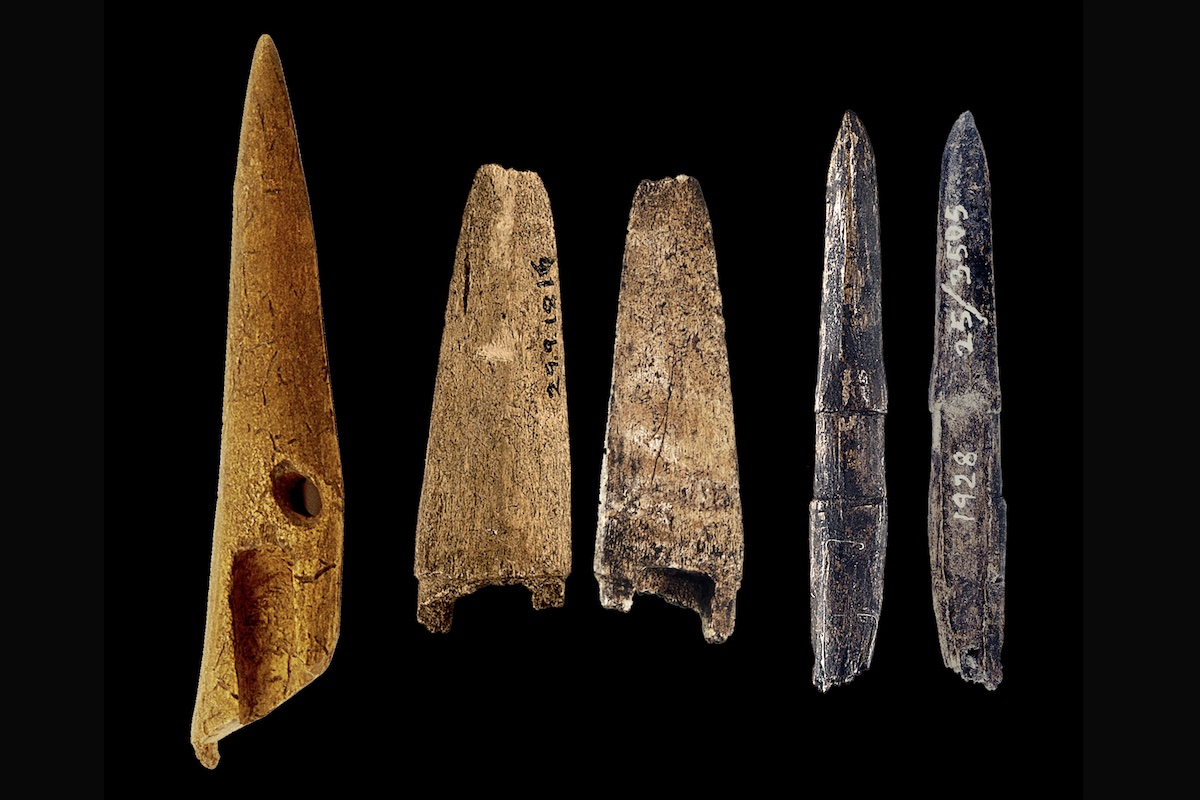
Modified bird wing bones, probably shaman’s equipment. Top pair from Port au Choix cemetery. Bottom pair from Red Paint village site, North Haven Island, Maine (~17 cm long).
In a 2017 article published in Science, Ann Gibbons wrote about the power of DNA analysis to “bust” the myths associated with Europeans’ origins: “Despite their tales of origin, most people are the mixed descendants of many migrations… As techniques for probing ethnic origins spread, nearly every week brings a new paper testing and then falsifying lore about one ancient culture after another.” Gibbons properly describes this as a positive development. But if this principle is true for the so-called old world, why is it untrue in regard to Indigenous peoples? The only way one might consider Duggan’s research to be offensive or controversial is to such extent as one might wish to preserve the idea of Indigenous peoples as staking out an unbroken genetic (and therefore moral) claim to this or that part of North America. Certainly, I can think of no other basis on which Duggan might be required to secure the permission of modern First Nations (as they are known in Canada) to conduct scientific research on populations that haven’t existed for thousands of years.
As it turned out, I had been naïve about the extent to which this kind of politics was now interfering with paleogenetic research. The ideologically correct approach had been articulated at a 2019 Brown University conference titled “State of the Field: The Ancient DNA Revolution in Archaeology.” There, Robert Preucel of Brown’s Haffenreffer Museum presented a roster of speakers who laid out what they regarded as state-of-the-art ethical standards in the field. They advised audience members to pursue a “commonly agreed set of best practices” with “descendant communities”—especially when paleogenomic conclusions challenge, or conflict with, community knowledge about the past. Folklore and myths must be taken into account, and we must discourage the idea of science “controlling the narrative.”
Moreover—and here is where I began to understand why Duggan’s lab had suddenly gone dark on this issue—“Even if we can’t seek consent from the study subjects themselves for inclusion in our ancient DNA studies, descendant-affiliated or geographically proximate communities should be consulted and engaged prior to the start of research because they may wish to speak for the ancestors” (my emphasis).
This anti-paleogenetic movement, as I would describe it, has roots dating back to the American Indian Movement (AIM) of the 1960s. AIM emerged among urban-dwelling Indigenous neighborhoods, not on Indian reservations (though AIM does deserve credit for calling out the poor living conditions in those communities). This was an important cause. But over time, AIM became more radicalized thanks to the influence of activists who sought to block scientific research in the name of cultural sensitivity. Eventually, this movement led to the passage of the Native American Graves Protection and Repatriation Act (NAGPRA) of 1990, a US law requiring federally funded entities to return “cultural items” (as broadly defined) to the ancestors or cultural affiliates of the communities from which those items originated…
Even those who do not follow paleogenetic controversies closely may know Kennewick Man, the name assigned to the 9,000-year-old remains of a prehistoric Paleoamerican man found in Washington state 25 years ago. In that case, the remains were found to be related to tribes still present in the area where Kennewick Man was found [See my blog here about Kennewick Man] (although this finding remains contested by some). But in many other cases, such local linkages have been harder to find. DNA from two 11,000-year-old skeletons discovered the following year in Spirit Cave, Nevada, for instance, were found to be more closely related to living Indigenous South Americans than to living Native North Americans. A much younger skeleton (about 700 years old) from Lovelock Cave, Nevada, was found to be a close genetic match with the Spirit Cave remains, and so also contained evidence of ancestry from a Mexican-related population. Nevertheless, in 2018, all three skeletons were handed over to the local Paiute-Shoshone for reburial because they had been found on their (currently understood) aboriginal homelands. “Repatriating” human remains to groups in this way has simply become the path of least resistance.
Also instructive is the case of 4,000-year-old human skeletons from the Nevin site in Blue Hill, Maine, which are held at Harvard’s Peabody Museum. These are the only well-preserved Red Paint People skeletal remains ever found, and thus are critical to resolving such issues as the relationship between them and the Maritime Archaic of Newfoundland-Labrador. They were analyzed at Reich’s Harvard lab five years ago, but the results remain unpublished (though verbal reports indicate that they bear no close relationship to the Penobscot or any of the other federally-recognized Indian tribes in Maine).
The wonderful collection of artifacts found with the Nevin skeletons were housed at a museum named for a different Peabody, the R. S. Peabody Museum at Phillips Academy in Andover, Massachusetts. Absent the publication of the Nevin DNA analyses, the director of that museum decided to honor a request from the Penobscots for their repatriation—even though he was apparently fully aware of the surrounding paleogenetic facts. And so the remarkable Nevin collection was never adequately catalogued or photographed, much less fully analyzed and reported. Requests from researchers to tribal officials about their whereabouts reportedly have, to my knowledge, gone unanswered.
Of course, some might say that there is only theoretical value in knowing about early human life in North America—so why not simply accede to the requests of Indigenous peoples? By way of answer, consider that Reich’s lab at Harvard has published a staggering amount of paleogenetic data, much of it relating directly to human wellbeing. Svante Pääbo’s lab is similarly productive, as illustrated by a 2020 paper published in Nature, entitled ‘The major genetic risk factor for severe COVID-19 is inherited from Neanderthals.’ It identifies a gene cluster on chromosome 3 that is a “major genetic risk factor for severe symptoms in patients,” and shows that the risk is conferred by “a genomic segment of around 50 kilobases in size that is inherited from Neanderthals and is carried by around 50% of people in south Asia and around 16% of people in Europe.”
Such discoveries have been made regarding all manner of diseases. And we will never know how many new discoveries we may have missed now that human remains are being taken from—or freely given away by—scientists in the name of politics. It is past time for science to reassert itself for the benefit of all humanity.
Bruce Bourque is senior archaeologist, emeritus, at the Maine State Museum, and senior lecturer in Anthropology, emeritus, at Bates College.

