

These missionaries were stating, unequivocally, that the Indians were a remnant of the House of Israel, which implied that they were more than mere savages. They were the descendants of an advanced culture, which implied that they should be viewed differently by American society and should be given rights under the law.
In the summer of 1841, a group of Native Americans from the Sac and Fox tribes had been displaced from their homelands and were living in present-day Iowa. They agreed to cross the Mississippi River to Nauvoo, a Mormon settlement; to visit the Prophet Joseph Smith as described in a recorded meeting in LDS church history. “Thursday, 12—A considerable number of the Sac and Fox Indians have been for several days encamped in the neighborhood of Montrose. The ferryman brought over a great number on the ferryboat and two flat boats for the purpose of visiting me. [Joseph Smith describes] The military band and a detachment of Invincibles [part of the Legion] were on the shore ready to receive and escort them to the grove, but they refused to come on shore until I went down. I accordingly went down, and met Keokuk, Kis-ku-kosh, Appenoose, and about one hundred chiefs and braves of those tribes, with their families. At the landing, I was introduced by Brother Hyrum [Smith] to them; and after salutations, I conducted them to the meeting ground in the grove, and instructed them in many things which the Lord had revealed unto me concerning their fathers, and the promises that were made concerning them in The Book of Mormon. I advised them to cease killing each other and warring with other tribes; also to keep peace with the whites; all of which was interpreted to them. 339 The year before publication of the Squier and Davis report of 1848, the first company of Mormon pioneers entered the valley of the Great Salt Lake as a consequence of being driven out of their homes in Nauvoo, Illinois. This was the beginning of a westward migration of tens of thousands of their faithful into the valley of the Great Salt Lake, where they would establish the headquarters of their expanding settlements.
Chief Moses Keokuk [Kis-ku-kosh] a Sac [Sauk] Indian

Eastern Tribes of Indians

Moundville Archaeological Park outside Tuscaloosa, Alabama

Shawnee, Sauk and Algonquin Indians of America’s Heartland


“The Work Among the Lamanites” Elder Spencer W. Kimball
Of the Council of the Twelve Apostles Conference Report, October 1950, pp. 63-69
“…And then the Prophet Joseph Smith said,
. . . and there (in the Rocky Mountains) they (the Latter-day Saints) will open the door for the establishing the gospel among the Lamanites who will receive the gospel and their endowments and the blessings of God.And Brother John Taylor said:
. . . the work among the Lamanites must not be postponed if we desire to retain the approval of God. Oliver Cowdery, even in that early day, had found the Navajos in the far Southwest, and he reported it to the brethren, feeling that it was a very important thing. Then Wilford Woodruff said this further, as he went down into the southwest, in New Mexico, and visited among the Indians there. He said: “In my short communication of the second inst., I promised to give a fuller account of my visit to the Isletas which I will now endeavor to do. The Isletas are one of the Pueblo groups down in New Mexico.I view my visit among the Nephites one of the most interesting missions of my life, although short. I say Nephites, because if there are any Nephites on this continent, we have found them among the Zunis, the Lagunas, and the Isletas, for they are a different race of people, altogether, from the Lamanites. I class the Navajo, Moquis (Hopis) and Apaches with the Lamanites, although they are in advance of many Indian tribes of America. I class the Zunis, Lagunas, and Isletas among the Nephites.
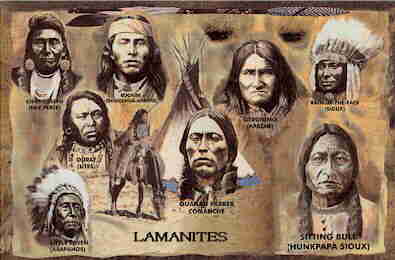
Brother Brigham Young said: “It is our duty to feed and teach these Indians.” Let me quote a few lines from him. He advised us to “educate them and teach them the gospel” so that many generations would not pass ere they should become a white and delightsome people (2 Ne. 30:6).
This is the land they and their fathers have walked over, called their own. And they have just as good right to call it theirs today as any children have to call any land their own. They have buried their fathers and mothers and children here. This is their home, and we have taken possession and occupy the land where they used to hunt. Now the game is gone, and they are left to starve… The Lord has given us the ability to cultivate the ground and reap bountiful harvests. We have an abundance of food for ourselves and for the stranger… We are living on their possessions and at their homes.
I should like to quote again from President John Taylor. He said:
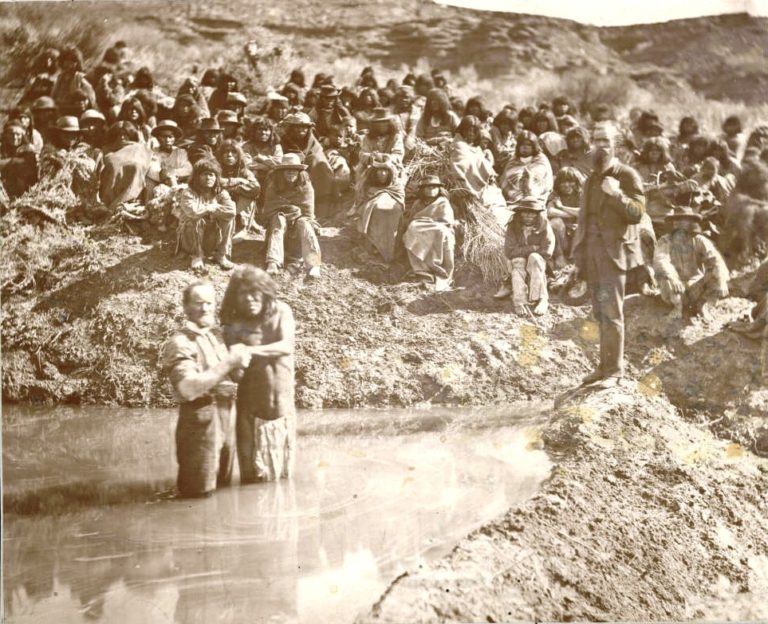
The work among the Lamanites must not be postponed if we desire to retain the approval of God. Thus far we have been content simply to baptize them and let them run wild again, but this must continue no longer; the same devoted effort, the same care in instructing, the same organization and priesthood must be introduced and maintained in the House of Lehi as amongst those of Israel gathered from Gentile nations. As yet God has been doing all, and we comparatively nothing. He has led many of them to us, and they have been baptized, and now we must instruct them further and organize them into churches with proper presidencies, attach them to our stakes, organizations, etc., in one word, treat them exactly in these respects as we would and do treat our white brethren.” Spencer W. Kimball Of the Council of the Twelve Apostles Conference Report, October 1950, pp. 63-69