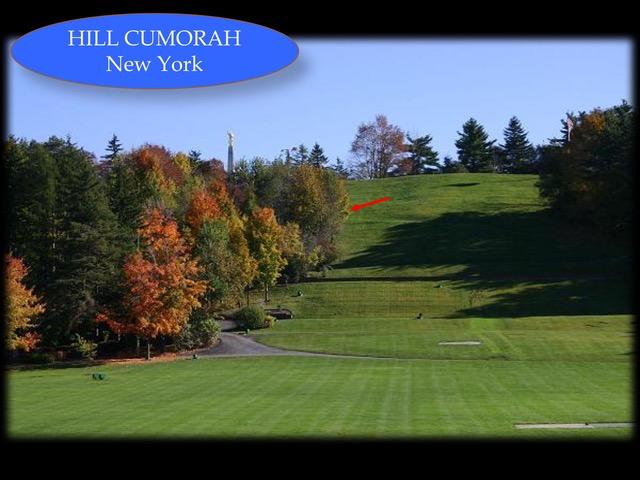
A friend of mine named Glenn asked me this question, “If the New York Hill is the one spoken of by Joseph Smith, why does Mormon 6:6 state the plates for the Book of Mormon were not deposited in Cumorah?” So Glenn was asking me about Mormon 6:6 which says, “save it were these few plates which I gave unto my son Moroni.” This led me into a thoughtful response I share below.

Editors note: Many of the Mesoamerican theorists dont believe Oliver or Joseph Smith, who assisted Oliver in the edition of the letter, that the hill Cumorah was indeed the very place where the final battles of the Nephites and Jaredites were fought. These theorists believe the NY cumorah was indeed the place where Joseph received the plates, but the final battles were waged some place in Mexico.
Oliver Cowdery Letter VII continues, “By turning to the 529th and 530th pages of the Book of Mormon, you will read Mormon’s account of the last great struggle of his people, as they were encamped round this hill Cumorah. In this valley fell the remaining strength and pride of a once powerful people, the Nephites—once so highly favored of the Lord, but at that time in darkness, doomed to suffer extermination by the hand of their barbarous and uncivilized brethren. From the top of this hill, Mormon, with a few others, after the battle, gazed with horror upon the mangled remains of those who, the day before, were filled with anxiety, hope, or doubt.” Oliver Cowdery’s Letter VII Joseph Smith Papers “Letter VII,” LDS Messenger and Advocate, July 1835, 1:155–159 .
Why do they believe this? a) They have a bias that the amazing buildings and pyramids in Mexico were built by the Nephites. b) They know about Brigham Young’s statement that Joseph had walked into a large cave in the NY Cumorah where many wagon loads of plates were stored, but these theorists believe that was a dream or vision somewhere in Mexico, not in the NY Cumorah hill. Thus not believing Brigham and many other leaders that there was a second depository in Cumorah for the many wagons of plates. Many members of the Church believe the events in the Book of Mormon began in Mesoamerica and a “hill” somewhere in Mexico was “the hill” (maybe a hill like Cumorah in New York) where the majority of Jaredite and Nephites records were hidden. They do believe the plates found by Joseph Smith in New York were the ones translated to become today’s Book of Mormon. Most of these members however, also believe the final battles between the Nephites and Lamanites happened somewhere in Mexico and not in New York at what we call hill Cumorah. Here is what the heading in the Book of Mormon says in regard to Mormon 6:6. “The Nephites gather to the land of Cumorah for the final battles—Mormon hides the sacred records in the hill Cumorah” Heading chapter 6. These Mesoamericanists believe this heading refers to what happened in Mexico, not America.
Last Battles in NY
President Marion G. Romney of the First Presidency stated: “I will give you a lesson today that the Lord has taken great pains to bring to us… In the western part of the state of New York near Palmyra is a prominent hill known as the “hill Cumorah” (Mormon. 6:6). [There] perished at the foot of Cumorah the remnant of the once mighty Jaredite nation, of whom the Lord had said, ‘There shall be none greater… upon all the face of the earth’ (Ether 1:43, p. 461). “As I contemplated this tragic scene from the crest of Cumorah and viewed the beautiful land of the Restoration as it appears today, I cried in my soul, How could it have happened?… This second civilization to which I refer, the Nephites, flourished in America between 600 B.C. and A.D. 400. Their civilization came to an end for the same reason, at the same place, and in the same manner as did the Jaredites…I bear you my personal witness that I know that the things I have presented to you today are true—both those pertaining to past events and those pertaining to events yet to come.” (145th Semiannual Conference, Saturday Morning Session, October 4, 1975; emphasis added.)
Also, Joseph Smith said while on Zions Camp in 1834 in Illinois on the banks of the Mississippi River, “The whole of our journey, in the midst of so large a company of social honest and sincere men, wandering over the plains of the Nephites, recounting occasionally the history of the Book of Mormon, roving over the mounds of that once beloved people of the Lord, picking up their skulls & their bones, as a proof of its divine authenticity…” Joseph Smith Papers Letter to Emma Smith, 4 June 1834 Page 56.
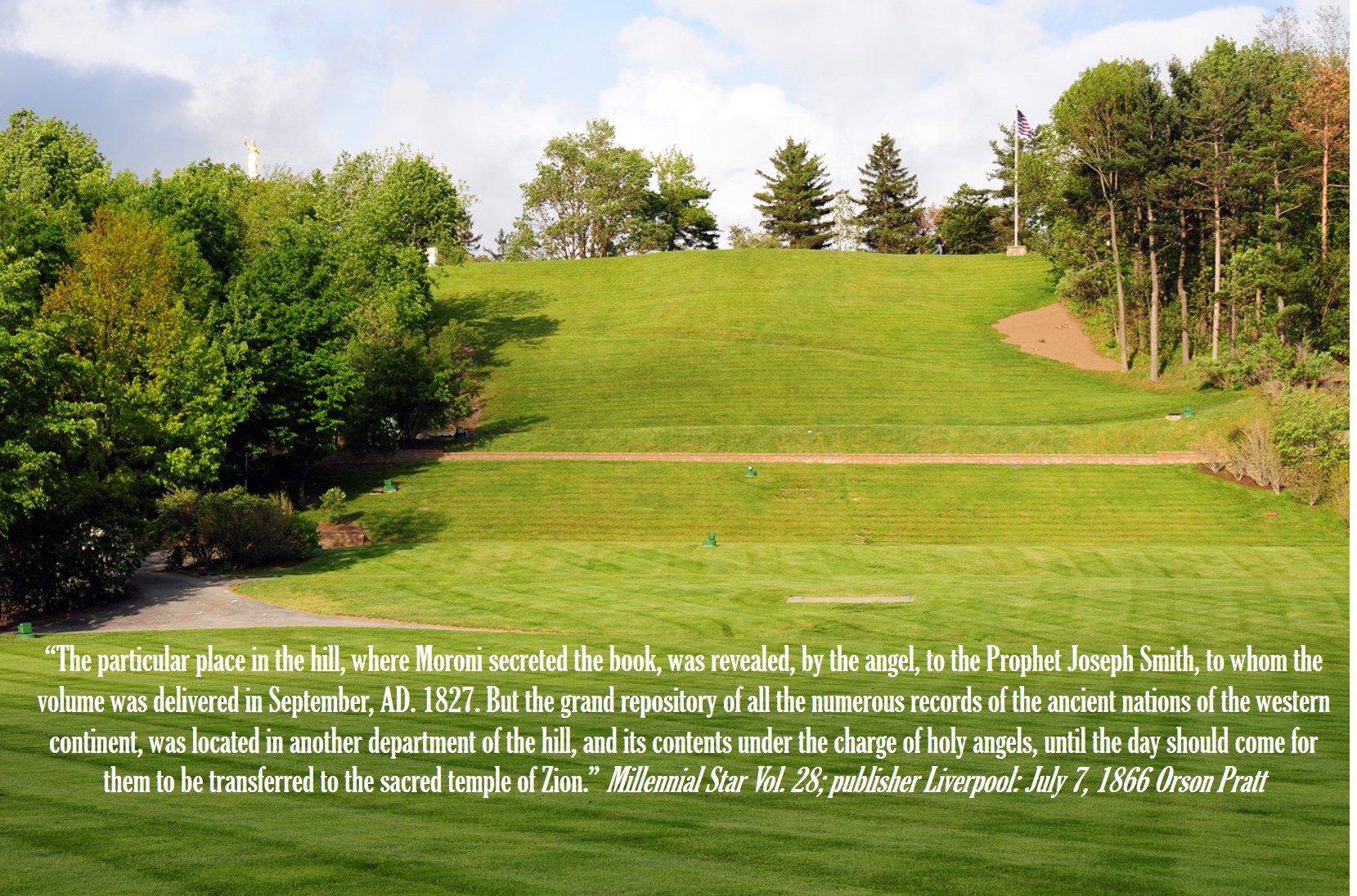
We read Mormon 6:6 saying, “And it came to pass that when we had gathered in all our people in one to the land of Cumorah, behold I, Mormon, began to be old; and knowing it to be the last struggle of my people, and having been commanded of the Lord that I should not suffer the records which had been handed down by our fathers, which were sacred, to fall into the hands of the Lamanites, (for the Lamanites would destroy them) therefore I made this record out of the plates of Nephi, and hid up in the hill Cumorah all the records which had been entrusted to me by the hand of the Lord, save it were these few plates which I gave unto my son Moroni.” First if Mormon would “not suffer the records…to fall into the hands of the Lamanites…”, wouldn’t that include ANY records including “these few” plates that Moroni had left? Yes!
Let’s assume “all the records” were hid up in the hill Cumorah as Mormon says above, except the very few plates that Mormon had left and gave those to his son Moroni. Which few plates would those be? Possibly those plates that had not been written upon by Mormon so that Moroni could write upon those plates himself. We read in Mormon 8:1, “Behold I, Moroni, do finish the record of my father, Mormon. Behold, I have but few things to write, which things I have been commanded by my father.” That probably means Mormon chapter 1-6 were written on plates by Mormon. The remainder of the few plates then would allow Moroni to write a “few things” in Mormon Chapter 8 and 9. Moroni then abridges the 24 plates of the Jaredites which he includes before he finishes writing on those “few plates” as we see in Ether chapter 1-15.
We sense it was not the complete record of the plates of Nephi, nor was it “all the records”, because we know Moroni also writes his final words in Moroni chapter 1 through 10 on some of those “few plates” Mormon had left him, and then Moroni runs out of ore as recorded in Mormon 8:5 saying, “Behold, my father hath made this record, and he hath written the intent thereof. And behold, I would write it also if I had room upon the plates, but I have not; and ore I have none, for I am alone.” Mormon 8:5
We know it had been 15 years since the death of Mormon as we read in Mormon 8:6 saying, “Behold, four hundred years have passed away since the coming of our Lord and Savior.” That means Moroni on these few plates was writing Mormon 6 verses 8 and 9, and abridging the 24 Jaredite records, and writing his own words in Moroni chapter 1-10. Were the 24 Jaredite records abridged using the “few plates” Mormon had left him, or were the few plates only Mormon 6 verses 8-9, and the Book of Moroni?
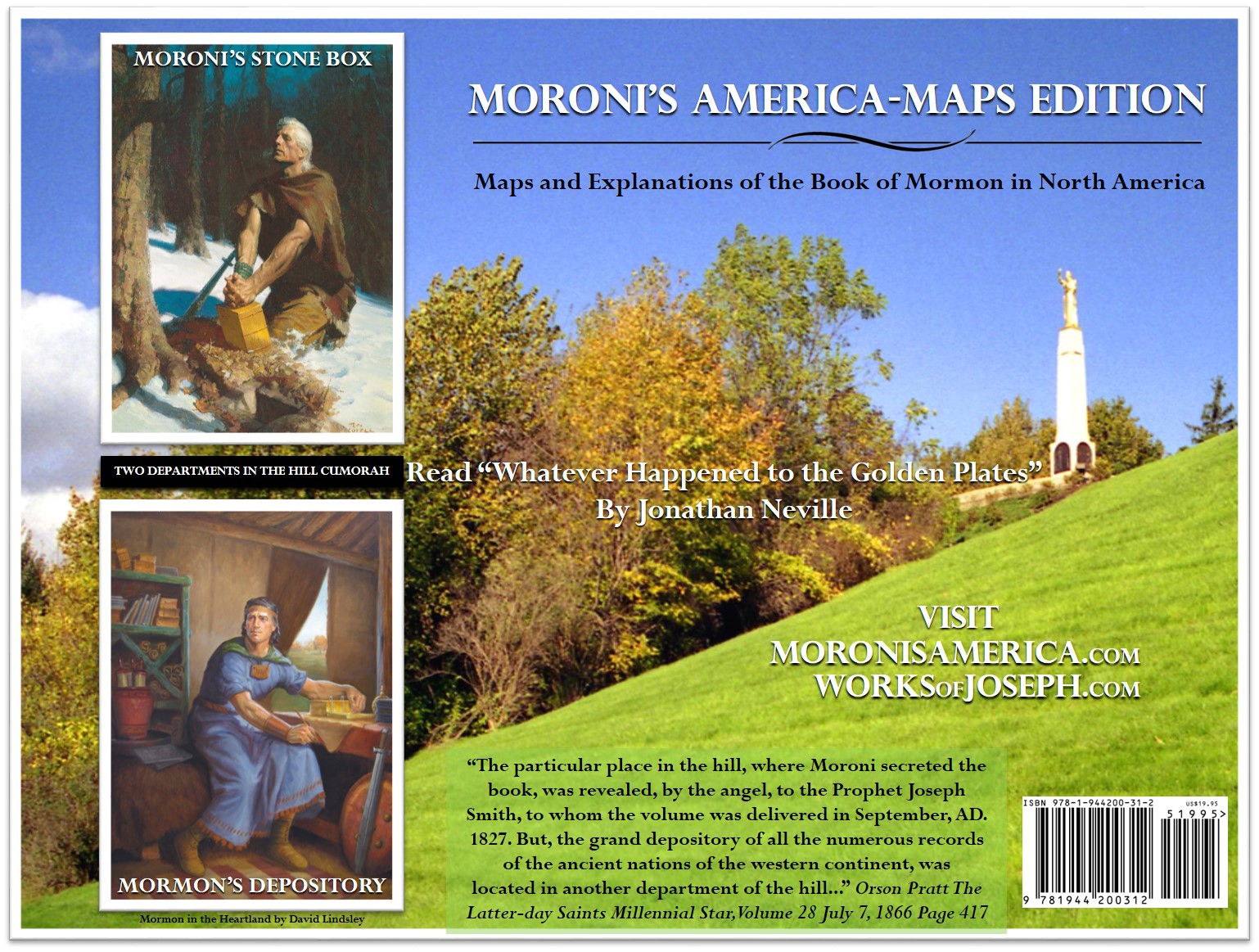
My conclusion: I believe there were two depositories at hill Cumorah in New York. One was called Cumorah’s Cave which had wagon loads (See Journal of Discourses, vol. 19, pp. 36-39 by Brigham Young) of Jaredite and Nephite records, along with the Sword of Laban, the Liahona, and many other sacred artifacts. But, the “few plates” Mormon gave to Moroni were added to the original plates of Nephi, as were the 24 Jaredite records, and then Moroni buried them all in the Stone Box at Cumorah not in the Cave of Cumorah.
As Orson Pratt says, “The hill Cumorah, with the surrounding vicinity, is distinguished as the great battlefield on which, and near which, two powerful nations were concentrated with all their forces. Men, women and children fought till hundreds of thousands on both sides were hewn down, and left to molder upon the ground. . . .
These new plates were given to Moroni to finish the history. And all the ancient plates, Mormon deposited in Cumorah, about three hundred and eighty-four years after Christ. When Moroni, about thirty-six years after, made the deposit of the book entrusted to him, he was, without doubt, inspired to select a department of the hill separate from the great depository of the numerous volumes hid up by his father. The particular place in the hill where Moroni secreted the book, was revealed, by the angel, to the prophet Joseph Smith, to whom the volume was delivered in September, A.D. 1827. But the grand repository of all the numerous records of the ancient nations of the western continent, was located in another department of the hill, and it’s contents under the charge of holy angels, until the day should come for them to be transferred to the sacred temple of Zion.” 1866 Orson Pratt Millennial Star (28 (27): 417)
In relation to these records, Orson Pratt commented in 1873: “But will these things be brought to light? Yes. The records, now slumbering in the hill Cumorah, will be brought forth by the power of God, to fulfil the words of our text, that ‘the knowledge of God shall cover the earth, as the waters cover the deep.'” (Orson Pratt, May 18, 1873, in Journal of Discourses 16:57)
Pres Ivins said, “According to the Book of Mormon, many hundreds of thousands of people fell in battle around this hill and in the immediate vicinity. It was here that two once-powerful nations were exterminated so far as their national existence was concerned. It was here that these nations gathered together for their last great struggles.
All of these incidents to which I have referred, my brethren and sisters, are very closely associated with this particular spot in the state of New York. Therefore I feel, as I said in the beginning of my remarks, that the acquisition of that spot of ground is more than an incident in the history of the Church; it is an epoch—an epoch which in my opinion is fraught with that which may become of greater interest to the Latter-day Saints than that which has already occurred. We know that all of these records, all the sacred records of the Nephite people, were deposited by Mormon in that hill. That incident alone is sufficient to make it the sacred and hallowed spot that it is to us. I thank God that, in a way which seems to have been providential, it has come into the possession of the Church.” (“The Hill Cumorah” by President Anthony W. Ivins, Improvement Era, 1928, Vol. Xxxi. June, 1928 No. 8 .)