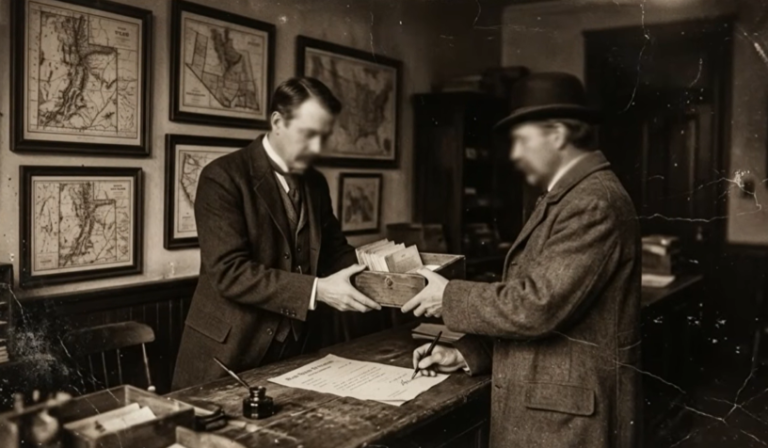
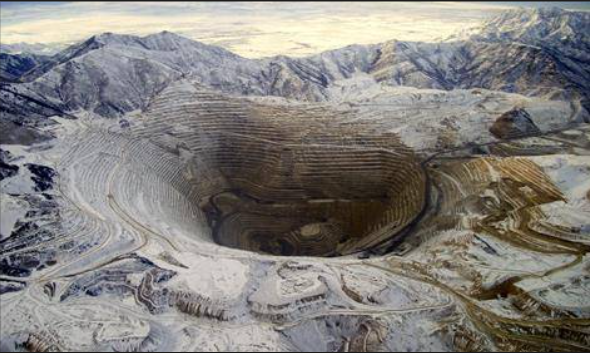
I share some history in Utah that may connect to the timelines of the Book of Mormon as I discuss the Bingham Canyon Mine below. Under the Bingham Canyon Mine were found shafts and tunnels with hidden artifacts and a likely validation of activity and archaeology dating from the Fremont culture 1-1300 AD, Adena and Hopewell time lines as well.
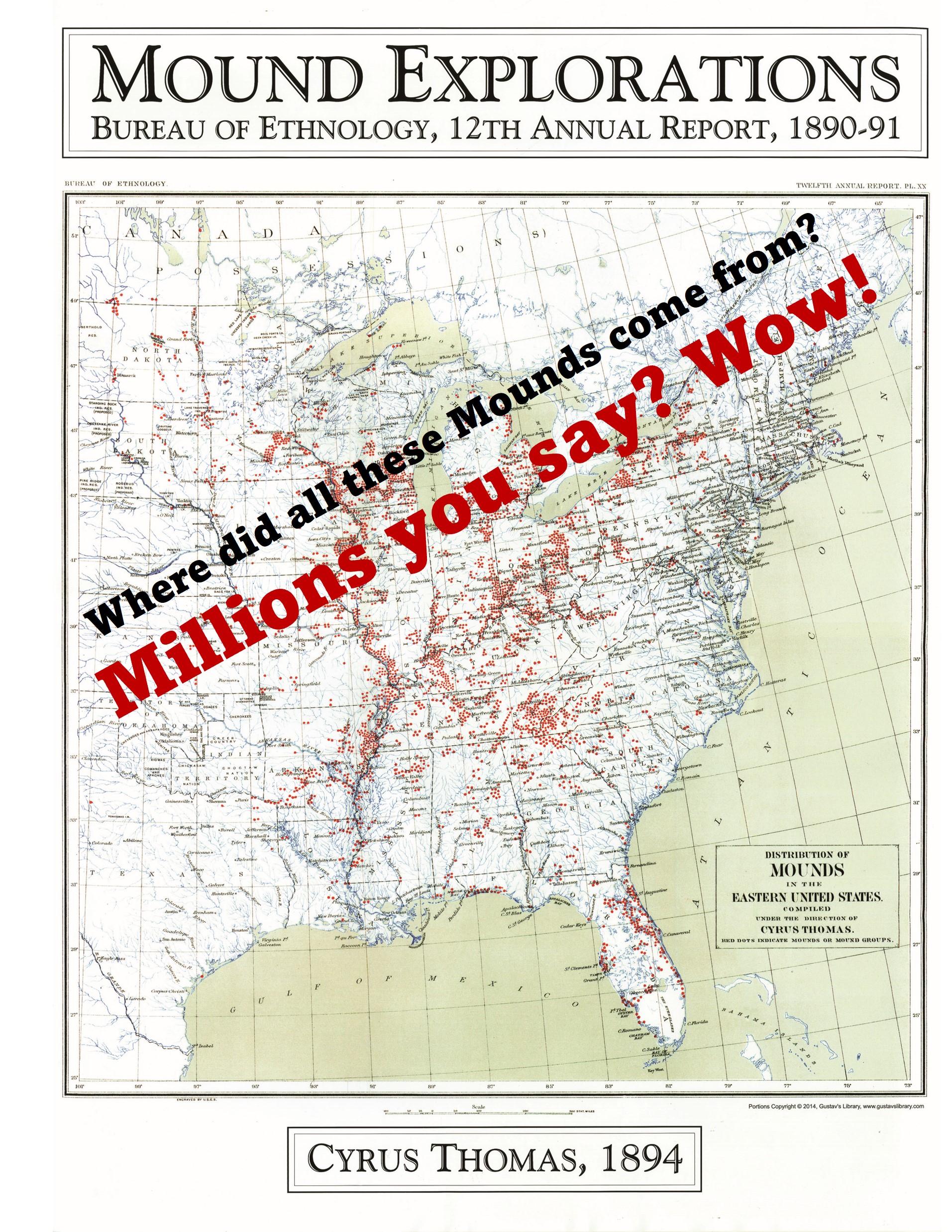
I believe it very possible that the Jaredites in about 2200 BC landed near Seattle Washington and they migrated all over Canada, The USA and Central and South America as show on the map below. Details here: bookofmormonevidence.org/jaredites 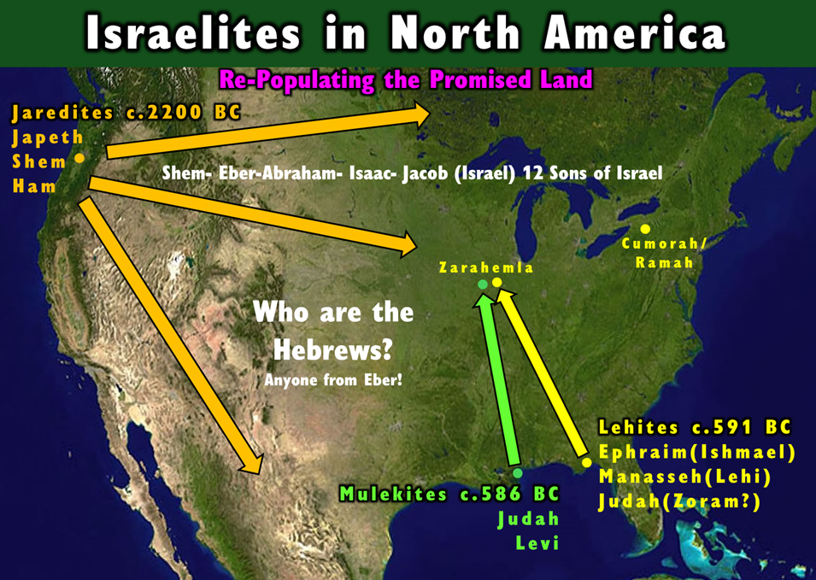
Bingham Canyon Mine Est. 1906
Much information below are segments from the Video ” What They Found in the Bingham Canyon Copper Mine in 1906 — Three Shafts Were Sealed That Week”
“The Bingham Canyon Mine is now the largest man-made excavation on Earth. You can see it from space, but nobody talks about what the original crews found before the industrial operation began, and nobody explains why a copper mine needed to seal off sections that contain no copper at all… Now, to understand what happened in those sealed shafts, you need to know what Bingham Canyon was before it became a mine.
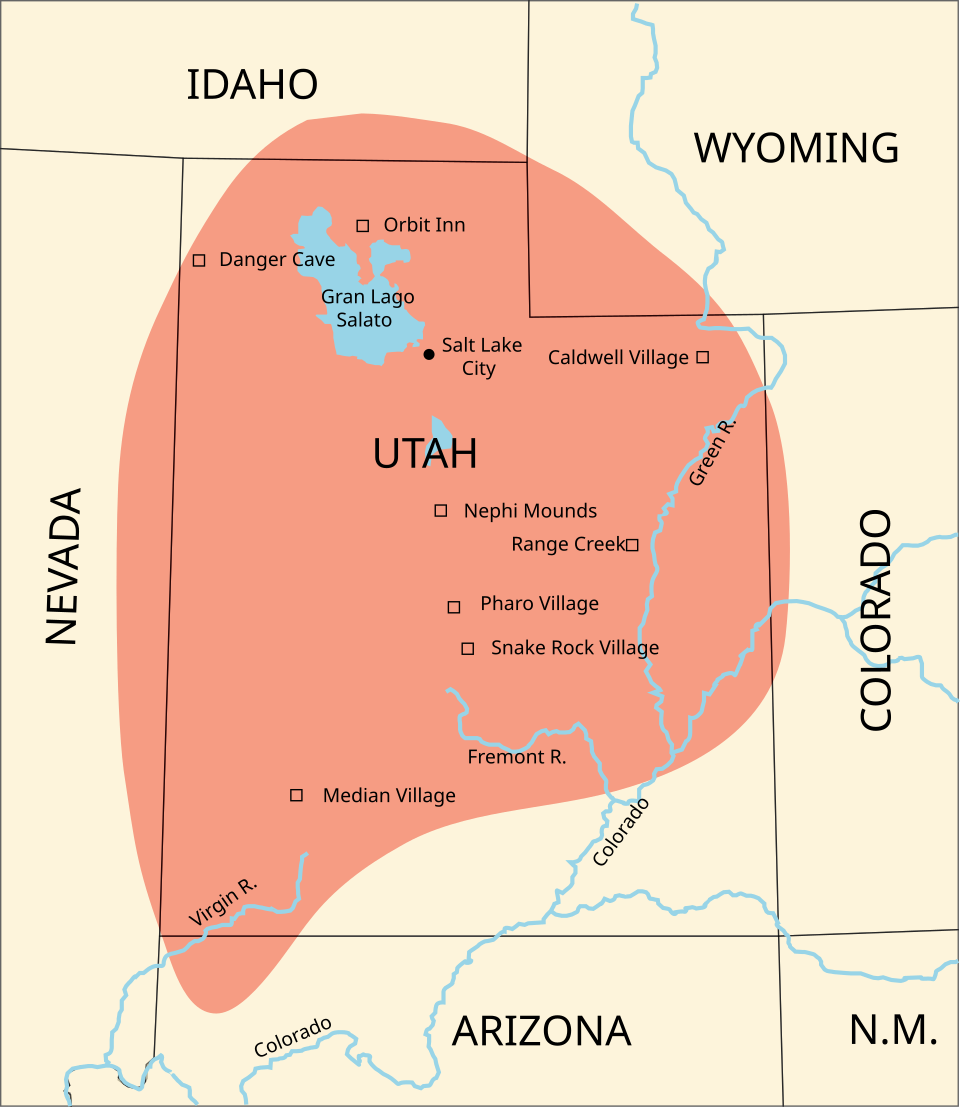
The Aqua of Mountains where Bingham Canyon sits have been inhabited for over 8,000 years. The Fremont people, then the Shoshone, considered the canyon sacred. Their oral histories describe it as a place where the old ones built into the mountain long before their ancestors arrived. The Shoshoni had specific warnings about certain areas of the canyon. Tribal elders told early settlers that some sections were forbidden, not because of spiritual taboos, but because people who entered certain caves didn’t come back the same.
They spoke of stone rooms that sang and tunnels that went down forever. Those warnings were documented in the journals of Jedidiah Smith, the first American explorer to traverse the region in 1826. Smith noted that his Shoshoni guides refused to approach the western face of the canyon, claiming it was a place of the ancients, not meant for the living.
When Mormon settlers reached the area in 1848, they found something strange. The canyon already had excavations, small test pits, sure, but also larger openings that showed evidence of metalwork far older than any Native American activity in the region.
Brigham Young surveyors noted worked tunnels of unknown origin in reports from 1850. One surveyor, a man named Erasmus Snow, went further in his personal correspondence. In a letter to his brother dated November 1851, he described finding a shaft descending at a precise angle, its walls bearing chisel marks of such uniformity that no hand tool could have made them. We dropped stones and counted to 30 before hearing them strike bottom. That’s over 400 ft deep. In 1851, cut into solid rock with precision that shouldn’t have been possible with the technology available to pre-Colombian cultures.
These weren’t natural caves. The walls were too uniform, the angles too precise. By the 1860s, small-scale mining operations started pulling copper and silver from surface deposits. The deeper they went, the more inconsistencies appeared. Miners kept hitting voids that shouldn’t exist in that geology. Spaces that had been deliberately carved out, then backfilled with material that didn’t match the surrounding rock. In 1896, the Boston Consolidated Mining Company bought up claims across the canyon. Their geologist, Samuel Newhouse, wrote in a private letter to investors about pre-existing excavations of considerable age interfering with our survey grid. That letter is in the Bancroft Library Archives at UC Berkeley. I found it three years ago while researching unrelated mining records. New House recommended against deep drilling in certain sections. He marked them on maps as unstable substrate. But the term he used in his field notes was different. Chambers, artificial origin, extent unknown. Nobody listened.
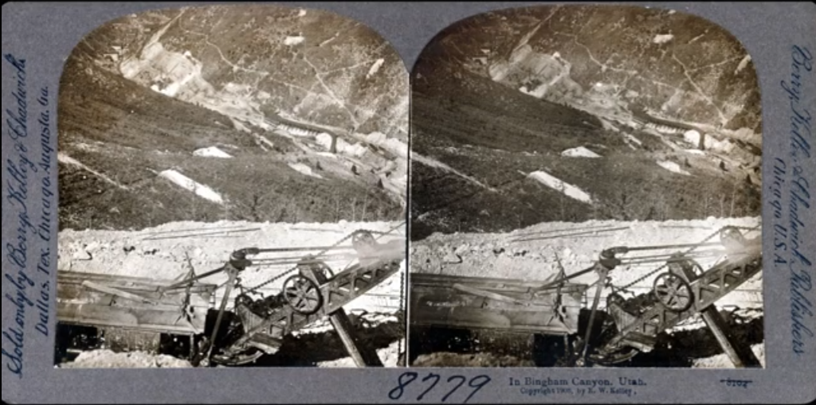
By 1903, industrial operations were underway. Steam shovels, dynamite, the kind of extraction that doesn’t stop for historical curiosities. Then came April 1906. The first discovery happened on April 11th. A drilling team working the southwest face about 280 ft down broke through into a cavity. Not a natural fisher, a rectangular space roughly 12 ft high extending back into the mountain in a straight line. The drill operator’s name was Clayton Moore.
His account, recorded in a later deposition for an unrelated lawsuit, describes what he saw when they lowered a lantern into the opening. The walls were smooth. Dress stone fit so tight you couldn’t slide a knife blade between the blocks. And there were markings, not Indian markings, symbols I’d never seen, running in bands along the ceiling. Moore’s crew reported the find to the shift supervisor, a man named Holay. Holay went down himself with two engineers. They spent 4 hours inside that chamber before coming back up and immediately wiring the Boston office.
What happened next is where the story gets deliberately vague. in official records. The mine’s daily operations log for April 12th through April 14th is missing from the archives. Just those three days, every other day in 1906 is accounted for. Those three pages were removed and the binding shows they were cut out carefully, not torn. But we have the personal diary of one of the engineers who went into that first chamber. His name was Robert Ashworth and his granddaughter donated his papers to the Utah State Historical Society in 1978. She had no idea what was in them.
Ashworth wrote that the chamber extended at least 200 ft into the mountain. The walls weren’t just smooth. They showed evidence of tool marks consistent with advanced metal working. Circular saw patterns in granite. precision cuts that would require diamond tipped industrial equipment, equipment that didn’t exist in the 1800s or the 1700s, or according to conventional history any time before the 20th century. Ashworth describes finding three distinct layers of construction… 1:12 to 6:26 minute of What They Found in the Bingham Canyon Copper Mine in 1906 — Three Shafts Were Sealed That Week
Video continued from 6:50 to 9:12
“On April 13th, two more chambers were discovered. One directly below the first, accessed by what Ashworth called a descending corridor with steps too wide for normal human stride. The second was in the North face at a depth of 310 ft, and it was different. This one had artifacts. Ashworth’s description is precise. He was an engineer trained to document what he saw without embellishment. He describes finding metal implements that showed no rust despite obvious age. Containers made of a ceramic material he couldn’t identify and a series of stone tablets carved with the same symbols they’d seen in the first chamber.
The metal objects were particularly anomalous. Ashworth noted that they appeared to be made of an alloy he couldn’t classify, not bronze, not iron. When struck, they produced a tone that resonated for several seconds, like a bell, but deeper. One piece was shaped like a cutting tool with an edge that was still sharp enough to scratch steel. The ceramic containers had a strange property. They were translucent when held up to lamp light, revealing internal structures that suggested they had been molded or cast rather than hand formed. Some contained residue that Ashworth described as crystalline powder, white with hints of blue, that left a metallic taste when accidentally touched to the tongue. He took samples. Those samples were confiscated when the chambers were sealed. One of the tablets had a diagram. Ashworth sketched it in his diary. It shows a cross-section of the canyon with multiple levels of chambers connected by vertical shafts.
The diagram indicated at least seven levels descending over 800 ft. But there was more to that tablet. Around the edges of the diagram were what appeared to be numerical notations. Ashworth, who was fluent in multiple languages and had studied ancient mathematics as a hobby, recognized the numbering system as base 12, not base 10. Duo decimal counting, the kind used by the Sumerians and Babylonians thousands of years before the common era.
Why would a structure in Utah use a mathematical system from ancient Mesopotamia? That charmed drawing stayed hidden in Ashworth’s personal effects for 72 years…” From the video below, What They Found in the Bingham Canyon Copper Mine in 1906 — Three Shafts Were Sealed That Week
Video below from about 14 minutes onward.
“Now, let’s talk about what those chambers actually were. The architectural style Ashworth described doesn’t match any known Native American construction. The Fremont people built pit houses and granaries. The Shoshone used temporary structures. Neither culture worked in dressed stone blocks with precision joinery. But it’s not just the style, it’s the engineering.
Ashworth documented joint tolerance of less than 1 millimeter between stone blocks weighing several tons each. That level of precision requires not just skill, but measurement tools accurate to fractions of an inch and lifting equipment capable of positioning massive weights with surgical accuracy. The ancient Egyptians achieved similar precision at Giza, but they had thousands of workers, decades of time, and a centralized state apparatus to support the effort. Who had that infrastructure in pre-Colombian Utah?
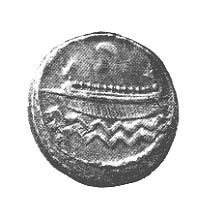
The symbols Ashworth sketched in his diary show geometric patterns similar to pre-Colombian Central American iconography, but with the symbols Ashworth sketched in his diary show geometric patterns similar to pre-Colombian Central American iconography, but with significant differences. Some researchers have compared them to ancient Phoenician or even proto-Sumerian writing systems, though the connection is speculative at best.
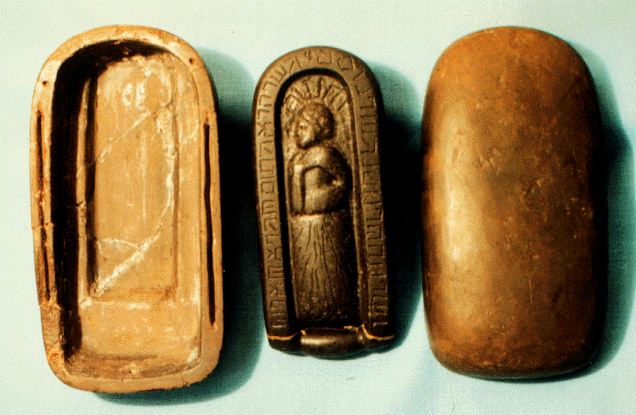
What’s interesting is that similar symbol sets have appeared in other anomalous North American sites. The grave creek stone from West Virginia discovered in 1838. The Bat Creek stone from Tennessee found in 1889. The Los Luna Decalogue stone in New Mexico which bears Paleo Hebrew script and has been carbon dated to anywhere between 500 BCE and 500 CE depending on which expert you ask.
All of these artifacts suggest contact between the old world and the Americas long before Columbus. And all of them have been dismissed, ignored, or locked away by mainstream archaeology. The Bingham Canyon symbols fit that pattern. They suggest knowledge that wasn’t supposed to be here. What isn’t speculative is the construction technique. The fused material Ashworth mentioned appears in other anomalous sites around the world.

Vitrified stone created by exposing rock to temperatures above 100° C. The process requires sustained controlled heat that ancient cultures supposedly couldn’t generate. Yet, it shows up in Scottish hill forts, in the Sahara Desert, and in certain megalithic sites across Europe and Asia, and now apparently 300 ft below a mountain in Utah.
The most famous examples are the vitrified forts of Scotland. Over 60 sites where stone walls have been melted and fused together…” From the video below, What They Found in the Bingham Canyon Copper Mine in 1906 — Three Shafts Were Sealed That Week
Rockefeller and Guggenheim Conspiracy
21:55 to 25:39
Another former employee, a drill operator who worked the mine from 1987 to 2003, reported that his crew once hit a void at a depth of 520 ft. They were immediately pulled back. The hole was filled with concrete and the drilling pattern was retooled. He was told it was a legacy issue and to include nothing about the incident in his daily report.
A void at 520 ft. below the areas where the 1906 chambers were sealed. Exactly where Ashworth’s diagram predicted there would be deeper levels. But why? If they’re just empty rooms, why not excavate them and move on? If they contain artifacts, why not study them or at least document them properly? The answer might lie in who owned the Boston Consolidated Mining Company in 1906. The majority shareholder was a man named William Rockefeller, brother of John D. Rockefeller.
The company’s board included members of the Guggenheim family who controlled much of the American copper industry at the time. These weren’t small-time prospectors. They were industrialists with connections to the highest levels of government and academia. But there’s more to the Rockefeller connection.
William Rockefeller was deeply involved in what was then called industrial archaeology. the practice of studying ancient construction techniques to improve modern engineering. He funded expeditions to Egypt, Mesopotamia, and Peru specifically to document advanced construction methods used by ancient civilizations.
In 1904, 2 years before the Bingham Canyon discovery, Rockefeller donated funds to establish the Department of Archaeology at the American Museum of Natural History in New York. One of the department’s first projects was cataloging anomalous American artifacts that didn’t fit conventional historical timelines. The department’s archives are still restricted. Researchers need special permission to access them and even then certain collections are marked as under review indefinitely. The Guggenheims had similar interests.
Daniel Guggenheim, who served on the Boston Consolidated Board, was a trustee of the Smithsonian Institution and personally funded several archaeological expeditions in the American Southwest between 1902 and 1910. The artifacts collected during those expeditions were supposed to be cataloged and displayed. Most of them never were. If they found something in those chambers that challenged the accepted history of human civilization in North America, they had both the resources and the motivation to bury it, literally. And they had the infrastructure to do it quietly.
The Rockefellers and Guggenheims controlled mining operations, railroads, museums, and academic institutions. They could move artifacts, seal sites, and suppress information without raising public suspicion because they owned every link in the chain of custody.
There’s a pattern here that shows up across multiple sites. When evidence emerges that doesn’t fit the established timeline, it gets categorized as an anomaly, dismissed as misidentification, or simply removed from public access.
https://www.youtube.com/watch?v=ZDxNHJUFGIY
Living Dates of the Fremont People in Utah
The Fremont culture—named after the Fremont River in Utah—thrived in what is now Utah and parts of Nevada, Idaho, and Colorado for roughly 1,000 to 1,300 years. Archaeological evidence and historical records place their occupation in Utah from about 200 AD to 1300 AD Utah Stories. Some sources give a slightly broader range, from AD 1 to 1301, reflecting regional variations in settlement and cultural continuity Wikipedia.
Timeline and Context
- Earliest evidence: Maize farming in Utah began around 100 B.C. in the Sevier Valley, spreading over centuries History to Go.
- Peak period: The Fremont culture reached its height in the 11th and 12th centuries AD, with widespread farming, rock art, and distinctive pottery History to Go.
- Decline: After about 900 AD, the landscape shifted from a mix of farming and foraging to a more settled, agricultural society. Over time, the Fremont culture was gradually replaced or absorbed by Numic-speaking peoples—ancestors of the Ute and Shoshone—who moved into the region from the west Utah Stories+1.
Cultural Life
The Fremont were semi-sedentary, agrarian societies who farmed corn, beans, and squash, supplemented by hunting, gathering, and gathering native plants like pinyon nuts and berries Legends of America+1. They lived in pit houses, wickiups, and rock shelters, and are known for their rod-and-bundle baskets, grayware pottery, and moccasins with dew claws for traction Legends of America+1.
In summary: The Fremont people lived in Utah from roughly 200 AD to 1300 AD, with their culture flourishing for over a millennium before being replaced by later Indigenous groups Utah Stories+1.
Nephites and Jaredites in Utah
I will share some additional information about Nephites and Jaredites roaming around the area of Utah according to leaders and others.
We believe the original Lamanites likely landed near Florida. The Lamanites chased Nephi north into Tennessee and later Mosiah went northward into Missouri and Iowa. This is called the Heartland theory. We do also believe that over many years the Lamanites migrated all over Canada, western USA and into South and Central America. According to Parley P. Pratt, the first mission to the Lamanites was in 1830 to Buffalo NY, Sandusky Ohio and Independence MO. See D&C 28, 30, and 32.
We also know the Prophet Joseph Smith said the saints would settle right in the midst of the Lamanites in Utah.
In the Midst of the Lamanites
“No,” said the old Patriarch [Joseph Smith Sr.], his whole being seeming to be alive with animation. “The Lord has told Joseph that when we leave here we will go into the Rocky Mountains, right into the midst of the Lamanites.”
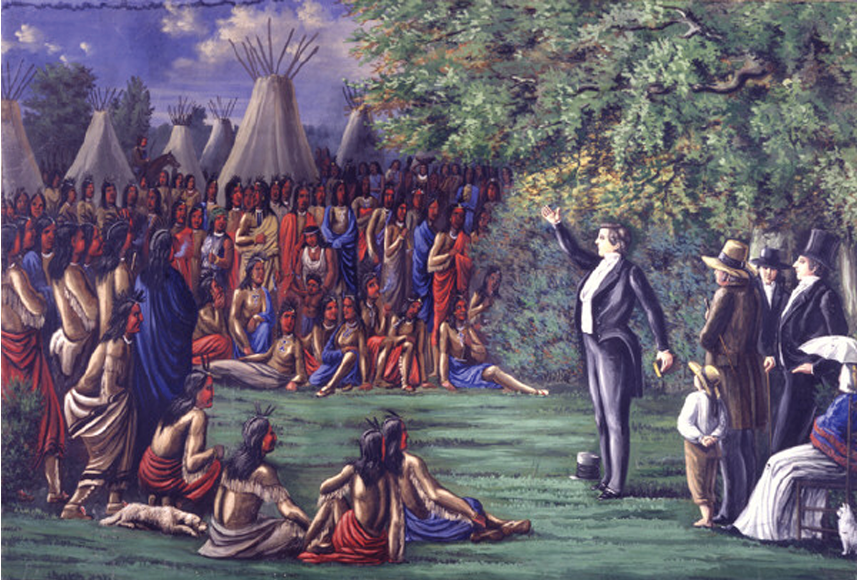 This information filled our hearts with unspeakable joy, for we knew that the Book of Mormon and this gospel had been brought to light more for the remnants of Jacob upon this continent than for the Gentiles.
Father Smith again enjoined upon us profound secrecy in this matter, and I don’t think it was ever uttered by one of Father Huntington’s family.
The history of Nauvoo shows that we located in Nauvoo in 1839 and left it in 1846.
See Sources here: The Young Woman’s Journal, II, (December, 1890), pp. 124-125; (February, 1891), pp. 225-226; (April, 1891), pp. 314-315; (May, 1891), p. 366; (July, 1891), pp. 466-468; IV (March, 1893), pp. 274-275; (April, 1893) pp. 320-321; (June, 1893), pp. 424-425; Hyrum L. Andrus and Helen Mae Andrus, comps., They Knew the Prophet [Salt Lake City: Bookcraft, 1974], 63
Brigham Young also spoke about Gadianton’s in the mountains near St George.
Gadianton Robbers in Utah
Upon one occasion President Brigham Young was in the Tabernacle at St. George and was speaking on the spirit world. He stated that it was not far from us and if the veil could be taken from our eyes there wouldn’t be either a man, woman or child who would dare go out of “this tabernacle as the spirits of the Gadianton robbers were so thick out there. This is where they lived in these mountains,” said he.” Crowther, Duane S., 1967, Life Everlasting, Bookcraft, SLC, UT, p. 165, as quoted from N. B. Lundwall, Temples of the Most High, p. 89.
“Of course, the significance of this statement makes sense only in light of the land of Zarahemla being in the United States [D&C 125]. The Nephites wouldn’t have gone all the way from Mexico into the United States to hunt the Gadianton Robbers, nor would the Gadiantons have gone into the United States to hide from Nephites in Mexico. It is clear that since the Gadianton Robbers were hiding out in Utah in the St. George region, the Land of Zarahemla must have been in the United States as well. The “mountains” mentioned in the following scriptures, therefore, are the Rocky Mountains of the United States.” Some references used from Joseph Smith Foundation Website
We also have an amazing story from an early pioneer named Zeke Johnson that shows possible Nephites or Jaredites in Utah.
A Nephite or a Jaredite?
EXPERIENCE OF ZEKE JOHNSON, son of Joel Hills Johnson, born in 1869. (Recorded in the JOHNSON BULLEITN, September 1973)
“I have been requested to relate an experience I had in 1908-9 in San Juan Co. I was just making a home in Blanding and the whole country there was covered with trees and sagebrush. I was working hard to clear the ground to plant a few acres of corn. We had five acres cleared and stared to plant corn. My little boy, Roy, about 7 or 8 years old was there to help me plant the corn. I’d plow around the place, then he would plant the furrow with corn, then I’d cover it and plow again. While I was plowing on that piece of ground, I discovered there were ancient houses there, that is the remains of them.
As I was plowing around I noticed that my plow had turned out the skeleton of a small child, the skull and backbone, but most of the bones of course were decayed and gone. Part of the skeleton was there, so I stopped immediately as my plow had passes it a little. I turned and looked back against the bar of the plow between the needles. As I was looking at that little skeleton that I had plowed out and wondering, all of a sudden, to my surprise, I saw the bones begin to wiggle and they began to change position and to take different color and within a minute there lay a beautiful little skeleton. It was a perfect little skeleton.
Then I saw the inner parts of the natural body coming in the entrails, etc. I saw the flesh coming on, and I saw the skin come on the body when the inner parts of the body were complete. A beautiful head of hair adorned the top of the head, and in about a half minute after the hair was on the head, it had a beautiful crystal decoration in the hair. It was combed beautifully and parted on one side. In about half a minute after the hair was on the head, the child raised up on her feet. She was lying a little on her left side with her back toward me. Because of this I wasn’t able to discern the sex of the child, but as she raised, a beautiful robe came down over her left shoulder and I saw it must be a girl.
She looked at me and I looked at her, and for a quarter of a minute we just looked at each other smiling. Then in my ambition to get hold of her, I said, ‘Oh you beautiful child.’ I reached out as if I would embrace her and she disappeared. That was all I saw, and I just stood there and wondered and thought for a few minutes… Now, I couldn’t tell that story to anyone, because it was so mysterious to me and such. Why should I have such a miraculous experience? I couldn’t feature a human being in such a condition as to accidentally plow that little body out and see it come alive. A body of a child about 5 to 7 years old, I’d say. I just couldn’t tell that story to anyone until finally, one day I met a dear friend of mine, Stake Patriarch, Wayne II. Redd of Blanding. He stopped me on the street, and said, ‘Zeke, you have had an experience on this mesa you won’t tell, and I want you to tell me.’ Well, I told it to him. Then he had me tell it to other friends and since then I’ve told it in 4 temples in the United States, and many meeting houses, many socials, Fast meetings, and at Conference time.
I wondered and worried about it for years as to why I was allowed to see it, a common man like me – uneducated as I was. Why was I, just a common man, allowed to see such a marvelous manifestation of God’s powers? One day as I was walking along with my hoe on my shoulder, going to hoe some corn, something said, ‘Stop under the shade of the tree for a few minutes and rest.’ This just came to me and I thought I would, so I stopped there and this was given to me:

It was an answer to my prayers. I prayed incessantly for an answer as to why I was privileged to see that resurrection. Then I was told why. When the child was buried there, it was either in time of war with the different tribes, or it was wintertime when the ground was frozen, and they had no tools to dig deep graves. If it were during time of war they couldn’t possibly take time to dig a deep grave. They just planted the little body as they could under the circumstances. Then it was done, the sorrowing Mother knew that it was such a little shallow grave that in her sorrow she cried out to the little group present, ‘That little shallow grave, the first beast that comes along will smell her body, and will dig her up and scatter her to the four winds. Her bones will be scattered all over these flats.’
There just happened to be a man present holding the Priesthood. (A Nephite or a Jaredite, I don’t know which, because they both had been in this country.) This man said, ‘Sister, calm your sorrows. Whenever that little body is disturbed or uncovered, the Lord will call her up and she will live.’ Since that time I have taken great comfort, great cheer, consolation, and satisfaction with praise in my heart and soul, until I haven’t the words to express it, that it was I that uncovered that little body.
Thank you for listening to me. I just can’t tell this without crying.”
Zeke Johnson, son of Joel Hills Johnson
See more information here: https://bookofmormonevidence.org/nephites-and-jaredites-in-utah/
Ryan, is your main source for the caverns in the Bingham Canyon mine the YouTube Video you reference?
Comments are closed.