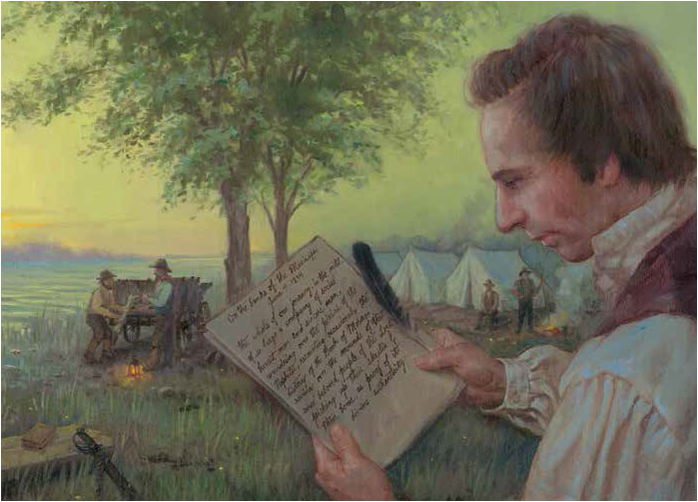
Let’s better understand this quote from the Joseph Smith Papers which was A letter sent to Emma Smith from her husband Joseph. On Page 56 of the JSP here, the top of the letter says, “On the Banks of the Mississippi, June 4th, 1834”
Then at the top of page 57-58 it says, “The whole of our journey, in the midst of so large a company of social honest and sincere men, wandering over the plains of the Nephites, recounting occasionally the history of the Book of Mormon, roving over the mounds of that once beloved people of the Lord, picking up their skulls & their bones, as a proof of its divine authenticity… During our travels we visited several of the mounds which had been thrown up by the ancient inhabitants of this country-Nephites, Lamanites, etc.” Joseph Smith Papers Letter to Emma Smith, 4 June 1834 Page 56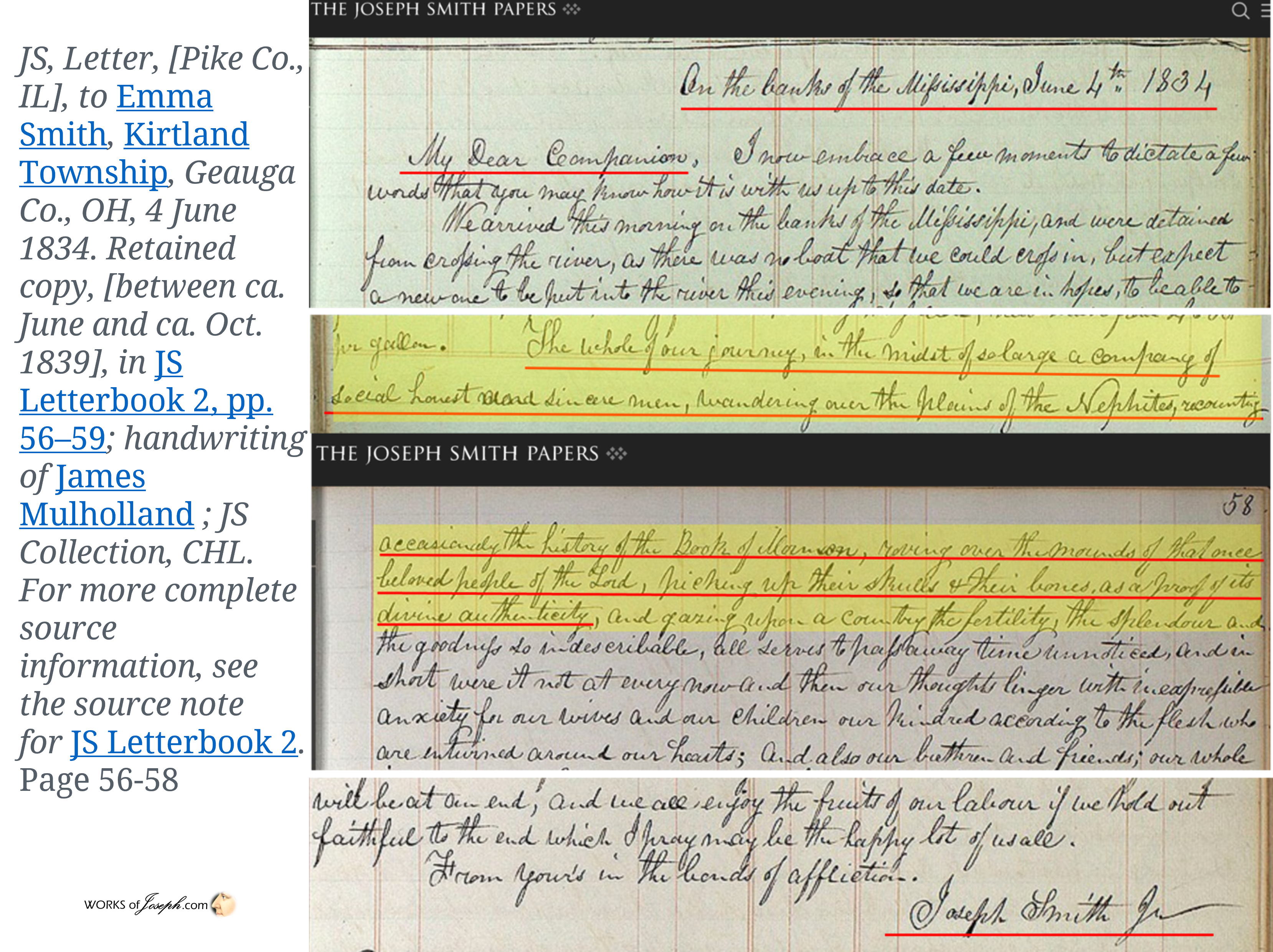
Let’s now break down this quote from the Joseph Smith Papers. What would make this quote Historical, Narrative, Historical Truth or Historical Fact?
You read and decide.
Definitions
Historical Narrative- Beyond the Control of Humans
Like it or not, history is a narrative representation of the past because historians cannot know “the past-thing-in-itself.” In addition, as a narrative discourse, “the-past-as-history” can be articulated and communicated in as many different modes or forms of expression as the historian (and everyone else) can imagine … Source
A theory that events are determined or influenced by conditions and inherent processes beyond the control of humans. Source.” Free Dictionary
Historical Truth- A Kernel of Truth
Historical truth, as Sigmund Freud conceived it, can be defined as a lost piece of the subject’s lived experience that is accessible only through the work of construction. The term historical here refers to origins, which explains why historical truth can be presented as a kernel of truth in formations as diverse as legends, religions, or delusions.
History is not a collection of raw facts we simply look up and copy down. Nor can we peel away the layers of time to find the plain truth revealed. The past is still a little-known world. As we probe its depths, we appreciate resources that save us time. We crave materials we can confidently trust. Yet historical truths are rarely rooted in either shortcuts or comfort.
Historical Fact- Rethink Conventional Wisdom
As the old saying goes, “Those who don’t know history are doomed to repeat it.” Yes, it’s important to know your history—not just the big names and key dates, but the little details that help us better understand a historic figure or era in which they lived. Maybe it’s a surprising fact that makes you rethink conventional wisdom. Maybe it’s a wild anecdote that seems too crazy to be true. Whatever the case, it’s the little, surprising bits of history are perhaps the most fun bits of history.” Source
Understanding Joseph Letter to Emma
From June 1st until about June 5th 1834, was a very important time for the Saints during the Zion’s Camp March, They were learning to follow wise council from leaders, build faith, and experience hard times which would lead to a great humbling of spirit. As a matter of fact, “Zion’s Camp would later be seen as a proving and testing ground for early Latter-day Saint leaders. Of the original Quorum of the Twelve Apostles called, eight served in Zion’s Camp. The majority of the First Quorum of the Seventy were also chosen from among Zion’s Camp members. Joseph Smith himself was refined as a prophet through the experience.” LDSDaily
Historical Narrative:
Zion’s Camp wandered over the plains of Illinois
Historical Truth
During Zions’s Camp Joseph said they were “wandering over the Plains of the Nephites.”
It’s Historical Truth as You are Quoting from an actual copy of the letter that was sent to Emma. JSP Letter
Historical Fact
From Zion’s Camp, Joseph wrote a letter to Emma that said.,” picking up their skulls & their bones, as a proof of its [Book of Mormon] divine authenticity.”
It’s a Historical Fact as 6 or 7 other members of Zion Camp are also quoted as saying similar things. (Wilford Woodruff, Heber C. Kimball, George A. Smith, Levi Hancock, Moses Martin, and Reuben McBride). You also have Joseph allowing James Mulholland to write this down for Joseph, and you have Wilford Woodruff editing the various witnesses and combining all the narratives together in “History of the Church”. But here is the real reason I believe it to be a fact. I have prayed about it and I believe Joseph is telling the truth, especially in a letter to his wife.
Because this letter to Emma is so filled with important spiritual information, I don’t see how it could be left out of “Saints”, as i believe this story would validate the authenticity of the Book of Mormon as the quote says. I sincerely believe Church Historians left this quote out because it shows clearly that the book of Mormon events happened in North America and the vast majority of Historians believe the Book of Mormon events began in Mesoamerica. If true that is such a selfish motive.
I could go into depth with other things I feel were left out of Saints for a similar reason.
Story of Zelph, a righteous Lamanite who fought from Illinois in a great last struggle. It’s also hard to believe the word Cumorah is not included in “Saints.” Also see my other blogs here, here, and here.
Note 14 in the JSP on page 58 says, “On 3 June, the Camp of Israel passed through the vicinity of what is now Valley City, Illinois, where several members of the camp climbed a large mound. At the top, they uncovered the skeletal remains of an individual JS reportedly (Why reportedly? Why not just identified?) identified as Zelph, a “white Lamanite.” Archeologists have since identified the mound as Naples–Russell Mound #8 and have classified it as a Hopewell burial mound of the Middle Woodland period of the North American pre-Columbian era (roughly 50 BC to AD 250). (Godfrey, “The Zelph Story,” 31, 34; Farnsworth, “Lamanitish Arrows,” 25–48.) Even the Joseph Smith Papers says this Zelph mound is a Historical Fact as they tell you Archaeologists have dated this mound during the exact time when the Book of Mormon took place. Wow, how did the historians miss this in Saints?
What was included in SAINTS Volume 1 during the period I indicate above, June 1-4, 1834? Why was this story of Joseph’s Letter inserted only in the Note #20 and left out of this time period? Why was Zelph not mentioned? I realize they can’t include everything, but these stories are a validation to me that the Nephites lived in the Heartland of North America. This narrative is so important, the Church itself in Gospel Essays includes this story, but not in “Saints”? why?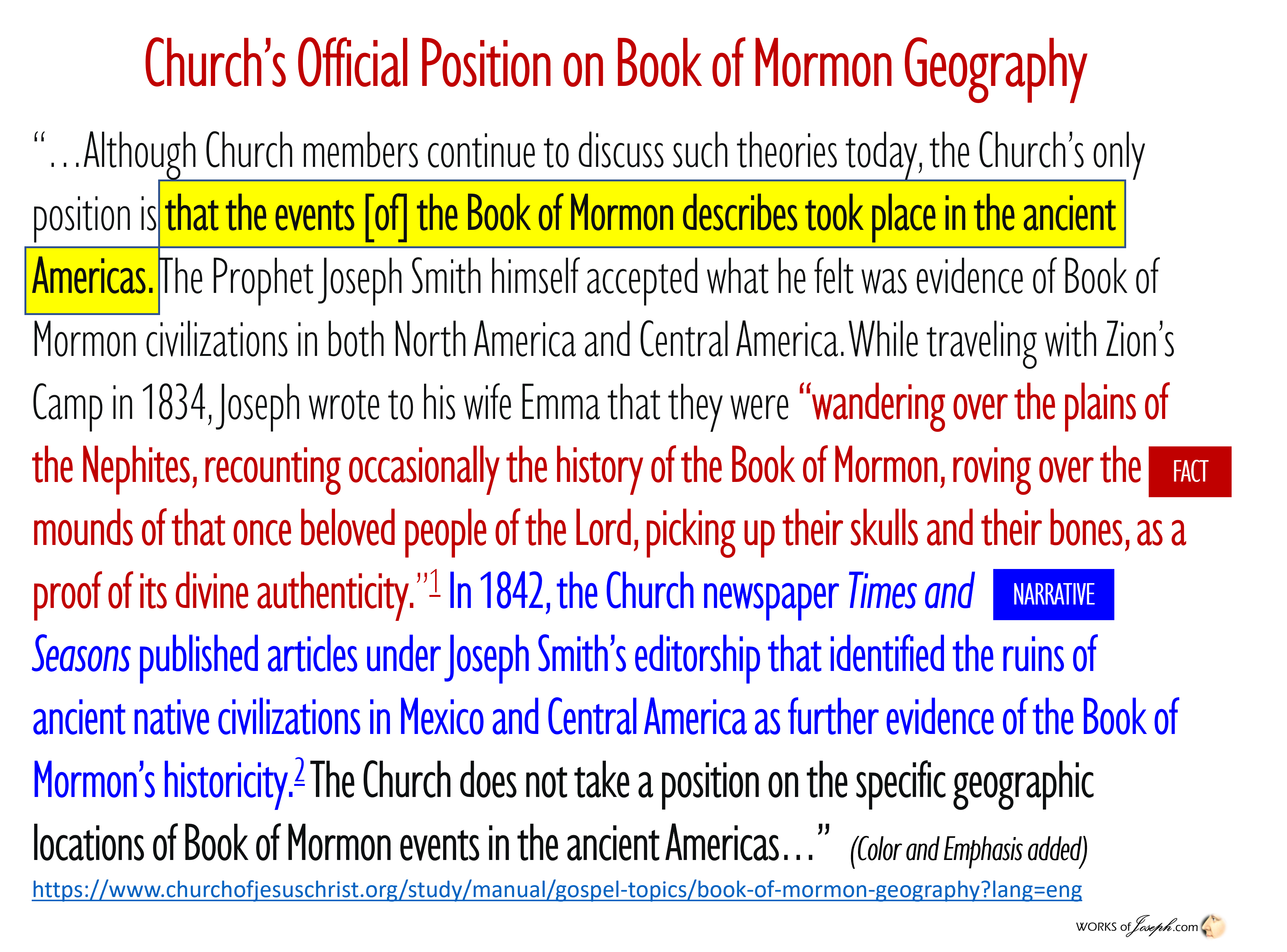
Chapter 18 The Camp of Israel
 “On June 4, after a month of marching, the camp reached the Mississippi River. Joseph was tired and sore from the journey, but he felt ready to confront the challenges that lay ahead.(20) He learned that reports and rumors of the camp’s movements had already reached Missouri, and hundreds of settlers were preparing for a fight. He wondered whether the Saints were strong enough to face them.
“Camp is in as good a situation as could be expected,” he wrote Emma while sitting on the riverbank, “but our numbers and means are altogether too small.”
The next day was hot and muggy as the Camp of Israel waited to cross the river into Missouri. The Mississippi was more than a mile wide, and the camp had only one boat to ferry them across. As they waited, some camp members hunted and fished while others fought off boredom and looked for shade to escape the summer sun.
The camp spent two tedious days crossing the river. By the end of the second day, they were tired and on edge. Now that they were in Missouri, many of them feared surprise attacks. That evening, Joseph’s watchdog startled everyone when it began barking at the last company to arrive in camp.
Sylvester Smith, the captain of the arriving company, threatened to kill the dog if it did not stop barking. Joseph calmed the animal, but Sylvester and his company were still complaining about it the next morning.
Hearing their complaints, Joseph called camp members together. “I will descend to the spirit that is in the camp,” he announced, “for I want to drive it from the camp.” He started to mimic Sylvester’s behavior from the night before, repeating the captain’s threats against the dog. “This spirit keeps up division and bloodshed throughout the world,” he said.
Sylvester, who was no relation to Joseph, was unamused. “If that dog bites me,” he said, “I will kill him.”
“If you kill that dog,” Joseph said, “I will whip you.”
“If you do,” said Sylvester, “I shall defend myself!”
The camp watched the two men stare each other down. So far, no fights had broken out among them, but weeks of marching had frayed everyone’s nerves.
At last, Joseph turned away from Sylvester and asked the Saints if they were as ashamed as he was of the feeling in the camp. He said they were acting like dogs rather than men. “Men ought never to place themselves on a level with beasts,” he said. “They ought to be above it.” Saints Volume 1 Chapter 18 The Camp of Israel page 201
What was left out of SAINTS Volume 1?
HISTORICAL TRUTH AND FACT
Below are two important quotes from the Joseph Smith Papers. They tell us of Joseph’s vision about Zelph, a white Lamanite chieftain and his importance in some of the last Book of Mormon battles. Also I included the letter written from Joseph to Emma on June 4, 1834. This is an important letter as Joseph describes the finding of Nephite bones which as Joseph says, “as a proof of its [Book of Mormon] divine authenticity.” Why would the Historians leave these two important stories out of the SAINTS Book? I know you can’t include everything, but how significant are the words of Joseph’s witnesses saying, “the visions of the past being opened to my understanding by the Spirit of the Almighty”, compared to what was included, “Camp is in as good a situation as could be expected,” he wrote Emma while sitting on the riverbank, “but our numbers and means are altogether too small.” Saints Page 101
Quotes from the Joseph Smith Papers
“On the top of the mound were stones which presented the appearance of three altars having been erected one above the other, according to the ancient order; and the remains of bones were strewn over the surface of the ground. The brethren procured a shovel and a hoe, and removing the earth to the depth of about one foot, discovered the skeleton of a man, almost entire, and between his ribs the stone point of a Lamanitish arrow, which evidently produced his death. Elder Burr Riggs retained the arrow. The contemplation of the scenery around us produced peculiar sensations in our bosoms; and subsequently the visions of the past being opened to my understanding by the Spirit of the Almighty, I discovered that the person whose skeleton was before us was a white Lamanite, a large, thick-set man, and a man of God. His name was Zelph. He was a warrior and chieftain under the great prophet Onandagus, who was known from the Hill Cumorah, or eastern sea to the Rocky mountains. The curse was taken from Zelph, or, at least, in part-one of his thigh bones was broken by a stone flung from a sling, while in battle, years before his death. He was killed in battle by the arrow found among his ribs, during the last great struggle of the Lamanites and Nephites.” Joseph Smith Papers History, 1838–1856, volume A-1 [23 December 1805–30 August 1834], Page 483
 Zelph. a Man of God, with Onandagus by Ken Corbett and “Three altars having been erected one above the other, according to the ancient order”
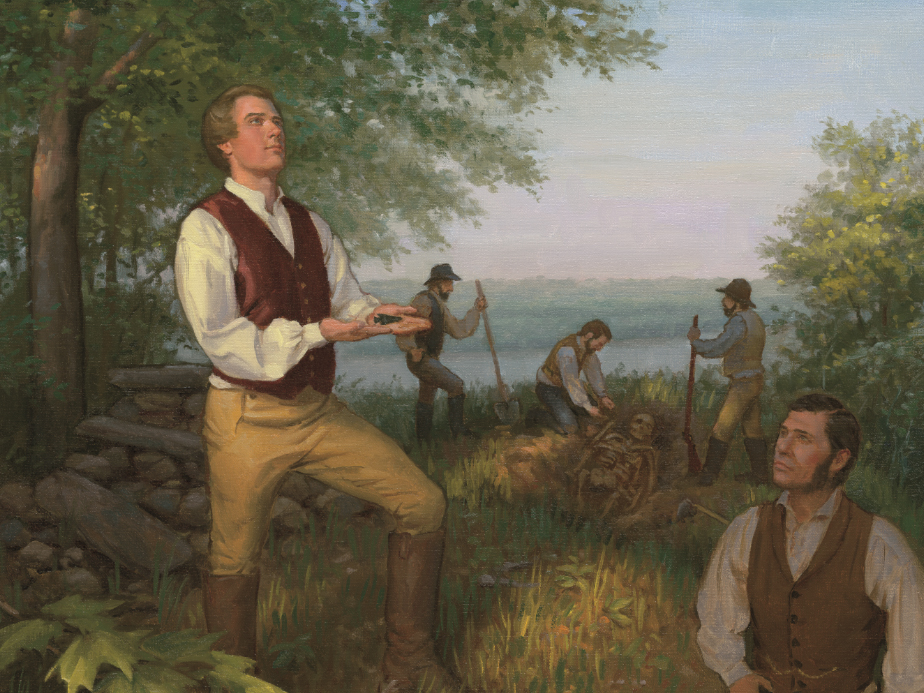
Zelph in Vision by Ken Corbett. See the over 7-foot long bones and the arrowhead Joseph found in the ribs of the righteous Lamanite Warrior named Zelph?
I Repeat an Amazing Quote Again
“The whole of our journey, in the midst of so large a company of social honest and sincere men, wandering over the plains of the Nephites, recounting occasionally the history of the Book of Mormon, roving over the mounds of that once beloved people of the Lord, picking up their skulls & their bones, as a proof of its divine authenticity… During our travels we visited several of the mounds which had been thrown up by the ancient inhabitants of this country-Nephites, Lamanites, etc.” Joseph Smith Papers Letter to Emma Smith, 4 June 1834 Page 56