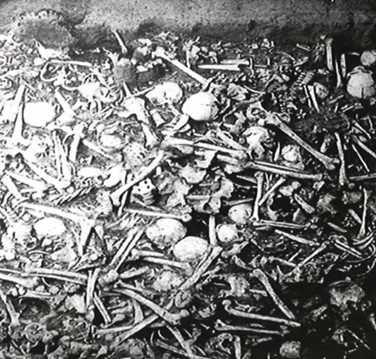
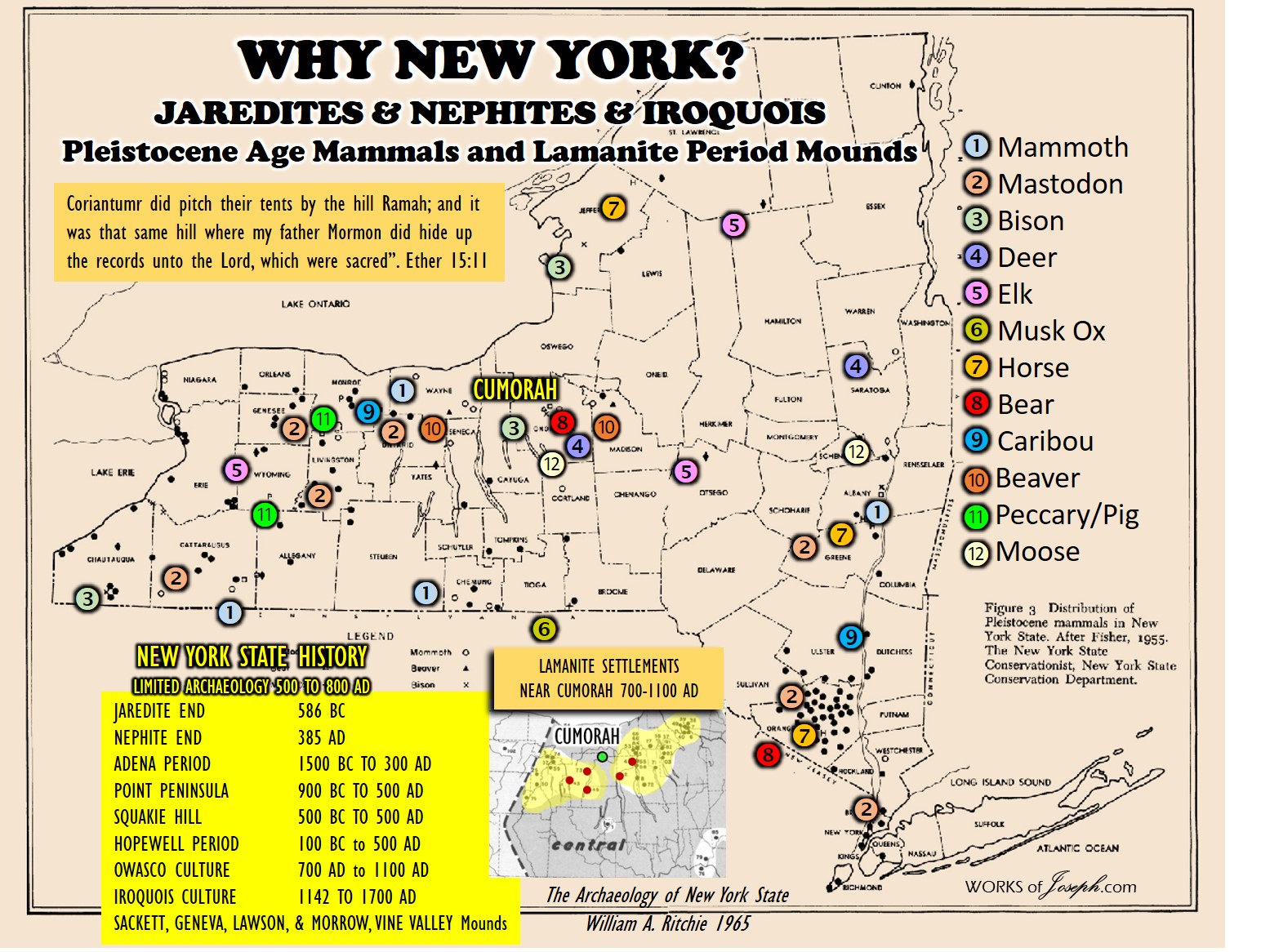
The purpose of this blog is to share with you significant archaeological evidence for the ancient Hopewell Culture nearby the Hill Cumorah. You can read this information from EG Squires here:
There is evidence of “Bone Pits”, fortifications, pottery, copper, weapons, palisades, forts, mass burials, mounds, tools and other artifacts all around this area. 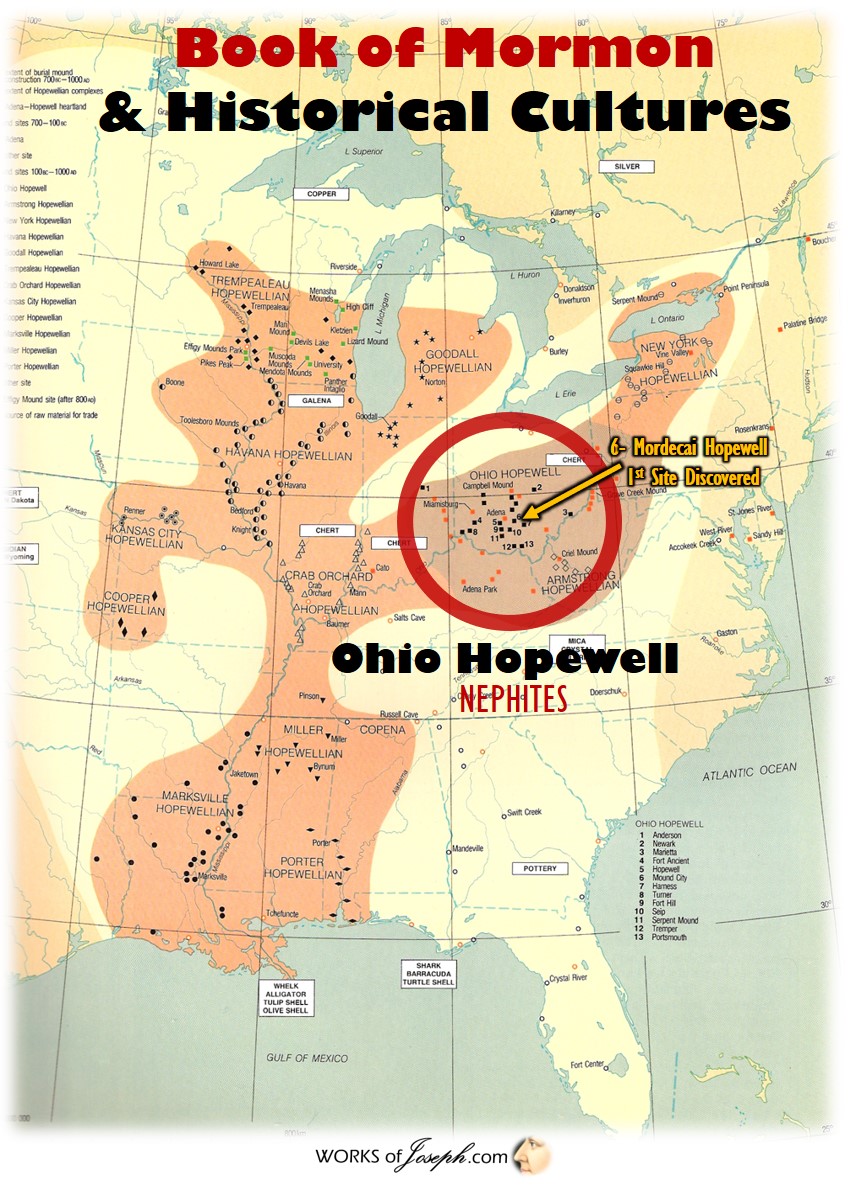 I believe the Hopewell culture matches up with the Nephite culture extraordinarily well. The Hopewell originated about 550 BC at the panhandle of Florida from Crystal River to Tallahassee, Florida. History documents this. The Hopewell then traveled north into Georgia and Tennessee. There is evidence of a huge society of the Hopewell from Missouri to Illinois to Indiana and then to Ohio which was the dominant historical area of this people. History shows the end of the Hopewell civilization around the year 400 AD. Historians say the Hopewell just disappeared and historians have no idea what happened. I feel I have a good idea. The final battle at Hill Cumorah was 385 AD. This is some great evidence of a possible link to the Hopewell and the Nephites.
E.G. Squire 1849
 “I believe we may confidently pronounce that all the hypotheses which attribute those works to Europeans are incorrect and fanciful—first, on account of the present number of the works; secondly, on account of their antiquity; having from every appearance, been erected a long time before the discovery of America; and finally, their form and manner are totally variant from European fortifications, either in ancient or modern times.
It is equally clear that they were not the work of the Indians… It is apparent that Turner did not believe the American Indians were responsible, or connected with the ancient civilization that was responsible for the mounds. Would this culture of thinking deny the American Indians their rightful heritage?
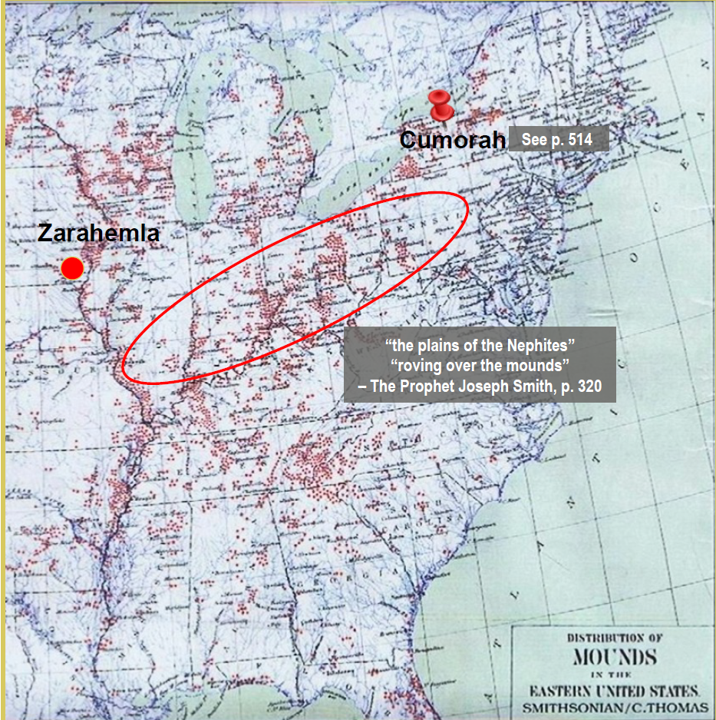
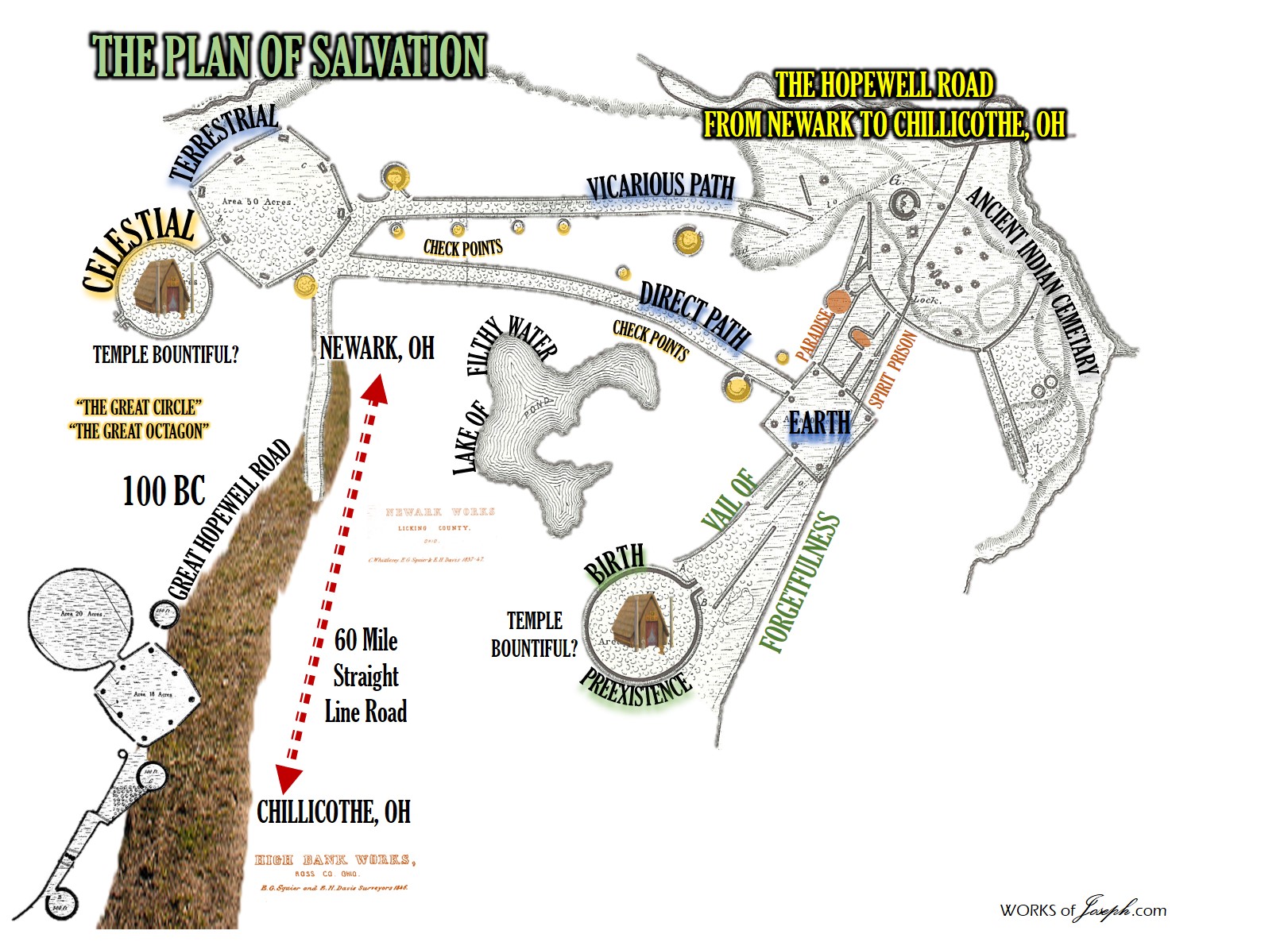
What knowledge is left that might enable society to unlock the enigma of the Mound-Builders’ existence? Many of the giant earthworks, temple mounds, and effigy constructions show signs of a central government and of a spiritual and religious turning, [Maybe 34 to 200 AD Book of Mormon times?] built in times of peace and prosperity where ceremonies and religious rituals were shared.” (For example the Newark Earthworks in Newark, Ohio are dated between 100 AD and 100 BC. These earthworks show no defensive fortifications. If fact the Newark earthwork seems to be describing the plan of Salvation during a peaceful time of the Hopewell).
Squires continues, “In their later constructions are found evidences of a time when the populations were motivated by fear [Maybe 250 to, 350 AD Book of Mormon times?] building hill-top fortifications and defenses. They incorporate ingenious military design and constructions and give signs of a time of ongoing conflicts, where the motivation behind these types of constructions was that of survival… In another section of EG Squires book he says, “Another which I [Squier] visited in the town of Clarence, Erie County, contained not less than four hundred skeletons. A deposit of bones comprising a large number of skeletons was found, not long since, in making some excavations in the town of Black Rock, situated on Niagara River, in Erie county…In Canada similar deposits are frequent. Accounts of their discovery and character appeared in various English publications, among which may be named the “British Colonial Newspaper” of September 1847, and the “Edinburgh New Philosophical Journal,” for July 1848. From a communication in the latter by Edward W. Bawtree, M.D., the subjoined interesting facts are derived. “A quantity of human bones was found in one spot in 1846 near Barrie, and also a pit containing human bones near St. Vincent’s. Great numbers were found in the latter, with several copper and brass kettles, and various trinkets and ornaments in common use among the Indians.” E. G. Squier: Antiquities of the State of New York: (1851) Editor notes in blue italics
See a great new video below from Steven Smoot, exploring the agenda being the silencing of America’s Ancient History, and the once great civilizations that inhabited North America.
Squire continues, “The purposes of the mounds of New York, so far as can be determined, seem uniformly to have been those of sepulture. They generally occur upon commanding or remarkable positions. Most of them have been excavated, under the impulse of an idle curiosity, or have had their contents scattered by “money-diggers,” a ghostly race, of which, singularly enough, even at this day, representatives may be found in almost every village. I was fortunate enough to discover one upon Tonawanda Island, in Niagara River, which had escaped their midnight attentions. It was originally about fifteen feet in height. At the base appeared to have been a circle of stones, perhaps ten feet in diameter, within which were several small heaps of bones, each comprising three or four skeletons. The bones are of individuals of all ages, and had evidently been deposited after the removal of the flesh. Traces of fire were to be discovered upon the stones. Some chippings of flint and broken arrow-points, as also some fragments of deers’ horns, which appeared to have been worked into form, were found amongst the bones. The skulls had been crushed by the superincumbent earth. The mounds which formerly existed in Erie, Genesee, Monroe, Livingston, St. Lawrence, Oswego, Chenango, and Delaware counties, all appear to have contained human bones, in greater or less quantities, deposited promiscuously, and embracing the skeletons of individuals of all ages and both sexes. They probably all owe their origin to a practice common to many of the North American tribes, of collecting together at fixed intervals the bones of their dead, and finally depositing them with many and solemn ceremonies. They were sometimes heaped together so as to constitute mounds; at others placed in pits or trenches dug in the earth; and it is probable they were in some instances buried in separate graves, but in long ranges, or deposited in caverns, either promiscuously or with regularity. 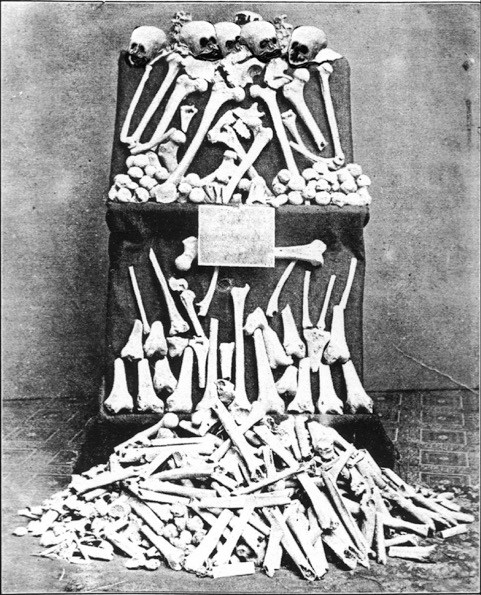 The period when this second burial took place occurred at different intervals amongst the different tribes, but was universally denominated the “Festival of the Dead.” Bartram, speaking of the burial customs of the Floridian Indians, says: “After the bone-house is full, a general solemn funeral takes place. The nearest kindred and friends of the deceased, on a day appointed, repair to the bone-house, take up the respective coffins, and, following one another in the order of seniority, the nearest relations and connections attending their respective corpses, and the multitude succeeding them, singing and lamenting alternately, slowly proceed to the place of general interment, when they place the coffins in order forming a pyramid. Lastly, they cover all over with earth, which raises a conical hill or mount. They then return to town in order of solemn procession, concluding the day with a festival which is called the ‘Feast of the Dead?’ The author here quoted adds in a note, that it was the opinion of some ingenious men with whom he had conversed, “that all those artificial pyramidal hills, usually called ‘Indian Mounts,’ were raised on such occasions, and are generally sepulchres;” from which opinion he takes occasion to dissent. There is no doubt a wide difference between the mounds thus formed and the great bulk of those connected with the vast ancient enclosures of the Western States.
  The large cemeteries which have been discovered in Tennessee, Kentucky, Missouri, and Ohio, seem to have resulted from a similar practice. In these the skeletons were generally packed in rude coffins composed of flat stones, placed in ranges of great extent. The circumstance that many of these coffins were not more than two or three feet in length, gave rise to the notion of the former existence here of a pigmy race. The discovery of iron and some articles of European origin in one of these cemeteries in the vicinity of Augusta, Kentucky, shows that this mode of burial existed at a late period among the Indians in that direction. The “bone-pits” which occur in some parts of Western New York, Canada, Michigan, etc., have unquestionably a corresponding origin. Several of these have been described in a previous chapter. They are of various sizes, but usually contain a large number of skeletons. In a few instances the bones appear to have been arranged with some degree of regularity. One of these pits discovered some years ago, in the town of Cambria, Niagara county, was estimated to contain the bones of several thousand individuals. Another which I visited in the town of Clarence, Erie county, contained not less than four hundred skeletons. A deposit of bones comprising a large number of skeletons was found not long since, in making some excavations in the town of Black Rock, situated on Niagara River, in Erie county. They were arranged in a circle, with their heads radiating from a large copper kettle, which had been placed in the centre, and filled with bones. Various implements both of modern and remote date had been placed beside the skeletons.” ABORIGINAL MONUMENTS OF THE STATE OF NEW YORK COMPRISING THE RESULTS OF ORIGINAL SURVEYS AND EXPLORATIONS; WITH AN ILLUSTRATIVE APPENDIX, BY E. G. SQUIER, A.M.