
Many scholars and intellectuals say Joseph used a stone he found in a well and put it in a hat in order to translate the Book of Mormon. Many of them also claim the gold plates were not even looked at by Joseph during his translation. That is silly to me. No where in the scriptures does it say that Joseph used a stone in a hat, but many times in scripture say Joseph used the spectacles attached to a breastplate to translate as in the picture below.
The word “interpreters” and “Urim and Thummim” mean plural stones, not a singular one. Many of these scholars equate a single stone as the Urim and Thummim, which to me is wrong. They also say that Joseph read the words that appeared in the single stone. That would mean someone was giving Joseph the words to write so it wouldn’t be a translation but more like a dictation. Why did Mormon and Nephi go through all the hard work of writing on gold plates, if the Lord was just going to give Joseph a stone to read from. It makes no sense to me.
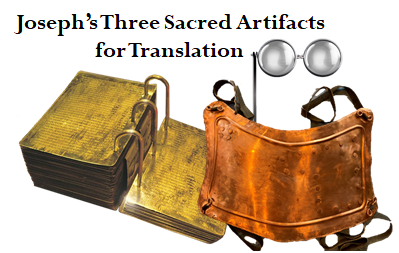
What 3 artifacts were found in the stone box of Hill Cumorah where Joseph Smith found the gold plates? The Gold Plates, the Breastplate and the Urim and Thummim. (That’s It) The Sword of Laban and the Liahona were found in the Cave of Records at Cumorah NY, with wagon loads of other Jaredite and Nephite plates, in a different location at Hill Cumorah NY.
Two Separate Repositories
As Orson Pratt says, “The hill Cumorah, with the surrounding vicinity, is distinguished as the great battlefield on which, and near which, two powerful nations were concentrated with all their forces. Men, women and children fought till hundreds of thousands on both sides were hewn down, and left to molder upon the ground. . . . These new plates were given to Moroni to finish the history. And all the ancient plates, Mormon deposited in Cumorah, about three hundred and eighty-four years after Christ. When Moroni, about thirty-six years after, made the deposit of the book entrusted to him, he was, without doubt, inspired to select a department of the hill separate from the great depository of the numerous volumes hid up by his father. The particular place in the hill where Moroni secreted the book, was revealed, by the angel, to the prophet Joseph Smith, to whom the volume was delivered in September, A.D. 1827. But the grand repository of all the numerous records of the ancient nations of the western continent, was located in another department of the hill, and it’s contents under the charge of holy angels, until the day should come for them to be transferred to the sacred temple of Zion.” 1866 Orson Pratt Millennial Star (28 (27): 417)
What are the Urim and Thummim? (Bible)
Israel’s High Priest was commanded to carry two things called the Urim and Thummim. What are they and what do they symbolize? What is their purpose? When did they stop being used?  The King James Old Testament refers to the Urim and Thummim in only seven passages.
The first place it is mentioned is in the book of Exodus in relation to the unique and special clothing worn by the High Priest of Israel. And you shall put in the breastplate of judgment the Urim (Hebrew: uriym, Strong’s Concordance #H224 which literally means “lights”) and the Thummim (Hebrew: tummiym, Strong’s Concordance #H8550 which literally means “perfections” or emblem of truth).
And they shall be upon Aaron’s heart, when he goes in before the Lord. And Aaron shall bear the judgment of the children of Israel . . . (Exodus 28:30, HBFV). The other places in the Bible the Urim and Thummim are directly referenced are Leviticus 8:8, Numbers 27:21, Deuteronomy 33:8, 1 Samuel 28:6, Ezra 2:63 and Nehemiah 7:65.
This Old Testament Urim and Thummim are very diferent than the Interpreters or Urim and Thummim which was in possession of the Brother of Jared and handed down to Moroni who buried it in the Hill Cumorah NY. (Scripture below)
What are the Urim and Thummim? (Modern Scripture)
Here is the detailed explanation of Joseph Smith’s mother, Lucy Mack Smith who actually help the Urim and Thummim in her hands, along with the separated breastplate, as each wes only wrapped in a thin linen cloth.  Lucy Mack Smith said, “I trembled so much with fear lest all might be lost again by some small failure in keeping the commandments, that I was under the necessity of leaving the room to conceal my feelings Lucy. Joseph saw this and followed me. “Mother,” said he. “Do not be uneasy. All is right. See here,” said he, “I have got the key.” I knew not what he meant, but took the article in my hands and, examining it with no covering but a silk handkerchief, found that it consisted of two smooth three-cornered diamonds set in glass, and the glasses were set in silver bows connected with each other in much the same way that old-fashioned spectacles are made. He took them again and left me, but did not tell me anything of the record…. That of which I spoke, which Joseph termed a key, was indeed nothing more nor less than a Urim and Thummim by which the angel manifested those things to him that were shown him in vision; by which also he could at any time ascertain the approach of danger, either to himself or the record, and for this cause he kept these things constantly about his person.” (History of Joseph Smith, Revised and Enhanced, p. 139, 145)
Are the Words, Urim and Thummim Found in the Book of Mormon?
No. The words of urim and thummim are not found anywhere in the Book of Mormon. They are called “Interpreters”, or Nephite Interpreters. See Scriptures: Mosiah 28:13, 20; Ether 3:22-23; 4:5; Alma 37:21, 24-25 The words urim and thummim are in the Pearl of Great Price here: JSH 1:35,52,62,75*; and in Abraham 3:1,4. These words are found in the Doctrine and Covenants here D&C 3; 6; 7; 11; 14; 15; 16; 17; D&C 10:1; D&C 17:1; D&C 130:8; D&C 130:9; D&C 130:10.
Did Brigham Young have the Urim & Thummim?
Yes. The Prophet Joseph Smith was not the only individual in this dispensation to use the Urim and Thummim and to receive revelations from God. Heber C. Kimball testified that Brigham Young also used these sacred instruments. “The question is asked many times, “Has brother Brigham got the Urim and Thummim?” Yes, he has got everything; everything that is necessary for him to receive the will and mind of God to this people. Do I know it? Yes, I know all about it; and what more do you want? That is true, gentlemen; I am one of his witnesses in the last days, and to bear testimony of the truth of “Mormonism.”” (Heber C. Kimball, J.D. 2:111)
Revelations by Joseph Smith while using the Urim and Thummim
- Section 3- Harmony, Pennsylvania, July 1828, relating to the loss of 116 pages “In July 1828, the heavenly messenger returned the Urim and Thummim (which had been taken in consequence of Joseph “having wearied the Lord in asking for the privilege of letting Martin Harris take the writings”). Joseph then received the revelation now recorded in Doctrine and Covenants 3 through the Urim and Thummim.” Larry E. Morris, “The Conversion of Oliver Cowdery,” in Days Never to Be Forgotten: Oliver Cowdery, ed. Alexander L. Baugh (Provo, UT: Religious Studies Center, Brigham Young University, 2009), 15–49.
- Section 6- Harmony, Pennsylvania, April 1829, Oliver Cowdery began his labors as scribe
- Section 7- Revelation given to Joseph Smith the Prophet and Oliver Cowdery, at Harmony, Pennsylvania, April 1829, The revelation is a translated version of the record made on parchment by John
- Section 11- Revelation given through Joseph Smith the Prophet to his brother Hyrum Smith, at Harmony, Pennsylvania, May 1829.
- Section 14- Revelation given through Joseph Smith the Prophet to David Whitmer, at Fayette, New York, June 1829.
- Section 15- Revelation given through Joseph Smith the Prophet to John Whitmer, at Fayette, New York, June 1829
- Section 16- Revelation given through Joseph Smith the Prophet to Peter Whitmer Jr., at Fayette, New York, June 1829
- Section 17- Revelation given through Joseph Smith the Prophet to Oliver Cowdery, David Whitmer, and Martin Harris, at Fayette, New York, June 1829.
Urim and Thummim used to Translate the Bible.
“In this respect the testimony of Lorenzo Brown about the preparation the Prophet made for his translation of the Bible may be instructive. He records the Prophet as saying: “After I got through translating the Book of Mormon, I took up the Bible to read with the Urim and Thummim. I read the first chapter of Genesis and I saw the things as they were done. I turned over the next and the next, and the whole passed before me like a grand panorama; and so on chapter after chapter until I read the whole of it. I saw it all!” (as cited in Matthews, Plainer Translation, 25).” The Process of Translating the Book of Mormon Joseph Fielding McConkie (Professor of Ancient Scripture, BYU) Craig J. Ostler (Assistant Professor of Church History and Doctrine, BYU)
Joseph Smith Translation (JST)
 “A revision or translation of the King James Version of the Bible begun by the Prophet Joseph Smith in June 1830. He was divinely commissioned to make the translation and regarded it as “a branch of his calling” as a prophet. Although the major portion of the work was completed by July 1833, he continued to make modifications while preparing a manuscript for the press until his death in 1844, and it is possible that some additional modifications would have been made had he lived to publish the entire work. Some parts of the translation were published during his lifetime. “The translation process was a learning experience for the Prophet, and several sections of the Doctrine and Covenants (and also other revelations that are not published in the Doctrine and Covenants) were received in direct consequence of the work (D&C 76–77; 91). Also, specific instruction pertaining to the translation is given in D&C 37:1; 45:60–61; 76:15–18; 90:13; 94:10; 104:58; 124:89. The book of Moses and the 24th chapter of Matthew (JS—M), contained in the Pearl of Great Price, are actual excerpts from the JST. Many excerpts from the JST are also given in the appendix and footnotes in the edition of the KJV that accompanies this dictionary. The JST to some extent assists in restoring the plain and precious things that have been lost from the Bible (see 1 Ne. 13–14). Although not the official Bible of The Church of Jesus Christ of Latter-day Saints, the JST offers many interesting insights and is an invaluable aid to biblical interpretation and understanding. It is a most fruitful source of useful information for the student of the scriptures. It is likewise a witness for the divine calling and ministry of the Prophet Joseph Smith.” https://www.churchofjesuschrist.org/study/scriptures/bd/joseph-smith-translation?lang=eng
Apostle John’s Parchment

“While translating the Book of Mormon, Joseph Smith and Oliver Cowdery found they held different views on the meaning of a passage in the Bible. They “mutually agreed to settle” the question “by the Urim and [Thummim].” As a result, Joseph received a revelation giving the translation of an account by the ancient disciple John, [D&C 7] written on parchment but lost to history. This early experience seeking revelation that illuminated the text of a Bible passage was an important precedent. About a year later, during the summer of 1830, Joseph and Oliver received by revelation an account of visions experienced by Moses but not found in the Bible. This revelation marked the beginning of Joseph Smith’s efforts to prepare an inspired revision or translation of the Bible. For the next three years, Joseph worked on his “new translation of the Bible” with Oliver Cowdery, Sidney Rigdon, and other scribes, considering the project a “branch of [his] calling” as a prophet of God.” https://www.churchofjesuschrist.org/study/history/topics/joseph-smith-translation-of-the-bible?lang=eng
Translation of Foxe’s Book of Martyrs.
 “While looking over our copy of a large English Book of Martyrs, he (Josoeph Smith) expressed sympathy for the Christian martyrs and a hope for their salvation. He asked to borrow the book, promising to return it when he should meet us again in Missouri.
On returning it he said, ‘I have, by the aid of the Urim and Thummim, seen those martyrs. They were honest, devoted followers of Christ, according to the light they possessed. They will be saved.’” Hyrum L. Andrus, They Knew the Prophet, pg. 83
The Loss of the 116 Pages
 The summer of 1828 had been a traumatic one for the Smith family. On June 15, Joseph and Emma, then living in Harmony, Pennsylvania, near Emma’s parents, lost their firstborn child, a son named Alvin, who died shortly after his birth. For two weeks, Joseph nursed Emma, who seemed “for some time,” wrote Lucy, “more like sinking with her infant into the mansion of the dead, than remaining with her husband among the living.” With Emma slowly recovering, Joseph traveled to the Smith farm in Manchester, New York, only to discover that Martin Harris had lost the 116 transcribed pages of the Book of Mormon. The entire family was plunged into despair, and when Joseph departed for Harmony, Lucy wrote, “We parted with heavy hearts, for it now appeared that all which we had so fondly anticipated, and which had been the source of so much secret gratification, had in a moment fled, and fled for ever.”[5] About two months later, apparently in late August or early September, Joseph Sr. and Lucy traveled to Harmony because they had heard nothing from Joseph and were worried about him. To their surprise, he met them “with a countenance blazing with delight.”[6] Although the plates and the Urim and Thummim had been taken from Joseph, they had now been restored because of his penitence. He had also received a revelation (now section 3 of the Doctrine and Covenants) in which the Lord told Joseph that he was “still chosen” and “again called to the work” (v. 10). Furthermore, reported Joseph, “the angel said that the Lord would send me a scribe, and I trust his promise will be verified.”[7] Larry E. Morris, “The Conversion of Oliver Cowdery,” in Days Never to Be Forgotten: Oliver Cowdery, ed. NOTES [5] Lucy Mack Smith, Biographical Sketches of Joseph Smith the Prophet and His Progenitors for Many Generations (Liverpool, England: S. W. Richards, 1853), 122. [6] Lucy Mack Smith, Preliminary Manuscript [1844–45], Church History Library, in Anderson, Lucy’s Book, 424. [7] Smith, Biographical Sketches, 126. Reconstructing a precise chronology for this time period is problematic because of differences in Joseph Jr.’s and Lucy Mack Smith’s accounts. Joseph said that “immediately” after his return to Harmony, in July 1828, the heavenly messenger returned the Urim and Thummim (which had been taken in consequence of Joseph “having wearied the Lord in asking for the privilege of letting Martin Harris take the writings”). Joseph then received the revelation now recorded in Doctrine and Covenants 3 through the Urim and Thummim. “After I had obtained the above revelation,” recorded Joseph, “both the plates, and the Urim and Thummin were taken from me again, but in a few days they were returned to me” (Joseph Smith, Manuscript History of the Church, Book A-1, Joseph Smith Papers, Church History Library [hereafter “Manuscript History”], in Dan Vogel, Early Mormon Documents [Salt Lake City: Signature Books, 1996–2003], 1:73).
Urim and Thummim Returned to Joseph
 “Lucy, on the other hand, said in one portion of her reminiscences that the Urim and Thummim was returned on September 22, 1828, and that sometime after that, she and her husband visited Joseph (see Smith, Biographical Sketches, 126). Complicating the matter even further, she said in another part of her history that “nearly two months” had passed when she and Joseph Sr. decided to go to Harmony. Since Joseph apparently returned to Pennsylvania the first week of July, such reckoning places Joseph Sr. and Lucy’s trip south around the beginning of September rather than at the end of the month. I believe Lucy was simply mistaken about the September 22 date and that the plates and Urim and Thummim were returned to Joseph in July and that his parents visited early in September, arriving back in Manchester on or before September 11, the date when Gain C. Robinson visited the Smith family and charged Joseph Sr. for medicine (see note 10). This is one of a number of instances where a third-party account confirms details of Lucy Mack Smith’s history—rather impressive considering the fact that she dictated it in 1844–45.” Larry E. Morris, “The Conversion of Oliver Cowdery,” in Days Never to Be Forgotten: Oliver Cowdery, ed. Alexander L. Baugh (Provo, UT: Religious Studies Center, Brigham Young University, 2009), 15–49. See additional blog here: https://bookofmormonevidence.org/abinadi-foxes-book-of-martyrs/