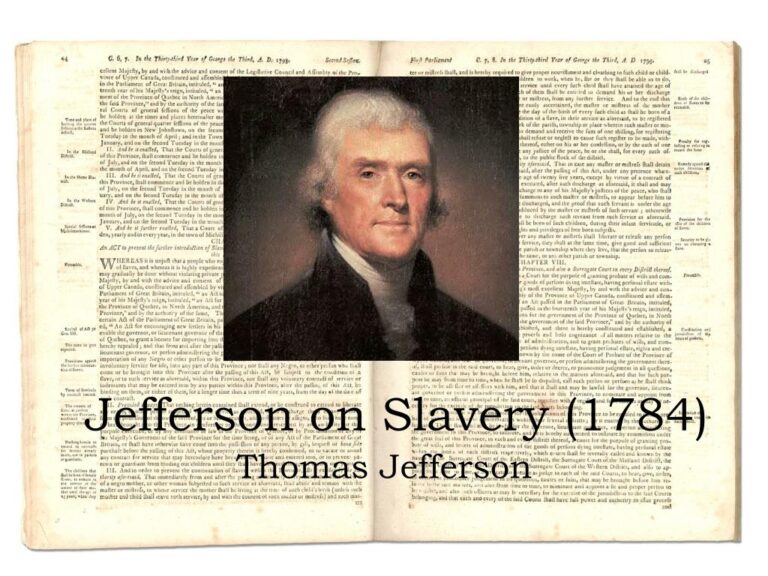
This above title is what Thomas Jefferson said to the Royal Crown.
How could the author of the Declaration of the Independence own slaves? How could twenty percent of the population of the new United States, founded on the principles of liberty and equality, live in bondage? What was life like for enslaved people in the early republic?

“You know that nobody wishes more ardently to see an abolition not only of the trade but of the condition of slavery: and certainly nobody will be more willing to encounter every sacrifice for that object.” -Thomas Jefferson to Brissot de Warville, February 11, 1788
1784
– Rhode Island and Connecticut begin gradual emancipation.
– North Carolina prohibits the importation of African slaves.
– Jefferson’s proposal to restrict the westward expansion of slavery fails.
Jefferson’s Failed Anti-Slavery Proviso of 1784 and the Nascence of Free Soil Constitutionalism
By William G. Merkel
Despite his severe racism and inextricable personal commitments to slavery, Thomas Jefferson made profoundly significant contributions to the rise of anti-slavery constitutionalism. This Article examines the narrowly defeated anti-slavery plank in the Territorial Governance Act drafted by Jefferson and ratified by Congress in 1784. The provision would have prohibited slavery in all new states carved out of the western territories ceded to the national government established under the Articles of Confederation.

The Act set out the principle that new states would be admitted to the Union on equal terms with existing members, and provided the blueprint for the Republican Guarantee Clause and prohibitions against titles of nobility in the United States Constitution of 1788. The defeated anti-slavery plank
inspired the anti-slavery proviso successfully passed into law with the
Northwest Ordinance of 1787. Unlike that Ordinance’s famous antislavery clause, Jefferson’s defeated provision would have applied south as well as north of the Ohio River. https://scholarship.shu.edu/cgi/viewcontent.cgi?article=1115&context=shlr

Thomas Jefferson: Liberty & Slavery
Thomas Jefferson helped to create a new nation based on individual freedom and self-government. His words in the Declaration of Independence expressed the aspirations of the new nation. But the Declaration did not extend “Life, Liberty, and the pursuit of Happiness” to African Americans, indentured servants, or women. Twelve of the first eighteen American presidents owned slaves. Thomas Jefferson drafted the Declaration and called slavery an “abominable crime,” yet he was a lifelong slaveholder. Fearful of dividing the fragile new nation, Jefferson and other founders who opposed slavery did not insist on abolishing it.
It took 87 more years―and the Civil War, the Emancipation Proclamation, and the 13th Amendment―to end slavery. https://www.monticello.org/slavery-at-monticello
Why Thomas Jefferson’s Anti-Slavery Passage Was Removed from the Declaration of Independence
YOHURU WILLIAMS
With its soaring rhetoric about all men being “created equal,” the Declaration of Independence gave powerful voice to the values behind the American Revolution. Critics, however, saw a glaring contradiction: Many of the colonists who sought freedom from British tyranny themselves bought and sold human beings. By underpinning America’s nascent economy with the brutal institution of chattel slavery, they deprived roughly one-fifth of the population of their own “inalienable” right to liberty.

What isn’t widely known, however, is that Founding Father Thomas Jefferson, in an early version of the Declaration, drafted a 168-word passage that condemned slavery as one of the many evils foisted upon the colonies by the British crown. The passage was cut from the final wording.
So while Jefferson is credited with infusing the Declaration with Enlightenment-derived ideals of freedom and equality, the nation’s founding document—its moral mission statement—would remain forever silent on the issue of slavery. That omission would create a legacy of exclusion for people of African descent that engendered centuries of struggle over basic human and civil rights.
What the deleted passage said
In his initial draft, Jefferson blamed Britain’s King George for his role in creating and perpetuating the transatlantic slave trade—which he describes, in so many words, as a crime against humanity.
He has waged cruel war against human nature itself, violating its most sacred rights of life & liberty in the persons of a distant people who never offended him, captivating & carrying them into slavery in another hemisphere or to incur miserable death in their transportation thither.
Jefferson went on to call the institution of slavery “piratical warfare,” “execrable commerce” and an “assemblage of horrors.” He then criticized the crown for
“Exciting those very people to rise in arms among us, and to purchase that liberty of which he has deprived them, by murdering the people on whom he also obtruded them: thus paying off former crimes committed against the Liberties of one people, with crimes which he urges them to commit against the lives of another.”

This passage refers to a 1775 proclamation by Britain’s Lord Dunmore, which offered freedom to any enslaved person in the American colonies who volunteered to serve in the British army against the patriots’ revolt. The proclamation inspired thousands of enslaved people to seek liberty behind British lines during the Revolutionary War.
Why was the Declaration’s anti-slavery passage removed?

The exact circumstances of the passage’s removal may never be known; the historical record doesn’t include details of the debates undertaken by the Second Continental Congress. What is known is that the 33-year-old Jefferson, who composed the Declaration between June 11 and June 28, 1776, sent a rough draft to members of a pre-selected committee, including John Adams and Benjamin Franklin, for edits ahead of its presentation to Congress. Between July 1 and July 3, congressional delegates debated the document, during which time they excised Jefferson’s anti-slavery clause.
The removal was mostly fueled by political and economic expediencies. While the 13 colonies were already deeply divided on the issue of slavery, both the South and the North had financial stakes in perpetuating it. Southern plantations, a key engine of the colonial economy, needed free labor to produce tobacco, cotton and other cash crops for export back to Europe. Northern shipping merchants, who also played a role in that economy, remained dependent on the triangle trade between Europe, Africa and the Americas that included the traffic in enslaved Africans.
Decades later, in his autobiography, Jefferson primarily blamed two Southern states for the clause’s removal, while acknowledging the North’s role as well.
“The clause…reprobating the enslaving the inhabitants of Africa, was struck out in compliance to South Carolina and Georgia, who had never attempted to restrain the importation of slaves, and who on the contrary still wished to continue it. Our Northern brethren also I believe felt a little tender under these censures; for tho’ their people have very few slaves themselves, yet they had been pretty considerable carriers of them to others.”
Many in Congress had a vested interest

To call slavery a “cruel war against human nature itself” may have accurately reflected the values of many of the founders, but it also underscored the paradox between what they said and what they did. Jefferson, after all, had been tasked with writing a document to reflect the interests of an assemblage of slave-owning colonies with a profound commercial interest in preserving the trade in human beings. One third of the Declaration’s signers were personally enslavers and even in the North, where abolition was more widely favored, states passed “gradual emancipation” laws designed to slowly phase out the practice.

Thomas Jefferson Foundation
Jefferson himself had a complicated relationship to the “peculiar institution.” Despite his philosophical abhorrence of slavery and his ongoing legislative efforts to abolish the practice, Jefferson over his lifetime enslaved more than 600 people—including his own children with his enslaved concubine Sally Hemings. On his death in 1826, Jefferson, long plagued with debt, chose not to free any of the human beings he claimed as property.
READ MORE: How Sally Hemings and Other Enslaved People Secured Precious Pockets of Freedom
Such conflicts didn’t go unnoticed. How was it possible, wrote British essayist Samuel Johnson at the start of the war, “that we hear the loudest yelps for liberty among the drivers of Negroes?” American loyalist and former governor of Massachusetts Thomas Hutchinson echoed these sentiments in his “Strictures Upon the Declaration of the Congress at Philadelphia”:
“I could wish to ask the Delegates of Maryland, Virginia, and the Carolinas, how their constituents justify the depriving more than an hundred thousand Africans of their rights to liberty, and the pursuit of happiness, and in some degree to their lives, if these rights are so absolutely unalienable….”
The legacy of a foundational omission

The signers ultimately replaced the deleted clause with a passage highlighting King George’s incitement of “domestic insurrections among us,” for stirring up warfare between the colonists and Native tribes—leaving the original passage a footnote to what might have been.
Indeed, removing Jefferson’s condemnation of slavery would prove the most significant deletion from the Declaration of Independence. The founders’ failure to directly address the question of slavery exposed the hollowness of the words “all men created equal.” Nonetheless, the underlying ideals of freedom and equality expressed in the document have inspired generations of Americans to struggle to obtain their inalienable rights. BY YOHURU WILLIAMS

