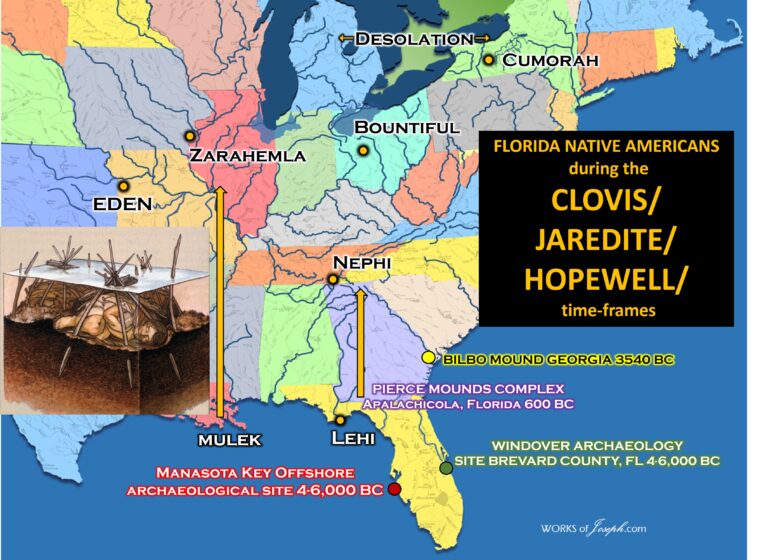
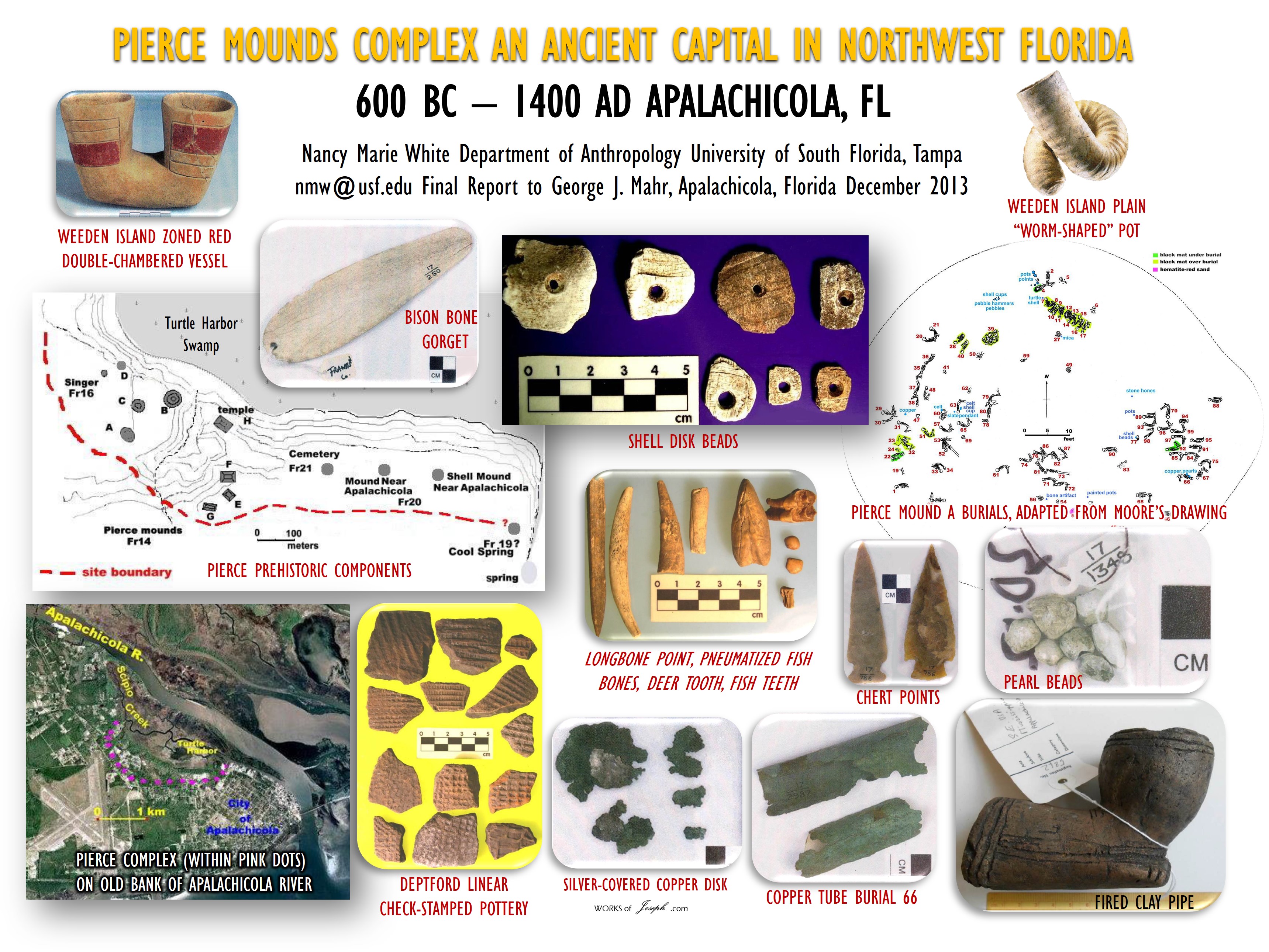
The Lehites had to Land somewhere. This is the point we need to understand, not where the Nephites ended up or are today. They are spread all over North, South and Central America. I’m a Heartlander and believe the ancient Hopewell Culture and the Deptford and Swift Creek culture that historically began in 600 BC in Florida, are likely Nephites. The Hopewell Culture historically ended in 400 AD in New York and historians don’t know why. Sounds like Nephites to me. I have personally been to Apalachicola, FL and found 500 to 600 BC pottery that was authenticated by Dr. Nancy White, Anthropologist at South Florida University in her amazing research called, “Pierce Mounds Complex An Ancient Capital in Northwest Florida [email protected].
Of course there are Children of Lehi in North, South, and Central America. Both the Heartlanders and the Mesoamericanists agree here. However, that has nothing to do with where the Nephites initially landed in the Promised Land.
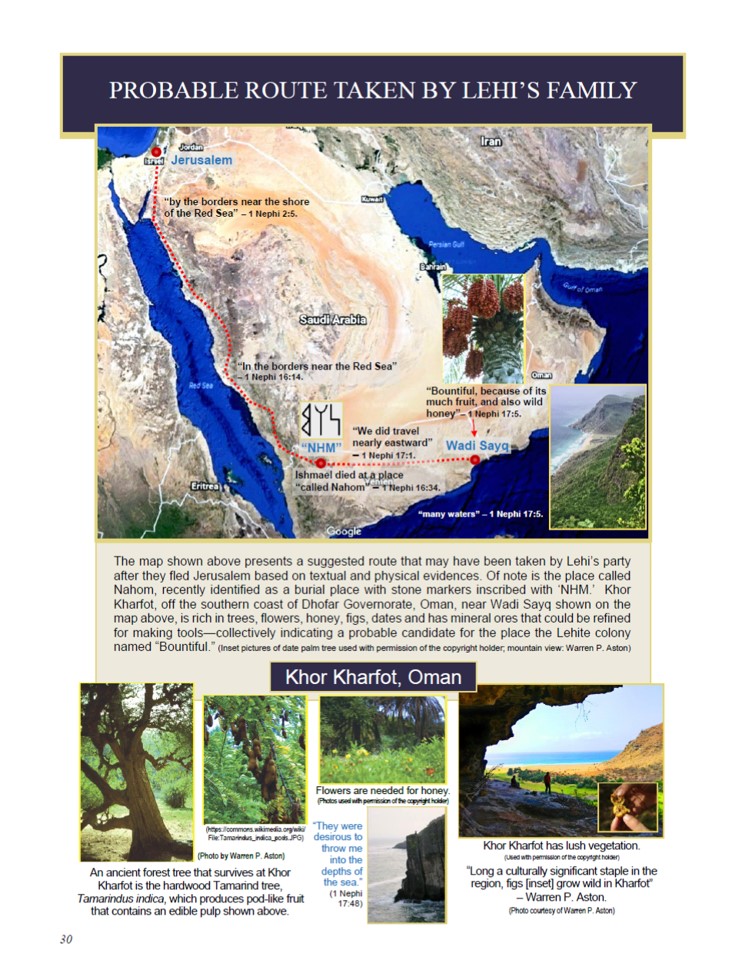
Where did Lehi’s family leave from?
“THE Book of Mormon explains that Lehi’s sailing party left a coastline they named “Bountiful” in the Old World. Nephi’s descriptions lead us to believe they left the Arabian peninsula, probably in modern-day Oman or Yemen. As you see in the map below, nearly all current geography theorists believe that Oman is likely the place of origin after the Jerusalem exodus. Whether a Mesoamerican theorist of a Heartland theorist or a Baja or south America theorists tend to agree with an area of Khor Kharfot, Oman as a likely place of launching Nephite’s ship from. See map below.
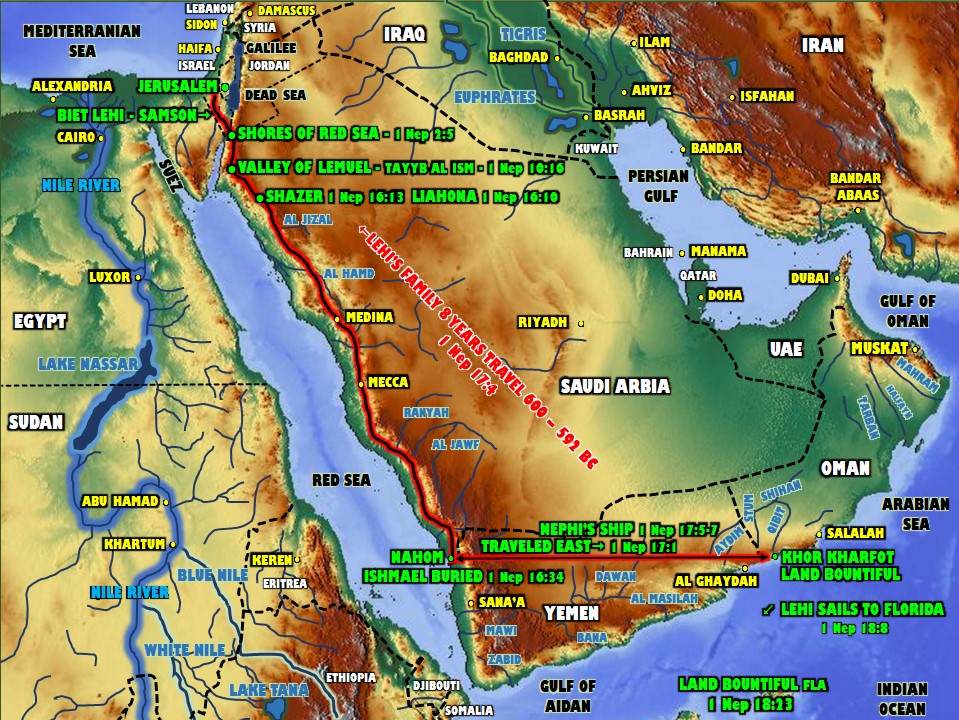
WHY APALACHICOLA, FLORIDA IS PLAUSIBLE
FOR THE LAND OF LEHI’S LANDING
591 BC 1 Nephi 18:23-25
Archaeology, Bees, Honey, Climate, Latitude, Wind Currents, Promised Land (USA), Abundance of Food, Scripture Text, Seeds, No large number of indigenous peoples, and “It Just Makes Sense”
They crossed the “many waters” and landed at the promised land: “And it came to pass that I, Nephi, did guide the ship, that we sailed again towards the promised land. And it came to pass that after we had sailed for the space of many days we did arrive at the promised land; and we went forth upon the land, and did pitch our tents; and we did call it ‘The Promised Land’” (1 Nephi 18: 22-23). This description is so vague that it leaves readers with many possibilities for the landing site. We know from Moroni’s statements to Joseph Smith that the Book of Mormon is a record of the ancient inhabitants of “this country” meaning the United States, and of “this continent,” meaning the American continent, but that says nothing about where Lehi’s group originally landed…
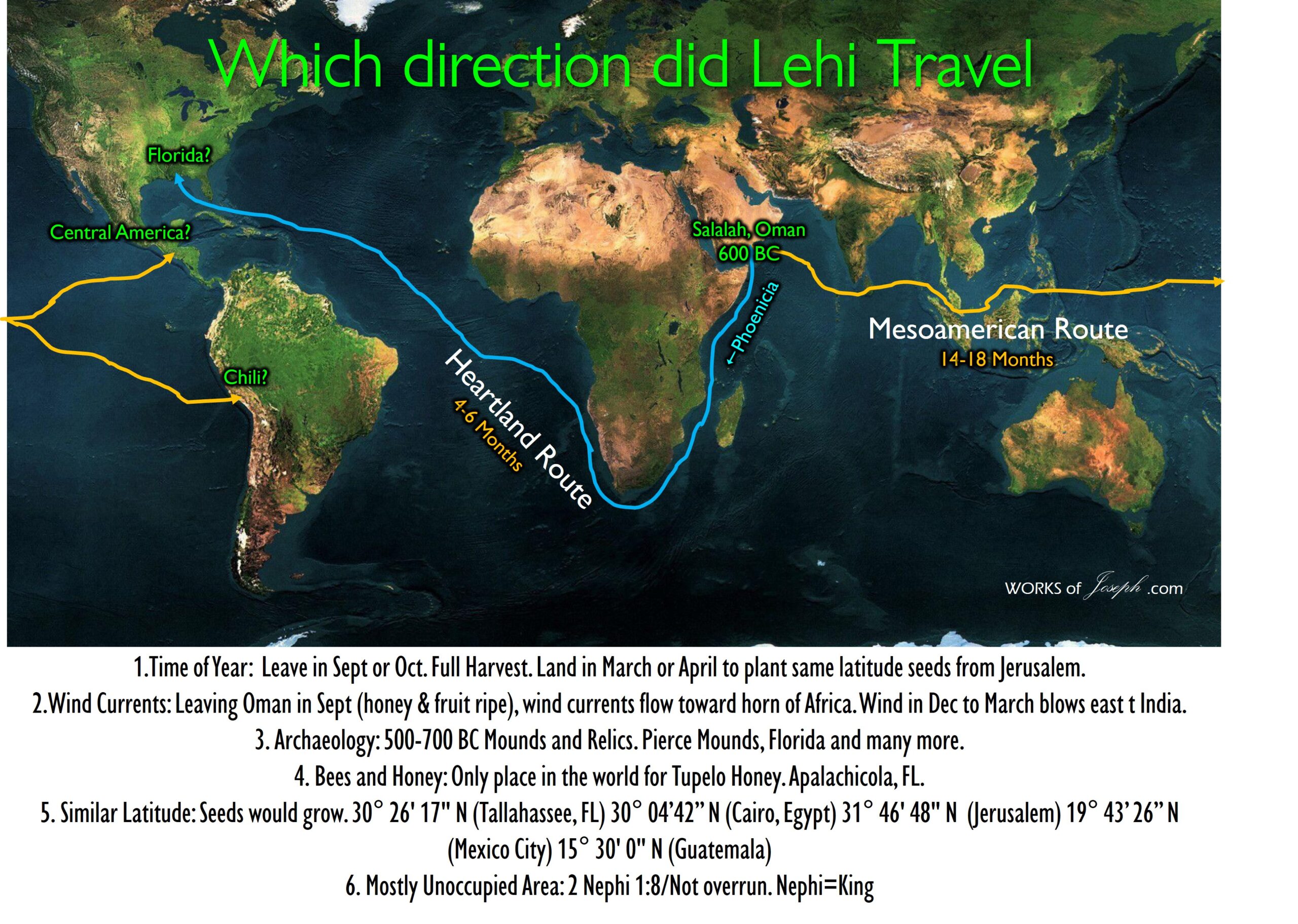
A… reason to accept an Atlantic crossing is the actual voyage of the ship Phoenicia, which was a recreation of an actual ship from 600 B.C. (see p. 35). The crew intended to circumnavigate Africa, but wind and sea currents pushed them within 350 miles of Florida before they managed to return the ship to the Mediterranean. This experience demonstrates the feasibility of an ancient Atlantic crossing. Once they arrived in the promised land, Nephi explains that the seeds they brought from the land of Jerusalem grew “exceedingly,” that they eventually found beasts including the cow, ox, ass, horse, goat and wild goat, and that they found ore of gold, silver and copper especially in the eastern hills of Chattanooga TN. (1 Nephi 18:24-5). The seed growing suggests a similar climate in Jerusalem and Florida.Both the panhandle of Florida and the area of Jerusalem are located about 30 degrees north latitude. Florida receives more precipitation, which may explain why the seeds grew “exceedingly.” Annotated book of Mormon by David Hocking and Rod Meldrum page 531
Landing in Florida
“I think Lehi landed in Florida for all the reasons I’ve explained in Moroni’s America. He may have sailed south of Cuba to get there because of ocean currents and wind, but it’s interesting that Mulek, Lehi and Columbus converge on the same areas.” [Below are some reasons].” Jonathan Neville Moroni’s America.
1- Wind current routes across the Atlantic (in the fall when honey and fruits were available, and the natural currents in the fall take you west) would put them somewhere in the Caribbean. This route was proven to be possible by the Phoenicia Expedition of 2009.
2- They went where the Lord directed them with the Liahona, so I don’t think they would have just landed wherever the wind blew them (which would probably have been Hispaniola or maybe the East Coast of Florida or South Carolina).
3- I think it makes sense they landed about the same latitude [Similar climate for seeds] as Jerusalem, which they could tell from the stars.
Latitudes a Similar 30° 26′ 17″ N (Tallahassee, FL) and 31° 46′ 48″ N (Jerusalem) Not similar 15° 30′ 0″ N (Guatemala)
4- Crops grew abundantly. This would be difficult in the jungles or islands.
5- It had to be a mostly unoccupied area (not Mesoamerica). Only small groups of hunter/gatherers in Southeastern U.S. at the time. [A large group of people wouldn’t have allowed Nephi to be their king]
6- It had to be the same general land where the Jaredites lived. [Cumorah and Ramah]
7- Should have archaeological evidence. (See Nancy White article here)
8- There should be signs of Hebrew writing or relics. (Holy Stones, Bat Creek Stones, Los Lunas, etc.)
9- Lehi and Nephi brought much honey with them from Bountiful in Oman. 1 Nephi 18:6 “And it came to pass that on the morrow, after we had prepared all things, much fruits and meat from the wilderness, and honey in abundance, and provisions according to that which the Lord had commanded us, we did go down into the ship, with all our loading and our seeds, and whatsoever thing we had brought with us, every one according to his age; wherefore, we did all go down into the ship, with our wives and our children.” It would make sense that the Lord may have led them to another land (Apalachicola FL) that had an abundance of honey producing vegetation, or Lehi may have brought the seeds from Israel to grow the White Tupelo Gum trees, nyssa ogeche, that are found naturally in Florida. Remember the Jaredites also brought bees with them to the Promised land. Ether 2:3 “And they did also carry with them deseret, which, by interpretation, is a honey bee; and thus, they did carry with them swarms of bees, and all manner of that which was upon the face of the land, seeds of every kind.”
A Chile or Guatemala Landing?
“What then accounts for long-held beliefs that Lehi landed on the western coast of the Americas? An 1836 handwritten statement by Frederick G. Williams, Second Counselor in the First Presidency, asserts that “Lehi and his company…landed on the continent of South America, in Chili [sic], thirty degrees, south latitude.” No documents have ever been found that connect this statement to Joseph Smith, but it may be the source upon which Orson Pratt relied when he inserted a footnote in the 1879 edition of the Book of Mormon to 1 Nephi 18:23 that reads, “believed to be on the coast of Chili [sic], S. America.”
This speculative language demonstrates that Church leaders did not consider this landing site to be certain. [Contrast that with the unambiguous footnote to Mormon 6:2, which reads, “The hill Cumorah is in Manchester, Ontario Co., N. York.” See p. 480) The Chile landing was contradicted by an unsigned anonymous article in the 1842 Times and Seasons newspaper which claimed that Lehi “landed a little south of the Isthmus of Darien,” without specifying whether this was on the western or eastern coast of Panama.
Orson Pratt lived in Nauvoo in 1842 when this article was published. If he believed Joseph had written or edited the anonymous Times and Seasons, Sep. 15, 1842, article that referred to the Isthmus of Darien (Panama), it is unlikely he would have persisted with the Chile landing site in the 1879 footnotes. Nor would Joseph’s other contemporaries, including apostles John Taylor and Wilford Woodruff, allow the Chile footnote if they believed Joseph was responsible for the “Isthmus of Darien” article. Because these unsigned statements cannot be directly attributed to Joseph Smith, subsequent Church leaders have declined to give any statements about Book of Mormon geography beyond the New York Hill Cumorah. President Joseph F. Smith was once asked to review a map showing the supposed landing place of Lehi’s company. He declared that the “Lord had not yet revealed it” – Pack, Frederick J. and Pyper, George D., “The Route Traveled by Lehi and His Company,” The Instructor, Vol. 73, No. 4 [April 1938], 160. By contrast, President Smith republished Letter VII (see pp. 512-516) in the Improvement Era in 1899.
Meso and Heartland Theories. Where do they Agree?
Lehi left Jerusalem south along the Red Sea and at Nahom (NHM) they traveled directly East to Oman and ended up near Khor Kharfot, Oman.
On October 24, 2022 in the Springville, Utah office of Book of Mormon Central (BOMC), an important meeting took place. With President of BOMC, Kirk Magleby inviting the Phoenicia crew of Heartland Research to their offices. There were 10 or so of the BOMC employees present, and Heartland proponents present were, Philip Beale the Captain of the Phoenicia Voyages of 2009 and 2019, with his international film crew of Yuri and Vera Sanada from Brazil, and also present were two of the owners of Heartland Research Group, Mike and Betty LaFontaine. See picture below.
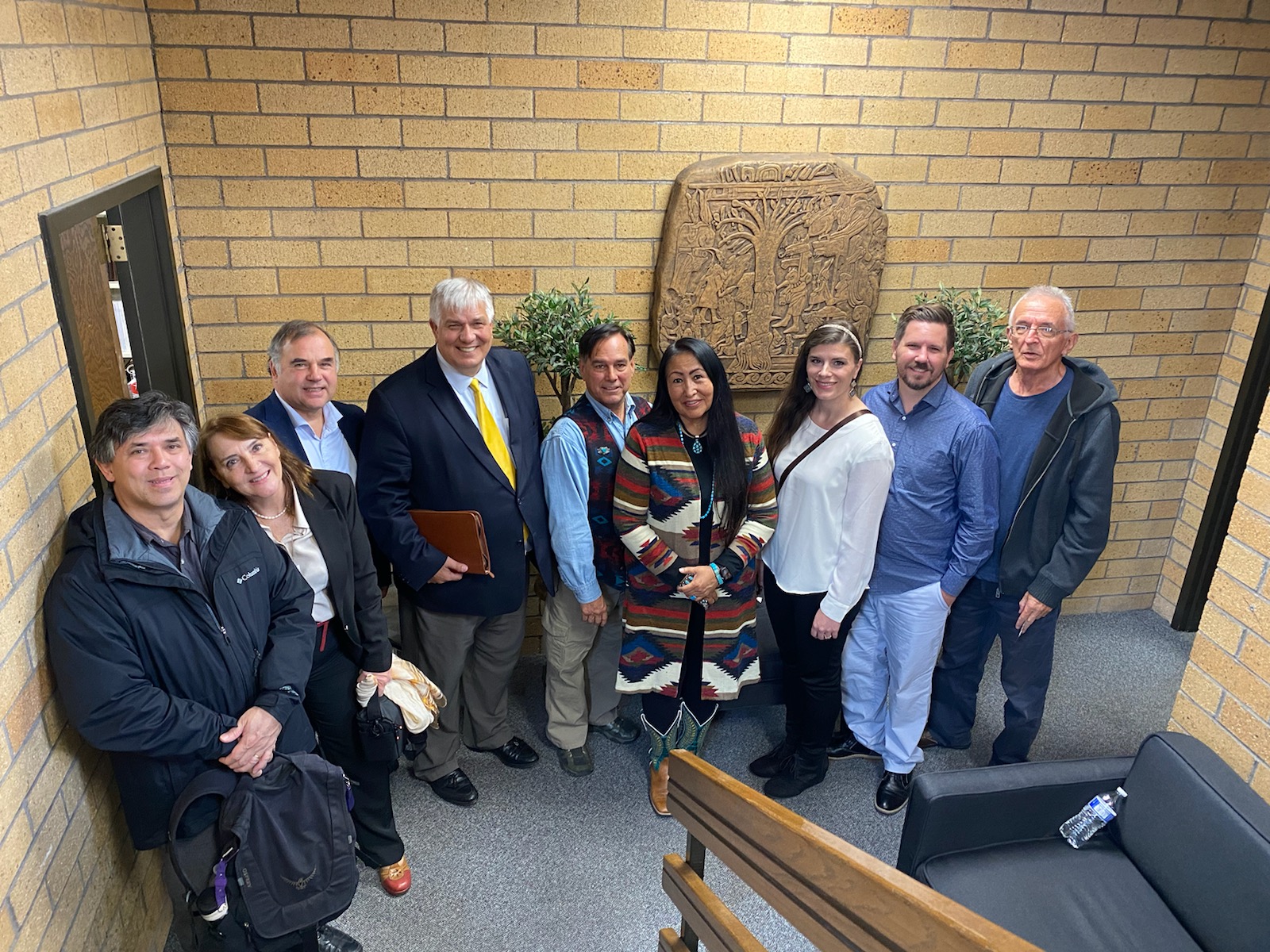
Kirk Magleby had invited a special guest from Australia, Warren Aston. Warren sailed on the Phoenicia with Captain Beale in 2009 for a few days early in the voyage. I am guessing Warren may have been there to just meet Philip again, or convince Philip that sailing East from Oman towards India was a better route than the Phoenicia took, which was West from Oman towards the Africa cape. (See Map Below)
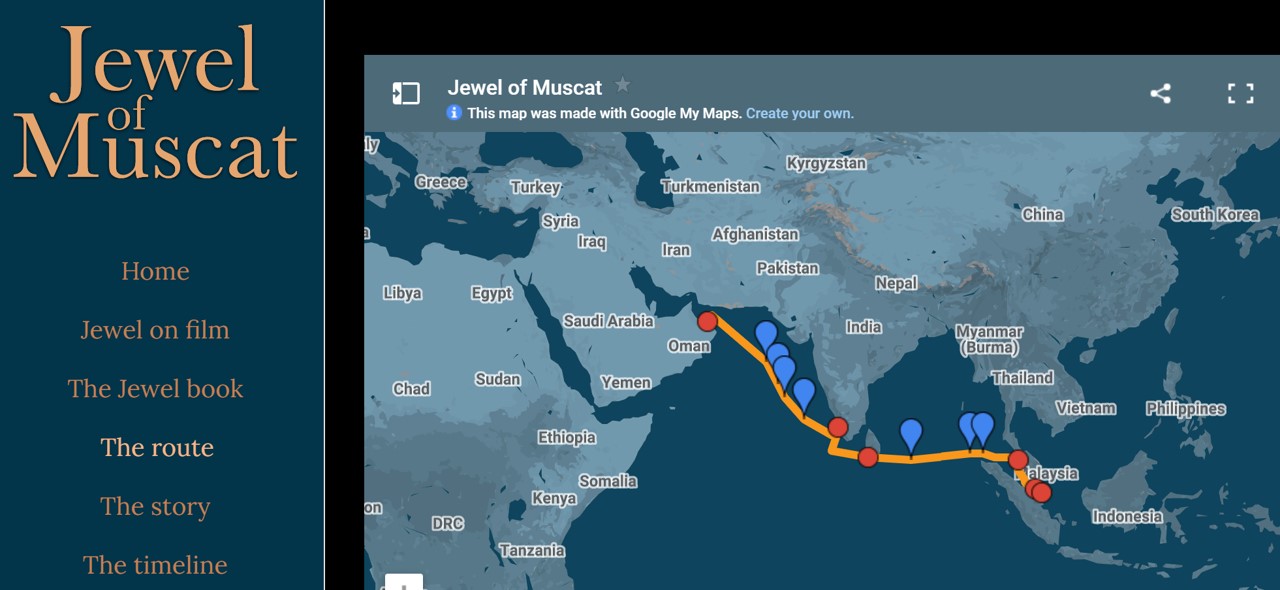
Both Agree Lehi Began Sea Travel Near the Same Place.
Not much about that directional difference was discussed at this meeting. I do know however that those in the Mesoamerican camp love the story of the 1140 AD rebuilt ship the Jewel of Muscat which sailed from Oman to Singapore in 2011. As you may know, it had to be hauled into port twice, sails and masts fixed and they had many challenges. Philip Beale mentioned to Warren and Kirk the problems with going east from Oman, but the BOMC group was determined that was the correct route for Lehi. Sad thing is that after landing in Singapore that ship would have to travel now through Indonesian and past New Guinea now into the Pacific Ocean for many miles before landing somewhere in Central America or Chile as they think is the landing place. Sounds very impossible according to Captain Beale. Beale says, “you may have a boat arrive in Central America after going east towards the Indian Ocean, but the people would be all dead without food and water after that long trip.”
Those of the Heartland persuasion strongly believe Lehi left from Oman and traveled southwest toward the tip of Africa and around sailing directly into the Gulf of America near the panhandle of Florida which is the Promised Land, and those of the Mesoamerican persuasion believe Lehi traveled southeast from Oman towards India landing either on the west coast of Guatemala or on the west coast of Chili in the Promised Land.
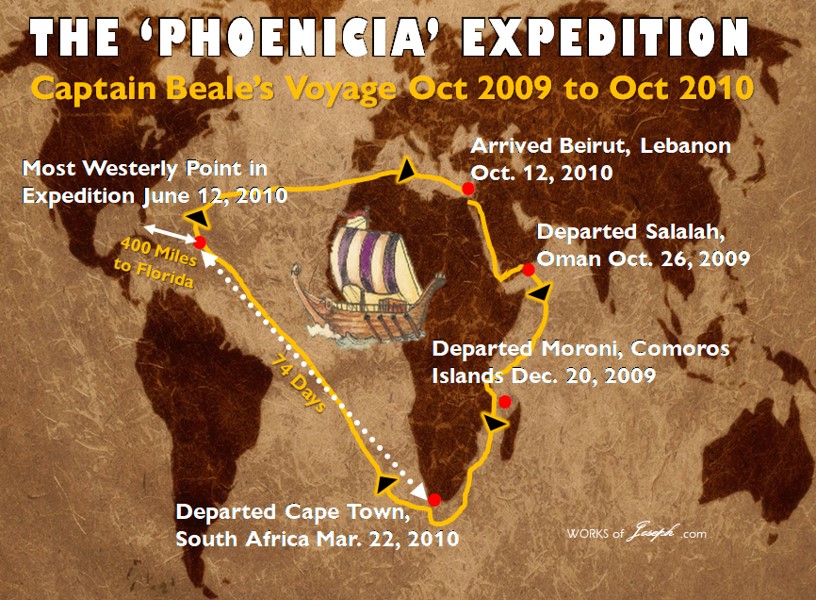
Both those people in the Mesoamerican camp, and those in the Heartland camp agree about the direction the Nephites wilderness travel from Jerusalem to Oman. They both agree that likely the place called Khar Karfoot, Oman may be the initial ‘Land Bountiful” in the Old World.You may decide on your own if the Lehites landed in Florida or Chile or Guatemala.
Similar Timelines. Hopewell and Nephites
If you look at the historical ancient Hopewell Culture it began in about 600 BC in Florida and ended in 400 AD in NY, and historians say it just ended abruptly. Of course that refers likely to the last great battle of the BofM.
There is ancient non-Mormon evidence that show that the Lehites plausibly landed in Florida. I personally have found pottery dated as Deptford and Swift Creek pottery at pierce Mounds at Apalachicola, FL, according to the University of South Florida Anthropologist Nancy White. I was there with Mike and Betty LaFontaine in about Oct of 2017 as we had the land owner Georg Mahr shows us around. We still have many pieces of pottery from the exploration.
Here is her report from 2013: https://docslib.org/doc/255127/pierce-mounds-complex-an-ancient-capital-in-northwest-florida
“The Deptford culture (800 BCE—700 CE) was an archaeological culture in southeastern North America characterized by the appearance of elaborate ceremonial complexes, increasing social and political complexity, mound burial, permanent settlements, population growth, and an increasing reliance on cultigens…
The Deptford culture was oriented to the coast. From Georgia it spread along the Atlantic coast, reaching Cape Fear, North Carolina to the north and the mouth of the St. Johns River to the south. The Deptford culture also spread along the Gulf of Mexico coast, reaching from the Perdido River on the western border of Florida to Tampa Bay on the lower west coast of Florida. Deptford culture appeared in Florida around 500 BCE. The Deptford culture in the Gulf region (Florida Panhandle, southeast Alabama and southwest Georgia) evolved into the Swift Creek and Santa Rosa-Swift Creek cultures around 200 CE, while the culture in the Atlantic coastal region continued until about 700. The Cades Pond culture developed from the Deptford culture after 100 CE in an inland region previously used seasonally by Deptford people.” Wikipedia
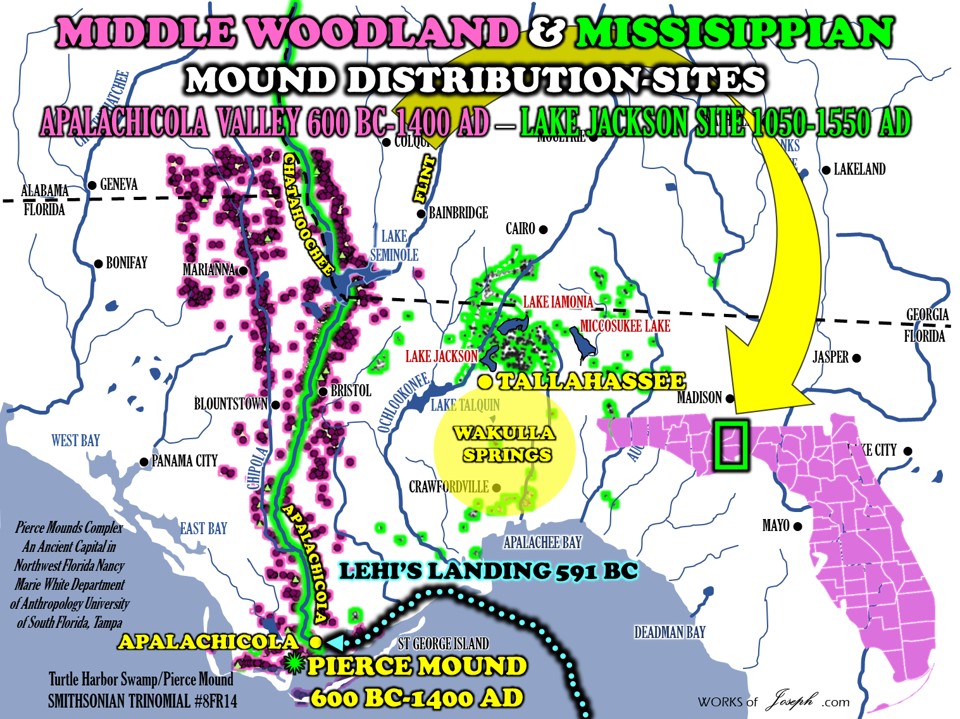
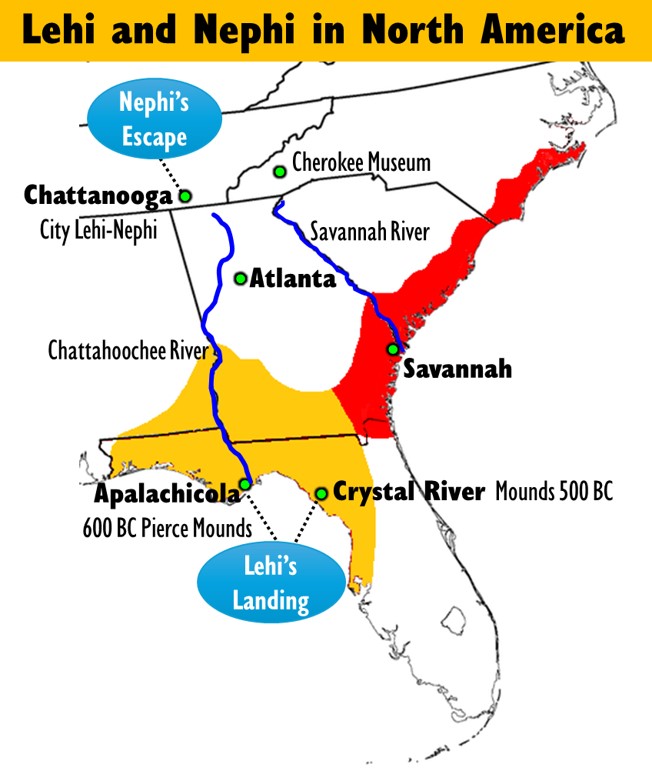
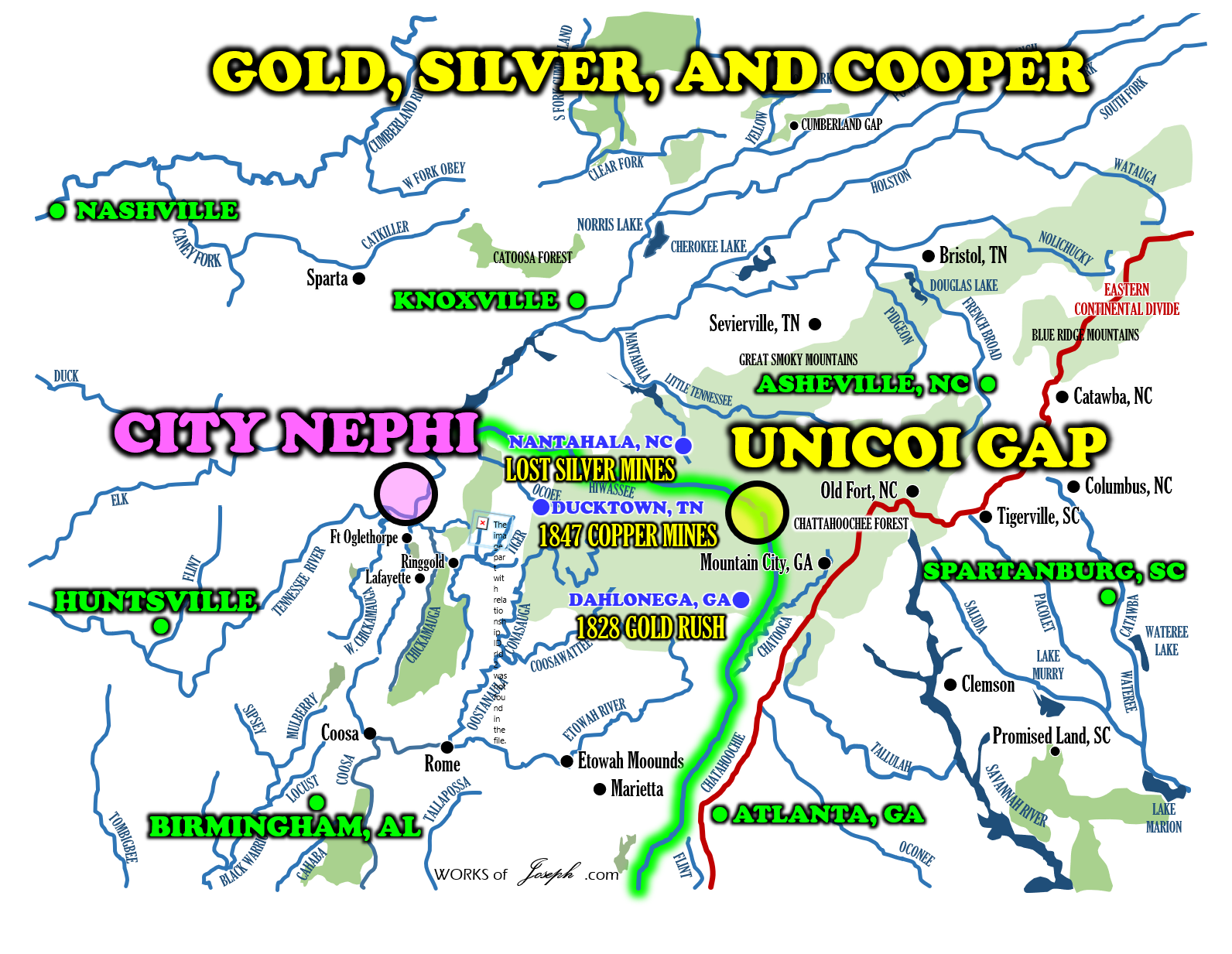
From Florida, the Nephites likely took the Chattahoochee River north and went into Georgia, and Tennessee (See map above the first picture) to escape the Lamanites. From the source of the Chattahoochee River and only 1,750 feet north is the source of the Hiwassee River that goes north into the Tennessee River. Once on the Tennessee River it is only a few miles south into Chattanooga, TN, where I believe the Nephites built the first temple. See picture below.

After Nephi and his people were driven into the wilderness and found a place to settle plausibly near Chattanooga TN. Nephi continued to instruct and serve his people. “And I did teach my people to build buildings, and to work in all manner of wood, and of iron, and of copper, and of brass, and of steel, and of gold, and of silver, and of precious ores, which were in great abundance. And I, Nephi, did build a temple; and I did construct it after the manner of the temple of Solomon save it were not built of many precious things; for they were not to be found upon the land, wherefore, it could not be built like unto Solomon’s temple. But the manner of the construction was like unto the temple of Solomon; and the workmanship thereof was exceedingly fine.” 2 Nephi 5:15-16.
The walls of the the Nephites first temple were not hewn stone, but wood with limestone cement on the outside as this Angel Mound in Indiana shows below:

“Archaeological excavation revealed a set of two palisade (stockade) walls. The outer palisade surrounded the perimeter of the town with the Ohio River acting as a barrier on the south side. An inner palisade bisected the interior of the site. An entrance to the town was believed to have been on southwest corner of the palisade, based on archaeological findings at that location. Parallel to the stockade walls, another barrier (similar to a picket fence) was set 14 feet (4.3 m) outside the stockade. It was designed to slow attackers as they came into range.
A reconstruction of part of the stockade, based on archeological evidence, was made in 1972. The reconstructed walls are 12 feet (3.7 m) high and have wooden posts set 4 feet (1.2 m) deep into a narrow trench. The walls and posts are covered with wattle and daub (a loose weaving of sticks covered with a mud-and-grass plaster). Defensive bastions along the stockade walls were also reconstructed. The original inhabitants set the bastions about 120 feet (37 m) apart and projecting 10 feet (3.0 m) to 11 feet (3.4 m) from the wall. The distance between each bastion allowed defenders using arrows or lances to protect the walls from direct attack.” Wikipedia
Of course we believe the Lamanites and then the Nephites final battles ended at Hill Cumorah, NY which is the same hill called Ramah, by the Jaredites. Ether 15:11. Joseph Smith said in the JSP, in a letter to Emma during Zion’s camp while beside the Mississippi River and near Atlas, Illinois saying, “wandering over the plains of the Nephites, recounting occasionally the history of the Book of Mormon, roving over the mounds of that once beloved people of the Lord, picking up their skulls & their bones, as a proof of its divine authenticity” Joseph Smith Papers Letter to Emma Smith, 4 June 1834 Page 56. Joseph knew the Plains of the Nephites were in the Heartland of North America.
Mesoamericanists and Heartlands may agree to disagree, but we all love the Book of Mormon and know its a spiritual witness of truth.
Another blog here: Lehi’s Landing-Apalachicola Florida
And here: Hinterland is Mesoamerica & Western United States
And here: Florida Hurricane Nicole Unearths Human Remains 500 BC