Seasons
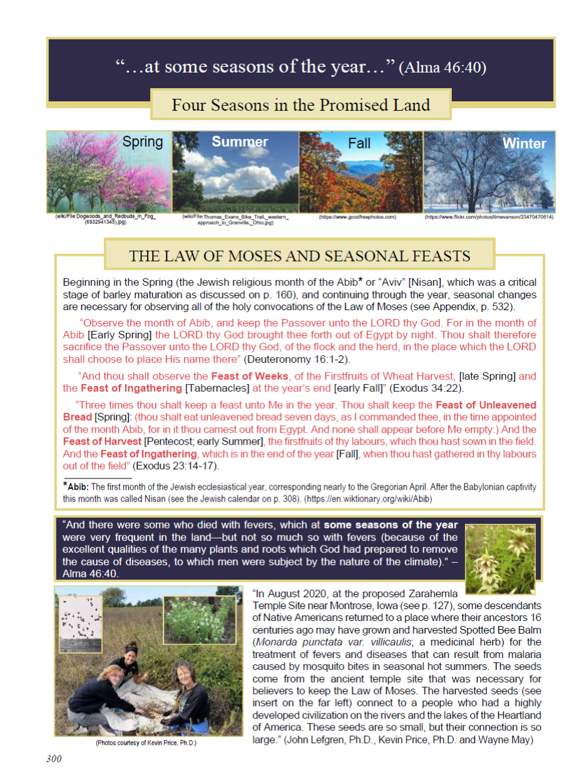
“…at some seasons of the year…” (Alma 46:40). As the Book of Mormon states there were some seasons of the year, that doesn’t fit the climate in Mesoamerica which has tropic and subtropic climates. The Heartland of the United States has Winter, Spring, Summer and Fall, which is the type of climate most indicative of what is said in the Book of Mormon. Alma 40:46 “And there were some who died with fevers, which at some seasons of the year were very frequent in the land—but not so much so with fevers, because of the excellent qualities of the many and roots which God had prepared to remove the cause of , to which men were subject by the nature of the climate.” So some seasons of the year had more fevers than others, and certain herbs were found during different climates in the land, which I feel is the Heartland of the United States and not in Mesoamerica.
At what seasons of the year would fevers be more likely? In South America there are basically two seasons. Hot and hotter. Or, warm and warmer. Rainy or not rainy? Dry or wet? In North America there are 4 seasons of the year and and at what time of the year are fevers and the flu more frequent?
Four Seasons in the Promised Land

Does it Mention Snow in the Book of Mormon?
If you answered No, the word snow is not found in the Book of Mormon, you would be in agreement with 90% of those in the Mesoamerican camp. They have said for so many years there is no snow in the Book of Mormon, yet most have not read that passage lately, or ever!
But these theorists would say, yes, but that was in a dream, Nephi wasn’t talking about real snow. Well, who was Nephi writing to? To his children and grand children and to us. Why would Nephi use the word snow if he had never experienced it? Why would he mention snow if his children wouldn’t understand what the word snow meant? Did you know the term “the whiteness of the driven snow” is not found in the Bible? They wouldn’t know about DRIVEN snow unless they lived in upstate New York or in Wyoming during winter. And yes, it does snow in Israel at times.
Driven Snow
“Nephi recorded the description of his previous vision of the Tree of Life: “And I looked and beheld a tree… and the beauty thereof was far beyond, yea, exceeding of all beauty; and the whiteness thereof did exceed the whiteness of the driven snow” (1 Nephi 11:8). Nephi was addressing his own people after having separated from the Lamanites and wrote this description on the small Plates of Nephi, which he was commanded to make forty years after arriving in the Promised Land (2 Nephi 5:30-34). It was thirty years after he made the large set of plates which were used by his father Lehi to record his history and visions. Nephi’s children and grandchildren never lived in Jerusalem. The Nephites were living in the land choice above all others where “driven” snow must have been common in order for them to understand the analogy of “whiteness of the driven snow,” an expression not found in Hebrew Scripture.
As an example, Isaiah wrote: “…though your sins be as scarlet, they shall be as white as snow…” a passage that was written on the Plates of Brass in the book of Isaiah (1:18). Nephi did not write, “they shall be as white as snow,” Nephi instead wrote, “…the whiteness thereof did exceed the whiteness of the driven snow.” In other words, the children and grandchildren of Nephi must have had experienced something similar to a blizzard—snow driven by the wind. Nephi may have experienced this weather condition in the Promised Land, and after living there for forty years, he knew that the generations of his people would understand this specific description as an analogy of the “whiteness” of the fruit of the Tree of Life. Nephi was commanded by God to write on the small plates “for the ministry of my people” (1 Nephi 9:3), suggesting this unique and specific analogy would have meaning to them.
By comparison Nephi records what his father, Lehi saw in the vision while in the Arabian wilderness: “Yea and I beheld that the fruit thereof was white, to exceed all the whiteness that I had ever seen” (1 Nephi 8:11). The phrase, “whiteness of the driven snow” is Nephi’s description, recorded forty years after arriving in the Promised Land, suggesting that he lived somewhere in North America where blizzards “drive” the snow, providing an analogy that had a special and understandable meaning for those who witnessed snow driven by strong winds.” (See p. 300, Annotated Book of Mormon “Four Seasons in the Promised Land.”)
“I want to mention something about the driven snow from an artist point of view. When the sun is at an angle and it hits the snow that is piled up or driven, it reflects so brilliantly that at certain angles it’s almost blinding to look at it. The top of the regular snow in most cases reflects the blue of the sky or the grey of the sky and really is not that white. But driven snow reflects that brilliant sunlight not off the surface but off the part of the snow that is driven or piled up and when it is in that condition it can be truly a bright white” – Clark Kelley Price, Professional Artist. See one of his brand new beautiful paintings below:
Actually, snow and hail are mentioned three times in the text in conjunction with dreams and exhortations (1 Nephi 11:8, Mosiah 12:6 and Helaman 5:12), but no mention is made that they experienced it happening. Both “rain” and “heat” are mentioned in seven verses; twice rain is mentioned as having occurred, once by the Nephites (Helaman 11:17) and once by the Jaredites (Ether 9:35), all other references are speaking in prophecy or metaphorically. There are three instances of observed normal weather phenomena and only two mention the most common—that of rain.
Only once is a hot day mentioned as having occurred as found in Alma 51:33 where it reads: “And it came to pass that when the night had come, Teancum and his servant stole forth and went out by night, and went into the camp of Amalickiah; and behold, sleep had overpowered them because of their much fatigue, which was caused by the labors and heat of the day.”
This solitary reference has formed the foundation upon which many have speculated about the climate of the Book of Mormon. From this one verse it has been surmised that a tropical climate is indicated by the text. But does the text justify such an assumption?
Assuming that the term “heat of the day” refers to the outdoor temperature of that particular day, the timing of the battle is important for context: “And thus endeth the twenty and fifth year of the reign of the judges over the people of Nephi” (Alma 51:37). The Nephites’ lunar calendar meant that the end of their year was the beginning of spring on their observed Jewish calendar.
Weather patterns may have been different anciently, so it may not have been unusual to experience warm temperatures in the Midwestern States in April (the beginning of the Jewish New Year.) Even so, temperature data shows that Cleveland, Ohio, a city noted for its cold winters, recorded highs of 83 degrees F in March, 1945 and 88 degrees F in April, 1986. Similarly, weather almanac’s for St. Louis, Missouri for the month of April have recorded average high temperatures of 67 degrees F and record high temperatures of 93 degrees F. Source: http://myforecast.co/bin/climate.m?city=22127&metric=false
Therefore, it is quite possible that Teancum found Amalickiah much fatigued due to an unseasonably warm day at the end of the 25th year of the reign of the judges in March or April, 67 B.C. There is no reason to assume a tropical climate is necessitated by the text when all that would be required is one of any number of warm sunny spring days in the North American Heartland.
In Helaman 11:17, it says, “that it [rain] did bring forth her fruit in the season of her fruit”. In North America what is the season of her fruit? Look at the picture lower left and see that typically in Ohio the harvest season is July, August, and September. In South America what is the season of her fruit? All the time! See the chart below right and you will notice things are abundant almost any time of the year in Brazil.
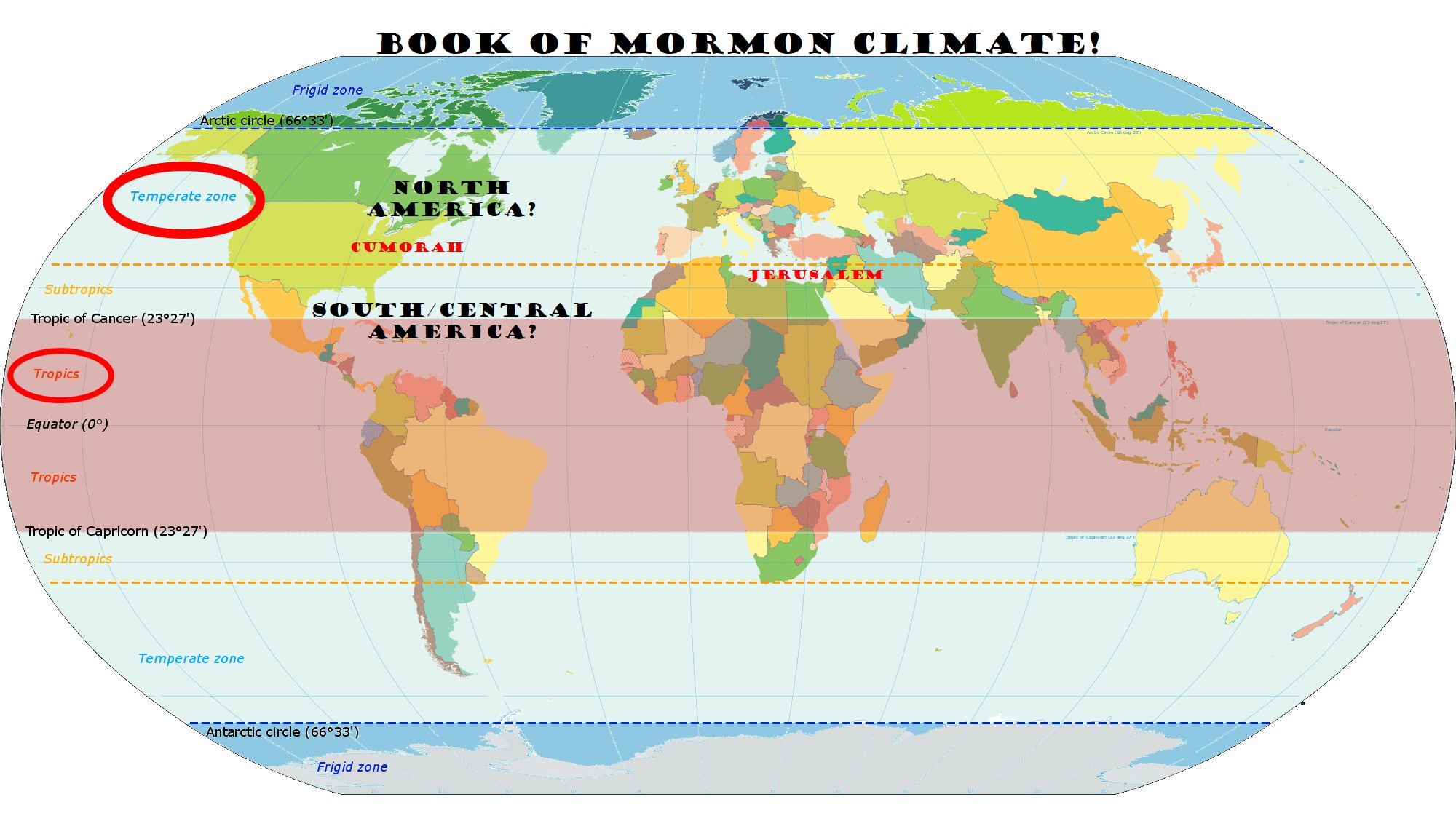
Alma 46:40 it says, “And there were some who died with fevers, which at some seasons of the year were very frequent in the land—but not so much so with fevers, because of the excellent qualities of the many plants and roots which God had prepared to remove the cause of diseases, to which men were subject by the nature of the climate”
At what seasons of the year would fevers be more likely? In South America there are basically two seasons. Hot and hotter. Or, warm and warmer. Rainy or not rainy? Dry or wet? In North America there are 4 seasons of the year and and at what time of the year are fevers and the flu more frequent?
The Flu Season
“While seasonal influenza (flu) viruses are detected year-round in the United States, flu viruses are most common during the fall and winter. The exact timing and duration of flu seasons can vary, but influenza activity often begins to increase in October. Most of the time flu activity peaks between December and February, although activity can last as late as May.” Center for Disease Control
“Remember that the southern hemisphere seasons are reversed – with summer roughly November to February, and winter in June to August. Peru is pretty much a year round destination thanks to its proximity to the equator. However, visit between January and March and you’ll be slap bang in the middle of the rainy season.” Responsible Travel
Climate
What was the nature of the climate of the Book of Mormon? One longstanding question has been that of snow. If the Book of Mormon lands were in North America, why was there no mention of snow? If I told you right now the word “snow” is in the Book of Mormon, what would you say? Over 80% of the people I speak to today say, “NO it isn’t”. Then I ask them to look it up, there is usually shock on their faces. From there it is easy to discuss this issue. We have been conditioned by the Mesoamerican Theorists that there is no snow mentioned in the Book of Mormon. I would also say that 40% of Heartlanders don’t even know that snow is mentioned in the Book of Mormon.
Migrating Animals
“The Waters of Mormon, were in the borders of the and of Shilom, which was prone to “having been infested, by times or at seasons, by wild beasts” (Mosiah 18:4). A seasonal infestation of wild beasts could indicate migratory patterns caused by changing seasons that affect the abundance or scarcity of available food throughout the year in temperate climates. There are no migratory land animals in climates that do not have distinctive seasons, such as near the equator.” Page 171 Annotated Book of Mormon
Migratory animals live in locales that are difficult to survive in year-round. Instead of hibernating (the survival choice of many land animals) when food and water become scarce, these animals choose to migrate in search of more hospitable habitats and terrain. Most land animals practice seasonal migration — a type of migration that corresponds with the change in seasons, while others migrate in search of mates.
American Bison
American bison inhabit the grasslands and parklands of Canada and the central United States. They are nomadic as well as seasonal migratory animals. During the day, bison slowly graze on grasses, herbs and shrubs, moving approximately 2 miles each day; this slow-moving migratory pattern is called “nomadic migration.” During their seasonal migration, American bison move to more southerly habitats in the winter covering up to 150 miles during their journey. https://animals.mom.me/land-animals-migrate-3520.html
Elk Migration
Elk wintering in Jackson Hole, Wyoming, after migrating there during the fall As is true for many species of deer, especially those in mountainous regions, elk migrate into areas of higher altitude in the spring, following the retreating snows, and the opposite direction in the fall. Hunting pressure also impacts migration and movements.[46] During the winter, they favor wooded areas and sheltered valleys for protection from the wind and availability of tree bark to eat. Roosevelt elk are generally non-migratory due to less seasonal variability of food sources.[37]
The Greater Yellowstone Ecosystem elk herd numbers over 200,000 individuals and during the spring and fall, they take part in the longest elk migration in the continental U.S. Elk in the southern regions of Yellowstone National Park and in the surrounding National Forests migrate south towards the town of Jackson, Wyoming, where they winter for up to six months on the National Elk Refuge. Conservationists there ensure the herd is well fed during the harsh winters.[47] Many of the elk that reside in the northern sections of the Greater Yellowstone Ecosystem migrate to lower altitudes in Montana, mainly to the north and west. https://en.m.wikipedia.org/wiki/Elk
Mammals Migration
“Seasonal movements are not widespread among terrestrial species of mammals, because walking speed is relatively slow and energy consumption great. Marine and flying mammals have a much greater tendency to migrate, a tendency that is directly related to their locomotive powers.
Terrestrial Mammals
True migration among mammals occurs mostly among large artiodactyls (even-toed ungulates) living in habitats with wide fluctuations of climatic and biotic conditions.
In North American Arctic regions, herds of caribou (Rangifer tarandus) settle during the summer in the barrens—rather flat wasteland with little vegetation. In July the animals begin to move irregularly southward and spend the winter in the taiga, or northern forests, through which they wander freely with no general directional trend. Each herd seems to move in accordance with local conditions and without a well-defined pattern. The caribou again move northward as early as late February and return to the barrens. These migrations follow the same routes from year to year.
In former times, American bison (Bison bison) migrated regularly through the Great Plains. Herds of as many as 4,000,000 animals moved from north to south in fall and returned when spring rains brought fresh grass to the northern part of their range. Bison travelled over more or less circular routes and spent the winter in areas 320 to 640 kilometres (200 to 400 miles) from the summer range. Other North American mammals, such as elk (Cervus canadensis), mule deer (Odocoileus hemionus), and dall sheep (Ovis dalli), still migrate regularly in areas undisturbed by man.
Mesoamerican Migration

A few birds and the butterfly migrate in Mesoamerica. “And it came to pass that the people did follow the course of the beasts, and did devour the carcasses of them which fell by the way, until they had devoured them all.” Ether 9:34 I doubt in Ether that Mormon was referring to either a bird or a butterfly or even the turkey which is from Mesoamerica.
Domesticated Animals
What are domestic animals?
The term is very vague especially if you’re talking about Mesoamerica. If you mean animals of burden, they had none, but there are other animals
What they had for food, ritual sacrifice & companions (if they were pets, they were never used as food.) dogs & turkeys.
The dogs that they had are the Chihuahuas (debated to be techichi) & Mexican Hairless (Xoloitzcuintli). There was people who breed them to have select qualities. It’s a debate whether the ones as pets were breeded differently than the ones that were eaten other than the ones that would be eaten were fatten. https://tecpaocelotl.livejournal.com/16190.html
Jaredites Bring Their Animals
The Jaredites would not have brought their animals from the Middle East to Mesoamerica as they would not have survived the climate. This is another reason why it makes sense that the Jaredites landed in North America in a temperate climate and a place for domesticated animals.

“The Jaredites left their homeland driving great herds of cattle before them in the immemorial Asiatic manner, and even if they had never been nomads before, they certainly lived the life of the steppes during those many years before they set sail (Ether 3:3, p. 464), and when they embarked, they crammed all they could of their beasts into their small boats, “flocks and herds” and other beasts (Ether 6:4, p. 466), and upon reaching the New World continued to cultivate “all manner of cattle, of oxen, and cows, and of sheep…and of goats” just as their ancestors had in the old country (Ether 9:18, p. 471)” – Hugh Nibley, “The World of the Jaredites;” Part VIII, Improvement Era, [Apr. 1952], 236. The Nephites, who came from Jerusalem, then had religiously essential sheep, goats, cows and oxen brought in by the Jaredites to North America. This allowed the Nephites, who were from the House of Joseph, to practice the Law of Moses in the land of the future New Jerusalem. Page 493 Annotated Book of Mormon.
Domesticated Animals in Mesoamerica
“Dogs, turkeys, and the Musovy duck were the only domesticated animals in ancient Mesoamerica. All were used for food, but they made only a minor contribution to the Aztec diet. The Aztecs also fished and hunted wild game, but again these food sources were limited…Archaeologists do find the bones of fish, deer, rabbit, iguana, dog, turkey, and other animals in Aztec domestic trash deposits, but rarely in dense concentrations. Meat from large animals was a minor part of the Aztec diet. Early Spanish observers noted the widespread use of insects among the Aztecs, including ants, grasshoppers, manuey worms, and jumil bugs. Insects are high in protein, tasty, and could often be harvested in large numbers. The Aztecs also gathered great amounts of blue-green spirulina algae…from the surface of the lakes. This algae, known as tecuitlatl, is extremely high in protein, grows rapidly, and abundantly, and is easy to gather with fine nets…The Spanish soldiers and priests had a low opinion of the palatability of this algae, but it was much prized by the Aztecs.” —The Aztecs, Smith (p. 67) http://www.foodtimeline.org/foodmaya.html
Turkeys Were Domesticated Not For Meat, But For Ancient Mesoamerican Ceremonies
“A staple for many a Thanksgiving and Christmas lunch, the turkey is now synonymous with the holiday season and roast dinners.
But this wasn’t always the case. Now archaeologists have uncovered the earliest origins of the all-American domestic turkey in Mexico, finding that these early birds were not prized for their tasty meat, but rather traded for their cultural significance in rituals and sacrifice.
The archaeological evidence suggests that meat from deer and rabbit was a more popular meal choice for people in pre-Columbian societies; turkeys are likely to have also been kept for their increasingly important symbolic and cultural role,” explained Dr Aurélie Manin, who led the study published in Royal Society Open Science.
The team of researchers studied the bones of 55 turkeys collected from Mesoamerica – which spans an area from central Mexico to northern Costa Rica – that dated to between 300 BCE and 1500 CE.” https://www.iflscience.com/plants-and-animals/turkeys-were-domesticated-not-for-meat-but-for-ancient-mesoamerican-ceremonies/
Law of Moses
Mesoamerica did not have lambs, sheep, rams, bullocks, doves, wheat, barley or wine during the time of the Book of Mormon. These were all necessary animals and plants to practice the Law of Moses.
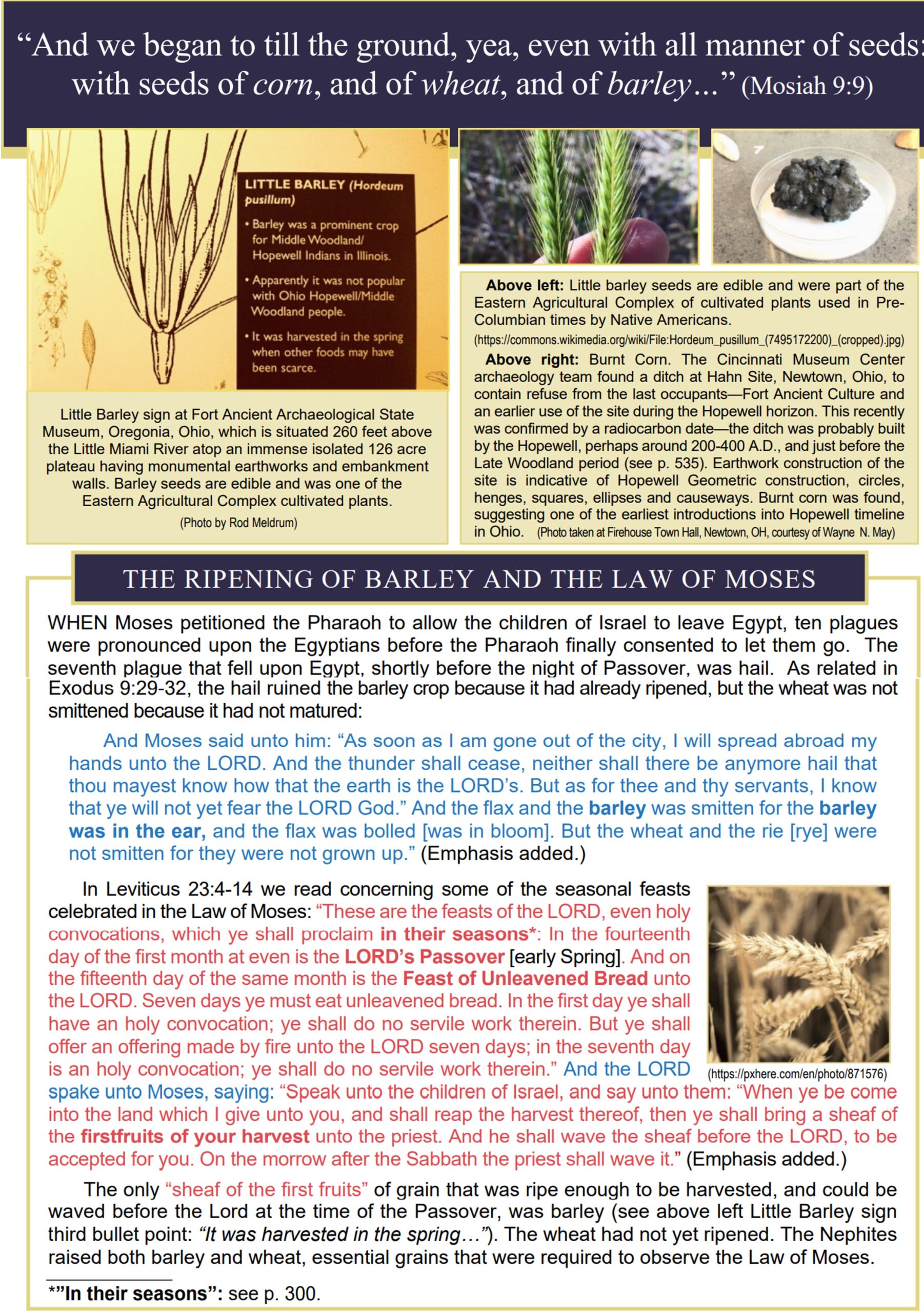 Not only this, but the proper seasons were required to practice the Law of Moses. In Mesoamerica there is very little change in seasons.
Beginning in the Spring (the Jewish month of the Abib* or “Aviv” [Nisan], which was a critical stage of barley maturation as discussed on p. 160 Annotated Book of Mormon), and continuing through the year, seasonal changes are necessary for observing all of the holy convocations of the Law of Moses (see Appendix, p. 532 Annotated Book of Mormon). See blog on Barley here:
“Observe the month of Abib, and keep the Passover unto the LORD thy God. For in the month of Abib [Early Spring] the LORD thy God brought thee forth out of Egypt by night. Thou shalt therefore sacrifice the Passover unto the LORD thy God, of the flock and the herd, in the place which the LORD shall choose to place His name there” – Deuteronomy 16:1-2.
“And thou shalt observe the Feast of Weeks, of the Firstfruits of Wheat Harvest, [late Spring] and the Feast of Ingathering [Tabernacles] at the year’s end [early Fall]” – Exodus 34:22.
“Three times thou shalt keep a feast unto Me in the year. Thou shalt keep the Feast of Unleavened Bread [Spring]: (thou shalt eat unleavened bread seven days, as I commanded thee, in the time appointed of the month Abib, for in it thou camest out from Egypt. And none shall appear before Me empty:) And the Feast of Harvest [Pentecost] [early Summer], the firstfruits of thy labours, which thou hast sown in the field. And the Feast of Ingathering, which is in the end of the year [Fall], when thou hast gathered in thy labours out of the field” – Exodus 23:14-17.
*Abib: The first month of the Jewish ecclesiastical year, corresponding nearly to the Gregorian April. After the Babylonian captivity this month was called Nisan (see the Jewish calendar on p. 308 of the Annotated Book of Mormon) (https://en.wiktionary.org/wiki/Abib)
THE LAW OF MOSES AND SEASONAL FEASTS
Four Seasons in the Promised Land
3 Nephi 1:24-26 “And there were no contentions save it were a few that began to preach, endeavoring to prove by the scriptures, that it was no more expedient to observe the Law of Moses. Now in this thing they did err, having not understood the scriptures. But it came to pass that they soon became converted and were convinced of the error which they were in, for
it was made known unto them that the Law was not yet fulfilled, and that it must be fulfilled in every whit; yea, the word came unto them that it must be fulfilled; yea, that one jot or tittle should not pass away till it should all be fulfilled; therefore in this same year were they brought to a knowledge of their error and did confess their faults. And thus the ninety and second year did pass away, bringing glad tidings unto the people because of the signs which did come to pass according to the words of the prophecy of all the holy prophets.”
It was no more expedient to observe the Law of Moses: The Nephites were observing the Law of Moses as contained in the Plates of Brass for over 600 years since they left Jerusalem. They were commanded to observe it until Jesus Christ’s Atonement fulfilled the Law. (The Hebrew word jot is the smallest letter of the square Hebrew alphabet. A tittle refers to a small stroke or point in writing or printing. It is now most commonly used as the name for the dot over the letter i. ) Page 380 Annotated Book of Mormon
Lambs
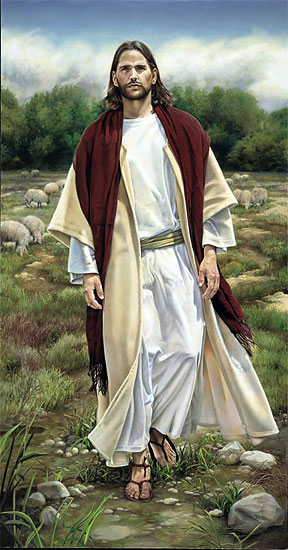
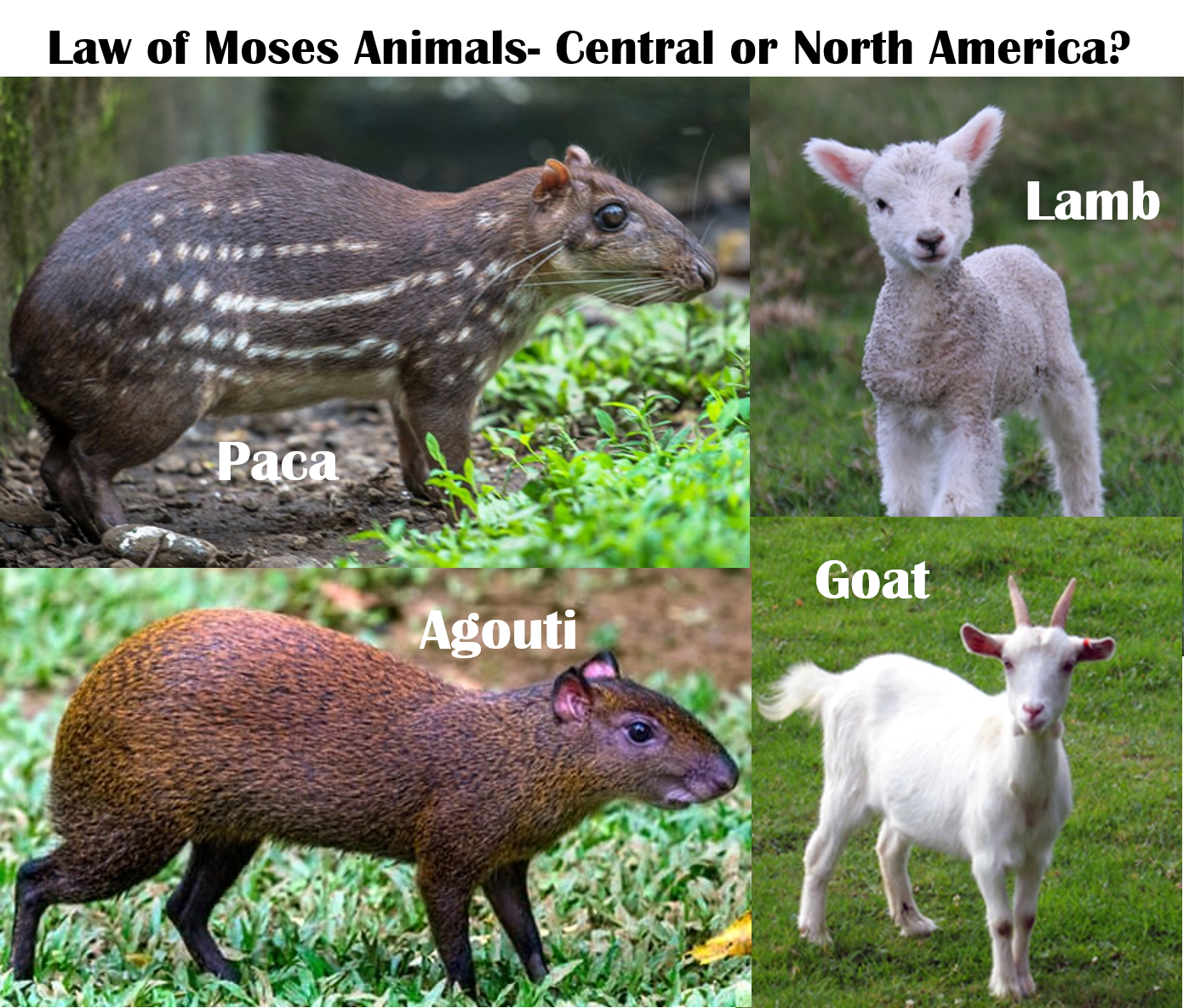 Remember the most important symbolic animal in the Israelite culture is the Lamb, as in “the Lamb of God.” I have heard the Lamb is known as the only animal that will not resist its own death. That surely describes the Savior of the World.
“…they had a lamb-skin about their loins…” (3 Nephi 4:7).
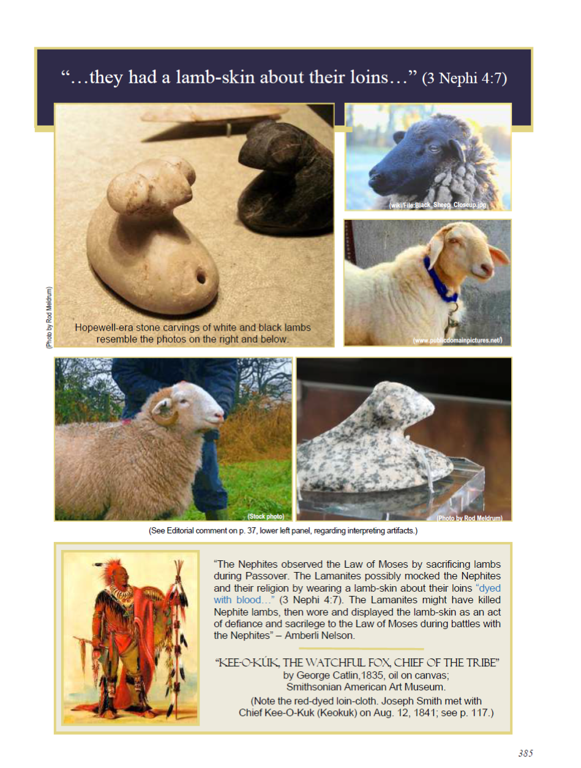
The Nephites observed the Law of Moses by sacrificing lambs during Passover. The Lamanites possibly mocked the Nephites and their religion by wearing a lambskin about their loins “dyed with blood” (3 Nephi 4:7). The Lamanites might have killed Nephite lambs, then wore and displayed the lamb-skin as an act of defiance and sacrilege to the
Law of Moses during battles with the Nephites. (Research by Amberli Nelson) Page 385 Annotated Book of Mormon
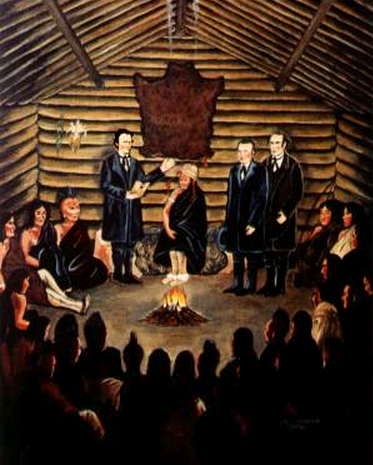
(Above) “Kee-o-kúk, The Watchful Fox, Chief of the Tribe” by George Catlin,1835, oil on canvas; Smithsonian American Art Museum. (Note the red-dyed loin cloth. “…and they were naked, save it were a skin which was girded about their loins… ” (Alma 43:20). (Left) Joseph Smith met with Chief Kee-O-Kuk on Aug. 12, 1841; see p. 117 Annotated Book of Mormon)
 Mesoamerica did not have sheep or goats or bullocks or rams to practice the Law of Moses. North America did as Hugh Nibley states below.
“If my insistent harping on central Asia annoys you, let me remind you again that the book of Ether gives us no choice. It never lets us forget that what the Jaredite kings did was a conscious imitation and unbroken continuation of the ways of “the ancients,” of “them of old” on the other side of the water. This, incidentally, is another indication that we are not to regard the Jaredite migration as taking place immediately after the flood, for the fall of the tower saw the destruction of an ancient and established order. The Jaredites left their homeland driving great herds of cattle before them in the immemorial Asiatic manner, and even if they had never been nomads before, they certainly lived the life of the steppes during those many years before they set sail (Ether 3:3), and when they embarked, they crammed all they could of their beasts into their small boats, “flocks and herds” and other beasts (Ether 6:4), and upon reaching the New World continued to cultivate “all manner of cattle, of oxen, and cows, and of sheep” just as their ancestors had in the old country (Ether 9:18). Now you know, how the Nephites could have had sheep in North America brought to this land by the Jaredites. The Nephites could continue practicing the Law of Moses in the land of The New Jerusalem.” (2 Nephi 25:24 Mosiah 2:3) Hugh Nibley from Lehi in the Desert; The Great Open Spaces
Why are Baby Farm Animals Typically Born in the Spring? IOWA AG LITERACY …Some of my friends even celebrate events like ‘Lambaggedon’. So many baby lambs can be born on a single weekend that family and friends have to come from miles away to help out. They make the event fun with a little contest. Guess the number of lambs to be born between Friday morning and Monday noon. Closest guess gets the privilege of naming one of the lambs.
But why are so many babies born in the spring?
In a lot of ways spring is the perfect time for babies to be born. Mother mammals usually need better, richer food to produce quality milk for their babies to nurse. For grazing animals like cattle, sheep, and horses, the fresh green grass and other plants on pasture in spring and early summer are rich in nutrients. These plants can have a higher percentage of protein and ‘total digestible nutrients’. This can lead to better milk production for the babies. Most calves are born between January and May because of this reason. Read more about early calving here.
Spring is also a good time for babies to be born because the days become longer and temperatures rise. With the warmer weather it is easier for the baby to survive. There is less chance of harsh weather. Just like humans, animals need to be protected from severe weather. Cows often like to wander away from the herd to give birth in solitude. This can put the mother and calf at risk. If the cow has any problems during the birthing process, a farmer might not be available to assist and help pull the calf. Away from the herd, especially in cold weather, the calf might be less likely to survive. Away from the herd, the baby might be in danger from predators like foxes, coyotes, or even large birds of prey like eagles. In many, contemporary farming operations calving and farrowing happens in a barn or ‘under roof’. This protects the mother and baby from many of those dangers.
Because spring is such a good time of year for babies, many animals evolved to accommodate these natural cycles. Many Iowans are familiar with the deer rut that happens in October, November, and December. Male deer are at peak testosterone, get more aggressive, and start fighting for mates. They wander out of their natural habitats which leads to increased motor vehicle accidents when they cross roads. This is in large part because the female deer come into estrus in the fall. As the days shorten, their hormones trigger the estrus cycles. A deer’s gestation will take 201 days. So if the female gets pregnant on October 1, you can expect a fawn around April 20th. Why are Baby Farm Animals Typically Born in the Spring?
Warfare only in the Tropics?
Apparently, the only place the Nephites could have fought is in tropics like Mexico where a narrow neck of land is located. From Book of Mormon Central we read this:
“When we carefully examine the accounts of wars in the middle portion of the Nephite record, we find that military action did not take place at random throughout the calendar year but at particular times. Whatever realistic scene we assume for the Nephite lands, we would expect to find a similar seasonal pattern in that area’s secular historical sources. I consider Mesoamerica (central and southern Mexico and northern Central America) to have been the scene of the Nephite conflicts, but whatever plausible location one chooses will lie in the tropics because, among other reasons, only in those areas are there feasible isthmuses located that could correspond to the “narrow neck of land” of the Nephites. Everywhere in those latitudes, war was normally carried on by the pre-Columbian inhabitants during a limited annual period. This paper investigates the evidence for seasonality of warfare in the Book of Mormon account and compares it with what is currently known about the timing of warfare in Mesoamerica.” https://archive.bookofmormoncentral.org/content/seasonality-warfare-book-mormon-and-mesoamerica
Cold Climate
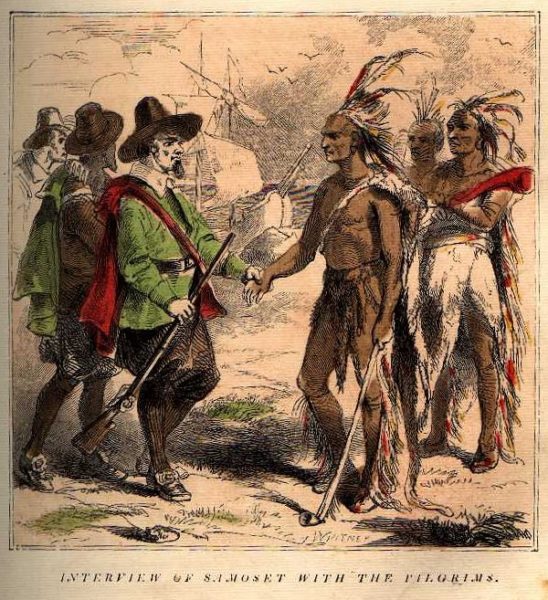
(Below) “On a cold March 16, 1621, in Plymouth, Massachusetts, the English settlers were startled to see a Native American Indian approach them and with great enthusiasm speak the famous words, ‘Welcome, Englishmen.’ His name was Samoset (c. 1590–1653) and he towered over them. He stood before them ‘a tall straight man…’ What impressed them the most was that he was ‘stark naked,’ with just a fringe strap of leather around his waist When a cold gust of wind kicked up, one of the Pilgrims was moved to throw his coat over the Indian’s shoulders” – Nathaniel Philbrick, Mayflower, A Story of Courage, Community and War, Viking, Penguin Group (USA) Inc., NY, NY [2006], 93.

This encounter (below) shows that native Indian tribes could acclimate to the cold months even though non-natives, not accustomed to the cold, needed to be fully clothed for protection from the “cold gust of wind.”