Heartland Research with President John Lefgren, and Vice Presidents Mike and Betty LaFontaine, are doing wonderful things to share the gospel world-wide. It is simply amazing all the doors that are being opened up to the world about The Church of Jesus Christ of Latter-day Saints. Heartland Reseach are instumental in spreading the word that there are 3 and 4 additional witnesses of the Book of Mormon.
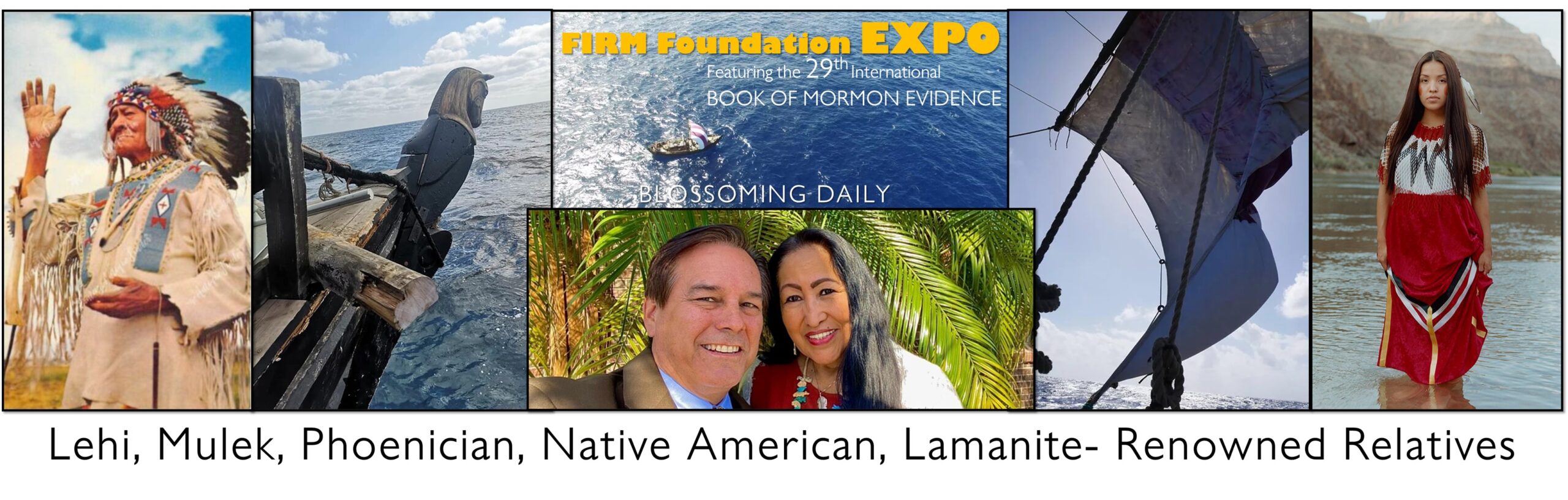 This article by John Lefgren is an amazing explanation of the bridge between the Old and New worlds. I challenge each reader to investigate and ask these amazing people more questions about their research and how they are instuments in the hand of God to wake up the world to wonderful truth that the world has not known before.
Ask them:
What is the Phoenicia?
Why is it important to the Tribes of Judah and Joseph?
How does the Phoenicia connect the Old and New world?
What are the similarities between the City Sidon in Lebanon and the River Sidon in Iowa?
Who is Mulek and how is he involved in the Old and New World?
How is the Phoenicia gathering the children of Israel today?
How are they attracting non LDS members to their Iowa Museum?
What makes these people gather in Iowa and how is Christ involved?
What is the connection between Mulek and the Nephites?
Who is Zedikiah and how is he important in the New World?
How are the voyages of Phoenicia so important in knowing the Book of Mormon is true?
Are the Phoenicians related to the Israelites?
Phoenician is a name given to what group by the Greeks?
What is the significance of Tunisia in the narrative of the Bible and North America?
Where did some of Judah flee after 587 BC, that is a critical part of the Phoenician story?
Who is Hanno and Herodicus and how are they important in our Church today?
These questions and others are very important to expand your knowlwdge about the amazing great work the Heartland Group is doing in Montrose Iowa. Why Montrose? See D&C 125.
 John Lefgren wrote, “Fortunately, for our purposes, there are many biblical people who were contemporaries at the height of Carthage’s sea power at the time of Hanno the Navigator. The story of PHOENICIA connects with the great stories of the ancient world. All in the same generation, there are so many people who were living at the early part of the sixth century before Christ. There was Necho II, the great Pharaoh of Egypt, who commissioned Phoenician ships to sail around Africa. There was Admiral Hanno whose navy and ships made Carthage the richest city in the Ancient World. There was Jeremiah, one of the great prophets of the Jewish Bible. In Jerusalem, there was Zedekiah, the Last King of the Jews. There was King Nebuchadnezzar who was a prominent figure in the Ancient World, appearing in the books of Jeremiah, Ezekiel, Daniel, 2 Kings, 1 and 2 Chronicles, and Ezra. Indeed, some have calculated that as much as twenty percent of the verses of the Old Testament are associated with this generation of time. These are the connecting points across an ocean six centuries before Christ from King Zedekiah in Jerusalem to his youngest son, Mulek, in the New Work.
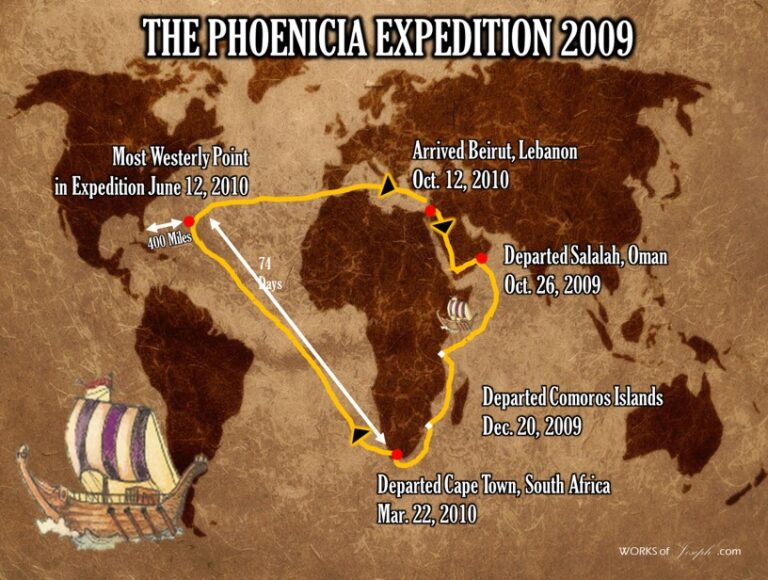
In Montrose, Iowa, on the west bank of the Mississippi River, we have the oldest replica that has sailed 30,000 miles crossing two oceans. The square rigged ship came from the Old to the New Worlds. Her design came from Phoenician shipwrecks from the Ancient World. The wrecks are found in ten places on the bottoms of waters that are connected to the Mediterranean Sea. The replica was assembled in a manner that Hanno the Navigator would have recognized in his time from the early 6th century before Christ. We are grateful for the people in our generation who have helped us and recognize the value of what we are doing. Click here for more information.
600 BC is a significant time in history because it marks the beginning of the “Classical Era,” a period where major civilizations like the Persian Empire, Ancient Greece, and the Neo-Babylonian Empire were flourishing, with important developments in philosophy, art, and political structures taking place across the ancient world; it’s often seen as a time of great cultural and political change, laying the foundations for our civilization.
The Jews were taken into captivity and went to the rivers of Babylon during this time. The Jewish captivity dominates the background for the Book of Daniel. A forgotten dream of King Nebuchadnezzar, interpreted by the Prophet Daniel illustrates God’s sovereignty over history. It is clear from the King’s dream that God is aware of the histories of nations even before they exist. Throughout Daniel Chapter 2, we see that God’s knowledge extends beyond the immediate into the future.
 The dream tells of five distinct periods: (1) the gold head represents Nebuchadnezzar’s kingdom, 606 BC; (2) the silver arms represent the Persians, 538 BC; (3) the brass thighs represent the Greeks, 330 BC; (4) the iron legs represent the Romans, 146 BC; and (5) the iron mixed with clay represents Roman provinces, AD 1453. The climax of the King’s dream was when the Kingdom of God was cut out of the mountain without hands rolling down to consume the kingdoms of the earth.
 God gave Daniel the ability to interpret the King’s dreams when no one else could. Despite the interpretation of his dream by Daniel, Nebuchadnezzar would conquer the Kingdom of Judah and the King’s captain would order the burning of Solomon’s Temple on Sunday, July 24th on the 10th Day of Av in the Hebrew Calendar in our year of 587 BC. The First Temple continued to burn throughout the night and into the following day. This burning was a major turning point for the history of the Jews.
Come to Iowa to learn more about the Bible and the Ancient World. PHOENICIA welcomes scholars, Jews, Mulims and non-believers from around the world. There are few places on earth where the Old and New Worlds are so closely connected.
Regards, John
See their newsletter, videos, or donate here: phoenicia.rocks