
Several of the most asked questions about Book of Mormon Geography or the Hill Cumorah go something like this:
Where is the proof of weapons of war near the Hill Cumorah?
Why are there are no arrowheads found on the Hill Cumorah?
Why is there no archaeological evidence of bones near Cumoraah?
Why is there no physical evidence for millions dead in the soil throughout the region?
There are More Answers! Here: https://bookofmormonevidence.org/historical-verification-of-the-book-of-mormon-in-north-america-cumorah/
“When Joseph Smith made his claims and published the Book of Mormon as an ancient history of the American Indians, some scoffed at the idea that a major battle had anciently taken place in the local vicinity. However, evidence was soon produced that documented that this region of the country did indeed once possess a heavy Indian population, and that a terrible battle had taken place in that locality.

 Writing in 1851, E. G. Squier says that in the region:
“Human bones of men, women, and children of both sexes were thrown together promiscuously by the thousands.” He notes large quantities of pottery, pipes, flint arrow-heads, stone hatchets and other implements were also found there. He further states that the ancient relics unearthed in the vicinity (which he estimates to be several hundred years old) showed considerable evidence of Hebrew origin.” (See E. G. Squier, Antiquities of New York, 1851, pp. 137-138.)
Antiquities of the State of New York. Being the results of extensive original surveys and explorations, with a supplement on the antiquities of the West..” Source
ONTARIO COUNTY. PLATE VI. No. 2.
 Ancient Work near Canandaigua.
ONE mile east of the town of Canandaigua, upon the slope of a hill overlooking Canandaigua Lake, is the work here figured. It is unsurpassed for the beauty of its position. A considerable portion of the embankment has been obliterated by cultivation, and another portion by the turnpike road, from Canandaigua to Geneva, which passes through it. The parts which may yet be traced are appropriately indicated in the plan, and enable us to make out the original form of the work with sufficient exactness. In constructing the road, human bones in considerable quantities were disclosed on the brow of the hill, accompanied by the usual rude relics of Indian art. It is mentioned by Mr. Schoolcraft, that the Senecas deduce their descent from the remarkable eminence upon which this work is situated.*
Between three and four miles west of Canandaigua, on the road to Victor, there is a long, narrow trench running nearly in a direction from N. E. to S. W. It may be traced, with occasional interruptions, for some miles, and has been erroneously, but very generally, believed to be a work of art. It marks the line of a long, narrow fissure in the limestone sub stratum, into which the earth has subsided. The water which accumulates in it sinks, to swell the volume of so*me subterraneous stream. The cause of this singular fissure is worthy of the inquiries of geologists.
Judge Porter, of Niagara, mentions another ancient inclosure, similar to that above described, in the vicinity of Canandaigua; but its locality could not be ascertained. It is probably now completely destroyed.
* Notes on the Iroquois, p. 196.
PLATE VII. No. 1. Ancient Work near the City of Geneva.
 ONE and a half miles west of Geneva are the traces of the old Indian ” Castle ” of Ganundesdga, built by the Senecas, and destroyed by Sullivan in 1779. Near it is a mound thickly covered over with graves. A plan and description of this work will be given in another connection. About two miles beyond, in the same direction, in Seneca township, is another work of more ancient date, a plan of which is here presented. It is situated upon elevated grounds, and coincides generally with those already described. The position, upon the east side, is protected by a steep, natural bank, perhaps sixty feet in height, which subsides into low, marshy grounds. At the foot of the bank is a copious and perennial spring. Upon the west, south, and north, the ground falls off gently ; and here we find the artificial defences. Although the whole has been for some time under cultivation, the lines of entrenchment may be followed throughout nearly their entire extent, without difficulty. The usual evidences of ancient occupancy are found within the area.
Half a mile further to the westward, upon a corresponding site, are the traces of an ancient palisaded work, which will be described in its appropriate place.
ONONDAGA COUNTY
PROBABLY no county in the State had originally a greater number of aboriginal monuments within its boundaries, than the county of Onondaga. It has, however, been so long settled, and so generally brought under cultivation, that nearly all vestiges of its ancient remains have disappeared. The sites of many are, however, still remembered ; but even these will soon be forgotten. It is a fortunate circumstance that the antiquities of this county were the first to attract the attention of observers, and our accounts relating to them are more complete than concerning those of the other parts of the State. Our principal source of information respecting their numbers, localities, and character, is the memoir of De Witt Clinton, already several times alluded to. Mr. Schoolcraft and Mr. J. V. H. Clark, of Manlius, have presented additional information ; and from these authorities we derive most of the facts, and illustrations which follow.
Ancient works occurred in the towns of Fabius, De Witt, Lafayette, Camillus, Onondaga, Manlius, Elbridge, and Pompey ; but of many of them we know nothing beyond the simple fact of their former existence. It should be mentioned that some of the townships here named have been erected within the last few years, and since the date of Mr. Clinton’s Memoir.
Those in Elbridge, according to Mr. Clinton, occurred near the village of that name, about four miles from Seneca River, upon lands then (1817) occupied by Judge Munro. They were two in number. ” One was on a very high hill, and covered three acres. It had a gateway opening toward the east ; and upon the west was another, communicating with a spring about ten rods from the fort. It was elliptical in shape : the ditch deep, and the eastern wall eight feet high. The stump of a black-oak tree, certainly one hundred years old, stood upon the embankment. The second work was about half a mile distant, upon lower grounds. It was constructed like the first, but was only half as large. * * * * The early settlers observed, in this vicinity, the shells of testaceous animals accumulated, in several places, in considerable masses, together with numerous fragments of pottery. Judge Munro found, in digging the cellar of his house, several pieces of burned clay ; and, in various places, large spots of deep black mould, demonstrating the former existence of buildings or erections of some kind. At one place he observed what appeared to be a well, viz., a hole ten feet deep, and the earth much caved in. Upon digging to the depth of three and a half feet, he came to a quantity of flints, below which he found a great number of human bones.” This disposition of the dead, Mr. Clinton conjectures, was made by an enemy ; but we shall soon see that it probably owed its existence to the practice of gathering the bones of the dead at stated intervals, and depositing them in pits — a practice common among the Hurons and other Indians around the great lakes.
Mr. Clark has described some aboriginal remains in this township, which are probably the same ones alluded to by Mr. Clinton. He says: “Upon lot 81, N. E. part, on lands now occupied by Mr. John Munro (previously the Judge Munro farm) was formerly a fort situated on high ground. In 1793 the ditch and embankment were easily to be traced. Large trees stood upon the wall and in the ditch. The work was square, except that the line of embankment toward the west curved slightly outward. The area was about an acre and a quarter. The walls were about two feet high ; the gateway opened toward the west, and was twelve feet wide. It was situated on a beautiful eminence, nearly surrounded by ravines.”
” About half a mile N. W. of this work,” continues Mr. Clark, ” on what is called the Purdy lot, was another work of larger dimensions, containing about four and a half acres of ground. It is situated upon one of the most considerable elevations of the town, and is nearly or quite square, with gateways opening to the east and west. The embankment was originally about three feet high, and an oak tree, two feet in diameter, was standing upon it. On the south side were numerous holes, about two feet deep and six feet apart. Large quantities of broken pottery and freshwater shells are still found here. An oaken chest was discovered here, somewhere about the year 1800, which contained a quantity of silk goods. The folds and colors were easily distinguishable, but the fabric crumbled on exposure. Some copper coins, it is said, were found with the silks.
It is situated on the shores of Onondaga Lake, between Brown’s pump-works and Liverpool. A fine spring of water rises near it, and quantities of relics, of various kinds, have been found within it.” Antiquities, Page 31-33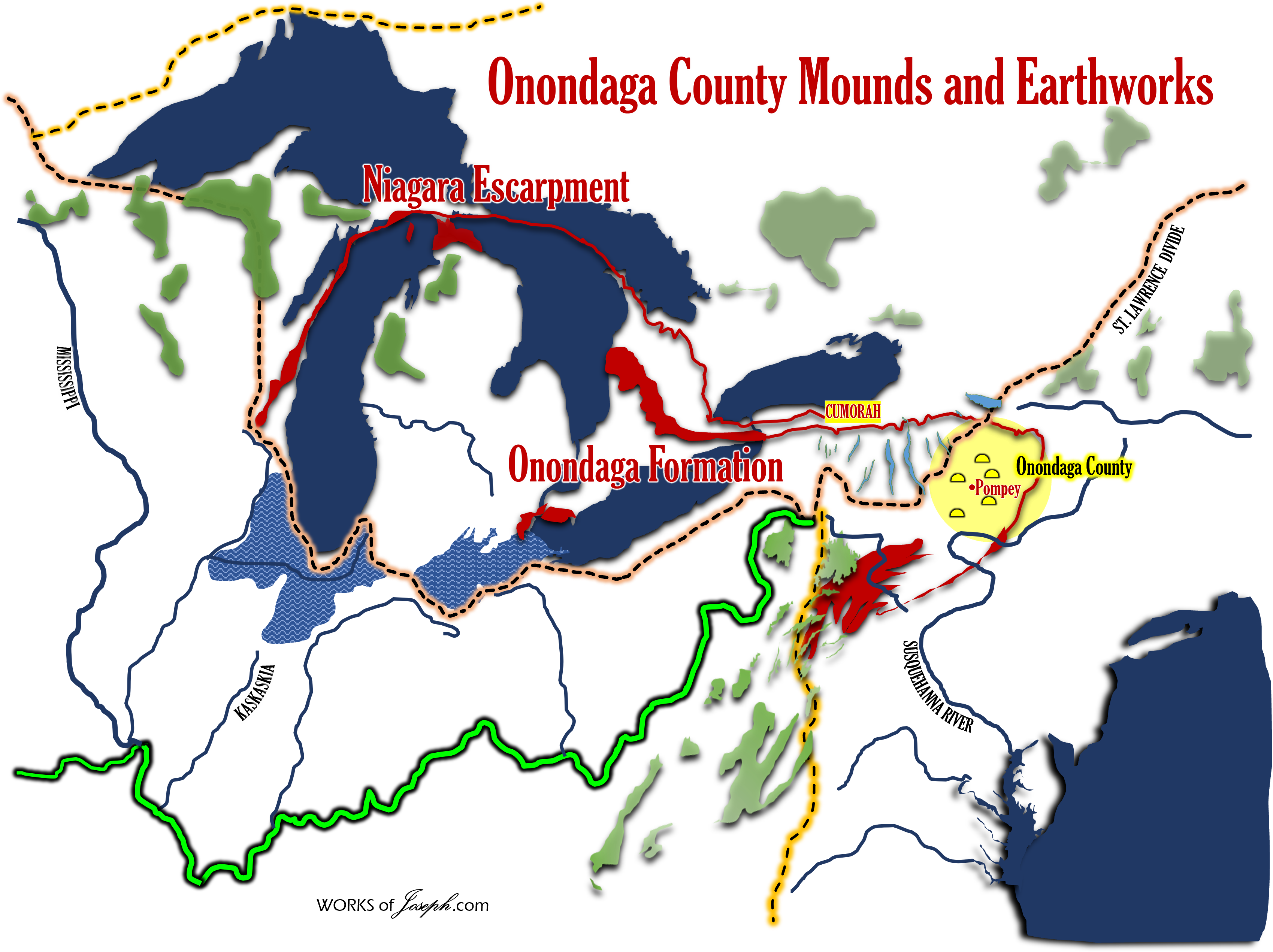
CHAPTER VI.
OBSERVATIONS ON THE PROBABLE ORIGIN OP THE ABORIGINAL MONUMENTS OF NEW YORK.
“By whom were the aboriginal monuments of Western New York erected, and to what era may they be ascribed? The consideration of these questions has given rise to a vast amount of speculation, generally not of the most philosophical, nor yet of the most profitable kind. If the results arrived at have been erroneous, unsatisfactory, or extravagant, it may be ascribed to the circumstance that the facts heretofore collected have been too few in number and too poorly authenticated to admit of correct conclusions, not less than to the influence of preconceived notions, and to that constant leaning toward the marvelous, which is a radical defect of many minds. Rigid criticism is especially indispensable in archaeological investigations ; yet there is no department of human research in which so wide a range has been given to conjecture. Men seem to have indulged the belief that here nothing is fixed, nothing certain, and have turned aside into this field as one where the severer rules which elsewhere regulate philosophical research are not enforced, and where every species of extravagance may be indulged in with impunity. I might adduce numberless illustrations of this remark. The Indian who wrought the rude outlines upon the rock at Dighton, little dreamed that his work would ultimately come to be regarded as affording indubitable evidence of Hebrew, Phoenician, and Scandinavian adventure and colonization in America ; and the builders of the rude defences of Western New York, as little suspected that Celt and Tartar, and even the apocryphal Madoc with his ” ten ships,” would, in this the nineteenth century of our faith, be vigorously invoked to yield paternity to their labors!
The probable purposes to which these works were applied are, perhaps, sufficiently evident from what has already been presented. Their positions, general close proximity to water, and other circumstances not less conclusive, imply a defensive origin. The unequivocal traces of long occupancy found within many of them, would further imply that they were fortified towns and villages, and were permanently occupied. Some of the smaller ones, on the other hand, seem rather designed for temporary protection — the citadels in which the builders sought safety for their old men, women, and children, in case of alarm or attack.
In respect to date nothing positive can be affirmed. Many of them are now covered with heavy forests ; a circumstance upon which too much importance has been laid, and which in itself may not necessarily be regarded as indicative of great age, for we may plausibly suppose that it was not essential to the purposes of the builders that the forests should be removed. Still I have seen trees from one to three feet in diameter standing upon the embankments and in the trenches ; which would certainly carry back the date of their construction several hundred years, perhaps beyond the period of the discovery in the fifteenth century. There is nothing, however, in this circumstance, nor in any other bearing upon the subject, which would necessarily imply that they were built by tribes anterior to those found in occupation of the country by the whites. And this brings us at once to the most interesting point of our inquiry, viz. :By whom were these works erected?
I have already mentioned that within them are found many relics of art and many traces of occupancy. These, I had ample opportunities of ascertaining in the course of my investigations, are absolutely identical with those which mark the sites of towns and forts known to have been occupied by the Indians, within the historical period. The pottery taken from these sites and from within the supposed ancient inclosures, is alike in all respects ; the pipes and ornaments are undistinguishable ; and the indications of aboriginal dwellings are precisely similar, and, so far as can be discovered, have equal claim to antiquity. Near many of these works are found cemeteries, in which well-preserved skeletons are contained, and which, except in the absence of remains of European art, differ in no essential respect from the cemeteries found in connection with the abandoned modern towns and ” castles ” of the Indians. There are other not less important facts and coincidences, all of which go to establish that if the earth-works of Western New York are of a remote ancient date, they were not only secondarily but generally occupied by the Iroquois or neighboring and contemporary nations ; or else — and this hypothesis is most consistent and reasonable — they were erected by them.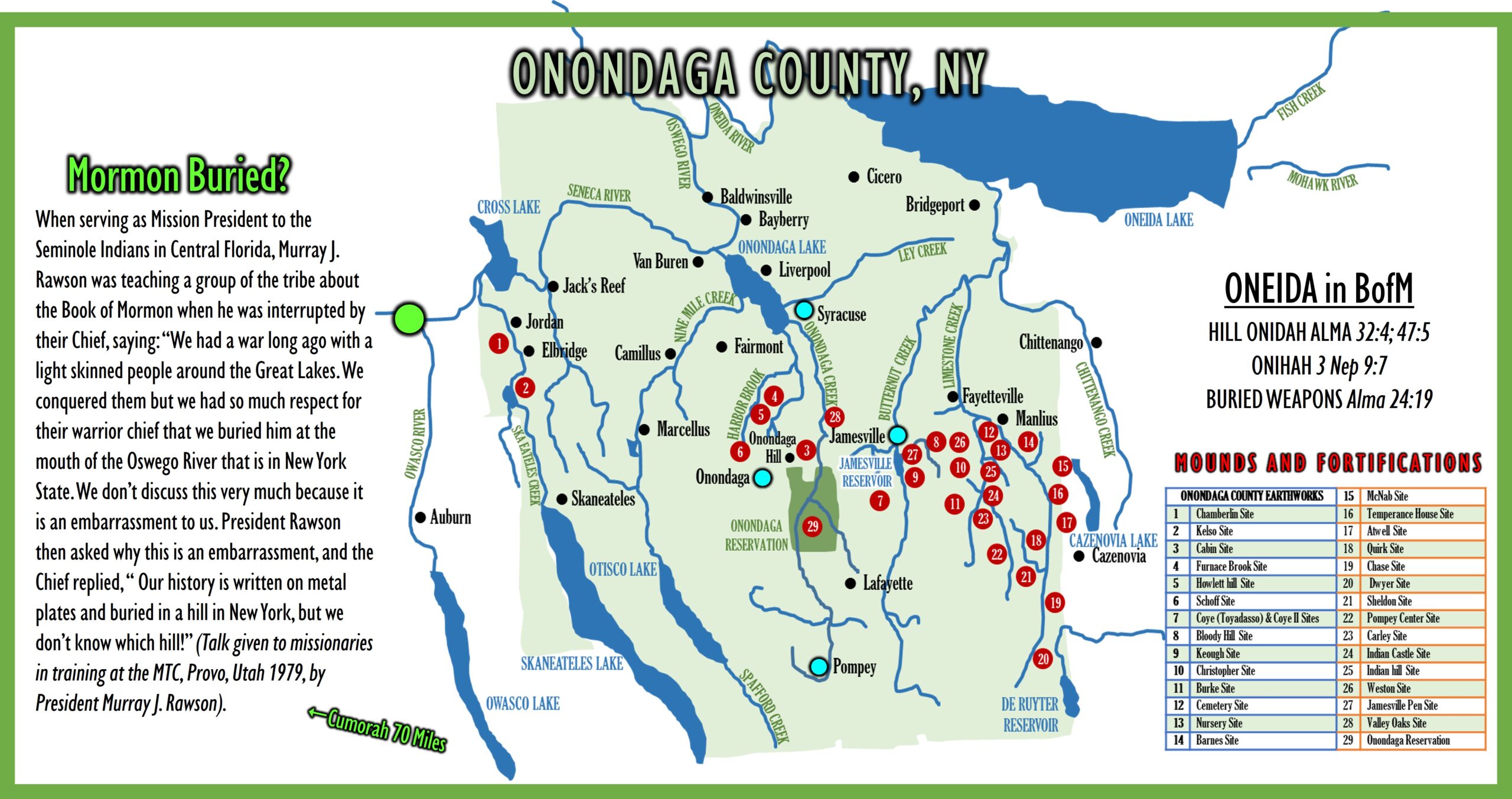
It may be objected, that if the Indians constructed works of this kind, it could not have escaped the notice of the early explorers, and would have been made the subject of remark by them. The omission is singular, but not unaccountable. They all speak of the defences of the Indians as composed of palisades firmly set in the ground. The simple circumstance of the earth being heaped up around them, to lend them greater firmness, may have been regarded as so natural and simple an expedient, as not to be deserving of special mention, particularly as the embankment, in such a case, would be an entirely subordinate part of the structure. After the introduction of European implements, enabling the Indians to plant their pickets more firmly in the ground, and to lend them a security before unattainable, the necessity for an embankment was in a great degree obviated. We may thus account for its absence in their later structures, which also underwent some modification of form, suggested by the example or instructions of the whites, or by the new modes of warfare following the introduction of firearms. Thus in the plan of the old Seneca fort of Ganundasaga, we find distinct traces of the bastion — a feature observable in none of the more ancient defences.
I am aware that the remnants of the Indian stock which still exist in the State, generally profess total ignorance of these works. I do not, however, attach much importance to this circumstance. When we consider the extreme likelihood of the forgetfulness of ancient practices, in the lapse of three hundred years, the lack of knowledge upon this point is the weakest of all negative evidence. Cusick, the Indian, in his so-called ” His tory of the Six Nations,” has, no doubt, correctly described the manner in which they constructed their early defences. ” The manner of making a fort : First, they set fire against as many trees as it requires to make the enclosure, rubbing off the coals with their stone axes, so as to make them burn faster. When the tree falls, they put fires to it about three paces apart, and burn it into pieces. These pieces are then brought to the spot required, and set up around, according to the bigness of the fort. The earth is then heaped on both sides. The fort has generally two gates, one for passage and one to the water.” ” The people,” continues Cusick, ” had implements with which they made their bows and arrows. Their kettles were made of baked clay ; their awls and needles of sharpened bones ; their pipes of baked clay or soft stone ; a small turtle-shell was used to peel the bark, and a small dry stick to make fire by boring it against seasoned wood.”
Golden observes of their defences, as they were constructed in his time : ” Their castles are generally a square surrounded with palisades, without any bastions or outworks; for, since the general peace, their villages all lie open.”*
In full view of the facts before presented, I am driven to a conclusion little anticipated when I started upon my exploration of the monuments of the State, that the earth-works of Western New York were erected by the Iroquois or their western neighbors, and do not possess an antiquity going very far back of the discovery. Their general occurrence upon a line parallel to and not far distant from the lakes, favors the hypothesis that they were built by frontier tribes — a hypothesis entirely conformable to aboriginal traditions. Here, according to these traditions, every foot of ground was contested between the Iroquois and the Gahkwas and other western tribes ; and here, as a consequence, where most exposed to attack, were permanent defences most necessary. It was not until after the Confederation, that the Five Nations were able to check and finally expel the warlike people which disputed with them the possession of the beautiful and fertile regions bordering the lakes ; and it is not impossible that it was the pressure from this direction which led to that Confederation — an anomaly in the history of the aborigines. Common danger, rather than a far-seeing policy, may be regarded as the impelling cause of the consolidation.
In conclusion, I may be permitted to observe, that the ancient remains of Western New York, except so far as they throw light upon the system of defence practiced by the aboriginal inhabitants, and tend to show that they were to a degree fixed and agricultural in their habits, have slight bearing upon the grand ethnological and archaeological questions involved in the ante-Columbian history of the continent. The resemblances which they bear to the defensive structures of other rude nations, in various parts of the world, are the result of natural causes, and cannot be taken to indicate either a close or remote connection or dependence. All primitive defences, being designed to resist common modes of attack, are essentially the same in their principles, and seldom differ very much in their details. The aboriginal hunter and the semi-civilized Aztec selected precisely similar positions for their fortresses, and defended them upon the same general plan ; yet it would be palpably unsafe to found conclusions as to the relations of the respective builders, upon the narrow basis of these resemblances alone. * History of the Five Nations, vol.I p. 9.
The entire book link is below and called,
ANTIQUITIES STATE OF NEW YORK. BEING THE RESULTS OF EXTENSIVE ORIGINAL SURVEYS AND EXPLORATIONS, WITH A SUPPLEMENT ANTIQUITIES OF THE WEST; ILLUSTRATED BY FOURTEEN QUARTO PLATES AND EIGHTY ENGRAVINGS ON WOOD : By E. G. SQUIEB, M. A.,
https://archive.org/details/antiquitiesofsta00squirich/page/n3/mode/2up
More Historical Verification of the Book of Mormon in North America
Non-Mormon Archaeology and Research 600 BC to 421 AD
- Ancient Monuments Of The Mississippi Valley By E. G. Squier, Am., And E. H. Davis, M.D. Accepted For Publication By The Smithsonian Institution, June 1847
- Aboriginal Monuments Of The State Of New York Comprising The Results Of Original Surveys And Explorations; With An Illustrative Appendix, By E. G. Squier, A.M.1849
- Archaeology of New York State 1965 by William A. Ritchie Or here
- The Archeological History of New York, Volumes 235-238 By Arthur Caswell Parker
- American Antiquities and Discoveries in the West: Being an Exhibition of the Evidence by Josiah Priest 1835
- New York State Bulletin 87 ARCHEOLOGY by WILLIAM M. BEAUCHAMP ALBANY NEW YORK 1905
- The Mound Builders People that once inhabited the valleys of the Ohio and Mississippi, together with an investigation into the Archeology of Butler County, Ohio. By J. P. MacLEAN Published 1879
- The Lost Civilizations of North America
- Cahokia Mounds
- Flint Ridge State Memorial, Ohio
- Fort Hill State Memorial, Ohio
- Hopewell Culture National Historical Park
- Newark Earthworks Ohio
- The Seip Mound Group