Did Joseph Smith translate the Kinderhook Plates?
I haven’t determine if these plates are authentic or a hoax. Because there are many scholars and historians who believe these plates to be a hoax, I tend to believe more readily, that the Kinderhook plates are very possibly authentic. I feel at times when there are new or old ideas or information that comes forward, many people want to dismiss it as it does not conform with their internal thinking so they dismiss it out of hand.
The Kinderhook plates have been controversial ever since 1843. Apologists and critics have debated the historical facts and extrinsic evidence for many years now.
 Below is a quote from The Church of Jesus Christ of Latter-day Saint’s website, that the historians who likely wrote this article, believe the plates are not authentic. We do however know that Joseph Smith and other Saints visited the Kinderhook mound as it does exist as is recorded in Church History along with the Enon Mound and the Zelph Mound. Many historians don’t believe the Zelph Mound story either, so it is up to you to decide.
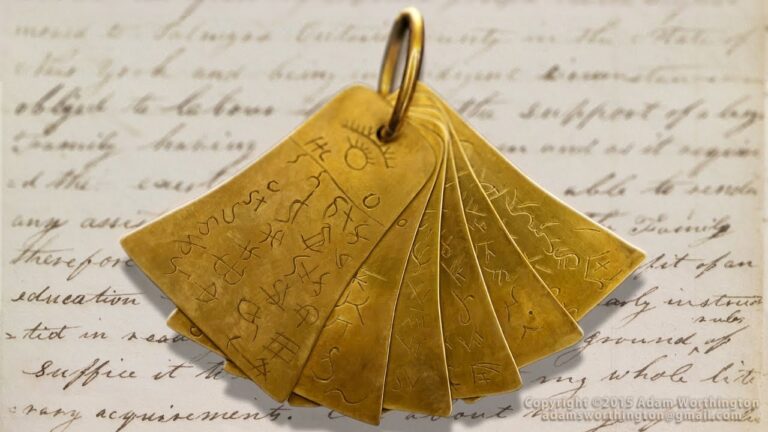
“In 1843, a group of men unearthed six bell-shaped brass plates about three inches in height from an American Indian burial mound near Kinderhook, Illinois. The plates contained symbols resembling an ancient script, and one member of the group thought the artifacts appeared well suited for Joseph Smith to translate. Accounts suggest the discovery intrigued Joseph Smith and other Latter-day Saints in Illinois, but no translated text resulted from this short-lived excitement.
One of those present when the plates were unearthed later reported that he had learned the whole episode was a prank. Wilbur Fugate admitted that he, Robert Wiley, and a local blacksmith forged the plates and deposited them in the burial mound the night before the discovery. Chemical and metallurgical analysis of the one surviving plate confirms the artifact was not an ancient production. Moreover, the characters on the plates do not match any known language and were likely invented by Fugate and Wiley.
Contemporaneous sources say very little about Joseph Smith’s encounter with the Kinderhook plates, which occurred over a span of just a few days in 1843. Joseph apparently examined the plates and, according to his clerk William Clayton, remarked that they contained “the history of … a descendant of Ham through the loins of Pharaoh king of Egypt.” Joseph evidently did not attempt a revelatory translation as he had done with the Book of Mormon plates, but rather appears to have compared the symbols on the Kinderhook plates with other ancient artifacts in his possession. One symbol on the plates closely matches a glyph on the Egyptian papyri Joseph translated in Kirtland, Ohio. Joseph’s previous translation of this glyph mentions a descendant of Ham through the lineage of the pharaohs.
Whether Joseph suspected the forgery, thought of attempting a revelatory translation but experienced a “stupor of thought,” or merely took a scholarly interest in the purported ancient writings (like other amateur linguists of the time) remains unconfirmed by historical accounts. Whatever he thought of the plates, he quickly lost interest in them.” https://www.churchofjesuschrist.org/study/history/topics/kinderhook-plates?lang=eng
Of course this quote above is an opinion and not based on facts. However when the historians of this article say Joseph Smith “suspected the forgery” or “thought of attempting a revelatory translation” or “experienced a stupor of thought” or “merely took a scholarly interest in the purported ancient writings” and these historians emphasize that “like other amateur linguists of the time” Joseph’s findings are “unconfirmed by historical accounts” and they also say that, “Whatever he (Joseph) thought of the plates, he quickly lost interest in them.”
How about my conjecture here? I say, what if Joseph did translate a portion of the Kinderhook plates and what if they are correct? What if Joseph Smith has no responsibility to let others know of his Prophetic intensions or powers he possessed, and these historians only want to suggest the negative about our prophet Joseph Smith? I am biased towards my own opinion of course.
Kinderhook Mound Information
 I quote “The Mormons and the Mounds by Jonathan Neville MHA Presentation June 2017 St. Louis, Missouri where Jonathan Neville said, “Three specific mounds figure prominently in LDS history: Zelph’s mound in Illinois, the Kinderhook mound, also in Illinois, from which the six brass plates were taken, and Enon mound in Ohio… and continues saying, “The Kinderhook mound probably dates to the Adena era, and it reportedly had a conical shape typical of Adena mounds, but there doesn’t appear to be any discussion in the literature about this mound ever being dated or studied.” Neville Page 6
On page 9 of the same Neville paper above he says, “J. Michael Hunter introduced his article about Mormon archaeological zeal by writing “In 1843, Robert Wiley unearthed a set of six brass plates in a burial mound near Kinderhook, Illinois.” Hunter, J. Michael, “The Kinderhook Plates, the Tucson Artifacts, and Mormon Archaeological Zeal,” Journal of Mormon History, Vol. 31, No. 1
 Neville then says, “Several authors have written and presented on the topic of the Kinderhook plates, including Mark Ashurst-McGee, Don Bradley, Brian M. Hauglid, and Jason Frederick Peters. In 1981, the Ensign published an article that took the positions that (i) the Kinderhook plates were a hoax and (ii) Joseph Smith never attempted to translate them.” Jonathan Neville with reference from him found in Kimball, Stanley B.,“Kinderhook Plates Brought to Joseph Smith Appear to be a Nineteenth-Century Hoax,” Ensign, August 1981
Whether or not the plates were a hoax there is always the possibility they were genuine. You as a reader need to determine that yourself. I just share quotes from honest people, but through your personal study and prayer you may know the truth of all things. If true, the Kinderhook plates are another possible witness that Joseph Smith is and was a Prophet of God. That is something I ponder on.
Jonathan Neville did an interview about the Kinderhook plates on the Mormon Book Reviews channel on YouTube. See it here: https://www.youtube.com/watch?v=ADH6y0iHE40
The Mormons and the Mounds by Jonathan Neville MHA Presentation June 2017 St. Louis, Missouri, complete article can be read here: here:https://www.academia.edu/67253762/The_Mormons_and_the_Mounds_Presentation_at_the_Mormon_History_Association_St_Louis_Missouri_June_2017
Priesthood
As it says Joseph may have translated a portion of the Kinderhook Plates printed again in the Times and Seasons, “I have translated a portion of them, and find they contain the history of the person with whom they were found. He was a descendant of Ham, through the loins of Pharaoh, king of Egypt, and that he received his kingdom from the ruler of heaven and earth.” (Then followed a reprint of material from the Times and Seasons article.) Deseret News Sept 3, 1856
So Pharaoh, king of Egypt apparently received his Kingdom, but we know from the scriptures that Ham’s offspring with Egyptus could not hold the Priesthood as we read below.
About Patriarchal and Melchizedek Priesthoods
During the time of Adam it seems the Higher Priesthood of God was apparent in the Prophets and likely given to each worth som after that time. However, after the flood when Noah reigned, it seems the father to son Priesthood called the Patriarchal Priesthood was given by simply being a good father. The Highest Priesthood later called Melchisedek Priesthood after the righteous man named Melchisedek or Shem (Same Person), who was the King of Salem.
You will learn more as you contemplate the scripture about Ham and the Priesthood in Abraham 1:22-27 comparing scripture to the possible translation from Joseph Smith.
“Now this king of Egypt was a descendant from the loins of Ham, and was a partaker of the blood of the Canaanites by birth.
From this descent sprang all the Egyptians, and thus the blood of the Canaanites was preserved in the land.
The land of Egypt being first discovered by a woman, who was the daughter of Ham, and the daughter of Egyptus, which in the Chaldean signifies Egypt, which signifies that which is forbidden;
When this woman discovered the land it was under water, who afterward settled her sons in it; and thus, from Ham, sprang that race which preserved the curse in the land.
Now the first government of Egypt was established by Pharaoh, the eldest son of Egyptus, the daughter of Ham, and it was after the manner of the government of Ham, which was patriarchal.
Noah had the High Priesthood from Adam, and also had the Patriarchal Priesthood from his father, Lamech. Ham had the High Priesthood from his father Noah, and also the Patriarchal Priesthood from Noah, yet Hams sons with Egyptus, had the only the Patriarchal Priesthood because of his father, but not likely the Highest or Melchizedek Priesthood, as the scriptures say the Son of Ham and Egyptus, could not hold the highest Priesthood, but then his son tried to imitate the highest Priesthood as Satan does imitate it today.
Now let’s not get confused, as I also understand the Shem was likely the same person as Melchisedek, which adds further discussion into this Priesthood line of authority that we won’t address here.
It seems that all three of Noah’s sons had some type of priesthood which was likely the Patriarchal Priesthood, which comes simply by being the son of your father. Yet it seems Noah gave only Shem both the Patriarchal and the Melchisedek Priesthood, as the line of Shem is where the Melchisedek Priesthood comes from for us today.
For example my father ordained me to the Melchisedek Priesthood, but did my father have both Patriarchal and Melchisedek Priesthood to give me? (He only could give me the Patriarchal Priesthood as simply being my father), but he did not ordain me to have the Patriarchal Priesthood, but my father did ordain me to the Melchisedek Priesthood. But any worthy holder of the Melchisedek Priesthood could have ordained me, correct? In other words when did simple Patriarchal Priesthood end, and we now only have the Aaronic and Melchisedek Priesthood today?
I remember as a member of a Bishopric calling the LDS phone number we all should know for questions of any kind at, 801-240-1000, and they gave me a Priesthood leader who was authorized to speak to my question. He told me that we only have the two Priesthoods today the Aaronic and Melchisedek. I understood that to mean over 25 years ago, to mean that only the Melchisedek Priesthood is given by ordination. This has helped me answer the question I posed in Chapter 11E of this book, as to why there were 3 levels of Priesthood or 3 altars spoken of in this question and answer?
This makes sense. Both sons of Noah, Ham and Japeth had a Patriarchal Priesthood, but only Noah’s son Shem was given the Higher or Melchisedek Priesthood to carry on through the Savior time and through ordination today from a worthy Melchisedek Priesthood holder.
Pharaoh, being a righteous man, established his kingdom and judged his people wisely and justly all his days, seeking earnestly to imitate that order established by the fathers in the first generations, in the days of the first patriarchal reign, even in the reign of Adam, and also of Noah, his father, who blessed him with the blessings of the earth, and with the blessings of wisdom, but cursed him as pertaining to the Priesthood.
Now, Pharaoh being of that lineage by which he could not have the right of Priesthood, (He likely had Patriarchal Priesthood from his father Ham, but he could not be ordained to the Highest Priesthood of Melchisedek), notwithstanding the Pharaohs would fain claim it from Noah, through Ham, therefore my father was led away by their idolatry;” Abraham 1:21-27 (That may mean the Pharaohs could claim they can use the Patriarchal Priesthood and pretend it was the same as the Melchisedek Priesthood which they could not be ordained to).
Did the Brother of Jared Hold the Priesthood?
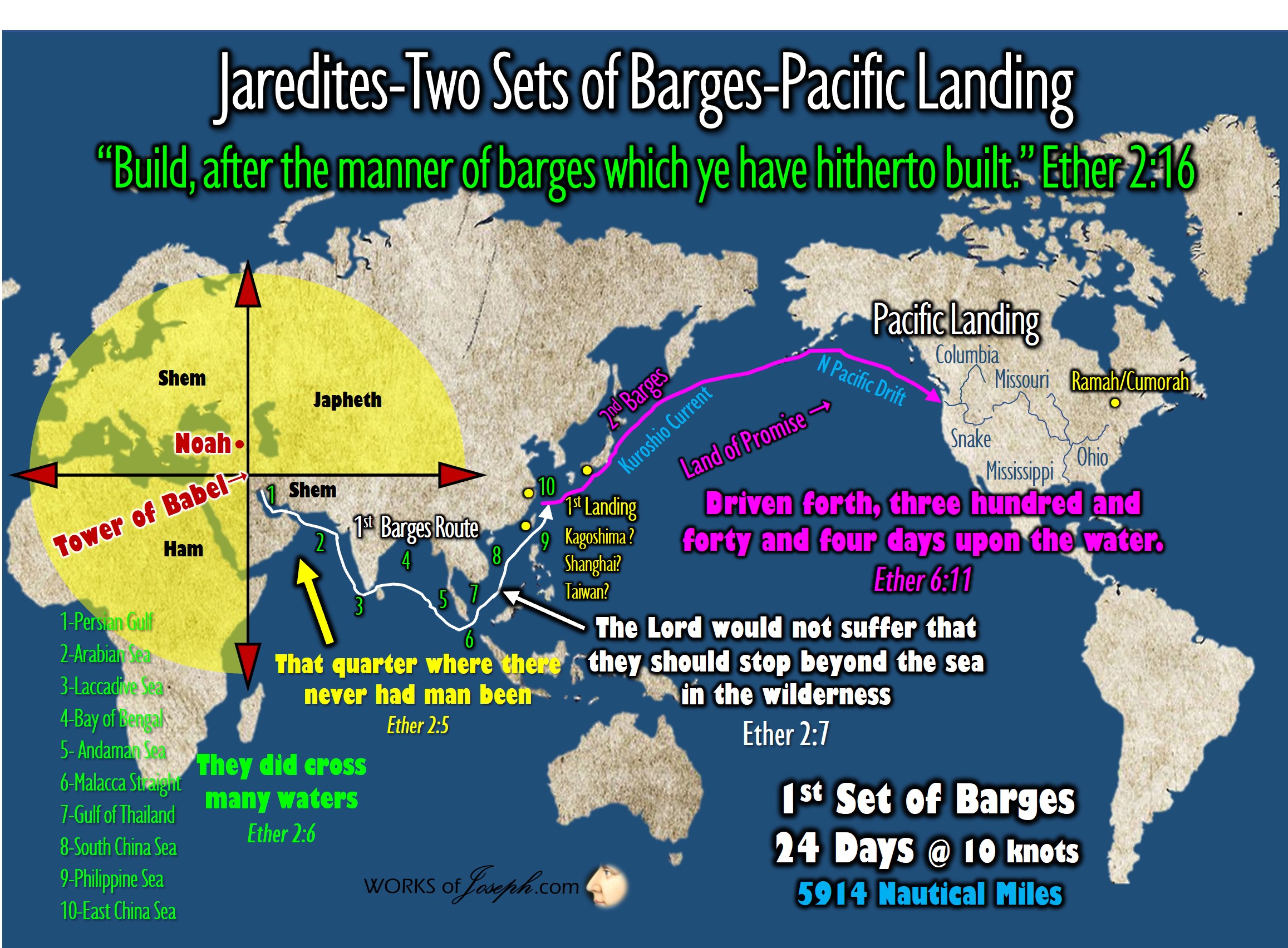 I share with you that I believe the Jaredites likely landed near Seattle Washington. I also share that I believe the Jaredites who were blessed with keeping the Adamic Language very likely had the correct Priesthood. Bruce R. McConkie said, “These promises of God to the Jaredites contain the essential elements of the everlasting covenant detailed later to Father Abraham and to every covenant people. These elements include priesthood, posterity, and a land of inheritance” Bruce McConkie, A New Witness 505
Yes! They Retained the Adamic Language, which relates to the Priesthood. Ether was their last Prophet and Mahonri Moriancumer would have the Priesthood or else why did Jared always ask him to talk with the Lord on behalf of the Jaredites? I realize you don’t have to have the Priesthood to see Christ, as we know Joseph Smith saw Christ without holding the Priesthood, but it makes sense that Prophets had the ordained Priesthood and especially those who were sent to the Promised land of North America, such as Lehi and Mahonri Moriancumer.
“The book of Moses described the language of Adam as “pure and undefiled”. It is intimately connected with the “Priesthood, which was in the beginning, [and] shall be in the end of the world also.” MOSES 6:5 Thomas R. Valletta, “Jared and His Brother,” in Fourth Nephi, From Zion to Destruction, ed. Monte S. Nyman and Charles Tate Jr. (BYU Provo, UT: Religious Studies Center
In a video I did online here: bookofmormonevidence.org/jaredites, I will share with you my details of why I believe the Jaredites Landed near Seattle and why I strongly believe the Jaredites had the Priesthood.
More Kinderhook Plates from Deseret News
On September 3 and 10, 1856, the following paragraphs appeared in the Deseret News as part of the serialized “History of Joseph Smith”:
“[May 1, 1843:] I insert facsimiles of the six brass plates found near Kinderhook, in Pike county, Illinois, on April 23, by Mr. R. Wiley and others, while excavating a large mound. They found a skeleton about six feet from the surface of the earth, which must have stood nine feet high. The plates were found on the breast of the skeleton and were covered on both sides with ancient characters.
“I have translated a portion of them, and find they contain the history of the person with whom they were found. He was a descendant of Ham, through the loins of Pharaoh, king of Egypt, and that he received his kingdom from the ruler of heaven and earth.” (Then followed a reprint of material from the Times and Seasons article.)
 Although this account appears to be the writing of Joseph Smith, it is actually an excerpt from a journal of William Clayton. It has been well known that the serialized “History of Joseph Smith” consists largely of items from other persons’ personal journals and other sources, collected during Joseph Smith’s lifetime and continued after the Saints were in Utah, then edited and pieced together to form a history of the Prophet’s life “in his own words.” It was not uncommon in the nineteenth century for biographers to put the narrative in the first person when compiling a biographical work, even though the subject of the biography did not actually say or write all the words attributed to him; thus the narrative would represent a faithful report of what others felt would be helpful to print. The Clayton journal excerpt was one item used in this way. For example, the words “I have translated a portion” originally read “President J. has translated a portion. …”
Where the ideas written by William Clayton originated is unknown. However, as will be pointed out later, speculation about the plates and their possible content was apparently quite unrestrained in Nauvoo when the plates first appeared. In any case, this altered version of the extract from William Clayton’s journal was reprinted in the Millennial Star of 15 January 1859, and, unfortunately, was finally carried over into official Church history when the “History of Joseph Smith” was edited into book form as the History of the Church in 1909.
Front and back of four of the six Kinderhook plates are shown in these facsimiles (rough copies of even earlier published facsimiles), which appeared in 1909 in History of the Church, vol. 5, pp. 374–75.
By 1912, however, at least two items of evidence had come to light indicating that the Kinderhook plates were not authentic. One was a letter written in 1855 (but not published until 1912) by Dr. W. P. Harris—the same W. P. Harris who authored the statement that appeared in the Times and Seasons article. In this letter he wrote that in 1843 he had accepted the discovery of the plates as genuine. “I washed and cleaned the plates and subsequently made an honest affidavit to the same,” he said. “But since that time, Bridge Whitton [a blacksmith in Kinderhook, Illinois] said to me that he cut and prepared the plates and he (B. Whitton) and R. Wiley engraved them themselves, and that there was nitric acid put upon them the night before they were found to rust the iron ring and band. And that they were carried to the mound, rubbed in the dirt and carefully dropped into the pit where they were found.”
 The other item was a letter written in 1879 by Wilbur Fugate (another of those present at the excavation of the plates) to an anti-Mormon in Salt Lake City. Fugate declared that the alleged discovery of the Kinderhook plates was “a HUMBUG, gotten up by Robert Wiley, Bridge Whitton and myself. … None of the nine persons who signed the certificate [a document included in the Times and Seasons article] knew the secret, except Wiley and I.
“We read in Pratt’s prophecy that ‘Truth is yet to spring out of the earth.’ [The quote is from Parley P. Pratt’s 1837 missionary tract Voice of Warning.] We concluded to prove the prophecy by way of a joke. We soon made our plans and executed them. Bridge Whitton cut them out of some pieces of copper; Wiley and I made the hieroglyphics by making impressions on beeswax and filling them with acid and putting it on the plates. When they were finished we put them together with rust made of nitric acid, old iron and lead, and bound them with a piece of hoop iron, covering them completely with the rust.”
Fugate then went on to tell how they secretly buried the plates and faked their discovery.
These accounts have generated much controversy for more than a hundred years since the martyrdom of Joseph Smith, the question being twofold: (1) are the Kinderhook plates authentic? and (2) did Joseph Smith attempt to translate them? In general, Latter-day Saint scholars and laymen have sought to confirm the story of the Kinderhook plates, feeling that such authentication would both defend the Prophet and make more plausible the account of the Book of Mormon having been taken from plates of gold. Antagonists, on the other hand, have sought to demonstrate that Joseph Smith was a false prophet…
Since coming to public awareness in 1920, this plate has undergone a number of tests. For example, in 1953 it was examined by two engravers who made an affidavit stating that “to the best of our knowledge this Plate was engraved with a pointed instrument and not etched with acid”—a conclusion which contradicted the letters claiming the plates to be a hoax, and which therefore fueled the hopes of those who wanted the plates to be proven genuine.
A much more rigorous study of the Chicago plate was organized in 1969 by Dr. Paul Cheesman of Brigham Young University. He secured permission from the Chicago Historical Society to bring the plate to BYU for exhaustive non-destructive testing—that is, analytical tests not involving actual damage to the plate. The results of these tests were to be compared with previous tests performed in 1960 and 1966. The plate was examined by physicists, engravers, a jeweler, a metalworker, and several photographers, with mixed results. The physicists concluded that the plate was acid-etched and of non-ancient brass; the others could not agree whether it was etched, engraved, or both. Dr. Cheesman concluded: “It appears we need to have a destructive analysis for further confirmation. Much more testing needs to be done.”
 There the matter rested until 1980, when I had the good fortune to secure permission from the Chicago Historical Society for the recommended destructive tests. These tests, involving some very sophisticated analytical techniques, were performed by Professor D. Lynn Johnson of the Department of Materials Science and Engineering at Northwestern University…
Charlotte Haven, a somewhat antagonistic non-Mormon who was visiting her sister (a Mormon) in Nauvoo at the time, wrote a letter on May 2 that gives the following account:
“We hear very frequently from our Quincy friends through Mr. Joshua Moore, who passes through that place and this in his monthly zigzag tours through the State, traveling horseback. His last call on us was last Saturday [April 29] and he brought with him half a dozen thin pieces of brass, apparently very old, in the form of a bell about five or six inches long. They had on them scratches that looked like writing, and strange figures like symbolic characters. They were recently found, he said, in a mound a few miles below Quincy. When he showed them to Joseph, the latter said that the figures or writing on them was similar to that in which the Book of Mormon was written, and if Mr. Moore could leave them, he thought that by the help of revelation he would be able to translate them.”
It is possible, then, that Mr. Joshua Moore was the one who obtained the plates by pretense and brought them to Nauvoo. In any event, the plates had apparently arrived in Nauvoo by Saturday, April 29, and had been shown to Joseph Smith.
William Clayton evidently had access to the plates at some point, for in his journal entry of Monday, May 1, he included a tracing of one of the plates. (Whether or not he was present when Joseph Smith saw the plates is unknown.) Two days later, on Wednesday, Brigham Young also drew an outline of one of the Kinderhook plates in a small notebook/diary that he kept. Inside the drawing he wrote: “May 3—1843. I had this at Joseph Smith’s house. Found near Quincy.”
Very soon afterward the plates were removed from Nauvoo, for the Times and Seasons editorial, which was written perhaps on Wednesday or Thursday (May 3 or 4), said: “Mr. Smith has had those plates, what his opinion concerning them is, we have not yet ascertained. The gentleman that owns them has taken them away, or we should have given a fac simile of the plates and characters in this number. We are informed however, that he purposes returning with them for translation; if so, we may be able yet to furnish our readers with it.”
The plates were apparently in Nauvoo, then, from Saturday the 29th through Wednesday the 3rd—a period of five days—and were then taken away. Later, however, they were evidently returned to Nauvoo for a time, for by June 24 the Nauvoo Neighbor press had access to them and was thus able to produce facsimiles for the published broadside. A History of the Church entry for Sunday, May 7, says: “In the forenoon I [Joseph Smith] was visited by several gentlemen, concerning the plates that were dug out near Kinderhook.” Whether or not the plates were actually returned on that day—or indeed, whether Joseph Smith himself ever had the plates again—is uncertain.
In any case, the translation for which hope had been expressed in the Times and Seasons did not appear. In a letter dated April 8, 1878, Wilbur Fugate recalled: “We understood Jo Smith said [the plates] would make a book of 1200 pages but he would not agree to translate them until they were sent to the Antiquarian society at Philadelphia, France, and England.” Furthermore, a review of other entries in Joseph Smith’s history indicate that he was occupied during the following weeks with mayoral duties, Church business, the Nauvoo Legion, and four different trips to neighboring cities; there is no indication of translating activities. Then on June 23, just one day before publication of the broadside that repeated the Saints’ hopeful expectation of an eventual translation, the Prophet was abducted by Missourians who tried to get him to Missouri for prosecution on charges of “treason.” He made it back to Nauvoo on June 30, but the habeas corpus proceedings took up more than two weeks of his time.
Just when the plates were taken from Nauvoo for the second and perhaps final time is uncertain. But we know that by fall of that same year they were back in Robert Wiley’s possession, for on November 15 he wrote a letter to one J. J. Harding suggesting that he was interested in selling the plates to “the National Institute,” and that he was also interested in the “opinions of your different Entiquarian friends.” In reference to having the plates examined by “the Antiquarian society at Philadelphia, France, and England,” Wilbur Fugate went on to say: “They were sent and the answer was that there were no such Hyeroglyphics known, and if there ever had been, they had long since passed away. Then Smith began his translation.” (The reference to Joseph Smith having begun a “translation” of the plates is in error, since they were never returned to Nauvoo. The Prophet died a martyr the following year.)
However, the question of when the plates were taken from Nauvoo is not as important as the fact that they were taken away. In spite of the considerable excitement they generated in Nauvoo after their “discovery” the plates were allowed to leave the Saints, apparently without fanfare. No known record exists which intimates that Joseph Smith or those around him ever purchased or attempted to purchase the plates (as were the mummies associated with the Book of Abraham papyrus), even though their owner, Wiley, was prepared to sell them.
That the plates had aroused interest in Nauvoo is evident from two accounts that were not published until years later. In a letter written to a friend on Sunday, May 7, Parley P. Pratt said: “A large number of Citizens have seen them and compared the characters with those on the Egyptian papyrus which is now in this city.” A few lines previously, he had begun his comment on the plates as follows:
“Six plates having the appearance of Brass have lately been dug out of a mound by a gentleman in Pike Co. Illinois. They are small and filled with engravings in Egyptian language and contain the genealogy of one of the ancient Jaredites back to Ham the son of Noah. His bones were found in the same vase (made of Cement). Part of the bones were 15 ft. underground.”
This calls to mind the statement from the William Clayton journal referred to above:
“I have seen six brass plates which were found in Adams County by some persons who were digging in a mound. They found a skeleton about six feet from the surface of the earth which was nine feet high. … President J. has translated a portion and says they contain the history of the person with whom they were found, and he was a descendant of Ham through the loins of Pharaoh, king of Egypt, and that he received his kingdom from the Ruler of heaven and earth.”
It seems, then, that there was considerable talk about the plates in Nauvoo—and apparently as much misinformation and hearsay was current among people as there was fact. Pratt heard of a discovery in Pike County; Clayton said Adams County. Clayton said that the find was made six feet underground; Pratt, fifteen. Elder Pratt spoke of a cement vase—an item mentioned in no other account. Clayton mentioned a skeleton nine feet tall—also unmentioned in any other account. Clayton said that the plates gave a history of an Egyptian; Pratt mentioned a Jaredite.
The elements that these two accounts have in common suggest a basic jist to the hearsay stories circulating in Nauvoo and also that Joseph Smith with others saw and wondered about the nature of the material that had been brought to Nauvoo. But there is, obviously, leagues of difference between an actual translation of sacred records and a consideration of artifacts of uncertain origin—the former requiring study, prayer, and revelation; the latter characterized perhaps by an examination for points of similarity, etc., in a setting where various suggestions are likely aired by those present and elaborated on as discussion continued. And the actual presence of William Clayton or Parley P. Pratt in any discussion on the topic with Joseph Smith is simply unknown.
It is hard to imagine that the Prophet Joseph Smith wouldn’t have been intrigued by the plates. When they were first shown to him, he may well have noted certain correspondence between some characters on the plates and “reformed Egyptian” and contemplated the possibility of authenticity and translation, as the Charlotte Haven letter suggests. But how much of the conjecture that was current in Nauvoo at the time might be attributable to him would be a speculation in itself, impossible to verify from the available accounts. The one account that was published in the Times and Seasons, whose editors were equally as intimate with Joseph Smith as William Clayton and Parley P. Pratt, could only report that “Mr. Smith has had those plates, what his opinion concerning them is we have not yet ascertained.”
The central issue in the whole question of Joseph Smith’s involvement in the Kinderhook plate episode is that the expected “translation” did not appear. And this fact may well explain the characteristic that has made this hoax most interesting—that it was never carried to completion. That the Kinderhook plates were not authentic artifacts is no longer in doubt; but if the plates were faked, why wasn’t the hoax revealed right away?
It has been suggested that the whole Kinderhook plate incident was, as Wilbur Fugate said in his 1878 and 1879 letters, a heavy-handed, frontier-style “joke.” On the other hand, the conspirators’ objective might have been more pointed—to produce a bogus set of plates and then reveal the hoax in a shower of ridicule after the Prophet made a purported “translation.” In either case, they were frustrated in their scheme because no translation ever appeared. In fact, there is no evidence that Joseph Smith ever concluded the plates were genuine, other than conflicting statements from members who hoped that a translation would come forth—and in fact no evidence that the Prophet manifested real interest in the “discovery” after his initial viewing of the plates. The statement taken from William Clayton’s journal didn’t appear until September 1856 in Salt Lake City’s Deseret News. At that point, time itself had eroded away the opportunity for a hearty joke, if that were the hoaxers’ intent; and the absence of an actual translation in spite of the Clayton entry in the “History of Joseph Smith” could only have added to their frustrations—assuming that the hoaxers even knew of the Deseret News account, which appeared thirteen years later and a thousand miles away.
Another possible explanation for the hoax never having been carried through may lie in Robert Wiley’s desire to sell the plates as genuine artifacts. For him to have exposed the hoax before the attempted sale would, of course, have scuttled any negotiations; and to expose it afterward may have landed the sellers and conspirators in jail for attempted fraud—turning the tables and making them the object of ridicule instead of Joseph Smith.
 Significantly, there is no evidence that the Prophet Joseph Smith ever took up the matter with the Lord, as he did when working with the Book of Mormon and the Book of Abraham. And this brings us to the other side of the story, for those of us who believe that Joseph Smith was the Lord’s prophet: Isn’t it natural to expect that he would be guided to understand that these plates were not of value as far as his mission was concerned? That other members may have been less judicious and not guided in the same way cannot be laid at the Prophet’s feet. Many people, now as well as then, have an appetite for hearsay and a hope for “easy evidence” to bolster or even substitute for personal spirituality and hard-won faith that comes from close familiarity with truth and communion with God.
So it is that in the 100-year battle of straw men and straw arguments, Joseph Smith needs no defense—he simply did not fall for the scheme. And with that understood, it is perhaps time that the Kinderhook plates be retired to the limbo of other famous faked antiquities.
Enlargement of the front and back of the Kinderhook plate now owned by the Chicago Historical Society. Actual size of the bell-shaped plate is 2 7/8″ high by 2 1/4″ wide at the bottom, tapering to 1 3/16″ at the top; average thickness is 1/32″. The nickel-size splotch on the backside is likely due to corrosion since its 1843 “discovery.” Photographs courtesy Chicago Historical Society.”
Summation:
Again I explain that I do not know if the Kinderhook plates are authentic or not. But I do believe Joseph Smiths words more that intellects. If Joseph Smith spoke the words he is said to have said below, I believe Joseph.
As it says Joseph may have translated a portion of the Kinderhook Plates printed again in the Times and Seasons, “I have translated a portion of them, and find they contain the history of the person with whom they were found. He was a descendant of Ham, through the loins of Pharaoh, king of Egypt, and that he received his kingdom from the ruler of heaven and earth.” (Then followed a reprint of material from the Times and Seasons article.) Deseret News Sept 3, 1856
If the words above is what Joseph really said, then I believe the Kinderhook Plates are very likely to be authentic. These words explain to me the difference between God giving Hams son the Priesthood of Melchisedek, and simply giving him “his Kingdom” which he had the right for from his father Ham as a Patriarchal Priesthood, through simply being a son, and it was not an ordained Melchizedek Priesthood unto the son of Ham.
I will leave it for you to decide on your own.