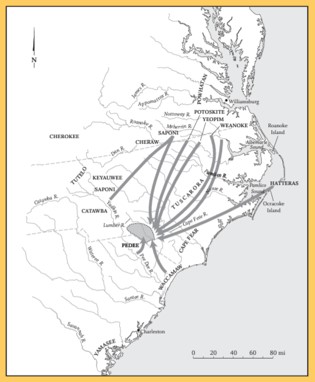
Why Not Utter Destruction?
In my opinion “Utterly Destroyed” does not have to mean complete annihilation. Most likely it means something is destroyed or taken away, such as the priesthood, or the church, or the blessings of the covenant, but not necessarily a complete group of people.
For example, the Nephite army including women and children at the last battle at Cumorah, did not necessarily contain the entirety of Nephites on the entire continent, but likely a great portion of those who called themselves Nephites or Lamanites were not even part of the last army on either side. There most likely were thousands of people left on the North American soil who were not present at the final battle, which makes sense to me. Similarly not the entirety of Jaredites were destroyed at hill Ramah. (Ramah and Cumorah were the same hill, Ether 15:11). It is likely many of the Nephites who did not attend the final battle at Cumorah, left in ships to other lands such as to England etc. It is also likely that many Jaredites lived beyond the Ramah battle in North, South, and Central America, and were not even present at the last battles of the Jaredites in up-state New York. History tells us that before Columbus there were many indigineous people in the Americas. These were very likely previous Jaredites and Lehites. Remember when I say Jaredites, I mean many descendants of Ham, Shem, and Japeth who were part of the Jaredite contingency that came to America from the Tower of Babel area. The Brother of Jared had the Priesthood and made covenants with the Lord, not all from Ham and Japeth necessarily joined him at Ramah.
Lumbee Native Americans- Could they be Descendants of Nephites, Lamanites, Ishmaelites, and Lemuelites?
The Lumbee Tribe of North Carolina have an amazing history. Like many of the Lamanites of North America their story is unique and very informative. These great people may be descended from the Nephite and Lamanites in my opinion, whom of course had the last battle at Cumorah in 385 AD.
I have made a point on other blogs, about who I believe the Iroquois and Algonquian people are. See Here: After researching both of these language groups and preparing a side by side list of attributes, I have decided most likely the Algonquian are the Lamanites who were victorious at the battle at Hill Cumorah, and I believe most likely the Iroquois are many of the remaining Nephites that were mixed in with the Lamanites, or who were not present at the last battle of Cumorah. My point is, both Lamanite and Nephite blood remained amongst the people who fought at Cumorah.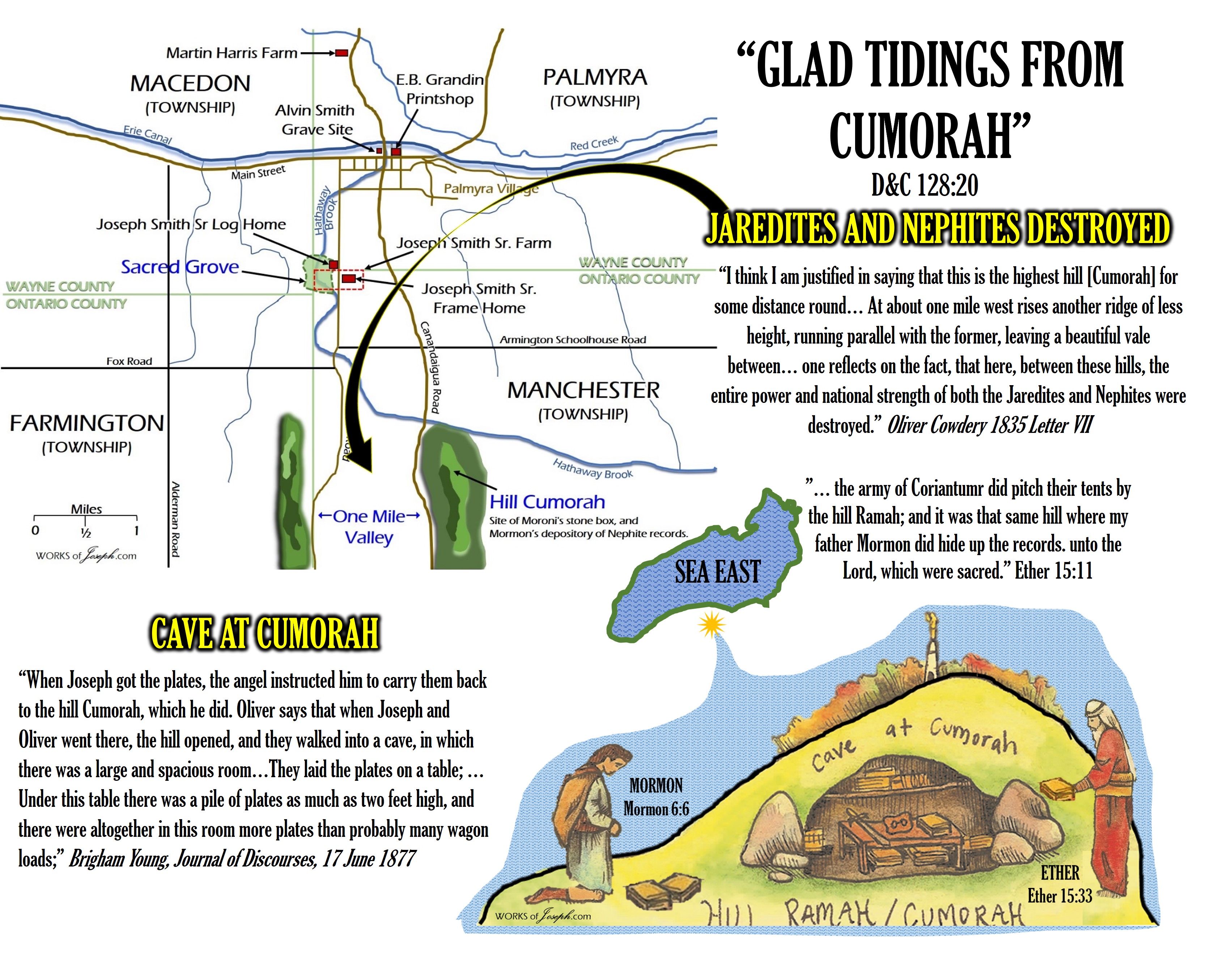
How you say that is possible? I think it is most likely that all of the people that existed on the land of North America in 385 AD, including Canada and Central America, did not attend the final battle of Cumorah and many knew nothing about this final battle. What do the scriptures teach?
Define Utter Destruction?
Let me comment on that further. We read in 2 Nephi, “And now, Joseph, my last-born, whom I have brought out of the wilderness of mine afflictions, may the Lord bless thee forever, for thy shall not utterly be .” 2 Nephi 3:3
In this way I believe the son of Lehi named Joseph, who escaped from the Lamanites with Nephi his older brother, was promised some of his seed would remain in North America. Was Joseph a Lamanite or a Nephite? It doesn’t matter by just the name, Joseph was a son of Lehi whose children were a direct descendent (Alma 10:3) of the Tribe of Joseph through Manasseh, and the promise was some of Joseph’s (Son of Lehi) seed would remain. We read in history that Nephi and his brothers married the daughters of Ismael, correct? According to Elder Snow, “I am asked to occupy the few minutes yet remaining: If the Spirit gives me liberty I will pursue the train of thought that has passed through my mind while Brother Richards has been speaking upon the spirit that has gone abroad upon the remnants of the house of Israel who occupy this land, the American Indians whom we understand to be the descendants of the Nephites, the Lamanites, the Lemuelites and the Ishmaelites who formerly possessed this land, whose fathers we have an account of in the Book of Mormon.” The Indians—The Influence of the Elders Among Them in the Interest of Peace, Etc. Discourse by Elder Erastus Snow, delivered at Logan, Sunday Afternoon, February 5th, 1882
“And now behold, my beloved brethren, I would speak unto you; for I, Nephi, would not suffer that ye should suppose that ye are more righteous than the Gentiles shall be. For behold, except ye shall keep the commandments of God ye shall all likewise ; and because of the words which have been spoken ye need not suppose that the Gentiles are utterly destroyed.” 2 Nephi 30:1
These scripture indicate to me that utterly destroyed does not necessarily mean every man, woman and child were killed, but that the “Covenant People of the Lord” were utterly destroyed. The Jaredite and the Nephite civilizations and churches were likely “utterly destroyed”, not all inhabitants of America.
This scripture explains my definition here: “And now behold, we are prepared to receive you; yea, and except you withdraw your purposes, behold, ye will pull down the wrath of that God whom you have rejected upon you, even to your utter destruction.” Alma 54:9. This suggests to me that people who reject Christ, are “utterly destroyed.” Many Nephites may have rejected Christ but still lived other places in America and other Nephite blood was mixed with Lamanite and Mulekite blood as well.
The closest time that ‘utter destruction” happened was during the flood of Noah where only 8 were saved. In my understanding utter destruction of a “Covenant People”, were those who had entered that sacred Covenant with God who were “utterly destroyed.”
Mormon also said utter destruction of his people did not happen. “And it came to pass that there were ten more who did fall by the sword, with their ten thousand each; yea, even all my people, save it were those twenty and four who were with me, and also a few who had escaped into the south countries, and a few who had deserted over unto the Lamanites, had fallen; and their flesh, and bones, and blood lay upon the face of the earth, being left by the hands of those who slew them to molder upon the land, and to crumble and to return to their mother earth.” Mormon 6:15. Even some Nephites at the final battle apparently remained in North America, along with the many in North America, who were not part of those at the final battle, along with many Nephites in Canada and Central America who escaped and who were not mecessarily present at the Hill Cumorah area in 385 AD.
Ancient Indigenous Peoples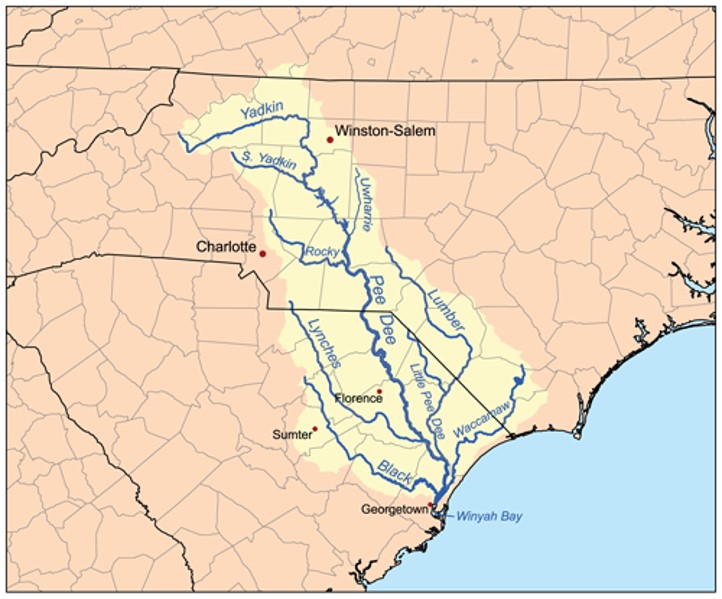
As I speak about the Lumbee Tribe, I speak of them as an indigenous tribe and not as if they are either Lamanite or Nephite. From my understanding as I quote below, the Lumbee have Iroquois, Algonquian and Siouan in their language. I have some great friends named John and Brittany Boltinhouse who live in Beulaville, NC. John is part Lumbee and Brittany is Taino from Puerto Rico.
We read from a Lumbee article saying, “Evidence from archeological excavations along the Lumber River has shown that successive cultures of indigenous Native Americans inhabited this area for thousands of years. A number of archaeological sites have been excavated on high ground along the river. While many have been disturbed by the agricultural practices of the post-Columbian era, numerous artifacts and some fossils have been recovered. These include a dugout canoe made by indigenous people and estimated to be over 1,025 years old. This ancient canoe is on display at the Native American Resource Center at the University of North Carolina at Pembroke.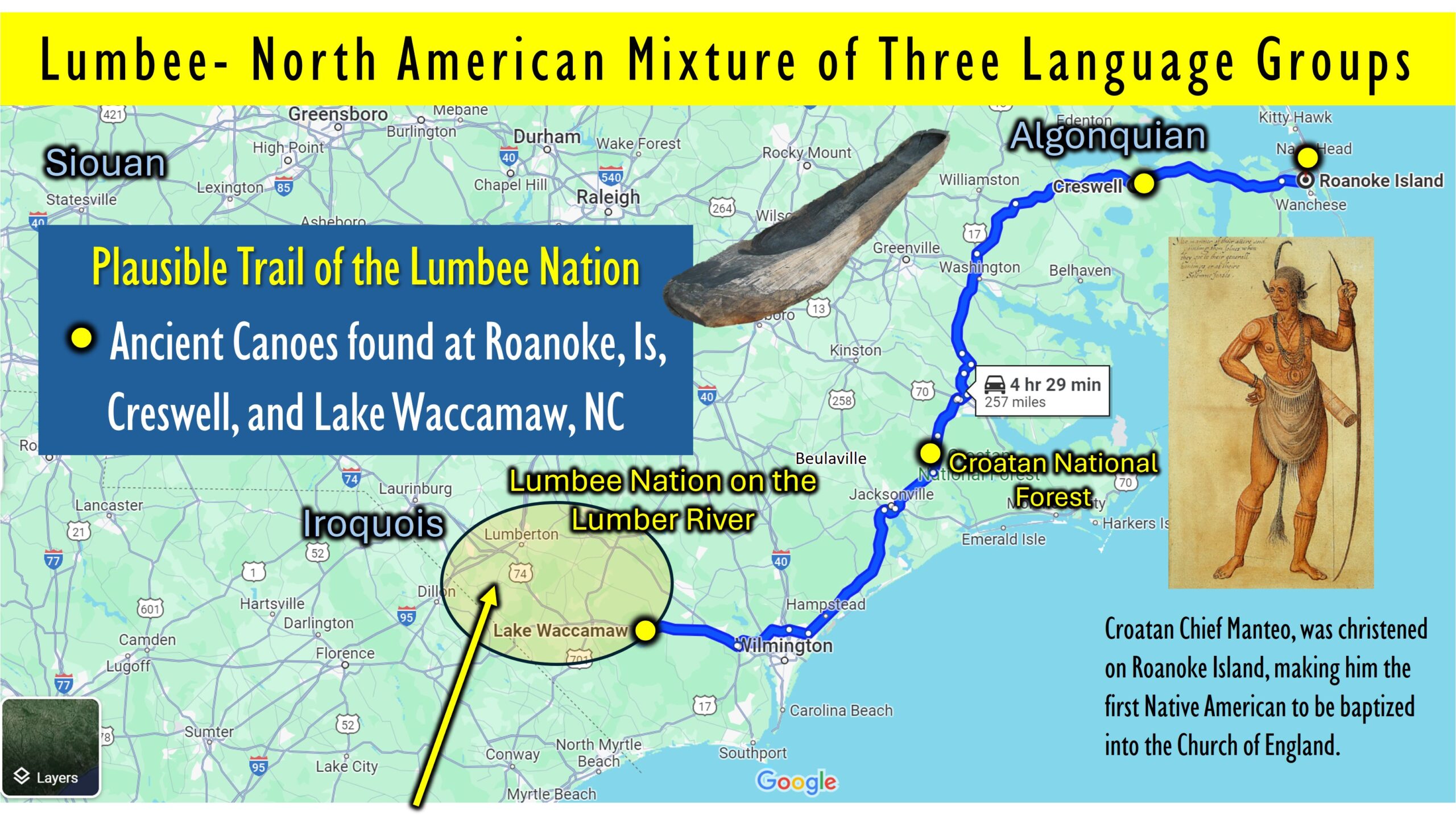
[See Map Above] “Much of the archaeological work in the Lumber River region has been done in Robeson County. A total of 429 archaeological sites have been recorded in this area. The sites contain components from various archaeological periods: Paleo-Indian, Archaic Woodland, Mississippian and Historic (after European encounter).
Iroquoian, Siouan, and Carolina Algonquian-speaking peoples were among the historic tribes who lived in the coastal and inland region prior to European encounter. Archeologists have identified 47 sites of potential importance, 20 of which are eligible for inclusion in the National Register of Historic Places.” Source More Information Here:
HISTORY AND CULTURE of LUMBEE
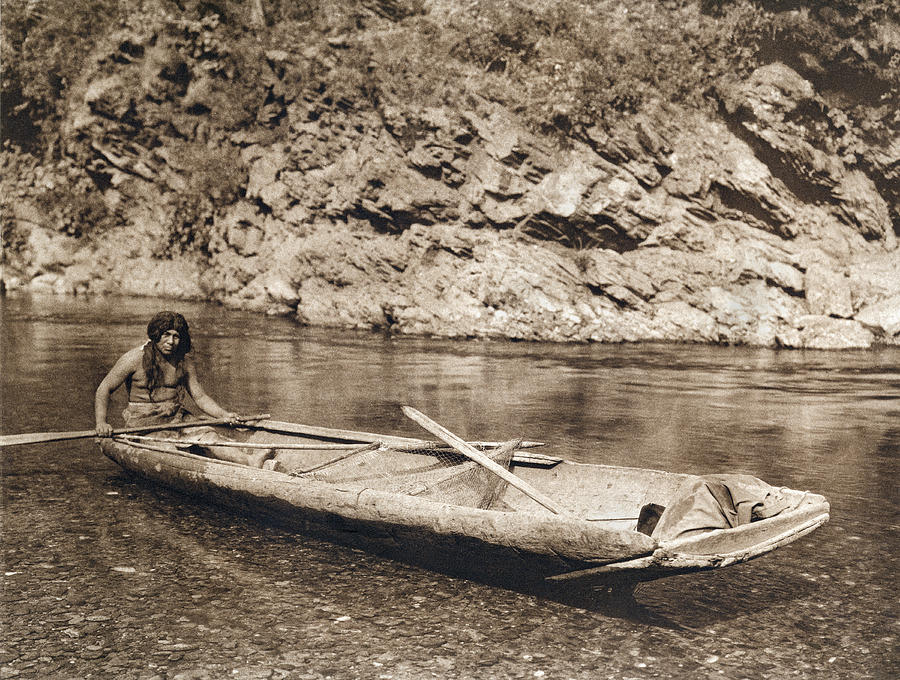 “In southeastern North Carolina, amongst the pines, swamps, and dark waters of the Lumbee River, you will find the heart and homeland of the Lumbee People. The ancestors of the Lumbee came together in the shelter of this land hundreds of years ago – survivors of tribal nations from the Algonquian, Iroquoian, and Siouan language families, including the Hatteras, the Tuscarora, and the Cheraw. The ancestors of the Lumbee were recognized as Indian in 1885 by the State of North Carolina. In 1956, Congress recognized the Lumbee as an Indian tribe while denying the People any federal benefits that are associated with such recognition – an action that the Lumbee continue to fight today.
Lumbee tribal headquarters are located in the small town of Pembroke. The tribal territory and service area is comprised of four adjoining counties: Robeson, Scotland, Hoke and Cumberland. The tribal housing complex, also known as ‘The Turtle’, houses most tribal services. The Lumbee are a strong People with a dynamic history and promising future. The sequential banners below, created by Karen Dial Bird and Kaya Littleturtle, share some of the rich history of the Lumbee in both narrative and visual form.”
*A ‘Notes’ page follows the banners for those interested in works cited and more information on included photographs. This banner series is copyrighted by the Lumbee Tribe of North Carolina – © 2017 Lumbee Tribe of North Carolina. More info here;
Jan 23, 2025, was an important day for the Lumbee Nation as you read in this memorandum. “DIRECTING PLAN FOR RECOGNITION OF LARGEST TRIBE EAST OF MISSISSIPPI RIVER: Today President Donald J. Trump signed a Presidential Memorandum to the Secretary of the Interior to submit a plan to advance full federal recognition of the Lumbee Tribe of North Carolina.” Fact Sheet: President Donald J. Trump Directs Administration to Advance Lumbee Tribe Recognition – The White House
A Summertime Swim Turns into an Archaeological Discovery
“The lengthy removal process was worth it,” said state archaeologist John Mintz. “This canoe is about 1,000 years old, and it’s a southeastern Indian canoe, and it originated from this area. An Important Part of Waccamaw Siouan History A team of neighbors, archaeologists and members of the Waccamaw Siouan Tribe brought the canoe to the surface.” Source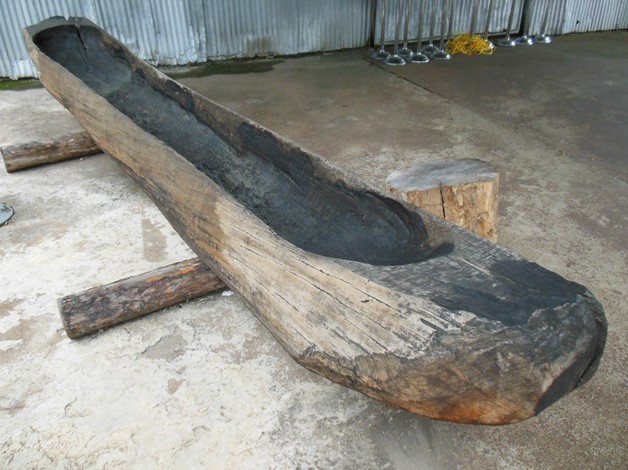
“That canoe at 28 feet long would have carried many a brave,” said Michael Jacobs, chief of the Waccamaw Siouan Tribe. “We feel like in our heart, it’s a history that we’re still exploring and understanding because this is the first time we’ve had access.”
Dugout Canoes at Lake Phelps Creswell, North Carolina
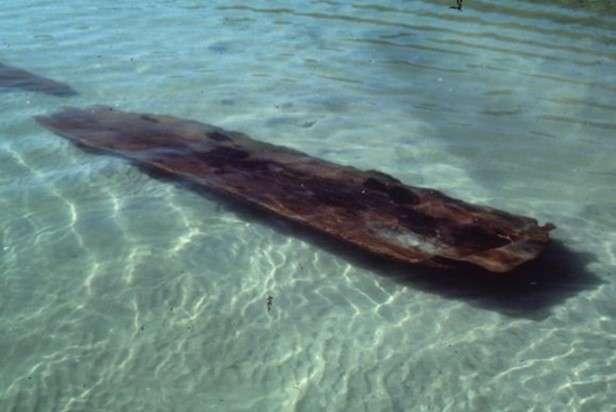
“The Lake Phelps canoes were likely made by the Carolina Algonquin people who arrived in the region around 9500 to 8000 B.C. The Algonquin had been living in the area nearly 800 years before Europeans arrived. The longest canoe to be discovered so far measures 36 feet, and the oldest of them is thought to be around 4,400 years old.” Source
Croatan Chief Manteo
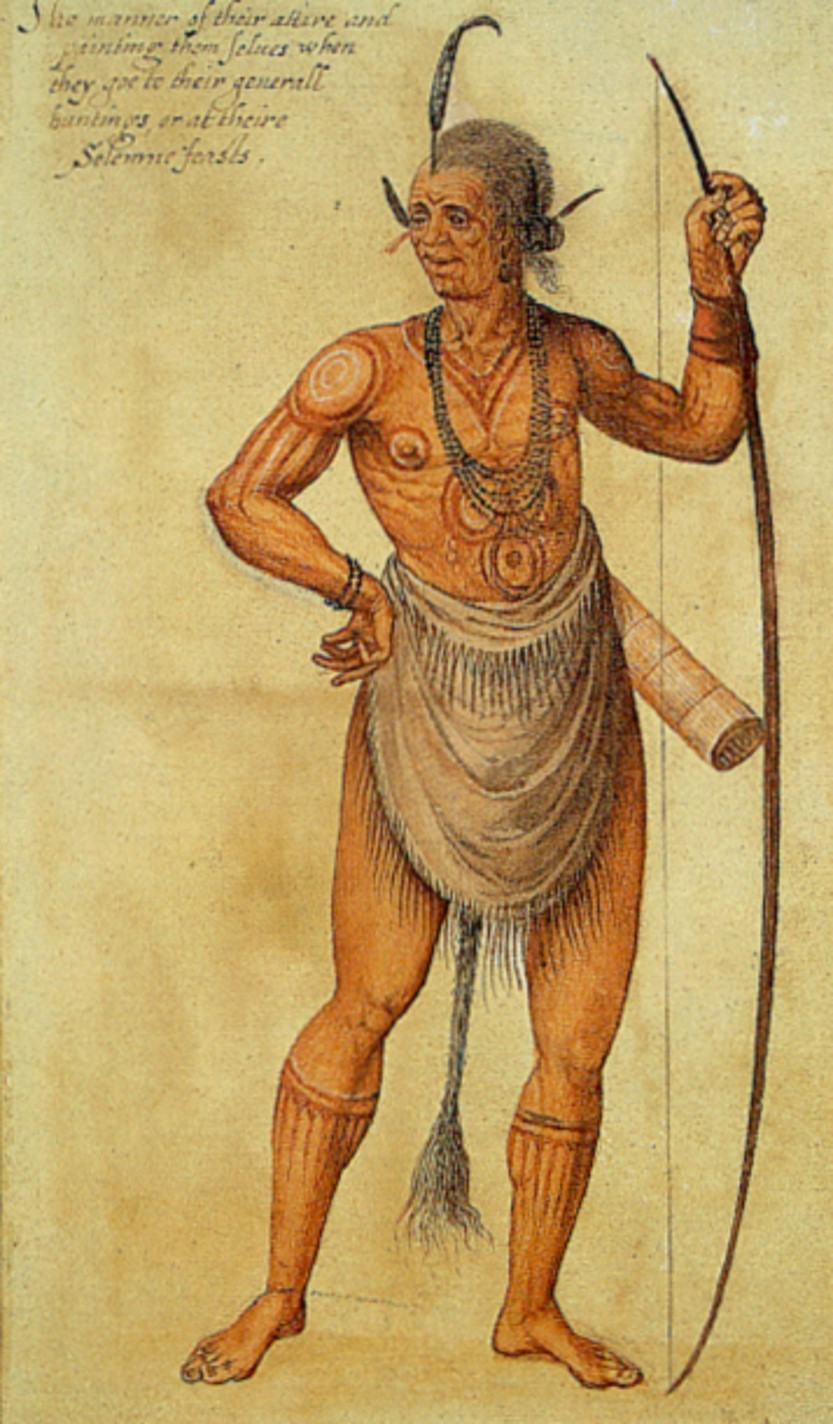
Manteo (c. 1564 – c. 1590) was a Croatan Native American, and was a member of the local tribe that befriended the English explorers who landed at Roanoke Island in 1584. Though many stories claim he was a chief, it is understood that his mother was actually the principal leader of the tribe. This leadership would not have automatically passed down to her children as many English at the time may have assumed.
In 1585 the English returned to Roanoke, arriving too late in the year to plant crops and harvest food, and Manteo helped the colonists make it through the harsh winter. He traveled to England on two occasions, in 1584 and 1585. After staying there, he was among those who sailed for the New World in 1587 along with Governor John White and his colonists, who founded the failed settlement later known as “The Lost Colony”. On Sunday, August 13, 1587, Manteo was christened on Roanoke Island, making him the first Native American to be baptized into the Church of England…
Manteo first entered the historical record through his encounter with English explorers in 1584, when Sir Walter Raleigh dispatched the first of a number of expeditions to Roanoke Island to explore and eventually settle the New World…
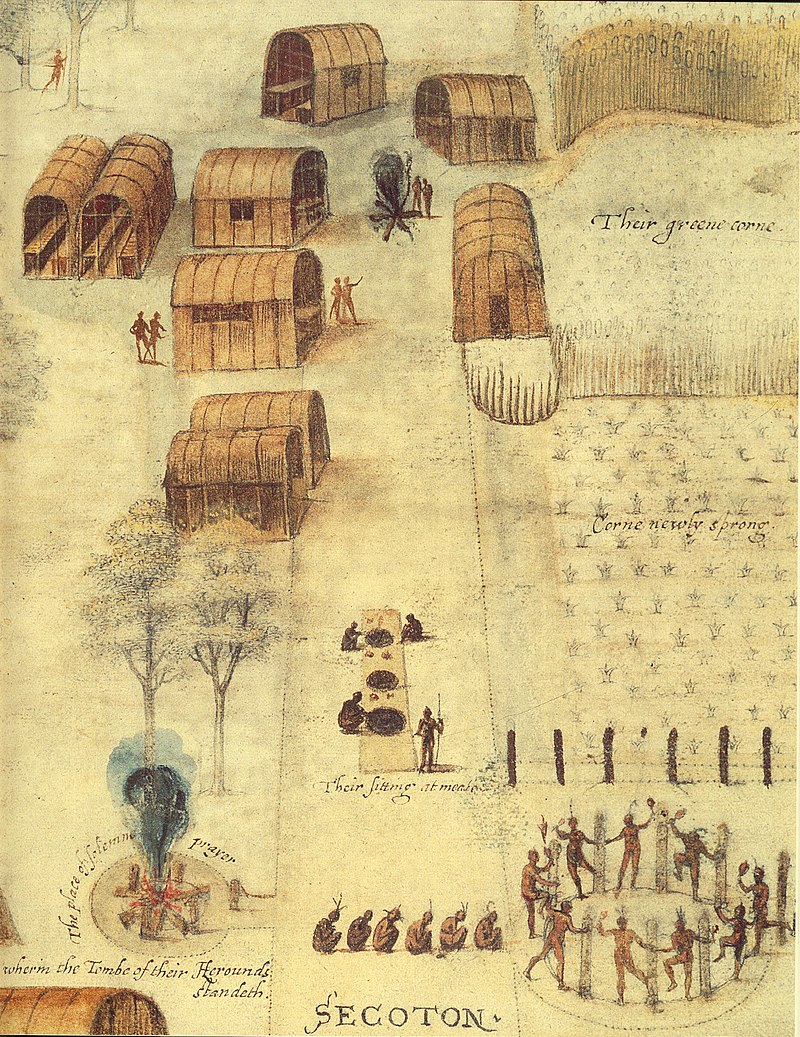
Once safely delivered to England in September 1584,[4]: 64 Manteo and Wanchese soon caused a sensation at court. Raleigh’s priority, however, was not publicity but rather intelligence about his new land of Virginia, and he restricted access to the exotic newcomers. He assigned the scientist Thomas Harriot the job of deciphering and learning the Carolina Algonquian language,[4]: 70 using a phonetic alphabet of his own invention in order to effect the translation…
Manteo is recognized as being the first Native American who became an Anglican Christian.[2]: 355 Manteo was possibly converted to Anglican Christianity by Raleigh. Some historians[who?] believe that Raleigh promoted this as a political maneuver to further Manteo’s role in working with the English. Upon conversion, Manteo retained his given name.[6]: 190 Manteo may have assisted in helping the English convert other Native Americans to Christianity as well.[2]: 351 In 2008, the 125th Annual Convention of the Episcopal Diocese of East Carolina approved the commemoration of the Baptism of Manteo, along with that of Virginia Dare [Photo below right], to be kept on August 17 of each year. Wikipedia
 The Lumbee tribe was first recognized by the state of North Carolina in 1885. The tribe has since been recognized by the federal government, and is now a federally recognized tribe. The Lumbee people have a rich culture and heritage, and are proud of their history. The tribe is known for their traditional arts and crafts, as well as their music and dance. The Lumbee people are also known for their hard work and determination, and have been successful in many different fields. The Lumbee people have a long and proud history, and are an important part of the state of North Carolina. The tribe has a rich culture and heritage, and is known for their traditional arts and crafts, as well as their music and dance. The Lumbee tribe is a proud and independent people, and will continue to fight for their rights and their culture.” The Lumbee People: A Proud And Independent Native American Tribe by Mika
Lumbee Tribe of North Carolina Origins and Migrations
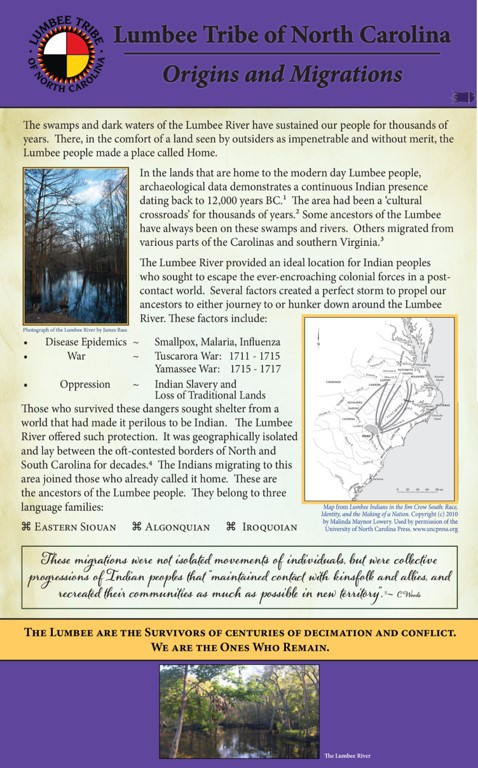
The Lumbee are the Survivors of centuries of decimation and conflict. We are the Ones Who Remain.
“The swamps and dark waters of the Lumbee River have sustained our people for thousands of years. There, in the comfort of a land seen by outsiders as impenetrable and without merit, the Lumbee people made a place called Home. In the lands that are home to the modern day Lumbee people, archaeological data demonstrates a continuous Indian presence dating back to 12,000 years BC.1 The area had been a ‘cultural crossroads’ for thousands of years.2 Some ancestors of the Lumbee have always been on these swamps and rivers. Others migrated from various parts of the Carolinas and southern Virginia.3 The Lumbee River provided an ideal location for Indian peoples who sought to escape the ever-encroaching colonial forces in a post-contact world.
Several factors created a perfect storm to propel our ancestors to either journey to or hunker down around the Lumbee River. These factors include:
• Disease Epidemics ~ Smallpox, Malaria, Influenza
• War ~ Tuscarora War: 1711 – 1715 Yamassee War: 1715 – 1717
• Oppression ~ Indian Slavery and Loss of Traditional Lands
Those who survived these dangers sought shelter from a world that had made it perilous to be Indian. The Lumbee River offered such protection. It was geographically isolated and lay between the oft-contested borders of North and South Carolina for decades.4 The Indians migrating to this area joined those who already called it home. These are the ancestors of the Lumbee people. They belong to three language families: These migrations were not isolated movements of individuals, but were collective progressions of Indian peoples that “maintained contact with kinsfolk and allies, and recreated their communities as much as possible in new territory”.
~ C. Woods Pamlico Sound Ocracoke Island Roanoke Island JamesR. NottowayR. MeherrinR. DanR. RoanokeR. P PeeDeeR. CatawbaR. SavannahR. YadkinR. JamesR. t AppomatoxR. NottowayR. MeherrinR. DanR. RoanokeR. a ammlliiccooRR. . PamlicoR. PeeDeeR. WatereeR. CatawbaR. SavannahR. YadkinR. Lumber R. NeuseR. CATAWBA CHERAW CHEROKEE SAPONI KEYAUWEE PEDEE POTOSKITE SAPONI WEANOKE YEOPIM PEDEE CAPEFEAR CAPEFEAR WACCAMAW WACCAMAW YAMASEE TUTELO TUTELO TUSCAROR TUSCARORA POWHATAN POWHATAN SanteeR. HATTERAS N 0 60 40 20 80 mi Albemarle Sound Williamsburg Charleston Cape Fear R. Eastern Siouan, Algonquian, Iroquoian, Map from Lumbee Indians in the Jim Crow South: Race, Identity, and the Making of a Nation. Copyright (c) 2010 by Malinda Maynor Lowery. Used by permission of the University of North Carolina Press. www.uncpress.org The Lumbee are the Survivors of centuries of decimation and conflict. We are the Ones Who Remain.
Map from Lumbee Indians in the Jim Crow South: Race, Identity, and the Making of a Nation. Copyright (c) 2010 by Malinda Maynor Lowery. Used by permission of the University of North Carolina Press. www.uncpress.org
Sir Walter Raleigh Maybe Connected to the Lumbee People
From the Roanoke Island to Creswell NC, to the Croatan National Forest of NC, to Lake Waccamaw NC, and then settling on the Lumber River at Lumberton NC could have been the route of the Lumbee people who today are there on the Lumbee Reservation in Lumberton, NC. (See map again below).
“Roanoke Colony was an attempt by Sir Walter Raleigh to found the first permanent English settlement in North America. The colony was founded in 1585, but when it was visited by a ship in 1590, the colonists had inexplicably disappeared. It has come to be known as the Lost Colony, and the fate of the 112 to 121 colonists remains unknown…
He was granted a royal patent to explore Virginia, paving the way for future English settlements. In 1591, he secretly married Elizabeth Throckmorton, one of the Queen’s ladies-in-waiting, without the Queen’s permission, for which he and his wife were sent to the Tower of London. After his release, they retired to his estate at Sherborne, Dorset…

On March 25, 1584, Queen Elizabeth granted Raleigh a royal charter authorizing him to explore, colonise and rule any “remote, heathen and barbarous lands, countries and territories, not actually possessed of any Christian Prince or inhabited by Christian People”, in return for one-fifth of all the gold and silver that might be mined there.[20][21] This charter specified that Raleigh had seven years in which to establish a settlement, or else lose his right to do so. Raleigh and Elizabeth intended that the venture should provide riches from the New World and a base from which to send privateers on raids against the treasure fleets of Spain. The charter was originally given to Sir Humphrey Gilbert who pitched the idea to Queen Elizabeth I and died at sea while attempting to accomplish it…
On April 27, 1584, the Philip Amadas and Arthur Barlowe expedition set sail from England on an exploratory mission to determine what resources were available in North America.[22][23] They returned with two of the local inhabitants, Manteo and Wanchese, in August 1584, and reported of their findings.[21] The region (the majority of the east coast) received the name “Virginia” for the Virgin Queen Elizabeth I, which is the origin of the name of the modern day state.[11]…
The Native Americans in the region had likely encountered, or at least observed, Europeans from previous expeditions. The Secotan, who controlled Roanoke Island and the mainland between Albemarle Sound and the Pamlico River, soon made contact with the English and established friendly relations. The Secotan chieftain, Wingina, had recently been injured in a war with the Pamlico, so his brother Granganimeo represented the tribe in his place.[24]
Upon their return to England in the autumn of 1584, Amadas and Barlowe spoke highly of the tribes’ hospitality and the strategic location of Roanoke. They brought back two natives: Wanchese, a Secotan, and Manteo, a Croatan whose mother was the chieftain of Croatoan Island.[25] The expedition’s reports described the region as a pleasant and bountiful land, alluding to the Golden Age and the Garden of Eden, although these accounts may have been embellished by Raleigh.[26]
Queen Elizabeth was impressed with the results of Raleigh’s expedition. In 1585, during a ceremony to knight Raleigh, she proclaimed the land granted to him “Virginia” and proclaimed him “Knight Lord and Governor of Virginia”. Sir Walter Raleigh proceeded to seek investors to fund a colony.[27]
 When the supply ship arrived in Roanoke, three years later than planned, the colonists had disappeared.[30] The only clue to their fate was the word “CROATOAN” and the letters “CRO” carved into tree trunks. White had arranged with the settlers that if they should move, the name of their destination be carved into a tree or corner post. This suggested the possibility that they had moved to Croatoan Island, but a hurricane prevented John White from investigating the island for survivors.[30] Other speculation includes their having starved, or been swept away or lost at sea during the stormy weather of 1588. No further attempts at contact were recorded for some years. Whatever the fate of the settlers, the settlement is now remembered as the “Roanoke Colony” later known as the “Lost Colony”.[31]https://en.wikipedia.org/wiki/Walter_Raleigh
Archaeologists Find New Clues to “Lost Colony” Mystery
“When John White, appointed by Sir Walter Raleigh as governor of Roanoke Colony, returned to England for more supplies in late 1587, he left behind his wife, his daughter and his infant granddaughter—Virginia Dare, the first child born in the New World to English parents—among the other settlers. Upon White’s return in 1590, he found no trace of his family or the other inhabitants of the abandoned colony. Over the centuries to come, archaeologists, historians and explorers would delve into the mystery of the “Lost Colony” of Roanoke, all failing to find definitive answers.
Based on the scant clues left behind, some speculated that Native Americans attacked and killed the English colonists. “Croatoan” was the name of an island south of Roanoke, now Hatteras Island, which at the time was home to a Native American tribe of the same name. Alternatively, they might have tried to sail back to England on their own and been lost at sea, or been killed by hostile Spaniards who came north from their own settlements in Florida. One enduring theory was that the settlers might have been absorbed into friendly Native American tribes, perhaps after moving further inland into what is now North Carolina.
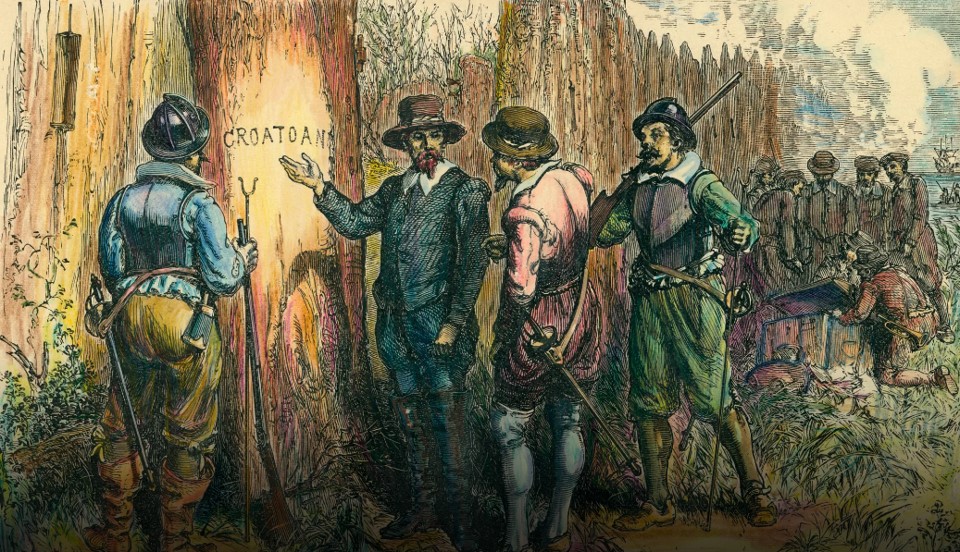
Two independent teams found archaeological remains suggesting that at least some of the Roanoke colonists might have survived and split into two groups, each of which assimilated itself into a different Native American community. One team is excavating a site near Cape Creek on Hatteras Island, around 50 miles (80 kilometers) southeast of the Roanoke Island settlement, while the other is based on the mainland about 50 miles to the northwest of the Roanoke site…
According to archaeologist Nicholas Luccketti of the First Colony Foundation, which is conducting the excavations at Site X, the group has found shards of pottery that they claim may have been used by Roanoke settlers after they left the colony. Located nearby is a site that archaeologists believe might have been a small Native American town, Mettaquem. After the Roanoke colony met its end, English settlers eventually came south from Virginia into North Carolina, but the first recorded settler in the area did not arrive until about 1655. But the recently uncovered pottery is in a style called Border Ware, which is typical of the pottery dug up on Roanoke Island, as well as at Jamestown, but was no longer imported to the New World after the early 17th century, when the Virginia Company dissolved.
In addition to the Border Ware pottery, archaeologists at Site X discovered various other items, including a food-storage jar known as a baluster, pieces of early gun flintlocks, a metal hook of the sort used to stretch animal hides or tents and an aglet, a small copper tube used to secure wool fibers before the advent of the hook and eye in the 17th century. Based on his team’s findings, Luccketti thinks the Roanoke colonists may have moved inland to live with Native American allies sometime after White left, and these artifacts might have been among their belongings. As reported in the New York Times, the First Colony Foundation will reveal more about its findings and theory this week in Chapel Hill, North Carolina.
Though the newly announced discoveries don’t solve this lingering historical mystery, they do point away from Roanoke Island itself, where researchers have failed to come up with evidence pointing to the Lost Colony’s fate. Archaeologists on both teams are hoping that a detailed study of their new finds will yield more clues, and—of course—that more evidence remains, waiting to be discovered, in the endless layers of dirt that surround them.” https://www.history.com/news/archaeologists-find-new-clues-to-lost-colony-mystery