
Once again I have to thank the ever-so-reading Betty “Red Ant” LaFontaine for finding most of this information for me. I think she cheated however because there is the name of a park near this site called, Fontainebleau State Park. Her and Mike are probably related to these French Lamanites. Read about Betty and 14 other amazing Lamanites in the book to the left.
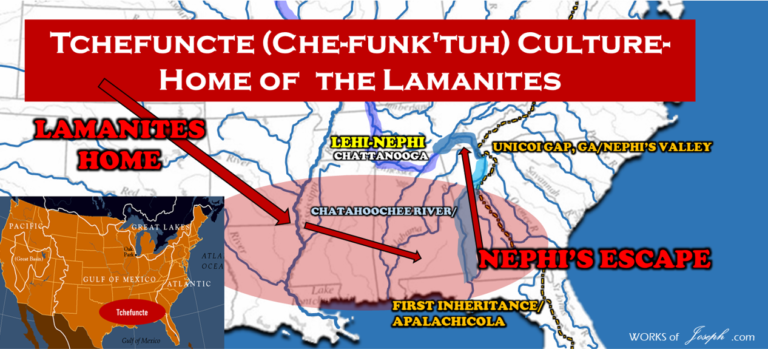
We believe Lehi landed in Florida near Tallahassee about 589 BC. Later, after Lehi dies, Nephi escaped north possibly using the Chattahoochee River to Unicoi Gap, GA, and then traveling on the Hiwassee River which connects to the Tennessee River, then settling near Chattanooga, Tennessee which area became the land of Nephi and also called the Land Lehi-Nephi. A few Nephites came back south of the Ohio River to find the Land of their inheritance, but Nephites mostly stayed north of the Ohio River.
 The Lamanites remained near the panhandle of Florida near where they landed, and they would probably extend north into Georgia and west into north and central Florida then east to Alabama, Mississippi and Louisiana. I imagine this was a beautiful place to live and hunt and build. This information below speaks mostly about Louisiana and Mississippi Mound Culture of the Tchefuncte Culture from 500 BC to 1AD.
These people are mostly of the main tribe of the Muskogean Language. Along with the Algonquin and the Iroquois these three main language groups are most likely to have the Haplogroup x DNA similar to that in Iraq, Turkey and other West Eurasian countries. National Geographic Article Here on DNA.
History Defines Hopewell Cultural Decline

“Around 400 AD, the Hopewell exchange ceased, mound building stopped, and art forms were no longer produced. War is a possible cause, as villages dating to the Late Woodland period shifted to larger communities; they built defensive fortifications of palisade walls and ditches. Colder climatic conditions could have driven game animals north or west, as weather would have a detrimental effect on plant life, drastically cutting the subsistence base for these foods. The introduction of the bow and arrow, by improving hunts, may have caused stress on already depleted food populations. This may have been another reason for people to live in larger, more permanent communities for protection, as warfare became more deadly. With fewer people using trade routes, there was no longer a network linking people to the Hopewell traditions. The breakdown in societal organization could also have been the result of adoption of full-scale agriculture. Conclusive reasons for the evident dispersal of the people have not yet been determined.” Source
The Heartland Model Defines Hopewell Cultural Decline
Read the book of Mormon. The last battles between the Nephites and the Lamanites is at 385 AD. Moroni lasted until about 421 AD. Between those years I am sure Moroni stayed fairly close to the cave at hill Cumorah so he could abridge a few more records and the Lord probably had a nice hiding place for him at or near the cave. Why would Moroni travel over 3500 miles back and forth to Mesoamerica with plates and with becoming exposed to so many people and dangers? He wouldn’t. Some Scholars try and explain there was no Cave at Cumorah and the final battles were in Guatemala or some where else. I don’t believe it.
I also believe that Moroni dedicated temple sites in Manti, St George, Independence, and others. He could have done this as a translated person as maybe that is how he left this earth. Remember Moroni holds keys. “Moroni, whom I have sent unto you to reveal the Book of Mormon, containing the fulness of my everlasting gospel, to whom I have committed the keys of the record of the stick of Ephraim.” D&C 27:5. It may be also possible that Moroni appeared to and helped George Washington, Columbus and others as it was his duty to spread the Stick of Ephraim to the area and to the world.
The Tchefuncte Site
The Tchefuncte Site (16ST1) is an archaeological site that is a type site for the prehistoric Tchefuncte culture period. The name is pronounced Che-funk’tuh. It is located in the southeast section of Fontainebleau State Park near Mandeville, St. Tammany Parish, Louisiana.
The site was inhabited from 500 BCE to 1 CE during the Tchula period. Major excavations were directed by Clarence Johnson in 1938 and Edwin Doran in 1941. https://en.wikipedia.org/wiki/Tchefuncte_Site
(Pronounced- Che-funk’tuh)
Muskogean Nation of St. Tammany- Choctaw & Chickasaw
History of the Native American cultures, in the Muskogean Nation of “St. Tammany” is known for its Choctaw population
Local Native American historian Grayhawk Perkins spoke at a public meeting held at the Fuhrmann Auditorium in Covington on June 7, 2017, an event hosted by the Covington Heritage Foundation. Perkins shared several stories about his efforts over the past 40 years to preserve the history of the area’s original inhabitants through his teaching, his music, and story-telling.
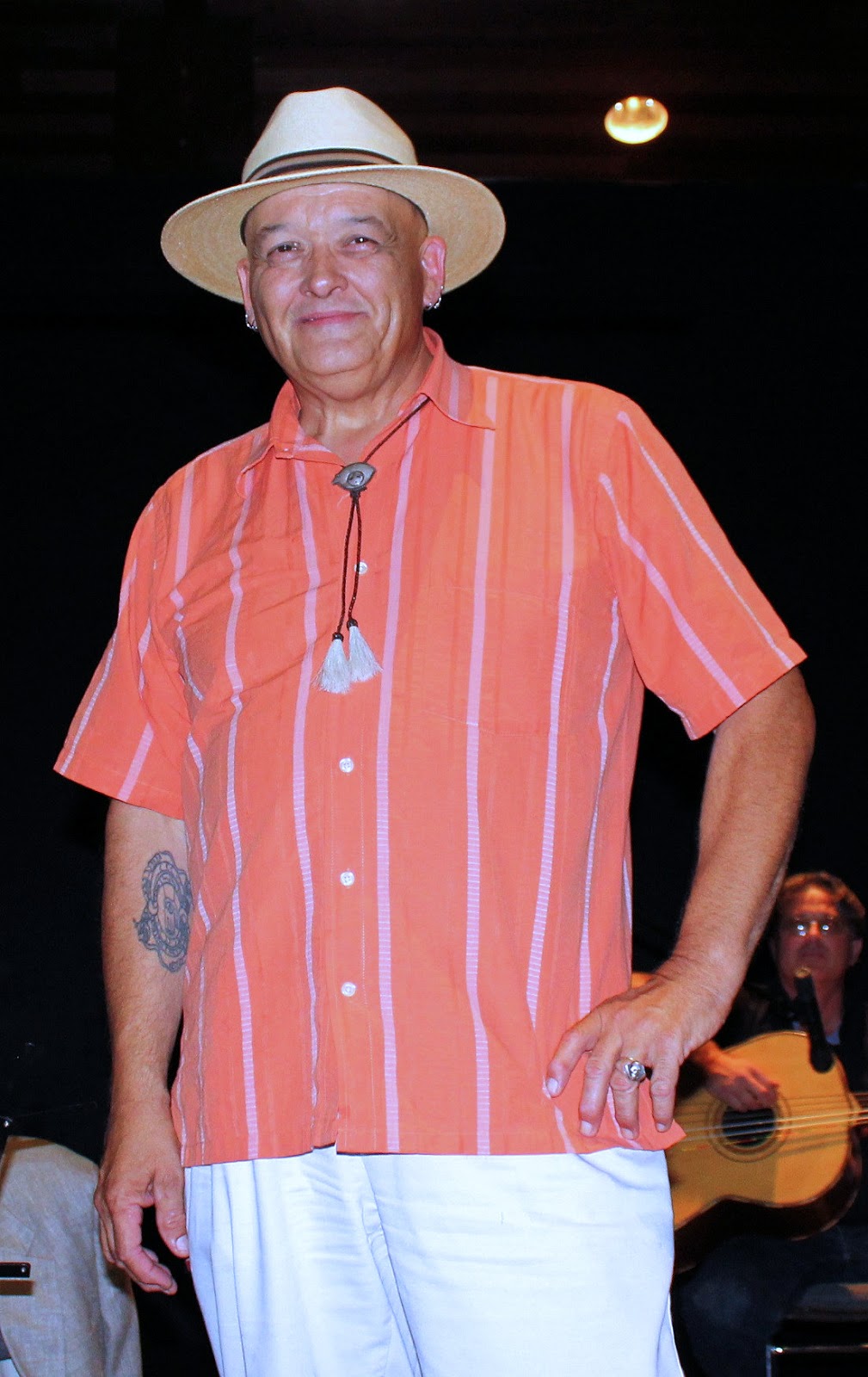
Perkins, a well-known cultural historian and musician, told of the importance of his grandmother’s lessons about the past, as well those shared by his grandfather, aunts and uncles. “Because of my grandparents, I became the tribal story-teller,” he said, “and I’ve even traveled to the Smithsonian to take part in their Native American history programs.”
People are beginning to realize that cultural story-telling is very important to keeping your nation going and to keeping your family going, he said.
Perkins told about his early search for the history of the Native American cultures, especially those in the Muskogean Nation of which he is a part. “St. Tammany is known for its Choctaw population, but they were actually immigrants,” he said. “They came into this area later. They were pushed out of MIssissippi in the beginning of the 1800’s. But the Muskogeans were here first. The Choctaws spoke the Muskogean language however, so they were welcomed and blended in,” he explained.
What is known as the “Tchefuncte culture” actually represents a time period in Native American history, Perkins said. It involved native peoples all the way from the Texas border into the Florida panhandle. “They had architecture, astronomy, agriculture. They were not nomads, and they lived in villages, large villages. Several of these cities featured mounds, some of which were 80 feet tall, and there were houses for families. Those communities stretched out for miles and miles.”

Tribal nations and councils so impressed Benjamin Franklin that parts of the United States government were patterned after the Native American nations and tribal governments, he explained. “Franklin was smart enough to see how it worked and incorporated parts of it into the new United States,” Perkins said.
He asked his listeners who they think was here (in southeast Louisiana) when the first European set foot in America. “It was the Acolapissa tribe” he said. “They were part of the Muskogean Nation, and they had seven large villages here, some of which were in Fontainebleau State Park.” People are always finding arrowheads and points all over St. Tammany Parish, Perkins noted.
He touched upon how the French newcomers learned the Mobilian trade language used among the tribes in the region (as a second language) and as a result got along better with the native inhabitants than the English or the Dutch did.
In addition to his music and his teaching, Perkins has written books. He was able to write a dictionary with the help of his grandmother, sharing the meanings of the original Muskogean words. He also mentioned instances of natural healing remedies, such as when his grandmother placed wadded up spiderwebs into a deep cut to stop the bleeding.
Prior to his talk in Covington, Perkins had spent two days speaking to children at every library branch in Livingston Parish, explaining the values of life among the Native Americans, how they governed, their family life, and their day-to-day routines.
He performs regularly at the New Orleans Jazz Festival where he has served as a coordinator for the past 25 years, and lately he has collaborated on music projects with French musicians and others around the world.
Mark Johnson, president of the Covington Heritage Foundation, introduced Grayhawk to the audience of approximately 150.

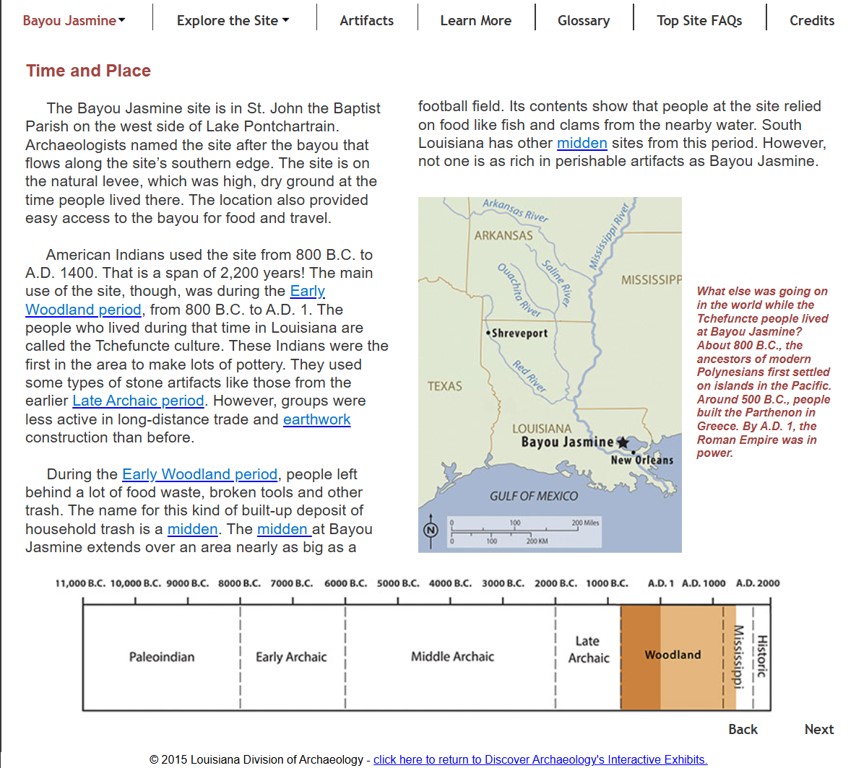
According to information provided by the Louisiana Dept. of Culture, Recreation and Tourism, the Tchefuncte Culture began around 600 B.C. as a hunter-gatherer culture living in small, scattered sites in coastal areas or in lowlands near slow-moving streams. Long-distance trade was much less important, yet people in Louisiana were in contact with people in western Mississippi, coastal Alabama, eastern Texas, Arkansas, and southeastern Missouri.
Editor’s note: With the date around 600 BC this could very well be a Nephite and Lamanite area in Florida. We know as the Nephites left to get away from the Lamanites, they traveled north into Georgia and Tennessee. These Lamanites who stayed behind would have been right in this general location. See Red Oval on bottom of map below.
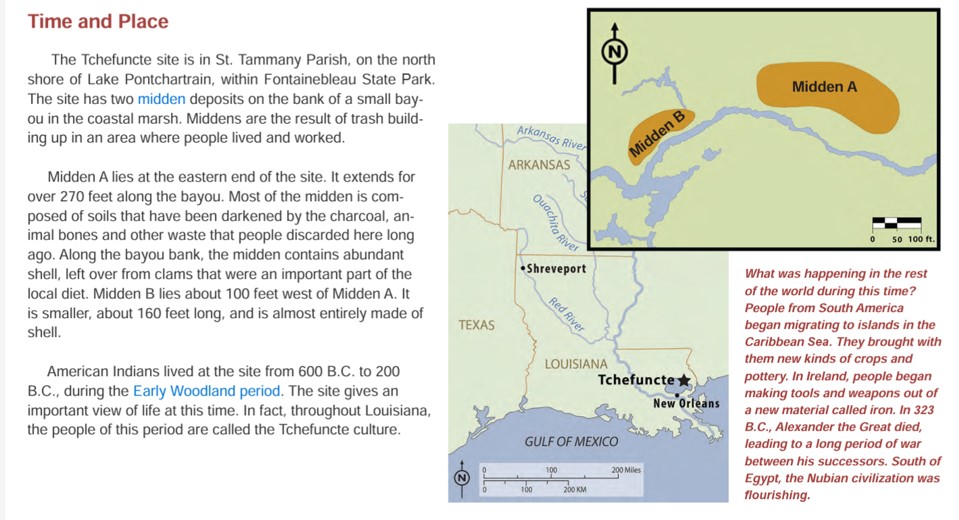
The Tchefuncte Site located on the north shore of Lake Pontchartrain was so named because it was situated inside Tchefuncte State Park (renamed Fountainbleau State Park). The site had two shell middens, one that measured 100 feet by 250 feet and another 100 feet by 150 feet. Both were excavated, and archaeologists found 50,000 pieces of pottery, as well as artifacts made from bone, shell, and stone. Forty-three human burials were recovered, none of which had objects buried with them.

Tchefuncte people appear to have camped on natural levees, terraces, salt domes, cheniers, and ridges that provided dry ground in the wet environment. They built their houses, which were probably temporary circular shelters having a frame of light poles covered with palmetto, thatch, or grass mixed with mud.
They were the first Louisiana Indians to make large amounts of pottery. They rolled coils of clay into shape and then smoothed them to form a container. Many shapes of pots were made, but characteristically they had “footed” bases.

After decorating the pots, they fired them by slow baking. The introduction of pottery was an important improvement in food storage. When these pots were kept covered, they provided a relatively dry and animal-proof, portable container. The Tchefuncte culture began to phase out around 200 B.C. https://tammanyfamily.blogspot.com/2017/06/native-american-history.html
7 Amazing Archaeological Sites In Louisiana
While most people know that Louisiana has a rich history, many people don’t realize that the state is home to some truly amazing archaeological treasures. We have a multitude of historical sites and artifacts that give us a deep window into life on the Mississippi River before and during early colonization. Here are 7 of the most amazing sites.
We’re aware that these uncertain times are limiting many aspects of life. While we continue to feature destinations that make our state wonderful, please take proper precautions or add them to your bucket list to see at a later date. If you know of a local business that could use some extra support during these times, please nominate them here: onlyinyourstate.com/nominate
1) Poverty Point World Heritage Site 1700 B. C. – 1100 B. C.
While most people know that Louisiana has a rich history, many people don’t realize that the state is home to some truly amazing archaeological treasures. We have a multitude of historical sites and artifacts that give us a deep window into life on the Mississippi River before and during early colonization. Here are 7 of the most amazing sites. We’re aware that these uncertain times are limiting many aspects of life. While we continue to feature destinations that make our state wonderful, please take proper precautions or add them to your bucket list to see at a later date. If you know of a local business that could use some extra support during these times, please nominate them here: onlyinyourstate.com/nominate
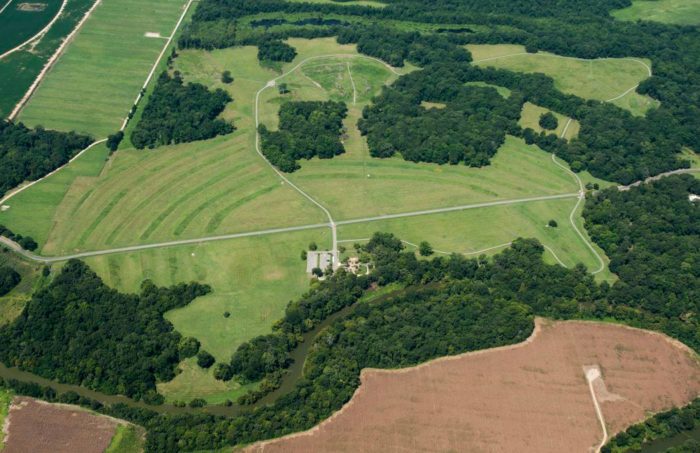
Recently recognized as a UNESCO world heritage site, Poverty Point is completely unique. The design of the mounds here with C-shaped ridges are unlike any other site in the world.
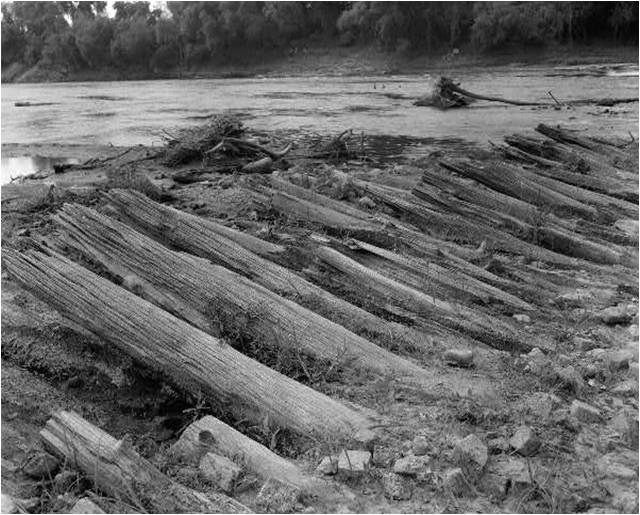
2) Bailey’s Dam 1864
Built during the civil war, this dam was constructed to free a Union naval squadron that was stuck in low water at the Red River. Using just the materials at hand, the dam is a testament to the perseverance of the Union soldiers.
3) Tchefuncte 600 B.C. – 200 B.C.
Located in the coastal marsh of southeastern Louisiana, Tchefuncte excavations have demonstrated crucial understanding about the vibrant life of indigenous peoples in the early woodland period.

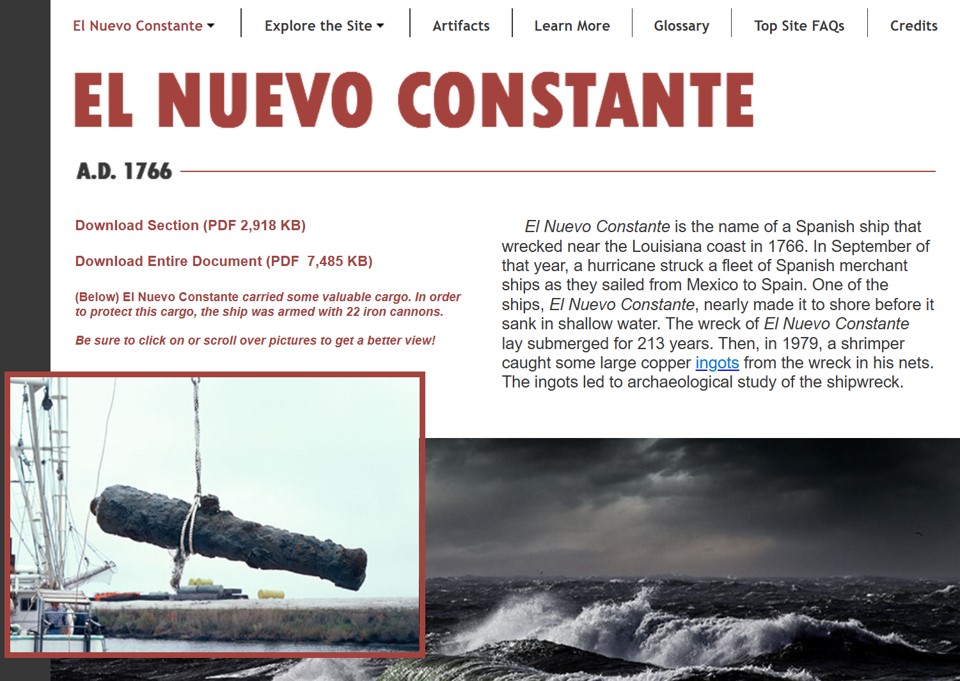
4) El Nuevo Constante 1766
El Neuvo Constante was a Spanish ship that sank in a hurricane near Louisiana on its way from Mexico to Spain. It was discovered in 1979 after a shrimper found copper ingots from the wreck.
Built by Spanish colonists in 1716, the Los Adaes site was once the capital of Spanish Texas and a scene of unique cooperation between the French, Spanish, and indigenous Native American tribes in the area. Numerous early 18th century artifacts have been found there.
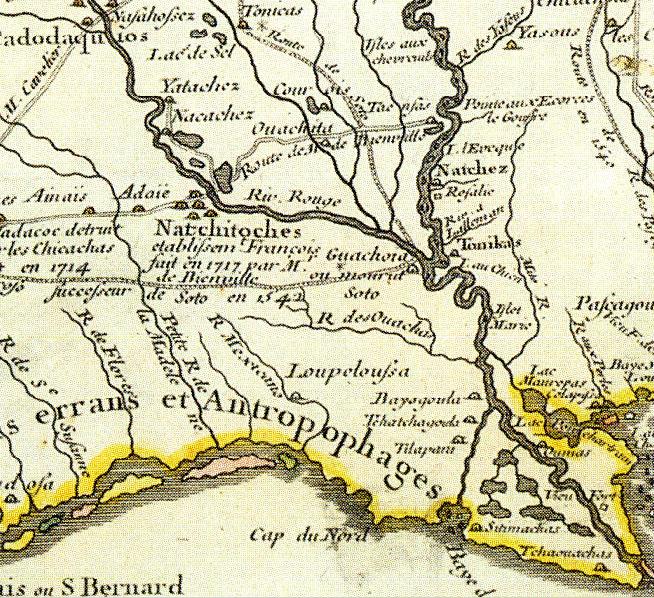
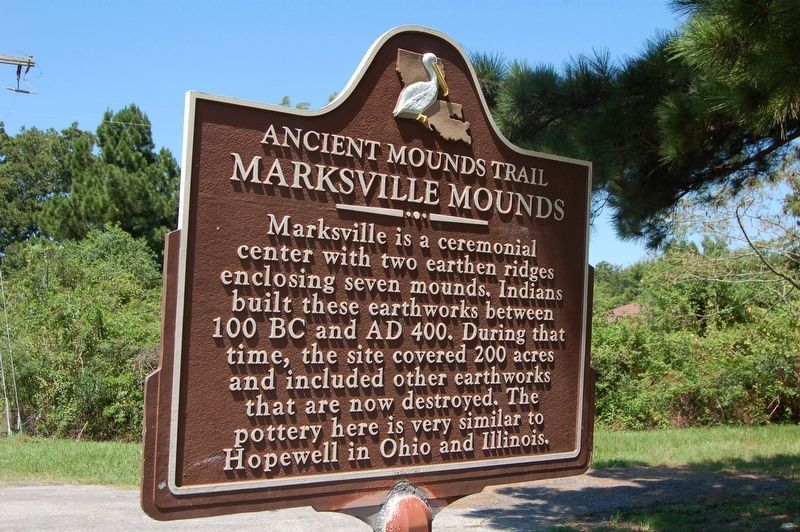
Over 2,000 years ago members of the Hopewell culture built a series of six mounds and one ring. Other earthworks were also found on the site. Here’s a recreation of the mounds in painting form as well as some examples of artifacts that have been found there.
The Marksville culture was a Hopewellian culture in the Lower Mississippi valley, Yazoo valley, and Tensas valley areas of present-day Louisiana, Mississippi, Missouri, and Arkansas. It evolved into the Baytown culture and later the Coles Creek and Plum Bayou cultures. It is named for the Marksville Prehistoric Indian Site in Marksville, Louisiana.
A Southeast Louisiana site where indigenous peoples lived for thousands of years when the land was much higher. As the land sank, many artifacts were uncovered, preserved by the mud and silt in the area. https://www.crt.state.la.us/dataprojects/archaeology/bayoujasmine/