
Inspired Teachings about Polynesia
Here I share with you much evidence from quotes of prophets, apostles and others saying Polynesians are of the House of Israel and are Children of Lehi. They are a choice and wonderful people.
Howard W. Hunter — 1984 Statement on Polynesians
“It has been the position of the Church that Polynesians are related to the American Indians as descendants of Father Lehi, having migrated to the Pacific from America… Our belief in this regard is scriptural.”
Matthew Cowley — To the Hawaiian People
“Elder Matthew Cowley, speaking to the Hawaiian people at Laie, declared: “Brothers and sisters, you are God’s children — you are Israel.” This was directed specifically at Hawaiians, though Cowley later served broadly in the Pacific.” BYU Religious Studies Center
“A description of the broader framework at the time noted: “Here were two great strains of the house of Israel — the children of Ephraim from the isles of Britain, and the children of Lehi from the isles of the Pacific.” BYU Religious Studies Center
 Joseph Smith Foundation
A great source for most of these quotes below comes from Hannah Stoddard of the Joseph Smith Foundation found here: https://josephsmithfoundation.org/nephite-and-lamanite-link-to-polynesia/#note-2445-5
Mark E. Petersen
“The Polynesian Saints are characterized by a tremendous faith. Why do they have this great faith? It is because these people are of the blood of Israel. They are heirs to the promises of the Book of Mormon. God is now awakening them to their great destiny. As Latter-day Saints we have always believed that the Polynesians are descendants of Lehi and blood relatives of the American Indians, despite the contrary theories of other men.” [1] Mark E. Petersen
George Q. Cannon
The doctrine that the Hawaiian people and all other Polynesians are heirs to the blessings promised to the posterity of Abraham had its origin through George Q. Cannon. While he was at Lahaina, he received a knowledge directly from the Lord that the Hawaiians were of the house of Israel. From this time on Elder Cannon and his associates began to teach that the Hawaiian people were an offshoot branch of Israel through the posterity of Lehi, the Book of Mormon prophet” [2] George Q. Cannon
Cheesman, Paul R. and Millie Foster Cheesman
“Paul Cheesman notes in Early America and the Polynesians that Bruce G. Pitt, a graduate student, “viewed a portion of microfilm #34 in the BYU library” which contained the patriarchal blessings given to these people in regard to the lineage declared in the blessings. The following information was found: “Of 321 total Polynesian lineages viewed, 155 were declared to be of Manasseh, 2 of Manasseh and Ephraim, 68 of Joseph, 62 of Israel, 4 of Jacob, 28 of Ephraim, 1 of Lehi and 1 of Japeth. . .
Another [graduate] researcher, Max Hirschi, recorded that out of 35 patriarchal blessings given to Polynesians, thirteen were from the tribe of Ephraim, fourteen were told they were from Manasseh, and the other eight were of the tribe of Joseph”.
During Dr. Paul Cheesman’s visits to the islands, he questioned patriarchs in the various places and found “that nearly three-fourths [of the declared lineages] were from Manasseh and one-fourth were from Ephraim, with some being designated as descendants of the tribe of Joseph”. Since Lehi was a descendant of Manasseh (Alma 10:3) and Ishmael was a descendant of Ephraim (Journal of Discourses 23:184), the common lineage of these two descendants of Joseph who was sold into Egypt and the Polynesian Saints gives support to the theory that the Polynesians came from the American Nephites.”[3] Cheesman, Paul R. and Millie Foster Cheesman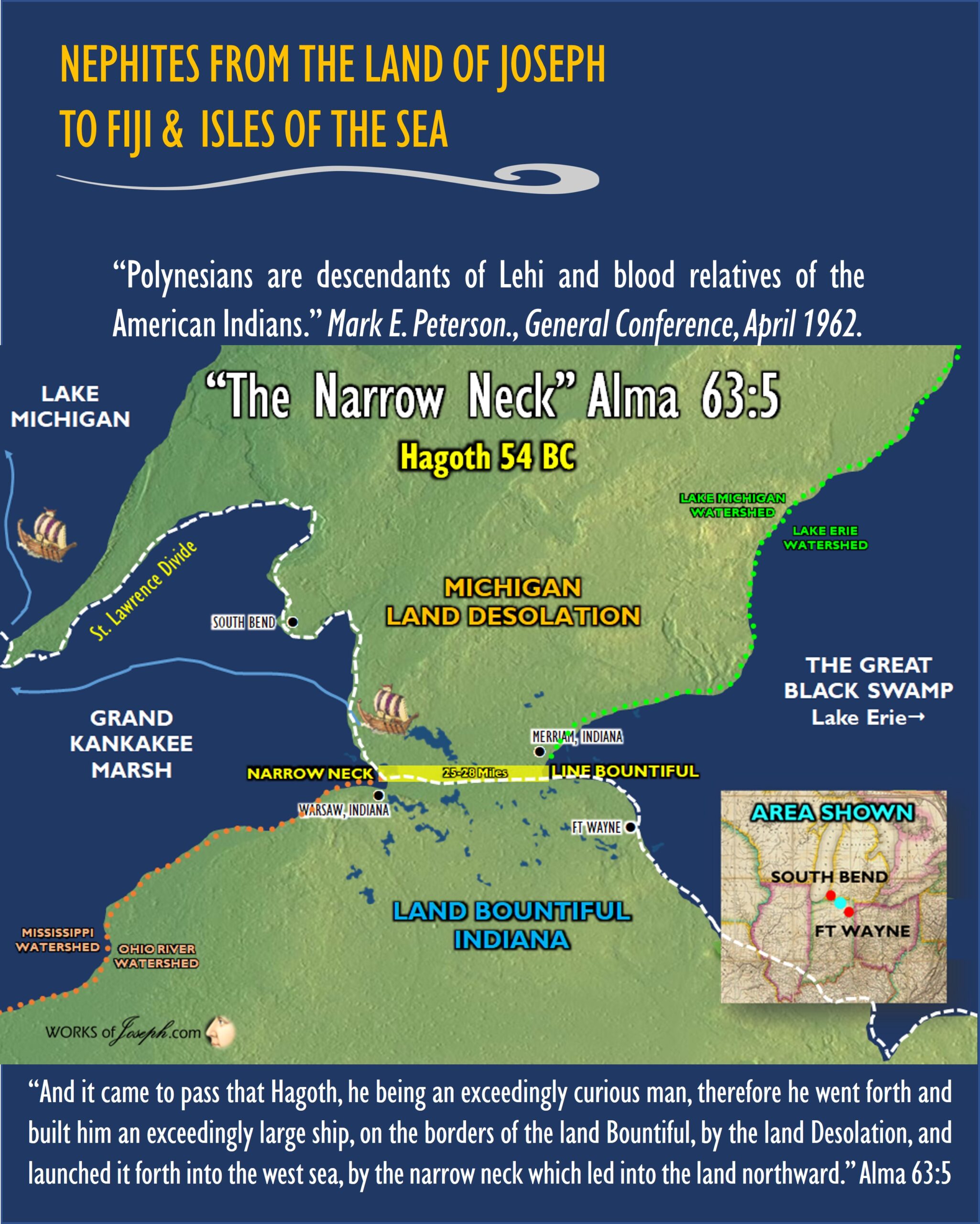
Heber J. Grant
According to Alma Taylor’s reminiscences of the event [Elder Heber J. Grant’s prayer dedicating the land of Japan for missionary work in 1901], Elder Grant “spoke of those who, because of iniquity, had been cut off from among the Nephites . . . and said we felt that through the lineage of those rebellious Nephites who joined with the Lamanites, that the blood of Lehi and Nephi [and of all Israel] had been transmitted unto the people of this land, many of whom have the features and manners of the American Indians, [and he] asked the Lord that if this were true that He would not forget the integrity of His servants Lehi and Nephi and would verify the promises made unto them concerning their descendants in the last days upon this [the Japanese] people for we felt that they were a worthy nation”.[4]
Matthew Cowley
“Brothers and sisters, you are God’s children—you are Israel. You have in your veins the blood of Nephi.” [5] Matthew Cowley “
David O. McKay
“We express gratitude that to these fertile islands thou didst guide descendants of Father Lehi and hast enabled them to prosper.” [6] David O. McKay
Spencer W. Kimball
“And so it seems to me rather clear that your ancestors moved northward and crossed a part of the South Pacific. You did not bring your records with you, but you brought much food and provisions. And so we have a great congregation of people in the South seas who came from the Nephites, and who came from the land southward and went to the land northward, which could have been Hawaii. And then the further settlement could have been a move southward again to all of these islands and even to New Zealand. The Lord knows what he is doing when he sends his people from one place to another. That was the scattering of Israel. Some of them remained in America and went from Alaska to the southern point. And others of you came this direction. [President Spencer W. Kimball continued by quoting former President Joseph F. Smith as saying:] “I would like to say to you brethren and sisters from New Zealand, you are some of Hagoth’s people, and there is No Perhaps about it!” He didn’t want any arguments about it. That was definite. So, you are of Israel. You have been scattered. Now you are being gathered.” [7] Spencer W. Kimball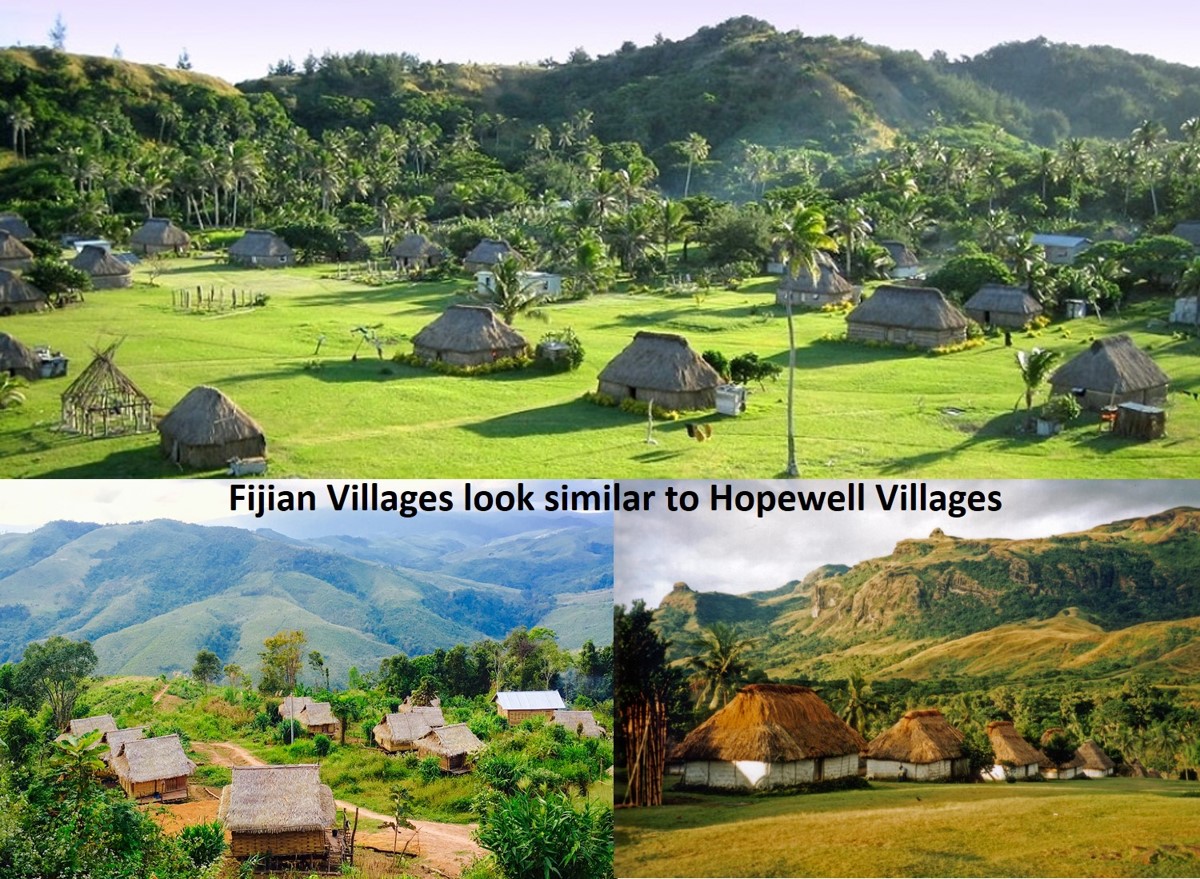
Robert E. Parsons
“It might be of interest to you to know that when Elder Spencer W. Kimball set me apart for my mission to New Zealand in 1946, he said: “We bless you with power and the ‘gift of tongues’ to learn the language of the Maoris. . . We set you apart among the Children of Lehi to do good.” [8] Robert E. Parsons
Gordon B. Hinckley
“Again, there was something prophetic about it. Here were two great strains of the house of Israel the children of Ephraim from the isles of Britain, and the children of Lehi from the isles of the Pacific.” [9] Gordon B. Hinckley “We thank Thee, O God, for revealing to us the Book of Mormon, the story of the ancient inhabitants of America.”
Hugh B. Brown
“We thank Thee that from among those inhabitants, the ancestors of these whose heads are bowed before Thee here, came from the western shores of America into the South Seas pursuant to Thy plan and now their descendants humbly raise their voices in grateful acknowledgement of Thy kindness, Thy mercy, and Thy love for them and those who went before them.
We humbly thank Thee that this building is erected in this land, so that those faithful Maoris who came here in early days, descendants of Father Lehi, may be remembered by their descendants and saved through the ordinances that will, in this House, be performed in their behalf.” [10] Hugh B. Brown
 Elder Matthew Cowley
“Elder Matthew Cowley tells of a great convention held in 1881 that represented all of the native tribes of New Zealand. They were gathered at a native village near Mastertown, near Wellington. Many who attended that conference were old enough to have seen the first Christian missionaries arrive in New Zealand, and all who attended belonged to a Christian church. They were Catholics, Methodists, or Presbyterians. One of the dominant topics considered was why the Maoris were no longer religiously unified as they had been before Christianity came to them. If Christianity was the higher light—the true religion—why were they divided into many churches? So, they began asking themselves which of these Christian churches was the right one for the Maori race and which one they should all belong to so that there would be only one church among them. Not knowing the answer and not being able to decide in their debate, they turned to their wisest sage, Paora Potangaroa, and asked him which church they should all join. He said he would have to think on it and then went to his own residence which was nearby. After three days of fasting and prayer, asking Jehovah which was the right church for the Maori people, he returned to his people and said: “My friends, the church for the Maori people has not yet come among us. You will recognize it when it comes. Its missionaries will travel in pairs. They will come from the rising sun. They will visit with us in our homes. They will learn our language and teach us the gospel in our own tongue. When they pray, they will raise their right hands.”
Paora Potangaroa then asked Ranginui Kingi to write down what he was going to say, and his words were proclaimed to his people at the “eight-years house” on the 16th day of March 1881. Several things were said of interest to us: First, the year 1881 is the “day of fulness”; that is the year that the missionaries first taught the fulness of the gospel to the Maori people. It is also the year *W. M. Bromley arrived to preside over the mission. He was told before leaving Utah “that the time had come to take the gospel to the Maori people.” Potangaroa said the next year, 1882, would be the year of the “sealing.” It was in 1882 when they were first taught about the sealing ordinances performed in the temple. He said the third year, 1883, would be the year of “the honoring,” when they would pay “tribute to whom tribute was due, custom to whom custom . . . honor to whom honor” (See Romans 13:7). Elder Cowley interpreted that as the year when Maoris joined the Church in great numbers and gave “tribute to whom tribute was due [and] custom to whom custom” was due as they began worshiping the Lord.
The prophecy went on to say that they were the lost sheep of the house of Israel. They would learn of the scepter of Judah, and of “Shiloh, the king of peace.” They would also learn of “the sacred church with a large wall surrounding it.” There would be an “increase of the[ir] race” and of their faith, love, and peace. That was at a time when the Maoris were beginning to be exterminated, much as the American Indian was in the United States. There was a great deal of apprehension among them, a fear they would disappear as a people.
This covenant was written down on a piece of paper, and at the top of the piece of paper they drew an “all-seeing eye.” This prophecy was then placed in a cement monument in the eight-years house where the convention was held. It remained there from 1881 until 1929, when a Maori sect known as the Ratana Church, in groping for substantiation that they were the true church of the Maoris as foretold by Potangaroa, broke open the cement monument to get at his prophecy, hoping to find something in it that would establish their claim to be the right church for the Maori. Unfortunately, the storage chamber which contained the prophecy had not been hermetically sealed and the paper had been so damaged by moisture that nothing was legible on it.
That was 1929. In 1944, Matthew Cowley was the New Zealand mission president. He was there during the war years, and the only American missionaries he had were himself, his wife, and their daughter. They held a convention for the Maoris in the same area where Paora Potangaroa gave his prophecy in 1881. Present at the 1944 convention was Eriata Nopera, another great Maori chief. When he rose to speak, he told his people that he had been a little boy there when Paora Potangaroa gave his prophecy and repeated what he remembered of the prophecy. At the end of that day’s convention, one of the women attending the convention had her husband go fetch parcel wrapped in brown paper from a trunk in their house. When he brought her the parcel, she called President Cowley and Eriata Nopera into an adjoining room and gave it to them. They opened the parcel and found a photograph of Potangaroa’s written prophecy wrapped up in it.
What had happened was that in 1881, when the prophecy was written down by Ranginui, a photographer in Wellington had heard that a Maori had made a prophecy. He traveled out to that village and asked for permission to photograph it. This was granted and he photographed the prophecy before it was sealed in the cement monument. This woman’s family got a copy of that photograph and had kept it since. She then gave it to Brother Nopera, who in turn gave it to President Matthew Cowley. That is the way we know what was in Paora Potangaroa’s prophecy.” [11] Matthew Cowley
*[Note From Rian Nelson]
“President William Michael Bromley was the first Mission President to the Māori’s in 1881. I have done a blog about the Polynesians and the people of Hagoth at my website https://bookofmormonevidence.org/hagoth/
In about 2020, my sister Lori Nelson Merritt was reading the article and she noticed something familiar in my article. She saw the name W.M. Bromley as a missionary among the Māori’s and she knew our grandfather’s name was Clyde Bromley Nelson. She put two and two together and found out that my sister and I are related to William Bromley as he is our 2nd Great Grandfather. I’m sure many of you have felt a leap of joy when you find something new about one of your ancestors and my heart also leaped a little.
I did another blog about the first Maori members and about William Michael Bromley as he served as the first Mission President in New Zealand and was sent by Pres Joseph F. Smith in 1881. I served a mission in Fiji and Kirabati and because of my great love for the Polynesians this story was even more interesting.” https://bookofmormonevidence.org/hagoth-and-polynesians-are-descendants-of-lehi-and-blood-relatives-of-judah-and-of-the-american-indians/“ Rian W Nelson
Spencer W. Kimball
“I thought to read to you a sacred scripture which pertains especially to you the islanders of the Pacific. It is in the sixty-third chapter of Alma [He then read the account of Hagoth.]
And so, it seems to me rather clear that your ancestors moved northward and crossed a part of the South Pacific. You did not bring your records with you, but you brought much food and provisions. And so, we have a great congregation of people in the South seas who came from the Nephites, and who came from the land southward and went to the land northward, which could have been Hawaii. And then the further settlement could have been a move southward again to all of these islands and even to New Zealand. The Lord knows what he is doing when he sends his people from one place to another. That was the scattering of Israel. Some of them remained in America and went from Alaska to the southern point. And others of you came this direction.” [12] Spencer W. Kimball
Robert E. Parsons
“I asked Elder John Groberg, who has spent years among the Tongans, if they had any traditions concerning their coming to the islands. He said they had nothing as detailed as the Maori, but that Church members among both Tongans and Samoans were adamant in their tradition that they came from the east, not the west as some modern scholars affirm.” [13] Robert E. Parsons
Joseph Smith Foundation Notes
Found here:
https://josephsmithfoundation.org/nephite-and-lamanite-link-to-polynesia/#note-2445-5
Notes and References Below
- Petersen, Mark E. “New Evidence for the Book of Mormon,” Improvement Era (June 1962) 65:456–59; also in Conference Report (Apr 1962) 111–15
- George Q. Cannon, as quoted in Britsch, R. Lanier. Unto the Islands of the Sea: A History of the Latterday Saints in the Pacific. Salt Lake City: Deseret Book, 1986, pp. 97–98
- Cheesman, Paul R. and Millie Foster Cheesman. Early America and the Polynesians. Provo, Utah: Promised Lands Publication, Inc., 1975, p. 15; as quoted in Robert E. Parsons, “Hagoth and the Polynesians,” in The Book of Mormon: Alma, the Testimony of the Word, ed. Monte S. Nyman and Charles D. Tate Jr. (Provo, UT: Religious Studies Center, Brigham Young University, 1992), 249–62
- Reminiscences by Alma Taylor of Elder Heber J. Grant’s 1901 prayer dedicating the land of Japan to receive the restored gospel, Palmer, Spencer J., and Roger R. Keller. Religions of the World: A Latter-day Saint View. Provo, Utah: Brigham Young University, 1989, p. 91
- Elder Matthew Cowley, in an address to the Hawaiian people at Laie, as recorded in Cole, William A., and Edwin W. Jensen. Israel in the Pacific: A Genealogical Text For Polynesia. Salt Lake City: Genealogical Society of Utah, 1961, p. 384
- Prayer offered by President David O. McKay the the dedicatory prayer of the New Zealand Temple, “Dedicatory Prayer Delivered By Pres. McKay at New Zealand Temple,” Church News, 10 May 1958, 2, 6
- President Spencer W. Kimball in a talk to the Samoan people, as recorded in the “Official Report of the Samoa Area Conference Held in Pago Pago and Apia, Samoa,” February 15, 16, 17, 18, 1976
- Robert E. Parsons, “Hagoth and the Polynesians,” in The Book of Mormon: Alma, the Testimony of the Word, ed. Monte S. Nyman and Charles D. Tate Jr. (Provo, UT: Religious Studies Center, Brigham Young University, 1992), 249–62
- President Gordon B. Hinckley’s comment at the dedication of the New Zealand temple upon observing Europeans assembling with the Maoris of the Pacific, “Temple in the Pacific.” Improvement Era (July 1958) 61:506–509, 538
- Elder Hugh B. Brown’s closing prayer at the ceremony to lay the cornerstone for the New Zealand Temple, as told in Cummings, David W. Mighty Missionary of the Pacific. Salt Lake City: Bookcraft, 1961, p. 63; and Cheesman, Paul R. and Millie Foster Cheesman. Early America and the Polynesians. Provo, Utah: Promised Lands Publication, Inc., 1975, p. 14
- Cowley, Matthew. Matthew Cowley—Speaks. Salt Lake City: Deseret Book, 1954, pp. 200-205, as quoted in Robert E. Parsons, “Hagoth and the Polynesians,” in The Book of Mormon: Alma, the Testimony of the Word, ed. Monte S. Nyman and Charles D. Tate Jr. (Provo, UT: Religious Studies Center, Brigham Young University, 1992), pp. 249–262 12.
- President Spencer W. Kimball in a talk to the Samoan people, as recorded in the “Official Report of the Samoa Area Conference Held in Pago Pago and Apia, Samoa,” February 15, 16, 17, 18, 1976
- Robert E. Parsons, “Hagoth and the Polynesians,” in The Book of Mormon: Alma, the Testimony of the Word, ed. Monte S. Nyman and Charles D. Tate Jr. (Provo, UT: Religious Studies Center, Brigham Young University, 1992), 249–62 Allen H. Richardson, David E. Richardson and Anthony E. Bentley
“1937 Stuart Meha and “The Personal Testimony of Stuart Meha,” Waipawa, H. B., New Zealand. Elwin W. Jensen A signed manuscript, recorded May 20, 1937, in the Missionary Journal, (abt. Joseph F. Smith) First Mission, Elder Elwin W. Jensen, Salt Lake City.
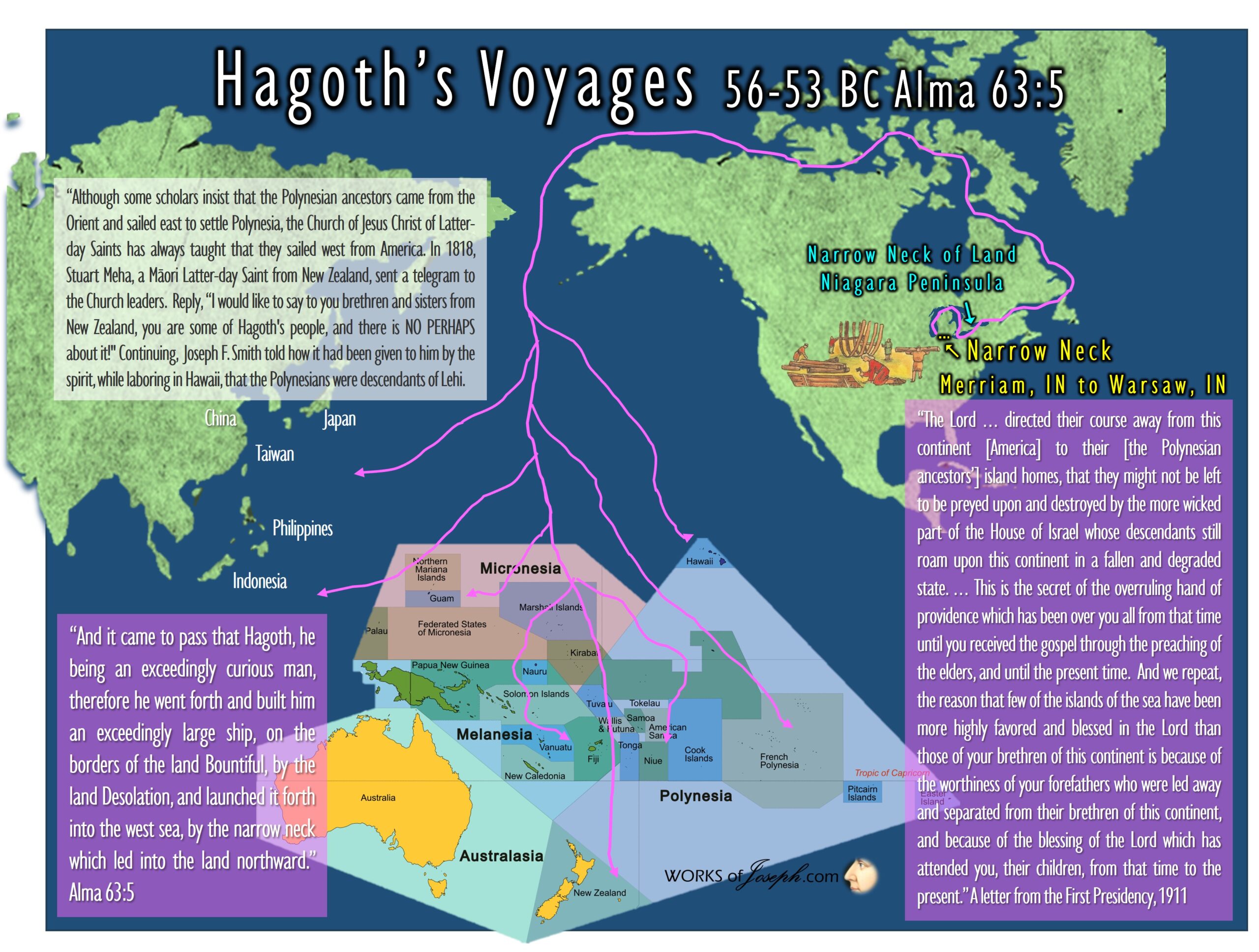
Although some scholars insist that the Polynesian ancestors came from the Orient and sailed east to settle Polynesia, the Church of Jesus Christ of Latter-day Saints has always taught that they sailed west from America. In 1818, Stuart Meha, a Maori Latter-day Saint from New Zealand, sent a telegram to the Church leaders thanking them for the privilege of allowing a group of Maori saints to travel to Salt Lake to go through the temple. In the telegram, Brother Meha added the words: “Who knows but that some of Hagoth’s people have returned–perhaps!”
Later, the First Presidency of the Church, and some of the General Authorities, gave a welcome, in Wandermere Park, in honor of this party of Maori Saints from New Zealand. In a speech delivered on that occasion, President [Joseph F.] Smith replied to the telegram: “I would like to say to you brethren and sisters from New Zealand, you are some of Hagoth’s people, and there is NO PERHAPS about it!”
Continuing, President Smith told how it had been given to him by the spirit, while laboring in Hawaii, that the Polynesians were descendants of Lehi. Brother Meha testifies that these statements touched his heart, and he had no more uncertainties as to whether the Polynesians were truly of the House of Israel. (From “The Personal Testimony of Stuart Meha,” Waipawa, H. B., New Zealand. A signed manuscript, recorded May 20, 1937, in the Missionary Journal, First Mission, Elder Elwin W. Jensen, Salt Lake City.”
Source: Allen H. Richardson, David E. Richardson and Anthony E. Bentley. 1000 Evidences for the Church of Jesus Christ of Latter-day Saints: Part Two-A Voice from the Dust: 500 Evidences in Support of the Book of Mormon. Salt Lake City: Envision Press, 2001, p. 33.
Who are the Lamanites?
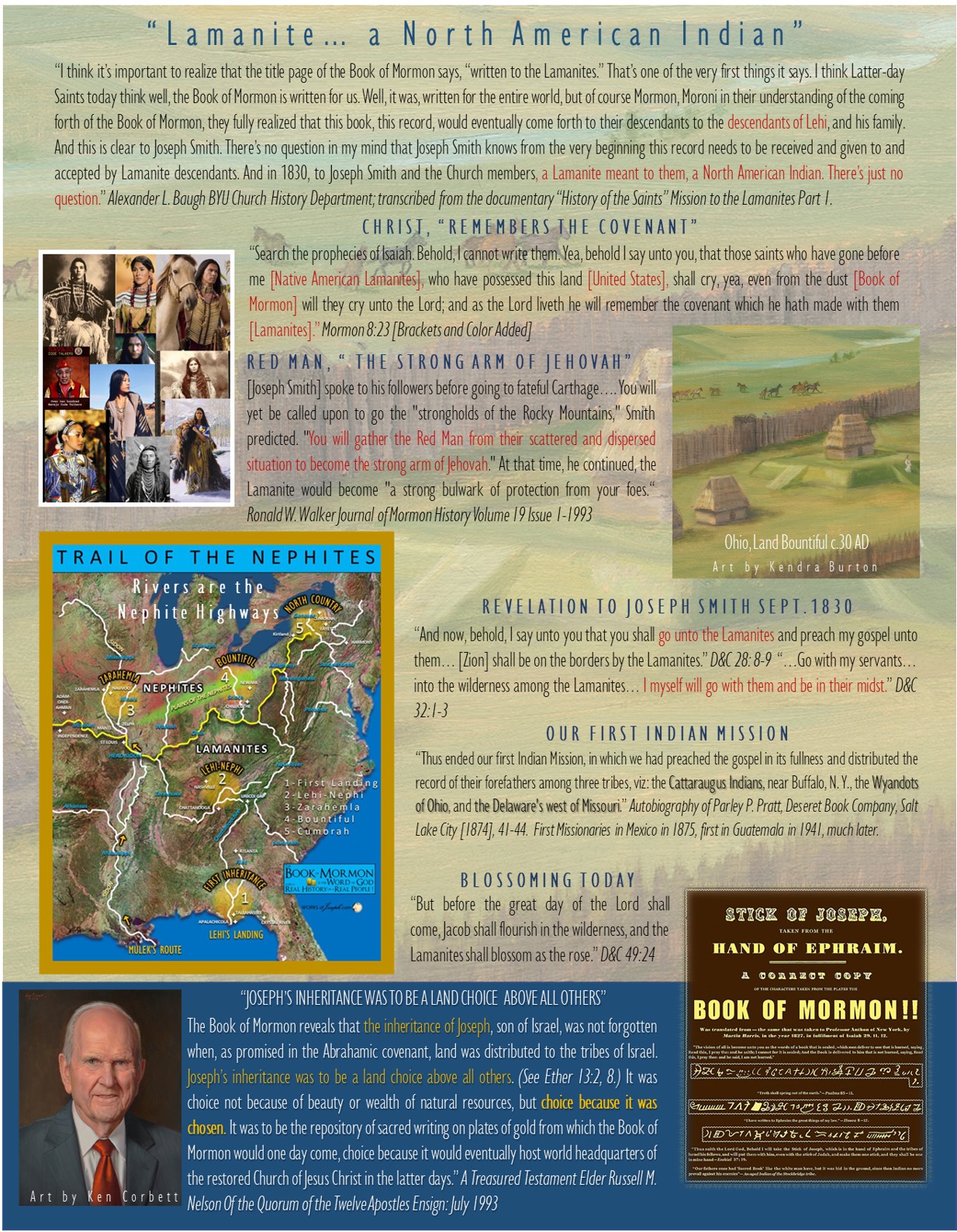
Many dedicatory prayers by Prophets at Temples in South and Central America have mentioned that the people have, “the blood of Father Lehi”, or Prophets refer to “Lehi’s blood” or “Lehi’s descendants,” or even the “Lamanites,” how should we understand these terms? Who are the Lamanites?
“For several years, people have asked how the statements of prophets and apostles regarding Lamanites in Latin America and the Pacific fit with the North American setting. I’ve addressed the question several times, but not as thoroughly as I suppose I should, so here are my thoughts on the topic. A basic criticism of the North American setting (Moroni’s America or the Heartland model) is that in temple dedicatory prayers and other comments, modern prophets and apostles have said Lamanites live throughout the Americas, from at least Cardston, Alberta, to São Paulo, Brazil. Some people think I’ve ignored these statements. I haven’t ignored them; I just don’t think they tell us anything about Book of Mormon geography.
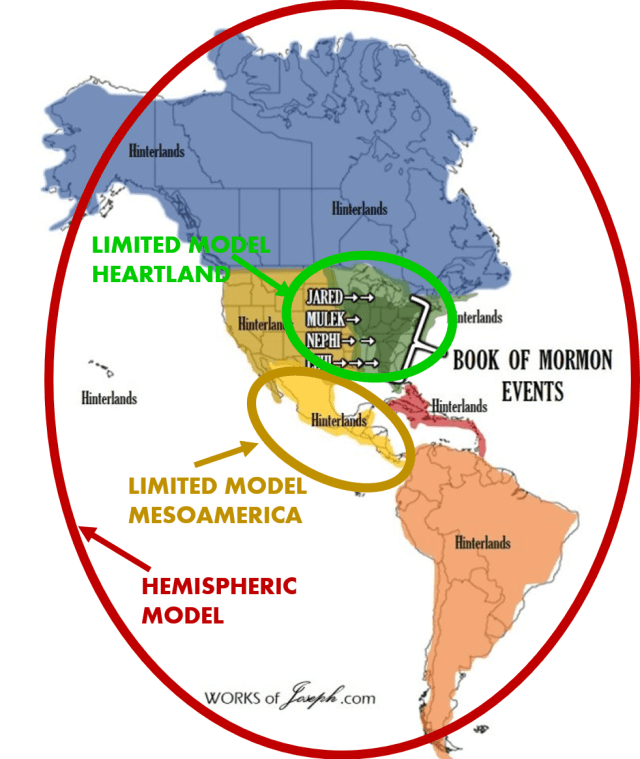
It’s difficult to understand the rationale of this criticism in the first place. It appears to rely on the premise that Lehi’s descendants were isolated and never interacted with other indigenous people in the Western Hemisphere.
For example, when President Hinckley’s 1983 temple dedicatory prayer said the Saints in Mexico “have in their veins the blood of Father Lehi,” the premise would mean that Mexico must be where the Book of Mormon took place. But such a premise contradicts the statements themselves, which, as I noted, identify Lamanites throughout the hemisphere. (Someone could argue that the narrative took place throughout the hemisphere such that Lehi’s descendants were restricted to one hemisphere, but I don’t think anyone makes that argument any longer, at least not from Alberta to southern Brazil).
Whether the Book of Mormon narrative took place in New York, Tennessee, Illinois, Baja, Mexico, Guatemala, Panama or Chile, people from all those areas interacted with one another over the thousands of years they shared the continent.
However, Lehi had to land somewhere! I believe he most likely landed near Florida based on artifacts, history, routes, and DNA. See Blog Here: https://bookofmormonevidence.org/lehis-landing-apalachicola-florida/
In other words, generalized statements of the prophets and apostles about the Lamanites tell us nothing about Book of Mormon geography except that it took place in the Western Hemisphere (but one could dispute even that). They certainly don’t contradict the North American setting or establish a justification for a non-New York Hill Cumorah.
I think the entire New World narrative of the Book of Mormon took place in North America, meaning from Florida to Northern USA, and from the Atlantic to the Midwest (as far west as Missouri and Iowa). By the authors’ own admission, the narrative is merely a brief sketch; it covers less than 1% of the history of the Nephites and even less of the history of the Lamanites. Since before Lehi arrived, people throughout the Americas traded and intermarried. Lehi’s little colony grew to a large civilization in part by absorbing indigenous people (as well as the people of Zarahemla). After the Nephite civilization was lost around 385 A.D., the Lamanites (with some Nephites) continued to live on the land, but their history is lost to us. We must resort to anthropology and archaeology, which indicate ongoing interaction throughout the Americas before and after 385 A.D.
With this background, how could “the blood of Father Lehi” not be found throughout the Americas?
There is no problem harmonizing the New York Cumorah with the statements of prophets and apostles regarding Lamanites or descendants of Lehi throughout the Americas (and in the Pacific). Full blog here:
https://bookofmormonevidence.org/wp-admin/post.php?post=17894&action=edit&classic-editor