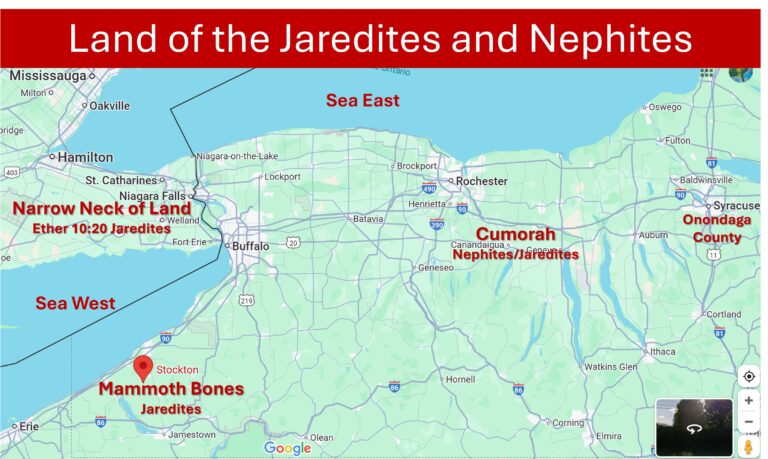
WHY NEW YORK?
New York is one of the most archaeologically rich sites in America. Human bones, battles, artifacts, copper, steel, pearls, roads, forts, mounds, and a bloody hill. The incredible amount of animal bones including Mastodons and Mammoths I discuss below, match up with the Book of Mormon timeline and are also very abundant as shown below in this map, taken from “Distribution of Pleistocene Mammals in New york State” Fisher 1955, and “The Archaeology of New York State” William A. Ritchie 1965.
 ANCIENT NEPHITE-LAMANITE BATTLEGROUNDS
“The battles in described as often having culminated in the destruction of previous, superior Native cultures which had taken final refuge in forts at the tops of hills, including the general region of the hill known to Mormons as Cumorah. In the town of Camillus, in the same county of Onondaga . . . there are two ancient forts . . . One is on a very high hill, and its area covers about three acres. . . . The ditch was deep and the eastern wall ten feet high. In the centre was a large lime stone of an irregular shape.”
A Memoir on the Antiquities of the Western Parts of the State of New-York, Addressed to the Honourable Samuel L. Mitchill, a Vice-President of the Literary and Philosophical Society of New York . . . by Dewitt Clinton . . . Read Before the Society November 13th, 1817 De Witt Clinton (1769-1828)
Bloody Hill NY
“Pompey in Onondaga County, a town covering upwards of five hundred acres must have contained a population greatly transcending all our ideas of credibility . . . This town was on elevated ground, . . . and was well calculated for defense. . . . There are three old forts distant about eight miles from each other, and forming a triangle which encloses the town; . . . and they were, in all probability, erected to cover the town and to protect the inhabitants from the attacks of an enemy. . . . On the line of the north side, the town was probably stormed. There are graves on each side close to the precipice; sometimes five or six persons were thrown promiscuously into the same grave. If the invaders had been repulsed, the inhabitants would have interred the killed in the usual places; but from the circumstance of there being graves near the ravine and in the village, I am induced to believe that the town was taken. (noting ‘gun barrels, axes, hoes and swords . . . all over these grounds’) The traditions of the Indians agree in some measure with the French relations. They represent that their forefathers had several bloody battles with the French . . . There is a hill in Pompey, which the Indians will not visit, and which they call Bloody Hill. . . . The old fortifications were erected previous to European intercourse. The Indians are ignorant by whom they were made; and in the wars which took place in this country, it is probable that they were occupied as strong holds by the belligerents; and it is likely that the ruins of European works of a different construction may be found… it is remarkable that our ancient forts resemble the old British and Danish. The Bloody Hill site dated by modern archaeology to ca. 1420 A.D. has been excavated carefully in modern times, yielding comparatively superior ceramic artifacts. Significantly more Native sites are now recognized in Pompey, beyond the few which [DeWitt] Clinton knew or was able to visit.” (James A. Tuck, 104-119) Mormon Parallels: A Bibliographic Source 2014 Rick Grunder page 403. Map from “Onondaga Iroquois Pre History A Study in Settlement Archaeology” James A. Tuck 1971 page 20
Onondaga, Joseph Smith’s Indians?
“Onondaga was a name that Joseph would have heard frequently in the Indian lore which B. H. Roberts felt must have influenced Joseph during his early days in Palmyra… Indeed, in order to reach Palmyra in company with Lucy Mack Smith and his siblings when they emigrated from Vermont, Joseph had to traverse the important township of Onondaga, through which the original Genesee and Seneca Turnpikes still run today…” Mormon Parallels: A Bibliographic Source 2014 Rick Grunder pg 1125
LAMANITE SETTLEMENTS
I share 5 mounds dated from 700 to 1100 AD called SACKETT, GENEVA, LAWSON, MORROW, & VINE VALLEY Mounds. These are a few of the mounds around the Cumorah area that show the Lamanites settlements were possible after the final battles could be all around this location. See above map.
Complete mastodon jaw unearthed in New York after homeowner spots teeth in backyard
“A complete mastodon jaw was discovered in the backyard of a home in New York’s Hudson Valley, marking the state’s first such find in more than a decade, officials announced this week.
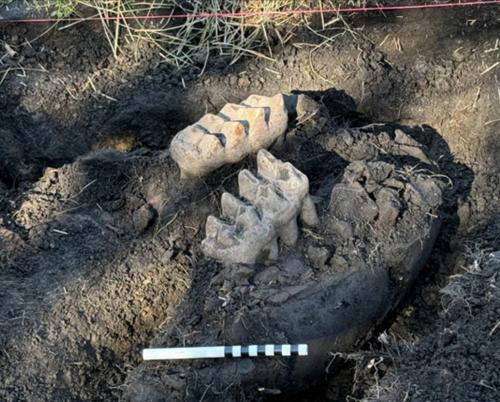
Their excavation unearthed additional fossils, including a full, well-preserved adult jaw and fragments of rib and toe bones that once belonged to a mastodon — ancient giants that existed during the Ice Age and became extinct some 10,000 years ago. The term refers to a group of massive elephant-like species, like the mammoth.
“When I found the teeth and examined them in my hands, I knew they were something special and decided to call in the experts,” said the homeowner in a statement to the New York State Museum. “I’m thrilled that our property has yielded such an important find for the scientific community.”
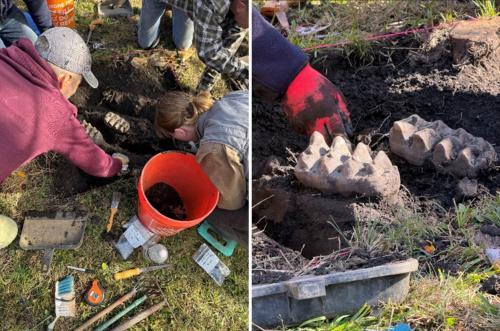
Remnants of mastodons have been discovered in New York before. According to the museum, more than 150 fossils of these prehistoric creatures have been documented to date statewide, with around one-third of them coming from Orange County, where the latest bones were found.
But experts said the findings offer an opportunity to learn something new.
“This discovery is a testament to the rich paleontological history of New York and the ongoing efforts to understand its past,” said Robert Feranec, a research director and curator at the New York State Museum whose work centers on ice age animals, in a statement. “Fossils are resources that provide remarkable snapshots of the past, allowing us to not only reconstruct ancient ecosystems but also provide us with better context and understanding of the current world around us.”
The mastodon fossils will undergo carbon dating and analysis to determine the creature’s age, diet and habitat while it was alive, the museum said. After that analysis and subsequent preservation work are complete, the bones will be featured on public display in 2025.”
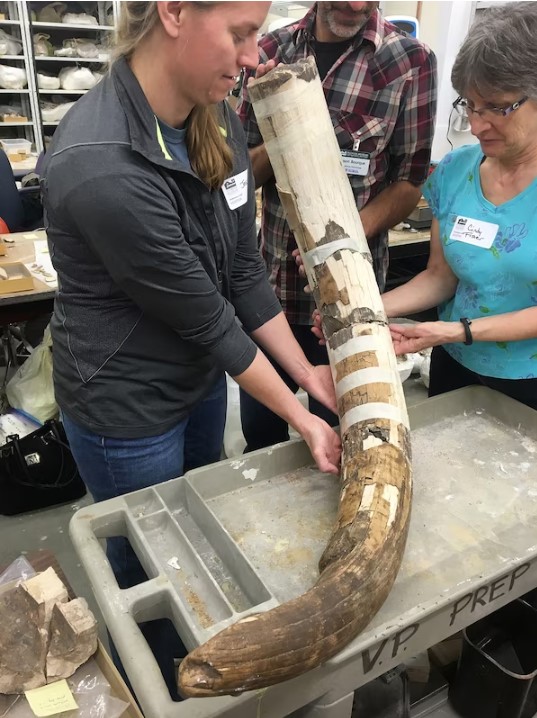
See additional information titled, Elephants, Cureloms, & Cumoms (Mammoths?) in North America

Mastodon Rock-Underwater Stonehenge?
The Mastodon rock is perhaps one of the most incredible features of the underwater Stonehenge. Researchers speculate that the rock is made out of granite, a very hard material. For people to carve something onto this stone, they had to use a tool harder than granite. So the logical question is: What could ancient mankind have used 10.000 years ago to carve something onto a granite rock?
Researchers stress that the marks and lines that make out the mastodon figure were precisely carved, the lines were not just “scratched” onto the rock.
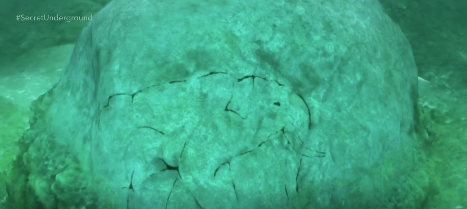
The incredible rock formation and the correctly aligned stones circles clearly indicate a man-made structure. The areas around Michigan are a witness of early human presence in the American continent which is believed to date back over 25.000 years. In the distant past, the Lake itself did not exist since an Ice Age ruled over the lands and what is now located at the bottom of one of the five Great Lakes of North America, was once on dry land.
The man responsible for this underwater discovery is Mark Holley, professor of underwater archeology at the Northwestern Michigan College. In 2007, he searched for shipwrecks but found, 12 meters below the surface a series of stones arranged in a circle. Adding to this amazing discovery is a relatively large rock which has, on its surface a depiction of a mastodon, an animal that became extinct around 8000 BC. https://holleyarchaeology.com/index.php/the-truth-about-the-stonehenge-in-lake-michigan/
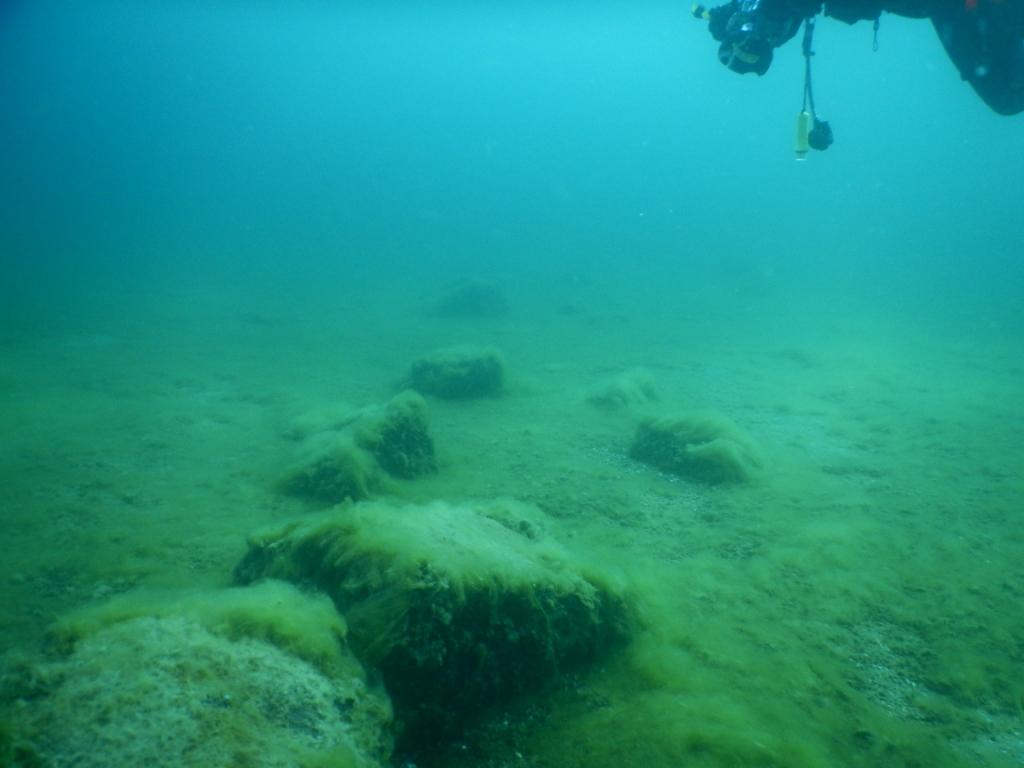
In the region near Lake Michigan, researchers have previously discovered menhirs and petroglyphs. When the first Europeans arrived in the seventeenth century, they found that Michigan had thousands of prehistoric mounds. Scholars also found “sacred stones” across the geography of the Great Lakes, stones according to the natives were placed by another race who lived there before. Statues and stone idols erected in various parts were discovered weighing over 100 kilograms.
The underwater Stonehenge of Lake Michigan must have been created before the last Ice Age when the lake bed was dry, and that is, according to researchers, over 12.000 years ago, a time that according to history, mankind couldn’t erect such elaborate constructions.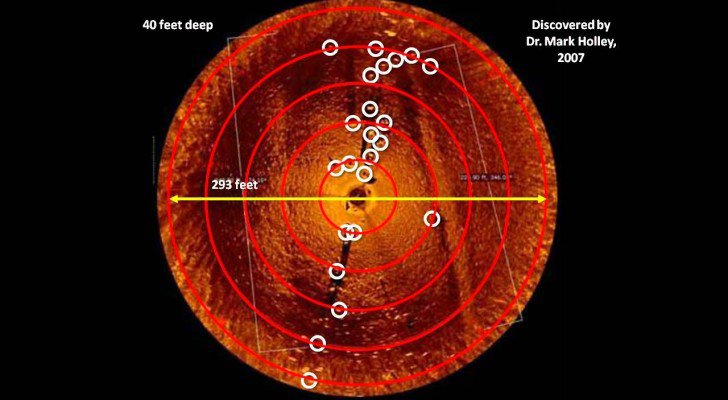
What does this tell us about history? Is this another piece of evidence that points to the fact that history books, as we know them should be rewritten? We believe yes.
Source and reference
When trying to decide what to write about, I came across an article that mentioned that there was a structure like Stonehenge recently discovered in Lake Michigan. Structures much like Stonehenge are common, especially in the United Kingdom, so it was interesting to find that there was something similar even closer to home, and underwater none the less. Mark Holly, a professor of underwater archaeology at Northwestern Michigan University , discovered the site in 2007. The archaeologist was hired to survey the floor of the lake close by to Traverse City using sonar to examine old boat wrecks. They found cars, boats, and a pier from the Civil War era but even more surprising was the underwater structure.
The stones are organized in a circle 40 below the surface of Lake Michigan and is believed to be at least 10,000 years old. One stone in the outer circle, although still up for debate, appears to have a carving of a mastodon, an animal that closely resembles an elephant that went extinct over 10,000 years ago.
Of course, the logical question is how did the stones end up under one of the largest lakes in the world? The only explanation I could find was that local could have created the structure during the last Ice Age when the lake bed was dry.
The problem is that many specialists want to see the structure themselves to determine its authentically, only most of the experts do not dive so they have reached a problem. Many people question whether the rocks were purposely placed or a random occurrence. Other stone circles have been found in the area so it would not be an unreasonable discovery. There have been few new updates on the status of the stones so it has yet to be determined.
After seeing the stone circle under Lake Michigan, I was curious what other Stonehenge-like structures were located in the area. Beaver Island located in northern Lake Michigan is home of another stone circle. It consists of a group of stones circularly located around a large central stone that contains unusual carvings. The carvings have not been carbon dated or tested to see the time period they come from and little is known about the structure itself. The significance of the circle is still being debated by archaeologist and historians although local Native Americans recall stories of a gathering place in the island where a stone calendar was located. Some people see the circle as a random glacial deposit with no historical significance.
Sources:
https://anthropology.msu.edu/anp264-ss15/2015/03/25/lake-michigan-stonehenge/
http://www.zmescience.com/science/archaeology/stonehenge-under-lake-michigan-3125445/
http://www.repositorybeaverislandstonecircle.com/