Nephi Escapes to Unicoi Gap Georgia?
After Lehi dies about 570 BC. Nephi escaped from his brothers in Florida probably north using the Apalachicola River which turns into the Chattahoochee River, with them pitching their tents near Unicoi Gap, GA. (They “did journey in the wilderness for the space of many days.” 2 Nephi 5:7)
The head of the Chattahoochee River is only 1,700 feet from the head of the Hiawasee River. Traveling on the Hiawasee River about 100 miles it connects to the Tennessee River. The Nephites could eventually settle near Chattanooga, Tennessee (What we could call the City of Nephi) as that would make sense on a large river, and mountains of gold, silver, and copper nearby. Also the ancient Seneca Trail is right there. This area of Northern Georgia and Southeastern Tennessee became the land of Nephi and also called called the Land Lehi-Nephi.
Near Knoxville, TN on the Clinch River was found what archaeologists call an ancient Egyptian Temple discovered in 1935 and dated very ancient. See here: https://www.ancientpages.com/2018/08/15/secrets-about-tennessees-ancient-egyptian-temple-revealed/
Again, from Florida and the Land of First Inheritance, the Nephites likely fled north to get away from the Lamanites, and their path could very likely been up the Chattahoochee River, which is only about 10 miles west of Atlanta. Near Atlanta Georgia are many ancient mounds. One we speak about is the Rock Eagle Effigy Mound in more detail below. That area near Atlanta could have had many Nephites or Lamanites locating in those areas in 500 BC. However there are also many possibilities that around 100 AD, or the date of the Rock Eagle Mounds there are some who may have located near there. The exciting thing is that we have the timeline of the Nephites in many parts of Georgia and Tennessee.
See more about Nephi’s escape and his route in the blog here: https://bookofmormonevidence.org/nephite-route-showing-the-waters-of-mormon/
Earthen Mounds
The Hopewell Culture (c. 2300 B.c.c. A.d. 400)Burial mounds
“Mounds are artificially constructed heaps or banks of earth built to contain sacred objects. Their basic construction is the same all over the world: a pit is dug and lined, and the sacred contents are deposited and covered with earth. Sometimes these objects are sprinkled with red ocher, a pigment used to make paint, perhaps as a way to revive the spirits thought to dwell within them.
If we were to go for a walk on an open plain in Illinois or Ohio and were to come across one of these “dirt piles,” we probably would ignore it. But an archaeologist would be thrilled to find a sacred mound, for it might conceal vital clues to the ancient past of Native America: human and animal bones, weapons, ornaments, and mysterious clay figurines.
Some of the oldest and largest mounds in the world are found in America. The older North American mounds are cone-shaped and can reach heights of 70 ft (21 m) or more. Some of the more recent mounds are shaped like animals, people, or abstract forms and are therefore known as “effigy” mounds because they symbolize another object. No one knows what the effigy mounds were used for. Some archaeologists believe that they functioned as totem poles. As with totems, a few human bones were buried within the effigy mounds for their symbolic value. Found mostly in Wisconsin, Minnesota, Iowa, and Illinois, effigy mounds are shaped like deer, turtles, snakes, eagles, foxes, bears, birds, and human beings. Today, the Great Serpent Mound winds along a river near a public park in Peebles, Ohio, for a distance of over 1 mi (1.6 km), its head recoiling as if to snatch into its hungry jaws a frog or other mysterious oval-shaped object. An enormous bird mound at Poverty Point, Louisiana, faces westward, its wings outstretched in a symbolic moment of flight.
Tens of thousands of mounds are found in the United States. Many more originally must have existed. St. Louis was the location of so many sacred mounds that it was once known as Mound City; today just one of those mounds remains. A great number of mounds have been bulldozed into the ground, their contents either thought-lessly pirated by treasure hunters or casually destroyed.
Most mounds were used for burials, but a significant number, built in the vicinity of the Mississippi River about A.D. 700 and later, were known as Temple Mounds. They looked like flat-topped pyramids crowned with wooden temples.
Who built the North American mounds? Archaeologists believe that they were the product of two ancient native cultures: the Adena and the Hopewell.” https://science.jrank.org/pages/4480/Mounds-Earthen.html

Oldest Known Effigy Mound East of the Mississippi.
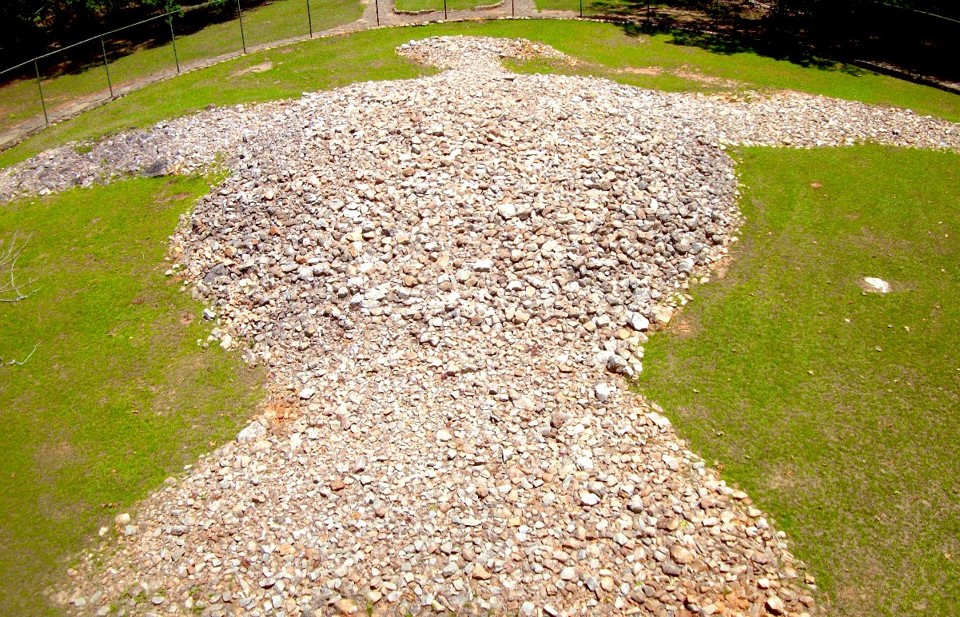
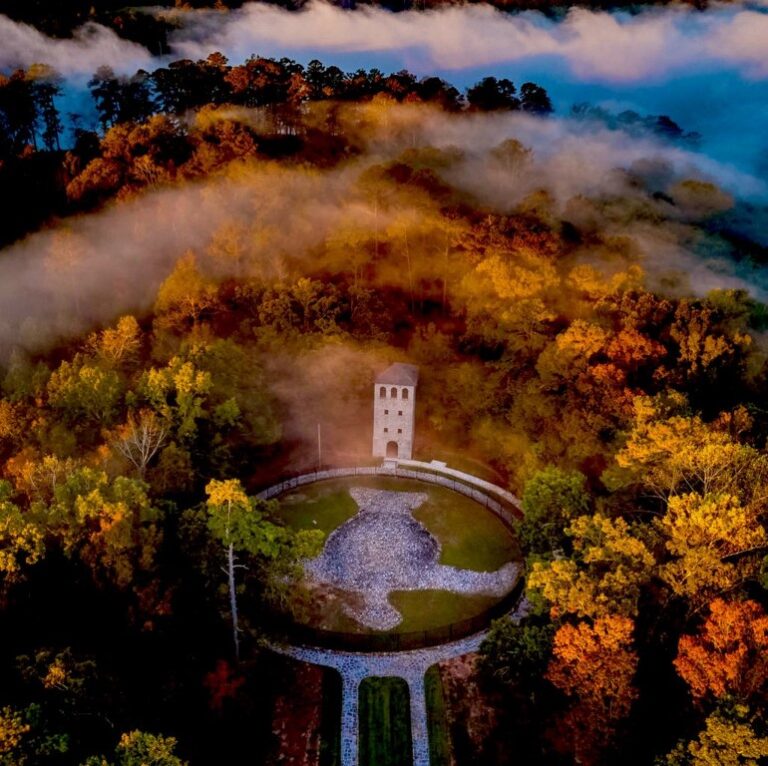
In central Georgia sits the oldest known effigy mound east of the Mississippi. It’s not built from earth. It’s built from thousands of hand-placed white quartz stones— shaped into the form of an eagle with outstretched wings. This is Rock Eagle. And its purpose is still debated 1,500 years later.
Rock Eagle lies near Eatonton, Georgia, on a wooded ridge overlooking the Oconee Valley. Its wings stretch 120 feet tip to tip. The torso rises 8 feet high. It isn’t a burial mound. It isn’t a habitation site. It’s a ceremonial effigy—meant to be seen from above.
Constructed entirely from local quartz, the mound reflects light in all directions. There is a single stone-covered burial beneath the chest. But the overall design suggests broader meaning: ritual, sky symbolism, territorial memory. It was not built casually. It was planned with intention.
Most effigy mounds are found in the Upper Midwest—Wisconsin, Iowa, Minnesota. They take the form of animals: bears, birds, panthers, snakes. But in the Southeast, Rock Eagle stands nearly alone. Only one other known example exists nearby: Rock Hawk, 13 miles away.
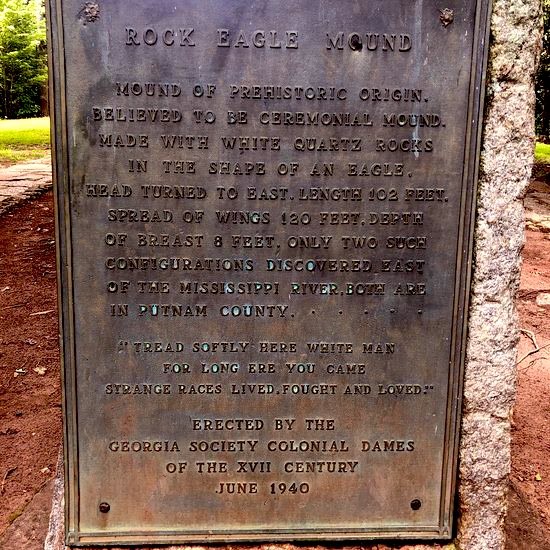
Radiocarbon estimates and artifact evidence place the construction of Rock Eagle in the Late Woodland period: 100–300 CE. That predates the Mississippians. It predates Cahokia. It predates written records of anything in the region.
We don’t know what name the builders gave it. We don’t know what language they spoke. But we know this: They gathered and placed over 2,000 stones, one by one, to shape a sacred form tied to sky and memory. It still holds that shape today.
Rock Eagle is not folklore. It’s not a replica. It’s one of the oldest surviving monuments in the South. Not built to be buried beneath— but to be looked upon. A symbol still holding its place in the land, 15 centuries later.
https://x.com/MoundLore/status/1908645626310758742
Ancient History in Georgia Stone
2,000 Years of History The massive effigy mound is thought to have been built in the shape of an eagle or some other large bird by people who lived in the area some 2,000 years ago. Just off U.S. Highway 441 north of Eatonton, the famed Rock Eagle Effigy Mound is one of Georgia’s most stunning ancient landmarks.

Although there have been many theories over the years, archaeologists currently believe the massive effigy was build during the Middle Woodland period, which is usually dated to 100-300 A.D. and is one of only two confirmed stone effigy mounds east of the Mississippi River. The other, called the Rock Hawk or Little Rock Eagle Effigy, is located east of Eatonton and is in Putnam County as well.
What prompted the early inhabitants of Middle Georgia, who lived in a time long before the rise of the later Mississippian, Creek and Cherokee cultures, to build these massive effigy mounds is still something of a mystery. They obviously hold ceremonial significance and the Rock Eagle seems to have been expanded from a large dome- shaped central mound.
Archaeological excavations into the mound over the years have found a surprisingly small number of artifacts other than the stones from which it was built. A 1950s research project did find a single quartz tool a Rock Eagle, along with evidence of cremated human burials in the mound. Otherwise, the structure has revealed very little about its intended purpose.
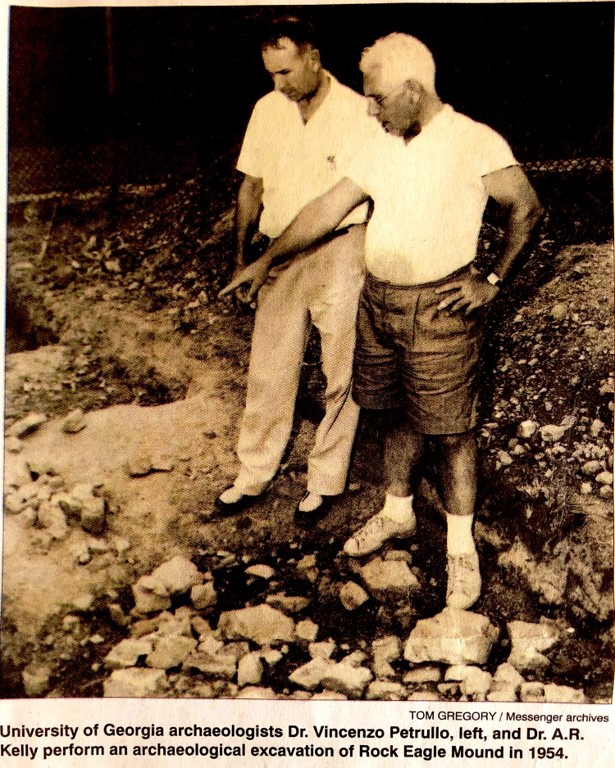 Early settlers of the region thought it might cover some fantastic buried treasure and dug into it from time to time, but 20th century archaeologists found only that the eagle was built atop a natural rock outcrop. Theories as to the reasons for its construction currently range from the need for some central burial place by the ancient inhabitants of the area to the possibility that the people of Rock Eagle were sending a message to God.
Although dating of the mound remains tentative (with some suggesting a much older date), most scientists now concur that it was probably built shortly after the time of Christ. This was an era with earthen effigy mounds were build in the Midwest in large numbers. It should be noted, however, that the earthworks at the much older Poverty Point site in Louisiana also appear to form the shape of a gigantic bird. That site is thought to date back 3,000 years.
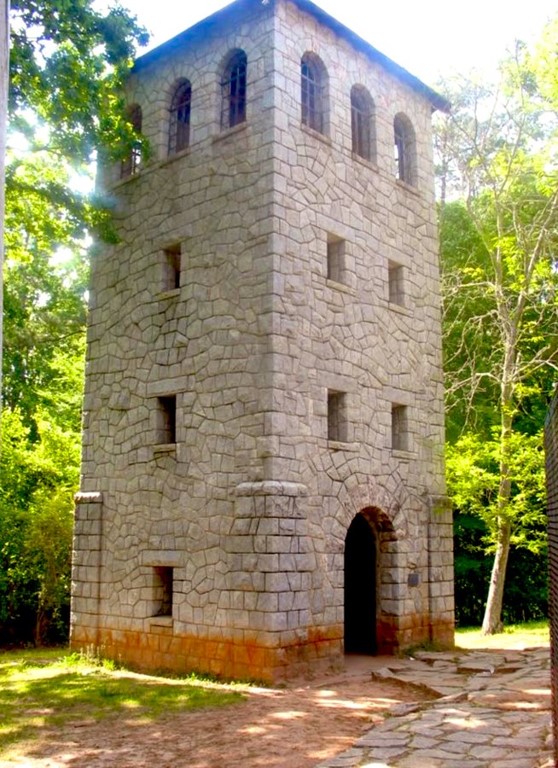
The people of Georgia and Putnam County in particular have long had a commendable interest in preserving the stunning effigy. As a result, it became the focus of a public works project during the Great Depression. Workers from the Civilian Conservation Corps (CCC) restored the mound and built the beautiful stone tower that now overlooks it, as well as walkways and other features. A unique aspect of the walkways around the mound is that historic grind stones from gristmills were included in spots.
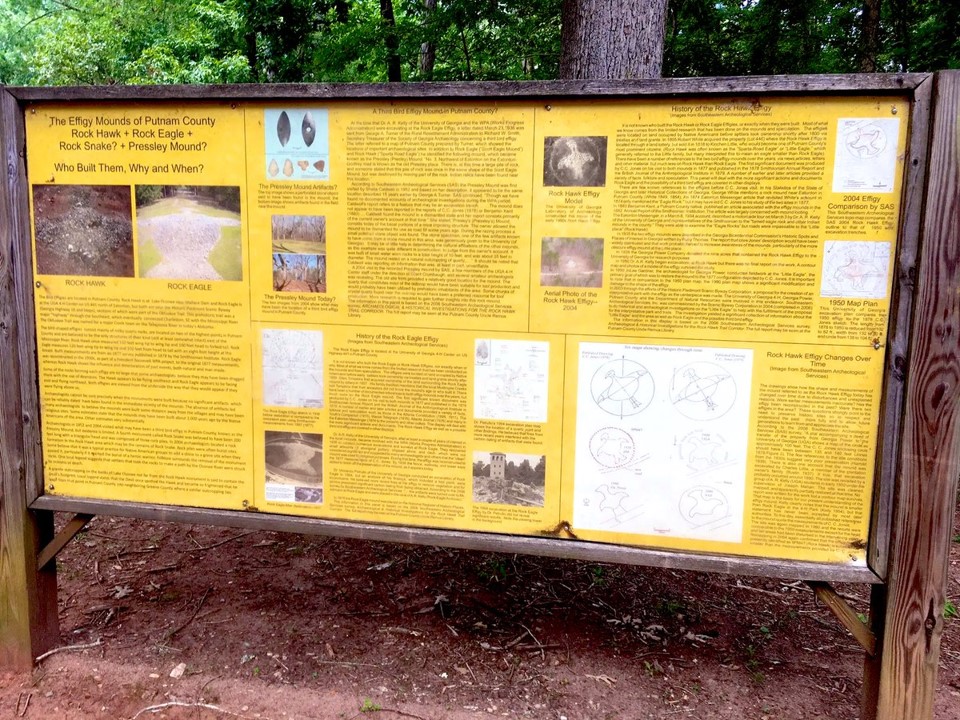 The stone tower build by the CCC workers in the 30s provides a stunning view of the Rock Eagle and is a must for anyone visiting the site, although the stairs can be strenuous. A paved pathway circles the effigy and there are interpretive panels to explain the significance of the site. The park is beautifully maintained.
The Rock Eagle Effigy is surrounded by Rock Eagle 4H Center, built during the 1950s and thought to be the largest such 4H center in the world. Access is designed, however, so that visitors can tour the Rock Eagle Effigy without disrupting or intruding upon the activities of the young men and women at the center.
To reach the Rock Eagle Effigy Mound from downtown Eatonton, take combined U.S. Highways 441 and 129 north for 6.7 miles and turn left on Rock Eagle Road at the entrance to Rock Eagle 4-H Center. Travel for .7 miles to the first paved road to the right. Turn right and then watch for the first paved road to your left, which leads to the effigy. The route is well-marked.
There is no cost to visit and the site is open to the public during normal business hours. https://www.exploresouthernhistory.com/rockeagle.html