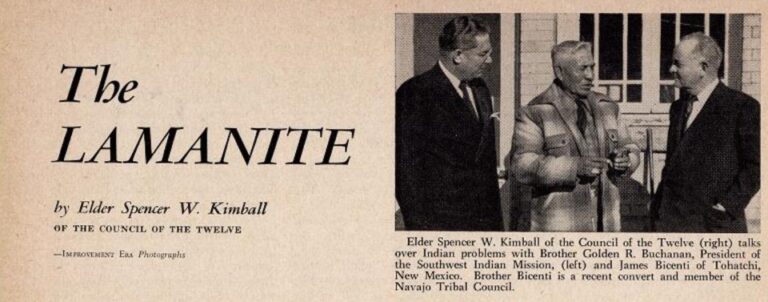
If you love the Native Americans of North America as much as I do, or any of our Lamanite brothers and sisters, this article is a must read by all. The brief quote of Pres Kimball below should make each of us stop and read, ponder, and then act, on how we may each help, love and support our great Lamanite friends.
The Greatest Problem of the Lamanites
“Above all of the problems which the Indian has, his greatest one is the white man— the white man, who not only dispossessed him, but the white man who has also never seemed to try to understand him — the white man who stands pharisaically above him — the white man who goes to the temple to pray and says, “Lord, I thank thee that I am not as other men are.” There are too many Pharisees among the white men, who are worried about unwashed hands; and too few Galileans who heal palsied hands and teach untutored minds and comfort broken hearts.
 There are too many who “strain at a gnat and swallow a camel,” and too few who have judgment and faith and mercy and kindness for the unfortunate. There are too many who pray on their knees for fulfilment of prophecy and too few who let their hearts be softened and become “nursing fathers and mothers” to the downtrodden. There are too many Levites who pull their robes about them and pass by with disdain, and too few who “take them to the inn” and give them tender treatment and care.
There are too many curiosity seekers and too few laborers. We are constantly reminded of the eloquent scripture given to the Nephites:
Wherefore, a commandment I give unto you, which is the word of God, that ye revile no more against them because of the darkness of their skins; neither shall ye revile against them because of their filthiness; but ye shall remember your own filthiness. (Jacob 3:9.)
 Again, there are too many who push down and tread under, and too few who lift up, encourage, and help.
There are too many goats and too few sheep. There are too many who exploit and profit by his misfortune, and there are too few who give the stranger meat and drink and clothe his nakedness and visit him in prison.
My good people: Accept the Lamanite as your brother. I ask for him, not tolerance — cold, calculating tolerance; haughty, contemptible tolerance; scornful, arrogant tolerance; pitying, coin-tossing tolerance. Give them what they want and need and deserve — opportunity and brotherliness and understanding, warm and glowing fellowship, unstinted and beautiful love, enthusiastic and affectionate brotherhood.” The LAMANITE by Elder Spencer W. Kimball OF THE COUNCIL OF THE TWELVE
 THE LAMANITE
by Elder Spencer W. Kimball OF THE COUNCIL OF THE TWELVE April 1955 Improvement Era page 227
“If there ever was a people in the world who needed friends, sympathetic, understanding friends, it is the Lamanites. They are trying now to pick themselves up by their bootstraps, but it is a rather difficult thing when so many of them have neither straps nor boots. It isn’t enough merely to give them freedom to grow and develop; they need nursing fathers and mothers; they need. friendly hearts; they need understanding.
The Lord is at the helm. He has, through his prophets, predicted that the Lamanites would fall and that they would then be recovered. Let me quote holy scriptures:
And the angel said unto me [Nephi, in his vision] : Behold these shall dwindle in unbelief.
And it came to pass that I beheld after they had dwindled in unbelief they became a dark, and loathsome, and filthy people, full of idleness and all manner of abominations. (1 Nephi 12:22-23.)
… I say, if the day shall come that they will reject the Holy One of Israel, the true Messiah, their Redeemer and their God, behold, the judgments of him that is just shall rest upon them.
Yea, he will bring other nations unto them, and he will give unto them power, and he will take away from them the lands of their possessions and he will cause them to be scattered and smitten. (2 Nephi 1:1011.)
. . . the Lord God will raise up a mighty nation among the Gentiles, yea, even upon the face of this land; and by them shall our seed be scattered. (1 Nephi 22:7.)
 But behold, it shall come to pass that they shall be driven and scattered by the Gentiles; and after they have been driven and scattered by the Gentiles, behold, then will the Lord remember the covenant which he made unto Abraham and unto all the house of Israel. (Mormon 5:20.)
They have been scattered. They have been driven. How cruelly have they been decimated and how literally have the prophecies been fulfilled.
We approach the day when the latter part of those predictions may be fulfilled, when the Lord will remember the covenant which he made unto Abraham and unto all the house of Israel.
Students of history recognize the harsh treatment which these people received, even though they may not know it came as a matter of fulfilment of prophecy. The Lehites had forgotten their Lord. They had committed all manner of abominations, and the Lord brought them to the bar of justice.
C olumbus and others discovered this promised land; the colonists came and settled the country; the Revolutionary War was a part of the program to bring freedom to the new world; and all of these developments were charted and permitted by the Lord. And when religious liberty was a reality through this God-given Constitution of the United States, then it was possible for the gospel to be restored. And Joseph Smith was raised up, the plates were found in the Hill Cumorah, and the Book of Mormon came forth, and the gospel was restored through the Gentile nations and thus came to the Lamanite people. The Prophet Joseph Smith immediately began to send the gospel to the red men, and this soon after the Church was organized. As soon as he had read accounts of them in the Book of Mormon he became aware of their destiny. Repeated attempts have been made through these many years to reach the Lamanites.
At the time Columbus came there were many large and proud nations of them on this continent. True, they were fighting among themselves, but they were not at first hostile to the whites. The Indians occupied the entire country and the whole land was covered with them. The Indian population was greater then than now. They have been decimated and destroyed by the peoples from Gentile nations who came to settle their country.
 The Cherokee nation is a good example and typical of the many peoples who suffered the wrath of the Gentiles which were to come and possess their land. There is only one way, as I see it, that this nation can ever pay for what it has done to the Lamanites, and that is to educate them and bring the gospel to them so that they may receive the blessings so long withheld.
At first the Cherokee nation occupied many of the states in the southeastern part of the United States. Parts of Georgia, South Carolina, North Carolina, Tennessee, Kentucky, and Alabama were acknowledged as their land. By treaties which were written “in water and in the air,” they were dispossessed of half of that area back in the beginning of the nineteenth century. And then from time to time, their land was reduced until it was called by their chiefs, “The Last Little.”
When the state of Georgia began to press for the removal of the Cherokees, they resisted. One little Indian girl expressed their feelings thus: “If the people want more land, why don’t they go back to the country they came from?” And Edward Everett, later to share the Gettysburg platform with Abraham Lincoln, said to the House of Representatives: “These, sir, are your barbarians — whom you are going to expel from their homes — and you will do it for their good! In the west you grant the same land two or three times to different tribes. What is the population of Georgia where there is no room for these few Indians? It is less than seven to the square mile. We, sir, in Massachusetts, have seventy-four to the square mile and space for a great many more.”
 The Cherokees, with others of the five civilized nations, had an alphabet, an educational program, a constitution, and a democratic government, and they resisted, not with swords and spears, but in legal and peaceful ways, the encroachment of the people of the states into their country. When the removal bill was passed by the state of Georgia, according to historical accounts, the Cherokees brought an injunction against the state, but they lost their suit since sometimes, “might makes right.” They tried to establish themselves as an independent nation but were never completely recognized as such.
Time and time again, they sent delegations of their members to Washington, D.C., to secure redress for their wrongs. Though the Cherokees had assisted General Andrew Jackson in his battle to suppress the last revolt of other Indians in that area, they were to find that Andrew Jackson, as President of the United States, was not friendly to their cause, for he refused to interfere with the operation of the vicious state laws.
The Cherokees were not permitted to meet regularly in their own councils and took them across the line into another state and became in 1830, a government-in-exile. The state then sent survey parties onto the Cherokee lands, and the property was allocated to white men through a lottery system. Another protest went from the Indians to Washington, but it was unavailing. It seemed that Cherokee self-government was to be wholly terminated. The annuity, which had been paid for many years from the government of the United States to the tribe, was now no longer to be given to the tribe but to be paid individually to the Indians if they came for it. This took from them their tribal funds. The Cherokees were incensed at this injustice; and though they needed the funds, they would not go for them. The amount was only forty-four cents an Indian, and only two percent — or about two hundred sixty, out of a total population of 16,000 — called at the agency for their forty-four cents a head. This represented about fifty families.
 Even when the 550 surveyors came in to divide their land, the Cherokees did not rise in armed rebellion. They took the matter to the Supreme Court, where they were sustained. However,. President Jackson said: “John Marshall made the decision; let him enforce it.” And the persecution persisted, and new squatters came into the area to take over the property rightly belonging to the Indians.
The state laws suspended all Cherokee laws in that state, and removal or extermination seemed certain. By the fall of 1832, the homes which the Indians had built, the crops they had planted, the livestock they had raised were taken by new people — whites from the South. More delegations went to Washington to see whether their grievances might be relieved. Andrew Jackson, president, was unsympathetic to their cause. The Indian leaders declared that if they were forced out of their own country, they would go beyond the limits of the country: “If the United States would not live up to its obligations, they would put themselves forever beyond its reach.” Texas and Oregon were both considered as a possible home.
“President Van Buren came into the -“- presidency. Even though he seemed to have some sympathy for the Cherokees, he was unwilling to take a stand for them. And in effect, he said: “Your cause is just, but I can do nothing for you.”
 Pressures became terrific. Ultimate moving was almost certain. A first group, under almost enforced enrolment, was assembled at Hiwassee on the Hiwassee River, and they were put on flatboats and sent down the Tennessee and Mississippi rivers, up the Arkansas River to the insect infested Arkansas country, later known as the Indian Territory. This was a tragic move. Many died of cholera en route. The living reached Little Rock, Arkansas, when the water was too low to carry their barges. They must walk then through the mosquito-malaria country to their new country, and one-half of the survivors at Little Rock died before the first year was ended.
The body of the Cherokees had not yet yielded, and an agent, Schermerhorn, with some official recognition, went into tne Cherokee country. In an underhanded way he secured treaties. He called a council for December 23, 1835, urging all Indians to be present and offering a blanket to all comers. To it came only seventy-nine legal voters of the 16,000 Indians. But this agent was not to be defeated, so he announced that all absentees were counted in favor of the treaty. He selected twenty men and had this “committee of twenty” ratify this treaty, which most Cherokees would not ratify and which was obnoxious to them. Again they protested that they were being denationalized, that they had neither land nor homes, nor a resting place which could be called their own. They appealed to the justice, to the magnanimity, to the compassion of the bodies of Congress and to the people in general, asking to be sustained in their protest against the enforcement of a compact in the formation of which they had no agency, no voice. These petitions were signed by a large number of the Indians.
 So outraged did these Indians feel that they would not accept the government rations which came, for fear they would compromise their positions. Many of them preferably returned to their hills to live on wild game and roots and herbs.
The final roundup began May 23, 1838, according to published accounts, and the unopposed state militia, with bayonets in their guns, gathered up these defenseless property owners and moved them up the road away from their homes, toward a new world. This mass movement was called “The Trail of Tears,” for a nation of defenseless, homeless, people was en route with tears in their eyes and in their hearts.
The trek of the Mormon Pioneers from Nauvoo to Salt Lake Valley is not more bloody, not more heartrending than the enforced trek of the Cherokee Indians from the Southern States to the Indian Territory. The census of 1835 in Georgia showed 16,542 Cherokees; and except for those who were killed and those who escaped into the hills, these thousands were removed — driven from their homelands to a country to be called “Indian Territory,” a swampy and mosquito-infested country — most undesirable and unhealthful. This Indian Territory already belonged to tribes of Indians who had it as their home, but the government now reallocated and gave it to these many other tribes. And now some thirty tribes of Indians in Oklahoma are taking the place of those who previously possessed it. Each summer now, there is presented in the hills of North Carolina, a pageant depicting the sufferings of this long “Trail of Tears.”
 The new settlers took from the Indians the newly discovered gold mines; they appropriated the Cherokee farms and homes and crops and livestock; they took possession of the land; and these peaceable Indians, taking a last, fond look at their beloved homeland, were pushed north and west. There were new babies to carry in their arms; there were unborn babies to come en route; there were mothers who were destined to die by the roadside; there were consumptives and cripples who needed to be carried; there were blind who needed to be led; there were parents who were separated from their children and little frightened ones who ran into the woods and were never found. There were unmilked cows with swollen udders; chickens and pigs unfed; and empty cabins and sometimes smoking ruins.
This virtuous, civilized nation was on enforced move. They plodded on through, rain and cold. Blue-lipped babies became heavy; newborn ones came into the world but found it too difficult to stay. Possessions were carried in blankets over shoulders. Thousands of Cherokees were in custody on the bank of the river. Dysentery and fever increased the difficulties. They were held in concentration camps. Hundreds escaped and returned to their hills, resisting to the last. They would not give their names; they would accept no rations. One party which left Hiwassee with 800 souls, had only 489 at Paducah, Kentucky; 311 had either died or escaped.
Summer was as hazardous a time with the rivers low, and summer fevers, and infested areas. Disease broke out. There was no shelter, no sanitation, uncertain and questionable water supplies. They were herded together as animals. One missionary said, “This is the most painful and expensive way of putting people to death,” and “All over sixty should have been killed before the trek began.” Babies died by the hundreds. Newborn ones seldom survived their first weeks. It is estimated that by October, two thousand had died in the camps alone.
 All this was in direct fulfilment of the prophecies which the Lord had caused his prophets to declare:
. . . the Lord God will raise up a mighty nation among the Gentiles, yea, even upon the face of this land; and by them shall our seed be scattered. (1 Nephi 22:7.)
And now when the river route proved disastrous, authorities determined that they should be fitted out and sent over land. And a great nation, in fourteen parties of seven hundred to a thousand each, went overland. About 645 wagons, 5000 horses, and a large number of oxen were assembled, and the body of the nation was on wheels and on foot.
The exodus began about October 4. What an unfortunate hour! What horrors faced them! Through Nashville they traveled to the Ohio River, down it across the Mississippi River, and then southwest to Arkansas. Through the fall months of 1838 there was a stream of wagons, a cloud of dust, a chain of graves. Often the refugees cut wood and pitched camp as many as three times before they were permitted to settle for the night — this because of unwilling, unkind people through whose territory they were moving. Apples suddenly rose in price from six to fifty cents a dozen, and eggs and milk and other supplies likewise rose to unheard of and prohibitive prices.
Winter came on. The roads were frozen; feet were bare. They waited two weeks on the banks of the Mississippi before they could cross.
And now that the Cherokees were evacuated from their lands, President Van Buren issued an article “congratulating the nation that the Indian removal had at last been peaceably achieved.” The weary, heartsick, and bedraggled survivors began to arrive in the Indian Territory from early January to late in March. It was estimated that 4000 of them had died en route, and another 600, who had escaped into the hills in their own country, had passed away. More than one-fourth of the nation had paid the supreme price, and all had been subjected to heavy prices of sorrow, pain, and bitterness.
 One missionary said: “From the first of June, I feel as if I had been in the midst of death.” A general funeral sermon was preached upon arrival, to take care of all of the dead from the Carolina hills in Georgia to the Indian Territory swamps. Another missionary wrote: “With regard to the West, all is dark as midnight. Oh, that my head were waters and my eyes a fountain of tears, that I might weep day and night for the slain of the daughters of my people.”
The new land offered some opportunity. There was ground to clear and crops to plant and logs with which to build homes, but one old Cherokee veteran said: “For whom do I build here? I had three sons. One died in General Scott’s camp; one died on the trail; the third died here. For whom do I build my house?”
The Civil War further divided them and prostrated them. The Cherokee Nation was humbled and scattered and stripped. In the east the escapees had returned to the hills. They had given their new babies such names as “Going Home.” They preferred starvation in their own hills to an enforced move to distant, forbidding lands.
The story is told of one Tsali who, with his family, had been started on the westward trek. His wife could not keep up with the soldiers’ pace. They had prodded her with a bayonet. In extreme bitterness, Tsali planned. In quiet, conversational Cherokee he calmly talked to his tribal brothers in the line of march. They were alerted when the password was given. The English-speaking soldiers little realized the trap that was being set. When they came to a heavily wooded area, the password “Ho” was given. Each Cherokee took a soldier, wrested from him his gun, and all of the large group escaped into the forest and returned to the shelter of their own hills. But unfortunately one gun went off, and one soldier was killed. No count was made and little thought was given to the hundreds of Indians who had lost their lives, but there was now a price on the head of Tsali and his sons. These escapees could not live openly in the hills nor peaceably in their own country. They could not plant crops nor build fires. An ultimatum came from the government. Tsali and his sons must be given up for punishment. This information was presented to Tsali in his hideout cave. He reasoned that he was an old man and his wife and one child had already died in the hills. He would soon die, anyway, and so Tsali and his sons came down the mountain and surrendered as scapegoats, and all were shot except the youngest boy, Washington. Before his death of sacrifice, Tsali said: “Oh, Euchella, if the Cherokee people beyond the Mississippi carried my heart in their bosoms, they would never have left this beautiful land, this our mountain land. My little son must never go beyond the father of waters but die in the land of his birth. It is sweet to die in one’s own country and to be buried by the margin of one’s native stream.”
 And as it was with the Cherokees, so it was with the Sioux, the Navajos, the Apaches, and others of the -tribes.
In 1868 the United States government had signed a treaty with the Sioux, Cheyenne, and other tribes of the Great Plains, designating a large area in western Dakota and Nebraska and part of eastern Wyoming as an Indian reservation. The government agreed to protect the Indian nations in these badlands, but in less than six years gold had been found in the Black Hills in the heart of their reservation by US soldiers. A gold rush ensued, and the Indians were overrun again and pushed out of another new land given them. When they resisted, General Custer was sent with an army of men to bring into submission these rebellious natives. And Custer made his last stand on the Little Big Horn up in Montana. I was there not long ago, and I saw the monument on which were many names. These were the names of the 231 officers and enlisted men and civilians and Indian scouts who were killed by the six thousand Sioux Indians. There were little graves with white markers all around the great monument, graves of the white men who lost their lives. Nowhere could I see any evidence of the graves of the many hundreds of the Indians who lost their lives in that last great battle and were buried in that soil. That was perhaps the last important armed resistance of the American Indians in the north plains. They had fought these many years valiantly for their land, the home of their fathers, but now their resistance was broken.
 The great Navajo nation had a similar fate. They had resisted the white man’s encroachment. They had felt justified in defending their homes and their land against invading forces. Finally the army of the United States was sent in to Navajo country, and the natives subdued by starvation were herded into the canyons and crevices of the rocks where they took refuge in Canyon De Chelly and Canyon del Muerto. The army burned the hogans; they rooted up the crops; they cut down the peach trees; they killed the cattle and the sheep; and finally in desperation, the Navajos surrendered, and thousands of them were marched across the trackless desert to Bosque Redondo on the Pecos River in central New Mexico. This merciless trek was called “The Long Walk.” Here for four years they starved and froze in a land that was unproductive, unkind, harsh, and cruel to them. There was little wood to burn; the winds were fierce; the cold was penetrating; their rations from the government were limited. And after four years of intense suffering, they were released. A treaty was signed between a great Gentile nation and a fast vanishing native nation, and the refugees were permitted to move painfully back through central New Mexico into northeastern Arizona to the hills and canyons from which they had come — and to which they were glad to come — and those were blood-stained miles — desolate miles — heartbreaking and backbreaking miles. Many hundreds of those thousands suffered death in those perilous years at Fort Sumner and in “The Long Walk” each way; and as desolate as was the Navajo land, it was home. That was the last organized resistance of the Navajos. They never rose again.
Down in Apache land, where I used to live, an old chief, Cochise, a great warrior and an honorable man, led his Apaches for many years in resistance to what he felt was invasion by foreign forces into his own beloved land. There was Mangas Coloradas, the great leader of the Mimbres Apaches. There were Victorio and Nana, and Eskiminzin, and many other great warriors and chiefs who fought the “Battle of America,” their war of defense, and in the end they lost. Their resistance was broken; their lands were gone; they were placed on reservations, virtually concentration camps.
Down near Lordsburg, New Mexico, was placed a little monument which says: “Near here Geronimo surrendered. This was the last battle.” That was 1868. The Indians were subdued; the end had come for these proud peoples as independent nations. Prophecy was fulfilled; the penalty was exacted. And now for many years, these deprived and scattered and stripped people have been confined on small reservations, limited and deprived, with few opportunities.
One missionary expressed the feeling of the American people in the old days of the Cherokee problem. He said: “Americans do not feel toward the Indians as they do toward other heathen nations. Therefore, reports of their wretchedness do not excite sympathy as they ought, but paralyze every exertion. There by that old and cruel theory, Indians are to be destroyed.” Actually at different times in this country there have been these theories advanced by religionists that the Indians were not wholly human, and therefore it was nothing to kill an Indian. I am grateful that such a feeling has been greatly modified. Yet there is still intolerance.
I should like here to recall the story of the Good Samaritan. The Lord was speaking of people such as these who had suffered such deprivation and who even now need good Samaritans. The lawyer said, “Master, what shall I do to inherit eternal life?” And the answer was: “What is written in the law? how readest thou?” And then he said: “Thou shalt love the Lord thy God . . . and thy neighbour as thyself.” The lawyer, trying to justify himself, said: “And who is my neighbour?” and then the Lord gave that beautiful story about “a certain man (who) went down from Jerusalem to Jericho, and fell among thieves, which stripped him of his raiment, and wounded him, and departed, leaving him half dead.” (See Luke 10:25-30.)
Was the Lord looking forward about sixteen’ to nineteen centuries? Was he seeing the travail of this deprived people, who through centuries, fought the battle of America and continually lost, resulting in their scattering and suffering and their being dispossessed? Was he seeing this Lamanite people — who “fell among thieves, which wounded him, and stripped him of his raiment, and departed, leaving him half dead?”
If in all America or even in the Church, there could be developed a sympathy, a love, an understanding — if good Samaritans could be raised up, men and women who would go out and mold public opinion, who would vote at the polls, who would influence Senators and Representatives, who would do the things which will finally bring to these deprived people education, opportunity, and the healing oil of understanding!
 The Lord said, in speaking of the time when he would come in his glory, that he would gather all nations and separate them one from another as a shepherd divideth his sheep from his goats, the sheep on the right and the goats on the left. And then he speaks of these sheep:
For I was an hungred, and ye gave me meat: I was thirsty, and ye gave me drink: I was a stranger, and ye took me in:
Naked, and ye clothed me: I was sick, and ye visited me: I was in prison, and ye came unto me.
Then shall the righteous answer him, saying, Lord, when saw we thee an hungred, and fed thee? or thirsty, and gave thee drink?
When saw we thee a stranger, and took thee in? or naked, and clothed thee?
Or when saw we thee sick, or in prison, and came unto thee?
And the King shall answer and say unto them, Verily I say unto you, Inasmuch as ye have done it unto one of the least of these my brethren, ye have done it unto me. (Matt. 25:35-40.)
Then follows the Lord’s curse on those who were not kind, merciful, and charitable.
Depart from me, ye cursed. . . . (Ibid., 41.)
Applying such punishment to those of whom he spoke saying:
Verily I say unto you, inasmuch as ye did it not to one of the least of these, ye did it not to me. (Ibid., 45.)
There are more than 400,000 of these “the least of these my brethren” in our land. And when you do it unto them, you do it unto Him.
A few more battles like Cumorah would have completely taken every soul of the Nephites and Lamanites upon this continent. Not a Lehite would have been left to greet Columbus, or the Pilgrims, not one to be proselyted or eventually to help build the holy temple, but the Lord did not permit a total destruction. He had destined that the remnant of this seed of Lehi should live to possess the land until the Gentile nation, which he had in mind, would come to possess it. He intended that the Gentile nation, which would bring with them the Holy Bible containing the gospel of Jesus Christ, could eventually, if it were alert, bring to these people education, progress, development, growth, and, above all, the gospel of Jesus Christ.
The Lord said that this people would again become white and delightsome. They are on their way. They are making progress, with help from us and a great deal from themselves. They are making headway in educational fields. They are equal to us and to our children in their mental powers, and authorities, by actual survey, place them above many of the rural areas in the United States. These people, who have a high IQ, have had little opportunity, and therefore their progress has been retarded. Official statistics indicate that in the early 50’s only one percent of the Arizona-Utah Indian children reached the twelfth grade and that only three percent of those Indian children in that area reached the ninth grade; this condition is improving. Navajo children numbering 4421, selected from perhaps six or seven times that many, were sent to schools at Chemawa, Chillocco, Sherman, Phoenix, Albuquerque, Brigham City, and other off reservation schools. But still there were many thousands who could not find opportunity for schooling.
One survey in the late 40’s indicated that 3.7 percent of all Americans had had no schooling, but 25.2 of all Indians in the United States, and 66 percent of all Navajo Indians had had none. The survey indicated also that the average time spent in school in the United States was 8.4 years; whereas all Indians spent an average of 5.7 years, and the Navajo about .9 of a year. And there were many thousands who had never spent a single day in a school and had never had a slate or a pencil or book in in their hands. As late as 1940 there were Navajos who still resisted the white man’s school, but in the early ’50’s it is almost unheard of to find Indians who are not begging for schools. In at least two communities in Navajo land the eager parents brought logs from the mountains, got together a few hundred dollars for nails, hinges, and glass, and built their own school buildings without help from state or nation.
There are good and bad Indians as there are good and bad white people; there are honest and dishonest; there are moral and immoral. But they beg for schools, for opportunity. These people are grasping the gospel. Each year we baptize hundreds of them in the Indian reservation. Not only the Navajos, but also the Hopis, the Zunis, the Pueblos, the Apaches, and others are accepting the gospel. They are learning to live the Word of Wisdom and the law of tithing. They are learning the law of chastity. They attend their meetings; they fast; they have their family prayers; they go to the temple.
Above all of the problems which the Indian has, his greatest one is the white man— the white man, who not only dispossessed him, but the white man who has also never seemed to try to understand him — the white man who stands pharisaically above him — the white man who goes to the temple to pray and says, “Lord, I thank thee that I am not as other men are.” There are too many Pharisees among the white men, who are worried about unwashed hands; and too few Galileans who heal palsied hands and teach untutored minds and comfort broken hearts.
There are too many who “strain at a gnat and swallow a camel,” and too few who have judgment and faith and mercy and kindness for the unfortunate. There are too many who pray on their knees for fulfilment of prophecy and too few who let their hearts be softened and become “nursing fathers and mothers” to the downtrodden. There are too many Levites who pull their robes about them and pass by with disdain, and too few who “take them to the inn” and give them tender treatment and care.
There are too many curiosity seekers and too few laborers. We are constantly reminded of the eloquent scripture given to the Nephites:
Wherefore, a commandment I give unto you, which is the word of God, that ye revile no more against them because of the darkness of their skins; neither shall ye revile against them because of their filthiness; but ye shall remember your own filthiness. (Jacob 3:9.)
Again, there are too many who push down and tread under, and too few who lift up, encourage, and help.
There are too many goats and too few sheep. There are too many who exploit and profit by his misfortune, and there are too few who give the stranger meat and drink and clothe his nakedness and visit him in prison.
My good people: Accept the Lamanite as your brother. I ask for him, not tolerance — cold, calculating tolerance; haughty, contemptible tolerance; scornful, arrogant tolerance; pitying, coin-tossing tolerance. Give them what they want and need and deserve — opportunity and brotherliness and understanding, warm and glowing fellowship, unstinted and beautiful love, enthusiastic and affectionate brotherhood.” The LAMANITE by Elder Spencer W. Kimball OF THE COUNCIL OF THE TWELVE https://archive.org/details/improvementera5804unse/page/226/mode/2up
Below is a PDF you can download