There exists many differences of opinion about the landing site of Lehi. There has been general agreement that Lehi probably began his exodus to the Promised Land near Khor Karfot, Oman before sailing to the New World. Those who believe in the Mesoamerican theory (M2C) think they sailed east towards India. Those of the Heartland Model (HM) feel Lehi sailed west toward the tip of Africa. You will see more about the discussion below. Those of M2C think Lehi landed somewhere on the west coast of South America and the HM think they landed near Florida. Those of M2C feel Lehi landed amongst a large population of Mayans. They also believe the Mayan civilization absorbed the Lehites and that is why today you find only Asian DNA amongst those people of South America. Those of us in the HM feel that Lehi landed amongst a few native hunter gathers in North America. We also believe there has been found Hebrew DNA in the Natives near the Great Lakes.
As the scripture says, “this land should be kept as yet from the knowledge of other nations; for behold, many nations would overrun the land, that there would be no place for an inheritance.” 2 Nephi 1:8. This is why the Vikings and others were not allowed to remain upon the land. We would expect a smaller group that Lehi would greet. I can’t imagine how Nephi could be a King amongst just a few of Lehi’s people, if there was a large contingency of natives on the land previously.
Page 30 Annotated Book of Mormon. click to enlarge
Page 35 Annotated Book of Mormon. Click to enlarge.
“The Book of Mormon explains that Lehi’s sailing party left a coastline they named “Bountiful” in the Old World. Nephi’s descriptions lead us to believe they left the Arabian peninsula, probably in modern-day Oman or Yemen. They crossed the “many waters” and landed at the promised land: “And it came to pass that I, Nephi, did guide the ship, that we sailed again towards the promised land. And it came to pass that after we had sailed for the space of many days we did arrive at the promised land; and we went forth upon the land, and did pitch our tents; and we did call it the promised land.” (1 Nephi 18: 22-23)
This description is so vague that it leaves readers with many possibilities for the landing site. We know from Moroni’s statements to Joseph Smith that the Book of Mormon is a record of the ancient inhabitants of “this country” meaning the United States, and of “this continent,” meaning the American continent, but that says nothing about where Lehi’s group originally landed.
Nephi does tell us the approximate season of the year when they left the Old World, and knowing when they left tells us something about which direction they would have sailed. He states: “After we had prepared all things, much fruits and meat from the wilderness, and honey in abundance, and provisions according to that which the Lord had commanded us, we did go down into the ship, with all our loading and our seeds, an whatsoever thing we had brought with us, every one according to his age; wherefore, we did all go down into the ship, with our wives and our children.” (1 Nephi 18:6). In the Oman area (see map on p. 30 above), there are two honey harvests each year, (spring and fall) but most fruit is harvested in the fall. That they gathered much fruit just prior to leaving suggests a fall departure. Nephi’s account continues, “…we did put forth into the sea and were driven before the wind…” (1 Nephi 18:8), which suggests that the ship was not traveling contrary to, but in concert with the Northeast monsoon winds that prevail at this season of the year and would have driven the ship southwest, along the eastern coast of Africa (see map on p. 35 above). This route would have rounded the cape into the Atlantic Ocean and followed the currents and winds across the Atlantic to the Caribbean. Once there, the route picks up the currents that Columbus utilized when he left Spain and sailed to the Canary Islands off the western coast of Africa having the ship proceeding westward.” Annotated Book of Mormon by David Hocking and rod Meldrum page 30, 35, 535
14 FACTORS- APALACHICOLA, FLORIDA AS THE SITE OF LEHI’S LANDING!
Navigational Proof: Phoenicia 2009 Expedition
Length of voyage: 4-6 months vs. 14-18 months
Time of Year: Leave in Sept or Oct. Land in March or April?
Archaeology: 500-700 BC Mounds and Relics
Bees and Honey: Only place in the world for Tupelo Honey
Similar Latitude: Seeds would grow. 30° 26′ 17″ N (Tallahassee, FL) 30° 04’42” N (Cairo, Egypt) 31° 46′ 48″ N (Jerusalem) 19° 43’ 26” N (Mexico City) 15° 30′ 0″ N (Guatemala)
One alleged 1836 statement indicated Lehi landed “in Chile, 30 degrees, south latitude” and in an 1842 statement “a little south of the Isthmus of Darien” (now Panama). There is a 3,000 mile discrepancy in these statements. Annotated Book of Mormon page 530
“The Nephites could not possibly have lived among the Mayans” by Jonathan Neville
A comparison of LiDAR data showing the ancient Maya site of El Zotz covered in trees (left), and with the trees digitally removed. Credit: Ithaca College
Moroni’s America position- If you believe in the New York Cumorah, you will likely view this LiDAR discovery as additional evidence that the Nephites could not possibly have lived among the Mayans.
I think the text shows Lehi’s colony landing in the promised land, planting their own seeds, finding animals and ore in the wilderness, all while completely unimpeded by any existing civilization. (1 Ne. 18:23-5). I think Lehi’s observation that “this land should be kept as yet from the knowledge of other nations” was accurate; i.e., that there were no “other nations” in the promised land where they landed, “for behold, many nations would overrun the land, that there would be no place for an inheritance” (2 Nephi 1:8). I do think think there were some indigenous people who went with Nephi when he fled (2 Nephi 5:6), but I infer they were unorganized hunter/gatherers that did not qualify as any sort of “nation” and were impressed by the Jewish immigrants’ technology, language, etc.
In my view, it is difficult enough to believe that Lehi’s family, a relative handful of immigrants from a distant culture speaking a different language, could have arrived and started planting crops on unclaimed land in Mesoamerica, encountering no resistance, but it is even more difficult to believe Lehi’s descendants could have managed to rule as kings and chief judges over even a part of a Mayan civilization, and that in the midst of this Mayan civilization, King Mosiah could have escaped with the Nephites into the wilderness and found a much larger group of illiterate people (the people of Zarahemla) who possessed exactly one engraven stone.
Now that we are learning from LiDAR that the Mayan civilization was even larger, more densely populated, and more sophisticated than we previously realized, the Book of Mormon seems even less plausible in that setting. IOW, the grander the Mayan civilization, the less likely it is that Lehi landed anywhere near that civilization.
This view is based on the text and has nothing directly to do with the New York Cumorah, but it does confirm my bias in favor of the New York Cumorah. _____
M2C position. If you believe the M2C position that Cumorah is not in New York and that the entire Book of Mormon took place in Mesoamerica, you will likely view this LiDAR discovery as additional evidence that the Nephites must have lived among the Mayans.
The basic M2C concept is described in the Meridian Magazine article. It is the idea that the Nephites were absorbed into Mayan culture. That’s why there is no Israelite DNA in Central America, no traces of Nephite languages or the law of Moses or Christian beliefs and practices, etc. M2C proponents believe there were bottlenecks (both DNA-related and cultural) that screened out Nephite cultural influence.” Jonathan Neville blog here
Annotated Book of Mormon
“Within recent years there has arisen among certain students of the Book of Mormon a theory to the effect that within the period covered by the Book of Mormon, the Nephites and Lamanites were confined almost entirely within the borders of the territory comprising Central America and the southern portion of Mexico—the isthmus of Tehuantepec probably being the “narrow neck” of land spoken of in the Book of Mormon rather than the Isthmus of Panama (See Alma 50:34; 52:9; 63:5; Mormon 2:29; 3:5). This theory is founded upon the assumption that it was impossible for the colony of Lehi’s to multiply and fill the hemisphere within the limits of 1,000 years, or from the coming of Lehi from Jerusalem to the time of the destruction of the Nephites at the Hill Cumorah. Moreover, they claim that the story in the Book of Mormon of the migrations, building of cities, and the wars and contentions, preclude the possibility of the people spreading over great distances such as we find within the borders of North and South America. “If we are willing to accept the Bible record, which is confirmed by the Doctrine and Covenants, the entire civilization of the earth was destroyed in the flood except Noah and his family (See Gen 6; 7; 8; Moses 7:36–43). Moreover, this destruction took place less than 5,000 years ago, and today the population of the earth, notwithstanding wars and destructions, is estimated [in 1954] at over 2,000,000,000 souls [2018 population estimated at 7,600,000,000, has nearly quadrupled in just 64 years]. The population of Europe, based upon the best records available, is vastly increased over that at the time of the discovery of America; yet upon this hemisphere are to be found hundreds of millions of people, descendants of European and Asiatic ancestors who knew nothing of this land before the discovery by Columbus. The rapid increase of posterity is known to every genealogist who has traced the record of the early settlers in this western country.
“This modernistic theory of necessity, in order to be consistent, must place the waters of Ripliancum and the Hill Cumorah some place within the restricted territory of Central America, notwithstanding the teachings of the Church to the contrary for upwards of 100 years. Because of this theory some members of the Church have become confused and greatly disturbed in their faith in the Book of Mormon. It is for this reason that evidence is here presented to show that it is not only possible that these places could be located as the Church has held during the past century, but that in very deed such is the case. It is known that the Hill Cumorah where the Nephites were destroyed is the hill where the Jaredites were also destroyed. This hill was known to the Jaredites as Ramah. It was approximately near to the waters of Ripliancum, which the Book of Ether says, ‘by interpretation, is large, or to exceed all’ – Ether 15:8. Mormon adds: ‘And it came to pass that we did march forth to the land of Cumorah, and we did pitch our tents round about the hill Cumorah; and it was in a land of many waters, rivers, and fountains; and here we had hope to gain advantage over the Lamanites,’ (Mormon 6:4)” –
Joseph Fielding Smith, Doctrines of Salvation, Edited by Bruce R. McConkie, Vol. 3 [1999] 232–243.As stated on page 441 SPECULATION ABOUT BOOK OF MORMON GEOGRAPHY
Moroni’s America
“In an effort to explain the discrepancy between the enumerated (small) population and the large population implied by having wars and building a temple, proponents of a Mesoamerican setting suggest that–
“When the Book of Mormon peoples entered the not-empty New World, they entered a land that was not only populated, but which already boasted highly developed civilizations. The Book of Mormon does not explain Mesoamerican peoples—but Mesoamerican peoples help explain the Book of Mormon… With such a small Lehite population entering an established region with a significantly larger population, the most logical direction of cultural borrowing would have been from the established indigenous population to the small population that had originated in Jerusalem.[i]
This suggestion contradicts the text, in my opinion. I agree
with the likelihood that the Nephites encountered indigenous people, but far
from “cultural borrowing” from any “established indigenous population,” Nephi keeps
the law of Moses and is soon teaching his people how to build a temple, make
weapons, etc., as we’ll see in the next section.
Father Lehi’s statement about “other nations” directly
contradicts the idea that the Nephites landed among “highly developed
civilizations” that existed in Mesoamerica. On the other hand, Lehi’s
statement is compatible with the various hunter/gatherer groups identified in
the archaeological evidence in the southeastern United States at the time. Such
groups would naturally be attracted to new arrivals who brought with them
productive seeds for food, advanced technology for weapons and buildings, a
written language and other benefits.
Another possibility for the relatively large population
during Nephi’s lifetime is that Lehi brought servants along with him. I
consider this likely.
Erastus Snow noted that, “The Prophet Joseph informed us
that… Ishmael was of the lineage of Ephraim, and that his sons married into
Lehi’s family, and Lehi’s sons married Ishmael’s daughters…these descendants of
Manasseh and Ephraim grew together upon this American continent.”[ii]
In his analysis of Lehi’s group, John Sorenson noted that
“Nothing is said about Zoram’s ancestry, but it seems statistically likely,
given his bureaucratic/military role in Jerusalem, that he was a Jew, while
both Lehi and Ishmael counted descent from Joseph.”[iii]
This would make all of Lehi’s group “Israelites, principally the descendants of
Joseph,” which is how Orson Pratt described them in his 1840 pamphlet.[iv]
However, Joseph Smith made a correction to this language when he
wrote the Wentworth Letter. Joseph wrote, “They were principally
Israelites, of the descendants of Joseph.”[v] It
is possible that Joseph Smith was referring to Zoram after all, clarifying
he was not a Jew. He may have been referring to those who accompanied the
Mulekites (presumably Phoenicians). But it is also possible that he was
referring to others who accompanied Lehi.
Here are John Sorenson’s comments on that topic.
Were there servants? No mention is made of male or
female servants, yet it is possible that there were some. At first glance, 1
Nephi 2:4 would seem to rule that out, since reference is made only to Lehi’s taking
“his family.” Yet Near Eastern usage would not rule out including servants
under that heading without specifically distinguishing them. Lehi’s “great
wealth” would seem to have called for at least female servants in the
household. Nephi’s hesitancy about even adding Zoram to their party would not
apply in the case of family retainers, who would have known no other life than
service to Lehi and Sariah and had no alternative place in society in the land
of Jerusalem even if they dreamed of defecting. I do not consider it likely
that there were such people along, but the door should not be shut on the
possibility, for they might account for some genetic variety in the colony as
well as providing additional hands for the construction of the ship when they reached
Bountiful.
Finally, I note that Lynn M. Hilton has proposed in an
unpublished paper that Laman and Lemuel took dark-skinned South Arabian women
as second wives during the sojourn in Bountiful, thus accounting for the skin
color attributed to the Lamanites in the promised land in America. That the
party had social interaction with local inhabitants in Bountiful on the south
Arabian coast does seem likely, even inevitable. Among other things, Nephi
claims “neither did I build the ship after the manner of men” (1 Nephi 18:2), implying
that he had knowledge of other ships which almost certainly would have existed
on that coast. However, Jacob 3:5, which credits the Lamanites with a tradition
of strict monogamy, goes against the Hilton suggestion, but Lehi could have
picked up families, or single people who married Lehi’s servants. We simply don’t know.
I think it is likely Lehi brought servants. The journey from
Jerusalem through the wilderness would have been arduous for any small group,
but also dangerous. Lehi was a wealthy man, and likely accustomed to desert
travel; in the context of the times, he would have had servants to assist him
in his work, as well as to assist the household. Furthermore, it seems unlikely
that Lehi would have sent all of his sons back to Jerusalem, leaving Lehi and
Sariah and their daughters alone in the wilderness, if he did not have
servants. Perhaps he also sent servants to accompany his sons on their trips to
Jerusalem.
Joseph Smith said the group was “principally Israelites,”
so some of them were not. Apart from Zoram, the record gives no specifics on
the identity of these non-Israelites. Had Zoram been the only exception, would
Joseph have used the term “principally?” The term refers to rank or importance,
not merely numbers, so even a significant number of non-Israelite servants
would leave the group “principally Israelites.”
Mesoamerican advocates have considered but rejected the
notion that Lehi’s party included servants or people from Arabia,[vi]
but I think that approach reflects a desire to show that Lehi landed among a
sophisticated Mesoamerican population. In my view, that idea contradicts the
text.
To summarize: I think Lehi brought servants and landed in a mostly uninhabited area in Florida, among a small population of hunter/gatherers who lacked a well-organized society.” Moroni’s America pages 84-85
[i] Brant Gardner, Traditions
of the Fathers, pp. 153-4.
[ii] Erastus Snow, “God’s Peculiar People,” Journal of Discourses, 23:184, available
online at http://bit.ly/Moroni38.
[iii] John Sorenson, “The Composition of Lehi’s Family,” in By Study and Also by Faith, (Neal A.
Maxwell Institute), available online at http://bit.ly/Moroni39.
[iv] Orson Pratt, A[n]
Interesting Account of Several Remarkable Visions, p. 15, available online
at http://bit.ly/Moroni40.
[v] The Wentworth letter was
published in the 1 March 1842 Times and
Seasons. The Historical Introduction in the Joseph Smith Papers explains
that the letter echoes some wording from Pratt’s pamphlet. The letter is
available online at http://bit.ly/Moroni41.
[vi] E.g., Brant Gardner, Traditions of the Fathers, p. 156.
Jonathan Neville, author of the acclaimed historical book, The Lost City of Zarahemla, which finally unlocked the mystery of how Book of Mormon geography was shifted from Joseph Smith’s North American setting to Mesoamerica, has also written one of the most informative books ever shedding a flood of light and evidence onto the subject of Book of Mormon history called, “Moroni’s America”. If you haven’t read his book lately, you will realize how exciting it is to know the possible locations of the geography of the Book of Mormon. Share this article with your friends who wonder where the two theories came from.
Moroni’s America Chapter 2 by Jonathan Neville
Pocket Edition 110 pages $9.95 Full Edition 366 pages $22.95
The Book of Mormon presents a unique challenge when it comes to geography. The text contains many named locations, but the names are ancient. There is nothing comparable to Jerusalem, for example. We know where Jerusalem is because it never moved and it has been continuously inhabited. By contrast, there are no named sites in the Book of Mormon that have maintained their location and name through the present.
The text describes a comprehensive, consistent geography, but it is quite flexible. Locations and directions are given in vague terms. Distances are measured by travel time, not by miles or kilometers. There are lands northward and southward, relative terms whose meaning depends on the frame of reference. There is a narrow neck, a small neck, a narrow pass, and a narrow passage. There are seas and rivers and mountains and hills, some named but most not.
With such ambiguity, no two people can independently develop an identical map merely from reading the text. Matching such maps to real-world locations is just as problematic.
What we need is a solid starting point—a reliable pin in the map.
That’s why we need modern revelation.
Because the Book of Mormon does not refer to places we recognize, we look to modern revelation, where there are scriptural references to two Book of Mormon sites: Cumorah and Zarahemla.
Regarding Cumorah, D&C 128:20 says, in part:
And again, what do we hear? Glad tidings from Cumorah! Moroni, an angel from heaven, declaring the fulfilment of the prophets—the book to be revealed. A voice of the Lord in the wilderness of Fayette, Seneca county, declaring the three witnesses to bear record of the book!
Oliver Cowdery explicitly and unequivocally located the hill Cumorah is in New York, outside of Palmyra. Joseph Smith repeatedly endorsed Oliver’s statements about Cumorah.[i] Every one of Joseph’s contemporaries accepted the New York setting.
I stick a Cumorah pin in the map in western New York.
Regarding Zarahemla, D&C 125:3 says, in part, “Let them build up a city unto my name upon the land opposite the city of Nauvoo, and let the name of Zarahemla be named upon it.”[ii]
This verse is not conclusive about geography, but it doesn’t need to be. The Lord named the site Zarahemla. I want to see if it fits, so I stick a pin in eastern Iowa, along the Mississippi River across from Nauvoo.
There it is. Book of Mormon geography in a nutshell.
I expect you have some questions. Most people ask, what about the narrow neck of land? What about the sea west? What about…
I’ll get to all those questions, but for now I want to focus on this question: If figuring out Book of Mormon geography based on modern revelation is so easy, why has it been so complicated and confusing?
A detailed answer would take an entire book to answer,[iv] so I’ll summarize some of the factors.
Fundamentally, we have more resources than people had in the past. Some of these factors may fit within Article of Faith 9: “We believe all that God has revealed, all that He does now reveal, and we believe that He will yet reveal many great and important things pertaining to the Kingdom of God.”
1. The Book of Mormon was translated into English from an ancient text that contained unusual terminology that has been difficult to understand. It contains ancient literary structures (such as chiasmus, discussed in Chapter 27) that were unknown to Joseph Smith and his contemporaries. I think Joseph knew where the Book of Mormon took place but couldn’t figure out how the text described the geography. That’s why he identified Book of Mormon places and people but didn’t link them to the text.
With modern understanding of these ancient literary structures and terminology, we can see how the text describes a comprehensive, consistent geography in a way previous generations could not.
2. Ancient languages lacked punctuation. Joseph Smith dictated the text without punctuation (another evidence of its antiquity, by the way). The original printer and subsequent editors have used punctuation to make sense of the text, but in doing so have unintentionally obscured some of the meaning. The text has also been divided into chapters and verses that also affect the meaning.
Thanks to the Joseph Smith Papers project and the work of Dr. Royal Skousen, we have access to portions of the original manuscript dictated by Joseph and the entire printer’s manuscript (the copy Oliver Cowdery made for the printer).[v] We can see where changes have been made in the text, whether by innocent mistake or in an effort to clarify the meaning. The closer we get to the original, the better—even on the geography issues.
3. In the 1830s and 1840s, overzealous missionaries sought to prove the truthfulness of the Book of Mormon by citing impressive ruins in Central America. The public was fascinated by the accounts of explorers in that area and some Mormons thought linking the Book of Mormon to these exotic locales would motivate more people to read the book. Some of these ideas were published in the Church newspaper, the Times and Seasons, in 1842. Different ideas about Book of Mormon settings in Central and South America were published in footnotes to the official text starting in 1879. The footnotes were deleted in 1920, but artwork by Arnold Friberg depicting Central America was included in official editions of the Book of Mormon and reinforced the Mesoamerican theory. Over the years, Mormon scholars persisted in seeking links between the Mayans and the Book of Mormon, and these ideas have remained dominant in Church culture, despite the official position of neutrality.
Thanks to the Joseph Smith Papers and other electronic resources, we now know much more about Church history and can see that the early links to Mesoamerica and South America originated not with Joseph Smith but with others. It is also becoming more apparent that the purported cultural links between Mayans and Book of Mormon peoples are illusory.
4. Everyone reads the Book of Mormon in the light of their own culture and knowledge. In the 19th century, people knew relatively little about archaeology, geology, geography, anthropology, etc.[vi] This led to misunderstandings about what the text actually said, leading to unwarranted assumptions about geography and Nephite culture that have persisted.
With far greater knowledge and understanding of the scientific context of ancient America—North, Central, and South—we can re-evaluate previous beliefs and match the text to what we discover.
We simply know more now than those who preceded us. And the more we learn, the more we realize Joseph Smith was right all along.
An open-minded evaluation of the text is essential for anyone approaching this topic in the pursuit of truth. As Brother John L. Sorenson points out, “If we are to progress in this task, we must chop away and burn the conceptual underbrush that has afflicted the effort in the past.”[vii]
Ironically, some of that conceptual underbrush has been the basis for the Mesoamerican theory itself. Brother Sorenson declined to even consider North America:
The prospect that any other part of America than Mesoamerica was the scene of Book of Mormon events is so slight that only this obvious candidate area will be considered here.[viii]
Answering the question before examining the evidence leads to confirmation bias, a common error that superficially resembles testing a hypothesis. I am sensitive to the risk of confirmation bias. When I started this process, I was fully prepared to take the pins out of the map if they didn’t fit. Unlike Brother Sorenson, I didn’t view any setting as unworthy of consideration. But after considering the Mesoamerican geography for decades, I realized it just didn’t work. So I came up with a different hypothesis.
The search for Book of Mormon geography is akin to application of the scientific method. I asked a question (where did the Book of Mormon take place?), did background research (reading, talking, traveling), constructed a hypothesis (put two pins in the map), tested the hypothesis (read the text carefully), analyzed my data, and drew a conclusion. The final step, communicating my results, consists of this book.
The rest of Section 1 of this book discusses how the text describes Moroni’s America and what Joseph Smith and others said about it. Section 2 goes through the text, verse by verse, to put the geographical references in context. Section 3 discusses frequently asked questions about geography issues and examines how the chiastic structure of Alma 22 describes North America.
[i] I recognize that some scholars dispute the validity of Oliver’s account. They even claim Joseph merely adopted a “tradition” about the New York Cumorah that was started by unknown Church members at an unknown time. I address this in my short book, Letter VII, Oliver Cowdery’s Message to the World about the Hill Cumorah, so I don’t address it in detail in this book.
[iii] I used Google Earth in this book because it is easily accessible to anyone who has access to the Internet. Those interested can experiment with the text on their own, using my maps as a start. I haven’t put my maps on the Internet because I’m constantly adjusting them, but if you’d like my .kml file for your personal use, just email me at the address listed on the copyright page.
[iv] The complications arose from what people read into the text. For example, where Joseph and Oliver stated clearly and simply that the Hill Cumorah was in New York, some scholars in the 20th century claimed that was wrong; they think Cumorah has to be in southern Mexico. They reached this conclusion by 1) establishing their own criteria for the scene of the last battles of the Jaredites and the Nephites and 2) deciding New York didn’t meet their criteria. For example, see David A. Palmer, In Search of Cumorah, Horizon Publishers, 1982, also cited in Sorenson, Mormon’s Codex, p. 142. Brother Sorenson discusses Cumorah in more detail on pages 688-695, where he ridicules those who believe the final battles took place in New York. See also Brant A. Gardner, Traditions of the Fathers, pp. 375-379, in which Brother Gardner refers to the “sacralization of the New York hill.”
[v] In this book, I reference the printed books (Joseph Smith Papers, Revelations and Translations, Volume 3) as well as Brother Skousen’s work available online. Information about the books is available here: http://bit.ly/Moroni7.
[vi] People were aware that many ancient sites were being destroyed, so they made efforts to document what they found. Squier and Davis conducted an extensive survey and published it in Ancient Monuments of the Mississippi Valley, which I reference later in this book.
What did Joseph Smith find inside the stone box with the gold plates? 1-Gold Plates. 67% was sealed and 33% was loose pages of metal. 2-Ancient Jaredite Breastplate 3-Two stones set inside a silver bow like a pair of very large glasses. There are two additional items that Historians and Intellectuals say was in the stone box. 4- Sword of Laban 5. The Liahona These last two items were in the large “Cave at Cumorah” and not in the small stone box. Revisionists Historians want you to believe these two items were in the stone box because they don’t believe there was a “Cave at Cumorah”. They say the large room of records that Brigham Young and others mentioned, was just a dream somewhere in Mesoamerica. Remember the Intellectuals always want to validate their theory that there were two Hill Cumorahs so they can then say the Book of Mormon events happened somewhere in Mexico.
The following statement lets you know there were two distinct places at the Hill Cumorah in New York. Orson Pratt said, “The particular place in the hill, where Moroni secreted the book, was revealed, by the angel, to the Prophet Joseph Smith, to whom the volume was delivered in September, AD. 1827. But the grand repository of all the numerous records of the ancient nations of the western continent, was located in another department of the hill, and its contents under the charge of holy angels, until the day should come for them to be transferred to the sacred temple of Zion.” .” The Latter-day Saints Millennial Star Vol. 28; publisher Liverpool: July 7, 1866 Orson Pratt (Italics added)
Did ancient prophets write the plates of the Book of Mormon or did the Lord write it, or did the Lord tell the prophet what to write? Prophets have said, If there are imperfections they are of man, which means the Lord did not tell them what to write, but gave them inspiration to record the events. Ancient prophets wrote as inspired by the Lord, The Lord did not write for them. In the same way Joseph translated the ancient language by using the knowledge bank in his own head assisted by the Power of God with the help of the Urim and Thummim.
Definition of Translate
1a: to turn into one’s own or another language b: to transfer or turn from one set of symbols into another : TRANSCRIBE c(1): to express in different terms and especially different words : PARAPHRASE (2): to express in more comprehensible terms : EXPLAIN, INTERPRET 2a: to bear, remove, or change from one place, state, form, or appearance to another : TRANSFER, TRANSFORM https://www.merriam-webster.com/dictionary/translate#synonyms
Definition of Dictate
intransitive verb 1: to utter words to be transcribed : to give dictation dictate for the stenographer transitive verb 1: to speak or read for a person to transcribe or for a machine to record dictating a letter to her secretary https://www.merriam-webster.com/dictionary/dictate
Why do we say that we believe Bible to be word of God as far as is translated correctly, A of F 1:8. Is there a possibility it was translated incorrectly? In other words are there mistakes in it? Of course there are mistakes. Remember how Mormon said
Mormon 8:12 “And whoso receiveth this record, and shall not condemn it because of the imperfections which are in it, the same shall know of greater things than these. Behold, I am Moroni; and were it possible, I would make all things known unto you.”
Ether 12:23 “And I said unto him: Lord, the Gentiles will mock at these things, because of our weakness in writing; for Lord thou hast made us mighty in word by faith, but thou hast not made us mighty in writing; for thou hast made all this people that they could speak much, because of the Holy Ghost which thou hast given them;”
Quote below from The Church of Jesus Christ of Latter-day Saints
“Some minor errors in the text have been perpetuated in past editions of the Book of Mormon. This edition contains corrections that seem appropriate to bring the material into conformity with pre publication manuscripts and early editions edited by the Prophet Joseph Smith.” https://www.churchofjesuschrist.org/study/scriptures/bofm/explanation?lang=eng&clang=eng#p9
Why were many editions of the Book of Mormon edited by Joseph Smith if they came from the Lord who wrote the words on a stone in a hat? Why then did Joseph edit the perfection of the Lord? He didn’t, Joseph edited his own words that as he learned using his own knowledge bank that seemed to need to be corrected.
If the words on the gold plates were put onto a seer stone in a hat, who is it that was putting these words there? Was it the Lord? If so there would be no errors and if there were errors that Oliver wrote, the Lord could have stopped and corrected the word, correct? If it was an angel who put the words on the stone where did he get the words from? Or if it was a prophet, who was a greater prophet than Joseph Smith? Wouldn’t the Lord have the Prophet of this dispensation actually translate the words and not transpose or transliterate or just repeat back the words? Wouldn’t the Lord only step in after all Joseph could do? Didn’t Joseph have his own vocabulary, and didn’t he learn Hebrew and he practiced with and was instructed by Moroni and other angels and prophets? Would Joseph learn all he could about translation with this heavenly help? Why would the Lord just give it to him? The Lord could have given the text of the Book of Mormon on any item including a mirror or having the words revealed on a piece of wood, etc. Why would Joseph need a stone and a hat? Then again why would the Lord place a breastplate and two stones in a bow with the plates, if he didn’t want Joseph to utilize them in helping him translate the record?
Ether 2:22 And behold, when ye shall come unto me, ye shall write them and shall seal them up, that no one can interpret them; for ye shall write them in a language that they cannot be read.
23 And behold, these two stones will I give unto thee, and ye shall seal them up also with the things which ye shall write…
Ether 2:28 And it came to pass that the Lord commanded him that he should seal up the two stones which he had received, and show them not, until the Lord should show them unto the children of men.
So based on common sense, Joseph Smith Translated the Gold Plates, he did not dictate them from a stone in a hat.
Two Quotes that mean Everything!
Below are first hand accounts that share the truth about the method of translation. All other quotes are 2nd and 3rd hand accounts from sources who didn’t necessarily like Joseph Smith or had an axe to grind against him, including Emma Smith, David Whitmer, Martin Harris, William McClellan and today many BYU professors and intellectuals who want to deningrad Joseph just a little in order to elevate themselves as smarter than Joseph.
-1- “In the Wentworth Letter, the Prophet wrote: “With the records was found a curious instrument, which the ancients called “Urim and Thummim,” which consisted of two transparent stones set in the rim of a bow fastened to a breast plate. Through the medium of the Urim and Thummim I translated the record by the gift and power of God” (History of the Church, 4:537).
-2- In the October 1834 Messenger and Advocate [the Church newspaper in Kirtland, Ohio], Oliver Cowdery wrote: “These were days never to be forgotten to sit under the sound of a voice dictated by the inspiration of heaven, awakened the utmost gratitude of this bosom! Day after day I continued, uninterrupted, to write from his mouth, as he translated, with the Urim and Thummim, or, as the Nephites would have said, ‘Interpreters,’ the history or record called ‘The Book of Mormon’” (Messenger and Advocate, 1:14; Also known as Letter I Oliver Cowdery to William W. Phelps, 7 September 1834).
It is sad and hard to believe that those intellectuals of the Mesoamerican Theory, say some hard to believe things about the process of translation. Below is a quote from Book of Mormon Central.
Why Were the Plates Present During the Translation of the Book of Mormon? Post contributed by BMC Team September 21, 2017 KnoWhy #366
“People are sometimes surprised to discover that the plates of the Book of Mormon were not regularly used during the process of its translation.1 While translating, Joseph Smith would typically place his face into a hat to block out ambient light.2 He would then, according to witnesses, read aloud the words which miraculously appeared in a seer stone or in the interpreters, and a scribe would record them.3
As for the plates themselves, Emma Smith reported that they “often lay on the table without any attempt at concealment, wrapped in a small linen table cloth.”4 Other witnesses recalled that on a few occasions they were kept “in a nearby box under the bed or even hidden in the Whitmer’s barn during translation.”5This has caused some to wonder why the plates were necessary at all. If Joseph Smith wasn’t actively consulting them during the translation, then why were they covered with a cloth and placed in some nearby and usually visible location? “BMC
President Ezra Taft Benson offered this advice, “Sometimes rom behind the pulpit, in our classrooms, in our Council meetings and in our church publications we hear, read or witness things that do not square with the truth. . . . Now do not let this serve as an excuse for your own wrong-doing. The Lord is letting the wheat and the tares mature before he fully purges the Church. He is also testing you to see if you will be misled. The devil is trying to deceive the very elect.” Ezra Taft Benson, “Our Immediate Responsibility” (BYU Devotional, Provo, October 25, 1996), https://speeches.byu.edu/talks/ezra-taft benson_immediateresponsibility.
“Does it Really Matter? Some may wonder, “Does it really matter how Joseph Smith translated the Book of Mormon? What difference does it make if he used the Urim and Thummim or a seer stone?” Upon closer inspection, however, the implications have a far greater impact than we might realize. If we accept that Joseph Smith dictated the Book of Mormon using a dark occultic seer stone he presumably found from an alleged career in treasure digging, scrying, and magic, this means the Book of Mormon was revealed through an occultic instrument and not by revelation and instruments provided by God. No true Christian can accept as God’s word, a book which came from this “bitter fountain.”13 The very foundations of our faith crumble.
Additionally, if we accept that Joseph Smith dictated the Book of Mormon from words magically appearing on a seer stone, even a stone that was not occultic, Joseph Smith’s character and integrity are shattered and ou history is not viable. Consider the following:
• If Joseph Smith never used the plates, why did the Lord burden generations of Nephite prophets with the painstaking recording and preservation of their history? Why was Moroni doomed to spend years on the run, hunted by the Lamanites, while he finished his father’s abridgment and hid the record from those who were seeking to destroy it? Why was Joseph Smith warned by Moroni that he would be “cut off ”14 if he lost the plates, if he never used them? Was the Lord just wasting everyone’s time?
• If Joseph Smith never used the plates, relying instead on words that appeared on a stone, to what degree does the Book of Mormon text we read today correspond with the original Nephite plates, if there is any correlation at all? Is the Book of Mormon even an historical text? Why not simply an inspired parable with heart-warming lessons “for our day”? How can we know the book’s validity, the book’s authenticity, and the book’s truth, if this is our foundation
• The “seer stone in a hat” narrative contradicts the testimonies of the only legitimate mortal eyewitnesses, Joseph Smith and Oliver Cowdery. Were Joseph and Oliver lying? Whom should we trust?” Seer Stone vs Urim and Thummim by James and Hannah Stoddard Page 4-5
Inside of the Stone Box is Described!
“The manner in which the plates were deposited: First, a hole of sufficient depth, (how deep I know not) was dug. At the bottom of this was laid a stone of suitable size, the upper surface being smooth. At each edge was placed a large quantity of cement, and into this cement, at the four edges of this stone, were placed, erect, four others, their bottom edges resting in the cement at the outer edges of the first stone. The four last named, when placed erect, formed a box, the corners, or where the edges of the four came in contact, were also cemented so firmly that the moisture from without was prevented from entering. It is to be observed, also, that the inner surface of the four erect, or side stones was smoothe. This box was sufficiently large to admit a breast-plate, such as was used by the ancients to defend the chest, &c. from the arrows and weapons of their enemy. From the bottom of the box, or from the breast-plate, arose three small pillars composed of the same description of cement used on the edges; and upon these three pillars was placed the record of the children of Joseph, and of a people who left the tower far, far before the days of Joseph… I must not forget to say that this box, containing the record was covered with another stone, the bottom surface being flat and the upper, crowning. But those three pillars were not so lengthy as to cause the plates and the crowning stone to come in contact. I have now given you, according to my promise, the manner in which this record was deposited; though when it was first visited by our brother, in 1823, a part of the crowning stone was visible above the surface while the edges were concealed by the soil and grass, from which circumstances you will see, that however deep this box might have been placed by Moroni at first, the time had been sufficient to wear the earth so that it was easily discovered when once directed, and yet not enough to make a perceivable difference to the passer-by.” Oliver Cowdery, “Letter VIII,” October 1835
A VIEW OF THE PLATES AS IF THE FRONT OF THE STONE BOX WAS SEE-THROUGH
I wanted to give you an update on the New Annotated Edition of the Book of Mormon. As you may remember we printed our first 5,000 copies in Sept 2018. Those were gone in less than one month. We then had another 10,000 printed and available for last Christmas 2018. Those are now almost all sold. We now have another 10,000 ready to arrive any week now. Thanks to each of you, and your friends for supporting this amazing new edition of the Book of Mormon. This will mean that we have printed 25,000 within about one year. That is remarkable and we feel grateful that so many wonderful people are reading the Book of Mormon.
Now with Christmas coming and the new Sunday School curriculum being the Book of Mormon, what another great time to stock up on a few more of these wonderful gifts.
We are happy to let you know that 17 Costco Stores from Idaho, Utah and Arizona now have them in stock. Here are the stores: Boise, Idaho; Idaho Falls, Gilbert, AZ; Murray, UT; South Ogden, UT; Lehi, UT; St. George, UT; Spanish Fork, UT; Bountiful, UT; Salt Lake City, UT; Mesa, AZ; Orem, UT; Pocatello, ID; South Jordan, UT; Twin Falls, ID; West Valley, UT; Sandy, UT;
Now Available at Deseret Book!
THIS NEW EDITION FEATURES – FOR THE FIRST TIME EVER -The words of the Lord in red -Scripture quoted by the Lord in red italic -Angel’s words in blue -Quoted scripture in blue italic -Paragraphs forming complete thoughts -Multiple in-line topic headings per chapter -Poetry format showing Hebrew expressions -Chiastic structures outlined -Bold text identifying writers (I, Nephi) -Dozens of original art pieces -Over 600 pages with the most up-to date historical, archaeological, linguistic, genetic, chronological and doctrinal insights -Engaging study aids -Over 250 “insights” pages of in-depth information. -More than 500 photos, illustrations, charts, graphs, maps, timelines, chronologies, notations and historical references together with hundreds of prophetic quotes. -Deluxe large format full color book comes in navy blue -Leatherette hardcover with gold gilding and embossing, -Smyth-sewn binding, and two ribbon bookmarks.
The Book of Mormon is an account of the “former inhabitants of this continent” that contains “thefulness of the everlasting gospel….as delivered by the Savior to the ancient inhabitants,” (JosephSmith-History, 1:34) who were the “other sheep” Jesus spoke of during His ministry in Jerusalem.
Costco Bountiful
The Annotated Book of Mormon has been created to help readers understand the everlasting gospel asexplained in the text, together with what the modern prophets and apostles have taught about it. The text has beenformatted so readers can identify natural conversations, poetic speech patterns, prophecies, and the words of God.The annotations include prophetic commentaries on quoted scripture and the use of colored text. (See “A TextFormatting Guide,” pp. xxv and xxvi). These elements bear witness to the divinity of this ancient text by drawingupon Hebrew tradition—much different from the nineteenth century rural America known to Joseph Smith.
The Annotated Book of Mormon also focuses on an important part of Moroni’s introduction; i.e., the“former inhabitants of this continent.” Joseph Smith, writing in Nauvoo, Illinois, in 1842, explained that “theremnant [of these ancient inhabitants] are the Indians that now inhabit this country.” (See Appendix, “ChurchHistory—Wentworth Letter,” pp. 546-549.) Oliver Cowdery mentioned this in his Letter VII (see p. 515).
There are “insight pages” inserted throughout the text. These include illustrations, images, maps andprophetic statements that support the proposition that the ancestors of the “Indians that now inhabit thiscountry” closely fit the time frames and events described in the Book of Mormon. As such, their identityis an additional witness of the divine authenticity of the text.
The “insight pages” are provided toenhance understanding of the text as an authentic history of the ancestors of the Indians who live in thiscountry, not to establish a specific geography. It is recognized that, apart from the New York Cumorah,Church leaders have declined to correlate Book of Mormon sites with modern locations. It is left toindividuals to do their own research and reach their own conclusions. In 1929, Anthony W. Ivins,counselor in the First Presidency, added, ‘There has never been anything yet set forth that definitelysettles that question [of overall Book of Mormon geography]…We are just waiting until we discover thetruth’ – Conference Report [April 1929], 16.
Regarding Cumorah, however, Church leaders have consistently taught the New York setting. President Cowdery’s Letter VII unambiguously declared that the New York hill was (i) the location ofMoroni’s stone box from which Joseph obtained the plates; (ii) the scene of the final battles of theNephites and Jaredites; and (iii) the site of Mormon’s depository of Nephite records (Mormon 6:6). JosephSmith had Letter VII copied into his personal history as part of his life story. Letter VII was re-publishedin early Church publications including the Times and Seasons, the Gospel Reflector, the Millennial Star,the Prophet, and the Improvement Era. Prophets and apostles have reaffirmed this teaching, includingBrigham Young, Wilford Woodruff, Heber C. Kimball, Joseph F. Smith, Joseph Fielding Smith, AnthonyW. Ivins, James E. Talmage, LeGrand Richards, Marion G. Romney, and Mark E. Petersen.
Pursuant to the acquisition of the Hill Cumorah in Manchester, New York in 1928, President AnthonyIvins declared in General Conference, “It was here that two once-powerful nations were exterminated sofar as their national existence was concerned. It was here that these nations gathered together for the lastgreat struggles…all of the sacred records of the Nephite people, were deposited by Mormon in that hill.”(Improvement Era [June 1928]; see also “Celebration of the Purchase of the Hill Cumorah,” p. 440.
Beyond Cumorah, there have been a few other statements by Joseph Smith, Jr. and his contemporariesthat readers may find interesting and useful. Incorporated in this Annotated Edition are maps that depictspecific locations given through revelation, in journal entries, or in an official Church publication. Thesemaps help explain how the Book of Mormon is a history of the ancestors of the Indians who live in thiscountry, but they are not to be considered official Church doctrine.
—————————–FOOTNOTE——————————————————-
*Letter IV is the one of eight letters written by Oliver Cowdery under the direction of Joseph Smith, Jr. The letters werewritten in response to the first anti-Mormon publication “Mormonism Unvailed” in the fall of 1834, which claimed that the Book ofMormon was fiction, plagiarized from other then-extant publications. These eight letters are significant to Latter-day Saints becauseparts of them have been canonized in the Pearl of Greet Price, other parts are quoted widely in historical research and excerpted intomany Church publications and Conference talks. All eight letters were republished on multiple occasions and distributed widelyduring the first 100 years of the Church’s development. Letter VII is particularly significant because it provides the greatest amountof detail regarding the Hill Cumorah (see Mormon 6:2-6; pp. 438-439) that has ever been documented by the First Presidency in thisdispensation. For more about these important letters turn to pp. 491, 512-16 and 522.
INTRODUCTION TO FORMATTING STYLE ELEMENTS
THE ANNOTATED EDITION OF THE BOOK OF MORMON has been formatted to enlarge our understanding of and give reverence to this unique and sacred volume of scripture. The reader will immediately note that the text is structured and formatted differently from the versions currently in print.
THE ANNOTATION OF THE TEXT utilizes several style elements: ▪ Use of quotations when there is speech ▪ Use of paragraphs for complete thoughts ▪ Use of color for clarity of voice spoken: Red for Deity; Blue for angels; Blue for quoted scripture ▪ Use of capitalized references to Deity, i.e. Thee, Thou, Thine, Me, Mine, Spirit, etc. ▪ Use of style elements for emphasis, i.e. prophecies are indented with a smaller type font ▪ Use of capitalized nouns (i.e. Plates of Brass, Valley of Lemuel, House of Israel, etc.) ▪ Use of bold text for I, Nephi; I, Lehi; I, Jacob; I, Mormon, etc. to highlight personal records ▪ Use of italics for paraphrased quotes; the voice of the Master (Lord of the vineyard) in Jacob 5
John H. Gilbert typeset the original 1830 edition for the publisher, Mr. Egbert B. Grandin, printer of the Wayne Sentinel. His recollections of the events are instructive: “After working a few days, I said to [Hyrum] Smith on his handing me the manuscript in the morning, ‘Mr. [Hyrum] Smith, if you would leave this manuscript with me, I would take it home with me at night and read and punctuate it, and I could get along faster in the daytime, for now I have frequently to stop and read half a page to find how to punctuate it.’ [For an example see Background, p. xxvi.] His reply was, ‘We are commanded not to leave it.’ A few mornings after this, when [Hyrum] Smith handed me the manuscript, he said to me, ‘If you will give your word that this manuscript shall be returned to us when you get through with it, I will leave it with you.’ I assured Smith that it should be returned all right when I got through with it. For two or three nights I took it home with me and read it, and punctuated it with a lead pencil. This will account for the punctuation marks in pencil, which is referred to in the Mormon Report, an extract from which will be found below. “Names of persons and places were generally capitalized, but sentences had no end. The character or short ‘&’ was used almost invariably where the word ‘and’ occurred, except at the end of a chapter. I punctuated it to make it read as I supposed the author intended, and but very little punctuation was altered in proofreading. The Bible [Book of Mormon] was printed sixteen pages at a time, so that one sheet of paper made two copies of sixteen pages each, requiring 2,000 sheets of paper for each form of sixteen pages. There were thirty-seven forms of sixteen pages each—570 pages in all.” – Recollections of John H. Gilbert [Regarding printing the Book of Mormon], 8 September 1892, Palmyra, New York, typescript, Harold B. Lee Library, Brigham Young University, Provo, UT (http://www.boap.org/LDS/Early Saints/JHGilbert.html). Over the years, changes in how The Book of Mormon has been formatted have resulted in several editions being published. Currently, The Book of Mormon has been divided into chapters and verses, and many key words have been marked for cross-referencing, with the original punctuation marks inserted by Mr. Gilbert left largely unchanged throughout the varied publications.
The editors wish to thank the many who contributed to this publication, through their own attentive research, uniquely individual talents and personal dedication to their craft. In particular, we express appreciation to the scholars, students of the scriptures, artists, photographers and proofreaders who have generously shared their gifts and talents in providing timely, relevant content, critical feedback and constructive criticism—for these contributions we are most grateful. Finally, we thank our spouses, our families and our colleagues, whose intimate support has enabled this work to fill the measure of its creation. – David R. Hocking, Rodney L. Meldrum, Editors
“And we talk of Christ, we rejoice in Christ, we preach of Christ, we prophesy of Christ, and we write according to our prophecies, that our children may know to what source they may look for a remission of their sins.” (2 Nephi 25:26)
“Although he engraved only 9.8% of the Book of Mormon,[i] Moroni’s contributions were exceptional in several ways.
Moroni, “Holds the Keys of the Stick of Ephraim” D&C 27:5
1. He finished the record by writing things that his father, Mormon, commanded him to write. (Mormon 8:1) 2. He had two unique qualifications. First, he knew the history his father had written. Second, he saw our day. “Behold, I speak unto you as if ye were present, and yet ye are not. But behold, Jesus Christ hath shown you unto me, and I know your doing.” (Mormon 8:35) 3. Hundreds of years after Christ’s ministry, Moroni personally met the disciples of Jesus who had been promised to tarry (Mormon 8:10-11). 4. He knew more than he could write. He explained that “were it possible, I would make all things known unto you.” (Mormon 8:12) Because that wasn’t possible, he selected choice teachings and knowledge specifically for our benefit. 5. He abridged the record of the Jaredites and provided important warnings about secret combinations in our day. 6. He wrote, “And then shall ye know that I have seen Jesus, and that he hath talked with me face to face, and that he told me in plain humility, even as a man telleth another in mine own language, concerning these things.” 7. He gave instructions on Church operations and Priesthood ordinances, spiritual gifts, and sanctification. 8. He explained the manner by which anyone who reads the Book of Mormon can find out, directly from God, whether it is true.
Annotated Book of Mormon page 253
Another reason for the title is that Moroni lived in what is now western New York. It was in America—Moroni’s America—where he saw his father die, where he observed the destruction of his people, where he finished the record, where he buried the plates, where he died, and where he, as a resurrected being, returned to give the plates to Joseph Smith.
By his own words, he was in the area where the Jaredites and Nephites were destroyed—which was the same place where he buried the plates. He called it “this north country” (Ether 1:1).
Oliver Cowdery explained that the plates were written and deposited in New York.
He [Moroni] then proceeded and gave a general account of the promises made to the fathers, and also gave a history of the aborigines of this country, and said they were literal descendants of Abraham. He represented them as once being an enlightened and intelligent people, possessing a correct knowledge of the gospel, and the plan of restoration and redemption. He said this history was written and deposited not far from that place [i.e., Joseph’s home].[ii]
Moroni referred to the Hill Cumorah, where the plates were written and deposited. It is “not far from” Joseph’s home—about two miles south.
Although their message is universally applicable to every child of God on Earth, Moroni and his father (as well as Nephi, Jacob, and the other contributors) were writing in America, about America, to Americans.
The Book of Mormon took place in Moroni’s America.
There is another Moroni who deserves mention here. When he raised the title of liberty, Captain Moroni prayed mightily unto his God for the blessings of liberty to rest upon his brethren, so long as there should a band of Christians remain to possess the land—
And it came to pass that when he had poured out his soul to God, he named all the land which was south of the land Desolation, yea, and in fine, all the land, both on the north and on the south—A chosen land, and the land of liberty.
And he said: Surely God shall not suffer that we, who are despised because we take upon us the name of Christ, shall be trodden down and destroyed, until we bring it upon us by our own transgressions. (Alma 46:13, 17, 18).
This relevance of this message is apparent to those who live in Moroni’s America today.
I titled this book Moroni’s America, but maybe I should have titled it Lehi’s America. For Lehi, the place where he landed was a promised land, a land of inheritance for his descendants.
Where are those descendants today?
Soon after the Book of Mormon was published in 1830, the Lord called Oliver Cowdery, Parley P. Pratt, Ziba Peterson, and Peter Whitmer, Jr., to go on a mission to the Lamanites—the living descendants of Lehi. (See D&C 28:8-10; 30:5-6; and 32:1-3). Where were they sent?
To New York, Ohio, and Missouri.
Sometimes we forget who originally possessed the land now called the United States of America. Before the Europeans arrived, millions of Indians inhabited North America. By the year 1900, their numbers had declined to 237,000.[iii] Even where the former inhabitants have been killed or removed from their land, their presence endures through Indian place names. More than half of the States, as well as dozens of counties, cities, towns, villages, rivers, and landmarks throughout the country, are known by Indian names. All of the states in the Heartland of America have Indian names—except for Indiana, which is a Latin-derived name that means “Land of the Indians.”
American States with Indian names
Annotated Book of Mormon page 132
Alabama – Thicket Clearers (Choctaw) Alaska – Great Land/Peninsula (Aleut) Arizona – Silver Slabs/Small Springs (O’odham) Arkansas – Downstream People (Kansa) Connecticut – Upon the Long River (Algonquian) Dakota (North/South) – Related People/Allies (Sioux) (Dakota tribe) Illinois – Men/Great Men or Speaks Normally (Algonquian) Indiana – Land of the Indians Iowa – Drowsy People (Dakota) (Iowa tribe) Kansas – People of the South Wind (Kansa) (Kaw tribe) Kentucky – Hunting Ground, the Meadow (Iroquoian) Massachusetts – Great Hill (Algonquian) Michigan – Great Water (Ojibwe) Minnesota – Sky Tinted Water (Dakota) Mississippi – Father of Water, Great River (Ojibwe) [Sidon?] Missouri – Long Canoe People (Illinois) (Missouri tribe) Nebraska – Flat Water (Chiwere) Ohio – Good River (Seneca/Iroquoian) (for both Ohio and Allegheny) Oklahoma – Land of the Red People (Choctaw) Oregon – Beautiful Water (unknown Native American) Tennessee – Winding River, meeting place, river of the great bend Texas – Tejas or Allies (Caddo) Utah – Those Who Dwell High Up (Apache) Wisconsin – It Lies Red (Miami) or Red Stone Place (Ojibwe) Wyoming – Big River Flat (Munsee Delaware)
Canadian Provinces
Manitoba – Strait of the Spirit (Cree or Ojibwa) Ontario – Beautiful Lake (Wyandot) Quebec – Strait, Narrows (Mikmaq) Saskatchewan – Swift Flowing River (Cree)
Another important reason for the title Moroni’s America is that Moroni specifically addressed the future inhabitants of his homeland. One of the purposes of the Book of Mormon, the thread that runs throughout from Nephi through Moroni, is connecting the past (Jaredites), present (Nephites), and future (Americans).
Annotated Book of Mormon page 349
When he abridged the writings of Ether, the Jaredite prophet, Moroni included his own editorial comments about the land of promise that had been occupied by the Jaredite nation and the Nephite nation, and would in the future be occupied by another nation.
[i] Wayne A. Larsen and Alvin C. Rencher, “Who Wrote the Book of Mormon? An Analysis of Wordprints,” in Book of Mormon Authorship: New Light on Ancient Origins, ed. Noel B. Reynolds (Provo, UT: Religious Studies Center, Brigham Young University, Provo, Utah, 1982), pp. 157-88, Appendix A
[ii] Oliver Cowdery, Letter IV. Oliver wrote a series of letters to W.W. Phelps, describing events in early Church history. They were published in the Messenger and Advocate, the Times and Seasons, and the Gospel Reflector. Joseph Smith had them copied into his personal journal (History, 1834-1836, p. 69), online here: http://bit.ly/Moroni6. The letters are discussed in my book, Letter VII: Oliver Cowdery’s Message to the World about the Hill Cumorah.
Annotated Book of Mormon page 363
[iii] Estimates of pre-Columbian population numbers vary widely. See Guenter Lewy, “Were American Indians the Victims of Genocide,” History News Network, online at http://bit.ly/Moroni136 and Charles C. Mann, 1491 (Knopf 2005), pp. 97-101.” Notes [12] Wayne A. Larsen and Alvin C. Rencher, “Who Wrote the Book of Mormon? An Analysis of Wordprints,” in Book of Mormon Authorship: New Light on Ancient Origins, ed. Noel B. Reynolds (Provo, UT: Religious Studies Center, Brigham Young University, Provo, Utah, 1982), pp. 157-88, Appendix A [13] Oliver Cowdery, Letter IV. Oliver wrote a series of letters to W.W. Phelps, describing events in early Church history. They were published in the Messenger and Advocate, the Times and Seasons, and the Gospel Reflector. Joseph Smith had them copied into his personal journal (History, 1834-1836, p. 69), online here: http://bit.ly/Moroni6. The letters are discussed in my book, Letter VII: Oliver Cowdery’s Message to the World about the Hill Cumorah. [14] Estimates of pre-Columbian population numbers vary widely. See Guenter Lewy, “Were American Indians the Victims of Genocide,” History News Network, online at http://bit.ly/Moroni136 and Charles C. Mann, 1491 (Knopf 2005), pp. 97-101.”
As most of you know, The Church of Jesus Christ of Latter-day Saints has released some fantastic new Book of Mormon Videos. You can watch them all here!
It seems the Church has been more neutral in the geography of this new Book of Mormon Series. We are thankful for all those who have had a part in creating these wonderful videos.
We want you to also remember a previous powerful video released by the Church of Jesus Christ of Latter-day Saints focusing on the sacrifices made throughout history to preserve the word of God. The program, aired a few years ago, includes a welcome “new video depiction” of Christ’s visit to the Nephites portrayed among large earthen mounds and wooden structures that appear similar to those of the Hopewell Mound Builders of the Heartland of North America, rather than stately stone pyramids in Mesoamerica.
Click the image above to watch the video, Scriptures Legacy.
In this inspirational video, Scriptures Legacy, The Church of Jesus Christ of Latter-day Saints depicts several significant events in which individuals were called upon to make tremendous sacrifices, including jeopardizing their own lives, to preserve the scriptures we have today. The video includes such accounts as William Tyndale, who suffered death for his unrelenting passion to bring common people the Holy Bible in the English language they knew; the courage of Moroni, a Book of Mormon prophet who was hunted for his unwavering determination to fulfill his destiny of completing the histories found on his gold plates, and Mary and Caroline Rollins who risked their lives to save pages of the Book of Commandments during the destruction of a printing press by an angry mob.
The first sweeping scene (below) shows Christ descending in a shaft of light to visit multitudes of Nephites who are streaming up a ramped earthen platform mound reminiscent of Monk’s Mound and the grand murals inside Cahokia Mounds State Historic Site – east of St. Louis, Missouri (see further below). The background is a vast plain with interspersed massive grass-covered mounds, wooden homes with thatched roofs and hardwood forests, while the foreground shows a large wooden temple atop a monumental ramped earth structure. The scene is one that is true to the Book of Mormon record, without stone pyramids or thick jungle vegetation since nowhere in the text is there any mention of stone buildings, palm trees, monkeys or a tropical climate. The voice of Elder D. Todd Christofferson narrates the scene saying, “We are among the other sheep that Christ visited in America.”
Following the broad panoramic view is a close-up view of Christ (below), dressed in flowing white robes with arms outstretched while stepping down from a stone staircase that ascends a grass covered earthen mound, thereby inviting those who would come unto Him to feel the nail prints in His hands and feet and feel of His love for them. It is a truly unforgettable scene as one by one the Nephites behold the Savior of the world whose coming had been so long prophesied.
We feel that the Heartland geography research has overwhelmingly demonstrated through Book of Mormon prophecies, Joseph Smith’s writings, DNA, archaeological, linguistic and cultural evidences that the most likely location for the setting of the Book of Mormon was in America’s Heartland. However, it must be remembered that the Church has not endorsed any particular geography model, but rather is remaining neutral on the subject. There are elements of both Mesoamerican models as well as the Heartland theory, which is truly not new, but a returning back to the prophetic understandings of the prophet Joseph Smith in context with the prophecies of the ancient writers of the Book of Mormon. This model is consistent with Joseph Smith’s known and historically documented statements and actions in such accounts as the those found in D&C 28, 30, and 32, the Wentworth Letter, the American Revivalist account, the Zelph accounts, Joseph hand-written letter to his wife while on Zion’s camp, and many additional sources.
The stunning image from the film (above) is somewhat reminiscent of the image of Miamisburg Mound in central Ohio which adorns the front cover of the book, Exploring the Book of Mormon in America’s Heartland (below).
Click to Purchase
Click image above to learn more about the # 1 LDS book on Book of Mormon evidences! Watch the Video Trailer HERE.
In the final scene of Scriptures Legacy, Christ is seen teaching a group of Nephites atop a mound overlooking several other large platform mounds. The image below is from the news press release and article in Deseret News.
The platform temple mounds in the background of the new film appear to be similar to those depicted in a large wall mural in the Cahokia Mounds Interpretive Center, which is also shown on page 116 of Exploring the Book of Mormon in America’s Heartland (see below).
Below: Mural on wall of Cahokia Mounds Interpretive Center, located in Collinsville, Illinois. Notice the large temple platform mound in the distance, it is quite similar to the illustration shown in the book, Exploring the Book of Mormon in America’s Heartland (pictured above) as well as that depicted in the new Church film (above).
The massive Monks Mound (pictured below), is a bi-level platform mound outside of St. Louis, Missouri having similar features as that depicted in the new LDS Church film, Scriptures Legacy. The Image below is from page 117 of Exploring the Book of Mormon in America’s Heartland by FIRM Foundation president, Rod L. Meldrum.
The FIRM Foundation applauds the films balance of neutrality. It depicts Lamanite pursuers yielding Mesoamerica type macuahuitl wooden clubs with embedded obsidian shards, which are never mentioned in the Book of Mormon, as well as Moroni using his steel sword with its hilt and sheath as is explicitly described in the text. It portrays Moroni burying the plates in a setting with fall leaves and a hint of snow as one would expect in North America, but not Mesoamerica. It shows the encounter between the prophet Alma, dressed in rather plain clothing and the Mayan feather bedecked costume of Korihor – an antichrist. Moroni is depicted pouring molten metal into stone molds in Book of Mormon time frames which has been verified in the Hopewell civilization in America’s Heartland, but the Maya in Central America were not doing any smelting of metals until hundreds of years after the Nephite extermination. A stout and powerful Moroni is found pounding thin metal sheets and assembling them together with rings into the gold plates around 400 AD, yet the archaeology of the Maya in Mesoamerica show that they were not doing any metal working until about 900-1100 AD – long after Moroni and the Book of Mormon time frames. Most of the costumes in the film are simple, textile based clothing, rather than animal skins, which is consistent with the Book of Mormon. The majority of the Book of Mormon scenes are shown in a northern climate consistent with the Heartland Model geography, but a few of the scenes are shown within stone buildings – which are never mentioned in the Book of Mormon, yet are dominant in the Mayan civilization of Mesoamerica. It is likely that the Church wanted to utilize their magnificent movie sets in Goshen, Utah which were made primarily for biblical scenes, but could be re-purposed in the making of this film.
Overall, the film is a powerful, wonderful and encouraging portrayal of the many individuals who lived their lives in the service of their Lord and Savior, Jesus Christ. It invites all to carefully read, study and ponder the value and message of the scriptures we have been blessed with in our day. The Book of Mormon is the crowning book of scripture with its account of the visit of our Savior to the Nephites of the Book of Mormon. It is fitting, then, that the final scene of the Church’s film is that of the Savior teaching the Nephites while sitting atop a large earthen mound overlooking the serene scene of platform temples and wooden structures so prevalent in the Heartland of America, the place we have come to understand is where the Nephites called home.
Be sure and watch the new Book of Mormon Videos being released weekly. Watch here.
The Process of Translating the Book of Mormon Seer Stone, Urim & Thummim or Nephite Interpreters?
The instrument used to translate the gold plates can be defined in different ways. In the Old Testament there was something called the Urim and Thummim defined from the Bible Dictionary below.
Mosiah2 confers interpreters upon Alma2, Mosiah 28:20.
Alma2 admonishes Helaman2 to preserve interpreters, Alma 37:21.
Moroni2 commanded to seal up interpreters, Ether 4:5.
Notice that the name “Urim and Thummim” is never written in the Book of Mormon, but always called, “Interpreters”. That is why you shouldn’t conflate the two instruments as you are reading the scriptures.
Joseph Smith defined the instrument saying, “With the records was found a curious instrument which the ancients called “Urim and Thummim,” which consisted of two transparent stones set in the rim of a bow fastened to a breastplate. Through the medium of the Urim and Thummim I translated the record by the gift, and power of God.” Joseph Smith, “Church History,” Times and Seasons 3, (March 1, 1842): 707; emphasis added.
JSH 1:35 “Also, that there were two stones in silver bows—and these stones, fastened to a breastplate, constituted what is called the Urim and Thummim—deposited with the plates; and the possession and use of these stones were what constituted “seers” in ancient or former times; and that God had prepared them for the purpose of translating the book.”
Nephite Interpreters
Notice Joseph Smith calls the instrument, “Urim and Thummim” and he says, “which the ancients called”. The Interpreters would look something like the picture to the left as Joseph describes. The instrument called the “Urim and Thummim in the Old Testament would look like something very different as in the picture here.
Urim and Thummim in the Old Testament
Because both instruments were used for similar things, they have been called by both names. It is important in your study to understand the difference so you can understand better which instrument is being referred to. Some scholars have interchangeably used the name “Seer Stones” to refer to the Interpreters or the Urim and Thummim. I think we can all agree these 3 instruments could be used for whatever purpose the Lord wants, but the names could be confused as people discuss these instruments.
I personally do not believe that Joseph Smith used the individual seer stone to translate the Book of Mormon, but he used the two stones in a silver bow that could be attached to the Jaredite breastplate. I like to call this the “Nephite Interpreters” as it was very different than a single “Seer Stone” and very different from the Old Testament “Urim and Thummim”.
Additional Quotes about the Nephite Interpreters
“A silver bow ran over one stone, under the other, arround [sic] over that one and under the first in the shape of a horizontal figure 8…[T]hey were much too large for Joseph and he could only see through one at a time using sometimes one and sometimes the other.” These stones, he continued, “were attached to the breastplate by a rod which was fastened at the outer shoulde[r] edge of the breastplate and to the edge of the silver bow.” (Tyrell Givens, By the Hand of Mormon, p.22)
Account from William Smith:
“Among other things we inquired minutely about the Urim and Thummim and the breastplate. We asked him what was meant by the expression “two rims of a bow,” which held the former. He said a double silver bow was twisted into the shape of the figure eight, and the two stones were placed literally between the two rims of a bow. At one end was attached a rod which was connected with the outer edge of the right shoulder of the breast-plate. By pressing the head a little forward, the rod held the Urim and Thummim before the eyes much like a pair of spectacles. A pocket was prepared in the breastplate on the left side, immediately over the heart. When not in use the Urim and Thummim was placed in this pocket, the rod being of just the right length to allow it to be so deposited. This instrument could, however, be detached from the breastplate and his brother said Joseph often wore it detached when away from home, but always used it in connection with the breastplate when receiving official communications, and usually so when translating as it permitted him to have both hands free to hold the plates.” (J. W. Peterson in The Rod of Iron I:3 (February 1924), 6—7.)
Replicas by David Baird
Lucy Mack Smith description:
“On the morning of September 22, after Joseph had
returned from the hill, he placed the article [the Nephite interpreters] of
which he spoke into my hands, and, upon examination, I found that it consisted
of two smooth three-cornered diamonds set in glass, and the glasses were set in
silver bows, which were connected with each other in much the same way as old
fashioned spectacles. . . . He [Joseph Smith] handed me the breastplate spoken
of in his history. It was wrapped in a thin muslin handkerchief, so thin that I
could feel its proportions without any difficulty. It was concave on one side
and convex on the other, and extended from the neck downwards, as far as the
center of the stomach of a man of extraordinary size. It had four straps of the
same material, for the purpose of fastening it to the breast.” (History
of Joseph Smith by His Mother Lucy Mack Smith)
The above quotes come from the article titled, The Process of Translating the Book of Mormon Joseph Fielding McConkie (Professor of Ancient Scripture, BYU) Craig J. Ostler (Assistant Professor of Church History and Doctrine, BYU)
The following information is from the wonderful new book by James and Hannah Stoddard.
Did Joseph Smith Translate Using the Urim and Thummim, or a Dark Seer Stone?
“Joseph Smith must have been asked repeatedly regarding the details of his experiences. In 1838, Joseph Smith wrote in his journal, “in the afternoon answered the questions which were frequently asked me while on my last Journey . . . .” Surely, one of the most frequent questions was, “How and where did you obtain the book of Mormon?” Joseph responded on May 8, 1838: “Moroni, the person who deposited the plates from whence the Book of Mormon was translated, in a hill in Manchester, Ontario County, New York, being dead, and raised again therefrom appeared unto me, and told me where they were and gave me directions how to obtain them. I obtained them [the plates] and the Uri and Thummim with them, by the means of which I translated the plates and thus came the Book of Mormon.15 Now the plaintiff—the progressive historians who propound the “seer stone in a hat” narrative—may attempt to construe Joseph Smith’s use of the phrase “Urim and Thummim” as vague and undefined.
They might ask, “Joseph Smith used the term ‘Urim and Thummim’ rather ambiguously. Could the ‘Urim and Thummim’ not simply be a dark seer stone?
To answer this charge, we will again turn to the testimony of the Prophet Joseph Smith in his own words. We read, that in addition to the description of the plates, the Wentworth Letter included the Prophet’s description of the Urim and Thummim as two transparent stones, set in the rim of a bow: “With the records was found a curious instrument which the ancients called “Urim and Thummim,” which consisted of two transparent stones set in the rim of a bow fastened to a breastplate. Through the medium of the Urim and Thummim I translated the record by the gift, and power of God.16
An early historian described the Wentworth Letter as “one of the choicest documents in our church literature.”17 In this letter, Joseph Smith provided an official, accurate account of the translation of the Book of Mormon and gave a clear, unambiguous description of the Urim and Thummim; what it is and what it is not. The Prophet described the Urim and Thummim as a set of two transparent stones, not a single, dark, chocolate-colored stone. The two stones were set in the rim of a bow, fastened to a breastplate.
Throughout the letter, there is, unsurprisingly, no mention of a seer stone or a “stone in a hat.” The Prophet also specified that “through the medium of the Urim and Thummim [he] translated.” In 1835, Joseph Curtis related that Joseph Smith and the Prophet’s parents visited him in Michigan. During the course of conversation Joseph Smith shared some of his experiences, including the First Vision and the coming forth of the Book of Mormon. Curtis remembered: “. . . [ Joseph Smith] saw an angel with a view of the hill cumorah & the plates of gold had certain instructions got the plates & by the assistance of the Urim & Thummim [sic] translated them by the gift & power of God also stated he [had] done nothing more than he was commanded to do & for this his name was cast out as evil for this he was persecuted . . . 18
In the Curtis account, Joseph Smith reiterates that he translated the plates with “the assistance of the Urim and Thummim” and that he had been intensely persecuted and “cast out as evil” for no more than obeying the voice of the Lord. Such has been the pattern throughout history for all of God’s true and holy prophets.19
In another 1835 conversation, recorded in his personal journal, Joseph Smith related the experience he had with Moroni on the night of September 23, 1823. From the very beginning, Moroni made it clear to the Prophet that the translation was to take place through the means of the Urim and Thummim, and that God would give him the power to do so using this sacred instrument: “. . . he [Moroni] told me of a sacred record which was written on plates of gold, I saw in the vision the place where they were deposited, he said the indians, were the literal descendants of Abraham . . . the Urim and Thummim [sic], was hid up with the record, and that God would give me power to translate it, with the assistance of this instrument. 20
Today, very few believers dispute that the translation occurred by the “gift and power of God,” but they question the means. However, the incident in the Prophet Joseph Smith’s personal journal recounting Moroni’s visit, is one of many records that clarify that the means was the Urim and Thummim. Why is there dispute over the means, but agreement on the “gift and power of God?” Is it an attempt to keep the translation vague, to introduce an agenda?” SEER STONE V. URIM & THUMMIM: BOOK OF MORMON TRANSLATION ON TRIAL by James E. Stoddard III and L. Hannah Stoddard
Joseph by Val Chadwick Bagley
Notes:
15 Joseph Smith History, vol. B-1, 8 May 1838, 794, The Joseph Smith Papers; emphasis added. See also Elders’ Journal 1 ( July 1838): 42-43; emphasis added. 16 Joseph Smith, “Church History,” Times and Seasons 3, (March 1, 1842): 707; emphasis added. 17 History of the Church, vol. 4 (Salt Lake City: Deseret Book, 1950), 541. 18 Curtis, Joseph 1818-1883. Joseph Curtis reminiscences and diary, p. 6, https://catalog.lds.org/assets/24463061-0287-4460-8a45-62d078b75991/0/11 (accessed: February, 2019); emphasis added. 19 See Matthew 5:10-12. “Blessed are they which are persecuted for righteousness’ sake: for theirs is the kingdom of heaven. Blessed are ye, when men shall revile you, and persecute you, and shall say all manner of evil against you falsely, for my sake. Rejoice, and be exceeding glad: for great is your reward in heaven: for so persecuted they the prophets which were before you.” 20 Joseph Smith conversation with Robert Matthews, Joseph Smith Journal, “Sketch Book for the use of Joseph Smith, jr.,” 9–11 November 1835, 24-25, The Joseph Smith Papers; emphasis added.
In the past 5 or 6 years most of you have heard about the DNA studies that show the finding of Native American DNA around the Great Lakes matching the DNA of Sephardic Jews near Israel and other areas. The links to these articles are at the very end of this blog. The connection between the Native Americans and the Jew has also been discussed at length here and in the Annotated Book of Mormon. The Book of Mormon itself talks about this connection in D&C 19:26-27 which says, “And again, I command thee that thou shalt not covet thine own property, but impart it freely to the printing of the Book of Mormon, which contains the truth and works of God. Which is my word to the Gentile, that soon it may go to the Jew, of whom the Lamanites are a remnant that they may believe the gospel, and look not for a Messiah to come who has already come.”
The Cherokee are an important connection between the Old World and the New World. There are many names that the Cherokee are related to:
Apalachee are a Native American people who historically lived in the Florida Panhandle. “They derived their name from Palaza, a name of ancient Magadha, a powerful Yadava kingdom in what is now today’s state of Bihar. When the Palazis came to America, they came with the intention of staying. Therefore, they became the Apalizis (Ex-Palazis). Without a doubt, these “Apalazis” were the founders of the mound-building cultures, for in other parts of the world they built the Egyptian pyramids, became the founding fathers of Greek civilization, and the like.” Source; and Additional Information>
Magadha was an ancient Indian kingdom in southern Bihar, and was counted as one of the sixteen Mahajanapadas, ‘Great Countries’ of ancient India. Magadha played an important role in the development of Jainism and Buddhism, and two of India’s greatest empires, the Maurya Empire and Gupta Empire, originated in Magadha.
Looking into the Cherokee heritage is exciting. They are a very important part of the history in our world. It is amazing how many cultures they have influenced and are part of.
DNA SCIENTISTS CLAIM THAT CHEROKEES ARE FROM THE MIDDLE EAST
“The laboratory immediately stumbled into a scientific hornet’s nest. That Cherokee princess in someone’s genealogy was most likely a Jewish or North African princess. Its scientists have labeled the Cherokees not as Native Americans, but as a Middle Eastern-North African population. Cherokees have high levels of test markers associated with the Berbers, native Egyptians, Turks, Lebanese, Hebrews and Mesopotamians. Genetically, they are more Jewish than the typical American Jew of European ancestry. So-called “full-blooded” Cherokees have high levels of European DNA and a trace of Asiatic (Native American) DNA. Their skin color and facial features are primarily Semitic in origin, not Native American.” Native News Online
“DNA haplogroup X2a is a major mtDNA subclade in North America; among the Algonquian peoples, it comprises up to 25% of mtDNA types which is also found in a similar percentage among the Druze in the Hills of Galilee.”(“The peopling of the Americas: Genetic ancestry influences health,” Scientific American, 14 August 2009.
Harvard University professor Barry Fell in his book Saga America first published in 1980 presented historical, epigraphic, archeological and linguistic evidence suggesting links between Greeks and Egyptians and the Algonquian Indians of Nova Scotia, Acadia and surrounding regions around the mouth of the St. Lawrence Seaway, particularly the Abnaki (“White”) and Micmac Indians. See here: https://dnaconsultants.com/acadian-anomalies/ “Map of Algonquian Language Distribution” in Appendix, “Native America DNA Studies” pp. 556-57.)
Annotated Book of Mormon by David Hocking and Rod Meldrum page 91
LDS scholar and surgeon, Dr. David Stewart in his online article found on the Church’s LDS.org website titled “DNA and the Book of Mormon,” quotes fellow LDS scholar Martin Tanner, contributor to the Neil A. Maxwell Institute for Religious Scholarship (formerly FARMS), who explains his position:
The idea haplogroup X has been in the Americas for 10 to 35 thousand years is based solely upon the assumptions of the Hardy-Weinberg equilibrium, which include: (1) completely neutral variants, (2) no mutation, (3) no migration, (4) constant near infinite population size, and, (5) completely random mate choice. In the Book of Mormon account, most of the Hardy-Weinberg equilibrium assumptions are inapplicable. The wilderness journey, the ocean voyage, and the colonization of the new world, result in patterns of genetic selection and DNA migration different from that found in Lehi’s home environment. Closely related individuals married and we are dealing with an [initially] very small group, not a nearly infinite population which would dramatically alter DNA marker distribution and inheritance over time. If we take these assumptions about haplogroup X instead of the Hardy-Weinberg assumptions, haplogroup X could have been introduced into the Americas as recently as one to two thousand years ago, far less than the ten to thirty-five thousand years under the Hardy-Weinberg assumptions. Ref 96
Haplogroup X plausibility in relation to the Book of Mormon Is there any possible correlation of Haplogroup X with the Book of Mormon and Lehi’s group? Can we narrow down the potential connections? Is it possible, or even probable, that there will ever be any evidence in favor or support of the Book of Mormon’s claim of being a historical account of real people? The understanding, of course, is that DNA cannot “prove” the historicity of the Book of Mormon, but rather a case is being built that may support its authenticity. After reading the information presented here it should be clear that each of these questions may now be answered with a resounding “Yes!” Rod Meldrum Rediscovering the Book of Mormon Remnant through DNA 2009
Connecting the Cherokee and the Phoenician’s DNA
CHEROKEE UNLIKE OTHER INDIANS Monday, May 28, 2018
Dorene Soiret’s mother, Alice Gound, about 1960. Soiret is a participant in DNA Consultants’ Phase III Cherokee Studies.
Photo used by permission of Alice Gound and Dorene Soiret.
Dorene Soiret always knew there was something different about her ancestry. She had been on a fruitless quest to prove her family’s Cherokee heritage for many years until she joined Phase III of DNA Consultants’ Cherokee DNA Studies Project. She will have to wait a little longer for all the answers. But in the meantime, she is enrolled as Participant 52 and matches one other woman in the unique study, their rare lineage labeled American Indian H1z1.
Historically, H1 is centered in Libya and Tunisia among the Tuareg people, concentrated around the site of ancient Carthage. In the first millennium BCE, this was the homeland of the sea-roving Phoenicians, who sent teeming colonies westward composed of natives from the Maghreb interior. The Cherokee Paint Clan, it has been suggested by Donald Yates and others, preserves their name, Paint or *Punic People, given to them because of their monopoly in making purple dye and trading luxury goods.
Article about the *Punic People at the end of this blog.
The Phoenicians’ name in their own Semitic language translates as “Canaanite,” a reflection of their origins in the East Mediterranean. James Adair, who wrote the first book about American Indians in 1775, suggested this ethnonym (national identity) appears in the name of the Kanawha River and as the name of a now-extinct Indian tribe in Kentucky and West Virginia. Phoenicians are probably also the source of haplogroup X in the New World, and they are implicated in the mystery of the Melungeon people, with court cases mentioning them by name.
Soiret’s direct female line, like all the others in the program, goes back to a historical Cherokee woman, in this case the wife of Lycan Adkins who lived between 1829 and 1908 and whose maiden name was Murray. The test subject has several other multiply intermarried Adkinses in her ancestry.
Phase III of Cherokee DNA Studies is now closed, with 57 participants enrolled over the past three years. It began in 2007 and went through two phases before the publication of the book CHEROKEE DNA STUDIES: REAL PEOPLE WHO PROVED THE GENETICISTS WRONG. The results of Phase III will be published in a sequel, Cherokee DNA Studies, Volume 2: More Real People Who Proved the Geneticists Wrong (forthcoming 2018). See CHEROKEE STUDY CLOSED.
Although ignored by most tribal bibliographies and Native American journals, CHEROKEE DNA STUDIES: REAL PEOPLE WHO PROVED THE GENETICISTS WRONG was favorably reviewed by Stephen C. Jett, a noted geographer, who endorsed it with the screed, “Revolutionary DNA findings.” He went on to say in his academic book, ANCIENT OCEAN CROSSINGS (University of Alabama Press 2017): “Donald N. Yates and collaborators… characterized the mtDNA of fifty-two individuals of partial Cherokee ancestry who did not display any of the usual Native American mtDNA haplogroups A through D… identifying (in order of the frequency) haplogroups T, U, X, J, H, L and K. T, X, and J are essentially Levantine (eastern Mediterranean) in origin….”
The Warriors of AniKituhwa This dance group brings to life the Cherokee War Dance and Eagle Tail Dance as described by Lt. Henry Timberlake in 1762. They are designated as official cultural ambassadors by the Tribal Council of the Eastern Band of Cherokee Indians and are sponsored by the Museum of the Cherokee Indian.
Further, Jett noted that the East Mediterranean haplogroup showings were interesting for several reasons:
Hg T seems to have emerged in Mesopotamia and later spread into Europe. This Hg occurred in nearly 27 percent of Yates’ sample. None of the Cherokee Ts exactly matched any other known T haplotype, and the Cherokee percentage of T was three times as high as that of the general US population. Cherokee/*Melungeon-associated J haplotypes are not precisely duplicated elsewhere, either, suggesting the passage of much time to allow differentiation…. Hg U is largely European….and is generally absent among Native Americans. However, it reached a level of approximately 25 percent among those Cherokee descendants, whose Hts (haplotypes) turned out to be very diverse and to include some mutations unique to American Indians, again implying considerable elapsed time since introduction… the Cherokee descendants shared some haplotypes with Jews. Too, the Jewish ‘Cohen gene’ has been traced back within the Cherokee to no later than about AD 1640.”
Information at the end about *Melungeon People
Jett concluded that the distribution of haplogroups was evidently ancient and not the result of recent European or Middle Eastern admixture in America:
Yates’ genetically remarkably diverse Cherokee sample, the unique haplotypes represented therein, and the frequencies of the haplogroups found—quite different from those of the larger US populations—are striking: ‘Similar proportions of these haplogroups are noted in the populations of Egypt, Israel and other parts of the East Mediterranean … No such mix could result from post-1492 European gene flow into the Cherokee Nation.’” (pp. 353f.)
Preliminary results from Phase III (closed in May 2018) confirm the “non-American Indian,” or anomalous Native American component of Cherokee descendants. The updated haplogroup findings across Phases I-III are as follow:
Haplogroup
N=
Percent
New in Phase III
U
40
22.7
17
T
31
17.6
4
H
30
17
16
J
17
9.7
10
A-D
13
7.4
3
K
11
6.3
5
X
9
5.1
0
Total Participants
151
85.8
55
All Others
25
14.2
2
Grand Total
176
100.0
57
As can be seen, U emerges as the most common anomalous type of Cherokee, modally U5 (n=23, one of the oldest forms of U and MOST COMMON IN MIDDLE EASTERNERS AND EUROPEANS), followed by T and H. The expected haplogroups A-D account for only 7.4 percent of Cherokee lineages according to the DNA Consultants study, suggesting a very divergent type from other American Indians. Mesopotamian and Old European types (including Greek, Egyptian, Israeli, Levantine and others) represent 81.8 percent of lineages. (Here, X is grouped with Levantine, as no firm separation can be established between Old and New World types.)
The Adkinses appear to be part of a little-studied phenomenon of Welsh or British Jews. Their surname means “kin of Arthur (or Adam).” In 2012, Donald Yates wrote about the pioneer family in his book OLD WORLD ROOTS OF THE CHEROKEE (pp. 144-45):
Adkins . . . is a family heavily intermarried with the pioneer Coopers, Blevinses and Burkes from Wayne County, Kentucky. They came from Pittsylvania County, Virginia, an important staging area for the movement of Melungeon families along the northern and eastern boundaries of the Overhill Cherokee. The family is traced to a James Atkinson, a Quaker who came to Philadelphia in the 1600s, probably from a seaport in Wales. His great-grandson William Adkins left a will dated Jan. 22, 1784 and probated March 15, 1784, detailing an accumulation of wealth, and was buried near Cooper’s Old Store, Pittsylvania County. William’s son Owen was born about 1750 in Lunenberg County, Virginia (parent county of Pittsylvania) and died in Watauga, Hawkins County, Tennessee about 1790. He married Agnes Good/Goad, from the same family that provided a spouse to Valentine Sevier (1701/02-1803). Good is the English equivalent of Shem Tov, Buen, Boone, Le Bon and other names for those bearing the “good name” of King David. Valentine and Agnes were the parents of John Sevier, the first governor of Tennessee. One of his sons, Valentine, married Sarah Cooper. The Seviers can be traced to Don Juan de Xavier of a Sephardic family who took refuge in Navarre during the Spanish Inquisition.
In 1836, Benjamin Adkins built a log mill on the Little South Fork of the Cumberland near Parmleysville, Kentucky, made of huge squared logs. This mill, with rifle slits on two levels, is still standing. He left a will in 1839 showing $10,000 in debts owed him and an estate of great value. Numerous family members moved first to Sequatchee (Marion County, Tennessee) and subsequently to Sand Mountain and to a hidden cove at the foot of Fox Mountain (named after Black Fox) called Anawaika, or Deerhead, on the Georgia state line. Some proceeded west to Arkansas. William E. Adkins (about 1828-1862) married Susan E. (Sukie) Cooper (about 1831-1901), the daughter of Isaac and Mahala Jane (Blevins) Cooper, April 20, 1847, in Henry County, Tennessee, and descendants filed unsuccessful applications to be enrolled as Cherokee in Indian Territory. Memories of their Cherokee ancestors ran thin, but Steve Adkins of Arkansas recalled in 2001, “When I was little my Great Grandma Adkins (Virgie Stanley) use to tell me stories about my Great Grandfather’s (Arthur ‘Aud’ Adkins) Grandmother. She said her name was Sukie and she was a Cherokee Indian. I later found out that ‘Sukie’ was a nickname for Susan. She also mentioned the name Mahala Blevins.”
The Adkins family in America exhibits a familiar pattern of trading and land development on the Southern frontier, intermarriage with the Cherokee Indians and Crypto-Jewish or Melungeon connections. In these respects, their history echoes that of the Coopers, Blevinses, Walkers, Gists, Troxells, Adairs and others in genealogical literature. The genetics of their Indian marriage partners forms the main interest of Cherokee DNA Studies.
Although Dorene Soiret’s story is unusual compared to most Americans it is completely typical when placed beside the Cherokee descendants profiled in DNA Consultants’ Cherokee DNA Studies.
Be open-minded and continue your journey! Dohiyi!
Disclaimer: Our genetic findings about Cherokee people have not been submitted for peer-reviewed scientific or historical publication.
It is not widely known that haplogroup X is one of the 12 primary Jewish lineages, and is found in the Cherokee.
Cherokee/Phoenician Connection
The connection of the Cherokee and the Phoenician is amazing information. The Cherokee seem to be well connected to the Phoenicians and the Jewish people. You may know our friend Boyd Tuttle has spent some time on the replica Phoenicia ship guided by British Sailor Philip Beale as they sail from ancient Carthage toward Florida. We believe the voyage of Mulek followed this route and the Phoenicians brought the People of Zarahemla or the Mulekites to this land. They traveled up the Mississippi River to eventually be stopped by the Des Moines river rapids near Nauvoo, Illinois. See LDS Living article about Mr Beale’s voyage here>
Punic People
Punic praying statuette, c. 3rd century BC
“The Cherokee Paint Clan, it has been suggested by Donald Yates and others, preserves their name, Paint or *Punic People, given to them because of their monopoly in making purple dye and trading luxury goods.” DNA Consultants’ Cherokee DNA Studies. “The Punic language, also called Canaanite or Phoenicio-Punic, is an extinct variety of the Phoenician language, a Canaanite language of the Semitic family. It was spoken in Northwest Africa and several Mediterranean islands by the Punic people throughout Classical antiquity, from the 8th century BC to the 6th century AD? Wikipedia
The Punics (from Latin punicus, pl. punici), also known as Carthaginians, were a people from Ancient Carthage (modern Tunisia and Northeastern part of Algeria) who traced their origins to the Phoenicians. Punic is the English adjective, derived from the Latin adjective punicus to describe anything Carthaginian. Their language, Punic, was a dialect of Phoenician.
Empire of Carthage
History 814–146 BCE The Punic religion was based on that of their Phoenician forefathers, who worshiped Baal Hammon and Melqart, but merged Phoenician ideas with Numidian and some Greek and Egyptian deities, such as Apollo, Tanit, and Dionysus, with Baal Hammon being clearly the most important Punic god.[3] Punic culture became a melting pot, since Carthage was a big trading port, but the Carthaginians retained some of their old cultural identities and practices.
The Carthaginians carried out significant sea explorations around Africa and elsewhere from their base in Carthage. In the 5th century BCE, Hanno the Navigator played a significant role in exploring coastal areas of present-day Morocco and other parts of the African coast, specifically noting details of indigenous peoples such as at Essaouira.[4][5] Carthaginians pushed westerly into the Atlantic and established important settlements in Lixus, Volubilis, Chellah and Mogador, among other locations.
Greek–Punic and Roman–Punic Wars Being trade rivals with Magna Graecia, the Carthaginians had several clashes with the Greeks over the island of Sicily in the Sicilian Wars from 600 to 265 BCE.
They eventually also fought Rome in the Sicilian Wars of 265–146 BCE but lost because they were outnumbered, had a lack of full governmental involvement, and relied too much on their navy. That enabled Roman settlement of Africa and eventual domination of the Mediterranean Sea. Cato the Elder famously ended all his speeches, regardless of their subject, with the imperative that Carthage be utterly crushed, a view summarised in Latin by the phrase Praeterea censeo Carthaginem esse delendam meaning, “Moreover, I declare, Carthage must be destroyed!”. Although the Carthaginians were eventually conquered in 146 BCE, with their city destroyed, Cato never got to see his victory, having died 3 years earlier.
146 BCE–700 CE The destruction of Carthage was not the end of the Carthaginians. After the wars, the city of Carthage was completely razed and the land around it was turned into farmland for Roman citizens. There were, however, other Punic cities in Northwest Africa, and Carthage itself was rebuilt and regained some importance, if a shadow of its ancient influence. Although the area was partially Romanized and some of the population adopted the Roman religion (while fusing it with aspects of their beliefs and customs), the language and the ethnicity persisted for some time.
People of Punic origin prospered again as traders, merchants and even politicians of the Roman Empire. Septimius Severus, emperor of Rome and a proud Punic, was said to speak Latin with a Punic accent. Under his reign Carthaginians rose to the elites and their deities entered their imperial cult. Carthage was rebuilt about 46 BCE by Julius Caesar and settlements in the surrounding area were granted to soldiers who had retired from the Roman army. Carthage once again prospered and even became the number-two trading city in the Roman Empire, until Constantinople took over that position.
As Christianity spread in the Roman Empire, it was especially successful in Northwest Africa, and Carthage became a Christian city even before Christianity was legal. Saint Augustine, born in Thagaste (modern-day Algeria), considered himself Punic, and left some important reflections on Punic cultural history in his writing.[6] One of his more well known passages reads: “It is an excellent thing that the Punic Christians call baptism itself nothing else but ‘salvation’, and the sacrament of Christ’s body nothing else but ‘life’”.[7]
The last remains of a distinct Punic culture probably disappeared somewhere in the chaos during the fall of the Western Roman Empire. The demographic and cultural characteristics of the region were thoroughly transformed by turbulent events such as the Vandals’ wars with Byzantines, the forced population movements that followed and the early Muslim conquests in the 7th century CE. https://en.wikipedia.org/wiki/Punics
Melungeon Heritage
“Phoenicians are probably also the source of haplogroup X in the New World, and they are implicated in the mystery of the Melungeon people.” DNA Consultants’ Cherokee DNA Studies.
1. Who Are the Melungeons?
Melungeon is a term that first appeared in print in the 19th century, used in Virginia, Tennessee, and North Carolina to describe people of mixed ancestry. Melungeons were considered by outsiders to have a mixture of European, Native American, and African ancestry. Researchers have referred to Melungeons and similar groups as “tri-racial isolates,” and Melungeons have faced discrimination, both legal and social, because they did not fit into America’s accepted racial categories.
2. Are there other groups of people similar to the Melungeons?
As many as 200 different mixed ethnic groups have been identified in the eastern and southern United States, ranging from New York to East Texas. These include the Chestnut Ridge People of West Virginia, the Piscataway of Maryland, the Nanticokes and Moors of Delaware, the Ramapough Lenape Nation of New York and New Jersey, the Cubans and Portuguese of North Carolina, the Sumter Tribe of Cheraw Indians, and the Wassamasaw Tribe of Varnertown Indians of South Carolina, and the Creoles and Redbones of South Carolina, Alabama, Mississippi, Texas, and Louisiana. These groups share a “mysterious” origin and have historically been stigmatized by neighbors. While each of the various groups possesses its own unique history and culture, historical and cultural evidence suggests a broad kinship between the groups and a possible common origin (especially for some families), though centuries of population dispersion and admixture have influenced the ethnic and social character of each of the separate populations.
Through intermarriage and migration away from their home regions, many of these groups have lost their collective identity in the last half-century and have blended into the majority population. Some groups with a predominantly Indian heritage have organized as tribes, and a few have gained limited government recognition. Others, like the Melungeons, are recognizing and celebrating their unique multi-ethnic heritage.
4. What does the word “Melungeon” mean?
The traditional explanation for the word “Melungeon” is the French mélange, meaning “mixture.” Another proposed theory for the origin of “Melungeon” is the Afro-Portuguese term melungo, supposedly meaning “shipmate.” Yet another is the Greek termmelan, meaning “black.” Other researchers have speculated that “Melungeon” derives from the Turkish melun can, (meaning “cursed soul”); the Italian melongena (“eggplant,” referring to one with dark skin), or the old English term “malengin” (“guile; deceit”). Nearly everyone who has written about the Melungeons agrees that they fiercely resented the name. However, in recent years, many Melungeons proudly bear the name and acknowledge their heritage.
5. What do Melungeons look like?
The earliest descriptions of the Melungeons varied widely, so it is unlikely there was ever a “typical” Melungeon appearance. They were described variously as having European, Native American, or African features, a reflection of the mixed ethnic nature of the Melungeons. Over the years, Melungeons intermarried primarily with whites, so most of today’s Melungeons appear “white.” However, some Melungeons consider themselves African-American, while others have a distinctly Native American or Mediterranean appearance.
6. How do people know who is a Melungeon?
Melungeons, like most of the other tri-racial groups, are known by family names. The surnames of the first recorded Melungeons included Collins, Gibson, Mullins, Goins, Bunch, Bowlin, and Denham. Over the generations, many other surnames have become associated with the Melungeons. Of course, these surnames are common names in America, and are only considered “Melungeon” names in the areas where Melungeons live.
7. Where do Melungeons live?
During the 19th century the name Melungeon was applied to people of mixed ancestry in Virginia and the Carolinas, but in the 20th century it was used mostly in northeastern Tennessee. Land and tax records show that some of the earliest Melungeon families in this region migrated from the tidewater and Piedmont regions of Virginia and North Carolina. The best-known Melungeon area is Hancock County, Tennessee, and particularly Newman’s Ridge and Blackwater (or Vardy) Valley. Other Melungeon communities or family groups were found in neighboring Hawkins County and Lee, Scott, and Wise Counties in Virginia. From these areas, Melungeons migrated and established communities in southeastern Kentucky, southeastern and middle Tennessee, southwestern Virginia, southern West Virginia, and as far north as eastern Ohio. Of course, not all Melungeon families stayed within their communities; many moved away where they would not face discrimination because of their ethnic heritage. During the 20th century, many Melungeons joined the outmigration from Appalachia to urban manufacturing centers.
8. What sort of discrimination did Melungeons face?
In a society where people were classified according to European concepts of race, the Melungeons, like other, similar groups, were in an awkward position. Neither white, black, nor Indian, their social status was below that of whites, but usually somewhat above that of African-Americans. Different groups faced different social and legal restrictions, depending on local customs and attitudes. In the 1840’s, several Melungeons were tried for illegal voting on the grounds that they were not white, and therefore ineligible to cast a ballot. However, they were acquitted. In Virginia, Melungeons were classified as “colored” by the Racial Integrity Act, which was in effect from 1924 to 1971. Most of the discrimination faced by Melungeons was social rather than legal; they were considered low-class, untrustworthy, and “tainted” by their African ancestry.
9. Where did the Melungeons originate?
Melungeon Family
That is the million-dollar question, the one that has fueled the imagination of journalists since the mid-19th century. Until recently, most scientists studying the Melungeons believed them to be – like most of the other tri-racial groups – the product of intermarriage between Anglo/Celtic Americans, Indians, and free African-Americans along the American frontier. Hancock County Melungeons, when first interviewed by outsiders about their heritage around 1890, defined themselves as Indian and Portuguese, but also acknowledged English and African ancestry. While most whites discounted the claim of Portuguese ancestry, believing it to be a means of denying African ancestry, generations of feature writers tapped into folklore and their own imaginations to develop theories to explain the origins of the Melungeons. Various writers suggested they were descendants of the “Lost Colony” of Roanoke Island, descendants of deserters from Hernando de Soto’s expedition, one of the Lost Tribes of Israel, descendants of shipwrecked pirates, or descendants of Carthaginian sailors. In each of these suggested scenarios, these overseas visitors intermarried with Indians and moved inland. Genetic studies have shown that Melungeons share genetic traits with populations in the Mediterranean, South Asia, and Middle East, as well as with northern Europeans, Native Americans, and African-Americans. Not all Melungeons share all these genetic traits; every family has its own unique ethnic history. These studies do not answer all of the questions about the origins of the Melungeons, of course. We cannot tell when these various ethnic components entered a particular family line. However, these findings do open the door to further speculation and study; the Melungeons’ origins are almost certainly more complex than originally thought.
10. Was there a unique Melungeon culture?
The Melungeons, like nearly all the other tri-racial groups, were culturally almost identical to their neighbors. Some Melungeons were fairly well off economically, but most worked on small farms – just like the whites in that region.
11. Why are people now discovering their possible Melungeon ancestry?
Even those who lived in Melungeon communities, or had close ties to those communities, often never heard the word “Melungeon” applied to themselves or their families; the term was considered an insult and was rarely said directly to the person it was describing. As Melungeon families and individuals migrated away from their home areas, they frequently wanted to leave the stigma of their ethnic heritage behind them. Their children and grandchildren were not told of their family’s heritage, since many considered it shameful, something to be hidden. Over the years, family legends about “an Indian great-grandmother” or “a Portuguese grandfather” seemed to explain the swarthy appearance of ancestors and descendents, but many genealogists found inexplicable gaps in their families’ histories, census designations for ancestors indicating “mulatto” or “free person of color,” and other mysteries.
The rise of the Internet in the mid-1990s coincided with the publication of The Melungeons: The Resurrection of a Proud People by Brent Kennedy. This book suggested Turkish, Moorish, Jewish, Spanish, Portuguese, African, northern European, and Native American ancestry for the Melungeons, and theorized that the population of Melungeon descendents was much larger than previously assumed. Web pages and e-mail groups were devoted to the study of Melungeons, and the first Melungeon Union celebration was held in 1997. The Melungeon Heritage Association was formed in 1998 to facilitate research and disseminate information. In 2002 a joint resolution signed by presidents of MHA and the Vardy Community Historical Society agreed to cooperation between the two organizations, and made a statement of principles affirming kinship among all mixed ancestry groups.
12. How can I find out if I have Melungeon ancestry?
If you have a connection to a documented Melungeon family, you obviously have Melungeon ancestry. However, it can be very difficult to find a “documented” Melungeon family. Prior to 1900, the entire written record of Melungeons consisted of less than a dozen newspaper and magazine articles, nearly all focusing on the Hancock County group, and only a few individual Melungeons were identified in these articles.
Researchers have identified several surnames as “Melungeon” names (see the surname lists elsewhere on this website). Again, these names are common in America, and only in areas where Melungeons lived were they associated with that population. If you find records of ancestors in these areas who have “Melungeon surnames,” there is a strong possibility you have Melungeon ancestry – particularly if some family members are listed as non-white in census reports.
Remember, Melungeons did not begin to identify themselves as such until the mid-1960s. Their neighbors imposed the name on them, and their neighbors defined who was and who was not a Melungeon – and those definitions were not always consistent. There were no tribal rolls, no records identifying a certain group of people as Melungeons. As a result, most people will find it difficult to establish a Melungeon ancestry with any certainty.
13. Can DNA testing establish a Melungeon ancestry?
There is no “Melungeon gene.” Melungeons are an ethnic and racial mixture and genetic tests reflect that mixture. Furthermore, this mixture is different in each Melungeon family. DNA testing, combined with genealogical research, can provide clues that might suggest Melungeon ancestry.
As you can imagine, there were many groups of people with mixed origin, but none more fabled and romanticized than the dark skinned, blue eyed Melungeons of the Appalachian region. Legends were that they were survivors from the lost colony of Roanoke, or one of the lost Tribes of Israel. They were also speculated to be of Cherokee, gypsy, Turkish, Spanish, Phoenician, etc. decent. The legend also is that Elvis Presley descended from the melungeons.
The following is taken from “The Melungeons: The Resurrection of A Proud People; An Untold Story of Ethnic Cleansing in America,”by Dr. N. Brent Kennedy (p. 140) Source: Local Lore
The Spanish, of course left behind a multitude of place names and a populace descended from them. Even today, there can be found in New Mexico descendants of conversos who once came to New Mexico secretly practicing a truncated and furtive form of Judaism under a Christian veneer. Some are thank G-d returning to their Jewish roots.
It would be an injustice not to mention the Native Americans, an assortment of many nationalities and languages who are the poorest of America’s ethnic groups. It would be a service to America if their traditions could be preserved and their economic foundation built up.
Was he a Melungeon?
Along with the many imigrants to America, are there other groups whose presence passes unnoted in the official histories of our country?
It seems so. How many people give thought to the Melungeons ? Who are they? One of their web sites, Melungeons.com offers articles and links to the scholarship revolving around this fascinating group, whose origins are shrouded in mystery…
“With his team of researchers, Dr Kennedy has found hundreds of words in local Indian dialects that have almost the same meaning in Turkish or Arabic. The Cherokee word for mother for example, is Ana Ta. In Turkish, the word for mother is also Ana-Ta.”
The early records of non English immigration to North America help explain this phenomenon. The BBC article elaborates as follows.
“When he began to research his ancestry, Dr Kennedy found evidence that first people to arrive in Appalachia, were not northern Europeans, but may have been Ottoman Turks. Portuguese settlers brought Turkish servants with them in the 16th Century. Sir Francis Drake unloaded hundreds of other Turks after he liberated them from the Spanish in 1587. Blood typing has confirmed close similarities between present day Melungeons and people of the Mediterranean region. What has now become known as the Kennedy theory is that these people pushed inland and settled down with American Indian women, to begin life as farmers.” Source Globe Tribune
It is claimed that Abraham Lincoln, who became America’s 16th President on this day in 1860, was a Melungeon; a person of European, African-American and Native American ancestry.
Melungeons are typically believed to come from East Tennessee, Southwest Virginia, and eastern Kentucky. Some come from the Appalachian region of the U.S. which spans over Canada and numerous states in the U.S.
Like African-Americans, Melungeons also have a painful past in America – “have been maligned and denied their basic rights. They have been pushed off of fertile land. They have been barred from schools. They have been prohibited from voting,” according to The Washington Post.
A Melungeon family circa 1900; teacher and nurse…Johnson City Press
Lincoln’s Melungeon ancestry is said to come from his mother as explained in Melungeons: The Last Lost Tribe in America by Elizabeth Hirschman. The author stated, “That Abraham Lincoln was of Melungeon descent was first suggested, to my knowledge, by Brent Kennedy.” “Kennedy comments that Lincoln’s mother, Nancy Hanks, was in all likelihood of Melungeon heritage, given several facts of her background.”
According to Appalachian Histories & Mysteries, “Melungeons are considered to be bi- or tri-racial individuals, of varying and debatable ethnicities ranging from African to Jewish to European, living in the Appalachian region. These people have been particularly famous for living in small enclaves in Hawkins and Hancock Counties of Eastern Tennessee, Lee, Scott, and Wise Counties of Southwest Virginia, and Western North Carolina. Smaller communities of family groups were once known to live in Western South Carolina, Southern West Virginia, and Eastern Kentucky. According to the Melungeon Heritage Association, at least 200 other mixed-ethnic groups have been identified in the Eastern United States, such as the Guineas of West Virginia, the We-Sorts of Maryland, the Nanticokes and Moors of Delaware, the Jackson Whites of New York and New Jersey, the Cubans and Portuguese of North Carolina, the Turks and Brass Ankles of South Carolina, and the Creoles and Redbones of Alabama, Mississippi, Texas, and Louisiana.”
CHEROKEE ARE MOORS
DNA: PROOF CHEROKEE ARE MOORS (Berber is a name given to Native Moors (Mauri) of north Africa by Greco/Romans.) AND THAT MOORS TRAVERSED THIS LAND LONG BEFORE THE EUROPEAN! Posted on January 14, 2016 by mmwnews
“The term “Moors” refers primarily to the Muslim inhabitants of the Maghreb, the Iberian Peninsula, Sicily, and Malta during the Middle Ages. The Moors initially were the indigenous Maghrebine Berbers. The name was later also applied to Arabs.” Wikipedia
Moros y Cristianos festival in Oliva.
DNA: PROOF CHEROKEE ARE MOORS AND THAT MOORS TRAVERSED THIS LAND LONG BEFORE THE EUROPEAN!
“A Berber Connection to Cherokee Ancestry? By genealogy.com user September 04, 2009
Thought I’d pass this along since Cherokee ancestry is fairly common in some lines of the Cross lineage.
I was just reading an article by Brian Wilkes, a Cherokee language instructor, concerning the Cherokee/Berber connection. Here’s an excerpt and perhaps something to think about if you’re Cherokee mixed blood, considering DNA testing, or have gone through the DNA testing process.
“Old Cherokee migration legends suggest an ancient connection with the Berbers of North Africa, Morocco.
Moors on the North African coast, as depicted in Britain in 1739
The Berbers are a tribal people whose lands once stretched from Mauritania on the Atlantic Ocean to Libya on the Mediterranean Sea and are related to the Phoeicians and Carthaginians.
According to Mr. Wilkes, the DNA markers in most Cherokee mixed-bloods supports the legend of the Cherokee surviving a volcano and flood by sailing west on reed boats, following a seven-pointed star. The mountains were called Attala and since that time, the Cherokee have believed it’s best to live in or near mountains near cedar trees in case the world floods again..” http://www.genealogy.com/forum/surnames/topics/cross/7344/
Anomalous Mitochondrial DNA Lineages in the Cherokee Tuesday, October 13, 2009
READ “Rediscovering the Book of Mormon Remnant through DNA“
This short version article is here and the long version may be downloaded here, titled “Rediscovering the Book of Mormon Remnant through DNA” by Rod Meldrum effectively and powerfully addresses, and provides supporting evidence about the DNA questions you may have.
Creation and Evolution; A Witness of Prophets “The following are just 4 of many direct printed quotes from the Prophetic leadership of the Church of Jesus Christ of Latter-day Saints involving the concepts of organic evolution. They were compiled by James Stoddard and shared with his permission. It is hoped that this information will help give insight and perspective on the teaching of evolution being done at nearly every university, college, and public high school across our nation to our most precious treasure, our children. For more detailed information presented in a historical context that provides tremendous understanding of the origins and growth of the theory of evolution and what it’s being taught means to us today and the terrible results it has already produced in this nation and around the world, please see the wonderful film “Creation and Evolution”, by Zion Vision below. Rod Meldrum
“In my view, the principles of adaptive evolution are valid because living things have to adapt to changes in the physical world, but the scientists are mistaking the biological relationships among species as evidence that everything evolved from random chance mutations.” Jonathan Neville.
1. The First Presidency of the Church of Jesus Christ of Latter-day Saints.
President Joseph F. Smith, President John R. Winder, and President Anthon H. Lund (First Presidency, The Origin of Man, Ensign, Feb., 2002, p. 26) Excerpts from the formal pronouncement: “The Origin of Man”, November, 1909
“Adam, our great progenitor, ‘the first man,’ was, like Christ, a pre-existent spirit, and like Christ, he took upon him an appropriate body, the body of a man, and so became a ‘living soul.’ The doctrine of the pre-existence, revealed so plainly, particularly in latter-days, pours a wonderful flood of light upon the otherwise mysterious problem of man’s origin. It shows that man, as a spirit, was begotten and born of heavenly parents, and reared to maturity in the eternal mansions of the Father, prior to coming upon the earth in a temporal body to undergo an experience in mortality. It teaches that all men existed in the spirit before any man existed in the flesh, and that all who have inhabited the earth since Adam have taken bodies and become souls in like manner. It is held by some that Adam was not the first man upon this earth, and that the original human being was a development from lower orders of the animal creation. These, however, are the theories of men. The word of the Lord declares that Adam was ‘the first man of all men’ (Moses 1:34), and we are therefore in duty bound to regard him as the primal parent of the race. It was shown to the brother of Jared that all men were created in the beginning after the image of God; and whether we take this to mean the spirit or the body, or both, it commits us to the same conclusion: Man began life as a human being, in the likeness of our heavenly Father. True it is that the body of man enters upon its career as a tiny germ or embryo, which becomes an infant, quickened at a certain stage by the spirit whose tabernacle it is, and the child, after being born, develops into a man. There is nothing in this, however, to indicate that the original man the first of our race, began life as anything less than a man, or less than the human germ or embryo that becomes a man. Man, by searching, cannot find out God. Never, unaided, will he discover the truth about the beginning of human life. The Lord must reveal Himself, or remain unrevealed; and the same is true of the facts relating to the origin of Adam’s race—God alone can reveal them. Some of these facts, however, are already known, and what has been made known it is our duty to receive and retain. The Church of Jesus Christ of Latter-day Saints, basing its belief on divine revelation, ancient and modern, proclaims man to be the direct and lineal offspring of Deity. God himself is an exalted man, perfected, enthroned, and supreme. Man is the child of God, formed in the divine image and endowed with divine attributes, and even as the infant son of an earthly father and mother is capable in due time of becoming a man, so the undeveloped offspring of celestial parentage is capable, by experience through ages and aeons, of evolving into a God.”
2. The First Presidency of the Church of Jesus Christ of Latter-day Saints
President Heber J. Grant, President Anthony W. Ivins, and President Charles W. Nibley Formal Pronouncement: “Mormon View of Evolution”, Editor‘s Table, September 1925 (Improvement Era, 28:1090–1091)
“God created man in his own image, in the image of God created he him; male and female created he them.‘ In these plain and pointed words the inspired author of the book of Genesis made known to the world the truth concerning the origin of the human family. Moses, the prophet-historian, who was “learned” we are told, “in all the wisdom of the Egyptians,” when making this important announcement, was not voicing a mere opinion. He was speaking as the mouthpiece of God, and his solemn declaration was for all time and for all people. No subsequent revelator of the truth has contradicted the great leader and law-giver of Israel. All who have since spoken by divine authority upon this theme have confirmed his simple and sublime proclamation. Nor could it be otherwise. Truth has but one source, and all revelations from heaven are harmonious one with the other. Jesus Christ, the Son of God, is “the express image” of his Father’s person (Hebrews 1:3). He walked the earth as a human being, as a perfect man, and said, in answer to a question put to him: “He that hath seen me hath seen the Father” (John 14:9). This alone ought to solve the problem to the satisfaction of every thoughtful, reverent mind. It was in this form that the Father and the Son, as two distinct personages, appeared to Joseph Smith, when, as a boy of fourteen years, he received his first vision… All men and women are in the similitude of the universal Father and Mother, and are literally sons and daughters of Deity. Adam, our great progenitor, “the first man,” was, like Christ, a pre-existent spirit, and, like Christ, he took upon him an appropriate body, the body of a man, and so became a “living soul.” The doctrine of pre-existence pours wonderful flood of light upon the otherwise mysterious problem of man’s origin. It shows that man, as a spirit, was begotten and born of heavenly parents, and reared to maturity in the eternal mansions of the Father, prior to coming upon the earth in a temporal body to undergo an experience in mortality. The Church of Jesus Christ of Latter-day Saints, basing its belief on divine revelation, ancient and modern, proclaims man to be the direct and lineal offspring of Deity. By his Almighty power God organized the earth, and all that it contains, from spirit and element, which exist co-eternally with himself. Man is the child of God, formed in the divine image and endowed with divine attributes, and even as the infant son of an earthly father and mother is capable in due time of becoming a man, so the undeveloped offspring of celestial parentage is capable, by experience through ages and aeons, of evolving into a God.”
3. Joseph Smith
“God has made certain decrees which are fixed and immovable; for instance…the oak of the forest, the fruit of the tree, the herb of the field, all bear a sign that seed hath been planted there; for it is a decree of the Lord that every tree, plant, and herb bearing seed should bring forth of its kind, and cannot come forth after any other law or principle. (Joseph Smith, Teachings of the Prophet Joseph Smith, 198) If Jesus Christ was the Son of God, and John discovered that God the Father of Jesus Christ had a Father, you may suppose that He had a Father also. Where was there ever a son without a father? And where was there ever a father without first being a son? Whenever did a tree or anything spring into existence without a progenitor? And everything comes in this way. Paul says that which is earthly is in the likeness of that which is heavenly. (Joseph Smith, Teachings of the Prophet Joseph Smith, 373) [Joseph Smith] taught us that God was the great head of human procreation–was really and truly the father of both our spirits and our bodies. (Joseph Smith, Letter of Benjamin F. Johnson to George S. Gibbs, 1903) John learned that God glorified Himself by saving all that His hands had made, whether beasts, fowls, fishes or men; and He will glorify Himself with them. Says one, “I cannot believe in the salvation of beasts.” Any man who would tell you that this could not be, would tell you that the revelations are not true…The four beasts [that John saw in heaven] were four of the most noble animals that had filled the measure of their creation, and had been saved from other worlds, because they were perfect: they were like angels in their sphere…Again, there is no revelation to prove that things do not exist in heaven as I have set forth, nor yet to show that the beasts meant anything but beasts; and we never can comprehend the things of God and of heaven, but by revelation. We may spiritualize and express opinions to all eternity; but that is no authority. (Joseph Smith, Teachings of the Prophet Joseph Smith, 291) It was by faith that the worlds were framed. God spake, chaos heard, and worlds came into order by reason of the faith there was in HIM. So with man also; he spake by faith in the name of God, and the sun stood still, the moon obeyed, mountains removed, prisons fell, lion’s mouths were closed, the human heart lost its enmity, fire its violence, armies their power, the sword its terror, and death its dominion; and all this by reason of the faith which was in him. . . . without power there could be no creation nor existence!” (Joseph Smith, Lectures on Faith, p. 5)
4. Russell M. Nelson
“Through the ages, some without scriptural understanding have tried to explain our existence by pretentious words such as ex nihilo (out of nothing). Others have deduced that, because of certain similarities between different forms of life, there has been a natural selection of the species, or organic evolution from one form to another. Still others have concluded that man came as a consequence of a “big bang” that resulted in the creation of our planet and life upon it…
To me, such theories are unbelievable! Could an explosion in a printing shop produce a dictionary? It’s unthinkable! But it could be argued to be within a remote realm of possibility. Even if that could happen, such a dictionary could certainly not heal its own torn pages, or renew its own worn corners, or reproduce its own subsequent editions!…
It is incumbent upon each informed and spiritually attuned person to help overcome such foolishness of men who would deny divine creation or think that man simply evolved. By the spirit we perceive the truer and more believable wisdom of God….
Repentance requires spiritual dominion over appetites of the flesh. Every physical system has appetites. Our desires to eat, drink, see, hear, and feel respond to those appetites. But all appetites must be controlled by the intellect for us to attain true joy. On the other hand, whenever we allow uncontrolled appetites of the body to determine behavior opposed to nobler promptings of the Spirit, the stage is set for misery and grief….
For years I have attended scientific meetings of learned societies. Medical scientists and practitioners by the thousands participate in such assemblies annually from all over the world. The quest for knowledge is endless. It seems that the more we know, the more there is yet to learn. It is impossible that man may learn all the ways of God. But as we are faithful and are deeply rooted in scriptural accounts of God’s magnificent creations, we will be well prepared for future discoveries. All truth is compatible because it all emanates from God….
The great accomplishments of this life are rarely physical. Those attributes by which we shall be judged one day are spiritual….” The Magnificence of Man RUSSELL M. NELSON of the Quorum of the Twelve Apostles Mar. 29, 1987
To read more quotes from Prophets about Evolution Visit Here!
Click to purchase.
Below is a clip from the DVD “Creation and Evolution: A Witness of Prophets.” This clip documents the changes in Charles Darwin’s life, moving from a belief in God to atheism as a result of the continued development of his theory on “natural selection.” This DVD documents and discusses the consistent position taken by the leadership of the Church of Jesus Christ of Latter-Day Saints for the past nearly 180 years and illustrates the damaging effects of Darwinian evolution on modern society. For more information please visit www.zionvision.com.
“In the early 1900s, questions concerning the Creation of the earth and the theories of evolution became the subject of much public discussion. In the midst of these controversies, the First Presidency issued the following in 1909, which expresses the Church’s doctrinal position on these matters.
Inquiries arise from time to time respecting the attitude of The Church of Jesus Christ of Latter-day Saints upon questions which, though not vital from a doctrinal standpoint, are closely connected with the fundamental principles of salvation. The latest inquiry of this kind that has reached us is in relation to the origin of man. It is believed that a statement of the position held by the Church upon this subject will be timely and productive of good.
In presenting the statement that follows we are not conscious of putting forth anything essentially new; neither is it our desire so to do. Truth is what we wish to present, and truth—eternal truth—is fundamentally old. A restatement of the original attitude of the Church relative to this matter is all that will be attempted here. To tell the truth as God has revealed it, and commend it to the acceptance of those who need to conform their opinions thereto, is the sole purpose of this presentation.” Joseph Smith foundation
You either… 1. Know something is true (Scriptures) 2. Believe something is true 3. Believe something is false 4. Know something is false There are other variables but this gives you the basics.
Known or Unknown Truth? →The Book of Mormon is the Word of God, and a Real History of a Real People? →The Hill Cumorah where Joseph Smith found the gold plates, and in that same area is where the Nephites fought their last battle, both of which are near Manchester, New York? →The New Jerusalem will be built in Missouri? →Adam-ondi-Ahman where Adam met his posterity is in Daviess County, Missouri? →The “Plains of the Nephites” as described by Joseph Smith are in the Midwest (Illinois, Indiana, Ohio)? →Zelph’s mound is near Valley City, Illinois? →Zarahemla is across from Nauvoo near Montrose, Iowa? →Manti of the Book of Mormon is in southeastern Missouri near Huntsville?
“Many proposed Book of Mormon geography theories were originated using a method proposed by Dr. John Sorenson and others who taught that the first step was to create a hypothetical or “internal” map using the 500+ geography related passages. This has lead to more than 150 different proposed geographies. The book was not written for its geography, but for its prophecies. Can we learn more about its geography through its prophecies than we can by speculating using hypothetical maps? Following is a brief synopsis of the scriptural basis for the Heartland Model geography of the Book of Mormon.
“From my own experience, starting any geography quest using distances and other unknown truths as a primary guide is untenable because it can, and does, vary tremendously.
For example…
Is the
distance involved based on walking, marching, riding their horses, canoeing, or
other transport?
If on
a river are they traveling with or against the current?
If
walking or marching are they being pursued?
How
much farther would someone travel in a day if they are casually moving their
family to a new home, or if the threat of attack is imminent?
How
far can several days journey take you if you are traveling in winter or summer?
How
much longer would a journey take if food is naturally available and abundant
vs. scarce, such as in winter?
How
much distance would it change if you had flocks and herds involved vs without
animals?
What
about dealing with local issues such as swamps, creeks, rivers, vegetation,
flooding, storms, lack of water, terrain, elevation change, etc?
Then
there’s the question of conditioning of the traveler, their relative age, the
condition of those in a group which could greatly effect the potential distance
traveled.
In other words, I think you are ignoring a fundamental tenet of finding truth. We are taught to begin any quest for truth by beginning from a foundation of something known to be true, and then build upon it line upon line, precept upon precept.
If you start from a concept not based in fact then you often end up creating a house of cards based on a false precept. Speculation breeds more and more speculation. Beginning with something that is known to be true is the only sure way to find additional truth.
Only if all of the above questions can be clearly answered for every instance can we conclude that you are beginning from a known truth. If not, then you are beginning with speculations about travel distance and time possibilities, which, vary orders of magnitude. I suppose one could create a maximum and minimum range of possible travel taking into account all the variables, but my guess is in doing so, you defeat your own purpose in attempting to limit or create certain barriers to acceptance of the proposed geography based on those limitations. In other words, how many geographies wouldn’t fit the narrative if a “day’s journey” ranged from 1 mile (presumably the minimum distance one might travel if herding sheep through dense undergrowth, carrying them uphill across a couple rain-swollen creeks, while keeping track of the kids and carrying your tents, cooking pots, food, water, all your clothes, extra tools, etc., and then one of them gets a stomach ache so you stop for the night), to let’s just say a maximum of 120 miles (presumably a Nephite ultra runner in flat unobstructed terrain with only a loincloth and a pouch with enough food/water for one day). How many geographies do you think will be eliminated by imposing the restriction that any days journey must fall somewhere between 1 and 120 miles per day? I doubt any fall outside these parameters, so what is accomplished? Nothing, unless we can account for every variable…which is impossible with the information we have from the text.
How about this….
1. We
start by understanding how many promised lands Christ outlined in His visit
with the Nephites. Simple answer: 2. Jerusalem/Israel and New Jerusalem/USA.
This is beginning from a basis in fact, i.e. the words of Christ (Assuming His
words are truth and the BofM is correct).
2.
Then we identify where those promised lands are located. Easy enough. Cainan
and Canaan or Jerusalem and New Jerusalem. Today Israel and USA. All scripture
based, no speculation. We know where these places are and that Christ provided
that information.
3. We examine the 36 prophecies in the BofM to establish which nation in the Americas best matches them. Simple. All based on scripture but involving some interpretation. When all 36 prophecies are fulfilled, and by only one nation, we now know which nation is involved.
4. We
examine the words of the Lord to Joseph Smith i.e. the D&C 28, 30, 32
involving missions to “the Lamanites.” We assume here that the Lord
chose the word “Lamanites” and that the Lord knows where the remnant
Lamanites are located. This step is scripture based. We then examine to whom
they went, using historical accounts. The Lord guided them to
“Lamanites” in NY, OH and MO. Historically documented fact. No
speculation. We now know who are at least some of the remnant Lamanites without
speculating. The Lord so indicated.
5. We
examine the archaeological remains in the location now specified. Does it match
the timelines? Yes.
Does
it indicated two migrations? Yes.
Do
those civilizations correspond well with the BofM? Yes.
Are
all the plants, animals, weather, climate, clothing, customs, burial practices,
tools, weapons, language and culture indications from the BofM align with those
civilizations? Yes.
6. Can
the geography related passages (550?) be understood within the parameters of
the proposed geography? Yes, roughly outlined using potential travel distances,
rates and conveyances.
I
could go on but my point is that in my opinion you are attempting a fools
errand if you begin the proceess by trying to create an artificially contrived
limit on travel distances.
I suggest a more robust methodology than beginning with something so subjective and speculative, as I have loosely outlined above.”
“The book is true no matter where it happened. Right? This is a response I have heard many others say and one I have said myself many times. But reading in 3 Nephi this morning made me change my mind. I think the Book of Mormon geography does matter.
When Christ appeared to the Nephites as the resurrected Savior, He blessed them, He taught them He prayed with them and for them. He also quoted to them the words of Isaiah. He reminded them that they had been given THIS LAND for their inheritance and were warned that they would not be allowed to remain on THIS LAND if they did not remain faithful. This emphasis shows the significance of the LAND to the Book of Mormon people, and the people who would be brought by the hand of God to THIS LAND and now occupy THIS LAND.
Christ himself said, “great are the words of Isaiah” and He commanded the Nephites and all who read the Book of Mormon to search his words. If the words of Isaiah are great and we are commanded to read them and study them and ultimately understand them, then I believe we most certainly should understand where THIS LAND is and we should understand who the Lord is taking to when he talks about the inhabitants of THIS LAND. Because he is in fact talking directly to those who are on THIS LAND and if you don’t know where that is you can’t fully understand the message.
Does the geography of the Book of Mormon matter? With over 1400 references to “this land” in the Book of Mormon I’m not sure how the Book of Mormon prophets could have made it clearer. THIS LAND matters. Geography matters. Those of us on THIS LAND the “promised land,” the Land of Liberty, the Land of the New Jerusalem need to know who we are. America is THIS LAND. America is a covenant land. I live on THIS LAND. Even the chapter heading of 3 Nephi also confirms this truth.
Israel will be gathered when the Book of Mormon comes forth–The Gentiles will be established as a free people in America–They will be saved if they believe and obey; otherwise, they will be cut off and destroyed–Israel will build the New Jerusalem, and the lost tribes will return.
I am learning more each day about what the prophecies say about me, my fellow Gentiles and my House of Israel sisters and brothers on THIS LAND. I desire to understand my covenant that I have made with the Lord and the Book of Mormon is the “voice crying from the dust” helping me understand it. The geography of the Book of Mormon matters to me.” Rod Meldrum FIRM Foundation President
THIS LAND: Zarahemla and the Nephite Nation
by Wayne May and Edwin Goble. Published by Ancient American Archaeology Foundation P.O. Box 370, Colfax, Wisconsin 54730 www.ancientamerican.com
Only One Cumorah
THIS LAND #1: Zarahemla and the Nephite Nation by Wayne May
“A major question in Book of Mormon studies is, “Where was the Land of Zarahemla really?” There can be no real Book of Mormon Archaeology until the true real-world setting of the Book of Mormon is identified. It will not do to just dig up any archaeological site in the Americas and call it a Book of Mormon site. There have been many theories in the past about this, but none has been able to answer the question to the satisfaction of the authors. The theory that is presented in this book harmonizes things that were previously misunderstood. This book shows that the Hill Cumorah where the Nephites were destroyed really was in New York, and that the heartland of the Nephite culture, being the Land of Zarahemla, was not too far from it.
For over 100 years, the majority of people did not doubt that Cumorah was really in New York, and the prophets were consistent in their teachings about that fact. (See our list of quotes at the end). The only thing that was ever in doubt was how far south the rest of the lands mentioned in the Book of Mormon were from Cumorah in New York. The popular theory that the Land Southward including Zarahemla was in Mesoamerica (Southern Mexico and parts of Central America) started in 1842 with some speculation in the church. Later, certain people identified the Isthmus of Panama as the “obvious” narrow neck mentioned in the Book of Mormon. From this promiscuous mix of speculation spawned the idea that the Book of Mormon Lands covered the whole hemisphere.
Then the Mesoamericanists came along with the idea of a theory that the Book of Mormon Lands only took up a few hundred miles. They believe that Cumorah and all the rest of the lands were actually down in Mesoamerica, so they have dispensed entirely with a Cumorah in New York State.
This book in no way represents the official position of the Church of Jesus Christ of Latter-day Saints. This material is the result of painstaking research and the personal ideas of the authors, which we are solely responsible for. While our theory is different than most in many respects, we cannot take credit for all of the concepts in this book. Much of it builds on research of those who came before. We would like to give credit where credit is due.
More maps visit here!
First of all, thanks to the many hours of work from the Mesoamerican researchers, because one recognizes the Book of Mormon Lands didn’t take up the whole hemisphere. The text demands an introduction of a more limited area than that. Delbert Curtis was the first to recognize the Niagara Peninsula as the Narrow Neck of Land. He gave us a reason to “Return to Cumorah.” He was one of the pioneers. It was truly unfortunate, however, that Curtis dismissed the Manti site in Missouri, which could have led him much further along to the whole picture. Duane Aston was the first to recognize that the word Niagara means “neck.” Duane Erickson was probably the first to break away from the extremely limited and untenable models of the New York Geographies. He paved the way for the more broad, but still limited, geographies that fit much better with the internal evidence from the Book of Mormon.
The broader limited geographies help one to understand how people could fill the whole face of the land. One can also understand how there was “an exceedingly great distance” between the Zarahemla/Nephi area and the Land of Many Waters, but it was still a relatively limited area. Duane Erickson was the first to recognize the Sidon as the Mississippi. We have built on his pioneering to demonstrate that the place name indeed shows this to be the case. Duane recognized that Zarahemla, Iowa mentioned in D&C 125 was the ancient site of Zarahemla as well, or at least, was in the area of it.
Ron and Jeff Garff were innovative enough to put this North American story with scriptural support on four video cassettes and make them available to the serious students of the Book of Mormon geography. A wealth of information was laid open for anyone searching for the lands of the Nephites.
Each researcher has had his or her part in putting together puzzle pieces for a true picture of geography. This book may consist of little bits of inspiration here and there. Even so, we do not know our thesis is correct. We cannot make any claims. All we know is that this theory feels right to us. We believe that our book has cemented these puzzle pieces into a coherent whole and added to them. Yet, we are always open to new information as it comes forth.
It is unfortunate that all past researchers have failed to deal with the Manti in Missouri site for one reason or another. Finally, the true nature of the head of the Sidon in its vicinity has been identified. The Manti site is at least as important as Cumorah in New York is. Without the Manti site in Missouri, one cannot come to a correct understanding of where the river Sidon or Land Southward is. We are able to show how that Manti fits with the internal evidences and how it also fits with Erickson’s Zarahemla site in Iowa.
Moroni Fortifies the Lands of the Nephites, by Clark Kelley Price.
Another of our contributions is to further solidify Duane Aston’s completed research on the meaning of the word Niagara; to leave no doubt as to the identity of that landmark as the Narrow Neck of Land. Our theory is the first to show how the whole Great Lakes System is the West Sea spoken of. We have shown that the ancients did not regard these as separate bodies of water, but as one great whole; for it was the “sea” that divided the land, not seas.
Further, we have paved the way for understanding how to correctly identify what evidences can be used in a plausible argument. We have shown that things must actually date to the correct time period. The mistake made by others was to not take into consideration artifact dating. We have shown things are controversial and have not been redeemed by science yet. We recognize that these cannot be regarded as evidence… yet.
In spite of that, the artifacts still demand further research and cannot be dismissed out of hand. They have a high probability of being real. Just test them is all we ask. This book shows that the Adena-Hopewell were indeed the Book of Mormon peoples.
It also shows that the artifacts one uses as potential Book of Mormon artifacts, must date to the right time period and be from the right area. Unlike previous researchers, we have directly challenged the notions of the Mesoamerican researchers. We have taken their dogmatism head-on, that it is impossible that Book of Mormon Lands could be in the Great Lakes region. Previous researchers have not dared take on the Mesoamericanists. They seem to pretend that there was no need to challenge them. They seem to believe that it was enough that prophets said Cumorah was in New York, so that was all the evidence they needed, when it was only one of the spices in the soup, not all of the ingredients. The fact is, if the Mesoamericanists are never directly challenged, their theory will always dominate the scholarly opinion in The Church of Jesus Christ of Latter-day Saints. If there is never a paradigm shift in the scholarly opinion of the Church towards a Great Lakes setting, the Church will forever be held in the clutches of an incorrect theory. If any revelation is ever to be had on the geography by a prophet to tell us finally how it is, surely some kind of research would have to come out some time beforehand to show the plausibility of such a revelation, to prepare the minds of the people for it. Otherwise, such a revelation would probably be doubted because “everybody knows it’s in Mexico.” Such a thing would be a preparatory work. We make no special claims, but we do see the potential need for such a thing. If so, perhaps this book will fill the void, and show the need for further research in this long-ignored area of North America. If the Foundation for Ancient Research and Mormon Studies (FARMS) is going to spend large sums in their research in Mexico, all we ask is that they spend an equal amount of money on the United States. What they will find may surprise them. Perhaps they don’t take it seriously yet because of their pet theories. Eventually someone will have to give them a good enough reason.
Some people believe that the Lord doesn’t want anything to be found. Our conviction, on the other hand, is that the Lord has complete control over the evidence. They can only be found in His own due time. If we have found anything, it can only be because its time has come. It may be that it was always out there, and the time has just come for this data to be put together. The Lord may have been hiding it, and people’s minds simply needed to be opened to be able to see it.” Edwin G. Goble & Wayne N. May
Quotes from Apostles, Prophets, & Saints about ONE CUMORAH!
1. “I do not believe that the classrooms or the pulpits of our Church are for laboratory purposes in which to experiment with new doctrines and speculative notions. They are exclusively for the use of those who are willing to convert men and women and boys and girls to the truth. . . . I do not believe we should give credence to the highly speculative theories about Book of Mormon geography. I do not believe that there were two Hill Cumorahs, one in Central America and the other one up in New York, for the convenience of the Prophet Joseph Smith, so that the poor boy would not have to walk clear to Central America to get the gold plates. I do not believe we can be good Latter-day Saints and question the integrity of Joseph Smith. I do not believe we can be good Latter-day Saints and question the testimony of the eleven witnesses of the Book of Mormon. I do not believe you have a testimony of the truth if you question the accuracy of the translation of the Book of Mormon.” Mark E. Petersen LDS Conference Reports, Sunday afternoon, April 5, 1953
2. “…This modernistic theory of necessity, in order to be consistent, must place the waters of Ripliancum and the Hill Cumorah some place within the restricted territory of Central America, notwithstanding the teachings of the Church to the contrary for upwards of 100 years. Because of this theory some members of the Church have become confused and greatly disturbed in their faith in the Book of Mormon. It is for this reason that evidence is here presented to show that it is not only possible that these places could be located as the Church has held during the past century, but that in very deed such is the case… It is known that the Hill Cumorah where the Nephites were destroyed is the hill where the Jaredites were also destroyed. This hill was known to the Jaredites as Ramah. It was approximately near to the waters of Ripliancum, which the Book of Ether says, “by interpretation, is large, or to exceed all… It must be conceded that this description fits perfectly the land of Cumorah in New York, as it has been known since the visitation of Moroni to the Prophet Joseph Smith, for the hill is in the proximity of the Great Lakes and also in the land of many rivers and fountains. Moreover, the Prophet Joseph Smith himself is on record, definitely declaring the present hill called Cumorah to be the exact hill spoken of in the Book of Mormon. Further, the fact that all of his associates from the beginning down have spoken of it as the identical hill where Mormon and Moroni hid the records, must carry some weight. It is difficult for a reasonable person to believe that such men as Oliver Cowdery. Brigham Young, Parley P. Pratt, Orson Pratt, David Whitmer, and many others, could speak frequently of the Spot where the Prophet Joseph Smith obtained the plates as the Hill Cumorah, and not be corrected by the Prophet, if that were not the fact. That they did speak of this hill in the days of the Prophet in this definite manner is an established record of history.” Doctrines of Salvation Joseph Fielding Smith Chapter 12
3. “The United States is the promised land foretold in the Book of Mormon—a place where divine guidance directed inspired men to create the conditions necessary for the Restoration of the gospel of Jesus Christ.” Elder L. Tom Perry Ensign Dec. 2012
4. “Both the Nephite and Jaredite civilizations fought their final great wars of extinction at and near the Hill Cumorah (or Ramah as the Jaredites termed it), which hill is located between Palmyra and Manchester in the western part of the state of New York. It was here that Moroni hid up the gold plates from which the Book of Mormon was translated. (Morm. 6; Ether 15.) Joseph Smith, Oliver Cowdery, and many of the early brethren, who were familiar with all the circumstances attending the coming forth of the Book of Mormon in this dispensation, have left us pointed testimony as to the identity and location of Cumorah or Ramah.” (Doctrines of Salvation, vol. 3, pp. 232-241.) (Bruce R. McConkie, Mormon Doctrine “CUMORAH,” 1966, p. 175)
5. “We visited the Hill Cumorah and were accorded the courtesy of going thereon by the wife of Mr. George Sampson, a brother of Admiral Wm. Sampson, who before his death owned the property. When we went up there and looked around, we felt that we were standing on holy ground. The brethren located, as near as they thought was possible, the place from which the plates of the Book of Mormon were taken by the Prophet. We were delighted to be there. Looking over the surrounding country we remembered that two great races of people had wound up their existence in the vicinity, had fought their last fight, and that hundreds of thousands had been slain within sight of that hill. Evidence of the great battles that have been fought there in days gone by are manifest in the numerous spear and arrow-heads that have been found by farmers while plowing in that neighborhood. We were fortunate enough to obtain a few of the arrowheads.” (George Albert Smith, Conference Report, April 1906, Third Day—Morning Session p. 56)
6. “Aug. 11, Wed: President McCune and I went early to the Grove. Later we were conveyed by auto to the Hill Cumorah by Brother Bean. We climbed the hill and traversed it back and fore and examined it with interest and care. It is the largest of the many glacial drumlins of the locality, and is the most prominent of all the elevations in the neighborhood. Aside from the fact that the plates of the Book of Mormon were taken from this hill, I was greatly interested in looking from its summit over the surrounding region and in contemplating the tremendous battle-scenes of the past, whereby first the Jaredites and later the Nephites were exterminated as nations. I believe the Book of Mormon account without reservation or modification. I believe, also, and express it as my personal conviction, that many ancient records, possibly those from which Mormon made his abridgment, are still concealed in that hill. I believe also that they will be brought forth in the Lord’s due time, and that until that time no man will succeed in finding them.” (James E. Talmage Journal Entries, 1920, pg 132-133; Special Collections, Harold B. Lee Library, BYU: MSS 229, Box 6, Folder 1, Journal 23.)
7. “Millennia ago he declared: “There shall none come into this land [he was speaking of America] save they shall be brought by the hand of the Lord… In the western part of the state of New York near Palmyra is a prominent hill known as the “hill Cumorah.” (Morm. 6:6.) On July twenty-fifth of this year, as I stood on the crest of that hill admiring with awe the breathtaking panorama which stretched out before me on every hand, my mind reverted to the events which occurred in that vicinity some twenty-five centuries ago—events which brought to an end the great Jaredite nation… Thus perished at the foot of Cumorah the remnant of the once mighty Jaredite nation, of whom the Lord had said, “There shall be none greater … upon all the face of the earth.” (Ether 1:43.)… This second civilization to which I refer, the Nephites, flourished in America between 600 B.C. and A.D. 400. Their civilization came to an end for the same reason, at the same place, and in the same manner as did the Jaredites… The tragic fate of the Jaredite and the Nephite civilizations is proof positive that the Lord meant it when he said that this “is a land of promise; and whatsoever nation shall possess it shall serve God, or they shall be swept off when the fulness of his wrath shall come upon them. And the fulness of his wrath cometh upon them when they are ripened in iniquity.” (Ether 2:9.) This information, wrote Moroni, addressing himself to us who today occupy this land, “cometh unto you, O ye Gentiles” (now, Gentiles is the term used by the Book of Mormon prophets to refer to the present inhabitants of America and to the peoples of the old world from which they came)… Now my beloved brethren and sisters everywhere, both members of the Church and nonmembers, I bear you my personal witness that I know that the things I have presented to you today are true—both those pertaining to past events and those pertaining to events yet to come. The issue we face is clear and well defined. The choice is ours. The question is: Shall we of this dispensation repent and obey the laws of the God of the land, who is Jesus Christ, or shall we continue to defy them until we ripen in iniquity That we will repent and obey and thereby qualify to receive the blessings promised to the righteous in this land, I humbly pray in the name of Jesus Christ, our Redeemer. Amen.” America’s Destiny Marion G. Romney Oct 1975
8. “Oliver Cowdery wrote that the Ephraimites and the Lamanites were the “original settlers of this continent,” and that “an ancient prophet caused the plates from which the Book of Mormon was translated to be buried nearly two thousand years ago, in which is now called Ontario County, New York. In this same issue, W. W. Phelps wrote that it was “by that book [the Book of Mormon] I learned that the poor Indians of America were of the remnants of Israel.” Many other times editor Phelps identified the land of America as being the place where at least some Book of Mormon history took place, including the last battles of both the Jaredites and the Nephites (see Messenger and Advocate, vol. 2, October 1835, and the letter of W. W. Phelps to Oliver Cowdery in that same issue.) Oliver Cowdery Latter Day Saints’ Messenger and Advocate, July 1835, pp. 158-159
9. “We shall now introduce much circumstantial evidence, from American antiquities, and from the traditions of the natives, etc. First, says Mr. Boudinot: “It is said among their principal or beloved men, that they have it handed down from their ancestors, that the book which the white people have, was once theirs: that while they had it they prospered exceedingly, etc. They also say, that their fathers were possessed of an extraordinary Divine Spirit, by which they foretold future events, and controlled the common course of nature; and this they transmitted to their offspring, on condition of their obeying the sacred laws; that they did, by these means, bring down showers of blessings upon their beloved people; but that this power, for a long time past, had entirely ceased.” Colonel James Smith, in his journal, while a prisoner among the natives, says: “They have a tradition, that in the beginning of this continent, the angels or heavenly inhabitants, as they call them, frequently visited the people, and talked with their forefathers, and gave directions how to pray. Mr. Boudinot, in his able work, remarks concerning their language: “Their language, in its roots, idiom, and particular construction, appears to have the whole genius of the Hebrew; and what is very remarkable, and well worthy of serious attention, has most of the peculiarities of that language.” There is a tradition related by an aged Indian, of the Stockbridge tribe, that their fathers were once in possession of a “Sacred Book,” which was handed down from generation to generation; and at last hid in the earth, since which time they had been under the feet of their enemies. But these oracles were to be restored to them again; and then they would triumph over their enemies, and regain their rights and privileges.” Quoted from A Voice of Warning An introduction to the faith and doctrine of The Church of Jesus Christ of Latter-day Saints. Chapter IV by Parley P. Pratt
10. [Heber C. Kimball] “prophesied that when the final last struggle came to this nation it would be at the Hill Cumorah where both of the former Nations [Jaredite and Nephite] were destroyed” (abt. Heber C. Kimball) Wilford Woodruff’s Journal 6:305, December 17, 1866
11. “In 1873, apostles Brigham Young Jr. and George Q. Cannon visited the New York Hill Cumorah and wrote up an account of the same which was published. “Undoubtedly great changes had occurred in the appearance of the surrounding country[side] since the days when Mormon and [his son] Moroni had trod the spot where we stood. Still we could readily understand, even now, how admirable a position this would be [from the hilltop] for a general to occupy in watching and directing the movements of armies and in scrutinizing the position of an enemy. Around Cumorah is yet a land of many waters, rivers and fountains [just] as Mormon said it was in his day. Our emotions on treading on this sacred hill were of the most peculiar character. They were indescribable. This was the hill Ramah of the Jaredites. In this vicinity, Coriantumr and Shiz, with the people whom they led, fought their last battle. For this great battle they were four years preparing, gathering the people together from all parts of the land, and arming men and women, and even children. The battle lasted eight days, and the result was the complete extermination of the Jaredite nation, none being left but the Prophet Ether and Coriantumr, who succeeded in slaying his mortal enemy Shiz. [Ether] and Coriantumr alone, of all that mighty race which had flourished upwards of fifteen hundred, were left. Who can imagine the feelings which he must have had on such an occasion? From the summit of this hill, Mormon and his great son Moroni had also witnessed the gathering of hosts of the Nephites, and the dusky and myriad legions of their deadly enemies, the Lamanites. Around this hill they had marshaled their forces–their twenty-three divisions of ten thousand men each, commanded by the most skillful of their generals, all to be swept away except Moroni. It was here that [Mormon] hid the abridgement which he made of the records [of his people], and which is know known by his name [Book of Mormon]. And it was here, thirty-six years after this tremendous battle, that his son Moroni also hid his abridgment of the book of Ether, and the record which he had made from which we learn the fate of his father, Mormon, and his other companions It was to this spot that about fourteen hundred years after these events, Joseph Smith, the Prophet, was led by Moroni in person, and here the records, engraved on plates, were committed to him for translation. Who could tread this ground and reflect upon these mighty events, and not be filled with indescribable emotion?” Brigham Young, Jr. and George Q. Cannon The Latter-Day Saints’ Millennial Star,(35 (33): 513-16), Tuesday, August 19th, 1873
12. Just two months and twelve days before his death in 1877, Brigham Young was establishing a new stake in Farmington, Utah. In his discourse, he said the following: “Orrin P. Rockwell is an eyewitness to some powers of removing the treasures of the earth. He was with certain parties that lived nearby where the plates were found that contain the records of the Book of Mormon. There were a great many treasures hid up by the Nephites. Porter was with them one night when there were treasures, and they could find them easy enough, but they could not obtain them. When [Porter] tells a thing he understands, he will tell it just as he knows it; he is a man that does not lie. He said that on this night when they were engaged hunting for this old treasure, they dug around the end of a chest for some twenty inches. The chest was about three feet square. One man who was determined to have the contents of that chest took his pick and struck into the lid of it, and split through into the chest. The blow took off a piece of the lid, which a certain lady [Lucy Mack Smith, Joseph’s mother] kept in her possession until she died. That chest of money went into the bank. Porter describes it so he says this is just as true as the heavens are.” Brigham Young Journal of Discourses (Liverpool, 1878), vol. 19:36-39.
13. “Consider how very fortunate we are to be living in this land of America. Many great events have transpired in this land of destiny. This was the place where Adam dwelt; this was the place where the Garden of Eden was; it was here that Adam met with a body of high priests at Adam-Ondi-Ahman shortly before his death and gave them his final blessing, and the place to which he will return to meet with the leaders of his people (D&C 107:53-57). This was the place of three former civilizations: that of Adam, that of the Jaredites, and that of the Nephites.” The Teachings of Ezra Taft Benson pp. 587-588
14. McGavin and Bean explain their point of view concerning the identity of the Hill Cumorah as an ancient battlefield. The authors conclude that the scholars “need not search for [Cumorah] in Mexico or Yucatan” E. Cecil McGavin and Willard W. Bean “Cumorah-Land, An Ancient Battlefield,” in The Improvement Era 44, September 1941, 526, 571-72.
15. J. Golden Kimball is quoted as saying the following: “Heber C. Kimball said it was revealed to him that the last great destruction of the wicked would be on the lakes near the Hill Cumorah.” J. Golden Kimball (abt. Heber C. Kimball) N. B. Lundwall, Temples of the Most High, SLC: Bookcraft, 1941, p. 52.
16. “Once the red men were many; they occupied the country from sea to sea — from the rising to the setting sun; the whole land . . . Thousands of moons ago, when the red men’s forefathers dwelt in peace and possessed this whole land the Great Spirit talked with them, and revealed His law and His will and much knowledge to their wise men and prophets. This they wrote in a Book . . . written on plates of gold and handed down from father to son for many ages and generations. It was then that the people prospered and were strong and mighty; they cultivated the earth, built buildings and cities and abounded in all good things, as the pale faces now do . . . This Book, which contained these things was hid in the earth by Moroni, in a hill called by him Cumorah, which hill is now in the state of New York, near the village of Palmyra, in Ontario county . . . Thus ended our first Indian mission, in which we had preached the Gospel in its fullness and distributed the record of their forefathers among three viz.: the Cattaraugus Indians, near Buffalo, N.Y., the Wyandots, of Ohio and the Delawares, west of Missouri.” Autobiography of Parley P. Pratt, pp. 56-6; Documentary History of the Church Vol 1: Footnotes 183:2-18
17. “Two great American Christian civilizations—the Jaredites and the Nephites—were swept off this land because they did not “serve the God of the land, who is Jesus Christ” (Ether 2:12). What will become of our civilization?… I have faith that the Constitution will be saved as prophesied by Joseph Smith. It will be saved by the righteous citizens of this nation who love and cherish freedom. It will be saved by enlightened members of this Church—among others—men and women who understand and abide the principles of the Constitution.
I reverence the Constitution of the United States as a sacred document. To me its words are akin to the revelations of God, for God has placed His stamp of approval upon it.
I testify that the God of heaven sent some of His choicest spirits to lay the foundation of this government, and He has now sent other choice spirits to help preserve it.
We, the blessed beneficiaries of the Constitution, face difficult days in America, “a land which is choice above all other lands” (Ether 2:10)… Ezra Taft Benson “Our Divine Constitution Ensign Oct 1987
By Ken Corbett.
18. “It is as impossible for me to continue the subject of yesterday as to raise the dead. My lungs are worn out. There is a time to all things, and I must wait. I will give it up, and leave the time to those who can make you hear, and I will continue the subject of my discourse some other time. I want to make a proclamation to the Elders. I wanted you to stay, in order that I might make this proclamation. You know very well that the Lord has led this Church by revelation. I have another revelation in relation to economy in the Church–a great, grand, and glorious revelation. I shall not be able to dwell as largely upon it now as at some other time; but I will give you the first principles. You know there has been great discussion in relation to Zion–where it is, and where the gathering of the dispensation is, and which I am now going to tell you. The prophets have spoken and written upon it; but I will make a proclamation that will cover a broader ground. The whole of America is Zion itself from north to south, and is described by the Prophets, who declare that it is the Zion where the mountain of the Lord should be, and that it should be in the center of the land. When Elders shall take up and examine the old prophecies in the Bible, they will see it.” President Joseph Smith’s Remarks–The Whole of America Zion–April Conference, 1844 Section Six 1843-44, p.362
19. “What most impressed me last summer on my first and only expedition to Central America was the complete lack of definite information about anything. Never was so little known about so much… It is just a fact of life that no one knows much at all about these oft-photographed and much-talked-about ruins… Counterparts to the great ritual complexes of Central America once dotted the entire eastern United States, the most notable being the Hopewell culture centering in Ohio and spreading out for hundreds of miles along the entire length of the Mississippi River. These are now believed to be definitely related to corresponding centers in Mesoamerica… One thing that leads us to suspect that most of the great powerhouses whose traces still remain were never anything more than pompous imitations or replicas is their sheer magnificence. The archaeologist finds virtually nothing of the remains of the primitive Christian church until the fourth century, because the true church was not interested in buildings and deliberately avoided the acquisition of lands and edifices that might bind it and its interests to this world. The Book of Mormon is a history of a related primitive church, and one may well ask what kind of remains the Nephites would leave us from their more virtuous days. A closer approximation to the Book of Mormon picture of Nephite culture is seen in the earth and palisade structures of the Hopewell and Adena culture areas than in the later stately piles of stone in Mesoamerica… Though such piles as the great pyramid-temple of Chichén Itzá yield to few buildings in the world in beauty of proportion and grandeur of conception, there is something disturbing about most of these overpowering ruins. Writers describing them through the years have ever confessed to feelings of sadness and oppression as they contemplate the moldy magnificence—the futility of it all: “They have all gone away from the house on the hill,” and today we don’t even know who they were The great monuments do not represent what the Nephites stood for; rather, they stand for what their descendants, “mixed with the blood of their brethren,” descended to. But seen in the newer and wider perspective of comparative religious studies, they suggest to us not only the vanity of mankind and the futility of man’s unaided efforts, but also something nobler; the constant search of men to recapture a time when the powers of heaven were truly at the disposal of a righteous people.” Ancient Temples: What Do They Signify? By Hugh Nibley September 1972
20. “The passages which I have quoted from the Book of Mormon and the more extended discussion of this subject by Elder B. H. Roberts which was published in The Deseret News of March 3 definitely established the following facts: That the hill Cumorah, and the hill Ramah are identical. That it was around this hill that the armies of both the Jaredites and Nephites fought their great last battles. That it was in this hill that Mormon deposited all of the sacred records which had been entrusted to his care by Ammaron, except the abridgment which he had made from the plates of Nephi, which were delivered into the hands of his son, Moroni. We know positively that it was in this hill that Moroni deposited the abridgment made by his father, and his own abridgment of the record of the Jaredites, and that it was from this hill that Joseph Smith obtained possession of them.” Anthony Ivins Improvement Era June 1928
21. “On the title page I read that it is “written to the Lamanites, who are a remnant of the house of Israel; and also to Jew and Gentile.” In the introduction to the Book of Mormon: Another Testament of Jesus Christ, it says that the Lamanites “are among the ancestors of the American Indians.” As I read the Book of Mormon, it seemed to me that it was about my American Indian ancestors. It tells the story of a people, a part of which were later described as “Lamanites,” who migrated from Jerusalem to a “land of promise” (1 Nephi 2:20) about 600 B.C.” “Come unto Me, O Ye House of Israel” By Elder Larry Echo Hawk of the Seventy Ensign Oct 2012
22. “But while this direct testimony from the Prophet himself is lacking, it is not lacking from those who are competent to speak on the subject–and who did speak of it and who published their statements, and one of these in the life time of the prophet, Oliver Cowdery, close associate with Joseph Smith in bringing forth the Book of Mormon, and his chief amanuensis in the translation of it, declares this hill from which the Book of Mormon was taken to be the Hill Cumorah, the place where Mormon deposited “all the records in his possession, except his abridgment from the plates of Nephi which he gave to his son; and also emphatically declares it to be the scene of the destruction of both the Jaredite and Nephite people. This statement Oliver published in the Church organ at the time, called the “Saints Messenger and Advocate,” Kirtland, Ohio, 1834. There are nine letters published under the title of “Early Scenes and Incidents in the Church.” These letters were reproduced in the Improvement Era, Vol. II, 1898-9”. Written for the Deseret News by B. H. Roberts.
23. “From the time Father Bosley located near Avon, he found and plowed up axes and irons, and had sufficient to make his mill irons, and had always abundance of iron on hand without purchasing. In the towns of Bloomfield, Victor, Manchester, and in the regions round about, there were hills upon the tops of which were entrenchments and fortifications, and in them were human bones, axes, tomahawks, points of arrows, beads and pipes, which were frequently found; and it was a common occurrence in the country to plow up axes, which I have done many times myself. I have visited the fortifications on the tops of those hills frequently, and the one near Bloomfield I have crossed hundreds of times, which is on the bluff of Honeyoye River, at the outlet of Honeyoye Lake. In that region there are many small deep lakes, and in some of them the bottom has never been found. Fish abound in them. The hill Cumorah is a high hill for that country, and had the appearance of a fortification or entrenchment around it. In the State of New York, probably there are hundreds of these fortifications which are now visible, and I have seen them in many other parts of the United States. Readers of the Book of Mormon will remember that in this very region, according to that sacred record, the final battles were fought between the Nephites and Lamanites. At the hill Cumorah, the Nephites made their last stand prior to their utter extermination, A. D., 385. Thus was Heber preaching the Gospel to the Gentiles, above the graves of the ancients of Israel, whose records with the fullness of that Gospel, and the relics of their prowess and civilization, were now whispering from the dust.” Life of Heber C. Kimball by Orson F. Whitney Mounds at Cumorah
24- “In his heretofore unpublished letter, Elder Golden Jensen refers to statements made in his presence at the Hill Cumorah by the late Elder James E. Talmage, of the Council of the Twelve, as follows:
Dear Brother Dixon, In keeping with your request, I will endeavor to give you herein an account of an experience which I greatly enjoyed while laboring as secretary of the Eastern States Mission.
In the summer of 1920, I received an assignment to attend a special meeting with the missionaries laboring in Buffalo, New York. The day following the meeting I met George W. McCune, my mission president, and the late Dr. James E. Talmage who had driven to Buffalo from Detroit, Michigan. At their invitation I accompanied them to New York City. Enroute, however, we proceeded to Rochester, thence to the city of Palmyra, where we visited briefly. We then proceeded to the Joseph Smith Farm, where we left our car and walked to the sacred grove. As we were about to enter the grove, Dr. Talmage stopped, removed his shoes, and requested that President McCune and I remain where we were while he entered and prayed, alone in that sacred and holy spot, to the Living God.
After a while he called us to join him, whereupon he retold the story of the boy Prophet and of the glorious vision which Joseph had beheld, while President McCune and I sat and wept with joy. Leaving the grove, we went immediately to the Hill Cumorah and viewed the spot where the Angel Moroni had, ages before, deposited the golden plates according to the instructions of the Lord. These records were later revealed and delivered to Joseph the Prophet and were translated by him forth to the world The Book of Mormon. All the while I was being thrilled and edified by the continuous flow of information and wisdom that came from the marvelous store of knowledge of Elder Talmage. I think I shall never forget how he looked, standing with bared head on the crest of the Hill Cumorah and with outstretched arm describing as he seemed to visualize that last great battle between the armies of the Nephites and Lamanites, calling attention to the significance of the hill as a vantage point for the forces who might gain control of possession of it.
At this time, he stated that he had found as a result of a survey and extensive analysis made by him, while a student in an eastern university, the soils of the surrounding area to be very rich in calcium, and phosphate content, in the soils particularly adjacent to the Hill Cumorah. With further investigation he discovered that there was a lack of these elements in the land which lay further than a few miles in radius in any direction from the Hill Cumorah. To him, this discovery was indicative of the fact that there was decaying of bones of the Nephite and Lamanite armies that perished there. To Apostle Talmage there was no doubt as to the reality of those great events as related in the Book of Mormon, nor was there any doubt in his mind as to the place where they had occurred. Sincerely your brother, J. Golden Jensen” JUST ONE CUMORAH by Riley L. Dixon, P. 147-149
5 Book Special Sale! Retail $109.75 Now just $89.95
This FIVE book series by Wayne May contains valuable information about Book of Mormon archaeology, Native American oral history, and Church History relating to this subject material. This package includes one (1) each of Volume One; This Land: Zarahemla and the Nephite Nation, Volume Two; This Land: Only One Cumorah, Volume Three; This Land: They Came from the East, Volume Four; This Land: America 2000 B.C. to 400 A.D.and Volume Five; Willards Cumorah.
On this blog I have been showing you a lot of archaeological artifacts of items found in North America, some with a tie to the Hebrew language. I want to be clear with my readers. Just because I post it on this blog doesn’t mean it is authentic. I share information to expand our desire to view all things that have been found and validate them by means of study and prayer. As Moroni said, “we may know the truth of all things.”
I love what Elder Holland said. “Truly rock-ribbed faith and uncompromised conviction comes with its most complete power when it engages our head as well as our heart… Truth borne by the Holy Spirit comes with, in effect, two manifestations, two witnesses if you will—the force of fact as well as the force of feeling… I believe God intends us to find and use the evidence He has given—reasons, if you will—which affirm the truthfulness of His work… Evidence is still evidence even if it is not immediately observable…” The Greatness of the Evidence By Elder Jeffrey R. Holland August 16, 2017
The Spirit of truth can be physical and spiritual. I feel strongly that this land of the United States is the Promised Land spoken of in the Book of Mormon and this book is the Word of God. Because of that, I believe we will find secondary evidences to assist us if needed. I have seen many in the Church who don’t have a strong witness of the Spirit that have found a new hope in physical evidence of the Book of Mormon as a real history of a real people. I have a friend that has struggled with a testimony, but as soon as I discussed the Moundbuilders, an actual real people of history, he began researching and found his knowledge about these Moundbuilders to spark a renewed desire to read and pray again about the Book of Mormon.
I am just a typical Saint trying hard to share information whether physical or spiritual that I feel will help each of you study and pray on your own to strengthen your own testimony of the Lord Jesus Christ.
If you haven’t read Jonathan Neville’s book titled “Mesomania” it is a great read. As I read it today I remember back to that zeal I had for 40 years about the Mesoamerican Theory. That zeal is now heavily focused in the Heartland and I am blessed to know this great country is indeed the place spoken of in the Book of Mormon.
The Mesomania book is available by clicking on the picture below..
By way of explanation, I’m not criticizing any current LDS scholars. I fully respect their efforts and deeply appreciate the good work they’ve done in many fields. Plus, they’re great people. I just think they’re making a fundamental mistake about the geography question and I’m just trying to understand the psychology behind the Mesoamerican theory. It’s a fascinating topic, and I have a much longer manuscript, but everyone wants short books, so I made the Mesomania as short as I could.
For those new to this blog, I don’t care what anyone thinks about Book of Mormon geography and historicity so long as it works for them and gets them to read the text and incorporate the teachings.
However, it seems obvious that the vast majority of the people in the world reject the Book of Mormon as a legitimate, authentic history. This includes members of the Church, too many of whom are inactive. Even among active members, many don’t think the Book of Mormon is an authentic history. I do.
And I think the Mesoamerican theory is a distraction that deters people from accepting the Book of Mormon as an authentic history. Of course, there are some people who find great value in seeing Mesoamerican culture in the text. That’s fine. As I said, whatever works. You can apply the scriptures to yourselves by reading into the text attributes of African culture, Chilean culture, etc.
But when the scholars present only the Mesoamerican theory to their students (or, just as bad, an abstract map theory), and seek to present only that theory to the world through missionary work, in my view it’s a serious mistake because, as Joseph Fielding Smith warned, the theory causes members (and investigators) to become confused and disturbed in their faith in the Book of Mormon.
I think the Mesoamerican distraction originated with Benjamin Winchester, William Smith and others in the 1840s, but it died down until the 1920s when the limited geography setting in Mesoamerica was developed by RLDS scholars. They were the first to reject the New York Cumorah; so far as I can discover, not a single person who knew Joseph rejected the New York Cumorah.
LDS scholars at BYU gradually adopted the RLDS position over the objection of Joseph Fielding Smith, and that’s where we are today.
I’m hoping we can change course, embrace Letter VII and the other early teachings, and become united as LDS who have full faith in the historicity of the Book of Mormon. __________________
In Mesomannia, I explain my views on the psychology that drives the effort by modern LDS scholars to promote the Mesoamerican theory. Among other things, they are seeking to accomplish these objectives:
1. Reject Letter VII by characterizing Oliver Cowdery as a speculative, unreliable man who lacks credibility.
2. Reject David Whitmer’s accounts because he, too, was a speculative, unreliable man who lacks credibility.
3. Portray Joseph Smith as an uncertain man who 1) embraced a false tradition about the Hill Cumorah in New York and 2) changed his mind about the North American setting and embraced a Mesoamerican setting with the expectation that modern LDS scholars would answer the questions about Book of Mormon geography. ________________
For me, those objectives undermine faith and are the fulfillment of Joseph Fielding Smith’s warning.
And it’s all so unnecessary.
Which is why I want to understand the psychology, and why I wrote Mesomania.
Critics of the Book of Mormon point to the lack of physical evidence to corroborate the narrative in the text, but the real problem is choosing among the abundant evidences. Almost no matter where you look in the Americas, scientists are uncovering more and more physical evidence of ancient civilizations that expands our understanding and appreciation of these cultures. These civilizations were more extensive and more sophisticated than previous generations realized.
But that’s a topic for another day.
Here, I want to address the challenge of zeal. Advocates of most theories of Book of Mormon geography have a certain degree of zeal or they wouldn’t be advocates. Nothing wrong with zeal, per se. You need zeal to accomplish anything. But you can also have excessive zeal, and we want to be cognizant of that so we don’t make counterproductive mistakes.
At the same time, we don’t want to dismiss a proposed setting just because some advocates have emphasized artifacts that turn out not to be what they were once thought to be, or are represented to be. That’s just as irrational as relying on the artifacts in the first place.
______________________________
In the area of Book of Mormon archaeology, probably the best-known mistake is Izapa Stela 5, the so-called “Lehi’s Tree of Life” stone. For decades, it was promoted as proof that the Book of Mormon took place in Mesoamerica.
The Church even got involved. An article in the 1985 Ensign evaluates Stela 5 and says, “If this is true—and, again, we must remain cautious and tentative until all the evidence is in—Stela 5 may prove to be the first deciphered artifact from the Nephite civilization.”
That’s some powerful hype.
Stela 5 was again on display in the Liahona magazine in 2010.
Many “isles of the sea” were among places where the gospel began to take root in the 19th century. This replica of Stela 5—one of 80 monuments in Izapa, Chiapas, Mexico—is known as the Tree-of-Life Stone. Some have suggested that it might depict Lehi’s dream (see 1 Nephi 8).
There’s a replica of Stela 5 on display at the Utah Cultural Center. For years, you could buy replicas at Deseret Book and the BYU bookstore. I’ve seen them in the homes of many Latter-day Saints. I’ve seen replicas in offices. Stela 5 has become the emblem of the Mesoamerican theory for many people.
“Based on parallels with traditions originating in the Old World, a few researchers have linked the stone to theories of pre-Columbian trans-oceanic contact. Mormon theorist M. Wells Jakeman proposed that the image was a representation of a tree of life vision found in the Book of Mormon.[11] Jakeman’s theory was popular for a time among Mormons, but found little support from Mormon apologists.[12] Julia Guernsey finds that Jakeman’s research “belies an obvious religious agenda that ignored Izapa Stela 5’s heritage”.[13]“
In fact, I have an article from 2004 titled “Izapa Stela 5: Deception in Stone” by Kathryn Egan that demonstrates the stone has nothing to do with the Book of Mormon, but the myth persisted anyway.
I think it’s fair to say now that the link between Stela 5 and the Book of Mormon has been largely abandoned by LDS scholars, including those who otherwise believe the Mesoamerican setting. I attended a seminar last year when this was announced and the audience seemed upset and disappointed. Nevertheless, the connection persists in LDS culture. Just google “Stela 5” and you’ll find lots of examples.
Does this example of poor evidence invalidate the Mesoamerican theory? Of course not. We should recognize people make mistakes. Research continues throughout the Americas. _____________________
Historical note. The first “proof” artifact from South America was brought to Nauvoo in 1842. These were paper facsimiles taken from a 20-foot long hieroglyphic engraving on a rock in South America. It purported to show Lehi crossing the “large waters” before landing on this continent, as well as their travels and encampments. They were presented to Joseph Smith. If you have never heard about this, it’s because Joseph didn’t give it any credence. Just like we shouldn’t give any credence to physical evidence that doesn’t add up. _____________________
There is unreliable physical evidence everywhere we look, both because of fakes and because of illusory “correspondences” that we hope will validate our expectations.
I’m hoping we can all work together to support evidence that corroborates the Book of Mormon wherever it is found.
Since my last post on the Newark Holy Stones in 2017, we have found additional evidence from Dr. Yitzchok Levine Department of Mathematical Sciences Stevens Institute of Technology Hoboken, NJ 07030 . He says as you will see in the Red Title Boxes at the end, The Holy Stones are Genuine. Also see page 545 in the Annotated Book of Mormon.
Here we provide some additional information on the Newark Decalogue Stone, currently on display at the Johnson-Humrickhouse Museum in Coshocton, OH.
Newark Decalogue Stone, currently on display at the Johnson-Humrickhouse Museum in Coshocton, OH
Just like almost any information that might support the claims of the Book of Mormon – or any truth for that matter – there will be those that both agree and disagree with whatever evidence is brought forward. There is no amount of evidence sufficient to convince those that refuse to accept a particular position and there are those that believe something no matter what evidence there is to refute it. Much of what you might read comes down to confirmation bias, so one has to look at the potential bias of those both supporting and refuting the information.
We readily agree with the many non-Mormon experts who have actually conducted an analysis of the stone and it’s accompanying Keystone, Stone Bowl and the related Bat Creek Stone, and have provided strong evidence that these are all part of an ancient culture that knew a form of Hebrew language unknown at the time of their discovery, known today as Monumental or Block-Style Hebrew. This form of Hebrew wasn’t known to exist when these stones were discovered, but were later found in Israel. This forms one of the first difficulties to explain if one believes the stones to be a hoax. It would be like asking someone today to write the Ten Commandments… in Klingon! Since no one knows what Klingon looks like, how would one even begin to make a forgery of it? In order to make a forgery, you have to have something authentic to forge from. There were no authentic Monumental or Block-style Hebrew writings known to exist in 1860’s when these stones were recovered.
David Wyrick: When you add this fact to the historical documentation that David Wyrick, the man who discovered the stone in an Indian Burial Mound, never recanted his story, was a well respected surveyor for the county and city, and was unable to make an accurate wooden replica of the stone (he attempted this to safeguard the original stone while allowing the characters to be studied by other professionals and interested parties) which would be orders of magnitude easier than creating it in stone, and that he made many attempts to have the stone verified by competent professionals seem to favor the idea that he did not create the stone or was trying to hoax anyone.
Picture from Exploring the Book of Mormon in America’s Heartland by Rod Meldrum
Contrary Beliefs: While Wyrick did apparently believe in the idea that the Ten Lost Tribes had somehow made it to America, and this stone and others like it could certainly be used to bear this out, this was an idea that permeated the American culture at the time. It was not unique to Wyrick. However, there were also those that were determined to refute any claim of Israelite descent for the Native Americans, believing that to accept such an idea Indians would then necessarily have to be given the same rights and respect given to other European peoples. This would fly in the face of the growing American Manifest Destiny Doctrine wherein it was being touted that the Indians were less evolved people who didn’t deserve the same respect and treatment as their more evolved cousins, therefore they could be classified as ‘ignorant savages’ and denied the right to own land, vote, etc. Thus, there was a powerful motive to ignore, erase or attack any evidence that would suggest European ancestry for the Native Americans.
Scientific Analysis: Experts today disagree on the authenticity of the stones. Some claim that the language on the stones can’t be authentic, that David Wyrick faked them for some unknown purpose (usually forgers do so for money or fame, Wyrick received neither, but rather was mercilessly attacked for his discovery), and therefore the stones are a hoax. Other professionals have determined to use scientific methodologies in their pursuit of the truth. The ONLY scientific analysis of the stones has been done by Scott Wolter, a self-proclaimed atheist who owns American Petrographic Services in Minnesota and is a Forensic Geologist, meaning that he does forensics type work on rock and minerals, both commercially and for the government. He is a highly respected, no-nonsense kind of person who has no reason to try to advance the authenticity of the stone. Using some of the latest scientific technologies he has completed analysis on several of the stones in question with Hebrew characters inscribed into their surfaces and of the Decalogue Stone he claimed “Geologically, I don’t see any problems here that would make these things obvious hoaxes. The evidence seems clear, there’s no reason not to accept these as genuine, legitimate artifacts.” This, from a professional geologist using scientific methodologies that showed conclusively that the stones could not have been faked during the time-frame of Wyrick.
The Mesoamerican Geography LDS Bias:
Writing and interpretation of the Keystone
Within the Church there are a small group of scholars who have been systematically promoting the theory that the Book of Mormon took place in Mesoamerica. There is a complete lack of any evidence for Hebrew-based language or characters anywhere in their preferred geography of Mesoamerica. The Mayan civilization had a written language that covered their buildings, walls, ball courts and to an extent, their entire civilization’s buildings, but experts know that this glyph system of writing originates from the Far East, and has no connection to Hebrew whatsoever. They seem to forget that the Nephite language in the Book of Mormon was specifically mentioned as being primarily Hebrew, but the plates themselves were written in a ‘reformed Egyptian’ language, neither of which has ever been found in Mesoamerica. Not even a potential hoax has been found there! They also seem to ignore that fact that the Nephite authors wrote that the hatred of Lamanites caused them to destroy any evidence of their existence, and they would destroy anything the Nephites left in the way of written language, thus they had to hide the plates and records in the depository of records in the Hill Cumorah. The Lamanites had many years to erase the remaining evidence of their former enemies.
Those associated with promoting the Mesoamerican theories to church members are loathe to accept any evidence that might suggest a Book of Mormon setting outside of their theories. They, along with those proclaiming these stones to be fakes and hoaxes on the basis of their assumption that Hebrews were never in ancient America, are, of course, opposed to these stones being authentic as it would undermine their theories. They created organizations long ago that were set up to convince members and leaders of the church that the setting of the Book of Mormon was in Mesoamerica and they convinced some former General Authorities to sit on their boards to give further authority and credence to their theories. However, Church leadership has maintained neutrality on the subject which overrides even the opinions of a couple of General Authorities who have become caught up on their theories. We feel that they ignore or are not aware of the clear teachings of the scriptures and prophets regarding the United States being the nation spoken of in the Book of Mormon… a mighty Gentile nation above all other nations, a land of liberty, security and prosperity where the ‘Marvelous Work and a Wonder’ would occur and where the ‘New Jerusalem’ will be built, neither of which is speculation, but historical and revelatory fact.
Decalogue Stone Reverse Side
They have used their organizations to launch attacks against any geography theories contrary to their own. It is sad to think that they would attack and undermine the ONLY viable evidences of the Hebrew language mentioned in the Book of Mormon in the Americas solely because these evidences fall outside of their theorized geography. But unfortunately that is exactly what they are doing in order to continue with their promotion that Guatemala is the Promised Land and the Book of Mormon occurred there, which, by the way, has now been shown to have originated within the church by three apostates back in the days of Joseph Smith. For more information on that historical account, please read the book The Lost City of Zarahemla or the blog posts by attorney Jonathan Neville on the subject.
So, in conclusion, it is safe to say that these stones, like many aspects of the gospel, are controversial and you’ll need to do as the Lord has indicated throughout history, the scriptures and prophets… you’ll need to read the relevant material, study it out in your mind, and then ask God for an answer. That is the most powerful and wonderful way to know the truth of anything.
New Information posted Oct 29, 2019 Below.
The “Holy” Stones Found Near Newark, Ohio
Dr. Yitzchok Levine Department of Mathematical Sciences Stevens Institute of Technology Hoboken, NJ 07030 [email protected]
“In 1867, David M. Johnson, a banker who co-founded the Johnson-Humrickhouse Museum, in conjunction with Dr. N. Roe Bradner, M.D., of Pennsylvania, found a fifth stone, in the same mound group south of Newark in which Wyrick had located the Decalogue. The original of this small stone is now lost, but a lithograph, published in France, survives.
“The letters on the lid and base of the Johnson-Bradner stone are in the same peculiar alphabet as the Decalogue inscription, and appear to wrap around in the same manner as on the Decalogue’s back platform.
“The independent discovery, in a related context, by reputable citizens, of a third stone bearing the same unique characters as the Decalogue stone, strongly confirms the authenticity and context of the Decalogue Stone, as well as Wyrick’s reliability.”7
The Johnson-Bradner Stone
Lithograph J. Royer, Nancy. Congres International des Americanistes, vol. 2, p. 192.
To construct a model of the Johnson-Bradner stone, click here to display the stone by itself, somewhat enlarged, and then print out its image on light cardboard or on paper that you paste to light cardboard. (I’ve now solved my earlier technical problem of its not printing out correctly.) Cut out the solid black portions of the three pieces, including the hatched blemish. Ignore the thin lines. Tape point A on the Base to point A on the Side. Continue taping these edges together, bending the Side to follow the base. Tape the two ends of the Side together so that the two identical markings at the ends overlap and so that it stands at a right angle to the Base the whole way around. Tape the lid onto the upper edge of the Side, so that the blemishes align. The result is roughly coffin-shaped. The original was approximately 3 in. (7.6 cm.) long.
The Newark Holy Stones Are Genuine
Dr. Rochelle Altman, a specialist in ancient phonetic-based writing systems, maintains that the Newark Holy Stones are indeed genuine. In her discussion of this topic she notes that “Dr. Arnold Fischel, lecturer at the Sephardic synagogue in New York (founded in 1654, thus with a Sephardic-Dutch connection), a noted scholar and authority, had written a paper, ‘The Hebrew Inscribed Stones Found in Ohio,’ delivered in June of 1861 to The American Ethnological Society. In this paper, he stated he was convinced of the authenticity of the artifact and ascribed it to ‘medieval and European origins’.” Dr. Altman notes that the 1863 report of a committee set up by the Ethnological Society agreed with Dr. Fischel’s conclusions; nonetheless, this report has been ignored by the archaeological world. She writes, “Why was the identification ignored? Because neither the committee’s report nor Fischel’s identification fit the two models erected with regard to these artifacts. On one side, we had a group who maintained that the artifacts were evidence of the presence of the ten lost tribes of Israel in ‘Ancient America.’ On the other side, we had a school who declared the artifacts were ‘modern forgeries.’” Dr. Altman then presents a new and novel explanation of what the five Newark Holy Stones really are. There are five pieces, four of which compose a set of ritual artifacts of two types. The fifth item is a case, made-to-order, to house one of the ritual artifacts. The two types are intended for different purposes. “Type one consists of head (‘rosh’) [which Dr. Altman identifies as the Johnson-Bradner Stone] and hand (‘yad’) phylacteries (tefillin), made of black limestone (black is required for phylacteries). The hand phylactery is 6-7/8” in length by 2-7/8” in width by 1-3/4” in thickness. “The artifact [the Decalogue Stone] is inscribed in the incantation format and displays a variant of a known condensed version of the ‘decalogue,’ with abbreviations and composite graphs that dates to before the second century BCE. The head phylactery,
inscribed with two of the four excerpts of Exodus required by halacha (Laws), is also written in the spirals of an incantation format and is also made of black limestone. Now only a lithograph of the head piece remains. The phylactery was approximately 3” long by 1-3/4” in thickness and tapered from approximately 1” at the top to a rounded “point” at the bottom. Dr. Yitzchok Levine Department of Mathematical Sciences Stevens Institute of Technology Hoboken, NJ 07030 [email protected]More Here:
As our friend Wayne May says, We Report, You Decide!
Additional Resources:
The following article has links to many additional sources and information.
Forensic geologist Scott Wolter, star of the History2 Channel’s hit series America Unearthed, meets professor Hugh McCullough at the Johnson Humrickhouse Museum in Coshocton, Ohio to conduct an analysis on the Ohio Decalague stone. The stone, discovered in a Native America burial mound in Newark, Ohio in 1860 by David Wyrick, the town’s respected surveyor, has been unscientifically declared a hoax by the archaeological establishment under the Smithsonian. It is controversial because it was found to have an ancient form of Hebrew writing that, when translated, turned out to be a complete rendition of the Ten Commandments. One problem is that the stone was discovered in an undisturbed burial mound that dates to about 100 AD, which is some 200 years prior to the compilation of the Bible in Europe. How could people in America know about the Ten Commandments 200 years before they were available in Europe? The question is one that deserves to be discussed. There is an answer to how people in ancient America may have had the Ten Commandments before the Bible was compiled. The answer may be found in the recovery of an ancient record inscribed on metal plates and translated into English in 1830. To find out more about this ancient history, visit www.BookofMormonEvidence.org. The evidence is overwhelming. There were Hebrews in America anciently and their descendants are North American Native Peoples. Their ancestors were among the most advanced, sophisticated civilizations anywhere on earth at their time. It is time to end the hiding, ignoring and destruction of their mighty civilization which reigned supreme in the Heartland of North America for some 1000 years.
See America Unearthed Holy Stone Analysis Video Below
Why is finding “Lamanite” DNA in the America’s Important?
Since the Book of Mormon record is a true literal historical record, then one would think we should be able to find some evidence in the genetic record to that effect, as the Book itself testifies that…
The whole face of the land had become covered with buildings, and the people were as numerous almost, as it were the sand of the sea.” (Book of Mormon | Mormon 1:7)
This clearly indicates that this is not some small obscure village tucked neatly away in a remote location unknown to scientists, but rather that they literally covered the face of the land.
This being the case, even with admixture from their contemporary Asian civilizations of the time, who also inhabited the America’s, it seems logical that there would be some evidence for this great and mighty people.
You will see below there is abundant evidence that North America was home to millions of people of the Adena, Hopewell, and Mississippian cultures.
How Many Mounds are there in the United States?
In the book titled The Illustrated Encyclopedia of Native American Mounds & Earthworks, this amazing answer is given. “The most common question that is asked about mounds is, “How many exist?” In the 1800’s the Smithsonian sponsored many expeditions to identify mound sites across America. A map (shown below) was produced by Cyrus Thomas in 1894 in a Bureau of Ethnology book. They found approximately 100,000 mound sites, many with complexes containing 2 to 100 mounds. The figure of 100,000 mounds once existing—based on Cyrus Thomas map revealing 100,000 sites—is often cited by others, but that estimate is far, far too low. After visiting several thousand mounds and reviewing the literature, I am fairly certain that over 1,000,000 mounds once existed and that perhaps 100,000 still exist. Oddly, some new mound sites are discovered each year by archaeological surveys in remote areas. But in truth, a large majority of America’s mounds have been completely destroyed by farming, construction, looting, and deliberate total excavations” – Gregory L. Little, Ed.D., The Illustrated Encyclopedia of Native American Mounds & Earthworks, Eagle Wing Books, Inc., Memphis, TN [2009].
If millions of mounds existed, wouldn’t it make sense that it would take millions of people to build them? Some of these great mounds were larger is size than any pyramids in Egypt. For example, “the Newark Earthworks in Newark and Heath, Ohio, consist of three sections of preserved earthworks: the Great Circle Earthworks, the Octagon Earthworks, and the Wright Earthworks. This complex, built by the Hopewell culture between 100 CE and 500 CE, contains the largest earthen enclosures in the world, and was about 3,000 acres in total extent. Less than 10 percent of the total site has been preserved since European-American settlement; this area contains a total of 206 acres (83 ha). It is operated as a state park by the Ohio History Connection. A designated National Historic Landmark, in 2006 the Newark Earthworks was also designated as the “official prehistoric monument of the State of Ohio.” https://en.wikipedia.org/wiki/Newark_Earthworks
You can also read the Report on the mound explorations of the Bureau of ethnology by Thomas, Cyrus, 1825-1910
What is the Controversy Surrounding DNA and the Book of Mormon?
If The Book of Mormon is true (and I believe it is) then it is a literal historical record of real people in addition to its primary purpose of testifying of Jesus Christ. Lehi and his family, who came from the Holy Land area, where descendants of Joseph that was sold into Egypt. (1 Nephi 5:14). The three primary races of the earth, Asian (Oriental), African (Negroid) and European (Caucasian) are quite easily distinguished from each other through specific DNA markers or ‘signatures’ that delineate their ancestry.
The Book of Mormon tells us that the descendants of Lehi, (including his wife Sariah, Ishmael and his wife, and Zoram) lived and multiplied to a great extent somewhere in the America’s. Since it is highly probable that Sariah, Ishmael, and Zoram were also of the same genetic stock (not Asian or African), their genetic signatures today would most certainly be classified by present day geneticists as ‘European’ rather than Asian or African. We do not know the exact makeup of Lehi’s DNA, but that does not preclude us from being able to make a direct connection to his ‘European/Caucasian’ heritage.
Preliminary DNA studies, performed on thousands of individual Native Americans from the Aleuts in Alaska, through North, Central, and South America, were completed. They were tested, studied and classified into one of 4 primary genetic groups called haplogroups. These four founding groups, designated Haplogroups A, B, C and D are all Asian-based groups found in modern populations of Siberia and Asia today, which supports the dominant theory of the peopling of the New World (the America’s) by an overland migration across the Bering Strait during an ice age epoch. Initial studies indicated that there were no European type genetic DNA markers, which would lead to the conclusion that no migration or population expansion of an ‘Israelite’ group occurred anywhere in the America’s as is indicated by the Book of Mormon. This led to some LDS scientists viewing this as the ‘final straw’ for their belief and some were subsequently excommunicated from the church after writing books contrary to the teachings and doctrine of the gospel, but based on these initial scientific findings.
DNA vs The Book of Mormon is created
A small ‘Christian ministry’ capitalized on this small group of LDS scholars and scientists who left or were excommunicated from the church and documented their feelings and findings, producing a very powerful anti-Mormon video documentary (Picture left). This DVD has sold tens of thousands of copies since its introduction in early 2003. The revenue produced by this documentary has funded other ‘anti-Mormon’ videos. While the producers of these videos have offered them on their websites for free, they continue to sell thousands of the ‘hard’ copies. Who are buying these, as they are available for free, and why? The answer is that other Christian denominations are buying these up by the pallet load for free distribution in the neighborhood after neighborhood. Entire cities have been ‘blanketed’ by different Christian groups in an effort to thwart the evangelical efforts of the LDS Church. Cities from Springville, Utah to Gilbert, Arizona, and hundreds of cities in the ‘Bible belt’ have come under this siege.
Why is this being done?
Because for the first time other Christian denominations have something for which we, the members of The Church of Jesus Christ of Latter-day Saints, have provided no conclusive answers, although the subject has been addressed by numerous articles from LDS apologetic organizations. The simple fact is that no DNA findings support the dominant theory of the geography of the Book of Mormon in Mesoamerica. Since there is no DNA evidence supporting the claims of the Book of Mormon in Central America, those who believe in this geography must explain why there is no evidence of European lineages there. While some have addressed the issue (including FAIRMormon, Foundation for Ancient Research and Mormon Studies, and Book of Mormon Central) with well-reasoned research that is certainly plausible, their explanations fall short of providing a solid answer that both addresses the DNA issues and validates the claims of The Book of Mormon.
The explanations fall into one of three primary categories.
We don’t have DNA samples from any of Lehi’s party, so we don’t even know what types of DNA we are looking to find.
Lehi’s group was small and as they intermingled with the existing Asian populations, their DNA was diluted to the point that it is no longer traceable.
It is possible that a ‘genetic bottleneck’ occurred that extinguished the DNA markers found in the original Book of Mormon peoples. These explanations are used to excuse the lack of DNA evidence in Central or Mesoamerica, in order to defend these geographical theories. This has lead LDS apologetic groups to claim that DNA research and findings cannot be used either to falsify the claims of the Book of Mormon, nor to provide evidence in it’s support. As a classic example of this argument read the Deseret News/Mormon Times article by Roger L. Hardy, and Daniel Petersen, a very vocal LDS apologist who is also a strong advocate of the Mesoamerican hypothesis. He mentions all three while promoting a new book on DNA which is actually mostly a collection of previously published articles, some of which are quite old in terms of the current DNA research field they are addressing. While each of these explanations have merit and are justifiably employed in defence of the Book of Mormon’s claims, there is another aspect that must be addressed. No less than seven times in the scriptures there are specific claims that in the latter days, there would remain on the Promised Land a “remnant” of the “House of Israel” or Lehi’s posterity which came through the lineage of Joseph of Egypt and his son Manasseh. Some LDS apologists have claimed that they ‘don’t expect to find” any DNA evidence in favor of the Book of Mormon. Why would any member of the church not expect to find evidence of the Book of Mormon’s claim that there will be a ‘remnant seed’ still in existence in the latter days? How can there be a ‘remnant’ if there is no actual genetic (DNA) connection to this lineage? This is the reason that I did not feel comfortable with the answers being provided by the LDS apologetic community, which created the desire for me to begin this research in 2003 and continue it today in 2019. Since the Book of Mormon is true (as previously admitted to as my bias) it stands to reason that it’s claims that Lehi’s seed would not be utterly destroyed must indicate that their genetics would still be found in order to fulfill the promises made by the Lord. If there is no genetic remnant, how can there be a differentiation between those who are actual descendants, and those who are Gentiles who are ‘grafted into’ the House of Israel? Why then would the Lord make that distinction?
What is the Problem with those who say there is no DNA Evidence?
The problem is twofold. The anti-Mormon documentary producers were premature in their conclusions regarding DNA studies in the America’s as the research was not yet complete at the time of the release of their video. The second problem is that in order for DNA to be found relating to Book of Mormon people, we must be sure that we are looking for it in the correct location. What chance is there of finding supportive DNA or any other physical evidence for the truth of The Book of Mormon if we are looking for it in the wrong place?
Here is something also very prophetic:
When the Winter Olympic games were held in Salt Lake City in 2002, President Gordon B. Hinckley was asked by a reporter if he had a comment about the lack of DNA evidence for the Book of Mormon. He simply responded that all the information wasn’t in yet. Eleven years later, in 2013, National Geographic Magazine published an article titled: “Great Surprise”—Native Americans Have West Eurasian Origins.”
In the article, ancient DNA researcher Eske Willerslev, of the University of Copenhagen,Denmark. stated: “This [DNA] study changes this idea because it shows that a significant minority of Native American ancestry actually derives not from East Asia but from a people related to present-day western Eurasians.” Willerslev also said: “It’s approximately one-third of the genome, and that is a lot,” he added. “So in that regard I think it’s changing quite a bit of the history” – Published November 22, 2013.
READ “Rediscovering the Book of Mormon Remnant through DNA“
This short version article is here and the long version may be downloaded here, titled “Rediscovering the Book of Mormon Remnant through DNA” by Rod Meldrum effectively and powerfully addresses, and provides supporting evidence that answers both of these fundamental questions above. In addition, it goes back to the very foundations of the geographical theories to bring to light the knowledge that Joseph Smith had on the subject as well as an in-depth study of the internal geographic indications from The Book of Mormon itself. All of this information has now, for the first time, been combined to produce a clear geographical picture that is exciting because of its solid foundation of evidence that supports the validity and truthfulness of this literal ancient record. You are invited to explore the information from this article for yourself and ask the source of all truth of its validity.
Could Genetics help us Discover the Geography of the Book of Mormon?
What if we found ‘European’ style DNA in the America’s, just not where we thought it would be? Could it lead to a new geographical paradigm that also fits the prophecies found in the Book of Mormon itself as well as validates the prophetic statements of Joseph Smith on the matter at the same time?
From The Annotated Book of Mormon page 557
The answer is an emphatic, Yes! Genetics could help us discover the true geography of the Book of Mormon, if we follow the evidence, rather than theoretical assumptions. These articles above do just that, follow the scientific evidence that leads to some conclusions about the geography of the Book of Mormon that finally makes sense and is consistent with the Book of Mormon itself and the Prophet Joseph Smith.
The article, “Rediscovering the Book of Mormon Remnant through DNA is taken from peer reviewed scientific journals consistent with scientific research. Other forms of validation are brought to bear on the subject based on a firm belief in the truthfulness and validity of the gospel, the scriptures, revealed truths through living prophets, and Biblical history. Scientific methodology was used throughout the project in creating a ‘Hierarchy of Evidence’ for determination of which evidence ‘trumps’ other evidence based on a scale. Sound scientific reasoning and an understanding of the scriptural basis for beginning a learning process are addressed. This information, while potentially very interesting to non-LDS people is specifically geared to address the LDS communities unique understanding of the need for truth as defined by Joseph Smith through modern day revelation. This places this information firmly in the pro-LDS camp, as an underlying assumption going into this research is that the Church and its gospel are true. All scientists bring their presuppositions with them into their study, and this is no different. For disclosure sake, it is important to make this very clear.
See Rod’s youtube video here: DNA vs Book of Mormon(INCREDIBLE New Evidence that proves The Book of Mormon: Another Testament of Jesus Christ, is true, not false).DNA evidence of The Book of Mormon in North America, linking Native Americans to the Jewish population in the Middle East.
For many years I have known about Chief Joseph of the Nez Perce tribe. I learned in school how brave he was during his forced surrender to the US Government. I also had remembered about a square shaped stone that was found with him and that is was very ancient. I recently was reading about Chief Joseph and have found some amazing things that tie in with Book of Mormon Geography. It is well established there are no ancient sheep found in Mesoamerica at the time of the Book of Mormon, but artifacts about sheep have been found in North America. (See Hopewell Artifacts above, and my blog Here.) I found it very interesting that on this square shaped stone was found wedge-shaped characters used in the ancient writing systems of Mesopotamia called cuneiform. It spoke about the purchase of sheep and goats for a sacrifice. In total there are three artifacts found in the USA with the ancient cuneiform script that have been studied by reputable archaeologists and deemed authentic. They are sales receipts for sheep and goats. Amazing. Below are the details.
Chief Joseph
From Josephknew.com: “In 1877 the respected leader of the Nez Perce tribe surrendered to the U. S. Government. At his surrender, Chief Thunder Rolling Down the Mountain (known by his Christian name Joseph), presented General Nelson Appleton Miles with a pendant, a 1 inch square clay tablet with writings unrecognizable to General Miles. The writing, which was translated by Dr. Robert D. Biggs, Assyyriology Professor at the University of Chicago, turned out to be a sales receipt dating back to 2042 B.C. in Assyria. It read:
Chief Joseph Tablet
“Nalu received 1 lamb from Abbashaga on the 11th day of the month of the festival of An, in the year Enmahgalanna was installed as high priestess of Nanna.”
Chief Joseph said the tablet had been passed down in his family for many generations. How would his family come into possession of a nearly 4,000-year-old tablet? According to the Chief, they inherited it from their white ancestors.
Other tablets with an Assyrian connection have been found throughout North America. A tablet similar in size and appearance to The Chief Joseph tablet was found in 1963 in northwestern Georgia near the Chattahoochee River. (*Information below) Like the Chief Joseph tablet, this one was a receipt for the sale of sheep and goats that were to be used in a ceremonial sacrifice. From other information contained on the tablet, it appears to have been created in 2040 B.C. One difference is the Georgia tablet was made of lead.
When Chief Joseph surrendered to General Miles, he had the tablet in his medicine bag. That bag was itself an interesting connection to Ancient Assyria.
In an April, 2001 article published in Assyria Times, Benjamin Daniali points out a connection between an Assyrian symbol known as the Ashur Star and the design on Chief Joseph’s medicine bag.
In this photo of an ancient relief sculpture we can see the Assyrian god Ashur upon his throne. In front of him is a disc with the symbol known as the Assyrian Star or the Ashur Star. It is a four-pointed star with a circle in the center. Radiating out from between the four points of the star are rays of light.
In 1971 Assyria adopted a new flag depicting the Assyrian Star.
In photos of Chief Joseph we can see this same design on his medicine bag.
In photos of Chief Joseph we can see this same design on his medicine bag.
Assyrian Symbol on Bag
How could the Nez Perce and other tribes in North America have 4,000-year-old Assyrian artifacts handed down for generations? Why would Chief Thunder Rolling Down the Mountain have a Star of Ashur beaded on his medicine bag?
Sometime near the beginning of the Assyrian Empire — which ran from 2,500 B.C. to 605 B.C. — a tower was built in Assyria (modern day Iraq) to reach heaven. As a result, languages were confounded and families were scattered.
On October 5, 1877, his speech, as he surrendered to General Howard, immortalized him in American history forever:
In 1904 Chief Joseph died, according to his doctor, of a broken heart.
Chief Joseph
“I am tired of fighting. Our chiefs are killed. Looking Glass is dead. Toohoolhoolzote is dead. The old men are all dead. It is the young men who say, ‘Yes’ or ‘No.’ He who led the young men [Olikut] is dead. It is cold, and we have no blankets. The little children are freezing to death. My people, some of them, have run away to the hills, and have no blankets, no food. No one knows where they are — perhaps freezing to death. I want to have time to look for my children, and see how many of them I can find. Maybe I shall find them among the dead. Hear me, my chiefs! I am tired. My heart is sick and sad. From where the sun now stands I will fight no more forever.” — Chief Joseph —
Crazy Horse
“The Red Nation shall rise again and it shall be a blessing for a sick world; a world filled with broken promises, selfishness and separations; a world longing for the light again. I see a time of Seven Generations when all the colors of mankind will gather under the Sacred Tree of Life and the whole Earth will become one circle again. In that day, there will be those among the Lakota who will carry knowledge and understanding of unity among all living things and the young white ones will come to those of my people and ask for this wisdom. I salute the light within your eyes where the whole universe dwells. For when you are at the center within you and I am that place within me, we shall be one.” Crazy Horse, Oglala Sioux (1840-1877)
Sacrifices
To understand the significance of Joseph’s Tablet we need to understand more about animal sacrifice.
“Soon after Adam and Eve were cast out of the Garden of Eden, the Lord gave them the law of sacrifices, which included offering the firstlings of their flocks in a similitude of the sacrifice that would be made of the Only Begotten Son of God (Moses 5:4–8). Thereafter, whenever there were true believers on the earth, with priesthood authority, sacrifices were offered in that manner and for that purpose. This continued until the death of Jesus Christ, which ended the shedding of blood as a gospel ordinance. It is now replaced in the Church by the sacrament of the bread and the water, in remembrance of the offering of Jesus Christ.” LDS Bible Dictionary/Sacrifice
This would mean that the family of the Brother of Jared would be offering sacrifices as we know the Jaredites were one of the most righteous of God’s people. Some members of the church have said to me that the Jaredites did not hold the priesthood and they weren’t even Christian, which I don’t believe. Read this great article which supports my feelings about this: Jared and His Brother I would appreciate your feedback about this question as well.
“Animal sacrifice was general among the ancient Near Eastern civilizations of Ancient Mesopotamia, Egypt and Persia, as well as the Hebrews. Unlike the Greeks, who had worked out a justification for keeping the best edible parts of the sacrifice for the assembled humans to eat, in these cultures the whole animal was normally placed on the fire by the altar and burned, or sometimes it was buried.” Wikipedia here
Overview map in the 15th century BC showing the core territory of Assyria with its two major cities Assur and Nineveh wedged between Babylonia downstream and the states of Mitanni and Hatti upstream.
Timeline/Date Adam Placed 4070 BC Fall of Adam 4004 BC City of Enoch taken 3313 BC Noah born 2943 BC Flood began 2343 BC Peleg born 2241 BC Abraham born 2052 Cuneiform tablets 2042 BC Noah dies 1993 BC Sodom & Gomorrah 1953 BC Isaac born 1952 BC Jacob born 1892 BC Jared 1830 BC Jacob/Rachel married 1808 BC Judah born 1804 BC Joseph born 1801 BC Tower destroyed 1780 BC Ephraim/Manasseh born 1767 BC Jaredites in N.America 1676 BC Moses born 1542 BC 10 Commandments 1462 BC Moses translated 1422 BC David born 1057 BC Daniel captive 605 BC Lehi departs 601 BC Jaredites destroyed 600 BC (Bold indicates North America) Source JohnPratt.com
About Assyrians
All Things Assyrian From Stews to Stars: the World’s Oldest Writing
CLAY TABLET. FOUND: Babylon, Iraq. CULTURE: Late Babylonian. DATE: A.D. 62. LANGUAGE: Akkadian. ( The Trustees of the British Museum)
In early 2016, hundreds of media outlets around the world reported that a set of recently deciphered ancient clay tablets revealed that Babylonian astronomers were more sophisticated than previously believed. The wedge-shaped writing on the tablets, known as cuneiform, demonstrated that these ancient stargazers used geometric calculations to predict the motion of Jupiter. Scholars had assumed it wasn’t until almost A.D. 1400 that these techniques were first employed–by English and French mathematicians. But here was proof that nearly 2,000 years earlier, ancient people were every bit as advanced as Renaissance-era scholars. Judging by the story’s enthusiastic reception on social media, this discovery captured the public imagination. It implicitly challenged the perception that cuneiform tablets were used merely for basic accounting, such as tallying grain, rather than for complex astronomical calculations. While most tablets were, in fact, used for mundane bookkeeping or scribal exercises, some of them bear inscriptions that offer unexpected insights into the minute details of and momentous events in the lives of ancient Mesopotamians.
Chief Joseph Middle sitting
First developed around 3200 B.C. by Sumerian scribes in the ancient city-state of Uruk, in present-day Iraq, as a means of recording transactions, cuneiform writing was created by using a reed stylus to make wedge-shaped indentations in clay tablets. Later scribes would chisel cuneiform into a variety of stone objects as well. Different combinations of these marks represented syllables, which could in turn be put together to form words. Cuneiform as a robust writing tradition endured 3,000 years. The script–not itself a language–was used by scribes of multiple cultures over that time to write a number of languages other than Sumerian, most notably Akkadian, a Semitic language that was the lingua franca of the Assyrian and Babylonian Empires.
Map showing the extent of Mesopotamia. Shown are Washukanni, Nineveh, Hatra, Assur, Nuzi, Palmyra, Mari, Sippar, Babylon, Kish, Nippur, Isin, Lagash, Uruk, Charax Spasinu and Ur, from north to south.
After cuneiform was replaced by alphabetic writing sometime after the first century A.D., the hundreds of thousands of clay tablets and other inscribed objects went unread for nearly 2,000 years. It wasn’t until the early nineteenth century, when archaeologists first began to excavate the tablets, that scholars could begin to attempt to understand these texts. One important early key to deciphering the script proved to be the discovery of a kind of cuneiform Rosetta Stone, a circa 500 B.C. trilingual inscription at the site of Bisitun Pass in Iran. Written in Persian, Akkadian, and an Iranian language known as Elamite, it recorded the feats of the Achaemenid king Darius the Great (r. 521–486 B.C.). By deciphering repetitive words such as “Darius” and “king” in Persian, scholars were able to slowly piece together how cuneiform worked. Called Assyriologists, these specialists were eventually able to translate different languages written in cuneiform across many eras, though some early versions of the script remain undeciphered.
Today, the ability to read cuneiform is the key to understanding all manner of cultural activities in the ancient Near East–from determining what was known of the cosmos and its workings, to the august lives of Assyrian kings, to the secrets of making a Babylonian stew. Of the estimated half-million cuneiform objects that have been excavated, many have yet to be catalogued and translated. Here, a few fine and varied examples of some of the most interesting ones that have been. Source here
Judging from the artifacts they left behind, the Assyrians and Sumerians made quite an extensive voyage to the Americas about 4000 years ago. This the first installment of a three entry blog that presents the evidence.
Chief Joseph’s Cuneiform Tablet
The most famous piece of evidence passed down among the Nez Perce tribe of Montana was a strange cuneiform tablet known to us as the Chief Joseph Tablet. Housed in the museum at West Point, this tablet was photographed by Warren C. Dexter in 1991, the tablet was taken from—some say gifted by—Chief Joseph when he was captured in 1877.
Chief Joseph, best known for his statement, “I will fight no more forever,” claimed he inherited it from his white ancestors and that it had been in his family for generations. He carried the inch square baked tablet in a medicine pouch with the Star of Ashur, an Assyrian symbol, on it. (That is the subject of my next blog.)
Translated by Professor Robert Biggs of the University of Chicago, the Chief Joseph tablet reads, “Nalu received 1 lamb from Abbashaga on the 11th day of the month of the festival of An, in the year Enmahgalanna was installed as high priestess of Nanna.” That would be 2042 BCE.
Now, some websites claim this tablet is a forgery, to which I would reply: Really? Chief Joseph knew the Assyrian language and wrote in cuneiform, you say. And he knew the history of the priestesses of Nanna, too. So tell me how Chief Joseph came by that knowledge in the 1880s? (That in itself is a good mystery—especially since cuneiform was first deciphered in 1857 in Britian.)
The Hearn Cuneiform Tablet
(*From above) The Hearn tablet was discovered in Georgia in 1963. It is a receipt for sheep and goats intended as sacrifice to the sun god Utu and the goddess Lama Lugal. The scribe, Enlila, states it was the 37th or 38th year of the reign of King Suigi of Ur, Sumeria. That dates this tablet to 2040 BCE, two years prior to the Chief Joseph tablet.
The Hearn tablet is made of lead, not clay. There are other lead pieces found on the Hearn property dated to the same time. So it would seem at least this tablet may have been created here in the Americas. Lead smelting and the need to create a receipt for goods exchanged, I would say, indicates a larger presence than just a handful of explorers.
The Shawnee Creek Stone of Oklahoma
The Shawnee Creek Stone is yet a third important discovery.
According to Gloria Farley who was one of the pioneers of the movement to discover and preserve evidence of pre-Columbian trans-Atlantic travel:
“Borrowing the [Shawnee Creek] stone, I made a latex mold and my son Mark Farley obtained a clear photograph, both of which were sent to Dr. Barry Fell. His returning telephone call told me that he believed the find to be of great importance, as the design resembles the seals from ancient Dilmun in the Arabian Gulf. (This is the name which the Arabs give to the Persian Gulf. Dilmun was located mainly on the island of Bahrain.) The inscription, said Dr. Fell, appears to employ the ideographs used by Dilmunian scribes, especially the ones for ‘Inanna, Goddess of Love and Queen of Heaven.’ He told me that Inanna also related to the Sumerians. Sumer is now modern Iraq.”
Molds of the inscription were sent to Ali Akbar H. Bushiri a scholar of ancient Bahrain who wrote about the Dilmun culture. He confirmed that four of the five symbols related to Inanna. We have the circle with 8 rays (the Venus star), the vertical line with semicircle (Inanna), the “U” shape (Nanna, Moon God and father to Inanna), and the vertical line with 2 of 3 bars–the third bar having been chipped off (symbol of fertility).
Who was Inanna?
The reign of Inanna (also spelled Innana) as the Goddess of Love seems to have begun in 5300 BCE (the date for the “founding” of Sumer) and lasted right through the period of Akkadain rule in both Sumer and Assyria (2334-2218). Dilmun is south of Sumer. This places the Shawnee Creek Stone in the same date and geographic range as the two cuneiform tablets, although the stone could also have been much earlier or even later.
So we have one tablet (2042 BCE) that is Assyrian, one tablet (2040 BCE) that is Sumerian and one that is carved stone related to either Sumer or Assyria. All three can be related to one single era—just before the Akkandian rule of both Sumer and Assyria.
The question below should be an easy one. It is for members of The Church of Jesus Christ of Latter-day Saints, because we know about the Jaredites, Mulekites and Lehites. We know how common it is to travel the ocean anciently. If we could only convince the archaeologists and historians who want to still believe the Bering Strait theory.
How did these artifacts get to America?
It is argued that neither the Sumerian nor the Assyrian people were navigators and could not have made it to America. So how did the tablets come to be found in America?
We need to remember that the Akkadian period began with the conquest of Assyria and Sumeria by Sargon of Akkad. His desire to expand and gain power may have extended to exploration, even across the Atlantic.
But the two cuneiform tablets are dated firmly to 2042 and 2040 BCE and Sargon’s conquest is dated to 2334 BCE. So either the tablets were made in Assyria and Sumeria before the conquest and then brought to America during a later Akkadian exploration, or they were made in America signifying Assyrian/Sumerian exploration before Akkadian rule. In which case, we need to re-examine the statement that the Assyrians and Sumerians were not navigators. Perhaps they did navigate far distances, even across the Atlantic.
And we must remember Chief Joseph claimed his “white ancestors” passed the stone down through the generations. Is it possible that Assyrians and/or Sumerians came to this country to escape Sargon of Akkad and his conquering armies? If so, this would not be the last time the Americas became a haven for those escaping harsh conditions in their motherlands.
Credits:
Photos of the tablets and some basic information in this blog are from the much quoted articles by Benjamin Daniali of the Assyrian Times.
But for more detailed and substantiated information see: Farley, Gloria (1994). In Plain Sight: Old world records in ancient America. Muskogee, OK: Hoffman Printing Company (pp. 150-155). (There is a picture of the Shawnee Creek stone translation on p. 153.)Search
The Assyrian Times presents this comparison below as well:Source Here:
Additional Reading
The Lost Colonies of Ancient America: A Comprehensive Guide to the Pre Columbian Visitors who really Discovered America
By Frank Joseph
“After Hin-mah-too-yah-lat-kekt of the Wal-lam-wat-kain, a band of Nez Perce Indians, surrendered to units of the U.S. Cavalry near Chinook Chinook in the north of what is now Montana on October 5, 1877, his “medicine bag” containing a 1-inch-square baked clay tablet was stolen. Better remembered as Chief Joseph, he explained that the tablet, engraved on both sides with then inscrutable texts, “had been passed down in his family for many generations, and that they had inherited it from their white ancestors. Chief Joseph said that white men had come among his ancestors long ago, and had taught his people many things.” 34 Today, his ancestral heirloom is still warehoused at New York’s West Point Museum.
In 2000, Robert D. Biggs, an Assyriology professor at the Oriental Institute of the University of Chicago, with a PhD from Johns Hopkins University, and editor of the Journal of Near Eastern Studies , was able to translate the texts of Chief Joseph’s tablet, because they had been inscribed in cuneiform. They recorded the sale of a lamb for sacrifice on behalf of a person named Enmahgalanna to celebrate her promotion as a high priestess of Nanna, the same moon-god enshrined at Ur’s Great Ziggurat. Professor Biggs dated the Sumerian inscription to approximately 2042 BC . 35
Native American pouches such as the one Chief Joseph carried “contained items that would remind the warrior of home, of where he came from,” according to historical writer Mary Gindling. “The mundane nature of the contents of the tablet argues against forgery. Cuneiform had only been deciphered in 1846, and the process was far from complete even in 1877, so a would-be forger would had to have been an extremely well educated individual, familiar not only with the ancient language itself, but with the shape of the tablets created by the ancient scribes.” 36
Not long after the Cherokee artifact came to light, “a Sumerian tablet with cuneiform writing was found beside ancient stone projectile points near Lexington, Georgia,” writes Dr. Thompson. “The tablet is from Ur-Nammuk, Iraq, and dates to 2040 B.C.” 37
Cultural diffusionist researcher Gloria Farley tells of a similar discovery in the same state made by a Mrs. Joe Hearn:
In 1963, while digging a new flower bed on her property in northwestern Georgia, not far from the Chatahoochee River, her shovel had struck a small, pillow-shaped tablet made of lead.… The cuneiform script, according to Dr. Curtis Hoffman, describes how a scribe named Enlila was aware that it was the thirty-seventh or thirty-eighth year of the reign of King Shulgi of Ur, which by our reckoning, would have been about 2040 B.C. It recorded the sale of sheep and goats, which apparently had been transported overseas to America, for sacrifice to Utu, the sun-god, and the goddess, Lama Lugal [a Sumerian deity of intercession and protection]. 38
Chief Joseph
Although Shulgi actually ruled from 2029 to 1982 BC , Georgia’s Hearn object and Chief Joseph’s tablet both date to within 11 years of each other; their discoveries were separated by many hundreds of miles and two centuries, underscoring a common authenticity. LaGrange College, Georgia’s oldest private college, founded in 1831, today owns the Hearn Tablet.
Near Quaker City, Ohio, an amateur Indian arrowhead collector discovered a cuneiform tablet in 1978. Its ancient provenance was established by David Owen, professor of Near Eastern studies at Cornell University, in Ithaca, New York. He translated the Sumerian text, which had been composed “by a man named Ur-e’e in the month of Dumuzi [late June], in the year the ensi [ruler] of Karzida was elevated.” 39 Karzida was the second city of worship for Nanna, the same moon-god likewise referenced by the inscription on Chief Joseph’s tablet, suggesting a relationship between his family heirloom and the Quaker City find, which came to light years after his death. That relationship is remarkably cogent to our discussion, because they, together with the Lexington and Hearn tablets, were all inscribed within 12 years of each other, between 2042 and 2030 BC . They define the most appropriate segment of time for voyages to America, because it matches the dynamic outset of the Ur III Period, or “Sumerian Renaissance.”
It began in 2047 BC , just after the Sumerians liberated themselves from Akkadian domination and experienced their most energetic outward expansion, as exampled by the specimen of South African resin found in Queen Puabi’s tomb at Ur. “Many such Ur III tablets have been found in the U.S.,” states Professor Owen, “including some tablets dug up a few years ago from the ruins of an old apartment house in Auburn, New York.” 40
So many tablets spread over half a continent—from Montana to Georgia, Ohio, and New York—do not suggest some lone survivor of shipwreck, blown far off course during some otherwise-normal trading mission in the Middle East, but indicate rather the deliberate arrival of numerous Sumerian visitors, all from the same capital of Ur’s Third Dynasty.” The Lost Colonies of Ancient America, A Comprehensive Guide to the Pre-Columbian Visitors Who Really Discovered America Page 36-39
Notes: 34 Gindling, Mary. “History Mystery: Chief Joseph’s Cuneiform Tablet” ( www.stumbleupon.com/su/8Pv0tq/www.helium.com/items/1636848-hisdtory-mystery-chief-josephs-cuneiform-tablet , 2009). 35 Biggs, Robert D. “History Mystery.” 36 . Gindling. “History Mystery: Chief Joseph’s Cuneiform Tablet.” 37 . Thompson, American Discovery 38 . Farley, Gloria. “History Mystery.” 39 . Tiel, William. “Two Enigmatic Stones from Ohio,” Ancient American , vol. 9, no. 58 (August 2004). 40 . Although they agree that the four cuneiform tablets are authentically Sumerian, mainstream archaeologists dismiss them as insignificant. As described in Lost Civilizations , “Professor Owen ‘suggests that we are not to make too much of the (Quaker City) find,’ since ‘tablets of this type were sold throughout the U.S. in the early years of this (the 20th) Century, and have shown up in various places, including garbage dumps and garage sales.’ That does not explain Chief Joseph’s tablet, which became public knowledge in 1877, more than twenty years before the alleged importation of Sumerian relics, nor the Hearn Tablet, which was dug up on property consistently owned by the discoverer’s family since 1850. The Quaker City tablet itself was excavated from a depth of some two feet amid a cluster of Indian arrowheads—hardly the setting for a misplaced trinket from the early 20th Century. Moreover, a thorough Internet search by this author failed to turn up any suggestion that brisk sales in authentic cuneiform tablets occurred in the United States during the early 1900s, as Professor Owen stated without proof.” Source Here:
The Third Dynasty of Ur, also called the Neo-Sumerian Empire, refers to a 22nd to 21st century BC (middle chronology) Sumerian ruling dynasty based in the city of Ur and a short-lived territorial-political state which some historians consider to have been a nascent empire. The Third Dynasty of Ur is commonly abbreviated as Ur III by historians studying the period.
The Oklahoma Runestones If the tales told by the old-timers are correct, Oklahoma may once have contained dozens of runestones. Five of these have been found. This chapter discusses their discovery and possible meanings. Also, other possible runestones from Oklahoma and Arkansas are discussed.
The Lord will remember the Jew, the Lamanite, and the Native Americans
D&C 19:26-27 And again, I command thee that thou shalt not covet thine own property, but impart it feely to the printing of the Book of Mormon, which contains the truth and works of God.
27: Which is my word to the Gentile, that soon it may go to the Jew, of whom the Lamanites are a remnant that they may believe the gospel, and look not for a Messiah to come who has already come.
In Alma 24:19 And thus we see that, when these Lamanites were brought to believe and to know the truth, they were firm, and would suffer even unto death rather than commit sin, and thus we see that they buried their weapons of peace, or they buried the weapons of war, for peace.
“The converted Lamanite is devout. Few ever apostatize. Some lose their way as they partake of the worldliness about them, but generally the children of Lehi of the twentieth century have inherited that grace and ability to believe like their ancestors of the long ago. We read in Hel. 6:36: ‘And thus we see that the Lord began to pour out his Spirit upon the Lamanites, because of their easiness and willingness to believe in his words’” (The Teachings of Spencer W. Kimball, ed. Edward L. Kimball [Salt Lake City: Bookcraft, 1982], p. 178; emphasis added).
“The Lamanites must rise again in dignity and strength to fully join their brethren and sisters of the household of God in carrying forth his work in preparation for that day when the Lord Jesus Christ will return to lead his people, when the millennium will be ushered in, when the earth will be renewed and receive its paradisiacal glory and its lands be united and become one land. For the prophets have said, ‘The remnant of the house of Joseph shall be built upon this land; and it shall be a land of their inheritance; and they shall build up a holy city unto the Lord, like unto the Jerusalem of old; and they shall no more be confounded, until the end come when the earth shall pass away.’ (Eth. 13:8.) “In this I have great faith.” Spencer W. Kimball (“Our Paths Have Met Again,” Ensign, Dec. 1975, p 5, 7.)
President Spencer W. Kimball
“Have you ever tried to recover something that you have lost in your memory all at once, as you strain and struggle, here it comes back? That is the way the Gospel is to the Lamanites. One good Navajo man said to me: “All our lives we knew that we were off line. We used to be with you folks in the long ago; then we came to a division in the road with a great stone in the middle. We went one way and you went the other, but now we are around it and we are all coming back together(Lamanite Conference April 24, 1971 President Kimball).
Ether 13:8 “Wherefore, the remnant of the house of Joseph shall be built upon this land; and it shall be a land of their inheritance; and they (Lamanites) shall build up a holy city unto the Lord, like unto the Jerusalem of old;… (In parenthesis added)
Alma 9:16-17 16- For there are many promises which are extended to the Lamanites; for it because of the traditions of their fathers that caused them to remain in their state of ignorance; therefore the Lord will be merciful unto them and prolong their existence in the land. 17- And at some period of time they will be brought to believe in word, and to know of the incorrectness of the traditions of their fathers; and many of them will be saved, for the Lord will be merciful unto all who call on his name.
“And that the Lamanites might come to the knowledge of their fathers, and that they might know the promises of the Lord, and that they may believe the gospel and rely upon the merits of Jesus Christ, and be glorified through faith in his name, and that through their repentance they might be saved.” (D&C 3:18–20.)
Chief Joseph’s Assyrian Style bag
“The Book of Mormon is a record of the forefathers of our western Tribes of Indians, having been found through the ministration of an holy Angel translated into our own Language by the gift and power of God, after having been hid up in the earth for the last fourteen hundred years containing the word of God, which was delivered unto them, By it we learn that our western tribes of Indians are descendants from that Joseph that was sold into Egypt, and that the Land of America is a promised land unto them, and unto it all the tribes of Israel will come. with as many of the gentiles as shall comply with the requisitions of the new covenant. But the tribe of Judah will return to old Jerusalem.” ~Joseph Smith.
In July of 1866 Elder Wilford Woodruff said the following: “If the Elders of Israel had always treated the Lamanites as they should, I do not believe that we should have had any difficulty with them at all. This is my firm conviction, and my conclusion according to the light that is in me. I believe that the Lord permits them to chasten us at the present time to convince us that we have to overcome the vindictive feelings which we have harbored towards that poor, downtrodden branch of the House of Israel.”
“The record of the Nephite history just prior to the Savior’s visit reveals many parallels to our own day as we anticipate the Savior’s second coming. The Nephite civilization had reached great heights. They were prosperous and industrious. They had built many cities with great highways connecting them. They engaged in shipping and trade. They built temples and palaces. But, as so often happens, the people rejected the Lord. Pride became commonplace. Dishonesty and immorality were widespread. Secret combinations flourished because, as Helaman tells us, the Gadianton robbers “had seduced the more part of the righteous until they had come down to believe in their works and partake of their spoils. (Hel. 6:38).
Christ Visits the Nephites in North America by Kendra Burton
…Then a voice began to speak—a voice from the heavens that was heard throughout the entire land. The voice spoke of the terrible destruction and announced that this was a direct result of the wickedness and the abominations among the people. Imagine the feelings of the people when the voice asked, “Will ye not now return unto me, and repent of your sins, and be converted, that I may heal you?” (3 Ne. 9:13).
Then the voice identified itself: “Behold, I am Jesus Christ the Son of God” (3 Ne. 9:15). It was the voice of the very person who had been mocked and ridiculed and rejected by the wicked! It was the voice of Him whom the prophets proclaimed and for whom they were stoned and killed! It was the voice of the Master! He declared that by Him redemption came, that in Him the Law of Moses was fulfilled, and that they were to offer a sacrifice unto Him of a broken heart and a contrite spirit.
When the darkness had dispersed, a great multitude gathered around the temple in the land of Bountiful. Twenty-five hundred men, women, and children had come together. As they were conversing about this Jesus Christ, of whom the sign had been given concerning his death, they once again heard the voice.
Mormon tells us that “it was not a harsh voice, neither was it a loud voice; nevertheless, and notwithstanding it being a small voice it did pierce them that did hear to the center, insomuch that there was no part of their frame that it did not cause to quake; yea, it did pierce them to the very soul, and did cause their hearts to burn” (3 Ne. 11:3). The first time and the second time the voice spoke, the people heard it but could not understand it.
The record then states that “again the third time they did hear the voice, and did open their ears to hear it. … “And behold, the third time they did understand the voice which they heard; and it said unto them: “Behold my Beloved Son, in whom I am well pleased, in whom I have glorified my name—hear ye him” (3 Ne. 11:5–7). How few people in all the history of the world have heard the actual voice of God the Father speaking to them. As the people looked heavenward, “they saw a Man descending out of heaven; and he was clothed in a white robe; and he came down and stood in the midst of them” (3 Ne. 11:8). A glorious, resurrected being, a member of the Godhead, the Creator of innumerable worlds, the God of Abraham, Isaac, and Jacob, stood before their very eyes!
“And it came to pass that he stretched forth his hand and spake unto the people, saying: “Behold, I am Jesus Christ, whom the prophets testified shall come into the world… The whole multitude fell to the earth. Jesus commanded them to rise and come forth unto Him. He invited them to thrust their hands into his side and feel the prints of the nails in His hands and feet. One by one each of the twenty-five hundred present went forth. Indeed they “did see with their eyes and did feel with their hands, and did know of a surety and did bear record, that it was He, of whom it was written by the prophets, that should come” (3 Ne. 11:15).” Ezra Taft Benson April 1987 Ensign “The Savior’s Visit to America.
Joseph Smith said, “Through the medium of the Urim and Thummim I translated the record by the gift, and power of God. In this important and interesting book the history of ancient America is unfolded, from its first settlement by a colony that came from the tower of Babel, at the confusion of languages to the beginning of the fifth century of the Christian era. We are informed by these records that America in ancient times has been inhabited by two distinct races of people. The first were called Jaredites and came directly from the tower of Babel. The second race came directly from the city of Jerusalem, about six hundred years before Christ. They were principally Israelites, of the descendants of Joseph. The Jaredites were destroyed about the time that the Israelites came from Jerusalem, who succeeded them in the inheritance of the country. The principal nation of the second race fell in battle towards the close of the fourth century. The remnant are the Indians that now inhabit this country. This book also tells us that our Saviour made his appearance upon this continent after his resurrection, that he planted the gospel here in all its fulness, and richness, and power, and blessing; that they had apostles, prophets, pastors, teachers and evangelists; the same order, the same priesthood, the same ordinances, gifts, powers, and blessing, as was enjoyed on the eastern continent…” The Wentworth Letter, Joseph Smith Jr.
“An altar of earth thou shalt make unto me… in all places where I record my name I will come unto thee, and I will bless thee. And if thou wilt make me an altar of stone, thou shalt not build it of hewn stone: for if thou lift up thy tool upon it, thou hast polluted it. Neither shalt thou go up by steps unto mine altar…” Exodus 20:24 – 26
There is a temple mound situated above the Ohio River near Cincinnati. “Fragments of burnt limestone may still be seen on the top. The mound is a rectangle two hundred and twenty-five feet long by one hundred and twenty feet broad, and seven feet high.” In contrast to the hewn stone buildings and altars of Mexico, the Ohio mound has the right dimensions to have accommodated a timber and burnt lime plaster (“cement”) building of the size and proportions of Solomon’s Temple.” J. P. Maclean, The Mound Builders – Archaeology of Butler County, Ohio, 1904, pp. 222-223.
“Few realize that some of the oldest, largest and most complex structures of ancient archaeology were built of earth, clay, and stone right here in America, in the Ohio and Mississippi valleys. From 6,000 years ago until quite recently, North America was home to some of the most highly advanced and well organized civilizations in the world – complete with cities, roads, and commerce.” Dr. Roger Kennedy, former director of the Smithsonian’s American History Museum
“This painting [By Kendra Burton] shows Christ descending in a shaft of light to visit multitudes of Nephites who are streaming up a ramped earthen platform mound reminiscent of other earthen monuments made by the civilization now known as the Hopewell Mound Builders. The background is a vast plain with interspersed massive grass-covered mounds, wooden homes with thatched roofs and hardwood forests, while the foreground shows a large wooden temple atop a monumental ramped earth structure. The scene is one that is true to the Book of Mormon record, without stone pyramids or thick jungle vegetation since nowhere in the text is there any mention of stone buildings, palm trees, monkeys or a tropical climate.
The Heartland geography research has overwhelmingly demonstrated through Book of Mormon prophesies, Joseph Smith’s writings, DNA, archaeological, linguistic and cultural evidences that the most likely location for the setting of the Book of Mormon was in America’s Heartland. This painting is consistent with Joseph Smith’s known and historically documented statements and actions in such accounts as the those found in D&C 28, 30, and 32, the Wentworth Letter, the American Revivalist account, the Zelph accounts, Joseph’s hand-written letter to his wife while on Zion’s camp, and many additional sources.” Rod Meldrum, Author “Exploring the Book of Mormon in America’s Heartland
Page 408, Annotated Book of Mormon by David Hocking and Rod Meldrum. Click picture to pre-order the book.
“Contrasting the works of the mound builders with Mesoamerica stone ruins, Hugh Nibley observes: “A closer approximation to the Book of Mormon picture of Nephite culture is seen in the earth and palisade structures of the Hopewell and Adena culture areas than in the later stately piles of stone in Mesoamerica… Though such piles as the great pyramid-temple of Chichen Itza are surpassed by few buildings in the world in beauty of proportion and grandeur of conception, there is something disturbing about most of these overpowering ruins… The great monuments do not represent what the Nephites stood for; rather they stand for what their descendents, mixed with the blood of their brethren, descended to…” Hugh Nibley, The Prophetic Book of Mormon, pp. 272-273
Wayne May has been researching all of his life, finding amazing information about archaeology all over North America. He has become a very respected voice when it comes to copper in Michigan. Wayne has had articles in his Ancient American magazine for years from Mr. Wakefield and others who share with us amazing research about the ancient civilizations of the Hopewell and Adena Cultures. I recommend his magazines highly and you can purchase them here.
Editor’s Note: It’s important to remember that we support the Universal Model and believe in the dating of the earth to about 12,000 BC and dinosaurs date to the time of Adam. References in the article below may not reflect this information.
Article below by Jay Stuart Wakefield Published 29th July 2011
The Shipping of Michigan Copper across the Atlantic in the Bronze Age (Isle Royale and Keweenaw Peninsula, c. 2400 BC-1200 BC)
Summary
Recent scientific literature has come to the conclusion that the major source of the copper that swept through the European Bronze Age after 2500 BC is unknown. However, these studies claim that the 10 tons of copper oxhide ingots recovered from the late Bronze Age (1300 BC) Uluburun shipwreck off the coast of Turkey was “extraordinarily pure” (more than 99.5% pure), and that it was not the product of smelting from ore. The oxhides are all brittle “blister copper”, with voids, slag bits, and oxides, created when the oxhides were made in multiple pourings outdoors over wood fires. Only Michigan Copper is of this purity, and it is known to have been mined in enormous quantities during the Bronze Age.
The Geology of Copper
Copper is said to be the most common metal on the face of the Earth with the exception of iron. However, most of it is in the form of low-grade ores that require a sequence of concentration mechanisms to upgrade it to exploitable ore through a series of proto-ores. Copper ores of the “oxidized type”, including the oxide cuprite, and carbonates (malachite) are generally green or blue, and reducible to copper metal by simple heating with charcoal. Ores of the “reduced type” are sulfides or sulfosalts (chalcocite, chalcopyrite, tetrahedrite), and are not readily identified in outcrops as ores; they require roasting to convert them to oxides, then reduction of the oxides to produce metal. There are a number of places in the world where copper can be found in small deposits in the pure state, but it is usually embedded in a rock matrix, from which it must be freed by intensive labor, or, today, crushed in huge volumes, and treated to obtain the metal.
The Unique Geology of Michigan Copper
Early in Earth’s history, there were huge volcanic outflows over the Great Lakes area. As new sediments overlaid these flows, copper solutions were crystallizing in the Precambrian flood basalts of the lava layers. The copper had been crystallized in nodules and irregular masses along fracture zones a few inches, to many feet wide. After a billion years, about a quarter of the age of the Earth, four major glaciations ground upon the edges of the old layered basalt lava beds, and exposed some of the embedded copper (Fig.2, top drawing).
Click for fullsize image
Isle Royale and the Keweenaw Peninsula remained high ridges of volcanic basalt. The scraping and digging by the glaciers, followed by surface exposure of the hardest material, the metal, was followed by sluicing of the land by glacial meltwaters. This left many mineral nodules of all sizes on the surface, in the huge pine forests. This was called “float copper”, as it appeared that it had “floated” to the surface. Nodules of copper were discovered shining in the surf along the shores of Isle Royale. The prolonged crystallization, followed by glacial exposure, was a unique sequence of events. When exploited, it took man from the stone age to an industrial world. The half billion pounds mined in prehistory were followed by six and a half billion pounds mined in the “industrial age” in America, starting in the late 1800s
Old World Copper
Most European copper was smelted out of copper ores starting about 4460 BC. These ores often had only a concentration of 15% copper in them, and had many trace element contaminants, such as lead (Ref.19). Buried hoards of bronze are usually composed of broken axeheads, miscellaneous broken pieces, and lumps, recycling the valuable metal. Henderson’s book (Ref.19) reports a German study that did 12,000 [!] chemical analyses of copper-containing artifacts, with the aim of identifying “workshops”. They were not able to do this, but noted that “hoards which often contain low impurity metal in South-Eastern England and Northern France may be linked to the occurrence of copper ingots, which also had low impurities.” Barber (Ref.28) says that “ingot (or ‘cake’) fragments are a common feature of founder’s hoards of the late Bronze Age, and often comprise pure, unalloyed copper.” Barber says only one mining site in the British Isles (Great Orme) shows evidence of activity after the early Bronze Age. Burgess (Ref.16) says of the British Isles Bronze Age, “the remarkable thing is that metallurgy seems to have started in the south-east, apparently as early as anywhere in Britain, [though] the southeast has no local ores”.
The Miners of Michigan Copper
It is estimated that half a billion pounds (Ref.1) of copper were mined in tens of thousands of pits on Isle Royale and the Keweenaw Peninsula of Michigan by ancient miners over a period of a thousand years. Carbon dating of wood timbers in the pits has dated the mining to start about 2450 BC and end abruptly at 1200 BC. Officially, no one knows where the Michigan copper went. All the “ancient copper culture” tools that have been found could have been manufactured from just one of the large boulders. A placard in London’s British Museum Bronze Age axe exhibit says: “from about 2500 BC, the use of copper, formerly limited to parts of Southern Europe, suddenly swept through the rest of the Continent”. No one seems to know where the copper in Europe came from.
Indian legends tell the mining was done by fair-haired “marine men”. Along with wooden tools, and stone hammers, a walrus-skin bag has been found (Ref.1). A huge copper boulder was found in the bottom of a deep pit raised up on solid oak timbers, still preserved in the anaerobic conditions for more than 3,000 years. Some habitation sites and garden beds have been found and studied (various ref.). It is thought that most of the miners retired to Aztalan (near Madison, Wisconsin) and other locations to the south at the onset of the hard winters on Lake Superior. The mining appears to have ended overnight, as though they had left for the day, and never came back. A petroglyph of one of their sailing ships has been found (Fig.7).
During this thousand-year period of mining, some of the miners must have explored the continent to the west, as evidenced by strangely large skeletons in a lot of places, such as the red-haired giants who came by boat to Lovelock Cave on Lake Lahontan (Nevada), that were found in 1924 with fishnets and duck decoys (Ref.77). There is “biological tracer” evidence for foot traffic back and forth across the continent, more that three thousand years before the Lewis and Clark Expedition. Huber (Ref.27) describes the “remarkable” presence of the shrub Devil’s Club on Blake Point, the northern tip of Isle Royale, and on Passage Island, offshore, and also on small islands around Rock Harbor, on Isle Royale. Its usual habitat is the rainforest gullies of the conifer forests of the Pacific Northwest. Huber claims it appears nowhere else east of the Rocky Mountains. This plant has giant leaves, with spines underneath, and frightfully spiny woody stems. It has a history of traditional use as a medicine, to treat diabetes, tumors, and tuberculosis, with its effectiveness confirmed by modern studies. It appears likely it was carried in a medicine bag to this remote island in Lake Superior in ancient times, and the places where the Devil’s Club are found are showing us where the miners were using medicines.
Silver in the Copper
Pieces of the “native” Michigan copper sometimes have crystals of silver inclusions, mechanically enclosed but not alloyed; this is called “halfbreed copper”. In the commercial mines, the miners are said to have cut these silver nodules off with knives, and take them home. The presence of silver nodules in “Old Copper Culture” tools shows they were made by hammering, called “cold working”. These hammered weapons and tools found in Hopewell mounds sometimes “show specks of silver, found only in copper of Lake Superior” (Ref. 69). Apparently, one instance of identification by silver inclusion has occurred overseas: In this letter of December 1st, 1995, Palden Jenkins, a historian from Glastonbury, writes, “I met the farmer who owns the land on which a megalithic stone circle is, called Merry Maidens, in far west Cornwall. While clearing hedges, he discovered an arrowhead, which was sent to the British Museum for identification. The answer returned: ‘5,000 years old; source, Michigan, USA’.” (Ref.76).
Trace Element Analysis
The temperature of a wood fire is 900°C, and with charcoal above 1000°C, but forced air fires are hotter, and met the need to obtain the 1084°C melting point of copper. The melting of crystallized copper, and pouring it into oxhide molds (the shape of the skin of a flayed ox) for shipping, wherever it was done, is the first step in its contamination. Re-melting, for pouring into tool molds, can involve the use of fluxes, fuel contamination, the addition of used/broken tools, and the addition of arsenic or tin.
Since metals always contain small portions of trace elements, it was thought we could follow the copper, by looking at trace elements in copper elsewhere, to see if it matched. The six early studies reported by Griffin (Ref.25), all report native copper at 99.92% copper. Rapp and others (Ref.8,53) report that using trace element “fingerprints”, using mostly Lake Superior copper samples, probable geographic/geologic source identification can be done. The work of Hancock et al. (Ref.47) showed again that native copper, including Michigan copper, showed lower levels of tin, arsenic, gold, and especially cobalt, than “European copper” manufactured artifacts. The British Museum reported “generally low trace element content [in] our Egyptian artifacts” (Ref.2). Years ago, the author collected some European copper and bronze axes, thinking that he might do some sampling of them for some commercially-available trace element analysis. Unfortunately, sample testing is only useful for hammered coppertools, not melted/cast ones. Looking at artifacts, full of mixed contaminants in their manufacturing, has for the most part, not been helpful. We need to look at the least-disturbed samples, the ingot form in which copper was shipped.
The Uluburun Ingots
In the excellent 30-page 2002 study by Hauptmann et al, on the “Structure and Composition of Ingots from the 1300 BC Uluburun Wreck” (Ref.54) the authors say “the cargo represents the ‘world market’ of bulk metal in the Mediterranean. The wreck contained 354 oxhide-shaped ingots and 121 discoid, or bun ingots, altogether 10 tons of copper (see Fig.4).
Additionally a ton of tin ingots were recovered, in 120 ingots and fragments, a ratio which roughly corresponds to the ratio of copper to tin in ‘classical’ bronzes.” The cedar hull was badly damaged by a collision with the shore, but some of the wood was preserved by the corrosion products of the copper ingots. These ingots are all now in the Museum of Underwater Archaeology, in Bodrum, Turkey, with the ingots also found in the later date Cape Gelidonya shipwreck. These are more ingots than the total in all other museums and private collections put together. Some oxhide ingots have been excavated in the Minoan ruins of Hagia Triadha in Crete (dated to 1550-1500 BC), and others have been found in Sardinia, Cyprus, the Nile Delta, Turkey and Bulgaria. Researcher Zena Halpern, (Ref.71), reports “I saw heaps of copper ingots in the Maritime Museum in Haifa, Israel”. “Metal bars in the oxhide shape dating from c.1700 BC have been found at Falmouth in Cornwall”, England (Ref.78). Egyptian New Kingdom tomb paintings and temple reliefs depict a great number of copper ingots, but only one has been found in Egypt, as they were consumed there. (Ref.23).
For many years, the archaeological community has thought that lead isotope studies by an Oxford group, Gale et.al.(Ref.23,35,44,56) have proved that the ingots all came from Cyprus. In 1998 the Gale group (Ref.56) reports performing “approximately one thousand [!] lead isotope analyses of ores and ingots, including about 60 Uluburun ingots”. (They did not test a single sample of Michigan copper.) The study reports that the “Uluburun ingots are greater than 99.5% pure copper”.
In the Hauptmann study, a steel chisel was used to cut pieces for surface sampling of 151 of the Uluburun ingots, and three oxhides and one bun were drill cored all the way through (see Fig.2). Their report states that he samples showed porous volume typical of “blister copper”, that “exceeds by far our previous ideas on their inner structure, with void volume reaching 20% or higher, especially in the upper portions of the ingots. In general, cavities like these, called “spratzen”, are caused by the effervescence of gases, such as oxygen, carbon monoxide, and carbon dioxide, by water from burning charcoal. This is in contrast with copper from other periods and other localities… All the ingots contain angular-shaped inclusions of iron-silicateslags, features compatible with natural rocks affected by the impact of high temperatures in the solid state. These can be removed by repeated melting, but, while these were regular steps … at many metallurgical sites all over the middle and southern part of Africa, the Uluburun ingots were not processed in this way. The angular shape of the slag inclusions, the structure, and the existence of iscorite point to a pouring of copper into a mold when the slag was already solidified… Interfaces in the crystalline structure of the ingots points to different batches during casting. Almost all the samples contained cuprite (Cu2O) distributed in changing amounts throughout the ingots, associated with large voids. The cuprite formed by corrosion in the sea does not penetrate for more than 5mm or so. An oxygen-rich atmosphere necessary to produce cuprite in an amount observed does not prevail during the smelting of (roasted) ores. We therefore can eliminate the conclusion that the ingots consist of as-smelted raw copper from a smelting furnace. Most of the ore available on Cyprus is of chalcopyritic composition, and relics of sulfides are quite difficult to completely remove, yet this mixed sulfide does not occur in the copper ingots.”
The Hauptman study concludes that “from a chemical point of view, the purity of the ingots is extraordinary in comparison with other sorts of copper from Wadi Arabah (high lead), from the Caucasus (high arsenic), from Oman (high arsenic and nickel). The ingots are made of pure copper, and all the ingots show a homogeneous composition. From our metallographic investigations, we are able to exclude a conscious purification or even a refining process to produce the ingots. We see few indications that bronze scrap could have been added, due to the very low tin concentration, and would not include gas bubbles and slag inclusions. The ingots provide an explanation for the previously vexing question of how an ingot of a metal as ductile as copper could have been broken up into small pieces such as those excavated by the hundreds in Sardinia. Two characteristics of the Uluburun ingots stand out – the presence of a substantial degree of porosity, and a high concentration of copper oxide inclusions, which made it brittle. Simply dropping the ingots onto a hard surface would easily shatter the ingots.”
A 32 page 1995 study by Budd et al (Ref.55), reviewed all the work to date, and says “all the oxhide ingots are composed of essentially pure copper… No meaningful conclusions on provenance can currently be drawn from a consideration of trace element data for oxhide ingots, ores, and artifacts on Cyprus or Sardinia… It is no surprise that the only oxhide ingot mold ever found, at Ras Ibn Hani, Syria, in 1983 was surrounded by droplets bearing the same isotope signature as the vast majority of the oxhide ingots. The 1989 (Ref.35) Gale report concludes that the Aghia Triadha ingots on Crete “are certainly not made of Cypriot copper”, and the copper source could not be identified. Dickinson, author of the Aegean Bronze Age (Ref.21) “From outside the Aegean came …oxhide ingots. These have all, when tested, proved to be non-Aegean metal.”
Where did the Copper go?
Enormous orders for bronze weapons are recorded on excavated Bronze Age clay tablets, for swords in the tens of thousands. The Roman soldier is said to have worn up to 48 pounds of bronze in his uniform. Armies throughout the ancient world were equipped with bronze weapons. Statues and musical instruments, chariots, furniture and vases were made of copper and bronze. Even rooms were lined with copper and bronze. After the bronze Colossus of Rhodes was destroyed in an earthquake in 226 B.C., it was sold to a merchant, who used almost 1,000 camels to ship the pieces to Syria (Ref.13). “From only 5% of the Karum Kanesh tablets, we already know of 110 donkey loads carrying 15 tons of tin into Anatolia, enough to produce (at 5-7% tin content) 200 to 300 tons of bronze.”(Ref.23).
Minoan Traders
A variety of cultural groups were involved in the mining, shipping, and trading of copper, among them the Egyptians, the Megalithic peoples of the western coast of Europe, the Atlanteans, and the Minoans. The Minoans have the reputation of controlling the copper trade in the Eastern Mediterranean. “It is in the New Palace period in Bronze AgeMinoan Crete, that we find a large increase in population, particularly in settlements along the coasts, the growth of towns, which in some cases surround mini-palaces, luxurious separate town houses at palatial and other sites, and fine country villas…Villas and houses at Ayia Triadha and Tylissos contained not only weights and loom weights, but also copper oxhide ingots and Linear A tablets, and both are rich in luxury products and bronze objects. Minoan prowess in metal weapon production was not limited to the long sword, but included the short sword, the solid long dagger and the shoe-socketed and tube-socketed spearhead and arrowhead, all of which may have made their first Aegean appearance in Crete”… Neopalatial Crete is extremely rich in bronze, but very poor in sources of copper and of course totally lacking in sources of tin” (Ref.23). The Newberry Tablet of Newberry, Michigan (Fig.6) is in a Cypriot/Cretan sylabary. Cretan script may have been the basis of the Cree sylabary (Ref.7), and Mayan writing (Ref.3).
The “Cavern of Glyphs” on the Ohio River had images of clothed figures that “singularly recall the dress of the Minoans, as seen on the frescoes at Knossos in Crete” (Ref.79). A Minoan pot has been unearthed in Louisiana. The Olmecs laid mosaic tiles at La Venta, (Mexico) upon asphalt, the same technique used in Crete (Ref.3). The excavation of the wealthy grave goods at Hallstatt (see Fig.5) show that traders brought Minoan pots as well as copper/bronze pots to trade for salt.
It appears that the ruling elite of Hallstatt were among the end customers of Michigan copper, as well as the Egyptians.
References
1. Drier, R.W., Du Temple, O.J., Prehistoric Mining in the Lake Superior region, A Collection of Reference Articles, reprinted privately January 2005, #367
2. Davies, W.V., Catalogue of Egyptian Antiquities in the British Museum, VII, Tools and Weapons, Axes, British Museum Publications, London, 1987 (ISBN 0 7141 0934 7)
3. Bailey, J., Sailing to Paradise, The Discovery of the Americas by 7000 BC, Simon & Schuster, New York, 1994, (ISBN 0-684-81297-5)
4. Rydholm, C.F., Michigan Copper, The Untold Story, A History of Rediscovery, Winter Cabin Books, Marquette, 2006 (ISBN 0-9744679-2-8)
5. “Michigan’s Copper Country, The History of Copper Mining in Michigan’s Upper Peninsula, featuring cooperating sites of the Kaweenaw National Historical Park”, The History Channel, DVD, www.keweenawvideo.com
6. TerHaar, C., “Isle Royale Impressions, Video DVD of the Wildlife, Moods, and Scenery of Isle Royale National Park, set to Music”, Mackinac Scenics, 803 Islington Rd., Cedarville, Mi 49719, 2004
7. Jewell, R.J., Ancient Mines of Kitchi-Gumi, Cypriot/Minoan Traders in North America, Jewell Histories, Fairfield Pa., 2nd Ed, 2004 (ISBN 0-9678413-3-X)
8. Scott, D.A., and Meyers, P., Archeometry of Pre-Columbian Sites and Artifacts, The Getty Conservation Institute, Los Angeles, 1994, (ISBN 0-89236-249-9)
9. O’Brien, W., Bronze Age Copper Mining in Britain and Ireland, Shire Publications Ltd., Buckinghamshire, 1996 (ISBN 07478 0321 8)
11. Martin, S.R., Wonderful Power, The Story of Ancient Copper Working in the Lake Superior Basin, Wayne State Univ. Press, Detroit, 1999 (ISBN 0-8143-2843-1)
12. Trevelyan, A.M., Miskwabik, Metal of Ritual, Metallurgy in Precontact Eastern North America, U. Press of Kentucky, Louisville, 2004 (ISBN 0-8131-2272-4)
13. Childress, D.H., Lost Cities of Atlantis, Ancient Europe & the Mediterranean, Adventures Unlimited Press, Stelle, Ill., 1996 (ISBN 0-932813-25-9)
14. Taylour, L.W., The Mycenaeans, Thames & Hudson, 1964 and 1983, New York (ISBN 0-500-27586-6)
15. Milner, G.R., The Moundbuilders, Ancient Peoples of Eastern North America, Thames and Hudson, London, 2004, (ISBN 0-500-28468-7)
16. Burgess, C., The Age of Stonehenge, Castle Books, Edison, N.J.,1980-2003 (ISBN 0-7858-1593-7)
17. De Jonge, R.M., and Wakefield, J.S., How the SunGod Reached America c.2500 BC, A Guide to Megalithic Sites, MCS., Kirkland, Wa. 2002 (ISBN 0-917054-19-9)
18. Whittlesey, C., Ancient Mining on the Shores of Lake Superior, Smithsonian Contributions to Knowledge, 1862, reprinted 2007 Gustavs Library, Davenport Iowa, no ISBN
19. Henderson, J., The Science and Archaeology of Materials, An Investigation of Inorganic Materials, Routledge, New York, 2000, (ISBN 0-415-19934-4)
20. Halsey, J.R., Miskwabik – Red Metal, The Roles Played by Michigan’s Copper in Prehistoric North America, Michigan Dept of State, no date, publisher, or ISBN
21. Dickinson, O., The Aegean Bronze Age, Cambridge University Press, New York, 1994 (ISBN 0-521-456649)
22. Schertz, J.P., Old Water Levels and Waterways During the Ancient Copper Mining Era (about 3000 BC to 1000 BC), 1999, no ISBN
23. Gale, N.H., Bronze Age Trade in the Mediterranean, Papers Presented at the Conference held at Rewley House, Oxford, 1989, /Studies in Mediterranean Archaeology Vol.XC, Paul Astroms Forlag, 1991, no ISBN, Weiner, M.H., “The Nature and Control of Minoan Foreign Trade”
25. Griffin, J.B., Lake Superior Copper and the Indians: Miscellaneous Studies of Great Lakes Prehistory, Anthropological Papers, Museum of Anthropology, University of Michigan No.17, Ann Arbor, 1961
26. Rothenburg B., Tylecote, R.F., Boydell, P.J., Chalcolithic Copper Smelting, Excavations and Experiments, Archaeo-Metallurgy/ Number One, Institute for Archaeo-Metallurgical Studies, London, 1978,(ISBN 0 906183 00 6)
27. Huber, N.K., The Geologic Story of Isle Royale National Park, Formerly U.S. Geologic Survey Bulletin 1309, 1983-1996, Isle Royale Natural History Association, Houghton, Mi (ISBN 0 932212-89-1)
28. Barber, M., Bronze and the Bronze Age, Metalworking and Society in Britain c.2500-800 BC, Tempus, Gloustershire, 2003 (ISBN 0-7524 2507 2)
29. Moore, C.N., Bronze Age Metalwork in Salisbury Museum, Salisbury and South Wiltshire Museum Occasional Publication, 1972, no ISBN
30. Gore, R., “Men of the Sea, A Lost History, Who were the Phoenicians?, National Geographic, October 2004, nationalgeographic.com/magazine
31. Wood, D.J., “Bronze Age Michigan” a final of 3 parts, Ancient American, Vol.8, no.51, pg.21
32. Rydholm, F., “Old World Copper Miners of Ancient Michigan”, The Barnes Review, July/Aug, 2002 Vol.VIII, No.4, pg.37
33. “Missing Link Discovered”, Ancient American, Issue #12, pg.14
34. Carter, G.F., and Razi, H., “Chemical Composition of Copper-Based Coins of the Roman Republic, 217-31 BC”, American Chemical Soc, Advances in Chemistry Series 220, Archaeological Chemistry IV, 1989, pg. 213
35. Gale, N.H., and Stos-Gale, Z.A., “Bronze Age Archaeometallurgy of the Mediterranean: The Impact of Lead Isotope Studies”, American Chemical Society, advances in Chemistry Series 220, Archaeological Chemistry IV, 1989, pg.160
36. Great Lakes, National Geographic Society, 1987
37. Ozment,K., “Journey to the Copper Age”, National Geographic, Vol. 195, No.4., April 1999 pg.70
38. Marquis, A.L., “Fighting Gravity, Saving What Remains of Michigan’s 19th Century Copper Industry”, National Parks, winter 2009, pg. 14
39. Carter, L.D., and Cheesman, P.R., “Michigan’s Mound Builders, Historical Background of the Soper-Savage Collection of Inscriptions and Photographs”, Ancient American, Issue #53, pg.2
40. Avery, R., Copper Country –God’s Country, Avery Color Studios, 1973, no ISBN
43. Wagner, H., “Wiconsin’s Ancient Copper Miners”, From Wisconsin Outdoor Journal, Ancient American, No. 75
44. Stos-Gale, Z.A., Maliotis,G., Gale, N.H., and Annetts, N., “Lead Isotope Characteristics of the Cyprus Copper Ore Deposits Applied to Provenance Studies of Copper Oxhide Ingots”, Archaeometry, Vol.39, Issue 1 Feb 1997, Pg.83-123
45. Ackley, J., Strauss Center for Conservation, Harvard Univ. Art Museums, personal email re: Knapp, S., “Mystery in Bronze”, Dartmouth Life, Pg.4, April 2003
46. Freeman, A.M., “Copper Artifacts: Correlation with Source Types of Copper Ores”, Science, Vol. 152, 1996, pg 1504
47. Hancock, R.G.V., Pavlish, L.A., Salloum, R.M., Fox, W.A., Wilson, G.C., “Distinguishing European Trade Copper and North-Eastern North American Native Copper”, Archaeometry 33, 1991 69-86
48. Fitzgerald, W.R., Ramsden, P.G., “Copper Based Metal Testing as an Aid to Understanding Early European- Amerindian Interaction: Scratching the Surface”, Canadian Journal of Archaeology, Vol.12, 1988
49. Martin, S.R., “The State of Our Knowledge about Ancient Copper Mining in Michigan”, The Michigan Archaeologist, 31 (2-3):119-138
50. Guerra, M.F., “Analysis of Archaeological Metals. The Place of XRF and PIXE in the Determination of Technology and Provenance”, X-Ray Spectrometry, Vol.27, 73-80, 1998
51. Budd, P., “Seeking the Origins of Bronze Tools”, British Archaeology, No.36, July, 1998: Features
53. Rapp, G. Jr., Allert, J., Hendrickson, E., “Trace Element Discrimination of Discrete Sources of Native Copper”, American Chemical Society, 14, pg.270-293, 1984
54. Hauptmann, A., Maddin, R., Prange, M., “On the structure and Composition of Copper and Tin Ingots Excavated from the Shipwreck of Uluburun”, American Schools of Oriental Research, Bulletin No.328, pgs.1-30, Nov.2002
55. Budd, P., Pollard, A.M., Scaife, B., Thomas, R.G., “Oxhide Ingots, Recycling and the Mediterranean Metals Trade”, Journal of Mediterranean Archaeology, Vol.8, Issue 1, 1995 pgs.1-32, ISSN: 0952-7648
56. Stos-Gale, Z.A., Gale, N.H., Bass, G., Pulak, C., Galili, E., Sharvit, J., “The Copper and Tin Ingots of the Late Bronze Age Mediterranean: New Scientific Evidence”, Proceedings of the Fourth International Conference on the Beginning of the Use of Metals and Alloys (BUMA-IV), The Japan Institute of Metals – Aoba, Japan, 1998, pp. 115-126.
57. Salter, C.J., Northover, J.P., Jones, S., “Study of possible Bronze Age copper smelting debris from the Great Orme, Gwynedd, Wales”, Gwynedd Archaeological Trust, Current Research Projects, Oxford Material Science- Based Archaeology Group Index (abstract)
59. Joel, E.C., Sayre, E., Vocke, R., “Statistical Evaluation of the Lead Isotope Data on Geological Ore Samples from Western and Central Europe”, Smithsonian Center for Materials Research and Education, SCMRE Research Report FY 1993: Historical Archaeology, http://www.si.edu/scmre/about/93histarch.htm
60. Srinivasan, S., “The Use of Tin and Bronze in Prehistoric Southern Indian Metallurgy”, JOM, July, 1998
66. Budd, P., “Seeking the origins of bronze tools”, British Archaeology, No.36, July 1998 Features
67. Viegas, J., “Ancient Metalworking Recreated, Ancient Metalworkers Burned Out of History”, Discovery News, http://dsc.discovery,.com/news/briefs/20050425/metalworking.html
68. Friedman, A.M., Conway, M., Kastner, M., Milsted, J., Metta, D., Fields, P.R., Olsen, E., “Copper Artifacts: Correlation with source Types of Copper Ores”, Science, Vol 152, 10 June 1966, pg 1504-06.
69. Cornell, M.F., Prehistoric Relics of the Mound Builders, Battle Creek, Michigan, 1892
70. Rapp, G., Copper Project Database, Archaeometry Laboratory, 214 RLB, University of Minnesota, Duluth, 55812
71. Halpern, Z., personal email 10/16/2007
72. Glascock, M.D., Archaeometry Laboratory, University of Missouri Research Reactor, Columbia, Mo. 65211, [email protected]
Published April 1863, 30 page reprint from the Smithsonian Institution; this booklet one of the best early sources for the ancient copper mining activities of Upper Michigan. Booklet is fully illustrated with examples of miners copper, stone and wood tools plus map of the Keweenaw Peninsula showing ancient mine locations. Booklet, orig. rel. in 1863, 30 pgs.
In honor of the recent passing of Elder Hartman Rector Jr., we present this wonderful information he has shared.
Emeritus member of the First Quorum of the Seventy Hartman Rector Jr. shares his thoughts about the Book of Mormon research in the Heartland of America.
The Land Choice Above All
HARTMAN RECTOR JR. of the Seventy June 30, 1974 • Devotional
“Good evening. It’s a great honor and privilege to greet you this evening—the beautiful Sabbath evening that is—in the name of the Lord Jesus Christ. We meet in his name; it’s because of him that we’re here.
We’re on the eve of what we call the Fourth of July. It’s altogether fitting that we consider, relative to the Fourth of July, the real meaning that is behind it. Certainly the Lord Jesus Christ is behind the Fourth of July and our celebration thereof. It’s marvelous to have just the opportunity to get together on a Sunday evening like this with so many of you. You make such a beautiful picture. As I walked in here, I was struck by the pastel shades that were before me. You’re like spirits, I’m sure, that radiate colors, feelings. I guess spirits do have colors. Certainly your spirits show through. It’s what’s inside that makes you look as you do on the outside. We’re indebted to the living prophets for information such as this.
We’re all spirits, each one of us. Each of us lives in a house of clay for a brief period of time, but it’s our spirit that sees and feels and hears. It’s the spirit, I presume, that also gets addicted to drugs and bad habits and evil desires, because each one of us is a spirit—just as God is a spirit. I refer you to the Doctrine and Covenants, where it says, “For man is spirit” (D&C 93:33).
THE MEANING OF FREEDOM We talk of a person having a good spirit or a bad spirit. We talk of the spirit of ‘76. We are going to celebrate our two hundredth national anniversary in the not-too-distant future, and this spirit of ‘76 is to permeate everything that we do. This evening I’d like to talk a bit about the spirit of ‘76 and what we are really dong when we celebrate the Fourth of July.
This holiday means a lot of things to a lot of different people, I’m sure, but most of all it means freedom—real freedom, the freedom to act, the freedom to pray, the freedom to love and know what we’re doing. We do many things without really understanding what we’re doing, but real freedom gives us knowledge and makes us free to move within our own spheres of activity. When the Lord makes us free, we’re free, indeed, because we’re not fettered by false ideas or understandings. We need to understand that we’re here for a purpose, each one of us. We have missions to fulfill—real missions, missions that reach into eternity. We can make serious mistakes if we don’t understand why we’re here. We’ve been told we’re here to fill missions that will make us as our Heavenly Father is. The mission, the purpose, the work and glory of our Heavenly Father are to bring to pass the immortality and eternal life of man—and woman. (Man, in this instance, is a collective term. It includes everyone.)
Resurrection comes as a free gift. No one has to do anything for that. Everybody’s going to be resurrected whether he wants to be or whether he doesn’t. There will be a lot of people resurrected that won’t want to be. They’re going to be resurrected anyway. You’re going to get it whether you want it or whether you don’t. All too often that happens to us in life: we get something whether we want it or not. Resurrection is a free gift which was given to us by the Lord Jesus Christ, our elder brother.
But God equates his glory with eternal life, meaning the power to procreate after our own kind, eternally. That’s the real purpose of being here. Eternal life is a gift of God, but it’s not a gift in the sense that resurrection is a gift. No one will receive eternal life who doesn’t want it. You have to want it more than anything else in this world because you have to have help from heavenly Father to receive it. The fact remains that the Lord cannot give it to you unless you’re in condition to receive it. You can’t get blessings from your Father unless you’re in condition to receive them. Our whole purpose here is to get ourselves in condition to enjoy eternal life. That also comes only through the Lord Jesus Christ. And so freedom—real freedom—means freedom to get ourselves in condition to enjoy eternal life.
The Fourth of July, then, celebrates freedom of a sort. Everyone enjoys the Fourth of July. To children it means fireworks, Roman candles, sky rockets, explosions of all kinds. Back in my home state of Missouri, when I was growing up, there were no limits on the size of firecrackers. We took great delight in laying a stick of dynamite on top of a log, lighting it, and then going back quite a distance. We rattled all the dishes on the shelves of every home in the valley in which I lived. We youngsters could hardly wait for the Fourth of July. I’ve always had a sneaking hunch that the Fourth means freedom to play with matches. I’m sure that has something to do with the reason children love it so.
To mothers, the Fourth means fixing picnic lunches and making sure that there’s plenty to eat for everyone. They are the only ones who don’t really enjoy much freedom on the Fourth of July.
THE SYMBOLISM OF THE FLAG To everyone the Fourth means parades with marching bands, horses, floats, and beautiful girls such as are here this evening. It also means the flag, Old Glory, the star-spangled banner, the red, white, and blue. There is a poem that says:
Hats off!
Along the street there comes
A blare of bugle, a ruffle of drums,
A flash of color beneath the sky:
Hats off!
The flag is passing by.
[Henry H. Bennett, “The Flag Goes By,” st. 1]
Red means courage and hardness. That’s the reason, I presume, it was chosen. White means purity, virtue, innocence. Blue means vigilance, perseverance, justice. It’s altogether fitting that our flag represent these virtues, and all those who live under this flag should manifest these virtues in everything that they do. With this symbolism you can appreciate why the Lord might like the stars and stripes—seven red, six white stripes, and then a blue field of stars, one star representing each state of the Union. It takes an act of Congress to add a state to the Union, of course. A star is always added on the Fourth of July following the acceptance of a new state. Today, of course, there are fifty of those stars.
The flag became known as the “star-spangled banner” because of the song written by Francis Scott Key in 1814. As you know, his song became the national anthem. The name “Old Glory” came from a ship captain by the name of William Driver. The first time that we heard that name was in 1824.
Purchase BofM Maps of the United States here!
THIS LAND IS CHOICE
I thrill when I see the flag. I hope you do, too. It stands for the USA. This is a land choice above all other lands. We have revelation on the subject. There’s nothing like the USA anywhere. There never has been, and I presume there never will be. The Lord has made that comment in respect to this earth. There are those who feel that we in the Western Hemisphere are the New World but, of course, we aren’t the New World at all this is where it all began; thus the USA is really the “Old World.”
It was on this continent, near the center of this continent (in fact, very near Missouri, which is the center of this continent), that the Garden of Eden was located. Life didn’t start off over in what they call the “cradle of civilization” or today’s Holy Land. No, it started in the central part of the United States. That’s where Adam and Eve were cast out of the garden. They moved out to earn their bread by the sweat of their brows. Also it was there that Cain slew Abel. It was there that Noah built an ark, in the middle of a continent like the United States. No wonder they thought he was a little bit “strange,” to say the least. It was there that he and his wife and his three sons and their wives embarked on the ark and floated for many, many days. The ark finally came to rest on top of Mount Ararat. They came down out of the ark, and civilization supposedly started from there. But that was the second start. Civilization had already started here.
The Book of Mormon says that, when the waters receded off of this land, it became a land choice above all other lands—a land of promise to those who would obey the God of this land, who is Jesus Christ. If the people would not obey the God of this land, then they would be swept off (see Ether 2:7–12). That has happened at least three times previously as far as we know. It happened in Noah’s time, certainly. It happened again to the Jaredite civilization. It happened again in the Nephite civilization, which included the Mulekites. It may have happened at other times. We’re not sure. We don’t have all the records that deal with this land, but what records we do have are consistent. The warning to us in this day and time is that unless we live these commandments, unless we serve the God of this land, we too can be swept from this land. I don’t believe that will happen again because this people, the Lord’s people, the Latter-day Saints, are going to keep the commandments of God. If they don’t, they will no longer be Latter-day Saints.
It’s important that we know where our salvation is. We know that if we want to remain free we have to remain firm—firm in living obedient to these commandments. This nation has been established primarily to preach the gospel. That’s really the only purpose in it. Nations such as this are not established just to enjoy prosperity and ease in living, though we have that; but if we let this be our object and design, the nation will not remain free. A call to be God’s nation is a call to service, a call to give of ourselves, to reach out as we have been doing since the day the USA really became a nation.
Early in our history there were those who were friendly to us because we were struggling. It seems that tyranny has always been more organized than freedom. Freedom is more precious than any of the gifts for which you may be tempted to give it up. Sometimes we’re tempted to give it up for ease or for personal convenience, but we dare not. Someone has said that anyone can sympathize with a friend’s suffering, but it requires a really fine nature to sympathize with a friend’s success. The USA has been very successful, and some who were our friends while we were struggling are no longer such fast friends. They find things to criticize about us. I presume that we deserve it, but there’s still no nation like this one, which has been set up to reach out to people and to lift people. That’s what we’ve done.
SPREADING THE GOSPEL FROM THE USA I’m proud of the USA because it has provided the means to establish and carry forth the gospel. It took a Constitution that was put together by men whom the Lord raised up for that very purpose. He says that he did:
Therefore, it is not right that any man should be in bondage one to another.
And for this purpose have I established the Constitution of this land, by the hands of wise men whom I raised up unto this very purpose and redeemed the land by the shedding of blood. [D&C 101:79–80]
It seems always to be part of the Lord’s economy that choice lands must be redeemed by the shedding of blood. This is a pattern the Lord has always followed.
So we have a nation established in this land, and it took a special Constitution to get it done. But that’s not the end, certainly. I heard the testimony of a new mission president, Brother Salik, who is now presiding over the Brazil Rio de Janeiro Mission. He was born in Yugoslavia but moved into Austria at the end of World War II because of persecution. He said that the people almost starved to death but were saved by assistance under the Marshall Plan, in which food, clothing, and monetary assistance were provided by the United States after World War II to help those countries get on their feet. Brother Salik emigrated to Australia, and there two Mormon elders taught him the gospel and he joined the Church. He feels that he was saved by help from the United States.
The same thing has happened in many, many other instances, of course. It happened in Japan. Japan was placed under the occupation of American forces after World War II. It took the best blood of this nation to subdue that nation—that’s for sure. But because the Japanese were placed under domination of the United States, they were made free—free for the first time in the history of that country. With that new freedom, everyone knows what has happened. Japan has become an economic power second perhaps only to the USA. And its economy is growing all the time.
You can see the difference between countries that were placed under Communist domination and those under American control. Certainly East Germany was one of the former countries. I’ve been there. There is no freedom. It is difficult for us even to keep the Church as a unit there—very difficult indeed. The Church cannot grow there, while in Japan it is growing by leaps and bounds. There are six missions in Japan today. The stakes are growing. It’s the same way in Korea. We just divided that mission. There are two missions in Korea today and a stake in Seoul. And there will be other stakes in Korea.
In both Japan and Korea, when the troops moved out, the mission president and the missionaries moved in. Why? Because of Mormon servicemen. Wherever Old Glory flies, there the kingdom of God is established. It’s that way all over the world. It makes no difference where she flies; you’ll find the kingdom of God there. I’m convinced that the stars and stripes is God’s flag because of what happens when it flies. It works the same way wherever you look. The same thing is happening in Vietnam, Thailand, Hong Kong, Singapore, Southeast Asia, and Taiwan. Mormon servicemen have established the kingdom, so when the military goes out, the mission president and the missionaries go in. And the Lord’s kingdom rolls forth.
Notice the same pattern: these lands have been redeemed by the shedding of blood—the best blood of this generation. Many choice young servants of the Lord have died in those conflicts. I presume it has ever been so. It doesn’t seem to make any difference whether it be in the Church or outside; thus the kingdom of God rolls forth in the earth.
President Lee’s statement on this subject is very interesting. Talking in terms of the fact that we are now a worldwide organization, he said that we’re all over the world, which brings up special problems in the Church. We’re beginning to see an expansion of the Church, he said. We’re beginning to see it is no longer an American church. It is an international, universal kingdom of God that bids fair now to be on the way to blanket the earth with truths as the waters cover the mighty deep, as the prophets have said.
President Lee also spoke in terms of the finances that we are receiving throughout the world. There are only three countries in the world that can really support the Church monetarily today. There are only three countries in the world that in fact donate more to the kingdom of God in a year than the Church actually spends in those countries. Mostly it’s not the other countries’ fault that they contribute less. The people donate their share, but when the family income is twelve dollars a month, that’s not very much. The Lord asks for only one-tenth of it, and they give it. These are good people, but they’d never be able to build the kind of chapels and the temples that need to be built around the world so that these people can enjoy the fullness of the gospel of Jesus Christ.
As we look at the figures, we see that the United States donates 112 percent of what is actually spent here in the United States. That extra 12 percent finances the rest of the world, almost, because 80 percent of the Church membership is in the United States. Canada donates 193 percent of what is spent in Canada. But only 2.2 percent of the Church members live in Canada, so that 93 percent, while substantial, is not all that much, you see. South Africa donates 157 percent. But there are only two-tenths of one percent of the Church members in South Africa. Every other country donates much less: the British Isles, 29 percent; Germany, 38 percent; South America, 17 percent; Mexico and Central America, 13 percent; Australia and New Zealand, 28 percent; Japan, Taiwan, and the Far East, 29 percent. You see, the Saints here in the USA donate what it takes to run the kingdom around the world. Isn’t it a privilege to do it? Aren’t you glad you can?
Why do you suppose the Lord organized the kingdom in the United States?So he could finance it. The kingdom has to be financed. I’m sure the Lord knows where all the gold is. He could give me a shovel and tell me where to dig, and I could probably bring back enough gold from within sight of where I am standing in two days’ digging to finance the Church for the next fifty years. But if he did that, he could forget about us. We, you and I, desperately need to make this kind of sacrifice because it’s sacrifice that brings forth the blessings of heaven. They don’t come forth on any other basis. Sacrifice is what is required—coupled with obedience. As a matter of fact, obedience is sometimes sacrifice, isn’t it?
The same kind of statistics are evident when it comes to preaching the gospel or furnishing the manpower to carry the message of the Restoration around the world. Eighty-eight percent of all our missionaries in the world today come from the USA. Canada furnishes 7 percent of the missionaries in the world. That’s above their share by quite a bit, isn’t it? Only 2.2 percent of the Church members live in Canada, but they furnish 7 percent of the missionaries. The USA and Canada together provide 95 percent of those the Lord calls to preach the gospel. That means that the rest of the world furnishes 5 percent. That’s the reason that President Kimball is so anxious that we give the other countries in the world an opportunity to call their young men and women into the mission field. They desperately need to do so.
Calling missionaries from other countries wouldn’t just take the load from the United States, because I don’t anticipate any cutback in the missionary force from the USA. In fact, we need to increase the missionary force here because the Lord is going to open more doors for us and we’re going to go places we’ve never been before. We’re going to need this group that can come from the USA to go into lands that we would consider behind the Iron Curtain or the Bamboo Curtain. When the time comes to go, the Lord will open the curtains. There will be no curtains. We can penetrate them. We need to get ready to do that kind of work because it is vitally important that good people everywhere have an opportunity to hear the gospel. What happens to a young man when he has given the Lord his two years? Well, that’s where we produce future mission presidents and stake presidents and bishops. That’s what happens there. I’ve seen it happen among the peoples of those countries when their own young men have filled missions.
It’s interesting also that 50 percent of all those missionaries who come from the United States come from the Utah-Idaho area. If the purpose of the Lord in establishing his kingdom here in the United States was to raise up a righteous generation in the rocky Mountains that would support the kingdom throughout the world, he has accomplished his purpose. But the end is not yet. It still goes on.
To me, it’s obvious why the Lord established this country, this land. With his own hand he has done it. Isn’t it great to be able to serve in the military of this country? As far as I’m concerned, service in the military of the USA is service in the kingdom of God. I believe that. I believe it even more strongly because of what the First Presidency has said. Their statement is “We believe that young men should hold themselves in readiness to answer the call of their country to serve in the military.” We can build the kingdom wherever we are. It doesn’t make any difference what you’re doing or where you are located. The work must be done. And we’re free to do it because we have this kind of a nation as our heritage. We know more about freedom, I presume, than anyone knows—except, I guess, maybe one doesn’t really know about freedom unless he’s lost it. But we know about freedom because we have experienced it.
THE USA WELCOMING IMMIGRANTS Another reason why I love the USA is that she provides a haven for those who have no hope. It doesn’t make any difference what nation they come from. The inscription on the Statue of Liberty says this very well. More properly, if we were looking up this inscription on the Statue of Liberty we would find that the name of the statue is the “Liberty, Enlightenment” or “Liberty Enlightening the World.” That’s really what the name of the Statue of Liberty is—“Liberty Enlightening the World.” Isn’t that descriptive? Part of the inscription on that statue says:
Keep, ancient lands, your storied pomp.
Give me your tired, your poor,
Your huddled masses yearning to breathe free,
The wretched refuse of your teeming shore,
Send these, the homeless, tempest-tossed, to me:
I lift my lamp beside the golden door.
[Emma Lazarus]
The people have come from all nations. The mixing of the blood of all of the children of God has taken place here. Isn’t it apropos? That’s how you get strength. Anybody who knows anything about raising cattle knows that you have to bring in outside blood lines every now and then to build strength in the stock. Of course, it’s the same way in the kingdom of God. That’s the reason we need to keep bringing in the converts, mixing them with the blood in the Church so the blood of Israel will be kept strong and viable.
AMERICAN PATRIOTS Another reason why I love the USA is that she has produced some great men—great men that you can hold up as an example, that you can look to for leadership. George Washington, whom many call the father of this country, was such a man. In his first inauguration he set a tone that everyone could profitably seek to emulate. After he had accepted the oath of office from Robert Livingston of New York, he added the words “so help me God,” and then he kissed the Bible and went back to work. There are no other coins that I know of anyplace in the world that have “In God We Trust” stamped on them as a motto.
Another great patriot was Thomas Jefferson, who wrote the Declaration of Independence—just struck it off, as it were, at the age of thirty-three. A short quote: “We hold these truths to be self-evident; that all men are created equal; that they are endowed by their creator with certain unalienable rights; that among these are life, liberty, and the pursuit of happiness.” About this document Edmund Burke, the famous English statesman, is supposed to have said, “It was the most noble document ever struck by the pen of man.”
And then, of course, there was Abraham Lincoln, who could not abide that man should be in bondage one to another. Born in a log cabin, he followed the study course of the Bible, the scriptures, and you couldn’t do better than that. He was probably one of the most quoted men of all times. They tell me his words fill fifteen volumes. The 2 1/2-minute talk that he delivered at Gettysburg I presume will stand always and forever as a masterpiece:
Fourscore and seven years ago our fathers brought forth on this continent, a new nation, conceived in Liberty, and dedicated to the proposition that all men are created equal.
Now we are engaged in a great civil war, testing whether that nation or any nation so conceived and so dedicated can long endure. We are met on a great battlefield of that war. We have come to dedicate a portion of that field, as a final resting place for those who here gave their lives that that nation might live. It is altogether fitting and proper that we should do this.
But, in a larger sense, we cannot dedicate—we cannot consecrate—we cannot hallow—this ground. The brave men, living and dead, who struggled here, have consecrated it far above our poor power to add or detract. The world will little note nor long remember what we say here, but it can never forget what they did here. It is for us, the living, rather to be dedicated here to the unfinished work which they who fought here have thus far so nobly advanced. It is rather for us to be here dedicated to the great task remaining before us—that from these honored dead we take increased devotion to that cause for which they gave the last full measure of devotion; that we here highly resolve that these dead shall not have died in vain; that this nation, under God, shall have a new birth of freedom; and that government of the people, by the people, for the people, shall not perish from the earth.
I guess that couldn’t be improved upon, for he said it all. The Spirit bears record that what he said was true.
The greatest American who has ever lived in this dispensation was the Prophet Joseph Smith, who was raised up by the Lord. We have testimony by prophets that he has done more, save the Lord Jesus Christ, than any other man for the salvation of mankind. Yes, he was the instrument through which the Lord reestablished his kingdom upon the earth, made it available to everyone, as many as will. The Prophet Joseph Smith was a great, great champion. He said one time, “Never be discouraged. If I were sunk in the deepest pit in Nova Scotia and the Rocky Mountains were piled on top of me, I’d hold on, exercise good courage and faith, and come out on top.” I’m sure he would have. You couldn’t beat him. Isn’t it great to be that kind of a winner? I presume that’s the way the Lord is. You can’t beat him. He can make something good out of any bad kind of circumstances—no matter what the conditions are.
The Prophet Joseph Smith said at another time, “I never met a man I couldn’t throw.” Some thought that was a terrible thing for a prophet to say. But I love it, don’t you? What a champion he was! He brought forth some of the greatest, most beautiful revelations that you could ever read. He told us how to exercise authority—the one thing that man has more trouble with than anything else. Authority is hard to exercise correctly. The Prophet started out using some of my favorite words. He said:
How long can rolling waters remain impure? What power shall stay the heavens? As well might man stretch forth his puny arm to stop the Missouri river in its decreed course [I like that Missouri in there, you see] or to turn it up stream, as to hinder the Almighty from pouring down knowledge from heaven upon the heads of the Latter-day Saints.
Behold, there are many called, but few are chosen. And why are they not chosen?
Because their hearts are set so much upon the things of this world, and aspire to the honors of men, that they do not learn this one lesson—
That the rights of the priesthood are inseparably connected with the powers of heaven, and that the powers of heaven cannot be controlled nor handled only upon the principles of righteousness.
That they may be conferred upon us, it is true; but when we undertake to cover our sins, or to gratify our pride, our vain ambition, or to exercise control or dominion or compulsion upon the souls of the children of men, in any degree of unrighteousness behold, the heavens withdraw themselves; the Spirit of the Lord is grieved; and when it is withdrawn, Amen to the priesthood or the authority of that man.
Behold, ere he is aware, he is left unto himself, to kick against the pricks, to persecute the saints, and to fight against God.
We have learned by sad experience that it is the nature and disposition of almost all men, as soon as they get a little authority, as they suppose, they will immediately begin to exercise unrighteous dominion.
Hence many are called, but few are chosen.
No power or influence can or ought to be maintained by virtue of the priesthood [or authority], only by persuasion, by long-suffering, by gentleness and meekness, and by love unfeigned;
By kindness, and pure knowledge, which shall greatly enlarge the soul without hypocrisy, and without guile—
Reproving betimes with sharpness, when moved upon by the Holy Ghost; and then showing forth afterwards an increase of love toward him whom thou hast reproved, lest he esteem thee to be his enemy;
That he may know that thy faithfulness is stronger than the cords of death. [D&C 121:33–44]
And then he gave the secret, if you would have communion with the Lord:
Let thy bowels also be full of charity towards all men, and to the household of faith, and let virtue garnish thy thoughts unceasingly; then shall thy confidence wax strong in the presence of God; and the doctrine of the priesthood shall distil upon thy soul as the dews from heaven.
The Holy Ghost shall be thy constant companion, and thy scepter an unchanging scepter of righteousness and truth; and thy dominion shall be an everlasting dominion, and without compulsory means it shall flow unto thee forever and ever. [D&C 121:45–46]
There will be no greater words written than those. The Prophet Joseph Smith had to go through a lot of trials and tribulations to bring that to pass. He had to spend nine months in a jail—dungeon, if you would, back in Liberty, Missouri. I’m not proud of that. But if he had to do this only to bring forth those words, it was worth it.
Many times we feel that we’re terribly put upon by the things we suffer. For instance, do you know what it took to get the Smith family from Sharon, Windsor County, Vermont, over to Palmyra, New York? Three crop failures and impending drought. I presume the Smith family felt that they were terribly mistreated. Now, of course, the Lord could have sent the angel Moroni down to Joseph Smith, Sr., and said, “Brother Smith, I’d like you to move your family over to Palmyra, New York. There’s something I’d like Joseph to do over there.” He could have, but he didn’t, you see. He just made it untenable for them to stay there. Aren’t you glad he did?
Many times the things that we think are terribly disconcerting to us and that we don’t really deserve are the things that make us great. I had a cancer on my lip when I was eighteen years old. The doctor said it was caused from continuous exposure to the sun. If I stayed in the sun, he couldn’t guarantee it wouldn’t return. I love to farm, but I didn’t like it that much, and so I left the farm. I had to, just as did the Saints who came to the Salt Lake Valley. (President Tanner says the Saints came of their own free will, because they had to.) That’s the reason I left the farm. I left of my own free will because I had to. A short time later I was back in the navy living out in San Diego, California, and along came two young missionaries who knocked on the door. I don’t think they ever would have found me back in Missouri. Not where I was, back there on the farm, anyway. If I hadn’t had that cancer, I probably would not be here today. I’m glad I had it. The quality of refusing to be defeated will make winners of us all.
The Prophet Joseph Smith said something about patriotism that we ought to be aware of. He said, “Patriotism should be sought for and will be found in right living.” Isn’t that interesting? You can’t be really patriotic unless you’re righteous. No man can be a good Latter-day Saint and not be true to the best interests and welfare of his country. We know what we’re supposed to do. King Benjamin’s doctrine is still true: “When ye are in the service of your fellow beings ye are only in the service of your God” (Mosiah 2:17).
The USA is great because its leaders are willing to give it away. I don’t know what Kissinger has bartered away over in the Near East, but I’m sure he’s given quite a bit away because those people he was dealing with wouldn’t do the things that he’d want them to do unless he paid them for it. I don’t think anyone representing any other nation could have persuaded them to do it, though. The price may be a little high, but we can afford it. We can afford peace as long as it doesn’t destroy liberty and take away our honor.
We need to give. That’s the message of the Fourth of July, as far as I’m concerned. It is, once again, a looking back to that time when our forefathers were willing to pledge their lives, their fortunes, and their sacred honor to bring this nation to pass. Many gave their lives to do it, but it was worth it. When you die in this kind of a cause, I think you’ve got a ticket to the highest degree. “Greater love hath no man than this, that a man lay down his life for his friends” (John 15:13).
We’re called of the Lord to give, worldwide. But we should do it in the Lord’s way. We have to keep the free-enterprise system because that’s what makes it possible for us to do what we’re doing. We can’t do it with socialism and communism. They have over half of the people in Russia on the farm trying to feed the other half. Here in the USA, less than 10 percent of the people are feeding everybody else, yet we hear that there are still too many farmers. The cattle ranchers are going to cut back on the cattle production because prices are so bad. Isn’t that interesting? I believe we in the United States could feed the whole world if we really wanted to. We can do it because this is that land choice above all other lands. We can reach out to other peoples, and they can feel the touch of the Master’s hand through us because that’s what we’re called to do.
Purchase Annotated BofM here!
THE INFLUENCE OF THE MASTER We are blessed above all other people. But we’re not blessed to sit down with our blessing and hold it and hug it to our breasts; we are blessed to give it away, for in the giving we always get back more than we give. That’s the gospel of Jesus Christ and that’s the philosophy of this country. We’ve got to follow that because there are many who can feel the touch of the Master’s hand through us. There’s a verse that illustrates this point:
’Twas battered and scarred, and the auctioneer
Thought it scarcely worth his while
To waste much time on the old violin,
But he held it up with a smile:
“What am I bidden, good folks?” he cried,
“Who’ll start the bidding for me?
A dollar, a dollar,” then, “Two.” “Only two?
Two dollars, and who’ll make it three?
Three dollars, once; three dollars, twice;
Going for three—.” But no.
From the room, far back, a gray-haired man
Came forward and picked up the bow;
Then, wiping the dust from the old violin,
And tightening the loose strings,
He played a melody pure and sweet
As sweet as a caroling angel sings.
The music ceased, and the auctioneer,
In a voice that was quiet and low,
Said, “What am I bid for the old violin?”
And he held it up with the bow.
“A thousand dollars, and who’ll make it two?
Two thousand! And who’ll make it three?
Three thousand, once, three thousand, twice,
And going and gone!” said he.
The people cheered, but some of them cried,
“We do not quite understand
What changed its worth.” Swift came the reply:
“The touch of a master’s hand.”
And many a man with life out of tune,
And battered and scarred with sin,
Is auctioned cheap to the thoughtless crowd,
Much like the old violin.
A “mess of pottage,” a glass of wine;
A game–and he travels on.
He’s “going” once, and he’s “going” twice,
He’s “going” and almost “gone.”
But the Master comes, and the foolish crowd
Never can quite understand
The worth of a soul or the change that’s wrought
By the touch of the Master’s hand.
[Myra Brooks Welch, “The Touch of the Master’s Hand”]
The whole world can feel that touch through what goes out from this land, choice above all others. May we accept this challenge and may we love it. It’s not enough just to be good, you know. You have to go the second mile. It’s not enough just to pay your tithing; you’ve got to feel good about it. It’s not enough just to be good; you’ve got to be good for something. We need to be good, but we need to be good for something. We need to be good for everybody that we touch.
Wherever the old stars and stripes flies or Old Glory waves, there the kingdom of God must be. That’s what we’re called to do, and you here who are young and vigorous don’t know your own capacity. You’re like the Lamanite striplings—I’m sure of that. There’s nothing you can’t do, as long as you include the Lord with it. He blesses this nation and he blesses those that go out to represent it, but we’ve got to be in condition so that the Spirit can speak through us.
It comes right back to what the Prophet said: “You cannot be patriotic unless you live righteously.” Nor can you have eternal life unless you live righteously. You can’t represent the Lord unless you live righteously. Righteous living makes it all possible. I’m convinced that this Church is going to be that leaven that leavens the whole loaf. We’re going to be here when the master comes—a people prepared to meet him. We’ll have to do it. It won’t just happen because we’re born here. We have great responsibility, but responsibility that’s a lot of fun. Enjoy it.
I bear you my witness that I know that God, our Heavenly Father, lives and that he hears and answers prayers. He is interested in the United States of America; make no mistake about that. He has gone to every length to establish this land. He kept it hidden for centuries so that no one else knew about it. All those who come to this land are led by the Spirit of the Lord. That’s what it says in the Book of Mormon. What does that say about your forebears? They were led by the Spirit of the Lord to come here.
I bear testimony that Jesus is the Christ and that he is the God of this land and that we have to worship the God of this land if we are to remain free and vigorous and viable. There is no other way. I bear witness that this is his true church. It’s been reestablished upon the earth in our day and time through that great prophet, Joseph Smith—wonderful man that he was. But wonderful as he was, he’s not the greatest prophet to you and me today. That man is Spencer W. Kimball, who is a prophet of the living God. I bear my witness that he is and that he makes the decisions in the Church and kingdom of God today that affect everybody throughout this world. It’s a world organization. He makes those decisions under the direction of our Lord and Savior, Jesus Christ, with whom he communicates, whose church it really is, and whose country this is, too. May we always be worthy and make the sacrifices necessary to be worthy. I pray that we will and leave my love and my blessing to you upon whom so much depends. You are a chosen generation, a royal priesthood, a peculiar people, who are born to serve. May you do it I pray in Jesus’ name. Amen.” Hartman Rector Jr (Emphasis Added)
Hartman Rector Jr.r., was a member of the First Quorum of the Seventy of The Church of Jesus Christ of Latter-day Saints when this fireside address was given at Brigham Young University on 30 June 1974.
I have added information on this article that I posted a few weeks ago by the name of “Why Edit Joseph Smith’s Words”? The last section of this article is titled, “New Information from Jonathan Neville Jan 22, 2019″, which has been added. I feel it is significant to show some of the deeply held biases of some of our good members of the church. We should all be open minded to listen to differences in our opinions about the geography of the Book of Mormon. I believe there is only one Hill Cumorah and others are welcomed to share why they feel there are two Cumorahs. I believe events of the Book of Mormon happened in the USA and others who contribute to some of our Church publications such s “Saints”, believe events happened in Central America. The Church of Jesus Christ of Latter-day Saints is officially neutral about where the events took place. Since the Church is neutral, why do many intellectuals who correlate and edit Church History, promote a specific geography in Central America? It’s a subject worth learning more about. I believe Joseph Smith taught a North American setting for the Book of Mormon and never hinted at a Central American setting. You can decide what you believe.
Early Bird Tickets for our next Book of Mormon Evidence Conference HERE
Our great friend Jonathan Neville has been sharing information for years about the importance of the one and only Hill Cumorah being located in New York. I agree with him. For 40 years I had believed a second Cumorah in Mexico, but now it just doesn’t make sense.
Click to Enlarge
Jonathan as a previous believer of the Mesoamerican theory, has amazing insight as he has studied Church History to show the importance of Cumorah in New York. Many of the friends of his who have stayed with their feelings about a second Cumorah have been upset with Jonathan as he continues to explain his position. Many of these historians claim Jonathan calls them offensive names. But I believe they are just concerned because of Jonathan’s solid information against the Meso theory. (Below you will see that Jonathan has a very favorable opinion of his friends on the other side. Jonathan’s opinion continues to show amazing information that supports his belief that Hill Cumorah indeed was the place that Joseph received the plates, and it was also the place where the final battles of the Jaredites (Ramah) and the Nephites, (Cumorah) occurred.
I have compiled below some of Jonathan’s research on how many of the Church Historians have edited, changed, or omitted important parts of historical documents in order to accommodate their version that there were two Cumorah’s; one hill where Joseph received the plates, and a different hill Cumorah in Mexico where the final battles of the Book of Mormon supposedly happened.
I share this information of course from the point of view of my own bias, as I believe the majority of prophets, apostles, and leaders of the church believe there is simply one Cumorah, which makes sense to me. For additional information about my views you can visit my website at www.worksofjoseph.com and read my list of Prophet and Apostle quotes here. Jonathan Neville’s website is www.moronisamerica.comHis blog site is here.
Jonathan Neville’s First Blog of 2019
“For my first post in 2019, I’m showing another instance of M2C* censorship. This one is from the Brigham Young lesson manual (Teachings of the Presidents of the Church – Brigham Young).
This is part of a well-established pattern of censorship by Church employees who follow the M2C (Mesoamerican 2 Cumorah Theory) intellectuals. Although these materials are approved by Church leaders, the materials are prepared by staff who are trusted to be accurate and truthful when they write these manuals.
I don’t believe any Church leaders would knowingly approve of the deliberate censorship of teachings of the prophets who preceded them, especially when the censorship is driven by the desire to promote M2C.
Look at the comparison below to see how the employees who wrote this manual changed Brigham Young’s clear teachings to accommodate M2C. The blue in the right column is the original. The red in the left column is the work of the censors.
Lesson manual
Original talk in Journal of Discourses
When Joseph first received the knowledge of the plates that were in the hill Cumorah, he did not then receive the keys of the Aaronic Priesthood, he merely received the knowledge that the plates were there, and that the Lord would bring them forth. … He received the knowledge that [early inhabitants of the Americas]were once in possession of the Gospel, and from that time he went on, step by step, until he obtained the plates, and the Urim and Thummim and had power to translate them.
When Joseph first received the knowledge of the plates that were in the hill Cumorah, he did not then receive the keys of the Aaronic Priesthood, he merely received the knowledge that the plates were there, and that the Lord would bring them forth, and that they contained the history of the aborigines of this country. He received the knowledge that they were once in possession of the Gospel, and from that time he went on, step by step, until he obtained the plates, and the Urim and Thummim and had power to translate them.
Notice: the original phrase “aborigines of this country” was censored and replaced with “early inhabitants of the Americas.” Jonathan Neville post from Moroni’s America Jan 2, 2019
“I again emphasize that I have great respect for Brother Sorenson; I acknowledged him in Moroni’s America as a major–and positive–contributor to the study of the Book of Mormon. Although I disagree with his premises and arguments in many respects, his practical, real-world approach to understanding the text has been highly influential on me and thousands of other Latter-day Saints.” Jonathan Neville
Purchase Today!
“For thousands of members of the Church, the censorship of Cumorah has become a serious enough issue that the editors of Saints responded publicly (although they haven’t yet responded to the other revisionist problems in Saints). Their response confirmed that they’ve been revising Church history to accommodate M2C. They now characterized their editorial policy as their effort to “uphold” what they perceive to be “neutrality” regarding Book of Mormon geography, a euphemism for accommodating 20th century theories about two-Cumorahs. All along, I’ve emphasized that the censorship of Cumorah is an issue of accuracy in Church history, not a question of Book of Mormon geography.
The New York Cumorah says nothing about where the other events took place. In fact, for decades, Church leaders have consistently taught two things:
1. The hill Cumorah of Mormon 6:6 is in New York.
2. We don’t know where the other events took place (i.e., neutrality).
M2C intellectuals (including the historians) confuse members of the Church by conflating these two teachings. What they now characterize as “neutrality” is actually an explicit repudiation of the prophets and apostles, including members of the First Presidency speaking in General Conference.
Because M2C contradicts the plain teachings of the prophets and apostles, M2C intellectuals don’t want Church members to know what the prophets and apostles have taught. Saints is just the latest iteration of this effort.” Jonathan Neville
Church Historians Censor Other Information Below
Wentworth Letter Omission Here! “The Prophet Joseph Smith shared with us important information regarding the Lamanites spoken of in the Book of Mormon and how they were the Native Americans of this land of North America.” Jonathan Neville
Church historians concede they censored Cumorah in Saints “I’ve asserted that the editors of Saints censored Cumorah not to “suppress” or “speak against” a “heartland” model, but to accommodate (make room for) M2C. As you’ll see in a moment, they admit that’s exactly what they did.”Jonathan Neville
Cumorah – 8b, M2C in the Ensign
Few Church members realize the Ensign itself published the foundations for M2C (the Mesoamerican/two-Cumorahs theory). This brought M2C into the mainstream and gave cover for M2C intellectuals to openly defy the prophets and apostles. It helps explain why BYU/CES and other Church employees are so deeply invested in M2C, and why they refuse to look at the evidence that supports the teachings of the prophets and apostles regarding the New York Cumorah.
No-Wise #489 Where is the Hill Cumorah? No-Wise #489 is a definite keeper. It exposes the paucity of evidence to support M2C’s repudiation of the prophets. Let’s take a look. Here’s the link. Here’s the opening image: They chose an image that makes the Hill Cumorah in New York appear insignificant, which supports their M2C narrative. Notice how Book of Mormon Central Censor (BOMCC) superimposes their Mayan logo. This is the logo that conveys their corporate mission to “to increase understanding of the Book of Mormon as an ancient Mesoamerican codex.”
“…there is no historical evidence that Moroni called the hill “Cumorah” in 1823.” Editors of “Saints”
“This is a very carefully written sentence. It’s both another straw man fallacy and a deflection. The straw man is whether or not Moroni called the hill “Cumorah” in 1823. It’s an irrelevant point. Joseph could have learned the term from Moroni at any point between 1823 and 1827. What is important is that there is historical evidence that in 1827, before he got the plates, Joseph referred to the hill as “Cumorah.” These historians know this, but they word their statement here to deflect from that evidence, without overtly denying it exists. Joseph’s mother, Lucy Mack Smith, quoted Joseph referring to the hill Cumorah in 1827, in a passage these editors deliberately avoided when they wrote Saints, as I showed here.“ Jonathan Neville
“Chapter 4 of Saints, titled “Be Watchful,” covers the events leading up to the time when Joseph obtained the plates. You can read Chapter 4 here: At one point, the chapter relates an account of Joseph being chastised.” Jonathan Neville
Highlighted text left out of the Church Manual called Teachings of the Prophets-Joseph Smith. Page 549 of the Annotated Book of Mormon by David Hocking and Rod Meldrum- Purchase today
New Information from Jonathan Neville below on Jan 22, 2019
I encourage everyone to read/watch his talk. Critics such as the CES Letter are having a tremendous impact on members of the Church (and investigators), and Elder Corbridge gives some great advice.
_____
Here, I want to discuss why the critics are so successful. I think their success is largely attributable to the teachings of certain LDS intellectuals that are being promulgated by CES and BYU.
IOW, the CES Letter is persuasive to people because of the teachings of LDS intellectuals who teach the youth that the prophets are wrong. This includes not only M2C advocates but also the revisionist Church historians who support them.
For now, I’ll give just two examples.
M2C-approved BYU Fantasy map that teaches students
to think of the Book of Mormon in a fictional setting –
because the prophets are wrong
The Book of Mormon is the keystone of our religion. The critics know that, so naturally that’s where they focus.
But their job is made easy because both CES and BYU teach their students that Joseph Smith and Oliver Cowdery were ignorant speculators who misled the Church about the New York Cumorah.
To make sure students grasp the point, CES and BYU use fantasy maps in their Book of Mormon classes.
Really, when CES and BYU students are being indoctrinated to think of the Book of Mormon in terms of a computer-generated fantasy map that has no relevance to the actual planet Earth, the critics are redundant.
The critics claim that the Book of Mormon is fiction, but every student going through CES and BYU is learning that already.
By contrast, how did Joseph and Oliver respond to the early anti-Mormon claim that the Book of Mormon was fiction? Did they draw a fantasy map and publish it in Church literature?
Of course not.
Eight letters
Instead, they wrote the first Gospel Topics Essays, published as letters, explaining the facts regarding the restoration of the Priesthood, the visit of Moroni, and the location of the Hill Cumorah in western New York.
They declared it was a fact that this is the very Hill Cumorah where (i) Joseph found the plates, (ii) Mormon concealed the repository of Nephite records, and (iii) both the Jaredite and Nephite nation waged their final battles. (See Mormon 6:6 and Letters IV and VII).
How do our intellectuals respond? Do they support and corroborate what Joseph and Oliver taught?
No. Instead, they side with the anti-Mormon critics and insist Joseph and Oliver were wrong. They teach people to disbelieve these declarations by Joseph and Oliver that were republished multiple times during Joseph’s lifetime. For example, Joseph’s brother William, a member of the Quorum of the Twelve, republished Letter VII in New York City just two days after Joseph’s martyrdom in Carthage. These LDS intellectuals proceed to teach their students to disbelieve the teachings of all the prophets who have reaffirmed the New York Cumorah, including members of the First Presidency speaking in General Conference.
_____
According to the M2C intellectuals, Joseph changed his mind about the setting of the Book of Mormon when he read a travel book in 1841-1842.
Joseph Smith Papers,
M2C-approved
Look at this comment in the Joseph Smith Papers, for example. This is in the Historical Introduction to Orson Pratt’s 1840 missionary pamphlet titled “Interesting Account.”
Pratt’s association of Book of Mormon peoples with the history of all of North and South America matched common understanding of early Latter-day Saints. Shortly thereafter, when John Lloyd Stephens’s Incidents of Travel in Central America, Chiapas, and Yucatan became available in Nauvoo in about 1842, JS greeted it enthusiastically and church members used it to map Book of Mormon sites in a Central American setting.
In my view, this is an outrageously deceptive comment because Joseph Smith actually rejected Orson Pratt’s speculations.
Saints – M2C-approved
If you’re a faithful member of the Church who reads the commentary in the Joseph Smith Papers, the Saints book, or even the Joseph Smith lesson manual, you will never know what Joseph actually taught.
Why?
Because the M2C intellectuals and their followers don’t want you to know what Joseph actually taught.
When he wrote the Wentworth Letter, Joseph Smith adapted parts of Pratt’s 1840 pamphlet. The Joseph Smith Papers comment explains it this way (same reference as above):
Interesting Account is not a JS document, because JS did not write it, assign it, or supervise its creation. However, two JS documents in this volume, “Church History” and “Latter Day Saints” (a later version of “Church History”), quote extensively from Pratt’s pamphlet. These documents made use of Pratt’s language to describe JS’s early visionary experiences and built on Pratt’s summary of the church’s “faith and doctrine” for the thirteen-point statement of church beliefs that came to be known as the Articles of Faith… Interesting Account is therefore included as an appendix to allow convenient comparison with JS’s histories.
“Church History” here refers to the 1842 Wentworth letter. While Joseph quoted from part of Pratt’s pamphlet when he wrote the Wentworth letter, he deleted all of Pratt’s speculation about the remnant of the Lamanites living in Central and South America and replaced it with this statement:
The remnant are the Indians that now inhabit this country.
This is the very passage that the Correlation/Curriculum Departments censored from the Joseph Smith Manual, as we’ve discussed before, such as here.
Why do the editors of the Joseph Smith Papers (JSP) claim Joseph “enthusiastically” “greeted” a travel book about Central America?
Because they continue to teach that Joseph Smith was the acting editor of the Times and Seasons, as opposed to merely the nominal editor. That teaching contradicts the historical evidence, as I’ve explained in detail in my three books about Nauvoo history. (This teaching causes other problems that I don’t have time to cover here.)
If you look at the footnote 6 to the JSP comment I linked to above, it references Terryl Givens for authority. Brother Givens also wrote the Foreword to John Sorenson’s Mormon’s Codex, in which he claims “So influential has Sorenson’s work on Book of Mormon Geography been that there is widespread consensus among believing scholars in support of what is now called the “Sorenson model,” which identifies the scripture’s setting with a Mesoamerican locale.”
Do you see how the M2C citation cartel works? Brother Sorenson writes M2C material, including Mormon’s Codex, which was published by Deseret Book and the Maxwell Institute. Brother Givens writes the Foreword. Then the Joseph Smith Papers cites Brother Givens to support the proposition that Joseph Smith enthusiastically greeted the very travel book that is the premise for Mormon’s Codex. It’s all circular reasoning, but it’s effective because most Church members rely on these intellectuals and historians to relate history accurately. They don’t realize this is all driven by the M2C agenda.
Recall, Mormon’s Codex is the book that teaches this: “There remain Latter-day Saints who insist that the final destruction of the Nephites took place in New York, but any such idea is manifestly absurd. Hundreds of thousands of Nephites traipsing across the Mississippi Valley to New York, pursued (why?) by hundreds of thousands of Lamanites, is a scenario worthy only of a witless sci-fi movie, not of history.”
Among these Latter-day Saints whose teachings are “manifestly absurd” according to the M2C intellectuals are these: Joseph Smith, Oliver Cowdery, Brigham Young, Heber C. Kimball, Wilford Woodruff, Joseph F. Smith, Anthony Ivins, Joseph Fielding Smith, Marion G. Romney, James E. Talmage, LeGrand Richards, and many others who have declared, in their writings and in General Conference, that Cumorah is in New York.
These influential LDS scholars, who all believe in M2C, have infiltrated every department of the Church, and their work is found throughout the Joseph Smith Papers, as well as Saints, the lesson manuals, and the ubiquitous artwork and media productions.
They successfully indoctrinate people into believing M2C because the M2C citation cartel continues to censor the teachings of the prophets.
This all makes is much easier for CES Letter and other critics to undermine the faith of the Latter-day Saints.
_____
This is the tip of the iceberg, but today’s students don’t have to read CES Letter or other critical literature to lose their faith in the divine authenticity of the Book of Mormon.
All they have to do is attend class at CES/BYU and learn how the prophets are wrong about so basic a fundamental as the location of the Hill Cumorah.
_____
“…they did cast up mighty heaps of earth to get ore of gold, and of silver, and of iron, and of copper.” (Ether 10:23)
If you are looking for the ores mentioned in the Book of Mormon, they do exist, and they have been found in North America. Many iron and copper swords HAVE been discovered. When most scientists or archaeologists find an unexplained item in their research, they very often label it a fake, or too good to be true. Since very few experts are looking in North America for iron and steel, it is ignored when they do find it. We will list many pictures and articles about iron and copper swords found in North America in this article.
Father Edmund Bosley Mormon Pioneer
25 June 1776–15 Dec. 1846. He was a Miller. Born at Northumberland Co., Pennsylvania. Lived at Livonia, Livingston Co., New York, 1792–1834. Stockholder in Kirtland Safety Society. Served as second counselor in Kirtland elders quorum, 1837. Ordained a high priest, 1844, at Nauvoo, Hancock Co., Illinois.
“From the time Father Bosley* located near Avon [Livingston County, NY], he found and plowed up axes and irons, and had sufficient to make his mill irons, and had always abundance of iron on hand without purchasing. In the towns of Bloomfield, Victor, Manchester, and in the regions round about, there were hills upon the tops of which were entrenchments and fortifications, and in them were human bones, axes, tomahawks, points of arrows, beads and pipes, which were frequently found; and it was a common occurrence in the country to plow up axes, which I have done many times myself. “The hill Cumorah [the Jaredite hill Ramah] is a high hill for that country and had the appearance of a fortification or entrenchment around it. In the State of New York, probably there are hundreds of these fortifications which are now visible, and I have seen them in many other parts of the United States. “Readers of the Book of Mormon will remember that in this very region, according to that sacred record, the final battles were fought between the Nephites and Lamanites. At the hill Cumorah, the Nephites made their last stand prior to their utter extermination, A. D., 385.” – Life of Heber C. Kimball, by Orson F. Whitney, Salt Lake City, UT: Stevens & Wallis, Inc. [1888], 25. Quoted in Annotated Book of Mormon page 492 by David Hocking and Rod Meldrum Page 477
Click picture to subscribe to Ancient American Magazine. This Ancient America LDS Special Edition covers a wide variety of topics from Native American Traditions, Archeological evidence of the Book of Mormon in North America, and writings from Joseph Smith and the Book of Mormon leaving no doubt that America is the The Promised Land of the scriptures.
“It seems to be a well-established fact that the bodies of nearly all those buried in mounds were partially, if not entirely, consumed by fire, before the mounds were built. This is made to appear by quantities of charcoal being found at the centre and base of the mounds—stones burned and blackened— and marks of fire on the metallic substances buried with them. It is a matter of much regret that on not one of the articles yet found have been discovered any letters, characters, or hieroglyphics, which would point to what nation or age these people belonged. We have been told by an eyewitness that a few years ago, near Blacksburgh, in Virginia, eighty miles from Marietta, there was found about half of a steel bow, which, when entire, would measure five or six feet; the other part was corroded or broken. The father of the man who found it was a blacksmith, and worked up this curious article, we suppose, with as little remorse as he would an old gun-barrel. Mounds are very frequent in that neighborhood, and many curious articles of antiquity have been found there. It is related from good authority that an ornament composed of very pure gold, something similar to those found in Marietta, was discovered a few years since in Ross county, Ohio, near Chillicothe, lying in the palm of a skeleton’s hand, in a small mound. This curiosity, it is stated, is in the museum at Philadelphia.” North America’s Indian Traditions, Archaeology & Book of Mormon II Ohio’s Ancient City edited by Wayne May Reprinted from The Wonders of the World, Boston, Massachusetts: The John Adams Lee Publishing Company, circa 1850.
Front and back view of sword scabbard. All three Illustrations from Wonders of the World, John Adams Lee Publishing Company,pages 340 & 341.(Left) Front view of ornament of Silver (Right) Back view of Copper
“Lying immediately over, or on the forehead of the body, were found three large circular bosses, or ornaments for a sword-belt or a buckler; they are composed of copper, overlaid with a thick plate of silver. But the fronts of them are slightly convex, with a depression, like a cup, in the center, and they measure two and a quarter inches across the face of each.
On the reverse side, opposite one is a copper rivet or nail, around which are two separate plates, by which they were fastened to the leather. Two small pieces of the leather were found lying between the plates of one of the bosses; they resemble the skin of an old mummy and seem to have been preserved by the salts of the copper.
The plates of copper are nearly reduced to an oxide, or rust. The silver looks quite black, but is not much corroded, and on rubbing, it becomes quite brilliant. Two of these are yet entire; the third one is so much wasted, that it dropped in pieces on removing it from the earth. Around the rivet of one of them is a small quantity of flax or hemp, in a tolerable state of preservation.
Near the side of the body was found a plate of silver, which appears to have been the upper part of a sword-scabbard. It is six inches in length and two inches in breadth and weighs one ounce; it has no ornaments or figures, but has three longitudinal ridges, which probably correspond with edges or ridges of the sword. It seems to have been fastened to the scabbard by three or four rivets, the holes of which yet remain in the silver.
Two or three broken pieces of a copper tube were also found, filled with iron rust. These pieces, from their appearance, composed the lower end of the scabbard, near the point of the sword. No sign of the sword itself was discovered, except the appearance of rust above mentioned.
Near the feet was found a piece of copper, weighing three ounces. From its shape it appears to have been used as a plumb, or for an ornament as near one of the ends is a circular crease, or groove, for tying a thread; it is round, two and a half inches in length, one inch in diameter at the centre and half an inch at each end. It is composed of small pieces of native copper pounded together, and in the cracks between the pieces are stuck several pieces of silver, one nearly the size of a four-penny piece, or half a dime.
This copper ornament was covered with a coat of green rust and is considerably corroded. A piece of red ochre, or paint, and a piece of iron ore, which has the appearance of having been partially vitrified or melted, were also found. The ore is about the specific gravity of pure iron.” Writings of Caleb Atwater 1833.
“Somewhere in the Mountains of Wyoming, a sheep herder stumbled upon this 24 inch iron sword of unusual workmanship. The sword was sent to the Smithsonian Museum and they put a date upon it between 100 BC and 200 AD, Hopewell timeline. How the test was conducted, we do not know. These photos were supplied by the discoverer and are here for our readers to view.” Ancient America Magazine
Turner Copper Smelting Furnaces Amatuer Archaeologist Dr. Ellis Neiburger:Ancient Copper Smelters Found Near Cincinnati
In my book “Iron Age America” I discuss evidence that large copper artifacts found at some prehistoric archaeological sites in North America were made by hot working in furnaces. Like the iron furnaces mentioned in my book, the copper furnaces were built by carving out bowls and air ducts in mounds, in creek banks and other natural elevations. In the case of mounds, there is reason to speculate that existing elevations were “borrowed” from their original purpose (burials) and used as furnace sites. While Neiberger’s work is discussed in detail in my book, his furnace diagrams were not included. So, these appear here with temperatures reached during his experimental test firings.
Metal Arrowheads “While spear points and knives made of native copper were made and used by pre-contact American Indian groups in the Great Lakes region during the Late Archaic period, iron and brass first came to the peoples of the Ohio country when Europeans arrived in eastern North America with metal kettles and knives to trade. The American Indians who first acquired this wonderful new material began to trade it among their neighbors. So, the first metal artifacts in Ohio came, not from the Europeans themselves, but from other American Indians. The kettles often were cut up into small pieces of iron and brass that could be made into arrowheads and other tools. Metal arrowheads were much more durable than arrowheads chipped from stone, but chipped stone points were still used by some early American Indians living in the era of contact with European settlers. Arrowheads made from iron, and sometimes brass, are found on post-contact American Indian sites, as well as a few pre-contact sites.” Ohio History Connection
ANTIQUITIES STATE OF NEW YORK. BEING THE RESULTS OF EXTENSIVE ORIGINAL SURVEYS AND EXPLORATIONS, WITH A SUPPLEMENT ANTIQUITIES OF THE WEST; ILLUSTRATED BY FOURTEEN QUARTO PLATES AND EIGHTY ENGRAVINGS ON WOOD : By E. G. SQUIEB, M. A., Page 286-288
USE OF SILVER BY THE AMERICAN ABORIGINES. Granville, as we have seen in the quotation from his voyage on page 177, speaks of finding pieces of silver among the Virginia Indians, ” grossly beaten,” and used for purposes of ornament. Having shown that the copper found among the Indian tribes of the north was probably obtained from the native deposits around Lake Superior, we have little difficulty in accounting for the presence among them of small quantities of silver, derived from the same locality where it also exists in a native form. That the silver in use among the mound-builders was principally if not wholly obtained there, seems incontestable. In no instance does it appear to have been smelted. A variety of silver ornaments were discovered some years ago in one of the mounds at Marietta, Ohio, under very singular circumstances, and in a remarkable connection. The circumstances have been detailed by the accurate pen of Dr. S. P. HILDRETH, in a communication to the President of the American Antiquarian Society, dated ” Marietta, Nov. 3, 1819.”
” In removing the earth composing an ancient mound in the streets of Marietta, on the margin of the plain, near the fortifications, several curious articles were discovered. They appear to have been buried with the body of the person to whose memory the mound was erected.
” Lying immediately over, or on the forehead of the body, were found three large circular bosses, or ornaments for a sword-belt or a buckler: they are composed of copper overlaid with a thick plate of silver. The fronts are slightly convex, with a depression like a cup in the centre, and measure two inches and a quarter across the face of each. On the back side, opposite the depressed portion, is a copper rivet or nail, around which are two separate plates, by which they were fastened to the leather. Two small pieces of the leather were found lying between the plates of one of these bosses; they resemble the skin of a mummy and seem to have been pre served by the salts of copper. The copper plates are nearly reduced to an oxyde, or rust. The silver looks quite black, but is not much corroded, and in rubbing is quite brilliant. Two of these are yet entire 5 the third one is so much wasted that it dropped in pieces in removing it from the earth. Around the rivets of one of them is a small quantity of flax or hemp, in a tolerable state of preservation. Near the side of the body was found a plate of silver, which appears to have been the upper part of a sword-scabbard; it is six inches in length and two inches in breadth, and weighs one ounce. It has no ornaments or figures, but has three longitudinal ridges, which probably corresponded with the edges or ridges of the sword; it seems to have been fastened to the scabbard by three or four rivets, the holes of which remain in the silver.
” Two or three broken pieces of a copper tube were also found filled with iron rust. These pieces, from their appearance, composed the lower end of the scabbard, near the point of the sword. No signs of the sword itself were discovered, except the appearance of rust above mentioned. Near the feet was found a piece of copper weighing three ounces [now in the Museum of the Antiquarian Society of Worcester]. From its shape it appears to have been used as a plumb, or for an ornament, as near one of the ends is a circular crease or groove, for tying a thread: it is round, two inches and a half in length, one inch in diameter at the centre, and half an inch at each end. It is composed of small pieces of native copper pounded together; and in the cracks between the pieces are stuck several pieces of silver, one nearly the size of a half-dime. A piece of red ochre or paint, and a piece of iron ore [hematite] which had the appearance of having been partially vitrified [polished.?], were also found.
“The body of the person here buried was laid upon the surface of the ground, with his face upwards, and his feet pointing to the south-west. From the appearance of several pieces of charcoal and bits of partially burned fossil coal, and the black color of the earth, it would seem that the funeral obsequies had been celebrated by fire; and while the ashes were yet hot and smoking, a circle of these flat stones had been laid around and over the body. The circular covering was about eight feet in diameter; and the stones yet look black, as if stained by fire and smoke. This circle of stones seems to have been the nucleus over which the mound was formed, as immediately over them is heaped the common earth of the adjacent plain. At the time of opening it, the height was 6 feet and diameter between 30 and 40. It has every appearance of being as old as any in the neighborhood, and was, at the first settlement of Marietta, covered with large trees. It seems to have been made for this single personage, as the remains of one skeleton only were discovered. The bones were much decayed, and many of them crumbled to dust on exposure to the air.”
Engravings of the silver-plated discs and also of the embossed silver plate, supposed by Dr. Hildreth to have been a sword ornament, are herewith presented. These articles have been critically examined, and it is beyond doubt that the copper ” bosses ” are absolutely plated, not simply overlaid, with silver. Between the copper and the silver exists a connection, such as, it seems to me, could only be produced by heat ; and if it is admitted that these are genuine remains of the mound-builders, it must, at the same time, be admitted that they possessed the difficult art of plating one metal upon another. There is but one alternative, viz., that they had occasional or constant intercourse with a people advanced in the arts, from whom these articles were obtained. Again, if Dr. Hildreth is not mistaken, oxidized iron, or steel, was also discovered in connection with the above remains ; from which also follows, as a necessity upon the previous assumption, the extraordinary conclusion that the mound-builders were acquainted with the use of iron the conclusion being, of course, subject to the improbable alternative already mentioned.
Personal Collection of Wayne May. Click picture for his website.
Leading, therefore, as they do, to such extraordinary conclusions, it is of the utmost importance that every fact and circumstance connected with these remains should be narrowly examined. If there is a reasonable way of accounting for their presence, under the circumstances above described, without involving us in these conclusions, un-sustained as they are by collateral facts, we are justified upon every recognized rule of evidence in adopting it as the nearest approximation to the truth.” From ANTIQUITIES STATE OF NEW YORK
“A tree had been cut down growing directly over the mound, upon the stump of which could be counted 230 concentric circles. Remains of rude specimens of earthen ware, pieces of copper, and iron instruments of rude workmanship were ploughed up within the area.” PIONEER HISTORY OF THE HOLLAND PURCHASE OF WESTERN NEW YORK: O. Turner, 1849
Below is information from Rod Meldrum’s #1 Best Selling LDS book on Geography, “Exploring the Book of Mormon in America’s Heartland”. Purchase Here
The following three quotes are from the Smithsonian Institution, Bureau of Ethnology, J.W. Powell, Director, Catalogue of Prehistoric Works East of the Rocky Mountains by Cyrus Thomas, 1891
“Daughter’s Mound, on the west side of the Kissimmee River, in Florida, 4 miles northwest of Fort Bassenger… [it was] explored, contained quantities of beads, glass eardrops, a piece of silver, and two steel axes” as reported by J.F. LeBaron, Sm. Rep. 1882, p.778
“Erie County New York was reported to have” Circular works, with skeletons, pottery, and iron axes, on two hills in the north part of Aurora: as recorded in French’s Gazetteer of the Stat of New York, 1861 p. 283 as recorded in History of Erie County, p. 121
A “Deposit of Indian axes at Aurora, one of which was made of steel,” was reported by Obed Edson in American Antiquities Vol. 1, 1878 pp. 170-171
“This past summer (2010), Dr.Harold Alanen from Thunder Bay,Canada, experienced a rare and exciting adventure. Walking private property on Dog Lake, near the north shore of Lake Superior, he chanced upon a big ancient copper tool or weapon, see Fig. 1, Plate I. Nearby he found a cache of 11 smaller copper objects. Dr. Alanen sent pictures of the big artifact, asking me what it could have been used for?…
“The earliest date for pounding copper is unknown, but we have two clear carbon dates form the remains of wooden shafts preserved in a pair of socketed copper points, Vilas County Wisconsin, 1998 (Reardon 2004). These two dates are 7305 +/– 60 years BP University of Wisconsin Radiocarbon Laboratory, Madison, Wisconsin (1998) and 7,600 +/– 40 years B P Beta Analytic Radiocarbon Lab Miami, Florida (1999)…
We know that Dr. Alanen’s find is significant, but a common Straight Back Type, Thick Back Variety, of exceptional size and beauty. We know, too, it was produced by the Old Copper Complex technology, probably earlier than 1,500 BC, and most likely sometime after 5,600 BC. It is obviously too large for common domestic tasks, is longer than some Old World short swords, and could have served as such a weapon.” Ancient American by Wayne May Issue Number 90 The Big Canadian Knife (Sword?) by Don Spohn Ph.D. Great Lakes Copper Research
“Ether 10:22 And they were exceedingly industrious, and they did buy and sell and traffic one with another, that they might get gain. 23 And they did work in all manner of ore, and they did make gold, and silver, and iron, and brass, and all manner of metals; and they did dig it out of the earth; wherefore, they did cast up mighty heaps of earth to get ore, of gold, and of silver, and of iron, and of copper. And they did work all manner of fine work. 24 And they did have silks, and fine-twined linen; and they did work all manner of cloth, that they might clothe themselves from their nakedness. 25 And they did make all manner of tools to till the earth, both to plow and to sow, to reap and to hoe, and also to thrash. 26 And they did make all manner of tools with which they did work their beasts. 27 And they did make all manner of weapons of war. And they did work all manner of work of exceedingly curious workmanship. 28 And never could be a people more blessed than were they, and more prospered by the hand of the Lord. And they were in a land that was choice above all lands, for the Lord had spoken it.” Book of Mormon emphasis added.
Click for more information
Steel Swords during Nephite times
You will find it very interesting that the advocates of the Mesoamerican theory have been stumped by the talk about “steel swords” in the Book of Mormon. Most of the scholars claim there have been no steel swords found in Mesoamerica but they speak of something called a a Macana or Macuahuitl, a long, flat piece of hardwood embedded with sharp pieces of obsidian. As you see in the picture to the right, if there were steel swords in Jerusalem, it makes sense that similar swords would be found where Lehi landed. We find those in North America. See the article by Matt Roper a research associate at the Neal A. Maxwell Institute for Religious Scholarship at BYU here:
It seems there is proof of the ability of Joseph Smith to translate an ancient record which mentioned steel among the Jews in 600 B.C., long before such was ever thought to be true. According to Robert Maddin, James D. Muhly, and Tamara S. Wheeler, “How the Iron Age Began,” Scientific American (237/4 [October 1977]:127), who state: “It is increasingly apparent that the practice of hardening iron through deliberate carburization, quenching and tempering was well known to the ancient world from which Nephi came. ‘It seems evident,’ notes one recent authority, ‘that by the beginning of the tenth century B.C. blacksmiths were intentionally steeling iron.’” (Reported from NephiCode.com)
How is Iron different that Steel?
What is the difference between an iron and a steel sword? Primarily, iron is an element while steel is an alloy comprising of iron and carbon. However, in this alloy iron is present in a greater quantity. You can add various other metals to steel so as to produce alloys that have different properties. Iron was known to the humans from the beginning of civilization; however, steel was discovered at a later date. Many experts have thought carbon steel began to be used for the making of swords in about 300 BC, but the information below shows the knowledge and application of carbon steel was known and could have been used amongst the Jaredites and the Nephites who came to North America from the Old World.
“Historically, steel is the best material to make a sword out of but what is the oldest archaeological steel sword we have on record that started it all, where does it come from, how was it made, and what does it look like? I present to you the Vered Jericho Sword, an Israelite sword dating from 600BC on display at Jerusalem’s Israel Museum. Microradiographic x-ray examination and photography of the sword indicate that the hilt, ridge, and the blade were prepared separately and then forged together by hammering. Metallurgical analysis of a sample taken from the blade proves that it was made of mild steel, and that the iron was deliberately hardened into steel, attesting to the technical knowledge of the blacksmith.” Shadiversity Published on Sep 19, 2017. Here is a video about the Vered Jericho Sword. https://youtu.be/BG7YKl7tSfY
In 2005, metallurgical analysis by Hideo Akanuma of iron fragments found at Kaman-Kalehöyük in 1994 and dating to c. 1800 BCE revealed that some of these fragments were composed of carbon steel; these currently form the world’s earliest known evidence for steel manufacture. World’s Oldest Carbon Steel artifacts in Turkey- 1800 BC
Broxmouth Iron Age hill fort
“Scientists have determined that fragments of artifacts recovered from the Broxmouth Iron Age hill fort in the 1970s were forged from high-carbon steel. The objects, which date to between 490 and 375 B.C., may have been tools or weapons”. Archaeology, A publication of the Archaeological Institute of America.Carbon Steel in Scotland 490-375 BC
Israeli Iron Sword, 7th century BCE
“Here is the description of the sword as displayed in Jerusalem’s Israel Museum, Iron Age Gallery: “This rare and exceptionally long sword, which was discovered on the floor of a building next to the skeleton of a man, dates to the end of the First Temple period. The sword is 1.05 meters long and has a double edged blade, with a prominent central ridge running along its entire length. The hilt was originally inlaid with a material that has not survived, most probably wood. Only the nails that once secured the inlays to the hilt can still be seen. The sword’s sheath was also made of wood, and all that remains of it is its bronze tip. Owing to the length and weight of the sword, it was probably necessary to hold it with two hands. The sword is made of iron hardened into steel, attesting to substantial metallurgical know-how. Over the years, it has become cracked, due to corrosion.” (Biblical Archaeology Review 12/4 [July-August 1986]: 33, 35) See the actual sword from Jerusalem’s Israel Museum here.
“…we will hide away our swords, yea, even we will bury them deep in the earth…” (Alma 24:16).
To “bury the hatchet” is an American English idiom meaning “to make peace.” The phrase alludes to the figurative or literal practice of putting away the tomahawk when hostilities ceased during the formation of the Iroquois Confederacy. Weapons (tomahawks, hatchets, swords, etc.) were to be buried, or otherwise stored, in time of peace.
From The Museum of Classical Archaeology at Ohio State
Samuel Sewall wrote in 1680: “I write to you in one [letter] of the Mischief the Mohawks did; which occasioned Major Pynchon’s goeing [sic] to Albany, where meeting with the Sachem the[y] came to an agreement and buried two Axes in the Ground; one for English another for themselves; which ceremony to them is more significant & binding than all Articles of Peace[,] the hatchet being a principal weapon with them.” (O Brave NewWords!: Native American Loanwords inCurrent English [1994] by Charles L. Cutler Encyclopedia of the Haudenosaunee (Iroquois Confederacy) [2000], edited by Bruce Elliott Johansen and Barbara Alice Mann.)
The Treaty of Hopewell, signed by Colonel Benjamin Hawkins, General Andrew Pickens and Headman McIntosh, in Keowee, South Carolina in 1795 established the boundary of the Cherokee Nation, and made use of the phrase “bury the hatchet.” Article XI reads, in part, “The hatchet shall be forever buried, and the peace given by the United States, and friendship re-established between the said states on the one part, and all the Cherokees on the other, shall be universal; and the contracting parties shall use their utmost endeavors to maintain the peace given as aforesaid, and friendship reestablished.” (Treaty with the Choctaw, 1786 [Jan. 3, 1786] 7 Stat., 21. Indian Affairs: Laws and Treaties. Vol.II (Treaties). Washington, D.C.: Government Printing
Wow, this sounds familiar doesn’t it? Here it is from the “most correct” book, even the Book of Mormon.
Alma 24:19 “And thus we see that, when these Lamanites were brought to believe and to know the truth, they were firm, and would suffer even unto death rather than commit sin; and thus we see that they buried their weapons of peace, or they buried the weapons of war, for peace.”
Helaman 15:9 “And ye know also that they have buried their weapons of war, and they fear to take them up lest by any means they should sin; yea, ye can see that they fear to sin—for behold they will suffer themselves that they be trodden down and slain by their enemies, and will not lift their swords against them, and this because of their faith in Christ.”
The Onondaga at the great white pine tree in Syracuse NY on the shores of Onondaga Lake is where the message of peace was planted and the hatchets were buried. Similarly, the Lamanites , “…buried the weapons of war, for peace.” Alma 24:19
Hiawatha Belt
“The tree figure in this Hiawatha belt, signifies the Onondaga Nation, capital of the League and home to the central council fire. It was on the shores of Onondaga Lake where the message of peace was “planted”, and the hatchets were buried. From this tree four white roots sprouted, carrying the message of unity and peace to the four directions. The Hiawatha Belt has been dated to the mid-18th century. Near its center it contains a bead made of colonial lead glass. It is believed the design is as old as the league itself and that the present belt is not the original.” History of the Iroquois Confederacy
See Iron, Steel, and Copper Swords from Wayne May’s Ancient American Magazine. If you want to see hundreds of examples of swords in North America, subscribe to his magazine HERE.
From Wayne May’s personal collectionAncient American Magazine
I hope by now you realize that there is evidence of Iron, Steel, and Copper swords in North America. A special thanks to Wayne May for his incredible years of research and his love for the Book of Mormon. Email Wayne at: [email protected]
Additional information about [Metal, Coins, Swords, Scabbards, Furnaces, Soldering, Hebrew, Helmets, Iron, Steel, Copper, Nails, etc].
The natural and aboriginal history of Tennessee: up to the first settlements therein by the white people, in the year 1768 BY JOHN HAYWOOD, OF THE COUNTY OF DAVIDSON, THE STATE OF TENNESSEE. NASHVILLE : PRINTED BY GEORGE WILCOX, 1823. Page 341-349
First we will speak of the coins of the aborigines found in the neighboring countries, and then of metallic instruments and utensils also found there.
First. On the farm of Mr. Edward Payne, near Lexington, were found two ancient coins ; one was of gold, and sold for id dollars : the other was of brass. Each had a head reversed, and both were inscribed with characters not understood, but said to resemble Hebrew. The date of the gold coin was probably 1214, and the date of the brass piece 1009. A few miles below Mr. Payne, a gold piece “Was found, on the plantation of Mr. Chambers, who says it was sold at Lexington for 13 dollars. It was inscribed in unknown characters; and, as Mr. Chambers thinks, was unlike any coin he had ever seen. He says, that a small piece of copper was found on his farm at the same time. The date 1214 could not relate to the “hegira.” [Muhammad’s departure from Mecca to Medina in AD 622]. If it related to the Christian era, it must have come from some of the modern kingdoms of Europe, which bad adopted the use of the Arabic numerals. It is not known that the Persians ever used them. The most that can be made of the fact, is, a probability that these coins came to the country before the discovery of America by Columbus; for between 1214 and 1492, the time of his discovery, were 178 years, and before the Spaniards could have circulated it, many more years intervened prior to their intercourse with the nations on the continent. So that it must have circulated nearly 300 years, before it could have come hither from them, and by that time would have been worn out.
At Circleville a copper coin was taken from the central mound, from beneath the roots of a hickory growing on the mound, seven or eight inches in circumference. It has no resemblance in its devices to any British or other coins to which it hath been compared. A hickory six to eight inches in circumference, might have grown up long since the French settlements were on the Ohio and its waters.
On the plantation of Colonel William Sheppard, in the county of Orange, on the river Enoe; 6 miles above Hillsborough in North Carolina, and near the remains of a town which had been deserted in very remote times, was picked up, about the year 1803 or 1804, a round piece of copper about the size of an American eagle. On both sides was a short line of letters, with parallel lines increasing in length till past the center, whence they decreased in length to the bottom, accommodating themselves to the rounded shape of the copper. It was neatly executed. The letters were of some unknown alphabet. This copper was dropped again on the same plantation, where probably it now is. It was about the thickness of the coins called coppers. Similar pieces were sometimes given by the Spanish friars to their proselyted Indians.
Gold and silver ornaments have been found in many of the tumuli in Ohio. Silver very well plated, has been found in several of the mounds : copper in many: pipe bowls of copper, hammered, and not welded together, but lapped over, have been found in them. A bracelet of copper was found in a stone mound at Chillicothe. It resembles the links of a common chain, the ends passed by each other, but were not welded together. Ornaments of silver and copper have not been found north of Newark. Below that place, vast numbers have been found. North of that place are no wells perforated in the rocks. Arrow heads of copper, some of them five or six inches in length, circular medals of copper, several inches in diameter, very thin, and much injured by time, have been found in the tumuli of Ohio. Iron has been found in some instances oxidized.
Out of a mound near t:he circle of the large fort at Circleville, was found the elk- horn handle of a small sword or long knife. Around the end where the blade had been inserted, was a ferule of silver; no iron was found, but an oxide remained. Also, charcoal and wood ashes in which those articles lay, which were surrounded by several bricks very well burnt. A skeleton appeared to have been burnt in a large and very hot fire, which had almost consumed the bones of the deceased. The skeleton was deposited a little to the south of the centre of the tumulus. And 20 feet to the north of it, was another. There was also a large mirror, three feet in length, one and a half in breadth, and one inch and a half thick. It was of “isinglass.” [mica or a similar material in thin transparent sheets]. Also a plate of iron, which had become an oxyde ; but before it was disturbed by the spade, resembled a plate of iron. This skeleton had been burned like the former and lay in charcoal and a considerable quantity of wood ashes.
An ornament of very pure gold was discovered, a few years since, in Ross county, near Chillicothe, lying in the palm of a skeleton’s hand, in a small mound. [Arch. Am. 176].
Not long since, a silver cup was taken from a mound at Marietta, on the Ohio. It is in the possession of Mr. Hill, of St. Clair county, Illinois. It is in the form of an inverted cone, measuring three and a half inches across at top, two and a half at bottom, and four inches in height. It is of pure silver, and so skillfully wrought, that no traces of the plating hammer are discernible. The bottom, which is circular, has been separately forged, accurately fitted to the sides, or barrel, and soldered on.
The line of attachment is plainly discernible. Its interior surface has been gilt, or washed, with a bright, yellow, untarnishable metal, which is undoubtedly gold ; but that gilding is impaired in some places. It was found in a mound at Marietta, half a mile east of those remarkable fortifications on the Muskingum. The mound is situated in woody plane, with a gentle declivity towards the river, and a small stream washes its base. During the autumnal rains, or the melting of the snow in the spring, it runs with the velocity of a current. Thus it has gradually washed away the earth, and laid open the mound for a considerable space, and in this situation the cup was discovered. It was then in a bruised or shapeless mass, and foul from adhering clay ; but being taken to a silversmith, was put into the shape it now presents, which was probably the shape it originally had. Its value by weight is about fifteen dollars. It bears no device or ornamental work of any kind, being a perfectly plain and heavy piece of workmanship. If it be not of European fabrication, the inference is inevitable, that some nation preceding the savages was formerly here, of far greater advancement in the arts of civilization than they ever possessed. But for fear of mistake, let us bear in mind that the French settled in Canada as early as the year 1608, and soon afterwards carried on trade extensively with all the Indians who lived on the waters of the Ohio.
Copper instruments and ornaments have also been found. In 1813 was found in a mound a piece of copper incrusted with “erugo” [mildew, plant rust], half an inch thick It consists of thin plates of copper rolled up, encircling each other. It was about three inches in length, and one fourth of an inch in thickness. The plates were remarkably pure and fine. In the same mound a beautiful piece of marble was taken up in the year 1814. It was undoubtedly made and used for an ornament, being perforated with loopholes for fastening, which must have been bored by some hard instrument. The marble piece is about five or six inches in length, flat on one side, oval on the other, having an increasing width in the middle, the ends are apparently cut, and with some hard implement used for the purpose. The marble is of a dark dun colour, but the veins of the stones are very distinct. The magicians of India are provided with many articles against witchcraft, which they distribute amongst those who consult them. There are certain enchanted beads, very thin plates of copper, on which extraordinary figures are engraved, with inexplicable words and unknown characters. Amulets also, of various kinds, all which are worn by the Hindoos to serve as talismans, and to preserve them from every species of incantation. No other circum-stance at present recollected, can account in the least degree for the plates of copper above mentioned.
In one of the tumuli on Grave creek, below Wheeling, near to the Ohio, were found, about 20 years since, sixty copper beads, made of a coarse “wire, hammered out, and not drawn and cut off at unequal lengths. They were soldered together in an awkward manner, the centre of some of them uniting with the edges of others. They were incrusted with “verdigrease” [A green patina or crust of copper sulfate or copper chloride formed on copper, brass, and bronze exposed to air or seawater for long periods of time], but the inside of them was pure copper.
Some copper pieces have been found in a mound near the Little Muskingum, four miles from Marietta, which appear to have been the front of a helmet, was originally eight inches long and four broad, and has marks of having been attached to leather. It is much decayed and is now a thin plate, and appears to have been attached to the centre of it by a rivet, the hole for which appears both in the plate and ornament. At this place the remains of a skeleton were found. No part retained its form but a portion of the forehead or scull, which lay under the plate of copper. These bones are deeply tinged with green, and appear to have been preserved by the salts in the copper.
In an ancient mound of the streets of Marietta, in the margin of the plane near the fortifications, amongst other things, in 1819 were discovered three large circular bosses [A shield boss, or umbo, is a round, convex or conical piece of material at the centre of a shield], or ornaments, for sword belts, or a buckler composed of copper, oval, and with a thick plate of silver. The front is slightly convex with a depression like a cap in the centre. The measure, two inches and a quarter across the face of each. On the back side, opposite the depressed portion, is a copper rivet or nail, around which are two separate plates, by which they were fastened to the leather. Two small pieces of the leather were found lying between the holes of one of the bosses. They resemble the skin of an old mummy. The plates of copper are nearly reduced to rust. Around the rivet of one of them is a quantity of flax or hemp in a tolerable state of preservation. Near the side of the human body was a plate of silver, the upper part of a sword scabbard, six inches long, two wide, weighing one ounce. Three longitudinal ridges were on it, which perhaps corresponded with the edges or ridges of the sword. It had been fastened to the scabbard by three or four rivets, the holes of which yet remain in the silver. Two or three pieces of a copper tube were also found, filled with rust. These compose the lower end of the scabbard, near the point of the sword. There is no sign of the sword itself, except this appearance of rust. Near the feet was a piece of copper weighing three ounces. It seemed by the shape to have been used for a plumb or for ornament. Near one of the ends is a circular crease or groove for lying a thread It is round, two inches and a half in length, one in diameter at the centre, and half an inch at each end. It is composed of small pieces of native copper pounded together; and in the cracks between the pieces, are several pieces of silver, one nearly of the size of a fourpenny piece or half a “disme” [ an American silver coin with a face value of five cents.] This copper ornament was covered with a coat of green rust, and is considerably corroded. A piece of red ochre or paint, and a piece of iron ore, which has the appearance of having been partly vitrified or melted, were also found. The trees upon the mound, as evidenced by the annulars, were between 400 and 500 years of age, and on the ground beside them were other trees, in a state of decay that appeared to have fallen from dotage.
From the ancient works where Circleville now stands, and from the mound there, were taken a few scattered human bones, a branch of a deer’s horn and a piece of earthenware containing muscle shells. At the distance of 500 feet from this pyramid, in the direction of north eight east, there is another. Nine feet high, of a circular figure, nearly flat on the top. In it were found some human skeletons, and a hand full of copper beads, which had been strung on a cravat of lint. There is another mound at the in tersection of Third and Main streets; whatever it contained was deposited a small distance below a stratum of loam which is common to the town. The first artificial layer was gravel, considerably raised in the middle; the next, composed of large pebbles, was convex and of a uniform thickness ; the last consisted of loam and soil. The strata were entire, and must have been formed after the deposites in the tumulus were completed. Amongst other articles were these : A bone ornamented with several carved lines ; the sculpture representation of the head or beak of a rapacious bird, perhaps an eagle ; a quantity of isinglass ; a small oval piece of sheet copper with two perforations ; a large oval piece of some metal with longitudinal grooves or ridges ; a number of beads of bone or shell; the teeth of a carnivorous animal, probably those of a bear; seven large marine shells, belonging perhaps to the genus buccinum, cut in such a manner as to serve for domestic utensils, and nearly converted into a state of chalk; several copper articles, each consisting of two sets of circular concave and convex plates. The. interior one of each sort connected with the other by a hollow axis, around which had been wound some lint. Other articles have been found there, consisting of pure copper, human bones of different sizes, sometimes enclosed in rude stone coffins, but oftener lying blended with the earth, surrounded by a portion of ashes and charcoal.
Iron and steel utensils and ornaments have also been found. There was dug up from the central mound at Circleville, a fragment of some culinary vessel. It was evidently of cast iron, and showed the marks of the mould. It was covered on the lower side with the black, smut contracted over the fire. It was found among ashes, and large pieces of charcoal.
In the large cemetery of Augusta were found four iron bracelets on the left arm of a female skeleton. They are formed with a loop at one extremity, and extend in an oval shape to a knob at the other end, “which hitches into the loop. The elongated central part of the oval is the thickest, from which it gradually tapers to the clasp. These bracelets are much corroded, and the loops destroyed; but even their present state of preservation can only be accounted for by the fortunate circumstance, that the alluvial soil of the burying ground was free from mineral acids. There are in this state some ancient ivory bracelets from Indostan, which exactly resemble in shape those iron ones. It is a well-known fact, that the dress and ornaments of the Hindoos have continued unchanged from the earliest periods of history.
The aborigines had some very well manufactured swords and knives of iron, and possibly of steel. A few years ago, near Blacksburg in Virginia, 80 miles from Marietta, was found about the half of a steel bow, which when entire would have measured five or six feet.
On the main branch of Paint creek in Ohio, near some very ancient works, and on the inside of a wall on the side of an elevated hill 300 feet high, which wall is of stone, around the brow of the hill there appears to have been a row of furnaces or smiths‘ shops, where the cinders now lie many feet in depth. The remains are four or five feet in depth even now in many places. SOURCE: https://archive.org/stream/naturalaborigina00hayw/naturalaborigina00hayw_djvu.txt
Was this an Iron Furnace?
Yes, it was. Welcome to archaeological mystery! The author is William D. Conner, avocational archaeologist of Columbus, Ohio. My archaeological odyssey begins August, 1963, as I pose (middle) with amateur archaeologist Arlington H. Mallery, and a neighborhood youngster. We sit in the remains of the bowl of the Overly furnace near the village of Austin, Ross County, Ohio. This furnace and others like it in South Central Ohio, excavated 1949-1992 by amateur investigators, represent an Old World technology 2,000 years old. How did it come to exist in Ohio?
Iron Age America before Columbus Overview ‘Crushing’ Evidence of Antiquity
Click to Purchase
Centuries before history began, someone left behind furnaces of ancient Old World Iron Age design buried deep inside “Indian mounds,” hillsides and the banks of creeks in and around the land that would become Ross County, Ohio. Prehistoric Iron Age people from the Old World built the furnaces to smelt bog iron ore into wrought iron, the metal blacksmiths shaped into tools and weapons. I will provide conclusive proof that all attempts to fit Ohio’s pit iron furnaces into the 18th century — before American settlers claimed the land — are unworkable. Instead, evidence indicates that these furnaces were constructed and used about a thousand years ago.
I was a teenage boy at Chillicothe High in Ross County when first I met Arlington H. Mallery in 1949. Scorned by professional archaeologists, Mallery, a bridge-building engineer, knew Iron Age furnaces when he found them, even if they occurred in Ohio, where they were not supposed to exist. He dug up several furnaces of ancient design along Ross County’s Deer Creek in 1949-50.
I have developed compelling evidence these furnaces are in fact prehistoric and this new evidence will be uncovered in my new book, Iron Age America Before Columbus.
Wayne May by Val Chadwick Bagley. See his art here:
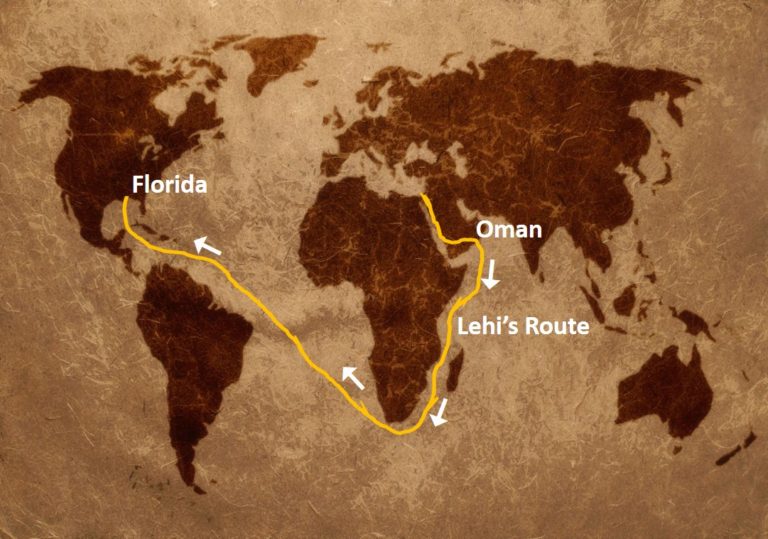


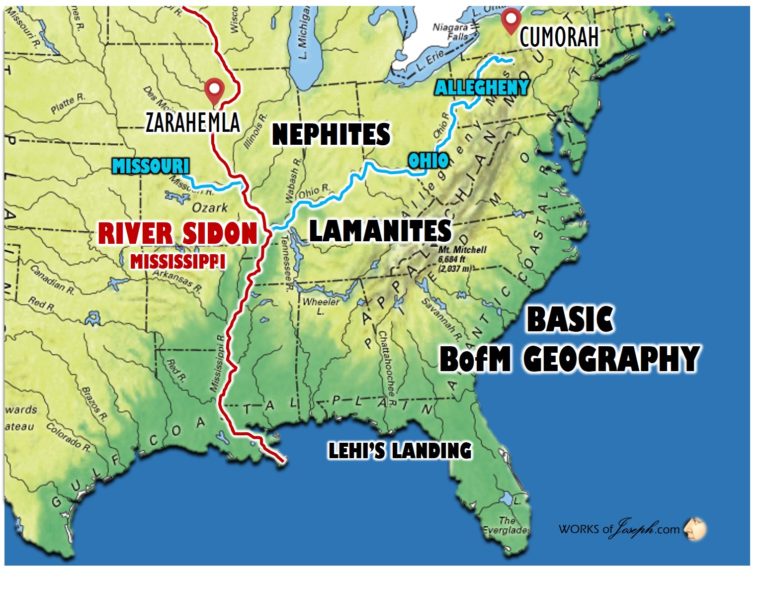


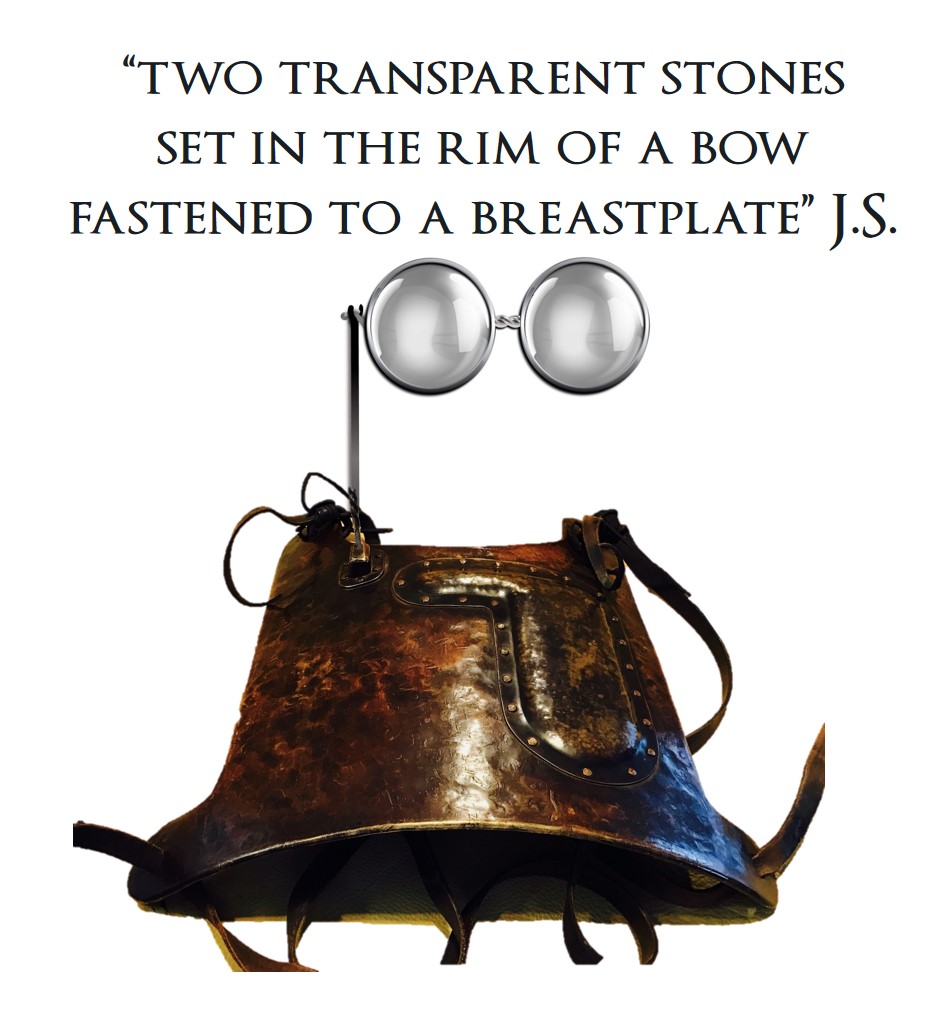


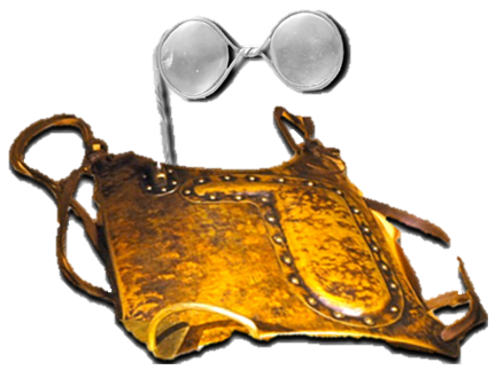


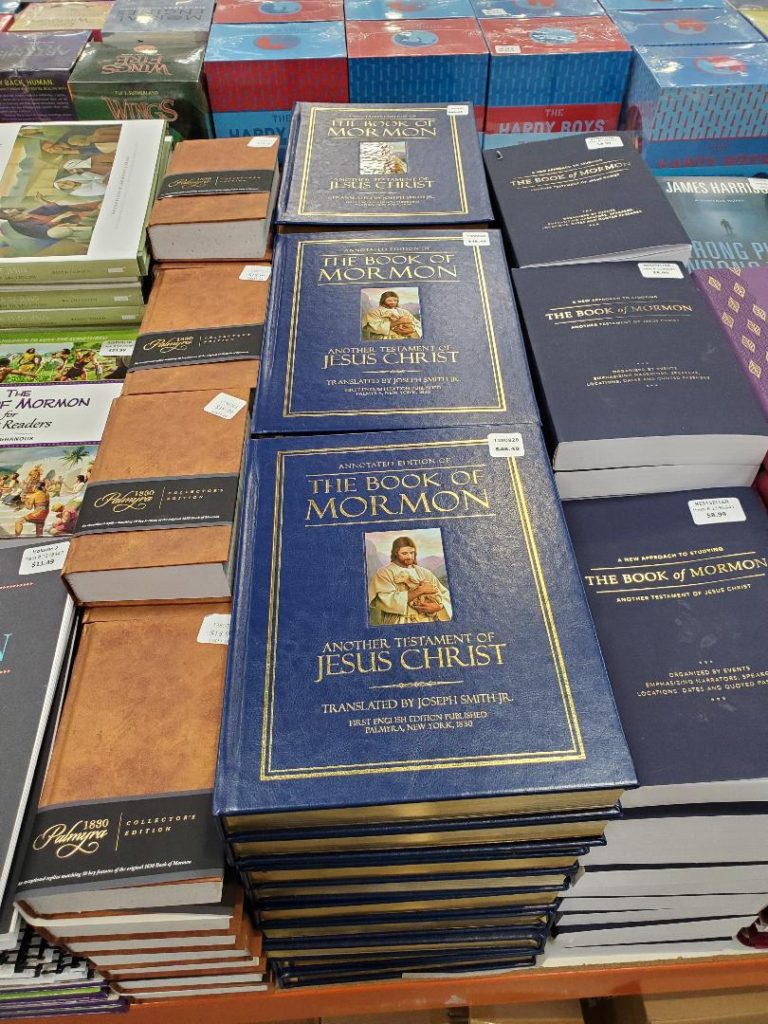




 John H. Gilbert typeset the original 1830 edition for the publisher, Mr. Egbert B. Grandin, printer of the Wayne Sentinel. His recollections of the events are instructive: “After working a few days, I said to [Hyrum] Smith on his handing me the manuscript in the morning, ‘Mr. [Hyrum] Smith, if you would leave this manuscript with me, I would take it home with me at night and read and punctuate it, and I could get along faster in the daytime, for now I have frequently to stop and read half a page to find how to punctuate it.’ [For an example see Background, p. xxvi.] His reply was, ‘We are commanded not to leave it.’ A few mornings after this, when [Hyrum] Smith handed me the manuscript, he said to me, ‘If you will give your word that this manuscript shall be returned to us when you get through with it, I will leave it with you.’ I assured Smith that it should be returned all right when I got through with it. For two or three nights I took it home with me and read it, and punctuated it with a lead pencil. This will account for the punctuation marks in pencil, which is referred to in the Mormon Report, an extract from which will be found below. “Names of persons and places were generally capitalized, but sentences had no end. The character or short ‘&’ was used almost invariably where the word ‘and’ occurred, except at the end of a chapter. I punctuated it to make it read as I supposed the author intended, and but very little punctuation was altered in proofreading. The Bible [Book of Mormon] was printed sixteen pages at a time, so that one sheet of paper made two copies of sixteen pages each, requiring 2,000 sheets of paper for each form of sixteen pages. There were thirty-seven forms of sixteen pages each—570 pages in all.” – Recollections of John H. Gilbert [Regarding printing the Book of Mormon], 8 September 1892, Palmyra, New York, typescript, Harold B. Lee Library, Brigham Young University, Provo, UT (http://www.boap.org/LDS/Early Saints/JHGilbert.html). Over the years, changes in how The Book of Mormon has been formatted have resulted in several editions being published. Currently, The Book of Mormon has been divided into chapters and verses, and many key words have been marked for cross-referencing, with the original punctuation marks inserted by Mr. Gilbert left largely unchanged throughout the varied publications.


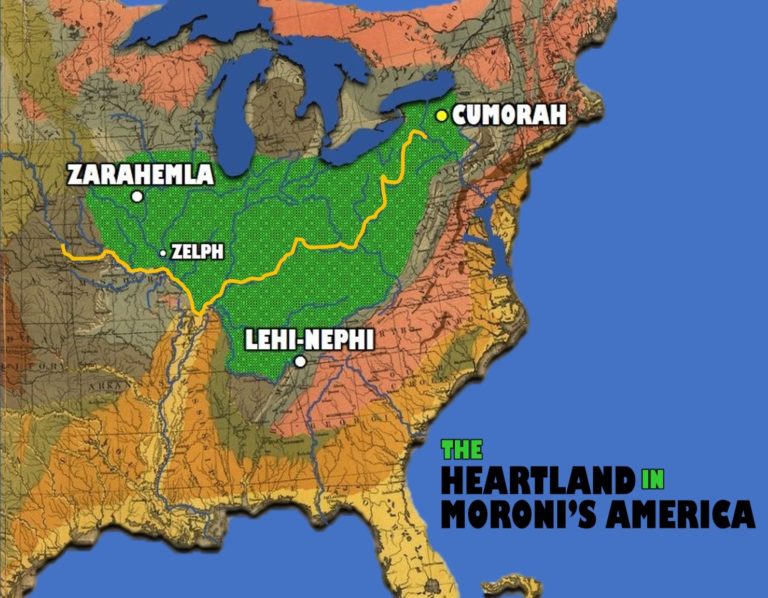


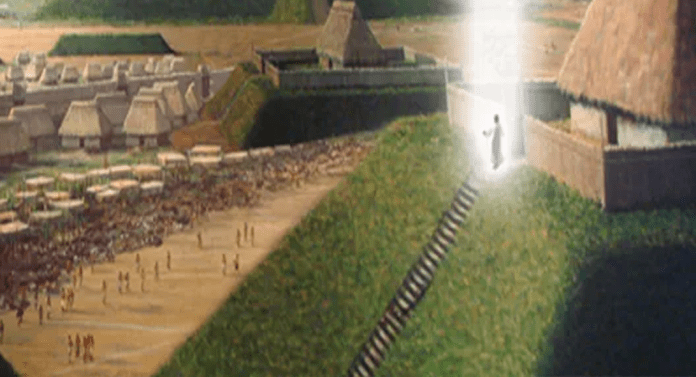

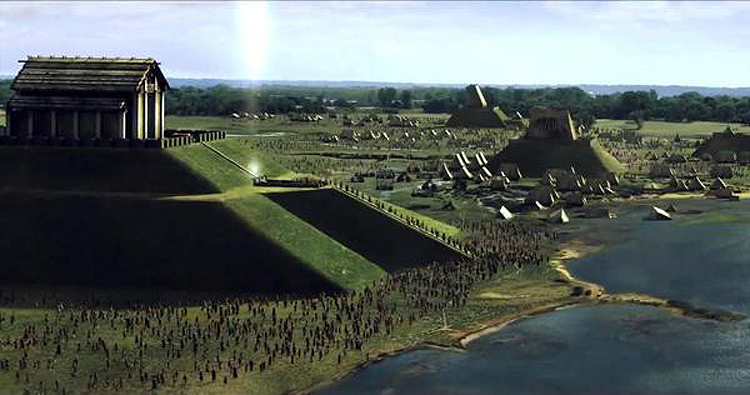
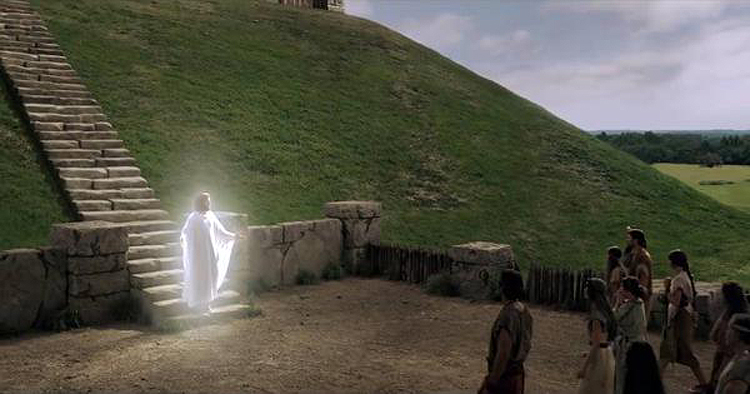
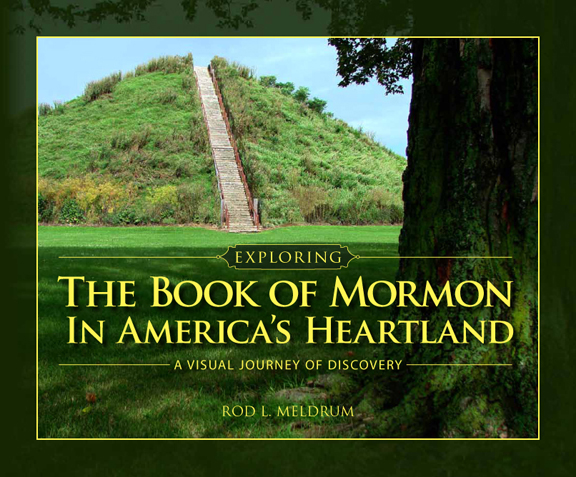
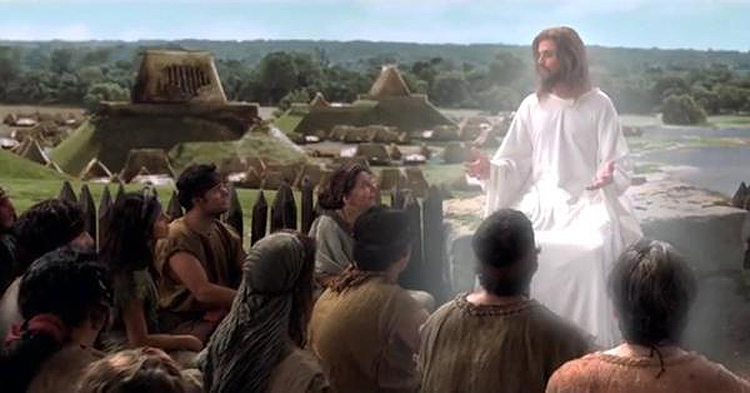
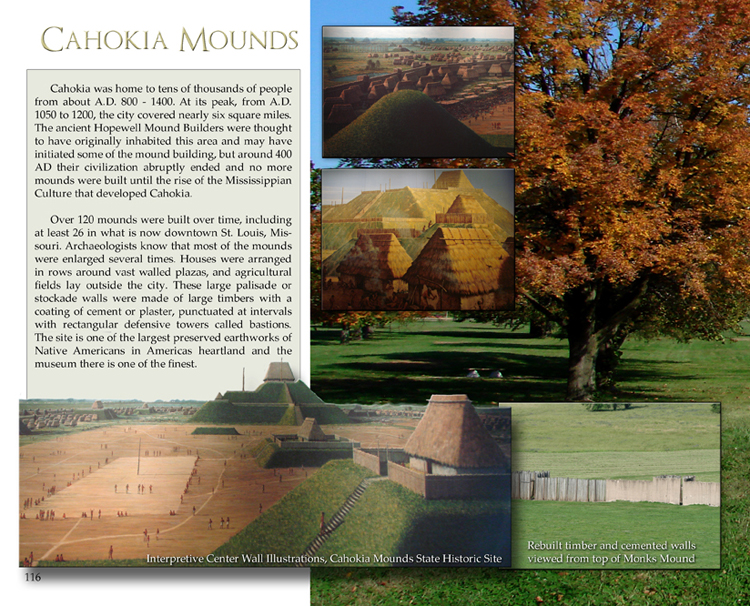
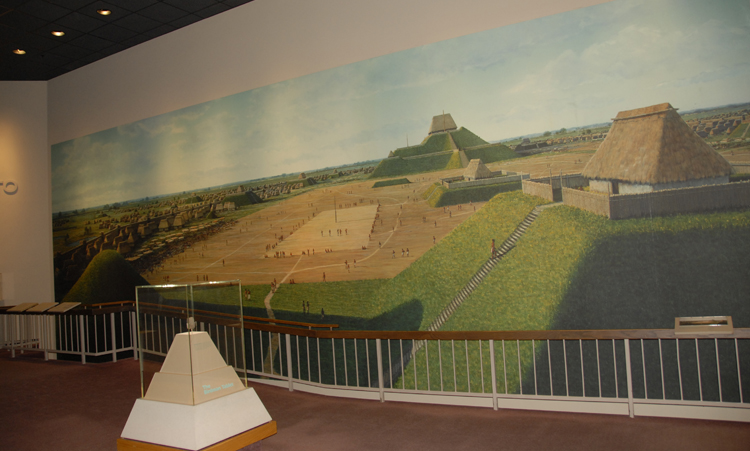
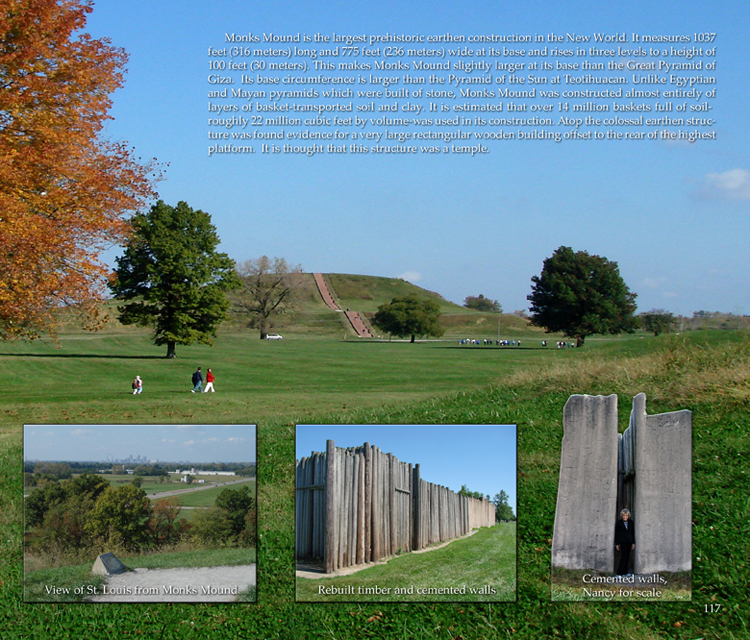
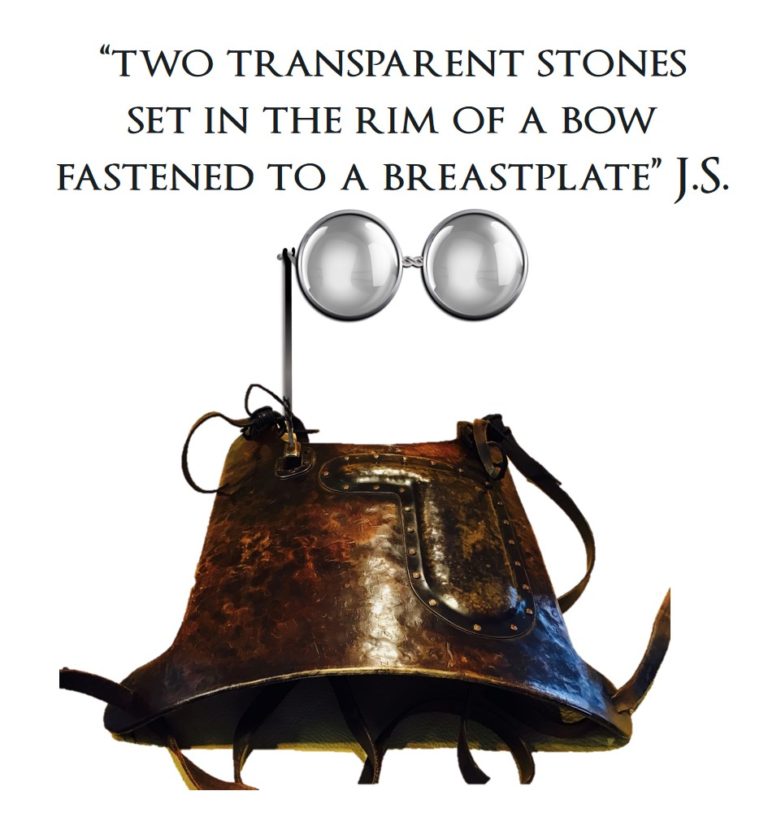





 “The following are just 4 of many direct printed quotes from the Prophetic leadership of the Church of Jesus Christ of Latter-day Saints involving the concepts of organic evolution. They were compiled by James Stoddard and shared with his permission. It is hoped that this information will help give insight and perspective on the teaching of evolution being done at nearly every university, college, and public high school across our nation to our most precious treasure, our children. For more detailed information presented in a historical context that provides tremendous understanding of the origins and growth of the theory of evolution and what it’s being taught means to us today and the terrible results it has already produced in this nation and around the world, please see the wonderful film “Creation and Evolution”, by Zion Vision below. Rod Meldrum
 Annotated Book of Mormon may be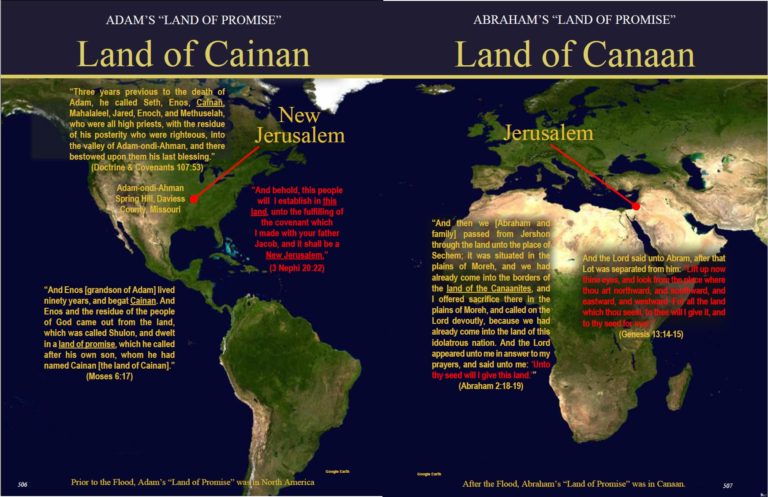


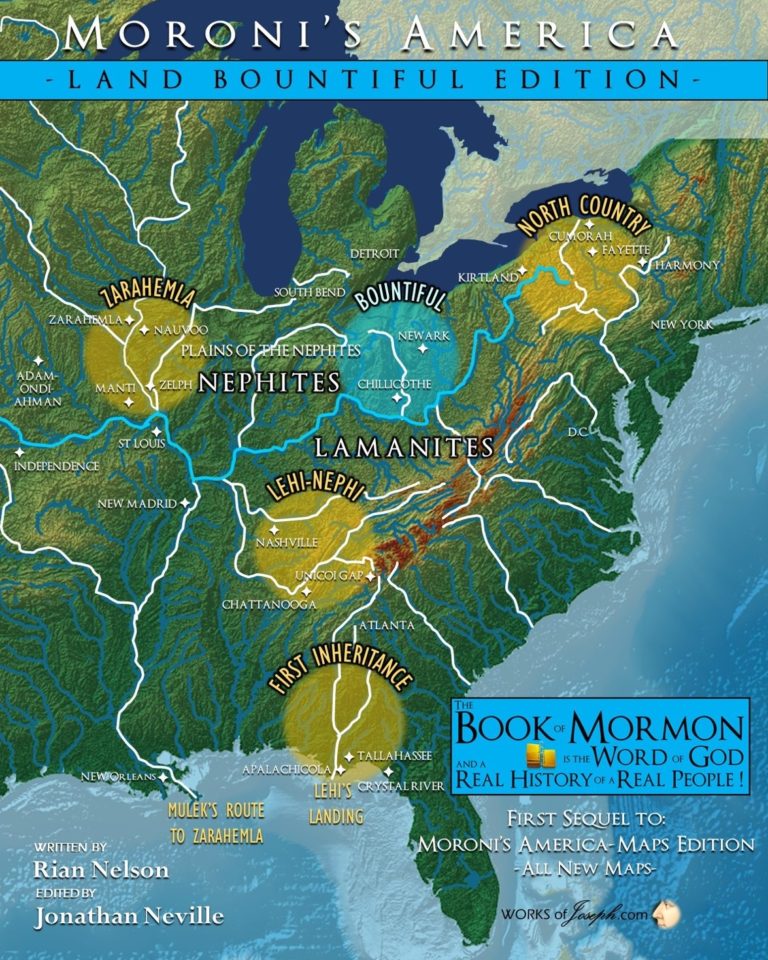


 3-Gifts for the New Heartlander for Christmas!
 Along with “
 2. “…This modernistic theory of necessity, in order to be consistent, must place the waters of Ripliancum and the Hill Cumorah some place within the restricted territory of Central America, notwithstanding the teachings of the Church to the contrary for upwards of 100 years. Because of this theory some members of the Church have become confused and greatly disturbed in their faith in the Book of Mormon. It is for this reason that evidence is here presented to show that it is not only possible that these places could be located as the Church has held during the past century, but that in very deed such is the case… It is known that the Hill Cumorah where the Nephites were destroyed is the hill where the Jaredites were also destroyed. This hill was known to the Jaredites as Ramah. It was approximately near to the waters of Ripliancum, which the Book of Ether says, “by interpretation, is large, or to exceed all… It must be conceded that this description fits perfectly the land of Cumorah in New York, as it has been known since the visitation of Moroni to the Prophet Joseph Smith, for the hill is in the proximity of the Great Lakes and also in the land of many rivers and fountains. Moreover, the Prophet Joseph Smith himself is on record, definitely declaring the present hill called Cumorah to be the exact hill spoken of in the Book of Mormon. Further, the fact that all of his associates from the beginning down have spoken of it as the identical hill where Mormon and Moroni hid the records, must carry some weight. It is difficult for a reasonable person to believe that such men as Oliver Cowdery. Brigham Young, Parley P. Pratt, Orson Pratt, David Whitmer, and many others, could speak frequently of the Spot where the Prophet Joseph Smith obtained the plates as the Hill Cumorah, and not be corrected by the Prophet, if that were not the fact. That they did speak of this hill in the days of the Prophet in this definite manner is an established record of history.” Doctrines of Salvation Joseph Fielding Smith Chapter 12
 4. “Both the Nephite and Jaredite civilizations fought their final great wars of extinction at and near the Hill Cumorah (or Ramah as the Jaredites termed it), which hill is located between Palmyra and Manchester in the western part of the state of New York. It was here that Moroni hid up the gold plates from which the Book of Mormon was translated. (Morm. 6; Ether 15.) Joseph Smith, Oliver Cowdery, and many of the early brethren, who were familiar with all the circumstances attending the coming forth of the Book of Mormon in this dispensation, have left us pointed testimony as to the identity and location of Cumorah or Ramah.” (Doctrines of Salvation, vol. 3, pp. 232-241.) (Bruce R. McConkie, Mormon Doctrine “CUMORAH,” 1966, p. 175)
 7. “Millennia ago he declared: “There shall none come into this land [he was speaking of America] save they shall be brought by the hand of the Lord… In the western part of the state of New York near Palmyra is a prominent hill known as the “hill Cumorah.” (Morm. 6:6.) On July twenty-fifth of this year, as I stood on the crest of that hill admiring with awe the breathtaking panorama which stretched out before me on every hand, my mind reverted to the events which occurred in that vicinity some twenty-five centuries ago—events which brought to an end the great Jaredite nation… Thus perished at the foot of Cumorah the remnant of the once mighty Jaredite nation, of whom the Lord had said, “There shall be none greater … upon all the face of the earth.” (Ether 1:43.)… This second civilization to which I refer, the Nephites, flourished in America between 600 B.C. and A.D. 400. Their civilization came to an end for the same reason, at the same place, and in the same manner as did the Jaredites… The tragic fate of the Jaredite and the Nephite civilizations is proof positive that the Lord meant it when he said that this “is a land of promise; and whatsoever nation shall possess it shall serve God, or they shall be swept off when the fulness of his wrath shall come upon them. And the fulness of his wrath cometh upon them when they are ripened in iniquity.” (Ether 2:9.) This information, wrote Moroni, addressing himself to us who today occupy this land, “cometh unto you, O ye Gentiles” (now, Gentiles is the term used by the Book of Mormon prophets to refer to the present inhabitants of America and to the peoples of the old world from which they came)… Now my beloved brethren and sisters everywhere, both members of the Church and nonmembers, I bear you my personal witness that I know that the things I have presented to you today are true—both those pertaining to past events and those pertaining to events yet to come. The issue we face is clear and well defined. The choice is ours. The question is: Shall we of this dispensation repent and obey the laws of the God of the land, who is Jesus Christ, or shall we continue to defy them until we ripen in iniquity That we will repent and obey and thereby qualify to receive the blessings promised to the righteous in this land, I humbly pray in the name of Jesus Christ, our Redeemer. Amen.” America’s Destiny Marion G. Romney Oct 1975
 10. [Heber C. Kimball] “prophesied that when the final last struggle came to this nation it would be at the Hill Cumorah where both of the former Nations [Jaredite and Nephite] were destroyed” (abt. Heber C. Kimball) Wilford Woodruff’s Journal 6:305, December 17, 1866
 14. McGavin and Bean explain their point of view concerning the identity of the Hill Cumorah as an ancient battlefield. The authors conclude that the scholars “need not search for [Cumorah] in Mexico or Yucatan” E. Cecil McGavin and Willard W. Bean “Cumorah-Land, An Ancient Battlefield,” in The Improvement Era 44, September 1941, 526, 571-72.
 21. “On the title page I read that it is “written to the Lamanites, who are a remnant of the house of Israel; and also to Jew and Gentile.” In the introduction to the Book of Mormon: Another Testament of Jesus Christ, it says that the Lamanites “are among the ancestors of the American Indians.” As I read the Book of Mormon, it seemed to me that it was about my American Indian ancestors. It tells the story of a people, a part of which were later described as “Lamanites,” who migrated from Jerusalem to a “land of promise” (1 Nephi 2:20) about 600 B.C.” “Come unto Me, O Ye House of Israel” By Elder Larry Echo Hawk of the Seventy Ensign Oct 2012
 23. “From the time Father Bosley located near Avon, he found and plowed up axes and irons, and had sufficient to make his mill irons, and had always abundance of iron on hand without purchasing. In the towns of Bloomfield, Victor, Manchester, and in the regions round about, there were hills upon the tops of which were entrenchments and fortifications, and in them were human bones, axes, tomahawks, points of arrows, beads and pipes, which were frequently found; and it was a common occurrence in the country to plow up axes, which I have done many times myself. I have visited the fortifications on the tops of those hills frequently, and the one near Bloomfield I have crossed hundreds of times, which is on the bluff of Honeyoye River, at the outlet of Honeyoye Lake. In that region there are many small deep lakes, and in some of them the bottom has never been found. Fish abound in them. The hill Cumorah is a high hill for that country, and had the appearance of a fortification or entrenchment around it. In the State of New York, probably there are hundreds of these fortifications which are now visible, and I have seen them in many other parts of the United States. Readers of the Book of Mormon will remember that in this very region, according to that sacred record, the final battles were fought between the Nephites and Lamanites. At the hill Cumorah, the Nephites made their last stand prior to their utter extermination, A. D., 385. Thus was Heber preaching the Gospel to the Gentiles, above the graves of the ancients of Israel, whose records with the fullness of that Gospel, and the relics of their prowess and civilization, were now whispering from the dust.” Life of Heber C. Kimball by Orson F. Whitney Mounds at Cumorah




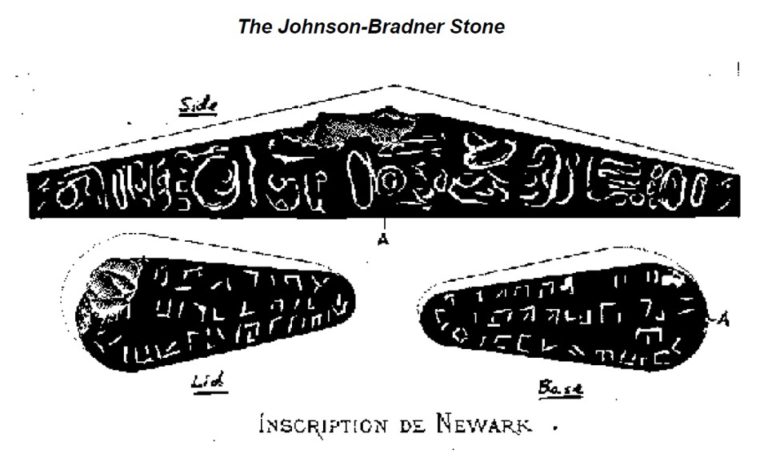


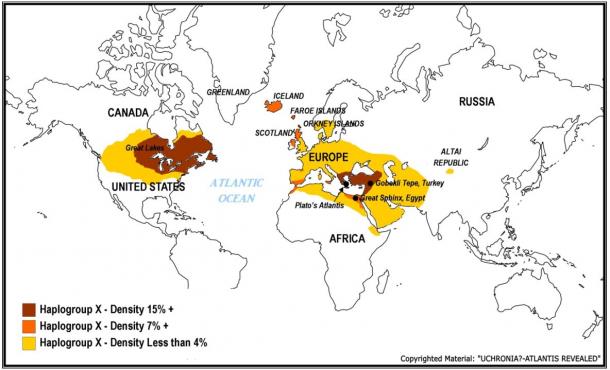


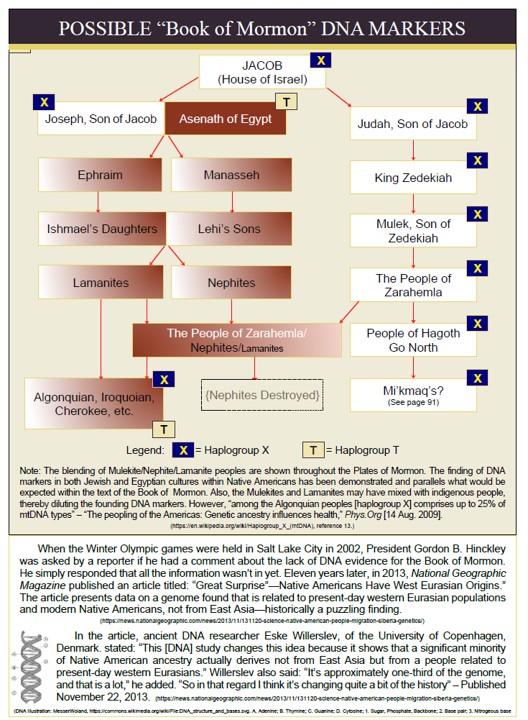


 “Soon after Adam and Eve were cast out of the Garden of Eden, the Lord gave them the law of sacrifices, which included offering the firstlings of their flocks in a similitude of the sacrifice that would be made of the Only Begotten Son of God (
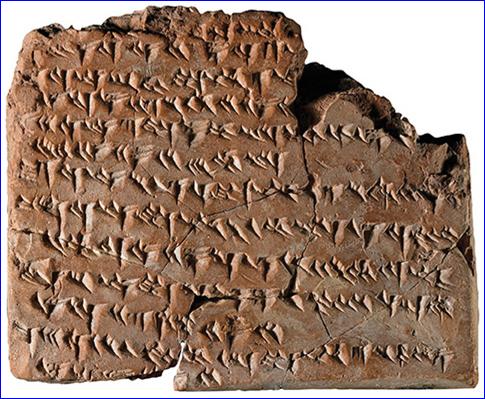


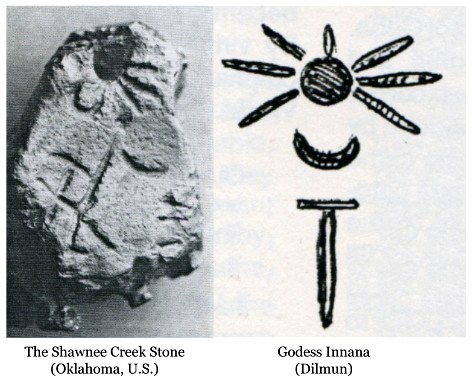


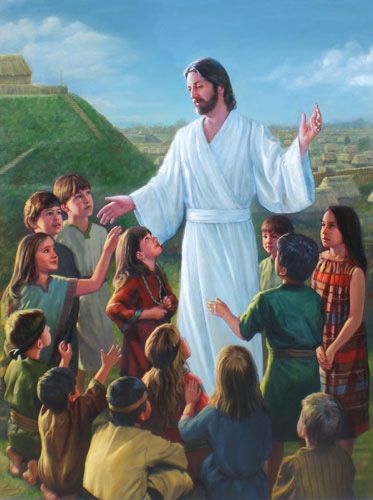

 Mormon tells us that “it was not a harsh voice, neither was it a loud voice; nevertheless, and notwithstanding it being a small voice it did pierce them that did hear to the center, insomuch that there was no part of their frame that it did not cause to quake; yea, it did pierce them to the very soul, and did cause their hearts to burn” (3 Ne. 11:3). The first time and the second time the voice spoke, the people heard it but could not understand it.
 Joseph Smith said, “Through the medium of the Urim and Thummim I translated the record by the gift, and power of God. In this important and interesting book the history of ancient America is unfolded, from its first settlement by a colony that came from the tower of Babel, at the confusion of languages to the beginning of the fifth century of the Christian era. We are informed by these records that America in ancient times has been inhabited by two distinct races of people. The first were called Jaredites and came directly from the tower of Babel. The second race came directly from the city of Jerusalem, about six hundred years before Christ. They were principally Israelites, of the descendants of Joseph. The Jaredites were destroyed about the time that the Israelites came from Jerusalem, who succeeded them in the inheritance of the country. The principal nation of the second race fell in battle towards the close of the fourth century. The remnant are the Indians that now inhabit this country. This book also tells us that our Saviour made his appearance upon this continent after his resurrection, that he planted the gospel here in all its fulness, and richness, and power, and blessing; that they had apostles, prophets, pastors, teachers and evangelists; the same order, the same priesthood, the same ordinances, gifts, powers, and blessing, as was enjoyed on the eastern continent…” The Wentworth Letter, Joseph Smith Jr.
 There is a temple mound situated above the Ohio River near Cincinnati. “Fragments of burnt limestone may still be seen on the top. The mound is a rectangle two hundred and twenty-five feet long by one hundred and twenty feet broad, and seven feet high.” In contrast to the hewn stone buildings and altars of Mexico, the Ohio mound has the right dimensions to have accommodated a timber and burnt lime plaster (“cement”) building of the size and proportions of Solomon’s Temple.” J. P. Maclean, The Mound Builders – Archaeology of Butler County, Ohio, 1904, pp. 222-223.
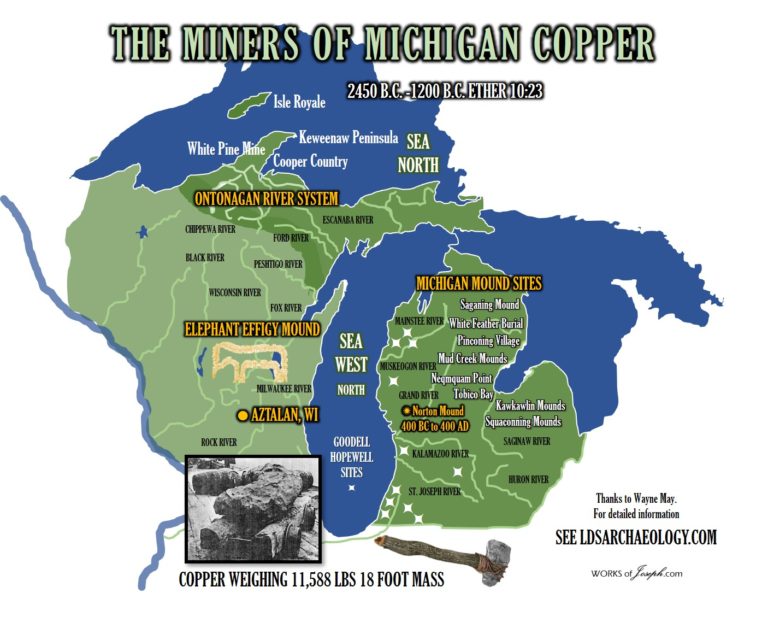
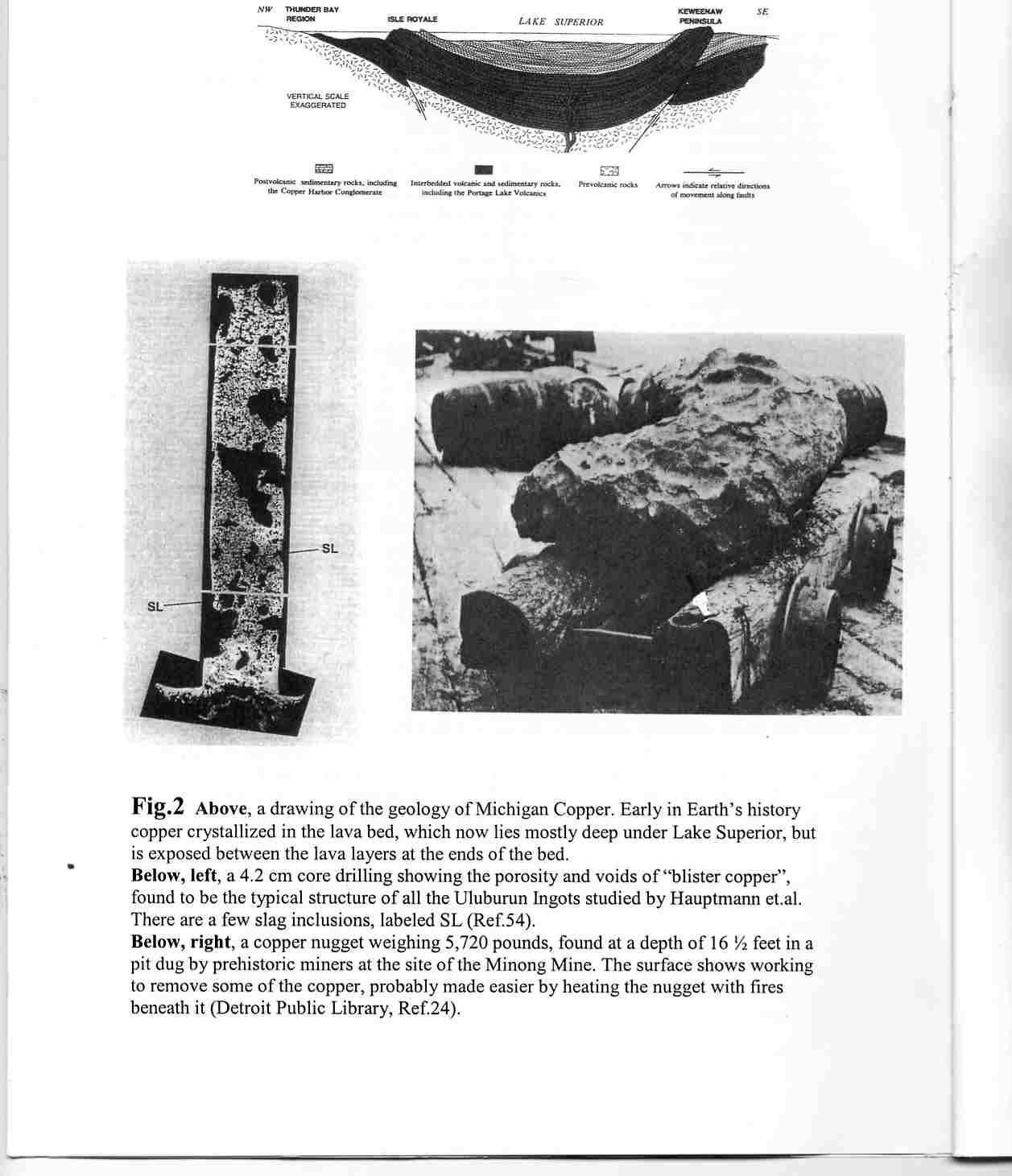



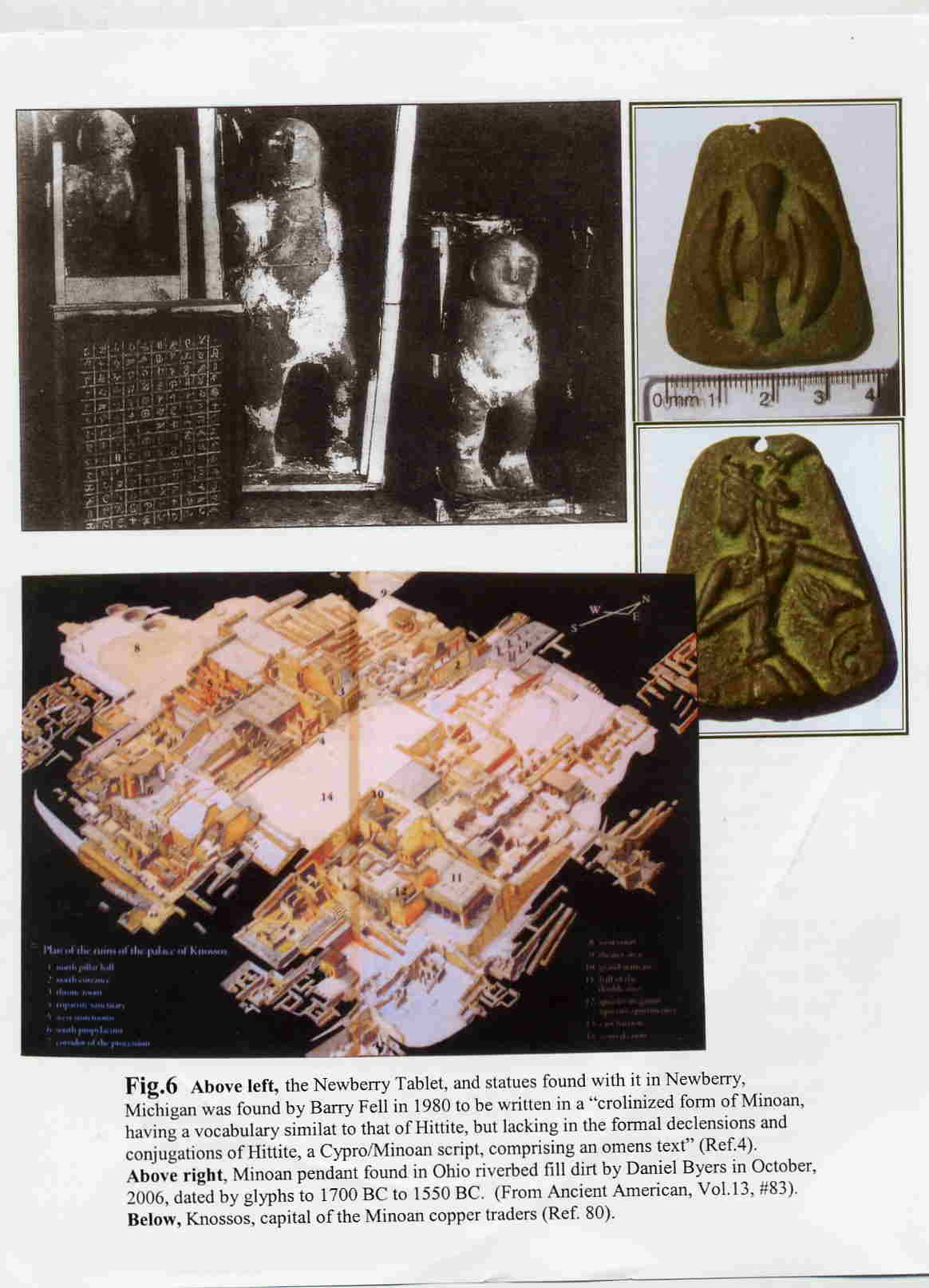
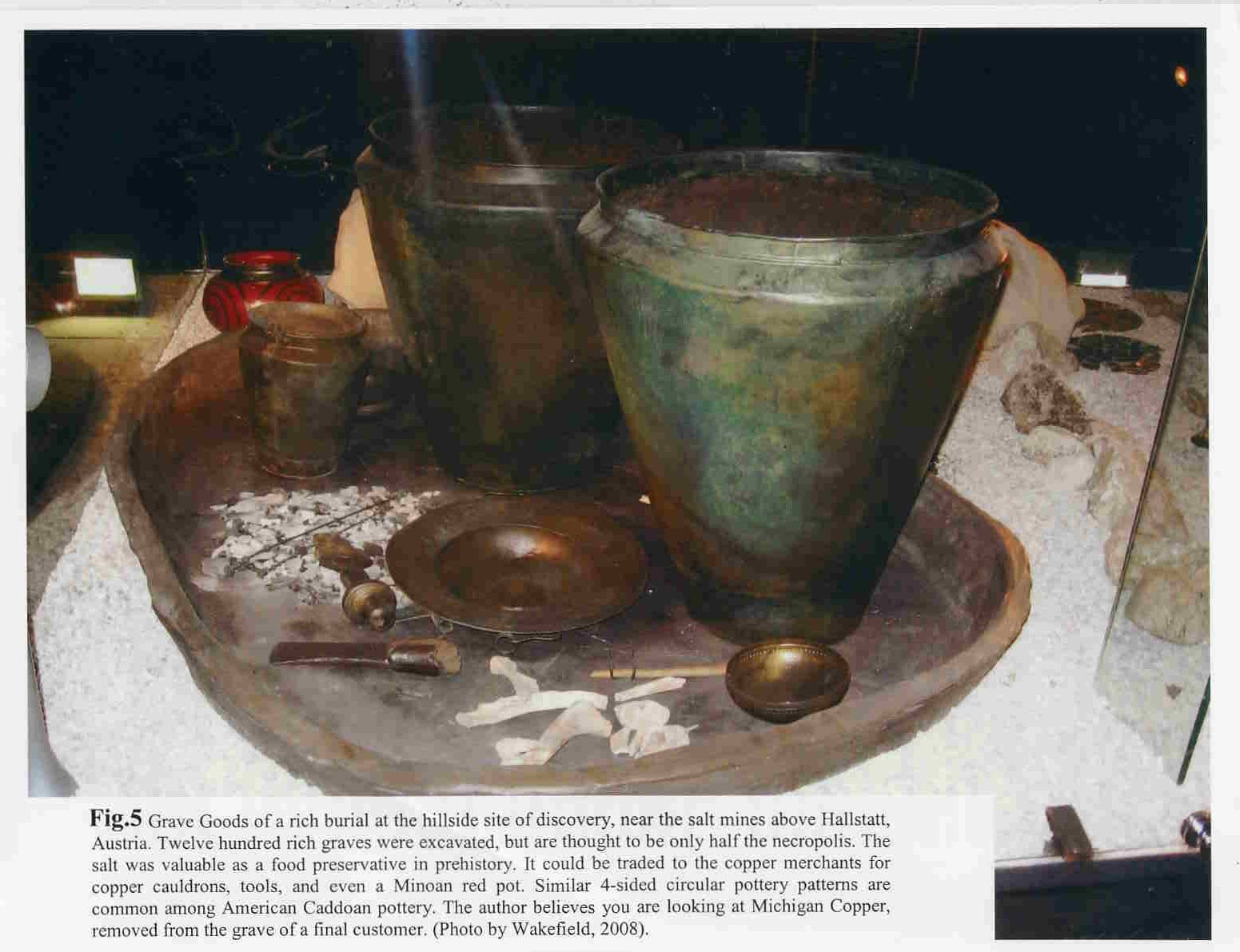


 “Good evening. It’s a great honor and privilege to greet you this evening—the beautiful Sabbath evening that is—in the name of the Lord Jesus Christ. We meet in his name; it’s because of him that we’re here.
 We talk of a person having a good spirit or a bad spirit. We talk of the spirit of ‘76. We are going to celebrate our two hundredth national anniversary in the not-too-distant future, and this spirit of ‘76 is to permeate everything that we do. This evening I’d like to talk a bit about the spirit of ‘76 and what we are really dong when we celebrate the Fourth of July.
 To everyone the Fourth means parades with marching bands, horses, floats, and beautiful girls such as are here this evening. It also means the flag, Old Glory, the star-spangled banner, the red, white, and blue. There is a poem that says:
 I’m proud of the USA because it has provided the means to establish and carry forth the gospel
 Calling missionaries from other countries wouldn’t just take the load from the United States, because I don’t anticipate any cutback in the missionary force from the USA. In fact, we need to increase the missionary force here because the Lord is going to open more doors for us and we’re going to go places we’ve never been before. We’re going to need this group that can come from the USA to go into lands that we would consider behind the Iron Curtain or the Bamboo Curtain. When the time comes to go, the Lord will open the curtains. There will be no curtains. We can penetrate them. We need to get ready to do that kind of work because it is vitally important that good people everywhere have an opportunity to hear the gospel. What happens to a young man when he has given the Lord his two years? Well, that’s where we produce future mission presidents and stake presidents and bishops. That’s what happens there. I’ve seen it happen among the peoples of those countries when their own young men have filled missions.
 Another reason why I love the USA is that she has produced some great men—great men that you can hold up as an example, that you can look to for leadership. George Washington, whom many call the father of this country, was such a man. In his first inauguration he set a tone that everyone could profitably seek to emulate. After he had accepted the oath of office from Robert Livingston of New York, he added the words “so help me God,” and then he kissed the Bible and went back to work.
  And then, of course, there was Abraham Lincoln, who could not abide that man should be in bondage one to another. Born in a log cabin, he followed the study course of the Bible, the scriptures, and you couldn’t do better than that. He was probably one of the most quoted men of all times. They tell me his words fill fifteen volumes. The 2 1/2-minute talk that he delivered at Gettysburg I presume will stand always and forever as a masterpiece:
 The greatest American who has ever lived in this dispensation was the Prophet Joseph Smith, who was raised up by the Lord.
 Wherever the old stars and stripes flies or Old Glory waves, there the kingdom of God must be.
 Hartman Rector Jr.r., was a member of the First Quorum of the Seventy of The Church of Jesus Christ of Latter-day Saints when this fireside address was given at Brigham Young University on 30 June 1974.

 “For my first post in 2019, I’m showing another instance of M2C* censorship. This one is from the Brigham Young lesson manual (Teachings of the Presidents of the Church – Brigham Young).
 Church historians concede they censored Cumorah in Saints


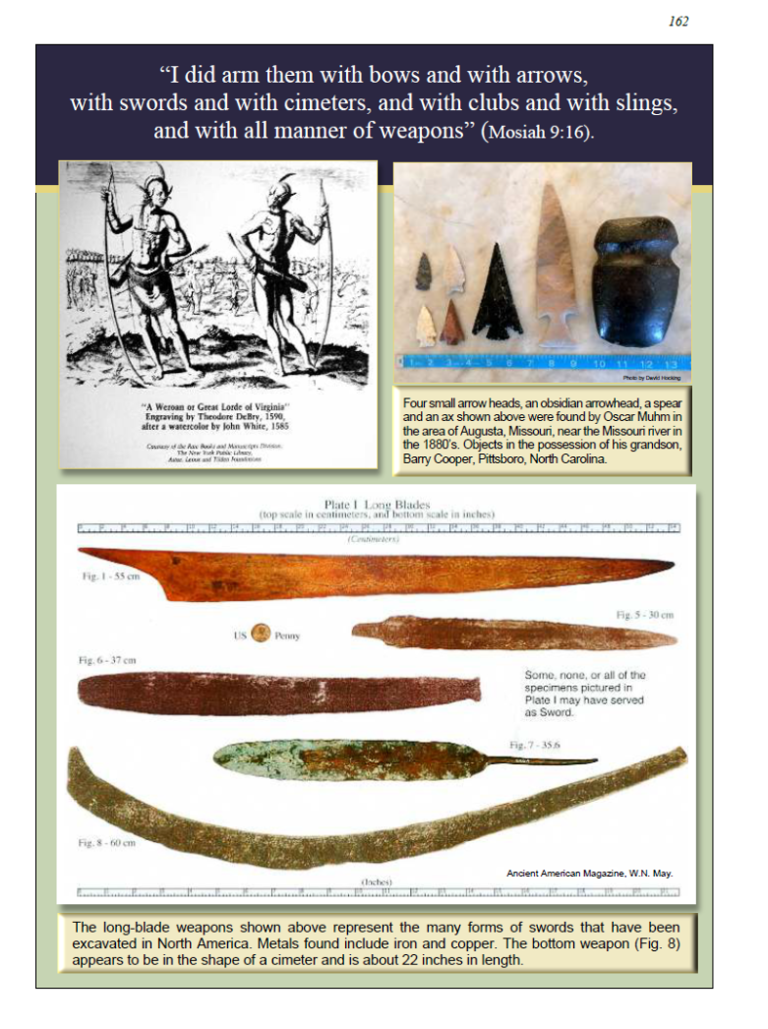
 “From the time Father Bosley* located near Avon [Livingston County, NY], he found and plowed up axes and irons, and had sufficient to make his mill irons, and had always abundance of iron on hand without purchasing. In the towns of Bloomfield, Victor, Manchester, and in the regions round about, there were hills upon the tops of which were entrenchments and fortifications, and in them were human bones, axes, tomahawks, points of arrows, beads and pipes, which were frequently found; and it was a common occurrence in the country to plow up axes, which I have done many times myself. “The hill Cumorah [the Jaredite hill Ramah] is a high hill for that country and had the appearance of a fortification or entrenchment around it. In the State of New York, probably there are hundreds of these fortifications which are now visible, and I have seen them in many other parts of the United States. “Readers of the Book of Mormon will remember that in this very region, according to that sacred record, the final battles were fought between the Nephites and Lamanites. At the hill Cumorah, the Nephites made their last stand prior to their utter extermination, A. D., 385.” – Life of Heber C. Kimball, by Orson F. Whitney, Salt Lake City, UT: Stevens & Wallis, Inc. [1888], 25.


 Near the feet was found a piece of copper, weighing three ounces. From its shape it appears to have been used as a plumb, or for an ornament as near one of the ends is a circular crease, or groove, for tying a thread; it is round, two and a half inches in length, one inch in diameter at the centre and half an inch at each end. It is composed of small pieces of native copper pounded together, and in the cracks between the pieces are stuck several pieces of silver, one nearly the size of a four-penny piece, or half a dime.
 “Somewhere in the Mountains of Wyoming, a sheep herder stumbled upon this 24 inch iron sword of unusual workmanship. The sword was sent to the Smithsonian Museum and they put a date upon it between 100 BC and 200 AD, Hopewell timeline. How the test was conducted, we do not know. These photos were supplied by the discoverer and are here for our readers to view.”
  ” Lying immediately over, or on the forehead of the body, were found three large circular bosses, or ornaments for a sword-belt or a buckler: they are composed of copper overlaid with a thick plate of silver. The fronts are slightly convex, with a depression like a cup in the centre, and measure two inches and a quarter across the face of each. On the back side, opposite the depressed portion, is a copper rivet or nail, around which are two separate plates, by which they were fastened to the leather. Two small pieces of the leather were found lying between the plates of one of these bosses; they resemble the skin of a mummy and seem to have been pre served by the salts of copper. The copper plates are nearly reduced to an oxyde, or rust. The silver looks quite black, but is not much corroded, and in rubbing is quite brilliant. Two of these are yet entire 5 the third one is so much wasted that it dropped in pieces in removing it from the earth. Around the rivets of one of them is a small quantity of flax or hemp, in a tolerable state of preservation. Near the side of the body was found a plate of silver, which appears to have been the upper part of a sword-scabbard; it is six inches in length and two inches in breadth, and weighs one ounce. It has no ornaments or figures, but has three longitudinal ridges, which probably corresponded with the edges or ridges of the sword; it seems to have been fastened to the scabbard by three or four rivets, the holes of which remain in the silver.
 ” Two or three broken pieces of a copper tube were also found filled with iron rust. These pieces, from their appearance, composed the lower end of the scabbard, near the point of the sword. No signs of the sword itself were discovered, except the appearance of rust above mentioned. Near the feet was found a piece of copper weighing three ounces [now in the Museum of the Antiquarian Society of Worcester]. From its shape it appears to have been used as a plumb, or for an ornament, as near one of the ends is a circular crease or groove, for tying a thread: it is round, two inches and a half in length, one inch in diameter at the centre, and half an inch at each end. It is composed of small pieces of native copper pounded together; and in the cracks between the pieces are stuck several pieces of silver, one nearly the size of a half-dime. A piece of red ochre or paint, and a piece of iron ore [hematite] which had the appearance of having been partially vitrified [polished.?], were also found.
 “The body of the person here buried was laid upon the surface of the ground, with his face upwards, and his feet pointing to the south-west. From the appearance of several pieces of charcoal and bits of partially burned fossil coal, and the black color of the earth, it would seem that the funeral obsequies had been celebrated by fire; and while the ashes were yet hot and smoking, a circle of these flat stones had been laid around and over the body. The circular covering was about eight feet in diameter; and the stones yet look black, as if stained by fire and smoke. This circle of stones seems to have been the nucleus over which the mound was formed, as immediately over them is heaped the common earth of the adjacent plain. At the time of opening it, the height was 6 feet and diameter between 30 and 40. It has every appearance of being as old as any in the neighborhood, and was, at the first settlement of Marietta, covered with large trees. It seems to have been made for this single personage, as the remains of one skeleton only were discovered. The bones were much decayed, and many of them crumbled to dust on exposure to the air.”
 Engravings of the silver-plated discs and also of the embossed silver plate, supposed by Dr. Hildreth to have been a sword ornament, are herewith presented. These articles have been critically examined, and it is beyond doubt that the copper ” bosses ” are absolutely plated, not simply overlaid, with silver. Between the copper and the silver exists a connection, such as, it seems to me, could only be produced by heat ; and if it is admitted that these are genuine remains of the mound-builders, it must, at the same time, be admitted that they possessed the difficult art of plating one metal upon another. There is but one alternative, viz., that they had occasional or constant intercourse with a people advanced in the arts, from whom these articles were obtained. Again, if Dr. Hildreth is not mistaken, oxidized iron, or steel, was also discovered in connection with the above remains ; from which also follows, as a necessity upon the previous assumption, the extraordinary conclusion that the mound-builders were acquainted with the use of iron the conclusion being, of course, subject to the improbable alternative already mentioned.
 Below is information from Rod Meldrum’s #1 Best Selling LDS book on Geography, “Exploring the Book of Mormon in America’s Heartland”.
  “This past summer (2010), Dr.Harold Alanen from Thunder Bay,Canada, experienced a rare and exciting adventure. Walking private property on Dog Lake, near the north shore of Lake Superior, he chanced upon a big ancient copper tool or weapon, see Fig. 1, Plate I. Nearby he found a cache of 11 smaller copper objects. Dr. Alanen sent pictures of the big artifact, asking me what it could have been used for?…


 I hope by now you realize that there

