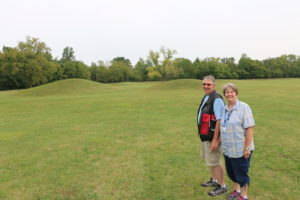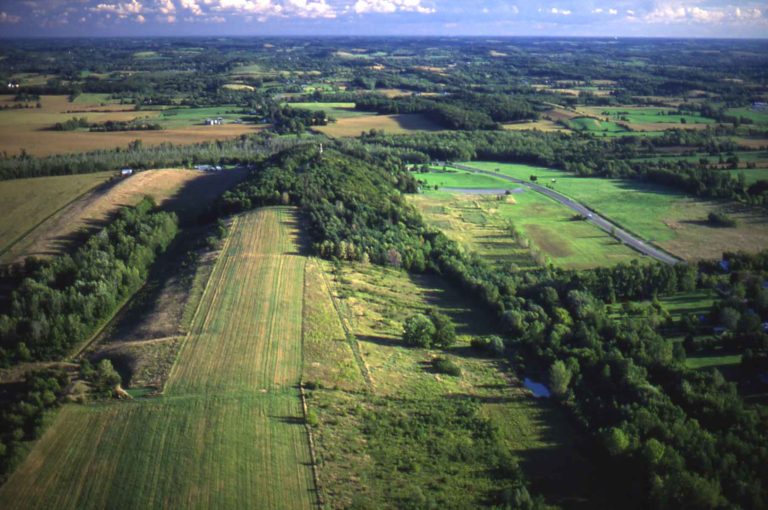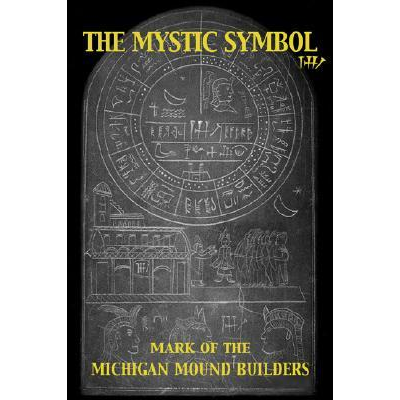
At the 24th Book of Mormon Evidence Conference, I shared a presentation with our guests about how the Nephite Culture of the Book of Mormon has so many amazing similarities to the Hopewell Culture in the United States, both dated from c.600 BC to 400 AD . Many archaeologists, scientists and historians who aren’t members of the Church of Jesus Christ of Latter-day Saints, know and believe the history of the Hopewell Culture and verify the dating which parallels the Book of Mormon. At the link below, you will also find the fantastic article I referenced of a discussion between Archaeologist of Ohio William Mills in 1917 with James E. Talmadge.
My talk along with all of those from this previous conferences are streaming on our new online streaming service today. Currently we have over 900 fantastic videos you can choose from. Our Subscription site isHERE and my presentation title is, “Nephite Hopewell Parallels” found here:
The Hopewell & Nephites- Parallel Histories
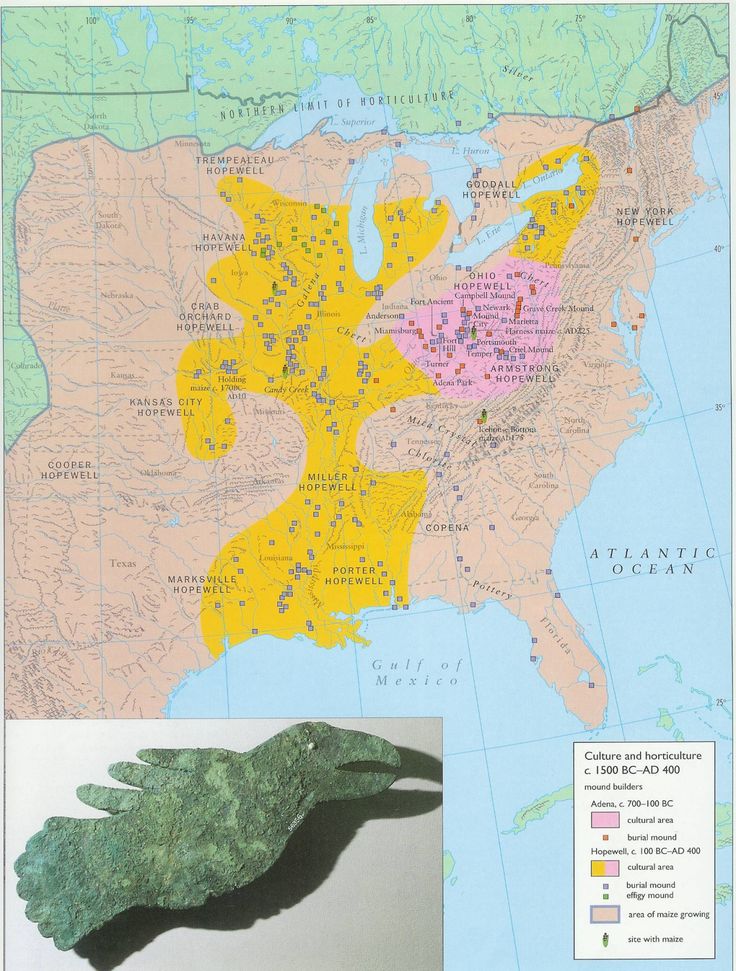
“The Hopewell culture describes the common aspects of a segment of Native American culture that flourished along rivers in the northeastern and Midwestern United States from approximately 400 B.C. to 500 A.D., a time period that nearly matches the span of the developed Nephite societies. The Hopewell peoples were not a single culture or society, but a widely dispersed set of related populations as shown on the map on the left. They were connected by a common network of trade routes, in what is known as the “Hopewell exchange system.” The name ‘Hopewell’ was chosen by Warren K. Moorehead, known as the ‘Dean of American archaeology,’ after his explorations in 1891 and 1892 of a group of mounds in Ross County, Ohio. He named the mounds after Mordecai Hopewell, the owner of the land. Subsequently all mounds that have similar identifications are named as the Hopewell Mound Builders within an interaction sphere.Currently, the Hopewell interaction sphere has come to encompass regions from the Southeastern United States as far south as the Crystal River Indian Mounds in Florida up to the southeastern Canadian shores of Lake Ontario in the north. Within this geographic area, inter societal exchanges were common along major waterways. The Hopewell exchange system received materials from all over what is now the heartland of the United States. Many objects created by the Hopewell cultures have been excavated and show a remarkable degree of commonality to items described within the text from the Nephite and Lamanite civilizations. In 1848, Ephraim George Squier, A.M., and Edwin Hamilton Davis, M.D., published the book, Ancient Monuments of the Mississippi Valley: Comprising the Results of Extensive Original Surveys and Explorations. The work was a landmark in American scientific research and was the genesis of archaeology as a scientific discipline. More importantly, the book was the first volume of the Smithsonian Institution’s Contributions to Knowledge series and the Institution’s first publication. Among Squier and Davis’ most important achievements was their systematic approach to analyzing and documenting the sites they surveyed, including Seip Mound, southwest of Chillicothe, Ohio (survey Plate XXI, No. 2 shown below on the left), which they discovered in 1846, and the mapping of the Mound City Group, also in Chillicothe, Ohio, which has been restored using their data and is now part of Hopewell Culture National Historical Park. Squier and Davis collection of ancient Mound objects can now be seen at the British Museum in London, England. A few of their maps will be used in this edition as most of those mounds they identified have been destroyed by population growth that demanded land as the United States expanded westward. Their drawings are left to us to study of what was a highly educated, cultured and civilized society with roads, highways and cities rivaling the sizes of those in Europe.
Click to Enlarge
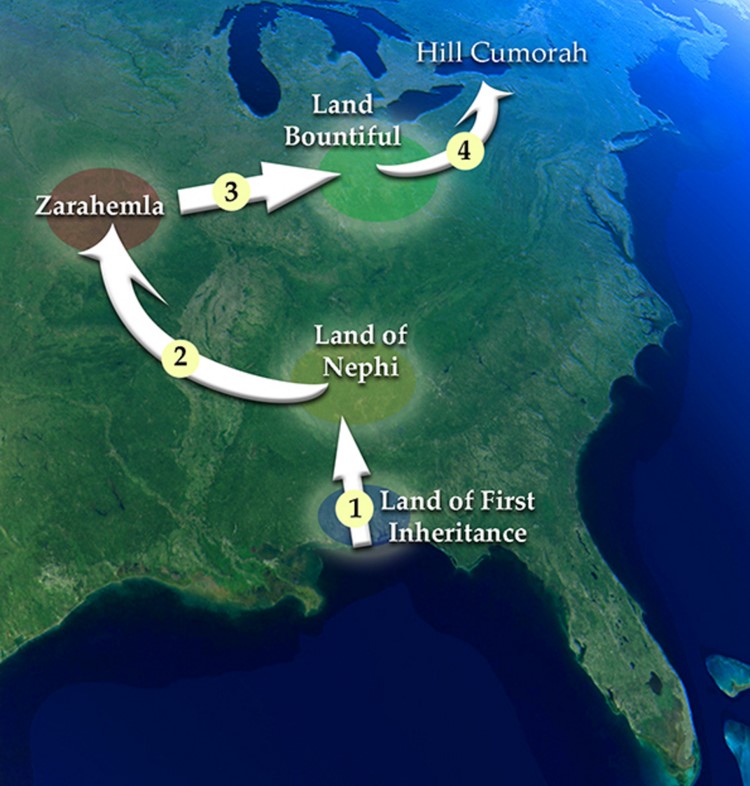
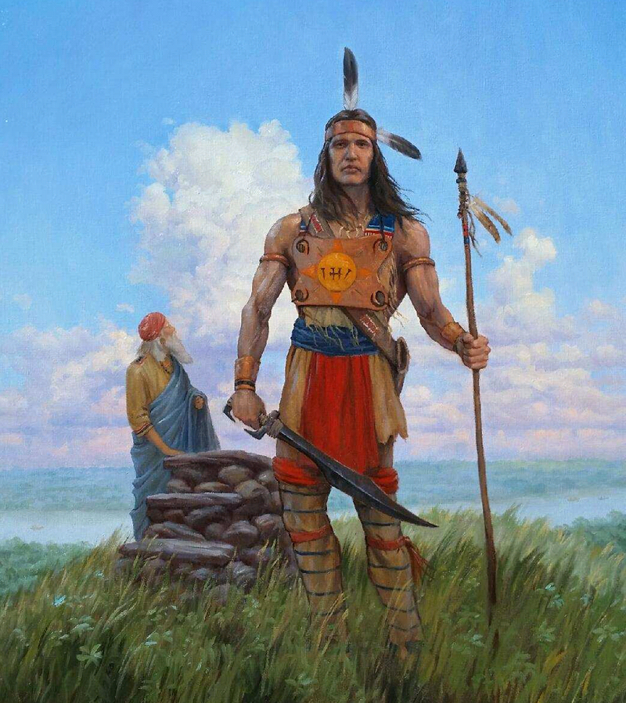
The Annotated Edition of the Book of Mormon highlights various excavated artifacts throughout the text that come from the “Mound Builder’s” earth or “dust” (Isaiah 29:4), like those found at Zelph’s Mound, providing physical or “circumstantial evidences” (Teachings of the Prophet Joseph Smith, Section Five [1842-43], 267) showing those mound builders shared common associations with the Nephite cultures. Lehi’s party arrived in the Promised Land in roughly 590 B.C. as a small group. Within a few years, those who followed Nephi separated themselves from those who followed Laman and Lemuel. By 570 B.C. the two groups, the Nephites and the Lamanites, were then living in separate geographical regions with different lifestyles. The Nephites settled in a small region maintaining their flocks, herds and crops while the followers of Laman lived as wanderers feeding off of wild animals, “becoming wicked and wild and ferocious, yea, even becoming Lamanites” (Helaman 3:16). By 500 B.C., one hundred years after leaving Jerusalem, the populations were now well into the second and third generations and growing rapidly. In 279 B.C., king Mosiah leaves the land of their first inheritance, the land of Nephi, and finds the people of Zarahemla, who are more numerous than his group (Omni 1:17), and joins with them. After learning their language, he discovers that their history parallels their arriving in the land at about the same time period when both founding groups fled Jerusalem. It is quite reasonable then, that by 200 to 100 B.C., the best dating of the beginning of the Hopewell societies, that the population within the Hopewell interaction spheres parallels the history and culture within the pages of the Book of Mormon (see Appendix, pp. 538-539, for a list of 50 correlations). Moroni, the last Nephite prophet and historian to write on his metal plates, describes the destruction of his people in about 421 A.D. Remarkably, the culture of the Mound Builders suddenly collapses between 400-500 A.D. Those groups of “Mound Builders,” who exhibited similar characteristics of the Nephites, in the working in metals, in making fine jewelry and cloth, in implementing battle armaments such as head-plates, arm-shields, breastplates, etc., and engaging in similar military tactics of digging ditches around high banks of earth such as this recorded event: “Now behold, the Lamanites could not get into their forts of security by any other way save by the entrance because of the highness of the bank, which had been thrown up and the depth of the ditch, which had been dug round about, save it were by the entrance” (Alma 49:18), have all disappeared from history. The early European settlers of North America observed Native American Indians as just savages, yet in a revelation given through the prophet Joseph Smith to Parley P. Pratt, Oliver Cowdery and Ziba Peterson, in Manchester, NY, early October 1830 the Lord declared: “And now concerning My servant Parley P. Pratt, behold, I say unto him that as I live I will that he shall declare My gospel and learn of Me, and be meek and lowly of heart. And that which I have appointed unto him is that he shall go with My servants, Oliver Cowdery and Peter Whitmer, Jun., into the wilderness among the Lamanites. And Ziba Peterson also shall go with them; and I Myself will go with them and be in their midst; and I am their advocate with the Father, and nothing shall prevail against them” (Doctrine and Covenants Section 32:1-3: emphasis added). The Lord has declared where some of the surviving Lamanites were and are—and He will be a personal guide to the help His servants in teaching them their House of Israel heritage.” Annotated Book of Mormon by David Hocking and Rod Meldrum pages 536-537. Charts below are from page 538 and 539 of the same book. Purchase Here
Parallels of the Hopewell Culture as described by William C. Mills, Chief Archaeologist of Ohio, with the Book of Mormon [May 20, 1917; Sunday] by James E Talmage
“Attended Sunday School and afternoon service in Hawthorne Hall, and was a speaker at each assembly. Evening meetings here, as also in Brooklyn, have been discontinued for the summer. The attendance both at Sunday School and afternoon meeting was surprisingly large in view of the fact that many of the Utah college students have left for the vacation period. This evening at the hotel I had a long and profitable consultation with Professor Wm. C. Mills, State Archaeologist of Ohio. He is continuing his splendid work of exploration in the Ohio mounds, and I went over with him again the remarkable agreement between his deductions and the Book of Mormon story. He has reached the following (10) conclusions: The area now included within the political boundaries defining the State of Ohio was once inhabited by two distinct peoples, representing two cultures, a higher and a lower.
These two classes were contemporaries; in other words, the higher and the lower culture represented distinct phases of development existing at one time and in contiguous sections, and furnish in no sense an instance of evolution by which the lower culture was developed into the higher.
These two cultural types or distinct peoples were generally in a state of hostility one toward the other, the lower culture being more commonly the aggressor and the higher the defender.
During limited periods, however, the two types, classes, or cultures, lived in a state of neutrality, amounting in fact to friendly intercourse.
The numerous exhumations of human bones demonstrate that the people of the lower type, if not indeed both cultures, were very generally affected by syphilis, indicating a prevalent condition of lasciviousness.
Their (are) two peoples or cultures…the lower culture was most commonly the assailing party, while the people of the higher type defended as best they could but in general fled.
As a further consequence of this belligerent status they buried their dead, with or without previous cremation, in such condition as to admit of expeditious covering up of the cemeteries by the heaping of earth over the sepulchers [sic], in which hurried work the least skilled laborers and even children could be employed.
From a careful collating of data it is demonstrated that the general course of migration through the area now defined as the State of Ohio was inward from the west and outward toward the east.
Professor Mills states that no definite data as to the age of these peoples have as yet been found, but that the mounds may date back a few hundred years or even fifteen hundred or more.
Several years ago I placed a Book of Mormon in the hands of Professor Mills and, while he is reticent as to the parallelism of his discoveries and the Book of Mormon account, he is impressed by the agreement.”
James E. Talmage 20 May 1917 See copies below from William Mills 1914 publication called Archaeological Atlas of Ohio
Chart above courtesy of Wayne May Ancient American Magazine here William Mills 1914 publication called Archaeological Atlas of Ohio. Entire book here:
DOES THE GEOGRAPHY OF THE BOOK OF MORMON MATTER?
When Christ appeared to the Nephites as the resurrected Savior, He blessed them, He taught them He prayed with them and for them. He also quoted to them the words of Isaiah. He reminded them that they had been given THIS LAND for their inheritance and were warned that they would not be allowed to remain on THIS LAND if they did not remain faithful. This emphasis shows the significance of THIS LAND to the Book of Mormon people, and the people who would be brought by the hand of God to THIS LAND and now occupy THIS LAND. With over 1400 references to “this land” in the Book of Mormon, I’m not sure how the Book of Mormon prophets could have made it clearer. THIS LAND matters. Geography matters. Those of us on THIS LAND the “promised land,” the Land of Liberty, the Land of the New Jerusalem need to know who we are. America is THIS LAND. America is a covenant land. I live on THIS LAND. Even the chapter heading of 3 Nephi also confirms this truth. The geography of the Book of Mormon matters to me.” Rod Meldrum FIRM Foundation President
Hopewell and Nephites-Same Travel PatternWhy Lehi Landed in Florida. (Apalachicola, FL Lehi’s City)Laman and Lemuel Chased the Nephites North to Unicoi Gap, GA (Nephi’s Valley)Mosiah Left the Land of Nephi by way of the Tennessee River To Zarahemla at Montrose Iowa.Mosiah meets the Mulekites in the Land Zarahemla bway of Mosiah’s River (Tennessee runs North)The first mission to the Lamanites was in NY, OH, and MO, October 1830 (D&C 28,30, and 32). The first missionaries of the LDS Church in Mexico came in 1874. The first missionaries arrived in Guatemala in 1947. The Lord said, ” I myself will go with them and be in their midst.” D&C32;3
Find More Information
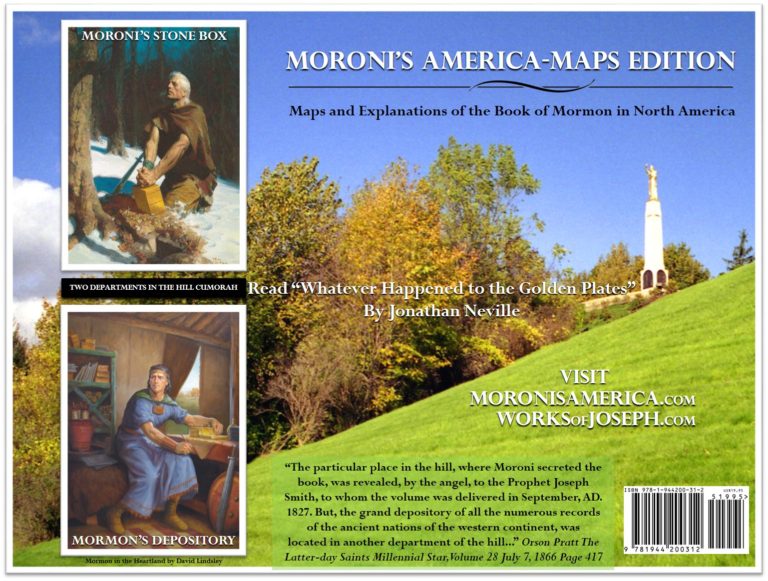
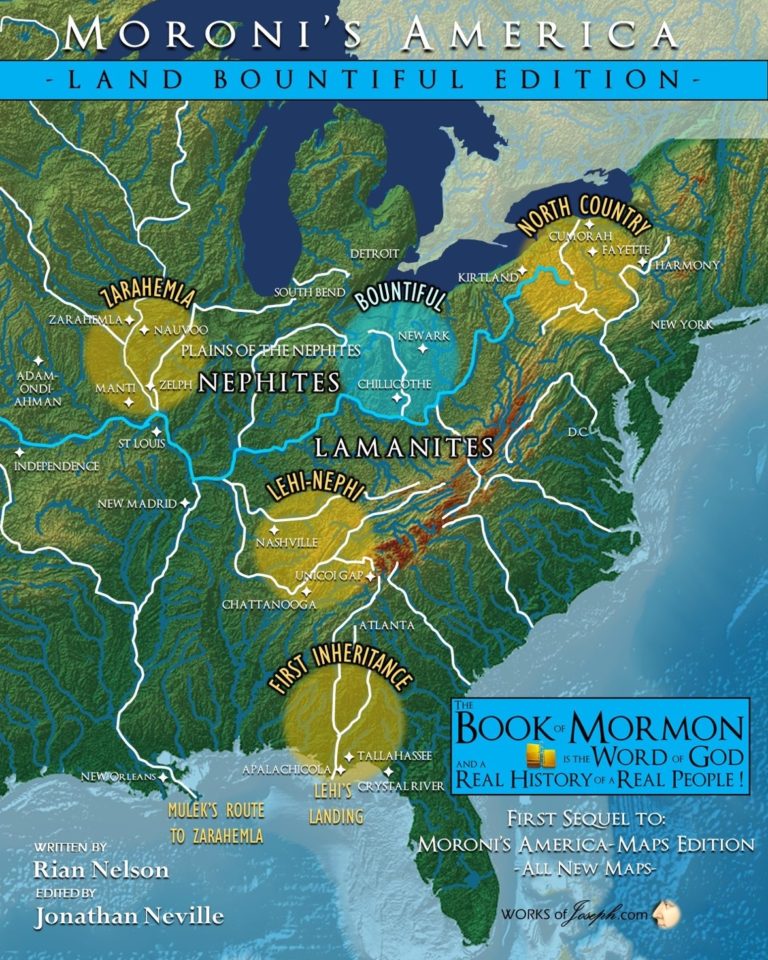
You can discover more information about the connection between the Hopewell, Nephites, and Jews in Ohio in the my book, Moroni’s America-Land Bountiful Edition seen below. This 60 Map Bountiful Edition is available in a great package below.
Heartland Map Package: Moroni’s America-Maps Edition 150 Pages, AND Moroni’s America-Land Bountiful Edition 60 Maps. 210 Total Maps, PLUS receive the All-New 20″ x 30″ Folding Travel Map. Buy ALL THREE and Save 18% here.
Below is some information from the Bountiful Edition map book.
“There was a wall at the Great Circle at the Hopeton site. For those of you interested in dry archeological research, here is more about an interesting and recent discovery at the Hopeton Great Circle (adjacent to the Cedar Bank site near Chillicothe OH and also adjacent to the Chillicothe Ward building). Typically, I try to remain abreast with the research happening each year in Ohio and nearby. I spoke with an archaeologist last summer [2017] at the site, and learned of his confirmation of anomalies indicated by a an extensive magnetometry survey. The other day in conversation, we discussed more details regarding the findings. It appears the Great Circle has evidences of a wooden fence, where the at least 6 ft height 1050 ft diameter earthen wall (enclosing 20 acres) was located. Indications are a pattern of very large posts spaced every 6 meters. This excavation last season revealed a post mold to be 96cm (about 38 inches) in diameter and 1.13 meters deep. One can estimate the height from that data. Indications are that smaller posts existed between the larger ones. The Hopeton site is significant in its location in relation to Cedar Bank, Sugarloaf, Mound City, and Dunlap Works and likely others. The current Chillicothe Ward building aligns with the Cedar Bank site (specifically the platform mound) and is within sight of Sugarloaf and in association with other major earthworks, including Hopeton. I am pretty sure Church engineering had not considered the earthworks when the building was designed.” Anthony George Lifelong Resident of Chillicothe, Ohio and Archaeological Researcher as quoted in Moroni’s America Land Bountiful Edition by Rian Nelson and Jonathan Neville
Hebrew & Hopewell DNA “A lady by the name of Lisa Mills did her doctoral thesis on the Hopewell. She sampled 49 Hopewell burials from Mound City in Chillicothe, Ohio. They were originally excavated by Shetrone in the mid-20th century. Of the 49 she extracted Mt/DNA from 64% of them. What is significant is she found Haplogroup X in several remains. Haplogroup X is a marker that originated in Galilee. This in my opinion strongly suggests contact by the Hebrews with Hopewell. Richard D. Moats, Avocational Archaeologist, Archaeoastronomer
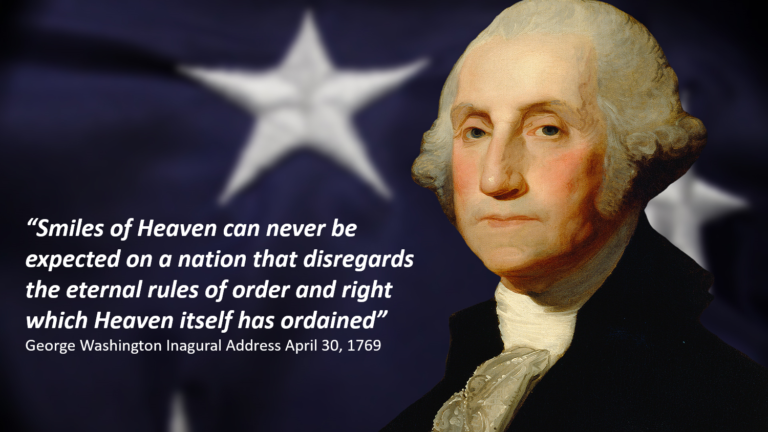
Our good friend Timothy Ballard, founder of “Operation Underground Railroad” has spoken at our FIRM Foundation Conferences for the past many years. Last April of 2019 he gave a wonderful talk about the importance of supporting our country and the Founding Fathers. He spoke of the high integrity of George Washington and how God was an important part of his life. In Washington’s inaugural speech he shared the importance of maintaining the values of a Nation of Liberty. You will be able to access Tim’s and many other presentations with our new Online Subscription Service. Information at the end of this article.George Washington’s First inaugural address – Thursday, April 30, 1789 “The Nation’s first chief executive took his oath of office in April in New York City on the balcony of the Senate Chamber at Federal Hall on Wall Street. General Washington had been unanimously elected President by the first electoral college, and John Adams was elected Vice President because he received the second greatest number of votes. Under the rules, each elector cast two votes. The Chancellor of New York and fellow Freemason, Robert R. Livingston administered the oath of office. The Bible on which the oath was sworn belonged to New York’s St. John’s Masonic Lodge. The new President gave his inaugural address before a joint session of the two Houses of Congress assembled inside the Senate Chamber. “Fellow-Citizens of the Senate and of the House of Representatives, Among the vicissitudes incident to life no event could have filled me with greater anxieties than that of which the notification was transmitted by your order, and received on the 14th day of the present month. On the one hand, I was summoned by my country, whose voice I can never hear but with veneration and love, from a retreat which I had chosen with the fondest predilection, and, in my flattering hopes, with an immutable decision, as the asylum of my declining years–a retreat which was rendered every day more necessary as well as more dear to me by the addition of habit to inclination, and of frequent interruptions in my health to the gradual waste committed on it by time. On the other hand, the magnitude and difficulty of the trust to which the voice of my country called me, being sufficient to awaken in the wisest and most experienced of her citizens a distrustful scrutiny into his qualifications, could not but overwhelm with despondence one who (inheriting inferior endowments from nature and unpracticed in the duties of civil administration) ought to be peculiarly conscious of his own deficiencies. In this conflict of emotions all I dare aver is that it has been my faithful study to collect my duty from a just appreciation of every circumstance by which it might be affected. All I dare hope is that if, in executing this task, I have been too much swayed by a grateful remembrance of former instances, or by an affectionate sensibility to this transcendent proof of the confidence of my fellow-citizens, and have thence too little consulted my incapacity as well as disinclination for the weighty and untried cares before me, my error will be palliated by the motives which mislead me, and its consequences be judged by my country with some share of the partiality in which they originated.
Currier & Ives (American, active New York, 1857–1907) The Inauguration of Washington as First President of the United States,
Such being the impressions under which I have, in obedience to the public summons, repaired to the present station, it would be peculiarly improper to omit in this first official act my fervent supplications to that Almighty Being who rules over the universe, who presides in the councils of nations, and whose providential aids can supply every human defect, that His benediction may consecrate to the liberties and happiness of the people of the United States a Government instituted by themselves for these essential purposes, and may enable every instrument employed in its administration to execute with success the functions allotted to his charge. In tendering this homage to the Great Author of every public and private good, I assure myself that it expresses your sentiments not less than my own, nor those of my fellow-citizens at large less than either. No people can be bound to acknowledge and adore the Invisible Hand which conducts the affairs of men more than those of the United States. Every step by which they have advanced to the character of an independent nation seems to have been distinguished by some token of providential agency; and in the important revolution just accomplished in the system of their united government the tranquil deliberations and voluntary consent of so many distinct communities from which the event has resulted can not be compared with the means by which most governments have been established without some return of pious gratitude, along with an humble anticipation of the future blessingswhich the past seem to presage. These reflections, arising out of the present crisis, have forced themselves too strongly on my mind to be suppressed. You will join with me, I trust, in thinking that there are none under the influence of which the proceedings of a new and free government can more auspiciously commence. By the article establishing the executive department it is made the duty of the President “to recommend to your consideration such measures as he shall judge necessary and expedient.” The circumstances under which I now meet you will acquit me from entering into that subject further than to refer to the great constitutional charter under which you are assembled, and which, in defining your powers, designates the objects to which your attention is to be given. It will be more consistent with those circumstances, and far more congenial with the feelings which actuate me, to substitute, in place of a recommendation of particular measures, the tribute that is due to the talents, the rectitude, and the patriotism which adorn the characters selected to devise and adopt them. In these honorable qualifications I behold the surest pledges that as on one side no local prejudices or attachments, no separate views nor party animosities, will misdirect the comprehensive and equal eye which ought to watch over this great assemblage of communities and interests, so, on another, that the foundation of our national policy will be laid in the pure and immutable principles of private morality, and the preeminence of free government be exemplified by all the attributes which can win the affections of its citizens and command the respect of the world. I dwell on this prospect with every satisfaction which an ardent love for my country can inspire, since there is no truth more thoroughly established than that there exists in the economy and course of nature an indissoluble union between virtue and happiness; between duty and advantage; between the genuine maxims of an honest and magnanimous policy and the solid rewards of public prosperity and felicity; since we ought to be no less persuaded that the propitious smiles of Heaven can never be expected on a nation that disregards the eternal rules of order and right which Heaven itself has ordained; and since the preservation of the sacred fire of liberty and the destiny of the republican model of government are justly considered, perhaps, as ‘deeply’, as ‘finally’, staked on the experiment entrusted to the hands of the American people.Besides the ordinary objects submitted to your care, it will remain with your judgment to decide how far an exercise of the occasional power delegated by the fifth article of the Constitution is rendered expedient at the present juncture by the nature of objections which have been urged against the system, or by the degree of inquietude which has given birth to them. Instead of undertaking particular recommendations on this subject, in which I could be guided by no lights derived from official opportunities, I shall again give way to my entire confidence in your discernment and pursuit of the public good; for I assure myself that whilst you carefully avoid every alteration which might endanger the benefits of an united and effective government, or which ought to await the future lessons of experience, a reverence for the characteristic rights of freemen and a regard for the public harmony will sufficiently influence your deliberations on the question how far the former can be impregnably fortified or the latter be safely and advantageously promoted. To the foregoing observations I have one to add, which will be most properly addressed to the House of Representatives. It concerns myself, and will therefore be as brief as possible. When I was first honored with a call into the service of my country, then on the eve of an arduous struggle for its liberties, the light in which I contemplated my duty required that I should renounce every pecuniary compensation. From this resolution I have in no instance departed; and being still under the impressions which produced it, I must decline as inapplicable to myself any share in the personal emoluments which may be indispensably included in a permanent provision for the executive department, and must accordingly pray that the pecuniary estimates for the station in which I am placed may during my continuance in it be limited to such actual expenditures as the public good may be thought to require. Having thus imparted to you my sentiments as they have been awakened by the occasion which brings us together, I shall take my present leave; but not without resorting once more to the benign Parent of the Human Race in humble supplication that, since He has been pleased to favor the American people with opportunities for deliberating in perfect tranquillity, and dispositions for deciding with unparalleled unanimity on a form of government for the security of their union and the advancement of their happiness, so His divine blessing may be equally ‘conspicuous’ in the enlarged views, the temperate consultations, and the wise measures on which the success of this Government must depend.” (Bold and Highlights added)
The primary source for the information about Zelph comes from diaries kept by members of the 1834 Zion’s Camp including, Wilford Woodruff, Heber C. Kimball, George A. Smith, Levi Hancock, Moses Martin, and Reuben McBride.
This Hopewell culture mound site is located in Pike County, Illinois three miles east of the city of Griggsville. The mound today is known as Naples-Russell Mound #8, or Zelph Mound.
Naples-Russell Mound #8, or Zelph Mound
A scientific excavation of this mound was carried out in 1990 by The University of Illinois at Urbana-Champaign, in cooperation with the Center for American Archaeology at Kampsville, Illinois. The dig was funded by the Illinois Department of Transportation and supervised by archaeologist, Ken Farnsworth. The artifacts found during the excavation confirmed the mound to be a Hopewell burial mound, dating from 100 B.C. to 500 A.D. The artifacts are now located in the Illinois State Museum.
From the volume titled History of the Church Volume 2: pp.79-80, we read; “During our travels we visited several of the mounds which had been thrown up by the ancient inhabitants of this country—Nephites, Lamanites, etc., and this morning I went up on a high mound, near the river, accompanied by the brethren. From this mound we could overlook the tops of the trees and view the prairie on each side of the river as far as our vision could extend, and the scenery was truly delightful.
Zelph in Vision by Ken Corbett
On the top of the mound were stones which presented the appearance of three altars having been erected one above the other, according to the ancient order; and the remains of bones were strewn over the surface of the ground. The brethren procured a shovel and a hoe, and removing the earth to the depth of about one foot, discovered the skeleton of a man, almost entire, and between his ribs the stone point of a Lamanitish arrow, which evidently produced his death. Elder Burr Riggs retained the arrow. The contemplation of the scenery around us produced peculiar sensations in our bosoms; and subsequently the visions of the past being opened to my understanding by the Spirit of the Almighty, I discovered that the person whose skeleton was before us was a white Lamanite, a large, thick-set man, and a man of God. His name was Zelph. He was a warrior and chieftain under the great prophet Onandagus, who was known from the Hill Cumorah, or eastern sea to the Rocky mountains. The curse was taken from Zelph, or, at least, in part—one of his thigh bones was broken by a stone flung from a sling, while in battle, years before his death. He was killed in battle by the arrow found among his ribs, during the last great struggle of the Lamanites and Nephites.”
Tower Hill (declared site of a Adam-ondi-Ahman Temple by Joseph Smith)
In LDS Church History we hear about a similar ancient altar found near Adam-Ondi-Ahman in Missouri. In Orson F. Whitney, Life of Heber C. Kimball, page 209, we read; “The Prophet Joseph called upon Brother Brigham, myself and others, saying, “Brethren, come, go along with me, and I will show you something,” He led us a short distance to a place where were the ruins of three altars built of stone, one above the other, and one standing a little back of the other, like unto the pulpits in the Kirtland Temple, representing the order of three grades of Priesthood; “There,” said Joseph, “is the place where Adam offered up sacrifice after he was cast out of the garden.” The altar stood at the highest point of the bluff. I went and examined the place several times while I remained there.”
In another account of the History of Church 3:35 it says, “we arrived at Colonel Lyman Wight’s home. He lives at the foot of Tower Hill (a name I gave the place in consequence of the remains of an old Nephite altar or tower that stood there), where we camped for the Sabbath.”
Today’s Adam-Ondi-Ahman is just a little over 200 miles from the location of Zelph Mound in Illinois, both of which fit within the geography of the Heartland Model of The Land of Zarahemla.
These Copper Adzes or Celts were removed from a two foot trench archaeologically excavated through NRM#8. They are of heated or hammered native copper from Lake Superior. Note the remains of Hopewell fabric on the copper surface, preserved by contact with the copper. Copper is common in Hopewell burial sites. They are dated 100 BC to 200 AD.
Remarkably, items discovered in the Zelph Mound area fit precisely within the parameters of the Book of Mormon historical chronology. (100 B.C. to 500 A.D.) This general collection of evidence points to a strong possible North American Book of Mormon geographic location.
According to Wilford Woodruff, “I brought the thigh bone to Missouri. I desired to bury it in the Temple Block in Jackson County; but not having this privilege, I buried it in Clay County, Missouri, near the house owned by Col. Arthur and occupied by Lyman Wight. The arrowhead referred to is now in the possession of President Joseph F. Smith, Salt Lake City, Utah.” Wilford Woodruff Journal Page 41.
“While on our way we felt anxious to know who the person was who had been killed by that arrow. It was made known to Joseph that he had been an officer who fell in battle, in the last destruction among the Lamanites, and his name was Zelph. This caused us to rejoice much, to think that God was so mindful of us as to show these things to His servant. Brother Joseph had enquired of the Lord and it was made known to him in a vision.” Life of Heber C. Kimball, by Orson F. Whitney.
This shallow ceramic bowl, about seven inches wide, has an abstract water-bird design. It was excavated from NRM#8 and is a typical Zones Hopewell pottery type. Such designs are typical of the Middle Woodland period (1 AD – 500 AD. Later designs became simpler and less artistically developed.
Shallow seven inch bowl from NRM#8, Pike County, Illinois has an abstract plant design typical of Hopewell art. This mound was radiocarbon dated to 250 AD +/- 100 years. The Hopewell are now accepted archaeologically as having been highly advances.
Zelph Mound History
“The Naples Mound 8 (also Naples-Russel Mound 8 or Illinois Archaeological Survey #PK 335) is a Havana Hopewell culture mound site located in Pike County, Illinois three miles east of the city of Griggsville. The mound was given the name Naples Mound #8 in 1882. The mound was listed on the National Register of Historic Places in 1975 First recorded visit by Latter Day Saints: The Zelph Mound In May and June 1834, Joseph Smith led a Latter Day Saint group of 150 men known as Zion’s Camp on a march from Kirtland, Ohio, to Jackson County, Missouri. On June 3, while passing through west-central Illinois three miles east of Griggsville, Illinois, some men discovered a large burial mound on the west side of the Illinois River one mile south of present-day Valley city.
On the top of the mound were …the remains of bones were strewn over the surface of the ground. The brethren procured a shovel and a hoe, and removing the earth to the depth of about one foot, discovered the skeleton of a man, almost entire, and between his ribs the stone point of a Lamanitish arrow, which evidently produced his death… The visions of the past being opened to my understanding by the Spirit of the Almighty, I discovered that the person whose skeleton lay before us was a white Lamanite, a large thick-set man, a white Lamanite, and a man of God…He was a warrior and chieftain under the great prophet Onandagus, who was known from the Hill Cumorah [Ontario County, New York], or eastern sea to the Rocky Mountains…He was killed during the last great struggles of the Lamanites and Nephites”.
The Book of Mormon identifies the last struggles or battles between the Nephites and the Lamanites as occurring between 375 A.D. and about 385 A.D. The leg bones of “Zelph” were carried in Wilford Woodruff’s wagon and reburied near Liberty, Missouri, but the arrow head was retained. The Zelph Mound incident was recorded by six men of Zion’s Camp in their journals: Woodruff, Heber C. Kimball,Levi Hancock, George A. Smith, Moses Martin, and Reuben McBride. The Zelph Mound incident was formally recorded in church history from available sources in 1842 by church historian, Willard Richards. First recorded visits by local settlers
Illinois was made a state in 1818 and white settlers came in and opened some of the burial mounds in the former Native American lands. Judge John G. Henderson of Winchester, Illinois, was impressed by beautifully carved stone smoking pipes a friend showed him which were obtained from burial mounds in Naples, Illinois. Accordingly, he and a Mr. Merrill, in 1876, did some excavations and documentation of some of the Naples mounds in which were found a raccoon and a turtle pipe, copper axes, and human skeletal remains. Henderson also mapped the location of fifteen mounds near Naples, including Naples Mound #8. A map he made shows Naples Mound #8 as being a mile south of Valley City, Illinois and across the Illinois River from Naples, Illinois. Being impressed with mound #8, Henderson illustrated an Eagle pipe unearthed from the mound about 40 years earlier by a Daniel Burn, John W. Windsor and others. In describing Naples Mound #8 Henderson states, “On the right bank of the Illinois river about 300 yards below [south of] Griggsville Landing, rises a lofty bluff fully 300 feet above the level of the river. On the summit is a beautiful, oval mound, 150 long, 92 feet wide in the middle, and 25 or 30 feet high….within a radius of 5 miles from Naples there are a least fifty mounds, very few of which have ever been opened”. After Henderson wrote an article describing the Naples mounds and the relics found in them, the Smithsonian Institution, in December 1879 began a thorough exploration of them, furnishing six laborers to help with the excavations. Afterwards, Henderson authored the article describing the results in the Smithsonian Annual Report. Rediscovery of the Mound
The mound was forgotten after 1882 and no records of visits have been found until 1974. Due to the Central Illinois Expressway bridge being planned across the Illinois River, the river bluffs were again visited by archaeologists. A team of graduate students from Northwestern University led by Archaeology Professor Jane E. Buikstra combed the bluffs of the Illinois River a mile South of Valley City, Illinois mapping burial mounds. They located an extraordinarily large mound and were excited to inform local historian, Warren Winston, about it. James Bradley, a Mormon Historian from Utah, who had been searching for Zelph Mound for 25 years, visited Warren Winston the day after Professor Buikstra’s visit and the connection was made. The Zelph Mound, was re-identified using historic journals, historic landmarks and mound surveys. The archaeological name Naples Mound #8, which archaeologist Henderson had given it over ninety years earlier, was changed by Professor Buikstra in 1974 to Naples-Russell Mound #8 (RN8). The name “Russell” was added due to the mound being on private land owned by a Mr. Roy Russell. Shortly after that event, in 1975, Buikstra applied to have the mound placed on the National Register of Historic Places. Seven years later, in 1988, The State of Illinois purchased 280 acres of Illinois River frontage land, including the mound. Scientific investigation of the Mound
Archaeologists, after excavating in the Elizabeth Mounds and Napoleon Hollow for ten years where the expressway bridge was to be built, received permission to do excavations in Naples-Russell Mound #8, located just a hundred and fifty yards to the north of the Elizabeth Mound group. A scientific excavation of RN8 was carried out in 1990 by The University of Illinois at Urbana-Champaign, in cooperation with the Center for American Archaeology at Kampsville, Illinois. The dig was funded by the Illinois Department of Transportation and supervised by archaeologist, Ken Farnsworth. The artifacts found during the excavation confirmed the mound to be a Hopewell burial mound, dating from 100 B.C. to 500 A.D. The artifacts are now located in the Illinois State Museum. The artifacts of the RN8 Mound were found to be from many parts of the eastern two thirds of United States or east of the Rocky Mountains, illustrating the wide trade network of the Hopewell culture. Photographs of the artifacts from NR8 have recently been published. The mound is located at the Roy Norbut Fish and Wildlife Area, overseen by the Illinois Department of Natural Resources.” Sourced at Wikipedia/Naples Mound 8
Mesoamerica “Book of Mormon Lands” tour promoter Dr. John L. Lund, released a historically incorrect and misleading article in a newsletter and paid advertisement eblast (http://ldsliving.com/e/2012/db02_29_2012.html ) published Feb. 29, 2012. Lund’s piece, Joseph Smith Identified Zarahemla as Being in Guatemala, proclaims that an article appearing in the Times and Seasons on October 1, 1842 in Nauvoo, Illinois was emphatically “written by Joseph Smith.” The article begins by flatly stating that members of the Church can “be confident that when you travel to Mexico, Guatemala, and Central America you are traveling in the lands where the primary American events of the Book of Mormon took place according to the Prophet Joseph Smith.” Lund’s confidence appears on the surface to be based on historically documented and authenticated writings of the Prophet Joseph. Is he overstating the historical facts?
A retired BYU lecturer, Lund has reportedly taken over 4,000 LDS Church members on tours to Israel, Church history and also Mesoamerica, the latter of which he boldly proclaims to be “Book of Mormon Lands.” The article is the latest tactic being used in an attempt to prop up theories that the Promised Land of the Book of Mormon, which was prophesied to be a “mighty” (1 Ne. 22:7, 3 Ne. 20:27), “prosperous” (1 Ne. 13:15, 20), and “free” (3 Ne. 21:4) latter day “Gentile” nation “above all other nations” (1 Ne. 13:30), is nonetheless located in the impoverished, drug-lord torn nations of Guatemala and Mexico, rather than in the United States of America.
According to Israeli officials, Lund was denied reentry back into their country for his alleged improprieties and indiscretions against the State of Israel in regard to Israeli antiquities and artifacts. See the KSL-TV news report at http://www.ksl.com/?nid=148&sid=15619321 and the news article in the Salt Lake Tribune http://www.sltrib.com/sltrib/news/51848034-78/lund-bar-tura-antiquities.html.csp about Lund’s arrest by Israeli authorities in June of 2011. Lund’s attorneys have more recently been able to negotiate his re-admittance to Israel upon payment of certain undisclosed fines. In his multiple books, speaking engagements and tours Lund zealously proclaims the actual lands of the Book of Mormon to be located in Guatemala and southern Mexico in spite of the fact that Church leadership has maintained neutrality on where its history took place for over 150 years. What does Lund know, that Church leaders do not, that gives him such confidence?
Speculations Without Historical Verification Involving Joseph Smith and the Book of Mormon
Lund claims that “According to the Prophet Joseph Smith, the city of Zarahemla was located south of the Rio Grande in Guatemala and Central America.” This claim rests entirely on a handful of articles appearing in the Times & Seasons newspaper during the fall of 1842, a time when Joseph Smith was in hiding from the law for a crime he did not commit. Official Church historians have stated that the author or authors of these particular Times & Seasons articles are unknown through actual historical documentation, so Lund resorted to word print analysis of his own making in order to make his bold claim about Joseph Smith’s alleged belief in a Central America setting, while ignoring numerous historically verified accounts wherein Joseph Smith made statements indicating the Book of Mormon occurred in America’s Heartland.
While Joseph Smith’s name appeared on the end-plate of the paper as being its editor, as was customary at that time, there is no historically verifiable evidence that he participated in the writing, publication or printing of these specific articles or edited these editions whatsoever. Official Church historians know this fact, along with the fact that every single article proclaimed by Lund to be written by Joseph Smith was unsigned and that their authorship is historically unknown. Lund claims that “new research has confirmed that Joseph Smith was indeed the author of this and several other articles proclaiming the lands in Central America and Southern Mexico were the lands of the primary American events in the Book of Mormon.” However, what Dr. Lund does not disclose is that the “new research” he is referring to… is his own, and is based solely on comparing word usage of several early brethren of the Church. It is simply an attempt to link the articles in question to the Prophet Joseph, because these few unsigned and unknown authored articles make up the last remaining historical hope for Mesoamerican theorists to shore up their collapsing speculations that Joseph Smith abandoned his earlier revelations wherein he indicated a North American setting (links to his earlier accounts are below). Anti-Mormon’s have used claims that Joseph Smith changed his mind from his earlier recorded revelations regarding a North American setting to a Mesoamerican setting by Lund and other Mesoamerican proponents as an indication that Joseph Smith was a false prophet because they claim that he abandoned earlier revelations.
Conflicting evidence surrounds these articles as they were not written in the writing style of first person singular as are his other written accounts. These were written in first person plural, indicating different authorship. In addition, some issues had an article written by Joseph and another article accredited to “ED” in the same issue. In other words, there were two authors, one was Joseph, the other was “ED” or editor within the same issue. Had Joseph written both articles, wouldn’t they have both been attributed to him?
Even more difficult to explain are several instances in these and other articles attributed to “ED” which refer to the Prophet in third person. For example, in the Sept. 15th, 1842 issue that Lund references, in the article titled “Facts Are Stubborn Things” the author, presumed by Lund to have been Joseph Smith, wrote, “the world will prove Joseph Smith a true prophet by circumstantial evidence” referring to Joseph Smith in third person. Had Joseph written the article, why would he not have referred to himself as “I” or “me” as he is known to have consistently done in virtually all of his writings? Suddenly changing to third person in referencing himself is something Joseph is not known to have ever done, which strongly indicates that he was not the author.
Joseph Smith’s Historically Verifiable Written Statements
Nearly all those familiar with the early statements by the Prophet touching on potential Book of Mormon lands know that he clearly indicated them to be in North America. This is evident in the historically verified accounts wherein he declared revelation such as in the Wentworth Letter, the American Revivalist Account, the Zelph Accounts and Joseph’s handwritten letter to Emma while on Zion’s camp. In addition, the prophet revealed a Nephite altar at Adam-ondi-Ahman, mentioned the land of Manti was near Huntsville, Missouri, and revealed that this land was “the borders of the Lamanites” (see D&C 54:8). Furthermore he received revelation from the Lord for the location of Zarahemla (see D&C 125:3) and New Jerusalem (see D&C 84:1-6) which Christ Himself declared to be on Book of Mormon lands (3 Nephi 20:22), both of which are absolutely located in North America. These accounts and their indications are not speculation based, but historically documented fact.
Mesoamerican theorists are thereby forced to claim that the Prophet Joseph Smith reneged on these early revelations after being introduced to a New York Times best-selling travel book by John Lloyd Stevens called “Incidents of Travels in Central America, Chiapas and Yucatan.” They feel that Joseph learned more about Book of Mormon geography from this travelogue than from his angelic visitations by Moroni, other ancient prophets, or his translation of the sacred text itself.
Did Joseph Smith Abandon His Earlier Revelations?
Did Joseph Smith abandon his early historically documented statements that he claimed to have received by revelation, in order to embrace a Mesoamerican setting.. all because of a best-selling New York Times travelogue?
A critical question is whether there is any historical evidence that Joseph Smith’s belief that North America was the setting for the Book of Mormon had actually changed. We can often gain a better of understanding of a person’s true thoughts by observing their actions in addition to their words. Such may be the case with Joseph Smith. Beyond his written words, what were his actions? We know that when commanded by the Lord to take the gospel to the “Lamanites” Joseph immediately dispatched Oliver Cowdery (D&C 28:8), Peter Whitmer, Jr.(D&C 30:5-6), Parley P. Pratt (D&C 32:1-2) and Ziba Peterson (D&C 32:3) armed with the first copies of the Book of Mormon from the Grandin Press to go to the “borders of the Lamanites” (D&C 28:9) and preach the gospel to them. In the last reference the Lord states, “I myself will go with them and be in their midst…” which appears to indicate that the Lord would personally oversee this mission to “the Lamanites.” Could any believing member of the Church really consider that the Lord did not know where the remnant Lamanites were located? He sent them, according to Parley P. Pratt’s autobiography and the History of the Church, to Indian tribes in New York, Ohio and Missouri.
Some, such as the FAIR organization, have argued that the term “Lamanites” as recorded in the revelations which are now D&C 28, 30, 32 and 54 was not the Lord’s term but simply the misguided term of the Prophet Joseph Smith. This seems improbable due to the fact that the term was used in multiple instances over at least four sections of the Doctrine and Covenants. Certainly if it were a mistake by the Prophet in one instance that would be understandable, but with multiple uses, it becomes less likely that it was a mistake. The Mesoamerica promotion and apologist organization, FAIR, also published on their website that “Joseph clearly did not consider them [the revelations] “direct quotations” from God, since he was quite happy to revise them, edit them later, etc…This means that “Lamanites” to describe the American Indians was Joseph’s word choice [not the Lords].“
The Prophet Joseph Smith had been commanded by the Lord to send missionaries unto the “Lamanites” and their entire mission, which was guided and directed by the Lord Himself (D&C 32:3), was entirely spent in America’s Heartland and it is interesting to note that the Prophet never sent a single “Lamanite” missionary to Central or South America to preach to the aboriginal inhabitants there.
Fortunately, undeniable historical evidence exists that his revelatory views had not changed because in his own journal entry, just one month before his martyrdom at Carthage jail, Joseph writes of a second encounter with the Sac & Fox Indians…a tribe of the Algonquian language family of Native American Indians.
Account of the First Visit of the Sac & Fox Indians
Previously, on Aug. 12th, 1841 the History of the Church (vol. 4:pp 401-402) records that “I [Joseph Smith] accordingly went down, and met Keokuk, Kis-ku-kosh, Appenoose, and about one hundred chiefs and braves of those tribes [Sac & Fox], with their families.” Joseph continued, “I conducted them to the meeting grounds in the grove, and instructed them in many things which the Lord had revealed unto me concerning their fathers, and the promises that were made concerning them in the Book of Mormon.” Thus Joseph claimed that he knew, by revelation from the Lord, that the Book of Mormon was the literal ancestral history of this tribe of Native Americans.
This tribe is a member of the larger Algonquian speaking language group that consists of over 100 tribes and whose ancestors occupied the Heartland of North America in Book of Mormon time frames according to DNA, anthropological and archaeological findings. These Native peoples did not come from the populations of Central or South America.
Account of the Second Visit of the Sac & Fox Indians
In the Prophets final journal an entry is made for Thursday, May 23rd, 1844 with an account of another meeting with the Sac & Fox Indians. This is just prior to the Prophets death on June 27th, 1844 and long after the articles in the Times and Seasons had been published in 1842. Joseph writes, “1 P.M. held council with the Indians – Sac & Fox in my back kitchen. I replied…Great spirit wants you to be united & live in peace. [ I ] found a book, (presenting them with a Book of Mormon) whichtold me about your fathers & Great Spirit told me.” This second witness testifies to the fact that Joseph Smith did not forsake his earlier revelations regarding this people as being literal descendants of the Book of Mormon. It is impossible to believe that the Prophet had actually deserted his previous written revelatory understandings when he again testified, for the second time, that the Lord (the Great Spirit) had told him that the book was about the fathers of this North American Indian tribe. This account occurred long after the publication of the Times and Seasons articles attempted by Lund and other Mesoamerican promoters to falsely claim that Joseph had changed his mind. No word print analysis by John Lund or others can refute the historical fact that Joseph Smith did not abandon, dismiss, or forsake his previous revelations wherein he emphatically claimed that through revelation from the Lord he knew these people were the actual and literal remnant of the Lamanites of the Book of Mormon and they are without question North American Native peoples.
Learning the Historical Facts about Joseph Smith’s Knowledge and Statements
A fully referenced presentation on exactly what Joseph Smith did know can be view FREE by visiting our website VIDEO GALLERY and watching video’s #11-15 (#14 – 15 deal directly with Lund’s claims). Here you will find the historically verified accounts complete with photographs of many of the actual documents which verify the accuracy of the research. These videos provide the facts about the articles Lund is claiming to be Joseph Smith’s. Lund indirectly admits in the article that (LDS Church) historians have legitimately questioned the authorship of the articles, yet he still makes the definitive statement that he knows that Joseph Smith personally made the claim about Zarahemla being in Guatemala, which again, is unsubstantiated by official Church historians. See the text of their official response below.
Q: “In a book by Rod Meldrum the Book of Mormon in America’s Heartland pg 63 states that it is a false report that “Joseph Smith had claimed that Lehi…landed on the continent of South America in Chile, thirty degrees south latitude which has been thoroughly refuted by Church historians”.. My question is that I would like to know if this is true or false statement. plus I have seen advertisements that Joseph Smith said that “Zarahemla is located in Guatemala”. I want to know the truth from the source.”
A: “Thank you for contacting the Church History Library with your questions about Joseph Smith.
The statement on the course taken by Lehi was written by Fredrick G. Williams in a collection of notes, that include a copy of Section 7 of the Doctrine and Covenants. It is included with other items that are clearly not revelations and the note on Lehi’s landing in South America should not be considered a prophetic statement. The report in the Bernhisel Manuscript is in the handwriting of Bernhisel and has nothing written in the margins, as stated in Meldrum’s book.
Regarding the Zarahemla information, an article was written in the Times and Seasons in October 1842 discussing the apparent correlation between archeological findings and the description of cities in the Book of Mormon. However, the article explicitly states, “We are not agoing [sic] to declare positively that the ruins of Quirigua are those of Zarahemla.” This, too, should not be taken as a prophetic statement by Joseph Smith.
We appreciate your interest in clarifying these statements.”
Sincerely,
Sherry Smith, Library Reference, LDS Church History Library”
Lund claims that the ‘majority of scholars‘ ascribe the articles to Joseph. Apart from being an obvious appeal to consensus, it is also misleading because Lund is considering only those promoting Mesoamerican theories as being “scholars.” It is questionable whether Lund’s claim that a majority of scholars subscribe to his Mesoamerican theories remains valid; as the Heartland Model geography has now garnered scores of men and women with Ph.D.’s and doctorates in its support, possibly outnumbering the total number who are still promoting archaic Mesoamerican theories. These scholars may not work for LDS tour companies or BYU, but they cannot be dismissed as being illegitimate scholars, as some Mesoamerica proponents are want to imply.
Another aspect Lund fails to mention is that the scholars referenced as agreeing that Joseph Smith wrote the articles in question were simply relying on, as many have in the past, the mistaken idea that they were written by The Prophet. Nevertheless, the fact still remains that official Church historians claim that they simply do not know who authored those articles. For Lund to proclaim, as he has done in his article, that Joseph Smith stated that Zarahemla was in Guatemala is exaggerated, unsubstantiated and possibly untrue. If Lund’s claims were true, why wouldn’t Church leadership simply adopt that position and come out in open endorsement of Lund’s “Book of Mormon lands?” Yet the fact stubbornly remains that the Church is officially neutral on the subject. Where Did the Lord Himself (As Well as Joseph Smith) Declare Zarahemla to be Located?
In contrast to Lund’s unsubstantiated claims that Joseph Smith wrote these unsigned articles regarding Zarahemla in Guatemala, one can simply go to D&C 125:3. There you will find the historically verified account from the Prophet Joseph Smith, through revelation from God, which appears to refute Lund’s claim that Zarahemla was in Mesoamerica. The Lord told His Prophet to build a city across from Nauvoo and call it Zarahemla, not “New” Zarahemla as would have been the pattern established by the Lord for the naming of cities that refer symbolically to earlier cities in other lands. Such an example can be seen in the naming of Jerusalem and the later New Jerusalem. (See Ether 13:4-6). The passage is straight forward and compelling.
The Lord could have given the location across the Mississippi River from Nauvoo any one of an infinite number of possible names, yet He called it simply “Zarahemla.” If it was not the actual site of the ancient Book of Mormon city of Zarahemla, why would He have specifically named it that? God is not a God of confusion. Once an understanding is gained of the strategic importance of this location, due to the shallow rapids (historically called the Des Moines Rapids) which made possible a river crossing on foot, one can begin to comprehend why the ancient Book of Mormon city of Zarahemla was said to be located in the center of their lands, was their capital city and why when it was burned at the time of Christ’s death it was rebuilt. This is the first river crossing from the Gulf of Mexico up the Mississippi river, which would naturally make this one of, if not the most strategic location in North America. This is where trade and commerce would flow, and whoever controlled it would be enabled to defend nearly a third of what is now the United States by preventing enemy armies from ingression.
There is not a single authenticated or documented historical account, which has been verified by official Church historians, that establishes that the Prophet Joseph Smith relinquished his revelatory position that the Heartland of North America were the lands of the Book of Mormon, or that its history occurred in Mesoamerica. Not one. Many Church historians that have been consulted on the matter have so indicated. It is clear that Lund’s claim cannot be substantiated and is therefore over stated and may be untrue.
Some have questioned why the Prophet Joseph Smith would allow others to write articles that might seem contrary to his early views in the Times and Seasons, and why Joseph didn’t correct them if they were incorrect. Further information about this and many other questions regarding Joseph Smith and Book of Mormon geography will be thoroughly examined in the new book Joseph Knew; Joseph Smith and Book of Mormon Geography to be released by the end of 2012 by this author.
Rod L. Meldrum President Foundation for Indigenous Research and Mormonism, The FIRM Foundation
Quotes about the United States, Hill Cumorah, The Book of Mormon, Lamanites, & Joseph Smith.
WE KNOW IT!
William Armitage (1857–1940), Joseph Smith Preaching to the Indians, c. 1870.
“Let the Government of the United States also continue to gather together, and to colonize the tribes and remnants of Israel (the Indians), and also to feed, clothe, succor, and protect them, and endeavor to civilize and unite; and also to bring them to the knowledge of their Israelitish origin, and of the fulness of the gospel which was revealed to, and written by, their forefathers on this land;… He has revealed the origin and the Records of the aboriginal tribes of America, and their future destiny. —And we know it. He has revealed the fulness of the gospel, with its gifts, blessings, and ordinances. —And we know it. He has commanded us to bear witness of it, first to the Gentiles and then to the remnants of Israel and the Jews. —And we know it. He has commanded us to gather together his Saints on this Continent, and build up holy cities and sanctuaries. —And we know it.” PROCLAMATION of the Twelve Apostles of the Church of Jesus Christ of Latter-day Saints. New York April 6, 1845. James R. Clark, comp., Messages of the First Presidency of The Church of Jesus Christ of Latter-day Saints, 6 vols. (Salt Lake City: Bookcraft, 1965-75), 1:, p.252-266
ANCIENT RECORDS
“Circumstances are daily transpiring which give additional testimony to the authenticity of the Book of Mormon. . . . it was [once considered] improbable, nay, almost impossible—notwithstanding the testimony of history to the contrary, that anything like plates could have been used anciently; particularly among this people. The following letter and certificate, will, perhaps have a tendency to convince the skeptical, that such things have been used, and that even the obnoxious Book of Mormon, may be true; and as the people in Columbus’ day were obliged to believe that there was such a place as America; so will the people in this day be obliged to believe, however reluctantly, that there may have been such plates as those from which the Book of Mormon was translated.” John Taylor [Times and Seasons 4 (May 1, 1843), pp. 185-6]
THIS LAND “The Angel also informed him that America had once been people by a remnant of the seed of Israel of the tribe of Joseph who became two great Nations upon this Land one of those Nations were the present Natives of America or the Indians the other Nation was distroid [sic] about four hundred years after Christ.” Pratt, Parley Parker 1807-1857. An epistle written by an elder of the Church,
Hopewell/Nephite Village by Kendra Burton
“I am asked to occupy the few minutes yet remaining: If the Spirit gives me liberty I will pursue the train of thought that has passed through my mind while Brother Richards has been speaking upon the spirit that has gone abroad upon the remnants of the house of Israel who occupy this land, the American Indians whom we understand to be the descendants of the Nephites, the Lamanites, the Lemuelites and the Ishmaelites who formerly possessed this land, whose fathers we have an account of in the Book of Mormon.” The Indians—The Influence of the Elders Among Them in the Interest of Peace, Etc. Discourse by Elder Erastus Snow, delivered at Logan, Sunday Afternoon, February 5th, 1882
THE HISTORY OF HIS FOREFATHERS Mormon lived in that age of the world, and was a Nephite, and a Prophet of the Lord. He, by the commandment of the Lord, made an abridgment of the sacred records, which contained the history of his forefathers, and the Prophecies and Gospel which had been revealed among them; to which he added a sketch of the history of his own time, and the destruction of his nation. Previous to his death, the abridged records fell into the hands of his son Moroni, who continued them down to A. D. 420; at which time he deposited them carefully in the earth, on a hill which was then called Cumorah, but is situated in Ontario County, township of Manchester, and State of New York, North America. This he did in order to preserve them from the Lamanites, who overran the country, and sought to destroy them and all the records pertaining to the Nephites. This record lay concealed, or sealed up, from A. D. 420 to September 22, 1827, at which time it was found by Mr. Joseph Smith, jun., he being directed thither by an angel of the Lord.” A Voice of Warning, page 96 Parley P. Pratt
CUMORAH/RAMAH “Moroni told Joseph that he had hidden up the records four centuries after the birth of Jesus, while he was living on the earth. He said that the Nephites, the people to which he belonged, called the hill where they stood Cumorah, and that a still earlier people, the Jaredites, called it Ramah. This was a very important hill in the history of both these peoples.” The Latter-day Prophet. History of Joseph Smith Written for Young People by George Q. Cannon 1900
THE LORD WILLED IT!
Joseph Fielding Smith said the following in the April 1966 General Conference, “America was discovered because the Lord willed it. The gospel was restored in America, rather than in some other land because the Lord willed it. This is the land “shadowing with wings” spoken of by Isaiah that today is sending ambassadors by the sea to a nation scattered and peeled, which at one time was terrible in the beginning (Isaiah 18:1-2). Now that nation is being gathered, and once again they shall be in favor with the Lord.” (Joseph Fielding Smith, Conference Report, April 1966, pp. 12-15).
HERE IN AMERICA “Moroni’s father was commander of the armies of this ancient people, known as Nephites. His name was Mormon. The war of which we speak took place here in America some four hundred years after Christ. As the fighting neared its end, Mormon gathered the remnant of his forces about a hill which they called Cumorah, located in what is now the western part of the state of New York… When finished with his record, Moroni was to hide it up in that same Hill Cumorah which was their battlefield. It would come forth in modern times as the Book of Mormon, named after Moroni’s father, the historian who compiled it.” (“The Last Words of Moroni,” Conference Reports, October 1978) Mark E. Petersen
CURRENT AS THE MORNING NEWSPAPER
“It’s narrative is a chronicle of nations long since gone. But in its descriptions of the problems of today’s society, it is as current as the morning newspaper and much more definitive, inspired, and inspiring concerning the solutions to those problems… If the Book of Mormon is true, then America is a choice land, but if it is to remain such the inhabitants of the land must worship the God of the land, the Lord Jesus Christ. The histories of two great nations, told with warning in this sacred volume, indicate that while we must have science, while we must have education, while we must have arms, we also must have righteousness if we are to merit the protection of God.” Gordon B. Hinckley The Power of the Book of Mormon Ensign June 1988
A DESCENDANT OF RED CLOUD, SITTING BULL, CHIEF JOSEPH, CHEE DODGE, CHIEF CRAZY HORSE
“I am proud to declare to you today, brothers and sisters, that I am a descendant of Lehi, Nephi, and all the great Book of Mormon prophets. I am proud to be a child of the Book of Mormon people. I have found my true heritage; I have found my true identity. I am a son of God, a child of God, a child of the Book of Mormon, a child of Lehi, a rich heritage that extends all the way back to my Heavenly Father, through Moses, and Abraham, and other great prophets.
I am also proud to be a descendant of great Indian chiefs of our country. I am proud to be a descendant of Red Cloud, Sitting Bull, Chief Joseph, Chee Dodge, Chief Crazy Horse and all these great Indian chiefs that did so well as leaders of their people. I want you to know that these men were great. I wouldn’t be surprised if they are all in paradise; and I wouldn’t be surprised if some of them are converted, and maybe some of them are on the fourth missionary discussion. I am proud of my rich heritage.
To you my people, the Lamanite people, on Indian reservations and in the cities of our country and through the islands of the sea, I want you to know that Jesus Christ is our Elder Brother. He is our Savior. He is our Redeemer.” George P. Lee October 1975 My Heritage Is Choice (Editor’s note: I thought long and hard about using this quote, but who am I to judge?)
A MIGHTY LAND This has always been a mighty land in God’s plan. It was in the valley of Adam-ondi-Ahman prior to his death, called the great high priests together and there bestowed upon them his last blessing. The Lord appearing there proclaimed Adam to be Michael, the Prince, the Archangel. (D&C 107:53-54) It is to that same spot that Adam, as the Ancient of Days, shall come to visit his people (D&C 116), where judgement shall be set and the books opened. (Daniel 7:9 ff; Revelation 20:4) It is here on this land that the New Jerusalem shall be built “unto the remnant of the seed of Joseph” — ourselves and those others the literal descendants of Lehi. (Ether 13:5 ff; 1 Nephi 14:1-2, 2 Nephi 10:18) And finally, it is here on this hemisphere that Zion shall be built. (Tenth Article of Faith.) It is this fact and this purpose, the building of Zion on this hemisphere, which is Zion, which seems to be the dominant elements in all of God’s dealings with them who possess this land, for Isaiah, speaking more than twenty-five hundred years ago, declared that “out of the Lord from Jerusalem” (Isaiah 2:3.) President J. Reuben Clark, Jr The Glorious Purpose page 103
CHOICE ABOVE ALL OTHER LANDS “Because of his faithfulness and integrity, Joseph received greater blessings than the progenitors of Jacob, and was rewarded with the land of Zion. His brothers, with malicious intent, separated him and cast him out from among them. The Lord, in rewarding him, separated him from his brothers — the other tribes of Israel — and gave him an inheritance in a land that is choice above all other lands, which, we have learned from the Book of Mormon and modern revelation, is America… We are informed in the revelations given to Joseph Smith the Prophet, that the city of Zion and the New Jerusalem is one and the same. In a number of revelations the Lord speaks of the New Jerusalem which is to be built…” Zion and Jerusalem by Joseph Fielding Smith, Improvement Era Vol. 22 JULY 1919
ONLY TWO PROMISED LANDS
Tools of Faith by Ken Corbett
3 Nephi 20:22: “And behold, this people will I establish in this land, unto the fulfilling of the covenant which I made with your father Jacob; and it shall be a New Jerusalem. And the powers of heaven shall be in the midst of this people; yea, even I will be in the midst of you.
23 Behold, I am he of whom Moses spake, saying: A prophet shall the Lord your God raise up unto you of your brethren, like unto me; him shall ye hear in all things whatsoever he shall say unto you. And it shall come to pass that every soul who will not hear that prophet shall be cut off from among the people.
24 Verily I say unto you, yea, and all the prophets from Samuel and those that follow after, as many as have spoken, have testified of me.
25 And behold, ye are the children of the prophets; and ye are of the house of Israel; and ye are of the covenant which the Father made with your fathers, saying unto Abraham: And in thy seed shall all the kindreds of the earth be blessed.
26 The Father having raised me up unto you first, and sent me to bless you in turning away every one of you from his iniquities; and this because ye are the children of the covenant—
27 And after that ye were blessed then fulfilleth the Father the covenant which he made with Abraham, saying: In thy seed shall all the kindreds of the earth be blessed—unto the pouring out of the Holy Ghost through me upon the Gentiles, which blessing upon the Gentiles shall make them mighty above all, unto the scattering of my people, O house of Israel.”
28 And they shall be a scourge unto the people of this land. Nevertheless, when they shall have received the fulness of my gospel, then if they shall harden their hearts against me I will return their iniquities upon their own heads, saith the Father.
29 And I will remember the covenant which I have made with my people; and I have covenanted with them that I would gather them together in mine own due time, that I would give unto them again the land of their fathers for their inheritance, which is the land of Jerusalem, which is the promised land unto them forever, saith the Father.” 3 Nephi 20:22-29
AMERICA’S PAST UNCOVERED “Remarkable discoveries of evidences of America’s prehistoric civilizations in various parts of the country are frequently being reported in public prints…
On Sept. 10, what are believed to be bodies of a royal family of the ancient mound builders were unearthed in a group of mounds near Bainbridge, Ohio. With these remains were found strands of pearls, some of extraordinary size and perfection; also ornaments of silver and copper and some sculptured objects of exquisite workmanship.
This is a highly interesting find. It shows that these mound builders in the Mississippi valley were wealthy and civilized, and that they must have had commercial connections with distant places where pearl oysters were procured.
Scientists know nothing certain about the time when the mound builders lived, whence they came and what became of them.
However, when Zion’s Camp, in the year 1834, was temporarily located on the western bank of the Illinois river, the Prophet Joseph and others ascended a high mound, on the top of which three altars had once stood. On removing some soil, they uncovered a skeleton, between the ribs of which there was an arrowhead. To the Prophet it was later made known that this was the remains of a Lamanite warrior, by the name of Zelph, who served the great Onandagus, a prophet known from the Hill Cumorah to the Rocky Mountains. Zelph was slain during the last struggle between the Lamanites and Nephites. May not this furnish a key to the mystery of the mound builders in the Mississippi valley? Besides this, at various points, from Maine to California, we find evidences of a race, or perhaps more than one race, that, like the Jaredites, who from their point of departure, carried with them “the fish of the waters,” depended largely upon sea food for their sustenance. The evidence of this they have left in numerous shell mounds, which consist almost entirely of oyster shells, some of gigantic size.
Some tell us American archaeology does not corroborate the Book of Mormon. As I see it, American Archaeologists will never unravel the mysteries of this country without the Book of Mormon.” THE JUVENILE INSTRUCTOR, Vol. 60, No. 10 October 1925 Janne M. Sjodahl
INTEREST IN HISTORY AND IN GEOGRAPHY
“We have a great message to tell the world. We have to live it, and then we have to tell it, too. If you’re interest in history and in geography, just think what you can get out of the Book of Mormon! The Book of Mormon is the most tangible evidence that we have the truth, for no man could have written it at the time that it was written—except the story of the Prophet Joseph be a true story. Just imagine what that book has to tell us about America. Go back to the promises of Jacob and Moses and Joseph, who was sold into Egypt and who was promised a new land in the utmost bounds of the everlasting hills. Nobody in this world, outside of this Church, can tell you where that new land is, and yet Moses, in describing that land, used the word precious five times in just four short verses in the bible (see Deuteronomy 33:13–16). He called it a precious land, and we read the history of how Lehi and his people came here and how they were told that it was a land choice above all other lands. This fact is repeated over and over again in the scriptures.
From a historical standpoint, it ought to be worth something to people to know about this land of America or when Columbus discovered it. The knowledge that we get through the Book of Mormon is a knowledge that we can’t get any other way in all this world. It not only tells us of the great destiny of this land of America, but it also gives the promises of the Lord through his prophets that it would be a land choice above all other lands and that it would be the land upon which God would build his New Jerusalem in the latter days. It was hidden away from the eyes of the world that it might not be overrun, and the Spirit of the Lord moved upon a man across the great waters to come here. We understand and know that man was Columbus. You see what a marvelous thing it is to have understanding.” LeGrande Richards, “You’re Fringe Benefits” 1975 Devotional
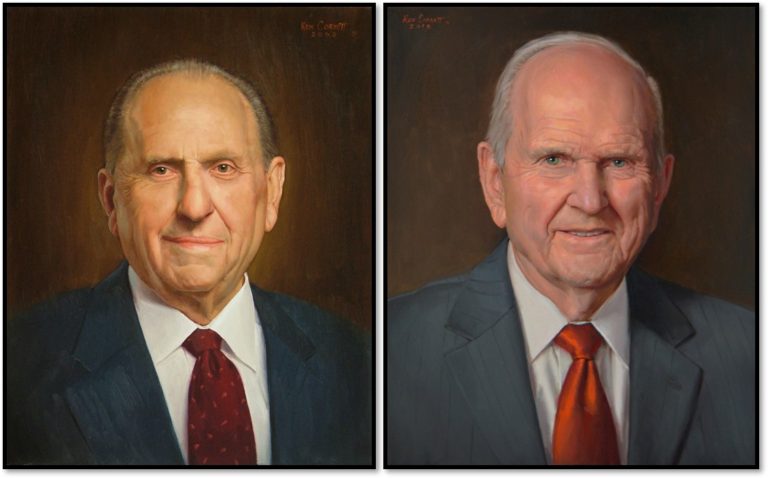
“I love the Book of Mormon as it is a special witness of the truth of the Gospel of Jesus Christ. It is the “Key Stone” of our religion. How I love President Thomas S. Monson’s last talk as he urges us to read and follow this amazing book. I am so thankful to his many years of service on our behalf for the Lord.
President Russell M Nelson is also a Prophet of God, of this I am so sure. He has taken the mantle and you can feel his love for each of us. Oh, how I pray we follow these chosen Prophets. There are no better words than to hear from them below. I pray you will be touched by their words.” Rian Nelson
The Power of the Book of Mormon By President Thomas S. Monson
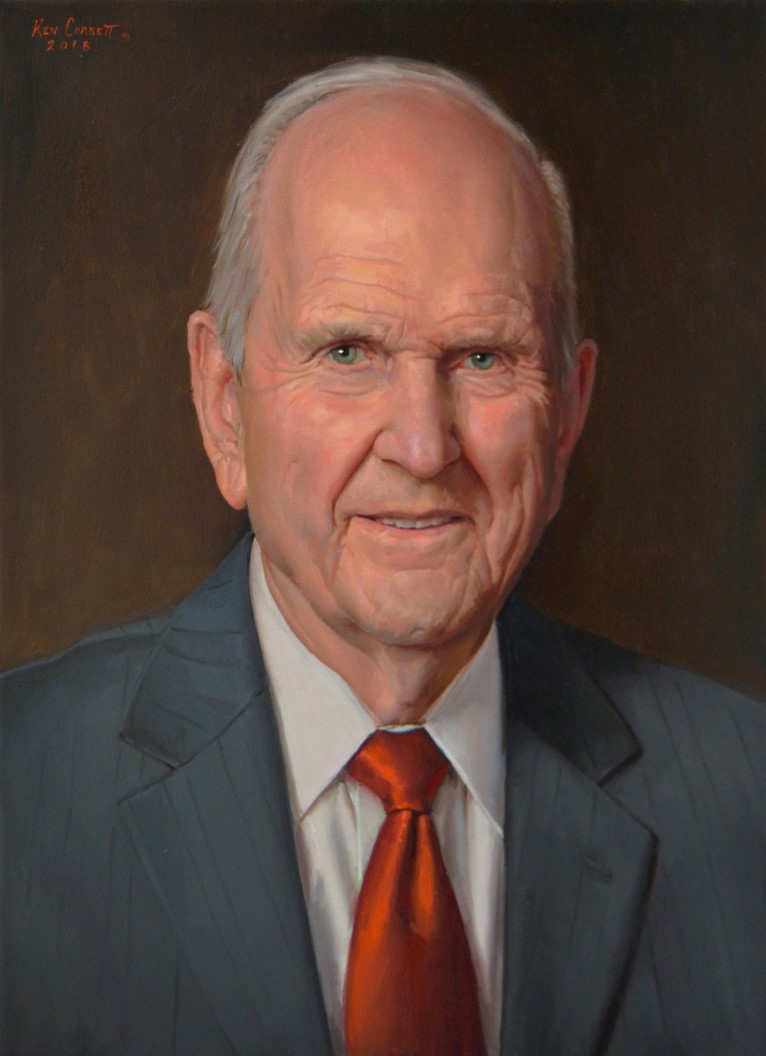
Thomas S. Monson by Ken Corbett. Click to see Ken’s other art.
“I implore each of us to prayerfully study and ponder the Book of Mormon each day.
My dear brothers and sisters, I greet you most warmly as we are met again in a great general conference of The Church of Jesus Christ of Latter-day Saints. Before I begin my formal message today, I would like to announce five new temples which will be built in the following locations: Brasília, Brazil; greater Manila, Philippines, area; Nairobi, Kenya; Pocatello, Idaho, USA; and Saratoga Springs, Utah, USA.
This morning I speak about the power of the Book of Mormon and the critical need we have as members of this Church to study, ponder, and apply its teachings in our lives. The importance of having a firm and sure testimony of the Book of Mormon cannot be overstated.
We live in a time of great trouble and wickedness. What will protect us from the sin and evil so prevalent in the world today? I maintain that a strong testimony of our Savior, Jesus Christ, and of His gospel will help see us through to safety. If you are not reading the Book of Mormon each day, please do so. If you will read it prayerfully and with a sincere desire to know the truth, the Holy Ghost will manifest its truth to you. If it is true—and I solemnly testify that it is—then Joseph Smith was a prophet who saw God the Father and His Son, Jesus Christ.
Because the Book of Mormon is true, The Church of Jesus Christ of Latter-day Saints is the Lord’s Church on the earth, and the holy priesthood of God has been restored for the benefit and blessing of His children.
If you do not have a firm testimony of these things, do that which is necessary to obtain one. It is essential for you to have your own testimony in these difficult times, for the testimonies of others will carry you only so far. However, once obtained, a testimony needs to be kept vital and alive through continued obedience to the commandments of God and through daily prayer and scripture study.
My dear associates in the work of the Lord, I implore each of us to prayerfully study and ponder the Book of Mormon each day. As we do so, we will be in a position to hear the voice of the Spirit, to resist temptation, to overcome doubt and fear, and to receive heaven’s help in our lives. I so testify with all my heart in the name of Jesus Christ, amen.”
Russell M. Nelson by Ken Corbett- Click to see his website
President Nelson’s Book of Mormon Lists Oct 2017
The Book of Mormon is:
Another testament of Jesus Christ. Its major writers—Nephi, Jacob, Mormon, Moroni—and its translator, Joseph Smith, were all eyewitnesses of the Lord.
A record of His ministry to people who lived in ancient America.
True, as attested by the Lord Himself.
The Book of Mormon affirms:
The individual identity of Heavenly Father and His Beloved Son, Jesus Christ.
The necessity of the Fall of Adam and the wisdom of Eve, that men might have joy.
The Book of Mormon refutes notions that:
Revelation ended with the Bible.
Infants need to be baptized.
Happiness can be found in wickedness.
Individual goodness is adequate for exaltation (ordinances and covenants are needed).
The Fall of Adam tainted mankind with “original sin.”
The Book of Mormon fulfills biblical prophecies that:
“Other sheep” shall hear His voice.
God will do “a marvelous work and a wonder,” speaking “out of the dust.”
The “stick of Judah” and the “stick of Joseph” will become one.
Scattered Israel will be gathered “in the latter days” and how that will be done.
The land of inheritance for the lineage of Joseph is the Western Hemisphere.
The Book of Mormon clarifies understanding about:
Our premortal existence.
Death. It is a necessary component of God’s great plan of happiness.
Postmortal existence, which begins in paradise.
How the resurrection of the body, reunited with its spirit, becomes an immortal soul.
How our judgment by the Lord will be according to our deeds and the desires of our hearts.
How ordinances are properly performed: for example, baptism, sacrament, conferring the Holy Ghost.
The Atonement of Jesus Christ.
The Resurrection.
The important role of angels.
The eternal nature of priesthood.
How human behavior is influenced more by the power of the word than the power of the sword.
The Book of Mormon reveals information previously unknown:
Baptisms were performed before Jesus Christ was born.
Temples were built and used by people in ancient America.
Joseph, 11th son of Israel, foresaw the prophetic role of Joseph Smith.
Nephi (in 600–592 BC) foresaw the discovery and colonizing of America.
Plain and precious parts of the Bible have been lost.
The Light of Christ is given to each person.
The importance of individual agency and the need for opposition in all things.
Warnings about “secret combinations.”
The above list is from President Russell M Nelson, then President of the Quorum of the Twelve, General Conference talk Oct 2017Read and view video Here
What did the Prophet Joseph Smith know about Book of Mormon geography? By Rod Meldrum
“No less than three times Joseph claimed to have received inspiration and/or revelation on the matter, and he is completely consistent about where he indicated he knew it occurred. He established this knowledge also by where he sent the first missionaries after having received commandment from God to go and preach the gospel unto the ‘Lamanites’. Where did Joseph send the first missionaries, and which tribes did he himself preach the gospel to and declare to be remnants of the Lamanites?
What about claims that the Prophet Joseph Smith stated that Zarahemla was located in Guatemala? This claim has been perpetuated by several Mesoamerican theorists. An example is the following:
“Joseph Smith, as editor of the Times and Seasons, directed our attention to this fact in an editorial (Oct. 1, 1842). He stated that “the city of Zarahemla “stood upon this land where explorer John Lloyd Stephens brought the magnificent ancient Maya ruins to the world’s attention in his 1841 publications,” “Incidents of Travel in Central America, Chiapas, and Yucatan.” Ongoing researches today are confirming Joseph’s inspired insight.”
The claim that Joseph Smith made these statements stems from two articles that appeared in the Times and Seasons of Sept. 15th and Oct. 1st, 1842, and have been falsely attributed to Joseph Smith. Joseph Smith did not write either article, he did not sign it (as he testified he would for anything he wrote in the Times and Seasons), he had already given editorial responsibility to the 12 by revelation, and he happened to be in hiding from the law at the time these two articles appeared. This ‘evidence’ for a Mesoamerican setting for the Book of Mormon would be thrown out of any court of law for insufficient evidence.
FARMS agree’s that claiming this quote to be from Joseph Smith’s is invalid.
See http://farms.byu.edu/display.php?table=jbms&id=202 quoted below.
Joseph Smith and Book of Mormon GeographyExactly what Joseph Smith believed at different times in his life concerning Book of Mormon geography in general is also indeterminable. Only a few clues remain. For example, while the church was headquartered in Nauvoo, Joseph read a best-selling book of his day by John L. Stephens, Incidents of Travel in Central America, Chiapas, and Yucatan, which John Bernhisel had sent to him from the East. In a letter dated 16 November 1841, the Prophet thanked Bernhisel and wrote about the book that “of all histories that had been written pertaining to the antiquities of this country it is the most correct” and it “supports the testimony of the Book of Mormon.” Ten months later, the Times and Seasons printed an enthusiastic review of the Stephens volume. John Taylor was the editor, although Joseph Smith had shortly before announced his own editorial responsibility for the newspaper. The unnamed writer of the review (probably Wilford Woodruff) stated that “we have just learned . . . [that] the city Zarahemla . . . stood upon this land [of Guatemala, whose ruins Stephens was reporting].
Joseph Smith received a revelation on January 28th, 1842 that the Twelve should be given responsibility for the Times and Seasons and manage the print shop. Joseph recorded, “I received the following revelation to the Twelve concerning the Times and Seasons, given January 28th, 1842. Revelation. Verily thus saith the Lord unto you, my servant Joseph, go and say unto the Twelve, that it is my will to have them take in hand the editorial department of the Times and Seasons, …” 1
From the Times and Seasons, Tuesday, March 15th, 1842 Joseph wrote: “This paper commences my editorial career, I alone stand for it, and shall do for all papers having my signature henceforward.” Neither of these two editorial commentaries in the Times and Seasons indicating a Mesoamerican setting for the Book of Mormon was signed by anybody, including Joseph. He did, however, sign other articles that appeared during this same time frame, thereby validating his express statement that he would be responsible for all articles that bore his signature
The proposed letter from Joseph Smith to John Bernhisel of Nov. 16th, 1841 is also being misconstrued to indicate something it doesn’t when reading in its entirety. It states:
“Dear Sir, I received your kind present by the hand of Er [Elder] Woodruff & feel myself under many obligations for this mark of your esteem & friendship which to me is the more interesting as it unfolds & developes (sic) many things that are of great importance to this generation & corresponds with & supports the testimony of the Book of Mormon;I have read the volumes with the greatest of interest & pleasure & must say that of all the histories that have been written pertaining to the antiquities of this country it is the most correct luminous & comprehensive.”
When read in context, Joseph appears to be thanking Bishop Bernhisel for his friendship and support and then mentions that he had read the book set ‘Incidents of travel in Central America’ which he considered to be the most correct and comprehensive of any book written pertaining to ‘this country’. What ‘country’ was Joseph talking about? The book’s title specifically indicates it was written about Central America, so it is clear that Joseph was simply stating that this book set is the best information available on Central America. Nowhere does Joseph state that the Book of Mormon history occurred in Central America.
Conversely, Joseph was very clear about where he KNEW the Book of Mormon to have occurred.
In the Wentworth letter (which Joseph stated was received by revelation) Joseph wrote “I was also informed concerning the aboriginal inhabitants of this country, and shown who they were, and from whence they came; a brief sketch of their origin, progress, civilization, laws, governments,…“. He went on to write “The remnant are the Indians that now inhabit this country. This book also tells us that our Saviour [Savior] made his appearance upon this continent…”. 2
In a letter Joseph wrote by commandment from God, and which was subsequently printed in the American Revivalist and Rochester Observer Feb. 2nd, 1833 edition, he writes to the editor in which he described the Book of Mormon as follows: “The Book of Mormon is a record of the forefathers of our western tribes of Indians;…” “By it we learn that our western tribes of Indians, are descendants from that Joseph that was sold into Egypt, and that the land of America is a promised land unto them.” West to Joseph at this time would have meant Ohio, Illinois, Missouri…further west it was actually Mexico at the time.
From a hand-written letter to his wife Emma Smith while on Zion’s camp march of June 4th, 1834 Joseph wrote “The whole of our journey, in the midst of so large a company of social honest and sincere men, wandering over the plains of the Nephites, recounting occasionally the history of the Book of Mormon, roving over the mounds of that once beloved people of the Lord, picking up their skulls and bones, as proof of its divine authenticity..” Signed by Joseph Smith Jr. 3
The Zelph account. On June 3rd, 1834, Joseph Smith Jr. with several brethren (8 of whom wrote in their personal journals as having witnessed this account, and three of these men became future prophets of the church) visited a prominent mound on top of the bluffs overlooking the area around Valley City, Illinois. Joseph procured a shovel and dug down about a foot where he unearthed some bones. He continued until a ribcage could be distinguished wherein they found an arrowhead. They’re combined, highly corroborated accounts were recorded as follows. “the visions of the past being opened to my understanding by the Spirit of the Almighty, I discovered that the person whose skeleton was before us was a white Lamanite, a large, thick-set man, and a man of God. His name was Zelph. He was a warrior and chieftain under the great prophet Onandugus, who was known from the hill Cumorah or eastern sea to the Rocky Mountains… He was killed in battle by the arrow found among his ribs during the last great struggle with the Lamanites and Nephites.” 4
Even more importantly than what Joseph said is what he personally wrote. But even more important than what he wrote is what he DID. When commanded by God to send missionaries to preach the gospel “unto the Lamanites” (see D&C 28:8 Sept. 1830) Joseph immediately dispatched three men. Oliver Cowdrey (D&C 28:8), Peter Whitmer Jr. (D&C 30:5-6) and Parley P. Pratt (D&C 32:1-2). Parley P. Pratt recorded in his autobiography 5, “Thus ended our first Indian Mission, in which we had preached the Gospel in its fullness and distributed the record of their forefathers among three tribes…” And where did the prophet Joseph send those missionaries? To Buffalo New York, Ohio, and west of Missouri. And isn’t it ironic that he just happened to send these first missionaries to the very tribes that today have Haplogroup X (European) DNA…how did Joseph know that? How many missionaries did Joseph Smith send to Guatemala?
Where did Joseph Smith himself go to “preach unto the Lamanites”? From History of the Church, Vol. 4 p 401-402 on Thursday, August 12th, 1841 Joseph wrote: “I accordingly went down, and met Keokuk, Kis-ku-kosh, Appenoose, and about one hundred chiefs and braves of those tribes (Sac and Fox tribes), with their families.” He went on to say, “I conducted them to the meeting grounds in the grove, and instructed them in many things which the Lord had revealed unto me concerning their fathers, and the promises that were made concerning them in the Book of Mormon.”
D&C 54:8states “And thus you [Newel Knight] shall take your journey into the regions westward, unto the land of Missouri, unto the borders of the Lamanites.” Even if Joseph was confused (which he wasn’t) do you think that GOD is confused about where the remnants of the Lamanites are located?
And finally, where did GOD himself place the city of Zarahemla? See D&C 125:3 and see for yourself where he placed it. Remember, God has only named a handful of places through his prophets, so it is likely very important when he does so. You may be very surprised at the answer, and it was not in Mesoamerica.” By Rod Meldrum
Autobiographical and Historical Writings, vol. 1 of The Papers of Joseph Smith, by Dean C. Jessee p 431 ↩
The Personal Writings of Joseph Smith, by Dean C. Jessee p 324 ↩
History of the Church Vol. 2:79-80, 1948 edition ↩
Pratt, Parley P. Autobiography of Parley Parker Pratt: One of the Twelve Apostles of the Church of Jesus Christ of Latter-Day Saints, Embracing His Life, Ministry and Travels, with Extracts, in Prose and Verse, from His Miscellaneous Writings. Salt Lake City, UT: Deseret Book, 1980. 56-61. Print. ↩
Joseph Smith knew all about where the Nephites lived.
“As we look into the record, we find that after the first visit to the Hill Cumorah, Joseph told the story of the history of the early American inhabitants to his family. His mother wrote: “From this time forth, Joseph continued to receive instructions from the Lord, and we continued to get the children together every evening for the purpose of listening while he gave us a relation of the same. I presume our family presented an aspect as singular as any that ever lived upon the face of the earth—all seated in a circle, father, mother, sons and daughters, and giving the most profound attention to a boy, eighteen years of age.” This sounds like the first family home evening of this dispensation.
Then she continued to say: “We were now confirmed in the opinion that God was about to bring to light something upon which we could stay our minds, or that would give us a more perfect knowledge of the plan of salvation and the redemption of the human family. This caused us greatly to rejoice, the sweetest union and happiness pervaded our house, and tranquility reigned in our midst. During our evening conversations, Joseph would occasionally give us some of the most amusing recitals that could be imagined. He would describe the ancient inhabitants of this continent, their dress, mode of traveling, and the animals upon which they rode; their cities, their buildings, with every particular; their mode of warfare; and also their religious worship. This he would do with as much ease, seemingly, as if he had spent his whole life among them.” This was before he received the plates. He must have received this by revelation, for he knew the whole story of the content of the record that is now the Book of Mormon. He had had five long visits with Moroni, and his mother says he received many revelations.” Eldred G. Smith, Conference Report, October 1967, pp. 82-84
It is important to use your own judgement when hearing information from sites such as mine that don’t necessarily have the endorsement of The Church of Jesus Christ of Latter-day Saints. The Lord has told us to seek truth and pray about it and we many know the “truth of all things.”
Ask Gramps is sort of a “Dear Abby” column for Mormon topics. Author Clay Gorton has been a Mormon bishop, stake president, mission president, and MTC president, and has been answering questions as “Gramps” for many years. His website (which I don’t necessarily endorse,) will include content from his books as well as answers to new questions that come in. Many questions are interesting and obscure, and Gramps does a great job of answering them all in a fun and candid way — just like your own grandpa.
Many who believe in the Mesoamerican Theory say that Joseph Smith received the gold plates from a hill in NY, but it wasn’t necessarily called Cumorah. They say that Moroni took the other plates he didn’t deposit in the hill in NY and put them in a hill in Mexico somewhere. Here is a question to “Ask Gramps” from 2008 that I think you will enjoy.
Have you found any reference where Joseph Smith actually called the hill of the golden plates Cumorah?
Gramps,
Jerry Ainsworth has spent a lifetime on Book of Mormon archaeology. He supports the Central America theory and claims Joseph Smith never identified the place he got the records as Cumorah, even though later church leaders have. Have you found anywhere where Joseph actually called the hill of the golden plates Cumorah?
Gary, from Whitby. Ontario
Dear Gary,
Many others, in addition to Jerry Ainsworth, have spent their lives studying Book of Mormon archaeology, and they do not all agree with the Central America theory. That theory is indeed the most popular one, but it has a number of unresolved problems associated with it. Each of the other theories also have their own problems.
To the best of my knowledge, we have no first person record of Joseph Smith naming the hill from which he received the plates of the Book of Mormon. However, Only a small fraction of the words that Joseph Smith spoke were ever written down–and we can include in that fraction the scriptures that he revealed. There can be no other explanation for the Hill Cumorah being named what it was than that the name was given by Joseph Smith. All of his contemporaries used the name Cumorah for that hill, and there is no record of him refuting any of them. Had he done so, there no doubt would have been corrections made in the thinking and the writing of others. It is impossible to think that somebody else thought up that name and Joseph went along with it.
So I think that we can conclude with utmost confidence that Joseph received the name of that hill from the Angel Moroni. Therefore, the Hill Cumorah in New York State must stand as an a priori postulate for any reasonable archaeological theory relating to the Nephite culture. Here are just a few of the voluminous records that point to Joseph Smith as the originator of the name Cumorah—
“This angel delivered a message to Joseph Smith, and told him that in the Hill Cumorah there were buried golden plates containing a record of the forefathers of the American Indians” (Discourse of President Heber J. Grant, Conference Report, October 1919, Morning Session, p.21
“Joseph Smith visited by the angel Moroni and told of the Book of Mormon record. Joseph viewed the gold plates buried in a nearby hill” (Cumorah) (see Joseph Smith—History 1:27-54).
“The following is also taken from the history of the travels of the Kirtland Camp: ‘The camp passed through Huntsville, in Randolph County, which has been appointed as one of the stakes of Zion, and is the ancient site of the City of Manti, and pitched tents at Dark Creek, Salt Licks, seventeen miles” (Joseph Fielding Smith, Doctrines of Salvation, edited by Bruce R. McConkie, 3:, p.239)
Next we’ll find some archaeologist claiming that the Book of Mormon city, Manti, could not have been in Randolph County, Indiana.
Here’s a statement from our current prophet, President Gordon B. Hinckley—
“Among these was Mormon, who in his day kept the chronicles of the nation. From these extensive records he had compiled on plates of gold an abridged record. This he had given to his son, Moroni, who survived the destruction of the Nephite nation at the hands of the Lamanites. Moroni, prior to his death, buried the record in the Hill Cumorah, where Joseph Smith received it some fourteen centuries later” (Gordon B. Hinckley, What of the Mormons? , p.78)
And again from Brigham Young —
“Persecution did not commence in Kirtland, nor in Jackson County, but it commenced at the time Joseph the Prophet sought the plates in the hill Cumorah” (Journal of Discourses, 2:, p.5)
Where do you think that Brigham Young could have come up with that identification of the Hill Cumorah, if not from Joseph Smith?
Another quote from Brigham Young—
“I have conversed with several of those men who say they have seen the plates that Joseph Smith took out of the hill Cumorah; I have also conversed with Joseph Smith, who has told me of these things and many more that it would be unnecessary on the present occasion to relate” (Journal of Discourses, 10:, p.131).
Relative to the things that the Lord promised the Three Witnesses that they were entitled to see, we have this interesting account also preserved for us by Brigham Young—
“When Joseph got the plates, the angel instructed him to carry them back to the hill Cumorah, which he did” (Journal of Discourses, 19:38).
In this regard, those who refute the location of the Hill Cumorah as being in upper New York State are necessarily impugning the veracity of the Angel Moroni.
You guys believe more in man’s telestial scientific theories that you do in the word of God. I’ve spent my life in the field of science–my last assignment was as the Chief Scientist for one of the divisions of TRW, the largest spacecraft manufacturing firm in the U.S. And you would be very surprised at the limitations of the scientific method, and the gross errors that are embedded in the current scientific philosophy. I just wrote a book on “The Demise of Darwinism.” The prehistoric time line following Darwin’s theory that scientists use today is absolutely full of holes and is grossly inaccurate. Please rescue yourself from the trap of judging the prophets by the scientists rather than judging the scientists by the prophets, as it should be done.
The St. George Utah Temple, originally named the St. George Temple, and the only temple completed during Brigham Young’s 30-year tenure as President of The Church of Jesus Christ of Latter-day Saints, is the oldest operating temple of the Church and the first built in Utah. It was privately dedicated on 1 January 1877 in a series of three dedicatory prayers: the baptistry by Wilford Woodruff, the main floor by Erastus Snow, and the sealing room by Brigham Young, Jr. The St. George Utah Temple is also the first temple where endowments for the dead were performed, and it is also there that temple ordinances were put into a written form for the first time.
Elder Bruce C. Hafen, former president of the St. George Utah Temple and emeritus General Authority, during a presentation titled “Brigham Young, Wilford Woodruff, and the St. George Temple” at the Church History Museum in 2014 noted that “the temples in Kirtland, Nauvoo and St. George were all necessary for bringing about the restoration of important priesthood keys and ordinances.” Wilford Woodruff and the Temple Work of the Founding Fathers by Keith L. Brown | May 25, 2015 | Early History
Christopher Columbus: A Latter-day Saint Perspective
Arnold K. Garr With a foreword by DeLamar Jensen Published by the Religious Studies Center, Brigham Young University, Provo, Utah http://rsc.byu.edu
While many books have been written about the life of Christopher Columbus and his New World discoveries, this one has a different thrust—that Columbus was not just a skilled, courageous sailor but was also a chosen instrument in the hands of God. This book profiles the man from Genoa who apparently yearned from childhood for the seafaring life and who early began to acquire the nautical knowledge and experience that would make him the most widely traveled seaman of his day and would help him rise to the top ranks in that career.
Arnold K. Garr, Christopher Columbus A Latter-Day Saint Perspective, (Provo, Utah: Religious Studies Center, Brigham Young University, 1992), 71–72.
Epilogue
For Latter-day Saints, the story of Christopher Columbus does not begin with his birth in 1451; nor does it end with his death in 1506. Because they believe that everyone associated with this earth lived as spirit children of our Heavenly Father in a premortal state before they came to earth, they believe that Columbus lived before he came here. And because they believe that life continues after death, they believe he is now in the Spirit World awaiting the resurrection with millions of other spirits who have passed from this life.
But Latter-day Saints are more involved in Columbus’ life than just believing that he lived in a premortal state and waiting for him to be resurrected. They believe that he was an instrument in the Lord’s hand to discover the Americas to the Europeans. That in turn brought the Founding fathers here to establish the United States of America. Its freedoms made it possible to restore the Church of Jesus Christ to the earth. And there is still more.
They have a tradition that President Wilford Woodruff, while he was serving as the President of the St. George Temple, was visited by the spirits of several great men who requested him to perform vicarious baptism for them in the temple. Speaking of that experience, President Woodruff said:
“The spirits of the dead gathered around me, wanting to know why we did not redeem them. Said they, “You have had the use of the Endowment House for a number of years, and yet nothing has ever been done for us. We laid the foundation of the government you now enjoy, and we never apostatized from it, but we remained true to it and were faithful to God.” These were the signers of the Declaration of Independence, and they waited on me for two days and two nights. I thought it very singular , that notwithstanding so much work had been done, and yet nothing had been done for them. The thought never entered my heart, from the fact, I suppose, that heretofore our minds were reaching after our more immediate friends and relatives. I straightway went into the baptismal font [in the temple] and called upon brother McCallister to baptize me for the signers of the Declaration of Independence, and fifty other eminent men, making one hundred in all, including John Wesley, Columbus, and others.” (JD 19:229)
On the same day these ordinances were performed, President Woodruff records in his journal that he baptized brother McCallister “for 21, including Gen Washington & his forefathers and all the Presidents of the United States that were on my list except Buchanan Van Buren & Grant Sister
Lucy Bigelow Young went forth into the font and was Baptized for Martha Washington and her family and seventy (70) of the Eminent women of the world. . . . There were Baptized in all to day 682” (Woodruff, Journal 7:367–69). All these proxy ordinances are performed for the dead so they as spirits in the Spirit World may accept or reject them.
As President Ezra Taft Benson presided over the Church in 1992, the 500th anniversary of Columbus’ epic voyage, it seems appropriate to quote his appraisal of the man and the other “eminent men” whose temple ordinances were performed by President Woodruff:
The temple work for the fifty-six signers of the Declaration of Independence and other founding fathers has been done. All these appeared to Wilford Woodruff when he was President of the St. George Temple. President George Washington was ordained a High Priest at that time. You will also be interested to know that according to Wilford Woodruff’s journal, John Wesley, Benjamin Franklin, and Christopher Columbus were also ordained High Priests at the time. When one casts doubt upon the character of these noble sons of God, I believe he or she will have to answer to the God of heaven for it. (Benson 604)
[I have a friend named Oak Norton who has a copy of the St. George temple records and Lord Nelson from Britain was also ordained a High Priest. It’s written out to the side as Elder Benson must have missed it.] You can clearly see below how High Priest is written for Lord Nelson.
See John Wesley and Christopher Columbus but here is says Elder only.
Arnold K. Garr continues, “Notwithstanding the mistakes he made in his life and the human faults he had, Christopher Columbus was a man of notable spiritual sensitivity. Given the powers of repentance and forgiveness, it should come as no surprise that President Wilford Woodruff vicariously had his endowments done and ordained him a High Priest three days after he was baptized for him.” Arnold K. Garr
Question: According to Wilford Woodruff’s journal, President George Washington, John Wesley, Benjamin Franklin, and Christopher Columbus were ordained high priests when they appeared within the sacred walls of the St. George Temple. Why did these ordinations take place in our sphere by a mortal man?
Answer: These ordinations took place in our sphere, by a mortal man because these ordinances must be performed in this life. After the resurrection comes the judgment, when the books will be opened and it will be eternally too late to enter ordinance work into the ledger. The ordination to the Melchizedek Priesthood, along with sealings, endowments, baptisms, and confirmations, all must happen in this life, and must be recorded in this life. Thus, the dead will “be judged according to men in the flesh, but live according to God in the spirit” (1Peter 4:6). askgramps.com
Eminent Men and Women Baptized in the St. George Temple
Temple work was performed on behalf of the following well-known and respected men and women in the St. George Utah Temple in August 1877 Compiled By Glen W. Chapman- January 2002)
Founding Fathers: William Hooper(NC), Joseph Hewes (NC), John Penn(NC), Button Gwinnett(GA), Lyman Hall(GA), George Walton(GA), Edward Rutledge(SC), Thomas Heyward Jr.(SC), Thomas Lynch(SC), Arthur Middleton(SC), Samuel Chase(MD), William Paca(MD), Thomas Stone(MD), Charles Carrol(MD), George Wythe(VA), Richard Henry Lee(VA), Thomas Jefferson(VA), Benjamin Harrison(VA), Thomas Nelson Jr.(VA), Francis Lightfoot Lee(VA), Carter Braxton(VA), Robert Morris (PA), Benjamin Rush(PA), Benjamin Franklin(PA), John Morton(PA), George Clymer(PA), James Smith(PA), George Taylor(PA), James Wilson(PA), George Ross(PA), Caeser Rodney(DE), George Read(DE), Thomas McKean(DE), Philip Livingston(NY), Francis Lewis(NY), Lewis Morris(NY), Richard Stockton (NJ), John Witherspoon(NJ), Francis Hopkinson(NJ), John Hart(NJ), Abraham Clark(NJ), Josiah Bartlett(NH), William Whipple(NH), Matthew Thornton(NH), Samuel Adams(MA), John Adams(MA), Robert Treat Paine(MA), Elbridge Gerty(MA), Stephen Hopkins(RI), William Ellery(RI), Roger Sherman(CN), Samuel Huntington(CN), William Williams(CN), and Oliver Wolcott(CN).
Note: Temple work was not done for John Hancock or William Floyd as it had already been completed previously.
Presidents of the United States: George Washington, John Adams, Thomas Jefferson, James Madison, James Monroe, John Quincy Adams, Andrew Jackson, William Henry Harrison, John Tyler, James Knox Polk, Zachary Taylor, Millard Fillmore, Franklin Pierce, Abraham Lincoln, and Andrew Johnson.
Note: Temple work was not done for James Buchanan, Martin Van Buren, or Ulysses S. Grant.
Other eminent men baptized by Wilford Woodruff in the St. George Utah Temple in August 1877 include: Sir Edward Gibbon, Johann Wolfgang von Goethe, Oliver Goldsmith, Henry Grattan, Humboldt, Alexander von Irving, Washington Jackson, Thomas Jonathan “Stonewall” Johnson, Samuel Ju~rez, Benito Pablo Kemble, John Philip Liebig, Baron Justus von Livingstone, David Macaulay, Thomas Babington Nelson, Lord Horatio O’Connell, Daniel Peabody, George Powers, Hiram Reynolds, Sir Joshua Schiller, Johann Christoph Friedrich von Scott, Sir Walter Seward, William Henry Stephenson, George Thackeray, William Makepeace, Vespucci, Amerigo Webster, Daniel Wesley, John Wordsworth, William Parepa, Count Dimitrius, Martha Washington and her family, John Washington(Great Grandfather of George Washington), Sir Henry Washington, Lawrence Washington (Brother of George Washington), Augustine Washington (Father of George Washington), Lawrence Washington (Father of Augustine), Lawrence Washington, Daniel Park Custis, John Park Custis (Son of Daniel and Martha Parke Custis), and Martin Luther.
Eminent Women baptized include: Jean Armour (1767—1834) of Scotland, Jean Armour Burns (Wife of Robert Burns) (1759—1796), Jane Austen (1775—1817) of England, novelist, Mary Ball (1708—1789) of America, Mary Ball Washington (Mother of George Washington) (1732—1799), Sarah Bernard (1800—1879) of England, Sarah Barnard Faraday (wife of Michael Faraday (1791—1867), Charlotte Bronte (1816—1855) of England, novelist, Felicia Dorothea Browne (1793—1835) of England, Elizabeth Barrett Browning (1806—1861) of England, poet, (wife of Robert Browning) (1812—18?), Martha Caldwell Calhoun (d. 1802) of America (mother of John Caldwell Calhoun) (1782—1850), Martha Parke Custis (1755—1773) of America (Daughter of Martha Washington) (1732—1802), Martha Dandridge Washington (1732—1802) of America (wife of George Washington) (1732—1799), Rachel Donelson Jackson (1767—1828) of America (wife of Andrew Jackson (1767—1845), and Abigail Eastman Webster (1737—1816) of America (mother of Daniel Webster (1782—1852), to name but a few. Temple work was performed for a total of 70 eminent women.
A Salute to Michael Bedard -Artist of the Eminent Men and Women
Michael Bedard has created countless pieces of fine art, built three art studios, and raised a family of seven kids. He is a man who is confident in his abilities and always looking to improve them. He worked several jobs and served in the national guard while obtaining his BFA at Brigham Young University and MFA at Washington State University, all while raising a growing family. Michael is now living in Nauvoo, Illinois, with his wife and youngest son, establishing another gallery there. He has come a long way, developing his art over the years and through life’s challenges. The simple desire to create something greater popped into existence when a little Michael saw a mural made of tiny tiles at the public pool one summer. The flippant thought came to him, “I can do that!” This little boy looked at a simple piece of art and grew to create masterpieces that shape and are shaped by the world around him. With support from his young single mother, encouragement from schoolteachers eager to get the rebel to do something productive, and later many more people, the young man began to doodle, grow, draw, and paint. From that point he began his mission to change himself and the world. “When you create great art that literally frees people, it lifts them up and gives them wings.”
85 Indian Chiefs baptized Aug 29, 1877 at the St. George Temple, one week after the Founding Fathers. Read the Annotated Book of Mormon by David Hocking and Rod Meldrum page 554 Detailed story at my blog here:https://www.bofm.blog/85-native-american-chiefs-baptized-at-the-st-george-temple/
Photo copy of page 196 St George Temple Baptisms Aug 29, 1877. Picture taken by Rod Meldrum
This is an excellent article that I have read over and over. This article along with Elder Jeffrey R. Holland’s called “The Greatness of the Evidence“, are important words to hear from two well respected men. Whether you believe Book of Mormon events happened in Mesoamerica, S. America, Baja, or the Heartland, these brethren have given us wonderful advice. The two quotes from each Apostle below are my favorites quotes.
“Those who rely exclusively on scholarship reject revelation… Those who rely on a combination of revelation, faith, and scholarship can see and understand all of the complex issues of the Book of Mormon record, and it is only through that combination that the question of the historicity of the Book of Mormon can be answered.” Elder Oaks
“Truth borne by the Holy Spirit comes with, in effect, two manifestations, two witnesses if you will—the force of fact as well as the force of feeling… I believe God intends us to find and use the evidence He has given—reasons, if you will—which affirm the truthfulness of His work… Evidence is still evidence even if it is not immediately observable.” Elder Holland
The Historicity of the Book of Mormon
By Elder Dallin H. Oaks. Elder Dallin H. Oaks was a member of the Quorum of the Twelve Apostles of The Church of Jesus Christ of Latter-day Saints when this was published.
The issue of the historicity of the Book of Mormon highlights the difference between those who rely solely on scholarship and those who rely on revelation, faith, and scholarship. Those who rely solely on scholarship reject revelation and focus on a limited number of issues. But they can neither prove nor disprove the authenticity of the Book of Mormon through their secular evidence and methods. On the other hand, those who rely on a combination of revelation, faith, and scholarship can see and understand all of the complex issues of the Book of Mormon record, and it is only through that combination that the question of the historicity of the Book of Mormon can be answered. [1]
Some who term themselves believing Latter-day Saints are advocating that Latter-day Saints should “abandon claims that [the Book of Mormon] is a historical record of the ancient peoples of the Americas.” [2] They are promoting the feasibility of reading and using the Book of Mormon as nothing more than a pious fiction with some valuable contents. These practitioners of so-called “higher criticism” raise the question of whether the Book of Mormon, which our prophets have put forward as the preeminent scripture of this dispensation, is fact or fable—history or just a story.
The historicity—historical authenticity—of the Book of Mormon is an issue so fundamental that it rests first upon faith in the Lord Jesus Christ, which is the first principle in this, as in all other matters. However, on the subject of the historicity of the Book of Mormon, there are many subsidiary issues that could each be the subject of a book. It is not my purpose to comment on any of these lesser issues, either those that are said to confirm the Book of Mormon or those that are said to disprove it.
Those lesser issues are, however, worthy of attention. Elder Neal A. Maxwell quoted Austin Farrer’s explanation: “Though argument does not create conviction, the lack of it destroys belief. What seems to be proved may not be embraced; but what no one shows the ability to defend is quickly abandoned. Rational argument does not create belief, but it maintains a climate in which belief may flourish.” [3]
In these remarks I will seek to use rational argument, but I will not rely on any proofs. I will approach the question of the historicity of the Book of Mormon from the standpoint of faith and revelation. I maintain that the issue of the historicity of the Book of Mormon is basically a difference between those who rely exclusively on scholarship and those who rely on a combination of scholarship, faith, and revelation. Those who rely exclusively on scholarship reject revelation and fulfill Nephi’s prophecy that in the last days men “shall teach with their learning, and deny the Holy Ghost, which giveth utterance” (2 Ne. 28:4). The practitioners of that approach typically focus on a limited number of issues, like geography, horses, angelic delivery, or nineteenth-century language patterns. They ignore or gloss over the incredible complexity of the Book of Mormon record. Those who rely on scholarship, faith, and revelation are willing to look at the entire spectrum of issues—the content as well as the vocabulary, the revelation as well as the excavation.
Speaking for a moment as one whose profession is advocacy, I suggest that if one is willing to acknowledge the importance of faith and the reality of a realm beyond human understanding, the case for the Book of Mormon is the stronger case to argue. The case against the historicity of the Book of Mormon has to prove a negative. You do not prove a negative by prevailing on one debater’s point or by establishing some subsidiary arguments.
For me, this obvious insight goes back over forty years to the first class I took on the Book of Mormon at Brigham Young University. The class was titled, somewhat boldly, the “Archaeology of the Book of Mormon.” In retrospect, I think it should have been labelled something like “An Anthropologist Looks at a Few Subjects of Interest to Readers of the Book of Mormon.” Here I was introduced to the idea that the Book of Mormon is not a history of all of the people who have lived on the continents of North and South America in all ages of the earth. Up to that time I had assumed that it was. If that were the claim of the Book of Mormon, any piece of historical, archaeological, or linguistic evidence to the contrary would weigh in against the Book of Mormon, and those who rely exclusively on scholarship would have a promising position to argue.
In contrast, if the Book of Mormon only purports to be an account of a few peoples who inhabited a portion of the Americas during a few millennia in the past, the burden of argument changes drastically. It is no longer a question of all versus none; it is a question of some versus none. In other words, in the circumstance I describe, the opponents of historicity must prove that the Book of Mormon has no historical validity for any peoples who lived in the Americas in a particular time frame, a notoriously difficult exercise. One does not prevail on that proposition by proving that a particular Eskimo culture represents migrations from Asia. The opponents of the historicity of the Book of Mormon must prove that the people whose religious life it records did not live anywhere in the Americas.
Another way of explaining the strength of the positive position on the historicity of the Book of Mormon is to point out that we who are its proponents are content with a standoff on this question. Honest investigators will conclude that there are so many evidences that the Book of Mormon is an ancient text that they cannot confidently resolve the question against its authenticity, despite some unanswered questions that seem to support the negative determination. In that circumstance, the proponents of the Book of Mormon can settle for a draw or a hung jury on the question of historicity and take a continuance until the controversy can be retried in another forum.
In fact, it is our position that secular evidence can neither prove nor disprove the authenticity of the Book of Mormon. Its authenticity depends, as it says, on a witness of the Holy Spirit. Our side will settle for a draw, but those who deny the historicity of the Book of Mormon cannot settle for a draw. They must try to disprove its historicity—or they seem to feel a necessity to do this—and in this they are unsuccessful because even the secular evidence, viewed in its entirety, is too complex for that.
Hugh Nibley made a related point when he wrote: “The first rule of historical criticism in dealing with the Book of Mormon or any other ancient text is, never oversimplify. For all its simple and straightforward narrative style, this history is packed as few others are with a staggering wealth of detail that completely escapes the casual reader. . . . Only laziness and vanity lead the student to the early conviction that he has the final answers on what the Book of Mormon contains.” [4] Parenthetically, I would cite as an illustration of this point the linguistic, cultural, and writing matters described in support of the authenticity of the Book of Mormon in Orson Scott Card’s persuasive essay, “The Book of Mormon—Artifact or Artifice?” [5]
I admire those scholars for whom scholarship does not exclude faith and revelation. It is part of my faith and experience that the Creator expects us to use the powers of reasoning He has placed within us, and that He also expects us to exercise our divine gift of faith and to cultivate our capacity to be taught by divine revelation. But these things do not come without seeking. Those who utilize scholarship and disparage faith and revelation should ponder the Savior’s question: “How can ye believe, which receive honour one of another, and seek not the honour that cometh from God only?” (John 5:44).
God invites us to reason with Him, but I find it significant that the reasoning to which God invites us is tied to spiritual realities and maturity rather than to scholarly findings or credentials. In modern revelation the Lord has spoken of reasoning with His people (D&C 45:10, 15; 50:10–12; 61:13; see also Isa. 1:18). It is significant that all of these revelations were addressed to persons who had already entered into covenants with the Lord—to the elders of Israel and to the members of his restored Church.
In the first of these revelations, the Lord said that He had sent His everlasting covenant into the world to be a light to the world, a standard for his people: “Wherefore, come ye unto it,” he said, “and with him that cometh I will reason as with men in days of old, and I will show unto you my strong reasoning” (D&C 45:10). Thus, this divine offer to reason was addressed to those who had shown faith in God, who had repented of their sins, who had made sacred covenants with the Lord in the waters of baptism, and who had received the Holy Ghost, which testifies of the Father and the Son and leads us into truth. This was the group to whom the Lord offered (and offers) to enlarge their understanding by reason and revelation.
Some Latter-day Saint critics who deny the historicity of the Book of Mormon seek to make their proposed approach persuasive to Latter-day Saints by praising or affirming the value of some of the content of the book. Those who take this approach assume the significant burden of explaining how they can praise the contents of a book they have dismissed as a fable. I have never been able to understand the similar approach in reference to the divinity of the Savior. As we know, some scholars and some ministers proclaim Him to be a great teacher and then have to explain how the one who gave such sublime teachings could proclaim himself (falsely they say) to be the Son of God who would be resurrected from the dead.
The new-style critics have the same problem with the Book of Mormon. For example, we might affirm the value of the teachings recorded in the name of a man named Moroni, but if these teachings have value, how do we explain these statements also attributed to this man? “And if there be faults [in this record] they be the faults of a man. But behold, we know no fault; nevertheless God knoweth all things; therefore, he that condemneth, let him be aware lest he shall be in danger of hell fire” (Morm. 8:17). “And I exhort you to remember these things; for the time speedily cometh that ye shall know that I lie not, for ye shall see me at the bar of God; and the Lord God will say unto you: Did I not declare my words unto you, which were written by this man, like as one crying from the dead, yea, even as one speaking out of the dust?” (Moro. 10:27).
There is something strange about accepting the moral or religious content of a book while rejecting the truthfulness of its authors’ declarations, predictions, and statements. This approach not only rejects the concepts of faith and revelation that the Book of Mormon explains and advocates, but it is also not even good scholarship.
Here I cannot resist recalling the words of a valued colleague and friend, now deceased. This famous law professor told a first-year class at the University of Chicago Law School that along with all else, a lawyer must also be a scholar. He continued: “That this has its delights will be recalled to you by the words of the old Jewish scholar: ‘Garbage is garbage; but the history of garbage—that’s scholarship.”‘ [6] This charming illustration reminds us that scholarship can take what is mundane and make it sublime. So with the history of garbage. But scholarship, so-called, can also take what is sublime and make it mundane. Thus, my friend could have illustrated his point by saying, “Miracles are just a fable, but the history of miracles, that’s scholarship.” So with the Book of Mormon. Those who only respect this book as an object of scholarship have a very different perspective than those who revere it as the revealed word of God.
Scholarship and physical proofs are worldly values. I understand their value, and I have had some experience in using them. Such techniques speak to many after the manner of their understanding. But there are other methods and values too, and we must not be so committed to scholarship that we close our eyes and ears and hearts to what cannot be demonstrated by scholarship or defended according to physical proofs and intellectual reasoning.
To cite another illustration, history—even Church history—is not reducible to economics or geography or sociology, though each of these disciplines has something to teach on the subject. On the subject of history, President Gordon B. Hinckley commented on the critics who cull out demeaning and belittling information about some of our forbears: “We recognize that our forebears were human. They doubtless made mistakes . . .. But the mistakes were minor, when compared with the marvelous work which they accomplished. To highlight the mistakes and gloss over the greater good is to draw a caricature. Caricatures are amusing, but they are often ugly and dishonest. A man may have a blemish on his cheek and still have a face of beauty and strength, but if the blemish is emphasized unduly in relation to his other features, the portrait is lacking in integrity. . . . I do not fear truth. I welcome it. But I wish all of my facts in their proper context, with emphasis on those elements which explain the great growth and power of this organization.” [7]
In the sixteenth chapter of Matthew, we read how Jesus taught Peter the important contrast between acting upon the witness of the Spirit and acting upon his own reasoning in reliance upon the ways of the world. “When Jesus came into the coasts of Caesarea Philippi, he asked his disciples, saying, Whom do men say that I the Son of man am? And they said, Some say that thou art John the Baptist: some, Elias; and others, Jeremias, or one of the prophets. He saith unto them, But whom say ye that I am? And Simon Peter answered and said, Thou art the Christ, the Son of the living God. And Jesus answered and said unto him, Blessed art thou, Simon Bar-jona: for flesh and blood hath not revealed it unto thee, but my Father which is in heaven. . . . Then charged he his disciples that they should tell no man that he was Jesus the Christ” (Matt. 16:13–17, 20).
That was the Lord’s teaching on the value of revelation by the Spirit (“Blessed art thou, Simon Bar-jona”). In the next three verses of this same chapter of Matthew we have the Savior’s blunt teaching on the contrasting value of this same apostle’s reasoning by worldly values: “From that time forth began Jesus to shew unto his disciples, how that he must go unto Jerusalem, and suffer many things of the elders and chief priests and scribes, and be killed, and be raised again the third day. Then Peter took him, and began to rebuke him, saying, Be it far from thee, Lord: this shall not be unto thee. But he turned, and said unto Peter, Get thee behind me, Satan: thou art an offence unto me: for thou savourest not the things that be of God, but those that be of men” (Matt. 16:21–23).
I suggest that we do the same thing and deserve the same rebuke as Peter whenever we subordinate a witness of the Spirit (“the things that be of God”) to the work of scholars or the product of our own reasoning by worldly values (the things that “be of men”).
Human reasoning cannot place limits on God or dilute the force of divine commandments or revelations. Persons who allow this to happen identify themselves with the unbelieving Nephites who rejected the testimony of the prophet Samuel. The Book of Mormon says, “They began to reason and to contend among themselves, saying: That it is not reasonable that such a being as a Christ shall come” (Hel. 16:17–18). Persons who practice that kind of “reasoning” deny themselves the choice experience someone has described as our heart telling us things that our mind does not know. [8]
Sadly, some Latter-day Saints ridicule others for their reliance on revelation. Such ridicule tends to come from those whose scholarly credentials are high and whose spiritual credentials are low.
The Book of Mormon’s major significance is its witness of Jesus Christ as the only begotten Son of God the Eternal Father who redeems and saves us from death and sin. If an account stands as a preeminent witness of Jesus Christ, how can it possibly make no difference whether the account is fact or fable—whether the persons really lived who prophesied of Christ and gave eye witnesses of His appearances to them?
Professor John W. Welch pointed out to me that this new wave of antihistoricism “may be a new kid on the block in Salt Lake City, but it has been around in a lot of other Christian neighborhoods for several decades.” Indeed! The argument that it makes no difference whether the Book of Mormon is fact or fable is surely a sibling to the argument that it makes no difference whether Jesus Christ ever lived. As we know, there are many so-called Christian teachers who espouse the teachings and deny the teacher. Beyond that, there are those who even deny the existence or the knowability of God. Their counterparts in Mormondom embrace some of the teachings of the Book of Mormon but deny its historicity.
Recently, as I was scanning the magazine Chronicles, published by the Rockford Institute, I was stopped by the title of a book review, “Who Needs the Historical Jesus?” [9] and by the formidable reputation of its author. Jacob Neusner, who is Dr., Rabbi, and Professor, reviewed two books whose titles both include the phrase “the historical Jesus.” His comments are persuasive on the subject of historicity in general.
Neusner praises these two books, one as “an intensively powerful and poetic book . . . by a great writer who is also an original and weighty scholar” [10] and the other as “a masterpiece of scholarship.” [11] But notwithstanding his tributes to their technique, Neusner forthrightly challenges the appropriateness of the effort the authors have undertaken. Their effort, typical in today’s scholarly world, was to use a skeptical reading of the scriptures rather than a believing one, to present a historical study that would “distinguish fact from fiction, myth or legend from authentic event.” In doing so, their “skeptical reading of the Gospels” [12] caused them to assume that the Jesus Christ of the Gospels was not the Jesus who actually lived. It also caused them to assume that historians can know the difference.
I now quote Neusner’s conclusions:
No historical work explains itself so disingenuously as does work on the historical Jesus: from beginning, middle, to end, the issue is theological. [13] Surely no question bears more profound theological implications for Christians than what the person they believe to be the incarnate God really, actually, truly said and did here on earth. But historical method, which knows nothing of the supernatural and looks upon miracles with unreserved stupefaction, presumes to answer them. [14]
But statements (historical or otherwise) about the founders of religions present a truth of a different kind. Such statements not only bear weightier implications, but they appeal to sources distinct from the kind that record what George Washington did on a certain day in 1775. They are based upon revelation, not mere information; they claim, and those who value them believe, that they originate in God’s revelation or inspiration. Asking the Gospels to give historical rather than gospel truth confuses theological truth with historical fact, diminishing them to the measurements of this world, treating Jesus as precisely the opposite of what Christianity has always known Him to be, which is unique.
When we speak of “the historical Jesus,” therefore, we dissect a sacred subject with a secular scalpel, and in the confusion of categories of truth the patient dies on the operating table; the surgeons forget why they made their cut; they remove the heart and neglect to put it back. The statement “One and one are two,” or “The Constitutional Convention met in 1787,” is simply not of the same order as “Moses received the Torah at Sinai” or “Jesus Christ is Son of God.”
What historical evidence can tell us whether someone really rose from the dead, or what God said to the prophet on Sinai? I cannot identify a historical method equal to the work of verifying the claim that God’s Son was born to a virgin girl. And how can historians accustomed to explaining the causes of the Civil War speak of miracles, or men rising from the dead, and of other matters of broad belief? Historians working with miracle stories turn out something that is either paraphrastic of the faith, indifferent to it, or merely silly. In their work we have nothing other than theology masquerading as “critical history.” If I were a Christian, I would ask why the crown of science has now to be placed upon the head of a Jesus reduced to this-worldly dimensions, adding that here is just another crown of thorns. In my own view as a rabbi, I say only that these books are simply and monumentally irrelevant. [15]
Please excuse me for burdening you with that long quote, but I hope you will agree with my conclusion that what the rabbi/professor said about the historical Jesus is just as appropriate and persuasive on the question of the historicity of the Book of Mormon. [16]
To put the matter briefly, a scholarly expert is a specialist in a particular discipline. By definition, he knows everything or almost everything about a very narrow field of human experience. To think that he can tell us something about other scholarly disciplines, let alone about God’s purposes and the eternal scheme of things, is naive at best.
Good scholars understand the limitations of their own fields, and their conclusions are carefully limited to the areas of their expertise. In connection with this, I remember the reported observation of an old lawyer. As they traveled through a pastoral setting with cows grazing on green meadows, an acquaintance said, “Look at those spotted cows.” The cautious lawyer observed carefully and conceded, “Yes, those cows are spotted, at least on this side.” I wish that all of the critics of the Book of Mormon, including those who feel compelled to question its historicity, were even half that cautious about their “scholarly” conclusions.
In this message I have offered some thoughts on matters relating to the historicity of the Book of Mormon.
1. On this subject, as on so many others involving our faith and theology, it is important to rely on faith and revelation as well as scholarship.
2. I am convinced that secular evidence can neither prove nor disprove the authenticity of the Book of Mormon.
3. Those who deny the historicity of the Book of Mormon have the difficult task of trying to prove a negative. They also have the awkward duty of explaining how they can dismiss the Book of Mormon as a fable while still praising some of its contents.
4. We know from the Bible that Jesus taught His apostles that in the important matter of His own identity and mission they were “blessed” for relying on the witness of revelation (“the things that be of God”), and it is offensive to Him for them to act upon worldly values and reasoning (“the things . . . that be of men”) (Matt. 16:23).
5. Those scholars who rely on faith and revelation as well as scholarship, and who assume the authenticity of the Book of Mormon, must endure ridicule from those who disdain these things of God.
6. I have also illustrated that not all scholars disdain the value of religious belief and the legitimacy of the supernatural when applied to theological truth. Some even criticize the “intellectual provincialism” of those who apply the methods of historical criticism to the Book of Mormon.
I testify of Jesus Christ, whom we serve, whose Church this is. I invoke his blessings upon you, in the name of Jesus Christ, amen.
Notes
[1] This paper was originally presented 29 October 1993 at the Annual Dinner of the Foundation for Ancient Research and Mormon Studies, Provo, Utah, and was available as a typescript from F.A.R.M.S. The valuable suggestions of Professor John W. Welch, Brigham Young University Law School, are gratefully acknowledged.
[2] Anthony A. Hutchinson, “The Word of God Is Enough: The Book of Mormon as Nineteenth-Century Scripture,” New Approaches to the Book of Mormon: Exploration in Critical Methodology, ed. Brent Lee Metcalfe (Salt Lake City: Signature Books, 1993), 1.
[3] Austin Fairer, “The Christian Apologist,” in Light on C. S. Lewis, ed. Jocelyn Gibb (New York: Harcourt, Brace & World, 1965), 26.
[4] Hugh Nibley, Lehi in the Desert, The World of the Jaredites, There Were Jaredites, The Collected Works of Hugh Nibley: Volume 5, The Book of Mormon (Salt Lake City: Deseret Book and the Foundation for Ancient Research and Mormon Studies, 1988), 237.
[5] Orson Scott Card, A Storyteller in Zion: Essays and Speeches by Orson Scott Card (Salt Lake City: Bookcraft, 1993), 13–45.
[6] Paul M. Bator, “Talk to the First Year Class,” The Law School Record 35 (spring 1989): 7.
[7] Gordon B. Hinckley, Conference Report, October 1983, 68.
[8] Harold B. Lee, Stand Ye in Holy Places (Salt Lake City: Deseret Book, 1974), 92.
[9] Jacob Neusner, “Who Needs the Historical Jesus?” review of A Marginal Jew: Rethinking the Historical Jesus, by John P. Meier and The Historical Jesus: The Life of a Mediterranean Jewish Peasant, by John Dominic Crossan, published in Chronicles, July 1993, 32–34.
[10] Neusner, “Who Needs the Historical Jesus?” 34.
[11] Neusner, “Who Needs the Historical Jesus?” 33.
[12] Neusner, “Who Needs the Historical Jesus?” 32.
[13] Neusner, “Who Needs the Historical Jesus?” 34.
[14] Neusner, “Who Needs the Historical Jesus?”32.
[15] Neusner, “Who Needs the Historical Jesus?” 32–33.
[16] Neusner apparently agrees. See his letter to the editor in Sunstone, July 1993, 7–8. 248
Dallin H. Oaks, “The Historicity of the Book of Mormon,” in Historicity and the Latter-day Saint Scriptures, ed. Paul Y. Hoskisson. (Provo, UT: Religious Studies Center, Brigham Young University, 2001), 237–48.
From time to time people say that if you accept Letter VII and the New York Cumorah, you have to also accept the hemispheric model of Book of Mormon geography.
Usually that claim is made without further analysis, as if Letter VII itself describes a hemispheric model. But it doesn’t.
The only thing Letter VII establishes is that Cumorah–the Cumorah of the final battles, the Cumorah of Mormon 6:6, etc.–is the hill in New York where Joseph obtained the plates.
It’s true that some contemporaries of Joseph Smith described a hemispheric model. There was quite a bit of speculation about where the Book of Mormon events took place, but zero speculation about any site for Cumorah other than New York. The 1879 Orson Pratt footnotes are a perfect example. I have a separate post on that scheduled for later this week.
It is because of this unanimous and universal understanding about the New York Cumorah that I say Cumorah is a pin in the map. It’s the touchstone between our modern world and the world of the Nephites and Jaredites. It’s the one sure thing we can rely on, and it was given to us unambiguously and definitely by Joseph and Oliver in Letter VII.
As I’ve documented on this blog and elsewhere, some LDS scholars and educators nevertheless continue to insist that Cumorah is not in New York and cannot be in New York. They almost don’t care where it is so long as it is not in New York.
I attribute their approach to Mesomania. Others attribute it to stubbornness, academic pride, and similar concerns.
_____________________
The reason people link Letter VII to the hemispheric model is not because Oliver or Joseph did, but because the scholars have created the link in their minds.
They insist that most of the events in the Book of Mormon took place in Central America. Therefore, they reason, a New York Cumorah means a hemispheric model; i.e., the Nephites would have had to travel all the way from Central America to New York, an idea that they ridicule as absurd.
Actually, I tend to agree with them on that point. But the absurdity arises from the Mesoamerican setting, not from the New York Cumorah.
_____________________
Maybe I should start referring to Mesoamerican proponents as anti-Letter-Seveners. These anti-Letter-Seveners have basically suppressed Letter VII for decades. Now, thanks in part to the Joseph Smith Papers project, Letter VII is available to anyone with Internet access. Thousands of Church members are discovering it for the first time.
So what does a good anti-Letter-Sevener do?
Try to link it to the discredited hemispheric model.
Let’s pretend we’re anti-Letter-Seveners for a minute.
We can observe that right in Letter VII, Oliver Cowdery described Joseph Smith’s thoughts as he approached the hill to get the plates. Joseph was thinking about the value of the plates and how they would relieve him of poverty. On the other hand, he was commanded to work with the plates only for the glory of God. But he could sell the valuable history for a lot of money. As Oliver wrote, “to use his own words it seemed as though two invisible powers were influencing, or striving to influence his mind.”
Oliver observed one reason the history would be valuable: “A history of the inhabitants who peopled this continent, previous to its being discovered to Europeans by Columbus, must be interesting to every man; and as it would develope [develop] the important fact, that the present race were descendants of Abraham, and were to be remembered in the immutable covenant of the Most High to that man, and be restored to a knowledge of the gospel, that they, with all nations might rejoice, seemed to inspire further thoughts of gain and income from such a valuable history.”
While we’re in the anti-Letter-Sevener mode, we will interpret this to mean that Oliver and Joseph thought the plates were describing a hemispheric setting for the Nephites and the Jaredites.
Let’s step out of anti-Letter-Sevener mode and look at the facts.
Joseph entertained these thoughts before he translated the plates. Before he even obtained them. Oliver is not representing what the plates said, only what Joseph thought they would, or might, say.
Scholars can debate about what Oliver meant here; i.e., does “peopled this continent” mean North America, or all of the Western Hemisphere? What did he mean by saying “this continent” was “discovered to Europeans by Columbus?” Those are the type of debates scholars love because there is never any resolution.
But the debate is irrelevant because Oliver was not writing about what the record actually contained; he was writing about what Joseph thought it would contain before he translated a single word.
Oliver’s description of what Joseph was thinking before he obtained the plates is irrelevant to what Joseph and Oliver taught after they have translated the plates.
________________________
In Letter VII, Oliver referred to the Indians as “red men” when he wrote this:
The land was left to the possession of the red men, who were without intelligence, only in the affairs of their wars; and having no records, only preserving their history by tradition from father to son, lost the account of their true origin, and wandered from river to river, from hill to hill, from mountain to mountain, and from sea to sea, till the land was again peopled, in a measure, by a rude, wild, revengeful, warlike and barbarous race.-Such are our Indians.”
This passage could lead an anti-Letter-Sevener to claim that Oliver was referring to all indigenous Native Americans throughout the hemisphere. That might be difficult to believe, but the anti-Letter-Seveners have honed their rhetorical skills defending their Mesoamerican theories. Transforming Oliver’s sentence into a full-blown hemispheric model would not be any more difficult than what they’ve done with the Times and Seasons, Wentworth letter, Zelph account, etc.
But you can see for yourself that Oliver didn’t invoke Central or South America.
Oliver’s eight letters were part of a running correspondence with W.W. Phelps, who was living in Missouri at the time. Phelps wrote 11 letters to Oliver’s 8. The letters were published in the Messenger and Advocate between October 1834 and October 1835.
In his second letter, published in December 1834, Phelps wrote a poem titled “The Red Man.” [Note: the origins of the term “red man” are not clear, but likely involved the use of red pigment by certain tribes, such as a tribe in Newfoundland that used red ochre to paint their bodies, houses, canoes, etc. Europeans called them the “Red Indians.” I’m not aware of any example of the term being used for indigenous people in Central America.]
At the conclusion of his poem, Phelps wrote this:
Besides the Delawares, Shawnees, Kickapoos, Wyandots, Pottowattomies, Senecas, Osages, Choctaws, Cherokees, Kaskaskias, Kansas, &c. &c. which our nation and the missionaries are domesticating as they are gathered, upon the southern limits of the land of Israel, the Pawnees, the Sioux, the Rickarees, the Mandans, the Nespersees, the Blackfeet, the Sacs, the Foxes, and many other tribes, rove and hunt from prairie to prairie, from river to river, from hill to hill, and from mountain to mountain, and live, and are blessed before the face of heaven daily as well as their contemporary whites; and, perhaps I may add, are as justifiable before God, as any people on the globe, called heathens.”
Note that he referred to the North American tribes, not any people in Central or South America.
In Letter No. 3, January 1835, Phelps wrote another letter about the “various tribes of Indians” in the Missouri area. “About twenty miles from this post, the Delawares, and Shawnees, sit in darkness waiting patiently for a light to break forth out of obscurity, that they may know of their fathers, and of the great things to come.” Again, nothing about a hemispheric model.
In Letter No. 11, October 1835, Phelps’s final letter in the series, he wrote to Oliver about the Indians, suggesting the U.S. government was helping to “gather” them:
“The Indians occupy a large portion of the land of America, and, as they are a part of the creation of God, and are a remnant of the children of Israel, they must necessarily hear the gospel, and have a chance to be gathered into the fold of the Lord. Our government has already gathered many of the scattered remnants of tribes, and located them west of the Missouri, to be nationalized and civilized; and feeling, as every saint must, a deep interest in their salvation, I rejoice to see the great work prosper. The Indians are the people of the Lord; they are of the tribes of Israel; the blood of Joseph, with a small mixture of the royal blood of Judah, and the hour is nigh when they will come flocking into the kingdom of God, like doves to their windows; yea, as the book of Mormon foretells-they will soon become a white and delightsome people.”
Later, in the same letter, Phelps went on to speculate about the extent and location of the tribes of Israel:
“Again the Commissioners stated that “thirty tribes, containing a population of 156,310, have held treaties with the United States, and that there is an Indian population east of the Mississippi, of 92,676,”-making a total of 405,286. Now allowing the same number west of the Mountains, and suppose 800,000, in the northern regions of the Canadas, and 500,000 in South America, there will be 2,110,562 of the sons of Joseph, and of the remnants of the Jews. A goodly number to be willing in the day of the Lord’s power, to help build up the waste places of Zion. A blessed band to be restored to mercy and enjoy the chief things of ancient mountains; even the deep things that couch beneath. The parts of the globe that are known probably contain 700 millions of inhabitants, and those parts which are unknown may be supposed to contain more than four times as many more, making an estimated total of about three thousand, five hundred and eighty millions of souls: Let no man marvel at his statement, because there may be a continent at the north pole, of more than 1300 square miles, containing thousands of millions of Israelites, who, after a high way is cast up in the great deep, may come to Zion, singing songs of everlasting joy.”
Oliver’s final letter, Letter VIII, was published in the same Oct. 1835 issue. I know of no response he gave to Phelps’ speculations.
___________________
Consequently, I can’t find anything in Oliver’s letters that suggest, let alone require, a link between the New York Cumorah and any hemispheric model of Book of Mormon geography.
The wonderful picture below reminds me of Samuel the Lamanite. My friend “Red Ant” shared this picture with me and I wanted to use it for one of my blogs. As you know I love the Native American Lamanites and I think you will love this information about the first ever Native American who was a Christian preacher named Samson Occom who was similar to Samuel the Lamanite preaching to the Nephites.
THIS WEEK’S COVER: An American Red Indian, the story of whose forefathers is told in the Book of Mormon, is shown on this week’s Star cover. This modern-day scripture relates the history of the people who inhabited the Western Hemisphere many centuries before Christ, who were visited by the Saviour after His resurrection and before His ascension, and who once prospered as a mighty civilization, only later to dwindle in unbelief and iniquity. The title page of the Book of Mormon is one of the interesting “shots” in the current March of Time production. A brief explanation of the book is also made in the commentary of the film.
Samson Occom
“ANOTHER IMPORTANT PREACHER who lived among the Oneida Indians was Samson OCCOM (1723-92), the famous early Native American minister from Connecticut. Like Samuel the Lamanite in the Book of Mormon (Helaman 13-16), Samson Occom created a sensation among those who were not Indians.As the first Native American preacher to visit Great Britain, he delivered hundreds of sermons to large crowds (1766-67) and raised donations of more than £12,000 from such distinguished figures as George III and Lord Dartmouth. This money was intended for Eleazar Wheelock’s Indian Charity School. It in fact made possible the establishment of Dartmouth College with Moor’s Charity (“Indian”) School which young Hyrum Smith may possibly have attended less than half a century later (Porter, 25-26). (See article below titled, Hyrum Attends Moor Indian School). Disgruntled with Wheelock’s use of this money for a non-Indian college, Samson Occom turned to itinerant preaching among the New England tribes, and later procured a homeland for some of their members among the Oneida, where he relocated near the end of his life. According to Leon B. Richardson.
Moor’s Indian School, Early Dartmouth College
His appearance was dignified, his voice pleasant, his fluency in English sufficient to enable him to preach without notes, while in the Indian language his brethren esteemed him a great orator. He paid little attention to the dogmas of theology, but centered his efforts upon the emphasis of rules of personal conduct with the citation of simple and pertinent illustrations. His Sermon Preached at the Execution of Moses Paul, an Indian, a moving plea for temperance delivered in New Haven in 1772, was published and went through nineteen editions. He composed a number of hymns, the best known of which is “Awaked by Sinai’s Awful Sound,” and published an Indian hymnal, A Choice Selection of Hymns (1774), which attained three editions. He was a sturdy and uncompromising leader of his people in resisting white encroachment upon Indian lands, an activity which brought upon him great unpopularity in Connecticut, and which was successful in preserving to his followers their possessions in New York.
Samson Occom & Samuel the Lamanite
In the Book of Mormon, Samuel the Lamanite also complained of worldly pride and the misuse of money by non-Indians (Helaman 13:18-36). The title of Occom’s most famous hymn (above, “Awaked by Sinai’s Awful Sound”) reminds me of Samuel the Lamanite trying to arouse the wicked to righteousness with allusions to the law of Moses (Helaman 13:1; 15:5). And, precisely as Horatio Spafford, Salmon Case, and Skenandoa suggested, the people whom Samson Occom championed became like the Lamanites who were praised by Samuel the Lamanite in the Book of Mormon:
Samuel the Lamanite
. . . behold, salvation hath come unto them through the preaching of the Nephites; and for this intent hath the Lord prolonged their days. . . . Yea, . . . the more part of them are . . . striving with unwearied diligence that they may bring the remainder of their brethren to the knowledge of the truth; . . . And ye know also that they have buried their weapons of war, and they fear to take them up lest by any means they should sin; yea, . . . they will suffer themselves that they be trodden down and slain by their enemies, and will not lift their swords against them, and this because of their faith in Christ. . . . and notwithstanding they shall be driven to and fro upon the face of the earth, and be hunted, and shall be smitten and scattered abroad, having no place for refuge, the Lord shall be merciful unto them. [Helaman 15:4, 6, 9, 12]
The similar Oneida of central New York State were certainly appreciated in such a context by Protestant ministers and missionaries of the early United States. The venerable Christian Oneida Chief SKENANDOAH (mentioned above, also known variously as “Schenando, Scanondo, Shenandoah, Schenandoah,” or “Johnko’ Skeanendon”) died in 1816, his days indeed prolonged – reputedly to a century or more. He was evidently a drunkard until about 1755, when . . . he was converted to Christianity by Samuel Kirkland. A firm friend of the colonists, he fought against the French in the French and Indian War, and at the outbreak of the Revolution, with Samuel Kirkland and Thomas Spencer, he was responsible for keeping the Oneida and Tuscarora from joining the rest of the Iroquois Confederation in fighting for the British. . . . He is said to have prevented the massacre of many settlers at German Flats, now in Herkimer County, NY.
Samson Occom
After the war he shared the fate of the rest of his people, living on year after year in a situation gradually becoming more narrow and more uncomfortable. He grew to be a very old man, . . . and he died at his home near Oneida Castle strong in the white man’s faith. (“Skenandoa,” giving his most extended claimed lifespan, “(1706?—March 11, 1816”)]
Skenandoa
John Shenandoah
“John Skenandoa (c. 1706[1] – March 11, 1816), also called Shenandoah among other forms, was an elected chief (a so-called “pine tree chief”) of the Oneida. He was born into the Iroquoian-speaking Susquehannocks, but was adopted into the Oneida of the Iroquois Confederacy. When he later accepted Christianity, he was baptized as “John”, taking his Oneida name Skenandoa as his surname. Based on a possible reconstruction of his name in its original Oneida, he is sometimes called “Oskanondonha” in modern scholarship. His tombstone bears the spelling Schenando.” Revolvry.com
Mormon Parallels continues, “In the fall of 1819, the Northern Missionary Society erected a monument (left) to Skenandoa where he had been buried three years earlier, in Clinton, Oneida County, New York, next to his friend, Rev. Samuel Kirkland (1741-1808, founder of Hamilton Oneida Academy, now Hamilton College, in 1793). The following contemporary account offers a compelling witness to the powerful image of the ONEIDA in the minds of many Americans who would later read of the Hill Onidah in the Book of Mormon . . .
Hill Onidah Where the Weapons were Buried
“To “bury the hatchet” is an American English idiom meaning “to make peace.” The phrase alludes to the figurative or literal practice of putting away the tomahawk when hostilities ceased during the formation of the Iroquois Confederacy. Weapons (tomahawks, hatchets, swords, etc.) were to be buried, or otherwise stored, in time of peace.” Annotated Book of Mormon Page 251
Compare the name of Oneida, and Onidah in the Book of Mormon. Isn’t it quite amazing that Onidah means a place of arms, and the Oneida Indians buried there weapons anciently?
Annotated Book of Mormon by David Hocking and Rod Meldrum page 251
“And now he had got the command of those parts of the Lamanites who were in favor of the king; and he sought to gain favor of those who were not obedient; therefore he went forward to the place which was called Onidah, for thither had all the Lamanites fled; for they discovered the army coming, and, supposing that they were coming to destroy them, therefore they fled to Onidah, to the place of arms”. Alma 47:5
Mormon Parallels continues, “On the 26th ult. [October 1819] the committee repaired to Hamilton College where they were met by a deputation from the Oneida Nation, accompanied by Mr. Williams their catechist and minister. The Utica Gazette states, that, “having assembled in the chapel of the college, they proceeded from thence to . . . an airy and commanding site, conspicuous from the village and surrounding country.
The procession moved in the following order: Mr. Williams, the missionary; the relatives of Schenando; other Oneidas; the students of the college; the trustees; the faculty; the president; attending citizens; the committee.
The urn, which was to complete the summit of the monument was borne immediately before the committee, and the procession having arrived at the burial ground and opened to the right and left, the urn was carried forward and placed on the top of the obelisk. The committee having followed, the Oneidas were collected before the monument, and Mr. Williams translated into their own tongue the inscription on its base; which is as follows:—
SCHENANDO, a Chief of the Oneida
THIS MONUMENT was erected by the NORTHERN MISSIONARY SOCIETY, in testimony of their respect for the memory of SCHENANDO, a chief of the Oneida nation, who died in the peace and hope of the gospel on the 11th of March, 1816. Wise, eloquent and brave, he long swayed the councils of his tribe, whose confidence and affection he eminently enjoyed. [p. 588 ends]
In the war which placed the Canadas under the crown of Great Britain, he was actively engaged against the French. In that of the revolution, he espoused the cause of the colonies, and ever afterwards remained a firm friend to the United States.
Statue in Smithsonian’s Museum of the American Indian entitled Allies in War, Partners in Peace; on the sides are George Washington and Skenandoa; at the center is Polly Cooper, who is said to have conveyed the corn to Valley Forge.
Under the ministry of the Rev. Mr. Kirkland, he embraced the doctrines of the gospel; and having exhibited their power in a long life, adorned by every christian virtue.
He fell asleep in Jesus, at the advanced age of one hundred years. Prayer was then offered up to Almighty God by the Rev. Dr. Blatchford, and immediately after, the Oneidas were addressed on the occasion by the Rev. Mr. Stansbury. The address was rendered, sentence by sentence, into the Oneida tongue, by Mr. Williams, who consented to act as interpreter. The ceremony closed, on the part of the committee, by shaking hands with all the Indians present.—The daughter of the departed chief and several of his grand children were present; and when the address was concluded, the daughter requested Mr. Williams to say that “she should reply on the part of her family, but her heart was too full.” [The Christian Spectator (New Haven, Connecticut) 1:11 (November 1819), pp. 588-89]
Joseph Smith’s Native American Land
Young Joseph Smith likely passed near this spot not long after Skenandoa’s death, at a time when the Smith family moved from Vermont to Palmyra, New York. “The great chief,” explains Frank K. Lorenz, full of years (exactly how many cannot be said with certainty), died at his home near Oneida Castle on March 11, 1816. According to his often expressed wish “that I might cling to the skirts of his garments and go up with him at the great resurrection,” he was buried alongside his old friend Samuel Kirkland in the garden of Kirkland’s home, now the Harding Farm. [Lorenz, 26]
Looking west at the “. . . Hamilton college buildings as seen from the [Chenango] canal in Clinton village, about one mile and a half distant, beautifully situated on a commanding eminence westward of the Oriskany valley, overlooking the village, having a delightful distant prospect.” Engraving from a drawing done ca. 1840, in Barber & Howe, 361, bearing caption, “Distant view of Hamilton College, Kirkland.”
Rev. Kirkland’s residence on what is now Harding Road (just south of its intersection with College Hill Road) stands two miles south of the old pioneer road, the Seneca Turnpike (State Route 5). It was very few miles west of this point that Lucy Mack Smith had to appeal to the patrons of a tavern to oblige her wagon driver, Mr. Howard, not to abandon her family and steal her team (Lucy Mack Smith 1853, 69), evidently near the town of Vernon, just east of Oneida Castle. (See complete words of Lucy Mack Smith below)
“In 1856,” adds Lorenz, “the remains of both [Kirkland and Skenandoa] were transferred to the newly expanded and refurbished Hamilton College Cemetery, where the Northern Missionary Society erected a monument to Skenandoa’s memory within a few yards of Kirkland’s own gravesite.” Finally, on September 21, 1999, “a delegation of Oneida once again gathered on what is now College Hill for a ceremony.” The old gravestone, “weathered by the storm of years,” was replaced by one of identical design, unveiled following the observance of . . . a solemn rite, the burning of tobacco, a sacred plant to the Nation, conducted by Brian Patterson and Chief Stanley Buck . . . It incorporates the inscription on the old one, supplemented by new inscriptions reaffirming the historical ties between the College and the Oneida Nation, concluding with, “May the friendship of Skenandoa and Kirkland continue to inspire our two communities.”
[Lorenz, 26-27. PHOTOGRAPH of the present stone, above, by Rick Grunder, October 5, 2005]
. . . In his youth he was a brave and intrepid warrior, and in his riper years one of the noblest counsellors among the North American tribes; he possessed a vigorous mind, and was alike sagacious, active, and persevering. As an enemy, he was terrible. As a friend and ally, he was mild and gentle in his disposition, and faithful to his engagements. His vigilance once preserved from massacre the inhabitants of the little settlement at German Flats. In the revolutionary war his influence induced the Oneidas to take up arms in favor of the Americans.
Among the Indians he was distinguished by the appellation of the ‘white man’s friend.’ “Although he could speak but little English, and in his extreme old age was blind, yet his company was sought. In conversation he was highly decorous; evincing that he had profited by seeing civilized and polished society, and by mingling with good company in his better days.
“To a friend who called on him a short time since, he thus expressed himself by an interpreter: ‘I am an aged hemlock. The winds of an hundred winters have whistled through my branches; I am dead at the top. The generation to which I belonged have run away and left me: why I live, the Great Good Spirit only knows. Pray to my Jesus that I may have patience to wait for my appointed time to die.’
“In 1811, the Smith family moved to West Lebanon, New Hampshire, where Catherine was born on July 28, 1812.22 By then, things were looking up for the family. Lucy remembered, “We settled ourselves down and began to contemplate, with joy and satisfaction, the prosperity which had attended our recent exertions.” Hyrum and his siblings had received little formal education to this point, but their parents made arrangements for Hyrum to attend the academy at Hanover and for the other children to attend a “common school.”23
The academy, or Moor’s Charity School, was associated with Dartmouth College in Hanover, a few miles north of the Smith home and on the same side of the Connecticut River. Lucy did not explain why Hyrum was chosen to attend, but it may have been simply because his cousin of about the same age, Stephen Mack, was already a student there. One of the school’s tutors, Andrew Mack, was also a distant relative.24
Eleazar Wheelcock founded the Moor’s School in Lebanon, Connecticut, in 1754. Its curriculum extended beyond simply educating students; rather, it focused on preparing them to become teachers and preachers. In 1769, the school relocated to Hanover, New Hampshire, and became associated with the newly founded Dartmouth College. With the establishment of a common school in Hanover in 1808, the academy further refined its focus to prepare able students for additional scholarly education. But it maintained its religious influence, and students attended daily chapel services at the White Church on campus. If Hyrum attended in 1811, as Lucy seems to indicate, he joined a class of thirty-one students, which grew to fifty-six by 1814. 25
School records are incomplete, but the “Hiram Smith” listed in the August 1814 record was one of the “charity scholars” studying arithmetic.26 Charity scholars were not merely students with limited financial means. The designation also implied remarkable intellectual potential. School president John Wheelcock personally followed the progress of these student scholars, who were supported from his limited funds. Hyrum’s designation as a charity scholar in 1814 implies that he performed well academically during his previous years there.
The outbreak of “typhus fever” in late 1812 interrupted Hyrum’s education.27 He came home sick from school, perhaps at the end of the quarter in February 1813. His whole family was eventually infected, but Hyrum, despite his own illness, was determined to do his part to alleviate their suffering. He relieved his mother and sat at Joseph’s side for days or weeks until Nathan Smith—an attending surgeon at Dartmouth College, whose daughter Malvina attended class with Hyrum—operated on Joseph’s leg to eradicate the infection. Whether Hyrum and Malvina’s association was significant or even known to those involved is not recorded.
As Joseph’s leg improved, his family sent him to his Uncle Jesse’s home in Salem, Massachusetts, in hopes that “the sea-breezes would be of service to him.” The rest of the family, financially devastated by a year of illness, moved to Norwich, Vermont. Hyrum’s return to the Moor’s School now required him to travel about four miles east of his home and across the Connecticut River. His youngest brother, Don Carlos, was born in Norwich on March 15, 1816. 28.” Hyrum Smith, Patriarch http://deseretbook.com/Hyrum-Smith-Patriarch-Pearson-H-Corbett/i/b791 by Pearson H. Corbett
Lucy Mack Smith Rebukes Mr. Howard:
Lucy Mack and Joseph Smith Sr. by Karen Foster
“After one whole year of affliction dis we were able once more to look upon our children and each other in health, and I assure you my gentle reader we realized the blessing for I believe felt more to acknowledge the hand of God in preserving our lives through such a desperate siege of disease pain and trouble than if we had enjoyed health and prosperity during the interim When health returned to us it found us as may well be supposed in very low circumstances as we had hired nurses all the time and been upon continual expense Sickness with all its attendant expenses of nurses medical attendance and other necessary articles It Reduced us so that we were now compelled to make arrangements for going into some kind of buisness to provide for present wants rather than future prospects as we had previously contemplated.
My Husband now determined to change his residence accordingly we moved to Norrige in New Hampshire and established ourselves on farm belonging to Squire Moredock, The first year our crops failed and we bought our bread with the proceeds of the orchard and our own industry the 2nd year they failed again In the ensuing Spring Mr. Smith [Joseph Smith Sr.] said if that he would plant once more on this farm and if he did not succeed better he would go to New york where they farmers raised wheat in abundance This year was like the preceeding seasons blig vegetation was blighted by untimely frost and which well nigh produced a famine, My Husband now decided upon going to New York and one day he came to house and sat down and after meditating sometime he said if he could so arrange his buisness he would be Glad to set out shortly for New York one Mr. Howard who was going to Palmira [Palmyra] and [p. [3], bk. 3] but said he I cannot leave for you could not get along without me besides I am owing some debts that I must pay I told I thought I that he might call upon both his debtors and creditors by so doing make an arrangement between them that would be satisfactory to all parties and As for the rest I thought I could prepare myself and my Family to follow him by the time he might be ready for us He called upon those with whom he had any dealings and settled up his accounts but there were some who neglected to bring their books but however wittesses were called in order that there might be evidence of the settlement— having done this Mr. Smith left Norrige for Palmira New York with Mr. Howard my sons Alvin [Smith] & Hyrum [Smith] followed their Father with a heavy heart some distance.
After the departure of my Husband we toiled faithfully until we considered that we were fully prepared to leave at a moments warning we soon received a letter from Mr. Smith requesting to make ready to take up a journey for Palmira immediately And a messenger soon arrived with a team conveyance for myself and family to take us to him As we were near setting out those gentlemen who had demands against him us and who settled with my husband pre before he left now visited me bringing the accounts that had been withheld heretofore. Thus I was compelled to pay out $150 out of the means reserved for bearing our expenses in traveling this I made shift to do and saved 60— or $80 for the Journey We set out with Mr. Howard a cousin of the Gentleman who went with Mr. Smith on his journey I had prepared a great quantity of woolen Clothing for my Children besides I had on hand a great deal of diaper and pulled cloth in the web. [p. [4], bk. 3]
My Mother was with me and as She she had been assisting in my preparations for traveling She was now returning to her home when we arrived there I had a task to perform which was a severe trial to my feelings one to which I shall ever look back with peculiar sensations that can never be obliterated I was here to take leave of that pious and affectionate parent to whom I was a indebted for all the religious instructions as well as most of the educational priviledges which I had ever received The parting hour came My Mother wept over me long and heartily She told me that it was not probable She should ever behold my face again but My Dear Child said She I have lived long my days are nearly numbered I must soon exchange the things of Earth for another state of existence where I hope to enjoy the society of the Blessed.
And now as my last admonition I beseech to continue faithful in the exercise of every religious duty to the end of your days that I may have the pleasure of embracing you in another fairer World above— After this I pur[s]ued my Journey but a short time untill I discovered that the man who drove the team in which we rode was an unprincipled unfeeling wretch by the manner in which he handled my Goods & money as well as his treatment to my children, especially Joseph who was Still somewhat lame of foot> but we bore patiently with repeated aggravations until we came 20 miles west of Utica when the was one Morning we were preparing as usual for starting on the days journey my oldest son came to me Mother said he Mr. Howard has thrown the goods out of the waggon and is about Setting off with the team I told him to call the man in [p. [5], bk. 3] I met him in the bar room where there was a large company of travelers male and female I demanded of the man his reason for such procedure. he answered that the money which I gave him was all exhausted and he could go no farther I turned to those present said I.
“Gentlemen and ladies Please give me your attention for a moment. As Now as there is a God in Heaven that Waggon and those horses as well as the goods accompanying them are mine And here I declare that they Shall go This man is determined to take away from me every means of proceeding on my journey leaving me with 8 little children utterly destitute but I forbid you Mr. Howard from stiring one step with my Wagon or horses but for I here I declare that the team Goods and children with myself shall go together to my Husband and the Father of my children as for you sir I has no use for you and can ride or walk the rest of the way as you please but I shall take charge of my own affairs.” I then proceeded on my way and in a short time I arrived in Palmira with a small portion of my effects my babes <&> & 0 cents in money but perfectly happy in the society of my family. The joy I felt in seeing throwing myself and my children upon the care and affection of a tender Husband and Father doubly paid me for all I had suffered for when I saw The children surrounded their Father clinging to his neck an covering his face with tears and kisses that were heartily reciprocated by him— “Joseph Smith Papers, Lucy Mack Smith, History, 1844–1845 9 (Not edited or corrected)
I Am a Unique Scientist Who Does Not Support the Evolution Theory
I appeal to logic, reason, reliable data, and what we can KNOW! Most of the world believes in organic evolution – along with a large percentage of Christians. The internet is full of information in support of this theory. https://en.wikipedia.org/wiki/ Acceptance_of_evolution_by_religious_groups
New Bean Museum exhibit explores evolution March 10, 2019Gabriel Mayberry/BYU Photo
I Googled “no evolution across different kinds,” and got 310 million results. Essentially all of them were pro-organic evolution. Recently, my alma-mater, BYU, one of the most significant religious universities in the world and where I got my bachelor’s degree in physics, put up a permanent display in their Bean Museum depicting the evolution of humankind. Yet, only 22% of the members of the Church of Jesus Christ of Latter-day Saints believe in it. The highest percentages are among academics. Trevor Louden, a political activist, shows how and why our university instructors have been infiltrated by atheists and socialists: http://www.allanstime.com/Government/Barack_Obama_and_the_enemies_within/index.html
My Science Background
To give background for how I provide proof that the resurrection falsifies Darwin’s theory, I share the following: I have been studying the sciences and how nature works for 68 years, but the most important truth I have learned is that God is the Master Scientist. He is the master in any good discipline your care to think of, and knowing that has made all the difference in my life. I have come to know God, as He has helped me almost daily in my work. My basic desire is to have my work be His work, “to bring to pass the immortality and eternal life of man.” (Moses 1:39) That my Heavenly Father loves me is not a belief. I know, and I will tell you how you can know.
Because of my successes, as a praying physicist, I have received several international awards, and the Institute of Electrical and Electronics Engineers (IEEE), which is the largest scientific publishing house in the world, came to our home 5-6 November 2018 and conducted a two day ORAL HISTORY of my life. I was so pleased because I was able to give God the glory for my successes: https://ethw.org/Oral-History:David_W._Allan God’s way is the BEST WAY.
Not my will, but Thy will be done, is the bottom-line to the successes God has given me. I believe He has blessed me so because of my willingness and desire to share the TRUTH. I also know that Christ is “the way, the truth, and the life.” (John 14:6)
During this decade I have been invited to give four talks at international conferences in conjunction with the awards I have been given and the work the Lord has given me to do over my career path: two in Russia, one in Edinburgh, Scotland, and one in Houston, TX.
If you Google “Allan variance,” which came out of my master’s thesis at the University of Colorado, you will get over 50 thousand results. My thesis was published in the Proceedings of the IEEE in February 1966, and is one of the most cited publications to ever come out of the Department of Commerce. My Russian colleagues told me they have better search engines and they found 2 million hits: https://en.wikipedia.org/wiki/Allan_variance When I went to Russia in 2014 to give a plenary talk at their International Time and Space Symposium held in Suzdal, I was given an award celebrating the 50th anniversary of the Allan variance signed by over 40 of their top scientists. Grad students would come up to me with a printed copy of my master’s thesis for me to sign. I took too cases of my book www.ItsAboutTimeBook.com and sold them all
– a book that harmonizes science and religion!
Click to Purchase
The Lord has given me, with significant help from brilliant colleagues, the inspiration for three different variances, which are now international standards and widely used in the time and frequency community, the navigation community, and the telecom community. For those who have some math background and an appreciation for Fourier analysis, I prepared a tutorial to answer the questions they had for me during the IEEE oral history interview: https://ieee- uffc.org/frequency-control/educational-resources/tutorials/.
I am so happy that I have been able help make the world be a better place and to serve with my work. I give God the glory. In spite of my weaknesses, I believe He is pleased with me as I share His glorious gospel message around the world. Now over 90 nations visit my book’s web site: www.ItsAboutTimeBook.com, and the number is exponentially increasing, which not only harmonizes science and religion, but shows the solutions to many harmful false traditions that have crept into society.
I love the story of James Tour a brilliant scientist and a Jew. He thought it not wrong to view pornography until a friend shared with him what the Savior said in the New Testament that “whosoever looketh on a woman to lust after her hath committed adultery with her already in his heart.” (Matthew 5:28). He found the Lord and was born again.
The Savior came into his room as he was praying and he felt this enormous cleansing power sweep through his soul –clean before God and from this addiction. https://www.youtube.com/embed/QNGLZvtRoiU. We are all sinners, and to enjoy the cleansing power of the Lord’s infinite atonement is the greatest blessing I have received in my life. I know of its reality and of the Lord’s infinite atonement.
We live in a unique time in world history. I believe it is the best of times. These times have been greatly blessed as we have been given this “Land of the Free” and as the Lord called the Prophet Joseph Smith to open up the Dispensation of the Fullness of Times and restored the fullness of the gospel of Jesus Christ. Joseph prophesied that there would come a day when the world would prove him a prophet of God. We are at that day.
The scientific method depends on observable, repeatable, and reliable data to validate a hypothesis or theory. In Chapter 1 of my book www.ItsAboutTimeBook.com, I expand the scientific method to include God and things spiritual. Spiritual things can also be “observable, repeatable, and reliable” and contribute to our database. In Chapter 2 I use this expanded scientific method to document our premortal existence as well as the fact that when we die our spirit does not die and goes into the Spirit World. The same person and personality we are here goes forward with us. Then later, because of Christ’s glorious resurrection, all of us will be given glorious resurrected bodies. Where we end up at the final judgement is our choice. Read 2 Nephi 2:25-27 in the Book of Mormon to get a clear picture of how important our choices are.
The Theory of Organic Evolution
If the theory of organic evolution is false, this has enormous consequences in our education systems throughout the world and we have witnessed correlated moral decay with its increased pervasiveness.
In scientific inquiry, you cannot prove a theory true. From experimentation, you may show data consistency. But data correlation does not prove validation. A theory can be proven false if reliable falsifying data are known. Using reliable data from many credible scientists, I share the falsification of the theory of organic evolution in Chapter 6 of my book.
In this article I share how the resurrection also falsifies this world wide accepted theory of organic evolution for the origin of humankind, which also has enormous ramifications to society and to our religious views. The only way we can know something is true is if God tells us. We live in that day when His word is being proven, which is extremely important and exciting given the challenges we have today. When he comes again, we will hear from heaven.
The Theory of Evolution
The theory of evolution, as promulgated by Charles Darwin and as generally held in the world, includes man as being evolved from lower forms of life — contrary to the Biblical account. We have a lot of data for evolution within a kind, and we see this as God’s design in helping any kind to adapt to its environment. Yet we have no data for cross-kind evolution – even though the world would have you believe otherwise. If you have no cross-kind evolution, then you have no validation for the theory of organic evolution. It is an empty theory that has been promulgated for nearly 150 years and is largely believed around the world as being true. Hence, to prove otherwise is of great value to society; thus, the reason I am writing this article to further falsify organic evolution.
Ray Comfort with LivingWaters.com does a great job interviewing several atheists and people who believe in evolution. He brings them to understand, as we all need to understand, that we have no repeatable and observable data showing evolution across different kinds: https:// www.youtube.com/watch?v=U0u3-2CGOMQ&t=1503s Therefore, we have no validation for this theory.
Watch the excellent youtube video by Ben Stein, Expelled! No Intelligence Allowed!, He interviews both sides of the evolutionary theory, and he comes out the door, “Intelligent Design!” https://www.youtube.com/watch?v=V5EPymcWp-g. It is a well done documentary.
Now, over ninety percent of the leading American scientists believe the Bible is a myth. There is a fascinating prophecy of Joseph in Egypt that there would come a time when people would disbelieve the Bible and that one of the purposes of the Book of Mormon coming forth would be to show the Bible to be true, as outlined in the above blog article on my book’s web site. In addition to validating the Bible, the main purpose of the Book of Mormon is as a second witness with the Bible that Jesus is the Christ, the Son of God, and that He gave us the infinite atonement, which includes the glorious and miraculous resurrection of our Lord and Savior and opens the door to the greatest of all the gifts of God – Eternal Life. I will show you with reliable data that this is true. We start with faith until we come to know.
The Resurrection
When studied the historical data validating the resurrection are most profound. The religious records as well as much of the secular records tell of Jesus arising from the grave, and showing Himself in both the eastern (Bible account) and western hemispheres (Book of Mormon account). Many other documents show consistency with the testimonies of these two most important books. Good information can lead to good conclusions if we are willing to accept that “good information” from any reliable source, which may be either physical or spiritual.
Photo by: Rick Bowmer/AP/Rick Bowmer/AP
Erroneously, most scientists and historians choose to ignore anything spiritual or from God.They cannot prove that God does not exist, yet they seem to ignore all the evidences that He does.
There are uncountable documented miracles God performs in our lives, but most non-believers chose to ignore them, and the resurrection of our Lord is the best documented miracle of them all. Chapter 5 of my book www.ItsAboutTimeBook.com documents the miracle of our grand- daughter, Mary Owen, being found alive after spending six days and nights stranded on Mount Hood after a falling accident. She was found with angelic assistance, as documented by a Coast Guard rescue helicopter. Similarly, the Cookeville Miracle documents angelic assistance in saving the children in a horrible bombing perpetrated by a vengeful person. These miracles are well documented and provide reliable data: https://en.wikipedia.org/wiki/ The_Cokeville_Miracle.The Book of Mormon has been documented as reliable ancient American religious history witnessing the resurrection of our Lord and Savior. https://www.byutv.org/player/90be2679- e6eb-4039-afa1-fee5477b0c20/a-new-day-for-the-book-of-mormon, I have several blog articles on my book’s web site for validating. If you go to the search icon at www.ItsAboutTimeBook.com and put in “Book of Mormon,” you will find several fascinating articles.
In addition to all the religious validations of the resurrection, there are a large number of secular and extra historical validations. Consider, as an example, the following. There are well over 13 million documented near-death experiences (NDE), and in many of them the person having the NDE has had the privileged of seeing the resurrected Savior. Many of their experiences are also documentable in that what they experienced and talked about while out of body they could not have known. We have several friends, who we trust, who have had NDEs and they now know the Savior on a personal basis. To ignore these data would compromise our integrity, which I choose not to do.
Christ in Matthew 7 and Alma tell us how to know the truth.
Beware of false prophets which come to you in sheep’s clothing, but inwardly they are ravening wolves. Ye shall know them by their fruits. Do men gather grapes of thorns or figs of thistles? Even so every good tree bringeth forth good fruit; but a corrupt three bringeth forth evil fruit. A good tree cannot bring forth evil fruit, neither can a corrupt tree bring forth good fruit… Wherefore by their fruits ye shall know them. (Matt. 7:15-20)
“By their fruits ye shall know them.” Alma tells us that as we plant the seed of faith in a truth, if the seed is good, it will bring forth good fruit, “…it swelleth and sprouteth, and beginneth to grow, ye must needs know that the seed is good.” (Alma 32:33) From the Savior’s logic in Matthew 7 we have both a necessary and sufficient condition to know the fruit is good or not.
Hence, we can come to know something is true. Now we can KNOW. Jesus said, “If any man will do his will, he shall know of the doctrine, whether it be of God, or whether I speak of myself.” (John 7:17) Notice, He says we can KNOW. This has been a very important scripture for me in my pursuit of the TRUTH in religion and in science.
Last Sunday morning (6 April 2019) during the Semi-annual General Conference of the Church of Jesus Christ of Latter-day Saints, President Russell M. Nelson shared how countries are now coming to him to have the missionaries because they can see the good fruits of the members: https://www.churchofjesuschrist.org/study/general-conference/2019/10/46nelson?lang=eng He outlined the massive amount of humanitarian efforts the members of the Church are giving throughout the world to both member and non-member in need. God loves all of His children, and so should we. The fruits of most of the members of the Church show to be good. The Church’s main goal is to bring people to Christ.
All will stand before the bar of Christ because of the resurrection. Is that important information for everyone to know? At that day, everyone will know of the importance of the infinite atonement and will bend the knee gratefully knowing, because He loves us with an infinite love, his justice and mercy are perfect and are balanced for our eternal best interests, and all will acknowledge that great TRUTH.
Suicide Rates are Now Epidemic
Atheism and the theory of evolution are significantly contributing to the suicide rates – people believing that death will take them out of life’s miseries and not knowing the purpose of life. As I share in my book, in premortal time in the presence of our loving Heavenly Father, we shouted for joy for the privilege to come to earth. We knew that life would have many challenges, but that those challenges would be for our growth and benefit when we understood His perfect plan.
My dear friend, Dr. Joyce Brown, has written a book for suicide prevention. It is the best book I know on this subject. She had a near death experience, and knows from the other side of the veil that suicide is definitely not the answer in dealing with life’s challenges. She has received hundreds of letters from people thanking her for saving their lives. You can get her book here: www.helpstopsuicide.org His perfect plan includes perfect mercy and justice administered by a perfect and loving God. When we study it, we cannot imagine a better plan, which we will fully appreciate when we all stand before the bar of God. As Dr. Brown succinctly says to live our lives so that we will know “How to Make Certain You Enjoy the Other Side When You Get There.”
Satan is So Subtle
When you look at the big picture, it is Satan fighting against Christ and all who would follow Him. I find it fascinating that at the same time the Lord introduced the dispensation of the fullness of the gospel through the Prophet Joseph Smith, one of Satan’s subtle counter attacks was through Darwinian evolution. Organic evolution destroys the Bible story of Adam and Eve and that we were born as their descendants into a fallen world. Most of the world have bought Darwin’s theory with atheistic consequences and contributing to the suicide rate when people our faced with challenges or don’t feel they have a purpose for living.
After Darwin, then Satan moved the next step with John Wesley Powell and colleagues extending organic evolution to social evolution implying that the Native Americans were inferior, and hence it was permissible to take away their lands, and to drive them out and kill them.
What a great travesty was perpetuated.
Then Satan takes it to step three introducing political evolution through socialism and communism, which takes us away from the liberty provided by our Constitution and Declaration of Independence. God gave us this “Land of the Free” to promulgate the gospel message to the world. Only through the atonement can we truly be free individually and as nations and have liberty. Socialism makes the state sovereign; the gospel of Jesus Christ make the individual sovereign. We are each precious children of God and not chattel to the state.
The Proof:
If the theory of Darwinian evolution is true, then the Bible story of Adam and Eve in the Garden of Eden and the Fall as they partook of the fruit of the tree of knowledge of good and evil cannot be true. If the Bible story is true and Christ’s infinite atonement overcame the effects of the Fall, then organic evolution cannot be true. Since we have no reliable data showing evolution across-kinds, which is essential for organic evolution to be true, and now we have a great deal of reliable data documenting the resurrected Lord with witnesses of His infinite atonement, then Darwin’s theory of evolution is false. The ramifications of this falsification are enormous.
I give you one of a large number of examples of current day witnesses of the Lord’s glorious resurrection and love. In the following blog article, entitled The Blessing of Abraham – The Great Gathering, I briefly share the remarkable conversion story of the Iranian, Afshin Javid. He was a devout follower of Ala and was visited by Christ. https://itsabouttimebook.com/blessing- abraham-afshin-javid/ It is a remarkable conversion story and is not singular. I could share many more like it.
In the above mentioned blog article https://itsabouttimebook.com/religious-science-translation- of-it-came-to-pass/, I have researched 1800 phrases in the scriptures of The Church of Jesus Christ of Latter-day Saints, which includes the King James Version of the Bible. These three phrases tie back to the ancient Hebrew Kabbalah and give direct evidence of the Adamic language spoken by Adam and Eve and their descendants. The distribution and use of these 1800 phrases validates Joseph Smith to be a Prophet of God, and most importantly validating the Adam and Eve vital piece of human history and the infinite atonement of our Lord and Savior, which includes His most miraculous and all important resurrection.
One of these phrases shows that we have a hidden book of scriptures in our scriptures preparing us for the Second Coming and about the restoration of the fullness of the gospel in the latter days. It is humanly impossible for the distribution and use of these 1800 phrases to be the product of human beings and directly give evidence of God’s hand in these sacred and precious scriptures. It provides a divine signature for all to see and for hearts to feel.
I challenge anyone to read this blog article and the links associated with it and prove me wrong. In several of my blog articles on my book’s web site, I show God continues to provide more and more evidence validating His Word. Let us exercise our faith until we also KNOW! We are fortunate to live in the glorious day when we now have reliable data so we can know, if we will plant the seed of faith to find out that the resurrection is real, it will resonate with our souls and be most delicious – bringing love, joy and peace to our hearts.
Organic evolution, was devised by Satan to destroy the Bible story. It takes away moral responsibility. God gave us a conscious so we could know good from evil. We see that organic evolution is actually anti-Christ and not only false, but has had a massive destructive effect on the masses as we have seen a significant moral decline correlated with the introduction of this theory. It is a massive harmful deceit that has been perpetrated throughout the world.
Now Beware of Further Subtleties of Satan
Most appropriately, the early Christians were most excited with the glorious resurrection and shared this glorious news with enthusiasm. Now, Satan has removed the significance of the resurrection from our Christian worship. For example, while the Catholics and Episcopalians believe we need the ordinances to be saved, the evangelicals believe we are saved by grace and look to the cross of Christ and His sufferings for their sins to save them. We don’t see the resurrected Christ in their art work and worship.
The members of the Church of Jesus Christ of Latter-day Saints, of which I am a member, often express their gratitude for the “atoning sacrifice” of Christ, and seldom express their gratitude for the resurrection like the early Christians did with great enthusiasm.
Please know that the Living resurrected Christ is most important to us today. Heavenly Father and Jesus visited Joseph Smith in a magnificent epiphany to begin this last dispensation of the fullness of the gospel of Jesus Christ before He comes again. Next year the Church will celebrate the 200th Anniversary of this “Magnificent Epiphany” that commenced the beginning of the dispensation of the fullness of times, as prophesied by the Apostle Paul, in preparation for the Lord’s coming. (Eph.1:10)
All true Christians should be most grateful for all seven incredible steps performed by our Savior in His infinite and loving atonement opening the door to the greatest of all the gifts of God – Eternal Life. Yes, we focus on His unfathomable suffering for us, but also that He overcame death and hell as His glorious resurrection proves. It also proves the existence of the fall of Adam and Eve and that His infinite atonement totally overcame the effects of the fall with enormous hope for us all. Because of His resurrection, God will give us a perfect body to go with our spirit that we may receive a fullness of joy in His presence as we keep His commandments. His plan is perfect – bringing us out of all our imperfections and through all our challenges as we come unto Him.
Come unto me, all ye that labour and are heavy laden and I will give you rest. Take my yoke upon you, and learn of me; for I am meek and lowly in heart: and ye shall find rest unto your souls. For my yoke is easy, and my burden is light. Matt. 11:28-30
Here we provide some additional information on the Newark Decalogue Stone, currently on display at the Johnson-Humrickhouse Museum in Coshocton, OH.
Newark Decalogue Stone, currently on display at the Johnson-Humrickhouse Museum in Coshocton, OH
Just like almost any information that might support the claims of the Book of Mormon – or any truth for that matter – there will be those that both agree and disagree with whatever evidence is brought forward. There is no amount of evidence sufficient to convince those that refuse to accept a particular position and there are those that believe something no matter what evidence there is to refute it. Much of what you might read comes down to confirmation bias, so one has to look at the potential bias of those both supporting and refuting the information.
We readily agree with the many non-Mormon experts who have actually conducted an analysis of the stone and it’s accompanying Keystone, Stone Bowl and the related Bat Creek Stone, and have provided strong evidence that these are all part of an ancient culture that knew a form of Hebrew language unknown at the time of their discovery, known today as Monumental or Block-Style Hebrew. This form of Hebrew wasn’t known to exist when these stones were discovered, but were later found in Israel. This forms one of the first difficulties to explain if one believes the stones to be a hoax. It would be like asking someone today to write the Ten Commandments… in Klingon! Since no one knows what Klingon looks like, how would one even begin to make a forgery of it? In order to make a forgery, you have to have something authentic to forge from. There were no authentic Monumental or Block-style Hebrew writings known to exist in 1860’s when these stones were recovered.
David Wyrick: When you add this fact to the historical documentation that David Wyrick, the man who discovered the stone in an Indian Burial Mound, never recanted his story, was a well respected surveyor for the county and city, and was unable to make an accurate wooden replica of the stone (he attempted this to safeguard the original stone while allowing the characters to be studied by other professionals and interested parties) which would be orders of magnitude easier than creating it in stone, and that he made many attempts to have the stone verified by competent professionals seem to favor the idea that he did not create the stone or was trying to hoax anyone.
Picture from Exploring the Book of Mormon in America’s Heartland by Rod Meldrum
Contrary Beliefs: While Wyrick did apparently believe in the idea that the Ten Lost Tribes had somehow made it to America, and this stone and others like it could certainly be used to bear this out, this was an idea that permeated the American culture at the time. It was not unique to Wyrick. However, there were also those that were determined to refute any claim of Israelite descent for the Native Americans, believing that to accept such an idea Indians would then necessarily have to be given the same rights and respect given to other European peoples. This would fly in the face of the growing American Manifest Destiny Doctrine wherein it was being touted that the Indians were less evolved people who didn’t deserve the same respect and treatment as their more evolved cousins, therefore they could be classified as ‘ignorant savages’ and denied the right to own land, vote, etc. Thus, there was a powerful motive to ignore, erase or attack any evidence that would suggest European ancestry for the Native Americans.
Scientific Analysis: Experts today disagree on the authenticity of the stones. Some claim that the language on the stones can’t be authentic, that David Wyrick faked them for some unknown purpose (usually forgers do so for money or fame, Wyrick received neither, but rather was mercilessly attacked for his discovery), and therefore the stones are a hoax. Other professionals have determined to use scientific methodologies in their pursuit of the truth. The ONLY scientific analysis of the stones has been done by Scott Wolter, a self-proclaimed atheist who owns American Petrographic Services in Minnesota and is a Forensic Geologist, meaning that he does forensics type work on rock and minerals, both commercially and for the government. He is a highly respected, no-nonsense kind of person who has no reason to try to advance the authenticity of the stone. Using some of the latest scientific technologies he has completed analysis on several of the stones in question with Hebrew characters inscribed into their surfaces and of the Decalogue Stone he claimed “Geologically, I don’t see any problems here that would make these things obvious hoaxes. The evidence seems clear, there’s no reason not to accept these as genuine, legitimate artifacts.” This, from a professional geologist using scientific methodologies that showed conclusively that the stones could not have been faked during the time-frame of Wyrick.
The Mesoamerican Geography LDS Bias:
Writing and interpretation of the Keystone
Within the Church there are a small group of scholars who have been systematically promoting the theory that the Book of Mormon took place in Mesoamerica. There is a complete lack of any evidence for Hebrew-based language or characters anywhere in their preferred geography of Mesoamerica. The Mayan civilization had a written language that covered their buildings, walls, ball courts and to an extent, their entire civilization’s buildings, but experts know that this glyph system of writing originates from the Far East, and has no connection to Hebrew whatsoever. They seem to forget that the Nephite language in the Book of Mormon was specifically mentioned as being primarily Hebrew, but the plates themselves were written in a ‘reformed Egyptian’ language, neither of which has ever been found in Mesoamerica. Not even a potential hoax has been found there! They also seem to ignore that fact that the Nephite authors wrote that the hatred of Lamanites caused them to destroy any evidence of their existence, and they would destroy anything the Nephites left in the way of written language, thus they had to hide the plates and records in the depository of records in the Hill Cumorah. The Lamanites had many years to erase the remaining evidence of their former enemies.
Those associated with promoting the Mesoamerican theories to church members are loathe to accept any evidence that might suggest a Book of Mormon setting outside of their theories. They, along with those proclaiming these stones to be fakes and hoaxes on the basis of their assumption that Hebrews were never in ancient America, are, of course, opposed to these stones being authentic as it would undermine their theories. They created organizations long ago that were set up to convince members and leaders of the church that the setting of the Book of Mormon was in Mesoamerica and they convinced some former General Authorities to sit on their boards to give further authority and credence to their theories. However, Church leadership has maintained neutrality on the subject which overrides even the opinions of a couple of General Authorities who have become caught up on their theories. We feel that they ignore or are not aware of the clear teachings of the scriptures and prophets regarding the United States being the nation spoken of in the Book of Mormon… a mighty Gentile nation above all other nations, a land of liberty, security and prosperity where the ‘Marvelous Work and a Wonder’ would occur and where the ‘New Jerusalem’ will be built, neither of which is speculation, but historical and revelatory fact.
Decalogue Stone Reverse Side
They have used their organizations to launch attacks against any geography theories contrary to their own. It is sad to think that they would attack and undermine the ONLY viable evidences of the Hebrew language mentioned in the Book of Mormon in the Americas solely because these evidences fall outside of their theorized geography. But unfortunately that is exactly what they are doing in order to continue with their promotion that Guatemala is the Promised Land and the Book of Mormon occurred there, which, by the way, has now been shown to have originated within the church by three apostates back in the days of Joseph Smith. For more information on that historical account, please read the book The Lost City of Zarahemla or the blog posts by attorney Jonathan Neville on the subject.
So, in conclusion, it is safe to say that these stones, like many aspects of the gospel, are controversial and you’ll need to do as the Lord has indicated throughout history, the scriptures and prophets… you’ll need to read the relevant material, study it out in your mind, and then ask God for an answer. That is the most powerful and wonderful way to know the truth of anything.
As our friend Wayne May says, We Report, You Decide!
Additional Resources:
The following article has links to many additional sources and information.
Forensic geologist Scott Wolter, star of the History2 Channel’s hit series America Unearthed, meets professor Hugh McCullough at the Johnson Humrickhouse Museum in Coshocton, Ohio to conduct an analysis on the Ohio Decalogue stone. The stone, discovered in a Native America burial mound in Newark, Ohio in 1860 by David Wyrick, the town’s …
OVERVIEW OF BOOK OF MORMON GEOGRAPHY AND CHURCH HISTORY by Jonathan Neville
“My thesis: The Book of Mormon took place in North America, not Central America or anywhere else. Oliver Cowdery and Joseph Smith taught this clearly. Early Church authors, including Benjamin Winchester, speculated about a setting in Central America. Winchester wrote editorials to that effect that were published anonymously in the 1842 Times and Seasons. Ever since, people assumed, incorrectly, that Joseph wrote or approved of these editorials. Over the years, scholars developed a theory that Cumorah was in Mexico, not New York. They elaborated on their theory to the point that it became the de facto theory in the Church. But it’s wrong and I hope the historical mistake gets corrected soon.
I started my blog titled www.bookofmormonwars to explore questions of Book of Mormon historicity and geography. I’m an active member of the Church and I accept the Book of Mormon as an actual history of real people. There are a lot of active, inactive, and former members who don’t believe that. I wanted to know why. I’ve spent much of the last two years (July 2014-July 2016) focusing on the issue, and now I’m going to state my overall conclusion and thesis. After that, I will briefly summarize the history of the blog and the responses I have received.
Preliminary matters. Many members of the Church are deeply attached to a particular setting for the Book of Mormon. If your ideas work for you—in the sense that your beliefs make the text more real for you and help you understand and apply its meaning—then that’s great. In this blog I’m simply relating the facts as I understand them, along with reasonable inferences. This understanding works for me. Your mileage may vary. Do what you think best. Many active Church members tell me it doesn’t matter where the Book of Mormon took place because it is the message (about Christ and the Gospel) that is the most important. To me, that’s a non sequitur. Granted, the message about Christ and the Gospel is the most important, but that’s not the reason we have the Book of Mormon. That message could have been communicated through modern revelation. It could also have been communicated through parables—which is exactly what many active members of the Church think the Book of Mormon is, instead of an actual history. I’m not saying active members need to be interested in Book of Mormon historicity and geography, but I am saying they need to recognize they are self-selected by their faith in the Book of Mormon. When we recognize that most members of the Church are not active, maybe we’ll recognize one reason is because they don’t accept the Book of Mormon as a literal history. I think the reason we have the Book of Mormon is (as the Title Page explains) to convince people that Jesus is the Christ, manifesting himself unto all nations. If, as I assert, the Book of Mormon is an actual history of real people, then the only explanation for it is what Joseph and Oliver said. And if it’s an actual history, then it took place somewhere—again, as Joseph and Oliver said. Ultimately, the geography depends on where Cumorah is. I suspect most members of the Church—including me—think Cumorah is in New York. Many Church members are surprised to discover that is not what most LDS Book of Mormon scholars claim. I think the scholars are wrong, and this blog explains why. Summary and thesis: This is a summary of the facts in Church history as I understand and interpret them. You may or may not have heard/read these things before, but probably you have not. Some people will disagree with me about some of the details, but my point here is not to convince anyone. I’m just explaining my thesis. I’m not including any references or detail; I’ve provided hundreds of footnotes in this blog and in my books for those interested.
My detailed thesis: In 1829, Joseph Smith and Oliver Cowdery translated the plates Moroni deposited in the square box he constructed of stone and cement in the Hill Cumorah near Palmyra, New York. Joseph and Oliver worked in Joseph’s small home in Harmony, Pennsylvania. While they worked on the translation, Joseph received a revelation (D&C 10) that he should not retranslate the first part of the plates—the Book of Lehi. (In 1828, he had translated the Book of Lehi with Martin Harris acting as scribe, but Harris lost the manuscript.) Consequently, when Joseph and Oliver reached the end of the Book of Moroni, they were finished with those plates. D&C 10 told Joseph he’d have to translate the Plates of Nephi to replace the lost manuscript—but he didn’t have the plates of Nephi. Due to increasing persecution, Joseph and Oliver arranged to continue the work at the Whitmer farm in Fayette. Joseph gave the plates to a heavenly messenger in the form of a man. David Whitmer drove his wagon to Harmony to pick them up. On their way to Fayette, they passed the messenger on the road. David asked if he wanted a ride, but the man declined, saying he was heading for Cumorah.
David had grown up in the area but had never heard of Cumorah. He turned to Joseph to inquire. When he turned back, the messenger had already left. The messenger went to Cumorah where, separate from Moroni’s stone box, there was a large underground room—a repository—containing all the records of the Nephites. Mormon had moved the plates here from the original storage place in the Hill Shim. The messenger left Mormon’s plates in the repository and retrieved the plates of Nephi. He took these to Fayette. He showed them to David’s mother before giving them to Joseph Smith. Joseph and Oliver translated the plates of Nephi (1 Nephi through Words of Mormon) in Fayette. When they finished, Oliver, David Whitmer, and Martin Harris sought permission to see the plates. The messenger brought additional records from the repository, including the plates of brass, the plates of Ether, and other plates and artifacts. He set them up in the woods. Moroni then app
eared to Joseph, Oliver and David, showing them all the records. He appeared to Martin Harris and Joseph separately, possibly showing him just some of the things Oliver and David saw. The messenger then returned all the plates and artifacts to the repository in Cumorah. Later, Joseph arranged to have eight other men view the plates. These men were all in the area of Palmyra when they saw them. Joseph and Oliver went to the repository, retrieved a set of plates (probably Mormon’s, not Nephi’s). Joseph and Oliver returned the plates to the repository. This likely happened on more than one occasion; i.e., two groups of four men each saw the plates, but they all signed a joint statement of testimony. From the time Joseph first announced he had found the plates in the Hill Cumorah, people had been digging in the hill seeking buried treasure. The Lord knew that once the statements of the witnesses were published, the treasure seekers would renew their efforts. Before Oliver Cowdery left on his mission to the Lamanites, he and Joseph, probably assisted by David Whitmer and Joseph’s brothers Hyrum and Don Carlos, moved the plates out of Cumorah to another location. Probably this was to the Hill Shim where Ammaron had originally hidden them. It took several trips by wagon, but it left the repository in Cumorah empty.
All of the men involved operated under a vow of secrecy. Oliver and some of the others did tell Brigham Young and a few other people what happened. Possibly they told Brigham where they moved the plates, but if so, this has never been discussed publicly. During Zion’s Camp, Joseph recognized the terrain as the plains of the Nephites. He wrote about it to Emma, who had been one of the original scribes. She knew what Joseph was referring to because they had discussed what Joseph learned from Moroni during his interviews, when Moroni told him all about Nephite society and showed him the people in vision. Also on Zion’s Camp, Joseph had a vision of Zelph, a warrior in the final battles who was killed and buried in Illinois. Joseph knew the Native American Indians who lived in the Great Lakes region were the descendants of Lehi’s people. He met with tribes from this area and told them their fathers had written the Book of Mormon. At various times, Joseph tried to write a history of the Church, but events were unfolding so rapidly – and he was not comfortable writing because of his limited education – that the efforts never amounted to much.
In 1834, Oliver began writing a series of letters to W.W. Phelps, outlining the early history. Joseph assisted in the effort. Oliver wrote eight letters that were published in the Church’s newspaper, the Messenger and Advocate, in Kirtland. In Letter VII, he described the Hill Cumorah and explained that the final battles of the Nephites and Jaredites took place in the mile-wide valley west of Cumorah. Oliver didn’t claim revelation on the point; he knew it was true because Mormon had deposited the records in the hill and Oliver and Joseph had both seen them there. That’s why Joseph had his scribes copy Letter VII into his journal as part of his history (this was after Letter VII was published in the Messenger and Advocate in 1835). Years later, Joseph gave express permission to Benjamin Winchester to republish the letters, including Letter VII, in the Gospel Reflector. Joseph’s brother Don Carlos also republished them in the Times and Seasons. The following year, 1842, Joseph referred to Cumorah in D&C 128. Cumorah in New York was universally understood in Joseph’s day because Joseph and Oliver taught it, and they taught it because they had been inside Mormon’s repository and had moved the Nephite records. Apart from Cumorah, which Joseph mentioned in D&C 128, and Zarahemla, mentioned in D&C 125, the Prophet never officially identified specific Book of Mormon sites. He was faced with more pressing matters, including the troubles in Missouri, the need to build the temple and introduce all the temple ordinances before he died, the thousands of immigrants coming to settle in Nauvoo, and much more. It is possible he was unable to relate what he knew to the geography passages in the Book of Mormon because the references in the text are archaic and use Hebrew parallel forms.” Jonathan Neville moronisamerica.com Entire Article Here:To purchase Jonathan’s Booksvisit Here
Non-Fiction, Heartland for dummies
Cartoons by Val Chadwick Bagley. Purchase his wonderful Heartland themed book here.
Important Announcement!
If you have already paid for and pre-ordered your copy (or copy’s) of the Annotated Book of Mormon, you can pick up your book(s) at our Sept 28-29 conference in Sandy, Utah. Just give us your name and we’ll hand you the book(s). They will be mailed after the conference to those who are unable to attend. (Sorry for the delay) Purchase today for $49.95 Here!
“The fact that “compass” is the interpretation of LIAHONA might suggest that LIAHONA was not immediately recognizable to the native Lehite speaker. This may have been due to a shift in the language between LEHI I’s day and ALMA II’s mention of the word about 500 years later, or it may be that the word is not part of the base Lehite vocabulary, i.e., it may come from another language base, perhaps EGYPTIAN. I believe the latter to be more likely. I am unaware of any proposed EGYPTIAN etymologies.
Reynolds & Sjodahl (1:188) point out that this need not mean the mariner’s instrument known and used widely since the 12th c. AD, for the English word “compass” means “a circle or a globe in general, a round, a circuit,” which describes the shape of the LIAHONA, the “curious ball.” They derive the name from HEBREW l, “to,” + yah “Yahweh,” + ʾon, an EGYPTIAN city On (= Greek Heliopolis, “city of the sun”). From this they derive the meaning “to God is light” or “of God is light,” adding that the EGYPTIAN form of HEBREW ʾon is *annu** (R&S 1:229; Reynolds, Dictionary of the Book of Mormon, p. 303; Sjodahl, Authenticity of the Book of Mormon, p. 11; and reiterated in Ludlow, Companion to the Book of Mormon, p. 113; similar is). This etymological explanation is rather unlikely because ancient Near Eastern people did not mix languages, especially in the onomasticon.” LIAHONA – Book of Mormon Onomasticon
Alma 37:38-47
38 And now, my son, I have somewhat to say concerning the thing which our fathers call a ball, or director—or our fathers called it Liahona, which is, being interpreted, a compass; and the Lord prepared it.
39 And behold, there cannot any man work after the manner of so curious a workmanship. And behold, it was prepared to show unto our fathers the course which they should travel in the wilderness.
40 And it did work for them according to their faith in God; therefore, if they had faith to believe that God could cause that those spindles should point the way they should go, behold, it was done; therefore they had this miracle, and also many other miracles wrought by the power of God, day by day.
41 Nevertheless, because those miracles were worked by small means it did show unto them marvelous works. They were slothful, and forgot to exercise their faith and diligence and then those marvelous works ceased, and they did not progress in their journey;
42 Therefore, they tarried in the wilderness, or did not travel a direct course, and were afflicted with hunger and thirst, because of their transgressions.
43 And now, my son, I would that ye should understand that these things are not without a shadow; for as our fathers were slothful to give heed to this compass (now these things were temporal) they did not prosper; even so it is with things which are spiritual.
44 For behold, it is as easy to give heed to the word of Christ, which will point to you a straight course to eternal bliss, as it was for our fathers to give heed to this compass, which would point unto them a straight course to the promised land.
45 And now I say, is there not a type in this thing? For just as surely as this director did bring our fathers, by following its course, to the promised land, shall the words of Christ, if we follow their course, carry us beyond this vale of sorrow into a far better land of promise.
46 O my son, do not let us be slothful because of the easiness of the way; for so was it with our fathers; for so was it prepared for them, that if they would look they might live; even so it is with us. The way is prepared, and if we will look we may live forever.
47 And now, my son, see that ye take care of these sacred things, yea, see that ye look to God and live. Go unto this people and declare the word, and be sober. My son, farewell.
Tohono O’odham Nation (Nickname Papagos)
“The Hopis say that they came across the ocean. The Navajos believe they came up from the other side of the earth through a tube. The Papagos believe they were guided to this land by divine means.
Recently I was on the Papago Reservation. One of our new converts to the Church there told me this story:
“I had never joined any church because the ministers and the priests did not teach the Bible as I read it. I couldn’t read it and make it say the same things the other churches said it did. I speak the Papago language. I have lived among them all my life. I know their story and their traditions. And as I read the Book of Mormon that was placed in my hands by missionaries, I recognized the stories of the Papagos, and I knew the book was true. Your missionaries read the Bible the same way I did. These are the reasons I joined the Church. The Papagos believed they crossed the ocean and came to this land, that in the ships and on the trails they were guided by a ball. In this ball was a needle that pointed the direction they were to go. In the Papago language yet today, the name of this ball is ‘Liahona.’ LAMANITE TRADITION by Golden R. Buchanan PRESIDENT, SOUTHWEST INDIAN MISSION IMPROVEMENT ERA APRIL 1955 SPECIAL LAMANITE ISSUE
EARLY CHEROKEE HISTORY
“It is the belief of the Cherokee People that they came to the land of the New World from the direction of the East Ocean riding on a white cloud. There seems to be in the legend the existence of some type of round instrument which directed the voyage.
Although not totally clear, it seems that the instrument which directed the voyage was ball-shaped and contained another like it within itself. It contained a liquid, making the floating devices within to congregate at times to give direction to the eyes of the beholder.
(This description of the so-called “Liahona” is the first rendition I have come across outside of the Pueblo Indian legends. The Pueblo Indians of New Mexico relate a story of a man who is in search of his “other brothers” who originated from the same land he did, and came to this land after the great destruction. However, he is led to his brothers by the means of an awl which “pointed in the direction of whither he should go. The story says that he was able to communicate with the awl in all circumstances and receive both direction and instruction from the instrument, so that he was able to locate his brothers safely in the new land of promise. (Note given by Paul Enciso.)”
A SPECIAL REPORT on the RELIGIOUS KNOWLEDGE of the CHEROKEE INDIANS By: J. Murray Rawson. Murray Rawson, Former Florida Mission President and Special Indian Emissary of the Church of Jesus Christ of Latter-day Saints. Following is a poorly recorded audio talk from Pres Rawson to BYU Missionaries in 1979 at the MTC in Provo, UThttps://archive.org/details/MurrayRawsonIndianTraditions
The Liahona and Aaron’s Rod?
“…The pot of manna and Aaron’s rod from the Ark of the Covenant and the Liahona from the Nephite reliquary. Are these really parallel? They are indeed. In general terms they’re parallel as memorials of God’s mercy to the children of Israel in their Exodus and God’s mercy to Lehi’s family in their exodus. But the parallels get much more specific. The pot of manna memorialized God miraculously providing the Israelites with sustenance on their journey: Exodus 16:13-15: “In the morning the dew lay round about the host. And when the dew that lay was gone up, behold, upon the face of the wilderness there lay a small round thing…. And when the children of Israel saw it, they said one to another, It is manna, for they wist not what it was.” Aaron’s rod had been an instrument for divining God’s will. To settle dispute over who had right to serve in the priestly role in the Tabernacle, each of the twelve tribes placed a rod before the Ark. Aaron’s rod then budded, demonstrating that it was his family that had been chosen for these duties.
What sacred object was associated with these functions in the exodus of Lehi’s family to their New World promised land? How did they divine God’s will, and receive sustenance from Him? It was the Liahona through which they learned God’s will and by which they were led to the provisions that sustained them on their journey. The giving of the Liahona, as described by Nephi, was surprisingly similar to the giving of the manna: “As my father arose in the morning, and went forth to the tent door, to his great astonishment he beheld upon the ground a round ball of curious workmanship” (1 Nephi 16:10). Regardless of whether, as it seems, the bestowal of the Liahona was intended to evoke that of the manna, the preservation of a pot of manna and the preservation of the Liahona memorialized the same divine blessings of sustenance upon Moses’ people and upon Lehi’s.” Piercing the Veil: Temple Worship in the Lost 116 Pages Don Bradley August 2012
Shining Stones
In a side note, it is interesting to hear about additional miraculous help on ocean voyages. Lehi had the Liahona and the Brother of Jared had shining stones. What about shining stones on Noah’s Ark? Both the Liahona and shining stones are guidance from the Lord, just as Moses traveled by miraculous means with the children of Israel.
“Shining stones are not unique to the book of Ether. One reference to a shining stone in Noah’s ark appears in the Jerusalem Talmud, stating that a stone in the ark shone brighter in the night than in the day so that Noah could distinguish the times of day (Pesachim I, 1; discussed in CWHN 6:337-38, 349). Shining stones were also said to be present in the Syrian temple of the goddess Aphek (see CWHN 5:373) and are mentioned several times in the pseudepigraphic Pseudo-Philo (e.g., 25:12).” Encyclopedia on Mormonism Author: Tanner, Morgan W.
ABSTRACT
The Liahona was given by the Lord as a communications device for Lehi to determine the appropriate direction of travel. This device contained two pointers, only one of which was necessary to provide directional information. But the Liahona was more than just a simple compass in function, for it additionally required faith for correct operation. Since a single pointer always “points” in some direction, the additional pointer was necessary to indicate whether or not the first pointer could be relied upon. This proposed purpose for the second pointer conforms to a well-established engineering principle used in modern fault-tolerant computer systems called “voting,” in which two identical process states are compared and declared correct if they are the same, and incorrect if they are different. Hence the second pointer, when coincident with the first, would indicate proper operation, and when orthogonal, would indicate non operation.
Question: Was the Liahona simply a magnetic compass that was out of place in 600 B.C.?
To use the word compass as a name for a round or curved object is well attested in both the King James Version of the Bible and the Oxford English Dictionary
It is claimed that the description of the Liahona as a “compass” is anachronistic because the magnetic compass was not known in 600 B.C. One critical website notes that “the COMPASS which DIRECTED one’s course wasn’t invented yet for many centuries.”
To use the word compass as a name for a round or curved object is well attested in both the King James Version of the Bible and the Oxford English Dictionary. The Book of Mormon refers to the Liahona as “a compass” not because it anachronistically pointed the way to travel, but because it was a perfectly round object.
1 Nephi 16:10, 30
10 And it came to pass that as my father arose in the morning, and went forth to the tent door, to his great astonishment he beheld upon the ground a round ball of curious workmanship; and it was of fine brass. And within the ball were two spindles; and the one pointed the way whither we should go into the wilderness.
30 And it came to pass that I, Nephi, did go forth up into the top of the mountain, according to the directions which were given upon the ball.
This object did give directions, however this object was referred as “a compass” because it was a perfectly round object.
The purpose of the two spindles is not explained, however, one assumes that one of them provided directional information
The fact that the Liahona is referred to as a “compass” and that it contained spindles leads one to assume that it was used like a modern compass. However, there is no indication that either of the spindles pointed to magnetic north. If one of the spindles was used to provide directional information, the inference is that it simply pointed the direction that they were to go, which would not be magnetic north.
The Book of Mormon does specifically indicate, however, that the Liahona was used to direct the travels of Lehi’s party based upon writing that appeared upon the object
As Nephi put it, the “directions which were given upon the ball”:
29 And there was also written upon them a new writing, which was plain to be read, which did give us understanding concerning the ways of the Lord; and it was written and changed from time to time, according to the faith and diligence which we gave unto it. And thus we see that by small means the Lord can bring about great things.
30 And it came to pass that I, Nephi, did go forth up into the top of the mountain, according to the directions which were given upon the ball. 1 Nephi 16:29-30 (emphasis added)
Over the years several General Authorities have described different means in which the Lord continues to guide us in our journey of life, like a Liahona.
Elder W. Rolfe Kerr of the Seventy compared the words of Christ to the Liahona: “So we see, brethren and sisters, that the words of Christ can be a personal Liahona for each of us, showing us the way. Let us not be slothful because of the easiness of the way. Let us in faith take the words of Christ into our minds and into our hearts as they are recorded in sacred scripture and as they are uttered by living prophets, seers, and revelators. Let us with faith and diligence feast upon the words of Christ, for the words of Christ will be our spiritual Liahona telling us all things what we should do” (in Conference Report, Apr. 2004, 38; or Ensign, May 2004, 37).
President Thomas S. Monson compared the Liahona to an individual’s patriarchal blessing: “The same Lord who provided a Liahona for Lehi provides for you and for me today a rare and valuable gift to give direction to our lives. … The gift to which I refer is known as a patriarchal blessing” (Live the Good Life [1988], 36).
President Spencer W. Kimball compared the Liahona to the light of Christ, or our conscience:
“Wouldn’t you like to have that kind of a ball … ?
“… The Lord gave to … every person, a conscience which tells him everytime he starts to go on the wrong path. …
“… Every child is given it” (in Conference Report, Oct. 1976, 117; or Ensign, Nov. 1976, 79).
Elder David A. Bednar compared the Liahona to the gift of the Holy Ghost:
“As we each press forward along the pathway of life, we receive direction from the Holy Ghost just as Lehi was directed through the Liahona. …
“The Holy Ghost operates in our lives precisely as the Liahona did for Lehi and his family, according to our faith and diligence and heed. …
“And the Holy Ghost provides for us today the means whereby we can receive, ‘by small and simple things’ (Alma 37:6), increased understanding about the ways of the Lord. …
“The Spirit of the Lord can be our guide and will bless us with direction, instruction, and spiritual protection during our mortal journey” (in Conference Report, Apr. 2006, 31; or Ensign, May 2006, 30–31).
Codex Vindobonensis 2554
This 13th century frontispiece from the Codex Vindobonensis 2554 shows God as creator using a compass—so named not because it is used for navigation, but because it is used to draw arcs and circles.
Alma2 explained why the director the Lord gave to Lehi was called the Liahona
…I have somewhat to say concerning the thing which our fathers call a ball, or director — or our fathers called it Liahona, which is, being interpreted, a compass; and the Lord prepared it (Alma 37:38).[2]
Believing it was called a compass because it pointed the direction for Lehi to travel is a natural interpretation by the modern reader
As a verb, the word “compass” occurs frequently in the King James Version of the Bible and it generally suggests the idea of surrounding or encircling something. Note the following usages:
Also he made a molten sea of ten cubits from brim to brim, round in compass, and five cubits the height thereof; and a line of thirty cubits did compass it round about. 2 Chronicles 4:2
They compassed me about; yea, they compassed me about: but in the name of the Lord I will destroy them. Psalms 118:11
And ye shall compass the city, all ye men of war, and go round about the city once. Thus shalt thou do six days. Joshua 6:3
From the wicked that oppress me, from my deadly enemies, who compass me about. Psalms 17:9
A third common situation in the KJV is the use of the phrase “to fetch a compass” (e.g., Numbers 34:5; Joshua 15:3; Acts 28:13), which if not recognized as a verbal phrase could be wrongly seen as presenting “compass” as a noun.
In every case, it is clear that, at least in Jacobean England, the word was regularly treated as meaning either a round object, or something which moved in a curved fashion. The Book of Mormon text uses a form of Jacobean English–and does not contain expressions that were introduced after 1700. This has implications for how we read the text. The critic treats something important as insignificant.
Further evidence of the archaic meaning of the word comes from a study of the rather lengthy listing for the word in the Oxford English Dictionary. It includes definition 5.b.:
“Anything circular in shape, e.g. the globe, the horizon; also, a circlet or ring.”
the clock can also be referred to as a compass, yet it points at the time.
If critics insist on reading this as a “mariner’s compass,” even this may not be as anachronistic as they have assumed
Naturally-occurring magnetic ore was being mined by the 7th century B.C., and its magnetic properties were first discussed by the early philosopher Thales of Miletos around 600 B.C.
Non-LDS astronomer John Carlson reported finding a Olmec hematite artifact in Mesoamerica, which was radio-dated to 1600 to 1000 B.C. If Carlson is right, this usage “predates the Chinese discovery of the geomagnetic lodestone compass by more than a millennium.” Other researchers have suggested the metal is simply part of an ornament, though Mesoamericanist Michael Coe has suggested the use of such ores as floating compasses. Such examples demonstrate how a single find can radically alter what archaeology tells us is “impossible” with regard to the Book of Mormon text.
As Robert F. Smith observed: It is worth noting that the function of magnetic hematite was well understood in both the Old and New Worlds before Lehi left Jerusalem. Magnetite, or lodestone, is, of course, naturally magnetic iron (Fe3O4), and the word magnetite comes from the name of a place in which it was mined in Asia Minor by at least the seventh century B.C., namely Magnesia.[a] Parenthetically, Professor Michael Coe of Yale University, a top authority on ancient Mesoamerica, has suggested that the Olmecs of Veracruz, Mexico, were using magnetite compasses already in the second millennium B.C. This is based on Coe’s discovery during excavations at San Lorenzo-Tenochtitlán of a magnetite “pointer” which appeared to have been “machined,” and which Coe placed on a cork mat in a bowl of water in a successful test of its function as a true floater-compass.[b] The Olmecs (Jaredites?) of San Lorenzo and their relatives in the Oaxaca Valley were utilizing natural iron ore outcroppings by the Early Formative period (c. 1475-1125 B.C.), and at the end of the San Lorenzo phase and in the Nacaste phase (c. 1200-840 B.C.). Mirrors and other items were also fashioned from this native magnetite (and ilmenite).” The Design of the Liahona and the Purpose of the Second Spindle Robert L. Bunker
The Smoking Gun of Book of Mormon Geography by Jonathan Neville
“Where did the idea that the Book of Mormon occurred in central America originate? What historical evidence from Joseph Smith exists to support the many Mesoamerica theories speculating about its geography? Where did the Book of Mormon history really take place and what did the Prophet, Joseph Smith, know about it, if anything? BYU law school graduate, former JAG attorney and author Jonathan Neville has conducted one of the most important, monumental and history clarifying research on these subjects. His research has culminated in one of the most important books on the Book of Mormon that has been written, a book that will finally lay to rest speculation about where to complete our search for the evidence of the reality of the Book of Mormon, a book that reveals new research that is destined to become… THE SMOKING GUN OF BOOK OF MORMON GEOGRAPHY… The book is called “The Lost City of Zarahemla” – Rod Meldrum
Purchase Today!
“Saturday, June 11, 1842, was unusually cold in Boston, Massachusetts. It snowed in the city that day, the latest snow in Boston history. Also on that day, the Dollar Weekly Bostonian published the first in a series of articles written under a false name–a pseudonym–that were part of a scheme to change LDS thinking about the Book of Mormon. The scheme would misdirect Book of Mormon research for 173 years.
By 1842 standards, it was a simple plan, but there were complications. The now virtually unknown perpetrator–who will become known as the “Smoking Gun” of Book of Mormon geography –was well known at the time. He had to work anonymously. He had to work from a great distance. And he needed an accomplice, someone very close to the Prophet Joseph Smith whom no one would suspect until it was too late.
To pull off this scheme, it had to be an inside job.
It was brilliantly executed. The seeds sown by the conspirators in 1842 took root and prospered. Even today, the fruit is visible inside thousands of LDS chapels around the world, in the pages of Church manuals and magazines, and in illustrations published inside the Book of Mormon itself. Millions of people–members, investigators, and critics–have formed opinions and mental images of the Book of Mormon based on the work of the Smoking Gun.
Try this experiment. With your mind’s eye, picture Samuel the Lamanite on the city walls, preaching to the Nephites.
Did you see a man standing on top of a massive stone wall, his red cape blowing in the wind? The sun setting behind him? A muscular archer aiming directly for his heart?
If that is what you pictured, you are experiencing the influence of this man… the Smoking Gun of Book of Mormon geography.
Arnold Friberg, who painted that image of Samuel the Lamanite and eleven other paintings in the famous series on Book of Mormon events, specifically set his paintings in Central America. His painting titled “Lehi and His People Arrive in the Promised Land” includes white birds flying around the ship. Friberg explained, “The birds are not seagulls, but rather swallow-tailed roseate terns, which are found in the tropical waters around Central America. Such details helped define the geographic location for this painting.” 1
Why did Friberg choose a Central American setting? Why do so many people–perhaps most members of the Church today–think Book of Mormon events took place in Mesoamerica?
It was the work of a small group of men, led by the Smoking Gun.
Early church members speculated that the Book of Mormon events took place across the Americas. The “narrow neck of land” had to be Panama, they guessed, while the Nephites lived in North America and the Lamanites in South America. Such a hemispheric model might have made sense in a day when people did not have accurate maps–let alone satellites–to reveal the distances and geography involved. But Joseph Smith made statements that, had they been more widely known, likely would have focused the Saints’ attention on a smaller geographic area.
Joseph Smith’s view
The Book of Mormon text mentions only one site–Cumorah–that relates to a modern location. Cumorah is where the last great battles were fought, and is also the place where Joseph Smith obtained the plates. Some people believe there is one Cumorah; others believe there are two, one in New York and another–the scene of the last battles–in Mesoamerica. This raises the question, how did Joseph Smith’s Cumorah end up in Mesoamerica?
After crossing Ohio, Indiana, and Illinois as part of Zion’s Camp in 1834, Joseph wrote a letter to his wife Emma. He described “wandering over the plains of the Nephites, recounting occasionally the history of the Book of Mormon, roving over the mounds of that once beloved people of the Lord, picking up their skulls & their bones, as proof of its divine authenticity.” (See https://www.josephsmithpapers.org/paper-summary/letter-to-emma-smith-4-june-1834/3
Where are the plains of the Nephites? The Book of Mormon describes several plains where events took place, including plains near the city of Mulek (Alma 52:20), the plains of Agosh (Ether 14:15), the plains of Heshlon (Ether 13:28), and the plains of Nephihah (Alma 62:18). Joseph could have been referring to any or all of these.
As recorded in the Doctrine and Covenants, the Lord sent missionaries to the Indians living in New York, Ohio, and Missouri, specifically identifying them as Lamanites and telling them that He (the Lord) “would go with them and be in their midst.” (D&C 32:2) During this mission, Joseph Smith told tribes from Michigan that the Book of Mormon was the history of their ancestors. He wrote that the Book of Mormon is a record of “the forefathers of our western tribes of Indians.” 2
Joseph identified an old Nephite altar in what is known as Adam-ondi-Ahman. He had a vision on Zelph’s Mound of a fallen Lamanite who was killed during the last great struggle with the Lamanites and Nephites, and who served under the great prophet Onandagus, who was known from the Hill Cumorah or east sea to the Rocky Mountains. Cumorah and “east sea” are both locations named in the Book of Mormon text. The Book of Mormon explains that the last battles occurred between Zarahemla and Cumorah. Zelph’s Mound is located about 70 miles southeast of Nauvoo–between Zarahemla and Cumorah. (See here https://www.josephsmithpapers.org/paper-summary/history-1838-1856-volume-a-1-23-december-1805-30-august-1834/489)
Mormon, “Carried by my Father to the Land Zarahemla” by Ken Corbett (Ohio River at Moundsville, WV)
Mormon claims that when he was eleven years old, he “was carried by my father into the land southward, even to the land of Zarahemla. The whole face of the land had become covered with buildings, and the people were as numerous almost, as it were the sand of the sea.” Mormon 1:6-7. One non-Mormon observer in the 1800s claimed that anciently, there were 5,000 cities at once full of people in eastern North America. Another reported over 3,000 tumuli, or mounds, along the Ohio River alone. Today there are 170,000 known
Enlarge
“Indian” archaeological sites in Illinois alone. Artifact collectors in Iowa, directly across the Mississippi from Nauvoo, have found tens of thousands of arrowheads in the vicinity. More wash up whenever the rivers flood.
D&C 125:3 named the area in Iowa across from Nauvoo as “Zarahemla” and that location fits the proposed ancient Zarahemla when an abstract internal map based on the Book of Mormon text is overlaid on North America.
Despite all these links to North America, Arnold Friberg, who “established for Latter-day Saints what Book of Mormon people, landscapes, and events might have looked like,” 3 picked Central America–as have most artists who depict Book of Mormon events.
Why Central America?
As listed above, prior to 1842, there was a consistent record of Joseph Smith locating Book of Mormon peoples in North America. What caused the shift to Central America?
The Times and Seasons–the equivalent of today’s Ensign–reprinted the Bostonian articles mentioned in the opening paragraph. These articles prepared readers for three additional articles published in the September 15th and October 1st issues of the Times and Seasons that specifically linked Book of Mormon cities to Mesoamerica.
The first Mesoamerica article claims “these wonderful ruins of Palenque [Mexico] are among the mighty works of the Nephites,” and “the Nephites… lived about the narrow neck of land, which now embraces Central America.” A second article reads new material into the Book of Mormon text: “When we read in the Book of Mormon that… Lehi… crossed over to this land and landed a little south of the Isthmus of Darien…” The third outright states that “The city of Zarahemla… stood upon this land [referring to Central America or Guatemala]… It is certainly a good thing for the excellency and veracity, of the divine authenticity of the Book of Mormon, that the ruins of Zarahemla have been found where the Nephites left them.”
Joseph Smith was listed as the publisher and editor of the Times and Seasons when these articles were published. For that reason, even though the articles themselves are unsigned, many historians and scholars assumed that Joseph wrote, or edited–or at least approved of–these articles. No one knew for sure, but this assumption has become the prevailing view and is the underlying basis for the Mesoamerican theory.
Now, thanks to new Church history research, we know Joseph did NOT write these articles. The Smoking Gun of Book of Mormon geography is about to be revealed.
Smoking Gun(s)
The earliest case in the career of Sherlock Holmes (1880) was titled “The Adventure of the Gloria Scott.” In the story, a fake chaplain shot the captain of the ship–proven because “the chaplain stood with a smoking pistol in his hand”–the first “smoking gun.” Now the term “smoking gun” refers to a fact that provides conclusive evidence of a crime.
Writing the three “Mesoamerica” articles for the Times and Seasons was not a crime in the technical sense of the word. But the mystery about their authorship has endured for 173 years because the stakes involved are so high. What reader of the Book of Mormon has not wondered where the events took place? Millions of people–members, investigators, and critics, as well as the curious and studious–have read the Book of Mormon. Having an idea of the actual setting is important in order to understand the Book of Mormon people and their society–as well as to establish the historicity of the book. If Joseph Smith wrote the Mesoamerican articles, then those who sustain him as a Prophet generally feel compelled to accept the Mesoamerican setting. In fact, it was the presumption that Joseph wrote, or at least approved of, these articles that led Church members to formulate the limited geography of Mesoamerica as the setting for the Book of Mormon in the first place. LDS scholars have worked diligently to vindicate what they thought were Joseph’s teachings about Mesoamerica.
But if Joseph did not write these articles, then shouldn’t the other things he wrote about the North American setting take precedence?
This brings us back to the central question: is there solid evidence of authorship? Is there in fact, a smoking gun?
Modern proponents of the Mesoamerican theory have used stylometry–the statistical study of linguistic style, word usage, etc.–to demonstrate that Joseph Smith was the author. Stylometry can find a “smoking gun,” but only if the actual author is among the candidates tested.
Two stylometry studies by LDS scholars have purported to prove Joseph was the author (or co-author) of the Times and Seasons articles. However, both studies limited their examination to only three possible authors: Joseph Smith, Wilford Woodruff, and John Taylor. Of the three, Joseph’s writing style was closest to the actual author’s, but not by much. The Mesoamerican articles were linguistic outliers. The results of the study showed it was unlikely that any of the three candidates they tested were the actual author. In fact, these studies essentially proved Joseph could not have been the author. (That analysis is too detailed for this article, but it is included in the book, “The Lost City of Zarahemla,” which discusses the historical facts in depth.)
So what went wrong? How and why did these scholars reach what seemed to be an incorrect result?
The scholars who wrote these stylometry studies are also proponents of the Mesoamerican theory. Perhaps there was an element of confirmation bias; i.e., because they believe the Book of Mormon took place in Mesoamerica, they believed Joseph was the author of these articles and when the results seemed to verify this, the analysis ended. But in fact, it was the articles in the Times and Seasons that led to the Mesoamerican theory in the first place! The stylometry studies did not solve the real mystery of who wrote the articles.
There are two key facts that have been overlooked regarding the authorship of the Mesoamerican articles. First, much of the material in the Times and Seasons consisted of reprints from other sources that were mailed to the newspaper. Some articles were even written under pseudonyms. Second, someone other than Joseph Smith was actually editing and publishing the Times and Seasons in August and September of 1842.
What no one noticed before now was a number of similarities between the Mesoamerican articles and the known writings of one Benjamin Winchester. Words, phrases, and concepts were common to both sets of documents–and unique to Winchester.
Winchester, in fact, was the Smoking Gun of Mesoamerican theory.
This realization led to further inquiry. Who exactly was Benjamin Winchester? Why did he write these articles? How did he get them published in the Times and Seasons? What did Joseph Smith think of them?
Benjamin Winchester
Although he is mostly forgotten now, Benjamin Winchester was well known in the early days of the Church. He had been the youngest adult (age 16) on Zion’s Camp in 1834. He had been ordained an Elder and a Seventy by the age of 20. He had been present when the original members of the Quorum of the Twelve were chosen and ordained. Along with them, he had received a blessing and a promise that he “shall push many people to Zion.” In fulfillment of that blessing, he became a zealous missionary–successful enough that the Times and Seasons published an account of his missionary work in its very first issue in 1839.
Winchester settled down in Philadelphia, where he became the Branch President Presiding Elder (equivalent to today’s Bishop). Frustrated with the anti-Mormon opposition and the inadequate success of the missionary work, he started his own newspaper, called The Gospel Reflector, to promulgate his ideas about Church doctrine and the Book of Mormon, he developed a “new course of argument” that he believed would persuade the world to read the Book of Mormon and join the Church. A thrilling book by John L. Stephens, titled Incidents of Travel in Central America, Chiapas and Yucatan, was riveting readers with descriptions of an expedition that uncovered mysterious, long-lost civilizations. Accompanied by detailed illustrations of exotic ruins, the book became a national best seller. Winchester had previously sought to popularize the Book of Mormon by linking it to other books about archaeology, but the Stephens book was more sensational.
John E. Page
John E. Page, an Apostle who visited Philadelphia and conducted missionary meetings with Winchester along with another Apostle, William Smith (the Prophet’s younger brother), liked Winchester’s ideas. He wrote a letter to Joseph Smith, explaining this “new course of argument” with great enthusiasm. He gave the letter to William to hand-deliver to his brother Joseph. Winchester traveled through New York on his way to Massachusetts. Shortly thereafter, a member of the Church in New York, Dr. John Bernhisel, bought a copy of the Stephens book and sent it to Joseph Smith in Nauvoo. Winchester abandoned his mission and hastily relocated to Nauvoo, where he secured a job at the Times and Seasons following the death of Don Carlos Smith, another of Joseph’s brothers. He managed to reprint many of his Gospel Reflector articles in the Times and Seasons but the Quorum of the Twelve suspended him before he could reprint his Mesoamerica promoting articles, which were first published in the Gospel Reflector back in March 1841.
Later in May of 1842, Brigham Young formally silenced Winchester, printing a notice in the Times and Seasons so Mormons everywhere would see it. But Winchester remained convinced that his new course of argument would dramatically improve missionary work. His overriding motivation was missionary zeal. He was well intentioned, but he disregarded the counsel of his leaders, a problem Joseph Smith himself explained several times to Winchester personally. Joseph once told John Taylor, “You can never make anything out of Benjamin Winchester if you take him out of the channel he wants to be in… he can write for thousands to read while he can preach to but few.” And Winchester did not want to be out of the channel of proving the Book of Mormon with archaeological evidence from Mesoamerica.
But how could Winchester accomplish his goal when he was living in Philadelphia, especially after the Quorum of the Twelve had suspended him from the Times and Seasons and publicly silenced him? Was someone in Nauvoo working with him? Did he have an accomplice?
The first paragraph of this article mentioned a pseudonymous article published in a Boston newspaper. There were actually four such articles written, two by an author using the fake name “Q” and two by another named “A Lover of Truth.” The articles purported to be written by non-Mormons who were inordinately impressed with the Mormon preachers in Boston–including the link between the Book of Mormon and archaeological discoveries. The Times and Seasons reprinted these articles in July, August and September 1842.
There was no explanation in Church history regarding the authorship of these articles, but there was something suspicious about them. Winchester had been present at the Boston meetings, but he was not mentioned in the articles. A closer look at the linguistic style of the articles revealed another smoking gun: clearly, Winchester was “Q.” Why would he write under a pseudonym?
The answer was easy. He had to.
Winchester was posing as a non-Mormon. Plus, he needed to avoid attention from Joseph Smith and Brigham Young, who had previously reprimanded him so many times.
But who was “A Lover of Truth?” The writing style excluded Winchester. A series of investigatory breakthroughs uncovered yet another smoking gun. A Lover of Truth was a friend of Winchester’s.
Still, it seemed improbable that Joseph Smith, John Taylor, or Wilford Woodruff would have published articles from pseudonymous authors. Such an author could have been an enemy of the church, writing falsehoods to fool the saints and then discredit the Times and Seasons. Someone had to know the true identity of “Q” and “A Lover of Truth,” but who?
William Smith
There was only one person in Nauvoo who knew their identity: William Smith, the brother of Joseph. William was the editor and publisher of The Wasp, another Nauvoo newspaper, but what did he have to do with the Times and Seasons? No account of Church history mentions William Smith in connection with the Times and Seasons. In fact, as the stylometry articles mentioned above showed, William was never even considered as having had anything to do with the Times and Seasons.
What everyone seemed to have forgotten is that William was publishing and editing The Wasp from the same printing shop using the same printing press as the Times as Seasons. In fact, there is abundant evidence that William was the acting editor of the Times and Seasons during August and September 1842. This is an astonishing discovery–yet another smoking gun–but it makes sense in the context of the other facts of this case. It was William who had hand-carried the letter from John E. Page to Joseph Smith that described the “new course of argument” Winchester developed. William had reprinted Winchester’s pseudonymous articles from the Bostonian. Therefore, it was William who published Winchester’s unsigned articles about Mesoamerica in the Times and Seasons.
But why would William participate in a scheme to link the Book of Mormon to Mesoamerica, especially if it contradicted Joseph’s own teachings? For one thing, William had a long history of confrontations with his brother Joseph. Shortly after Joseph’s assassination, William apostatized and became President of the Quorum of the Twelve Apostles under James Strang. In that position, he continued to promote the Mesoamerican theory of Book of Mormon geography.
So William Smith was Winchester’s Nauvoo insider and accomplice.
Joseph not only didn’t write the Mesoamerican articles, he didn’t edit, publish or even approve them. For several reasons (which are discussed in detail in the book), he couldn’t simply retract the articles. But he took action to mitigate their impact and prevent their recurrence. Within days of the unauthorized release of the three Mesoamerican articles in the fall of 1842, Joseph fired William from The Wasp, had Winchester removed as Branch President in Philadelphia, and resigned as Editor of the Times and Seasons himself.
The Legacy
The conspiracy fomented by Benjamin Winchester and William Smith is not merely an interesting and previously unknown aspect of Church history. George J. Adams, a close associate of Joseph’s, wrote that shortly before their martyrdom, “Joseph and Hyrum said that Winchester was rotten at heart, would apostatize, and injure the church as much as he could.” But as noted at the outset, Winchester has been largely forgotten. Few people other than serious students of Church history have ever heard of him. Has Joseph’s prophecy been fulfilled? Has Winchester injured the church?
The answer comes back to Winchester’s three Mesoamerican articles in the Times and Seasons. Certainly they have had a major influence on the Church through Mesoamerican Book of Mormon theories ever since.
For 173 years, faithful Mormons have been searching in Mesoamerica for evidences of the Book of Mormon. Scientific expeditions have been conducted. Books have been published, films produced, tours undertaken, and artwork and photos created and displayed, not only in chapels and temples but in the pages of the Book of Mormon itself. And yet, after all this time, energy and expense, not a single piece of evidence of the Book of Mormon civilizations has been discovered in Mesoamerica. At best, scholars find parallels and similarities. They’ve made an honest and sincere–but terribly costly–mistake.
All because of one Benjamin Winchester.
The Problem with Mesoamerica
The underlying premise of the Mesoamerican geography is that there are problems with the text as translated by Joseph Smith.
As an example, Mesoamerica has an east/west orientation. To the north is the Gulf of Mexico. To the south is the Pacific. However, the Book of Mormon speaks of the land northward and the land southward, not the land east and west. For Mesoamerica to qualify as the setting for the Book of Mormon, proponents must redefine the term “north” as used in the Book of Mormon (“Nephite north”), claiming it cannot be the same as the direction we call “north” today.
This has led one faithful LDS scholar to make the following statement:
“The Book of Mormon is the translation of a document from a culture with which Joseph Smith was not familiar. We have evidence that Joseph dictated ‘north.’ What we do not have evidence of is what the text on the plates said.” 4
This scholar doesn’t think Joseph’s translation is evidence of what was on the plates. It is difficult to conceive of an argument that undermines the Book of Mormon more than this. If Joseph couldn’t correctly or accurately translate a concept as basic as a cardinal direction, what basis is there for believing he could translate anything correctly or accurately? Joseph reviewed the Book of Mormon several times to make sure the translation was correct. If, as this quotation demonstrates, Mesoamerican proponents must cast doubt on the validity of Joseph’s translation to place the Book of Mormon in Mesoamerica, the Mesoamerican theory sows confusion and misdirection.
Another prominent and faithful LDS scholar has defended his Mesoamerican geography in a series of books on the topic. Here are some of his conclusions.
“There remain Latter-day Saints who insist that the final destruction of the Nephites took place in New York, but any such idea is manifestly absurd. Hundreds of thousands of Nephites traipsing across the Mississippi Valley to New York, pursued (why?) by hundreds of thousands of Lamanites, is a scenario worthy only of a witless sci-fi movie, not of history.” 5
“Joseph Smith became convinced in the last years of his life that the lands of the Nephites were in Mesoamerica.” 6
“The prospect that any other part of America than Mesoamerica was the scene of Book of Mormon events is so slight that only this obvious candidate area will be considered here.” 7
Val Chadwick Bagley’s Book Here
This “sci-fi” take on Joseph’s comments during Zion’s camp may be understandable if one believes that Joseph wrote the Times and Seasons articles, but now that we know he did not, what justification can there be for ridiculing a North American setting? The second quotation expresses a common belief among Mesoamerican advocates that Joseph’s views changed over the years, but what evidence is there of that, apart from Winchester’s articles? Once we recognize that Winchester, the Smoking Gun of Book of Mormon geography research, wrote these articles and that William Smith published them, everything that Joseph wrote or taught is consistent with a North American setting for the Book of Mormon.
The third quotation from this scholar shows that he didn’t even consider a site outside of Mesoamerica, presumably because of the Winchester articles. Hopefully he, and those who have collaborated with him, will now recognize that the foundations for the Mesoamerican theories have collapsed, leaving behind nothing but swirling dust and the smoke curling out of the smoking gun that is Benjamin Winchester’s.
Why Zarahemla?
It has long been somewhat curious that the final Mesoamerican Times and Seasons article focused on Zarahemla. Why Zarahemla? Why didn’t Winchester write about the city of Bountiful, or the city of Nephi or some other Book of Mormon location?
More Maps Here
The site across the Mississippi River from Nauvoo had been named Zarahemla by the Lord in D&C 125:3. Some authors have stated, incorrectly, that the site was referred to as Zarahemla prior to this revelation, but the historical record shows this is not the case. The saints’ use of the term Zarahemla for the land across the river from Nauvoo followed the revelation.
The Times and Seasons published only one description of the development activity in Zarahemla, Iowa. The author stood by the temple and looked across the river, writing “The Temple also commands a fine view of Zarahemla, and the beautiful prairie that stretches along, at its wonted distance from the river for several miles. Several buildings are in progress in Zarahemla.”
As you may already have guessed, the author of that article was Benjamin Winchester.
Winchester first formulated his Mesoamerican theory in March 1841–the same month that, 850 miles away in Nauvoo, Joseph Smith had received the revelation now known as D&C 125. Was the Lord preparing Joseph for what Winchester would eventually propose? Was it Winchester’s missionary zeal that led him to link the Book of Mormon to a best-selling book about Mesoamerica? Did this theory of Winchester’s ultimately injure the Church as Joseph predicted?
Everyone can assess the evidence and decide, but in the end, best-selling books and public fascination do not have enduring value. Only the truth does.” Jonathan Neville
3 Book Combo 33% OFF Special – Mesomania, Moroni’s America & Letter VII by Jonathan Neville (Books) $26.95
Notes:
1- Vern G. Swanson, “The Book of Mormon Art of Arnold Friberg, ‘Painter of Scripture’” Journal of Book of Mormon Studies 10/1 (Neal A. Maxwell Institute for Religious Scholarship, Brigham Young University, Provo, Utah 2001): 26-35, 33. ↩
2- Joseph Smith, “Mormonism,” The American Revivalist and Rochester Observer 7/6 (February 2, 1833). Only the last two paragraphs of Joseph’s letter to the newspaper were printed. The entire letter appeared eleven years later in the November 15, 18. issue of the Times and Seasons. ↩
3- Vern G. Swanson, “The Book of Mormon Art of Arnold Friberg, ‘Painter of Scripture, Journal of Book of Mormon Studies 10/1 (Neal A. Maxwell Institute for Religious Scholarship, Brigham Young University, Provo, Utah 2001): 26-35, 33. ↩
4- Brant A. Gardner, ‘An Exploration in Critical Methodology: Critiquing a Critique,” FARMS Review 16/2 (Neal A Maxwell Institute for Religious Scholarship, Brigham Young University, Provo, Utah, 2004): 173-223, p. 218 ↩
5- John L.Sorenson, Mormon’s Codex (The Neal A Maxwell Institute for Religious Scholarship and Deseret Book, Salt Lake City, Utah, 2013), p. 688. ↩
6- Ibid, p. 694. ↩
7- John L. Sorenson, The Geography of Book of Mormon Events: A Source Book (The Foundation for Ancient Research and Mormon Studies, Provo, Utah 1992): 407. ↩
Last December Heartland Research Group and other scientists, archaeologists and supporters gathered in Ohio to do magnetometry research attempting to locate ancient evidence of human activity in Ohio over 2,000 years ago. The company SENSYS, from Germany was hired to utilize their state of the art equipment. Heading this research was John Lefgren PhD and longtime scientist. He said the following:
John Lefgren
“On Friday evening, December 14th, 2018, at the Frisch’s Big Boy Family Restaurant near the AmeriStay Motel in Batavia, Ohio I was eating a buffet and sitting with Richard Moats, Kirk Magleby, Hu McCullough, and Jeffery Wilson. It was a pleasant evening. There were other people at the table. In our table conversation, I turned to the aforementioned people and I said that I wanted each one of them to answer a plain and simple question. Were there ancient Hebrews in Ohio? Richard Moats said absolutely yes. Hu McCullough said yes. Jeffery Wilson said yes. Kirk Magleby said no.
How about that?”
John Lefgren PhD, President Heartland Research Group
Who said yes and who said no to the question, “Hebrews in Prehistoric America?”
“Absolutely”, says Richard Moats Ordained Evangelist in the Church of Jesus Christ International. and Avocational Archaeologist, Archaeoastronomer who has lived in Ohio all his life.
“Yes”, says J. Huston McCulloch Professor of Economics and Finance The Ohio State University and Ohio Avocational Archaeologist for 40 years.
“Yes”, says Jeffery Wilson the director/manager of the Serpent Mound in Ohio. Friends of Serpent Mound, or FOSM for short, is made up of individuals, organizations, and businesses that care about and see the value in preserving the Great Serpent Mound Park. He knows Ohio Archaeology very well.
“No”, said Mesoamerican advocate and Executive Director of Book of Mormon Central Kirk Magleby.
Richard Moats about Hebrews in Ohio
Richard Moats
“I am an Ordained Minister in the Church of Jesus Christ International. I am also an Avocational Archaeologist specializing in Archaeoastronomy. It may seem strange to some people that I am both a student of the Bible and Scientist. The pre-history of America has not been fully understood. Every year, new tools of science push back the curtain of understanding into the lifeways of early Native Americans.
This is expected of science because, unlike the Bible, there are no written records. The only record of the peoples living here are prior to discovery is written in the artifacts left behind and the DNA that has moved forward.
Frequently I am asked, “Do I believe Hebrews were in prehistoric America”. My answer is always yes.
Of course the next question is “why”. But, because this is a short essay, I cannot give the four hour lecture with supporting evidence and pictures. So I will give simple answers to what is a complex question.
The evidence has been rejected by so called scientists for over 150 years. The Newark Holy Stones were discovered in a Hopewell burial mound near Jacksontown, Ohio. The Newark Holy Stones were declared fake by the “scholars” of the day. But, if the truth be known about those who declared them fake, you would find they are all atheists. The Holy Stones were too much for their paradigm to handle.
But, a scientist by the name of Scott Wolter, a Geologist and Petrologist, recently studied the stones and said “there is no evidence to suggest the stones are not as old as the Hopewell context in which they were discovered.
Wolter also studied the Bat Creek Stone and said “the Hebrew writing on the stone is as old as the Hopewell burial in which it was discovered. The evidence from the Newark and Bat Creek stones demonstrates Hebrews made contact with the Native Americans we call the Hopewell prior to 500 AD.
The other evidence is from a discovery of Haplogroup X Mitochondrial DNA marker found in Hopewell skeletal remains in mound number 25 at Mound City near Chillicothe, Ohio by Dr. Lisa Mills. HgX originated in Galilee, the land of the Hebrews. The concentration of HgX in the area around Galilee is 27%. The next highest concentration in the world is in Nova Scotia, Canada at 25%. As HgX is over the globe, it could not have come into south east Canada by any route other than by sea. (See National Geographic Article Here)
The sphere of influence of the pre-Algonquin people of southeast Canada extended into what is now New York, Maine, and Vermont. The sphere of influence of the Hopewell extended into southern Canada as well as what is today New York State. This suggests the Hopewell and the pre-Algonquin interfaced sometime before 500 AD; thus, the exchange of HgX DNA.
The Hopewell belief system was a three tier system where they lived in the terrestrial world but believed in an underworld and an upper world. The constructed massive geometric earthworks to align with celestial events. They viewed the upper world as the destination of the souls of their ancestors and themselves in the “Pathway of Souls”. The “Pathway of Souls” or “River of Souls”, is the Milky Way Galaxy band of stars. The parallels between our Judeo Christian worldview is the same. We view the lower world as a very bad place, and the upper world as Heaven.
Lastly there is the enigmatic East Fork Earthworks which in fact existed in Clermont County, Ohio. It is also called the “Menorah site” after the configuration found inside the earthen walls of the enclosure appearing to be that of a Nine Candle Menorah. This massive earthwork was destroyed for some unknown reason early in the 19th century. But, there is no doubt it did exist. Only Hopewell built massive geometric earthworks. Therefore, the East Fork Works appears to be the “smoking gun” to prove contact into the Hopewell Native Americans sometime before the Hopewell disappeared before 500 AD.
There is a concerted effort to relocate the East Fork Works by a group of researchers known as the Heartland Research Group. By using cutting edge magnetometry surveying, the group will scan hundreds of acres in south west Ohio in an effort to find the “lost menorah”. When it is relocated, possibly the proof of Hebrews contacting the Hopewell in Ohio will be discovered.
There is a megalithic structure on Oak Island, Nova Scotia named Nolan’s Cross. It is formed by huge stones placed on the island to form a Christian Cross. Who built it? When was it built? Why was it constructed? I do not know. But, is it possible that Hebrews which came to Mahone Bay Nova Scotia Canada and placed a stone memorial to their entry into the “Promise Land”? I say yes because it is what Joshua did when he led the Hebrews across the Jordan River into the promised land of today’s Israel. (Joshua Chapter 4).
Hopefully the Newark Holy Stones and the Bat Creek stone will be subjected to today’s best analytical tests and declared authentic by science. Hopefully HgX is scientifically proven to have come into the Americas between 0 and 500 AD by the geneticists. And the East Forks Works are determined to be influenced by the Hebrews thus proving cultural contact.
For your own study and research, use the key words from this essay to search the net for knowledge and revelation.”
Richard D. Moats, Rev./Avocational Archaeologist/Archaeoastronomer
The site known formally as the Yost Works is a Hill Top Geometric Earthworks constructed by a Hopewell Chiefdom sometime late in the Hopewell fluorescence. It is within three miles of the old Fort Glenford Hill Top Enclosure constructed by the earlier culture, the Adena. These two sites are about 8 miles south east of the Great Stone Mound where the Newark Holy Stones were found. All three of these sites are intervisible one to the other with an absence of foliage. This makes them related in ways we are only beginning to understand.
This paper will offer the scientific data of the Yost Works. The archaeoastronomical alignments associated with this site by sheer numbers makes it possibly the most important geometric earthwork in terms of gaining insight into the minds of those who constructed it. To endeavor to understand the minds of the Hopewell and what drove them to build such a plethora of geometric works is termed Cognitive Archaeology.
INTRODUCTION TO FORT GLENFORD HILL TOP ENCLOSURE Here
Fort Glenford is not a Fort in the definition of Military Forts of the 19th century in America. Its name was drawn from the early mindsets of the archaeologists comparing its structure to stockades and even castles of Europe which were defensive compounds. Fort Glenford is an Adena constructed mortuary complex from the late Archaic Period into the onset of the Woodland Period from about 1000 BC to 200 AD.
The structure is on a hilltop in Ohio which is characterized by a stacked stone wall approximately 1.5 mile long enclosing approximately 23 acres of land. There were several entrances up the steep terrain through the natural bedrock and into enclosed space. Inside this enclosed space stood a stacked stone mound 18 feet high.
The mound stood opened until Mr. James Dutcher cleared away the stones and revealed the mound floor in the late 1980’s. Until Mr. Dutcher excavated to mound floor and discovered diagnostic artifacts consistent with the Adena Culture, no one knew for certain who constructed the site. No one knew how old the site was or when the wall and mound had been constructed.
There is a concerted effort to relocate the East Fork Works by a group of researchers known as the Heartland Research Group. By using cutting edge magnetometry surveying, the group will scan hundreds of acres in south west Ohio in an effort to find the “lost menorah”. When it is relocated, possibly the proof of Hebrews contacting the Hopewell in Ohio will be discovered.
There is a megalithic structure on Oak Island, Nova Scotia named Nolan’s Cross. It is formed by huge stones placed on the island to form a Christian Cross. Who built it? When was it built? Why was it constructed? I do not know. But, is it possible that Hebrews which came to Mahone Bay Nova Scotia Canada and placed a stone memorial to their entry into the “Promise Land”? I say yes because it is what Joshua did when he led the Hebrews across the Jordan River into the promised land of today’s Israel. (Joshua Chapter 4).”
Many have collected dinosaur remains all over and they have no lingering doubt concerning their reality. Thousands of specimens have been found and excavated. However, simply because we acknowledge the existence of dinosaurs does not mean we must accept that it took millions of years for their appearance/disappearance. Many people see the dinosaur bones, but feel there is no direct Biblical supporting evidence for their creation. I think the existence of dinosaurs is very plausible and even supported in the Bible. The word “Dinosaur” does not even appear in the KJV of the Bible and that makes perfect sense. Because In 1842, the English naturalist Sir Richard Owen coined the term Dinosauria, derived from the Greek deinos, meaning “fearfully great,” and sauros, meaning “lizard.”
Purchase Here
“Gen 1:24-25 “And God said, Let the earth bring forth the living creature after his kind, cattle, and creeping thing, and beast of the earth after his kind: and it was so. And God made the beast of the earth after his kind, and cattle after their kind, and every thing that creepeth upon the earth after his kind: and God saw that it was good.”
Among the beasts of the Earth, there were animals of all sizes, great and small, including those we know today as dinosaurs. We know they were here because we see their remains, but where did they go? Intermittent extinction of animals is ongoing, but the greatest mass-extinction event to occur on the Earth, the global, Universal Flood, witnessed the sudden end of 75% of all land species, including plants and animals, and 95% of all marine species. When this transpired about 4,400 years ago, tens, even hundreds-of-millions of animals perished, most obliterated by the forces of the great Deluge, but some remains survived because of a very unique, perfectly balanced environment of heat, pressure, water, and ocean chemistry, known as a hypretherm. Those fossil remains show us that the continents were all once connected, that all dinosaurs died in a flood environment (worldwide, all dinosaur fossils are found in flood sediment), and that the extinction event happened in the springtime. In fact, fossilization of dead animals is not happening today; it only happened during the Great Flood.” Russ Barlow, editor of the Universal Model, New Millennial Science
“Sir Richard Owen, (born July 20, 1804, Lancaster, Lancashire, Eng.—died Dec. 18, 1892, London), British anatomist and paleontologist who is remembered for his contributions to the study of fossil animals, especially dinosaurs. He was the first to recognize them as different from today’s reptiles; in 1842 he classified them in a group he called Dinosauria. Owen was also noted for his strong opposition to the views of Charles Darwin.
Owen was educated at Lancaster Grammar School and was apprenticed in 1820 to a group of Lancaster surgeons. In 1824 he went to Edinburgh to continue medical training, but in 1825 he transferred to St. Bartholomew’s Hospital in London. He was admitted to the Royal College of Surgeons of England, where he was engaged as curator of the Hunterian Collections (made by John Hunter, the renowned anatomist) and set up in medical practice. In 1830 he met Georges Cuvier, a celebrated French paleontologist, and the following year visited him in Paris, where he studied specimens in the National Museum of Natural History. Elected a Fellow of the Royal Society in 1834, in 1836 Owen became Hunterian professor at the Royal College of Surgeons and in 1837 its professor of anatomy and physiology, as well as Fullerian professor of comparative anatomy and physiology at the Royal Institution. Leaving medical practice and devoting himself to research, he was appointed superintendent of the natural history departments of the British Museum in 1856. From then until his retirement in 1884 he was largely occupied with the development of the British Museum (Natural History) in South Kensington, London. On retirement he was created a knight of the Order of the Bath.
Among Owen’s earliest publications were the Descriptive and Illustrated Catalogue of the Physiological Series of Comparative Anatomy Contained in the Museum of the Royal College of Surgeons in London (1833), which enabled him to acquire a considerable knowledge of comparative anatomy. His Memoir on the Pearly Nautilus (1832) was a classic, and he became a highly respected anatomist. By 1859, the year of the publication of Charles Darwin’s Origin of Species, however, Owen’s judgment was muddied by his sense that his own preeminence in biology was about to be lost, and he set about to discredit Darwin, who had been a good friend and colleague for 20 years. Owen wrote a very long anonymous review of the book (The Edinburgh Review, 1860), on which Darwin commented:
“It is extremely malignant, clever, and I fear will be very damaging. . . . It requires much study to appreciate all the bitter spite of many of the remarks against me. . . . He misquotes some passages, altering words within inverted commas. . . .”
Owen is also said to have coached Bishop Wilberforce in his debate against Thomas Huxley, one of Darwin’s chief defenders. As Darwin’s thesis began to become more accepted in the scientific community, Owen shifted his position somewhat; although he denied Darwinian doctrine, he admitted the accuracy of its basis, claiming to have been the first to have pointed out the truth of the principle on which it was founded.”
Contributed By Jason Swensen, Church News associate editor
(Quote from article link above)”He eventually enrolled at BYU, joined the Church, and continued his paleontology studies under Jensen. Some on campus were suspicious of science, prompting debates over, say, creationism and evolution. But Scheetz never picked sides between his scientific learning and his burgeoning gospel testimony. No need, he said—the Creator is also the supreme Scientist.”
“Did dinosaurs live and die on this earth long before man came along? There have been no revelations on this question, and the scientific evidence says yes. (You can learn more about it by studying paleontology if you like, even at Church-owned schools.)
The details of what happened on this planet before Adam and Eve aren’t a huge doctrinal concern of ours. The accounts of the Creation in the scriptures are not meant to provide a literal, scientific explanation of the specific processes, time periods, or events involved. What matters to us is that as part of His plan for us, God created the earth and then created Adam and Eve, who were our first parents and were instrumental in bringing about the Fall, which enabled us to be born on earth and participate in God’s plan.” (See Jeffrey R. Holland, “Where Justice, Love, and Mercy Meet,” Ensign, May 2015, 105.)
How do dinosaurs fit into the creation? By Ask Gramps
“…a comment on carbon dating, which may be used for only rather recent geological time estimates. There is a radioactive isotope of carbon, called carbon 14, (14C). It has a half-life of 5100 years. That means that for any given amount of 14C, half of it will have dissipated in 5100 years, another half in another 5100, etc.. 14C is produced by neutron bombardment of nitrogen (14N) in the atmosphere, and unites with oxygen to form carbon dioxide, (CO2). Only an extremely small amount of the carbon in the atmosphere consists of the isotope 14. CO2 from the atmosphere is absorbed into the structure of plants through their leaves. Scientists can determine the ratio of the radioactive isotope, 14C, to the stable isotope, 12C, and from the known rate of decay of 14C, they can estimate how long ago the plant material was living and absorbing CO2 from the atmosphere.
The question is, how accurate are the estimates? In the first place, the cosmic ray flux into the earth’s atmosphere is known to vary. Over the last few thousand years it has fluctuated a number of times by at least ten percent. Secondly, the scientists assume that the relative concentrations of the atmospheric constituents have been constant over the geological time periods of interest. A number of factors can occur that would alter the atmospheric composition, such as atmospheric pollution from volcanic eruptions, which would in turn affect the accuracy of 14C dating. So, beyond 5000 years or so, I would not give much confidence to the time estimates based on carbon dating. Full Article Here
Woolly Mammoths Survived on Alaska Island Until Just 5,600 Years Ago, New Study Shows
They are perhaps the most iconic animals of the Ice Age. But woolly mammoths survived in North America an astonishing 6,000 years after the Ice Age ended, scientists say. Entire article Here:
Do the revelations teach a 7,000 year temporal existence of the earth? Can the scriptures and writings of the presidents of the church be harmonized with the scientific principle of Uniformitarianism?
The scriptures are very clear that the earth has a temporal or mortal existence of 7000 years. John the Revelator saw by revelation the history of this earth. This history was divided into 1000 year increments or seven seals. The Prophet Joseph Smith was given a revelation explaining the teachings of John the Revelator concerning the seven seals spoken of in his work. Part of this explanation explains that the Lord created the earth in 6 days on His time, resting on the seventh, and that this earth will likewise continue for a 7000 year temporal existence.
. . . as God made the world in six days, and on the seventh day he finished his work, and sanctified it, and also formed man out of the dust of the earth, even so, in the beginning of the seventh thousand years will the Lord God sanctify the earth, and complete the salvation of man . . .
Additionally, the Lord explained that the book, which John saw, which was sealed on the back with seven seals represents:
. . . the revealed will, mysteries, and the works of God; the hidden things of his economy concerning this earth during the seven thousand years of its continuance, or it temporal existence.
The seven thousand years of this earth’s temporal existence? This scripture is very clear and definite as to the continuance of this earth. Some however, have suggested that it does not mean what it clearly says. What is the proper scriptural interpretation of this phrase? President Joseph Fielding Smith in explanation of Doctrine and Covenants 77 taught:
Here is a definite statement by revelation to us that this earth will go through 7,000 years of temporal existence. Temporal, by all interpretations, means passing, temporary or mortal. This, then, has reference to the earth in its fallen state, for the earth was cursed when Adam . . . transgressed the law. Before that time this earth was not mortal any more than Adam was.
“The Bible begins with a statement that is so simple a child can understand it, yet so inexhaustibly profound: In the beginning God created the heaven and the earth.” —Dr. Jeremy Lyon, “Genesis: Paradise Lost.”
It is the most dramatic and important opening of any chapter of any book. Given as a declaration of fact, the first verse of Genesis covers the creation of time, space, and matter in a single sentence; a solitary breath. Thus began the world and everything in it.
Genesis 1:24“And God said, Let the earth bring forth the living creature after its kind, cattle, and creeping thing, and beast of the earth after his kind: And it was so.”
Today, we continue to discover physical evidence of many creatures that no longer exist, including reptiles known as dinosaurs. Their skeletal remains give us a glimpse into the structure and size of these remarkable animals. Yet the controversy rages: Did these creatures evolve into existence and eventually become extinct millions of years before humanity stepped onto the scene of world history? Or were humans and dinosaurs created by God; co-existing for centuries before saurian extinction?
Part of the Original Creation?
In the Book of Exodus, as God gives His perfect law to Moses on Mount Sinai, He reiterates the plain reading of the Creation Story from Genesis chapter one:
Exodus 20:11 “For in six days the LORD made heaven and earth, the sea, and all that in them is, and rested the seventh day: wherefore the LORD blessed the sabbath day, and hallowed it.” [Emphasis added]
If God created everything in six days, with land animals and humans both coming into existence on the sixth day (Genesis 1:24-31), then humans and dinosaurs did occupy the same world at the same time. So what happened?
What Happened to the Perfect World?
Initially, God’s creation was perfect, with all animals and humans living in harmony, all feasting on plants, trees and their fruit. Everything was vegetarian in the Garden of Eden (Genesis 1:30). Sometime after the original creation, man sinned and this perfect world was corrupted in many ways. Eventually, God saw fit to punish the wickedness that had overtaken the world. But he spared Noah, “a just man, and perfect among his generations and Noah walked with God.” (Genesis 6:9)
Dinosaurs on the Ark?
The story of Noah saving the animals on the ark is not exclusive to those of Judeo-Christian descent. Over 277 cultures worldwide share a common story about a man who saved humanity and animals from extinction by building a vessel to survive a catastrophic deluge. Of course, scoffers reject the notion that anyone from ancient times could build a boat large enough and sturdy enough to hold all of the animals, especially the dinosaurs. However, it is logical to assume that the same God who created the world, and warned Noah of the upcoming disaster, could also provide him with the exact specifications he needed to build a seaworthy vessel. These specifications, recorded for us in Genesis 6:14-16, have been modeled, tested, and found to be sound by a number of scientific studies. Similar studies have shown that Noah needed to bring less than 8,000 animals on board the ark, in order to fulfill his mission. Some of them were dinosaurs; not the biggest and the meanest he could find, but smaller members of the saurian family who could preserve the population.
Why Aren’t Dinosaurs Mentioned in the Bible?
If dinosaurs were part of the original creation and taken on board Noah’s ark with the rest of the land dwelling animals, why aren’t they mentioned in the Bible?
Since the word “dinosaur” wasn’t actually coined until 1841, the creatures we now refer to as dinosaurs were simply called dragons throughout most of history. Not only does the Bible use the word “dragon” repeatedly, 21 times in the Old Testament and 12 times in the Book of Revelations, the Book of Job describes creatures called Behemoth and Leviathan, which seem to indicate large, reptilian beasts, like dinosaurs. (See the Book of Job, chapters 40 and 41.)
Job 40:15-19 “Behold now behemoth, which I made with thee; he eateth grass as an ox. Lo now, his strength is in his loins, and his force is in the navel of his belly. He moveth his tail like a cedar: the sinews of his stones are wrapped together. His bones are as strong pieces of brass; his bones are like bars of iron. He is the chief of the ways of God: he that made him can make his sword to approach unto him.”
In Hebrew, the word “Behemoth” translates as “gigantic beast.” For this animal to be described by God as “the chief,” it must surely have been a huge and magnificent sight!
What Happened to the Dinosaurs?
Throughout history, dragons have been a huge part of folklore, each culture replete with legends of flying reptiles, as well as monsters of land and sea. Notable historians such as Herodotus, Strabo, Dio, and Josephus have documented accounts with enormous creatures called dragons. In the journals of Alexander the Great and Marco Polo, there have been found additional references to these creatures, some large enough and scary enough to terrify the most stalwart of soldiers. Ancient writings have been discovered containing recipes which call for dragon parts like their bones, blood, and saliva. It seems that ancient man did not believe dinosaurs were a thing of the past, but a veritable threat to their present and future.
By the Middle Ages, dragon sightings had become rare. Those who did show themselves were instantly hunted for sport, food, or medicine. Yet the sightings continued. Today we continue to discover and unearth drawings and artwork with depictions of these monsters. From pottery, stones, and statues, to detailed carvings on an 800 year old temple in Cambodia, archaeology is abounding with pictures of the creatures we now call dinosaurs. So why is there a concerted effort to deny the co-existence of these creatures with humanity?
Millions of Years Ago…
We’ve heard it before, in numerous ways. Dinosaurs lived millions and millions of years ago. They died out before man came into existence and were not discovered until the early 1800’s. The proof for this is in the fossil evidence and extinction. In order for their bones to be fossilized, and then buried under miles of dirt, rock, and other bones, they must have been wiped out long before mankind existed. Whatever disaster destroyed the dinosaurs must have happened before our ancestors were crawling around on all fours, or they would have been destroyed too. Today, these assumptions are touted as fact, as indisputable as gravity.
Scientifically, we have discovered that fossilization does not take millions of years. It just requires the right conditions. And the burial of millions of animals, plants, and marine life is explained quite easily by the worldwide flood recorded in the Book of Genesis. This wasn’t just a bit of rain that fell from the sky, but a worldwide catastrophe of epic proportions!
Dinosaurs—Part of the Original Creation
Through God’s Word, historical records, and evidence uncovered, we can see that dinosaurs were part of the original creation. Adam and Eve saw them in the Garden of Eden; Noah took them on the Ark; and mankind has interacted with them and been fascinated by them for over 6,000 years. It is only in recent times that there has been a concerted effort to assert their extinction before the dawn of humanity. This error has led many to question the Word of God and thereby to deny the reality of Creation, the Flood, and the Coming Judgment. Yet, over the centuries, science has proven to be like shifting sand. Only God’s Word is steadfast.
Genesis 1: 31“And God saw everything that He had made, and, behold, it was very good.”
see https://creationtoday.org/dinosaurs-in-the-bible/
About the Author: Eric Hovind
Eric Hovind grew up immersed in the world of apologetics and following college graduation in 1999, he began full-time ministry. President and Founder of Pensacola-based organization, Creation Today, Eric’s passion to reach people with the life-changing message of the Gospel has driven him to speak in five foreign countries and all fifty states. He lives in Pensacola, Florida with his wife Tanya and three children and remains excited about the tremendous opportunity to lead an apologetics ministry in the war against evolution and humanism.
Behemoth
“Apparently the intensive plural of behemah, meaning “beast.” A large river animal (possibly the hippopotamus), described in Job 40:15–24.” LDS Bible Dictionary.
“(/bɪˈhiːməθ, ˈbiːə-/; Hebrew: בהמות, behemot) is a beast mentioned in Job 40:15–24. Suggested identities range from a mythological creature to an elephant, hippopotamus, rhinoceros, or buffalo.[1] Metaphorically, the name has come to be used for any extremely large or powerful entity.” https://en.wikipedia.org/wiki/Behemoth
Antichrist on Leviathan, Liber floridus, 1120
Leviathan
“Any great sea or land monster, such as the crocodile, either as an actual creature (Job 41:1) or as symbolic of a nation (Ps. 74:14); a large serpent (Isa. 27:1).” LDS Bible Dictionary
“(/lɪˈvaɪ.əθən/; Hebrew: לִוְיָתָן, Livyatan) is a creature with the form of a sea monster from Jewish belief, referenced in the Hebrew Bible in the Book of Job, Psalms, the Book of Isaiah, and the Book of Amos.
The Leviathan of the Book of Job is a reflection of the older Canaanite Lotan, a primeval monster defeated by the god Hadad. Parallels to the role of Mesopotamian Tiamat defeated by Marduk have long been drawn in comparative mythology, as have been wider comparisons to dragon and world serpent narratives such as Indra slaying Vrtra or Thor slaying Jörmungandr,[1] but Leviathan already figures in the Hebrew Bible as a metaphor for a powerful enemy, notably Babylon (Isaiah 27:1), and some scholars have pragmatically interpreted it as referring to large aquatic creatures, such as the crocodile.[2] The word later came to be used as a term for “great whale” as well as of sea monsters in general.” Wikipedia Levianthan
Dragon/Leviathan
“The Lord points to His power in the leviathan—All things under the whole heaven are the Lord’s.” Chapter 41 Job Heading.
“19 Out of his mouth go burning lamps, and sparks of fire leap out. 20 Out of his nostrils goeth smoke, as out of a seething pot or caldron. 21 His breath kindleth coals, and a flame goeth out of his mouth. 22 In his neck remaineth strength, and sorrow is turned into joy before him. 31 He maketh the deep to boil like a pot: he maketh the sea like a pot of ointment. 32 He maketh a path to shine after him; one would think the deep to be hoary.” Job 41:19-22, 31-32
“Snakes marked with flamelike spots, or whose bite caused acute inflammation (Num. 21:6). The Lord sent these upon the children of Israel to “straiten them,” and He prepared a way that those who were bitten might be healed by looking at the serpent of brass that Moses raised up before them, which was a symbol of the Redeemer being lifted upon the cross (John 3:14–15). The event is confirmed in latter-day revelation (1 Ne. 17:41;2 Ne. 25:20). See also Serpent, brazen.” LDS Bible Dictionary
Cureloms and Cumoms
Moroni briefly mentions beasts called “cureloms and cumoms” in Ether 9:19, mentioning that they are “useful unto man.” While they only make a brief appearance in the Book of Mormon, these unknown beasts might as well be mythical creatures to most scholars. But to some these may also be the Mammoth or Mastodon or even a larger beast like a Dinosaur.
Animal
Beasts and wild beasts are mentioned many places in the scriptures. In the LDS Bible Dictionary it gives the following list of some of the terms titled as Beasts.
Below is an amazing article by our friend David W. Allan. His witness to the divinity of the Savior is his greatest quality. Rod Meldrum and I asked him to share his feelings about the Book of Mormon and its historicity. This blog post contains his detailed feelings about this topic. He recently shared the following letter to his family and friends.
Dear family and friends,
“The Bible has had more influence for good for this nation than any other. The United States Constitution and Declaration of Independence were influenced more by this book than any other — making this the greatest Christian nation on the planet. Our founding fathers and mothers new this was the “Promised Land.” They spoke of the native tribes being part of scattered Israel and that the New Jerusalem would be built here.
Now, 93% of the leading American scientists believe the Bible is a myth and atheism is growing with our education system permeated with the false tradition of organic evolution, which I prove to be false in Chapter 6 of my book using profound experimental evidence of Steven Meyer’s and others. Logically, you cannot prove a theory true, but you can prove it false if you have experimental evidence saying so.
The importance of this nation repenting and turning back to the God of this land, who is Jesus the Christ is critical. The message of the Book of Mormon, as well as the Bible, is fundamental in this regard. I have researched and written the following article in this regard. https://itsabouttimebook.com/book-of-mormon-geography/Rod Meldrum and Rian Nelson have asked me to talk about this article at the next Book of Mormon Evidence Conference in April. I believe there is a lot of well researched meat here. I have gotten a lot of excellent feedback in writing it, which I deeply appreciate.
The absolute best thing we can do is live the gospel of Jesus Christ and share it; as Elder Neil Maxwell has well said, “If we are not sharing the gospel, we are not living the gospel.” I pray that we may, and that this article will help. I share it with love and hope in my heart.”
David (Dad, Grandpa Allan)
Where Does The Book Of Mormon Really Take Place and Does It Matter? By David W. Allan
God’s Basic Premise
It matters greatly because the Lord has said through the prophet Moroni, who saw our day: “For behold, this is a land which is choice above all other lands; wherefore he that doth possess it shall serve God or shall be swept off; for it is the everlasting decree of God. And it is not until the fullness of iniquity among the children of the land, that they are swept off.” (Ether 2:10; bolding is mine throughout the text) If we believe the Book of Mormon record, let us give serious attention to the Lord’s everlasting decree.
An Apostle of the Lord, Elder L. Tom Perry, has proclaimed, “The Church of Jesus Christ of Latter-day Saints is truly a world-wide Church. Nevertheless, it is important to realize that the Church could never have become what it is today without the birth of a great nation, the United States of America. The Lord prepared a new land to attract the peoples of the world who sought liberty and religious freedom…
“The United States is the promised land foretold in the Book of Mormon, a place where divine guidance directed inspired men to create the conditions necessary for the Restoration of the Gospel of Jesus Christ. It was the birth of the United States of America that ushered out the Great Apostasy, when the earth was darkened by the absence of prophets and revealed light. It was no coincidence that the lovely morning of the First Vision occurred just decades after the establishment of the United States.”
Purchase Here
If Elder Perry is right, and I believe he is, then it is critical that the people of the United States repent and serve God, or they will be “swept off. “How much clearer can it be? Yet many say the geography for the Book of Mormon doesn’t matter. https://itsabouttimebook.com/americasgreatestneedrepentance/
In my early years in the Church, I believed like most of the members that Mesoamerica explained the geography of the Book of Mormon. Decades ago, our son Sterling first woke me up that it could be otherwise and that the Great Lakes area had a large number of artifacts consistent with the Book of Mormon geography. Since then, I have gotten to know many researchers who have opened my eyes to the Heartland model for Book of Mormon historicity, archeology, and geography. I could make a very long list, but the work and research of the following have been enormously valuable and much of what I share here is from their research efforts; for them I am extremely grateful: Wayne May (who is a convert to the Church), Rod Meldrum, Amberli Nelson, Jonathan Neville, Timothy Ballard, Ryan Fisher, Richard Moats (a non-member), and many others showing the consistency of the Heartland model while giving evidence that the Mesoamerica model doesn’t match the historicity, the geography, or the archeology of the Book of Mormon message.
How Can You Know Something is True?
Because of the importance of Elder Perry’s bold proclamation as a prophet, as a scientist and as a devout member of the Church of Jesus Christ of Latter-day Saints, I have studied the evidence around his statement. You cannot prove a theory or hypothesis is true, but you can prove it false, if you have sound experimental evidence to the contrary. We learn this from logic. So, we have a sure way to know if something is false. Only if God reveals it can we know something is true.
In studying the evidence, I have used reasoning — both deduction and induction. I extract the following from my book: www.ItsAboutTimeBook.com.
Purchase Here!
My good friend, Paul Rimmasch, author of the book, The Lost Stones, has shared the following useful perspective. Paul is an expert forensic scientist and crime scene investigator. Basically, there are two different ways for a scientist to ascertain the Truth of something: deduction and induction.
Deduction is a top-down approach: one has an idea, a theory, or a hypothesis and then from experiments one observes whether the data fit or not. There is a danger with the deductive approach. If one has a pet theory, then there may be a tendency to pick the data so that they fit the theory. We see that integrity here is extremely important and to not be prone to cater to our pet ideas. If we know God’s word is true and trust in it — and we will give you very good evidence that you can trust in His word — then this knowledge helps in the deduction approach. The deduction approach will be used where we know or strongly believe we can trust the theory or hypothesis.
The Savior is suggesting the deductive approach to us in John: “If anyone chooses to do God’s will, he will find out… my teaching comes from God.” “If ye continue in my word, ye shall know the Truth, and the Truth shall make you free… If the Son therefore shall make you free, ye shall be free indeed,” respectively. (John 7:17 (NIV) and 8:31-36 (KJB). These scriptures are true for individuals and for nations.
Induction, on the other hand, is a bottom-up approach. One observes all of the relevant data and then after patterns, trends, or reasonable models seem to fit all of the data, then an idea modeling the data, a hypothesis or theory that seems appropriate is developed that fits all of the data. We can then look at the implications of this theory or hypothesis. This process often allows us to refine the theory or hypothesis.
Induction is the approach the Savior suggests when he tells us how to know false prophets: “You will know them by their fruits… every good tree bears good fruit, but the bad tree bears bad fruit. A good tree cannot produce bad fruit, nor can a bad tree produce good fruit.” (Matthew 7:15-20 (NAS)) In this remarkable scripture we have both a necessary and a sufficient condition to know if a prophet and his teachings are true or false. For me, using the Savior’s criteria Joseph Smith is a prophet of God.
The induction approach is also very powerful in ascertaining Truth.
Deduction is the main approach in science today with the theory of evolution and the big-bang theory being very important cases in point. In forensics, they use induction to avoid the danger of unfounded biases coming from the high level of emotions involved with those associated with a crime scene.
Based on deductive and inductive reasoning, we can make the following truth table:
THEORY
Deductive Evidence
Proving Theory is False
Inductive Evidence
Correlation is not Validation*
Heartland Model
The Data fit the Model; No Evidence to falsify the theory
Data Match the Model
Mesoamerica Model
Significant data showing
The Model to be False**
Some Data Match the Model
And Some Data don’t
*Again, correlated evidence does not give validation of a theory
**Next I list examples of data showing the Mesoamerica Model to be false:
Evidences Showing the Mesoamerica Theory to be False**
There are numerous evidences proving the Mesoamerica theory for the Book of Mormon historicity and geography to be false. Realize, it only takes one reliable source of data to prove a theory false, but here I share several poignant ones:
The DNA of the aborigine Mesoamerica peoples are mainly Asian. House of Israel DNA shows up mainly in North America’s Heartland.
The Book of Mormon peoples practiced the Law of Moses; the necessary items to observe this law didn’t exist in Mesoamerica.
Mesoamerica is not a “choice land, saith God unto me, above all other lands.” (2 Nephi 10:19)
Mesoamerica did not produce the promise that the, “Lord God will raise up a mighty nation among the Gentiles, yea, even upon the face of this land; and by them shall our seed be scattered.” (1 Nephi 22:7) This clearly was the United States.
Mesoamerica has never been, “A chosen land, and the land of liberty.” (Alma 46:17) The Statue of Liberty is a USA symbol.
Mesoamerica has never been promised the New Jerusalem that after the flood “this land… became a choice land above all other lands, a chosen land of the Lord; wherefore the Lord would have that all men should serve him who dwell upon the face thereof; And that it was the place of the New Jerusalem.” (Ether 13:2-3)
In the dedicatory prayer for the Kirtland Temple, Joseph Smith identifies the United States as the “Gentile Nation,” and Nephi prophesies that England will fight against us (the Revolutionary War). This violates the Mesoamerica theory. (1 Nephi 13:17)
Nephi prophecies that the Bible was to be carried forth to this Gentile nation, and the Bible was the most important book for the creation of the Declaration of Independence and the US Constitution. (1 Nephi 13:18-25) Again, this does not fit the Mesoamerica theory.
Nephi further prophecies, “these things [The Book of Mormon] shall be hid up, to come forth unto the Gentiles [USA], by the gift and power of the Lamb.” (1 Ne. 13:37) This happened with the Hill Cumorah, and clearly did not happen in Mesoamerica.
Click to Enlarge
The Scriptures Provide a Way to Prove a Prophet
If God reveals something, then we can know it is true. We have the sure promise in the scriptures: “And whoso treasureth up my word, shall not be deceived, for the Son of Man shall come, and he shall send his angels before him with the great sound of a trumpet, and they shall gather together the remainder of his elect from the four winds, from one end of heaven to the other.” (JS-M 37) He is the word (John 1:1), and I have a whole chapter in my book, “What is God’s word?” We live in a world where credentials seem to be more important than inspiration. Well did Jacob counsel: “O that cunning plan of the evil one! O the vainness, and the frailties, and the foolishness of men! When they are learned they think the are wise, and they hearken not unto the counsel of God, for they set it aside, supposing they know of themselves, wherefore, their wisdom is foolishness and it profiteth them not, and they shall perish. But to be learned is good if they hearken unto the counsels of God. (2 Nephi 9:28-29)
Perspectives from Our Prophets
Joseph Smith, Jr., in describing the Book of Mormon in the famous Wentworth letter, states, “In this important and interesting book the history of ancient America is unfolded, from its first settlement by a colony that came from the Tower of Babel, at the confusion of languages to the beginning of the fifth century of the Christian Era. We are informed by these records that America in ancient times has been inhabited by two distinct races of people. The first were called Jaredites and came directly from the Tower of Babel. The second race came directly from the City of Jerusalem, about six hundred years before Christ. They were principally Israelites, of the descendants of Joseph. The Jaredites were destroyed about the time that the Israelites came from Jerusalem, who succeeded them in the inheritance of the country. The principal nation of the second race fell in battle towards the close of the fourth century. The remnant are the Indians that now inhabit this country. This book also tells us that our Savior made His appearance unto this continent after His resurrection; that He planted the Gospel here in all its fullness, and richness, and power, and blessing,” (Joseph Smith Jr. Time and Season, 1 March 1842, vol. 3, no. 9 p. 707). So, Joseph Smith, a prophet of God, who better than anyone else knew where the Book of Mormon took place, is clearly sharing that it is “this continent” (North America) where the resurrected Savior appeared as described in the Book of Mormon.
In a letter Joseph wrote to Emma while they were traveling in Zion’s Camp,he stated, ”The whole of our journey, in the midst of so large a company of social honest and sincere men, wandering over the plains of the Nephites, recounting occasionally the history of the Book of Mormon, roving over the mounds of that once beloved people of the Lord, picking up their skulls and their bones, as a proof of its divine authenticity, and gazing upon a country the fertility, the splendor and the goodness so indescribable, all serves to pass away time unnoticed.” (Letter to Emma Smith [4 June 1834, 57 The Joseph Smith Papers) This 900 mile march from Kirtland, Ohio to Clay County, Missouri included the “plains of the Nephites.”
On that trip they unearthed a burial on a mound and “discovered the skeleton of a man, almost entire, and between is ribs the stone point of a Lamanitish arrow, which evidently produced his death… subsequently the visions of the past being opened to my understanding by the Spirit of the Almighty I discovered that the person whose Skeleton we had seen was a white Lamanite, a large thick set man, and a man of God. His name was Zelph. He was a warrior and Chieftain under the great prophet Onandagus, who was known from the eastern sea, to the Rocky Mountains… He was killed in battle, by the arrow found among his ribs, during a great struggle with the Lamanites. (The Joseph Smith Papers, History. 1838-1856, Volume A-1 [23 December 1805 – 30 August 1834], 482-483.) Eight others in Zion’s Camp wrote in their journals of this experience and how the Spirit of revelation showed in Joseph’s countenance as he shared this fascinating piece of history. It is now called Zelph’s Mound; we have been there. The Church has the “stone point” in their archives.
Letter VII was written by President Oliver Cowdery of the First Presidency with the assistance of Joseph Smith, Jr. And we read from it the extremely important message regarding Book of Mormon geography, as Oliver is describing the view to the west of the Hill Cumorah: “At about one mile west rises another ridge of less height, running parallel with the former, leaving a beautiful vale between. …when one reflects on the fact, that here, between these hills, the entire power and national strength of both the Jaredites and Nephites were destroyed… Moroni… deposited… all the records in this same hill, Cumorah.”
“By commandment from God,” the Prophet Joseph Smith wrote a letter to Noah C. Saxton, 4 January 1833, stating, “The Book of Mormon is a record of the forefathers of our western tribes of Indians… containing the word of God, which was delivered unto them… By it, we learn that our western tribes of Indians are descendants from that Joseph that was sold into Egypt, and that the land of America is a promise land unto them.” (The American Revivalist, and Rochester Observer,Rochester, New York, [2 Feb. 1833])
President Marion G. Romney profoundly testifies, “I will give you a lesson today that the Lord has taken great pains to bring to us… In the western part of the state of New York near Palmyra is a prominent hill known as the “hill Cumorah.” (Mormon 6:6) On July twenty-fifth of this year, as I stood on the crest of that hill admiring with awe the breathtaking panorama which stretched out before me on every hand, my mind reverted to the events which occurred in that vicinity some twenty-five centuries ago – events which brought to an end the great Jaredite nation… Thus perished at the foot of Cumorah the remnant of the once mighty Jaredite nation, of whom the Lord had said, ‘There shall be none greater… upon all the face of the earth.’ (Ether 1:43) As I contemplated this tragic scene from the crest of Cumorah and viewed the beautiful land of the Restoration as it appears today, I cried in my soul, How could it have happened?… This second civilization to which I refer, the Nephites, flourished in America between 600 B.C. and A.D. 400. Their civilization came to an end for the same reason, at the same place, and in the same manner as did the Jaredites. I bear you my personal witness that I know that the things I have presented to you today are true – both those pertaining to past events and those pertaining to events yet to come.” (President Marion G. Romney of the First Presidency, 145th Semiannual Conference, Saturday Morning Session, October 4, 1975)
More recently, President Ezra Taft Benson proclaimed, “This was the place where Adam dwelt: this was the place where the Garden of Eden was; it was here that Adam met with a body of high priests at Adam-ondi-Ahman shortly before his death and gave them his final blessing, and the place to which he will return to meet with the leaders of his people (D&C 107:53-57). This was the place of three former civilizations: that of Adam, that of the Jaredites, and that of the Nephites. This was also the place where our Heavenly Father and His Son, Jesus Christ, appeared to Joseph Smith, inaugurating the last dispensation. The Lord has also decreed that this land should be ‘the place of the new Jerusalem which should come down out of heaven and the holy sanctuary of the Lord (Ether 13:3. Here is our nation’s destiny!” (October 1979 General Conference.)
As if the above were not enough, finally by way of testimony I share the words of our current living Prophet, Russell M. Nelson, “The Book of Mormon reveals the inheritance of Joseph, son of Israel, who was not forgotten when land was distributed to the tribes of Israel. This was promised in the Abrahamic covenant. Because… Joseph’s inheritance was to be a land choice above all others. Choice because it was chosen to be the repository of sacred writing on golden palates from which the Book of Mormon would one day come. Choice because it would eventually host the world headquarters of the Restored Church of Jesus Christ in the latter days. And it was choice because it was a land of liberty for those who worship the Lord and keep His commandments.” (Yes, Mormons are Christians, Legends Library [2017], 60)
Why do some members Believe in the Mesoamerica Model for Book of Mormon Geography?
Physical, historical, and archaeological evidences are now accumulating rapidly that North America is the Promised Land. Why, in the past, have so many members of the Church of Jesus Christ of Latter-day Saints believed otherwise? Jonathan Neville uncovered the reason why.
Purchase Here!
Read Jonathan E. Neville’s books, Brought to Light (24 Dec.2015), The Lost City of Zarahemla, (1-11-16). Neville gives convincing evidence that the Mesoamerica theory for where the Book of Mormon took place started on a false premise, and the Prophet Joseph tried to stop it. The Prophet Joseph Smith taught and never said otherwise than that the Book of Mormon history took place in the heartland of America – the Promised Land and the place of the restoration.
Here I share Neville’s insightful perspective:
In 1842, a zealous, committed Mormon [Benjamin Winchester] invented a way to gain more converts. All he had to do was link the Book of Mormon to popular books, including a national bestseller, about Mesoamerica. This proof would be irresistible to the public. Except the prophet disagreed with the tactic. Convinced he was right, he battled Joseph Smith. Formally suspended and silenced, he fought back. He arranged for the publication in the Times and Seasons of articles that specifically linked the Book of Mormon to Mesoamerica. The consequences? Joseph Smith resigned from the paper. The champions of the Mesoamerican theory apostatized from the Church. And the Mesoamerican theory would undermine faith in Joseph Smith’s role as prophet, seer and revelator for the next 174 years. This man’s zeal and subterfuge have remained a secret despite the devoted efforts of historians, educators, and church leaders to uncover the truth. Until now.
If all the saints were to read Jonathan Neville’s books, I believe we would make major progress toward understanding and being united as regards Book of Mormon geography and historicity.
Scholars have spent enormous amounts of money and time authenticating the geography and historicity of the Bible with great success. We are on the verge of giant strides in this regard for the Book of Mormon, which will also validate Joseph Smith as the Lord’s prophet of the Dispensation of the Fullness of Times when, as Peter and Paul share, there will be a restitution of “all things.” (Acts 3.21; Ephesians 1:10) That is happening “as we speak.”
Hugh Nibley summarized the situation well:
What most impressed me last summer on my first and only expedition to Central America was the complete lack of definite information about anything Book of Mormon. (Hugh Nibley, The Prophetic Book of Mormon [Salt Lake City and Provo: Deseret Book Co., Foundation for Ancient Research and Mormon Studies, 1989], 265.)
The Book of Mormon is a history of a related primitive church, and one may well ask what kind of remains the Nephites would leave us from their more virtuous days. A closer approximation to the Book of Mormon picture of Nephite culture is seen in the earth and palisade structures of the Hopewell and Adena culture areas than in the later stately piles of stone in Mesoamerica. (Hugh Nibley, The Prophetic Book of Mormon [Salt Lake City and Provo: Deseret Book Co., Foundation for Ancient Research and Mormon Studies, 1989], 272.)
Respectively, the Hopewell and Adena cultures mirror the Nephite and Jaredite cultures well in timeline (historicity), in archeology, and in geography.
Data giving further evidence, I share the following:
We have the Nephite Altar identified by the Prophet Joseph and witnessed by others at Adam-ondi-Ahman. We have interesting inductive evidence witnesses in three occurrences of the Ten Commandments being found in North America written in ancient Hebrew. My wife’s cousin, James Saline, made an imprint of the one in New Mexico. Near Newark, Ohio, in 1860 David Wyrick and others excavated a mound in the center of twelve other mounds and found a stone in a box along with a large skeleton. On the stone is inscribed the Ten Commandments around a figure with the translated name of Moshe (the ancient name of Moses). The writings are readable by Rabbis in ancient “block Hebrew.” We visited the museum in Ohio where this stone is kept. There, we also saw the “Holy Stone.” The translations of the inscriptions, also in ancient Hebrew, on the four sides of this stone are, “Laws of Yahweh, Holy-of-Holies, Word of Yahweh, and King of the Earth.” The stone is pointed, and the angle of its sides is 23.5 degrees, which is the inclination of the earth’s spin axis to its orbital plane.
Purchase Here!
Not only is the United States of America the Promised Land, but the “Promised Land” given to the Jaredites and to the Lehites. Rod Meldrum has outlined from the scriptures, that this Promised Land was determined in premortal time to be a sacred and special place.
The place for the Garden of Eden;
The place where Adam and Eve began the human family;
The place where Adam (at Adam-ondi-Ahman), three years prior to his death, bestowed “his last blessing” upon his faithful patriarchal sons and others of the faithful;
The place where the Adamic language has been spoken more than any other place – for more than 3,000 years with Adam’s family and the Jaredites;
The Promised Land where the Jaredites, Lehites and Mulekites were led by the Lord; The place where a free nation (The United States of America) was born to bless all the nations of the earth;
The place where the fullness of gospel was restored;
The place where Adam will return and where the keys of the Kingdom will be given back to Christ to reign as King of kings and Lord of lords for a thousand years;
The place where the New Jerusalem will be built; and
The place from whence shall go forth the Law during the great millennial epoch.
It is important to realize that the Jaredites lived here for over 1600 years and the Lehites for nearly a thousand years. When we look at what has happened in the 400 years since the Pilgrims first came to America, we should not be surprised to see evidence of both Jaredite and Lehite peoples throughout the Americas. Both Mormon and Moroni said they only could write a hundredth part of the history of their people.
When Duane learned that I had been invited to St. Petersburg, Russia, to give a talk at an International Navigation Conference, he drove all the way down from Evanston, WY, to let me borrow a stone that had been given to him by Russell E. Burrows, who discovered the Burrows cave in Illinois. Experts say the findings there are a hoax, Burrows not being an expert archeologist. Duane knew Russell and can vouch for him. On one side the stone showed the nail marks on the Savior’s hand and wrist; on the other was a face profile of the Savior. In addition, the mystic symbol was inscribed, as shown below, which is interpreted to be the name of their God, “Yod Hey Vau.” (Jehovah).
Regardless of what people say, from the data, because I have seen several occurrences of this kind of stone in the Heartland from the research efforts of those mentioned above, it gives one the feeling that these are folks who witnessed the Savior’s visit and made these stones in memory of that sacred event. I showed this stone to my colleagues at the conference in St. Petersburg that they might know Christ had visited America after His resurrection. Some say the five nails in the mystic symbol represent the Father, the Son, and the Holy Ghost talking to prophets to redeem fallen man. Five nails were used to crucify Christ.
There is also a large amount of evidence of ancient Christian activity in Central and South America that is totally consistent with the Jaredites and Lehites landing in North America given the amount of time their civilizations existed. For example, read the book, He Walked the Americas by L. Taylor Hansen.
Purchase Books Here!
Wayne May’s This Land five volume set validating Mormon and Moroni’s writings in the Book of Mormon have sold 35 thousand copies, and his Book of Mormon Geography DVDs have sold 45 thousand copies. Rod Meldrum’s work has been extremely helpful as well in addressing the question of validating the historicity and geography of the Book of Mormon. His book, The Book of Mormon in the Heartland, has sold well over 40,000 copies, and he has sold around 250,000 DVDs acquainting people with the Heartland model. In 2010, my wife and I were privileged to go on one of his tours, and it was a life-changing experience.
Keith Merrill, the writer and director of the profound movies Legacy and The Testaments, went on Rod Meldrum’s tour and had a change of heart from the Mesoamerica model to the Heartland model. He would love to redo the movie The Testaments in the correct place.
Purchase Today!
The new “Annotated Edition of The Book of Mormon” edited by David R. Hocking, Rod L. Meldrum, with contributions from Jonathan Neville, Boyd J. Tuttle, Rian Nelson, Amberli Nelson, and several others, is having great success since being published in 2018 with several thousand copies being sold already. The five thousand printed for the September 2018 Book of Mormon Evidence conference sold out almost immediately. There is a significant shift in acceptance of the general Church membership of the Heartland model as evidenced in the new book (2019), “…most scholars support a Mesoamerican setting for the Book of Mormon. But the general membership of the Church, those who actually take an interest, seem to have an affinity for this North American theory – what has become known as the ‘Heartland Theory.’
“This theory, set mainly in the eastern United States, has probably the largest ‘following’ of your average everyday Latter-day Saint. In their favor they have had a lot of press and exposure in recent years. And, also in their favor they have this little hill in New York that a long-standing tradition says is the actual hill Cumorah that we read about in the Book of Mormon.” (CUMORAH, The Journal of Book of Mormon Geography, p 41)
For me, the model that Rod laid out for us on our tour, over those two weeks, fits hand in glove with what we read in the Book of Mormon. Everything from the “Waters of Mormon” to Zarahemla, the River Sidon, and the Land Bountiful felt right and looked right. It was like when we visited the Holy Land with Dan Rona and had the Bible story laid out before us in a most inspiring way – including details of the Savior’s life and where He worked out the infinite atonement. We have also been privileged to see some of the ruins in Central America, and we fully agree with Huge Nibley’s assessment quoted above.
I have heard several of Wayne May’s talks and have his five-volume set of books entitled, This Land. The Hebrew relics he has shared and the Book of Mormon evidence he has compiled are most compelling, as well, for North America being the Promised Land where both the Jaredites and the Lehites first landed.
Purchase Here!
Bruce Porter’s book entitled, An Everlasting Decree – Ensuring a Title of Liberty for the Promised Land, has direct scriptural evidence that North America is the Promised Land. He further shows that it matters greatly to know that and for all of us to help bring about the repentance so critically needed that she may fulfill her destiny of helping to prepare the Bride to meet the Bridegroom at His coming.
The DNA studies, mentioned above, also point to North America being the land of the Lehites, where haplogroup X2 – common among the Hopewell Native Americans — ties back to the Middle East. When the first studies of DNA were made on Native Americans, scientists labeled them A, B, C, and D, which tie back to Asia and Siberia. The anti-Mormons picked up on this immediately and propagated the tale that the Book of Mormon is false because the people in Mesoamerican were not Israelite DNA.
Purchase Here!
That there were other populations present in the Americas seems evident from current data. In the DVD Lost Civilizations of North America by Steven E. Smoot, is documented that anciently there was significant commerce between the continents. A couple of fun examples are: 1) I was in one of Rod Meldrum’s special meetings, and a Navajo leader shared that he had his DNA tested and he was from Mongolia. Someone else in the room spoke up and said their grandson had served his mission in Mongolia and came back speaking Navajo; and 2) when the Scots came to America speaking Gallic, the Cherokees could understand them.
The Book of Mormon clearly tells of the Savior visiting other groups. As He went from the Promised Land to visit them, so now our missionaries go from the Promised Land to share the gospel with remnants of Israel, which is one of the main signs before the Lord’s coming. (Matt. 24, JS-M)
We read in apocryphal literature that when the Ten Tribes were taken captive by the Assyrians around 721 BC they subsequently traveled into the north – including both Europe and Asia. There is other evidence including scriptures that support this hypothesis. I was on a three-week lecture tour in mainland China. While in Xian, they took me to one of the oldest museums in the world. One building had nothing but stele. On one of these stones, I saw an image that reminded me very much of the resurrected Savior. For example, the Hebrew-looking-robed man had a staff over his shoulder with a knapsack on it denoting travel. His feet were bare, and He was standing over water. The image was old, but I could detect what looked like the marks of the nails in his feet.
I asked my guide if she could read the Chinese inscriptions with it, and she said she couldn’t; they were in ancient Chinese. Indications are that China will open up soon to the preaching of the gospel, and the predictions are that we will see large numbers of the Chinese come into the fold of God. The Christians have already done a great job. According some estimates, about 5% of China is now Christian. The message of the Book of Mormon will resonate with their souls; I had some great conversations with them while there. I shared with some of my colleagues the Book of Mormon story, and they were intrigued.
Another good friend of ours, Keith Chandler, served his mission in Finland. He shared with us that the Fins have an oral tradition that lines up beautifully with the Savior anciently having visited them as well. In that regard, it is interesting that haplogroup X, which is also found among the Hopewell Indians, ties to Finland, Italy and the Holy Land. In some of Rod Meldrum’s original research, he has a picture of a Native American who looks much like an Italian.
The Lord Turns Evil into Good to Draw Us Closer to Him and Believe in His Word
Everything the Lord does is in the loving intent to help us draw closer to Him. If we ask, “Why did the Lord instruct the Prophet Joseph to name the city, across from Nauvoo, Zarahemla?”, (D&C 125:3) we arrive at some interesting answers. It is particularly interesting that the Lord gave Joseph a map of how the city was to be laid out, which included a temple facing the Nauvoo Temple – like book ends across the Mississippi (Sidon) River. Recently, Wayne May has found plausible evidence of an ancient temple facing the Nauvoo Temple in the area the Lord so designated.
The Lord’s promise in D&C 121:26-32 “Which our forefathers have awaited with anxious expectation to be revealed in the last times, which their minds were pointed to by the angels, as held in reserve for the fulness of their glory” is rapidly coming about. It is also interesting, that before the Des Moines dam was built, Nauvoo was the first place one could cross the Mississippi River on foot. One hypothesis is the Mulekites navigated up the Mississippi to this point and settled Zarahemla.
Purchase more maps of the Book of Mormon in North America Click on the Map Here!
I find it fascinating that the revelation, (D&C 125:3) naming a city Zarahemla to be built across from Nauvoo, was given by the Lord just before the controversy began between the Prophet Joseph and Benjamin Winchester regarding Book of Mormon geography. It is as if the Lord — anticipating this controversy – gave the revelation to bring understanding and harmony to those who had eyes to see and ears to hear His word. Winchester persisted and would not leave the Mesoamerica model alone for the geography of the Book of Mormon. This controversy is well documented in Jonathan Neville’s most recent books, The Lost City of Zarahemla, and Brought to Light.
Joseph prophesied that Winchester had “a rotten heart” that he would “apostatize and injure the Church as much as he could.” That is exactly what happened, but the Lord will turn all of that into good, as we will see.
My wife, Edna, has a fascinating idea regarding the perspective by the general church membership that the Book of Mormon took place in Mesoamerica. The Lord knew what would happen and that the general acceptance of the Mesoamerica model would dominate LDS thinking for 174 years. He knew the Church members would take the gospel to the folks in Central and South America with more vigor believing this model than they would have otherwise. He loves all of His children. Now it is time for the true Lamanites to blossom as a rose as the First becomes the Last in preparation for the Lord’s coming. (See Chapter 23 of my book, (http://ItsAboutTimeBook.com)
I taught institute for the Moroni Stake for eleven years following our mission to the Ivory Coast (’97-’99), where we also saw evidence of the scattered tribes of Israel. It was interesting to me to see the change in the Book of Mormon institute manual during those eleven years. The old manual had many pictures from Mesoamerica; the new manual has none. Recently, the Church released a new film following General Conference depicting the Savior’s coming to America following His resurrection. The old film depicted it occurring in Mesoamerica; the new one (called Scriptures Legacy), depicted it amongst the mounds of the Hopewell Indians – many of which are in the Mississippi drainage – the great Sidon River – and consistent with the Heartland model.
Purchase DVD Here!
For me, as a scientist, the data are very convincing. Watch the DVD, Lost Civilizations of North America. Beginning in 1991, Dr. Roger Kennedy, then director of the Smithsonian, became aware of what he calls, “Hidden Cities.” Like him, the more you learn of it the more you will be astounded. Experts estimate that there were some 200,000 mounds and structures built by the Hopewell civilization along the Ohio and Mississippi drainages. The ancient city of Cahokia, IL, across from St. Lewis, was larger than London or Rome. Chillicothe, Ohio, is a Shawnee word for “big town.” Only about 1,000 of these mounds remain (0.5%). The rest have been destroyed because of the colonizer’s attitude of “manifest destiny” – feeling the natives were savages, and to redeem these lands from them was their right as a superior-evolved race.
As an example, the Great Octagon and Great Circle are part of a larger Newark, Ohio Earthworks complex which is about 4 ½ square miles. The octagon portion of the Great Octagon is large enough to house 4 Roman coliseums and it combined with the other portions of this complex make it the largest and most sophisticated earth mound structure on earth. The angle of the Great Pyramid at Giza from the baseline to the apex is 51.8 degrees. The angle of the Great Octagon through the centers of the Octagon and adjoining circle to true North is also 51.8 degrees. Encoded in the eight nodes of the Great Octagon are all eight of the moons lunar alignments over its entire 18.6 year cycle – consistent with Hebrew calendar dating. Dr. Bradley T. Lopper, curator of the Ohio historical society says, “This is as inspiring as sending a man to the moon,” and rivals any other architectural achievement.”
The 51.8 degrees angle forms what is called “The Divine ratio.” If you measure the distance from the base of the Giza Pyramid to the apex divided by the distance from the edge of the base to the center of the base, you obtain the Divine ratio. The Divine ratio is also found in the five-pointed star, as illustrated. The ratio of b/a can be shown equal to (b+a)/b uniquely for the five-pointed star, which is the Divine ratio.
The Great Octagon has been carbon dated to about 100 to 150 AD and was evidently a time of great peace and of a highly sophisticated civilization with science and religion integrated, as there were no defense networks around it. From Rodney Meldrum’s work, this correlates with the “Land Bountiful” in the Book of Mormon, which is where the Savior appeared to them. It clearly was a very sacred place for them. This civilization ended about 400 AD according to archeologists – matching the Book of Mormon account.
Click to Purchase “Christ in America- As Witnessed at the Newark Earthworks in Ohio” by Dr. John C. Lefgren
The Fibonacci series asymptotes to the Divine ratio in the ratio of the last number to the next to the last number. The series is given by: 1.1.2.3.5.8.13.21.34.55… In other words, you add up the last two numbers to get the next one. One sees these Fibonacci numbers are replete in nature as is the Divine ratio. As an example of the Divine ratio in the human body, the distance from the top of your head to the tip of your nose divided by the distance from the tip of your nose to your chin is the Divine ratio. You find the same ratio similarly in the ratio of the distance from the tips of your fingers to your elbow to your shoulder, and in the distance from the top of your head to the navel and then to your feet. There are several other instances. The Hopewell’s, apparently understood all of this as we find it imbedded in their structures and architecture. It is evident in these archeological findings that they were constructed in reverence to their God.
DVD Here!
Amberli Nelson (Hebrew symbology expert interprets Plan of Salvation above), points out, when studied carefully, this amazing 4 ½ square-miles of earth works shown below maps out God’s plan of salvation. (Documented by Squire and Davis in 1848) For example, the 30-acre circle at the bottom has a water trench on the inside denoting a womb – representing where we were born as spirit children of our Heavenly Parents. Note, the birth canal, going from the circle toward the square, is larger than the birth canal attached to the square; the latter denotes our physical birth into mortality. The symbolism shows us being given physical birth into the 20-acre square area (denoting the four corners of the earth). Note additionally that by the ratio of the areas (30 acres/20 acres) represents the third part of the children of God who also came to earth but were denied physical bodies – the angels who fell following Lucifer. Not to elaborate further here, but other details of Heavenly Father’s perfect plan of happiness can be seen. Amberli’s research gives further evidence that this was the Land Bountiful and was very sacred to them. REJOICE, as we see God’s truths unfold as inspiring signs of the times. I have found 21 correlations in these earth works documented by Squire and Davis with the Plan of Salvation. I feel these folks had constructed these amazing representations of the Plan of Happiness in deep gratitude for the Savior’s visit to them and sharing how to be a Zion, pure-in-heart, society, which they were for over 200 years, and inviting us to do the same.
Let us Take the Evidence, Build our Faith, and Come to Christ
Purchase Now!
We see from the words of the Prophets and from logic for both the believer and the unbeliever that the United States is the “Promised Land” spoken of in the Book of Mormon – exactly as Elder Perry stated. Unfortunately, The United States, the Promised Land, has turned her back on God with enormous consequences because the “Everlasting Decree” is in place, and her people will be “swept off” unless there is massive repentance. Hence, we see the great importance both of knowing that this is the “Promised Land,” and of sharing the vital message of the gospel to bring this people and all people back to the God of this land, who is Jesus Christ with the goal to come to know the Father and the Son, which is Eternal Life – the greatest of all the gifts of God. https://itsabouttimebook.com/americasgreatestneedrepentance/
NOTICE!All the above pictures, maps, books and DVD’s were added to Brother Allan’s article by myself. To see his original article in pdf format for you to download or print is found HERE!
David W. Allan “Warrior for the Lord”
Hear David’s live presentation of this article at the FIRM Foundation Expo April 11-13, 2019 at the Davis County Conference Center in Layton, Utah Directions Here!
David W. Allan has spent 58 years researching time and related topics. He helped develop the nation’s official atomic-clock timing system during his 32 years in Boulder, CO, at the National Bureau of Standards (now National Institute of Standards and Technology). For 25 of those years, his research group was responsible for generating official time for the United States and helping with official time for the world. During that time he spent several man years helping in the development of GPS. Atomic clocks are the heart of GPS, and the folks developing GPS came to Boulder to learn how to best use them being taught by Allan and his colleagues at NBS.
His 1965 master’s thesis became the international standard for how to characterize and use atomic clocks, and his work is as well known in the time and frequency, navigation, telecommunication communities as any other when it comes to how to best use precise timing devices. In 2016, he was given the highest award given by the Institute of Electronics and Electrical Engineers with the citation: “For seminal work… regarding time determination, time prediction, time-dissemination and timekeeping through contributions to atomic frequency standards, space-based navigation, time and frequency stability analysis, time-scale algorithms, and timekeeping devices.” In 2018 he was given the coveted the IEEE Keithley Award with the citation, “For leadership in time determination and precise timing instruments.” The IEEE publishes more scientific papers than any other organization. His algorithm is still being used to generate time for the United States. During November 2018, the IEEE came to his home and spent two days documenting his life’s history because of the many significant contributions he has made to the world timing community; they will put this information on-line during 2019.
As a faithful Latter-day Saint, he has served as a bishop, stake president, and in the Denver Mission Presidency, and his recent book, www.ItsAboutTimeBook.com , gives a grand harmony between science and religion. LDS Living has carried an excerpt from it, http://www.ldsliving.com/The-Powerful-Book-of-Mormon-Phrase-We-Always-See-but-Never-Think-About/s/81070 , and his Amazon reviews are excellent. He is pleased that the book’s web site is receiving international and growing interest, as it is his gospel outreach. Several of his talks are on youtube and on his book’s website: “David W. Allan”.