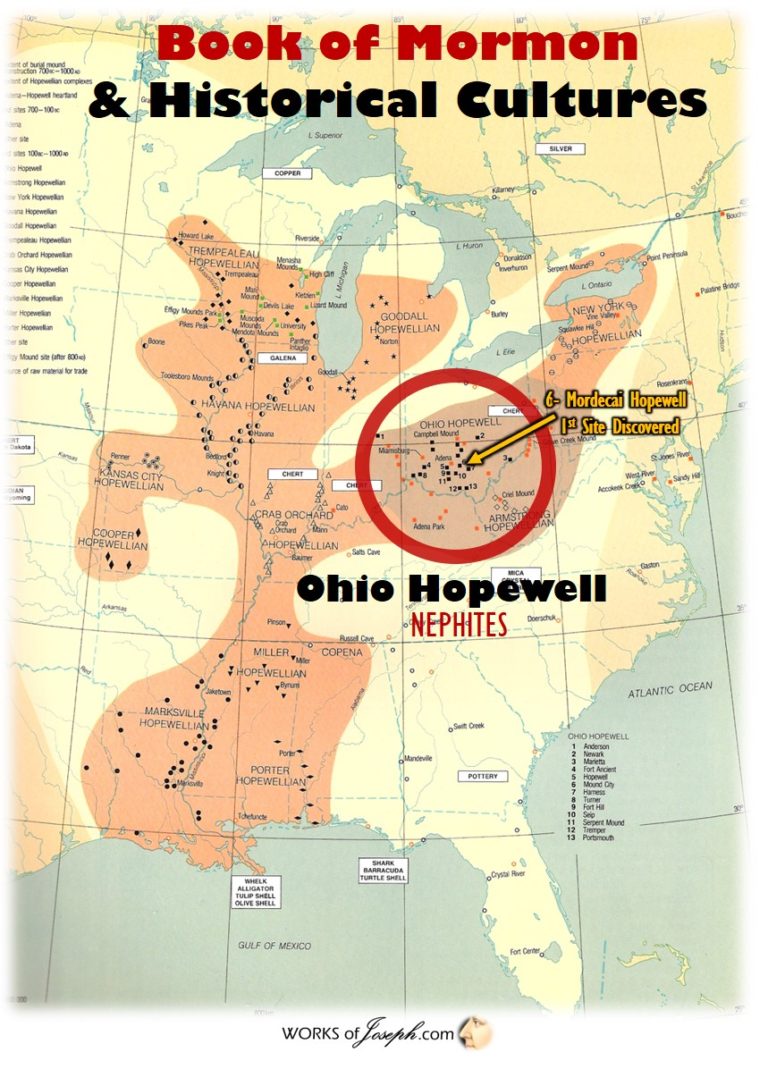
“Why does Book of Mormon geography matter? Think of that question if we are speaking about the Bible or Israel. Does it matter where the Savior was born, or where the Biblical events happened? Yes. At Mount Moriah where Abraham was to sacrifice Isaac, the Lord made a special covenant with Abraham. The land around Mt Moriah was a covenant land and God’s people were given that covenant land as long as they are righteous. However, if they disobey the commandments, God’s people will be swept off that sacred land. The Jews, Muslims, and Christians fight over control over this one piece of land why? Because it is a beautiful piece of real estate? No, because it is a covenant land. All three religions say Mt Moriah is sacred to them and they are willing to die over it.
Click to review pages of the new Annotated Book of Mormon by David Hocking and Rod Meldrum.
In the same token what is the Promised Land spoken of in the Book of Mormon? According to the Book of Mormon this Promised land must meet certain requirements to be the Promised Land. 1. No Kings upon the land 2. Land choice above all other lands 3. Land of Liberty 4. Land where sacred record is kept 5. Land kept from the knowledge of other nations. 6. Land of the New Jerusalem 7. Gentiles to scatter and afflict the Remnant. 8. The place where the Marvelous Work and Wonder happened. These are only 8 of 36 prophecies and promises in the Book of Mormon so it makes sense to me that the USA is the Promised Land. Not Canada, Mexico, England, or South America.
Just as Israel is a Promised Land forever, so the USA is a Promised Land forever and it does matter where this Promised Land is located. It is in the Heartland of North America. The Nephites practiced the Law of Moses. To do this they needed the following plants and animals to keep the Law. Sheep, Rams, Goats, Bullocks, Doves, Wheat, Barley, and Wine. None of these animals or items are found anywhere in Mesoamerica during the Nephites times, only in the USA. So, the land and where things happen is critical to us and especially to the Lord.” Rian Nelson
Amberli Nelson will be speaking at the 24th Book of Mormon Evidence Conference Sept 27, 2019 Fri at 2:25 pm at the Utah Valley Convention Center at 220 W. Center St Provo, UT. Directions here: For a list of all the speakers Click Here:
Her presentation is Titled:
“Law of Moses: the Who + the Why = the Where”
“Every serious student of the Book of Mormon should become familiar with the Jewish cultural research of Amberli Nelson, who has brought together one of the most unique, significant and essential, yet never before considered, pieces to the puzzle of Book of Mormon geography research.
“The findings of Amberli Nelson will forever alter the landscape of Book of Mormon geography theories as she imparts of her years of intensive research into an area of study never previously brought to bear on the subject of locating these lands.
Why has this critically important understanding – which was reiterated by the ancient prophets more than 30 times in the text and has been right before our eyes – been missed, ignored or overlooked by Book of Mormon scholars for so long? Prepare yourself to be blown away!” – Rod Meldrum
Jehovah’s Holy Days in the Heartland by Amberli Nelson
“Do you love learning new and previously undiscovered truths about the Book of Mormon? You are invited to enjoy this highly insightful video presentation on DVD (available here) which will take you on a fascinating journey where you will learn three striking truths about the Nephites of the Book of Mormon, truths that indisputably confirm that their enigmatic history played out in the Heartland of North America! What are these truths?
(DVD) Jehovah’s Holy Days in the Heartland by Amberli Nelson
Purchase Amberli’s DVD here
3 Essential Truths about Nephite Observance of the Law of Moses
First Truth:
The Nephites “strictly” kept the Law of Moses as indicated in 37 verses in the Book of Mormon, (see Alma 30:3, Mosiah 13:29-30,Jarom 1:5) and they did so with delight as it was seen by them as both symbolic of Christ and a means of coming unto Him. Occasionally even the Lamanites were known to “strictly” observe the law (Hel. 13:1).
Second Truth:
In “observing to keep the commandments of the Lord in all things, according to the Law of Moses” (2 Ne. 5:10) the Nephites would have necessarily observed all the feasts or “holy days” given to Moses by Jehovah. These are recorded in Exodus and Leviticus and are known as “holy convocations”. You will learn how beautifully these “rehearsals” typify the life and mission of Jesus Christ.
Third Truth:
It was absolutely essential for these Jewish Lehites to be brought to and given a land that would provide an abundance of all the plants and animals necessary to keep the Law of Moses, with its concomitant Holy Days or celebrated festivals.
A list of 10 essential items required by every Mosaic Law abiding people are revealed in this compelling presentation. Some of those essential items include lambs, goats, wheat and barley. These have never been found in the archaeological record of the Maya in Mesoamerica yet, in stark contrast, each has been verified in the archaeological record of the ancient Mound Builder civilization which flourished in the Heartland of North America during Book of Mormon time frames. Based on the latest archeological findings of this civilization, it can now be irrefutably shown that the Heartland of North America is the only location in the Western Hemisphere where all 10 essential items have been confirmed. Thus, this covenant and Promised Land is the only one capable of sustaining and enabling a Jewish population, such as the Nephites, to observe and honor their sacred rites and religion without being forced to use unauthorized substitutions that would have been utterly offensive to God. Learn about the symbolic significance of each of these 10 critical items in this inspirational presentation.
A Prophetic Warning to Latter Day America
Purchase book today
Because this evidence, in concert with other overwhelming evidences from genetics, prophecies, archaeology etc, profoundly establishes that the lands now occupied by the United States of America are the only possible lands of the Book of Mormon, you will then, of necessity, come face to face with one of the most important and timely messages of the Book of Mormon — the ominous warning to us, the modern day Gentiles, who inhabit this sacred and Promised Land today. It is only in THIS nation that the ancient prophetic warnings can be reconciled with the history and resultant destruction of the Jaredites, then later the Nephites, and finally the latter-day Americans according to 36 Book of Mormon prophecies about ‘this nation’ (read about these prophecies HERE
How is that you ask? Because, according to what we read in the sacred record, all ancient inhabitants of this Promised Land were subject to what has been termed the “American Covenant*.” Its promised blessings are repeatedly spelled out in the Book of Mormon; namely the blessings of a land, posterity, liberty, prosperity and protection (see 1 Ne. 2:20, 2 Ne. 1:7 and article). Those precious blessings are predicated upon the earnest fulfillment of two requirements: first, that the inhabitants keep the Ten Commandments and second, that they serve the God of the land. We learn from a careful study of the Book of Mormon that the Nephites ultimate demise was precipitated by their prideful abrogation of these two requirements.
In light of that truth, the express purpose of this DVD presentation is to provide, based on the clear and compelling evidence presented, another witness that the Heartland of North America is the actual location of the Book of Mormon as that fact becomes the central truth upon which the rest of this, most important discussion hinges. For it is the author’s strong belief that it is a monumental mistake to unwittingly assign the Book of Mormon civilizations to Mesoamerica or anywhere other than the United States of America, as some modern day students of the Book of Mormon assert. Doing so obscures and effectively negates the understanding of which nation is being warned. The very lessons to be learned by the swift and utter destruction of both the Jaredites and the Nephites are revealed for the benefit of that specified nation.
One of the central and paramount themes of the book is its historic instructions – a literal “how-to manual” – on avoiding the shared fates of those two destroyed civilizations. To persist down the erroneous path of misplaced geography ultimately reduces the reason for their self-sown demise to little more than a curious, inexplicable and totally unjustified tragedy, since in no other place but the sacred and covenant land of North America has there been established an “American Covenant” for them to break or keep. It is a covenant that inextricably bound them to the promised blessings, when kept, and condemned them to the terrible fate they met when broken.
In short, without the “American Covenant”- which is exclusive to North America, there is no adequate explanation for the spectacular rise and subsequent fall of those two civilizations or that of the United States of America in modern times. That fact, by extension, provides the necessary framework for a modern day understanding that we too, as citizens of this, the Promised Land, are under the selfsame obligations they were… Obligations which, if kept, will either secure divine protection from our Creator or provoke His divine wrath unto our utter destruction. It is a very timely and urgent warning about our near future that we ignore at our own peril! A Covenant Land for a Covenant People, Providing All Essential Needs For Observance of the Law
Lastly, we must ask the question,
“Would God have lead his covenant people to a Promised Land devoid of every essential animal and plant required by Him to obey his commandment to live the Law of Moses?“
Click to enlarge
To place God’s chosen and covenant people anywhere but upon the covenant lands now occupied by the United States of America would have deprived these ancient civilizations of nearly every item required by the Lord in order for them to keep the Law of Moses. To do so would not only bring the veracity of the sacred text itself into question, but it would undermine the credibility of Joseph Smith as its translator if the setting would not support compliance to the law. Furthermore it would cast a disparaging light & considerable doubt on the prescient premise embraced by the faithful Nephites who delighted in the knowing that the “law of Moses was a type of his coming”….”believing that they must keep those outward performances until the time that He should be revealed unto them.” For the “law of Moses did serve to strengthen their faith in Christ; and thus they did retain a hope through faith, unto eternal salvation,” (Alma 25:15-16).
Therefore, the time has come to acknowledge the righteous Nephites for their astoundingly unique and singular ability to fuse the principles and laws of Judaism with the doctrines and saving ordinances of the gospel of Jesus Christ, creating one seamless theological bridge between the two. This is an astonishing feat that had never been accomplished before that time or since, effectively making The Book of Mormon the only known text ever written that is neither exclusively Jewish nor Christian, but simultaneously both at the same time. This then gifts its readers with an insightful glimpse into the Jewishness of Jesus Himself and the Holy Days of Judaism which He authored, thereby providing precious perspective for us as Christians who long to know Him more fully and intimately as we strive with a brightness of hope toward the penultimate blessing of walking with Him through His millennial reign.” ~Amberli Nelson
Amberli Nelson received a B.S. in sociology from Brigham Young University. A busy wife and mother of seven, Amberli has a deep and abiding love of truth, knowledge and greater understanding and therefore she thoroughly enjoys reading about and researching subjects she is most passionate about which include: sacred symbology, The Book of Mormon, early LDS church history, and Jewish religious customs, beliefs and traditions. She has become an expert on ancient Jewish practices, especially those involving the Laws of Moses. She delights in sharing this knowledge with others and does so with energy and enthusiasm.
Read more about the Heartland of North America as explained by the scriptures in a wonderful article by Rod Meldrum Here
Click here to purchase Amberli’s newest video released in 2018.This ancient Newark Ohio earthwork has been explained by Amberli Nelson as “The Plan of Salvation”
WE HAVE LAYING BEFORE US,” wrote Ebenezer Robinson, editor of the Times and Seasons for January 1, 1842, “a neat little work of 256 pages, 32 mo. entitled ‘Evidences in proof of the Book of Mormon’ &c. By Charles Thompson, minister of the gospel; published at Batavia, N. Y. We are much pleased with the spirit manifested by the writer, and feel to commend him in his laudable undertaking.” Indeed, four and a half pages (more than a quarter of this issue) were devoted to extracts from Thompson’s proofs and comments. (Times and Seasons 3:5; pp. 640-44)
Such a work was needed badly. Thompson took on the project with apologies for his personal limitations, hoping to benefit “the young Elders and Priests who are just commencing in their ministry,” as well as new converts and an uninformed public (Preface, p. [3]). Among the “young” missionaries was Thompson himself, only twenty-seven years of age. He had joined the Church at age 21, was soon appointed a seventy, and in 1838 joined the Kirtland Camp to Far West, Missouri . . .
Charles Thompson’s 1838 signature on the Kirtland Camp constitution as reproduced in Milton V. Backman, The Heavens Resound; A History of the Latter-day Saints in Ohio 1830-1838 (Salt Lake City, 1983), p. 390.
PETER CRAWLEY explains that Thompson then undertook a four-year mission to his native state of New York, and baptized nearly a hundred converts in Batavia who encouraged him in the production of this book. Crawley demonstrates that portions draw upon the Gospel Reflector, an important LDS periodical-format treatise published by Benjamin Winchester in Philadelphia during the first half of 1841.
Native American antiquities, Bible prophecy – even an acrostic-based poem comprise various segments of this handy volume. Pages 235-40 contain Thompson’s own Mormon folk verse, an unnoticed extra! These homely lines will not conceal the exuberance of the early Saints. Two segments caught my attention as particularly interesting . . .
In eighteen hundred thirty-three, As many did most plainly see, Signs in the stars were then shone forth, And plainly seen in all the earth. [p. 236]
EVIDENCES IN PROOF OF THE BOOK OF MORMON By Charles Thompson, minister of the gospel; published at Batavia, N.Y.
From the Times and Seasons 3:5; pp. 640-44 we quote, “We have laying before us, a neat little work of 256 pages, 32 mo. entitled “Evidences in proof of the Book of Mormon” &c. By Charles Thompson, minister of the gospel; published at Batavia, N. Y. We are much pleased with the spirit manifested by the writer, and feel to commend him in his laudable undertaking.
We make the following extracts, commencing on the 97th page.
I will next introduce the description of some of these ancient fortifications and military works of defence [defense], as recorded in the American Antiquities, by Josiah Priest, and also introduce a history of the building of these fortifications and works of defence [defense], as recorded in the Book of Mormon; and I will here remark, that the Book of Mormon was published in A. D. 1830, and the American Antiquities, by Josiah Priest, was not published until A. D. 1833, three years after. Antiquities, page 158 and 159, “Near Newark in the county of Licking, Ohio, is situated one of the immense works or fortifications of the ancient nations of America. It embraces in the whole, a circumferance [circumference] of about six hundred rods, or nearly two miles; a wall of earth about four hundred rods, is raised on the sides of this fort next to the small creek which comes down along its sides from the west and east. It would seem that the people who made this settlement, undertook to encompass, with a wall, as much land as would support its inhabitants, and also sufficient to build their dwellings on, with several fortifications arranged in a proper manner for its defence [defense]. There are within its ranges four of these forts, of different dimensions; one contains forty acres, with a wall of about ten feet high; another containing twenty-two acres, also walled, but in this fort is an elevated observatory, of sufficient height to overlook the whole country; a third fort, containing about twenty-six acres, having a wall around it thrown out of a deep ditch on the inside of the wall. This wall is now from twenty-five to thirty feet in height. A fourth fortification encloses twenty acres with a wall of about ten feet high.”
Book of Mormon, page 378, 2nd Ed., “Now it came to pass that while Amalickiah had thus been obtaining power by fraud and deceit, Moroni on the other hand, had been preparing the minds of the people to be faithful unto the Lord their God, yea, he had been strengthening the armies of the Nephites, and erecting small forts or places of resort, throwing up banks of earth round about to enclose his armies, and also building walls of stone to encircle them round about their cities and the borders of their lands.”
Antiquities, page 160, “A second fort siuated [situated] southwesterly from the great works on the Licking, encloses about forty acres; its wall is entirely of stone
(page 640)
Click to Enlarge
Antiquities, page 163, “At Circleville, Ohio, there is a circular fort surrounded by two walls with a deep ditch between them; also, a square foot about eighteen rods in circumference enclosed by a wall with a ditch.”
Book of Mormon, page 382, “Now behold, the Lamanites could not get into their forts of security by any other way save by the entrance, because of the highness of the bank which had been thrown up and the depth of the ditch which had been dug round about, save it was by the entrance.”
Antiquities, page 165, “Near the round fort at Circleville is another fort ninety feet high, and was doubtless erected to overlook the whole works of that enormous military establishment. That it was a military establishment is the decided opinion of the President of the Western Antiquarian Society, Mr. Atwater. He says the round fort was picketed in, if we are to judge from the appearance of the ground on and about the walls. Half way up the outside of the inner wall, is a place distinctly to be seen, where a row of pickets once stood, and where it was placed when this work of defence [defense] was originally erected. These works have been examined by the first military men now living in the United States, and they have uniformly declared their opinion to be, that they were military works of defence [defense].”
Moroni fortifies the lands of the Nephites, by Clark Kelley Price (Alma 50 See explanation at end of blog)
Book of Mormon, page 383, 2nd Ed., (Alma 50) “And now it came to pass that Moroni did not stop making preparation for war, or to defend his people against the Lamanites, for he caused that his armies should commence in the commencement of the twentieth year of the reign of the Judges, that they should commence in digging up heaps of earth round about all the cities throughout all the land which was possessed by the Nephites; and upon the top of the ridges of earth, he caused that there should be timbers, yea, works of timbers built up to the height of a man, round about the cities. And he caused that upon those works of timbers there should be a frame of pickets built upon the timbers, round about, and they were strong and high; and he caused towers to be erected that overlooked those works of pickets. And he caused places of security to be built upon those towers, that the stones and arrows of the Lamanites could not hurt them; and they were prepared, that they could cast stones from the top thereof, according to their pleasure and their strength, and slay him who should attempt to approach near the walls of the city. Thus Moroni did prepare strong holds against the coming of their enemies, round about every city in all the land.
The foregoing is but a few of the corresponding accounts of fortifications and works of defence [defense] there are to be found in the Book of Mormon and American Antiquities, but these are sufficient to show to the public that the people whose history is contained in the Book of Mormon, are the authors of these works.-But again; as we trace the history of this people down through succeeding generations, we find that one Gadianton, a robber, rose up and organized a band to rob and plunder. These robbers prepared strong holds and secret places in the mountains, to which they could flee, and be secure when the armies of the Nephites pursued them. Some of these strong holds and secret places were discovered in 1832–two years after the Book of Mormon was published-by a Mr. Furguson, and communicated to the editor of the Christian Advocate and Journal. This account is recorded on page 169 of the American Antiquities. Mr. Furguson describes this discovery as follows:
Looking from Lookout Mountain down to Moccasin Bend on the Tennessee River
“On a mountain called the Lookout Mountain, (Chattanooga, TN) belonging to the vast Allegany [Allegheny] chain, running between the Tennessee and Coos rivers, rising about one thousand feet above the level of the surrounding valley. The top of the mountain is mostly level, but presents to the eve [eye?] an almost barren waste. On this range, notwithstanding its hieght [height], a river has its source and after traversing it for about seventy miles, plunges over a precipice. The rock from which the water falls, is circular, and juts over considerably. Immediately below the fall, on each side of the river, are bluffs, which rise about two hundred feet. Around one of these bluffs the river makes a bend which gives it the form of a peninsula. On the top of this are the remains of what is esteemed fortifications, which consist of a stone wall built on the very brow of this tremendous ledge. The whole length of the wall, following the very course of the brink of this precipice, is thirty seven rods and eight feet,
(page 641)
including about two acres of ground. The only descent from this place is between two rocks, for about thirty feet, when a bench of the ledge presents itself from two to five feet in width and ninety feet long. This bench is the only road or path up from the water’s edge to the summit. But just at the foot of the two rocks where they reach this path and within thirty feet of the top of the rock, are five rooms, which have been formed by dint of labor. The entrance to these rooms is very small, but when within, they are found to communicate with each other by doors or appertures [apertures].”
Mr. Furguson thinks them to have been constructed during some dreadful war, and those who constructed them, to have acted on the defensive; and believes that twenty men could have withstood the whole army of Xerxes, as it was impossible for more than one to pass at a time, and might by the slightest push, be hurled at least an hundred and fifty feet down the rocks.
I, Nephi, did build a Temple by Ken Corbett at Lookout Mountain, TN
Book of Mormon, page 479, 2nd Ed., “And it came to pass that the ninety and third year (of the reign of the Judges over the people of Nephi) did also pass away in peace, save it was for the Gadianton robbers, who dwelt upon the Mountains, who did infest the land; for so strong were their holds and their secret places, that the people could not overpower them; therefore they did commit many murders, and did so much slaughter among the people.” Again; Book of Mormon, page 481, “And it came to pass in the commencement of the fourteenth year, (form [from] the time the sign was given of the birth of Christ,) the war between the robbers and the people of Nephi did continue, and did become exceeding sore; nevertheless the people of Nephi did gain some advantage of the robbers, insomuch [inasmuch] that they did drive them back out of their land into the mountains and into their secret places.” Again; Book of Mormon, page 485, 2nd Ed., “But it came to pass that in the latter end of the eighteenth year, those armies of robbers had prepared for battle and began to come down and to sally forth from the hills, and out of the mountains and the wilderness, and their strong holds and their secret places, and began to take possession of the lands.” And on the 487 and 488 pages, we are informed how these robbers were finally destroyed; it was by a stratagem. A part of the Nephite armies getting between the robbers and their secret places and strong holds, by which they were cut off in their retreat.
Click to Enlarge
This again, is evidence that the Book of Mormon is true, and that this band of robbers were the constructors of this strong hold and these secret rooms which Mr. Furguson has described; for mark! this discovery was not made untill [until] two years after the Book of Mormon was published, consequently the writer of the Book of Mormon could not have written this tale concerning the robbers, to account for the construction of those caverns, for it was not known that there was such a place in existence, until after the book was written and published. And thus we have abundance of proof from recent discoveries, American Antiquities and prophecy, that the history contained in the Book of Mormon is true.
Again; this history informs us that about four hundred years after Christ, this nation of Nephites were brought down and destroyed by the Lamanites; and this because they became proud and lifted up, practising [practicing] all manner of wickedness and abominations, and they refused to repent and turn again unto God; therefore because they were more wicked than the Lamanites, God stirred up the Lamanites to camp against them round about, and to raise forts against them with a mount, and thus they were brought down. But just before their final overthrow, a man by the name of Mormon took their record containing their history and sacred writings, from the time they left Jerusalem, (the city where David dwelt,) unto his days, and made an abridgement [abridgment] therefrom, and engraved it upon plates which he made out of ore. These plates, after Mormon’s death, fell into the hands of Moroni, his son, who survived the entire destruction of the Nephites, finished the record, and deposited it in a stone box in the earth, that it might not be destroyed; to come forth in due time for a sign to Israel, that the time of their redemption had come. And also, in connection with the Bible, to be set up as an ensign for the nations; and thus, this nation of Nephites possessing the light of God’s revelation, which constituted them Ariel, or Lion of God, and being “of the city
(page 642)
where David dwelt,” (that is, having come out from Jerusalem,) was brought down and their words having been written and hid up in the earth and come forth again out of the earth, they “speak out of the ground and their voice whispers out of the dust.”
This account also agrees with the Indian traditions which I have quoted in a former part of this work. It says, that their forefathers were once in possession of a sacred Book, which was handed down from generation to generation, and at last hid in the earth; but these oracles are to be restored to them again and then they shall triumph over their enemies and regain their ancient country.
But again, when this Book was taken from the place of its deposite [deposit], the words thereof were delivered to the learned Dr. Mitchel of New York, with a request that he should read them, but he could not; thus fulfilling the 11th verse of the 29th chapter of Isaiah, which says, the words of a book which is sealed men deliver to one that is learned, saying, read this I pray thee; and he saith I cannot for it is sealed. And the book is delivered to him that is not learned, saying read this I pray thee; and he saith I am not learned. Wherefore the Lord said, forasmuch as this people, (the people of this generation,) draw near me with their mouths, and with their lips do honor me; but have removed their hearts far from me, and their fear towards me is taught by the psecepts [precepts] of men; therefore behold, I will proceed to do a marvelous work among this people, even a marvelous work and a wonder: for the wisdom of their wise men shall perish, aud [and] the understanding of their prudent men shall be hid. And this he has done-
There Indeed by Clark Kelley Price
First; by inspiring the unlearned Joseph Smith, and giving him wisdom and power from on high, with the means which were before prepared, to read and translate the Book of Mormon, the words of which the learned Dr. Mitchel could not read; thus the wisdom of the wise has perished and the understanding of the prudent is hid.
Secondly.-By raising up and inspiring illiterate and unlearned men, and sending them forth with the Book of Mormon in connection with the Bible, as an ensign for the nations, to preach the fulness [fullness] of the gospel, and to build up the kingdom of God on the earth, in direct opposition to all the jarring systems of modern sectarianism, and giving them knowledge and wisdom from on high, insomuch [inasmuch] that they have been enabled to confound, astonish and bring to shame, confusion, and disgrace, every wise and learned man who has dared to oppose them by fair arguments or candid investigation.
Thirdly.-It is a marvel and a wonder to this generation that this work has spread so rapidly under the following circumstances: First, the men who were engaged in preaching this doctrine were men of no influence, being the poor, illiterate, and despised ones of the earth. Second,-they had not the advantages of education which the most of the preachers of the different denominations have. Third,-the advantages of that mighty engine, the press, which all the Christian world are so highly blessed with, they were almost wholly destitute of, while at the same time its power was put in requisition against them in all parts of the land. It is true, they undertook, and did publish a monthly periodical at diferent [different] times and places, but its circulation was very limited, and their office, press and type have been three times entirly [entirely] destroyed by mobs and incendiaries. Fourth,-they had to sustain the shock of an overwhelming religious influence opposed to them by the combined powers of every sect in America-they had to contend with the prejudices of the ignorant and the pen of the learned, together with all the lying slanders and misrepresentations which the devil and all his emissaries on earth could invent; while at the same time the combined powers of earth and hell were hurling a storm of persecution unparalelld [unparalleled] in the history of the world. They were insulted by mobs, their houses torn down or burned, their goods destroyed and fields of grain laid waste, some of them were cast into dungeons and there kept for months loaded with chains. Yea more-some of them were shot; others had their brains dashed out; others were whipped to death; others were cut in pieces with swords knives, corn-cutters, &c., while the whole society, at one time amounting to about 12 000 souls, were banished from the State of Missouri and driven two hundred miles from their lands, houses, homes and property, in the winter season, and this by the order of
(page 643)
See 50 pages of the Annotated Book of Mormon. Click here.
the Executive of Missouri, one of the free and independent states of this boasted republic. And the blood of many of these people now stains the soil of Missouri because of their religious principles, in this their native land; the land of boasted liberty and equal rights, whose officers, both of the state and nation, have been deaf to the voice of innocence, imploring at their feet for justice and protection in the enjoyment of their rights as American citizens. And no doubt many of the instruments of these diabolical proceedings verily thought they were doing God service, being inspired by the press and pulpit, and encouraged by the officers of state; or what is still worse, by the personal example of both officers of state and professed preachers of the gospel, who were actually the leaders and abettors of all the above horrible deeds. But under all these conflicting circumstances, this work has spread and has penetrated every state in the Union from Maine to Missouri as well as the Canadies [Canada’s?]. It has reacheed [reached] the islands of the sea-it has spread nearly all over England, and is now preached in Ireland, Scotland and Wales-all this in the short space of ten years. Churches are organized and conferences are held in all these regions, and the number of disciples who have already embraced this work is from an hundred to an hundred and twenty thousand. What but the arm of the Omnipotent could have moved it forward thus! Under the conflicting circumstances referred to above, surely it is a marvelous work and a wonder, causing the wisdom of the wise to perish and the understanding of the prudent to be hid. But again, another feature about this work which constitutes it marvelous and wonderful among the people of this generation is, these preachers profess no authority from antiquity to administer the gospel ordinances, but say that an angel has come down from the midst of heaven, and conferred on them the priesthood and authority to preach and administer the everlasting gospel unto them that dwell on the earth, and to every nation, and kindred, and tongue, and people, sayiug [saying] with a loud voice, fear God and give glory to him for the hour of his judgement [judgment] is come: and worship him that made heaven and earth and the sea and the fountains of waters. (See Revelations 14th chap. 6th and 7th verses.) And they profess to be apostles, prophets, evangelists, pastors and teachers, all inspired by the Holy Ghost, just like the ancient officers of the church and kingdom of God-(See Ephesions [Ephesians] 4th chap. 11th 12th and 13th verses.) Also the believers in this Book of Mormon, being baptized for the remission of sins and receiving the laying on of hands by these apostles and prophets, they speak with new tongues and prophesy, cast out devils, and sometimes lay hands on the sick and they recover, and thus one has given him by the Holy Ghost the word of wisdom, and another the word of knowledge, and another faith, and another the gifts of healing, and another the working of miracles, and another prophecy, and another the diserning [discerning] of spirits, and another divers kinds of tongues, and another the interpretation of tongues-just as was anciently given to the church of Christ. (See 1st Cor. 12th chap.) And in consequence of these gifts the blind are made to see, the deaf to hear, the meek increase and their joy is in the Lord, and the poor rejoice in the Holy One of Israel. Also, they that erred in spirit come to understanding, and they that murmured learn doctrine. All these things are marvelous to this generation because their fear towards God is taught by the precepts of men, and they know nothing of inspiration or the power of God, therefore they have a form of godliness but deny the power thereof. From such says Paul turn away. (See 2nd Timothy iii: 1-9.)”
Alma 50:1-15
I have a proposition for Alma 50:8 in regard to the “Straight Course.” Jonathan Neville speaks about this in Moroni’s America below.
“A key point here is that the east wilderness was “north of the lands of their own possessions.” This is true whether he refers to the Nephites or the Lamanites; i.e., the east wilderness was south of the narrow strip of wilderness, but because the Ohio and Allegheny rivers flow from the north, the east wilderness is actually north of much of the land of Zarahemla (including the land Bountiful).
When Moroni drove the Lamanites down to the land of Nephi, south of Zarahemla, he extended Nephite territory all the way east to the seashore, in this case the Atlantic. At that point, the land of the Lamanites ran in a straight east/west line instead of following the narrow strip of wilderness northeast.
When Moroni “cut off all the strongholds of the Lamanites in the east wilderness,” it was a smart strategic move because it removed the vulnerability from the small neck of land between the rivers that formed the narrow strip of wilderness. He was then able to fortify the rest of the narrow strip, the “line between the Nephites and the Lamanites, between the land of Zarahemla and the land of Nephi, from the west sea running by the head of the river Sidon” (Alma 50:11).” Moroni’s America pg 179-180
In trying to identify the “Straight Course” in Alma 50:8. I have come up with this map (attached) including latitudes for various cities. Notice how a parallel line is formed from:
1- Philadelphia to Columbus through Moundsville
2- Baltimore to Cincinnati through Parkersburg, WV
3- Washington DC to St Louis through Huntington WV
4- Norfolk, VA to The Head of the River Sidon.
That means the City Moroni may have been either Philadelphia, Baltimore, Washington DC or Norfolk. These are all cities on the shores of the Atlantic and they have a parallel line to other popular mound builder cities either on the Ohio or Mississippi rivers which is quite ironic. Any of these lines could have been the “strait course” referred to in Alma 50. I have found great archaeology in Wash DC., that matches the Nephite timeline. (See additional map below)
What do we know about the location of the Garden of Eden? By Bruce A. Van Orden, associate professor of Church history, Brigham Young University.
Click to Enlarge
“We must remember that the whole earth was paradisiacal before the Fall. The Garden of Eden was a center place. After the Fall, there was no Garden of Eden or paradisiacal status on earth. Yet relative to the locale of the site of the Garden of Eden, the Prophet Joseph Smith learned through revelation (D&C 57) that Jackson County was the location of a Zion to be and the New Jerusalem to come. The Prophet first visited Jackson County, Missouri, in the summer of 1831. The Prophet visited Jackson County again in April and May 1832. On one of the occasions, or perhaps both, the Prophet Joseph apparently instructed his close associates, and perhaps even a general Church gathering, that the ancient Garden of Eden was also located in Jackson County. Brigham Young stated, “Joseph the Prophet told me that the garden of Eden was in Jackson [County] Missouri.” (Journal of Wilford Woodruff, vol. 5, 15 Mar. 1857, Archives Division, Church Historical Dept., Salt Lake City.) Heber C. Kimball said: “From the Lord, Joseph learned that Adam had dwelt on the land of America, and that the Garden of Eden was located where Jackson County now is.” (Andrew Jenson, Historical Record, 9 vols., Salt Lake City: Andrew Jenson, 1888, 7:439; see also Orson F. Whitney, Life of Heber C. Kimball, Salt Lake City: Bookcraft, 1967, p. 219.) Other early leaders have given the same information.
Unfortunately, we do not have primary source documentation for all of Joseph Smith’s revelations or doctrinally related declarations. This is especially true for the periods when he did not have a scribe to keep a record of his daily activities. His 1831 and 1832 trips to Missouri fit into this category.
Annotated Book of Mormon page 508. Order today!
One of the early Latter-day Saint residents of Jackson County was Emily Austin. Remembering her first year there, she reminisced, “Our homes in this new country presented a prosperous appearance—almost equal to Paradise itself—and our peace and happiness, we flattered ourselves, were not in a great degree deficient to that of our first parents in the garden of Eden.” (Mormonism; or, Life among the Mormons, New York: AMS Press, 1971, p. 67.) She was reflecting a commonly held belief among the Saints that Eden was in Jackson County.
It wasn’t until May 1838 that revelation (D&C 116) identified Adam-ondi-Ahman, a site near the Garden of Eden, to be in Daviess County, Missouri, some seventy miles from present-day Kansas City. (Encyclopedia of Mormonism, 4 vols., New York City: Macmillan, 1992, 1:19–20.) Other revelations referring to Adam-ondi-Ahman were D&C 78:15–16 and D&C 107:53–57. President Joseph Fielding Smith said: “In accord with the revelations given to the Prophet Joseph Smith, we teach that the Garden of Eden was on the American continent located where the City of Zion, or the New Jerusalem, will be built. When Adam and Eve were driven out of the Garden, they eventually dwelt at a place called Adam-ondi-Ahman, situated in what is now Daviess County, Missouri. … We are committed to the fact that Adam dwelt on [the] American continent.” (Doctrines of Salvation, 3 vols., comp. Bruce R. McConkie, Salt Lake City:Bookcraft, 1956, 3:74. Compare Answers to Gospel Questions, 5 vols., Salt Lake City: Deseret Book Co., 1957–75, 2:93–95, 4:19–24; and Alvin R. Dyer, in Conference Report, Oct. 1968, pp. 108–9.) President Joseph Fielding Smith wrote,”In accord with the revelations given to the Prophet Joseph Smith, we teach that the Garden of Eden was on the American continent located where the city of Zion, or the New Jerusalem will be built. When Adam and Eve were driven out of the Garden, they eventually dwelt at a place called Adam-ondi-Ahman, situated in what is now Daviess County, Missouri” (Doctrines of Salvation 3:74). Joseph Smith taught that Adam, just prior to his death, called Seth, Enos, Cainan, Mahalaleel, Jared, Enoch and Methuselah, as well as the “residue of his posterity who were righteous,’ to Adam-ondi-Ahman. It was there he “bestowed upon them his last blessing” (Doctrine and Covenants 107:53).
Apostle John Widtsoe wrote,”Since Adam called together seven generations of his descendants at Adam-ondi-Ahman, it can well be believed that there was his old homestead. If so, the Garden of Eden was probably not far distant, for it was the entrance at the east of the Garden which was closed against them at the time of the ‘fall’ (Genesis 3:24). In fact, it has been commonly understood among the Latter-day Saints, from the teachings of the Prophet, that the temple was to be built in or near the location of the Garden of Eden” (Evidences and Reconciliations, pg. 396).
According to Heber C. Kimball, a temple block was dedicated. “While there we laid out a city on a high elevated piece of land, and set the stakes for the four corners of a temple block, which was dedicated, Brother Brigham being mouth” (Life of Heber C. Kimball, 2nd ed., pp. 208-209 as printed in BYU Studies, Autumn 1972, pg. 34). Dr. Robert J. Matthews of Brigham Young University states,”Although the ‘temple block’ was dedicated, apparently no corner stones were laid, and no temple was built. Persecution soon forced the Saints to flee Illinois, and thus the settlement had a short existence lasting only a few months, because by November 1838 the Saints were leaving their homes and abandoning Adam-ondi-Ahman” (BYU Studies, Autumn 1972, pg. 34).
Smith also taught that Adam will once again come to visit this site. Mormon Apostle Bruce McConkie makes reference to this event and stated that a portion of Adam’s altar had remained through the ages. He wrote, “At that great gathering Adam offered sacrifices on an altar built for the purpose. A remnant of that very altar remained on the spot down through the ages. On May 19, 1838 Joseph Smith and a number of his associates stood on the remainder of the pile of stones at a place called Spring Hill, Daviess County, Missouri. There the Prophet taught them that Adam again would visit in the Valley of Adam-ondi-Ahman, holding a great council as a prelude to the great and dreadful day of the Lord” (Mormon Doctrine, pg. 21).
In volume one of his two-volume set entitled Joseph Smith Begins His Work, Wilford Wood includes a photograph of what he calls “stones from Adam’s altar.” Heber C. Kimball also wrote of this altar. He stated that Smith led them a short distance from the temple block and said, “There is the place where Adam offered up sacrifice after he was cast out of the garden” (BYU Studies, Autumn 1972, pg. 34).
President Ezra Taft Benson also wrote how the Garden of Eden was located in America. Under the section “Divine Destiny” in his book The Teachings of Ezra Taft Benson (pp. 587-588), he wrote,
“Consider how very fortunate we are to be living in this land of America … Many great events have transpired in this land of destiny. This was the place where Adam dwelt; this was the place where the Garden of Eden was; it was here that Adam met with a body of high priests at Adam-ondi-Ahman shortly before his death and gave them his final blessing, and the place to which he will return to meet with the leaders of his people (D&C 107:53-57). This was the place of three former civilizations: that of Adam, that of the Jaredites, and that of the Nephites.” Notice also how Benson places the Nephites in the United States, not Central America as Mormon scholars are now insisting.
Not only have LDS leaders stated that Eden was located in what is today the United States, they have also stated that Noah built his famous ark nearby as well. On October 7, 1860, President Brigham Young declared,
“In the beginning, after the earth was prepared for man, the Lord commenced his work upon what is now called this American continent, where the Garden of Eden was made. In the days of Noah, in the days of the floating of the ark, he took the people to another part of the earth: the earth was divided, and there he set up his kingdom” (Journal of Discourses 8:195).
Before he became first counselor to Brigham Young, Apostle George Q. Cannon stated,
“Men have supposed that because the Ark rested on Ararat that the flood commenced there, or rather that it was from thence the Ark started to sail. But God in His revelations has informed us that it was on this choice land of Joseph where Adam was placed and the Garden of Eden was laid out” (Journal of Discourses 11:337).
In a sermon delivered by Orson Pratt, the LDS Apostle concurred with the aforementioned statements by saying, “We may, however, observe, that so far as new revelation has given us information on this subject, this Continent of ours may be ranked among the first lands occupied by the human family. The very first man who had dominion on the face of the earth, under the direction of the Heavens, once dwelt on this Continent, His name was Adam” (Journal of Discourses 12:338) Pratt continued by saying, “It was on this land where both Noah built his ark, which was blown by the winds of Heaven away to the east, and landed on Ararat” (Journal of Discourses 12:338).
Like many teachings brought about by LDS leaders, the idea that the Garden of Eden was in Missouri cannot be supported by the Bible. Mormons are really left with nothing but the claims of Joseph Smith for their “evidence.” Pratt admits this when he said, “These things are not revealed to us by the Bible, or by tradition, but by the inspiration of the Almighty through the great modern prophet who was raised up to commence this marvellous (sic) work of which you and I are now partakers” (Journal of Discourses 12:339).
On pages 125-26, Priest [Josiah] describes a large hewn stump of a tree discovered by men digging a deep well near Cincinnati in 1826, eighty feet or more below the surface. It still bore marks of an axe, and a residue of rust. Priest presumes “that the tree was undoubtedly antediluvian,” p. 125, and from there he launches into painful exegesis on how Noah must have dwelt in America before the deluge. Priest calculates possible current flow for the ark toward Mt. Ararat, and ends up feeling quite content “. . . that here, perhaps in the very State of New-York, the miraculous vessel was erected, and bore away, treasured with its enormous capacity, the progenitors of the human race renewed. So that if America have not the honor of being the country where Adam was created, as is believed by some, it has nevertheless the honor, as supposed, of being the country where the ark was erected.” (p. 131)
Priest’s literal biblical credulity will not allow him to accept both honors for America, since (reasons he,) the rivers that are described in Genesis as flowing from the primeval Garden do not exist here (p. 130). This does not prevent him, however, from quoting a better mind than his own, from which he relays a delicious presumption of the American Eden itself . . . The celebrated antiquarian, Samuel L. Mitchell [sic], late of New-York, with, other gentlemen, eminent for their knowledge of natural history, are even of the opinion that America was the country where ADAM was created. In a letter to Governor De Witt Clinton, in which this philosopher argued the common origin of the people of America, and those of Asia, he says: “I avoid the opportunity which this grand conclusion affords me, of stating, that America was the cradle of the human race; of tracing its colonies westward over the Pacific Ocean, and beyond the sea of Kamschatka, to new settlements; of following the emigrants by land and water, until they reached Europe and Africa. I had no inclination to oppose the current opinions relative to the place of man’s creation and dispersion. I thought it was scarcely worth the while to inform an European, that in coming to America, he had left the new world behind him, for the purpose of visiting the old.”—American Antq. Society, p. 331. [p. 129
. . . And men did live a holy race,
And worship Jesus face to face,
In Adam-ondi-Ahman.
Her land was good and greatly blest,
Beyond old Israel’s Canaan;
Here fame was known from east to west;
Her peace was great, and pure the rest—
Of Adam-ondi-Ahman.
[“Adam-ondi-Ahman. By W. W. Phelps.” Latter Day Saints’ Messenger and Advocate 1:9 (June 1835), p. 144. For the local singing of this hymn in the summer of 1838, see Matthews, 33.]
Garden of Eden in EVIDENCE AND RECONCILIATIONS
John A. Widtsoe Arranged by G. Homer Durham Salt Lake City, Utah Text (c) 1960 by Bookcraft Chapter 12 Item 4
Brigham Young, also a close associate of the Prophet, testified similarly:
In the beginning, after this earth was prepared for man, the Lord commenced his work upon what is now called the American continent, where the Garden of Eden was made. In the days of Noah, in the days of the Boating of the ark, he took the people to another part of the earth. (Discourses, p. 102)
In conversation with Orson Hyde, on March 15, 1857, President Young said: You have been both to Jerusalem and Zion, and seen both. I have not seen either, for I have never been in Jackson County. Now it is a pleasant thing to think of and to know where the Garden of Eden was. Did you ever think of it? I do not think many do, for in Jackson County was the Garden of Eden. Joseph has declared this, and
I am as much bound to believe that as to believe that Joseph was a prophet of God. (Journal History, March 15, 1857)
That is the position of the Latter-day Saints today, with respect to the much-discussed location of the Garden of Eden.
Adam, after his expulsion from the Garden of Eden, lived in the vicinity of the great Missouri and Mississippi rivers. As his descendants multiplied, they would naturally settle along the fertile and climatically acceptable river valleys. When the flood came in the days of Noah, the Mississippi drainage must have increased to a tremendous volume, quite in harmony with the Biblical account. Noah’s ark would be floated on the mighty, rushing waters, towards the Gulf of Mexico. With favorable winds, it would cross the Atlantic to the Eastern continents. There the human race, in its second start on earth,
began to multiply and fill the earth.
Click to Enlarge
The location of the Garden of Eden in America, and at Independence, Missouri, clears up many a problem which the Bible account of Eden and its garden has left in the minds of students.
As we have shown, the Garden of Eden was in Missouri and the New Jerusalem will be in Missouri. Read Ether 13 below and will will fully understand this important matter. As it says in Ether 13:2 “…after the waters had receded from off the face of this land it became a choice land above all other lands, a chosen land of the Lord”
From the above we see that Adam was born in Missouri and we know his posterity was blessed in Missouri, D&C 107:53, and because of wickedness the flood swept them off of this land of Missouri, which was again being prepared for the next group of people the Jaredites. Ether 13:2. They were swept off this land of Missouri and so it makes sense the Nephites would live around this same area of Missouri.
D&C 107:53 “Three years previous to the death of Adam, he called Seth, Enos, Cainan, Mahalaleel, Jared, Enoch, and Methuselah, who were all high priests, with the residue of his posterity who were righteous, into the valley of Adam-ondi-Ahman, and there bestowed upon them his last blessing.”
Moses 6:17 “And Enos lived ninety years, and begat Cainan. And Enos and the residue of the people of God came out from the land, which was called Shulon, and dwelt in a land of promise, which he called after his own son, whom he had named Cainan.”
In Elder McConkie’s book “Mormon Doctrine“, he states: “One of the greatest spiritual gatherings of all the ages took place in the Valley of Adam-ondi-Ahman some 5,000 years ago…. At that great gathering Adam offered sacrifices on an altar built for that purpose. A remnant of that very altar remained on the spot down through the ages. On May 19, 1838, Joseph Smith and a number of his associates stood on the remainder of the pile of stones at a place called Spring Hill, Daviess County, Missouri. There the Prophet taught them that Adam again would visit the Valley of Adam-ondi-Ahman, holding a great council as a prelude to the great and dreadful day of the Lord…”
Brigham Young
Brigham by Ken Corbett. See his art at www.kencorbettart.com
“In the beginning, after this earth was prepared for man, the Lord commenced his work upon what is now called the American continent, where the Garden of Eden was made. In the days of Noah, in the days of the floating of the ark, he took the people to another part of the earth: the earth was divided, and there he set up his kingdom. Did they receive his kingdom? No; they rejected it. Afterwards he called a man, and ordained him, and showed to him the inhabitants of the whole earth, and gave to him a promise that his offspring should be the people of God. He spoke to Abraham, Isaac, and Jacob, and their children, as his covenant people. The Jews rejected Jesus Christ, who came to redeem the world. They cried—“Crucify him, crucify him! Let his blood be upon us, and upon our children!” God has removed the kingdom from Jerusalem again to Zion, and here he will wind up the scene. Righteousness will go forth, and the wickedness upon the earth will be swept from it. Will I prophesy evil? No; let us prophesy good. But the justice and mercy of God must have their demands. Let everything have its place and its just due, both the good and the evil; and we will not curse the wicked, for they are already cursed; the wrath of the Almighty does not slumber upon their track; their condition is lamentable. They live and flourish, and may have a few days of prosperity, as the enemies of the Prophets did anciently. They flourish like a green bay tree, and may so flourish for a few days; but they will become withered and dried and prepared to be cast into the fire, while the kingdom of God will stand; and if we do not remain faithful, others will take our places.” JD 8:195-6 Brigham Young
Click to Enlarge
Elder Jeffrey R. Holland said, “Temporarily, we call it America. But it began with the single, primeval continent of Genesis, and the miracle of millennial healing will bring that unity again…
The most sacred of places, then, will always be those locations which God has designated for holy and eternal purposes, locations where he is the “doer of the deed.” These places are revered forever by his faithful children wherever they may be.
America is such a place, but of course it wasn’t always called America nor has it always been identified by a distinctive continental shape. Originally it was simply a portion of that large, single land mass which God in his creative process called “Earth” and which, when completed, was pronounced “good.” (Gen. 1:10.) Whatever its name and geographical configuration, however, it was from the beginning a land of divinity as well as a land of destiny. The choicest part of this earthly creation was a garden “eastward in Eden” where God placed our first parents, Adam and Eve. This resplendent place filled with paradisiacal glory was located on that part of the land mass where the city Zion, or the New Jerusalem of the earth’s last days, would eventually be built… After Adam and Eve were driven out of the Garden, they dwelt at a place called Adam-ondi-Ahman, located in what is now Daviess County, Missouri. In that region this first family lived out their days, tilling the soil, tending the flocks, offering sacrifices, and learning the gospel of Jesus Christ from on high. There Adam prophesied concerning all the families of the earth and, three years before his death, called together the righteous remnant of his posterity and bestowed upon them his last blessing. The Lord appeared unto this faithful group and Adam’s family rose up “and blessed Adam, and called him Michael, the prince, the archangel… Never before had one spot of earth been favored with such a meeting, nor provided the stage for such sacred scenes from the drama of man’s ultimate destiny.
But even as such sacred manifestations and proclamations were recorded, the land was being polluted with unrighteousness. The willful Cain had already made his covenant with Satan and taken the life of his younger brother, Abel…
Two generations later the Lord was so pained by that generation “without affection” (Moses 7:33) that he opened the windows of heaven and cleansed the entire earth with water. Thus, the “everlasting decree” (Ether 2:10) was first taught that he who will not obey the Lord in righteousness will be swept from his sacred land. The lesson would be tragically retaught in dispensations yet to come.
Holy Scripture records that “after the waters had receded from off the face of this land it became a choice land above all other lands, a chosen land of the Lord; wherefore the Lord would have that all men should serve him who dwell upon the face thereof.” (Ether 13:2.) Such a special place needed now to be kept apart from other regions, free from the indiscriminate traveler as well as the soldier of fortune. To guarantee such sanctity the very surface of the earth was rent. In response to God’s decree, the great continents separated and the ocean rushed in to surround them. The promised place was set apart. Without habitation it waited for the fulfillment of God’s special purposes.
With care and selectivity, the Lord began almost at once to repeople the Promised Land. The Jaredites came first, with stories of the great flood fresh in their memories and the Lord’s solemn declaration ringing in their ears… (Ether 2:8.) Despite such counsel, however, the Jaredite civilization steadily degenerated into a violent society which forced a man to keep “the hilt of his sword in his right hand” (Ether 14:2)… But even as the last light flickered on Jaredite civilization, a bold new sun rose to illuminate a thousand years of Nephite-Lamanite experience on the same soil. Despite periods of war and rebellion, these people nevertheless had great moments of power and purity, including the personal ministry of the resurrected Christ, who walked and talked and prayed with these New World inhabitants for three indescribable days. There in the meridian of time the land enjoyed three generations of peace and perfection, which it would not know again until the Master’s millennial reign.
But the lessons of history, if not learned well, are certain to be taught again, and a lone father with his son lived to see the self-destruction of these people of promise. The Nephite-Lamanite morality descended from “sorceries, and witchcrafts, and magics” (Morm. 1:19) into rape, murder, and cannibalism…
A thousand years after God had given such choice land to their fathers and a thousand years before he would attempt to do it again, Mormon wrote to his son Moroni: “O the depravity of my people! They are without order and without mercy…
In spite of such grief and despair the Lord of the vineyard determined to “spare it a little longer” (Jacob 5:50) long enough for one final attempt, long enough for one more dispensation, long enough for one final experiment focused on the Promised Land.
So, after a thousand years of preparation, the Spirit of God rested upon a young Italian [Columbus] sailing under the flag of Spain, and, as Nephi had seen in vision, “he went forth upon the many waters, even unto the seed of my brethren, who were in the Promised Land.” (1 Ne. 13:12.) This “Christian of almost maniacal devoutness”… was not to be denied…
As Elder Paul H. Dunn recently declared to a Church-wide audience: “(Joseph) grew up toward adolescence just like the new land. He fitted it. He was young, clean, unspoiled—a lad without a past, kneeling in a grove. This pristine land—this innocent young man—and thus the Lord reached out and kept his promise. He established his conditions over centuries; you see, God has time. His plan made it possible for the holy priesthood and the Church to be restored upon the earth—the restoration of the gospel of Jesus Christ—but only in America…The purpose of America was to provide a setting wherein that was possible. All else takes its power from that one great, central purpose.” (Ensign, Nov. 1975, p. 54.)
Elder Holland continues, “Thus in one final moment worthy men and righteous principles came together for the restoration of heavenly things. With his center stake in America, God began stretching the cords of his tabernacle to all the world… “And the land of Jerusalem and the land of Zion shall be turned back into their own place, and the earth shall be like as it was in the days before it was divided.” (D&C 133:23–24.)
These two cities, Zion (the New Jerusalem) and the ancient city of Jerusalem, will be those capitals out of which both the word and law of the Lord shall go forth and to which all nations shall flow. (See Isa. 2:2–3.)
It is good that the historical celebration of the United States bicentennial allows us to focus on a land in which God has done so much of his work. It has not always looked the same geographically nor has it always been governed the same politically. But that all seems appropriate since the meaning of America, in its most theological sense, is something more than borders and boundaries, something above nativism and nationalism. It is an ideal, a thing of the spirit… As with temple sites, missionary service, and area general conferences, gospel experience transcends the borders—and, if necessary, the flames of nationalism…” Selected portions of a talk titled, “A Promised Land”, by Jeffrey R. Holland June 1976 Ensign
THE FAR WEST
Evening and Morning Star Vol. 1 No. 5 October 1832 Page 71
The far west, as the section of country from the Mississippi to the Rocky Mountains may justly be styled, is not only distant from the Atlantic States, but different. Its principle river, running rapidly from the 48th to the 39th degree of north latitude, is always rily, always wearing away its banks and always making new channels: It is rightly named Missouri; for in plain English, it looks like the waters of misery,-or troubled water:-even as the sea which the prophet said, Casts up mire and dirt. With the exception of the skirts of timber upon the streams of water, this region of country is one continued field, or prairie, (as the French have it, meaning meadows,) and there is something ancient as well as grand about it, too; for while the eye takes in a large scope of clear field, or extensive plains, decorated with here and there a patch of timber, like the orchards which beautify the farms in the east, the mind goes back to the day, when the Jaredites were in their glory upon this choice land above all others, and comes on till they, and even the Nephites, were destroyed for their wickedness: Here pause and look to the east, and read the words of the prophet: Wo to the crown of pride, to the drunkards of Ephraim, whose glorious beauty is a fading flower, which is on the head of the fat valleys of them that are overcome with wine! Behold, the Lord hath a mighty and strong one, which as a tempest of hail and a destroying storm, as a flood of mighty waters overflowing, shall cast down to the earth with the hand.-The crown of pride, the drunkards of Ephraim, shall be trodden under feet: and the glorious beauty, which is on the head of the fat valley, shall be a fading flower, and as the hasty fruit before the summer; which when he that looketh upon it seeth, while it is yet in his hand he eateth it up. In that day shall the Lord of hosts be for a crown of glory, and for a diadem of beauty, unto the residue of his people, and for a spirit of judgment to him that sitteth in judgment, and for strength to them that turn the battle to the gate.
To return: this beautiful region of country is now mostly, excepting Arkansas and Missouri, the land of Joseph or the Indians, as they are called, and embraces three fine climates: First, like that of New-York; second, like Missouri, neither northern nor southern; and third, like the Carolinas. This place may be called the centre [center] of America; it being about an equal distance from Maine, to Nootka sound; and from the gulf of St. Lawrence to the gulf of California; yea, and about the middle of the continent from cape Horn, south, to the head land at Baffin’s Bay, north. The world will never value the land of Desolation, as it is called in the book of Mormon, for any thing more than hunting ground, for want of timber and mill-seats: The Lord to the contrary notwithstanding, declares it to be the land of Zion which is the land of Joseph, blessed by him, for the precious things of heaven, for the dew, and for the deep that coucheth beneath, and for the precious fruits brought forth by the sun, and for the precious things put forth by the moon, and for the chief things of the ancient mountains, and for the precious things of the lasting hills, and for the precious things of the earth and fulness [fullness] thereof, and for the good will of him that dwelt in the bush: let the blessing come upon the head of Joseph, and upon the top of the head of him that was separated from his brethren. His glory is like the firstling of his bullock, and his horns are like the horns of unicorns: with them he shall push the people together from the ends of the earth: and they are the ten thousands of Ephraim, and they are the thousands of Manasseh.
When we consider that the land of Missouri is the land where the saints of the living God are to be gathered together and sanctified for the second coming of the Lord Jesus, we cannot help exclaiming with the prophet, O land be glad! and O earth, earth, earth, hear the word of the Lord: For Zion’s sake will I not hold my peace, and for Jerusalem’s sake I will not rest, until the righteousness thereof go forth as brightness, and the salvation thereof as a lamp that burneth. And the Gentiles shall see thy righteousness, and all kings thy glory: and thou shalt be called by a new name, which the mouth of the Lord shall name. Thou shalt also be a crown of glory in the hand of the Lord, and a royal diadem in the hand of thy God. Thou [Jerusalem] shalt no more be termed Forsaken; neither shall thy land [Zion] any more be termed Desolate; but thou shalt be called Hephzi-bah, and thy land Beulah: for the Lord delighteth in thee, and thy land shall be married, [joined together] so that the land of Zion, and the land of Jerusalem will be one, as they were before the days of Peleg: For in his days the earth was divided or separated to receive the oceans, on account of wickedness. Peleg died 305 years after Noah’s flood: Abram’s father was born 210 years after the flood, and Abram 288 after, which brings to mind Joshua’s words unto all the people, Thus saith the Lord God of Israel, Your fathers dwelt on the other side of the flood in old time, even Terah the father of Abraham, and the father of Nachor, and they served other gods. The building of Babel was wickedness, and serving other gods was wickedness: so that dividing, or opening the earth to let in the waters, which were in the beginning gathered unto one place, is one of the Lord’s great miracles, and shows to the world that them that look for signs among the wicked, have them to their own condemnation in all ages.
But, reader, stop and pause at the greatness of God; and remember that even Moses, when on the top of Pisgah, lifted up his eyes and looked westward first, to view the promised land.
Vol. 1 No. 5, October 1832
http://contentdm.lib.byu.edu/cdm/ref/collection/NCMP1820-1846/id/28104
Evening and Morning Star Vol. 1 No. 5 October 1832 Page 71
Zelph, a Man of God by Ken Corbett. Click to purchase 150 maps of the Book of Mormon in North America
Levi Hancock (Journal, Handwritten): The longest and most detailed near-contemporaneous account of Zelph’s discovery was written by Levi Hancock, later one of the Presidents of the Seventy. He makes no mention of the Hill Cumorah or of Onandagus’s wide fame but does write that Zelph was a white Lamanite:
On the way to Illinois River where we camped on the west side in the morning, many went to see the big mound about a mile below the crossing, I did not go on it but saw some bones that was brought with a broken arrow, they was layed down by our camp Joseph addressed himself to Sylvester Smith. “This is what I told you and now I want to tell you that you may know what I meant; this land was called the land of desolation and Onendagus was the king and a good man was he, there in that mound did he bury his dead and did not dig holes as the people do now but they brought there dirt and covered them untill [sic] you see they have raised it to be about one hundread [sic] feet high, the last man buried was Zelf, he was a white Lamanite who fought with the people of Onendagus for freedom, when he was young he was a great warrior and had his th[igh] broken and never was set, it knited [sic] together as you see on the side, he fought after it got strength untill [sic] he lost every tooth in his head save one when the Lord said he had done enough and suffered him to be killed by that arrow you took from his brest[sic].” These words he said as the camp was moving of[f] the ground; as near as I could learn he had told them something about the mound and got them to go and see for themselves. I then remembered what he had said a few days before while passing many mounds on our way that was left of us; said he, “there are the bodies of wicked men who have died and are angry at us; if they can take the advantage of us they will, for if we live they will have no hope.” I could not comprehend it but supposed it was all right. (Levi Hancock Diary, LDS Church Archives Spelling not corrected)
To order the Annotated Book of Mormon visit www.bookofmormonevidence.org or Click Here
To preview the pages of the Annotated Book of Mormon visit www.annotatedbookofmormon.com or Click Here
“The Priesthood was first given to Adam; he obtained the First Presidency, and held the keys of it from generation to generation. He obtained it in the Creation, before the world was formed, as in Genesis 1:26, 27, 28.” Teachings of the Prophet Joseph Smith Section Four 1839-42, p.157 “I saw Adam in the valley of Adam-Ondi-Ahman.” ibid pg.158
Continent of Genesis
“Temporarily, we call it America. But it began with the single, primeval continent of Genesis, and the miracle of millennial healing will bring that unity again.”
A Promised Land” by Jeffrey R. Holland June 1976 Ensign
1. “The most sacred of places, then, will always be those locations which God has designated for holy and eternal purposes, locations where he is the ‘doer of the deed.’ These places are revered forever by his faithful children wherever they may be. America is such a place, but of course it wasn’t always called America nor has it always been identified by a distinctive continental shape.
2. “Originally it was simply a portion of that large, single land mass which God in his creative process called ‘Earth’ and which, when completed, was pronounced ‘good.’ (Gen. 1:10.) Whatever its name and geographical configuration, however, it was from the beginning a land of divinity as well as a land of destiny.
3. “The choicest part of this earthly creation was a garden ‘eastward in Eden’ where God placed our first parents, Adam and Eve. This resplendent place filled with paradisiacal glory was located on that part of the land mass where the city Zion, or the New Jerusalem of the earth’s last days, would eventually be built. (See D&C 57:1–3, D&C 84:1–3)
4. “After Adam and Eve were driven out of the Garden, they dwelt at a place called Adam-Ondi-Ahman, located in what is now Daviess County, Missouri. In that region this first family lived out their days, tilling the soil, tending the flocks, offering sacrifices, and learning the gospel of Jesus Christ from on high.
5. “There Adam prophesied concerning all the families of the earth and, three years before his death, called together the righteous remnant of his posterity and bestowed upon them his last blessing. The Lord appeared unto this faithful group and Adam’s family rose up ‘and blessed Adam, and called him Michael, the prince, the archangel…’
6. “Never before had one spot of earth been favored with such a meeting, nor provided the stage for such sacred scenes from the drama of man’s ultimate destiny…
7. “The righteous Enoch helped save a city but the heavens wept over the wickedness of his generation, shedding their tears as the rain upon the mountains. (Moses 7:28).”
A Promised Land, by Jeffrey R. Holland June 1976 Ensign (Color and numbers have been added).
1. Earth Defiled
2. Great Deluge
3. Choice Land Set Apart
4. Jaredites re-people the Promised Land
“But even as such sacred manifestations and proclamations were recorded, the land was being polluted with unrighteousness… Indeed, the earth itself groaned against the defilement of God’s sacred soil, crying: ‘I am weary, because of the wickedness of my children. …’ Two generations later the Lord was so pained by that generation ‘without affection’ (Moses 7:33) that he opened the windows of heaven and cleansed the entire earth with water. Thus, the ‘everlasting decree’ (Ether 2:10) was first taught that he who will not obey the Lord in righteousness will be swept from this sacred land. The lesson would be tragically retaught in dispensations yet to come. Holy scripture records that ‘after the waters had receded from off the face of this land it became a choice land above all other lands, a chosen land of the Lord; wherefore the Lord would have that all men should serve him who dwell upon the face thereof.’ (Ether 13:2.) Such a special place needed now to be kept apart from other regions, free from the indiscriminate traveler as well as the soldier of fortune. To guarantee such sanctity the very surface of the earth was rent. In response to God’s decree, the great continents separated and the ocean rushed in to surround them. The promised place was set apart. Without habitation it waited for the fulfillment of God’s special purposes. With care and selectivity, the Lord began almost at once to repeople the promised land. The Jaredites came first, with stories of the great flood fresh in their memories and the Lord’s solemn declaration ringing in their ears: ‘Whoso should possess this land of promise, from that time henceforth and forever, should serve him, the true and only God, or they should be swept off when the fulness of his wrath should come upon them.’ (Ether 2:8). Despite such counsel, however, the Jaredite civilization steadily degenerated into a violent society which forced a man to keep ‘the hilt of his sword in his right hand’ (Ether 14:2)—until finally he ‘ate and slept, and prepared for death on the morrow.’ (Ether 15:26.) A Promised Land, by Jeffrey R. Holland June 1976 Ensign
Garden of Eden
“Brigham Young, also a close associate of the Prophet, testified similarly: In the beginning, after this earth was prepared for man, the Lord commenced his work upon what is now called the American
continent, where the Garden of Eden was made. In the days of Noah, in the days of the Boating of the ark, he took the people to another part of the earth. (Discourses, p. 102)
In conversation with Orson Hyde, on March 15, 1857, President Young said: You have been both to Jerusalem and Zion, and seen both. I have not seen either, for I have never been in Jackson County. Now it is a pleasant thing to think of and to know where the Garden of Eden was. Did you ever think of it? I do not think many do, for in Jackson County was the Garden of Eden. Joseph has declared this, and
I am as much bound to believe that as to believe that Joseph was a prophet of God. (Journal History, March 15, 1857)
That is the position of the Latter-day Saints today, with respect to the much-discussed location of the Garden of Eden. Adam, after his expulsion from the Garden of Eden, lived in the vicinity of the great Missouri and Mississippi rivers. As his descendants multiplied, they would naturally settle along the fertile and climatically acceptable river valleys. When the flood came in the days of Noah, the Mississippi
drainage must have increased to a tremendous volume, quite in harmony with the Biblical account. Noah’s ark would be floated on the mighty, rushing waters, towards the Gulf of Mexico. With favorable winds, it would cross the Atlantic to the Eastern continents. There the human race, in its second start on earth, began to multiply and fill the earth.
The location of the Garden of Eden in America, and at Independence, Missouri, clears up many a problem which the Bible account of Eden and its garden has left in the minds of students.” John A. Widtsoe Arranged by G. Homer Durham Salt Lake City, Utah Text (c) 1960 by Bookcraft Chapter 12 Item 4
President Joseph Fielding Smith said: “In accord with the revelations given to the Prophet Joseph Smith, we teach that the Garden of Eden was on the American continent located where the City of Zion, or the New Jerusalem, will be built. When Adam and Eve were driven out of the Garden, they eventually dwelt at a place called Adam-ondi-Ahman, situated in what is now Daviess County, Missouri. … We are committed to the fact that Adam dwelt on [the] American continent.” (Doctrines of Salvation, 3 vols., comp. Bruce R. McConkie, Salt Lake City:Bookcraft, 1956, 3:74. Compare Answers to Gospel Questions, 5 vols., Salt Lake City: Deseret Book Co., 1957–75, 2:93–95, 4:19–24; and Alvin R. Dyer, in Conference Report, Oct. 1968, pp. 108–9.)
Only Two Promised Covenant Lands
“There are only two “Promised Lands” mentioned by Christ in the Book of Mormon; Jerusalem of the Old World (3 Nephi 20:29) and New Jerusalem of the New World (3 Nephi 20:22). Both of these covenant lands of promise were given by the Lord to the house of Israel for their latter day gathering place. The New World Promised Land would be the location of the gathering place for the House of Israel in the America’s. Where is this gathering place? It will be at the New Jerusalem. And where is the New Jerusalem going to be located? We know through revelation that the New Jerusalem will be built in Jackson County Missouri, in the Heartland of North America (D&C 84:1-4). Did the Book of Mormon history take place on the same land as the New Jerusalem? Multiple passages establish that Lehi’s family was lead to and remained on this Promised Land throughout their entire history (1 Nephi 13:30, 22:7, 2 Nephi 1:5, 3 Nephi 20:22, 21:2-4,21:22-23, Ether 13:2-6). Therefore the land the Nephites, Jaredites, Mulekites and Lamanites lived upon was their “covenanted” land of promise and must – by covenant – include the Heartland of North America because it is the revealed location of the New Jerusalem by the Lord Himself.” Rod Meldrum The Scriptural Basis for the Heartland Model
TWO LANDS OF PROMISE Page 508 Annotated Book of Mormon
“…out of Zion shall go forth the law, and the word of the Lord from Jerusalem” (2 Nephi 12:3). “And He shall set up an ensign for the nations, and shall assemble the outcasts of Israel, and gather together the dispersed of Judah from the four corners of the earth” (2 Nephi 21:12).
“We are committed to the fact that Adam dwelt on this American continent. But when Adam dwelt here, it was not the American continent, nor was it the Western Hemisphere, for all the land was in one place, and all the water was in one place. There was no Atlantic Ocean separating the hemispheres” – Joseph Fielding Smith, Doctrines of Salvation Vol. III, [1954], 499
Book of Mormon Geography
“Many proposed Book of Mormon geography theories were originated using a method proposed by Dr. John Sorenson and others who taught that the first step was to create a hypothetical or “internal” map using the 500+ geography related passages. This has lead to more than 150 different proposed geographies. The book was not written for its geography, but for its prophecies. Can we learn more about its geography through its prophecies than we can by speculating using hypothetical maps? Following is a brief synopsis of the scriptural basis for the Heartland Model geography of the Book of Mormon.” Rod Meldrum The Scriptural Basis for the Heartland Model
Cainan, the First Recorded “Land of Promise” in Scripture
“The first recorded instance of a “land of promise” in scripture is a land called Cainan, named after a great-grandson of Father Adam (PGP Moses 6:17). Three years prior to his death, Adam called his righteous posterity together, specifically including Cainan by name, and gave them his last blessing in the valley of Adam-ondi-Ahman (D&C 107:53). Interestingly, the original or pre-flood “land of promise” was a land in the vicinity of Adam-ondi-Ahman which is known by modern revelation to be within the state of Missouri, USA (D&C 116:1).” Rod Meldrum The Scriptural Basis for the Heartland Model
“And Enos [grandson of Adam] lived ninety years, and begat Cainan. And Enos and the residue of the people of God came out from the land, which was called Shulon, and dwelt in a land of promise, which he called after his own son, whom he had named Cainan [the land of Cainan].” (Moses 6:17)
“And behold, this people will I establish in this land, unto the fulfilling of the covenant which I made with your father Jacob, and it shall be a New Jerusalem.” (3 Nephi 20:22)
“Three years previous to the death of Adam, he called Seth, Enos, Cainan, Mahalaleel, Jared, Enoch, and Methuselah, who were all high priests, with the residue of his posterity who were righteous, into the valley of Adam-ondi-Ahman, and there bestowed upon them his last blessing.” (Doctrine & Covenants 107:53)
Canaan, the Second Recorded “Land of Promise” in Scripture
“And then we [Abraham and family] passed from Jershon through the land unto the place of Sechem; it was situated in the plains of Moreh, and we had already come into the borders of the land of the Canaanites, and I offered sacrifice there in the plains of Moreh, and called on the Lord devoutly, because we had already come into the land of this idolatrous nation. And the Lord appeared unto me in answer to my prayers, and said unto me: ‘Unto thy seed will I give this land.’” (Abraham 2:18-19)
“And the Lord said unto Abram, after that Lot was separated from him: “Lift up now thine eyes, and look from the place where thou art northward, and southward, and eastward, and westward: For all the land
which thou seest, to thee will I give it, and to thy seed for ever.” (Genesis 13:14-15)
While living in the Old World, Abraham entered into a covenant with God. Four major covenant blessings that were given to Abraham are highlighted below and will be invoked by Lehi when he arrives in the New World where he is directed by the Lord God to “a land which is choice above all other lands” (1 Nephi 2: 20).
1- The Promised Land of Canaan (An Inheritance):
“And then we [Abraham’s family and friends] passed from Jershon through the land unto the place of Sechem; it was situated in the plains of Moreh, and we had already come into the borders of the land of the Canaanites, and I offered sacrifice there in the plains of Moreh, and called on the Lord devoutly, because we had already come into the land of this idolatrous nation. And the Lord appeared unto me in answer to my prayers, and said unto me: “Unto thy seed will I give this land” (Abraham 2: 18-19). “I will give unto thee, and to thy seed after thee, the land wherein thou art a stranger, all the land of Canaan, for an everlasting possession; and I will be their God” (Genesis 17:8). 2- Posterity (Seed, Descendants):
“I will bless thee, and in multiplying I will multiply thy seed as the stars of the heaven, and as the sand which is upon the sea seashore” (Genesis 22:17). 3- Prosperity (Economic, Wealth):
“And I will bless them that bless thee, and curse them that curse thee; and in thee (that is, in thy Priesthood) and in thy seed (that is, thy Priesthood), for I give unto thee a promise that this right shall continue in thee, and in thy seed after thee (that is to say, the literal seed, or the seed of the body) shall all the families of the earth be blessed, even with the blessings of the Gospel, which are the blessings of salvation, even of life eternal” (Abraham 2:11). “Keep therefore the words of this covenant, and do them, that ye may prosper in all that you do” (Deuteronomy 29:9). 4- Security (Protection):
“I will send My fear before thee, and will destroy all the people to whom thou shalt come, and I will make all thine enemies turn their backs unto thee” (Exodus 23:27). In order for Abraham’s seed to bless all of God’s children with the gospel they will need a land to establish a culture of righteousness independent of unrighteous cultural norms, they will need children to share the gospel message, resources to support their missionary efforts and God’s security so that missions can be performed in lieu of military service. This covenant enables the blessings necessary to carry out His work of salvation to all nations through His covenant people.” Annotated Book of Mormon Page 46
“When Lehi arrived in the New World he testified concerning the land of promise which they had obtained. He was shown a vision that Jerusalem had been destroyed. The children of Israel had become wicked and rejected the Lord, breaking their national covenant and causing the Lord’s revocation of His special blessings of their lands, posterity, prosperity and security. Their lands were taken by the Assyrians and Babylonians resulting in tremendous loss of life, prosperity and making them vulnerable to outside attacks. Lehi’s vision for his posterity on the promised land included the same covenant blessings given to Abraham in the Old World. He would now renew or invoke this covenant in the New World. Many hundreds of years previous to Lehi’s arrival the prophet Ether had seen in vision “a New Jerusalem upon this land” (Ether 13:4) in the New World.” Annotated Book of Mormon page 50
“A CHOICE LAND”
“Choice” can mean excellent or superior, but it can also mean carefully selected for a righteous people to dwell and prosper. The Book of Mormon uses it in the last connotation: ‘And the Lord would not suffer that they should stop beyond the sea in the wilderness, but he would that they should come forth even unto the land of promise, which was choice above all other lands, which the Lord God had preserved for a righteous people’ (Ether 2:7; emphasis added). “This does not mean that the land of North America is ‘superior’ to all other lands. However, it was ‘carefully selected’ for a special purpose. For the Jaredites it was a land chosen for a ‘righteous people.’ For the Nephites, it was ‘carefully selected’ as a land of promise and a covenant land for a remnant of the House of Israel.
“The covenant land can be a blessing and also a cursing in that, if the people don’t keep the covenant, they are worse off than had they never entered the covenant in the first place. In this sense, America has been carefully selected not only as a promised land for the Jaredites and the Nephites, but as the central place for the Lord’s marvelous work and a wonder in our day. America has been chosen to host
a) the restoration of the Gospel,
b) the translation and publication of the Book of Mormon,
c) the establishment of the Church of Jesus Christ of Latter-day Saints; and
d) the restoration of Priesthood authority and keys for the gathering of Israel and the salvation of the dead.
These blessings come with great responsibilities. America is not “superior” to any other land created by God. This is consistent with the basic principle that God is no respecter of persons, that He speaks to all His children wherever they live: ‘Know ye not that there are more nations than one? Know ye not that I, the Lord your God, have created all men, and that I remember those who are upon the isles of the sea; and that I rule in the heavens above and in the earth beneath; and I bring forth My word unto the children of men, yea, even upon all the nations of the earth?’(2 Nephi 29:7; emphasis added).
In this sense, every land can be a promised land for the people who live there. We should appreciate all respective homelands for every nation or peoples in every continent. Understanding the history of Book of Mormon connections may help us recognize that all people can develop their own spiritual connections and traditions with their respective homeland.” – Jonathan Neville. Page 509 Annotated Book of Mormon.
12 Tribes of Israel
How many Tribes of Israel were there? Two Tribes didn’t receive Land! Who were they? (Joseph and Levi)
“Only unto the tribe of Levi he gave none inheritance; the sacrifices of the Lord God of Israel made by fire are their inheritance, as he said unto them.” Joshua 13:14
“So the children of Joseph, Manasseh and Ephraim, took their inheritance.” Joshua 16:4. The House of Ephraim and the House of Manasseh each received a land inheritance
“Joseph’s inheritance was to be a land choice above all others” –Pres. Russell M. Nelson
Wherefore, the remnant of the house of Joseph shall be built upon this land; [North America] and it shall be a land of their inheritance; and they shall build up a holy city[New Jerusalem] unto the Lord, like unto the Jerusalem of old; and they shall no more be confounded, until the end come when the earth shall pass away. Ether 13:8 Color and Parentheses added.
Land of Joseph
“The Book of Mormon reveals that Joseph, the son of Jacob who was once sold into Egypt, foresaw the Prophet Joseph Smith and his day and noted that there would be many similarities in their lives. Centuries later, the Prophet Joseph stated, “I feel like Joseph in Egypt.” The Book of Mormon reveals that the inheritance of Joseph, son of Israel, was not forgotten when land was distributed to the tribes of Israel, as promised in the Abrahamic covenant. Joseph’s inheritance was to be a land choice above all others.It was choice not because of beauty or wealth of natural resources, but choice because it was chosen to be the repository of sacred writings on golden plates from which the Book of Mormon would one day come. It was choice because it would eventually host the world headquarters of the restored Church of Jesus Christ in the latter days. And it was choice because it is a land of liberty for those who worship the Lord and keep His commandments.” President Russell M. Nelson, President of the Quorum of the Twelve Apostles, addresses new Mission Presidents June 22 through June 26, 2016 (Emphasis added)
This quote to me clearly shows that the Land chosen for Joseph of Egypt was indeed CHOICE above all others including any land in Canaan and indeed it was to be the United States of America, the place of Joseph Smith, the gold plates, Salt Lake City and this choice land of liberty.
“It was not by chance that the Puritans left their native land and sailed away to the shores of New England, and others later followed. They were the advance guard of the army of the Lord, predestined to establish the God-given system of government under which we live and to make America, which is the land of Joseph, the gathering place of Ephraim, an asylum for the oppressed of all nations, and prepare the way for the restoration of the gospel of Christ and the establishment of his church upon the earth” – Heber J. Grant, Conference Report, April 1930.
PRESIDENT RUSSELL M. NELSON’S BOOK OF MORMON LISTS – OCT 2017
The Book of Mormon is: Another testament of Jesus Christ. Its major writers—Nephi, Jacob, Mormon, Moroni—and its translator, Joseph Smith, were all eyewitnesses of the Lord. 2. A record of His ministry to people who lived in ancient America. 3. True, as attested by the Lord Himself.
The Book of Mormon affirms: The individual identity of Heavenly Father and His Beloved Son, Jesus Christ. 2. The necessity of the Fall of Adam and the wisdom of Eve, that men might have joy.
The Book of Mormon refutes notions that: Revelation ended with the Bible. 2. Infants need to be baptized. 3. Happiness can be found in wickedness. 4. Individual goodness is adequate for exaltation (ordinances and covenants are needed). 5. The Fall of Adam tainted mankind with “original sin.”
The Book of Mormon fulfills biblical prophecies that:“Other sheep” shall hear His voice. 2. God will do “a marvelous work and a wonder,” speaking “out of the dust.” 3. The “stick of Judah” and the “stick of Joseph” will become one. 4. Scattered Israel will be gathered “in the latter days” and how that will be done. 5. The land of inheritance for the lineage of Joseph is the Western Hemisphere.
The Book of Mormon clarifies understanding about: Our premortal existence. 2. Death. It is a necessary component of God’s great plan of happiness. 3. Postmortal existence, which begins in paradise. 4. How the resurrection of the body, reunited with its spirit, becomes an immortal soul. 5. How our judgment by the Lord will be according to our deeds and the desires of our hearts. 6. How ordinances are properly performed: for example, baptism, sacrament, conferring the Holy Ghost. 7. The Atonement of Jesus Christ. 8. The Resurrection. 9. The important role of angels. 10. The eternal nature of priesthood. 11. How human behavior is influenced more by the power of the word than the power of the sword.
The Book of Mormon reveals information previously unknown: Baptisms were performed before Jesus Christ was born. 2. Temples were built and used by people in ancient America. 3. Joseph, 11th son of Israel, foresaw the prophetic role of Joseph Smith. 4. Nephi (in 600–592 BC) foresaw the discovery and colonizing of America. 5. Plain and precious parts of the Bible have been lost. 6. The Light of Christ is given to each person. 7. The importance of individual agency and the need for opposition in all things. 8. Warnings about “secret combinations.”
“Whenever I hear anyone, including myself say, I know the Book of Mormon is True, I want to exclaim that’s nice but it isn’t enough. We need to feel deep the inmost parts of our hearts that the Book of Mormon is unequivocally the word of God. We must feel it so deeply that we wouldn’t want to live even one day without it. I might paraphrase President Brigham Young in saying, I wish I had the voice of seven thunders to wake up the people to the truth and power of the Book of Mormon.” Elder Russell M. Nelson Sept 30, 2017 General Conference. Emphasis added.
“Read the Book of Mormon between now and the end of the year. President Nelson suggested that as they read, they mark each verse that refers to the Savior and talk about Him with friends and family.” At at the Women’s Conference LDS News Conference Report Oct 2018
“The United States is the promised land foretold in the Book of Mormon—a place where divine guidance directed inspired men to create the conditions necessary for the Restoration of the gospel of Jesus Christ.” Elder L. Tom Perry Ensign January 2012
Spectacular Meteor Shower Might Repeat by John P. Pratt
There might be a truly spectacular meteor shower during the pre-dawn hours of November 18, 1999. But it is not expected to rival the impressive meteor shower which occurred when the saints were expelled from Jackson County, Missouri in 1833.
see JohnPratt.com
Have you ever wanted to see a truly spectacular meteor shower? There is a chance that the annual shower during the pre-dawn hours of Nov 18 will be truly magnificent this year. If that night is clear, it may well be worth the effort to be watching the sky beginning soon after midnight, especially if you live in Europe or the eastern United States. But no matter where you live, you still have a chance to see the best meteor shower that you may ever see. The intensity of meteor showers is notoriously hard to predict. The official forecasts from a variety of meteor scientists for the number of meteors range from “only a few” to “we may get rates as high as 7,000 per hour.”[1] If the “falling stars” are seen at even one tenth that latter rate, it would mean seeing a meteor about every five seconds. The normal rate is one every minute or two, so it could be rare treat indeed. Not even binoculars are required; simply face east in a comfortable reclining lawn chair, and enjoy!
Several meteor showers occur on about the same day every year, when the earth passes through the orbit of a comet. When the earth, traveling at some 18 miles per second, encounters the pebble-sized debris left by the comet, those particles race through our upper atmosphere and heat up and glow intensely, appearing to be “falling stars.” The chance for a major meteor shower is best in the year or so after the comet has passed by. The comet associated with this shower has a 33-year period. Exactly 33 years ago in 1966, a wonderful display occurred, with over 100,000 meteors being witnessed during the peak hour. That is about 30 meteors per second! That was the first meteor shower to rival the “Night the Stars Fell” in 1833, which was a memorable event in L.D.S. Church history. The rest of this article summarizes several eye witness accounts of that night, both from LDS Church members and from other reliable witnesses recorded by scientists, for whom it marked the beginning of modern meteor science.
Reports from Latter-day Saints
“all the firmament seemed enveloped in splendid fireworks, as if every star in the broad expanse had been hurled from its course…” Parley P. Pratt
As the saints were being driven from Jackson County, Missouri, in November, 1833, several hundred refugees lay on the banks of the Missouri River, many sleeping on the ground under the open sky. They were awakened about 2 a.m. on November 13th to witness one of the most spectacular showers of meteors in recorded history, which has been referred to as “the night the stars fell.” Elder Parley P. Pratt, an LDS apostle, was there and described it:
“About two o’clock the next morning we were called up by the cry of signs in the heavens. We arose, and to our great astonishment all the firmament seemed enveloped in splendid fireworks, as if every star in the broad expanse had been hurled from its course, and sent lawless through the wilds of the ether. Thousands of bright meteors were shooting through space in every direction, with long trains of light following their course. This lasted for several hours, and was only closed by the dawn of the rising sun. Every heart was filled with joy at this majestic display of signs and wonders. . .” [2]
Edward Stevenson, who joined the church shortly after the event, described the event and also mentioned the effect on nearby enemies of those saints:
“I witnessed the falling stars–which was the grandest and most sublime sight eye ever beheld. No fear entered my mind, but joy rather than awe; this was in the fall, September I believe. If ever stars in the heavens had been on the move, it could not have excelled the sight. It appeared to me as some of the meteors, or stars, came down near to the surface of Silver Lake, on the banks of which I stood. And what makes it still more interesting was that a mob had assembled in Missouri to mob the Latter-day Saints who had just been driven from Jackson County, Missouri, and were in their tents, canopies, wagons and etc. on the banks of the Missouri River. God frightened the mob by this one of the signs of the last days so that great fear came upon the people, and the mob fled saying that the judgment day had come.”[3]
Eliza Lyman also mentioned the effect on the enemies of the Church:
“The next day we crossed the river into Clay County…. It was here that I saw the stars fall. They came down almost as thick as snowflakes and could be seen until the daylight hid them from sight. Some of our enemies thought the day of judgment had come and were very much frightened but the Saints rejoiced…” [4]
“I arose, and to my great joy, beheld the stars fall from heaven like a shower of hailstones…”
The Prophet Joseph Smith
The Prophet Joseph Smith also included the event in his history of the church, taken from his eye-witness account in Kirtland, Ohio, recorded in his personal journal. He explained that the still future sign of the Second Coming will be even more impressive:
“November 13. About 4 o’clock a.m. I was awakened by Brother Davis knocking at my door, and calling me to arise and behold the signs in the heavens. I arose, and to my great joy, beheld the stars fall from heaven like a shower of hailstones… “Some at times appeared like bright shooting meteors, with long trains of light following in their course, and in numbers resembled large drops of rain in sunshine. These seemed to vanish when they fell behind the trees, or came near the ground. Some of the long trains of light following the meteoric stars, were visible for some seconds; these streaks would curl and twist up like serpents writhing. The appearance was beautiful, grand, and sublime beyond description; and it seemed as if the artillery and fireworks of eternity were set in motion to enchant and entertain the Saints, and terrify and awe the sinners of the earth. Beautiful and terrific as was the scenery, it will not fully compare with the time when the sun shall become black like sack-cloth of hair, the moon like blood, and the stars fall to the earth–Rev. vi:13 (italics added). [5]
It is clear from the final sentence of this quote that the Prophet interpreted the phenomenon only as a precursor to the great sign which would later be given of the Second Coming of Christ. LDS leaders, such as Oliver Cowdery and Sidney Rigdon followed his lead, and even shortly afterward noted that the sign of the falling of the stars would be a future event. [6]
Philo Dibble, a prominent member of the church at that time, recorded the following observations made by Joseph Hancock, the brother of Levi Hancock, near Kirtland, Ohio, on that night:
“On one occasion Joseph was preaching in Kirtland, sometime in the fall of 1833. Quite a number of persons were present who did not belong to the Church, and one man, more bitter and skeptical than others, made note with pencil and paper of a prophecy uttered on that occasion, wherein Joseph said that ‘Forty days shall not pass, and the stars shall fall from heaven.’
“Such an event would certainly be very unusual and improbable to the natural man, and the skeptic wrote the words as a sure evidence to prove Joseph to be a false prophet.
“On the thirty-ninth day after the utterance of that prophecy, a man and brother in the Church, by the name of Joseph Hancock,… and another brother were out hunting game and got lost. They wandered about until night, when they found themselves at the house of this unbeliever, who exultingly produced this note of Joseph Smith’s prophecy and asked Brother Hancock what he thought of his prophet now that thirty-nine days had passed and the prophecy was not fulfilled.
“Brother Hancock was unmoved and quietly remarked, ‘There is one night left of the time, and if Joseph said so, the stars will certainly fall tonight. The prophecy will all be fulfilled.’
“The matter weighed upon the mind of Brother Hancock, who watched that night, and it proved to be the historical one, known in all the world as ‘the night of the falling of the stars.’
“He stayed that night at the house of the skeptical unbeliever, as it was too far from home to return by night, and in the midst of the falling of the stars, he went to the door of his host and called him out to witness what he had thought impossible and the most improbable thing that could happen, especially as that was the last night in which Joseph Smith could be saved from the condemnation of a ‘false prophet.’
“The whole heavens were lit up with the falling meteors, and the countenance of the new spectator was plainly seen and closely watched by Brother Hancock, who said that he turned pale as death and spoke not a word.” [7]
This latter account includes a prophecy which does not appear to have been recorded elsewhere, and which, being a third-hand report is unlikely to be correct in every detail. [8] It is included here only as a parallel account of the stars falling. In particular, the detail that the skeptic looked “pale as death” is specifically noted in other accounts which reported that there was sufficient light on that moonless night even to discern the color of a man’s beard.
Scientific Reports of Eye-witnesses
“…apartments, where persons were sleeping, were strongly illuminated, and some were aroused under the apprehensions that their dwellings were in flames”
Let us now consider accounts by other credible witnesses, which both show that the phenomenon was witnessed over all of the eastern states and also emphasize just how spectacular it was. Professor Denison Olmsted of Yale University collected and published the following eye witness accounts. [9] The event was so significant that one recent researcher has noted that “The early morning storm of meteors seen in the eastern United States on November 13, 1833, marked the birth of modern meteor astronomy.” [10]
Here are some excerpts from Prof. Olmsted’s collection:
The Columbian Centinel in Boston reported: “This morning there was the appearance of a thick shower of fire. It was occasioned by the incessant falling of innumerable meteors … about half as thick as the flakes of snow in one of our common snow falls.”
“their brilliancy was so great, that we could, at times, read common sized print, without much difficulty”
The Salt River Journal in Bowling Green, Missouri, published “Above all, around the firmament–thicker than the stars themselves, which were uncommonly bright, large and beautiful–we beheld innumerable fire-balls… Though there was no moon…their brilliancy was so great, that we could, at times, read common sized print, without much difficulty, and the light which they afforded was much whiter than that of the moon.” The report added that “the very countenances of men wore the aspect and hue of death…” and that “There was a grand, peculiar, and indescribable gloom on all around.” It went on to report that “there was scarcely a space in the firmament which was not filled at every instant with these falling stars…” and that “at times they would shower down in groups–calling to mind the ‘fig tree, casting her untimely figs when shaken by a mighty wind …'” The report also agreed with others that, “there was not a space in the firmament equal in extent to three diameters of the moon, which was not filled at every instant with falling stars; all of which left luminous traces from five to ten degrees in length, that lasted for seven or eight seconds…”[11]
A civil engineer at West Point wrote that “[some of them] shot along like falling lamps, followed by a small short and pointed flame so brilliant as to pain the sight for an instant. In sensible magnitude these might be compared to the morning star, and in intensity of brilliance to lightning.” He recorded one “red fiery ball of perhaps one fifth the moon’s apparent diameter.”
The President of St. John’s College, Annapolis, stated that “The light was so intense that apartments, where persons were sleeping, were strongly illuminated, and some were aroused under the apprehensions that their dwellings were in flames…. In the words of most, they fell, like flakes of snow. … It was well ascertained that several of the meteors appeared to burst into numbers of smaller stars as they fell … One in particular, is stated by several, to have been as large as the moon ...”
“there was not a space in the firmament equal in extent to three diameters of the moon, which was not filled at every instant with falling stars”
A chemistry professor in Maryland observed: “…the scene was altogether brilliant beyond conception … the meteors in numbers exceeding the visible stars, and in intensity of light often rivalling the rays of the full moon.”
A medical doctor traveling all night in North Carolina reported that the “most magnificent meteor … appeared somewhat larger than the full moon rising” and that its track “was visible at least twenty minutes.”
Thus, many witnesses all over the entire eastern part of the United States recorded this spectacular event.
Let’s Be Watching
The Lord has told us to be watching for the signs of his Second Coming: “And it shall come to pass that he that feareth me shall be looking forth for the great day of the Lord to come, even for the signs of the coming of the Son of Man.” (D&C 45:39)
One of those signs is that the stars shall fall from heaven, which might well refer to a great meteor shower. The Prophet Joseph Smith implied that that event would be even more wonderful than the Night the Stars Fell in 1833. Should not we be watching the skies, hoping to see that marvelous occurrence? The morning of Nov. 18, 1999, gives us an opportunity to practice watching, in anticipation of the day when the true sign of His Coming will be given. https://www.johnpratt.com/items/docs/lds/meridian/1999/meteors.html
Click to Purchase
Notes
1 Joe Rao, “The Leonid Meteor Storm: Is This the Year?”, Sky and Telescope 98:5 (Nov. 1999), 29-35.
2 Parley P. Pratt, Autobiography of Parley P. Pratt, (Salt Lake City, Utah: Deseret Book Co., 1985), p. 83.
3 J.G.Stevenson, ed., Autobiography of Edward Stevenson, (1986), p 5.
4 Eliza Lyman, B.Y.U. Studies, p.4.
5 DHC 1:439, from Times and Seasons 6, p.898.
6 For example Oliver Cowdery (Evening and Morning Star, Dec. 1833, p. 116) and Sidney Rigdon (ibid., Jun 1834, p. 161).
7 The Juvenile Instructor, 27 (Jan. 1892), p. 23.
8 If the Prophet did preach publicly in Kirtland exactly 40 days before Nov. 13, 1833, it would have been on Friday, Oct 4, 1833, the day prior to his departure for a mission to Canada. That seems unlikely, because such a remarkable prophecy which was fulfilled in such a spectacular manner would almost certainly have been recorded by others. Instead, the “skeptic” was apparently the only one who recorded the prophecy. On the other hand, Joseph Hancock was a faithful member of the church who would hardly have fabricated the account. It seems more likely that the Prophet encountered the skeptic on Oct. 5, after he had left Kirtland. Apparently the skeptic lived well outside of Kirtland because his house was discovered while Bro. Hancock was lost and was too far from his home for him to return that night. Perhaps the skeptic was at Lamb’s Tavern in Astabula, about 40 miles from Kirtland, where the Prophet spent that Saturday night (DHC I:416).
9 Denison Olmsted, “Observations on the Meteors of November 13th, 1833,” American J. Sci. Arts 25 (1834), 354-411.
10 D.K. Yeomans, “Comet Tempel-Tuttle and the Leonid Meteors,” Icarus, 47, 492-499 (1981).
11 This data would imply a rate of at least 50 meteors per second.
Leonid meteor shower to light up night sky
By Kate Tobin CNN Tuesday, November 16, 2004
Italian astrophotographer Lorenzo Lovato captured this Leonid fireball in 1998.
(CNN) — The annual Leonid meteor shower is set to rain space dust over Earth for the next few days, putting on a show for night skygazers. Astronomers disagree as to when the shower will peak — some say Wednesday, others Friday.
Every year at this time, Earth passes through the dusty debris trail of the comet Tempel-Tuttle. As the tiny meteors — most no bigger than a grain of sand — hit earth’s atmosphere, they burn up in a fiery streak. They are also known as shooting stars.
It generally takes a couple of days for Earth to pass completely through the debris cloud, and it is hard to say exactly when the shower will peak. Scientists do not expect this year’s shower to be particularly spectacular, with only 15 to 20 meteors per hourvisible under optimal conditions. But exactly how intense the shower will be has been notoriously hard to predict accurately.
Comet Tempel-Tuttle orbits the sun once every 33 years. It last passed close to Earth in March 1998, laying down a fresh debris trail. As a consequence, astronomers predicted the 1998 and 1999 Leonid meteor showers could be spectacular. The 1998 event was a disappointment, with only about 250 meteors per hourobserved at the shower’s peak. But the 1999 Leonids met expectations, with the shower becoming a storm of nearly 4,000 meteors per hour over Europe and the Middle East.
Skywatchers who hope to catch the show should try to get out to an area where the sky is dark, away from city lights. While the Leonids are so-named because they appear to come from the area of the sky where the constellation Leo is found, the best way to view them is to find a place with a good unobstructed view of the whole sky. No telescopes or binoculars are necessary.
In those years when the shower reached “storm” proportions, meaning thousands of meteors per hour, the streaks of light filled the whole sky.
Obviously, cloudy weather could ruin the whole show.
While meteor showers may make for entertaining skygazing, the risk of getting hit by a meteorite is practically zero. The largest of the Leonid meteors — a very small number — might be the size of baseballs. But after striking the atmosphere at 44 miles per second, few if any will survive long enough to hit the ground.
Meteor showers do pose a slight risk to satellites in orbit. Even the ones the size of a grain of sand, because they are moving 200 time faster than a speeding bullet, could damage a satellite beyond repair if it were to hit it just right. Another danger from the impact of a meteor on a satellite is an effect called “charging” in which the collision creates a tiny cloud of electrically charged gas, called plasma, that can short out electrical systems.
Many satellite operators take precautions during meteor showers, such as angling sensitive optics away from the oncoming meteors, or turning solar arrays on edge to the shower.
However, NASA scientist Don Yeomans noted that the risk of a satellite getting “taken out” by a Leonid is quite small, less than 0.1 percent. He said satellites are more at risk every day from man-made space junk. http://www.cnn.com/2004/TECH/space/11/16/meteor.shower/index.html
ASTRONOMERS HAVE REVEALED THE BIGGEST METEOR SHOWER EVER RECORDED IN THE SOLAR SYSTEM 12/26/2018
On our planet, we’re quite in luck if we see a few hundred meteors an hour during a meteor shower. But if you were on Mars about three years ago, nevertheless, you would have witnessed something extraordinary – 108,000 meteors per hour, the biggest meteor shower ever in recorded history on any planet.
Joseph Smith Prediction of Stars Falling From Heaven
Philo Dibble records Joseph’s prophecy and it’s spectacular fulfillment.
“On one occasion Joseph was preaching in Kirtland in the fall of the year 1833 [October 5]. Quite a number of persons were present who did not belong to the Church; and one man, more bitter and skeptical than the others, made note with pencil and paper of the prophecy uttered on that occasion, wherein Joseph said that ‘Forty days shall not pass and the stars shall fall from heaven.’
“On the thirty-ninth day after the utterance of that prophecy a brother in the Church, Joseph Hancock and another man were out hunting game and got lost. They wandered about until night, when they found themselves at the home of this unbeliever, who exultingly produced this note of Joseph Smith’s prophecy and asked Brother Hancock what he thought of his prophet now that thirty-nine days had passed an the prophecy was not fulfilled.
“Brother Hancock was unmoved and quietly remarked, ‘There is one night left of the time and if Joseph said so, the stars will certainly fall tonight. This prophecy will all be fulfilled.’
“The matter weighed upon the mind of Brother Hancock, who watched that night and it proved to be the historical one known in the entire world as ‘The Night of Falling Stars.’
“He stayed that night at the home of the skeptic unbeliever, as it was too far from home to return by night; and in the midst of the falling of the stars he went to the door of his house and called him out to witness what he thought impossible and the most improbably thing that could happen, especially as that was the last night in which Joseph Smith could be saved from the condemnation of a ‘false prophet’.
“The whole heavens were lit up with the falling meteors and the countenance of the skeptic as he viewed the spectacle was plainly seen and closely watched by Brother Hancock, who said that he turned pale as death and spoke not a word.
“After that event the unbeliever sought the company of any Latter-day Saint. …. Not long afterwards, too, he sent for Joseph and Hyrum to come to his house, which they did.”
This leonid meteor shower took place on November 13, 1833, and is still regarded as one of the most spectacular showers in recorded history.
This was the famous meteor shower noticed by so many Americans, including Joseph Smith, November 18, 1833 (“. . . beautiful, grand, and sublime beyond description . . .” History of the Church I:439). Interestingly, on page 235, Thompson also describes a lesser-known display which shot past the Kirtland Temple years later . .
In eighteen hundred thirty-eight,
As I will now to you relate—
‘Twas on the eighteenth day of May,
About the closing of the day,
A brilliant thing I did espy,
‘Twas passing through the eastern sky:
A ball of fire it seemed to be,
A fiery stream behind I see.
This sign in heaven passed along,
As you will learn by this my song;
Until it passed the house of God,
Who’ll scourge this nation with his rod.
Then it was parted, roll’d in balls,
And vanished out of sight of all.
Illustration of the temple above taken from Henry Howe, Historical Collections of Ohio . . . (Cincinnati, 1848 ed.), p. 283. It was NOT published in Thompson’s Evidences described here and therefore does not appear in this volume; shown here for background interest only.
Thompson defines “the house of God” as “The Temple in Kirtland, Ohio” in a note at the bottom of the page. Joseph Smith was in Missouri at this time, no Church periodicals were published that month, and I find no reference to this fiery Kirtland phenomenon in LDS Church history except this first-hand account by Charles Thompson now at hand.
“John W. Welch, Editor-in-Chief, BYU Studies, has written and edited numerous wonderful books and articles about the Book of Mormon. He discovered chiasmus in the text and has offered many valuable insights about historicity of the text, particularly related to the Old World setting.” Moroni’s America page xii-xiii
Purchase Annotated Book of Mormon for Christmas
“The Book of Mosiah is organized into a complex chiasmus which focuses on the Messianic teachings of the prophet Abinadi and places emphasis on the powerful teachings of king Benjamin and king Mosiah (Welch, John W., “Chiasmus in the Book of Mormon,” BYU Studies, Vol. 10, No. 1 [1969], 13). The prophet and historian Mormon accomplishes this by using two flashback sequences. The FIRST FLASHBACK (J through J’) is inherently chiastic, so Mormon puts it in the center. The rest of the account, if told in chronological order, would not be chiastic. Mormon uses a SECOND FLASHBACK (H’ through C’) to create a chiastic structure. This complex narrative demonstrates a deliberate effort by Mormon to use the parallel structure common to Hebrew writing as also found in the Bible. This is further evidence that
both scriptural witnesses of Christ—the Bible and the Book of Mormon—were written by prophets inspired of God.” Annotated Book of Mormon by David Hocking and Rod Meldrum page 140
Below is from Moroni’s America by Jonathan Neville pages 26-28
The framework for Book of Mormon geography is set forth in Alma 22, in which Mormon describes the way the land was divided between the Nephites and the Lamanites. He is writing several hundred years in the future, looking back on the events as a historian providing an overall perspective.
Alma 22 can be confusing because we are not accustomed to the method Mormon used to describe the various lands. Plus, the current chapter and verse divisions make the text a little more confusing than it should be. (In the next chapter I suggest two changes that would help, although I realize we can’t change the chapters and verse at this point.)
One point to keep in mind is that Mormon describes the overall picture of Nephite and Lamanite lands in the first section, then he focuses on a particular region of Nephite territory (Bountiful and Desolation) before coming back to summarize the overall picture.
He begins in verse 27, where he gives a general outline of the Lamanite King’s territory. Here is how verse 27 appeared as originally translated by Joseph Smith and recorded by Oliver Cowdery, without punctuation:[i]
And it came to pass that the king sent a proclamation throughout all the land amongst all his people who were in all his land who were in all the regions round about which was bordering even to the sea on the east and on the west and which was divided from the land of Zarahemla by a narrow strip of wilderness which ran from the sea east even to the sea west and round about on the borders of the seashore and the borders of the wilderness which was on the north by the land of Zarahemla through the borders of Manti by the head of the river Sidon running from the east towards the west and thus were the Lamanites and the Nephites divided.
As you can imagine, this long sentence has been interpreted in many different ways. For example, the meaning of the passage changes completely depending on what each clause beginning with the word which modifies.
When I analyzed this passage, I considered what others had written.[ii] But then I wondered why Mormon wrote it this way, and how he thought it would be intelligible to his future readers.
(Actually, I wondered why Mormon didn’t just include a map on the plates. Presumably, as a military leader, Mormon used maps. If a picture is worth a thousand words, it seems like a map would be worth a thousand words of description. Of course, it is possible that Mormon did draw a map on the plates, and that Joseph saw it, but neither he nor any of the Three or Eight Witnesses mentioned it. If there was a map engraved on the plates, we don’t have a copy of it. The only things traced from the plates were the characters that Martin Harris took to Charles Anthon and the other scholars.[iii])
Although we don’t have a map from the plates, the text works well enough when we combine the other elements we’ve been given.
A key point to understanding Alma 22:27 is the ancient poetic form of chiasmus that is also found in the Hebrew Bible.
Chiasmus is an inverted parallel structure in which a series of thoughts are repeated in reverse order. The structure helps convey meaning, serving a function similar to modern punctuation. (Chapters 27 and 28 explain chiasmus and its application to the geography passages in more detail.)
It should not be surprising that Mormon and other Book of Mormon authors would use chiasmus, since they lived in a Hebrew culture and knew the language. In fact, it would be more surprising if they didn’t use chiasmus.
It is helpful to re-format chiastic passages so the parallel structure is more apparent. When formatting parallel structures in a text, scholars commonly put a capital letter at the beginning of each line to clarify the correspondence between the two branches of the chiasm.
A simple chiasmus would look something like this:
There are several passages in the text that use this structure. Here is an example Don Parry offers from Mosiah 2:56.
Mormon constructed Alma 22:27 and subsequent verses in discreet lines of text and phrases that make sense when viewed in this chiastic—or parallel—format. Chapter 28 includes a step-by-step analysis of the chiastic format. Here I am merely summarizing it.
Parallel terms are underlined for convenience. In my proposed structure below, I’ve also bolded the word which because of its importance to the structure and meaning of the passage. In this format, each of the which clauses modifies the original focus of the passage—the extent of the king’s land. Together, they describe an oval or a rectangle. This clarifies the meaning of the text and produces a general overview of the geography in The Book of Mormon.
Alma 22:27—Chiastic format
“And it came to pass that the king sent a proclamation throughout all the land
Here’s how this verse looks in graphic form:
NOTES
[i] The earliest manuscript we have for this section of the text is the printer’s manuscript, which shows punctuation added by the printer. Placement of punctuation makes a difference in the meaning; because punctuation was added after Joseph dictated the words, punctuation reflects someone’s interpretation of the text. Disregarding the punctuation offers a chance for an unimpeded interpretation.
Purchase Today!
[ii] In the year 2000, John Sorenson published Mormon’s Map, an overview of what The Book of Mormon text says about geography. He writes, “The nearest thing to a systematic explanation of Mormon’s geographical picture is given in Alma 22:27-34… He [Mormon] must have considered that treatment full and clear enough for his purposes, because he never returned to the topic.”[1] Sorenson takes the approach of creating an abstract map based on The Book of Mormon text, and then seeing if it fits in a real-world location. I agree with Sorenson about the importance of Alma 22, as well as the utility of creating an abstract map and finding a fit in the real world.
However, Sorenson’s analysis of Alma 22 seems to be influenced by the Times and Seasons article published on 1 October 1842, which declares that the Nephite city of Zarahemla “stood upon” “Central America or Guatimala [sic].” Sorenson cites this passage from the Times and Seasons, although he recognizes the “fact that the geography question had not been settled authoritatively.”[1] In Mormon’s Codex, Sorenson relegates the Times and Seasons articles to a footnote in support of his unequivocal conclusion: “Joseph Smith became convinced in the last years of his life that the lands of the Nephites were in Mesoamerica.”[1]
Sorenson’s assumptions about Central America lead him to a preconceived concept of Book of Mormon geography; i.e., a narrow neck of land between two larger land masses. Perhaps he felt somewhat bound by the Times and Seasons articles and his inference that Joseph Smith agreed with them. As such, Sorenson’s work could be viewed as an effort to vindicate the Prophet’s words.
[iii] Joseph Smith copied characters from the plates for Martin Harris to take to scholars, but the whereabouts of that document is unknown. There are three existing documents that contain characters from the plates that may have been copied from the paper Joseph prepared. See http://bit.ly/Moroni10.
Early Woodland period (1500 BC–200 BC) ADENA
Middle Woodland period (200 BC–500 AD) HOPEWELL
Late Woodland period (500–1000 AD) FORT ANCIENT
Mississippian Period (1000 -1500 AD) EARLY-LATE JAREDITES (22OO BC – 586 BC) NEPHITES (600 BC – 421 AD)
“The Hopewell Culture was contemporaneous with the end of the Adena culture, but the Adena people tended to be considerably larger than the Hopewell. Remains of men seven feet tall were common among the Adena, while Hopewell were robust, their males averaged closer to six feet in height. There are four types of earthworks that were constructed by the ancient Hopewell civilization.
Defensive Enclosure Mounds
Burial Mounds
Effigy (Shaped) Mounds
Ceremonial and Temple Mounds
“Mounds were used chiefly as burial places but also as elevated foundations for special structures such as temples (Marietta, OH), hill top enclosures (Fort Ancient, OH), as totemic representations (Serpent Mound in Ohio), and ceremonial space and structures, (The great Circle/Octagon complex, Newark, OH). In size they vary from less than one acre in area to more than 100 acres. Over 200,000 earthworks dotted America’s Heartland.” The Book of Mormon in America’s Heartland by Rodney Meldrum
The Hopewell Culture describes the common aspects of the Native American culture that flourished along rivers in the northeastern and midwestern United States from 300 BC to 400 AD, in the Middle Woodland period. The Hopewell tradition was not a single culture or society, but a widely dispersed set of related populations. They were connected by a network of trade routes, known as the Hopewell Exchange System.
At its greatest extent, the Hopewell Exchange System ran from the Southeastern United States as far south as the Crystal River Indian Mounds into the southeastern Canadian shores of Lake Ontario up north. Within this area societies participated in a high degree of exchange with the highest amount of activity along waterways. The Hopewell Exchange System included copper from the Great Lakes, mica from the Carolinas, obsidian from the Rocky Mountains, and shells from the Gulf Coast. These people then converted the materials into products and exported them through local and regional exchange networks. Although the origins of the Hopewell are still under discussion, the Hopewell culture can also be considered a cultural climax, ending suddenly in about 400 AD.
Hopewell populations originated in western New York and moved south into Ohio where they built on top of the local Adena mortuary tradition. Hopewell was also said to have originated in western Illinois and spread by diffusion … to southern Ohio. Similarly, the Havana Hopewell tradition was thought to have spread up the Illinois River and into southwestern Michigan, spawning Goodall Hopewell.
The name “Hopewell” was applied by Warren K. Moorehead after his explorations of the Hopewell Mound Group in Ross County, Ohio in 1891 and 1892. The mound group itself was named for the family that owned the earthworks at the time.
The Hopewell location in the Mississippi Valley, plains of Illinois, and Indiana and locations in Ohio match up with the location of the Nephites in the Book of Mormon. The time period also shows a great correlation, especially as both the Hopewell and Nephite civilization abruptly ended in about 400 AD.” The Book of Mormon in America’s Heartland page 102 by Rodney Meldrum
Parallels of the Hopewell Culture
Parallels of the Hopewell Culture as described by William C. Mills, Chief Archaeologist of Ohio, with the Book of Mormon“[May 20, 1917; Sunday] Attended Sunday School and afternoon service in Hawthorne Hall, and was a speaker at each assembly. Evening meetings here, as also in Brooklyn, have been discontinued for the summer. The attendance both at Sunday School and afternoon meeting was surprisingly large in view of the fact that many of the Utah college students have left for the vacation period. This evening at the hotel I had a long and profitable consultation with Professor Wm. C. Mills, State Archaeologist of Ohio. He is continuing his splendid work of exploration in the Ohio mounds, and I went over with him again the remarkable agreement between his deductions and the Book of Mormon story. He has reached the following (10) conclusions: The area now included within the political boundaries defining the State of Ohio was once inhabited by two distinct peoples, representing two cultures, a higher and a lower. These two classes were contemporaries; in other words, the higher and the lower culture represented distinct phases of development existing at one time and in contiguous sections, and furnish in no sense an instance of evolution by which the lower culture was developed into the higher. These two cultural types or distinct peoples were generally in a state of hostility one toward the other, the lower culture being more commonly the aggressor and the higher the defender. During limited periods, however, the two types, classes, or cultures, lived in a state of neutrality, amounting in fact to friendly intercourse. The numerous exhumations of human bones demonstrate that the people of the lower type, if not indeed both cultures, were very generally affected by syphilis, indicating a prevalent condition of lasciviousness. Their (are) two peoples or cultures…the lower culture was most commonly the assailing party, while the people of the higher type defended as best they could but in general fled. As a further consequence of this belligerent status they buried their dead, with or without previous cremation, in such condition as to admit of expeditious covering up of the cemeteries by the heaping of earth over the sepulchers [sic], in which hurried work the least skilled laborers and even children could be employed. From a careful collating of data it is demonstrated that the general course of migration through the area now defined as the State of Ohio was inward from the west and outward toward the east. Professor Mills states that no definite data as to the age of these peoples have as yet been found, but that the mounds may date back a few hundred years or even fifteen hundred or more. Several years ago I placed a Book of Mormon in the hands of Professor Mills and, while he is reticent as to the parallelism of his discoveries and the Book of Mormon account, he is impressed by the agreement.” James E. Talmage 20 May 1917
Ross County, OH in Red. Each tiny black dot is equal to one mound complex. Over 5,500 complexes in Ohio
THE HOPEWELL CULTURE
Mounds
We know the Hopewell principally from their mounds. Archaeologists have excavated scores of Hopewell mounds in search of knowledge about these ancient people. Many of these mounds were places of burial and, as a result, we know quite a lot about the Hopewell “way of death.” But the burials and the construction of mounds may only represent the climactic events in a series of activities performed at these special sites.
Before the mounds were built, the Hopewell erected large wooden structures on the site. Some of these structures probably were charnel houses, places where the Hopewell dead were prepared for burial or cremation. Others could have been council houses, places of worship, or all of these things. They may have been used over and over again, as layer upon layer of colored clays and sands sometimes are found covering the floors. Each layer may represent the ritualized ending of one phase of activity and the beginning of another. Often, clay basins were built into the upper most floors and some of these served as crematories.
Once they had fulfilled their role in Hopewell society, whatever that role may have been, the wooden structures were burned to the ground, or carefully taken down. Then these places of ceremony and burial were covered with mounds of earth, some of which were quite large such as those at sites like Seip, Harness, and, the largest, Mound 25 at the Hopewell Mound Group. Mound 25, actually three conjoined mounds, was 500 feet long, 180 feet wide, and 30 feet high when mapped by Squier and Davis in the 1840s.
Sometimes the Hopewell would perform this cycle of activities many times in the same general area. The resulting clusters of anywhere from two to a dozen or more mounds might be enclosed by an elliptical or rounded rectangular earthen wall. At Mound City there are at least 23 mounds of varying shapes and sizes surrounded by the walls of an enclosure.
The people buried in the mounds include males and females, young and old. The Hopewell often cremated their dead, but extended burials in prepared tombs are also common. They often clothed or wrapped the bodies in fine textiles. Sometimes they would bury an array of ornaments and objects of ritual with the dead.
The skeletons uncovered by archaeological excavations into Hopewell mounds show us that, in life, these people were healthy and robust. Infant mortality probably was high by today’s standards, but many Hopewellians lived to a ripe old age. The elderly likely held a special place in Hopewell societies. They represented “living archives” of lore on all aspects of the natural and supernatural worlds. Although the Hopewell probably had leaders of some considerable power and influence there is no evidence, such as consistent patterns in burial practices, that their leaders inherited political power after the manner of kings or pharaohs.
The most spectacular offerings frequently were not associated with a particular burial and may, therefore, represent some other ritual activity. Such offerings might include large numbers of copper earspools, copper axes and adzes, plaques of copper or mica cut into various abstract designs or representational forms, animal effigy pipes often carved from Ohio pipestone or other works shaped from various materials brought from the ends of the Hopewell world. These exotic materials included the raw copper and silver from the Lake Superior area; mica, quartz crystal and chlorite from the southern Appalachians; pearls, fossil shark teeth, alligator teeth, conch shells and sea turtle shells from the Gulf Coast; obsidian from the Rocky Mountains; and meteoric iron from various sources. Some archaeologists think these exotic commodities represent a far flung network of trade. But very little material from Ohio, such as tools shaped from Flint Ridge flint, is found at the other end of the so-called Hopewell interaction sphere. Perhaps the trade involved deer skins or other things which have left no traces in the soil for archaeologists to unearth. Perhaps it was not trade at all. Exotic raw materials may have been brought to Ohio by people on pilgrimages or by Ohio Hopewell who collected the materials while on extended quests to far off lands.
One dot per mound complex could be 3-20 mounds per complex.
Enclosures
The Hopewell people frequently enclosed places of special importance with earthen walls built in diverse shapes and sizes. Squier and Davis originally classified these into two broad categories: works of defense and sacred enclosures. Archaeologists still recognize the basic distinction between hilltop enclosures, with walls that follow the edges of bluff tops, and geometric earthworks which are usually built on broad, flat river terraces. But they no longer interpret most of the hilltop enclosures as defensive works, even though many still bear the name of “fort”. The Fort Ancient site, for example, has more than three miles of embankments with more than 60 passages allowing entry into the enclosure. Ditches, or moats, were dug inside the walls, rather than outside where we might expect to find defensive features. These facts indicate many of the hilltop enclosures were never intended to serve as forts.
The walls of Hopewell enclosures generally were not used to cover burials. Only at the Turner Group of earthworks near Cincinnati and at Mound City have archaeologists recovered burials beneath the walls of an enclosure. Burial mounds occasionally are enclosed by circular or elliptical embankments, but many, perhaps most, of the earthworks were not used for mortuary ceremonialism.
The gigantic earthen enclosures of the Hopewell are among the most compelling and mysterious architectural remains of ancient America. Embankments of earth built in the shape of simple geometric figures or following the contours of a hilltop are the tantalizing vestiges of a sacred landscape molded from Ohio’s soils nearly 20 centuries ago. Most of these earthworks appear to represent places of social, political and religious significance . But it is difficult, if not impossible, to translate this abstract geometry into sure knowledge about the activities and beliefs of the prehistoric builders. Important clues to the function of the earthworks may still lie buried beneath our feet, or may wheel across the sky above our heads.
Ray Hively, a physicist, and Robert Horn, a philosopher, together recently determined the circular enclosures connected to octagons, at Newark and Chillicothe, record in the alignment of their walls the rising and setting points of the moon through an 18.6 year long cycle. Some scholars argue such alignments are coincidental and the Hopewell were not astronomers. But it should not be surprising these people were aware of the cyclical nature of the apparent motions of the moon and sun, nor that they attached importance to these phenomena. Indeed, we should move beyond the question of whether or not the alignments are intentional or accidental. The important question now is, were the earthworks used as instruments for making astronomical observations or, do the astronomically significant alignments of the walls fulfill a strictly symbolic function? In either case, Hopewellian monumental architecture serves to bring the celestial choreography down to earth.
An unexpected precision underlies Hopewellian geometry. Squier and Davis noted a remarkable correspondence between the form and dimensions of earthworks located many miles apart. For example, the circles connected to the octagonal enclosures at both Newark and the High Bank Works in Chillicothe were the same size as the inner of two concentric circles which once graced Circleville. The outer circle at Circleville was the same diameter as Newark’s Great Circle.
There are other important connections between the Hopewell earthworks at Newark and Chillicothe. The Scioto Valley north and south of the modern city of Chillicothe has the largest number and greatest diversity of earthworks built in North America. The Newark Works are the single largest complex of joined geometric earthen enclosures ever built. Octagon State Memorial in Newark and the High Bank Works in Chillicothe are the only two circular enclosures joined to octagons built by the Hopewell and the main axis of these two sites are oriented precisely perpendicular to each other, even though they are more than 50 miles apart.
There is some evidence to suggest the connections between ancient Newark and Chillicothe were formalized in a prehistoric roadway of long, straight parallel walls. Caleb Atwater, one of Ohio’s first archaeologists, suggested in 1820 that the parallel walls which ran southwestward from Newark’s octagon might extend thirty miles or more. In 1862 James and Charles Salisbury, early residents of Newark, traced these walls six miles “over fertile fields, through tangled swamps and across streams, still keeping their undeviating course.” They did not follow the road to its end, but noted the walls headed in the direction of Chillicothe.
If the Hopewell truly built such a long, straight “roadway” they would not have been the only culture in the Americas to do so; but they would have been among the first. The Anasazi of Chaco Canyon and the Maya of the Yucatan built the most famous networks of long, straight roads more than a century after the Hopewell. The roads of the Maya were ceremonial highways and pilgrimage routes connecting one special place with another. It is often inappropriate to draw analogies between cultures so widely separated in space and time, but perhaps Hopewellian Newark and Chillicothe were great religious centers like Mecca, Santiago de Compostela, or the Vatican. Pilgrims from across eastern North America may have come to these places bearing offerings of rare and precious items; perhaps they left with a spiritual recompense – an oracular message or a religious inspiration. This would provide one of many possible explanations for the presence of large quantities of copper, mica and other exotic materials in Ohio’s mounds and the relative absence of material goods from Ohio in sites at the periphery of Hopewellian influence. See http://www.heathohio.org/about/hopewell.html.
Ancient DNA from the Ohio Hopewell
Click for FREE 170 page download
Amazing results of a study of ancient DNA from the Hopewell site! Lisa A. Mills conducted a study of ancient DNA recovered from human remains from mounds at the Hopewell site, Ross County, Ohio. The results of her work are presented in her doctoral dissertation: Mitochondrial DNA analysis of the Ohio Hopewell of the Hopewell Mound Group. PhD Dissertation by Lisa A. Mills, Department of Anthropology, Ohio State University, 2003.
The Hopewell Mound Group is located in Ross County along the North Fork of Paint Creek, about four miles northwest of Chillicothe. It is part of the Hopewell Culture National Historical Park [http://www.nps.gov/hocu/]. The Hopewell culture [http://www.ohiohistorycentral.org/entry.php?rec=1283] extended across much of eastern North America, but its heartland was here in central and southern Ohio. Hopewell culture sites range in age from 100 BC to around AD 500.
Mills successfully extracted mitochondrial DNA (mtDNA) from the teeth of 34 individuals originally excavated by H. C. Shetrone who was, at the time, Curator of Archaeology for the Ohio Archaeological and Historical Society (now called the Ohio Historical Society). These human remains were excavated from mounds of the Hopewell Mound Group between 1922 and 1925 and subsequently have been curated by the Ohio Historical Society. Mills sampled a total of 49 individuals so her success rate at recovering DNA was 69%. This rate of success indicates excellent preservation of DNA. Although based on a relatively small sample of individuals, the results are promising and provocative.
First, Mills noted that the people she studied from the Hopewell site represented a very diverse group. The sample included 4 out of the 5 documented Native American lineages (haplotypes) [see http://www.centerfirstamericans.com/mt.php?a=203 and http://en.wikipedia.org/wiki/Haplogroup_X_(mtDNA) for more information about Native American DNA]. This apparent diversity might suggest that individuals from different groups were buried together in these mounds.
Second, comparisons between the mtDNA from individuals from the Hopewell site and a database of mtDNA from groups from all over the world, demonstrated that these ancient Native Americans shared close ties with Asia especially, China, Korea, Japan, and Mongolia. This offers strong support for the already well-supported conclusion that Native Americans originated in Asia and migrated to the Americas in the past 15,000 years.
Third, comparisons between the mtDNA from these individuals from the Hopewell site and a database of mtDNA samples from 50 ancient and modern Native American groups provided evidence of some biological relationships. There were clear links between these people and individuals from two Adena culture [http://www.ohiohistorycentral.org/entry.php?rec=1287] sites as well as individuals from the even earlier Glacial Kame culture [http://www.ohiohistorycentral.org/entry.php?rec=2049]. This confirms the inference that the people of the Hopewell culture were the descendants of people of the Adena culture (circa 800 BC to AD 1) who were, in turn, descended from the local Archaic cultures (circa 3000-500 BC).
Interestingly, however, the Hopewell site individuals did not show a close relationship to the Fort Ancient culture samples [http://www.ohiohistorycentral.org/entry.php?rec=1285]. Perhaps, as some scholars have suggested, some Fort Ancient-era groups (circa AD 1000-1650) moved into Ohio from elsewhere. The most closely related ancient groups outside of Ohio included individuals buried at the 700-year-old Norris Farm mound in central Illinois. Also, Mills found that one particular female buried at Mound 25 at the Hopewell site had a rare mutation that she shared with several elite individuals buried at the 1000-year-old Cahokia site [http://www.cahokiamounds.com/cahokia.html].
Modern groups with whom the individuals at the Hopewell site shared some degree of relatedness include the Chippewa/Ojibwa [http://www.ohiohistorycentral.org/entry.php?rec=2090] and Kickapoo of the Great Lakes region. Some genetic links also are indicated between one or more of the individuals from the Hopewell site and tribes as diverse and widespread as the Apache, Iowa, Micmac, Pawnee, Pima, Seri, Southwest Sioux, and Yakima. Mills looked, in particular, for evidence of ancestral ties between the individuals at the Hopewell site and Cherokee Indians, since some oral traditions have suggested a relationship between them. She found that Cherokee mtDNA samples do not cluster close to the Ohio Hopewell.
Finally, Mills found that multiple burials at the Hopewell site included individuals with different mtDNA profiles, indicating they did not share a recent female ancestor (since mtDNA is passed from mother to child). This further indicates that the people at this Hopewell culture site did not base their burial practices on principles of matrilineal descent. Due to the small sample size, the conclusions are tentative.
Mills work, however, confirms that DNA is recoverable from 2,000-year-old bones and that it can be used to make inferences about biological relationships between and among ancient populations and their descendants. It also demonstrates the importance of museum collections, including ancient human remains.
Mitochondrial DNA analysis of the Ohio Hopewell of the Hopewell Mound Group. PhD Dissertation by Lisa A. Mills, Department of Anthropology, Ohio State University, 2003. CHAPTER 6 CONCLUSION
“The results of this study add to an already growing body of research dedicated to mtDNA analysis. In recent years, research utilizing Y- chromosome and STR analysis have also begun to add to what is known about the genetic variation present in Native Americans both ancient and modern. Combine that information with mtDNA, and a complete picture of migration, gene flow and kinship begins to take shape in North America. The Ohio Hopewell through an analysis of their mutations have revealed ancestral relationships with individuals in China, Korea, Japan, Taiwan, Mongolia, Russia and South America. The Ohio Hopewell also display mutations that are uniquely their own, such as haplotype A 16166, haplotype B 16247 and 16265. The unique mutations of the Ohio Hopwell of Hopewell Mound Group may have been lost through attrition or have yet to be discovered in other Native American populations. The Ohio Hopewell also share a unique mutation with the Cahokians of 72Sub2 Mound , utilized to denote a rare haplotype aligned with individuals of high status at Cahokia.
Phylogenetic analysis through Neighbor Joining trees revealed that the Ohio Hopewell group with those individuals who share the basic A through D Native American haplotypes. Upon closer examination, the Ohio Hopewell clustered with both ancient and modern groups of Native Americans. RFLP Neighbor Joining trees revealed that the Ohio Hopewell do not group with samples from Fort Ancient populations of the Ohio River Valley, but with samples from Glacial Kame, Adena or Norris Farms, possibly indicating some relationship between the groups. This in part could be due to small sample size and a low number of sites that have been amplified. More work within all of the Ohio River Valley cultures is needed to give a clearer picture to archaeologists, linguists and biological anthropologists alike. Also examined were hypotheses detailing the migration of the Glacial Kame/Red Ocher groups into the northeast. The Ohio Hopewell did not supply evidence to support these hypotheses. This research did add to the growing body of work on the Hopewell. Matrilineal descent at least at the Hopewell Mound Group is not supported by this research. Also, based upon a visual analysis of the mtDNA haplotypes at the Hopewell Mound Group, as well as lack of homogeneity in multiple burials, segregation does not seem to be occurring at the site. More analysis is needed for the remaining burials in order to flesh out the rest of the site and compare the patterns. Finally, genetic indices were produced which present the Ohio Hopewell as a diverse and heterogenetic group, possessing four out of the five possible Native American haplotypes and presenting as an expanding population. This information also adds to the debate of the number of original waves of Native Americans to migrate into the North America. The Ohio Hopewell would suggest only one wave containing all the haplotypes that are present today in modern Native American populations. Finally, this research provides a model for multidisciplinary research, drawing from all four fields of anthropology. Each field complementing the work of the other fields to produce a complete picture. However, due to the small sample size and restriction to mtDNA, future work could add to what is already known about the Ohio Hopewell.
Contributions were also made in the struggle to deal with the bane of ancient DNA work, contamination. The procedure outlined in this research could help preserve information thought lost to contamination.”
Notes about Haplogroup X documentation
Brown M, Hosseini S, Torroni A and et al. (1998) MtDNA haplogroup X: An ancient link between Europe/Western Asia and North America? A J Hum Genet 63: 1852-1861.
For Native Americans, extensive RFLP and control region (CR; also known as the “D-loop”) sequence analysis has unambiguously identified four major founding mtDNA haplogroups, designated “A”–“D” (Torroni et al. 1992;1993a). Together, these haplogroups account for ∼97% of modern Native American mtDNAs surveyed to date (Torroni and Wallace 1994; Merriwether et al. 1995). Apparent non–haplogroup A–D mtDNAs can result from reversion of key A–D markers, recent admixture with non–Native Americans, or represent additional Native American founding mtDNA lineages. A striking example of the presence of non–haplogroup A–D genotypes in Native Americans can be seen in the Ojibwa, an Amerindian population from the Great Lakes region of North America. Using high-resolution RFLP analysis, Torroni et al. (1993a) found that 25% of the northern Ojibwa mtDNAs did not belong to haplogroups A–D and that nearly all of these “other” mtDNAs encompassed four distinct but related haplotypes characterized by the RFLP motif −1715 DdeI and +16517 HaeIII. This motif was also present in 4% of the Navajo, but it was not observed in 18 other tribes from North, South, and Central America. The high incidence of this motif in the Ojibwa has been confirmed recently by Scozzari et al. (1997), who reported its presence in 26% of the southeastern Ojibwa from Manitoulin Island, Canada.
In this era of amazing and rapid change in the church we must remain valliant to our Church leaders. Follow President Nelson and the 12 in all they do. “Stay on the Covenant Path”, as our Prophet says. Complaining or kicking against the pricks is wrong and will lead you nowhere but the bottom. Remember the quote, “Obedience is greater than Sacrifice?” (see1 Samuel 15:22). With our leaders it is better to simply be obedient than worry about why they are asking you to do something. “Just Do It”. Not blind obedience, but faithful obedience. If the Book of Mormon is the truth (and it is), then obey it. If Joseph Smith is and was a Prophet (which he is and was), just obey him. Stop trying to find fault with Brother Joseph. I know the Church of Jesus Christ of Latter-day Saints is true and I continue to strive to be obedient to our leaders teachings. The difference between a righteous and a wicked person is simply this. The righteous are continually being obedient and repenting. The evil don’t have a desire to obey anything and they are never repenting. (Cover Art “He Shall Reign” by Sue Edwards
Revelation in a Changing World Boyd K. Packer of the Quorum of the Twelve Apostles Oct 1989
“All inspiration does not come from God. (See D&C 46:7.) The evil one has the power to tap into those channels of revelation and send conflicting signals which can mislead and confuse us. There are promptings from evil sources which are so carefully counterfeited as to deceive even the very elect. (See Matt. 24:24.)
Nevertheless, we can learn to discern these spirits. Even with every member having the right to revelation, the Church can be maintained as a house of order.
Revelation comes in an orderly way in the Church. We are entitled to personal revelation. However, unless we are set apart to some presiding office, we will not receive revelations concerning what others should do…
An unusual spiritual experience should not be regarded as a personal call to direct others. It is my conviction that experiences of a special, sacred nature are individual and should be kept to oneself.
Few things disturb the channels of revelation quite so effectively as those people who are misled and think themselves to be chosen to instruct others when they are not chosen.
Others, fearing they also might go astray, then hold back and do not seek the source of divine revelation. Obedience to constituted priesthood authority will protect us from going astray.
There are those within the Church who are disturbed when changes are made with which they disagree or when changes they propose are not made. They point to these as evidence that the leaders are not inspired.
They write and speak to convince others that the doctrines and decisions of the Brethren are not given through inspiration.
Two things characterize them: they are always irritated by the word obedience, and always they question revelation. It has always been so. Helaman described those who “began to disbelieve in the spirit of prophecy and in the spirit of revelation; and the judgments of God did stare them in the face.” (Hel. 4:23.) “They were left in their own strength” (Hel. 4:13), and “the Spirit of the Lord did no more preserve them; yea, it had withdrawn from them” (Hel. 4:24).
Instructions given by Joseph Smith the Prophet, at Nauvoo, Illinois, February 9, 1843, making known three grand keys by which the correct nature of ministering angels and spirits may be distinguished.
D&C 129:1 There are two kinds of beings in heaven, namely: bAngels, who are resurrected personages, having bodies of flesh and bones—
2 For instance, Jesus said: Handle me and see, for a spirit hath not flesh and bones, as ye see me have.
3 Secondly: the spirits of just men made perfect, they who are not resurrected, but inherit the same glory.
4 When a messenger comes saying he has a message from God, offer him your hand and request him to shake hands with you.
5 If he be an angel he will do so, and you will feel his hand.
6 If he be the spirit of a just man made perfect he will come in his glory; for that is the only way he can appear—
7 Ask him to shake hands with you, but he will not move, because it is contrary to the order of heaven for a just man to deceive; but he will still deliver his message.
8 If it be the devil as an angel of light, when you ask him to shake hands he will offer you his hand, and you will not feel anything; you may therefore detect him.
9 These are three grand akeys whereby you may know whether any administration is from God.
Be not deceived, even Satan can appear as an angel of light. See 2 Corinthians 11:14
“God intends us to find and use the evidence He has given—reasons, if you will—which affirm the truthfulness of His work….” The Greatness of the Evidence By Elder Jeffrey R. Holland August 16, 2017
Art by Ken Corbett. Visit kencorbettart.com
“The Book of Mormon reveals the inheritance of Joseph, son of Israel, who was not forgotten when land was distributed to the tribes of Israel. This was promised in the Abrahamic covenant… Josephs inheritance was to be a land choice above all others. Choice because it was chosen to be the repository of sacred writings on golden plates from which the Book of Mormon would one day come. Choice because it would eventually host the world headquarters of the Restored Church of Jesus Christ in the latter days. And it was choice because it was a land of liberty for those who worship the Lord and keep His commandments.”Russell M Nelson President, Quorum of 12 June, 2016 Provo Missionary Training Center
“It was not by chance that the Puritans left their native land and sailed away to the shores of New England, and others later followed. They were the advance guard of the army of the Lord, predestined to establish the God-given system of government under which we live and to make America, which is the land of Joseph, the gathering place of Ephraim, an asylum for the oppressed of all nations, and prepare the way for the restoration of the gospel of Christ and the establishment of his church upon the earth” – Heber J. Grant, Conference Report, April 1930.
Letter I to Letter VIII 1835 Written by Oliver Cowdery and Joseph Smith CLICK HERE
Below we share with you many examples of Scriptures, Prophets, Apostles, Leaders, and Saints who have firm beliefs in the Geography of the Book of Mormon in North America. In Joseph Smith’s own words (letter to Emma June 4, 1834) he expresses his feelings that many of the Book of Mormon events were located in North America and more specifically the Heartland of the United States.
“The United States is the promised land foretold in the Book of Mormon—a place where divine guidance directed inspired men to create the conditions necessary for the Restoration of the gospel of Jesus Christ.” Elder L. Tom Perry Ensign January 2012
Elder Jeffrey R. Holland said, “…Truly rock-ribbed faith and uncompromised conviction comes with its most complete power when it engages our head as well as our heart… Truth borne by the Holy Spirit comes with, in effect, two manifestations, two witnesses if you will—the force of fact as well as the force of feeling… I believe God intends us to find and use the evidence He has given—reasons, if you will—which affirm the truthfulness of His work… Evidence is still evidence even if it is not immediately observable… “My testimony to you tonight is that the gospel is infallibly true and that a variety of infallible proofs supporting that assertion will continue to come until Jesus descends as the ultimate infallible truth of all. Our testimonies aren’t dependent on evidence—we still need that spiritual confirmation in the heart of which we have spoken—but not to seek for and not to acknowledge intellectual, documentable support for our belief when it is available is to needlessly limit an otherwise incomparably strong theological position and deny us a unique, persuasive vocabulary in the latter-day arena of religious investigation and sectarian debate. Thus armed with so much evidence of the kind we have celebrated here tonight, we ought to be more assertive than we sometimes are in defending our testimony of truth… Farrer [English cleric Austin Farrer] said: “Though argument does not create conviction, lack of it destroys belief. What seems to be proved may not be embraced; but what no one shows the ability to defend is quickly abandoned. Rational argument does not create belief, but it maintains a climate in which belief may flourish.”… May our Father in Heaven bless us and an ever-larger cadre of young scholars around the Church to do more and more to discover and delineate and declare the reasons for the hope that is in us, that like those converted Lamanites, we may with bold conviction hold up to a world that desperately needs it “the greatness of the evidences which [we have] received,” especially of the truthfulness of the Book of Mormon, the keystone of our religion. In the name of Jesus Christ, amen.” The Greatness of the Evidence By Elder Jeffrey R. Holland August 16, 2017 (Color added) Full article HEREVideo HERE
Elder Dallin H. Oaks – while a member of the Quorum of Twelve Apostles – wrote, “The historicity—historical authenticity—of the Book of Mormon is an issue so fundamental that it rests first upon faith in the Lord Jesus Christ, which is the first principle in this, as in all other matters. However, on the subject of the historicity of the Book of Mormon, there are many subsidiary issues that could each be the subject of a book. Those lesser issues are worthy of attention. Elder Neal A. Maxwell quoted Austin Farrer’s explanation: ‘Though argument does not create conviction, the lack of it destroys belief. What seems to be proved may not be embraced; but what no one shows the ability to defend is quickly abandoned. Rational argument does not create belief, but it maintains a climate in which belief may flourish.”
Elder B. H. Roberts wrote in 1909: “[The Holy Ghost] must ever be the chief source of evidence for the truth of the Book of Mormon. All other evidence is secondary to this, the primary and infallible. No arrangement of evidence, however skilfully ordered; no argument, however adroitly made, can ever take [the] place [of the Holy Ghost].
Secondary evidences in support of truth, like secondary causes in natural phenomena, may be of first rate importance, and mighty factors in the achievement of God’s purposes” (New Witnesses for God,Salt Lake City, Deseret News, 1909, pp. vi–vii).
Purchase Here
“Does the geography of the Book of Mormon matter?By Rod Meldrum
The book is true no matter where it happened. Right? This is a response I have heard many others say and one I have said myself many times. But reading in 3 Nephi this morning made me change my mind. I think the Book of Mormon geography does matter. When Christ appeared to the Nephites as the resurrected Savior, He blessed them, He taught them He prayed with them and for them. He also quoted to them the words of Isaiah. He reminded them that they had been given THIS LAND for their inheritance and were warned that they would not be allowed to remain on THIS LAND if they did not remain faithful. This emphasis shows the significance of the LAND to the Book of Mormon people, and the people who would be brought by the hand of God to THIS LAND and now occupy THIS LAND.
Christ himself said, “great are the words of Isaiah” and He commanded the Nephites and all who read the Book of Mormon to search his words. If the words of Isaiah are great and we are commanded to read them and study them and ultimately understand them, then I believe we most certainly should understand where THIS LAND is and we should understand who the Lord is taking to when he talks about the inhabitants of THIS LAND. Because he is in fact talking directly to those who are on THIS LAND and if you don’t know where that is you can’t fully understand the message.
Does the geography of the Book of Mormon matter? With over 1400 references to “this land” in the Book of Mormon I’m not sure how the Book of Mormon prophets could have made it clearer. THIS LAND matters. Geography matters. Those of us on THIS LAND the “promised land,” the Land of Liberty, the Land of the New Jerusalem need to know who we are. America is THIS LAND. America is a covenant land. I live on THIS LAND. Even the chapter heading of 3 Nephi also confirms this truth.
Israel will be gathered when the Book of Mormon comes forth–The Gentiles will be established as a free people in America–They will be saved if they believe and obey; otherwise, they will be cut off and destroyed–Israel will build the New Jerusalem, and the lost tribes will return.
I am learning more each day about what the prophecies say about me, my fellow Gentiles and my House of Israel sisters and brothers on THIS LAND. I desire to understand my covenant that I have made with the Lord and the Book of Mormon is the “voice crying from the dust” helping me understand it. The geography of the Book of Mormon matters to me.” Rod Meldrum FIRM Foundation President
Purchase Here
I believe the following secondary evidences of the truth and veracity of Book of Mormon geography. My belief of these quotes shows solid support of a North American setting of the Book of Mormon with only “One Cumorah” clearly in Manchester, NY. This opinion is my own and not endorsed by The Church of Jesus Christ of Latter-day Saints. I am a lifelong devoted member of the The Church of Jesus Christ of Latter-day Saints and I love the Prophet Joseph Smith and the Lord Jesus Christ, and fully support President Russell M Nelson as the only holder of all Keys of the true Gospel of Jesus Christ, even The Church of Jesus Christ of Latter-day Saints. We believe the Book of Mormon is the word of God. It is a comfort to know that additional knowledge of many of the events of the Book of Mormon Geography happened right here in the Untied States. This makes us love the Book of Mormon even more. Rian Nelson
Secondary Evidences of The Book of Mormon in North America
1.“Let them build up a city unto my name upon the land opposite the city of Nauvoo, and let the name of Zarahemla be named upon it.” D&C 125:3
2.“…Here, between these hills, the entire power and national strength of both the Jaredites and Nephites were destroyed. By turning to the 529th and 530th pages of the Book of Mormon, you will read Mormon’s account of the last great struggle of his people, as they were encamped round this hill Cumorah. In this valley fell the remaining strength and pride of a once powerful people, the Nephites—once so highly favored of the Lord, but at that time in darkness, doomed to suffer extermination by the hand of their barbarous and uncivilized brethren. From the top of this hill, Mormon, with a few others, after the battle, gazed with horror upon the mangled remains of those who, the day before, were filled with anxiety, hope, or doubt.” Oliver Cowdery’s Letter VII
3. “And again, what do we hear? Glad tidings from Cumorah! Moroni, an angel from heaven, declaring the fulfilment of the prophets—the book to be revealed. A voice of the Lord in the wilderness of Fayette, Seneca county, declaring the three witnesses to bear record of the book! The voice of Michael on the banks of the Susquehanna, detecting the devil when he appeared as an angel of light! The voice of Peter, James, and John in the wilderness between Harmony, Susquehanna county, and Colesville, Broome county, on the Susquehanna river, declaring themselves as possessing the keys of the kingdom, and of the dispensation of the fulness of times!” D&C 128:20
Plains of the Nephites by Ken Corbett
4. “The whole of our journey, in the midst of so large a company of social honest and sincere men, wandering over the plains of the Nephites, recounting occasionally the history of the Book of Mormon, roving over the mounds of that once beloved people of the Lord, picking up their skulls & their bones, as a proof of its divine authenticity… During our travels we visited several of the mounds which had been thrown up by the ancient inhabitants of this country-Nephites, Lamanites, etc.” JS Papers Letter from Joseph to Emma. June 4, 1834
5. “The camp passed through Huntsville, in Randolph County, which has been appointed as one of the stakes of Zion, and is the ancient site of the City of Manti…” Millennial Star, vol. 16, p. 296 “September 25, 1838. We passed through Huntsville, Co, seat of Randolph Co, Pop. 450, and three miles further we bought 32 bu. of corn off one of the brethren who resides in this place. There are several of the brethren round about here and this is the ancient site of the City of Manti, which is spoken of in the Book of Mormon and this is appointed one of the Stakes of Zion, and it is in Randolph County, Missouri, three miles west of the county seat.” Journal of Samuel D. Tyler, filed in Church Historian’s Office. Joseph Fielding Smith, Doctrines of Salvation 3: 239
“We came through Huntsville, the county seat of Randolph county . . . A mile and a half west of Huntsville we crossed the east branch of Chariton (River), and one and a half miles west of the river we found Ira Ames and some other brethren near the place where the city of Manti is to be built, and encamped for the night on Dark creek, six miles from Huntsville. Traveled this day seventeen miles. Distance from Kirtland, seven hundred and fifty-five miles.” 1838 Joseph Smith Documentary History of the Church, 3:10:144:1
Joseph Smith accompanied several Church members in exploring the area around Lyman Wight’s northern Missouri home. In his journal, A. Jenson wrote: “The [Kirtland] camp passed through Huntsville, in Randolph County, which has been appointed as one of the stakes of Zion, and is the ancient site of the City of Manti. . . .” 1838 A. Jenson, Historical Record, Book 1, p. 601Millennial Star 16:296
6. “I was also informed concerning the aboriginal inhabitants of this country, and shown who they were, and from whence they came…I was also told where there was deposited some plates on which were engraven an abridgment of the records of the ancient prophets that had existed on this continent…. The principal nation of the second race fell in battle towards the close of the fourth century. The remnant are the Indians that now inhabit this country.” History of the Church 1: 301
7.Joseph said that “the Book of Mormon is a record of the forefathers of our western tribes of Indians . . . By it we learn that our western tribes of Indians are descendants from that Joseph that was sold into Egypt, and that the land of America is a promised land unto them.” Joseph Smith’s Letter to The American Revivalist Feb 2, 1833 (Quoted in Dean C. Jessee, The Personal Writings of Joseph Smith (Salt Lake City: Deseret Book Co., 1984), p. 273)
8. “He told me of a sacred record which was written on plates of gold, I saw in the vision the place where they were deposited, he said the Indians were the literal descendants of Abraham…” Joseph Smith Journal, November 9, 1835; The Joseph Smith Papers: Journals Volume 1:1832-1839(Salt Lake City: Church Historian’s Press, 2008), 88-89.
9. “From this time forth, Joseph continued to receive instructions from the Lord, and we continued to get the children together every evening, for the purpose of listening while he gave us a relation of the same. I presume our family presented an aspect as singular as any that ever lived upon the face of the earth–all seated in a circle, father, mother, sons, and daughters, and giving the most profound attention to a boy, eighteen years of age, who had never read the Bible through in his life: he seemed much less inclined to the perusal of books than any of the rest of our children, but far more given to meditation and deep study… During our evening conversations, Joseph would occasionally give us some of the most amusing recitals that could be imagined. He would describe the ancient inhabitants of this continent, their dress, mode of traveling, and the animals upon which they rode, their cities, their buildings, with every particular; their mode of warfare; and also their religious worship. This he would do with as much ease, seemingly, as if he had spent his whole life with them.” History of Joseph Smith by his mother, 1954, pp. 82-83
10. “Wherefore, it is an abridgment of the record of the people of Nephi, and also of the Lamanites—Written to the Lamanites, who are a remnant of the house of Israel;” BofM Title Page
11.” You shall go unto the Lamanites and preach my gospel unto them;… and no man knoweth where the city Zion shall be built, but it shall be given hereafter. Behold, I say unto you that it shall be on the borders by the Lamanites. D&C 28:8-9
12. “Thus ended our first Indian mission, in which we had preached the Gospel in its fullness and distributed the record of their forefathers among three tribes… west of Missouri.” Autobiography of Parley P. Pratt, p 56-61
13. “I accordingly went down, and met Keokuk, Kis-Ku-Kosh, Appenoose, and about one hundred chiefs and braves of those tribes (Sac, Fox), with their families.” … and instructed them in many things which the Lord had revealed unto me concerning their fathers, and the promises that were made concerning them in the Book of Mormon.” Joseph Smith Papers; History, 1838–1856, volume C-1 Addenda page 10-11
210 Maps Purchase Here
14. “I do not believe that the classrooms or the pulpits of our Church are for laboratory purposes in which to experiment with new doctrines and speculative notions. They are exclusively for the use of those who are willing to convert men and women and boys and girls to the truth. . . . I do not believe we should give credence to the highly speculative theories about Book of Mormon geography. I do not believe that there were two Hill Cumorahs, one in Central America and the other one up in New York, for the convenience of the Prophet Joseph Smith, so that the poor boy would not have to walk clear to Central America to get the gold plates. I do not believe we can be good Latter-day Saints and question the integrity of Joseph Smith. I do not believe we can be good Latter-day Saints and question the testimony of the eleven witnesses of the Book of Mormon. I do not believe you have a testimony of the truth if you question the accuracy of the translation of the Book of Mormon.” Mark E. Petersen LDS Conference Reports, Sunday afternoon, April 5, 1953
15.“On the top of the mound were stones which presented the appearance of three altars having been erected one above the other, according to the ancient order; and the remains of bones were strewn over the surface of the ground. The brethren procured a shovel and a hoe, and removing the earth to the depth of about one foot, discovered the skeleton of a man, almost entire, and between his ribs the stone point of a Lamanitish arrow, which evidently produced his death. Elder Burr Riggs retained the arrow. The contemplation of the scenery around us produced peculiar sensations in our bosoms; and subsequently the visions of the past being opened to my understanding by the Spirit of the Almighty, I discovered that the person whose skeleton was before us was a white Lamanite, a large, thick-set man, and a man of God. His name was Zelph. He was a warrior and chieftain under the great prophet Onandagus, who was known from the Hill Cumorah, or eastern sea to the Rocky mountains. The curse was taken from Zelph, or, at least, in part-one of his thigh bones was broken by a stone flung from a sling, while in battle, years before his death. He was killed in battle by the arrow found among his ribs, during the last great struggle of the Lamanites and Nephites.” History of the Church, ed. B. H. Roberts, 7 vols. 2:79-80
16. “…This modernistic theory of necessity, in order to be consistent, must place the waters of Ripliancum and the Hill Cumorah some place within the restricted territory of Central America, notwithstanding the teachings of the Church to the contrary for upwards of 100 years. Because of this theory some members of the Church have become confused and greatly disturbed in their faith in the Book of Mormon. It is for this reason that evidence is here presented to show that it is not only possible that these places could be located as the Church has held during the past century, but that in very deed such is the case… It is known that the Hill Cumorah where the Nephites were destroyed is the hill where the Jaredites were also destroyed. This hill was known to the Jaredites as Ramah. It was approximately near to the waters of Ripliancum, which the Book of Ether says, “by interpretation, is large, or to exceed all… It must be conceded that this description fits perfectly the land of Cumorah in New York, as it has been known since the visitation of Moroni to the Prophet Joseph Smith, for the hill is in the proximity of the Great Lakes and also in the land of many rivers and fountains. Moreover, the Prophet Joseph Smith himself is on record, definitely declaring the present hill called Cumorah to be the exact hill spoken of in the Book of Mormon. Further, the fact that all of his associates from the beginning down have spoken of it as the identical hill where Mormon and Moroni hid the records, must carry some weight. It is difficult for a reasonable person to believe that such men as Oliver Cowdery. Brigham Young, Parley P. Pratt, Orson Pratt, David Whitmer, and many others, could speak frequently of the Spot where the Prophet Joseph Smith obtained the plates as the Hill Cumorah, and not be corrected by the Prophet, if that were not the fact. That they did speak of this hill in the days of the Prophet in this definite manner is an established record of history.” Doctrines of Salvation Joseph Fielding Smith Chapter 12
17. Other scriptures that reference the Book of Mormon in America or North America.
A. Mormon 6:6; B. D&C 128:20; C. D&C 10:48-52; D. Triple combination Index: (look under America, American) -prophets blessed land in prayers: D&C 10:49–50 -America to be free: D&C 10:51 -Zion to be built upon American continent: A of F 1:10
E. Ether 13; Ether speaks of a New Jerusalem to be built in America by the seed of Joseph.
Review the new Annotated Book of Mormon here:
To Purchase the Annotated Book of Mormon visit here:
Edited by David R. Hocking & Rodney L. Meldrum. Nearly 600 pages of Prophetic Testimony, Evidences, Pictures, & Maps. Hardbound, Gold Embossed, 8½” X 11” and in Full Color!
Why do we keep finding information in our Church Manuals that has been edited by either our Church History Department, or Correlation? If we have found these few examples over the years, how many other alterations will we find? I believe 80% of scholars and intellectuals who work for the church, believe and teach that the Book of Mormon events happened in Mesoamerica, so they also have to find a hill Cumorah somewhere in Mexico to validate their theory. The official Church position is neutrality about where the BofM events happened. I believe events happened in North America.
When Joseph first received the knowledge of the plates that were in the hill Cumorah, he did not then receive the keys of the Aaronic Priesthood, he merely received the knowledge that the plates were there, and that the Lord would bring them forth. … He received the knowledge that [early inhabitants of the Americas] were once in possession of the Gospel, and from that time he went on, step by step, until he obtained the plates, and the Urim and Thummim and had power to translate them.
When Joseph first received the knowledge of the plates that were in the hill Cumorah, he did not then receive the keys of the Aaronic Priesthood, he merely received the knowledge that the plates were there, and that the Lord would bring them forth, and that they contained the history of the aborigines of this country. He received the knowledge that they were once in possession of the Gospel, and from that time he went on, step by step, until he obtained the plates, and the Urim and Thummim and had power to translate them.
“I maintain that the issue of the historicity of the Book of Mormon is basically a difference between those who rely exclusively on scholarship [Mesoamecanist] and those who rely on a combination of scholarship, faith, and revelation.[Heartlanders] Those who rely exclusively on scholarship reject revelation and fulfill Nephi’s prophecy that in the last days men “shall teach with their learning, and deny the Holy Ghost, which giveth utterance” (2 Ne. 28:4). — Dallin H. Oaks, 29 October 1993, The Historicity of the Book of Mormon Words, color, and emphasis added.
Why is it that so many artifacts found in North America over the years have been called a hoax by most of the so-called archaeologists and scientists? Why do the “smart ones” seem to lack so much knowledge? Why did the Smithsonian hide artifacts and claim that all Native Americans were Savages? Most scientists don’t like discussing things that go against their pet theories.
For example, I have an acquaintance who is a well known professor in Utah who is a wonderful man, a great member of the Church of Jesus Christ of Latter-day Saints, and has spent over 30 years of research to find evidences of the Book of Mormon in Mesoamerica. His donors have spent millions of dollars researching all over the land of Mexico and Central America looking for any little proof of a connection to the Book of Mormon. He refuses to even consider artifacts in North America.
Here is a quote from another LDS researcher friend of mine who said, “Mesoamerica fits because of things like populations, writing systems, warfare, city-state governments, kings, raised highways, and so much more. This is not saying that the Nephites were the Maya. Rather, it seems that the Nephites were a small group affected by Mesoamerican culture.” These serious archaeologists searching in Mesoamerica have found nothing of substance, but only suggestions of why the Book of Mormon happened in Mesoamerica. Now understand, as a heartlander I don’t think I have all the answers either. I am just saying why not take all of this possible evidence of Nephites in North America and research it? Why not spend $1 million of the $8 million these LDS archaeologists just received, and search things in North America. They could still use the $7 million in Mesoamerica.
This is why almost all so-called evidence of the Book of Mormon in North America is called a hoax because it doesn’t fit their paradigm so they don’t want to explore it further, in case it goes against their belief. We have the same bias who believe in the heartland theory, but like me, most of us have studied the Mesoamerican theory for many years and found very little.
Recently this first acquaintance I mentioned earlier, spent a few days in Ohio with 4 non-Mormon PhD’s, scientists and archaeologists who were looking for evidence of ancient civilizations of Hebrew culture in Ohio. Combined they had over 90 years of archaeological experience of Ancient Hebrew existing in Ohio. We did find 7 ancient Adena roundhouses dated from about 400 to 200 BC, using magnetometry from Germany.* However not one of our non-Mormon friends could convince this acquaintance of mine to even consider looking in Ohio for Hebrew artifacts. See this picture? A wonderful LDS archaeologist who is so focused in Mesoamerica that he won’t even look at this Hebrew evidence in North America. He doesn’t even want to take the chance that it is a possibility. You would think with Lehi being from the tribe of Joseph, and Mulek from the tribe of Judah and possibly existing evidence in North America, why wouldn’t that be something he would want to at least take a look at? It’s called confirmation bias, and we all do it. *See my other blog here. https://www.bofm.blog/in-search-of-the-lost-menorah-in-ohio/
This is why I think it is important for my readers to view all the information that is out there. I believe we should be open minded to all theories. It shows strength when we are willing to look at the other side which just strengthens our own resolve as we learn and pray about truth. As Moroni said, “we may know the true of all things.”
Elder Oaks said, “I maintain that the issue of the historicity of the Book of Mormon is basically a difference between those who rely exclusively on scholarship [Mesoamecanist] and those who rely on a combination of scholarship, faith, and revelation [Heartlanders]. Those who rely exclusively on scholarship reject revelation and fulfill Nephi’s prophecy that in the last days men “shall teach with their learning, and deny the Holy Ghost, which giveth utterance” (2 Ne. 28:4). — Dallin H. Oaks, 29 October 1993, Complete article here- The Historicity of the Book of Mormon (Parentheses, color, and emphasis added.)
Pouring Down Knowledge
As you read about all the archaeology found in the rest of this blog, you will be overwhelmed with information. How can an intellectual or Historical Professor just dismiss it all and say it isn’t true? Because it doesn’t fit their pet theories contained in their own “Great and Spacious Building.” I am amazed at what the Lord is doing, “pouring down knowledge from heaven upon the heads of the Latter-day Saints.” D&C 121:33
Look at all the amazing information from Hannah Stoddard, Rod Meldrum, Wayne May, Jonathan Neville, Pamela Openshaw, Dean Sessions, and Russ Barlow. The Lord is really helping those who are open to His Spirit, to learn outstanding new information from Heaven.
This painting by Ken Corbett, represents Mormon with his son, Mormon traveling south on the Ohio River heading towards the Land Zarahemla in Illinois and Missouri, near Grave Creek Mound in West Virginia. You can visualize in Mormon 1:6-7 Young Mormon saying, “And it came to pass that I, being eleven years old, was carried by my father into the land southward, even to the land of Zarahemla. The whole face of the land had become covered with buildings, and the people were as numerous almost, as it were the sand of the sea.” Young Mormon is pointing to the Grave Creek mound and all the buildings around.
Grave Creek Mound Archaeological Complex
The Mound
“The heart of the site is probably the most famous and certainly the largest of the Adena Burial mounds. A massive undertaking, the total effort required the movement of more than 60,000 tons of earth. Artifacts and exhibits interpreting the lifestyle of the Adena people are displayed in the Delf Norona Museum, adjacent to the 2,000 year old mound. The most impressive and largest Adena mound, Grave Creek Mound is the largest conical type of any of the mound builder structures. Construction of the mound took place in successive stages from about 250-150 B.C., as indicated by the multiple burials at different levels within the structures. In 1838, road engineers measured its height at 69 feet and its diameter at the base at 295 feet. Originally a moat of about 40 feet in width and five feet in depth with one causeway encircled it.
The first recorded excavation of the mound took place in 1838, conducted by local amateurs. To gain entrance to the mound, two horizontal tunnels and one vertical shaft were created. This led to the most significant discovery of two burial vaults.
In addition to the Adena ornaments and remains found in the interior, the upper vault contained a small flat sandstone tablet. Later, authenticity of the tablet and the meaning of its inscription became quite controversial. Though the stone has never been authenticated and has been disputed by most professionals, a replica of the original is on display in the museum.
Grave Creek Archaeological Complex also maintains a 136-seat theater with a small stage.
The Museum
The Delf Norona Museum opened in December 1978. The thoroughly modern facility, with its natural brick facade and pyramid-shaped skylights is an architectural tribute to a prehistoric era. Exhibits and displays on the upper level portray and clarify what is known about the cultural life of this prehistoric people and the construction of the Grave Creek Mound. We also have the archaeology exhibits that pertain to the early inhabitants of the area including the First Homes of West Virginia; the Grave Creek Tablet; The Building of the Mound; The Builders of the Mound and Who They Were.
Open year-round to visitors. An interpretive lecture is available to groups with advance reservation and group leaders can contact the museum for a list of hands-on programs
The Adena People
About 1000 B.C. marks the beginning of a new period in North America. Called the Woodland Period, this period lasted until about 700 A.D. During this time, a new culture emerged and made significant settlements in what is now known as West Virginia. These people are known to us today by the general term the Mound Builders, so called for their practice of creating earthen burial mounds and other earthworks. The Mound Builders lived over a wide range from the Atlantic, the Midwest and the Ohio Valley to the Mississippi Valley. The term “mound builders” refers to several cultures that span a period of about 20 centuries.
The first group of people to develop this unique way of life were the Adena, from about 1000 B.C. to about 1 A.D. They had well-organized societies and lived in a wide area including much of present day Ohio, Indiana, West Virginia, Kentucky and parts of Pennsylvania and New York. A later group of Mound Builders, the Hopewell, lived from about 1 A.D. to 700 A.D. and represented a greater refinement over the earlier Adena culture. Other cultures extended Mound Builders to about 1300 A.D.
The labour of many people must have been required to build these mounds since they did not use the wheel and had no horses. The large amounts of earth had to be moved by the basket-load. Perhaps for this reason, the mounds were often used more than once. We find in many mounds there are multiple burials at different levels. Over time the mounds gradually increased in size.
Most of the people were cremated after death, placed in small log tombs and covered with earth. They often were buried in the flesh and more important people were laid to rest with a variety of artifacts such as flint tools, beads, pipes and mica and copper ornaments.
Grave Creek Mound is of the late Adena Period and was built in successive stages over a period of 100 years or more. We do not know why the Adena chose to build the particular mound on such a huge scale compared with other burial mounds in the area that generally range in size from 20 to 300 feet in diameter.
A typical Adena house was built in a circular form from 15 to 45 feet in diameter. The walls consisted of paired posts tilted outward, joined to other wood to form a conical-shaped roof. The roof was covered with bark and the walls may have been bark, wickerwork or some combination. They were extensive traders as evidenced by the types of ,material found in the mounds they constructed. Copper from the western Great Lakes region and shells from the Gulf of Mexico, all attest to the range of their economic activity. In addition, the culture also practiced agriculture, hunting and fishing.
About 500 B.C., the Adena culture began slowly to give way to a more sophisticated culture, the Hopewell. Although little remains of their villages, the Adena left great monuments to mark their passing, and one of the greatest of these in the Grave Creek Mound.” by The West Virginia Department of Arts, Culture and History See my blog about the Adena people here: https://www.bofm.blog/the-adena-culture-is-the-jaredite-culture/
The Grave Creek Stone was discovered in 1838 during the excavation of the Grave Creek Mound, in Moundsville, West Virginia, on the Ohio River, about 10 miles south of Wheeling. The stone, an actual photograph of which appears in Figure 1 above, was a small inscribed sandstone disk, about 1 7/8″ (4.8 cm) wide, and 1 1/2″ (3.6 cm) high. The reverse side was uninscribed.
In 1838, the mound was reported to have been 69 feet high and 295 feet in diameter at the base, making it the largest of the Adena mounds. Today the mound is preserved in the Grave Creek Mound State Park. According to the Park website, the mound is currently believed to have been built between 250 BC and 150 BC. Figure 2 below shows the mound in its present condition. Note the relative size of the cars and house.
Fig. 2
The Grave Creek Mound today Lifted from Home in West Virginia website.It is not known where the stone itself is today. In 1868 it was in the collection of E.H. Davis, of Squier and Davis fame, before most of Davis’s collection was sold to the Blackmore Museum, now part of the British Museum. Fig. 1 above, the only known photograph of the actual stone, is cropped from a photograph of items 60 – 65 of the Davis collection taken shortly before the sale. Nevertheless, the British Museum’s North American Ethnographic Collection confirms that the Grave Creek Stone is not at present in the Museum’s Squier and Davis collections (personal communication, 12/4/89). According to Barnhart (1986, p. 124n), the stone was probably in the collection of Wills de Hass at the time of his death in 1910, and may have passed from there “to parts unknown.” De Hass’s papers are preserved in a library in West Virginia, and may provide some information, or even contain the stone itself, but I have not checked this out.
The Cast and Wax ImpressionIn 1868, however, Davis made a plaster cast of the stone and deposited it in the Smithsonian Institution. In 1990, Donal Buchanan and I visited the Smithsonian’s National Museum of Natural History in order to view the cast and to check out rumors that the Smithsonian had the original. The NMNH in fact has four casts of the stone, but no original.
(C) Smithsonian Institution Fig. 3.
Cast of the Grave Creek Stone. Smithsonian Institution Photograph No. 6768
(Catalogue No. 7252) Two of the casts have catalog number NMNH 7252, one NMNH 138470, and one NMNH 325934. The darker of the two 7252s, which I call 7252 #1, is painted realistically and signed at the bottom of the front in pale white ink, “E.H. Davis W. Va.” It is shown in Figure 3 above. The white marks under the figure at the bottom are just the remnants of Davis’s signature, upside down. The second, lighter colored NMNH 7252 #2 and the two higher numbered casts appear to be derivative casts made from the above NMNH 7252 #1.
The National Anthropological Archives (MS 3146, E.H. Davis Collection) also has a wax impression of the stone that Davis made at the same time. It is unprotected and badly cracked, but confirms some details that do not show well on the cast. In particular, it clearly shows an X-shaped letter at the left end of the second line, and a lozenge- or diamond-shaped letter at the left end of the third line, that only partially “took” on the cast.
Our inspection confirmed the view of Charles Whittlesey, (1876) that the drawing by Capt. Seth Eastman, which appeared in Henry R. Schoolcraft’s 1850 Indian Tribes of the United States, was the only reliable drawing of the stone, of the six depicted by Whittlesey. Unfortunately, many of the early scholars who made serious attempts to interpret the inscription, including Rafn, Jomard, and Bing-Lvy, worked from seriously inferior copies of the stone. This may at least in part account for the total divergence of the early interpretations, as to both language and content.
Fig. 4
Photocopy of Seth Eastman drawing of Grave Creek Stone
from Henry R. Schoolcraft Indian Tribes of the United States, 1850,
by way of Barnhart (1986). (added 2/08)It should be noted that although Whittlesey (1876, p. 2) presents what he calls a “Copy of Grave Creek Stone — No. 1. by Captain Eastman, United States Army,” what he shows is not actually Eastman’s copy of the stone, but rather a redrawing of Eastman’s copy. Furthermore, his redrawing differs in two important respects from Eastman’s — First, Eastman draws the leftmost letter in the first line with its two verticals meeting at the bottom to form a “V”, whereas Whittlesey has them more nearly parallel, and distinctly open at the bottom. And second, Eastman correctly draws the leftmost letter on the third line as a lozenge or diamond that closes at its top, whereas Whittlesey draws this letter to be distinctly open at the top. In a second, 1879 article, Whittlesey includes his redrawing of Eastman again, with the somewhat misleading explanation, “I insert again the only correct copy made by Captain Eastman, United States Army, from the original in 1850, for Schoolcraft’s Indian Tribes.” Williams (1991, p. 84) also reproduces Whittlesey’s 1876 illustration, giving an 1879 article by M.C. Read as his immediate source.
A New DrawingBelow is my own attempt to draw the inscription, based on a tracing of the above photograph of the cast, supplemented by our inspection of the actual cast and wax impression.
Fig. 5.
The Grave Creek InscriptionIt is not obvious from the inscription itself whether the lines are to be read from left to right or right to left, or perhaps even back and forth or “boustrophedon.” It is not even obvious which end of the stone is the top. Many of the letters are invertible top for bottom, and two actually appear along with their own inverse. I have merely followed the universal convention of placing the figure at the bottom.
The horizontal guide lines are more shallow than the letters themselves, and are not part of the inscription. In Figure 5 below, I have eliminated them and separated the lines for clarity.
Fig. 6.
The Letters of the Grave Creek InscriptionThe principal difference between my drawing and Eastman’s is that in the D-like second letter from the right in the last line, Eastman has drawn the crossbar as a faint wavering line, which one might interpret as a stray scratch, while in fact it is straight and bold, and definitely part of the letter. I have drawn the vertical of the “D” to extend down below the crossbar to meet the loop, as Eastman did, since this appears to be what was intended. However, this continuation in fact is not very clear on either the cast or the wax impression. It is therefore not inconceivable that the vertical only extends down to the crossbar, as it appears in Whittlesey’s Copy #2, from the American Pioneer, May 1843, and Copy #3, used by Jomard.
The Early ControversyHistorian Terry Barnhart has recently published an excellent overview (1986) of the 19th century controversy over the authenticity of the Grave Creek Stone. Schoolcraft, Wills de Hass, and J.P. MacLean supported its authenticity, while E.G. Squier, Davis, and M.C. Read regarded it as a forgery. Barnhart’s most interesting observation is that in 1847, Squier had made much of the “singular omission” of any mention of the stone in Dr. James W. Clemens’ first-hand, day-by day account of the excavation, which appeared in S.G. Morton’s 1839 Crania Americana. In 1858, however, de Hass managed to produce the manuscript original of Clemens’ account, and demonstrated that Morton had merely taken it upon himself to expurgate the stone’s discovery from the published version. Dr. Clemens in fact recorded the inscribed stone on the day of its discovery.
In 1877, the Ohio State Archaeological Society appointed a committee to study the authenticity of the stone. Committee member M.C. Read published a strong denunciation, that included a widely cited experiment to determine if the inscription was alphabetic: He asked four persons who had no training in ancient inscriptions to fabricate twenty or more arbitrary “letters” composed of straight lines and combinations of straight lines. “The result, said Read, was that ‘In every case an inscription was produced presenting as many indications of being alphabetical’ as that on the Grave Creek stone. Accordingly, Read concluded that the Grave Creek inscription was ‘just such a medley of characters as anyone would produce who undertook to invent an inscription to puzzle the curious.'” (Barnhart 1986 p. 120)
Committee member Rev. J.B. MacLean, on the other hand, published his own article in which he “did not hesitate to pronounce its authenticity as incontestable…. Regardless of who found the stone or whether it was discovered inside or outside the mound, all professed witnesses agreed it had come from the mound. To MacLean, this was the unassailable preposition.” (Barnhart 1986 p. 122)
Barnhart’s discussion stops short of the two influential articles by Charles Whittlesey, already mentioned above. The first, entitled “Archaeological Frauds,” (1876) deals at length with the Grave Creek Stone. Whittlesey ominously cites Squier’s finding that “Dr. Clemens, in his first account of the opening of the mound, makes no mention of this stone” (p. 5), but himself makes no mention of de Hass’s correction of this misconception.
The Prehistoric Mound as it appeared in 1857
Whittlesey condemns the inscription itself on the very peculiar grounds that even “If the Grave Creek find was free from suspicion as to its integrity, it has undergone so many mutations from transcribers and translators that its value to ethnologists is gone.” (1876, p. 5) Whittlesey himself had already demonstrated that most of the copies that had been made of the stone were unreliable. However, even though these inaccurate copies created considerable unfortunate confusion among scholars, they in no way altered the inscription itself or in any way lessened any ultimate value it might have to ethnologists.
It was also true that the many attempts at translation differed completely as to substance and even purported language and alphabet. However, this does not demonstrate that none of the proposed translations could be of any merit, but merely that at most one could be of any merit. Even if they all proved erroneous (which Whittlesey did not even begin to attempt to demonstrate in either of his articles), it still would not follow that there could never be a valid translation. Nor would they in any way hamper any future valid translation. In any event, the disagreement among the translations may have been more the fault of the bad copies the translators had to work with than of the inscription or of the translators themselves.
Whittlesey concludes that “The best authorities in the United States have condemned it during many years. The preponderances of proof as well as of probabilities are decidedly against it.” (1876, p. 5) The very title of his article clearly classifies it as a fraud.
In his second, 1879 article, entitled “The Grave Creek Inscribed Stone,” Whittlesey intriguingly backs off his earlier position that the stone itself is a clearcut hoax. Instead, he now merely insists that the inscription is not alphabetic: “I agree with Prof. Read that the characters on the stone, by whomsoever they were cut, are not alphabetical or phonetic. If they have any meaning and are not a mere jumble of characters they must be symbolic or picture writing. It is therefore of small consequence whether the stone is antique or modern, whether it is genuine or a fraud.” (p. 66) He concludes, “If Professor Read and myself are right in our conclusions, that the figures are neither of the Runic, Phonician, Canaanite, Hebrew, Libyan, Celtic, or any other alphabet language, its importance has been greatly overrated.” (p. 68)
After Whittlesey’s two articles the Grave Creek Stone was generally dropped from serious consideration by archaeologists, except as a textbook example of an established hoax. It was so thoroughly discredited that they even lost track of its whereabouts.
Wills de Hass was appointed to head the Smithsonian Bureau of Ethnology’s Mound Survey project, but was quickly replaced in favor of Cyrus Thomas. It is not unlikely that this had something to do with his favorable position toward the Grave Creek Stone. Thomas, on the other hand, “took a very strong, almost sarcastic, stance toward the Grave Creek Stone and Schoolcraft’s support of it.” (Williams 1991, p. 86)
The Bil Stumps ReadingA 1930 article in Science News Letter reported in all seriousness that one Andrew Price had at last “cleared up one of the greatest hoaxes in the record of American science,” by translating the Grave Creek inscription into “good old West Virginian.” (Davis 1930) According to the article, “That hoax, perpetrated by some unknown practical jokesmith, has stood triumphantly undetected for ninety odd years.” The inscription, according to Price, reads, in plain English,
BIL STUMPS STONE OCT 14 1838Price claims that this hoax was inspired by Charles Dickens’ The Pickwick Papers, published just the year before the Grave Creek mound was opened. In Dickens’ novel, Mr. Pickwick discovers a stone bearing the following cryptic inscription:
X
B I L S T
U M
P S H I
S. M.
A R KAfter Pickwick announces that he has unearthed “a curious inscription of unquestionable antiquity,” the message is ignominiously deciphered as reading
X BIL STUMPS HIS MARKA diagram accompanying the Science News Letter article indicates that Price interprets the three lines on the Grave Creek Stone as follows:
B I L-S T-U M
P S S T O N E
O C T-1 4-1 8 3 8Over these letters is a transcription of the inscription that is bad beyond Whittlesey’s wildest imagination. Letters are pushed together or pulled apart and lines added or ignored wherever convenient. Letters from different lines are even joined together, and in several cases letter portions are used more than once in this manner. Even this mutilated transcription must be tortured beyond endurance before it will confess to Price’s reading.
The Bil Stumps reading is an amusing spoof that has no true relation to the inscription. Even Williams (1991, p. 87) concurs in this assessment. The only hoax here was that the likes of Science News Letter fell for Price’s “solution.”
The Hough Stone
Figure 7.
The Hough Stone Photo courtesy Robert B. Miller, Jr.
[Added 8/31/00]
In 1951, Philip R. Hough purchased for $1 an inscribed stone from an assemblage of unprovenienced Indian artifacts offered for sale by a gun dealer near Steubenville, Ohio. Hough sent a rubbing of the stone to the Smithsonian. He was informed that it closely resembled the Grave Creek stone, and might either be the original or a clever copy. Hough duly reported his find and its circumstances in a note in the Tennessee Archaeologist (1952).
In 1988, Hough’s grandson Robert B. Miller, Jr., then of Richmond Va., sent a photograph of the Hough stone to the late Victor Moseley, then president of the Midwestern Epigraphic Society. Moseley passed the photo on to me, which is displayed in Figure 6 above.
A close comparison of the Hough stone to the cast shown in Figure 3 above reveals, unfortunately, that it is not the original Grave Creek Stone. Its guide lines are too straight, too evenly spaced, and too parallel. Furthermore, the vertical alignment of the letters does not match that on the cast. It is, however, definitely a deliberate modern copy of the Grave Creek stone, and not, like the Braxton Creek and Ohio County stones, a possible corroborating inscription in the same script. There is no evidence that whoever made it was attempting to pass it off as the genuine article, and Hough is to be commended for his straightforward reporting of the matter.
FellModern interest in the stone has been revived, at least among amateurs like myself, by the late Barry Fell in his 1976 book America B.C. (1976a, p. 21, ch. 11). Fell offers yet another entirely different translation of the inscription, stating that the script is Iberian and the language Punic:
The mound raised-on-high for Tasach
This tile
(His) queen caused-to-be-made.He argues that although the Iberian script was already known in 1838, the phonetic values of the letters were not completely understood until the publication of Diringer’s The Alphabet in 1968, so that if the inscription yields an intelligible translation using these values, it must be genuine.
Fell provides the details of his translation in (1976b). In this article, he generally follows Eastman’s drawing of the stone. However, it should be noted that he adds a short foot to the third letter from the left in the second line, and then reads it, together with its two neighbors, as a single letter (a Semitic shin). I see no evidence of a foot or any connection at the base apart from the guideline, which should not be taken as part of the inscription, and believe this group should instead be read as three separate letters. I have no idea how this change would alter sense of his reading.
Fell’s translation is incorporated into an exhibit about the stone in the Delf Norona Museum at the Grave Creek Mound State Park. The replica of the stone on display there is not an actual cast of the original stone, but merely an artist’s reconstruction based on Eastman’s drawing.
Humbug?
The mound was built over a period of 200 years with burial vaults at different layers.
The Grave Creek Stone plays the lead role in Chapter 4 of Stephen Williams’ 1991 Fantastic Archaeology, entitled “The American Humbug: They’ll Believe Almost Anything!” Williams initially has the stone first noticed by Schoolcraft five years after the excavation among some artifacts taken from the mound by its owner, Abelard Tomlinson. In his next paragraph, however, Williams indicates that Tomlinson actually exhibited the stone about two years after the excavation (p. 82). Either way, he warns, following Samuel F. Haven, that the claim that the stone came from the mound was greatly “weakened by the time that purportedly elapsed between its discovery and the announcement of the find” (p. 84). He makes no mention of de Hass’s 1858 demonstration that Clemens in fact recorded it on the day it was found. Instead, he cautions the reader that “the problem of a time delay is a common thread running through a number of Fantastic Archaeology cases” (p. 85).
Williams places great weight on Read’s experiment to determine that the inscription is not alphabetical. “Read … says: ‘It [the inscription] is precisely of such character as would be the result of an ordinary attempt to manufacture an inscription’ and that any of the laborers could have made it. Read’s well-structured and careful testing should have laid the question of the Grave Creek inscription to rest.” (p. 86)
Williams’ overall assessment of the stone, echoed in the title of his chapter, is, “Bah, humbug, Mr. Tomlinson.” (p. 87)
KelleyIn a critical review of Williams’ book, philologist David H. Kelley deals at length with Williams’ treatment of the Grave Creek Stone. Kelly is the author of Deciphering the Mayan Script, a 1976 text that was instrumental in establishing the phonetic character of the Mayan glyphs. He considers as entirely appropriate Schoolcraft’s much-ridiculed, if inconclusive, attempt to identify the alphabet of the inscription.
Kelley writes, “I have a hard time criticizing the view that the inscription is non-alphabetic, for that seems to me an obvious fantasy. I think that anyone who could not recognize that obvious fact should, ipso facto, disbar himself from any serious discussion of the problem. Williams praises an ‘experiment’ by Read to determine what geometric forms would be produced by a teacher, a schoolgirl, a druggist, and a college professor asked ‘to write down twenty or more arbitrary symbols, not resembling any characters known to them and using only straight lines.’ This rubbish is utterly irrelevant to the question of alphabets. If one can match an inscription to a specific alphabet or even to a closely related group of alphabets, it is alphabetic; otherwise, it is not. Inventing imaginary systems (by people familiar with alphabets) seems to have been a useful propaganda device, but such systems do nothing to support Read’s conclusion that any of the labourers could have invented such an inscription. ‘Bah, humbug, Mr. Read.'” (1995, p. 12)
Display at Grave Creek Mound of objects found during an early dig at the mound.
Kelly goes on to discuss the similar Braxton Creek and Ohio County inscriptions mentioned by Fell, and concludes, “My major point, however, is not to argue that the inscriptions are, indeed, genuine, but rather that I do not find it fantastic to think that they may be. Williams’s account makes the Grave Creek inscription look like obvious humbug, but he did not know many important facts which supported Tomlinson’s account of the find, and he completely misinterpreted Schoolcraft’s comparisons…. Williams’s book …. should not be used as a bludgeon against looking at important but unusual data and trying to put such data in a genuinely appropriate archaeological context.” (pp 13-14)
SmithMost recently, Rev. C. Edward Smith, Jr. (1998) has made a detailed study of Fell’s (1976b) translation of the Grave Creek inscription. Smith argues that Fell’s interpretation of the text as Punic does not work at all, even taking his letter values as given. Personally, I couldn’t tell Punic language from Arabic, but Smith cogently maintains that Fell doesn’t seem to see the difference either, using as he does Wehr’s Arabic dictionary to read Punic. Both are Semitic languages, but they belong to different branches of the family, and are evidently quite different in many pertinent respects.
Smith attempts no evaluation of Fell’s interpretation of the letters themselves as Iberian script, nor of the authenticity of the stone. He concludes, “we simply do not know — at this point in time and history — what the Grave Creek Stone says — only what it does not say.”
Conclusion
Dr. Walter Hough (1859-1935), curator of ethnology, U.S. National Museum, Smithsonian Institution, shown holding a rare cast of the Grave Creek Mound inscription which has been in the museum for more than half a century. The original stone disappeared years ago.
The Grave Creek Stone is long lost. It may turn up some day, but in the meanwhile, a surviving cast, a wax impression, Eastman’s drawing, and even a fuzzy photograph of the original give us an adequate indication of its appearance. The Hough Stone is a good copy, but regrettably is not the original.
Although it was amateurishly excavated, and years later there were numerous discrepancies about the details of its discovery, by all accounts it came out of the interior of the mound. Dr. Clemens documented the inscribed stone on the day of its discovery, even though Morton cut this account from the published version of Clemens’ report. There is no particular reason to think the stone is fraudulent.
Although David Kelley regards the inscription as obviously alphabetic, there is still no solid confirmation of Barry Fell’s identification of the script as Iberian. Fell’s translation of the language as Punic has been sharply criticized by Edward Smith. Perhaps future study will establish a consensus about the alphabet, the language, and/or the message.
References
Barnhart, Terry A. “Curious Antiquity? The Grave Creek Controversy Revisited.” West Virginia History 1986, pp. 103-124.
Davis, Emily C. “Printer’s Knowledge of Dickens Solves Scientific Hoax,” Science News Letter 17: 234-5, 1930.
Fell, Barry. America B.C. New York Times Books, 1976a.
Fell, Barry. “The Etymology of some Ancient American Inscriptions,” Epigraphic Society Occasional Publications Vol. 3, No. 76 part 2, Sept. 1976b.
Hough, Philip R. “My Part in the Story of the Grave Creek Tablet,” Tennessee Archaeologist Vol. 8 #2, Summer 1952, pp. 47-48.
Kelley, David H. “Epigraphy and Other Fantasies,” The Review of Archaeology, vol. 15, #2 (April 19, 1995), pp. 8-14.
Smith, C. Edward, Jr. “What the Grave Creek Stone Does not Say: An Epigraphic and Philological Analysis.” PO Box 96, Colerain, OH 43916. Revised Jan. 1998, June 2006.
Whittlesey, Charles. “Archaeological Frauds,” Western Reserve and Northern Ohio Historical Society Tract No. 33, Nov. 1876, pp. 1-7.
Whittlesey, Charles. “The Grave Creek Inscribed Stone,” Western Reserve and Northern Ohio Historical Society Tract No. 44, April 1879, pp. 65-68.
Williams, Stephen. Fantastic Archaeology: The Wild Side of North American Prehistory. University of Pennsylvania Press, 1991.
Drawings on this page may be freely downloaded and copied, with credit to this website.
Figure 3 may not be used without the permission of the Smithsonian Department of Anthropology.
POSTED JULY 17, 2017JONATHAN NEVILLE Oliver Cowdery wrote a letter dated April 8, 1831, from Jackson County, Missouri, to the Saints in Kirtland. He described some of the events of the mission to the Lamanites.
I think everyone agrees that “early” members of the Church believed the American Indians in the U.S. and its territories were Lamanites. Here, Oliver refers to the Delaware Indians as the “deleware Nation of Lamanites.”
That fits pretty well with what the Lord said in D&C 28, 30 and 32. _______________
Here is a short history of the Delaware nation:The historically Algonquian-speaking Delaware refer to themselves as Lenni Lenape. At contact, in the early 17th century, the tribe lived along the Delaware River, named for Lord de la Warr,[4] territory in lower present-day New York state and eastern New Jersey, and western Long IslandThe Delaware nation was the first to sign a treaty with the new United States. They signed the treaty on the 17th September 1778. Despite the treaty, the Delaware were forced to cede their Eastern lands and moved first to Ohio, later Indiana(Plainfield), Missouri, Kansas, and Indian Territory. The ancestors of the Delaware Nation, following a different migration route, settled in Anadarko. Other Delaware bands moved north with the Iroquois after the American Revolutionary War to form two reserves in Ontario, Canada.[4]Traditionally the Delaware were divided into the Munsee, Unami, and Unalachtigo, three social divisions determined by language and location…
Document Transcript (Spelling not corrected) <Let[ter] 7>1 Kaw Township Jackson Co Missouri April 8— 1832 1831 My dearly beloved brethren & sisters in the Lord we received your[s] dated March 1—2 on the 2 ult which was joyful news to our hearts for we had been long looking for letters from you with the hope that the news that we should <rieceive> woud give our friends who reside in this Land joy by confirming them in the belief that we are men of truth and the Lord God of hosts has not forsaken the earth but is in very deed about to redeem his ancien[t] covenant people & lead them with the fulness of the Gentiles to springs yea fountains of living waters to his holy hill of Zion3 & make them joyful in his house of prayer,4 For truly our Brethren we are men greatly wondered at and the Lord has given us some friends and also brethren while we are strangers in a strange land5 for yesterday we held a meeting and proclaimed the word of the Lord, and one sister thank the Lord obeyed the truth and at evening we held another meeting when another sister obeyed also and trust that the time is not far distant when more will follow for truly when we were assambled at the water while my natural feet stood upon an exceding large rock which had been rent in seams and fragments which was done when the God of heaven bowed his head when it was finished,6 I stood in spirit upon a rock that was broader then the heavens and in full assurence that the gospel was commited to me to proclaim the lord gave his spirit and sinners were pricke[d] in there hearts,7 I this day received heard from the deleware Nation of Lamanites by the man who is employed by government a smith for that Nation he believes the truth and says he tha[n]ks God he does believe8 and also says that he shall shortly be baptized which I pray God may be the case for truly my brethren he is a [p. 10] man he also says that we have put more into the lamenites during the short time we we were permited to be with them (which was but a few days[)] then all the devels in the infernal pit and and and all the men on earth can get out of them in four generations he tells me that, that evry Nation have now the name of Nephy who is the son of Nephi & handed down to this very generation, there is only a part of that Nation here now but the remainder are expected this spring9 the principle chief10 says he believes evry word of the Book11 & there are many <more> in the Nation who believe and we understand there are many among the Shawnees who also believe & we trust that when the Lord shall open the <our> way we shall have glorious times for truly my brethren my heart sorrows for them for they are cast out & dispised and know not the God in whom they should trust12 we have traveld about in this country considerable and proclaimed repentence and very <many> are very anxious serious & honest,
It really struck a chord with me. He quoted Elder Boyd K. Packer from a 2004 talk and I was moved by the admonition of one of our dear Brethren. For over 40 years I have heard from CES Instructors, College Professors, and many other learned people that there are two Hill Cumorah’s. One in NY where Joseph Smith found the plates, and one somewhere in Mexico where the final battles of the Nephites ended. That has NEVER FELT correct to me, but I had not heard of anything else. I was fortunate about 8 years ago to find out about the great ancient civilizations in the United States called the Hopewell and Adena people that history says lived during the same time frame as the Nephites and the Jaredites. I have always loved the Book of Mormon and since my mission in 1975, I have had a strong testimony of its truthfulness by the power of the Holy Ghost.
My testimony has been strengthened by the knowledge I have gained, now feeling deep in my heart that this land of the United States is the Promised Land of the Book of Mormon. If this is that Promised Land spoken of in this precious book, then there can only be one Hill Cumorah and it is in these United States in Ontario County, NY.
Purchase Here
How did I ever think there may also be one hill Cumorah in Mexico? It had to come from those in the past who have taught me that doctrine. Many intellectuals speak about the Times and Seasons in 1842 that speaks about an article ascribed to Joseph Smith as the author. In 2015 I read the wonderful book called, “The Lost City of Zarahemla” by Jonathan Neville, who says, “In March of 1841, the Prophet Joseph Smith received a revelation naming the area of Iowa across from Nauvoo as Zarahemla. That same month, a man Joseph described as rotten at heart, who would injure the Church as much as he could, began a scheme to move Zarahemla to Guatemala. His efforts culminated in an article in the Church’s Times and Seasons on 1 October 1842. From that date until now, this man’s scheme succeeded.” This book lays out amazing historical information that the article in the Times and Seasons was written by a man named Benjamin Winchester, not the Prophet Joseph Smith. Hill Cumorah only in NY now makes perfect sense to me.
Wayne May speaking at the FIRM Foundation Expo April, 2019 Layton, UT
As a supporter of the FIRM Foundation I have been blessed with the opportunity to meet thousands of people and email 10’s of thousands of people who believe as I do, that there is only one Cumorah. That has opened my eyes. When I do find someone who believes in two Cumorah’s, they are usually easily convinced with study to understand that it just makes sense that there is only one Cumorah. Most intellectuals who I speak with that believe in the Mesoamerican theory seem rigid and they get downright ornery and don’t want to speak with me. This is sad. They seem so entrenched and unwilling to debate the issue in a friendly manner.
I don’t claim to have full knowledge of the gospel and if the Prophet or the Apostles told me that Cumorah was in Russia or anywhere else, I would eventually understand why they believe that and I would support them, as they are my Leaders in the true Church of Christ.
I know that thousands of you reading this blog feel as I do. You know the Church is neutral on the subject of geography. There are websites such as Book of Mormon Central, Meridian Magazine, The Interpreter, Fair Mormon, and others who are suppose to promote the neutrality position since they are represented on the LDS.org website, but I know those above websites are not neutral, but they promote a Mesoamerican theory only. They don’t share any information from the Heartland followers on their websites. It’s wrong to tell the Church you are neutral and another thing to not show that neutrality. We Heartlanders show our position as believers in only one Cumorah and we don’t purport neutrality. Each reader is free to decide your own belief about Book of Mormon Geography, as the Church has said. For me, one Cumorah is all I feel and it seems correct by researching geography, anthropology, history and Book of Mormons text. You may decide on your own.
Illusion of scholarship – Mantle vs. Intellect by Jonathan Neville
“15 years ago, a manual for Seminary teachers included a talk by then-Elder Boyd K. Packer titled “The Mantle Is Far, Far Greater than the Intellect.”
Before reading excerpts from that talk, let’s be clear.
Everyone acknowledges that M2C constitutes a repudiation of the teachings of the prophets about the New York Cumorah.
By definition, M2C means the prophets were wrong.
This is no secret. Supporters of M2C freely and openly acknowledge this…
Moroni’s America Website
Now, let’s review what Elder Packer taught. Think of how it applies to those who claim the prophets are wrong about the New York Cumorah.” Jonathan Neville
The Mantle Is Far, Far Greater Than the Intellect by Elder Boyd K. Packer
“I have come to believe that it is the tendency for many members of the Church who spend a great deal of time in academic research to begin to judge the Church, its doctrine, organization, and leadership, present and past, by the principles of their own profession. Ofttimes this is done unwittingly, and some of it, perhaps, is not harmful.
It is an easy thing for a man with extensive academic training to measure the Church using the principles he has been taught in his professional training as his standard. In my mind it ought to be the other way around. A member of the Church ought always, particularly if he is pursuing extensive academic studies, to judge the professions of man against the revealed word of the Lord….
Some of our scholars establish for themselves a posture of neutrality. They call it “sympathetic detachment.” Historians are particularly wont to do that. If they make a complimentary statement about the Church, they seem to have to counter it with something that is uncomplimentary.
Some of them, since they are members of the Church, are quite embarrassed with the thought that they might be accused of being partial. They care very much what the world thinks and are very careful to include in their writings criticism of the Church leaders of the past….
Those of you who are employed by the Church have a special responsibility to build faith, not destroy it. If you do not do that, but in fact accommodate the enemy, who is the destroyer of faith, you become in that sense a traitor to the cause you have made covenants to protect.
Those who have carefully purged their work of any religious faith in the name of academic freedom or so-called honesty ought not expect to be accommodated in their researches or to be paid by the Church to do it….
Several years ago President Ezra Taft Benson spoke to you and said: “It has come to our attention that some of our teachers, particularly in our university programs, are purchasing writings from known apostates … in an effort to become informed about certain points of view or to glean from their research. You must realize that when you purchase their writings or subscribe to their periodicals, you help sustain their cause. We would hope that their writings not be on your seminary or institute or personal bookshelves. We are entrusting you to represent the Lord and the First Presidency to your students, not the views of the detractors of the Church” (The Gospel Teacher and His Message[address delivered to Church Educational System personnel, 17 Sept. 1976], p. 12.)
I endorse that sound counsel to you.
Remember: when you see the bitter apostate, you do not see only an absence of light, you see also the presence of darkness.
Do not spread disease germs!…
Do you believe that the successors to the prophet Joseph Smith were and are prophets, seers, and revelators; that revelation from heaven directs the decisions, policies, and pronouncements that come from the headquarters of the Church? Have you come to the settled conviction, by the Spirit, that these prophets truly represent the Lord?
Now, you obviously noted that I did not talk about academic qualifications. Facts, understanding, and scholarship can be attained by personal study and essential course work. The three qualifications I have named come by the Spirit, to the individual. You can’t receive them by secular training or study, by academic inquiry or scientific investigation.
I repeat: if there is a deficiency in any of these, then, regardless of what other training an individual possesses, he cannot comprehend and write or teach the true history of this Church. The things of God are understood only by one who possesses the Spirit of God.
I want to say something to that historian and to others who may have placed higher value on intellect than upon the mantle.
The Brethren then and now are men, very ordinary men, who have come for the most part from very humble beginnings. We need your help! We desperately need it. We cannot research and organize the history of the Church. We do not have the time to do it. And we do not have the training that you possess. But we do know the Spirit and how essential a part of our history it is. Ours is the duty to organize the Church, to set it in order, to confer the keys of authority, to perform the ordinances, to watch the borders of the kingdom and carry burdens, heavy burdens, for others and for ourselves that you can know little about.
Do you know how inadequate we really are compared to the callings we have received? Can you feel in a measure the weight, the overwhelming weight, of responsibility that is ours? If you look for inadequacy and imperfections, you can find them quite easily. But you may not feel as we feel the enormous weight of responsibility associated with the callings that have come to us. We are not free to do some of the things that scholars think would be so reasonable, for the Lord will not permit us to do them, and it is his church. He presides over it.
Do not yield your faith in payment for an advanced degree or for the recognition and acclaim of the world. Do not turn away from the Lord nor from his Church nor from his servants. You are needed—oh, how you are needed!
It may be that you will lay your scholarly reputation and the acclaim of your colleagues in the world as a sacrifice upon the altar of service. They may never understand the things of the Spirit as you have a right to do. They may not regard you as an authority or as a scholar. Just remember, when the test came to Abraham, he didn’t really have to sacrifice Isaac. He just had to be willing to.” The Mantle Is Far, Far Greater Than the Intellect,” Teaching Seminary: Preservice Readings (2004), 114–23
May each of us who read this talk be fully aware of the challenges of not allowing intellect to dictate our faith. Truth just feels right and doesn’t need a long explanation or a lot of intellectual knowledge. It just needs an open mind and a spiritual heart.
I believe the understanding of who the Lamanites are, and where they lived, has been a topic of interest for many years in The Church of Jesus Christ of Latter-day Saints. Many of us have been taught the “Hemispheric Model” about the Book of Mormon. Meaning, that generally speaking all of the Lamanites lived in South America and all the Nephites lived in North America and the “Narrow Neck of Land” was Central America. That has now become obsolete to most people in the Church, whether they believe in a Mesoamerican, a Heartland, a Baja theory, or any other theory about Book of Mormon Events. The reason is that the distances required to make this a reality has created an almost consensus opinion that it just doesn’t make sense.
I believe the best evidence of who the Book of Mormon Lamanites are, comes from the Lord in D&C 32:2-3: “And that which I have appointed unto him is that he [Parley P. Pratt] shall go with my servants, Oliver Cowdery and Peter Whitmer, Jun., into the wilderness among the Lamanites. And Ziba Peterson also shall go with them; and I myself will go with them and be in their midst; and I am their advocate with the Father, and nothing shall prevail against them.” These first missionaries to the Lamanites first visited the Cattaraugus Indians in Buffalo NY, then the Wyandot Indians in Sandusky, OH, and finally the Shawnee and Delaware Indians in MO. It seems that we know from the Lord that these Native American Tribes are Lamanites. See Church Article Here! We will discuss this in more detail below.
Many dedicatory prayers by Prophets at Temples in South and Central America have mentioned that the people have, “the blood of Father Lehi”, or Prophets refer to “Lehi’s blood” or “Lehi’s descendants,” or even the “Lamanites,” how should we understand these terms? Who are the Lamanites? To help answer this question let’s first discuss an issue called “the Hinterlands.”
Mormon could not “write the hundredth part” of the events of his people. For this reason we have the record of the Nephites from Mormon’s abridgement, but we don’t have the written record of those who lived in the periphery or “Hinterland.” See Words of Mormon 1:5, Ether 15:33, Isaiah 18:1
Defining Hinterlands
The Hinterland Hypothesis (DVD) Heartland Core – Mesoamerican Periphery $19.95
“Hinterlands is defined here as meaning the unknown area of North and South America that are not within the scope of the writings of the Book of Mormon. In other words, since we believe main events of the Book of Mormon happened in a limited area of North America around the Great Lakes in the east, and Ohio, Indiana, Iowa and Missouri to the west, and south in Tennessee, West Virginia, Georgia, and Florida, all other areas will be discussed as “The Hinterlands”. We propose that Mesoamerica is the Hinterlands along with many other areas of the continent. As Mormon has said, “…I shall take from the plates of Nephi; and I cannot write the hundredth part of the things of my people (Words of Mormon 1:5). There are many people in South and Central America that are Lamanites and part of the Hinterlands.” Jonathan Neville
Enlarge
In other words, if the Book of Mormon events took place in Mesoamerica, then every other area would be the “Hinterlands” where other Lamanites may have migrated and lived. If however the events of the Book of Mormon took place in the Heartland of the United States (As we believe they did), then every other area outside of this limited Heartland area would contain migrating Lamanites, including the western United States, Canada, Mexico, and South and Central America. Heartland Core – Where the main Nephite and Lamanite events occured! Mesoamerican Periphery – Where Nephites and Lamanites migrated to outside of this core! (See map to the right)
Confusion about Cumorah, “Lamanites,” and the prophets by JONATHAN NEVILLE
Click for source
“For several months, people have asked how the statements of prophets and apostles regarding Lamanites in Latin America and the Pacific fit with the North American setting. I’ve addressed the question several times, but not as thoroughly as I suppose I should, so here are my thoughts on the topic. A basic criticism of the North American setting (Moroni’s America or the Heartland model) is that in temple dedicatory prayers and other comments, modern prophets and apostles have said Lamanites live throughout the Americas, from at least Cardston, Alberta, to São Paulo, Brazil. Some people think I’ve ignored these statements. I haven’t ignored them; I just don’t think they tell us anything about Book of Mormon geography.
It’s difficult to understand the rationale of this criticism in the first place. It appears to rely on the premise that Lehi’s descendants were isolated and never interacted with other indigenous people in the Western Hemisphere.
For example, when President Hinckley’s 1983 temple dedicatory prayer said the Saints in Mexico “have in their veins the blood of Father Lehi,” the premise would mean that Mexico must be where the Book of Mormon took place. But such a premise contradicts the statements themselves, which, as I noted, identify Lamanites throughout the hemisphere. (Someone could argue that the narrative took place throughout the hemisphere such that Lehi’s descendants were restricted to one hemisphere, but I don’t think anyone makes that argument any longer, at least not from Alberta to southern Brazil).
Whether the Book of Mormon narrative took place in New York, Tennessee, Illinois, Baja, Mexico, Guatemala, Panama or Chile, people from all those areas interacted with one another over the thousands of years they shared the continent.
In other words, generalized statements of the prophets and apostles about the Lamanites tell us nothing about Book of Mormon geography except that it took place in the Western Hemisphere (but one could dispute even that). They certainly don’t contradict the North American setting or establish a justification for a non-New York Hill Cumorah.
I think the entire New World narrative of the Book of Mormon took place in North America,meaning from Florida to Canada and from the Atlantic to the Midwest (as far west as Missouri and Iowa). By the authors’ own admission, the narrative is merely a brief sketch; it covers less than 1% of the history of the Nephites and even less of the history of the Lamanites. Since before Lehi arrived, people throughout the Americas traded and intermarried. Lehi’s little colony grew to a large civilization in part by absorbing indigenous people (as well as the people of Zarahemla). After the Nephites were annihilated around 385 A.D., the Lamanites continued to live on the land, but their history is lost to us. We must resort to anthropology and archaeology, which indicate ongoing interaction throughout the Americas before and after 385 A.D.
With this background, how could “the blood of Father Lehi” not be found throughout the Americas?
There is no problem harmonizing the New York Cumorah with the statements of prophets and apostles regarding Lamanites or descendants of Lehi throughout the Americas (and in the Pacific). (See my addtional blog here: https://www.bofm.blog/the-hinterlands-lamanites-in-the-americas/
That said, there is an ongoing controversy about DNA. Critics ask how “Lamanite blood” can be found in people whose DNA shows they are overwhelmingly Asian in origin. It’s a valid question about definitions.
When prophets refer to “Lehi’s blood” or “Lehi’s descendants,” or even the “Lamanites,” are they referring to people whose DNA contains markers showing Israelite origin? If so, then the indigenous people of Latin America don’t qualify (unless we want to say Asians are Israelites, which broadens the term beyond usefulness). But if the prophets are referring to links in heredity, however tenuous, then the indigenous people of Latin America cannot be disqualified. Such links cannot be disproven because you can be descended from a person even if you don’t possess DNA markers that link you to that person. (The problems with the DNA criticism are discussed in the notes below.*)
To be sure, we would expect to find the highest concentration of relevant DNA markers in the areas where Lehi’s descendants lived in the highest concentrations; i.e., in the northeastern U.S. (and the Midwestern areas where they were forced to move). After all, the Lord designated the tribes in New York, Ohio, and Missouri as Lamanites when he sent Oliver Cowdery and others on a mission to these tribes (D&C 28, 30, 32). Joseph Smith told these tribes the Book of Mormon was their history.
That expectation seems to be borne out when we consider the X haplogroup.** The X haplogroup is the only non-Asian haplogroup found among indigenous Native Americans.
As the map depicts, the highest concentrations of X haplogroup in the world are in the Middle East and in the Northeastern U.S. and Canada. This isn’t “proof” of Lehi’s DNA for the reasons I mention in the notes, but it does correspond to our expectations of a genetic link between indigenous people in these two areas–expectations raised by Joseph Smith and the Lord Himself in the Doctrine and Covenants. Based on those expectations, the X haplogroup works as a proxy for Lehi’s ancestry.
In 1981, the Church added an introduction to the Book of Mormon that reads “After thousands of years, all were destroyed except the Lamanites, and they are the principal ancestors of the American Indians.” That introduction was changed in 2007 to read “After thousands of years, all were destroyed except the Lamanites, and they are among the ancestors of the American Indians.” This is how the introduction reads today.
As used in these sentences, who are the “American Indians?”
I’ve seen all kinds of semantic gyrations about this term, but a typical dictionary will provide an explanation similar to this one: “Usage Note: In principle, American Indian can apply to all native peoples throughout the Americas except the Eskimo, Aleut, and Inuit, but in practice it is generally restricted to the peoples of the United States and Canada. For native peoples in the rest of the hemisphere, usage generally favors Indian by itself or, less frequently, the contractions Amerindian or Amerind.”
If we look at the map, it is apparent that although the X haplogroup is concentrated in the Northeast, it spreads through much, but not all, of the American Indians in the United States and Canada. Therefore the 2007 change to the Introduction makes sense; i.e., the Lamanites may not be the principal ancestors of the American Indians, but they are among those ancestors–especially for those American Indians living in the Northeast.
But the X haplogroup does not appear among the indigenous people in Latin America.
From the New York Cumorah perspective, the prophets’ identification of Lamanites throughout the hemisphere works not because of DNA, but because of the assumption that over the centuries, trade and intermarriage would have distributed the “blood of Lehi” widely, albeit in concentrations too dilute to detect with DNA. [Here is a great article from National Geographic.]
From the non-New York Cumorah perspective, however, it’s a different problem. Advocates of these theories must assume that the areas where we would expect to find the most evidence of Middle-Eastern DNA (Mesoamerica, Chile, Peru, Baja, etc.) actually have so little it is undetectable. Meanwhile, indigenous people living in the Northeastern U.S.–the area they claim cannot be the setting for the Book of Mormon–have the highest concentration of X haplotype in the world outside of the Middle-East.
IOW, if we support what the prophets have said about the Lamanites, then the North American setting is the best explanation for the various statements about Lamanites throughout the hemisphere.
There is another little-known aspect of this Lamanite question. In the Wentworth letter, Joseph Smith wrote “The principal nation of the second race [the Nephites] fell in battle towards the close of the fourth century. The remnant are the Indians that now inhabit this country.”
Plenty of ink has been spilled parsing this statement. Although Joseph was writing from Nauvoo, Illinois, to Mr. Wentworth of Chicago, Illinois, Mesoamerican advocates have claimed that the term “this country” actually refers to the entire hemisphere. I leave it to the reader to decide whether that’s a plausible interpretation of what Joseph intended or what Mr. Wentworth would understand.
More significant is what Joseph deleted when he wrote those sentences.
The Wentworth letter was largely based on a missionary pamphlet written by Orson Pratt. Joseph (and/or his assistants) edited the pamphlet by changing details in some areas and by deleting large sections in others.
The first sentence of the two I quoted is identical to the one in Orson Pratt’s pamphlet. But Joseph’s second sentence–“The remnant are the Indians that now inhabit this country”–replaces 2,700 words of Orson Pratt’s speculation about Lehi’s descendants inhabiting all of North and South America. I view this significant editing as a specific repudiation of Pratt’s hemispheric model, but it is only apparent when we look at how Joseph edited Pratt’s pamphlet.
There is a “Mormon Chess” element of this discussion as people position their pieces (quotations) to defend their queens (theories). In many cases, there is a perception of conflict among the authorities (e.g., a New York Cumorah is inconsistent with a Guatemalan City of Nephi). These conflicts lead people to seek a hierarchy of authority; e.g., a Rook is worth more than a Knight which is worth more than a pawn, so the scriptures are worth more than a conference talk which is worth more than a dedicatory prayer.
You can see how such an approach quickly descends into chaos and confusion.
In my view, it is more valuable to harmonize the various statements of the prophets whenever possible and to clarify issues by isolating them for analysis. The Cumorah question is independent of the Lamanite and scope of geography questions, so I’ll look at it next.
Cumorah
Lately I’ve focused on the question of Cumorah because, in my view, it is the keystone of Book of Mormon geography. (In this post, I’m not indulging the dodge of the two-Cumorahs theory. When I say Cumorah, I mean the Cumorah of Mormon 6:6; i.e., the hill where Mormon hid the repository and where the final battles of the Nephites and Jaredites occurred.)
I don’t think there is any conflict among statements by Church authorities about Cumorah. Cumorah is the one unambiguous pin in the map we’ve been given, and I think it’s way past time that all Latter-day Saints agree that Cumorah is in New York, for all the reasons I’ve given in my blogs, books, and presentations.
Others disagree. They claim Cumorah is in southern Mexico, Baja, Panama, Chile, and places in Africa and Asia.
This is why I frame the Cumorah issue as a choice between two positions:
Either Cumorah is in New York, or it is elsewhere.
The corollary: if it’s not in New York, I don’t think it really matters where it is, because in that case we are talking about a non-literal text; i.e., a parable at best.
I say this because the New York Cumorah has been a constant since before the text was translated through General Conference talks by prophets and apostles at least through the 1970s. Letter VII is explicit and unambiguous, and it has been republished multiple times.
So how, people ask, can anyone think Cumorah is not in New York?
The only reason–the only reason–is because they think the New York Cumorah conflicts with their preferred theories about Book of Mormon geography.
Here is the basic argument. Let’s say you believe the Book of Mormon events took place in Baja, or Chile, or Central America (including Mesoamerica). You find all kinds of correspondences that you think corroborate your interpretation of the text. You develop an abstract map and superimpose it on the actual geography, or the hypothetical ancient geography of your choice. You decide where Cumorah must be, based on your theory and interpretation of the text.
But you conclude that New York doesn’t fit. What then?
You write (or think) something along the lines of the famous quotation by John Sorenson: “There remain Latter-day Saints who insist that the final destruction of the Nephites took place in New York, but any such idea is manifestly absurd.”
[For those new to this topic, Brother Sorenson was a long-time BYU professor whose book, Mormon’s Codex, was widely praised by LDS scholars and educators as his “magnum opus.” The quotation is a direct repudiation of the prophets and apostles who have spoken on this issue, and yet everyone who promotes a non-New York Cumorah embraces the Sorenson position.]
To support the non-New York Cumorah theories, LDS scholars and educators have sought to obscure the issue by conflating it with the question of the “Lamanites.”
The Lamanites
As noted at the outset, several prophets and apostles have made statements about the Lamanites, including sometimes in temple dedicatory prayers. There are good lists at FairMormon. The 19th Century is here. The 20th Century ishere. The 21st Century ishere. (Notice, that list includes no statements about Cumorah.)
These statements have been cited to criticize the North American setting, including the New York Cumorah. I’ve already explained why I don’t think that argument works, and why these statements actually are more consistent with a New York Cumorah than any non-New York Cumorah. But it’s useful to take a closer look at the temple dedicatory prayers that are so frequently cited.
Generally, the views expressed in these statements reflect a hemispheric concept of Lamanite people; i.e., the “descendants of Lehi” are identified as residing in the land around Cardston, Alberta, (Heber J. Grant’s dedication of the Cardston temple in 1923) all the way south to Sao Paulo, Brazil (President Kimball’s dedication of the Sao Paulo temple in 1978).
The prototype for temple dedicatory prayers is D&C 109, the dedication of the Kirtland temple. Verses 65-66 refer to the “remnants of Jacob” this way: “65 And cause that the remnants of Jacob, who have been cursed and smitten because of their transgression, be converted from their wild and savage condition to the fulness of the everlasting gospel; 66 That they may lay down their weapons of bloodshed, and cease their rebellions.” In context, this terminology refers to the American Indians in the United States, a discussion we can have if anyone doesn’t see that.
In my database of temple dedicatory prayers, I note that the term Lamanites has not been used since 1978. The most specific identification of Lamanites was in the 1975 Mesa Arizona rededicatory prayer: “Thou didst acknowledge the role of the Lamanite, especially in this temple, and numerous of the sons and daughters of Lehi have found in these sacred precincts peace, knowledge and solace to their souls.“
The term Lehi has been used more recently and more frequently, but an interesting trend has developed that coincides with the changes to the Introduction to the Book of Mormon.
First, look at the 1983 Mexico City temple dedication: “Bless Thy saints in this great land and those from other lands who will use this temple. Most have in their veins the blood of Father Lehi. Thou hast kept Thine ancient promise. Many thousands “that walked in darkness have seen a great light.””
The 1986 Lima Peru temple prayer includes this passage: “We are particularly mindful this day of the sons and daughters of Lehi. They have known so much of suffering and sorrow in their many generations. They have walked in darkness and in servitude. Now Thou hast touched them by the light of the everlasting gospel. The shackles of darkness are falling from their eyes as they embrace the truths of Thy great work. Surely father Lehi has wept with sorrow over his posterity. Surely he weeps today with gladness, for in this holy house there will be exercised the fullness of the priesthood to the blessing, not only of those of this and future generations, but also to the blessing of those of previous generations.”
The 2000 Tuxtla Gutierrez Mexico Temple: “We invoke Thy blessings upon this nation of Mexico where so many of the sons and daughters of Father Lehi dwell.“
The 2002 Snowflake Arizona temple: “We are grateful that this Thy house will be available to the sons and daughters of Lehi who live nearby. Let the scales of darkness fall from their eyes and bring a fulfillment of the ancient promises made concerning them. May this house become a hallowed sanctuary for many of these, our brothers and sisters.”
After 2002, I can’t find any examples of a dedicatory prayer specifically stating where Lehi’s descendants live. This includes temples throughout Latin America, including the rededications of the Mexico City temple in 2008 and 2015.
Now, notice the timing of the Introduction:
It was added to the text in 1981, when it said the Lamanites “are the principal ancestors of the American Indians.”
It was changed in 2007 to read the Lamanites “are among the ancestors of the American Indians.”
I’m not saying the change in the Introduction drove the changes in the temple dedicatory prayers. It may be an example of coincidence and not causation. But it could also be a shift in understanding that appears in both the Introduction and the temple dedicatory prayers.
That said, I note that dedications of temples in Mexico, Peru, Argentina, Honduras, Brazil, and Guatemala include this sentence: “We thank Thee for the sacred record of Lehi, Nephi and Jacob, Alma and Mosiah, Benjamin and Mormon, and of Moroni.”
The 2011 dedication of the Quetzaltenango Guatemala temple included these sentences: “Thou kind and gracious Father, our hearts are filled with gratitude for Thy remembrance of the sons and daughters of Lehi. Thou hast heard their cries and seen their tears. Thou hast accepted their righteous sacrifices.” The 2013 dedicatory prayer of the Tegucigalpa Honduras Temple included these: “Our hearts are filled with gratitude for Thy blessing of the sons and daughters of Lehi. Thou hast heard their cries and seen their tears. Thou hast accepted their righteous sacrifices.”
These sentences could be interpreted to imply Lamanites live in Guatemala and Honduras, but they could also be of more general application, like the expression of gratitude for the Book of Mormon that immediately follows in both prayers.
Click to Purchase
Hinterlands. In 2013, there was a brilliant article and presentation titled “Heartland as Hinterland: The Mesoamerican Core and North American Periphery of Book of Mormon Geography.” It was an attempt to explain Joseph Smith’s statements about the Nephites in North America by attributing them to Nephites who had escaped to the north. In my view, the article introduced a valuable concept, but got the geography and evidence backward; i.e., the core of Book of Mormon geography is in North America, while Mesoamerica is the periphery. I have a chapter about this in the Second Edition of The Lost City of Zarahemla (picture right) so I won’t repeat the discussion here, but if you read the article, I’d like to point out a few key points.
First, the premise relies on the anonymous 1842 articles in the Times and Seasons. I’ve offered considerable evidence that Joseph Smith had nothing to do with these articles, but instead they reflected the views of Benjamin Winchester, William Smith, John E. Page, and others. In fact, the article quotes John E. Page for authority.
Second, notice that the article includes a section on Cumorah that never even mentions Letter VII. It’s as if Letter VII didn’t exist, which is what you’ll see in all the publications by Mesoamerican proponents. Nor does it refer to the repository in the New York hill that Joseph and Oliver visited, even though it quotes Mormon 6:6.
Third, the article contains a claim that the term “plains of the Nephites,” which Joseph used to describe the Midwestern states he crossed during Zion’s Camp, “are never mentioned in the Book of Mormon.” Yet the article acknowledges “there are multiple plains attested to in the text.” The argument is summarized here: “Plains in the text of the Book of Mormon are always attached to a specific city. Those in Joseph’s letter to Emma are not.” Think about that one.
I mention this article here because it is the best one I know of that seeks to justify the Mesoamerican setting in the light of Joseph’s own statements about North America. Because it omits key facts such as Letter VII, it succeeds for Mesoamerican proponents who seek to confirm their biases. But it is also important because it addresses a key point in relation to the statements of the prophets about Lamanites throughout the hemisphere.
The last section of the article has this heading: “Evidence for Mesoamerican/North American Interaction.” It includes this observation:
“In 2003 a study was done that compared the DNA of the Ohio Hopewell with fifty indigenous populations from both North and Central America, and they found Central American and even South American markers. This, of course, demonstrates that the interaction between the two regions involved more than just the trading of goods and ideas. For the genetic markers to be so prevalent it is likely that there was a significant amount of procreation, more than is likely than from the occasional Mesoamerican merchant passing through town.”
There is increasing acceptance of the idea that Mayans migrated northward when much of their core civilization collapsed around 800-900 A.D. A month ago I was in Paducah, Kentucky, where a placard pointed out that the Mississippian culture, “around 700 years ago, exhibit a series of parallel, if not diffused cultural traits originating from Mesoamerica.” Later, these groups returned to their homeland in Central America, taking with them the heredity that the prophets have mentioned.
In conclusion, I think the statements by the prophets and apostles about the Hill Cumorah being in New York, starting with 1835 Letter VII and continuing through General Conference in the 1970s, are conclusive and should be accepted by all LDS. The objections to that position–that the New York hill doesn’t match the text and/or is too far from some other preferred setting–are unpersuasive because they are not supported by facts and they use circular reasoning to confirm the predetermined conclusions about the other preferred settings.
I also think the statements by the prophets and apostles about the identity and location of the Lamanites fall into two camps. Joseph Smith was specific when he identified the Lamanites as the American Indians living in the United States. He never identified any other group as Lamanites. However, some of his contemporaries, and several later prophets and apostles, have identified groups throughout the Western Hemisphere and even in the Pacific islands as Lamanites (or descendants of Lehi).
I don’t think these two camps conflict. Joseph (and the Lord, in the D&C) were specific because they were identifying people who had the highest concentration of Lehi’s blood. Others were more generalized because they were identifying people who have, or may have, more attenuated heredity linked to Lehi, even though it doesn’t show up in their DNA.
The generalized Lamanite statements have no bearing on the New York Cumorah issue one way or the other, because a New York Cumorah can coexist with a wide dispersal of Lehi’s posterity.
However, I think Joseph Smith’s specific statements about the Lamanites fully corroborate his statements on the North American setting generally and the New York Cumorah specifically.
NOTES:
* The first response to criticism based on DNA is that we don’t know what DNA Lehi’s group brought with them. To write the famous Wentworth letter, Joseph Smith edited an earlier pamphlet by Orson Pratt. Orson had written, “The second race came directly from the city of Jerusalem, about six-hundred years before Christ, being Israelites, principally the descendants of Joseph.” Joseph Smith changed that to read “The second race came directly from the city of Jerusalem, about six hundred years before Christ. They were principally Israelites, of the descendants of Joseph.” This is a significant change. Joseph Smith is telling us that Lehi’s group were not all Israelites. And we don’t even know what DNA markers the Israelite portion had.
The second response is that DNA only preserves limited markers; it’s not a complete genealogy.
** There is controversy about the X2 haplotype that is beyond the scope of this post, but if anyone’s interested, we can discuss it in another post. The controversy involves the split between different groups with distinctive X2 haplotype attributes. The prevailing view, based on mutation rates derived from evolutionary theory and the millions of years it has taken to evolve, holds that the X2 in the Americas split off 10,000 years or more before the present time. This would mean Lehi’s group was too recent so the ancient American people must have descended from another unknown group that had the X2 haplotype. The alternative view, based on mutation rates derived from observation, concludes that the X2 haplotype split off from the Middle-Eastern group around 600 B.C.
Many archaeologists have long determined that the Poverty Point site in Louisiana was probably the oldest Native American Mound Site. Below is information about the Bilbo Mound that is lesser known near Savannah Georgia that may be even older than Poverty Point. Along with the additional article below about the ancient use of copper in Georgia, this makes me consider the possible voyage of the Jaredites with an additional possibility.
Some researchers believe that the Jaredites may have come from the Near East and traveled the Atlantic and arrived up the St Lawrence River near the Great Lakes. Some believe the Jaredites traveled on foot east from the Tower of Babel across Asia and traveled the Pacific arriving at the Columbia River. I personally believe the Jaredites left from the Tower of Babel south to the Persian gulf and were directed by the Lord to eastern Asia. From China or Japan they took the 344 day voyage to land near Seattle, Washington. See my blog here: https://bookofmormonevidence.org/jaredites-2-sets-of-barges-pacific-landing/
I share some things about the Georgia/Tennessee area based on many years of research that may be significant as a location of the Nephites and/or the Jaredites. The area of northern Georgia is an amazing area for possible Nephite locations. Near Helen, Georgia and the source of the Hiawasee and Chattahoochee Rivers is what I call Nephi’s Valley. From the mouth of the Apalachicola River where is found 600 BC artifacts, is a possible landing place for Lehi. Nephi would have left the Florida area by way of the Chattahoochee River up to the area called Unicoi Gap, Georgia. By taking the source of the Hiwassee River, Nephi could have traveled up that River which connects to the Tennessee River with an easy stopping place near Chattanooga, Tennessee where I feel is a good possible location for the first Nephite Temple. The eastern hills of eastern Tennessee is rich with gold, silver, and copper where Nephi could have made swords. This area of northern Georgia and eastern Tennessee is the location of the great Cherokee Indians. The area of Chattanooga is close to hundreds of beautiful springs in northern Georgia where a location for the Waters of Mormon is possible. If you have questions, please ask. I acknowledge much of this geography is plausible based on archaeology, geology and other factors. (See map of Unicoi Gap, Georgia for possible Nephite locations at the end of this blog).
A Light on Fort Mountain
That prehistoric Georgia may have been inhabited for 17,000 years, throughout the Paleoindian, Archaic, and Woodland periods is evidenced by sites along the Macon plateau at the fall-line. Archaic period pottery found in a mound at Stallings Island near Augusta is the oldest yet to be confirmed in North America, ALTHOUGH the base of another mound near Savannah’s Irene site, known as the Bilbo Mound may be even older – it’s been dated at 3,540 B.C. If this is correct, the culture represented by this Savannah site may well be the OLDEST in North America, preceding ALL others.
Achievements credited to the “Neolithic Revolution,” of the Early Farmers from this period include more substantial dwellings and permanent settlements, decorative symbolic pottery (Swift Creek & Weeden Island – Middle/Late Woodland), limited agricultural advancements, and the use of the bow and arrow. They also participated in the broader Adena, Hopewellian and Fort Ancient trading cultures.
Along the Etowah River southwest of Cartersville, Georgia in Bartow County, the Leake Mounds site contains the remains of a prehistoric occupation that lasted from approximately 300 B.C. until 650 A.D. A major center during the Middle Woodland period, it figured prominently in the interaction among peoples throughout the Southeastern and the Midwestern United States. Swift Creek pottery has been discovered throughout a major portion of Georgia as well as portions of surrounding states. The Leake site is at the northernmost edge of its distribution.
Tamachichi, Creek Delegation & British Trustees at Westminister Palace – painting by the artist William Verelst (1734)
Architect/historian/author Richard Thornton said, “The Uchee, Apalache and Itsate all told early British settlers that the first place <their ancestors> lived when they arrived in their current homeland was the general vicinity of Savannah. High King Chikili told the settlers that ‘our first emperor is buried in a mound near Savannah’.” (The Bilbo Mound)
Early metal use and crematory practices in the American Southeast
Long-distance exchange of copper objects during the Archaic Period (ca. 8000-3000 cal B.P.) is a bellwether of emergent social complexity in the Eastern Woodlands. Originating from the Great Lakes, the Canadian Maritimes, and the Appalachian Mountains, Archaic-age copper is found in significant amounts as far south as Tennessee and in isolated pockets at major trade centers in Louisiana but is absent from most of the southeastern United States. Here we report the discovery of a copper band found with the cremated remains of at least seven individuals buried in the direct center of a Late Archaic shell ring located in coastal Georgia. Late Archaic shell rings are massive circular middens thought to be constructed, in part, during large-scale ritual gatherings and feasting events. The exotic copper and cremated remains are unique in coastal South Carolina and Georgia where Archaic-age cremations are conspicuously absent and no other Archaic copper objects have been reported. Elemental data produced through laser ablation inductively coupled plasma mass spectrometry shows the copper originated from the Great Lakes, effectively extending Archaic copper exchange almost 1,000 km beyond its traditional boundaries. Similarities in mortuary practices and the presence of copper originating from the Great Lakes reveal the presence of long-distance exchange relations spanning vast portions of the eastern United States and suggest an unexpected level of societal complexity at shell ring localities. These findings are consistent with the hypothesis that elite actors solidified their positions through ritual gatherings and the long-distance exchange of exotic objects during the Archaic.
Significance Chemical sourcing of a Late Archaic (ca. 4100–3980 cal B.P.) copper artifact reveals extensive trade networks linking the coastal southeastern United States with the Great Lakes. Found alongside the cremated remains of at least seven individuals and in the direct center of a plaza defined by a circular shell midden, the copper artifact demonstrates the existence of long-distance networks that transmitted both objects and mortuary practices. In contrast with models that assume coastal hunter-gatherer-fishers typically lived in small, simple societies, we propose that trading for and utilizing copper is evidence of emergent hierarchical social organization during the Archaic and the likelihood that power was gained and displayed during large-scale gatherings and ceremonial events.
Fig. 1. Locations of raw copper sources, selected archaeological sites, and selected Late Archaic shell rings. (1) Isle Royale; (2) Michipicoten; (3) Keweenaw; (4) Snake River; (5) Trout River; (6) Cap d’Or; (7) Cornwall; (8), Adams County; (9) Ducktown; (10) Fanning County; (11) Oglethorpe County; (12) Indian Knoll; (13) Poverty Point.
In summary, the McQueen site contains the remains of at least seven people who died on or near St. Catherines Island during the Late Archaic Period. The first to be interred was probably a young female adult who suffered an injury that became infected. Her body was cremated, and the remains were buried at the center of the McQueen Shell Ring. At some point not long thereafter, six other individuals died and were cremated and interred. They may have been interred in one or more events. The interred people had suffered some minor ailments during their lives, including evidence that at least one individual suffered an injury. Their remains were interred at the center of a shell ring, along with faunal remains, especially from fish and deer, and lithic, ceramic, and copper artifacts. Analysis of zooarchaeological materials is ongoing, but along with the more common taxa mentioned above, preliminary results include the identification of animals rarely encountered in Late Archaic deposits, such as pygmy sperm whale (Kogia breviceps) and eagle ray (Myliobatidae), as well as high proportions of bird and alligator remains (65).
Discussion/Conclusion The discovery of a Late Archaic-age cremation with associated mortuary items, including copper objects made from materials originating from the Great Lakes, contradicts interpretations that characterize shell ring residents as simple, provincial groups, largely disconnected from their more interior neighbors. These interpretations often rely on outdated models that suggest maritime economies are inherently poor and not stable enough to provide for societal expansion, diversification, or complexity (40). Instead, our findings are consistent with hypotheses that characterize ring residents as both living in social groups that included emergent elites (51) and participating in long-distance trade. Prior research suggests that aspiring elites could have utilized marine and terrestrial resources, including tree nuts, to host large-scale gatherings during the winter months (37). These gatherings likely included the mass consumption of shellfish that were then piled, perhaps to display the relative status of individuals or groups. We suggest that long-distance exchange played a key role in helping aspiring elites attain, display, and share social capital. The copper object originating from the Great Lakes is likely part of larger pattern in which ring residents participated in long-distance exchange networks trading raw materials and objects. Considering that a copper object was emplaced alongside cremated human and nonhuman remains, we propose that long-distance exchange practices were intertwined with ritual events. It is likely that emergent elites used both exotic items and ceremonies to elevate their positions within the broader political landscape. To this point, it is important to note that the placement of the copper band among the cremated remains of at least seven individuals, some of whom may have died violently, suggests that this object was purposefully taken out of circulation, likely during a very visible event in which human bodies were burned, pulverized, and then emplaced in the ring center. We know little about who these individuals were, why they were buried together, and why they were interred in the ring center along with the copper object and other potent items, including a whale vertebra. Perhaps these individuals were exalted members of the community and were given a high-status burial to reflect their position(s) in life. It is equally possible that these individuals were murdered by ring residents for political, social, or religious reasons, and their burial in the ring center had motives other than honoring the lives of the interred. It is also possible this group died an abnormal death, perhaps caused by disease or accident, and their burial was an act designed to alleviate the suffering of the dead or to protect the living from similar calamity.
Fig. 2. (A) St. Catherines Island with the location of McQueen Shell Ring. (B) Excavation units at McQueen; the center block is outlined. (C) Plan view of burial pit. (D) Profile of burial pit.
Calibrations were done in OxCal version 4.2.3 (https://c14.arch.ox.ac.uk/) using the IntCal13 and Marine13 curves (67). ND, no data; VPDB, Vienna Pee Dee Belemnite (international reference standard for carbon isotopes). *University of California, Irvine does not report δ13C, as all results have been corrected for isotopic fractionation according to the conventions offered in ref. 68, with δ13C values measured on prepared graphite using the AMS. These can differ from δ13C of the original material if fractionation occurred during sample graphitization or the AMS measurement and therefore are not presented.
“The Church of Jesus Christ of Latter-day Saints affirms that the Book of Mormon is a volume of sacred scripture comparable to the Bible. It contains a record of God’s dealings with three groups of people who migrated from the Near East or West Asia to the Americas hundreds of years before the arrival of Europeans.1
Although the primary purpose of the Book of Mormon is more spiritual than historical, some people have wondered whether the migrations it describes are compatible with scientific studies of ancient America. The discussion has centered on the field of population genetics and developments in DNA science. Some have contended that the migrations mentioned in the Book of Mormon did not occur because the majority of DNA identified to date in modern native peoples most closely resembles that of eastern Asian populations.2
Basic principles of population genetics suggest the need for a more careful approach to the data. The conclusions of genetics, like those of any science, are tentative, and much work remains to be done to fully understand the origins of the native populations of the Americas. Nothing is known about the DNA of Book of Mormon peoples, and even if their genetic profile were known, there are sound scientific reasons that it might remain undetected. For these same reasons, arguments that some defenders of the Book of Mormon make based on DNA studies are also speculative. In short, DNA studies cannot be used decisively to either affirm or reject the historical authenticity of the Book of Mormon.”Book of Mormon and DNA Studies. The Church acknowledges the contribution of scholars to the scientific content presented in this article; their work is used with permission. found here: (Bold Added)
Click to view on the internet
Rediscovering the Book of Mormon Remnant through DNA by Rod Meldrum
This work is the sum of over four years of nearly continuous research into possible DNA connections between the Native American peoples, and the prophesied “remnant” of the house of Israel as contained in the Book of Mormon. You will find scriptural, historical and scientific material combined in a synergistic way that may offer support to some of the physical claims of the Book of Mormon. Many tens of thousands of Latter‐day Saints have now seen portions of this information, either through a four hour DVD or at live presentations around the country. Many scholars and historians support this research and its findings, with many more anticipated as this information continues to gain momentum and change “accepted” paradigms. It is also acknowledged that there are many scholars that do not support this research.
It is a rather technical book because it addresses a subject with a high level of scientific contribution. A substantial number of direct quotes from peer reviewed scientific journals are incorporated and an attempt has been made to explain them to well‐educated non‐scientists. It is written in a way that maintains scientific accuracy but is readable and understandable.
The subject of DNA and the Book of Mormon, while a currently popular topic, is still rather poorly understood among Latter‐day Saints and non‐members alike. It is hoped that this exciting new information leads to insights that provide support for the historic reality of the Book of Mormon. Certain portions of this research may be considered by some to be of a controversial nature. In the author’s view this work is not controversial, but rather scriptural, historical and scientific. The desire is to present this new research in a non‐confrontational, Christ‐like manner, while offering significant evidence that may challenge some long held, yet unsanctioned, beliefs about the geography of the Book of Mormon.
While the information must address questions and possible objections to this research, the intent is to do so in a Christ‐like, respectful manner, yet as authoritatively and factually as possible. This information will be a powerful tool in helping to establish a new paradigm in the LDS community regarding the geography of the Book of Mormon.
Though the author’s professional research activities have not been specifically focused in the area of genetics, this paper does not rely on an appeal to personal authority, but provides detailed documentation in peer reviewed scientific journals that readers can examine for themselves.
The quotes and scriptures in this article are sometimes rather lengthy. This was done so that the reader could understand the quote in context without overstepping the boundaries of copyright. The majority of the journal articles are in journals that are difficult or expensive for normal readers to access, making it difficult to verify the quotes for most people. I encourage readers to check up and verify the validity of the quotes and if there is something found to have been taken out of context, it will be taken under advisement and corrections made as needed. Note: Unless otherwise indicated, emphasis within any quotation is added by the author.” Rediscovering the Book of Mormon Remnant through DNA by Rod Meldrum Preface
Annotated Book of Mormon page 557
The Initial Genetics Controversy over DNA and the Book of Mormon
“What genetic evidence for the Book of Mormon would be expected and what was initially found? From the early days of the Church there have been many ideas and assumptions that prevailed upon its membership. Some believed that Book of Mormon peoples migrated into a pristine land devoid of any other populations and many thought that every Native American anywhere in the Americas was a literal descendant of one of the Book of Mormon groups, in other words, from the Lamanites.
An understanding of the lineages from Noah’s sons down through Joseph, Manasseh and Ephraim then becomes critical to our understanding of what types of genetic markers might be expected from the Book of Mormon account.
The following sequential study of events leading up to one of the most exciting discoveries of human genetics regarding the Book of Mormon is about to be unfolded to your view, and the results are nothing short of amazing. The field of genetics is in a state of flux as they go about interpreting the current DNA data and continue to gain additional insights from larger sampling groups. One of the most exciting things for members of the Church of Jesus Christ of Latter‐day Saints is that these findings may provide additional validation for the historical claims of the Book of Mormon. They also could lend supporting evidence in favor of Joseph Smith’s under‐standing and revelations about the geography that is outlined within the prophecies and promises of the Book of Mormon.
Researchers working with Native American mtDNA among populations in North America found a new genetic strain that didn’t match any of the established Asiatic lineages, so it was relegated to the “other” category until further sampling could be done. As early as 1998 these new findings were beginning to surface in the literature. Genetic research in Europe was by this time in full stride and journals were flowing with information on their findings. Scientific investigators were beginning to unravel some of the mysteries behind the migrations of the ancient peoples of Europe. Populations were being sampled and linkages and groupings of European peoples were being procured from the data. Investigators on both sides of the Atlantic began to share their findings with each other in unprecedented cooperation, and unexpected links from the old world to the new world began to be forged.
The predominant theory of the peopling of the Americas, known as the Bering Strait theory or hypothesis, claimed that ancient Asian people crossed a “land bridge” sometime during the last ice age and crossed over into what is now Alaska. They then worked their way down through Canada into the United States, Mexico, Central America and finally pushed into South America. This theory predicted no European lineages until more recent admixture with Vikings and other European incursions into the Americas. This, however, was about to change!
The LDS Scholarly Response to the DNA Controversy
As introduced earlier, the initial lack of “European” DNA caused some to conclude that no ancient European or “Israelite” migration as recorded in the Book of Mormon had occurred anywhere in the Americas. This led a small number of LDS and non‐LDS scholars to write articles and books claiming that DNA studies refute the historicity of the Book of Mormon The LDS scholarly community was quick to respond with articles and papers debunking the uninformed false claims that DNA evidence “proves” the Book of Mormon false. Organizations such as FARMS, or Foundation for Ancient Research and Mormon Studies were among the first to counter these arguments. A series of highly informative and well‐researched articles appeared that dispelled the claims brought forward by the critics of the Church.
It became clear that the claims of those who had attempted to use DNA against the Book of Mormon were based on several untenable assumptions. LDS scholars demonstrated that using the current understanding of genetics and DNA research, a claim that portends to “prove” the Book of Mormon false had fundamental flaws. Their contributions to the understanding of DNA research for the membership of the Church are unquestionable and undeniable. Through these articles it became clear that DNA research could not dis‐prove the truthfulness of the Book of Mormon.
The DNA controversy relating to Latter‐day Saint members stems from several assumptions made by members of the Church, LDS scholars, and those who are boldly claiming that DNA “proves” the Book of Mormon false. Those seeking to put forth evidence against the Church used many of these assumptions to form the basis of their arguments. This is why addressing these assumptions is important to an understanding of the nature of the controversy.
The Arguments of the Critics Based on the Assumptions of Church Members
One of the first assumptions made by critics who believed that DNA disproves the Book of Mormon is that it is the belief of the Church that all Native American populations, anywhere in North or South America, were descended from the Lamanites who were the remaining population after the final battles of extermination described in the Book of Mormon. While this belief has been pervasive among church members, the Church has had no official position … until recently.
Are all Native Americans “Lamanites”?
Although it has been widely held by some early and modern members of the Church that all indigenous peoples of the Americas descended from the original “Lamanite” population, the first presidency of the Church has recently made a change to the introduction page of the Book of Mormon that corrects that false assumption. A more detailed work by this author on the beliefs and understandings of some of the early brethren regarding this assumption has been compiled and reviewed by competent historians and will be released upon completion.
Historical accounts witness to the fact that some of these early brethren espoused a hemispheric model that embraced all of North and South America as the scope of the Book of Mormon lands. Such has also been the opinion of many modern apostles and prophets; however clarification was received by the First Presidency of the Church under the prophet Gordon B. Hinckley and reported in the Deseret Morning News on November 8, 2007. An article titled “Debate renewed with change in Book of Mormon introduction” by religion writer Carrie A. Moore (Here)appeared in the newspaper outlining a one‐word change to be made to the introduction page of all future printings of the Book of Mormon. The introduction was not a part of the original book as translated by Joseph Smith Jr., but was written by Bruce R. McConkie in 1981.
The original introduction page reads:
“After thousands of years, all were destroyed except the Lamanites, and they are the principal ancestorsof the American Indians. Book of Mormon” – Preface Introduction: 1
Following the revision by the First Presidency, the Preface Introduction now reads:
“After thousands of years, all were destroyed except the Lamanites, and they are among the ancestors of the American Indians.” Book of Mormon – Preface Introduction: 2
The phrase “the principle ancestors” was officially corrected by the presidency of the Church to read “among the ancestors” of present day American Indians, which clarifies the position of the brethren and answers the question of whether all Native Americans are descendants of the Lamanites. Clearly they are not.
The incorrect assumption that all Native Americans descended from the “remnant” Lamanite population has also been challenged based on population demographics and geographical indications from the text.” Rediscovering the Book of Mormon Remnant through DNA by Rod Meldrum Page 15-17
Establishing What We May be Looking for Genetically through DNA Research
Before potential evidence can be found, an understanding of what might be expected must first be reached. If there were genetic indications from DNA studies supporting the Book of Mormon, what would they be? How would we know what they were, if we were to find them? What kind of DNA evidence would be necessary to demonstrate a plausible or possible connection between the claims of the Book of Mormon and DNA research? We must begin by stating what we might expect to find, defined as accurately as possible, based on the best information we have available.
Joseph Smith declared that the “the Indians” were literal [genetic] descendants from Shem’s priestly lineage. Upon the occasion of a visit of an angel to him he writes: He [the angel] told me of a sacred record which was written on plates of gold. I saw in the vision the place where they were deposited. He [the angel] said the Indians were the literal descendants of Abraham. Ref 23
This claim by Joseph was made in 1835. Joseph consistently referred to the Native Americans in the North American areas wherein he was acquainted as “Indians” or “Lamanites,” even interchangeably. He wrote that he received in vision knowledge of the location where the plates were deposited, then immediately relates that visionary location in New York with the Indians with which he would have been acquainted, making no distinction otherwise.
When understood in the light of his other revelatory statements from the Wentworth Letter and American Revivalist accounts, it is hard to imagine that Joseph thought the Indians he was referring to were not those of North America. He emphatically stated that “the remnant are the Indians that now inhabit this country” and “the Book of Mormon is a record of the forefathers of our western tribes of Indians” and “by it, we learn that our western tribes of Indians, are descendants from that Joseph that was sold into Egypt…”
Had the Prophet thought his use of the term “Indians” meant the descendants of the Mayan culture in Mesoamerica, it seems odd that he would not have distinguished them from the Indians with whom he was intimately familiar. If the North American Indians were in fact not the descendants of which he spoke, wouldn’t Joseph have indicated so, directing his words to Central American peoples rather than simply stating “Indians that now inhabit this country,” clearly indicating those with whom he had familiarity? Remember that he testified that he had learned these things by an angel of God. He was not stating his opinion. Joseph knew.
If the Native American people that Joseph was acquainted with were in fact the very descendants of Book of Mormon people, it would seem that this would be a good place to begin looking for possible genetic connections. We should be keeping a sharp eye out for any genetic evidence within the North American Indian populations that could lend support to Joseph’s revelatory and prophetic statements. Of course we should also be looking for any genetic evidence anywhere in the Americas as well.” Rediscovering the Book of Mormon Remnant through DNA by Rod Meldrum Page 61
Reviewing the Case for DNA Evidence: Possible, Plausible, or Probable—Did the Following Expectations Occur?
What might reasonably be expected from the DNA evidence available today to demonstrate the possibility, plausibility or probability of the historicity of the Book of Mormon and what was found?
1. We expected DNA markers in Native American populations consistent with known Caucasian lineages stemming from Shem. They have been verified.
2. We expected DNA profiles that were predominantly Asian, with lower frequencies of European markers among a large sampling. This is what has been verified.
3. We expected DNA markers in Native Americans common to or consistent with those found among known Jewish or Israelite lineages. This has been verified.
4. We expected Native American markers consistent with specific lineages such as Semitic (good), Israelite (better), or Jewish (best) lineages. All three have been verified.
5. We expected these lineages to be shown to have existed in the Americas anciently, within the time‐frames of the Book of Mormon. This has been verified.
6. We expected lineages that existed near the time that Lehi left Jerusalem to possibly share lineages with Lehi’s group. This has been shown.
7. We hoped to find DNA markers linking Native American populations to populations from the same time frame and area from which Lehi’s group left. Again, this has been shown.
As a result of all of these expectations having been fulfilled, all of these refinements make a progressively stronger case with a more robust claim that the Book of Mormon story may actually be probable.
Conclusions
To further develop the case for the authenticity of the Book of Mormon, some guidelines need to be established in analyzing old and new information regarding the Book of Mormon. These criteria, it is believed, will provide further strength to the case for the truthfulness of the Book of Mormon, while most likely never “proving” it. There will always remain unanswered questions for which faith is required. No level of evidence should ever take the place or supplant the role of faith in individual testimonies of the truths of the gospel.
It is the hope of this author that the information contained herein will renew excitement in exploring the truths of the Book of Mormon, both physical and spiritual. It is the most believable and credible book, which has time and again held up under intense scrutiny. It is a historical record of real individuals who lived out their lives somewhere in the Americas. Where it happened is much less important than the fact that it happened.
The Importance of the Historicity of the Book of Mormon
The historical reality of the Book of Mormon forms the very basis for its teachings. The importance of this understanding is critical. It cannot be overstated. Robert L. Millet, professor of ancient scripture at Brigham Young University, made the following statement on the importance of the historicity of the Book of Mormon.
The historicity of the Book of Mormon record is crucial. We cannot exercise faith in that which is untrue, nor can “doctrinal fiction” have normative value in our lives. Ref 2
Faith, by definition is a belief in something that is true (Alma 32:21). That definition does not include fables or fairy tales. The Book of Mormon must be a true history in order for it to be true. There are those that believe that the book was simply an inspired story spun by the prophet Joseph Smith to teach spiritual truths. This is not consistent with the words of the book itself, the Lord, or his prophets. In order for the Book of Mormon to be spiritually true, it must also be historically true. Not perfectly historically accurate, since it was written by inspired men with human frailties, but true to the important aspects of the history. Millet goes on to clarify why its historicity is important.
Only scripture—writings and events and descriptions from real people at a real point in time, people who were moved upon and directed by divine powers—can serve as a revelatory channel, enabling us to hear and feel the word of God. Ref 2
A New Set of Criterion for Book of Mormon Research
A new set of criterion for Book of Mormon geographical research is proposed. These criteria follow a natural progression based on the newly released book “Prophecies and Promises” by Bruce Porter and this author. It is proposed that all old and new proposed geographies for the Book of Mormon meet the following criteria or explain why doing so is not necessary. The proposed model:
1. Must not violate the 36 Prophecies and Promises as outlined in the book by that title
2. Must not violate Joseph Smith’s revealed and historically documented words
3. Must be in the Promised Land of the United States of America as demonstrated scripturally in the book Prophecies and Promises
4. Must have at least a possible case for the remnant of the House of Israel to actually exist
5. Must demonstrate an advanced civilization within the Book of Mormon time frames
6. Must demonstrate that this civilization had at least some of the artifacts mentioned in the Book of Mormon (such as headplates, breastplates, pearls, metals, etc.)
7. Must demonstrate a civilization that had metalworking capabilities
8. Must have minable metal ore (copper, iron, gold) within its geography
9. Must have archaeologically verified cities built as described by Moroni with earth banks and trenches
10. Must demonstrate a basis for both an agrarian and nomadic hunting lifestyle within the proposed geography
11. Must demonstrate mass burials with evidence for wars of extermination
12. Travel distances must match known time frames from the Book of Mormon
13. Must have a plausible explanation for the destruction at the time of Christ
14. Must demonstrate road construction by the proposed civilization
15. Must demonstrate that the civilization deforested their lands
16. Must demonstrate that the civilization had capability of making cement
17. Must be able to be provide general correlations with the 550 geographic passages based on these new guidelines and with an understanding that they are, in fact, incomplete
Click to Purchase
Final Remarks
DNA expert David A. McClellan summarized his feelings. At the end of his article on detecting Lehi’s genetic signature, he writes: I am convinced that there has been constant gene flow between Asia and the Americas, but I am also convinced that there has been a trickle of migrants from other source populations. Though far from verifying or proving the Book of Mormon, this observation allows for the plausibility of the Book of Mormon story line. It is very possible that a group or groups of people from the Middle East found their way to the New World in 600 B.C. Ref 14
Like McClellan, it is agreed that while current DNA research is far from “proving” the truth of the Book of Mormon, certainly it may offer plausible evidence in favor of its claimed historicity. Based on this new DNA research, and utilizing the haplogroup X DNA lineage, there is now not only plausible evidence favoring the claims of the Book of Mormon, but there is credible evidence that “probably” supports it.
It could very well be that haplogroup X is indeed related to a migration from the Mediterranean area in the time frames of the Book of Mormon once more empirical rates of mtDNA mutations are used. For anyone to claim that haplogroup X cannot be related to the Book of Mormon, they must first demonstrate the following:
-That the rate of mutation upon which their claim is based is factual, meaning based on solid observational evidence, and not on theoretical musings.
-That haplogroup X is found in exclusivity within source populations that founded the other four founding haplogroups of the Americas and cannot be attributed to any other source.
-That this source population was the actual origin for all Native American haplogroup X lineages found in the Americas
-That Native American haplogroup X is not at all related to Mediterranean haplogroup X lineages
-That the time of arrival into the Americas of haplogroup X is inconsistent with the timing of the Book of Mormon migrations
Does this DNA research and evidence “prove” the Book of Mormon is true? Emphatically NO.We still do not have a sample population from which to gain a solid basis of comparison, we don’t know if anyone in Lehi’s group had haplogroup X DNA in any frequency, we can’t be positive that even if they originally had haplogroup X that it would have remained in sufficient quantity to reverse the effects of dilution or genetic bottlenecks. For that matter, we can’t know for certain even if haplogroup X is the only marker that can be a distinguishing characteristic of ancestry deriving from ancient Mediterranean groups.
However, this fresh new research and its resulting Heartland Model geography for the Book of Mormon does provide at least the possibility that an ancient migration to America from a population in the Mediterranean area did occur, which is consistent with the historical account from the Book of Mormon. At the minimum we now have DNA evidence that may very well support the claims of the Book of Mormon in a positive way, rather than accepting the neutral approach that there is not now, and never will be supporting or contradictory evidence (positive or negative) for this sacred record. Do we have faith that the Book of Mormon is a true historical account or not?
The author invites those who would like to further this theory to do so, as well as inviting all who find discrepancies to make them known so that they can be corrected. The author acknowledges that as with all scholarly work, mistakes can and will be made, and invites those who choose to take issue with this research to do so in a Christ‐like manner, rather than making personal attacks against the author’s character, knowledge or motives.
The Heartland Model is consistent with the previously established location of the Promised Land as being the United States of America, and Joseph Smith’s revelatory statements as outlined in the book Prophecies and Promises.Rediscovering the Book of Mormon Remnant through DNA by Rod Meldrum Page 161-163
Druze
The greatest frequency of haplogroup X is observed in the Druze, a minority population in Israel, Jordan, Lebanon, and Syria, as much in X1 (16%) as in X2 (11%).[10] The Druze also have much diversity of X lineages. This pattern of heterogeneous parental origins is consistent with Druze oral tradition. The Galilee Druze represent a population isolate, so their combination of a high frequency and diversity of X signifies a phylogenetic refugium, providing a sample snapshot of the genetic landscape of the Near East prior to the modern age.[11]
North America
Further information: Genetic history of indigenous peoples of the Americas Haplogroup X is also one of the five haplogroups found in the indigenous peoples of the Americas. (namely, X2a subclade).
Although it occurs only at a frequency of about 3% for the total current indigenous population of the Americas, it is a bigger haplogroup in northern North America, where among the Algonquian peoples it comprises up to 25% of mtDNA types. It is also present in lesser percentages to the west and south of this area—among the Sioux (15%), the Nuu-chah-nulth (11%–13%), the Navajo (7%), and the Yakama (5%).
Unlike the four main Native American mtDNA haplogroups (A, B, C, D), X is not strongly associated with East Asia. The main occurrence of X in Asia discovered so far is in the Altai people in Siberia.[16]
One theory of how the X Haplogroup ended up in North America is that the people carrying it migrated from central Asia along with the A, B, C, and D Haplogroups, from an ancestor from the Altai Region of Central Asia.Two sequences of haplogroup X2 were sampled further east of Altai among the Evenks of Central Siberia.[10] These two sequences belong to X2* and X2b. It is uncertain if they represent a remnant of the migration of X2 through Siberia or a more recent input.
This relative absence of haplogroup X2 in Asia is one of the major factors used to support the Solutrean hypothesis. However, the New World haplogroup X2a is as different from any of the Old World X2b, X2c, X2d, X2e, and X2f lineages as they are from each other, indicating an early origin “likely at the very beginning of their expansion and spread from the Near East”.
The Solutrean hypothesis postulates that haplogroup X reached North America with a wave of European migration about 20,000 BP by the Solutreans, a stone-age culture in south-western France and in Spain, by boat around the southern edge of the Arctic ice pack.
In a 2008 article in the American Journal of Human Genetics, a group of researchers in Brazil (except for David Glenn Smith, of U.C. Davis) argue against the Solutrean hypothesis, stating:
“Our results strongly support the hypothesis that haplogroup X, together with the other four main mtDNA haplogroups, was part of the gene pool of a single Native American founding population; therefore they do not support models that propose haplogroup-independent migrations, such as the migration from Europe posed by the Solutrean hypothesis … Here we show, by using 86 complete mitochondrial genomes, that all Native American haplogroups, including haplogroup X, were part of a single founding population, thereby refuting multiple-migration models.”
An abstract in a 2012 issue of the American Journal of Physical Anthropology states that: “The similarities in ages and geographical distributions for C4c and the previously analyzed X2a lineage provide support to the scenario of a dual origin for Paleo-Indians. Taking into account that C4c is deeply rooted in the Asian portion of the mtDNA phylogeny and is indubitably of Asian origin, the finding that C4c and X2a are characterized by parallel genetic histories definitively dismisses the controversial hypothesis of an Atlantic glacial entry route into North America.”
A 2015 report re-evaluates the evidence. Saying that without conflicting evidence the most convincing explanation of migration is the “Beringian model”, they wrote that
“X2a has not been found anywhere in Eurasia, and phylogeography gives us no compelling reason to think it is more likely to come from Europe than from Siberia. Furthermore, analysis of the complete genome of Kennewick Man, who belongs to the most basal lineage of X2a yet identified, gives no indication of recent European ancestry and moves the location of the deepest branch of X2a to the West Coast, consistent with X2a belonging to the same ancestral population as the other founder mitochondrial haplogroups. Nor have any high-resolution studies of genome-wide data from Native American populations yielded any evidence of Pleistocene European ancestry or trans-Atlantic gene flow.” Wikipedia/Haplogroup X (mtDNA)
Lost Civilizations documentary, Deborah Bolnick on haplogroup X DNA
“Nearly one-third of Native American genes come from west Eurasian people linked to the Middle East and Europe, rather than entirely from East Asians as previously thought, according to a newly sequenced genome.”
Americas’ Natives Have European Roots The oldest known genome of a modern human solves long-standing puzzles about the New World’s genetic heritage.
“This new origin story helps to resolve several peculiarities in New World archeology. For example, ancient skulls found in both North and South America have features that do not resemble those of East Asians. They also carry the mitochondrial haplogroup X, which is related to western Eurasian lineages but not to east Asian ones.
On the basis of these features, some scientists have suggested that Native Americans descended from Europeans who sailed west across the Atlantic. However, says Willerslev, “you don’t need a hypothesis that extreme”. These features make sense when you consider that Native Americans have some western Eurasian roots.” By Ed Yong, Nature magazine on November 20, 2013
DNA Consultants Cherokee Study
“In 2008 DNA Consultants, Inc. initiated comprehensive DNA testing of the Cherokees living on the Qualla Reservation in western North Carolina. The North Carolina Cherokees were chosen because after 180 years in the west, Oklahoma Cherokees are so thoroughly mixed with other ethnic groups, that any DNA test marker obtained would be meaningless.
The laboratory immediately stumbled into a scientific hornet’s nest when the results were issued on a press release in April 2010. 2 That Cherokee princess in someone’s genealogy was most likely a Middle Eastern or North African princess. Its scientists have labeled the Cherokees not as Native Americans, but as a Middle Eastern-North African population. The implication is that they are indeed, the Ten Lost Tribes of Israel. DNA Consultants, has now tested a much larger population on the North Carolina Reservation and gotten similar results. The Cherokees seem to be the people that Brent Kennedy thought the Melungeons were.
The Cherokees tested had high levels of DNA test markers associated with the Berbers, native Egyptians, Turks, Lebanese, Hebrews and Mesopotamians. Genetically, they are more Jewish than the typical American Jew of European ancestry. So-called “full-blooded” Cherokees had high levels of European DNA and a trace of Asiatic (Native American) DNA. 80 Some “card-carrying” Cherokees had almost no Asiatic DNA. The European DNA contained a much higher level of DNA test markers associated with the Iberian Peninsula that was typical of Caucasian Americans. The level of haplogroup T in the Cherokee (26.9%) approximated the percentage for Egypt (25%), one of the only lands where T attains a major position among the various mitochondrial lineages. The lab claims that their skin color and facial features are primarily Semitic in origin, not Native American.” DNA Consultants
So in essence, maybe there is a little bit of Native American in Europeans and a little bit of European in Native Americans that occurred in their deep ancestry, not in the past 500-1000 years.
“From the complete nuclear genome of a Siberian boy who died 24,000 years ago—the oldest complete genome of a modern human sequenced to date. His DNA shows close ties to those of today’s Native Americans. Yet he apparently descended not from East Asians, but from people who had lived in Europe or western Asia. The finding suggests that about a third of the ancestry of today’s Native Americans can be traced to “western Eurasia,” with the other two-thirds coming from eastern Asia.” The Very First Americans May Have Had European Roots By Colin Schultz Smithsonian.com
“We’ve been saying it all along but it looks as though geneticists may be forced by new findings in ancient DNA to admit that early Siberian people and present-day Native Americans both have strong roots in Europe, only secondarily in Asia.” Shocking, Long Overdue Revision to American Indian Genetics By Donald N. Yates
“On the basis of comprehensive RFLP analysis, it has been inferred that ∼97% of Native American mtDNAs belong to one of four major founding mtDNA lineages, designated haplogroups “A”–“D.” It has been proposed that a fifth mtDNA haplogroup (haplogroup X) represents a minor founding lineage in Native Americans. Unlike haplogroups A–D, haplogroup X is also found at low frequencies in modern European populations.” AJHG Volume 63, Issue 6, December 1998, Pages 1852-1861
“Haplogroup X is an exception to this pattern of limited geographical distribution. It is found, generally at low frequencies, in both West Eurasians (Richards et al. 2000) and some northern groups of Native Americans (Ward et al. 1991; Forster et al. 1996; Scozzari et al. 1997; Brown et al. 1998; Smith et al. 1999; Malhi et al. 2001), but, intriguingly, it is absent in modern north Siberian and East Asian populations (Brown et al. 1998; Starikovskaya et al. 1998; Schurr et al. 1999), which are genetically and geographically closest to those of Native Americans. Among Siberians, haplogroup X mtDNAs have only been detected in some Altaian populations of southwestern Siberia (Derenko et al. 2001).” Am J Hum Genet. 2003 Nov; 73(5): 1178–1190. Published online 2003 Oct 20. doi: 10.1086/379380
“Anthropologists have recently been puzzled by surprising features on a handful of ancient American skeletons that resemble those of Europeans rather than Asians, the presumed ancestors of the first people to cross the Bering Strait into the Americas. Now a new genetic study may link Native Americans and people of Europe and the Middle East, offering tantalizing support to a controversial theory that a band of people who originally lived in Europe or Asia Minor were among this continent’s first settlers. The new data come from studies of a genetic marker called Lineage X, which has been found both in living Native Americans and in certain groups in Europe and Asia Minor, including Italians, Finns, and certain Israelis–but not in any Asian population.”
Recent DNA Studies on Native American Populations
“The level of haplogroup T in the Cherokee (Nation) (26.9%) approximates the percentage
for Egypt (25%), one of the only lands where T attains a major position among the various
mitochondrial lineages. In Egypt, T is three times what it is in Europe.“Haplogroup X, found throughout the Middle East, has been found in high frequency of Native American tribes throughout the Great Lakes regions. The only other place on earth where haplogroup X is found at an elevated level apart from other American Indian groups like the Ojibwe (Algonquian) is among the Druze in the Hills of Galilee in northern Israel and Lebanon. The work of Shlush et al., “The Druze: A Population Genetic Refugium of the Near East,” PLoS ONE 3(5): e2105 [2009], demonstrates that this region was in fact the center of the worldwide diffusion of haplogroup X.” (Donald N. Yates, Mitochondrial DNA Lineages in the Cherokee; Egyptian, Greek, Phoenician and Hebrew Origins of Cherokee?, DNA Consultants, Longmont CO, [August 31, 2009].) As quoted in Annotated book of Mormon by David Hocking and Rod Meldrum 20018 page 556
The structure of DNA, based on Image: DNA-structure-and-bases.png:
When the Winter Olympic games were held in Salt Lake City in 2002, President Gordon B. Hinckley was asked by a reporter if he had a comment about the lack of DNA evidence for the Book of Mormon. He simply responded that all the information wasn’t in yet. Eleven years later, in 2013, National Geographic Magazine published an article titled: “Great Surprise”—Native Americans Have West Eurasian Origins.” The article (Here) presents data on a genome found that is related to present-day western Eurasian populations and modern Native Americans, not from East Asia—historically a puzzling finding.
In the article, ancient DNA researcher Eske Willerslev, of the University of Copenhagen, Denmark. stated: “This [DNA] study changes this idea because it shows that a significant minority of Native American ancestry actually derives not from East Asia but from a people related to present-day western Eurasians.” Willerslev also said. “It’s approximately one-third of the genome, and that is a lot,” he added. “So in that regard I think it’s changing quite a bit of the history” – Published November 22, 2013. (DNA illustration: Messer Woland, A. Adenine; B. Thymine; C. Guanine; D. Cytosine; 1. Sugar, Phosphate, Backbone; 2. Base pair; 3. Nitrogeous base. As quoted in Annotated book of Mormon by David Hocking and Rod Meldrum 20018 page 557
In order to show fairness I quoted at the beginning of this article from the LDS.org website under Gospel Topics and I now want you to read what FairMormon has to say, who believe the Book of Mormon people are from Mesoamerica.
As our good friend Wayne May says, “We report, you Decide!”
Their Quote “Although this point has been hit on quite a bit, I’d like to add a few points to the discussion of the X haplogroup as evidence for The Book of Mormon. I am not a geneticist, but Ugo Perego, a leading geneticist who has published on the X haplogroup, assisted with the article, and had the final say of it’s content. I’d also like to add that this is not meant to attack anyone, but to just present the facts.” The Book of Mormon and the X haplogroup….again April 29, 2010 by Tyler Livingston
My Quote “Although this point has been hit on quite a bit, I’d like to add a few points to the discussion of the X haplogroup as evidence for The Book of Mormon. I am not a geneticist, but Rod Meldrum, a leading researcher who has published on the X haplogroup, didn’t assist me on my opinion, and I have the final say of it’s content. I’d also like to add that this is not meant to attack anyone, but to just present my feelings.” Rian Nelson (Non-Geneticist) I say it just “feels right” that the Iroquois and Algonquin of North America are related to the Jews as spoken about in the scriptures below.).
2 Nephi 30:4 And then shall the remnant of our seed know concerning us, how that we came out from Jerusalem, and that they are descendants of the Jews.
D&C 19:26 And again, I command thee that thou shalt not covet thine own property, but impart it freely to the printing of the Book of Mormon, which contains the truth and the word of God—
27 Which is my word to the Gentile, that soon it may go to the Jew, of whom the Lamanites are a remnant, that they may believe the gospel, and look not for a Messiah to come who has already come.
“The Solutrean hypothesis for the origin of the Clovis archaeological culture contends that people came from south-western Europe to North America during the Last Glacial Maximum. This hypothesis has received numerous critiques, but little objective testing, either of cultural or genetic evidence. We contest the assertion that there is NO genetic evidence to support this hypothesis, and detail the published evidence, consistent with a pre-Columbian western Eurasian origin for some founding genetic markers, specifically mtDNA X2a, and some autosomal influence, found in ancient and modern Native American populations. The possibility that the inferred pre-Columbian western autosomal influence came more directly than through Siberia is not even considered in such studies. The mtDNA X2a evidence is more consistent with the Atlantic route and dates suggested by the Solutrean hypothesis and is more parsimonious than the assumption of a single Beringian entry, that assumes retrograde extinction of X in East Eurasia. The mtDNA X2a evidence is more consistent with the Atlantic route and dates suggested by the Solutrean hypothesis and is more parsimonious than the assumption of a single Beringian entry, that assumes retrograde extinction of X in East Eurasia. (Oppenheimer, Steven, et. al., “Solutrean hypothesis: genetics, the mammoth in the room,” World Archaeology 46(5), October 2014.)”
The dating part of DNA will always be the problem for those who are against the theory of Native Americans with DNA from Israel, so long as they ignore the data in favor of their agenda-driven theories. It comes down to theory vs observation. Opponents WANT their theories to be accepted as fact, so they are emotionally tied to them to the point they can’t accept the observations.
For more information on the “Two Sets of Plates” see the Annotated Book of Mormon page 557
Read at the bottom of the page about an actual voyage called the Phoenicia Expedition – Tunisia to Florida 2020
Below is evidence of a possible Mulekite Landing at Nauvoo Illinois from Moroni’s America.
“ALTHOUGH SHORT, THE BOOK OF OMNI CONTAINS critical geographical information that illuminates the rest of the book. Omni was the next-to-the-last book that Joseph translated. He and Oliver had moved from Harmony, Pennsylvania, to the Peter Whitmer farm in New York. They were days away from the manifestations to the Three Witnesses and the Eight Witnesses. It was the culmination of a difficult but thrilling process. People recorded that when Joseph and Oliver came downstairs after working on the translation, they glowed. Oliver began working as scribe in Harmony, Pennsylvania, in April 1829 with what is now Mosiah 1. Historical documents suggest that Mosiah 1 was originally the third chapter of Mosiah; the first two chapters, and everything leading up to that, were part of the manuscript that Martin Harris lost. We don’t know how much of what is contained in Omni was also contained in that lost manuscript, but it is remarkable how this brief book ties together several loose threads from the nearly 500 pages that follow it—and preceded it in the translation process.” Jonathan NevilleBelow is from Moroni’s America by Jonathan Neville page 99-106Omni 1:15-19 At first, Mosiah and his people could not communicate with the people of Zarahemla with language because “their language had become corrupted and they had brought not records with them.” As Mosiah soon found out, the people of Zarahemla—their ancestors, actually—came out from Jerusalem. Because Mosiah’s ancestors, too, came out from Jerusalem, it may seem surprising that the two groups could not communicate. Scholars debate about how long it takes for languages to change, but another possibility is that the Mulekites—the common name for the people of Zarahemla—were brought to the New World by Phoenician sailors.(108) Perhaps the Mulekites adopted the Phoenician language or mixed it with their own. The use of Phoenician names such as Sidon and Isabel is further evidence of the Phoenician influence. (109) Once he learned Mosiah’s language, Zarahemla himself “gave a genealogy of his fathers, according to his memory.” Unfortunately, we don’t have that record. But it was presumably from Zarahemla that Mosiah learned about how Zarahemla’s ancestors “came out from Jerusalem at the time that Zedekiah, king of Judah, was carried away captive into Babylon.” Mulek was the son of Zedekiah who escaped captivity; hence the term Mulekites, which is actually not found in the scriptures. Mulek and his companions “journeyed in the wilderness and were brought by the hand of the Lord across the great waters into the land where Mosiah discovered them and they had dwelt there from that time forth.” This verse tells us the Mulekites “journeyed in the wilderness” but doesn’t reveal how long they journeyed or how far they went. They left Jerusalem, where Mulek’s brothers had been killed (2 Kings 25:7) and his father blinded before being taken captive, and reached a port. Most likely, they went to Egypt, since that is where his sisters and others found refuge (Jeremiah 43:6-7). From Egypt, the Phoenicians would have transported Mulek and his group west through the Mediterranean, passing the Iberian Peninsula and across the Atlantic to the New World. They likely followed a route similar to that of Columbus and other explorers who left from the Mediterranean. A key point here is that they were led by the Lord “into the land where Mosiah discovered them and they had dwelt there from that time forth.” How would they have reached Iowa directly? And why would they have remained there for hundreds of years? *(see Geography Note at the bottom)
Mulekite route across the Atlantic
There is a good reason why the Mulekites would have stopped in Iowa, across from Nauvoo. It is the first place up the Mississippi river from the Gulf Coast that, historically, was impassable for large ships, due to the Des Moines rapids located just south of there. Even in the 1840s, riverboats had to stop at the rapids, unload cargo, and then be dragged over the rapids before progressing north. (Now, a series of dams and locks makes the river navigable for barges and other large ships.) Lewis and Clark noted the rapids on their 1814 map. In 1837, Robert E. Lee made a map showing the rapids by Fort Des Moines, where Montrose, Iowa, is today. Picture left shows another key point. The Mulekites could have easily sailed up the river without encountering the Nephites or the Lamanites, who were several hundred miles east. Furthermore, the Mulekites would have sailed right past other civilizations that likely existed in the area, descendants of Jaredites or other groups who had come to the continent. The Zarahemla location in Iowa, across from Nauvoo, is ideal from several perspectives. First, being on the river provides plentiful water and facilitates commerce. Second, it is upriver from the Des Moines rapids, which provide a defensive barrier against river-borne invaders from the south. Third, the area has productive agricultural land. Ultimately, of course, it’s where the Lord led them. This geography helps clarify why the Nephites never encountered Zarahemla until Mosiah was prompted to flee from the land of Nephi. In our day, we might think people would explore freely, but anciently, the wilderness was dangerous. There were wild beasts, unpredictable weather, the potential of getting lost, sicknesses, and no way to communicate over long distances. You were on your own in the wilderness. By contrast, there was safety in numbers and community. Farms provided food. Why risk leaving a safe, productive and favorable location?It required great faith for Lehi and his family to leave Jerusalem, let alone cross the ocean (which is why Nephi faced such resistance from his brothers). In the new world, it required great faith for Nephi to flee from his brothers into the wilderness. Mosiah exercised great faith to leave the land of Nephi. The prominence of Zarahemla—it is by far the most-often mentioned place in the Book of Mormon, the capital of the Nephites—shows it was wise for the people of Zarahemla to stay put. Omni 1:20-22
Mosiah Interprets the Jaredite Stone by Minerva Teichert
And it came to pass in the days of Mosiah there was a large stone brought unto him with engravings on it and he did interpret the engravings by the gift and power of God. And they gave an account of one Coriantumr and the slain of his people. And Coriantumr was discovered by the people of Zarahemla; and he dwelt with them for the space of nine moons. It also spake a few words concerning his fathers. And his first parents came out from the tower at the time the Lord confounded the language of the people and the severity of the Lord fell upon them according to his judgments which are just and their bones lay scattered in the land northward. The sequence of events shows that Zarahemla had not mentioned Coriantumr or the Jaredites to Mosiah before the stone was brought forth. The parenthetical—“And Coriantumr was discovered by the people of Zarahemla; and he dwelt with them for the space of nine moons”—is ambiguous. The information could have been taken from the engravings, or perhaps the bringing of the stone prompted Zarahemla to tell Mosiah that his people had discovered Coriantumr. The text doesn’t say when Coriantumr lived. It could have been during Zarahemla’s lifetime or much earlier. (110) Either way, there is no indication that the people of Zarahemla had themselves discovered any Jaredite remains. Everything Mosiah learned about the Jaredites at this point came from his translation of the engravings on the stone. This is important because it corroborates Amaleki’s statement that the Lord led the Mulekites to the land where they settled and they never left that land. If they went directly to Iowa, then they never visited the land where the Jaredites lived and were ultimately destroyed—i.e., Cumorah. The printed text does not retain the capitalization found in the printer’s manuscript on the assumption that capitalization was random. The printer’s manuscript capitalizes the word “Northward” here, suggesting it may be a proper noun. Some instances in the printer’s manuscript capitalize northward, while others do not. [NOTE: The account in Omni is straightforward, but some commentators have confused it with what happened when King Limhi sent a search party of 43 men who inadvertently discovered the Jaredites and their record in Mosiah 8:7-12. I will address that in the Mosiah chapter.] What about Coriantumr? How did the people of Zarahemla discover him if they didn’t discover the land where the Jaredites were destroyed? And where did the stone come from? Ether, the final Jaredite prophet, had told Coriantumr that if he didn’t repent, “he should only live to see the fulfilling of the prophecies which had been spoken concerning another people receiving the land for their inheritance and Coriantumr should receive a burial by them and every soul should be destroyed save it were Coriantumr.” Ether 13:21. Just a few verses previously, Ether had also prophesied about the New Jerusalem. 2 For behold, they [the Jaredites] rejected all the words of Ether; for he truly told them of all things, from the beginning of man; and that after the waters had receded from off the face of this land it became a choice land above all other lands, a chosen land of the Lord; wherefore the Lord would have that all men should serve him who dwell upon the face thereof; 3 And that it was the place of the New Jerusalem, which should come down out of heaven, and the holy sanctuary of the Lord. 4 Behold, Ether saw the days of Christ, and he spake concerning a New Jerusalem upon this land. (Ether 13:2-4)
Coriantumr’s route from Cumorah. Click to Enlarge
As the sole survivor of the final battle, living all by himself in Cumorah (Ether having either died or declined to join him), Coriantumr surely would have remembered Ether’s prophecies. Ether correctly prophesied that Coriantumr would be the sole survivor; wouldn’t Coriantumr therefore believe that the New Jerusalem would come? Ether had referred to it coming to “this land” which was “a chosen land,” just as he told Coriantumr that “another people” would receive “the land for their inheritance.” Coriantumr could reasonably conclude that the site of the New Jerusalem would be where he would meet the new people who were to receive the land for their inheritance. From D&C 84:1-5, we know the New Jerusalem will be “in the western boundaries of the State of Missouri.” How would Coriantumr get there from Cumorah? One route would be to travel south on the Allegheny River to the Ohio River, then south and west to the Mississippi River on his way to the Missouri River, which leads directly to the New Jerusalem. Along the way, probably while on the Mississippi, he was apparently found by the people of Zarahemla, who took him in for nine months before he died. As for the stone, I think Coriantumr carved it during those nine months he lived with the people of Zarahemla. There is no indication in Omni that Coriantumr communicated with the people. They would have had completely different languages. Unlike the situation with Mosiah, who at least shared a common Israelite ancestry and culture with the people of Zarahemla, nothing about Coriantumr’s Jaredite culture would be familiar. The people of Zarahemla did not keep records and apparently had no writing system, since Zarahemla recounted his genealogy by memory. Coriantumr, having seen another of Ether’s prophecies fulfilled—that he would see another people receive the land for their inheritance—would have wanted to leave a record of his people and his own life. Engraving a stone would probably be the only method available to do so. (Even if he knew Ether kept a record, Coriantumr would have no way of knowing what became of Ether’s plates.) Coriantumr knew the people of Zarahemla wouldn’t understand his engravings, but figured that eventually, someone would decipher it. His hopes were realized when Mosiah arrived. NOTES [108] John Sorenson wrote, “It is very likely that non-Jews were in the crew of the vessel that brought Zedekiah’s son Mulek to the New World (see Omni 1:15-16). A purely Israelite crew recruited in the Palestine homeland would have been possible during some periods, but at the time Mulek’s party left, all the Mediterranean ports of the kingdom of Judah were in Babylonian hands. Most likely the crew of the ship (there could have been more than one, of course) were ‘Phoenician,’ itself a historical category that was by no means homogenous.” John L. Sorenson, “When Lehi’s Party Arrived in the Land, Did They Find Others,” Journal of Book of Mormon Studies, Vol. 1 Fall 1992 (Provo, Utah, FARMS), 13. [109] Hugh Nibley noted that Sidon is the name of the Phoenician harbor in what is now Lebanon. The city still bears that name. Of course, the name also appears in the Old Testament as part of a border description (Genesis 10:19). Isabel, the harlot Alma chastised his son Corianton for visiting in Alma 39:3, is also “the name of the Patroness of Harlots in the religion of the Phoenicians.” Nibley, “The Book of Mormon: Forty Years After,” in The Prophetic Book of Mormon (Deseret Book/FARMS 1992) available online at http://bit.ly/Moroni59. Siron is another possible Phoenician influence. The Book of Mormon Onomasticon notes, “Given the possibility of Phoenician influence on the Mulekites who first settled the land around ZARAHEMLA,[1] this GN [given name] may be identical to the biblically attested Phoenician name for Mount Hermon, namely, śiryôn (Deuteronomy 3:9 and Psalms 29:6), Sirion in KJV (JH, JAT).[2]. Notice also the similar biblical word siryôn which in Jeremiah 46:4 and 51:3 is a type of body armor (JH). http://bit.ly/Moroni60 [110] Estimates for the final battle of the Jaredites range from 580 B.C. to 400 B.C. (Sorenson, An Ancient American Setting, p. 119) or as late as 200 B.C. (Gardner, Traditions of the Fathers, p. 391). This question is addressed in the Mosiah and Ether chapters.
Purchase Wayne May’s DVD about Mulek and the Jaredites here.
*Geography Note: Our friend and colleague Wayne May believes the Mulekites may have traveled from Jerusalem to the St Lawrence River and landed near Detroit, MI. He feels it is likely that the Mulekites could have picked up Coriantumr near Cumorah on their journey west through the Great Lakes. I believe this is very possible but I lean more towards the theory that Jonathan Neville lays out from the above article. One thing that is wonderful with those of us who believe in the Heartland Model, is we have room to disagree and persuade and find additional information. None of us knows the exact details of most of Book of Mormon Geography. However we have a common belief that there is only one Hill Cumorah in New York, and that Joseph Smith knew the Nephites were in Illinois, Indiana and Ohio based on his letter to Emma and his vision of Zelph. We also feel strongly that D&C 125 tells us the plausible location of Zarahemla (Montrose, IA) in the Book of Mormon. I would love your opinion on this post or at www.facebook.com/firmfoundationexpoAs Wayne May says, “We report, you decide!”
Phoenicia Expedition – Tunisia to Florida 2020 Evidence of a possible Mulekite Landing at Nauvoo Illinois
What is the 2020 Phoenician Expedition?
The Phoenicia is a traditionally-built replica of a Phoenician merchant vessel, based on a 600 BC design.
According to Greek geographer and historian, Strabo, the Phoenicians traded and settled along the East Atlantic coast, prompting Philip Beale’s belief in the likelihood that the Phoenicians would have attempted to sail West in the hope of discovering more lands.
Beale commissioned the building of the Phoenicia ship 12 years ago. It was traditionally built in Syria and its design was based on the wreckage of the Jules Vernes 7, discovered in the Mediterranean in the early 1990’s. The Phoenicia is believed to be the only replica of its kind in the world.
Tunisia to Florida Sept 25 to Feb 4, 2020 on a replica Phoenician Ship
This voyage (From Tunisia began the 28th of Sept 2019 and Landed in Ft Lauderdale FL on Feb 4, 2020), has proved it possible for the ancient Mulekites to have traveled from Tunisia (Ancient Capital of the Phoenicians), all the way to Florida where we feel the Mulekites traveled up the Mississippi (Sidon) River, and were forced to stop at the DeMoines River rapids near Nauvoo, IL. For an explanation see my blog article here called, Mulekites Land Near Nauvoo
Watch below for the Phoenicia Expedition Connection with the Book of Mormon
I believe the Mulekites traveled the same path as the Phoenician Expedition has just made. Philip Beale a British sailor and ship will arrive in Ft Lauderdale Florida from Tunisia on Tuesday Feb 4th. It has been a voyage of about 4 months since Boyd Tuttle left with the ship. It is very probable that the Mulekites traveled into the Gulf of Mexico near New Orleans and traveled up the Mississippi (Sidon) River and stopped near Nauvoo.
I also believe the Phoenicians are related to the Cherokee Indians and many others you may be surprised about. See my blog here titled, Cherokee/Phoenician DNA Connection
Handmade drum from Mike and Betty to Philip Beale, Captain of Phoenicia 2020
(Quote from my blog above). The Phoenicians’ name in their own Semitic language translates as “Canaanite,” a reflection of their origins in the East Mediterranean. James Adair, who wrote the first book about American Indians in 1775, suggested this ethnonym (national identity) appears in the name of the Kanawha River and as the name of a now-extinct Indian tribe in Kentucky and West Virginia. Phoenicians are probably also the source of haplogroup X in the New World, and they are implicated in the mystery of the Melungeon people, with court cases mentioning them by name. See DNA Blog called, Lamanites are Descendants of the Jews.
Read the article below written by the ship crew and learn about there just finished voyage and how you may be able to help them in their desire for donations:
The goal of the Heartland Group including Rod Meldrum, Boyd Tuttle, Wayne May, Jonathan Neville, Mike and Betty LaFontaine, and Rian Nelson is to purchase the Phoenicia Ship and dock it across the river from Nauvoo, IL at Montrose IA. Her we would love to build a large Native America Museum all about the Book of Mormon and their voyage from the Old World to the USA. We hope you can help by donating above.
THE HEARTLAND OF THE UNITED STATES IS MORONI’S AMERICA →The Book of Mormon is the Word of God, a Real History of a Real People →Hill Cumorah is in Manchester, New York →The New Jerusalem will be built in Missouri →Adam-ondi-Ahman is in Daviess County, Missouri →The “Plains of the Nephites” are in the Midwest (Illinois, Indiana, Ohio) →Zelph’s mound is near Valley City, Illinois →Zarahemla is across the river from Nauvoo at Montrose, Iowa →Manti is likely in southeastern Missouri near Huntsville.
THIS IS THE PLACE. There is only “ONE CUMORAH!”
“Let the Government of the United States also continue to gather together, and to colonize the tribes and remnants of Israel (the Indians), and also to feed, clothe, succor, and protect them, and endeavor to civilize and unite; and also to bring them to the knowledge of their Israelitish origin, and of the fulness of the gospel which was revealed to, and written by, their forefathers on this land;… He has revealed the origin and the Records of the aboriginal tribes of America, and their future destiny.—And we know it. He has revealed the fulness of the gospel, with its gifts, blessings, and ordinances.—And we know it. He has commanded us to bear witness of it, first to the Gentiles and then to the remnants of Israel and the Jews.—And we know it. He has commanded us to gather together his Saints on this Continent, and build up holy cities and sanctuaries.—And we know it.” PROCLAMATION of the Twelve Apostles of the Church of Jesus Christ of Latter-day Saints. New York April 6, 1845. James R. Clark, comp., Messages of the First Presidency of The Church of Jesus Christ of Latter-day Saints, 6 vols. (Salt Lake City: Bookcraft, 1965-75), 1:, p.252-266
Because of his faithfulness and integrity, Joseph received greater blessings than the progenitors of Jacob, and was rewarded with the land of Zion. His brothers, with malicious intent, separated him and cast him out from among them. The Lord, in rewarding him, separated him from his brothers — the other tribes of Israel — and gave him an inheritance in a land that is choice above all other lands, which, we have learned from the Book of Mormon and modern revelation, is America… We are informed in the revelations given to Joseph Smith the Prophet, that the city of Zion and the New Jerusalem is one and the same. In a number of revelations, the Lord speaks of the New Jerusalem which is to be built.” Zion and Jerusalem by Joseph Fielding Smith, Improvement Era Vol. 22 July 1919
Overview of Book of Mormon Geography and Church History by Jonathan Neville
Click to Enlarge
My thesis: the Book of Mormon took place in North America, not Central America or anywhere else. Oliver Cowdery and Joseph Smith taught this clearly. Early Church authors, including Benjamin Winchester, William Smith, W.W. Phelps, and the Pratt brothers speculated about a setting in Central and/or South America. Winchester wrote editorials to that effect that were published anonymously in the 1842 Times and Seasons. Ever since, people assumed, incorrectly, that Joseph wrote or approved of these editorials. Over the years, scholars developed a theory that Cumorah was in Mexico, not New York. They elaborated on their theory to the point that it became the de facto theory in the Church. But it’s wrong and I hope the historical mistake gets corrected soon.
I’m an active member of the Church and I accept the Book of Mormon as an actual history of real people. There are a lot of active, inactive, and former members who question the divine authenticity of the Book of Mormon. I wanted to know why. I started my blog bookofmormonwars.blogspot.com/ to explore issues related to Book of Mormon historicity and geography.
Preliminary matters
Many members of the Church are deeply attached to a particular setting for the Book of Mormon. If your ideas work for you—in the sense that your beliefs make the text more real for you and help you understand and apply its Gospel meaning—then that’s great. In my books and blogs I’m simply relating the facts as I understand them, along with inferences I consider reasonable. This understanding works for me. Your mileage may vary. Do what you think best.
Many active Church members tell me it doesn’t matter where the Book of Mormon took place because it is the message (about Christ and the Gospel) that is the most important. To me, that’s a non sequitur. Granted, the message about Christ and the Gospel is the most important, but that’s not the reason we have the Book of Mormon. That message could have been communicated through modern revelation. It could also have been communicated through parables—which is exactly what many active members of the Church think the Book of Mormon is, instead of an actual history.
I’m not saying active members need to be interested in Book of Mormon historicity and geography, but I am saying they need to recognize they are self-selected by their faith in the Book of Mormon. When we recognize that most members of the Church are not active, that nearly 40% of returned missionaries are now inactive or have left the Church, and that the conversion rate per thousand members of the Church is about 1/3 what it was just 35 years ago, maybe we’ll recognize one reason is because people don’t accept the Book of Mormon as a literal history.
I think the reason we have the Book of Mormon is (as the Title Page explains) to convince people that Jesus is the Christ, manifesting himself unto all nations. If, as I assert, the Book of Mormon is an actual history of real people, then the only explanation for it is what Joseph and Oliver said. And if it’s an actual history, then it took place somewhere—again, as Joseph and Oliver said.
Ultimately, the geography depends on where Cumorah is. I suspect most members of the Church—including me—think Cumorah is in New York. Many Church members are surprised to discover that is not what most LDS scholars and educators teach. I think the scholars are wrong.
Summary and thesis
This is a summary of the facts in Church history as I understand and interpret them. You may or may not have heard/read these things before. Some people will disagree with me about some of the details, but my point here is not to convince anyone. I’m just explaining my thesis. I’m not including any references or detail; I’ve provided hundreds of footnotes in my blogs and in my books for those interested.
My detailed thesis:
Click picture to purchase
In 1827, Joseph Smith obtained a set of golden plates from a box made of stone and cement that Moroni built in the Hill Cumorah in western New York. He took this set of plates to Harmony, Pennsylvania.
In 1828, Joseph dictated the translation of the Book of Lehi from the Harmony plates. Martin Harris acted as scribe, along with Emma. Martin lost the 116 pages and we still don’t have them today.
In 1829, Joseph dictated the balance of the Harmony plates, from Mosiah through Moroni, to Oliver Cowdery, who acted as scribe. Joseph translated the Title Page, which was on the last leaf of the set of plates.
When they reached the end, Joseph and Oliver considered returning to the beginning and retranslating the Book of Lehi. However, Joseph received a revelation (D&C 10) that he should not retranslate the first part of the plates. Instead, he was directed to translate the Plates of Nephi to replace the lost 116 pages of manuscript. But Joseph didn’t have the plates of Nephi.
In May 1829, the Lord commanded Joseph to write to David Whitmer and ask him to convey Joseph and Oliver to David’s father’s home in Fayette. Oliver wrote the letter.
Before leaving Harmony, Joseph gave the set of plates to a heavenly messenger. He also arranged to have the Title Page printed and sent to a federal court in New York to register the copyright.
David drove his wagon to Harmony to pick up Joseph and Oliver. On their way to Fayette, they met an old man on the road. David asked if he wanted a ride, but the man declined, saying he was going to Cumorah. David had grown up in the area but had never heard of Cumorah. He turned to Joseph to inquire. When he turned back, the messenger had already left. Joseph said it was the messenger who had the plates.
Art by Val Chadwick Bagley. See his 96 page book by clicking on the picture.
The messenger went to Cumorah where, separate from Moroni’s stone box, there was a large underground room—a depository containing all the records of the Nephites. (Mormon 6:6) Mormon had moved the plates to Cumorah from the original storage place in the Hill Shim.
The messenger left the Harmony plates in the depository and retrieved the plates of Nephi. He took these to Fayette. He showed them to David’s mother before giving them to Joseph Smith.
Joseph and Oliver translated the plates of Nephi (1 Nephi through Words of Mormon) in Fayette. When they finished, Oliver, David Whitmer, and Martin Harris sought permission to see the plates.
An angel showed the plates to the Three Witnesses, turning each plate so they could see the engravings, but none of the witnesses touched the plates at the time.
A few days later, Joseph arranged to show the plates to eight other witnesses in the Palmyra area.
It’s unknown whether the Three Witnesses saw the Harmony plates or the Fayette plates, but I think they probably saw the Harmony plates, which Joseph later explained were the “Original Book of Mormon.” The reason is David said there was a portion of the plates that looked as solid as wood. I think this is the compartment that contained the Nephite interpreters.
The Eight Witnesses more likely saw the plates of Nephi (the Fayette plates) because none of them mentioned a solid portion. Joseph’s mother said he had obtained these plates from one of the Three Nephites, who was probably the messenger who got them from the depository and took them to Fayette.
Art by Val Chadwick Bagley. Click picture to enlarge.
Joseph and Oliver went to the depository on multiple occasions. Possibly they returned the Fayette plates there, then got them to show the Eight Witnesses, then returned them again.
From the time Joseph first announced he had found the plates in the Hill Cumorah, people had been digging in the hill seeking buried treasure. The Lord knew that once the statements of the witnesses were published in 1830, the treasure seekers would renew their efforts. Before Oliver Cowdery left on his mission to the Lamanites, he and Joseph, probably assisted by David Whitmer and Joseph’s brothers Hyrum and Don Carlos, moved the plates out of Cumorah to another location. I think they moved them to the Hill Shim where Ammaron had originally hidden them. It took several trips by wagon. None of the plates remained in Cumorah, as both David and Oliver explained.
All of the men involved operated under a vow of secrecy. Oliver and some of the others did tell Brigham Young and a few other people what happened. Possibly they told Brigham where they moved the plates, but if so, this has never been discussed publicly.
“The Plains of the Nephites” by Ken Corbett “Zelph a Man of God” by Ken Corbett. Click to purchase pictures.
During Zion’s Camp, Joseph recognized the terrain as the plains of the Nephites. He wrote about it to Emma, who had been one of the original scribes. She knew what Joseph was referring to because they had discussed what Joseph learned from Moroni during his interviews, when Moroni told him all about Nephite society and showed him the people in vision.
Also on Zion’s Camp, Joseph had a vision of Zelph, a warrior in the final battles who was killed and buried in Illinois.
Joseph knew the Native American Indians who lived in the Great Lakes region were the descendants of Lehi’s people. He met with tribes from this area and told them their fathers had written the Book of Mormon.
At various times, Joseph tried to write a history of the Church, but events were unfolding so rapidly—and he was not comfortable writing because of his limited education—that the efforts never amounted to much. In October 1834, a significant anti-Mormon book, Mormonism Unvailed, was published in Painesville, Ohio, not far from Kirtland. Apparently in response, that same month Oliver began publishing a series of letters about Church history in the Church’s newspaper, the Messenger and Advocate, in Kirtland. Joseph assisted Oliver in writing them. Oliver wrote eight letters. In Letter VII, he described the Hill Cumorah and explained that the final battles of the Nephites and Jaredites took place in the mile-wide valley west of Cumorah and that Mormon’s depository was located in the same hill.
Oliver didn’t claim revelation on the point; he knew it was true because he and Joseph had actually visited the depository and saw all the Nephite records and artifacts. Joseph endorsed Letter VII and the rest of the letters by having his scribes copy them into his journal as part of his history.
Years later, Joseph gave express permission to Benjamin Winchester to republish the letters, including Letter VII, in the Gospel Reflector. He gave the letters to his brother, Don Carlos, to republish in the Times and Seasons. The following year, 1842, Joseph referred to Cumorah in D&C 128. Cumorah in New York was universally understood in Joseph’s day because Joseph and Oliver taught it, and they taught it because they had been inside Mormon’s depository and had moved the Nephite records.
Later, Joseph’s brother William republished the letters again in The Prophet, a Church newspaper based in New York. The letters were also republished in England in February 1844.
Apart from Cumorah, which Joseph mentioned in D&C 128, and Zarahemla, mentioned in D&C 125, the Prophet never officially identified specific Book of Mormon sites. He was faced with more pressing matters, including the troubles in Missouri, the thousands of converts coming to settle in Nauvoo, the need to build the temple and introduce all the temple ordinances before he died, and much more. It is possible he saw no need to elaborate beyond the location of Cumorah and the plains of the Nephites and Zelph’s mound; i.e., that was enough information for people to figure out the geography on their own.
From the outset of their missionary work, Parley P. Pratt, Benjamin Winchester, and other early missionary/authors were constantly being attacked by anti-Mormons. One persistent line of attack was the claim that Joseph had copied the Book of Mormon from a manuscript by Solomon Spaulding. Pratt and Winchester both responded to this claim. Another criticism focused on the text itself. The Book of Mormon describes advanced civilizations, but everyone knew the Indians were savages. Critics claimed the Book of Mormon merely repeated the legends of ancient civilizations in North America that were destroyed by the savage Indians. Pratt, Winchester, and others responded to these criticisms by pointing to discoveries of long-lost civilizations in Central America that built great stone pyramids and cities.
In 1842 Joseph Smith became the nominal editor of the Times and Seasons. From the early days of the Church, he knew it was important for the Church to have its own newspaper because he could not get fair coverage from the media. In 1832, W.W. Phelps, an experienced newspaperman, was called to publish a newspaper in Missouri—The Evening and the Morning Star. Oliver Cowdery was called to assist in editing. Phelps had a strident tone, though, and he wrote an article that inflamed the Missourians and led to the destruction of the printing press. Joseph sent Oliver back east to buy another press. Oliver set it up in Kirtland and continued the Evening and the Morning Star. He replaced it with the Messenger and Advocate. Eventually, Phelps and Oliver were excommunicated. Joseph started the Elders’ Journal, which listed himself as Editor, although his brother Don Carlos (who had learned the newspaper business from Oliver), was the acting editor.
When the Saints moved to Nauvoo, Don Carlos started the Times and Seasons. He died in September 1841, after which Ebenezer Robinson took over as publisher and editor. Winchester moved to Nauvoo and began working at the paper in November 1841, despite being severely disciplined by Joseph Smith on October 31. Every issue of the Times and Seasons from November 1 through February 15 contained at least one long article written by Winchester but published anonymously, giving credit only to the Gospel Reflector.
Joseph had misgivings about the operation of the paper. Based on his experience with Phelps and Oliver, he seemed willing to trust only his brother Don Carlos, but when Don died, Joseph was left with few options. The Lord answered his prayers with a revelation that the Quorum of the Twelve should take over the paper. They “suspended” Winchester, who moved back to Philadelphia and started work on his Synopsis and Concordance.
The Twelve purchased the printing shop from Robinson and, beginning on February 15, 1842, Joseph was listed as as printer, editor, and publisher. Wilford Woodruff managed the business affairs of the printing office and John Taylor assisted in writing. The printing office, which published a variety of material in addition to the Times and Seasons, had a staff of printers, proofreaders, and writers. In April, Joseph’s other brother, William, started a local paper called the Wasp. It was published from the same shop as the Times and Seasons and shared editorial content.
Joseph’s involvement at the Times and Seasons started with the publication of the Book of Abraham, the Wentworth letter, and the History of Joseph Smith, a compilation of material Joseph supplied to his clerks but did not write himself. By the spring of 1842, W.W. Phelps had moved to Nauvoo and was helping to write and edit material for the Times and Seasons.
Joseph was busy with many responsibilities, well documented in his journal. Editing the Times and Seasons was never mentioned in his journal. (Nor was printing the paper.) Although Joseph was the nominal editor, William soon became the acting editor of both newspapers, with the uncredited assistance of Phelps (although it is very difficult to determine which of them contributed what editorial content). Winchester, who had been sending material to the Times and Seasons since its very first issue in 1839, continued sending articles to the paper.
Because of his tenuous relationship with the Twelve, Winchester’s work was published anonymously and over the signature of the Editor. One example is the article “Try the Spirits,” published on 1 April 1842, which contains several passages that are nearly identical to portions of Winchester’s Synopsis and Concordance.
Art by Val Chadwick Bagley. Click to enlarge.
Later in the year, William published some of Winchester’s material over a pseudonym. Winchester continued adapting the material he was writing for his Synopsis and Concordance. As in the Gospel Reflector, Winchester’s main themes were baptism, opposing anti-Mormons, and proving the Book of Mormon with extrinsic evidence. Winchester wrote editorial comments about the works of Josiah Priest and Stevens and Catherwood. Three of these anonymous articles appeared in the September and October 1842 Times and Seasons, making an explicit link between the Book of Mormon and Central America. The one published on October 1 even claimed Zarahemla was in Quirigua, Guatemala. These issues contained letters that Joseph Smith wrote and sent to the newspaper because he was in hiding.
Joseph Smith usually saw the paper when everyone else did—after it was published. He was dismayed by the Oct. 1 issue. He realized that having his name listed as the nominal editor conferred an element of authority on the paper that was unwarranted and risky. He had already been told by others that William’s editorial approach reflected badly on the Church so he decided to remove William as editor of both papers. He, Joseph, decided that he would officially resign first and allow William to keep his name on the Wasp for a while longer, although John Taylor would take over both papers immediately in October.
Read the entire story about Benjamin Winchester and the Times and Seasons. Click to purchase.
Joseph faced a dilemma that his resignation alone would not resolve. His critics read every word of the Times and Seasons, looking for opportunities to criticize Joseph and the Church. The paper was struggling financially. If he were to recant the Zarahemla article, his critics would have a field day. The same October 1 issue contained the letter that would become D&C 128. If he retracted the Zarahemla article, his critics would say D&C 128 was also false doctrine. He decided to let the article go without comment. It was never cited again or even mentioned (until the 20th Century by LDS scholars who sought to promote a Mesoamerican theory of geography).
Subsequent editorials and news items mentioned both North American and Central American archaeological findings in connection with the Book of Mormon, but this was consistent with what was generally believed. An earlier article in the Times and Seasons had observed that the Aztec people had traditions that contained “Traits of the Mosaic History” which came from migrations from Wisconsin to Mexico. The Wisconsin people, like other Great Lakes tribes, were descendants of Lehi; naturally the accounts of Moses would accompany Israelites wherever they went, even when the stories had been corrupted by Lamanite interpretations.
The only geographic detail that was unambiguously established was the location of Cumorah in New York. During Joseph’s lifetime, everyone knew that Cumorah was in New York because Joseph made sure Letter VII was republished frequently enough for everyone to read and understand.
After Winchester and William Smith were excommunicated, they became persona non grata. Parley P. Pratt instructed Church members to stop buying Winchester’s books. William became President of the Quorum of the Twelve of the Strangites. In that capacity, he wrote a series of articles about the Book of Mormon, placing it in Central America.
Even today, William’s newspaper, the Wasp, is completely ignored at the recreated Printing Shop in Nauvoo. The Community of Christ has historical markers about the Wasp and reprints from its pages, but the LDS sites are silent about it. When I visited Nauvoo in 2015, the missionaries working in the printing shop had never even heard of the Wasp.
Despite his prominence in Nauvoo in 1841-1844—Winchester was President of the Nauvoo Literary Society in 1844—Winchester has largely vanished from Church history. Few LDS even know his name now. William Smith, too, has largely been ignored.
Once the Saints moved to Utah, the question of Book of Mormon geography was mostly ignored, except by Orson Pratt. Pratt did not adhere to the Zarahemla in Quirigua theory, however; he advocated a hemispheric model that put Zarahemla in South America near the Magdalena River. When he organized the Book of Mormon into chapter and verse, he included footnotes about geography that he specified were speculative, except for Cumorah, which he declared was in New York.
Later, in the 1920s, scholars in the Reorganized Church of Jesus Christ of Latter-day Saints proposed that the Book of Mormon took place in a “limited geography” much smaller than the hemispheric model. They settled on Central America. LDS scholars began adopting these ideas.
A dilemma arose. If Cumorah was in New York, how could all the rest of the Book of Mormon take place in Central America? The short answer: it couldn’t. This led to the development of the two-Cumorahs theory; i.e., the theory that the New York Cumorah is merely the place where Moroni buried the one set of plates in the stone and cement box. Moroni carried the plates all the way from Central America to New York because the “real” Cumorah—the site of the final battles of the Nephites and Lamanites—was located in Central America.
Joseph Fielding Smith, Church Historian and member of the Quorum of the Twelve, recognized that this “two-Cumorahs” theory would cause members of the Church to become confused and disturbed in their faith in the Book of Mormon. He denounced the theory. However, LDS scholars ignored him and continued developing the idea. When he was President of the Quorum of the Twelve in the 1950s, President Smith reiterated his warning about the two-Cumorahs theory. Again, he was ignored by LDS scholars.
By the 1980s, the two-Cumorahs Mesoamerican theory had become so widely accepted that it appeared in the Ensign magazine. Artwork based on the Mesoamerican theory became ubiquitous in Church meeting houses, magazines, media, manuals, and web pages. Changes in the artwork in the missionary editions of the Book of Mormon itself reflected the shift away from New York, as did displays in visitors centers.
Read letter VII on the internet by clicking the picture.
Letter VII was ignored by the scholars. A symposium at BYU on the life of Oliver Cowdery included a section on Oliver’s letters, but did not mention Oliver’s observation about Cumorah. Letter VII cannot be found on lds.org except in one footnote in an article about Moroni’s message to Joseph Smith. It is included in the Joseph Smith Papers only because it was included in Joseph’s journal, but it is without comment.
LDS scholarly publications have published dozens of articles promoting the Mesoamerican theory. The prevailing consensus about Cumorah was expressed in a book titled Mormon’s Codex, published by Deseret Book and the Neal A. Maxwell Institute at BYU. There, the author, John L. Sorenson, wrote, “There remain Latter-day Saints who insist that the final destruction of the Nephites took place in New York, but any such idea is manifestly absurd.”
In other words, modern LDS scholars think Oliver Cowdery’s Letter VII is “manifestly absurd.”
LDS scholars have highly praised Mormon’s Codex. Terryl Givens wrote the Foreword, saying “So influential has Sorenson’s work on the Book of Mormon geography been that there is widespread consensus among believing scholars in support of what is now called the ‘Sorenson model,’ which identifies the scripture’s setting within a Mesoamerican locale.” (emphasis added)
If it is not already evident to my readers, I completely disagree with the LDS scholars who endorse the Mesoamerican theory. To paraphrase Mormon’s Codex, I think the Mesoamerican model is manifestly absurd. I realize that sounds harsh to those who believe in the Mesoamerican model, but Mormon’s Codex sounds harsh to those of us who accept Letter VII.
In my view, there are only two approaches to Book of Mormon geography.
1- You can accept Letter VII and believe the Hill Cumorah is in New York. 2- You can reject Letter VII and put Cumorah somewhere else. Where else doesn’t really matter.
Whether you concoct an abstract map or put Cumorah in Mesoamerica, Peru, Baja, or Eritrea, you’re rejecting Letter VII. You’re saying Joseph and Oliver were ignorant speculators who misled the Church about Cumorah being in New York.
For me, it’s an easy choice. Everything fits when you put the Cumorah pin in the map of New York.
Why I wrote about all of this.
Click the picture to see more maps.
People ask me why I’ve spent so much time working on these issues and writing about them. The short answer: because I think Book of Mormon historicity is an increasingly important and critical issue.
As I mentioned at the outset, there is a train of thought that people should accept the Book of Mormon on faith; i.e., they should respond to the Spirit that bears witness as they read the book. That seems axiomatic to me; of course people should respond in this way. So I have no problem with this train of thought—but this should not be the only train allowed on the track.
Using the train analogy, let’s say there is a track leading to God. One train carries people who have faith. They believe based on what they’ve been taught, what they’ve read, what they feel. All good. (For that matter, people of other religions also exercise faith that brings them to God, but that’s another topic.)
But more than one train can travel on a track, and the scriptures directly tell us that not everyone has this kind of faith. “And as all have not faith, seek ye diligently and teach one another words of wisdom; yeah, seek ye out of the best books words of wisdom, seek learning even by study and also by faith (D&C 109:7). Faith is a gift of the Spirit, and everyone has different gifts.
As I read the promise in Moroni 10, it doesn’t apply exclusively to those who have a gift of faith to believe on words only. In verse 1, Moroni says he writes to his brethren, the Lamanites. IOW, the Lamanites are real, identifiable people. Then he gives a specific date: “more than four hundred and twenty years have passed away since the sign was given of the coming of Christ.” Then he says he will “seal up these records,” showing they are real, tangible items. Then he tells his readers to “ponder in your hearts” the things you have read. Think about them. Meditate. Then pray. The Holy Ghost will “manifest the truth of it unto you.”
Does this promise apply only to those on the faith train? I don’t think so. I think the Holy Ghost can manifest the truth of things through physical, extrinsic evidence as well.
This is the point Moroni makes starting in verse 8, when he emphasizes that “there are different ways that these gifts are administered.” Some have a gift to teach the word of wisdom, others the word of knowledge. That invokes D&C 109, where some don’t have faith so they can learn words of wisdom out of the best books.
Here’s where the issue of historicity seems to step on toes. I fully agree with Joseph Fielding Smith that the two-Cumorah theory causes members to become confused and disturbed in their faith. First, the two-Cumorah theory undermines the credibility and reliability of Oliver Cowdery, one of the three witnesses. According to LDS scholars, members should have complete confidence in Oliver as one of the Three Witnesses, but shouldn’t have confidence in him as the author of Letter VII. In other words, they ask you to believe what Oliver said about the restoration of the Priesthood, but they also ask you not to believe what he said about the repository in the Hill Cumorah in New York.
I find this irrational and confusing.
For decades, scholars have skirted the issue by avoiding Letter VII and discounting the repository as a “visionary” experience. But anti-Mormon web sites, easily accessible to anyone interested, don’t ignore Letter VII. People who search the Internet discover Letter VII and the disconnect between what Joseph and Oliver taught on one hand, against the current “widespread consensus among believing scholars” on the other hand.
Furthermore, it only exacerbates the problem when LDS scholars disagree with Joseph Fielding Smith. Now LDS students are supposed to follow the Prophet, but only if he agrees with the scholars. To me, that is completely backwards.
I won’t belabor the point. I commonly hear from people who were taught the Mesoamerican idea in Seminary, Institute, or Church schools (especially BYU), but who never believed it. That’s anecdotal, but what isn’t anecdotal is the number of people who leave the Church (or cease activity). Because the Book of Mormon is the keystone of our religion, false teachings about the book undermine faith. It’s that simple. When a student doesn’t believe what his/her religious teachers say about one topic, what impact does that have on other things the teachers say?
Just to be clear: I think the Mesoamerican theory is false, and CES teachers should abandon it as soon as possible. I think everyone who has promoted the Mesoamerican theory ought to reject it publicly and reaffirm the credibility and reliability of Oliver Cowdery.
I know that’s a lot to ask. And as I’ve said, I’m fine with people having different ideas. I’m fine with agreeing to disagree about things.
What I’m not fine with is suppressing important information.
I think every member of the Church should read Letter VII and make a decision about whether to accept it or not. Keep studying, thinking (pondering), teaching one another, and praying. Eventually we will all know the truth, and the truth will make us free.
For a free pdf of this map email [email protected]. To purchase 150 maps of the Book of Mormon in North America, click the picture.
Thanks to Jonathan Neville
Jonathan Neville is a lawyer, businessman, educator and author who has written over forty books, including both nonfiction and fiction. He has studied Church history and the Book of Mormon for decades, but didn’t begin publishing in the field until 2015. As of July 2017, he has published ten books on these topics. He also writes for several blogs, including lettervii.com.
Brother Neville approaches these issues like the criminal prosecutor he once was. He pursues the evidence wherever it leads and doesn’t simply “assume” anything or take anyone’s word at face value. When it comes to Church history, he follows the adage: “trust, but verify.” That process of verifying has led to some important new discoveries that he finds to be faith-affirming and corroborate what Joseph Smith said and what the Book of Mormon teaches.
The article below is from Jonathan Neville. In my opinion it is one of the best articles about the Geography of the Book of Mormon in North America and what he calls “Moroni’s America”
“During the summer of 1835, while the apostles left on missions to the eastern states and Canada, the Saints worked together to finish the temple and prepare for the endowment of power. Spared the violence and loss the Saints in Missouri had suffered, Kirtland grew and prospered spiritually as converts gathered to the town and lent their hands to the Lord’s work.1
In July, a poster advertising “Egyptian Antiquities” appeared in town. It told of the discovery of hundreds of mummies in an Egyptian tomb. Some of the mummies, as well as several ancient papyrus scrolls, had been exhibited throughout the United States, attracting large crowds of spectators.2
Michael Chandler, the man showcasing the artifacts, had heard of Joseph and come to Kirtland to see if he wanted to purchase them.3 Joseph examined the mummies, but he was more interested in the scrolls. They were covered with strange writing and curious images of people, boats, birds, and snakes.4 Chandler permitted the prophet to take the scrolls home and study them overnight. Joseph knew Egypt played an important role in the lives of several prophets in the Bible. He also knew Nephi, Mormon, and other writers of the Book of Mormon had recorded their words in what Moroni called “reformed Egyptian.”5 As he examined the writings on the scrolls, he discerned that they contained vital teachings from the Old Testament patriarch Abraham. Meeting with Chandler the next day, Joseph asked how much he wanted for the scrolls.6 Chandler said he would only sell the scrolls and mummies together, for $2,400.7
The price was far more than Joseph could afford. The Saints were still struggling to finish the temple with limited funds, and few people in Kirtland had money to loan him. Yet Joseph believed the scrolls were worth the price, and he and others quickly raised enough money to buy the artifacts.8
Excitement rippled through the church as Joseph and his scribes began trying to make sense of the ancient symbols, confident the Lord would soon reveal more of their message to the Saints.9
When Joseph was not poring over the scrolls, he put them and the mummies on display for visitors. Emma took a keen interest in the artifacts and listened carefully as Joseph explained his understanding of the writings of Abraham. When curious people asked to see the mummies, she often exhibited them herself, sharing what Joseph had taught her.10 Source: Saints Chapter 20 Do Not Cast Me Off
NOTES Chapter 20: Do Not Cast Me Off
William W. Phelps to Sally Waterman Phelps, June 2, 1835, in JSP, D4:335–36; William W. Phelps to Sally Waterman Phelps, in Historian’s Office, Journal History of the Church, July 20, 1835; this entry was copied from the original letter in possession of a grandson of William W. Phelps. Topic: Kirtland, Ohio219
Historical Introduction to Book of Abraham Manuscript, circa Early July–circa Nov.1835–A Abraham 1:4–2:6], in JSP, D5:71–77; “Egyptian Antiquities,” Times and Seasons, May 2, 1842, 3:774.
Joseph Smith History, 1838–56, volume B-1, 595–96; “Egyptian Antiquities,” Times and Seasons, May 2, 1842, 3:774; Oliver Cowdery to William Frye, Dec. 22, 1835, in Oliver Cowdery, Letterbook, 68–74; “Egyptian Mummies,” LDS Messenger and Advocate, Dec. 1835, 2:234–35; Certificate from Michael Chandler, July 6, 1835, in JSP, D4:361–65.220
“Egyptian Mummies,” LDS Messenger and Advocate, Dec. 1835, 2:234–35; see also “Egyptian Papyri,” at josephsmithpapers.org.220
Historical Introduction to Certificate from Michael Chandler, July 6, 1835, in JSP, D4:362; Tullidge, “History of Provo City,” 283; William W. Phelps to Sally Waterman Phelps, in Historian’s Office, Journal History of the Church, July 20, 1835; Mormon 9:32.220
Joseph Smith History, 1838–56, volume B-1, 596; Oliver Cowdery to William Frye, Dec. 22, 1835, in Oliver Cowdery, Letterbook, 68–74; Historical Introduction to Certificate from Michael Chandler, July 6, 1835, in JSP, D4:362; Tullidge, “History of Provo City,” 283.220
JSP, D4:363, note 9; Joseph Coe to Joseph Smith, Jan. 1, 1844, Joseph Smith Collection, Church History Library; Orson Pratt, in Journal of Discourses, Aug. 25, 1878, 20:65.220
Joseph Coe to Joseph Smith, Jan. 1, 1844, Joseph Smith Collection, Church History Library; Peterson, Story of the Book of Abraham, 6–8.220
William W. Phelps to Sally Waterman Phelps, in Historian’s Office, Journal History of the Church, July 20, 1835. Topic: Book of Abraham Translation22
Lyman and others, No Place to Call Home, 44.
The Joseph Smith Foundation- Bruce H. Porter
Eleven mummies, found by Lebolo were eventually sent to the United States, four of which were purchased by the church in Kirtland in 1835. The history of the mummies was published in a church publication in December of 1835. It reads:
The public mind has been excited of late, by reports which have been circulated concerning certain Egyptian mummies and ancient records which were purchased by certain gentlemen of Kirtland, last July… The records were obtained from one of the catacombs in Egypt, near the place where one stood the renowned city of Thebes, by the celebrated French Traveler, Antonio Lebolo in the year 1831. He procured license from Mehemet Ali, then Viceroy of Egypt, under the protection of Chevalier Drovetti, the French Consul, in the year 1828; employed 433 men four months and two days (if I understood correctly, Egyptian or Turkish soldiers), at from four to six cents per diem, each man entered the catacomb June 7, 1831, and obtained eleven mummies in the same catacomb: about one hundred embalmed after the first order, and deposited and placed in niches, and two or three hundred after the second and third order, and laid upon the floor or bottom of the grand cavity, the two last orders of embalmed were so decayed that they could not be removed, and only eleven of the first, found in the niches. On the way from Alexandria to Paris, he put in at Trieste, and after ten days illness, expired. This was in the year 1832. Previous to his decease, he made a will of the whole to Mr. Michael H. Chandler, then in Philadelphia, Pa. his nephew whom he supposed to have been in Ireland. Accordingly the whole were sent to Dublin, addressed according, and Mr. Chandler’s friends ordered them sent to New York, where they were received at the custom house, in the winter or spring of 1833. In April of the same year, Mr. Chandler paid the duties upon his Mummies, and took possession of the same. Up to this time they had not been taken out of the coffins nor the coffins opened. On opening the coffins he discovered that in connection with two of the bodies, were something rolled up with the same kind of linen, saturated with the same bitumen, which, when examined, proved to be two rolls of papyrus, previously mentioned. I may add that two or three other small pieces of papyrus, with astronomical calculations, epitaphs, etc. were found with others of the Mummies.1
Concerning the discovery, we must rely on sources that are not even second hand. According to the Chandler/Cowdery account, it states that the records and mummies came from the area of Thebes and were discovered by Antonio Lebolo. There is no question that this is possible, since Lebolo worked almost exclusively in the vicinity of Thebes. He also carried out excavations on his own as is seen with the Soter find and probable others.2 As to the date, there is a problem. I am unaware of any record of Lebolo being in Egypt after December of 1821. Balboni, Gl’Italiani nella Civilta Egiziana, 307, 308. Balboni, in his book has a copy of a letter written by Lebolo to Segate, dated November 25, 1821, Lebolo being in Egypt at that time. Lebolo’s marriage record is dated June 12, 1824 at Venice. The record states, “…born in Castellamonte…presently domiciled in Alexandria Egypt” (H. Donl Peterson, “Mummies and Manuscripts,” 1980). This does not mean in any way that he could not have been or would not have been in Egypt any number of times after 1821. Dawson, in his Who Was Who, states that Lebolo died in Trieste in 1823. The second edition leaves the death date open in light of Cowdery’s account above.”‘3 However, this is not possible since the church register in Castellamonte records Lebolo’s death there on February 19, 1830.’4 Was Chandler mistaken on the death date? Was he misinformed? Was it Lebolo at all that discovered the tomb? The date for the discovery by Lebolo himself is wrong; of this, there is no doubt. Even if the discovery took place on “June 7, 1831” as stated by Chandler/Cowdery, the time allowed to accomplish all that the report indicated would be questionable.5Although we can only make assumptions about the difference in dating, other details that Chandler gave about the mummies incline us to question his veracity. “He procured license from Hememet Ali.” This would have had to have been done in order to “personally” excavate in Egypt at that time. If Lebolo was acting as an independent, he would need a license from Ali. However, if he were operating as an agent of Drovetti, “with permission to ascertain a personal collection,”7 The license was procured by Lebolo, according to Chandler/Cowdery, in 1828. This very well could have been if Lebolo had returned to do excavations on his own. The report then speaks of Lebolo employing 433 men, four months and two days (such exact numbers!). This is not hard to believe in light of Vidua’s comment that Lebolo would sometimes have up to “three hundred men at his command.”8 According to this account, after entering the tomb, they obtained eleven mummies; probably those had coffins and could be removed intact. It would be surprising if there were not more than eleven coffins in the tomb, and as habit dictated in the past, the better ones were opening looking for valuable artifacts.”‘9 “One hundred mummies after the first order, and ‘one to two hundred after the second and third order’ were contained in the tomb.” Of the two to three hundred mummies in the tomb, most were in such a state of decay that only eleven could be removed. As Henniker stated, there were more than fourteen mummies in the Soter tomb and all but those fourteen were too decayed to be removed.”10 Belzoni speaks of such a tomb as described by Chandler/Cowdery:
After the exertion of entering into such a place, through a passage of fifty, a hundred, three hundred, or perhaps six hundred yards, nearly overcome, I sought a resting-place, found one, and contrived to sit; but when my weight bore on the body of an Egyptian, it crushed like a bandbox. I naturally had recourse to my hands to sustain my weight, but they found no better support; so that I sank altogether among the broken mummies, with a crash of bones, rags, and wooden cases, which raised such a dust as kept me motionless for a quarter of an hour, waiting till it subsided again. I could not remove from the place, however, without increasing it, and every step I took I crushed a mummy in some part or another. Once I was conducted from such a place to another resembling it through a passage of about twenty feet in length, no wider than body could be forced through. It was choked with mummies, and I could not pass without putting my fact in contact with that of some decayed Egyptian; but as the passage inclined downwards, my own weight helped me on; however, I could not avoid being covered with bones, legs, arms, and heads rolling from above. Thus, I proceeded from one cave to another all full of mummies piled up in various ways some standing, some lying, and some on their heads. The purpose of my researches was to rob the Egyptians of their papyri; of which I found a few hidden in their breasts, under their arms, in the space above the knees, on the leg, and covered by numerous folds of cloth that envelop the mummy.11
It is possible that this large number of mummies could have been in the tomb with the eleven that Chandler received. However, there is one problem. There are not that many known tombs in Qurna that could accommodate two or three hundred living, much less mummified, people. Could the eleven mummies that Chandler received have come from more than one tomb? Could they derive from Lebolo’s last collection, sold after his death? Lebolo did not make a will leaving the eleven mummies to Michael H. Chandler. The will of Antonio Lebolo was found in the fall of 1984 and contained no mention of a Michael H. Chandler, or the eleven mummies. The will itself was over two hundred pages, most of which listed Lebolo’s belongings. From his will, Lebolo obviously passed away a wealthy and influential man in his community.12 Where then did the eleven mummies that Michael Chandler acquired from? At the time the will was found, and in the same archives, the heirs of Antonio Lebolo were filing suit against one Alban Oblasser, dated July 30, 1831. This suit charged Oblasser, who then resided in Trieste, of the sale of “eleven mummies” that he had been given by Lebolo to sell on consignment. The sale of these mummies by Oblasser left monies owing the estate of the Lebolo heirs.”13 Could these “eleven mummies” be the same “eleven mummies” that Chandler received? Another account of Chandler receiving the mummies is giving in 1842 by P. P. Pratt.
A gentleman, travelling in Egypt, made a selection of several mummies, of the best kind of embalming, and of course, in the best state of preservation; on his way to England he died, bequeathing them to a gentleman of the name of Chandler. They arrived in the Thames, but it was found the gentleman was in America, they were then forwarded to New York and advertised, when Mr. Chandler came forward and claimed them. One of the mummies, on being unrolled, had underneath the cloths in which it was wrapped, lying upon the breast, a roll of papyrus, in an excellent state of preservation, written in Egyptian character, and illustrated in the manner of our ingraving, which is a copy from a portion of it. The mummies, together with the record, have been exhibited, generally, throughout the States, previous to their falling into our hands.14
In light of the “Oblasser suit,” this account seems even more plausible than the Chandler/Cowdery “will” story. However Chandler came by the mummies, in “April of 1833” he paid the duty and took possession of them. From New York “he took his collection to Philadelphia, where he exhibited them for a compensation.” Cowdery continues, “from Philadelphia he visited Harrisburgh, and other places east of the mountains.” Newspaper accounts and advertisements verify that Chandler did exhibit his collection. A Philadelphia newspaper contained the following:
EGYPTIAN MUMMIES
The largest collection of EGYPTIAN MUMMIES ever exhibited in this city, is now to be seen at the Masonic Hall, in Chestnut Street above Seventh. They were found in the vicinity of Thebes, by the celebrated traveler Antonio Lebolo and Chevalier Drovetti, General Consul of France in Egypt. Some writings on Papirus [sic] found with the mummies, can also be seen, and will afford, no doubt, much satisfaction to Amateurs of Antiquites. Admittance 25 cents, children half price. Open from 9 A.M. till 2 P.M., and from 3 P.M. to 6. Ap 3 – d3W This article began on April 3rd and ran for three weeks.15 The Hartford Republican ran this note while the mummies were on exhibition in Philadelphia: “Nine mummies, recently found in the vicinity of Thebes, are now exhibiting at the Masonic Hall, Philadelphia.”16 By this time two mummies were already missing from the collection of eleven. In Pratt’s account above, Chandler opened one coffin and unrolled one mummy at the customs house. Cowdery, in speaking of this incident, says: “When Dr. Chandler discovered that there was something with the Mummies, he supposed, or hoped it might be some diamonds or other valuable metal, and was no little chagrined when he saw his disappointment.””17 As noted above, one mummy may have been destroyed at the customs house while Chandler searched it for the gold of the Pharaohs. Two mummies appear to have been bought by Samuel George Morton in Philadelphia. He lists in his Catalogue of Skulls under item numbers 48, 60, “48. Embalmed head of an Egyptian girl, eight years of age, from the Theban catacombs. Egyptithan form, with a single lock of long fine hair.18 Dissected by me before the Academy of Natural Sciences of Philadelphia, December 10, 1833.” There is little question that this mummy came from the Chandler mummies. Entry number 60 leaves no doubt: “Embalmed head of an Egyptian lady about 16 years of age, brought from the catacombs of Al Gourna, near Thebes, by the late Antonio Lebolo, of whose heirs I purchased it, together with the entire body; the latter dissected before the Academy of Natural Sciences, on the 10th and 17th of December, 1833, in the presence of eight members and others. Egyptian form, with long fine hair.” By the time Chandler reached Baltimore, the number of mummies had dwindled to six. We read: “P.S. The citizens are respectfully informed that the Manager has received from the vicinity of Thebes that celebrated city of Ancient Egypt, Six strangers illustrious from their antiquity, count probably an existence at least 1,000 years anterior to the advent of our blessed Savior…”19
On September 9, 1833, we see in the Harrisburg Chronicle: “SIX EGYPTIAN MUMMIES now exhibiting in the Masonic Hall, Harrisburg.” By the time Chandler reached Cleveland in 1835, he was tired of “life on the road.” Following the typical advertisement of the mummies we read: “The collection is offered for sale by the Proprietor.”20 About three months later, they were bought by the church in Kirtland, Ohio. In the journal of Joseph Smith, it reads for the date of July 3, 1835: “On the 3rd of July, Michael H. Chandler came to Kirtland to exhibit some Egyptian mummies. There were four human figures, together with some two or more rolls of papyrus covered with hieroglyphic figures and devices.”21 On the 6th of July “some of the Saints at Kirtland purchased the mummies and papyrus.”22 Joseph Smith then kept the mummies and papyrus in his possession until his death in 1844. They then passed to his mother who kept them until her death in 1855. Eventually it appears that they were acquired by the Woods Museum in Chicago. After the great Chicago fire of 1871, it was believed that the mummies and papyrus had been destroyed. In 1966, some fragments of the Joseph Smith Papyri were found in the Metropolitan Museum of Art, hinting that perhaps at least some of this Lebolo collection may still be found. The church obtained ownership of the eleven fragments of papyri in November of 1967. They are now housed in the Church Archives in Salt Lake City, Utah.
Messenger and Advocate, 2:3 (December, 1835); 232-33. This was recorded by Oliver Cowdery, who interviewed Michael H. Chandler within six months of the purchase.
It would be naive to assume that Lebolo did no digging on his own, or did no more than the Soter excavation, when considering Lebolo sold his own collections to the Vatican and to Burghart for the Imperial Museum of Vienna.
Dawson and Uphill, Who Was Who, 166. Speaking of the mummies Uphill states that “Further ones appear to have been received in America…which if correct shows that Lebolo cannot have died in 1823 as previously thought.”
A copy of Lebolo’s death entry is in the position of H. Donl Peterson. It reads: “1830 Lebolo Antonio the wife of whom is Anna Dufour, African woman, son of Pietro and Marianna Meuta, aged of fifty years, provided with sacraments, died on the nineteenth day of February and the next day buried.
If the discovery took place in June of 1831, the mummies would then have to be removed and transported from Qurna to Cairo, and from there to Alexandra. Once there, they would have to be packed and crated for the voyage to Trieste where they would need to be unloaded and moved to where Lebolo was to die. Once the will was probated (and the freight paid), the mummies were then to proceed to Ireland. After the search for Michael CHandler failed, his “friends” sent them to New York. From the date of entering the tomb to the time Chandler recieved the mumies was about twenty-two months. It is possible, but not probable.
“Marro Papers.” Marro’s summary of Lebolo. See note 8 above. he would need no license, but would then be “under the protection of” Drovetti.°6 Vidua, in letter No. 34, writes that even the “Turkish commander respects him (Lebolo) for fear of Mr. Drovetti.”
Ibid.
Henniker, Notes, 137. See notes 30 and 31 above.
Ibid.
Mayes, The Great Belzoni, 160.
The will is housed in the state archives in Torino. Mr. Comollo, H. Donl Peterson and myself were in Torino for the purpose of locating the will when it was found. Copies of the will are in the possession of Professor Peterson and myself.
A copy of this suit is in the possession of H. Donl Peterson as well as myself.
The Latter-Day Millennial Star, 3:3 (July, 1842), 46.
U. S. Gazette, published by Joseph R. Chandler, Philadelphia, Wednesday, April 3, 1833, p. 3.
The Hartford Republican, Belle Air, Hartford County, Maryland, 3:41 (Thursday, May 23, 1833):1.
Messenger and Advocate, p. 234.
Samuel George Morton, Catalogue of Skulls, (Philadelphia: Merrihew and Thompson, 1849), 38, 39. Both of these mummies were from Thebes and were dissected the same day by Morton.
American and Commercial Daily Advertiser, Baltimore, July 22, 1833. This article was under the section for the Baltimore Museum and ran through August 9, 1833.
Cleveland Advertiser, Cleveland, Ohio, Thursday, March 26, 1835.
Joseph Smith, History of the Church of Jesus Christ of Latter-day Saints, (Salt Lake City, Utah: Deseret, 1973), 2:235.
Napoleon Bonaparte’s late eighteenth-century adventures, depredations, and exploits unintentionally inaugurated an age of exploration and inquiry into Egyptian antiquities. Subsequently, sometime between 1817 and 1821, an Italian explorer, Antonio Lebolo, uncovered a tomb near Thebes, Egypt, containing a large cache of mummies and papyri. Later, eleven of the mummies were sent to New York City under what remain curious circumstances. In early July 1835 some of the Saints in Kirtland Ohio, purchased four Lebolo mummies and some papyri from Michael Chandler, an antiquities dealer visiting the area. (Hauglid, Textual History of the Book of Abraham, 1.) JS’s close associate, William W. Phelps, provided the following account of these events to his wife: “On the last of June four Egyptian mummies were brought here. With them were two papyrus rolls, besides some other ancient Egyptian writings. . . . They were presented to President Smith. He soon knew what they were and said that the rolls of papyrus contained a sacred record kept by Joseph in Pharaoh’s court in Egypt and the teachings of Father Abraham.” Phelps added, “These records of old times when we translate and print them in a book will make a good witness for the Book of Mormon.” (William W. Phelps, Kirtland, OH, to Sally Phelps, Liberty, MO, 20 July 1835, in Journal History of the Church, 20 July 1835, CHL.)
Later that year, in response to public excitement prompted by “erroneous statements” circulating in the press concerning the Egyptian artifacts, correspondence between Oliver Cowdery, another close associate of JS, and a William Frye of Illinois was printed in the December 1835 issue of the Latter Day Saints’ Messenger and Advocate. Published under the heading “Egyptian Mummies—Ancient Records,” Cowdery’s letter to Frye endeavored to set the record straight concerning “a quantity of ancient records.” After reviewing the circumstances surrounding acquisition of the artifacts and describing some papyri in detail, Cowdery observed in closing, “When the translation of these valuable documents will be completed I am unable to say; neither can I give you a probable idea how large volumes they will make. . . . Be they little or much, it must be an inestimable acquisition to our present scriptures.” (“Egyptian Mummies—Ancient Records,” LDS Messenger and Advocate, Dec. 1835, 2:223−227.)
By the time the Messenger and Advocate account was published, JS, Cowdery, Phelps, and JS’s scribes Frederick G. Williams and Warren Parrish had invested portions of the previous six months working with the Egyptian material. JS’s journalfor the period from October to December 1835 contains nine entries recording activity directly associated with the Egyptian documents. In addition, a JS history entry for July 1835, probably composed by William W. Phelps in 1843, notes that JS was “engaged in translating an alphabet to the Book of Abraham, and arranging a grammar of the Egyptian language as practiced by the ancients.” (JS, History, 1838–1856, vol. B-1, p. 597.)
Regardless of the specifics, it is apparent that JS and his scribes spent considerable time in the second half of 1835 and early 1836 engaged in two separate yet related endeavors: the translation of the Book of Abraham, which yielded several Abraham manuscripts; and a language-study effort that produced a number of Egyptian alphabet and grammar manuscripts. Both types of manuscripts exhibit connections to the papyri in JS’s possession and, according to the historical record, both projects occurred roughly concurrently. However, there is presently not enough information to definitively ascertain how these two projects related to each other or to the revelatory process.
The Egyptian manuscripts featured here, which constitute all the known and extant JS Egyptian manuscripts, range from a “counting” document to several “alphabet” documents to sheets of copied hieroglyphs. Scribes created entries on pages within a ledger book as well, titled “Grammar & Aphabet of the Egyptian Language.” In total, there is one ledger book, six other assorted records, and two small notebooks of copied hieroglyphs with English commentary. Some of the records are integral to one another; others are more textually tied to the papyri and extant manuscripts of the Book of Abraham. Historical introductions for each document will be posted soon to this website. For further information on the Abraham material, see “Introduction to Book of Abraham manuscripts.” The original papyri are partially extant; images are available here.
Note: The transcripts of the Egyptian material presented here are used with permission of Brian M. Hauglid, associate professor of ancient scripture, Brigham Young University. Hauglid is preparing a collection of JS Egyptian materials for print publication. Source Joseph Smith Papers
The Mummies of Nauvoo
by W. Ralph Odom Adapted from the diary of Solomon Hale
This is an adaptation from material found in the diary of Solomon Hale. He was a nephew of the Prophet Joseph Smith and lived in Nauvoo at the time the Prophet acquired the Egyptian mummies described in this incident.
As the nephew of Joseph Smith, I had access to the many mysteries of the then fabulous Nauvoo Mansion House. When I think of that place, and time, I remember a joke I was fond of playing on the children my age in our neighborhood.
Many people had heard of the “mummies” my uncle had in his study, but I don’t think too many knew for sure what or who they were. In some, superior knowledge breeds contempt, and my twisted sense of humor had a field day with the naive children of Nauvoo. You see, not only had I seen the mummies, but I also knew they were harmless.
I would gather four or five of my intended victims together in front of the Mansion House, with the promise that they would soon see the strange and bizarre sights of the upper floor. I told them they were about to go back in time to the land of the pyramids and savage demons, half lion and half man. My party and I would climb the stairs slowly so as not to disturb the slumbering spirits of the mummies and carefully enter the room where the treasures were.
I would arrange my trusting friends in a line facing the closet where the mummies were kept and, with all due reverence place my hand on the black drape hiding them from view.
I would count slowly to three, whisk the curtain aside. and watch with glee as my former friends would dash down the stairs in terror of the shriveled and dusty Egyptians.
Later I would meet them in the street with a self-contented and, I assure you, very smug smile. Once I brought down an old rag with me and chased them down Mulholland Street with it; I had told them it was the very piece of cloth used to cover the hearts of the mummies and could turn them into youthful reproductions of the monsters in the closet.
One day I found an especially dumb bunch of kids playing outside my uncle’s home. After my usual opening explanation, I led them into the Prophet’s study and began my act. I looked at them very carefully to impress upon them the miraculous thing they were about to behold. I had changed my act and had added what I felt sounded like an authentic Egyptian chant.
I finished the chant, pulled aside the drape, and was appalled by the lack of reaction; no one yelled or ran; the little girl present didn’t faint. Either my friends had amazing self-control or someone had done something to the mummies. They did, however, see something, for their mouths were opened so far their chins nearly touched the tops of their shoes. I looked around the corner of the closet and came face to face with my uncle’s watch bob.
There he stood, the Prophet Joseph, right where the mummies should have been. I looked for the telltale mark of the not-too-mad-adult, that amused-but-not-showing-it-over-the-childish-prank look, but it wasn’t there. So, giving him my toothiest smile, I ushered my audience out the door and down the stairs. That was the last time I ever went to see or ever wanted to see the mummies of Nauvoo. Source: https://www.churchofjesuschrist.org/study/new-era/1973/12/the-mummies-of-nauvoo?lang=eng
Podcast: What Happened to the Mummies and Papyri Joseph Smith Purchased That Led to the Book of Abraham?
by LDS Living Staff | Jan. 07, 2017
In this fascinating podcast from LDS Perspectives, Dr. John Gee sheds interesting light on some of the biggest mysteries associated with the Book of Abraham and its translation.
Having studied the topic for 30 years, he shares intriguing details of Joseph Smith’s purchase of the papyri that the Book of Abraham was translated from as well as the Church’s acquisition of fragments of the same papyri in the late 1960s.
An interesting part of the history of these papyri and the mummies acquired with them is that “Joseph [Smith] gave them to his mom and let her show them to people for 25 cents,” Dr. Gee shares. He continues, “It was a way of providing her with an income” after Joseph Smith Sr. passed away.
After Lucy Mack Smith died, Emma Smith sold the mummies and papyri, in part because Dr. Gee is convinced she was “sick of having dead bodies laying around the house.”
Dr. John Gee shares more about this topic in the book A Reason for Faith, which also includes other articles by experts that explain confusing or controversial aspects of Church history.
Lead image from Wikimedia Commons of a portion of the papyri used by Joseph Smith as the source of the Book of Abraham.
Lexington, in Kentucky, stands nearly on the site of an ancient town, which was of great extent and magnificence, as is amply evinced by the wide range of its circumvalliatory works, and the quantity of ground it once occupied.
There was connected with the antiquities of this place, a catacomb, formed in the bowels of the limestone rock, about fifteen feet below the surface of the earth, adjacent to the town of Lexington. This grand object, so novel and extraordinary in this country, was discovered in 1775, by some of the first settlers, whose curiosity was excited by something remarkable in the character of the stones which covered the entrance to the cavern within. They removed these stones, and came to others of singular appearance for stones in a natural state; the removal of which laid open the mouth a cave, deep, gloomy, and terrific, as they supposed.
With augmented numbers, and provided with light, they descended and entered, without obstruction, a spacious apartment; the sides and extreme ends were formed into niches and compartments, and occupied by figures representing men. When alarm subsided, and the sentiment of dismay and surprise permitted further research and inquiry, the figures were found to be mummies, preserved by the art of embalming, to as great a state of perfection as was known among the ancient Egyptians, eighteen hundred years before the Christian era; which was about the time that the Israelites were in bondage in Egypt, when this art was in its perfection. * * * * * On this subject Mr. Ash has the following reflections: “How these bodies were embalmed, how long preserved, by what nations, and from what people descended, no opinion made, but what must result from speculative fancy and wild conjecture. For my part, I am lost in the deepest ignorance. My reading affords me no knowledge, my travels no light. I have neither read nor known of any of the North American Indians who formed catacombs for their dead, or who were acquainted with the art of preservation by embalming.
Had Mr. Ash in his researches consulted the Book of Mormon his problem would have been solved, and he would have found no difficulty in accounting for the mummies being found in the above mentioned case. The Book of Mormon gives an account of a number of the descendants of Israel coming to this continent; and it is well known that the art of embalming was known among the Hebrews, as well as among the Egyptians, although perhaps not so generally among the former, as among the latter people; and their method of embalming also might be different from that of the Egyptians.
Jacob and Joseph were no doubt, embalmed in the manner of the Egyptians, as they died in that country, Gen. 1, 2, 3, 26. When our Saviour [Savior] was crucified his hasty burial obliged them only to wrap his body in linen with a hundred pounds of myrrh, aloes, and similar spices, (part of the ingredients of embalming.) given by Nicodemus for that purpose: but Mary and other holy women had prepared ointment and spices for embalming it, Matt. xxviii. 59: Luke xxiii. 56: John xxx. 39-40.
This art was no doubt transmitted from Jerusalem to this continent, by the before mentioned emigrants, which accounts for the finding of the mummies, and at the same time is another strong evidence of the authenticity of the Book of Mormon.-[ED. Source: Times and Seasons “Truth will prevail” Vol. III. No. 13] . CITY OF NAUVOO, ILL,. MAY 2, 1842 [Whole No. 49 Joseph Smith Editorializing from Ancient Antiquities Page 110-112 2 May 1842: Times and Seasons— Evidence from Kentucky
THE MOUND BUILDERS THEIR WORKS AND RELICS.
BY REV. STEPHEN D. FEET, PH. D., 1831-1914. VOL. I. ILLUSTRATED. CHICAGO: OFFICE OF THE AMERICAN ANTIQUARIAN
A shelter cave was discovered near San Jose, in California, by Dr. Stephen Bowers. It contained a number of baskets, in which were bundles of painted sticks, covered with peculiar signs, probably the outfit of a modern ”medicine man.” Caves have also been found in Utah, but as the remains of man were associated with ears of corn and other relics, we conclude that they were extremely modern. There were Cave-dwellers in the Mound-builders’ territory. Prof. Putnam has described several in Tennessee. There were mummies in one of these caves, dessicated bodies of natives which had been deposited, but which the salt had preserved, making them to resemble mummies. Some of these bodies were covered with feather headdresses and feathered robes and other equipments, resembling those used by later races. Page 10
The part which the Mound-builders performed in connection with the neolithic age. The Mound builders, in a technical sense, are to be confined to the Mississippi Valley. There are, to be sure, many mounds and earth-works on the northwest coast, others in Utah, and still others scattered among the civilized races in Mexico, but the Mound-builders as such were the inhabitants of this valley. We shall see the extent of their territory if we take the mounds of the Red River Valley as one stream and follow the line across the different districts until we reach the mounds of Florida. This is the length of their territory north and south; the breadth could be indicated by the Allegheny mountains upon the east and the foot-hills of the Rocky mountains upon the west, for all this range of territory belonged to the Mound-builders.
Within this territory we have the copper mines of Lake Superior, 1 the salt mines of Illinois and Kentucky, 2 the garden beds of Michigan, 3 the pipe-stone quarries of Minnesota, 4 the extensive potteries of Missouri, 5 the stone graves of Illinois, 6 the work-shops, the stone cairns, the stone walls, the ancient roadways, and the old walled towns of Georgia, 7 the hut rings of Arkansas, 8 the shelter-caves of Ten nessee and Ohio, 9 the mica mines in South Carolina, 10 the quarries in Flint Ridge in Ohio, 11 the ancient hearths ot Ohio, 12 the bone beds 13 and alabaster caves in Indiana, 14 the shell-heaps of Florida, 15 oil wells and ancient mines, and the rock inscriptions 16 which are scattered over the territory everywhere.
We ascribe all of these to the Mound-builders and conclude that they were worked by this people, for the relics from the a rude people, whose remains are buried in the debris, for layers of ashes have been found having great depths. The fire beds and stone graves have been found at various depths beneath the river bottoms. Miami Gazette. Jan. 20, 1892. See Smithsonian Report, 1874. R. S. Robinson; Peabody Museum, 8th Report, F. W. Putnam. The Mammoth cave and other deep caves have yielded mummies and other remains which may have belonged to this antecedent period. Collins’ History of Kentucky. Page 36
BURIAL MOUNDS VIEWED AS MONUMENTS. DIFFERENT MODES OF BURIAL ASCRIBED TO DIFFERENT TRIBES OR RACES. Page 59
We propose in this chapter to take up the burial mounds in the United States and study them as monuments. The term is very appropriate, since they, in common with all other funereal structures, were evidently erected as monuments, which were sacred to the memory of the dead. Whatever we may say about them as works of architecture, they are certainly monumental in design. It is a singular fact that mounds have everywhere been erected for this purpose. We read in Homer that a mound was built over the grave of Patroclus, and that the memorial of this friend of Alneas was only a heap of earth. The name of Buddha, the great Egyptian divinity, has also been perpetuated in the same way. There are great topes, conical structures, in various parts of Asia, which contain nothing more than a fabled tooth of the great incarnate divinity of the East, but the outer surface of these topes is very imposing. The pyramids of Fgypt were erected for the same purpose. Some of them contain the mummies of the kings by whose orders they were erected. Some of them have empty tombs, and yet they are all monuments to the dead. It was a universal custom among the primitive races to erect such memorials to the dead. The custom continued, even when the races had passed out from their primitive condition, but was modified. The earth heaps gave place to stone structures, either menhirs or standing stones, cairns, cromlechs, dolmens, triliths. stone circles, and various other rude stone monuments, though all of these may have been more the tokens of the bronze age than of the stone age. We make this distinction between the ages: during the paleolithic age there were no burial heaps ; the bodies were placed in graves, or perished without burial. During the neolithic age the custom of burying in earth heaps was the most common, though it varied according to circumstances. During the bronze age stone monuments were the most numerous. When the iron age was introduced the the modern custom of erecting definite architectural structures appeared. The prevalence of the earthworks in the United States as burial places shows that the races were here in the stone age, but the difference between these will illustrate the different conditions through which the people passed during that age.
Incidentally, Colonel Bennett Young states that several mummies have been found in the caves in Kentucky encased in clothing. The cave which has yielded the most material of any which we have personally investigated is at Mills Spring in Wayne County about half-way between Burnside and Monticello. The cave is located on the farm of Hon. J. S. Hines and is known locally as the “Hines Cave.” This region is rather famous historically since it is adjacent to Price’s Meadow and Mills Spring where the “Long Hunters” who came to Kentucky from Virginia and North Carolina about 1770 are supposed to have camped for two years or more. Zollicoffer’s entrenchments are still visible across the Cumberland River.
PHOTO BY A. S. HENDRICK FIG. 67. ENTRANCE TO HINES CAVE.
The cave itself is extensive and is ideally situated for habitation. The land slopes from it gradually to the river, providing an excellent place for the cultivation of crops; the entrance to the cave is wide and high and the first chamber to which it leads is roomy and dry; the mouth is flanked by high cliffs which protect it from wind, rain and snow; the bottom is level and the light penetrates for a considerable distance from the entrance. Altogether it affords a shelter which must have been most desirable to a primitive race.
North America’s oldest mummy returned to US tribe after genome sequencing. DNA proves Native American roots of 10,600-year-old skeleton.
Spirit Cave in Nevada, where archaeologists discovered ancient remains in 1940.
The sequencing of a 10,600-year-old genome has settled a lengthy legal dispute over who should own the oldest mummy in North America — and given scientists a rare insight into early inhabitants of the Americas.
The controversy centred on the ‘Spirit Cave Mummy’, a human skeleton unearthed in 1940 in northwest Nevada. The Fallon Paiute-Shoshone Tribe has long argued that it should be given the remains for reburial, whereas the US government opposed repatriation. Now, genetic analysis has proved that the skeleton is more closely related to contemporary Native Americans than to other global populations. The mummy was handed over to the tribe on 22 November.
The case follows the US government’s decision this year that another controversial skeleton, an 8,500-year-old human known as Kennewick Man, is Native American and qualifies for repatriation on the basis of genome sequencing. Some researchers lament such decisions because the buried skeletons are then unavailable for scientific study. But others point out that science could benefit if Native American tribes use ancient DNA to secure the return of more remains, because this may deliver long-sought data on the peopling of the region. “At least we get the knowledge before the remains are put back in the ground,” says Steven Simms, an archaeologist at Utah State University in Logan, who has studied the Spirit Cave Mummy. “We’ve got a lot of material in this country that’s been repatriated and never will be available to science.”
EMINA is a searchable database of Egyptian mummy resources in North America, compiled by S.J. Wolfe (Mummies in Nineteenth Century America; Ancient Egyptians as Artifacts; McFarland, 2009) from thousands of digitized articles in newspapers, periodicals and books, as well as web sites, personal recollections, correspondences, and regular print resources.
The Spirit Cave Mummy is the oldest known mummy in the world. It was first discovered in 1940 by Sydney and Georgia Wheeler, a husband and wife archaeological team. The Spirit Cave Mummy was naturally preserved by the heat and aridity of the cave it was found in.
In 1997, the Paiute-Shoshone Tribe of Nevada’s Fallon Reservation enacted The Native American Grave Protection and Repatriation Act (NAGPRA) to claim the Spirit Cave Mummy’s remains. For nearly two decades the Paiute-Shoshone Tribe fought a legal battle against the U.S. government, who did not want to return the mummy. In 2016 the mummy was finally returned to the Paiute-Shoshone Tribe, after its DNA was sequenced to determine that he was related to contemporary Native Americans.
The mysterious Fawn Hoof Mummy: Ancient Egyptian Presence in North America
Mammoth Cave Mummy, Mammoth Cave National Park, Kentucky
This fascinating mummy was found over 200 years ago in one of the largest cave systems in America: The Mammoth Cave. There, miners discovered an extremely well-preserved mummy with red hair prepared and embalmed in an eerily similar way as the ancient Egyptians. After examining the mummy in the late 1800’s, the Smithsonian Institute ‘lost’ the mummy.
Some 200 years ago, a very unusual mummy was discovered in Mammoth Cave, Kentucky.
There are a couple of things about the mummy which completely challenge what we have taught to believe about history books, especially about the ability and accomplishments of the Ancient Egyptians, their intrepid transoceanic voyages and their influence in other ancient cultures.
The mummy known as Fawn Hoof is considered by many as evidence that history books are wrong and that we are being given filtered information when it comes to ancient civilizations and the origins of mankind.
The mummy was mentioned in the book Prehistoric Mummies from the Mammoth Cave Area, by Angelo I. George where the author indicates that the mummy was found in the cave in September of 1811.
According to George, the Ancient mummy was given the name “Fawn Hoof” in 1815 and that ‘thousands’ of people saw the mummy as it was put on display. But what’s the story behind the mummy and why is it so important?
Sometime between Between 1811 and 1813 (different authors vary on the date, a group of miners were working inside one of the Kentucky caves known as Short Cave. One of the workers, who was excavating, came across a hard surface which proved to be a large rock with a flat surface.
After miners had removed the rock they discovered a crypt that contained a mummy inside. But it wasn’t an ordinary mummy. In the past, such discoveries were not given much importance and people looked to make a profit out of history.
In 1816, Nahum Ward from Ohio visited the cave, purchased numerous artifacts and the Fawn Hoof Mummy. In addition to the Fawn Hoof Mummy, Ward also purchased other mummies and some of them were over reportedly 2500 years old.
Years went by and the collection purchased by Ward was placed in a traveling exhibition of rarities. Through the years, the Fawn Hoof Mummy traveled across the country. It was first taken to Lexington, Kentucky and later transferred to the American Antiquarian Society.
In 1876 the Fawn Hoof Mummy was transferred to the Smithsonian Institution by Isaiah Thomas, founder of the American Antiquarian Society. Due to the fact that the mummy was inadequately cared for and because it was transported a lot, the mummy suffered damage.
Researchers at the Smithsonian examined the mummy, dissected it and reported their findings. At some point after that –like many other things that challenge history— the Fawn Hoof Mummy was completely lost. According to initial reports, the mummy was found to have been a woman of around six feet in height. The mummy was wrapped in deerskin, which in turn was decorated with leaf and vine patterns.
The mummy was found to be in an extremely well-preserved condition even though the mummy was not analyzed by researchers for over 60 years after it was initially found. Among the more unusual finding was the fact that this mummy-like other mummies found in Peru and Bolivia in recent times— had red hair.
It was concluded that the hair was cut to a length of an eighth of an inch, except for the back of the mummy’s head where the hair was about two inches long. Based on the artifacts found where the mummy was buried, it is believed that the woman was of great importance in ancient times.
However, researchers noted that among the most fascinating details about the Fawn Hoof Mummy is the fact that it was prepared and embalmed in an eerily similar way as the ancient Egyptians used to. Reports indicate that the hands, ears, fingers, and the rest of the body were dried, but extremely well preserved.
But how is it possible that the mummy was lost? Is it possible that the mummy challenged historical doctrines set into place by certain institutions?
In connection with cave burial, the subject of mummifying or embalming the dead may be taken up, as most specimens of the kind have generally been found in such repositories. It might be both interesting and instructive to search out and discuss the causes which have led many nations or tribes to adopt certain processes with a view to prevent that return to dust which all flesh must sooner or later experience, but the necessarily limited scope of this preliminary work precludes more than a brief mention of certain theories advanced by writers of note, and which relate to the ancient Egyptians. Possibly at the time the Indians of America sought to preserve their dead from decomposition some such ideas may have animated them, but on this point no definite information has been procured. In the final volume an effort will be made to trace out the origin of mummification among the Indians and aborigines of this continent.
The Egyptians embalmed, according to Cassien, because during the time of the annual inundation no interments could take place, but it is more than likely that this hypothesis is entirely fanciful. It is said by others they believed that so long as the body was preserved from corruption the soul remained in it. Herodotus states that it was to prevent bodies from becoming a prey to animal voracity. “They did not inter them,” says he, “for fear of their being eaten by worms; nor did they burn, considering fire as a ferocious beast, devouring everything which it touched.” According to Diodorus of Sicily, embalmment originated in filial piety and respect. De Maillet, however, in his tenth letter on Egypt, attributes it entirely to a religious belief insisted upon by the wise men and priests, who taught their disciples that after a certain number of cycles, of perhaps thirty or forty thousand years, the entire universe became as it was at birth, and the souls of the dead returned into the same bodies in which they had lived, provided that the body remained free from corruption, and that sacrifices were freely offered as oblations to the manes of the deceased. Considering the great care taken to preserve the dead, and the ponderously solid nature of their tombs, it is quite evident that this theory obtained many believers among the people. M. Gannal believes embalmment to have been suggested by the affectionate sentiments of our nature–a desire to preserve as long as possible the mortal remains of loved ones; but MM. Volney and Pariaet think it was intended to obviate, in hot climates especially, danger from pestilence, being primarily a cheap and simple process, elegance and luxury coming later; and the Count de Caylus states the idea of embalmment was derived from the finding of desiccated bodies which the burning sands of Egypt had hardened and preserved. Many other suppositions have arisen, but it is thought the few given above are sufficient to serve as an introduction to embalmment in North America. From the statements of the older writers on North American Indians, it appears that mummifying was resorted to among certain tribes of Virginia, the Carolinas, and Florida, especially for people of distinction, the process in Virginia for the kings, according to Beverly, [Footnote: Hist. of Virginia, 1722, p 185] being as follows:
“The “Indians” are religious in preserving the Corpses of their Kings and Rulers after Death, which they order in the following manner: First, they neatly flay off the Skin as entire as they can, slitting it only in the Back; then they pick all the Flesh off from the Bones as clean as possible, leaving the Sinews fastened to the Bones, that they may preserve the Joints together: then they dry the Bones in the Sun, and put them into the Skin again, which in the mean time has been kept from drying or shrinking; when the Bones are placed right in the Skin, they nicely fill up the Vacuities, with a very fine white Sand. After this they sew up the Skin again, and the Body looks as if the Flesh had not been removed. They take care to keep the Skin from shrinking, by the help of a little Oil or Grease, which saves it also from Corruption. The Skin being thus prepar’d, they lay it in an apartment for that purpose, upon a large Shelf rais’d above the Floor. This Shelf is spread with Mats, for the Corpse to rest easy on, and skreened with the same, to keep it from the Dust. The Flesh they lay upon Hurdles in the Sun to dry, and when it is thoroughly dried, it is sewed up in a Basket, and set at the Feet of the Corpse, to which it belongs. In this place also they set up a “Quioccos,” or Idol, which they believe will be a Guard to the Corpse. Here Night and Day one or other of the Priests must give his Attendance, to take care of the dead Bodies. So great an Honour and Veneration have these ignorant and unpolisht People for their Princes even after they are dead.”
It should be added that, in the writer’s opinion, this account and others like it are somewhat apocryphal, and it has been copied and recopied a score of times.
According to Pinkerton [Footnote: Collection of Voyages, 1812, vol. XIII, p 39.], the Werowanco preserved their dead as follows:
“By him is commonly the sepulcher of their Kings. Their bodies are first bowelled, then dried upon hurdles till they be very dry, and so about the most of their joints and neck they hang bracelets, or chains of copper, pearl, and such like, as they used to wear. Their inwards they stuff with copper beads, hatchets, and such trash. Then lap they them very carefully in white skins, and so roll them in mats for their winding-sheets. And in the tomb, which is an arch made of mats, they lay them orderly. What remained of this kind of wealth their Kings have, they set at their feet in baskets. These temples and bodies are kept by their priests.
“For their ordinary burials, they dig a deep hole in the earth with sharp stakes, and the corpse being lapped in skins and mats with their jewels they lay them upon sticks in the ground, and so cover them with earth. The burial ended, the women being painted all their faces with black coal and oil do sit twenty-four hours in the houses mourning and lamenting by turns with such yelling and howling as may express their great passions.
“Upon the top of certain red sandy hills in the woods there are three great houses filled with images of their Kings and devils and tombs of their predecessors. Those houses are near sixty feet in length, built harbor wise after their building. This place they count so holy as that but the priests and Kings dare come into them; nor the savages dare not go up the river in boats by it, but they solemnly cast some piece of copper, white beads, or pocones into the river for fear their Okee should be offended and revenged of them.
“They think that their Werowances and priests which they also esteem quiyoughcosughs, when they are dead do go beyond the mountains towards the setting of the sun, and ever remain there in form of their Okee, with their heads painted red with oil and pocones, finely trimmed with feathers, and shall have beads, hatchets, copper, and tobacco, doing nothing but dance and sing with all their predecessors. But the common people they suppose shall not live after death, but rot in their graves like dead dogs.”
The remark regarding truthfulness will apply to this account in common with the former.
The Congaree or Santee Indians of South Carolina, according to Lawson, used a process of partial embalmment, as will be seen from the subjoined extract from Schoolcraft; [Footnote: Hist. Indian Tribes of the United States, 1854, Part IV, p. 155, et seq] but instead of laying away the remains in caves, placed them in boxes supported above the ground by crotched sticks. “The manner of their interment is thus: A mole or pyramid of earth is raised, the mould thereof being worked very smooth and even, sometimes higher or lower, according to the dignity of the person whose monument it is. On the top thereof is an umbrella, made ridgeways, like the roof of a house. This is supported by nine stakes or small posts, the grave being about 6 or 8 feet in length and 4 feet in breadth, about which is hung gourds, feathers, and other such like trophies, placed there by the dead man’s relations in respect to him in the grave. The other parts of the funeral rites are thus: As soon as the party is dead they lay the corpse upon a piece of bark in the sun, seasoning or embalming it with a small root beaten to powder, which looks as red as vermilion; the same is mixed with bear’s oil to beautify the hair. After the carcass has laid a day or two in the sun they remove it and lay it upon crotches cut on purpose for the support thereof from the earth then they anoint it all over with the aforementioned ingredients of the powder of this root and bear’s oil. When it is so done they cover it over very exactly with the bark of the pine or cypress tree to prevent any rain to fall upon it, sweeping the ground very clean all about it. Some of his nearest of kin brings all the temporal estate he was possessed of at his death, as guns, bows and arrows, beads, feathers, match coat etc. This relation is the chief mourner, being clad in moss, with a stick in his hand, keeping a mournful ditty for three or four days, his face being black with the smoke of pitch pine mixed with bear’s oil. All the while he tells the dead mans relations and the rest of the spectators who that dead person was, and of the great feats performed in his lifetime, all that he speaks tending to the praise of the defunct. As soon as the flesh grows mellow and will cleave from the bone they get it off and burn it, making the bones very clean then anoint them with the ingredients aforesaid, wrapping up the skull (very carefully) in a cloth artificially woven of opossum’s hair. The bones they carefully preserve in a wooden box, every year oiling and cleansing them. By these means they preserve them for many ages that you may see an Indian in possession of the bones of his grandfather or some of his relations of a longer antiquity.They have other sorts of tombs as when an Indian is slain in, that very place they make a heap of stones (or sticks where stones are not to be found), to this memorial every Indian that passes by adds a stone to augment the heap in respect to the deceased hero. The Indians make a roof of light wood or pitch pine over the graves of the more distinguished, covering it with bark and then with earth leaving the body thus in a subterranean vault until the flesh quits the bones. The bones are then taken up, cleaned, jointed, clad in white dressed deer skins, and laid away in the “Quiogozon,” which is the royal tomb or burial place of their kings and war captains, being a more magnificent cabin reared at the public expense. This Quiogozon is an object of veneration, in which the writer says he has known the king, old men, and conjurers to spend several days with their idols and dead kings, and into which he could never gain admittance.”
Another class of mummies are those which have been found in the saltpeter and other caves of Kentucky, and it is still a matter of doubt with archaeologists whether any special pains were taken to preserve these bodies, many believing that the impregnation of the soil with certain minerals would account for the condition in which the specimens were found. Charles Wilkins [Footnote: Trans. Amer. Antiq. Soc., 1820, vol. 1, p. 360] thus describes one: “exsiccated body of a female … was found at the depth of about 10 feet from the surface of the cave bedded in clay strongly impregnated with nitre, placed in a sitting posture, incased in broad stones standing on their edges, with a flat stone covering the whole. It was enveloped in coarse clothes, … the whole wrapped in deer- skins, the hair of which was shaved off in the manner in which the Indians prepare them for market. Enclosed in the stone coffin were the working utensils, beads, feathers, and other ornaments of dress which belonged to her.”
The next description is by Dr Samuel L. Mitchill: [Footnote: Trans. and Coll. Amer. Antiq. Soc., 1820, vol. 1, p. 318]
[A letter from Dr. Mitchill of New York, to Samuel M. Burnside, Esq., Secretary of the American Antiquarian Society, on North American Antiquities.]
“Aug 24th, 1815
“DEAR SIR: I offer you some observations on a curious piece of American antiquity now in New York, It is a human body [Footnote: A mummy of this kind, of a person of mature age, discovered in Kentucky, is now in the cabinet of the American Antiquarian Society. It is a female. Several human bodies were found enwrapped carefully in skins and cloths. They were inhumed below the floor of the cave, “inhumed”, and not lodged in catacombs.] found in one of the limestone caverns of Kentucky. It is a perfect exsiccation, all the fluids are dried up. The skin, bones, and other firm parts are in a state of entire preservation. I think it enough to have puzzled Bryant and all the archeologists.
“This was found in exploring a calcareous cave in the neighborhood of Glasgow for saltpeter.
“These recesses, though under ground, are yet dry enough to attract and retain the nitric acid. It combines with lime and potash, and probably the earthy matter of these excavations contains a good proportion of calcareous carbonate. Amidst these drying and antiseptic ingredients, it may be conceived that putrefaction would be stayed, and the solids preserved from decay. The outer envelope of the body is a deer skin, probably dried in the usual way and perhaps softened before its application by rubbing. The next covering is a deer’s skin, whose hair had been cut away by a sharp instrument resembling a hatter’s knife. The remnant of the hair and the gashes in the skin nearly resemble a sheared pelt of beaver. The next wrapper is of cloth made of twine doubled and twisted. But the thread does not appear to have been formed by the wheel, nor the web by the loom. The warp and filling seem to have been crossed and knotted by an operation like that of the fabricks of the northwest coast, and of the Sandwich islands. Such a botanist as the lamented Muhlenburgh could determine the plant which furnished the fibrous material.
“The innermost tegument is a mantle of cloth like the preceding, but furnished with large brown feathers arranged and fastened with great art so as to be capable of guarding the living wearer from wet and cold. The plumage is distinct and entire, and the whole bears a near similitude to the feathery cloaks now worn by the nations of the northwestern coast of America. A Wilson might tell from what bird they were derived.
“The body is in a squatting posture with the right arm reclining forward and its hand encircling the right leg. The left arm hangs down, with its hand inclined partly under the seat. The individual, who was a male did not probably exceed the age of fourteen, at his death. There is near the occiput a deep and extensive fracture of the skull, which probably killed him. The skin has sustained little injury, it is of a dusky color, but the natural hue cannot be decided with exactness from its present appearance. The scalp, with small exceptions is cohered with sorrel or foxy hair. The teeth are white and sound. The hands and feet, in their shriveled state, are slender and delicate. All this is worthy the investigation of our acute and perspicacious colleague, Dr Holmes.
“There is nothing bituminous or aromatic in or about the body, like the Egyptian mummies, nor are there bandages around any part. Except the several wrappers, the body is totally naked. There is no sign of a suture or incision about the belly whence it seems that the viscera were not removed.
“It may now be expected that I should offer some opinion, as to the antiquity and race of this singular exsiccation. “First, then, I am satisfied that it does not belong to that class of white men of which we are members. “2dly. Nor do I believe that it ought to be referred to the bands of Spanish adventurers, who, between the years 1500 and 1600, rambled up the Mississippi, and along its tributary streams. But on this head I should like to know the opinion of my learned and sagacious friend, Noah Webster. “3dly. I am equally obliged to reject the opinion that it belonged to any of the tribes of aborigines, now or lately inhabiting Kentucky.
“4thly. The mantle of the feathered work, and the mantle of twisted threads, so nearly resemble the fabricks of the indigines of Wakash and the Pacifick islands, that I refer this individual to that era of time, and that generation of men, which preceded the Indians of the Green River, and of the place where these relics were found. This conclusion is strengthened by the consideration that such manufactures are not prepared by the actual and resident red men of the present day. If the Abbe Clavigero had had this case before him, he would have thought of the people who constructed those ancient forts and mounds, whose exact history no man living can give. But I forbear to enlarge; my intention being merely to manifest my respect to the society for having enrolled me among its members, and to invite the attention of its Antiquarians to further inquiry on a subject of such curiosity.
“With respect, I remain yours,
“SAMUEL L. MITCHILL”
It would appear from recent researches on the Northwest coast that the natives of that region embalmed their dead with much care, as may be seen from the work recently published by W. H. Dall, [Footnote: Cont. to N. A. Ethnol., 1877, vol. 1, p. 89] the description of the mummies being as follows:
“We found the dead disposed of in various ways; first, by interment in their compartments of the communal dwelling, as already described; second, by being laid on a rude platform of drift-wood or stones in some convenient rock shelter. These lay on straw and moss, covered by matting, and rarely have either implements, weapons, or carvings associated with them. We found only three or four specimens in all in these places, of which we examined a great number. This was apparently the more ancient form of disposing of the dead, and one which more recently was still pursued in the case of poor or unpopular individuals.
“Lastly, in comparatively modern times, probably within a few centuries, and up to the historic period (1740), another mode was adopted for the wealthy, popular, or more distinguished class. The bodies were eviscerated, cleansed from fatty matters in running water, dried, and usually placed in suitable cases in wrappings of fur and fine grass matting The body was usually doubled up into the smallest compass, and the mummy case, especially in the case of children, was usually suspended (so as not to touch the ground) in some convenient rock shelter. Sometimes, however, the prepared body was placed in a lifelike position, dressed and armed. They were placed as if engaged in some congenial occupation, such as hunting, fishing, sewing, etc. With them were also placed effigies of the animals they were pursuing, while the hunter was dressed in his wooden armor and provided with an enormous mask, all ornamented with feathers and a countless variety of wooden pendants, colored in gay patterns. All the carvings were of wood, the weapons even were only facsimiles in wood of the original articles. Among the articles represented were drums, rattles, dishes, weapons, effigies of men, birds, fish, and animals, wooden armor of rods or scales of wood, and remarkable masks, so arranged that the wearer when erect could only see the ground at his feet. These were worn at their religious dances from an idea that a spirit which was supposed to animate a temporary idol was fatal to whoever might look upon it while so occupied. An extension of the same idea led to the masking of those who had gone into the land of spirits.
“The practice of preserving the bodies of those belonging to the whaling class–a custom peculiar to the Kadiak Innuit–has erroneously been confounded with the one now described. The latter included women as well as men, and all those whom the living desired particularly to honor. The whalers, however, only preserved the bodies of males, and they were not associated with the paraphernalia of those I have described. Indeed, the observations I have been able to make show the bodies of the whalers to have been preserved with stone weapons and actual utensils instead of effigies, and with the meanest apparel, and no carvings of consequence. These details, and those of many other customs and usages of which the shell heaps bear no testimony … do not come within my line.”
Martin Sauer, secretary to Billings’ Expedition [Footnote: Billings’ Exped. 1802, p. 167.] in 1802, speaks of the Aleutian Islanders embalming their dead, as follows:
“They pay respect, however, to the memory of the dead, for they embalm the bodies of the men with dried moss and grass; bury them in their best attire, in a sitting posture, in a strong box, with their darts and instruments; and decorate the tomb with various colored mats, embroidery, and paintings. With women, indeed, they use less ceremony. A mother will keep a dead child thus embalmed in their hut for some months, constantly wiping it dry; and they bury it when it begins to smell, or when they get reconciled to parting with it.”
Regarding these same people, a writer in the San Francisco Bulletin gives this account:
“The schooner William Sutton, belonging to the Alaska Commercial Company, has arrived from the seal islands of the company with the mummified remains of Indians who lived on an island north of Ounalaska one hundred and fifty years ago. This contribution to science was secured by Captain Henning, an agent of the company, who has long resided at Ounalaska. In his transactions with the Indians he learned that tradition among the Aleuts assigned Kagamale, the island in question, as the last resting-place of a great chief, known as Karkhayahouchak. Last year the captain was in the neighborhood of Kagamale, in quest of sea-otter and other furs and he bore up for the island, with the intention of testing the truth of the tradition he had heard. He had more difficulty in entering the cave than in finding it, his schooner having to beat on and off shore for three days. Finally, he succeeded in effecting a landing, and clambering up the rocks he found himself in the presence of the dead chief, his family and relatives.
“The cave smelt strongly of hot sulphurous vapors. With great care the mummies were removed, and all the little trinkets and ornaments scattered around were also taken away.
“In all there are eleven packages of bodies. Only two or three have as yet been opened. The body of the chief is enclosed in a large basket like structure, about four feet in height. Outside the wrappings are finely-wrought sea-grass matting, exquisitely close in texture, and skins. At the bottom is a broad hoop or basket of thinly-cut wood, and adjoining the center portions are pieces of body armor composed of reeds bound together. The body is covered with the fine skin of the sea-otter, always a mark of distinction in the interments of the Aleuts, and round the whole package are stretched the meshes of a fish-net, made of the sinews of the sea lion; also those of a bird- net. There are evidently some bulky articles enclosed with the chief’s body, and the whole package differs very much from the others, which more resemble, in their brown-grass matting, consignments of crude sugar from the Sandwich Islands than the remains of human beings. The bodies of a pappoose and of a very little child, which probably died at birth or soon after it, have sea-otter skins around them. One of the feet of the latter projects, with a toe-nail visible. The remaining mummies are of adults. “One of the packages has been opened, and it reveals a man’s body in tolerable preservation, but with a large portion of the face decomposed. This and the other bodies were doubled up at death by severing some of the muscles at the hip and knee joints and bending the limbs downward horizontally upon the trunk. Perhaps the most peculiar package, next to that of the chief, is one which encloses in a single matting, with sea-lion skins, the bodies of a man and woman. The collection also embraces a couple of skulls, male and female, which have still the hair attached to the scalp. The hair has changed its color to a brownish red. The relics obtained with the bodies include a few wooden vessels scooped out smoothly; a piece of dark, greenish, flat stone, harder than the emerald, which the Indians use to tan skins; a scalp-lock of jet-black hair; a small rude figure, which may have been a very ugly doll or an idol; two or three tiny carvings in ivory of the sea-lion, very neatly executed, a comb, a necklet made of birds’ claws inserted into one another, and several specimens of little bags, and a cap plaited out of sea-grass and almost water-tight.”
With the foregoing examples as illustration, the matter of embalmment may be for the present dismissed, with the advice to observers that particular care should be taken, in case mummies are discovered, to ascertain whether the bodies have been submitted to a regular preservative process, or owe their protection to ingredients in the soil of their graves or to desiccation in arid districts.
This site includes some historical materials that may imply negative stereotypes reflecting the culture or language of a particular period or place. These items are presented as part of the historical record and should not be interpreted to mean that the WebMasters in any way endorse the stereotypes implied.
Introduction to the Study of Mortuary Customs Among the North American Indians http://www.nanations.com/burialcustoms/mummies.htm
Pedro Mountains Mummy, Carbon County, Wyoming
In October 1932, while digging for gold in the San Pedro mountains, Carbon County, Wyoming, two prospectors, Cecil Mayne and Frank Carr, blasted their way through some thick rock that a large vein of gold continued into. When the dust settled, they saw they had opened up a small room, approximately 4 ft tall, 4 ft wide, and about 15 ft deep. This is where they claimed that they first saw the mummy of a tiny person.
This first mummy was examined using X-rays which determined that it was the body of an anencephalic infant “whose cranial deformity gave it the appearance of a miniature adult.” A second mummy examined by University of Wyoming anthropologist George Gill and the Denver Children’s Hospital in the 1990s was also shown to be an anencephalic infant. DNA testing showed it to be Native American and radiocarbon dating dated it to about 1700.
The Pedro Mountain Mummy (also called the Dwarf Mummy of Wyoming) is a small (approximately 40 centimeters or 14 inches) mummified corpse, that was found in 1932 by two prospectors named Cecil Main and Frank Carr in a cave in the Pedro Mountains in Wyoming.
The mummy was put on public display at Jones’ Drug in Meeteetse, Wyoming, before being sold to Ivan Goodman, a Casper, Wyoming, businessman, in the mid-1940s. Thinking it would be a good way to attract business and publicity, Goodman displayed the mummy at his used car lot for several years. The mummy was also displayed publicly at the Rialto Cigar Shop in downtown Casper for a time during the late 1940s.
In 1950, Goodman had the mummy examined by Dr. Harry Shapiro, an anthropologist from the American Museum of Natural History. X-rays showed that it was indeed human but this is where anthropologists and other scientific experts part company. The anthropologists were unanimous in agreement that the mummy was an infant but another group of radiologists and doctors believed the remains were of a 16-65 year old male.
Goodman died in 1950 and the mummy was passed on to Leonard Wadler, a New York businessman, a July 7, 1979, article in the Casper Star-Tribune states. The mummy has not been seen in public since Wadler, who died in the 1980s, took possession of it.
The mummy’s whereabouts are currently unknown. After the mummy vanished, its X-rays were examined by George Gill, an anthropology professor at the University of Wyoming in the 1970s. Gill concluded the mummy was the remains of an anencephalic infant, according to a February 3, 2003, Casper Star-Tribune story.
Although the exact nature of the mummy may never be determined, some speculate it to be the remains of a Nimerigar, a race of Little People spoken of in the legends of the Shoshone Indians. Others have claimed it was an extraterrestrial. The head was covered in a dark, gelatinous substance, leading some to accuse Main and Carr of perpetrating a hoax using an infant from a medical collection, since some of the mummy appeared to have been preserved in liquid. This mystery will remain until the mummy surfaces and faces a battery of modern day tests … if ever. Source: https://www.crystalinks.com/mummiesnorthamerica.html
MUMMIES IN AMERICA Bruce H. Porter
Eleven mummies, found by Lebolo were eventually sent to the United States, four of which were purchased by the church in Kirtland in 1835. The history of the mummies was published in a church publication in December of 1835. It reads:
The public mind has been excited of late, by reports which have been circulated concerning certain Egyptian mummies and ancient records which were purchased by certain gentlemen of Kirtland, last July… The records were obtained from one of the catacombs in Egypt, near the place where one stood the renowned city of Thebes, by the celebrated French Traveler, Antonio Lebolo in the year 1831. He procured license from Mehemet Ali, then Viceroy of Egypt, under the protection of Chevalier Drovetti, the French Consul, in the year 1828; employed 433 men four months and two days (if I understood correctly, Egyptian or Turkish soldiers), at from four to six cents per diem, each man entered the catacomb June 7, 1831, and obtained eleven mummies in the same catacomb: about one hundred embalmed after the first order, and deposited and placed in niches, and two or three hundred after the second and third order, and laid upon the floor or bottom of the grand cavity, the two last orders of embalmed- were so decayed that they could not be removed, and only eleven of the first, found in the niches. On the way from Alexandria to Paris, he put in at Trieste, and after ten days illness, expired. This was in the year 1832. Previous to his decease, he made a will of the whole to Mr. Michael H. Chandler, then in Philadelphia, Pa. his nephew whom he supposed to have been in Ireland. Accordingly the whole were sent to Dublin, addressed according, and Mr. Chandler’s friends ordered them sent to New York, where they were received at the custom house, in the winter or spring of 1833. In April of the same year, Mr. Chandler paid the duties upon his Mummies, and took possession of the same. Up to this time they had not been taken out of the coffins nor the coffins opened. On opening the coffins he discovered that in connection with two of the bodies, were something rolled up with the same kind of linen, saturated with the same bitumen, which, when examined, proved to be two rolls of papyrus, previously mentioned. I may add that two or three other small pieces of papyrus, with astronomical calculations,
epitaphs, etc. were found with others of the Mummies. 1
concerning the discovery, we must rely on sources that are not even second hand. According to the Chandler/Cowdery account, it states that the records and mummies came from the area of Thebes and were discovered by Antonio Lebolo. There is no question that this is possible, since Lebolo worked almost
exclusively in the vicinity of Thebes. He also carried out
excavations on his own as is seen with the Soter find and probable others.2
As to the date, there is a problem. I am unaware of any
record of Lebolo being in Egypt after December of 1821.3 This does not mean in any way that he could not have been or would not have been in Egypt any number of times after 1821.
Dawson, in his Who Was Who, states that Lebolo died in
Trieste in 1823. The second edition leaves the death date open in light of Cowdery’s account above.4 However, this is not
1 Messenger and Advocate, 2:3 (December, 1835); 232-33. This was recorded by Oliver Cowdery, who interviewed Michael H. Chandler within six months of the purchase.
2 It would be naive to assume that Lebolo did no digging on his own, or did no more than the Soter excavation, when considering Lebolo sold his own collections to the Vatican and to Burghart for the Imperial Museum of Vienna.
3 Balboni, Gl’Italiani nella Civilta Egiziana, 307, 308. Balboni, in his book has a copy of a letter written by Lebolo to Segate, dated November 25, 1821, Lebolo being in Egypt at that time. Lebolo’s marriage record is dated June 12, 1824 at Venice. The record states, “…born in Castellamonte …presently domiciled in Alexandria Egypt” (H. Donl Peterson, “Mummies and Manuscripts,” 1980).
4 Dawson and Uphill, Who Was Who, 166. Speaking of the mummies Uphill states that “Further ones appear to have been received in America…which if correct shows that Lebolo cannot have died in 1823 as previously thought.”
possible since the church register in Castellamonte records Lebolo’s death there on February 19, 1830. Was Chandler mistaken on the death date? Was he misinformed? Was it Lebolo at all that discovered the tomb? The date for the discovery by Lebolo himself is wrong; of this, there is no doubt. Even if the discovery took place on “June 7, 1831” as stated by Chandler/Cowdery, the time allowed to accomplish all that the report indicated would be questionable. 6 Although we can only make assumptions about the difference in dating, other details that Chandler gave about the mummies incline us to question his veracity.
“He procured license from Hememet Ali.” This would have had to have been done in order to “personally” excavate in Egypt at that time. If Lebolo was acting as an independent, he would need a license from Ali. However, if he were operating as an agent of Drovetti, “with permission to ascertain a personal collection,”7
A copy of Lebolo’s death entry is in the position of H. Donl Peterson. It reads: “1830 Lebolo Antonio the wife of whom is Anna Dufour, African woman, son of Pietro and Marianna Meuta, aged of fifty years, provided with sacraments, died on the nineteenth day of February and the next day buried.
6 If the discovery took place in June of 1831, the mummies would then have to be removed and transported from Qurna to Cairo, and from there to Alexandra. Once there, they would have to be packed and crated for the voyage to Trieste where they would need to be unloaded and moved to where Lebolo was to die. Once the will was probated (and the freight paid), the mummies were then to proceed to Ireland. After the search for Michael Chandler failed, his “friends” sent them to New York. From the date of entering the tomb to the time Chandler received the mummies was about twenty-two months. It is possible, but not probable.
7 “Marro Papers.” above.
Marro’s summary of Lebolo. See note 8
he would need no license, but would then be “under the protection of” Drovetti. 8
The license was procured by Lebolo, according to
Chandler/Cowdery, in 1828. This very well could have been if Lebolo had returned to do excavations on his own.
The report then speaks of Lebolo employing 433 men, four months and two days (such exact numbers!). This is not hard to believe in light of Vidua’s comment that Lebolo would sometimes have up to “three hundred men at his command.119 According to this account, after entering the tomb, they obtained eleven mummies; probably those had coffins and could be removed intact. It would be surprising if there were not more than eleven coffins in the tomb, and as habit dictated in the past, the better ones were opening looking for valuable artif acts.1 0
“One hundred mummies after the first order, and ‘one to two hundred after the second and third order’ were contained in the tomb.” Of the two to three hundred mummies in the tomb, most were in such a state of decay that only eleven could be removed. As Henniker stated, there were more than fourteen mummies in the Soter tomb and all but those fourteen were too decayed to be removed. 11 1 1
Belzoni speaks of such a tomb as described by
8 Vidua, in letter No. 34, writes that even the “Turkish commander respects him (Lebolo) for fear of Mr. Drovetti.”
Ibid.
1 0 Hennik er, Notes, 137. See notes 30 and 31 above.
1 1 Ib id.
Chandler/Cowdery:
After the exertion of entering into such a place, through a passage of fifty, a hundred, three hundred, or perhaps six hundred yards, nearly overcome, I sought a resting-place, found one, and contrived to sit; but when my weight bore on the body of an Egyptian, it crushed like a bandbox. I naturally had recourse to my hands to sustain my weight, but they found no better support; so that I sank altogether among the broken mummies, with a crash of bones, rags, and wooden cases, which raised such a dust as kept me motionless for a quarter of an hour, waiting till it subsided again. I could not remove from the place, however, without increasing it, and every step I took I crushed a mummy in some part or another. Once I was conducted from such a place to another resembling it through a passage of about twenty feet in length, no wider than body could be forced through. It was choked with mummies, and I could not pass without putting my fact in contact with that of some decayed Egyptian; but as the passage inclined downwards, my own weight helped me on; however, I could not avoid being covered with bones, legs, arms, and heads rolling from above. Thus, I proceeded from one cave to another all full of mummies piled up in various ways some standing, some lying, and some on their heads. The purpose of my researches was to rob the Egyptians of their papyri; of which I found a few hidden in their breasts, under their arms, in the space above the knees, on the leg, and covered by numerous folds of cloth that envelop the mummy. 1 2
It is possible that this large number of mummies could have been in the tomb with the eleven that Chandler received. However, there is one problem. There are not that many known tombs in Qurna that could accommodate two or three hundred living, much less mummified, people. Could the eleven mummies that Chandler received have come from more than one tomb? Could they derive from Lebolo’s last collection, sold after his death?
Lebolo did not make a will leaving the eleven mummies to Michael H. Chandler. The will of Antonio Lebolo was found in the fall of 1984 and contained no mention of a Michael H. Chandler,
1 2 Mayes, The Great Belzoni, 160.
or the eleven mummies. The will itself was over two hundred pages, most of which listed Lebolo’s belongings. From his will, Lebolo obviously passed away a wealthy and influential man in his community.1 3
Where then did the eleven mummies that Michael Chandler acquired from? At the time the will was found, and in the same archives, the heirs of Antonio Lebolo were filing suit against one Alban Oblasser, dated July 30, 1831. This suit charged Oblasser, who then resided in Trieste, of the sale of “eleven mummies” that he had been given by Lebolo to sell on consignment. The sale of these mummies by Oblasser left monies owing the estate of the Lebolo he irs. 1 4 Could these “eleven mummies” be the same “eleven mummies” that Chandler received?
Another account of Chandler receiving the mummies is giving
in 1842 by P. P. Pratt.
A gentleman, travelling in Egypt, made a selection of several mummies, of the best kind of embalming, and of course, in the best state of preservation; on his way to England he died, bequeathing them to a gentleman of the name of Chandler. They arrived in the Thames, but it was found the gentleman was in America, they were then forwarded to New York and advertised, when Mr. Chandler came forward and claimed them. One of the mummies, on being unrolled, had underneath the cloths in which it was wrapped, lying upon the breast, a roll of papyrus, in an excellent state of preservation, written in Egyptian character, and illustrated in the manner of our ingraving, which is a copy from a portion of it. The mummies, together with the record, have been exhibited, generally, throughout the States,
1 3 The will is housed in the state archives in Torino. Mr. Comollo, H. Donl Peterson and myself were in Torino for the purpose of locating the will when it was found. Copies of the will are in the possession of Professor Peterson and myself.
1 4 A copy of this suit is in the possession of H. Donl Peterson as well as myself.
previous to their falling into our hands. 1 3
In light of the “Oblasser suit,” this account seems even more plausible than the Chandler/Cowdery “will” story.
However Chandler came by the mummies, in “April of 1833” he paid the duty and took possession of them. From New York “he took his collection to Philadelphia, where he exhibited them for a compensation.” Cowdery continues, “from Philadelphia he visited Harrisburgh, and other places east of the mountains.” Newspaper accounts and advertisements verify that Chandler did
exhibit his collection. following:
A Philadelphia newspaper contained the
EGYPTIAN MUMMIES
The largest collection of EGYPTIAN MUMMIES ever exhibited in this city, is now to be seen at the Masonic Hall, in Chestnut Street above Seventh.
They were found in the vicinity of Thebes, by the celebrated traveler Antonio Lebolo and Chevalier Drovetti, General Consul of France in Egypt.
Some writings on Papirus [sic] found with the mummies, can also be seen, and will afford, no doubt, much satisfaction to Amateurs of Antiquites.
Admittance 25 cents, children half price. Open from 9 A.M. till 2 P.M., and from 3 P.M. to 6.
Ap 3 – d3W
This article began on April 3rd and ran for three weeks.1e The Hartford Republican ran this note while the mummies were
on exhibition in Philadelphia: “Nine mummies, recently found in the vicinity of Thebes, are now exhibiting at the Masonic Hall,
1 The Latter-Day Millennial star, 3:3 (July, 1842), 46.
1 eu, s. Gazette, published by Joseph Philadelphia, Wednesday, April 3, 1833, p. 3.
R. Chandler,
Phil adelphia.”1 7
By this time two mummies were already missing from the collection of eleven. In Pratt’s account above, Chandler opened one coffin and unrolled one mummy at the customs house. Cowdery, in speaking of this incident, says: “When Dr. Chandler discovered that there was something with the Mummies, he supposed, or hoped it might be some diamonds or other valuable metal, and was no little chagrined when he saw his d is appointment.” 1 9 As noted above, one mummy may have been destroyed at the customs house while Chandler searched it for the gold of the Pharaohs.
Two mummies appear to have been bought by Samuel George Morton in Philadelphia. He lists in his Catalogue of Skulls under item numbers 48, 60, “48. Embalmed head of an Egyptian girl, eight years of age, from the Theban catacombs. Egyptian form, with a single lock of long fine hair. Dissected by me before the Academy of Natural Sciences of Philadelphia, December 10, 1833.” There is little question that this mummy came from the Chandler mummies. Entry number 60 leaves no doubt: “Embalmed head of an Egyptian lady about 16 years of age, brought from the catacombs of Al Gourna, near Thebes, by the late Antonio Lebolo, of whose heirs I purchased it, together with the entire body; the latter dissected before the Academy of Natural Sciences, on the 10th and 17th of December, 1833, in the presence
1 7 The Hartford Republican, Belle Air, Hartford County, Maryland, 3:41 (Thursday, May 23, 1833):1.
1 8 Messenger and Advocate, p. 234.
of eight members and others. Egyptian form, with long fine hair.” 1 9
By the time Chandler reached Baltimore, the number of mummies had dwindled to six. We read: “P.S. The citizens are respectfully informed that the Manager has received from the vicinity of Thebes that celebrated city of Ancient Egypt, Six strangers illustrious from their antiquity, count probably an existence at least 1,000 years anterior to the advent of our blessed Savior…”2 0
On September 9, 1833, we see in the Harrisburg Chronicle: “SIX EGYPTIAN MUMMIES now exhibiting in the Masonic Hall, Harrisburg.” By the time Chandler reached Cleveland in 1835, he was tired of “life on the road.” Following the typical advertisement of the mummies we read: “The collection is offered for sale by the Proprie tor.”2 1
About three months later, they were bought by the church in
Kirtland, Ohio. In the journal of Joseph Smith, it reads for the date of July 3, 1835: “On the 3rd of July, Michael H. Chandler came to Kirtland to exhibit some Egyptian mummies. There were four human figures, together with some two or more rolls of
1 9 Samuel George Morton, Catalogue of Skulls, (Philadelphia: Merrihew and Thompson, 1849), 38, 39. Both of these mummies were from Thebes and were dissected the same day by Morton.
2 0 Ameri can and Commercial Daily Advertiser, Baltimore, July 22, 1833. This article was under the section for the Baltimore Museum and ran through August 9, 1833.
2 1 Cleveland Advertiser, Cleveland, Ohio, Thursday, March 26, 1835.
papyrus covered with hieroglyphic figures and devices.”
on the 6th of July “some of the saints at Kirtland purchased the mummies and papyrus.”2 3 Joseph Smith then kept the mummies and papyrus in his possession until his death in 1844. They then passed to his mother who kept them until her death in 1855. Eventually it appears that they were acquired by the Woods Museum in Chicago. After the great Chicago fire of 1871, it was believed that the mummies and papyrus had been destroyed. In 1966, some fragments of the Joseph Smith Papyri were found in the Metropolitan Museum of Art, hinting that perhaps at least some of this Lebolo collection may still be found. The church obtained ownership of the eleven fragments of papyri in November of 1967. They are now housed in the Church Archives in Salt Lake City, Utah.
2 2 Joseph Smith, History of the Church of Jesus Christ of Latter-day Saints, (Salt Lake City, Utah: Deseret, 1973), 2:235.
2 3 Ib id., p. 236.
We need to look no further than the scriptures to know the Lamanites ARE DESCENDANTS of the JEWS.
“And again, I command thee that thou shalt not covet thine own property, but impart it freely to the printing of the Book of Mormon, which contains the truth and the word of God—Which is my word to the Gentile, that soon it may go to the Jew, of whom the Lamanites are a remnant, that they may believe the gospel, and look not for a Messiah to come who has already come.” D&C 29:26-27
“Which is my word to the Gentile, that soon it may go to the Jew, of whom the Lamanites are a remnant, that they may believe the gospel, and look not for a Messiah to come who has already come.” D&C 19:27
“And then shall the remnant of our seed know concerning us, how that we came out from Jerusalem, and that they are descendants of the Jews.” 2 Nephi 30:4
D&C 57:1 “Hearken, O ye elders of my church, saith the Lord your God, who have assembled yourselves together, according to my commandments, in this land, which is the land of Missouri, which is the land which I have appointed and consecrated for the gathering of the saints.
2 Wherefore, this is the land of promise, and the place for the city of Zion.
3 And thus saith the Lord your God, if you will receive wisdom here is wisdom. Behold, the place which is now called Independence is the center place; and a spot for the temple is lying westward, upon a lot which is not far from the courthouse.
4 Wherefore, it is wisdom that the land should be purchased by the saints, and also every tract lying westward, even unto the line running directly between Jew and Gentile;” D&C 57:1-4
At that time the Lamanites (or Jews) lived on the west and the Gentiles (or Whites) lived on the east. In this way you may interpret D&C 57:1-4 as separating the Jews and Gentiles or the Lamanites and Whites
.”I would say to the Lamanites, if I could speak to them understandingly, that you are also a branch of the house of Israel, and chiefly of the house of Joseph, and your forefathers have fallen through the same examples of unbelief and sins, as have the Jews, and you, as their posterity, have wandered in sin and darkness for many generations; and you, like the Jews, have been driven and trampled under the foot of the Gentiles, and put to death through your wars with each other, and with the white man, until you are almost destroyed. But there is still a redemption and salvation for a remnant of you in the latter days. It is time for you to cease shedding each other’s blood or making war upon your fellow-man. Cease to destroy one another, learn to cultivate the earth, and raise your food therefrom; call upon the Great Spirit to protect you and deliver you from bondage and darkness, and the Great Spirit will hear you and deliver you, and a remnant of you will again become a delightsome people as your forefathers were when they kept the commandments of God.”
Wilford Woodruff History of His Life and Labors AS RECORDED IN HIS DAILY JOURNALS PREPARED FOR PUBLICATION BY MATTHIAS F. COWLEY Salt Lake City, Utah 1909
“Who, then, are the Jews
“Who, then, are the Jews, and what part shall they yet play in the gathering of Israel and the return of their King? There is a maze of fuzzy thinking and shoddy scholarship, both in the world and in the Church, that seeks to identify the Jews, both ancient and modern, and to expound upon what they have believed and do believe. It is not strange that the divines of the day-not knowing that the kingdom is to be restored to Israel at that glorious day; not having the Book of Mormon and latter-day revelation to guide them-it is not strange that they come up with false and twisted views about the mission and destiny of the Jews. It is a little sad that church members sometimes partake of these false views and of this secular spirit so as to misread the signs of the times.
The term Jew is a contraction of the name Judah, but the Jews are not the members of the tribe of Judah as such. After the reign of Solomon, the Lord’s people divided into the kingdom of Israel and the kingdom of Judah. Nearly ten tribes served Jeroboam in Israel and two and a half tribes served Rehoboam in Judah. The Levites were scattered among all the tribes. Judah, Simeon, and part of Benjamin comprised the kingdom of Judah. In actual fact, and considering blood lineage only, both kingdoms had in them people from all of the tribes. Lehi, who lived in Judah and was a Jew, was of the tribe of Manasseh. The Jews were nationals of the kingdom of Judah without reference to tribal ancestry. Thus the descendants of Lehi, both the Nephites and the Lamanites, were Jews because they came out from Jerusalem and from the kingdom of Judah. (2 Ne. 33:8.)
The Jews today are also those whose origins stem back to the kingdom of their fathers. Clearly the dominant tribe-dominant, however, only in the sense of political power and rulership-was Judah. As to the bloodlines, who knows whether there are more of Judah or of Simeon or of Benjamin or of some other tribe among the Jews as we know them? Paul, a Jew, was of the tribe of Benjamin. The name Judea, now used as a noun, is actually an adjective meaning Jewish and is the Greek and Roman designation for the land of Judah.
Since the Ten Tribes were taken into Assyria and lost from the knowledge of their fellows more than a century before the Jews went into Babylonian captivity, the prophets began to speak of Jews and Gentiles and to consider as a Gentile everyone who was not a Jew. This classifies Ephraim and the rest of scattered Israel as Gentiles. Everyone, in this sense, who is not a Jew is a Gentile, a concept that will enable us, in due course, to set forth what is meant by the fulness of the Gentiles.” (The Millennial Messiah: The Second Coming of the Son of Man, p.221-222) Bruce R. McConkie
Below is an outstanding article by a Jewish Rabbi named, HaRav Ariel Bar Tzadok
Native American Jews? A Fulfillment of Prophecy? By HaRav Ariel Bar Tzadok
Submitted by Quest-News-Serv… on Wed, 05/18/2011 – 02:09.
Native American Jews? A Fulfillment of Prophecy? By HaRav Ariel Bar Tzadok
In 1650, Rabbi Menashe Ben Israel, Chief Rabbi of Amsterdam recorded an incredible story in his book
Mikveh Yisrael. He relates a conversation that he had with a Jewish Dutch explorer of the Americas.
The explorer related how he made contact with the Native Americans but after trying to communicate
with them in every possible European language, he had no success. Being a Jew, as was his first mate,
these two began to talk amongst themselves in Hebrew. To his utter amazement, upon hearing him
speak Hebrew to his first mate, the Native American chief responded in kind and stated, “Shema
Yisrael.”
This is only one of the very numerous instances that seem not only to suggest, but to actually prove that
indeed, somehow, in some way, a number of Biblical Israelites managed to leave the Holy Land, over
two thousand years ago and by the Hand of G-d found their way to the shores of what today we call the
Americas. It was known in Talmudic times that the world was indeed round and some Sages suggest that
there is hints to the existence of what today we call the Americas in some of the oldest Rabbinic
literature.
Archeological evidence to establish this claim is rather significant and wide spread. There are numerous
archeological artifacts that have been found throughout the Americas, specifically here in the United
States that are clearly thousands of years old and written in either Biblical Hebrew or later block
(modern) Hebrew script. These include full inscriptions of the Ten Commandments, etched in stone and
written in Ktav Ivrit (original pre-Babylonian Biblical Hebrew script). There is even one claim made that
an ancient pair of Tefillin have actually been found buried in an Indian burial ground.
In 1775, Englishman James Adair, after living with Native Americans for 40 years, recorded his
experiences and published a book about them in London entitled, “The History of the American
Indians.” Almost his entire work is dedicated to document and prove that the Native American tribes of
the central and southern territories, soon to become the U.S.A. were definitively of Jewish origins and
to his day maintained a sizable amount of their ancient Israelite heritage. He goes so far as to say that
the tribes that he knew worshiped a single God Creator who they called in their language Ye’ho’wah.
Adair’s book created quite a stir and was widely read.
Even President Thomas Jefferson in 1803 was aware of Adair’s book and made mention of it in one of his
letters to John Adams. Jefferson quotes Adair’s belief that, “all the Indians of American to be
descended from the Jews: the same laws, usages; rites and ceremonies, the same sacrifices, priests,
prophets, fasts and festivals, almost the same religion, and that they all spoke Hebrew.”
The belief of the Native American/Israelite connection proliferated widely in the early 1800s. Even a
new religion was founded upon the belief. We have all heard of the Mormons, famously of Utah. But
many (non-Mormons) do not know that Mormon founder Joseph Smith was originally from the North East and proclaimed that his “Book of Mormon” (which serves as a Mormon Bible) claims to tell the history of a family of Jewish refugees who fled Jerusalem prior to the Babylonian exile. Smith claims that this history was revealed to him from special writings given to him by an angel. Yet, regardless of Mormon theology, the Native American/Israelite concept was alive and thriving at that time and many believed it, not needing Joseph Smith to establish a religion based on it.
I will leave it to my readers to explore the evidence for themselves. James Adair’s book, The History of
the American Indians, written in 1775 is still available today. A copy of the original London publication
can be found on Amazon.com. I also recommend to everyone a very interesting DVD also available from
Amazon.com entitled Lost Civilizations of North America. This production also claims that DNA
testings have shown a positive match between certain Native Americas and inhabitants of Holy Land
from over 2000 years ago. One can also do a web search for the Los Lunas Ten Commandments Stone
in New Mexico. One can further see that certain websites presenting themselves as teaching Cherokee
Spiritual Traditions certainly look suspiciously similar to ancient Torah teachings.
In these days, when we believe Biblical prophecies are being fulfilled around us and how in the End of
Days many of the “lost tribes” would rejoin the Jewish nation, I would love to pursue the possibility of
locating those Native American elders who may still have safeguarded their ancient and sacred histories
and who may be able to shed some light on this wondrous revelation.
Purchase Here
I once spoke with an elder of a southwestern Native American tribe. He told me how during the Second
World War he had served in the armed forces, which brought him for the first time in his life to New
York City. While there having time to look around, he related to me how in one set of buildings he
recognized what for him were ancient Native holy symbols. He concluded that there must be a lost
segment of his “Indian” tribe in New York. He told me the symbol that convinced him of such is what
we know as the Menorah and the set of buildings he mentioned were synagogues. The Lost Civilizations
of North America does show an ancient Native symbol which, in my opinion could be nothing other than
a menorah. So, apparently the Native chief knew something 70 or more years before the producers of
the DVD did.
Rabbi Menashe Ben Israel understood the discovery of lost Israelites to be a clear and immanent sign
that we are living close to the days of the coming of Mashiah. While I cannot say with certainty that all
Native Americans are of Israelite stock, nonetheless the way they suffered under the dominion of
European oppressors certainly makes them no different from Jews who lived in European lands for
centuries. Both Jews and Native Americans suffered similar oppression under the boot of Europeans.
The similarities of our sufferings under the boot of the same oppressors certainly adds to the evidence
that not only are these people historically Israel, but they remain spiritual Israel to this day, suffering as
all Jews do. Maybe their Jewish identity may be lost to our eyes, but apparently it is not lost to the
eyes of Heaven.
I am presently conducting an in-depth study into the ancient spiritual traditions of the Native peoples
whose land I presently inhabit. I want to learn everything about them, good or bad, Israelite or
otherwise. If there is any real connection between our peoples, if we truly are one, then I believe we
should make every effort to discover this, validate it and proceed from there to reach out to our lost
family and help reintroduce them to the Boreh Olam, Creator of the Universe (the Great Spirit?) and to
reunite them with their lost ancient past and their even better most promising future.
If any of my readers know any leaders among the Native American elders who would be willing to meet
with and dialogue with me as an Orthodox Rabbi, I would love the opportunity to hold such a meeting
and see where we can build common foundations and from there, see what Heaven has in mind.
I do believe we are ever so close to the dawn of a new era in human history where our old idols and self deceptions will finally be broken forever. Maybe by finding lost family and reuniting with them, we can move this great process along. At least, that is my hope.
I invite anyone reading this to say hi to this Rabbi as I have done and tell him all you know about the Book of Mormon. He also quotes from our fellow member of the Church of Jesus Christ of Latter-day Saints, Steven E. Smoot who is the author of “Lost Civilizations of North America” which the Rabbi is fascinated by. You can purchase Steve’s book here:
Antique photograph of North American Indians from Southwest of United States during 19th century: an Indian family is posing in front of the camera, a man and a woman that bears a baby in a wrap at her back (all of them in traditional, period costume). With them a horse with his carry. Behind them their conical tent (tipi) and far way other tents of their village


 Amberli Nelson received a B.S. in sociology from Brigham Young University. A busy wife and mother of seven, Amberli has a deep and abiding love of truth, knowledge and greater understanding and therefore she thoroughly enjoys reading about and researching subjects she is most passionate about which include: sacred symbology, The Book of Mormon, early LDS church history, and Jewish religious customs, beliefs and traditions. She has become an expert on ancient Jewish practices, especially those involving the Laws of Moses. She delights in sharing this knowledge with others and does so with energy and enthusiasm.

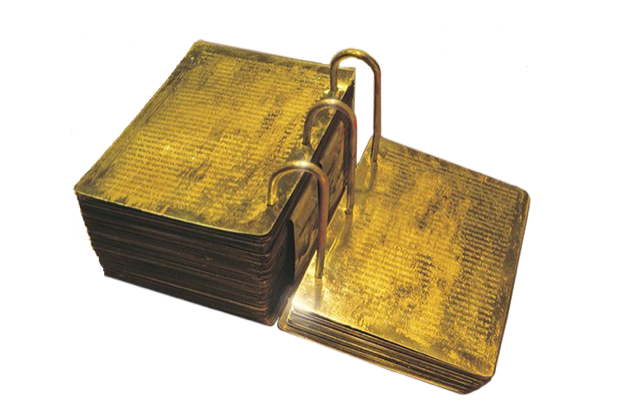





 oseph Smith taught that Adam, just prior to his death, called Seth, Enos, Cainan, Mahalaleel, Jared, Enoch and Methuselah, as well as the “residue of his posterity who were righteous,’ to Adam-ondi-Ahman. It was there he “bestowed upon them his last blessing” (
 “At that great gathering Adam offered sacrifices on an altar built for the purpose. A remnant of that very altar remained on the spot down through the ages. On May 19, 1838 Joseph Smith and a number of his associates stood on the remainder of the pile of stones at a place called Spring Hill, Daviess County, Missouri. There the Prophet taught them that Adam again would visit in the Valley of Adam-ondi-Ahman, holding a great council as a prelude to the great and dreadful day of the Lord” (Mormon Doctrine, pg. 21).
 “Divine Destiny” in his book The Teachings of Ezra Taft Benson (pp. 587-588), he wrote,
 “We may, however, observe, that so far as new revelation has given us information on this subject, this Continent of ours may be ranked among the first lands occupied by the human family. The very first man who had dominion on the face of the earth, under the direction of the Heavens, once dwelt on this Continent, His name was Adam” (Journal of Discourses 12:338)


 The choicest part of this earthly creation was a garden “eastward in Eden” where God placed our first parents, Adam and Eve. This resplendent place filled with paradisiacal glory was located on that part of the land mass where the city Zion, or the New Jerusalem of the earth’s last days, would eventually be built… After Adam and Eve were driven out of the Garden, they dwelt at a place called Adam-ondi-Ahman, located in what is now Daviess County, Missouri. In that region this first family lived out their days, tilling the soil, tending the flocks, offering sacrifices, and learning the gospel of Jesus Christ from on high. There Adam prophesied concerning all the families of the earth and, three years before his death, called together the righteous remnant of his posterity and bestowed upon them his last blessing. The Lord appeared unto this faithful group and Adam’s family rose up “and blessed Adam, and called him Michael, the prince, the archangel… Never before had one spot of earth been favored with such a meeting, nor provided the stage for such sacred scenes from the drama of man’s ultimate destiny.
 When we consider that the land of Missouri is the land where the saints of the living God are to be gathered together and sanctified for the second coming of the Lord Jesus, we cannot help exclaiming with the prophet, O land be glad! and O earth, earth, earth, hear the word of the Lord: For Zion’s sake will I not hold my peace, and for Jerusalem’s sake I will not rest, until the righteousness thereof go forth as brightness, and the salvation thereof as a lamp that burneth. And the Gentiles shall see thy righteousness, and all kings thy glory: and thou shalt be called by a new name, which the mouth of the Lord shall name. Thou shalt also be a crown of glory in the hand of the Lord, and a royal diadem in the hand of thy God. Thou [Jerusalem] shalt no more be termed Forsaken; neither shall thy land [Zion] any more be termed Desolate; but thou shalt be called Hephzi-bah, and thy land Beulah: for the Lord delighteth in thee, and thy land shall be married, [joined together] so that the land of Zion, and the land of Jerusalem will be one, as they were before the days of Peleg: For in his days the earth was divided or separated to receive the oceans, on account of wickedness. Peleg died 305 years after Noah’s flood: Abram’s father was born 210 years after the flood, and Abram 288 after, which brings to mind Joshua’s words unto all the people, Thus saith the Lord God of Israel, Your fathers dwelt on the other side of the flood in old time, even Terah the father of Abraham, and the father of Nachor, and they served other gods. The building of Babel was wickedness, and serving other gods was wickedness: so that dividing, or opening the earth to let in the waters, which were in the beginning gathered unto one place, is one of the Lord’s great miracles, and shows to the world that them that look for signs among the wicked, have them to their own condemnation in all ages.
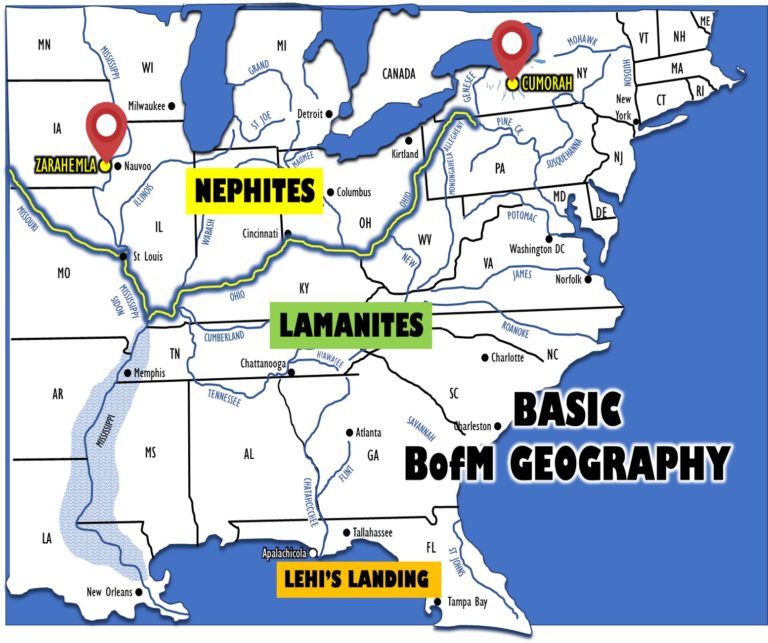
 “Temporarily, we call it America. But it began with the single, primeval continent of Genesis, and the miracle of millennial healing will bring that unity again.”
 1. Earth Defiled
 TWO LANDS OF PROMISE Page 508 Annotated Book of Mormon


 “About two o’clock the next morning we were called up by the cry of signs in the heavens. We arose, and to our great astonishment all the firmament seemed enveloped in splendid fireworks, as if every star in the broad expanse had been hurled from its course, and sent lawless through the wilds of the ether. Thousands of bright meteors were shooting through space in every direction, with long trains of light following their course. This lasted for several hours, and was only closed by the dawn of the rising sun. Every heart was filled with joy at this majestic display of signs and wonders. . .” [2]
 “On one occasion Joseph was preaching in Kirtland, sometime in the fall of 1833. Quite a number of persons were present who did not belong to the Church, and one man, more bitter and skeptical than others, made note with pencil and paper of a prophecy uttered on that occasion, wherein


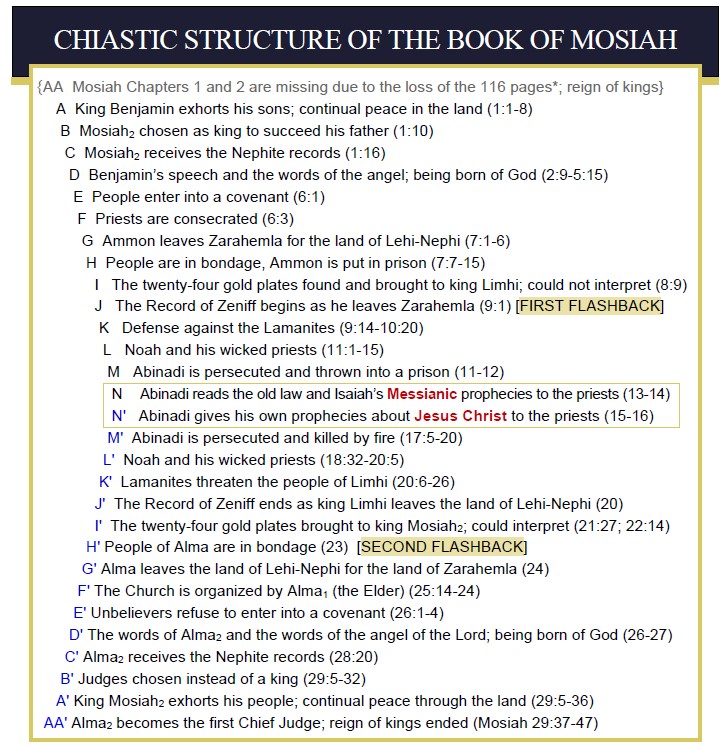


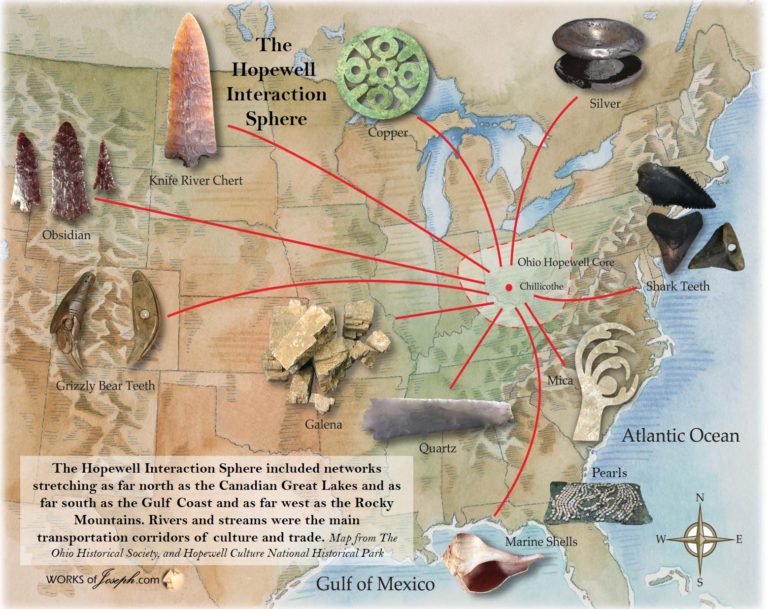

 “The Hopewell Culture was contemporaneous with the end of the Adena culture, but the Adena people tended to be considerably larger than the Hopewell. Remains of men seven feet tall were common among the Adena, while Hopewell were robust, their males averaged closer to six feet in height. There are four types of earthworks that were constructed by the ancient Hopewell civilization.
 The Hopewell Culture describes the common aspects of the Native American culture that flourished along rivers in the northeastern and midwestern United States from 300 BC to 400 AD, in the Middle Woodland period. The Hopewell tradition was not a single culture or society, but a widely dispersed set of related populations. They were connected by a network of trade routes, known as the Hopewell Exchange System.
 Parallels of the Hopewell Culture as described by William C. Mills, Chief Archaeologist of Ohio, with the Book of Mormon“[May 20, 1917; Sunday] Attended Sunday School and afternoon service in Hawthorne Hall, and was a speaker at each assembly. Evening meetings here, as also in Brooklyn, have been discontinued for the summer. The attendance both at Sunday School and afternoon meeting was surprisingly large in view of the fact that many of the Utah college students have left for the vacation period. This evening at the hotel I had a long and profitable consultation with Professor Wm. C. Mills, State Archaeologist of Ohio. He is continuing his splendid work of exploration in the Ohio mounds, and I went over with him again the remarkable agreement between his deductions and the Book of Mormon story. He has reached the following
 The people buried in the mounds include males and females, young and old. The Hopewell often cremated their dead, but extended burials in prepared tombs are also common. They often clothed or wrapped the bodies in fine textiles. Sometimes they would bury an array of ornaments and objects of ritual with the dead.
 There is some evidence to suggest the connections between ancient Newark and Chillicothe were formalized in a prehistoric roadway of long, straight parallel walls. Caleb Atwater, one of Ohio’s first archaeologists, suggested in 1820 that the parallel walls which ran southwestward from Newark’s octagon might extend thirty miles or more. In 1862 James and Charles Salisbury, early residents of Newark, traced these walls six miles “over fertile fields, through tangled swamps and across streams, still keeping their undeviating course.” They did not follow the road to its end, but noted the walls headed in the direction of Chillicothe.
 “The results of this study add to an already growing body of research dedicated to mtDNA analysis. In recent years, research utilizing Y- chromosome and STR analysis have also begun to add to what is known about the genetic variation present in Native Americans both ancient and modern. Combine that information with mtDNA, and a complete picture of migration, gene flow and kinship begins to take shape in North America. The Ohio Hopewell through an analysis of their mutations have revealed ancestral relationships with individuals in China, Korea, Japan, Taiwan, Mongolia, Russia and South America. The Ohio Hopewell also display mutations that are uniquely their own, such as haplotype A 16166, haplotype B 16247 and 16265. The unique mutations of the Ohio Hopwell of Hopewell Mound Group may have been lost through attrition or have yet to be discovered in other Native American populations. The Ohio Hopewell also share a unique mutation with the Cahokians of 72Sub2 Mound , utilized to denote a rare haplotype aligned with individuals of high status at Cahokia.
 “All inspiration does not come from God. (See D&C 46:7.) The evil one has the power to tap into those channels of revelation and send conflicting signals which can mislead and confuse us. There are promptings from evil sources which are so carefully counterfeited as to deceive even the very elect. (See Matt. 24:24.)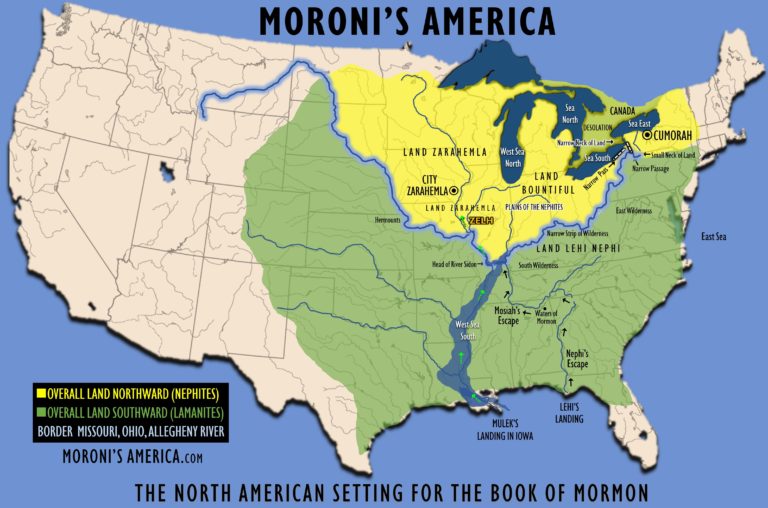
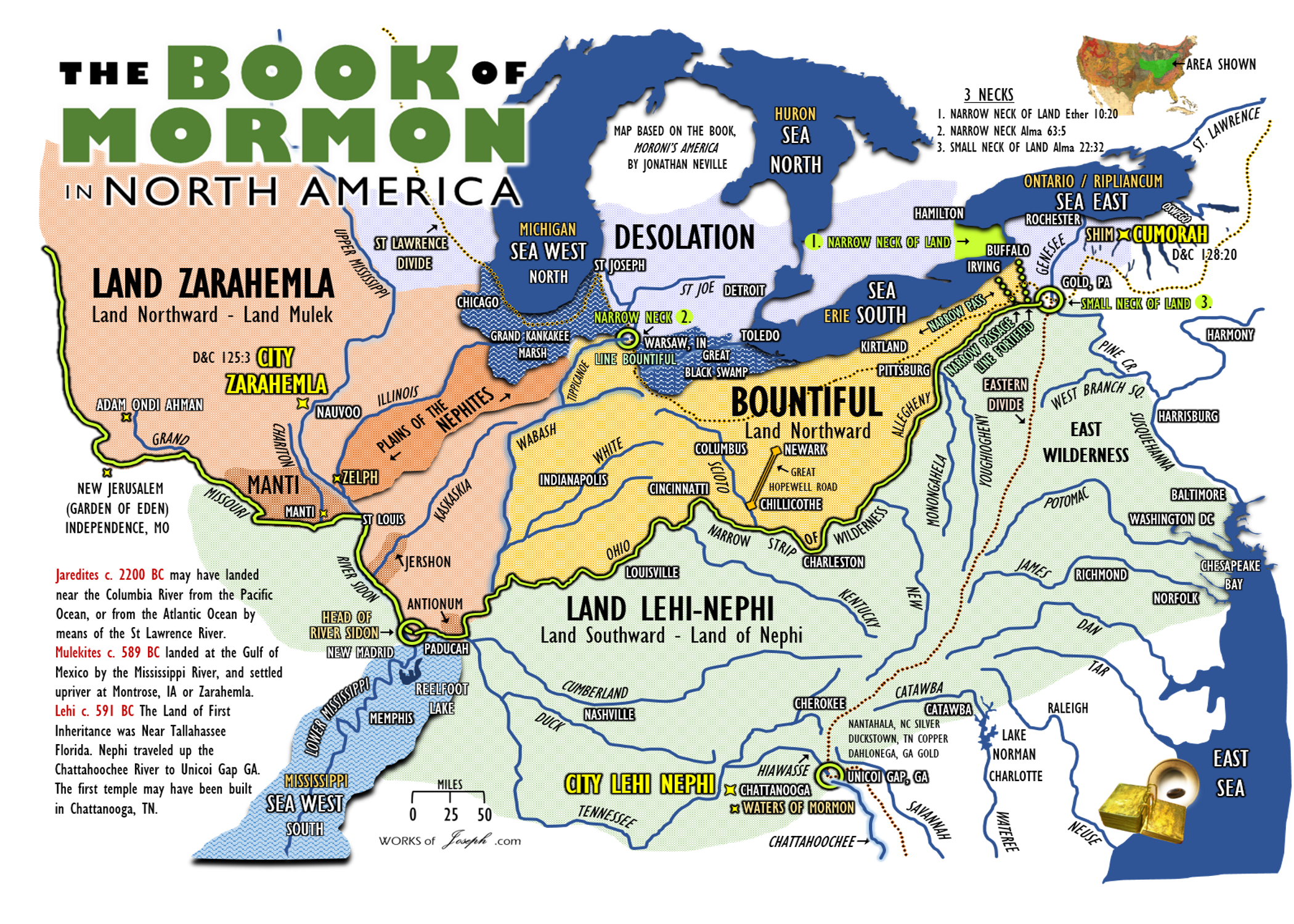
 Elder Jeffrey R. Holland said, “…Truly rock-ribbed faith and uncompromised conviction comes with its most complete power when it engages

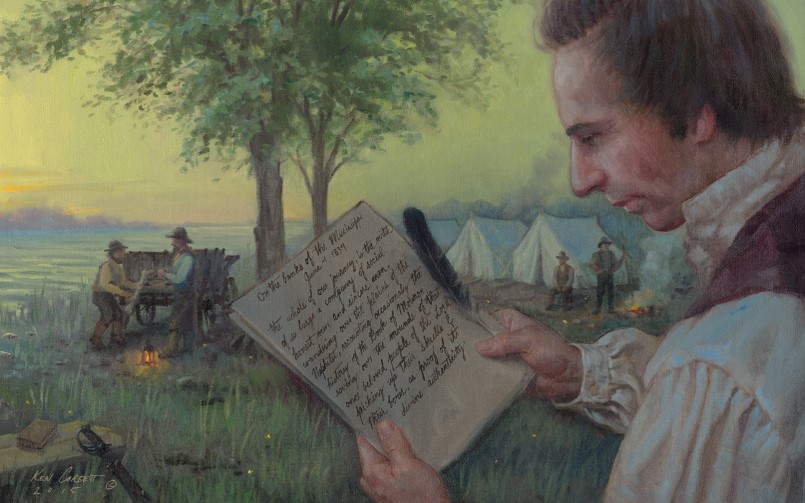
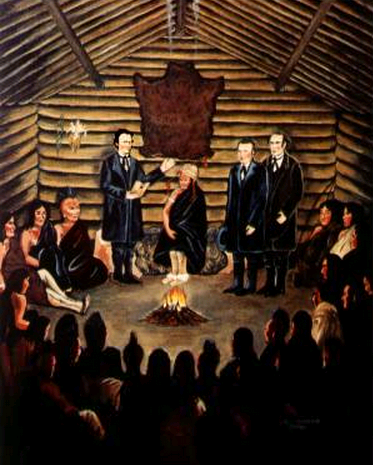
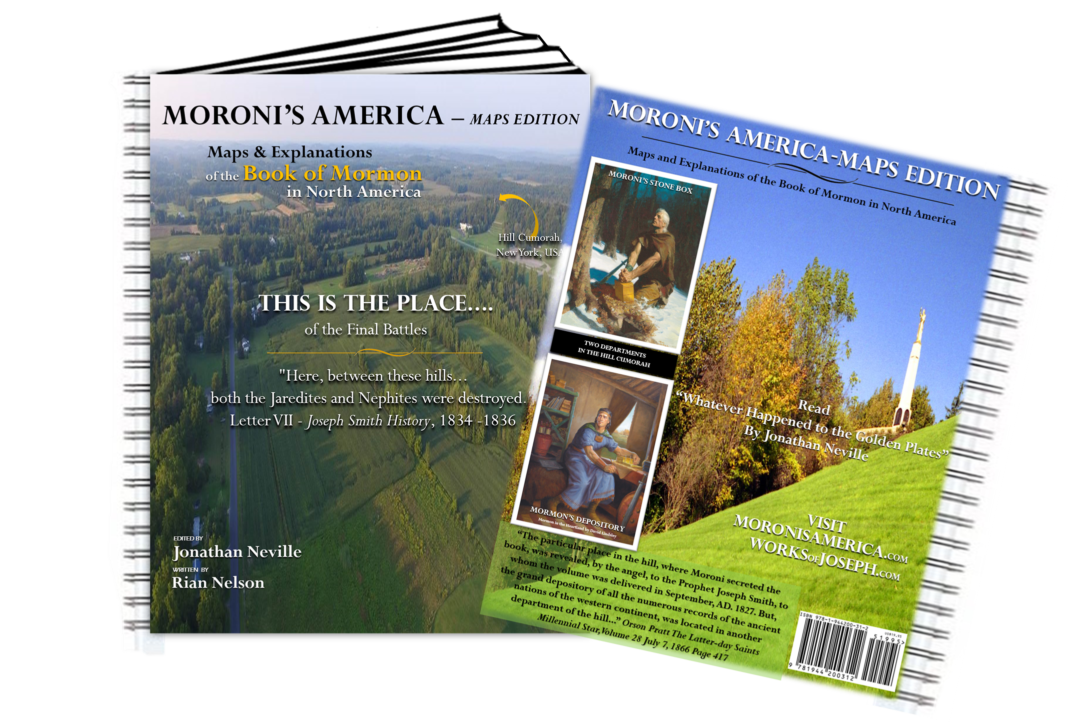
 Review the new Annotated Book of Mormon
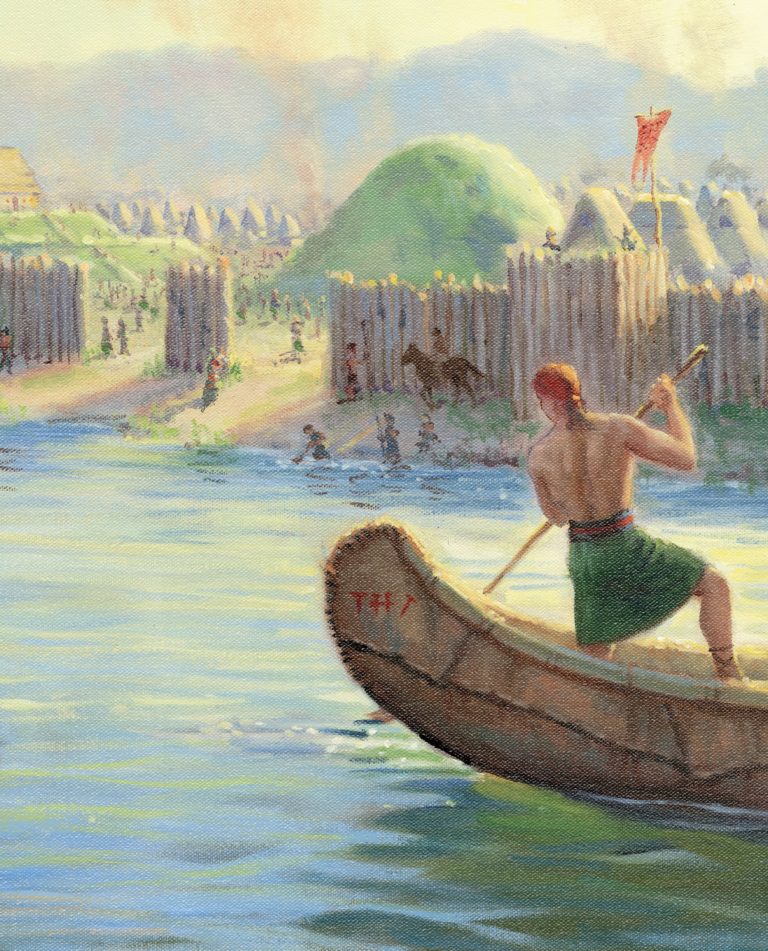



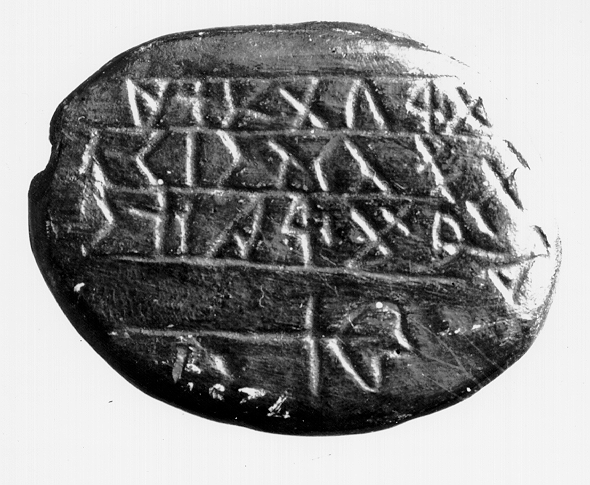
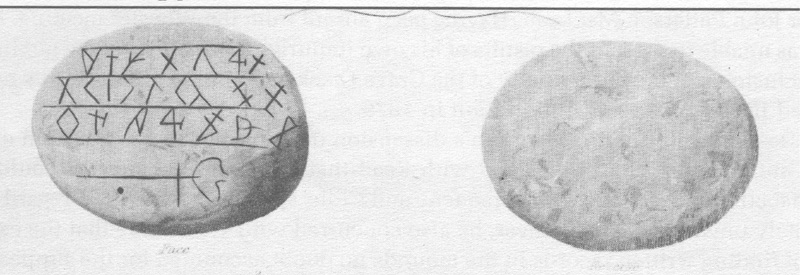
 Fig. 5.
 Fig. 6.
 In 1877, the Ohio State Archaeological Society appointed a committee to study the authenticity of the stone. Committee member M.C. Read published a strong denunciation, that included a widely cited experiment to determine if the inscription was alphabetic: He asked four persons who had no training in ancient inscriptions to fabricate twenty or more arbitrary “letters” composed of straight lines and combinations of straight lines. “The result, said Read, was that ‘In every case an inscription was produced presenting as many indications of being alphabetical’ as that on the Grave Creek stone. Accordingly, Read concluded that the Grave Creek inscription was ‘just such a medley of characters as anyone would produce who undertook to invent an inscription to puzzle the curious.'” (Barnhart 1986 p. 120)
 In his second, 1879 article, entitled “The Grave Creek Inscribed Stone,” Whittlesey intriguingly backs off his earlier position that the stone itself is a clearcut hoax. Instead, he now merely insists that the inscription is not alphabetic: “I agree with Prof. Read that the characters on the stone, by whomsoever they were cut, are not alphabetical or phonetic. If they have any meaning and are not a mere jumble of characters they must be symbolic or picture writing. It is therefore of small consequence whether the stone is antique or modern, whether it is genuine or a fraud.” (p. 66) He concludes, “If Professor Read and myself are right in our conclusions, that the figures are neither of the Runic, Phonician, Canaanite, Hebrew, Libyan, Celtic, or any other alphabet language, its importance has been greatly overrated.” (p. 68)
 A 1930 article in Science News Letter reported in all seriousness that one Andrew Price had at last “cleared up one of the greatest hoaxes in the record of American science,” by translating the Grave Creek inscription into “good old West Virginian.” (Davis 1930) According to the article, “That hoax, perpetrated by some unknown practical jokesmith, has stood triumphantly undetected for ninety odd years.” The inscription, according to Price, reads, in plain English,
 Over these letters is a transcription of the inscription that is bad beyond Whittlesey’s wildest imagination. Letters are pushed together or pulled apart and lines added or ignored wherever convenient. Letters from different lines are even joined together, and in several cases letter portions are used more than once in this manner. Even this mutilated transcription must be tortured beyond endurance before it will confess to Price’s reading.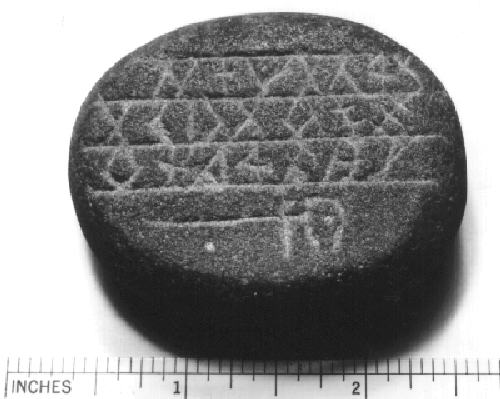


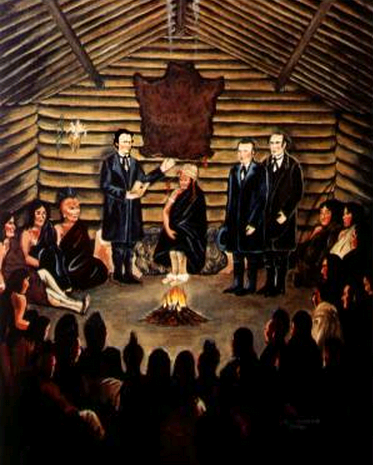




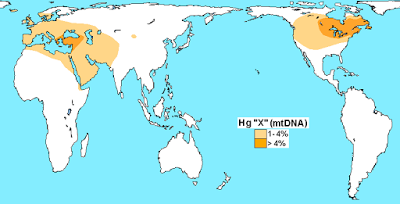

 Cumorah
 For a FREE download of Rod’s 170 page book titled, “Book of Mormon Remnant through DNA”, visit our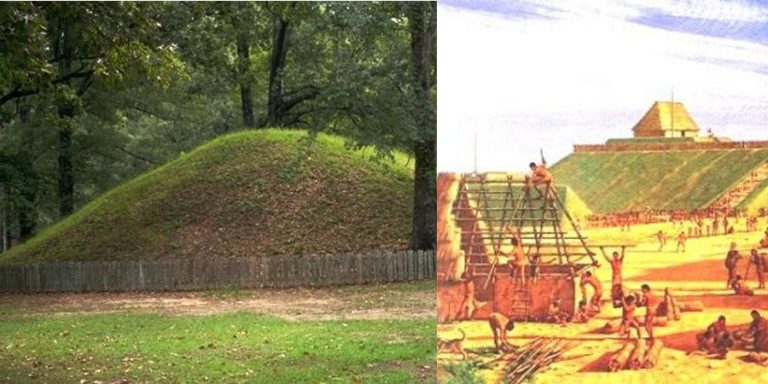


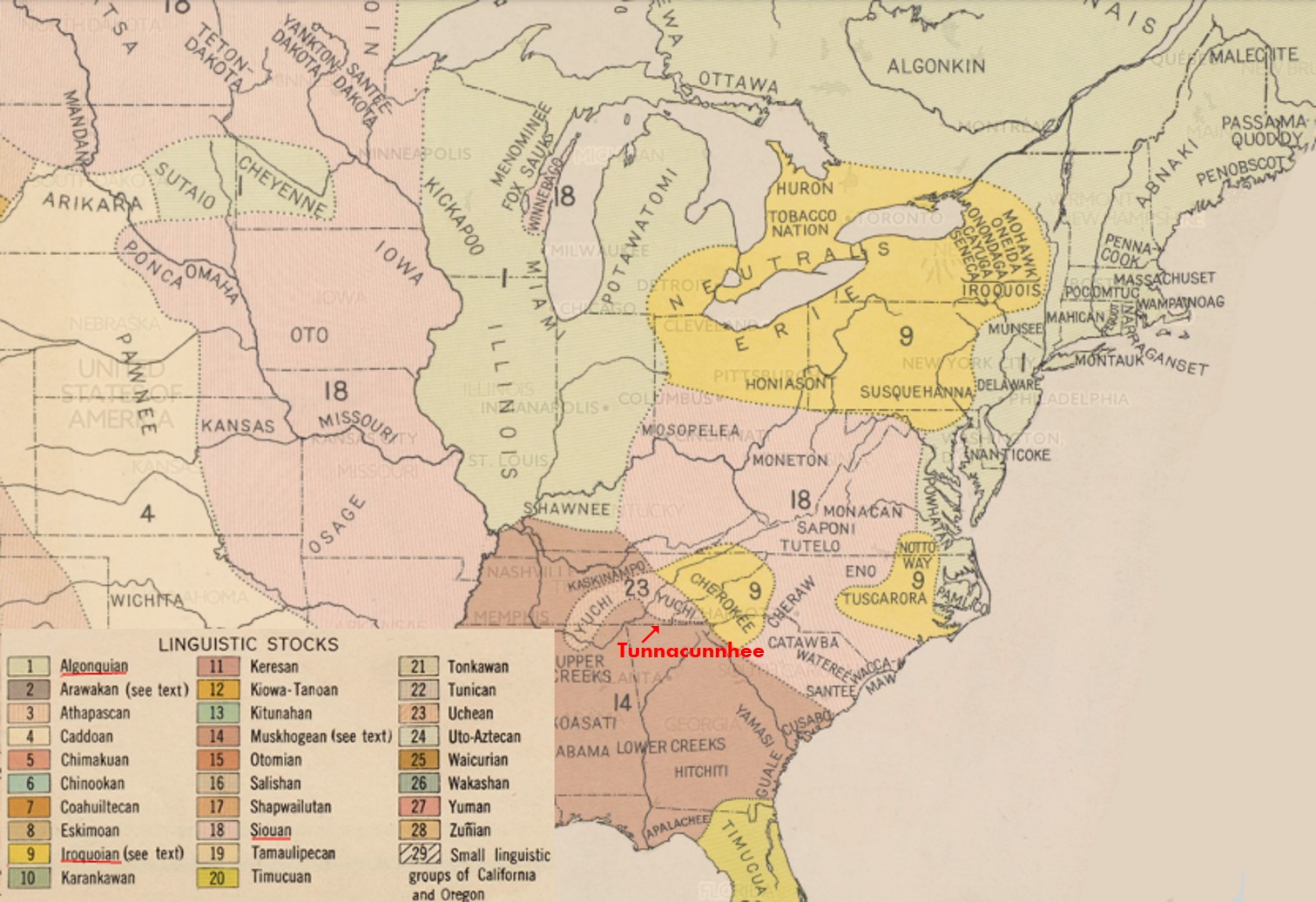


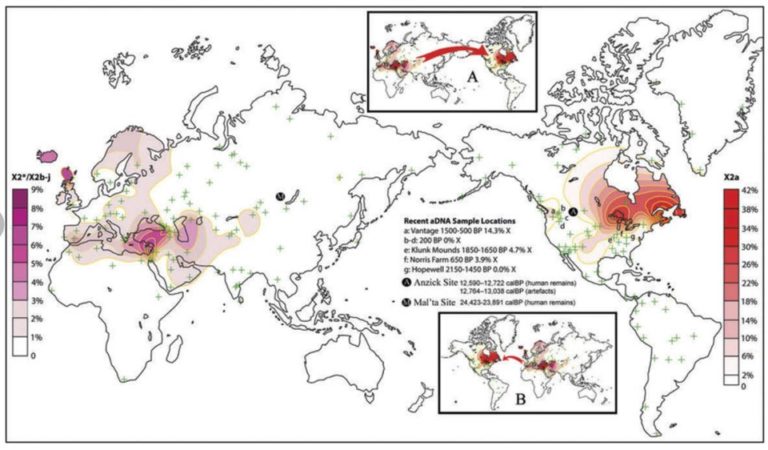


 When understood in the light of his other revelatory statements from the Wentworth Letter and American Revivalist accounts, it is hard to imagine that Joseph thought the Indians he was referring to were not those of North America. He emphatically stated that “the remnant are the Indians that now inhabit this country” and “the Book of Mormon is a record of the forefathers of our western tribes of Indians” and “by it, we learn that our western tribes of Indians, are descendants from that Joseph that was sold into Egypt…”
 The author invites those who would like to further this theory to do so, as well as inviting all who find discrepancies to make them known so that they can be corrected. The author acknowledges that as with all scholarly work, mistakes can and will be made, and invites those who choose to take issue with this research to do so in a Christ‐like manner, rather than making personal attacks against the author’s character, knowledge or motives.


 Picture left shows another key point. The Mulekites could have easily sailed up the river without encountering the Nephites or the Lamanites, who were several hundred miles east. Furthermore, the Mulekites would have sailed right past other civilizations that likely existed in the area, descendants of Jaredites or other groups who had come to the continent. The Zarahemla location in Iowa, across from Nauvoo, is ideal from several perspectives. First, being on the river provides plentiful water and facilitates commerce. Second, it is upriver from the Des Moines rapids, which provide a defensive barrier against river-borne invaders from the south. Third, the area has productive agricultural land. Ultimately, of course, it’s where the Lord led them. This geography helps clarify why the Nephites never encountered Zarahemla until Mosiah was prompted to flee from the land of Nephi. In our day, we might think people would explore freely, but anciently, the wilderness was dangerous. There were wild beasts, unpredictable weather, the potential of getting lost, sicknesses, and no way to communicate over long distances. You were on your own in the wilderness. By contrast, there was safety in numbers and community. Farms provided food. Why risk leaving a safe, productive and favorable location?It required great faith for Lehi and his family to leave Jerusalem, let alone cross the ocean (which is why Nephi faced such resistance from his brothers). In the new world, it required great faith for Nephi to flee from his brothers into the wilderness. Mosiah exercised great faith to leave the land of Nephi. The prominence of Zarahemla—it is by far the most-often mentioned place in the Book of Mormon, the capital of the Nephites—shows it was wise for the people of Zarahemla to stay put. Omni 1:20-22


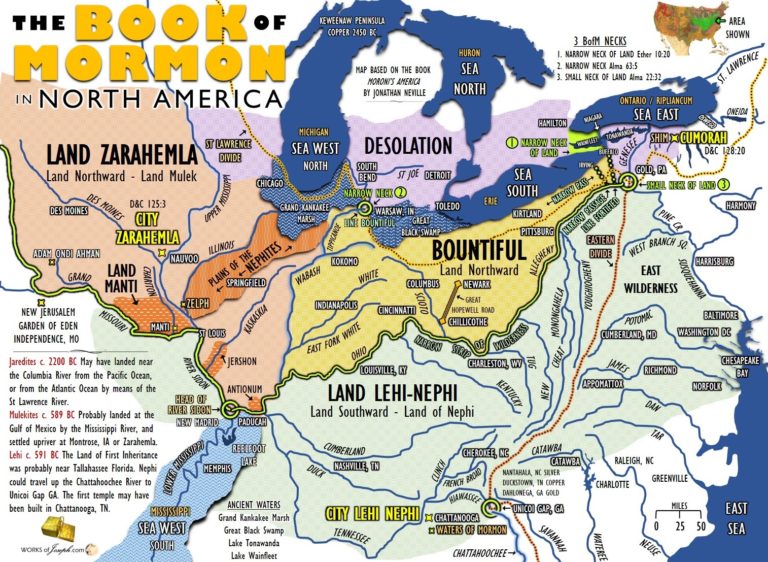
 “Let the Government of the United States also continue to gather together, and to colonize the tribes and remnants of Israel (the Indians), and also to feed, clothe, succor, and protect them, and endeavor to civilize and unite; and also to bring them to the knowledge of their Israelitish origin, and of the fulness of the gospel which was revealed to, and written by, their forefathers on this land;… He has revealed the origin and the Records of the aboriginal tribes of America, and their future destiny.—And we know it. He has revealed the fulness of the gospel, with its gifts, blessings, and ordinances.—And we know it. He has commanded us to bear witness of it, first to the Gentiles and then to the remnants of Israel and the Jews.—And we know it. He has commanded us to gather together his Saints on this Continent, and build up holy cities and sanctuaries.—And we know it.” PROCLAMATION of the Twelve Apostles of the Church of Jesus Christ of Latter-day Saints. New York April 6, 1845. James R. Clark, comp., Messages of the First Presidency of The Church of Jesus Christ of Latter-day Saints, 6 vols. (Salt Lake City: Bookcraft, 1965-75), 1:, p.252-266


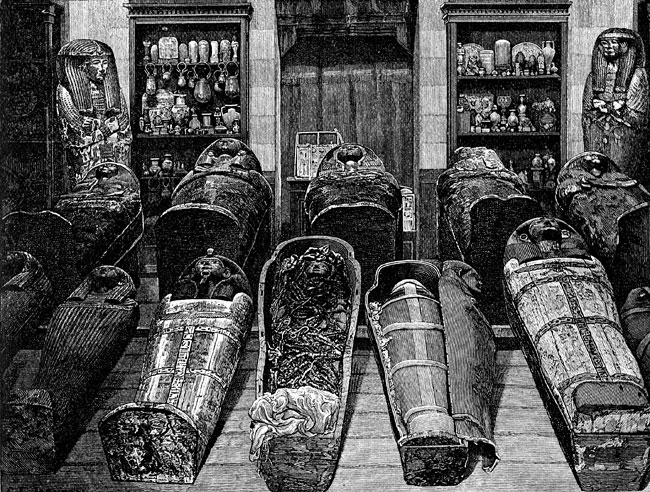
 “During the summer of 1835, while the apostles left on missions to the eastern states and Canada, the Saints worked together to finish the temple and prepare for the endowment of power. Spared the violence and loss the Saints in Missouri had suffered, Kirtland grew and prospered spiritually as converts gathered to the town and lent their hands to the Lord’s work.1
 Concerning the discovery, we must rely on sources that are not even second hand. According to the Chandler/Cowdery account, it states that the records and mummies came from the area of Thebes and were discovered by Antonio Lebolo. There is no question that this is possible, since Lebolo worked almost exclusively in the vicinity of Thebes. He also carried out excavations on his own as is seen with the Soter find and probable others.
 It is possible that this large number of mummies could have been in the tomb with the eleven that Chandler received. However, there is one problem. There are not that many known tombs in Qurna that could accommodate two or three hundred living, much less mummified, people. Could the eleven mummies that Chandler received have come from more than one tomb? Could they derive from Lebolo’s last collection, sold after his death? Lebolo did not make a will leaving the eleven mummies to Michael H. Chandler. The will of Antonio Lebolo was found in the fall of 1984 and contained no mention of a Michael H. Chandler, or the eleven mummies. The will itself was over two hundred pages, most of which listed Lebolo’s belongings. From his will, Lebolo obviously passed away a wealthy and influential man in his community.
 The largest collection of EGYPTIAN MUMMIES ever exhibited in this city, is now to be seen at the Masonic Hall, in Chestnut Street above Seventh. They were found in the vicinity of Thebes, by the celebrated traveler Antonio Lebolo and Chevalier Drovetti, General Consul of France in Egypt. Some writings on Papirus [sic] found with the mummies, can also be seen, and will afford, no doubt, much satisfaction to Amateurs of Antiquites. Admittance 25 cents, children half price. Open from 9 A.M. till 2 P.M., and from 3 P.M. to 6. Ap 3 – d3W This article began on April 3rd and ran for three weeks.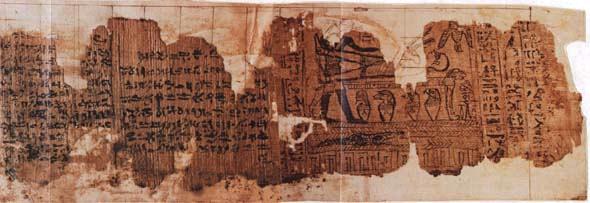
 Lexington, in Kentucky, stands nearly on the site of an ancient town, which was of great extent and magnificence, as is amply evinced by the wide range of its circumvalliatory works, and the quantity of ground it once occupied.
 Jacob and Joseph were no doubt, embalmed in the manner of the Egyptians, as they died in that country, Gen. 1, 2, 3, 26. When our Saviour [Savior] was crucified his hasty burial obliged them only to wrap his body in linen with a hundred pounds of myrrh, aloes, and similar spices, (part of the ingredients of embalming.) given by Nicodemus for that purpose: but Mary and other holy women had prepared ointment and spices for embalming it, Matt. xxviii. 59: Luke xxiii. 56: John xxx. 39-40.
 A shelter cave was discovered near San Jose, in California, by Dr. Stephen Bowers. It contained a number of baskets, in which were bundles of painted sticks, covered with peculiar signs, probably the outfit of a modern ”medicine man.” Caves have also been found in Utah, but as the remains of man were associated with ears of corn and other relics, we conclude that they were extremely modern. There were Cave-dwellers in the Mound-builders’ territory. Prof. Putnam has described several in Tennessee.
  We propose in this chapter to take up the burial mounds in the United States and study them as monuments. The term is very appropriate, since they, in common with all other funereal structures, were evidently erected as monuments, which were sacred to the memory of the dead. Whatever we may say about them as works of architecture, they are certainly monumental in design. It is a singular fact that mounds have everywhere been erected for this purpose. We read in Homer that a mound was built over the grave of Patroclus, and that the memorial of this friend of Alneas was only a heap of earth. The name of Buddha, the great Egyptian divinity, has also been perpetuated in the same way. There are great topes, conical structures, in various parts of Asia, which contain nothing more than a fabled tooth of the great incarnate divinity of the East, but the outer surface of these topes is very imposing.


 Years went by and the collection purchased by Ward was placed in a traveling exhibition of rarities. Through the years, the Fawn Hoof Mummy traveled across the country. It was first taken to Lexington, Kentucky and later transferred to the American Antiquarian Society.
 In connection with cave burial, the subject of mummifying or embalming the dead may be taken up, as most specimens of the kind have generally been found in such repositories. It might be both interesting and instructive to search out and discuss the causes which have led many nations or tribes to adopt certain processes with a view to prevent that return to dust which all flesh must sooner or later experience, but the necessarily limited scope of this preliminary work precludes more than a brief mention of certain theories advanced by writers of note, and which relate to the ancient Egyptians. Possibly at the time the Indians of America sought to preserve their dead from decomposition some such ideas may have animated them, but on this point no definite information has been procured. In the final volume an effort will be made to trace out the origin of mummification among the Indians and aborigines of this continent.
 “
“
 It would appear from recent researches on the Northwest coast that the natives of that region embalmed their dead with much care, as may be seen from the work recently published by W. H. Dall, [Footnote: Cont. to N. A. Ethnol., 1877, vol. 1, p. 89]
  “One of the packages has been opened, and it reveals a man’s body in tolerable preservation, but with a large portion of the face decomposed. This and the other bodies were doubled up at death by severing some of the muscles at the hip and knee joints and bending the limbs downward horizontally upon the trunk. Perhaps the most peculiar package, next to that of the chief, is one which encloses in a single matting, with sea-lion skins, the bodies of a man and woman. The collection also embraces a couple of skulls, male and female, which have still the hair attached to the scalp. The hair has changed its color to a brownish red. The relics obtained with the bodies include a few wooden vessels scooped out smoothly; a piece of dark, greenish, flat stone, harder than the emerald, which the Indians use to tan skins; a scalp-lock of jet-black hair; a small rude figure, which may have been a very ugly doll or an idol; two or three tiny carvings in ivory of the sea-lion, very neatly executed, a comb, a necklet made of birds’ claws inserted into one another, and several specimens of little bags, and a cap plaited out of sea-grass and almost water-tight.”