Nephite Connection with the Mounds and the Smith’s
Alvin Smith’s Burial Mound in Palmyra, NY
“Mormonism sprang from the mounds,” wrote Roger Kennedy, former director of the Smithsonian National Museum of American History. Even before the Book of Mormon was published, Mormonism was linked to the Moundbuilder civilizations of North America. One man who claimed to have heard a reading of the lost 116 pages said “It was a description of the mounds about the country and similar to the ‘Book of Mormon.’” In 1843, Joseph Smith apparently alluded to the 116 pages when he said the Book of Mormon spoke about sacred burial places. Several authors have placed the Book of Mormon among other 19th century books about the origins of the Moundbuilders. At one time, there were over a million ancient earth mounds in North America; approximately 100,000 remain today. Many of these mounds are located in the territory from western New York through western Missouri where early Mormon history took place. Three specific mounds figure prominently in LDS history: Zelph’s mound in Illinois, the Kinderhook mound, also in Illinois, from which the six brass plates were taken, and Enon mound in Ohio. Until the early Saints leveled them to build homes and farms, Indian mounds dominated Nauvoo. Joseph Smith purchased one and resorted to it from time to time. Less well known are the mounds located just north of Nauvoo that have recently been discovered and preserved. The connections between Mormonism and the mounds of North America have yet to be fully explored…
The Red Brick Store in Nauvoo, IL sits on an ancient Hopewell burial mound
The increasing awareness of the numerous Hopewell mounds in the Nauvoo area may give renewed attention to the connection between Mormons and the mounds. When workers dug a utility trench between the Red Brick Store and the Joseph Smith Homestead, the equipment churned up Hopewell bones and artifacts. This area is adjacent to the Smith Family Cemetery, leading to the possibility that Joseph Smith, his wife Emma, his brother Hyrum and his parents are buried in a Hopewell burial site.
If “Mormonism sprang from the mounds” as Roger Kennedy suggested, it seems only fitting that Joseph Smith would be buried among the Moundbuilders…” Jonathan Neville- See his complete presentation called “The Mormons and the Mounds” HERE
In visiting the Alvin Smith burial site in Palmyra New York, it is a unique setting. It is just one block north of the four corner of Churches on Main St. It is possible that this was once a Nephite burial mound. (See picture gallery at the bottom of the page). When on top it is very secluded and surrounded by large trees, is very flat with very straight lines, and it is about 25 feet high. It would make some sense especially knowing that his younger brother Joseph is similarly buried in Nauvoo on a former Nephite burial site.
Jonathan Swift Memorial Cemetery in Palmyra, New York
Alvin Smith, the Prophet Joseph Smith’s oldest brother died unexpectedly while building a nice frame home for his parents and family and was buried in the Jonathan Swift Memorial Cemetery in Palmyra, New York. Alvin had shown great interest in the coming forth of the Book of Mormon. In 1836 Joseph saw Alvin in a vision of the Celestial Kingdom and marveled that he had inherited that reward without being baptized in mortality. That vision became a foundation of understanding salvation for millions that die without receiving the gospel in mortality. BYU Virtual Tours
Joseph Smith said to his mother about his deceased brother, “Mother, Alvin is not lost”
“I saw the beautiful streets of that kingdom, which had the appearance of being paved with gold. I saw Father Adam and Abraham; and my father and my mother; my brother Alvin, that has long since slept; And marveled how it was that he had obtained an inheritance in that kingdom, seeing that he had departed this life before the Lord had set his hand to gather Israel the second time, and had not been baptized for the remission of sins. Thus came the voice of the Lord unto me, saying: All who have died without a knowledge of this gospel, who would have received it if they had been permitted to tarry, shall be heirs of the celestial kingdom of God; Also all that shall die henceforth without a knowledge of it, who would have received it with all their hearts, shall be heirs of that kingdom; For I, the Lord, will judge all men according to their works, according to the desire of their hearts.” D&C 137:4-9
“Oldest brother of Joseph Smith Jr., founder and Prophet of The Church of Jesus Christ of Latter-day Saints.
On one occasion, Joseph described his older brother as “a very handsome man, surpassed by none but Adam and Seth, and of great strength” Alvin’s mother said he was “a youth of singular goodness of disposition — kind and amiable.”
In November of 1823, Alvin suddenly became sick with what is called by his mother “bilious colic.” The family doctor was not available, so a substitute was procured, who prescribed “a heavy dose of calomel” – a compound of mercury and chlorine that some thought would encourage the discharge of bile. Alvin at first refused to take the medicine, but was eventually persuaded. According to Lucy’s account, “This dose of calomel lodged in his stomach, and all the medicine afterwards freely administered by four very skillful physicians could not remove it.”
Realizing that he was dying, Alvin called the family members to him and one by one gave counsel and encouragement. Joseph at this time was almost 18 years old, and had only recently had his first visit with the Angel Moroni. Alvin’s counsel to Joseph was: “I am now going to die…I want you to be a good boy, and do everything that lies in your power to obtain the Record. Be faithful in receiving instruction, and in keeping every commandment that is given you.”
The family mourned greatly at the death of Alvin, and frequently wept in sorrow when they remembered his devotion to Joseph and his divine calling.” Find a Grave
Interesting Facts:
• “Lucy recorded that Alvin was engaged to be married at the time of his death. The young lady never did marry as far as we know, but pined away in Alvin’s memory saying that she would never find another like Alvin. Joseph wrote that he was sure that her youthful heart would break when Alvin died. Larry Porter once appropriately described Alvin as a “quiet giant.”
• Alvin’s body was reportedly exhumed and dissected. Father Smith went to the grave with witnesses in order to ascertain that the rumor was unfounded and then had a notice that such was the case published in the local newspaper. (Wayne Sentinel 2 (29 Sept. 1824): 3; Lucy Mack Smith, (ed. Proctor), 123.)” BYU Virtual Tours
Below are pictures taken at Palmyra New York at the Alvin Smith burial site in July, 2019
Posterazzi painting of Benjamin Franklin John Adams and Thomas Jefferson writing the Declaration of Independence.
“The Lord has always promised his covenant people who are faithful, four principle blessings. Posterity, prosperity, security and freedom, and a land of promise. The first recorded instance of a “land of promise” in scripture is a land called Cainan, named after a great-grandson of Father Adam (Moses 6:17). We understand through the scriptures that this land was near current day Adam-ondi-Ahman, Missouri (D&C 116:1)”. Rod Meldrum
1- A Land of Promise 2- Prosperity 3- Posterity 4- Security & Freedom
Understand the Law of Moses – What Is Shemittah?
The Sabbatical Year basics: absolution of loans, desisting from all field work, and the spiritual objective of all the above.
As soon as the Jews settled in the Holy Land,1 they began to count and observe seven-year cycles. Every cycle would culminate in a Sabbatical year,2 known as Shemittah,3 literally: “to release.”
The year following the destruction of the second Holy Temple was the first year of a seven-year Sabbatical cycle. In the Jewish calendar, counting from Creation, this was the year 3829, 68–69 CE on the secular calendar. By counting sevens from then, we see that the next Shemittah year will be the year 5782 after Creation, which runs from September 7, 2021 – September 25, 2022.
The Shemittah year waives all outstanding debts observance of Shemittah has several dimensions. In the following paragraphs we will outline the basics of Shemittah observance. For more detailed information, please see our Loan Amnesty and Deserting the Farms sections.
At the end of seven years you will make a release. And this is the manner of the release: to release the hand of every creditor from what he lent his friend; he shall not exact from his friend or his brother, because the time of the release for the L‑rd has arrived. (Deuteronomy 15:1–2)
The Shemittah year waives all outstanding debts between Jewish debtors and creditors. https://www.chabad.org/
Our basic bankruptcy laws possibly came from this Shemittah year. In U.S. law a bankruptcy stays on your credit for 7 years. In other words a release of our financial obligations every 7 years.
Washington’s Covenant on Genesis 49
Breaching of the Covenant, Judgments of God and Subsequent Re-Invoking of the Covenant
Each time that the singular requirement – obeying the commandments – is ignored by the people under the covenant, the Lord allows judgments to come upon them (see listing of judgments, Deut. 28:15-68). These covenant blessings are generally revoked sequentially in reverse order of how they were given in a merciful effort by the Lord to turn His children’s hearts and minds back to Him; to cause the covenant people to repent and ask for His protection and guidance. Their blessings are revoked in reverse order.
1- Security is breached; helping them realize their lack of security without God’s protection. (Consider Sept 11th, 2001, as the first great attack to our country and so the covenant of security was removed from our nation. The dome of protection was removed so to speak.
2- Prosperity removed; humbling them into the realization that prosperity is a blessing from God, not man. (When was the great bursting of the bubble in the financial markets? Sept 7, 2008)
3- Posterity is taken away, usually through internal conflict and war; helping them realize God’s blessing of having children. There was a law passed in the USA as Same-sex marriage in the United States expanded from one state in 2004 to all fifty states in 2015 and the Defund Planned Parenthood Act of 2015, passed by a vote of 241-187 on September 18, 2015.
4- Swept from the sacred land; God’s final consequence for disobedience – for God will not suffer unrighteous people to occupy His Promised Lands. Based on Shemittah, If the pattern holds, what may be our fate in 2022? No one knows, but we must continue planning for our future.
Lehi’s Covenant
Each time the covenant is ignored and the judgments of God fall upon the people, in order for the covenant to be reinstated, the people and their leaders must humble themselves, repent, vow to obey the commandments of God, and re-invoke the covenant. Such has been the case with prophets throughout Old Testament history as well as those who were directed to the American promised land. The Book of Mormon provides multiple examples of such re-invocations such as Limhi (Mosiah 21:32) Lachoneus (3 Nephi 3:12-25) and Captain Moroni (Alma 46:10-13). Rod Meldrum
Abraham’s Covenant
“I would like to share with you how I feel about this land of the United States of America, especially at this time of the year that we celebrate our great nation’s birthday. I feel I have been blessed with a tremendous opportunity to be part of this great nation where the gift of freedom and liberty live. With that blessing comes a tremendous stewardship to give back to the Lord for this wonderful blessing.
If I don’t share the Gospel or if I am not kind to my neighbor while living in such a great place, I will be held severely accountable. I love the Lamanites as brother Joseph did and I have a huge desire to bless their lives in all I do.
“Joseph the Prophet Addressing the Lamanites.” Lithograph by H. R. Robinson, 1844
Because of my blessings I too must give. Because of the great resources given to me, I too must share. Those in the world that live other places in this beautiful world are also blessed. I am definitely not better than anyone, for I too sin and fall short often.
I believe this land called the United States of America is the blessed land spoken of in the Book of Mormon. I feel thankful for what the Lord said here, “Therefore, it is not right that any man should be in bondage one to another. And for this purpose have I established the Constitution of this land, by the hands of wise men whom I raised up unto this very purpose, and redeemed the land by the shedding of blood. D&C 101:79-80
That doesn’t mean the United States is better than any other land, it means we Americans are being held to a higher standard. An American is defined as anyone who has citizenship in the United States, whether black or white, whether good or bad, whether right or left. The whole idea of America is to be “One Nation” just as the Savior wants us to be “One People” in the world.
I don’t believe true peace will come until the Lord comes. That doesn’t mean we don’t strive every day to share or give of our means. I believe this is mostly Satan’s world presently and it is up to us to choose the Lord’s side each day. When bad things happen we shouldn’t say, “why did this happen”, rather we should say, “what am I supposed to learn from what just happened?”
Each person in this world has been given from the Lord the best opportunity to succeed in life. The Lord knows each of us and doesn’t prejudge any of us. He loves us equally. We have been born into the situation we are, with the best opportunity to reach our full potential. No one is favored above the other in the Lord’s eyes. It is up to each of us individually to find the good in the place we live, and love all around us. The Lord doesn’t want victims, he wants us to live with Him again.
I think the difference between a righteous person and an evil person is simply this. The righteous person is always repenting no matter where they live. The evil person in the world doesn’t feel the need to repent and barely believes in the Lord Jesus Christ. This life is not only while we live on earth, but it continues when we die. That is why I believe if unfairness happens here, the Lord will make up the difference there. No unrighteous judgement. We are all the same in God’s eyes. For example, those who die in this life without the Gospel of Christ, will eventually have that opportunity before they are judged.” Editor Rian Nelson
A Choice Land
“Choice” can mean excellent or superior, but it can also mean carefully selected for a righteous people to dwell and prosper. The Book of Mormon uses it in the last connotation: ‘And the Lord would not suffer that they should stop beyond the sea in the wilderness, but he would that they should come forth even unto the land of promise, which was choice above all other lands, which the Lord God had preserved for a righteous people’ (Ether 2:7; emphasis added).
“This does not mean that the land of North America is ‘superior’ to all other lands. However, it was ‘carefully selected’ for a special purpose. For the Jaredites it was a land chosen for a ‘righteous people.’ For the Nephites, it was ‘carefully selected’ as a land of promise and a covenant land for a remnant of the House of Israel. “The covenant land can be a blessing and also a cursing in that, if the people don’t
keep the covenant, they are worse off than had they never entered the covenant in the first place. In this sense, America has been carefully selected not only as a promised land for the Jaredites and the Nephites, but as the central place for the Lord’s marvelous work and a wonder in our day. America has been chosen to host: a) the restoration of the Gospel, b) the translation and publication of the Book of Mormon, c) the establishment of the Church of Jesus Christ of Latter-day Saints; and d) the restoration of Priesthood authority and keys for the gathering of Israel and the salvation of the dead. These blessings come with great responsibilities. America is not “superior” to any other land created by God.
“This is consistent with the basic principle that God is no respecter of persons, that He speaks to all His children wherever they live: ‘Know ye not that there are more nations than one? Know ye not that I, the Lord your God, have created all men, and that I remember those who are upon the isles of the sea; and that I rule in the heavens above and in the earth beneath; and I bring forth My word unto the children of men, yea, even upon all the nations of the earth?’(2 Nephi 29:7; emphasis added). “In this sense, every land can be a promised land for the people who live there. We should appreciate all respective homelands for every nation or peoples in every continent. Understanding the history of Book of Mormon connections may help us recognize that all people can develop their own spiritual connections and traditions with their respective homeland.” – Jonathan Neville. Annotated Book of Mormon page 509
Speaking about the earth just after creation, Elder Jeffrey R. Holland said, “Temporarily, we call it America. But it began with the single, primeval continent of Genesis, and the miracle of millennial healing will bring that unity again…
The most sacred of places, then, will always be those locations which God has designated for holy and eternal purposes, locations where he is the “doer of the deed.” These places are revered forever by his faithful children wherever they may be.
America is such a place, but of course it wasn’t always called America nor has it always been identified by a distinctive continental shape. Originally it was simply a portion of that large, single land mass which God in his creative process called “Earth” and which, when completed, was pronounced “good.” (Gen. 1:10.) Whatever its name and geographical configuration, however, it was from the beginning a land of divinity as well as a land of destiny. .Jeffrey R. Holland
”We must remember that the whole earth was paradisiacal before the Fall. The Garden of Eden was a center place. After the Fall, there was no Garden of Eden or paradisiacal status on earth. Yet relative to the locale of the site of the Garden of Eden, the Prophet Joseph Smith learned through revelation (D&C 57) that Jackson County was the location of a Zion to be and the New Jerusalem to come. The Prophet first visited Jackson County, Missouri, in the summer of 1831. The Prophet visited Jackson County again in April and May 1832. On one of the occasions, or perhaps both, the Prophet Joseph apparently instructed his close associates, and perhaps even a general Church gathering, that the ancient Garden of Eden was also located in Jackson County.” Bruce A. Van Orden, associate professor of Church history, Brigham Young University.
Elder Holland continues, “The choicest part of this earthly creation was a garden “eastward in Eden” where God placed our first parents, Adam and Eve. This resplendent place filled with paradisiacal glory was located on that part of the land mass where the city Zion, or the New Jerusalem of the earth’s last days, would eventually be built… After Adam and Eve were driven out of the Garden, they dwelt at a place called Adam-ondi-Ahman, located in what is now Daviess County, Missouri. In that region this first family lived out their days, tilling the soil, tending the flocks, offering sacrifices, and learning the gospel of Jesus Christ from on high. There Adam prophesied concerning all the families of the earth and, three years before his death, called together the righteous remnant of his posterity and bestowed upon them his last blessing. The Lord appeared unto this faithful group and Adam’s family rose up “and blessed Adam, and called him Michael, the prince, the archangel… Never before had one spot of earth been favored with such a meeting, nor provided the stage for such sacred scenes from the drama of man’s ultimate destiny.
“But even as such sacred manifestations and proclamations were recorded, the land was being polluted with unrighteousness. The willful Cain had already made his covenant with Satan and taken the life of his younger brother, Abel…
Two generations later the Lord was so pained by that generation “without affection” (Moses 7:33) that he opened the windows of heaven and cleansed the entire earth with water. Thus, the “everlasting decree” (Ether 2:10) was first taught that he who will not obey the Lord in righteousness will be swept from his sacred land. The lesson would be tragically retaught in dispensations yet to come.” Jeffrey R. Holland
TWO LANDS OF PROMISE
“…out of Zion shall go forth the law, and the word of the Lord from Jerusalem” (2 Nephi 12:3).
“And He shall set up an ensign for the nations, and shall assemble the outcasts of Israel,
and gather together the dispersed of Judah from the four corners of the earth” (2 Nephi 21:12).
ADAM’S “LAND OF PROMISE” 1- Land of Cainan
“And Enos [grandson of Adam] lived ninety years, and begat Cainan. And Enos and the residue of the people of God came out from the land, which was called Shulon, and dwelt in a land of promise, which he called after his own son, whom he had named Cainan [the land of Cainan].” (Moses 6:17)
“Three years previous to the death of Adam, he called Seth, Enos, Cainan, Mahalaleel, Jared, Enoch, and Methuselah, who were all high priests, with the residue of his posterity who were righteous, into the valley of Adam-ondi-Ahman, and there bestowed upon them his last blessing.” (Doctrine & Covenants 107:53)
“And behold, this people will I establish in this land, unto the fulfilling of the covenant which I made with your father Jacob, and it shall be a New Jerusalem.” (3 Nephi 20:22)” Annotated Book of Mormon by David Hocking and Rod Meldrum Page 508
ABRAHAM’S “LAND OF PROMISE” 2- Land of Canaan
“And then we [Abraham and family] passed from Jershon through the land unto the place of Sechem; it was situated in the plains of Moreh, and we had already come into the borders of the land of the Canaanites, and I offered sacrifice there in the plains of Moreh, and called on the Lord devoutly, because we had already come into the land of this idolatrous nation. And the Lord appeared unto me in answer to my\ prayers, and said unto me: ‘Unto thy seed will I give this land.’” (Abraham 2:18-19)
And the Lord said unto Abram, after that Lot was separated from him: “Lift up now thine eyes, and look from the place where thou art northward, and southward, and eastward, and westward: For all the land
which thou seest, to thee will I give it, and to thy seed for ever.” (Genesis 13:14-15)
Annotated Book of Mormon Page 508. Click to purchase
Chosen Land Again
Holy Scripture records that “after the waters had receded from off the face of this land it became a choice land above all other lands, a chosen land of the Lord; wherefore the Lord would have that all men should serve him who dwell upon the face thereof.” (Ether 13:2.) Such a special place needed now to be kept apart from other regions, free from the indiscriminate traveler as well as the soldier of fortune. To guarantee such sanctity the very surface of the earth was rent. In response to God’s decree, the great continents separated and the ocean rushed in to surround them. The promised place was set apart. Without habitation it waited for the fulfillment of God’s special purposes.
Jaredites
With care and selectivity, the Lord began almost at once to repeople the Promised Land. The Jaredites came first, with stories of the great flood fresh in their memories and the Lord’s solemn declaration ringing in their ears… (Ether 2:8.) Despite such counsel, however, the Jaredite civilization steadily degenerated into a violent society which forced a man to keep “the hilt of his sword in his right hand” (Ether 14:2)…
Nephites/Lamanites
But even as the last light flickered on Jaredite civilization, a bold new sun rose to illuminate a thousand years of Nephite-Lamanite experience on the same soil. Despite periods of war and rebellion, these people nevertheless had great moments of power and purity, including the personal ministry of the resurrected Christ, who walked and talked and prayed with these New World inhabitants for three indescribable days. There in the meridian of time the land enjoyed three generations of peace and perfection, which it would not know again until the Master’s millennial reign.
But the lessons of history, if not learned well, are certain to be taught again, and a lone father with his son lived to see the self-destruction of these people of promise. The Nephite-Lamanite morality descended from “sorceries, and witchcrafts, and magics” (Morm. 1:19) into rape, murder, and cannibalism…
Mormon
A thousand years after God had given such choice land to their fathers and a thousand years before he would attempt to do it again, Mormon wrote to his son Moroni: “O the depravity of my people! They are without order and without mercy…
In spite of such grief and despair the Lord of the vineyard determined to “spare it a little longer” (Jacob 5:50) long enough for one final attempt, long enough for one more dispensation, long enough for one final experiment focused on the Promised Land.
Columbus
So, after a thousand years of preparation, the Spirit of God rested upon a young Italian [Columbus] sailing under the flag of Spain, and, as Nephi had seen in vision, “he went forth upon the many waters, even unto the seed of my brethren, who were in the Promised Land.” (1 Ne. 13:12.) This “Christian of almost maniacal devoutness”… was not to be denied…
Church Restored
Click to Enlarge
As Elder Paul H. Dunn recently declared to a Church-wide audience: “(Joseph) grew up toward adolescence just like the new land. He fitted it. He was young, clean, unspoiled—a lad without a past, kneeling in a grove. This pristine land—this innocent young man—and thus the Lord reached out and kept his promise. He established his conditions over centuries; you see, God has time. His plan made it possible for the holy priesthood and the Church to be restored upon the earth—the restoration of the gospel of Jesus Christ—but only in America…The purpose of America was to provide a setting wherein that was possible. All else takes its power from that one great, central purpose.” (Ensign, Nov. 1975, p. 54.)
Two Lands of Promise again
Elder Holland continues, “Thus in one final moment worthy men and righteous principles came together for the restoration of heavenly things. With his center stake in America, God began stretching the cords of his tabernacle to all the world… “And the land of Jerusalem and the land of Zion shall be turned back into their own place, and the earth shall be like as it was in the days before it was divided.” (D&C 133:23–24.)
These two cities, Zion (the New Jerusalem) and the ancient city of Jerusalem, will be those capitals out of which both the word and law of the Lord shall go forth and to which all nations shall flow. (See Isa. 2:2–3.)
Celebrate USA
It is good that the historical celebration of the United States bicentennial allows us to focus on a land in which God has done so much of his work. It has not always looked the same geographically nor has it always been governed the same politically. But that all seems appropriate since the meaning of America, in its most theological sense, is something more than borders and boundaries, something above nativism and nationalism. It is an ideal, a thing of the spirit… As with temple sites, missionary service, and area general conferences, gospel experience transcends the borders—and, if necessary, the flames of nationalism…” Selected portions of a talk titled, “A Promised Land”, by Jeffrey R. Holland June 1976 Ensign
Orson Hyde
In Salt Lake City, July 4, 1854 Orson Hyde said, “The progressive spirit of the times, on the one hand, and the chains of cruelty and oppression, on the other, inspired the apostles of American freedom to raise the standard of liberty, and unfurl its banner to the world as a warning to oppressors, and as the star of hope to the oppressed. The very name of America causes a thrill of patriotic devotion to her best interests to quiver in the heart of every citizen of Utah, with a zeal and a pride for the welfare of our country that does honor to the memory of those departed heroes whose ashes are mingled in our soil, and made rich and dear to us by their own blood…
In those early and perilous times, our men were few, and our resources limited. Poverty was among the most potent enemies we had to encounter; yet our arms were successful; and it may not be amiss to ask here, by whose power victory so often perched on our banner? It was by the agency of that same angel of God that appeared unto Joseph Smith, and revealed to him the history of the early inhabitants of this country, whose mounds, bones, and remains of towns, cities, and fortifications speak from the dust in the ears of the living with the voice of undeniable truth. This same angel presides over the destinies of America, and feels a lively interest in all our doings. He was in the camp of Washington; and, by an invisible hand, led on our fathers to conquest and victory; and all this to open and prepare the way for the Church and kingdom of God to be established on the western hemisphere, for the redemption of Israel and the salvation of the world.
This same angel was with Columbus, and gave him deep impressions, by dreams and by visions, respecting this New World. Trammeled by poverty and by an unpopular cause, yet his persevering and unyielding heart would not allow an obstacle in his way too great for him to overcome; and the angel of God helped him—was with him on the stormy deep, calmed the troubled elements, and guided his frail vessel to the desired haven. Under the guardianship of this same angel, or Prince of America, have the United States grown, increased, and flourished, like the sturdy oak by the rivers of water.
To what point have the American arms been directed since the Declaration of our National Independence, and proven unsuccessful? Not one! The peculiar respect that high Heaven has for this country, on account of the promises made to the fathers, and on account of its being the land where the mustard seed of truth was planted and destined to grow in the last days, accounts for all this good fortune to our beloved America…
So sure and certain as the great water courses wend their way to the ocean, and there find their level—so sure as the passing thundercloud hovers around yonder Twin Peaks of the Wasatch Mountains, and upon their grey and barren rocks pours the fury of its storm, just so sure and certain will the guardian angel of these United States fly to a remote distance from their borders, and the anger of the Almighty wax hot against them in causing them to drink from the cup of bitterness and division, and the very dregs, stirred up by the hands of foreign powers, in a manner more cruel and fierce than the enemies of the Saints in the day of their greatest distress and anguish; and all this because they laid not to heart the martyrdom of the Saints and Prophets, avenged not their blood by punishing the murderers, neither succored nor aided the Saints after they were despoiled of their goods and homes.
Would to God that we could forget this part of our experience in the land of our fathers! But we cannot forget it. It is incorporated in our being. We shall carry it to our graves, and in the resurrection it will rise with us. Had the United States been as faithful a guardian to the Latter-day Saints as the angel of God has been to them, she would never know dissolution, nor be humbled in dishonor by the decrees of any foreign powers…
North America A Land of Promise by Brook Malia Mann
When Justice is satisfied, and the blood of martyrs atoned for, the guardian angel of America will return to his station, resume his charge, and restore the Constitution of our country to the respect and veneration of the people; for it was given by the inspiration of our God.
One positive decree of Jehovah, respecting this land, is, that no king shall ever be raised up here, and that whosoever seeketh to raise up a king upon this land shall perish. The spirit of this decree is that no king shall bear rule in this country. And the islands contiguous to this land belong unto it by promise, for they are a part and parcel of the land of Joseph, and they geographically belong to it—belong to it by the covenants of the fathers: they also philosophically incline to this nearer and greater land.” Moroni Guardian Angel of America Orson Hyde Journal of Discourses 6:65.
Moroni Fortifies the Lands of the Nephites by Clark Kelley Price
Indeed this land of America and its leaders have been blessed with the protection of the Lord. “As details of the battle emerged, it turns out that either George Washington was extremely lucky, was bulletproof, or was being supernaturally protected. One Indian warrior testified that he had shot at him 17 times. He exclaimed that “Washington was never born to be killed by a bullet!” Another Indian, Red Hawk, had shot and missed him 11 times. He had not missed a shot before, and became convinced that Washington was being supernaturally protected by the Great Spirit. In 1770, fifteen years after the battle, an old Indian told Washington that he had sought out to meet him. He had been fighting in the battle that day, and he had told all the Indians with him to shoot at him, and make sure that he died. When they all missed, he told them to stop. On that evening, he predicted that Washington would never die in battle, and would be “the founder of a mighty empire.” David.Barton, The Bulletproof George Washington.
“Many locations in this land of America have been blessed by its guardian angel. “Moroni had the great privilege, as he walked across this American Continent, of finding a place and designating the place where the St. George temple was to be built. He also designated where the Manti Temple was to be. And it’s been written that he designated Kirtland and Nauvoo and probably others. Moroni appeared to the Prophet Joseph Smith 22 different times during the life of the Prophet Joseph that we know of.” The Angel Moroni by Elder Glen L. Rudd
“While serving as Mission President in Central Florida Brother Murray Rawson had the responsibility to work on the Seminole Indian reservation. While there he had numerous visits with the chief. While attempting to present the Book of Mormon the chief interrupted his message by saying: “We had a war long ago with the light skinned people around the Great Lakes. We conquered them but we had so much respect for their warrior chief that we buried him at the mouth of the Oswego River which is in New York State. We don’t discuss this very much because it is an embarrassment to us”. President Rawson asked why is this an embarrassment? “Our history is written on metal plates and buried in a hill in New York, but we don’t know which hill!” The Mystic Symbol, by Wayne N. May. Talk given to missionaries in training at the MTC, Provo, Utah 1979, by President Murray J. Rawson, Orem, Utah.
This United States of America is indeed, “A Land of Promise.” Moroni presides over the destinies of the United States, holds the keys of the Stick of Ephraim (D&C 27: 5), and is the guardian angel of this wonderful land. The Lord has said, “…repent and remember the new covenant, even the Book of Mormon…” (D&C 84:57). As we study The Book of Mormon, we learn to love even more this blessed America we call “A Promised Land.”
Cumorah
“I will give you a lesson today that the Lord has taken great pains to bring to us… In the western part of the state of New York near Palmyra is a prominent hill known as the “hill Cumorah.” (Mormon. 6:6.) On July twenty-fifth of this year, as I stood on the crest of that hill admiring with awe the breathtaking panorama which stretched out before me on every hand, my mind reverted to the events which occurred in that vicinity some twenty-five centuries ago—events which brought to an end the great Jaredite nation… Thus perished at the foot of Cumorah the remnant of the once mighty Jaredite nation, of whom the Lord had said, ‘There shall be none greater … upon all the face of the earth’ (Ether 1:43). “As I contemplated this tragic scene from the crest of Cumorah and viewed the beautiful land of the Restoration as it appears today, I cried in my soul, How could it have happened?… This second civilization to which I refer, the Nephites, flourished in America between 600 B.C. and A.D. 400. Their civilization came to an end for the same reason, at the same place, and in the same manner as did the Jaredites. “I bear you my personal witness that I know that the things I have presented to you today are true—both those pertaining to past events and those pertaining to events yet to come.” President Marion G. Romney of the First Presidency, 145th Semiannual Conference, Saturday Morning Session, October 4, 1975.
Dr. John C. Lefgren lives in Pennsylvania and owns his own business. He has a PhD in economics, served as a Foreign Service Officer with the US Department of State and was an officer with a major bank in New York. In 1980 his book April Sixth was published by Deseret Book. Since his youth he has had an active interest in Church History. He has developed a property in Vermont near the Joseph Smith Birthplace Memorial and has a business producing maple syrup. (It’s called “Land of Joseph” syrup, available in Utah grocery stores)
In his book from 1980, “April Sixth”, John Lefgren said that “On Tuesday, April 6, 1830, The Church of Jesus Christ of Latter-day Saints was organized according to the commandment of the Lord. Why was that date chosen? What was special about the sixth of April?
“For the last century and a half,” the author wrote, “Latter-day Saints have continued to believe that the timing of the restoration of the Church of Christ has an association with the birth of Christ.” April Sixth shows justification for this belief as it links three historic events: the birth of Christ, the death and resurrection of Christ, and the nineteenth-century restoration of the Church of Christ. His friend Dr. John P. Pratt said the following about the book. “Lefgren states that his intent is “to show how the modern revelation concerning the significance of April 6th is in perfect harmony with other sacred writings” (p. 12). That is, he proposes that the belief that Jesus was born on 6 April 1 B.C. is consistent with all LDS scripture, but not necessarily with all secular sources. (All dates refer to our Gregorian calendar.) The reviewers claim that Lefgren also believes the “resurrection of Jesus fell on April sixth. He does not; his date for the Resurrection is 3 April A.D. 33 (p. 61).”
Purchase Dr Lefgren’s book here
Thirty-eight years after the publication of his first book, Dr. Lefgren again looks to the Mosaic Law for the ordering of days and how this calendar connects to the birth of Christ as synchronized by the world’s largest geometric clock. He examines the very minute for the numeric harmony of the sign for the birth of Christ — a sign which ancient people witnessed in the Heartland of America. The identification of this moment is found in a time line from more than 2000 years ago and relies on 6 primary sources: (1) the exact movements of the earth around its axis; (2) the exact movements of the earth around the sun; (3) the exact movements of the moon around the earth; (4) the exact physical alignment of 3,000 acres of ancient earthworks in Newark, Ohio; (5) the exact 5-year prophecy of the coming of Christ by Samuel, the Lamanite; and (6) the exact eyewitness testimony of the fulfillment of the prophecy by Nephi, the Son of Nephi. All these sources point to the same moment in time and place.
At the FIRM Foundation Conference in April, 2018 in Layton, Utah, Lefgren spoke about his new book which is entitled “The Sign Before the Birth of Jesus Christ; As Witnessed in Newark, Ohio, 6:29 P.M., Tuesday April 6th, 1 B.C.; The 5-Year Prophecy of Samuel, the Lamanite; The Sun and the Moon Keeping Ancient Time at the Newark Earthworks.” He has an amazing story of why he feels the Book of Mormon events happened in the United States, which I will share with you at a later date.
Oh, How Lovely Was the Morning: Sun 26 Mar 1820? By John C. Lefgren
First Vision by Ken Corbett
Two researchers working independently have come up with evidence pointing toward a date for the First Vision. Detailed weather reports coupled with maple sugar production cycles point to the compelling possibility.
[Editor’s Note: John P. Pratt, who proposed the Sun 26 Mar 1820 date for the First Vision based on evidence from the Enoch calendar, was not aware of these results for either the March weather of 1820, nor that maple sugar production might be a factor in determining the date. In fact, Pratt’s article had already been reprinted as part of his new book Divine Calendars before he received any word of this corroborating evidence.]
What was the date of the First Vision?
What is the most important date in Church history? There have been days on which some very important visitors have come. John the Baptist, as well as Peter, James and John all came to restore the priesthood. The Savior, Moses, Elias and Elijah all came on the same Easter Sunday in 1836 to restore important priesthood keys, and that day has been shown to have important calendrical significance.[1] But there was one day on which Heavenly Father himself appeared to man in the latter-days. Has there been a more important day in LDS Church history than the day of the First Vision?
In the October 1998 General Conference President Gordon B. Hinckley stated:
Our entire case as members of The Church of Jesus Christ of Latter-day Saints rests on the validity of this glorious First Vision. It was the parting of the curtain to open this, the dispensation of the fulness of times. Nothing on which we base our doctrine, nothing we teach, nothing we live by is of greater importance than this initial declaration. I submit that if Joseph Smith talked with God the Father and His Beloved Son, then all else of which he spoke is true. This is the hinge on which turns the gate that leads to the path of salvation and eternal life.[2]
Review the contents of the new Annotated Book of Mormon by clicking on the picture.
The First Vision is fundamental to our religion, but what was the date on which it occurred? All that we have known about the date is that it “was on the morning of a beautiful, clear day, early in the spring” of 1820 (JSH 1:14). It has been assumed that this brief description could only be used to narrow down the date to have been within the period of late March to early April, with a Sunday being the most likely day on which a farm boy would have been able to actually go to the woods to pray.[3]
Meridian Magazine has published an article by Dr. John P. Pratt which stated that evidence from the Enoch calendar implied that by far the most likely date for the First Vision was Sunday, March 26, 1820.[4] When I learned of his proposed date, my interest in this problem was immediately rekindled. Two decades ago, about the time my book April Sixth[5] was published, it occurred to me that the First Vision might have happened on April 6, 1820. Knowing that the vision had been on a beautiful day, I sought weather records to verify whether that date was at least a candidate. To my delight I found that detailed weather records had been kept only eighty miles from Palmyra, but to my disappointment I found it had snowed the night before April 6, and had been cloudy and freezing weather all that day. I did not pursue the study further. Thus, when I recently learned of Pratt’s proposed date in March, I immediately sent to the National Archives for the microfilms of the weather journal, which resulted in the results published here.
Let us now attempt to identify the precise day of the Prophet Joseph Smith’s First Vision. My approach is divided into two parts. First, let us make a selection of all plausible days in early spring which are identified from original 1820 weather records. Second, from the set of possible days, let us consider maple sugar production, which leads to identifying Sunday, March 26, 1820, as by far the most likely day for the First Vision to have occurred.
March 1820 Weather
Early Spring Weather, 1820
According to Joseph Smith’s account, there are five conditions which relate to the time of the First Vision: (1) “On the morning of”, (2) “a beautiful”, (3) “clear day”, (4) “early in the spring” (5) “of eighteen hundred and twenty” (JSH 1:14). Using these conditions, I offer the following criteria for selecting a set of possible days from an 1820 weather diary which would satisfy his statement. Here are the selection criteria:
Weather at Sackets Harbor is similar to Palmyra.
“Morning” is a time after sunrise and before midday. This means that I will examine weather conditions which are reported for the morning.
“Beautiful” is an indication of a moderate temperature and no strong wind. I propose to look for mornings when the temperature is higher than 40 Fahrenheit with no strong wind.
“Clear” relates to the sky. In the mornings of the possible days there are no clouds, no snow, no sleet, and no rain.
“Spring” in North America is March, April, and May. For my examination, I propose that “in early spring” means a time which is after March 1st and before April 15th.
“Of eighteen hundred and twenty” means a day in the year 1820.
My research begins at the eastern end of Lake Ontario. In the early part of the nineteenth century, Sackets Harbor, New York, was a shipbuilding center for the United States Navy. During the war of 1812 this place played an important role in defending the northern border of the United States from British invasion. Sackets Harbor was once the location for one third of the country’s Army and one quarter of its Navy.
In 1820 Dr. W. Wheaton was an officer and surgeon who was stationed with the United States Second Infantry at Madison Barracks in Sackets Harbor. He was located on a bay where the Black River flows into Lake Ontario, about eighty miles from Palmyra. Sackets Harbor and Palmyra are generally in the same weather system which is influenced and homogenized by Lake Ontario (see map).
At the time of Dr. Wheaton’s assignment, the U.S. Surgeon General required medical officers to keep weather diaries. At Madison Barracks in 1820 Dr. Wheaton observed and recorded temperatures and weather conditions for each day at 7:00 a.m., 2:00 p.m., and 6:00 p.m. At the end of each month he filed his weather reports to the Office of the Surgeon General, Washington, D.C.
In 1953 the United States Weather Bureau collected climatological records and asked the National Archives and Records Administration to microfilm weather diaries. As a part of this effort, Dr. Wheaton’s original 1820 weather diaries from Madison Barracks were included.
[6] This record is the source to determine daily weather conditions and to select a set of possible days for the First Vision. The record is included in full in the notes at the end of this article,[7] with the column for the temperatures and morning weather shown in the accompanying reproductions of the microfilm image.
The weather for early spring is summarized in Figure 1, which shows the 7 a.m. temperatures as well as whether the weather was clear (yellow) or cloudy/rainy/snowy (grey)
Figure 1, 1820 Early Spring Weather
March in 1820 came in like a lion. During the first two weeks of March there were five snow days for a total accumulation of 23 inches. During these two weeks there were only three of forty-two temperature readings above freezing. It seems appropriate to exclude the first half of March from any consideration for the First Vision. There was an increase in the average temperature during the third week of March with daily readings above freezing. Nevertheless, the weather was mostly cloudy and at no time in the early morning was the temperature above freezing. Beginning on March 22 there is a break in the weather with rising temperatures. Friday March 24 the weather is clear and the morning temperature is above 40. This day is the first day in the set of possible days for the First Vision. Saturday March 25 is also clear and warm and is the second day in the set of possible days. Sunday morning March 26 is clear with a temperature of 56, the highest of any day that early spring. This day is the last of three consecutive clear days and is included in the set of possible days. The 2 p.m. temperature for both March 25 and 26 was 64, so they were both “beautiful days” that might stand out in young Joseph’s memory has having been unusually pleasant. Monday morning March 27 the weather becomes cloudy and the temperature begins to drop. During the last four days of March average temperature readings decline and during the first week of April there is snow, sleet and rain. On Thursday April 13 the ice breaks up on Lake Ontario and by Saturday April 15 the weather is clear with morning readings above forty degrees. This day is too late in the spring to be included in the set of possible days.
Now let us turn to a brief overview of how maple syrup is produced, which will indicate that the first two of those days would most likely have been long, arduous work days producing maple syrup. Moreover, that same cycle indicates that there would have been no more sap to gather nor process on Sunday, March 26, leaving it the sole and ideal candidate to have been the date of the First Vision.
Maple Sugar Production
The Smith family produced maple sugar which was an important source of their food, as well as a commodity which was traded for other foods and services. Maple sugar was about the only source of sugar at that time; cane sugar was rare and expensive. By the late 1800’s, cane sugar became much less expensive and replaced maple sugar for most purposes.
Sugar Maple Leaves
Lucy Mack Smith wrote of her years in Palmyra, “In the spring after we moved onto the farm we commenced making maple sugar of which we averaged one thousand pounds per year.”[8] That’s a lot of sugar, and it was all produced during a few weeks of spring. It was not a hobby or casual endeavor for them, it was an important source of sustenance which engaged their full time effort for brief periods entirely governed by the weather. Let’s review the production of maple sugar to understand why two of the three possible days for the
The harvesting of maple sugar is extremely temperature dependent. Maple sugar comes only from the northeast of North America and is part of our early history. The English settlers learned maple syrup and sugar production from the Native Americans.[9] The harvest of maple sugar occurs in the early spring. For hundreds of years farmers in New England have tapped millions of trees and have observed that the flow of maple sap is governed by a cycle of freezing and thawing temperatures. In recent years scientists have developed a theory to explain a mechanism by which sap runs. Their investigation includes the measurement of negative and positive pressures in the tree’s sapwood. When the temperature is below freezing the cells have a negative pressure relative to the atmosphere. The negative pressure causes water in the ground to move into the roots. The incoming water becomes sap as enzymes in the roots convert starch into sugar. When the temperature rises above freezing the cells develop positive pressure which causes the sap to rise up the tree. Over this cycle the pressures in the sapwood fluctuate from a low of twenty pounds to a high of forty-five pounds per square inch. Thus, negative pressure brings water into the root system and positive pressure pushes sap up the tree.
In an effort to understand the pump effect of a maple tree’s negative and positive pressures, scientists measure the dissolution rate of carbon dioxide. When temperatures are below freezing, carbon dioxide has a high dissolution and causes negative pressure. When temperatures are above freezing the dissolution rate falls releasing gas into the sap which produces positive pressure. Sometimes the release of carbon dioxide is so quick that the sap becomes a carbonated “spring tonic”. (It is pressurized carbon dioxide which is used to carbonate soft drinks.) This cycle of freezing and thawing temperatures is required for the sap to continue its flow. If temperatures stay above freezing for more than thirty hours, positive pressures fall as the sapwood literally runs out of gas. When this happens farmers are happy to take a break.
Sugar makers in 1820 gathered maple sap in wooden buckets. They boiled the sap in a series of iron kettles which hung over an open fire. At one end, where the fire was highest, water boiled off. As the sap thickened into syrup they ladled it into the second kettle, where the fire was lower, and added fresh sap to the first kettle. In this way, they removed the water without burning the sugar. In the last kettle they stirred liquid sugar until it crystallized and then poured it into wooden molds to form blocks.
The early settlers considered maple sugar a wonder of the New World. To produce one thousand pounds of maple sugar, as Lucy Smith recorded, the Smith Family in 1820 tapped more than 500 trees, collected 60,000 pounds of sap, and boiled off water by burning 10,000 pounds of wood.
From Figure 1 it is possible to determine that the family’s sugaring would have started in earnest on Saturday, March 18, and continued until Saturday, March 25. Because sap can go sour like milk, the family has to make sugar while the sap runs. All the members of the Smith Family would have been fully involved with sugar production. Even if the sap ran for only a few hours, the boiling fire could burn for as much as twenty hours.
Each family member understood that the spring harvest of maple sugar was a vital source of food and no other activity was as important.
By Saturday noon March 25 at the latest, the temperature readings would have been above freezing for more than thirty hours and the maple sap had stopped running. The boiling fires would have had to be fed for the rest of that day to finish the process. By Saturday night, every one would have been exhausted. Thus, Sunday would have been a rest day even if it had not been the weekly Sabbath day.
April 1820 Weather
In preparation for the final draft of this article and to independently verify that scenario, on October 5, 2002 I traveled to the Joseph Smith Birthplace Memorial in Vermont. On that day I arranged to meet John and Shirley Pease as well as Bruce Johnson. These people come from families who have been involved in maple sugaring for as many as seven generations. They have first-hand experience with the effects temperature and weather have on sugar production. Each spring for the last fifty years these New Englanders have “sugared” and they know the intense effort required to collect and to boil sap. I presented to them copies of the March and April 1820 weather diaries and I asked them to describe what the Smith Family would have done to make one thousand pounds of maple sugar. Their review of the weather diaries identified the first “run” as beginning on Sunday, March 5. They estimated that the “run” lasted one day and produced less than one fourth of the season’s sugar. The second “run” started on Monday, March 13, and lasted for two or three days. This “run” produced more than one fourth of the season’s sugar. It was clear to them that the big “run” started on Saturday, March 18 and with sap running through Friday, March 24. They said that during this “run” the Smith Family would have kept boiling fires for twenty-four hours a day, through Saturday, and that they would have produced about half of the season’s sugar. They also said that some members of the family would have worked as much as twenty hours per day as they tried to keep pace with the flow of the sap, so that it would not go sour. They claimed that no other harvest or agricultural activity is as intense and demanding as maple sugaring. Thus they verified the conclusion in detail.
One note from one of Joseph’s several accounts of the First Vision implies that he had indeed been cutting timber on the day prior. The editor of the Pittsburg Gazette visited Nauvoo in 1843 and interviewed the Prophet. His rendition of what the Prophet said included the following:
“I immediately went out into the woods where my father had a clearing, and went to the stump where I had stuck my axe when I had quit work, and I kneeled down, and prayed, saying, O Lord, what Church shall I join?”[10]
If that account is accurate, then it would seem to be both an indication that the axe had been left there on the previous day, and that he had been clearing trees with it. Those trees would have been used as the firewood needed to boil down the sugar.
Conclusion
Combining all of this evidence, there were three days of early spring on which the weather qualified as being possible for the First Vision. On the first two of them the Smith family would almost certainly have been totally occupied in producing maple sugar. On the third of those days, there would have been no more work to do in producing maple sugar, and it would have been a day of rest. That day coincided with Sunday, the weekly Sabbath. Thus it is one day which is indicated as being far more likely than any other for the First Vision. It must have been on the morning of Sunday, March 26, 1820, that Joseph Smith reached out to God and the glorious response changed the course of history. The brief statement that the marvelous event occurred “on the morning of a beautiful, clear day, early in the spring” of 1820 was enough to pinpoint the very day it occurred.
Notes
Pratt, J.P. “Symbolism of Passover and of Elijah’s Return,” Ensign 15, No. 7 (July, 1985), pp. 55-64.
Hinckley, Gordon B., “What Are People Asking About Us?” Ensign (Nov. 1998), p. 71.
Enders, Donald L., “The Sacred Grove,” Ensign, Apr. 1990, p. 15.
Pratt, John P. Enoch Calendar: Another Witness of the Restoration,” Meridian Magazine (5 Aug 2002).
Lefgren, John C., April Sixth (Salt Lake City: Deseret Book, 1980).
Microfilm T907-358, New York Reel No. 1-152.
The following table is taken from Dr. Wheaton’s weather diary. Each numbered line represents a day. Temperatures in degrees Fahrenheit for 7:00 a.m., 2:00 p.m., and 6:00 p.m. are in the columns labeled 7, 2, 6. The “Morning” and “Evening” columns are short statements about sky’s condition and the direction of the wind. The last column is for “General Remarks.”
Marc – 7 – 2 – 6 – Morning – Evening – General Remarks
Wed 1 25 31 37 Cloudy – N Cloudy – W
Thu 2 10 15 21 Clear – W Clear – W
Fri 3 18 16 23 Cloudy – N Snowing – SW
Sat 4 23 25 31 Clear – NW Clear – W Some Snow last night – 3 inches
Sun 5 39 40 40 Cloudy – S Cloudy – S
Mon 6 20 21 12 Snowing – N Cloudy – W Snow last night – 6 inches
Tue 7 7 16 17 Cloudy – W Snowing – N
Wed 8 9 14 14 Snowing – N Snowing – N Heavy fall of snow – 16 inches
Thu 9 16 22 20 Snowing – N Hail – N
Fri 10 24 26 29 Clear – N Clear – W Snow continues until this morning
Sat 11 22 28 23 Clear – N Clear – N
Sun 12 12 29 27 Clear – N Cloudy – N
Mon 13 31 37 34 Cloudy – N Cloudy – NW
Tue 14 35 39 35 Snowing – NE Snowing – N This night high winds with snow
Wed 15 30 36 34 Clear – NW Cloudy – WNW
Thu 16 30 35 32 Cloudy – WNW Cloudy – NW
Fri 17 26 34 32 Cloudy – NE Clear – NW
Sat 18 38 42 38 Cloudy – N Clear – WNW
Sun 19 32 43 48 Cloudy – NE Clear – SW Last night high winds from S and SW
Mon 20 48 46 40 Cloudy – SW Snowing – NE Last night high winds from NW
Tue 21 36 40 41 Cloudy – SW Clear – NW
Wed 22 30 32 34 Cloudy – S Clear – NW
Thu 23 40 46 44 Cloudy – NNE Clear – SW Pleasant night with moon light
Fri 24 44 50 49 Clear – NE Clear – SW
Sat 25 54 64 50 Clear – SSW Clear – S
Sun 26 56 64 64 Clear – SSW Clear – SW
Mon 27 55 44 42 Cloudy – W Clear -W&NW high High winds this night from W & NW
Tue 28 42 45 40 Clear – W Clear – NW
Wed 29 31 34 36 Clear – W Cloudy –
Thu 30 22 26 25 Clear – NW Clear
Fri 31 30 34 34 Snowing-NW Snowing – NE April 7 2 6 Morning Evening General Remarks April 7 2 6 Morning Evening General Remarks
Sat 1 31 32 30 Clear – NW 5 Cloudy – NW High winds
Sun 2 30 32 23 Clear – NNW Cloudy – NW
Mon 3 22 32 30 Clear – NE Clear – WSW High winds from W and NW
Tue 4 30 40 40 Clear – NE Clear – WSW
Wed 5 40 49 49 Cloudy – ESE 6 Cloudy – SSE Snow and rain this evening
Thu 6 32 33 36 Cloudy – NE Cloudy – W
Fri 7 38 39 36 Cloudy – SE Snowing – ENE Snow and sleet this evening
Sat 8 36 33 38 Cloudy – ENE Cloudy – W
Sun 9 32 40 38 Clear – NE Clear – W
Mon 10 36 38 37 Clear NW Clear – NW High winds
Tue 11 36 38 37 Clear – WSW 6 Clear – SW High Pleasant evenings
Wed 12 48 52 56 Cloudy – SW Clear – SW High
Thu 13 40 44 44 Clear – W Clear – SW High This day the ice in the lake is broken up
Fri 14 42 48 46 Clear – N Clear – SSW Pleasant
Sat 15 40 58 57 Clear – N Clear – W Fine pleasant evening
Coray, Martha J.
, “Biographical Sketches of the Mack Family and Autobiography of Lucy Mack Smith,” c. 1845, LDS Church Historical Department, Salt Lake City, Utah, as quoted in footnote 2 of Enders’ article referenced above in footnote 3.
One current reference on the internet for Native American maple sugar production methods is at http://www.kstrom.net/isk/food/maple.html.
Backman, Milton V., Jr., Joseph Smith’s First Vision (Salt Lake City: Bookcraft, 1971, Appendix G, quoting the editor of the Pittsburg Gazette in an account published in the New York Spectator, Sept. 23, 1843. Above article appeared in Meridian Magazine March 25, 2011.
To purchase our new Annotated Book of Mormon click here:
There are only two promised lands in the world. Old Jerusalem (Israel) and New Jerusalem (United States). The Lord has covenanted with His people to obey the commandments and as long as they do, His people will live in those lands. The covenant on the lands will be on those two lands “forever.” The covenant will only be upon the “people” as they are obedient. When the Lord says “Promised Land” or “Choice Land”, He doesn’t necessarily mean these two lands are the only wonderful and beautiful lands in the world, but that these two lands have been set aside for His people.
“These two covenant lands, one New World and one Old World, would be provided with the necessities for their success in blessing God’s children with the gospel and would be located conducive to the fulfillment of this responsibility. Just as ancient Israel was situated amidst the civilizations of Egypt, Babylon, Assyria and Persia, yet remained among the later civilizations of Rome and Greece at the time of Christ, so too the New World covenant land would be provided with all things necessary for its success. It would also be situated to best take advantage of its location to bless other nations and peoples, to become a shining beacon of hope and light and bring the gospel of Jesus Christ to the world as had ancient Israel. These two lands were covenanted and promised by God for the inheritance of His covenant people throughout the history of mankind and these same two promised lands are designated as the final gathering place for God’s chosen people, Israel. They are, namely, Jerusalem and the New Jerusalem. Both of these physical locations are known through history and through revelation respectively, and are not speculative (D&C 84:1-4).” Rod Meldrum
“Choice” can mean excellent or superior, but it can also mean carefully selected for a righteous people to dwell and prosper. The Book of Mormon uses it in the last connotation:
‘And the Lord would not suffer that they should stop beyond the sea in the wilderness, but he would that they should come forth even unto the land of promise, which was choice above all other lands, which the Lord God had preserved for a righteous people’ (Ether 2:7; emphasis added).
“This does not mean that the land of North America is ‘superior’ to all other lands. However, it was ‘carefully selected’ for a special purpose. For the Jaredites it was a land chosen for a ‘righteous people.’ For the Nephites, it was ‘carefully selected’ as a land of promise and a covenant land for a remnant of the House of Israel.
“The covenant land can be a blessing and also a cursing in that, if the people don’t keep the covenant, they are worse off than had they never entered the covenant in the first place. In this sense, America has been carefully selected not only as a promised land for the Jaredites and the Nephites, but as the central place for the Lord’s marvelous work and a wonder in our day. America has been chosen to host (i) the restoration of the Gospel, (ii) the translation and publication of the Book of Mormon, (iii) the establishment of the Church of Jesus Christ of Latter-day Saints; and (iv) the restoration of Priesthood authority and keys for the gathering of Israel and the salvation of the dead. These blessings come with great responsibilities. America is not “superior” to any other land created by God. “This is consistent with the basic principle that God is no respecter of persons, that He speaks to all His children wherever they live: ‘Know ye not that there are more nations than one? Know ye not that I, the Lord your God, have created all men, and that I remember those who are upon the isles of the sea; and that I rule in the heavens above and in the earth beneath; and I bring forth My word unto the children of men, yea, even upon all the nations of the earth?’(2 Nephi 29:7; emphasis added).
“In this sense, every land can be a promised land for the people who live there. We should appreciate all respective homelands for every nation or peoples in every continent. Understanding the history of Book of Mormon connections may help us recognize that all people can develop their own spiritual connections and traditions with their respective homeland.” – Jonathan Neville. Annotated Book of Mormon page 509
There are 36 Prophesies and Promises contained in the Book of Mormon which indicate the land of the United States of America IS THE PROMISED LAND for His people in these last days. This land of the United States and the Land of Israel will ALWAYS have the Covenant with them, whether or not His people are righteous. The Lord will just find another group of His people to place on these two chosen lands. (See the Annotated Book of Mormon by David Hocking and Rod Meldrum page 510-511)
View a video clip of 6 of these Prophesies and Promises below..
“In a revelation given through Joseph Smith Jr., the Prophet, to Oliver Cowdery (Second Elder of the
Church, at Fayette, New York, September 1830, who was ordained Assistant President of the Church in
1834) the Lord directs him to the Lamanites saying: “And now, behold, I say unto you that you shall go
unto the Lamanites and preach My gospel unto them; and inasmuch as they receive thy teachings thou
shalt cause My church to be established among them; and thou shalt have revelations, but write them not by way of commandment. And now, behold, I say unto you that it is not revealed, and no man knoweth where the city Zion shall be built, but it shall be given hereafter. Behold, I say unto you that it shall be on the borders by the Lamanites” (Doctrine and Covenants Section 28:8-9; emphasis added). In a subsequent revelation given through Joseph Smith Jr., the Prophet, at Kirtland, Ohio, September 22 and 23, 1832, the Lord states where the location will be: “…Yea, the word of the Lord concerning His church, established in the last days for the restoration of His people, as He has spoken by the mouth of His prophets, and for the gathering of His saints to stand upon Mount Zion, which shall be the city of New Jerusalem. Which city shall be built, beginning at the temple lot, which is appointed by the finger of the Lord, in the western boundaries of the State of Missouri, and dedicated by the hand of Joseph Smith, Jun., and others with whom the Lord was well pleased” (Doctrine and Covenants Section 84:2-3; emphasis added).
Pres Nelson said, “The Book of Mormon reveals that Joseph, the son of Jacob who was once sold into Egypt, foresaw the Prophet Joseph Smith and his day and noted that there would be many similarities in their lives. Centuries later, the Prophet Joseph stated, “I feel like Joseph in Egypt.” The Book of Mormon reveals that the inheritance of Joseph, son of Israel, was not forgotten when land was distributed to the tribes of Israel, as promised in the Abrahamic covenant. Joseph’s inheritance was to be a land choice above all others. It was choice not because of beauty or wealth of natural resources, but choice because it was chosen to be the repository of sacred writings on golden plates from which the Book of Mormon would one day come. It was choice because it would eventually host the world headquarters of the restored Church of Jesus Christ in the latter days. And it was choice because it is a land of liberty for those who worship the Lord and keep His commandments.” President Russell M. Nelson President of the Quorum of the Twelve Apostles June 23, 2016. Seminar for New Mission Presidents Bold added. https://missionary.lds.org/content/dam/mportal/mission-presidents/pdfs/snmp/2016/The-Book-of-Mormon-A-Miraculous-Miracle-President-Nelson-2016-SNMP.pdf
North America is a choice land, a land that ushered in the restoration of the Gospel with the translation
of the Book of Mormon by the gift and power of God, and a land that has a future destiny in being the
location of the city of the New Jerusalem in which those of the House of Israel shall dwell.” Annotated Book of Mormon page xxiii
During the century before the Church was organized, the American Indian population in North America declined by about four hundred thousand as a result of warfare, exposure to disease, and the disruption of Indigenous economies caused by new settlers from Europe. At the same time, the European American population grew by over five million. In 1800 most colonial settlements remained within five hundred miles of the Atlantic Coast, but white settlers soon pressed westward across North America. This expansion led to tense encounters between Indians and white settlers.
By the early 1800s, Indian nations had engaged in centuries of trade, diplomacy, military alliances, and conflicts with European American settlers, and many tribes had signed treaties guaranteeing access to territory and resources. But in 1830 the United States Congress passed a law that permitted the removal of various tribes to territories west of the Mississippi River. Protestant churches sponsored missions to the displaced Native groups, hoping that gospel preaching would improve Indian relations. But Indian removal caused immense disruption and suffering and led to further conflict.
Indian-Mormon Encounters in the 1830s and 1840s
The Book of Mormon was published the same year the Indian Removal Act passed. It gave Church members a different perspective on the past history and future destiny of American Indians. The early Saints believed that all American Indians were the descendants of Book of Mormon peoples, and that they shared a covenant heritage connecting them to ancient Israel. They often held the same prejudices toward Indians shared by other European Americans, but Latter-day Saints believed Native Americans were heirs to God’s promises even though they now suffered for once having rejected the gospel. This belief instilled in the early Saints a deeply felt obligation to bring the message of the Book of Mormon to American Indians.
Within months of the founding of the Church in 1830, Latter-day Saint missionaries journeyed to Indian Territory, on the borders of the United States. Parley P. Pratt reported that William Anderson (Kik-Tha-We-Nund), the leader of a group of Delaware (Lenape) who had relocated to the area near Independence, Missouri, warmly received the missionaries, and an interpreter told Oliver Cowdery that the “chief says he believes every word” of the Book of Mormon. However, a government agent soon barred them from further evangelizing among Indians in the area because they had not secured proper authorization. Latter-day Saint interactions with American Indians remained sparse for the next few years, though Pratt and others still spoke of a day when Indians would embrace the Book of Mormon.
Joseph Smith preaching to American Indians.
Amid troubles in Missouri during the 1830s, Church leaders were cautious about contact with local Native groups, having been accused by their enemies of using missionary work to cultivate sedition among the Indians. During the 1840s, Joseph Smith and the First Presidency sent missionaries to the Sioux (Dakota), Potawatomi (Bodéwadmi), Stockbridge (Mahican), and other Indian peoples residing in Wisconsin and Canada. Delegations from the Sauk (Asakiwaki) and Fox (Meskwaki) tribes met in Nauvoo with Joseph Smith, who told them of the Book of Mormon and plans to raise up a New Jerusalem. Two years later, Potawatomi leaders asked Joseph and the Mormons to lend aid and join an alliance of confederated tribes. Joseph declined but assured them the Book of Mormon could light the way toward peaceful relationships. After Joseph’s death, the Council of Fifty, under Brigham Young’s leadership, discussed a broader alliance with Indian nations but ceased diplomatic efforts in 1846 in order to organize the Saints’ migration west.
Utah’s Native Peoples and the Latter-day Saint Pioneers
As Church President, territorial governor, and territorial superintendent of Indian affairs, Brigham Young pursued a peace policy to facilitate Mormon settlement in areas where Indians lived. Latter-day Saints learned Indian languages, established trade relations, preached the gospel, and generally sought accommodation with Indians. Peaceful accommodation between Indians and Latter-day Saints was both the norm and the ideal. But, despite Brigham Young’s constant effort to broker lasting agreements, his peace policy emerged unevenly and was inconsistently applied. These two cultures—European and American Indian—had vastly different assumptions about the use of land and property and did not understand each other well. These misunderstandings led to friction and sometimes violence between the peoples.
The two largest clashes between Latter-day Saints in Utah and local Indian groups later came to be known as the Walker War (1853–54) and the Black Hawk War (1865–72). They began as skirmishes between Mormon militias and principally Ute Indians that escalated into larger-scale conflicts. Violence between Mormons and Indians abated as disease and starvation severely reduced Indigenous populations living in the Intermountain West and United States federal action confined many Indians to reservations.
Indian Missions and Student Programs
Despite intermittent conflict, Church leaders remained committed to bringing the message of the Book of Mormon to Native Americans and established proselytizing missions and farms. These efforts introduced the gospel and provided education and food for Indians in Utah and Arizona. Missionaries during the second half of the 19th century visited Catawba (Yeh Is-Wah H’reh), Goshute (Kutsipiuti), Hopi (Hopituh Shi-nu-mu), Maricopa (Piipaash), Navajo (Diné), Papago (Tohono O’odham), Pima (Akimel O’otham), Shoshone (Newe), Ute (Nunt’zi), and Zuni (A:shiwi) peoples forced by settler expansion to live on Indian reservations scattered throughout the American West. Thousands of northwestern Shoshones in the 1870s were baptized and eventually formed the Washakie Ward, which was led by the first American Indian bishop in the Church, Moroni Timbimboo.Rather than move to reservations, many Utes from central Utah settled in Indianola in Sanpete County, where they built up a vibrant branch and a Relief Society, with an Indian woman serving in the presidency. Over 1,200 Papago, Pima, and Maricopa Indians in southern Arizona joined the Church in the 1880s, establishing a ward that later contributed to the building and dedication of the Mesa Arizona Temple. In South Carolina, most of the Catawba Nation received baptism. About 65 years later, Catawba chief Samuel Taylor Blue spoke in general conference. “I have tasted the blessing and joy of God,” he testified. “I have seen the dead raised; I have seen the sick whom the doctors have given up, through the administration of the Elders they have been restored to life. My brothers and sisters, beyond a shadow of a doubt I know that this gospel is true.”
Chief Washakie (seated, center front) and other Shoshone men.
Latter-day Saint outreach to American Indians continued into the 1930s and 1940s with the expansion of missions in Arizona and New Mexico. These missions alerted Church leaders to adverse conditions on the Southwest Indian reservations, and they began to consider alternatives to direct proselytizing, feeling, as Spencer W. Kimball later expressed, an obligation to help their covenant siblings. In the 1950s a student placement program emerged in which Latter-day Saint families hosted Indian students during school semesters. In addition, Brigham Young University offered scholarships with the goal of increasing American Indian enrollment. By the time the Indian Student Placement Program came to a close around the year 2000, some 50 thousand American Indian students had been sponsored.
American Indians today continue to face difficulties as a result of centuries of conflict and displacement. Larry Echo Hawk, a member of the Pawnee Nation, former U.S. Assistant Secretary of the Interior for Indian Affairs, and current General Authority Seventy, spoke in 2007 of the challenges he and his ancestors have faced. “That is a painful history,” he stated, adding that “the pain was not limited to one generation.” Nevertheless, he found strength in the Book of Mormon’s promises and expressed his hope that America’s native peoples will live up to the vision articulated by President Spencer W. Kimball, becoming powerful leaders in their communities and nations.
“Polynesians are descendants of Lehi and blood relatives of the American Indians.” Peterson, Mark E., General Conference, April 1962.
Moroni’s America- Alma 63
“In the 37th year, “there was a large company of men, even to the amount of five thousand and four hundred men, with their wives and their children, departed out of the land of Zarahemla into the land which was northward.” This would make a group of 10-20,000, depending on family size. The text does not explain whether these people sailed north or traveled overland. It doesn’t even specify from where in the land of Zarahemla they left. All we know is that the land was “northward” from Zarahemla.
Whether they sailed or hiked, it seems unlikely that such a large group would veer far from a river. At a minimum, they would need a constant supply of water. The text says nothing about herds or grain; presumably the people would prefer fresh sources of food from fishing.
Moroni’s America Just $9.95
Two rivers they could follow north are the Illinois and Mississippi Rivers and their tributaries. Because the text does not say they left from the city of Zarahemla (on the west bank of the Mississippi), it seems more likely they would follow the Illinois River out of the land. This would have led them in proximity to the southern part of Lake Michigan and the Michigan peninsula. Anciently, much of northwestern Indiana was covered by the Kankakee marsh, through which the meandering Kankakee River flowed. That area has been called the “Everglades of the North.” It has since been drained and converted to farmland, but anciently it was an area of abundant wildlife and resources such as fresh water pearls. This would be a logical place for people to seek out. Although I don’t address archaeology in this book, archaeologists have suggested “a date of activity could logically be established as ranging from 100 B.C. to A.D. 200” in this area.[i]
The text suggests this northward migration piqued the curiosity of a man named Hagoth.
Alma 63:5-6 “And it came to pass that Hagoth, he being an exceedingly curious man, therefore he went forth and built him an exceedingly large ship, on the borders of the land Bountiful, by the land Desolation, and launched it forth into the west sea, by the narrow neck which led into the land northward. And behold, there were many of the Nephites who did enter therein and did sail forth with much provisions, and also many women and children; and they took their course northward. And thus ended the thirty and seventh year.”
Hagoth by Brook Malia Mann
The story of Hagoth shows the Nephites were proficient in shipbuilding, as Mormon implies in Helaman 3:14. Mormon does not mention Hagoth because he built a ship; he mentioned Hagoth because he built an exceedingly large ship. Because the entire civilization was founded by seafarers, it would be more surprising if the Nephites did not use ships than if they did, and Hagoth demonstrates that they knew how to build ships.
One wonders why he built such a large ship and which Nephites became passengers. Given the sequence of events, it is possible that the “large company of men” sailed north on the Illinois River, reaching the source. They would continue overland to the “land which was northward” where they reached the west sea and sent word back to Hagoth. Then Hagoth came north and built an “exceedingly large ship” to accommodate “many of the Nephites” who had gone northward.
Why did all these people go northward? One reason could be natural expansion; i.e., the Nephite population was growing and the Lamanites occupied all the land south of Zarahemla. The east (Bountiful) was already populated. The west may have been less appealing. Another reason could be economic opportunity in the north, perhaps associated with the abundant copper on the Keweenaw Peninsula where hundreds of ancient mines have been found.[ii]
The text says Hagoth built his ship “on the borders of the land Bountiful by the land Desolation.” This implies he constructed it inland, presumably in a protected area that would be deep enough, like on a river or inlet. From the construction site, he “launched it forth into the west sea by the narrow neck which led into the land northward.
This passage is susceptible to more than one meaning. Of course, a “narrow neck” can be either water or land, and the text doesn’t explain which it is in this case (unlike Ether 10:20, which specifies a “narrow neck of land”).
I discussed the various “narrow” features in the geography in Chapter 6. The Oxford English Dictionary includes these definitions of neck:
a. A pass between hills or mountains; the narrow part of a mountain pass.
b. A narrow channel or inlet of water; the narrow part of a sound, etc.
c. A narrow piece of land with water on each side; an isthmus or narrow promontory
d. A narrow stretch of wood, pasture, ice, etc.
Click to Enlarge
No mountains or woods are mentioned in Alma 63, so presumably we are dealing with 1) a narrow channel or inlet of water; 2) the narrow part of a sound; 3) an isthmus; 4) or a narrow promontory.
A common interpretation treats by as a synonym of near; i.e., Hagoth launched his ship into the west sea near the narrow neck, and the narrow neck leads into the land northward. This interpretation assumes the neck was a neck of land, but it’s not clear how a neck of land would lead into a larger land mass. A neck of land would lead to a larger land mass, but not into one. This interpretation also raises the question of why the narrow neck is associated with the launch, but not the construction, of the ship. That is, Hagoth built the ship by the land Desolation but launched it by the narrow neck that led into the land northward.
A second interpretation assumes that because Hagoth built the ship inland, the narrow neck could be the neck of a river that led into—meaning penetrated—the land northward.
A third possibility is that the narrow neck was a waterway—a narrow channel or inlet—by means of which he launched his ship into the sea. In this case, the relative pronoun which would refer back to the west sea; i.e., the west sea leads into the land northward.
Yet another interpretation would have the launching itself constitute what led into the land northward. A comma after neck would clarify this meaning; i.e., “launched it forth into the west sea by the narrow neck, which led into the land northward.”
This interpretation is somewhat corroborated by the sequence of events. Hagoth built the ship by the land Desolation, launched it into the west sea, then picked up his passengers and took their course northward. Clearly, the west sea led into the land northward; it’s only a question of whether, and how, the narrow neck did also.
The text distinguishes between the land northward and the land Desolation. Again, this reflects the relative nature of these terms. Often in the text, the land Desolation is northward. Here, the frame of reference is near the land Desolation where Hagoth built his ship. Consequently, the land northward in these passages is north of Desolation.
Verse 7 points out that the first ship returned “and set out again to the land northward.” That seems inconsistent with the idea that Hagoth’s departure point was close to the land northward, which would be the case if it was next to a narrow neck that led into that land. His passengers were boarding a ship in the west sea because that sea led into the land northward, not because the narrow neck did.
There are several places along Lake Michigan that would qualify as a “narrow neck” under the definitions given. The lake today is at around 577 feet above sea level. There are areas such as Benton Harbor where the land is only a few feet higher than the lake. In ancient times, when the lake was higher, the harbor would have been much bigger than it is today, surrounded by peninsulas—narrow necks.[iii] It would be a good place to build an exceedingly large ship, and then launch it into the west sea.
This all becomes clearer by referencing the map to the left.
Hagoth was not satisfied with only one ship.
7 And in the thirty and eighth year, this man built other ships. And the first ship did also return, and many more people did enter into it; and they also took much provisions, and set out again to the land northward.
8 And it came to pass that they were never heard of more. And we suppose that they were drowned in the depths of the sea. And it came to pass that one other ship also did sail forth; and whither she did go we know not.
The text does not say in what month of the thirty-seventh year Hagoth launched his first ship, or in what month it returned in the thirty-eighth year. The first ship could have been gone an entire year, only a few months, or nearly two years. I assume it returned after about a year, only because Hagoth built other ships before it returned.
At any rate, the first voyage was successful. Either the ship sailed for six months, discovered something worth exploring, and turned around for supplies for an even longer expedition, or it spent some period of time—a winter, perhaps—at its destination before returning. It may have dropped off passengers at various locations, such as the mining areas in northern Michigan, and then continued exploring. There was at least one permanent community in the land northward because Alma’s son Corianton went forth to deliver provisions to the people who had settled there (Alma 63:10).
Polynesia
One aspect of the Hagoth verses is the link that has been made between Hagoth and the Polynesian people. Although the text says the Nephites thought Hagoth’s people were drowned at sea, there are LDS traditions that Hagoth’s people went to Japan, Hawaii, and Polynesian Islands.[iv]
Without commenting on the merits of these traditions, is the North American setting consistent with them?
The answer is yes.
Hagoth DVD by Wayne May. Click to Purchase
Although the common view regarding Hagoth is that he launched his boats directly into the Pacific Ocean (i.e., the west sea), his ships could have arrived in the Pacific from Lake Michigan also. The Black and White map above left, shows a northeast waterway that leads to the St. Lawrence Seaway. From there, a ship could navigate to the Pacific by going south around South America or north through the Northwest passage and down through the Bering Strait.
In a 1976 talk to the Samoans, President Kimball referred to the scattering of Israel in connection with the Polynesians. He said, “Some of them remained in America and went from Alaska to the southern point.”[v] That could be consistent with the Northwest Passage route.
Other traditions refer to the ancestors of the Maoris coming from “the joining of two waters.”[vi] Although Matthew Cowley and others interpreted that phrase to refer to the “narrow neck of land between two bodies of water,” meaning Central America, the two waters do not join there. Two waters join at the southern tip of South America: the Atlantic and the Pacific.
The North American setting doesn’t establish the Hagoth-Polynesia link, but it doesn’t contradict it, either. Moroni’s America by Jonathan Neville page 181-190
[ii] “The Native Americans used the copper from this area for the last 6800 years. The natives mined the copper from the bedrock as well as from glacial deposits. The entire peninsula from Keweenaw Point to the Ontonagon River area contain ancient mining pits. The deposits on Isle Royale were also mined by natives (a conservative estimate is that there were at least 1089 pits on the island).” Collector’s Corner, Mineralogical Society of America, http://bit.ly/Moroni144.
[iii] One “analysis of 115 geographic features English-speaking colonists called a ‘neck of land’” concluded that the Book of Mormon narrow neck of land would be a peninsula rather than an isthmus because 113 of the 115 features studied were peninsulas. “Necks of Land,” Book of Mormon Resources, http://bit.ly/Moroni145. Of course, if the narrow neck here was a water feature, it would not be a peninsula.
[iv] For a thorough overview of LDS teachings, see Robert E. Parsons, “Hagoth and the Polynesians,” in The Book of Mormon: Alma, the Testimony of the Word, ed. Monte S. Nyman and Charles D. Tate Jr., (Religious Studies Center, BYU 1992), 249-62, online at http://bit.ly/Moroni146. Genetic data suggests the Polynesians came from Southeast Asia and Taiwan. See K. R. Howe, “Ideas of Maori Origins,” The Encyclopedia of New Zealand, available online at http://bit.ly/Moroni147.
4,000 Latter-day Saints in Fiji welcomed President Nelson on his fifth stop of Pacific Ministry Tour on May 22, 2019. Here is the article about his Fiji visit.
I remember that beautiful land and the wonderful saints of Fiji very well, as I served a mission from 1975 to 1977. I was privileged to meet President Spencer W. Kimball the prophet who called me on my mission to Fiji. There in 1976 he visited Fiji with Elder Russell M Nelson as his personal Doctor along with Elder David B. Haight as a newly called Apostle. The picture on the left is Pres Kimball in Fiji in 1976 with District President Yee on his left and Sister Yee on his right. Over his left shoulder is Mission President Kenneth M. Palmer from New Zealand and over his right shoulder is Elder Rian W. Nelson. What an honor it was to be there that day. At that time in Fiji we only had about 600 members and today (2019) we have over 22,000. As part of the Fiji Suva Mission we also opened the missionary work in the Gilbert Islands (Kiribati today). My companion Richard Evans and I were the first to baptize the Gilbertese people, and today there are over 15,000 members there. The Church growth among Hagoth’s blessed people is growing.
I have lived with Fijians, served them and had hundreds of visits with them at my home They are pure wonderful people. They have the Spirit of Lamanites about them. It is very interesting to me that their dwellings (called a Bure, pronounced bur-ey), very closely resemble the Hopewell civilization in the United States. The Fijians also have the chiefs home built higher on a platform than a regular villager as seen below.
Nephite and Lamanite Link to Polynesia by Joseph Smith Foundation
Summary
In 1836, the keys to direct the work of gathering the House of Israel were given to Joseph Smith by Moses in the Kirtland Temple (see D&C 110:11). Seven years later, the first missionaries were sent to the Polynesian islands, and later to Japan.
The story of Hagoth in the Book of Mormon, a Nephite who built several ships and sailed away with a large group of Nephites (Alma 63:4–9), has sparked an interest in the origins of the Polynesian people. Many statements have been made by Presidents of the Church and members of the Twelve Apostles in regard to their belief that the Polynesian people originated from Lehi’s American colony.
Inspired Teachings Polynesia
Mark E. Petersen
The Polynesian Saints are characterized by a tremendous faith. Why do they have this great faith? It is because these people are of the blood of Israel. They are heirs to the promises of the Book of Mormon. God is now awakening them to their great destiny. As Latter-day Saints we have always believed that the Polynesians are descendants of Lehi and blood relatives of the American Indians, despite the contrary theories of other men. 1
George Q. Cannon
The doctrine that the Hawaiian people and all other Polynesians are heirs to the blessings promised to the posterity of Abraham had its origin through George Q. Cannon. While he was at Lahaina, he received a knowledge directly from the Lord that the Hawaiians were of the house of Israel. From this time on Elder Cannon and his associates began to teach that the Hawaiian people were an offshoot branch of Israel through the posterity of Lehi, the Book of Mormon prophet. 2
Patriarchal Blessings
Paul Cheesman notes in Early America and the Polynesians that Bruce G. Pitt, a graduate student, “viewed a portion of microfilm #34 in the BYU library” which contained the patriarchal blessings given to these people in regard to the lineage declared in the blessings. The following information was found: “Of 321 total Polynesian lineages viewed, 155 were declared to be of Manasseh, 2 of Manasseh and Ephraim, 68 of Joseph, 62 of Israel, 4 of Jacob, 28 of Ephraim, 1 of Lehi and 1 of Japeth. . . .
Another [graduate] researcher, Max Hirschi, recorded that out of 35 patriarchal blessings given to Polynesians, thirteen were from the tribe of Ephraim, fourteen were told they were from Manasseh, and the other eight were of the tribe of Joseph”.
During Dr. Paul Cheesman’s visits to the islands, he questioned patriarchs in the various places and found “that nearly three-fourths [of the declared lineages] were from Manasseh and one-fourth were from Ephraim, with some being designated as descendants of the tribe of Joseph”. Since Lehi was a descendant of Manasseh (Alma 10:3) and Ishmael was a descendant of Ephraim (Journal of Discourses 23:184), the common lineage of these two descendants of Joseph who was sold into Egypt and the Polynesian Saints gives support to the theory that the Polynesians came from the American Nephites. 3
Japan
Heber J. Grant
According to Alma Taylor’s reminiscences of the event [Elder Heber J. Grant’s prayer dedicating the land of Japan for missionary work in 1901], Elder Grant “spoke of those who, because of iniquity, had been cut off from among the Nephites . . . and said we felt that through the lineage of those rebellious Nephites who joined with the Lamanites, that the blood of Lehi and Nephi [and of all Israel] had been transmitted unto the people of this land, many of whom have the features and manners of the American Indians, [and he] asked the Lord that if this were true that He would not forget the integrity of His servants Lehi and Nephi and would verify the promises made unto them concerning their descendants in the last days upon this [the Japanese] people for we felt that they were a worthy nation”. 4
Hawaii
Matthew Cowley
Brothers and sisters, you are God’s children—you are Israel. You have in your veins the blood of Nephi. 5
New Zealand
David O. McKay
We express gratitude that to these fertile islands thou didst guide descendants of Father Lehi and hast enabled them to prosper. 6
Spencer W. Kimball
And so it seems to me rather clear that your ancestors moved northward and crossed a part of the South Pacific. You did not bring your records with you, but you brought much food and provisions. And so we have a great congregation of people in the South seas who came from the Nephites, and who came from the land southward and went to the land northward, which could have been Hawaii. And then the further settlement could have been a move southward again to all of these islands and even to New Zealand. The Lord knows what he is doing when he sends his people from one place to another. That was the scattering of Israel. Some of them remained in America and went from Alaska to the southern point. And others of you came this direction.
[President Spencer W. Kimball continued by quoting former President Joseph F. Smith as saying:]
“I would like to say to you brethren and sisters from New Zealand, you are some of Hagoth’s people, and there is No Perhaps about it!” He didn’t want any arguments about it. That was definite. So you are of Israel. You have been scattered. Now you are being gathered. 7
It might be of interest to you to know that when Elder Spencer W. Kimball set me apart for my mission to New Zealand in 1946, he said: “We bless you with power and the ‘gift of tongues’ to learn the language of the Maoris. . . . We set you apart among the Children of Lehi to do good.” 8
Gordon B. Hinckley
Again, there was something prophetic about it. Here were two great strains of the house of Israel the children of Ephraim from the isles of Britain, and the children of Lehi from the isles of the Pacific. 9
Hugh B. Brown
We thank Thee, O God, for revealing to us the Book of Mormon, the story of the ancient inhabitants of America. We thank Thee that from among those inhabitants, the ancestors of these whose heads are bowed before Thee here, came from the western shores of America into the South Seas pursuant to Thy plan and now their descendants humbly raise their voices in grateful acknowledgement of Thy kindness, Thy mercy, and Thy love for them and those who went before them.
We humbly thank Thee that this building is erected in this land, so that those faithful Maoris who came here in early days, descendants of Father Lehi, may be remembered by their descendants and saved through the ordinances that will, in this House, be performed in their behalf. 10
Matthew Cowley
Elder Matthew Cowley tells of a great convention held in 1881 that represented all of the native tribes of New Zealand. They were gathered at a native village near Mastertown, near Wellington. Many who attended that conference were old enough to have seen the first Christian missionaries arrive in New Zealand, and all who attended belonged to a Christian church. They were Catholics, Methodists, or Presbyterians. One of the dominant topics considered was why the Maoris were no longer religiously unified as they had been before Christianity came to them. If Christianity was the higher light—the true religion—why were they divided into many churches? So they began asking themselves which of these Christian churches was the right one for the Maori race and which one they should all belong to so that there would be only one church among them. Not knowing the answer and not being able to decide in their debate, they turned to their wisest sage, Paora Potangaroa, and asked him which church they should all join. He said he would have to think on it and then went to his own residence which was nearby. After three days of fasting and prayer, asking Jehovah which was the right church for the Maori people, he returned to his people and said: “My friends, the church for the Maori people has not yet come among us. You will recognize it when it comes. Its missionaries will travel in pairs. They will come from the rising sun. They will visit with us in our homes. They will learn our language and teach us the gospel in our own tongue. When they pray they will raise their right hands.”
Paora Potangaroa then asked Ranginui Kingi to write down what he was going to say and his words were proclaimed to his people at the “eight-years house” on the 16th day of March 1881. Several things were said of interest to us: First, the year 1881 is the “day of fulness”; that is the year that the missionaries first taught the fulness of the gospel to the Maori people. It is also the year W. M. Bromley arrived to preside over the mission. He was told before leaving Utah “that the time had come to take the gospel to the Maori people.” Potangaroa said the next year, 1882, would be the year of the “sealing.” It was in 1882 when they were first taught about the sealing ordinances performed in the temple. He said the third year, 1883, would be the year of “the honoring,” when they would pay “tribute to whom tribute was due, custom to whom custom . . . honor to whom honor” (See Romans 13:7). Elder Cowley interpreted that as the year when Maoris joined the Church in great numbers and gave “tribute to whom tribute was due [and] custom to whom custom” was due as they began worshiping the Lord.
The prophecy went on to say that they were the lost sheep of the house of Israel. They would learn of the scepter of Judah, and of “Shiloh, the king of peace.” They would also learn of “the sacred church with a large wall surrounding it.” There would be an “increase of the[ir] race” and of their faith, love, and peace. That was at a time when the Maoris were beginning to be exterminated, much as the American Indian was in the United States. There was a great deal of apprehension among them, a fear they would disappear as a people.
This covenant was written down on a piece of paper, and at the top of the piece of paper they drew an “all-seeing eye.” This prophecy was then placed in a cement monument in the eight-years house where the convention was held. It remained there from 1881 until 1929, when a Maori sect known as the Ratana Church, in groping for substantiation that they were the true church of the Maoris as foretold by Potangaroa, broke open the cement monument to get at his prophecy, hoping to find something in it that would establish their claim to be the right church for the Maori. Unfortunately, the storage chamber which contained the prophecy had not been hermetically sealed and the paper had been so damaged by moisture that nothing was legible on it.
That was 1929. In 1944, Matthew Cowley was the New Zealand mission president. He was there during the war years, and the only American missionaries he had were himself, his wife, and their daughter. They held a convention for the Maoris in the same area where Paora Potangaroa gave his prophecy in 1881. Present at the 1944 convention was Eriata Nopera, another great Maori chief. When he rose to speak, he told his people that he had been a little boy there when Paora Potangaroa gave his prophecy and repeated what he remembered of the prophecy. At the end of that day’s convention, one of the women attending the convention had her husband go fetch parcel wrapped in brown paper from a trunk in their house. When he brought her the parcel, she called President Cowley and Eriata Nopera into an adjoining room and gave it to them. They opened the parcel and found a photograph of Potangaroa’s written prophecy wrapped up in it.
What had happened was that in 1881, when the prophecy was written down by Ranginui, a photographer in Wellington had heard that a Maori had made a prophecy. He traveled out to that village and asked for permission to photograph it. This was granted and he photographed the prophecy before it was sealed in the cement monument. This woman’s family got a copy of that photograph and had kept it since. She then gave it to Brother Nopera, who in turn gave it to President Matthew Cowley. That is the way we know what was in Paora Potangaroa’s prophecy. 11
Samoa
Spencer W. Kimball
I thought to read to you a sacred scripture which pertains especially to you the islanders of the Pacific. It is in the sixty-third chapter of Alma [He then read the account of Hagoth.]
And so it seems to me rather clear that your ancestors moved northward and crossed a part of the South Pacific. You did not bring your records with you, but you brought much food and provisions. And so we have a great congregation of people in the South seas who came from the Nephites, and who came from the land southward and went to the land northward, which could have been Hawaii. And then the further settlement could have been a move southward again to all of these islands and even to New Zealand. The Lord knows what he is doing when he sends his people from one place to another. That was the scattering of Israel. Some of them remained in America and went from Alaska to the southern point. And others of you came this direction. 12
Tonga
Robert E. Parsons
I asked Elder John Groberg, who has spent years among the Tongans, if they had any traditions concerning their coming to the islands. He said they had nothing as detailed as the Maori, but that Church members among both Tongans and Samoans were adamant in their tradition that they came from the east, not the west as some modern scholars affirm. 13
Notes:
Petersen, Mark E. “New Evidence for the Book of Mormon,” Improvement Era (June 1962) 65:456–59; also in Conference Report (Apr 1962) 111–15
George Q. Cannon, as quoted in Britsch, R. Lanier. Unto the Islands of the Sea: A History of the Latter-day Saints in the Pacific. Salt Lake City: Deseret Book, 1986, pp. 97–98
Cheesman, Paul R. and Millie Foster Cheesman. Early America and the Polynesians. Provo, Utah: Promised Lands Publication, Inc., 1975, p. 15; as quoted in Robert E. Parsons, “Hagoth and the Polynesians,” in The Book of Mormon: Alma, the Testimony of the Word, ed. Monte S. Nyman and Charles D. Tate Jr. (Provo, UT: Religious Studies Center, Brigham Young University, 1992), 249–62
Reminiscences by Alma Taylor of Elder Heber J. Grant’s 1901 prayer dedicating the land of Japan to receive the restored gospel, Palmer, Spencer J., and Roger R. Keller. Religions of the World: A Latter-day Saint View. Provo, Utah: Brigham Young University, 1989, p. 91
Elder Matthew Cowley, in an address to the Hawaiian people at Laie, as recorded in Cole, William A., and Edwin W. Jensen. Israel in the Pacific: A Genealogical Text For Polynesia. Salt Lake City: Genealogical Society of Utah, 1961, p. 384
Prayer offered by President David O. McKay the the dedicatory prayer of the New Zealand Temple, “Dedicatory Prayer Delivered By Pres. McKay at New Zealand Temple,” Church News, 10 May 1958, 2, 6
President Spencer W. Kimball in a talk to the Samoan people, as recorded in the “Official Report of the Samoa Area Conference Held in Pago Pago and Apia, Samoa,” February 15, 16, 17, 18, 1976
Robert E. Parsons, “Hagoth and the Polynesians,” in The Book of Mormon: Alma, the Testimony of the Word, ed. Monte S. Nyman and Charles D. Tate Jr. (Provo, UT: Religious Studies Center, Brigham Young University, 1992), 249–62
President Gordon B. Hinckley’s comment at the dedication of the New Zealand temple upon observing Europeans assembling with the Maoris of the Pacific, “Temple in the Pacific.” Improvement Era (July 1958) 61:506–509, 538
Elder Hugh B. Brown’s closing prayer at the ceremony to lay the cornerstone for the New Zealand Temple, as told in Cummings, David W. Mighty Missionary of the Pacific. Salt Lake City: Bookcraft, 1961, p. 63; and Cheesman, Paul R. and Millie Foster Cheesman. Early America and the Polynesians. Provo, Utah: Promised Lands Publication, Inc., 1975, p. 14
Cowley, Matthew. Matthew Cowley—Speaks. Salt Lake City: Deseret Book, 1954, pp. 200-205, as quoted in Robert E. Parsons, “Hagoth and the Polynesians,” in The Book of Mormon: Alma, the Testimony of the Word, ed. Monte S. Nyman and Charles D. Tate Jr. (Provo, UT: Religious Studies Center, Brigham Young University, 1992), pp. 249–262
President Spencer W. Kimball in a talk to the Samoan people, as recorded in the “Official Report of the Samoa Area Conference Held in Pago Pago and Apia, Samoa,” February 15, 16, 17, 18, 1976
Robert E. Parsons, “Hagoth and the Polynesians,” in The Book of Mormon: Alma, the Testimony of the Word, ed. Monte S. Nyman and Charles D. Tate Jr. (Provo, UT: Religious Studies Center, Brigham Young University, 1992), 249–62
1937 Stuart Meha and “The Personal Testimony of Stuart Meha,” Waipawa, H. B., New Zealand. Elwin W. Jensen A signed manuscript, recorded May 20, 1937, in the Missionary Journal, (abt. Joseph F. Smith) First Mission, Elder Elwin W. Jensen, Salt Lake City.
Although some scholars insist that the Polynesian ancestors came from the Orient and sailed east to settle Polynesia, the Church of Jesus Christ of Latter-day Saints has always taught that they sailed west from America. In 1818, Stuart Meha, a Maori Latter-day Saint from New Zealand, sent a telegram to the Church leaders thanking them for the privilege of allowing a group of Maori saints to travel to Salt Lake to go through the temple. In the telegram, Brother Meha added the words: “Who knows but that some of Hagoth’s people have returned–perhaps!”
This photograph of a meeting of Mormon Church members at Nuhaka includes Hirini Whaanga Christy (fourth from right) and Stuart Meha (third from right).
Later, the First Presidency of the Church, and some of the General Authorities, gave a welcome, in Wandermere Park, in honor of this party of Maori Saints from New Zealand. In a speech delivered on that occasion, President [Joseph F.] Smith replied to the telegram: “I would like to say to you brethren and sisters from New Zealand, you are some of Hagoth’s people, and there is NO PERHAPS about it!” Continuing,
President Smith told how it had been given to him by the spirit, while laboring in Hawaii, that the Polynesians were descendants of Lehi. Brother Meha testifies that these statements touched his heart, and he had no more uncertainties as to whether the Polynesians were truly of the House of Israel. (From “The Personal Testimony of Stuart Meha,” Waipawa, H. B., New Zealand. A signed manuscript, recorded May 20, 1937, in the Missionary Journal, First Mission, Elder Elwin W. Jensen, Salt Lake City.
Source: Allen H. Richardson, David E. Richardson and Anthony E. Bentley. 1000 Evidences for the Church of Jesus Christ of Latter-day Saints: Part Two-A Voice from the Dust: 500 Evidences in Support of the Book of Mormon. Salt Lake City: Envision Press, 2001, p. 33.
*The expression that Hagoth was an “exceedingly curious man” meant that his skills and knowledge in ship building were extremely good and was beyond the ability of common men. To those who could not comprehend how he could have constructed the ship, they used the term “curious” to describe his skills, similar to Nephi’s skill referred to in 1 Nephi 18:1.341 Hagoth’s Travels Alma 63:6 (55 B.C.) (Picture right, Phoenician ship Carved on the face of a sarcophagus. 2nd century AD.:
“The map below suggests a possible area where Hagoth built and launched his ship. In ancient America, the Grand Kankakee Marsh and the Great Black Swamp almost merged. The land between the two wetlands produced a narrow neck which provided an entrance into “the land northward.” As shown, “the borders of the land Bountiful” are next to “seas.” Annotated Book of Mormon by David Hocking and Rod Meldrum page 341
In Feb. 2018 Lidar images in Mesoamerica have caused many Mesoamericanist’s to say how this new archeological information corroborates the Book of Mormon in Mesoamerica. I believe it shows just the opposite. (Note: Before Mesoamericanist’s tell you the featured picture is Cahokia which isn’t a city in the time-frame of the Book of Mormon, let me tell you for them. The featured picture of Cahokia was an ancient Mississippian Earthwork near St. Louis, MO dated from 1050 to 1200 AD)
Lidar in Mesoamerica
Mesoamericanist’s say, “These new LiDAR images have revealed 60,000 previously unknown structures, leading experts to new population estimates as high as 15–20 million for the lowland Maya during the Classic period. This means Maya civilization was much more dense, complex and advanced than previously thought. This is consistent with the situation described by Mormon: “The whole face of the land had become covered with buildings, and the people were as numerous almost, as it were the sand of the sea” (Mormon 1:7). Early Book of Mormon authors made similar descriptions” (Mosiah 27:6; Jarom 1:8).” 4 Ways the New Maya Discoveries May Relate to the Book of Mormon This post is based on an article by Kirk Magleby of Book of Mormon Central who believes in the Mesoamerican Theory of the Book of Mormon. View the original article at the Book of Mormon Resources blog
“Now that we are learning from LiDAR that the Mayan civilization was even larger, more densely populated, and more sophisticated than we previously realized, the Book of Mormon seems even less plausible in that setting. IOW, the grander the Mayan civilization, the less likely it is that Lehi landed anywhere near that civilization.” Jonathan Neville
The Mesoamericanist’s say that Lehi landed on the west coast of Mesoamerica and they found a large indigenous population already living there which describes what the Book of Mormon says. They also say that this population was large enough that the DNA of Lehi basically was absorbed and had become extinct. We will explain these ideas in this blog. First let’s discuss the ancient cities of North America that did exist. These cities in North America are being searched for and discovered regularly.
“If you live into the next century you will see evidence for the Book of Mormon come forth in droves.” Truman G. Madsen, speaking of what the Prophet Joseph Smith said to a colleague, in the opening statement of the 2005 video, “Journey of Faith.”
“HIDDEN CITIES” IN NORTH AMERICA
Cahokia near St. Louis MO
“…When…first commanded to testify of these things they [The Three Witness] demurred and told the Lord the people would not believe them for the book concerning which they were to bear record told of a people who were educated and refined, dwelling in large cities; whereas all that was then known of the early inhabitants of this country was the filthy, lazy, degraded and ignorant savages that were roaming over the land. The Lord told us, in reply that he would make it known to the people that the early inhabitants of this land had been just such a people as they were described in the book, and he would lead them to discover the ruins of great cities, and they should have abundant evidence of the truth of that which is written in the book…” – David Whitmer, Interview with James H. Hart (Richmond, Mo., 21 August 1883), as printed in Deseret Evening News, Salt Lake City, Utah as published in Annotated Book of Mormon by David Hocking and Rod Meldrum page 560.
Roger G. Kennedy, Director Emeritus, Smithsonian National Museum of American History, author, “Hidden Cities, The Discovery and Loss of Ancient North American Civilization,” The Free Press, New York, [1995], stated, “Very, very few of us were conscious of these immense cities of a place like Monk’s Mound and Cahokia, opposite St. Louis, which is bigger in its footprint than the Great Pyramid at Giza [city in Egypt]. We didn’t know that.” Dr. Kennedy coined the phrase, “Hidden Cities,” because he states, “I use the term because these were very big places. There were more people, that we now know, in Cahokia, across from St. Louis, than there were in London or Rome. There were major population centers in what is now Nashville and Cincinnati and Pittsburgh and St. Louis. Few realize that some of the most complex structures of ancient archaeology were built in North America, home of some of the most highly advanced and well organized civilizations in the world.”
Click Picture to Purchase
In his book, Hidden Cities, he writes: “Eighteenth century pioneers passing over the Appalachians into the Ohio Valley wrote often of [the] feeling of being freed of encumbrances, of fresh beginnings. Judging from what they said, and from what has been said of them subsequently, most of them shared the misconception that they were entering an ample emptiness intended to be theirs alone. “In fact… [t]he western vastness was not empty. Several hundred thousand people were already there, and determined to resist invasion….Even along the headwaters of the Ohio, on the banks of mountain brooks, there were signs of ancient habitation…As the streams grew larger, so did the buildings. “In the Ohio and Mississippi
valleys, tens of thousands of structures were built between six and sixty-six centuries ago. Some, as large
as twenty-five miles in extant, required over three million person hours of labor” – Roger G. Kennedy, Hidden Cities, page 560 Annotated Book of Mormon
Few realize that some of the oldest, largest, and most complex structures of ancient archaeology were built of earth, clay, and stone right here in America, in the Ohio and Mississippi valleys. From 6,000 years ago until quite recently, North America was home to some of the most highly advanced and well organized civilizations in the world – complete with cities, roads, and commerce. From the lost city of Balbantsha, near New Orleans, to the Great Hopewell Road, a causeway for religious pilgrims along the Ohio River in the thirteenth century, these cultures built hundreds of thousands of structures, of which a small but tantalizing portion still remain. Like the Druids of Salisbury Plain, they patterned extraordinarily precise geometry according to the rising and setting of the moon. Like the ancient Egyptians, they organized millions of hours of human labor to construct pyramids, platforms, and plazas. In Hidden Cities, Roger G. Kennedy sets out on a bold quest of recovery – a recovery of the rich heritage of the North American peoples, and a reimagination of the true relations of their modern-day successors and neighbors. From the Spanish and French explorers to the present, very few Euro-Americans have paid attention to the evidence and meaning of this heritage. Building on recent work of many archaeologists and historians, Roger Kennedy presents a fascinating picture of these American antiquities as well as their reception among leading citizens of the young United States. On missions of exploration, politics, and even piracy, men such as George Rogers Clark, George Washington, Albert Gallatin, and Thomas Jefferson frequently chanced upon the architecture of the past. As Kennedy shows us the magnificence of the mound-building cultures through the sometimes-prejudiced eyes of the Founding generation, he reveals not only the astounding history of our continent, but also the reasons why we have refused to credit Native American predecessors with the greatness. Roger G. Kennedy, Director Emeritus, Smithsonian National Museum of American History, author, “Hidden Cities, The Discovery and Loss of Ancient North American Civilization,” The Free Press, New York, [1995]
Etzanoa Ancient Mississippian Era City of 20,000 indians
“Wichita State archaeologist and anthropologist Donald Blakeslee points out man-made depressions on a boulder in what would have been the lost city of Etzanoa, a home to ancestors of the Wichita tribe. Researchers like Blakeslee believe that the area was a sprawling city of 20,000 people… ” TRAVIS HEYINGTHE WICHITA EAGLE
Wichita State archaeologist and anthropologist Donald Blakeslee
“Etzanoa has remained a mystery for 400 years. Archaeologists could not find it. Historians thought reports of a permanent settlement with 20,000 Native Americans in it were exaggerated. But here in Arkansas City, at the confluence of the Walnut and Arkansas Rivers, Blakeslee, an anthropologist and archaeologist at Wichita State University, has found evidence of a massive town stretching across thousands of acres of bluffs and rich bottomland along two rivers. What clinched it was the discovery, by a high school kid, of a half-inch iron cannon ball. He even found a still-functional water shrine, depicting communication with the spirit world, carved into a limestone boulder in Tami and Greg Norwood’s backyard.
It’s a good story, all true, Blakeslee said: A lost city, a forgotten mythology — and the story of the once-great Wichita Nation, decimated by European diseases, then pushed aside by American settlers and the United States Army. With the discovery, Arkansas City leaders are hoping to turn their town into a tourist destination.
“We always knew we once had a whole bunch of Indians living around here, because we had found way too many artifacts to think otherwise,” said Jay Warren, an Arkansas City council member. “But we had no idea until Dr. Blakeslee came along about how big it was.” Etzanoa might have been comparable in size to Cahokia, Blakeslee said. That alone should bring world attention…
“The Spaniards were amazed by the size of Etzanoa,” Blakeslee said. “They counted 2,000 houses that could hold 10 people each. They said it would take two or three days to walk through it all.” But for four centuries, the story of a big Native American town in Kansas made no sense to historians…. Onate sent armed patrols into the empty town.
What his soldiers saw unnerved them. They told Onate they’d counted 2,000 big beehive-shaped homes — clusters of these homes surrounded by cornfields. Nervous about the size of the place, they turned around. Indians told them later that the settlement extended for miles past where the Spaniards stopped, meaning the true population might have been higher than the 20,000 Spanish estimate.” Source: Its location a mystery for centuries, huge Indian city may have been found in Kansas By Roy Wenzl Kansas city Star Full Article Here: Etzanoa
“…the bodies of many thousands are moldering in heaps upon the face of the earth…” (Alma 28:11). See Annotated Book of Mormon page 260
How many Mounds were there?
“The most common question that is asked about mounds is, “How many exist?” In the 1800’s the Smithsonian sponsored many expeditions to identify mound sites across America. A map (shown left) was produced by Cyrus Thomas in 1894 in a Bureau of Ethnology book. They found approximately 100,000 mound sites, many with complexes containing 2 to 100 mounds. The figure of 100,000 mounds once existing— based on Cyrus Thomas map revealing 100,000 sites—is often cited by others, but that estimate is far, far too low. After visiting several thousand mounds and reviewing the literature, I am fairly certain that over 1,000,000 mounds once existed and that perhaps 100,000 still exist. Oddly, some new mound sites are discovered each year by archaeological surveys in remote areas. But in truth, a large majority of America’s mounds have been completely destroyed by farming, construction, looting, and deliberate total excavations” – Gregory L. Little, Ed.D., The Illustrated Encyclopedia of Native American Mounds & Earthworks, Eagle Wing Books, Inc., Memphis, TN [2009].
“We have an outstanding new example of how confirmation bias works in the arena of Book of Mormon geography and historicity.
Last week, researchers announced a major discovery about Mayan civilization based on LiDAR scanning of jungles in Central America. This discovery will probably confirm your bias no matter what you believe; i.e., it will support your position whether:
1. You accept the New York Cumorah as taught in President Cowdery’s Letter VII and reaffirmed by the prophets and apostles, which I refer to as Moroni’s America (MA);
OR
2. You accept the Mesoamerican/two-Cumorahs (M2C) theory taught by BYU/CES intellectuals, which repudiates Letter VII and the prophets and apostles.
Another way to say this:
M2C seeks to repudiate Letter VII and the prophets and apostles. MA seeks to support Letter VII and the prophets and apostles.
You decide which bias you share and then interpret the scriptures accordingly.
I’ll have lots more to say about bias confirmation in upcoming posts because it fascinates me that two groups can derive such dramatically different expectations from the same text.
Because this news about the Mayans is so fresh, let’s start by looking at the discovery. Then we’ll look at how the scriptures are interpreted to confirm the respective biases.
_____
Here’s one report, along with an image from the article:
A comparison of LiDAR data showing the ancient Maya site of El Zotz covered in trees (left), and with the trees digitally removed. Credit: Ithaca College
The image on the left shows what the area looks like with tree coverage. On the right, the trees are removed, showing a complex of buildings and roads that are not visible naturally.
The new data revealed a much more extensive, sophisticated, and densely-populated civilization than was previously known or estimated.
One of the researchers, Thomas Garrison, will appear in a documentary on the National Geographic channel tomorrow (Feb 6). The article notes this: “Especially telling to Garrison are newly revealed agricultural features that would be necessary to support the lowland Maya population during their centuries of civilization—population estimates have now expanded from a few million to 10-20 million—and defensive structures that suggest warfare was far more prevalent than previously known.”
As an MA supporter, my bias is this: I accept the New York Cumorah as taught by Letter VII and the prophets and apostles. I interpret the text and relevant scientific and historical evidence in a manner that corroborates and confirms my bias.
M2C supporters (those affiliated with BYU Studies, BookofMormonCentral, FairMormon, the Interpreter, Meridian Magazine, BMAF, etc.) have a bias expressed candidly by BMAF: “to increase understanding of the Book of Mormon as an ancient Mesoamerican codex.” They interpret the text and relevant scientific and historical evidence in a manner that corroborates and confirms their bias.
Big Mound City, Florida
After I started writing this post, Meridian Magazine posted an article about this finding titled “How an Incredible New Archaeological Discovery Corroborates the Book of Mormon.” Now I don’t have to infer what M2C intellectuals would think about this discovery: I can use their actual words. You can see why I’ve referred to this source as Meridian Mesoamerican Magazine. They will never, ever tell their readers about President Cowdery’s Letter VII because their owners don’t want their readers to know what the prophets and apostles have taught. I consider this deceitful, of course, and you can decide for yourself whether you agree, but I don’t blame them for seeking to confirm their biases because everyone does it–even when, in this case, they are trying to persuade members of the Church to disbelieve the prophets and apostles.
You can see the bias confirmation in the very title of this article!
_____
There is nothing inherently right or wrong about bias. Everyone has biases. It’s a question of whether we honestly recognize our own and those of others, and then recognize that we interpret the world (and the scriptures) to confirm our biases.
Once we recognize the biases of the various players, the rest is easy.
Here’s an example. My first job out of law school was as a law clerk to the Chief Justice of the Supreme Court of New Mexico. After oral argument on a case, the Justices would vote on the outcome they wanted. Whichever outcome the majority voted for became the Court’s position, and the Justices assigned us, as the law clerks, to write the opinions accordingly.
Any of us law clerks could have written the opinion to reach whichever conclusion the Justices wanted. In close cases, it’s not a question of what the law is, but rather what the Justices want it to be. Then we write the opinion to make it look like the desired outcome was obvious all along. You always want the Court’s opinion frame the issue as a pursuit of the “correct law,” but everyone knows these opinions are anything but that. They are always a reflection of the personal philosophies of the judges. That’s why it makes such a big difference whether a conservative or a liberal is appointed to a court.
The reason lawyers charge clients so much money is not because they know what the law is, but because they know how to use the law to get what the clients want.
BYU map designed to teach students that the
apostles and prophets are wrong about the New York Cumorah
It’s really no different in scholarly work. The idea that one side or the other is pursuing “the truth” is a ruse. Everyone is seeking purely to confirm his/her biases. When you look at the fantasy map currently being taught at BYU, for example, it has nothing to do with seeking the truth, and everything to do with teaching the students that the prophets and apostles are wrong about the New York Cumorah. Otherwise, the BYU map would show Cumorah in New York.
The same thing is going on in the Church History department, btw, which I’ll be demonstrating in upcoming posts. The scholars there are colluding with the M2C proponents to portray Joseph Smith as a confused speculator who was wrong about the New York Cumorah.
This is why the semantic arguments about interpreting the Book of Mormon are pointless. LDS literature on this topic is full of subjective interpretations about such topics as what constitutes a “narrow neck,” and whether that is different from a “narrow neck of land.” You will agree or disagree with a particular interpretation depending on whether you agree or disagree with the bias of the person proposing that interpretation.
Actually, this is why the M2C proponents oppose Letter VII so vehemently. You can’t mistake President Cowdery’s meaning when he states it is a fact that the final battles of the Jaredites and Nephites took place in the mile-wide valley west of Cumorah. There’s no wiggle room there.
To reiterate this again:
MA proponents seek interpretations of the text and relevant science, history, etc. that corroborate Letter VII and the prophets and apostles because they want to demonstrate their teachings are correct. M2C proponents seek interpretations of the text and relevant science, history, etc. that refute Letter VII and the prophets and apostles because they want to demonstrate their teachings are false.
Everything you read about this topic reflects these respective biases. Meridian Magazine has an agenda of teaching members of the Church that the prophets and apostles are wrong about Cumorah, so they published this article to reinforce that agenda.
My agenda is to teach members of the Church that the prophets and apostles are correct about Cumorah, so I publish this blog to reinforce that agenda.
This is all very basic, but it is usually overlooked.
Now, let’s look at how the new data about the Mayans confirms these respective biases.
Key Information
MA position. If you believe in the New York Cumorah, you will likely view this LiDAR discovery as additional evidence that the Nephites could not possibly have lived among the Mayans.
I think the text shows Lehi’s colony landing in the promised land, planting their own seeds, finding animals and ore in the wilderness, all while completely unimpeded by any existing civilization. (1 Ne. 18:23-5). ; i.e., that there were no “other nations” in the promised land where they landed, “for behold, many nations would overrun the land, that there would be no place for an inheritance” (2 Nephi 1:8). I do think there were some indigenous people who went with Nephi when he fled (2 Nephi 5:6), but I infer they were unorganized hunter/gatherers that did not qualify as any sort of “nation” and were impressed by the Jewish immigrants’ technology, language, etc.
In my view, it is difficult enough to believe that Lehi’s family, a relative handful of immigrants from a distant culture speaking a different language, could have arrived and started planting crops on unclaimed land in Mesoamerica, encountering no resistance, but it is even more difficult to believe Lehi’s descendants could have managed to rule as kings and chief judges over even a part of a Mayan civilization, and that in the midst of this Mayan civilization, King Mosiah could have escaped with the Nephites into the wilderness and found a much larger group of illiterate people (the people of Zarahemla) who possessed exactly one engraven stone.
Now that we are learning from LiDAR that the Mayan civilization was even larger, more densely populated, and more sophisticated than we previously realized, the Book of Mormon seems even less plausible in that setting. IOW, the grander the Mayan civilization, the less likely it is that Lehi landed anywhere near that civilization.
This view is based on the text and has nothing directly to do with the New York Cumorah, but it does confirm my bias in favor of the New York Cumorah. _____
M2C position. If you believe the M2C position that Cumorah is not in New York and that the entire Book of Mormon took place in Mesoamerica, you will likely view this LiDAR discovery as additional evidence that the Nephites must have lived among the Mayans.
Mound City, Ohio
The basic M2C concept is described in the Meridian Magazine article. It is the idea that the Nephites were absorbed into Mayan culture. That’s why there is no Israelite DNA in Central America, no traces of Nephite languages or the law of Moses or Christian beliefs and practices, etc. M2C proponents believe there were bottlenecks (both DNA-related and cultural) that screened out Nephite cultural influence.
Let’s look at some of the verses cited in the Meridian Magazine article to demonstrate how the respective interpretation confirm the respective biases.
M2C proponents generally believe the Nephites lived among a much larger culture (i.e., Mayan culture in Mesoamerica). The Meridian article cites Mormon 1:7 as evidence of a huge Nephite population, possibly in the millions, with intensive agriculture, etc.
6 And it came to pass that I, being eleven years old, was carried by my father into the land southward, even to the land of Zarahemla. 7 The whole face of the land had become covered with buildings, and the people were as numerous almost, as it were the sand of the sea.
If you look at the published LiDAR images, and you want to confirm your M2C bias of a large, dense civilization, you will eagerly conclude that (i) Mayan buildings literally “covered” the land, and (ii) Mormon somehow knew this without the benefit of satellite images.
But if you’re not seeking to confirm your M2C bias, you look at the selected LiDAR images and notice they do not show the land to be “covered with buildings.” There are more structures than archaeologists realized, for sure, but most of the terrain remains uninhabited, just like in the much more heavily populated modern world.
The National Geographic article points out that “The results suggest that Central America supported an advanced civilization that was, at its peak some 1,200 years ago, more comparable to sophisticated cultures such as ancient Greece or China than to the scattered and sparsely populated city states that ground-based research had long suggested.”
No ancient civilizations in Greece, China, Mesoamerica, or anywhere else, covered the land with buildings. The LiDAR articles themselves don’t make any such claim. Instead, they note that “Complex irrigation and terracing systems supported intensive agriculture capable of feeding masses of workers who dramatically reshaped the landscape.”
LiDAR shows us that the “face of the land” was mainly covered with agricultural activities and wilderness, with some areas containing a concentration of buildings, just as the land today is throughout the world, even in densely populated countries such as Taiwan, South Korea, Lebanon, and Israel.
Only a bias-confirming M2C proponent would delude himself/herself into thinking that these LiDAR images show “the whole face of the land covered with buildings.”
Am I saying Mormon was wrong?
Not at all.
Let’s look at the scripture. He says he was 11 years old when his father took him on this trip. Why would he say the face of the land was “covered with buildings,” when such a description, if taken literally, is impossible as we just saw.
1. First, we have to consider this from the perspective of an 11-year-old boy.
2. Second, we have to consider what someone on the ground would see, without the benefit of satellite images.
3. Third, we have to consider what the term “building” means.
I’ve addressed all of this before in my book, Moroni’s America, but I’ll quickly summarize it here.
1. The perception of an 11-year-old differs from the perception of an adult. Think of Mormon as a Cub Scout. He wasn’t even old enough to be a Deacon. How would a Cub Scout perceive the world? To children, everything looks bigger. Who hasn’t revisited a childhood home and been surprised at how small it was compared with what you remembered?
Tikal viewed from the air
2. Without the benefit of satellite or aerial imagery, how would ancient people know what “the face of the land” was like? If you’ve climbed to the top of the Mayan ruins in Yucatan as I have, you know you can look over the relatively flat terrain and see the peaks of other ruins, many of them still covered with jungle. Let’s assume that in Mormon’s day the jungle was cut back so you could see the structures clearly.
What would Mormon see from the top of one of these temples?
He would see mostly agricultural land, just as the LiDAR images show.
The Meridian Magazine article, paradoxically, recognizes the inconsistency of its own argument. Look at these two applications of Mormon 1:7:
“Maya lowland population at apogee could have reached 15 million Mormon 1:7” (we can all see that Mormon 1:7 gives no population numbers).
“land use was intensive – nearing 100% utilization is some areas Mormon 1:7” (we can all read that Mormon 1:7 describes buildings covering the whole face of the earth, not “intensive land use”).
Besides reading into the text the M2C bias, these two claims are inconsistent. Which is it? “The whole face of the earth is covered with buildings” (Mormon’s description)” or “intensive land use in some areas” for agriculture (Meridian Magazine’s M2C description)? Do you see how bias confirmation can lead to absurd interpretations of the text?
_____
So what could Mormon have meant in these verses?
He could only have reported what he saw (or was told). I think this means that on his way to Zarahemla, he traveled in heavily populated areas.
I think everyone can agree that he did not have an aerial view.
So let’s think. How would an 11-year-old boy taking what was essentially a long field trip travel through a heavily populated area that was “covered with buildings” with so many people that it seemed to him like “the people were as numerous almost, as it were the sand of the sea?”
One thing is for sure; Mormon either did not describe his experience accurately, or he could not have been traveling through the areas captured in these LiDAR images, because most of the land he would have traveled through was agricultural or wilderness.
National Geographic is going to show the most spectacular LiDAR images of stone structures, including temples and roads. They will show indicia of irrigation, including canals, dykes and reservoirs (none of which are mentioned in the text, btw). But by far, most of the land even in this “densely populated” ancient Mayan world captured by LiDAR is not covered by buildings.
Again, I’m not saying Mormon reported his observations inaccurately. I’m saying just the opposite.
Distribution of mounds and earthworks in the eastern United States.
Red dots indicate relative occurrence and comparative distribution
rather than individual major remains.
I think Mormon was traveling along the Allegheny and Ohio rivers on his way to the land of Zarahemla (Illinois and Iowa). In ancient North America, people lived along these rivers.
This map shows how the ancient moundbuilders in North America located mostly along rivers. This makes sense; rivers provided water, fish, and other wildlife. They were transportation corridors. They also served as boundaries between competing groups.
If, as I have proposed, Mormon was traveling along these rivers, he would have seen little more than buildings and people. (One non-LDS experts reports there were over a million mounds in ancient North America.)
Had Mormon instead been walking through Mesoamerica, he would have seen mostly agricultural and wilderness areas, occasionally interspersed with the Mayan structures.
From my perspective, confirming my bias in favor of Letter VII and the New York Cumorah, young Mormon was describing a long-distance journey through a heavily populated area where the “face of the land” (as opposed to the rivers he was on) appeared to be “covered with buildings” along with lots and lots of people.
From my perspective, a person traveling through the lands depicted in the Mayan LiDAR photos would never have described the land as “covered with buildings” because most of it was agricultural and wilderness.
3. What does the term “building” mean in the first place?
First, we have to recognize that not a verse in the Book of Mormon says any “buildings” were made of stone. We are told they were made of wood and, for one brief period in one location, of wood and cement (Helaman 3). But the only stone buildings in the text are in the imagination of the reader.
If you want to confirm an M2C bias, then you can read “stone” into the text wherever you want. People who share your bias will undoubtedly agree with you.
But because I don’t share the M2C bias, I don’t see any stone buildings.
However, I do see “their shipping and building of ships,” which Mormon didn’t take the time to describe in detail but was just as much a part of Nephite society as “their building of temples, and of synagogues and their sanctuaries” (Helaman 3:14). I take this to mean they lived along rivers.
So what could Mormon have meant by “buildings” in verse 7?
In my presentation at the 2017 Mormon History Association in St. Louis (you can read it here), I pointed out that Dr. Roger Kennedy, the former director of the Smithsonian’s American History Museum, addressed a misperception about earth mounds, noting that earth mounds are actually buildings. “Build and building are also very old words, often used in this text [his book] as they were when the English language was being invented, to denote earthen structures. About 1150, when the word build was first employed in English, it referred to the construction of an earthen grave. 350 years later, an early use of the term to build up was the description of the process by which King Priam of Troy constructed a “big down to bare earth.” So when we refer to the earthworks of the Ohio and Mississippi Valleys as buildings no one should be surprised.”
Even today when you drive along the Ohio River you see lots of ancient mounds that have been preserved. I’ve taken photos of many of these. By far, most have been destroyed and replaced by modern roads and structures. But as the map above shows, in ancient times if you traveled along these rivers, there were mound cities and defensive positions along the banks.
MORMON, “CARRIED BY MY FATHER… TO THE LAND OF ZARAHEMLA.” by Ken Corbett
Most of the modern depictions of the moundbuilder sites illustrate Mississippian or later culture because these were built over earlier settlements that dated to Book of Mormon times, but they give a rough idea of what Mormon would have seen during his field trip.
This painting shows young Mormon on his way to Zarahemla. [They are traveling south west on the Ohio River at Moundsville, WV, and you can see Grave Creek Mound].
A Cub Scout seeing this would definitely conclude that the “whole face of the land” was “covered with buildings.”
Nevertheless, if your bias is that Letter VII and the prophets and apostles are wrong, then you cannot accept my interpretation of the text because it would contradict your bias. It would generate cognitive dissonance you seek to avoid.
Instead, you must persuade yourself that traveling through agricultural and wilderness land, by foot, occasionally passing through areas of dense human habitation, would lead you to write that the “whole face of the land had become covered with buildings, and the people were as numerous almost, as it were the sand of the sea.”
_____
You can also pretend that you don’t have a bias; i.e., you don’t have an opinion on whether or not Letter VII and the prophets and apostles are correct. You just want to look at the “facts” and decide.
If so, I’m interested in an explanation of how these Mayan LiDAR images show anything like the “whole face of the land covered with buildings.”
_____
There’s one more aspect of this passage we should examine.
The M2C proponents claim the Book of Mormon describes a Nephite civilization numbering in the millions (or at least in the midst of millions of Mayans). The LiDAR discoveries have increased population estimates to as high as 15 million, which confirms the M2C bias.
The MA bias sees it differently. I read the text as describing a Nephite civilization of tens of thousands, not millions, of people. (I’m not discussing the Jaredites here.) Because of my bias, when I read LiDAR discoveries that there were many millions more Mayan than previously believed, that takes the Mayan civilization even further away from the descriptions in the text.
I keep reading in Mormon 1. During the same year as Mormon’s field trip, he says there began to be a war (verse 8). 8 And it came to pass in this year there began to be a war between the Nephites, who consisted of the Nephites and the Jacobites and the Josephites and the Zoramites; and this war was between the Nephites, and the Lamanites and the Lemuelites and the Ishmaelites. 9 Now the Lamanites and the Lemuelites and the Ishmaelites were called Lamanites, and the two parties were Nephites and Lamanites. 10 And it came to pass that the war began to be among them in the borders of Zarahemla, by the waters of Sidon.
Sounds like a lot of people involved, doesn’t it? Seven separate groups, allied into two camps: the Nephites and the Lamanites.
In fact, Mormon says “the Nephites had gathered together a great number of men” for this war. They had a number of battles during which the Nephite “did slay many of” the Lamanites.
Now, how many men did Mormon consider to be a “great number?”
30,000.
Well, “even to exceed the number of thirty thousand.”
Look at how that is phrased. Mormon seeks to impress the reader with the size of this Nephite army by calling it “a great number of men, even to exceed the number of thirty thousand.”
As if the reader can hardly imagine a number as great as 30,000.
In the context of a civilization of 15 million people, how would this be at all impressive?
Do you see why, in my interpretation of the text, a Nephite civilization in the midst of 15 million people makes no sense?
Later, Mormon tells us that after he gathered in his people “together in one body” he was able to recruit an army of 42,000. (Mormon 2:7-9). That’s even more impressive than the 30,000, but still insignificant in the midst of 15 million people.
For these and similar reasons, the larger the Mayan civilization turns out to be, the less likely it has anything to do with the Book of Mormon.
_____
So far, I’ve only addressed Mormon 1:7 to show how confirmation bias drives one’s interpretation of the text. I could do the same with the rest of the Meridian Magazine article.
I freely admit my bias: I seek to corroborate and support President Cowdery’s Letter VII and the prophets and apostles who have consistently affirmed it.
M2C proponents also freely admit their bias: they seek “to increase understanding of the Book of Mormon as an ancient Mesoamerican codex,” which requires them to refute and reject President Cowdery’s Letter VII and the prophets and apostles who have consistently affirmed it.
In my view, the intellectuals who push M2C don’t really care what the text actually says, so long as they can construe it–or make stuff up–up to confirm their biases.
They are so obsessed with proving the prophets and apostles wrong that they resort to strained interpretations of the text and seeing terms and concepts that don’t appear in the text anywhere. That’s how they come up with the 3 Js (Jaguars, Jungles and Jade) and the three Ms (Mayans, Mountains and Massive stone temples) that are characteristic of Mesoamerica but not the Book of Mormon. (Not to mention volcanoes…).
_____
Every time you read Meridian Magazine (or BYU Studies, or anything produced by any other members of the citation cartel), you need to recognize that the authors are confirming their biases.
If you share their biases, then you will probably accept what they write, no problem.
If you don’t share their biases, you will see right through their rhetoric.
THIS LAND: Zarahemla and the Nephite Nation by Wayne May and Edwin Goble. Published by Ancient American Archaeology Foundation P.O. Box 370, Colfax, Wisconsin 54730 www.ancientamerican.com
Only One Cumorah
THIS LAND #1: Zarahemla and the Nephite Nation by Wayne May (Book 220 pages) $19.95
“A major question in Book of Mormon studies is, “Where was the Land of Zarahemla really?” There can be no real Book of Mormon Archaeology until the true real-world setting of the Book of Mormon is identified. It will not do to just dig up any archaeological site in the Americas and call it a Book of Mormon site. There have been many theories in the past about this, but none has been able to answer the question to the satisfaction of the authors. The theory that is presented in this book harmonizes things that were previously misunderstood. This book shows that the Hill Cumorah where the Nephites were destroyed really was in New York, and that the heartland of the Nephite culture, being the Land of Zarahemla, was not too far from it.
For over 100 years, the majority of people did not doubt that Cumorah was really in New York, and the prophets were consistent in their teachings about that fact. (See our list of quotes at the end). The only thing that was ever in doubt was how far south the rest of the lands mentioned in the Book of Mormon were from Cumorah in New York. The popular theory that the Land Southward including Zarahemla was in Mesoamerica (Southern Mexico and parts of Central America) started in 1842 with some speculation in the church. Later, certain people identified the Isthmus of Panama as the “obvious” narrow neck mentioned in the Book of Mormon. From this promiscuous mix of speculation spawned the idea that the Book of Mormon Lands covered the whole hemisphere.
Then the Mesoamericanists came along with the idea of a theory that the Book of Mormon Lands only took up a few hundred miles. They believe that Cumorah and all the rest of the lands were actually down in Mesoamerica, so they have dispensed entirely with a Cumorah in New York State.
This book in no way represents the official position of the Church of Jesus Christ of Latter-day Saints. This material is the result of painstaking research and the personal ideas of the authors, which we are solely responsible for. While our theory is different than most in many respects, we cannot take credit for all of the concepts in this book. Much of it builds on research of those who came before. We would like to give credit where credit is due.
More maps visit here!
First of all, thanks to the many hours of work from the Mesoamerican researchers, one recognizes the Book of Mormon Lands doesn’t take up the whole hemisphere. The text demands a introduction more limited area than that. Delbert Curtis was the first to recognize the Niagara Peninsula as the Narrow Neck of Land. He gave us a reason to “Return to Cumorah.” He was one of the pioneers. It was truly unfortunate, however, that Curtis dismissed the Manti site in Missouri, which could have led him much further along to the whole picture. Duane Aston was the first to recognize that the word Niagara means “neck.” Duane Erickson was probably the first to break away from the extremely limited and untenable models of the New York Geographies. He paved the way for the more broad, but still limited, geographies that fit much better with the internal evidence from the Book of Mormon.
The broader limited geographies help one to understand how people could fill the whole face of the land. One can also understand how there was “an exceedingly great distance” between the Zarahemla/Nephi area and the Land of Many Waters, but it was still a relatively limited area. Duane Erickson was the first to recognize the Sidon as the Mississippi. We have built on his pioneering to demonstrate that the place name indeed shows this to be the case. Duane recognized that Zarahemla, Iowa mentioned in D&C 125 was the ancient site of Zarahemla as well, or at least, was in the area of it.
Ron and Jeff Garff were innovative enough to put this North American story with scriptural support on four video cassettes and make them available to the serious students of the Book of Mormon geography. A wealth of information was laid open for anyone searching for the lands of the Nephites.
Each researcher has had his or her part in putting together puzzle pieces for a true picture of geography. This book may consist of little bits of inspiration here and there. Even so, we do not know our thesis is correct. We cannot make any claims. All we know is that this theory feels right to us. We believe that our book has cemented these puzzle pieces into a coherent whole and added to them. Yet, we are always open to new information as it comes forth.
It is unfortunate that all past researchers have failed to deal with the Manti in Missouri site for one reason or another. Finally, the true nature of the head of the Sidon in its vicinity has been identified. The Manti site is at least as important as Cumorah in New York is. Without the Manti site in Missouri, one cannot come to a correct understanding of where the river Sidon or Land Southward is. We are able to show how that Manti fits with the internal evidences and how it also fits with Erickson’s Zarahemla site in Iowa.
Moroni Fortifies the Lands of the Nephites, by Clark Kelley Price.
Another of our contributions is to further solidify Duane Aston’s completed research on the meaning of the word Niagara; to leave no doubt as to the identity of that landmark as the Narrow Neck of Land. Our theory is the first to show how the whole Great Lakes System is the West Sea spoken of. We have shown that the ancients did not regard these as separate bodies of water, but as one great whole; for it was the “sea” that divided the land, not seas.
Further, we have paved the way for understanding how to correctly identify what evidences can be used in a plausible argument. We have shown that things must actually date to the correct time period. The mistake made by others was to not take into consideration artifact dating. We have shown things are controversial and have not been redeemed by science yet. We recognize that these cannot be regarded as evidence… yet.
In spite of that, the artifacts still demand further research and cannot be dismissed out of hand. They have a high probability of being real. Just test them is all we ask. This book shows that the Adena-Hopewell were indeed the Book of Mormon peoples.
It also shows that the artifacts one uses as potential Book of Mormon artifacts must date to the right time period and be from the right area. Unlike previous researchers, we have directly challenged the notions of the Mesoamerican researchers. We have taken their dogmatism head-on, that it is impossible that Book of Mormon Lands could be in the Great Lakes region. Previous researchers have not dared take on the Mesoamericanists. They seem to pretend that there was no need to challenge them. They seem to believe that it was enough that prophets said Cumorah was in New York, so that was all the evidence they needed, when it was only one of the spices in the soup, not all of the ingredients. The fact is, if the Mesoamericanists are never directly challenged, their theory will always dominate the scholarly opinion in the church. If there is never a paradigm shift in the scholarly opinion of the church towards a Great Lakes setting, the church will forever be held in the clutches of an incorrect theory. If any revelation is ever to be had on the geography by a prophet to tell us finally how it is, surely some kind of research would have to come out some time beforehand to show the plausibility of such a revelation, to prepare the minds of the people for it. Otherwise, such a revelation would probably be doubted because “everybody knows it’s in Mexico.” Such a thing would be a preparatory work. We make no special claims, but we do see the potential need for such a thing. If so, perhaps this book will fill the void, and show the need for further research in this long-ignored area of North America. If the Foundation for Ancient Research and Mormon Studies (FARMS) is going to spend large sums in their research in Mexico, all we ask is that they spend an equal amount of money on the United States. What they will find may surprise them. Perhaps they don’t take it seriously yet because of their pet theories. Eventually someone will have to give them a good enough reason.
Some people believe that the Lord doesn’t want anything to be found. Our conviction, on the other hand, is that the Lord has complete control over the evidence. They can only be found in His own due time. If we have found anything, it can only be because its time has come. It may be that it was always out there, and the time has just come for this data to be put together. The Lord may have been hiding it, and people’s minds simply needed to be opened to be able to see it.” Edwin G. Goble & Wayne N. May
Quotes from Apostles, Prophets, & Saints about ONE CUMORAH!
1. “I do not believe that the classrooms or the pulpits of our Church are for laboratory purposes in which to experiment with new doctrines and speculative notions. They are exclusively for the use of those who are willing to convert men and women and boys and girls to the truth. . . . I do not believe we should give credence to the highly speculative theories about Book of Mormon geography. I do not believe that there were two Hill Cumorahs, one in Central America and the other one up in New York, for the convenience of the Prophet Joseph Smith, so that the poor boy would not have to walk clear to Central America to get the gold plates. I do not believe we can be good Latter-day Saints and question the integrity of Joseph Smith. I do not believe we can be good Latter-day Saints and question the testimony of the eleven witnesses of the Book of Mormon. I do not believe you have a testimony of the truth if you question the accuracy of the translation of the Book of Mormon.” Mark E. Petersen LDS Conference Reports, Sunday afternoon, April 5, 1953
2. “…This modernistic theory of necessity, in order to be consistent, must place the waters of Ripliancum and the Hill Cumorah some place within the restricted territory of Central America, notwithstanding the teachings of the Church to the contrary for upwards of 100 years. Because of this theory some members of the Church have become confused and greatly disturbed in their faith in the Book of Mormon. It is for this reason that evidence is here presented to show that it is not only possible that these places could be located as the Church has held during the past century, but that in very deed such is the case… It is known that the Hill Cumorah where the Nephites were destroyed is the hill where the Jaredites were also destroyed. This hill was known to the Jaredites as Ramah. It was approximately near to the waters of Ripliancum, which the Book of Ether says, “by interpretation, is large, or to exceed all… It must be conceded that this description fits perfectly the land of Cumorah in New York, as it has been known since the visitation of Moroni to the Prophet Joseph Smith, for the hill is in the proximity of the Great Lakes and also in the land of many rivers and fountains. Moreover, the Prophet Joseph Smith himself is on record, definitely declaring the present hill called Cumorah to be the exact hill spoken of in the Book of Mormon. Further, the fact that all of his associates from the beginning down have spoken of it as the identical hill where Mormon and Moroni hid the records, must carry some weight. It is difficult for a reasonable person to believe that such men as Oliver Cowdery. Brigham Young, Parley P. Pratt, Orson Pratt, David Whitmer, and many others, could speak frequently of the Spot where the Prophet Joseph Smith obtained the plates as the Hill Cumorah, and not be corrected by the Prophet, if that were not the fact. That they did speak of this hill in the days of the Prophet in this definite manner is an established record of history.” Doctrines of Salvation Joseph Fielding Smith Chapter 12
3. “The United States is the promised land foretold in the Book of Mormon—a place where divine guidance directed inspired men to create the conditions necessary for the Restoration of the gospel of Jesus Christ.” Elder L. Tom Perry Ensign Dec. 2012
4. “Both the Nephite and Jaredite civilizations fought their final great wars of extinction at and near the Hill Cumorah (or Ramah as the Jaredites termed it), which hill is located between Palmyra and Manchester in the western part of the state of New York. It was here that Moroni hid up the gold plates from which the Book of Mormon was translated. (Morm. 6; Ether 15.) Joseph Smith, Oliver Cowdery, and many of the early brethren, who were familiar with all the circumstances attending the coming forth of the Book of Mormon in this dispensation, have left us pointed testimony as to the identity and location of Cumorah or Ramah.” (Doctrines of Salvation, vol. 3, pp. 232-241.) (Bruce R. McConkie, Mormon Doctrine “CUMORAH,” 1966, p. 175)
5. “We visited the Hill Cumorah and were accorded the courtesy of going thereon by the wife of Mr. George Sampson, a brother of Admiral Wm. Sampson, who before his death owned the property. When we went up there and looked around, we felt that we were standing on holy ground. The brethren located, as near as they thought was possible, the place from which the plates of the Book of Mormon were taken by the Prophet. We were delighted to be there. Looking over the surrounding country we remembered that two great races of people had wound up their existence in the vicinity, had fought their last fight, and that hundreds of thousands had been slain within sight of that hill. Evidence of the great battles that have been fought there in days gone by are manifest in the numerous spear and arrow-heads that have been found by farmers while plowing in that neighborhood. We were fortunate enough to obtain a few of the arrowheads.” (George Albert Smith, Conference Report, April 1906, Third Day—Morning Session p. 56)
6. “Aug. 11, Wed: President McCune and I went early to the Grove. Later we were conveyed by auto to the Hill Cumorah by Brother Bean. We climbed the hill and traversed it back and fore and examined it with interest and care. It is the largest of the many glacial drumlins of the locality, and is the most prominent of all the elevations in the neighborhood. Aside from the fact that the plates of the Book of Mormon were taken from this hill, I was greatly interested in looking from its summit over the surrounding region and in contemplating the tremendous battle-scenes of the past, whereby first the Jaredites and later the Nephites were exterminated as nations. I believe the Book of Mormon account without reservation or modification. I believe, also, and express it as my personal conviction, that many ancient records, possibly those from which Mormon made his abridgment, are still concealed in that hill. I believe also that they will be brought forth in the Lord’s due time, and that until that time no man will succeed in finding them.” (James E. Talmage Journal Entries, 1920, pg 132-133; Special Collections, Harold B. Lee Library, BYU: MSS 229, Box 6, Folder 1, Journal 23.)
7. “Millennia ago he declared: “There shall none come into this land [he was speaking of America] save they shall be brought by the hand of the Lord… In the western part of the state of New York near Palmyra is a prominent hill known as the “hill Cumorah.” (Morm. 6:6.) On July twenty-fifth of this year, as I stood on the crest of that hill admiring with awe the breathtaking panorama which stretched out before me on every hand, my mind reverted to the events which occurred in that vicinity some twenty-five centuries ago—events which brought to an end the great Jaredite nation… Thus perished at the foot of Cumorah the remnant of the once mighty Jaredite nation, of whom the Lord had said, “There shall be none greater … upon all the face of the earth.” (Ether 1:43.)… This second civilization to which I refer, the Nephites, flourished in America between 600 B.C. and A.D. 400. Their civilization came to an end for the same reason, at the same place, and in the same manner as did the Jaredites… The tragic fate of the Jaredite and the Nephite civilizations is proof positive that the Lord meant it when he said that this “is a land of promise; and whatsoever nation shall possess it shall serve God, or they shall be swept off when the fulness of his wrath shall come upon them. And the fulness of his wrath cometh upon them when they are ripened in iniquity.” (Ether 2:9.) This information, wrote Moroni, addressing himself to us who today occupy this land, “cometh unto you, O ye Gentiles” (now, Gentiles is the term used by the Book of Mormon prophets to refer to the present inhabitants of America and to the peoples of the old world from which they came)… Now my beloved brethren and sisters everywhere, both members of the Church and nonmembers, I bear you my personal witness that I know that the things I have presented to you today are true—both those pertaining to past events and those pertaining to events yet to come. The issue we face is clear and well defined. The choice is ours. The question is: Shall we of this dispensation repent and obey the laws of the God of the land, who is Jesus Christ, or shall we continue to defy them until we ripen in iniquity That we will repent and obey and thereby qualify to receive the blessings promised to the righteous in this land, I humbly pray in the name of Jesus Christ, our Redeemer. Amen.” America’s Destiny Marion G. Romney Oct 1975
8. “Oliver Cowdery wrote that the Ephraimites and the Lamanites were the “original settlers of this continent,” and that “an ancient prophet caused the plates from which the Book of Mormon was translated to be buried nearly two thousand years ago, in which is now called Ontario County, New York. In this same issue, W. W. Phelps wrote that it was “by that book [the Book of Mormon] I learned that the poor Indians of America were of the remnants of Israel.” Many other times editor Phelps identified the land of America as being the place where at least some Book of Mormon history took place, including the last battles of both the Jaredites and the Nephites (see Messenger and Advocate, vol. 2, October 1835, and the letter of W. W. Phelps to Oliver Cowdery in that same issue.) Oliver Cowdery Latter Day Saints’ Messenger and Advocate, July 1835, pp. 158-159
9. “We shall now introduce much circumstantial evidence, from American antiquities, and from the traditions of the natives, etc. First, says Mr. Boudinot: “It is said among their principal or beloved men, that they have it handed down from their ancestors, that the book which the white people have, was once theirs: that while they had it they prospered exceedingly, etc. They also say, that their fathers were possessed of an extraordinary Divine Spirit, by which they foretold future events, and controlled the common course of nature; and this they transmitted to their offspring, on condition of their obeying the sacred laws; that they did, by these means, bring down showers of blessings upon their beloved people; but that this power, for a long time past, had entirely ceased.” Colonel James Smith, in his journal, while a prisoner among the natives, says: “They have a tradition, that in the beginning of this continent, the angels or heavenly inhabitants, as they call them, frequently visited the people, and talked with their forefathers, and gave directions how to pray. Mr. Boudinot, in his able work, remarks concerning their language: “Their language, in its roots, idiom, and particular construction, appears to have the whole genius of the Hebrew; and what is very remarkable, and well worthy of serious attention, has most of the peculiarities of that language.” There is a tradition related by an aged Indian, of the Stockbridge tribe, that their fathers were once in possession of a “Sacred Book,” which was handed down from generation to generation; and at last hid in the earth, since which time they had been under the feet of their enemies. But these oracles were to be restored to them again; and then they would triumph over their enemies, and regain their rights and privileges.” Quoted from A Voice of Warning An introduction to the faith and doctrine of The Church of Jesus Christ of Latter-day Saints. Chapter IV by Parley P. Pratt
10. [Heber C. Kimball] “prophesied that when the final last struggle came to this nation it would be at the Hill Cumorah where both of the former Nations [Jaredite and Nephite] were destroyed” (abt. Heber C. Kimball) Wilford Woodruff’s Journal 6:305, December 17, 1866
11. “In 1873, apostles Brigham Young Jr. and George Q. Cannon visited the New York Hill Cumorah and wrote up an account of the same which was published. “Undoubtedly great changes had occurred in the appearance of the surrounding country[side] since the days when Mormon and [his son] Moroni had trod the spot where we stood. Still we could readily understand, even now, how admirable a position this would be [from the hilltop] for a general to occupy in watching and directing the movements of armies and in scrutinizing the position of an enemy. Around Cumorah is yet a land of many waters, rivers and fountains [just] as Mormon said it was in his day. Our emotions on treading on this sacred hill were of the most peculiar character. They were indescribable. This was the hill Ramah of the Jaredites. In this vicinity, Coriantumr and Shiz, with the people whom they led, fought their last battle. For this great battle they were four years preparing, gathering the people together from all parts of the land, and arming men and women, and even children. The battle lasted eight days, and the result was the complete extermination of the Jaredite nation, none being left but the Prophet Ether and Coriantumr, who succeeded in slaying his mortal enemy Shiz. [Ether] and Coriantumr alone, of all that mighty race which had flourished upwards of fifteen hundred, were left. Who can imagine the feelings which he must have had on such an occasion? From the summit of this hill, Mormon and his great son Moroni had also witnessed the gathering of hosts of the Nephites, and the dusky and myriad legions of their deadly enemies, the Lamanites. Around this hill they had marshaled their forces–their twenty-three divisions of ten thousand men each, commanded by the most skillful of their generals, all to be swept away except Moroni. It was here that [Mormon] hid the abridgement which he made of the records [of his people], and which is know known by his name [Book of Mormon]. And it was here, thirty-six years after this tremendous battle, that his son Moroni also hid his abridgment of the book of Ether, and the record which he had made from which we learn the fate of his father, Mormon, and his other companions It was to this spot that about fourteen hundred years after these events, Joseph Smith, the Prophet, was led by Moroni in person, and here the records, engraved on plates, were committed to him for translation. Who could tread this ground and reflect upon these mighty events, and not be filled with indescribable emotion?” Brigham Young, Jr. and George Q. Cannon The Latter-Day Saints’ Millennial Star,(35 (33): 513-16), Tuesday, August 19th, 1873
12. Just two months and twelve days before his death in 1877, Brigham Young was establishing a new stake in Farmington, Utah. In his discourse, he said the following: “Orrin P. Rockwell is an eyewitness to some powers of removing the treasures of the earth. He was with certain parties that lived nearby where the plates were found that contain the records of the Book of Mormon. There were a great many treasures hid up by the Nephites. Porter was with them one night when there were treasures, and they could find them easy enough, but they could not obtain them. When [Porter] tells a thing he understands, he will tell it just as he knows it; he is a man that does not lie. He said that on this night when they were engaged hunting for this old treasure, they dug around the end of a chest for some twenty inches. The chest was about three feet square. One man who was determined to have the contents of that chest took his pick and struck into the lid of it, and split through into the chest. The blow took off a piece of the lid, which a certain lady [Lucy Mack Smith, Joseph’s mother] kept in her possession until she died. That chest of money went into the bank. Porter describes it so he says this is just as true as the heavens are.” Brigham Young Journal of Discourses (Liverpool, 1878), vol. 19:36-39.
13. “Consider how very fortunate we are to be living in this land of America. Many great events have transpired in this land of destiny. This was the place where Adam dwelt; this was the place where the Garden of Eden was; it was here that Adam met with a body of high priests at Adam-Ondi-Ahman shortly before his death and gave them his final blessing, and the place to which he will return to meet with the leaders of his people (D&C 107:53-57). This was the place of three former civilizations: that of Adam, that of the Jaredites, and that of the Nephites.” The Teachings of Ezra Taft Benson pp. 587-588
14. McGavin and Bean explain their point of view concerning the identity of the Hill Cumorah as an ancient battlefield. The authors conclude that the scholars “need not search for [Cumorah] in Mexico or Yucatan” E. Cecil McGavin and Willard W. Bean “Cumorah-Land, An Ancient Battlefield,” in The Improvement Era 44, September 1941, 526, 571-72.
15. J. Golden Kimball is quoted as saying the following: “Heber C. Kimball said it was revealed to him that the last great destruction of the wicked would be on the lakes near the Hill Cumorah.” J. Golden Kimball (abt. Heber C. Kimball) N. B. Lundwall, Temples of the Most High, SLC: Bookcraft, 1941, p. 52.
16. “Once the red men were many; they occupied the country from sea to sea — from the rising to the setting sun; the whole land . . . Thousands of moons ago, when the red men’s forefathers dwelt in peace and possessed this whole land the Great Spirit talked with them, and revealed His law and His will and much knowledge to their wise men and prophets. This they wrote in a Book . . . written on plates of gold and handed down from father to son for many ages and generations. It was then that the people prospered and were strong and mighty; they cultivated the earth, built buildings and cities and abounded in all good things, as the pale faces now do . . . This Book, which contained these things was hid in the earth by Moroni, in a hill called by him Cumorah, which hill is now in the state of New York, near the village of Palmyra, in Ontario county . . . Thus ended our first Indian mission, in which we had preached the Gospel in its fullness and distributed the record of their forefathers among three viz.: the Cattaraugus Indians, near Buffalo, N.Y., the Wyandots, of Ohio and the Delawares, west of Missouri.” Autobiography of Parley P. Pratt, pp. 56-6; Documentary History of the Church Vol 1: Footnotes 183:2-18
17. “Two great American Christian civilizations—the Jaredites and the Nephites—were swept off this land because they did not “serve the God of the land, who is Jesus Christ” (Ether 2:12). What will become of our civilization?… I have faith that the Constitution will be saved as prophesied by Joseph Smith. It will be saved by the righteous citizens of this nation who love and cherish freedom. It will be saved by enlightened members of this Church—among others—men and women who understand and abide the principles of the Constitution.
I reverence the Constitution of the United States as a sacred document. To me its words are akin to the revelations of God, for God has placed His stamp of approval upon it.
I testify that the God of heaven sent some of His choicest spirits to lay the foundation of this government, and He has now sent other choice spirits to help preserve it.
We, the blessed beneficiaries of the Constitution, face difficult days in America, “a land which is choice above all other lands” (Ether 2:10)… Ezra Taft Benson “Our Divine Constitution Ensign Oct 1987
By Ken Corbett.
18. “It is as impossible for me to continue the subject of yesterday as to raise the dead. My lungs are worn out. There is a time to all things, and I must wait. I will give it up, and leave the time to those who can make you hear, and I will continue the subject of my discourse some other time. I want to make a proclamation to the Elders. I wanted you to stay, in order that I might make this proclamation. You know very well that the Lord has led this Church by revelation. I have another revelation in relation to economy in the Church–a great, grand, and glorious revelation. I shall not be able to dwell as largely upon it now as at some other time; but I will give you the first principles. You know there has been great discussion in relation to Zion–where it is, and where the gathering of the dispensation is, and which I am now going to tell you. The prophets have spoken and written upon it; but I will make a proclamation that will cover a broader ground. The whole of America is Zion itself from north to south, and is described by the Prophets, who declare that it is the Zion where the mountain of the Lord should be, and that it should be in the center of the land. When Elders shall take up and examine the old prophecies in the Bible, they will see it.” President Joseph Smith’s Remarks–The Whole of America Zion–April Conference, 1844 Section Six 1843-44, p.362
19. “What most impressed me last summer on my first and only expedition to Central America was the complete lack of definite information about anything. Never was so little known about so much… It is just a fact of life that no one knows much at all about these oft-photographed and much-talked-about ruins… Counterparts to the great ritual complexes of Central America once dotted the entire eastern United States, the most notable being the Hopewell culture centering in Ohio and spreading out for hundreds of miles along the entire length of the Mississippi River. These are now believed to be definitely related to corresponding centers in Mesoamerica… One thing that leads us to suspect that most of the great powerhouses whose traces still remain were never anything more than pompous imitations or replicas is their sheer magnificence. The archaeologist finds virtually nothing of the remains of the primitive Christian church until the fourth century, because the true church was not interested in buildings and deliberately avoided the acquisition of lands and edifices that might bind it and its interests to this world. The Book of Mormon is a history of a related primitive church, and one may well ask what kind of remains the Nephites would leave us from their more virtuous days. A closer approximation to the Book of Mormon picture of Nephite culture is seen in the earth and palisade structures of the Hopewell and Adena culture areas than in the later stately piles of stone in Mesoamerica… Though such piles as the great pyramid-temple of Chichén Itzá yield to few buildings in the world in beauty of proportion and grandeur of conception, there is something disturbing about most of these overpowering ruins. Writers describing them through the years have ever confessed to feelings of sadness and oppression as they contemplate the moldy magnificence—the futility of it all: “They have all gone away from the house on the hill,” and today we don’t even know who they were
The great monuments do not represent what the Nephites stood for; rather, they stand for what their descendants, “mixed with the blood of their brethren,” descended to. But seen in the newer and wider perspective of comparative religious studies, they suggest to us not only the vanity of mankind and the futility of man’s unaided efforts, but also something nobler; the constant search of men to recapture a time when the powers of heaven were truly at the disposal of a righteous people.” Ancient Temples: What Do They Signify? By Hugh Nibley September 1972
20. “The passages which I have quoted from the Book of Mormon and the more extended discussion of this subject by Elder B. H. Roberts which was published in The Deseret News of March 3 definitely established the following facts: That the hill Cumorah, and the hill Ramah are identical. That it was around this hill that the armies of both the Jaredites and Nephites fought their great last battles. That it was in this hill that Mormon deposited all of the sacred records which had been entrusted to his care by Ammaron, except the abridgment which he had made from the plates of Nephi, which were delivered into the hands of his son, Moroni. We know positively that it was in this hill that Moroni deposited the abridgment made by his father, and his own abridgment of the record of the Jaredites, and that it was from this hill that Joseph Smith obtained possession of them.” Anthony Ivins Improvement Era June 1928
21. “On the title page I read that it is “written to the Lamanites, who are a remnant of the house of Israel; and also to Jew and Gentile.” In the introduction to the Book of Mormon: Another Testament of Jesus Christ, it says that the Lamanites “are among the ancestors of the American Indians.” As I read the Book of Mormon, it seemed to me that it was about my American Indian ancestors. It tells the story of a people, a part of which were later described as “Lamanites,” who migrated from Jerusalem to a “land of promise” (1 Nephi 2:20) about 600 B.C.” “Come unto Me, O Ye House of Israel” By Elder Larry Echo Hawk of the Seventy Ensign Oct 2012
22. “But while this direct testimony from the Prophet himself is lacking, it is not lacking from those who are competent to speak on the subject–and who did speak of it and who published their statements, and one of these in the life time of the prophet, Oliver Cowdery, close associate with Joseph Smith in bringing forth the Book of Mormon, and his chief amanuensis in the translation of it, declares this hill from which the Book of Mormon was taken to be the Hill Cumorah, the place where Mormon deposited “all the records in his possession, except his abridgment from the plates of Nephi which he gave to his son; and also emphatically declares it to be the scene of the destruction of both the Jaredite and Nephite people. This statement Oliver published in the Church organ at the time, called the “Saints Messenger and Advocate,” Kirtland, Ohio, 1834. There are nine letters published under the title of “Early Scenes and Incidents in the Church.” These letters were reproduced in the Improvement Era, Vol. II, 1898-9”. Written for the Deseret News by B. H. Roberts.
23. “From the time Father Bosley located near Avon, he found and plowed up axes and irons, and had sufficient to make his mill irons, and had always abundance of iron on hand without purchasing. In the towns of Bloomfield, Victor, Manchester, and in the regions round about, there were hills upon the tops of which were entrenchments and fortifications, and in them were human bones, axes, tomahawks, points of arrows, beads and pipes, which were frequently found; and it was a common occurrence in the country to plow up axes, which I have done many times myself. I have visited the fortifications on the tops of those hills frequently, and the one near Bloomfield I have crossed hundreds of times, which is on the bluff of Honeyoye River, at the outlet of Honeyoye Lake. In that region there are many small deep lakes, and in some of them the bottom has never been found. Fish abound in them. The hill Cumorah is a high hill for that country, and had the appearance of a fortification or entrenchment around it. In the State of New York, probably there are hundreds of these fortifications which are now visible, and I have seen them in many other parts of the United States. Readers of the Book of Mormon will remember that in this very region, according to that sacred record, the final battles were fought between the Nephites and Lamanites. At the hill Cumorah, the Nephites made their last stand prior to their utter extermination, A. D., 385. Thus was Heber preaching the Gospel to the Gentiles, above the graves of the ancients of Israel, whose records with the fullness of that Gospel, and the relics of their prowess and civilization, were now whispering from the dust.” Life of Heber C. Kimball by Orson F. Whitney Mounds at Cumorah
24- “In his heretofore unpublished letter, Elder Golden Jensen refers to statements made in his presence at the Hill Cumorah by the late Elder James E. Talmage, of the Council of the Twelve, as follows:
Dear Brother Dixon,
In keeping with your request, I will endeavor to give you herein an account of an experience which I greatly enjoyed while laboring as secretary of the Eastern States Mission.
In the summer of 1920, I received an assignment to attend a special meeting with the missionaries laboring in Buffalo, New York. The day following the meeting I met George W. McCune, my mission president, and the late Dr. James E. Talmage who had driven to Buffalo from Detroit, Michigan. At their invitation I accompanied them to New York City. Enroute, however, we proceeded to Rochester, thence to the city of Palmyra, where we visited briefly. We then proceeded to the Joseph Smith Farm, where we left our car and walked to the sacred grove. As we were about to enter the grove, Dr. Talmage stopped, removed his shoes, and requested that President McCune and I remain where we were while he entered and prayed, alone in that sacred and holy spot, to the Living God.
After a while he called us to join him, whereupon he retold the story of the boy Prophet and of the glorious vision which Joseph had beheld, while President McCune and I sat and wept with joy. Leaving the grove, we went immediately to the Hill Cumorah and viewed the spot where the Angel Moroni had, ages before, deposited the golden plates according to the instructions of the Lord. These records were later revealed and delivered to Joseph the Prophet and were translated by him forth to the world The Book of Mormon. All the while I was being thrilled and edified by the continuous flow of information
and wisdom that came from the marvelous store of knowledge of Elder Talmage. I think I shall never forget how he looked, standing with bared head on the crest of the Hill Cumorah and with outstretched arm describing as he seemed to visualize that last great battle between the armies of the Nephites and Lamanites, calling attention to the significance of the hill as a vantage point for the forces who might gain control of possession of it.
At this time, he stated that he had found as a result of a survey and extensive analysis made by him, while a student in an eastern university, the soils of the surrounding area to be very rich in calcium, and phosphate content, in the soils particularly adjacent to the Hill Cumorah. With further investigation he discovered that there was a lack of these elements in the land which lay further than a few miles in radius in any direction from the Hill Cumorah. To him, this discovery was indicative of the fact that there was decaying of bones of the Nephite and Lamanite armies that perished there. To Apostle Talmage there was no doubt as to the reality of those great events as related in the Book of Mormon, nor was there any doubt in his mind as to the place where they had occurred. Sincerely your brother, J. Golden Jensen” JUST ONE CUMORAH by Riley L. Dixon, P. 147-149
5 Book Special Sale! Retail $109.75 Now just $89.95
This FIVE book series by Wayne May contains valuable information about Book of Mormon archaeology, Native American oral history, and Church History relating to this subject material. This package includes one (1) each of Volume One; This Land: Zarahemla and the Nephite Nation, Volume Two; This Land: Only One Cumorah, Volume Three; This Land: They Came from the East, Volume Four; This Land: America 2000 B.C. to 400 A.D.and Volume Five; Willards Cumorah.
The Misguided Focus on 1619 as the Beginning of Slavery in the U.S. Damages Our Understanding of American History
In 1619, “20. and odd Negroes” arrived off the coast of Virginia, where they were “bought for victualle” by labor-hungry English colonists. The story of these captive Africans has set the stage for countless scholars and teachers interested in telling the story of slavery in English North America. Unfortunately, 1619 is not the best place to begin a meaningful inquiry into the history of African peoples in America. Certainly, there is a story to be told that begins in 1619, but it is neither well-suited to help us understand slavery as an institution nor to help us better grasp the complicated place of African peoples in the early modern Atlantic world. For too long, the focus on 1619 has led the general public and scholars alike to ignore more important issues and, worse, to silently accept unquestioned assumptions that continue to impact us in remarkably consequential ways. As a historical signifier, 1619 may be more insidious than instructive…
Most obviously, 1619 was not the first time Africans could be found in an English Atlantic colony, and it certainly wasn’t the first time people of African descent made their mark and imposed their will on the land that would someday be part of the United States. As early as May 1616, blacks from the West Indies were already at work in Bermuda providing expert knowledge about the cultivation of tobacco. There is also suggestive evidence that scores of Africans plundered from the Spanish were aboard a fleet under the command of Sir Francis Drake when he arrived at Roanoke Island in 1586. In 1526, enslaved Africans were part of a Spanish expedition to establish an outpost on the North American coast in present-day South Carolina. Those Africans launched a rebellion in November of that year and effectively destroyed the Spanish settlers’ ability to sustain the settlement, which they abandoned a year later. Nearly 100 years before Jamestown, African actors enabled American colonies to survive, and they were equally able to destroy European colonial ventures…
There is also suggestive evidence that scores of Africans plundered from the Spanish were aboard a fleet under the command of Sir Francis Drake when he arrived at Roanoke Island in 1586. In 1526, enslaved Africans were part of a Spanish expedition to establish an outpost on the North American coast in present-day South Carolina. Those Africans launched a rebellion in November of that year and effectively destroyed the Spanish settlers’ ability to sustain the settlement, which they abandoned a year later. Nearly 100 years before Jamestown, African actors enabled American colonies to survive, and they were equally able to destroy European colonial ventures.
These stories highlight additional problems with exaggerating the importance of 1619. Privileging that date and the Chesapeake region effectively erases the memory of many more African peoples than it memorializes. The “from-this-point-forward” and “in-this-place” narrative arc silences the memory of the more than 500,000 African men, women, and children who had already crossed the Atlantic against their will, aided and abetted Europeans in their endeavors, provided expertise and guidance in a range of enterprises, suffered, died, and – most importantly – endured.” Smithsonian Magazine
The Love of Joseph Smith
Secondhand Account Mary Frost Adams, December 1906
“While [Joseph was] acting as mayor of the city, a colored man named Anthony was arrested for selling liquor on Sunday, contrary to law. He pleaded that the reason he had done so was that he might raise the money to purchase the freedom of a dear child held as a slave in a Southern State. . . . Joseph said, ‘I am sorry, Anthony, but the law must be observed, and we will have to impose a fine.’ The next day Brother Joseph presented Anthony with a fine horse, directing him to sell it, and use the money obtained for the purchase of the child. (Mary Frost Adams, “Joseph Smith, the Prophet,” Young Woman’s Journal, December 1906, as quoted in Hyrum L. Andrus, Joseph Smith, the Man and the Seer (Salt Lake City: Deseret Book, 1960), 33.)
Green Flake
Green Flake was born in January 1828 in Anson County, North Carolina. He was the Slave of James Madison Flake, a Southerner who converted to the Church. Green was given to James and Agnes Love Flake by James’s father, Jordan Flake as a wedding gift. He took the last name of his master and was known thereafter as Green Flake. He was baptized a member of The Church of Jesus Christ of Latter-day Saints at the age of 16 in the Mississippi River by John Brown on April 7, 1844, but remained a slave. He accompanied the Flake family to Nauvoo, Illinois.
From family diaries and the memory of a grandson, it is believed that was Green who drove the carriage and team that brought President Brigham Young into the Salt Lake Valley.
Brigham Young had Flake freed in 1854. Flake died a faithful member. (Margaret Young was the source of much of the information on this page.)http://www.blacklds.org/flake
Indentured Servitude of Whites in British America
Indentured servitude in British America was the prominent system of labor in the British American colonies until it was eventually supplanted by slavery.[1] During its time, the system was so prominent that more than half of all immigrants to British colonies south of New England were white servants, and that nearly half of total white immigration to the Thirteen Colonies came under indenture.[2] By the beginning of the American Revolutionary War in 1775, only 2 to 3 percent of the colonial labor force was composed of indentured servants.[3]
The consensus view among economic historians and economists is that indentured servitude became popular in the Thirteen Colonies in the seventeenth century because of a large demand for labor there, coupled with labor surpluses in Europe and high costs of transatlantic transportation beyond the means of European workers.[4][5] Between the 1630s and the American Revolution, one-half to two-thirds of white immigrants to the Thirteen Colonies arrived under indentures.[6] Half a million Europeans, mostly young men, also went to the Caribbean under indenture to work on plantations. Fraud and sometimes even force were widely used as methods of recruitment.[7] A debt peonage system similar to indenture was also used in southern New England and Long Island to control and assimilate Native Americans from the 1600s through the American Revolution.[8] Wikipedia
Indentured servants first arrived in America in the decade following the settlement of Jamestown by the Virginia Company in 1607. The idea of indenturedservitude was born of a need for cheap labor.
When the Church was organized in 1830, there were two million slaves in the United States—about one-sixth of the country’s total population. For three centuries, women and men had been kidnapped or taken as war captives in Africa and shipped across the Atlantic, and European Americans came up with various justifications for enslaving them and their posterity. In 1808, the United States banned the transatlantic slave trade, but the status of slaves already in the country and their descendants was a matter of continuing debate.
Slavery was gradually abolished in the Northern States in the late 1700s and early 1800s, including in the early Latter-day Saint centers of New York and Ohio. In the Southern States, including Missouri, slavery and the domestic slave trade continued. Many Americans supported slavery. Of those who opposed it, some focused on limiting the spread of slavery, some hoped to see it gradually end, and some—an outspoken few known as abolitionists—called for a more immediate and unconditional end to slavery. Because the exaggeration of racial differences was common in early American social, scientific, and religious thought, even many abolitionists advocated returning black Americans to Africa rather than integrating them into American society.
Though most early Latter-day Saint converts were from the Northern States and were opposed to slavery, slavery affected Church history in a number of ways. In 1832, Latter-day Saints who had settled in Missouri were attacked by their neighbors, who accused them of “tampering with our slaves, and endeavoring to sow dissentions and raise seditions amongst them.” That winter, Joseph Smith received a revelation that a war would begin over the slave question and that slaves would “rise up against their masters.” The next year, concerns that free black Saints would gather to Missouri was the spark that ignited further violence against the Saints and led to their expulsion from Jackson County.
In the mid-1830s, the Saints tried to distance themselves from the controversy over slavery. Missionaries were instructed not to teach enslaved men and women without the permission of their masters. The Church’s newspaper published several articles critical of the growing abolitionist movement. After the Saints had been driven from Missouri and had settled in Illinois, however, Joseph Smith gradually became more outspoken in his opposition to slavery. He asked how the United States could claim that “all men are created equal” while “two or three millions of people are held as slaves for life, because the spirit in them is covered with a darker skin than ours.” As a U.S. presidential candidate in 1844, Joseph called for the federal government to end slavery within six years by raising money to compensate former slaveholders.
By the time the Saints migrated to Utah, there were both free and enslaved black members of the Church. Green Flake, Hark Lay, and Oscar Crosby, members of the vanguard 1847 pioneer company, were enslaved to Mormon families at the time of their pioneer journey. [See information below about each of them]. In 1852, Church leaders serving in Utah’s legislature debated what to do about black slavery in Utah Territory. Brigham Young and Orson Spencer spoke in favor of legalizing and regulating slavery, allowing enslaved men and women to be brought to the territory but prohibiting the enslavement of their descendants and requiring their consent before any move.This approach would guarantee the eventual end of slavery in the territory. Apostle Orson Pratt gave an impassioned speech against any compromise with the practice of slavery: “[To] bind the African because he is different from us in color,” he said, “[is] enough to cause the angels in heaven to blush.” Young and Spencer’s position prevailed, and the legislature authorized a form of black slavery that demanded humane treatment and required access to education.
During the 1850s, there were about 100 black slaves in Utah. In 1861, the Civil War broke out in the United States over the question of slavery, as Joseph Smith had prophesied. On June 19, 1862, the United States Congress ended slavery in U.S. territories, including Utah. The next year, U.S. president Abraham Lincoln signed the Emancipation Proclamation, declaring that the U.S. government no longer recognized slavery in the rebelling Southern States. After the war, a constitutional amendment prohibited slavery throughout the United States.
Church Resources
“Letter to Oliver Cowdery, circa 9 April 1836,” Historical Introduction, in Brent M. Rogers, Elizabeth A. Kuehn, Christian K. Heimburger, Max H Parkin, Alexander L. Baugh, and Steven C. Harper, eds., Documents, Volume 5: October 1835–January 1838. Vol. 5 of the Documents series of The Joseph Smith Papers, edited by Ronald K. Esplin, Matthew J. Grow, and Matthew C. Godfrey (Salt Lake City: Church Historian’s Press, 2017), 231–36.
Joseph Smith’s Views on the Powers and Policy of the Government of the United States (Salt Lake City: Jos. Hyrum Parry, 1898).
Jonathan A. Stapley and Amy Thiriot, “‘In My Father’s House Are Many Mansions’: Green Flake’s Legacy of Faith,” Pioneers in Every Land series, Feb. 19, 2014, history.lds.org.
“Race and the Priesthood,” Gospel Topics Essays, topics.lds.org.
Bibliography
The following publications provide further information about this topic. By referring or linking you to these resources, we do not endorse or guarantee the content or the views of the authors.
David Eltis and David Richardson, Atlas of the Transatlantic Slave Trade (New Haven: Yale University Press, 2010).
William Mulligan and Maurice Bric, eds., A Global History of Anti-slavery Politics in the Nineteenth Century (New York: Palgrave Macmillan, 2013).
On April 7, 1844, Joseph Smith arose at his final General Conference and delivered what many believe to be his greatest sermon. His topic, the relationship of man and God, transformed the understanding of members of the restored church. That same day, John Brown, a missionary in Mississippi, noted in his diary that “we ordained two elders the same day, brother James M. Flake & Washing[ton] N. Cook. I also baptized two black men, Allen & Green, belonging to Brother Flake.” 1
Green was born into slavery on the Jordan Flake plantation near Wadesboro, Anson County, North Carolina, in the mid-1820s.2 Later, Jordan’s son, James Madison Flake, took Green to Mississippi to help colonize the land being vacated by the forced relocation of the Five Civilized Tribes. It was in Mississippi that James, his wife, Agnes Love Flake, and their slaves met Elder Benjamin Clapp and joined The Church of Jesus Christ of Latter-day Saints.
The Flake household traveled first to Nauvoo, Illinois, then on to Winter Quarters. When the first company of Saints left for the Rocky Mountains, three convert families from Mississippi sent their slaves ahead with the vanguard pioneer company. The slaves, Green Flake, Oscar Crosby, and Hark Lay (later Wales), were to prepare homes for the families at their destination.
Although references company members made to the black men traveling with them were not particularly enlightened, the men were a vital part of the pioneer trek.3 When Brigham Young lay ill at the head of Emigration Canyon, he sent Green and others ahead to prepare the road. Green drove the first wagon into Emigration Canyon,4 and when Young arrived in the valley, Green had already planted crops. When James and Agnes Flake arrived in the Salt Lake Valley in October 1848, they found that Green had built them a comfortable log cabin in the South Cottonwood area of the Salt Lake Valley.
James soon passed away, and three years later the widowed Agnes and her three young boys went to settle San Bernardino, California. Agnes took her slave, Liz, with her, but left Green in the Salt Lake Valley. Several years later, as Agnes was dying, she had Amasa Lyman write to Brigham Young to ask him to sell Green Flake to raise funds for her family. No sale took place; Green may have considered himself freed when James Madison Flake died in 1850.
Green Flake married Martha Crosby, the daughter of Vilate Crosby and half-sister of Hark (Lay) Wales and Oscar Crosby. While still a slave, Martha had been baptized along with members of the Crosby family in Mississippi about the same time Green was baptized. Green and Martha had two children, Lucinda and Abraham. Green remained in an area of the Salt Lake Valley known as Union for most of the rest of his life. He farmed his land and was involved in mining ventures with Martha’s family members, Hark Wales and Miles Litchford. Green was an active member of the Union Ward.
Utah Semi-Centennial Pioneer Jubilee pin presented to Green Flake in 1897.
As the years wore on, Green became a popular speaker at Pioneer Day celebrations. During the 1894 celebrations, “Green Flake … made an interesting address, stating that he was proud to be of that honorable and honored body [of 1847 Pioneers].”5 In 1896, Green moved to Gray’s Lake, Idaho, to be near his children and grandchildren, but returned to Salt Lake City in 1897 for the Jubilee Pioneer Day celebration. A newspaper account described the surviving pioneers and proclaimed that “one of the most interesting of these old-timers was Green Flake, the only colored survivor of the band of ’47. Green is a vigorous, broad-shouldered, good-natured, bright old gentleman, long a resident of Salt Lake County, but now living at John Gray’s Lake, Idaho. He wears glasses, but that is the only sign of old age about him. His voice might do for a trumpet, and he steps off like a West Pointer when he walks.”6
Green passed away in 1903.7 The Deseret Evening News said at the time of his death that “Bro. Flake had reached the honorable age of 76, which means, to all who knew him, 76 years of honest, hard work for the betterment of humanity, and for an exaltation in his Father’s kingdom.”8
“Bro. Flake had reached the honorable age of 76, which means, to all who knew him, 76 years of honest, hard work for the betterment of humanity.” The Deseret Evening News
Sixty years earlier, when Green joined the church, a black seventy named Elijah Abel had just returned from a mission, and members of the Quorum of the Twelve were promoting Joseph Smith’s proposal to free all the slaves in the United States.9 Not long after Green arrived in the Great Basin, however, church leaders began to exclude black men from the priesthood, a change that also limited black members’ access to the temple.
Despite this change, Green lived out his life in full faith.10 He carved a gravestone for his wife that he ultimately shared with her in the Union Cemetery. Above his name is etched in now weather-worn and barely legible text: “In my Father’s house are many mansions.” This invocation echoed the sentiments Joseph Smith preached the day Green was baptized: “There [are] many mansions in my father’s Kingdom. What have we to console us in relation to our dead? We have the greatest hope in relation to our dead of any people on earth. We have seen them walk worthy on earth and those who have died in the faith are now … gone to await the resurrection of the dead, to go to the celestial glory.”11 Jonathan A. Stapley and Amy Thiriot
[1] John Brown, Reminiscences and Journals, April 3-7, 1844, p. 27, microfilm of holograph, MS 1636, LDS Church History Library.
[2] Census records placed Green Flake’s birth between 1825 and 1828. His gravestone states 1828. Newspaper articles at the time of his death noted that he was 76 years old, which would indicate a date of 1826 or 1827. Near the end of his life Green noted that he was “Born in north Car[o]lina, ” at “mads burr” [probably Wadesboro], Anson County, North Carolina. Green Flake, Reminiscences, in Utah Semi-Centennial Commission, The Book of the Pioneers [ca. 1897], quoted in Mormon Pioneer Overland Travel, 1847–1868.
[3] “Fifty Years Ago Today,” Salt Lake Tribune, May 31, 1897, 1.
[4] “More Pioneers,” Deseret News, July 19, 1897, 2.
[5] “The Veterans’ Reunion,” Salt Lake Herald, August 21, 1894, 8.
[6] “The Opening Day of the Jubilee,” Salt Lake Tribune, July 20, 1897, 1.
[7] “Died,” Salt Lake Herald, October 23, 1903, 8.
[8] “Union. Funeral of Green Flake. Aged Colored Pioneer Laid to Rest Honored and Respected by All,” Deseret Evening News, October 31, 1903, 9.
[9] Andrew H. Hedges, Alex D. Smith, and Richard Lloyd Anderson, eds., Journals, Volume 2: 1842-1843 in The Joseph Smith Papers, ed. Dean C. Jessee, Ronald K. Esplin, and Richard Lyman Bushman (Salt Lake City: Church Historian’s Press, 2011), 197 and 212; General Smith’s Views of the Powers and Policy of the Government of the United States (Nauvoo Ill.: John Taylor, 1844), 7.
[10] “Union. Funeral of Green Flake. Aged Colored Pioneer Laid to Rest Honored and Respected by All,” Deseret Evening News, October 31, 1903, 9.
[11] Joseph Smith, Sermon, April 7, 1844, Wilford Woodruff report, Andrew F. Ehat and Lyndon Cook, eds., Words of Joseph Smith: The Contemporary Accounts of the Nauvoo Discourses of the Prophet Joseph (Provo, Utah: BYU Religious Studies Center, 1980), 347; cf., Thomas Bullock report, ibid., 354.
Elijah Abel
“A ready and willing Abel • What about Elijah Abel, who was ordained to the LDS priesthood by Mormon founder Joseph Smith in 1836, and soon rose to the office of Seventy and became one of the leading elders of the church at the time?
Abel served at least four Mormon missions and contributed generously to the building of the Salt Lake Temple, but was never allowed inside for its sacred rituals.
“It is tempting to partition Abel off from mainstream Mormon history as a token black man who happened to hold the priesthood,” Stevenson says. “But if you want to understand LDS history, Elijah Abel is as representative as any other early white Latter-day Saint.”
Not to be forgotten was Jane Manning James, a freeborn black woman who converted to Mormonism in 1839, traveled West with the Saints and tried repeatedly to be allowed into an LDS temple.
Jane Manning James
Jane Manning James
James was “sealed” to founder Smith and his wife Emma as a “servant” and, then, posthumously to her own children.
“Our stories are just as inspiring as all the other ones,” Vranes says. “How do we tell the story about Eliza Lyman almost dying on the trail and leave out the part about how a black woman gave Eliza half her flour? Saved her life?”
White Mormon feminists almost “deify Eliza R. Snow,” an early convert, poet and longtime female leader in the church, Vranes says, but Snow held racist views just like her contemporaries.
In one of Snow’s poems, she suggests that “the (*black see editor’s note below) people are cursed,” Vranes says. “So some group’s heroes are not everyone’s heroes.”
Maybe one day, she says, Mormon feminists will understand why “I don’t necessarily want a silhouette of Eliza Snow on my T-shirt.”
But the real history of LDS blacks also reveals how unusual Mormonism was, Vranes and Smith say.
Abel not only worshipped alongside white Mormons, but also preached to them and led them at a time when most black and white Americans were not allowed in the same congregation. James addressed the mostly white, all-women Relief Society, a feat almost unheard of in the rest of the nation.
Black people, Smith says, “have always been an important part of Mormon history.” Maybe now that rich past will live in the present.” Salt Lake Tribune 2014 Black Mormon pioneers — a rich but forgotten legacy of faith.
Forced by mob persecution to leave their homes in Nauvoo, Illinois, many members of The Church of Jesus Christ of Latter-day Saints decided to go westward to find a new home. The next year, 1847, under the direction of President Brigham Young, they moved to the Great Salt Lake Valley, Utah. The first pioneer colony to arrive at the valley numbered one hundred forty-three men, three women, and two children. Among these first settlers was Green Flake, a former slave of a North Carolina planter, who had been converted earlier to the Church.
Born in Anson County, North Carolina, in 1825, Green was inherited by Madison Flake after his father’s death. As was the custom of the time, Green took the surname of his master. After Madison Flake joined the Church, he offered Green his freedom. However Green chose to remain with Madison, and he moved to Nauvoo with the Flake family. In Nauvoo Green served for a short time as one of the Prophet Joseph Smith’s bodyguards.
Madison asked Green to go with the first wagon train of Saints to help prepare for the subsequent arrival of the Flake family. Life was hard for all of the pioneers. Green proved himself strong and reliable as the small group of men set up winter quarters in Nebraska, made a trail along the Platte River to Fort Laramie, Wyoming, in the spring, and found a way through the Rocky Mountains.
President Young became ill with a fever when they arrived at Echo Canyon, which cut through the eastern slopes of the Wasatch Range eighty kilometers from the Great Salt Lake. He sent Orson Pratt ahead with a company of forty-two men, instructing them to build bridges and roads as they went. Green Flake was included in this group, which pushed on and reached the Great Salt Lake Valley 21 July 1847. He rode in the first wagon to move through Emigration Canyon into the desert valley, later called by Brigham Young “the Promised Land.”
Orson Pratt immediately dedicated the land to the Lord and blessed the seed that they had carried with them over a thousand miles. He then ordered the first crops to be planted. Green Flake plowed the earth and sowed his share of the seed before building a log house for the Flake family. He had chosen a site that the Flakes could live near the Southern Saints who had come west with the Mississippi Company.
When Madison Flake arrived a year later, he found a beautiful home ready for his family. At this time, Green was only twenty-two years old. Shortly afterward Green married Martha Crosby, and they had two children. After his wife died in 1885, Green went to live near his son and daughter in Gray’s Lake, Idaho. He returned to Salt Lake City in 1897 to attend the Jubilee Pioneer Celebration and to receive a special certificate for being one of the first pioneers to enter the valley. He died six years later in Gray’s Lake at the age of seventy-eight. https://www.churchofjesuschrist.org/study/liahona/1989/06/green-flake-black-pioneer?lang=eng
“Before closing this communication, I beg leave to drop a word to the traveling Elders. You know, brethren, that great responsibility rests upon you; and that you are accountable to God, for all you teach the world. In my opinion, you will do well to search the Book of Covenants, in which you will see the belief of the Church, concerning masters and servants. All men are to be taught to repent; but we have no right to interfere with slaves, contrary to the mind and will of their masters. In fact it would be much better, and more prudent, not to preach at all to slaves, until after their masters are converted, and then teach the masters to use them with kindness: remembering that they are accountable to God, and the servants are bound to serve their masters with singleness of heart, without murmuring.” Joseph Smith
History of the Church, Vol.2, Ch.30, April 9, 1836, p.436–440. https://josephsmithfoundation.org/historical-scriptural-statements-on-race/
Petition, also, ye goodly inhabitants of the slave states, your legislators to abolish slavery by the year 1850, or now, and save the abolitionist from reproach and ruin, infamy and shame. Pray Congress to pay every man a reasonable price for his slaves out of the surplus revenue arising from the sale of public lands, and from the deduction of pay from the members of Congress. Break off the shackles from the poor black man, and hire him to labor like other human beings; for “an hour of virtuous liberty on earth, is worth a whole eternity of bondage!” . . . The southern people are hospitable and noble: they will help to rid so free a country of every vestige of slavery, whenever they are assured of an equivalent for their property. (Joseph Smith. Nauvoo, Illinois. Printed by John Taylor. 1844. General Smith’s Views of the Power and Policy of the Government)
Green Flake and Abraham – Poem
Here is a tribute given to Green Flake at the July 24th 2007 Pioneer Commemoration at the Levine Museum of the New South in Charlotte NC. It included artwork and photos.
When Brigham Young said “This is the right place, drive on”, he most likely said it to a trailblazer from North Carolina named Green Flake. Green Flake was a 19-year old slave who joined the church in Nauvoo, Illinois. He was a bodyguard for the Prophet Joseph Smith in 1844, the year when Joseph ran for president. A key platform of Joseph’s campaign was to free the slaves by selling public lands to compensate the owners and help the South make the economic transition. As you look at this museum’s exhibit “From Cotton Fields to Skyscrapers”, think about how much smoother and quicker that transition would have been if this plan had been used and war had been avoided.
A poem called “Green Flake and Abraham”, in the style of Dr. Seuss, is a tribute to our North Carolina pioneer. It refers to past Biblical rationalizations for slavery and discrimination as the Curse of Ham. It then witnesses to the full blessings of Abraham that have come to Green Flake and other Black Pioneers through our unfolding Constitution and the spirit of connecting all families. It will be read by Elder Rambo from Kelso, Washington who is serving a mission in the Charlotte area.
This is the right place, drive on he said, A Salt Lake view from Brigham’s bed. And who drove on and lead the way? Was me, Green Flake, … plus Oscar Crosby and Hark Lay.
Three strong young men, I was nineteen. Both saint and slave, I served the team. We blazed the trail and sang our songs, With hope the Lord would right all wrongs.
I am Green Flake, Green Flake I am. I do not like the curse of Ham. As pioneer, was glad to work, Just set me free, and bless my curse.
How did I get to Great Salt Lake? I’ll tell the tale of this Green Flake, Who was born in 1828.
From Carolina just north of South, In Anson County, I came out. Plantation fields were my green home. We served master and did not roam.
A wedding gift at age of ten, To James and Agnes Flake, so then, This Green young boy became a Flake, And all a move to Mississippi take.
Then Mormons came to preach God’s Word, James and Agnes the spirit heard. Up river we move to Nauvoo, And there I get me baptized too.
I was washed in Old Man River, Set free from sin, sweet Lord deliver. John Brown’s the man who baptized me. No, not the Brown of song history.
I, Green, was Black, and Brown was White, Yet brothers we by gospel light. The year was 1844. I was sixteen, slave ten years more.
That year kept me a workin’ hard, For Joseph Smith, a bodyguard. That year he ran for president, To set slaves free with payment sent.
The Mormon Book says this land, Should sure be free for every man. Joseph Smith had a plan, To pay for freedom – would that be grand!
But Carthage Jail would end his life, And set our course for joy and strife.
By 46 we left Nauvoo, As Brigham’s lead, I blazed the view.
We found the place that God prepared, Brown land turned green with water shared. I built a cabin for the Flake’s. Then trekked back East for goodness sakes.
I brought more Saints to Utah’s life, And found dear Martha for my wife. I paid vegetables for the right, My sweet potato both day and night.
Master Flake went on a mission, California, his position, But a mule kicked his head and he was dead Poor Agnes, his wife, came west in his stead.
I, Green Flake stayed in Salt Lake, And worked for Flake’s tithing sake. 1854, I was set free, With Brigham Young befriending me.
Our children would sit on Brigham’s lap, For this and more I tip my cap. I only wish for temple rights, To say goodbye to Ham’s cursed plight.
I listened to a Bible plan, At least as taught to me by man. I do not like that Cain-Ham curse, Could you please rethink that verse?
I raised my family in Salt Lake, Till death did dare my Martha take. The year was 1885. I know in heaven she is alive.
I, Green Flake, moved to Idaho, Faithful saint where e’er I go. October 20, 1903 Is when the earth buried me.
In Union Cemetery, with Martha dear, Is a Green and Black suit of a pioneer. I am Green Flake, Green Flake I am. I am now full blessed by Abraham.
On to heaven’s great expansion, Father’s house has many mansions. I am Green Flake, Green Flake I am. Full blessed I am by Abraham.
Hark Lay Wales Memorial
The Utah branch of the Afro-American Historical and Genealogical Society (AAHGS), descendants of the Crosby-Lay family, and Amy Tanner Thiriot, a historian of black enslavement in Utah Territory, are working with the cooperation of Daughters of Utah Pioneers, the caretakers of Union Pioneer Memorial Cemetery, to place a gravestone for Hark Lay Wales. We would be delighted and grateful to have your support for this project.
Hark Lay Wales, an enslaved man, entered the Salt Lake Valley on July 22, 1847, two days ahead of the first Mormon pioneer company. Traveling with him were two fellow enslaved men, Green Flake and Oscar Crosby Smith. Hark’s owners, William and Sytha Crosby Lay, had sent him ahead to prepare a home for them; they arrived in the Valley a year later with a pioneer company that included their large extended family and three dozen more enslaved persons.
Hark lived in the valley for almost four years before his owners took him to California and separated him from his pregnant wife and young son. By early 1856, Hark learned he was free. Thereafter he was known as Hark Wales. In the early 1870s, he returned to Utah and lived in the small black community in Union Fort and mined in Big Cottonwood Canyon. He has no known descendants, and his grave in Union Pioneer Memorial Cemetery is unmarked.
Amounts raised in excess of the cost of laying the stone (approximately $4300) will be contributed to Daughters of Utah Pioneers for the upkeep of the cemetery, the final resting place of two of the three enslaved men in the first pioneer company, as well as some of their family and friends.
*Black (I replaced an inappropriate word with black above. I apologize for the language in some places of this article, but I feel it’s important to share this information. The Lord loves us all and I feel anyone who dislikes someone for the color of their skin is deeply wrong. We are all children of God.
See many testimonies of wonderful black Members of the Church Here~
“Abraham Lincoln became the sixteenth US president during a very dark time in America’s history. Author Timothy Ballard explores the crucial role that President Lincoln played to bring this nation closer to heaven. Readers will see Lincoln as a man inspired of God who invoked a covenant relationship between America and its maker — not unlike the national covenants invoked by righteous leaders in the Book of Mormon. In addition, The Lincoln Hypothesis reveals documented evidence that Abraham Lincoln did, in fact, check out the Book of Mormon as he struggled with making some of the most critical decisions of his presidency. Did he read it? Did it influence him? Was the Book of Mormon a key factor in Lincoln’s success and the healing of a nation?” Deseret Book
“In the autumn of 1848, Abraham Lincoln campaigned for Whig presidential candidate Zachary Taylor in Massachusetts. On the way home to Illinois, he visited Niagara Falls, and found the sight so impressive that he started writing about it. His unfinished meditation on the falls probably dates from the end of September” Lincoln Institute
Piketon, Ohio where Lincoln stayed
“When he bought this house (right), [Geoffrey] Sea had heard of a visit there by Abraham Lincoln, but had to discover on his own the reason the then-congressman would have gone out of his way to come here: In 1848, when he was ending his last term in congress, when he returned from Illinois to Washington, instead of taking the train, he took a steamboat up the Ohio River from St. Louis. It became very clear that the reason was that Squier and Davis had just published “Ancient Monuments of the Mississippi Valley,” which he read, and became fascinated with the different sites that they described. And if you look at his route, he would have had the opportunity to visit many of the sites described by Squier and Davis, including the Portsmouth works, and the works that were in front of this house. It was a little earthworks tour! https://www.ancientohiotrail.org/routes/lower-scioto-valley
BARNES OR “SEAL TOWNSHIP” EARTHWORKS
“Continue south (from SR 32) on Wakefield Mound Road past several early nineteenth century houses,
notably the Barnes House (3 miles south of the Route 32 intersection, on the left), where Abraham Lincoln stayed while visiting the impressive earthworks which stood directly across the road (now only traces). This square is the only one known to have aligned with the cardinal points, its gateways opening due north, south, east, and west. The site is now largely lost to gravel quarries. This huge circle and square stood at the time on land owned by the prominent Barnes Family (hence the effort to re-name it the Barnes Works), who, obviously impressed with the earthworks, built their stately brick mansion exactly on the cross-axis of the ancient square. The Ancient Ohio Trail The Lower Scioto Valley From Chillicothe to Portsmouth
Niagara Falls by Abraham Lincoln
“Niagara-Falls! By what mysterious power is it that millions and millions, are drawn from all parts of the world, to gaze upon Niagara Falls? There is no mystery about the thing itself. Every effect is just such as any intelligent man knowing the causes, would anticipate, without [seeing] it. If the water moving onward in a great river, reaches a point where there is a perpendicular jog, of a hundred feet in descent, in the bottom of the river,—it is plain the water will have a violent and continuous plunge at that point. It is also plain the water, thus plunging, will foam, and roar, and send up a mist, continuously, in which last, during sunshine, there will be perpetual rain-bows. The mere physical of Niagara Falls is only this. Yet this is really a very small part of that world’s wonder. It’s power to excite reflection, and emotion, is it’s great charm. The geologist will demonstrate that the plunge, or fall, was once at Lake Ontario, and has worn it’s way back to it’s present position; he will ascertain how fast it is wearing now, and so get a basis for determining how long it has been wearing back from Lake Ontario, and finally demonstrate by it that this world is at least fourteen thousand years old. A philosopher of a slightly different turn will say Niagara Falls is only the lip of the basin out of which pours all the surplus water which rains down on two or three hundred thousand square miles of the earth’s surface. He will estim[ate with] approximate accuracy, that five hundred thousand [to]ns of water, falls with it’s full weight, a distance of a hundred feet each minute—thus exerting a force equal to the lifting of the same weight, through the same space, in the same time. And then the further reflection comes that this vast amount of water, constantly pouring down, is supplied by an equal amount constantly lifted up, by the sun; and still he says, “If this much is lifted up, for this one space of two or three hundred thousand square miles, an equal amount must be lifted for every other equal space, and he is overwhelmed in the contemplation of the vast power the sun is constantly exerting in quiet, noiseless operation of lifting water up to be rained down again.
“But still there is more. It calls up the indefinite past. When Columbus first sought this continent—when Christ suffered on the cross—when Moses led Israel through the Red-Sea—nay, even, when Adam first came from the hand of his Maker—then as now, Niagara was roaring here. The eyes of that species of extinct giants, whose bones fill the mounds of America, have gazed on Niagara, as ours do now. Co[n]temporary with the whole race of men, and older than the first man, Niagara is strong, and fresh to-day as ten thousand years ago. The Mammoth and Mastadon—now so long dead, that fragments of their monstrous bones, alone testify, that they ever lived, have gazed on Niagara. In that long—long time, never still for a single moment. Never dried, never froze, never slept, never rested.” Papers of Abraham Lincoln Digital Library https://papersofabrahamlincoln.org/documents/D200527
Annotation
[1] AD, DLC-RTL. The dating of this document by Nicolay and Hay [July 1, 1850?] has been rejected because the editors can find no reason for so dating it. The date, c. September 25-30, 1848, is based on two principal facts: (1) Lincoln visited Niagara Falls en route from Boston to Chicago, September 23-October 5, 1848; (2) the document is in appearance of paper and handwriting contemporary with the documents of speeches written in 1848 in Washington. The content suggests the sort of meditation and recapitulation of observations and reflections which would be psychologically apropos following a visit to the Falls, and one suspects that Lincoln’s boat trip from Buffalo provided the leisure to begin, if not to conclude, the meditation. Nicolay and Hay entitle the piece “Notes for a Lecture,” but the subject itself should suffice. The manuscript stops abruptly with an unfinished sentence. Collected Works of Abraham Lincoln. Volume 2
“Through the mid-19th century, European Americans did not recognize that ancestors of the Native Americans had built the prehistoric mounds of the eastern U.S. They believed that the massive earthworks and large ceremonial complexes were built by a different people. A New York Times article from 1897 described a mound in Wisconsin in which a giant human skeleton measuring over 9 ft in length was found. From 1886, another New York Times article described water receding from a mound in Cartersville, Georgia, which uncovered acres of skulls and bones, some of which were said to be gigantic. Two thigh bones were measured with the height of their owners estimated at 14 ft. President Lincoln made reference to the giants whose bones fill the mounds of America.
The antiquarian author William Pidgeon created fraudulent surveys of mound groups that did not exist, possibly tainting this opinion, which was replaced by others.
A major factor in increasing public knowledge of the origins of the mounds was the 1894 report by Cyrus Thomas (see map left) of the Bureau of American Ethnology. He concluded that the prehistoric earthworks of the Eastern United States were the work of early cultures of Native Americans. A small number of people had earlier made similar conclusions: Thomas Jefferson, for example, excavated a mound and from the artifacts and burial practices, noted similarities between mound-builder funeral practices and those of Native Americans in his time. In addition, Theodore Lewis in 1886 had refuted Pidgeon’s fraudulent claims of pre-Native American mound builders. Writers and scholars have proposed many alternative origins for the Mound Builders:” Wikipedia/Mound builders
Quick Description: Rockwell Mound, which dates back 2000 years, is the second largest burial mound in the midwest.
Location: Illinois, United States
Date Posted: 9/17/2006 7:23:59
The monument (left) reads: The Rockwell Mound Built in about A.D. 150, this massive mound is thought to be the largest prehistoric earthwork in the Illinois River valley. it is the largest known mound built by indians of the Western Hopewell or Havana culture. [Same culture as the Zelph Mound]. Found along major rivers of the midwest, mounds of the Havana culture were usually built over the log-covered tombs of prominent leaders. Ceremonial and everyday items were often placed with the burials. It has been estimated that this two-acre, 14 foot high mound required about 1,700,000 basket loads of earth to construct. Because of its size and strategic location opposite Spoon River, Rockwell Mound was probably the most important of the Havana site’s more than twenty mounds. Havana was a trading and ceremonial center with trade routes that spanned much of the midcontinent.The mound was not scientifically verified until 1986, where a small test trench yielded pottery fragments and a variety of other identifiable material. Individual baskets loads of earth were clearly visible in the walls of the trench. The site was added to the National Register of Historic Places in 1987.
The second marker (above) reads as follows: Lincoln and Douglas SpeechesThis mound was the site of major campaign addresses by Abraham Lincoln and Stephen A. Douglas during their campaign for U.S. Senate in 1858. Music, fireworks, banners, and parades characterized the campaign. After firing a cannon to assemble a crowd of one thousand, Douglas spoke here for several hours on August 13th, 1858. Half the crowd left to greet Abraham Lincoln at the landing several blocks to the south, as he arrived with a brass band on board the flag draped steamboat “Senator”. After spending the night with friends, Lincoln spoke for two hours in the grove on this mound on August 14th, highlighting his
opposition to slavery and responding to Senator Douglas’s claims. Lincoln remained in Havana for several days, visiting old friends and campaigning. On april 16th, he spoke at Bath, after renewing acquaintances all along the route. Lincoln departed on the Havana ferry on August 17th.Abraham Lincoln was well known in Mason county. During the 1830’s and 1840’s, he surveyed and practiced law here, campaigned for other offices, and owned a Mason county farm.This park has been the scene of social and recreational activities ever since it was donated by the Havana Pioneer Northrup J. Rockwell in 1849. The mound was crowned with a large bandstand near the beginning of the 20th century. http://www.waymarking.com/waymarks/WMQQN_Rockwell_Mound
Bronson Park Mound- Ancient American Indian Mounds
Bronson Park Mounds Kalamazoo, MI
When Europeans first entered North America they encountered large earthen mounds, many with elaborate buildings on them. Built over centuries, southeastern American Indian tribes in the 1700s were still using the mounds for rituals that included political transitions, agricultural celebrations, cosmological worship, or, occasionally sacred human burials (see note 1).
During the Colonial Era and the Federal Period, as settlers filled the forests and plains from the Ohio and Upper Mississippi River Valleys and the Great Lakes, they encountered more of these ancient mounds and earthworks. Having been forcibly relocated to those regions from their ancestral homes, few of the American Indian tribes in the southern Great Lakes claimed to have built the mounds. The early settlers mistakenly attributed the mound to Vikings, ancient Phoenicians and Israelites, or a lost race of “Mound Builders.” Because they contained metal artifacts, most thought the American Indians were too primitive to have built them.
But by the late 19th century extensive scientific research and unbiased study of American Indian legends and oral histories demonstrated that midwestern mounds and earthworks, like those in the southeast, were the work of the ancestors of the American Indian tribes that had been encountered there.
The Tribal Land Foundation describes how these ancient mounds hold cultural values tied to their traditional lands for nearly all American Indian nations and peoples. The mounds are thus are a critical base for spiritual practices, beliefs, and worship. Maintaining strong cultural and spiritual ties to the land is necessary for preserving traditional practices and American Indian religious beliefs for future generations.
Artist’s conception of 1721 Natchez American Indian ceremony atop flat-topped mound (Mississippi Department of History)
As in ancient times, present-day American Indian mounds can be a keeper of memories, a portal to the spirit world, or a place to go for guidance and strength. For these reasons, American Indian tribes object to the destruction of ancient mounds by real or imagined looters and curio collectors. And like many other tribes, the Match-E-Be-Nash-She-Wish Pottawatomi oppose the disrespect of their cultural values through destructive archaeological sciences and uninformed museum displays (see note 2). Since 1990 the Federal Native American Graves Protection and Repatriation Act has mandated the return of sacred artifacts and remains from such sites to the responsible American Indian tribes.
Mound in Bronson Park
One of the factors conditioning Iannelli’s choice of an American Indian theme for his new fountain may have been the presence in Bronson Park of a Native American mound. A recent Kalamazoo Historic Preservation Commission brochure stated, “. . . the best-known mound in the County is in Bronson Park in the heart of the city of Kalamazoo. Originally the mound had a diameter of fifty-eight feet at its base, a height of four feet nine inches and was in the form of a perfect circle.”
According to the Kalamazoo Public Library’s archives, “The mound was first excavated in 1832 by E. Lakin Brown and Cyrus Lovell, whose investigation revealed nothing.” In the 1840s the County jail used the unfilled excavation hole in the center of the mound for a root cellar. Then, “… in the early 1850s, local businessman Alexander J. Sheldon took on the responsibility of restoring the mound, which had been damaged over the years. During the process, he buried a time capsule containing coins, information about his time, and issues of the Kalamazoo Telegraph, which he published. A century later, Alexis Praus, director of the Kalamazoo Public Museum and Nicholas Kik, superintendent of parks, re-excavated the center of the mound. They recovered the time capsule and discovered [what they assumed was] the outline of a grave. A new time capsule took the place of the original with the intention that it remain until 2054.”
The Preservation Commission noted that from the time of Bronson Park’s creation, it has been the site of celebrations and public meetings. In 1856, Abraham Lincoln, then an attorney, spoke at a political rally in the park, possibly from a platform built atop the mound near the southwest corner of the park. In later years Stephen A. Douglas, William Jennings Bryan and Theodore Roosevelt may also have spoken to Kalamazoo citizens from the mound or from a bandstand. Later, John Kennedy spoke to the Bronson Park crowds front he steps of City Hall and Robert Kennedy spoke from those at the County Courthouse.
The present surface of the mound has been restored by Park employees. While there is no current evidence to link the Bronson Park mound to any specific prehistoric time period, use, or cultural group, only the center of the mound has been significantly disturbed; and modern, non-destructive, archaeological investigations have never been conducted (see note 3).
Notes:
1. The mounds of the Midwest
As early as 3500 years ago, American Indians’ traditional knowledge of differing environments led them to develop a unique North American agricultural complex; fostering prehistoric trade between and within the tribes across the eastern United States. Plants, ceremonial practices, domestic spear points and pottery, and artifacts of unusual form and exotic materials were exchanged; and within more complex societies, earthen mounds were constructed. Some mounds were for burials and some were built over and/or under buildings of different uses, including rituals. Elaborate copper, silver, obsidian and mica artifacts have been found in the “Ohio Hopewell” mounds of Ohio built between 250 BCE and 350 CE, and in related mounds along the Gulf Coast and across the southern midwest.
Of the scattered mound groups in southern Michigan, only a few along the Grand and Muskegon Rivers have had careful excavation or analyses. These show that they were built between 100 BCE and 200 CE and were linked to Hopewell-like complexes of Illinois, somewhat unlike those in Ohio. Also, the small number of mounds in the Upper Peninsula are related to somewhat later cultures from Minnesota to western New York.
Between 700 and 1000 CE groups of animal-shaped or conical mounds were built from Oklahoma to southwestern Wisconsin. Along the lower Ohio, Mississippi, Tennessee and Alabama Rivers large flat-topped rectangular mounds served as platforms for rebuilding a series of temples. Some were still in use as late as 1720 but the greatest number had been built around 1100 CE and had been abandoned before 1500 CE.
No mounds of that type are found in Michigan but a few isolated ditch-and-embankment earthen circles and a number of geometric raised garden beds were found across the prairies of southern Michigan and Wisconsin, and in north-central Illinois and Indiana. These date to the period between 1350 AD and 1500: they were made by American Indian agricultural tribes which then occupied those regions, including ancestors of Algonquian-speaking groups such as the Miami, Illinois, and Anishinabe. Late 19th century historians noted a number of those geometric garden beds in Kalamazoo on the oak openings south of the Bronson Park mound. However, there is no suggestion that there was a circle of cedar trees anywhere in the vicinity of the mound prior to the late 19th century.
2. The Match-E-Be-Nash-She-Wish Pottawatomi
First recorded as the Nation of Fire in the area from northern Lake Huron to southwestern Lake Superior, by 1680 culturally related Anishinabe tribes were identified as the Ojibwa (Chippewa) who had also occupied eastern lower Michigan, the Adwada (Ottawa), who had also moved to northwestern Michigan, and the Pottawatomi who were expanding around southern and western Lake Michigan. Throughout two centuries of colonial conflict, the villages of these three tribes were pushed to French and British forts and trading posts. After the American Revolution the Federal Government opened their lands beyond the Appalachian Mountains to American settlers. In spite of their united resistance to the new settlements, the Anishinabe and other tribes were defeated, and in the 1795 Treaty of Greenville ceded to the U.S. their lands east of the Wabash and Miami Rivers, giving up millions of acres of forests, lake shores, and river valleys.
In 1807 and 1821 the Pottawatomi ceded their lands in lower Michigan to the Michigan Territory, reserving tracts near Dowagiac for the Pokagon Band, along the Nottawa‐seppe for the Huron Band, and a 9‐square mile block along the Kalamazoo River for the Match‐E‐Be‐Nash‐She‐Wish Band. But in 1827, to move the Pottawatomi away from the Detroit‐Chicago Road, the Michigan Territorial Government reclaimed the Match‐E‐Be‐Nash‐She‐Wish Reservation. While the Indian Removal Act of 1830 required non‐reservation Native Americans to relocate west of the Mississippi River, the Match‐E‐Be‐Nash‐She‐Wish band never abandoned this area. While some left on the Trail of Death to Kansas, by 1840 most of the Match‐E‐Be‐Nash‐She‐Wish band members had moved to small farms near Gun Lake, 20‐30 miles north of their former Kalamazoo home. Federal recognition of the Match‐E‐Be‐Nash‐She‐Wish band of Pottawatomi on August 23, 1999, acknowledged the band’s continuous presence in southwest Michigan. The Gun Lake band remains a culturally and economically important participant in the region to this day.
3. New Archaeological Methods
Over the past thirty-five years archaeology has applied a spectrum of new scientific methods and techniques to fieldwork and laboratory analysis. Earlier field methods used shovels, trowels, and even palette knives to expose the buried remains of structures and activity surfaces and to recover the diagnostic artifacts that identified the time and the ethnic identity of those who had used the places and spaces. But even when carefully used with detailed written and photographic recording, those tools destroyed the geological and cultural layers that incorporated the archaeological remains; and they frequently missed tiny changes in the soils themselves … changes that future techniques could use to understand subtle environmental and chronological information.
Today, archaeologists use electronic devices first developed by military and intelligence agencies, such as laser-assisted ground-penetrating radar or computer-linked electrical resistivity surveys. They can create fine-scale maps of differing substance densities, soil layers’ chemical components and sedimentary structure, and relative moisture characteristics of pits, post-holes, walls and fireplaces; all without disturbing the site.
FIRM Foundation just completed our 22nd International Book of Mormon Conference in Sandy Utah. We had an overflow crowd as it was a fantastic event. We thank all the vendors, speakers and wonderful guests who made it such a success.
We will be highlighting several of the speakers presentations in the next few weeks here on this blog. First up is a summary of a talk by Jonathan Neville.
“What you need to know about the Churches new ‘Saints’ books” by Jonathan Neville
“I’m very enthusiastic about the renewed emphasis on Church history. Everyone is reading Saints, which is awesome.
But there is another aspect of the tragedy of Saints to consider.
Because the book censors all references to the New York Cumorah, it reinforces skepticism about Church history.
Think about this: a book titled “The Standard of Truth” deliberately censors a key teaching of the founding prophets, their contemporaries and their successors.
Here is a table of examples of censorship in the first volume of Saints. There are more examples, and there will be more in the next three volumes, but this gives you an idea of the magnitude of the problem.” Jonathan Neville.
Event
Treatment in Saints
Justification by M2C intellectuals
During his first visit to Joseph, Moroni “proceeded and gave a general account of the promises made to the fathers, and also gave a history of the aborigenes of this country… He said this history was written and deposited not far from that place” [meaning Joseph’s home].
Saints changed all references to “this country” and “this continent” to the generic term “the Americas” to accommodate M2C.
None of the original documents used the term “the Americas” in connection with the Book of Mormon.
Oliver and Joseph were wrong.
They either didn’t quote Moroni correctly, or when Moroni said “this country” he really meant Mesoamerica.
Also, Moroni didn’t mean the record was written not far from Joseph’s home; it was actually written in Mesoamerica.
Moroni told Joseph the hill was named Cumorah even before Joseph got the plates.
Lucy Mack Smith described an event that occurred when Joseph was returning from Manchester in 1827, before he got the plates. He was late coming home, and his parents questioned him about where he was. He explained he’d had a sever chastisement and his father became angry, wanting to know who had harassed Joseph. Lucy reported Joseph’s response in a direct quotation.
“Stop, father, Stop.” said Joseph, “it was the angel of the Lord— as I passed by the hill of Cumorah, where the plates are, the angel of the Lord met me and said, that I had not been engaged enough in the work of the Lord…”
Note: In the Joseph Smith Papers, this passage isn’t even indexed under “Cumorah” so readers can’t find it when they search for Cumorah.
Lucy Mack Smith was wrong.
She must have been confused, or she conflated her account with the false tradition about the New York Cumorah started by Oliver Cowdery or someone else.
When David Whitmer was taking Joseph Smith and Oliver Cowdery from Harmony, PA, to Fayette, NY, he met a divine messenger who said he was taking the plates to Cumorah.
During the interview, Whitmer said he, Oliver and Joseph were riding in a wagon on the way to Fayette when a man appeared next to the wagon. “I invited him to ride if he was going our way. But he said very pleasantly, “No, I am going to Cumorah.’ This name was something new to me, I did not know what Cumorah meant. We all gazed at him and at each other, and as I looked round enquiringly of Joseph the old man instantly disappeared, so that I did not see him again….It was the messenger who had the plates, who had taken them from Joseph just prior to our starting from Harmony.”
Millennial Star (Vol. 40, No. 49, Dec. 9, 1878, p. 769, onlinehere, scroll down to Dec. 9 and open the first file) titled “Report of Elders Orson Pratt and Joseph F. Smith.”
This account was also censored in the recent Church films about Harmony and Fayette.
It was also censored and even changed in the book Opening the Heavens, edited by brother John W. Welch, who is also Editor-in-Chief of BYU Studies and Chairman of Book of Mormon Central.
David Whitmer was wrong.
Although he repeated this account multiple times with a lot of detail, David was either mistaken, confused, or conflated this account with the false tradition about the New York Cumorah.
This account was given in a formal and public report to the Quorum of the Twelve by two Apostles, but Church members today should not ever be told about it.
During the mission to the Lamanites, Oliver Cowdery explained that it was Moroni who named the hill in New York Cumorah.
“This Book, which contained these things, was hid in the earth by Moroni, in a hill called by him, Cumorah, which hill is now in the State of New York, near the village of Palmyra, in Ontario county.”
Autobiography of Parley P. Pratt, p. 57
_____
By the way, Saints doesn’t even quote the revelations that called Oliver, Parley and others (D&C 28, 30, 32) on the mission to the Lamanites. Instead, Saints substitutes “American Indians” for “Lamanites” in this passage: “The revelation then called Oliver to go nearly a thousand miles to the western edge of the United States to preach the restored gospel to American Indians, who were remnants of the house of Israel…. The Lord called Peter Whitmer, Jr., Ziba Peterson, and Parley Pratt to join Oliver on the mission to the west.”
The Joseph Smith Papers goes so far as to use quotation marks to distance the intellectuals from the revelations: The link between the Book of Mormon peoples and the American Indians appears in connection with the mission ofOliver Cowdery and others to preach to the “Lamanites” in 1830–1831.”
He either mis-remembered when he wrote his journal, or he was repeating the false tradition.
Speaking of the mission to the Lamanites, notice how Saints and the Joseph Smith Papers change the terminology of the revelations to American Indians instead of Lamanites.
Why this change? The American Indians are genetically distinct from the Mayans, so the revelations contradict M2C.
President Cowdery explained it was a fact that the Hill Cumorah in New York is the same one Mormon described in Mormon 6:6. This account was published in the Messenger and Advocate, the Millennial Star, the Times and Seasons, the Prophet and the Gospel Reflector. Joseph had his scribes copy it into his own history, where we can read it today in the Joseph Smith Papers.
“At about one mile west rises another ridge of less height, running parallel with the former, leaving a beautiful vale between. The soil is of the first quality for the country, and under a state of cultivation, which gives a prospect at once imposing, when one reflects on the fact, that here, between these hills, the entire power and national strength of both the Jaredites and Nephites were destroyed….
[Mormon], by divine appointment, abridged from those records, in his own style and language, a short account of the more important and prominent items, from the days of Lehi to his own time, after which he deposited, as he says, on the 529th page, all the records in this same hill,Cumorah and after gave his small record to his son Moroni, who, as appears from the same, finished, after witnessing the extinction of his people as a nation.
This hill, by the Jaredites, was called Ramah: by it, or around it pitched the famous army of Coriantumr their tents.
In this same spot, in full view from the top of this same hill, one may gaze with astonishment upon the ground which was twice covered with the dead and dying of our fellow men. Here may be seen where once sunk to nought the pride and strength of two mighty nations; and here may be contemplated, in solitude, while nothing but the faithful record of Mormon and Moroni is now extant to inform us of the fact…
In this vale lie commingled, in one mass of ruin the ashes of thousands, and in this vale was destined to consume the fair forms and vigorous systems of tens of thousands of the human race—blood mixed with blood, flesh with flesh, bones with bones and dust with dust!”
President Cowdery was wrong. He was elaborating on the false tradition.
Joseph Smith was wrong when he passively adopted this false tradition when he made sure this account was republished throughout the Church while he was alive.
Every apostle and prophet who has taught this was wrong.
No prophet or apostle has ever questioned or repudiated his predecessors’ teaching about the New York Cumorah.
Only the M2C intellectuals, who have been hired to guide the Church, know the truth; i.e., that the real Cumorah is in Mesoamerica.
Journal of Discourses vol. 17, pp. 289-306 by Elder Orson Pratt, delivered in the Twentieth Ward Meetinghouse, on the Evening of Sunday, February 7, 1875. Reported by David W. Evans.
Redemption of Zion
“There is one thing which I am now about to read which has not yet been fulfilled, and which we must fulfill before Zion is redeemed. I will read it—“Behold, saith the Father, I will bring the fulness of my Gospel from among them, and then I will remember my covenant which I have made unto my people, O house of Israel, and I will bring my Gospel unto them.” Now then, we are here in this land, the house of Israel are scattered all around us, some in the great basin, some in Arizona, some in Idaho, some in Colorado, some in Montana, some in one place, some in another; I refer to the American Indians, all remnants of Joseph and belonging to the house of Israel. They have become very degraded in consequence of the apostasy and wickedness of their ancient fathers. This people—the Latter-day Saints, before they can ever return to build up the waste places of Zion and receive their inheritances in Jackson County, Missouri, have got to exert themselves to bring the remnants of Joseph to a knowledge of the truth. We have not made any very great exertions in this direction unto the present time. The Lord has given us time since he brought the fulness of the Gospel from among the Gentiles to lay a foundation so that we could commence this missionary work in behalf of and among the remnants of Joseph.
We have got the foundation laid, we have succeeded in building many cities, towns, villages, &c., for some four hundred miles north and south; we have got our farms fenced and our water ditches dug, and we have begun to prosper in the land, so that now, I think, is the time for us to wake up our minds in relation to the scattered remnants of the house of Israel.” “Behold, then I will remember my covenant which I have made unto my people, O house of Israel, and I will bring my Gospel unto them.”
It seems that the Lord is working among that people, and that he is determined this prophecy shall be fulfilled whether we take it in hand or not. What do my ears hear? What do we all hear? Messengers are visiting these wild tribes in the basin, and in the regions round about hundreds of miles apart. These messengers come to them, and they speak in their own language in great plainness, and tell them what to do; they tell them to repent of their sins and to be baptized for the remission thereof; tell them also to cease roaming over the country and to cultivate the land; tell them to go to the Elders of this Church and receive the ordinances under their hands.
Who are these messengers? Read the Book of Mormon and you will find what God promised to do for the remnants of Joseph fourteen hundred years ago, about the time that most of them were becoming wicked and corrupt. The Lord said when their record should come forth in the latter days that he would send his messengers to them, and among these messengers he mentioned three persons who lived some eighteen hundred years ago, three of the Twelve who were chosen on this land. The Lord made a promise to these three that they should administer, as holy messengers in the latter days, for and in behalf of the remnants of the house of Israel, which should fall into a low and degraded condition in consequence of the great wickedness and apostasy of their ancient fathers; that they should be instruments in his hands in bringing these remnants to the knowledge of the truth. We hear that these messengers have come, not in one instance alone, but in many instances. Already we have heard of some fourteen hundred Indians, and I do not know but more, who have been baptized. Ask them why they have come so many hundred miles to find Elders of the Church and they will reply—“Such a person came to us, he spoke in our language, instructed us and told us what to do, and we have come in order to comply with his requirements.”
Perhaps you may inquire—“May not this great work, the redemption of these Indian tribes, take place after we have returned to our inheritances?” No doubt but what there will be a great work transpire among the Indians after we do return; but let me say to you that there will also be a great work performed among them before we return to receive our inheritances and before the redemption of Zion. In order to prove this I will read what Jesus has said further on this subject. After having foretold a great many things that should transpire in the latter days our Lord and Savior also spoke of that portion of the Gentiles which would repent and receive this book called the Book of Mormon, and he makes the following promise unto them—“If they will repent and hearken unto my words, and harden not their hearts, I will establish my Church among them.” This the Lord has done, and the Church now numbers over a hundred thousand right here in this great desert. “I will establish my Church among them, and they shall come in unto the covenant and be numbered among those of the remnant of Jacob unto whom I have given this land for their inheritance.”
A great many have desired to know what this means. Are you Mormons going to be numbered with them and wander about with them in these mountains? Are you going to hunt as they hunt, and lead a wild, nomadic, vagabond life as they do? No. What is the meaning of it then? The meaning of it is this—the Lord God made a promise to the forefathers of the Indians, about six hundred years before Christ, that all this continent should be given to them and to their children after them for an everlasting inheritance; and he made a promise also by the mouth of Nephi, one of the first colonists who came from Jerusalem, some twenty-four hundred years ago, that, when the Gentiles in the latter days should come forth upon the face of this land and receive the records of the descendants of those ancient colonists, they should be numbered with the remnants of Jacob in the inheritance of the land. Not numbered with them to come down to their foolish, degraded, wicked, warlike customs, but numbered with them in the inheritance of the land.
Another thing mentioned in prophecy is that they, “the Gentiles,” shall assist my people, the house of Israel, the remnant of Jacob, and also as many of the house of Israel as shall come, that they may build a city, which shall be called the New Jerusalem; and then shall they assist my people, who are scattered upon all the face of the land, that may be gathered in unto the New Jerusalem; and then shall the power of heaven come down and be in the midst of this people, and I also will be in their midst. And then shall the work of the Father commence, at that day, even when this Gospel shall be preached among the remnant of this people. Verily I say unto you, in that day shall the work of the Father commence among all the dispersed of my people.”
What I wish to call your special attention to now, so far as these sayings are concerned, is this—the Latter-day Saints in these mountains never can have the privilege of going back to Jackson County and building that city which is to be called the New Jerusalem, upon the spot that was appointed by revelation through the Prophet Joseph, until quite a large portion of the remnants of Joseph go back with us.Now then, here is a work for us, and we have no need to pray the Father to return us to Jackson County until that work is done. We can pray to the Father, in the name of Jesus, to convert these Indian tribes around us, and bring them to a knowledge of the truth, that they may fulfill the things contained in the Book of Mormon. And then when we do return, taking them with us, that they shall be instructed not only in relation to their fathers and the Gospel contained in the record of their fathers, but also in the arts and sciences.They will also be instructed to cultivate the earth, to build buildings as we do, instructed how to build Temples and in the various branches of industry practiced by us; and then, after having received this information and instruction, we shall have the privilege of helping them to build the New Jerusalem. The Lord says—“They,” the Gentiles, who believe in the Book of Mormon, “shall assist my people, the remnant of Jacob, that they may build a city, which shall be called the New Jerusalem.”
Now, a great many, without reading these things, have flattered themselves that we are the ones who are going to do all this work. It is not so; we have got to be helpers, we have got to be those who cooperate with the remnants of Joseph in accomplishing this great work; for the Lord will have respect unto them, because they are of the blood of Israel, and the promises of their fathers extend to them, and they will have the privilege of building that city, according to the pattern that the Lord shall give. Do not misunderstand me, do not think that all the Lamanite tribes are going to be converted and receive this great degree of education and civilization before we can return to Jackson County. Do not think this for a moment, it will only be a remnant; for when we have laid the foundation of that city and have built a portion of it, and have built a Temple therein, there is another work which we have got to do in connection with these remnants of Jacob whom we shall assist in building the city. What is it? We have got to be sent forth as missionaries to all parts of this American continent. Not to the Gentiles, for their times will be fulfilled; but we must go to all those tribes that roam through the cold regions of the north—British America, to all the tribes that dwell in the Territories of the United States, also to all those who are scattered through Mexico, and Central and South America, and the object of our going will be to declare the principles of the Gospel unto them, and bring them to a knowledge of the truth. “Then shall they assist my people who are scattered on all the face of the land, that they may be gathered in to the New Jerusalem.”
Will not this be a great work? It will take a good while to gather all these tribes of South America, for some of them will have to come from five to eight thousand miles in order to reach the New Jerusalem. This will be quite a work, and yet we shall have to perform it after the city is built.
What then? After they are all gathered, “then shall the powers of heaven come down and be in the midst of this people, and I also will be in your midst.” Now I do not say that this will be a period after his second coming in the clouds of heaven, but I believe that it will be a coming prior to that time, when he comes to manifest himself to all the nations and kindreds of the earth. It will be a fulfillment of that saying in the Psalms of David—“Give ear, O Shepherd of Israel, thou that leadest Joseph like a flock. Stir up thy strength and come and save us.” He is called, in a peculiar manner, the shepherd of Israel. This is what is meant also in the blessing of Jacob upon the twelve tribes of Israel, or more especially upon the tribe of Joseph. You recollect he called up his twelve sons to bestow upon them his last prophetic blessing. He told them that he would inform them what should take place in the latter days. Joseph, he said, is a fruitful bough by a well, whose branches run over the wall. As much as to say that the descendants of Joseph would be so numerous that they would not all stay on the old homestead near Jerusalem, but some of them would run over the wall, that is, go to some other place. “The archers have sorely grieved him, they have shot at him and hated him, but his bow abode in strength, and the arms of his hands were made strong by the hand of the mighty God of Jacob; from thence is the Shepherd, the Stone of Israel.”
Now who can explain and tell us what this means? Can any of the wise commentators of the day? Can any of those who have studied theology all their lifetime, tell us why it is from Joseph that the Shepherd, the Stone of Israel is to be made manifest? Says one—“It cannot have reference to his birth, because Jesus descended from Judah, instead of Joseph, out of the loins of Judah, through the lineage of David. He is the Lion of the tribe of Judah.” Why then this peculiar saying of the old Prophet Jacob, about the tribe of Joseph, that from thence is the Shepherd, the Stone of Israel, if he was not born of Joseph, and did not descend through that tribe? This is a very curious kind of a saying. But he will be made manifest in the character of a shepherd, and that shepherd will lead Joseph as a flock, and he will stir up his strength and will save the house of Joseph. But it will be in his own time and way. First, a remnant will be converted; second, Zion will be redeemed, and all among the Gentiles who believe will assist this remnant of Jacob in building the New Jerusalem; third, a vast number of missionaries will be sent throughout the length and breadth of this great continent, to gather all the dispersed of his people in unto the New Jerusalem; fourth, the power of heaven will be made manifest in the midst of this people, and the Lord also will be in their midst, in the character of a shepherd, and he will lead Joseph as a flock, and he will instruct and counsel them personally as he did their ancient fathers in the days of their righteousness.
This is what we must look for—these are the things that must be fulfilled, and for which we must seek and pray in an understanding manner. Not asking God to redeem Zion before he has redeemed a portion of the remnants of Joseph; not asking God to establish this people upon their inheritances in Jackson County, until the other things are fulfilled in their order, and in their times and seasons.
Perhaps some may inquire—“Have you any idea, brother Pratt, how we will be redeemed when we have accomplished this work you have spoken of?” Not much, I do not pretend to have a great deal of understanding upon the subject; but there are some few things revealed, some of which I read to you at the commencement of my remarks. Speaking of the redemption of this people, the Lord says—“Behold I will raise up a man like unto Moses.” This did not mean Joseph Smith, he was already raised up and was among us. He was the one who received that revelation; he was the one who brought to light the Book of Mormon, and translated it by the inspiration of the Holy Ghost. But the Lord, who understands the end from the beginning, saw that when his work was completed, he would be taken away, and that another would be raised up. When this was first given I used to inquire, in my own mind, whether it meant Joseph, and I got it into my heart that Joseph, perhaps, would lead us until he became a very old man; I was in hopes all the time that such would be the case. I, like many others, did not seem to understand that this was a prediction of the future.
When Joseph was taken away, and our beloved brother, President Young, was appointed to take the lead, and received the keys and the power of the holy Priesthood that had been conferred upon Joseph, I was in hopes that he might be the man, and I still have a lingering hope that such may be the case. But he is now becoming aged, and how long the Lord will bless us with his presence I do not know, but this much I do know, that either he will be preserved, or that some other personage will be raised to fulfill that prophecy. “Behold I say unto you, the redemption of Zion must needs come by power, therefore I will raise up unto my people a man who shall lead them like as Moses led the children of Israel, for ye are the children of Israel, and of the seed of Abraham, and ye must needs be led out of bondage by power, with an outstretched arm, and as your fathers were led at the first, even so shall the redemption of Zion be.”
It seems then that this people, at some future time in their sojourn here in this land, may possibly be in bondage greater than they are at the present time. I try to hope for the best, and to think that the bondage we are in and have been in for years, in consequence of the efforts of those who are striving to take away our rights as American citizens, and to trample us down in the dust; I say I have been in hopes that that would be all the bondage that was meant here in this prophecy, but I do not know but what there may be a greater signification to these words. I do not know what the purposes of the Lord are in relation to this particular thing. It may be that we shall have our rights completely taken from us; it may be, if we do not live sufficiently faithful before the Lord, that he will yet bring us into still greater tribulation than that which we have hitherto had. It may be that we shall yet be in bondage like the Israelites in the land of Egypt; for the Lord has said that, when this man should be raised up, he would redeem his people by power out of bondage, and they should be led as their fathers were led at the first. Says the Lord—“I say not unto you as I said unto your fathers—’mine angel shall go before you, but not my presence’—but I say unto you that mine angels shall go before you, and also my presence.” It was, in ancient days, a great calamity to Israel, when the Lord swore in his wrath that he would not go up in their midst, but that he would send an angel before them. Why did the Lord do this? Because of the wickedness and stiffneckedness of that people. He had redeemed them out of the land of Egypt, and they would not hearken to the words of Moses, they would not obey the voice of the Lord, but they stiffened their necks and hardened their hearts against the counsels that they received, and for this reason the Lord was under the necessity of leading them for forty years in the wilderness, considering them unworthy to go into their choice and promised land, and he swore an oath that all of that company—hundreds of thousands—who had come out of the land of Egypt, from twenty years old and upward, except Joshua and Caleb, should not enter into the Land of Promise, so great was their wickedness; and he fulfilled his word. So provoked was he on one occasion at their rebellion, that he threatened to consume them in a moment, but Moses plead with the Lord to spare his people, lest the people around about should say that the Lord could not bring his people into the Promised Land. Moses said—“Remember thy covenant which thou didst make with Abraham, Isaac and Jacob, our fathers, that they and their seed should have this land for an everlasting inheritance.” “No,” said the Lord, “I can raise up seed unto you Moses, that you may go in and possess the land.” “No,” said Moses, “remember that ancient covenant, that thy people may not be deprived of their inheritance;” and the Lord finally concluded to hearken to the voice of Moses, and to let them go into the land. But said he—“My presence shall not go up with you, lest I break forth upon you in my wrath, and you be consumed in a moment, but I will send an angel with you.”
In these last days, in redeeming his people from bondage he has told us in plain words, that his angel should go before us and also his presence; and as, in the deliverance of Israel in ancient times the waters were divided and plagues sent forth upon the Egyptian nation, it would not surprise me at all if there should be similar power manifested in the redemption of Zion. There may be a few individuals go to prepare the way, to purchase a little more land and get things in orders; but when that is accomplished, this people as a body will return to that land, the Lord going with them.
In ancient times, so long as the Lord did continue with Israel, he manifested his glory over their camp by a cloud by day; and whenever the cloud arose they followed it, and wherever it rested, there they pitched their tents and remained until the cloud moved again, when they again journeyed on. Now, if Zion is to be redeemed after the same manner, you need not be surprised if the Lord God should let his glory, in the form of a cloud by day and the shining of a flaming fire by night, be over all the camp of Zion. This is what I look for; perhaps I am a little enthusiastic, but it is really what I look for and expect; and when the Lord says that his presence shall go with us, I expect he will be in the midst of this people as he was in the midst of ancient Israel until they rejected him from their midst.
Did he converse with them in the wilderness before he left them? Yes, he talked with them out of a burning cloud in the burning mount, he spoke in their ears by the voice of a trump, and sounded in the ears of all the house of Israel the ten commandments, and they all, men, women and children, heard it. Do I look for similar manifestations of God’s power and presence when Zion is redeemed? I do. He may not come down upon any mountains, but he will converse with this people as audibly to men, women and children, as he did in ancient times. Zion must needs be redeemed by power, with an outstretched arm, the angel of the Lord going before the camp of this people, and they will return, and a remnant of the Lamanites with them to build up the city of Zion in Jackson County.
How about our inheritance when we get back there, our farms, &c.? We need give ourselves no uneasiness about that, there will be no speculation, no grabbing in those days; no one to say—“I am going to take up all the land round about so that I can speculate with it in selling it to my brethren.” No such thing as this, not a solitary soul among all the Latter-day Saints will receive an inheritance in this way. Another person is to come for the special purpose of dividing to the Saints their inheritances. “Behold,” saith the Lord God, “I will send one mighty and strong, clothed with light as with a garment, whose bowels shall be a fountain of truth, who shall utter words, eternal words, and who shall divide to the Saints their inheritances by lot.”
Have you read this revelation? It was published in the fourteenth volume of the “Millennial Star,” and it has been published in other publications. Says one—“If the inheritances of the Saints are to be apportioned by lot, a good man, perhaps, will be put off with the poorest inheritance, and some not so good will get some of the best, it is all haphazard.” Oh no, we find that lots cast by divine appointment in ancient times were cast upon a principle which designated the very thing which the Lord desired. How was it on a certain occasion about casting lots to discover the transgressor among all the hosts of Israel? A certain man had taken a gold wedge, and the people had been forbidden to take it. No one knew anything about it, but the transgressor, and he hid it in the earth. Lots were cast and the lot fell upon a certain tribe, it did not designate the man at first; they cast lots again, and it fell upon a certain portion of that tribe; they cast lots again, and it fell on a certain family, and finally it fell on a certain man in that family, and being called up, it proved that he was the very man among all the hundreds of thousands of Israel. Now here was a casting of lots by divine appointment, and the Lord, who orders all these things well, caused the very thing to be revealed according to his own mind. And when the lots are cast for this people to receive their inheritances, the Lord will so order it that every man will be rewarded according to his works, and that too by lot, however great the miracle may be.
Now I have told you about all I know, so far as it is revealed, concerning the redemption of Zion. There is one little thing, however, that I wish to name—that there will be quite a company of us before the redemption of Zion. Saith the Lord, in a certain revelation—“Let mine army become very great, and let it become sanctified before me, that they may be as fair as the sun, as clear as the moon, that their banners may be terrible unto all the nations of the earth.” We learn from this declaration of the Lord, that before Zion is redeemed we are to be quite a numerous people; and this agrees with what is in the sixtieth chapter of Isaiah—“A little one shall become a thousand, and a small one a strong nation.” That is our destiny. However much our enemies may howl, whatever may be our future tribulations, the Lord God has decreed that Zion shall become a strong nation, that the armies of Israel shall become very great, and not only very great, but they will be sanctified before him, and there will be such a power made manifest in their midst, that their banners will be terrible to all the nations of the earth. They will not be terrible because we outnumber the nations, but this terror of Zion which will be among the nations, will be because of the power of the great Jehovah that will be manifested in their midst, something that the nations will discern and understand; and when telegraphic dispatches are sent forth to the most distant parts of the earth, it will be said—“Who can stand before the armies of Zion? Behold, the Lord God is with them as a cloud by day, and as a pillar of fire by night.” Fear will seize upon the nations of the earth, and the banners of Zion will be terrible.
These are some few things pertaining to the redemption of Zion. I would to the Lord that we were righteous enough to know a few more! There are a great many things that I would like to know about the redemption of Zion that I do not know, and I presume that you also would like to know them. But what the Lord has revealed is very plain when connected together; and when we reflect upon it, it is astonishing to us to think that in our day the Lord has decreed to perform such a great work in the midst of the earth. It will be astonishing to us when the time comes for the Lord to gather in, from every part of this great continent, these poor, miserable, degraded Lamanites, that his servants may have power over them in order to bring them to civilization. It looks impossible to us, but remember that that is the day of the Lord’s power, and that then will be fulfilled the saying in the Book of Doctrine and Covenants, that the Spirit of the Lord shall be shed forth upon the hearts of those who are ordained to that power; that every man among these remnants of Joseph will hear the Gospel in his own tongue, by the power of the Holy Ghost shed forth upon those who are ordained unto this power. There is such a saying as that in the Book of Covenants, and when that day comes the Lord God will work mightily by signs, wonders and miracles in various ways that will have an influence over these remnants of Joseph to convert them and bring them to a knowledge of the truth, that the prayers of their ancient fathers, and of the Prophets and Elders who once dwelt on this American continent, may be fulfilled upon their heads.
I do not know that I have done justice to the subject of the redemption of Zion; if I have not, it is because I do not sufficiently understand it. I do not know that I know anything in relation to the matter only what God has revealed. I have had no vision, no revelation in relation to that particular subject; yet I know, from what has been revealed to me, that these things are true, and that, in their times and seasons, every jot and every tittle thereof will be fulfilled. Amen.”
Journal of Discourses vol. 17, pp. 289-306 by Elder Orson Pratt, delivered in the Twentieth Ward Meetinghouse, on the Evening of Sunday, February 7, 1875. Reported by David W. Evans. (Italics, color and bold added)
First of all I want to apologize to all the faithful readers of this blog. Some of my blogs are VERY long and I know this. I just can’t help it. Once I get on an idea, I always over research it. I love getting the whole story and I like sharing as much as I can at one time. I guess the reason is, if I give you all the information you can read portions at a time or skip over some of it. I could put just a paragraph or two and then have you read the entire article, but I like having all the information in one place for future reference.
I found so much great information about Thomas Jefferson and his love of the Country and love of Native Americans and ancient Indian Artifacts, that I just have to share it. Enjoy!
Thomas Jefferson and Native Americans
“Thomas Jefferson believed Native American peoples to be a noble race who were “in body and mind equal to the white man” and were endowed with an innate moral sense and a Indians setting marked capacity for reason.
Jefferson never removed any Native Americans. However in private letters he did suggest various ideas for removing tribes from enclaves in the East to their own new lands in lands west of the Mississippi. Indian Removal was passed by Congress in 1831, long after he died. Before and during his presidency, Jefferson discussed the need for respect, brotherhood, and trade with the Native Americans, and he initially believed that causing them to adopt European-style agriculture and modes of living would allow them to quickly “progress” from “savagery” to “civilization”. Beginning in 1803, Jefferson’s private letters show increasing support for the idea of removal. Jefferson maintained that Indians had land “to spare” and, he thought, would willingly exchange it for guaranteed supplies of food and equipment.
Jefferson’s view of the aboriginal people
Jefferson was fascinated with Indian cultures and languages. His home at Monticello was filled with Indian artifacts obtained from the Lewis and Clark expedition. He collected information on the vocabulary and grammar of Indian languages.
In Jefferson’s day the theory of “environmentalism”, which maintained that the Native peoples of America were inferior to Europeans due to climate and geography, was generally accepted. Jefferson refuted these notions in his book, Notes on the State of Virginia, where he defended American Indians and their culture.” https://en.wikipedia.org/wiki/Thomas_Jefferson_and_Native_Americans
Research in the Heartland to Locate the “Menorah” Earthworks in Clermont County Ohio John C. Lefgren, PhD -Draft #4 – August 2, 2018
Figure 1 National Archives Photograph RG77 144.20
In 1803 the United States Congress asserted that the Constitution did not contain provisions for acquiring new territory. President Thomas Jefferson declared that his presidential powers were sufficient to negotiate treaties for the purchase of land from foreign countries. So, in 1803 he negotiated and signed the largest land purchase in the history of the world. President Jefferson bought from France 827,000 square miles of land for 15 million dollars in gold. In that same year President Jefferson was impressed when he saw General William Lytle’s maps1 which had “those works of antiquity” on the East Fork in Clermont County Ohio. He requested more information about these works.2 This was the first historical reference about earthworks which President Jefferson recognized were designed in the likeness of a Jewish “Menorah”. The ancient features of these works were surveyed in the early nineteenth century but by the late nineteenth century these same works were lost and buried under row crops, streets and houses in Ohio. These works have since become known as the lost earthworks. There exists today a technology which makes it possible to rediscover the exact locations of these earthworks.3
Figure 2 Panel 2B of Plate 34 of Squire and Davis, Ancient Monuments of the Mississippi Valley, 1847.
First let’s outline what we know from the National Archives. Figure 1 is a portion of one map drawn in 1823 which Warden in 1834 attributed to Major Isaac Roberdeau, the Head of the Bureau of Topographical Engineers, U.S. Army Corps of Engineers. The complete original map is still preserved in the Cartographic and Architectural Branch of the Military Archives Division of the U.S. National Archives in Alexandria, Virginia, Record Group 77 (U.S. Army Corps of Engineers, Fortifications File), Drawer 144, Sheet No. 20. The map consists of two sheets of identical paper glued together, so it is not entirely clear whether the scale pertains only to the Milford Works on the left panel, or to the entire map, including the East Fork Works on the right panel. A less detailed survey of the same works depicted by the Roberdeau Map, was made in 1803 by General William Lytle of Cincinnati and was published in 1811 in the book, Observations on the Climate in Different Parts of America 4.
It seems clear that Roberdeau’s 1823 Survey is the ultimate source of Panel 2B of Plate 34 of Squire and Davis, Ancient Monuments of the Mississippi Valley, 1847.5
Sometime during the last half of nineteenth century farmers plowed over the East Fork Works and planted row crops so that since the late nineteenth century the features of the “Menorah” Earthworks have not been noticeable. Perhaps in the mid-nineteenth century some wanted to destroy the large earthworks to disassociate any link to the idea that in ancient times Hebrews were in North America. By making the “Menorah” Earthworks unknown the European settlers diminished the cultural heritage of the native peoples of America.
Cyrus Thomas was an ethnologist and entomologist prominent in the late nineteenth century. He was noted for his studies of the natural history of the American West. However, Thomas is best known for his work in archaeology and ethnology — specifically, his contributions to the question of the origins of the mound builders and Mayan hieroglyphics. Thomas was not a field archaeologist. He visited the sites on which he reported, but did little if any field work. He had permanent and temporary field assistants and one clerical assistant. They provided him with their notes, which he organized, formed into a report, and published.
When Thomas began his investigations into the origins of the mound builders, he was under the impression that the mounds were made by a more advanced race that no longer existed. He argued that America had once been settled by a people who tended to stay in one place. In his mind the archaeological record had been produced by the same people of that area throughout history.6 The Bureau of American Ethnology commissioned Cyrus Thomas to find answers to some of the riddles which troubled many minds. In 1882, Thomas set out to collect as much information as he could about the mound builders; he investigated 2,000 mound sites in 21 states and collected over 40,000 artifacts from these mounds.
In 1894 Cyrus Thomas (left) was apparently unaware of the original survey made in 1823 and he dismissed the 1847 drawings which Squier and Davis had made with respect to the “Menorah” Earthworks in Clermont County as “largely imaginary.”7 From 1803 to 1897 the history of the existence of the “Menorah” Earthworks goes from found to lost. Here is the sequence of events.
(a) 1803. General William Lytle (right), Surveyor General of the Northwest Territory, identified and made drawings of the features of the “Menorah” Earthworks. These drawings came to the attention of President Thomas Jefferson as he was negotiating the Louisiana Purchase.
(b) 1811. The “Menorah” Earthworks were identified in a book published in New York by Hugh Williamson.
(c) 1823. Major Isaac Roberdeau, head of the Bureau of Topographical Engineers of the U.S. Army Corps of Engineers made a survey of the “Menorah” Earthworks. This original survey is currently found in the National Archives.
d) 1847. Squire and Davis (right) confirmed in the first book ever published by the Smithsonian Institute that the “Menorah” Earthworks existed.
(e) 1894. Cyrus Thomas claimed that the “Menorah” Earthworks do not exist and that they are “imaginary”.
The nineteenth century began with the sure knowledge the earthworks existed and ended with the claim that they did not exist.
Heartland Research intends to use German technology to rediscover the exact place of these earthworks.
The 1823 survey showed that the ancient “Menorah” Earthworks existed along the waters of the East Fork of the Little Miami River in Ohio, about 20 miles above its mouth near Milford, and about 25-30 miles east of Cincinnati. The works have long since been under the plow zone. Their orientation and exact locations are today unknown.
Heartland Research wants to locate the existence of the “Menorah” Earthworks. That which was once known by the second President of the United States should now become known to every American citizen. It is time to bring back into the light that which has been hidden for 150 years.
The Heartland Research Group seeks to fund this research with large and small donations which will total at least $100,000. A main purpose of the research is to re-establish the idea that at least one of the ancient earthworks in Ohio was associated Hebrews who were living in America.
NOTES
1 William Lytle, (1770-1831) amassed a fortune surveying the lands of Revolutionary War veterans granted land in Ohio, and was a good friend of Andrew Jackson, serving in his “kitchen cabinet”.
2 Anthony F.C. Wallace, Jefferson and the Indians: The Tragic Fate of the First Americans, The Belknap Press of Harvard University Press, Cambridge, Massachusetts, 1999, p. 139 and n. 18.
3 SENSYS of Germany designs and manufactures equipment which uses non-destructive methods to digitize thousands of acres of land in a short time. There are nearly a billion data points for each acre and each data point has GPS coordinates which are within a precision of one quarter of an inch. With the use of this technology it is possible to identify ancient features which are under the plow zone. The speed of the technology allows for the search and discovery of ancient features which are now lost.
4 Hugh Williamson, Observations on the Climate in Different Parts of America, New York: T & J Swords, 1811.
5 E.G. Squier and E.H. Davis, Ancient Monuments of the Mississippi Valley, Washington, D.C.: The Smithsonian Institution, June 1847.
6 Bennie C. Keel, “Cyrus Thomas and the Mound Builders”, Southern Indian Studies, Chapel Hill, NC: The Archaeological Society of North Carolina, Vol. XXII, October 1970, pp. 3-16.
7 Cyrus Thomas, Report on the Mound Explorations of the Bureau of Ethnology, Twelfth Annual Report, Washington, D.C.: Government Printing Office, 1894.
Thomas Jefferson’s Archaeological Dig
July 26, 2010 by Frances Hunter
Mammoth tooth from Jefferson’s fossil collection
Thomas Jefferson was fascinated by fossils. There are several accounts of his asking Meriwether Lewis, William Clark, and George Rogers Clark to search for fossils for him at Big Bone Lick in Kentucky, and some of the items he collected are on display at Monticello to the present day. However, Jefferson was not just a collector. He was a practicing field archaeologist.
From a young age, Jefferson was intrigued by the Monacan Indians he saw around his childhood home in Albemarle County, Virginia. He wrote about a party of Indians who passed through his father’s property at Shadwell and to visit an earthen mound nearby. The Indians lingered at the mound for some time, and young Jefferson noted their mournful expressions, “which were construed to be those of sorrow.” Jefferson drew the conclusion that the mound was a burial ground, perhaps of ancient origin, and that the Monacan Indians were visiting the mound to grieve.
Reconstructed Monacan Indian Village, Natural Bridge, VA
Intrepidly curious, Jefferson noted a number of other mounds (or “barrows,” as he called them) around the area that he suspected contained human remains. In the 1770’s, when he was in his late 20s or early 30s, he decided to investigate one on a hill in the Blue Ridge Mountains, at a location near Monticello he described as “a few miles north of Wood’s gap.” There he conducted an extensive and scientifically ambitious archaeological dig. Jefferson wrote about what he found in Notes on the State of Virginia in 1787…
Jefferson and Science, by Silvio Bedini
Caught up in the spirit of scientific inquiry, Jefferson appears to have felt no squeamishness or sentiment about digging into a human grave. From a scientific standpoint, he found the presence of children’s bones in the barrow particularly significant. “Every one will readily seize the circumstances above related, which militate against the opinion that it covered the bones only of persons fallen in battle,” he wrote. Also, the jumbled arrangement of the bones also seemed to rule it out as being common sepulcher of an Indian town, in which bodies were generally placed upright, touching one another other. He determined to investigate further.
Jefferson concluded that “appearances certainly indicate that it has derived both origin and growth from the accustomary collection of bones, and deposition of them together.” He conjectured that “the first collection had been deposited on the common surface of the earth, and few stones put over it, and then a covering of earth, that the second had been laid on this, had covered more or less of it in proportion to the number of bones, and was then also covered with earth; and so on.” In other words, the barrow consisted of a number of mass graves, slowly added to and built up over time.
In his methods and observations of the archaeological strata, Jefferson displays his characteristic brilliance. His conclusions about the mounds were worlds ahead of the general state of archaeological science at that time, and have been borne out by more modern scientific investigation of similar burial structures. As Silvio Bedini writes in his monograph Jefferson and Science, “By applying his innate sense of order and detail, he anticipated modern archaeology’s basis and methods by almost a full century.” The dig also demonstrated Jefferson’s intense interest in–and unsentimental view of–Native American cultures.
Jefferson’s Excavation of an Indian Burial Mound
Mather Brown (American, 1761—1831) Thomas Jefferson, 1786 Oil on canvas National Portrait Gallery, Smithsonian Institution;
In 1780, the secretary of the French legation in Philadelphia, François Marbois, submitted to various members of the Continental Congress a list of questions concerning the thirteen American states.1 Joseph Jones, a member of the Virginia delegation, believed Thomas Jefferson the most capable person to answer these queries for the state of Virginia and put Marbois’s questionnaire in his hands. The answers composed by Jefferson to twenty-three queries make up his Notes on the State of Virginia, which has been called the “most important scientific and political book written by an American before 1785.”2 Among the queries submitted by Marbois was one asking for a description of the Indians in the state (Query XI). Jefferson long had an interest in the Indian population of his native Virginia and his response to Query XI constitutes an impressive description of Indian tribes, their number, history, and geographical location, as well as their languages. As part of this response, Jefferson described in detail his exploration of an Indian burial mound in the “neighbourhood” of Monticello. He stated that it was “situated on the low grounds of the Rivanna, about two miles above its principal fork, and opposite to some hills, on which had been an Indian town.”3
Ely Mound in Lee County Source: Wikipedia, Ely Mound
Jefferson and others were aware of “many” barrows, as he called them, in the area.4 This particular mound or barrow was known locally as “the Indian Grave.”5 Jefferson excavated the barrow in order to ascertain which of several views of the Indian burial customs was correct: “That they were repositories of the dead, has been obvious to all: but on what particular occasion constructed, was matter of doubt. Some have thought they covered the bones of those who have fallen in battles fought on the spot of interment. Some ascribed them to the custom, said to prevail among the Indians, of collecting, at certain periods, the bones of all their dead, wheresoever deposited at the time of death. Others again supposed them the general sepulchres for towns, conjectured to have been on or near the grounds; and this opinion was supported by the quality of the lands in which they are found, (those constructed of earth being generally in the softest and most fertile meadow-grounds on river sides) and by a tradition, said to be handed down from the Aboriginal Indians, that, when they settled in a town, the first person who died was placed erect, and earth put around him, so as to cover and support him; that, when another dies, a narrow passage was dug to the first, the second reclined against him, and the cover of earth replaced, and so on.”6
Jefferson wrote that the mound was “of spheroidal form, of about 40 feet diameter at the base, and had been of about twelve feet altitude …. I first dug superficially in several parts of it, and came to collections of human bones, at different depths, from six inches to three feet below the surface. These were lying in the utmost confusion, some vertical, some oblique, some horizontal, and directed to every point of the compass, entangled, and held together in clusters by the earth. … to give the idea of bones emptied promiscuously from a bag or basket, and covered over with earth, without any attention to their order.”7
Monasukapanough, the main Monacan town, was located across the South Fork of the Rivanna River from the mound that Thomas Jefferson excavated
Jefferson proceeded to “make a perpendicular cut through the body of the barrow, that I might examine its internal structure. This passed about three feet from its center, was opened to the former surface of the earth, and was wide enough for a man to walk through and examine its sides.” He observed several strata of bones with those nearest the surface the least decayed and “conjectured that in this barrow might have been a thousand skeletons.”8 There was no evidence of violence to the bones such as holes made from bullets or arrows. The latter finding argued against the view that the remains in the mounds were of warriors killed in battle; nor did Jefferson find that the bodies had been placed upright as others had speculated based on local Indian lore.
Leesville Mound had five burial layers Source: Archeological Society of Virginia Quarterly Bulletin
Jefferson added that “about thirty years ago” he observed a party of Indians visiting the barrow. They “went through the woods directly to it, without any instructions or enquiry, and having staid about it some time, with expressions which were construed to be those of sorrow, they returned to the high road, which they had left about a dozen miles to pay this visit, and pursued their journey.”9 Jefferson submitted a draft of the Notes to Marbois in 1781, and it has been suggested that Jefferson’s sighting of the Indians at the barrow “about thirty years ago” would have been, therefore, when he was about eight years old.10 However, this estimate, given Jefferson was born in 1743, is valid only if the passage was included in the Marbois draft and not added to a later copy, and, of course, that Jefferson remembered accurately the number of years past. The original manuscript delivered to Marbois in 1781 has never been found and may no longer exist, and it is known that Jefferson continued work on the 1781 manuscript over the next few years.11
Jefferson did not record exactly when he made his excavation of the Indian mound, and numerous dates have been suggested: C.G. Holland says “about 1780.”12 Silvio Bedini suggests it was “around 1782,” but may have been undertaken in the 1770s.13 Marie Kimball argues that Jefferson’s “observations were, in all probability, made before 1773, the year Jefferson began to become so involved in the Revolutionary movement that he had little thought or time for anything else.”14 The Monticello and Jamestown archaeologist, William Kelso, writes: “It is certain that Jefferson, at some time in his twenties, organized an archaeological expedition to that mound, directed archaeological fieldwork, analyzed what he found, and published his conclusions.”15 Thus Kelso, too, believed the excavation likely to have taken place before 1773…
In addition to mounds that were removed for farming or construction, others were destroyed by people seeking artifacts rather than information Source: Judith H. Dobrzynski, A Wider View of Grandeur: Restoring an American Treasure
Evidence presented by Douglas Wilson, however, makes a strong case for an excavation date in the summer or early fall of 1783.16 As part of his investigation into the evolution of the Notes, Wilson points out that Jefferson’s account of the dig was a primary addition to the draft he completed in the summer or early fall of 1783. Since Jefferson left Virginia for Philadelphia on October 16 of that year, Wilson argues that the dig was made between the completion of the draft and his departure for Philadelphia. Moreover, based on an analysis of Charles Thomson’s comments made in the spring of 1784, Wilson suggests that Thomson had not seen a first-hand account of the dig as it appears in the later draft and that “Jefferson was prompted to describe his dig, many months after the dig itself by Thomson’s spring 1784 commentary.”17
Thomas Jefferson: Father of American Archaeology
Tthe Rapidan Mound was constructed next to the town of Stegara in territory of the Mannahoacks, and the Rivannna (Jefferson) Mound was at Monasukapanough in Monacan territory Source: Library of Congress, Virginia (by John Smith, 1624)
Archaeological studies have identified thirteen mounds in the Piedmont, Ridge, and Valley regions of central Virginia, including that described by Jefferson. These burial mounds date to the late prehistoric and early contact era (ca. A.D. 900-1700), vary in size and composition (e.g., earth-stone and conical), and may contain the bones of more than a thousand individuals; also, interestingly, these collective burial mounds typically are bereft of artifacts.18
The site of Jefferson’s mound is on the right (south) bank of the South Fork of the Rivanna River just north of Charlottesville and has been explored by archaeologists on several occasions, most recently by members of the Anthropology Department of the University of Virginia.19 However, as early as 1911, Bushnell explored the area and reported that the mound had “entirely disappeared,” most likely washed away due to flooding in the lowland where Jefferson found it.20 On the other hand, scholars agree that the “Indian Town” mentioned by Jefferson was the Monacan village of Monasukapanough, which probably occupied both banks of the South Fork at this point.21 Research at this site is ongoing.22
A supposed burial mound of Delawares is in Loudoun County Source: ESRI, ArcGIS Online
The original territory of the Monacan Indians and their allies once “comprised more than half the state of Virginia, including almost all of the Piedmont region and parts of the Blue Ridge Mountains.” These indigenous people were mound builders, placing the remains of their dead over time in sacred earthen graves.23 Charles Thomson gave an eyewitness account of these burial rituals as part of his extensive comments on a draft of Jefferson’s Notes, which Jefferson included as an appendix to the Notes.24
Jefferson’s excavation of the Indian mound earned him the title of “Father of American Archaeology” and “first American archaeologist.”25 His systematic trenching and use of stratigraphy (i.e., stratigraphic observation) as part of his exploration of the Indian mound, “anticipates the fundamental approach and the methods of modern archaeology by about a full century.”26
Hantman, Jeffrey. “Jefferson’s Mound Archaeological Site.”In Encyclopedia Virginia. Charlottesville: Virginia Foundation for the Humanities, 2008-. Article published December 7, 2011.
Douglas L. Wilson, “The Evolution of Jefferson’s ‘Notes on the State of Virginia,'”The Virginia Magazine of History and Biography vol. 112, no. 2 (2004): 98-133. Examination of the manuscript held by the Massachusetts Historical Society, which is considered to be the setting copy for the 1785 Paris edition, reveals that the passage of interest was part of the fair copy and not an addition, unlike the passage describing Jefferson’s excavation of the mound. The description of Jefferson’s sighting of Indians visiting the barrow may well have been included in the Marbois draft, given Wilson’s statement that “it seems likely that the answers supplied to Marbois, while no doubt ripe with Jefferson’s extensive personal knowledge and impressions, were not the result of extensive research.” Ibid., 105, 108. In other words, it is certainly plausible that Jefferson included in the copy to Marbois the passage based on his “personal knowledge” of Indians visiting the mound.
Karenne Wood, “Monacan Indian Nation,” in The Virginia Indian Heritage Trail(3rd ed.), ed. Karenne Wood (Charlottesville: Virginia Foundation for the Humanities, 2009), 36.
North American Mounds Kayleigh Speirs University of Winnipeg
“Thomas Jefferson exhibited great interest in the mounds, excavating one on his property in Monticello, Virginia in 1784. His aim was to examine the contents of the mound in an attempt to determine their origin. Jefferson cut a trench through a small mound, observing layers of human bones at different depths which were separated by sterile layers of soil. He recorded the internal structure, and determined
that there were around 1,000 skeletons which had been deposited over the course of hundreds of years.
Jefferson’s excavation was unique in its time; he was not interested in looting the mound, he simply wanted to gather information to better understand who had the built the mounds (Garlinghouse 2001)…
Thomas Jefferson is now credited with conducting the first scientific excavation in the history of archaeology (Renfrew and Bahn 2004). Since that time, archaeological methods have undergone significant changes and improvements, from excavation methods to dating methods. In more recent
years, there has been a shift from excavating mounds to a focus on protecting and preserving them. There has also been a shift toward multidisciplinary approaches which will be explored further in discussing the Watson Brake site.” North American Mounds Kayleigh Speirs University of Winnipeg UMASA Journal Volume 32 (2014)
Mode of Burial among North American Indians
The mound—builders were accustomed to dispose of their dead in many different ways; their modes of sepulture were also quite varied. The same statements will apply with equal force to the Indians.
“The commonest mode of burial among North American Indians,” we are informed by Dr. H. C. Yarrow, [Footnote: First Annual Report Bureau of Ethnology, Smithsonian Institution, 1879—’80 (1881), p. 93.] “has been that of interment in the ground, and this has taken place in a number of ways.” The different ways he mentions are, in pits, graves, or holes in the ground; in stone graves or cists; in mounds; beneath or in cabins, wigwams, houses or lodges, and in caves.
Mode of Burial among North American Indians
The most common method of burial among the mound—builders was by inhumation also, and all the different ways mentioned by Dr. Yarrow as practiced by the Indians were in vogue among the former. It was supposed for a long time that their chief and almost only place of depositing their dead was in the burial mounds, but more thorough explorations have revealed the fact that near most mound villages are cemeteries, often of considerable extent.
The chief value of this fact in this connection is that it forms one item of evidence against the theory held by some antiquarians that the mound—builders were Mexicans, as the usual mode of disposing of the dead by the latter was cremation. [Footnote: Clavigero, Hist. Mex., Cullen’s transl., I, 325; Torquemada, Monarq. Ind., I, p.60, etc.] According to Brasseur de Bourbourg the Toltecs also practiced cremation. [Footnote: H.H. Bancroft, Native Races, vol. 2, 1882, p. 609.]
Removal of the flesh before burial.—This practice appears to have been followed quite generally by both Indians and mound—builders.
That it was followed to a considerable extent by the mound builders of various sections is shown by the following evidence:
The confused masses of human bones frequently found in mounds show by their relation to each other that they must have been gathered together after the flesh had been removed, as this condition could not possibly have been assumed after burial in their natural state. Instances of this kind are so numerous and well known that it is scarcely necessary to present any evidence in support of the statement. The well—known instance referred to by Jefferson in his “Notes on Virginia” [Footnote: Fourth Am. ed., 1801, p. 143; p. 146, in 8th ed.] [pg 20] is one in point. “The appearance,” he tells us, “certainly indicates that it [the barrow] has derived both origin and growth from the customary collections of bones and deposition of them together.” THE PROBLEM OF THE OHIO MOUNDS. BY CYRUS THOMAS. Government Printing Office 1889
Seven Bends of the Shenandoah River
An aerial photograph shows the locations of Indian mounds dating back to the Late Woodland Period (AD 900–1650) in the seven bends area of the Shenandoah River between Woodstock and Strasburg, Virginia. After some 250 years of plowing by settlers, the mounds have largely disappeared from sight, though traces of them can be detected with aerial photography.
The nineteen-foot rise in the landscape visible next to the barn in this photograph is Ely Mound, an ancient Indian burial mound in Lee County that dates to the latter part of the Mississippian Period (ca. AD 1200–1650). This view is taken from U.S. Route 58, which runs near the archaeological site. Ely Mound was placed on the Virginia Landmarks Register and National Register of Historic Places in 1983
Thomas Jefferson gives an accounting of the Indian tribes in Virginia—the location of their settlements and the population of their warriors in 1607 and 1669—in a foldout page from his Notes from the State of Virginia (1785). The page shown here is from Jefferson’s personal copy of the 1787 London edition.
This illustration depicts shell gorgets, carved decorative shells worn around the neck, a Native American art form that most often dates to the Middle Woodlands Period (ca. 200 BC–AD 500) and the Mississippian Period (ca. AD 1200–1650). Carved to look like human faces, these gorgets were excavated at Indian sites in Tennessee as well as at locations in Stafford County (Aquia Creek) and Lee County (Ely Mound). A key at bottom indicates where each carving was found. The archaeologist William Henry Holmes used this illustration in his “Art in Shell of the Ancient Americans,” an article that appeared in the Smithsonian Institution’s Second Annual Report of the Bureau of American Ethnology (1883).
Do the Indians have any order of the Priesthood? Letter to John Adams from Thomas Jefferson.
“You ask further, if the Indians have any order of priesthood among them, like the Druids, Bards or Minstrels of the Celtic nations? …”
“And, even here, Adair might have kept up his parallel, with ennobling his Conjurers. For the ancient Patriarchs, the Noahs, the Abrahams, Isaacs and Jacobs, and, even after the consecration of Aaron, the Samuels and Elijahs, and we may say further every one for himself, offered sacrifices on the altars. The true line of distinction seems to be, that solemn ceremonies, whether public or private, addressed to the Great Spirit, are conducted by the worthies of the nation, Men, or Matrons, while Conjurers are resorted to only for the invocation of evil spirits…”
“Before the revolution they were in the habit of coming often, and in great numbers to the seat of our government, where I was very much with them. I knew much the great Outassete [i.e., Outacity], the warrior and orator of the Cherokees. He was always the guest of my father, on his journeys to and from Williamsburg. I was in his camp when he made his great farewell oration to his people, the evening before his departure for England…”
“That nation, consisting now of about 2000. warriors, and the Creeks of about 3000. are far advanced in civilisation. They have good Cabins, inclosed fields, large herds of cattle and hogs, spin and weave their own clothes of cotton, have smiths and other of the most necessary tradesmen, write and read, are on the increase in numbers, and a branch of the Cherokees is now instituting a regular representative government…” Full Article Here: Letter To John Adams Monticello, June 11, 1812 rom Thomas Jefferson about the Indians
Archeologists, anthropologists, and historians are only now beginning to revise much of their understanding of the ancient world. Text books have taught since Columbus that Columbus was the first to travel by ship to the New World. More recently, a few textbooks have conceded that maybe early Vikings such a Leif Erikson also visited Greenland and possibly further. But historians are now having to revise history again acknowledging the existence of hundreds of Phoenician mooring stones, ancient rune stones, and other artifacts that are found throughout the Americas. And most of these artifacts are not recent discoveries but have been known since the early 1800’s.
The Waubansee Stone for example was in possession of the Chicago museum (same museum housing the Joseph Smith papyri) and after the Great Chicago fire in 1871 found its way into service as a drinking fountain for a time. This stone is now thought to be a Phoenician mooring stone that may have marked the entrance from Lake Michigan to the Chicago River which leads to the Mississippi River. In addition to the carved face, this stone features a basin with a chiseled hole that was meant to catch the blood of a sacrifice and drain it down through the middle and out the front of the stone.
Another interesting aspect of the Waubansee Stone is the very detailed but possibly fraudulent alternative story put forth by Henry H. Hurlbut, a member of the Chicago and Wisconsin historical societies. The Hurlburt’s story contains way too much detail to even summarize. (google: Waubansee Stone) Hurlbut goes to great length to describe the stone as a fancy mortar for grinding corn. But, the question is, why go to all the trouble to deceive and explain away the stone as only common?
Manifest Destiny
Some are now saying that this purposeful suppression was due to Manifest Destiny. Thanks to Manifest Destiny, there was a huge conspiracy put in place to conceal the true origins of the Native Americans in order to characterize them as sub-evolved savages and deny them constitutional rights. Native Americans were classified as subhuman in order to appear to legally claim American soil by new European settlers. Hiding the true origins of the Native Americans would also served to discredit the Book of Mormon.
This new Phoenician myth reminds me of another much more ancient myth that stood for thousands of years. 3000 years ago the Phoenicians controlled all trade and shipping in the Mediterranean. In addition to their capital in Carthage, the Phoenicians owned port cities throughout the Mediterranean including the Strait of Gibraltar. No ships were allowed to pass the straits. The story was told and perpetuated that the Earth was flat and any ship that passed the straits risked falling off the edge of the Earth. The popularity of the Earth is flat myth is one of the major reasons why most historians believed no one before Columbus visited America. These historians, in a way, still believe the myth.
This was such a great myth that it didn’t end with the Phoenicians but continued with Rome and even endured to the Spanish Empire until the voyage of Columbus in 1492. While this fraudulent myth was perpetuated throughout Europe, it turns out that the Phoenicians were traveling the New World routinely as these many mooring stones demonstrate.
I grew up in Salt Lake and was exposed to the many firesides, FARM and even occasional Ensign articles looking for the Book of Mormon lands in Mesoamerica. A few details fit, here and there, between the Maya and Book of Mormon but it was mostly very dissatisfying. I even grew up with a “Book or Mormon Lands” poster on my bedroom wall. When I met my wife, her uncle is a world expert on the Maya. I asked him if there was any connection between the Maya and Book of Mormon which he flatly and unapologetically said “No”!
Now genetic (mtDNA Haplogroup X), anthropologic, archeological evidence, and specific statements by the prophet Joseph Smith are finally being recognized which point to the Adena Culture and Hopewell Cultures of North America as the Jaredites and Nephites of the Book of Mormon.
What myths we are told and believe as a society today?
[Michigan Ship Petroglyph]
History is indisputable that scientists and rulers from the Greek period including Pythagoras and Ptolemy clearly understood the Earth to be round. The issue with Columbus sailing to America was not fear of a flat Earth but navigating in the open ocean. However, it is currently being debated if flat Earth myth was generally believed by the medieval serf and whether the myth was purposefully promulgated by the Church and the popular arts.” http://ldsdoctrine.blogspot.com/2016/06/myth-of-waubansee-stone.html
You can do a google search for many indications of Phoenician artifacts here: Davenport Tablets , Iowan Stele, Bat Creek Stone, Los Lunas Decalogue Stone, Pontotoc Stele, Newark Holy Stones, Oklahoma Hymn to Aten, Narragansett Rune Stone, Tyngsboro Map Stone, Tuscon Lead Artifacts, America’s Stonehenge Baal Stone (Mystery Hill NH), Westford Boat Stone, Spirit Pond Inscription Stone, Paraíba inscription, Pedra de Gavea Inscription.
“On the bank of the Pelican River, near the east end of the suspension bridge connecting Peterson and Sherwin Parks, lie three boulders into which have been drilled odd-shaped triangular holes. A nearby plaque proclaims them “Viking Mooring Stones.” These stones–originally from the east shore of Grove Lake–are among many scattered across the Minnesota lake country and the Red River Valley. They are commonly believed to have been made by a wandering group of Norsemen, who reputedly used them to anchor their long ships while on a voyage of discovery into North America.” The Myth of the Mooring Stones” (Roger Pinckney, Pelican Rapids Press)
Contradicting Stories About The Waubansee Stone
The Waubansee Stone with relics of the Chicago Fire, as seen in 1911.
According to the official version, the four-inch-deep basin was used by Native Americans for grinding grain. In the early 1800s a soldier stationed at Fort Dearborn chiseled the face in the likeness of friendly Potawatomi chief Waubansee.
However, nothing more was heard about the stone until it a prominent Chicago family put it on display in their front yard in the 1860s. The family gave the stone to the museum in 1914.
The Chicago Museum cut the stone and used it as a drinking fountain for 18 years.
The two holes on either side of the Waubansee Stone have also intrigued many researchers. Were the holes bored?
In the 1881 book Chicago Antiquities by Henry H. Hurlbut, a member of the Chicago and Wisconsin historical societies admitted it’s unknown how the holes were created and because there is no information that could cast more light on the mystery. “Its prehistoric record, of course, is not very clear to us,” Hurlbut wrote.
Could This Be The Stone Of Sacrifice And Death?
Some historians have speculated that the face was carved on the rock long before the arrival of explorers and settlers, even the Potawatomi.
In The Story of Chicago (1892), Joseph Kirkland writes: “Many persons have looked on it as a relic of prehistoric art–the sacrificial stone of an Aztec teocalli perhaps.”
If the boulder was the Stone of Death and Sacrifice, it means that the face depicts god or a spirit to whom indigenous Americans like the Mound Builders, or perhaps ancient overseas voyagers, offered their victims.
However, this doesn’t explain how the Waubansee Stone ended up in Chicago.
Was The Waubansee Stone Created By The Phoenicians?
Frank Joseph, alternative history researcher and author of several books think the stone was made by the Phoenicians, a Semitic people closely related to the Hebrews. The Phoenicians called themselves Canaanites, and modern researchers believe they were the descendants of two groups, the early Canaanites, who inhabited the coast of present-day Lebanon, and seafarers.
The Phoenicians established several colonies throughout the Mediterranean. including Carthage, their greatest city, in North Africa that became a dominant power in the Western Mediterranean.
Mainstream historians have rejected the possibility that the Phoenicians visited North America before Columbus’ arrival. Some alternative history researchers such as Dr. Barry Fell (1917-1994), who became famous for his controversial work in New World epigraphy, argued that various inscriptions in the Americas are best explained by extensive pre-Columbian contact with Old World civilizations.
Some alternative ancient history researchers have suggested the Waubansee Stone was created by the Phoenicians.
In one of his books, America B.C.: Ancient Settlers in the New World, Dr. Fell offers many examples of Old World civilizations left behind symbols and messages all over America.
According to Frank Joseph, there are parallels between the Waubansee Stone and other artifacts. “One thing, the Carthaginians sculpted disembodied faces face-on. The other thing, they sculpted people with closed eyes,” which signified death. They also wore chin beards, he notes.
Druids in Vermont? Phoenicians in Iowa? These are just a few of the interesting bits of information contained in this volume of American prehistory. This groundbreaking work shatters many of the myths of America centuries ago.
Frank Joseph also rejects the idea the Waubansee Stone was a corn mortar. It points to a tophet,” he says, naming the outdoor stone altars upon which Carthaginians were known to sacrifice children to appease the gods.
Why Hasn’t The Museum Examined The Waubansee Stone?
Ascertaining the legitimacy of a historic object is by no means easy. There are many reasons why experts prefer not to examine an artifact. Some objects kept at a museum can be fakes, but is it really up to the visitors to decide what is real and not?
“We give them the options of deciding if the artifacts are real, fake or maybe. The ‘maybe’ answer isn’t a cop-out on our part. Some objects you just can’t tell if they are real or not. There might be physical tests we could do on the object to help us find the truth, but in many cases the objects are so rare and delicate, it is not worth damaging them to find out,” curator Peter Alter said.
Journalist Jeff Huebner who writes for the Chicago Reader investigated the controversial history of the Waubansee Stone.
“Has the Chicago Historical Society ever had the Waubansee Stone examined by geologists, archaeologists, metallurgists, or art historians?” Huebner asks.
Is the Puzzling Waubansee Stone a precious, neglected Pre-Columbian artifact? Image credit: Office of the Cultural Historian of the City of Chicago
In an interview with Ralph Pugh, a 19-year society historian Huebner was told the museum never bothered to examine the boulder.
“You know, I can reveal that in terms of analysis of the stone and other clues, we can say we haven’t looked into those claims.” Pugh thinks the alternative theories “seem fanciful,” rooted in how 19th-century Chicagoans yearned to view their young, fast-growing city as having an antiquated and folkloric past. “The stone caught a lot of people’s imaginations, and that accounts for a lot of the overimagination.”
Yet he admits, “Science could help us discount some speculations.” So, what should we think of the puzzling Waubansee Stone?
Is it a piece of prehistoric art, was it made in modern times or is it the work of Mother Nature? Without proper examination, it’s impossible to determine who carved the face on the rock.
If the Waubansee Stone was really made by an Old World civilization, the rock could easily re-write the history of North America.
One of four base relief carvings on towers made of Indiana Limestone on the Michigan Avenue Bridge, over the Chicago River, has an interesting five-pointed star on a Native American shield. Along with other interesting symbols within the carvings, does it reflect the ideological leanings of the artist, Henry Hering, or perhaps of the ones who commissioned them?
Scott, field producer, Paula Engelking (left side) and guest, Dr. Scott Mastores, with his daughter Katie, pose with the Waubansee Stone at a secret location outside of Chicago.
A closer view of the face carved on the Waubansee Stone shows the hole in the mouth where water was designed to flow from the bowl on top.
A piece of glacial field stone from the Ohman farm in Kensington, Minnesota, where the Kensington Rune Stone was discovered in 1898, is mortared into the outside wall of the Chicago Tribune Building in downtown Chicago.
Just like the Rock Wall in Texas, when we began shooting this episode I was a little surprised I had never before heard of the Waubansee Stone. In fact, there is sparse information about it on the Internet or in books. It’s one of those artifacts that slipped through the cracks of history and its origin truly is a mystery. As we pursued the investigation, it quickly became clear to me this was not the creation of a bored soldier at Fort Dearborn 200 years ago, who carved the face on this stone that at one time was originally eight feet long. I also read where the local native tribes reported the stone was upright with one end three feet in the ground like a megalithic standing stone. It might have been erected to mark the important, and very ancient, portage route to the Mississippi River from Lake Michigan. It seems perfectly logical to speculate the standing stone could date back thousands of years as an important marker for the ancient Copper Culture, both from Europe and for indigenous people to have used this portage to transport their valuable cargo.
It’s difficult for people to imagine these days, but the landscape of the Great Lakes region in the post-glacial period two to five millennia ago looked much different than it does today. In fact, at one point of what is now the Chicago River that flows into Lake Michigan, the river likely flowed directly out of the lake to the Mississippi. As the continental ice sheets melted back, lake levels were constantly changing. Isostatic rebound of the earth’s crust from the removal of the immense weight of the ice also created dramatic changes in lake levels and the flow of rivers and streams over the past five thousand years. Remember, because of differences in water levels in the past, there almost certainly were easier travel routes for larger vessels between the individual Great Lakes than they would be now. Excluding of course, modern canals and locks.
In any case, the most likely scenario for me is the Phoenicians, and/or whichever ancient cultures in the America’s that were involved in the early mining of copper in the Lake Superior region. I’m certainly open to other possibilities, such as the Mayans, Aztecs, or some other early Native American group as the carvers of the mysterious face, but I’m not at all receptive to the notion that a soldier with the advanced skills, appropriate tools, and time on his hands at Fort Dearborn had anything to do with it. Therefore, this makes the Waubansee Stone one the most historically important and valuable artifacts in North America. In my opinion, it should be front page news and I’m hopeful that it will soon be prominently displayed for the American public to see and ponder.
DNA and Population Genetics
“A haplotype is a group of genes derived from DNA that are inherited together from a single parent and a haplogroup is a group of similar haplotypes that share a common ancestor with a single-nucleotide polymorphism mutation. The haplogroups most commonly studied are Y-chromosome (Y-DNA) haplogroups and mitochondrial DNA (mtDNA) haplogroups, both of which can be used in determining genetic dispersion in population studies. Both Lehi’s and Ishmael’s families are from the Semitic tribe of Joseph who married Asenath, an Egyptian. Mulek, the son of King Zedekiah of the Southern Kingdom of Judah, escaped the destruction of Jerusalem, migrated to “the choice land above all others” and became the people of Zarahemla discovered by King Mosiah. Eventually the Nephites and the people of Zarahemla combined their groups, and sometime later, some of the people of these groups mingled and joined with the Lamanites. Any haplogroup marker that shows a lineage to specific regional origins to these groups of peoples would be important in determining the migrations of those peoples. It is significant that DNA studies have shown that some of the Native American Nations have mtDNA lineages traced to both Egypt and the regions of northern Israel.
Recent DNA Studies on Native American Populations
“The level of haplogroup T in the Cherokee (Nation) (26.9%) approximates the percentagefor Egypt (25%), one of the only lands where T attains a major position among the various mitochondrial lineages. In Egypt, T is three times what it is in Europe. “Haplogroup X, found throughout the Middle East, has been found in high frequency of Native American tribes throughout the Great Lakes regions. The only other place on earth where haplogroup X is found at an elevated level apart from other American Indian groups like the Ojibwe (Algonquian) is among the Druze in the Hills of Galilee in northern Israel and Lebanon. The work of Shlush et al., The Druze: A Population Genetic Refugium of the Near East, PLoS ONE 3(5): e2105 [2009], demonstrates that this region was in fact the center of the worldwide diffusion of haplogroup X.” (Donald N. Yates, Mitochondrial DNA Lineages in the Cherokee; Egyptian, Greek, Phoenician and Hebrew Origins of Cherokee?, DNA Consultants, Longmont CO, [August 31, 2009].)
Native Americans may have a more complicated heritage than previously believed. PHOTOGRAPH BY ROLAND W. REED, NATIONAL GEOGRAPHIC
When the Winter Olympic games were held in Salt Lake City in 2002, President Gordon B. Hinckley was asked by a reporter if he had a comment about the lack of DNA evidence for the Book of Mormon He simply responded that all the information wasn’t in yet. Eleven years later, in 2013, National Geographic Magazine published an article titled: “Great Surprise”—Native Americans Have West Eurasian Origins.” The article presents data on a genome found that is related to present-day western Eurasian populations and modern Native Americans, not from East Asia—historically a puzzling finding. In the article, ancient DNA researcher Eske Willerslev, of the University of Copenhagen, Denmark. stated: “This [DNA] study changes this idea because it shows that a significant minority of Native American ancestry actually derives not from East Asia but from a people related to present-day western Eurasians.” Willerslev also said. “It’s approximately one-third of the genome, and that is a lot,” he added. “So in that regard I think it’s changing quite a bit of the history” – NATIONAL GEOGRAPHIC Published November 22, 2013.
Annotated Book of Mormon by David Hocking and Rod Meldrum page 554-555 Pre-Order Here
Review by Rod L. Meldrum, President, The FIRM Foundation
All in all, I found Pros, cons of Book of Mormon geography theories relatively well balanced, although still teetering toward the Mesoamerican theories. It could be assumed that DeGroote is getting considerable pressure from those entrenched in Mesoamerican geography theories to help in ‘putting down’ the Heartland Model geography theory, but it appears that he is resisting this pressure to his great credit. While there are some things that need to be clarified, the tone and writing style are not divisive or argumentative, which is a welcomed change from the writings of other organizations who have taken up the effort of ‘debunking’ and proclaiming “fatal flaws” in this theory through personal character, motive and intellect criticisms, rather than substantive arguments based on its strengths and weaknesses.
DeGroote begins by correctly stating that both the leading geography theories, the Mesoamerican and the Heartland model, have strong and weak points.The strengths of the Mesoamerican theories are presented first, with weaknesses following.The primary strengths DeGroote sees in the Mesoamerican models are as follows:
Geographic correlation
High level of civilization
Writing
Archaeology
Peoples
While these are certainly thought of as strengths, there are important underlying aspects that need to be addressed.For example, which of the many proposed Mesoamerican theories are being referenced?There are many different ideas of geography within the Mesoamerican setting, and they disagree with each other over specific geographical locations.Each of them has strengths and weaknesses as well, depending on whose interpretation of scripture one uses.DeGroote uses a ‘large north-flowing river’ as an example of Mesoamerican strength, but where in the Book of Mormon does it definitively claim the Sidon flowed North?It had east and west banks, but nowhere does the text positively declare it to flow North.The direction of flow has been deduced based on certain assumptions derived from interpretations about the relative locations of the lands of Manti and Zarahemla, and the definition of the ‘head’ of a river. An article about this very subject has been available on the Q&A page for several years. The article questions the assumption that the Sidon flowed north, based on the second viable definition of the term ‘head’ of a river being a confluence, rather than the beginning stream. Those interested are encouraged to read the article HERE.
No one would argue the fact that Mesoamerican civilizations were highly advanced with large cities, populations etc., but the fact that such indicators exist does not in any way prove that they are Book of Mormon related. Other advanced civilizations could certainly have existed simultaneously with Book of Mormon peoples without contradicting its text. The book itself makes no requirement that the Nephites or Lamanites be the ONLY civilization that existed with large populations and cities. Mesoamerican cities were not the only advanced cultures that existed during Book of Mormon time frames. Only recently has the true history of the highly advanced Hopewell Mound Building civilization been emerging.
That a written language was in use in Mesoamerica anciently is beyond question. However, claiming that the Mayan language is ‘Egyptian’ in form, as does Sorenson, should require proper referencing by qualified mainstream non-LDS linguists and ancient language experts before being held out as viable evidence for Book of Mormon geography. Such a claim is unsupported by non-Mormon experts. The fact is that while the Maya did have a written language, it has absolutely nothing to do with either Hebrew or “reformed Egyptian” which are the only two languages mentioned as being in use by the Nephites in the Book of Mormon. It is as unrelated to these Book of Mormon written languages as Chinese is to Latin.
The claim that archaeology, as defined by DeGroote, means “cities – large urban areas” which date to the right time for the Book of Mormon seems to be a subset of the second strength given, or the highly advanced civilization already discussed.
The fifth strength outlined by DeGroote involves being able to distinguish three separate groups from each other, potentially indicating the Jaredites, Nephites, and Mulekites in their appropriate time frames and relative positions within the geography proposed.For example, the Book of Mormon states that the Jaredite lands were in the land northward, near Desolation and the Hill Cumorah.Sorenson claims that there is evidence of being able to distinguish between these three groups of peoples in Mesoamerica. But before one can accept this as evidence, it would be imperative to know if these groups were genetically related, as were the Mulekites and Nephites since they were both known to be Semitic peoples. Another critical standard should be whether the remains of these ancient peoples had identifiable genetic links to Mediterranean or Semitic peoples as declared by the Book of Mormon.Such genetic evidence is strikingly absent in all Mesoamerican based models. It would be relatively simple to find three groups of people who are relatively isolated from one another by distance but lived concurrently within the Book of Mormon time frames nearly anywhere civilizations existed during that time.One must be able to demonstrate that the groups purported to be Nephites, Jaredites or Mulekites were demonstrably related to the Book of Mormon.
The weaknesses of the Mesoamerican theories described by DeGroote are summarized a
Metals
Directions
Statements of Joseph Smith
Transporting Gold Plates
Sorenson claims to have “several hundred specimens of smelted metal from Book of Mormon time periods” but says that “most archaeologists would dismiss them”.Why don’t mainstream archaeologists accept Sorenson’s specimens? Similar circumstances involving tens of thousands of artifacts bearing Hebrew and Egyptian characters unearthed in North America have similarly been dismissed by mainstream archaeologists. This has been held out by Mesoamerican enthusiasts decrying the application of such “controversial” artifacts as evidence by Heartland Model adherents. How does Sorenson then validate his claim of having smelted metal artifacts from the Book of Mormon time frame?What method of dating was used and are there other important evidence of metallurgy such as smelting furnaces, ore deposits, efficient fuels (such as coal) and metal ores for alloying available?
In contrast, amateur archaeologist William D. Conner has identified dozens of iron and copper smelting furnaces, hidden by burial under Hopewell Mounds throughout the Ohio River Valley. Artifacts recovered include an ancient iron ax head still held within the mold into which it was poured, which protected it from rusting away as all exposed iron or steel does over thousands, if not hundreds of years. Conner’s new book, Iron Age America – Before Columbus is finally completed and provides overwhelming testimony of the advanced metallurgy capability of the Hopewell Mound Builders of America’s heartland. The book is now available in our Bookstore.
Cardinal directions have been an ongoing challenge to Mesoamerican models as is properly indicated by DeGroote.Mesoamerican enthusiasts have argued that Book of Mormon people may have used cardinal directions in a different way, or with a different understanding of what was meant such as north really meaning more of an easterly direction etc.This would seem problematic since the sun always comes up in the east and down in the west, thereby providing a bearing every 12 hours from which to ascertain those two general directions. Thus, by simple means, north and south can thereby be easily deduced.To think that the ancients had their directions wrong, in order to make a ‘fit’ for a proposed geography is in itself demonstrative of the difficulty in making the Mesoamerican geography theories fit the text. To do so requires either a profound lack of knowledge on the part of ancient peoples or the supposition that earth tilt-angle or pole shifts have occurred since Book of Mormon times, neither of which is supported by scientific evidence.
Indeed one of the fundamental weaknesses of a Mesoamerican setting are the historically documented writings and actions of Joseph Smith who claimed to have received revelations in multiple instances and accounts that bear on the subject of geography.The Hill Cumorah, where the plates were secured, the Wentworth letter, American Revivalist account, Zelph Accounts, letter to his wife Emma while on Zion’s camp and the claim of having found a “Nephite altar” near Adam-Ondi-Ahman stand as a testament to his claimed knowledge.Further testimony is found through his sending missionaries “unto the Lamanites” (D&C 28, 30, 32) as directed by the Lord to New York, Ohio and Missouri, and writing in his journal of telling North American Indian tribes that the Great Spirit has revealed to him that the Book of Mormon was a record of their fathers (History of the Church 4:401-402).This provides indisputable evidence that the prophet referenced North America as, at the very least, a part of Book of Mormon lands and associated peoples if not the primary lands. Nowhere does Joseph Smith claim in his own writing(s) to have received revelation indicating any location for the Book of Mormon other than North America.For further detailed information on this fact, you will want to read the upcoming book Joseph Knew to be released within a few months or watch the video sequence # 11-15 in the VIDEO GALLERY.
It has been estimated that if the gold plates were pure gold, they would have weighed close to 60 pounds. If alloyed with copper as mentioned by Joseph’s younger brother, William Smith in an interview in 1884, they may have weighed closer to 40 pounds.Either weight would have presented severe difficulties with transporting them over thousands of miles from Mesoamerica to New York, USA on foot. When one considers that Moroni had the 24 Jaredite plates with him as well, it is easy to see the difficulty for Moroni to carry these sets of heavy metal records with him such a distance, while evading capture by the Lamanites.
While written as a side note, rather than a weakness, DeGroote also correctly notes that Mesoamerica is a very limited area in extent for people who apparently crossed the entire one million square mile Arabian peninsula, an area roughly one-quarter of the entire land area of the continental United States,… in 8 years (1 Nephi 17:4). Yet, after arrival in the Americas, it is postulated that they remained in an area many times smaller than the Arabian Peninsula, for over a thousand years. The extremely limited geography proposed by Sorenson and other Mesoamerican theorists is restricted to an area of only three or four hundred miles in extent. See map below for a comparison at the same scale. Traveling in the Arabian Peninsula, one of the most inhospitable and desolate land areas on earth would be much more difficult to traverse than the much smaller tropical rainforests of Mesoamerica. It has been speculated that Lehi’s group did not venture beyond this highly restricted zone throughout their entire thousand year history.While it is possible that they didn’t undertake any further exploration of their surrounding lands, it is highly unlikely for a people who traveled nearly half the earth’s surface, to cease further exploration, especially given the hostilities perpetrated against those who were called the Nephites.
DeGroote’s article then turns to the strengths of the Heartland Model geography, with emphasis on:
Promised Land
Joseph Smith statements
DNA
Archaeology
Hill Cumorah
The 36 prophecies in the Book of Mormon regarding the Promised Land clearly define the latter-day location where its events took place.Three times the ancient prophets testified that a new “nation” would be established in the latter days.A “nation” cannot be construed to mean ‘hemisphere’ or ‘continent’ but must refer to a specific nation with borders and boundaries. That this nation refers to a political entity, rather than a large human population, is also clear because it would be “established,” “raised up” and “lifted up” (1 Nephi 13:19, 30, 22:7), by men who the Lord claimed he had “raised up unto this very purpose” (D&C 101:80).They prophesied that this nation would be a mighty Gentile nation that would be “above all other nations” (1 Nephi 22:7).These Gentiles would come “out of captivity,” as did the Puritans and Pilgrims, “upon the many waters” (1 Nephi 13:13) and establish a nation that in no less than eight instances within the text emphatically states would be known as a “land of liberty.”Their “mother Gentiles” would be “gathered together upon the waters, and upon the land also, to battle against them” (1 Nephi 13:17) yet it would be “delivered by the power of God out of the hands of all other nations” (1 Nephi 13:19).This same nation is where the “marvelous work and a wonder” would occur as well as being the location where the New Jerusalem will be built.That these prophecies are referencing the establishment of the United States of America is well established by many prophets. If this is the case, then scriptures that specifically and undeniably state that the history of the Book of Mormon took place on the very same land, such as 1 Nephi 22:7, and Ether 13:2-3, provide strong evidence of what lands are being prophesied about and those lands are a part of the only nation that qualifies in all 36 of these prophecies to be that promised land…the United States of America. For more detailed information about these prophecies, read the recently released book, Prophecies and Promises by this author and Bruce Porter, available at http://www.bookofmormonevidence.org/products.php or also at all Deseret Book stores nationwide.
Mesoamerican enthusiasts have opined that Joseph Smith changed his mind from his earlier revelations in the early 1830’s to a Mesoamerican setting after reading a book set called Incidents of Travel in Central America by John Lloyd Stephens. Several articles appeared in the Times and Seasons newspaper in 1842 containing abstracts of this book. The historical documentation of these articles being either written, edited or reviewed by Joseph is completely lacking and it is questionable whether he was aware of their publication, as he was in hiding from arrest during this time. The historical documentation for what is known will be discussed in detail in an upcoming book titled Joseph Knew to be released soon. This subject has also been treated in depth in the 5 DVD disk series Book of Mormon Evidence, which is the most comprehensive treatise on this material ever assembled. The entire presentation is available to watch FREE on the VIDEO GALLERY # 11-15.
The undocumented and untenable position that Joseph’s mind was changing based on these Times and Seasons articles, is in sharp contrast with the undisputed, historically documented written statements wherein Joseph claimed to have received revelation that clearly indicates a North American setting for the Book of Mormon.Did Joseph really change his mind from his earlier revelations? Historical documentation that will clarify this idea will be forthcoming in the new book Joseph Knew. Joseph did not deny, contradict or retreat from his earlier statements; rather he embraced them and was completely consistent with the Book of Mormon’s prophets and prophecies. Historical documentation only days before his death provide conclusive evidence that indeed Joseph’s mind had not abandoned his earlier revelations. Joseph knew.
DNA research by this author has shown strong evidence through scientific peer-reviewed journals that the prophecies of the Book of Mormon are valid and true.No less than seven passages claim that there will be a “remnant” of the “House of Israel” (2 Nephi 9:53, 1 Nephi 15:14) remaining on the Promised Land in the latter days. How are these prophecies to be fulfilled without a true genetic remnant lineage?How is the prophecy that “at that day shall the remnant of our seed know that they are of the house of Israel” going to be fulfilled without DNA evidence support?What other methods are there for establishing their genetic links to the house of Israel?
This is certainly, as DeGroote has indicated, a tremendous strength of the Heartland Model geography. Native American skeletal remains have been archaeologically removed from the Ohio and Mississippi river valley’s and radiocarbon dated directly into Book of Mormon time frames. They have been shown by main stream geneticists in peer reviewed journals to harbor a distinct genetic signature or lineage whose origins have been shown to have originated in the Middle East or Holy Land region. These same genetic markers are present in modern day Jewish and Semitic populations worldwide.This level of potential evidence is unprecedented in Book of Mormon geography research.Mesoamerican theories can make no such claim, and at this time they have nowhere near this level of non-LDS scientific support for the Book of Mormon’s historicity. Further in-depth information on this fascinating research subject is now available in the book Rediscovering the Book of Mormon Remnant Through DNA by this author (available at the BOOKSTORE).This 170 page large format book has the most current DNA research available at this time, and delves deeply into the phylogenetic dating method used in DNA studies. Dating of the arrival of this lineage in the Americas is the only remaining primary objection preventing this DNA lineage, which is found only in North American Native populations, from being established as Israelite, or Book of Mormon related.
Archaeologically, the past 10-15 years have yielded a treasure trove of evidence in support of the Book of Mormon’s claims in North America.First, new evidence demonstrates that there was a highly advanced civilization that existed in North America that rather amazingly corresponds with the time frames of the Book of Mormon Nephite civilization.This ancient civilization was beginning to show up in the archaeological record near 400 B.C. and abruptly ended by all accounts shortly after 400 AD. This civilization has been shown to be more highly advanced than had been previously reported.This history has been nearly annihilated by what has been termed ‘wanton destruction’ because of political and scientific agenda such as Manifest Destiny doctrine of the United States. In addition, the progression of our cities, farming and alteration of the land and the lack of understanding of the need to preserve this history has exacerbated the problem.What was once one of the most advanced civilizations in ancient human history, with large cities rivaling any on earth at the time, a written language, an understanding of metallurgy, astronomy, mathematics and of the building of roads and massive earthen structures, has been reduced by war, disease and God’s judgments to a lowly and pitiful state. That such has been the case can be attested to by their descendants being classified as “savages” by early European colonists.
Research conducted by this author and the FIRM Foundation have now found at least 45 significant correlations between this ancient civilization in America’s Heartland and the Book of Mormon Nephite civilization.They both built cities with ditches and earth banks together with wooden palisades for protection.Both civilizations had metal breastplates and head plates, used lunar time reckoning, built temples, were agrarian and had roads connecting major population centers.Again this level of evidence from non-LDS sources is unprecedented in Book of Mormon geography research.For more information you are invited to watch disk # 4: Book of Mormon Correlations from the recently released 5 DVD disk series Book of Mormon Evidence by this author for more detailed and complete information. The disk is available separately or together with the entire series at the BOOKSTORE.For further information or to order online go to www.BookofMormonEvidence.org .
It is hard to mistake the strength of the fact that the actual plates of gold inscribed by the ancient prophets of the Book of Mormon were recovered in the Hill Cumorah in New York.That this was a Book of Mormon site is unquestionable.It is equally undeniable that this site is in North America, not Mesoamerica.There are at least six revealed sites where Book of Mormon events are known to have occurred in North America.They are: 1. the Hill Cumorah in New York, 2. Zelph’s mound in Illinois, 3. the Nephite altar near Adam-Ondi-Ahman, 4. the City of Manti near Huntsville, Missouri, 5. and the Manti and 6. St. George Temples in Utah. Each of these sites had Book of Mormon people physically upon them and every one of them is located in North America.Not one such instance is known anywhere in Meso, Central or South America.
DeGroote finished his article by outlining the weaknesses of the Heartland Model as he understands them.If these are indeed the primary weaknesses of the Heartland Model, we are encouraged, since all of them have already been answered in the new 5 DVD series Book of Mormon Evidence or the new documentary, The Lost Civilizations of North America. The Heartland Model weaknesses, according to DeGroote, are as follows:
River Sidon
Hills
A West Sea
Climate
Lack of Civilization
DeGroote quotes Sorenson as stating “The Book of Mormon makes it abundantly clear that the river Sidon runs from the south to the north” and that armies had to be able to cross the river on foot. Sorenson believes this to be impossible for the Mississippi river, which is proposed in the Heartland Model to be the River Sidon of the Book of Mormon.Where exactly does the Book of Mormon state that the river flowed north? We know it had east/west banks, making it possible to narrow down the direction it flowed as either north or south, but how does Sorenson know positively that the river ran north?The fact is, nowhere in the Book of Mormon does it state that the river flows north or south.Both Sorenson and DeGroote seem to be unaware of the information already provided in the DVD series Book of Mormon Evidence or discussed in a video clip http://www.bookofmormonevidence.org/video_gallery.php titled ‘Zarahemla near Nauvoo?‘ or written in the book Prophecies and Promises (available in the BOOKSTORE) about the Des Moines rapids. These rapids ran between Nauvoo, IL and Keokuk, Iowa and historical sources show that the mean depth of the Mississippi river at these rapids was a mere 2.4 feet deep! They are known to have been crossed at certain seasons of the year on foot and by horse, especially during the summer and autumn dry seasons.Several examples of this have been found in historical documents of the Church and will be referenced in the new book, Joseph Knew upon its release. This rapid was the first location upriver from the Gulf of Mexico where the Mississippi River could be crossed on foot until dams and locks were constructed to raise the water levels sufficiently to allow river boats to pass.For an informative treatise on this subject, visit the Q&A section of www.BookofMormonEvidence.org and scroll nearly to the bottom of the page.
The land of Nephi is consistently referred to in the Book of Mormon as having the necessity of traveling “up” into or “down” out of the land, with only one exception.That it was higher in elevation has been substantiated by several passages and also through the opposite being consistently used in relation to Zarahemla. Travels toward it are always referred to as going “down” into Zarahemla or coming “up” out of it. Sorenson asks “Is it the hills of Kentucky?” This indicates a lack of research or understanding of the Heartland Model, since eastern Tennessee with its Great Smoky Mountains and Cumberland Plateau is the proposed area for the Land of Nephi.These areas are litered with archaeological evidence of the Hopewell Mound Builder civilization, with an abundance of gold, copper and silver as required by the Book of Mormon text.
This region stands at an elevation between 3,000 and 5,000 feet above sea level. In contrast, the proposed location of Zarahemla as being across the river from Nauvoo, IL, as revealed by the Lord in D&C 125:3, lies on the west bank of the Mississippi river and is only about 600 feet above sea level.Of course the simplest way to know what is “up” and what is “down” in a relatively flat topography such as America’s heartland, is to notice the direction of flow of the rivers.Up will always be against the river current, and down is with it. The ancients would certainly have known that all the rivers on the western slopes of the Appalachians in eastern Tennessee are flowing “down” toward the Mississippi river and were a part of the overall Mississippi river tributary system, which is proposed as the Sidon River in the Heartland Model geography. That neither Sorenson nor DeGroote knew this is understandable only if one assumes that neither have watched the 5 DVD series, Book of Mormon Evidence, or come to the advanced presentations on the Heartland Model geography, both of which discuss that at length.Had they done so, the alleged “weakness” in this article may have been included as one of its strengths because it matches beautifully with the text.
Another example of simply not having completed their research is the third “weakness” of the Heartland Model geography.Had a thorough investigation been conducted on the proposed geography of the Heartland Model, Sorenson and DeGroote would have already had their answer to the question of a West Sea in relation to the Narrow Neck of Land.DeGroote again cites Sorenson who wonders how Lehi sailed to it from Asia.Again this demonstrates an assumed interpretation of several scriptures as nowhere in the Book of Mormon itself does it claim that Lehi landed on the western side of the Promised Land, nor that they sailed east across the largest ocean in the world, the Pacific, at its widest point. Why wouldn’t they have taken the shorter, easier, and more natural route to America by sailing around Africa and up into the Gulf of Mexico, as proposed by the Heartland Model back in 2006?
An recently completed voyage in a replica 600 BC era sailing ship, called the Phoenicia, has demonstrated and validated the likely route of Lehi from the Arabian Peninsula to the America’s. This expedition has proven beyond any doubt that a route following the natural ocean and surface currents from the Arabian Peninsula in a sailing ship to the America’s is not only feasible, it has now been positively demonstrated. Read about the significance of this voyage to every person who believes in the truthfulness of the Book of Mormon in the article Lehi’s Voyage Demonstrated: The Phoencia Expedition.
Sorenson’s questions about snow and cold were addressed in the very first presentations and DVD nearly three years ago.Apparently he again has not taken the necessary time to familiarize himself with the Heartland research. If he disagrees with the explanations that have been provided, he has provided no mention of why he disagrees, nor provided evidence refuting it.Having read several of Sorenson’s works, I know him to be very articulate in his research involving things he is interested in.A concern is that Sorenson is either disinterested in this proposed model or so confident in his own theory that he makes claims without attempting to ascertain the facts or review the information. Information regarding weather and climate can be found on the original DVD titled DNA Evidence for Book of Mormon Geography or on disk # 4 of the new DVD series Book of Mormon Evidence.The mention of snow and hail in the Book of Mormon occurs three times, whereas the mention of “the heat of the day” is mentioned only once, and cannot be construed as evidence requiring a tropical climate.Nowhere in the Book of Mormon are monkeys, palm trees, coconuts or jungles mentioned.Weather was apparently not high on the priority list for recording on the sacred records by the ancient prophets who were charged with keeping them. Still, there are indicators of climate such as the fact that there were “seasons of the year” and that this was the “nature of the climate” (Alma 46:40) which would seem to favor a North American setting rather than a Mesoamerican setting because there is little difference between the warm rainy season and the warm dry seasons in Mesoamerica in comparison with winter and summer in North America.Also indicators such as whirlwinds in the Book of Mormon (3 Nephi 8:12, 16) which are most likely referencing significant tornadoes, don’t occur in Mesoamerica, whereas North America’s heartland is known as tornado alley.
The final weakness mentioned in the article is the lack of civilization within the confines of the Heartland Model.This claimed weakness is almost embarrassing for Sorenson and DeGroote who both should have known better than argue this point since the release of the new documentary The Lost Civilizations of North America. This film includes 15 scholars (only three of which are LDS) all attesting to the fact that the Mound Builders in America’s heartland were every bit as advanced, and possibly more so, than any other civilization of its time on earth.(See video clips # 24-28 on the FREE VIDEO GALLERY) Their overall achievements rival anything else on earth in size, scope, difficulty, and scale of their era.They created from the natural materials they had, stunning works that “challenge the imagination” (see video clips # 65-67 at the VIDEO GALLERY).
The primary difference between the evidence for this civilization and that of Mesoamerica lies in their claimed preferred building materials.The Book of Mormon is very clear that the preferred building material was wood, not stone or cement. The only occasion when cement is mentioned was when they had used up all the wood. This fact is reiterated time and again in the text.See Mosiah 11:8-10, Helaman 3:9-11, Mormon 5:5 and Ether 14:17.Both Sorenson and DeGroote failed to mention an overwhelming weakness of the Mesoamerican theories because of the utilization of stone in Mayan ruins while the Book of Mormon makes no mention of stone as a building material, nor of temples of stone. In fact, according to the text, the temples of the Nephites were made of wood (see Hel. 3:9). There is only one reference to stone being used as a building material, and that was in the making of walls, not buildings (Alma 48:8).
In summary, DeGroote did outline the strengths and weaknesses quite well of the Mesoamerican theories, as well as the strengths of the Heartland Model. However, his assessments of the weaknesses of the Heartland model are demonstrably in error. Either he is not well informed about some of the arguments that had already been addressed or he may be trying to balance the argument using interpretations that were formulated by Sorenson and others whose belief and agenda is founded in Mesoamerican theories. Many such theorists have interpreted the scriptures in such a way as to support their positions.Overall, though, the article was a very good step in the right direction with no animosity, name calling or personal attacks for which this author is very grateful. I believe this was an honest attempt at neutrality on the issue.I would like to suggest that next time DeGroote take the time to review with me his thoughts and concerns and listen closely to my response so that more accurate reporting can be made in this regard.
May I reiterate my position that the evidence for the geography of the Book of Mormon is not something that could ever take the place of the spiritual confirmation of the Holy Ghost in gaining a testimony and a knowledge of the truthfulness of its words.This testimony is not gained by looking for physical evidence, but rather by putting Moroni’s challenge to the test, and reading, pondering and praying to receive an answer.May I suggest that as you investigate the Heartland Model geography, you make it a matter of reading, pondering and praying to know the truths that may be found.This is the only sure way to know what is truth and what isn’t.
The role of salt in the Bible is relevant to understanding Hebrew society during the Old Testament and New Testament periods. Salt is a necessity of life and was a mineral that was used since ancient times in many cultures as a seasoning, a preservative, a disinfectant, a component of ceremonial offerings, and as a unit of exchange. The Bible contains numerous references to salt. In various contexts, it is used metaphorically to signify permanence, loyalty, durability, fidelity, usefulness, value, and purification. In ancient Rome, salt on the table was a mark of a rich patron; those who sat nearer the host were “above the salt”, and those less favored were “below the salt”.
“A French folktale tells of a princess, who declares to her father the king, “I love you like salt!” He, being angered by the perceived slight, banishes her from the kingdom. Only sometime later, when he is denied salt, does he realize its value and therefore the depth of his daughter’s love.
Recently we studied as a church in the Come Follow Me manual, the Sermon on the Mount, wherein the Savior declared to his disciples, “Ye are the salt of the earth” (Matthew 5:13). Salt is so common nowadays, that it’s easy to not think much of the Savior’s statement. But it wasn’t always so. In Mark Kurlansky’s NY times bestseller titled, “Salt – a World History” he stated, “Salt is now so common, so easy to obtain, and so inexpensive that we have forgotten that from the beginning of civilization until about 100 years ago, salt was one of the most sought-after commodities in human history.” A greater understanding of salts role in the economies of ancient civilizations can bring deeper insights.
Of course time does not allow an exhaustive review, so hopefully a few examples predating and contemporary to the time of Christ will suffice. These examples, and many more, are found in Mark Kurlansky’s book.
Chinese historians date the first saltworks in China to around 6,000 BC. Many years later in 221 BC, the Chin state of China defeated its last rivals and its ruler became the first emperor of united China. They developed a price-fixing monopoly on salt and iron that kept the prices for both excessively high. This is the first known instance in history of a state-controlled monopoly of a vital commodity. They used the salt revenues to build armies as well as the Great Wall which was designed to keep Huns and other barbarians from the north out of China.
Many of us probably have some Celtic blood. The Celts date to around 1200 BC and lived in what is now Hungary, Austria and Bavaria. The romans called them Gaul’s, which originated from the Greek word hal, meaning salt. They were the salt people. They were expert in salt mining and their economy was based on salt and iron. The German and Austrian towns of Halle, Hallein, Swabisch Hall, and Hallstatt were all named for Celtic saltworks. The Celts used rivers for trade and conquest as they moved into France, northern Spain, Belgium, the British Isles and the Mediterranean. By 51 BC, the Celts had largely been defeated by Julius Caesar and the Romans, except of course for some isolated groups in England, Wales, Ireland, Scotland, the Isle of Man and the Brittany peninsula.
Speaking of the Romans, most Italian cities were founded proximate to saltworks, staring with Rome. The first of the great Roman roads, the Via Salaria, or Salt Road, was built to bring salt to Rome and across the interior of the peninsula. As the Romans became ambitious empire builders, they needed salt for their soldiers, horses and livestock. At times soldiers were even paid in salt, which was the origin of the word salary and the expression “worth his salt”. In fact, the Latin word sal became the French word solde, meaning pay, which is the origin of the word, soldier. Romans developed saltworks throughout their expanding world, establishing them on seashores, marshes, and brine springs throughout the Italian peninsula. By conquest they took over not only Hallstatt, Hallein, and the many Celtic works of Gaul and Britain but also the saltworks of the Phoenicians and Carthaginians in North Africa, Sicily, Spain, and Portugal.
They acquired Greek works and Black Sea works and ancient Middle Eastern works including the saltworks of Mount Sodom by the Dead Sea. All of this occurring in and around the time of the Savior’s earthly ministry.
Salt was important to these early economies, because salt is required to live. When sodium, an unstable metal that can suddenly burst into flame, reacts with a deadly poisonous gas known as chlorine, it becomes the staple food sodium chloride, NaCl, or table salt. Chloride is essential for digestion and in respiration. And without sodium, which the body cannot manufacture, the body would be unable to transport nutrients or oxygen, transmit nerve impulses, or move muscles, including the heart.
Clearly salt is valuable, but it’s not the only commodity of value that the Savior could have used. Why did He not say, “Ye are the frankincense of the earth” or, “ye are the money of the earth”? I don’t presume to know why the savior selected the words he did, but besides being essential for life, three other characteristics of salt lend to the symbolism of the Saviors declaration: salt preserves, salt seals, and salt enhances flavor.
Salt Preserves
Salt creates a hostile environment for bacteria and destructive enzymes, thereby preventing decay. In 1573, salt miners in the Durnberg mountain mine near the Austrian town of Hallein, discovered a man, 9 hand spans in length, with flesh, legs, hair, beard and clothing in a state of non-decay. He was wearing pants, a woolen jacket, leather shoes, and a cone-shaped felt hat. The bright colors of the patterned clothing – plaid twill with brilliant red – were strikingly well preserved. The interesting thing…the body was carbon dated to 400 B.C. almost 2,000 years earlier. For thousands of years, until the invention of canning, salt was used to preserve fish, meats, grains, and vegetables so that they didn’t need to be consumed right away.
Salt Seals
Under the proper conditions of pressure and humidity, salt becomes viscoelastic thereby allowing it to self heal cracks in its structure. This ability to seal makes it an ideal medium for storing things in over long periods of time. In fact the company I work for is in the business of storing gases, compressed air, and liquids (pretty much anything except water) in salt caverns 3,000 feet underground. Another fun fact: our nation’s strategic petroleum reserve of 649 million barrels of oil is stored in salt caverns along the gulf coast in Texas and Louisiana, providing 143 days of import protection.
Salt Enhances Flavor
This characteristic is perhaps the most well understood. If you haven’t salted a cantaloupe, or a watermelon, or an apple…don’t. It can be addicting.
Covenants
With these characteristics of salt in mind it’s clear that the Savior’s statement “Ye are the Salt of the earth” is both a compliment, and a weighty charge. How then do we answer this charge?
How do we prove that we’re “worth our Salt”? How do we go about “salting” the earth?
I have come to believe that one of the most important ways, is for us to honor our covenants.
When we were baptized, each of us covenanted to: take upon ourselves the name of Christ, keep His commandments, and always remember Him (Moroni 4). We also covenanted, as Alma taught, to bear one another’s burdens, to mourn with those that mourn, to comfort those that stand in need of comfort, and to stand as witnesses of God at all times, in all things, and in all places, even unto death(Mosiah 18:8-10) Furthermore, those who have entered into God’s holy temples have entered into covenants that we will be obedient to God’s commandments, that we will be selfless, that we will live clean, pure, and chaste lives, and that we will develop and dedicate ourselves to God’s holy purposes.
In 1833 Joseph Smith received a revelation which included the following, “When men are called unto mine everlasting gospel, and covenant with an everlasting covenant, they are accounted as the salt of the earth and the savor of men” (D&C 101:39). Did you catch that? When we covenant with an everlasting covenant, we are accounted as the salt of the earth and the savor (flavor) of men.
It’s interesting that under the law of Moses, priests in the Temple put salt on all of the offerings of grains and meats before placing them on the altar. The phrase “covenant of salt” is used in the Old Testament to signify the immutable and everlasting nature of covenants between God and man (see Numbers 18:19; 2 Chronicles 13:5).
Just as salt preserves, seals and adds flavor, our covenants preserve, seal, and add flavor to not only our own lives but also to all kindreds of the earth.
Covenants Preserve
When our baptismal and temple covenants become the defining focus of our life, rather than just one of the many influences, we create a hostile environment where the influences of the adversary cannot thrive, thereby preventing moral decay and the inherent unhappiness (our or somebody else’s) that always accompanies it. Does this mean that we’re perfect or won’t have temptations? Of course not, but the serious transgressions will be so far back in the rearview mirror that they won’t have any impact on us.
As a group, those who make and keep sacred covenants can halt the spread of moral decay by living righteously and being a force for good. They also sometimes help prevent the judgements of God from falling on societies that have ripened in iniquity (Helaman 13:14)
Covenants Seal
Through the power of the priesthood and our temple covenants, we are sealed with our loved ones for eternity. Our covenants connect us to our ancestors and to our offspring. And when we are faithful to our covenants, we seal up the Lord’s promised blessings. He cannot break his part of a covenant when we honor ours. This qualifies us for his spirit to always be with us and the promised blessings of strength and power to care for our families.
Covenants Enhance the Flavor of Life
Commitment to our covenants enhances the pleasing flavors of life. Peace, tranquility, confidence and joy can be felt, even amidst life’s stern trials. The world preaches fun. Fun is the
result of amusement, but fun is fleeting. Joy is rooted in the Savior and in covenant keeping. Joy is enduring and is not dependent on circumstances. Is fun bad? of course not, but Lehi did not say, “Men are that they might have fun, rather Men are that they might have joy.”
President Nelson stated, “Your commitment to follow the Savior by making covenants with Him and then keeping those covenants will open the door to every spiritual blessing and privilege available to men, women, and children everywhere.”
And Elder Bednar taught, “Enduring joy is not a blessing reserved for a select few. Rather, every member of the Lord’s restored Church who is striving to remember and honor sacred covenants and keep the commandments can receive this gift, according to God’s will and timing.” (Elder Bednar Dec 2018 BYU Devotional)
One of President Nelson’s themes seems to be enduring joy. In his first conference talk as the prophet he proclaimed, “Our message to the world is simple and sincere: we invite all of God’s children on both sides of the veil to come unto their Savior, receive the blessings of the holy temple, have enduring joy, and qualify for eternal life.” (President Nelson, April 2018)
Add Flavor to the world
When we are committed to our covenants, we are motivated to love and serve God and to love and bless the lives of those around us. After Abraham’s trial of faith with Isaac, the Lord personally appeared and made a covenant with him. Among the promises made by the Lord was the assurance that all the nations of the earth would be blessed through his seed. This covenant is called the Abrahamic covenant. So important were the promises given, that God appeared and renewed them with Isaac and Jacob whose name was changed to Israel. And in the latter days God the Father and his Son Jesus Christ established once again the Abrahamic covenant, this time through the Prophet Joseph Smith.
In D&C 124:58 we read “And as I said unto Abraham concerning the kindred of the earth, even so I say unto my servant Joseph: In thee and in thy seed shall the kindred of the earth be blessed.” In the temple, through the authority of the sealing power, the blessings of the Abrahamic covenant are conferred upon us and we become heirs to all the blessings of Abraham, Isaac, and Jacob. (See Russell M. Nelson BYU Devotional 1989).
And so as children of the covenant we go out to all kindreds of the earth, to preach the good news of the Gospel, to flavor the earth with the enduring joy that comes through the plan of happiness. We build temples all over the world and invite all of God’s children on both sides of the veil to come unto their Savior, receive the blessings of the holy temple, and have enduring joy. This is how we fulfill the Savior’s charge to be the salt of the earth and the savor of men.
It seems significant that the headquarters of the Church of Jesus Christ of Latter-day Saints is headquartered in Salt Lake City.
In closing, it’s interesting to note that salt does not lose its savor with age. Salt loses its savor when it becomes contaminated. “But if the salt shall lose its savor, wherewith shall the earth be salted? The salt shall be thenceforth good for nothing, but to be cast out and to be trodden under foot of men.” (3 Ne. 12:13) Here again, keeping our covenants helps keeps of from the impurities that make us “good for nothing” in terms of salting the earth.
In Doctrine & Covenants 25, we read, “Wherefore, lift up thy heart and rejoice, and cleave unto the covenants which thou hast made.” (DC 25:13)
For those of you under the age of 8, I encourage you to prepare yourselves for the waters of baptism. Learn about the covenants that you will be making. If you have not yet been to the temple or do not have a current temple recommend, I invite you to take the steps necessary to attend the temple. It may take humility, honesty, repentance, but it will be worth it. And for those with temple recommends, please attend the temple and enjoy the power and blessings that come through temple service.
We are the salt of the earth. As such we are vitally important to God. We have been called to be the savor of men. May we salt our families, our neighborhood, our schools, our places of employment, and everywhere we have influence with the power and love of God and the testimony of our Savior’s Atonement.” Bishop J Farr Bountiful, Utah March 2019
Zelph was a warrior, a chieftain, an officer, a man of God, a thick set man, and a white Lamanite who had the curse removed from him. He fought for the Nephites in one of the last battles between the Nephites and Lamanites, and served under the Prophet Onandagus, who was known from Hill Cumorah to the Rocky Mountains. (See History of the Church 2:79-80)
Zelph, A Man of God by Ken Corbett
We will consider a possible scenario of where Zelph may fit into the history of the Book of Mormon, by using information from journals, scriptures and other quotes. (This is plausible possibilities based on our belief of Heartland Geography)
1. Zelph fought for the Nephites and died in one of the last battles with the Lamanites. This battle would have had to be in the Land of Zarahemla, near present day Valley City, Illinois as this is where Zelph was buried.
2. The beginning battle of the last battles between the Nephites and Lamanites began in Zarahemla near the Sidon River in 322 AD (Mormon 1:10). The last battle in the Land of Zarahemla was probably in 328 AD near the borders of the west sea. (Possibly Lake Michigan or Lake Erie. Mormon 2:6)
3. According to Joseph Fielding Smith, “In the Book of Mormon story the Lamanites were constantly crowding the Nephites back towards the north and east. If the battles in which Zelph took part were fought in the country traversed by the Zion’s Camp, then we have every reason to believe from what is written in the Book of Mormon, that the Nephites were forced farther and farther to the north and east until they found themselves in the land of Ripliancum, which both Ether and Mormon declare to us was the land of Ramah or Cumorah, a land of “many waters,” which “by interpretation, is large, or to exceed all.” This being true, what would be more natural then that Moroni, like his father Mormon, would deposit the plates in the land where the battles came to an end and the Nephites were destroyed? This Moroni says he did, and from all the evidence in the Book of Mormon, augmented by the testimony of the Prophet Joseph Smith, these final battles took place in the territory known as the United States and in the neighborhood of the Great Lakes and hills of Western New York. And here Moroni found the resting place for the sacred instruments which had been committed to his care.”
4. In 327 AD, Mormon was 16 years old and chosen to be the Nephite leader. (Mormon 2:1) In Mormon’s first battle, his army was afraid and headed toward the north countries to the city of Angola, which was probably still in the land of Zarahemla. Zelph may have been a contemporary of Mormon while together in the Land of Zarahemla.
The possible conclusion of where Zelph may fit into the historicity of the Book of Mormon is either, Zelph may have died in 322 AD before Mormon became the Nephite leader or, Zelph may have died in 327 AD in Mormon’s first battle against the Lamanites in the City of Angola before the Nephites went even farther north and east toward Cumorah.
In the painting above by Ken Corbett, Zelph is shown sometime between 322-327 AD, on the same mound above the Illinois River where the Prophet Joseph Smith received a vision of this great warrior in 1834. Prophet Onandagus is seen praying for the freedom of his people. Nearby is, “the appearance of three altars having been erected one above the other, according to the ancient order”, as Joseph’s vision had indicated. In the distance you see some Lamanites in canoes on the Illinois River.
Joseph Smith’s account of the history of Zelph was recorded by Wilford Woodruff in the Documentary History of the Church. The following is President Woodruff’s testimony regarding the truthfulness of that history, particularly the events that transpired during Zion’s Camp: “I am now called to preside over the only Temple there is on the earth, built for the salvation of the living and the dead. There are but a few of us living who were in Zion’s Camp. I will here say that God has inspired me to keep a journal and write the history of this Church, and I warn the future historians to give credence to my history; for my testimony is true, and the truth of its record will be manifest in the world to come. All the words of the Lord will be fulfilled upon the nations, which are written in this book. Wilford Woodruff, His Life and Labors, Matthias F. Cowley.
The name of Onandagus mentioned by Joseph, sounds very similar to Onondaga, one of the five Indian nations that comprised the Haudenosaunee or Iroquois Confederacy. Haudenosaunee means “the people of the long house”. This confederacy assisted the United States in forming a similar government as the Iroquois. The tribe of Onandaga are native peoples of New York and are known to have built houses of timber. (Alma 19:17-18; 26:28-29). The Onandaga are also the leading tribe, or “fire keepers” of this current confederacy. Another people of the Haudenosaunee are the Oneida, which is strikingly similar to the Book of Mormon place name “Onidah”. (Alma 32:4; 47:5) It is also likely no coincidence that the Lamanite title of deity, “Great Spirit” is a native North American appellation. (Alma 18:4-5)
Author L. Taylor Hansen wrote intriguingly of a site in New York State: “On the authority of some older inhabitants of Onondaga, it is stated that on a ledge of rocks, about a mile south of Jamesville, (Near Syracuse and Oneida Castle) is a place which used to be pointed out by the Indians as a spot where the Great Spirit once came down and sat and gave good advice to the chiefs of Onondagas. That there are the prints of his hands and his feet, left in the rocks, still to be seen. In the former years the Onondagas used annually to offer, at this place, tobacco and pipes, and to burn tobacco and herbs as a sacrifice to the Great Spirit, to conciliate his favor and which was a means of preventing diseases.”
“Blood sacrifice was forbidden and replaced by the use of tobacco, today an important element in all traditional Native American ceremonies. Among many eastern tribes, East Star Man is regarded as the son of the Great Spirit, the Creator.” Wayne May, Christ in North America.
In 1927, Janne M. Sjödahl a Swedish immigrant and convert to the LDS church, wrote a book on one of the founding works in the area of Book of Mormon studies. In his book he said; “The Onondagas: These have special interest… It appears from this, that this warrior, Zelph, was an Onondaga, as well as a “white” Lamanite, and that the Onondagas (of New York), consequently must be of Lamanite lineage. It also appears that at least some of the mounds in the Ohio Valley were erected by the descendants of Lehi” J.M. Sjodahl, An Introduction to the Study of the Book of Mormon.
“Perhaps the name Zelph is a masculine version of the Hebrew “zalaphah”, meaning “Raging Heat” – a fitting name for a zealous warrior.” (Brown – Driver – Briggs – Gesenius Hebrew – Aramaic Lexicon, 2152, pg 273)
Lamanitish Arrows and Eagles with Lead Eyes: Tales of the First Recorded Explorations in an Illinois Valley Hopewell Mound by Kenneth B. Farnsworth
“Two of the first historically recorded pioneer mound excavations in the lower Illinois Valley area were undertaken in 1834 and 1840 at Naples-Russell Mound #8, an imposing bluff-top mortuary structure situated on the Illinois River bluffs in Pike County. Historical documents that discuss the early explorations there are evaluated below in light of recent professional excavations at the site to help interpret the structure and function of this imposing Middle Woodland mortuary feature.
Introduction
Archaeological test excavations and mound-restoration work conducted by the Center for American Archeology between 1986 and 1990 at several Middle Woodland mound groups in the Pike County Conservation Area, in advance of proposed highway construction there, included restoration and evaluation of Naples-Russell Mound #8 (also called Naples 8), the largest bluff-top mound in the lower Illinois Valley. Our 1990 transit-generated topographic map of this imposing structure indicated that it measured some 54 m (E–W) x 26 m (N–S), excluding its central ramp-like southern extension, and that its east and west lobes rose 7.5 m and 5.3 m, respectively, above the surrounding bluff-crest terrain.”
Mormon Excavations at Naples 8 on June 3, 1834
Artist’s interpretation of the Joseph Smith Mormon excavation into Naples 8 on June 3, 1834, published in the April 1853 issue of Harper’s New Monthly Magazine.
“The earliest recorded excavations in Naples 8 were associated with the well-documented Zion’s Camp Trail crossing of the Illinois River at Philips Ferry (at the present-day site of Valley City) on June 2, 1834, by a group of about 200 members (and 20 baggage wagons) of the Church of the Latter-day Saints, led by their prophet, Joseph Smith. Their expedition, from Kirtland, Ohio, was traveling to Jackson County, Missouri, in an effort to recover property from which members of their faith had been forcefully ejected in 1833. According to Lachlan Mackay (personal communication, 2010), most of the members of the Zion’s Camp expedition had not lived in Missouri. The church had two main communities in the early 1830s, one at Kirtland, Ohio, and one in Missouri. When members in Jackson County were driven out, men from the sister community in Ohio attempted to come to their aid.
As documented by Jelks (1983, 1986) and Riley (1993:27), the Mormon party crossed the Illinois River at Philips Ferry, just a kilometer north of the Naples-Russell mound group. Smith and his group were so impressed by the dramatic size and towering location of the Naples-Russell Mound #8 earthwork that several of them spent part of the next morning (Tuesday, June 3) visiting the mound and digging there. A fanciful artist’s interpretation of that morning’s dig 176 years ago was published in Harper’s New Monthly Magazine in 1853 (Vol. 6 #35:610) (see Figure 8) as part of an unsympathetic short history of the rise of Mormonism printed by the magazine. Smith’s journal description of the condition of the mound as they found it and of the burial they uncovered atop Mound #8 that morning in 1834 was fairly straightforward and is historically useful.” Kenneth B. Godfrey
Click to Order Today!
Early Mormon Historical Interpretation of Ancient Illinois
“The repeated Mormon journal entries and references (discussed below) to the “Zelph” burial from Mound #8 as a battle fatality from a great Lamanite/Nephite conflict reflect early Mormon religious beliefs regarding two sons of a Jewish patriarch, who in 600 B.C. sailed to the Americas after it was prophesied Jerusalem would be destroyed. The sons, Laman and Nephi, grew to be the heads of two great warring tribes: the Lamanites and Nephites. In this Mormon view, the two groups were characterized as dark-skinned (“black”) vs. light-skinned (“white”) clans who became mortal enemies in the Illinois area, where they fought one another in a series of regional conflicts. Their last great battles were said to have been fought in the area of present-day Pike County, in the late fourth century A.D. Thus the Lamanite leader Zelph could be “revealed” to Joseph Smith to have been buried in Naples-Russell Mound #8 (see Bradley and 34 Illinois Archaeology Vol. 22 (1), 2010 Willard 1985; Godfrey 1989 and 1999; and Riley 1993:25–26 for Mormon historical overview discussions).
According to Godfrey (1989:47–49, 1999:75–77), Joseph Smith later changed some of his ideas of Mormon historical geography, leaving the significance of the Zelph burial unclear. In 1834 Smith believed the Plains of Nephi were located in Illinois, but after reading J. L. Stephens’ Incidents of Travel in Central America, Chiapas, and Yucatan in 1841, he revised his interpretation southward and placed them in Mesoamerica and Central America. In any event, these early Mormon beliefs stand in strong contrast with modern archaeological interpretations and with 1990 C.A.A. excavation data (see Farnsworth and Atwell 2001 fieldwork report—expanded published version in preparation) that interpret Naples 8 as a ceremonial mortuary center for regional Hopewellian populations during early portions of the Middle Woodland period (ca. 50 B.C.–A.D. 100, uncalibrated).
The Zion’s Camp Journals
Click for more Book of Mormon in North America Maps
The written record of the day’s events at Naples 8 on June 3, 1834, include Joseph Smith’s journal, as published in his church history (Smith 1957), and the journal entries of at least six of his followers, a small group of whom visited the mound with him and participated in the dig near the top of the earthwork. The event is mentioned in more or less detail in the journals of Levi Hancock, Heber Kimball, Ruben McBrady, Moses Martin, George Smith, and Wilford Woodruff (manuscripts curated at Brigham Young University and the LDS Church historian’s office, Salt Lake City). In large part, the entries closely follow Smith’s primary account. But some include independent information, and are excerpted below with highlighted passages. It is important to note that the accounts of Smith’s followers may actually be the primary references (Lachlan Mackay, personal communication 2010). On occasions when Joseph Smith’s journals were silent, the accounts of his followers were sometimes rewritten and inserted into
Smith’s journals for the purposes of fleshing out LDS Church history—thus the close similarity in wording of some of the Zelph Mound entries quoted below. Between April and August, Joseph Smith’s original 1834 journal contains no entries at all.
Joseph Smith’s account is as follows:
Zelph Arrowhead Sketch by Ken Corbett
This morning I went up on a high mound, near the river, accompanied by the brethren. On top of the mound were stones, which presented the appearance of three altars having been erected one above the other, according to the ancient order; and the remains of bones were strewn over the surface of the ground. The brethren procured a shovel and a hoe and removing the earth to a depth of about one foot, discovered the skeleton of a man, almost entire, and between his ribs the stone point of a Lamanitish arrow, which evidently produced his death. Elder Burr Riggs retained the arrow. . Subsequently the visions of the past being opened to my understanding by the Almighty, I discovered that the person whose skeleton was before me was a white Lamanite, a large thick-set man, and a man of God. His name was Zelph. He was a warrior and a chieftain under the great prophet Onandagus. . . . He was killed in battle during the last great struggle of the Lamanites and Nephites. [Smith 1957:79–80, emphasis added]
Other relevant journal passages include the following:
Sketch by Ken Corbett
Many went to see the big mound about a mile below the crossing. I did not go on it, but saw some bones that were brought with a broken arrow. [Levi Hancock journal, 1803–1882:51, emphasis added] We discovered a large quantity of mounds. Being filled with curiosity we excavated the top of one some two feet when we came on the bones of an extraordinarily large person. . . . It was felt that this man would have been 8 or 9 feet high. In the trunk of his skeleton near the vitals we found a large stone arrow, which I suppose brought him to his end. . . . Thus we found those mounds to be deposits for the dead which had fallen, no doubt in some great battle. In addition to this, we found many large fortifications, which denotes a civilization . . . which had fallen by wars and commotion. [Moses Martin journal, 1834:7, emphasis added] On Tuesday, the 3d, several of us went up with the Prophet to the top of a Mound on the bank of the Illinois River, which was several hundred feet above the river. . . . On top of this mound there was the appearance of three altars, which had been built of stone, one above the other, according to the ancient order; and the ground was strewn with human bones. . . . At about one foot in depth we discovered the skeleton of a man, almost entire; and between two of his ribs we found an Indian arrow, which had evidently been the cause of his death. We took the leg and thigh bones and carried them to Clay County. . . . Brother Brigham Young has yet the arrow in his possession. The same day we pursued our journey. While on our way we felt anxious to know who the person was who had been killed by that arrow. It was made known to Joseph that he had been an officer who fell in battle in the last destruction among the Lamanites, and his name was Zelph. [Heber Kimball journal, Whitney 1888:60–61, emphasis added] This morning [Tuesday, June 3] I went up on a high mountain near the river accompanied by many of the [brethren]. On the tops of the mounds were stones which personated the appearance of three altars, one above the other, according to the ancient order, and the remains of bones [strewn] over the surface of the ground . . . we had a shovel and a hoe with us, and while we were [descending] the mound, the Prophet Joseph stopped suddenly and pointed to the ground and said “[Brethren dig in [there].” And when we had dug one foot we uncovered the skeleton of a man, and between his ribs in the backbone was found the stone point of a Lamanitish arrow, which produced his death. Milton [Holmes] took the arrow out of the back bone, also one of the thigh bones which had been broken, and took it to camp, and put it into my wagon . . . and I Wilfor[d] Woodruff carried the thigh bone to Clay County and buried it. [Wilford Woodruff journal 1807–1898:19, emphasis added] Riley (1993:29) indicates that “the arrowhead was kept by Woodruff’s wife, Emma.” But in a later revised and edited published version of Woodruff’s journal (1881:41), he himself mentions that “the arrowhead . . . is now in the possession of President Joseph F. Smith, Salt Lake City, Utah.”
Mormon-curated obsidian projectile point (a) said to have been excavated with a Naples 8 burial by Joseph Smith and some of his Zion’s Camp followers on June 3, 1834. Comparative examples of similar local projectile point types (b–d) are illustrated for comparison (Point-type drawings from Perino 1985, 1991).
The “Lamanitish” Arrow
A good first test of cultural affiliation for the Zelph burial exhumed by the Mormons from Naples 8 in 1834 would be to locate and identify the “stone arrow” found with the burial. While the analysis project for the 1990 excavation study was underway, the artifact was located in the Mormon archive in Salt Lake City by James Bradley, who kindly provided C.A.A. researchers with a photograph (Figure 10a). Although the photo is not in full focus, it clearly shows a 3¾- inch-long obsidian barbed and corner-notched “spear” point
(i.e., much larger and heavier than lightweight arrow points attached to wooden shafts during the Late Woodland bow-and-arrow era). The combined size, shape, and raw material of manufacture of the Zelph point are regionally unique. It does not appear to have been broken or resharpened. Large flakes were removed to create a heavy, expanding straight-sided blade with prominent tangs and broad V-shaped corner notches above Figure 9. 1990 C.A.A. topographic map of the Naples- Russell mound group, associated activity areas, and probable burial knolls. 38 Illinois Archaeology Vol. 22 (1), 2010 a straight expanding stem with a flared base. Obsidian was imported into the region during Hopewellian times, but 50 years of extensive archaeological surveys and excavations at Middle Woodland habitation and mortuary sites in the lower Illinois Valley area have produced only about 400 small pieces of obsidian, mostly in the form of small sharpening flakes or blade fragments (Michael Wiant, personal communication 2010). From Wiant’s ongoing studies, a few obsidian drill fragments are known, along with a half dozen or so bifacial cutting and scraping tools (all but one from village-midden contexts) and eight notched projectile points. The projectiles are mostly casually made, crude, small “dart” points, often unifacially chipped and made from obsidian flakes or lamellar blades and only three of them are documented from mortuary contexts. One, from a mound in Fulton County, is a “3 inch square based obsidian knife” (Wray 1938:81–82). Another, casually produced by notching and unifacially flaking a 4-x-1.5- inch lamellar blade, was found in Bedford Mound 12, about 10 miles downstream from Naples 8 (Perino 2006:267, Figure 2.23). The third, a small bifacial corner-notched point less than 2 inches long, was recovered by Henderson from Naples Mound 3, about 4 miles upstream from the Naples-Russell group (Henderson 1884:696, Figure 13d). All three of these points were recovered as grave goods accompanying burials, not thrust or projected into them. As shown in Figure 10, the only regional prehistoric projectile point styles that in any way resemble the\ Zelph specimen are the Late Archaic (ca. 2000–1000 B.C.) Kampsville Barbed and Labras Lake types (Figure 10b and 10c) and an Apple Creek point style (Figure 10d), at first tentatively dated by Perino to ca. A.D. 350–550 (Perino 1975) because of similar points of this age from Missouri. But in the lower Illinois Valley, Apple Creek points are usually found in Terminal Archaic contexts and are likely a Kampsville Barbed variant. All three types have straight-sided blades and tangs, but only one, Labras Lake (see McElrath et al. 2009:351–352), occasionally has a slightly excurvate base (as shown in Figure 10). This style is characteristically found in the American Bottom area further south and is much smaller than the Zelph point. No obsidian was regionally used or available in Late Archaic times, and all of these
Figure 10. Mormon-curated obsidian projectile point (a) said to have been excavated with a Naples 8 burial by Joseph Smith and some of his Zion’s Camp followers on June 3, 1834. Comparative examples of similar local projectile point types (b–d) are illustrated for comparison (Point-type drawings from Perino 1985, 1991). Farnsworth 39 tanged point types are made from local white Burlington chert (see Farnsworth and Asch 1986; Perino 1985). From the Zelph point’s size, odd style attributes, and unique obsidian raw material (a noteworthy attribute curiously not mentioned in any of the early Mormon journal accounts), the photographed specimen from the Mormon archives is likely either a modern reproduction or a western Great Basin aboriginal point from the Salt Lake City area (perhaps an Elko Corner-Notched variety: see Perino 1985:123), mis-cataloged or acquired at some point to fill a void in the Joseph Smith collection at Salt Lake City.”
To see the complete article titled “Lamanitish Arrows and Eagles with Lead Eyes: Tales of the First Recorded Explorations in an Illinois Valley Hopewell Mound” by Kenneth B. Farnsworth click here.
How is it possible to read the Book of Mormon and read the promises about a Promised Land, and not know these prophets are speaking about the United States of America? There are many choice lands in the Americas, but not like the USA with its constitution, liberty and missionary work. We truly are blessed to be in this chosen land of America. With this blessing, we are under covenant to share the gospel to the rest of the world and if we don’t we shall be swept off this chosen Land. President Dyer shares in plain language as an ambassador of the Lord, this same sentiment.
The Destiny of AmericabyPresident Alvin R. Dyer
Of the First Presidency Conference Report, October 1968, pp. 106-110
“My brothers and sisters and friends of our vast television audience, I occupy this position this morning by assignment from our beloved leader, President David O. McKay. We are so grateful he is present with us this morning, and I bear record that he is a prophet of God.
The Destiny of America
My talk this morning concerns the destiny of America, which directly and indirectly affects all of mankind.
Since the founding of this country, political leaders have spoken of the greatness of America and of its place in the world as the cradle of freedom and democracy, with a destiny to disseminate these principles throughout the world.
We have witnessed America’s attempt at this by various methods, but she is learning by hard and costly experience that freedom cannot be taken or given to any people, nor can it be bought. America of today will need to learn the lesson, as did our Founding Fathers, that freedom must be sought after with courage and sacrifice, and that she cannot maintain it at home or convey it unto others unless this type of pursuit is involved.
As to the destiny of America, politically speaking, I am not prepared to say, but I do know that long before the ships of Columbus touched the shores of the New World, long before our independence and our Founding Fathers established a new nation, events had long since transpired to give unto this land, which we now call America, its committed purpose and destiny.
True destiny spiritual
I have a firm conviction that the true destiny of America is religious, not political; it is spiritual, not physical.
Much has been said by many of the purpose of its founding. The Prophet Joseph Smith himself declared its constitution to be heavenly inspired, and because of this we earnestly pray for its purposeful continuity. But noble and great as are the political phases of its establishment, its real significance lies in its spiritual purpose, for which it was truly founded. I have chosen two of these spiritual and therefore God-purposed reasons for reference:
First: America was founded to fulfill a covenant that God made with the patriarchal ancestors of the house of Israel. The Lord, speaking unto a remnant of this house who had inhabited this land, had thus to say:
“For it is wisdom in the Father that they should be established in this land, and be set up as a free people by the power of the Father, that these things might come forth from them unto a remnant of your seed, that the covenant of the Father may be fulfilled which he hath covenanted with his people, O house of Israel” (3 Ne. 21:4).
Preservation of moral agency
Second: America and its constitution were founded to preserve unto mankind the God-given right of moral agency. I quote from a revelation given to the Prophet Joseph Smith on this subject:
“According to the laws and constitution of the people, which I have suffered to be established, and should be maintained for the rights and protection of all flesh, according to just and holy principles;
“That every man may act in doctrine and principle pertaining to futurity, according to the moral agency which I have given unto him, that every man may be accountable for his own sins in the day of judgment.
“Therefore, it is not right that any man should be in bondage one to another,
“And for this purpose have I established the Constitution of this land, by the hands of wise men whom I raised up unto this very purpose, and redeemed the land by the shedding of blood” (D&C 101:77-80, italics added).
The people whom Columbus found were the ebbing remnants of those who came to this land by heavenly direction and in fulfillment of the covenants which God had enacted long before their migrations and occupancy of the land, which the Lord announced to them as a land of promise and inheritance.
Migration of Jaredites
According to the Book of Mormon, the Jaredites began their migration to this land at the time when the great tower of Babel was under construction. This occurred in about the year 2200 B.C. At this time the language of the people was confused. This tower has been identified in our modern time at a place called Hillah in modern Iraq, southwest of the city of Baghdad, on the east bank of the Euphrates River. Here is found a ruin known as Birs Nimrud, standing like a watchtower on a vast plain. Inscriptions on the pyramid-shaped ruins were found by Professor Rawlinson to bear the name of “The Temple of the Seven Planets.” This ruin is supposed to be what is left of the Tower of Babel.
In the course of the travels of the Jaredites, first northward into the valley of Nimrod and then, after crossing many lakes and rivers, eventually reaching the great sea which separated the continents, they established a community named Moriancumer after their great leader, the brother of Jared (see Ether 2:1-6,13).
We learn that the Lord gave instructions to the brother of Jared for the building of submersible barges that would enable his colony to cross the great waters to a land of promise, concerning which Mahonri-Moriancumer wrote:
“And now, we can behold the decrees of God concerning this land, that it is a land of promise; and whatsoever nation shall possess it shall serve God, or they shall be swept off when the fulness of his wrath shall come upon them. And the fulness of his wrath cometh upon them when they are ripened in iniquity.
“For behold, this is a land which is choice above all other lands; wherefore he that doth possess it shall serve God or shall be swept off; for it is the everlasting decree of God” (Ether 2:9-10).
Lehi led to promised land
About 1,600 years later, or 600 B.C., a prophet by the name of Lehi with his family left doomed Jerusalem, as the Lord had directed him. Lehi and his colony, as with the Jaredites many centuries before, were to be led to the promised land. Speaking unto Nephi, the son of Lehi, while they were yet in the wilderness prior to their embarkation, the Lord said:
“And inasmuch as ye shall keep my commandments, ye shall prosper, and shall be led to a land of promise; yea, even a land which I have prepared for you; yea, a land which is choice above all other lands” (1 Ne. 2:20).
Eventually, after much tribulation and a perilous journey over the great waters in a ship built as directed by the Lord, Lehi and his colony, somewhat enlarged since their departure from Jerusalem, reached the promised land, probably in the year of 589 B.C.
Later, Nephi made this declaration:
“But,” said he, “notwithstanding our afflictions, we have obtained a land of promise, a land which is choice above all other lands; a land which the Lord God hath covenanted with me should be a land for the inheritance of my seed. Yea, the Lord hath covenanted this land unto me, and to my children forever, and also all those who should be led out of other countries by the hand of the Lord” (2 Ne. 1:5).
Land of man’s beginning
While the Reformation and the surge for freedom were gaining momentum in Europe and England, events were transpiring that led to the rediscovery of the land of America, for God touched the heart of a mariner by the name of Christopher Columbus, who eventually pioneered a passageway to the promised land in 1492. But neither Columbus, the Nephites, nor the Jaredites were its original discoverers, nor did they establish the purpose of America’s destiny. This had already been established in the infancy of earth’s habitation. In these migrations they were but directed to the land of man’s beginning upon the earth.
Christ’s visit to America
We have learned that following his earth-life ministry among the Jews, visiting the sheep of another fold here in the land of America and establishing his Church among the people, the resurrected Christ tells of the founding of America and the coming forth again of his gospel unto the remnant of the seed of those then occupying this land, and unto all of the children of God. This was to follow a period of spiritual darkness upon the earth. In this declaration the Lord tells of the sacred destiny of the great land of America, and I quote the words of the Savior:
“And verily I say unto you, I give unto you a sign, that ye may know the time when these things shall be about to take place—that I shall gather in, from their long dispersion, my people, O house of Israel, and shall establish again among them my Zion” (3 Ne. 21:1).
The land of inheritances
The lord in the following declaration designates the land of America as the land of inheritances unto those who are of the house of Israel, who shall be gathered from throughout the earth, for, said he:
“And then shall the remnants, which shall be scattered abroad upon the face of the earth, be gathered in from the east and from the west, and from the south and from the north; and they shall be brought to the knowledge of the Lord their God, who hath redeemed them.
“And the Father hath commanded me that I should give unto you this land, for your inheritance.
“And behold, this people will I establish in this land, unto the fulfilling of the covenant which I made with your father Jacob; and it shall be a New Jerusalem. And the powers of heaven shall be in the midst of this people; yea, even I will be in the midst of you” (3 Ne. 20:13-14,22).
To speak of America, both north and south, as “the choice land,” “a land consecrated” (D&C 57:1), we will need to go back to the beginning for an understanding.
The Garden of Eden
From the writings of the prophet Moses, dealing with the placement of man upon the earth, this statement is made:
“And I, the Lord God, planted a garden eastward in Eden, and there I put the man whom I had formed” (Moses 3:8).
Then, as it was not good for man to be alone, a helpmeet, or a woman, was placed beside him, that both man and woman together could occupy the garden thus planted.
As to what and where the Garden of Eden was, it is well to call to mind that in the process of the creation, during the third period, all waters were gathered in one place, and the dry land was in one place. The land was called earth and the waters sea (Gen. 1:10).
The dry land, or earth, is also given other name, that of Eden, and it was eastward in Eden or eastward on the dry land that the garden of our first earth-life parents was placed (Gen. 2:8).
In the course of time from the creation, in the days of Peleg (Gen. 10:16 (JST)), or about the year 2200 B.C., Just prior to the confusion of the languages, the single continent of land that had continued from creation was divided to produce the hemispheres as we now know them. But notwithstanding this, the geographic location of the Garden of Eden was made known to the Prophet Joseph Smith by revelation as here in the land of America, in Jackson County, Missouri, with Independence as the center place.
Beginning of mortal life
When Adam and Eve were cast out of the Garden, they traveled in a northerly direction less than 100 miles to settle in a place that we now have come to know by the revealed word of God as Adam-ondi-Ahman (see D&C 116:1). Here is where mortal family life began, as Adam and Eve begat sons and daughters, all of this here in the land of America.
Adam and Eve, shut out from the presence of God, settled in the place of their earthly abode and called upon God. They were instructed to offer the firstlings of their flocks upon altars as a sacrifice unto the Lord, to which commandment they were obedient even though they did not know the reason. An angel of the Lord then appeared and explained the similitude of the sacrifice of Christ the Lord, who would come to earth at an appointed time. Thereafter the gospel plan of salvation and exaltation, by reconciliation with God the Father, from whose presence they had been banished, was revealed for the first time to man upon the earth (Moses 5:4-8).
Keys of salvation given to Adam
The Holy Priesthood, after the order of the Son of God, which “administereth the gospel and holdeth the key of the mysteries of the kingdom, even the key of the knowledge of God” (D&C 84:19), was conferred upon Adam. Hence, unto Adam, the great progenitor of the human family, were given the “keys of salvation” (D&C 78:16). The Lord, or Ahman, thus made known unto Adam and Eve that though they had fallen and were subject to both physical and spiritual deaths, they could be redeemed and reconciled with God the Father.
In conferring the “keys of salvation” upon Adam, the revealing and unlocking of the conditions of salvation were made known to them and through them to mankind. In this we can understand the true meaning of the term “Adam-ondi-Ahman,” or simply: from “Ahman,” who is the Lord—”ondi,” meaning through Adam unto mankind.
In the revelation referred to, but to which more attention is now given, the Lord speaks clearly of the “keys of salvation” having been given to Adam (or Michael (D&C 27:11), his premortal name), identifying the purpose for which they were conferred.
“That you may come up unto the crown prepared for you, and be made rulers over many kingdoms, saith the Lord God, the Holy One of Zion, who hath established the foundations of Adam-ondi-Ahman;
“Who hath appointed Michael your prince, and established his feet, and set him upon high, and given unto him the keys of salvation under the counsel and direction of the Holy One, who is without beginning of days or end of life” (D&C 78:15-16).
“. . . for it is necessary in the ushering in of the dispensation of the fulness of times, which dispensation is now beginning to usher in, that a whole and complete and perfect union, and welding together of dispensations, and keys, and powers, and glories should take place, and be revealed from the days of Adam even to the present time” (D&C 128:18).
A choice land
Thus, from these brief accounts we see the reasons why America, or the continent of America, is the promised and choice land, choice above all other lands, for it was here that the habitation of man began, and here that the covenants of God were first established. And it is from the center of this land that God has started his great latter-day work that will carry to the finish.
It is of compelling interest to learn that in the sequence of the Lord’s time, the earth and the waters will return to their original place. On this subject we have this revelation from the Lord:
“And he shall utter his voice out of Zion, and he shall speak from Jerusalem, and his voice shall be heard among all people;
“And it shall be a voice as the voice of many waters, and as the voice of a great thunder, which shall break down the mountains, and the valleys shall not be found.
“He shall command the great deep, and it shall be driven back into the north countries, and the islands shall become one land;
“And the land of Jerusalem and the land of Zion shall be turned back into their own place, and the earth shall be like as it was in the days before it was divided.
“And the Lord, even the Savior, shall stand in the midst of his people, and shall reign over all flesh” (D&C 133:21-25).
Zion will not fail
America as Zion will not fail. Since America is the land choice above all other lands (1 Ne. 2:20), and it is in the “Center Place” that Zion will be established (D&C 57:3), it will not fail.
America as Zion will not fail, not simply because it is, the land of our illustrious independence and constitutional fathers, but because it is the land of Joseph, the son of Jacob, and has been so established by God’s covenant. It is the land for the gathering of Israel in the culminating period of the last dispensation, which God has established through the Prophet Joseph Smith.
To accomplish his purposes in the destiny of America as Zion, we have these words from the Lord concerning his people:
“But first let my army become very great, and let it be sanctified before me, that it may become fair as the sun, and clear as the moon, and that her banners may be terrible unto all nations” (D&C 105:31).
I bear testimony of the fulfillment and the destiny of the land of America as Zion, and I do it in the name of Jesus Christ. Amen.” (Color and highlights added)
As many of you know, Rod Meldrum’s research has blessed and enhanced the lives of thousands and increased their faith in the divine authenticity of the Book of Mormon, the prophetic role of the Prophet Joseph Smith, and a renewed understanding of the sacred covenants with God on His Promised Lands.
The FIRM Foundation (Foundation for Indigenous Research and Mormonism), today comprises ten boards with more than 200 board members and over 40,000 newsletter recipients. The FIRM Foundation sponsors two International Book of Mormon Evidence Expos and Conferences annually with additional regional conferences and events throughout the country and around the world bringing together dozens of the top LDS speakers for thousands of Latter-day Saints.
For years the FIRM Foundation has been trying to develop a more cordial relationship with those who do not necessarily agree with their mission statement. Those who share the Mesoamerican theory of the Book of Mormon love the Church and the Book of Mormon every bit as much as Rod and FIRM Foundation does. Rod, Jonathan Neville, Wayne May and many others have shared with me a desire to reach out to those who believe opposing theories and have meaningful discussions and friendly debate with them.. For whatever reason it has been difficult to make that happen.
A few months ago, Greg Jarrard called me shortly after our April BofM Conference and said he had an idea. He has been in radio for many years and has done a lot of work in marketing and advertising. Greg asked me what I thought of his idea to bring the Heartland and Mesoamerican theories together through radio. I gave it much thought and spoke with Rod and Jonathan about it, and we felt it was a great idea.
I have listened for years to the Laura Ingraham, Michael Medved and Larry Elder radio show’s on KLO AM 1430 here in Salt Lake. When Greg mentioned he wanted to develop Latter Day Radio to air from 10-1 each day to replace Jim Rome whom I never listened to, I was excited. Greg wanted Rod Meldrum to be his first guest and we were honored and excited to participate.
So here it is. It happened quickly, and we hope our friends, customers, and followers will love this opportunity to hear Rod speak about his love of the Book of Mormon and the Savior. We are excited to begin a discussion with Martin Tanner. Martin is well known here in Utah as he has done many programs and currently has his “Religion Today” radio program on KSL Radio. Martin is a strong proponent of the Mesoamerican Theory and Greg has now brought him and Rod together. We hope this will be the beginning of a wonderful relationship.
LATTER DAY RADIO DEBUT! 1430am KLO Friday, June 1st, 10am–1pm
Please tune in as your support is needed so we may continue this adventure. In a few weeks Greg mentioned he will have Jonathan Neville on with Martin as well. LAWYERS FACE OFF in debate about Book of Mormon lands! Martin Tanner, himself a “Meso-America guy,” and “Hopewell” proponent Jonathan Neville, will defend their views on where the Nephites lived and died, coming in June (date TBD)
Rod Meldrum
Author & International Speaker who loves the gospel and believes the Book of Mormon speaks all about the Promised Land of the United States He shares why he feels Book of Mormon events happened in North America.
VS.
Martin Tanner
A long-time defender of the truth who speaks on behalf of Gospel principles fearlessly and directly, a veteran talk radio host of Religion Today and Salt Lake attorney. Why he believes in the Mesoamerica theory.
No Holds Barred, Mano-a-Mano
Join us,
Rian Nelson, FIRM Foundation Manager
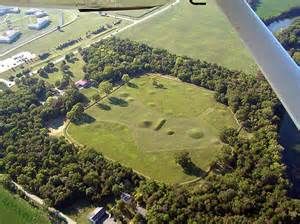


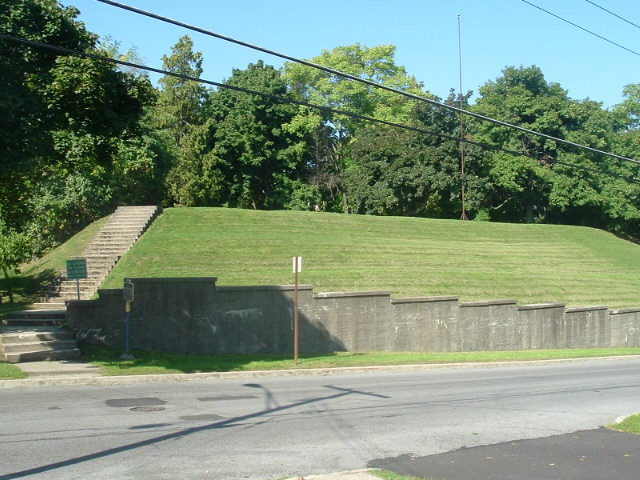
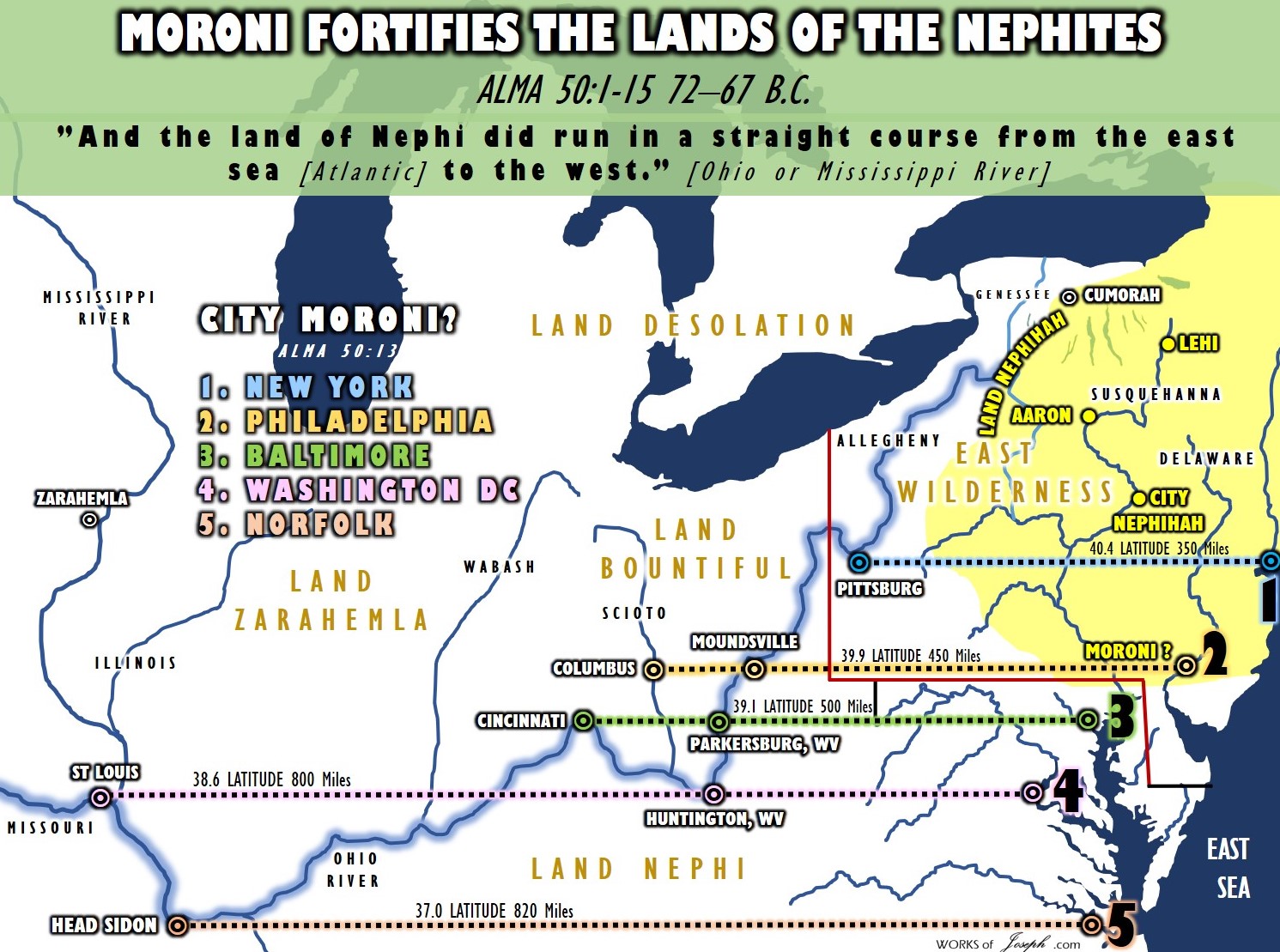
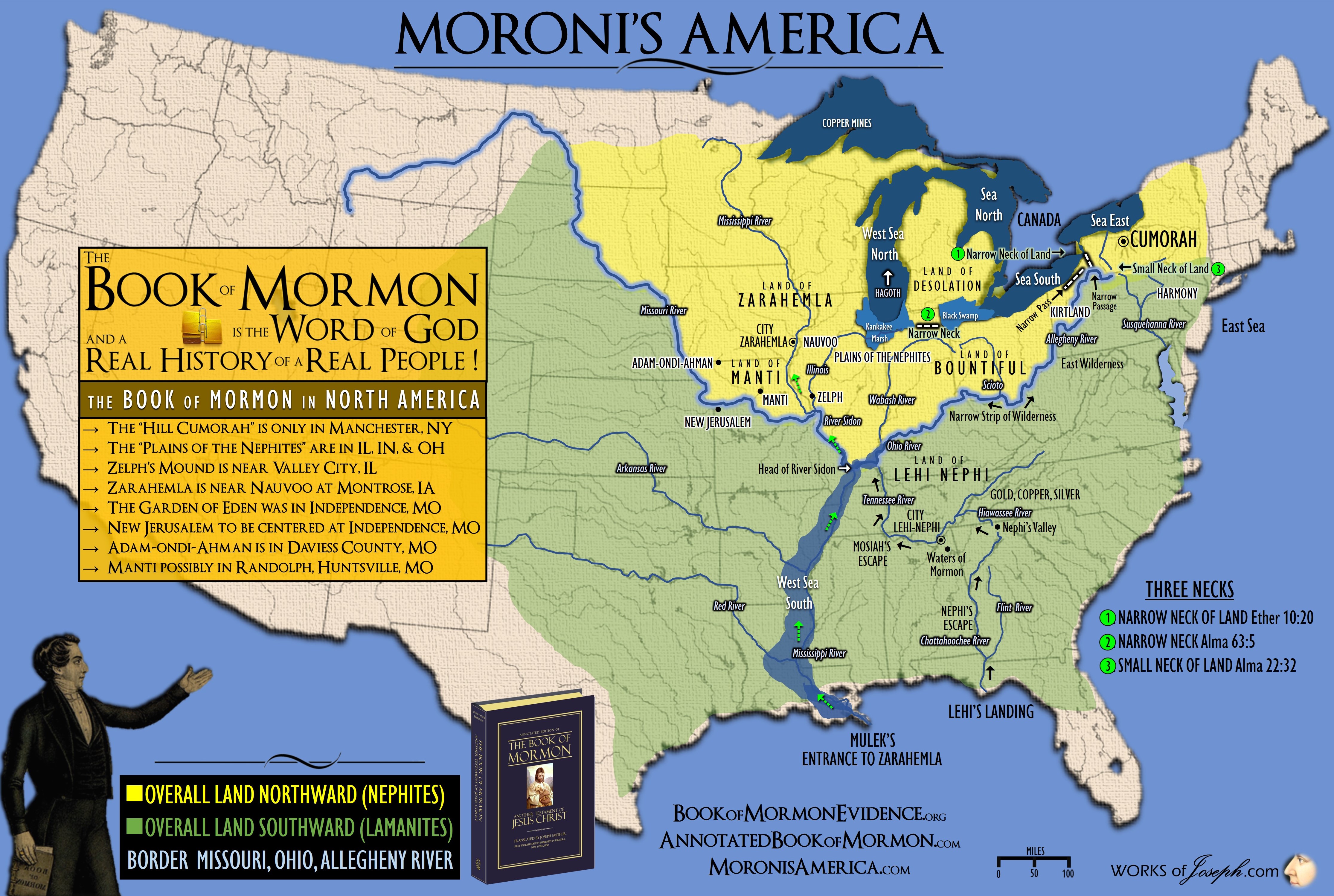
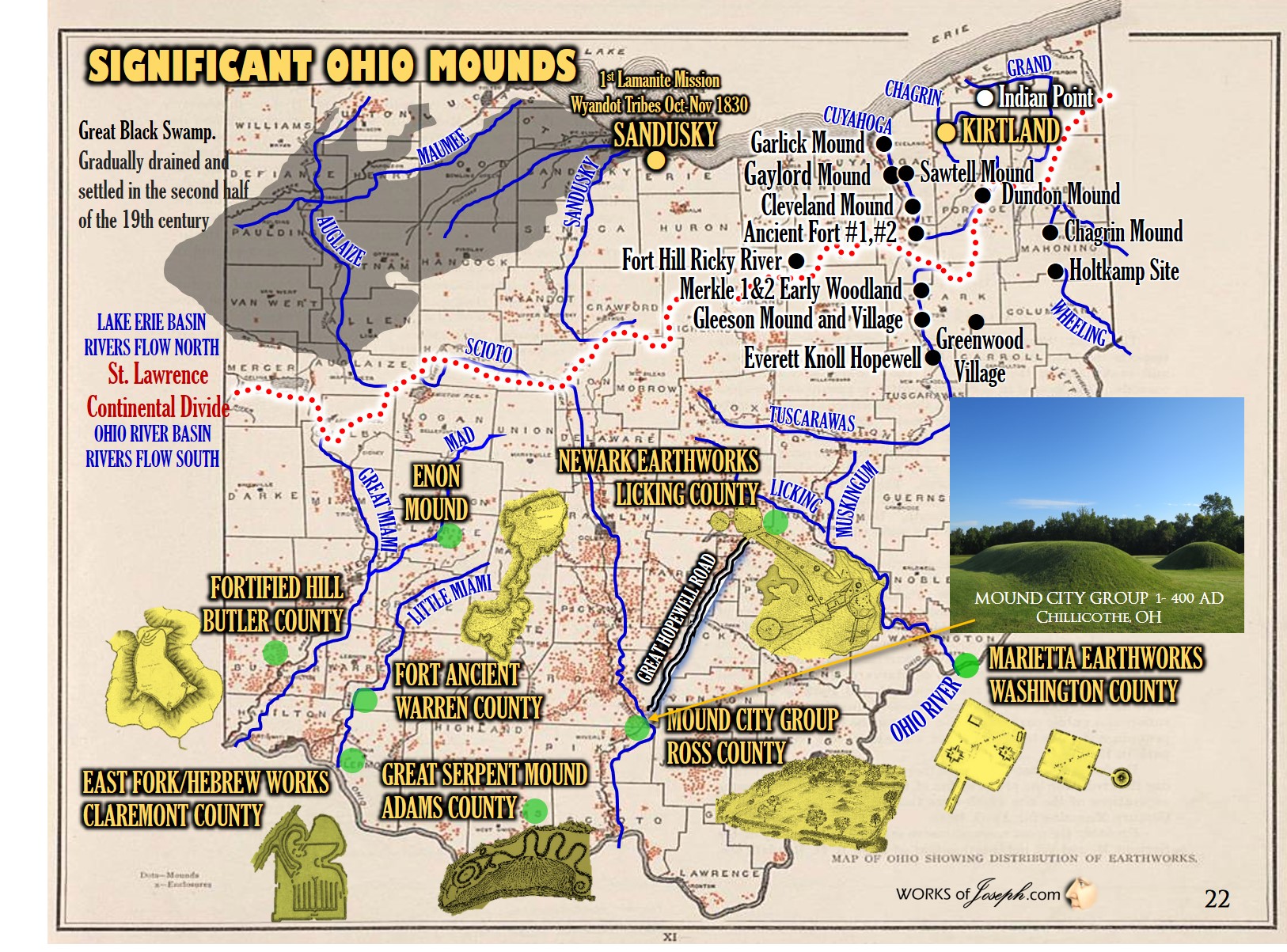
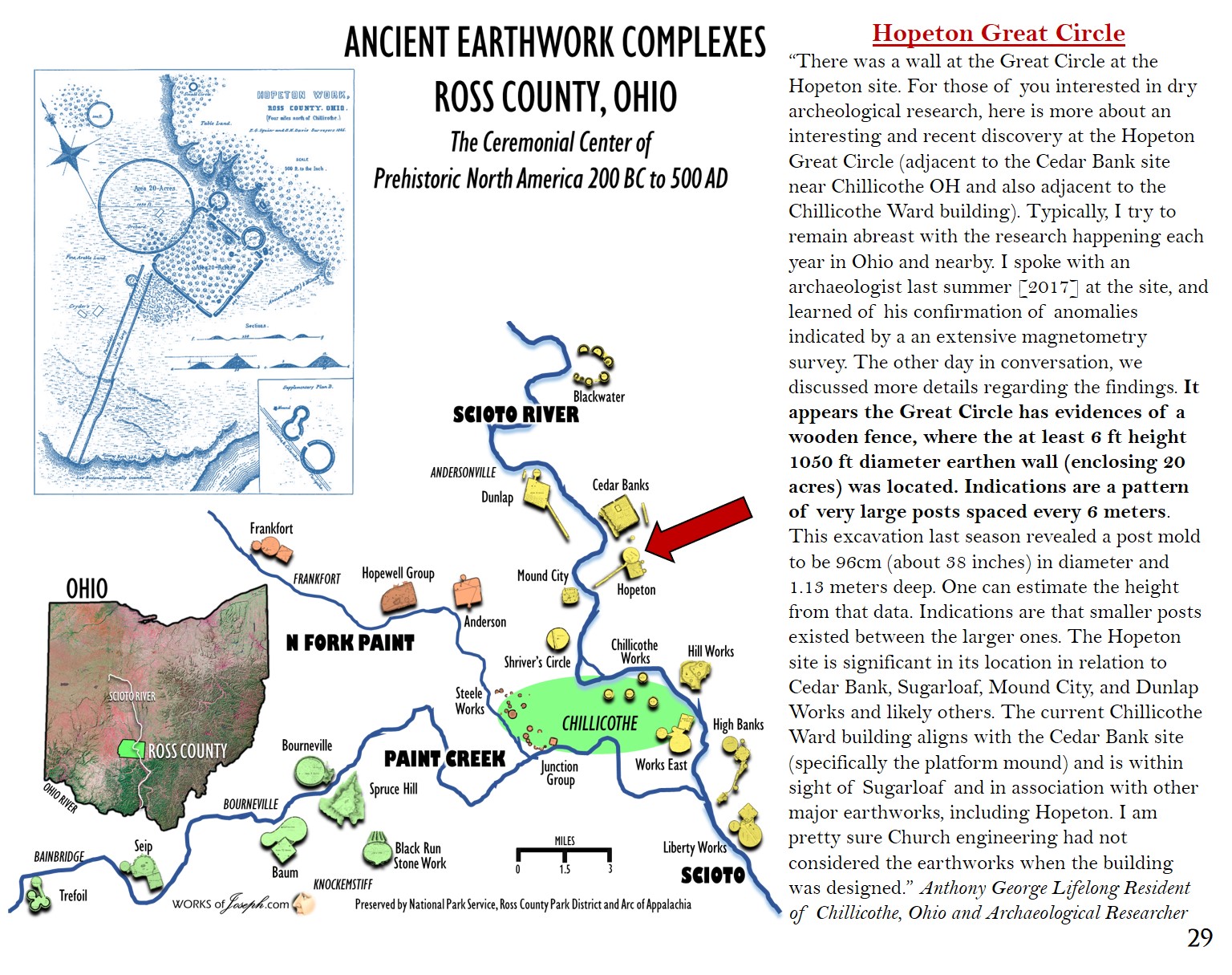
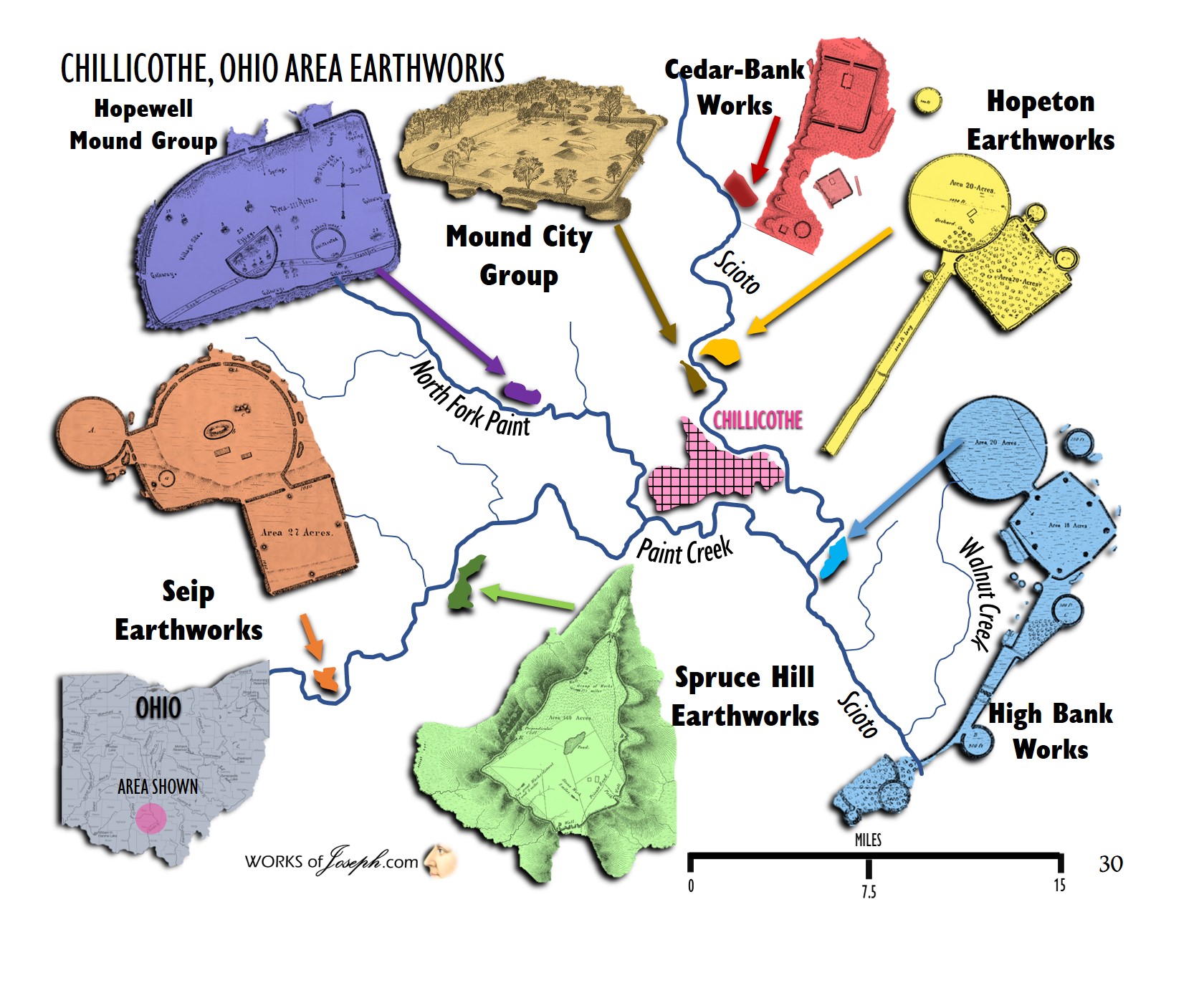
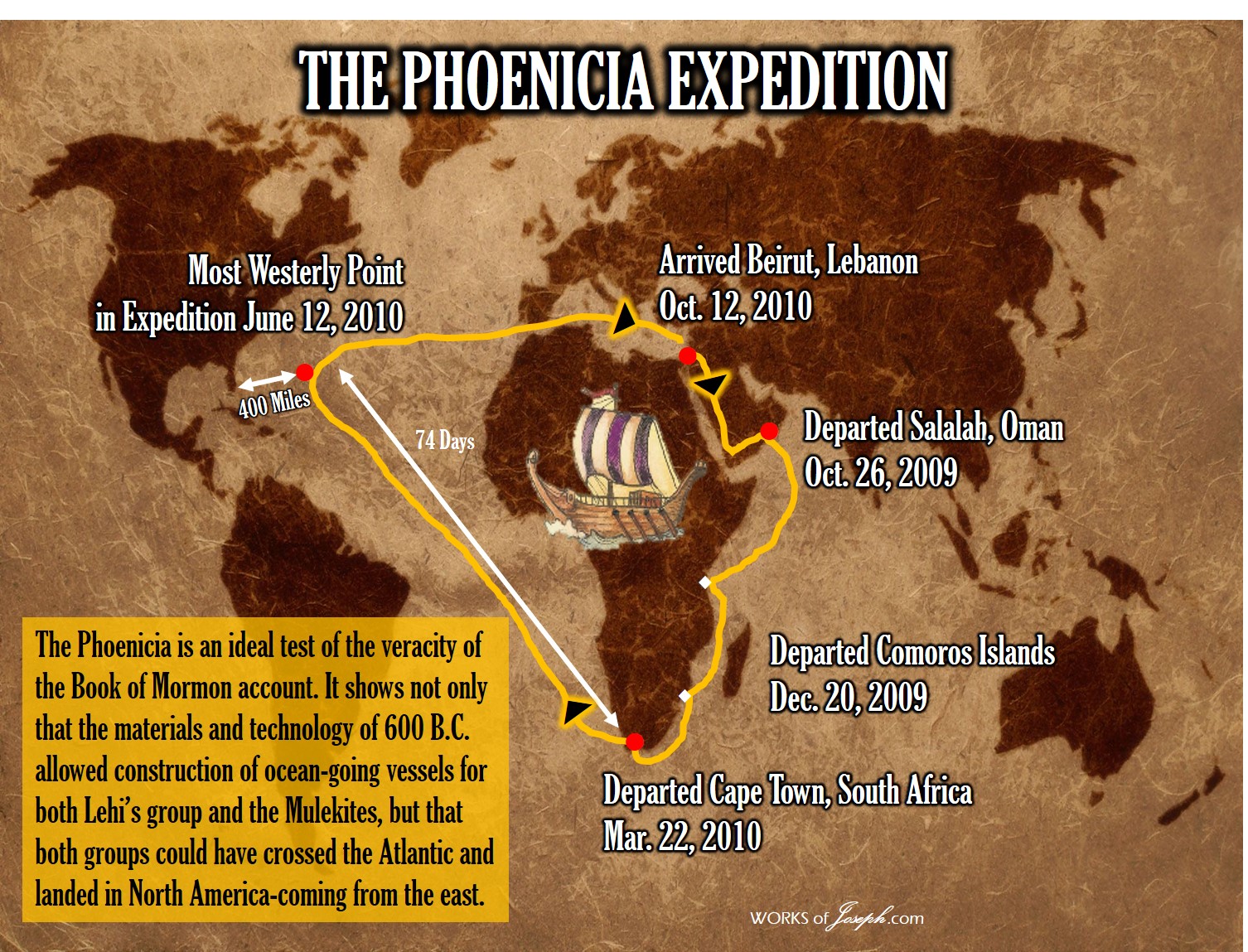
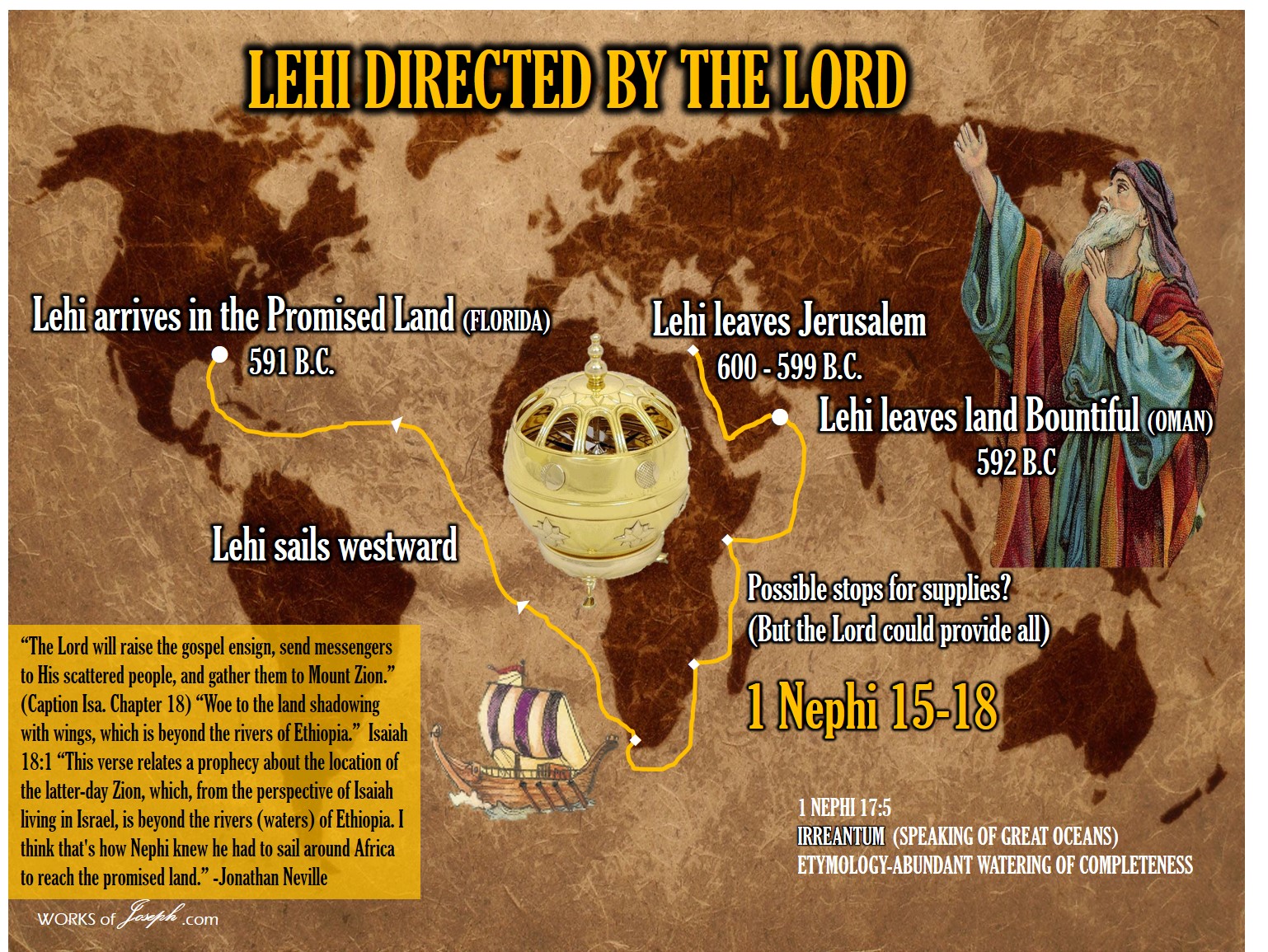
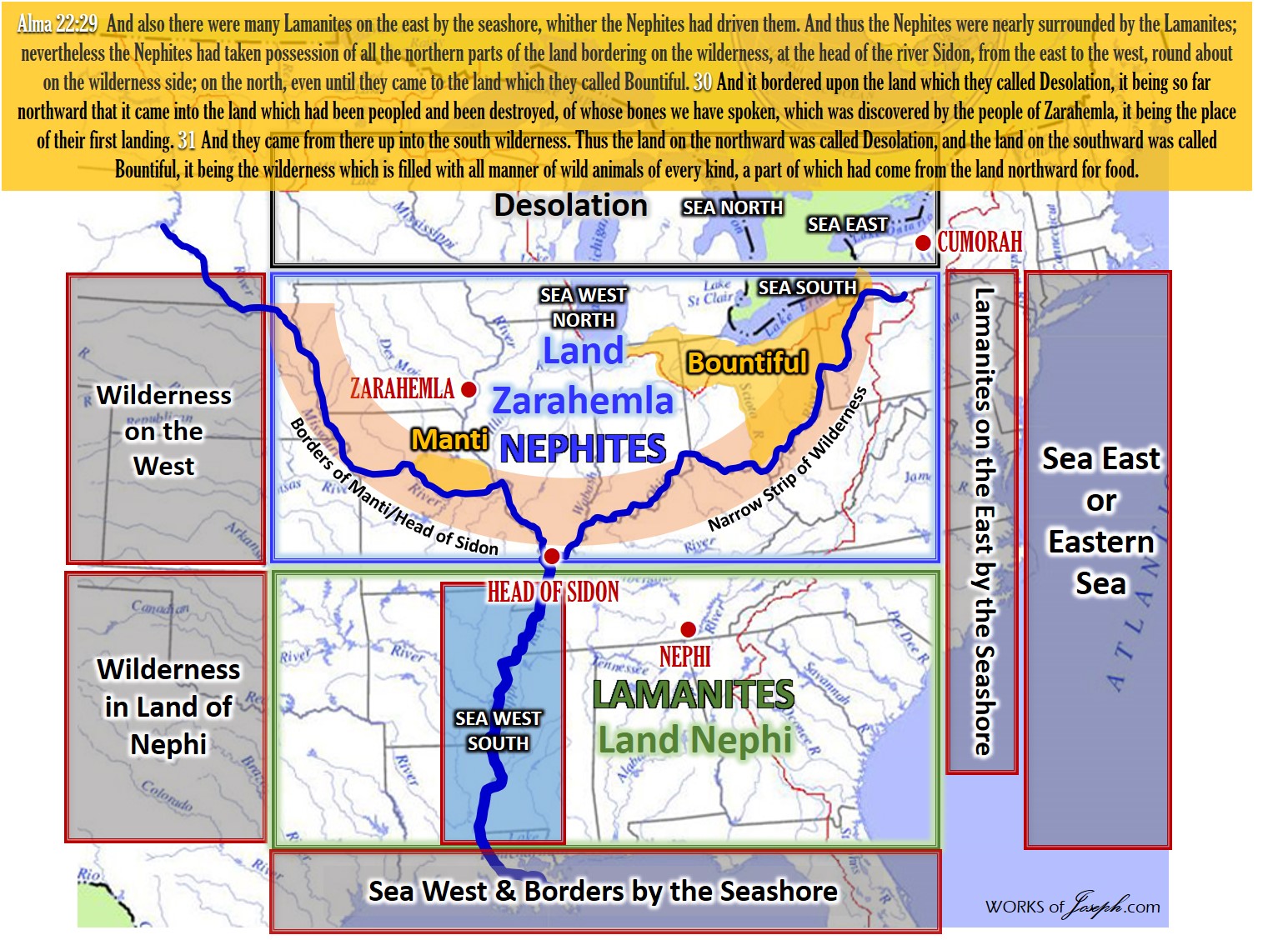

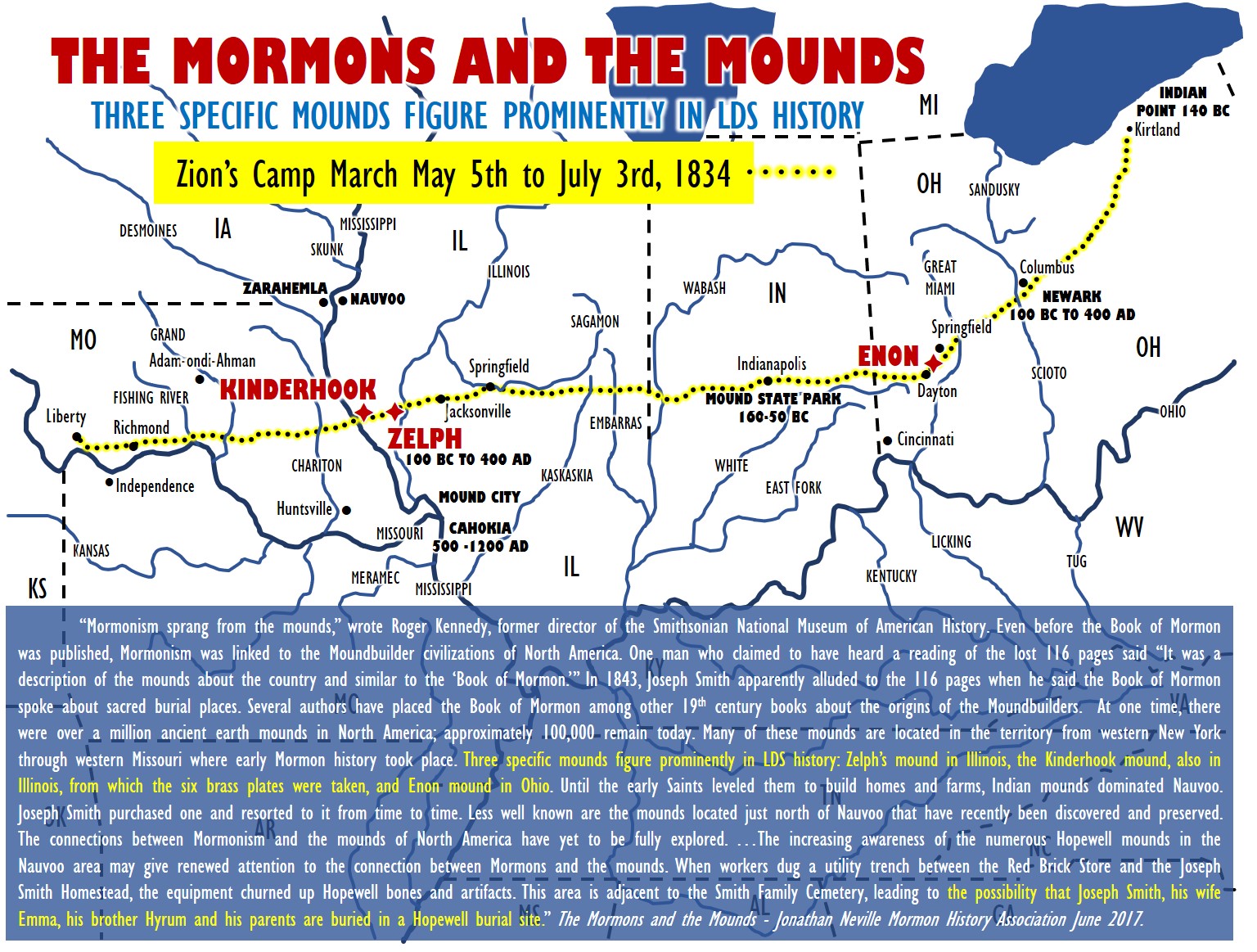


 The year following the destruction of the second Holy Temple was the first year of a seven-year Sabbatical cycle. In the Jewish calendar, counting from Creation, this was the year 3829, 68–69 CE on the secular calendar. By counting sevens from then, we see that the next Shemittah year will be the year 5782 after Creation, which runs from September 7, 2021 – September 25, 2022.
 At the end of seven years you will make a release. And this is the manner of the release: to release the hand of every creditor from what he lent his friend; he shall not exact from his friend or his brother, because the time of the release for the L‑rd has arrived. (Deuteronomy 15:1–2)


 Speaking about the earth just after creation, Elder Jeffrey R. Holland said, “
 ”We must remember that the whole earth was paradisiacal before the Fall. The Garden of Eden was a center place. After the Fall, there was no Garden of Eden or paradisiacal status on earth. Yet relative to the locale of the site of the Garden of Eden, the Prophet Joseph Smith learned through revelation (D&C 57) that Jackson County was the location of a Zion to be and the New Jerusalem to come. The Prophet first visited Jackson County, Missouri, in the summer of 1831. The Prophet visited Jackson County again in April and May 1832. On one of the occasions, or perhaps both, the Prophet Joseph apparently instructed his close associates, and perhaps even a general Church gathering, that the ancient Garden of Eden was also located in Jackson County.”
  TWO LANDS OF PROMISE

 In spite of such grief and despair the Lord of the vineyard determined to “spare it a little longer” (
 Elder Holland continues, “Thus in one final moment worthy men and righteous principles came together for the restoration of heavenly things. With his center stake in America, God began stretching the cords of his tabernacle to all the world…


 “While serving as Mission President in Central Florida Brother Murray Rawson had the responsibility to work on the Seminole Indian reservation. While there he had numerous visits with the chief. While attempting to present the Book of Mormon the chief interrupted his message by saying: “We had a war long ago with the light skinned people around the Great Lakes. We conquered them but we had so much respect for
  “I will give you a lesson today that the Lord has taken great pains to bring to us… In the western part of the state of New York near Palmyra is a prominent hill known as the “hill Cumorah.” (Mormon. 6:6.) On July twenty-fifth of this year, as I stood on the crest of that hill admiring with awe the breathtaking panorama which stretched out before me on every hand, my mind reverted to the events which occurred in that vicinity some twenty-five centuries ago—events which brought to an end the great Jaredite nation… Thus perished at the foot of Cumorah the remnant of the once mighty Jaredite nation, of whom the Lord had said, ‘There shall be none greater … upon all the face of the earth’ (Ether 1:43). “As I contemplated this tragic scene from the crest of Cumorah and viewed the beautiful land of the Restoration as it appears today, I cried in my soul, How could it have happened?… This second civilization to which I refer, the Nephites, flourished in America between 600 B.C. and A.D. 400. Their civilization came to an end for the same reason, at the same place, and in the same manner as did the Jaredites. “I bear you my personal witness that I know that the things I have presented to you today are true—both those pertaining to past events and those pertaining to events yet to come.” President Marion G. Romney of the First Presidency, 145th Semiannual Conference, Saturday Morning Session, October 4, 1975.
 Dr. John C. Lefgren lives in Pennsylvania and owns his own business. He has a PhD in economics, served as a Foreign Service Officer with the US Department of State and was an officer with a major bank in New York. In 1980 his book April Sixth was published by Deseret Book. Since his youth he has had an active interest in Church History. He has developed a property in Vermont near the Joseph Smith Birthplace Memorial and has a business producing maple syrup. (It’s called “Land of Joseph” syrup, available in Utah grocery stores)


 The harvesting of maple sugar is extremely temperature dependent. Maple sugar comes only from the northeast of North America and is part of our early history. The English settlers learned maple syrup and sugar production from the Native Americans.[9] The harvest of maple sugar occurs in the early spring. For hundreds of years farmers in New England have tapped millions of trees and have observed that the flow of maple sap is governed by a cycle of freezing and thawing temperatures. In recent years scientists have developed a theory to explain a mechanism by which sap runs. Their investigation includes the measurement of negative and positive pressures in the tree’s sapwood. When the temperature is below freezing the cells have a negative pressure relative to the atmosphere. The negative pressure causes water in the ground to move into the roots. The incoming water becomes sap as enzymes in the roots convert starch into sugar. When the temperature rises above freezing the cells develop positive pressure which causes the sap to rise up the tree. Over this cycle the pressures in the sapwood fluctuate from a low of twenty pounds to a high of forty-five pounds per square inch. Thus, negative pressure brings water into the root system and positive pressure pushes sap up the tree.
 In an effort to understand the pump effect of a maple tree’s negative and positive pressures, scientists measure the dissolution rate of carbon dioxide. When temperatures are below freezing, carbon dioxide has a high dissolution and causes negative pressure. When temperatures are above freezing the dissolution rate falls releasing gas into the sap which produces positive pressure. Sometimes the release of carbon dioxide is so quick that the sap becomes a carbonated “spring tonic”. (It is pressurized carbon dioxide which is used to carbonate soft drinks.) This cycle of freezing and thawing temperatures is required for the sap to continue its flow. If temperatures stay above freezing for more than thirty hours, positive pressures fall as the sapwood literally runs out of gas. When this happens farmers are happy to take a break.
 Sugar makers in 1820 gathered maple sap in wooden buckets. They boiled the sap in a series of iron kettles which hung over an open fire. At one end, where the fire was highest, water boiled off. As the sap thickened into syrup they ladled it into the second kettle, where the fire was lower, and added fresh sap to the first kettle. In this way, they removed the water without burning the sugar. In the last kettle they stirred liquid sugar until it crystallized and then poured it into wooden molds to form blocks.


 “In a revelation given through Joseph Smith Jr., the Prophet, to Oliver Cowdery (Second Elder of the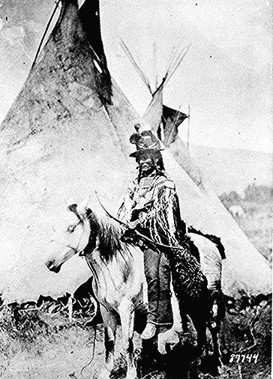

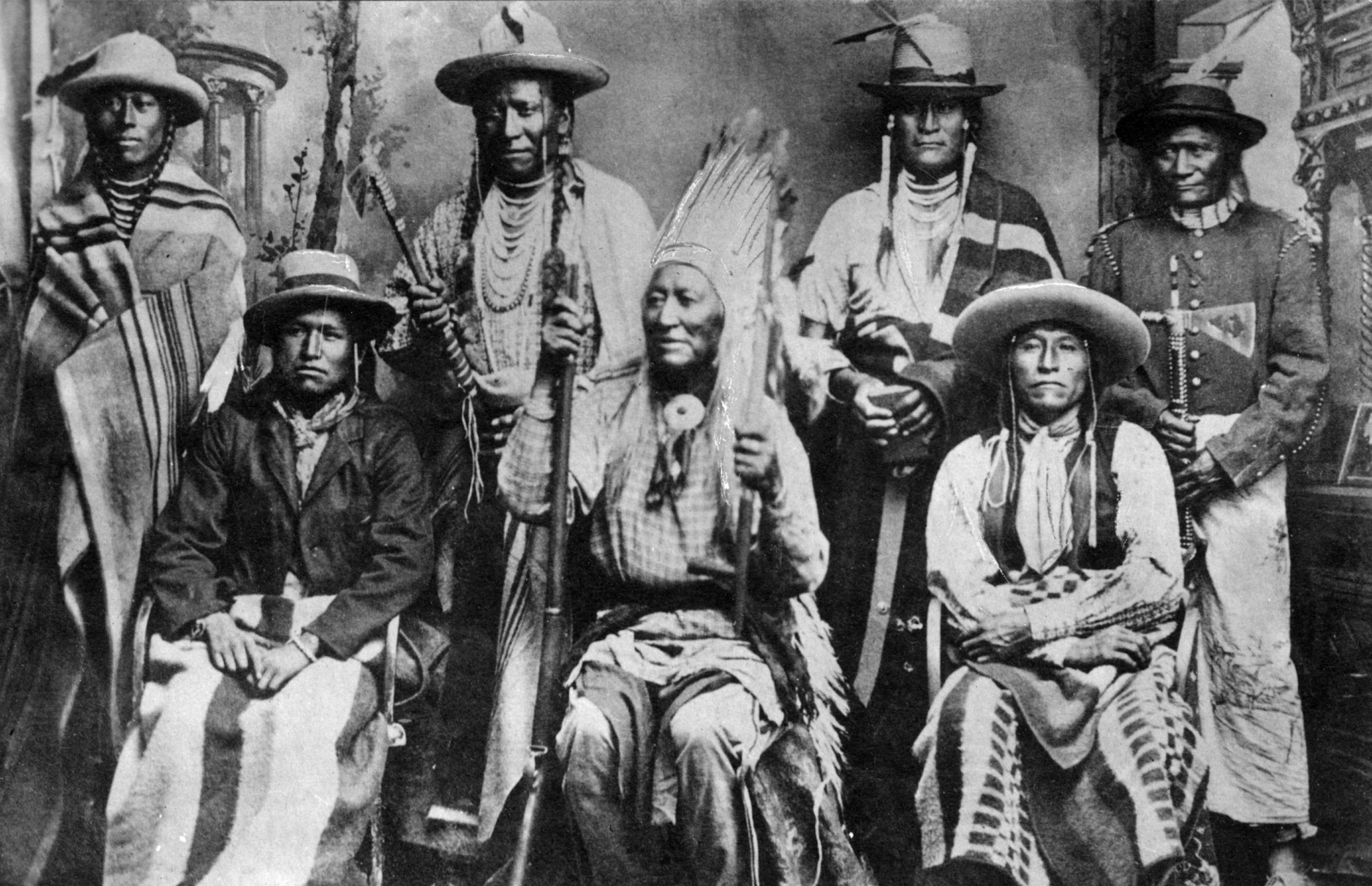


 I remember that beautiful land and the wonderful saints of Fiji very well, as I served a mission from 1975 to 1977. I was privileged to meet President Spencer W. Kimball the prophet who called me on my mission to Fiji. There in 1976 he visited Fiji with Elder Russell M Nelson as his personal Doctor along with Elder David B. Haight as a newly called Apostle. The picture on the left is Pres Kimball in Fiji in 1976 with District President Yee on his left and Sister Yee on his right. Over his left shoulder is Mission President Kenneth M. Palmer from New Zealand and over his right shoulder is Elder Rian W. Nelson. What an honor it was to be there that day. At that time in Fiji we only had about 600 members and today (2019) we have over 22,000. As part of the Fiji Suva Mission we also opened the missionary work in the Gilbert Islands (Kiribati today). My companion Richard Evans and I were the first to baptize the Gilbertese people, and today there are over 15,000 members there. The Church growth among Hagoth’s blessed people is growing.


 *The expression that Hagoth was an “exceedingly curious man” meant that his skills and knowledge in ship building were extremely good and was beyond the ability of common men. To those who could not comprehend how he could have constructed the ship, they used the term “curious” to describe his skills, similar to Nephi’s skill referred to in 1 Nephi 18:1.341 Hagoth’s Travels Alma 63:6 (55 B.C.) (Picture right, Phoenician ship Carved on the face of a sarcophagus. 2nd century AD.:


 “The Spaniards were amazed by the size of Etzanoa,” Blakeslee said. “They counted 2,000 houses that could hold 10 people each. They said it would take two or three days to walk through it all.” But for four centuries, the story of a big Native American town in Kansas made no sense to historians…. Onate sent armed patrols into the empty town.
 Another way to say this:


 Meridian Magazine has an agenda of teaching members of the Church that the prophets and apostles are wrong about Cumorah, so they published this article to reinforce that agenda.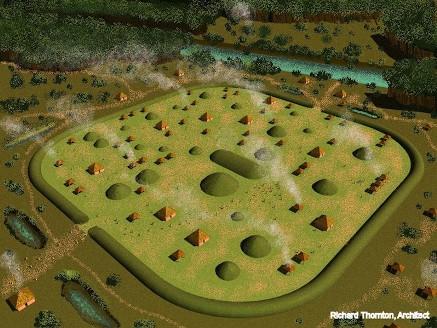


 As if the reader can hardly imagine a number as great as 30,000.


 2. “…This modernistic theory of necessity, in order to be consistent, must place the waters of Ripliancum and the Hill Cumorah some place within the restricted territory of Central America, notwithstanding the teachings of the Church to the contrary for upwards of 100 years. Because of this theory some members of the Church have become confused and greatly disturbed in their faith in the Book of Mormon. It is for this reason that evidence is here presented to show that it is not only possible that these places could be located as the Church has held during the past century, but that in very deed such is the case… It is known that the Hill Cumorah where the Nephites were destroyed is the hill where the Jaredites were also destroyed. This hill was known to the Jaredites as Ramah. It was approximately near to the waters of Ripliancum, which the Book of Ether says, “by interpretation, is large, or to exceed all… It must be conceded that this description fits perfectly the land of Cumorah in New York, as it has been known since the visitation of Moroni to the Prophet Joseph Smith, for the hill is in the proximity of the Great Lakes and also in the land of many rivers and fountains. Moreover, the Prophet Joseph Smith himself is on record, definitely declaring the present hill called Cumorah to be the exact hill spoken of in the Book of Mormon. Further, the fact that all of his associates from the beginning down have spoken of it as the identical hill where Mormon and Moroni hid the records, must carry some weight. It is difficult for a reasonable person to believe that such men as Oliver Cowdery. Brigham Young, Parley P. Pratt, Orson Pratt, David Whitmer, and many others, could speak frequently of the Spot where the Prophet Joseph Smith obtained the plates as the Hill Cumorah, and not be corrected by the Prophet, if that were not the fact. That they did speak of this hill in the days of the Prophet in this definite manner is an established record of history.” Doctrines of Salvation Joseph Fielding Smith Chapter 12
 4. “Both the Nephite and Jaredite civilizations fought their final great wars of extinction at and near the Hill Cumorah (or Ramah as the Jaredites termed it), which hill is located between Palmyra and Manchester in the western part of the state of New York. It was here that Moroni hid up the gold plates from which the Book of Mormon was translated. (Morm. 6; Ether 15.) Joseph Smith, Oliver Cowdery, and many of the early brethren, who were familiar with all the circumstances attending the coming forth of the Book of Mormon in this dispensation, have left us pointed testimony as to the identity and location of Cumorah or Ramah.” (Doctrines of Salvation, vol. 3, pp. 232-241.) (Bruce R. McConkie, Mormon Doctrine “CUMORAH,” 1966, p. 175)
 7. “Millennia ago he declared: “There shall none come into this land [he was speaking of America] save they shall be brought by the hand of the Lord… In the western part of the state of New York near Palmyra is a prominent hill known as the “hill Cumorah.” (Morm. 6:6.) On July twenty-fifth of this year, as I stood on the crest of that hill admiring with awe the breathtaking panorama which stretched out before me on every hand, my mind reverted to the events which occurred in that vicinity some twenty-five centuries ago—events which brought to an end the great Jaredite nation… Thus perished at the foot of Cumorah the remnant of the once mighty Jaredite nation, of whom the Lord had said, “There shall be none greater … upon all the face of the earth.” (Ether 1:43.)… This second civilization to which I refer, the Nephites, flourished in America between 600 B.C. and A.D. 400. Their civilization came to an end for the same reason, at the same place, and in the same manner as did the Jaredites… The tragic fate of the Jaredite and the Nephite civilizations is proof positive that the Lord meant it when he said that this “is a land of promise; and whatsoever nation shall possess it shall serve God, or they shall be swept off when the fulness of his wrath shall come upon them. And the fulness of his wrath cometh upon them when they are ripened in iniquity.” (Ether 2:9.) This information, wrote Moroni, addressing himself to us who today occupy this land, “cometh unto you, O ye Gentiles” (now, Gentiles is the term used by the Book of Mormon prophets to refer to the present inhabitants of America and to the peoples of the old world from which they came)… Now my beloved brethren and sisters everywhere, both members of the Church and nonmembers, I bear you my personal witness that I know that the things I have presented to you today are true—both those pertaining to past events and those pertaining to events yet to come. The issue we face is clear and well defined. The choice is ours. The question is: Shall we of this dispensation repent and obey the laws of the God of the land, who is Jesus Christ, or shall we continue to defy them until we ripen in iniquity That we will repent and obey and thereby qualify to receive the blessings promised to the righteous in this land, I humbly pray in the name of Jesus Christ, our Redeemer. Amen.” America’s Destiny Marion G. Romney Oct 1975
 10. [Heber C. Kimball] “prophesied that when the final last struggle came to this nation it would be at the Hill Cumorah where both of the former Nations [Jaredite and Nephite] were destroyed” (abt. Heber C. Kimball) Wilford Woodruff’s Journal 6:305, December 17, 1866
 14. McGavin and Bean explain their point of view concerning the identity of the Hill Cumorah as an ancient battlefield. The authors conclude that the scholars “need not search for [Cumorah] in Mexico or Yucatan” E. Cecil McGavin and Willard W. Bean “Cumorah-Land, An Ancient Battlefield,” in The Improvement Era 44, September 1941, 526, 571-72.
 21. “On the title page I read that it is “written to the Lamanites, who are a remnant of the house of Israel; and also to Jew and Gentile.” In the introduction to the Book of Mormon: Another Testament of Jesus Christ, it says that the Lamanites “are among the ancestors of the American Indians.” As I read the Book of Mormon, it seemed to me that it was about my American Indian ancestors. It tells the story of a people, a part of which were later described as “Lamanites,” who migrated from Jerusalem to a “land of promise” (1 Nephi 2:20) about 600 B.C.” “Come unto Me, O Ye House of Israel” By Elder Larry Echo Hawk of the Seventy Ensign Oct 2012
 23. “From the time Father Bosley located near Avon, he found and plowed up axes and irons, and had sufficient to make his mill irons, and had always abundance of iron on hand without purchasing. In the towns of Bloomfield, Victor, Manchester, and in the regions round about, there were hills upon the tops of which were entrenchments and fortifications, and in them were human bones, axes, tomahawks, points of arrows, beads and pipes, which were frequently found; and it was a common occurrence in the country to plow up axes, which I have done many times myself. I have visited the fortifications on the tops of those hills frequently, and the one near Bloomfield I have crossed hundreds of times, which is on the bluff of Honeyoye River, at the outlet of Honeyoye Lake. In that region there are many small deep lakes, and in some of them the bottom has never been found. Fish abound in them. The hill Cumorah is a high hill for that country, and had the appearance of a fortification or entrenchment around it. In the State of New York, probably there are hundreds of these fortifications which are now visible, and I have seen them in many other parts of the United States. Readers of the Book of Mormon will remember that in this very region, according to that sacred record, the final battles were fought between the Nephites and Lamanites. At the hill Cumorah, the Nephites made their last stand prior to their utter extermination, A. D., 385. Thus was Heber preaching the Gospel to the Gentiles, above the graves of the ancients of Israel, whose records with the fullness of that Gospel, and the relics of their prowess and civilization, were now whispering from the dust.” Life of Heber C. Kimball by Orson F. Whitney Mounds at Cumorah
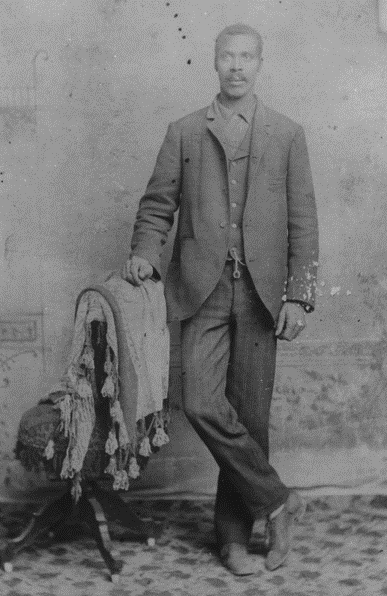

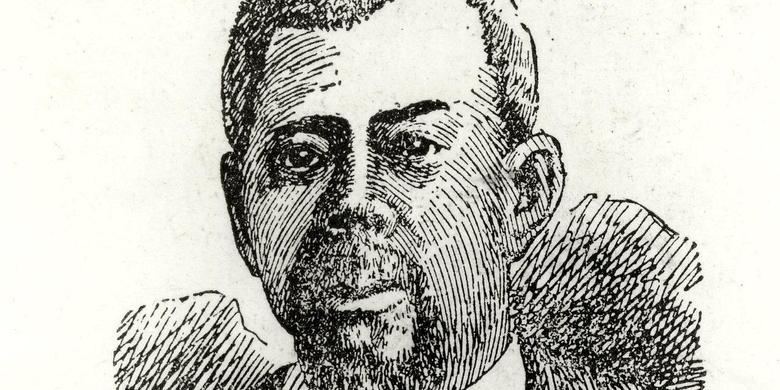
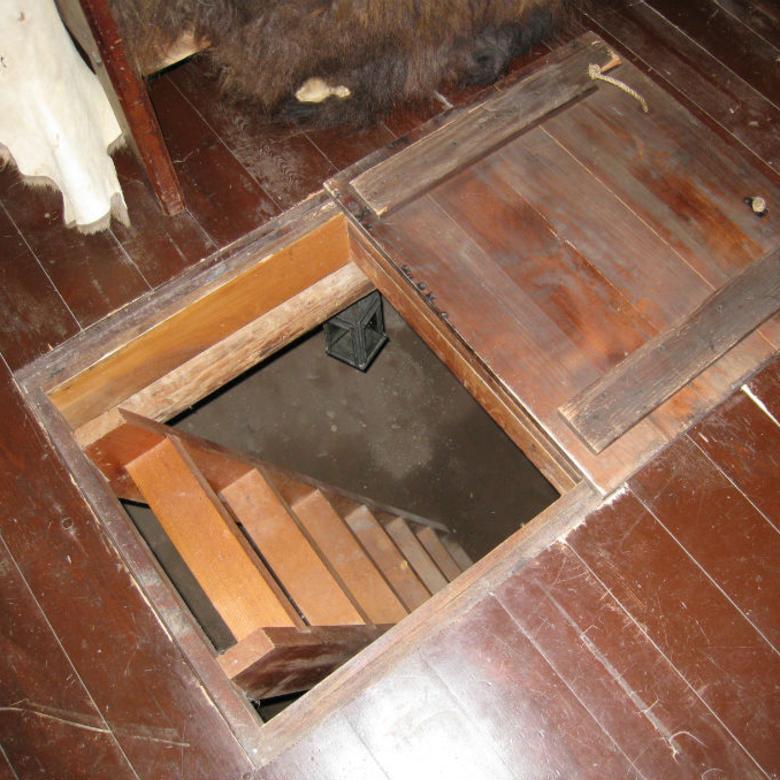
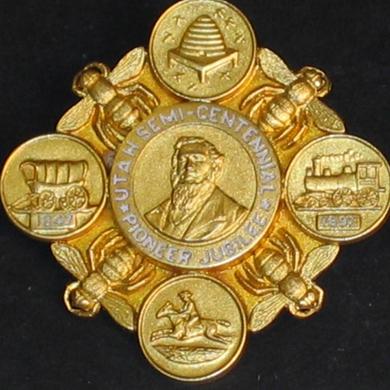


 The Utah branch of the Afro-American Historical and Genealogical Society (AAHGS), descendants of the Crosby-Lay family, and Amy Tanner Thiriot, a historian of black enslavement in Utah Territory, are working with the cooperation of Daughters of Utah Pioneers, the caretakers of Union Pioneer Memorial Cemetery, to place a gravestone for Hark Lay Wales. We would be delighted and grateful to have your support for this project.
 Hark lived in the valley for almost four years before his owners took him to California and separated him from his pregnant wife and young son. By early 1856, Hark learned he was free. Thereafter he was known as Hark Wales. In the early 1870s, he returned to Utah and lived in the small black community in Union Fort and mined in Big Cottonwood Canyon. He has no known descendants, and his grave in Union Pioneer Memorial Cemetery is unmarked.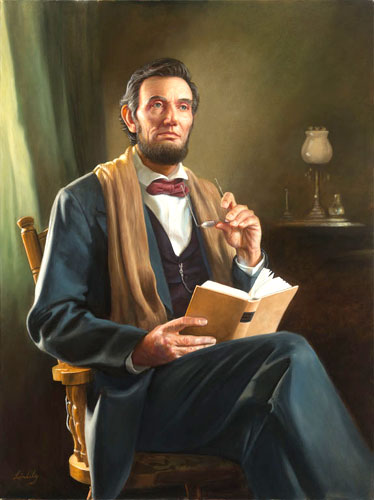

 “In the autumn of 1848, Abraham Lincoln campaigned for Whig presidential candidate Zachary Taylor in Massachusetts. On the way home to Illinois, he visited Niagara Falls, and found the sight so impressive that he started writing about it. His
 “Continue south (from SR 32) on Wakefield Mound Road past several early nineteenth century houses,
 “Niagara-Falls! By what mysterious power is it that millions and millions, are drawn from all parts of the world, to gaze upon Niagara Falls? There is no mystery about the thing itself. Every effect is just such as any intelligent man knowing the causes, would anticipate, without [seeing] it. If the water moving onward in a great river, reaches a point where there is a perpendicular jog, of a hundred feet in descent, in the bottom of the river,—it is plain the water will have a violent and continuous plunge at that point. It is also plain the water, thus plunging, will foam, and roar, and send up a mist, continuously, in which last, during sunshine, there will be perpetual rain-bows.
  The mere physical of Niagara Falls is only this. Yet this is really a very small part of that world’s wonder. It’s power to excite reflection, and emotion, is it’s great charm. The geologist will demonstrate that the plunge, or fall, was once at Lake Ontario, and has worn it’s way back to it’s present position; he will ascertain how
  accuracy, that five hundred thousand [to]ns of water, falls with it’s full weight, a distance of a hundred feet each minute—thus exerting a force equal to the lifting of the same weight, through the same space, in the same time. And then the further reflection comes that this vast amount of water, constantly pouring
  [1] AD, DLC-RTL. The dating of this document by Nicolay and Hay [July 1, 1850?] has been rejected because the editors can find no reason for so dating it. The date, c. September 25-30, 1848, is based on two principal facts: (1) Lincoln visited Niagara Falls en route from Boston to Chicago, September 23-October 5, 1848; (2) the document is in appearance of paper and handwriting contemporary with the documents of speeches written in 1848 in Washington. The content suggests the sort of meditation and recapitulation of observations and reflections which would be psychologically apropos following a visit to the Falls, and one suspects that Lincoln’s boat trip from Buffalo provided the leisure to begin, if not to conclude, the meditation. Nicolay and Hay entitle the piece “Notes for a Lecture,” but the subject itself should suffice. The manuscript stops abruptly with an unfinished sentence.
  The antiquarian author William Pidgeon created fraudulent surveys of mound groups that did not exist, possibly tainting this opinion, which was replaced by others.
 The monument (left) reads: The Rockwell Mound Built in about A.D. 150, this massive mound is thought to be the largest prehistoric earthwork in the Illinois River valley. it is the largest known mound built by indians of the Western Hopewell or Havana culture. [Same culture as the Zelph Mound]. Found along major rivers of the midwest, mounds of the Havana culture were usually built over the log-covered tombs of prominent leaders. Ceremonial and everyday items were often placed with the burials. It has been estimated that this two-acre, 14 foot high mound required about 1,700,000 basket loads of earth to construct. Because of its size and strategic location opposite Spoon River, Rockwell Mound was probably the most important of the Havana site’s more than twenty mounds. Havana was a trading and ceremonial center with trade routes that spanned much of the midcontinent.The mound was not scientifically verified until 1986, where a small test trench yielded pottery fragments and a variety of other identifiable material. Individual baskets loads of earth were clearly visible in the walls of the trench. The site was added to the National Register of Historic Places in 1987.
 This mound was the site of major campaign addresses by Abraham Lincoln and Stephen A. Douglas during their campaign for U.S. Senate in 1858.


 Mound in Bronson Park
 The Preservation Commission noted that from the time of Bronson Park’s creation, it has been the site of celebrations and public meetings.
  As early as 3500 years ago, American Indians’ traditional knowledge of differing environments led them to develop a unique North American agricultural complex; fostering prehistoric trade between and within the tribes across the eastern United States. Plants, ceremonial practices, domestic spear points and pottery, and artifacts of unusual form and exotic materials were exchanged; and within more complex societies, earthen mounds were constructed. Some mounds were for burials and some were built over and/or under buildings of different uses, including rituals. Elaborate copper, silver, obsidian and mica artifacts have been found in the “Ohio Hopewell” mounds of Ohio built between 250 BCE and 350 CE, and in related mounds along the Gulf Coast and across the southern midwest.
 First recorded as the Nation of Fire in the area from northern Lake Huron to southwestern Lake Superior, by 1680 culturally related Anishinabe tribes were identified as the Ojibwa (Chippewa) who had also occupied eastern lower Michigan, the Adwada (Ottawa), who had also moved to northwestern Michigan, and the Pottawatomi who were expanding around southern and western Lake Michigan. Throughout two centuries of colonial conflict, the villages of these three tribes were pushed to French and British forts and trading posts. After the American Revolution the Federal Government opened their lands beyond the Appalachian Mountains to American settlers. In spite of their united resistance to the new settlements, the Anishinabe and other tribes were defeated, and in the 1795 Treaty of Greenville ceded to the U.S. their lands east of the Wabash and Miami Rivers, giving up millions of acres of forests, lake shores, and river valleys.
 “I’m very enthusiastic about the renewed emphasis on Church history. Everyone is reading Saints, which is awesome.
 “There is one thing which I am now about to read which has not yet been fulfilled, and which we must fulfill before Zion is redeemed. I will read it—“Behold, saith the Father, I will bring the fulness of my Gospel from among them, and then I will remember my covenant which I have made unto my people, O house of Israel, and I will bring my Gospel unto them.”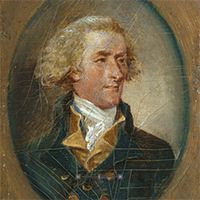
 Jefferson never removed any Native Americans. However in private letters he did suggest various ideas for removing tribes from enclaves in the East to their own new lands in lands west of the Mississippi. Indian Removal was passed by Congress in 1831, long after he died. Before and during his presidency, Jefferson discussed the need for respect, brotherhood, and trade with the Native Americans, and he initially believed that causing them to adopt European-style agriculture and modes of living would allow them to quickly “progress” from “savagery” to “civilization”. Beginning in 1803, Jefferson’s private letters show increasing support for the idea of removal. Jefferson maintained that Indians had land “to spare” and, he thought, would willingly exchange it for guaranteed supplies of food and equipment.

 Cyrus Thomas was an ethnologist and entomologist prominent in the late nineteenth century. He was noted for his studies of the natural history of the American West. However, Thomas is best known for his work in archaeology and ethnology — specifically, his contributions to the question of the origins of the mound builders and Mayan hieroglyphics. Thomas was not a field archaeologist. He visited the sites on which he reported, but did little if any field work. He had permanent and temporary field assistants and one clerical assistant. They provided him with their notes, which he organized, formed into a report, and published.
 In 1894 Cyrus Thomas (left) was apparently unaware of the original survey made in 1823 and he dismissed the 1847 drawings which Squier and Davis had made with respect to the “Menorah” Earthworks in Clermont County as “largely imaginary.”7 From 1803 to 1897 the history of the existence of the “Menorah” Earthworks goes from found to lost. Here is the sequence of events.
 (c) 1823. Major Isaac Roberdeau, head of the Bureau of Topographical Engineers of the U.S. Army Corps of Engineers made a survey of the “Menorah” Earthworks. This original survey is currently found in the National Archives.
 The 1823 survey showed that the ancient “Menorah” Earthworks existed along the waters of the East Fork of the Little Miami River in Ohio, about 20 miles above its mouth near Milford, and about 25-30 miles east of Cincinnati. The works have long since been under the plow zone. Their orientation and exact locations are today unknown.


 Jefferson wrote that the mound was “of spheroidal form, of about 40 feet diameter at the base, and had been of about twelve feet altitude …. I first dug superficially in several parts of it, and came to collections of human bones, at different depths, from six inches to three feet below the surface. These were lying in the utmost confusion, some vertical, some oblique, some horizontal, and directed to every point of the compass, entangled, and held together in clusters by the earth. … to give the idea of bones emptied promiscuously from a bag or basket, and covered over with earth, without any attention to their order.”


 “And, even here, Adair might have kept up his parallel, with ennobling his Conjurers. For the ancient Patriarchs, the Noahs, the Abrahams, Isaacs and Jacobs, and, even after the consecration of Aaron, the Samuels and Elijahs, and we may say further every one for himself, offered sacrifices on the altars. The true line of distinction seems to be, that solemn ceremonies, whether public or private, addressed to the Great Spirit, are conducted by the worthies of the nation, Men, or Matrons, while Conjurers are resorted to only for the invocation of evil spirits…”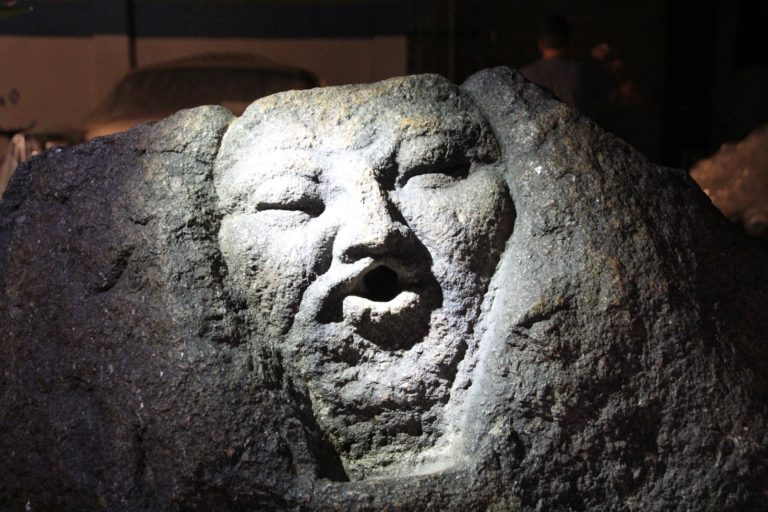


 In one of his books, America B.C.: Ancient Settlers in the New World, Dr. Fell offers many examples of Old World civilizations left behind symbols and messages all over America.


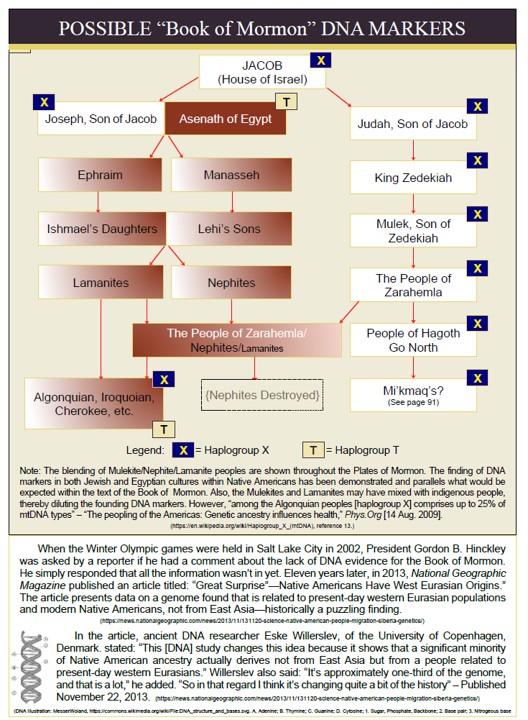
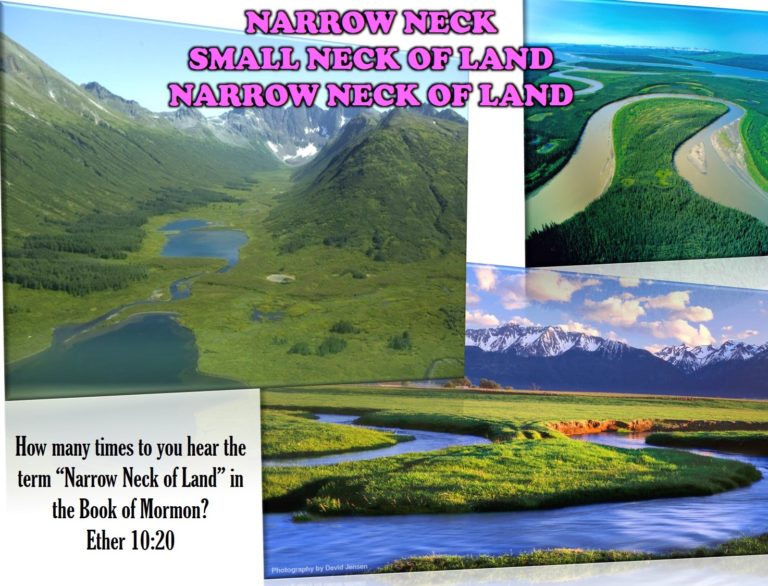

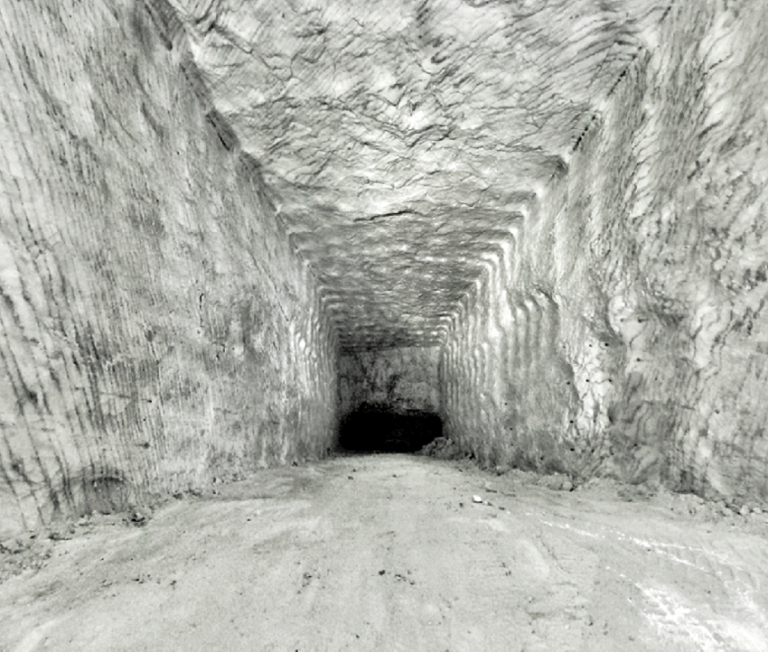

 Recently we studied as a church in the Come Follow Me manual, the Sermon on the Mount, wherein the Savior declared to his disciples, “Ye are the salt of the earth” (Matthew 5:13). Salt is so common nowadays, that it’s easy to not think much of the Savior’s statement. But it wasn’t always so. In Mark Kurlansky’s NY times bestseller titled, “Salt – a World History” he stated, “Salt is now so common, so easy to obtain, and so inexpensive that we have forgotten that from the beginning of civilization until about 100 years ago, salt was one of the most sought-after commodities in human history.” A greater understanding of salts role in the economies of ancient civilizations can bring deeper insights.
 Many of us probably have some Celtic blood. The Celts date to around 1200 BC and lived in what is now Hungary, Austria and Bavaria. The romans called them Gaul’s, which originated from the Greek word hal, meaning salt. They were the salt people. They were expert in salt mining and their economy was based on salt and iron. The German and Austrian towns of Halle, Hallein, Swabisch Hall, and Hallstatt were all named for Celtic saltworks. The Celts used rivers for trade and conquest as they moved into France, northern Spain, Belgium, the British Isles and the Mediterranean. By 51 BC, the Celts had largely been defeated by Julius Caesar and the Romans, except of course for some isolated groups in England, Wales, Ireland, Scotland, the Isle of Man and the Brittany peninsula.
 Salt was important to these early economies, because salt is required to live. When sodium, an unstable metal that can suddenly burst into flame, reacts with a deadly poisonous gas known as chlorine, it becomes the staple food sodium chloride, NaCl, or table salt. Chloride is essential for digestion and in respiration. And without sodium, which the body cannot manufacture, the body would be unable to transport nutrients or oxygen, transmit nerve impulses, or move muscles, including the heart.

 When our baptismal and temple covenants become the defining focus of our life, rather than just one of the many influences, we create a hostile environment where the influences of the adversary cannot thrive, thereby preventing moral decay and the inherent unhappiness (our or somebody else’s) that always accompanies it. Does this mean that we’re perfect or won’t have temptations? Of course not, but the serious transgressions will be so far back in the rearview mirror that they won’t have any impact on us.
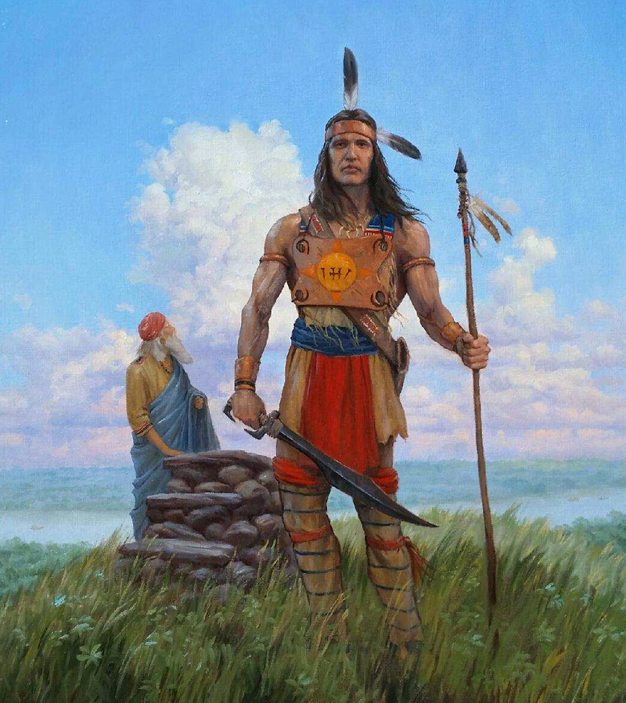

 The possible conclusion of where Zelph may fit into the historicity of the Book of Mormon is either, Zelph may have died in 322 AD before Mormon became the Nephite leader or, Zelph may have died in 327 AD in Mormon’s first battle against the Lamanites in the City of Angola before the Nephites went even farther north and east toward Cumorah.
 The name of Onandagus mentioned by Joseph, sounds very similar to Onondaga, one of the five Indian nations that comprised the Haudenosaunee or Iroquois Confederacy. Haudenosaunee means “the people of the long house”. This confederacy assisted the United States in forming a similar government as the Iroquois. The tribe of Onandaga are native peoples of New York and are known to have built houses of timber. (Alma 19:17-18; 26:28-29). The Onandaga are also the leading tribe, or “fire keepers” of this current confederacy. Another people of the Haudenosaunee are the Oneida, which is strikingly similar to the Book of Mormon place name “Onidah”. (Alma 32:4; 47:5) It is also likely no coincidence that the Lamanite title of deity, “Great Spirit” is a native North American appellation. (Alma 18:4-5)


 Of the First Presidency Conference Report, October 1968, pp. 106-110


 Rod Meldrum

You can do a google search for many indications of Phoenician artifacts here: Davenport Tablets , Iowan Stele, Bat Creek Stone, Los Lunas Decalogue Stone, Pontotoc Stele, Newark Holy Stones, Oklahoma Hymn to Aten, Narragansett Rune Stone, Tyngsboro Map Stone, Tuscon Lead Artifacts, America’s Stonehenge Baal Stone (Mystery Hill NH), Westford Boat Stone, Spirit Pond Inscription Stone, Paraíba inscription, Pedra de Gavea Inscription.