“Why does Book of Mormon geography matter? Think of that question if we are speaking about the Bible or Israel. Does it matter where the Savior was born, or where the Biblical events happened? Yes. At Mount Moriah where Abraham was to sacrifice Isaac, the Lord made a special covenant with Abraham. The land around Mt Moriah was a covenant land and God’s people were given that covenant land as long as they are righteous. However, if they disobey the commandments, God’s people will be swept off that sacred land. The Jews, Muslims, and Christians fight over control over this one piece of land why? Because it is a beautiful piece of real estate? No, because it is a covenant land. All three religions say Mt Moriah is sacred to them and they are willing to die over it.
Click to review pages of the new Annotated Book of Mormon by David Hocking and Rod Meldrum.
In the same token what is the Promised Land spoken of in the Book of Mormon? According to the Book of Mormon this Promised land must meet certain requirements to be the Promised Land. 1. No Kings upon the land 2. Land choice above all other lands 3. Land of Liberty 4. Land where sacred record is kept 5. Land kept from the knowledge of other nations. 6. Land of the New Jerusalem 7. Gentiles to scatter and afflict the Remnant. 8. The place where the Marvelous Work and Wonder happened. These are only 8 of 36 prophecies and promises in the Book of Mormon so it makes sense to me that the USA is the Promised Land. Not Canada, Mexico, England, or South America.
Just as Israel is a Promised Land forever, so the USA is a Promised Land forever and it does matter where this Promised Land is located. It is in the Heartland of North America. The Nephites practiced the Law of Moses. To do this they needed the following plants and animals to keep the Law. Sheep, Rams, Goats, Bullocks, Doves, Wheat, Barley, and Wine. None of these animals or items are found anywhere in Mesoamerica during the Nephites times, only in the USA. So, the land and where things happen is critical to us and especially to the Lord.” Rian Nelson
“Every serious student of the Book of Mormon should become familiar with the Jewish cultural research of Amberli Nelson, who has brought together one of the most unique, significant and essential, yet never before considered, pieces to the puzzle of Book of Mormon geography research.
“The findings of Amberli Nelson will forever alter the landscape of Book of Mormon geography theories as she imparts of her years of intensive research into an area of study never previously brought to bear on the subject of locating these lands.
Why has this critically important understanding – which was reiterated by the ancient prophets more than 30 times in the text and has been right before our eyes – been missed, ignored or overlooked by Book of Mormon scholars for so long? Prepare yourself to be blown away!” – Rod Meldrum
The following article originally titled “Jehovah’s Holy Days in the Heartland of North America”, is a reprint of a post from Amberli Nelson in September of 2012.
Jehovah’s Holy Days in the Heartland by Amberli Nelson
“Do you love learning new and previously undiscovered truths about the Book of Mormon? You are invited to enjoy this highly insightful video presentation on DVD which will take you on a fascinating journey where you will learn three striking truths about the Nephites of the Book of Mormon, truths that indisputably confirm that their enigmatic history played out in the Heartland of North America! What are these truths? Contact Amberli for this DVD.
Jehovah’s Holy Days in the Heartland by Amberli Nelson
3 Essential Truths about Nephite Observance of the Law of Moses
First Truth:
The Nephites “strictly” kept the Law of Moses as indicated in 37 verses in the Book of Mormon, (see Alma 30:3, Mosiah 13:29-30,Jarom 1:5) and they did so with delight as it was seen by them as both symbolic of Christ and a means of coming unto Him. Occasionally even the Lamanites were known to “strictly” observe the law (Hel. 13:1).
Second Truth:
In “observing to keep the commandments of the Lord in all things, according to the Law of Moses” (2 Ne. 5:10) the Nephites would have necessarily observed all the feasts or “holy days” given to Moses by Jehovah. These are recorded in Exodus and Leviticus and are known as “holy convocations”. You will learn how beautifully these “rehearsals” typify the life and mission of Jesus Christ.
Third Truth:
It was absolutely essential for these Jewish Lehites to be brought to and given a land that would provide an abundance of all the plants and animals necessary to keep the Law of Moses, with its concomitant Holy Days or celebrated festivals.
A list of 10 essential items required by every Mosaic Law abiding people are revealed in this compelling presentation. Some of those essential items include lambs, goats, wheat and barley. These have never been found in the archaeological record of the Maya in Mesoamerica yet, in stark contrast, each has been verified in the archaeological record of the ancient Mound Builder civilization which flourished in the Heartland of North America during Book of Mormon time frames. Based on the latest archeological findings of this civilization, it can now be irrefutably shown that the Heartland of North America is the only location in the Western Hemisphere where all 10 essential items have been confirmed. Thus, this covenant and Promised Land is the only one capable of sustaining and enabling a Jewish population, such as the Nephites, to observe and honor their sacred rites and religion without being forced to use unauthorized substitutions that would have been utterly offensive to God. Learn about the symbolic significance of each of these 10 critical items in this inspirational presentation.
A Prophetic Warning to Latter Day America
Purchase book today
Because this evidence, in concert with other overwhelming evidences from genetics, prophecies, archaeology etc, profoundly establishes that the lands now occupied by the United States of America are the only possible lands of the Book of Mormon, you will then, of necessity, come face to face with one of the most important and timely messages of the Book of Mormon — the ominous warning to us, the modern day Gentiles, who inhabit this sacred and Promised Land today. It is only in THIS nation that the ancient prophetic warnings can be reconciled with the history and resultant destruction of the Jaredites, then later the Nephites, and finally the latter-day Americans according to 36 Book of Mormon prophecies about ‘this nation’ (read about these prophecies HERE
How is that you ask? Because, according to what we read in the sacred record, all ancient inhabitants of this Promised Land were subject to what has been termed the “American Covenant*.” Its promised blessings are repeatedly spelled out in the Book of Mormon; namely the blessings of a land, posterity, liberty, prosperity and protection (see 1 Ne. 2:20, 2 Ne. 1:7 and article). Those precious blessings are predicated upon the earnest fulfillment of two requirements: first, that the inhabitants keep the Ten Commandments and second, that they serve the God of the land. We learn from a careful study of the Book of Mormon that the Nephites ultimate demise was precipitated by their prideful abrogation of these two requirements.
In light of that truth, based on the clear and compelling evidence presented, another witness that the Heartland of North America is the actual location of the Book of Mormon as that fact becomes the central truth upon which the rest of this, most important discussion hinges. For it is the author’s strong belief that it is a monumental mistake to unwittingly assign the Book of Mormon civilizations to Mesoamerica or anywhere other than the United States of America, as some modern day students of the Book of Mormon assert. Doing so obscures and effectively negates the understanding of which nation is being warned. The very lessons to be learned by the swift and utter destruction of both the Jaredites and the Nephites are revealed for the benefit of that specified nation.
One of the central and paramount themes of the book is its historic instructions – a literal “how-to manual” – on avoiding the shared fates of those two destroyed civilizations. To persist down the erroneous path of misplaced geography ultimately reduces the reason for their self-sown demise to little more than a curious, inexplicable and totally unjustified tragedy, since in no other place but the sacred and covenant land of North America has there been established an “American Covenant” for them to break or keep. It is a covenant that inextricably bound them to the promised blessings, when kept, and condemned them to the terrible fate they met when broken.
In short, without the “American Covenant”- which is exclusive to North America, there is no adequate explanation for the spectacular rise and subsequent fall of those two civilizations or that of the United States of America in modern times. That fact, by extension, provides the necessary framework for a modern day understanding that we too, as citizens of this, the Promised Land, are under the selfsame obligations they were… Obligations which, if kept, will either secure divine protection from our Creator or provoke His divine wrath unto our utter destruction. It is a very timely and urgent warning about our near future that we ignore at our own peril! A Covenant Land for a Covenant People, Providing All Essential Needs For Observance of the Law
Lastly, we must ask the question,
“Would God have lead his covenant people to a Promised Land devoid of every essential animal and plant required by Him to obey his commandment to live the Law of Moses?“
Click to enlarge
To place God’s chosen and covenant people anywhere but upon the covenant lands now occupied by the United States of America would have deprived these ancient civilizations of nearly every item required by the Lord in order for them to keep the Law of Moses. To do so would not only bring the veracity of the sacred text itself into question, but it would undermine the credibility of Joseph Smith as its translator if the setting would not support compliance to the law. Furthermore it would cast a disparaging light & considerable doubt on the prescient premise embraced by the faithful Nephites who delighted in the knowing that the “law of Moses was a type of his coming”….”believing that they must keep those outward performances until the time that He should be revealed unto them.” For the “law of Moses did serve to strengthen their faith in Christ; and thus they did retain a hope through faith, unto eternal salvation,” (Alma 25:15-16).
Therefore, the time has come to acknowledge the righteous Nephites for their astoundingly unique and singular ability to fuse the principles and laws of Judaism with the doctrines and saving ordinances of the gospel of Jesus Christ, creating one seamless theological bridge between the two. This is an astonishing feat that had never been accomplished before that time or since, effectively making The Book of Mormon the only known text ever written that is neither exclusively Jewish nor Christian, but simultaneously both at the same time. This then gifts its readers with an insightful glimpse into the Jewishness of Jesus Himself and the Holy Days of Judaism which He authored, thereby providing precious perspective for us as Christians who long to know Him more fully and intimately as we strive with a brightness of hope toward the penultimate blessing of walking with Him through His millennial reign.” ~Amberli Nelson
Amberli Nelson received a B.S. in sociology from Brigham Young University. A busy wife and mother of seven, Amberli has a deep and abiding love of truth, knowledge and greater understanding and therefore she thoroughly enjoys reading about and researching subjects she is most passionate about which include: sacred Symbology, The Book of Mormon, early LDS church history, and Jewish religious customs, beliefs and traditions. She has become an expert on ancient Jewish practices, especially those involving the Laws of Moses. She delights in sharing this knowledge with others and does so with energy and enthusiasm.
Read more about the Heartland of North America as explained by the scriptures in a wonderful article by Rod Meldrum Here
This ancient Newark Ohio earthwork has been explained by Amberli Nelson as “The Plan of Salvation”
The Annotated Book of Mormon includes thousands of dollars worth of professional art by some wonderful artists including:
View much of it by clicking on one of the pictures below!
Ken Corbett Clark Kelley Price Kendra Burton David Lindsley Suella-Meldrom Panacoast Joseph Brickey Lehi Thundervoice Eagle Sanchez Del Parson Brooke Mahlia Mann Jon McNaughton James H. Fullmer Jeremy Winborg
“I rejoice in the work that is being accomplished both at home and abroad. I rejoice in the manifestations of the Spirit of God, that come to each and every one of our elders who faithfully perform the duties devolving upon them. I rejoice in the fact that God opens the way and prepares the hearts of the honest in every land and clime, wherever this Gospel of Jesus Christ has gone. It is also a source of joy and satisfaction to me that, in all my journeys at home and abroad, wherever I go, wherever I mingle with people, I am constantly receiving additional evidence and testimony regarding the divinity of this work in which we are engaged, As I journeyed away from home, and as I mingled with people, I would feel sorrowful if I had constantly been finding objections to the plan of life and salvation, that required exertion on my part to explain away. It would be a source of regret if I were constantly finding obstacles in the path, regarding the divinity of the work of God, which we have espoused. But, I have never found any such obstacles: I have never found anything that needed to be explained away: everything points to the divinity of the work.
“While listening to the remarks of Brother Ivins, referring to a book that was written by one of our enemies, in which the statement is made that there is not a particle of evidence to show that there is any trace of the Hebrew among the people who anciently inhabited this country, and that there is no evidence that would go to prove that the Book of Mormon is true. I was reminded of a little item of evidence that came under my observation while I was in the City of London. A gentleman there, to whom a very dear friend of mine, Col. Alex. G. Hawes, had given me a letter, kindly invited a number of newspaper men to his home to meet me. I am very sorry that the newspaper men declined the honor; but I had the privilege of meeting with this man and his family, and a few friends, and conversing with them. One of his friends had been a member of the British legation at Constantinople and had spent a considerable portion of his life there. He had traveled all over the holy land and was familiar with the people and their customs. Among other things, he said: “Mr. Grant, I was astonished beyond measure, when I visited Canada, to find there oriental patterns woven in beads, by the American Indians. They were the same patterns that were woven in rugs, in the oriental countries. I have traveled extensively, and I had never seen those oriental patterns in any part of the world except in the holy land, until I found them among the North American Indians. Those patterns have been handed down for hundreds of years, from generation to generation ; they are kept in families, and can be found nowhere else; and how under the heavens those Indians, who have no connection with the people of the holy land, should have the same patterns is a mystery to me.” “Well, mv friend,” I said, “if I were to inform you that the forefathers of these American Indians came from the city of Jerusalem, that would explain it, wouldn’t it?” He replied, “Well, of course, it would.” I asked him if he had ever read the Book of Mormon. He said, “No.” “Well, it will be my pleasure to send you a copy, and from it you will learn that the forefathers of the American Indians came from Jerusalem.” “Well,” he said, “that explains the mystery; I am much obliged for the book.” Now, the one thing for us to do, as Latter-day Saints, is to be loyal, to be true, to be patriotic, to be honest with God; then we need have no fear of what the world may say about us. We have the truth, and we know it, thank God; we know it, though the world may not know it. Let us follow the admonition of the Savior, and let our light so shine that other men seeing our good deeds shall glorify God.” ELDER HEBER J. GRANT 79th Annual Conference of the Church of Jesus Christ of Latter- day Saints April 4th, 5th, and 6th, 1909, page 111-113
“I would say to the Lamanites, if I could speak to them understandingly, that you are also a branch of the house of Israel, and chiefly of the house of Joseph, and your forefathers have fallen through the same examples of unbelief and sins, as have the Jews, and you, as their posterity, have wandered in sin and darkness for many generations; and you, like the Jews, have been driven and trampled under the foot of the Gentiles, and put to death through your wars with each other, and with the white man, until you are almost destroyed. But there is still a redemption and salvation for a remnant of you in the latter days.” History of His Life and Labors By Wilford Woodruff
THE AMERICAN INDIAN (UH-NISH-IK-NA-BA) by ELIJAH M. HAINES
From this book, THE AMERICAN INDIAN (UH-NISH-IK-NA-BA) by ELIJAH M. HAINES we will show the similarity in some of the Indian languages, to the Hebrew, and that the former must have been derived from the latter. I have edited just one chapter of over 833 pages which focuses on Chapter IV, Affinity with the Jews. This may be a lengthy blog, but it is amazing how much information you will receive about the similarities of our Book of Mormon Lamanites with the Tribe of Judah from Israel. You will also enjoy some of the old pictures which come from this amazing book.
You will also enjoy the online links to other wonderful books written long ago about the Native Americans of the United States. I know they are the honored brothers of Manasseh and it is our duty as Ephraim to bring us together again with the Book of Mormon. To Purchase the Annotated Book of Mormon Click Here!
THE AMERICAN INDIAN (UH-NISH-IK-NA-BA). The Whole Subject Complete in One Volume Illustrated with Numerous Appropriate Engravings. By ELIJAH M. HAINES. CHICAGO: THE MAS-SIN-NA’-GAX COMPANY, 1888. Page 99-114
The subject of the American Indian has ever been one of peculiar interest to the ethnologist and student of history; but at no time since the discovery of America has it attracted so much attention as is being given to it at the present day. Volumes upon volumes have been written concerning it in its varied relations, but still it is not exhausted; and indeed the changing circumstances of the American race present at this day a phase of this subject, calling for its renewed presentation in more complete and comprehensive form.
Amidst the vast number of books published concerning this mysterious people since the discovery of America, there seems to be none now in print presenting their history in a succinct classified form, at the same time reaching out and taking in every phase of the Indian subject, to the satisfaction of the general reader.
This book has therefore been prepared with reference to this long felt want, and is such a work as the public mind and student of history now seem to demand. As the title indicates, it comprises ‘the whole Indian subject in complete and comprehensive form. In other words, it is a sort of cyclopaedia on the subject of the’ American Indian in all its phases and bearings as shown by the table of contents following; grouping together in condensed form, and within such limited space as the subject will admit of, the varied information comprised in that vast field of research in American history, not to be found in any single work of this kind heretofore published, containing many special features, which are highly interesting and valuable to the general reader.
Photograph (Left) of Elijah M. Haines, Illinois politician from Lake County and former Speaker of the Illinois House.
CHAPTER IV. AFFINITY WITH THE JEWS.
Opinion of James Adair-The Indians Descended from the People of Israel-He Assigns Twenty-three Arguments for this Opinion— Similarity Between the Languages — Comparison of Words and Sentences— Opinion of Be v. Jedidiah Morse— Similarity of Religious Customs— Dr. Boudinot Favors this Theory— Rev. Ethan Smith— Evidence in Favor of this Theory— The Indians Acknowledge but One Great Spirit like the Jews— Father Charlevoix Presents Evidence in Support of this Theory— Indians Were Never Known to Worship Images— Evidence of William Penn — Features of the Face like the Hebrews — And so with Dress t Trinkets and Ornaments— Their Fasts and Feasts, like the Jews— They Reckon by Moons and Count Time like the Hebrews— Have their Prophets— Abstain from Unclean Things — Salute the Dawn of Morning by Devotional Ceremony — In their Lodge Tales and Traditions Twelve Brothers are Spoken of— Custom in Mourning for the Dead, like the Jews— Have a Custom of Burnt Offerings— Had a Custom like the Jews of Anointing the Head— The Indian Medicine Lodge Corresponded to the Jewish Synagogue — Had a Secret Order Resembling that of the Jews— Their Medicine Man Corresponded to the “Wise Men,” Matthew II, 1 — The Bow and Arrow was Common to the Jews— The Indian Tent was like that of the Jews — Lived in Tribes like the Jews.
Many writers have given special attention to an inquiry into the subject of the American aborigines, with reference to discovering an affinity of this people with the Jews, or people of Israel.
Among the class of writers aforesaid is Mr.James Adair, who resided forty years among the American tribes, and who wrote a book (here) on the subject, which was published about the year 1775, in which he, without hesitation, declares that the American aborigines are descendants from the Israelites, and so complete is his conviction on this head, that he declares he finds a perfect and undisputable similitude in each. He says: “From the most accurate observations I could make, in the long time I traded among the Indians of America, I was forced to believe them lineally descended from the tribes of Israel.”
AFFINITY WITH THE JEWS. Page 99
Among the early authorities cited, to show that the American Indians are descendants from the Israelites, Mr. Adair seems to be the principal one, and since his time, all writers who have favored his views, refer with unreserved confidence to the evidence furnished by him to this end.
One of the earnest writers in support of this theory in later times, is Rev. Ethan Smith, of Poultney, Vt , as shown in his book entitled “ View of the Hebrew, or the Tribes of Israel in America,” published in 1825, wherein he undertakes to prove, citing Mr. Adair and others, that the American Indians are descendants from the Lost Tribes of Israel.
Mr. Smith sums up the arguments of Mr. Adair that the natives of this continent are of the ten tribes of Israel, to the following effect: 1. Their division into tribes. 2. Their worship of Jehovah. 3. Their notions of a theocracy. 4. Their belief in the administration of angels. 5. Their language and dialects. 6. Their manner of counting time. 7. Their prophets and high priests. 8. Their festivals, fasts and religious rites. 9. Their daily sacrifice. 10. Their ablutions and anointings. 11. Their laws of uncleanliness. 12. Their abstinence from unclean things. 13. Their marriage, divorces and punishments of adultery. 14. Their several punishments. 15. Their cities of refuge. 16. Their purifications and preparatory ceremonies. 17. Their ornaments. 18. Their manner of curing the sick. 19. Their burial of the dead. 20. Their mourning for the dead. 21. Their raising seed to a deceased brother. 22. Their change of names adapted to their circumstances and times. 23. Their own traditions; the account of English writers ; and the testimonies given by Spaniards and other writers of the primitive inhabitants of Mexico and Peru.
Many of those who contend for Jewish origin of the American Indian insist that evidence of this fact is found in the languages of the Indians, which appear clearly to have been derived from the Hebrew. This is the opinion expressed by Mr. Adair, in which Dr. Edwards having a good knowledge of some of the Indian languages, concurs and gives his reasons for believing this people to have been originally Hebrew.
The languages of the Indians and of the Hebrews, he remarks, are both found without prepositions, and are formed with prefixes and suffixes, a thing not common to other languages; and he says that not only the words, but the construction of phrases in both are essentially the same. The Indian pronoun, as well as other nouns, he remarks, are manifestly from the Hebrews. The Indian laconic, bold, and commanding figures of speech, Mr. Adair notes as exactly agreeing with the genius of the Hebrew language.
THE AMERICAN INDIAN. 100
Relative to the Hebraism of their figure, Mr. Adair gives the following instance from an address of a captain to his warriors, on going to battle: “I know that your guns are burning in your hands; your tomahawks are thirsting to drink the blood of your enemies ; your trusty arrows are impatient to be upon the wing ; and lest delay should burn your hearts any longer, I give you the cool refreshing words: Join the holy ark; and away to cut off the devoted enemy”
A table of words and phrases is furnished by Dr. Boudinot, Adair and others, to show the similarity, in some of the Indian languages, to the Hebrew, and that the former must have been derived from the latter. The following is an example afforded from the sources quoted:
Photocopy from THE AMERICAN INDIAN (UH-NISH-IK-NA-BA). By ELIJAH M. HAINES.
Rev. Jedidiah Morse, in big tour among the Western Indians, says of the Indians language: “It is highly metaphorical; and in this and other respects they resemble the Hebrew.” ” This resemblance in their language” he adds, “and the similarity of many of their religious customs to those of the Hebrews, certainly give plausibility to the ingenious theory of Dr. Boudinot, exhibited in his interesting work, the Star in the West”
Dr. Boudinot speaks of some Indians at a place called Cohocks, who called the high mountain at the west Ararat He says that the Penobscot Indians called a high mountain by the same name ; that he himself attended an Indian religious dance, concerning which he remarks:
“They dance one round; and then a second, singing hal-hal-hal, till they finished the round. They then gave us a third round, striking up the words le-le-le. On the next round it was the words, lu-lu-lu, dancing with all their might During the fifth round was yah-yah-yah. Then all joined in a lively and joyful chorus, and sung halleluyah ; dwelling on each syllable with a very long breath, in a most pleasing manner.” And he says, “there could be no deception in all this. Their pronunciation was very gutteral and sonorous, but distinct and clear.”
Rev. Ethan Smith, in his book before mentioned, remarking on this circumstance, says: “How could it be possible that the wild native Americans, in different parts of the continent, should be found singing this phrase of praise to the Great First Cause, or to Jah —exclusively Hebrew, without having brought it down by tradition from ancient Israel ? The positive testimonies of such men as Boudinot and Adair are not to be dispensed with nor doubted. They testify what they have seen and heard. And I can conceive of no rational way to account for this Indian song, but that they brought it down from ancient Israel, their ancestors.”
Dr. Boudinot further says of the Indians: ” Their languages in their roots, idioms and particular construction, appear to have the whole genius of the Hebrew; and what is very remarkable have most of the peculiarities of that language, especially those in which it differs from most other languages.”
It is also insisted by many, as further evidence showing the Jewish origin of the American Indian, that they have had their imitation of the ark of the covenant in ancient Israel. Rev. Ethan Smith says, that different travelers, and from different regions, unite in this, and refers to the fact that Mr. Adair is full in his account of it. He describes it as a small square box, made convenient to carry on the back; that the Indians never set it on the ground, but on rocks in low ground where stones were not to be had, and on stones where they are to be found. Mr. Adair, in reference to this matter, says:
“It is worthy of notice that they never place the ark on the ground, nor set it on the bare earth when they are carrying it against an enemy. On hilly ground, where stones are plenty, they place it on them. But in level land, upon short logs, always resting themselves (i. e. the carriers of the ark) on the same materials. They have also as strong a faith of the power and holiness of their ark as ever the Israelites retained of theirs. The Indian ark is deemed so sacred and dangerous to touch, either by their own sanctified warriors, or the spoiling enemy, that neither of them dare meddle with it on any account. It is not to be handled by any except the chieftain and his waiter, under penalty of incurring great evil; nor would the most inveterate enemy dare to touch it. The leader virtually acts the part of a priest of war, pro tempore, in imitation of the Israelites fighting under the divine military banner.”
It is said that among all the aboriginal tribes and nations of both North and South America, whatever may have been said by the Spaniards to the contrary, they acknowledged one, and only one God, and this again is taken by the advocates of the Jewish origin of the American Indians as further proof that this people are descendants of the Jews. Dr. Boudinot says of the Indians, that they were never known, whatever mercenary Spaniards may have written to the contrary, to pay the least adoration to images or dead persons, to celestial luminaries, to evil spirits, or to any created beings whatever ; in which Mr. Adair concurs, adding that none of the numerous tribes and nations, from Hudson Bay to them Mississippi, have ever been known to attempt the formation of any image of God. On this subject Rev. Ethan Smith says:
“Du Pratz was very intimate with the chief of those Indians called ‘ The Guardians of the Temple,’ near the Mississippi (Book Here). (He inquired of them the nature of their worship. The chief informed him that they worshipped the great and most perfect Spirit, and said: * He is so great and powerful, that in comparison with him all others are as nothing. He made all things that we see, and all things that we cannot see.’ The chief went on to speak of God as having made little spirits, called free servants, who always stand before the Great Spirit, ready to do his will. That ‘ the air is filled with spirits, some good, some bad, and that the bad have a chief who is more wicked than the rest.’ Here, it seems, is their traditional notion of good and bad angels, and of Beelzebub, the chief of the latter. This chief, being asked how God made man, replied that ‘ God kneaded some clay, made it into a little man, and, finding it was well formed, he blew on his work, and the man had life and grew up.’ Being asked of the creation of the woman, he said that ‘ their ancient speech made no mention of any difference, only that the man was made first Moses 9 account of the formation of the woman, it seems, had been lost 1 “
Charlevoix, speaking of the Indian traits and religious customs, and in reference to their resembling the Jews, says: ” The greatest Part of their Feasts, their Songs and their Dances, appear to me to have had their Rise from Religion, and still to preserve some Traces of it; but one must have good eyes, or rather a very lively imagination, to perceive in them all that some travelers have pretended to discover. I have met with some who could not help thinking that our savages were descended from the Jews, and found in everything some affinity between these barbarians and the people of God. There is, indeed, a resemblance in some things, as not to use knives in certain meals, and not to break the bones of the beast they ate at those times, and the separation of the women during the time of their usual infirmities. Some persons, they say, have heard them, or thought they heard them, pronounce the word Hallelujah in their songs. But who can believe that when they pierce their ears and noses they do it in pursuance of the law of circumcision ? On the other hand, don’t we know that the custom of circumcision is more ancient than the law that was given to Abraham and his posterity. The feast they made at the return of the hunters, and of which they must leave nothing, has also been taken for a kind of burnt offering, or for a remain of the passover of the Israelites ; and rather, they say, because when any one cannot compass his portion, he may get the assistance of his neighbors, as was practiced by the people of God, when a family was not sufficient to eat the whole Paschal Lamb.”
Rev. Ethan Smith, in his book before mentioned, refers to a letter from Mr. Calvin Cushman, missionary among the Choctaws, to a friend in Plainfield, Mass., in 1824, in which he says:
” By information received from Father Hoyt respecting the former traditions, rites and ceremonies of the Indians of this region, I think there is much reason to believe they are descendants of Abraham. They have had cities of refuge, feasts of first fruits, sacrifices of the firstlings of the flock, which had to be perfect, without blemish or deformity, a bone of which must not be broken. They were never known to worship images, nor to offer sacrifices to any God made with hands. They all have some idea and belief of the Great Spirit Their feasts, holy days, etc., were regulated by sevens, as to time, i. e., seven sleeps, seven moons, seven years, etc They had a kind of box containing some kind of substance which was considered sacred, and kept an entire secret from the common people. Said box was borne by a number of men who were considered pure or holy (if I mistake not, such a box was kept by the Cherokees). And whenever they went to war with another tribe they carried this box; and such was its purity in their view that nothing would justify its being rested on the ground. A clean rock or scaffold of timber only was considered sufficiently pure for a resting place for this sacred coffer. And such was the veneration of all of the tribes for it, that whenever the party retaining it was defeated and obliged to leave it on the field of battle, the conquerors would by no means touch it. “ The celebrated William Penn, who saw the Indians of the eastern shore of the continent before they had been affected by the ill-treatment of the white people, in a letter to a friend in England concerning this people, says:
” I found them with like countenances with the Hebrew race; and their children of so lively a resemblance to them that a man would think himself in Duke’s place, or Barry street, in London, when he sees them.” Here, without the least previous idea of those natives being Israelites, that shrewd man was struck with their perfect resemblance of them, and with other things which will be noted. He speaks of their dress and trinkets as notable like those of ancient Israel ; their earrings, nose jewels, bracelets on their arms and legs (such as they were), on their fingers, necklaces made of polished shells found in their rivers and on their coasts, bands, shells and feathers ornamenting the heads of females, and various strings of beads adorning several parts of the body.
Mr. Penn further adds that the worship of this people consists in two parts, sacrifices and cantos (songs). The first is with their first fruits, and the first buck they kill goes to the fire; and that all who go to this feast must take a piece of money, which is made of the bone of a fish. (” None shall appear before me empty.”) He speaks of the agreement of their rites with those of the Jews, and adds:
“They reckon by moons; they offer their first ripe fruits; they have a kind of feast of tabernacles; they are said to lay their altars with twelve stones; they mourn a year; they have their separation of women; with many other things that do not now occur.” Here is a most artless testimony given by that notable man, drawn from his own observations and accounts given by him, while the thought of this people’s being actually Hebrew was probably most distant from his mind. William Penn visits the Indians
Mr. Adair says that the southern Indians have a tradition that their ancestors once had a sanctified rod, which budded in one night’s time, which is held by some to be a tradition of Aaron’s rod. Some tribes of Indians, it is said, had, among their numerous feasts, one which they called the hunter’s feast,answering, it is claimed by some, to the Pentecost in ancient Israel, and which is described as follows:
“They choose twelve men, who provide twelve deer. Each of the twelve men cuts a sapling ; with these they form a tent, covered with blankets. They then choose twelve stones for an altar of sacrifice. Some tribes, he observes, choose but ten men, ten poles, and ten stones. Here seems an evident allusion to the twelve tribes, and also to some idea of the ten separate tribes of Israel. Upon the stones of their altar they suffered no tool to pass. No tool might pass upon a certain altar in Israel.”
In their feasts of first ripe fruits, or green corn, the custom of the Indians is to eat none of their corn or first fruit till a part is given to God. In the Indian feasts they had their sacred songs and dances, singing Hallelujah, Tohewa, in syllables which compose the words, and it is asked what other nation besides the Hebrews and Indians ever attempted the worship of Jehovah.
Mr. Adair, in further support of his theory, says: “As the nation had its particular symbol, so each tribe has the badge from which it is denominated The sachem of each tribe is a necessary party in con- veyances and treaties, to which he affixes the mark of his tribe. If we go from nation to nation among them we shall not find one who doth not lineally distinguish himself by his respective family. The genealogical names which they assume are derived either from the names of those animals whereof the cherubim are said in revelation to be compounded, or from such creatures as are most familiar to them. They call some of their tribes by the names of cherubimical figures that were carried on four principal standards of Israel.”
The Indians count time after the manner of the Hebrews. They divide the year into spring, summer, autumn and winter. They number their years from any of those four periods, for they have no name for a year, and they subdivide these and count the year by lunar months, like the Israelites who counted by moons. They begin a year at the first appearance of the first new moon of the vernal equinox, according to the ecclesiastical year of Moses. Till the so-called captivity the Israelites had only numeral names for the solar and lunar months except Abib and Ethamin ; the former signifying a green ear of corn, and the latter robust or valiant, and by the first of these the Indians (as an explicative) term their Passover, which the trading people call the green corn dance.
In conformity to, or after the manner of the Jews, the Indians of America have their prophets, high priests and others of a religious order. As the Jews had a sanctum sanctorum (holy of holies), so in general have all the Indian nations. There they deposit their consecrated vessels, none of the laity daring to approach that sacred place. Indian tradition says that their fathers were possessed of an extraordinary divine spirit, by which they foretold future things and controlled the common course of nature ; and this power they transmitted to their offspring, provided they obeyed the sacred laws annexed pertaining thereto.
Mr. Adair, it must be remembered, in referring to words in the Indian languages, has reference to those tribes which at that day were living in the southern colonies, classed by ethnologists as the Appalachians, and who were the Choctaws, Chickasaws, Cherokees, Seminoles and Muscogees. In speaking with reference to these Indians he says, Ishtoallo is the name of their priestly order, and their pontifical office descends by inheritance to the eldest. There are some traces of agreement, though chiefly lost, in their pontifical dress. Before the Indian Archimagus officiates in making the supposed holy fire for the yearly atonement for sin, the Sagan (waiter of the high priest) clothed him with a white ephod, which is a waistcoat without sleeves. In resemblance of the Urim and Thummim, the American Archimagus wears a breast plate made of a white conch shell with two holes bored in the middle of it, through which he puts the ends of an otter skin strap and fastens a buck-horn white button to the outside of each, as if in imitation of fche precious stones of the Urim.
[More about Ishtoallo here: SIMILARITY OF CUSTOMS OF THE ISRAELITES AND NORTH AMERICAN INDIANS. To the Editors of the Jewish Expositor. The Jewish Expositor, and Friend of Israel]
7. In conformity to or after the manner of the Jews, the Indian Americans have their prophets, high priests, and others of a religious order. As the Jews had a sanctum sanctorum, [Holy of Holies) so have all the Indian nations. There they deposit their consecrated vessels; none of the laity daring to approach that sacred place. The Indian tradition says, that their forefathers were possessed of an extraordinary divine spirit, by which they foretold things future, and controlled the common course of nature: and this they transmitted to their offspring, provided they obeyed the sacred laws annexed to it. Ishtoallo is the name of all their priestly order; and their pontifical office descends by inheritance to the eldest. T here are some traces of agreement, though chiefly lost, in their pontifical dress. Before the Indian Archimagus officiates in making the supposed holy fire for the yearly atonement of sin, the Sagan clothes him with a white ephod, which is a waistcoat without sleeves. In resemblance of the Urim and Thummim, the American Archimagus wears a breast-plate made of a white conch-shell, with two holes bored in the middle of it, through which he puts the ends of an otter-skin strap, and fastens a buck horn white button to the outside of each, as if in imitation of the precious stones of the Urim.”— Upon this statement (says Mr. Faber,) I may observe, that Ishtoallo may perhaps be a corruption of Ish-di-Eloah, a man of God, (see 2nd Kings iv. 21, 22, 25. 27. 40. et alibi,; and that Sagan is the very name by which the Hebrews called the deputy of the high priest, who supplied his office, and who performed the functions of it in the absence of the high priest, or when any accident had disabled him from officiating in person. (See Calmet’s Diet. vox Sagan.)
“It is generally thought that Elohim is derived from eloah, the latter being an expanded form of the Northwest Semitic noun ’il.[5] The related nouns eloah (אלוה) and el (אֵל) are used as proper names or as generics, in which case they are interchangeable with elohim.)” Wikipedia Quote Here K. van der Toorn, Bob Becking, Pieter Willem van der Horst (eds), Dictionary of deities and demons in the Bible (revised 2nd edition, Brill, 1999)
In this statement, Rev. Ethan Smith thinks Mr. Adair exhibits evidence of which he himself seems unconscious, saying that the general name of all their priestly order is Ishtoallo, and the name of the high priest waiter is Sagan. It is thought by some that the former word is a corruption of Ish-da-elvah, a man of God ; see 2 Kings, iv, 21, 22, 25, 27, 40, and other places. That the latter word Sagan is the very name by which the Hebrews called the deputy of the high priest, who supplied his office, and performed the functions of it in the absence of the high priest.
The ceremonies of the Indians, in their religious worship, says Mr. Adair, were more after the Mosaic institutions than of Pagan imitation; which could not be if a majority of the old nations were of heathenish descent They were utter strangers to all the gestures practiced by the Pagans in their religious rites.
Mr. Adair further speaks of the sacred adjuration of the Indians by the great and awful name of God; the question being asked, and the answer given, Yah, with a profound reverence in a bowing posture of body immediately before the invocation of To-he-wah; this he considers to be Hebrew, adjuring their witnesses to give true evidence.
Jle says it seems exactly to coincide with the conduct of the Hebrew witnesses even now on like occasions.
Mr. Adair, in likening the Indians to the Jews on account of their abstinence from unclean things, says that eagles of every kind are esteemed an unclean food, likewise ravens, crows, bats, buzzards, swallows and every species of owl. This he considers as precisely Hebrew, as also their purifications of their priests, and purification for having touched a dead body or any other unclean thing. He further says that before going to war, the Indians have many preparatory ceremonies of purification and fasting, like what is recorded of the Israelites.
Bev. Mr. Chapman, missionary of the United States Foreign Missionary Society, at the Union Mission, in a letter of March 24th, 1823, gives an account of some of the manners and customs of the Osage Indians, which would seem to have some bearing on the question under consideration. He went with a large company of these Indians, whose object was to form a treaty of peace with the Cherokees, to Fort Smith. The evening before they arrived on a hill, the chiefs announced that in the morning they must make their customary peace medicine (a religious ceremony previous to a treaty) for the purpose of cleansing their hearts and securing their sincerity of thinking and acting. Ten of the principal warriors, including the priest of the Atmosphere, (a name of one of their clans) were selected and sent beneath a ledge, to dream or learn whether any error had been committed thus far, or (as they express it) to “watch the back track.” In proceeding to describe their ceremonies, prayers, sacred painting, anointings, etc, Mr. Chapman says: “About two feet in advance, and in a line with our path, were three bunches of grass, which had been cut and piled about three feet apart, as an emblem of him whom they worshipped.
“Here the priest stood with his attendants, and prayed at great length. Having finished his prayer, he again ordered the march on foot. The Indians from the right and left entered the path with great regularity, and, on wheeling forward, every individual was compelled to step upon each bunch of the grass. The company proceeded about forty rods, then halted and formed as before. The priest now ordered his senior attendant to form a circle of grass about four feet in diameter, -and to fix a handsome pile in the centre. By this he made another long prayer. Then stepping on the circle, and followed in this by his attendants, they passed on.”
Mr. Chapman further says: “It is a universal practice of these Indians to salute the dawn every morning with their devotion.” This custom, it may be remarked, seems to be universal among all the American tribes. In regard to the ceremonies which Mr. Chapman describes, he adds: “Perhaps the curious may imagine that some faint allusion to the lost ten tribes of Israel may be discovered in the select number of dreamers (they being ten), to the Trinity in Unity in the bunches (and the circle) of grass, to the Jewish anointings and purifications in their repeated paintings, to the sacred rite of the sanctuary in their secret consultations, and to the prophetic office in the office of their dreamers.”
A religious custom is related by Maj. Long, which some think goes to prove that the Omaha Indians are of Israel. He relates that from the age of between five or ten years their little sons are obliged to ascend a hill fasting once or twice a week, during the months of March and April, to pray aloud to Wahconda. When this season of the year arrives, the mother informs the little son that the u ice is breaking up in the river, the ducks and geese are migrating, and it is time for you to prepare to go in clay.” The little worshipper then rubs himself over with whitish clay, and at sunrise sets off for the top of a hill, instructed by the mother what to say to the Master of Life.
From his elevated position he cried aloud to Wahconda, humming a melancholy tune, and calling on him to have pity on him and make him a great hunter, warrior, etc.
This, it is urged by some, has more the appearance of descending from Hebrew tradition than from any other nation in the earthy teaching their children to fast in clay as “in dust and ashes,” and to cry to Jah for pity and protection.
In part second of Mr. Schoolcraft’s general work on the Indian tribes of the United States, p. 135, is an article written by Mr. Wm. W. Warren, on the oral traditions respecting the history of the Ojibway nation. Mr. Warren, as Mr. Schoolcraft remarks, was a descendant, on his mother’s side, of one of the most respectable Indian families- at the ancient capital of this nation.
In this communication, Mr. Warren is inclined to the opinion, from the information derived from the manners and customs of the Ojibways, that the red race of America are descendants of the lost tribes of Israel, and he asserts that this is the belief of some eminent men and writers, and mentions this belief to say that he has noted much in the course of his inquiries that would induce him to fall into the same belief, besides the general reasons that are adduced to prove the fact Referring to the Ojibways, he says:
“I have noticed that in all their principal and oldest traditions and lodge tales, twelve brothers are spoken of that are the sons of Getube, a name nearly similar to Jacob. The oldest of these brothers
is called Mudjekeewis, and the youngest Wa-jeeg-e-wa-kon-ay, the name for his coat of fishers 9 skins, with which he resisted the machinations of evil spirits. He was the beloved of his father and the Great Spirit; the wisest and most powerful of his twelve brothers.”
The tradition in which also originated Ke-na-big-wusk, or snake-root, which forms one of the four main branches of the Me-da-win, is similar in character to the brazen serpent of Moses that saved the lives of the afflicted Israelites. In the Indian tradition, the serpent is made to show to man a root which saved the lives of the people of a great town, which was being depopulated by pestilence. Not only in these instances is the similitude of the Ojibway oral traditions and the written history of the Hebrews evident and most striking, but in part first of Mr. Schoolcraft’s work aforesaid, page 259, is some information by Mr. Thomas Fitzpatrick, a government agent of the higher Platte and Arkansas. In this, reference is made to the fact of a resemblance in the manners, customs and habits of the Indians with that of the Jews or Israelites, in which he says: “In regard to the manners, customs, habits, etc., of the wild tribes of the western territory, a true and more correct type than any I have ever seen may be found in the ancient history of the Jews or Israelites after their liberation from Egyptian bondage. The medicine lodge of the Indian may be compared to the place of worship or tabernacle of the Jews, and the sacrifices, offerings, purifications and anointings may be all found amongst and practiced by those people.”
It is to be noted, however, that Mr. Fitzpatrick is not inclined to adopt these evidences as proof that the Indians are descended from the Jews, but considers them as mere coincidences, liable to occur among the natives of any portion of the globe.
In an interview which the writer had several years ago with Rev. John Johnston, a native educated Ottawa Indian, and a minister of the gospel of the Episcopal Church among the Ojibways at White Earth Agency, Minn., he expressed his belief quite firmly that the aborigines were descendants from the Jews, and cited instances of their manners, customs and habits in support of this opinion.
There is a marked similarity between the customs of the Indians and the Jews in their mourning for the dead. Like the Jews, the Indians had a time or season for mourning for the dead. A custom among the Jews of loud lamentation over the dead was also a peculiar custom of the American tribes. In Gen. xxxii, 34, it is said that *’ Jacob rent his clothes, and put sackcloth upon his loins, and mourned for his son many days.” This is suggestive of a like custom among the American Indians. Among the Indians the friends of the deceased visited the graves of their departed relatives and there resumed their custom of weeping and shrieking. This was also a prominent custom among the Jews, as noticed in John xi, 31 : ” She goeth out to the grave to weep there.” The custom of engaging women to mourn over the bodies of the dead, which prevailed among the American tribes, was also a custom among the Jews, as mentioned in Jer. ix, 17 : ** Thus saith the Lord of Hosts, consider ye, and call for the mourning women that they may come.”
Among the Indians it was a custom for the bridegroom to make presents to the father or parents of the bride as a consideration in the transaction. This custom also prevailed among the . Jews; Jacob gave a term of service as a consideration for Eachel. Gen. xxix, 20.
Among the Jews, parents negotiated marriage between sons and daughters. Hagar chose a wife for Ishmael. Gen. xxi, 21. Judah selected a wife for Er. Gen. xxxviii, 6. The like custom prevailed among the American Indians.
The marriage ceremony among the American tribes was much the same as with the Jews. In Gen. xxiv, 67, it is said ” Isaac brought her into his mother Sarah’s tent, and took Eebekah, and she became his wife.” Rev. James Freeman, in his book entitled ” Manners and Customs,” says there is no evidence of any special religious forms in these primitive marriages. The marriage ceremony consisted of the removal of the bride from the father’s house to that of the bridegroom, or that of his father. The marriage ceremony among the American tribes was of like simplicity, and very much the same.
The Indians, like the Jews, had a custom of burnt offerings, as that of the burning of tobacco, as an offering to the Great Spirit They had also a custom like that of the meat offering of the Jews. See Lev. vi, 14. They also, like the Jews, had a sacrifice of animals. Num. xix, 2. Instead of the red heifer without a spot, as with the Jews, it was a white dog without a spot or blemish.
Like the Jews, they had their feasts for various occasions. Amongst others was a feast of first fruits, such as the strawberry feast of the Iroquois. The harvest feast was universal with all tribes who raised the Indian corn or zea maize. This corresponded to the like custom among the Jews. Ex. xxiii, 16.
Dancing on various occasions was a custom practiced among the American Indians as with the Jews, although not precisely in the same form. Dancing was performed at first among the Jews on sacred occasions only. Among the Hebrews it was joined with sacred songs and was usually participated in by the women only. When the men danced it was in company separate from the women. When Jeptha returned from his conquest over the Ammonites, his daughter came out to meet him with timbrels and with dances. When the men of Benjamin surprised the daughters of Shiloh, the latter were dancing at a feast of the Lord. Judges, xxi, 19-21. A corresponding custom of dances among the Hebrews, as given in scripture, is found among all the American tribes, the occasion for many of which is precisely the same.
The Israelites used the mortar for beating their manna. Num. xi, 8. It was by this means that the Indians of America from time immemorial beat their corn and thus prepared it for use.
The custom prevailing among the Jews of anointing the head, and in using oils on other parts of the body, also prevailed among the American tribes.
Sign language, so common among the American tribes, is also marked as a mode of communication among the Jews. In Proverbs, vi, 13, it is said “He speaketh with his feet; he teacheth with his fingers.”
The Indians, at the close of their speeches in council, used a word of like signification as the word Amen, common among the Jews as stated in 1 Chronicles, xvi, 36. U A11 the people said Amen, and praised the Lord.” Amen literally means firm, from Aman, to prop, to support Its figurative meaning is faithful ; its use is designated as affirmatory response, and the custom is very ancient among the Jews. See Num. v, 22, Deui xxvii, 15-16. The Iroquois, in closing their speeches, used the word Hiro, of the like import of the Jewish word Amen. The Pottawattamies, a tribe of the Algonquin group, used the word Hoa.
The Indian medicine lodge or council-house corresponds much to the ancient Jewish synagogues, which were originally places of instruction rather than of worship, and wherein, it is said, the Jews read and expounded the law. We find Christ publicly speaking in the synagogues, and so also the Apostles in their missionary travels addressing the people in the synagogues.
The secret order of medicine men and prophets of the Indians had a corresponding institution among the Jews called “sons of the prophets,”forming a peculiar order, whose mission seems to have been to assist the prophets in their duties, and in time to succeed them. 2 Kings, ii, 3-12; vi, 1.
A personage corresponding to the Indian medicine man is found in the ”wise men” or Magi of the Jews, spoken of in Mathew, ji, 1. We find in the Old Testament several references to the Magi. In Jer. xxxix, 3, 13, Nergal-sharezer is said to have been the Rab-mag, that is, the chief of the Magi. In Daniel’s time the Magi were very prominent in Babylon. In Dan. ii, 2, “magicians,” “astrologers,” “sorcerers,” and “Chaldeans” are mentioned, while in the twenty-seventh verse of the chapter “soothsayers” are named.
Some tribes of Indians had a custom of making images or a kind of idols, not as an object of worship, but to imitate or personate some particular spirit or god, to whom they paid some kind of adoration. A like custom seems to have prevailed among the Jews, mentioned in 1 Samuel, vi, 5.
A custom prevailed among western Indian tribes, who lived in villages of dirt houses, of assembling on the tops of their dwellings on festive or public occasions; this was likewise a custom among the Jews. See Judges, xvi, 27, wherein it is said, “there were upon the roof about three thousand men and women, that beheld while Samson made sport”
The Indians felt that menial service was degrading. Service of this kind among them was performed by the women. The same idea prevailed among the Jews, who considered it a degradation to be hewers of wood and drawers of water. Josh, ix, 21.
The bow and arrow, the common and efficient weapon with the primitive American Indian, was also in common use among the ancient Jews. See 2 Kings, xiii, 15.
The ancient Israelites lived in tents in the style of the most of the American tribes.
In notions of dress there was a striking similarity between the American Indians and the Jews, especially in regard to the outer garment thrown over the shoulders or wrapped around the body. The Indian medicine man or prominent chief possessed a peculiar vanity in regard to their dress, which was frequently gaudy and fantastic, and so with the high priests among the Jews where display in dress was a peculiar feature in Jewish custom among those high in authority. It was a custom among the Jews to sleep in their garments, Deut. xxiv, 12-13, and so with the American Indians.
The name Dorcas, Acts, ix, 36, it is said, means antelope or gazelle. According to some writers the Jews had a custom of giving to their daughters poetic names, or names significant of beauty or beautiful objects. This was a marked custom with the American Indians.
According to Mr. Freeman, it was an ancient custom among the Jews to give names to families from animals. This found a corresponding custom among the Indians, in adopting their totems to mark their families, as the bear, the deer, the elk, and the like. The custom is continued among the Israelites down to the present time, as found in the name of Wolf, Bear, Lion and other names from animals.
It was a custom among the Jews to give names to persons that have some special signification, as Reuben, ” See a Son.” This custom likewise prevailed among other eastern nations. This was a universal custom among the American Indians, as Sheeshebanee (Ojibway), “little duck.”
The change of names of persons in after life on particular occasions was a custom of the Jews. 2 Chron. xxxvi, 4; Gen. xxxii, 28 ; xxxv, 10. It was also a custom among the American Indians.
By an ancient mode of declaring war, practiced amongst the Jews, a herald came to the confines of the enemy’s territory, and, after observing certain solemnities, cried with a loud voice, ” I wage war against you,” at the same time giving reasons therefor. He then shot an arrow or threw a spear into the enemy’s country, which was significant of warlike intentions. The custom among the Indians, in declaring war, was to send a bundle of arrows to some representative chief of the enemy.
The Indian practice of lying in ambush to surprise an enemy, it seems, was also a practice to some extent among the Jews. In Judges, v, 11, is the following: “They that are delivered from the noise of archers in the places of drawing water, there shall they rehearse the righteous acts of the Lord.” This, it is said, refers to the practice of lying in ambush near wells and springs for the purpose of seizing flocks and herds when brought thither for water.
When a war party of Indians returned to their villages after the victory, it was customary for the women and children, with the old men remaining behind, to assemble and express their great joy by singing, shouting and other demonstrations. This was likewise a custom among the Jews, as appears 1st Sam. xviii, 6: “It came to pass as they came, when David was returned from the slaughter of the Philistine, that the women came out of all the cities of Israel, singing and dancing, to meet King Saul with tabrets, with joy, and with instruments of music.” See also Ex. xv, 20. Judges, xi, 34.
The war club and other weapons of the Indians were like those of the Jews. Jer. li, 20. With the Jews, the same as with the Indians, these weapons were buried with the dead. Ezek. xxxii, 27.
The custom of wearing buffalo horns by distinguished warriors, attached to their head dress, seems to have existed also among the Jews. In 1st Kings, xxii, 11, it is said ” the false prophet Zedekiah made him horns of iron,” and in Ps. lxxv, 5: ” Lift not your horns on high; speak not with a stiff neck.”
Rev. Peter Jones, an educated Ojibway Indian, in the appendix to his book, entitled “History of the Ojibway Indians,” quotes approvingly the following from a recent publication which he considers good authority, and wherein is summed up in general terms the most striking analogies between the American tribes and the ancient Israelites:
“They (the Indians) are living in tribes, with heads of tribes; they all have a family likeness, though covering thousands of leagues of land, and have a tradition prevailing universally that they connect that country at the northwest corner. They are a very religious people, and yet have entirely escaped the idolatry of the Old World. They acknowledge one God, the Great Spirit, who created all things seen and unseen. The name by which this being is known to them is Ale, the old Hebrew name of God; he is also called Tehowah, sometimes Yah, and also Abba; for this great being they possess a high reverence, calling him the head of their community, and themselves his favorite people. They believe that he was more favorable to them in old times than he is now; that their fathers were in covenant with him, that he talked with them, and favored them. They are distinctly heard to sing, with their. religious dances, Hallelujah and praise to Yah; other remarkable sounds go out of their mouth as shilu yo, shilu he ale yo he-wah, yohewah, but they profess not to know the meaning of these words, only that they learned to use them on sacred occasions. They acknowledge the government of a Providence overruling all things, and express a willing submission to whatever takes place. They keep annual feasts, which resemble those of the Mosaic ritual ; a feast of first fruits, which they do not permit themselves to taste until they have made an offering of them to God; also an evening festival, in which no bone of the animal that is eaten may be broken ; and if one family be not large enough to consume the whole of it, a neighboring family is called in to assist; the whole of it is consumed, and the relics of it are burned before the rising of the next day’s sun. There is one part of the animal which they never eat, the hollow of the thigh. They eat bitter vegetables, and observe severe feasts, for the purpose of cleansing themselves from sin ; they also have a feast of harvest, when their fruits are gathering in ; a daily sacrifice and a feast of love. Their forefathers practiced the rites of circumcision, but not knowing why so strange a practice wag continued, and not approving of it, they gave it up. There is a sort of jubilee kept by some of them. They have cities of refuge, to which a guilty man, and even a murderer, may fly and be safe.”
Rev. Jabez B. Hyde, a minister of the gospel, of prominence in Western New York, and of considerable experience among the Seneca Indians, writing in 1825 concerning his information derived from the aforesaid people on the subject of their manners and customs, says that of the meaning of words they used in their dances and divine songs, they were wholly ignorant They used the words T-O-He- Wah and Hal-le-lu-yak as represented of other Indians. Speaking further in regard to their apparent affinity with the Jews, he says: “In all their rites which I have learned from them, there is certainly a most striking similitude to the Mosaic rituals; their feast of first fruits; feasts of ingathering; day of atonement; peace offerings; sacrifices. They build an altar of stones before a tent covered with blankets ; within the tent they burn tobacco for incense, with fire taken from the altar of burnt offering.” Mr. Hyde further remarks that these Indians had formerly places like cities of refuge existing among them, and that an old chief had shown him the boundaries of one of them.
Art by George Catlin 1796 – 1872
On this subject the testimony of Mr. George Catlin may be considered as important, he having spent eight years amongst the wildest and most remarkable tribes then existing in North America, commencing in the year 1832, as an artist and student of Indian history and manners and customs. He describes at length and in detail the manners and customs of these tribes, in concluding which, he says:
“Amongst the list of their customs, however, we meet a number which had their origin, it would seem, in the Jewish ceremonial code, and which are so very peculiar in their forms, that it would seem quite improbable, and almost impossible, that two different people should ever have hit upon them alike, without some knowledge of each other. These I consider go farther than anything else as evidence and carry in mind conclusive proof that these people are tinctured with Jewish blood.”
To purchase the Annotated Book of Mormon Click Here:
Picture Gallery Below:
Native Americans are Remnants of the Jews
“And again, I command thee that thou shalt not covet thine own property, but impart it freely to the printing of the Book of Mormon, which contains the truth and the word of God—Which is my word to the Gentile, that soon it may go to the Jew, of whom the Lamanites are a remnant, that they may believe the gospel, and look not for a Messiah to come who has already come.” D&C 29:26-27
“A great nation (the United States of America) shall be set up… by the power of God, so that the gospel may be restored, the Book of Mormon come forth, its message go to the American remnant of Jews, that the eternal covenants of the Lord with his people might be fulfilled.” “The remnant of Jacob, including the Lamanites in the Americas”, will assist in the gathering of Israel to the promised land New Jerusalem.”McConkie, Bruce R., Mortal Messiah, Book 4, 1981, pp. 348-349, 358
“I hope that when you read the Book of Mormon you will read carefully the last chapter of first Nephi, which refers to the day in which we are living. In this chapter Nephi talked about this land and the gentiles who in latter days would be brought here. Then he said:
And it meaneth that the time cometh that after all the house of Israel have been scattered and confounded [the scattering of the ten tribes and the Jews to all parts of the world], that the Lord God will raise up a mighty nation among the Gentiles, yea, even upon the face of this land [the United States]; and by them shall our seed be scattered. [Through the Indian wars the Indians were scattered by the early Americans.]” The Great Prologue by Mark E. Petersen.
Is there a difference between “walls of stone” and “stone walls”? Is there a difference between stacked stone and hewn stone?
Stone Altars, not Altars of Stone
After Nephi and his people were driven into the wilderness and found a place to settle, Nephi continued to instruct and serve his people. “And I did teach my people to build buildings, and to work in all manner of wood, and of iron, and of copper, and of brass, and of steel, and of gold, and of silver, and of precious ores, which were in great abundance. And I, Nephi, did build a temple; and I did construct it after the manner of the temple of Solomon save it were not built of many precious things; for they were not to be found upon the land, wherefore, it could not be built like unto Solomon’s temple. But the manner of the construction was like unto the temple of Solomon; and the workmanship thereof was exceedingly fine.” 2 Nephi 5:15-16
By Ken Corbett. Nephi’s Temple on Lookout Mountain in Chattanooga, TN
The temple would be built on the highest point of the Nephite settlement. It would be facing directly east symbolic of the Savior’s coming. If it was to be built similar to Solomon’s, the altars of the temple were made of stacked stone, not hewn stone. “The word in Exodus 20:25 which is translated as ‘tool’ is the Hebrew חרב which most literally means ‘sword’. There explains that a sword is designed to shorten life, while an altar is designed to lengthen life by being used to achieve atonement. It makes sense, therefore, that one should not be used in the formation of the other.” Rashi, Medieval French Rabbi.
The outside of the temple may have been finished with a mortar cement made of limestone which was prevalent in the Promised Land. “Lime mortar is a type of mortar composed of lime and an aggregate such as sand, mixed with water. It is one of the oldest known types of mortar, dating back to the 4th century BC and widely used in Ancient Rome and Greece.” Lucas, A. 2003 Ancient Egyptian Materials and Industries. After processing, products derived from limestone have the unique ability to return quickly to their original chemical form.
“An altar of earth thou shalt make unto me… in all places where I record my name, I will come unto thee, and I will bless thee. And if thou wilt make me an altar of stone, thou shalt not build it of hewn stone: for if thou lift up thy tool upon it, thou hast polluted it. Neither shalt thou go up by steps unto mine altar…” Exodus 20:24 – 26
“There is a temple mound situated above the Ohio River near Cincinnati. “Fragments of burnt limestone may still be seen on the top. The mound is a rectangle two hundred and twenty-five feet long by one hundred and twenty feet broad, and seven feet high.” In contrast to the hewn stone buildings and altars of Mexico, the Ohio mound has the right dimensions to have accommodated a timber and burnt lime plaster (“cement”) building of the size and proportions of Solomon’s Temple.” J. P. Maclean, The Mound Builders – Archaeology of Butler County, Ohio, 1904, pp. 222-223.
“Few realize that some of the oldest, largest and most complex structures of ancient archaeology were built of earth, clay, and stone right here in America, in the Ohio and Mississippi valleys. From 6,000 years ago until quite recently, North America was home to some of the most highly advanced and well organized civilizations in the world – complete with cities, roads, and commerce.” Dr. Roger Kennedy, former director of the Smithsonian’s American History Museum
Moroni prepares his people to defend the cause of the Christians
Below is the only scripture in the Book of Mormon that mentions walls of stone, or anything about stone. The building materials of the Nephites were earth and wood, and at times of no trees they used some cement, which is not stone! See my blog here: https://www.bofm.blog/nephite-building-materials-wood-dirt-cement/
“Yea, he had been strengthening the armies of the Nephites, and erecting small forts, or places of resort; throwing up banks of earth round about to enclose his armies, and also building walls of stone to encircle them about, round about their cities and the borders of their lands; yea, all round about the land.” Alma 48:8
What makes most sense to you? Did the Nephites cut stone walls, or stack stone walls? Would the Nephites create magnificent stone carvings, and ornate designed walls for pleasure or beauty, or communicating, or would the Nephites build simple walls for protection and survival? We report you decide as our friend Wayne May would say.
Hugh Nibley Said…
“What most impressed me last summer on my first and only expedition to Central America was the complete lack of definite information about anything. Never was so little known about so much… It is just a fact of life that no one knows much at all about these oft-photographed and much-talked-about ruins…
Counterparts to the great ritual complexes of Central America once dotted the entire eastern United States, the most notable being the Hopewell culture centering in Ohio and spreading out for hundreds of miles along the entire length of the Mississippi River. These are now believed to be definitely related to corresponding centers in Mesoamerica…
The Book of Mormon is a history of a related primitive church, and one may well ask what kind of remains the Nephites would leave us from their more virtuous days. A closer approximation to the Book of Mormon picture of Nephite culture is seen in the earth and palisade structures of the Hopewell and Adena culture areas than in the later stately piles of stone in Mesoamerica.
C. Northcote Parkinson has demonstrated with withering insight how throughout history really ornate, tasteless, and pompous building programs have tended to come as the aftermath of civilization. After the vital powers are spent, then is the time for the super-buildings, the piling of stone upon stone for monuments of staggering mass and proportion. It was after the disciples of the early church decided to give up waiting for the Messiah and to go out for satisfaction here and now that the Christians of the fourth century took to staging festivals and erecting monuments in the grand manner, covering the whole Near East with structures of theatrical magnificence and questionable taste.
How unlike the building program of the Church today which can barely erect enough of our very functional, almost plain chapels to keep abreast of the growing needs of the Latter-day Saints. Though such piles as the great pyramid-temple of Chichén Itzá yield to few buildings in the world in beauty of proportion and grandeur of conception, there is something disturbing about most of these overpowering ruins. Writers describing them through the years have ever confessed to feelings of sadness and oppressionas they contemplate the moldy magnificence—the futility of it all: “They have all gone away from the house on the hill,” and today we don’t even know who they were
. The great monuments do not represent what the Nephites stood for; rather, they stand for what their descendants, “mixed with the blood of their brethren,” descended to. But seen in the newer and wider perspective of comparative religious studies, they suggest to us not only the vanity of mankind and the futility of man’s unaided efforts, but also something nobler; the constant search of men to recapture a time when the powers of heaven were truly at the disposal of a righteous people.” Ancient Temples: What Do They Signify? By Hugh Nibley September 1972
Now let’s consider the following information about the incredible stacked stone walls of North America. They were built for protection, hiding, concealment of records, and other practical things. Why don’t we find in North America a grand pyramid, or a gorgeous temple of hewn stone, or a palace of stone, built up to worship some evil king or dictator? The Nephites were disciples of God who lived simply without aggrandizement or pride. They built earthworks for burial, temple worship, or representation of a special mountain or animal. They built works that represented the heavens where the Great Spirit dwelt. They held sacred the moon, sun, and stars as a spiritual way of worship. Remember the Nephites had the true Gospel of Jesus Christ as we do today. Remember also they lost the blessing of this Gospel. Let us learn from their mistakes.
Stonehenge of North America Salem, NH
Sacrificial Table
What is America’s Stonehenge?
Built by a Native American Culture or a migrant European population? No one knows for sure. A maze of man-made chambers, walls and ceremonial meeting places, at over 4,000 years old America’s Stonehenge is most likely the oldest man-made construction in the United States.
Like Stonehenge in England, America’s Stonehenge was built by ancient people well versed in astronomy and stone construction. It has been determined that the site is an accurate astronomical calendar. It was, and still can be, used to determine specific solar and lunar events of the year.
Various inscriptions have been found throughout the site including Ogham, Phoenician and Iberian Punic Script. Dr. Barry Fell of Harvard University did extensive work on the inscriptions found at the site. They are detailed in his book America B.C.” source: https://www.stonehengeusa.com/
Stonehenge Salem, NH
Scattered throughout the woods and fields of New England lie the remains of an ancient civilization. These remnants are enigmatic stone structures that predate European settlement. Standing stone circles, hundreds of impressive and elaborate stone chambers, massive balanced stones, over one million stone cairns, stone animal effigies, solstice and equinox markers and many other unexplained structures litter the landscape. Historical texts, colonial reports, carbon dating, astro-archeological research and Native American oral traditions all support this contention.
The Adena, Hopewell and Mississippian mound building cultures built earthen mounds, pyramids and geometric enclosures that showed an extremely high degree of engineering and mathematical skill. Shell and midden mounds were built from Florida to Maine. Mystery stone walls and forts were built throughout the midwestern states. In the Southwest the Anasazi and Hopi built star cities on the ground that are a perfect reflection of all the major stars in the Orion system. While all this construction and more was happening in ancient America, we are told that in New England there was nothing occurring of note other than scattered native tribes involved in a fairly primitive lifestyle. Archeologists continue to claim that stone chambers are root cellars, elaborate cairns, sometimes up to 9 feet high and conical or in the case of the 25 foot high 200 foot long, Hopkinton, MA cairn, are farmer’s clearing piles and dolmens and balanced rocks are glacial erratics.
The Historical Blackout
It is as if a large circle is drawn around New England which represents a complete absence of pre- colonial construction. This is the conventional wisdom proposed by the Archaeological community, however the evidence does not seem to support this notion. Let us look at several enigmatic stone sites in New England and what they tell us about its mysterious past. America’s Stonehenge in Salem, New Hampshire is probably the most elaborate and controversial site in New England. It has been described by Dr. Edward J. Kealy, professor of History at Holy Cross University as “potentially the most important stone complex in the Northern Hemisphere”. Featured on the History Channel and other programs, this 30 acre complex is a mixture of stone chambers, stone solstice and equinox markers, cairns, chimneys, fireplaces and stone drains. The two largest stones here weigh 45 and 70 tons. The site has been carbon dated to at least 2000 B.C. by scientists at Geochron Labs of Cambridge, Mass after dating 13 different test pits. That dates it’s construction half a millenia before the final construction phase of Stonehenge, and like Stonehenge it possesses many precise astronomical alignments. Stone markers throughout the site provide over 200 alignments with the sun, moon and 45 different stars which have been verified by independent researchers. One alignment wall allows a person to observe the southern most standstill of the moon on its 18.61 year metonic cycle. A period of 18.61 is required to carry the moon to all of its possible positions in respect to the sun. This event is marked at Mystery Hill as the moon passes above the winter solstice stone and then aligns with the terminal of this wall.
Gungywamp
Gungywamp stone circle
In a letter dated November 30, 1654 by John Pynchon (founder of Springfield, Mass.) lends strong support to the idea that many stone structures existed here before the colonists arrived. Here is a portion of his letter. “Honored Sir, Understanding you are now at New Haven and supposing there will be opportunity from Hartford for conveyance thither, I make bold to scribble a few lines to you… Sir, I hear a report of a stonewall and strong fort (chamber) within it, made all of stone, which is newly discovered at or near Pequet (presently known as the Gungywamp Range), I should be glad to know the truth of it from your self, here being many strange reports about it”. Gungywamp in Groton Conn. is another site that has been thoroughly researched and has generated equally perplexing questions. Also featured recently on the History Channel in the special “Who really discovered America”. The complex has stone chambers, precolonial walls, a bird petroglyph, a double concentric ring of 21 large quarried stones and has been carbon dated to 600 A.D. Nearby there are several large standing stones that have been carefully positioned along astronomical site lines. The main chamber has a stone lined shaft that was designed precisely to permit the Equinoctial sunset to fully penetrate the chambers dark interior only on the spring equinox. The high density of the granite in the stones magnifies the intensity of the sunlight entering the chamber. Archeo-astronomers have determined that New England is replete with stone chambers. There are some 105 astronomically aligned chambers in Massachusetts, 51 in New Hampshire, 41 in Vermont, 62 in Connecticut, 12 in Rhode Island and 4 in Maine. Suffice it to say, it is obvious that the alignments found at Gungywamp and America’s Stonehenge are not random. Orthodox archaeologists routinely claim that the chambers are colonial root cellars. At the Pound Ridge Historical Museum in New York exists a faded letter dated July 1742. It is from a priest writing back to a local farmer who had just discovered a stone chamber near his property in the woods. The priest instructed the man to stay away from the chamber because it was the work of the devil and was a place where the devil enters this world. Why would this admonishment take place if it was a colonial root cellar as modern archaeologists insist? These stone chamber sites often have large standing stones, stone animal effigy mounds, wells, cairns and wall complexes associated with them.
Mystery in Vermont
Stone Chambers, Indians and Astronomy: A Critique of Vermont’s Stone Chambers By Byron E. Dix and James W. Mavor, Jr.
James Mavor and Byron Dix led a seven year investigation into stone sites in New England with much of the focus on two sites in Vermont they named Calendar 1 and Calendar 2. Mavor received a masters degree in naval architecture from MIT, taught marine engineering at the U.S. Naval academy and taught mechanical engineering at Northeastern University. As a research specialist in applied physics he was the lead designer of the famous deep sea submersible “Alvin”. Dix was a brilliant optical designer and an expert in archeo-astronomy, surveying, precise measuring and was eminently qualified for the research they undertook measuring the movements of heavenly bodies. Their results were eye opening. The Calendar Two stone chamber was built with the exact 2 to 1 ratio found at many worldwide sacred sites, it’s roof is constructed with nine 14 foot long expertly joined roof stones that weigh over 3 tons apiece. But even more sophisticated, the size of the doorway entrance is such that it’s limits mark the declination angles 18.3 and 28.6 of the moons major and minor standstills, thus providing a means of accurately predicting eclipses. This form of ecliptic prediction requires advanced astronomical, mathematical and engineering knowledge. Down the road at Vermont’s Calendar One site 8 stone chambers, 14 standing stones, 5 cairn groupings and many other stone structures were meticulously and painstakingly excavated, mapped, and studied. There turns out to be 32 astronomical alignments from one single location at the complex. These two Vermont sites are 14 miles apart but they exist on a perfect north/south alignment accurate to within 200 feet. Mavor and Dix concluded, based on their research that the sites were at least several thousand years old .
Carbon dates and astounding feats
The stone chambers of New England like all the precolonial stonework are dry laid. When you examine any of these chambers you will see that they were not easy to construct, their design is quite complex. The walls are built using a technique called corbelling. This sophisticated architectural design is used to support arches, parapets and floors. In this case corbelling is used in the walls which are made up of piles of stones arched inward to support the ceiling lintel stones. At the New Salem Mass. chamber, the roof is one stone slab which is 10 ft. x 5 ft, several feet thick and weighs over fifteen thousand pounds. Forgetting about the mathematics and geometry of solar orientations for a moment, the organization, engineering and force required to construct some of these chambers is very impressive. In Upton, Mass. there is an enormous stone chamber which was built completely underground and carved into the side of a hill. A 4 ½ foot high 14 foot long tunnel leads into a 12 foot diameter 11 foot high chamber. The irregular stones were meticulously fitted and many roof stones are ovals weighing over ten thousand pounds apiece.This chamber also possesses many precise astronomical alignments with a focus on the Pleiades. Charcoal remains in a stone chamber in Putney, Vermont have been carbon dated to 492 A.D. by Geochron labs.
Turtle Effigy Mound – Andover, MA |
In 1951, Yale archaeologist Frank Glynn studied the massive stone turtle mound in Andover, Mass. The stone mound has two chambers in it and Glynn found charcoal and human bone remains in them that were carbon dated to 2000 B.C. Glynn also found tools and artifacts that he dated to 3000 B.C. Lastly, in 1981 a team of Harvard archaeologists studied and dated an ancient stone wall at the Flagg Swamp rock shelter in Westborough, Mass. to 2700 B.C. This site was later destroyed to make a cloverleaf for the I-495 interstate highway. Putting aside carbon dating evidence for a minute, are we to believe that colonists built these elaborate and time consuming structures and had the means and desire to orient them to predict eclipses and mark equinoxes and solstices?
The stone walls of New England, to the moon and back
Let us now examine the stone walls of New England. Again conventional wisdom states that every stone wall you see was built sometime in the last 400 years. This seems like a reasonable claim at first glance, colonials definitely built walls for property boundaries and agricultural uses. Timber eventually became scarce in the colonies and fencing was needed as land was farmed and livestock raised. We are told that the majority of the walls were built in a 75 year window between the revolutionary and civil wars. How many walls did and does New England actually have? An 1872 U.S. Department of Agriculture report estimated there were over 240,000 miles of stone walls east of the Hudson river right after the civil war. This very conservative estimate was done using incomplete data and didn’t account for other areas in the northeast that possess large amounts of stone walls. The actual figure is well over 500,000 miles, many researchers estimate. That is a stone wall that circles the earth 20 times or all the way to the moon and back. Reflect on that staggering reality for a minute. Does it seem likely that a colonial population struggling for survival, involved in several all encompassing wars and working difficult and unforgiving land could have accomplished this feat? The average colonial home burned between 20 and 40 hand cut cords of wood yearly. Processing this amount of wood, among other overwhelming tasks, in a harsh environment with long and difficult winters left little time for activities like wall building which had very little utility. Take the town of Hawley, Mass., an isolated community in the rugged highlands of Western MA, which has an area of 30.9 square miles. First settled in 1770 it has over one thousand miles of stone walls. However, it’s population at the time in question was 539 in 1790, 1089 in 1820 and back down to 600 in 1879. Could this meager population be responsible for such an impressive feat? To build all the walls of New England would have been the most costly and labor intensive undertaking in colonial history. An enormous venture but with little mention in the historical texts other than the assumption that it was done. The total sheer tonnage of New England’s stone walls represents an amount greater than all the worlds pyramids, stone temples, stone complexes and ancient stone structures combined.
Walls without colonial purpose
A Maine cairn
An indication of the antiquity of many walls is their seemingly irrational construction and placement. If the only purpose of walls was for agricultural uses such as livestock containment and boundary markers then a massive amount fall into some unknown realm. There are stone walls 12 feet high with 20 foot bases, walls that undulate wildly, tying into glacial erratics, beginning and ending without seeming purpose and defining no boundary. There are walls that are balanced with exact precision and have holes throughout their entire length, walls that have precise geometric shapes such as squares, triangles and rectangles embedded in them. There are walls that have the exact same odd building techniques used from Martha’s Vineyard to Pennsylvania and all around New England. There are walls that enclose huge swamps, climbing up 30 foot cliffs, using precariously perched stones weighing 5 and 10 thousand pounds apiece, boulder walls with stones built off the ground weighing 50 thousand pounds and more. We find walls that consist of quartz that geologists determined had to be brought from miles away because the area in question possessed none, stones actually quarried and used in construction when there is ample stone in close proximity, if the purpose was to clear land or build boundaries. There are walls that end abruptly with serpent and effigy heads, walls that have massive amounts of stone cairns and effigy mounds right next to them that have exactly the same weathering and construction techniques. There are walls over mountains that were never settled or farmed, walls that head straight up such extreme slopes that your lungs burn just to walk them. Many, many walls that use stones weighing tons in total inaccessible areas that could not have been done with the benefit of beasts of burden. Finally, an inordinate amount of walls are located on a path that leads to the setting sun on the solstices. In the northeast the angle of that path is approximately 123 degrees southeast for the winter solstice sunrise and 303 degrees northwest for the summer solstice sunset. Standing along this line, one would see the sun rising on the southeast horizon on the shortest day of the year, the winter solstice and six months later, if you turned around 180 degrees, you would see the sun setting at that point on the horizon, on the longest day of the year, the summer solstice
Underneath the Hudson
Ships and Walls found by Sonar
The following news item is an example of under reporting that takes place when new information arises that doesn’t fit the existing paradigm. On December 18, 2002 the New York Times reported the following. “Scientists mapping the bottom of the Hudson River with sonar say that they have found nearly every single ship that ever foundered in the river over the last 400 years or more. The surveys have also turned up more mysterious structures, including a series of submerged walls more than 900 feet long that scientists say are clearly of human construction. They say the walls are probably 3000 years old because that was the last time the river’s water levels were low enough to have allowed construction on dry land. “I think there are going to be really significant findings”, said Warren Riess, a research associate professor of history and marine science at the University of Maine”. Or maybe there won’t be because no one will hear about this story again. This is how the information filter works, maybe something might rarely slip by once but never twice. Someone who posted a comment online after the article sums up my sentiments, “The heck with the ships, who was building 900 ft. long stone walls in the Northeast North America in 1000 B.C. or earlier”. Shouldn’t this report rewrite the history books, instead of getting scant attention and then disappearing?
The records don’t lie
Nashoba Brook Chamber
If many stone walls already existed in the New World when colonists arrived then there must have been documented evidence. This is most certainly the case and many of the reports are matter of fact, as if this were fairly well known and taken for granted. Let’s look at a few of the reports describing Indian “stone fences” and stone walls. The colonists attributed the stone work to Native Americans because they were the culture present at the time but Native American oral tradition does not include stone wall building. Henry Baker, History of Montville, CT. 1896 p 31. “Owanecco…. afterwards gave them each (two Englishmen who rescued him from drowning) One hundred acres of land, which transaction was afterwards confirmed by the General Court, and ordered to be surveyed and laid out “about a mile or two west northerly of the Ancient Indian Fence”. Stonington, CT Deeds 1664-1714. Book 2; Part 3; 2-79: “and from thence were run north northeast northerly 288 rod where we marked a small walnut tree and marked seven notches on it a little within the Indian fence at Qualquetoye. The above written act of surveyors was entered Jan. 4th 1680. Ancestors and descendant of Johnathan Abell, P.11 (Rehoboth, MA) The 26th of the 12th month 1651, it was agreed that Robert Abell and Richart Bullock should burn the commons round about, from the Indian Fence. The Smithsonian also documented one of the ancient stone wall complexes found in New Hampshire. Here is part of E. G. Squire’s report. Smithsonian Contribution to Knowledge, Vol 2 1851; p 145-146. “when the first settlers discovered the fort, there were oak trees of large size standing within the stone walls. Within the enclosure and in the mound and vicinity were found innumerable ornaments, such as crystals cut into shapes of diamonds, squares, pyramids, etc…” This site had stone blocking mounds and horseshoe shaped stone walls, both Mississippian mound building features but done with stone and not earth. There are numerous accounts in the historical texts of chambers, cairns and other enigmatic creations existing before the colonists arrived. Thomas Jefferson, Yale President Ezra Stiles, Cotton Mather, Roger Williams and countless others described the different structures they saw and theorized about who the builders might be. There is certainly a mystery here and the closer you look, the stranger it gets.
The Queen’s Fort and Queen’s Bed Chamber in Exeter, R.I.
Byron E. Dix, James W. Mavor, Manitou: The Sacred Landscape of New England’s Native Civilization, Inner Traditions International, 1989.
Francis Hutching, Earth Magic, William Morrow and Co. 1977. pp. 151-159
Philip Imbrogno, Marianne Horrigan, Celtic Mysteries: Windows To Another Dimension In America’s Northeast, Llyewllyn Publications. 2000. pp. 10-14, 92-93
Byron E. Dix, James W. Mavor, Heliolithic Ritual Sites In New England, Northeast Antiquities Research Association Journal, Volume 42 #2 Winter 2008. pp. 2-20
Robert Ellis Cahill, New England’s Ancient Mysteries, Old Saltbox Publishing, 1993. pp. 27-30, 37-43
Gregory L. Little, The Illustrated Encyclopedia of Native American Mounds And Earthworks, Eagle Wing Books, Inc. 2009. pp. 2-9
Louis H. Everts, History of The Connecticut Valley in Massachusetts, Volume 2, 1879.
Tom Draheim “A Look at Andover Turtle Mound”, Andover Guide Spring 2007.
Six Mysterious Stone Structures of New England
Upton, Massachusetts
Stone Chamber
Everyone knows that stone walls cover the New England landscape like honeycombs. But far fewer people know about the region’s hundreds of mysterious stone structures.
In the 1930s, someone estimated that New England had 250,000 miles of stone walls. In the following decades came inventories of the region’s stone structures, which some believed to be ancient.
A stone chamber in Leverett, Mass.
Some of those ancient stone structures are oriented to the stars and planets. They also stand near megaliths, cairns or dolmens. A few have what are probably stone beds or sacrificial altars.
Speculation now runs rampant about the origins of the mysterious stone structures. Did medieval Irish monks, American Indians or Vikings build them? Or did the English colonists just built them as root cellars?
Most noteworthy, just three Northeast counties account for the majority of stone structures in North America: Putnam County, N.Y.; New London County, Conn.; and Windsor County, Vt.
Massachusetts has the densest concentration of beehive-shaped stone chambers like those built by Culdee monks in Ireland. The state has 105 sites containing stone structures.
Connecticut also has quite a few at 62, New Hampshire has 51 and Vermont has 41. Tiny Rhode Island has only 12 stone structures, but still more than Maine, which has only four.
E. G. Squier, Antiquities of the State of New York, Smithsonian Contributions to Knowledge, Vol. II, 1851; p. 145-6: “There are . . . some remains in the State of New Hampshire, which, whatever their origin, are entitled to notice. The subjoined plan of one of these is from a sketch made in 1822 by Jacob B. Moore, Esq., late Librarian of the Historical Society of New York, who has also furnished the accompanying description.
‘According to your request, I send the inclosed sketch and memoranda of an ancient fortification, supposed to have been the work of the Penacook Indians, a once powerful tribe, whose chief seat was in the neighborhood of Concord, New Hampshire. . . . Under the name of Penacooks, were probably included all the Indians inhabiting the valley of the Merrimack, from the great falls at the Amoskeag to the Winnepiseogee Lake, and the great carrying-place on the Pemiqewasset. That they were one and the same tribe, is rendered probable from the exact similarity of relics, which have been found at different places, and from the general resemblance of the remains of ancient fortifications, which have been traced near the lower falls of the Winnepiseogee, in Franklin and Sanbornton, and on the table-land known as the Sugar-Ball Plain in Concord. . . . The accompanying sketch was taken in pencil, on a visit to the spot, in company with the Hon. James Clark and several friends in the month of September, 1822. The remains are on the west side of the Winnepiseogee, near the head of Little Bay, in Sanbornton, New Hampshire. The traces of the walls were at that time easily discerned, although most of the stones had been removed to the mill-dam near at hand, on the river. On approaching the site, we called upon a gentleman (James Gibson) who had lived for many years near the spot, and of whom we learnt the following particulars: He had lived in Sanbornton fifty-two years, and had known the fort some time previous to settling in the place. When he came to the town to reside, the walls were two or three feet high, though in some places they had fallen down, and the whole had evidently much diminished in height, since the first erection. They were about three feet in thickness, constructed of stones outwardly, and filled in with clay, shells, gravel, etc., and such as men in a savage state would be supposed to use for such a purpose. They were placed together with much order and regularity, and when of their primitive height, the walls must have been very strong–at least, sufficiently strong for all the purposes of defence against an enemy to whom the use of firearms was unknown. . . . When the first settlers discovered the fort, there were oak trees of large size standing within the walls. Within the inclosure, and in the mound and vicinity, were found innumerable Indian ornaments, such as crystals cut into rude shapes of diamonds, squares, pyramids, etc., with ornamental pipes of stone and clay–coarse pottery ornamented with various figures–arrowheads, hatchets of stone, and other common implements of peace and war. The small [adjacent] island in the bay appears to have been a burial-place, from the great quantity of bones and other remains disclosed by the plough, when settlements were commenced by the whites. Before the island was cultivated, there were several large excavations resembling cellars or wells discovered, for what purpose constructed or used, can of course be only conjectured. . . . After writing thus far, I addressed a note to the Hon. James Clark, of Franklin, New Hampshire, with inquiries as to the present state of these ruins. Mr. Clark was kind enough at once to make a special visit to the site of the ruins, in company with Mr. Bradford, son of one of the settlers. The following is an extract from his reply:
The remains of the walls are in part plainly to be traced; but the ground since our former examination has been several years ploughed and cultivated, so as to now give a very indistinct view of what they were in our previous visit, when the foundation of the whole could be distinctly traced. No mounds or passage-ways can now be traced. . . . The stones used in these walls were obtained on the ground, and were of such size as one man could lift; they were laid as well as our good walls for fences in the north, and very regular; they were about three feet in thickness and breast high when first discovered. The stones have been used to fill in the dam now adjoining. There were no embankments in the interior. The distance between the outer and inner wall was about sixty feet; the distance from the north to the south wall was about 250 feet, and from the west wall to the river about 220 feet. There were two other walls extending south to Little Bay. . . . The remains of a fortification, apparently of similar construction to that above described, were some years since to be seen on the bluffs east of the Merrimack River, in Concord, on what was formerly known as Sugar-Ball Plain. The walls could readily be traced for some distance, though crumbled nearly to the ground, and overgrown with large trees.’ ”
The sketch referenced above can be viewed below. The green arrow indicates a cairn, while the three red arrows point to the blocking mounds opposite the entrances, a common theme in Mississippian architecture, although usually constructed of earth. The horseshoe design is a common Native religious architectural practice as well. It should be noted that some of the walls (both in the horseshoe and the portion south of it) are parallel, common features in Native wall complexes.
Source: http://nativestones.com/walls.htm
Documentation of Native stone walls
As reported in late 2002 in the NY Times, high-resolution sonar surveys of the Hudson river revealed ancient stone walls: “The surveys have also turned up more mysterious structures, including a series of submerged walls more than 900 feet long that scientists say are clearly of human construction. They say the walls are probably 3,000 years old because that was the last time the river’s water levels were low enough to have allowed construction on dry land.” Note this is a conservative age estimate, at least one of the researchers believes a 7,000-year-old age is more likely. Scattered accounts of Native stone walls (a.k.a. “fences”) occur in early records, several of which are reproduced below:
Carl Bridenbaugh, editor, The Letters of John Pynchon; Vol. 1, 1984; John Pynchon (founder of Springfield, Massachusetts), in a letter to John Winthrop Jr. (then at New Haven, Connecticut), dated Nov. 30, 1654:
“Sir I heare a report of a stonewall and strong fort in it, made all of Stone, which is newly discovered at or neere Pequot, I should be glad to know the truth of it fro yourselfe, here being many strange reports about it.”
Queen’s “Fort” (a.k.a. Quaipan’s Fort) in Exeter, RI is a massive stone construction of Native American origin, listed on the National Register of Historic Places since 1980. The contention that it was a fort makes no sense, it is a religious complex.
I’m sure many of you have had the opportunity to tour the wonderful Church History sites in Palmyra New York. You could spend an entire week at this sacred place about the history of the Church of Jesus Christ of Latter-day Saints.
Some of you may have noticed a new small home on Highway 21 between Palmyra and the Hill Cumorah. It has a big sign in front and it is called the Oliver Cowdery Museum. It is owned by our great friend Jonathan Neville. He is trying to share with the visitors of Palmyra how important Oliver Cowdery’s eight letters were in explaining all about Hill Cumorah.
For more details about these aspects of Church history, see the books Whatever Happened to the Golden Plates? and Letter VII: Joseph Smith and Oliver Cowdery Explain the Hill Cumorah, both by Jonathan Neville
When you attend the Palmyra area sites the missionaries will take you on a tour and share with you wonderful information about all the sites. Jonathan Neville has created his own “Unofficial Supplemental Site Book” which explains the many ideas found in the Joseph Smith Papers about the final battled of the Book of Mormon events taking place around Hill Cumorah, the second set of golden plates, and why he believes the Hill Cunorah is the only hill, plus other new information.
Supplement for Palmyra area site books.
In recent years the Joseph Smith Papers project has assembled a collection of authoritative sources, many of which were previously unknown or long overlooked. This supplement to the Palmyra area site books includes references from the Joseph Smith Papers and other authentic sources referred to in the basic site books.
This unofficial supplement is provided for the personal use of site missionaries and those of you who would like to understand Jonathan’s opinion on some important issues.
All spelling in quoted sources is original.
Guide to Exhibits at the Book of Mormon Historic Publication Site The Hill Cumorah
The quotation in the box is from Oliver Cowdery’s Letter VII, which is found in Joseph Smith’s personal history here:
All eight of President Cowdery’s letters were copied into Joseph’s history. They were republished in the Times and Seasons, the Millennial Star, the Gospel Reflector, the Prophet, and the Improvement Era.
These letters give us unique details about early Church history from the only eye-witness other than Joseph Smith to many of these seminal events.
When Joseph Smith wrote his history (Joseph Smith-History) he expected his audience to be already familiar with President Cowdery’s eight letters. Consequently, he did not provide the detail that President Cowdery had, especially regarding the visit of John the Baptist, the location and retrieval of the plates from the hill Cumorah, and the importance of the hill Cumorah as the scene of the final battles of the Jaredites and Nephites as well as the location of Mormon’s depository of Nephite records (Mormon 6:6)
Guide to Exhibits at the Joseph Smith Historic Farm Site
About Moroni
The most detailed account of Moroni’s visit was written by President Oliver Cowdery, with the assistance of Joseph Smith. The two men wrote eight historical essays, which they published as letters in the Church newspaper in Kirtland, Ohio. The essays were copied into Joseph Smith’s own history, where they can be found today in the Joseph Smith Papers.
Letter IV describes Moroni’s visit. Here are some excerpts:
”The stature of this personage was a little above the common size of men in this age; his garment was perfectly white, and had the appearance of being without seam….He then proceeded and gave a general account of the promises made to the fathers, and also gave a history of the aborigenes [sic] of this country, and said they were literal descendants of Abraham. He represented them as once being an enlightned [sic] and intelligent people, possessing a correct knowledge of the gospel, and the plan of restoration and redemption. He said this history was written and deposited not far from that place, and that it was our brother’s privilege, if obedient to the commandments of the Lord, to obtain and translate the same by the means of the Urim and Thummim, which were deposited for that purpose with the record.”
Letter VII gives some additional information. Writing about Moroni’s visit, President Cowdery explained:
“And though it was in the night, yet it was not a dream. There is no room for conjecture in this matter, and to talk of deception would be to sport with the common sense of every man who knows when he is awake, when he sees and when he does not see.
“He could not have been decieved in the fact that a being of some kind appeared to him; and that it was an heavenly one, the fulfillment of his words, so minutely, up to this time, in addition to the truth and word of salvation which has been developed to this generation, in the book of Mormon, ought to be conclusive evidence to the mind of every man who is priveleged to hear of the same. He was awake, and in solem prayer, as you will bear in mind, when the angel made his appearance; from that glory which surrounded him the room was lit up to a perfect brilliancy, so that darkness wholly disappeared: he heard his words with his ears, and recieved a joy and happiness indiscribable by hearing that his own sins were forgiven, and his former transgressions to be remembered against him no more, if he then continued to walk before the Lord according to his holy commandments. He also saw him depart, the light and glory withdraw, leaving a calmness and peace of soul past the language of man to paint—was he deceived?
“Far from this; for the vision was renewed twice before morning, unfolding farther and still farther the mysteries of godliness and those things to come. In the morning he went. to his labour as us[u]al, but soon the vision of the heavenly messenger was renewed, instructing him to go immediately and view those things of which he had been informed, with a promise that he should obtain them if he followed the directions and went with an eye single to the glory of God.
“Accordingly he repaired to the place which had thus been described. But it is necessary to give you more fully the express instructions of the angel, with regard to the object of this work in which our brother had now engaged— He was to remember that it was the work of the Lord, to fulfil certain promises previously made to a branch of the house of Israel, of the tribe of Joseph, and when it should be brought forth must be done expressly with an eye, as I said before, single to the glory of God, and the welfare and restoration of the house of Israel.
150 Maps of the Book of Mormon in the Heartland here
“You will understand, then, that no motive of a pecuniary, or earthly nature, was to be suffered to take the lead of the heart of the man thus favoured. The allurements of vice, the contaminating influence of wealth, without the direct guidance of the Holy Spirit, must have no place in the heart nor be suffered to take from it that warm desire for the glory and kingdom of the Lord, or instead of obtaining, disapointment and reproof would most assuredly follow. Such was the instruction and this the caution….
“It is sufficient to say that such were his reflections during his walk of from two to three miles: the distance from his father’s house to the place pointed out. And to use his own words it seemed as though two invisible powers were influencing or striving to influence his mind—one with the reflection that if he obtained the object of his pursuit, it would be through the mercy and condescention of the Lord, and that every act or performance in relation to it, must be in strict according accordance with the instruction of that personage, who communicated the inteligence to him first; and the other with the tho’ts and reflections like those previously mentioned—contrasting his former and present circumstances in life with those to come. That precious instruction recorded on the sacred page—pray always—which was expresly impressed upon him, was at length entirely forgotten, and as I previously remarked, a fixed determination to obtain and agrandize himself, ocupied his mind when he arrived at the place where the record was found.
Letter VII gives a complete description of the hill Cumorah:
“I must now give you some description of the place where, and the manner in which these records were deposited.
“You are acquainted with the mail road [today’s route 21] from Palmyra, Wayne Co. to Canandaigua, Ontario Co. N.Y. and also, as you pass from the former to the latter place, before arriving at the little village of Manchester, say from three to four, or about four miles from Palmyra, you pass a large hill on the east side of the road. Why I say large, is because it is as large perhaps, as any in that country. To a person acquainted with this road, a description would be unnecessary, as it is the largest and rises the highest of any on that rout. The north end rises quite sudden until it assumes a level with the more southerly extremity, and I think I may say an elevation higher than at the south a short distance, say half or three fourths of a mile. As you pass toward canandaigua it lessens gradually until the surface assumes its common level, or is broken by other smaller hills or ridges, water courses and ravines. I think I am justified in saying that this is the highest hill for some distance round, and I am certain that its appearance, as it rises so suddenly from a plain on the north, must attract the notice of the traveller as he passes by.
“At about one mile west rises another ridge of less height, running parallel with the former, leaving a beautiful vale between. The soil is of the first quality for the country, and under a state of cultivation, which gives a prospect at once imposing, when one reflects on the fact, that here, between these hills, the entire power and national strength of both the Jaredites and Nephites were destroyed.
“By turning to the 529th and 530th pages of the book of Mormon120 you will read Mormon’s account of the last great struggle of his people, as they were encamped round this hill Cumorah. (it is printed Camorah, which is an error.) In this vally fell the remaining strength and pride of a once powerful people, the Nephites—once so highly favored of the Lord, but at that time in darkness, doomed to suffer extermination by the hand of their barbarous and uncivilized brethren. From the top of this hill, Mormon, with a few others, after the battle, gazed with horror upon the mangled remains of those who, the day before, were filled with anxiety, hope or doubt. A few had fled to the South, who were hunted down by the victorious party, and all who would not deny the Saviour and his religion, were put to death. Mormon himself, according to the record of his son Moroni, was also slain.
Annotated Book of Mormon Here
“This hill, by the Jaredites, was called Ramah: by it, or around it pitched the famous army of Coriantumr their tents.123 Coriantumr was the last king of the Jaredites The opposing army were to the west, and in this same vally, and near by, from day to day, did that mighty race spill their blood, in wrath, contending, as it were, brother against brother, and father, against son. In this same spot, in full view from the top of this same hill, one may gaze with astonishment upon the ground which was twice covered with the dead and dying of our fellow men. Here may be seen where once sunk to nought the pride and strength of two mighty nations; and here may be contemplated, in solitude, while nothing but the faithful record of Mormon and Moroni is now extant to inform us of the fact, scenes of misery and distress…
“In this vale lie commingled, in one mass of ruin the ashes of thousands, and in this vale was destined to consume the fair forms and vigerous systems of tens of thousands of the human race—blood mixed with blood, flesh with flesh, bones with bones and dust with dust! When the vital spark which animated their clay had fled, each lifeless lump lay on one common level—cold and inanimate.”
“In my last I said I should give, partially, a “description of the place where, and the manner in which these records were deposited:” the first promise I have fulfilled, and must proceed to the latter:
“The hill of which I have been speaking, at the time mentioned, presented a varied appearance: the north end rose suddenly from the plain, forming a promontory without timber, but covered with grass. As you passed to the south you soon came to scattering timber, the surface having been cleared by art or by wind; and a short distance further left, you are surrounded with the common forest of the country. It is necessary to observe, that even the part cleared was only occupied for pasturage, its steep ascent and narrow summit not admitting the plow of the husbandman, with any degree of ease or profit. It was at the second mentioned place where the record was found to be deposited, on the west side of the hill, not far from the top down its side; and when myself visited the place in the year 1830, there were several trees standing: enough to cause a shade in summer, but not so much as to prevent the surface being covered with grass—which was also the case when the record was first found….
“How far below the surface these records were placed by Moroni, I am unable to say; but from the fact they had been some fourteen hundred years buried, and that too on the side of a hill so steep, one is ready to conclude that they were some feet below, as the earth would naturally wear more or less in that length of time. But they being placed toward the top of the hill, the ground would not remove as much as at two-thirds, perhaps. Another circumstance would prevent a wearing away of the earth: in all probibility, as soon as timber had time to grow, the hill was covered, after the Nephites were destroyed, and the roots of the same would hold the surface. However, on this point I shall leave every man to draw his own conclusion, and form his own speculation, as I only promised to give a description of the place at the time the records were found n 1823.—126 It is sufficient for my present purpose, to know, that such is the fact: that in 1823, yes, 1823, a man with whom I have had the most intimate and personal acquaintance, for almost seven years, actually discovered by the vision of God, the plates from which the book of Mormon, as much as much as it is disbelieved, was translated! Such is the case, though men rack their verry brains to invent falshood, and then waft them upon every breeze, to the contrary notwithstanding….
“The manner in which the plates were deposited:
“First, a hole of sufficient depth, (how deep I know not) was dug. At the bottom of this was laid a stone of suitable size, the upper surface being smooth. At each edge was placed a large quantity of cement, and into this cement, at the four edges of this stone, were placed, erect, four others, their bottom edges resting in the cement at the outer edges of the first stone. The four last named, when placed erect, formed a box, the corners, or where the edges of the four came in contact, were also cemented so firmly that the moisture from without was prevented from entering. It is to be observed, also, that the inner surface of the four erect, or side stones was smoothe. This box was sufficiently large to admit a breast-plate, such as was used by the ancients to defend the chest, &c. from the arrows and weapons of their enemy. From the bottom of the box, or from the breast-plate, arose three small pillars composed of the same description of cement used on the edges; and upon these three pillars was placed the record of the children of Joseph, and of a people who left the tower far, far before the days of Joseph, or a sketch of each…
“I must not forget to say that this box, containing the record was covered with another stone, the bottom surface being flat and the upper, crowning. But those three pillars were not so lengthy as to cause the plates and the crowning stone to come in contact. I have now given you, according to my promise, the manner in which this record was deposited; though when it was first visited by our brother, in 1823, a part of the crowning stone was visible above the surface while the edges were concealed by the soil and grass, from which circumstances you will see, that however deep this box might have been placed by Moroni at first, the time had been sufficient to wear the earth so that it was easily discovered when once directed, and yet not enough to make a perceivable difference to the passer-by….
“A few years sooner might have found even the top stone concealed, and discouraged our brother from attempting to make a further trial to obtain this rich treasure, for fear of discovery; and a few latter might have lef[t] the small box uncovered, and exposed its valuable contents to the rude calculations and vain speculations of those who neither understand common language nor fear God.
“But such would have been contra[r]y to the words of the ancients and the promises made to them: and this is why I am left to admire the works and see the wisdom in the designs of the Lord in all things manifested to the eyes of the world: they show that all human inventions are like the vapors, while his word endures forever and his promises to the last generation.”
The site guide paraphrases the account and gives a short quotation in the box, but the original source tells us something important about Cumorah.
The passage below is from Lucy Mack Smith’s history, taken from the Joseph Smith Papers:
Presently he smiled, and said in a very calm tone, “I have taken the severest chastisement, that I have ever had in my life”.
My husband, supposing it was from some of the neighbors, was quite angry; and observed, “I would would like to know what business any body has to find fault with you.”
“Stop, father, Stop.” said Joseph, “it was the angel of the Lord—as I passed by the hill of Cumorah, where the plates are, the angel of the Lord met me and said, that I had not been engaged enough in the work of the Lord; that the time had come for the record to <be> brought forth; and, that I must be up and doing, and set myself about the things which God had commanded me to do: but, Father,’ continued he, ‘give yourself no uneasiness concerning the reprimand that I have received; for I now know the course that I am to pursue; so all will be well.”
Comment: This statement explains that Joseph knew the hill was named Cumorah even before he got the plates. Joseph could have learned this only from Moroni.
The Autobiography of Parley P. Pratt corroborates the statement from Lucy Mack Smith’s history. Elder Pratt includes this quotation from Oliver Cowdery’s teachings to the Lamanites in Kansas: “This Book, which contained these things, was hid in the earth by Moroni, in a hill called by him, Cumorah, which hill is now in the State of New York, near the village of Palmyra, in Ontario county.” p. 57.
Hymn 13, An Angel From On High, also teaches that it was Moroni who identified the hill in New York by name: the hill Cumorah.
An angel from on high
The long, long silence broke;
Descending from the sky,
These gracious words he spoke:
Lo! in Cumorah’s lonely hill
A sacred record lies concealed.
Lo! in Cumorah’s lonely hill
A sacred record lies concealed.
Whitmer Farm – Historic Site Guide The Prophet Moves to Fayette
The site guide explains that David Whitmer received a third letter from Oliver Cowdery, asking if the Whitmers would open their home to allow Joseph and Oliver to continue the work of translation there. The guide says, “Due to increased interruptions and harassment from the surrounding community in Harmony, the work was moving slowly, resulting in the need for a new place to complete the translation.”
Here is the rest of the story:
Joseph wrote to David Whitmer because he was commanded to, not because the work was going slowly.
Lucy Mack Smith’s Account.
The site guide includes block quotations from Lucy Mack Smith’s account, but the first quotation begins after Lucy explains that Joseph Smith received a commandment through the Urim and Thummim to write to David Whitmer. The bolded part below is not in the site guide but it is very important to understand how Joseph used the Urim and Thummim:
In the mean time Joseph was 150 miles distant and knew naught of the matter e[x]cept an intimation that was given through the urim and thumim for as he one morning applied the<m> latter to his eyes to look upon the record instead of the words of the book being given him he was commanded to write a letter to one David Whitmore [Whitmer] this man Joseph had never seen but he was instructed to say him that he must come with his team immediately in order to convey Joseph and his family <Oliver [Cowdery]> back to his house which was 135 miles that they might remain with him there untill the translation should be completed for that an evil designing people were seeking to take away Joseph’s life in order to prevent the work of God from going forth among the world This was accordingly done and the letter received and Mr Whitmore showed it to his Father mother sisters and brothers…
Joseph was applying the Urim and Thummim to his eyes to look upon the record. He was not looking at a seer stone in a hat.
When he would look upon the record with the urim and Thummim, the words of the book would be given to him.
On this occasion, instead of receiving the words of the book he received a commandment to write to David Whitmer.
Joseph had never met David Whitmer.
Joseph was going to complete the translation at the Whitmer farm.
Although Joseph used the Urim and Thummim primarily to translate the engravings on the plates, he occasionally received commandments through the Urim and Thummim. His mother, Lucy Mack Smith, gave another example of how this came about. When Oliver Cowdery first arrived in Harmony,
“They sat down and conversed together till late bedtime; and during the evening, Joseph told Oliver his history, as far as necessary for his present information, in the things which mostly concerned them him. And the next morning, they commenced the work of translation; in which they soon became deeply engaged.
“One morning they sat down to their work as usual, and the first thing which presented itself through the Urim and Thummim, was a commandment, for Joseph and Oliver to repair to the water, and attend to the ordinance of baptism. They accordingly did so; and, as they were returning to the house, they overheard Samuel, who was engaged in secret prayer. Joseph said, that he considered this as a sufficient testimony of his being a fit subject for baptism; and as they had now received authority to baptize, they spoke to Samuel upon the subject, and he went straitway to the water with them and was baptized. After which they proceeded with the work of translation as before.”
Another version of Lucy’s account explains that Joseph was translating with the Urim and Thummim.
“After Samuel [Smith] left them, they still continued the work as before until about the time of the trial that took place in <the State of> New York. Not far from this time, as Joseph was translating by means of the Urim and Thummim, he received instead of the words of the Book, a commandment to write a letter to a man by the name of David Whitmer, who lived in Waterloo; requesting him to come immediately with his team, and convey them [3 words illegible] (Joseph & Oliver) to Waterloo; as an evil designing people were seeking to take away his (Joseph’s life), in order to prevent the work of God from going forth to the world.”
Non-fiction Heartland Geography by Val Chadwick Bagley here
Another important aspect of this history is understanding that in Harmony, Joseph had finished the translation of the plates he received from Moroni. The plates he translated in Fayette came from the Nephite depository in the Hill Cumorah.
D&C 9:1-2 tells Oliver Cowdery about “other records” in addition to the ones he was transcribing from Joseph Smith’s dictation.
”I would that ye should continue until you have finished this record, which I have entrusted unto him. And then, behold, other records have I, that I will give unto you power that you may assist to translate.”
“This record” refers to the plates Joseph received from Moroni. What were the “other records” that Oliver would assist to translate?
The next section, D&C 10, tells us.
We know that Joseph, while in Harmony, translated all of the plates he obtained from Moroni (except the sealed portion) because he reached the end of the plates—the Title Page, which was the “last leaf” of the collection of plates. Joseph translated the Title Page in Harmony because he had to get it printed as a separate document to send to the federal court as part of his copyright application.
Another indication that Joseph finished the plates in Harmony is that he and Oliver contemplated going back to re-translate the Book of Lehi (the lost 116 pages). In response, in D&C 10, the Lord told them not to re-translate the Book of Lehi.
D&C 10:38 “And now, verily I say unto you, that an account of those things that you have written, which have gone out of your hands, is engraven upon the plates of Nephi…
“41 Therefore, you shall translate the engravings which are on the plates of Nephi, down even till you come to the reign of king Benjamin, or until you come to that which you have translated, which you have retained;
“42 And behold, you shall publish it as the record of Nephi; and thus I will confound those who have altered my words.”
They key point, often overlooked, is that Joseph did not have the plates of Nephi when he was in Harmony. The plates of Nephi were the “other records” the Lord referred to when he told Oliver in D&C 9 that he would assist Joseph in translating other records.
Before leaving Harmony, Joseph gave the plates to a divine messenger.
In Joseph Smith History, 1:60, Joseph explained:
“But by the wisdom of God, they [the plates Joseph got from Moroni’s stone box] remained safe in my hands, until I had accomplished by them what was required at my hand. When, according to arrangements, the messenger called for them, I delivered them up to him; and he has them in his charge until this day, being the second day of May, one thousand eight hundred and thirty-eight.”
This makes sense because Joseph was finished with this set of plates. But as the Lord explained to Oliver Cowdery in D&C 9, there were other records to translate.
In D&C 10, the Lord told him to translate the plates of Nephi, but he didn’t have the plates of Nephi yet.
Lucy offers additional context and explanation. In her first draft, Lucy explained “When he commenced making preparations for his journey he enquired of the Lord in what manner the plates should be conveyed to their point of destination. His answer was that he should give himself no trouble about but hasten her to waterloo and after he arrived a[t] Mr. Whitmore’s house if he would repair immediately to the garden he would receive the plates from the hand of an angel to whose charge they must be committed for their safety.”
“When Joseph commenced making preparations for the journey, he inquired of the Lord to know in what manner he should carry the plates; his answer was, that he should commit into the hands of an angel for their safety; and, when he should arrive at Mr. Whitmer’s, the angel would meet him again in the garden, and deliver them up again into his hands.
“Joseph and Oliver set out without delay; leaving Emma to take charge of affairs during her husband’s absence. On arriving at Waterloo, Joseph received the Record according to promise, and the next day, they resumed the work of translation, which they continued without farther interruption until the whole work was accomplished.”
At first glance, it may seem from Lucy’s account that the messenger was simply going to carry the plates from Harmony to Fayette, which would suggest that Joseph had the same set of plates in Fayette that he had in Harmony. But instead, there was an important event that occurred during the trip that clarifies what happened.
The Prophet Travels to Fayette, New York
The site guide says:
“Joseph Smith, Oliver Cowdery, and David Whitmer traveled to the Whitmer farm in early June 1829. During their trip the men were greeted “by a very pleasant, nice looking old man.” David invited him to ride, but the man declined, saying, “No, I am going to Cumorah.” David said that this person “was the messenger who had the plates.”25
“Note 25. Joseph F. Smith letter to John Taylor, Sept. 17, 1878; see also Deseret News, Nov. 27, 1878, 674; David Whitmer Interviews, 42.”
Here is the full account from President Smith’s letter to the Twelve:
“D.W. —When I was returning to Fayette with Joseph and Oliver all of us riding in the wagon, Oliver and I on an old fashioned wooden spring seat and Joseph behind us, while traveling along in a clear open place, a very pleasant, nice-looking old man suddenly appeared by the side of our wagon who saluted us with, “good morning, it is very warm,” at the same time wiping his face or forehead with his hand. We returned the salutation, and by a sign from Joseph I invited him to ride if he was going our way. But he said very pleasantly, “No, I am going to Cumorah.’ This name was something new to me, I did not know what Cumorah meant. We all gazed at him and at each other, and as I looked round enquiringly of Joseph the old man instantly disappeared, so that I did not see him again.
“J.F.S.—Did you notice his appearance?
“D.W.—I should think I did, he was, I should think, about 5 feet 8 or 9 inches tall and heavy set, about such a man as James Vancleave there, but heavier, his face was as large, he was dressed in a suit of brown woolen clothes, his hair and beard were white like Brother Pratt’s, but his beard was not so heavy. I also remember that he had on his back a sort of knapsack with something in, shaped like a book. It was the messenger who had the plates, who had taken them from Joseph just prior to our starting from Harmony.”
David related this account to other people as well. Apparently he related it as early as 1835. See the explanation here:
The key point here is that the messenger was not taking the plates to Fayette. He even expressly turned down the offer of a ride to Fayette. Instead, he took the plates to Cumorah, and then he went to Fayette.
The reason?
He took the Harmony plates to Mormon’s depository of Nephite records in the hill Cumorah and picked up the small plates of Nephi, as the Lord required in D&C 10. Then the messenger took these plates of Nephi to Fayette, where Joseph translated them as 1 Nephi through Words of Mormon 1:12.
We can see this from the Title Page, which describes the contents of the record Moroni buried in the stone box. The Title Page refers to two abridgements, plus Moroni’s “sealing” of the book (his comments, plus the Book of Ether). But the Title Page does not mention any original records.
The plates of Nephi were original records, not abridgments. They were not mentioned in the Title Page, so they were not in the collection of plates in the stone box.
The Eight Witnesses
Lucy Mack Smith explained that “They all that is the male part of the company repaired to a little grove where it was customary for the family to offer up their secret prayers— as Joseph had been instructed that the plates would be carried there by one of the ancient Nephites.”
Lucy makes a distinction between “one of the ancient Nephites” and “the Angel.” Presumably the Angel is Moroni and the ancient Nephites are the three Nephites. Joseph did not make this distinction; in Joseph Smith-History, he referred to Moroni as a messenger, not as an angel. He also referred to John the Baptist as a messenger (JS-H 1:68), not naming him until several verses later.
Oliver Cowdery referred to John the Baptist as an “angel of God” in Letter I, included in JS-H as a footnote. Martin Harris also referred to Moroni as an angel (JS-H 1:64).
Lucy’s account suggests that the “ancient Nephite” who brought the plates to Palmyra so Joseph could show them to the 8 witnesses was the same one who took the Harmony plates to Cumorah, picked up the plates of Nephi from the depository in Cumorah, and took those plates to Fayette. If so, then the plates viewed and handled by the 8 witnesses were probably the plates of Nephi. This makes sense because these witnesses never said anything about the plates, or any portion of them, being sealed.
Lucy’s account continues:
“Here <it> was that those 8 witnesses recorded in the Book of Mormon looked upon the plates and handled them of which they bear witness in the following words, [the Testimony of the Eight Witnesses].
“After the witnesses returned to the house the Angel again made his appearance to Joseph and received the the [sic] plates from his hands.”
The final sentence gives us another event during which Joseph delivered the plates to an angel or messenger. However, Lucy doesn’t tell us when this happened.
We now have four occasions upon which Joseph obtained plates from a messenger:
In September 1827 when he first obtained them from Moroni’s stone box.
In September 1828 when the messenger returned them after Joseph had given them up because Martin Harris lost the 116 pages.
In June 1829 when Joseph received them in the garden at Fayette after the messenger brought them from Cumorah.
In June 1829 when Joseph received them in Palmyra to show to the Eight Witnesses.
Brigham Young explained that, “When Joseph got the plates, the angel instructed him to carry them back to the hill Cumorah, which he did. Oliver says that when Joseph and Oliver went there, the hill opened, and they walked into a cave, in which there was a large and spacious room.”
Brigham doesn’t tell us which occasion this was, but we assume it was after he obtained the plates in Palmyra from one of the “ancient Nephites” to show to the Eight Witnesses.
However, Brigham also explained that Joseph and Oliver made multiple trips to the depository in Cumorah.
Book of Maps. BofM in North America
“They laid the plates on a table; it was a large table that stood in the room. Under this table there was a pile of plates as much as two feet high, and there were altogether in this room more plates than probably many wagon loads; they were piled up in the corners and along the walls. The first time they went there the sword of Laban hung upon the wall; but when they went again it had been taken down and laid upon the table across the gold plates; it was unsheathed, and on it was written these words: “This sword will never be sheathed again until the kingdoms of this world become the kingdom of our God and his Christ.” I tell you this as coming not only from Oliver Cowdery, but others who were familiar with it, and who understood it just as well as we understand coming to this meeting, enjoying the day, and by and by we separate and go away, forgetting most of what is said, but remembering some things. So is it with other circumstances in life. I relate this to you, and I want you to understand it. I take this liberty of referring to those things so that they will not be forgotten and lost. Carlos Smith was a young man of as much veracity as any young man we had, and he was a witness to these things. Samuel Smith saw some things, Hyrum saw a good many things, but Joseph was the leader.”
It is possible that the first time they went to the depository, they were returning the plates they had shown to the Eight Witnesses. The second time they went was when they transported the plates and other artifacts to another location, “not far from” the hill Cumorah, as David Whitmer later explained.
For more details about these aspects of Church history, see the books Whatever Happened to the Golden Plates? and Letter VII: Joseph Smith and Oliver Cowdery Explain the Hill Cumorah, both by Jonathan Neville
“Zion’s Camp started in Kirtland, Ohio and ended in Independence, Missouri. The Camp traveled areas occupied by both the Hopewell (see p. 535) and Adena (see p. 452) cultures.” Annotated Book of Mormon ZION’S CAMP AND THE “PLAINS OF THE NEPHITES” Illustration by Rod L Meldrum
1. “The Adena culture existed from 1500 BC to 300 AD, in a time known as the Early Woodland period. The Adena culture refers to what were probably a number of related Native American societies sharing a burial complex and ceremonial system. The Adena lived in an area including parts of present-day Ohio, Indiana, West Virginia, Kentucky, New York, Pennsylvania and Maryland.
2. “Adena sites are concentrated in a relatively small area (see pink area in map to the left)- maybe 200 sites in the central Ohio Valley, with perhaps another 200 scattered throughout the other states, although they may once have numbered in the thousands. The importance of the Adena complex comes from its considerable influence on other contemporary and succeeding cultures. The Adena culture is seen as the precursor to the traditions of the Hopewell culture, which are sometimes thought as an elaboration, or zenith, of Adena traditions.
Click to Enlarge
3. “The Adena were notable for their agricultural practices, pottery, artistic works and extensive trading network, which supplied them with a variety of raw materials, ranging from copper from the Great Lakes to shells from the Gulf Coast. The Adena culture was named for the large mound on Thomas Worthington’s early 19th-century estate called ‘Adena’, in Chillicothe, Ohio.
4. “The Miamisburg Mound is the best known, but least understood major prehistoric Indian feature in Ohio. It is the largest conical shaped burial mound or earthwork of its kind east of the Mississippi, and the most recognizable land mark in in the city of Miamisburg.”
5. “The origin of these very advanced peoples is
not known. They arrived or developed in the Ohio river valley beginning 1500 BC They were the first to domesticate plant food such as squash, sunflower and pumpkins. They lived in permanent settlement near streams. Sometimes their villages were enclosed with earthen walls from four to five feet in height. Their principal weapon was the spear. The Adena Indians were the first in Ohio to build earthworks and burial mounds giving rise to their popular name, Mound Builders.
6. “This civilization, unlike the Hopewell Mound Builder civilization which followed them tended to create their mounds in conical form. Both buried their honored dead within large earthen mounds.
Click to Enlarge
7. “Their culture strongly correlated with the Book of Mormon Jaredite people in time frame and location in relation to the Nephites and several criteria. Their skills were advanced and many of their remains were truly monumental.” The Book of Mormon in America’s Heartland page 100 by Rodney Meldrum
The Adena Culture of the Northeast
“From the years of about 1000 B.C. to about 1 A.D. the Adena people were a group of well-organized societies that lived in parts of present-day Ohio, Indiana, Wisconsin, West Virginia, Kentucky, Pennsylvania, Maryland, and New York.
The Adena people were not a single tribe, but rather, a group of indigenous people that shared similarities in artifact style, architecture, and other cultural practices, including a common burial and ceremonial system that included mound building. The Adena were the first group of “mound builders,” a practice which spanned several cultures over a period of about 20 centuries.
Grave Creek Mound, Moundsville, West Virginia
Building these mounds was a monumental task as these ancient people didn’t use the wheel and had no horses. Large amounts of earth would have to have been moved by the basket-load to the mound site. Probably, for this reason, the mounds were used more than once. Over the years, more earth was brought in and the mounds were built higher and higher, containing multiple burials at different levels.
Most of the mounds range in size from 20 to 300 feet in diameter. However, the conical-type Grave Creek Mound in Moundsville, West Virginia, is much larger. The largest of Adena’s burial mounds, standing at 62 feet high and is 240 feet in diameter, is thought to have been built over a period of 100 years or more.” Legends of America by Kathy Weiser-Alexander, October 2018Full article here:
Click to Enlarge
“The first land settled by the Jaredites was Moron… Now the Nephite land in the borders, by the seashore on the edge of the wilderness was called by them Moroni… Moroni as meaning ‘belonging’ to Moron… the old -i ending being the most familiar and unchanging suffix from the oldest Egyptian and Babylonian to modern Arabic… Both the time—the very end of Jaredite history—and the place—the outer borderland—agree in bringing the two names Moron and Moroni together in a cultural overlap…” Lehi in the Desert Hugh Nibley
“Adena burial mounds are common in the Ohio River Valley region. It was not, however, until 1901 that the first Adena mound was excavated for historical purposes by William C. Mills of the Ohio State Museum (Mills, 1902). This mound was on the estate of Thomas Worthington (Governor of Ohio, 1814- 18) in Ross County, a mile northwest of Chillicothe, Ohio. Governor Worthington gave the name “Adena” (probably from the Hebrew “Adinah”) Presumably he meant to imply “nothing lacking” or, freely translated, “paradise.” The name “Adena” was adopted by archeologists to refer to the prehistoric Indians who built such mounds…This area became one of the favored locations of these people between 800 B.C. and A.D. 800…” SMITHSONIAN INSTITUTION Volume 112 1960 Number 3441 WELCOME MOUND AND THE EFFIGY PIPES OF THE ADENA PEOPLE By Frank M. Setzler
Mormon and his son Mormon travel from Cumorah to Zarahemla. Did they see remnants of the Adena culture? Mormon 1:6
Click to Enlarge
“Mormon refers to the land of Zarahemla as “the land southward.” What is his frame of reference? Many times in the text, Mormon refers to Zarahemla as the land northward. For example, he explained that “Now the land south was called Lehi, and the land north was called Mulek, which was after the son of Zedekiah; for the Lord did bring Mulek into the land north, and Lehi into the land south” (Helaman 6:10). But here, he refers to Zarahemla as “the land southward.” Obviously he is writing from a reference point north of Zarahemla… Starting from the northern area near the land Antum, Mormon and his father would travel south to reach the Allegheny River, then south to join the Ohio River, then south along the Ohio River until it moves more westerly. Only once he reaches the head of Sidon would he turn north. Mormon wouldn’t be looking at Google Earth or a map of the globe to determine the relative latitude of his destination (although, even technically, Zarahemla is south of his starting point). Mormon would refer to the direction they headed; i.e., they went “into the land southward” from the perspective of someone leaving from the Cumorah area. Later, Mormon will write about how the Lamanites drove the Nephites northward, back to the area of his homeland. During his field trip, the boy Mormon was amazed at what he saw. “The whole face of the land had become covered with buildings, and the people were as
Adena Village
numerous almost, as it were the sand of the sea.” Mormon 1:7. The whole face of the land would be the areas through which Mormon traveled. Imagine what it would be like for a young boy to leave his homeland and “see the world” with his parents.
What does it mean that the “land had become covered with buildings” in this context? The Book of Mormon text includes over 100 references to “build,” “building,” and “buildings.” Recall how Dr. Roger Kennedy, the former director of the Smithsonian’s American History Museum, explained this term. “Build and building are also very old words, often used in this text [his book] as they were when the English language was being invented, to denote earthen structures. About 1150, when the word build was first employed in English, it referred to the construction of an earthen grave. Three hundred and fifty years later, an early use of the term to build up was the description of the process by which King Priam of Troy constructed a “big town of bare earth.” So when we refer to the earthworks of the Ohio and Mississippi Valleys as buildings no one should be surprised.” Roger G. Kennedy, Hidden Cities: The Discovery and Loss of Ancient North American Civilization.
All along the Ohio and Mississippi Rivers, young Mormon would have passed by these earthworks and mounds. Most of the hundreds of thousands of sites have long since been destroyed, but many can still be visited today. Along the Ohio River, there are sites such as the one in Moundsville, West Virginia that I discussed in the Mosiah chapter. Other sites include Marietta and Portsmouth, Ohio, the Mann site near Evansville, Indiana, and several in Illinois.” Moroni’s America page 241-42
MORMON, “CARRIED BY MY FATHER… TO THE LAND OF ZARAHEMLA.” By Ken Corbett
In the painting right, I show Grave Creek Mound at Moundsville, WV, which can be seen today. “Grave Creek Mound is the largest conical type of any of the mound builder structures. Construction of the mound took place in successive stages from about 250–150 B.C., as indicated by the multiple burials at different levels within the structures. In 1838, road engineers measured its height at 69 feet and its base as 295 feet. Originally a moat of about 40 feet in width and five feet in depth, with one causeway across it, encircled the mound. Inside the mound, archaeological researchers have discovered Adena Hopewell remains and ornaments, along with a small sandstone tablet.” Wikipedia Grave Creek Mound
Adena Man found in Ohio 200 BC
“Mormon’s father may have taken his son to visit historic sites along tributaries, such as the Scioto and Tennessee Rivers. He could have visited the ancient city of Nephi, [Waters of Mormon] the places where the sons of Mosiah taught the gospel to the Lamanites, and Alma’s land of Helam. He could have visited the battlefields described in Alma. The journey would be the perfect preparation for the future prophet and historian who would compile the history of Lehi’s descendants.” Moroni’s America page 242
In Mormon 1:12 it speaks about peace in the land for four years. This time would have been utilized by young Mormon to read, write, and study more about these events that he was commanded to record on the plates. At the age of 16 Mormon now large in stature, was made the commander of the Nephite army. In this painting you can see the “Title of Liberty” hoisted at the top of the fort in Moundsville, as young Mormon would continue to follow this pledge of; “In memory of our God, our religion, and freedom, and our peace, our wives, and our children” Alma 46:12.
Mormon and his son Moroni were direct descendants of Manasseh (3 Nephi 5:20). Moroni would bury the plates, which Joseph Smith, a direct descendant of Ephraim, would be led to uncover. Once again the covenant of the House of Joseph and the House of Israel would be upon the Promised Land.
Featured Image about culture time frames at the very top is based on Sacred Calendars by JohnPratt.com
See a comprehensive article about the Adena Culture from Calvin Hamilton click Here:
by Timothy Ballard, adapted from “The Washington Hypothesis” | May 19, 2016
PUBLISHER’S NOTE: The following excerpt from The Washington Hypothesis is a small piece of what the title describes, a hypothesis about George Washington and what he may have known about America as a land prepared by God. As stated in the Publisher’s Note at the opening of the book, “A hypothesis is not a statement of fact, though it often reads like one. It is, rather, a jumping-off point, a tentative assumption made that provides a framework for examining and organizing facts.” This book includes both “demonstrable facts” and “bold conjecture” based on historical documents, published accounts, the author’s own investigative research and, admittedly, some speculation. The author is not a historian. The following excerpt is speculative, both second-hand and anecdotal, told years later by an aging gentleman whose identity and credibility has been questioned. Whether you agree with the author’s hypothesis or not, we hope that “readers will gain a new appreciation for the events that shaped America as a nation and for the greatness of its first president, George Washington.” LDS Living Magazine
“On July 4,1859, Anthony Sherman—one of Washington’s soldiers at Valley Forge who was now 99 years old—was one of the last remaining veteran soldiers of the Revolution.
Before he died, he wanted to tell someone of an event he had witnessed at Valley Forge. So he asked his friend and journalist Wesley Bradshaw to meet him at Independence Hall—the place where the Declaration of Independence had been signed.
They sat down on a bench inside the hall, and the old man recounted a vision and prophecy Washington reportedly had received at Valley Forge. The prophecy spoke of a series of conflicts America had faced and would face, including wars and rumors of wars, whose descriptions sounded a lot like the war for independence, the American Civil War, and other future conflicts. The point of the vision was to tell Washington that America was God’s creation and would endure and be victorious over all these conflicts.
George Washington’s Vision at Valley Forge
Below is an excerpt from the report entitled “Washington’s Vision,” as told directly from the memory of Sherman while sitting in Independence Hall:
The darkest period we had, I think, was when Washington, after several reverses, retreated to Valley Forge, where he resolved to pass the winter of 1777. Ah! I have often seen the tears coursing down our dear commander’s careworn cheeks, as he would be conversing with a confidential officer about the condition of his poor soldiers. You have doubtless heard the story of Washington’s going to the thicket to pray. Well, it was not only true, but he used often to pray in secret for aid and comfort from God, the interposition of whose Divine Providence brought us safely through the darkest days of tribulation.
One day, I remember it well [in Valley Forge], the chilly winds whistled through the leafless trees, though the sky was cloudless and the sun shone brightly, [Washington] remained in his quarters nearly all afternoon alone. When he came out I noticed that his face was a shade paler than usual, and there seemed to be something on his mind of more than ordinary importance.
Returning just after dusk, he dispatched an orderly to the quarters of the officer I mentioned who was presently in attendance. After a preliminary conversation of about half an hour, Washington, gazing upon his companion with that strange look of dignity which he alone could command, said to the latter: “I do not know whether it is owing to the anxiety of my mind, or what, but this afternoon, as I was sitting at this table engaged in preparing a dispatch, something seemed to disturb me. Looking up, I beheld standing opposite me a singularly beautiful female. So astonished was I, for I had given strict orders not to be disturbed, that it was some moments before I found language to inquire the cause of her presence. A second, a third, and even a fourth time did I repeat my question, but received no answer from my mysterious visitor . . . . By this time I felt strange sensations spreading through me. I would have risen but the riveted gaze of the being before me rendered volition impossible.
“Presently I heard a voice saying ‘Son of the Republic, look and learn’ while at the same time my visitor extended her arm eastwardly. I now beheld a heavy white vapor at some distance rising fold upon fold. This gradually dissipated, and I looked upon a strange scene. Before me lay spread out in one vast plain all the countries of the world—Europe, Asia, Africa and America. . . . ‘Son of the Republic,’ said the same mysterious voice as before, ‘look and learn.’ At that moment I beheld . . .[another] angel, standing or rather floating in mid-air, between Europe and America. Dipping water out of the ocean in the hollow of each hand he sprinkled some upon America . . . . A second time the angel dipped water from the ocean, and sprinkled it out as before . . .”
Was the Angel Moroni One of the Angels?
Before continuing with the report of this vision, I want to pause and take you to Salt Lake City. It was July 4, 1854, five years to the day before the old man Sherman recounted his witness of what happened to Washington at Valley Forge. Orson Hyde, an ordained Apostle of God, stood at the pulpit in the Tabernacle and boldly declared that the angel Moroni was in the camp of Washington. He stated:
“It was by the agency of that same angel of God that appeared unto Joseph Smith, and revealed to him the history of the early inhabitants of this country, whose mounds, bones, and remains of towns, cities, and fortifications speak from the dust in the ears of the living with the voice of undeniable truth. This same angel presides over the destinies of America, and feels a lively interest in all our doings. He was in the camp of Washington; and, by an invisible hand, led on our fathers to conquest and victory; and all this to open and prepare the way for the Church and kingdom of God to be established on the western hemisphere, for the redemption of Israel and the salvation of the world . . . . Under the guardianship of this same angel, or Prince of America, have the United States grown, increased, and flourished, like the sturdy oak by the rivers of water.”
Could this corroborate Sherman’s account? The principal angel in Valley Forge was, of course, described as a woman. But it was a male angel (or male angels) who anointed the land.
As Washington’s vision continues, the Moroni hypothesis becomes ever more interesting. After the principal angel described to Washington what sounds like yet another conflict to hit the land—“thundering of the cannon, clashing of swords, and the shouts and cries of millions in mortal combat”—the male angel performed a familiar act, familiar to the LDS student, at least.
“Son of the Republic,” said the female angel, “look and learn.” Washington then beheld a male angel and, according to Sherman, told of how he watched as the angel “placed his trumpet once more to his mouth, and blew a long, fearful blast.”
Washington continued:
“Instantly a light, as of a thousand suns, shone down from above me, and pierced and broke into fragments the dark cloud, which enveloped America. At the same moment the angel . . . who bore our national flag in one hand and a sword in the other, descended from the heavens attended by legions of bright spirits. These immediately joined the inhabitants of America, who I perceived were well nigh overcome, but who immediately taking courage again, closed up their broken ranks, and renewed the battle.
“Again, amid the fearful noise of the conflict, I heard the mysterious voice, saying: ‘Son of the Republic, look and learn.’ As the voice ceased, the shadowy angel for the last time dipped water from the ocean and sprinkled it upon America. Instantly the dark cloud rolled back, together with the armies it had brought, leaving the inhabitants of the land victorious.
“Then once more I beheld the villages, towns, and cities springing up where I had seen them before, while the bright angel, planting the azure standard he had brought in the midst of them, cried with a loud voice: ‘While the stars remain, and the heavens send down dew upon the earth, so long shall the Union last!’ . . . while the people, kneeling down, said ‘Amen.’”
I cannot read this account without thinking of the biblical prophecy of the angel Moroni found in Revelation 14:6–7: “And I saw another angel fly in the midst of heaven, having the everlasting gospel to preach unto them that dwell on the earth, and to every nation, and kindred, and tongue, and people, Saying with a loud voice, Fear God, and give glory to him; for the hour of his judgment is come: and worship him that made heaven, and earth, and the sea, and the fountains of waters.”
The Restoration of the gospel did not simply begin in 1820. The foundation was being laid years earlier in the battlefields of America—in Boston, Long Island, Saratoga, and Valley Forge. George Washington was a power player in the story of the Restoration, as he was building the nation, the foundation, for Christ to return, that He might bring His priesthood and truths of salvation.
Indeed, the forthcoming Restoration had nowhere safe to land. God needed to create the asylum, and Washington knew that he was helping God do just that. Writing from Valley Forge, he declared: “Even if the rest of the world continues to ignore us, we will fight on. For we are fighting not only for ourselves, but for all mankind. We are fighting for freedom and human dignity and the right to worship the God of our choice.”
Washington, no doubt, was doing his part to get this message out. Like Joseph at Liberty Jail, and like Lincoln in 1862, Washington was compelled to his knees while in the darkness of Valley Forge. And he was blessed for it. He had received an assurance from the Lord about the fate of America. As he led the nation in righteousness, he would be victorious. He needed to know this. Now he did.
Learn more about the inspiration and miracles surrounding George Washington in Timothy Ballard’s new book, The Washington Hypothesis. Available at Deseret Book stores and deseretbook.com.
We know that George Washington was a moral man and an inspiring leader, but did he possibly know more than we suppose? Was he a national covenant maker like Moses, Abraham, Lehi, or Captain Moroni? Did he understand that he was fighting for the liberty of a promised land protected by God, a place where the Lord’s holy temples could be built? The Washington Hypothesis explores the intriguing evidence that Washington and the other Founding Fathers knew the Lord had a greater purpose for America. It takes us on a fascinating historical journey through the miracles of the Revolutionary War to the foundational documents of this great nation to the symbolism evident in every corner of the nation’s capital. Exploring how Washington’s beliefs framed his every action, author Timothy Ballard draws compelling conclusions about the divinity of that great leader’s calling. As we see the evidence of the Lord’s hand in Washington’s life, we may discover a much grander design at work in the founding of our nation—and thus a greater desire to strive to preserve those promised blessings.”
“Indeed this land of America and its leaders have been blessed with the protection of the Lord. ‘As details of the battle emerged, it turns out that either George Washington was extremely lucky, was bulletproof, or was being supernaturally protected. One Indian warrior testified that he had shot at him 17 times. He exclaimed that ‘Washington was never born to be killed by a bullet!’ Another Indian, Red Hawk, had shot and missed him 11 times. He had not missed a shot before, and became convinced that Washington was being supernaturally protected by the Great Spirit. In 1770, fifteen years after the battle, an old Indian told Washington that he had sought out to meet him. He had been fighting in the battle that day, and he had told all the Indians with him to shoot at him, and make sure that he died. When they all missed, he told them to stop. On that evening, he predicted that Washington would never die in battle, and would be ‘the founder of a mighty empire.’ David.Barton, The Bulletproof George Washington
Click Picture to Purchase
“…By whose power victory so often perched on our banner? It was by the agency of that same angel of God that appeared unto Joseph Smith, and revealed to him the history of the early inhabitants of this country, whose mounds, bones, and remains of towns, cities, and fortifications speak from the dust in the ears of the living with the voice of undeniable truth. This same angel presides over the destinies of America, and feels a lively interest in all our doings. He was in the camp of Washington; and, by an invisible hand, led on our fathers to conquest and victory; and all this to open and prepare the way for the Church and kingdom of God to be established on the western hemisphere, for the redemption of Israel and the salvation of the world. This same angel was with Columbus, and gave him deep impressions, by dreams and by visions, respecting this New World…Under the guardianship of this same angel, or Prince of America, have the United States grown, increased, and flourished, like the sturdy oak by the rivers of water… When Justice is satisfied, and the blood of martyrs atoned for, the guardian angel of America will return to his station, resume his charge, and restore the Constitution of our country…One positive decree of Jehovah, respecting this land, is, that no king shall ever be raised up here, and that whosoever seeketh to raise up a king upon this land shall perish…” Moroni Guardian Angel of America Orson Hyde Journal of Discourses 6:65.
“Many locations in this land of America have been blessed by its guardian angel. Moroni had the great privilege, as he walked across this American Continent, of finding a place and designating the place where the St. George temple was to be built. He also designated where the Manti Temple was to be. And it’s been written that he designated Kirtland and Nauvoo and probably others. Moroni appeared to the Prophet Joseph Smith 22 different times during the life of the Prophet Joseph that we know of.” The Angel Moroni by Elder Glen L. Rudd
This United States of America is indeed, “A Land of Promise.” Moroni presides over the destinies of the United States, holds the keys of the Stick of Ephraim (D&C 27: 5), and is the guardian angel of this wonderful land. The Lord has said, “…repent and remember the new covenant, even the Book of Mormon…” (D&C 84:57). As we study The Book of Mormon, we learn to love even more this blessed America we call “A Land of Promise”, and the Land of the Book of Mormon.” Moroni’s America Maps Edition page 123 Rian Nelson/Jonathan Neville
Washington’s Vision (Complete Version not edited as above LDS Living Article)
In the National Tribune, 1880, an article appeared giving an account of the “Vision of Washington” at Valley Forge. The account was told by a gentleman named Anthony Sherman, who supposedly was at Valley Forge during the winter of 1777-78. The story has been published several times.
Some people will say that it is substantiated by the fact that a copy of the account is in the Library of Congress. This argument of authenticity is misleading in and of itself. The Library of Congress has copies of anything published. That does not indicate accuracy of the content.
I am unaware of any eighteenth-century evidence that corroborates this story. The soldier mentioned as having a first-hand account of the “Vision,” Anthony Sherman, was a soldier in the Continental Army. However, according to his pension application, written by him, he states that he was at Saratoga under the command of Benedict Arnold at the end of 1777 and only joined the main forces in 1778 in New Jersey just before the Battle of Monmouth.
Anthony Sherman wrote:
You doubtless heard the story of Washington’s going to the thicket to pray in secret for aid and comfort from God, the interposition of whose Divine Providence brought us safely through the darkest days of tribulation. One day, I remember it well, when the chilly winds whistled through the leafless trees, though the sky was cloudless and the sun shown brightly, he remained in his quarters nearly all the afternoon alone. When he came out, I noticed that his face was a shade paler than usual. There seemed to be something on his mind of more than ordinary importance. Returning just after dusk, he dispatched an orderly to the quarters who was presently in attendance. After a preliminary conversation of about an hour, Washington, gazing upon his companion with that strange look of dignity which he alone commanded, related the event that occurred that day.
“George Washington’s Vision”
This afternoon, as I was sitting at this table engaged in preparing a dispatch, something seemed to disturb me. Looking up, I beheld standing opposite me a singularly beautiful female. So astonished was I, for I had given strict orders not to be disturbed, that it was some moments before I found language to inquire the cause of her presence. A second, a third and even a fourth time did I repeat my question, but received no answer from my mysterious visitor except a slight raising of her eyes.
By this time I felt strange sensations spreading through me. I would have risen but the riveted gaze of the being before me rendered volition impossible. I assayed once more to address her, but my tongue had become useless, as though it had become paralyzed.
A new influence, mysterious, potent, irresistible, took possession of me. All I could do was to gaze steadily, vacantly at my unknown visitor. Gradually the surrounding atmosphere seemed as if it had become filled with sensations, and luminous. Everything about me seemed to rarefy, the mysterious visitor herself becoming more airy and yet more distinct to my sight than before. I now began to feel as one dying, or rather to experience the sensations which I have sometimes imagined accompany dissolution. I did not think, I did not reason, I did not move; all were alike impossible. I was only conscious of gazing fixedly, vacantly at my companion.
Presently I heard a voice saying, “Son of the Republic, look and learn,” while at the same time my visitor extended her arm eastwardly, I now beheld a heavy white vapor at some distance rising fold upon fold. This gradually dissipated, and I looked upon a stranger scene. Before me lay spread out in one vast plain all the countries of the world — Europe, Asia, Africa and America. I saw rolling and tossing between Europe and America the billows of the Atlantic, and between Asia and America lay the Pacific.
“Son of the Republic,” said the same mysterious voice as before, “look and learn.” At that moment I beheld a dark, shadowy being, like an angel, standing or rather floating in mid-air, between Europe and America. Dipping water out of the ocean in the hollow of each hand, he sprinkled some upon America with his right hand, while with his left hand he cast some on Europe. Immediately a cloud raised from these countries, and joined in mid-ocean. For a while it remained stationary, and then moved slowly westward, until it enveloped America in its murky folds. Sharp flashes of lightning gleamed through it at intervals, and I heard the smothered groans and cries of the American people.
A second time the angel dipped water from the ocean, and sprinkled it out as before. The dark cloud was then drawn back to the ocean, in whose heaving billows in sank from view. A third time I heard the mysterious voice saying, “Son of the Republic, look and learn,” I cast my eyes upon America and beheld villages and towns and cities springing up one after another until the whole land from the Atlantic to the Pacific was dotted with them.
Again, I heard the mysterious voice say, “Son of the Republic, the end of the century cometh, look and learn.” At this the dark shadowy angel turned his face southward, and from Africa I saw an ill omened specter approach our land. It flitted slowly over every town and city of the latter. The inhabitants presently set themselves in battle array against each other. As I continued looking I saw a bright angel, on whose brow rested a crown of light, on which was traced the word “Union,” bearing the American flag which he placed between the divided nation, and said, “Remember ye are brethren.” Instantly, the inhabitants, casting from them their weapons became friends once more, and united around the National Standard.
“And again I heard the mysterious voice saying “Son of the Republic, look and learn.” At this the dark, shadowy angel placed a trumpet to his mouth, and blew three distinct blasts; and taking water from the ocean, he sprinkled it upon Europe, Asia and Africa. Then my eyes beheld a fearful scene: From each of these countries arose thick, black clouds that were soon joined into one. Throughout this mass there gleamed a dark red light by which I saw hordes of armed men, who, moving with the cloud, marched by land and sailed by sea to America. Our country was enveloped in this volume of cloud, and I saw these vast armies devastate the whole county and burn the villages, towns and cities that I beheld springing up. As my ears listened to the thundering of the cannon, clashing of sword, and the shouts and cries of millions in mortal combat, I heard again the mysterious voice saying, “Son of the Republic, look and learn” When the voice had ceased, the dark shadowy angel placed his trumpet once more to his mouth, and blew a long and fearful blast. “Instantly a light as of a thousand suns shone down from above me, and pierced and broke into fragments the dark cloud which enveloped America. At the same moment the angel upon whose head still shone the word Union, and who bore our national flag in one hand and a sword in the other, descended from the heavens attended by legions of white spirits. These immediately joined the inhabitants of America, who I perceived were will nigh overcome, but who immediately taking courage again, closed up their broken ranks and renewed the battle.
Again, amid the fearful noise of the conflict, I heard the mysterious voice saying, “Son of the Republic, look and learn.” As the voice ceased, the shadowy angel for the last time dipped water from the ocean and sprinkled it upon America. Instantly the dark cloud rolled back, together with the armies it had brought, leaving the inhabitants of the land victorious!
Then once more I beheld the villages, towns and cities springing up where I had seen them before, while the bright angel, planting the azure standard he had brought in the midst of them, cried with a loud voice: “While the stars remain, and the heavens send down dew upon the earth, so long shall the Union last.” And taking from his brow the crown on which blazoned the word “Union,” he placed it upon the Standard while the people, kneeling down, said, “Amen.”
The scene instantly began to fade and dissolve, and I at last saw nothing but the rising, curling vapor I at first beheld. This also disappearing, I found myself once more gazing upon the mysterious visitor, who, in the same voice I had heard before, said, “Son of the Republic, what you have seen is thus interpreted: Three great perils will come upon the Republic. The most fearful is the third, but in this greatest conflict the whole world united shall not prevail against her. Let every child of the Republic learn to live for his God, his land and the Union.” With these words the vision vanished, and I started from my seat and felt that I had seen a vision wherein had been shown to me the birth, progress, and destiny of the United States.” USHistory.org
The Book of Mormon and the Book of Jasher – What is the Connection?
In 1839, an ancient pure rabbinical Hebrew manuscript was recovered in the ruins of the destruction of Jerusalem in 70 A.D., subsequently translated into English in 1839, in Liverpool, England, then published in 1840 in New York City. The work was titled, “Sefer haYashar,” or “Book of the Upright,” or the “Book of Jasher.” Significantly, ten years earlier, the Book of Mormon, an ancient record written in reformed Egyptian, was recovered from an ancient Hebrew people, translated by Joseph Smith in 1829 then published in 1830. Both books contain Old Testament events that are similar, but are not found, to date, in other ancient records. Other revelations by Joseph Smith recorded in the Book of Moses, the Book of Abraham and the Doctrine and Covenants, that were received prior to the 1840 English publication of the Book of Jasher are substantiated in the Book of Jasher. An overview of the history of the discovery of the lost Book of Jasher, as referenced in the books of Joshua and 2 Samuel, with specific events contained therein and substantiated by modern revelation, will be presented that validates Joseph Smith, Jr. as a Prophet, Seer, and Revelator. An introduction to the “Annotated Edition of The Book of Jasher, The Annals of the Early Hebrews” will be presented.
David R. Hocking, Author of The Annotated Edition of the Book of Mormon
The Book of Jasher by David Hocking
This Annotated Edition of the Book of Jasher seems to have struck a resonant chord among readers of this ancient parallel Biblical history spanning a timeframe from the creation of Adam and Eve to the conquest of Canaan by Joshua. From the gorgeous cover to the gilded pages filled with scores of Master painters of Biblical art, annotations, insights and a comprehensive Index, the book’s unique appeal stems, in part, from the fact that it is the first edition to feature a literary treatment of the many Hebraisms in the text. Another aspect is the changing font colors throughout the text: red for the voice of Deity, bluefor angels and blue for the voice of Satan.
The familiar 1840 English text has been treated in three unique dimensions:
1st, a LITERARY treatment of the text;
2nd, addition of “INSIGHT” pages;
3rd, use of vast amounts of COLOR in a variety of forms.
The content has not been altered, but the formatting and literary presentation of the text has. e.g.
verses are combined into coherent paragraphs; new descriptive headers appear within chapters
over each new thought. Verse numbers are superscripted; poetical stanzas shown in their Hebraic
forms; quotation marks, indentation and BOLD text identify voices of speakers, and much more;
Ancient Hebraic writing forms such as psalms, parallelisms, etc. are shown in-context along with font
colors which establish textual hierarchy.
Over ten years in the making, this edition gives powerful testimony to the fact that the Book of Jasher is indeed a rich Hebrew literary masterpiece centered on the founding and early history of the Hebrew Nation.
The editor of this annotated edition, David R. Hocking of Raleigh, North Carolina, began the project as a way of enhancing his own study of the Book of Jasher to determine if it related an authentic parallel history as contained in the Hebrew Old Testament Scripture. His findings reveal that modern revelations prior to the English translation in 1840 corroborate specific events in the Book of Jasher that are not found in the Old Testament, and will, therefore, enhance your understanding of how this volume can be helpful as it supplements the Old Testament history of the founding of the Hebrew nation.
The book will be available at the 24th Book of Mormon Evidence Conference Sept 27-28 at the Utah Valley Convention Center 220 W. Center St. Provo, UT from 9 am to 9 pm. The author David Hocking will be speaking and available to sign your copy. Information about the Conference HERE!
The ancient Adena and Hopewell cultures created pipes in the images that they saw and experienced. Ancient cultures respected all that the Great Spirit created, animals, birds, people, and nature. The Adena culture represents the same time frame as the Jaredites (1500 BC – 200 AD) and the Hopewell culture (200 BC – 400 AD) parallels the time frame of the Nephites.
“There is a bowl for the tobacco in their pipes in the top, and there is a small hole at one end to breathe in the smoke. The pipe was made by Native Americans living in what is today the US state of Ohio. These Native Americans were small-scale farmers who built large burial and ceremonial mounds. There were over 200 pipes buried in a collection of mounds known as the ‘Mound City Group’. The pipe was not simply smoked for pleasure but probably had a religious function. A shaman may have smoked it to evoke the otter as a representative of his clan, or as a spirit guide who would then accompany the shaman on a spiritual journey. Tobacco has been smoked in North America for at least 2300 years and pipe smoking still remains an integral part of modern Native American culture. Tobacco was first brought to Europe in the early 1500s, where it quickly spread across Europe, Africa and Asia.” A History of the World BBC
Henry C. Shetrone, archaeologist for the Ohio Archaeological and Historical Society (now the Ohio History Connection) uncovering effigy pipes during the excavation of Seip Mound in Ross County, Ohio, ca. 1925-1928
“On the authority of some older inhabitants of Onondaga, it is stated that on a ledge of rocks, about a mile south of Jamesville, (Near Syracuse and Oneida Castle) is a place which used to be pointed out by the Indians as a spot where the Great Spirit once came down and sat and gave good advice to the chiefs of Onondagas. That there are the prints of his hands and his feet, left in the rocks, still to be seen. In the former years the Onondagas used annually to offer, at this place, tobacco and pipes, and to burn tobacco and herbs as a sacrifice to the Great Spirit, to conciliate his favor and which was a means of preventing diseases.” Author L. Taylor Hansen He Walked the Americas
“Native accounts tell of his arrival [Christ] from the direction of the rising sun, after which he set up his priesthood among his followers known as the “Wau-pa-nu” (the spelling phonetic). They were said to have healed the sick and instituted new laws. Blood sacrifice was forbidden and replaced by the use of tobacco, today an important element in all traditional Native American ceremonies. Among many eastern tribes, East Star Man is regarded as the son of Great Spirit, the Creator.” Wayne May, Christ in North America.
Human effigy pipe also called the Adena Man or the Adena Pipe, from the Adena culture, Early Woodland period, 500 BC-1 AD. This photograph shows the pipe being excavated from Burial 21, Adena Mound, Ross County, in 1901
Woodland Animal Effigy Pipes
“During the Woodland period, artisans crafted many ceremonial pipes into the shapes of various animals and sometimes people. The remarkable animal effigy platform pipes of the Hopewell culture are among the most delicate and naturalistic of these sculpted effigies. Archaeologists have found them mainly in ceremonial deposits at two sites, Mound City and Tremper Mound.
The examples shown in the image include an owl, a toad, and a raccoon. The animals may represent the spirit guides of shamans who smoked the pipes to induce a trance state to assist with rituals of healing. Notice how the animal generally would be facing the shaman as he or she smoked the pipe.
It used to be thought that the Ohio effigy pipes had been made from Ohio pipestone, which occurs in Scioto County just across the river from Tremper Mound. Chemical studies of the Tremper Mound pipes, however, have shown that most of these are made from a pipestone found Illinois.” http://www.ohiohistorycentral.org/w/Woodland_Animal_Effigy_Pipes
Smoking Pipes and Tobacco
“The earliest archaeobotanical evidence of the use of tobacco in eastern North America comes from the central Mississippi Valley between AD 100 and 200 (uncalibrated RCYBP) (Asch 1991, 1994; Haberman 1984; Wagner 2000; Winter 2000), with dates for the rest of eastern North America falling several centuries later (Haberman 1984; Wagner 2000). These dates indicate that tobacco was a major intoxicant from the Early Woodland onward. However, ethnohistoric accounts indicate that a variety of plants were smoked in addition to tobacco, including Cornus sp. (Dogwood), Juniperus species (Juniper), Rhus glabra (Sumac), and Arctostaphylus uva-ursi (Bearberry) (Brown 1989; Hall 1977; Springer 1981; Yarnell 1964).
Although there remains much to be learned about the evolution of smoke plant use, what can be said is that smoking pipes were the primary means of intoxicant ingestion in prehistoric eastern North America…
Annotated Book of Mormon page 535. Save 28% now
The Early Woodland Period and Adena (ca. 1000 BC–AD 200) Tubular smoking pipes’ are widely known as characteristic Early Woodland period artifacts (Rafferty 2002, 2006, 2008; Rafferty et al. 2012; Salkin 1986). The typical morphology is that of a 1–2 cm wide cylinder with a wide hole at one end and a
narrower opening at the other. The narrow opening could be blocked with a pebble to prevent inhalation of tobacco (Gehlbach 1982; Meuser 1952; Stephens 1957) (Fig. 2.1). Earlier shapes of pipes are more conical in form. Alongside “plain” tubes, we also see during this early period tubes with beveled ends, compound forms with right angle bore extensions, as well as the early forms of platform and elbow pipes, though these are minority types. Pipes at this period are made from several different materials, including clay or soft stone, but iconic specimens are made of a soft limestone from the central Ohio River Valley (Stewart 1989; Thomas 1971, p. 77). These earliest pipes tend to be interred in burials, and often show signs of intentional destruction. Webb and Snow (1974, p. 86) suggested that not all “pipes” were used for smoking, and that some may have been sucking or pigment tubes for shamanic rituals (Frison and Van Norman 1993; Howes 1942). At least one researcher has even proposed
that pipes may have served as primitive telescopes (Schoolcraft 1845), though this seems unlikely. I do not dispute the fact that some Early Woodland tubes may have had other uses besides smoking, but specimens in museum collections have sooting and sometimes carbonized residues, indicating a smoking function (Jordan 1959). As discussed in other published papers, there is chemical evidence that further supports a smoking function for early tube pipes (Rafferty 2002, 2006; Rafferty et al. 2012). Residues from five tubular pipes dating to between 500 and 300 BC have been analyzed by the author; three showed clear mass spectra for nicotine or related metabolites…
Three effigy pipes discovered in Mound 18 during the excavation of the Mound City Group of mounds in Ross County, Ohio, 1920
While early pipes have often been associated with Adena mound builder sites of the Ohio Valley and their local contemporaries (Bense 1994, p. 129), smoking pipes predate the Early Woodland (pre-ca. 1000 BC) and were more widely distributed geographically. Pipes have been recovered from Late Archaic Period (ca. 4000– 1000 BC) burials as well, indicating that smoking’s connection with burial rituals had an earlier origin than has been hypothesized for the entirety of Early Woodland mortuary practices (Concannon 1993, p. 74; Custer 1987, p. 42; Dragoo 1963, p. 241, 1976; Walthall 1980, p. 77). One of the earliest pipes documented in eastern North America was recovered from the Eva Site in Tennessee and dates to ca. 2000 BC (Lewis and Kneberg Lewis 1961, p. 66). Webb and Baby (1957, p. 22) reference tubular pipes from Late Archaic shell mounds in Alabama and Kentucky, which were also, at least in part, functioning as burial contexts (Claassen 1991, 1996). These early examples suggest that the ritualistic function of pipes has a long history in eastern North America…
I have attempted to briefly summarize the history of smoking pipes in the eastern half of North America from their earliest evidence to the eve of European contact. This is the merest scratch on a vast surface. Even so, several trends are clear. Smoking pipes were used quite early in the East, though not so early as in western regions of North America. As early as they were adopted, they became important artifacts for a range of significant social practices, including burial rituals and intersocietal trade and exchange. The earliest pipes were made of stone, and tended towards tubular or platform types, while late prehistory was dominated by numerous plain clay pipes with occasionally more elaborate, often effigy, specimens as well. Tobacco smoking likely began as a specialized practice associated with ritual practices, but over time became more ubiquitous and widespread. Smoking pipes remain socially significant artifacts to Native American traditional cultures to the present day. As always, more research is necessary into the earliest origins, chronological development, and cultural significance of smoking pipes from across the
Ohio History Central Ohio History Central is an evolving, dynamic online encyclopedia that includes information about Ohio’s natural history, prehistory, and history. Ohio History Central is perfect for anyone wanting to learn more about Ohio! Ohio History Central was researched and written by staff at the Ohio History Connection. Pictures and descriptions below are from Ohio History Connection.
Description: Effigy of a dog with a long muzzle and pointed ears is depicted chewing on the remnant of human head, which he holds between his front paws. Paws are very blocky and stylized. Left front leg is broken, missing and restored. Part of right rear leg is broken and missing. Tail is tightly curved over the back and attached, forming a ring. Pipe bowl is a roughly rectangular projection in the middle of the dog’s back. Hole for pipe stem is in the dog’s posterior. Stylized human head is upside down. The nose is high relief. The lower jaw is missing. Dog is chewing on occipital region of the head. The artistic style is typical of the Copena Culture from Tennessee region. The effigy is made of dark grayish-brown steatite. Item was excavated from Seip Mound in Paxton Township, Ross County, Ohio.
Description: Large effigy pipe is in the shape of a male dog. It is made of steatite or granite that is mottled very dark grayish-brown and dark gray. The dog’s face has two deep eye sockets and a mouth with indication of teeth carved in the stone. There is a 7-mm hole drilled in the chin. Triangular ears fall forward. The tail curves up over the body and meets the pipe bowl. There is an oval-shaped space carved out between the tail and the body of the dog. The front legs are thinner (24 mm in diameter) than back legs (40.5 mm in diameter) and show distinctive joints. There are holes drilled from front to back in both front legs near the ends. Large chunks are missing from the back legs. There is a hole measuring 21.3 mm at the base of the tail that slopes upward toward the opening of the pipe bowl. Item was excavated from Seip Mound in Paxton Township, Ross County, Ohio.
Enlarge
Description: Front view of an effigy pipe in the form of a dog eating a human head that is grasped between its front paws. The pipe was created by the prehistoric Hopewell people during the Middle Woodland period. It was excavated from Seip Mound in Ross County, Ohio, and is part of the Archeology collections of the Ohio Historical Society.”
As we stated before, It seems the ancient Adena and Hopewell Cultures created pipes in the images in nature that they saw and experienced. Ancient cultures respected all that the Great Spirit created, animals, birds, people, and nature. In the Book of Mormon there are some amazing verses that indicate why the Native Americans may for example created pipes after the image of dogs eating humans.
Alma 16: 9-11 81-77 BC “And thus ended the eleventh year of the judges, the Lamanites having been driven out of the land, and the people of Ammonihah were destroyed; yea, every living soul of the Ammonihahites was destroyed, and also their great city, which they said God could not destroy, because of its greatness.But behold, in one day it was left desolate; and the carcasses were mangled by dogs and wild beasts of the wilderness.Nevertheless, after many days their dead bodies were heaped up upon the face of the earth, and they were covered with a shallow covering. And now so great was the scent thereof that the people did not go in to possess the land of Ammonihah for many years. And it was called Desolation of Nehors; for they were of the profession of Nehor, who were slain; and their lands remained desolate.”
Mosiah 12:1-3 148 BC “And it came to pass that after the space of two years that Abinadi came among them in disguise, that they knew him not, and began to prophesy among them, saying: Thus has the Lord commanded me, saying—Abinadi, go and prophesy unto this my people, for they have hardened their hearts against my words; they have repented not of their evil doings; therefore, I will visit them in my anger, yea, in my fierce anger will I visit them in their iniquities and abominations. Yea, wo be unto this generation! And the Lord said unto me: Stretch forth thy hand and prophesy, saying: Thus saith the Lord, it shall come to pass that this generation, because of their iniquities, shall be brought into bondage, and shall be smitten on the cheek; yea, and shall be driven by men, and shall be slain; and the vultures of the air, and the dogs, yea, and the wild beasts, shall devour their flesh. And it shall come to pass that the life of king Noah shall be valued even as a garment in a hot furnace; for he shall know that I am the Lord.”
Description: This pipe in effigy (a likeness or representation) of a dog was excavated from Tremper Mound, a Hopewell culture site located five miles north of Portsmouth in Scioto County. The dog is seated with its head pointed upward and mouth partially open. A narrow section of bowl (from top edge nearly to the bottom of bowl just behind dog’s left shoulder) and the left forepaw have been restored. The effigy pipe measures approximately 1.5″ x 3.5″ x 1.25″ (3.81 x 8.89 x 3.18 cm). This pipe is part of a large collection of pipes found at Tremper Mound. The pipes were carved of Ohio pipestone, a silica-based material that can be easily carved when freshly quarried from the hills east of the Scioto River. The pipes represent a variety of animals significant to the Hopewell, including owls, wolves, deer and beaver. Skilled Hopewell craftsmen carved the pipes with flint knives and some are embellished with pearls or copper. In Ohio, the Hopewell Indians (100 B.C.-A.D. 500) built burial mounds and large earthen enclosures in geometric shapes (circles, squares, and octagons) to mark the places where the people gathered periodically to participate in many social and ceremonial events. Some of these sites were quite large–the Newark Earthworks complex extends over a 4-square-mile area. The Hopewell people also maintained a large trade network extending as far as the Rocky Mountains of Wyoming, the Florida coast and Appalachians, and northern Lake Superior.
Description: This is a plaster cast of an effigy pipe known as the Mound City Horned Head. There is a human face with ears on either side. A knob on the forehead and two knobs equidistant on the back of the head represent a headdress. The pipe base is slightly convex in shape. This piece is from Hopewell Culture. Skilled Hopewell craftsmen carved pipes with flint knives and some are embellished with pearls or copper. In Ohio, the Hopewell Indians (100 B.C.-A.D. 500) built burial mounds and large earthen enclosures in geometric shapes (circles, squares, and octagons) to mark the places where the people gathered periodically to participate in many social and ceremonial events. Some of these sites were quite large – the Newark Earthworks complex extends over a 4-square-mile area. The Hopewell people also maintained a large trade network extending as far as the Rocky Mountains of Wyoming, the Florida coast and Appalachians, and northern Lake Superior.
Description: This pipe in effigy (a likeness or representation) of a gray wolf was excavated from Tremper Mound, a Hopewell culture site located five miles north of Portsmouth in Scioto County. The animal is seated with all four legs incised in bas relief on bowl; only the front toes are indicated. Its facial features consist of an incised mouth and drilled eyes. The right eye is inset with copper. A section of the upper part of the bowl on the right side and small sections of anterior platform are restored. The effigy pipe measures approximately 1.5″ x 3.5″ x 1.25″ (3.81 x 8.89 x 3.18 cm). This pipe is part of a large collection of pipes found at Tremper Mound. The pipes were carved of Ohio pipestone, a silica-based material that can be easily carved when freshly quarried from the hills east of the Scioto River. The pipes represent a variety of animals significant to the Hopewell, including owls, wolves, deer and beaver. Skilled Hopewell craftsmen carved the pipes with flint knives and some are embellished with pearls or copper. In Ohio, the Hopewell Indians (100 B.C.-A.D. 500) built burial mounds and large earthen enclosures in geometric shapes (circles, squares, and octagons) to mark the places where the people gathered periodically to participate in many social and ceremonial events. Some of these sites were quite large–the Newark Earthworks complex extends over a 4-square-mile area. The Hopewell people also maintained a large trade network extending as far as the Rocky Mountains of Wyoming, the Florida coast and Appalachians, and northern Lake Superior
Description: This pipe in effigy (a likeness or representation) of a mink was excavated from Tremper Mound, a Hopewell culture site located five miles north of Portsmouth in Scioto County. The body of the mink winds around the top of the bowl with the animal’s head and tail facing the smoker. Parts of the platform have been restored. Made of dark olive gray stone, the pipe measures approximately .88″ x 1.67″ x 3.75″ (2.2 x 4.1 x 9.5 cm). This pipe is part of a large collection of pipes found at Tremper Mound. The pipes were carved of Ohio pipestone, a silica-based material that can be easily carved when freshly quarried from the hills east of the Scioto River. The pipes represent a variety of animals significant to the Hopewell, including owls, wolves, deer and beaver. Skilled Hopewell craftsmen carved the pipes with flint knives and some are embellished with pearls or copper. In Ohio, the Hopewell Indians (100 B.C.-A.D. 500) built burial mounds and large earthen enclosures in geometric shapes (circles, squares, and octagons) to mark the places where the people gathered periodically to participate in many social and ceremonial events. Some of these sites were quite large–the Newark Earthworks complex extends over a 4-square-mile area. The Hopewell people also maintained a large trade network extending as far as the Rocky Mountains of Wyoming, the Florida coast and Appalachians, and northern Lake Superior.
Description: This pipe in effigy (a likeness or representation) of an American crow was excavated from Tremper Mound, a Hopewell culture site located five miles north of Portsmouth in Scioto County. Effigy consists of the head and neck of the bird. Eyes are drilled. The pipe has been restored. Made of dark gray stone, the pipe measures approximately 1.5″ x 1.5″ x 3.4″ (3.6 x 3.6 x 8.7 cm). This pipe is part of a large collection of pipes found at Tremper Mound. The pipes were carved of Ohio pipestone, a silica-based material that can be easily carved when freshly quarried from the hills east of the Scioto River. The pipes represent a variety of animals significant to the Hopewell, including owls, wolves, deer and beaver. Skilled Hopewell craftsmen carved the pipes with flint knives and some are embellished with pearls or copper. In Ohio, the Hopewell Indians (100 B.C.-A.D. 500) built burial mounds and large earthen enclosures in geometric shapes (circles, squares, and octagons) to mark the places where the people gathered periodically to participate in many social and ceremonial events. Some of these sites were quite large–the Newark Earthworks complex extends over a 4-square-mile area. The Hopewell people also maintained a large trade network extending as far as the Rocky Mountains of Wyoming, the Florida coast and Appalachians, and northern Lake Superior.
Description: This pipe in effigy (a likeness or representation) of a raccoon, made of gray and brown mottled pipestone, was excavated from Tremper Mound, a Hopewell culture site located five miles north of Portsmouth in Scioto County. The animal is shown crouched on bowl of pipe with legs flexed, and its tail extends to the platform. The details of the face–“mask”, mouth, and nostrils–were carefully carved in low relief. The left front leg and adjoining section of bowl, right side of bowl, and right shoulder of effigy are restored, as is the section of the tail that is completely in the round and a small section of the platform. This pipe is part of a large collection of pipes found at Tremper Mound. The pipes were carved of Ohio pipestone, a silica-based material that can be easily carved when freshly quarried from the hills east of the Scioto River. The pipes represent a variety of animals significant to the Hopewell, including owls, wolves, deer and beaver. Skilled Hopewell craftsmen carved the pipes with flint knives and some are embellished with pearls or copper. In Ohio, the Hopewell Indians (100 BC-AD 500) built burial mounds and large earthen enclosures in geometric shapes (circles, squares, and octagons) to mark the places where the people gathered periodically to participate in many social and ceremonial events. Some of these sites were quite large–the Newark Earthworks complex extends over a 4-square-mile area. The Hopewell people also maintained a large trade network extending as far as the Rocky Mountains of Wyoming, the Florida coast and Appalachians, and northern Lake Superior.
Description: This pipe in effigy (a likeness or representation) of a porcupine was excavated from Tremper Mound, a Hopewell culture site located five miles north of Portsmouth in Scioto County. The animal stands with head extended forward and tail extending backward. Some restoration work has been done to the platform. The pipe measures approximately 1.25″ x 1.25″ x 3.75″ (3.1 x 3.1 x 9.5 cm). This pipe is part of a large collection of pipes found at Tremper Mound. The pipes were carved of Ohio pipestone, a silica-based material that can be easily carved when freshly quarried from the hills east of the Scioto River. The pipes represent a variety of animals significant to the Hopewell, including owls, wolves, deer and beaver. Skilled Hopewell craftsmen carved the pipes with flint knives and some are embellished with pearls or copper. In Ohio, the Hopewell Indians (100 B.C.-A.D. 500) built burial mounds and large earthen enclosures in geometric shapes (circles, squares, and octagons) to mark the places where the people gathered periodically to participate in many social and ceremonial events. Some of these sites were quite large–the Newark Earthworks complex extends over a 4-square-mile area. The Hopewell people also maintained a large trade network extending as far as the Rocky Mountains of Wyoming, the Florida coast and Appalachians, and northern Lake Superior.
Description: This pipe in effigy (a likeness or representation) of a saw-whet owl was excavated from Tremper Mound, a Hopewell culture site located five miles north of Portsmouth in Scioto County. The eyes of this owl are set are drilled and set with pearls. Some restoration work has been done to the pipe, which measures approximately 1.15″ x 2″ (2.8 x 4.9 x 7.2 cm). This pipe is part of a large collection of pipes found at Tremper Mound. The pipes were carved of Ohio pipestone, a silica-based material that can be easily carved when freshly quarried from the hills east of the Scioto River. The pipes represent a variety of animals significant to the Hopewell, including owls, wolves, deer and beaver. Skilled Hopewell craftsmen carved the pipes with flint knives and some are embellished with pearls or copper. In Ohio, the Hopewell Indians (100 B.C.-A.D. 500) built burial mounds and large earthen enclosures in geometric shapes (circles, squares, and octagons) to mark the places where the people gathered periodically to participate in many social and ceremonial events. Some of these sites were quite large–the Newark Earthworks complex extends over a 4-square-mile area. The Hopewell people also maintained a large trade network extending as far as the Rocky Mountains of Wyoming, the Florida coast and Appalachians, and northern Lake Superior.
Description: This pipe in effigy (a likeness or representation) of a duck was excavated from Tremper Mound, a Hopewell culture site located five miles north of Portsmouth in Scioto County. Archaeologist William C. Mills identified this as a Buffelhead duck. Made of mottled dark olive gray stone, the pipe measures approximately 1.75″ x 1.5″ x 3.25″ (4.2 x 3.6 x 8.25 cm). Some parts of the pipe have been restored. This pipe is part of a large collection of pipes found at Tremper Mound. The pipes were carved of Ohio pipestone, a silica-based material that can be easily carved when freshly quarried from the hills east of the Scioto River. The pipes represent a variety of animals significant to the Hopewell, including owls, wolves, deer and beaver. Skilled Hopewell craftsmen carved the pipes with flint knives and some are embellished with pearls or copper. In Ohio, the Hopewell Indians (100 B.C.-A.D. 500) built burial mounds and large earthen enclosures in geometric shapes (circles, squares, and octagons) to mark the places where the people gathered periodically to participate in many social and ceremonial events. Some of these sites were quite large–the Newark Earthworks complex extends over a 4-square-mile area. The Hopewell people also maintained a large trade network extending as far as the Rocky Mountains of Wyoming, the Florida coast and Appalachians, and northern Lake Superior.
Description: This pipe in effigy (a likeness or representation) of a mountain lion was excavated from Tremper Mound, a Hopewell culture site located five miles north of Portsmouth in Scioto County. Mountain lions are also known as pumas, cougars, catamounts, or panthers. The animal stands on platform with its tail extended onto the platform. Mouth is slightly open and ears extend from head. Parts of the pipe have been reconstructed. Made of mottled red and brownish-gray stone, the pipe measures approximately 1.34″ x 1.33″ x 3.6″ (3.3 x 3.25 x 9 cm). This pipe is part of a large collection of pipes found at Tremper Mound. The pipes were carved of Ohio pipestone, a silica-based material that can be easily carved when freshly quarried from the hills east of the Scioto River. The pipes represent a variety of animals significant to the Hopewell, including owls, wolves, deer and beaver. Skilled Hopewell craftsmen carved the pipes with flint knives and some are embellished with pearls or copper. In Ohio, the Hopewell Indians (100 B.C.-A.D. 500) built burial mounds and large earthen enclosures in geometric shapes (circles, squares, and octagons) to mark the places where the people gathered periodically to participate in many social and ceremonial events. Some of these sites were quite large–the Newark Earthworks complex extends over a 4-square-mile area. The Hopewell people also maintained a large trade network extending as far as the Rocky Mountains of Wyoming, the Florida coast and Appalachians, and northern Lake Superior.
Description: This pipe in effigy (a likeness or representation) of a black bear was excavated from Tremper Mound, a Hopewell culture site located five miles north of Portsmouth in Scioto County. Only the front quarters of the bear are represented. Eyes are drilled and inset with copper. Ears extend from head. Some parts of the pipe have been damaged and other parts have been restored. Made of light olive gray stone, the pipe measures approximately 1.87″ x 1.4″ x 3.33″ (4.8 x 3.6 x 8.5 cm). This pipe is part of a large collection of pipes found at Tremper Mound. The pipes were carved of Ohio pipestone, a silica-based material that can be easily carved when freshly quarried from the hills east of the Scioto River. The pipes represent a variety of animals significant to the Hopewell, including owls, wolves, deer and beaver. Skilled Hopewell craftsmen carved the pipes with flint knives and some are embellished with pearls or copper. In Ohio, the Hopewell Indians (100 B.C.-A.D. 500) built burial mounds and large earthen enclosures in geometric shapes (circles, squares, and octagons) to mark the places where the people gathered periodically to participate in many social and ceremonial events. Some of these sites were quite large–the Newark Earthworks complex extends over a 4-square-mile area. The Hopewell people also maintained a large trade network extending as far as the Rocky Mountains of Wyoming, the Florida coast and Appalachians, and northern Lake Superior.
Description: This composite photograph is a front, side and back view of the Adena Pipe. The Adena Pipe is carved out of Ohio pipestone into the likeness of an ancient American Indian man, and was discovered by William C. Mills in 1901 during an excavation of the Adena Mound in Chillicothe, Ohio. Tubular pipes such as this one were common in the Adena culture (800 B.C. – A.D. 1), although effigy pipes are unusual, rendering this particular pipe very unique. As of 2013, it is now recognized as the state artifact of Ohio.
Photograph by Rod Meldrum
Description: This pipe in effigy (a likeness or representation) of a deer was excavated from Tremper Mound, a Hopewell culture site located five miles north of Portsmouth in Scioto County. Effigy consists of the upturned head of a deer resting on a platform. The bowl for tobacco is between the ears and eyes. Parts of the platform have been restored. Made of dark gray stone, the pipe measures approximately 1.25″ x 1.25″ x 3.33″ (3.2 x 3.3 x 8.5 cm). This pipe is part of a large collection of pipes found at Tremper Mound. The pipes were carved of Ohio pipestone, a silica-based material that can be easily carved when freshly quarried from the hills east of the Scioto River.
Overlaid photograph by Rod Meldrum
The pipes represent a variety of animals significant to the Hopewell, including owls, wolves, deer and beaver. Skilled Hopewell craftsmen carved the pipes with flint knives and some are embellished with pearls or copper. In Ohio, the Hopewell Indians (100 B.C.-A.D. 500) built burial mounds and large earthen enclosures in geometric shapes (circles, squares, and octagons) to mark the places where the people gathered periodically to participate in many social and ceremonial events. Some of these sites were quite large–the Newark Earthworks complex extends over a 4-square-mile area. The Hopewell people also maintained a large trade network extending as far as the Rocky Mountains of Wyoming, the Florida coast and Appalachians, and northern Lake Superior. View on Ohio Memory.
Is the above picture a Deer or a Horse? The Ohio History Connection lists this as a deer. I agree with Rod Meldrum and think it looks more like a horse.
“And it came to pass that we did find upon the land of promise, as we journeyed in the wilderness, that there were beasts in the forests of every kind, both the cow and the ox, and the ass and the horse, and the goat and the wild goat, and all manner of wild animals, which were for the use of men. And we did find all manner of bore, both of gold, and of silver, and of copper.” 1 Nephi 18:25
Native American Tobacco
Tobacco has long played a significant role in the American Indian culture (Paper, 1988; Seig, 1971). Tobacco provides American Indian people a connection between their own culture and the spirit world (Flannery, Sisk-Franco, & Glover, 1995; Hirschfelder & Molin, 1992; Paper, 1988; Winter, 2000). Historically, tobacco was used in medicinal and healing rituals, in ceremonial or religious practices, and as an instructional or educational device. Sacred tobacco was seen as a gift of the earth. It was burned, and the rising smoke was used to cleanse and heal. Often, sacred tobacco was sprinkled around the bed of the ailing individual to protect and to act as a healing agent. Tobacco was also used for social and peaceful purposes to promote well-being and good thoughts (Linton, 1924). Prior to important meetings, sacred tobacco was smoked as a ritualistic exchange and was also used as a powerful teaching tool. Elders, healers, and tribal leaders used tobacco leaves in their storytelling. Symbolically, smoke from sacred tobacco was called “spirits paths” (Linton, 1924, p. 1). It served as a channel to the evil or bad spirits.
Specific rules are to be followed when smoking sacred tobacco, which are just as important as the act of smoking itself. Small puffs of smoke were taken and held in the mouth. Deep inhaling was not encouraged because the smoke was not to be enjoyed but was a symbolic gesture meant to cleanse the air, the heart, and the mind. It became a facilitator to the spirits so that peaceful exchange could be obtained and prayers could be heard (Hodge, 2001).
The Origin of Sacred Traditional Tobacco
“The key informants on the three Ojibwe reservations talked about the origin of sacred traditional tobacco among their people. Tobacco was described as “one of the first things that the Creator [higher being] gave us to talk to him, was that spirit of tobacco.” All key informants could pinpoint the origin and the actual story of how tobacco came to Anishinabe (Ojibwe) people. However, due to oral tradition, the story or stories could not be told in an interview session like this one and could traditionally be articulated only during approved times of the year. All key informants agreed that a long time ago the original sacred tobacco the Anishinabe used was red willow (kinnikinnick). One key informant shared the following: I know a story that relates to Waynaboozhoo and when in the beginning the Creator told Waynaboozhoo that we wouldn’t be able to communicate directly with the Creator. And so he gave Waynaboozhoo a seed to plant the kinnikinnick, which is the red willow. And he said to go and tell the Anishinabe people to plant the seed and that is where they would get the kinnikinnick. Then that is the way we would talk to the Creator. That is the way we would communicate with him by smoking our pipes and whatever message we had to convey to the Creator, that the smoke would relay that message. And to put that tobacco, asemaa, on the ground also, near a tree, and this would serve the purpose also of communicating with our Creator.
Annotated Book of Mormon page 166 View pages here
Also, the Creator said that when we come into this world we have nothing. We come naked and we have nothing to offer. So that is why he gave Waynaboozhoo that seed to give to the Anishinabe people for that offering. Waynaboozhoo refers to the spirit of Anishinabe or original man (Benton-Benai, 1988). To obtain the original sacred tobacco, kinnikinnick has to be gathered: “Get the bark off, then shave it down and dry it.” However, when commercial tobacco became available, because it was grown readily, it was easier for many Anishinabe people to just smoke it rather than gather and prepare the kinnikinnick. “People just started using it [commercial tobacco] because it was a lot easier.” One key informant added that some quit gathering, preparing, and utilizing the traditional kinnikinnick tobacco because “I think they eventually got addicted. So, the nicotine that is in here is the prime reason why they switched over. So that is what I feel like, that eventually this [commercial tobacco] just wiped out the original tobacco.”
Even though Winter (2000) speculated that tobacco may have been the first plant to be domesticated in the New World, one spiritual leader disagrees: I’ve been out in the woods for many years and I have never come across a tobacco plant other than red willow….I never heard my grandparents, they are the ones who raised all of us, ever talk about tobacco like that [commercial tobacco]. But they talked about kinnikinnick. They taught us how to make it. I never heard them talk about tobacco or leaves. We never used it [commercial tobacco] or passed it on to the next generation. It is not our way. . . . I think the tobacco that we have nowadays, that started when they did the big tobacco farms. Another added that it seemed “if tobacco was natural, they would be perennials” that would not have to be “replanted every year, because our medicines and sacred plants grow in the bush [the woods] naturally.” There are a few Ojibwe who still harvest kinnikinnick.
My husband will gather that kinnikinnick for me again this summer. That is what we give to the ceremonies then, when we have ceremonies.” Another said that you will see right here on our reservation “that there is a lot of the elderly people that actually go out and make a daily offering of that original tobacco, kinnikinnick. It is still used among the people.” Another key informant added that sacred tobacco “is pretty good tobacco, what the Indians make. They have varieties of tobaccos, too, that they made their own ways.” There are different mixes of sacred tobacco; one said dogwood may also be used. “I used to smoke pipe and my ma used to make a certain type of tobacco. That really smelled good and tasted good. I don’t remember what she used. It was some of the old stuff.” Irwin, Lee & Hirschfelder, Arlene & Molin, Paulette. (1993). The Encyclopedia of Native American Religions: An Introduction. The Western Historical Quarterly.
The Hopewell and Adena people had a strong religious affinity. The way they lived may seem unlike what we think of today, but in their own way they believed in “One God” or the “Great Spirit” and He was a central role in their lives. We know the Jaredites lived the gospel in righteousness for many years, as did the Nephites and Lamanites. In Ether 20 we read, “so great was his faith in God, that when God put forth his finger he could not hide it from the sight of the brother of Jared, because of his word which he had spoken unto him, which word he had obtained by faith.”
Ammon converted many of the Lamanites as we read in Alma 19:35-56, “And it came to pass that there were many that did believe in their words; and as many as did believe were baptized; and they became a righteous people, and they did establish a church among them. And thus the work of the Lord did commence among the Lamanites; thus the Lord did begin to pour out his Spirit upon them; and we see that his arm is extended to all people who will repent and believe on his name.”
The Ancient Hopewell and Adena utilized the pipe and tobacco as a way to worship the Great Spirit.
The Mormons and the Mounds by Jonathan Neville Mormon History Association Presentation June 2017 St. Louis, Missouri
ABSTRACT
“Mormonism sprang from the mounds,” wrote Roger Kennedy, former director of the Smithsonian National Museum of American History. Even before the Book of Mormon was published, Mormonism was linked to the Moundbuilder civilizations of North America. One man who claimed to have heard a reading of the lost 116 pages said “It was a description of the mounds about the country and similar to the ‘Book of Mormon.’” In 1843, Joseph Smith apparently alluded to the 116 pages when he said the Book of Mormon spoke about sacred burial places. Several authors have placed the Book of Mormon among other 19th century books about the origins of the Moundbuilders. At one time, there were over a million ancient earth mounds in North America; approximately 100,000 remain today. Many of these mounds are located in the territory from western New York through western Missouri where early Mormon history took place. Three specific mounds figure prominently in LDS history: Zelph’s mound in Illinois, the Kinderhook mound, also in Illinois, from which the six brass plates were taken, and Enon mound in Ohio. Until the early Saints leveled them to build homes and farms, Indian mounds dominated Nauvoo. Joseph Smith purchased one and resorted to it from time to time. Less well known are the mounds located just north of Nauvoo that have recently been discovered and preserved. The connections between Mormonism and the mounds of North America have yet to be fully explored.
Click to see more maps!
The Mormons and the Mounds
Twenty-five miles east southeast of the site of the 2017 Mormon History Association’s 52nd Annual Conference in St. Charles, Missouri, sits one of only 22 UNESCO World Heritage Sites in the United States: Cahokia Mounds State Historic Site.
According to UNESCO, Cahokia is the largest pre-Columbian settlement north of Mexico.[1] It includes Monks Mound, the largest prehistoric earthwork in the Western Hemisphere. Cahokia was a prominent feature in the 1830s and 1840s when Mormons passed through the St. Louis region on Mississippi River steamboats. The site originally included 120 mounds and covered about 4,000 acres. Native Americans lived there between 800-1400 A.D. (the Mississippian period), so it is post-Book of Mormon era, but many other significant mound sites along the Mississippi River did flourish during Book of Mormon times.
Elm Point Mound was located just three miles north of the St. Charles Convention Center until it was leveled for residential development. The mound contained burials covered with limestone slabs and featuring red ochre staining. Projectile points, a grooved axe, and other artifacts were found at this site before its destruction.[2] A mile to the east is a district still called Les Mamelles, named after two 150-foot mounds that looked out over the plains to the north situated between the Missouri and Mississippi Rivers.
St. Louis itself was once nicknamed Mound City because of the many large mounds once located within current city limits. The largest of these, Big Mound, located on what is now Mound Street and North Broadway, would have been visible to Mormons traveling to Nauvoo from the Gulf of Mexico or from the Ohio River. Big Mound served as a landmark for Mississippi River steamboat pilots until it was leveled in 1868.
The sole remaining mound in St. Louis is Sugarloaf Mound. It has been purchased by the Osage Nation for preservation.
While Big Mound may have been one of the first ancient Indian mounds experienced by European Mormons immigrating to Nauvoo, the mounds were commonplace for American Mormons in the 19th Century. Joseph Smith’s birth state of Vermont features hundreds of ancient stone structures. Ethan Smith, the Vermont preacher, wrote A View of the Hebrews in part to explain the origins of the “walled towns,” “Forts,” and “watchtowers” he was familiar with.
New York State was rich with ancient mounds. New York governor DeWitt Clinton wrote about numerous such sites. In 1817, he wrote that a mound near Ridgway, Genesee County, about 65 miles northwest of Palmyra, contained piles of skeletons that “were deposited there by their conquerors.”[3]
When the early Saints moved from New York to Ohio, they encountered Indian mounds everywhere they went. Some remain, such as Indian Point, located just 14 miles northeast of the Kirtland Temple. This ancient Indian enclosure features two earthen walls bordered by ditches and protected on two sides of a triangle by steep cliffs. The walls were built around 140 B.C. The Zion’s Camp march passed several mounds, including two that were specifically noted in the historical record: Enon mound outside of Dayton, Ohio, and Zelph’s mound near the Illinois River.
Ancient Indian mounds are common in Missouri as well. According to the State Historic Preservation Office, “There are 37,000 known sites in the state, but that’s probably a small fraction of the total.”[4]
The connections between Mormonism and the mounds have been addressed in several books and articles. This paper provides a brief overview of the literature and introduces some new information that deserves additional focus and discussion.
Archaeological and Anthropological Background
Indian mounds have long been part of American history. George Washington used ancient mounds for military positions. Thomas Jefferson excavated a mound (one of many “barrows” in the area) found on his property at Monticello.[5] In 1894, the Smithsonian’s Bureau of Ethnology published a book by Cyrus Thomas that depicted a map of around 100,000 mound sites, located mainly along the rivers of the Midwestern and Southeastern United States. Many of these sites have multiple mound structures, some as many as 100.
One researcher wrote, “After visiting several thousand mounds and reviewing the literature, I am fairly certain that over 1,000,000 mounds once existed and that perhaps 100,000 still exist. Oddly, some new mound sites are discovered each year by archaeological surveys in remote areas.”[6]
This paper will discuss an example of new mound sites found within the last year a few miles north of Nauvoo.
Ancient Native American civilizations that built mounds have been classified into three major cultures based on era and the types of mounds they built.
The Archaic period (4500-1000 BCE). There are only a few major examples of earth structures built during the Archaic period, including Watson Brake and Poverty Point in Louisiana.
The Woodland period, consisting of Early Woodland (1000 BCE to 200 BCE) (Adena), Middle Woodland (200 BCE-500 CE) (Hopewell) and Late Woodland (500-1000 CE).
Adena. Adena sites are found in the Midwestern and Eastern United States including Wisconsin, Indiana, Ohio, Kentucky, West Virginia, Pennsylvania, Maryland, and New York. Only a few of the hundreds of Adena mounds have survived to the present. Mounds were used for burials, ceremonies, and gathering places. Enon Mound, the second largest conical burial mound in Ohio, is probably Adena. The largest Adena mound in the United States is in Moundsville, West Virginia, along the Ohio River. People tunneled into it in 1838, destroying archaeological evidence.
Hopewell. The Hopewell culture ranged from Florida to southeastern Canada (the Great Lakes area) and east to Kansas. The people lived along the rivers, particularly the Ohio and Mississippi Rivers and their tributaries. They built the giant geometric earthworks found in Ohio, including the Newark Earthworks that are the largest in the world and are aligned to specific sunrise and moonrise events. Hopewell cultures had distinctive regional attributes. Zelph’s mound fits within the Hopewell culture. The Kinderhook mound probably dates to the Hopewell era, but there doesn’t appear to be any discussion in the literature about this mound ever being dated or studied.
The Mississippian period (900-1450 CE). There is growing evidence of a link between Mesoamerican cultures and the Mississippian cultures, possibly a result of the collapse of the Mayan empire.
People who believe the Book of Mormon took place in North America generally relate the Adena to the Jaredites and the Hopewell to the Nephites.
What Constitutes a Mound
When archaeologists identify a “mound” site, it is usually more significant than merely a pile of dirt created by humans. Mounds varied greatly in size. Some might be a foot high with a circumference of two or three feet. Others may be tens of feet high, covering acres. Monks Mound is ten stories high and covers nearly 14 acres.
Geometric shapes, including squares and circles, are precisely measured and can encompass 20 acres or more. Some mound structures were topped with wooden pickets as defensive walls. Others were covered with cement. Some are shaped as animal effigies. Some follow natural ridges.
Dr. Roger Kennedy, the former director of the Smithsonian’s American History Museum, addressed a misperception about earth mounds, noting that earth mounds are actually buildings.
Build and building are also very old words, often used in this text [his book] as they were when the English language was being invented, to denote earthen structures.
About 1150, when the word build was first employed in English, it referred to the construction of an earthen grave. Three hundred and fifty years later, an early use of the term to build up was the description of the process by which King Priam of Troy constructed a “big town of bare earth.” So when we refer to the earthworks of the Ohio and Mississippi Valleys as buildings no one should be surprised.[7]
Literature Review
Painting with a broad brush, literature about the connections between Mormons and mounds can be divided into two categories: those who seek to link Mormonism to the mounds, and those who seek to distance Mormonism from the mounds.
From a purely historical perspective, those linking Mormonism with the mounds seem to have a stronger argument. They rely on original documents and contemporary accounts. This group includes critics of Mormonism as well as supporters.
Those distancing Mormonism from the mounds tend to rely on semantic arguments against original sources or seek to avoid the question altogether.
These different approaches manifest themselves most often in discussion and analysis of the three specific mounds that appear most often in the literature: Zelph’s mound and the Kinderhook mound, both in Illinois, and Enon mound in Ohio. I’ll cite examples after offering an overview of some of the best-known works on Mormon history that address the mound connection.
The most comprehensive analysis of the connections between Mormonism and the mounds is probably Dan Vogel’s 1986 book, Indian Origins and the Book of Mormon: Religious Solutions from Columbus to Joseph Smith (Signature Books). Vogel seeks to understand how the Book of Mormon “fit into the ongoing discussion about the origin and nature of ancient American cultures” (Introduction). His Chapter 4 focuses on the mound-builder myths. He views the Book of Mormon as a product of 19th Century thought and experience.
Fawn Brodie focused on the ancient American mounds, claiming that “The mystery of the Moundbuilders attracted no one more than Joseph Smith.”[8] Earl Wunderli also invoked the moundbuilders to explain the Book of Mormon. “Joseph Smith’s physical surroundings included the Indian burial mounds that people said were piles of slain warriors from antiquity.”[9]
Many supporters of Mormonism tend to downplay the links to the moundbuilders.
For example, in Rough Stone Rolling, Richard Bushman observes that “Indian relics turned up in newly plowed furrows, and remnants of old forts and burial mounds were accessible to the curious, but none was known in Palmyra or Manchester…Burial mounds, supposedly a stimulus for investigation of the Indians, receive only the slightest mention [in the Book of Mormon, Alma 16:11].”[10] He does briefly mention Zelph’s mound and the Kinderhook incident, but he deliberately avoids the debate about mounds and the Book of Mormon. For example, he quotes excerpts from the letter Joseph Smith wrote to Emma on June 4, 1834, from the banks of the Mississippi River during Zion’s Camp, but he omits a key phrase. Joseph wrote of “wandering over the plains of the Nephites, recounting occasionally the history of the Book of Mormon, roving over the mounds of that once beloved people of the Lord, picking up their skulls & their bones, as a proof of its divine authenticity,”[11] but Bushman quotes only “wandering over the plains,” omitting the rest of Joseph’s sentence.[12]
Terryl Givens writes that “A major appeal of the text itself, to both the historically curious and the flippantly cynical, was its claim to tell the public something about the people whose burial mounds lie scattered across the prairies of the Old Northwest, whose bones and artifacts emerged from the dust with provocative regularity…. Once the Book of Mormon is cast in these terms, by angels, prophets, editors, and satirists, the historical approach becomes double-edged, an irresistible tool of apologists and detractors alike.”[13]
Most articles focus on the two best-known mound-related topics: Kinderhook and Zelph.
Michael Hunter introduced his article about Mormon archaeological zeal by writing “In 1843, Robert Wiley unearthed a set of six brass plates in a burial mound near Kinderhook, Illinois.”[14] Several authors have written and presented on the topic of the Kinderhook plates, including Mark Ashurst-McGee, Don Bradley, Brian M. Hauglid, and Jason Frederick Peters. In 1981, the Ensign published an article that took the positions that (i) the Kinderhook plates were a hoax and (ii) Joseph Smith never attempted to translate them.[15]
Zelph’s mound in Illinois was first reported in the journals of participants in Zion’s Camp. Their accounts were amalgamated for an entry in History of the Church, but they have been reassessed individually. Kenneth Godfrey argued that the accounts “are inconsistent” and the skeleton “cannot, therefore, provide conclusive evidence for anything.”[16] Donald Q. Cannon provided greater context for the incident by referring to additional corroborating statements by Joseph Smith’s contemporaries as well as evidence from the archaeological and anthropological studies of the area, noting that “Some of the fabric recovered from the archaeological digs conducted at the bluff dates between 100 BC and AD 400… Remarkably, items discovered in the Zelph Mound area fit precisely within the parameters of the Book of Mormon historical chronology.”[17]
John H. Wittorf addressed Kinderhook and Zelph, but also treated Enon mound. Wittorf concluded that “in only one of three cases where Joseph Smith encountered the remains of the “Mound Builders”—the “Zelph incident”— did he even suggest a relationship between these peoples and those described in the Book of Mormon, the exact nature of which however, is still uncertain.” [18]
The Enon mound incident may not be well known. On May 16, 1834, Zion’s camp was in Ohio, traveling between Springfield and Dayton. Joseph’s journal records
About nine o’clock . . . we came into a piece of thick woods of recent growth, where I told them that I felt much depressed in spirit and lonesome, and that there had been a great deal of bloodshed in that place, remarking that whenever a man of God is in a place where many have been killed, he will feel lonesome and unpleasant, and his spirits will sink.
In about forty rods from where I made this observation we came through the woods, and saw a large farm, and there near the road on our left, was a mound sixty feet high, containing human bones. The mound was covered with apple trees, and surrounded with oat fields, the ground being level for some distance around.[19]
The large mound Joseph referred to was the Enon mound, located about seven miles west of Springfield. The mound still stands today in the town of Enon. It has been identified as an Adena mound, based on its size and shape, as well as artifacts retrieved from it.
Wittorf notes a hearsay account of an old gentleman who dug into the mound and deposited a collection of artifacts. He also suggests the dead men Joseph referred to could have been Shawnees killed in the battle of Piqua in August 1870. Piqua was about five miles west of Springfield.
Levi Hancock, who accompanied Joseph on the Zion’s Camp march, provided the most detailed account of the Zelph incident in his journal. Joseph’s statement about Zelph prompted him to also record what had happened at Enon. “I then remembered what he [Joseph Smith] had said a few days before while passing many mounds on our way that was left of us; said he, ‘there are the bodies of wicked men who have died and are angry at us: if they can take advantage of us they will, for if we live they will have no hope.’ I could not comprehend it but supposed it was all right.”[20]
Because Hancock connected Zelph with the Enon mound statement, he apparently inferred that Joseph Smith was relating both mounds to Book of Mormon peoples. Or Joseph may have made this connection explicit. It was just a few days later that Joseph wrote his letter telling Emma that he and his men had been “wandering over the plains of the Nephites… roving over the mounds of that once beloved people of the Lord, picking up their skulls & their bones.”
Purchase 150 Maps of the Book of Mormon in North America here!
Mormon Connections with Native American Indian Mounds
This paper does not assess the historical and cultural context of the Mound-builder tradition and whatever relationship it may have to Mormonism. Instead, it looks at specific examples that have not been covered in depth in the literature to suggest possibilities for additional research.
The 116 pages. In the summer of 1828, Martin Harris lost the first 116 pages of the manuscript Joseph Smith dictated. Little is known about the manuscript, except that it constituted Mormon’s abridgment of the Book of Lehi and it covered essentially the same history as the current books of 1 Nephi through Omni. The 116 pages were reportedly burned or stolen; at any rate, they have not been recovered so far.
One account suggests the 116 pages described the mounds in North America. W. R. Hine was a resident of Colesville, New York. He provided a statement in 1884 in which he claims he knew Joseph Smith and his father. He relates a version of the lost 116 pages that has Lucy Harris taking the 116 pages and giving them to a Dr. Seymour, who lived not far from Mr. Hine. Hine stated, “Dr. Seymour lived one and a half miles from me. He read most of it to me when my daughter Irene was born; he read them to his patients about the country. It was a description of the mounds about the country and similar to the ‘Book of Mormon.’”[21]
The current text of the Book of Mormon does not mention mounds. It refers to bodies being “heap up upon the face of the earth” in several places. Alma 50:1 says Moroni caused his people “that they should commence in digging up heaps of earth round about all the cities.” If Hines was correct that the 116 pages included “a description of the mounds about the country,” the lost manuscript would link the text more closely to the North American setting than does the current text. This would further support the claims of both critics and defenders who link the Book of Mormon to the Moundbuilders.
Joseph Smith’s 1843 sermon. On April 16, 1843, Joseph Smith’s journal relates that he gave a sermon at the temple at 10 a.m. He read a letter about the death of Lorenzo Barns and discussed the topic of burial.
it is to have the privilige [sic] of having our dead buried on the land where god has appointed to gather his saints together.— & where there will be nothing but saints, where they may have the privilege of laying their bodies where the Son will make his appearance. & where they may hear the. sound of the trump that shall call them forth to behold him, that in the morn of the resurrection they may come forth in a body. & come right up out of their graves, & strike hands immediately in eternal glory & felicity rather than to be scattered thousands of miles apart. There is something good & sacred to me in this thing. the place where a man is buried has been sacred to me.–this subject is made mention of In Book of Mormon & Scriptures. to the aborigines regard the burying places of their fathers is more sacred than any thing else.[22](emphasis added)
The portion in bold is of interest for two reasons. First, there is no place in the current Book of Mormon that mentions that the place where a man is buried is sacred. Joseph seems to be recalling a passage from the lost 116 pages, which, in his mind, were part of the Book of Mormon he translated.
Second, the sacred nature of a burial place is the basic premise for Native American Indian reverence for the burial mounds. Joseph alludes to this in the next passage when he refers to the “aborigines,” whom he considered Lamanites. This sermon may be a direct link between the 116 pages and the Native American Indian mounds.
The journal is in the handwriting of Willard Richards. He apparently inserted the phrase “this subject is made mention of” after he wrote the main phrase, probably when he found a moment to catch up with what Joseph was saying.
Mounds in Nauvoo. There are several references to mounds in Nauvoo. The lithograph by John Childs, 1844, made from a plat by Gustavus Hills in 1842 depicts several mounds in the city. A prominent one is between plats 82 and 83, just west of the temple.
Joseph’s journal records a few interactions with mounds in and around Nauvoo, including these.
14 June 1842 • Tuesday
Tuesday 14 To the mound with Emma & purchased 3/4 Sections of Land of Hiram Kimball [note 245][23]
Note 245: JS purchased the southwest quarter of Section 25, the southeast quarter of Section 26, and the northeast quarter of Section 35, within Township 7 North, Range 8 West, for $1,500 from Ethan Kimball of Orange County, Vermont. Hiram Kimball served as Ethan Kimball’s attorney in the transaction. The “mound” was located in the southwest quarter of Section 25. JS paid Kimball two weeks later. (Hancock Co., IL, Deed Records, 27 June 1842, vol. K, pp. 329–330, microfilm 954,599, U.S. and Canada Record Collection, FHL; JS, Journal, 27 June 1842.)
27 June 1842 • Monday
Monday 27 Transacting business in general through the day. borrowed money of Bros. Wooley Spencer &c. & made payment To Hiram Kimball for the mound.
Mounds in Nauvoo. In recent years, more Hopewell mound complexes have been discovered just north of Nauvoo. Some were looted in the 1970s, but others have been found untouched.
Wilson and Jenny Curlee moved to Nauvoo and purchased the property on which the mounds were located.[24] They organized an Eagle Scout project to restore some of the looted mounds, and archaeologists from the Illinois Historic Preservation Agency have certified these as authentic ancient sites. In the fall of 2016, a new complex was discovered in the area.
The increasing awareness of the numerous Hopewell mounds in the Nauvoo area may give renewed attention to the connection between Mormons and the mounds. When workers dug a utility trench between the Red Brick Store and the Joseph Smith Homestead, the equipment churned up Hopewell bones and artifacts. This area is adjacent to the Smith Family Cemetery, leading to the possibility that Joseph Smith, his wife Emma, his brother Hyrum and his parents are buried in a Hopewell burial site.
If “Mormonism sprang from the mounds” as Roger Kennedy suggested, it seems only fitting that Joseph Smith would be buried among the Moundbuilders.
Conclusion
The connections between Mormonism and the Moundbuilders have received considerable attention, but mainly from outsiders and critics. It is time for historians to re-assess these connections, especially in light of recent discoveries about Hopewell mounds in the Nauvoo area.
[3] DeWitt Clinton, “A Memoir on the Antiquities of the Western parts of the State of New-York,” Transactions of the Literary and Philosophical Society of New York 2 (1815-25): 82
[6] Little, Gregory L., Ed.D., The Illustrated Encyclopedia of Native American Mounds & Earthworks (Eagle Wing Books, 2009), p. 2.
[7] Kennedy, Roger G., Hidden Cities: The Discovery and Loss of Ancient North American Civilization (The Free Press, New York, 1994), p. vii. (hereafter Hidden Cities)
[8] Brodie, Fawn M., No Man Knows My History, 2d Ed. (Vintage Books, New York: 1995), p. 35.
[9] Wunderli, Earl, An Imperfect Book: What the Book of Mormon tell us about itself (Signature Books, Salt Lake City: 2013), p. 320.
[10] Bushman, Richard, Rough Stone Rolling (Alfred A Knopf, New York: 2005), pp. 95, 97.
[13] Givens, Terryl, By the Hand of Mormon (Oxford University Press, Oxford: 2002), pp. 93, 95-6.
[14] Hunter, J. Michael, “The Kinderhook Plates, the Tucson Artifacts, and Mormon Archaeological Zeal,” Journal of Mormon History, Vol. 31, No. 1 (Spring 2005), p. 31.
[24] Palmer, Rosemary G., “Why Do Nauvoo’s Historic Burial Mounds Matter?” Meridian Magazine, June 9, 2013, online at http://ldsmag.com/article-1-12816/.
“Lyman Wight, one of the original missionaries to Missouri, was an early settler in Adam-ondi-Ahman (left). “He is the one that brought our family into the Church,” says Daniel Burgon, 17, of the Shoal Creek Ward. Daniel and his sisters Angela, 14, and Natalie, 12, are descendants of Sanford Porter, whom Lyman Wight introduced to the gospel.
Preacher’s Rock
The Burgons like to go to Adam-ondi-Ahman to feel its peace and enjoy its beauty. The valley floor is now used for farmland, and the surrounding hills are deeply wooded. On the site are a few scenic overlooks, including Spring Hill and Tower Hill. “Preacher Rock,” where the Prophet is said to have stood and taught, is a short walk off the main trail at Tower Hill. There is even a marker to show the spot where Lyman Wight’s cabin once stood.” Special Issue: The Times and Seasons of Joseph Smith Independence: Living in Zion By Shanna Butler Church Magazines
Where Adam built an altar
“Duncan says Joseph showed he and others the place where Adam built an altar.
Was this the place of a Nephite Altar?
By this time Joseph the Prophet had come out to Adam-ondi-Ahman, Davies Country. . . . I think the next day he said to those present, Hyrum Smith, Bishop Vinson Knight, myself and two or three others, “Get me a spade and I will show you the altar that Adam offered sacrifice on.” I believe this was the only time Joseph was in Di-Ahman. He went about forty rods north of my house and placed the shovel with care and placed his foot on it. When he took out the shovelful of dirt it bared the stone, on the side of [the] upper edge nearly a foot deep. The dirt was two inches deep on the stone, I reckon. About four feet or more were disclosed. He did not dig to the bottom of the wall—three layers of good masonry wall put up, were unearthed. The stone looked like dressed stone, nice joints, ten inches thick, eighteen inches or more long. He came back down the slope perhaps fifteen rods. On the level, the Prophet stopped and remarked, “This place where we stood is the place where Adam gathered his posterity and blessed them, and predicted what should come to pass to later generations.” The next day he returned to Far West, Lyman Wight and Bishop Knight going with him.” Remembering Joseph by Mark McConkie. Duncan, Chapman (July 12, 1812-December 22, 1900) Extract from the Journal of Chapman Duncan,” LDS Church Archives, Salt Lake City, Utah. Some spelling and punctuation have been modernized. Note: See D&C 107:53-56 for the account of Adam blessing his posterity.
“…The remains of an old Nephite altar'” read from the sign.
Adam-ondi-Ahman
Chronology of Events in Adam-ondi-Ahman
Adam lived in Adam-ondi-Ahman after being cast out of the Garden of Eden
Adam offered sacrifice as commanded of the Lord
Adam was baptized, received the Holy Ghost and temple ordinances
Three years before he died, Adam met with his righteous posterity and gave them the temple ordinances
May 19, 1838, Joseph Smith revealed the location of Adam-ondi-Ahman
June 25, 1838, saints living at Adam-ondi-Ahman were organized into a stake of Zion
Latter-day Meeting at Adam-ondi-Ahman
Latter-day Discovery HC Volume 3 page 33 36 http://emp.byui.edu/satterfieldb/quotes/Adam-ondi-Ahman.html
Selection Of Lands In Caldwell And Daviess Counties For Settlement—Adam-Ondi-Ahman. The Prophet Leaves Far West to Locate Settlements.
Friday, May 18.—I left Far West, in company with Sidney Rigdon, Thomas B. Marsh, David W. Patten, Bishop Partridge, Elias Higbee, Simeon Carter, Alanson Ripley, and many others, for the purpose of visiting the north country, and laying off a stake of Zion; making locations, and laying claim to lands to facilitate the gathering of the Saints, and for the benefit of the poor, in upholding the Church of God. We traveled to the mouth of Honey Creek, which is a tributary of Grand
river, where we camped for the night. We passed through a beautiful country the greater part of which is prairie, and thickly covered with grass and weeds, among which is plenty of game, such as deer, turkey, and prairie hen. We discovered a large, black wolf, and my dog gave him chase, but he outran us. We have nothing to fear in camping out, except the rattlesnake, which is native to this country, though not very numerous. We turned our horses loose, and let them feed on the prairie.
The Prophet and Party Reach Tower Hill.
Saturday, 19.—This morning we struck our tents and formed a line of march, crossing Grand River at the mouth of Honey Creek and Nelson’s Ferry. Grand River is a large, beautiful, deep and rapid stream, during the high waters of Spring, and will undoubtedly admit of navigation by steamboat and other watercraft. At the mouth of Honey Creek is a good landing. We pursued our course up the river, mostly through timber, for about eighteen miles, when we arrived at Colonel Lyman Wight’s home. He lives at the foot of Tower Hill (a name I gave the place in consequence of the remains of an old Nephite altar or tower that stood there), where we camped for the Sabbath.
Adam-ondi-Ahman.
In the afternoon I went up the river about half a mile to Wight’s Ferry, accompanied by President Rigdon, and my clerk, George W. Robinson, for the purpose of selecting and laying claim to a city plat near said ferry in Daviess County, township 60, ranges 27 and 28, and sections 25, 36, 31, and 30, which the brethren called “Spring Hill,” but by the mouth of the Lord it was named Adam-ondi-Ahman,1 because, said He, it is the place where Adam shall come to visit his people, or the Ancient of Days shall sit, as spoken of by Daniel the Prophet. 2
Sunday, 20.—This day was spent by our company principally at Adam-ondi-Ahman; but near the close of the day, we struck our tents, and traveled about six miles north and encamped for the night with Judge Morin and company, who were also traveling north.
Monday, 21.—This morning, after making some locations in this place, which is in township 61, ranges 27 and 28, we returned to Robinson’s Grove, about two miles, to secure some land near Grand River, which we passed the day previous; and finding a mistake in the former survey, I sent the surveyor south five or six miles to obtain a correct line, while some of us tarried to obtain water for the camp.
Council called to determine Location of Settlements.
In the evening, I called a council of the brethren, to know whether it was wisdom to go immediately into the north country, or tarry here and here abouts, to secure land on Grand River, etc. The brethren spoke their minds freely on the subject, when I stated to the council that I felt impressed to tarry and secure all the land near by, that is not secured between this and Far West, especially on Grand River. President Rigdon concurred, and the council voted unanimously to secure the land on Grand River, and between this and Far West.
Elders Kimball and Hyde this day (21st May) arrived at Kirtland from England.
Tuesday, 22.—President Rigdon went east with a company, and selected some of the best locations in the county,3 and returned with a good report of that vicinity, and with information of valuable locations which might be secured. Following awhile the course of the company, I returned to camp in Robinson’s Grove, and thence went west to obtain some game to supply our necessities. We discovered some antiquities about one mile west of the camp, consisting of stone mounds, apparently erected in square piles, though somewhat decayed and obliterated by the weather of many years. These mounds were probably erected by the aborigines of the land, to secrete treasures. We returned without game.
D&C 116 May 19, 1838
“SPRING Hill is named by the Lord Adam-ondi-Ahman, because, said he, it is the place where Adam shall come to visit his people, or the Ancient of Days shall sit, as spoken of by Daniel the prophet.”
Robert J. Matthews (Professor, BYU)
“Elder Dyer also has gathered reports of early brethren and residents of Daviess county which describe Adam-ondi-Ahman as the site of two ancient altars (neither of which is now to be seen) used by Adam.One of these, an “altar of prayer” he locates not far from the Lyman Wight house on Tower Hill. The other, an “altar of sacrifice,” is said to have been situated a mile or so away near the top of Spring Hill. (BYU Studies, Vol. 13, No. 1, p.31)
Leland H. Gentry (CES Teacher)
“Abraham O. Smoot, a member of the survey team for Adam-ondi-Ahman, is quoted as having said that Joseph Smith was not present when “Adam’s Altar” was discovered: President Smoot said that he and Alanson Ripley, while surveying at the town [i.e., Adam-ondi-Ahman], which was about 22 miles from Jackson County, Missouri, came across a stone wall in the midst of a dense forest of underbrush. The wall was 30 feet long, 3 feet thick, and 4 feet high. It was laid in mortar or cement. When Joseph visited the place and examined the wall he said it was the remains of an altar built by Father Adam and upon which he offered sacrifices after he was driven from the Garden of Eden. He said that the Garden of Eden was located in Jackson County, Missouri. The whole town of Adam-ondi-Ahman was in the midst of a thick and heavy forest of timber and the place was named in honor of Adam’s altar. The Prophet explained that it was upon this altar where Adam blessed his sons and his posterity, prior to his death.” (BYU Studies, Vol. 13, No. 4, p.565)
Three altars built of stone, By Ken Corbett
Adam-ondi-Ahman- Like the Kirtland Temple Heber C. Kimball
“The Prophet Joseph called upon Brother Brigham, myself and others, saying, “Brethren, come, go along with me, and I will show you something,” He led us a short distance to a place where were the ruins of three altars built of stone, one above the other, and one standing a little back of the other, like unto the pulpits in the Kirtland Temple,representing the order of three grades of Priesthood; “There,” said Joseph, “is the place where Adam offered up sacrifice after he was cast out of the garden.” The altar stood at the highest point of the bluff. I went and examined the place several times while I remained there.” (Life of Heber C. Kimball , pp. 209-210)
A Most Holy Place-Elder Alvin R. Dyer
“I have been privileged to feel the nearness of President McKay’s spirit. I have felt the majesty of his soul as we stood in the valley of Adam-ondi-Ahman, observing in the short distance a place there known as Spring Hill, referred to in Section 116 of the Doctrine and Covenants as the place where Adam, Michael, or the “Ancient of Days,” in accordance with the prophecy of Daniel, shall in the due time of the Lord visit the earth for an important reason, and while there hearing President McKay utter quietly, “This is a most holy place.” (Conference Report, October 1967, p.41)
Adam-ondi-Ahman and Far West- Joseph Fielding Smith, Jr. and John J. Stewart (Author)
Friends at Far West
“Elder Dyer, whom President McKay subsequently ordained an apostle and later set apart as a counselor in the church presidency, offered some interesting after-thoughts on Far West:
In connection with President McKay’s visit at Far West, it is to be noted that while there the President appeared somewhat overwhelmed. The place made a deep impression upon him; so much so that he referred to Far West a number of times in the ensuing days as a place of deep impression.
The feeling that President McKay had at Far West registered upon me once again, but now with greater impact. The events that transpired there are significant: (a) The Lord proclaimed Far West a holy and consecrated land unto him, declaring to Joseph Smith that the very ground he stood on there was holy. (b) The Prophet Joseph Smith contended with the devil face to face for some time, upon the occasion of the power of evil menacing one of his children in the Prophet’s home just west of the temple site. Lucifer declared that Joseph had no right to be there, that this was his place. Whereupon the Prophet rebuked Satan in the name of the Lord, and he departed and did not touch the child again. (c) The overwhelming feeling that President McKay had when he visited this sacred place.
The Answer: I have often pondered the holy significance of Far West, and even more so since President McKay’s visit. The sacredness of Far West, Missouri, is no doubt due to the understanding that the Prophet Joseph Smith conveyed to the brethren, at these early times, that Adam-ondi-Ahman, the place to which Adam and Eve fled when cast out of the Garden of Eden, is where Adam erected an altar unto God, and offered sacrifices, and that Far West was the spot where Cain killed Abel.
This information tends to explain why the Lord declared Far West to be a holy consecrated place; and no doubt explains why Satan claimed that place as his own, as it was here that he entered into a covenant with Cain, resulting in the death of Abel, the first of mortal existence [to die] upon this earth.
“It would appear that President McKay while there felt the spirit and significance of this holy place.” (The Life of Joseph Fielding Smith, p.340)
Sacrifice
The primary purpose of the law of sacrifice is two fold: to test us and to assist us to come unto Christ.
Elder Neal A. Maxwell of the Quorum of the Twelve Apostles said: “Real, personal sacrifice never was placing an animal on the altar. Instead, it is a willingness to put the animal in us upon the altar and letting it be consumed!” (“‘Deny Yourselves of All Ungodliness,’” Ensign,May 1995, 68).
Elder Russell M. Nelson has taught: “We are still commanded to sacrifice, but not by shedding blood of animals. Our highest sense of sacrifice is achieved as we make ourselves more sacred or holy. “This we do by our obedience to the commandments of God. Thus, the laws of obedience and sacrifice are indelibly intertwined. … As we comply with these and other commandments, something wonderful happens to us. … We become more sacred and holy—[more] like our Lord!” (“Lessons from Eve,” Ensign, Nov. 1987, 88).
Adam and Eve were taught the law of sacrifice and were commanded to practice it by giving offerings. These included two emblems: the firstlings of the flock and the first fruits of the field. They obeyed without questioning (see Moses 5:5–6). President David O. McKay pointed out: “The effect of this [law] was that the best the earth produced, the best specimen in the flock or herd should not be used for self, but for God” (“The Atonement,” Instructor, Mar. 1959, 66). At a time in history when it was a struggle to make sure the family had food, those who sought to worship the Lord were asked to sacrifice the best part of their source of life. It was a real test of Adam and Eve’s faith, and they obeyed.
Adam’s Sacrifice- Offered in Adam-ondi-Ahman
Moses 5:4-8
“And Adam and Eve, his wife, called upon the name of the Lord, and they heard the voice of the Lord from the way toward the Garden of Eden, speaking unto them, and they saw him not; for they were shut out from his presence.
And he gave unto them commandments, that they should worship the Lord their God, and should offer the firstlings of their flocks, for an offering unto the Lord. And Adam was obedient unto the commandments of the Lord.
And after many days an angel of the Lord appeared unto Adam, saying: Why dost thou offer sacrifices unto the Lord? And Adam said unto him: I know not, save the Lord commanded me.
And then the angel spake, saying: This thing is a similitude of the sacrifice of the Only Begotten of the Father, which is full of grace and truth.
Wherefore, thou shalt do all that thou doest in the name of the Son, and thou shalt repent and call upon God in the name of the Son forevermore.”
Wilford Woodruff
“What is the gospel as taught by Jesus himself? The very first principle was faith in the Messiah; this was the first principle ever taught to man. When Adam, after being driven from the garden of Eden, went to Adam-ondi-Ahman to offer sacrifice, the angel of the Lord asked him why he did so. Adam replied that he did not know, but the Lord had commanded him to do it. He was then told that the blood of bulls and goats, of rams and lambs should be spilt upon the altar as a type of the great and last sacrifice which should be offered up for the sins of the world.The first principle, then, ever taught to Father Adam was faith in the Messiah, who was to come in the meridian of time to lay down his life for the redemption of man.” (The Discourses of Wilford Woodruff, p.18)
“At a conference of the Sunday School children in the old Tabernacle on the 30th of March (1873), Elder Woodruff reported Brigham Young as saying, “Joseph, the Prophet, told me that the Garden of Eden was in Jackson County, Missouri. When Adam was driven out he went to the place we now call Adam-ondi-Ahman, Daviess County, Missouri. There he built an altar and offered sacrifice.” (Wilford Woodruff, p. 481)
Joseph Fielding Smith
“Of necessity the first sanctified temples were the mountain tops and secluded places in the wilderness. If we are correctly informed, Adam built his altar on a hill above the valley of Adam-ondi-Ahman. At that place the Lord revealed to him the purpose of the fall and the mission of the Savior.” [Doctrines of Salvation, 2, p.232]
Adam Received Priesthood Ordinances in Adam-ondi-Ahman Moses 6:64-68
“And it came to pass, when the Lord had spoken with Adam, our father, that Adam cried unto the Lord, and he was caught away by the Spirit of the Lord, and was carried down into the water, and was laid under the water, and was brought forth out of the water.
And thus he was baptized, and the Spirit of God descended upon him, and thus he was born of the Spirit, and became quickened in the inner man.
And he heard a voice out of heaven, saying: Thou art baptized with fire, and with the Holy Ghost. This is the record of the Father, and the Son, from henceforth and forever;
And thou art after the order of him who was without beginning of days or end of years, from all eternity to all eternity.
Behold, thou art one in me, a son of God; and thus may all become my sons. Amen.”
Ezra Taft Benson
“When our Heavenly Father placed Adam and Eve on this earth, He did so with the purpose in mind of teaching them how to regain His presence. Our Father promised a Savior to redeem them from their fallen condition. He gave them the plan of salvation and told them to teach their children faith in Jesus Christ and repentance. Further, Adam and his posterity were commanded by God to be baptized, to receive the Holy Ghost, and to enter into the order of the Son of God. (See Moses 6.) To enter into the order of the Son of God is the equivalent today of entering into the fulness of the Melchizedek Priesthood, which is only received in the house of the Lord.
Because Adam and Eve had complied with these requirements, God said to them, “Thou art after the order of him who was without beginning of days or end of years” (Moses 6:67).[“What I Hope You Will Teach Your Children About the Temple,” Ensign 15 (August 1985): 8]
Adam’s Meeting with Posterity D&C 107:53-54
“Three years previous to the death of Adam, he called Seth, Enos, Cainan, Mahalaleel, Jared, Enoch, and Methuselah, who were all high priests, with the residue of his posterity who were righteous, into the valley of Adam-ondi-Ahman, and there bestowed upon them his last blessing.
And the Lord appeared unto them, and they rose up and blessed Adam, and called him Michael, the prince, the archangel.”
Joseph Smith
“This is why Adam blessed his posterity; he wanted to bring them into the presence of God.” (Teachings of the Prophet Joseph Smith, p.159)
Ezra Taft Benson
“Three years before Adam’s death, a great event occurred. He took his son Seth, his grandson Enos, and other high priests who were his direct-line descendants, with others of his righteous posterity, into a valley called Adam-ondi-Ahman. There Adam gave to these righteous descendants his last blessing.
The Lord then appeared to them.
The vast congregation rose up and blessed Adam and called him Michael, the prince and archangel. The Lord himself declared Adam to be a prince forever over his own posterity.
Then Adam in his aged condition rose up and, being filled with the spirit of prophecy, predicted “whatsoever should befall his posterity unto the latest generation.” All this is recorded in section 107 of the Doctrine and Covenants (verses 53-56).
The Prophet Joseph Smith said that Adam blessed his posterity because “he wanted to bring them into the presence of God.” (Teachings of the Prophet Joseph Smith, Joseph Fielding Smith ed., Salt Lake City: Deseret Book co., 1938, p. 159.)
How did Adam bring his descendants into the presence of the Lord?
The answer: Adam and his descendants entered into the priesthood order of God. Today we would say they went to the House of the Lord and received their blessings.” (“What I Hope You Will Teach Your Children About the Temple,” Ensign 15 [August 1985]: 8-10)
Latter-day Meeting at Adam-ondi-Ahman Joseph Smith
“Daniel in his seventh chapter speaks of the Ancient of days; he means the oldest man, our Father Adam, Michael, he will call his children together and hold a council with them to prepare them for the coming of the Son of Man. He (Adam) is the father of the human family, and presides over the spirits of all men, and all that have had the keys must stand before him in this grand council. This may take place before some of us leave this stage of action. The Son of Man stands before him, and there is given him glory and dominion. Adam delivers up his stewardship to Christ, that which was delivered to him as holding the keys of the universe, but retains his standing as head of the human family.” (Teachings of the Prophet Joseph Smith, p.157)
Joseph Fielding Smith
Looking North from Preacher’s Rock
“It was in the night vision that all this was shown to Daniel, and he saw the Son of Man come to the grand council, as he did to the first grand council in the valley of Adam-ondi-Ahman, and there he received the keys from Adam “and there was given to him dominion, and glory, and a kingdom, that all people, nations, and languages, should serve him: his dominion is an everlasting dominion, which shall not pass away, and his kingdom that which shall not be destroyed.” (Dan. 7: 13-14.) In this council Christ will take over the reigns of government, officially, on this earth, and “the kingdom and dominion, and the greatness of the kingdom under the whole heaven, shall be given to the people of the saints of the Most High, whose kingdom is an everlasting kingdom, and all dominions shall serve and obey him,” even Jesus Christ. Until this grand council is held, Satan shall hold rule in the nations of the earth; but at that time thrones are to be cast down and man’s rule shall come to an end — for it is decreed that the Lord shall make an end of all nations. (D.C. 87:6.) Preparation for this work is now going on. Kingdoms are already tottering, some have fallen; but eventually they shall all go the way of the earth, and he shall come whose right it is to rule. Then shall he give the government to the saints of the Most High.
This council in the valley of Adam-ondi-Ahman is to be of the greatest importance to this world. At that time there will be a transfer of authority from the usurper and impostor, Lucifer, to the rightful King, Jesus Christ. Judgment will be set and all who have held keys will make their reports and deliver their stewardships, as they shall be required. Adam will direct this judgment, and then he will make his report, as the one holding the keys for this earth, to his Superior Officer, Jesus Christ. Our Lord will then assume the reins of government; directions will be given to the Priesthood; and He, whose right it is to rule, will be installed officially by the voice of the Priesthood there assembled. This grand council of Priesthood will be composed, not only of those who are faithful who now dwell on this earth, but also of the prophets and apostles of old, who have had directing authority. Others may also be there, but if so they will be there by appointment, for this is to be an official council called to attend to the most momentous matters ‘ concerning the destiny of this earth.” (The Way to Perfection, p.289-291)
John Taylor
A great council will then be held to adjust the affairs of the world, from the commencement, over which Father Adam will preside as head and representative of the human family. . . .
Then they will assemble to regulate all these affairs, and all that held keys of authority to administer will then represent their earthly course. And as this authority has been handed down from one to another in different ages, and in different dispensations, a full reckoning will have to be made by all. All who have held the keys of priesthood will then have to give an account to those from whom they received them. Those that were in the heavens have been assisting those that were upon the earth; but then, they will unite together in a general council to give an account of their stewardships, and as in the various ages men have received their power to administer from those who had previously held the keys thereof, there will be a general account.
Those under the authorities of the Church of Jesus Christ of Latter-day Saints have to give an account of their transactions to those who direct them in the priesthood; hence the elders give an account to presidents of conferences; and presidents of conferences to presidents of nations. Those presidents and the seventies give an account to the twelve apostles; the twelve to the First Presidency; and they to Joseph, from whom they, and the twelve, received their priesthood. This will include the arrangements of the last dispensation. Joseph delivers his authority to Peter, who held the keys before him, and delivered them to him; and Peter to Moses and Elias, who endowed him with this authority on the Mount; and they to those from whom they received them. And thus the world’s affairs will be regulated and put right, the restitution of all things be accomplished, and the kingdom of God be ushered in. The earth will be delivered from under the curse, resume its paradisiacal glory, and all things pertaining to its restoration be fulfilled.” [The Gospel Kingdom, p.217]
Elder Bruce R. McConkie identified the Creation, the Fall, and the Atonement as the “three pillars of eternity” [2] and taught that understanding them lays the foundation for understanding the entire plan of salvation.” [3]
“Altar”Author: Porter, Bruce H.
Cain and Abel
“A focal point of religious worship throughout the ages, and in most cultures, has been the altar-a natural or man-made elevation used for prayer, sacrifice, and related purposes.Sacrifice on the altar was a basic rite. The characteristic worship practice in Old Testament times was sacrificial in nature, and consequently the altar became one of the most important ritual objects described in that book of scripture.
Sacred and symbolic meaning is ascribed to the altar. The stipulations of the “law of the altar” (Ex. 20:24-26) suggest that its construction is associated with the creation of the world and God’s covenants with humankind. As the waters of creation receded, dry land appeared and was known as the primordial mound (first hill). Here, according to legend, the gods stood in order to complete the Creation. Because of divine presence, this spot became sacred or holy ground, a point of contact between this world and the heavenly world. The altar was built that people might kneel by it to communicate and make covenants with their God. The altar in Ezekiel 43:15 is named “the mountain of God” (Hebrew term, hahar’el ), and becomes the symbolic embodiment of the Creation, the primordial mound, and the presence of God.
At an altar Adam learned the meaning of sacrifice (Moses 5:5-8). Following the Flood, the patriarch Noah immediately built an altar and offered his sacrifices to the Most High. When Abraham received the promise and covenant of an inheritance for his posterity, he marked this sacred event with an altar(Gen. 12:6-7). On Mount Moriah the young Isaac was bound upon the sacrificial table or altarin preparation for his father’s supreme offering and demonstration of obedience (Gen. 22:9-14). Tradition says the place of this consecrated altar became the locus of the temple in Jerusalem.
The temple complex in Jerusalem had four different altars. In an ascending order of sacral primacy, they were as follows: First, the Altar of Sacrifice, often called the altar of burnt offering or the table of the Lord (Mal. 1:7, 12;1 Cor. 10:21), was placed outside of the temple itself in the Court of Israel and was more public than the others. Sacrifices for the sins of Israel were offered here, anticipating fulfillment in the sacrifice of Jesus Christ (Heb. 9:25-26; Alma 34:9-10, 14-16). Second, the Altar of Incense stood in the “holy place” before the veil inside the temple proper. John describes the smoke of this altar as the “prayers of all saints upon the golden altar which was before the throne” (Rev. 8:3-4). Third, within the same area of the temple stood the Table of Shewbread, upon which rested twelve loaves of bread, frankincense, and a drink offering. And fourth, the ark of the covenant rested in the holy of holies, the most inner, sacred area within the temple. The ark was to Israel the portable throne or Mercy Seat and symbolized the presence of the Lord. It was here that the high priest, once a year on the Day of Atonement (Heb. 9:7;Lev. 16:1-17), made covenants with the Lord for all Israel, as though he represented all at the altar.
In LDS temples, altars of a different sort play a major role. Kneeling by them, Latter-day Saints participate in covenant-making ceremonies. They make these covenants, as was done anciently, in the symbolic presence of God at the altar (Ps. 43:4; cf. Ps. 118:27). Thus, while kneeling at an altar in a temple, a man and woman make covenants with God and each other in a marriage ceremony that is to be binding both in mortality and in the eternal world. Here, if parents were not previously married in a temple, they and their children may be sealed together for time and eternity by the power and authority of the priesthood. Likewise, these ordinances may be performed by proxies at an altar within the temple on behalf of people identified in genealogical records as having died without these privileges.
As the ancients came to the altar to communicate and commune with God, so also do members of the Church, in a temple setting, surround the altar in a prayer circle and in supplication. United in heart and mind, the Saints petition God for his blessings upon mankind, his Church, and those who have special needs.
In a more public Sacrament meeting, the Altar of Sacrifice is symbolized by the “Sacrament table.” On this table are emblems of the sacrifice of Jesus Christ, the bread and the water respectively representing the body and blood of the Savior (Luke 22:19-20). Each week individuals may partake of the Sacrament and renew their covenants.
Today members of the Church make sacred covenants with God and consecrate their lives and all that they have been blessed with as they “come unto Christ” and lay all things symbolically upon the altar as a sacrifice. To them a sacred altar is a tangible symbol of the presence of God, before whom they kneel with “a broken heart and contrite spirit” (2 Ne. 2:7; 3 Ne. 11:20).
Bibliography
Eliade, Mircea. Patterns in Comparative Religion. New York, 1974.
Talmage, James E. The House of the Lord. Salt Lake City, 1971.
Packer, Boyd K. The Holy Temple. Salt Lake City, 1980.
“And [Isaac] builded an altar there, and called upon the name of the Lord, and pitched his tent there: and there Isaac’s servants digged a well.” (Gen. 26:25.)
Altar, tent, and well. Isaac did not become an Abraham or a Jacob. He did not reach the heights of Abraham, called the “father of the faithful.” Nor was he as impressive as his son Israel, father of the twelve tribes. Yet Isaac is loved and revered. He worshiped God, cared for his home, and pursued his work. He is remembered simply as a man of peace. The eloquent simplicity of his life and his unique ability to lend importance to the commonplace made him great.
Altar, tent, and well: his worship, his home, his work. These basic things of life signified his relationship to God, his family, and his fellowmen. Every person on earth is touched by these three.
Kneeling at his altar, mindful of his family in his tent, Isaac found most of his working hours consumed in watching over wells he had caused to be digged. His flocks were nourished by them. His simple dependence upon the water and the soil and the forage that grew is little different in our day, for man must work.
Let a man choose an occupation in balance with the other two elements of the triumvirate of which I have spoken.Learn to give an honest day’s work for an honest day’s pay. In the farm or shop or office, let that man know that work is not an end in itself, but a means to a noble end.
How little things have changed since Isaac’s day—the things that really matter. There is the same God of Abraham, Isaac, and Jacob, the same family roles to fill, the same need to work.
Altar, tent, and well: these things are essential. Placed in proper perspective by God’s revealed word, they provide at once our greatest challenge and achievement.
The form “altar of stones” (1 Nephi 2:7) instead of the customary English form “stone altar” conforms to standard Hebrew construction, called the “construct state.” Examples from the Bible are “gods of gold” (Exodus 20:23), “altar of stone” (Exodus 20:25), “bedstead of iron” (Deuteronomy 3:11), “helmet of brass” (1 Samuel 17:5), “house of cedar” (2 Samuel 7:2), “throne of ivory” (1 Kings 10:18), “girdle of leather (2 Kings 1:8), and “pulpit of wood” (Nehemiah 8:4).” [D. Kelly Ogden, “Answering the Lord’s Call,” in Studies in Scripture: Book of Mormon, Part 1, pp. 32-33]
“He Built an Altar of Stones”
“After Lehi reached the Valley of Lemuel “he built an altar of stones” (1 Nephi 2:7). Brant Gardner notes that an altar of stones was a typical Arab/Hebrew wilderness altar. However he asks, Why was the sacrificial site not a pit ringed by stones? Or why was it not simply a brush pyre?
The elevation of stones probably served two purposes: the first was to create a miniature “high place” which through its symbolic elevation provided a sacred location. The second was that the use of stones connected the altar to the natural order, and built a symbolic miniature sacred mountain upon which the offer of sacrifice would be effective.” [Brant Gardner, “Brant Gardner’s Page, “[http://www]. highfiber.com/~nahualli/ LDStopics/1 Nephi/1 Nephi2.htm, p. 8]
By Val Chadwick Bagley Click to see more
“Altar of Stones”
“Hugh Nibley attests that to this day the Bedouin makes sacrifice on every important occasion, not for magical and superstitious reasons, but because he “lives under the constant impression of a higher force that surrounds him.” St. Nilus, in the oldest known eyewitness account of life among the Arabs of the Tih, says, “they sacrifice on altars of crude stones piled together.” That Lehi’s was such an altar would follow not only from the ancient law demanding uncut stones (Exodus 20;25), but also from the Book of Mormon expression “an altar of stones” (1 Nephi 2:7), which is not the same thing as “a stone altar.” Such little heaps of stones, surviving from all ages, are still to be seen throughout the south desert.” [Hugh Nibley, Lehi in the Desert, F.A.R.M.S., pp. 62-63]
“Altar of Stones”
“In Nephi 2:7 we find that Lehi and Nephi offered sacrifices upon an “altar of stones” after keeping their covenants with the Lord and successfully completing an assignment to obtain the plates of brass (the word of the Lord). The fact that they offered sacrifice on an altar of stones is full of covenant symbolism.
In Exodus 20:24–26 God instructed Moses to tell the people to make an altar of earth (mizbah) or (unhewn) stones (mizbah), upon which to sacrifice their offerings. . . . The form of this passage, in which God tells Moses to pass on this instruction to the people, suggests that it, like the Ten Commandments at the beginning of the chapter, was addressed to each Israelite individually.” [Tyndale House, The Illustrated Bible Dictionary, Vol 1, p. 36]
According to Lenet Read, from earliest times, stones have been employed in symbolic use in various ways to testify of Christ and his earthly work. Anciently, offerings to God were made on altars built of stones “not hewn” (that is uncut) by tools of human hands (see Exodus 20:25). Jacob, after an encounter with the Lord at Bethel where eternal promises [covenants] were made, set up a stone for a pillar, signifying the presence of the Lord in that place (see Genesis 28:10–22). Daniel saw the kingdom of God as a stone “cut out without hands” that “became a great mountain, and filled the whole earth” (Daniel 2:34–35). Under Mosaic [covenant] law stones symbolized judgment and justice, stoning being the means by which those who committed the most serious crimes were put to death.” [Lenet Hadley Read, “All Things Testify of Him–Understanding Symbolism in the Scriptures,” in The Ensign, January 1981, p. 7]
The common word “stone” is used in the Bible with a variety of references . . . figurative as well as literal. Notably the “stone” image is used in the New Testament to describe the person of Jesus. In the Synoptic Gospels, for example, the parable of the vineyard (Mark 12:1–11 and parallels) is followed by the Lord’s citation of Psalms 118:22, which is obviously applied to himself (“The very stone which the builders rejected has become the head of the corner”). [Tyndale House, The Illustrated Bible Dictionary, Vol 3, pp. 1488-1489]
In Romans 9:29–33 we find: And as Esaias said before, Except the Lord of Sabaoth had left us a seed, we had been as Sodoma, and been made like unto Gomorrha.
What shall we say then? that the Gentiles, which followed not after righteousness, have attained to righteousness, even the righteousness which is of faith.
But Israel, which followed after the law of righteousness, hath not attained to the law of righteousness.
Wherefore? Because they sought it not by faith, but as it were by the works of the law. For they stumbled at that stumbling stone (see Isaiah 8:14–15);
As it is written, Behold, I lay in Sion a stumbling stone and rock of offence: and whosoever believeth on him shall not be ashamed.
And he [“The Stone”–the Rock upon which all covenants are built] shall be for a sanctuary [or covenant Church]; but for a stone of stumbling and for a rock of offence to both the houses of Israel . . . and many among them shall stumble, and fall, and be broken, and be snared, and be taken.
Gather my saints together unto me; those that have made a covenant with me by sacrifice [upon altars of stone]. . . . The sacrifices of God are a broken spirit: a broken and a contrite heart . . .
At the time John the Baptism was baptizing in the river Jordan, he said unto the Pharisees and Sadducees, who touted themselves as covenant children through birth, “think not to say within yourselves, We have Abraham to our father: for I say unto you, that God is able of these stones [or covenants with the Lord] to raise up children unto Abraham.” (Matthew 3:9)
And ye shall offer up unto me no more the shedding of blood; yea, your sacrifices and your burnt offerings shall be done away, for I will accept none of your sacrifices and your burnt offerings.
And ye shall offer for a sacrifice unto me a broken heart and a contrite spirit. And whoso cometh unto me with a broken heart and a contrite spirit, him will I baptize with fire and with the Holy Ghost, even as the Lamanites . . .
. . . he [Alma the elder] began to establish a [covenant] church in the land . . . which was called Mormon; . . . (Alma 5:3) . . . And behold, I am called Mormon, being called after the land of Mormon, the land in which Alma did establish the [covenant] church among the people, yea, the first [covenant] church which was established among them after their transgression. . . . Yea, and surely shall he again bring a remnant of the seed of Joseph to the knowledge of the Lord their God. . . . And as he hath covenanted with all the house of Jacob, even so shall the covenant wherewith he hath covenanted with the house of Jacob be fulfilled in his own due time, unto the restoring all the house of Jacob unto the knowledge of the covenant that he hath covenanted with them. And then shall they know their Redeemer, who is Jesus Christ, the Son of God; . . . (3 Nephi 5:12, 23, 25–26)
If so be ye have tasted that the Lord is gracious. To whom coming, as unto a living stone, disallowed indeed of men, but chosen of God, and precious. Ye also, as lively stones, are built up a spiritual house, an holy priesthood, to offer up spiritual sacrifices, acceptable to God by Jesus Christ. (1 Peter 2:3–5).
Jesus said unto Peter, “upon this rock I will build my church; and the gates of hell shall not prevail against it” (Matthew 16:18). [Alan C. Miner, Personal Notes]
1 Nephi 2:7 He built an altar of stones and made an offering ([Illustration]): Lehi built an altar from stones and made an offering to God. Illustrators: Jerry Thompson and Robert T. Barrett. [The Church of Jesus Christ of Latter-day Saints, Book of Mormon Stories, p. 6]
1 Nephi 2:7 [Lehi] built an altar of stones and made an offering unto the Lord Lehi Building an Altar of Stones in the Valley of Lemuel. Lehi built an altar and “gave thanks unto the Lord.” [Thomas R. Valletta ed., The Book of Mormon for Latter-day Saint Families, 1999, p. 5]
Another of the group’s cultural norms comes in the form of their religious rites. The Book of Mormon account says that just after making camp for the first time, Lehi “built an altar of stones, and made an offering unto the Lord, and gave thanks unto the Lord our God” (1 Nephi 2:7). Considering their mode and method of travel, it is improbable that this caravaning group had an elaborate altar as part of their baggage. In the Near Eastern deserts, however, altars built from random stones are frequently seen in the region’s landscape: “To this day the Bedouin makes sacrifice on every important occasion. … St. Nilus, in the oldest known eyewitness account of life among the Arabs of the Tih says, ‘they sacrifice on altars of crude stones piled together.’ That Lehi’s was such an altar would follow not only from the ancient law demanding uncut stones, but also from the Book of Mormon expression ‘an altar of stones.’… Such little heaps of stones, surviving from all ages, are still to be seen throughout the south desert.” [12]
Interesting as the method of sacrifice may be, it is important to note what kinds of sacrifices the group was offering. S. Kent Brown notes that the rhetoric in the Book of Mormon shows that the group was strictly following the Mosaic law with regard to their sacrifices. Members of the group made peace offerings as a way of thanksgiving for safety in travel after each successful journey (when Lehi’s sons retrieved the brass plates, when Ishmael’s family joined with the group, and so forth.). When Lehi made burnt offerings for the group, it was for the purpose of purging sin from those within. When these sacrifices were offered, sin could clearly be seen in members of the group, be it murmuring or even a murder plot. 13]This form of worship is clearly expressed in the much-unchanged cultural society of today. It would have, however, taken more than a farmer from upstate New York to be able to describe this phenomena of “stone altars” and the timing and types of these sacrifices so accurately in his literature.
Read from the marker, “remains of an old Nephite altar or tower” See History of the Church 3:35
While at the base of a large hill near Lyman Wight’s cabin, George W. Robinson recorded that they discovered “the remains of an old Nephitish Alter.” To commemorate the discovery, Joseph Smith called the place Tower Hill. The wording of Robinson’s statement as recorded in the Prophet’s Scriptory book has led to a number of erroneous conclusions by historians and others regarding what the party actually came across or discovered. In fact, in editing the Prophet’s manuscript history, which B. H. Roberts later edited and published as the History of the Church, the editors changed Robinson’s narrative to read in first person as if Joseph Smith were writing it and then changed the statement to read that the Prophet discovered “the remains of an old Nephite[italics mine] altar or tower.” [34] Such a change has led to the erroneous conclusion that the structure was in fact an actual Nephite altar from the Book of Mormon period and culture. However, this is simply not true. So what did Robinson mean when he said they discovered the remains of a “Nephtish” structure? It is important to note that the early Latter-day Saints clearly believed that the native North American tribes were descendants of the earlier Nephite-Lamanite civilization. With this belief, Robinson probably used the word “Nephitish” to indicate that the structure or altar was built by, or originated with, the North American Indians. He may have also used “Nephitish” to mean that the altar was of ancient origin. Therefore, what Robinson was attempting to describe were the remains of what appeared to be a sacred altar structure erected by early Native Americans.
The matter is further complicated by the fact that a number of Joseph Smith’s contemporaries made statements about visiting Tower Hill and seeing the ancient ruins and then reported them as being Adamic or that the structure was in fact part of the original altar used by Adam to offer sacrifices. Archaeologically speaking, it is extremely rare for almost any type of physical structure, large or small, to survive some five or six thousand years under any circumstances. Furthermore, it is important to note that nowhere in Joseph’s personal record book (the Scriptory Book) he was keeping in 1838 is there any statement by him identifying the ruins on Tower Hill as being Adamic. So how did the idea come about that the peculiar ruins on Tower Hill originated with Adam?
Although a full treatment cannot be given here, the following will have to suffice. During the summer and fall of 1838, Joseph Smith visited Adam-ondi-Ahman, and on a number of occasions he, along with others, went to Tower Hill. In the reminiscences of those of the Prophet’s contemporaries who visited the site, either with Joseph or not, there is consistent agreement that the Prophet specifically identified Tower Hill as the location where Adam offered ancient sacrifices. Given this, one can see how after visiting the site and seeing the ruins and being told by Joseph that this was where Adam sacrificed, they would naturally associate the ancient remains with Adam when they were in fact of much later origin.
In summary, the following conclusions can be made. First, on May 19, 1838, Joseph Smith revealed that the location known as Spring Hill, in Daviess County, Missouri, was anciently known as Adam-ondi-Ahman, or the homeland of Adam and his posterity, and that at a future day, before the Second Coming of the Savior Jesus Christ, a great and marvelous council meeting will take place at that location. Second, the archaeological remains which the Prophet’s party discovered on May 19, 1838, could not have originated with Adam; rather, they were of Native American origin. Third, since Joseph Smith taught that Tower Hill was the location where Adam offered sacrifice, many of his contemporaries mistakenly identified the remains of the ancient structure still present there in 1838 as being of Adamic rather than of Native American origin.
Editors note: You will have to come to your own conclusion after reading this explanation. I feel it very well could have been the remains of an Adamic altar. It seems archaeologist don’t want to believe a prophet, but may want to believe how the lessons of archaeology explain things. Either way we are left to our own conclusion on the age of the altar. It could be from Nephite times and it could be from Adam’s time and it could be from early Native American times. All I know is I believe the area they are speaking of in Missouri is consistent with where the Book of Mormon people lived.
A group of Latter-day Saint researchers recently found evidence linking a site in Yemen, on the southwest corner of the Arabian peninsula, to a name associated with Lehi’s journey as recorded in the Book of Mormon.
Warren Aston, Lynn Hilton, and Gregory Witt located a stone altar that professional archaeologists dated to at least 700 B.C. This altar contains an inscription confirming “Nahom” as an actual place that existed in the peninsula before the time of Lehi. The Book of Mormon mentions that “Ishmael died, and was buried in the place which was called Nahom” (1 Ne. 16:34).
This is the first archaeological find that supports a Book of Mormon place-name other than Jerusalem or the Red Sea, says Brother Witt.
See previous blog here about Biet Lehi an archaeological site near Jerusalem that is said to be the City of Lehi
Understanding the name AMERICA! Amerigo Vespucci Richard Amerike Christopher Columbus John Cabot Amalric Himmelreich Ommerike Oh-ma-reeg-eh Pilgrims Mayflower Compact Language of the Vikings Lands beyond Greenland Amteric, or the Land of (Leif) Eric
“This work will fill the Rocky Mountains with tens of thousands of Latter-day Saints, and there will be joined with them the Lamanites who dwell in those mountains who will receive the gospel of Christ from the elders of Israel, and they will be united with the Church and the kingdom of God, and bring forth much good” (Discourses of Wilford Woodruff, p. 30).
“Upon the land of North America, four hundred years after the birth of our Savior and Master, there stood at least one man who knew the Lord God Almighty as a distinct personality, a Being capable of communicating Himself to man. That man was Moroni, the son of Mormon, whose testimony abides now and must abide through all the ages to come.”—George Q. Cannon, Life of Joseph Smith, p. 21.
While the Reformation and the surge for freedom were gaining momentum in Europe and England, events were transpiring that led to the rediscovery of the land of America, for God touched the heart of a mariner by the name of Christopher Columbus, who eventually pioneered a passageway to the promised land in 1492. But neither Columbus, the Nephites, nor the Jaredites were its original discoverers, nor did they establish the purpose of America’s destiny. This had already been established in the infancy of earth’s habitation. In these migrations they were but directed to the land of man’s beginning upon the earth…. In the course of time from the creation, in the days of Peleg (Gen. 10:16 (JST)), or about the year 2200 B.C., Just prior to the confusion of the languages, the single continent of land that had continued from creation was divided to produce the hemispheres as we now know them. But notwithstanding this, the geographic location of the Garden of Eden was made known to the Prophet Joseph Smith by revelation as here in the land of America, in Jackson County, Missouri, with Independence as the center place.” The Destiny of America by President Alvin R. Dyer October 1968
AMERICA (Look Unto the Rock Whence Ye are Hewn!) By Reverend Ken Kemble
“Hearken unto me, ye that follow after righteousness, ye that seek the LORD: look unto the rock whence ye are hewn, and to the hole of the pit whence ye are digged. Look unto Abraham your father, and unto Sarah that bare you: for I called him alone and blessed him, and increased him.’ – (ISAIAH 51:1-2)
IT is generally assumed and taught that America is named
after the explorer Americus Vespucci (1451-1512). Others claim that America is
named after Richard Ameryke, enthusiastic supporter and financier of the
explorer John Cabot (1450-1498).
Thus, America (amalric, himmelreich) literally means Kingdom of Heaven.” Reverend Ken Kemble
Amerigo Vespucci
Amerigo Vespucci
The name America, however, is actually much older, and has been attached to this great land since the time of the Vikings and before, hundreds of years before the time of Columbus, Cabot or Vespucci.
Amerigo Vespucci March 9, 1454 – February 22, 1512) was an Italian explorer, financier, navigator, and cartographer who was born in the Republic of Florence. Sailing for Portugal around 1501–1502, Vespucci demonstrated that Brazil and the West Indies were not Asia’s eastern outskirts (as initially conjectured from Columbus’ voyages) but a separate, unexplored land mass colloquially known as the New World. In 1507, the new continent was named America after the Latin version of Vespucci’s first name. Vespucci became a citizen of the Crown of Castile and died in Seville (1512). Wikipedia
Richard Amerike (or Ameryk)
Richard Amerike
“Richard ap Meryk, anglicised to Richard Amerike (or Ameryk) (c. 1440–1503) was an Anglo-Welsh merchant, royal customs officer and, at the end of his life, sheriff of Bristol. Several claims have been made for Amerike by popular writers of the late twentieth century. One was that he was the major funder of the voyage of exploration launched from Bristol by the Venetian John Cabot in 1497, and that Amerike was the owner of Cabot’s ship, the Matthew. The other claim revived a theory first proposed in 1908 by a Bristolian scholar and amateur historian, Alfred Hudd. Hudd’s theory, greatly elaborated by later writers, suggested that the continental name America was derived from Amerike’s surname in gratitude for his sponsorship of Cabot’s successful discovery expedition to the ‘New World’. However, neither claim is backed up by hard evidence, and the consensus view is that America is named after Amerigo Vespucci, the Italian explorer.” Wikipedia
John Cabot
Aalric or Amalaric
Amalric or Amalaric (also Americ, Almerich, Emeric, Emerick and other variations) is a personal name derived from the tribal name Amal (referring to the Gothic Amali) and ric (Gothic reiks) meaning “ruler, prince”.
Equivalents in different languages include: French: Amaury (surname/given name), Amalric (surname), Amaurich (surname), Maury (surname) German: Amalrich, Emmerich Italian: Amerigo, Arrigo Hungarian: Imre Latin: Amalricus, Americus, Almericus, Emericus Greek: Emerikos Polish: Amalaryk, Amalryk, Emeryk Dutch: Emmerik, Amerik, Hamelink Portuguese: Amauri, Américo, América Spanish: Américo Serbo-Croatian: Mirko Wikipedia
Himmelsreich
Alternative forms Reich der Himmel (“kingdom of the heavens; literal translation from Koine Greek: βασιλεία τῶν οὐρανῶν (Matthew 20:1)”)
German to English: Himmelreich: kingdom of Heaven Wiktionary
Reverend Ken Kemblen continues, “A marvelous appellation,’ wrote Miskovsky, ‘and calculated to make us thoughtful.’ Indeed, one might almost believe that this name, apparently given to our land by mere accident, was in reality prophetic, looking forward to a bright day to come.
America … Kingdom of Heaven! God’s country!
Ommerike’ (oh-meh- ric-eh)
It has been suggested that ‘America’ is derived from the old Norse word ‘Ommerike’ (oh-meh- ric-eh), that was evidently in common use among the North Atlantic sailing fraternity from around the beginning of the 11th century.
Voyages of Christopher Columbus
Omme means ‘out there,’ ‘final,’ or
‘ultimate’ Rike (spelled a number of ways in ancient Norse manuscripts such as
rige, rega, rike, rikja, and reykja) means ‘great land’, ‘kingdom’, ’empire’.
It is the equivalent of the Gaelic ‘righ’ and the German ‘reich’.
The old Norse ommerike, however, is simply a slightly
corrupted form of the still more ancient Visigothic term amalric.(2)
In fact, Professor Louis Miskovsky of Oberlin College wrote in the 1920’s that America is ‘simply another form of the old Gothic Amalric’. Amal means ‘heaven’; and ric means ‘Kingdom’, just as in the old Norse rike. We find the same old word handed down to us today in the modern German term ‘Himmelreich’, used for, the Biblical ‘Kingdom of Heaven.’ (3)
Throughout our history men and women have fought all manner
of trouble to come to this great land. It was a new mysterious ‘Promised Land’;
a land flowing with milk and honey, prepared for us by the Hand of the
Almighty. They came usually at risk of life, and sometimes lost it. But in their hearts was a righteous fervor. They
wanted not only to be free, but to establish a place where they could live for
God unfettered by the chains of religious persecution!
Pilgrims Mayflower Compact
The Pilgrims were Separatists (a dirty word nowadays, but highly scriptural – II Corinthians 6:17). They settled here in the early 1600’s and established a ‘Civil body Politick’, and it is made very clear in the Mayflower Compact that they did so under God, referring to God and the Christian Faith repeatedly throughout the Compact. The Compact even begins with the words ‘In the name of God, Amen.’ They lived their lives according to the Word of God, and to them this was truly America, the Kingdom of Heaven.
Pilgrims Landing
By the early 19th century, the United States of America was a marvel and a wonder to all the world. Our God had placed us above all the other nations of the earth, just as He had promised to do if we were obedient (Deuteronomy 28: 1). We were so blessed of God and so full of strength, liberty and bounty that one almost had to come to America and see it to believe it. And that they did; by the hundreds.
Alexis de Tocqueville
One of those who curiously came over for a visit to see this
great new wonder called the United States of America was a French historian and
researcher named Alexis de
Tocqueville. He came to see what made America ‘tick’. In 1826, after he
had been here for a tirne, he came to a conclusion. He said: ‘I sought for the greatness and genius of
America in her commodious harbours and her ample rivers, and it was not there;
in her fertile land and boundless prairies, and it was not there. Not until I
went to the churches of America and heard her pulpits aflame with righteousness
did I understand the secret of her genius and power. America
is great because she is good, and if America ceases to be good America will
cease to be great.’
Back in those days, there were indeed many mighty men of God in the pulpits across America. Men like Jonathan Mayhew, Samuel West and countless others stirred their congregations on to holy living. They preached righteousness. They preached obedience to God. They preached the Kingdom of Heaven. The pulpits of America were, as de Tocqueville states from firsthand experience, aflame!
Sadly, I see a totally different America when I look around
me and when I listen to the news on the radio. Lawlessness abounds in the land
of the free and home of the brave. In fact, it becomes more and more evident if we take an honest look at life in
America today that we are neither free nor brave. We are in bondage. A
bondage of our own making. The bondage that results from turning away from God.
Matthew 24:12, in speaking of our present day, says: And
because of the abundance of lawlessness (rebellion against God’s Law), the love
of many shall become cold.’
We have
indeed become cold, and have lost our first love. We have become a
wicked and adulterous generation, calling evil good and good evil. We accept all manner of wickedness in the name of tolerance,
and are called ‘un-christian’ if we don’t. Forgiveness of the wicked seems to be the
principal concern, while the cries for the re-establishment of righteousness in
the land are made out to be the ravings of an ogre.
We have brazenly turned our back on God and despised the inestimable
treasure of His Holy Word. We have become a nation of infidels, reprobates and
debauchees. We allow our unborn to be slaughtered without the blink of an eye,
and talk about it as though it were merely some trivial political issue. We
accept decadent sexual perverts as normal and castigate anyone who dares
suggest that they are what they are; wicked
Our nation’s Capitol is filled, even
at it’s highest levels, with sexual deviants, liars and felons; and nobody even
seems to care.
More and more, the lovers of righteousness and those that
love God’s Holy Word are called ‘hate mongers’ and the wicked are smothered
with sympathy and called simply ‘human’ or even ‘good!’
Righteousness is more and more becoming a relic of the
distant past. It is now an undesirable trait. It simply doesn’t fit in to the
communistic New World Order that everyone seems to want.
Jesus and Barabbas
Just as the angry mob so long ago shouted ‘Give us Barabbas’ and ‘Crucify Jesus’, we have said ‘Away with Christ’, ‘Away with His Word’, ‘Away with Christian ideals’, and we have welcomed Barabbas with open arms! Just as in the days of Ezra and Nehemiah, we have married strange wives and have begotten a whole new order, both in our society and in our churches, that is contrary to the Divine order! Just as the mighty Samson, we have laid our head in the lap of Delilah, and have been lulled to sleep by the constant subtle stroking of the world upon our mind. We have lost our vision and our strength.
America, look around. You have ceased being good; and whether you realize it or not, you are no longer great; not like you once were. And you have only yourselves to blame. De Tocqueville’s prophetic words loom ominously overhead. Your demise is sure if you do not repent with a humble and contrite heart, and look unto the Rock whence ye are hewn for grace and mercy.
The God of Heaven is the God of your fathers as far back as the history of the faith goes. He is the Lord your God, and He is a jealous God. He will not tolerate this wanton rebellion and harlotry! Submit yourselves under the Mighty Hand of God! Forsake all of this foul wickedness! Turn back to your God (‘In God We Trust!) and obey His Commandments and Statutes. Serve Him with your whole heart. Draw nigh to God, and He will draw nigh to you! Humble yourselves in the sight of the Lord, and He will, once again, lift us up!
For He hath said: ‘If My people, which are called by My Name, shall humble themselves, and pray, and seek My Face, and turn from their wicked ways; then will I hear from heaven, and will forgive their sin, and will heal their land.’(II Chronicles 7:14)
Amen, Lord! Let It be! May America be truly America, Kingdom of Heaven, once again!” Reverend Ken Kemblen
Did The Vikings Name America? by Dick Wicken
A number of theories regarding the origin of the name “America” have been advanced, but none have been proved true.
First, and most generally accepted, is that the name “America” is derived from the first name of Amerigo Vespucci, an Italian mapmaker and self-promoter who explored the seacoasts of North America in the decade following Christopher Columbus’ “discovery” of the New World for her most Catholic majesty, Isabella of Spain.
However, there has been no substantiation that this derivation of the name “America” is correct: and there is other evidence indicating that Amerigo Vespucci was not above turning to personal advantage an odd coincidence of phonetics in the sound of his first name and a composite word of ancient Norse invention, evidently in very current use by the North Atlantic sailing fraternity from about the year 1000 until well past the times of Columbus, Cabot and Vespucci.
The claim that the name of the entire continent, North and South, was derived from a given name is odd in itself, for common practice at the time would indicate using a man’s family name to derive an identity for a locality.
Secondly, and less generally accepted, is a theory emanating from Bristol, England, submitting that the name “America” was derived from name of one Richard Ameryke, a tax collector for King Henry VII as well as the city’s leading lumber merchant. Ameryke was an enthusiastic supporter and financial backer of the Italian navigator, John Cabot. Under letters-patent from Henry VII, dated 5 March 1496, Cabot set sail from Bristol in 1497, accompanied by his three sons.
Richard Ameryke
On 24 June 1497 he sighted Cape Breton Island and Nova Scotia, thus “discovering” the mainland of North America – about 600 years after the Vikings had done so.
There is no more factual substantiation of the Bristol theory of the origin of the name “America” than the highly questionable claims of Amerigo Vespucci.
Thirdly, the theory has been advanced that America was named for a Spanish sailor bearing the ancient Visigothic name of “Amalrick”.
Since these unproved – and quite possibly, unprovable – claims and theories are being advanced and accepted, it seems only right to submit a fourth unproven, equally logical and far more possible theory of the origin of the name “America”.
Therefore, it is herewith submitted that the word “America” is simply a phonetic derivation of an ancient Norse compound word “omme-rike“. In its simplest translation from the largely four-letter language of the Viking discoverers of the New World, it means “the remotest land”. The various parts of the New World were referred to in the Icelandic Sagas as Helluland (Stoneland), Markland (Woodland) and Vineland (Wineland). “Omme-rike” would have been the logical name to apply to the great land mass as a whole.
Norsemen
In support of this submission the following facts are listed for consideration:
The long-used and familiar name occurring in classic writings, “Ultima Thule,” designating a mysterious distant land. The meaning of these two words is singularly interesting in itself. Ultima means “the end,” “remotest,” and Thule is derived from, not Latin, but from the old Norse word “Thyle,” which means to “speak”. It is safe to assume that when the Norse word meaning speech is used, the speech being referred to is Norse. The simplest translation of “Ultima Thule” is “the farthest out land where Norse is spoken”. The obvious conclusion is simply that “Ultima Thyle” means what it says. The analysis of the word in question, “America,”as to its possible meaning in old Norse, the language of the Vikings, still current in a slightly changed form in Iceland and in isolated parts of Norway.In old Norse, the word “America” strongly suggests two separate words, “omme” and “rike”. “Omme” means “over,” “out,” “out there,” “the end,” “final,” “furthest out,” “most remote,” “very last,” or “ultimate” Rike” appears in lively existence today both in contemporary Norse, and its use by the Vikings to designate large land masses is amply attested to today in the names of places in the areas of Viking operations. Sometimes the word is slightly modified, but its presence is as easily recognized as its meaning. In old Norse it is pronounced rica as in America, It is spelled in a number of ways, but always pronounced the same: rige, rega, rike, rikja, reykja. In German it appears as “reich”. It always means the same thing: country, land, kingdom empire. Examples of the use of this ancient Norse word can be found in the following:
Norege, pronounced nor-reeg-eh, meaning Norway. Sverige, pronounced sver-reeg-eh, meaning Sweden. Frankrike, pronounced frankr-reeg-eh, meaning France. Osterike, pronounced oste-reeg-eh, meaning Austria.
The above should be sufficient to prove that it was common practice for Vikings to use this word to designate countries.
Combined, the old Norse words “omme” and rike” would be pronounced “Oh-ma-reeg-eh” – virtually identical to “America” – and would translate into an almost identical meaning with the oft repeated classic term “Ultima Thule (Thyle)” when one considers that Norse was a spoken, not a written, tongue, and that Latin was the only written language of the time; additional inferences are obvious.
On one of Verrazzano’s maps, the coast of New England is oddly named “Norumbega”. Naturally, one cannot expect a “segener” like Verrazzano to pronounce Norse words correctly, much less spell or understand them. Basic study on the possible Norse origin of the word “Norumbega,” bastardized by an ignorant Latin, suggests much support for the idea advanced: “Norum” is nothing else than the Norse word “naerom,” meaning “near under” (and contains the stem word “om” from “omme”) and “bega” is merely a misspelled-and-mispronounced Italian version of the Norse word “rege” or “rike”. I believe it is obvious that “Norumbega” is an Italianized version of the Norse word “Naerom-rega,” “Naeromrike,” or, possibly, “Naerom-vikja” which would translate into the meaning of “the near-under regions” or “the near-under-harbor”. But its real meaning is even clearer: It is only a slightly modified version of “omme-rike”.
Finn Magnussen has established that Columbus did visit Iceland at least once in 1477, fifteen years before undertaking his first voyage to the New World. He could have easily heard of Ommerike and could even have visited there in a Norse ship. Previous to the great plague, Iceland and Greenland – and the lands beyond – are believed to have supported a population numbering into the hundreds of thousands. One of the major ports doing business in this area was Bristol, England. It was the home base for John Cabot and source of the Bristol Theory of the origin of the name “America”. The first White man to see America was Bjarne Herulfssen, wind-blown upon it while bringing a cargo of wood (reader please make note of the cargo) from Norway to Iceland, 600 miles across open seas. It is rather naive to assume that what happened to Bjarne Herulfssen did not happen to others, Bristol traders as well as Norsemen. It is, I believe, quite safe to assume that Bristol ships had sailed the Ommerike coast long before John Cabot – if only by accident – and referred to the place by its Norse name. The key to the main reason that the Icelanders and Greenland Norse would never have abandoned contact with Ommerike can be found in the cargo of Bjarne Herulfssen’s ship. As there are no forests on either Iceland or Greenland and wood was needed to sustain life (both to keep warm in the rigorous winter and as building material for shelter for humans and livestock as well as for building and repairing ships), a source of supply of lumber had to be maintained. It had to come either from Europe or Ommerike. Europe meant a six hundred mile voyage across the open seas, with plenty of chance of disaster from the elements, desertion of the crews on arrival and payment of some kind to secure lumber; while a voyage to Ommerike meant a two hundred and fifty mile open sea voyage from Iceland to Greenland with landfall almost certain, another two hundred and fifty miles to certain landfall on the Ommerike coast, and from there on a cold but relatively safe coastal voyage to endless forests that were free for the taking – with little chance that the crew would desert or refuse to return to Iceland. Any present Icelander, given a similar choice of voyages, would set his sails for Ommerike, not Europe.
Vatican records in Rome are reported to establish that a Bishop Eric Gnuptson (probably Knutssen), Bishop of Greenland and neighboring regions, arrived in Ommerike in the last year of Pope Pashal II, stayed for at least one year and then returned to Rome via Greenland and Iceland. His ministry is said to have included seventeen parishes. There is also a reported Norwegian record granting the King’s authority to one George Knutsen to recruit the sons of leading Norwegian families to go to the lands beyond Greenland to search out and induce to return to the fold those colonists that had drifted off to live with the natives.
The Vatican could well have had very real practical reasons to be reluctant to place too great an importance to the Norse adventures in the New World or to publicize them. The Church’s authority always diminished in direct proportion to the northward distance from Rome. The grip on the countries around the Norwegian sea was always precarious, and any real hold in Iceland or Greenland was virtually non-existent.
Undoubtedly it seemed – and proved to be – to the Vatican’s advantage that the discovery and all ensuing “rights” to the New World be credited to the enterprise and operation of nations ruled by devout Christians.
Columbus
The name of this wondrous land, Ommerike, was so well established, so totally known and accepted, such common knowledge that none of the Italian navigators, not Cabot, Vespucci or even Columbus himself, ever thought of calling the place by any other name but the already long established Ommerike – America. The political expedients employed in this great delusion worked very well indeed, for both the nations of Spain and Portugal and for the Catholic Church. However, the days of such reasoning and shenanigans are long past and no reason remains, except indifference, to continue to deny that someplace in forgotten archives of the Vatican exist maps and written reports of Bishop Erie Knutssen and many others who visited the New World long before Columbus, voyaging over the Icelandic-Greenland route, and perhaps even as far as the islands of the Gulf of Mexico or even Mexico itself.
Bit by bit, in unexpected ways, the truth of the discovery of the New World surfaces, the last example of which is the authenticated Yale University Vinland map. There will be many more such scholastic breakthroughs and it is safe to predict that in some future rediscovered map or written report predating both the Italian Amerigo Vespucci and the Englishman Richard Ameryke, a name for the new lands will appear very close to “Ommerike”.
As stated before, these submissions are mere theories, with no more substantiation than the theories of other origins of the name “America”. Proof of them must be left to better and more thorough scholars than the writer. But the meaning of the word “omme-rike” in ancient Norse is sound, and should provide a new and different source to explore in searching out and authenticating a page of human history replete with all the ingredients of enchantment and subterfuge of a mystery novel.” Did The Vikings Name America? by Dick Wicken http://www.orange-street-church.org/text/viking.htm
Moundbuilders-Not from the Bering Strait!
“Traditional history lessons about the discovery of America also raise questions about the meaning of discovery itself. It is now universally recognized that neither Vespucci nor Columbus “discovered” America. They were of course preceded by the pre-historic Asian forebears of Native Americans, who migrated across some ice-bridge in the Bering Straits or over the stepping stones of the Aleutian Islands. A black African discovery of America, it has been argued, took place around 3,000 years ago, and influenced the development of Mayan, Aztec, and Inca civilizations. The records of Scandinavian expeditions to America are found in sagas — their historic cores encrusted with additions made by every storyteller who had ever repeated them. The Icelandic Saga of Eric the Red, the settler of Greenland, which tells how Eric’s son Leif came to Vinland, was first written down in the second half of the 13th century, 250 years after Leif found a western land full of “wheatfields and vines”; from this history emerged a fanciful theory in 1930 that the origin of “America” is Scandinavian: Amt meaning “district” plus Eric, to form Amteric, or the Land of (Leif) Eric.” THE NAMING OF AMERICA: FRAGMENTS WE’VE SHORED AGAINST OURSELVES BY JONATHAN COHEN
“Our Heavenly Father inspired Christopher Columbus in his discovery of America. Our Heavenly Father inspired the leaders of the renaissance period. Our Heavenly Father inspired men and caused that they would dream dreams and see visions and discover marvelous instruments and inventions which would enable them to set forth upon the oceans and to be led to the place where our Father in Heaven would have them led. Our Heavenly Father inspired the man who invented movable type, that His holy word, as found in the Bible, could be printed and disseminated widely to the people. Our Heavenly Father inspired the leaders of . . . the United States of America, that they might together, under His direction, having been raised up by God for the purpose, establish the Constitution of this country and . . . Bill of Rights, that . . . by the year of our Lord 1805 [there would be] a climate where our Heavenly Father could send into this period of mortality a choice spirit who would be known as Joseph Smith, Jr. His life’s mission would alter the course of all future events. Thus, came Joseph into the world.” Teachings of Thomas S Monson 2011 (Twenty-First Annual Joseph Smith Memorial Sermon, December 11, 1963)
You may have been hearing a lot about Letter VII (Letter 7). It is a book by Jonathan Neville, but that’s not what Letter VII began as. Long before it was copied into a book by Jonathan, it is one of a series of eight letters that Oliver Cowdery wrote to WW Phelps who was living in Missouri. It was cheaper to send mail to each other than it was to publish books, articles or pamphlets. Joseph Smith asked Oliver to put in letter form, a history of the Church and Joseph assisted him in producing much of the information. In return WW Phelps sent 11 letters to Oliver’s eight. The importance of these letters can be understood because Letter I by Oliver was canonized in the Pearl of Great Price. See in JSH 1:71 the asterisk*. These 8 letters were originally published in the “Messenger and Advocate, vol. 1 (October 1834), pp. 14–16.”
Click to enlarge
LETTER VII was published in the following publications: Messenger and Advocate (Kirtland 1835)
Copied into Joseph Smith’s Personal Journal (1835)
Quoted in Orson Pratt’s Pamphlet (1840)
Gospel Reflector (Philadelphia 1841)
Times and Seasons (Nauvoo 1841)
The Prophet (New York City 1844-45)
Liverpool Pamphlet (1844)
Millennial Star (1866)
Improvement Era (Salt Lake City 1899)
“I think Letter VII was reprinted so many times because it was so important. Oliver’s history was the most complete history of the early days of the Church until the serialized History of Joseph Smith began running in the Times and Seasons in 1842, but it was also important for people to know that the New York hill was a touchstone for the Book of Mormon. It was a connection between ancient and modern times–a pin in the map.” Jonathan Neville
Letter I to Letter VIII Introduction as found in the Joseph Smith Papers
The following section includes transcripts of eight letters Oliver Cowdery wrote in 1834 and 1835 regarding JS’s visions of an angel and his discovery of the gold plates of the Book of Mormon. Cowdery addressed the letters to William W. Phelps and published them as a series in the Latter Day Saints’ Messenger and Advocate between October 1834 and October 1835. The titles and formatting employed in this history are similar to those in the published series of articles, indicating that the Cowdery letters were copied into the history from the Messenger and Advocate, not from a manuscript version of the letters.
Frederick G. Williams could have begun the transcription in JS’s history as early as 6 December 1834, the date of Cowdery’s last historical entry in the preceding section of the history. However, Cowdery probably gave the history to Williams around 2 October 1835, when he gave Williams JS’s journal. On 29 October 1835, JS retrieved the history from Williams and delivered it to Warren Parrish, who continued copying the Cowdery letters. It is likely that Parrish finished copying the letters by early April 1836, when he gave JS’s journal (and presumably the 1834–1836 history along with it) to Warren Cowdery
In the first letter, Oliver Cowdery recounted his experiences with JS beginning when the two first met in April 1829. The letter includes an account of the vision he and JS had of John the Baptist, who gave them the authority to baptize. After composing this letter, but before its publication, Cowdery developed a new history-writing plan: he decided that in subsequent letters he would relate the “full history of the rise of the church,” beginning with JS’s early life and visions. As editor of the Messenger and Advocate, Cowdery prefaced the published version of the first letter with an explanation (also transcribed into the history) of the new plan. Although he had no firsthand knowledge of church history prior to April 1829, Cowdery assured his readers that “our brother J. Smith Jr. has offered to assist us. Indeed, there are many items connected with the fore part of this subject that render his labor indispensible.” Some passages in the ensuing narrative seem to have been related to Cowdery by JS, since Cowdery recounts events in which only JS participated.
Cowdery composed the letters to inform the Latter-day Saints of the history of their church, but he also wrote for the non-Mormon public. Employing florid romantic language, frequent scriptural allusions, and much dramatic detail, he clearly intended to present a rhetorically impressive account of early Mormon history. He placed the rise of the church in a dispensational framework, characterizing the time between the end of the New Testament and JS’s early visions as a period of universal apostasy. He included the revivalism of various denominations during the Second Great Awakening, which JS experienced in his youth, as an example of the doctrinal confusion and social disharmony present in Christendom. Throughout the series of letters, he defended JS’s character and that of the Smith family, and his explicitly apologetic statements include apparent allusions to both Alexander
Campbell’s Delusions (1832) and Eber Howe ’s Mormonism Unvailed (1834).
Beginning in the third letter, Cowdery provided the most extensive account of the origins of the Book of Mormon published up to that time. He related JS’s initial visions of the angel Moroni and, using biblical prophecies, elaborated on the angel’s message concerning the gathering of Israel in the last days in preparation for the Millennium. Cowdery continued his narrative up to, but did not include, JS’s receiving the gold plates in September 1827.
The transcription of the Oliver Cowdery letters into JS’s history was evidently conceived in terms of the entire series, not as a piecemeal copying of the individual letters. As noted above, Cowdery probably gave the “large journal” containing the history begun in 1834 to Williams in October 1835, the month of the Messenger and Advocate issue in which his final installment was published.
By the time Williams received the history, Cowdery may have already written the final letter; he had at least conceived of it as the final installment in his series. With the serialized Cowdery letters complete or nearing completion, the new history kept in the “large journal” could serve as a repository—more permanent than unbound newspapers—for a copied compilation of the entire series.
Letters from Messenger and Advocate The following communication was designed to have been published in the last No. of the star; but owing to a press of other matter it was laid over for this No. of the Messenger and ad[v]ocate. Since it was writen, upon further reflection, we have thought that a full history of the rise of the church of the Latter Day Saints, and the most interesting parts of its progress, to the present time, would be worthy the perusal of the Saints.— If circumstances admit, an article on this subject will appear on in each subsequent No. of the Messenger and advocate, until the time when the church was driven from Jackson Co. Mo. by a lawless banditti; & such other remarks as may be thought appropriate and interesting.
That our narrative may be correct, and particularly the introduction, it is proper to inform our patrons, that our brother J. Smith Jr. has offered to assist us. Indeed, there are many items connected with the fore part of this subject that render his labor indispensable. With his labor and with authentic documents now in our possession, we hope to render this a pleasing and agreeable narrative, well worth the examination and perusal of the Saints.
To do <Justice to> this subject will require time and space: we therefore ask the forbearance of our readers, assuring them that it shall be founded upon facts.” Letter I to Letter VIII Introduction as found in the Joseph Smith Papers History, 1834–1836 Joseph Smith Papers.org (emphasis added)
Answering- Is Letter VII Simply Speculation?
“We all agree that the message is more important than the geography, but people don’t read the book when they think it is fiction, as most of the world does. Plus, no one leaves the Church while still believing the Book of Mormon is a true history. That’s why anti-Mormons attack the historicity of the Book of Mormon.
It was precisely this problem that led President Cowdery to write Letter VII in the first place. Parley P. Pratt and others in the British Mission knew how important physical evidence is, which is why they reprinted Letter VII in the Millennial Star. This approach led them to convert 5,000 people with only 3,000 copies of the Book of Mormon. Today, there are over 150 million copies of the Book of Mormon in print, plus electronic versions, but there are fewer than 300,000 converts per year.
Maybe the physical evidence is more important than we realize.
Letter VII was one of a series of eight historical letters written by Oliver Cowdery with the assistance of Joseph Smith. Before he wrote Letter VII, Oliver was ordained by Joseph Smith as the Assistant President of the Church, which Joseph said included the responsibility to act as spokesman. In that capacity, in February 1835, President Cowdery ordained the first Twelve Apostles and gave them their charges.
The letters were written partly in response to anti-Mormon books and articles that claimed the Book of Mormon was fiction. They were published in the official Church newspaper, the Messenger and Advocate, in Kirtland in 1834-5.
In Letter VII, published in July 1835, Oliver wrote that it was a fact that the final battles of the Jaredites and Nephites took place in the mile-wide valley west of the Hill Cumorah in New York. He also said Mormon’s depository of Nephite records was in the same hill. Oliver knew this because, as Brigham Young, Wilford Woodruff, Heber C. Kimball, and others explained, Joseph and Oliver had actually visited that depository on multiple occasions.
There are some LDS intellectuals who teach that President Cowdery was merely speculating, but when you read these historical letters, you see that he was emphasizing the importance of relating facts to counter anti-Mormon arguments. The location of Cumorah was an important fact to refute the anti-Mormon claim that the Book of Mormon is fiction.
All four members of the First Presidency in 1835 endorsed the letters. Joseph helped write them and had his scribes copy them into his journal as part of his life story. It was Frederick G. Williams, Second Counselor in the First Presidency, who started copying the letters into Joseph’s history before another scribe took over. Sidney Rigdon, First Counselor in the First Presidency, gave permission to Benjamin Winchester to publish the letters in the Gospel Reflector–as did Joseph Smith. Every member of the Quorum of the 12 in 1835 who spoke/wrote about Cumorah affirmed Letter VII.
1841, Joseph gave the letters to his brother Don Carlos to publish in the Times and Seasons. Joseph’s brother William published Letter VII in the New York newspaper called The Prophet just two days after the martyrdom in Carthage.
The Pratt brothers, Parley and Orson, both reprinted Letter VII in England. Due to strong demand, the letters were published in a special pamphlet in England in February 1844.
Letter VII and its teachings about Cumorah in New York were ubiquitous during Joseph’s lifetime. It was in this context that Joseph wrote D&C 128:20.
All of the apostles and prophets who have ever spoken or written about Cumorah affirmed the New York setting. This has continued through at least the 1970s, when President Marion G. Romney and Elder Mark E. Petersen re-affirmed the New York Cumorah in General Conference.
No modern prophet or apostle has ever rejected Letter VII or claimed Cumorah is anywhere else.
LDS intellectuals have taken the position that all of the modern prophets and apostles were wrong about Cumorah.
It’s really an easy choice: do we follow the prophets or the intellectuals?
Why have the intellectuals chosen to reject the prophets and apostles?
Purely because they believe the Book of Mormon took place in Central America, and that New York is too far away to be the Cumorah spoken of. To reach this conclusion, they have characterized Oliver Cowdery, David Whitmer, Joseph Smith, Brigham Young, Wilford Woodruff, Heber C. Kimball, Parley P. and Orson Pratt, Joseph Fielding Smith, LeGrand Richards, Marion G. Romney, Mark E. Petersen, and others, as perpetrators of a false tradition.
The saying, “to a hammer, everything is a nail” applies to the LDS Mesoamerican experts. They think they have found “correspondences” between Mayan culture and the Book of Mormon, but these “correspondences” are common to most human cultures. People everywhere and throughout time have had wars, weapons, forts, crops, animals, etc. But the descriptions in the text describe a culture that built with wood and earth, not stones. Even when cement is mentioned, they built with wood and cement, not stone and cement.
The Mesoamerican theory originated with anonymous articles in the 1842 Times and Seasons that have been attributed to Joseph Smith, but now it is apparent that Joseph had nothing to do with those articles. They were written by Benjamin Winchester, edited by W.W. Phelps, and published by William Smith, who was publishing the Wasp at the same time, using the same office, printing press, etc.
There’s a lot more information about all of this for anyone who is interested.” Jonathan Neville
Page 524 of the new Annotated Book of Mormon
“Most members of the Church believe the Hill Cumorah is in New York. Church leaders have consistently taught this for over 150 years.
However, some intellectuals in the Church—including some faculty at BYU and some at CES—claim there are “two Cumorahs.” They rationalize that New York is too far from Central America (Mesoamerica) for the hill in New York to be the scene of the final battles of the Jaredites and the Nephites.
Because these intellectuals have trained thousands of LDS students for decades, their ideas have permeated the Church. The “two-Cumorahs” theory is being taught in some Church media and at Church visitors centers, but it has never been taught by a single member of the First Presidency or Quorum of the Twelve.
The efforts of the intellectuals have caused confusion among members and investigators. Recent discoveries in Church history reaffirm the original teaching that there is one Cumorah and it is in New York. For example, there is a lot of information in the book titled “Letter VII: Joseph Smith and Oliver Cowdery Explain the Hill Cumorah.” In response, many intellectuals are teaching their students that the prophets and apostles are wrong.
“This summary of Church history will help members understand the issue, so they can support the Brethren when confronted with arguments against the New York Cumorah.
In 1834, Joseph Smith and Oliver Cowdery decided to publish a series of letters about Church history in the Church newspaper titled The Messenger and Advocate. This was in response to anti-Mormon publications that were disrupting the missionary effort.
Oliver wrote the letters with Joseph’s assistance. They published eight letters between October 1834 and October 1835.
A section of Letter I is included as a footnote in the Pearl of Great Price at the end of Joseph Smith—History.
In December 1834, Joseph ordained Oliver Cowdery as Assistant President of the Church, explaining that this made him the spokesman. Joseph later referred to these letters as “President Cowdery’s letters.”
In Letter VII, published in July 1835, President Cowdery described the Hill Cumorah in New York. He explained that “at about one mile west rises another ridge of less height, running parallel with the former” and declares it was a “fact that here, between these hills, the entire power and national strength of both the Jaredites and Nephites were destroyed.” He emphasized that “in this valley fell the remaining strength and price of a once powerful people, the Nephites.” “This hill, by the Jaredites, was called Ramah; by it, or around it, pitched the famous army of Coriantumr their tent… The opposing army were to the west, and in this same valley, and near by.” He also explained that Mormon’s depository of Nephite records (Mormon 6:6) was in the same hill.
The entire First Presidency at the time endorsed these letters. Joseph Smith had President Frederick G. Williams begin the process of copying all eight letters into his history, which you can read in the Joseph Smith Papers in History, 1834-1836. (go to www.josephsmithpapers.org and search for “Letter VII.”) President Sidney Rigdon separately approved of them.
All members of the original Quorum of the Twelve (they were called and ordained by President Cowdery and others in February 1835) who ever mentioned Cumorah affirmed what Letter VII teaches, including Parley and Orson Pratt, Brigham Young, Heber C. Kimball, and William Smith.
Letter VII was originally published in the Messenger and Advocate(1835) and copied into Joseph Smith, History, 1834-1835, shortly thereafter. It was republished in the Millennial Star(1840), the Times and Seasons (1841), the Gospel Reflector (1841), a special pamphlet in England (1844), The Prophet (1844), and The Improvement Era. Joseph referred to it in D&C 128:20, which was originally a letter published in the Times and Seasons a year after Letter VII was published in the same newspaper.
Over the years, multiple members of the First Presidency and Quorum of the Twelve, speaking in General Conference, have affirmed the New York Cumorah. Elder James E. Talmage in Articles of Faithaffirmed it, as have other apostles, including LeGrand Richards in A Marvelous Work and a Wonder.
No member of the Twelve or First Presidency has ever said the Hill Cumorah was anywhere else.
Brigham Young, Heber C. Kimball, Wilford Woodruff and others explained that on multiple occasions, Oliver and Joseph had actually visited Mormon’s depository of records in the Hill Cumorah, which explains why President Cowdery wrote that it was a fact that Cumorah was in New York.
The intellectuals nevertheless have framed Letter VII as “Oliver Cowdery’s opinion,” characterizing it as a false tradition that Joseph Smith passively accepted. They claim that all the other prophets and apostles who have affirmed the New York Cumorah were perpetuating this false tradition. They claim that Brigham Young, Heber C. Kimball, Wilford Woodruff and others were mistaken because Oliver had merely told them about a vision of a hill in Mexico.
The intellectuals have rejected the New York Cumorah because they think it contradicts their preferred theory that the Book of Mormon took place in Mesoamerica. To persuade their students to agree with them, they have made a series of claims about archaeology, anthropology, geology, and geography, and they have insisted on an interpretation of the text that, they claim, makes the New York setting impossible. Lately, BYU and CES have been teaching students about the Book of Mormon by using a video-game-like fantasy mapthat depicts Cumorah in a mythical setting.
Although the consistent, repeated teachings of the prophets and apostles should be enough to settle this matter, there is evidence from archaeology, anthropology, geology, and geography that supports the New York Cumorah as the scene of the final battles of the Jaredites and the Nephites. There are dozens of archaeological sites in western New York, dating to Book of Mormon times, that contain artifacts from the Ohio Hopewell civilization (the archaeological and anthropological term for the people who correspond to the Nephites). Bushels of stone weapons have been recovered from the vicinity of Cumorah. Research in the area is ongoing.
When the Mesoamerica/two-Cumorahs theory began to be accepted by LDS intellectuals, Joseph Fielding Smith, then Church Historian and a member of the Quorum of the Twelve, released a statement that he later reiterated after he became President of the Quorum of the Twelve. He wrote, “Because of this theory some members of the Church have become confused and greatly disturbed in their faith in the Book of Mormon.” His prophetic warning against the efforts of the intellectuals remains as valid today as it was when he originally published it.”
Our friend Jonathan Neville has just posted an eye opening article. Why are more and more people of the world claiming that Noah’s flood was fictional or just a good story? More people are saying that Adam wasn’t the first man on this earth. Why are more and more members of the Church of Jesus Christ of Latter-day Saints claiming that the Book of Mormon contains a lot of great parables that aren’t real stories, but just parables that can teach us good things? Is the Bible the Word of God? We answer yes as far as it is translated correctly. We do know however that the stories in the Bible are actual accounts of real people in real places, just as the Book of Mormon is.
Why would we believe anything else? Because Satan’s plan is in full force. Remember this is Satan’s world right now. It won’t be Christ’s until the second coming. The craftiness of man is constantly being mixed with scripture and folklore. The “Great and Spacious building” is truly coming from the halls of academia. Many intellectuals continue pointing their fingers at humble followers of God from the heights of those house’s of cards. “Who’s on the Lord’s side who?” There are “save two churches”, one that speaks the truth of the Savior and all others who teach of man and his so-called wisdom.
Click to enlarge a Heartland version of the Book of Mormon
As you read this recent blog of Jonathan’s, don’t be discouraged, be bold! Don’t allow fear to affect your faith! The truth shall be known and we must continue steadfastly in living and teaching the truth of the Book of Mormon to the world. The Book of Mormon is real and true and it speaks of one amazing hill Cumorah in upstate New York. The “Plains of the Nephites” as Joseph said to Emma are in Ohio, Illinois, and Indiana, in the United States of America. I don’t speak for the Church of Jesus Christ of Latter-day Saints, but I do speak of common sense and truth as I understand it. I love this Church and the Brethren are true messengers of Christ. The Church remains neutral on geography, but they didn’t say I had to be. I know the land spoken of in the Book of Mormon, is the United States of America, and I am so blessed to live in this country. May we continue to share this true message of the Book of Mormon with the world.
Only 49% of LDS believe Book of Mormon is a literal, historical account? by Jonathan Neville
“Jana Reiss published a fascinating detail recently about the beliefs of Church members about whether the Book of Mormon is a literal, historical account:
More religiously orthodox. Utah Mormons were more devout on almost every testimony question. These differences were less pronounced on questions of basic Christian belief (God, Jesus, etc.) and more visible on specifically Mormon questions about the Book of Mormon, Joseph Smith, and the role of apostles and prophets today. For example, there’s a twenty-point difference between the Utah Mormons who strongly agree that the Book of Mormon is a “literal, historical account” (69%) and the non-Utah Mormons who do (49%). In many cases on these testimony questions, non-Utah folks would choose the second option of “somewhat” agree rather than “strongly” agree. So it doesn’t mean they don’t believe in Mormon teachings, but they may hold them less tightly than Utah Mormons tend to.
This indicates that 1/3 of devout Utah Mormons don’t strongly believe the Book of Mormon is a literal, historical account, and less than 1/2 of non-Utah Mormons believe that.
I suspect that the difference between the Utah and non-Utah Mormons is partly attributable to Utah Mormons having fewer interactions with people who challenge their faith in the Book of Mormon; i.e., they let bias confirmation guide them.
Those who make inquiries on the Internet quickly realize that outside of a handful of M2C intellectuals and their followers, no Mesoamerican scholars see any links between actual Mayan culture and the Book of Mormon. As I’ve shown many times, the so-called “correspondences” touted by the M2C intellectuals are illusory and unpersuasive to those who are outside the M2C bubble..
_____
The difference could also be attributed to demographics; i.e., non-Utah Mormons are generally younger, and younger LDS are less likely to believe the Book of Mormon is a literal history because of what LDS youth are being taught in CES and at BYU.
As LDS youth go through CES and BYU and learn the Book of Mormon by referring to the fantasy map, even fewer will believe it is a literal, historical account.
BYU fantasy map that teaches the prophets
are wrong about the New York Cumorah
This map is the work of fine scholars at BYU who claim it is the best representation of the geography-related passages in the text. Of course, they really mean it’s the best representation of their M2C-driven interpretation; other interpretations of the text fully support the teachings of the prophets.
BYU fantasy map that teaches the prophets are wrong about the New York Cumorah
Church members must realize that these fine scholars also teach that the prophets are wrong about the New York Cumorah. That’s why, in their map, they place Cumorah at the upper part of this fantasy map, as far from the real-world New York as possible.
This BYU map has been taught for several years now. Every new student has to learn this map in their introductory Book of Mormon classes. CES uses a similar map.
My question is, how could any trusting youth in the Church believe the Book of Mormon is a literal, historical account when his/her CES/BYU teachers claim a fantasy map is the best fit for the geography?
Especially when these CES/BYU teachers are telling the youth that the prophets are wrong?
_____
The M2C intellectuals, who claim to have been hired by the prophets to guide the Church, do, in fact, seem to be guiding the Church through their influence on the youth.
The inevitable result of this course will be rejection of the historicity of the Book of Mormon. What impact will that have? I’ll discuss that in an upcoming post.
_____
Meanwhile, let’s consider what course we’re on.
The de-literalizing of the Book of Mormon became apparent to me when I took a closer look at the lesson manuals, the CES/BYU curriculum, the Saints book, the visitors centers, etc. These all repudiate the teachings of the prophets about the New York Cumorah. I attribute all of those to the M2C Church employees.
True, members of the Quorum of the Twelve do approve all of this, at some level. But they can only review what the employees show them, and the employees only show them M2C approved material.
So far, not one Apostle or President of the Church has repudiated or even questioned the teachings of prior prophets about the New York Cumorah.
_____
Lately, lds.org has linked to the groups who are promoting the fictional fantasy maps of the Book of Mormon. At BYU Education Week, they offer courses in Lessons from the Book of Mormon and Lessons from the Chronicles of Narnia back-to-back.
And it has been 40 years since anyone speaking in General Conference declared the Book of Mormon is a real history.
When I go back and re-read the conference talks and other messages, they all emphasize the content of the book, not it’s historical reality. The parables in the Bible are discussed in the same way; i.e., stories that teach true principles.
Buy the Annotated Book of Mormon today!
Of course we all stipulate that the message of the Book of Mormon is more important than its history, but it is the literal, divine authenticity of the Book of Mormon–its historicity–that makes it a miraculous manifestation of God’s involvement with the world. As an inspired parable, it may have power like the Biblical parables, but the power of the book is, in my view, greatly diminished.
The Church History Department is instructing their staff and volunteers to tell people that Joseph never actually used the plates; instead, he kept them covered with a cloth while he read the words on a stone in a hat. Now Skousen and Carmack are saying Joseph didn’t even translate the plates, an idea that is getting zero pushback from Church leaders and a warm welcome from the intellectuals, in part because it corroborates their view that Joseph Smith was merely an ignorant farm-boy speculator who misled the Church about the New York Cumorah.
People tell me that when they ask Church leaders about Book of Mormon geography, the standard response is “We don’t talk about that.” That’s also the response missionaries are instructed to give whenever the question arises.
I realize the historicity doesn’t matter to those who already want to believe; bias confirmation always conquers lack of evidence. I’m more interested in the people who want at least some touchstone with reality.
Purchase Here!
During his lifetime, Joseph Smith emphasized the literal, historical reality of the Book of Mormon. He helped Oliver Cowdery write Letter VII, which teaches it was a fact that the final battles of the Nephites and Jaredites took place in the valley west of the hill Cumorah in western New York and that the repository of Nephite records (Mormon 6:6) was in the same hill. Joseph endorsed Letter VII and made sure it was widely distributed so all Church members could read it.
Today, few Church members have ever heard of Letter VII.
Instead, they’re learning that the Book of Mormon took place in a fictional fantasyland.
Below is an amazing article by our friend David W. Allan. His witness to the divinity of the Savior is his greatest quality. Rod Meldrum and I asked him to share his feelings about the Book of Mormon and its historicity. This blog post contains his detailed feelings about this topic. He recently shared the following letter to his family and friends.
Dear family and friends,
“The Bible has had more influence for good for this nation than any other. The United States Constitution and Declaration of Independence were influenced more by this book than any other — making this the greatest Christian nation on the planet. Our founding fathers and mothers new this was the “Promised Land.” They spoke of the native tribes being part of scattered Israel and that the New Jerusalem would be built here.
Now, 93% of the leading American scientists believe the Bible is a myth and atheism is growing with our education system permeated with the false tradition of organic evolution, which I prove to be false in Chapter 6 of my book using profound experimental evidence of Steven Meyer’s and others. Logically, you cannot prove a theory true, but you can prove it false if you have experimental evidence saying so.
The importance of this nation repenting and turning back to the God of this land, who is Jesus the Christ is critical. The message of the Book of Mormon, as well as the Bible, is fundamental in this regard. I have researched and written the following article in this regard. https://itsabouttimebook.com/book-of-mormon-geography/Rod Meldrum and Rian Nelson have asked me to talk about this article at the next Book of Mormon Evidence Conference in April. I believe there is a lot of well researched meat here. I have gotten a lot of excellent feedback in writing it, which I deeply appreciate.
The absolute best thing we can do is live the gospel of Jesus Christ and share it; as Elder Neil Maxwell has well said, “If we are not sharing the gospel, we are not living the gospel.” I pray that we may, and that this article will help. I share it with love and hope in my heart.”
David (Dad, Grandpa Allan)
Where Does The Book Of Mormon Really Take Place and Does It Matter? By David W. Allan
God’s Basic Premise
It matters greatly because the Lord has said through the prophet Moroni, who saw our day: “For behold, this is a land which is choice above all other lands; wherefore he that doth possess it shall serve God or shall be swept off; for it is the everlasting decree of God. And it is not until the fullness of iniquity among the children of the land, that they are swept off.” (Ether 2:10; bolding is mine throughout the text) If we believe the Book of Mormon record, let us give serious attention to the Lord’s everlasting decree.
An Apostle of the Lord, Elder L. Tom Perry, has proclaimed, “The Church of Jesus Christ of Latter-day Saints is truly a world-wide Church. Nevertheless, it is important to realize that the Church could never have become what it is today without the birth of a great nation, the United States of America. The Lord prepared a new land to attract the peoples of the world who sought liberty and religious freedom…
“The United States is the promised land foretold in the Book of Mormon, a place where divine guidance directed inspired men to create the conditions necessary for the Restoration of the Gospel of Jesus Christ. It was the birth of the United States of America that ushered out the Great Apostasy, when the earth was darkened by the absence of prophets and revealed light. It was no coincidence that the lovely morning of the First Vision occurred just decades after the establishment of the United States.”
Purchase Here
If Elder Perry is right, and I believe he is, then it is critical that the people of the United States repent and serve God, or they will be “swept off. “How much clearer can it be? Yet many say the geography for the Book of Mormon doesn’t matter. https://itsabouttimebook.com/americasgreatestneedrepentance/
In my early years in the Church, I believed like most of the members that Mesoamerica explained the geography of the Book of Mormon. Decades ago, our son Sterling first woke me up that it could be otherwise and that the Great Lakes area had a large number of artifacts consistent with the Book of Mormon geography. Since then, I have gotten to know many researchers who have opened my eyes to the Heartland model for Book of Mormon historicity, archeology, and geography. I could make a very long list, but the work and research of the following have been enormously valuable and much of what I share here is from their research efforts; for them I am extremely grateful: Wayne May (who is a convert to the Church), Rod Meldrum, Amberli Nelson, Jonathan Neville, Timothy Ballard, Ryan Fisher, Richard Moats (a non-member), and many others showing the consistency of the Heartland model while giving evidence that the Mesoamerica model doesn’t match the historicity, the geography, or the archeology of the Book of Mormon message.
How Can You Know Something is True?
Because of the importance of Elder Perry’s bold proclamation as a prophet, as a scientist and as a devout member of the Church of Jesus Christ of Latter-day Saints, I have studied the evidence around his statement. You cannot prove a theory or hypothesis is true, but you can prove it false, if you have sound experimental evidence to the contrary. We learn this from logic. So, we have a sure way to know if something is false. Only if God reveals it can we know something is true.
In studying the evidence, I have used reasoning — both deduction and induction. I extract the following from my book: www.ItsAboutTimeBook.com.
Purchase Here!
My good friend, Paul Rimmasch, author of the book, The Lost Stones, has shared the following useful perspective. Paul is an expert forensic scientist and crime scene investigator. Basically, there are two different ways for a scientist to ascertain the Truth of something: deduction and induction.
Deduction is a top-down approach: one has an idea, a theory, or a hypothesis and then from experiments one observes whether the data fit or not. There is a danger with the deductive approach. If one has a pet theory, then there may be a tendency to pick the data so that they fit the theory. We see that integrity here is extremely important and to not be prone to cater to our pet ideas. If we know God’s word is true and trust in it — and we will give you very good evidence that you can trust in His word — then this knowledge helps in the deduction approach. The deduction approach will be used where we know or strongly believe we can trust the theory or hypothesis.
The Savior is suggesting the deductive approach to us in John: “If anyone chooses to do God’s will, he will find out… my teaching comes from God.” “If ye continue in my word, ye shall know the Truth, and the Truth shall make you free… If the Son therefore shall make you free, ye shall be free indeed,” respectively. (John 7:17 (NIV) and 8:31-36 (KJB). These scriptures are true for individuals and for nations.
Induction, on the other hand, is a bottom-up approach. One observes all of the relevant data and then after patterns, trends, or reasonable models seem to fit all of the data, then an idea modeling the data, a hypothesis or theory that seems appropriate is developed that fits all of the data. We can then look at the implications of this theory or hypothesis. This process often allows us to refine the theory or hypothesis.
Induction is the approach the Savior suggests when he tells us how to know false prophets: “You will know them by their fruits… every good tree bears good fruit, but the bad tree bears bad fruit. A good tree cannot produce bad fruit, nor can a bad tree produce good fruit.” (Matthew 7:15-20 (NAS)) In this remarkable scripture we have both a necessary and a sufficient condition to know if a prophet and his teachings are true or false. For me, using the Savior’s criteria Joseph Smith is a prophet of God.
The induction approach is also very powerful in ascertaining Truth.
Deduction is the main approach in science today with the theory of evolution and the big-bang theory being very important cases in point. In forensics, they use induction to avoid the danger of unfounded biases coming from the high level of emotions involved with those associated with a crime scene.
Based on deductive and inductive reasoning, we can make the following truth table:
THEORY
Deductive Evidence
Proving Theory is False
Inductive Evidence
Correlation is not Validation*
Heartland Model
The Data fit the Model; No Evidence to falsify the theory
Data Match the Model
Mesoamerica Model
Significant data showing
The Model to be False**
Some Data Match the Model
And Some Data don’t
*Again, correlated evidence does not give validation of a theory
**Next I list examples of data showing the Mesoamerica Model to be false:
Evidences Showing the Mesoamerica Theory to be False**
There are numerous evidences proving the Mesoamerica theory for the Book of Mormon historicity and geography to be false. Realize, it only takes one reliable source of data to prove a theory false, but here I share several poignant ones:
The DNA of the aborigine Mesoamerica peoples are mainly Asian. House of Israel DNA shows up mainly in North America’s Heartland.
The Book of Mormon peoples practiced the Law of Moses; the necessary items to observe this law didn’t exist in Mesoamerica.
Mesoamerica is not a “choice land, saith God unto me, above all other lands.” (2 Nephi 10:19)
Mesoamerica did not produce the promise that the, “Lord God will raise up a mighty nation among the Gentiles, yea, even upon the face of this land; and by them shall our seed be scattered.” (1 Nephi 22:7) This clearly was the United States.
Mesoamerica has never been, “A chosen land, and the land of liberty.” (Alma 46:17) The Statue of Liberty is a USA symbol.
Mesoamerica has never been promised the New Jerusalem that after the flood “this land… became a choice land above all other lands, a chosen land of the Lord; wherefore the Lord would have that all men should serve him who dwell upon the face thereof; And that it was the place of the New Jerusalem.” (Ether 13:2-3)
In the dedicatory prayer for the Kirtland Temple, Joseph Smith identifies the United States as the “Gentile Nation,” and Nephi prophesies that England will fight against us (the Revolutionary War). This violates the Mesoamerica theory. (1 Nephi 13:17)
Nephi prophecies that the Bible was to be carried forth to this Gentile nation, and the Bible was the most important book for the creation of the Declaration of Independence and the US Constitution. (1 Nephi 13:18-25) Again, this does not fit the Mesoamerica theory.
Nephi further prophecies, “these things [The Book of Mormon] shall be hid up, to come forth unto the Gentiles [USA], by the gift and power of the Lamb.” (1 Ne. 13:37) This happened with the Hill Cumorah, and clearly did not happen in Mesoamerica.
Click to Enlarge
The Scriptures Provide a Way to Prove a Prophet
If God reveals something, then we can know it is true. We have the sure promise in the scriptures: “And whoso treasureth up my word, shall not be deceived, for the Son of Man shall come, and he shall send his angels before him with the great sound of a trumpet, and they shall gather together the remainder of his elect from the four winds, from one end of heaven to the other.” (JS-M 37) He is the word (John 1:1), and I have a whole chapter in my book, “What is God’s word?” We live in a world where credentials seem to be more important than inspiration. Well did Jacob counsel: “O that cunning plan of the evil one! O the vainness, and the frailties, and the foolishness of men! When they are learned they think the are wise, and they hearken not unto the counsel of God, for they set it aside, supposing they know of themselves, wherefore, their wisdom is foolishness and it profiteth them not, and they shall perish. But to be learned is good if they hearken unto the counsels of God. (2 Nephi 9:28-29)
Perspectives from Our Prophets
Joseph Smith, Jr., in describing the Book of Mormon in the famous Wentworth letter, states, “In this important and interesting book the history of ancient America is unfolded, from its first settlement by a colony that came from the Tower of Babel, at the confusion of languages to the beginning of the fifth century of the Christian Era. We are informed by these records that America in ancient times has been inhabited by two distinct races of people. The first were called Jaredites and came directly from the Tower of Babel. The second race came directly from the City of Jerusalem, about six hundred years before Christ. They were principally Israelites, of the descendants of Joseph. The Jaredites were destroyed about the time that the Israelites came from Jerusalem, who succeeded them in the inheritance of the country. The principal nation of the second race fell in battle towards the close of the fourth century. The remnant are the Indians that now inhabit this country. This book also tells us that our Savior made His appearance unto this continent after His resurrection; that He planted the Gospel here in all its fullness, and richness, and power, and blessing,” (Joseph Smith Jr. Time and Season, 1 March 1842, vol. 3, no. 9 p. 707). So, Joseph Smith, a prophet of God, who better than anyone else knew where the Book of Mormon took place, is clearly sharing that it is “this continent” (North America) where the resurrected Savior appeared as described in the Book of Mormon.
In a letter Joseph wrote to Emma while they were traveling in Zion’s Camp,he stated, ”The whole of our journey, in the midst of so large a company of social honest and sincere men, wandering over the plains of the Nephites, recounting occasionally the history of the Book of Mormon, roving over the mounds of that once beloved people of the Lord, picking up their skulls and their bones, as a proof of its divine authenticity, and gazing upon a country the fertility, the splendor and the goodness so indescribable, all serves to pass away time unnoticed.” (Letter to Emma Smith [4 June 1834, 57 The Joseph Smith Papers) This 900 mile march from Kirtland, Ohio to Clay County, Missouri included the “plains of the Nephites.”
On that trip they unearthed a burial on a mound and “discovered the skeleton of a man, almost entire, and between is ribs the stone point of a Lamanitish arrow, which evidently produced his death… subsequently the visions of the past being opened to my understanding by the Spirit of the Almighty I discovered that the person whose Skeleton we had seen was a white Lamanite, a large thick set man, and a man of God. His name was Zelph. He was a warrior and Chieftain under the great prophet Onandagus, who was known from the eastern sea, to the Rocky Mountains… He was killed in battle, by the arrow found among his ribs, during a great struggle with the Lamanites. (The Joseph Smith Papers, History. 1838-1856, Volume A-1 [23 December 1805 – 30 August 1834], 482-483.) Eight others in Zion’s Camp wrote in their journals of this experience and how the Spirit of revelation showed in Joseph’s countenance as he shared this fascinating piece of history. It is now called Zelph’s Mound; we have been there. The Church has the “stone point” in their archives.
Letter VII was written by President Oliver Cowdery of the First Presidency with the assistance of Joseph Smith, Jr. And we read from it the extremely important message regarding Book of Mormon geography, as Oliver is describing the view to the west of the Hill Cumorah: “At about one mile west rises another ridge of less height, running parallel with the former, leaving a beautiful vale between. …when one reflects on the fact, that here, between these hills, the entire power and national strength of both the Jaredites and Nephites were destroyed… Moroni… deposited… all the records in this same hill, Cumorah.”
“By commandment from God,” the Prophet Joseph Smith wrote a letter to Noah C. Saxton, 4 January 1833, stating, “The Book of Mormon is a record of the forefathers of our western tribes of Indians… containing the word of God, which was delivered unto them… By it, we learn that our western tribes of Indians are descendants from that Joseph that was sold into Egypt, and that the land of America is a promise land unto them.” (The American Revivalist, and Rochester Observer,Rochester, New York, [2 Feb. 1833])
President Marion G. Romney profoundly testifies, “I will give you a lesson today that the Lord has taken great pains to bring to us… In the western part of the state of New York near Palmyra is a prominent hill known as the “hill Cumorah.” (Mormon 6:6) On July twenty-fifth of this year, as I stood on the crest of that hill admiring with awe the breathtaking panorama which stretched out before me on every hand, my mind reverted to the events which occurred in that vicinity some twenty-five centuries ago – events which brought to an end the great Jaredite nation… Thus perished at the foot of Cumorah the remnant of the once mighty Jaredite nation, of whom the Lord had said, ‘There shall be none greater… upon all the face of the earth.’ (Ether 1:43) As I contemplated this tragic scene from the crest of Cumorah and viewed the beautiful land of the Restoration as it appears today, I cried in my soul, How could it have happened?… This second civilization to which I refer, the Nephites, flourished in America between 600 B.C. and A.D. 400. Their civilization came to an end for the same reason, at the same place, and in the same manner as did the Jaredites. I bear you my personal witness that I know that the things I have presented to you today are true – both those pertaining to past events and those pertaining to events yet to come.” (President Marion G. Romney of the First Presidency, 145th Semiannual Conference, Saturday Morning Session, October 4, 1975)
More recently, President Ezra Taft Benson proclaimed, “This was the place where Adam dwelt: this was the place where the Garden of Eden was; it was here that Adam met with a body of high priests at Adam-ondi-Ahman shortly before his death and gave them his final blessing, and the place to which he will return to meet with the leaders of his people (D&C 107:53-57). This was the place of three former civilizations: that of Adam, that of the Jaredites, and that of the Nephites. This was also the place where our Heavenly Father and His Son, Jesus Christ, appeared to Joseph Smith, inaugurating the last dispensation. The Lord has also decreed that this land should be ‘the place of the new Jerusalem which should come down out of heaven and the holy sanctuary of the Lord (Ether 13:3. Here is our nation’s destiny!” (October 1979 General Conference.)
As if the above were not enough, finally by way of testimony I share the words of our current living Prophet, Russell M. Nelson, “The Book of Mormon reveals the inheritance of Joseph, son of Israel, who was not forgotten when land was distributed to the tribes of Israel. This was promised in the Abrahamic covenant. Because… Joseph’s inheritance was to be a land choice above all others. Choice because it was chosen to be the repository of sacred writing on golden palates from which the Book of Mormon would one day come. Choice because it would eventually host the world headquarters of the Restored Church of Jesus Christ in the latter days. And it was choice because it was a land of liberty for those who worship the Lord and keep His commandments.” (Yes, Mormons are Christians, Legends Library [2017], 60)
Why do some members Believe in the Mesoamerica Model for Book of Mormon Geography?
Physical, historical, and archaeological evidences are now accumulating rapidly that North America is the Promised Land. Why, in the past, have so many members of the Church of Jesus Christ of Latter-day Saints believed otherwise? Jonathan Neville uncovered the reason why.
Purchase Here!
Read Jonathan E. Neville’s books, Brought to Light (24 Dec.2015), The Lost City of Zarahemla, (1-11-16). Neville gives convincing evidence that the Mesoamerica theory for where the Book of Mormon took place started on a false premise, and the Prophet Joseph tried to stop it. The Prophet Joseph Smith taught and never said otherwise than that the Book of Mormon history took place in the heartland of America – the Promised Land and the place of the restoration.
Here I share Neville’s insightful perspective:
In 1842, a zealous, committed Mormon [Benjamin Winchester] invented a way to gain more converts. All he had to do was link the Book of Mormon to popular books, including a national bestseller, about Mesoamerica. This proof would be irresistible to the public. Except the prophet disagreed with the tactic. Convinced he was right, he battled Joseph Smith. Formally suspended and silenced, he fought back. He arranged for the publication in the Times and Seasons of articles that specifically linked the Book of Mormon to Mesoamerica. The consequences? Joseph Smith resigned from the paper. The champions of the Mesoamerican theory apostatized from the Church. And the Mesoamerican theory would undermine faith in Joseph Smith’s role as prophet, seer and revelator for the next 174 years. This man’s zeal and subterfuge have remained a secret despite the devoted efforts of historians, educators, and church leaders to uncover the truth. Until now.
If all the saints were to read Jonathan Neville’s books, I believe we would make major progress toward understanding and being united as regards Book of Mormon geography and historicity.
Scholars have spent enormous amounts of money and time authenticating the geography and historicity of the Bible with great success. We are on the verge of giant strides in this regard for the Book of Mormon, which will also validate Joseph Smith as the Lord’s prophet of the Dispensation of the Fullness of Times when, as Peter and Paul share, there will be a restitution of “all things.” (Acts 3.21; Ephesians 1:10) That is happening “as we speak.”
Hugh Nibley summarized the situation well:
What most impressed me last summer on my first and only expedition to Central America was the complete lack of definite information about anything Book of Mormon. (Hugh Nibley, The Prophetic Book of Mormon [Salt Lake City and Provo: Deseret Book Co., Foundation for Ancient Research and Mormon Studies, 1989], 265.)
The Book of Mormon is a history of a related primitive church, and one may well ask what kind of remains the Nephites would leave us from their more virtuous days. A closer approximation to the Book of Mormon picture of Nephite culture is seen in the earth and palisade structures of the Hopewell and Adena culture areas than in the later stately piles of stone in Mesoamerica. (Hugh Nibley, The Prophetic Book of Mormon [Salt Lake City and Provo: Deseret Book Co., Foundation for Ancient Research and Mormon Studies, 1989], 272.)
Respectively, the Hopewell and Adena cultures mirror the Nephite and Jaredite cultures well in timeline (historicity), in archeology, and in geography.
Data giving further evidence, I share the following:
We have the Nephite Altar identified by the Prophet Joseph and witnessed by others at Adam-ondi-Ahman. We have interesting inductive evidence witnesses in three occurrences of the Ten Commandments being found in North America written in ancient Hebrew. My wife’s cousin, James Saline, made an imprint of the one in New Mexico. Near Newark, Ohio, in 1860 David Wyrick and others excavated a mound in the center of twelve other mounds and found a stone in a box along with a large skeleton. On the stone is inscribed the Ten Commandments around a figure with the translated name of Moshe (the ancient name of Moses). The writings are readable by Rabbis in ancient “block Hebrew.” We visited the museum in Ohio where this stone is kept. There, we also saw the “Holy Stone.” The translations of the inscriptions, also in ancient Hebrew, on the four sides of this stone are, “Laws of Yahweh, Holy-of-Holies, Word of Yahweh, and King of the Earth.” The stone is pointed, and the angle of its sides is 23.5 degrees, which is the inclination of the earth’s spin axis to its orbital plane.
Purchase Here!
Not only is the United States of America the Promised Land, but the “Promised Land” given to the Jaredites and to the Lehites. Rod Meldrum has outlined from the scriptures, that this Promised Land was determined in premortal time to be a sacred and special place.
The place for the Garden of Eden;
The place where Adam and Eve began the human family;
The place where Adam (at Adam-ondi-Ahman), three years prior to his death, bestowed “his last blessing” upon his faithful patriarchal sons and others of the faithful;
The place where the Adamic language has been spoken more than any other place – for more than 3,000 years with Adam’s family and the Jaredites;
The Promised Land where the Jaredites, Lehites and Mulekites were led by the Lord; The place where a free nation (The United States of America) was born to bless all the nations of the earth;
The place where the fullness of gospel was restored;
The place where Adam will return and where the keys of the Kingdom will be given back to Christ to reign as King of kings and Lord of lords for a thousand years;
The place where the New Jerusalem will be built; and
The place from whence shall go forth the Law during the great millennial epoch.
It is important to realize that the Jaredites lived here for over 1600 years and the Lehites for nearly a thousand years. When we look at what has happened in the 400 years since the Pilgrims first came to America, we should not be surprised to see evidence of both Jaredite and Lehite peoples throughout the Americas. Both Mormon and Moroni said they only could write a hundredth part of the history of their people.
When Duane learned that I had been invited to St. Petersburg, Russia, to give a talk at an International Navigation Conference, he drove all the way down from Evanston, WY, to let me borrow a stone that had been given to him by Russell E. Burrows, who discovered the Burrows cave in Illinois. Experts say the findings there are a hoax, Burrows not being an expert archeologist. Duane knew Russell and can vouch for him. On one side the stone showed the nail marks on the Savior’s hand and wrist; on the other was a face profile of the Savior. In addition, the mystic symbol was inscribed, as shown below, which is interpreted to be the name of their God, “Yod Hey Vau.” (Jehovah).
Regardless of what people say, from the data, because I have seen several occurrences of this kind of stone in the Heartland from the research efforts of those mentioned above, it gives one the feeling that these are folks who witnessed the Savior’s visit and made these stones in memory of that sacred event. I showed this stone to my colleagues at the conference in St. Petersburg that they might know Christ had visited America after His resurrection. Some say the five nails in the mystic symbol represent the Father, the Son, and the Holy Ghost talking to prophets to redeem fallen man. Five nails were used to crucify Christ.
There is also a large amount of evidence of ancient Christian activity in Central and South America that is totally consistent with the Jaredites and Lehites landing in North America given the amount of time their civilizations existed. For example, read the book, He Walked the Americas by L. Taylor Hansen.
Purchase Books Here!
Wayne May’s This Land five volume set validating Mormon and Moroni’s writings in the Book of Mormon have sold 35 thousand copies, and his Book of Mormon Geography DVDs have sold 45 thousand copies. Rod Meldrum’s work has been extremely helpful as well in addressing the question of validating the historicity and geography of the Book of Mormon. His book, The Book of Mormon in the Heartland, has sold well over 40,000 copies, and he has sold around 250,000 DVDs acquainting people with the Heartland model. In 2010, my wife and I were privileged to go on one of his tours, and it was a life-changing experience.
Keith Merrill, the writer and director of the profound movies Legacy and The Testaments, went on Rod Meldrum’s tour and had a change of heart from the Mesoamerica model to the Heartland model. He would love to redo the movie The Testaments in the correct place.
Purchase Today!
The new “Annotated Edition of The Book of Mormon” edited by David R. Hocking, Rod L. Meldrum, with contributions from Jonathan Neville, Boyd J. Tuttle, Rian Nelson, Amberli Nelson, and several others, is having great success since being published in 2018 with several thousand copies being sold already. The five thousand printed for the September 2018 Book of Mormon Evidence conference sold out almost immediately. There is a significant shift in acceptance of the general Church membership of the Heartland model as evidenced in the new book (2019), “…most scholars support a Mesoamerican setting for the Book of Mormon. But the general membership of the Church, those who actually take an interest, seem to have an affinity for this North American theory – what has become known as the ‘Heartland Theory.’
“This theory, set mainly in the eastern United States, has probably the largest ‘following’ of your average everyday Latter-day Saint. In their favor they have had a lot of press and exposure in recent years. And, also in their favor they have this little hill in New York that a long-standing tradition says is the actual hill Cumorah that we read about in the Book of Mormon.” (CUMORAH, The Journal of Book of Mormon Geography, p 41)
For me, the model that Rod laid out for us on our tour, over those two weeks, fits hand in glove with what we read in the Book of Mormon. Everything from the “Waters of Mormon” to Zarahemla, the River Sidon, and the Land Bountiful felt right and looked right. It was like when we visited the Holy Land with Dan Rona and had the Bible story laid out before us in a most inspiring way – including details of the Savior’s life and where He worked out the infinite atonement. We have also been privileged to see some of the ruins in Central America, and we fully agree with Huge Nibley’s assessment quoted above.
I have heard several of Wayne May’s talks and have his five-volume set of books entitled, This Land. The Hebrew relics he has shared and the Book of Mormon evidence he has compiled are most compelling, as well, for North America being the Promised Land where both the Jaredites and the Lehites first landed.
Purchase Here!
Bruce Porter’s book entitled, An Everlasting Decree – Ensuring a Title of Liberty for the Promised Land, has direct scriptural evidence that North America is the Promised Land. He further shows that it matters greatly to know that and for all of us to help bring about the repentance so critically needed that she may fulfill her destiny of helping to prepare the Bride to meet the Bridegroom at His coming.
The DNA studies, mentioned above, also point to North America being the land of the Lehites, where haplogroup X2 – common among the Hopewell Native Americans — ties back to the Middle East. When the first studies of DNA were made on Native Americans, scientists labeled them A, B, C, and D, which tie back to Asia and Siberia. The anti-Mormons picked up on this immediately and propagated the tale that the Book of Mormon is false because the people in Mesoamerican were not Israelite DNA.
Purchase Here!
That there were other populations present in the Americas seems evident from current data. In the DVD Lost Civilizations of North America by Steven E. Smoot, is documented that anciently there was significant commerce between the continents. A couple of fun examples are: 1) I was in one of Rod Meldrum’s special meetings, and a Navajo leader shared that he had his DNA tested and he was from Mongolia. Someone else in the room spoke up and said their grandson had served his mission in Mongolia and came back speaking Navajo; and 2) when the Scots came to America speaking Gallic, the Cherokees could understand them.
The Book of Mormon clearly tells of the Savior visiting other groups. As He went from the Promised Land to visit them, so now our missionaries go from the Promised Land to share the gospel with remnants of Israel, which is one of the main signs before the Lord’s coming. (Matt. 24, JS-M)
We read in apocryphal literature that when the Ten Tribes were taken captive by the Assyrians around 721 BC they subsequently traveled into the north – including both Europe and Asia. There is other evidence including scriptures that support this hypothesis. I was on a three-week lecture tour in mainland China. While in Xian, they took me to one of the oldest museums in the world. One building had nothing but stele. On one of these stones, I saw an image that reminded me very much of the resurrected Savior. For example, the Hebrew-looking-robed man had a staff over his shoulder with a knapsack on it denoting travel. His feet were bare, and He was standing over water. The image was old, but I could detect what looked like the marks of the nails in his feet.
I asked my guide if she could read the Chinese inscriptions with it, and she said she couldn’t; they were in ancient Chinese. Indications are that China will open up soon to the preaching of the gospel, and the predictions are that we will see large numbers of the Chinese come into the fold of God. The Christians have already done a great job. According some estimates, about 5% of China is now Christian. The message of the Book of Mormon will resonate with their souls; I had some great conversations with them while there. I shared with some of my colleagues the Book of Mormon story, and they were intrigued.
Another good friend of ours, Keith Chandler, served his mission in Finland. He shared with us that the Fins have an oral tradition that lines up beautifully with the Savior anciently having visited them as well. In that regard, it is interesting that haplogroup X, which is also found among the Hopewell Indians, ties to Finland, Italy and the Holy Land. In some of Rod Meldrum’s original research, he has a picture of a Native American who looks much like an Italian.
The Lord Turns Evil into Good to Draw Us Closer to Him and Believe in His Word
Everything the Lord does is in the loving intent to help us draw closer to Him. If we ask, “Why did the Lord instruct the Prophet Joseph to name the city, across from Nauvoo, Zarahemla?”, (D&C 125:3) we arrive at some interesting answers. It is particularly interesting that the Lord gave Joseph a map of how the city was to be laid out, which included a temple facing the Nauvoo Temple – like book ends across the Mississippi (Sidon) River. Recently, Wayne May has found plausible evidence of an ancient temple facing the Nauvoo Temple in the area the Lord so designated.
The Lord’s promise in D&C 121:26-32 “Which our forefathers have awaited with anxious expectation to be revealed in the last times, which their minds were pointed to by the angels, as held in reserve for the fulness of their glory” is rapidly coming about. It is also interesting, that before the Des Moines dam was built, Nauvoo was the first place one could cross the Mississippi River on foot. One hypothesis is the Mulekites navigated up the Mississippi to this point and settled Zarahemla.
Purchase more maps of the Book of Mormon in North America Click on the Map Here!
I find it fascinating that the revelation, (D&C 125:3) naming a city Zarahemla to be built across from Nauvoo, was given by the Lord just before the controversy began between the Prophet Joseph and Benjamin Winchester regarding Book of Mormon geography. It is as if the Lord — anticipating this controversy – gave the revelation to bring understanding and harmony to those who had eyes to see and ears to hear His word. Winchester persisted and would not leave the Mesoamerica model alone for the geography of the Book of Mormon. This controversy is well documented in Jonathan Neville’s most recent books, The Lost City of Zarahemla, and Brought to Light.
Joseph prophesied that Winchester had “a rotten heart” that he would “apostatize and injure the Church as much as he could.” That is exactly what happened, but the Lord will turn all of that into good, as we will see.
My wife, Edna, has a fascinating idea regarding the perspective by the general church membership that the Book of Mormon took place in Mesoamerica. The Lord knew what would happen and that the general acceptance of the Mesoamerica model would dominate LDS thinking for 174 years. He knew the Church members would take the gospel to the folks in Central and South America with more vigor believing this model than they would have otherwise. He loves all of His children. Now it is time for the true Lamanites to blossom as a rose as the First becomes the Last in preparation for the Lord’s coming. (See Chapter 23 of my book, (http://ItsAboutTimeBook.com)
I taught institute for the Moroni Stake for eleven years following our mission to the Ivory Coast (’97-’99), where we also saw evidence of the scattered tribes of Israel. It was interesting to me to see the change in the Book of Mormon institute manual during those eleven years. The old manual had many pictures from Mesoamerica; the new manual has none. Recently, the Church released a new film following General Conference depicting the Savior’s coming to America following His resurrection. The old film depicted it occurring in Mesoamerica; the new one (called Scriptures Legacy), depicted it amongst the mounds of the Hopewell Indians – many of which are in the Mississippi drainage – the great Sidon River – and consistent with the Heartland model.
Purchase DVD Here!
For me, as a scientist, the data are very convincing. Watch the DVD, Lost Civilizations of North America. Beginning in 1991, Dr. Roger Kennedy, then director of the Smithsonian, became aware of what he calls, “Hidden Cities.” Like him, the more you learn of it the more you will be astounded. Experts estimate that there were some 200,000 mounds and structures built by the Hopewell civilization along the Ohio and Mississippi drainages. The ancient city of Cahokia, IL, across from St. Lewis, was larger than London or Rome. Chillicothe, Ohio, is a Shawnee word for “big town.” Only about 1,000 of these mounds remain (0.5%). The rest have been destroyed because of the colonizer’s attitude of “manifest destiny” – feeling the natives were savages, and to redeem these lands from them was their right as a superior-evolved race.
As an example, the Great Octagon and Great Circle are part of a larger Newark, Ohio Earthworks complex which is about 4 ½ square miles. The octagon portion of the Great Octagon is large enough to house 4 Roman coliseums and it combined with the other portions of this complex make it the largest and most sophisticated earth mound structure on earth. The angle of the Great Pyramid at Giza from the baseline to the apex is 51.8 degrees. The angle of the Great Octagon through the centers of the Octagon and adjoining circle to true North is also 51.8 degrees. Encoded in the eight nodes of the Great Octagon are all eight of the moons lunar alignments over its entire 18.6 year cycle – consistent with Hebrew calendar dating. Dr. Bradley T. Lopper, curator of the Ohio historical society says, “This is as inspiring as sending a man to the moon,” and rivals any other architectural achievement.”
The 51.8 degrees angle forms what is called “The Divine ratio.” If you measure the distance from the base of the Giza Pyramid to the apex divided by the distance from the edge of the base to the center of the base, you obtain the Divine ratio. The Divine ratio is also found in the five-pointed star, as illustrated. The ratio of b/a can be shown equal to (b+a)/b uniquely for the five-pointed star, which is the Divine ratio.
The Great Octagon has been carbon dated to about 100 to 150 AD and was evidently a time of great peace and of a highly sophisticated civilization with science and religion integrated, as there were no defense networks around it. From Rodney Meldrum’s work, this correlates with the “Land Bountiful” in the Book of Mormon, which is where the Savior appeared to them. It clearly was a very sacred place for them. This civilization ended about 400 AD according to archeologists – matching the Book of Mormon account.
Click to Purchase “Christ in America- As Witnessed at the Newark Earthworks in Ohio” by Dr. John C. Lefgren
The Fibonacci series asymptotes to the Divine ratio in the ratio of the last number to the next to the last number. The series is given by: 1.1.2.3.5.8.13.21.34.55… In other words, you add up the last two numbers to get the next one. One sees these Fibonacci numbers are replete in nature as is the Divine ratio. As an example of the Divine ratio in the human body, the distance from the top of your head to the tip of your nose divided by the distance from the tip of your nose to your chin is the Divine ratio. You find the same ratio similarly in the ratio of the distance from the tips of your fingers to your elbow to your shoulder, and in the distance from the top of your head to the navel and then to your feet. There are several other instances. The Hopewell’s, apparently understood all of this as we find it imbedded in their structures and architecture. It is evident in these archeological findings that they were constructed in reverence to their God.
DVD Here!
Amberli Nelson (Hebrew symbology expert interprets Plan of Salvation above), points out, when studied carefully, this amazing 4 ½ square-miles of earth works shown below maps out God’s plan of salvation. (Documented by Squire and Davis in 1848) For example, the 30-acre circle at the bottom has a water trench on the inside denoting a womb – representing where we were born as spirit children of our Heavenly Parents. Note, the birth canal, going from the circle toward the square, is larger than the birth canal attached to the square; the latter denotes our physical birth into mortality. The symbolism shows us being given physical birth into the 20-acre square area (denoting the four corners of the earth). Note additionally that by the ratio of the areas (30 acres/20 acres) represents the third part of the children of God who also came to earth but were denied physical bodies – the angels who fell following Lucifer. Not to elaborate further here, but other details of Heavenly Father’s perfect plan of happiness can be seen. Amberli’s research gives further evidence that this was the Land Bountiful and was very sacred to them. REJOICE, as we see God’s truths unfold as inspiring signs of the times. I have found 21 correlations in these earth works documented by Squire and Davis with the Plan of Salvation. I feel these folks had constructed these amazing representations of the Plan of Happiness in deep gratitude for the Savior’s visit to them and sharing how to be a Zion, pure-in-heart, society, which they were for over 200 years, and inviting us to do the same.
Let us Take the Evidence, Build our Faith, and Come to Christ
Purchase Now!
We see from the words of the Prophets and from logic for both the believer and the unbeliever that the United States is the “Promised Land” spoken of in the Book of Mormon – exactly as Elder Perry stated. Unfortunately, The United States, the Promised Land, has turned her back on God with enormous consequences because the “Everlasting Decree” is in place, and her people will be “swept off” unless there is massive repentance. Hence, we see the great importance both of knowing that this is the “Promised Land,” and of sharing the vital message of the gospel to bring this people and all people back to the God of this land, who is Jesus Christ with the goal to come to know the Father and the Son, which is Eternal Life – the greatest of all the gifts of God. https://itsabouttimebook.com/americasgreatestneedrepentance/
NOTICE!All the above pictures, maps, books and DVD’s were added to Brother Allan’s article by myself. To see his original article in pdf format for you to download or print is found HERE!
David W. Allan “Warrior for the Lord”
Hear David’s live presentation of this article at the FIRM Foundation Expo April 11-13, 2019 at the Davis County Conference Center in Layton, Utah Directions Here!
David W. Allan has spent 58 years researching time and related topics. He helped develop the nation’s official atomic-clock timing system during his 32 years in Boulder, CO, at the National Bureau of Standards (now National Institute of Standards and Technology). For 25 of those years, his research group was responsible for generating official time for the United States and helping with official time for the world. During that time he spent several man years helping in the development of GPS. Atomic clocks are the heart of GPS, and the folks developing GPS came to Boulder to learn how to best use them being taught by Allan and his colleagues at NBS.
His 1965 master’s thesis became the international standard for how to characterize and use atomic clocks, and his work is as well known in the time and frequency, navigation, telecommunication communities as any other when it comes to how to best use precise timing devices. In 2016, he was given the highest award given by the Institute of Electronics and Electrical Engineers with the citation: “For seminal work… regarding time determination, time prediction, time-dissemination and timekeeping through contributions to atomic frequency standards, space-based navigation, time and frequency stability analysis, time-scale algorithms, and timekeeping devices.” In 2018 he was given the coveted the IEEE Keithley Award with the citation, “For leadership in time determination and precise timing instruments.” The IEEE publishes more scientific papers than any other organization. His algorithm is still being used to generate time for the United States. During November 2018, the IEEE came to his home and spent two days documenting his life’s history because of the many significant contributions he has made to the world timing community; they will put this information on-line during 2019.
As a faithful Latter-day Saint, he has served as a bishop, stake president, and in the Denver Mission Presidency, and his recent book, www.ItsAboutTimeBook.com , gives a grand harmony between science and religion. LDS Living has carried an excerpt from it, http://www.ldsliving.com/The-Powerful-Book-of-Mormon-Phrase-We-Always-See-but-Never-Think-About/s/81070 , and his Amazon reviews are excellent. He is pleased that the book’s web site is receiving international and growing interest, as it is his gospel outreach. Several of his talks are on youtube and on his book’s website: “David W. Allan”.
Example Tours Only Below.
The information below is simply to give you an idea the places and cities visited that are normally on most tours. For actual tours see the flyer above or visit the live website of Legacy Travel and Tours Here.
1- Follow the [potential] chronology of Book of Mormon history in ONE amazing tour!
Guided by Rod Meldrum
14 Day Tours Include:
13 night hotel accommodations
Deluxe motor-coach transportation
Museum entrance fees and guide
13 breakfasts, 3 lunches, and 3 dinners
Not Included:
Airfare To Tallahassee, FL and from Rochester, NY
Airline Baggage Fees
Tips For driver and guide
Meals Other Than Listed
Additional Trip Cancellation and Trip Interruption Insurance
Fly into TALLAHASSEE FLORIDA – board motor coach and drive back 2,000 years in time through the pristine swamps and grasslands of St. Marks National Wildlife Refuge ending at the picturesque ST. MARK’S LIGHTHOUSE on the undisturbed coastline of the Gulf of Mexico. Experience the thrill of a gulf coast sunset at is may have looked when Lehi and his family arrived in this area nearly 600 years before Christ.
Day 2
LETCHWORTH-LOVE MOUNDS – KENNESAW
Leave our luxury accommodations in Tallahassee for LETCHWORTH-LOVE MOUNDS state archaeological Park to see the state of Florida’s tallest Native America ceremonial earthwork and talk about the Lamanite occupation of this land for centuries – We then travel to Macon, Georgia to visit OCMULGEE NATIONAL MONUMENT and museum with the only fully excavated mound that has been restored so that you can actually go inside the sacred ceremonial area that once stood there, and on past Atlanta to – KENNESAW Georgia.
Day 3
LEAKE MOUNDS – ETOWAH INDIAN MOUNDS – DOLLYWOOD
After enjoying a nice breakfast you’ll be whisked off for a quick stop at the Nephite time framed LEAKE MOUNDS Interpretive Trail followed by a visit to ETOWAH INDIAN MOUNDS Historic Site to see several the huge earth mounds adjacent to the Etowah River – We then follow a course along the southern side of the picturesque Appalachian Mountains to CHEROKEE, North Carolina to see the new display of the famous Bat Creek Stone which unearthed in 1889 in an official archaeological excavation and discovered to have ancient Hebrew characters inscribed upon it at the fabulous MUSEUM OF THE CHEROKEE INDIAN – You will then experience the majestic beauty of climbing over the GREAT SMOKY MOUNTAINS NATIONAL PARK into PIGEON FORGE, singer, songwriter Dolly Parton’s hometown and often referred to today as “Dollywood.”
Day 4
KNOXVILLE – OLD STONE FORT – JACKSON
Leave Dollywood for the McClung Museum on the campus of the University of Tennessee in KNOXVILLE to learn about the Book of Mormon’s Land of Nephi connections – then we skirt along the northern Appalachian Mountains to Chattanooga, TN where we’ll climb to the top of Lookout Mountain, which overlooks portions of 7 southeastern states! OLD STONE FORT is an ancient ‘place of retreat’ surrounded by canyons and waterfalls that offered the ancient people protection using the cliff walls, earth embankments and sophisticated “place of entrance.” Then on to – NASHVILLE for a visit to the fabulous Tennessee State Museum which houses hundreds of beautiful artifacts of the ancient people and then driving on to – JACKSON, Tennessee for an amazing seafood buffet dinner and comfortable nights rest.
Day 5
PINSON MOUNDS – NEW MADRID
After breakfast you’ll visit PINSON MOUNDS State Park for a walk through the museum and a possible hike up massive Sauls Mound – then on to explore the mighty changes that occurred in this region at the time of Christ’s death through a visit to the NEW MADRID Historical Museum. Paducah is at the confluence of the Tennessee and Ohio Rivers. We think Mosiah came north on the Tennessee River to reach the land of Zarahemla. We get a chance to pass through the flood wall and its beautiful historical murals to the water’s edge and appreciate how massive these rivers are as we learn about the roles they played in Book of Mormon history. We stay the night in Paducah, KY.
Day 6
STONE FORT – CAHOKIA MOUNDS – HANNIBAL
This morning you’ll experience one site along a string of ancient fortifications at the southern tip of Illinois, in Giant City State Park called simply STONE FORT – Following our short hike to the overlook we’ll relax on the coach while we make our way to the largest earth structure in the world, the massive Monks Mound who’s 17 acre base rises to an impressive 100 feet in height at CAHOKIA MOUNDS State Historic Site – just east of St. Louis. From there we travel to Mark Twain’s boyhood hometown of HANNIBAL, Missouri.
Day 7
LITTLE MOUND CEMETERY – ZARAHEMLA – NAUVOO
After a quick ride down Hannibal’s Main Street, our group will head north with our first stop first at LITTLE MOUND CEMETERY, an ancient burial mound just outside of Keokuk, Iowa and then on for a visit to – ZARAHEMLA named that by the Lord in D&C 125:3. We’ll discuss why the Des Moines rapids made this site one of the most strategically important locations in all of North America and view the Mississippi River from high above as we cross the Fort Madison Bridge and enter – historic NAUVOO. We will have bus tour of Old Nauvoo to acquaint you with the many sites you can visit during your free time the following day. We will enjoy a special fireside presentation that evening.
Day 8
NAUVOO TEMPLE – OLD NAUVOO – TRAIL OF HOPE
For those who would like, arrangements have been made to attend a session at the beautifully restored and historic NAUVOO TEMPLE* in the morning, followed by an afternoon of fun exploring – OLD NAUVOO, and all the wonderful sights and sounds of ‘Joseph’s City’ complete with a walk down the Trail of Hope and visit to the Smith Family Cemetery which includes Joseph, Hyrum, Emma, Lucy Mack and Joseph Senior along with a surprising ancient secret about this sacred location.
Day 9
CARTHAGE JAIL – ZELPH’S MOUND – SPRINGFIELD –
As we say goodbye to old Nauvoo, our thoughts will turn to Joseph’s life – and death – as we visit CARTHAGE JAIL and discuss the life of the founding prophet of this dispensation – then we’ll explore the hidden trail to ZELPH’S MOUND where Joseph received the vision of this ancient Book of Mormon warrior who was killed and buried there following one of the final battles between the Nephites and Lamanites – then on to President Abraham Lincoln’s hometown of SPRINGFIELD, Illinois – finishing our day in CHAMPAIGNE.
Day 10
MIAMISBURG MOUND – FORT ANCIENT
This morning the group will watch some important videos while we traverse the state of INDIANA – and climb to the top of the Jaredite time framed MIAMISBURG MOUND in Ohio – Not far distant is the hill top fortification called FORT ANCIENT State Memorial which houses not only one of the great museums of the Hopewell (Nephites) civilization, but also has a replica home and you may get the chance to try your warrior skills by learning how to “cast” an atl-atl spear like they did anciently!
Day 11
SERPENT MOUND – SEIP MOUND – MOUND CITY
Once we leave the hotel in Cincinnati, you’ll experience one of the world’s most mysterious places, the ancient SERPENT MOUND perched atop a sacred plateau – SEIP MOUND nestled in the bottom of the Paint Creek Valley and the a visit to – MOUND CITY, home of the Hopewell Culture National Historical Park in Chillicothe, then to see the region’s best Hopewell artifact exhibit at the – OHIO HISTORY CENTER in Columbus and finish the day with a special evening meeting at our comfortable hotel in NEWARK, Ohio.
Day 12
GREAT OCTAGON – GREAT CIRCLE – HOLY STONES
Today you’ll experience what may be one of the most sacred locations in America, the GREAT OCTAGON and GREAT CIRCLE which are all that remains of an ancient 4 square mile ceremonial complex unrivaled in the world. It is believed that this could be the location of the temple mentioned in the Book of Mormon in the land Bountiful with all that implies. – Our next stop will be the Johnson Humrickhouse Museum which houses the incredible Newark HOLY STONES having Hebrew inscriptions following which we’ll visit other important sites in Church history, – the JOHN JOHNSON HOME, where Joseph and Emma lived, loved, received revelations and visitations and was tarred and feathered and then we’ll take some time taking in the beauties of the – KIRTLAND VISITORS CENTER there.
Day 13
KIRTLAND TEMPLE – SMITH FARM – GRANDIN PRESS
An autumn morning visit to the majestic KIRTLAND TEMPLE is awaiting you as we tour through this historic landmark and sing “The Spirit of God” where it was sung by the saints during the dedication of this, the first temple of this dispensation. As we head east we’ll stop along the shores of LAKE ERIE, one of the Great Lakes and then stop for a visit to the – SMITH FARM where Joseph Smith learned of his divine role as prophet and received the First Vision which ushered in the restoration of the gospel of Jesus Christ – You’ll be treated to a stop at the GRANDIN PRESS where the Book of Mormon was printed, enjoy dinner and view the ancient America exhibits in the Palmyra Inn, your hotel for the evening. The hotel is just up the street from the PALMYRA TEMPLE. We will visit the temple for pictures.
Day 14
HILL CUMORAH – ROCHESTER AIRPORT
This morning we will drive to the crest of the one and only HILL CUMORAH. The hill overlooking the final resting places of two entire civilizations that once inhabited this land and whose history is found in the Book of Mormon. From this hill wrote the prophet Moroni of the final destruction of his people and upon it did he deposit their sacred history, in a stone box atop this very hill. This cool autumn Sunday morning we’ll reflect upon this monumental history, its implications, its importance and its relevance in our lives. After you’ve had a chance to share your thoughts and feelings about these past two weeks, you’ll be transported to the – ROCHESTER AIRPORT for your flight home wherein you can continue to reflect on the experience you just had, the new friends you’ve made, and the profound impact this has had upon your testimony of the Book of Mormon, Joseph Smith and the restored gospel of Jesus Christ.
All Itinerary items are subject to change without notice at the discretion of the tour company, its hosts and affiliates.
Legacy Tours and Travel, LLC reserves the right to alter the itinerary and/or substitute sightseeing and/or other tour features if deemed necessary.
2- Book of Mormon and Church History Tour [Potential] – Niagara Falls, Palmyra, Nauvoo, Independence, Zarahemla
14 Day Tour Includes
13 night hotel accomodations
deluxe motor-coach transportation
Museum entrance fees
13 breakfasts, 3 lunches, and 3 dinners
Not Included:
Round trip airfare to Columbus, OH
Airline baggage fees
Meals other than listed
Additional trip cancellation and trip interruption insurance
tips for driver and guide
ITINERARY
Day 1
FLY TO NEW YORK
Upon arriving in New York, you will be shuttled to our hotel in Buffalo. Once you arrive at the hotel you will be able to check into your room and enjoy a relaxing evening so that you can begin your adventure refreshed and ready to explore!
Day 2
NIAGARA FALLS – LAKE ONTARIO
Today we will tour the unforgettable Niagara Falls. We will ride the Maid of the Mist and experience the power and energy of this natural wonder. You will learn of the significance of this site to the Book of Mormon people. From Niagara we will travel to Rochester and check into our hotel. That evening we will enjoy a welcome dinner with guest introductions. After dinner we will travel to Lake Ontario, or “Sea East” as identified by Joseph Smith to see the sun set.
Day 3
HILL CUMORAH – GRANDIN PRESS – SMITH FARM – PALMYRA TEMPLE
We begin our tour on top of the Hill Cumorah, the site where the Book of Mormon ends and church history begins! We will then visit the Grandin Printing Press where the first copies of the Book of Mormon were printed. You will have the privilege to enter the same sacred grove where the boy Joseph witnessed the Father and the son, as well as visit the Smith farm and other sacred sites such as Alvin Smith’s grave site. We will stop at the Palmyra Temple for pictures, then return to the Hill Cumorah where you will have many different dinner options from a variety of food vendors before watching the Pageant that evening.
Day 4
PALMYRA – FAYETTE – KIRTLAND
We start the morning off travelling southbound to visit the Peter Whitmer farm where the church was officially organized April 6, 1830, stopping for lunch by Lake Erie. We will work our way south to Ohio and the Kirtland Temple, now owned by the Community of Christ. Our tour of the historic Kirtland Temple will include a visit to the museum and introductory movie of this sacred site. Next stop, the Church’s Visitors Center of Old Town Kirtland where guides will take you to the Newel K Whitney store, Sawmill and Johnson Historic hotel as part of our continuing educational experience. You will be privileged to sit in the actual room of the school of prophets and contemplate the events that occurred there above the Whitney store. We will be staying the night near Kirtland, Ohio.
Day 5
JOHNSON FARM – COSHOCTON – NEWARK
Today we will then wind our way south to the John Johnson Farm where Joseph was dragged from his bed to be cruelly tarred and feathered. Our next stop begins our Book of Mormon evidences portion where we will explore the Johnson-Humrickhouse Museum in Coshocton, Ohio that houses the famous “Holy Stones” found in a Hopewell mound near Newark, Ohio inscribed with ancient Hebrew writings that demonstrates a North American connection to the old world. Next, we will visit the Great Circle in Newark, Ohio. This area is the most extensive monumental earthworks in the world built by the Hopewell Civilization and dating between 150 BC and 250 AD, during the peace following Christ’s visit. Scientists have recently discovered embedded astronomical alignments demonstrating a highly advanced civilization.
Day 6
ANCIENT OHIO SITES – MOUND CITY – SERPENT MOUND
Today we will see the Hopewell earthwork sites in Mound City and Seip Mound near Chillicothe, Ohio. We will visit an ancient hilltop fortress with defense earthworks similar to those described in the Book of Mormon. We will also see the famous effigy mound – Serpent Mound before driving to our hotel in Wilmington, OH.
Day 7
FORT ANCIENT – MIAMISBURG – SPRINGFIELD
Today we will visit Fort Ancient, another hill-top fortress with miles of embankments and trenches. Our final stop in Ohio is the pristine Miamisburg Adena culture mound. As we end the day, we will travel through the Indiana countryside to stay the night near Springfield, Illinois.
Day 8
ZELPH’S MOUND – CARTHAGE – NAUVOO
Today we will journey “over the plains of the Nephites” as Joseph wrote to his sweetheart Emma, while on Zion’s Camp march. One of the locations where Church History intersects with Book of Mormon history is Zelph’s Mound, perched high upon a bluff of the Illinois River. This sacred site is where Joseph Smith had a vision of righteous Lamanite warrior who died in the final struggles between the Nephites and Lamanites. After the short climb to the bluff of this unique site, we will travel to fateful Carthage Jail, where the lives of Joseph the prophet and his faithful brother Hyrum were taken by assassins. From there we travel on to Joseph’s city, Nauvoo.
Day 9
NAUVOO TEMPLE and PAGEANT – NAUVOO
The Nauvoo Temple stands majestically on a bluff, symbolically facing the west. For those who would like, we will have time to do a temple session in the morning. In the afternoon we will take a bus tour “back in time” to see Old Nauvoo, the Nauvoo Mansion, beautiful homes, blacksmith shop, Browning gun shop and more. In the evening you will have a chance to walk the Trail of Hope experienced by the saints as they bid farewell to Nauvoo. Looking across the river we will see Montrose, Iowa, the area indicated by the Lord to be called Zarahemla, in D&C 125:3. Following the Nauvoo Pageant performance we will spend the night in Nauvoo.
Day 10
ZARAHEMLA – HANNIBAL – CAHOKIA
Leaving Nauvoo, we will travel across the Mississippi River to Montrose, Iowa to see the Little Mound Cemetery. On our way to St. Louis we will stop in Hannibal, Missouri, hometown of Mark Twain. Next we will discover the largest city in North America before European settlement, Cahokia, just outside of St. Louis. The museum is world class but the magnitude of Monks Mound, the largest earthen temple mound structure in North America is awe inspiring. We will stay the night in Marion, MO.
Day 11
STONE FORT – NEW MADRID – WICKLIFFE
In the morning we will ride to Stone Fort, an ancient fortified hilltop with stone walls perched atop a bluff. Next we will drive to town of New Madrid, site of the largest earthquake sequence in North American historical time. The museum there will make this historic event come to life. We will drive south to the proposed Head of the River Sidon.
Day 12
Day 12 – in Independence, MO
Our tour bus will slowly travel down South Willis Street and temporarily gaze upon the home with house number 201. This is the former home of Louis E. Hills, the creator of M2C, The false Two Cumorah Theory currently being promoted by BookofMormonCentral, The Interpreter Foundation, and FairLatterdaySaints.
Please refrain from gawking as the current owners of 201 S. Willis likely have no clue of the historic significance of their home.
Later we will swing by The Stone Church near the Community of Christ Temple, where Louis E. Hills gave many lectures on his M2C. In this Church, built by Joseph Smith III, the oldest surviving son of Joseph Smith the Prophet, L.E. Hills gave many lectures both indoors and outdoors during the warm humid months of the year.
The Stone Church is currently used as a childcare center.
Louis E. Hills was hit by an automobile on one of these streets near his home in June 1925 and died a few days later in the Independence Sanitarium.
We will next visit his grave at the Mound Grove Cemetery in Independence, MO., which is likely an old Indian Mound, where L.E. Hills was interred on top of some dead yet still un-resurrected Nephites.
Thus, we will be able to gaze upon the home and grave of the very person who has prompted this tour in the first place. ??
Day 13
FAR WEST – ADAM-ONDI-AHMAN – KANSAS CITY TEMPLE
Visiting Far West, with its temple cornerstones still in place, will help us continue to learn of the significance and parallelisms of this, the Lord’s Promised Land. We will explore the ancient past and the foretold future where they meet in the lush valley of Adam-Ondi-Ahman. On this sacred land the Prophet Joseph found the remains of an old “Nephite altar” near Tower Hill. Then we return to Kansas City we will drive by the new Kansas City Temple before our farewell dinner. We will stay the night in near Kansas City, MO.
Day 14
RETURN
As you fly home from Kansas City you will have some more time to contemplate the parallelisms and wonder of having just experienced the marvelous histories that have played out in the Heartland of the Lord’s Promised Land, the United States of America.
3- Flint Ridge, Ohio History Center, Miamisburg Mound, and Serpent Mound [Potential]
Guided by Rod Meldrum
4 Day Tour Includes:
3 night hotel accommodations
Deluxe motor-coach transportation
Museum entry fees
Expert guide
3 breakfasts, 1 lunch, and 1 dinner
Not Included:
Round trip airfare to Columbus, OH
Airline Baggage Fees
Tips For driver and guide
Meals Other Than Listed
Additional Trip Cancellation and
Trip Interruption Insurance ($248)
ITINERARY
Day 1
COLUMBUS AIRPORT, OHIO
Flights should arrive before 10:00 pm. After collecting your luggage, guests will be shuttled to the hotel near the airport where you will be staying the night, prior to beginning the tour the next morning.
Day 2
FLINT RIDGE – HOLY STONES – GREAT CIRCLE – GREAT OCTAGON
Flint Ridge is the site of over a thousand ancient flint mining pits made by the Hopewell (Nephite) civilization. We will then visit the Johnson-Humrickhouse Museum in Coshocton, Ohio which houses a wonderful artifact collection, including metal head plates and breastplates as well as the famous “Holy Stones”, found in a Hopewell mound near Newark, Ohio in 1860. These stones, inscribed with ancient Hebrew writings, may connect North America with the Middle East. As we continue to Newark, you’ll discover that this area is filled with some of the most extensive and monumental earthworks in the world, including the Great Circle and Great Octagon, which may form a part of the largest temple complex on the planet, even today. They date between 150 AD and 250 AD, during the time of peace following Christ’s visit. Scientists have recently discovered embedded astronomical alignments demonstrating that this was a very highly advanced civilization. You’ll have a chance to walk among the massive ditches, 30 foot embankments and the ‘place of entrance’ of the Great Circle and see the observatory mound at the Great Octagon. You’ll learn more as we discuss the ancient Hopewell Mound Builder civilization that inhabited this area during Book of Mormon times. We’ll spend the night near Newark, Ohio. (B,D)
Day 3
OHIO HISTORY CENTER – MIAMISBURG MOUND – FORT ANCIENT
After a yummy hot breakfast, our first stop will be the Ohio History Center in Columbus where you’ll see firsthand the largest and most impressive archaeological collection of Hopewell artifacts, including the iconic mica ‘hand,’ effigy pipes and textile samples, along with more metal headplates and breastplates, even one covered with cultured pearls, just as the Book of Mormon described. Next we will roll west to see the massive Miamisburg Adena (Jaredite) Culture Mound. Our next site will be the fascinating Fort Ancient, a Hopewell fortification site with miles of embankments, reconstructed Nephite dwellings, a fabulous museum and evidence of the use of cement. You may also have the chance to throw an – Atl-Atl, a common Hopewell weapon! We’ll spend the night near Cincinnati, Ohio.
Day 4
SERPENT MOUND – SEIP MOUND – HOPEWELL CULTURE CENTER
Today we will explore the world famous Serpent Mound, a mysterious earthen effigy mound atop a peninsular bluff with massive coils forming astronomical alignments. We may also have time for a brief stop at Seip Mound before visiting the Hopewell Culture Archaeological Center at Mound City in Chillicothe, Ohio. This restored Hopewell site features displays of artifacts of copper, silver, and stone that may have been made by Book of Mormon people. We will then leave the Paint River Valley to return to the airport in Columbus, Ohio to catch your flight home and reflect on the many ‘discoveries’ you have made over the past 3 days!
Airfare To Airfare to Columbus, OH. and from St. Louis, MO.
Airline baggage fees
Tips For Coach Driver And guide
Meals Other Than Listed
Additional Trip Cancellation and Trip Interruption Insurance
ITINERARY
Day 1
COLUMBUS, OHIO –
Flights should arrive before 10:00 pm. After collecting your luggage, guests will be shuttled to the hotel near the airport where you will be staying the night, prior to beginning the tour the next morning.
Day 2
SACRAMENT MEETING – COLUMBUS TEMPLE –
We begin our tour be attending sacrament meeting with the saints in the Columbus area. The chapel is located next to the beautiful Columbus Ohio Temple. After lunch we will visit the Ohio History Connection in Columbus, an wonderful museum with important Hopewell artifacts and displays. We return to our hotel in Columbus for dinner and overnight.
Day 3
HOPEWELL MOUNDS –
Our first stop will be to see Flint Ridge, from there we travel south to the the Johnson-Humrickhouse Museum in Coshocton, Ohio. This museum houses the famous “Holy Stones”, found in a Hopewell mound near Newark, Ohio. These stones, inscribed with ancient Hebrew writings, demonstrate a North American connection to the Old World. As we continue toward Newark, you’ll discover that this area is filled with the most extensive and monumental earthworks in the world, including the Great Circle and Great Octagon, built by the Hopewell Civilization. They date between 150 AD and 250 AD, during the peaceful time following Christ’s visit. Scientists have recently discovered embedded astronomical alignments proving this was a highly advanced civilization. You’ll have a chance to ascend the 30 foot embankments and walk the ‘place of entrance’ of the Great Circle. You’ll learn more as we discuss the ancient Hopewell Mound Builder civilization that inhabited this area during Book of Mormon times. We’ll spend the night near Newark, Ohio.
Day 4
HOPEWELL MUSEUM – MOUND CITY – SERPENT MOUND –
After breakfast, our first stop will be the Hopewell Museum at Mound City in Chillicothe, Ohio. This restored Hopewell site features displays of artifacts of copper, silver, and stone that may have been made by Book of Mormon people. We continue through the Ohio River Valley, visiting ancient archaeological sites including Seip Mound, and Fort Hill, a Hopewell hilltop fortress with its ancient stones walls still visible. We’ll stop at an Amish Bakery to get lunch and other goodies for a picnic at Fort Hill. We’ll see the world famous Serpent Mound with its mysterious coils forming astronomical alignments. We’ll overnight near Cincinnati, Ohio.
Day 5
FORT ANCIENT – MIAMISBURG ADENA CULTURE MOUND –
Today we journey to Fort Ancient, another hilltop fortress with miles of embankments and trenches before exploring the Miamisburg Adena Culture Mound. Then we’ll have some quality discussion time about this ancient civilization that has over 25 correlations to the Book of Mormon, as we continue on toward Springfield, Illinois, where we will spend the night.
Day 6
ZELPH’S MOUND – ZARAHEMLA – DICKSON MOUNDS –
After breakfast you’ll continue your journey, “roving over the plains of the Nephites” as the Prophet Joseph wrote to his sweetheart Emma while on Zion’s Camp march in 1835. Our first stop, Zelph’s Mound, is perched high upon a bluff above the Illinois River. A short climb takes you to the site where Joseph Smith had a vision of a righteous Lamanite warrior named Zelph, who was buried in this mound after dying in the final struggle between the Nephites and Lamanites. From there you will travel to the Dickson Mounds Museum to see the impressive collection of Hopewell artifacts and displays. Then you’ll enjoy the afternoon in Nauvoo, majestic Temple, high on a bluff, symbolically facing the west. Across the Mississippi River you will have a wonderful view of Montrose, near the place the Prophet Joseph said was the site of Zarahemla, as indicated by the Lord in D&C 125:3.
Day 7
CAHOKIA – STONE FORT –
Today we’ll discover the largest city in North America before European settlement, Cahokia, just outside of St. Louis. The museum is world class but the magnitude of Monks Mound, the largest earthen temple mound structure in North America is awe inspiring. From there we’ll ride to Stone Fort, an ancient fortified hilltop with stone walls perched atop a bluff. We will be staying the night in Poplar Bluffs near Stone Fort.
Day 8
FORT DEFIANCE – WICKLIFFE MOUND – NEW MADRID –
Today we’ll drive to see the “Head of the River Sidon” at Fort Defiance State Park. Next we will visit Wickliffe Mounds before learning more about the destruction at the time of Christ’s death at New Madrid Earthquake Museum. We then return north to the St. Louis airport for departure. Flights can be scheduled after 4:00 pm.
To me a huge witness is that the River Sidon or Mississippi River, was not only navigable for the Nephites in about 74 BC, but also for Joseph Smith in 1841. An amazing coincidence at the same location.
If the Mississippi River is the River Sidon as mentioned in the Book of Mormon, [which I believe it is], how could the battles in Alma 2 and Alma 43-44 speak about how easily the Nephites and Lamanites could cross that huge Mississippi River on foot?
Did you know that during Joseph Smith’s time, the Mississippi River was crossed on horseback by Joseph, and could be crossed by walking in some parts as well? The Des Moines River Rapids just south of Nauvoo was an obstacle where ships could not navigate that area until the Army Corp of Engineers cut a path so boats could then navigate that river.
I believe it was at the Des Moines rapids, that stopped the Mulekites from traveling further up to Nauvoo, on the Mississippi River from the Gulf of Mexico. As it says in Omni 1:16, “And they [Mulekites] journeyed in the wilderness, and were brought by the hand of the Lord across the great waters, into the land where Mosiah discovered them; and they had dwelt there from that time forth. It seems that very place at the Des Moines Rapids, the Mulekites would have to had stopped, and then on foot [or portage] walked just north of there to Nauvoo and Montrose, Iowa, where they were found by Mosiah in about 300 BC. Detailed blog here: https://bookofmormonevidence.org/suggested-routes-of-the-mulekites/
Making the Mississippi River Navigable
“Various attempts to make the river navigable started in 1837 when a channel was blasted through the rapids by U.S. Army Corps of Engineers team led by Robert E. Lee. A canal around the rapids was built in 1877. It is now obliterated by Lock and Dam No. 19.” Wikepedia
Open your Annotated Book of Mormon to page 293, or open your regular Book of Mormon to Alma 43. As you read you can follow the action from the map below. The Mississippi River is the River Sidon and the action takes place just north of the current city of St. Louis, MO.
Cast their Dead into the River Sidon
20 And it came to pass that Moroni caused that the work of death should cease again among the people. And he took the weapons of war from the Lamanites; and after they had entered into a covenant with him of peace they were suffered to depart into the wilderness.
21 Now the number of their dead was not numbered because of the greatness of the number; yea, the number of their dead was exceedingly great, both on the Nephites and on the Lamanites.
22 And it came to pass that they did cast their dead into the waters of Sidon, and they have gone forth and are buried in the depths of the sea. “Alma 44:20-22
The information below is from Jonathan Neville’s best selling book, “Moroni’s America”
“Chapter 43 resumes the account of the wars between the Nephites and the Lamanites. The Nephites gathered their armies in the land of Jershon, while the Lamanites came into the land of Antionum. All the leaders of the Lamanites were Amlicites (Amalekites) and Zoramites.
Captain Moroni met the Lamanites “in the borders of Jershon” (Alma 43:18), but when the Lamanites saw that the Nephites were better armed and protected with breastplates and arm-shields and thick clothing, their leaders “departed out of the land of Antionum into the wilderness, and took their journey round about in the wilderness, away by the head of the river Sidon, that they might come into the land of Manti and take possession of the land” (Alma 43:25). [The Head of River Sidon is most likely the confluence of the Mississippi River and the Ohio River]
From the Lamanite perspective, this made sense. Moroni had fortified the land of Jershon, and presumably the sea, or mighty river, it bordered. The Lamanites could do an end run around Jershon, past the productive (bountiful) farmland into the wilderness north, and then cross the Sidon to reach Manti.
The confrontation between Moroni and the Lamanites is another battle in and near the river. Moroni “found by his spies which course the Lamanites were to take” (Alma 43:30).
31 Therefore, he divided his army and brought a part over into the valley, and concealed them on the east, and on the south of the hill Riplah; [See #5, in map above]
32 And the remainder he concealed in the west valley, on the west of the river Sidon, and so down into the borders of the land Manti. [See #4, in map above].
33 And thus having placed his army according to his desire, he was prepared to meet them.
34 And it came to pass that the Lamanites came up on the north of the hill, where a part of the army of Moroni was concealed.[See #4 on the map above].
35 And as the Lamanites had passed the hill Riplah, and came into the valley, and began to cross the river Sidon, the army which was concealed on the south of the hill, which was led by a man whose name was Lehi, and he led his army forth and encircled the Lamanites about on the east in their rear.
36 And it came to pass that the Lamanites, when they saw the Nephites coming upon them in their rear, turned them about and began to contend with the army of Lehi.
“Moroni Fortifies the Land of the Nephites” [See Alma 50] by Clark Kelley Price.
The Nephites were better armed and protected, so “the Lamanites became frightened because of the great destruction among them even until they began to flee towards the river Sidon… and they were driven by Lehi into the waters of Sidonand Lehi retained his armies upon the bank of the river Sidon that they should not cross” (Alma 43:39-40).
Moroni had stationed the rest of his army “in the valley on the other side of the river Sidon” (Alma 43:41). When his men began to “fall upon” the Lamanites and to slay them, “the Lamanites did flee again before them towards the land of Manti and they were met again by the armies of Moroni” (Alma 43:41-2).
All of this was taking place near the “head of Sidon,” because that is where the Lamanites planned to attack.
The passage describes a river that is a significant barrier, with a hill and bank on the east side and a large valley on the west side. Armies can cross it(at least at some times of the year), but it is a significant barrier. This cannot be “headwaters” as some commentators have proposed. [It is a confluence where the Mississippi meets the Ohio]
Another requirement: there must be a way out of the valley toward the land of Manti.
One place that fits this description nicely is where the Missouri River meets the Mississippi. [Another possible Head of Sidon with the confluence of the Missouri and the Mississippi]. On the east bank, there are hills. The west bank is a wide valley, with access to the north and west toward what would have been the land of Manti.
At this point, the Lamanites were surrounded. Moroni offered a truce, but Zerahemnah, the Lamanite leader, refused to enter a covenant of peace. Moroni resumed the battle until “Zerahemnah, when he saw that they were all about to be destroyed, cried mightily unto Moroni, promising that he would covenant and also his people with them, if they would spare the remainder of their lives, that they would never come to war against them” (Alma 44:19).
As before with the Amlicites, “they did cast their dead into the waters of Sidon and they have gone forth and are buried in the depths of the sea” (Alma 44:22).” Moroni’s America by Jonathan Neville page 169-173
Crossable Mississippi River for the Nephites and Joseph Smith
“The Des Moines Rapids between Nauvoo, Illinois on the east and Montrose (Zarahemla) and Keokuk, Iowa on the west was formed by a hard natural limestone shelf that extended across an 11 mile stretch of the Mississippi river. It severely limited Steamboat traffic through the early 19th century. Prior to the building of locks and dams that have raised water levels 18-20 feet, it was the first location upstream from the Gulf of Mexico where the Mississippi river could be crossed… on foot. Historical records state that these rapids had an average depth of only 2.4 feet*, with most of the crossing being more shallow, especially during late summer, fall and dry seasons…
*”The Mississippi in its natural state widens from 2,500 feet (760 m) to 4,500 feet (1,400 m) in width at Nauvoo as it drops 22 feet (6.7 m) over 11 miles (18 km) over shallow limestone rocks to the confluence with Des Moines. According to records its mean depth through the rapids was 2.4 feet (0.73 m) and “much less” in many places.” Wikipedia
Rodney Meldrum continues, “…Why is this important? This would have been one of the most strategic locations in North America due to this crossing of a significant barrier to travel, the Mississippi River. Trade would also occur here bringing goods and people together from across the continent.
This location would also be of strategic importance in securing against foreign invasion. An ancient army would of necessity be faced with either swimming or rowing their men across to launch an attack, which in the case of the Book of Mormon could mean many thousands of men awaiting portage. The element of surprise in battle would be lost if a week were required to ferry men across the river. This major river crossing would, then, be a critical strategic location either to defend of to conquer, by allowing or restricting access to either side. Exploring the Book of Mormon in America’s Heartland by Rod Meldrum pg. 80-81
CROSSING THE MISSISSIPPI ON HORSEBACK
On August 8, 1842, a Warrant was served by Governor Carlin for the arrest of Joseph Smith and Porter Rockwell who had been charged with the near fatal shooting of Gov. Lilburn Boggs. Joseph and Porter went into hiding, knowing their innocence and that this was just another attempt to thwart the work of the Lord.
From Dean C. Jesse’s The Papers of Joseph Smith, in the Illinois journal we read from the entry Aug. 11th, “It is very evident that the whole business is but another evidence of the effects of prejudice, and that it proceeds from a persecuting spirit, the parties having signified their determination to have Joseph taken to Missouri whether by legal or illegal means.” The journal continued, “12 August 1842 – Friday – This AM it appears still more evident that the whole course of Proceedings of Gov. Carlin and others is illegal”
A stratagem was conceived to trick the Sheriff and his Deputies. The journal states,” Accordingly Joseph’s new horse which he rides, (which he named Joe Duncan after the unsupportive former Governor of Illinois) was got ready and Wm. Walker proceeded to cross the river in sight of a number of Persons. One chief design in this procedure was to draw the attention of the Sheriffs and public, away from all idea that Joseph was on the Nauvoo side of the river.”
The next day, “A report came over the river that there is a several small companies of men in Montrose, Nashville, Keokuk, etc., in search of Joseph. They saw his horse go down the river yesterday and was confident he was on that side.” The Mississippi River was shallow enough on this late summer day to ride a horse across it at this location.”Exploring the Book of Mormon in America’s Heartland by Rod Meldrum pg 80-81
More about Zarahemla
“I have a Patriarchal blessing hanging in a frame in my room, which was pronounced upon my head by the prophet and patriarch, Hyrum Smith, in the fall of 1844[1843?], which is worth more than gold to me – Gold is no name for it. The predictions are being literally fulfilled every day. I know if I prove faithful it will all come to pass. I knew then and also know now that Joseph was a true prophet of God, and that the mantle of Joseph fell on Brigham Young who was his legal successor.
I was present at the meeting when this took place and heard with my own ears and saw with my own eyes. We all thought Joseph had come back to us although we knew he was in his grave. I was standing by the temple talking to Brother Woodruff and he pointed out a spot to me on the opposit[e] side of the river about a mile and a half above Montrose, and said there would be a city and a temple built there and the place would be called Zarahemla. I was at Nauvoo when the temple was finished and dedicated. I went up into the tower and wrote my name there. As I understand, the wicked have burned that temple to the ground and it is all destroyed like the Jerusalem temple. But I expect to see that temple re-erected and the one built on the opposite side of the river to match.” Autobiography of Edward Phillips (1813-1896)
Most of us in the Church of Jesus Christ of Latter-day Saints love the Wentworth Letter that Joseph Smith wrote in 1842 to John Wentworth, editor and proprietor of the Chicago Democrat. It outlined the history of the Church and included the 13 Articles of Faith. Read the entire Wentworth Letter Here
The Prophet Joseph Smith shared with us important information regarding the Lamanites spoken of in the Book of Mormon and how they were the Native Americans of this land of North America. (See bold orange text further down the page).
Below in quotes and in normal black text is a portion of the Wentworth Letter. When you come to the orange text this is the part of the Wentworth Letter that was omitted from the lesson manual titled Teachings of the Presidents of the Church: Joseph Smith Chapter 38 page 441.
“I was also informed concerning the aboriginal inhabitants of this country [America] and shown who they were, and from whence they came; a brief sketch of their origin, progress, civilization, laws, governments, of their righteousness and iniquity, and the blessings of God being finally withdrawn from them as a people, was [also] made known unto me; I was also told where were deposited some plates on which were engraven an abridgment of the records of the ancient prophets that had existed on this continent. The angel appeared to me three times the same night and unfolded the same things. After having received many visits from the angels of God, unfolding the majesty and glory of the events that should transpire in the last days, on the morning of the 22nd of September, A.D. 1827, the angel of the Lord delivered the records into my hands.
These records were engraven on plates which had the appearance of gold. Each plate was six inches wide and eight inches long, and not quite so thick as common tin. They were filled with engravings, in Egyptian characters, and bound together in a volume as the leaves of a book, with three rings running through the whole. The volume was something near six inches in thickness, a part of which was sealed. The characters on the unsealed part were small, and beautifully engraved. The whole book exhibited many marks of antiquity in its construction and much skill in the art of engraving. With the records was found a curious instrument, which the ancients called “Urim and Thummim,” which consisted of two transparent stones set in the rims of a bow fastened to a breastplate. Through the medium of the Urim and Thummim I translated the record by the gift and power of God.
In this important and interesting book the history of ancient America is unfolded, from its first settlement by a colony that came from the Tower of Babel at the confusion of languages to the beginning of the fifth century of the Christian era. We are informed by these records that America in ancient times has been inhabited by two distinct races of people. The first were called Jaredites and came directly from the Tower of Babel. The second race came directly from the city of Jerusalem about six hundred years before Christ. They were principally Israelites of the descendants of Joseph. The Jaredites were destroyed about the time that the Israelites came from Jerusalem, who succeeded them in the inheritance of the country. The principal nation of the second race fell in battle towards the close of the fourth century. The remnant are the Indians that now inhabit this country. This book also tells us that our Savior made His appearance upon this continent after His Resurrection; that He planted the gospel here in all its fulness, and richness, and power, and blessing; that they had apostles, prophets, pastors, teachers, and evangelists—the same order, the same priesthood, the same ordinances, gifts, powers, and blessings, as were enjoyed on the eastern continent; that the people were cut off in consequence of their transgressions; that the last of their prophets who existed among them was commanded to write an abridgment of their prophecies, history, etc., and to hide it up in the earth; and that it should come forth and be united with the Bible for the accomplishment of the purposes of God in the last days. For a more particular account I would refer to the Book of Mormon, which can be purchased at Nauvoo, or from any of our traveling elders.” Portion of the Wentworth Letter by Joseph Smith
Read more and purchase our Annotated Book of Mormon by clicking on the picture above.
It is my opinion that this important text about the Native Americans today in the United States being descended from the Lamanites of the Book of Mormon may have been left out on purpose by those over seeing the printing of this Church manual. It is not my opinion that the leaders of the Church of Jesus Christ of Latter-day Saints edited this book or had any wrongdoing in leaving portions of the Wentworth Letter out. I love the Brethren of the Church and support them in all that they do.
Is it possible that employees at the Church left this portion of the Wentworth Letter out of the lesson manual on purpose, based on their opinion that the Book of Mormon speaks about events in Mesoamerica? I will let you decide. I don’t bring this up for the sake of contention, but to be sure we understand the full context of this important paragraph. I would hope those in the Church Correlation Department or relevant departments would dialogue with myself, Jonathan Neville or Rod Meldrum about this. As of today we have had no takers to discuss this information. (Sept 3, 2018)
Jonathan Nevilles Blog Below
“If we were living in the United States in 1842, right about now we’d be receiving our copy of the March 1, 1842, Times and Seasons. This issue contains the Wentworth letter, which contains the Articles of Faith.
I have a 40-page chapter on the Wentworth Letter in my book called, The Editors: Joseph, William, and Don Carlos Smith. It was released April, 2017. You can order it here:
Here’s an excerpt from that chapter:
“The Wentworth letter relates to the authorship of the 900 words because it is a crucial piece of evidence regarding Joseph Smith’s thinking at a critical time. Recall that the thank-you note to John Bernhisel was written and mailed in November, 1841. This is the note that supposedly endorsed a Mesoamerican setting for the Book of Mormon. If Joseph had anything to do with the Bernhisel note (which I don’t think he did), than one would expect him to be consistent in March 1842. Instead of explicitly rejecting Orson Pratt’s hemispheric model, Joseph would have embraced it, or at least limited it to Central America. He could have condensed it and still kept Pratt’s original concept.
But he didn’t.
Instead, he replaced it with the clarification that the “remnant” of the Book of Mormon people are “the Indians who now inhabit this country.”
Because this point is so crucial, some promoters of the Mesoamerican theory have insisted that when Joseph wrote to Mr. Wentworth and referred to “this country,” he actually meant all of North and South America. That debate is beyond the scope of this book, but there are plenty of online references for anyone interested in following it.
For my purposes here, it seems unlikely that Joseph was thinking about how someone trying to promote a Mesoamerican setting in the twenty-first century might interpret the phrase. He was writing to a fellow resident of Illinois, knowing the article was intended for publication in the United States. Certainly Mr. Wentworth would understand the phrase to refer to the country in which he and Joseph both lived. If Joseph wanted to convey a hemispheric idea to Wentworth, he would have written “the Indians who live in North and South America” or similar words.” The Editors: Joseph, William, and Don Carlos Smith by Jonathan Neville
The Wentworth letter is an amazing accomplishment, and not only because of the Articles of Faith. It is a succinct explanation of the history of the Church and Joseph’s own experiences.
Where you can’t see the entire letter is in the lesson manual Teachings of the Presidents of the Church: Joseph Smith. The reason: the manual edited the Wentworth letter to omit Joseph’s explanation that the Lamanites are the American Indians living in “this country.”
Below is the actual article by Jonathan Neville that I have copied in this blog. Jonathan and I would like our readers to understand the importance of our Church history especially regarding the Lamanites of this land of North America. http://www.moronisamerica.com/the-wentworth-letter/
Annotated Book of Mormon by David Hocking and Rod Meldrum Page 557
The Annotated Book of Mormon by David Hocking and Rod Meldrum page 544. Click to purchase
JOSEPH SMITH AND MARTIN HARRIS DESIRED TO SPEAK WITH SAMUEL MITCHILL, AS HE HAD INTIMATE KNOWLEDGE OF THE IROQUOIS INDIANS
Samuel L. Mitchill
“The earliest records, found in 1829 New York newspaper accounts, verify that [Samuel] Mitchill was not only the person [Martin] Harris was sent to, but that he was the central figure in the story… Much of Mitchill’s work focused upon the area around New York State, in which he argued that the region was much older than Europe… Mitchill possessed special interests and experiences that may have prompted Bradish and Anthon to send Martin Harris to see him: his intimate knowledge of the American Indian and New York State’s geology and mineralogy; a marked familiarity with western New York, including Ontario County, as well as with American antiquities; a knowledge of ancient languages and hieroglyphics; and finally, his genuine love of people.”
“His interest in America’s native peoples grew directly out of his careful observations and prodigious knowledge as perhaps the leading mineralogist and geologist of his time. A frequent visitor to Niagara, Ontario, Genesee, Seneca, Cayuga, and Onondaga counties, he had found and catalogued a great many salt-based sea fossils from this region.”
“Trusted and highly respected, Mitchill had been adopted into the Mohawk fraternity, had learned their language, and had translated into English many of their Indian war songs. The Oneidas and the Onondagas had even bestowed personal names on him. He sustained an abiding interest in Indian languages and later concluded that all tribal languages were derived from the same linguistic root…”
“ … He shared his findings freely with contemporary colleagues and students of the American Indian at a time when much discussion focused on their origins and culture. His research interests had led him to discover several ancient Indian burial mounds and fortifications stretching across upstate New York from Sacketts Harbor to Boughton Hill in Ontario County and from Canandaigua to Onondaga.”
De Will Clinton
His lifelong friend and fervent admirer De Witt Clinton, likewise came to consider such constructions to be of ancient origin, the places of great battles between ancient Indian tribes long before the arrival of the European races.”
“There remain two other significant reasons why Mitchill showed such interest in his Palmyra visitor. The first was the simple matter of timing. Harris could not have caught the good professor at a more propitious moment. For the previous eight years Mitchill had been busily propounding and publishing one aspect or another of his ‘two-races’ theory of ancient America. (See Ethan Smith, View of the Hebrews; or, The Tribes of Israel in America, 1825).His interest in the history of the ancient American Indians was at a peak when Harris arrived. The second was Mitchill’s boundless curiosity, kindliness, and open and engaging personality.” From Darkness Unto Light, Michael Hubbard McKay, Gerrit J. Dirkmaat
JOSEPH SENDS MARTIN HARRIS TO FIND A TRANSLATOR FEBRUARY – MAY 1828 (See map Below)
Martin Harris
Luther Bradish
1. Feb 1828 Martin Harris visits Joseph in Harmony and receives the “Caractors.” Harris returns towards home before heading east.
2-3. Harris visits The Canandaigua Academy, a private school for boys established in 1791, potentially they had the resources to help Harris find scholars in the east and even books that may have helped him superficially analyze the characters. Then he goes to Palmyra before heading east.
4. A copyright for the Book of Mormon was submitted to the State Office in Utica on June 10, 1829. Harris may have visited for this reason.
Dr. Charles Anthon
5. Luther Bradish, Lt Governor of New York, was a diplomat, world traveler, knew many languages, and was a family friend of Harris.
6. Samuel Mitchill was the vice president of Rutgers Medical College
7. After Harris went to Albany and spoke with Bradish according to one source, Harris may have continued to Philadelphia after meeting with Anthon. The American Philosophical Society in Philadelphia, under the leadership of Thomas Jefferson encouraged research about Native Americans and helped support scholarship about their origins, culture, and history.
8. Visits Dr. Charles Anthon, Professor of Classical Languages 1820-1867
9. Harris Returns to Palmyra June 1828 and loses the 116 pages
Moroni’s America Map Edition page 107-108 by Rian Nelson and Jonathan Neville. Click to Purchase
Joseph Smith during his lifetime more than likely knew about many of the Indian Chiefs below, who were from the same vicinity as him. Some lived at the same time as Joseph Smith and he may have also spent time with many of them. I share some unique articles below that you may find interesting in understanding young Joseph and his opportunities to learn from Native Americans.
“Use of Ganargua Creek dates back to pre-colonial times. It was a primary stopover point for the Iroquois on their trade routes. Mormonism founder Joseph Smith also had an interest in the creek after hearing a speech from Seneca Indian Chief Red Jacket at Palmyra in 1822. Before the Erie Canal was constructed in 1817, Ganargua Creek originally met the Canandaigua Outlet in Lyons to form the Clyde River.” https://en.wikipedia.org/wiki/Ganargua_Creek
“The Iroquois Confederacy had been a functioning democracy for centuries by Benjamin Franklin’s day. Sometime between 1000 and 1450, the Cayuga, Mohawk, Oneida, Onondaga, and Seneca Nations came together to become the Iroquois Confederacy, and in the early 18th century they were joined by the Tuscaroras. Referred to as the Six Nations by the English, and the Iroquois by the French, the Confederacy called themselves the Haudenosaunee, or People Building a Long House.” By Cynthia Feathers and Susan Featherswww.upenn.edu/gazette/0107/gaz09.html
“Contrary, then, to widespread assumptions during Joseph Smith’s lifetime that the Onondaga migrated to the New York region, it becomes clear that they originated here as a small, narrowly localized amalgamation of a few villages near Onondaga Lake, during the century before Columbus’ discovery of America” Beauchamp’s Aboriginal Place Names of New York;
“How America Was Discovered is a story told by Handsome Lake (Seneca Prophet), and documented by Arthur C. Parker, about a young minister who meets the one he perceives to be the Lord, who then asks him to go to a new land and bring with him cards, money, a fiddle, whiskey, and blood corruption. In return the young minister will become rich. The young minister sought out Christopher Columbus, and with the help of his crew, traveled to the Americas. They turned back to report what they had seen, which caused an immigration of people from Europe to the Americas. Along with the people came the five things that aided in destroying the natives. The end reveals that the “Lord” in the gold castle was actually the devil, and that even he knew what he had caused was wrong.” Rudes, B. Tuscarora English Dictionary Toronto.
“On the one hand, there are parallels between Handsome Lake’s teachings and Book of Mormon, economic and social interactions between Iroquois and white settlers at the time were still extensive during the early decades of the 19th century, and Lucy Mack Smith wrote that Joseph talked about Indians “as if he had spent his whole life among them.” Lucy Mack Smith, Biographical Sketches of Joseph Smith, the Prophet, and His Progenitors for Many Generations (Liverpool: S.W. Richards, 1853. “Joseph Smith was interested in the people who lived around him. Young Joseph was a member of the juvenile debating club in Palmyra during 1822 when Red Jacket, arguably the most widely-known Seneca of this period, delivered a speech in town. Joseph also liked to hang out on Ganargua Creek (Mud Creek) in the area where Iroquois travelers camped. He had interest and access.” Joseph Smith and the Code of Handsome Lake Lori Taylor, Ph.D.
The Onondaga Nation at the great white pine tree in Syracuse NY on the shores of Onondaga Lake is where the message of peace was planted, and the hatchets were buried according to many researchers. Similarly, the Lamanites , “…buried the weapons of war, for peace.” (“a peacemaker crossed Onondaga Lake in a stone canoe, how he convinced warring nations to bury their weapons beneath a tree of peace.”) Sean Kirst Syracuse.com (Compare Alma 24:19)
“The Onondagas: These have special interest… this warrior, Zelph, was an Onondaga, as well as a “white” Lamanite, and that the Onondagas (of New York), consequently must be of Lamanite lineage.” J.M. Sjodahl, An Introduction to the Study of the Book of Mormon
Red Jacket
INDIAN SPEECH, Delivered before a Gentleman Missionary, from Massachusetts, by a Chief, commonly called by the white people RED JACKET. His Indian name is SAGU-Y A-WHAT-HATH, which being interpreted, is KEEPER-AWAKE.
In the summer of 1805, a number of the principal chiefs and warriors of the Six Nations of Indians, principally Senecas, assembled at Buffaloe Creek, in the State of New-York, at the particular request of a gentleman missionary, (Rev. Mr. Cram,) from the State of Massachusetts. The missionary being furnished with an interpreter, and accompanied by the agent of the United States, for Indian Affairs, met the Indians in council, and had a talk with them; when their Chief delivered the following answer:
Friend & Brother. —It was the will of the Great Spirit that we should meet this day. He orders all things and has given as a fine day for our council. He has taken his garment from before the sun, and caused it to shine with brightness upon us. Our eyes are opened, that we see clearly; our ears are unstopped, that we have been able to hear distinctly the words you have spoken. For all these favors we thank the Great Spirit, and HIM only.
Brother. This council fire was kindled by you. It was at your request that we came together at this time. We have listened with attention to what you have said. You requested us to speak our minds freely. This gives us great joy; for we now consider that we stand upright before you, and can speak what we think. All have heard your voice, and all speak to you as one man. Our minds are agreed.
Brother. You say you want an answer to your talk before you leave this place. It is right you should have one, as you are at a great distance from home, and we do not wish to detain you. But we will first look back a little, and tell you what our fathers have told us, and what we have heard from the white people.
Brother. Listen to what we say. There was a time when our forefathers owned this great island. Their feats extended from the rising to the setting of the sun. The Great Spirit had made it for the use of the Indians. He had created the buffaloe, the deer, and other animals for food. He had made the bear and the beaver. Their skins served us for clothing. He had scattered them over the country, and taught us how to take them. He had caused the earth to produce corn for bread. All this He had done for his red children because he loved them. If we had some disputes about our hunting ground, they were generally settled without the shedding of much blood. But an evil day came upon us. Your fore-fathers crossed the great water and landed upon this island. Their numbers were small. They found friends, not enemies. They told us they had fled from their own country for fear of wicked men, and had come here to enjoy their religion. They asked for a small seat. We took pity on them, we granted their request, and they sat down amongst us. We gave them corn and meat, they gave us poison [alluding, it is supposed to ardent spirits] in return.
The white people had now found our country. Tidings were carried back and more came amongst us. Yet we did not fear them. We took them to be friends. They called us brothers. We believed them, and gave them a larger seat. At length their numbers had greatly increased. They wanted more land; they wanted our country. Our eyes were opened and our minds became uneasy. Wars took place. Indians were hired to fight against Indians, and many of our people were destroyed. They also brought strong liquors amongst us. It was strong and powerful and has slain thousands.
Brother. Our seats were once large and yours were small. You have now become a great people, and we have scarcely a place left to spread our blankets. You have got our country, but are not satisfied; you want to force your religion upon us.
Brother. Continue to listen.
You say you are sent to instruct us how to worship the Great Spirit agreeably to his mind, and, if we do not take hold of the religion which you white people teach, we shall be unhappy hereafter. You say that you are right and we are lost. How do we know this to be true? We understand that your religion is written in a book. If it was intended for us as well as you, why has not the Great Spirit given to us, and not only to us, but to our forefathers, the knowledge of that book, with the means of understanding it rightly? We only know what you tell us about it. How shall we know when to believe, being so often deceived by the white people.
Brother. You say there is but one way to worship and serve the Great Spirit. If there is but one religion, why do you white people differ so much about it? Why not all agreed, as you can all read the book?
Brother. We do not understand these things. We are told that your religion was given to your forefathers, and has been handed down from father to son. We also have a religion, which was given to our forefathers, and has been handed down to us their children. We worship in that way. It teaches us to be thankful for all the favors we receive: to love each other, and to be united. We never quarrel about religion.
Brother. The Great Spirit has made us all, but he has made a great difference between his white and red children. He has given us different complexions and different customs. To you he has given the arts. To these he has not opened our eyes. We know these things to be true. Since he has made so great a difference between us in other things; why may we not conclude that he has given us a different religion according to our understanding? The Great Spirit does right. He knows what is best for his children; we are satisfied.
Brother. We do not wish to destroy your religion, or take it from you. We only want to enjoy our own.
Brother. We are told that you have been preaching to the white people in this place. These people are our neighbors. We will wait a little while and see what effect your preaching has upon them. If we find it does them good, makes them honest and less disposed to cheat Indians; we will then consider again what you have said.
Brother. You have now heard our answer to your talk, and this is all we have to say at present. As we are going to part, we will come and take you by the hand, and hope the Great Spirit will protect you on your journey, and return you safe to your friends.
As the Indians began to approach the missionary, he rose hastily from his seat and replied, that he could not take them by the hand, that there was no fellowship between the religion of God and the works of the devil.
It being afterwards suggested to the missionary that his reply to the Indians were rather indiscreet; he observed, that he supposed the ceremony of shaking hands would be received by them as a token that he assented to what they had said. Being otherwise informed, he said he was sorry for the expression.
NATHANIEL COVERLY, Printer, Milk St. Boston.
Early Mormon Lamanism, Forgotten Apocalyptic Visions, and the Indian Prophet
The year 1890 looms large in American history. It ranks up there with 1776, 1877, and 1945 as important dates that historians have used to organize our past. It also shapes collective memory. Mormons most readily associate 1890 with the Woodruff Manifesto and the ?official? end of polygamy. For Americans, and westerners more specifically, 1890 represents the end of the Frontier, the most American part of our history, to paraphrase Frederick Jackson Turner. According to C. Vann Woodward, the 1890s marked the hardening of segregation in the South.
1890 also marked the date of the last significant massacre of between 150 and 300 Oglala Lakota Indians (Sioux) at Wounded Knee, South Dakota. As the last major altercation between a Native group and the U.S. military, Wounded Knee has taken on great significance in Western and Native histories, marking the symbolic date of the last time that Native peoples had the potential to rise up militarily to define their own destinies. As Philip Deloria has noted, ?Some people?especially white Americans?dated the end of the old days to 1890, when U.S. soldiers had surrounded and slaughtered Big Foot’s band at Wounded Knee Creek. . . . Wounded Knee seemed to mark a. . .division across time. It split old days apart from new days (even as memory and shared culture stitched them together again).?[1] For white America,
Wounded Knee marked the end of the ?Indian Wars? of the late nineteenth-century, the last of the ?heroic yet doomed? military struggles over the fate of the continent. Wounded Knee also had significant consequences for what might be called ?Lamanism,? or the cultural production of Lamanites among white Latter-day Saints. As John-Charles Duffy suggests, the massacre ended ?armed resistance to the U.S. government. . . .[and] Indians’ submission to the reservation system dulled apocalyptic expectations about Lamanites violently reclaiming their promised land.?[2] In truth, it is doubtful that most white Mormons today, or even most Mormon historians for that matter, recognize the full significance of Lamanites/Native Americans in early Mormon history.[3] When The Book of Mormon appeared in 1830, it was a radical document, one that envisioned the eradication of much of white America by Native Americans and the absorption of a small group of converted Gentiles into the chosen remnant of Jacob (see especially 3 Nephi 21). Much of Joseph Smith’s Zion project centered around the promise of the large-scale conversion of Lamanites and rumors circulated from the 1830s through the 1890s of a white Mormon/Native American alliance that would wipe out white America. Parley P. Pratt, in his highly influential Voice of Warning, addressed Native America in saying that the very places of their [that is, white Americans] dwellings will become desolate except such of them as are gathered and numbered with you; and you will exist in peace, upon the face of this land, from generation to generation. And your children will only know, that the Gentiles once conquered this country, and became a great nation here, as they read it in history; as a thing long since passed away, and remembrance of it almost gone from the earth.[4]
Perhaps due to the rampant rumors of the white Mormon-Native alliance, Pratt deleted this passage from subsequent editions. Ironically, with the possibility of such Indian violence existing only in memory or distant millennialism after 1890, it has been white Mormons who have largely forgotten the violent Lamanism of the early church.
White Mormons have also forgotten that some early Saints looked for the Lord to raise up a great Indian prophet. In late 1830, Ohio newspaperman Eber D. Howe noted that Oliver Cowdery and his companions continued ?on their mission to the Indians (or Lamanites, as they term them) in the ‘far west,’ where they say a Prophet is to be raised up, in whom the tribes will believe.?[5] This is intriguing. Unfortunately, surviving evidence has not been located to flesh out what else Cowdery, JS, or others thought of this Indian prophet. However, when Orson Pratt prepared annotations for the 1879 edition of the Book of Mormon, his footnote for 2 Nephi 3:24, And there shall rise up one mighty among them, who shall do much good, both in word and deed, being an instrument in the hands of God, with exeeding faith, to work mighty wonders, and do that which is great in the sight of God, unto the bringing to pass much restoration unto the house of Israel, and unto the seed of thy brethren.
Pratt noted that the one to be risen up would be ?an Indian prophet.?[6] Howe’s use of the phrase ?to be raised up? suggests that Cowdery and others had this verse in mind when talking about this Indian prophet, although without more evidence, we can’t know for certain.
The missionaries visited the Wyandots (Hurons), the Delawares, the Catteraugus (Seneca Iroquois), and the Shawnees during this first Lamanite mission. While we do not know for sure why these groups were chosen for proselyting, Lori Taylor has noted that each of these Native nations claimed prophetic traditions. The Hurons spoke of Deganawidah, the Master of Things and the Peacemaker, a Huron prophet who taught the Iroquois Confederacy a new social order of cooperation. The Delawares followed Neolin, a prophet who encouraged his people to reject European ways in favor of the old ways, in order to gain favor with the Great Spirit. Neolin was associated with Pontiac and his war in 1763-1764. The Iroquois believed in Handsome Lake, a prophet who received heavenly visitations in 1799-1800 from four visitors who encouraged him and his people to embrace traditional practices and to observe the ceremonial cycle. He encouraged his people to give up alcohol, witchcraft, and other vices. And lastly, the Shawnees followed Tenskwatawa, brother of the famous Tecumseh, who taught that the Shawnee needed to reject white ways in order to push back white settlement. Tenskwatawa learned from Handsome Lake and taught some things that appears to be influenced by Christianity. Although it is unclear how much the early Mormons knew about these prophets or the Native peoples who claimed them, Taylor’s speculation that the missionaries proselyted the Wyandots, Delawares, Catteraugus, and Shawnees for this reason remains intriguing. Equally fascinating is Taylor’s analysis of a story told by some contemporary Iroquois that JS knew about Handsome Lake’s teachings (who was active in western New York until his death in 1815) and that the Book of Mormon was shaped by Handsome Lake’s ideas.[7] Whether there is any truth to such accounts awaits further investigation by ethnohistorians, but one thing is certain, the Book of Mormon and early white Mormon interpretations of it had more in common with the apocalyptic visions of Neolin, Tenskwatawa, and other Native prophets than with the views of most other white Americans of the nineteenth century.
_______
[1] Deloria, Indians in Unexpected Places, 15-16.
[2] Duffy, ?The Use of ‘Lamanite’ in Official LDS Discourse,? Journal of Mormon History 34, no. 1 (Winter 2008): 131.
[3] Walker, “?Seeking the ‘Remnant’: The Native American during the Joseph Smith Period,? Journal of Mormon History 19, no. 1 (1993): 1-33. Walker argues that historians have largely failed to recognize the centrality of Native Americans in early Mormonism. Mormon historians are not alone in marginalizing the importance of Native Americans when writing about nineteenth-century America. See Susan Scheckel’s The Insistence of the Indian: Race and Nationalism in Nineteenth-Century American Culture for a discussion of the centrality of Natives in nineteenth-century America and the tendency of twentieth-century historians to emphasize slavery as the central race question of the century. Much of the new New Indian History of the last two decades has recovered the power and agency of Native peoples in early American history. See Richard White, The Middle Ground, Alan Taylor, The Divided Ground, Ned Blackhawk, Violence Over the Land, and Pekka Hamalainan, The Comanche Empire, for some of the best examples of this new literature.
[4] As quoted in Underwood, The Millenarian World of Early Mormonism, 80.
[5] ?The Book of Mormon,? The Painesville Telegraph, 30 November 1830, 3.
[6] Thanks to Robin Jensen, the 2004 Joseph Smith Papers Student Researcher of the Year, for checking the reference for me.
[7] Taylor, ?Telling Stories About Mormons and Indians,? PhD. Diss, State University of New York at Buffalo, 2000, 141-60, 306-51. Taylor notes that Handsome Lake’s nephew, Red Jacket, spoke in Palmyra in 1822. Native Americans and early Mormonism. Juvenile Instructor
Joseph Smith and the Code of Handsome Lake by Lori Taylor, Ph.D.
Lori Taylor has three degrees in American Studies: Ph.D. from the SUNY at Buffalo, M.A. from The George Washington University, and B.A. from Brigham Young University. Through all of those degrees, she chased down the ways people frame and reframe the cultural and historical tidbits from which they make deep meaning. The joy in historiography for Lori is the story that makes THEN interesting NOW.
In 1994, sitting in a Western-themed lodge in Billings, Montana, a friend and colleague told me a story that I spent the next several years hunting down. I’m trained as a folklorist and oral historian, so the play of story, memory, and forgetting influence my understanding of histories. Whether the concept of “truth” plays any part in an exploration of this story, I’m not so sure. If the concept of “fact” is slippery for historians, “truth” is even more so.
“You’re a Mormon?” Nicholas said to me. “Oh, boy, do I have a good story to tell you.”
He spent more than an hour telling me about a sundance at Turtle Mountain in 1987 when dancers were talking as they prepared for the dance. It was here that he first heard the story he told me.
“Hey, you guys ever hear the story of how the Mormons came to be?” Wabanimkee had asked Nicholas and the other dancers. “The real story?”[1]
He told them about hard times in western New York after the War of 1812. The Senecas’ transition from their pre-white-settlement lives to the new reality after two generations was not going well. Iroquois have long been farmers, but crops had failed during the year of no summer in 1816. The local Indian agent wrote, “The situation of the Indians is truly deplorable.”[2]
During this period of transition and difficulty, the story goes, a young Joseph Smith worked as a field hand. He met Seneca field hands who were not like the other Senecas who were “into alcohol and debauchery and stuff.” He asked them why they were “so solid, so stable, so strong. And they say, well, they were followers of Handsome Lake.” Who was Handsome Lake? They told him.
Handsome Lake spent the last 15 years of his life, from 1800 to 1815, encouraging his people to turn away from alcohol, gambling, promiscuity, witchcraft, and the worst excesses that came with the settlers. He asked them to follow a code and a ceremonial cycle that maintained their Haudenosaunee identity while also embracing elements white Christian values. He preached of the need to adjust in order to survive. It wasn’t until 1826 that the women Faithkeepers of Tonawanda asked Handsome Lake’s grandson to recall the words of the teacher.[3] From these recollections, they created the Code of Handsome Lake, which has since evolved into the Gaiwiio (Good Word), the syncretic American religion practiced today as the longhouse religion of the Haudenosaunee. For most Iroquois, Handsome Lake is a prophet.
The Seneca field hands told Joseph Smith that Handsome Lake “found a way of blending” the best of Iroquois traditions and the best of Christian traditions “because his vision told him that they only way his people were going to survive is if they held on to the root, the main root of who they were throughout time that gave them a sense of identity and strength and consistency of heritage.” They had to incorporate the new into the old “in order for them to get along in this new society that was forming.”
Hearing the story of mixing two world views into a New World view, Joseph Smith said, “this is just what the white people need because they’re just as pitiful as the Indians are. And, because it’s a new world for everybody, what the white people need to do is to take the best of their Christian heritage and traditions and stuff that come out of their European ways and mix it with the indigenous ways of the people who have lived on this land for a long time.”
“And, so what he decided, what was really needed was an equivalent of Handsome Lake’s Gaiwiio, but for the white people, maybe with a little more Christian emphasis.”
What about all of the books and gold, the dancers asked the storyteller. The Senecas helped Joseph Smith, he said. “We’ll be better, us Indians will be better off if you white people do just like we did to get along here in this new world. We’ll be better off if you folks can understand us a little bit more by taking in some of our world view, too. So, we will help you. We will help you bring this new word. We will help you bring the Word to your own people.”
The teller of the story goes on to outline melting of the gold paid Tonawanda Senecas by the British for their help during the War of 1812 into tablets like Moses’ commandments, a story that bears no resemblance to reports of thin, brass plates found in construction of the Erie Canal during that generation. They told their stories in their own writing, taught him how to read it, then told him how he would make the discovery of his golden book a media event.
The story ends, and the sundance went on. Nicholas told me the story, and he told a few others, just as Wabanimkee had told a few others before.
In the years I spent asking whether such events could be possible let alone plausible—years I spent in graduate school in western New York with Haudenosaunee teachers, students, and friends—I heard a few much shorter versions of the story.
Among the questions I asked during my research was, what other comparisons have been made by those familiar with both the Iroquois longhouse and Mormonism? Edmund Wilson, on a tour of the Six Nations for the New Yorker in the 1950s, visited Philip Cook, Mohawk of Akwesasne. Cook was a convert to the LDS church. He told Wilson that he wondered whether Joseph Smith might have been influenced by Handsome Lake through Senecas in western New York, but “he concluded that no white man at the time could ever have had access to their ceremonies or understood what was said if he had.”[4]
Tracing the lines of acquaintances of all the people I know who know this story (at least, those who told me they know this story),[5] I find that one man knew them all or knew who told them. In another of Edmund Wilson’s articles for the New Yorker, he wrote of Wallace “Mad Bear” Anderson, in 1958 a dynamic man of 31 years old. Mad Bear become one of those elders who for young people in the 1960s and 1970s imparted Indian wisdom and stories. He also, in his extensive travels, made connections with indigenous peoples around the world and worked to bring them together. He spread Iroquois stories and his contemporary interpretations far and wide as a merchant seaman then as a travelling elder.
Mad Bear Anderson is the trickster figure in the story of Handsome Lake followers and Joseph Smith—possibly a source, possibly just a very strong teller of the tale.
Could these events have happened?
On the one hand, there are parallels between Handsome Lake’s teachings and Book of Mormon, economic and social interactions between Iroquois and white settlers at the time were still extensive during the early decades of the 19th century, and Lucy Mack Smith wrote that Joseph talked about Indians “as if he had spent his whole life among them.”[6] Joseph Smith was interested in the people who lived around him. Young Joseph was a member of the juvenile debating club in Palmyra during 1822 when Red Jacket, arguably the most widely-known Seneca of this period, delivered a speech in town. Joseph also liked to hang out on Ganargua Creek (Mud Creek) in the area where Iroquois travelers camped. He had interest and access.
On the other hand, melting down gold for thick tablets seems unlikely for quite a few reasons, including economic reality and cultural skill sets, and a coordinated cross-cultural media event is more of our day than of the 19th century. Even if such an event as described in the story actually happened in time, it is unlikely there would be any historically useful trace beyond memory through story.
Is the story possible? Sure. Is it plausible? Probably not, at least not in the specifics. After 200 years, a story can stretch to meet a lot of different needs. I’ve frequently heard people say after hearing the story, “I always wondered about that.” This story makes connections between peoples, connecting a few dots of curiosity. That may be the need it meets. Then again, it may bring up more questions than it claims to answer as it sparks an interest in what happened hundreds of years ago between early Mormons and their Haudenosaunee neighbors.
A generation ago, after scholars went through New York, turned it upside down and shook it out, someone asked if there is “anything new to be found in the history of the Church in New York.”[7]
Scholars have looked for influences on Mormonism in Puritan roots, evangelical revivals, hermetic traditions, folk magic, and in various social movements. Given the fact that Joseph Smith lived in Iroquoia—New York, Ontario, and beyond—we can include those historical sources for another potential area of influence. There is plenty “anything new” in Mormon history where it meets the parallel space of Indian Country. I’m confident more areas of influence will be added to the list in time as well.
Of course there is an endless new history to be written. We look in different places. We find different traces of the past. We ask different questions as we ourselves change. And, we rewrite histories we thought we knew when they no longer answer the questions we ask about our past. If history weren’t so fluid, there wouldn’t be much point in our discussing it here.
NOTES
The story and the questions come from my PhD dissertation, Telling Stories about Mormons and Indians (State University of New York at Buffalo, 2000).
[1] Nicholas C. P. Vrooman, “Handsome Lake, Joseph Smith, and the Word,” recorded 7 November 1994. For clarity, I’ve made my paraphrase and quotation of the story italics.
[2] Erastus Granger to Acting Secretary of War, George Graham, 20 January 1817. In Charles M. Snyder, ed., Red and White on the New York Frontier: A Struggle for Survival. Insights from the Papers of Erastus Granger, Indian Agent, 1807-1819 (Harrison, New York: Harbor Hill Books, 1978): 85.
[3] Elisabeth Tooker, “Iroquois Since 1820,” in Handbook of North American Indians, Volume 15, Northeast, ed. Bruce G. Trigger (Washington, D.C.: Smithsonian Institution, 1978): 452. There were others who contributed to the codification of the teachings of Handsome Lake as well.
[4] The New Yorker articles were published as Edmund Wilson, Apologies to the Iroquois (1959, 1960; Syracuse: Syracuse University Press, 1991): 123.
[5] Even as a colleague read over this post before I sent it, he said, “Now I understand better what my grandfather said to me about Seneca gold.” People I’ve known for years sometimes come up with pieces around the edges of this story.
[6] Lucy Mack Smith, Biographical Sketches of Joseph Smith, the Prophet, and His Progenitors for Many Generations (Liverpool: S.W. Richards, 1853): 85. If she told her stories in chronological order, the dates of these recitals would be 1823 or 1824.
[7] Chad Flake, review of The Restoration Movement: Essays in Mormon History, eds. F. Mark McKiernan, Alma R. Blair, Paul M. Edwards, BYU Studies 15/3 (Spring 1975): 373.
New theory connects a Native American prophet with Joseph Smith and the Book of Mormon by Jana Riess on Religion News Service
“Peter Manseau published a wonderfully engaging book on American religious history. One Nation, Under Gods is chock-full of “Aha!” moments, but for purposes of this blog I wanted to talk with Peter about his chapter on early Mormonism’s interplay with Native Americans.
In particular, I was intrigued by a theory about the origins of the Book of Mormon that I had not heard before. (As you can read below, Peter is eager to point out that he was not the first to make a connection between Joseph Smith and the Seneca prophet Handsome Lake, but it was certainly new to me.) — JKR
RNS: First off, you say in the book that Joseph Smith “came to look upon Native Americans not merely as an evangelical challenge but as a key to understanding the Christian scriptures . . . . Why did Smith alone see the New World as a missing piece in the story the Old World told about itself?” Great question. What do you think?
Peter Manseau: The biggest theological problem Europeans faced when they arrived in America was what to do with Native Americans, whose existence suggested God created a population that didn’t fit into their biblical worldview. This prompted questions: “Do they have souls?”, “Are they of the devil?” For Joseph Smith, it was “Are these people mentioned in the Bible after all?” If they were, it solved a theological puzzle.
RNS: So you see Joseph Smith as being interested in the Hebraic origins of Native Americans. What is the connection with Handsome Lake?
Manseau: Handsome Lake was of the Seneca people, the brother of a chief called Cornplanter, who became known in the late 18th century as someone who had welcomed the Quakers in his village. Handsome Lake meanwhile was known as a ne’er-do-well and a drunk. One winter, he became sick and it seemed like he was going to die. While he lay dying, he had a vision of several figures who came to him and told him to reform his life. They instructed him to write down the visions as a message that came to be known as the Code of Handsome Lake.
Handsome Lake’s vision blended Native American and Quaker religious ideas. It really took hold among the Seneca, the Iroquois. He became quite well known for it.
Handsome Lake’s revival might be considered the Native American outgrowth of the Second Great Awakening that began in the region. This of course is where we find Joseph Smith as well, who grows up very much interested in Native American culture and the lore that existed all around him. He, too, was interested in the general question: what do you do religiously with Native Americans as a people not accounted for in the original revelation? Whether through revelation or imagination, he proposed an alternate story that accounts for them.
What scholars now are beginning to do is investigate how Joseph Smith was influenced by Native American culture, and specifically by a movement such as Handsome Lake’s.
RNS: Interesting. You note in the book that Handsome Lake’s nephew lectured in Palmyra just one month before Smith claimed to have found the golden plates.
Manseau: Handsome Lake’s nephew was another Iroquois leader named Red Jacket. He presented his ideas — not quite the Code of Handsome Lake, but something similar — when he was in Palmyra lecturing very shortly before Joseph Smith claimed to have discovered this new scripture that incorporated Native Americans into biblical history.
RNS: Did Joseph attend that lecture?
Manseau: It’s likely. It seems that given who he was at the time — a teenage boy very interested in Native Americans — the arrival of this renowned chief would have been a big deal. It was publicized in the Palmyra Gazette and other newspapers.
RNS: How did you first learn about this connection?
Manseau: I came across an unpublished dissertation by Lori Taylor, who wrote about the idea of Handsome Lake having potential influence on Joseph Smith. I had seen it referenced on Juvenile Instructor.
RNS: Bottom line: Was Joseph Smith influenced by Handsome Lake, even indirectly, in writing the Book of Mormon?
Manseau: Maybe. But the other side of the coin that apologetics would offer is that the Book of Mormon, being an ancient text, had influenced Native Americans from generation to generation so that there was already a remnant of Book of Mormon truth in Seneca culture. Then it becomes a question of in which direction influence might have moved.” Jana Riess
When serving as Mission President to the Seminole Indians in Central Florida, Murray J. Rawson was teaching a group of the tribe about the Book of Mormon when he was interrupted by their Chief, saying: “We had a war long ago with a light skinned people around the Great Lakes. We conquered them but we had so much respect for their warrior chief that we buried him at the mouth of the Oswego River that is in New York State. We don’t discuss this very much because it is an embarrassment to us. President Rawson then asked why this is an embarrassment, and the Chief replied, “ Our history is written on metal plates and buried in a hill in New York, but we don’t know which hill!” (Talk given to missionaries in training at the MTC, Provo, Utah 1979, by President Murray J. Rawson).
“In 1837, Elder Parley P. Pratt, one of the early defenders of the church, wrote a work entitled, “A Voice of Warning,” which has been published in many different editions in Europe and America. In the edition of 1885, published at Lamoni, Iowa, page 82, there is a quotation from Mr. Boudinot, which reads as follows: Mr. Boudinot in his able work, remarks concerning their language: “Their language in its roots, idiom, and particular construction, appears to have the whole genius of the Hebrew; and what is very remarkable, and well worthy of serious attention, has most of the peculiarities of the language, especially those in which it differs from most other languages. There is a tradition related by an aged Indian of the Stockbridge Tribe, that their fathers were once in possession of a ‘Sacred Book’ which was handed down from generation to generation, and at last hid in the earth, since which time they have been under the feet of their enemies. But those oracles were to be restored to them again, and then they would triumph over their enemies and regain their. ancient country, together with their rights and privileges.” JOURNAL OF HISTORY APRIL, 1909 Published by Reorganized Church of Jesus Christ of Latter-day Saints.
(Above) In 1844 A.D. a newspaper called the “Prophet” published to the world in 1844 this broadside page declared that the Stick of Joseph had been translated and published into English for the first time. Notice the quote at the bottom from the aged Indian.
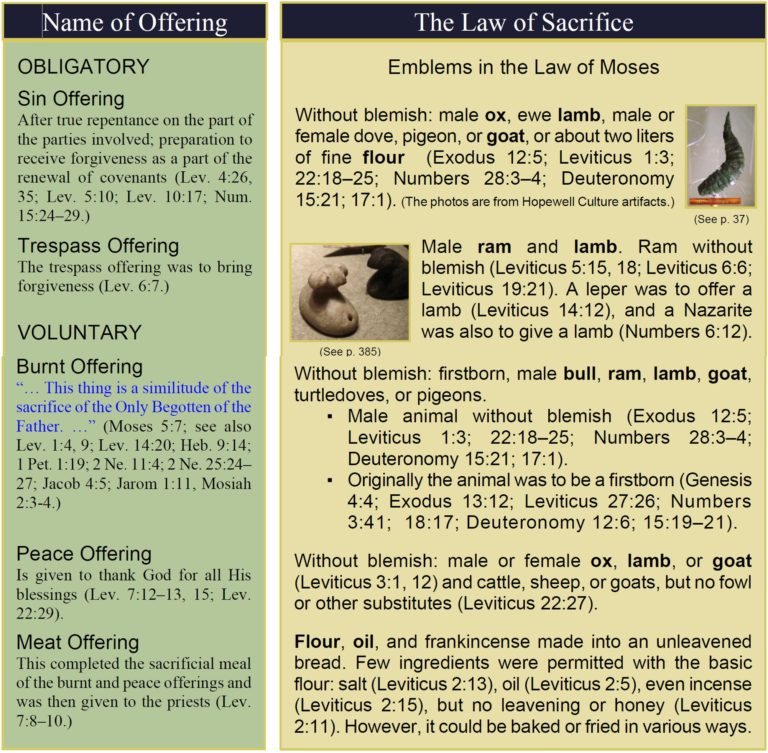


 Amberli Nelson received a B.S. in sociology from Brigham Young University. A busy wife and mother of seven, Amberli has a deep and abiding love of truth, knowledge and greater understanding and therefore she thoroughly enjoys reading about and researching subjects she is most passionate about which include: sacred Symbology, The Book of Mormon, early LDS church history, and Jewish religious customs, beliefs and traditions. She has become an expert on ancient Jewish practices, especially those involving the Laws of Moses. She delights in sharing this knowledge with others and does so with energy and enthusiasm.
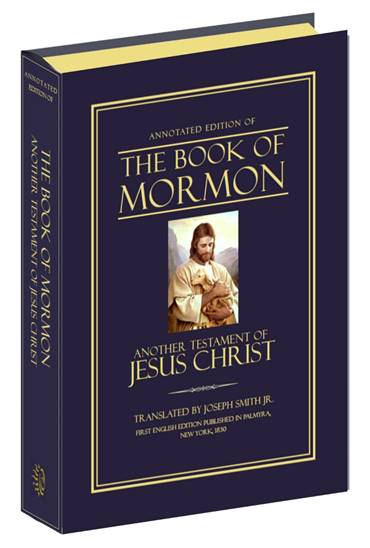




 From this book, THE AMERICAN INDIAN (UH-NISH-IK-NA-BA) by ELIJAH M. HAINES we will show the similarity in some of the Indian languages, to the Hebrew, and that the former must have been derived from the latter. I have edited just one chapter of over 833 pages which focuses on Chapter IV, Affinity with the Jews. This may be a lengthy blog, but it is amazing how much information you will receive about the similarities of our Book of Mormon Lamanites with the Tribe of Judah from Israel. You will also enjoy some of the old pictures which come from this amazing book.
 This book has therefore been prepared with reference to this long felt want, and is such a work as the public mind and student of history now seem to demand.

 Among the early authorities cited, to show that the American Indians are descendants from the Israelites, Mr. Adair seems to be the principal one, and since his time, all writers who have favored his views, refer with unreserved confidence to the evidence furnished by him to this end.
 Dr. Boudinot speaks of some Indians at a place called Cohocks, who called the high mountain at the west Ararat He says that the Penobscot Indians called a high mountain by the same name ; that he himself attended an Indian religious dance, concerning which he remarks:
 Dr. Boudinot further says of the Indians: ” Their languages in their roots, idioms and particular construction, appear to have the whole genius of the Hebrew; and what is very remarkable have most of the peculiarities of that language, especially those in which it differs from most other languages.”
 “Du Pratz was very intimate with the chief of those Indians called ‘
  Charlevoix, speaking of the Indian traits and religious customs, and in reference to their resembling the Jews, says: ” The greatest Part of their Feasts, their Songs and their Dances, appear to me to have had their Rise from Religion, and still to preserve some Traces of it; but one must have good eyes, or rather a very lively imagination, to perceive in them all that some travelers have pretended to discover. I have met with some who could not help thinking that our savages were descended from the Jews, and found in
  everything some affinity between these barbarians and the people of God. There is, indeed, a resemblance in some things, as not to use knives in certain meals, and not to break the bones of the beast they ate at those times, and the separation of the women during the time of their usual infirmities. Some persons, they say, have heard them, or thought they heard them, pronounce the word Hallelujah in their songs. But who can believe that when they pierce their ears and noses they do it in pursuance of the law of circumcision ? On the other hand, don’t we know that the custom of circumcision is more ancient than the law that was given to Abraham and his posterity. The feast they made at the return of the hunters, and of which they must leave nothing, has also been taken for a kind of burnt offering, or for a remain of the passover of the Israelites ; and rather, they say, because when any one cannot compass his portion, he may get the assistance of his neighbors, as was practiced by the people of God, when a family was not sufficient to eat the whole Paschal Lamb.”
 ” By information received from Father Hoyt respecting the former traditions, rites and ceremonies of the Indians of this region, I think there is much reason to believe they are descendants of Abraham. They have had cities of refuge, feasts of first fruits, sacrifices of the firstlings of the flock, which had to be perfect, without blemish or deformity, a bone of which must not be broken. They were never known to worship images, nor to offer sacrifices to any God made with hands. They all have some idea and belief of the Great Spirit Their feasts, holy days, etc., were regulated by sevens, as to time, i. e., seven sleeps, seven moons, seven years, etc They had a kind of box containing some kind of substance which was considered sacred, and kept an entire secret from the common people. Said box was borne by a number of men who were considered pure or holy (if I mistake not, such a box was kept by the Cherokees). And whenever they went to war with another tribe they carried this box; and such was its purity in their view that nothing would justify its being rested on the ground. A clean rock or scaffold of timber only was considered sufficiently pure for a resting place for this sacred coffer. And such was the veneration of all of the tribes for it, that whenever the party retaining it was defeated and obliged to leave it on the field of battle, the conquerors would by no means touch it. “
  Mr. Penn further adds that the worship of this people consists in two parts, sacrifices and cantos (songs). The first is with their first fruits, and the first buck they kill goes to the fire; and that all who go to this feast must take a piece of money, which is made of the bone of a fish. (” None shall appear before me empty.”) He speaks of the agreement of their rites with those of the Jews, and adds:
 “They choose twelve men, who provide twelve deer. Each of the twelve men cuts a sapling ; with these they form a tent, covered with blankets. They then choose twelve stones for an altar of sacrifice. Some tribes, he observes, choose but ten men, ten poles, and ten stones. Here seems an evident allusion to the twelve tribes, and also to some idea of the ten separate tribes of Israel. Upon the stones of their altar they suffered no tool to pass. No tool might pass upon a certain altar in Israel.”
 Mr. Adair, in further support of his theory, says: “As the nation had its particular symbol, so each tribe has the badge from which it is denominated The sachem of each tribe is a necessary party in con- veyances and treaties, to which he affixes the mark of his tribe. If we go from nation to nation among them we shall not find one who doth not lineally distinguish himself by his respective family. The genealogical names which they assume are derived either from the names of those animals whereof the cherubim are said in revelation to be compounded, or from such creatures as are most familiar to them. They call some of their tribes by the names of cherubimical figures that were carried on four principal standards of Israel.”
 The Indians count time after the manner of the Hebrews. They divide the year into spring, summer, autumn and winter. They number their years from any of those four periods, for they have no name for a year, and they subdivide these and count the year by lunar months, like the Israelites who counted by moons. They begin a year at the first appearance of the first new moon of the vernal equinox, according to the ecclesiastical year of Moses. Till the so-called captivity the Israelites had only numeral names for the solar and lunar months except Abib and Ethamin ; the former signifying a green ear of corn, and the latter robust or valiant, and by the first of these the Indians (as an explicative) term their Passover, which the trading people call the green corn dance.
 In conformity to, or after the manner of the Jews, the Indians of America have their prophets, high priests and others of a religious order. As the
  [
[ The ceremonies of the Indians, in their religious worship, says Mr. Adair, were more after the Mosaic institutions than of Pagan imitation; which could not be if a majority of the old nations were of heathenish descent They were utter strangers to all the gestures practiced by the Pagans in their religious rites.
 Mr. Adair, in likening the Indians to the Jews on account of their abstinence from unclean things, says that
  A religious custom is related by Maj. Long, which some think goes to prove that the Omaha Indians are of Israel. He relates that from the age of between five or ten years their little sons are obliged to ascend a hill fasting once or twice a week, during the months of March and April, to pray aloud to Wahconda. When this season of the year arrives, the mother informs the little son that the u ice is breaking up in the river, the ducks and geese are migrating, and it is time for you to prepare to go in clay.” The little worshipper then rubs himself over with whitish clay, and at sunrise sets off for the top of a hill, instructed by the mother what to say to the Master of Life.
 “I have noticed that in all their principal and oldest traditions and lodge tales, twelve brothers are spoken of that are the sons of Getube, a name nearly similar to Jacob. The oldest of these brothers
 There is a marked similarity between the customs of the Indians and the Jews in their mourning for the dead. Like the Jews, the Indians had a time or season for mourning for the dead. A custom among the Jews of loud lamentation over the dead was also a peculiar custom of the American tribes. In Gen. xxxii, 34, it is said that *’ Jacob rent his clothes, and put sackcloth upon his loins, and mourned for his son many days.” This is suggestive of a like custom among the American Indians. Among the Indians the friends of the deceased visited the graves of their departed relatives and there resumed their custom of weeping and shrieking. This was also a prominent custom among the Jews, as noticed in John xi, 31 : ” She goeth out to the grave to weep there.” The custom of engaging women to mourn over the bodies of the dead, which prevailed among the American tribes, was also a custom among the Jews, as mentioned in Jer. ix, 17 : ** Thus saith the Lord of Hosts, consider ye, and call for the mourning women that they may come.”


 The secret order of medicine men and prophets of the Indians had a corresponding institution among the Jews called “
 A custom prevailed among western Indian tribes, who lived in villages of dirt houses, of
  In notions of dress there was a striking similarity between the American Indians and the Jews, especially in regard to the outer garment thrown over the shoulders or wrapped around the body. The Indian medicine man or prominent chief possessed a peculiar vanity in regard to their dress, which was frequently gaudy and fantastic, and so with the high priests among the Jews where display in dress was a peculiar feature in Jewish custom among those high in authority. It was a custom among the Jews to sleep in their garments, Deut. xxiv, 12-13, and so with the American Indians.
 According to Mr. Freeman, it was an
 Rev. Peter Jones, an educated Ojibway Indian, in the appendix to his book, entitled “




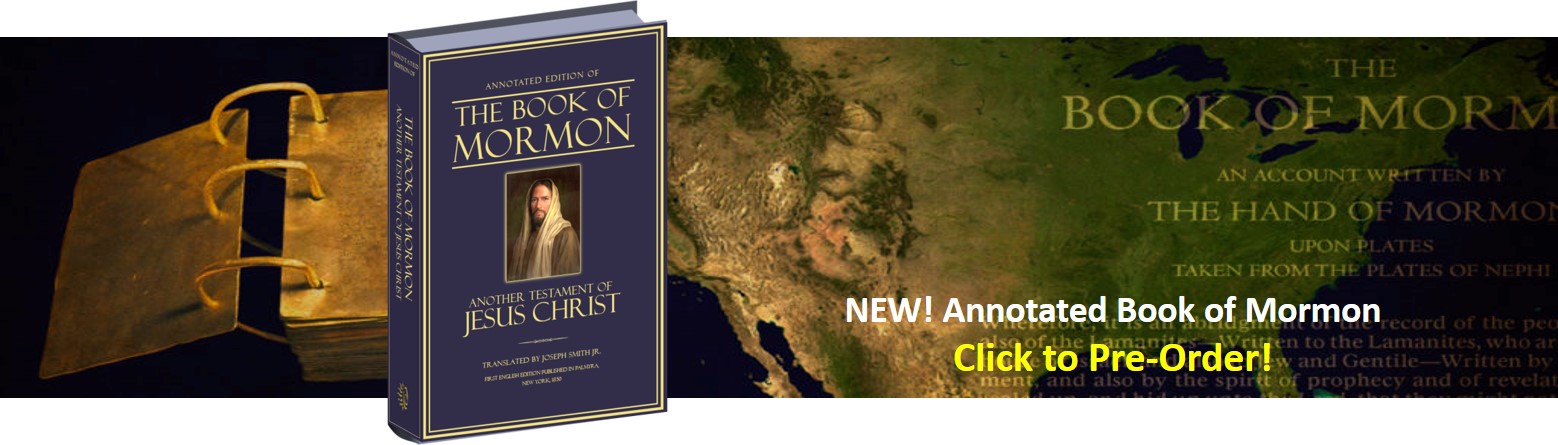
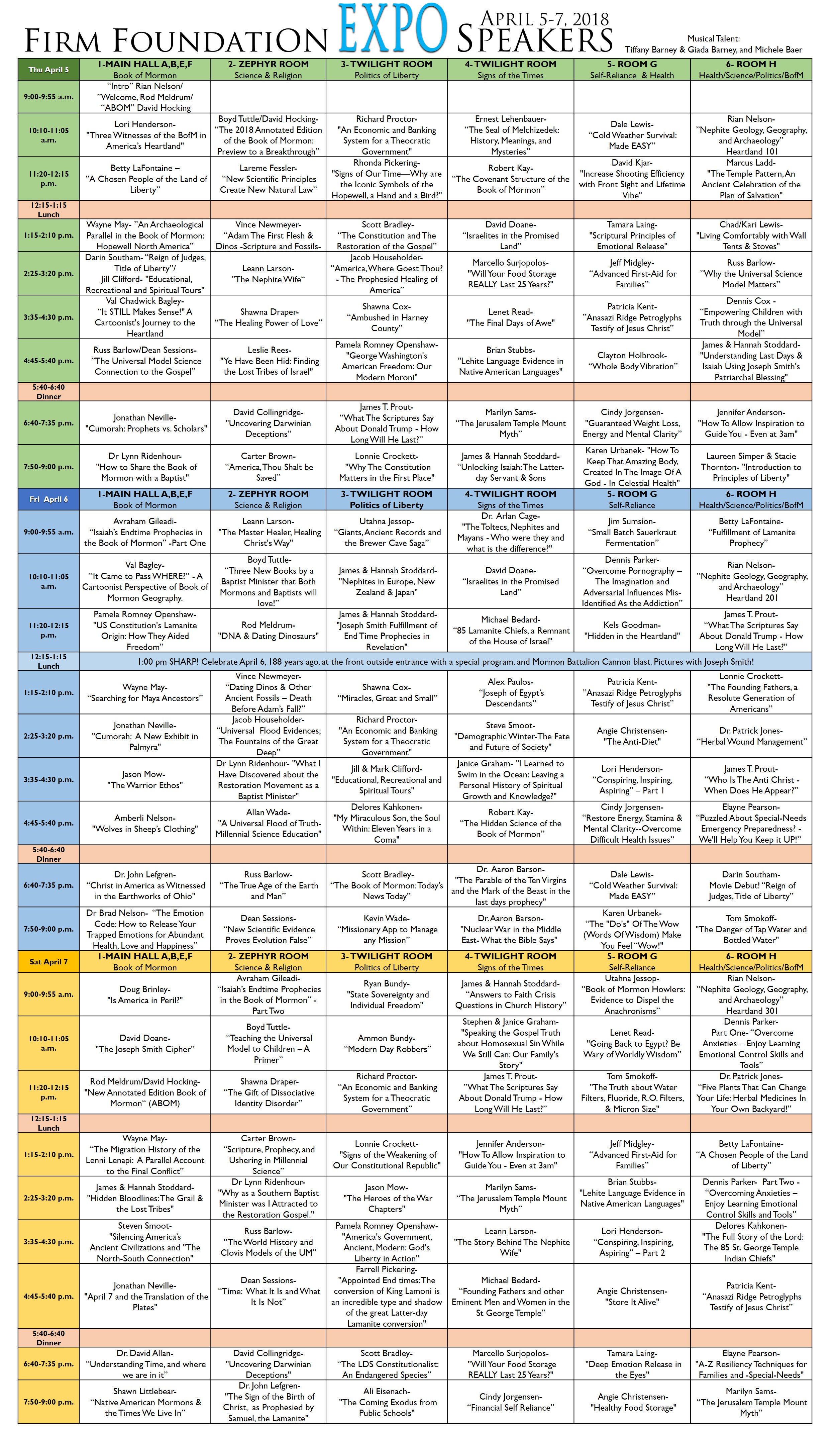



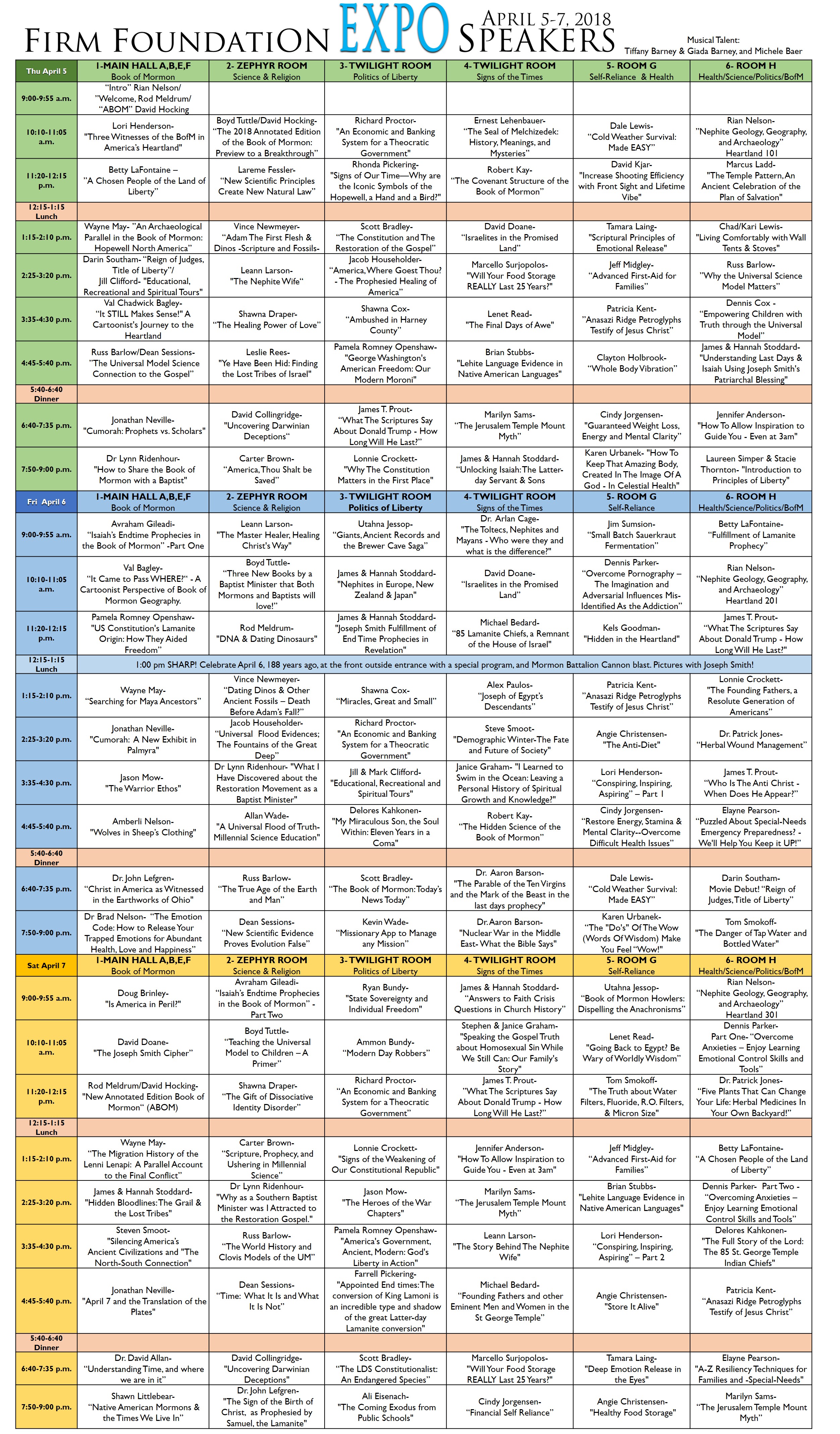
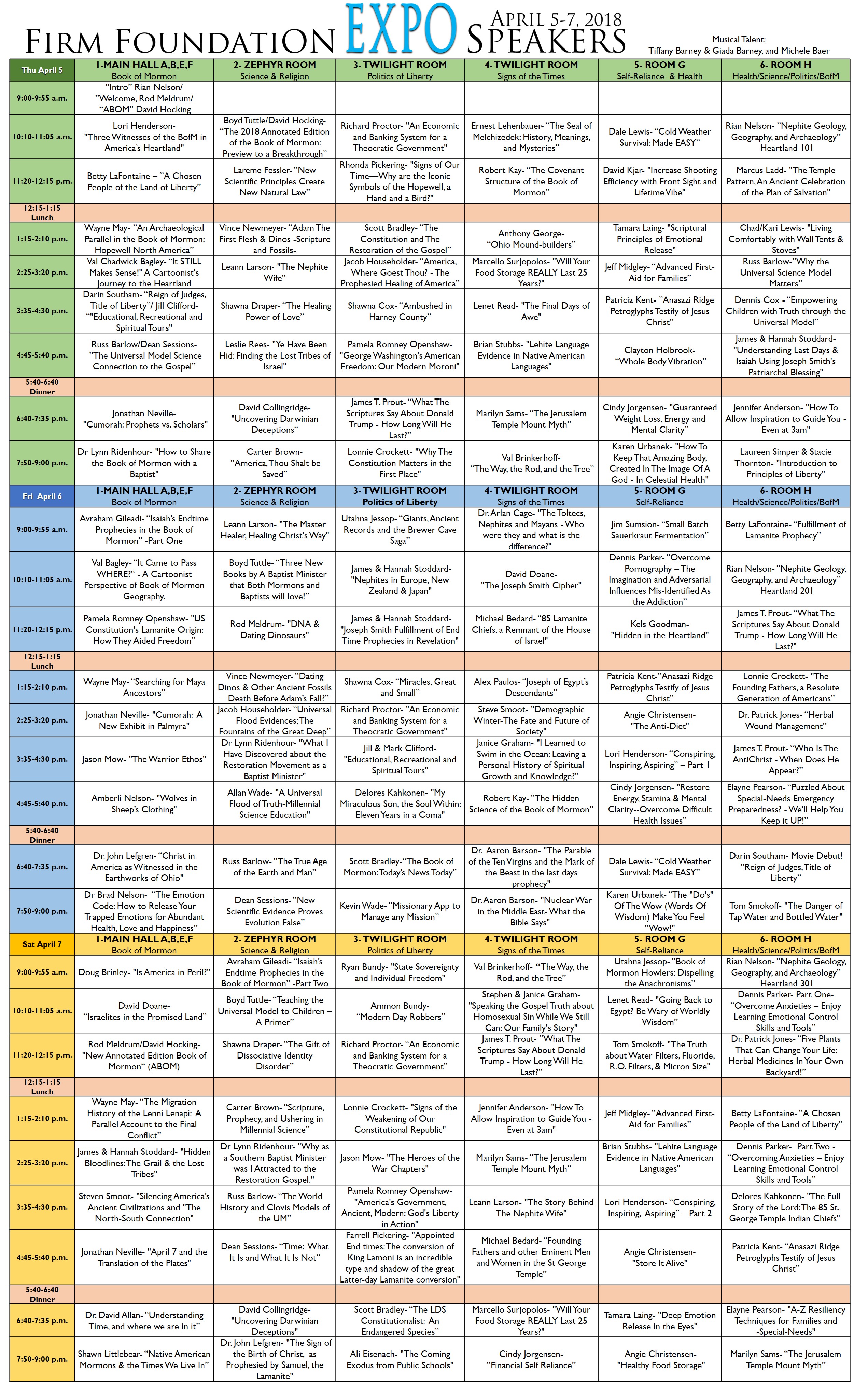

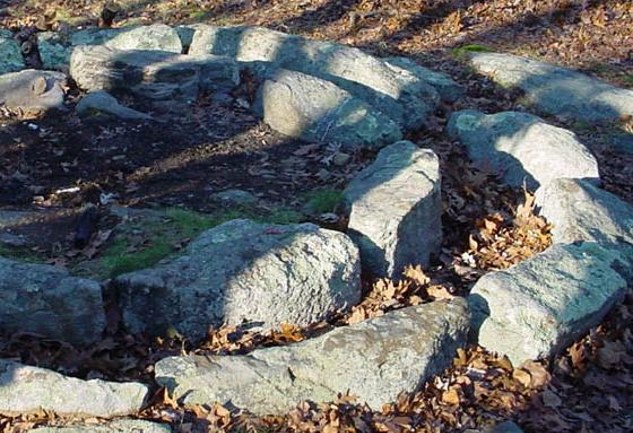


 It is as if a large circle is drawn around New England which represents a complete absence of pre- colonial construction. This is the conventional wisdom proposed by the Archaeological community, however the evidence does not seem to support this notion. Let us look at several enigmatic stone sites in New England and what they tell us about its mysterious past. America’s Stonehenge in Salem, New Hampshire is probably the most elaborate and controversial site in New England. It has been described by Dr. Edward J. Kealy, professor of History at Holy Cross University as “potentially the most important stone complex in the Northern Hemisphere”. Featured on the History Channel and other programs, this 30 acre complex is a mixture of stone chambers, stone solstice and equinox markers, cairns, chimneys, fireplaces and stone drains. The two largest stones here weigh 45 and 70 tons. The site has been carbon dated to at least 2000 B.C. by scientists at Geochron Labs of Cambridge, Mass after dating 13 different test pits. That dates it’s construction half a millenia before the final construction phase of Stonehenge, and like Stonehenge it possesses many precise astronomical alignments. Stone markers throughout the site provide over 200 alignments with the sun, moon and 45 different stars which have been verified by independent researchers. One alignment wall allows a person to observe the southern most standstill of the moon on its 18.61 year metonic cycle. A period of 18.61 is required to carry the moon to all of its possible positions in respect to the sun. This event is marked at Mystery Hill as the moon passes above the winter solstice stone and then aligns with the terminal of this wall.

 The stone chambers of New England like all the precolonial stonework are dry laid. When you examine any of these chambers you will see that they were not easy to construct, their design is quite complex.
 Let us now examine the stone walls of New England. Again conventional wisdom states that every stone wall you see was built sometime in the last 400 years. This seems like a reasonable claim at first glance, colonials definitely built walls for property boundaries and agricultural uses. Timber eventually became scarce in the colonies and fencing was needed as land was farmed and livestock raised. We are told that the majority of the walls were built in a 75 year window between the revolutionary and civil wars. How many walls did and does New England actually have? An 1872 U.S. Department of Agriculture report estimated there were over 240,000 miles of stone walls east of the Hudson river right after the civil war. This very conservative estimate was done using incomplete data and didn’t account for other areas in the northeast that possess large amounts of stone walls. The actual figure is well over 500,000 miles, many researchers estimate. That is a stone wall that circles the earth 20 times or all the way to the moon and back. Reflect on that staggering reality for a minute. Does it seem likely that a colonial population struggling for survival, involved in several all encompassing wars and working difficult and unforgiving land could have accomplished this feat? The average colonial home burned between 20 and 40 hand cut cords of wood yearly. Processing this amount of wood, among other overwhelming tasks, in a harsh environment with long and difficult winters left little time for activities like wall building which had very little utility. Take the town of Hawley, Mass., an isolated community in the rugged highlands of Western MA, which has an area of 30.9 square miles. First settled in 1770 it has over one thousand miles of stone walls. However, it’s population at the time in question was 539 in 1790, 1089 in 1820 and back down to 600 in 1879. Could this meager population be responsible for such an impressive feat? To build all the walls of New England would have been the most costly and labor intensive undertaking in colonial history. An enormous venture but with little mention in the historical texts other than the assumption that it was done. The total sheer tonnage of New England’s stone walls represents an amount greater than all the worlds pyramids, stone temples, stone complexes and ancient stone structures combined.


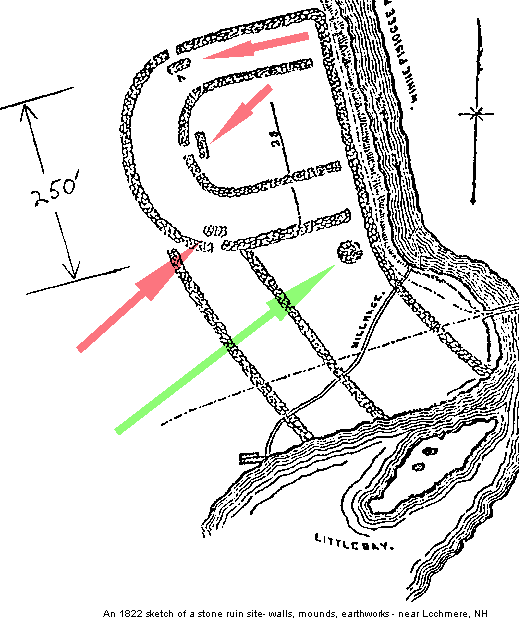

 When you attend the Palmyra area sites the missionaries will take you on a tour and share with you wonderful information about all the sites. Jonathan Neville has created his own “Unofficial Supplemental Site Book” which explains the many ideas found in the Joseph Smith Papers about the final battled of the Book of Mormon events taking place around Hill Cumorah, the second set of golden plates, and why he believes the Hill Cunorah is the only hill, plus other new information.
 ”The stature of this personage was a little above the common size of men in this age; his garment was perfectly white, and had the appearance of being without seam….He then proceeded and gave a general account of the promises made to the fathers, and also gave a history of the aborigenes [sic] of this country, and said they were literal descendants of Abraham. He represented them as once being an enlightned [sic] and intelligent people, possessing a correct knowledge of the gospel, and the plan of restoration and redemption. He said this history was written and deposited not far from that place, and that it was our brother’s privilege, if obedient to the commandments of the Lord, to obtain and translate the same by the means of the Urim and Thummim, which were deposited for that purpose with the record.”
 Letter VII gives a complete description of the hill Cumorah:
 “The manner in which the plates were deposited:
 The site guide explains that David Whitmer received a third letter from Oliver Cowdery, asking if the Whitmers would open their home to allow Joseph and Oliver to continue the work of translation there. The guide says, “Due to increased interruptions and harassment from the surrounding community in Harmony, the work was moving slowly, resulting in the need for a new place to complete the translation.”
 In the mean time Joseph was 150 miles distant and knew naught of the matter e[x]cept an intimation that was given through the urim and thumim for as he one morning applied the<m> latter to his eyes to look upon the record instead of the words of the book being given him he was commanded to write a letter to one David Whitmore [Whitmer] this man Joseph had never seen but he was instructed to say him that he must come with his team immediately in order to convey Joseph and his family <Oliver [Cowdery]> back to his house which was 135 miles that they might remain with him there untill the translation should be completed for that an evil designing people were seeking to take away Joseph’s life in order to prevent the work of God from going forth among the world This was accordingly done and the letter received and Mr Whitmore showed it to his Father mother sisters and brothers…
 Although Joseph used the Urim and Thummim primarily to translate the engravings on the plates, he occasionally received commandments through the Urim and Thummim. His mother, Lucy Mack Smith, gave another example of how this came about. When Oliver Cowdery first arrived in Harmony,


 “Zion’s Camp started in Kirtland, Ohio and ended in Independence, Missouri. The Camp traveled areas occupied by both the Hopewell (see p. 535) and Adena (see p. 452) cultures.” Annotated Book of Mormon ZION’S CAMP AND THE “PLAINS OF THE NEPHITES” Illustration by Rod L Meldrum


 “On July 4,1859, Anthony Sherman—one of Washington’s soldiers at Valley Forge who was now 99 years old—was one of the last remaining veteran soldiers of the Revolution.
 Returning just after dusk, he dispatched an orderly to the quarters of the officer I mentioned who was presently in attendance. After a preliminary conversation of about half an hour, Washington, gazing upon his companion with that strange look of dignity which he alone could command, said to the latter: “I do not know whether it is owing to the anxiety of my mind, or what, but this afternoon, as I was sitting at this table engaged in preparing a dispatch, something seemed to disturb me. Looking up, I beheld standing opposite me a singularly beautiful female. So astonished was I, for I had given strict orders not to be disturbed, that it was some moments before I found language to inquire the cause of her presence. A second, a third, and even a fourth time did I repeat my question, but received no answer from my mysterious visitor . . . . By this time I felt strange sensations spreading through me. I would have risen but the riveted gaze of the being before me rendered volition impossible.
 “Son of the Republic,” said the female angel, “look and learn.” Washington then beheld a male angel and, according to Sherman, told of how


 Over ten years in the making, this edition gives powerful testimony to the fact that the Book of Jasher is indeed a rich Hebrew literary masterpiece centered on the founding and early history of the Hebrew Nation.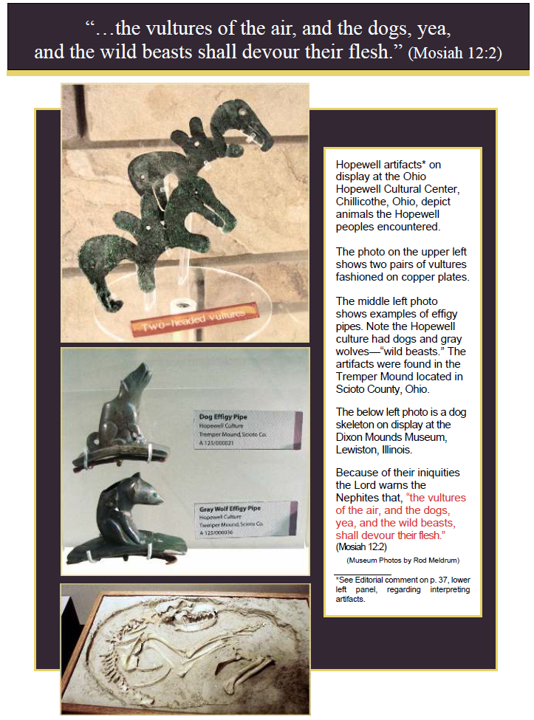


 Ohio History Central is an evolving, dynamic online encyclopedia that includes information about Ohio’s natural history, prehistory, and history. Ohio History Central is perfect for anyone wanting to learn more about Ohio! Ohio History Central was researched and written by staff at the Ohio History Connection. Pictures and descriptions below are from Ohio History Connection.
 Description: Effigy of a dog with a long muzzle and pointed ears is depicted chewing on the remnant of human head, which he holds between his front paws. Paws are very blocky and stylized. Left front leg is broken, missing and restored. Part of right rear leg is broken and missing. Tail is tightly curved over the back and attached, forming a ring. Pipe bowl is a roughly rectangular projection in the middle of the dog’s back. Hole for pipe stem is in the dog’s posterior. Stylized human head is upside down. The nose is high relief. The lower jaw is missing. Dog is chewing on occipital region of the head. The artistic style is typical of the Copena Culture from Tennessee region. The effigy is made of dark grayish-brown steatite. Item was excavated from Seip Mound in Paxton Township, Ross County, Ohio.
 Description
 Description
 Description: This is a plaster cast of an effigy pipe known as the Mound City Horned Head. There is a human face with ears on either side. A knob on the forehead and two knobs equidistant on the back of the head represent a headdress. The pipe base is slightly convex in shape. This piece is from Hopewell Culture. Skilled Hopewell craftsmen carved pipes with flint knives and some are embellished with pearls or copper. In Ohio, the Hopewell Indians (100 B.C.-A.D. 500) built burial mounds and large earthen enclosures in geometric shapes (circles, squares, and octagons) to mark the places where the people gathered periodically to participate in many social and ceremonial events. Some of these sites were quite large – the Newark Earthworks complex extends over a 4-square-mile area. The Hopewell people also maintained a large trade network extending as far as the Rocky Mountains of Wyoming, the Florida coast and Appalachians, and northern Lake Superior.
 Description
 Description
 Description
 Description
 Description
 Description
 Description
 Description
 Description
 Description


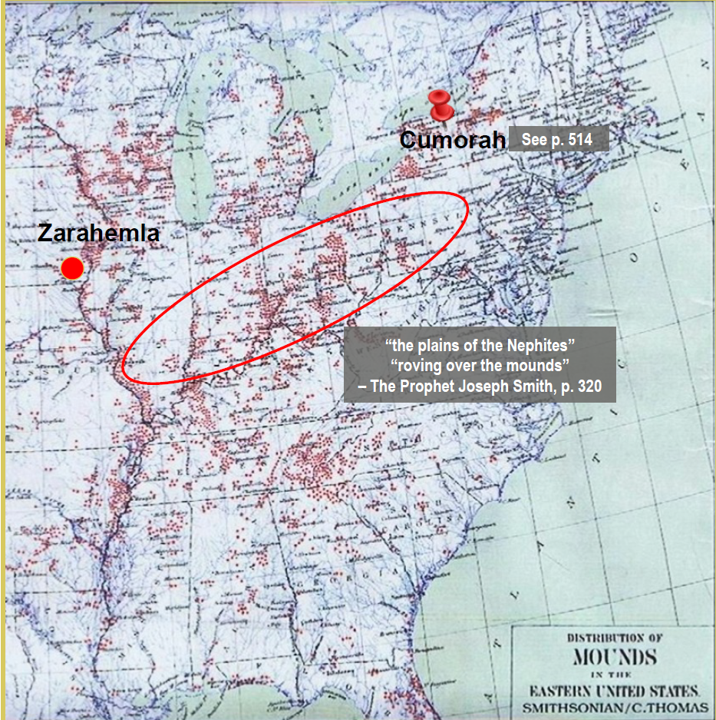

 For example, in Rough Stone Rolling, Richard Bushman observes that “Indian relics turned up in newly plowed furrows, and remnants of old forts and burial mounds were accessible to the curious, but none was known in Palmyra or Manchester…Burial mounds, supposedly a stimulus for investigation of the Indians, receive only the slightest mention [in the Book of Mormon, Alma 16:11].”



 Sunday, 20.—This day was spent by our company principally at Adam-ondi-Ahman; but near the close of the day, we struck our tents, and traveled about six miles north and encamped for the night with Judge Morin and company, who were also traveling north.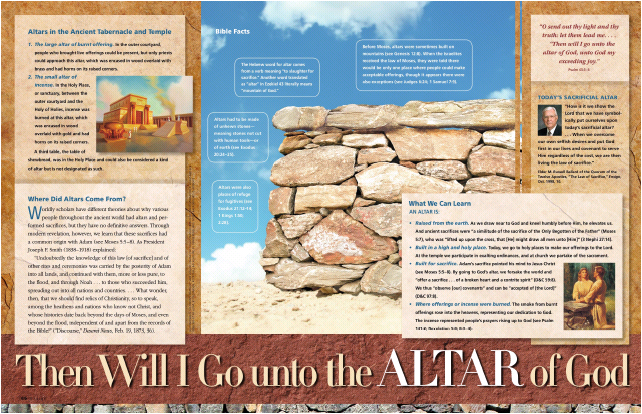
 “Elder Dyer also has gathered reports of early brethren and residents of Daviess county which describe

 The Answer: I have often pondered the holy significance of Far West, and even more so since President McKay’s visit. The sacredness of Far West, Missouri, is no doubt due to the understanding that the Prophet Joseph Smith conveyed to the brethren, at these early times, that Adam-ondi-Ahman,
  “And it came to pass, when the Lord had spoken with Adam, our father, that Adam cried unto the Lord, and he was caught away by the Spirit of the Lord, and was carried down into the water, and was laid under the water, and was brought forth out of the water.
 Because Adam and Eve had complied with these requirements, God said to them, “Thou art after the order of him who was without beginning of days or end of years” (Moses 6:67). [“What I Hope You Will Teach Your Children About the Temple,” Ensign 15 (August 1985): 8]
 Then Adam in his aged condition rose up and, being filled with the spirit of prophecy, predicted “whatsoever should befall his posterity unto the latest generation.” All this is recorded in section 107 of the Doctrine and Covenants (verses 53-56).

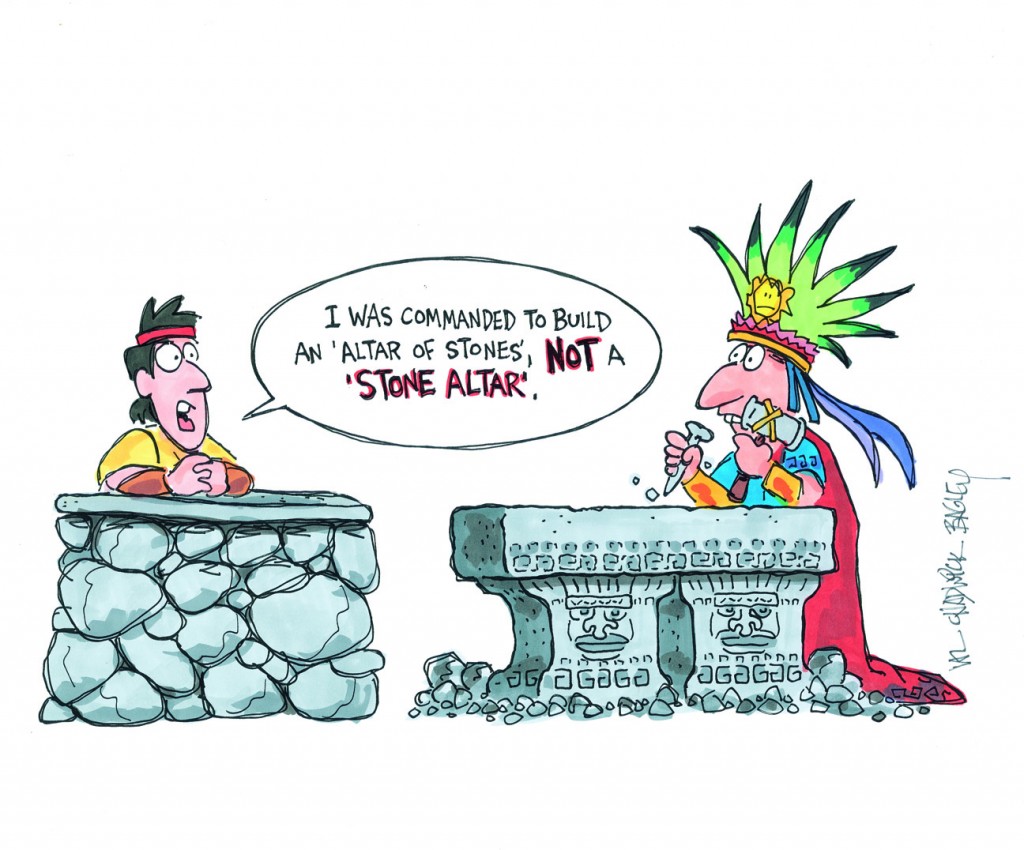




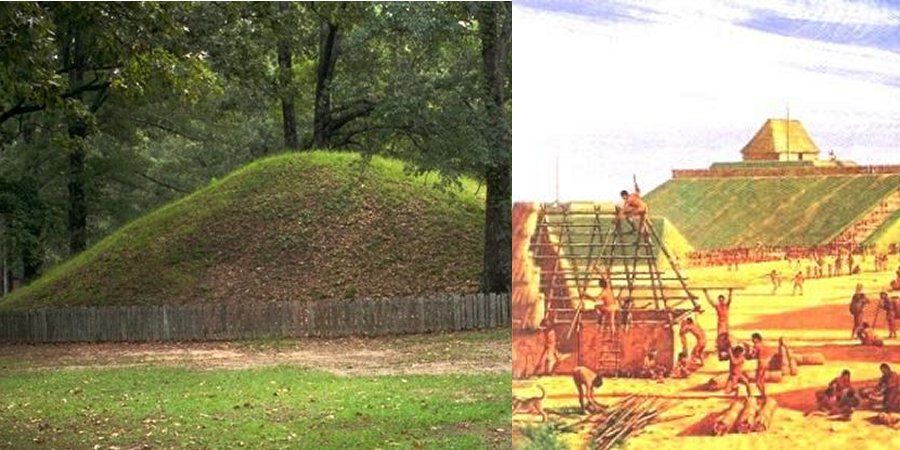



 Cowdery
 “We all agree that the message is more important than the geography, but people don’t read the book when they think it is fiction, as most of the world does. Plus, no one leaves the Church while still believing the Book of Mormon is a true history. That’s why anti-Mormons attack the historicity of the Book of Mormon.
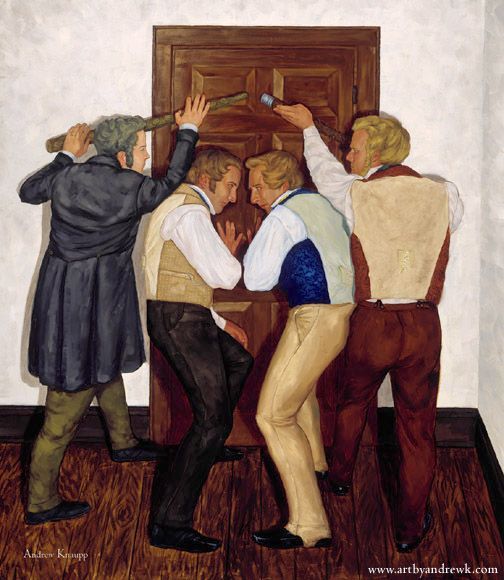
 Our friend Jonathan Neville has just posted an eye opening article. Why are more and more people of the world claiming that Noah’s flood was fictional or just a good story? More people are saying that Adam wasn’t the first man on this earth. Why are more and more members of the Church of Jesus Christ of Latter-day Saints claiming that the Book of Mormon contains a lot of great parables that aren’t real stories, but just parables that can teach us good things? Is the Bible the Word of God? We answer yes as far as it is translated correctly. We do know however that the stories in the Bible are actual accounts of real people in real places, just as the Book of Mormon is.
 Why would we believe anything else? Because Satan’s plan is in full force. Remember this is Satan’s world right now. It won’t be Christ’s until the second coming. The craftiness of man is constantly being mixed with scripture and folklore. The “Great and Spacious building” is truly coming from the halls of academia. Many intellectuals continue pointing their fingers at humble followers of God from the heights of those house’s of cards. “Who’s on the Lord’s side who?” There are “save two churches”, one that speaks the truth of the Savior and all others who teach of man and his so-called wisdom.

 The de-literalizing of the Book of Mormon became apparent to me when I took a closer look at the lesson manuals, the CES/BYU curriculum, the Saints book, the visitors centers, etc. These all repudiate the teachings of the prophets about the New York Cumorah. I attribute all of those to the M2C Church employees.

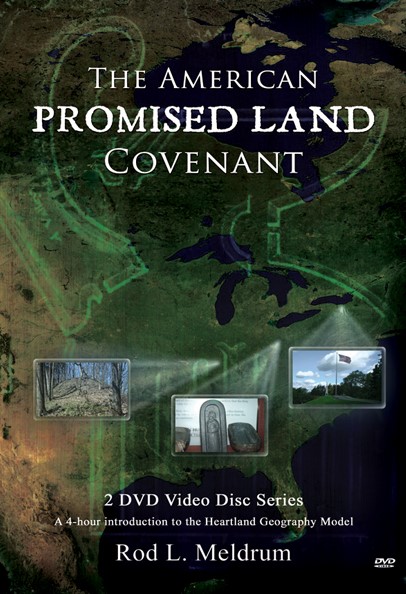
 An Apostle of the Lord, Elder L. Tom Perry, has proclaimed, “The Church of Jesus Christ of Latter-day Saints is truly a world-wide Church. Nevertheless, it is important to realize that the Church could never have become what it is today without the birth of a great nation, the United States of America. The Lord prepared a new land to attract the peoples of the world who sought liberty and religious freedom…


 David W. Allan has spent 58 years researching time and related topics. He helped develop the nation’s official atomic-clock timing system during his 32 years in Boulder, CO, at the National Bureau of Standards (now National Institute of Standards and Technology). For 25 of those years, his research group was responsible for generating official time for the United States and helping with official time for the world. During that time he spent several man years helping in the development of GPS. Atomic clocks are the heart of GPS, and the folks developing GPS came to Boulder to learn how to best use them being taught by Allan and his colleagues at NBS.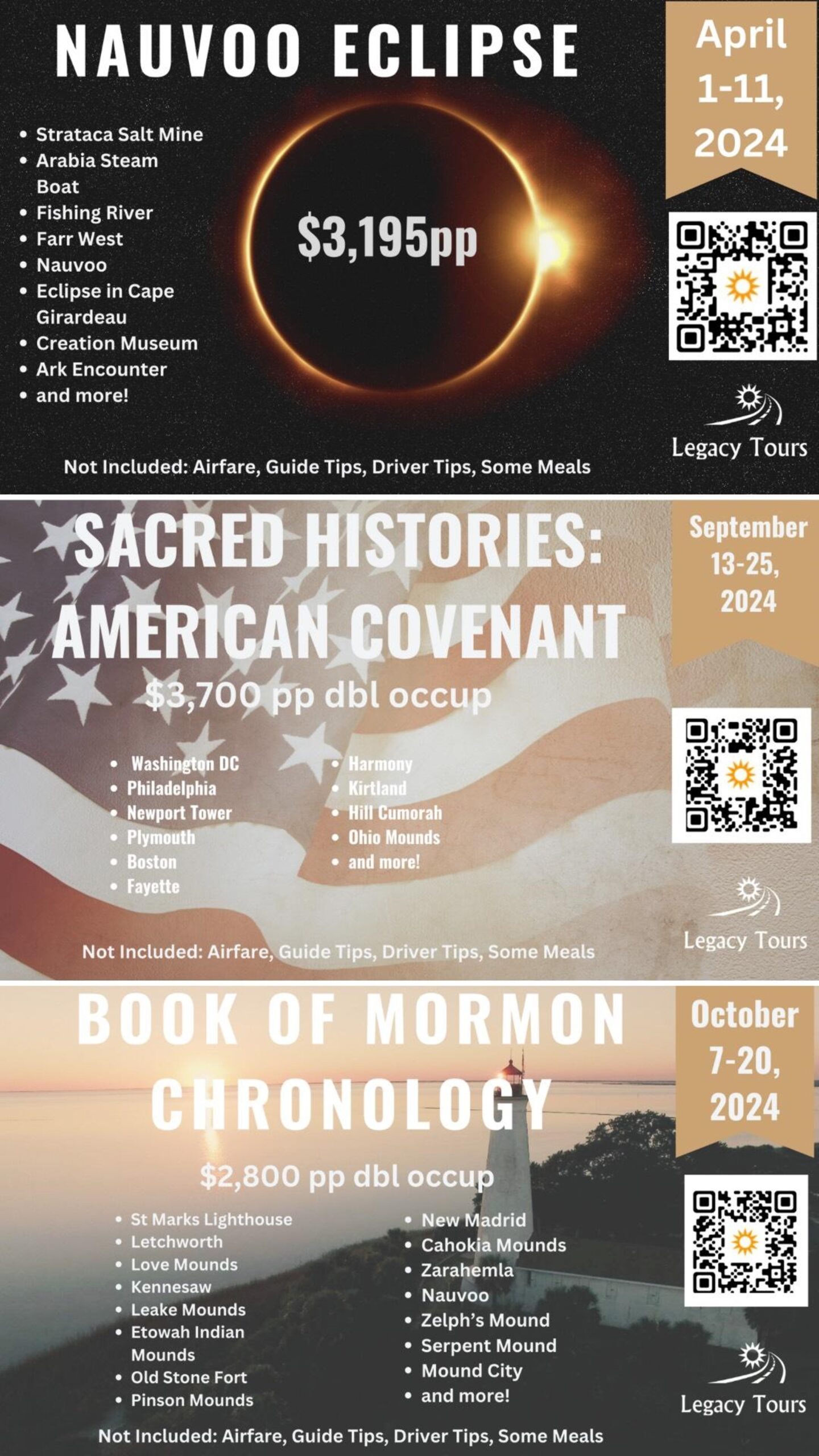
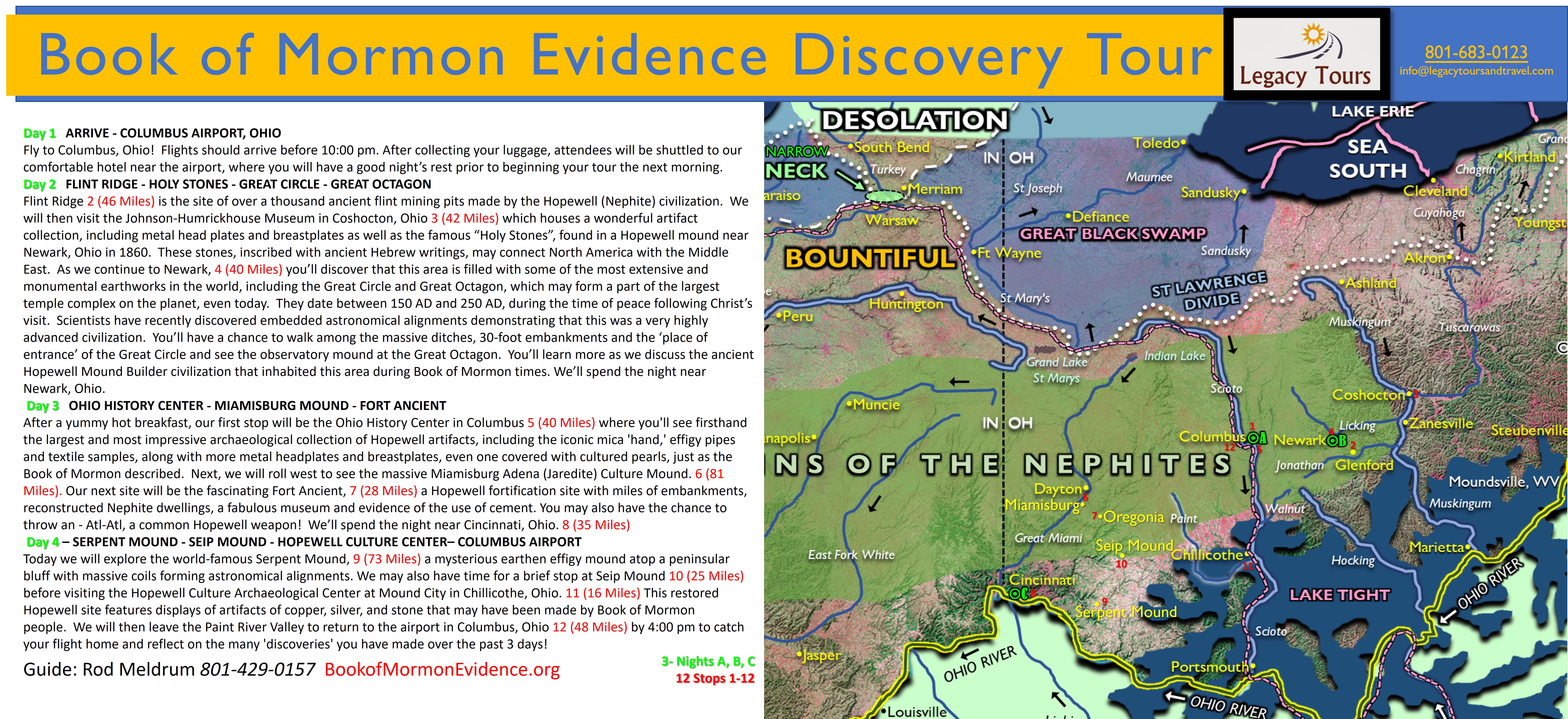



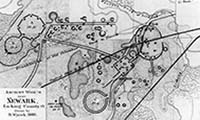


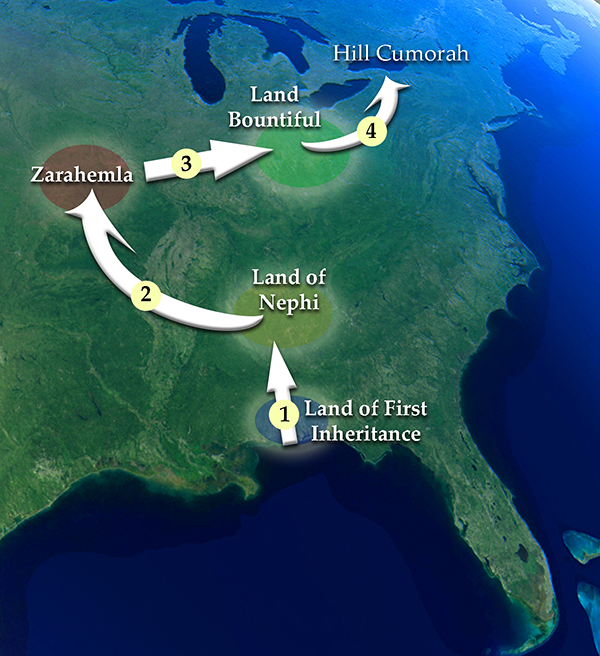




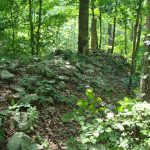





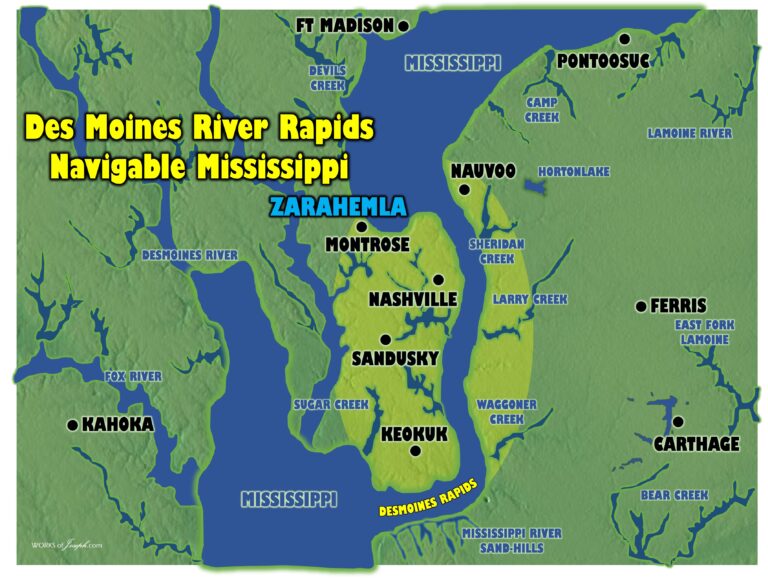
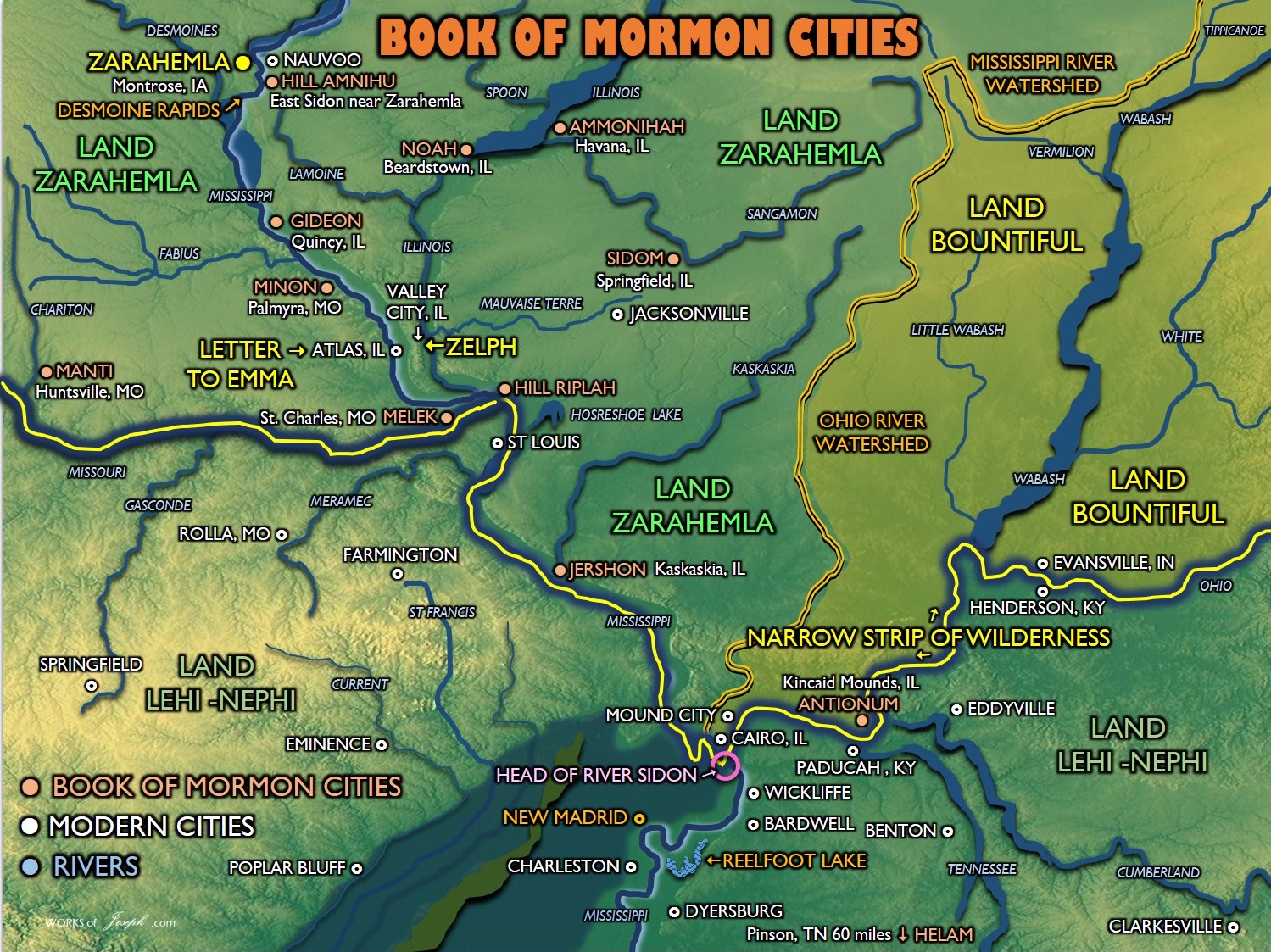
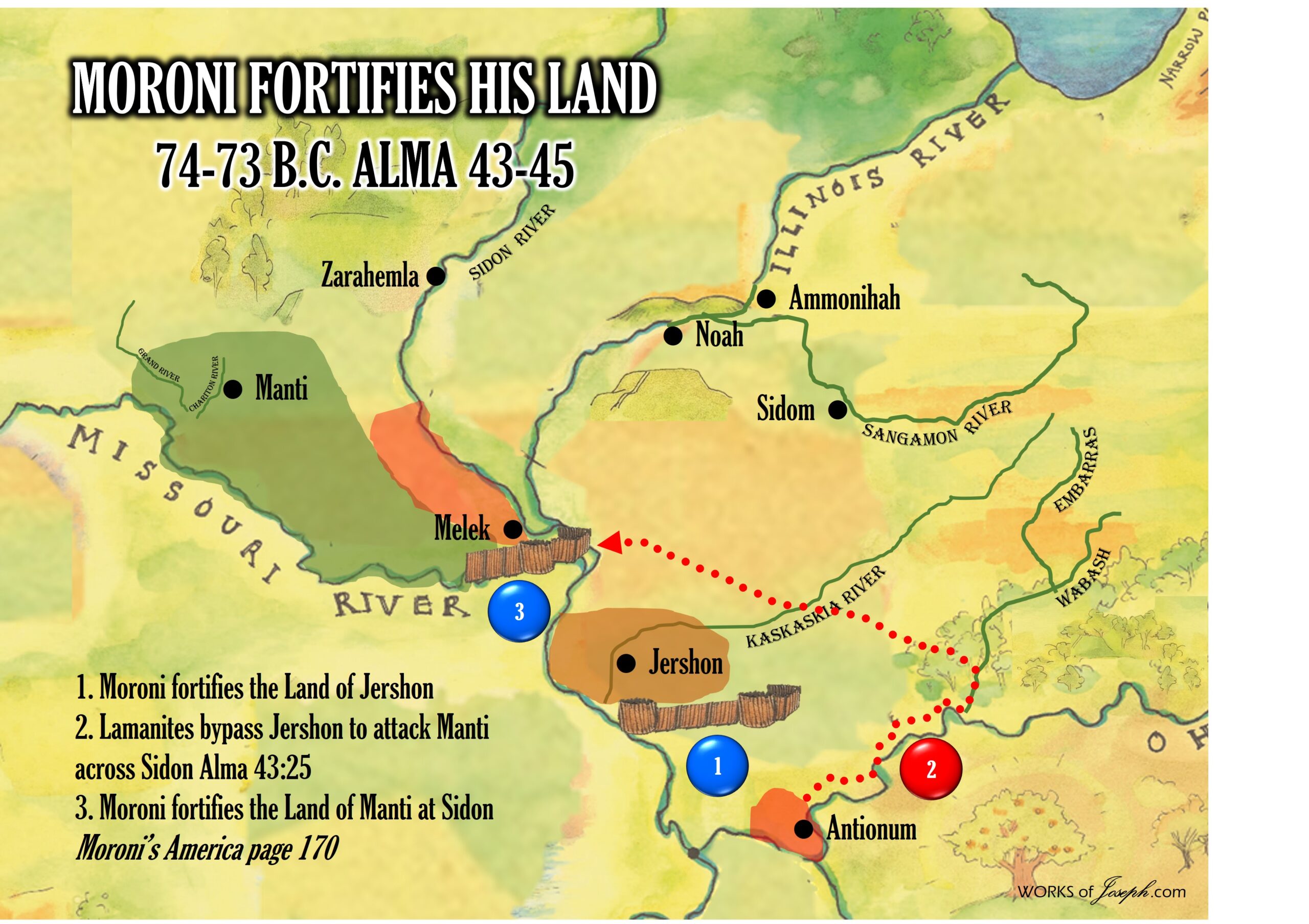

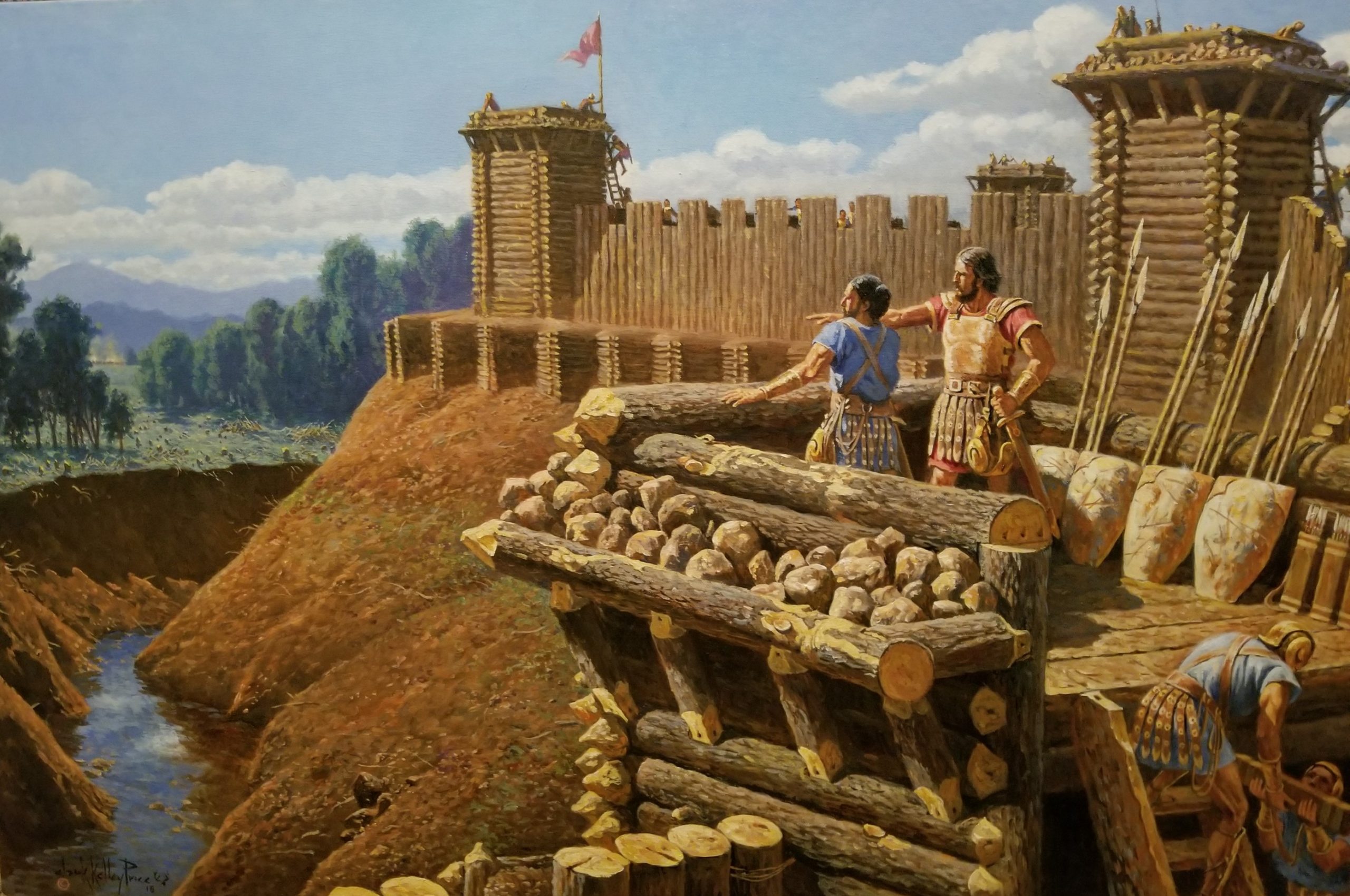
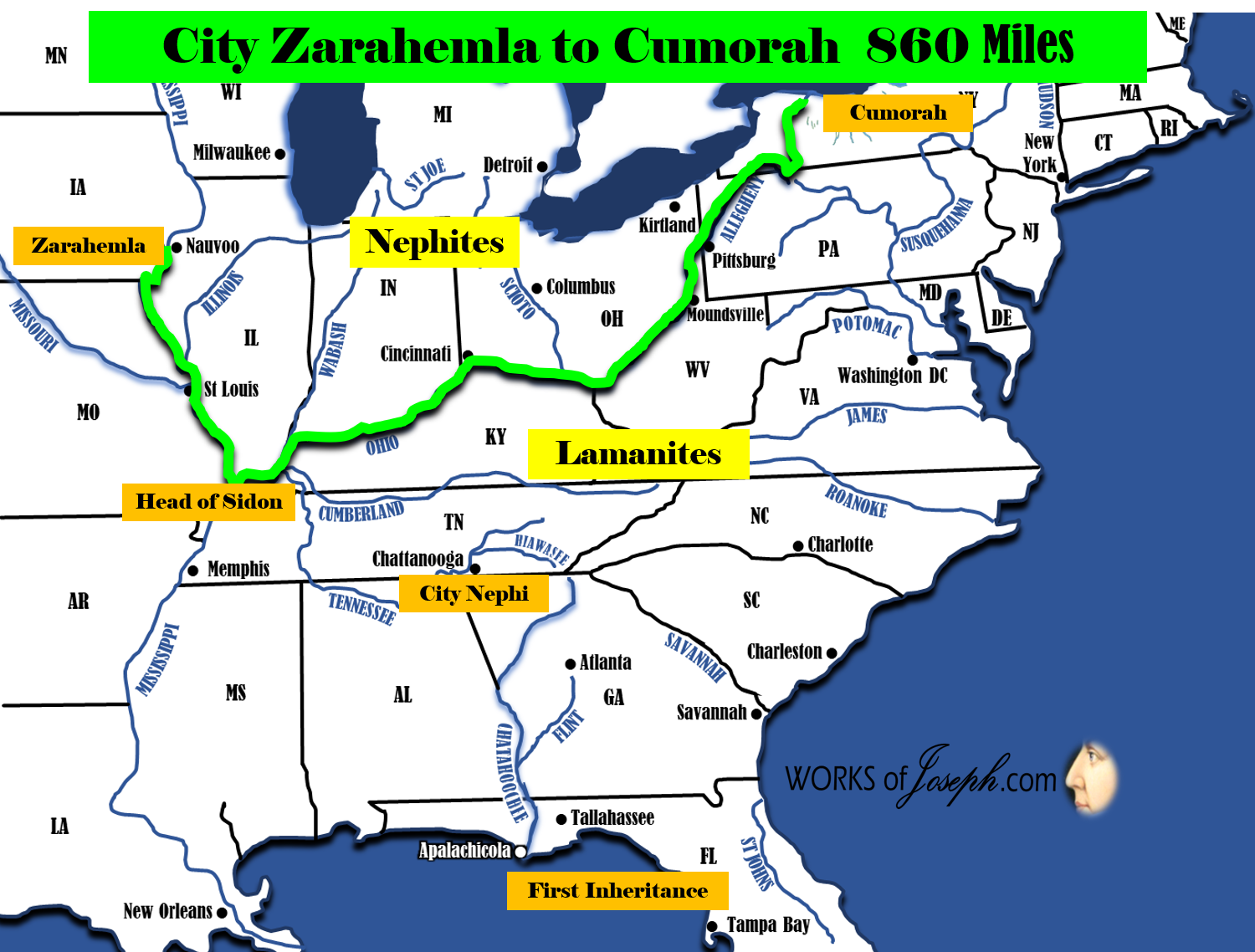

 Most of us in the Church of Jesus Christ of Latter-day Saints love the Wentworth Letter that Joseph Smith wrote in 1842 to John Wentworth, editor and proprietor of the Chicago Democrat. It outlined the history of the Church and included the 13 Articles of Faith.

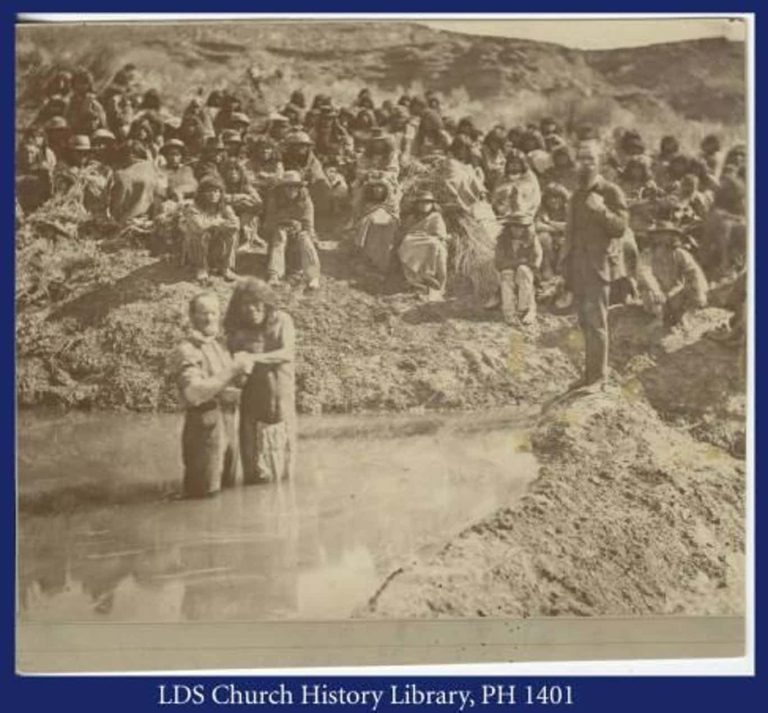


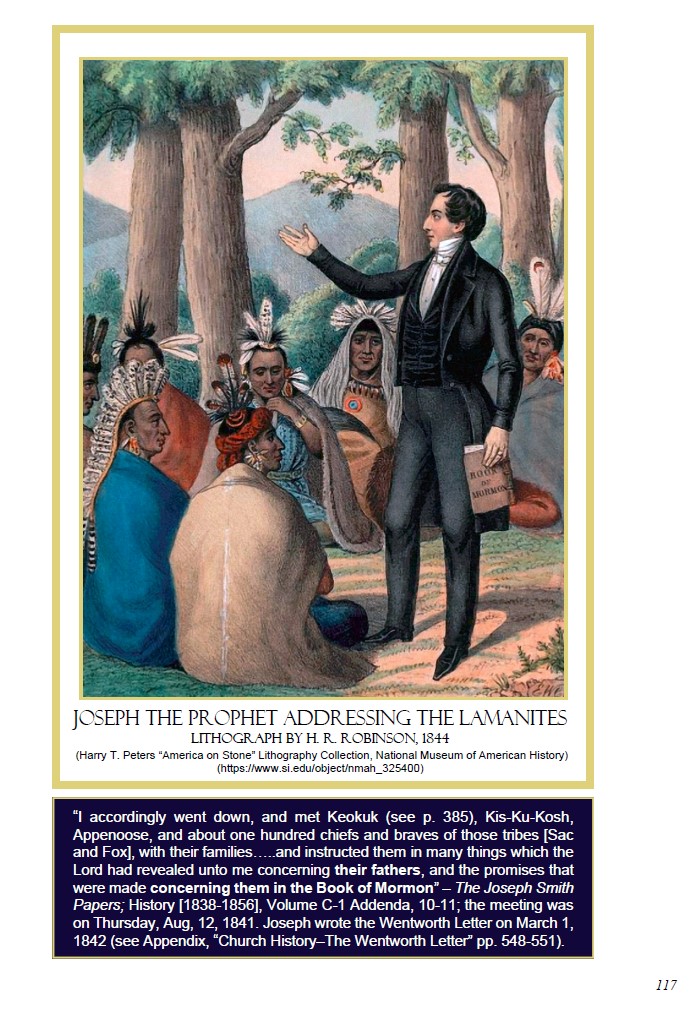
 Joseph Smith during his lifetime more than likely knew about many of the Indian Chiefs below, who were from the same vicinity as him. Some lived at the same time as Joseph Smith and he may have also spent time with many of them. I share some unique articles below that you may find interesting in understanding young Joseph and his opportunities to learn from Native Americans.

 Early Mormon Lamanism, Forgotten Apocalyptic Visions, and the Indian Prophet
 “You’re a Mormon?” Nicholas said to me. “Oh, boy, do I have a good story to tell you.”