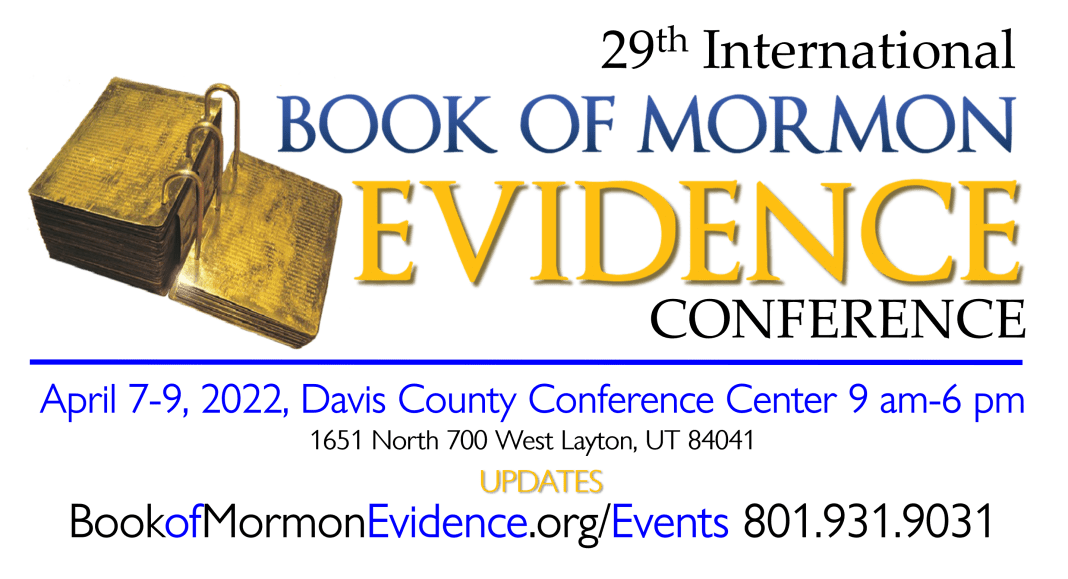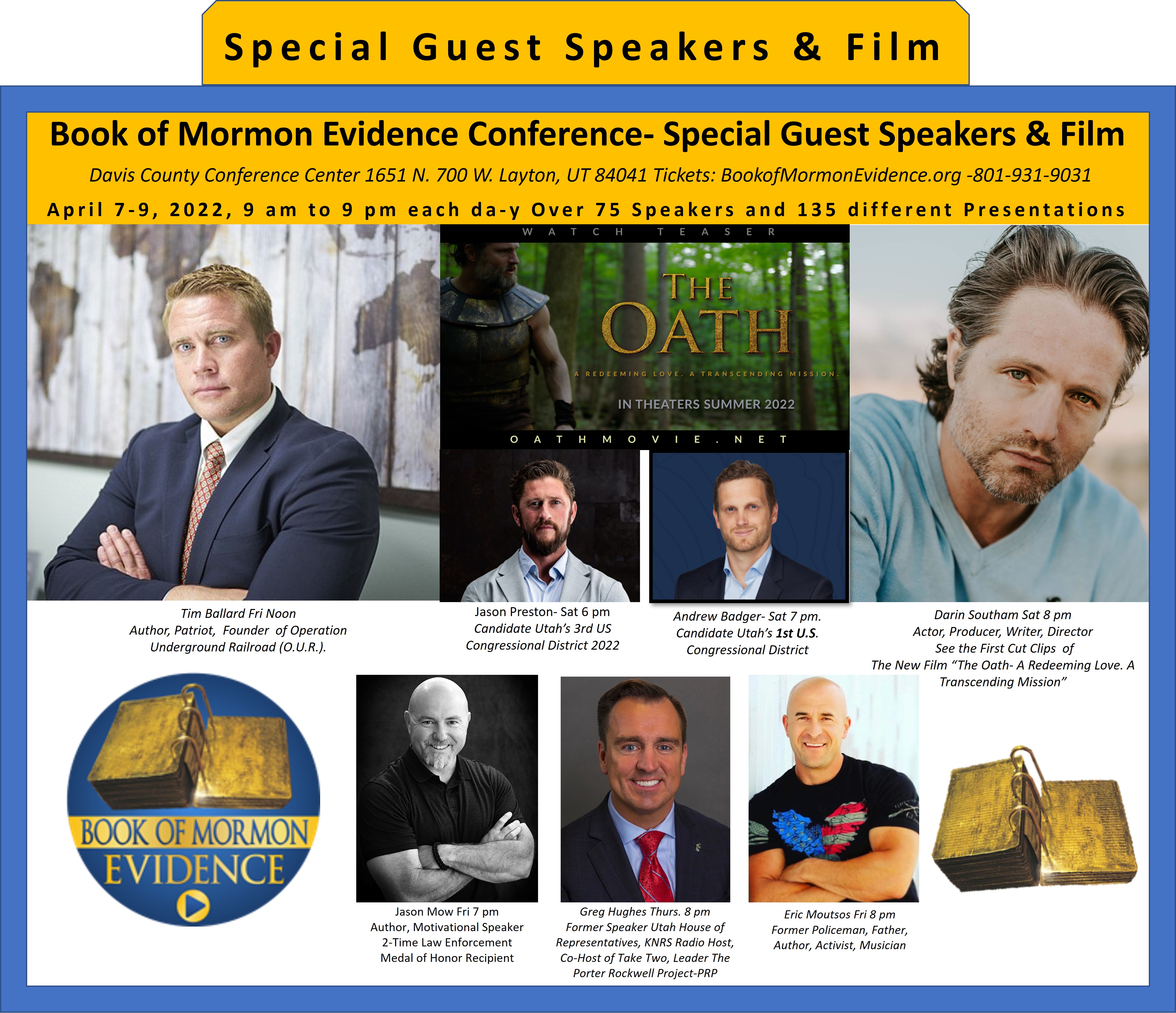
Rod Meldrum and Firm Foundation are looking forward to your participation. We will have over 75 inspirational speakers and over 125 presentations on the following subjects:
Book of Mormon Research U.S. Constitutional Studies Science and Religion Prophecies and Signs of the Times Native American Studies Health and Wellness
Children under 18 are FREE! A Couple Pass may be used for any two adults if you come together. Bring a spouse, friend, older child or come as a couple. No Early Bird discount as tickets are limited. Hurry to guarantee your registration.
Our live event is arriving soon. We are looking forward to your participation. We are expecting a larger crowd than last year in September. This event will have one main stage and 4 additional smaller stages everyday Thurs, Fri, and Sat. Our last speaker will be from 8-9 pm. The ticket registration link is hereto share with your friends and family. There will be no early bird discounts as we may sell out tickets, so please get yours now.
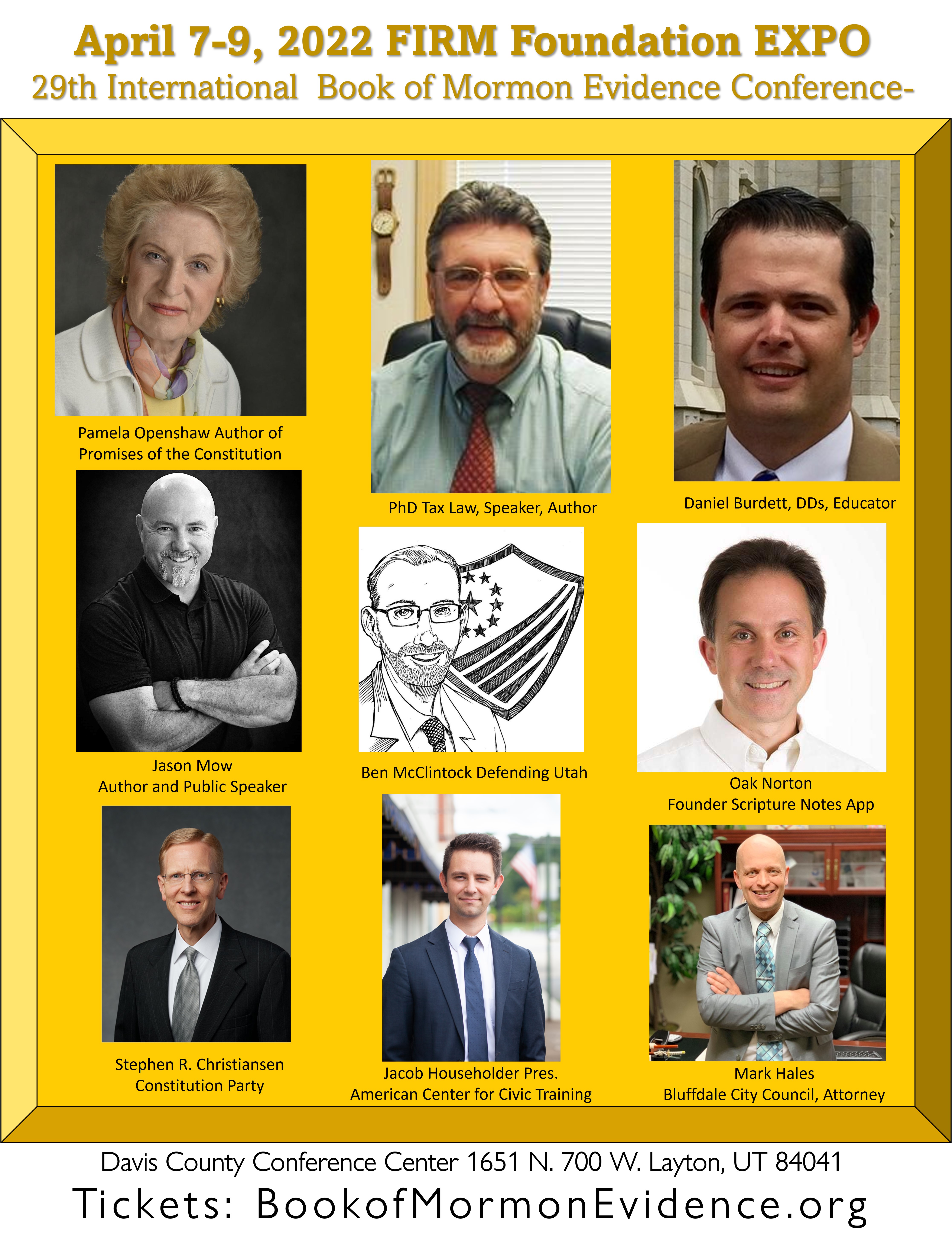
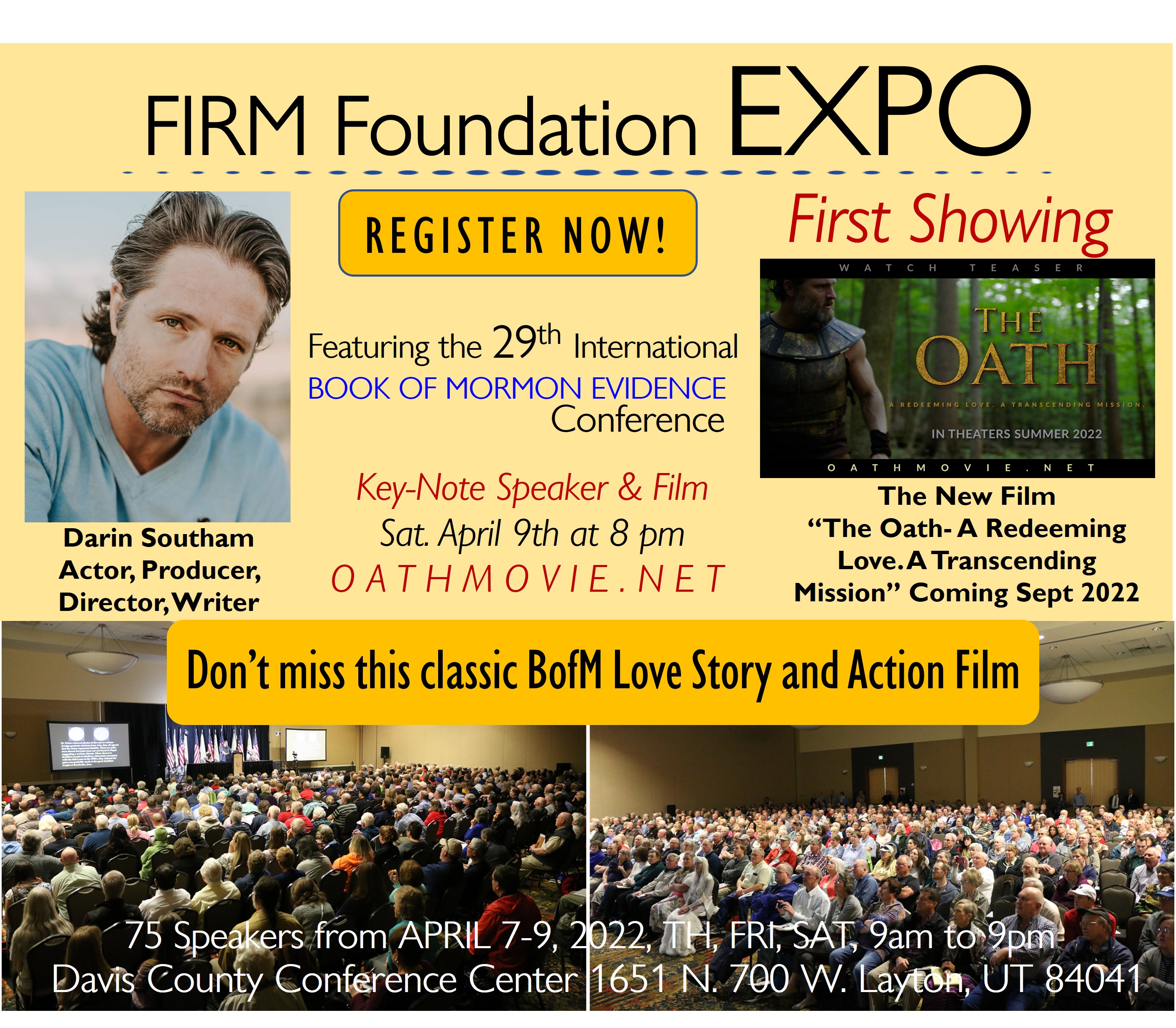
Event:FIRM Foundation Expo featuring the 29th Book of Mormon International Conference Dates: Thurs April 7, Fri April 8, Sat April 9 – From 9 am to 9 pm each day. Place: Davis County Conference Center 1651 N. 700 W. Layton, UT 84041 Directions here:
Important Note to Receive FREE PASSES
If you purchased the Premium for 6- months streaming, you receive one pass for the coming April conference. If you purchased the Premium for 1 year streaming you receive one pass for the coming April conference and one pass for the coming September conference in 2022. Streaming Sign-up here:
Your spouse or guest will need to purchase a separate ticket both times. You can buy the spouse ticket and print your FREE pass at the same checkout place here:
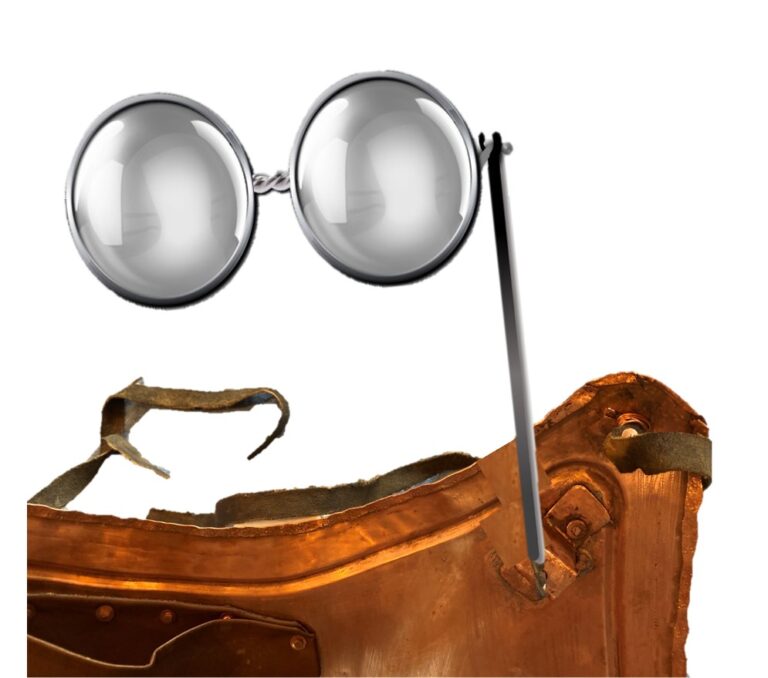
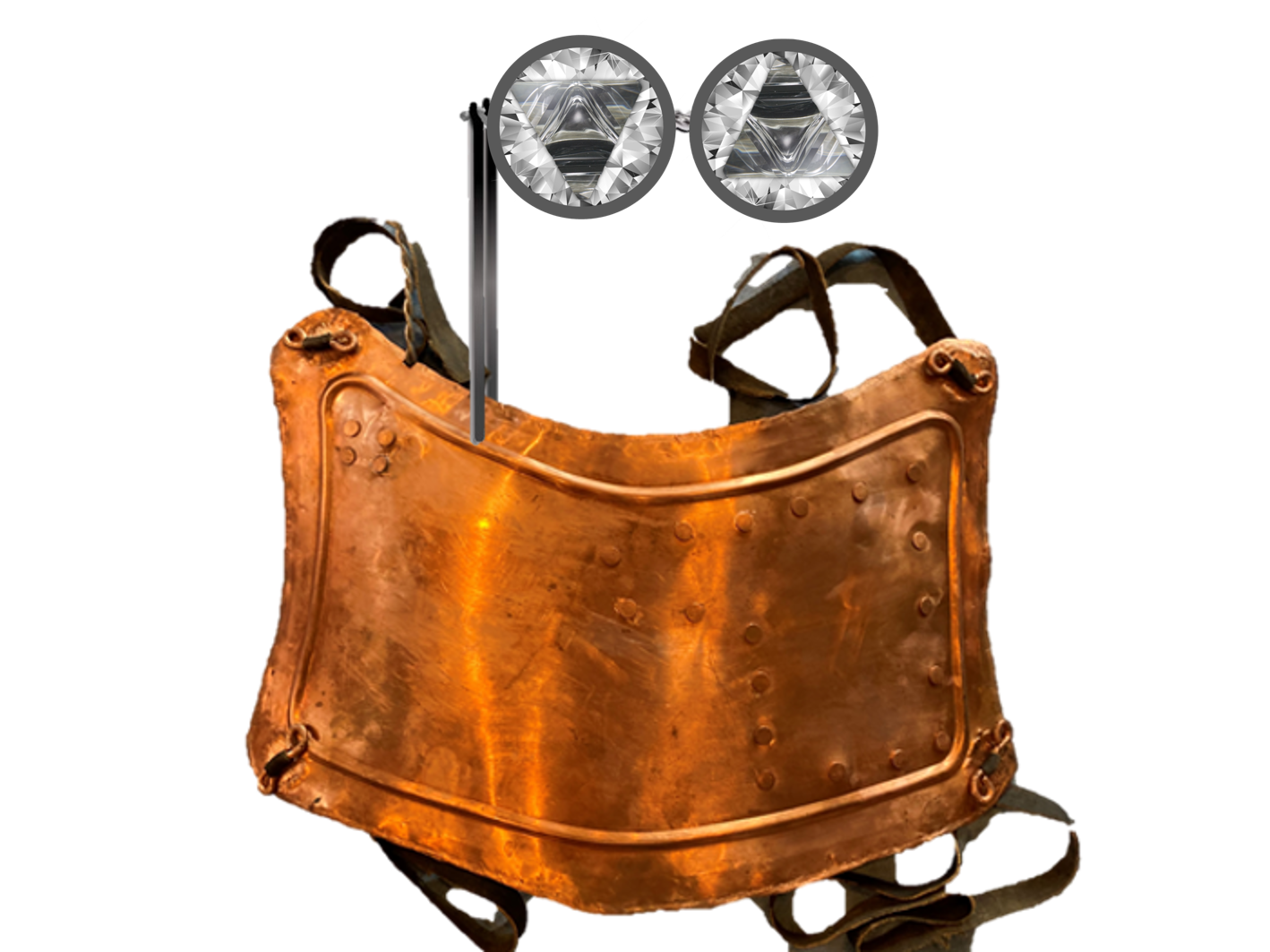
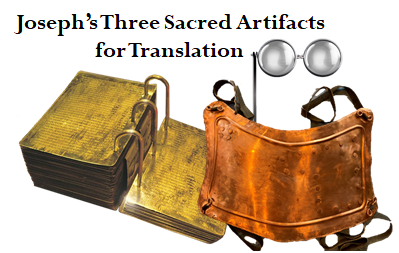
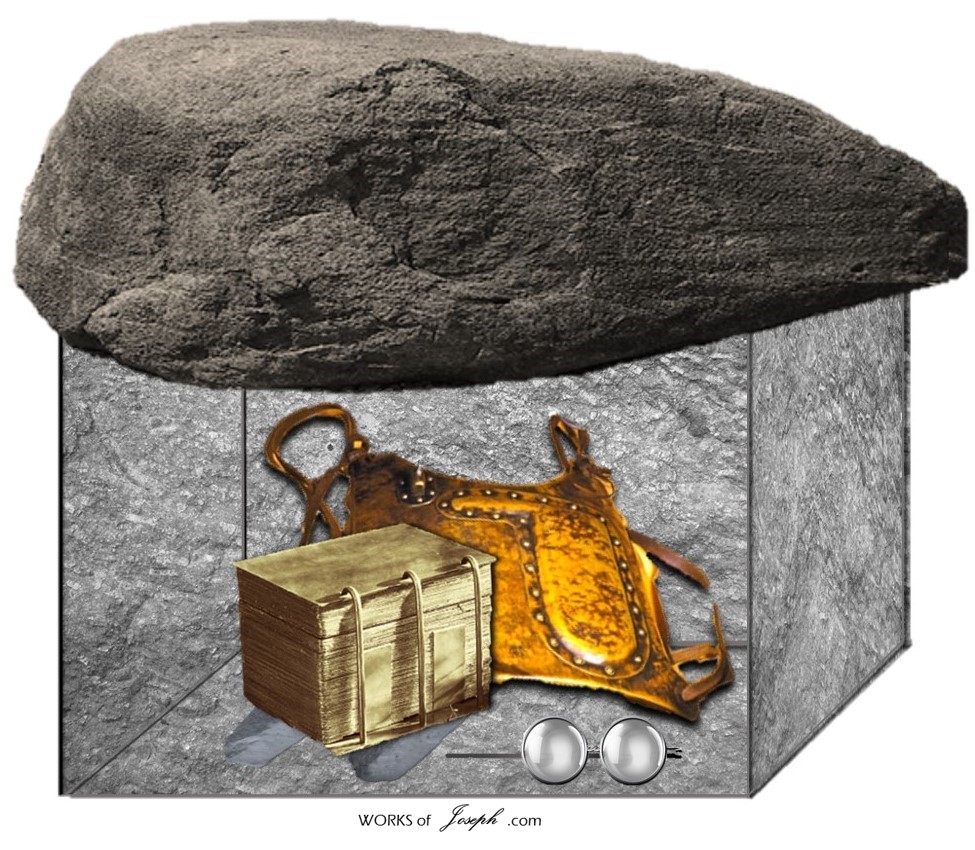
In the entire book of Mormon you will never find the word, Urim and Thummim. It only say Interpreters or Nephite Interpreters. These Interpreters are simply the breastplate and fastened spectacles found in the stone box with the gold plates. It is never mentioned anywhere in the scriptures that a stone in a hat was used. I believe many church Historians are just wrong on this issue. I also believe the two stones in silver bows as described by Joseph himself, originated with the Brother of Jared and handed down to possibly Nephi, but for sure to Mosiah and to Alma to Moroni and finally to Joseph Smith in 1827.
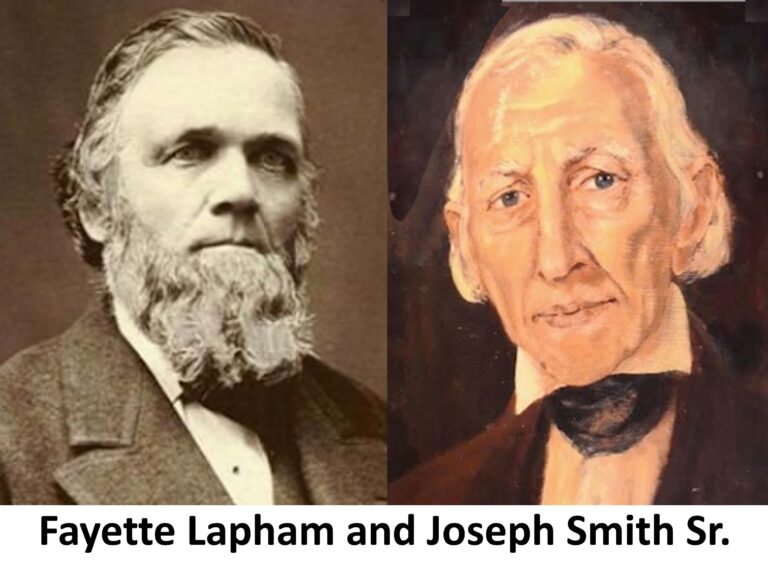
Lucy Mack Smiths Description of the Spectacles
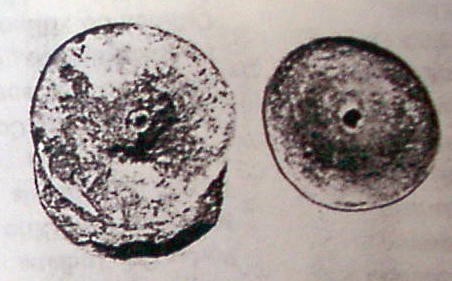
Lucy Mack describes the spectacles, “I knew not what he meant, but took the article in my hands and, examining it with no covering but a silk handkerchief, found that it consisted of two smooth three-cornered diamonds set in glass, and the glasses were set in silver bows connected with each other in much the same way that old-fashioned spectacles are made.” (See picture above left)
“In the opinion of the writer, the Prophet used no seer stone in translating the Book of Mormon, neither did he translate in the manner described by David Whitmer and Martin Harris.” By DR. FRANCIS W. KIRKHAM THE IMPROVEMENT ERA, OCTOBER, 1939
“King Mosiah possessed ‘two stones which were fastened into the two rims of a bow,’ called by the Nephites Interpreters” Doctrines of Salvation, 3:223 (Full Quote at the End)
The Lord provided the Urim and Thummim, which is the large breastplate and the clear spectacles, in the same stone box as the Gold Plates. These are the exact two stones that were touched by the finger of the Lord for the Brother of Jared. The Lord touched 16 stones to guide the barges, (Ether 3:1), but few people understand the Lord touched two additional special stones (Ether 3:23), meant for Joseph Smith to use in 1827.
Other seer stones may have been found by Joseph in a hole or a well but that individual seer stone was not in the stone box, which makes sense that the Lord only gave to Joseph that which was necessary for translating.
Note: As stated above, the name Urim and Thummim is never used in the Book of Mormon, only in the Old Testament and the D&C. In the Book of Mormon, they were called “Interpreters.”
You will be inspired by the witness of a man of God who loved the Book of Mormon. Francis W. Kirkham said, “The Prophet declared in October, 1831, that no one knew the manner of the translation, neither was “it expedient for him to relate these things.” Kirkham spoke about David Whitmer and Martin Harris’ description of translation as, “The statements of both of these men are to be explained by the eagerness of old age“. I trust the word of Joseph Smith and Oliver Cowdery above any others about the true method of translation. Below are their quotes.
Two True Quotes of Proper Translation
-1- “In the Wentworth Letter, the Prophet wrote: “With the records was found a curious instrument, which the ancients called “Urim and Thummim,” which consisted of two transparent stones set in the rim of a bow fastened to a breast plate. Through the medium of the Urim and Thummim I translated the record by the gift and power of God” (History of the Church, 4:537).
-2- In the October 1834 Messenger and Advocate [the Church newspaper in Kirtland, Ohio], Oliver Cowdery wrote: “These were days never to be forgotten to sit under the sound of a voice dictated by the inspiration of heaven, awakened the utmost gratitude of this bosom! Day after day I continued, uninterrupted, to write from his mouth, as he translated, with the Urim and Thummim, or, as the Nephites would have said, ‘Interpreters,’ the history or record called ‘The Book of Mormon’” (Messenger and Advocate, 1:14; Also known as Letter I Oliver Cowdery to William W. Phelps, 7 September 1834).
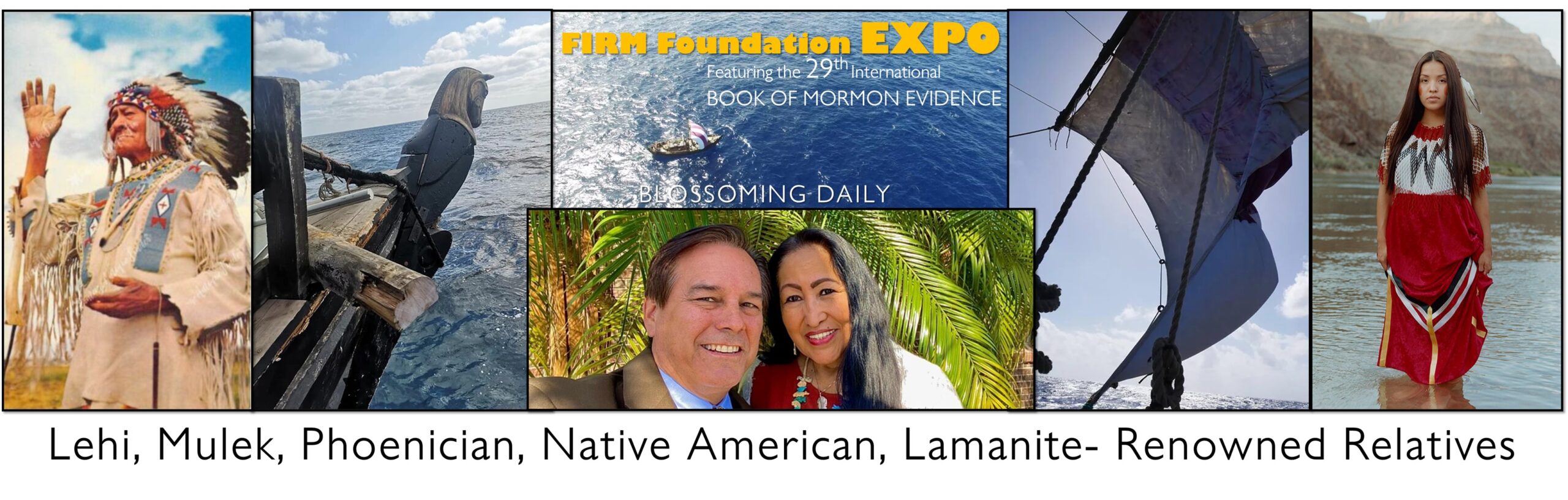
Hear Mike and Betty Lafontaine speak about their newly purchased “Phoenicia Ship” That’s right the original Phoenicia sailed by Philip Beale of England from Oman to Florida in 2009 and from Tunisia to Florida in 2020. The LaFontaine’s and John Lefgren will rebuild it and display it up the Mississippi, where we know the Mulekites who are Jewish lived. Also speaking will be BoydTuttle who sailed for part of the voyage on the Phoenicia in 2020. These will be awesome presentations.
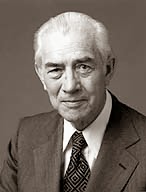
About Francis W. Kirkham
“Francis W. Kirkham occupies a special place among those who have taken pen in hand to write of the Book of Mormon. At a time when others lacked either the opportunity or the inclination to do so, he set out to gather many early documents related to the coming forth of the Book of Mormon—source materials that were still available but in jeopardy of loss or deterioration. He analyzed these sources and compiled them into a work that has had a lasting impact on our understanding of this book of scripture.” By Keith W. Perkins ChurchofJesusChrist.org
“Francis Washington Kirkham (January 6, 1877 – September 14, 1972)[1] was a prominent educator and the author of New Witness For Christ in America: Evidence of Divine Power in the “Coming Forth” of the Book of Mormon, one of the earliest book-length defenses of the authenticity of the Book of Mormon.
Kirkham studied business under James E. Talmage at age 15. He later attended Brigham Young Academy (BYA) and then served a three-year mission for the LDS Church in New Zealand. At the end of his mission, Kirkham wrote a grammar to help new missionaries learn the Māori language. After his mission, Kirkham completed his studies at BYA, graduating in 1904 as the valedictorian.[2]
Francis Kirkham & Martha Alzina Robison
In 1901 Kirkham married Martha Alzina Robison in the Salt Lake Temple. He then worked as a business man in Canada for about three years. After this, he went to the University of Michigan where he earned his bachelor’s degree. Kirkham then taught at Brigham Young University (BYU), which had formerly been BYA, for two years. He next entered law school at the University of Utah, where he was in the law school’s first graduating class. Kirkham pursued graduate studies at Stanford University and then earned his Ph.D. from the University of California, Berkeley.
Kirkham served as president of LDS Business College, head of vocational education for the state of Utah, and superintendent of Granite School District. While in the last position he wrote the book Educating All the Children of All the People. This gained him national attention and led to his appointment as head of the New York City-based National Child Welfare Association.
It was while working from New York that Kirkham did his studies on the Book of Mormon. This was a result of being able to access the newspapers from western New York and north-east Ohio in the time of Joseph Smith. In 1937, Kirkham published a compilation of these works as Source Material on the Book of Mormon. This material also was the main basis for his seminal work, A New Witness For Christ in America. The main argument of this book is built around using contemporary sources to dispute the main non-divine theories on the origin of the Book of Mormon.” From Wikipedia
A New Witness for the Book of Mormon by Francis W. Kirkham
“Near the time of the setting of the sun, Sabbath evening, April 5th, 1829, my natural eyes for the first time beheld this brother. He then resided in Harmony, Susquehanna County, Pennsylvania. On Monday, the 6th, I assisted him in arranging some business of a temporal nature and on Tuesday, the 7th, commenced to write the Book of Mormon. These days were never to be forgotten — to sit under the sound of a voice dictated by the inspiration of heaven, awakened the utmost gratitude of this bosom. Day after day I continued, uninterrupted, to write from his mouth as he translated with the Urim and Thummim, or, as the Nephites would have said, “interpreters,” the history or record called the “Book of Mormon.”
Further on in his narrative Mr. Cowdery, with the apparent Elders, 10 Priests, and 10 Teachers were in conference at the home of Brother Sirenes Burnett, at Orange, Cuyahoga County, Ohio (October 25, 1831 ). In the minutes of this conference the following appears (Far West Record, p. 16):
Brother Hyrum Smith said, “That he thought best that the information of the coming forth of the Book of Mormon be related by Joseph himself, to the Elders present, that all might know for themselves.”
Brother Joseph Smith, Jr., said “That it was not intended to tell the world all the particulars of the coming forth of the Book of Mormon,” and also said, “that it was not expedient for him to relate these things, etc.” A careful reading of the writings of the Prophet including his messages and sermons fails to reveal any further information regarding the manner of the translation of the Book of Mormon,
Explanations have been advanced by students to explain the diction, form, and construction of the language of the book. Reasons for the appearance of quotations from the King James’ Bible in the Book of Mormon have also been given.
Here it is emphasized that the only information left us by the Prophet Joseph Smith and Oliver Cowdery, his scribe, may be stated in a sentence. “Joseph Smith translated the Book of Mormon by the gift and power of God with the aid of the Urim and Thummim from gold plates entrusted to him by Moroni, who being dead was raised again therefrom.“
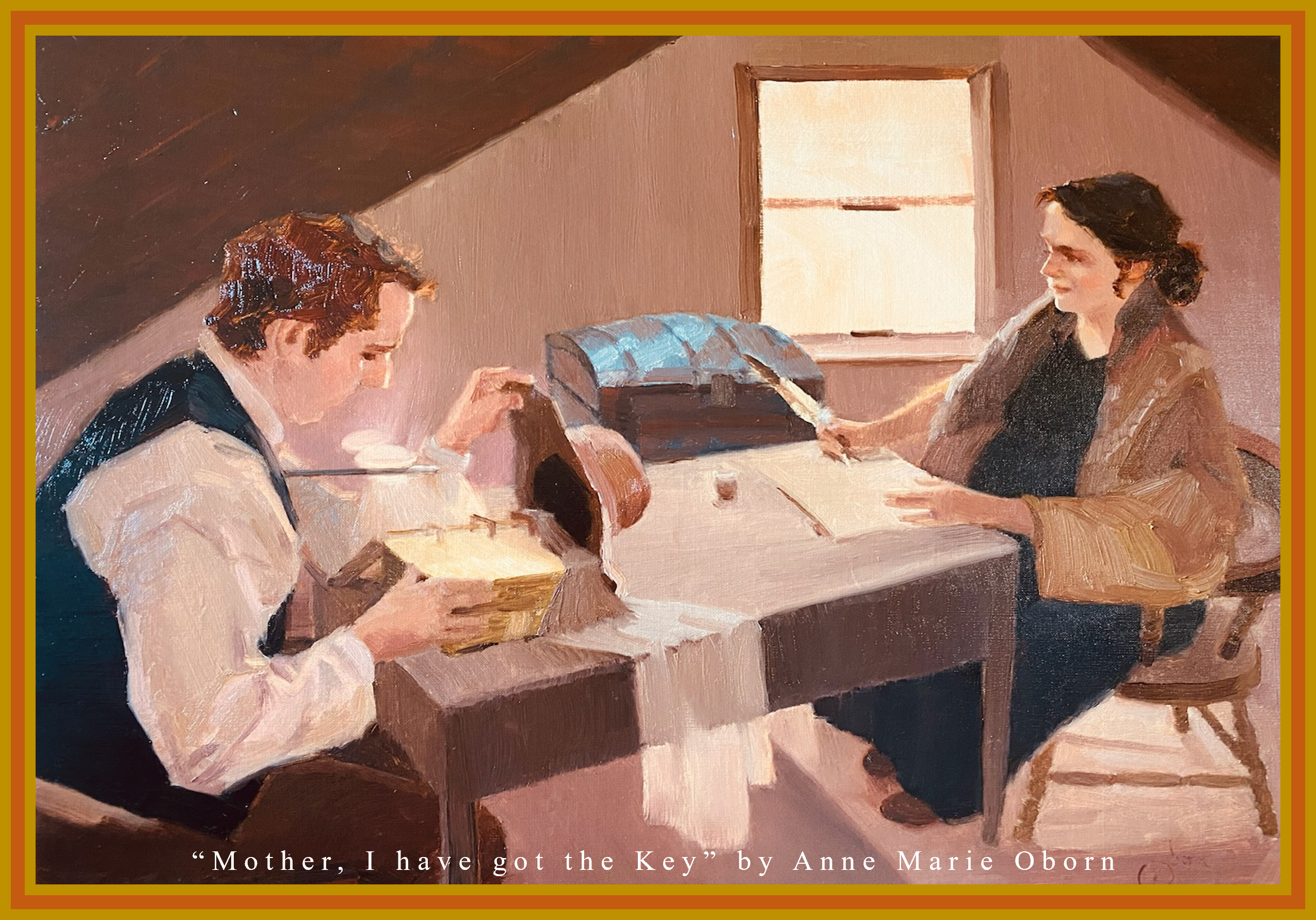
Read about how Joseph Smith wore the breastplate under his shirt, and blocked the vision of the scribe with his farmers hat. A single seer stone was never used to translate the Book of Mormon. Only the spectacles attached to the breastplate were used as seen above in Ann Marie Oborn’s new art. She will be at the Expo with her original pieces. Table #67 FREE PDF Here:
Final Word on the Translation from Francis W. Kirkham
“Both David Whitmer and Martin Harris knew positively that they had been shown the plates by Moroni and had so declared since the time of the experience, but the Prophet declared in October, 1831, that no one knew the manner of the translation, neither was “it expedient for him to relate these things.” ( See quotation above. ) When both these men were past eighty years of age, and about fifty years after the event, they undertook to describe the manner of translation, which Elder Brigham H. Roberts has clearly shown is not in harmony with the manner indicated in Section 8 of the Doctrine and Covenants. (See New Witness for God, Vol. II, pages 106- 133 by B. H. Roberts.) Moreover, they refer to the use of a seer stone by the Prophet. But no publication during his life contains such a statement.
A neighbor, Willard Chase, asserted Joseph stole a “singularly appearing stone” which he had found in 1822 when Joseph and his brother Alvin were employed by him in digging a well. “Joseph put it into his hat and then his face into the top of his hat . . . alleging that he could see in it.” — Mormonism Unveiled, Anti-Mormon Book. Eber D. Howe, 1834.
This is an attempt to explain the alleged power of Joseph Smith to translate the plates by a person who denounced him as a fraud and an ignorant deceiver.
In the opinion of the writer, the Prophet used no seer stone in translating the Book of Mormon, neither did he translate in the manner described by David Whitmer and Martin Harris. The statements of both of these men are to be explained by the eagerness of old age to call upon a fading and uncertain memory for the details of events which still remained real and objective to them.” By DR. FRANCIS W. KIRKHAM THE IMPROVEMENT ERA, OCTOBER, 1939
Additional Evidence that Joseph Used the Urim and Thummim only, to translate.
“The Prophet Joseph Smith used the same Urim and Thummim that was “given to the brother of Jared upon the mount, when he talked with the Lord face to face” (D&C 17:1). President Joseph Fielding Smith wrote a brief history regarding the Urim and Thummim: “King Mosiah possessed ‘two stones which were fastened into the two rims of a bow,’ called by the Nephites Interpreters, with which he translated the Jaredite record [Mosiah 28:11–14], and these were handed down from generation to generation for the purposes of interpreting languages. How Mosiah came into possession of these two stones or Urim and Thummim the record does not tell us, more than to say that it was a ‘gift from God’ [Mosiah 21:28]. Mosiah had this gift or Urim and Thummim before the people of Limhi discovered the record of Ether. They may have been received when the ‘large stone’ was brought to Mosiah with engravings upon it, which he interpreted by the ‘gift and power of God’ [Omni 1:20–21]. They may have been given to him, or to some other prophet before his day, just as the Brother of Jared received them—from the Lord. “That the Urim and Thummim, or two stones, given to the Brother of Jared were those in the possession of Mosiah appears evident from Book of Mormon teachings. The Brother of Jared was commanded to seal up his writings of the vision he had when Christ appeared to him, so that they could not be read by his people. … The Urim and Thummim were also sealed up so that they could not be used for the purpose of interpreting those sacred writings of this vision, until such time as the Lord should grant to man to interpret them. When they were to be revealed, they were to be interpreted by the aid of the same Urim and Thummim [Ether 3:21–28]. …“Joseph Smith received with the breastplate and the plates of the Book of Mormon, the Urim and Thummim, which were hid up by Moroni to come forth in the last days as a means by which the ancient record might be translated, which Urim and Thummim were given to the Brother of Jared [D&C 17:1]” (Doctrines of Salvation, 3:223–25).
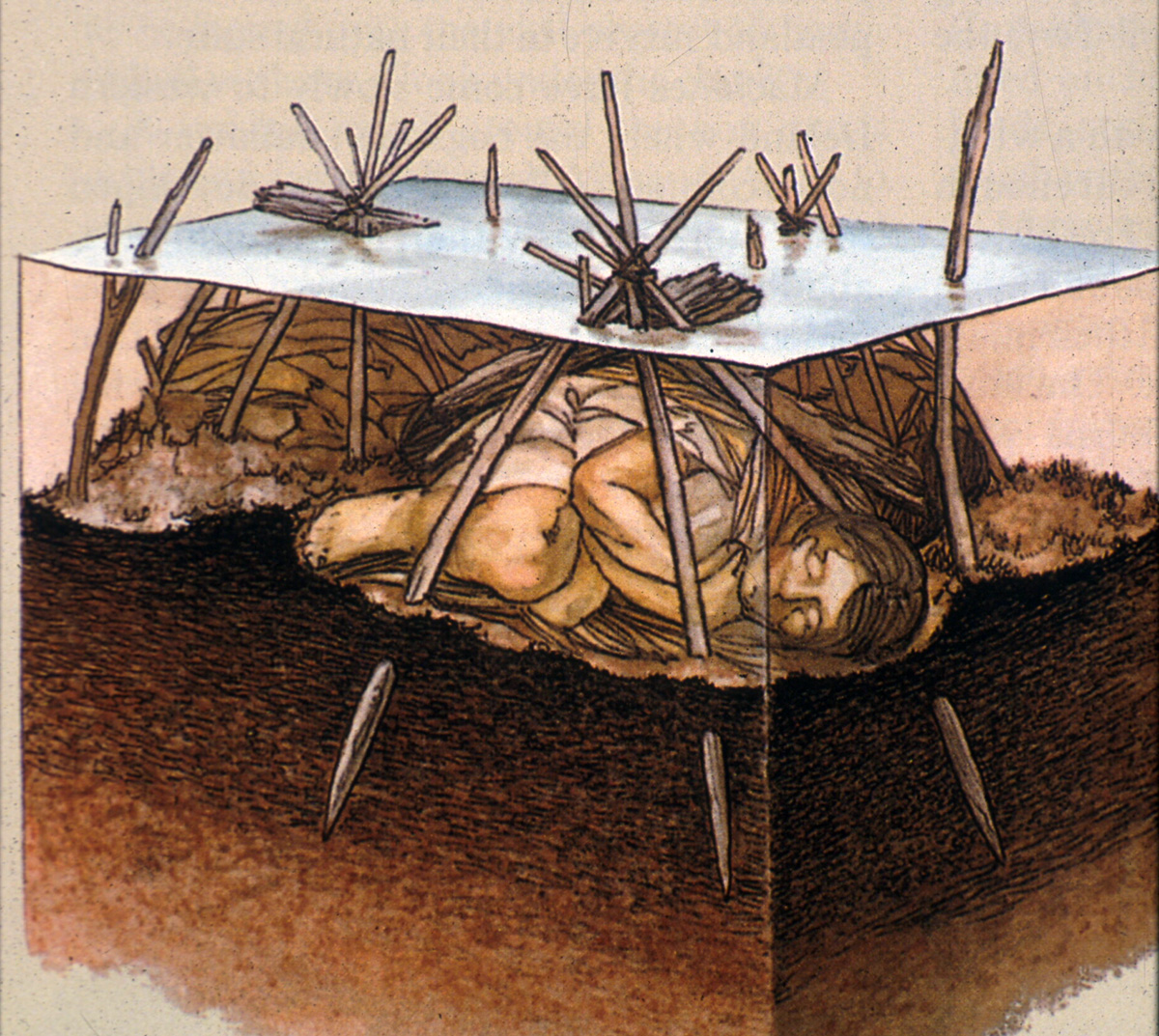
“The manner in which the plates were deposited: First, a hole of sufficient depth, (how deep I know not) was dug. At the bottom of this was laid a stone of suitable size, the upper surface being smooth. At each edge was placed a large quantity of cement, and into this cement, at the four edges of this stone, were placed, erect, four others, their bottom edges resting in the cement at the outer edges of the first stone. The four-last named, when placed erect, formed a box, the corners, or where the edges of the four came in contact, were also cemented so firmly that the moisture from without was prevented from entering. It is to be observed, also, that the inner surface of the four erect, or side stones was smoothe. This box was sufficiently large to admit a breast-plate, such as was used by the ancients to defend the chest, &c. from the arrows and weapons of their enemy. From the bottom of the box, or from the breast-plate, arose three small pillars composed of the same description of cement used on the edges; and upon these three pillars was placed the record of the children of Joseph, and of a people who left the tower far, far before the days of Joseph… I must not forget to say that this box, containing the record was covered with another stone, the bottom surface being flat and the upper, crowning. But those three pillars were not so lengthy as to cause the plates and the crowning stone to come in contact. I have now given you, according to my promise, the manner in which this record was deposited; though when it was first visited by our brother, in 1823, a part of the crowning stone was visible above the surface while the edges were concealed by the soil and grass, from which circumstances you will see, that however deep this box might have been placed by Moroni at first, the time had been sufficient to wear the earth so that it was easily discovered when once directed, and yet not enough to make a perceivable difference to the passer-by.” Oliver Cowdery, “Letter VIII,” October 1835
Since my last post on the Newark Holy Stones in 2019 we have found additional evidence from Scott E. Meyer of Northwestern University, and Dr. Arnold Fischel called “Newark” Ritual Artifacts By Rochelle I. Altman January 2004. She quotes saying, “If you found a US penny in a trench at a dig that was assumed to contain only ancient items, you wouldn’t claim the penny to be a forgery when you saw it. First, however, you would have to recognize that it’s a penny. Anon. Also see page 545 in the Annotated Book of Mormon.https://www.bofm.blog/additional-evidence-newark-holy-stones/ You can also read my blog at https://bookofmormonevidence.org/america-unearthed-holy-stone-analysis/
“In 1867, David M. Johnson, a banker who co-founded the Johnson-Humrickhouse Museum, in conjunction with Dr. N. Roe Bradner, M.D., of Pennsylvania, found a fifth stone, in the same mound group south of Newark in which Wyrick had located the Decalogue. The original of this small stone is now lost, but a lithograph, published in France, survives.
The “Holy” Stones Found Near Newark, Ohio Dr. Yitzchok Levine Department of Mathematical Sciences Stevens Institute of Technology Hoboken, NJ 07030 [email protected]
“The letters on the lid and base of the Johnson-Bradner stone are in the same peculiar alphabet as the Decalogue inscription, and appear to wrap around in the same manner as on the Decalogue’s back platform.
“The independent discovery, in a related context, by reputable citizens, of a third stone bearing the same unique characters as the Decalogue stone, strongly confirms the authenticity and context of the Decalogue Stone, as well as Wyrick’s reliability.”7 Dr. Yitzchok Levine Department of Mathematical Sciences Stevens Institute of Technology Hoboken, NJ 07030 [email protected]More Here:
As our friend Wayne May says, We Report, You Decide! Additional Resources: The following articles have links to many additional sources and information.
Forensic geologist Scott Wolters, star of the History2 Channel’s hit series America Unearthed, meets professor Hugh McCullough at the Johnson Humrickhouse Museum in Coshocton, Ohio to conduct an analysis on the Ohio Decalogue stone. Previously (March 2020) I shared the following information called, ANCIENT HEBREW ARTIFACTS IN THE UNITED STATES here: https://www.bofm.blog/ancient-hebrew-artifacts-in-the-united-states
Book of Mormon Evidence Conference
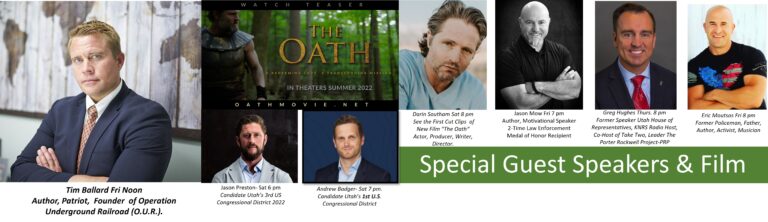
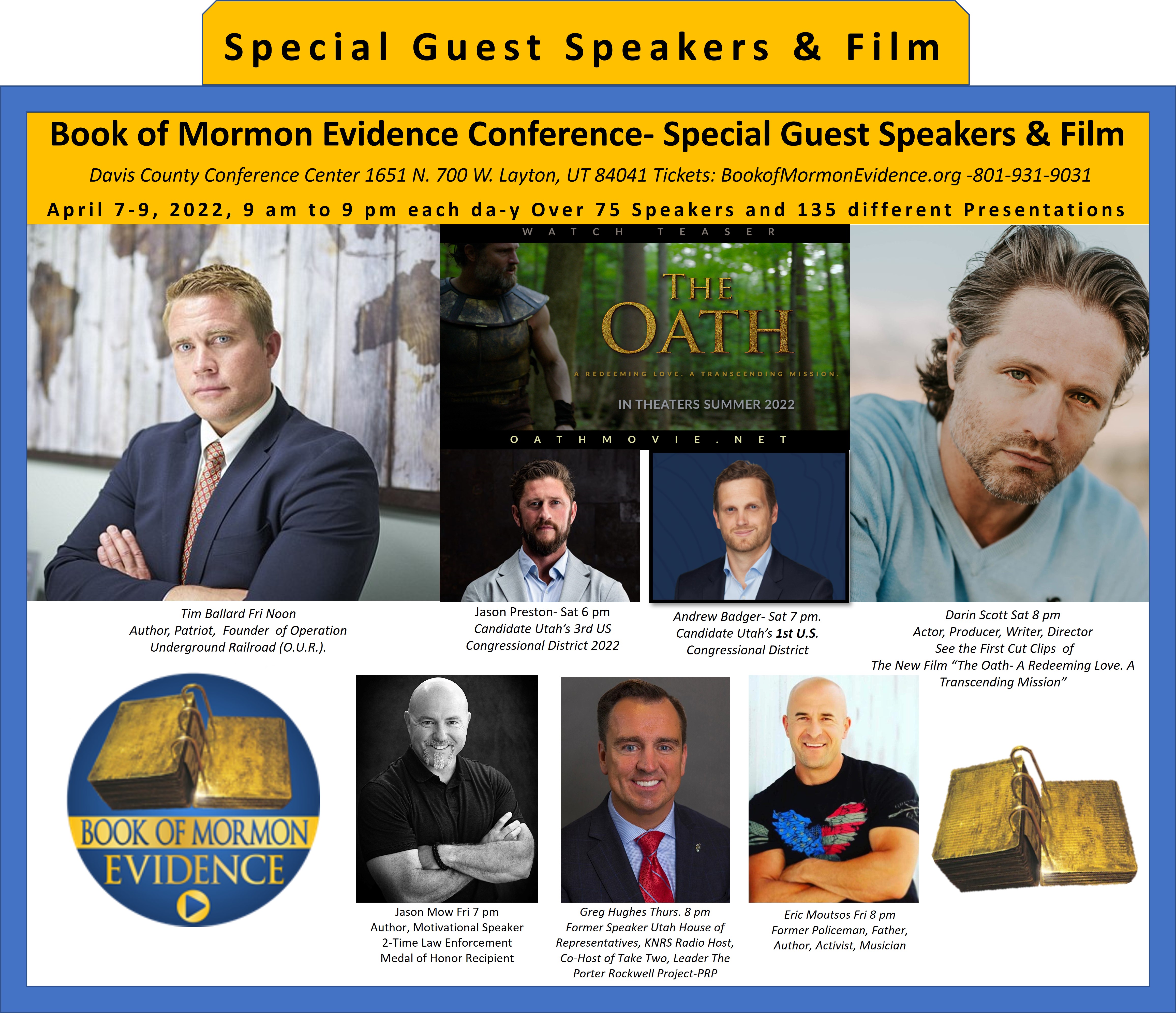
As our FIRM Foundation Conference begins in a few weeks, you can lean about the new ideas and witnesses of our speakers, who have discovered new knowledge that you will enjoy. Rod Meldrum Wayne May Tim Ballard, Darin Scott, Pamela Openshaw Lonnie Crocket, Shannon Tracy, Hannah Stoddard, Jonathan Neville, Betty and Mike LaFontaine, and another 80 speakers.
See complete schedule with times and titles of all of the presentations. Times and Speakers May ChangeClick Picture for Tickets
As you attend our conference and listen to these wonderful speakers, remember our dear Prophet, Russell M Nelson has said, Does God really want to speak to you? Yes! “As well might man stretch forth his puny arm to stop the Missouri river in its decreed course … as to hinder the Almighty from pouring down knowledge from heaven upon the heads of the Latter-day Saints.”
You don’t have to wonder about what is true. You do not have to wonder whom you can safely trust. Through personal revelation, you can receive your own witness that the Book of Mormon is the word of God, that Joseph Smith is a prophet, and that this is the Lord’s Church. Regardless of what others may say or do, no one can ever take away a witness borne to your heart and mind about what is true.
I urge you to stretch beyond your current spiritual ability to receive personal revelation, for the Lord has promised that “if thou shalt [seek], thou shalt receive revelation upon revelation, knowledge upon knowledge, that thou mayest know the mysteries and peaceable things—that which bringeth joy, that which bringeth life eternal.” Revelation for the Church, Revelation for Our Lives by President Russell M. Nelson
New Information
Just today 26 March 2022, I received a nice email from my friend Leslie Rees who is always sharing interesting articles with me. The one below has great information on how the world sees what the Heartlanders already0 know, as they get some things wrong, but the world is waking up and people today want answers. That’s why the Lord said to Joseph Smith, “How long can rolling waters remain impure? What power shall stay the heavens? As well might man stretch forth his puny arm to stop the Missouri river in its decreed course, or to turn it up stream, as to hinder the Almighty from pouring down knowledge from heaven upon the heads of the Latter-day Saints.” D&C 121:33
We Latter-day Saints have been blessed with an amazing deluge of new information poured down to us by the Lord in helping to wake up a world that needs to depend on God, and not on man. Today we are in a total war of good vs. evil. These new truths will assist us in bringing others back to the Lord.
When Europeans first glimpsed Native Americans more than 400 years ago, many were convinced they had discovered the Lost Tribes of Israel. At closer look, the connections are astounding. This hidden association has taken on greater importance recently as the two nations face similar threats, and perhaps even a common Messianic vision quest. Unmistakable traces of Jewish prayer echo in the voice of Joseph Riverwind, the Amahura (war chief) of the Northern Arawak Nation, the indigenous peoples of South America and Caribbean, as he sings, “Shema, shema, nayena, popaska hoya yah”. He translated this ancient Native American song for Breaking Israel News: “Listen, listen, people, as you gather together, we will dance before the creator.” This is strongly reminiscent of the Jewish prayer, Shema, which literally means ‘hear’. These two worlds are embodied in Chief Riverwind, a descendant of both Native Americans and Bnei Anousim (Jews who hid their identity as a result of the Spanish Inquisition). For him, the connection between Native Americans and Judaism is clear.
Kacike AmaHura, or Joseph RiverWind (Northern Arawaktaino)
“Among my people, our ancient name for God is Yah Yah ‘The Supreme Spirit of Spirits’, very similar to Yahweh,” Chief Riverwind explained. “Among my wife’s ancestors, the AniKituwahYah (Cherokee), they called God YoHeWaH. And the similarities don’t stop there. They carried an ark into battle, celebrate seven feasts, kept a seventh day of rest, had cities of refuge, and don’t eat pork.” Though the eerie etymological similarities may be coincidental, archetypal themes also connect the spirituality of Native Americans to the Bible. Chief Riverwind told a Choctaw story about how the Creator came to a man called Nuah and told him the world would be covered with water. The man was told to make a great raft to save mankind. The stories come from oral traditions which date to pre-Columbian times.
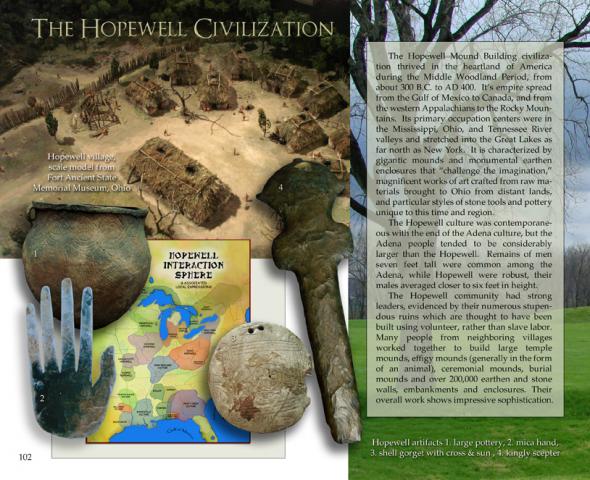
“Another Native American story tells of a time when the world was all one land mass, and we were all one tribe,” explained Chief Riverwind. “We tried to build a sky tower to the creator. These are pre-missionary oral traditions. They are passed down through specially trained storytellers who are forbidden from changing a single word.” This transoceanic cultural connection goes against most scientific theories about the origins of the Native Americans. Most anthropologists theorize that the Native Americans are descended from Siberian Mongolians who migrated to North America via the Bering Strait, a 50-mile-wide gap that separates Alaska from Russia. Chief Riverwind told Breaking Israel News that the Native Americans tell a very different story. “Some Anishnabi (Chippewa) believe they are from the Tribe of Ephraim,” Chief Riverwind explained. “Anishnabi” is amazing similar to the Hebrew words, “Anshe Navi” (people of the Prophet). “They lived on the coast, but their legends say that before that, they came from across the great waters. We have cave-drawings of these ships that are very similar to drawings of Phoenician ships in history books.” This theory is astounding, but archaeological artifacts connecting North America to ancient Israel are not uncommon. The Decalogue Stone found in New Mexico is an 80-ton boulder on which an abridged version of the Ten Commandments is inscribed in ancient paleo-Hebrew. A letter group resembling the tetragrammaton YHWH, or “Yahweh,” makes three appearances. The stone is controversial and has never been tested in a laboratory or dated by scientific means. If authentic, it would prove a pre-Columbian connection between North America and Israel. The Newark Holy Stones are artifacts discovered in 1860 within a cluster of ancient Indian burial mounds near Newark, Ohio. The mounds are one of the largest collections from an ancient American Indian culture known as the Hopewell that existed from approximately 100 BCE to 500 CE. Similar to the Decalogue stone, the Newark Stones are inscribed with Bible verses in Hebrew. Many of these artifacts are discounted as hoaxes based on circumstantial evidence, the improbability of their existence and what it implies, despite strong corroborating empirical proof of their validity. Chief Riverwind attributes this simply to ethnocentric tendencies.
Decalogue Stone with ten commandments written in Paleo-Hebrew, located in New Mexico. (Wikimedia Commons)
“European historians have always underestimated so much of what was going on here before Columbus,” he stated. “They simply can’t imagine men sailing from Israel to North America, even when they are holding the proof in their hands.” Roni Segal, the academic adviser for eTeacher, an online language academy, was fascinated by the possible connection. “Paleo-Hebrew dates back to the tenth century BCE. The language itself is a key to many ancient mysteries,” she told Breaking Israel News. “Though these discoveries are surprising, when studying the language that was used by God to communicate with Man, these types of connections are not entirely unexpected.” Chief Riverwind feels this connection is especially important today. “These are things we didn’t share in public before. Now, I really feel there is something stirring in the air. It isn’t by chance that the Native Americans are facing a huge propaganda campaign at the same time as the Jews in Israel are being told they aren’t indigenous,” he stated. “The Native Americans suffered ethnic cleansing and that is what they want to do to the Jews. We have that in common, and it is happening now.” Many would be surprised to learn that the Native Americans also have a messianic vision. Despite being expressed in different terms, it is similar indeed to what Jews believe. “First Nations have many prophecies that have been passed down for generations. We know that in the long ago time, the Creator destroyed the earth with water, and today, we are living in the generations when the fires will come to purify the Earth,” Chief Riverwind related. “Your people’s ancient stories can be found among my peoples ancient stories and we share the same destiny. Many of us have called upon the same Elohim since ancient times, and in the End, all the tribes that have been scattered will be gathered together once again.” Read more of my posts about the Hebrew Artifacts found all over North America Here;
The purpose of this blog today is to help us each understand the challenges, wars, and evils of our day, in order to avoid these things at any cost. Of course many things are beyond our control, but we can control ourselves, and assist to manage our family and the affairs of our daily life. When we stay in tune with what the Lord wants we as individuals and families may be blessed even during local or worldwide calamities.
It is never wise to judge other people or nations, but we must try and understand both sides and then do what we can to help in each situation. If we or our country is on the wrong side of truth, may we help through prayer and service on either side of the difficulties.
The conflict in Ukraine has two or three or even four versions of the truth. If Putin invaded Ukraine as an evil tyrant of course that is wrong and he should be punished. If Ukraine had dangerous bio labs and they were promoting evil on Russia’s border, I can understand the people of Russia to be in fear and protect themselves. There may be a third issue as well. If true, why is the United States paying our taxpayer money for bio labs in a foreign country? Only through much prayer and study can we each know the real truth. How about a fourth issue? What if the Government of Ukraine is controlled by evil forces that doesn’t care if Russia or Ukraine win. This evil government could be outsiders who are in this game for power over both countries and wants the money and resources of both sides? Big dilemma and we must not judge. Seek first to understand and then to be understood.
As I have titled this blog, War is a Racket. Who is doing what? Who or what are doing things for the money or power? In most conflicts there is one side who seems to come out better in the end. Watch the Money and Power issue at the end of the conflict and you will know the real reason for wars and rumors of wars. It’s Satan’s way of keeping the world under his control. He wants war and the Lord wants peace. Are we humbling ourselves to learn from these tragedies?
After all the question should not be, why do these things happen?, but what can I learn from these conflicts? How can I be part of the solution and not judge incorrectly? The purpose of this life is not to ask why during trials, but to say “please Lord, help me grow from this experience.”
As the Church has explained, we love all of God’s people and it is hard to take a side. This is not a war between Russia and Ukraine, or a war between the U.S. and Russia, but a war of good vs. evil. Who is on the Lord’s side?
Hear some amazing insight from over 75 inspirational speakers with sound advise how to avoid war, stay in control of our own lives, bless our country, understand prophecy, and how to rely on the Lord in all ways.
“The Lord has said that in the last days there will be “wars and rumors of wars, and the whole earth shall be in commotion, and men’s hearts shall fail them” (Doctrine and Covenants 45:26). As members of The Church of Jesus Christ of Latter-day Saints, we are a people of peace. We follow the Savior, who is the Prince of Peace. We look forward to His millennial reign, when wars will end and peace will be restored to the earth (see Isaiah 2:4). However, we recognize that in this world, government leaders sometimes send military troops to war to defend their nations and ideals.
Latter-day Saints in the military do not need to feel torn between their country and their God. In the Church, “we believe in being subject to kings, presidents, rulers, and magistrates, in obeying, honoring, and sustaining the law” (Articles of Faith 1:12). Military service shows dedication to this principle.
If Latter-day Saints are called upon to go into battle, they can look to the example of Captain Moroni, the great military leader in the Book of Mormon. Although he was a mighty warrior, he “did not delight in bloodshed” (Alma 48:11). He was “firm in the faith of Christ,” and his only reason for fighting was to “defend his people, his rights, and his country, and his religion” (Alma 48:13). If Latter-day Saints must go to war, they should go in a spirit of truth and righteousness, with a desire to do good. They should go with love in their hearts for all God’s children, including those on the opposing side. Then, if they are required to shed another’s blood, their action will not be counted as a sin.” https://www.churchofjesuschrist.org/study/manual/gospel-topics/war?lang=eng
First Presidency Statement on Armed Conflict
25 February 2022 – Salt Lake City Official Statement
Church leaders plead that “peace will prevail among nations and within our own hearts”
The First Presidency of The Church of Jesus Christ of Latter-day Saints has issued the following statement:
We are heartbroken and deeply concerned by the armed conflict now raging. The Church of Jesus Christ of Latter-day Saints has members in each of the affected areas and throughout the world. Our minds and hearts have been turned toward them and all our brothers and sisters.We continue to pray for peace. We know that enduring peace can be found through Jesus Christ. He can calm and comfort our souls even in the midst of terrible conflicts. He taught us to love God and our neighbors.We pray that this armed conflict will end quickly, that the controversies will end peacefully and that peace will prevail among nations and within our own hearts. We plead with world leaders to seek for such resolutions and peace. The First Presidency https://newsroom.churchofjesuschrist.org/article/first-presidency-statement-armed-conflict
Ezra Taft Benson
“We honor these partners [friends outside the Church] because their devotion to correct principles overshadowed their devotion to popularity, party, or personalities.
We honor our founding fathers of this republic for the same reason. God raised up these patriotic partners to perform their mission, and he called them “wise men.” (see D&C 101:80.) The First Presidency acknowledged that wisdom when they gave us the guideline a few years ago of supporting political candidates “who are truly dedicated to the Constitution in the tradition of our Founding Fathers.” (Deseret News, November 2, 1964.)
Our wise founders seemed to understand, better than most of us, our own scripture, which states that “it is the nature and disposition of almost all men, as soon as they get a little authority . . . they will immediately begin to exercise unrighteous dominion.” (D&C 121:39.)
To help prevent this, the founders knew that our elected leaders should be bound by certain fixed principles. Said Thomas Jefferson: “In questions of power, then, let no more be heard of confidence in man, but bind him down from mischief by the chains of the Constitution.”
These wise founders, our patriotic partners, seemed to appreciate more than most of us the blessings of the boundaries that the Lord set within the Constitution, for he said, “And as pertaining to law of man, whatsoever is more or less than this, cometh of evil.” (D&C 98:7.)
In God the founders trusted, and in his Constitution — not in the arm of flesh. “O Lord,” said Nephi, “I have trusted in thee, and I will trust in thee forever. I will not put my trust in the arm of flesh; . . . cursed is he that putteth his trust in man or maketh flesh his arm.” (2 Nephi 4:34.)” Ezra Taft Benson https://www.latterdayconservative.com/quotes/ezra-taft-benson/
“We, the blessed beneficiaries of the Constitution, face difficult days in America, “a land which is choice above all other lands” (Ether 2:10).
May God give us the faith and the courage exhibited by those patriots who pledged their lives, their fortunes, and their sacred honor. May we be equally as valiant and as free.” ( Source: “Our Divine Constitution” 6-7Ezra Taft Benson
Quarter of a Million Nephite Soldiers Killed
“Moroni’s father was commander of the armies of this ancient people, known as Nephites. His name was Mormon. The war of which we speak took place here in America some four hundred years after Christ. (See Mormon 6.) As the fighting neared its end, Mormon gathered the remnant of his forces about a hill which they called Cumorah, located in what is now the western part of the state of New York. Their enemies, known as Lamanites, came against them on this hill…
He accounted for about a quarter of a million Nephite soldiers killed in that final encounter at Cumorah….
When finished with the record, Moroni was to hide it up in that same Hill Cumorah which was their battlefield. It would come forth in modern times as the Book of Mormon…
Had not the Lord said to them, as he says to us now, that America is a choice land and that those who live here must obey God or be swept off? And had he not kept his word to those rebellious Nephites, now totally wiped out? So it is that today’s archaeologists find the ruins which are silent witnesses to the greatness that once was theirs….
He made it clear that advance warning is given to us who live today through the very book which he and his father had written and which he was now about to bury in Cumorah. It would be published in our day to give us that warning….
It should be remembered that these men wrote to us out of the desperation of the event they were passing through as the Nephites were being wiped off the face of the earth. They knew that we live here now under the same conditions that were given to them….
His people were Americans, too. His words constituted a people-to-people message, ancient Americans speaking to modern Americans. Theirs was the voice of bitter experience seeking to persuade us to avoid the dreadful conditions which engulfed them….
The last words of Moroni! Dare we forget them? God grant that we never will, I pray in Jesus’ name. Amen.” The Last Words of Moroni Mark E. Petersen Oct 1978
Mormon’s Sad and Gloomy Picture
“It was likewise stated to me by David Whitmer in the year 1877 that Oliver Cowdery told him that the Prophet Joseph and himself had seen this room and that it was filled with treasures, and on the table therein were the breastplate and the sword of Laban, as well as the portion of gold plates not yet translated, and that these plates were bound by three small gold rings, and would also be translated, as was the first portion in the days of Joseph. When they were translated much useful information will be brought to light. But till that day arrives, no Rochester adventurers shall ever see them or the treasures, although science and mineral rods testify that they are there. At the proper time when greed, selfishness and corruption shall cease to reign in the hearts of the people, these vast hoards of hidden treasure shall be brought forth to be used for the cause of the kingdom of Christ.
Before leaving the prophet Mormon standing on the hill in his lamentation, let us still extend the vision over the great battlefield . . . Only for a moment imagine that we see the camp just before the great battle: twenty-three camps each of 10,000 with a general at their head, would be required for the 230,000 soldiers. While I was standing upon this spot of ground [the New York Hill Cumorah] about three years ago, my mind contrasted the various changes of the present with the past and I fancied that I could review, as did Mormon, the sad and gloomy picture of his time, 1472 years ago. The fathers of those who fell around this historic hill came from Jerusalem 600 years B.C.” Edward Stevenson Reminiscences of Joseph the Prophet and the Coming Forth of the Book of Mormon (S. L. C.: Edward Stevenson, 1893), pp. 14-15.
U.S. Under Secy. Of State Nuland Confirms Bioweapons Labs In Ukraine
State Department Under Secretary for Political Affairs Victoria J. Nuland speaks during a briefing at the State Department in Washington, Jan. 27, 2022. (AP Photo/Susan Walsh, Pool)
One America News Newsroom
UPDATED 1:41 PM PT – Thursday, March 10, 2022
The Biden administration has continued to deny that the U.S. had any involvement with chemical weapons labs in Ukraine, yet the U.S. Under Secretary of State confirmed their existence.
This comes as China claims it’s concerned about an alleged biological weapons development program in Ukraine. On Thursday, China’s Foreign Ministry spokesperson Zhao Lijian echoed Russian allegations of a U.S.-run chemical and biological warfare laboratory in Ukraine. He called for its immediate inspection.
“We urge the U.S., once again, to fulfill its international obligations, make comprehensive clarifications on its domestic and foreign biological military activities, accept multilateral verification, and complete the destruction of its stockpile of chemical weapons as soon as possible,” Lijian stated.
One of four things could be happening and it is not for us to judge. Read more.
Are There Nazis in Ukraine? A Visit to Lviv
BY Joshua Tartakovsky, PUBLISHED January 6, 2015
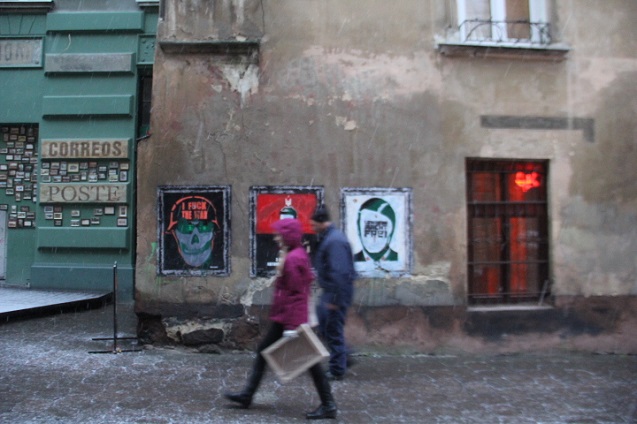
(Photo: Joshua Tartakovsky)
The conflict in Ukraine has been to a large degree about history and how to interpret it. The marches held in honor of World War II Ukrainian leader Stepan Bandera this past Thursday, January 1, 2015, in Kiev marking 106 years to his birth, confirm that understanding the past is essential for making sense of the future. While some have argued there are no fascists in Ukraine and that protesters in Maidan came from a wide gamut of Ukraine’s civil society, in the US Congress, difficult questions were asked about US support for the neo-Nazi Right Sector and in Russia, alarm was raised when pictures of protesters wearing Nazi insignia, and later Ukrainian army soldiers with fascist beliefs, were revealed.
(Photo: Joshua Tartakovsky)The questions of what to make of modern-day Nazis and of the Ukrainian Insurgent Army (UPA), Organization for Ukrainian Nationalists (OUN) and Stepan Bandera, suddenly became relevant and highlighted again the importance of understanding history in understanding the present. As one who lost people on both sides of my family to German and Ukrainian fascists, I was very interested in making sense of past as well as present events. To this end, I visited Lviv, Ukraine in December 2014 and read historical articles seeking to understand to what degree Ukrainain fascists were involved in World War II atrocities. This article is a culmination of these efforts.
We can read and research, but until the Spirit truly helps us understand we may have a hard time figuring this whole war out. The story below shows an incredible man who I knew nothing about until hearing about him from some Patriot Soldiers on the radio. His story shows the challenge of knowing what is going on. Whose side should we choose, or how can we help?
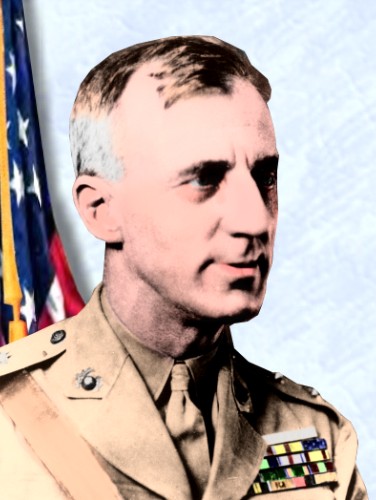
Major General Smedley Butler
Major General US Marine Corps, Antiwar Activist:1881-1940
I served in all commissioned ranks from second lieutenant to Major General. And during that period I spent most of my time being a high-class muscle man for Big Business, for Wall Street and for the bankers. In short, I was a racketeer for capitalism. I suspected I was just part of the racket all the time. Now I am sure of it.
Received 16 military medals, 5 for valor. Is one of 19 men to receive the Medal of Honor twice.
Wrote the 1935 exposé that linked business and the military titled “War Is A Racket.”
Ran for Senate as a Republican in 1932.
Biography
At the time of his death, Major General Smedley Darlington Butler, also known as “The Fighting Quaker”,was the most decorated Marine in US history; he was the only person to be awarded a Marine Corps Brevet Medal and a Medal of Honor for two separate military actions. He had also become an unrelenting voice against the business of war.
Raised by prominent Quaker parents, Smedley Butler defied his pacifist lineage by joining the Marines just before his 17th birthday. He served in Honduras, Nicaragua, Mexico and Haiti (earning his Medals of Honor in Mexico and Haiti). Butler was known for his leadership and commitment to the welfare of the men under his command. He rose quickly through the ranks to become, at age 48, one of the youngest major generals.
Prior to World War II, Butler spoke out against what he saw as admiration for Fascism and for Italy´s leader Benito Mussolini. He was punished for telling an unfavorable story about Mussolini, avoided court-martial by accepting a reprimand. Because of his rank, he was able to write his own reprimand and never apologized to Mussolini.
Butler retired from the military in 1931. By then, he was beginning to question US involvement in foreign conflicts. He had come to believe that war–in particular WWI–was really a profitable business for the few and at the expense of thousands of lives. He thought of himself as a cog in the imperialist war machine.
In a booklet titled War is a Racket, Butler wrote, “In the World War [I] a mere handful garnered the profits of the conflict. At least 21,000 new millionaires and billionaires were made in the United States during the World War….How many of these war millionaires shouldered a rifle?….The general public shoulders the bill. And what is this bill? …Newly placed gravestones. Mangled bodies. Shattered minds…For a great many years, as a soldier, I had a suspicion that war was a racket; not until I retired to civil life did I fully realize it. Now that I see the international war clouds gathering, as they are today, I must face it and speak out.”
War is a Racketgrew out of a series of speeches Butler gave to whatever group wanted to hear his views. Though he faced criticism, Butler was steadfast in his beliefs about war, US imperialism, and a growing Pro-Fascist movement. He spoke frankly and honestly about his experiences and opinions, and was very popular with the American public.
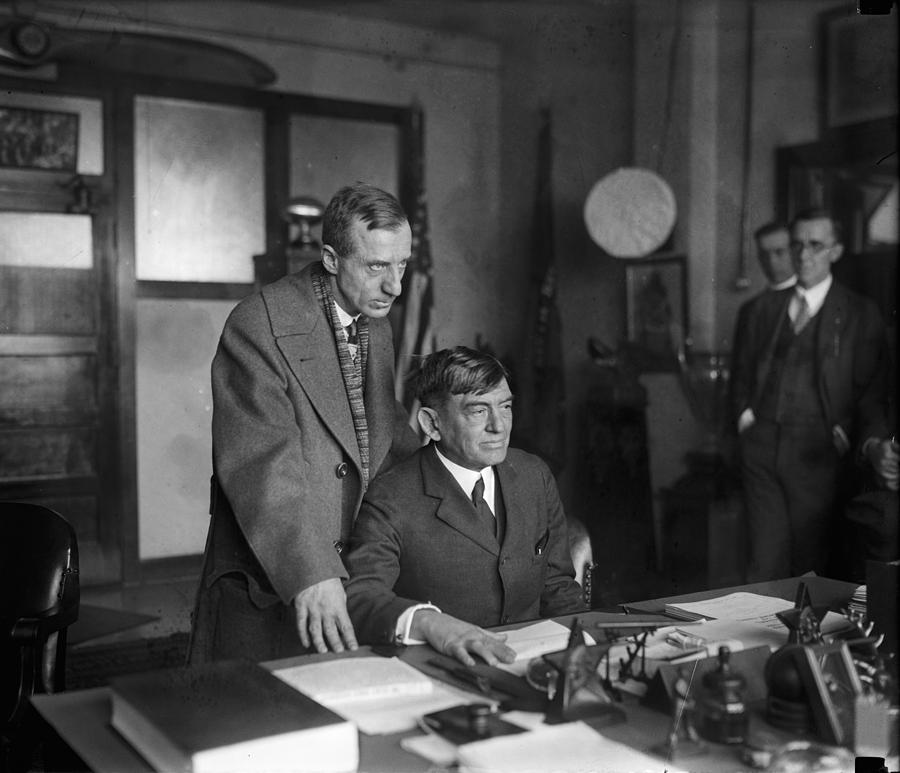
SMEDLEY BUTLER (1881-1940). Major General in the U.S. Marine Corps. Butler (standing), photographed with General John A. Lejeune in Washington, D.C
In 1934, Butler went before the House Un-American Activities Committee (HUAC) to expose a conspiracy against the government. He had been recruited by a group of wealthy Pro-Fascists who had hoped to use him in a coup against President Franklin D. Roosevelt. He went along, gathering intelligence about the plot, and took it to Congress. Butler’s assertions were not aggressively pursued, and the matter was largely dismi4ssed. However, an internal report to Congress from HUAC confirmed the veracity of the plot.
“On the top of the mound were stones which presented the appearance of three altars having been erected one above the other, according to the ancient order; and the remains of bones were strewn over the surface of the ground. The brethren procured a shovel and a hoe, and removing the earth to the depth of about one foot, discovered the skeleton of a man, almost entire, and between his ribs the stone point of a Lamanitish arrow, which evidently produced his death. Elder Burr Riggs retained the arrow. The contemplation of the scenery around us produced peculiar sensations in our bosoms; and subsequently the visions of the past being opened to my understanding by the Spirit of the Almighty, I discovered that the person whose skeleton was before us was a white Lamanite, a large, thick-set man, and a man of God. His name was Zelph. He was a warrior and chieftain under the great prophet Onandagus, who was known from the Hill Cumorah, or eastern sea to the Rocky mountains. The curse was taken from Zelph, or, at least, in part-one of his thigh bones was broken by a stone flung from a sling, while in battle, years before his death. He was killed in battle by the arrow found among his ribs, during the last great struggle of the Lamanites and Nephites.” Joseph Smith Papers History, 1838–1856, volume A-1 [23 December 1805–30 August 1834], Page 483
Brigham Young Knows Where the Nephites Lived
We see through the light of revelation that the wicked of this nation will someday be destroyed in that very area, repeating the same pattern over and over again. The Nephites were destroyed there. The Jaredites were destroyed there. Will our nation go to Mexico to be destroyed at Cummorah? Of course not. Can there be any doubt that these lakes referred to are the Great Lakes? Brigham Young said: This book, which contained these things, was hid in the earth by Moroni, in a hill called by him, Cumorah, which hill is now in the state of New York, near the village of Palmyra, in Ontario County. “ Cheesman, Paul R., 1978, The World of the Book of Mormon, Horizon Publishers, Bountiful, Utah, p. 24
Joseph Smith’s 1843 Sermon
Brother Joseph by David Lindsley
“Joseph Smith’s 1843 sermon. On April 16, 1843, Joseph Smith’s journal relates that he gave a sermon at the temple at 10 a.m. He read a letter about the death of Lorenzo Barns and discussed the topic of burial.
“I referred to it is to have the privilige [sic] of having our dead buried on the land where god has appointed to gather his saints together.— & where there will be nothing but saints, where they may have the privilege of laying their bodies where the Son will make his appearance. & where they may hear the sound of the trump that shall call them forth to behold him, that in the morn of the resurrection they may come forth in a body. & come right up out of their graves, & strike hands immediately in eternal glory & felicity rather than to be scattered thousands of miles apart. There is something good & sacred to me in this thing. the place where a man is buried has been sacred to me.–this subject is made mention of In Book of Mormon & Scriptures to the aborigines regard the burying places of their fathers is more sacred than any thing else.” (emphasis added)
The portion in bold is of interest for two reasons. First, there is no place in the current Book of Mormon that mentions that the place where a man is buried is sacred. Joseph seems to be recalling a passage from the lost 116 pages, which, in his mind, were part of the Book of Mormon he translated.
Second, the sacred nature of a burial place is the basic premise for Native American Indian reverence for the burial mounds. Joseph alludes to this in the next passage when he refers to the “aborigines,” whom he considered Lamanites. This sermon may be a direct link between the 116 pages and the Native American Indian mounds.
Click to Enlarge
The journal (left) is in the handwriting of Willard Richards. He apparently inserted the phrase “this subject is made mention of” after he wrote the main phrase, probably when he found a moment to catch up with what Joseph was saying.” Mormon History Association – Mounds and Mormons by Jonathan NevilleJournal, December 1842-June 1844; Book 2, 10 March 1843-14 July 1843, p. 141. Online at http://www.josephsmithpapers.org/paper-summary/journal-december-1842-june-1844-book-2-10-march-1843-14-july-1843/149.
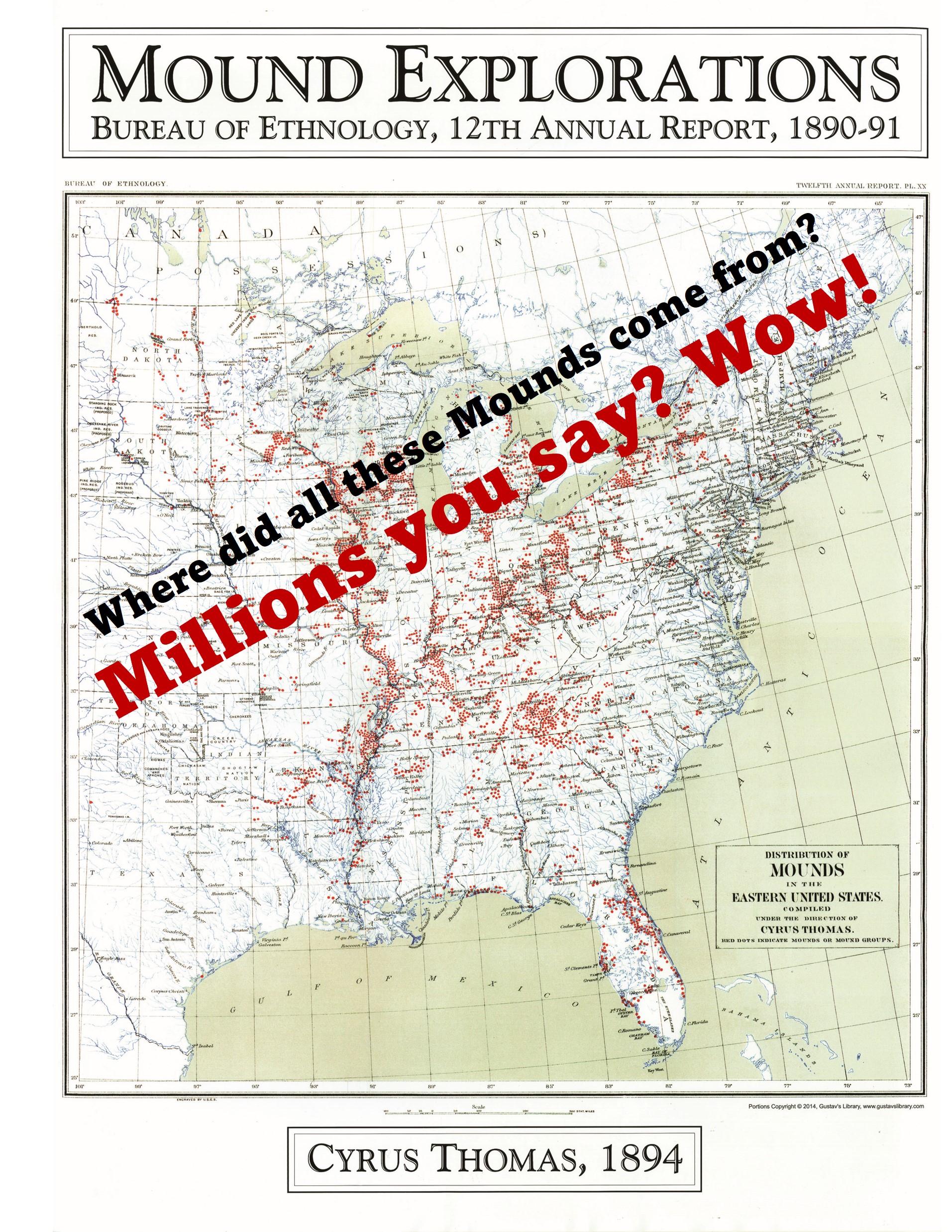
“Mormonism sprang from the mounds,” wrote Roger Kennedy, former director of the Smithsonian National Museum of American History. Even before the Book of Mormon was published, Mormonism was linked to the Moundbuilder civilizations of North America. One man who claimed to have heard a reading of the lost 116 pages said “It was a description of the mounds about the country and similar to the Book of Mormon. In 1843, Joseph Smith apparently alluded to the 116 pages when he said the Book of Mormon spoke about sacred burial places. Several authors have placed the Book of Mormon among other 19th century books about the origins of the Moundbuilders. At one time, *there were over a million ancient earth mounds in North America; approximately 100,000 remain today. Many of these mounds are located in the territory from western New York through western Missouri where early Mormon history took place.
*After visiting several thousand mounds and reviewing the literature, I am fairly certain that over 1,000,000 mounds once existed and that perhaps 100,000 still exist. Oddly, some new mound sites are discovered each year by archaeological surveys in remote areas. But in truth, a large majority of America’s mounds have been completely destroyed by farming, construction, looting, and deliberate total excavations” – Gregory L. Little, Ed.D., The Illustrated Encyclopedia of Native American Mounds & Earthworks, Eagle Wing Books, Inc., Memphis, TN [2009].
Zelph’s Mound Valley City, Illinois Picture from “Red Ant” 2018
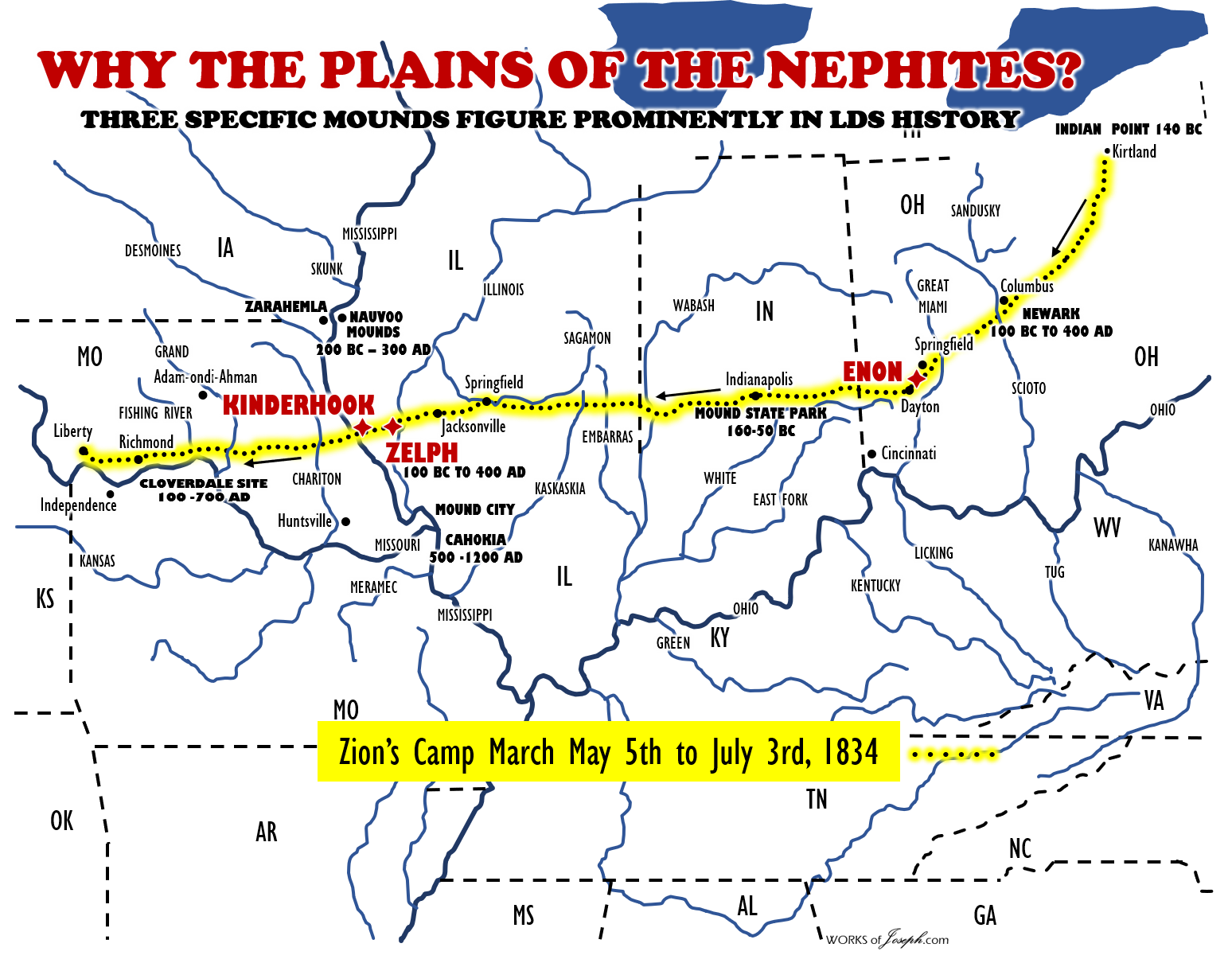
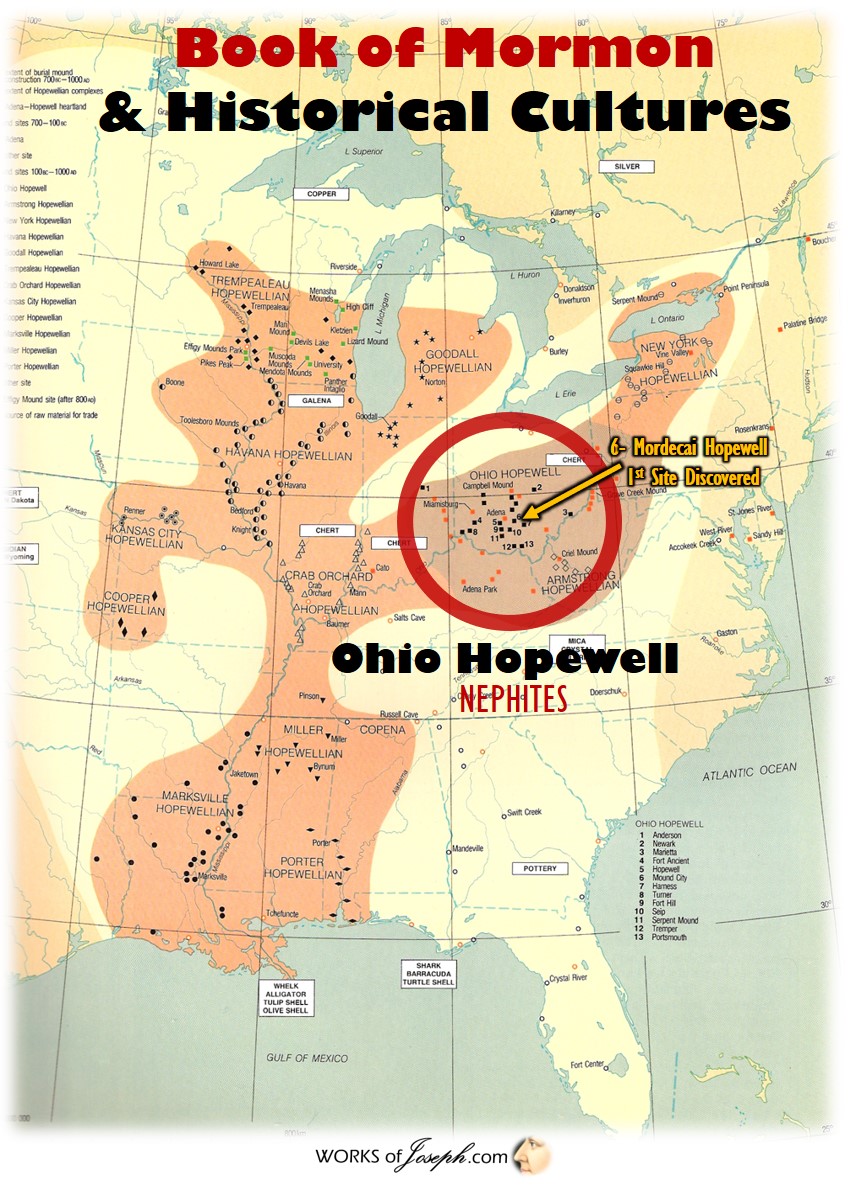
Jonathan Neville continues, “Three specific mounds figure prominently in LDS history: Zelph’s mound in Illinois, the Kinderhook mound, also in Illinois, from which the six brass plates were taken, and Enon mound in Ohio. Until the early Saints leveled them to build homes and farms, Indian mounds dominated Nauvoo. Joseph Smith purchased one and resorted to it from time to time. Less well known are the mounds located just north of Nauvoo that have recently been discovered and preserved. The connections between Mormonism and the mounds of North America have yet to be fully explored. …The increasing awareness of the numerous Hopewell mounds in the Nauvoo area may give renewed attention to the connection between Mormons and the mounds. When workers dug a utility trench between the Red Brick Store and the Joseph Smith Homestead, the equipment churned up Hopewell bones and artifacts. This area is adjacent to the Smith Family Cemetery, leading to the possibility that Joseph Smith, his wife Emma, his brother Hyrum and his parents are buried in a Hopewell burial site.” The Mormons and the Mounds – Jonathan Neville Mormon History Association June 2017.
Indian Burial Mounds
Indian Burial Mounds in this area
“Nauvoo appears to have been a destination for the living and the dead for centuries. According to Community of Christ Historic Sites Coordinator Lachlan Mackay, workmen digging a power wiring trench between the Smith Cemetery and Red Brick Store during the 1970s uncovered bones and artifacts, including a cardinal platform pipe from the Hopewell era (ca. 200 BC to 500 AD). This means that the Smith Family Cemetery was most likely built over an ancient graveyard. Lachlan Mackay referred to Gustavus Hills 1840 map of Nauvoo which revealed ancient tumuli, or burial mounds, including some on Partridge Street below the temple hill. In 1844, Henry Brown quoted John C. Bennetts 1842 description of Nauvoo: “The surface of the ground upon which Nauvoo is built, is very uneven. . . A number of tumuli, or ancient mounds, are found within the limits of the city, proving it to have been a place of some importance with the extinct inhabitants of this Continent” (History of Illinois, 1844, p. 490). Settlers, however, leveled the land for houses and gardens….
Smith Family Cemetery
Burial Place of Joseph, Hyrum, and Emma East of the Red Brick Store, Nauvoo, Illinois
The Joseph Smith Homestead became a graveyard for the Smith family, including Joseph and Lucy Mack Smith and their sons Don Carlos, Hyrum, Joseph, and Samuel. Those who died before 1846 were buried elsewhere in Nauvoo and later moved to the Smith Family Cemetery. When Don Carlos Smith and Joseph and Emma’s baby Don Carlos died in 1841, their bodies were buried near the temple and later reinterred on the Smith property. Joseph, Emma, and Hyrum’s bodies were laid to rest on the Homestead property in 1928 (Lachlan Mackay, Mormon Historical Studies, Fall 2002, pp. 240-252)…
Cemetery Impressions
The Prophet Joseph Smith said, “The place where a man is buried is sacred to me.” Each grave has a story to tell of a persons life and the time and place in which he or she lived. Visits to cemeteries offer reflection on the meaning of life, the inevitability of death, and the promise of resurrection. LDS visitors to Nauvoo feel the Spirit in the historic homes and the holy temple. Sometimes they search for ancestors in the cemetery on Parley Street and contemplate their lives. But other burial sites in Nauvoo have voices, too. Perhaps their voices will tell us why they came to Nauvoo and what they learned about life and death, joy and sorrow, faith, family, and community. They might whisper, “When you’re here, were here because we are in you–for we are all Heavenly Fathers children.” Laid to Rest in Nauvoo By Rosemary G. Palmer · July 17, 2014 Meridian Magazine https://latterdaysaintmag.com/article-1-14629-2/
Alvin Smith’s Death
It is very likely that Alvin Smith was buried on an ancient burial mound as his brother Joseph Smith was. There is something sacred about this possibility. The connection between the Nephites and Joseph Smith’s family must have been incredible. What joy during the resurrection to see the many wonderful saints arise next to each other.
Alvin’s Burial Mound, Palmyra, NY
“We took hold of the child [Lucy], but she clenched hold of him [Alvin] with such a desperate grasp that it was very difficult to disengage her hands.
As I turned with the child, Alvin said, “Father, Mother, brothers, sisters, farewell! I can now breathe out my life as calmly as a clock,” and immediately closed his eyes in death.[7]
The child still cried to go back to Alvin. One present said to her, “Alvin is gone. An angel has taken his spirit to heaven.” When the babe heard this, she renewed her cries, and as I bent over his corpse with her in my arms, she again threw her arms around him and kissed him repeatedly, screaming as before. And until the body was taken from the house, she continued constantly crying and showing such manifestation of affection mingled with terror at the scene before her as is seldom witnessed in a child.[8]…
Alvin buried on top of the mound, Palmyra NY
When the time for interment arrived, the inhabitants of the surrounding country gathered together, and during the funeral obsequies they gave the most affectionate manifestations of their sympathy; but there was one that felt our grief more deeply than the rest-a lovely young woman who was engaged to be married to my son. The disconsolate girl was rendered most desolate by his unexpected death, and as long as we knew her, she never recovered her wonted animation and good spirits…
Alvin had ever manifested a greater zeal and anxiety, if it were possible, than any of the rest with regard to the record which had been shown to Joseph, and he always showed the most intense interest concerning the matter. With this before our minds, we could not endure to hear or say one word upon that subject, for the moment that Joseph spoke of the record it would immediately bring Alvin to our minds with all his kindness, his affection, his zeal, and piety. And when we looked to his place and realized that he was gone from it, to return no more in this life, we all wept with one accord over our irretrievable loss, and we could “not be comforted, because he was not.”[10]…
[10] See Matt. 2:18; Jeremiah 31:15. The Smiths had now lost three children; that is, Alvin, Ephraim, and their firstborn son. The vision given in the Kirtland Temple, January 21, 1836 (twelve years after Alvin’s death), was especially powerful to Joseph: “The heavens were opened upon us, and I beheld the celestial kingdom of God, and the glory thereof. . . . I saw the transcendent beauty of the gate through which the heirs of that kingdom will enter; . . . also the blazing throne of God, whereon was seated the Father and the Son. . . . I saw Father Adam and Abraham; and my father and my mother; my brother Alvin, that has long since slept; and marveled how it was that he had obtained an inheritance in that kingdom, seeing that he had departed this life before the Lord had set his hand to gather Israel the second time, and had not been baptized for the remission of sins. Thus came the voice of the Lord unto me, saying: All who have died without a knowledge of this gospel, who would have received it if they had been permitted to tarry, shall be heirs of the celestial kingdom of God; also all that shall die henceforth without a knowledge of it, who would have received it with all their hearts, shall be heirs of that kingdom; for I, the Lord, will judge all men according to their works, according to the desire of their hearts.” (D&C 137:1, 2, 3, 5-9.)
Alvin Smith’s grave is located in the Swift Cemetery just south of Four Corners in Palmyra, New York. (See red circle left). It is located just a half mile from the Grandin Press. See the Directions here:
See the Ancient Tumuli Bluffs in Nauvoo Illinois on the map below:
Define Tumuli: A tumulus (plural tumuli) is a mound of earth and stones raised over a grave or graves. Tumuli are also known as barrows, burial mounds, or kurgans. When composed largely or entirely of stones they are usually referred to as cairns. The phenomenon appears early in human history, during the Neolithic era, and although used almost universally tumuli differ in size, structure, and usage with each culture. In one aspect, the tumulus is a simple way to bury the dead and honor them with a memorial, for it requires little sophistication or technology. On the other hand, though, the size of many of these mounds is impressive by today’s standards, and far more so considering the lack of technology available in ancient times. Their appearance throughout the world in unrelated cultures indicates a universal appreciation for the dead members of their society, and a desire to mark their life permanently in the physical world. New World Encyclopedia
Don Bradley’s new book, The Lost 116 Pages, is exceptional. He has done an outstanding job accumulating and explaining what we know about the translated pages Martin Harris lost from the original Book of Mormon.
This week I’m going to discuss several aspects of the book and offer some additional thoughts on specific topics. In important ways that are not apparent at first, Don’s book addresses the geography and historicity issues that we discuss on this blog.
A few years ago Don gave me some material to use in my presentation at the Mormon History Association titled “Mormons and the Mounds.” He mentions this material on page 218:
While memorializing Elder Lorenzo Barnes on April 16, 1843, Joseph made reference to a detail from the Book of Mormon text:
“[T]he place where a man is buried has been sacred to me.–this subject is made mention of In Book of Mormon & Scriptures. to the aborigines regard the burying places of their fathers is more sacred than any thing else.”
Joseph appears to refer to a description from the Book of Mormon that its peoples regarded the burial places of their fathers as sacred… if Joseph Smith cited an unknown Book of Mormon text, he was not speaking from inferior knowledge to ours but from superior knowledge [i.e., the lost 116 pages]… by Jonathan Neville, continued blog here: http://www.moronisamerica.com/the-lost-116-pages-part-1/
We are looking forward to your participation at our 29th Conference. We will have over 75 inspirational speakers and 125 presentations on the following subjects:
Evidences of the Book of Mormon U.S. Constitutional Studies Science and Religion Prophecies and Signs of the Times Native American Studies Health and Wellness
Children under 18 are FREE! A Couple Pass may be used for any two adults if you come together. Bring a spouse, friend, older child or come as a couple. No Early Bird discount as tickets are limited. No tickets at the door. Hurry to guarantee your registration.
Registration Fees
3-Day Individual Pass
$50
3-Day Couple Pass (You+1 Friend)
$90
1-Day Pass Individual
$25
1-Day Couple Pass (You+1 Friend)
$35
Premium Streaming Member
1 Free 3 Day pass
No Refunds after March 15, 2022
Our live event is arriving soon. We are expecting a larger crowd than last year in September. This event will have one main stage and 4 additional smaller stages everyday Thurs, Fri, and Sat. Our last speaker will be from 8-9 pm. The ticket registration link is hereto share with your friends and family. There will be no early bird discounts as we may sell out tickets, so please get yours now. There will be no tickets purchased at the door.
Event:FIRM Foundation Expo featuring the 29th Book of Mormon International Conference Dates: Thurs April 7, Fri April 8, Sat April 9 – From 9 am to 9 pm each day. Place: Davis county Conference Center 1651 N. 700 W. Layton, UT 84041 Directions here:
Important Note to Receive FREE PASSES
If you purchased the Premium for 6- months streaming, you receive one pass for the coming April conference.
If you purchased the Premium for 1 year streaming you receive one pass for the coming April conference and one pass for the coming September conference in 2022.
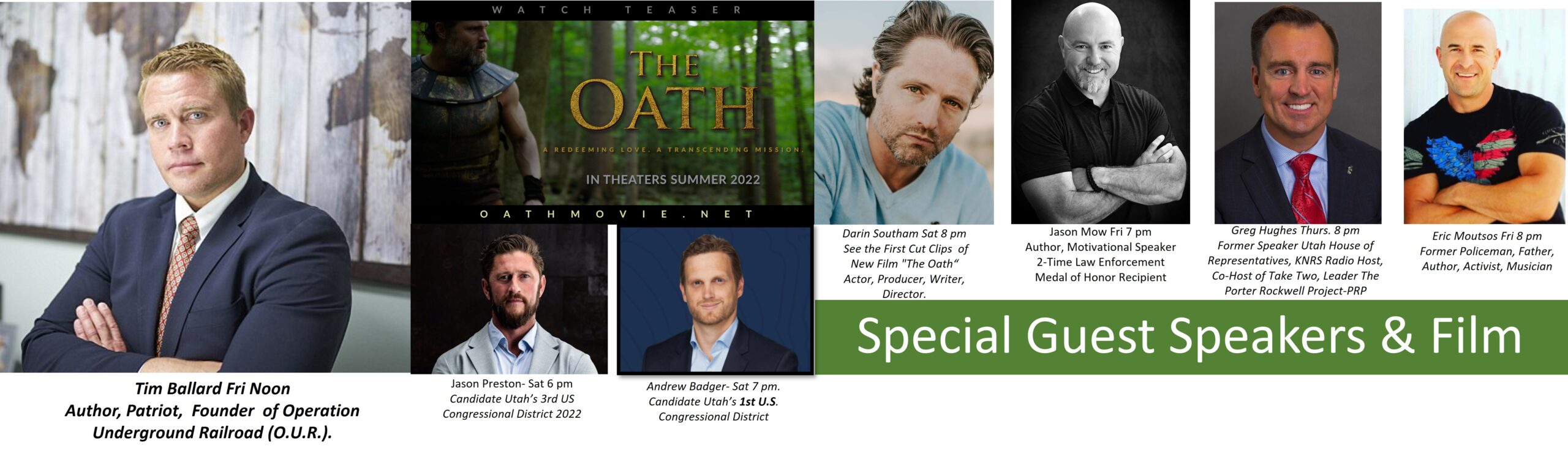
Here are some other special guests who will speak along with our outstanding regular speakers, Hannah Stoddard, Wayne May, Rod Meldrum, Jonathan Neville, plus many more.
Darin Scott (Stage Name) is an American actor, writer, and director of English, Scottish, and German decent, born in the small town of Vernal Utah. Most of his childhood and adolescence (12 years) was spent in Vancouver, Washington. A week after Scott’s seventeenth birthday, his father died of a heart attack. As the youngest and last of five children in the home, Scott became the man of the house.
The school stage is where Scott’s passion for acting began but he was also very into sports. After playing college football at Brigham Young University-Idaho, Scott finished his BA at the University of Utah. His football days led to his first acting role in the Disney film “Going To The Mat,” working with Khleo Thomas as the football jock, “Yardley”. The following year, Scott booked another role in Disney’s “Halloweentown High,” where he worked with Academy Award Nominated, Debbie Reynolds, as well as Teen Choice Nominated, Lucas Grabeel. Scott read for the role of Wylie in Disney’s “Buffalo Dreams” and had the director all but convinced until he was asked his age (being 25 at the time). Though Scott is typically cast in younger roles, in this case, the director took Scott’s age a bit too literally. Scott took a few roles in independent films and then landed a lead role in Discovery Channel’s “I Shouldn’t Be Alive.”
In spite of his brewing film success, with a young family, Scott relocated to California to pursue a law degree. Shortly after moving, he booked a role in “127 Hours” where he worked with Golden Globe Winner (and Academy Award Nominated), James Franco. Although the role turned out to be smaller than anticipated, as the entire wedding scene was cut from the final edit, it did steer Scott from law school. He withdrew after one semester to attend Playhouse West Acting School in North Hollywood. While studying there, he booked roles in a number of films, including the title role of the mountain man scout Ephraim Hanks in “Ephraim’s Rescue,” where he showed his ability to carry a film. Later, Scott was also direct-cast as a younger character version of PT Emmy-Nominated, John Heard, in “Counting For Thunder.” Not letting his law background go to waste, Scott followed by landing a supporting role as the lead Defense Attorney in “Just Let Go,” where he worked opposite Emmy-Nominated Henry Ian Cusick and Sam Sorbo (Jenkins). Scott continued his success working opposite Teen Choice Winner, Josh Lucas, in Kevin Costner’s acclaimed, Emmy-Nominated series “Yellowstone”.
Scott is also the writer and director of over 30 commercials and short films, including the third all-time highest crowdfunded short film on Kickstarter in 2017, “Reign of Judges: Title of Liberty.” In late 2021, Scott wrote, directed, and starred in his first directorial full-length feature, “The Oath,” based on “Reign of Judges: Title of Liberty,” also starring Billy Zane, Eugene Brave Rock, and Karina Lombard. “The Oath” is set to release in theaters late summer of 2022. – IMDb Mini Biography By: agent /publicist
Below Darin Southam has answered a few questions about his two movies, Reign of the Judges and The Oath.
Are the filmmakers behind this all members of the Church of Jesus Christ of Latter-day Saints?
No. This film is entirely independent of The Church of Jesus Christ of Latter-day Saints and we are independently funded by over 43 amazing investors. 90% of the cast and crew on our pilot short film were not members of The Church of Jesus Christ, and an even higher number than that is true of our first full feature. We’re proud of the fact that so many of all faiths (and of no faiths) have joined our production team and lent their inspiring talents to this meaningful endeavor. Nearly all the Hollywood professionals we’ve consulted have been very supportive of (and genuinely intrigued with) what we are doing.
Yes, the Writer/Director, Darin Southam, is an active member of the Church of Jesus Christ of Latter-day Saints who has made a lifelong study of the Book of Mormon and is an enthusiastic fan of Captain Moroni.
Mark Burnett did a masterful job of producing the Bible and Son of God. Mel Gibson did the same with The Passion of The Christ. Should we not see these movies because they’re both Catholic? Of course not. Likewise, we will employ the best talent in Hollywood, regardless of religious or irreligious affiliation, but we also feel it’s important to have a few team members who are active members of the Church of Jesus Christ and can provide the necessary knowledge of the source material.
I’m a Christian, should I support this movie?
Absolutely, YES! If you are a freedom-loving patriot of liberty, you will support making this film. It’d be the “Christian” thing to do ;).
Of course, as Christians, we read many books about Christ that are not the Bible. C.S. Lewis’ “Mere Christianity”, Sarah Young’s “Jesus Calling”, or Max Lucado’s “Fearless”, for example, are excellent Christian choices. But these books may be (and often are) written by pastors from Church denominations other than our own. Does this mean we up and change our Church just because we read a book from a different denomination? Of course not.
Of the Book of Mormon’s 239 chapters, 174 of them (73%) deal with war, terrorism, murder, political conspiracies, secret combinations, threats, family collusions, and other hostilities. These are universal themes 100% of the world understands. In contrast, the Book of Mormon also references Jesus nearly 4000 times as “Another Testament of Jesus Christ”. It’s one of the most Christ-soaked books on the planet.
With these merits, Reign of Judges: Title of Liberty is a war epic based on a book capable of attracting one of the largest, most ideologically-diverse audiences in history. It’s no wonder the Book of Mormon will soon be the 9th most translated book in the world approaching nearly 150 languages. But here’s the thing, if you’re not member of the Church of Jesus Christ of Latter-day Saints, the book is just another book about Jesus that’s also chock full of universally-relatable themes. Whether in a different religion or in no religion at all, you should support this epic film. Reign of Judges: Title of Liberty is really just an action-packed entertaining story about the blood cost price of LIBERTY that is soaked in the Spirit of Freedom. A period action film that follows a people who fled Jerusalem to declare independence from the oppressive king Zedekiah.
If you want to know something really interesting, the man our story centers around, Captain Moroni, actually coined the phrase “Christian” in 73 BC. Think of it, the inhabitants of ancient America had such faith in Christ they took upon themselves His name, even before He became flesh on earth. “And thus (Moroni) was preparing to support their liberty, their lands, their wives, and their children, and their peace, and that they might live unto the Lord their God, and that they might maintain that which was called by their enemies the cause of Christians. And therefore, at this time, Moroni prayed that the cause of the Christians, and the freedom of the land might be favored (Alma 48:10).”
Please, especially if you’re Christian, buy and share our concept short film, make a donation, or make an investment in our film, which represents your love of liberty, peace, and freedom that Christ affords His children. You won’t regret it
What will the Nephites and Lamanites look like in Reign of Judges (as well as their armor)?
This is a long one, sorry :). Need to be thorough here.
First, I think it best to acknowledge nobody really knows what either people looked like (if we are taking the events as historical). Everything we have put into our film is derived from or inspired directly by the record itself (The Book of Mormon). This includes the necessary creative liberties that have been taken to fill story gaps and pertinent details. Sadly, much of what people believe with regard to how Nephites and Lamanites looked anciently and where Book of Mormon events took place is derived from outside of the record itself (from “Scholarly” sources), which inherently involve someone else’s interpretation. Moreover, embracing the temptation to view these events through modern political vernaculars would also be detrimental to their authenticity. It’s also important to note, the Church of Jesus Christ of Latter-day Saints does not have an official position on what the Nephites looked like, nor where Book of Mormon events took place. To get caught up in these matters would miss the mark and be exactly the kind of distraction the opposition would love to create. And certainly to withhold support based on such opinions would be an even greater advantage to the opposition.
That said, here is what we do know. There was a lot of mixing between the Nephites and Lamanites, per the record, throughout their 1000 year cohabitation in the New World. At times, the Lamanites were “more righteous” than the Nephites and visa versa. At times, the Nephites where “white” and the Lamanites “dark” and visa versa. As far as the way they looked and skin color, the prophet Nephi, the first (in the Book of Mormon), saw in vision the “Gentiles” taking possession of what is now America. We do know the Gentiles, or the people who established America, essentially looked (and still do look) like Europeans. We can readily observe this even today.
Nephi said in his vision:
“And I beheld the Spirit of the Lord, that it was upon the Gentiles, and they did prosper and obtain the land (the land that Nephi also possessed with his people) for their inheritance; and I beheld that they were white, and exceedingly fair and beautiful, like unto my people before they were slain.” 1 Nephi 13:15
Here Nephi describes the Gentiles in great detail and then giving us the astonishing link directly to his people by saying the Gentiles looked “like… my people before they were slain.”
There are three critical points to consider in this vision.
1. If Nephi was a prophet we must believe he had this vision and he meant what he said. His words should not have projections placed on them to mean anything other than what he wrote, even if it doesn’t fit modern political vernaculars.
2. Nephi himself professed to be one who “(gloried) in plainness” and therefore his words must be taken plainly to mean exactly what they were intended to mean. White means white, fair means fair, and beautiful means beautiful. We also know that Lehi (Nephi’s father) and their families came from Jerusalem so that means they were white and fair Hebrews, essentially.
3. Nephi says, very importantly, that the Gentiles looked like his people “BEFORE they were slain”. The Native Americans found in America when the Gentiles drove them off the land, as was prophesied would take place in the Book of Mormon itself, were not the way the Nephites looked. There were nearly 1400 years of war, conflict, decivilization, and degeneration that took place among the Lamanites after they had destroyed the Nephites off the face of the land; so even the Lamanites in Nephi’s time likely looked very different from those found here at the time of Columbus and the early explorers.
The Lamanites were described many times as having a darker skin color, shaved heads, and fighting in loincloths. So that gives us one image. But there were other times when the Lamanites looked just like the Nephites, a few years after Christ’s post-resurrection visit to the Americas, for example.
That said, again, there was much mixing so there were Lamanites who joined the Nephites and visa versa. Usually the white Nephites who dissented to the Lamanites did so for political purposes and used the Lamanites’ hatred of the Nephites to incite war. The ultimate end of such conflict was to supplant the Nephites’ free republic with a monarchy. This will all be portrayed in Reign of Judges: Title of Liberty.
Finally, the Nephites would not have looked Roman necessarily. The Nephites appealed more to Egypt than anything else. They spoke often of (and held in highest regard) Joseph of Egypt. This is why the armor we designed hints of Egypt. We also know there was Greek influence from the descendants of Mulek, son of Zedekiah, who also came to the Northern part of the Americas before Lehi’s group arrived. We have names like “Archeantus“, a Greek name, found among the Captains of the Nephites, for example. What is a Greek name doing in the pre-Columbian New World? As far as armor is concerned, we also know the Nephites had possession of breastplates from the fallen civilization of the Jaredites. These breastplates were likely highly influential in the armor designs that Captain Moroni developed for his soldiers. What influences did the Jaredites have, hailing from the Tower of Babel? There is much to consider but the armor we have designed and the actors who will be featured will reflect what we know, as taken from the Book of Mormon itself.
We want to strike a tone similar to Terrance Malick’s The New World for the Lamanites and Exodus: Gods and Kings or The Ten Commandments for the Nephites, with mixing on both sides.
There will be many people of color in our film. There will also be many white people, as described by the record. In this sense, Reign of Judges will be an extremely diverse saga and the first film, Title of Liberty, will feature a Lamanite group who joins the Nephites, laying down their weapons of war in a covenant of peace. A very moving story as a backdrop to the heroic action of Captain Moroni’s defensive warfare.
View the successful Short film, “Reign of Judges below.
View the new Prequel called “The Oath- A Redeeming Love. A Transcending Mission”
https://youtu.be/wKq8hMcMdI4
You are invited to see the first full cut of the movie “The Oath” at the 29th Book of Mormon Evidence Conference at the Davis County Conference Center, 1651 N. 700 W. Layton, UT 84041 On Sat April 9th at 8 pm sharp. This could be over an hour and a half of film and special cuts.
Tickets to see just the movie on Sat are $25 each or two for $35.
Tickets to see any of the 75 presentations any time for 3-days is only $50. For you and a guest all 3-days are only $90. Join us. Tickets Here.
All Presentations will be videotaped for watching at your leisure 24/7 about 4 weeks after the April 7-9th Conference.
Personally as a “White Person”, I feel no guilt for being white. I feel blessed to be a child of God. My spirit came from a Heavenly Father and my parents who both happened to be white, created my body. I know Heavenly Father loves all of His children and all of us have an equal opportunity to succeed or fail in this life. We will never have equal outcome as we all have our own individual freedom of choice.
I have several Black, Hispanic, Asian and many Fijian friends, and I love them as myself. They are wonderful children of God. As Martin Luther King said, “I have a dream that my four little children will one day live in a nation where they will not be judged by the color of their skin but by the content of their character.” I love this quote as many do. Martin Luther King also said, “People fail to get along because they fear each other; they fear each other because they don’t know each other; they don’t know each other because they have not communicated with each other.” That is how I try and live my life.
I don’t need to overcome any silly white fragility, I just need to love my neighbor as myself. Christ is my Savior and it is He I must obey not someone who wrote a book of nonsense or someone who calls me names.
More and more society it trying to replace God with man. They don’t want to live by God’s law as it is seemingly judgmental. These people don’t want any judgement they want no restrictions on what ever they want, even if it is illegal or immoral. Please be aware of this harmful idea called White Fragility.
The Love of Joseph Smith
Secondhand Account Mary Frost Adams, December 1906 “While [Joseph was] acting as mayor of the city, a colored man named Anthony was arrested for selling liquor on Sunday, contrary to law. He pleaded that the reason he had done so was that he might raise the money to purchase the freedom of a dear child held as a slave in a Southern State. . . . Joseph said, ‘I am sorry, Anthony, but the law must be observed, and we will have to impose a fine.’ The next day Brother Joseph presented Anthony with a fine horse, directing him to sell it, and use the money obtained for the purchase of the child. (Mary Frost Adams, “Joseph Smith, the Prophet,” Young Woman’s Journal, December 1906, as quoted in Hyrum L. Andrus, Joseph Smith, the Man and the Seer (Salt Lake City: Deseret Book, 1960), 33.)
Thomas Jefferson: Liberty & Slavery
Thomas Jefferson helped to create a new nation based on individual freedom and self-government. His words in the Declaration of Independence expressed the aspirations of the new nation. But the Declaration did not extend “Life, Liberty, and the pursuit of Happiness” to African Americans, indentured servants, or women. Twelve of the first eighteen American presidents owned slaves. Thomas Jefferson drafted the Declaration and called slavery an “abominable crime,” yet he was a lifelong slaveholder. Fearful of dividing the fragile new nation, Jefferson and other founders who opposed slavery did not insist on abolishing it.
“I wish from my soul that the legislature of this State could see the policy of a gradual Abolition of Slavery.” From George Washington to Lawrence Lewis, 4 August 1797
“Not only do I pray for it, on the score of human dignity, but I can clearly foresee that nothing but the rooting out of slavery can perpetuate the existence of our union, by consolidating it in a common bond of principle.” Attributed to GEORGE WASHINGTON.—John Bernard, Retrospections of America, 1797–1811, p. 91 (1887). This is from Bernard’s account of a conversation he had with Washington in 1798.
“[Let] the poor the needy and oppressed of the Earth, and those who want Land, resort to the fertile land of our western country, the second land of Promise, and there dwell in peace, fulfilling the first and great commandment.” From George Washington to David Humphreys, 25 July 1785
“I never mean, unless some particular circumstances should compel it, to possess another slave by purchase, it being among my first wishes to see some plan adopted, by which slavery in the country may be abolished by law.” From George Washington to John Francis Mercer, 9 September 1786
Lincoln and the Emancipated-Slave Statue
Washington DC
Allen C. Guelzo and James Hankins describe the poignant origins of the Emancipation Memorial in Washington, paid for by the donations of newly freed slaves (“A Monument to Our Shared Purpose,” Life & Arts, June 30). The story of the memorial’s design is equally poignant.
The scene depicted actually happened. Admiral David Dixon Porter accompanied President Lincoln to Richmond to accept the surrender of the Confederacy, and recounted the story in his 1885 memoir.
During Black Lives Matter and Antifa riots, this statue was attempted to be torn down, but it was saved. What are these Marxist groups thinking? They aren’t. They just hate and we as Latter-day Saints need to push back and support our country. Let’s not forget our past. The Lord needs us in the battle.
(CNN) A statue in a Boston park depicting a formerly enslaved man kneeling before President Abraham Lincoln will be removed, according to city officials. After two public hearings, the Boston Art Commission voted to remove the Emancipation Group, a statue installed in 1879 in Boston’s Park Square, according to a statement announcing the removal. The statue is a replica of one in Washington, DC, and has been controversial since its installation for the depiction of the freed slave. The statue features Archer Alexander, a Black man who “assisted the Union Army, escaped slavery, and was recaptured under the Fugitive Slave Act,” the statement says.
Did You Know? “The three-fifths clause was not a measurement of human worth; it was an attempt to reduce the number of pro-slavery proponents in Congress.” Wallbuilders.com see *Quote Bottom.
Were all of America’s Founding Fathers racists, pro-slavery, and hypocrites?
By WallBuilders, Inc 1999
“One of the most frequent tactics employed to discredit America’s Founding Fathers is to say that the Founding Fathers were all pro-slavery racists and hypocrites. Therefore, why should we care what their views were on any subject? African-American professor Walter Williams wisely explained the use of this tactic in these words:”
Walter E. Williams
Walter Edward Williams (born March 31, 1936) is an American economist, commentator, and academic. He is the John M. Olin Distinguished Professor of Economics at George Mason University, as well as a syndicated columnist and author known for his classical liberal and libertarian views.[2] His writings frequently appear on Townhall.com, WND, and Jewish World Review. Wikipedia
“Politicians, news media, college professors and leftists of other stripes are selling us lies and propaganda. To lay the groundwork for their increasingly successful attack on our Constitution, they must demean and criticize its authors. As Senator Joe Biden demonstrated during the Clarence Thomas hearings, the framers’ ideas about natural law must be trivialized or they must be seen as racists.”
WallBuilders continues saying, “These people paint a false picture of the Founding Fathers and the issue of slavery. The historical fact is that slavery was not the product of, nor was it an evil introduced by the Founders; slavery was introduced in America nearly two centuries before the Founders. In fact, Supreme Court Chief Justice John Jay noted that there had been few serious efforts to dismantle the institution of slavery prior to the Founding Fathers.
The Revolution was a turning point in the national attitude against slavery—and it was the Founders who contributed greatly to that change. In fact, one of the reasons given by Thomas Jefferson for the separation from Great Britain was a desire to rid America of the evil of slavery imposed on them by the British.
Benjamin Franklin explained that this separation from Britain was necessary since every attempt among the Colonies to end slavery had been thwarted or reversed by the British Crown. In fact, in the years following America’s separation from Great Britain, many of the Founding Fathers who had owned slaves released them (e.g., John Dickinson, Ceasar Rodney, William Livingston, George Washington, George Wythe, John Randolph, and others).
It is true, however, that not all of the Founders from the South opposed slavery. According to the testimony of Thomas Jefferson, John Rutledge, and James Madison, those from North Carolina, South Carolina, and Georgia favored slavery.
Nevertheless, despite the support in those states for slavery, the clear majority of the Founders was opposed to this evil—and their support went beyond words.
For example, in 1774, Benjamin Franklin and Benjamin Rush founded America’s first antislavery society; John Jay was president of a similar society in New York. When Constitution signer William Livingston heard of the New York society, he, as Governor of New Jersey, wrote them, offering:
“I would most ardently wish to become a member of it [the society in New York] and… I can safely promise them that neither my tongue, nor my pen, nor purse shall be wanting to promote the abolition of what to me appears so inconsistent with humanity and Christianity… May the great and the equal Father of the human race, who has expressly declared His abhorrence of oppression, and that He is no respecter of persons, succeed a design so laudably calculated to undo the heavy burdens, to let the oppressed go free, and to break every yoke.”
Other prominent Founding Fathers who were members of societies for ending slavery included Richard Bassett, James Madison, James Monroe, Bushrod Washington, Charles Carroll, William Few, John Marshall, Richard Stockton, Zephaniah Swift, and many more.
In fact, based in part on the efforts of these Founders, Pennsylvania and Massachusetts abolished slavery in 1780; Connecticut and Rhode Island did so in 1784; New Hampshire in 1792; Vermont in 1793; New York in 1799; and New Jersey in 1804. Furthermore, the reason that the states of Ohio, Indiana, Illinois, Michigan, Wisconsin, and Iowa all prohibited slavery was a federal act authored by Rufus King (signer of the Constitution) and signed into law by President George Washington which prohibited slavery in those territories.
It is not surprising that Washington would sign such a law, for it was he who had declared:
“I can only say that there is not a man living who wishes more sincerely than I do to see a plan adopted for the abolition of it [slavery].” —George Washington
Notice a few additional examples of the Founder’s strong antislavery sentiments:
“[M]y opinion against it [slavery] has always been known… [N]ever in my life did I own a slave.” —John Adams, Signer of the Declaration of Independence and U.S. President. The Works of John Adams, Second President of the United States (Boston: Little, Brown, and Company, 1854), vol IX pp. 92-93. In a letter to George Churchman and Jacob Lindley on January 24, 1801.
“[W]hy keep alive the question of slavery? It is admitted by all to be a great evil.” —Charles Carroll, Signer of the Declaration of Independence. Kate Mason Rowland, Life and Correspondence of Charles Carroll of Carrollton (New York and London: G.P. Putnam’s Sons, 1898), Vol. II, pg. 231.
“As Congress is now to legislate for our extensive territory lately acquired, I pray to Heaven that they …[c]urse not the inhabitants of those regions, and of the United States in general, with a permission to introduce bondage [slavery].” —John Dickinson, Signer of the Constitution and Governor of Pennsylvania. Charles J. Stille, The Life and Times of John Dickinson (Philadelphia: J.B. Lippincott Company, 1898) p. 324.
“That men should pray and fight for their own freedom and yet keep others in slavery is certainly acting a very inconsistent as well as unjust and perhaps impious part.” —John Jay, President of Continental Congress, Chief-Justice of the U.S. Supreme Court, and Governor of New York. Correspondence and Public Papers of John Jay, Henry P. Johnston, editor (New York and London: G.P. Putnam’s Sons, 1891), Vol. III, pp. 168-169. In a letter to Dr. Richard Price on Sep. 27, 1785.
“Christianity, by introducing into Europe the truest principles of humanity, universal benevolence, and brotherly love, had happily abolished civil slavery. Let us who profess the same religion practice its precepts… by agreeing to this duty.” —Richard Henry Lee, President of Continental Congress and Signer of the Declaration of Independence. Memoir of the Life of Richard Henry Lee and His Correspondence With the Most Distinguised Men in America and Europe (Philadelphia: H.C. Carey and I. Lea, 1825), Vol. I, pp. 17-19. The first speech of Richard Henry Lee in the House of Burgesses.
“[I]t ought to be considered that national crimes can only be and frequently are punished in this world by national punishments; and that the continuance of the slave trade, and thus giving it a national sanction and encouragement, ought to be considered as justly exposing us to the displeasure and vengeance of Him who is equally Lord of all and who views with equal eye the poor African slave and his American master.” —Luther Martin, Constitutional Convention Delegate. James Madison, The Records of the Federal Convention, Max Farrand, editor (New Haven: Yale University Press, 1911), Vol. III, pg. 211.
“Domestic slavery is repugnant to the principles of Christianity… It is rebellion against the authority of a common Father. It is a practical denial of the extent and efficacy of the death of a common Savior. It is an usurpation of the prerogative of the great Sovereign of the universe who has solemnly claimed an exclusive property in the souls of men.” —Benjamin Rush, Signer of the Declaration of Independence. Minutes of the Proceedings of a Convention of Delegates From the Abolition Societies Established in Different Parts of the United States, Assembled at Philadelphia, on the First Day of January, One Thousand Seven Hundred and Ninety-Four… (Philadelphia: Zachariah Poulson, 1794), p. 24. “To the Citizens of the United States.”
“Slavery, or an absolute and unlimited power in the master over life and fortune of the slave, is unauthorized by the common law… The reasons which we sometimes see assigned for the origin and the continuance of slavery appear, when examined to the bottom, to be built upon a false foundation. In the enjoyment of their persons and of their property, the common law protects all.” —James Wilson, Signer of the Constitution and U.S. Supreme Court Justice. James Wilson, The Works of James Wilson, Robert Green McCloskey, editor (Cambridge, MA: Harvard University Press, 1967), Vol. II, pg. 605.
“It is certainly unlawful to make inroads upon others… and take away their liberty by no better right than superior force.” —John Witherspoon, Signer of the Declaration of Independence. The Works of John Witherspoon (Edinburgh: J. Ogle, 1815), p. 81, “Lectures on Moral Philosophy.”
Numerous similar quotes could be cited.
Yet despite the progress made by many of the Founders to end the institution of slavery and to recognize in practice that “all men are created equal,” it is currently charged that in the Constitution, the Founders considered a black to be only three-fifths of a person. This charge is yet another misportrayal of the truth.
Three-Fifths Clause
The records of the Constitutional Convention make clear that the three-fifths clause was actually an antislavery provision. As Professor Walter Williams explains:
“It was slavery’s opponents who succeeded in restricting the political power of the South by allowing them to count only three-fifths of their slave population in determining the number of congressional representatives. The three-fifths of a vote provision applied only to slaves, not to free blacks in either the North or South.” (emphasis added)
*The three-fifths clause was not a measurement of human worth; it was an attempt to reduce the number of pro-slavery proponents in Congress. By including only three-fifths of the total numbers of slaves into the congressional calculations, Southern states were actually being denied additional pro-slavery representatives in Congress.
While there were a few Founding Fathers who were pro-slavery, the truth is that it was the Founders who were responsible for planting and nurturing the first seeds for the recognition of black equality and for the eventual end of slavery. This is a fact made clear by Richard Allen.
RichardAllen
Allen had been a slave in Pennsylvania, but was freed after he converted his master to Christianity. A close friend of Benjamin Rush and several other Founding Fathers, he went on to become the founder of the A.M.E. Church in America. In an early address entitled “To the People of Color,” Allen reminded them:
“Many of the white people [who] have been instruments in the hands of God for our good, even such as have held us in captivity, are now pleading our cause with earnestness and zeal.” -Richard Allen
If this view of the Founding Fathers and many of their names were new to you, there is a solution to help acquaint you with many of them. Wallbuilders has reprinted an 1848 book entitled Lives of the Signers of the Declaration of Independence. This work, long used as a school text, gives a brief and informative biographical sketch of each of the fifty-six men who signed the Declaration of Independence.
What are the consequences of racial prejudice and false beliefs about the origin of races? Answer
Get biblical answers to racial hot-topics. Where did the races come from? How did skin color come about? Why is it important to have a biblical foundation for such issues?
Allen C. Christensen is an agricultural scientist who served as Professor of Animal and Veterinary Sciences and Dean of the College of Agriculture at California State Polytechnic University, Pomona and as Director of the Ezra Taft Benson Agriculture and Food Institute at Brigham Young University. In collaboration with the Tuba City Arizona Stake, the Benson Institute inaugurated a location specific gardening effort among the Navajo and Hopi peoples to strengthen families and improve nutrition. It was during that project effort that thoughts about his book titled, “Joseph Remnant; Lamanites in Today’s America” came which was published in 2019. Those experiences among the Navajo and Hopi peoples as well other indigenous peoples were written in Bringing Dignity and Hope: The Work of the Ezra Taft Benson Agriculture and Food Institute. His discipline publications are concerned with nutrition, agricultural development in less-developed nations including working with small-holder farmers in Latin America and Africa. His expertise in agricultural development was recognized by a U.S. presidential appointment to the Board for International Food and Agricultural Development. An avocational historian, he authored Before Zion: An Account of the 7th Handcart Company. He holds BS, MS and PhD degrees and was awarded an honorary degree from a Guatemalan university. He and his wife, Kathleen, are the parents of five children and were also foster parents for four Navajo foster daughters and one Hispanic foster son. An active member of The Church of Jesus Christ of Latter-day Saints he has served as a bishop, stake president, mission president, patriarch and Area Executive Secretary in the Pacific Islands.
Brother Christensen’s book has some wonderful and inspirational stories about 15 Native Americans including Emeritus General Authority Larry Echo Hawk. Three of these Native Americans will be speaking at our FIRM Foundation Expo. Betty “Red Ant” LaFontaine (Navajo) , Delores Kahkonen (Iroquois), and Franklin Keel (Chickasaw). You will also hear from a new speaker named Rose Johnson-Tsosie (Navajo). Come and support our Lamanite friends. For information click the picture below.
The other day at the Timpanogos Chapter of the Sons of the Utah Pioneers, Brother Christensen shared the following talk that I know you will enjoy.
Pioneers, Native Americans and Jews by Allen C. Christensen
“During my three years as a mission president, I read the Joseph Smith History in the Pearl of Great Price, 36 times, or every Fast Sunday. I also read many of the cross references. Fascinatingly, among the Scriptures quoted by Moroni to Joseph Smith the night of September 21, 1823 was the entire 11th chapter of Isaiah. In that context, I find Isaiah 11:12 especially intriguing: And he shall set up an ensign for the nations, and shall assemble the outcasts of Israel and gather together the dispersed of Judah from the four corners of the earth. The title Israel rightly belongs to Joseph (1 Chronicles 5:1) and then, subsequently, was conferred upon Ephraim by Jacob (Genesis 48:17-20 and JST Genesis 48: 5-11).
Admittedly, in the 19th Century there was an initial gathering to Zion, the Mountains of Ephraim. The concept of gathering had great appeal for early British and Scandinavian converts. Yet, I have come to think the expression “assembled,” means to be assembled in stakes as that typifies Israel today, while Judah is to be gathered from the four corners of the earth. Using both assemble and gathered seems more than picturesque English literature. It is an insightful difference recorded in the King James Translation.
I have been interested in people, their history, culture and legends. Those were topics frequently discussed in my parent’s family. By the time I was five, I knew I wanted to see the world. As a nine-year-old, I received The White Indian Boy as a Christmas gift. It has become a semi-sacred treasure that I have read a number of times and have used as a reference. Since boyhood, I have been fascinated with the founding accounts of the Church, especially the pioneering and Utah territorial periods including our relationships with Native Americans. Members of the Pawnee tribe helped the 7th Handcart Company ford the Loup River. The Loup was reportedly the most dangerous of all such river crossings due to the quicksand in its bottom. My Christensen forebears were a part of that company. My great-grandfather, Niels Christensen, was a 12-year-old when they forded the Loup.
Ultimately, a mature Niels Christensen raised horses as a part of his farming operation. He had a two-year old horse that had not thrived. A Native American came looking for a horse. My great-grandfather told him about this one. They went to the bottom lands to see the horse. The Ute liked what he saw. In after years, my dad remembered the price paid for the horse was a pair of buckskin gloves, two buckskin blankets, two rawhides, a buffalo robe and two dollars in silver.
I have a 6th great-grandmother, who was a full-blood member of the Iroquois Confederacy, probably a Mohawk. Her Native American name was Josnorum Scoenonti, her English name was Running Deer. Today she has many descendants who are Latter-day Saints including some who have been General Authorities. Notable among them is the late A. Theodore Tuttle of the Seventy.
For five years in the 1880s, my maternal grandfather, George Albert Allen, lived among the Utes of Eastern Utah. He was a cowboy for the Schofield, Reid and McCune Cattle Company of Nephi, Utah. He learned to speak their language fluently and never forgot it nor their kindnesses to him. George also learned of some person-specific prophetic promises that Brigham Young had made to individuals Utes. George lived to see those prophecies come to pass. For example, as a boy Wanrodes had known Brigham Young, who had given him a blessing that promised that he [Wanrodes] would become head chief of the Ute Tribe. When Bridger Jim succeeded Tabby as chief, Wanrodes was getting quite old and his eyesight was failing. He said to George: Umpigi Brigham toowig sorokquent. “I’m not certain Brigham told the truth.” George said: “I told him to wait awhile, that Brigham knew what he was talking about.” When Bridger Jim died, Wanrodes was in his 90s and totally blind, yet the Ute tribe elected him as their head chief.
Elder Larry Echo Hawk and his Pawnee Great Great Grandfather
Apparently the Ute name Wanrodes means “Shining Brass.” Many Indian names have special meaning. That is the case with the name “Echo Hawk.” Elder Larry Echo Hawk’s surname is an English translation of a Pawnee name given to his great-grandfather, who was born in the mid-1800s in present-day Nebraska. Among the Pawnee, the hawk is the symbol of a warrior. This Pawnee war scout was known for his bravery, but he was a quiet man who did not speak of his accomplishments. Rather, others spoke in admiration of his good deeds which became, as it were, an echo from one side of the village to the other. Hence, the tribal elders gave him a highly symbolic name, Echo Hawk, “the hawk whose deeds are echoed.” (See page 43, Joseph’s Remnant, second paragraph.)
During the 1880s, federal marshals were in hot pursuit of Latter-day Saint men who were involved in the practice of plural marriage. Many of the Utes considered themselves to be Mormons. Federal officers continued their search for those men into the Uintah Basin. When encountering Utes, they would question them as to the whereabouts of the specific individuals they were seeking to apprehend. The Utes would ask to see the officer’s “Mormon shirt.” If there was no Mormon shirt or temple garment, the Utes had no idea as to where they could be found. Sometimes it can be very smart to play dumb.
While transcribing and adding editorial commentary to the Biography of George A. Allen, I received a letter from Jim Cooper of Cherokee, North Carolina. It provided something of an epilogue about Ute Chief Walker or Wakara. In 1947, an LDS elder traveling alone came to the border of the Eastern Cherokee Reservation at Soco Gap. The elder got out of his car, knelt upon the earth and dedicated the reservation for the preaching of the Gospel of Jesus Christ. He then drove his car to the only restaurant in the little town and inquired if anyone knew of any families from Utah. A young man, Bill Larch, said the local high school band leader was a native of Roosevelt, Utah. After obtaining directions, the elder drove to the home of Philip and Kate Sneed Arkansas. Philip, Kate and their four children eventually joined The Church of Jesus Christ of Latter-day Saints. Philip Arkansas was a great-grandson of Chief Walker of Walker War fame. Chief Walker had given the Latter-day Saints and Brigham Young some difficulty. Yet, it was Brigham Young who had presented Chief Walker with his baptismal certificate. Fascinatingly, on June 17, 1949 in the Oconaluftee River, Philip Arkansas was baptized a member of the Church by Truman Fox Clawson, a 2nd-great-grandson of Brigham Young.
Jewish man in a tallith prayer shawl at Rosh Hashanah
My years at the University of California, Davis became a time when I began developing some close friendships with Jewish people and acquiring a deep interest in them. Robert Elser was one such friend. He told me that his parents had visited the Los Angeles Temple open house. Some 670,000 people attended that open house. “What did they think of it?” I asked. He replied: “My dad thought the temple was tremendous, he even tried to buy stock in the place!”
Yom Kippur
Reformed Jews sell seats in a synagogue or temple thereby raising money for a new edifice. It assures the purchaser of seating for the High Holy Days or the Days of Awe that begin with Rosh Hashanah and end with Yom Kippur. It occurs in the fall of the year and coincides with the ancient Feast of the Tabernacles or Ingathering. Dates vary yearly because Jews still use a lunar calendar. Fascinatingly, Moroni appeared to Joseph Smith on September 21, 1823. In 2020, Rosh Hashanah begins at sundown on September 18 and Yom Kippur begins at sundown on September 27. The preface to chapter 29 of 3 Nephi states: “The coming forth of the Book of Mormon is a sign that the Lord has commenced to gather Israel and to fulfill his covenants.”
While at UC Davis, I home taught Lt. Col. Louis Besbeck and his wife. She was a Latter-day Saint. He was a Jew. In those two years, not once did I hear of his experiences. As a young commissioned officer, he had been part of the Bataan Death March. He did not breathe a word about that. Until I met Lt. Benigno at Mt Samat in Bataan, Philippines and read the horrific suffering of the Martin Handcart Company written by my great-grandfather, Langley Allgood Bailey, I did not understand why. Langley wrote that when the rescuers arrived “that night someone stole and ate the leather straps from the rescuer’s saddles for hunger is a mild name.” Nineteen died that night. Graves were dug in the snow. Wolves came and tore up the dead bodies. The next morning he saw a young lady of about 16 walking in the snow leaving blood prints of her heels and toes. On leaving that morning he saw his brother, John, attempting to drive the wolves away from the bodies he had helped bury. John had to run for his life. Then Langley wrote: “I refrain from writing about the suffering of these folks. It can never be told.” (Journal of Langley Allgood Bailey, edited by Allen C. Christensen, p.8)
Banka boat
Lt. Benigno described his wounds and capture, of his escape through the jungle and making his way across the open sea to Cebu in a Banka boat, a motorized canoe, where he spent the remainder of the war as a guerilla. I attempted to question Lt. Benigno. He said, “I cannot talk about that. Let me just say that because of what happened here and on Corregidor, it has made it difficult to forgive the Japanese.” (Journal of Allen C. Christensen, XIX: 121-122.)
In Southern California I became acquainted with Dr. Fred Krinsky, a well-known professor of government at Pomona College and also an ordained rabbi. Fred said of his Jewish kinsmen, “Where two Jews are talking politics there are at least three political opinions with splinter groups. And if they are talking religion, you must double those numbers.” There is an echo of that in the current effort to elect a political party that can create a parliamentary coalition of sufficient numbers to form a new Israeli government.
Consider this phrase from Jacob’s patriarchal blessing upon Judah: “The scepter shall not depart from Judah, nor a lawgiver from between his feet until Shiloh come; and unto him shall the gathering of the people be” (Genesis 49:10). Couple that verse with D&C 77: 15 which speaks of “two prophets that are to be raised up to the Jewish nation in the last days.” The Jewish revolt against Rome following the Savior’s death marked the end of any semblance of a kingdom of Judah. Today, in electing the Israeli Knesset or parliament, one votes for a party rather than a candidate. The 120 seats are awarded on the basis of percentage of the vote received. That is how the Jewish nation is governed today. It was in March 1832 when Joseph Smith declared there was to be a Jewish nation. The modern Jewish concept of Zionism was nearly 70 years in the future.
Also of interest is the Spanish Inquisition. During the “Age of Discovery,” many Jews publicly became Converso’s. Yet, in the secret sanctity of their homes they remained practicing Jews. They played an important role in the settlement of the New World. “A mercantile people, Jews in the New World went about their business as traders and ship-owners, thus becoming first merchant class in the Spanish Empire. As long as they pretended to be Christians and delivered the goods, no one questioned their religiosity too closely.” (Edward Kritzler’s Jewish Pirates of the Caribbean, p. ix. 9)
The Spanish Inquisition, and I have seen evidence of its gruesome horrors in Peru, did not formally end until 1820, the year of the theophany at Palmyra. Parley P. Pratt’s magnificent hymn: “The morning breaks, the shadows flee, Lo Zion’s standard is unfurled. The dawning of a brighter day, majestic rises on the world,” seemingly has a reflection, an echo, of that terrible case of man’s inhumanity to man.
I have followed the wars and perplexities of the Middle East with intense interest. Initially, the Ingathering of Judah may have caught more of my attention than did the assembling of Israel. For a time, I seemed to read prophetic accounts in Isaiah and the Book of Mormon more in the Jewish context than the broader context for the entire House of Israel.
Consider, for example, 2 Nephi 10:9. Yea, the kings of the Gentiles shall be nursing fathers unto them and their queens shall become nursing mothers . . . For years I thought of the importance of Great Britain’s Balfour Declaration, and the measure of diplomatic legitimacy it conferred for the establishment of a Jewish Homeland in Palestine, as a reflection of Britain’s monarchy.
Other incidents emerged. Noteworthy was the statement made by Isaac Halevi Herzog, the Chief Rabbi of Israel, when he met with President Harry S. Truman at the White House. The orthodox Rabbi said to Truman: “God put you in your mother’s womb so you would be the instrument to bring the rebirth of Israel after two thousand years.” That statement seems to suggest Rabbi Herzog may have had some understanding of our premortal life. Such concepts as pre mortal existence and the resurrection are not usually doctrinally characteristic of Reformed Judaism. Perhaps the declaration of the Lord to Jeremiah, Before I formed thee in the belly I knew thee: and before thou camest out of the womb I sanctified thee and I ordained thee a prophet to the nations (see Jeremiah 1:5) had special meaning for Herzog. President Truman is reported to have been a serious reader of the Bible.
David Niles, a Jew, was a presidential staff appointee for both Roosevelt and Truman. Niles thought the Rabbi comments were overdoing it. Then, when he looked at the President, he noted there were tears running down Harry Truman’s cheeks. (David McCullough’s Truman p.620)
Consider this possibility: Queens, as used in the context of temple language, could mean wives, specifically in this case, the First Lady. The United States has been the key nation of the Gentiles in the 20th Century. When I read Isaiah 42:22-25, I wondered, “Could these verses also refer to the Holocaust?” Consider Anne Frank and her diary in this context. Thou art a people robbed and spoiled; thine enemies, all of them, have snared thee in holes, and have hid thee in prison houses; they have taken thee for a prey . . . and set him on fire round about . . . Auschwitz and Birkenau remain horribly painful, numbing images of genocide.
We had five LDS Placement Students who lived with us a combined total of 15 school years. The four daughters are Navajo; the son’s stepfather is a Hualapai. Our only daughter, who was a volunteer for LDS Social Services in St. Louis, Missouri, has never been able to have children of her own. While we were serving in New Zealand, she and her husband went to China and adopted a daughter. In reflection, she said that the experience of having four Navajo sisters in our home taught her that she could come to love deeply an individual of another culture.
In 2009, I became involved in an agricultural development effort with the Navajo and Hopi people. It involved intensive gardening and reclaiming badly eroded soils. I visited with a number of people who had been participants in the LDS Indian Placement Program. Few of those on the reservation had remained active in the Church, yet all were pleased with the placement experience and were seemingly much better off, physically and financially, than had been their parents. Progress is somewhat generational.
Canyon de Chelly National Monument Near Chinle, AZ
During the March 2009 feasibility study, I sat one evening in my room at the Holiday Inn in Chinle, Arizona pondering this question: “How can we make tradition an ally rather than an adversary?” Consider the long and painful history of Native Americans and Anglo Americans, of betrayal by high-level governmental officials, of setting aside of treaty promises made to the Tribes, of fraudulent and deceitful practices conducted by individuals and businesses against Native Americans. In reflection, I have come to realize that it can be a hard directive to pray for those who despitefully use and persecute you (see 3 Nephi 12:44). That commandment is a demanding test of Christian discipleship. Unwittingly, or deliberately in cases, that is the very test that non-Indian America has imposed on the Children of Lehi. A compelling need exists to build an Ammon-and-Lamoni-type relationship of trust. In this dispensation, that leadership obligation rests heavily upon the Tribe of Ephraim.
Teddy Draper, Sr
We Latter-day Saints accept 1 Nephi 13:12 as Nephi’s description of Columbus and his voyage of discovery. Yet, Native Americans do not necessarily consider him as a heroic figure. One prominent Navajo woman has called him “that lost Italian who has caused us so much grief.” As I reflected on the challenges facing Native Americans, this thought emerged: “Every family, society, culture or nation needs its heroes.” The next morning at Canyon de Chelly I found a book on the Navajo Code Talkers. Later that morning I met one of them, Teddy Draper, Sr., a holder of the Silver Star and Purple Heart, one of 15 Marines who had raised the second much larger flag on Iwo Jima. He had been wounded in that battle. During heavy fighting, he had thrown himself between three dead Marines to save his life. His actions were heroic. His commanding officer asked him what medal, meaning decoration, would he like for that service. With shrapnel wounds above his eye, his shoulder muscle cut and wounds elsewhere in his body, he said, “I’ve already got enough metal. What I want is a promotion.” That was granted and he sent the money home to his family.
Ultimately, I learned that among those young Navajo marines, who created the code, were religious fellows who read the Bible. In their unique effort to create a code within the Navajo language, Dennie Hosteen, saw something of a fulfillment of Jeremiah 5: 15-16. The KJV reads: Lo, I will bring a nation upon you from afar, O house of Israel, it is an ancient nation, a nation whose language thou knowest not, neither understandest what they say. Their quiver is an open sepulchre, they are all mighty men. Or as Hosteen stated: “I am bringing a distant nation against you. An ancient and enduring nation. A people whose language you do not know, whose speech you do not understand.” (Sally McClain, Navajo Weapon, p.59)
Walpi, Hopi Village, First Mesa
I thought: “There are heroes. What is needed is to find them.” I began the search. The project we started initially had two demonstration gardens, one at the Tuba City Stake Center and the other at Polacca Branch—a Hopi unit, and 30 pilot families. Within four years it had grown to more than 2,000 families and a number of demonstration gardens across the reservations.
I have watched with deep interest the work of the senior missionary couples, who have served among the Navajo and Hopi peoples. Those missionaries enlarged my understanding of the verses found in 1 Nephi 21:22-23 or Isaiah 49:22-23.
“Thus saith the Lord God: Behold, I will lift up my hands to the Gentiles, and set up my standard to the people; and they shall bring thy sons in their arms, and thy daughters shall be carried upon their shoulders. And kings shall be thy nursing fathers, and their queens thy nursing mothers; they shall bow down to thee, their face towards the earth, and lick up the dust of thy feet; and thou shall know that I am the Lord; for they shall not be ashamed who wait upon me.”
The climate of northern Arizona and New Mexico, with its sandstone, alkaline soil, 114 degree Fahrenheit temperatures, high winds, and lack of rain, is not favorable for growing produce. With the help of the Church’s welfare program, there are now 2,000 gardens being grown by members of the Navajo and Hopi Nations.
Regarding 1 Ne 21: 22-23, I can see a partial fulfillment of events associated with the Navajo-Hopi project, as I watched endowed members of the church, who were serving as church-service missionaries kneel in the dusty reservation soils or earth and plant seeds of faith and food crops. The methods of planting those crops, especially for corn, was changed. Of special interest was an incident involving Arnold Yellowhorse. According to his wife, Arnold Yellowhorse, a Navajo, knelt and prayed over each individual corn seed as he planted them a foot apart along each emitter of the drip tape. I watched as Elder Earl Seeley, a PhD agronomist, knelt in the earth with program participants and taught them how to grow crops on soils that one Navajo said: “We thought these soils wouldn’t grow nothing.” As I recall, that Navajo man was serving as a bishop.
I have seen Tuba City Arizona Stake President, Larry J. Justice, carry little Navajo children in his arms, wipe the perspiration from their brow, and get them a drink of ice water, while their parents were working with and learning from the missionaries under a hot Arizona sun. President and Sister Justice are Anglo.
Balfour Declaration
As mentioned previously, years ago, when I first read these verses, I thought they pertained to the role that Great Britain had played in the return of the Jews, namely the issuing of the Balfour Declaration that had given a measure of diplomatic legitimacy to the establishment of a Jewish homeland in Palestine. Given my experience with Native Americans, I think those prophetic verses can go beyond that.
I have come to feel that in addition to those events associated with the return of the Jews to their anciently promised homeland, this scripture may well pertain to wonderful senior missionaries, all of whom are endowed, who have knelt in the eroded reservation topsoil, their faces toward the earth, and have helped these people of the remnant plant seeds of crops and seeds of faith. Those efforts are rekindling the flame of faith. The Children of Lehi are seeing themselves in a new light.
Nephi said to his brethren: (1 Nephi 22:6, 8.) Nevertheless, after they shall be nursed by the Gentiles, and the Lord has lifted up his hand upon the Gentiles and set them up for a standard, and their children have been carried in in their arms, and their daughters have been carried upon their shoulders, behold these things of which are spoken are temporal; for thus are the covenants of the Lord with our fathers; and it meaneth us in the days to come, and also our brethren who are of the house of Israel. . . And after our seed is scattered the Lord God will proceed to do a marvelous work among the Gentiles, which shall be of great worth unto our seed; wherefore, it is likened unto their being nourished by the Gentiles and being carried in their arms and upon their shoulders. At least, to some degree, I have been an eye witness to that.
In 1 Ne 22: 6-8, consider in particular this sentence from verse 7 And it meaneth that the time cometh that after all the house of Israel have been scattered and confounded, that the Lord God will raise up a mighty nation among the Gentiles, yea, even on the face of this land; and by them shall our seed be scattered.
By David Lindsley
Is not the mighty nation that the Lord has raised up the United States? Section 101:80 reads: And for this purpose have I established the Constitution of this land, by the hands of wise men whom I raised up unto this very purpose, and redeemed the land by the shedding of blood. That scriptural declaration suggests such is the case. Furthermore, Spain and Portugal are not usually seen as mighty nations. They were not raised upon the face of this land, unless you stretch your imagination and state their New World colonies satisfies that provision.
According to Sam Charlie, growing a garden on land they have previously thought barren has been instrumental in helping them recover this lost part of their culture. (Sam Charlie and his garden were featured in the “Pure Religion” column of the October 2, 2010 edition of The Church News.) I treasure my involvement with the Navajo and Hopi peoples. I have met many of them. I have met their leaders. They are children of covenant promises made long ago to Lehi, Nephi, Jacob and Enos, and confirmed to others. While serving at BYU, there were choice experiences among the Children of Lehi living in Latin America.
I’m grateful for the opportunity to have been an eye witness to the beginning of the fulfillment of such covenant promises. I once said to those missionaries that it seemed to me that we are engaged in writing an unusual chapter in the history of the Church, when foretold events, recorded long ago in the scriptures, are beginning to happen before our very eyes.
In conclusion, I rhetorically pose these questions: What would our lives be like had not Nephi, Jacob and others recorded in detail these experiences and scriptural insights? What special thoughts and insights may our grandchildren miss if we do not write and preserve our personal record and the record of those from whom we have come?
Your officers have asked that we make the preservation of personal and pioneer histories a priority for our service. I hear some silent questioning of ability to do that. I refer you to 1 Nephi 19 and ask, “Which account of the exodus or flight from Jerusalem and the subsequent adventures of Lehi’s family do you think is probably the best written—Nephi’s first or second effort?” You will discover, as you become involved in this effort that your mortal trek has also been enriched and your abilities have increased.” Allen C. Christensen. Manuscript prepared for delivery at the Timpanogos Chapter of the Sons of Utah Pioneers, February 20, 2020.
This painting below shows the Native Americans of the Promised Land watching as the Pioneers and Pilgrims or Children of Israel reestablished themselves here in the United States as the Tribes of Joseph through Ephraim and Manasseh and the Tribes of Judah. This Promised Land of the United States is called the Land of Joseph.
“This beautiful region of country is…the land of Joseph or the Indians, as they are called…The world will never value the land of Desolation, as it is called in the Book of Mormon, for any thing more than hunting ground, for want of timber and mill-seats: The Lord to the contrary notwithstanding, declares it to be the land of Zion which is the land of Joseph, blessed by him, for the precious things of heaven, for the dew…” The Evening and Morning Star Vol. 1 No. 5 October 1832 Page 71 Editor WW Phelps
“It was not by chance that the Puritans left their native land and sailed away to the shores of New England, and others later followed. They were the advance guard of the army of the Lord, predestined to establish the God-given system of government under which we live and to make America, which is the land of Joseph, the gathering place of Ephraim, an asylum for the oppressed of all nations, and prepare the way for the restoration of the gospel of Christ and the establishment of his church upon the earth” – Heber J. Grant, Conference Report, [April 1930].
Certain lands were given to Israel for an inheritance in time and in eternity. America is the land of Joseph; it was the home of Nephite Israel, who were of Joseph, for a thousand years, and it is the headquarters of the Church in this final dispensation in which the church and kingdom of God are in the lands of Ephraim.” (McConkie, Bruce R., A New Witness for the Articles of Faith [1985], 511.)
“The Lord gave a divine promise to the ancient inhabitants of this favored country (the United States): ‘Behold, this is a choice land, and whatsoever nation shall possess it shall be free from bondage, and from captivity, and from all other nations under heaven, if they will but serve the God of the land, who is Jesus Christ” (Ether 2:12).
“Our Heavenly Father inspired the leaders of…the United States of America, that they might together, under His direction, having been raised up by God for the purpose, establish the Constitution of this country and…Bill of Rights, that by the year of our Lord 1805 [there would be] a climate where our Heavenly Father could send into this period of mortality a choice spirit who would be known as Joseph Smith, Jr.” 2011 President Thomas S. Monson (ordained an Apostle, 1963; ordained President of the Church, 2008)
Screen shot of Pres Monson’s book. United States in parenthesis is in his book.
“The Lord gave a divine promise to the ancient inhabitants of this favored country (the United States): ‘Behold, this is a choice land, and whatsoever nation shall possess it shall be free from bondage, and from captivity, and from all other nations under heaven, if they will but serve the God of the land, who is Jesus Christ” (Ether 2:12).
“Our Heavenly Father inspired the leaders of…the United States of America, that they might together, under His direction, having been raised up by God for the purpose, establish the Constitution of this country and…Bill of Rights, that by the year of our Lord 1805 [there would be] a climate where our Heavenly Father could send into this period of mortality a choice spirit who would be known as Joseph Smith, Jr.” 2011 President Thomas S. Monson (ordained an Apostle, 1963; ordained President of the Church, 2008)
“Thoughts on the location of Book of Mormon Peoples”
by Franklin Keel
“First, I must say that, based upon the words of the Prophet Joseph Smith and my experiences with contemporary American Indians, I believe that the events of Book of Mormon occurred in what is now the United States.
Having said that, I must also say that I also believe that Jesus Christ visited other people in this hemisphere and elsewhere (who, much like the Mulekites, were not descendants of Father Lehi) and taught them his doctrine. He speaks of this in 3 Nephi 16: 1-3:
1 And verily, verily, I say unto you that I have other sheep, which are not of this land, neither of the land of Jerusalem, neither in any parts of that land round about whither I have been to minister.
2 For they of whom I speak are they who have not as yet heard my voice; neither have I at any time manifested myself unto them.
3 But I have received a commandment of the Father that I shall go unto them, and that they shall hear my voice, and shall be numbered among my sheep, that there may be one-fold and one shepherd; therefore I go to show myself unto them.
Choctaw believe that Nanih Waiya is the “Mother Mound” (Inholitopa iski) where the first Choctaw was created. Nanih Waiya (alternately spelled Nunih Waya) is an ancient platform mound in southern Winston County, Mississippi, constructed by indigenous people during the Middle Woodland period, about 300 to 600 CE.
“There are many variations of the story. According to some versions, the mound (or nearby cave) is also the origin of the Chickasaw, Creek people, and possibly even the Cherokee.
Others believe Nanih Waiya is the location where the Choctaw tribe ceased their wanderings and settled after their origin further to the west. George Catlin’s Smithsonian Report in 1885 included a story of the Choctaw following a prophet from an origin in the west:
The Choctaws a great many winters ago commenced moving from the country where they then lived, which was a great distance to the west of the great river and the mountains of snow, and they were a great many years on their way. A great medicine man led them the whole way, by going before with a red pole, which he stuck in the ground every night where they encamped. This pole was every morning found leaning to the east, and he told them that they must continue to travel to the east until the pole would stand upright in their encampment, and that there the Great Spirit had directed that they should live.
They say that Nanih Waiya, which means “leaning hill,” “stooping hill,” or “place of creation” in Choctaw, was the final destination of their migration.” Source
“These people undoubtedly would have preserved a record of His visits–depending on the culture– through stories, legends, or writings. (I also believe that it is reasonable that the other sheep of this hemisphere might have subsequently interacted and/or intermarried with the Nephite and Lamanite descendants.) Now, millennia later, when the posterity of those people learn of the Book of Mormon, it strikes a chord with their preserved ancestral memories, as intended by the Savior. That, with the assistance of the Holy Ghost, helps them know that our Church is true.
However, simply because they have those memories through legends, stories, or even written records of a bearded white god, does not require that they be related to the people who are chronicled in the book of Mormon. Nor does it mean that because their ancestors were also visited by the Savior that the Book of Mormon events had to occur in their particular lands of inheritance.
As I noted above, in addition to legends or other stories passed down orally, the other sheep may also have had written records of His visit to their ancestors. I think that this is borne out in 2 Nephi 29:11, 13, where the Lord says:
11 For I command all men, both in the east and in the west, and in the north, and in the south, and in the islands of the sea, that they shall write the words which I speak unto them; for out of the books which shall be written I will judge the world, every man according to their works, according to that which is written.
13 And it shall come to pass that the Jews shall have the words of the Nephites, and the Nephites shall have the words of the Jews; and the Nephites and the Jews shall have the words of the lost tribes of Israel; and the lost tribes of Israel shall have the words of the Nephites and the Jews.
To summarize, based upon the words of Joseph Smith and the Book of Mormon, I believe other peoples, not just Lehi’s posterity, were visited and taught by the Savior. But the events of Book of Mormon (Father Lehi’s posterity) happened in only one place—the land now known as the United States—where the Prophet Moroni led the young Joseph Smith to the Hill Cumorah. As these prophecies are fulfilled, other records will come to the fore because the Lord has spoken it.” Franklin Keel
————————————————————————–
Based on the foregoing, I believe the LDS scholars who are following the evidence of groups of New World peoples outside of the land now known as the United States have indeed discovered those “other sheep” spoken of in modern scripture (i.e., the Book of Mormon). This is reason for rejoicing, not because they have found an additional Cumorah, but rather because they have found the remnants of the sheep of the other folds– the additional, living temporal proof of the words of the Savior cited above, as well as a reinforcement, by archaeological proof, of the literal truth of the Book of Mormon and its doctrine that Heavenly Father and our Savior do remember all Their children who were scattered anciently and visited them after His crucifixion. Their findings of these “other sheep” support the reality of the Book of Mormon just as the archaeological and anthropological findings in what is now the United States.
The universe of evidence that we are viewing is circumscribed by Truth and Truth alone. We as members of this Church say that we have assurances of that spiritual truth of which we must testify in order to come back to our Heavenly Father’s family through the waters of baptism. Because we are the children of the same Heavenly Father, we must be in agreement—he has commanded us to “be one.” (D&C 38:27) This alone should be reason enough to make us want to rejoice together and work together to discover and develop even greater temporal knowledge which will assist our brethren (spoken of in D & C 88:118) whose faith is “not sufficient.” Our doctrine tells us that the temporal and spiritual are inextricably intertwined. (D&C 128:14) With the help of these additional temporal proofs, these people will not be lost spiritually. Because there is more than one set of “other sheep,’ there must be and will be more than one path to discovering them.
Because both the “One Cumorah” and “other sheep” theories both support the doctrinal and physical Truth of the Book of Mormon, both sets of scholars must be willing to joyfully work together in the unity that the Savior commanded, or our divided efforts will eventually destroy this Church that we love. We must not allow the pressures of outside critics within the “great and spacious building” (1 Nephi 8: 26-28) to push us into separate corners and to forever remain asunder. Moreover, we must never forget that there is a power in this world that seeks that result.
Let all of us who love the Book of Mormon and the Savior put aside any personal envies and animosities and extend the Olive Leaf to each other and work together in this great and glorious endeavor. This is not only our duty but is the purpose of our lives.
“And other sheep I have, which are not of this fold: them also I must bring, and they shall hear my voice; and there shall be cone fold, and one shepherd.” John 10:16
“And verily I say unto you, that ye are they of whom I said: Other sheep I have which are not of this fold; them also I must bring, and they shall hear my voice; and there shall be one fold, and one shepherd.” 3 Nephi 15:21
In reference to the Land of Joseph also called the United States of America, Elder Russell M Nelson has said, “The Book of Mormon reveals that Joseph, the son of Jacob who was once sold into Egypt, foresaw the Prophet Joseph Smith and his day (see 2 Ne. 3:6–21) and noted that there would be many similarities in their lives. Centuries later, the Prophet Joseph stated, “I feel like Joseph in Egypt.” (The Personal Writings of Joseph Smith, ed. Dean C. Jessee, Salt Lake City: Deseret Book Co., 1984, p. 409; spelling modernized.)
“The Book of Mormon reveals that the inheritance of Joseph, son of Israel, was not forgotten when, as promised in the Abrahamic covenant, land was distributed to the tribes of Israel. Joseph’s inheritance was to be a land choice above all others. (See Ether 13:2, 8.) It was choice not because of beauty or wealth of natural resources, but choice because it was chosen. It was to be the repository of sacred writing on plates of gold from which the Book of Mormon would one day come, choice because it would eventually host world headquarters of the restored church of Jesus Christ in the latter days.” A TREASURED TESTAMENT By Elder Russell M. Nelson Of the Quorum of the Twelve Apostles JULY 1993 Adapted from an address given 25 June 1992 at a seminar for new mission presidents, Missionary Training Center, Provo, Utah.
President Thomas S Monson said, “The Lord gave a divine promise to the ancient inhabitants of this favored country (the United States): ‘Behold, this is a choice land, and whatsoever nation shall possess it shall be free from bondage, and from captivity, and from all other nations under heaven, if they will but serve the God of the land, who is Jesus Christ” (Ether 2:12). “Our Heavenly Father inspired the leaders of…the United States of America, that they might together, under His direction, having been raised up by God for the purpose, establish the Constitution of this country and…Bill of Rights, that by the year of our Lord 1805 [there would be] a climate where our Heavenly Father could send into this period of mortality a choice spirit who would be known as Joseph Smith, Jr.” Monson, Thomas S., Teachings of Thomas S. Monson, 2011, pp. 14-15, 157-158
Other Sheep in Addition to America and Jerusalem
“The ‘other sheep’ here referred to constituted the separated flock or remnant of the house of Joseph, who, six centuries prior to the birth of Christ, had been miraculously detached from the Jewish fold in Palestine, and had been taken beyond the great deep to the American continent” (Jesus the Christ, p. 419).
INTRODUCTION TO THE ANNOTATED EDITION OFTHE BOOK OF MORMON
THE OLD TESTAMENT: “I will gather the remnant of My flock out of all countries whither I have driven them.”(Jeremiah 23:3)
THE NEW TESTAMENT: “I am the Good Shepherd, and know My sheep, and am known of Mine. As the Father knoweth Me, even so know I the Father, and I lay down My life for the sheep. And other sheep I have, which are not of this fold: them also I must bring, and they shall hear My voice; and there shall be one fold, and one Shepherd.”(John 10:14-16)
THE BOOK OF MORMON: “And verily I say unto you, that ye are they of whom I said: ‘Other sheep I have which are not of this fold; them also I must bring, and they shall hear My voice; and there shall be one fold, and one Shepherd.’”(3 Nephi15:21)“… for behold, I know My sheep and they are numbered.” (3 Nephi 18:31) (Note: words spoken by Jesus Christ are in red lettering.)
“Other Sheep” Prophecies and Promises
“The Savior declared that He must visit others unknown to “this people” and unknown to those at Jerusalem, emphasizing that he must manifest Himself to them and that they must hear His voice. Read closely the few verses below as they indicate those to whom Christ had appeared to.
And verily, verily, I say unto you that I have other sheep, which are not of this land, neither of the land of Jerusalem, neither in any parts of that land round about whither I have been to minister.
For they of whom I speak are they who have not as yet heard my voice; neither have I at any time manifested myself unto them.
But I have received a commandment of the Father that I shall go unto them, and that they shall hear my voice, and shall be numbered among my sheep, that there may be one fold and one shepherd; therefore I go to show myself unto them. 3 Nephi 16:1-3
Including Tim Ballard, Greg Hughes, Hannah Stoddard, Andrew Badger, Rod Meldrum, Jason Preston, Jonathan Neville, Wayne May, Jason Mow, Kimberly Smith, Betty Red Ant, Dean Sessions, Russ Barlow, James Prout, Rhonda & Ferrell Pickering, Steve Smoot, David Allan, Pam Openshaw, David Hocking, David Doane, Robert Kay, Robert Wright, Kevin Price, and many more. Complete Schedule Here
These statements made by the Savior should be emphasized inasmuch that they indicate that the story is not over or limited to one group of people. They also indicate that the story did not begin with the visit of Christ after his resurrection, in Jerusalem and then in Bountiful. Christ teaches that “I have other sheep, which are not of this land, neither of the land of Jerusalem, neither in any parts of that land round about whither I have been to minister.”
The scriptures teach that there may be many nations that He visited who no doubt have kept records of His appearance and teachings. The fact that Christ has visited other sheep and nations does not necessarily mean that all of them must be located outside of the western hemisphere. These nations may be in the proverbial “backyard” of the Promised Land as well as any other continents in the same hemisphere, or even different peoples and cultures within a continent. There are no stated limitations. Some have addressed this thought and possibility as recorded in scripture about the visitation of Christ to other nations.
From the vantage point of the scriptures, the Lord could have made a visit to the inhabitants of the Japanese islands, and for that matter, to other peoples of Asia as well. During his earthly ministry Jesus frequently reassured the Jews that he was the Good Shepherd, always mindful of his sheep, and known of them. He explained that he had other sheep not of their fold whom he would visit (see John 10:14-16). This promise was fulfilled when the resurrected Messiah appeared on the American continent as recorded in the Book of Mormon (see 3 Nephi 15:21). But while still among the Nephites, Jesus made a further promise that he would also visit other tribes of the house of Israel, neither of the land of Jerusalem nor of the land of the Nephites, whom the Father had led away. He had been commanded of the Father to administer to the needs of these sheep, and they would hear his voice.
By Val Chadwick Bagley
There is little doubt that other peoples came to the western hemisphere as the DNA evidence has shown. Likewise, there is evidence that Christ did visit many nations as the sacred text reveals. Many traditions around the world indicate or imply that one like Christ did indeed visit many lands, including Central America. However, the Book of Mormon by textual evidence and coupled with the prophetic statements of Joseph Smith, is unquestionably about a people on the Promised Land and speaks specifically about the nation established by Gentiles who came out of captivity. This is the same nation and Promised Land where the New Jerusalem will be built. This latter-day nation is the United States of America.
The Savior states in 3 Nephi that there were others that He must visit besides those to whom He was speaking. These other people are unknown to those in this land of promise and the land of Jerusalem. But, verily, I say unto you that the Father hath commanded me, and I tell it unto you, that ye were separated from among them because of their iniquity; therefore it is because of their iniquity that they know not of you. And verily, I say unto you again that the other tribes hath the Father separated from them; and it is because of their iniquity that they know not of them. And verily I say unto you, that ye are they of whom I said: Other sheep I have which are not of this fold; them also I must bring, and they shall hear my voice; and there shall be one fold, and one shepherd. 3 Nephi 15:19-21
The Lord declares that others were separated, and that there have been many migrations of people that were led by the hand of the Lord to different lands, continents, and isles of the sea. The movement of families for the preservation of life and religion is a motif seen throughout the scriptures. The separation of the righteous from the wicked is evident in all of our standard works.
The City of Enoch, Abraham’s departure from Ur, the Rechabites in Jeremiah at the same time Lehi leaves Jerusalem, and then Nephi going into the wilderness leaving behind the land of their first inheritance are examples. Even the saints in this dispensation were led by the Lord from place to place seeking safety from persecution and religious freedom until they settled in the Salt Lake Valley. The Lord has led many families and groups into the “nethermost parts of the vineyard” as explained in Jacob 5.
The Allegory of the Olive Tree
Jacob, the brother of Nephi, also gives clues to some migrations led by the hand of the Lord in the “Allegory of the Olive Tree” in Jacob 5. Zenos prophesied that the “natural branches” will be taken off the “mother” tree and planted in the “nethermost parts of the vineyard” (Jacob 5:13). This allegory teaches that one branch, planted in a “good spot of ground”, brought forth both good and bad fruit:
And he said unto the servant: Look hither and behold the last. Behold, this have I planted in a good spot of ground; and I have nourished it this long time, and only a part of the tree hath brought forth tame fruit, and the other part of the tree hath brought forth wild fruit; behold, I have nourished this tree like unto the others.
In this “good spot of ground” there is a division of the “tame fruit” and “wild fruit” in the branch planted there. In verses 43-45 the wild fruit eventually overcame the good and tame fruit that was planted in a “good spot of ground”—a place that was “choice unto me above all other parts of the land of my vineyard.” Verse 44 speaks of the Jaredites being in the same “spot of ground” that was cut down to plant the branch which brought forth the two kinds of fruit.
And behold this last, whose branch hath withered away, I did plant in a good spot of ground; yea, even that which was choice unto me above all other parts of the land of my vineyard. And thou beheldest that I also cut down that which cumbered this spot of ground, that I might plant this tree in the stead thereof. And thou beheldest that a part thereof brought forth good fruit, and a part thereof brought forth wild fruit; and because I plucked not the branches thereof and cast them into the fire, behold, they have overcome the good branch that it hath withered away. Jacob 5:43-45
The commentaries that exist on these verses are unanimous in their interpretation of this “good spot of ground” as the Promised Land obtained by Lehi, one that is “choice unto me above all other parts of the land of my vineyard.” This same part of the vineyard was given to Lehi, the descendants of Mulek and to the Jaredites that once “cumbered” this good spot of ground. The “good fruit” being overcome by the “wild fruit” is always viewed as the eventual wickedness and destruction of the Nephites by the Lamanites.
This “good spot of ground” is described as the spot where those described in the Book of Mormon as “this people” were led to “this land.” The Book of Mormon is not only a history of the people led to “this land” but it also becomes a historical record and prophetic text about the “Promised Land” and those who shall inherit it.
The other people led away and “planted in the nethermost part of the vineyard” could be those in any part of the world.146 This “nethermost part” could be in Japan, China, and India, parts of Russia, Scandinavia, Greenland, Australia, or New Zealand. Any of the “isles of the sea” could be included. The “nethermost part” could even be the peoples and cultures that might be living and keeping records near the Promised Land and be found in Central or South America.
There are “myths” and stories of one like Christ appearing in many places and cultures around the world and teaching “Christian-like” concepts. The important lesson learned from the Book of Mormon is that there are other nations and groups of people that kept their own records of His teachings and His appearances to them. It would be folly to decide or interpret that the visit of Christ was limited to a single geographical setting. The fact that Christ appeared to the people on “this continent,” according to Moroni, and Joseph Smith, does not negate a possible visit to many other cultures in this hemisphere as well as those in the Promised Land as recorded in 3 Nephi, nor does it mean that all those who were visited by Christ were of necessity “Nephites.”
Christ Speaks to All Nations
An important question asked by the Lord in scripture and about scripture is “Know ye not that there are more nations than one?” There is no limit to the Lord’s love and concern for the nations, kindreds, and tongues of the world. Having reviewed a few scriptures about “other sheep” that are usually associated with the House of Israel, a review of passages about other nations might be helpful. These nations are discussed in scripture, beyond the scope of the historical setting and people of the Book of Mormon. However, the Lord has seen a need for the scriptural text of the Nephites to include information about these nations, lands, and records that lie beyond the borders of the particular Land of Promise. The paraphrased passages below give insight beyond “this land” into other peoples and other lands.
Know ye not that there are more nations than one?…and that I remember those who are upon the isles of the sea; and I bring forth my word unto the children of men, yea, even upon all the nations of the earth? …that I remember one nation like unto another? Wherefore, I speak the same words unto one nation like unto another. …that I speak forth my words according to mine own pleasure. And because that I have spoken one word ye need not suppose that I cannot speak another… Wherefore, because that ye have a Bible ye need not suppose that it contains all my words; neither need ye suppose that I have not caused more to be written.
For I command all men, both in the east and in the west, and in the north, and in the south, and in the islands of the sea, that they shall write the words which I speak unto them… For behold, I shall speak unto the Jews and they shall write it; and I shall also speak unto the Nephites and they shall write it; and I shall also speak unto the other tribes of the house of Israel, which I have led away, and they shall write it; and I shall also speak unto all nations of the earth and they shall write it. 2 Nephi 29:7-12
Could these other “nations” in the verses (especially verse 12) above, include the highly advanced civilizations of Asia, and the Far East, perhaps the nations of northern Europe? Could these passages even include the peoples and cultures of Central and South America that might not be recorded in the Book of Mormon?
The last verse above speaks of the Jews, and then the Nephites and all the “other tribes of the house of Israel” and then includes the statement, that he “shall also speak unto all nations of the earth and they shall write it.”
The fact that the Book of Mormon is a record of the Promised Land does not mean that the entire hemisphere was that land. There can be no limitations on the Lord and the work He might do as He questions and declares: “Know ye not that there are more nations than one?…I shall also speak unto all nations of the earth and they shall write it.”
Other Records, Other People, Other Lands
Teachers of the Book of Mormon often remind their students that this sacred text is a record of “three migrations” and no more. Therefore, this written history is not the record of every migration to this continent or hemisphere. The claim of the book itself, and that of the translator, is that it consists of a record of only those who came to the “Promised Land.” It is a history of Lehi and his family, Mulek and those who came with him, and the earlier migration and history of the Jaredites.
All of these groups were led to the very same “Promised Land” as is evident in the scriptures. The fact that the record does not represent all cultures of the Western Hemisphere does not necessarily indicate that all lands within the hemisphere should be represented and included as the “Promised Land” within the Book of Mormon text.
There are only three groups of people that make up the known populations in the text of the Book of Mormon. Therefore, the land within the scriptural text should only include the land that those three groups inhabit. The prophecies and promises about the people and the land are to be fulfilled within the same land which they inhabit.
Based on the limited number of cultures that the Book of Mormon embraces and the information presented above, let us hypothesize for the moment that the text is just as limited in its geography. Suppose it is the record of those groups only, that were “planted in the good spot of ground” that is the “Promised Land.” Nephi explains that the record he is making “should be kept for the instruction of my people, who should possess the land” (1 Nephi 19:3) — then and now.” Prophecies and Promises
I Will Graft Them
“In the process of grafting, healthy, living branches are cut from a tree and inserted into the trunk of another tree to grow. The “branches” in this allegory of the Tame Olive Tree represent different groups of people whom the Lord takes from one place and then plants in another place to keep the “tree” from dying. Ultimately, the regrafting in of those of the House of Israel will include their coming to “the knowledge of the true Messiah”(1 Nephi 10:14).” Annotated Book of Mormon by David Hocking and Rod Meldrum page 107
Instead of trying to find out where the Nephites lived, try this experiment. Find an ancient culture of people that lived somewhere in the world at the same time period as the Nephites. (Apx. 500 BC to 400 AD). If you believe the Nephites lived in Mesoamerican look for this group of people there. If you believe the Book of Mormon events happened in North America, look there. If you feel Nephi and Mosiah lived in South America, look there.
Next find real artifacts that exist today that are dated during those time frames of 500 BC to 400 AD. Look at their travel patterns and hunter gatherer societies and compare it with the location you have found.
Finally, does the land and these people you are looking for, match these 36 promises and prophecies below as recorded in the Book of Mormon? (These 36 are found at the end of the blog and in the Annotated Book of Mormon on page 510). If not, don’t be alarmed. The answer is: “The events of the Book of Mormon happened in the Heartland of the United States of America.” Item 8 below is a {REVELATION}.
It shouldn’t be disputed but it is. The way the Meso boys get around this, is they say the entire continent includes the New Jerusalem not just the USA. (So the Promised land could be Greenland, or Nova Scotia, or Venezuela, or Montreal? I guess it could be, but I don’t think it is. The place of the Constitution written by the Lord Himself and the place where the Garden of Eden is located is the Promised Land near Missouri. What else is an important location of a promised land? Hill Cumorah, Palmyra, Susquehanna, Colesville, Kirtland, Nauvoo, Independence, MO, Salt Lake City? There is overwhelming evidence that as Elder L Tom Perry said, “The United States is the promised land foretold in the Book of Mormon—a palace where divine guidance directed inspired men to create the conditions necessary for the Restoration of the gospel of Jesus Christ.” Elder L. Tom Perry Ensign Dec. 2012.
Stop looking. The Hopewell Mound builders are the society that match the criteria of what you are looking for.
Early Woodland period (1500 BC–200 BC) ADENA Middle Woodland period (200 BC–500 AD) HOPEWELL Late Woodland period (500–1000 AD) FORT ANCIENT Mississippian Period (1000 -1500 AD) EARLY-LATE JAREDITES (22OO BC – 586 BC) NEPHITES (600 BC – 421 AD)
“The Hopewell Culture was contemporaneous with the end of the Adena culture, but the Adena people tended to be considerably larger than the Hopewell. Remains of men seven feet tall were common among the Adena, while Hopewell were robust, their males averaged closer to six feet in height. There are four types of earthworks that were constructed by the ancient Hopewell civilization.
Defensive Enclosure Mounds
Burial Mounds
Effigy (Shaped) Mounds
Ceremonial and Temple Mounds
“Mounds were used chiefly as burial places but also as elevated foundations for special structures such as temples (Marietta, OH), hill top enclosures (Fort Ancient, OH), as totemic representations (Serpent Mound in Ohio), and ceremonial space and structures, (The great Circle/Octagon complex, Newark, OH). In size they vary from less than one acre in area to more than 100 acres. Over 200,000 earthworks dotted America’s Heartland.” The Book of Mormon in America’s Heartland by Rodney Meldrum
1. The Hopewell Culture describes the common aspects of the Native American culture that flourished along rivers in the northeastern and midwestern United States from 300 BC to 400 AD, in the Middle Woodland period. The Hopewell tradition was not a single culture or society, but a widely dispersed set of related populations. They were connected by a network of trade routes, known as the Hopewell Exchange System.
2. At its greatest extent, the Hopewell Exchange System ran from the Southeastern United States as far south as the Crystal River Indian Mounds into the southeastern Canadian shores of Lake Ontario up north. Within this area societies participated in a high degree of exchange with the highest amount of activity along waterways. The Hopewell Exchange System included copper from the Great Lakes, mica from the Carolinas, obsidian from the Rocky Mountains, and shells from the Gulf Coast. These people then converted the materials into products and exported them through local and regional exchange networks. Although the origins of the Hopewell are still under discussion, the Hopewell culture can also be considered a cultural climax, ending suddenly in about 400 AD.
3- Hopewell populations originated in western New York and moved south into Ohio where they built on top of the local Adena mortuary tradition. Hopewell was also said to have originated in western Illinois and spread by diffusion … to southern Ohio. Similarly, the Havana Hopewell tradition was thought to have spread up the Illinois River and into southwestern Michigan, spawning Goodall Hopewell.
4- The name “Hopewell” was applied by Warren K. Moorehead after his explorations of the Hopewell Mound Group in Ross County, Ohio in 1891 and 1892. The mound group itself was named for the family that owned the earthworks at the time.
5- The Hopewell location in the Mississippi Valley, plains of Illinois, and Indiana and locations in Ohio match up with the location of the Nephites in the Book of Mormon. The time period also shows a great correlation, especially as both the Hopewell and Nephite civilization abruptly ended in about 400 AD.” The Book of Mormon in America’s Heartland page 102 by Rodney Meldrum
Parallels of the Hopewell Culture
Parallels of the Hopewell Culture as described by William C. Mills, Chief Archaeologist of Ohio, with the Book of Mormon“[May 20, 1917; Sunday] Attended Sunday School and afternoon service in Hawthorne Hall, and was a speaker at each assembly. Evening meetings here, as also in Brooklyn, have been discontinued for the summer. The attendance both at Sunday School and afternoon meeting was surprisingly large in view of the fact that many of the Utah college students have left for the vacation period. This evening at the hotel I had a long and profitable consultation with Professor Wm. C. Mills, State Archaeologist of Ohio. He is continuing his splendid work of exploration in the Ohio mounds, and I went over with him again the remarkable agreement between his deductions and the Book of Mormon story. He has reached the following (10) conclusions: The area now included within the political boundaries defining the State of Ohio was once inhabited by two distinct peoples, representing two cultures, a higher and a lower. These two classes were contemporaries; in other words, the higher and the lower culture represented distinct phases of development existing at one time and in contiguous sections, and furnish in no sense an instance of evolution by which the lower culture was developed into the higher. These two cultural types or distinct peoples were generally in a state of hostility one toward the other, the lower culture being more commonly the aggressor and the higher the defender. During limited periods, however, the two types, classes, or cultures, lived in a state of neutrality, amounting in fact to friendly intercourse. The numerous exhumations of human bones demonstrate that the people of the lower type, if not indeed both cultures, were very generally affected by syphilis, indicating a prevalent condition of lasciviousness. Their (are) two peoples or cultures…the lower culture was most commonly the assailing party, while the people of the higher type defended as best they could but in general fled. As a further consequence of this belligerent status they buried their dead, with or without previous cremation, in such condition as to admit of expeditious covering up of the cemeteries by the heaping of earth over the sepulchers [sic], in which hurried work the least skilled laborers and even children could be employed. From a careful collating of data it is demonstrated that the general course of migration through the area now defined as the State of Ohio was inward from the west and outward toward the east. Professor Mills states that no definite data as to the age of these peoples have as yet been found, but that the mounds may date back a few hundred years or even fifteen hundred or more. Several years ago I placed a Book of Mormon in the hands of Professor Mills and, while he is reticent as to the parallelism of his discoveries and the Book of Mormon account, he is impressed by the agreement.” James E. Talmage 20 May 1917
Newark Earthworks and the Hopewell Road
THE HOPEWELL CULTURE
Mounds We know the Hopewell principally from their mounds. Archaeologists have excavated scores of Hopewell mounds in search of knowledge about these ancient people. Many of these mounds were places of burial and, as a result, we know quite a lot about the Hopewell “way of death.” But the burials and the construction of mounds may only represent the climactic events in a series of activities performed at these special sites.
Before the mounds were built, the Hopewell erected large wooden structures on the site. Some of these structures probably were charnel houses, places where the Hopewell dead were prepared for burial or cremation. Others could have been council houses, places of worship, or all of these things. They may have been used over and over again, as layer upon layer of colored clays and sands sometimes are found covering the floors. Each layer may represent the ritualized ending of one phase of activity and the beginning of another. Often, clay basins were built into the upper most floors and some of these served as crematories.
Once they had fulfilled their role in Hopewell society, whatever that role may have been, the wooden structures were burned to the ground, or carefully taken down. Then these places of ceremony and burial were covered with mounds of earth, some of which were quite large such as those at sites like Seip, Harness, and, the largest, Mound 25 at the Hopewell Mound Group. Mound 25, actually three conjoined mounds, was 500 feet long, 180 feet wide, and 30 feet high when mapped by Squier and Davis in the 1840s.
Sometimes the Hopewell would perform this cycle of activities many times in the same general area. The resulting clusters of anywhere from two to a dozen or more mounds might be enclosed by an elliptical or rounded rectangular earthen wall. At Mound City there are at least 23 mounds of varying shapes and sizes surrounded by the walls of an enclosure.
An artist’s rendering of a cutaway of Windover pond shows how the burials were originally positioned. Image courtesy of G. Doran.
The people buried in the mounds include males and females, young and old. The Hopewell often cremated their dead, but extended burials in prepared tombs are also common. They often clothed or wrapped the bodies in fine textiles. Sometimes they would bury an array of ornaments and objects of ritual with the dead.
The skeletons uncovered by archaeological excavations into Hopewell mounds show us that, in life, these people were healthy and robust. Infant mortality probably was high by today’s standards, but many Hopewellians lived to a ripe old age. The elderly likely held a special place in Hopewell societies. They represented “living archives” of lore on all aspects of the natural and supernatural worlds. Although the Hopewell probably had leaders of some considerable power and influence there is no evidence, such as consistent patterns in burial practices, that their leaders inherited political power after the manner of kings or pharaohs.
The most spectacular offerings frequently were not associated with a particular burial and may, therefore, represent some other ritual activity. Such offerings might include large numbers of copper earspools, copper axes and adzes, plaques of copper or mica cut into various abstract designs or representational forms, animal effigy pipes often carved from Ohio pipestone or other works shaped from various materials brought from the ends of the Hopewell world. These exotic materials included the raw copper and silver from the Lake Superior area; mica, quartz crystal and chlorite from the southern Appalachians; pearls, fossil shark teeth, alligator teeth, conch shells and sea turtle shells from the Gulf Coast; obsidian from the Rocky Mountains; and meteoric iron from various sources. Some archaeologists think these exotic commodities represent a far flung network of trade. But very little material from Ohio, such as tools shaped from Flint Ridge flint, is found at the other end of the so-called Hopewell interaction sphere. Perhaps the trade involved deer skins or other things which have left no traces in the soil for archaeologists to unearth. Perhaps it was not trade at all. Exotic raw materials may have been brought to Ohio by people on pilgrimages or by Ohio Hopewell who collected the materials while on extended quests to far off lands.
The most common question that is asked about mounds is, “How many exist?” In the 1800’s the Smithsonian sponsored many expeditions to identify mound sites across America. A map (shown below) was produced by Cyrus Thomas in 1894 in a Bureau of Ethnology book. They found approximately 100,000 mound sites, many with complexes containing 2 to 100 mounds. The figure of 100,000 mounds once existing— based on Cyrus Thomas map revealing 100,000 sites—is often cited by others, but that estimate is far, far too low. After visiting several thousand mounds and reviewing the literature, I am fairly certain that over 1,000,000 mounds once existed and that perhaps 100,000 still exist. Oddly, some new mound sites are discovered each year by archaeological surveys in remote areas. But in truth, a large majority of America’s mounds have been completely destroyed by farming, construction, looting, and deliberate total excavations” – Gregory L. Little, Ed.D., The Illustrated Encyclopedia of Native American Mounds & Earthworks, Eagle Wing Books, Inc., Memphis, TN [2009].
Enclosures
The Hopewell people frequently enclosed places of special importance with earthen walls built in diverse shapes and sizes. Squier and Davis originally classified these into two broad categories: works of defense and sacred enclosures. Archaeologists still recognize the basic distinction between hilltop enclosures, with walls that follow the edges of bluff tops, and geometric earthworks which are usually built on broad, flat river terraces. But they no longer interpret most of the hilltop enclosures as defensive works, even though many still bear the name of “fort”. The Fort Ancient site, for example, has more than three miles of embankments with more than 60 passages allowing entry into the enclosure. Ditches, or moats, were dug inside the walls, rather than outside where we might expect to find defensive features. These facts indicate many of the hilltop enclosures were never intended to serve as forts.
The walls of Hopewell enclosures generally were not used to cover burials. Only at the Turner Group of earthworks near Cincinnati and at Mound City have archaeologists recovered burials beneath the walls of an enclosure. Burial mounds occasionally are enclosed by circular or elliptical embankments, but many, perhaps most, of the earthworks were not used for mortuary ceremonialism.
The gigantic earthen enclosures of the Hopewell are among the most compelling and mysterious architectural remains of ancient America. Embankments of earth built in the shape of simple geometric figures or following the contours of a hilltop are the tantalizing vestiges of a sacred landscape molded from Ohio’s soils nearly 20 centuries ago. Most of these earthworks appear to represent places of social, political and religious significance . But it is difficult, if not impossible, to translate this abstract geometry into sure knowledge about the activities and beliefs of the prehistoric builders. Important clues to the function of the earthworks may still lie buried beneath our feet, or may wheel across the sky above our heads.
Ray Hively, a physicist, and Robert Horn, a philosopher, together recently determined the circular enclosures connected to octagons, at Newark and Chillicothe, record in the alignment of their walls the rising and setting points of the moon through an 18.6 year long cycle. Some scholars argue such alignments are coincidental and the Hopewell were not astronomers. But it should not be surprising these people were aware of the cyclical nature of the apparent motions of the moon and sun, nor that they attached importance to these phenomena. Indeed, we should move beyond the question of whether or not the alignments are intentional or accidental. The important question now is, were the earthworks used as instruments for making astronomical observations or, do the astronomically significant alignments of the walls fulfill a strictly symbolic function? In either case, Hopewellian monumental architecture serves to bring the celestial choreography down to earth.
An unexpected precision underlies Hopewellian geometry. Squier and Davis noted a remarkable correspondence between the form and dimensions of earthworks located many miles apart. For example, the circles connected to the octagonal enclosures at both Newark and the High Bank Works in Chillicothe were the same size as the inner of two concentric circles which once graced Circleville. The outer circle at Circleville was the same diameter as Newark’s Great Circle.
There are other important connections between the Hopewell earthworks at Newark and Chillicothe. The Scioto Valley north and south of the modern city of Chillicothe has the largest number and greatest diversity of earthworks built in North America. The Newark Works are the single largest complex of joined geometric earthen enclosures ever built. Octagon State Memorial in Newark and the High Bank Works in Chillicothe are the only two circular enclosures joined to octagons built by the Hopewell and the main axis of these two sites are oriented precisely perpendicular to each other, even though they are more than 50 miles apart.
There is some evidence to suggest the connections between ancient Newark and Chillicothe were formalized in a prehistoric roadway of long, straight parallel walls. Caleb Atwater, one of Ohio’s first archaeologists, suggested in 1820 that the parallel walls which ran southwestward from Newark’s octagon might extend thirty miles or more. In 1862 James and Charles Salisbury, early residents of Newark, traced these walls six miles “over fertile fields, through tangled swamps and across streams, still keeping their undeviating course.” They did not follow the road to its end, but noted the walls headed in the direction of Chillicothe.
If the Hopewell truly built such a long, straight “roadway” they would not have been the only culture in the Americas to do so; but they would have been among the first. The Anasazi of Chaco Canyon and the Maya of the Yucatan built the most famous networks of long, straight roads more than a century after the Hopewell. The roads of the Maya were ceremonial highways and pilgrimage routes connecting one special place with another. It is often inappropriate to draw analogies between cultures so widely separated in space and time, but perhaps Hopewellian Newark and Chillicothe were great religious centers like Mecca, Santiago de Compostela, or the Vatican. Pilgrims from across eastern North America may have come to these places bearing offerings of rare and precious items; perhaps they left with a spiritual recompense – an oracular message or a religious inspiration. This would provide one of many possible explanations for the presence of large quantities of copper, mica and other exotic materials in Ohio’s mounds and the relative absence of material goods from Ohio in sites at the periphery of Hopewellian influence. See http://www.heathohio.org/about/hopewell.html.
Ancient DNA from the Ohio Hopewell
Amazing results of a study of ancient DNA from the Hopewell site! Lisa A. Mills conducted a study of ancient DNA recovered from human remains from mounds at the Hopewell site, Ross County, Ohio. The results of her work are presented in her doctoral dissertation: Mitochondrial DNA analysis of the Ohio Hopewell of the Hopewell Mound Group. PhD Dissertation by Lisa A. Mills, Department of Anthropology, Ohio State University, 2003.
The Hopewell Mound Group is located in Ross County along the North Fork of Paint Creek, about four miles northwest of Chillicothe. It is part of the Hopewell Culture National Historical Park [http://www.nps.gov/hocu/]. The Hopewell culture [http://www.ohiohistorycentral.org/entry.php?rec=1283] extended across much of eastern North America, but its heartland was here in central and southern Ohio. Hopewell culture sites range in age from 100 BC to around AD 500.
Mills successfully extracted mitochondrial DNA (mtDNA) from the teeth of 34 individuals originally excavated by H. C. Shetrone who was, at the time, Curator of Archaeology for the Ohio Archaeological and Historical Society (now called the Ohio Historical Society). These human remains were excavated from mounds of the Hopewell Mound Group between 1922 and 1925 and subsequently have been curated by the Ohio Historical Society. Mills sampled a total of 49 individuals so her success rate at recovering DNA was 69%. This rate of success indicates excellent preservation of DNA. Although based on a relatively small sample of individuals, the results are promising and provocative.
First, Mills noted that the people she studied from the Hopewell site represented a very diverse group. The sample included 4 out of the 5 documented Native American lineages (haplotypes) [see http://www.centerfirstamericans.com/mt.php?a=203 and http://en.wikipedia.org/wiki/Haplogroup_X_(mtDNA) for more information about Native American DNA]. This apparent diversity might suggest that individuals from different groups were buried together in these mounds.
Second, comparisons between the mtDNA from individuals from the Hopewell site and a database of mtDNA from groups from all over the world, demonstrated that these ancient Native Americans shared close ties with Asia especially, China, Korea, Japan, and Mongolia. This offers strong support for the already well-supported conclusion that Native Americans originated in Asia and migrated to the Americas in the past 15,000 years.
Third, comparisons between the mtDNA from these individuals from the Hopewell site and a database of mtDNA samples from 50 ancient and modern Native American groups provided evidence of some biological relationships. There were clear links between these people and individuals from two Adena culture [http://www.ohiohistorycentral.org/entry.php?rec=1287] sites as well as individuals from the even earlier Glacial Kame culture [http://www.ohiohistorycentral.org/entry.php?rec=2049]. This confirms the inference that the people of the Hopewell culture were the descendants of people of the Adena culture (circa 800 BC to AD 1) who were, in turn, descended from the local Archaic cultures (circa 3000-500 BC).
Interestingly, however, the Hopewell site individuals did not show a close relationship to the Fort Ancient culture samples [http://www.ohiohistorycentral.org/entry.php?rec=1285]. Perhaps, as some scholars have suggested, some Fort Ancient-era groups (circa AD 1000-1650) moved into Ohio from elsewhere. The most closely related ancient groups outside of Ohio included individuals buried at the 700-year-old Norris Farm mound in central Illinois. Also, Mills found that one particular female buried at Mound 25 at the Hopewell site had a rare mutation that she shared with several elite individuals buried at the 1000-year-old Cahokia site [http://www.cahokiamounds.com/cahokia.html].
Modern groups with whom the individuals at the Hopewell site shared some degree of relatedness include the Chippewa/Ojibwa [http://www.ohiohistorycentral.org/entry.php?rec=2090] and Kickapoo of the Great Lakes region. Some genetic links also are indicated between one or more of the individuals from the Hopewell site and tribes as diverse and widespread as the Apache, Iowa, Micmac, Pawnee, Pima, Seri, Southwest Sioux, and Yakima. Mills looked, in particular, for evidence of ancestral ties between the individuals at the Hopewell site and Cherokee Indians, since some oral traditions have suggested a relationship between them. She found that Cherokee mtDNA samples do not cluster close to the Ohio Hopewell.
Finally, Mills found that multiple burials at the Hopewell site included individuals with different mtDNA profiles, indicating they did not share a recent female ancestor (since mtDNA is passed from mother to child). This further indicates that the people at this Hopewell culture site did not base their burial practices on principles of matrilineal descent. Due to the small sample size, the conclusions are tentative.
Mills work, however, confirms that DNA is recoverable from 2,000-year-old bones and that it can be used to make inferences about biological relationships between and among ancient populations and their descendants. It also demonstrates the importance of museum collections, including ancient human remains.
Mitochondrial DNA analysis of the Ohio Hopewell of the Hopewell Mound Group. PhD Dissertation by Lisa A. Mills, Department of Anthropology, Ohio State University, 2003. CHAPTER 6 CONCLUSION
“The results of this study add to an already growing body of research dedicated to mtDNA analysis. In recent years, research utilizing Y- chromosome and STR analysis have also begun to add to what is known about the genetic variation present in Native Americans both ancient and modern. Combine that information with mtDNA, and a complete picture of migration, gene flow and kinship begins to take shape in North America. The Ohio Hopewell through an analysis of their mutations have revealed ancestral relationships with individuals in China, Korea, Japan, Taiwan, Mongolia, Russia and South America. The Ohio Hopewell also display mutations that are uniquely their own, such as haplotype A 16166, haplotype B 16247 and 16265. The unique mutations of the Ohio Hopewell of Hopewell Mound Group, may have been lost through attrition or have yet to be discovered in other Native American populations. The Ohio Hopewell also share a unique mutation with the Cahokians of 72 Sub2 Mound , utilized to denote a rare haplotype aligned with individuals of high status at Cahokia.
Phylogenetic analysis through Neighbor Joining trees revealed that the Ohio Hopewell group with those individuals who share the basic A through D Native American haplotypes. Upon closer examination, the Ohio Hopewell clustered with both ancient and modern groups of Native Americans. RFLP Neighbor Joining trees revealed that the Ohio Hopewell do not group with samples from Fort Ancient populations of the Ohio River Valley, but with samples from Glacial Kame, Adena or Norris Farms, possibly indicating some relationship between the groups. This in part could be due to small sample size and a low number of sites that have been amplified. More work within all of the Ohio River Valley cultures is needed to give a clearer picture to archaeologists, linguists and biological anthropologists alike. Also examined were hypotheses detailing the migration of the Glacial Kame/Red Ocher groups into the northeast. The Ohio Hopewell did not supply evidence to support these hypotheses. This research did add to the growing body of work on the Hopewell. Matrilineal descent at least at the Hopewell Mound Group is not supported by this research. Also, based upon a visual analysis of the mtDNA haplotypes at the Hopewell Mound Group, as well as lack of homogeneity in multiple burials, segregation does not seem to be occurring at the site. More analysis is needed for the remaining burials in order to flesh out the rest of the site and compare the patterns. Finally, genetic indices were produced which present the Ohio Hopewell as a diverse and heterogenetic group, possessing four out of the five possible Native American haplotypes and presenting as an expanding population. This information also adds to the debate of the number of original waves of Native Americans to migrate into the North America. The Ohio Hopewell would suggest only one wave containing all the haplotypes that are present today in modern Native American populations. Finally, this research provides a model for multidisciplinary research, drawing from all four fields of anthropology. Each field complementing the work of the other fields to produce a complete picture. However, due to the small sample size and restriction to mtDNA, future work could add to what is already known about the Ohio Hopewell.
Contributions were also made in the struggle to deal with the bane of ancient DNA work, contamination. The procedure outlined in this research could help preserve information thought lost to contamination.”
Notes about Haplogroup X documentation
Brown M, Hosseini S, Torroni A and et al. (1998) MtDNA haplogroup X: An ancient link between Europe/Western Asia and North America? A J Hum Genet 63: 1852-1861.
For Native Americans, extensive RFLP and control region (CR; also known as the “D-loop”) sequence analysis has unambiguously identified four major founding mtDNA haplogroups, designated “A”–“D” (Torroni et al. 1992;1993a). Together, these haplogroups account for ∼97% of modern Native American mtDNAs surveyed to date (Torroni and Wallace 1994; Merriwether et al. 1995). Apparent non–haplogroup A–D mtDNAs can result from reversion of key A–D markers, recent admixture with non–Native Americans, or represent additional Native American founding mtDNA lineages. A striking example of the presence of non–haplogroup A–D genotypes in Native Americans can be seen in the Ojibwa, an Amerindian population from the Great Lakes region of North America. Using high-resolution RFLP analysis, Torroni et al. (1993a) found that 25% of the northern Ojibwa mtDNAs did not belong to haplogroups A–D and that nearly all of these “other” mtDNAs encompassed four distinct but related haplotypes characterized by the RFLP motif −1715 DdeI and +16517 HaeIII. This motif was also present in 4% of the Navajo, but it was not observed in 18 other tribes from North, South, and Central America. The high incidence of this motif in the Ojibwa has been confirmed recently by Scozzari et al. (1997), who reported its presence in 26% of the southeastern Ojibwa from Manitoulin Island, Canada.
36 promises and prophecies as recorded in the Book of Mormon Annotated Book of Mormon by David Hocking and Rod Meldrum page 510-511
From the Joseph Smith Papers we read, “12th Thursday. A considerable number of the Sac & Fox Indians have been for several days encamped in the neighborhood of Montrose. The ferryman this morning brought over a great number on the Ferry boat and two Flat boats for the purpose of visiting me. The Military band, and a detachment of Invincibles were on shore ready to receive & escort them to the grove, but they refused to come on shore until I went down. I accordingly went down, and met “Keokuk,” “Kish-ku-Kosh,” “Appenoose,” and about 100 Chiefs and Braves of those tribes with their families at the landing, introduced my brother Hyrum [Smith] to them, and after the usual salutations, conducted them to the meeting ground in the grove, and instructed them in many things which the Lord had [p. 10]
1841 Augt. 12 revealed unto me concerning their Fathers, and the promises that were made concerning them in the Book of Mormon; and advised them to cease killing each other and warring with other tribes, and keep peace with the whites; which was interpreted to them. Keokuk replied he had a Book of Mormon at his Wickaup which I had given him some years before. “I believe,” said he, “you are a great and good man; I look rough, but I also am a Son of the Great Spirit. I’ve heard your advice— we intend to quit fighting and follow the good talk you have given us.” After the conversation they were feasted on the green with good food, dainties, and melons by the brethren; and they entertained the spectators with a specimen of their dancing. see page 1220— JSP Source
You will find this information about the Lamanites in North America to be amazing and very parallel to the words in the Book of Mormon and Church history about this blessed people.
You will find amazing similarities between the Lamanites, Native Americans, and members of The Church of Jesus Christ of Latter-day Saints. Your love for the Native Americans will become even stronger. Towards the end are some Cherokee Traditions that are similar to our Temple Ordinances today.
My mother and my father both served the Native Americans on the Southwest Indian Mission of 1949-51 under Pres. Golden Buchanan. They have told me wonderful stories about Pres. Buchanan all my life. I came across this Improvement Era article just a few years ago and as a lover of Lamanite Tradition and one who desires to share the Gospel with our Native brothers and sisters, I wanted to share this with you.Click the Picture above or here to see the updated schedule of speakers at our conference. Conference Tickets Here
Golden R. Buchanan was a member of The Church of Jesus Christ of Latter-day Saints. He devoted 16 years to missionary service as president of the Southwest Indian Mission and Salt Lake Regional Mission. He was Indian coordinator for the church and was known for his work with the Indian people. He was known by some as the “father of the Indian Placement Program,” a program in the LDS Church in which thousands of Indian youngsters came to live for a time with LDS families.
LAMANITE TRADITION
by Golden R. Buchanan PRESIDENT, SOUTHWEST INDIAN MISSION IMPROVEMENT ERA APRIL 1955 SPECIAL LAMANITE ISSUE
As I have lived and worked among the Indian people, I have about come to the conclusion that the story of the race, as we know it from the Bible and the Book of Mormon, can be found in their legends. This story would have to be pieced together — a little from one tribe, a little from another. Tradition has a way of becoming garbled and mixed, but, running through most of their stories is a silver thread of truth. A wise Hopi once told me, “We have our stories and our traditions. They follow down a trail, but every little way, we in our traditions have gone out around a rock. But, we always get back to the trail and manage to go down it.”
This seems to be pretty largely true with most Indian legends. But by careful sorting, eliminating, and piecing together, many stories from Adam to the destruction of the Nephites on this continent can be found among them.
Even today the old men of the tribes get together on long winter nights and spend much time telling and retelling stories. It is the privilege of all the listeners to speak out if they think the “singer” has made a mistake. Thus these traditions have come down through the years with a core of truth in them, though they may be modified in part by the individual storytellers.
John Galino-Medicine Man
There are many people who do not understand the term, “medicine man.” Many think he is a fake healer. But the true medicine man is a great, gifted individual. He has a knowledge of the herbs and plants indigenous to the area, and he knows how to use them to cure certain ills. These he uses in his “sings.” But the main purpose of a “singer,” as he paints his sand painting, or goes through the various rituals pertaining to healing ordinances, is to offer a prayer. The white people speak their prayers — the Indians sing theirs. Great good comes to the people. It is true that there are fakers among them. There is a certain amount of “black magic.” But by and large, the old healer is a great man. He has a prodigious memory. His “sings” last at least one night, many of them for nine nights. Many of his songs have hundreds of verses and are sung night after night without repetition, without a word out of place.
I have heard medicine men sing by the hour with scarcely a pause. The story goes on, unfolding from verse to verse and from song to song: prayers of thanksgiving, prayers of praise, stories of the people, and finally the asking of great blessings upon the sick or upon the tribe. If we would remember the purpose of these ceremonials and sings, it would help us to understand our neighbor, the Indian. He is not without his prayers and his thanksgiving. He believes in a personal God.
In this article, I shall not go into great detail. Neither shall I try to be complete. But the few stories that I shall tell will be accurate and authentic as I have received them from the various tribes. Much of what I have received has been given to me by old medicine men in strict confidence, telling me things that few white people know, with the promise that they would not be divulged, and I shall not violate that confidence.
In some of the old Navajo stories there is made mention of “The First Man,” and “The First Woman.” The Navajos have special names for them. They believe that these individuals were brought to the world from another sphere. They do not think they “just happened” but that they came here in consequence of a pattern or purpose of a divine Creator.
Behind the story of “The First Man” and “The First Woman” is the story of an all-wise Personage, generally spoken of as a “man,” who is supreme. Working with him is his Son, who is consistently spoken of as “the man who never died.” Associated with these two individuals is a messenger, “Someone who is able to talk to the people.” The evil one is present always in opposition to the will of the Great One. It is not hard to teach the Indian people the truths of the Godhead.
The story of the flood is common among many tribes. Men and women, these stories tell, were destroyed because of wickedness. Water covered the land. Men, beasts, and the fowls fled to the tops of the highest mountains to escape the wrath of an angry sea. According to one legend, the turkey got the white tips on his tail feathers because in his exhaustion as he climbed the San Francisco Peaks near Flagstaff, Arizona, his tail was continually in the frothy water as the water rose and finally enveloped the land. They believe that a few men and animals escaped the flood. The story of the confusion of tongues, the breaking up into tribes, the scattering of the people upon the earth, are common among many tribes. They believe the people were scattered and their tongues confused because of the wrath of the Supreme Being.
I have never met an old Indian who believed that he came from the north. They disagree with the books and students of racial history. They say, “We came from the south.” Several years ago, I was on the Umatilla Reservation near Pendleton, Oregon, talking with a young Indian some twenty-four or twenty- five years of age. He had just completed his tour of military service in the Pacific. He had been the private orderly of a prominent general.
The general had encouraged this young man to go on to school. And, upon his return from the army, he enrolled in a university, planning to study anthropology. He wanted to know more of the history of his people. He said, “As I went into the classes and heard them teaching that my people migrated across the Bering Straits and came from the north, I knew that there was no need of my spending more time in that university. They didn’t have the truth — they didn’t know. “I stood up in a class and told the professor that what he was teaching was false. That we had migrated from the south. We had gone north — we knew how far north we had gone because the marks and our records are still to be found on the rocks and the ledges. Our people went up into southern Canada and then turned around and came back to the Columbia River, where we have made our home for generations.”
He said, “The professor laughed at me and called me foolish. But I left the school and enrolled in another thinking still to pursue my quest of knowledge of the origin of the Indian people. There again I found the same information being taught to the students. I only stayed a few months. It seemed so hopeless because they wouldn’t listen to me — they thought they knew it all. But we know we did not come from the north.”
The Hopis say that they came across the ocean. The Navajos believe they came up from the other side of the earth through a tube. The Papagos believe they were guided to this land by divine means. Recently I was on the Papago Reservation. One of our new converts to the Church there told me this story:
Purchase Today
“I had never joined any church because the ministers and the priests did not teach the Bible as I read it. I couldn’t read it and make it say the same things the other churches said it did. I speak the Papago language. I have lived among them all my life. I know their story and their traditions. And as I read the Book of Mormon that was placed in my hands by missionaries, I recognized the stories of the Papagos, and I knew the book was true. Your missionaries read the Bible the same way I did. These are the reasons I joined the Church. The Papagos believed they crossed the ocean and came to this land, that in the ships and on the trails they were guided by a ball. In this ball was a needle that pointed the direction they were to go. In the Papago language yet today, the name of this ball is ‘Liahona.’
Navajo tradition tells that a man and his wife and four sons came to this land a long time ago. They have, in their native language, the names of these four sons, but I cannot write them. The oldest two of these sons rebelled against the youngest two who were the appointed leaders. The older sons and their children lived in the forest. They made their living by hunting and by the use of the weapons of warfare.
They warred and preyed upon their two younger brothers. They covered their bodies with mud and thus became a dark people. The two younger sons became builders and built cities and houses of stone. They planted gardens and fields. They did not place mud upon themselves and thus remained white. For generations there were fighting, wars, and difficulties, the children of the older sons being the aggressors.
Then came a night in which the sun didn’t go down, and it was light all night, and the people were much disturbed and’ distressed. But still there were troubles. Some years after this, came an extended period of darkness.
In Hopi tradition, this same story is given, but more in detail as to the period of darkness. During these days great destruction came upon the land; the face of the earth was changed. Towns and cities were carried away by whirlwinds. Great fear and death reigned. Even today Hopis have a dread of whirlwinds. Should one come towards them as they work in the fields, they will run and hide. Should they be caught in one, they stand upright with their right hand on their breast, the left hand on their head. They do not want to be carried away as were the people many years ago.
The Navajos believe that shortly after these days of darkness and destructions, a great white personage appeared to the people and taught them and lived among them and brought them much good.
The tradition of the “Great White God” is prevalent among most of the tribes, in fact, among all of the tribes that I know. It is in the Mayan and Aztec traditions. After the visit of the “Great White God” there were many years of peace. The people joined together and lived as one. And for many, many years there were no wars, no bloodshed, and all the good things of life were enjoyed. Then came a period of time in which they began to fight again. Wars and contentions broke loose, at the end of which the white people were destroyed. Only the Indians were left.
Again they had a period of fighting and dissension, and they broke up into many tribes with different languages. The people lost their records and their “books.” But as the Hopis say, “We were not left without hope; we were told that some day young white men, with blue eyes, would come knocking at Hopi doors and would bring back to us our records and our true story. They would come from the east, and we would know them by their outstretched hand, and they would call us ‘my brother’ and ‘my sister.’ ”
They, too, are expecting the return of the “Great White Spirit.” They are expecting the return of their true church which will come in the days when there is much confusion upon the land. There will be many churches, each claiming to be right. They are to join none of these churches but are to worship in the kivas until the time comes that the proper messengers with the proper signs are found. One does not have to delve deeply into history to learn of the genuine welcome that was given to Cortez and Pizarro by the tribes of Mexico and Peru.
Among the Hopis, too, at the present time, is a “stone book.” I have seen it, but only a few white men have had that privilege. I cannot describe it because I have promised not to speak of it. I can only say that at a distance of four or five, feet anyone would easily take it for a modern book. Their stories say that the mate to this book will be brought back to them. The books will be opened, and someone will be able to read the message in them.
The principle of eternal marriage is not new to many of the tribes. The Hopi wedding, a beautiful ceremony, with the bride dressed in a lovely white garment woven by the hands of her finance, is a sacred affair, and is meant to last for the eternities. It is not until “death do you part.” Children are pure, they believe, and need no baptism or ordinances. When they die, they return immediately unto the God who created them. For that reason, children are never buried. They are taken to the cracks of the rocks in the cliffs where the spirit may pick up the bodies easily.
Indian tribes have their own ceremonies. They have their own religions. This was particularly true before the advent of the so-called Christian churches among them. Even today the faithful still cling to their native tradition. Some of them profess Christianity and give token obedience to the so-called Christian churches, but deep in their hearts they still are waiting for the return of the Great White Spirit and the truth.
In many dances, which are largely prayers, significant handclasps are sometimes given. Connected with some of these kiva ceremonies is the wearing of certain types of clothing, and in these clothing are certain marks sacred to the people. I have been told that only the faithful may wear these marks in their clothing, and that only the very good and true may receive these ordinances.
Certain washings and anointings are common in many tribes. Usually these are done with water and corn pollen or corn meal, all of which are sacred to the Indian. If it were not for violating confidences I could take you among the Utes and Piutes, and tell of certain “ordinances for the dead.” Among many of the tribes there is a tradition that some day the people will lose their dark color and become white.
Some months ago I spent a few days in the hinterlands of the reservation. Among others that I visited was an old medicine man. His home was so remote that up to this time he had never heard the gospel. As we sat in his home, I began the story of the gospel, using his lovely daughter as an interpreter. As the story progressed, I could see his interest rising, and by the time our story reached the part of the visit of the Savior to this continent and his choosing of the Twelve, he could contain his eagerness no longer.
In his native tongue, for he could speak no English, he said, “I know of that,” and putting up his hands he named the Twelve disciples chosen by the Savior. He gave them all names and in order. As the story continued, more and more he entered into the discussion, supplying parts of it. He was so completely enthralled that he seemed not to notice that we were white people. He fitted in the stories of the people with the message of the restoration.
Later on in the day, as we sat in the shade visiting, I asked him if he would let me have and write the names of the Twelve as he had given them. He thought a while and then cautioned that should I write, I must never give them to the world. They were sacred, and not to be used lightly. But, since I was his friend and knew the story anyway, he would give them to me and I might write them if I would keep them to myself. He then named them one by one, each in its place; there could be no variation.
As we sat there visiting, I thought to try him on another point. “Which of these Twelve are the three that did not die?” I asked. His eyes flashed, he looked at me searchingly. I seemed to read the thoughts in his mind, which were something like this. “How could you white men know about such things?” I said further to him, “Yes, I know about it. It is here in your book, the Book of Mormon. It is no secret. Your forefathers wrote it, and we have it here. I just wanted to see if you could give me the names of the three.”
He sat for some time with his head bowed, and then finally looked up and said, “The names of the Twelve I have just given you, are not the Twelve that he chose on this continent, they are the Twelve that were with him across the waters before he came here. Their names are sacred and must not be used lightly.” After some little time I asked him if he would give me the names of the Twelve chosen here. He looked up at me with a twinkle in his eye and said, “My friend, you have had enough for one time. Come again some other time.” He got up from the log and hurried away and busied himself with some sheep that were in the pen. As I sat there pondering, his wife came over and warned me again of the sacredness of what I had learned and suggested that they should only be used on rare occasions.
On other occasions I have been told the story of the three who never died. Some of the old patriarchs claim that they have seen the three, that they have sat with them in conference and have discussed the program of the Navajo people. But, said one, “They are not just like us although they look like it. They are not dead, but something has happened to their bodies because they can sit with us in council and then, quick as a flash, they are clear across the reservation with another group of Navajos. I do not know how they do it, but I know them and have talked with them many times.” I have scarcely scratched the surface of even the few things that I know, and I am sure that there are countless items of interest and information that have not come to my attention.
It is interesting to note, in closing, that I know of no Indian language in which one can take the name of the Lord in vain. Indeed, I do not know of an Indian language in which they can even swear. They have to learn English or some white man’s language before they can defile the name of Deity.” LAMANITE TRADITION by Golden R. Buchanan PRESIDENT, SOUTHWEST INDIAN MISSION IMPROVEMENT ERA APRIL 1955 SPECIAL LAMANITE ISSUE Source:https://archive.org/stream/improvementera5804unse/improvementera5804unse_djvu.txt
Sitting Bull and Chief Joseph Baptized?
“As mentioned previously, Tod Schulthess served a mission among the Navajo people in the later 1970s. He said one day that he and other missionaries saw their mission president, George P. Lee, come out of his office, looking as white as a ghost. President Lee informed them that he had been visited by Chief Joseph, Sitting Bull and a number of important Native American chiefs, and that he, George Lee, had been given their genealogy. President Lee received permission to leave his mission. He spent three days in the St. George Temple where he worked all day long doing the ordinance work for these Native American leaders. At this point, however, I have not been able to confirm that the temple work was done.” Allen C. Christensen “Joseph’s Remnant, Lamanites in today’s America”
Defining Hinterlands
“Hinterlands is defined here as meaning the unknown area of North and South America that are not within the scope of the writings of the Book of Mormon. In other words, since we believe main events of the Book of Mormon happened in a limited area of North America around the Great Lakes in the east, and Ohio, Indiana, Iowa and Missouri to the west, and south in Tennessee, West Virginia, Georgia, and Florida, all other areas will be discussed as “The Hinterlands”. We propose that Mesoamerica is the Hinterlands along with many other areas of the continent. As Mormon has said, “…I shall take from the plates of Nephi; and I cannot write the hundredth part of the things of my people (Words of Mormon 1:5). There are many people in South and Central America that are Lamanites and part of the Hinterlands.” Jonathan Neville
In other words, if the Book of Mormon events took place in Mesoamerica, then every other area would be the “Hinterlands” where other Lamanites may have migrated and lived. If however the events of the Book of Mormon took place in the Heartland of the United States (As we believe they did), then every other area outside of this limited Heartland area would contain migrating Lamanites, including the western United States, Canada, Mexico, and South and Central America. Heartland Core – Where the main Nephite and Lamanite events occurred!Mesoamerican Periphery – Where Nephites and Lamanites migrated to outside of this core! (See map above) Read more at the link below.
The Cherokee Council House (which serves as a temple edifice as well) has seven walls; built in the fashion of a septagon. Each side is representative of the seven Cherokee clans, or family groups. Each side also has an entrance, and a specific place for the chief to sit. The high chief with his two counselors sit in the middle of the council house (or temple). This high chief is also known as the grand council head chief. There is also a sub-grand council head chief, and medicine man, who is referred to as the “right-hand man.” Next in order sit the clan chiefs, the sub-clan chiefs, and then all the other members of the offices of each clan, or family unit, who sit behind one another in rank. Each one has a delegated seat in the Council House. Lastly the members of each family group can also sit in council and listen to the words that are spoken. Meantime, while the elect officials speak, no one else will irreverence the occasion by their speech.
About one hundred yards away from the seven-sided council house (or temple), the actual temple sits atop a mound. Because today there exists no village, as existed anciently, the Ark is brought and set upon what would be a holy house, made with four sides. The Ark is set there with all of the necessary articles for a religious ceremony.
It must be remembered that during the ceremonial use of the Ark of the Covenant, it had to be situated near a place where water existed so the ordinances of baptism for the living and proxy-baptisms for the dead could be performed. In attending this ceremony, which was usually held for up to four days–depending upon the size of the people gathered for the ordinances to be performed–everyone was expected to walk or go by horseback into the farthest remote areas wherever the Ark was taken and placed.
The walls of the holy house built to perform the ordinances associated with the Ark of the Covenant had to be white. The entrance had to face east, and the exit west.
The pre-requisite for anyone going through the veils of the temple was marriage. One was also required to go through the ordinances of the temple with one’s mate. Those entering the temple must wear light colored clothing, although not necessarily white.
In entering the holy house (temple), one must pass through four veils in order to obtain a view of the Ark of the Covenant. There are altars between each veil passage-way, where incense is burned. In order to pass from one veil to the another, certain passwords and hand-grips must be given. (These hand ‘grips were shown to J. Murray Rawson). The passwords were said to be the names of the old Tribal leaders, and of Yowa.
Regarding the marriage ceremony, Indians (Cherokee) must be married before the Tribal Council. This marriage is for this life only. If Indians are worthy, after the first ceremony, they can then go to the holy house and be married for eternity by the medicine-man and witnessed by all the council chiefs. This marriage cannot be broken or changed. There is no divorce. However, transgression of the eternal marriage covenant will revoke it.
When a spouse and his mate enter the temple house, they first enter through the east and go through a white veil, which is called the first veil.Upon entering, the woman washes the man’s feet, and then his hands. In return, the man washes his woman’s feet and then her hands.
By knowing what ordinance the two are there to perform, the woman will then proceed to go with her husband through the various steps, or rooms. There are four steps that must be performed prior to arriving to the Ark of the Covenant, assuming (hypothetically) they both are there to receive the ordinance of marriage sealing for eternity.
The second room is the incense room. In this room, one can pray and burn incense. It is not unusual for one’s prayers to be answered there. If the medicine-man finds one worthy in this second room, he, or the high priest officiating, will give his decision and recommendation for that person to continue to the third room, where the altar is located. In this third room, the Altar Room, one is allowed to bring his sacrifice, and there sacrifice a bird, or some other type of small animal.
Because only a certain number of people are allowed to enter this Altar Room, certain restrictions are applied. Therefore, after all the sacrifices are received of the high priest there, each person in the room is allotted a specified amount of time to ask questions, to receive guidance and revelation. The offerings are then burnt, at that point, while special prayers are recited. Simultaneously, the person going through the ordinance fervently prays hoping his prayer to be answered, and that he may receive a blessing of the Lord.
As one is found worthy, the medicine man will send him onto the fourth room, wherein he must pass through the fourth veil. In this fourth room the Ark of the Covenant is located. The passageway into the fourth room, through the fourth veil, is also called the “gateway.” Passage is gained only through the use of certain passwords. The officiator returns the same words as have been given to him by the person going through the temple.
The passwords, basically, are the answers to these questions: “Who are you?” and “What do you believe in?” The person then gives the officiator a name for the first password, and tells him that he believes in “Amiiwah”, meaning the Laws of the Long House. Those laws are very similar to the Ten Commandments, and very specific. Therefore, these laws teach one to keep clean, pure and chaste, morally, so that one’s body is pure to progress (spiritually), and also pure to progress symbolically (physically) into the fourth room.
Continuing, the medicine man will ask the person seeking passage through the “gateway” if he has kept the laws of his conviction (Amiiwah), and the person will answer him. Again he will ask the person another question: ‘Who is your master?” The person will then respond that his master is Ananyo’o–which means God. The person is then permitted to pass onward, to another high priest (or, brother), who asks him another question. The person will then respond according to the questions asked, which questions are determined by the purpose for which the person is going through this holy house. The person should be totally worthy to participate in the sacred rite.
Because there is no baptismal place inside the room were the Ark is located, a person understands that proxies to be performed for the departed (baptisms for the dead) must be done outside of the holy house. Nonetheless, while in this room,·the participant will go before the Ark to pray, asking for certain blessings to be imparted to the deceased.
Another type of ordinance that could take place at this time, aside from proxy baptisms, would be sealings. One type of sealing that could be asked to be performed in front of the Ark would be a marriage sealing. One would do this by kneeling in front of the Ark, being careful not to touch it.
Therefore, according to the prayer(s) being offered, the medicine man will recognize the purpose of the participants. He will then ask questions pertaining to the same.
In the marriage ceremony, after the proper questions have been asked, the couple wishing to be married (sealed for eternity) will then go before the seven clan chiefs to ask their permission to be married. If one of the clan chiefs refuses permission, then the participants would again need to start from the beginning, asking the permission of all the clan chiefs until they are united in favor of granting permission.
The man then will proceed to the high priest, who will ask why he has brought the woman to be sealed to him. He will also be asked why he loves her; why he wants to be married to her; and why he wants to be sealed to her.
Of course, the significance of sealing a man and a woman together is to bind them for eternity after death, and not just for this life.
After the marriage prayers are said, the couple is counselled and reminded of their faithfulness, trust and loyalty to one another. This then becomes the contract between the two, wherein each person describes his contract to the other person, detailing what each would expect in that marriage. This marriage contract can be revoked only upon transgression of the marriage covenant–the oath.However, a divorce cannot end this marriage contract if the couple should decide they want to annul and end the marriage. The marriage is binding for all eternity.
After each participant has spoken his and her.wishes of the marriage contract, then their wrists are cut and their blood exchanged. This was the custom in the old days; however, nowadays, the fingers are pricked with a needle, then they are joined together so that the blood exchange takes place. in like manner. These words are then spoken between the couple:·”Your blood is now my blood, and my blood is your blood; and now we are one, and no one will be able to break this marriage.”
The high priest and the other councilmen present will then approach the couple and will place their hands upon the heads of the married couple and will pray over them, asking for certain blessings upon the man. In the traditional way (the Old Days), these prayers used to be done by raising of both hands high into the air as certain blessings would be pronounced. Today that practice is done away. Rather, the placing of one’s hands upon the heads, shoulders, or some other part of the body is sufficient.
Entering into and going through the sacred ordinances of the temple ceremony has deep meaning to the Cherokee. Every person who will enter the temple to go through the four steps, passing each veil–from the first through the fourth–must know the exact passwords and responses to the questions that will be asked. Each. must repeat the same words and substance; each must be acquainted with ceremony and the purpose of his/her going through the ceremony.
If one is going for the purpose of being baptized for the dead, then one will also need to go to a river nearby, for which purpose its waters have been blessed. The person will be immersed into the river waters. This type of baptism is similar to the baptism for oneself.
Prior to being baptized for the.dead, the proxy must be worthy. The proxy must have fasted for four days and four nights, going completely without drink or nourishment for that period of time, in order to purify the body before performing the proxy baptism. This purification process also requires that the proxy go into a sweat-house, or sweat-lodge, and take a sweat bath. This allows one to sweat out the bad or evil spirits that may reside inside one’s body. The proxy is required to attend to a sweat bath at least twice a day during the four day ordeal. The person entering the sweat-house will wear light colored clothing, although it need not necessarily be white. This light colored clothing is necessary because the person will be entering into the temple.
During baptism–the proxy baptism, or baptism for oneself–one wears hardly any clothing. The reason for this is that anciently when buckskin was worn, it became wet and heavy and uncomfortable to wear.
It is the ancient belief, and right, that if two people who were married but not sealed according to the sealing ceremony, and one of the two had passed on in death, the survivor being worthy to enter the temple could invite a worthy brother or sister (as the case may be), or a blood relative, to stand in as proxy for the deceased companion. However, if no blood relative could be found, then the survivor wishing the ordinance of marriage sealing would have to fast and pray until someone was found, worthy enough, to stand in as the proxy. The religious rite would then take place, so that the sealing ceremony in the marriage covenant would take its binding power upon the living and the dead–this could happen even when they were unable to enter into the temple, because one or both were unworthy when they were both alive.
Both of the participants, the surviving spouse and the proxy standing would need to go through the ceremonial ordeal described earlier. The contract would be read by both people, the pricking of the finger and the exchanging of blood·, with the word exchange, as well a the final blessing being pronounced upon the two–all being done in the name of the Father God, the Son God and the Spirit God.As this was done, one of the four holy pipes would be presented to the Lord in the fashion of the four cardinal points. The pipe would then be taken to the woman and be placed on her forehead (and that was done in the name of the Father God), then the pipe would be placed on her left shoulder (which was done in the name of the Son God), and lastly, the pipe would be placed upon her right shoulder (which was done in the name of the Spirit God). The same rite would be performed upon the man, bringing the pipe to touch his forehead, his left shoulder, then the right shoulder in the same order and fashion as had been administered to the woman. This wedding was then celebrated with a feast.
It should be noted that Cherokee Indians also have two special hand grips that are both sacred and secret. These hand-grips were mentioned earlier. One is called the ‘‘brotherhood grip” and the other is called the “death covenant grip” which only certain people in the tribe receive. J. Murray Rawson was asked if he wore a “shield” with special marks on it. The response that was given pertaining to the Cherokee People was: “We wear a shield with marks on it.”
There also exists a secret assassination group in the Cherokee Nation who will kill anyone who breaks the laws of the holy ways of the Old Law covenant, which are sacred.” A SPECIAL REPORT on the RELIGIOUS KNOWLEDGE of the CHEROKEE INDIANS By: J. Murray Rawson.
Let’s better understand this quote from the Joseph Smith Papers which was A letter sent to Emma Smith from her husband Joseph. On Page 56 of the JSP here, the top of the letter says, “On the Banks of the Mississippi, June 4th, 1834”
Then at the top of page 57-58 it says, “The whole of our journey, in the midst of so large a company of social honest and sincere men, wandering over the plains of the Nephites, recounting occasionally the history of the Book of Mormon, roving over the mounds of that once beloved people of the Lord, picking up their skulls & their bones, as a proof of its divine authenticity… During our travels we visited several of the mounds which had been thrown up by the ancient inhabitants of this country-Nephites, Lamanites, etc.”Joseph Smith Papers Letter to Emma Smith, 4 June 1834 Page 56
Let’s now break down this quote from the Joseph Smith Papers. What would make this quote Historical, Narrative, Historical Truth or Historical Fact? You read and decide.
Definitions
Historical Narrative- Beyond the Control of Humans
Like it or not, history is a narrative representation of the past because historians cannot know “the past-thing-in-itself.” In addition, as a narrative discourse, “the-past-as-history” can be articulated and communicated in as many different modes or forms of expression as the historian (and everyone else) can imagine … Source
A theory that events are determined or influenced by conditions and inherent processes beyond the control of humans. Source.” Free Dictionary
Historical Truth- A Kernel of Truth
Historical truth, as Sigmund Freud conceived it, can be defined as a lost piece of the subject’s lived experience that is accessible only through the work of construction. The term historical here refers to origins, which explains why historical truth can be presented as a kernel of truth in formations as diverse as legends, religions, or delusions.
History is not a collection of raw facts we simply look up and copy down. Nor can we peel away the layers of time to find the plain truth revealed. The past is still a little-known world. As we probe its depths, we appreciate resources that save us time. We crave materials we can confidently trust. Yet historical truths are rarely rooted in either shortcuts or comfort.
Historical Fact- Rethink Conventional Wisdom
As the old saying goes, “Those who don’t know history are doomed to repeat it.” Yes, it’s important to know your history—not just the big names and key dates, but the little details that help us better understand a historic figure or era in which they lived. Maybe it’s a surprising fact that makes you rethink conventional wisdom. Maybe it’s a wild anecdote that seems too crazy to be true. Whatever the case, it’s the little, surprising bits of history are perhaps the most fun bits of history.” Source
Understanding Joseph Letter to Emma
From June 1st until about June 5th 1834, was a very important time for the Saints during the Zion’s Camp March, They were learning to follow wise council from leaders, build faith, and experience hard times which would lead to a great humbling of spirit. As a matter of fact, “Zion’s Camp would later be seen as a proving and testing ground for early Latter-day Saint leaders. Of the original Quorum of the Twelve Apostles called, eight served in Zion’s Camp. The majority of the First Quorum of the Seventy were also chosen from among Zion’s Camp members. Joseph Smith himself was refined as a prophet through the experience.” LDSDaily
Historical Narrative: Zion’s Camp wandered over the plains of Illinois
Historical Truth During Zions’s Camp Joseph said they were “wandering over the Plains of the Nephites.”
It’s Historical Truth as You are Quoting from an actual copy of the letter that was sent to Emma. JSP Letter
Historical Fact From Zion’s Camp, Joseph wrote a letter to Emma that said.,” picking up their skulls & their bones, as a proof of its [Book of Mormon] divine authenticity.”
It’s a Historical Fact as 6 or 7 other members of Zion Camp are also quoted as saying similar things. (Wilford Woodruff, Heber C. Kimball, George A. Smith, Levi Hancock, Moses Martin, and Reuben McBride). You also have Joseph allowing James Mulholland to write this down for Joseph, and you have Wilford Woodruff editing the various witnesses and combining all the narratives together in “History of the Church”. But here is the real reason I believe it to be a fact. I have prayed about it and I believe Joseph is telling the truth, especially in a letter to his wife.
Because this letter to Emma is so filled with important spiritual information, I don’t see how it could be left out of “Saints”, as i believe this story would validate the authenticity of the Book of Mormon as the quote says. I sincerely believe Church Historians left this quote out because it shows clearly that the book of Mormon events happened in North America and the vast majority of Historians believe the Book of Mormon events began in Mesoamerica. If true that is such a selfish motive.
I could go into depth with other things I feel were left out of Saints for a similar reason. Story of Zelph, a righteous Lamanite who fought from Illinois in a great last struggle. It’s also hard to believe the word Cumorah is not included in “Saints.” Also see my other blogs here, here, and here.
Note 14 in the JSP on page 58 says, “On 3 June, the Camp of Israel passed through the vicinity of what is now Valley City, Illinois, where several members of the camp climbed a large mound. At the top, they uncovered the skeletal remains of an individual JS reportedly (Why reportedly? Why not just identified?) identified as Zelph, a “white Lamanite.” Archeologists have since identified the mound as Naples–Russell Mound #8 and have classified it as a Hopewell burial mound of the Middle Woodland period of the North American pre-Columbian era (roughly 50 BC to AD 250). (Godfrey, “The Zelph Story,” 31, 34; Farnsworth, “Lamanitish Arrows,” 25–48.) Even the Joseph Smith Papers says this Zelph mound is a Historical Fact as they tell you Archaeologists have dated this mound during the exact time when the Book of Mormon took place. Wow, how did the historians miss this in Saints?
What was included in SAINTS Volume 1 during the period I indicate above, June 1-4, 1834? Why was this story of Joseph’s Letter inserted only in the Note #20 and left out of this time period? Why was Zelph not mentioned? I realize they can’t include everything, but these stories are a validation to me that the Nephites lived in the Heartland of North America. This narrative is so important, the Church itself inGospel Essaysincludes this story, but not in “Saints”? why?
Chapter 18 The Camp of Israel
“On June 4, after a month of marching, the camp reached the Mississippi River. Joseph was tired and sore from the journey, but he felt ready to confront the challenges that lay ahead.(20) He learned that reports and rumors of the camp’s movements had already reached Missouri, and hundreds of settlers were preparing for a fight. He wondered whether the Saints were strong enough to face them.
“Camp is in as good a situation as could be expected,” he wrote Emma while sitting on the riverbank, “but our numbers and means are altogether too small.”
The next day was hot and muggy as the Camp of Israel waited to cross the river into Missouri. The Mississippi was more than a mile wide, and the camp had only one boat to ferry them across. As they waited, some camp members hunted and fished while others fought off boredom and looked for shade to escape the summer sun.
The camp spent two tedious days crossing the river. By the end of the second day, they were tired and on edge. Now that they were in Missouri, many of them feared surprise attacks. That evening, Joseph’s watchdog startled everyone when it began barking at the last company to arrive in camp.
Sylvester Smith, the captain of the arriving company, threatened to kill the dog if it did not stop barking. Joseph calmed the animal, but Sylvester and his company were still complaining about it the next morning.
Hearing their complaints, Joseph called camp members together. “I will descend to the spirit that is in the camp,” he announced, “for I want to drive it from the camp.” He started to mimic Sylvester’s behavior from the night before, repeating the captain’s threats against the dog. “This spirit keeps up division and bloodshed throughout the world,” he said.
Sylvester, who was no relation to Joseph, was unamused. “If that dog bites me,” he said, “I will kill him.”
“If you kill that dog,” Joseph said, “I will whip you.”
“If you do,” said Sylvester, “I shall defend myself!”
The camp watched the two men stare each other down. So far, no fights had broken out among them, but weeks of marching had frayed everyone’s nerves.
At last, Joseph turned away from Sylvester and asked the Saints if they were as ashamed as he was of the feeling in the camp. He said they were acting like dogs rather than men. “Men ought never to place themselves on a level with beasts,” he said. “They ought to be above it.” Saints Volume 1 Chapter 18 The Camp of Israel page 201
What was left out of SAINTS Volume 1? HISTORICAL TRUTH AND FACT
Below are two important quotes from the Joseph Smith Papers. They tell us of Joseph’s vision about Zelph, a white Lamanite chieftain and his importance in some of the last Book of Mormon battles. Also I included the letter written from Joseph to Emma on June 4, 1834. This is an important letter as Joseph describes the finding of Nephite bones which as Joseph says, “as a proof of its [Book of Mormon] divine authenticity.” Why would the Historians leave these two important stories out of the SAINTS Book? I know you can’t include everything, but how significant are the words of Joseph’s witnesses saying, “the visions of the past being opened to my understanding by the Spirit of the Almighty”, compared to what was included, “Camp is in as good a situation as could be expected,” he wrote Emma while sitting on the riverbank, “but our numbers and means are altogether too small.” Saints Page 101
Quotes from the Joseph Smith Papers
“On the top of the mound were stones which presented the appearance of three altars having been erected one above the other, according to the ancient order; and the remains of bones were strewn over the surface of the ground. The brethren procured a shovel and a hoe, and removing the earth to the depth of about one foot, discovered the skeleton of a man, almost entire, and between his ribs the stone point of a Lamanitish arrow, which evidently produced his death. Elder Burr Riggs retained the arrow. The contemplation of the scenery around us produced peculiar sensations in our bosoms; and subsequently the visions of the past being opened to my understanding by the Spirit of the Almighty, I discovered that the person whose skeleton was before us was a white Lamanite, a large, thick-set man, and a man of God. His name was Zelph. He was a warrior and chieftain under the great prophet Onandagus, who was known from the Hill Cumorah, or eastern sea to the Rocky mountains. The curse was taken from Zelph, or, at least, in part-one of his thigh bones was broken by a stone flung from a sling, while in battle, years before his death. He was killed in battle by the arrow found among his ribs, during the last great struggle of the Lamanites and Nephites.” Joseph Smith Papers History, 1838–1856, volume A-1 [23 December 1805–30 August 1834], Page 483
Zelph. a Man of God, with Onandagus by Ken Corbett and “Three altars having been erected one above the other, according to the ancient order”
Zelph in Vision by Ken Corbett. See the over 7-foot long bones and the arrowhead Joseph found in the ribs of the righteous Lamanite Warrior named Zelph?
I Repeat an Amazing Quote Again
“The whole of our journey, in the midst of so large a company of social honest and sincere men, wandering over the plains of the Nephites, recounting occasionally the history of the Book of Mormon, roving over the mounds of that once beloved people of the Lord, picking up their skulls & their bones, as a proof of its divine authenticity… During our travels we visited several of the mounds which had been thrown up by the ancient inhabitants of this country-Nephites, Lamanites, etc.” Joseph Smith Papers Letter to Emma Smith, 4 June 1834 Page 56
Wandering Over the Plains of the Nephites, by Ken Corbett. Joseph’s Letter to Emma June 4, 1834, On the Banks of the Mississippi. See the large thigh bone Wilford Woodruff is said to have carried in his wagon to Missouri?
How Many Promised Lands Are There, When Were They Established, And Where Are They Located?
The First Recorded “Land of Promise” in Scripture
“The first recorded instance of a “land of promise” in scripture is a land called Cainan, named after a great-grandson of Father Adam (PGP Moses 6:17). Three years prior to his death, Adam called his righteous posterity together, specifically including Cainan by name, and gave them his last blessing in the valley of Adam-ondi-Ahman (D&C 107:53). Interestingly, the original or pre-flood “land of promise” was a land in the vicinity of Adam-ondi-Ahman which is known by modern revelation to be within the state of Missouri, USA (D&C 116:1).
Blessings of the Promised Land Covenant
Once Adams posterity rebelled against God, they were swept from this Promised Land by the the great flood. After the flood, Noah’s three sons, Ham, Shem, and Japeth, and their families dispersed from Turkey’s Mount Ararat into three regions roughly known as Egypt, Canaan and Asia respectively. Following their departure from righteousness, Abraham, a descendant of Shem, left his homeland of Canaan for Egypt for a time, returning again to the lands of his ancestors. Upon his return he was commanded to sacrifice that which was most precious to him, his son Isaac, on what today is Mount Moriah, or the temple mount of Old Jerusalem. Because of his unflinching obedience to God, Abraham was promised a land known as Canaan (Gen. 13:14-15, Abraham 2:18-19), which is present day Israel (see map), for his posterity, together with a covenant that as long as his children would keep His commandments, they would be blessed in the land by covenant.” Rod Meldrum
Posterity 2015 (seed), (see Genesis 13:16, 48:3-4, 1 Kings 2:3, 1 Chron. 22:13, D&C 132:30, Abr. 2:10-11 ) Republicans launched investigations into Planned Parenthood’s abortion practices after secretly recorded videos were released by the Center for Medical Progress. Although their most recent effort to strip Planned Parenthood of their $500 million in annual federal funding failed, Republicans have launched four investigations into Planned Parenthood’s abortion practices.Planned Parenthood Abortion funding Extended
Prosperity 2008 (wealth), (see 1 Kings 2:3, 1 Chron. 22:13, Leviticus 26:4 ) As historians recount the Great Recession of 2008 that put hundreds of thousands of people out of work and wiped trillions of dollars off global equity markets, there is more than just surging asset prices and investor greed that played a role in the demise of the global economy in 2008. Investopedia
“Elder Gordon B. Hinckley, 1st Counselor to President Ezra Taft Benson, proclaimed that the Book of Mormon “is as current as the morning newspaper”, “in its descriptions of the problems of today’s society.” The Power of the Book of Mormon, Ensign June 1988
The American Prophet Moroni testified that “Jesus Christ hath shown you unto me, and I know your doing.” Mormon 8:35
Purchase Now $10
Using these two quotations as a guide, author Rod Meldrum explores some of the Book of Mormon prophecies that pertain to our day and compare them directly with news headlines from the mainstream media of the USA. To understand the signs of our day, we must read the Book of Mormon!
Trailer Here! Using the two quotations above as a guide, author Rod Meldrum explores some of the Book of Mormon prophecies that pertain to our day and compare them directly with news headlines from the mainstream media of the USA. WE STILL HAVE TIME!
The Book of Mormon Prophets warned a very specific nation about the consequences of being wicked, upon God’s Promised Land. Rod discusses the 4 Sacred Covenants that George Washington invoked at St. Paul’s Cathedral during his inauguration – the same sacred ground the New York Twin Towers collapsed on during 9-11. Take a trip through current news headlines and see why America’s promised blessings are now being revoked, leaving her in grave peril and judgment from God. With this warning will the people living in our nation, foretold by ancient prophets in the Book of Mormon still serve Jesus Christ, the God of this sacred covenant land?” Rod Meldrum
Based on the timeline above, Shemita in 2022 will happen in September. What may we see or what may happen if anything?
The Year of the Jubilee!
“Now the Jubilee Year in Israel, as revealed in the Bible is significant in God’s prophetic calendar. The word “jubilee”—literally, “ram’s horn” in Hebrew—is defined in Leviticus 25:9 as the sabbatical year after seven cycles of seven years (49 years). The fiftieth year was to be a time of celebration and rejoicing for the Israelites. The ram’s horn was blown on the tenth day of the seventh month to start the fiftieth year of universal redemption. The Year of the Jubilee involved a year of release from indebtedness (Leviticus 25:23-38) and all types of bondage (vv. 39-55). All prisoners and captives were set free, all slaves were released, all debts were forgiven, and all property was returned to its original owners. In addition, all labour was to cease for one year, and those bound by labour contracts were released from them. One of the benefits of the Jubilee was that both the land and the people were able to rest. This Jubilee also relates to the work of salvation where, through the death and resurrection of the Lord Jesus, both Jews and Gentiles through repentance and faith in Jesus for salvation, can be set free from slavery to Satan and to sin and delivered from this present evil age.
1917-1967-2017
In relation to Israel regarding this 50 year Jubilee, it is interesting that significant events have occurred every 50 years since the liberation of Jerusalem from the Ottoman Turks in 1917. On November 2, 1917, Foreign Secretary Arthur James Balfour wrote an important letter to Britain’s most illustrious Jewish citizen, Baron Lionel Walter Rothschild, expressing the British government’s support for a Jewish homeland in Israel. The letter would eventually become known as the Balfour Declaration. In 1948 we saw Israel become a nation again after almost 2,000 years of exile. It was “a nation born in a day” (Isaiah 66:7-9) Even though Israel had been established as a nation they still did not have the Temple Mount. Then in 1967 the six day war occurred 50 years after Balfour Declaration in 1917. In the six-day war Israel, in a pre-emptive attack on Egypt, that drew Syria and Jordan into that regional war in 1967, Israel captured the Gaza Strip, the Golan Heights, the Sinai Peninsula up to the Suez Canal, the West Bank and most significantly took control of the Old City of Jerusalem which included the Temple Mount. Even though the Temple Mount was given back to the Muslims in a political gesture the whole City of Jerusalem is still in Israeli hands. Now this year 2017 marks 50 years from the liberation of east Jerusalem in 1967 when the entire city came under Israeli control.”
A Bold and Courageous Move!
President Trump is the first American President to publicly acknowledge Jerusalem as Israel’s capital and to activate the relocation of the US Embassy in Jerusalem, something that has been deferred by all previous American Presidents up until now even though it has been ‘on the books’ in the Whitehouse. Someone has suggested that the name “Trump” means “Trumpet” and relates his name to the blowing of the Shofar to announce the Jubilee year in Israel. This is an interpretation by one man. Be that as it may, President Trump has his faults as we all do and many do not even like him or his mannerisms at times but the man obviously loves and supports Israel to go out on the limb as he has done in this matter. We need to keep in mind that those who bless Israel will be blessed and those who curse Israel will be cursed and this not only includes individuals but nations as well. (Genesis 12:3) (Numbers 24:9)
Jerusalem, a Heavy Stone
As God has said concerning Jerusalem in the last days; “Behold, I am going to make Jerusalem a cup that causes reeling to all the peoples around; and when the siege is against Jerusalem, it will also be against Judah. It will come about in that day that I will make Jerusalem a heavy stone for all the peoples; all who lift it will be severely injured (ripped or torn). And all the nations of the earth will be gathered against it.” (Zechariah 12:2-3)
Well 50 years have passed since 1967 bringing us to 2017 and a further significant event concerning Israel that has resounded around the globe. It would seem the nations are gathering together against Israel, not only in the United Nations but also in the European Union. Jerusalem will eventually be surrounded by foreign armies. (Zechariah Chapters 12 &14) (Joel Chapter 3) (Ezekiel Chapters 38-39) in understanding the 50 years Jubilee cycle concerning Israel ‘the trumpet’ (Shofar) it would seem has been blown yet again. In the next 50 years we may well see these last end-time events concerning the nations gathered against Israel occur ending with the culmination of this present age. 50 years from this year brings us to the year 2067.
Are you ready?
I am not one to become involved with date setting that is for sure. We do not look for ‘dates’ but for ‘the signs’ of His coming again. Biblical Prophecy is ‘a pattern’ which can see events in history, similar in pattern, that are all partial fulfilments, that together all point to an ultimate and complete fulfilment. To be honest, in the light of current world affairs, I seriously doubt whether we have another 50 years to go. The decisions made by the UN and the radical Islamic nations concerning the status of Jerusalem may well bring us to the final countdown to the greatest event in human history since the incarnation of the Lord Jesus Christ, namely, His Second Coming! The most important thing is that we are ready to meet Him in the air when He does come back!” Shalom. Brother Raoulhttps://blowthetrumpet.com.au/1917-1967-2017-the-year-of-jubilee/
Debt Jubilee – The Jewish Shemitah:
The Jewish Shemitah or Sabbatical Year is the prescribed year in the Torah (Pentateuch or Five Books of Moses in the Bible) as the agricultural year of release. It occurs in a seven-year cycle.
This recurring seventh year is reserved for resting and releasing. This means that agricultural lands are not to be planted or harvested, and debts must be forgiven. In this season, private land holdings are to be made open to the needy, and staples such as food storage and harvests are to be freely redistributed and accessible to everyone. The logic behind is for the agricultural and debt cycle to be broken, and so the land can recover after six years of continuous growing and harvesting.
“Shmita. The Jewish Shemitah or Sabbatical Year is the prescribed year in the Torah (Pentateuch or Five Books of Moses in the Bible) as the agricultural year of release. It occurs in a seven-year cycle.
This recurring seventh year is reserved for resting and releasing. This means that agricultural lands are not to be planted or harvested, and debts must be forgiven. In this season, private land holdings are to be made open to the needy, and staples such as food storage and harvests are to be freely redistributed and accessible to everyone. The logic behind is for the agricultural and debt cycle to be broken, and so the land can recover after six years of continuous growing and harvesting.
This cycle must be followed, and so that God will bless the land and the next six years’ harvest. The current Jewish year (5782) of Shmita falls on September 7, 2021 until September 26, 2022.
As per the Bible in Exodus 23:10–11, “Six years you shall sow your land and gather in its produce, but the seventh year you shall let it rest and lie fallow, that the poor of your people may eat; and what they leave, the beasts of the field may eat. In like manner, you shall do with your vineyard and your olive grove.” Shmita was also discussed in Leviticus 25:20–22, Deuteronomy 15:1–6, Deuteronomy 31:10–13, Jeremiah 34:13–14, Nehemiah 10:31, 2 Chronicles 36:20–21, 2 Kings 19:29, and other biblical passages.
God created the earth in six and rested on the seventh day. If there are seven days related to the creation of heaven and earth, there is also the seventh year for resting. As Shmita affects the people of Israel, it has also affected the entire world (most visibly America) throughout history. As I have written in my previous article, America was a nation dedicated to God. It is also worth noting that there is a large population of Jewish migrants in the US, less than 6 million as of 2018.
So why do we need to know Shmita? The historical regularity of coincidences during Shmita years in comparison to world and Israel events, as well as world financial markets are undeniable. Major stock market crashes are associated with this seven-year cycle. Using Shmita as a guide, we can track the movement of financial stock markets. Famous stock analyst and trader William Delbert Gann included this seven-year cycle in his analysis.
We can also use Shmita as a guide given major world events or tragedies which occurred during the Shmita years. The Great Depression, continuation of Dot Bubble Crash, Lehman Brothers scandal, 9/11 terror attacks, end of World War II and defeat of the Third Reich, withdrawal of United States from the Vietnam War, Greek and EU bailout, Roe v Wade decision of US Supreme Court that legalized abortion and more. In the same way, we can also use it as a compass in tracking major events in Israel, such as the entry to the Land of Israel, Jerusalem’s fall to the Babylonians, Jerusalem’s capture by Herod and Sosius, the siege of Judas Maccabeus, Ezekiel’s vision of the restored temple and more.
Purchase Now!
Given the regularity of the seven-year Shmitas, it is prudent to be wise in our investments (especially stocks and bonds). The threat of a global recession is real – given the looming hyperinflation, over-printing of world money, and artificial bull-run of the stock market. Trillions of US dollars in government debt had been given with zero interest, which in turn inflated all the assets. As we know with stocks, an artificial bull-run will eventually lead to large corrections. The dissolution of established currencies (e.g. US Dollar) is also highly possible due to (fiat) money over-printing, and the strengthening of digital currencies.
One thing that you should also be aware is the planned enforcement of the “Great Reset” agenda by the world elites, big tech, and nation leaders. Global leaders and WEF (World Economic Forum) converged in Davos Switzerland in June 2020 to execute their plans and to force a reset of the world economy. Participants of this global meeting were Prince Charles, Klaus Schwab, John Kerry, Justin Trudeau, Joe Biden, Bill Gates, Greta Thunberg, George Soros, Adhanom Tedros, Pope Francis, and others. It also included notable companies and organizations such as United Nations, IMF, World Bank, Bank of America, MasterCard, Wells Fargo, Goldman Sachs, ChinaBank, Apple, Microsoft, Facebook, Twitter, Google, IBM, IKEA, Lockheed Martin, Time Magazine, Ericsson, JP Morgan Chase, and Deloitte among others. In relation to this, Time magazine published a series entitled “The Great Reset: How to Build a Better World Post-COVID-19″. This is their plan, now we should prepare for the worst.
Take a look at famous Shmita years with associated economic crashes, historical world events, and significant Jewish co-occurrences:
Notable Shmita years in modern World History:
2021-2022 – ???
2014-2015 – Market correction. Greek and EU bailout. Oil dropped 33%. DOW dropped 1000 points. ETFs dropped 43%. China devalued the Yuan.
2007-2008 – 50% U.S. Stock market value wiped out. Global recession. Dow Jones dropped 777.7 points on the last day of Shmita (September 29). Lehman Brothers Scandal. Housing crash.
2000-2001 – 37% U.S. stock market value wiped out. 9/11 Twin Tower attack, and Global recession. Dow Jones falls by 700 points in the last day of Shmita (September 17) Continuation of DotCom Bubble
1993-1994 – Bond market crash. DJIA bear market
1986-1987 – Black Tuesday. 33% U.S. Stock market value wiped out.
1979-1980 – USA and global recession.
1972-1973 – 48% U.S. Stock market value wiped out. Global recession. America legalizes the killing of unborn babies (abortion). The USA lost in the Vietnam War. US oil crisis.
1965-1966 – 23% stock market value wiped out.
1944-1945 – End of Third Reich and Britain’s hold on territories (like Israel). America becomes a world superpower. US Dollar becomes the global reserve currency
1937-1938 – 50% U.S. Stock market value wiped out. Global recession.
1930-1931 – 86% U.S Stock market value wiped out. The Great Depression
1916-1917 – 40% U.S. Stock market value wiped out. Major World Empires collapsed. Britain is nearly bankrupt. USA’s rise to world power.
1901-1902 – 46% U.S. Stock market value wiped out.
Notable Shmita in ancient Israel History:
749 CE – Sabbatical year earthquake
41-40 BCE – Sabbatical year. Jerusalem was captured by Herod and Sosius
163-162 BCE – Second battle of Beth-Zur
162-161 BCE – Sabbatical year. 2nd year of Antiochus Eupator. Judas Maccabeus garrison siege
134-133 BCE – Sabbatical year. Ptolemy killed the brethren of John Hyrcanus
521 BCE – Haggai and Zechariah
536 BCE – Cyrus’ proclamation
574 BCE – Ezekiel vision of restored temple
587 BCE – Fall of Jerusalem to Babylonians
623/622 BCE – Public reading of the law
700/699 BCE – Sabbatical year after the departure of the Assyrian army
868/867 BCE – Public reading of the law in the 3rd year of King Jehoshaphat
1406 BCE – Joshua entered Canaan and established the nation of Israel
As we near the Sabbath Year this 2021, we encourage you to get right with God. Manage your debt, set aside savings, invest wisely, account for your finances, store food and supplies (for your family and those who may be in need), and pray for the Lord’s protection and deliverance for your household and your nation. With this generation that thrives on hate, we also recommend that you bless the nation of Israel in your prayers. As was written in Genesis 12:3, “I will bless those who bless you, And I will curse him who curses you; And in you all the families of the earth shall be blessed.”
In this age of chaos, we humbly advise that you come to know Jesus Christ. As the Bible says in Romans 3:23, “for all have sinned and fall short of the glory of God,”. And the result of this sin is eternal death, “For the wages of sin is death, but the gift of God is eternal life in Christ Jesus our Lord. – Romans 6:23” This death is not physical death, but eternal separation from a loving God. As written in Daniel 12:2, “And many of those who sleep in the dust of the earth shall awake, Some to everlasting life, Some to shame and everlasting contempt.” But there is hope for us, as written in Romans 10:9, “that if you confess with your mouth the Lord Jesus and believe in your heart that God has raised Him from the dead, you will be saved.“
Pray this prayer today and ask for God’s mercy, “Dear God, have mercy and save me, I am a sinner and need your forgiveness. Apart from you, I deserve only judgment. I believe Jesus Christ is the Son of God and He died on the cross to shed his precious blood and pay the penalty for my own sins. I am willing to turn from my sin. He came to earth to live the perfect life that I couldn’t. Then He rose again after three days, proving He is true, with the offer and free gift of salvation and eternal life to anyone who believes. I want to know you more Jesus, help me live for You. Thank You for accepting me and giving me eternal life. This I pray and believe, in Jesus’ name, Amen.” If you prayed that prayer with all your heart, congratulations, you are now a new creation! As was written in 2 Corinthians 5:17, “Therefore, if anyone is in Christ, he is a new creation; old things have passed away; behold, all things have become new.“
Disclaimer: This is not financial advice. Invest at your own risk. It must be noted that there are other interpretations and calculations of the Shmita that differ from the evangelical one in certain aspects. You are free to interpret it according to what you have read in the Bible. This is not a claim that we know what will exactly happen in the Shmita year. Only God knows the future. However, given the historicity and the regularity of global and economic events every time there is a Shmita, it is wise to prepare for it.” https://the11throck.com/opinion/2021/08/preparing-for-shmita-year-2021-2022/
Read here for an example of a possible debt release for the world. GESARA News
Stay out of Debt
“Since the early days of the Church, the Lord’s prophets have repeatedly warned against the bondage of debt. One of the great dangers of debt is the interest that accompanies it. When it is necessary to incur debt, such as a reasonable amount to purchase a modest home or to complete one’s education, the debt should be repaid as quickly as possible.
True to the Faith, a Church publication, gives the following additional counsel regarding debt:
“Some forms of credit, such as credit cards, have particularly high interest rates. Once you are in debt, you find that interest has no mercy. It continues to accumulate, regardless of your situation—whether you are employed or jobless, healthy or sick. It never goes away until the debt is paid. Do not be deceived by credit offers, even if they make debt seem attractive by promising low interest rates or no interest for a certain period of time.
“Look to the condition of your finances. Discipline yourself in your purchases, avoiding debt to the extent you can. In most cases, you can avoid debt by managing your resources wisely. If you do incur debt, such as a reasonable amount in order to purchase a modest home or complete your education, work to repay it as quickly as possible and free yourself from bondage. When you have paid your debts and accumulated some savings, you will be prepared for financial storms that may come your way. You will have shelter for your family and peace in your heart” (True to the Faith, 2004, 48–49). LDS Source
Why Does the Jewish Calendar use Different Years?
The Jewish People count their years from 3761/3760 BC. That is the year of the commencement of the lunisolar calendar, not the year of Creation. In the century following the fall of Jerusalem (AD 70), certain Jewish scholars took the date 3761/3760 BC and assigned it to the time described in Genesis 1 and 2. Thus, the Jews preserved the correct date for calendar calculation but mistakenly associated it with Creation week. According to the best estimates, Creation occurred over two centuries prior to the beginning of the lunisolar calendar. The basic factor upon which the lunisolar calendar is based, the average length of the lunar month, would have taken more than two centuries of measurement and observation to determine. The Jews celebrate their new year in the autumn on the first day of Tishri, the seventh month. The Bible refers to two different years, the civil and the sacred. In ancient Israel, the civil year began in the autumn, on Tishri 1. It is comparable to the fiscal year in the United States. It was more or less the legal year, which was used to reckon the reign of kings and other chronological events. The true sacred year of the Bible begins with the first day of the month of Nisan (also called Abib), in the spring (Exodus 12:2). The sacred year portrays God’s great plan through the progression of holy days from Passover to the Last Great Day.
“O all ye that are pure in heart, lift up your heads and receive the pleasing word of God, and feast upon his love; for ye may, if your minds are firm, forever.
But, wo, wo, unto you that are not pure in heart, that are filthy this day before God; for except ye repent the land is cursed for your sakes; and the Lamanites, which are not filthy like unto you, nevertheless they are cursed with a sore cursing, shall scourge you even unto destruction.
And the time speedily cometh, that except ye repent they shall possess the land of your inheritance, and the Lord God will lead away the righteous out from among you.” Jacob 3:2-4
These righteous Lamanites have possessed this land as we have read the ending of the Book of Mormon. We know the righteousness of the ancient Lamanite has allowed their people to remain on this Land of Promise even the Land of Joseph or as it is called the United States of America. What have we learned from these Native Americans? How can we emulate them?
We have heard, “But before the great day of the Lord shall come, Jacob shall flourish in the wilderness, and the Lamanites shall blossom as the rose.” D&C 49:24. As you read about these wonderful brothers and sisters the Native Americans below, there has been a time in the not so distant past that they HAVE blossomed as a rose. Do you realize with the faith and dedication of these Native Americans who joined the early Church, they have passed on with their righteousness and shared the Gospel with many in the next life. As Peter said, “By which also he went and preached unto the spirits in prison” 1 Peter 3:19 What is not to say, there are millions of choice Lamanites just waiting for the day they can come down and join others in this world, to build the House of the Lord in the New Jerusalem?
Finding the Temple Records
In speaking of the Lamanites “Blossoming as a Rose”, remember the amazing miracle in about 2015 discovered by Rod Meldrum?
Page 196, St. George Temple Records August 29, 1877, LDS Church Archives, Copied by Rod Meldrum
Rod Meldrum said, “The deep understanding of the proper role and procedures in good government exemplified by Canassatego in his discourses with many of the Founding Fathers may have contributed to his being included in a little-known account in the history of the Church. I have recounted many times this story of how a Native American chief by the name of Canassatego had instructed some of the Founding Fathers during a particularly difficult negotiation, thereby being an instrument in establishing the inspired Constitution of the United States.
Many Latter-day Saints are aware that in August 1877 at St. George, Utah, Wilford Woodruff, the temple president, and his recorder received visions that vicarious temple ordinances for the Founding Fathers and other eminent men and women were to be performed. On August 21, 1877, temple ordinance work was undertaken for them. However, few church members are aware that baptisms by proxy were also performed for 85 Native American Chieftains. That was done August 29, 1877, only a few days following the ordinance work that had been done for the Founders. One of the historically significant chieftains of that illustrious group was Canassatego. The death of President Brigham Young on that same day resulted in the temple presidency leaving for Salt Lake City with only the chieftains’ baptismal work accomplished. Their remaining temple work seems to have been accidentally forgotten until I showed images of the temple registry during a presentation at St. George. In that audience was Delores Kahkonen, a Cayuga of the Six Nations/Iroquois. She literally jumped from her chair exclaiming, “Those are my people!” During the next two years she would be instrumental in researching each of those chieftains and facilitating the completion of their temple ordinance work including sealings to their spouses.” (January 26, 2019 email to Rian Nelson from Rodney Meldrum.)
I am confident that this finishing of the work for these Native Americans, began a type of unlocking of missionary work on the other side of the veil. Even today Delores Kahkonen does this work for all these ancestors of her people. (She is Cayuga, Iroquois). I spoke with her March 2021 and she along with others have done over 3,000 names of these blossoming Lamanites. What a wonderful work she has done and continues to do.
At the April 7-9 Conference Delores will have names to give you, to do temple work for these wonderful people.
I continue in Jacob, “O my brethren, I fear that unless ye shall repent of your sins that their skins will be whiter than yours, when ye shall be brought with them before the throne of God.
Wherefore, a commandment I give unto you, which is the word of God, that ye revile no more against them because of the darkness of their skins; neither shall ye revile against them because of their filthiness; but ye shall remember your own filthiness, and remember that their filthiness came because of their fathers.
Wherefore, ye shall remember your children, how that ye have grieved their hearts because of the example that ye have set before them; and also, remember that ye may, because of your filthiness, bring your children unto destruction, and their sins be heaped upon your heads at the last day.
O my brethren, hearken unto my words; arouse the faculties of your souls; shake yourselves that ye may awake from the slumber of death; and loose yourselves from the pains of hell that ye may not become angels to the devil, to be cast into that lake of fire and brimstone which is the second death.
And now I, Jacob, spake many more things unto the people of Nephi, warning them against fornication and lasciviousness, and every kind of sin, telling them the awful consequences of them.
And a hundredth part of the proceedings of this people, which now began to be numerous, cannot be written upon these plates; but many of their proceedings are written upon the larger plates, and their wars, and their contentions, and the reigns of their kings. Jacob 3: 8-13
Firm Foundation Speakers
Mike (Chippewa) and Betty (Navajo) LaFontaine
List of All Speakers Here Join our Native friends at the April 7-9 2022, FIRM Foundation Conference who will speak to us. Learn more of their Native stories and listen as they describe a wonderful miracle that has happened for all of us in the Heartland Movement, and in the entire Church of Jesus Christ of Latter-day Saint’s. Mike and Betty were instrumental along with Dr. John Lefgren of purchasing the amazing Ship “Phoenicia”. Expo Tickets Here
That is correct, the actual “Phoenicia” Ship captained by our friend Philip Beale (Retired) of the British Navy.
The building of Phoenicia was led by Khalid Hammoud on Arwad Island in 2007-08. Using traditional methods and construction techniques, it is the only working replica of a Phoenician vessel in the World. Academics and specialists researched and advised on the ship’s construction which is primarily based on the wreck of the Jules Vernes 7, found in the Mediterranean and which dates back to around 600 BC. Construction materials include Aleppo pine, Mediterranean oak, walnut, Mediterranean pine, Mediterranean cypress, handmade olive wood tenons and iron nails.
This replica was sailed over 25,000 miles and became a proof that it is possible to make two Book of Mormon Voyages by the Lehites and the Mulekites. More Phoenicia Info Here
Mike and Betty LaFontaine Present Captain Philip Beale a Native Drum and Award for Completing the Voyage from Tunisia to a Celebration in Florida in 2020
Captain Beale sailed in this ship in 2009 from Lebanon to just 300 miles from the shore of Florida and then back to Lebanon, proving Herodotus’ possible trade route around Africa in 500 BC, and the possibility of Lehi’s journey from Oman to Florida to discover the Land of Promise in about 589 BC. Then in 2020 Captain Beale took the same ship from Tunisia to southern Florida which is the possible route of Mulek to the Nauvoo area up the Mississippi River in about 586 BC.
Because of the faith of Betty Red Ant Lafontaine and her husband Mike, this ship was purchased in two large crates and it is in Montrose, Iowa right now and ready to be rebuilt in a permanent location for us to enjoy at a local museum. Follow Phoenicians Before Columbus Facebook. Purchase Philip’s new book here.
A Wonderful Manifestation – Hundreds of Indians Healed by the Power of God 1879
The Millennial Star Monday June 2, 1879 Volume 41 No.22 Shared with be by a wonderful Native American named Betty “Red Ant” LaFontaine.
Zuni girl 1903
Several accounts, slightly varying in their details, having become current with regard to the manifestation of God’s power in the healing of several hundred Zuni Indians, under the hands of Elder Llewellyn Harris, President Taylor directed Elder Orson Pratt, the Church Historian, to obtain, direct from Elder Harris, the facts in the case. The following is Brother Harris’ reply to Elder Pratt’s letter of inquiry:
Panguitch, Dec. 15th, 1879. Brother Orson. Pratt,
Dear brother,—Your favor of Nov. 27th, is received, wishing me to give a history of the healing of the Zuni Indians of small-pox, by the laying on of hands, which I will do, as near as I can remember the circumstances. I started from Panguitch on the 5th of November 1877; overtook brother Thayne and company (from Centreville) at Johnson, and traveled with them as far as Woodruff on the Little Colorado. I parted with the company there and traveled alone to the Zuni village; distance from Woodruff about 100 miles. Arrived at the Zuni village January 20th, 1878 and found some sick with the small-pox in nearly every house.
Llewellyn Harris
I put up with a Zuni Indian known as Captain Lochee, who had three children sick with the smallpox. After I had been asleep two or three hours, I was awakened by the cries of the family and some of the neighbors who had come in. I arose and inquired the cause of the crying, and was informed by Captain Lochee that his daughter, a child of about 12 years of age, was dying. I saw she was gasping for breath. I felt like administering to her then, but the Spirit of the Lord prompted me to wait a little longer. I waited until she had done gasping and she did not appear to breathe. The Spirit of the Lord moved upon me very strong to administer to her, which I did; she revived and slept well the remainder of the night. I also administered to the other two who were sick in the same house that night. All was quiet the remainder of the night, and all seemed much better in the morning.
The news of this spread through the town, and the next day I was called to visit about twenty-five families, all of whom had one or more sick with the small-pox. They also wished me to administer to the sick, which I did. I was called upon to visit from ten to twenty families a day for four days after my arrival and administering to their sick. The power of the Lord was made manifest to such a degree that nearly all I administered to recovered. The disease was spreading so rapidly that I was unable to visit all the houses. One morning about eight o’clock one of the Zuni women came for me to go and visit the sick; she took me to a house which had a large room in it, about twenty by forty feet. When I entered the room, I found they had gathered the sick from all parts of the village, till they had completely filled the house. The stench that arose and the horrible sight that met my eves is beyond description. They had a Spaniard there, who understood the Zuni language, for an interpreter, who told me they wanted me to administer to all those who were sick in the room. I being the only elder in the village it seemed to be a great task to administer to so many, but I called on the Lord to strengthen me. I commenced, and as fast as I administered to them they were removed, but other sick ones were continually being brought in. It was late in the afternoon before I could perceive that they began to diminish, in numbers. When I had administered to the last one and went out, the sun had set and it was getting dark. The Spaniard who had stayed there all day asked me if I knew how many I had prayed for. I told him that I did not keep count; he said he had and that it was 406. The next morning my arms were so sore that I could hardly move them.
Image of Zuni Pueblo created during the U.S. Army Corps of Topographical Engineers’s 1851 expedition to Arizona which was led by Captain Sitgreaves
There was a Presbyterian minister in the village, who became jealous of the influence I was gaining with the Indians. He persuaded two Spaniards, one Navajo Indian, one Albino ‘Zuni, and one of the Zuni medicine men, to circulate lies and frighten the ‘Zunis, telling them that those who were healed were healed by the power of the devil.
I felt weak from the effects of administering so much. And on the second day after administering to the 406. I started for the settlement in Savoia valley. The next day after arriving in Savoia I was taken down with a severe fever, which lasted about a week. I stopped with the family of brother John Hunt, who treated me very kindly. It was about three weeks before I was able to resume my I journey to the Mexican settlements on I the Rio Grande. I spent about four months preaching to the Mexican people in New Mexico. When I arrived at Savoia on my return, I was informed by the brethren that the minister who opposed me at Zuni had passed there and was nearly dead with the consumption. When I arrived at Zuni I was told by some of the most reliable Zunis that all that I had administered to recovered, excepting five or six that the minister gave medicine, and four or five that the medicine man had tried to cure by magic. The medicine man that opposed me had died during my absence, and the Navajo, who opposed me, on returning home, was killed by his people to keep the small-pox from spreading among them.
This is a true statement of the manner in which the power of God was made manifest among the Zunis, and also the judgments of God which followed some of those who opposed it. It seemed that I was, by the providence of God, cast among them; and I felt that I was one of the weakest of my brethren, and to ask the Lord to strengthen me if it was his will to make his power manifest through me. If the Lord had not strengthened me I could not have borne up under what I passed through at Zuni.
Zuni men and the ancient Pueblo Town of Zuni, ca.1868
If you wish a history of my mission to the Mexicans and will make it known, I will be pleased to furnish it to you. No more at present.
From your brother in the Gospel,
Llewellyn Harris.
The foregoing was published in the Deseret News some time since, but, owing probably to the remarkable character of the statements set forth in it, some people expressed doubts as to its veracity. In order to set the matter at rest, pains were taken to obtain information from various other sources. The result of these investigations, we are, by courtesy of Pres. John Taylor, enabled to place before our readers, in the annexed correspondence, which, besides being confirmatory of Brother Harris’s first account, gives further interesting details:
New Mexico, Feb. 20, 1879. Brother L. H. Hatch:
According to your request I hasten to give you an account of the power and blessings of our Heavenly Father through the ministration of Elder Llewellyn Harris, while laboring among the Zunis. And as the Church Historian has requested that it should be sent to him without exaggeration or depreciation, I will, as you earnestly requested me, use the same language used by them, under an inquiry. Upon my return and after you handed me the Apostle Brother Pratt’s letter, I called at the village where Bro. Harris had labored, and in the presence of at least forty Zunis I interrogated one of the principal men, who could talk Spanish, at least good enough to enable me to get a most thorough and positive understanding. Speaking to the crowd, I said: Do any of you remember a ‘Mormon,’ who came to this place and stayed a while, at the time you had the small-pox?
Orson Pratt
After a moment’s talk among themselves, the man of whom I have spoken stepped forward and answered:
“Oh yes, but why do you inquire about him”
“Because I wish to learn if he told the truth, when he said, the Lord heard him by curing them, when he laid his hands upon their heads.”
I very readily perceived from the above question that it aroused their suspicions, and in order to allay this spirit, so as to get at the naked truth, I continued:
“As this is the remedy to which we * Mormons’ appeal, for you all well know that I have always told you, that if we would serve the Great Spirit, he would hear us when we prayed to him.”
By this time those who had been baptized were drawing nearer, with an expression upon their countenances of brotherhood and confidence. However, the old man continued:’
“Yes, it is the truth. There is no doubt.”
This last sentence, when spoken in Spanish, affirms anything in the most positive manner possible, not even allowing any chance for a mistake.
“Do you know how many he cured? (You will remember that the crowd was consulted before answering at each successive question.)
“Oh, lots of them.”
“But about how many?” At the same time holding up my finger, as that is the manner of counting among natives, though these being a little more enlightened, it serves to form an extra impression, or by way of demanding the exact number.
She-we-na (Zuni Pueblo). Kachina doll (Paiyatemu), late 19th century. Brooklyn Museum
“Oh, lots of them! How could yoo tell how many, for there were lot of them cured, though some died after.”
“Which man in this crowd saw and heard this?
“Why, all but me, so they say. He cured them in a large house. He did lay his hands on lots in four houses.”
“Which man’s house, in this crowd, did he do this in?
“That man says he did in his house, and that children were brought into him, and those that were big enough and able to walk, came, and he cured all that he laid his hands on, though some died afterwards.”
This was said in presence of my wife Eliza, and not less than forty Zunis.
Besides, Brother Hatch, it gave me a splendid opportunity to talk to them upon the subject, which I improved, thus endeavoring to awaken in them a love for the truth, and they seemed to drink into the Spirit of it, though they said:
“Numberless stories, in short, everybody seems to be opposed to you; and though we feel good when you are with us, and we cannot help believing what you say. But then why all this opposition.”
However, feeling that a more thorough investigation would give better satisfaction, I drove off and left the crowd, and soon met Brother Ramon Lund, who affirmed, in the most positive manner, what had been stated, and adding, said, that it was true that some died after they had been cured ; but it was because they took the medicine of an American, who was acting as priest and doctor at that place, under the direction of the United States, and when he told me this, he went through the motion, with his hand, of putting something into his mouth. At this instant, I well remembered the crowd of which I have spoken, going through the same gestures to the old man, who was acting as interpreter, but he failed to tell that part, as he did not belong to the Church, though he had never to my knowledge taken any active part either for or against.
Laguna Pueblos
I feel impressed to call your attention to the subject of which we talked about; namely the call of the King of the Zunis, with others of his associates for some of our brethren to assist them this spring in putting in their crops. This is not only a request, but rather bordering on a demand, from the fact of us both having offered to do so. I do not know who to appeal to, and I am not acquainted with President John Taylor, but there should be something done, for they look to me, as you well know, as their father; and it is impossible for me to fill the place at the three Branches. You will please excuse my awkwardness and tedious way of explaining, for I have done the best I could.
Zuni Pottery
Praying God to bless you, and desiring to be remembered in your prayers, I remain, your co-laborer in the latter-day work,
Ammon M. Tenney. Forestdale, Yavapai Co., Arizona, March 3rd, 1879. Brother E. Snow.
Dear brother,—I arrived here on the first of this month in good health. I hope these few lines will find you and family enjoying the same blessing.
The brethren seem to feel satisfied and contented here, with the exception of a few, who do not like to have the Indians move in here. Some twelve families of the Apache Indians want to come into this place, and live with us, and learn to work, and live as we do, and send their children to school I will start out in a few days to preach to some of the Apache Indians, and I feel to pray to the Lord that I may have his Spirit to guide and direct me, that I may be able to do good. Some of the brethren blame me for inducing the Indians to come to this place; but I cannot help that, it is to gain their friendship I am here, and I intend to do so, if possible.
Zuni Indian Man and Northern-Cheyenne Woman
There are also some of the brethren who are trying to show that I have exaggerated on the number of the Zuni Indians administered to, and also the number healed. All I have to say about this is, that I have given a true account, as near as I could, by getting my information from other parties, and what I could see myself; but I will say one thing now, and that is this, that those Indians must have received benefit by the administration when I visited the different houses, or they would not gather all the sick that were in the village for me to administer to, and keep me busy all day. Let the number be more or less than 400, I will say one thing, and that is, that there were silent witnesses whom the Lord had sent to take note of what passed that day. The day will come when those witnesses will give their testimony, and testify that I worked all that day, and did all I could, and no man or men will be able to gainsay it, so I do not care what men may say at present; the Lord knows all things.
No more at present, from
Your brother in the Gospel, Llewellyn Harris.
Woodruff, March 8th, 1879. Elder Orson Pratt.
Dear brother,—I received, some time ago, a letter from the Historian’s Office, wishing me to ascertain a statement of the healing of the Zunis of the small-pox, and in order that I might get a correct understanding it has taken me some time to get the facts. I will give you what information I have on the subject, personally.
While on my way from Utah to my family that were located in New Mexico, while at sunset, Bishop John Hunt, whom I had placed in charge of the Zuni Mission during my absence, told me that the Zunis were dying off rapidly, and that Elder Llewellyn Harris was performing great cures by the laying on of hands and the power of faith. About the 15th of February, 1878, myself, Elders Ammon M. Tenney, Erastus B. Snow, and A. W. Ivins, passed through the main village, and learned through some of our Zuni brethren that there had been from 150 to 200 deaths, but at the time we passed, the disease was abating. About twenty miles distant, at my house in Savoindette, we found Elder Harris, who was quite sick from exposure and the effects of administering to so many sick people. We administered to him, and he was better. He revealed to us his experience in administering to the Zunis and the power of God in healing the sick. I will now give you a copy of a statement made by brother Harris on the 23rd of February, 1879, while at Bagley, on his way to the Apache Indians:
“On the 27th of January, 1878, I administered from 8 a.m. until sun down, and made short ceremonies. A Mexican was present, who was very friendly. He followed me to where the sick came. He told me that I had administered to 406. I kept no count of the number. I had administered to several at a private house, when a Zuni woman came and wished me to go and see some sick persons, and I went to a hall which I judged to be 20 x 40 feet in dimensions. I think that there were about 75 persons in the room. A loathsome sensation came over me, as I beheld their fearful condition. As I commenced administering this feeling left. After administering to them they were taken out, and others were brought in. These were mostly children. Some that were brought appeared to be well. I asked them why they wanted me to administer to them. The Mexican interpreter told me they wanted me to administer to them, so that if they were taken sick the attack might be light, and I blessed all that came. It seemed that there was a holy messenger standing by me. Fathers and mothers, as they brought their children, each seemed anxious to be first. The day passed rapidly, and after I got out into the open air, I felt sick, and the sun had gone down.
“A Presbyterian school-teacher in the employ of the United States Government, named Parmer, when he found what was done, ordered me away, when I went to Savoindette to your house, where you found me.
“Llewellyn Harris.”
This is, in substance, as related ta me one year ago. Brother Harris says, he cannot be positive as to dates, but believes he is about correct. There are some remarkable cases of healing among the Navajos, which I witnessed in connection with Elder L. C. Burnham and Bishop Hunt; about one year ago last June, an account of which I think I forwarded to the Deseret News at the time, also to President John W. Young. I do not remember the dates of those letters referred to. If you should require it, and the letters are not at hand, a statement can hereafter be given, as it might be of value to the Church history.
I shall always be happy to render you all the aid in my power to facilitate your arduous duties.
Your brother in the Gospel, L. H. Hatch.
P. S.—I herewith forward to you a statement of facts, as related by the Zunis themselves to Elder Aramom M. Tenney. L H. H.
“If there are any Nephites on this continent we have found them among the Zunis, Lagunas, and Isletas” Wilford Woodruff
To President John Taylor and Council:
Moqui Snake Dance
DEAR BRETHREN:—I arrived on Saturday night, the 13th inst., all well and in good spirits and found Brother Lake, of Brigham City, and Brother Bates, of Pleasant Valley, very sick. They had been to the Verde, baptizing some and administering to the sick. Brother Lake has been looked upon as dangerous, but was some better yesterday.
The Isletas of which I speak is a village twelve miles below Albuquerque, on the Rio Del Norte, containing 3,000 souls that stand at the head of this class of men that I call the Nephites. They occupy forty villages, containing a population of 32,000, speaking sixteen distinct languages, but nearly all good Spanish scholars. I look upon this as a great field of missionary labor for some forty good, faithful “Mormon” elders, who should be able to speak the Spanish; and I hope next conference will call some of them, at least, into the field. I visited this people, located in their homes in company with Brother Ammon M. Tenney, who had visited most of them before, and I think has done much good in opening doors among them. He had baptized 115 of the Zunis on a former mission.
Moqui Cave
My journey and visit with him was a visit of observation, and I was amply rewarded. In what way, I do not know, but in almost every village I visited, they were looking for me. I can only make a brief outline from my journal of our journey. On the 19th of August, we entered the Zuni village, containing about 3,000 souls. The village stood on a piece of elevated ground; many buildings were three stories high, and the upper stories were entered by ladders at the top.
There had been a heavy struggle in this village between the Catholics and Mormon Zunis. The priests had done all they could to lie about the Mormons and had drawn away {523}a few who had been baptized, but others remained firm. I went through the old Catholic cathedral in the village; it looked as though it were 500 years old. It had two bells hanging in the tower and over the pulpit was some of the finest carved work in wood I ever saw, representing Christ, the apostles, and angels. I went all through the village and, for the first time in my life, I had a view of the white Indians called Albinos. Their hair, face, and limbs were nearly as white as milk, much whiter than any Americans. I met with many who had been baptized and they were very glad to see me. They had 2,000 acres of corn, looking well without irrigation. On the day following, we visited their village at their farm called Fish Springs. I was here introduced to Brother Juan Bautista (John Baptist), the first man baptized in the Zuni nation by A. M. Tenney. His son’s wife was the most handsome woman I ever saw of the Indian race; had a beautiful child, nearly white. I went through their wheat fields, which they were cutting with sickles. We visited several ruins of the ancient inhabitants; some of the outside walls of stone were standing some eight feet high. On Sunday evening, the 25th, we held a meeting in a village of the Lagumas, called Mosita Negra. We had an interesting talk with the Governor of the place (Jose Carido), and the spiritual advisor (Lorenzo Coreo) and both wanted a meeting. They called the people together, men, women, and children. We opened by singing and prayer, and Brother Tenney spoke to them in Spanish thirty minutes. I spoke a short time. Brother Tenney interpreted and we dismissed, thinking we had kept them long enough.
The Hopi are descended from the Ancestral Puebloans
As soon as we dismissed, a Nephite arose, full of the spirit of the Lord, and said: ‘Friends, why do you dismiss us and leave us in this way. This is the first time we have heard of our forefathers and the gospel, and the things we have looked for from the traditions of our fathers. If our wives and children are weary, let them go home; we want to hear more. We want you to talk all night, do not leave us so.’ This speech raised me to my feet and the next hour was one of the best meetings we had. We all felt inspired, missionaries, Nephite men, women, and children. I spoke and Brother Tenney interpreted. I never felt the want of tongues more than on this occasion. I taught the things of the Kingdom of God and found hearts capable of receiving it. All were deeply interested and the seeds we {524}had sown in the hearts of that people will bring forth fruit. At the close of the meeting, the man who spoke in the meeting came to me and said, ‘When you return, drive to my home and all your wants will be supplied,‘ which we did and held another meeting on the Sunday following. We should have baptized him, the Governor, and many others, I think, but the Governor who had followed us, as did the spiritual advisor, some sixty miles to Isletas, had not returned. The people did not wish to take any steps until their Governor was with them. On the following morning, my carriage was surrounded by the Governor and people that we had talked to the night before. Some of them took breakfast with us and I had to talk to them on the principles of the gospel and their record and signs of the times, until I left; and the leading men of the village followed us sixty miles to Isletas and stopped with us most of the time we were there. On the morning of the 26th of August, we drove through Frisco, crossed the Rio Del Norte, which we found very low, and entered Albuquerque, containing about 3,000 inhabitants, Jews, Gentiles, Americans, and Mexicans.
I was introduced to Judge Parks, the U. S. District Judge of that District, from Illinois. I went through the city or town. It is quite a place of business. I went through the Catholic cathedral accompanied by an Italian padre, or priest. He took great pains to show us everything in it, robes of the priests and deacons; some robes woven from pure gold thread that cost $1,000.00. There was much more wealth than I would have looked for in as obscure a place as Albuquerque. We spent the day in the place and left in the evening and camped five miles below on the banks of the river. On the 27th of August, we entered the village of Isletas (Ysleta), being the day before the great annual feast of this people. Brother Ammon M. Tenney had visited this people three years ago and had made friends in the place. We called upon an old patriarch that had received him before. His name was Juan Reylocero (John King). He was glad to receive us. He furnished us with mutton, fruit, and anything we needed. He was one of the leading spirits, was one of the most influential men in the village, and was over eighty years of age; but by his labor and activity he did not appear more than seventy. It should be understood that the Catholic power has had dominion for centuries over most of the American tribes. This is the case with all {525}these tribes, as well as others, and the priests who now occupy their villages are mostly French or Italian. The priests who dwell in Isletas have had a hard contest with the old patriarch, because he had received the Mormons and their religion. He told the priest that he had his own rights and agency and no men should take his rights or religion from him; and they had not spoken to each other for two years. This spirit is manifest through all the tribes when the gospel is preached, and the Lamanites and Nephites throughout all the land are beginning to be weary of the Catholic priests and their religion.
The inhabitants of Isletas stand at the head of these 32,000 Nephites; all the other 40 villages come to them for counsel. They have their own laws, police courts, and judgment seat. They are very rich. The man we stopped with possessed 9,000 sheep, 100 brood mares and horses, 100 mules and asses, 500 cows and oxen, a ranch worth $8,000.00, and $25,000 of other wealth. He rents many houses in the city, and he is a sample of many of the Isletas nation. They allow no white man or Mexican to mix with them in their blood; all their marriages are in their own tribe. Our friend (Reylocero) said the Americans had called them wild men. If they were wild, they were honest and virtuous. It was very seldom that a case of seduction of a wife or daughter was known in their tribes. Whenever such a case did occur, the penalty of death was executed and had been for centuries, until civilization was introduced by Americans, who had introduced seduction and corruption wherever they had a chance, and now, if a man were put to death for seduction, the civilization of the day would kill his slayer. In fact they were so much afraid of white men coming in contact with their women, that Brothers Tenney and Robert H. Smith, of the 15th Ward, Salt Lake City, three years ago, came nearly starving to death before they got thoroughly acquainted with them.
They were not willing for these brethren to go into the presence of their women; but after the old patriarch had reached full confidence in Brother Tenney, he put his grand-daughter (a very handsome young woman) in his charge, as he was going away for a season, and a young Mexican wished to court her, and the old gentleman did not wish him to marry her. And as the people in that village had full confidence in him, on our arrival we were kindly received and entertained by all we {526}called upon.
Governor Edward Paul Torres, Pueblo of Isleta. Isleta, New Mexico; Jan. 2016.
I look upon the Isletas as the most industrious and hard laboring people of any I ever met (the Latter-day Saints not excepted). This Nephite village has a field of corn ten miles in length and one in width. It lies north and south of their village, and is irrigated. The corn is quite as good as any I ever saw in Utah, and perfectly clean; not a weed could be found in a hundred acres. They have also twenty-one vineyards bordering on their city and 1,000 vines to each vineyard, some of them 60 years of age, all kept perfectly clean and loaded with the finest of fruit, and as heavy a crop as I ever saw in St. George. The vines stand from two to four feet in height and, in the fall of the year, each vine has a mound of earth formed around it, until it is covered out of sight. In the spring it is uncovered and the earth leveled. This is an immense work. They have also many apple, pear, and peach orchards, all ripe as well as the grapes. Isletas is occupied only by the Nephites themselves. There are no Mexicans or white men. The houses generally are made of adobe, cement, or concrete, and plastered. The outside walls are as white as snow, and the floors are made of mortar or plaster, very smooth and many of them very neatly carpeted. We saw some as handsome women and girls as could be found in America, barring their dark complexions. There is one practice that exceeds that of any civilized city on the globe that I ever heard of. No man, woman, or child is allowed to sweep a particle of dirt or dust from their floors into the door yards or streets, under penalty of a fine. It all has to be gathered in cloths or baskets and carried to mounds which are located in different parts of the city. The room we occupied was in the center of the town and the mound formed from the sweepings of the floors in that part of the town measured 150 yards at the base and some thirty feet high, which had probably been 100 years in collecting, for they did not appear to cart it away. I found in Isletas and in other villages of the Nephites the same kind of crockery and stone ware painted in all its brilliant colors that we find in the remains of their ancient cities, or in ruins of the ancient inhabitants. All of their water jugs and main crockery are of this material, for they still hold the art of making and painting it. We visited quite a number of the families in the village and were kindly entertained. Among {527}others, we visited Mrs. Pascual Avieta, a Nephite lady, I should judge 50 years of age, a large portly woman, with a large, fine home. Her floors were neatly carpeted, and settees were covered with Navajoe blankets, worth $15 each. She was neatly dressed. I was introduced to her by Brother Tenney and to her daughters and sons. She received me and treated me with all the cordiality that any refined lady could, and presided over her household with all the dignity and grace of a Martha Washington.
Isleta, N. Mexico
When her daughters were introduced to me, after bowing and shaking hands, they very reservedly and modestly retired across the room, sat down upon a settee and listened to what was said in silence. The matron sat down beside me and conversed with great freedom. While the family could speak good Spanish, her son, a fine young man of 20, could speak good English, which was a God send to me, and I thoroughly improved it by preaching the Gospel of Christ and blessings of the Kingdom of God to him, which he gladly received and promised to deliver the same to his father and mother. The matron invited us into her pear, peach, and apple orchard, and grape vineyard where fruit was ripe. We feasted to our satisfaction, and repeated by invitation the same ceremony each day while in Isletas. The feast was on the 27th of August. There were hundreds of Mexicans from all the surrounding country gathered. The Mexican women and girls had their long trails. Most all the drinking, gambling, and fighting, which lasted all night, were done by the Mexicans, while the Isletas were in their homes with doors locked at an early hour. The Governor and leading men of Mosita Negra, where we preached, were with us and did not take part in the Mexican carousal.
Isleta Girl
Wilford Woodruff
Thus, dear brethren, I have given you an outline, merely, of the field of labor which I consider the God of Israel has opened unto us, and which I consider the revelations of God require us to perform. I think there is element sufficient for forty good, faithful elders. There is need for a goodly number of elders who can speak the Spanish language, or who will be able to learn it. I have already sent Brother Taylor a small list of names, including the Indian missionaries that are already in this country, as far as I can remember them, and if there are any in St. George {528}or southern Utah, or northern, who can speak the Spanish, or who will learn it, I would like Brother Taylor to consider them at the October Conference.
I am happy to be able to state that most of the settlements I have visited of the Saints have been blessed with fair crops of grain, notwithstanding the dry season. They were just finishing threshing as I left Snowflake. They will have over 3,000 bushels of grain, mostly wheat, and I am confident they will have over 4,000 bushels of wheat at Sunset.
Isleta Village
I have not written anything for publication concerning my journey to Lamanites or Nephites of late, thinking it would not be wisdom to publish anything about our labors among the American Indians under the present state of excitement on Mormonism. I forwarded a list of names in my other communication, as missionaries. I forward a few more in this communication and those I send from here are mostly persons who have given in their names and are willing to engage in the mission. Some incidents occurred on our mission which were interesting to me and showed that the Lord was at work with and for us, to open the way for the introduction of the gospel among this branch of the house of Israel. But I have already lengthened this communication much more than I intended at the commencement. I learned of the release of the Apostles from prison from the “News,” which has given joy to all the faithful Saints of the land. The devil is making a hard struggle to stop the building of temples, and the work of God, and the wicked are helping him, but, brethren, God reigns and will stand by you to the end. The lawyers, judges, and the nation are hastening to their doom as fast as time will permit, and they are sure of their fate. That God may bless you and give you the victory, is the earnest prayer of
Your brother in the gospel, WILFORD WOODRUFF.
According to Wilford Woodruff
Nephites Isletas Zunis Lagunas
Lamanites Navajo Moquis Apaches
A Quote to Remember
A young missionary Spencer W. Kimball poses in the 1920s. Deseret News Archives
“Oliver Cowdery, even in that early day, had found the Navajos in the far Southwest, and he reported it to the brethren, feeling that it was a very important thing. Then Wilford Woodruff said this further, as he went down into the southwest, in New Mexico, and visited among the Indians there. He said: “In my short communication of the second inst., I promised to give a fuller account of my visit to the Isletas which I will now endeavor to do. The Isletas are one of the Pueblo groups down in New Mexico. I view my visit among the Nephites one of the most interesting missions of my life, although short. I say Nephites, because if there are any Nephites on this continent, we have found them among the Zunis, the Lagunas, and the Isletas, for they are a different race of people, altogether, from the Lamanites. I class the Navajo, Moquis (Hopis) and Apaches with the Lamanites, although they are in advance of many Indian tribes of America. I class the Zunis, Lagunas, and Isletas among the Nephites. And then he goes on to say, that as soon as they dismissed this particular meeting among the Isletas, and were going to leave, one of the Nephites arose. . . full of the spirit of the Lord and said, “Friends, why do you dismiss us and leave us this way? This is the first time we have heard of our forefathers and the gospel and the things we have looked for from the traditions of our fathers. If our wives and children are weary, let them go home. We want to hear more. We want you to talk all night. Do not leave us so.” The Work Among the Lamanites Elder Spencer W. Kimball, Conference Report, October 1950, pp. 63-69
Most Socialists of the 19th century and the early 20th century would be absolutely ecstatic to see what our government has achieved, even in the supposedly capitalist United States. The United States today is a country where the government absolutely dominates the economy. Social welfare spending (meaning spending on government health care, Social Security and entitlements) makes up nearly 60 percent of the federal budget. Remember that there was no such thing as federal social welfare spending as recently as the early 1930s. “Government spending in the United States has steadily increased from seven percent of GDP in 1902 to almost 40 percent today.””By any reasonable standard, we are have a socialist system in the United States with pockets of laissez faire in a few isolated industries. Yet, we constantly hear from politicians that more socialism is necessary…So, let’s be more precise. What we have today is, again by any reasonable standard, statism. This is a system where the government dominates political and economic life.
And this is the opposite of what modern-day prophets have repeatedly preached going back to Joseph Smith. LDS prophets have consistently and unwaveringly been in favor of personal, voluntary charity. They have been against government-based welfare systems. And the reason is that government-based welfare systems are about force.
Again and again, prophets exhort us to voluntarily give to others, to feed the hungry, clothe the naked and help the helpless. They do not tell us that the government should do this for us, and in fact again and again they say that government-based charity is not God’s way.
(Note: if you still believe the United Order was a socialist system, please read this. It was not.)
Let’s hear from the left-wing favorite, President Uchtdorf, who spoke on this subject at General Conference in October 2011. President Uchtdorf clearly points out that caring for the poor is not about government sending people a check. Caring for the poor is about personal charity that involves action by both the giver and the receiver:
There are many good people and organizations in the world that are trying to meet the pressing needs of the poor and needy everywhere. We are grateful for this, but the Lord’s way of caring for the needy is different from the world’s way. The Lord has said, “It must needs be done in mine own way.”9 He is not only interested in our immediate needs; He is also concerned about our eternal progression. For this reason, the Lord’s way has always included self-reliance and service to our neighbor in addition to caring for the poor.
Let’s hear from some other prophets on the issue of statism:
Joseph Smith
Wednesday, 13. I attended a lecture at the Grove, by Mr. John Finch, a Socialist, from England, and said a few words in reply…
Thursday, 14. I attended a second lecture on Socialism, by Mr. Finch; and after he got through, I made a few remarks, alluding to Sidney Rigdon and Alexander Campbell getting up a community at Kirtland, and of the big fish there eating up all the little fish. I said I did not believe the doctrine. (Joseph Smith, History of the Church, Vol. 6, p. 33)
Brigham Young
We heard Brother Taylor’s exposition of what is called Socialism this morning. What can they do?Live on each other and beg. It is a poor, unwise and very imbecile people who cannot take care of themselves. (Brigham Young, Journal of Discourses, Vol. 14, p. 21) MillennialStar.org
Why do many in the Church today believe the doctrine of Socialism? Why do many of our children not even know what Socialism is? Why is the Liberal side of the church taking such a root in our midst. I’m not talking about political parties, I am talking about the Doctrines of our Savior. I truly believe our US Government is over 80% corrupt. All of them Democrat, Republican and Independent’s. Satan is laughing as his evil ways have crept into the two most important areas of life, the family and the government.This blog is to give you as individuals and families, ammunition to understand and utilize the importance of prophets of old who support our prophets of today, that Socialism is wrong. It is the next step to Communism and most in the world have no clue.A fundamental principle of the gospel is free agency, and references in the scriptures show that this principle is (l) essential to man’s salvation; and (2) may become a measuring rod by which the actions of men, of organizations, of nations may be judged. David O. McKay Conference Report, October 1965 “We believe that our real threat comes from within and not from without, and it comes from that underlying spirit common to Nazism, Fascism, and Communism, namely, the spirit which would array class against class, which would set up a socialistic state of some sort, which would rob the people of the liberties which we possess under the Constitution.“ The First Presidency, 1941, Consisting of Heber J. Grant, J. Rubin Clark, and David O. McKay
Our FIRM Foundation Conference is loaded with incredible speakers who share their wisdom about our Country and our World-Wide Freedoms. Join us April 7-9 to hear over 75 speakers share their insight and inspiration. We highlight many of them below.
In April 1965, Elder Ezra Taft Benson delivered a landmark talk on the subject of being Anxiously Engaged in the fight for freedom. In that address he quoted President McKay and followed up with his own inspired counsel.
“No greater immediate responsibility rests upon members of the Church, upon all citizens of this Republic and of neighboring Republics than to protect the freedom vouchsafed by the Constitution of the United States.” (Cited in Jerreld L. Newquist, Prophets, Principles and National Survival [SLC: Publishers Press, 1964], p. 157.) As important as are all other principles of the gospel, it was the freedom issue which determined whether you received a body. To have been on the wrong side of the freedom issue during the war in heaven meant eternal damnation. How then can Latter-day Saints expect to be on the wrong side in this life and escape the eternal consequences? The war in heaven is raging on earth today. The issues are the same: “Shall men be compelled to do what others claim is for their best welfare” or will they heed the counsel of the prophet and preserve their freedom?
Satan argued that men given their freedom would not choose correctly therefore he would compel them to do right and save us all. Today Satan argues that men given their freedom do not choose wisely; therefore a so-called brilliant, benevolent few must establish the welfare government and force us into a greater socialistic society. We are assured of being led into the promised land as long as we let them put a golden ring in our nose. In the end we lose our freedom and the promised land also. No matter what you call it-communism, socialism, or the welfare state-our freedom is sacrificed. We believe the gospel is the greatest thing in the world; why then do we not force people to join the Church if they are not smart enough to see it on their own? Because this is Satan’s way not the Lord’s plan. The Lord uses persuasion and love…
An Atmosphere of Freedom
Now, the Lord knew that before the gospel could flourish there must first be an atmosphere of freedom. This is why he first established the Constitution of this land through gentiles whom he raised up before he restored the gospel. In how many communist countries today are we doing missionary work, building chapels, etc.? And yet practically every one of those countries have been pushed into communism and kept under communism with the great assistance of evil forces which have and are operating within our own country and neighboring lands.
Yes, were it not for the tragic policies of governments-including our own-tens of millions of people murdered and hundreds of millions enslaved since World War II would be alive and free today to receive the restored gospel.
President J. Reuben Clark, Jr., put it clearly and courageously when he said:
“Reduced to its lowest terms, the great struggle which now rocks the whole earth more and more takes on the character of a struggle of the individual versus the state. . . .
“This gigantic world-wide struggle, more and more takes on the form of a war to the death. We shall do well and wisely so to face and so to enter it. And we must all take part. Indeed, we all are taking part in that struggle. whether we will or not. Upon its final issue, liberty lives or dies. . . . The plain and simple issue now facing us in America is freedom or slavery. . . . We have largely lost the conflict so far waged. But there is time to win the final victory, if we sense our danger and fight.” (Ibid., pp. 318, 327-328.)
Now where do we stand in this struggle, and what are we doing about it?
The Devil Knows
The devil knows that if the elders of Israel should ever wake up, they could step forth and help preserve freedom and extend the gospel. Therefore the devil has concentrated, and to a large extent successfully, in neutralizing much of the priesthood. He has reduced them to sleeping giants. His arguments are clever.
Here are a few samples:
First: “We really haven’t received much instruction about freedom,” the devil says. This is a lie, for we have been warned time and again. No prophet of the Lord has ever issued more solemn warning than President David O. McKay. Last conference I spoke of a book embodying much of the prophets’ warnings on freedom from Joseph Smith to David O. McKay which I commend to you. It is entitled Prophets, Principles, and National Survival.
Second: “You’re too involved in other church work,” says the devil. But freedom is a weighty matter of the law; the lesser principles of the gospel you should keep but not leave this one undone. We may have to balance and manage our time better. Your other church work will be limited once you lose your freedom as our Saints have found out in Czechoslovakia, Poland, and many other nations.
Third: “You want to be loved by everyone,” says the devil, “and this freedom battle is so controversial you might be accused of engaging in politics.” Of course the government has penetrated so much of our lives that one can hardly speak for freedom without being accused of being political. Some might even call the war in heaven a political struggle-certainly it was controversial. Yet the valiant entered it with Michael. Those who support only the popular principles of the gospel have their reward. And those who want to lead the quiet, retiring life but still expect to do their full duty can’t have it both ways.
Said Elder John A. Widtsoe:
“The troubles of the world may largely be laid at the doors of those who are neither hot nor cold; who always follow the line of least resistance; whose timid hearts flutter at taking sides for truth. As in the great Council in the heavens, so in the Church of Christ on earth, there can be no neutrality.” (Ibid, p. 440.)
Fourth: “Wait until it becomes popular to do,” says the devil, “or, at least until everybody in the Church agrees on what should be done.” But this fight for freedom might never become popular in our day. And if you wait until everybody agrees in this Church, you will be waiting through the second coming of the Lord. Would you have hesitated to follow the inspired counsel of the Prophet Joseph Smith simply because some weak men disagreed with him? God’s living mouthpiece has spoken to us-are we for him or against him? In spite of the Prophet’s opposition to increased federal aid and compulsory unionism, some church members still champion these freedom destroying programs. Where do you stand?
Fifth: “It might hurt your business or your family,” says the devil, “and besides why not let the gentiles save the country? They aren’t as busy as you are.” Well, there were many businessmen who went along with Hitler because it supposedly helped their business. They lost everything. Many of us are here today because our forefathers loved truth enough that they fought at Valley Forge or crossed the plains in spite of the price it cost them or their families. We had better take our small pain now than our greater loss later. There were souls who wished afterwards that they had stood and fought with Washington and the founding fathers, but they waited too long-they passed up eternal glory. There has never been a greater time than now to stand up against entrenched evil. And while the gentiles established the Constitution, we have a divine mandate to preserve it. But unfortunately today in this freedom struggle, many gentiles are showing greater wisdom in their generation than the children of light.
Sixth: “Don’t worry,” says the devil “the Lord will protect you, and besides the world is so corrupt and heading toward destruction at such a pace that you can’t stop it, so why try.” Well to begin with, the Lord will not protect us unless we do our part. This devilish tactic of persuading people not to get concerned because the Lord will protect them no matter what they do is exposed by the Book of Mormon. Referring to the devil, it says, “And others will he pacify, and lull them away into carnal security, and they will say: All is well in Zion, yea, Zion prospereth, all is well-and thus the devil cheateth their souls, and leadeth them away carefully down to hell.” (2 Nephi 28:21.)
I like that word “carefully.” In other words, don’t shake them, you might awake them. But the Book of Mormon warns us that when we should see these murderous conspiracies in our midst that we should awake to our awful situation. Now why should we awake if the Lord is going to take care of us anyway? Now let us suppose that it is too late to save freedom. It is still accounted unto us for righteousness’ sake to stand up and fight. Some Book of Mormon prophets knew of the final desolate end of their nations, but they still fought on, and they saved some souls including their own by so doing. For, after all, the purpose of life is to prove ourselves, and the final victory will be for freedom.
Conditional Prophecies
But many of the prophecies referring to America’s preservation are conditional. That is, if we do our duty we can be preserved, and if not then we shall be destroyed. This means that a good deal of the responsibility lies with the priesthood of this Church as to what happens to America and as to how much tragedy can be avoided if we do act now.
And now as to the last neutralizer that the devil uses most effectively-it is simply this: “Don’t do anything in the fight for freedom until the Church sets up its own specific program to save the Constitution.” This brings us right back to the scripture I opened with today-to those slothful servants who will not do anything until they are “compelled in all things.” Maybe the Lord will never set up a specific church program for the purpose of saving the Constitution. Perhaps if he set one up at this time it might split the Church asunder, and perhaps he does not want that to happen yet for not all the wheat and tares are fully ripe.
The Prophet Joseph Smith declared it will be the elders of Israel who will step forward to help save the Constitution, not the Church. And have we elders been warned? Yes, we have. And have we elders been given the guide lines? Yes indeed, we have. And besides, if the Church should ever inaugurate a program, who do you think would be in the forefront to get it moving? It would not be those who were sitting on the sidelines prior to that time or those who were appeasing the enemy. It would be those choice spirits who, not waiting to be “commanded in all things,” used their own free will, the counsel of the prophets and the Spirit of the Lord as guidelines and who entered the battle “in a good cause” and brought to pass much righteousness in freedom’s cause.
Years ago Elder Joseph F. Merrill of the Council of the Twelve encouraged the members of the Church to join right-to-work leagues and President Heber J. Grant concurred. For our day President David O. McKay has called communism the greatest threat to the Church, and it is certainly the greatest mortal threat this country has ever faced. What are you doing to fight.
“The War in Heaven” Is Raging on Earth Today
Brethren, if we had done our homework and were faithful, we could step forward at this time and help save this country. The fact that most of us are unprepared to do it is an indictment we will have to bear. The longer we wait, the heavier the chains, the deeper the blood, the more the persecution and the less we can carry out our God-given mandate and world-wide mission. The war in heaven is raging on earth today. Are you being neutralized in the battle?
“Verily I say, men should be anxiously engaged in a good cause and do many things of their own free will, and bring to pass much righteousness;
“For the power is in them, wherein they are agents unto themselves. . . .” (D&C 58:27-28.) In the name of Jesus Christ. Amen.
Thanks to our friend and speaker at the upcoming conference. Oak Norton for the quotes and comments from OakNorton.com For the entire article see his website.
A recent video produced by the YouTube channel, Mormon Counter Narrative, documents the Cultural Marxist aims and tactics of BYU’s black supremacist Black Lives Matter organization.
The video contains screen shots of BYU Black Lives Matter leaders stating that the LDS Church and white people deserve hateful remarks as well as other calls for communist style agitation.
Defending Utah has reported on the socialist/communist infiltration at BYU in this report showing BYU student’s support of open socialist Bernie Sanders
More issues of fighting those promoting liberty at BYU institutions can be found here
Thanks to our friend Ben McClintock and Defending Utah for this wonderful information. Come and hear Ben speak at our April Conference.
Quotes and Ammunition by Heber J. Grant:
Satan is making war against .. the very foundations upon which society, government, and religion rest. He aims to have men adopt theories and practices which he induced their forefathers, over the ages, to adopt and try, only to be discarded by them when found unsound, impractical, and ruinous. He plans to destroy liberty and freedom – economic, political, and religious, and to set up in place thereof the greatest, most widespread, and most complete tyranny that has ever oppressed men. He is working under such perfect disguise that many do not recognize either him or his methods. – Conference Report, October 1942, p. 13.
We believe that our real threat comes from within and not from without, and it comes from that underlying spirit common to Nazism, Fascism, and Communism, namely, the spirit which would array class against class, which would set up a socialistic state of some sort, which would rob the people of the liberties which we possess under the Constitution. – A Letter to the U.S. Treasury from the First Presidency, Sept. 30, 1941.
Communism is not a political party nor a political plan under the Constitution it is a system of government that is the opposite of our Constitutional government .. We call upon all Church members completely to eschew and shun Communism. The safety of our divinely inspired Constitutional government and the welfare of our Church imperatively demand that Communism shall have no place in America. – A Letter to the U.S. Treasury from the First Presidency, Sept. 30, 1941.
According to the gospel plan under which the Church is established and operates, the care of the widow, the orphan, and the poor, is a Church function, is a part of the brotherhood of man which underlies our whole social and religious life. As God’s children all, and as brothers and sisters in Christ, we must as a matter of spiritual responsibility and pursuant to positive divine command care for the helpless, the unfortunate, and the needy. Furthermore, it is essentially a neighbor to neighbor obligation. It is not a function of civil government. This is fundamental. – A letter from the First Presidency, to the U.S. Treasury, Sept. 30, 1941. Quoted by Elder H. Verlan Andersen in The Great and Abominable Church of the Devil.
Many of the Latter-day Saints have surrendered their independence they have surrendered their free thought, politically, and we have got to get back to where we are not surrendering the right. We must stay with the right and if we do so God will bless us.
Communism and all other similar “isms” bear no relationship whatever to the United Order. They are merely the clumsy counterfeits which Satan always devises of the gospel plan. Communism debases the individual and makes him the enslaved tool of the state to whom he must look for sustenance and religion the United Order exalts the individual, leaves him his property, “according to his family, according to his circumstances and his wants and needs,” (D&C 51:3) and provides a system by which he helps care for his less fortunate brethren. The United Order leaves every man free to choose his own religion as his conscience directs. Communism destroys man’s God-given free agency the United Order glorifies it. Latter-day Saints cannot be true to their faith and lend aid, encouragement, or sympathy to any of these false philosophies. They will prove snares to their feet. – Conference Report, April, 1942, p. 90.
I have been impressed with the fact that there is a spirit growing in the world today to avoid giving service, an unwillingness to give value received, to try to see how little we can do and how much we can get for doing it. This is all wrong. Our spirit and aim should be to do all we possibly can, in a given length of time, for the benefit of those who employ us and for the benefit of those with whom we are associated If we do that, the reward is sure to come to us. The other spirit—to get all we can, and give as little as possible in return—is contrary to the Gospel of the Lord Jesus Christ. It is not right to desire something for which we do not give service or value received. That idea is all wrong, and it is only a question of time when the sheep and the goats will be separated, so to speak .. There are always, I believe, striving with us two spirits, one that is the inspiration of the Lord and one that is not . . . . the spirit that inspires work is from our Heavenly Father. The spirit that would have us get something for nothing is from the lower regions. – The Improvement Era, 1940, p. 43:137.The Church Welfare Plan p.70.
These things are not matters of partisan politics with us. We care nothing as Church leaders about partisan politics as such, nor about the dominance of one party or the other. We grant to every man the right to vote as he wishes, and we would not control his vote even if we could. But we do reserve to ourselves the right to tell our people what we think is right regarding politics as affecting the fundamentals of our government system, to warn them of the dangers that lie under the present course, and to try to persuade them that their peace, their happiness, and their security do not lie along the path of the present trends of government. – A Letter to the U.S. Treasury from the First Presidency, Sept. 30, 1941.
Every faithful Latter-day Saint believes that the Constitution of the United States was inspired of God, and that this choice land and this nation have been preserved until now in the principles of liberty under the protection of God. — General Conference, Oct. 1944.
Just as the Book of Mormon tells the story of two main societies at war Nephites vs. Lamanites, there are many instances historically of the same thing as some are called the Iroquois vs. the Algonquian, or the Tallegwi vs the Leni-Lape, or the Cherokee vs the Delaware. These tribes seem to always be at war with each other. The names on the list below (Map 1, 2) each are various sub-tribes under various groups of people. Sometimes in history writers have used various names for the same group of people without understanding the differences.
“There can be no reasonable doubt that the Alleghewi or Tallegwi, who have given their name to the Alleghany River and Mountains, were the mound-builders. The destiny which ultimately befell the Mound-builders can be inferred from what was known of the fate of the Huron themselves in their final was with the Iroquois. The greater portion of the Huron people were exterminated, and their towns reduced to ashes. Of the survivors many were received and adopted among the conquerors. A few fled to the east and sought protection from the France.” Archaeological History of Ohio: The Mound builders and Later Indians pg 438
“It may be considered as beyond dispute that the Cherokees are a branch or off-shoot of the Huron-Iroquois family. Their language proves it. “The striking fact has become evident that the course of the migration of the Huron-Iroquois family has been from eastern Canada, on the Lower St. Lawrence, to the mountains of northern Alabama.” Archaeological history of Ohio : The Mound builders and later Indians / by Gerard Fowke.
Talmage and Mills
“This evening at the hotel I had a long and profitable consultation with Professor Wm. C. Mills, State Archaeologist of Ohio. He is continuing his splendid work of exploration in the Ohio mounds, and I went over with him again the remarkable agreement between his deductions and the Book of Mormon story. He has reached the following (10) conclusions: The area now included within the political boundaries defining the State of Ohio was once inhabited by two distinct peoples, representing two cultures, a higher and a lower.
These two classes were contemporaries; in other words, the higher and the lower culture represented distinct phases of development existing at one time and in contiguous sections, and furnish in no sense an instance of evolution by which the lower culture was developed into the higher.
These two cultural types or distinct peoples were generally in a state of hostility one toward the other, the lower culture being more commonly the aggressor and the higher the defender.
During limited periods, however, the two types, classes, or cultures, lived in a state of neutrality, amounting in fact to friendly intercourse.
The numerous exhumations of human bones demonstrate that the people of the lower type, if not indeed both cultures, were very generally affected by syphilis, indicating a prevalent condition of lasciviousness.
Their (are) two peoples or cultures…the lower culture was most commonly the assailing party, while the people of the higher type defended as best they could but in general fled.
As a further consequence of this belligerent status they buried their dead, with or without previous cremation, in such condition as to admit of expeditious covering up of the cemeteries by the heaping of earth over the sepulchers [sic], in which hurried work the least skilled laborers and even children could be employed.
From a careful collating of data it is demonstrated that the general course of migration through the area now defined as the State of Ohio was inward from the west and outward toward the east.
Professor Mills states that no definite data as to the age of these peoples have as yet been found, but that the mounds may date back a few hundred years or even fifteen hundred or more.
Several years ago I placed a Book of Mormon in the hands of Professor Mills and, while he is reticent as to the parallelism of his discoveries and the Book of Mormon account, he is impressed by the agreement.” James E. Talmage 20 May 1917 See copies from William Mills 1914 publication called Archaeological Atlas of Ohio
Oliver Cowdery wrote a letter dated April 8, 1831, from Jackson County, Missouri, to the Saints in Kirtland. He described some of the events of the mission to the Lamanites. I think everyone agrees that “early” members of the Church believed the American Indians in the U.S. and its territories were Lamanites. Here, Oliver refers to the Delaware Indians as the “deleware Nation of Lamanites.”
That fits pretty well with what the Lord said in D&C 28, 30 and 32. _______________
Here is a short history of the Delaware nation:
The historically Algonquian-speaking Delaware refer to themselves as Lenni Lenape. At contact, in the early 17th century, the tribe lived along the Delaware River, named for Lord de la Warr,[4] territory in lower present-day New York state and eastern New Jersey, and western Long Island.
The Delaware nation was the first to sign a treaty with the new United States. They signed the treaty on the 17th September 1778. Despite the treaty, the Delaware were forced to cede their Eastern lands and moved first to Ohio, later Indiana(Plainfield), Missouri, Kansas, and Indian Territory. The ancestors of the Delaware Nation, following a different migration route, settled in Anadarko. Other Delaware bands moved north with the Iroquois after the American Revolutionary War to form two reserves in Ontario, Canada.[4] Traditionally the Delaware were divided into the Munsee, Unami, and Unalachtigo, three social divisions determined by language and location…
“I this day received heard from the deleware Nation of Lamanites by the man who is employed by government a smith for that Nation he believes the truth and says he tha[n]ks God he does believe and also says that he shall shortly be baptized which I pray God may be the case for truly my brethren he is a man he also says that we have put more into the lamenites during the short time we we were permited to be with them (which was but a few days[)] then all the devels in the infernal pit and and and all the men on earth can get out of them in four generations he tells me that, that evry Nation have now the name of Nephy who is the son of Nephi & handed down to this very generation, there is only a part of that Nation here now but the remainder are expected this spring the principle chief says he believes evry word of the Book & there are many <more> in the Nation who believe and we understand there are many among the Shawnees who also believe & we trust that when the Lord shall open the <our> way we shall have glorious times for truly my brethren my heart sorrows for them for they are cast out & dispised and know not the God in whom they should trust we have traveld about in this country considerable and proclaimed repentence and very <many> are very anxious serious & honest.”
One of the most important non-LDS books which supports the Heartland Book of Mormon geography! Old World Roots of the Cherokee: How DNA, Ancient Alphabets and Religion Explain the Origins of America’s Largest Indian Nation, by Dr. Donald N. Yates provides the most stunning new research validating the Heartland Model. The Cherokee share DNA and cultural similarities with ancient Jewish populations. This blockbuster book is critical for the true “remnant” of the Book of Mormon
THE CITIES, FORTIFICATIONS AND EARTHWORKS OF THE TALLIGEWI
Heckewelder wrote about the Talligewi earthworks found in the area of Lake Erie where he believed the Talligewi went after being defeated by the Delaware and Iroquois. (See map 3 below) He further stated that he was shown earthen mounds near Sandusky, Ohio, where there were found hundreds of slain Talligewi warriors buried.
The Talligewi were said to have regularly built earthen fortifications, that were so strong that the Talligewi defended and protected themselves that the Delaware had to seek assistance from the Iroquois.
The fortifications and the power of the Talligewi were so strong that it took the war through many years, The Talligewi were finally defeated and the Talligewi survivors fled.
For many years the Talligewi the were at the Great Lakes began migrating south through what was believed is now Indiana. The Talligewi set up settlements east of the Fish River which Heckewelder thought was the Mississippi River.
Some information that Mooney wrote in his book stated that the river was called the Big Fish River and the river ran north to south.
Some say that if in Indiana and the river ran south, and included lakes and marsh lands, the river may have been the Old Kankakee River, which ran through Indiana. If in fact the river was the Kankakee the Kankakee marsh lands and lakes would have been in St. Joseph County, Indiana.
Archaeologists have discovered several ancient burial mounds and ceremonial mounds in Ohio, Indiana, Illinois, Virginia, Kentucky, and Tennessee which seem to prove, that this country was formerly inhabited by a nation farther advanced than other Indians that were migrating south.
R.S. Cotterill, in writing his “History of Pioneer Kentucky” (which, of necessity included Southern Indiana in the area of the falls of the Ohio), remarked on pre-Columbian Kentucky: “There are many traditions to indicate, and a few shreds of evidence to prove, that in the far past that Indiana and Kentucky supported an advanced and extensive civilization. Here they built huge mounds for fortifications, for burial places and for temples
Map 3
The Lenape-Allegewi War: A Native American Titanomachy
“By the time Europe realized the world wasn’t flat and decided to capitalize on its newly discovered career in real estate speculation, numerous civilizations had risen and fallen in the New World, including a few that were highly literate. This of course, required us to burn all their books and reduce the folk traditions of the “savages” to pagan mythology. When we inconveniently ran across oddly sophisticated, 5000 year old mound complexes stretching across vast swaths of territory, we (1) assumed that the relatively low technology natives or their ancestors could not possibly have been responsible for them (self-servingly muttering about the lost 13th Tribe of Israelites, or in more recent times, Vikings), and (2) if they in any way related to the indigenous populations we encountered, the peoples remaining were the product of collapse, dissolution, and regression. Our teleological inclinations abhor discontinuity, thus when disparate native tribes concurred that a sophisticated civilization of “giants” with serious earthworks construction chops dominated the area until a brutal war eradicated them, historians exerted a great deal of effort trying to prove that it was a fairy tale about the ultimate origins of the Cherokee. The indigenous explanation was that a monstrous tribe called the Allegewi (sometimes Tallegwi, preserved in the names of the Alleghany Mountains and River) were driven from the eastern side of the Mississippi in a genocidal war by an alliance of the migrating Lenni-Lenapes and Mengwe. Unsurprisingly, this hack and slash history of the founders of our respective civilizations battling giants to the last man, is repeated cross-culturally, from the Aesir-Vanir Wars of Teutonic mythology, to the South Indian Asura-Deva War, to the Greek Titanomachy. As a species, we seem to have spent many of our formative years hunting down giants.
By the time Westerners encountered the Lenni-Lenape, they were happily settled in territory in what is modern day Pennsylvania, New York, New Jersey, and Delaware (hence they are more commonly referred to as “the Delaware tribe”), but Lenni-Lenape legends steadfastly maintain that their ancestors originated from the northwestern shores of the Mississippi River, eventually moving into the Ohio Valley looking for more hospitable climes. The problem is that as they scouted across the Mississippi, they noticed the land was already occupied.
According to tradition handed down from their ancestors, the Lenni-Lenapes resided for many centuries in a very distant country, in the western part of the American continent. Having resolved to move eastward, they set out in a body in search of a new home, and after a long journey and many nights encampment (i.e., half of one year at a place), they reached the Sipee (Mississippi), where they fell in with another nation, the Mengwe, or Iroquois, who had also emigrated from a distant country for the same purpose. The region east of the Mississippi was occupied by the Allegewi (Alleghany), a powerful and partially civilized people, having numerous large towns defended by regular fortifications and entrenchments. In this country the Lenape, on their arrival, asked to settle. This request was denied by the Allegewi, but permission was granted to pass through the territory, and seek a settlement further eastward. No sooner had they commenced to cross the Mississippi, however, than the Allegewi, perceiving the vast number of the Lenapes, furiously attacked them. The result of this treachery was a long and bloody war between the Lenapes and their allies, the Mengwe, on the one side, and the Allegewi on the other. The latter, after a protracted contest, finding themselves unable to make head against the formidable alliance, and that their very existence, as a tribe, was threatened, abandoned their ancient seats and fled down the Mississippi, from whence they never again returned (Waring, 1889, p136-137).
Migration and displacement is pretty much the history of the human race in a nutshell. Bands of unruly folks wander about until they find some prime territory, and determine to grab it, knock some heads and take some names. The Mengwe, understood to be an Iroquoian predecessor, tell similar tales that concur with the Lenni-Lenape version of events. Curiously, these legends emphasize that the Allegewi were not just some unfortunate tribe that happened to be in the way, rather that they were warlike giants, far larger than your average Lenape.
And now the spies, who had been sent forward for the purpose of reconnoitering, returned. They had seen many things so strange, that when they reported them, our people half-believed them to be dreams, and for a while regarded them but as the songs of birds. They told, that they had found the further bank of the River of Fish inhabited by a very powerful people, who dwelt in great villages, surrounded by high walls. They were very tall—so tall that the head of the tallest Lenape could not reach their arms, and their women were of higher stature and heavier limbs than the loftiest and largest man in the confederate nations. They were called the Allegewi, and were men delighting in red and black paint, and the shrill war-whoop, and the strife of the spear. Such was the relation made by the spies to their countrymen. This report of the spies increased the fears and dissatisfaction of the Lenapes to such a height, that part agreed to remain in the lands in which they then were, and not to attempt to cross the river occupied by so many hostile warriors. But the greater part declared that they were men, and rather than turn back from a foe, however strong, or leave a battlefield without a blow or a war-whoop, they would march to certain death, and leave their bones in a hostile camp (Jones, 1830, p160-161).
Early European explorers in Pennsylvania, New York, and Maryland, running across tribes thought to have been Iroquoian in origin, also recorded the indigenous narrative for their presence, noting both the purported monstrous stature of the Allegewi as well as their talent for defensive engineering. It was also said that the Allegewi dominated the local Algonquin tribes and that an isolated remnant of holdouts were holed up in a mountain fortress as late as the 17th Century A.D.
The name Conestogo seems to have applied to this tribe of Indians long before Penn applied it to them. Evidently the stream and township originally may have taken their name from them. They seem to have some features in common with the Allegewi. They were of gigantic size, (Captain John Smith, in 1608, when on an exploring expedition at the mouth of the Susquehanna, met representatives of this tribe whom he described as of gigantic stature and of magnificent proportions); they were also a warrior tribe, having fortifications and entrenchments for defense; (this we will find later was not a general characteristic of the Indians), and they were renowned in the days of their glory for their valor and undaunted bravery “who, when fighting, never fled, but stood like a wall as long as there was one remaining.” Their palisaded town was on a steep mountain, difficult of access. They had guns and small cannon for defense and were practically impregnable in their mountain fastness. Isolated as they were, they kept the various surrounding Algonquin tribes in complete subjection, so that they did not dare to go to war against them. At the close of the Sixteenth century they were at war with the Mohawks, who suffered almost complete annihilation at their hands. In May, 1663, they were engaged with the Senecas, and with the odds sixteen to one, a little band of one hundred of them (the main body having been absent on an expedition to Maryland), defended themselves in their fort, then sallied out in vigorous onslaught, routed the enemy and put them to flight. Later they engaged with the Iroquois, in league, in as furiously contested warfare as history ever chronicled or human passion and the glory of arms ever contrived. Their encounters were, indeed, desperate, and though their forces were much reduced by smallpox, they were frequently victorious against overwhelming odds. They were finally defeated and conquered. In 1675 the Iroquois, urged and aided by Maryland and “Virginia troops under Major Trueman and Colonel Washington (grandfather of General Washington), who perpetrated, at this time, an act of treachery that later was responsible for Bacon’s rebellion, reduced the Susquehannas to complete subjection and forced them to return to their original lands along the Susquehanna (Lancaster County, 1917, p90).
The small number of surviving Allegewi, ravaged by the combined forces of the Lenni-Lenape and Mengwe, were said to have escaped south along the Mississippi, seeking a last refuge among the southerly tribes.
The traditions of the Lenni-Lenape, another Algonquian tribe, state that they came from the north, doubtless west of Lake Superior, “where it was cold and froze and stormed, to possess milder lands abounding in game.” Fighting their way, they sojourned in the land of firs, and later arrived on the plains of the buffalo land. Then they “longed for the rich east-land” and their passage across the Mississippi in south Minnesota was contested by the Tallegewi (Tsalagi or Cherokee); these were a tall people who had many large towns and fortifications; they were probably the effigy-builders of the Wisconsin-Minnesota-Iowa region of the old mound-builders. Those who crossed the river, being assisted by the Mengwe (an Iroquoian tribe, Hurons?), eventually expelled the Tallegewi, who fled down the Mississippi. Most of the Lenape remained in the Mississippi valley, but some finally settled in the eastern states, part of whom were known as Delaware (Haddon, 1919, p87).
It has been suggested that the last Allegewi, who both Iroquoian and Lenni-Lenape traditions associate with the ancient “Mound-Builders” were absorbed by the more southern Choctaws, Chickasaws, and Creeks. The nearby Cherokee maintain that they originated in the Ohio Valley, fleeing south, and scholars were quick to suggest that the Cherokee tribes represented the amalgamation of the mythical Allegewi with the Choctaw. Now while the Cherokee were no doubt big and tough, they were not giants, but since the sober historian cannot allow for the possibility that giants ever walked the earth, this was greedily seized on as a perfectly reasonable explanation for what is partially recounted in Lenni-Lenape and Iroquoian histories (that is, they kicked some keister and made a successful land grab, herding the decimated Allegewi south), but conveniently ignores multiple indigenous viewpoints that emphasize the Allegewi were a sophisticated race of mound-building giants. This is all wrapped up in a neat little teleological package.
The traditions of the Delawares preserved the remembrance of the Talligew or Tallegewi, a powerful nation whose western borders extended to the Mississippi, over whom they, in conjunction with the fierce warrior race of Wyandots or Iroquois, triumphed. The old name of the Mound-Builders is believed to survive, in modified form, in that of the Alleghany Mountains and River; and the Chatta-Muskogee tribes, including the Choctaws, Chickasaws, Creeks, and other southern Indians of the same stock, are supposed to represent the ancient race. The broad fertile region stretching southward from the Appalachian Mountains to the Gulf of Mexico must have attracted settlers from earliest times. It was latterly occupied by various tribes of this Chatta-Muskogee stock; but intermingled with others speaking essentially different languages, and supposed to be the descendants of the older occupants of the region on whom the Tallegewi intruded when driven out of the Ohio valley. The Cherokees preserved a tradition of having come from the upper Ohio. They have been classed by the Washington ethnologists as a distant branch of the Iroquois stock; but Mr. Hale, finding their grammar mainly Huron-Iroquois, while their vocabulary is largely derived from another source, ingeniously infers that one portion of the despairing Talligewi may have cast in their lot with the conquering race, as the Tlascalans did with the Spaniards in their war against the Aztecs. Driven down the Mississippi till they reached the country of the Choctaws, they, mingling with friendly tribes, became the founders of the Cherokee nation (Wilson, 1892, p103).
It would be mighty inconvenient for historians if civilized giants rose and fell in North America long before Western Europe got its grubby little hands on it. Or that pockets of giants in Scandinavia, India, and Greece struggled futilely against the onslaught of diminutive, upstart Homo sapiens. Such notions run counter to the continuous ascendancy of man, as it suggests that the history of sentience and civilization may not be the sole preserve of our particular subspecies of wise ape. It is nearly impossible to understand the full import for the future of what happens now, but the history of hindsight is less about reality, than aesthetic exercise in appreciation of our current position at the top of the Great Chain of Being, or as Voltaire said, “There certainly is no useful or entertaining history but the history of the day. All ancient histories, as one of our wits has observed, are only fables that men have agreed to admit as true; and with regard to modern history, it is a chaos out of which it is impossible to make anything.” The Lenape-Allegewi War: A Native American Titanomachy
References Haddon, Alfred C. 1855-1940. The Wanderings of Peoples. Cambridge: The University press, 1919. Jones, James Athearn, 1791-1854. Traditions of the North American Indians. being a second and revised edition of “Tales of an Indian camp.” London: H. Colburn and R. Bentley, 1830. Lancaster County Historical Society (Pa.). Historical Papers And Addresses of the Lancaster County Historical Society. Lancaster, Pa: [Lancaster County Historical Society], 1917. Waring, Clara Ingersoll. Faun-Fa: A Story of the Catskill Mountains In Four Parts. Detroit: Ostler Printing Co., 1889. Wilson, Daniel, Sir, 1816-1892. The Lost Atlantis: And Other Ethnographic Studies. Edinburgh: D. Douglas, 1892.
THE PROBLEM OF THE OHIO MOUNDS.
BY CYRUS THOMAS. Washington Government Printing Office 1889
“No other ancient works of the United States have become so widely known or have excited so much interest as those of Ohio. This is due in part to their remarkable character but in a much greater degree to the “Ancient Monuments of the Mississippi Valley,” by Messrs. Squier and Davis, in which these monuments are described and figured.
The constantly recurring question, “Who constructed these works?” has brought before the public a number of widely different theories, though the one which has been most generally accepted is that they originated with a people long since extinct or driven from the country, who had attained a culture status much in advance of that reached by the aborigines inhabiting the country at the time of its discovery by Europeans.
The opinion advanced in this paper, in support of which evidence will be presented, is that the ancient works of the State are due to Indians of several different tribes, and that some at least of the typical works, were built by the ancestors of the modern Cherokees. The discussion will be limited chiefly to the latter proposition, as the limits of the paper will not permit a full presentation of all the data which might be brought forward in support of the theory, and the line of argument will be substantially as follows:
First. A brief statement of the reasons for believing that the Indians were the authors of all the ancient monuments of the Mississippi Valley and Gulf States; consequently the Ohio mounds must have been built by Indians.
Second. Evidence that the Cherokees were mound builders after reaching their historic seats in East Tennessee and western North Carolina. This and the preceding positions are strengthened by the introduction of evidence showing that the Shawnees were the authors of a certain type of stone graves, and of mounds and other works connected therewith.
Third. A tracing of the Cherokees, by the mound testimony and by tradition, back to Ohio
Fourth. Reasons for believing that the Cherokees were the Tallegwi of tradition and the authors of some of the typical works of Ohio.
THE CHEROKEES AND THE TALLEGWI.
The ancient works of Ohio, with their “altar mounds,” “sacred enclosures,” and “mathematically accurate” but mysterious circles and squares, are still pointed to as impregnable to the attacks of this Indian theory. That the rays of light falling upon their origin are few and dim, is admitted; still, we are not left wholly in the dark.
If the proof be satisfactory that the mounds of the southern half of the United States and a portion of those of the Upper Mississippi Valley are of Indian origin, there should be very strong evidence in the opposite direction in regard to those of Ohio to lead to the belief that they are of a different race. Even should the evidence fail to indicate the tribe or tribes by whom they were built, this will not justify the assertion that they are not of Indian origin.
If the evidence relating to these works has nothing decidedly opposed to the theory in it, then the presumption must be in favor of the view that the authors were Indians, for the reasons heretofore given. The burden of proof is on those who deny this, and not on those who assert it.
It is legitimate, therefore, to assume, until evidence to the contrary is produced, that the Ohio works were made by Indians.
The geographical position of the defensive works connected with these remains indicates, as has been often remarked by writers on this subject, a pressure from northern hordes which finally resulted in driving the inhabitants of the fertile valleys of the Miami, Scioto, and Muskingum, southward, possibly into the Gulf States, where they became incorporated with the tribes of that section. [Footnote: Force: “To what race did the mound—builders belong?” p. 74, etc.] If this is assumed as correct it only tends to confirm the theory of an Indian origin.
But the decision is not left to mere assumption and the indications mentioned, as there are other and more direct evidences bearing upon this point to be found in the works of art and modes of burial in this region. That the mound—builders of Ohio made and used the pipe is proven by the large number of pipes found in the mounds, and that they cultivated tobacco may reasonably be inferred from this fact.
The general use of the pipe among the mound—builders is another evidence of their relation to the Indians; while, on the other hand, this fact and the forms of the pipes indicate that they were not connected with the Nahua, Maya, or Pueblo tribes.
Although varied indefinitely by the addition of animal and other figures, the typical or simple form of the pipe of the Ohio mound— builders appears to have been that represented by Squier and Davis [Footnote: Ancient Monuments of the Mississippi Valley, 1847, p. 179.] in their Fig. 68; and by Rau in Smithsonian Contributions to Knowledge, No. 287. [Footnote: 1876, p. 47, Fig. 177.] The peculiar feature is the broad, flat, and slightly—curved base or stem, which projects beyond the bowl to an extent usually equal to the perforated end. Reference has already been made to the statement by Adair that the Cherokees were accustomed to carve, from the soft stone found in the country, “pipes, full a span long, with the fore part commonly running out with a short peak two or three fingers broad and a quarter of an inch thick.” But he adds further, as if intending to describe the typical form of the Ohio pipe, “on both sides of the bowl lengthwise.” This addition is important, as it has been asserted [Footnote: Young Mineralogist and Antiquarian, 1885, No. 10. p. 79.] that no mention can be found of the manufacture or use of pipes of this form by the Indians, or that they had any knowledge of this form.
E. A. Barber says: [Footnote: Am. Nat., vol. 16, 1882, pp. 265, 266]
The earliest stone pipes from the mounds were always carved from a single piece, and consist of a flat curved base, of variable length and width, with the bowl rising from the center of the convex side (Anc. Mon., p. 227).
The typical mound pipe is the Monitor form, as it may be termed, possessing a short, cylindrical urn, or spool—shaped bowl, rising from the center of a flat and slightly—curved base. [Footnote: For examples of this form see Rau: Smithsonian Contributions to Knowledge, No. 287, p. 47, Fig. 177.]
This 36 page softcover book, RED MAN’S ORIGIN, provides the earliest and most complete account of the story of the origins and migrations of the Cherokee people, as first told by Native Cherokee George Sahkyah Sanders; translated and recorded by Cornsilk (William Eubanks – a Cherokee) from the recitation in Cherokee in the 1890s in Indian Territory. This faithful reproduction by Cherokee Native Donald Panther Yates provides unique insights into Cherokee origin lore and history.
Accepting this statement as proof that the “Monitor” pipe is generally understood to be the oldest type of the mound—builders’ pipe, it is easy to trace the modifications which brought into use the simple form of the modern Indian pipe. For example, there is one of the form shown in Fig. 5, from Hamilton County, Ohio; another from a large mound in Kanawha Valley, West Virginia; [Footnote: Science. 1884, vol. 3, p. 619.] several taken from Indian graves in Essex County, Mass.; [Footnote: Abbott, Prim. Industry, 1881, Fig. 313, p. 319; Bull. Essex Inst., vol. 3, 1872, p. 123.] another found in the grave of a Seneca Indian in the valley of the Genesee; [Footnote: Morgan, League of the Iroquois, p. 356.] and others found by the representatives of the Bureau of Ethnology in the mounds of western North Carolina. Fig. 5. Pipe from Hamilton County, Ohio.
So far, the modification consists in simply shortening the forward projection of the stem or base, the bowl remaining perpendicular. The next modification is shown in Fig. 6, which represents a type less common than the preceding, but found in several localites, as, for example, in Hamilton County, Ohio; mounds in Sullivan County, east Tennessee (by the Bureau); and in Virginia. [Footnote: Rau: Smithsonian Contributions to Knowledge, No. 287, p. 50, Fig. 190.] In these, although retaining the broad or winged stem, we see the bowl assuming the forward slope and in some instances (as some of those found in the mounds in Sullivan County, Tenn.) the projection of the stem is reduced to a simple rim or is entirely wanting. Fig. 6. Pipe from Hamilton County, Ohio. Fig. 7. Pipe from Sullivan County, Tennessee.
The next step brings us to what may be considered the typical form of the modern pipe, shown in Fig. 8. This pattern, according to Dr. Abbott, [Footnote: Prim. Industry, 1861, p. 329.] is seldom found in New England or the Middle States, “except of a much smaller size and made of clay.” He figures one from Isle of Wight County, Va., “made of compact steatite.” A large number of this form were found in the North Carolina mounds, some with stems almost or quite a foot in length. Fig. 8. Pipe from Caldwell County, North Carolina.
It is hardly necessary to add that among the specimens obtained from various localities can be found every possible gradation, from the ancient Ohio type to the modern form last mentioned. There is, therefore, in this peculiar line of art and custom an unbroken chain connecting the mound—builders of Ohio with the Indians of historic times, and in the same facts is evidence, which strengthens the argument, disconnecting the makers from the Mexican and Central American artisans.
As this evidence appears to point to the Cherokees as the authors of some of the typical mounds of Ohio, it may be as well to introduce here a summary of the data which bear upon this question.
Reasons which are thought well—nigh conclusive have already been presented for believing that the people of this tribe were mound— builders, and that they had migrated in pre—Columbian times from some point north of the locality in which they were encountered by Europeans. Taking up the thread of their history where it was dropped, the following reasons are offered as a basis for the conclusion that their home was for a time on the Ohio, and that this was the region from which they migrated to their historic locality.
As already shown, their general movement in historic times, though limited, has been southward. Their traditions also claim that their migrations previous to the advent of the whites had been in the same direction from some point northward, not indicated in that given by Lederer, but in that recorded by Haywood, from the valley of the Ohio. But it is proper to bear in mind that the tradition given by Lederer expressly distinguishes them from the Virginia tribes, which necessitates looking more to the west for their former home. Haywood connects them, without any authority, with the Virginia tribes, but the tradition he gives contradicts this and places them on the Ohio.
The chief hostile pressure against them of which we have any knowledge was from the Iroquois of the north. This testimony is further strengthened by the linguistic evidence, as it has been ascertained that the language of this tribe belongs to the Iroquoian stock. Mr. Horatio Hale, a competent authority on this subject, in an article on Indian migrations published in the American Antiquarian, [Footnote: Am. Antiquarian, vol. 5, 1883, p. 26] remarks as follows:
Following the same course of migration from the northeast to the southwest, which leads us from the Hurons of eastern Canada to the Tuscaroras of central North Carolina, we come to the Cherokees of northern Alabama and Georgia. A connection between their language and that of the Iroquois has long been suspected. Gallatin, in his “Synopsis of Indian Languages,” remarks on this subject: “Dr. Barton thought that the Cherokee language belonged to the Iroquois family, and on this point I am inclined to be of the same opinion. The affinities are few and remote, but there is a similarity in the general termination of the syllables, in the pronunciation and accent, which has struck some of the native Cherokees.”
The difficulty arising from this lack of knowledge is now removed, and with it all uncertainty disappears. The similarity of the two tongues, apparent enough in many of their words, is most strikingly shown, as might be expected, in their grammatical structure, and especially in the affixed pronouns, which in both languages play so important a part.
More complete vocabularies of the Cherokee language than have hitherto been accessible have recently come into possession of the Bureau of Ethnology, and their study serves to confirm the above conclusion that the Cherokees are an offshoot of Iroquoian stock.
On the other hand, the testimony of the mounds all taken together or considered generally (if the conclusion that the Cherokees were the authors of the North Carolina and East Tennessee mounds be accepted) seems to isolate them from all other mound—building people of that portion of the United States east of the Rocky Mountains. Nevertheless there are certain remains of art which indicate an intimate relation with the authors of the stone graves, as the engraved shells, while there are others which lead to the opinion that there was a more intimate relation with the mound—builders of Ohio, especially of the Scioto Valley. One of these is furnished by the stone pipes so common in the Ohio mounds, the manufacture of which appears also to have been a favorite pursuit of the Cherokees in both ancient and modern times. (Map 4)
Map 4
In order to make the force of this argument clear it is necessary to enter somewhat further into details. In the first place, nearly all of the pipes of this type so far discovered have been found in a belt commencing with eastern Iowa, thence running eastward through northern Illinois, through Indiana, and embracing the southern half of Ohio; thence, bending southward, including the valley of the Great Kanawha, eastern Tennessee, and western North Carolina, to the northern boundary of Georgia. It is not known that this type in any of its modifications prevailed or was even in use at any point south of this belt. Pipes in the form of birds and other animals are not uncommon, as may be seen by reference to Pl. XXIII of Jones’s Antiquities of the Southern Indians, but the platform is a feature wholly unknown there, as are also the derivatives from it. This is so literally true as to render it strange, even on the supposition here advanced; only a single one (near Nashville, Tenn.), so far as known, having been found in the entire South outside of the Cherokee country.
This fact, as is readily seen, stands in direct opposition to the idea advanced by some that the mound—builders of Ohio when driven from their homes moved southward, and became incorporated with the tribes of the Gulf States, as it is scarcely possible such sturdy smokers as they must have been would all at once have abandoned their favorite pipe.
Some specimens have been found north and east of this belt, chiefly in New York and Massachusetts, but they are too few to induce the belief that the tribes occupying the sections where they were found were in the habit of manufacturing them or accustomed to their use; possibly the region of Essex, Mass., may prove to be an isolated and singular exception.
How can we account for the fact that they were confined to this belt except upon the theory that they were made and used by a single tribe, or at most by two or three cognate tribes? If this be admitted it gives as a result the line of migration of the tribe, or tribes, by whom they were made; and the gradual modification of the form indicates the direction of the movement.
In the region of eastern Iowa and northern Illinois, as will be seen by reference to the Proceedings of the Davenport Academy of Natural Sciences [Footnote: Vol. 1, 1876, Pl. IV.] and the Smithsonian Report for 1882, [Footnote: Smithsonian Report for 1882 (1884), Figs. 4—8, pp. 689—692] the original slightly—carved platform base appears to be the only form found.
Moving eastward from that section, a break occurs, and none of the type are found until the western border of Ohio is reached, indicating a migration by the tribe to a great distance. From this point eastward and over a large portion of the State, to the western part of West Virginia, the works of the tribe are found in numerous localities, showing this to have long been their home.
In this region the modifications begin, as heretofore shown, and continue along the belt mentioned through West Virginia, culminating in the modern form in western North Carolina and East Tennessee.
As pipes of this form have never been found in connection with the stone graves, there are just grounds for eliminating the Shawnees from the supposed authors of the Ohio works. On the other hand, the engraved shells are limited almost exclusively to the works of the Shawnees and Cherokees (taking for granted that the former were the authors of the box—shaped stone graves south of the Ohio and the latter of the works in western North Carolina and East Tennessee), but are wanting in the Ohio mounds. It follows, therefore, if the theory here advanced (that the Cherokees constructed some of the typical works of Ohio) be sustained, that these specimens of art are of Southern origin, as the figures indicate, and that the Cherokees began using them only after they had reached their historical locality.
Other reasons for eliminating the Shawnees and other Southern tribes from the supposed authors of the typical Ohio works are furnished by the character, form, and ornamentation of the pottery of the two sections, which are readily distinguished from each other.
That the Cherokees and Shawnees were distinct tribes, and that the few similarities in customs and art between them were due to vicinage and intercourse are well—known historical facts. But there is nothing of this kind to forbid the supposition that the former were the authors of some of the Ohio works. Moreover, the evidence that they came from a more northern locality, added to that furnished by the pipes, seems to connect them with the Ohio mound—builders. In addition to this there is the tradition of the Delawares, given by Heckewelder, which appears to relate to no known tribe unless it be the Cherokees. Although this tradition has often been mentioned in works relating to Indians and kindred subjects, it is repeated here that the reader may judge for himself as to its bearing on the subject now under consideration:
The Lenni Lenape (according to the tradition handed down to them by their ancestors) resided many hundred years ago in a very distant country in the western part of the American continent. For some reason which I do not find accounted for, they determined on migrating to the eastward, and accordingly set out together in a body. After a very long journey and many nights’ encampments [Footnote: “Many Nights’ encampment” is a halt of one year at a place.] by the way, they at length arrived on the Namaesi—Sipu, [Footnote: The Mississippi or The River of Fish; Namaes, a fish, and Sipu a river.] where they fell in with the Mengwe, [Footnote: The Iroquois, or Five Nations.] who had likewise emigrated from a distant country, and had struck upon this river somewhat higher up. Their object was the same with that of the Delawares; they were proceeding on to the eastward, until they should find a country that pleased them. The spies which the Lenape had sent forward for the purpose of reconnoitring, had long before their arrival discovered that the country east of the Mississippi was inhabited by a very powerful nation who had many large towns built on the great rivers flowing through their land. Those people (as I was told) called themselves Talligew or Tallgewi. Many wonderful things are told of this famous people. They are said to have been remarkably tall and stout, and there is a tradition that there were giants among them, people of a much larger size than the tallest of the Lenape. It is related that they had built to themselves regular fortifications or intrenchments, from whence they would sally out, but were generally repulsed. I have seen many of the fortifications said to have been built by them, two of which, in particular, were remarkable. One of them was near the mouth of the river Huron, which empties itself into the Lake St. Clair, on the north side of that lake, at the distance of about 20 miles northeast of Detroit. This spot of ground was, in the year 1776, owned and occupied by a Mr. Tucker. The other works, properly intrenchments, being walls or banks of earth regularly thrown up, with a deep ditch on the outside, were on the Huron River, east of the Sandusky, about six or eight miles from Lake Erie. Outside of the gateway of each of these two intrenchments, which lay within a mile of each other, were a number of large flat mounds in which, the Indian pilot said, were buried hundreds of the slain Talligewi, whom I shall hereafter, with Colonel Gibson, call Alligewi. Of these intrenchments Mr. Abraham Steiner, who was with me at the time when I saw them, gave a very accurate description, which was published at Philadelphia in 1789 or 1790, in some periodical work the name of which I can not at present remember.
When the Lenape arrived on the banks of the Mississippi they sent a message to the Alligewi to request permission to settle themselves in their neighborhood. This was refused them, but they obtained leave to pass through the country and seek a settlement farther to the eastward. They accordingly began to cross the Namaesi—Sipu, when the Alligewi, seeing that their numbers were so very great, and in fact they consisted of many thousands, made a furious attack upon those who had crossed, threatening them all with destruction, if they dared to persist in coming over to their side of the river. Fired at the treachery of these people, and the great loss of men they had sustained, and besides, not being prepared for a conflict, the Lenapi consulted on what was to be done; whether to retreat in the best manner they could, or to try their strength, and let the enemy see that they were not cowards, but men, and too high—minded to suffer themselves to be driven off before they had made a trial of their strength and were convinced that the enemy was too powerful for them. The Mengwe, who had hitherto been satisfied with being spectators from a distance, offered to join them, on condition that, after conquering the country, they should be entitled to share it with them; their proposal was accepted, and the resolution was taken by the two nations, to conquer or die.
Having thus united their forces the Lenape and Mengwe declared war against the Alligewi, and great battles were fought in which many warriors fell on both sides. The enemy fortified their large towns and erected fortifications, especially on large rivers and near lakes, where they were successfully attacked and sometimes stormed by the allies. An engagement took place in which hundreds fell, who were afterwards [pg 45]buried in holes or laid together in heaps and covered over with earth. No quarter was given, so that the Alligewi at last, finding that their destruction was inevitable if they persisted in their obstinacy, abandoned the country to the conquerors and fled down the Mississippi River, from whence they never returned.
The war which was carried on with this nation lasted many years, during which the Lenape lost a great number of their warriors, while the Mengwe would always hang back in the rear leaving them to face the enemy. In the end the conquerors divided the country between themselves. The Mengwe made choice of the lands in the vicinity of the great lakes and on their tributary streams, and the Lenape took possession of the country to the south. For a long period of time, some say many hundred years, the two nations resided peacefully in this country and increased very fast. Some of their most enterprising huntsmen and warriors crossed the great swamps, and falling on streams running to the eastward followed them down to the great bay river (meaning the Susquehanna, which they call the great bay river from where the west branch falls into the main stream), thence into the bay itself, which we call Chesapeake. As they pursued their travels, partly by land and partly by water, sometimes near and at other times on the great salt—water lake, as they call the sea, they discovered the great river which we call the Delaware.
This quotation, although not the entire tradition as given by Heckewelder, will suffice for the present purpose.
The traces of the name of these mound—builders, which are still preserved in the name “Allegheny,” applied to a river and the mountains of Pennsylvania, and the fact that the Delawares down to the time Heckewelder composed his work called the Allegheny River “Allegewi Sipu,” or river of the Allegewi, furnish evidence that there is at least a vein of truth in this tradition. If it has any foundation in fact there must have been a people to whom the name “Tallegwi” [Footnote: There appears to be no real foundation for the name Allegewi, this form being a mere supposition of Colonel Gibson, suggested by the name the Lenape applied to the Allegheny River and Mountains.] was applied, for on this the whole tradition hangs. Who were they? In what tribe and by what name shall we identify them? That they were mound—builders is positively asserted, and the writer explains what he means by referring to certain mounds and inclosures, which are well known at the present day, which he says the Indians informed him were built by this people.
It is all—important to bear in mind the fact that when this tradition was first made known, and the mounds mentioned were attributed to this people, these ancient works were almost unknown to the investigating minds of the country. This forbids the supposition that the tradition was warped or shaped to fit a theory in regard to the origin of these antiquities.
Following the tradition it is fair to conclude, notwithstanding the fact that Heckewelder interpreted “Namaesi Sipu” by Mississippi, that the principal seats of this tribe or nation were in the region of the Ohio and the western slope of the Allegheny Mountains, and hence it is not wholly a gratuitous supposition to believe they were the authors of some of the principal ancient works of eastern Ohio (including those of the Scioto Valley) and the western part of West Virginia. Moreover, there is the statement by Haywood, already referred to, that the Cherokees had a tradition that in former times they dwelt on the Ohio and built mounds.
These data, though slender, when combined with the apparent similarity between the name Tallegwi and Cherokee or Chellakee, and the character of the works and traditions of the latter, furnish some ground for assuming that the two were one and the same people. But this assumption necessitates the further inference that the pressure which drove them southward is to be attributed to some other people than the Iroquois as known to history, as this movement must have taken place previous to the time the latter attained their ascendancy. It is probable that Mr. Hale is correct in deciding that the “Namaesi Sipu” of the tradition was not the Mississippi. [Footnote: Am. Antiquarian, vol. 5, 1883, p. 117.] His suggestion that it was that portion of the great river of the North (the St. Lawrence) which connects Lake Huron with Lake Erie, seems also to be more in conformity with the tradition and other data than any other which has been offered. If this supposition is accepted it would lead to the inference that the Talamatau, the people who joined the Delawares in their war on the Tallegwi, were Hurons or Huron—Iroquois previous to separation. That the reader may have the benefit of Mr. Hale’s views on this question, the following quotation from the article mentioned is given:
The country from which the Lenape migrated was Shinaki, the “land of fir trees,” not in the West but in the far North, evidently the woody region north of Lake Superior. The people who joined them in the war against the Allighewi (or Tallegwi, as they are called in this record), were the Talamatan, a name meaning “not of themselves,” whom Mr. Squier identities with the Hurons, and no doubt correctly, if we understand by this name the Huron—Iroquois people, as they existed before their separation. The river which they crossed was the Messusipu, the Great River, beyond which the Tallegwi were found “possessing the East.” That this river was not our Mississippi is evident from the fact that the works of the mound—builders extended far to the westward of the latter river, and would have been encountered by the invading nations, if they had approached it from the west, long before they arrived at its banks. The “Great River” was apparently the upper St. Lawrence, and most probably that portion of it which flows from Lake Huron to Lake Erie, and which is commonly known as the Detroit River. Near this river, according to Heckewelder, at a point west of Lake St. Clair, and also at another place just south of Lake Erie, some desperate conflicts took place. Hundreds of the slain Tallegwi, as he was told, were buried under mounds in that vicinity. This precisely accords with Cusick’s statement that the people of the great southern empire had “almost penetrated to Lake Erie” at the time when the war began. Of course in coming to the Detroit River from the region north of Lake Superior, the Algonquins would be advancing from the west to the east. It is quite conceivable that, after many generations and many wanderings, they may themselves have forgotten which was the true Messusipu, or Great River, of their traditionary tales.
The passage already quoted from Cusick’s narrative informs us that the contest lasted “perhaps one hundred years.” In close agreement with this statement the Delaware record makes it endure during the terms of four head—chiefs, who in succession presided in the Lenape councils. From what we know historically of Indian customs the average terms of such chiefs may be computed at about twenty—five years. The following extract from the record [Footnote: The Bark Record of the Leni Lenape.] gives their names and probably the fullest account of the conflict which we shall ever possess:
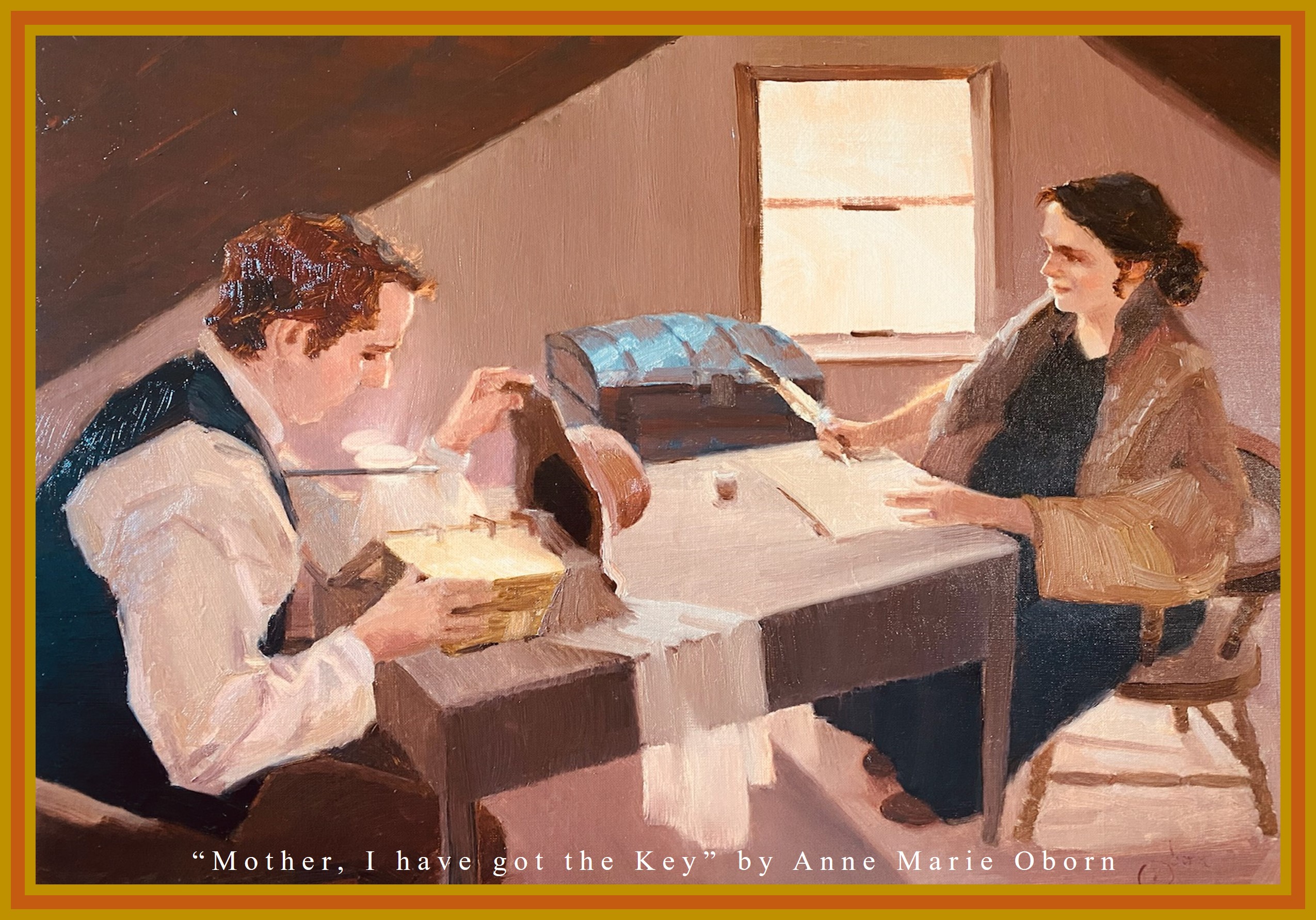
“Some went to the East, and the Tallegwi killed a portion.
“Then all of one mind exclaimed, War! War!
“The Talamatan (not—of—themselves) and the Nitilowan [allied north—people] go united (to the war).
“Kinnepehend (Sharp—Looking) was the leader, and they went over the river. And they took all that was there and despoiled and slew the Tallegwi.
“Pimokhasuwi (Stirring—about) was next chief, and then the Tallegwi were much too strong.
“Tenchekensit (Open—path) followed, and many towns were given up to him.
“Paganchihiella was chief, and the Tallegwi all went southward.
“South of the Lakes they (the Lenape) settled their council—fire, and north of the Lakes were their friends the Talamatan (Hurons!).”
There can he no reasonable doubt that the Alleghewi or Tallegwi, who have given their name to the Allegheny River and Mountains, were the mound—builders.
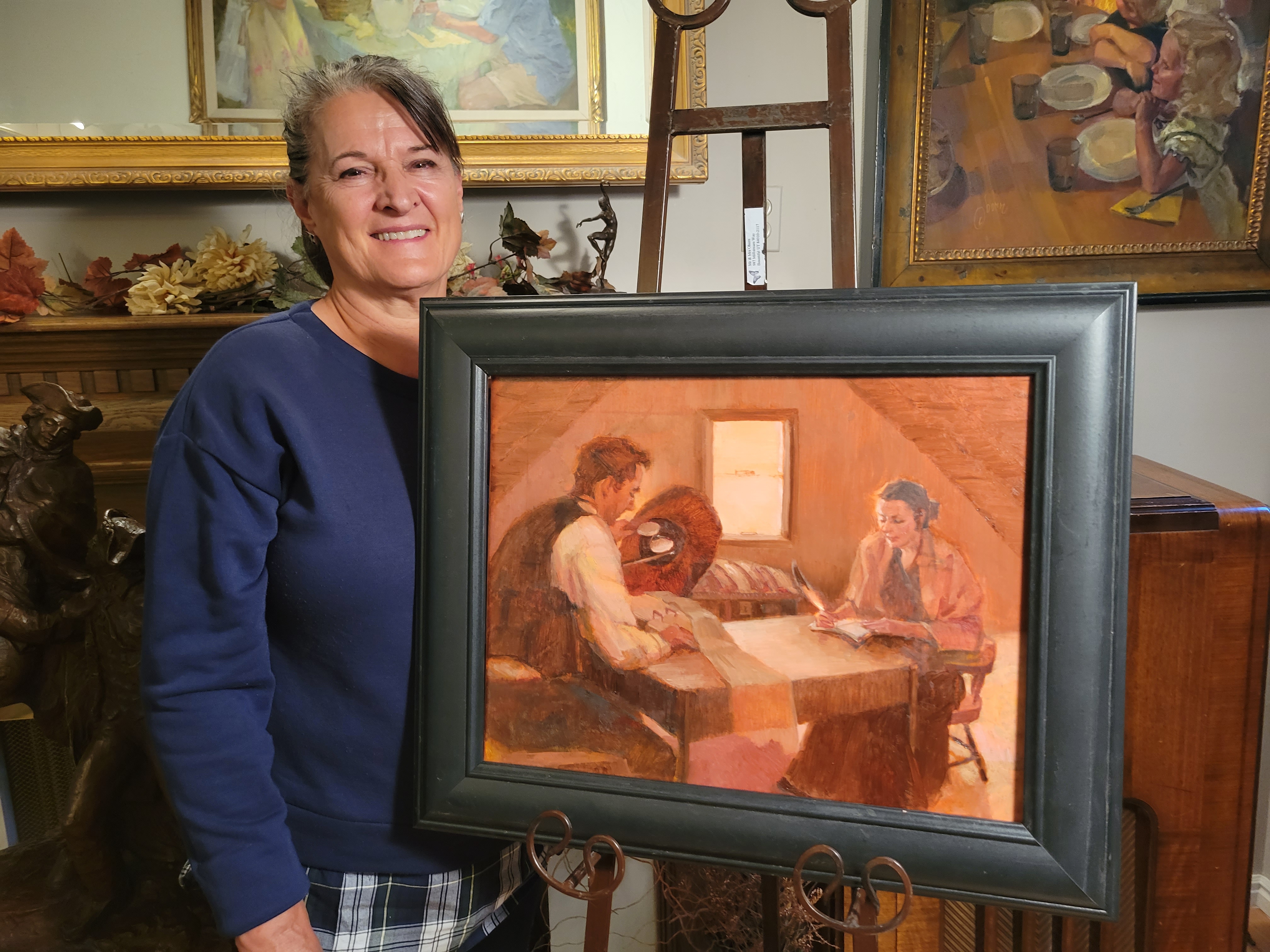
This supposition brings the pressing hordes to the northwest of the Ohio mound—builders, which is the direction, Colonel Force concludes, from the geographical position of the defensive works, they must have come.
The number of defensive works erected during the contest shows it must have been long and obstinate, and that the nation which could thus resist the attack of the northern hordes must have been strong in numbers and fertile in resources. But resistance proved in vain; they were compelled at last, according to the tradition, to leave the graves of their ancestors and flee southward in search of a place of safety.

Here the Delaware tradition drops them, but the echo comes up from the hills of East Tennessee and North Carolina in the form of the Cherokee tradition already mentioned, telling us where they found a resting place, and the mound testimony furnishes the intermediate link.
If they stopped for a time on New River and the head of the Holston, as Haywood conjectures, [Footnote: Nat. and Aborig. Hist. Tenn., p. 223.—See Thomas, “Cherokees probably mound—builders,” Magazine Am. Hist., May. 1884, p. 398.] their line of retreat was in all likelihood up the valley of the Great Kanawha. This supposition agrees also with the fact that no traces of them are found in the ancient works of Kentucky or middle Tennessee. In truth, the works along the Ohio River from Portsmouth to Cincinnati and throughout northern Kentucky pertain to entirely different types from those of Ohio, most of them to a type found in no other section.
On the contrary, it happens precisely in accordance with the theory advanced and the Cherokeee traditions, that we find in the Kanawha Valley, near the city of Charleston, a very extensive group of ancient works stretching along the banks of the stream for more than two miles, consisting of quite large as well as small mounds, of circular and rectangular inclosures, etc. A careful survey of this group has been made and a number of the tumuli, including the larger ones, have been explored by the representatives of the Bureau.
The result of these explorations has been to bring to light some very important data bearing upon the question now under consideration. In fact we find here what seems to be beyond all reasonable doubt the connecting link between the typical works of Ohio and those of East Tennessee and North Carolina ascribed to the Cherokees.
The little stone vaults in the shape of bee—hives noticed and figured in the articles in Science and the American Naturalist, before referred to, discovered by the Bureau assistants in Caldwell County, N. C., and Sullivan County, Tenn., are so unusual as to justify the belief that they are the work of a particular tribe, or at least pertain to an ethnic type. Yet under one of the large mounds at Charleston, on the bottom of a pit dug in the original soil, a number of vaults of precisely the same form were found, placed, like those of the Sullivan County mound, in a circle. But, though covering human remains moldered back to dust, they were of hardened clay instead of stone. Nevertheless, the similarity in form, size, use, and conditions under which they were found is remarkable, and, as they have been found only at the points mentioned, the probability is suggested that the builders in the two sections were related.
There is another link equally strong. In a number of the larger mounds on the sites of the “over—hill towns,” in Blount and Loudon Counties, Tenn., saucer—shaped beds of burnt clay, one above another, alternating with layers of coals and ashes, were found. Similar beds were also found in the mounds at Charleston. These are also unusual, and, so far as I am aware, have been found only in these two localities. Possibly they are outgrowths of the clay altars of the Ohio mounds, and, if so, reveal to us the probable use of these strange structures. They were places where captives were tortured and burned, the most common sacrifices the Indians were accustomed to make. Be this supposition worthy of consideration or not, it is a fact worthy of notice in this connection that in one of the large mounds in this Kanawha group one of the so—called “clay altars” was found at the bottom of precisely the same pattern as those found by Squier and Davis in the mounds of Ohio.
In these mounds were also found wooden vaults, constructed In exactly the same manner as that in the lower part of the Grave Creek mound; also others of the pattern of those found in the Ohio mounds, in which bark wrappings were used to enshroud the dead. Hammered copper bracelets, hematite celts and hemispheres, and mica plates, so characteristic of the Ohio tumuli, were also discovered here; and, as in East Tennessee and Ohio, we find at the bottom of mounds in this locality the post—holes or little pits which have recently excited considerable attention. We see another connecting link in the circular and rectangular inclosures, not combined as in Ohio, but analogous, and, considering the restricted area of the narrow valley, bearing as strong resemblance as might be expected if the builders of the two localities were one people.
It would be unreasonable to assume that all these similarities in customs, most of which are abnormal, are but accidental coincidences due to necessity and environment. On the contrary it will probably be conceded that the testimony adduced and the reasons presented justify the conclusion that the ancestors of the Cherokees were the builders of some at least of the typical works of Ohio; or, at any rate, that they entitle this conclusion to favorable consideration. Few, if any, will longer doubt that the Cherokees were mound builders in their historic seats in North Carolina and Tennessee. Starting with this basis, and taking the mound testimony, of which not even a tithe has been presented, the tradition of the Cherokees, the statement of Haywood, the Delaware tradition as given by Heckewelder, the Bark Record as published by Brinton and interpreted by Hale, and the close resemblance between the names Tallegwi and Chellakee, it would seem that there can remain little doubt that the two peoples were identical.
It is at least apparent that the ancient works of the Kanawha Valley and other parts of West Virginia are more nearly related to those of Ohio than to those of any other region, and hence they may justly be attributed to the same or cognate tribes. The general movement, therefore, must have been southward as indicated, and the exit of the Ohio mound—builders was, in all probability, up the Kanawha Valley on the same line that the Cherokees appear to have followed in reaching their historical locality. It is a singular fact and worthy of being mentioned here, that among the Cherokee names signed to the treaty made between the United States and this tribe at Tellico, in 1798, are the following: [Footnote: Treaties between the United States of America and the several Indian tribes (1837), p. 182.] Tallotuskee, Chellokee, Yonaheguah, Keenakunnah, and Teekakatoheeunah, which strongly suggest relationship to names found in the Allegheny region, although the latter come to us through the Delaware tongue.
If the hypothesis here advanced be correct, it is apparent that the Cherokees entered the immediate valley of the Mississippi from the northwest, striking it in the region of Iowa. This supposition is strengthened not only by the similarity in the forms of the pipes found in the two sections, but also in the structure and contents of many of the mounds found along the Mississippi in the region of western Illinois. So striking is this that it has been remarked by explorers whose opinions could not have been biased by this theory.
Mr. William McAdams, in an address to the American Association for the Advancement of Science, remarks: “Mounds, such as are here described, in the American Bottom and low—lands of Illinois are seldom, if ever, found on the bluffs. On the rich bottom lands of the Illinois River, within 50 miles of its mouth, I have seen great numbers of them and examined several. The people who built them are probably connected with the Ohio mound—builders, although in this vicinity they seem not to have made many earthen embankments, or walls inclosing areas of land, as is common in Ohio. Their manner of burial was similar to the Ohio mound— builders, however, and in this particular they had customs similar to the mound—builders of Europe.” [Footnote: Proc. Am. Assoc. Adv. Sci., 29th (Boston) meeting, 1880 (1881), p. 715.] One which he opened in Calhoun County, presented the regular form of the Ohio “altar.”
A mound in Franklin County, Ind., described and figured by Dr. G. W. Homsher, [Footnote: Smithsonian Report for 1882 (1884), p. 722.] presents some features strongly resembling those of the North Carolina mounds.
The works of Cuyahoga County and other sections of northern Ohio bordering the lake, and consisting chiefly of inclosures and defensive walls, are of the same type as those of New York, and may be attributed to people of the Iroquoian stock. Possibly they may be the works of the Eries who, we are informed, built inclosures. If such conclusion be accepted it serves to strengthen the opinion that this lost tribe was related to the Iroquois. The works of this type are also found along the eastern portion of Michigan as far north as Ogemaw County.
The box shaped stone graves of the State are due to the Delawares and Shawnees, chiefly the former, who continued to bury in sepulchers of this type after their return from the East. Those in Ashland and some other counties, as is well known, mark the location of villages of this tribe. Those along the Ohio, which are chiefly sporadic, are probably Shawnee burial places, and older than those of the Delawares. The bands of the Shawnees which settled in the Scioto Valley appear to have abandoned this method of burial.
There are certain mounds consisting entirely or in part of stone, and also stone graves or vaults of a peculiar type, found in the extreme southern portions of the State and in the northern part of Kentucky, which can not be connected with any other works, and probably owe their origin to a people who either became extinct or merged into some other tribe so far back that no tradition of them now remains.
Recently a resurvey of the remaining circular, square, and octagonal works of Ohio has been made by the Bureau agents. The result will be given in a future bulletin. Read More Here:
Mound-Builders, Mormons, and Joseph Smith
The Mound Builders of North America are connected with the Hopewell Culture of 600 BC to 400 AD which is connected to the Nephite civilization. WOW!
“This linking of the biblical world with the treasure-seeking environment of nineteenth-century New York through the indisputable presence of Native Americans likely impacted how the origins of the Book of Mormon were viewed upon its publication. Not surprisingly, local residents of Palmyra confused Joseph Smith’s claims about the ancient inhabitants described in the Book of Mormon with his earlier money digging experiences. Dahl even categorized the Book of Mormon as Mound Builder literature.
There was little difference between ancient angels, like the one that showed Joseph the plates, and ancient treasure guardians in the minds of some of the local residents when they reflected back upon what Joseph experienced in the early 1820s. This was in spite of the fact that interest in buried Native American artifacts was a deep-seated American interest closely associated with Christianity. Interest in Native American ruins or treasures buried in the New York landscape was not just a money digger’s preoccupation.
Curtis Dahl explained, “The Romantic love of the distant past, the desire to provide the new country with an antique and glorious history, and the controversy over American natural history between nationalistic Americans and the followers of the French naturalist Buffon prompted a number of archaeological books and articles on these mysterious ancient inhabitants of America [from 1800–1840],”
Curtis Dahl, “Mound-Builders, Mormons, and William Cullen Bryant,” New England Quarterly 34 (June 1961): 178. The idea of ancient mound builders was fairly well known and even supported and perpetuated by local Palmyra newspapers.
For examples, see “Indian Antiquities,” Palmyra Register, 21 January 1818, and Palmyra Herald, 19 February 1823. Dahl, “Mound-Builders,” 178–90. See also William A. Ritchie, The Archaeology of New York State (Garden City, NY: Natural History Press, 1965).
North America Inhabited by a White People before the Ancients (Jaredites)
By D. C. Miller. Batavia, N. Y., October 18, 1822. Vol. 11, No. 553.
AMERICAN ANTIQUITIES.
To the editors of the Louisiana Republican.
Gentlemen: — In the course of my observation & travels through several parts of the United States, I have kept minutes of the most remarkable events which have occurred under my own observation, extracts from which I design, occasionally, to submit to you, and if you think them worthy of insertion in your useful paper, you are at liberty to use them accordingly.
Indian Burial Mound – Cooperstown, New York – New World
All accounts extant, relative to the size of the ancient settlers of our country, agree that this race of beings must have been larger than the present; but none that I have seen give any evidence of this fact. From my own observation, I have evidence at least of one person of gigantic stature.
In the year 1810, I opened, with several other persons who accompanied me for the purpose, one of the flat mounds common in the western country. It was built of regular layers of flat stones, and covered lightly with earth. This was 4 miles west of the town of Worthington, in Ohio, and within a few rods of the banks of the river Scioto. — In this mound we found the skeletons of a number of bodies, some of a very large size, they were deposited directly due east and west, the heads to the west; precisely as is the practice in Christian burials.
After several hours fatigue in opening & examining this mound, we retired to a house of a Mr. Miller, about 200 yards from the spot, who informed us that he had taken a skeleton from the mound adjoining the one we had examined, which was supposed to be, when living, a man of at least 7 feet 4 inches. He stated that such was the opinion of all who had seen the bones in his possession — that the bone of the leg, which had lost a little at each end, was then longer than the bone of the tallest man in the settlement, measuring from the heel to the cap of the knee.
Mr. Miller stated that he had also in his possession, the jaw bone of this skeleton, which he said, would cover loosely the face of any of his neighbors; and that, when he found the skeleton, he picked from one of the joints of the neck bone, (which was also much larger than any he had seen before,) a stone arrow point; from which circumstances, it was thought his death had been occasioned. I made many inquiries of Mr. Miller, who seemed to be a very intelligent man. He informed me that he had been living at his residence on the Scioto, for many years; — that when he first settled there, he was told by all the old Indians that these mounds existed at a period beyond the recollection of the oldest of them, and that the tribe of Indians before them could give no account of the mounds, other than that they were burying places before they inhabited the country.
From these circumstances, together with some others, which have come under my observation, I have been of opinion, that the bones frequently found in these mounds, must have been the skeletons of a race of beings inhabiting the country, of whom the Indians had no knowledge. The most remarkable circumstance stated by Mr. Miller was, that when ploughing his field, he traced plainly the remains of an ancient building in the form of a house, as there was a manifest difference in the appearance of the earth; and pointing at the same time to the hearth stone in his fire-place, he observed “the hearth-stone which you see there, I took myself from the place where I suppose the fire-place was in the ancient building of which I speak.” The Indians, he added, gave him the same account of the appearance of this old building as they had of the mounds; that it existed before their time. During the war, and while on my way to Detroit, I intended calling on Mr. Miller, for more particular information, but upon my arrival at Worthington, I learned that he was dead.
Every information tending to prove the existence of a vast ancient population of any part of our country, ought to be preserved— but few persons can or will afford to spend time and money to the attainment of such an object. I have occasionally noted what had passed under my observation since the year 1807 in the western country; and, as I find leisure, will transmit them to you to be filed away through the medium of your paper, till better proof can be obtained of the existence of a vast ancient population of our country.
In my opinion the eight letters that Joseph asked Oliver to write about the History of the Church in 1835, should be read by everyone, and I feel they could even be scripture. Why haven’t you heard about them?
There is also much confusion about what was contained in the stone box where Joseph received the plates from Moroni. Most members of the Church don’t understand there were two depositories at Hill Cumorah. In addition to this stone box there was a separate cave at Hill Cumorah that was about 15 feet deep by 15 feet wide.
Also at the end of this blog about the the letters and the stone box, I want your help in sharing your opinion on a question about the contents of “pillars” in the stone box, but how many pillars were there? By the way, was there found the Liahona or sword in that box?
Did you know that Joseph had a stone or two while he was young? Almost everyone near Palmyra had a favorite stone or rock. We never hear in scripture that Joseph used his rock to translate the plates. What did Joseph use and what was contained in the stone box?
Of Oliver’s eight letters, portions of Letter I are found in our scriptures and canonized? “See Joseph Smith – History after verse 75.” The source reference is from Messenger and Advocate, vol. 1 (October 1834), pp. 14–16, which is the same thing published as Letter I.
LETTER VII IS PUBLISHED IN THESE PUBLICATIONS: Messenger and Advocate (Kirtland 1835) Copied into Joseph Smith’s Personal Journal (1835) Quoted in Orson Pratt’s Pamphlet (1840) Gospel Reflector (Philadelphia 1841) Times and Seasons (Nauvoo 1841) The Prophet (New York City 1844-45) Liverpool Pamphlet (1844) Millennial Star (1866) Improvement Era (Salt Lake City 1899)
“I think Letter VII was reprinted so many times because it was so important. Oliver’s history was the most complete history of the early days of the Church until the serialized History of Joseph Smith began running in the Times and Seasons in 1842, but it was also important for people to know that the New York hill was a touchstone for the Book of Mormon. It was a connection between ancient and modern times–a pin in the map.” Jonathan Neville
Joseph Smith’s History, 1834-1836, contains Oliver’s letters, including Letter VII. You can find it in the Joseph Smith Papers starting with Chapter 1 on page 17. Oliver’s letters appear several pages later. Oliver Cowdery’s Letter VII as it appears in Joseph Smith’s own history “Letter VII,” LDS Messenger and Advocate, July 1835, 1:155–159 (Key to finding letter VII is to scroll down until you find the July 1835 article).
Letter I to Letter VIII Introduction
From the Joseph Smith Papers Project- History, 1834–1836 Joseph Smith Papers.org Editorial Note”
The following section includes transcripts of eight letters Oliver Cowdery wrote in 1834 and 1835 regarding JS’s visions of an angel and his discovery of the gold plates of the Book of Mormon. Cowdery addressed the letters to William W. Phelps and published them as a series in the Latter Day Saints’ Messenger and Advocate between October 1834 and October 1835. The titles and formatting employed in this history are similar to those in the published series of articles, indicating that the Cowdery letters were copied into the history from the Messenger and Advocate, not from a manuscript version of the letters.
Frederick G. Williams could have begun the transcription in JS’s history as early as 6 December 1834, the date of Cowdery’s last historical entry in the preceding section of the history. However, Cowdery probably gave the history to Williams around 2 October 1835, when he gave Williams JS’s journal. On 29 October 1835, JS retrieved the history from Williams and delivered it to Warren Parrish, who continued copying the Cowdery letters. It is likely that Parrish finished copying the letters by early April 1836, when he gave JS’s journal (and presumably the 1834–1836 history along with it) to Warren Cowdery
In the first letter, Oliver Cowdery recounted his experiences with JS beginning when the two first met in April 1829. The letter includes an account of the vision he and JS had of John the Baptist, who gave them the authority to baptize. After composing this letter, but before its publication, Cowdery developed a new history-writing plan: he decided that in subsequent letters he would relate the “full history of the rise of the church,” beginning with JS’s early life and visions. As editor of the Messenger and Advocate, Cowdery prefaced the published version of the first letter with an explanation (also transcribed into the history) of the new plan. Although he had no firsthand knowledge of church history prior to April 1829, Cowdery assured his readers that “our brother J. Smith Jr. has offered to assist us. Indeed, there are many items connected with the fore part of this subject that render his labor indispensable.” Some passages in the ensuing narrative seem to have been related to Cowdery by JS, since Cowdery recounts events in which only JS participated.
Cowdery composed the letters to inform the Latter-day Saints of the history of their church, but he also wrote for the non-Mormon public. Employing florid romantic language, frequent scriptural allusions, and much dramatic detail, he clearly intended to present a rhetorically impressive account of early Mormon history. He placed the rise of the church in a dispensational framework, characterizing the time between the end of the New Testament and JS’s early visions as a period of universal apostasy. He included the revivalism of various denominations during the Second Great Awakening, which JS experienced in his youth, as an example of the doctrinal confusion and social disharmony present in Christendom. Throughout the series of letters, he defended JS’s character and that of the Smith family, and his explicitly apologetic statements include apparent allusions to both Alexander Campbell’s Delusions (1832) and Eber Howe ’s Mormonism Unveiled (1834).
Beginning in the third letter, Cowdery provided the most extensive account of the origins of the Book of Mormon published up to that time. He related JS’s initial visions of the angel Moroni and, using biblical prophecies, elaborated on the angel’s message concerning the gathering of Israel in the last days in preparation for the Millennium. Cowdery continued his narrative up to, but did not include, JS’s receiving the gold plates in September 1827.
The transcription of the Oliver Cowdery letters into JS’s history was evidently conceived in terms of the entire series, not as a piecemeal copying of the individual letters. As noted above, Cowdery probably gave the “large journal” containing the history begun in 1834 to Williams in October 1835, the month of the Messenger and Advocate issue in which his final installment was published.
By the time Williams received the history, Cowdery may have already written the final letter; he had at least conceived of it as the final installment in his series. With the serialized Cowdery letters complete or nearing completion, the new history kept in the “large journal” could serve as a repository—more permanent than unbound newspapers—for a copied compilation of the entire series.
Letters from Messenger and Advocate The following communication was designed to have been published in the last No. of the star; but owing to a press of other matter it was laid over for this No. of the Messenger and ad[v]ocate. Since it was written, upon further reflection, we have thought that a full history of the rise of the church of the Latter Day Saints, and the most interesting parts of its progress, to the present time, would be worthy the perusal of the Saints.— If circumstances admit, an article on this subject will appear on in each subsequent No. of the Messenger and advocate, until the time when the church was driven from Jackson Co. Mo. by a lawless banditti; & such other remarks as may be thought appropriate and interesting.
That our narrative may be correct, and particularly the introduction, it is proper to inform our patrons, that our brother J. Smith Jr. has offered to assist us. Indeed, there are many items connected with the fore part of this subject that render his labor indispensable. With his labor and with authentic documents now in our possession, we hope to render this a pleasing and agreeable narrative, well worth the examination and perusal of the Saints.
To do <Justice to> this subject will require time and space: we therefore ask the forbearance of our readers, assuring them that it shall be founded upon facts.
The breastplate was worn under Joseph’s shirt and a farmers hat was possibly used to prevent the scribe from seeing the plates and the spectacles.
The Proper Method of Translation in my opinion is utilizing the three items that were contained in the stone box at Cumorah. There were only the gold plates, the breastplate, and the two stones in a silver bow similar to spectacles. With these three items the translation of the Book of Mormon came forth. No where in the scriptures do we hear of Joseph using a stone in a hat to translate. We also find credible sources that a curtain was not placed between Joseph and the scribe. For detailed explanation you can click below the artwork for additional information about scriptural verification and the words of Lucy Mack Smith.
Did the spectacles really have the diamond shape in them? Lucy describes it.
The Authentic Stone Box & The Cave at Cumorah
“Through the medium of the Urim and Thummim I translated the record by the gift and power of God” Joseph Smith- HC4:537
The items above are the only contents of the stone box where Joseph received the plates. There was not a single seer stone, there was not the Liahona, nor the Sword of Laban. There is no scripture that says this, many historians have made this up as you can see today in the Church History Museum, in the picture below.
Heartlanders say, “Mormon’s depository and Moroni’s stone box are in the same hill Cumorah in New York in different locations.” [One Hill Cumorah only in New York] Mesoamericanists say, “Mormon’s depository is at some hill in Mexico, and Moroni’s stone box is in New York” [Neither one was necessarily called Cumorah. See “Saints” Vol. 1]
Video at the Church History Museum
The Liahona and Sword were in the large cave at Hill Cumorah that Joseph entered with Oliver, where there were many many plates and records. Wilford Woodruff said, “[Joseph] went [into] a Cave in the Hill Comoro with Oliver Cowdry & deposited those plates upon a table or shelf. In that room were deposited a large amount of gold plates containing sacred records… Joseph Smith said that cave contained tons of choice treasures & records.” Wilford Woodruff Journal, 11 December 1869
Heber C. Kimball said, “Joseph and others… went into a cave in the hill Cumorah, and saw more records than ten men could carry… There were books piled up on tables, book upon book. Those records this people will yet have, if they accept of the Book of Mormon and observe its precepts, and keep the commandments.” Heber C. Kimball
Oliver Cowdery
“The manner in which the plates were deposited: First, a hole of sufficient depth, (how deep I know not) was dug. At the bottom of this was laid a stone of suitable size, the upper surface being smooth. At each edge was placed a large quantity of cement, and into this cement, at the four edges of this stone, were placed, erect, four others, their bottom edges resting in the cement at the outer edges of the first stone. The four last named, when placed erect, formed a box, the corners, or where the edges of the four came in contact, were also cemented so firmly that the moisture from without was prevented from entering. It is to be observed, also, that the inner surface of the four erect, or side stones was smooth. This box was sufficiently large to admit a breast-plate, such as was used by the ancients to defend the chest, &c. from the arrows and weapons of their enemy. From the bottom of the box, or from the breast-plate, arose three small pillars composed of the same description of cement used on the edges; and upon these three pillars was placed the record of the children of Joseph, and of a people who left the tower far, far before the days of Joseph… I must not forget to say that this box, containing the record was covered with another stone, the bottom surface being flat and the upper, crowning. But those three pillars were not so lengthy as to cause the plates and the crowning stone to come in contact. I have now given you, according to my promise, the manner in which this record was deposited; though when it was first visited by our brother, in 1823, a part of the crowning stone was visible above the surface while the edges were concealed by the soil and grass, from which circumstances you will see, that however deep this box might have been placed by Moroni at first, the time had been sufficient to wear the earth so that it was easily discovered when once directed, and yet not enough to make a perceivable difference to the passer-by.” Oliver Cowdery, “Letter VIII,” October 1835
Empty with three small pillars
Translation tools with three small pillars
Joseph Smith Jr.
“Having removed the earth, I obtained a lever, which I got fixed under the edge of the stone, and with a little exertion raised it up. I looked in, and there indeed did I behold the plates, the Urim and Thummim [“Lights and Perfections” or allegorically, “Doctrine and Truth”; see pp. xix, 446, 560-61, 551], and the breastplate, as stated by the messenger. The box in which they lay was formed by laying stones together in some kind of cement. In the bottom of the box were laid two stones crossways of the box, and on these stones lay the plates and the other things with them.” JSH 1:52
Lucy Mack Smith
Lucy Mack Smith said, “[Moroni, after telling Joseph about the record, said] but you cannot get it until you learn to keep the commandments of God For it is not to get gain. But it is to bring forth that light and intelligence which has been long lost in the Earth
Now Joseph beware or when you go to get the plates your mind will be filled with darkness and all manner of evil will rush into your mind. To prevent you from keeping the commandments of God that you may not succeed in doing his work and you must tell your father of this for he will believe every word you say.
The record is on a side hill on the Hill of Cumorah 3 miles from this place. Remove the grass and moss and you will find a large flat stone pry that up and you will find the record under it laying on 4 pillars of cement— then the angel left him.” JSP Lucy Mack Smith, History, 1844–1845 https://www.josephsmithpapers.org/paper-summary/lucy-mack-smith-history-1844-1845/41
What Do You Think? Two? Three? or Four? Pillars?
I think it is most likely there were two stones on the bottom crossways of the box as this is canonized information. The Letter VIII information is a good secondary witness that there was something that the plates were sitting on top of such as the three pillars and of course Lucy Mack’s witness is always credible as she mentioned four pillars.
Plates, interpreters and Breastplate, with two stones crossways of the box at the bottom“Years ago, when the church was working on filming “How Rare A Possession,” (See Video Here) the Church contacted brother [L…] in our stake. [Le…] was quite a well-known, successful landscaper in the area (I also dated his son). They asked him if he could locate a rock that would be as close to the dimensions of the rock that would have covered the stone box where the plates were deposited.[L…] took this task VERY seriously and read the entire BofM in three days (morning and night). At around 3AM, just as he finished the last page, he knelt down in prayer and asked the Lord to guide him to such a rock. Upon finishing his supplication he heard a voice tell him to go to the Hill at that moment. He lived about 45 minutes from the Hill. By the time he arrived, the sun was just starting to rise. He said within 15 minutes he was directed to a spot on the Hill and as he peered down he noticed a tip of a rock jutting out of the hillside. As he started to dig, he realized how large this stone truly was. Then he heard another voice tell him, this is THE stone....the very stone that laid on top of the box. He immediately stopped his digging and decided to contact the Church. Upon calling them to tell them he believes he found THE stone, the brother told him that they knew and already had 4 men on a flight out there to meet with him and that he was to wait until they got there before removal of the stone. He said it took 5 men to lift the stone. The stone was used in the filming of the movie and is currently kept in the granite vaults in UT. You may be aware from your historical research that the actual stone box was reported by Oliver Cowdery that “the casket had been washed down to the foot of the Hill.” Thus, the box is no longer.” Kathy Burris as told in an email to Rod Meldrum. See complete blog here.This is the EXACT STONE used in the movie, that originally covered the Stone Box area.“Years ago, when the church was working on filming “How Rare A Possession,” (See Video Here) the Church contacted brother [L…] in our stake. [Le…] was quite a well-known, successful landscaper in the area (I also dated his son). They asked him if he could locate a rock that would be as close to the dimensions of the rock that would have covered the stone box where the plates were deposited.[L…] took this task VERY seriously and read the entire BofM in three days (morning and night). At around 3AM, just as he finished the last page, he knelt down in prayer and asked the Lord to guide him to such a rock. Upon finishing his supplication he heard a voice tell him to go to the Hill at that moment. He lived about 45 minutes from the Hill. By the time he arrived, the sun was just starting to rise. He said within 15 minutes he was directed to a spot on the Hill and as he peered down he noticed a tip of a rock jutting out of the hillside. As he started to dig, he realized how large this stone truly was. Then he heard another voice tell him, this is THE stone....the very stone that laid on top of the box. He immediately stopped his digging and decided to contact the Church. Upon calling them to tell them he believes he found THE stone, the brother told him that they knew and already had 4 men on a flight out there to meet with him and that he was to wait until they got there before removal of the stone. He said it took 5 men to lift the stone. The stone was used in the filming of the movie and is currently kept in the granite vaults in Utah. You may be aware from your historical research that the actual stone box was reported by Oliver Cowdery that “the casket had been washed down to the foot of the Hill.” Thus, the box is no longer.” Kathy Burris in an email to Rod Meldrum 2015. You can see the entire email at the blog below: https://bookofmormonevidence.org/arrowheads-the-cave-and-actual-stone-at-cumorah/
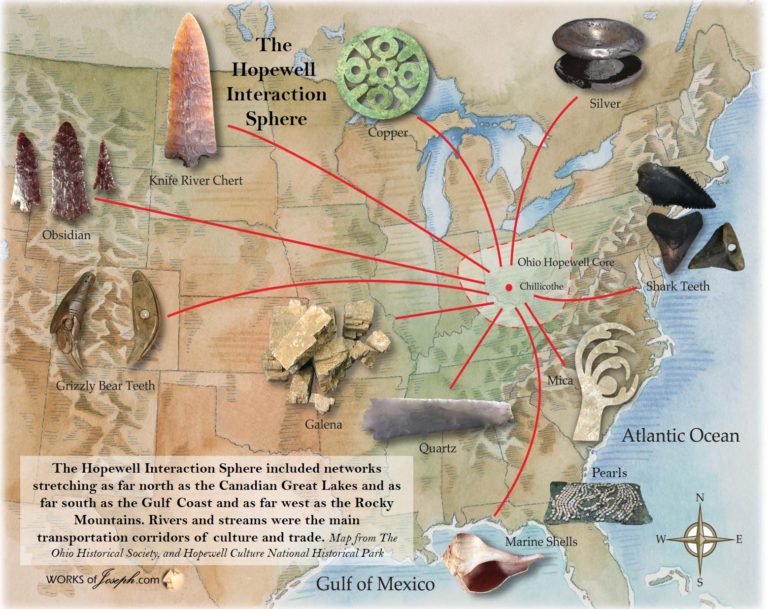
Now you know some new things about Church History. even though I could be wrong, I have studied and researched and believe this information is correct. May you be inspired to search out truth where ever it may be and seek your own personal revelation.
In the Heartland of the United States you will find many interesting geological features that help you create a map about ancient dwellings of the Book of Mormon People.
Many of your family and friends will say, “It really doesn’t matter where Book of Mormon events happened.” If geography and geology were not important to the Lord, why are there over 500 references to geography in the Book of Mormon?
Basic Book of Mormon Geography
Why does the geography matter? Think of that question if we are speaking about Israel. Does it matter where the Savior was born, or where the Biblical events happened? Yes. At Mount Moriah where Abraham was to sacrifice Isaac, the Lord made a special covenant with Abraham. The land around Mt Moriah was a covenant land and God’s people were given that covenant land as long as they are righteous. However, if they disobey the commandments, God’s people will be swept off that sacred land. The Jews, Muslims, and Christians fight over control over this one piece of land why? Because it is a beautiful piece of real estate? No, because it is a covenant land. All three religions say Mt Moriah is sacred to them and they are willing to die over it. In the same token what is the Promised Land spoken of in the Book of Mormon? According to the Book of Mormon this Promised land must meet certain requirements to be the Promised Land. 1. No Kings upon the land 2. Land choice above all other lands 3. Land of Liberty 4. Land where sacred record is kept 5. Land kept from the knowledge of other nations. 6. Land of the New Jerusalem 7. Gentiles to scatter and afflict the Remnant. 8. The place where the Marvelous Work and Wonder happened. These are only 8 of 36 prophesies and promises in the Book of Mormon so it makes sense to me that the USA is the Promised Land. Not Canada, Mexico, England, or South America.
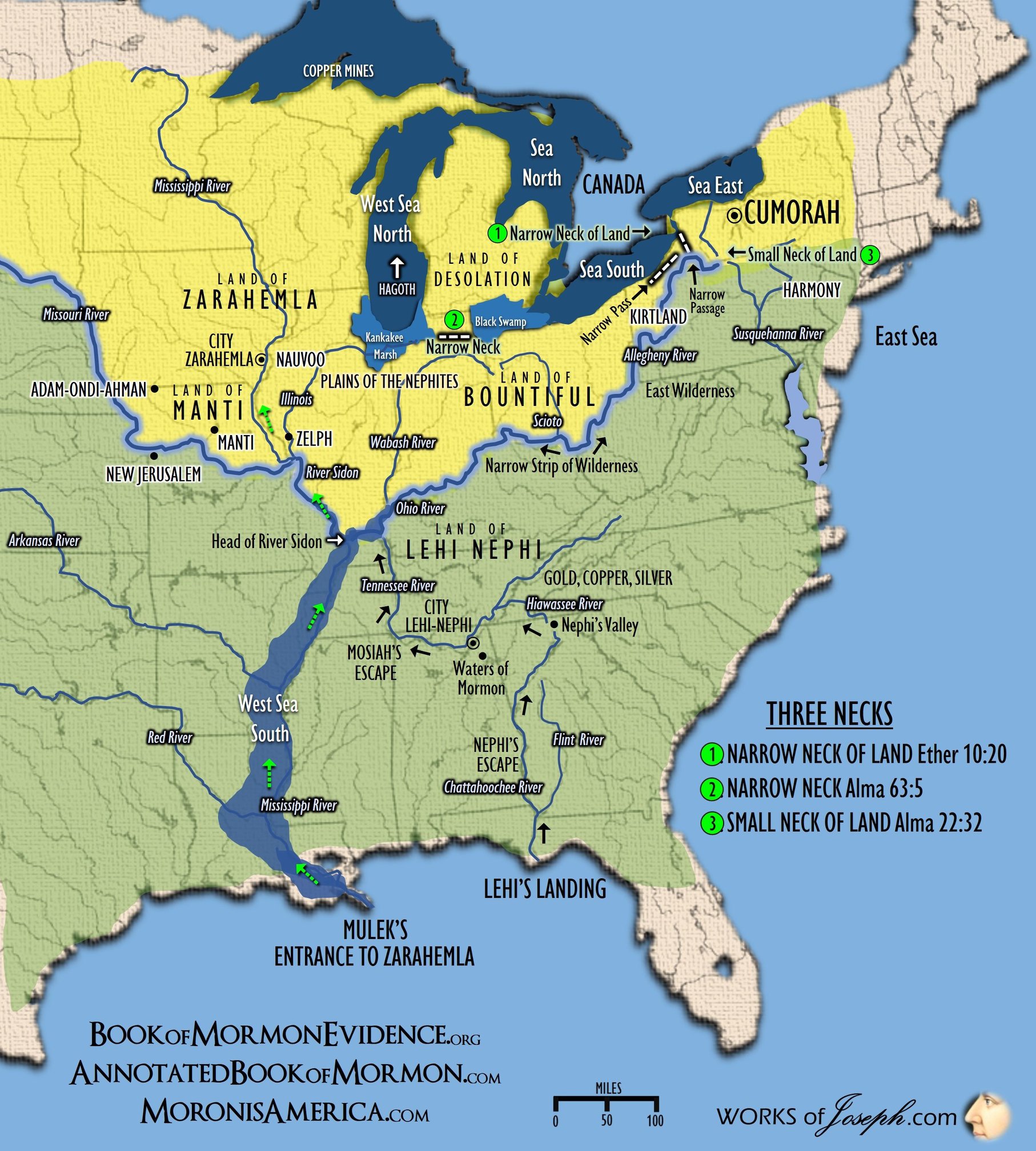
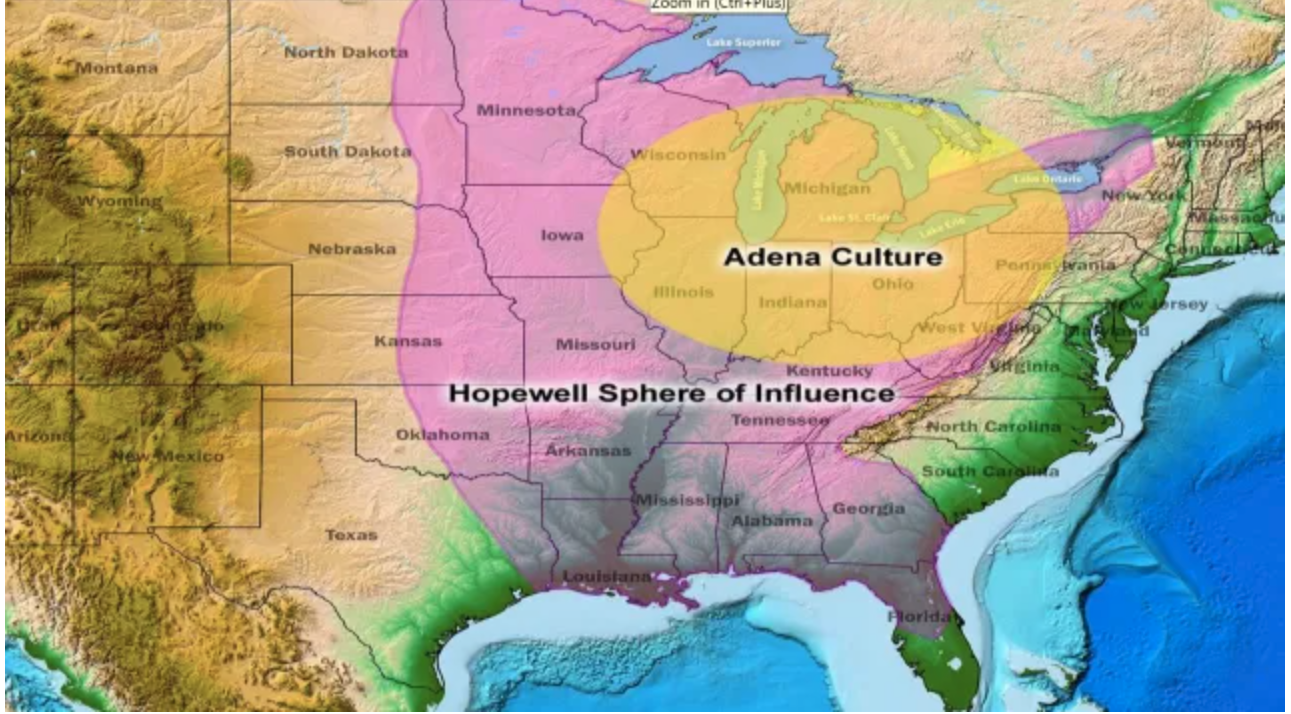
Just as Israel is a Promised Land forever, so the USA is a Promised Land forever and it does matter where this Promised Land is located. It is in the Heartland of North America. The Nephites practiced the Law of Moses. To do this they needed the following plants and animals to keep the Law. Sheep, Rams, Goats, Bullocks, Doves, Wheat, Barley, and Wine. None of these animals or items are found anywhere in Mesoamerica during the Nephites times, only in the USA. So, the land and where things happen is critical to us and especially to the Lord.
If we in the church cannot even decide among ourselves where the Book of Mormon happened, how confusing is that to our youth and adults? The Anti-Mormons love the idea that we don’t even know where our sacred scriptures happened. There are over 100 theories of where the Book of Mormon happened, including, Baja, Chile, Malaysia, Honduras, Peru, etc.
I know the Brethren of the Church take a neutral position on the geography of the Book of Mormon. There are many CES instructors and other BYU professors that teach the Two Cumorah theory or Mesoamerican theory, and they say a second Hill Cumorah exists somewhere in Mexico, but they aren’t sure where. I believe there is only one Hill Cumorah which is associated with the Heartland Model of the Book of Mormon. For you and I to take a neutral stand is not required. The Lord told us to read and study, and in the promise to Moroni, He said we may know the truth of ALL things, and that would include knowing the location of the Book of Mormon events. I believe knowledge of the Spirit and of the head, are both important in learning truth. I used to believe in the Mesoamerican theory, but after research and prayer I believe in the Heartland Model.
Each map I share with you below, will teach you incredible information of the travel and routes of the Nephites and Lamanites. Where they could have traveled and where there was an impossible obstacle that could not be overcome. All of these things effect the time and mode and way of travel.
Where would they have lived and why and what archaeology may validate it? What would be the best places of defense or where to build a fort. How important to have high places where you could see your enemy? What method of transportation would be best, walking or canoe? Where to build a city and live for long periods because of the nearby farm land or type of soil?
Considering the Heartland of the United States has changed over the years, how would those changes effect the Nephites. In other words what terrain or lake is not present today that could have been there many years ago? How could those changes effect where the Nephites lived or fought?
My purpose in this blog is to let you know about ancient lakes, rivers, terrain, artifacts, swamps, fortifications, marshes, and climate that would have a major impact on where the Nephites lived and defended their territory. What geological features are not present today in the Heartland that were very important to the survival of the Hopewell Culture or as we would call it the Nephite Culture?
Below is the overall main map of the entire Nephite territory!
Great Black Swamp
“It is hard to believe that there once lay a terrible swamp beginning in the vicinity of South Boundary Street and running as far south as Findlay, Ohio, and east and west from the city of Sandusky nearly to Fort Wayne, Indiana…40 miles wide and 120 miles long. It was the Great Black Swamp, an oozing mass of water, mud, snakes, wolves, wildcats, biting flies, and clouds of gnats and mosquitoes. It was nearly big enough to cover the entire state of Connecticut.
Water, often up to the belly of a horse, stood on the surface until it evaporated in the hot summer months. When it rained, or thawed in the winter, it was water and muck. Much of the swamp was covered with an almost impenetrable forest of giant oak, sycamore, hickory, walnut, ash, elm, maple and cottonwood trees, except in a few prairie areas where limestone just under the surface would not support timber growth.
Not even native Indians went into the swamp except to hunt, and unless you could follow a blazed trail, it was easy to become hopelessly lost since you could only see but a few yards ahead.
The enormous weight of the mile-thick ice pack pressed down and scooped out the earth beneath it to create a depression about 10 feet lower south of where Perrysburg sits on the river bluff. Thereafter, until it was drained, water stood in the silted wetland and clay in the ground prevented it from soaking in. When water was standing and flooding conditions occurred, large fish from the Maumee River and other streams could swim all over areas now covered by corn and soybean fields. One man in Perrysburg told of ice skating all the way to what is now Weston, Ohio, nearly 17 miles southwest of Perrysburg.
There was no end to the variety of sicknesses and maladies spawned from the mosquito-infested swamp. There was cholera, typhoid and milk sickness, but chief among them were malarial fevers generally known as “ague” for which people kept quinine powder on the table, along with salt and pepper, to sprinkle on their food.
The fevers caused people to have chills, or the shakes, and according to a doctor of the time it took them from three to five years to get over it. The shakes occurred from about the first of July until the first frost. They took hold of people and literally shook them up. The doctor wrote that so violent were the chills and shaking that when they came on, the very bed and floor would rattle.
The Black Swamp was Ohio’s last frontier, and beginning in the 1840s, it took several generations of determined farmers to drain it and make it the rich, flat farmland of today. What started it all was pretty much the idea of the medical profession which believed that it was bad swamp air that caused the fevers.
They were ignorant of the fact that it was blood-sucking mosquitoes that transmitted the disease, but at least they were on the right track. Along with this, when canals and railroads came through here they created markets for the vast timber resources, most of it in the swamp. And still another good reason for beginning the tremendous job of draining the swamp was the realization that it could be done. People learned from trying to build roads that they could dig ditches and the water would flow toward the nearest stream of river.
Until then, early farmers tilled just the highest ground, with some effort to build shallow, open ditches around a plot or field, or one leading to the nearest creek if available. As more settlers came, farmers would sometime cooperate in extending their adjoining ditches.
Finally, in 1850, the Ohio legislature passed the first law regarding government support for drainage systems resulting in people throughout Northwest Ohio cooperating in wide-area drainage, with ditches deep enough to drain the swamp water into Lake Erie via the Maumee and Portage Rivers.
Individual farmers continued to dry out their fields by plowing trenches across them, using wooden troughs laid underground, and eventually with clay tiles and pipe introduced by European farmers.
It took back-breaking labor and construction of one of the greatest underground drainage systems in the history of the world to create the productive farmland we now drive by and take for granted just outside of Perrysburg.” Historic Perrysburg Inc 2006-2012
Great Black Swamp Book of Mormon Features- Narrow Neck Line Bountiful/Desolation
Great Kankakee Marsh Book of Mormon Features- Narrow Neck Line Bountiful/Desolation Hagoth’s Launch
Grand Kankakee Marsh
”Located along the historic Kankakee River, the park is dynamically affected by seasonal flooding. This, along with different natural communities, provides ideal feeding in the fields for a variety of wildlife. Densely wooded areas and the remnants of old river channels provide excellent habitat for a large deer herd, many species of ducks, and other wildlife. Preservation of these natural habitats is one of the primary goals of the Lake County Parks and Recreation Department.
Hunting, wildlife and bird viewing, biking, hayride tours and canoe workshops make up the majority of recreation opportunities at the Marsh. The levees are also heavily used as bridle trails. GKM, along with Stoney Run and Deep River, are the Lake County Parks where the public may ride their horses. For the past 19 years, the park has been the site of the annual Voyageur Rendezvous, a living history reenactment of the early French fur trade era that presents educational information in a colorful re-creation.
GKM was acquired in 1977 with assistance from the Nature Conservancy. Through the years the marsh has been developed and managed for wildlife as well as public use. The careful management and regulation of hunting seasons has helped to make this property a noteworthy hunting area.
The majority of the park land was acquired through grants. In 1977 $425,000 was provided by the Land and Water Conservation Fund for the purchase of 872 acres. Since then many other grants, donations, and purchases have been combined to increase the park site to 2,069 acres.
In 1991, the park department received an Indiana Waters Grant of $250,000 (Dingle/Johnson Funds) to construct public access site on Kankakee River at Grand Kankakee Marsh. Special design included floating finger pier that “rides” with the 12′ high and low levels of the river. Parking for ten cars with trailers adjoins handicapped accessible ramp.
Summary
The Grand Kankakee Marsh that bordered the Kankakee River once consisted of between 500,000 and 600,000 acres of marsh land in Indiana.
It was from two to fifteen miles wide for the length of the river in Indiana and was the largest contiguous marsh in Indiana and one of the largest on the continent.
To understand how such a magnificent Marsh could be obliterated, one must consider the prevailing sentiment in the country at the time. The push was one to settle the area and then stake claim to the land further West. Settlement, at the time, meant agriculture.
Portions of the Kankakee Marsh soil were a black, sandy loam, three to six feet deep. This was potential prime farm land, all that needed to be done was to remove the water. Once the actual draining process began and well connected land speculators became involved, the drainage project became unstoppable. The voices of those who objected to the project could not be heard over the din of the activities of the steam shovels.” Lake County Parks and Recreation Department Corporate Office
Lake Tight
A GREAT LOST RIVER GETS ITS DUE By WALTER SULLIVAN NY Times Published: November 29, 1983
GEOLOGISTS now believe that one of the great master rivers of world history once flowed west from the eastern portion of the United States and was responsible for much of the land and stream formation as far west as the Mississippi valley.
Its deep gorges and broad valleys, as well as remnants of its many tributaries, now lie hidden under glacial deposits covering the region south of the Great Lakes.
Not until recently has the existence of such a river – probably formed more than two million years ago and almost certainly never seen by human eyes – finally become accepted.
Yet early explorers of the Ohio River drainage basin did begin to note early on that there was something very mysterious about its topography.
In 1838 a Dr. P. Hildreth wrote, in the first annual report of the Geological Survey of Ohio, ”Great changes have evidently been made in the direction of all our watercourses before they found their present levels.”
Typical of the evidence for such changes was the observation by Gerard Fowke in 1886 that the deep gorge west of Chillicothe, Ohio, could not have been formed by the trickles of Paint Creek, its present occupant. It must, he said, have been cut by a mighty river. His proposition, however, was met with great disdain by the conventional geologists of the time.
In 1903 William G. Tight of Denison University in Granville, Ohio, made a similar observation in West Virginia: The deep valley running westward from Charleston to the Ohio River, he said, carries no significant flow of water beyond St. Albans, where the Kanawha River suddenly turns north. Professor Tight sought in vain to persuade the geological community that this valley once carried a mighty river that continued across Ohio, Indiana and Illinois through a valley now deeply buried under glacial deposits. He called it the Teays (pronounced taze) River, for a village in West Virginia.
Mahomet Valley
After its discovery by coal explorers, the hidden river valley across Illinois was called the Mahomet Valley, for a town where the river is most deeply buried. But geologists did not then regard it as a continuation of the Teays, as most of them now do.
Some rivers, such as the Scioto in Ohio, have completely reversed their ancient direction of flow. The Scioto now flows south over a deep bed of glacial material, past Columbus and Chillicothe, to the Ohio River at Portsmouth. The bedrock beneath it, however, shows that it once formed a section of the Teays where it flowed north.
A key factor in changing direction was the formation of a ”forebulge’‘ in front of the advancing ice, produced in much the same way as marshy ground bulges forward when one walks across it.
Earlier this year a conference was held at the Newark campus of Ohio State University to discuss the role of the Teays River valley in providing migration paths for southern plant life into Ohio. Isolated groves of magnolias grow wild along the old riverbed, as do some species of azalea and rhododendron.
A related mystery of long standing is the presence of enormous boulders of alien origin in parts of Kentucky, far south of the known limits of ice advance.
The boulders seem more typical of rocks from the Adirondacks or the region between Ottawa and Quebec. The Epworth Boulder in Lewis County, Ky., weighs 16 tons.
It seems clear that they must have been carried south by ice, yet there are no other glacial deposits in the area. One possibility is that they were left by a very early glaciation.
Teays River or Ohio River
Still the notion of such a river remained unpopular, but over the years it has been slowly rolling along toward acceptability. Now, as was manifest at last month’s meeting of the Geological Society of America in Indianapolis, scientists believe the evidence is overwhelming. One entire session of the conference was devoted to tracing the course and complex history of this ”new” American river – the Teays.
The buried river and its surrounding landscape have now been charted by recording the depths to bedrock of tens of thousands of water, oil and gas wells. This procedure has revealed the location of most of the main stream and its tributaries, but there are still gaps.
Near Springfield, Ohio, for example, one of the buried tributaries seems to stop at a wall of stone. No route around the wall has yet been found. Various improbable explanations have been advanced, Dr. Richard P. Goldthwait of Ohio State University points out, such as, for example, a passage through extensive underground caverns.
An early clue to the Teays’s route across Illinois was uncovered in the 1880’s, when a coal company sank an exploratory shaft on the edge of Urbana. At a depth of 125 feet, water began pouring into the excavation at such a stupendous rate that the company soon renamed itself the Union Water Supply Company.
What finally killed the Teays River and gave birth to the Ohio River were the repeated southward advances of mile-thick ice sheets. For a time the ice dammed the Teays, forming what geologists now call Lake Tight, whose silty deposits cover much of Ohio.
After the ice reached its southern limit and began retreating, it unloaded its burden of rock, gravel, sand, clay and silt, leaving the landscape, including the Teays valley, buried under hundreds of feet of glacial ”drift.”
Torrents of water from the melting ice formed the Ohio River along what had been the ice’s farthest southward advance.
Today, wells in that area provide two dozen public and industrial water systems with 50 million gallons of water daily, and the Indianapolis conference was told there is no evidence of severe depletion. In a sense the river is still there, though it no longer flows in one long continuous stream. It is believed that much of the water in the ancient bed of the Teays comes from regional rainfall that drains down into the aquifer, rather than from its original tributaries to the east. The wells penetrate as much as 300 feet of glacial drift that fills the valleys where the buried river joined an earlier course of the Mississippi.
Teays River
Abstract
The Teays River was a preglacial river which drained a large portion of the east-central United States. The river met its end when Pre-Illinoisan (Early Pleistocene) ice sheets dammed the region, causing the formation of a large glacial lake, resulting in breached drainage divides and the formation of new drainage channels. These changes would eventually result in the creation of the modern Ohio River drainage system.
Geographic Setting
The Teays River was a preglacial river, comparable in size to its eventual successor, the Ohio River. The Teays River drained a large portion of the east-central U.S., including almost two thirds of Ohio (Hansen, 1995). The River’s headwaters were located near Blowing Rock, North Carolina and subsequently flowed through Virginia, West Virginia, Ohio, Indiana and Illinois. (Hansen, 1995).
Figure 1. Teays River Valley (From Teller, 1991)
Old Kentucky River
The largest tributary to the Teays River was the Old Kentucky River (Teller 1991), which extended from southern Kentucky through Frankfort (where I currently reside), and subsequently flowed northeast, meeting other tributaries and eventually joining the Teays.
In Virginia and West Virginia, the Teays River flowed in the valleys of the modern New River and Kanawha River (Hansen, 1995). The river then flowed west to Scioto County, Ohio and to Ross County, Ohio near Chillicothe. The valley then disappears under glacial sediments but can be tracked using water well yields and other means (Hansen, 1995). A total of seven tills have been identified within the Teays River Valley (Andrews, 2004). In portions of Ohio, the buried valley is up to 2 miles wide and lies beneath 500 FT of glacial sediments (Hansen, 1995).
Figure 2. Google Earth image showing remnant of Teays River Valley in Southern Ohio (N-S oriented river is the present day Scioto River).
Teays River Origins
The origin of the Teays River is up for debate. Some believe that the Teays formed during the Tertiary (Hansen, 1995). This scenario dates the formation of the Teays to approximately five million years ago, when water flowing from the Appalachian Mountain region carved channels while flowing to lower elevations (Ohio Department of Natural Resources). Another possibility is that the westward flowing Teays was a result of even earlier Pleistocene glaciations (Figure 3), which rerouted an earlier drainage system flowing to the Great Lakes region (Gray, 1991; Andrews 2004; Dutch 1999).
Figure 3. Possible Pre-Teays Drainage (From Dutch, 1999)
Glaciation and the Teays River
Pre-Illinoisan (Early Pleistocene) glaciations brought an end to the Teays River (Hansen, 1987), although specific dates were poorly constrained prior to recent cosmogenic isotope dating of fluvial deposits (Andrews, 2004). Dating of sediments suggests that the glacial advance which blocked the Teays did so sometime between 1.3 and .78 million years ago (Andrews, 2004).
The advance of ice sheets eventually dammed the Teays resulting in the formation of glacial Lake Tight, which is named after William George Tight, professor of geology and botany at Denison University. Tight published an article entitled “Drainage modifications in south-eastern Ohio and adjacent parts of West Virginia and Kentucky” in 1903 (Hansen, 1987). The article gave evidence for the existence of a preglacial river that had origins in the Appalachians (Tight, 1903).
Figure 4. Glacial Lake Tight (From Hansen, 1987)
Lake Tight rose to an elevation of nearly 900 feet and created a number of lakes in tributary valleys (Hansen, 1995). The lake extended into portions of Ohio, West Virginia, and Kentucky and covered approximately 7000 square miles. Dating of the seasonal changes in preserved lake bottom sediments (known as the Minford Clay) indicate the lake was present for greater than 6500 years (Hansen 1995). These clays were analyzed by Bonnett et al and determined to have reversed polarity, indicating that if they were deposited in the Pleistocene, they were deposited during the Matuyama reversed polarity chron (Bonnett, 1991). This data suggests a glaciation and Lake Tight formation date between 0.79 and 1.6 million years ago (Bonnet, 1991).
The waters of Lake tight created new drainage as it breached drainage divides and created new drainage channels which were lower in elevation than the Teays (Hansen, 1995). This new drainage system named Deep stage would mark the beginning of the Ohio River system, although subsequent glaciations would be needed to carve the modern Ohio River (Hansen, 1995).
The Teays River gradually changed its course as glaciations dammed and filled trunk valleys several times, forcing rivers beyond the glacial margin to establish new channels (Teller, 1991). This likely happened in a step process as continental ice sheets invaded the Teays River watershed (Teller, 1991). The largest tributary – the Old Kentucky River – was diverted resulting in flow of these waters west to the Old Ohio River (see figure 1 for river locations) (Teller, 1991).
Figure 5. Modern Ohio, Kentucky and Licking Rivers near northern Kentucky (Musser, 2007).
Modern Remnants
Although the Teays River no longer exists it has resulted in many lasting impacts. Many people live atop the ancient Teays River Valley which is filled with glacial sediments. These sand and gravel sediments create a productive aquifer for municipal water supplies (Ohio Department of Natural Resources). In addition to providing a groundwater resource, the river also has an impact on the biology of the region. Shawnee State Forest contains isolated patches of several Appalachian plants far to the north of their native ranges. Their origins are believed to be from deposition as seeds were carried downstream from their original habitat prior to the glaciations (Ohio Department of Natural Resources). The river is also credited for isolating endangered species of cave beetles in Ohio, where they are the only known specimens north of the Ohio River. The beetles were likely stranded as the Teays river changed course (Ohio Department of Natural Resources). In addition, the Minford clay is mined in some areas as a raw material for making brick and ceramic products (Hansen, 1995).
References
Andrews, William M. Jr., 2004, Geologic Controls on Plio-Pleistocene Drainage Evolution of the Kentucky River in Central Kentucky, PhD Dissertation, University of Kentucky.
Bonnett, R.B., Noltimier, H.C., and Sanderson, D.D., 1991, Apaleomagnetic study of the early Pleistocene Minford Silt Member, Teays Formation, West Virginia, in Melhorn, W.N., and Kempton, K.P., eds., Geology and hydrogeology of the Teays-Mahoment Bedrock Valley System: Boulder, Colorado, Geological Society of America Special Paper 258.
Gray, H.H., 1991 Origin and history of the Teays drainage system: The view from midstream, in Melhorn, W.N., and Kempton, K.P., eds., Geology and hydrogeology of the Teays-Mahoment Bedrock Valley System: Boulder, Colorado, Geological Society of America Special Paper 258.
Hansen, Michael C., 1987, The Teays River, Ohio Geology Newsletter Summer 1987, Ohio Department of Natural Resources, Division of Geological Survey.
Hansen, Michael C., 1995, The Teays River, GeoFacts No. 10, Ohio Department of Natural Resources, Division of Geological Survey.
Musser, Karl, 2007, Ohio River Map, Accessed Online http://commons.wikimedia.org/wiki/File:Ohiorivermap.png.See ohio.
Ohio Department of Natural Resources: Ohio’s Ancient Nile-The Teays River, Accessed Online http://www.dnr.state.oh.us/parks/magazinehome/magazine/sprsum04/teaysriver/tabid/364/Default.aspx.See ohio.
Teller, J.T., and Goldthwait, R.P., 1991, The Old Kentucky River; A major tributary to the Teays River, in Melhorn, W.N., and Kempton, K.P., eds., Geology and hydrogeology of the Teays-Mahoment Bedrock Valley System: Boulder, Colorado, Geological Society of America Special Paper 258.
Tight, W.G., 1903, Drainage modifications in southeastern Ohio and adjacent parts of West Virginia and Kentucky: U.S. Geological Survey Professional Paper 13.
River Watersheds
Watershed’s or ridges of land that separate waters flowing to different rivers, basins, or seas, would be significant in Nephite geography. Continental divides and the flow of significant rivers, would also be key geological features in Nephite history. Rivers would have been the highways of the Nephites.
Weak Ice Ages began occurring as early as 5 million years ago. Gradually, they became more severe. 1.4 million years ago, for the first time, glaciers advanced through valleys incised by the Erigan River drainage. This river system flowed through the present day sites of the Great Lakes which didn’t exist yet. The Laurentide ice sheet obliterated the Erigan River system and advanced beyond another major, now extinct, river–the Teays. The Teays River began in the North Carolina mountains and flowed in a northwesterly direction through what today is Virginia, West Virginia, Ohio, Indiana, and Illinois before emptying into the Mississippi River. Glaciers formed a dam, blocking the northwesterly flow of the Teays River and creating the massive Lake Tight, a 7000 square mile body of water as deep as 800 feet in some spots. Lake Tight must have been quite a sight–gray gravel and ice on the northwestern side and green boreal forests of spruce, pine, and northern hardwoods on the southeastern shore. Many species of fish lived in the water, attracting great flocks of gulls; and it was a summer destination for duck, goose, and swan. The churning waters spawned big waves like those of an ocean rather than a lake. Overflow from the lake was captured by a minor tributary of the Cumberland River. The ice forced the water to erode backward into bedrock, lengthening this tributary. This large creek/small river became the mighty Ohio river. When the glacier retreated, the ice dam melted, releasing an incredible quantity of water into the Ohio river and incising a deeper valley toward its outlet, the Mississippi River.
The ancient Teays River was a major regional drainage system during the Pliocene and early Pleistocene. The advance of glaciers during Pleistocene Ice Ages dammed this river, allowing a minor tributary of the Cumberland River to capture the stream flow. This small river became the mighty Ohio.
Map of Ohio River drainage. Glaciers pushed the water content of the Teays River south, creating the Ohio River instead. Formerly, it was a small tributary.
The Orange or Reddish outline above is the Ohio Water Basin. Technically you could walk this entire water shed as this is the dry land where the rivers begin and all rivers flow into Ohio River in dark blue.
Subsequent glacial advances during Ice Ages over the past 1.4 million years have had a major influence on the shape of the Ohio River. The southern lobe of the Laurentide ice sheet frequently advanced far enough south to push sediment into the northern part of the Ohio River, damming tributaries and creating an extensive network of lakes. During glacial maximums there were always a chain of lakes along the Ohio border with West Virginia and Kentucky. The Illinois Ice Age was 1 of the most severe. It lasted from ~240,000 BP-~135,000 BP. The Laurentide ice sheet advanced as far south as northern Kentucky–its greatest extent ever. This backed up lakes from the present day site of Louisville to the Pennsylvania border, forcing water into the Ohio River headwaters and incising 45 feet of bedrock.
Though the Wisconsin Ice Age (~114,000 BP-~11,000 BP) was not as severe as the previous glacial advance, the Ohio River valley was frequently incised by pulses of glacial meltwater. A recent study of river sediment found that changes in the Ohio River were closely correlated with global climate change. Warmer climate phases within the Ice Age were associated with greater incising and erosion, resulting from melting ice and large water discharge. Colder climate phases and lower water discharge caused greater sediment build-up, known as aggradation.
Today, the Teays River valley is mostly hidden by sediment, but its descendent is clearly visible on maps. Government officials used the Ohio River as a convenient demarcation to draw up borders between states. Imagine how different a modern day map of the United States would look, if there had been no Ice Ages, and accordingly, no Ohio River worth noting.
Reference:
Counts, Ronald; et. al.
“Late Quaternary Chronostratigraphic Framework of Terraces and Alluvium along the lower Ohio River, Southwestern Indiana, and Western Kentucky”
Quaternary Science Reviews February 2015
Mississippi Embayment
The Mississippi Embayment of North America, a northward extension of the Gulf of Mexico coastal plain, is a southwestward-plunging trough containing ∼1.5 km of Cretaceous and Cenozoic sediments. The Embayment is underlain by the early Paleozoic Mississippi Valley graben basement fault complex. Previous authors have attributed Embayment subsidence to the opening of the Gulf of Mexico. However, the Embayment subsided 60 million years after cessation of the sea-floor spreading in the Gulf. We have previously argued that the Mississippi Embayment formed as a result of the westward passage of faulted crust (Mississippi Valley graben) over the Bermuda hotspot in mid-Cretaceous. More recently published age data clarify age progressive (northwest-to-southeast) mid-Cretaceous volcanism that crosses the Mississippi Embayment, beginning ∼115 Ma in eastern Kansas and ending ∼65 Ma in central Mississippi. This line of volcanism coincides with the predicted Bermuda hotspot path and has isotopic signatures consistent with a mantle hotspot source. We propose that during mid-Cretaceous, the weak crust of the Mississippi Valley graben complex was uplifted 1–3 km as it passed over the Bermuda plume, and this upland was eroded. As the Mississippi Valley graben complex moved west of the hotspot, it subsided, and the eroded region became a topographic low that filled with fluvio-marine sediments, the Mississippi Embayment. Supporting evidence for mid-Cretaceous uplift and erosion of the Embayment region includes: (1) an angular unconformity on pre-Late Cretaceous rocks with ∼2 km eroded at mid-Cretaceous along the hotspot path; (2) a broad anticline in the Embayment at mid-Cretaceous (revealed by unfolding the down-warped basal Late Cretaceous unconformity); (3) exhumation and weathering of mid-Cretaceous plutons before burial by Late Cretaceous sediments; and (4) a mid-Cretaceous change in the northern part of the Gulf of Mexico sedimentation from a continuous carbonate platform to a large influx of deltaic clastics.
We now suggest that magmatic activity and pronounced uplift in the Mississippi Valley graben region may have been a result of increased hotspot flux of the typically weak Bermuda hotspot during the Cretaceous superplume mantle event (∼120–80 Ma).
“Lake Tonawanda was a prehistoric lake that existed approximately 10,000 years ago at the end of the last ice age, in Western New York, United States.
The lake existed on the southern (upper) side of the Niagara Escarpment east of the present course of the Niagara River between Early Lake Erie to the south and Glacial Lake Iroquois (the ancestor of Lake Ontario) to the north. During the retreat of the glaciers, the water levels of the Great Lakes were higher. Lake Tonawanda was created and fed by the elevated waters of Lake Erie. Lake Tonawanda itself was drained into Lake Ontario by a series of falls over the escarpment, including one at present day Lockport, New York.
The lake evaporated when the waters of Lake Erie dropped below the level of the feeder streams to the lake. Subsequently Lake Erie drained over the escarpment entirely through Niagara Falls, which marks roughly the western terminus of the former lake bed.
The remains of the previous falls, which rivaled Niagara Falls in grandeur, can be seen along the escarpment. The sinking of homes in the lakebed has been an ongoing problem in communities such as Amherst, New York.” Source:
Lake Wainfleet
Once covered by a shallow, warm sea 300-450 million years ago, what is now the Wainfleet Wetlands Conservation Area was the site of a clay and limestone quarry from the late 19th century until the 1960s. Fossils of the plants and animals that lived in the Paleozoic sea can be seen in the exposed limestone of the Onondaga Formation, in the quarry walls and on rock tableland.
Purchased by the NPCA in 1978, today the quarries and clay pits have naturalized and are home for fish, birds, waterfowl, turtles, snakes and plants. Unique alvar communities of rock-loving plants also thrive in the shallow soils.
This Conservation Area is a natural area and helps fulfill the NPCA’s objective to further the conservation, restoration, development and management of natural resources, as it is managed to provide habitat for fish and wildlife and to preserve the geological significance of the site, while providing passive recreational and educational opportunities.
The site contains the best exposed fossil and viewing area of geological formation and fossils (ancient marine lifeforms) in the Niagara Peninsula, highlighting species that lived 380- 450 million years ago in the shallow warm saltwater sea of the Michigan Basin that covered the site. Tilobites, crinoids shellfish and corrals can be seen.
This important property is home to a variety of unique and significant habitats including: alvars, prairie, cliffs, provincially significant wetlands, upland forest, low shrub areas and open water and streams. It contains terrestrial and aquatic habitat, supporting waterfowl staging areas, and is home to a number of birds (passerine, raptors waterfowl), mammals, fish, turtles, snakes, frogs, toads, and salamanders.
This wetland is unique as it attracts a large variety of bird species, with over 50 different confirmed sightings. Yellow Warblers are the most common, and wading and shorebirds are plentiful as are Great Blue Herons, Egrets, Gulls, Terns, and Sandpipers. Guests may also encounter Bald Eagles, Northern Pintails, Northern Shoveleers, Mallards, and more.
Wainfleet Wetlands is a Bronze Plaque Award winner for quarry rehabilitation work with the Management of Abandoned Aggregate Properties Program, awarded for efforts to increase wetland development and habitat cover for improved diversity and function in the landscape. Source
Narrow Neck of Land (Enlarged)
Montezuma Marsh
Montezuma Marsh is a marsh at the northern end of Cayuga Lake in the Finger Lakes region of New York. Much of the marsh is part of the Montezuma National Wildlife Refuge, which is a major point on the route of many migratory birds, such as Canada geese and mallard ducks.
The Cayuga valley is an old preglacial valley, which once drained northward into the Ontario Valley. Cayuga Lake and Montezuma Marsh were partially created by the damming effect of huge quantities of glacial drift brought from the Laurentian Shield of Canada and the deepened Ontario valley. (Cayuga Lake was also deepened southward of the area of the marsh.) The valley is completely buried by a drumlin field between the marsh and Lake Ontario.
The marsh was a barrier to westward travel in colonial times as roads could not be built across it, with the technology of the time. The first major passageway was the Erie Canal, which was completed in 1825 but the digging of the section that crossed the marsh was one of the most difficult, with great loss of life due to mosquito borne fevers (possibly malaria). The cut was finally finished by digging it in the winter (also with great suffering, due to frostbite) when mosquitoes were dormant.
Montezuma Marsh 20 miles from Cumorah
Early Lake Erie
Early Lake Erie was a prehistoric proglacial lake that existed at the end of the last ice age approximately 13,000 years ago. The early Erie fed waters to Glacial Lake Iroquois.
The ancient lake was similar in size to the current lake during glacial retreat, but for some period the eastern half of the lake was covered with ice.
Early-period Lake Erie was made up of smaller lakes (Lakes Warren, Wayne, Maumee and Lundy) with lower depths. Much of the ancient lake bed is now northern Ohio.
12,000 years before present (YBP) the Laurentian ice sheet had melted to the east, creating an outlet for the Lake Erie basin at the Niagara Escarpment. Simultaneously, the ice sheet had opened a drainage between Lake Algonquin and Lake Ontario thorough the Kirkfield Outlet. This ended the outflow from Lake Algonquin into the Lake Erie Basin. Holocene history of Lake Erie began with a flood of water over the Niagara Escarpment. The flood created a channel in the moraines and bedrock lower water level in the Erie basin.[2] The Niagara River Outlet, was over 50 metres (160 ft) lower than the present level of Lake Erie[3] creating a non-glacial lake, called Early Lake Erie. At this stage water elevation was 120 metres (390 ft) above sea level. The lake consisted of two lobes, one in the eastern basin and a smaller lake in the central basin.[4]
Discharge from Lake Algonquin
Early or Low-Level Stage of Early Lake Erie. Herdendorf, 2013. Gray is deep water basin, blue is Early Lake Erie. About 10,400 YBP the ice sheet advanced southward, blocking the Kirkfield Outlet. Once again, the Lake Erie basin received water from Lake Algonquin, through the Port Huron Outlet and the new St. Clair River-Lake St. Clair-Detroit River system.[5] The additional water created a marshy swamp in the western basin, then it created a river system through the Pelee Passage.[6] The shallow central basin overflowed the Norfolk Moraine creating the Pennsylvania Channel into the eastern basin. The deeper eastern basin overflowed Niagara Escarpment by the Niagara River[7] for a brief time. There is still a division of ideas about whether Early Lake Erie overflowed the Niagara River at this time or remained without an overflow.[4][8] Source
Laurentide Ice Sheet
The Laurentide Ice Sheet was a massive sheet of ice thousands of years ago that covered millions of square miles, including most of Canada and a large portion of the northern United States
Lake Erie Table Lands “The country here exhibits two different tables or sections of bottom, intervale or alluvial land; the one nearest the lake being the lower, and if I may so denominate it, the secondary table land; the primary or more elevated table land is bounded on the south by hills and valleys where Nature exhibits her usual aspects. The primary alluvial land was formed from the first retreat or recession of the lake, and then, it is supposed, the most southern line of fortifications was erected. In process of time the lake receded further to the north, leaving another section of table land, one which the other tier of works was made. The soil on the two flats is very different: the inferior being adapted for grass, and the superior for grain ; and the timber varies in a correspondent (sic) manner. On the south side of Lake Ontario there are also two alluvial formations; the most recent is north of the ridge road; no forts have been discovered on it.” Memoir on the antiquities of the western parts of the state of New-York BY De Witt Clinton
Niagara Escarpment
The Niagara Escarpment is a long escarpment, or cuesta, in the United States and Canada that runs predominantly east–west from New York, through Ontario, Michigan, Wisconsin, and Illinois. The escarpment is most famous as the cliff over which the Niagara River plunges at Niagara Falls, for which it is named.
The Escarpment is a UNESCO World Biosphere Reserve. It has the oldest forest ecosystem and trees in eastern North America.[1]
The Escarpment is composed of an outcrop belt of the Lockport Formation of Silurian age, and is similar to the Onondaga Formation, which runs in a parallel outcrop belt just to the south, through western New York and southern Ontario. The Escarpment is the most prominent of several escarpments formed in the bedrock of the Great Lakes Basin. From its easternmost point near Watertown, New York,[2] the escarpment shapes in part the individual basins and landforms of Lakes Ontario, Huron, and Michigan.
In Rochester, New York, three waterfalls over the escarpment are where the Genesee River flows through the city. The escarpment thence runs westward to the Niagara River, forming a deep gorge north of Niagara Falls, which itself cascades over the escarpment. In southern Ontario, it spans the Niagara Peninsula, closely following the Lake Ontario shore through the cities of St. Catharines, Hamilton, and Dundas, where it takes a sharp turn north in the town of Milton toward Georgian Bay. It then follows the Georgian Bay shore northwestwards to form the spine of the Bruce Peninsula and Manitoulin Island, as well as several smaller islands in northern Lake Huron, where it turns westwards into the Upper Peninsula of northern Michigan, south of Sault Ste. Marie. It then extends southwards into Wisconsin[3] following the Door Peninsula through the Bayshore Blufflands and then more inland from the western coast of Lake Michigan and Milwaukee, ending northwest of Chicago near the Wisconsin–Illinois border. https://en.wikipedia.org/wiki/Niagara_Escarpment
Onondaga Formation
The Onondaga formation in Pennsylvania includes all strata between the overlying Marcellus black shale and the underlying Oriskany sandstone. It consists of four members, lithologically distinct, but intergradational with one another and faunally indistinguishable. In the east a cherty limestone member overlies the Esopus shale member; in central Pennsylvania, a non-cherty limestone member succeeds a limy shale member. Local variations in lithology and thickness and minor disconformities are known. The upper contact of the formation, however, is usually transitional; and the lower contact is everywhere a disconformity. Because of its close faunal and strati-graphic affiliation with the overlying beds, the Onondaga formation in Pennsylvania is now assigned to the position of lowest formation of the Hamilton group of the Middle Devonian. https://www.journals.uchicago.edu/doi/abs/10.1086/624456?journalCode=jg
The Onondaga Limestone is a group of hard limestones and dolomites of Devonian age that form an important geographic feature in some areas in which it outcrops; in others, especially its Southern Ontario portion, the formation can be less prominent as a local surface feature.[citation needed]
In upstate New York and southern Ontario the sedimentary rocks tend to slope slightly southward, and the Onondaga outcrops in a line that usually forms an escarpment (the steep face of a cuesta), because of its resistance to erosion. The outcrop can be traced from the Hudson River valley westward along the southern rim of the Mohawk River valley, passing just south of Syracuse, and along the northern heads of the major Finger Lakes to Buffalo, New York. From Fort Erie, Ontario it runs to Windsor just north of the Lake Erie shoreline, becoming less prominent as one travels westward. It is not distinct west of Windsor, but begins to become noticeable as a steep hill just northwest of Leamington, as it forms a low ridge/escarpment along much of the Lake Erie shoreline.
Chittenango Falls In several spots it is breached by geologically young streams and spectacular waterfalls are formed, such as at Chittenango Falls just east of Syracuse, Buttermilk Falls at Le Roy, New York and Indian Falls west of Batavia.
A few other breaches occur in older valleys, which likely once had waterfalls, but erosion eventually obliterated them. Such breaches occur at the Tully valley, the Genesee River valley near Avon, New York, and at Port Colborne, Ontario, where the old valley forms a harbor on Lake Erie.
The formation is broken by the only major fault line in western New York, the Linden Fault just east of Batavia, where the eastern side of the fault has dropped down and the ledge moved southward relative to the western side. On the western side of the fault in Genesee County the escarpment achieves its greatest prominence. The New York State Thruway has a rock cut at Batavia which clearly shows the fault and is a popular point for geology class field trips.[1] The fault, which runs from Attica, New York northward to Lake Ontario, is still active and periodically causes minor earthquakes in the area.
The Onondaga Limestone also can be found in other areas where rocks of the same age outcrop, such as in western Pennsylvania and Michigan but they do not form prominent geographic features.
A similar and more prominent outcrop known as the Niagara Escarpment runs parallel and about 25 miles (40 kilometers) to the north through upstate New York, but curves northwestward in southern Ontario toward Lake Huron and eventually into Michigan’s Upper Peninsula and Wisconsin’s Door Peninsula.
Another smaller outcrop known as the Portage Escarpment lies about 35 miles (56 km) to the south, running along the southern ends of the Finger Lakes and forming Cascadilla, Ithaca and Buttermilk Falls in Ithaca.
The Onondaga Escarpment contains significant outcrops of flint (a type of chert) which bears the escarpment’s name. This variety of chert was of great importance to First Nations peoples throughout Southern Ontario, who used it to make stone tools (lithics) such as projectile points and hide scrapers. This variety of chert, which is of reasonably high-quality and which was highly valued by First Nations peoples, is often a common variety of chert recovered archaeologically from sites relatively adjacent to outcrops; for example, Onondaga-variety chert comprises 95% of all of the flint material from some sites in Milton, Ontario. The material has also been found as well at some distance from its original source; Onondaga chert has been recovered at the late archaic Duck Lake archaeological site in northern Michigan,[2] circa 400 kilometers from the nearest outcropping of the material. This wide distribution implies either a very large seasonal migration of ancient peoples or long-distance trade routes, with both likely being the case at different times throughout the prehistory of the Great Lakes region.[3] https://en.wikipedia.org/wiki/Onondaga_Limestone
The Scioto River Valley: “Keeping Promises in the Promised Land
We here in Scioto County live in the Scioto River Valley. It is a locale rich in natural resources and rich in American history. From the dramatic river confluence of the Scioto and the Ohio rivers in Portsmouth to the wide bottoms north of town, the valley – framed by lush native hills – offers a gorgeous landscape that should never be taken for granted.
A pertinent question for locals is “How much do you know about your homeland?” According to historian Andrew Lee Feight, the need to know is extremely important. He recounts a famous song that echoed that very notion:
“’Come all ye likely lads that have a mind for to range, Into some foreign country, your fortunes for to change; In seeking some new pleasures we will all together go, An’ we’ll settle on the banks of the pleasant Ohio.’ So went the old song, which James Keyes used in 1880 as a preface to his collection of sketches detailing the lives of pioneer settlers near the mouth of the Scioto River.
“For many, the Scioto Valley was an American Promised Land and it filled rapidly with men, women, and children, a seemingly restless people who were chasing their fortunes in the newly opened lands of the Trans-Appalachian West.” Allow me to shed a little light on the valley we call home. It is my hope that this exposition may reward you with a new understanding of our land and our forefathers.
The Scioto River Valley
The geologic history of the Scioto River is tied to the destruction of the Teays River network during the Ice Ages and consequent creation of the Ohio River. As the Ice Age began to cool the earth, and large glaciers began to creep south from modern-day Canada, many landforms and features were changed or destroyed. The Teays River’s path once traveled through modern-day West Virginia, Kentucky, Ohio, Indiana, and Illinois, finally emptying into the Gulf of Mexico, which at the time extended to southern Illinois.
The north flowing Teays River was dammed by glaciers, and damming of other rivers led to a series of floods as lakes overflowed into adjacent valleys. These Pre-Illinoisan (Early Pleistocene) glaciations brought an end to the Teays River.
The advance of ice sheets eventually dammed the Teays resulting in the formation of glacial Lake Tight. Glacial Lake Tight is estimated to have been two-thirds the size of modern Lake Erie. The lake extended into portions of Ohio, West Virginia, and Kentucky and covered approximately 7000 square miles. Valleys beyond the reach of glaciers were reorganized to create the Ohio River, and the Scioto River replaced the Teays River. The Scioto River flows through segments of the Teays River valley but opposite the direction the Teays River flowed.
The Scioto River then ran in a channel about 100 feet below its present bed. All its tributaries near their months were 100 feet lower than now. This made their flow much more rapid, and the growing process was very active. Every flood carried out of the tributary valleys an immense amount of eroded debris. Thus was the valley formed and fashioned into its present size and shape.
Had it not been for the upheaval there could have been no erosion; and without erosion the geological and stratigraphical formation of the valley would not have occurred. This glaciers gave birth to the valley, with all its living organisms.
Human Habitation
The Scioto River is fully 231 miles in length. Humans have inhabited the region for thousands of years. The river valley was home to many Native American cultures. The best known group was the Mound Builders of the Hopewell tradition. Of course, water is essential for life, but the Scioto also offered fertile land for homesteading pioneers – both Indian and white.
Here is a poetic view of the Scioto in the History of Lower Scioto Valley, 1884 …
“Drainage is not the entire object of our river systems. Irrigation and exposure of deep and otherwise hidden treasures are evidently had in view by the Author of Nature with all is elementary combinations. He that makes eyeless fishes where no light can every penetrate would not upheave and plow down the earth’s crust without having in view some special object. Scioto Valley is not, by any means, destitute of the foot-prints of the Deity, but is proof of his handiwork …
“But, aside from the ancient denizens of the Scioto Valley, let us view the inhabitants of the valley when first seen by the Caucasian. Not a tree had yet fallen before the ax of the white man. Among the waving branches of the heavy timbered bottoms, and on the stately oaks of the hills, were heard the notes and cries of birds of various plumage, new and strange. The Indian whoop, the panther’s cry, the hoarse growl of the bear, the howl of the wolf, mingled with thousands of notes of animated beings of a new world. Is he dreaming? Or, does he behold the animated beings of a literal country, like the ones left behind him?”
Yet, why, as a rule, did most early inhabitants of the Scioto Valley settle in the hills, some distances from the river instead of in the rich bottoms?
Despite the resources offered by the valley, both natives and whites had to deal with one persistent threat in the idyllic setting – flooding. Floods posed problems for habitation. Some were particularly devastating. For example, in 1753, a massive flood overflowed both the Scioto and Ohio River banks and completely destroyed the native village of Lower Shawneetown.
Andrew Feight wrote this about the event …
“Having themselves only recently returned to the region, at least three generations since their ancestors had been expelled, the Shawnee were apparently unfamiliar with the occasional massive floods that can make the annual, predictable floods, which inundate the area’s bottom lands, seem unremarkable. The Flood of 1753 would undoubtedly compare with the devastating flood of 1937, which swallowed much of Portsmouth and many other towns along the Ohio River.”
Not only did the river valley present threats of flooding waters, but also it harbored other serious health hazards.
According to James Emmitt, one of Waverly’s prominent fathers …
“Vegetation in the bottoms, in those days, was absolutely rank. Sycamore, black walnut and hackberry trees grew abundantly and to splendid proportions, and the vines of the wild grape clambered up in a dense and tangled mass to their very tops, interlacing their branches, and often uniting many trees in a common bond of clinging vines.
“The growth of weeds and underbrush was wonderfully dense, and when the floods would come and cover the bottoms, several inches of water would remain in those brakes of weeds for months after it had receded from less densely overgrown ground.
“As a matter of fact, the water would stand almost the year around, in lagoons, over a large portion of the bottoms, converting them into huge marshes, and causing them to closely resemble much of the swamp land now so abundant in the South.”
The bottom lands were called “immense tracts of poison-breeding land, marshy in nature, and wholly unfit for the agreeable habitation of man.” The lowlands were “reeking with malaria” and “ague” that was described as “almost as malignant as yellow fever.” Reports say “when a man was seized with the shaking ague, as it manifested itself in 1818-20, he imagined that a score of fiends were indulging in a fierce warfare over the dismemberment of his poor person.”
Emmitt wrote:
“Oh, what torture it was! After the terrible quaking ceased then came the racking, burning fever, that scorched the blood, parched the flesh, and made one pray for death. Torture more absolute and prostrating could not well be conceived of. And when it is remembered that no one who dared brave the dangers of the bottoms was exempt from ague, in some one of its many distressing forms, during the entire spring and summer seasons, and often year in and out, it is not surprising that the early settlers shunned what was to them a plague-stricken district.”
Thus, the hill country bordering the bottoms was first settled by whites. Then the bottoms were “gradually conquered” as residents worked from their outer boundaries clearing away timber, vines, and underbrush. Once the land was cleared, the sun converted it into “workable condition.” And, fever and ague grew less prevalent as the land was cleared up.
The pioneers turned up rich bottom lands since the debris – once an impediment that had kept floods from receding quickly – also produced a positive consequence. At every rise in the river, the water was held on the bottoms until “they had become enriched by a heavy deposit of the soil carried down from the hilltops.” However, once cleared, the bottom lands suffered more soil loss from the currents of flood waters. It seems nature provides and also takes away.
The Scioto River Valley remains one of the most fertile and beautiful areas of the country. Often people overlook the bountiful nature of their own environment, preferring to revel in memories and images of faraway places. The gem we in Scioto are intrusted to protect rivals any other natural wonder. Perhaps we should do much more to enjoy this gift and to enhance its being. These are promises that would benefit all who here dwell.
Sources: James Emmitt. Chillicothe Leader. 1886. Found at “Pike County” on rootsweb.ancestry.com. Andrew Lee Feight Ph.D. “Lower Shawnee Town and the Flood of 1753. Lower Scioto Blog. December 24, 2007. Andrew Lee Feight, Ph.D. “Settling the Scioto Valley.” Tour curated by: Andrew Lee Feight, Ph.D. sciotohistorical.org. R.P. Goldthwaite. “The Teays Valley Problem, a Historical Perspective”, pp. 3-8 in Wilton N. Melhorn, 1991, Geology and Hydrogeology of the Teays-Mahomet Bedrock Valley Systems, Geological Society of America Special Paper Kay L. Mason. History of Lower Scioto Valley Ohio. usgwarchives.net. Ohio Statewide Files – History: Chapter 4, History of Lower Scioto Valley. Chicago. 1884.Source
To see a complete Nephite travel route from Florida to New York Visit Here
In coming days, it will not be possible to survive spiritually without the guiding, directing, comforting, and constant influence of the Holy Ghost.” President Russell M Nelson April 2018
The Prophets and Apostles have warned us to follow the Spirit found in the Standard Works and the teachings of the Apostles and Prophets. Remember that Satan is near the end of his power, and knowing this even the very elect will be deceived. I am no different than each of you. We must push harder and stronger than we ever have to secure our own witness of truth. We should utilize all the tools the Lord has given us, but never relinquish our own witnesses by trusting others too much. In this day and age don’t simply believe the learned and those of intellect. Many are always trying to “sell” me on their pet theories, or “just trust me”, they say. The Lord has no agenda, many others do. I share the following words of our leaders with hope that what they say will support what I am suggesting. The Brethren are even saying, “don’t just depend on us.” Ourleaders want us to trust completely in the Lord Jesus Christ.
Think about some of these very difficult decisions we are being asked to make today? Decisions about our health, employment, virtue, freedom, conscious, religion, values, and ethics. God would be the best one to help us today. May we choose wisely in this difficult world, with His overwhelming assistance.Above, you see the Thursday only schedule of speakers at our upcoming Expo. Please click here for tickets and here for the entire schedule. Speakers are still giving us the titles to their presentations and we will post them when they arrive. We have over 75 speakers and over 125 presentations live in Layton,
Utah April 7-9, 2022. Join us!
Prophets Advice
“Whenever I hear anyone, including myself, say, “I know the Book of Mormon is true,” I want to exclaim, “That’s nice, but it is not enough!” We need to feel, deep in “the inmost part” of our hearts, that the Book of Mormon is unequivocally the word of God. We must feel it so deeply that we would never want to live even one day without it. I might paraphrase President Brigham Young in saying, “I wish I had the voice of seven thunders to wake up the people” to the truth and power of the Book of Mormon ” President Russell M. Nelson The Book of Mormon: What Would Your Life Be Like without It?
“When did I ever teach any thing wrong from this stand? when was I ever confounded? I want to triumph in Israel before I depart hence and am no more seen — I never told you I was perfect— but there is no error in the revelations which I have taught — must I then be thrown away as a thing of nought? — I enjoin for your consideration, add to your faith, virtue, love &c l say in the name of the Lord, if these things are in you, you shall be fruitful. I testify that no man has power to reveal it, but myself, things in heaven, in earth and hell — and all shut your mouths for the future — I commend you all to God, that you may inherit all things — & may God add his blessings. Amen” The Words of Joseph Smith; The Contemporary Accounts of the Nauvoo Discourses of the Prophet Joseph Andrew F. Ehat and Lyndon W. Cook, Editors12 May1844 pg.369
I reverence the Constitution of the United States as a sacred document. To me its words are akin to the revelations of God, for God has placed His stamp of approval upon it.
I testify that the God of heaven sent some of His choicest spirits to lay the foundation of this government, and He has now sent other choice spirits to help preserve it.
Hugh B. Brown. Courtesy | Intellectual Reserve, Inc.
There seems today to be a tendency toward flippant thinking, a lack of thought. There seems to be a tendency to belittle what our fathers and mothers thought because we feel we have made some progress scientifically. We are to ready to conclude that everything from past generations is now folly and that our main duty today, as far as the past is concerned, is to get away from it.
There is not enough of the attitude of the sincere investigator among us. When we come into a new field of research that will challenge our due and honest consideration, we should be warned against coming too quickly to a conclusion, of forming a decision too hastily. We should be scientific — that is, open-minded, approaching new problems without prejudice, deferring a decision until all the facts are in.
Some say that the open-minded leave room for doubt. But I believe we should doubt some of the things we hear. Doubt has a place if it can stir in one an interest to go out and find the truth for one’s self. I should like to awaken in everyone a desire to investigate, to make an independent study of religion, and to know for themselves whether or not the teachings of the Mormon church are true.
I should like to see everyone prepared to defend the religion of his or her parents, not because it was the religion of our fathers and mothers but because they have found it to be the true religion. If one approaches it with an open mind, with a desire to know the truth, and if one questions with a sincere heart what one hears from time to time, he or she will be on the road to growth and service.
There are altogether too many people in the world who are willing to accept as true whatever is printed in a book or delivered from a pulpit. Their faith never goes below the surface soil of authority. I plead with everyone I meet that they may drive their faith down through that soil and get hold of the solid truth, that they may be able to withstand the winds and storm of indecision and of doubt, of opposition and persecution. Then, and only then, will we be able to defend our religion successfully. When I speak of defending our religion, I do not mean such defense as an army makes on the battlefield but the defense of a clean and upright and virtuous life lived in harmony with an intelligent belief and understanding of the gospel. As Mormons, we should do with religion as we do with music, not defend it but simply render it. It needs no defense. The living of religion is, after all, the greatest sermon, and if all of us would live it, we would create a symphony which would be appreciated by all.
There are many churches in the world today, and in those churches are many people and many kinds of theology. I would like to distinguish between theology and religion. Religion is my preference. Someone has said, “I hate botany, but I love flowers.” I would say that I do not care for theology, but I love religion.
In my travels I have found a great many people who have had some rather perverted ideas about Mormons. Frequently during my army days I was asked, “How many wives do you have?” And I would say, “Well, I live in a country where we have all the wives we want.” Of course, I was immediately met with a knowing smile, and some of my army friends would comment, “I would like to live in a country like that.” I would answer, “Don’t you live in a country where you have all the wives you want? We have all the wives we want in Utah, but we only want one each.”
The Mormon church has a religion aside from its theology, which, if followed, dominates the life of individuals and leads them up out of the grueling surroundings which life may have placed them in, and teaches them that they are children of God and that being children of God they are of royal blood. The Church of Jesus Christ of Latter-day Saints has this practical view of religion: that religion should help us here and now; that we should not have to wait until after we are dead to get any benefits; that religion as understood and applied makes men and women more successful, happier, more contented, gives them aspiration and hope; that religion is the vitalizing force, religion is that which gives men and women an ideal, an ideal so high that it may be seen from both sides of the valley of life. The religion of the Latter-day Saints teaches youth that as children of God, they are expected to acquire experience as they go through life and that experience will ripen into knowledge, that knowledge will ripen into wisdom and intelligence, and that their greatness will be in proportion to their intelligence.
So the religion of the Latter-day Saints is not just theory from a book or taught in church. The gospel is a plan of which God is the author, a plan of which we are all necessary parts.
My religion sweetens my life. My religion, if properly lived, helps me to be a better friend to my associates, a better neighbor, a better citizen, a better father, a better man. If I am sincere in it, my religion forbids me to do to my neighbors what I would not want them to do to me, either in word or act. My religion, in other words, is that which is the greatest part of me.
I have been very grateful that the freedom, dignity, and integrity of the individual are basic in church doctrine. We are free to think and express our opinions in the church. Fear will not stifle thought. God himself refuses to trammel free agency even though its exercise sometimes teaches painful lessons. Both creative science and revealed religion find their fullest and truest expression in the climate of freedom.
As we all proceed to make our individual “declarations of independence,” I hope we can distinguish between liberty and license, that we can realize that freedom is only a blessing if it is accompanied by wisdom and intelligence. At the same time, we all need to resist the down-drag of mental laziness which sometimes leads to the premature hardening of the intellectual arteries. And I would especially urge all of us to avoid sluggishness of spirit, which is the worst kind of lethargy. Some people are phlegmatic to a degree that would make a turtle seem intolerably vivacious.
I admire men and women who have developed the questing spirit, who are unafraid of new ideas as stepping stones to progress. We should, of course, respect the opinions of others, but we should also be unafraid to dissent — if we are informed. Thoughts and expressions compete in the marketplace of thought, and in that competition truth emerges triumphant. Only error fears freedom of expression.
Both science and religion beget humility. Scientists and teachers of religion disagree among themselves on theological and other subjects. Even in our own church men and women take issue with one another and contend for their own interpretations. This free exchange of ideas is not to be deplored as long as men and women remain humble and teachable. Neither fear of consequence or any kind of coercion should ever be used to secure uniformity of thought in the church. People should express their problems and opinions and be unafraid to think without fear of ill consequences.
Hugh B. Brown
We should all be interested in academic research. We must go out on the research front and continue to explore the vast unknown. We should be in the forefront of learning in all fields, for revelation does not come only through the prophet of God nor only directly from heaven in visions or dreams. Revelation may come in the laboratory, out of the test tube, out of the thinking mind and the inquiring soul, out of search and research and prayer and inspiration. We must be unafraid to contend for what we are thinking and to combat error with truth in this divided and imperiled world, and we must do it with the unfaltering faith that God is still in his heaven even though all is not well with the world.
We should be dauntless in our pursuit of truth and resist all demands for unthinking conformity. No one would have us become mere tape recorders of other people’s thoughts. We should be modest and teachable and seek to know the truth by study and faith. There have been times when progress was halted by thought control. Tolerance and truth demand that all be heard and that competing ideas be tested against each other so that the best, which might not always be our own, can prevail. Knowledge is the most complete and dependable when all points of view are heard. We are in a world of restlessness and skepticism, where old things are not only challenged but often disappear, but also a world of miraculous achievement, undreamed of accomplishment, and terrifying power.
Science offers wonderful tools for helping to create the brotherhood of humanity on earth, but the cement of brotherhood does not come from any laboratory. It must come from the heart and mind and spirit of men and women.
Peace and brotherhood can be achieved when the two most potent forces in civilization — religion and science — join to create one world in its truest and greatest sense. We should continue to become acquainted with human experience through history and philosophy, science and poetry, art and religion. Every discovery of science reveals clearly the divine plan in nature. The remarkable harmony in the physical laws and processes of the universe, from the infinitesimal to the infinite, surpasses mortal understanding and implies a supreme architect, and the beauty and symmetry of God’s handiwork inspire reverence.
One of the most important things in the world is freedom of the mind; from this all other freedoms spring. Such freedom is necessarily dangerous, for one cannot think right without running the risk of thinking wrong, but generally more thinking is the antidote for the evils that spring from wrong thinking.
More thinking is required, and we should all exercise our God-given right to think and be unafraid to express our opinions, with proper respect for those to whom we talk and proper acknowledgment of our own shortcomings. We must preserve freedom of the mind in the church and resist all efforts to suppress it. The church is not so much concerned with whether the thoughts of its members are orthodox or heterodox as it is that they shall have thoughts. One may memorize much without learning anything. In this age of speed there seems to be little time for meditation.
While speak of independence and the right to think, to agree or disagree, to examine and question, I need to remind myself not to forget that fixed and unchanging laws govern all God’s creation, whether the vastness of the starry heavens or the minute revolving universe of the atom or human relationships. All is law. All is cause and effect, and God’s laws are universal. God has no favorites; no one is immune from either life’s temptations or the consequences of his or her deeds. God is not capricious.
An individual’s reactions to the ever-changing impacts of life will depend upon his or her goals and ideals. Every life revolves around certain fundamental core ideas, whether we realize it or not, and herein lies the chief value of religion. But while I believe all that God has revealed, I am not quite sure I understand what he has revealed, and the fact that God has promised further revelation is to me a challenge to keep an open mind and be prepared to follow wherever my search for truth may lead.
We Mormons have been blessed with much knowledge by revelation from God which, in some part, the world lacks. But there is an incomprehensibly greater part of truth yet to be discovered. Revealed insights should leave us stricken with the knowledge of how little we really know. It should never lead to an emotional arrogance based upon a false assumption that we somehow have all the answers — that we in fact have a corner on truth. For we do not.
And while all members should respect, support, and heed the teachings of the authorities of the church, no one should accept a statement and base his or her testimony upon it, no matter who makes it, until he or she has, under mature examination, found it to be true and worthwhile; then one’s logical deductions may be confirmed by the spirit of revelation to his or her spirit, because real conversion must come from within.
I hope that the spirit of the Holy Ghost rests upon everyone and leads us all back into the presence of our heavenly parents. I hope that everyone might conduct his or her life in such a manner as to be worthy of God’s continued blessings. And I especially hope that we might all be able, as we go forward, to walk figuratively and almost literally with our hand in God’s hand and to feel the effect of God’s presence in our lives, doing everything in Jesus’ name and with God’s blessings.”
[Ed: Hugh B. Brown served in the LDS Quorum of Twelve Apostles during the period 1958-1975, and in First Presidency during the period 1961-1970, serving under President David O. McKay. The article below is a classic of modern LDS literature, affirming the worth of education and open-minded free thinking, and urging young LDS to develop their full talents and pursue careers in academic and scientific research. This article is taken from Edward B. Firmage, The Memoirs of Hugh B. Brown: An Abundant Life, Signature Books, Salt Lake City, 1988, pg. 135-140, with permission of Firmage.]