Home Blog Page 37

John the Revelator and the Urim and Thummim

0

We have so much evidence that the two stones found in the stone box with the breastplate and the gold plates, were indeed the Urim and Thummim or the Nephites Interpreters that Joseph used to translate the Book of Mormon, and many other things, including the Bible. These Interpreters were also used to warn Joseph, or to see things in vision, or to protect the plates. There is no scripture that says a single seer stone was ever used to translate the Book of Mormon, or a stone was placed in a hat.

The Urim and Thummim consists of two seer stones or interpreters used by selected prophets throughout the ages. In ancient Israel the stones were part of the breastplate worn by the high priest of the Aaronic Priesthood. According to lds.org, the Urim and Thummim is “an instrument prepared of God to assist man in obtaining revelation from the Lord and in translating languages.” The website also states that the name Urim and Thummim is Hebrew for “lights and perfections” and that “there is more than one Urim and Thummim, but we are informed that Joseph Smith had the one used by the brother of Jared” (See D&C 17:1).

John the Revelator and the Urim and Thummim

Historical Background
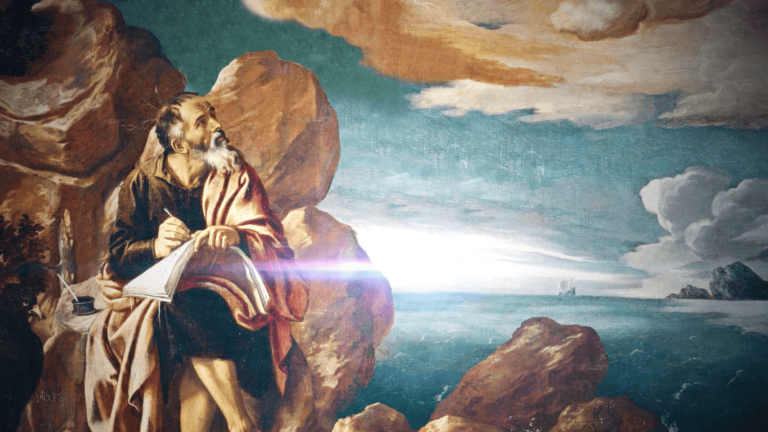
The future of the Apostle John, sometimes called “the Beloved” or “the Revelator,” is a mystery to the world. Confusion comes because of the statement in John 21:20–23. Referring to John and speaking to Peter, the Savior said: “If I will that he tarry till I come, what is that to thee? follow thou me. Then went this saying abroad among the brethren, that that disciple [John] should not die: yet Jesus said not unto him, He shall not die; but, If I will that he tarry till I come, what is that to thee?”

From this statement questions naturally arise: Did John die? If not, what is his status? If he did, why did Jesus make the statement? The issue has been debated for centuries among the various Christian denominations, with some scholars saying that he indeed died and was buried at Ephesus, while others believe he still walks the earth. A third school of thought states that even though he was buried at Ephesus, he is not really dead but simply sleeps in the grave until the Second Coming of the Savior. (See Sperry Compendium, pp. 66–67.)

Joseph Smith and Oliver Cowdery finally solved the issue through an appeal to the Lord. The Prophet Joseph Smith recorded: “During the month of April [1829, at Harmony, Pennsylvania,] I continued to translate, and he [Oliver Cowdery] to write, with little cessation, during which time we received several revelations. A difference of opinion arising between us about the account of John the Apostle, mentioned in the New Testament, as to whether he died or continued to live, we mutually agreed to settle it by the Urim and Thummim.” (History of the Church, 1:35–36.)

Editors note: In the Scripture Index link above, it says the following about the Urim and Thummim. “There is more than one Urim and Thummim, but we are informed that Joseph Smith had the one used by the brother of Jared (Ether 3:22–28D&C 10:117:1). (See Seer.) A partial description is given in JS—H 1:35. Joseph Smith used it in translating the Book of Mormon and in obtaining other revelations.”

Nephite Interpreters

No where in the Book of Mormon are the words Urim and Thummim. Instead it only says Interpreters, or Nephite Interpreters. When ever Interpreters is mentioned it has a plural meaning. For example it does not say an interpreter, as if it was a single stone. In the D&C it does mention Urim and Thummim but that always has a dual meaning as in “two” stones not one. It soesn’t say Joseph used the “Urim” without the “Thummim”

Old Testament Urim and Thummim

Joseph Smith received the same Urim and Thummim had by the Brother of Jared for it was the one expressly provided for the translation of the Jaredite and Nephite records. (D. & C. 10: 1; 17:1; Ether 3:22- 28.) It was separate and distinct from the one had by Abraham and the one had by the priests in Israel. The Prophet also had a seer stone which was separate and distinct from the Urim and Thummim, and which (speaking loosely) has been called by some a Urim and Thummim.” Mormon Doctrine page 576 under title Urim and Thummim and (Joseph Fielding Smith, Doctrines of Salvation, vol. 3, pp. 222-226.)

“Why do we not have more disclosure concerning the process of translation of the Book of Mormon? Perhaps the full process was not disclosed because we would not be ready to understand it, even if given. Perhaps, too, the Lord wanted to leave the Book of Mormon in the realm of faith, though it is drenched with intrinsic evidence. After all, Christ instructed Mormon, who was reviewing the Savior’s own teachings among the Nephites, not to record all of them on the plates because “I will try the faith of my people” (3 Ne. 26:11). Perhaps the details of translation are withheld also because we are intended to immerse ourselves in the substance of the book rather than becoming unduly concerned with the process by which we received it.” Elder Neal A. Maxwell https://www.churchofjesuschrist.org/study/ensign/1997/01/by-the-gift-and-power-of-god?lang=eng

“The result of Joseph and Oliver’s inquiry is given in the heading of section 7, which says,

“Revelation given to Joseph Smith the Prophet and Oliver Cowdery, at Harmony, Pennsylvania, April 1829, when they inquired through the Urim and Thummim as to whether John, the beloved disciple, tarried in the flesh or had died. The revelation is a translated version of the record made on parchment by John and hidden up by himself.”

Student Manual continues, It is not known whether Joseph saw the parchment referred to and was given power to translate it, or if its contents were revealed to Joseph without his seeing the original source. It makes no difference, since the material was given by revelation to the Prophet.

Notes and Commentary
D&C 7:1–3

See 3 Nephi 28:1–7 for a similar account of the Nephite disciples’ receiving the same gift because they had the same desires as John.

D&C 7:2. What Does It Mean to Have “Power over Death”?

This passage does not refer to the fact that a person would never die, for all must die (see 1 Corinthians 15:22). Even Christ died, though he had power over death (see John 10:17–18). To one who has power over death, death is held in abeyance according to the will of God (see Matthew 16:28Mark 9:1Luke 9:273 Nephi 28:7–8). Such persons are called translated beings (see 3 Nephi 28:1–40; McConkie, Mormon Doctrine,pp. 804–8).

The Prophet Joseph Smith said that “translated bodies cannot enter into rest until they have undergone a change equivalent to death. Translated bodies are designed for future missions.” (History of the Church, 4:425; for further discussion of translated beings see Smith, Teachings, pp. 170–71; Taylor, Mediation and Atonement, pp. 74–78.)

D&C 7:3–6. How Has John Prophesied before Nations and Ministered to Heirs of Salvation?

Five of the books of the Bible were written by John: the Gospel of John, three epistles, and the book of Revelation. The world’s most widely distributed book is the Bible, portions of which have been translated into 2,233 languages as of 2000. It has been estimated that between 1815 and 1999 some 3.88 billion Bibles were printed (see Guinness World Records 2000, p. 138). Certainly John’s written prophecy has gone forth among the nations.

The Apostle John ministered to the Prophet Joseph Smith and Oliver Cowdery in 1829 when he assisted Peter and James in the restoration of the Melchizedek Priesthood (see D&C 27:12).

In a conference of the Church on 3 June 1831, the Prophet Joseph Smith taught concerning John’s ministry: “John the Revelator was then among the Ten Tribes of Israel who had been led away by Shalmaneser, king of Assyria, to prepare them for their return from their long dispersion” (History of the Church, 1:176).

Elder Heber C. Kimball recorded an appearance of John in the Kirtland Temple:

“When the Prophet Joseph had finished the endowments of the First Presidency, the Twelve and the Presiding Bishops, the First Presidency proceeded to lay hands upon each one of them to seal and confirm the anointing; and at the close of each blessing the whole of the quorums responded to it with a loud shout of Hosanna! Hosanna! etc.

While these things were being attended to the beloved disciple John was seen in our midst by the Prophet Joseph, Oliver Cowdery and others.” (In Whitney, Life of Heber C. Kimball, pp. 91–92.)

D&C 7:7. What Are the Keys Held by Peter, James, and John?

The keys of the ministry which John says (Sec. 7:7) were given to Peter, James and himself, constituted the authority of Presidency of the Church in their dispensation. (See D.H.C., Vol. 3:387; Matt. 17:1–9D. & C. 81:1–2.) These keys were given at the transfiguration to these three Apostles, and they in turn gave them to Joseph Smith and Oliver Cowdery in this dispensation. (D. & C. 27:12–13128:20.)” (Smith, Church History and Modern Revelation, 1:49.)

Doctrine and Covenants Student Manual (2002), 17–18 
https://www.churchofjesuschrist.org/manual/doctrine-and-covenants-student-manual/section-7-john-the-revelator?lang=eng

Many Times the Urim and Thummim was Used to Translate

“In this respect the testimony of Lorenzo Brown about the preparation the Prophet made for his translation of the Bible may be instructive. He records the Prophet as saying: “After I got through translating the Book of Mormon, I took up the Bible to read with the Urim and Thummim. I read the first chapter of Genesis and I saw the things as they were done. I turned over the next and the next, and the whole passed before me like a grand panorama; and so on chapter after chapter until I read the whole of it. I saw it all!” (as cited in Matthews, Plainer Translation, 25).” The Process of Translating the Book of Mormon Joseph Fielding McConkie (Professor of Ancient Scripture, BYU) Craig J. Ostler (Assistant Professor of Church History and Doctrine, BYU)

10 things we know about the Urim and Thummim

  1. The earliest mention of the Urim and Thummim is in connection with the brother of Jared. The Lord told him to keep a record of certain sacred things and to seal the record up. (We have that record in the book of Ether.) “And behold, these two stones will I give unto thee, and ye shall seal them up also with the things which ye shall write” (Ether 3:23). That same Urim and Thummim was used by Joseph Smith in translating the Book of Mormon.

In the passage that follows, we read that the Lord “showed unto the brother of Jared all the inhabitants of the earth which had been, and also all that would be; and he withheld them not from his sight, even unto the ends of the earth” (Ether 3:25). The record is not clear, but very possibly the Urim and Thummim was used in giving that great vision to the brother of Jared.

  1. Abraham used the Urim and Thummim in receiving a vision of the order of heaven. “And I, Abraham, had the Urim and Thummim, which the Lord my God had given unto me, in Ur of the Chaldees; And I saw the stars, that they were very great, and that one of them was nearest unto the throne of God” (Abraham 3:1–2).
  2. Aaron followed the commandment of God in putting “in the breastplate the Urim and Thummim” (Leviticus 8:8).
  3. When Joshua succeeded Moses, he was commanded to “stand before Eleazar the priest, who shall ask counsel for him after the judgment of Urim before the Lord” (Numbers 28:21).
  4. On one occasion when David was warring with Saul, he apparently used the Urim and Thummim to determine what would happen. (See 1 Samuel 23:9–12; the breastplate bearing the Urim and Thummim was attached to the ephod.)
  5. Saul sought revelation from the Lord when the Philistines were preparing to attack. “And when Saul inquired of the Lord, the Lord answered him not, neither by dreams, nor by Urim, nor by prophets” (1 Samuel 28:6).
  6. In the time of Ezra, certain Levites could not prove their right to the priesthood. They were therefore barred from priestly privileges “till there stood up a priest with Urim and Thummim” to discern the truthfulness of their claim” (Ezra 2:63). It is likely that no one with the Urim and Thummim ever appeared to settle the dispute.
  7. In the Book of Mosiah, King Limhi took the Jaredite plates to King Mosiah, who “translated them by the means of those two stones which were fastened into the two rims of a bow” (Mosiah 28:13). Mosiah later passed the Urim and Thummim on to Alma the younger, who eventually gave them to his son Helaman.
  8. Not only did Joseph Smith use the Urim and Thummim to translate the Book of Mormon, but he also used it to receive revelation from God. Specifically, Doctrine and Covenants sections 3, 6, 11, and 14 were all given through the Urim and Thummim.
  9. We learn from the Doctrine and Covenants that “the place where God resides is a great Urim and Thummim.” In addition, “this earth, in its sanctified and immortal state, will be made like unto crystal and will be a Urim and Thummim to the inhabitants who dwell thereon.” And each person who receives the white stone mentioned in Revelation 2:17 will be able to use the Urim and Thummim (D&C 130:8–10).

http://www.ldsliving.com/10-Things-We-Know-About-the-Urim-and-Thummim/s/90115

No SEER STONE to Translate!

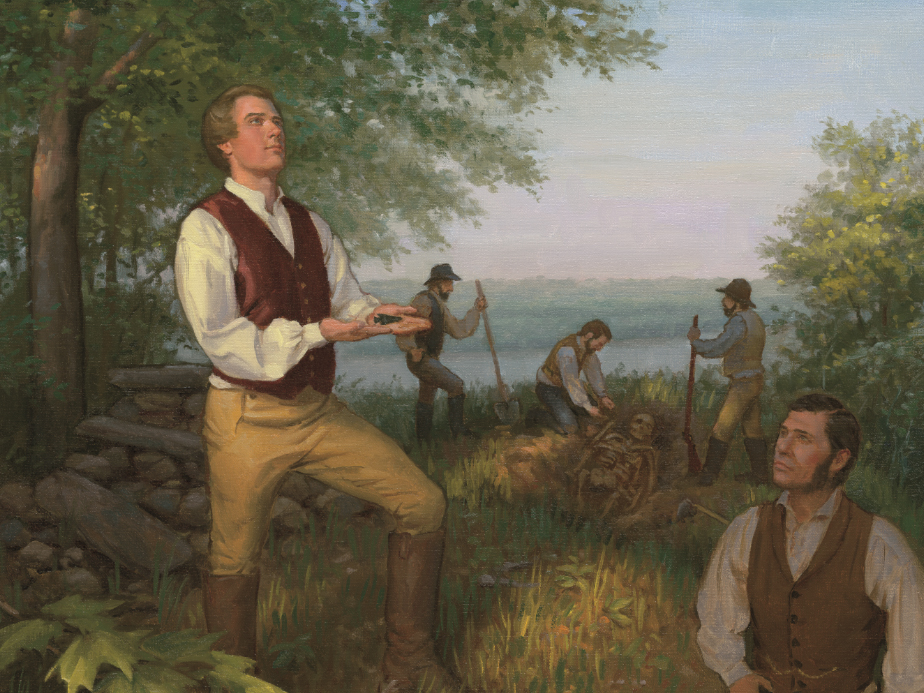
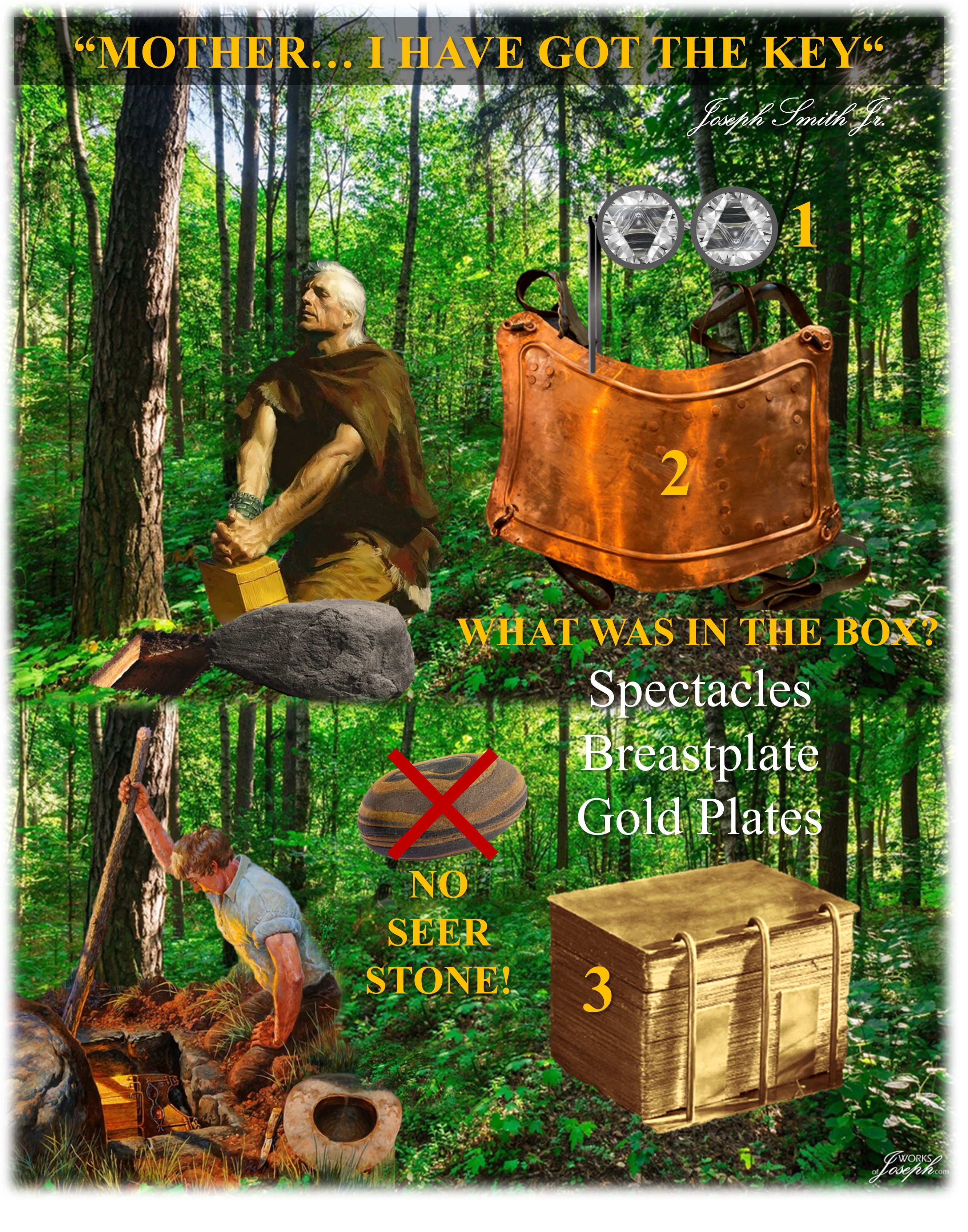
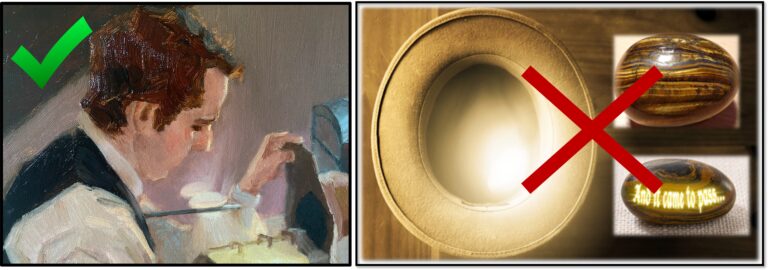
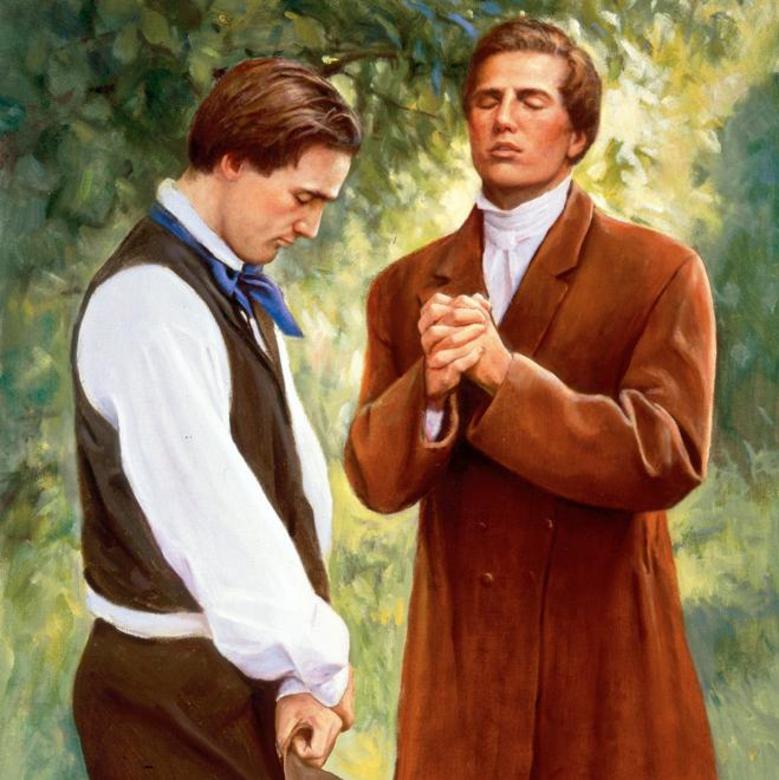
In the Spirit of love and reconciliation I share this information with friends and fellow faithful Saints, who may believe the translation of the Book of Mormon was done using a stone in a hat, which is sometimes called by them, the Urim and Thummim. I hope and pray you may consider my opinion as the Prophet and Apostles have not yet received revelation about the method of translation. The hat may have just been a simple prop to hide Emma’s view. The breastplate was under Joseph’s shirt as his mother said, “he kept these things constantly about his person.”

I would like to share with you a feeling of joy and possibility. I know the Book of Mormon is the word of God by the Spirit of the Lord. That is a feeling every faithful member of The Church of Jesus Christ of Latter-day Saints has or could have in regard to the Gospel and the Book of Mormon.

It the past year or so, I have had a wonderful journey of reading and studying about what the phrase, “by the gift and power of God” means in relationship to Joseph’s translation of the plates. Reading scriptures and other worthy books, such as the Lucy Mack Smith’s book and the Elder’s Journal has inspired me. “Thus, a close look at the Prophet’s comments is probably the most reliable method of understanding how he produced the Book of Mormon. As is generally known, Joseph Smith chose to speak in summary terms, though there are interesting reiterations in early but little-known sources. For instance, the Prophet gave a private account of his early visions in 1832, speaking of the Urim and Thummim in simple terms: “The Lord had prepared spectacles for to read the book; therefore, I commenced translating the characters…”

Joseph Smith used practically the same words in respond to a standard question on the ancient records in 1838: “I obtained them and the Urim and Thummim with them, by the means of which I translated the plates, and thus came the Book of Mormon.” Main source: Answers to Questions, Elders’ Journal of the Church of Jesus Christ of Latter-day Saints (July 1838): Secondary sources: Richard Lloyd Anderson By The Gift and Power of God.

You will not find even one scripture that says Joseph Smith translated using a single seer stone. Only the witnesses of Emma very late in her life, David Whitmer many times and Martin Harris, but remember none of them were ever permitted to see all the tools of translation; Plates, Breastplate, and Urim and Thummim. Oliver, Joseph and scripture is what I count on verifying the method of translation.

Elder Russell M. Nelson has said, “The details of this miraculous method of translation are still not fully known. Yet we do have a few precious insights. David Whitmer wrote…” After this quote, Elder Nelson quotes from David Whitmer and Emma Smith who are quoted as speaking about the stone in the hat. If Elder Nelson had a revelation or knew what David and Emma said was true, he wouldn’t have said, “The details of this miraculous method of translation are still not fully known. Yet we do have a few precious insights…” A Treasured Testament” by Russell M. Nelson 1992 This is a quote you can find in 1996 and 2002 as well as other times when Elder Nelson has shared “A Treasured Testament“

Use your own common sense, scripture, and personal revelation, to receive your own answer as to the proper method of translation.

URIM AND THUMMIM / NEPHITE INTERPRETERS

Oliver Cowdery, Witness to the Book of Mormon This is Scripture!

“I wrote, with my own pen, the entire Book of Mormon (save a few pages,) as it fell from the lips of the Prophet Joseph Smith, as he translated it by the gift and power of God, by the means of the Urim and Thummim, or, as it is called by that book, ‘holy Interpreters.’ I beheld with my eyes and handled with my hands the gold plates from which it was translated. I also saw with my eyes and handled with my hands the ‘holy interpreters.’ That book is true. . . . It contains . . . the everlasting gospel and came in fulfillment of the revelations of John where he says [that] he saw an angel come with the everlasting Gospel to preach to every nation, kindred, tongue, and people” (“Testimonies of Oliver Cowdery and Martin Harris,” Millennial Star, Aug. 20, 1859, 544).

Joseph Smith History Canonized Scripture!

JSH 1:34 He said there was a book deposited, written upon gold plates, giving an account of the former inhabitants of this continent, and the source from whence they sprang. He also said that the fulness of the everlasting Gospel was contained in it, as delivered by the Savior to the ancient inhabitants;

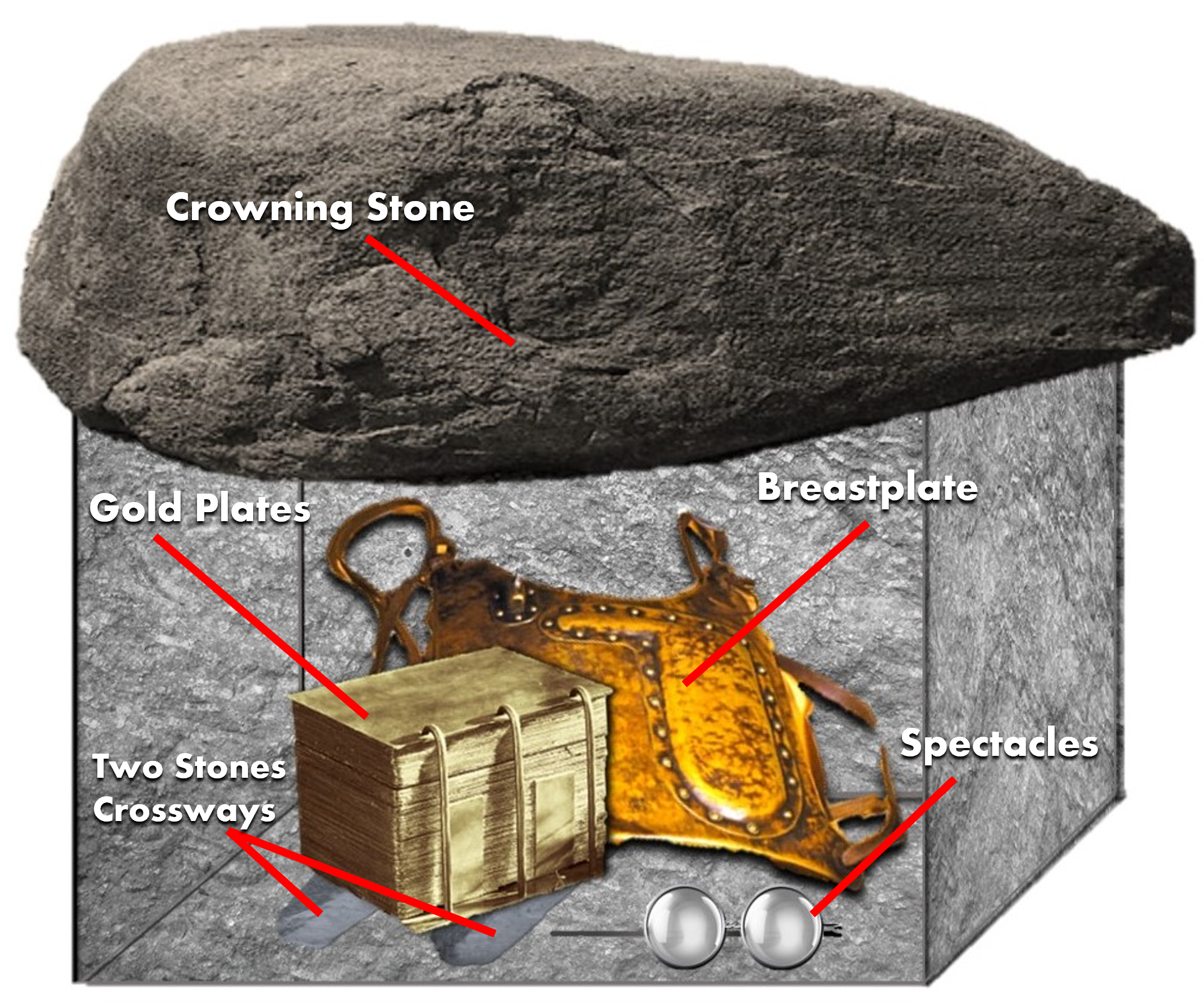
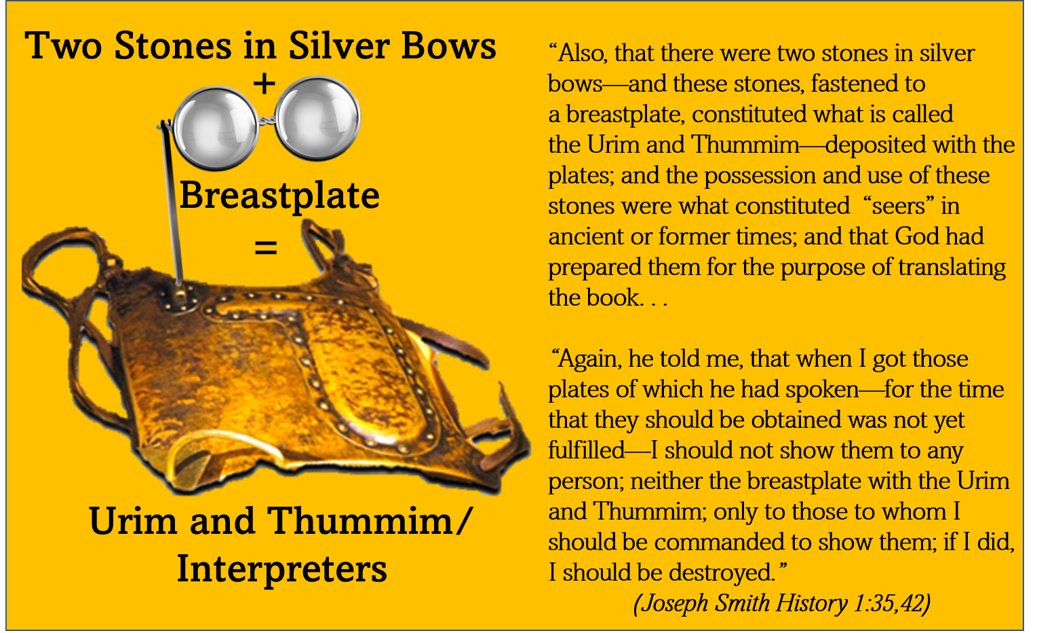
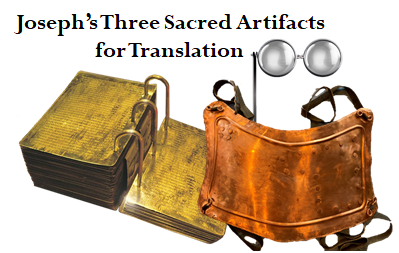
35 Also, that there were two stones in silver bows—and these stones, fastened to a breastplate, constituted what is called the Urim and Thummim—deposited with the plates; and the possession and use of these stones were what constituted “seers” in ancient or former times; and that God had prepared them for the purpose of translating the book.

42 Again, he told me, that when I got those plates of which he had spoken—for the time that they should be obtained was not yet fulfilled—I should not show them to any person; neither the breastplate with the Urim and Thummim; only to those to whom I should be commanded to show them; if I did I should be destroyed. While he was conversing with me about the plates, the vision was opened to my mind that I could see the place where the plates were deposited, and that so clearly and distinctly that I knew the place again when I visited it.

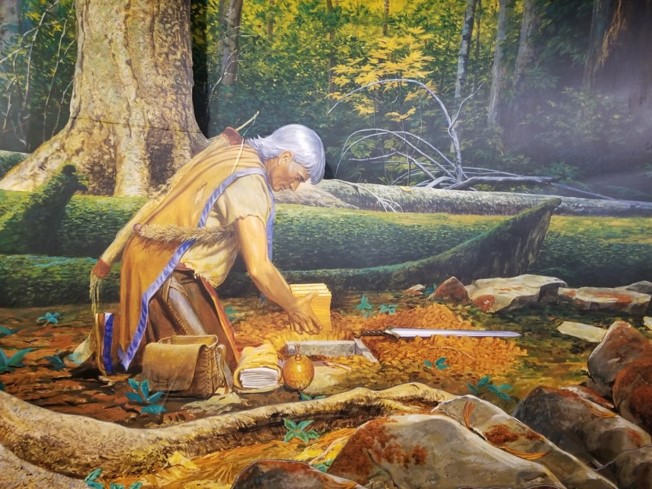
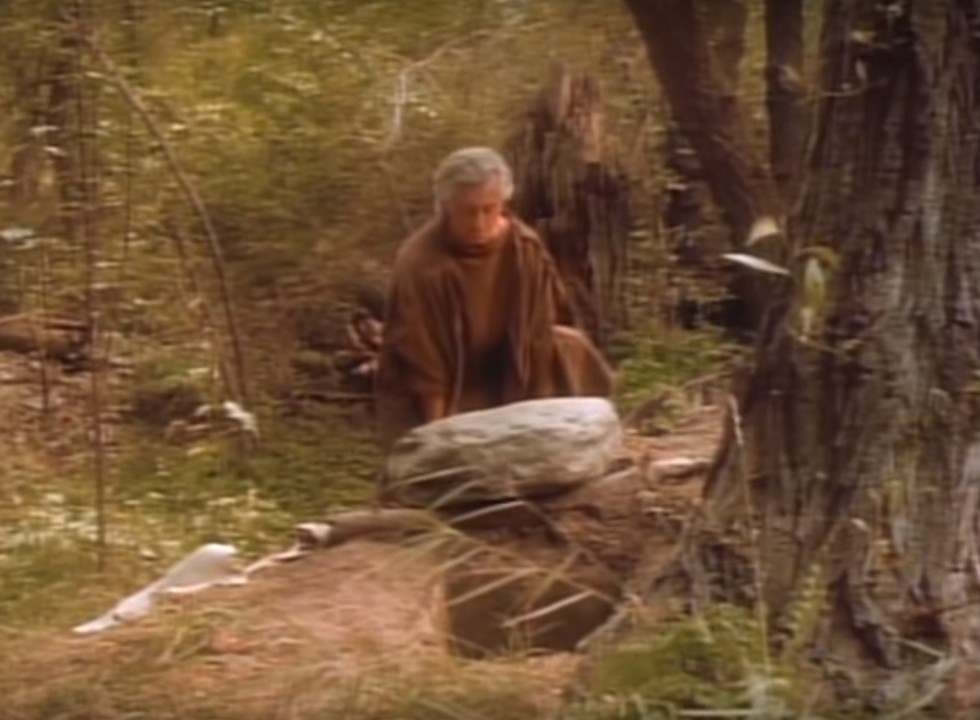
51 Convenient to the village of Manchester, Ontario county, New York, stands a hill of considerable size, and the most elevated of any in the neighborhood. On the west side of this hill, not far from the top, under a stone of considerable size, lay the plates, deposited in a stone box. This stone was thick and rounding in the middle on the upper side, and thinner towards the edges, so that the middle part of it was visible above the ground, but the edge all around was covered with earth.

52 Having removed the earth, I obtained a lever, which I got fixed under the edge of the stone, and with a little exertion raised it up. I looked in, and there indeed did I behold the plates, the Urim and Thummim, and the breastplate, [No Seer Stone] as stated by the messenger. The box in which they lay was formed by laying stones together in some kind of cement. In the bottom of the box were laid two stones crossways of the box, and on these stones lay the plates and the other things with them.

62 By this timely aid was I enabled to reach the place of my destination in Pennsylvania; and immediately after my arrival there I commenced copying the characters off the plates. I copied a considerable number of them, and by means of the Urim and Thummim I translated some of them, which I did between the time I arrived at the house of my wife’s father, in the month of December, and the February following.

63 Sometime in this month of February, the aforementioned Mr. Martin Harris came to our place, got the characters which I had drawn off the plates, and started with them to the city of New York. For what took place relative to him and the characters, I refer to his own account of the circumstances, as he related them to me after his return, which was as follows:

64 “I went to the city of New York, and presented the characters which had been translated, with the translation thereof, to Professor Charles Anthon, a gentleman celebrated for his literary attainments. Professor Anthon stated that the translation was correct, more so than any he had before seen translated from the Egyptian. I then showed him those which were not yet translated, and he said that they were Egyptian, Chaldaic, Assyriac, and Arabic; and he said they were true characters. He gave me a certificate, certifying to the people of Palmyra that they were true characters, and that the translation of such of them as had been translated was also correct. I took the certificate and put it into my pocket, and was just leaving the house, when Mr. Anthon called me back, and asked me how the young man found out that there were gold plates in the place where he found them. I answered that an angel of God had revealed it unto him.

65 “He then said to me, ‘Let me see that certificate.’ I accordingly took it out of my pocket and gave it to him, when he took it and tore it to pieces, saying that there was no such thing now as ministering of angels, and that if I would bring the plates to him he would translate them. I informed him that part of the plates were sealed, and that I was forbidden to bring them. He replied, ‘I cannot read a sealed book.’ I left him and went to Dr. Mitchell, who sanctioned what Professor Anthon had said respecting both the characters and the translation.”

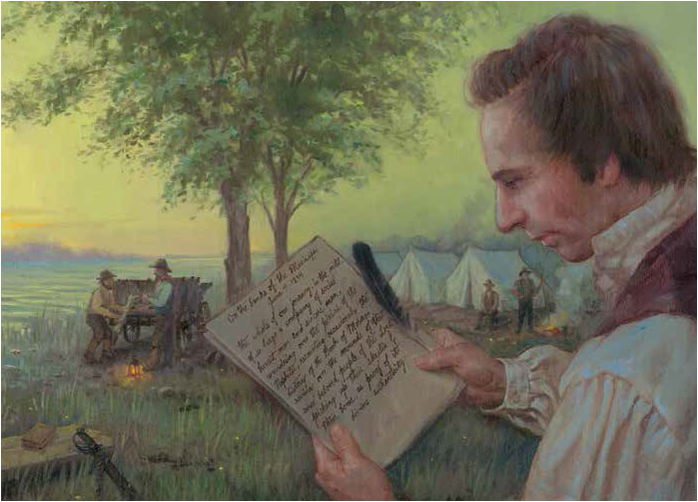
JSH 1:75* Oliver Cowdery describes these events thus: “These were days never to be forgotten—to sit under the sound of a voice dictated by the inspiration of heaven, awakened the utmost gratitude of this bosom! Day after day I continued, uninterrupted, to write from his mouth, as he translated with the Urim and Thummim, or, as the Nephites would have said, ‘Interpreters,’ the history or record called ‘The Book of Mormon.’



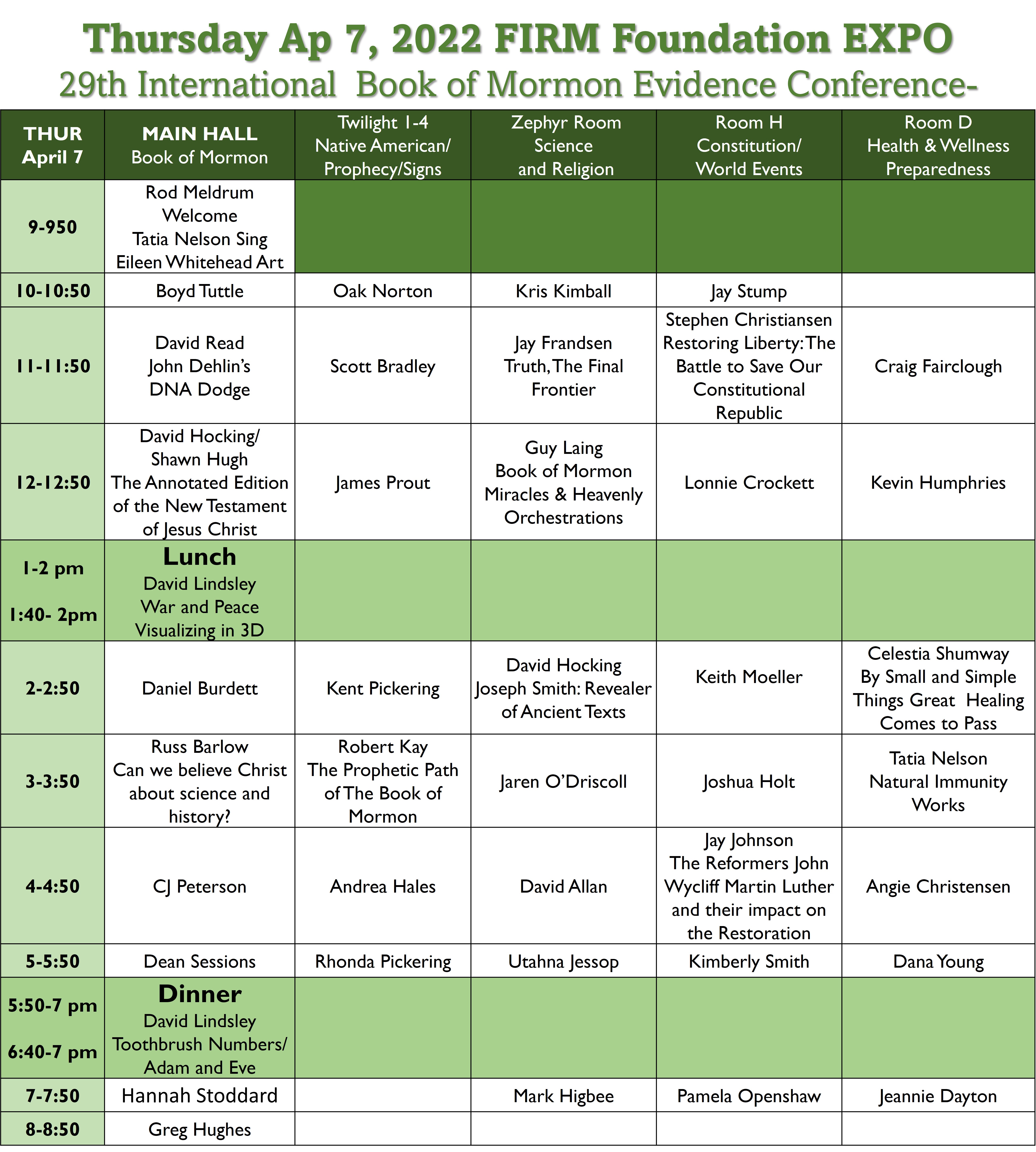
29th Book of Mormon Evidence Conference and Expo April 7-9, 2002, 9 am to 9pm Davis Conference Center 1651 N. 700 W. Layton, UT 84041 Tickets Here


The Proper Method of Translation by Lucy Mack Smith

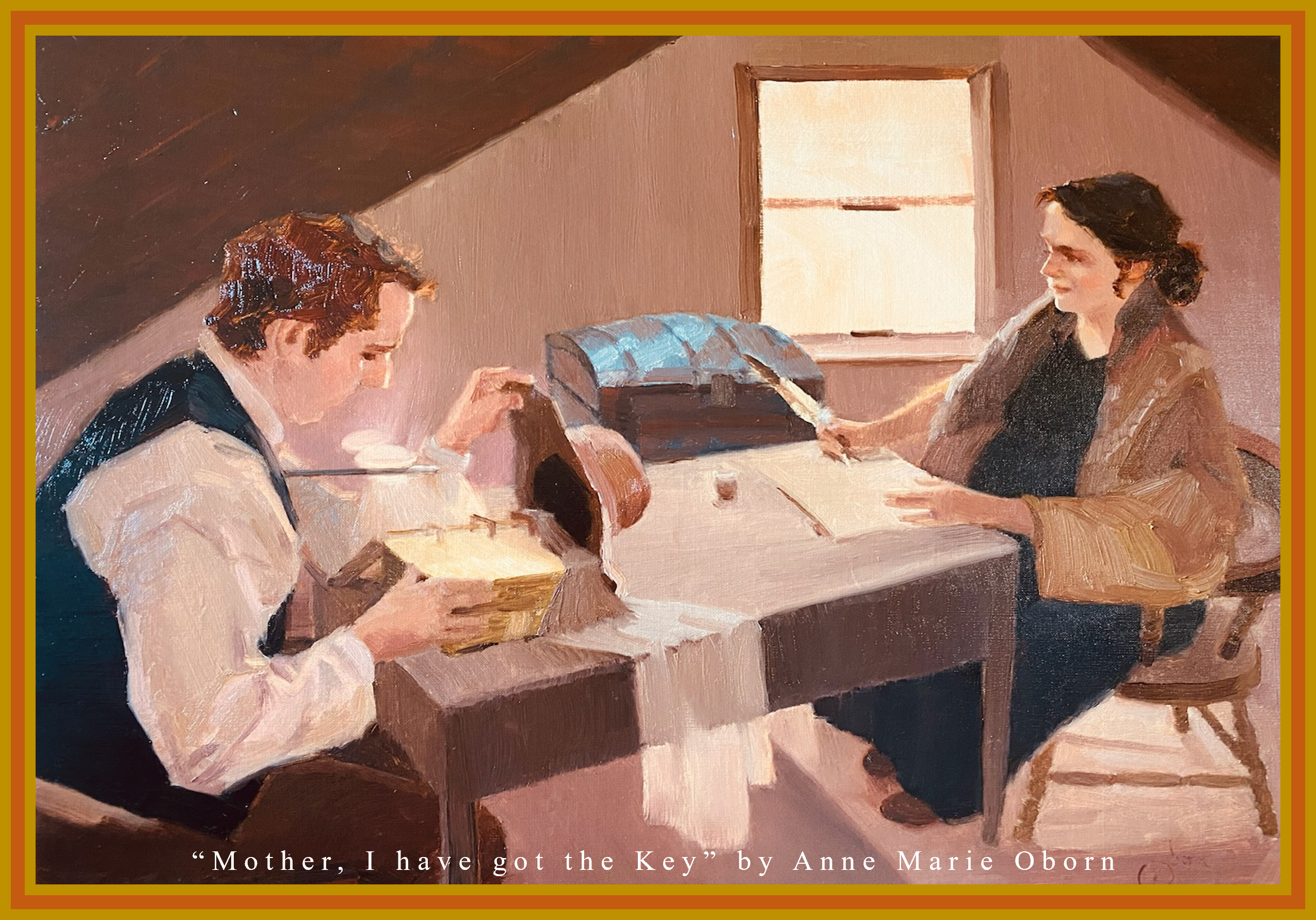
“I trembled so much with fear lest all might be lost again by some small failure in keeping the commandments, that I was under the necessity of leaving the room to conceal my feelings. Joseph saw this and followed me. “Mother,” said he. “Do not be uneasy. All is right. See here,” said he, “I have got the key.”

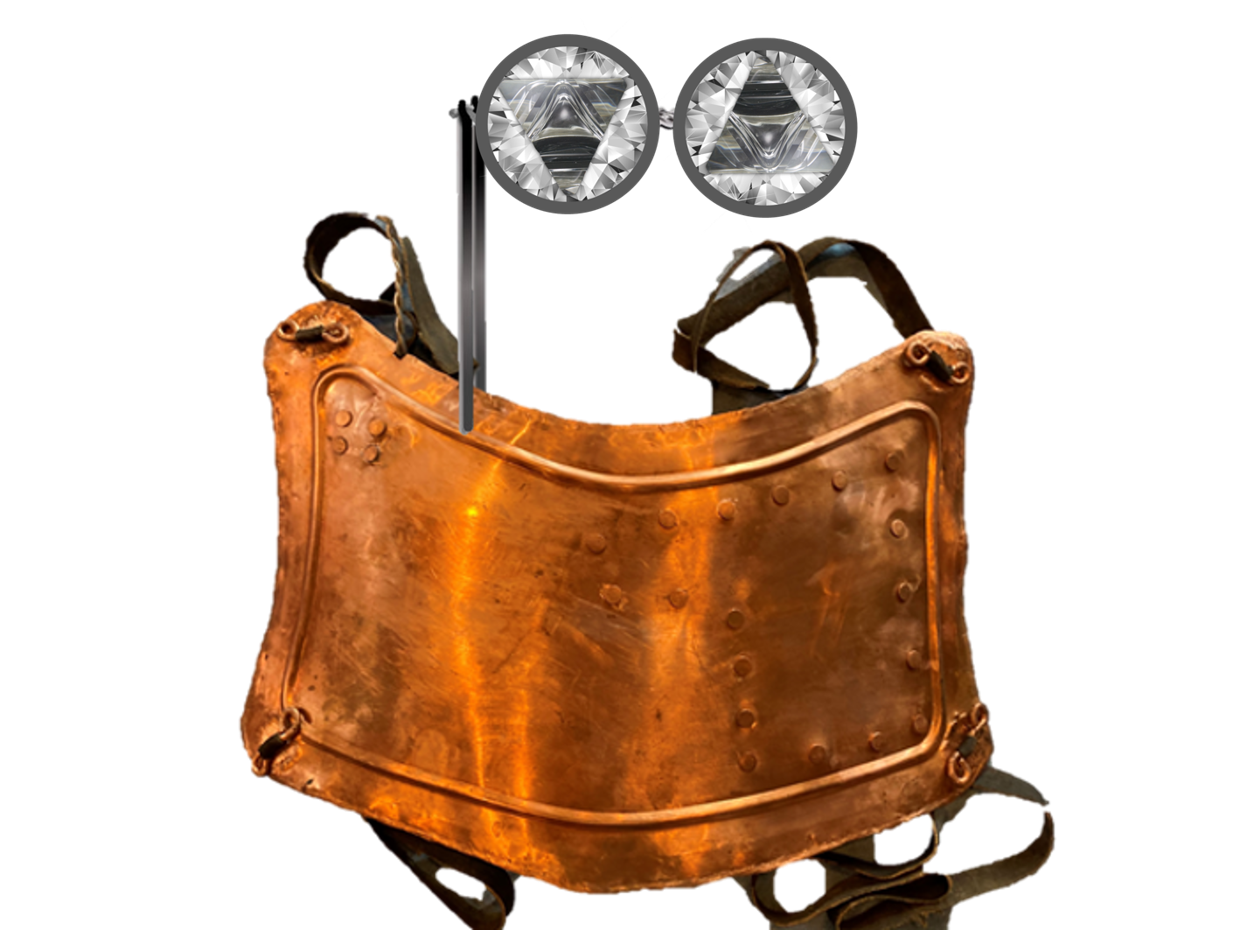
I knew not what he meant, but took the article in my hands and, examining it with no covering but a silk handkerchief, found that it consisted of two smooth three-cornered diamonds set in glass, and the glasses were set in silver bows connected with each other in much the same way that old-fashioned spectacles are made. He took them again and left me, but did not tell me anything of the record….

FREE PDF’S Below

The Key Short Version

HARD EVIDENCE SCRIPTURAL QUOTES  https://bookofmormonevidence.org/wp-content/uploads/2021/07/Book-of-Mormon-Hard-Evidence-Proper-Translation.pdf

4-PAGE SUMMARY PDF https://bookofmormonevidence.org/bookstore/wp-content/uploads/2002/01/4-page-Proper-Translation-Using-The-Key.pdf


That of which I spoke, which Joseph termed a key, was indeed nothing more nor less than a Urim and Thummim by which the angel manifested those things to him that were shown him in vision; by which also he could at any time ascertain the approach of danger, either to himself or the record, and for this cause he kept these things constantly about his person.” (History of Joseph Smith, Revised and Enhanced, p. 139, 145)

“After bringing home the plates, Joseph now commenced work with his father on the farm in order to be as near as possible the treasure that was committed to his care.

Exploring the Book of Mormon in America’s Heartland by Rod Meldrum

Soon after this, he came in from work one afternoon, and after remaining a short time, he put on his greatcoat and left the house. I was engaged at the time in an upper room in preparing some oilcloths for painting. When he returned, he requested me to come downstairs. I told him that I could not leave my work just then, yet upon his urgent request, I finally concluded to go down and see what he wanted, upon which he handed me the breastplate spoken of in his history.

It was wrapped in a thin muslin handkerchief, so thin that I could see the glistening metal and ascertain its proportions without any difficulty.

It was concave on one side and convex on the other and extended from the neck downwards as far as the center of the stomach of a man of extraordinary size. It had four straps of the same material for the purpose of fastening it to the breast, two of which ran back to go over the shoulders, and the other two were designed to fasten to the hips. They were just the width of two of my fingers (for I measured them), and they had holes in the end of them to be convenient in fastening.

The whole plate was worth at least five hundred dollars. After I had examined it, Joseph placed it in the chest with the Urim and Thummim.”  (History of Joseph Smith, Revised and Enhanced)

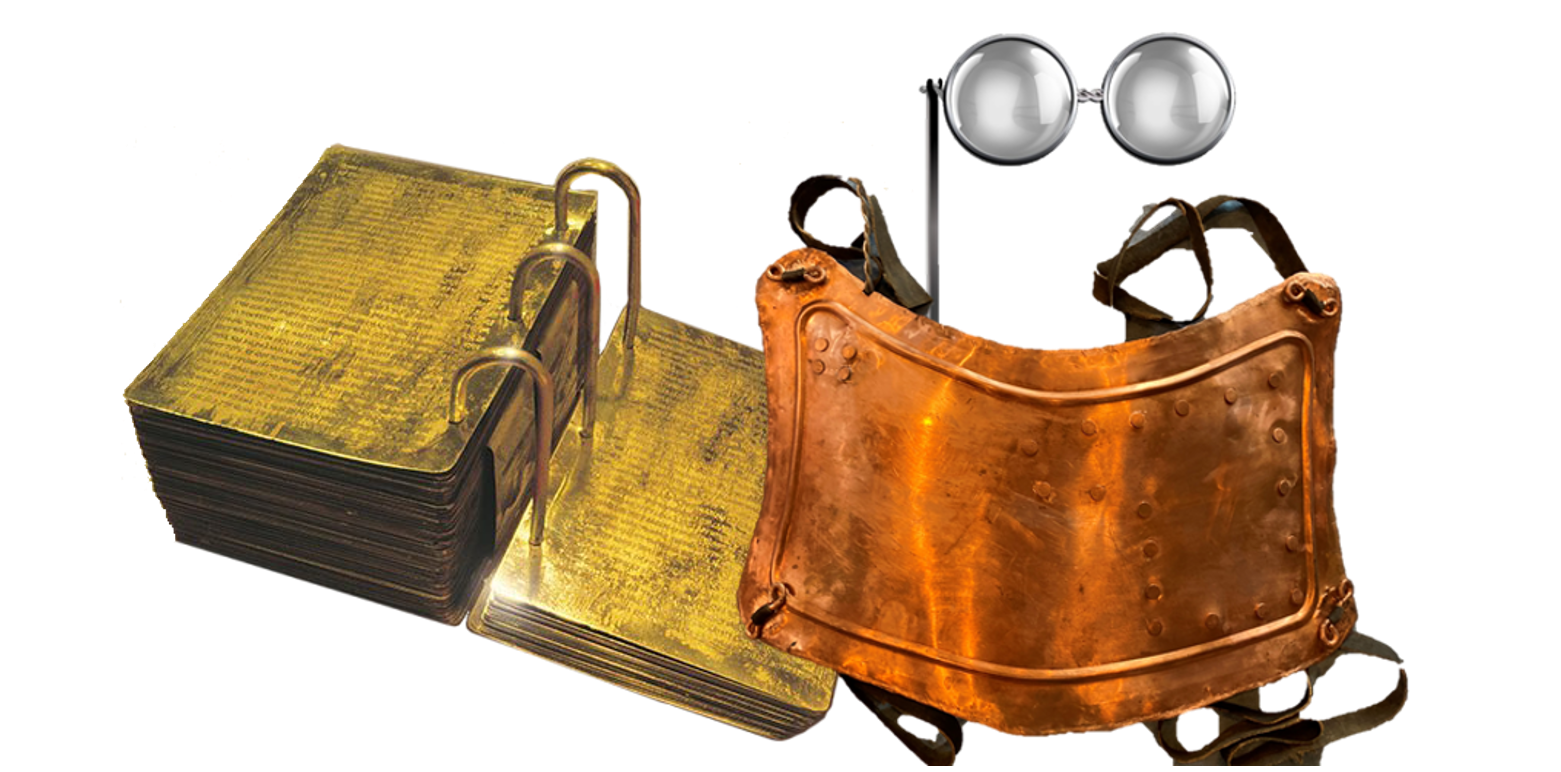
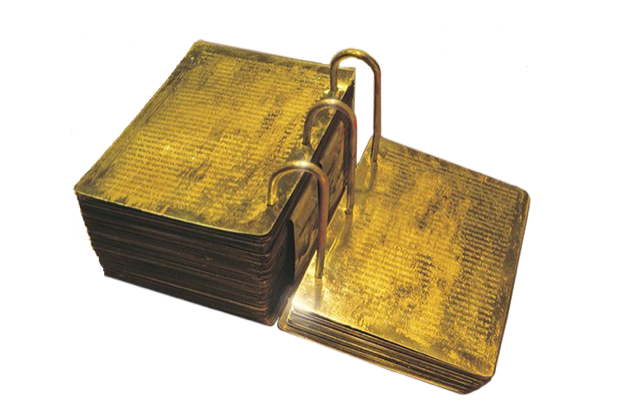
I have myself seen and handled the golden plates; they are about eight inches long, and six wide; some of them are sealed together and are not to be opened, and some of them are loose. They are all connected by a ring which passes through a hole at the end of each plate, and are covered with letters beautifully engraved. I have seen and felt also the Urim and Thummim. They resemble two large bright diamonds set in a bow (See picture left), like a pair of spectacles. My son puts these over his eyes when he reads unknown languages, and they enable him to interpret them in English. I have likewise carried in my hands the sacred breastplate. It is composed of pure gold and is made to fit the breast very exactly.” (in Henry Caswall, The City of the Mormons; or, Three Days at Nauvoo, in 1842, 2nd ed. revised and enlarged, (London: J. G. F. & J. Rivington, 1843), 26)

I conclude with two quotes I think you will enjoy:

“Joseph Smith, Jr. said, every man who lived on the earth was entitled to a seer stone, and should have one, but they are kept from them in consequence of their wickedness.” – Prophet Brigham Young, “History of Brigham Young,” Latter-day Saints’ Millennial Star, v. 26, February 20, 1864

“The power of seership is one of the greatest gifts ever given to man; and the time is not far distant when every man who bears the Priesthood will be a seer. But it can only be when men have proved themselves able to withstand all of the false deceptions of the devil. Today the powers of crystal ball gazers, astrologers, ouija boards, etc., are abounding because men have forsaken or rejected the true seers of God. Thousands of people seek unto ‘wizards who peep and mutter’ etc., but they will not seek unto the living God. I can say to all the inhabitants of the earth that before what is called spiritualism was ever known in America, I told the people that if they would not believe the revelations that God had given, He would suffer the devil to give revelations that they–priests and people would follow after. .  . I told the people that as true as God lived, if they would not have the truth they would have error sent to them, and they would believe it.”  (Brigham Young, Des. News, June 18, 1871, p. 308) (See Revelation 2:17 and D&C 130:11)May we seek for the true priesthood and further the truth as we understand about the Prophet Joseph Smith. I Love Joseph and the Savior and I know they are leading us in the way of God. Search your own testimony and please share with me how you feel about these things. May the Lord bless you.

Breastplate, Spectacles, and Plates Seen and not Seen

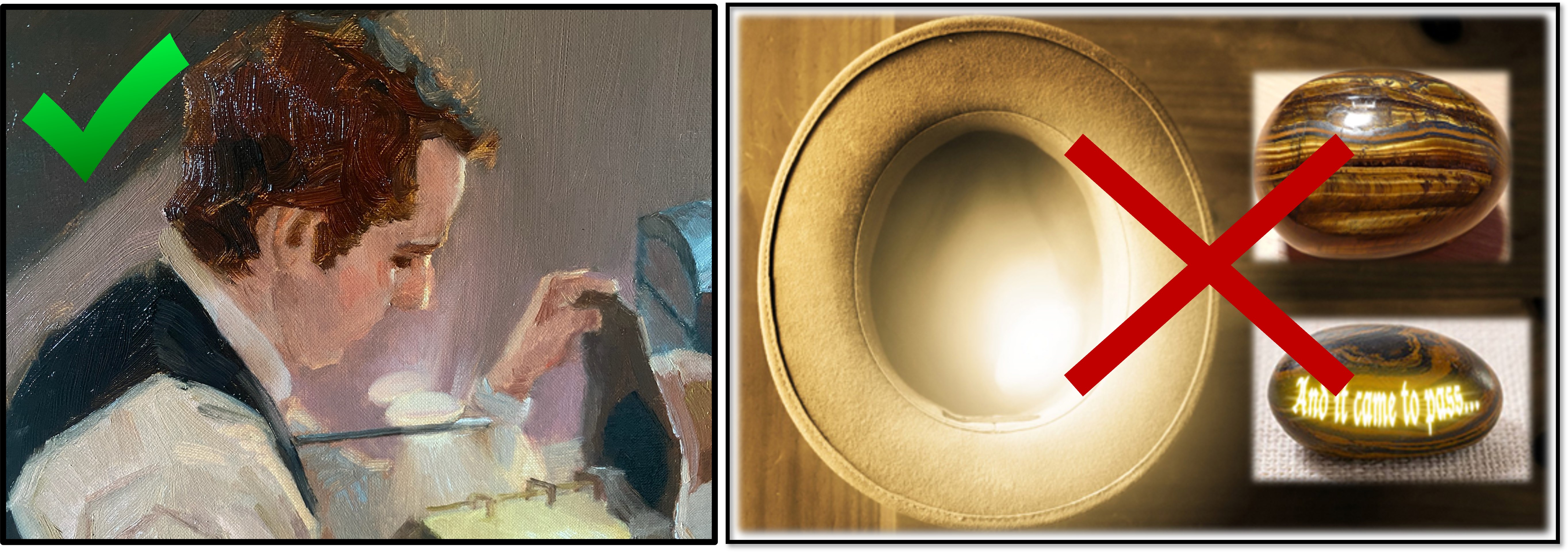
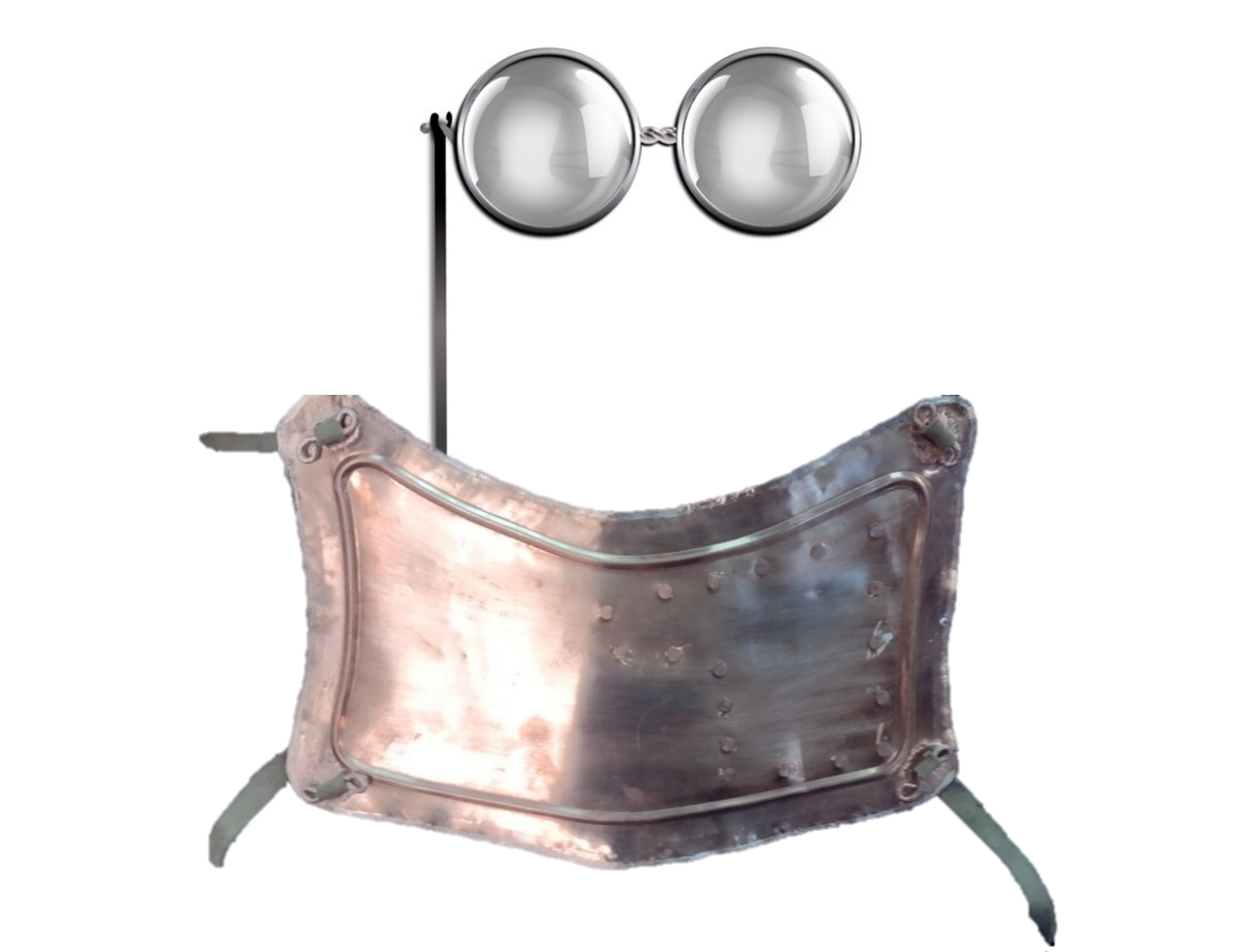
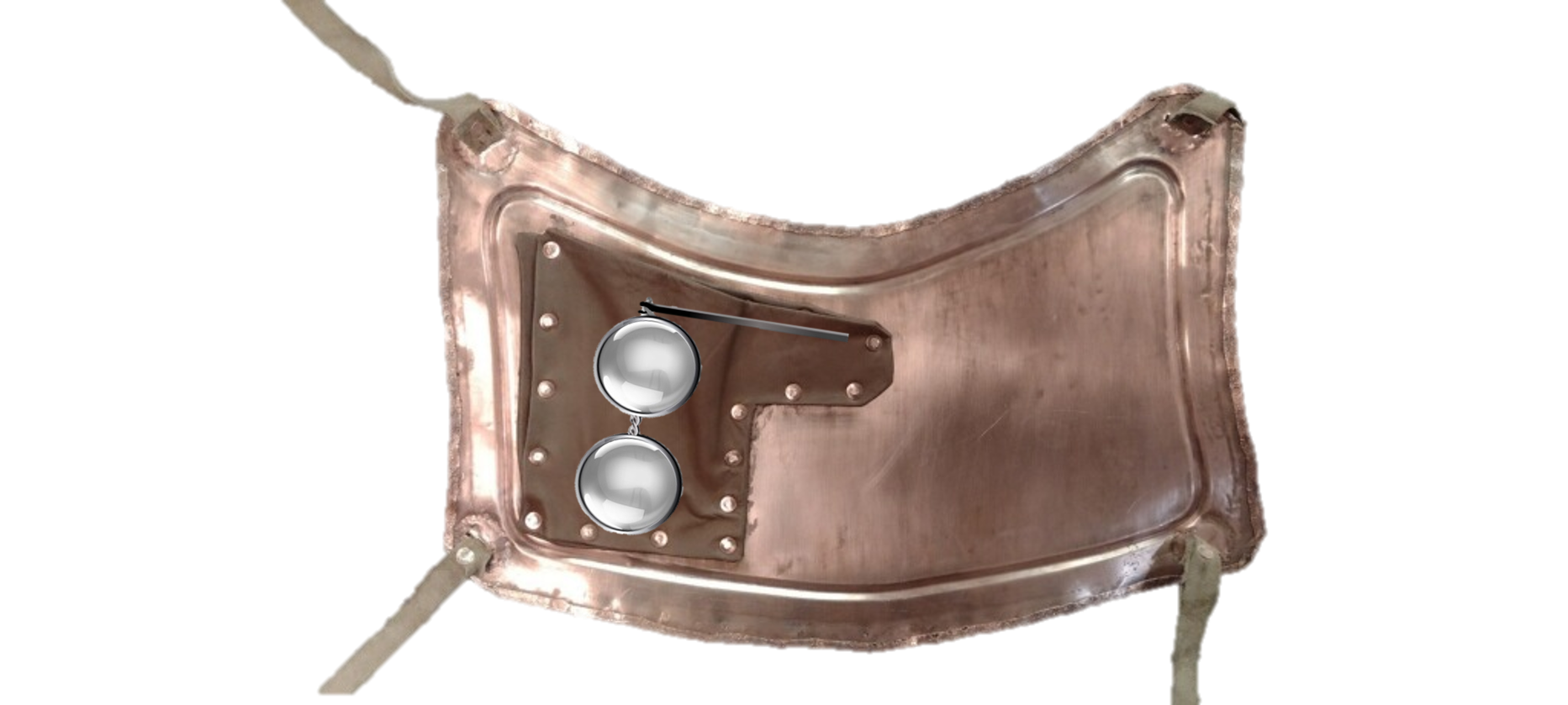
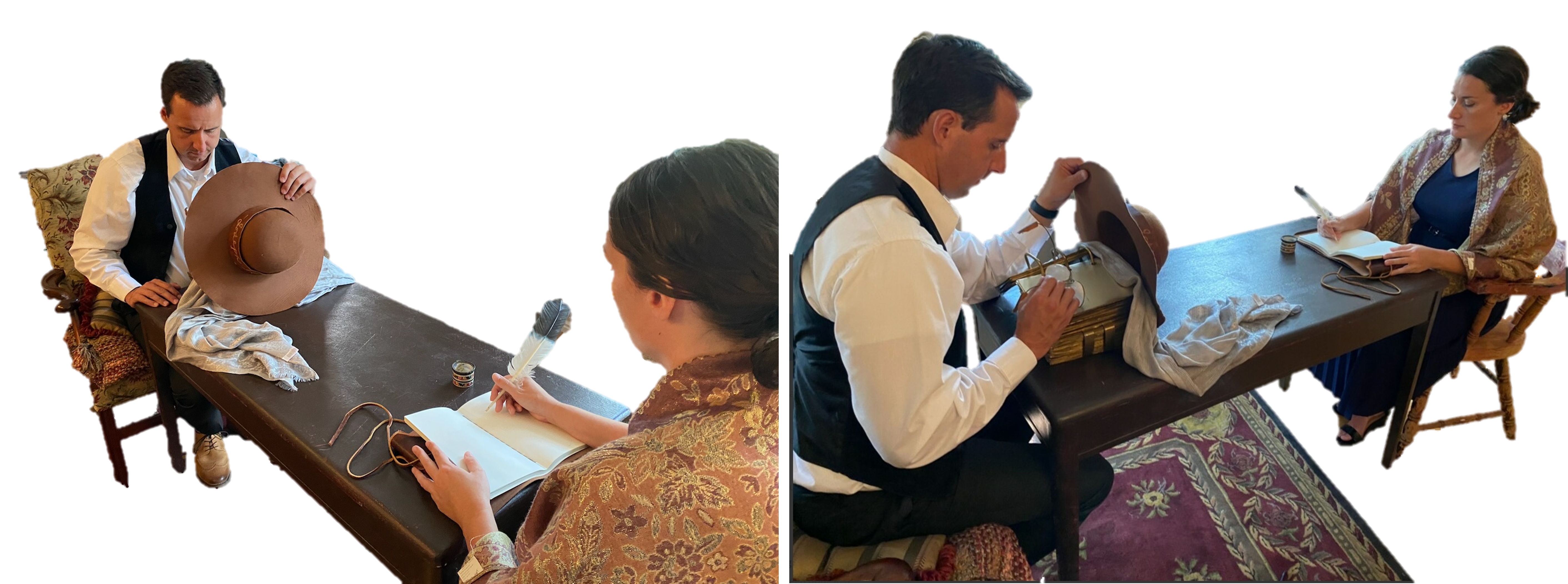
The breastplate will be worn under Joseph’s shirt and Joseph’s eyes would be looking through the glasses and seeing the gold plates on the table. The Large farmers hat would be placed as a shield between Joseph and Emma with the hat shielding the eyes of Emma so she could not see the plates or the glasses. Joseph could hold the hat brim with one hand and have his other hand on top of the plates with his finger pointing at the text on the plates.

Glasses attached to breastplate on the right side of Joseph with a downward slant so when Joseph bends over the glasses would be directly over the gold plates. On the back of the breastplate is a pocket to store the glasses on Josephs left, and over his heart.

William Smith

William Smith’s description: “A silver bow ran over one stone, under the other, around [sic] over that one and under the first in the shape of a horizontal figure 8[T]hey were much too large for Joseph and he could only see through one at a time using sometimes one and sometimes the other.” These stones, he continued, “were attached to the breastplate by a rod which was fastened at the outer shoulde[r] edge of the breastplate and to the edge of the silver bow.” (Tyrell Givens, By the Hand of Mormon, p.22)

Another account from William Smith: “Among other things we inquired minutely about the Urim and Thummim and the breastplate. We asked him what was meant by the expression “two rims of a bow,” which held the former. He said a double silver bow was twisted into the shape of the figure eight, and the two stones were placed literally between the two rims of a bow. At one end was attached a rod which was connected with the outer edge of the right shoulder of the breast-plate. By pressing the head a little forward, the rod held the Urim and Thummim before the eyes much like a pair of spectacles. A pocket was prepared in the breastplate on the left side, immediately over the heart. When not in use the Urim and Thummim was placed in this pocket, the rod being of just the right length to allow it to be so deposited. This instrument could, however, be detached from the breastplate and his brother said Joseph often wore it detached when away from home, but always used it in connection with the breastplate when receiving official communications, and usually so when translating as it permitted him to have both hands free to hold the plates.” (J. W. Peterson in The Rod of Iron I:3 (February 1924), 6—7.)

Proper View of the Translation

Emma’s view of the Translation (It would seem to Emma that the seer stone she knew Joseph had found in a well, was probably put in the hat, but she or no one else knew that for sure. Joseph was told by the Lord to never show the spectacles, breastplate or plates to anyone.

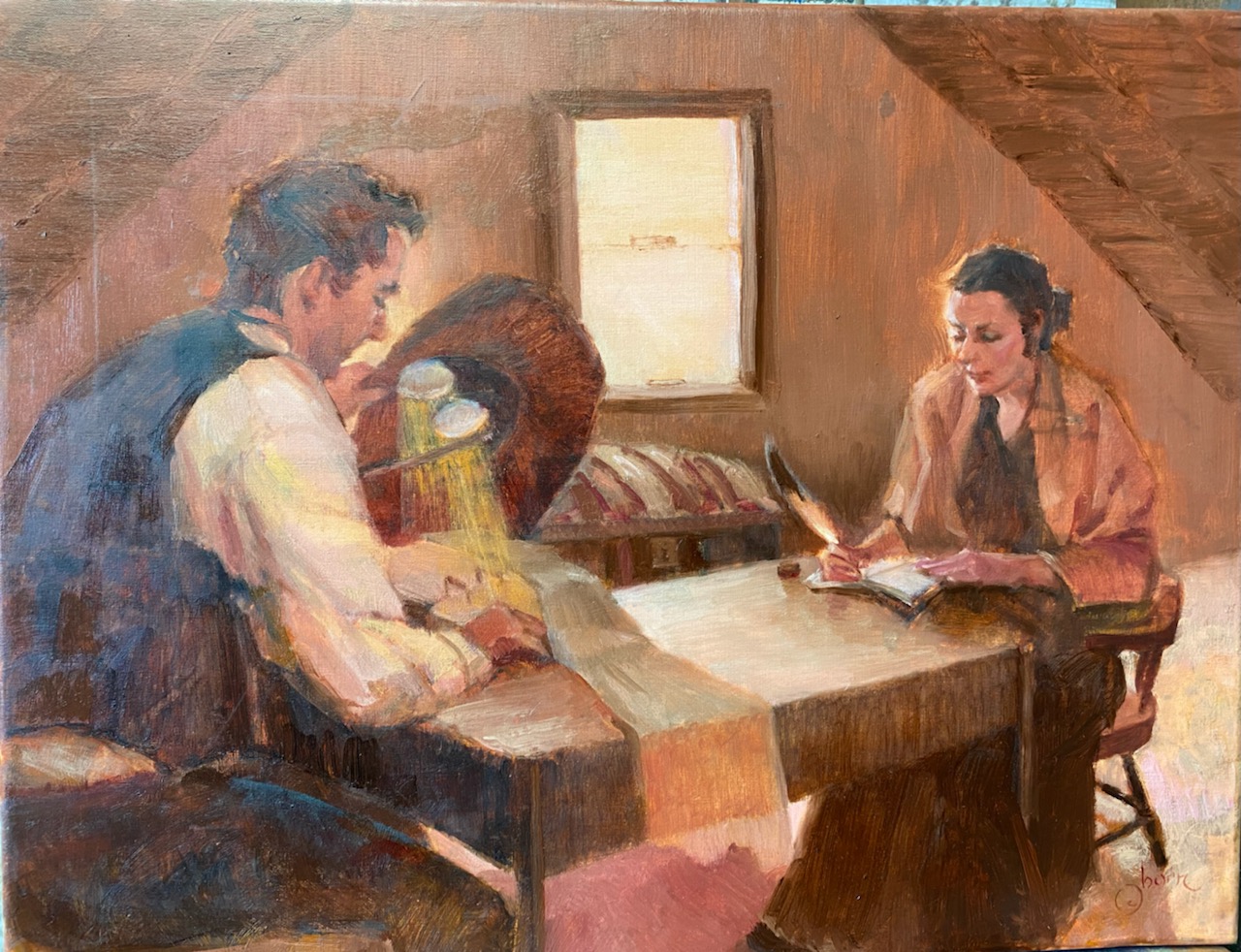
Joseph’s view of the Translation (Both of Joseph’s hands would be free, as the spectacles would be attached to the Breastplate under Joseph’s shirt as displayed in painting below)

Art by Anne Marie Oborn

Other Quotes

15- “And behold, these two stones [different than the previous 16 stones] will I give unto thee, and ye shall seal them up also with the things which ye shall write. For behold, the language which ye shall write I have confounded; wherefore I will cause in my own due time that these stones [2 stones] shall magnify to the eyes of men these things which ye shall write.” Ether 3:23:24 (Parenthesis Added)

16- Wherefore the Lord hath commanded me to write them; and I have written them. And he commanded me that I should seal them up; and he also hath commanded that I should seal up the interpretation thereof; wherefore I have sealed up the interpreters, according to the commandment of the Lord.” Ether 4:5 (Parenthesis added)

5- Joseph Smith said, “I inquired of the Lord through the Urim and Thummim and received from him the following.” (Note: See the preface to the Doctrine and Covenants 3,6,7,11,14,15,16,17) (History of the Church V.1 p.45)

6- “I continued to translate, and he [Oliver Cowdery] to write, with little cessation, during which time we received several revelations. A difference of opinion arising between us about the account of John the Apostle, mentioned in the New Testament, as to whether he died or continued to live, we mutually agreed to settle it by the Urim and Thummim.” (History of the Church, 1:35–36.

12- “And now he translated them by the means of those two stones which were fastened into the two rims of a bow…” Mosiah 28:13 “And whosoever has these things is called seer, after the manner of old times.” Mosiah 28:16 “And now, as I said unto you, that after king Mosiah had done these things, he took the plates of brass, and all the things which he had kept, and conferred them upon Alma, who was the son of Alma; yea, all the records, and also the interpreters, and conferred them upon him, and commanded him that he should keep and preserve them, and also keep a record of the people, handing them down from one generation to another, even as they had been handed down from the time that Lehi left Jerusalem.” Mosiah 28:20

13- “And now, I will speak unto you concerning those twenty-four plates, that ye keep them, that the mysteries and the works of darkness, and their secret works, or the secret works of those people who have been destroyed, may be made manifest unto this people; yea, all their murders, and robbings, and their plunderings, and all their wickedness and abominations, may be made manifest unto this people; yea, and that ye preserve these interpreters…“And now, my son, these interpreters were prepared that the word of God might be fulfilled, which he spake, saying: I will bring forth out of darkness unto light all their secret works and their abominations; and except they repent I will destroy them from off the face of the earth; and I will bring to light all their secrets and abominations, unto every nation that shall hereafter possess the land.” Alma 37:21, 24-25 (The word “Directors” was changed to “Interpreters” in the 1920 version & forward of the Book of Mormon)

Joseph’s Own Words

“We proceeded to copy some of [the characters], and he [Martin Harris] took his journey to the eastern cities and to the learned, saying, “Read this, I pray thee.” And the learned said, “I cannot. But if he would bring the plates, [I] would read it.” But the Lord had forbid it and he returned to me and gave them to me to translate. And I said, “I cannot for I am not learned.” But the Lord had prepared spectacles to read the book. Therefore, I commenced translating the characters and thus the prophecy of Isaiah was fulfilled.17 History, circa Summer 1832, 5, online at www.josephsmithpapers.org, spelling, punctuation, and grammar standardized.

“Thus a close look at the Prophet’s comments is probably the most reliable method of understanding how he produced the Book of Mormon. As is generally known, Joseph Smith chose to speak in summary terms, though there are interesting reiterations in early but little-known sources. For instance, the Prophet gave a private account of his early visions in 1832, speaking of the Urim and Thummim in simple terms: “The Lord had prepared spectacles for to read the book; therefore I commenced translating the characters.”…
Joseph Smith used practically the same words in responding to a standard question on the ancient records in 1838: “I obtained them and the Urim and Thummim with them, by the means of which I translated the plates, and thus came the Book of Mormon.”
Main source: Answers to Questions, Elders’ Journal of the Church of Jesus Christ of Latter Day Saints (July 1838): Secondary sources: Richard Lloyd Anderson By The Gift and Power of God https://www.churchofjesuschrist.org/study/ensign/1977/09/by-the-gift-and-power-of-god?lang=eng And https://www.churchofjesuschrist.org/study/manual/teachings-joseph-smith/chapter-4?lang=eng

Oliver’s Statement:

When Brother Samuel W. Richards was eighty-two, (1906) he dictated a statement reporting Oliver Cowdery’s recollections of Book of Mormon translation:
“He represented Joseph as sitting at a table with the plates before him, translating them by means of the Urim and Thummim, while he (Oliver) sat beside him writing every word as Joseph spoke them to him. This was done by holding the ‘translators’ over the hieroglyphics, the translation appearing distinctly on the instrument, which had been touched by the finger of God and dedicated and consecrated for the express purpose of translating languages. Every word was distinctly visible even to every letter; and if Oliver omitted a word or failed to spell a word correctly, the translation remained on the ‘interpreter’ until it was copied correctly.”

Richard Lloyd Anderson https://www.churchofjesuschrist.org/study/ensign/1977/09/by-the-gift-and-power-of-god?lang=eng

The Lion and Lamb of Judah Part 3 The strong man continued:

0

The Lion and Lamb of Judah Part 3 The strong man continued:

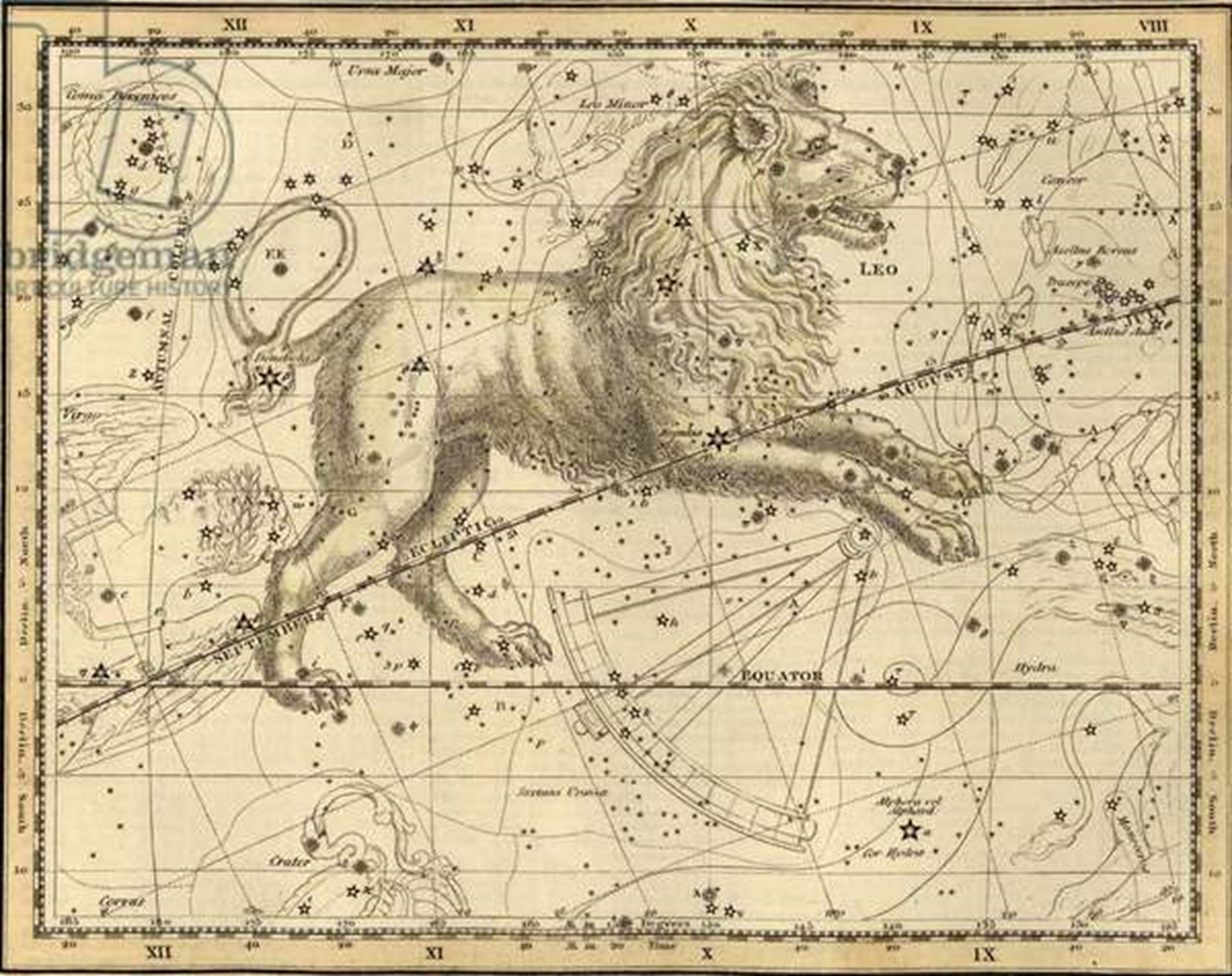
The goal in writing these papers is to testify of Christ.  In the first paper we discussed the Lamb in the heavens by the name of Aries, that portrayed the Lamb of God.  There are two other lambs that sit high in the heavens, The big and little dippers!  In Greek mythology they are recognized as Bears; but bears do not have the long tails that the two dippers display.  Instead of spending time on Ursa Major and Minor I will instead write about the four sheperds.  Auriga, Bootes, Ophiuchas, and the King sheperd Cepheus.  Once again remember that these are icons set in the Heavens.  It is the iconography that identifys the characters.

He shall feed his flock like a shepherd, he shall gather the lambs with his arm, and carry them in his bosom, and shall gently lead those that are with young.                 (Isaiah 40:11)                                     

Thus saith the Lord GOD, Behold, I will lift up mine hand to the Gentiles, and set up my standard to the people: and they shall bring thy sons in their arms, and thy daughters shall be carried upon their shoulders. (Isaiah 49:22)
I am the good shepherd: the good shepherd giveth his life for the sheep.

But he that is an hireling, and not the shepherd, whose own the sheep are not, seeth the wolf coming, and leaveth the sheep, and fleeth: and the wolf catcheth them, and scattereth the sheep.

The hireling fleeth, because he is an hireling, and careth not for the sheep.

I am the good shepherd, and know my sheep, and am known of mine. (John 10:11-14)

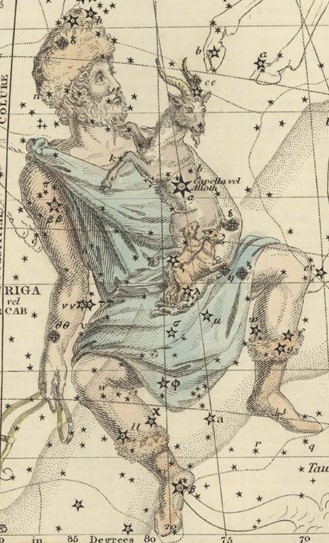
If one looks closely they can see the shepherd holding a small ram and two small lambs, Notice the right foot being pierced by the horn of Taurus and his left foot coming down upon the bulls head, identifying the shepherd having his iconic piercing as Christ.

“Auriga” comes from a Hebrew root meaning, shepherd of light “raa” shepherd, and “ur” light of the east, sunrise etc[1].

The stars in this constellation are:

“Alioth” meaning a she goat (Hebrew) the same in (Latin) [2]“Capella”
“Prijipati” at the head meaning Lord of Creation [3](Sanskrit/Pali)
“Al Maaz” meaning the goat[4] (Arabic) (similar to Mesarthim in Aries the ram
“Sadatoni” meaning two young goats [5](?) “Gedi” or “Ged|ee” meaning kids[6] (Hebrew)

Bootes                                                                                              

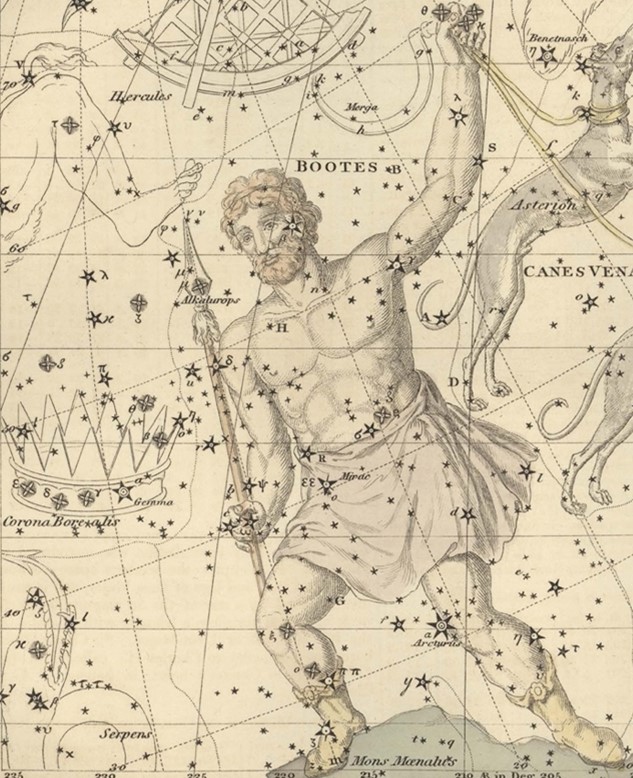
Bootes, better known as Arcturus, is the one who keeps the flock as Arktos or Arcas the adjoining constellation of the Big Dipper.  The Egyptian name Smat identifies him as ruler, subduer, and governor.  Arcturus means watcher or guardian.  Bootes, in the Greek, means “ploughman”.   The Hebrew and oriental root Bo means “coming”, or the “One who comes”.  The Greeks apparently tried to make him into a ploughman even though the plough would be facing the opposite direction, but who ploughs with uplifted hand?  Later in about the 16th century Europeans thought it might be nice to have him take a couple of dogs for a walk. (Obviously, a later invention), He is pictured with a sickle raised in his left hand and in his right hand he holds a rod, staff, spear, or Shepherd’s crook.  He is in the dress of a Shepherd and yet is turned facing away from his sheep (Ursa Major and Ursa Minor).  Before his face is the Crown, and underneath is Serpens, a serpent perhaps in the act of reaching for the crown or having it placed upon his head as we saw earlier. Other depictions show the serpent reaching upward with his tongue for this crown.   From such a vantage point it looks as if Arcturus with raised hand, instead of reaping, is in the act of striking down the serpent.   Now let’s put it all together.  The keeper and guardian of the flock is the one who is coming to subdue the enemy and govern the flock.  David of old was a type and shadow of the good shepherd in that he fought against the enemy, the giant Philistine.

And he took his staff in his hand, and chose him five smooth stones out of the brook, and put them in a shepherd’s bag which he had, even in a scrip; and his sling was in his hand: and he drew near to the Philistine. (1 Samuel 17:40
Another verse like this picture is to be found in Revelations:

And I looked, and behold a white cloud, and upon the cloud one sat like unto the Son of man, having on his head a golden crown, and in his hand a sharp sickle.

And another angel came out of the temple, crying with a loud voice to him that sat on the cloud, Thrust in thy sickle, and reap: for the time is come for thee to reap; for the harvest of the earth is ripe. (Revelation14: 14-15)

This portrayal is like the picture of Arcturus in the sky with his staff and sickle raised against Serpens his mortal enemy.  Moreover, his name is found in scripture.

Canst thou bind the sweet influences of Pleiades, or loose the bands of Orion?

Canst thou bring forth Mazzaroth in his season?  Or canst thou guide Arcturus with his sons?

Knowest thou the ordinances of heaven? Canst thou set the dominion thereof in the earth? (Job 38:31-33)

“Arcturus” in the left knee meaning the keeper, see Ursa Major (Hebrew)

“Al Katurops” upper staff meaning shepherds crook[7](Arabic)

“Izar” or “Mirak” at his waist means the loins or loincloth[8] (Arabic)

“Muphride” at left leg meaning the lancer[9] (Arabic) as he is in the act of striking down serpens the snake.

“Nekkar” at his head meaning the pierced (Arabic) the Hebrew name “daqar”[10]

Ophiuchus

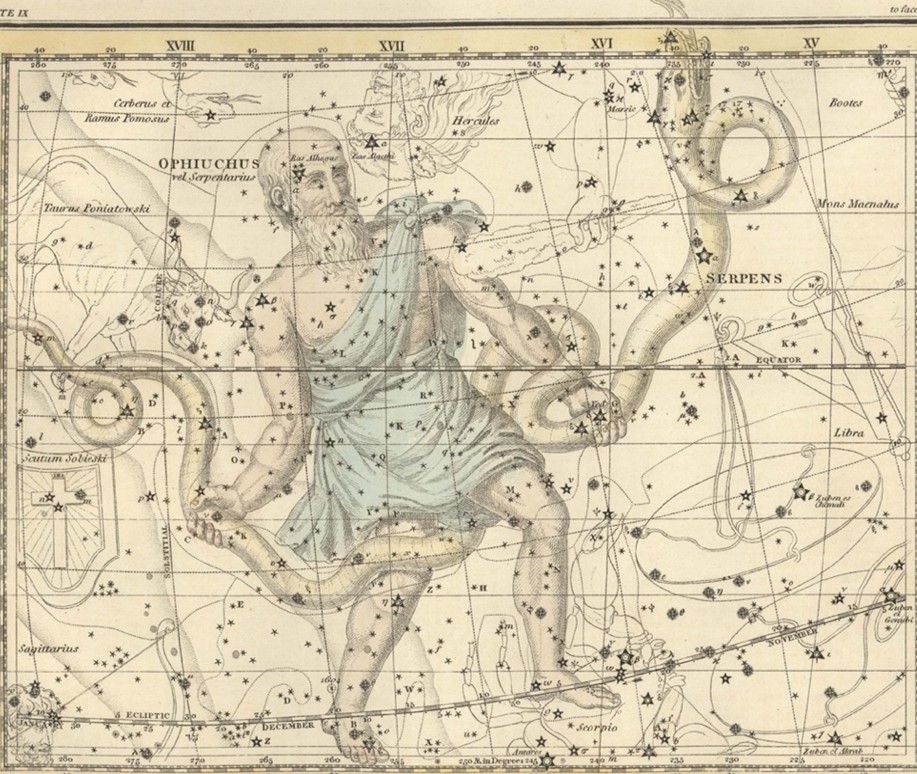
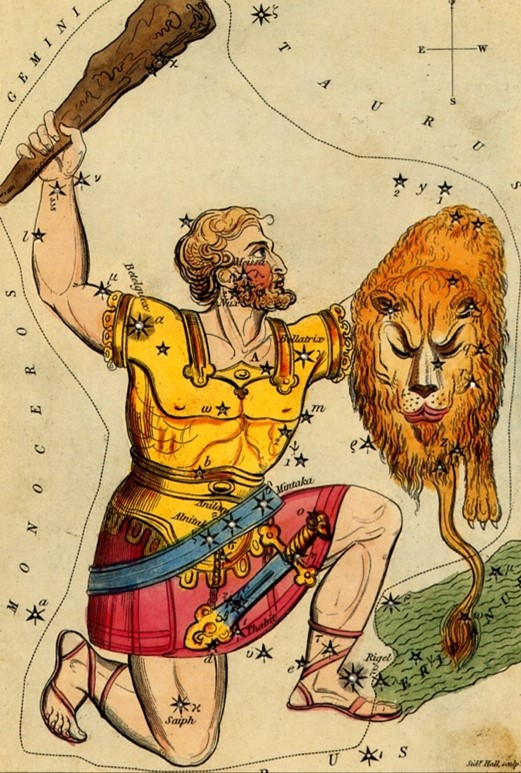
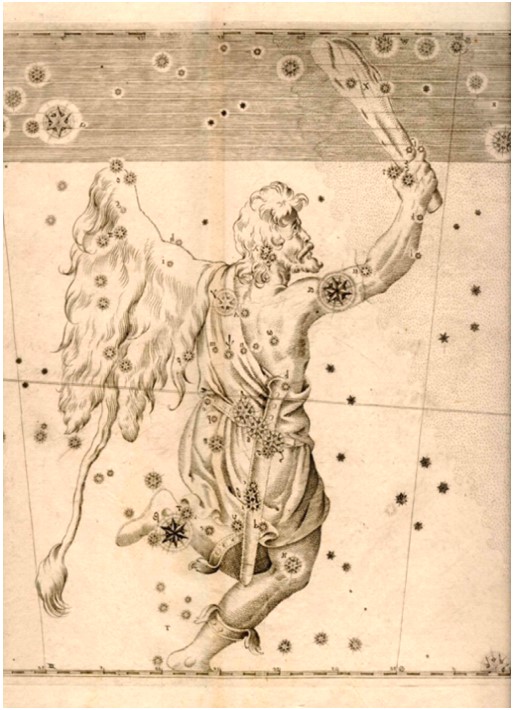
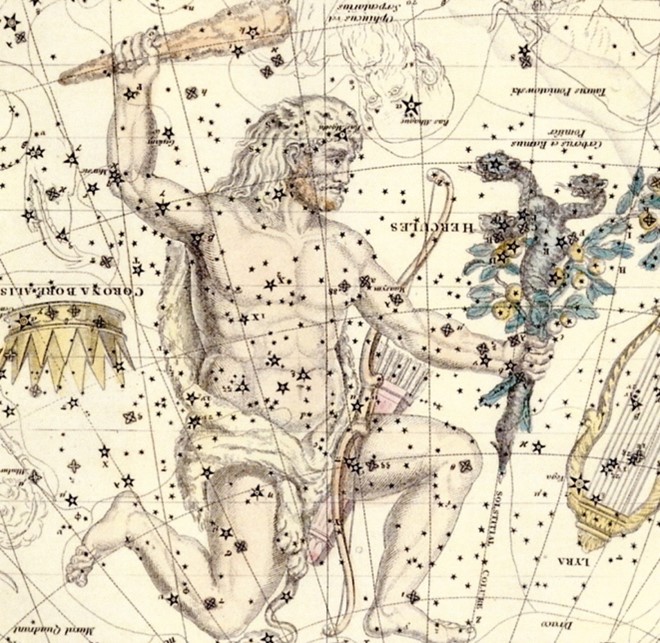
Head-to-head with Hercules is the constellation Ophiuchus who wrestles a serpent by the name of Serpens, his right foot over Scorpio and his left foot raised as if bruised or wounded as he appears to limp.  As mentioned before, Ophiuchus, Asclepius, according to Greek myth was the son of Apollo.  He raised Hippolytus from the dead after learning the secrets of life and death from a serpent, and therefore became worshipped as the great Healer.   In order to avoid humanity becoming immortal under Asclepius care, Zeus[11] eventually killed him with a bolt of lighting but placed him in the heavens to honor his good works.   It is said the serpent wrapped itself around him making the sign of medical arts today or more recognized as Moses brazen serpent.  Like Hercules, and Perseus, we have here pictured the combat between good and evil. On Mount Olympus there were twelve Olympians, fourteen if you count Zeus and Hera.  Hephaestus is one of the twelve Olympians who was thrown down from heaven, and severely injured his foot upon landing on earth, becoming an invalid with a deformed twisted foot.  The constellation Ophiuchus is the thirteenth sign of the Zodiac in that the sun crosses the path of his injured heel.  It is this heel that Sagittarius arrow would pass through to kill Dan’s sign of the adder being torn by the eagle, or today’s sign of Scorpio.  Follow all that?  What makes this interesting is that many of the Olympians have traits of the twelve constellations, as well as the twelve tribes, but of course they have severely deviated from their icons.

“Ophiuchus” comes from Hebrew [12]“Okhez” hold and “Nakhash” snake, in Arabic [13]“Hawwa” the serpent charmer both meaning the serpent held.  Stars in this constellation are:

In the serpent:

“Unuk” or “Unuk Al Hai” at the upper neck meaning “encompassing” (Hebrew)

“Alyah” or “Yed” the accursed (Hebrew)

“Al Hay” the reptile (Arabic)

In the man:

“Ras al Hagus” the head of him who holds[14] (Arabic)

“Cheleb” or “Chelbalrai” in the neck of the man meaning the heart of the Shepherd [15](Arabic)

“Saiph” or “Sabik” at the right knee meaning the bruised[16] (Hebrew)

“Triophas” treading underfoot (Hebrew) roots for walk, step, tread [17]etc.

“Carnebus” the wounding [18](Hebrew)

“Megeros” or “Makhalok|et meaning contention[19]  (Hebrew)

In most depictions of Ophiuchus, the serpent he wrestles (Serpens) has its tongue reaching for “Corona” the crown.

Behold, I come quickly: hold that fast which thou hast, that no man take thy crown.    (Revelation 3:11)

Perseus

To complete this part of the story we need to look below the feet of Andromeda and see the constellation that occupies that sector.  He is the Greek hero Perseus who, as another shadow of Christ with sword in hand, delivers the captive and grasps the head of Medusa (serpents in her hair) in the other.   The Arabic name is “Barshaush[20]”, in Hebrew the name is “Paras”, [21] in Greek “Perses”, meaning the breaker!   The wings on his feet show the swiftness of his coming. Perseus like Heracles has an earthly Mother “Danae”, and his father is Zeus the King of the gods, making him part God like Hercules, and part man like Christ!

Mirfak and Al Genib have been switched around depending on the author.  My astronomy program has Mirfak at the belly and Al Genib at the right shoulder.  Star names are:

“Mirfak” at right shoulder means elbow[22] (Arabic)
“Al Genib” at belly who carries away[23] (Arabic)
“Athik” at the left ankle meaning who breaks[24] (Arabic)                                              “Al Gol” or “Al Ghoul” in the head of Medusa “the evil spirit [25] (Arabic) or Rosh Satan the head of the adversary (Hebrew)

The breaker is come up before them: they have broken up, and have passed through the gate, and are gone out by it: and their king shall pass before them, and the LORD on the head of them. (Micah 2:13)      

In Greek Mythology the warrior Perseus’s story has come down to us in a somewhat corrupted tale.  After cutting off Medusa’s head, Perseus started his journey back to his home. On the way through Ethiopia, he encountered a beautiful woman named Andromeda chained to some rocks. He learned from her that her mother, Cassiopeia, had offended Poseidon by stating that her beauty was greater than the Nereids who attended Poseidon. To punish her, Poseidon sent a flood and a sea serpent to harass the people of her country. An oracle told Andromeda’s father, King Cepheus, to sacrifice his daughter Andromeda to the serpent to appease Poseidon. Andromeda begged Perseus to save her. Perseus agreed to help her, but first he wanted King Cepheus to give him Andromeda’s hand in marriage. Cephus agreed.

When the sea serpent came for Andromeda, Perseus jumped on top of it and battled it to the death killing him with his sword that breaks. Perseus was victorious and he freed Andromeda by breaking her chains.  (The Andromeda galaxy is situated right in the center of her chains, as if marking the cutting point for Perseus’s sword that breaks).

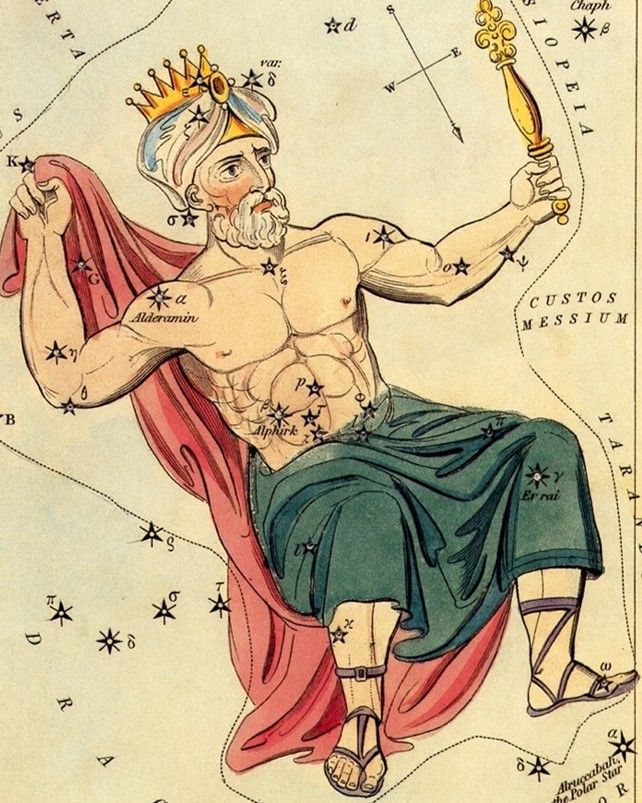
These next two constellations need to be expained in the context of the Perseus story.  Greek mythology is just that; a myth.  In all these strong men we have seen the iconology that points to one great man that we can recognize as part man and part God, both a warrior for his people and a good shepherd to them.  These next two constellations are at the center of the heavens, in fact Cepheus the king with his left foot, rest that foot on the North star.  Both are in sitting positions, and are on thrones.

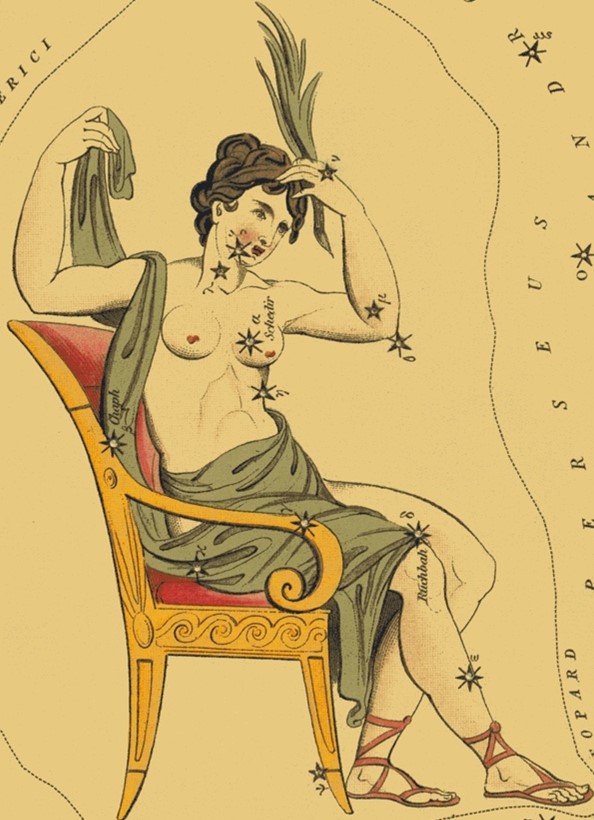
The star at His left knee is called Al Rai (meaning the shepherd!)  But in this case this shepherd has a crown on his head.  Both figures are pulling their robes over their right shoulders. And the King is handing his septer to his bride Cassiopia.  Do not let the mythology names confuse the narrative.  This is none other than Jehovah handing the scepter to his bride the Church.  She in her left hand she holds a branch[26], and is in the act of straightening out her hair as if preparing for some event.  She is the portayal of the church:

Wives, submit yourselves unto your own husbands, as unto the Lord.

For the husband is the head of the wife, even as Christ is the head of the church: and he is the saviour of the body.

Therefore as the church is subject unto Christ, so let the wives be to their own husbands in every thing.

Husbands, love your wives, even as Christ also loved the church, and gave himself for it;

That he might sanctify and cleanse it with the washing of water by the word,

That he might present it to himself a glorious church, not having spot, or wrinkle, or any such thing; but that it should be holy and without blemish.

So ought men to love their wives as their own bodies. He that loveth his wife loveth himself.

For no man ever yet hated his own flesh; but nourisheth and cherisheth it, even as the Lord the church:

For we are members of his body, of his flesh, and of his bones.

For this cause shall a man leave his father and mother, and shall be joined unto his wife, and they two shall be one flesh.

This is a great mystery: but I speak concerning Christ and the church. (Ephesians 5:22-32)

Interesting how Paul weaves the message of Christ and His church to the union of a man and his wife.  Men are to love their wives as their own bodies.  Paul is using this symbol to describe our responsibility to become subject to Christ.  This is the great mystery; that the church is being washed cleaned prepared for the great supper or marriage feast of the Lamb of God.  This is the event!  So we see Cassiopeia preparing herself for the king.

And to her was granted that she should be arrayed in fine linen, clean and white: for the fine linen is the righteousness of saints.

And he saith unto me, Write, Blessed are they which are called unto the marriage supper of the Lamb. And he saith unto me, These are the true sayings of God.              (Revelation 19:7-8)

Is there a throne of God in the constellations?  Yes!  When viewing the heavens there is a path the Sun takes through the constellations in a complete circle; it is called the ecliptic.  However, there is another equator that follows slightly off the same path, with Polaris at its center, called the celestial equator. Right exactly above that star is planted the foot of a king (Cepheus) who sits on a throne with a crown on his head!

It is situated to be the center of the zodiac!  To the Greeks he is called Cepheus the king, which comes from the Hebrew, and means the Branch.[27]  Why is it so important when viewing the big dipper that we take time to see how it points to the polar star Polaris?  Perhaps it is because the polar star is none other than the footstool of the heavenly picture of God on his throne!  Isn’t it interesting that on the Salt Lake Temple we have a depiction of the Big Dipper pointing to true north? Or, said differently, this Big Dipper points to the very star that the King rests upon, and the King is the symbol of the whole structure itself!  The presence of Cepheus with his foot upon the North Star is the point at which some ancient Hebrews believed the throne of the most high resided.

For thou hast said in thine heart, I will ascend into heaven, I will exalt my throne above the stars of God: I will sit also upon the mount of the congregation, in the sides of the north.                (Isaiah14:13)

For promotion cometh neither from the east, nor from the west, nor from the south.                 (Psalms 75:6)
The constellation Cepheus means the branch or seated crowned king.[28]  The few stars associated with this constellation are:

Al Rai, matching both Arabic (rai) and Hebrew (ro’ey) as shepard.[29]

Al Phirk, at his bosom, meaning the flock (Arabic).[30]

Al Dermin, meaning the right shoulder[31] or coming in a circle (Arabic).[32]

So how does one; both a king and a shepherd make it to the top of the earth?

THE heavens declare the glory of God; and the firmament sheweth his handywork.

Day unto day uttereth speech, and night unto night sheweth knowledge.

There is no speech nor language, where their voice is not heard.

Their line is gone out through all the earth, and their words to the end of the world. In them hath he set a tabernacle for the sun,

Which is as a bridegroom coming out of his chamber, and rejoiceth as a strong man to run a race.

His going forth is from the end of the heaven, and his circuit unto the ends of it: and there is nothing hid from the heat thereof. (Psalms 19:1-6)

This is the third time we have use this one scripture in these three papers. Here are verses that show the heavens speaking and declaring God’s glory.  The line is the path of the sun through the ecliptic, which goes to the end of the world, or rather his circuit, the circular orbit of the sun through the twelve stars of the zodiac.  In verse four “hath he set his tabernacle for the sun.”  The word “set” insinuates a throne, and the word “for” can mean before the sun.  And then again in verse five as a bridegroom coming out of his chamber?  In this going forth, the bridegroom leaves his tabernacle and is as the sun going around the ecliptic.  Is this not a very clear picture of our Lord and his tabernacle?

The above verses depict the Sun as it goes in a line around the constellations from one end of heaven (east) to (west).  And you see here the idea that this path of the sun is a circle.

For he that diligently seeketh shall find; and the mysteries of God shall be unfolded unto them, by the power of the Holy Ghost, as well in these times as in times of old, and as well in times of old as in times to come; wherefore, the course of the Lord is one eternal round. (1 Nephi 10:19)

This gives the idea that today, as in the past, the course of the Lord is in the round and is unchanging. What does that mean?   If all things are both temporal and spiritual, then it must mean that the Sun follows a straight path that is also round (as the Sun seems to go around the Earth).  It is the Earth that goes around the Sun, yet from our vantage point it seems that the Sun goes around the Earth.  It tracks from east to west in a straight line.  What is being portrayed here is a circular straight line.  (See also Alma 7:20, Alma 37:12, and D&C 35:1.)

For God doth not walk in crooked paths, neither doth he turn to the right hand nor to the left, neither doth he vary from that which he hath said, therefore his paths are straight, and his course is one eternal round. (D&C 3:2)

This means that like the Sun, the Lord does not walk in crooked paths; He doesn’t turn north or south and He, as an example, has a course that is one eternal round.

And yet again:

It is he that sitteth upon the circle of the earth, and the inhabitants thereof are as grasshoppers; that stretcheth out the heavens as a curtain, and spreadeth them out as a tent to dwell in:

To whom then will ye liken me, or shall I be equal?  saith the Holy One.

Lift up your eyes on high, and behold who hath created these things, that bringeth out their host by number: he calleth them all by names by the greatness of his might, for that he is strong in power; not one faileth. (Isaiah 40:22,25-26)

The tabernacle resembles the curtains of the heavens (a tent), where He that sitteth upon the circle of the earth dwells.  The host of heavens represents the host of each of the twelve tribes of Israel whom He knows by name.  First the Jews had the tabernacle; later it was Solomon who built the temple.  Temples as well as the tabernacle testify of Christ and are called the “House of the Lord.”

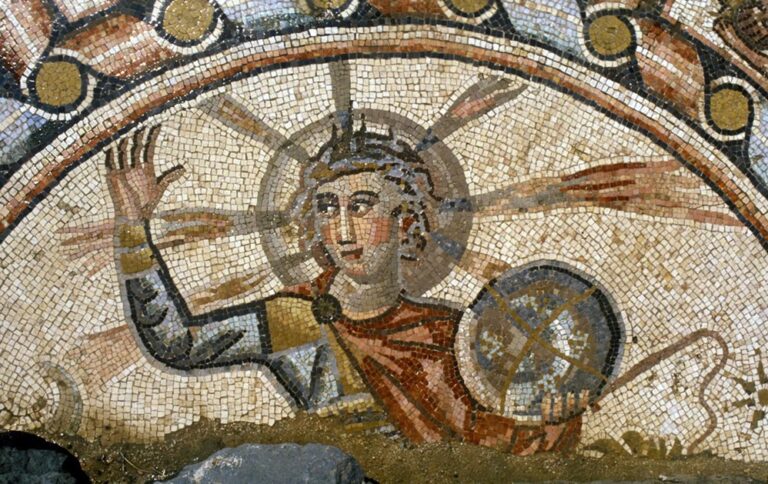
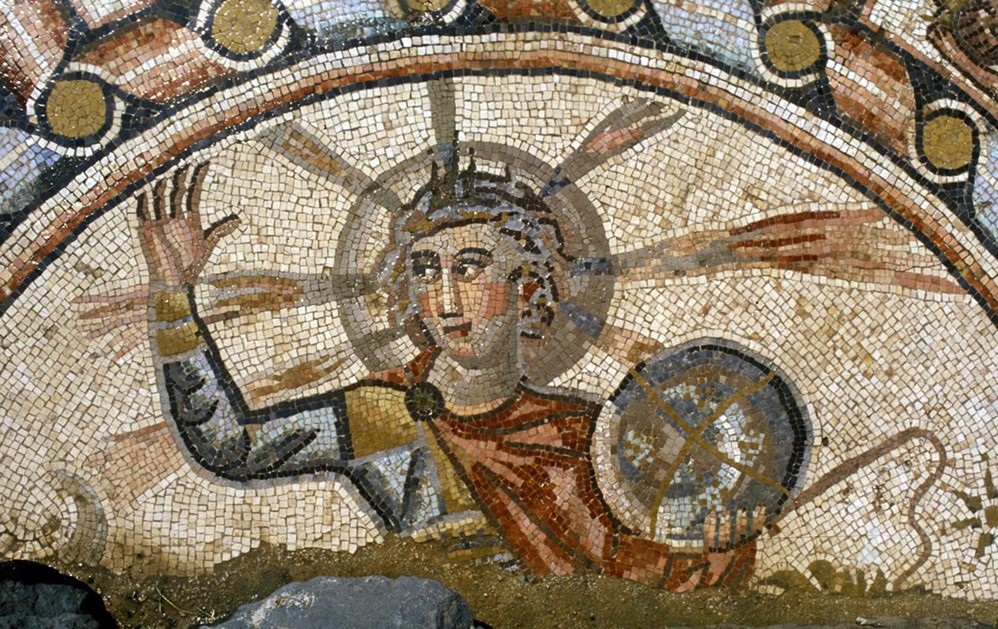
FourthCcentury Synagouge, Mosaic in Hammat near Tiberius.

The example below is a fourth century Synagouge, mosaic in Hammat near Tiberius.

The twelve signs representing the twelve tribes form a circle around this bridegroom. The Jews abhorred the pantheon of Roman gods and as a people did not worship them. They might perhaps adopt the symbol as their own style, or as a type of things recognized from their past. [33]   This is evidenced in Helios as depicted above, with a whip in hand and horses and a chariot.   It is a type of Cepheus as the Lord himself on the throne at the center of heaven itself, making the top of Earth his footstool.[34]  This idea of a footstool as being a place for the Lord to rest was taken a step further with the tabernacle, and then later with temples as a place where God could dwell among men.  For this reason, the tabernacle and temple are patterned after the heavens.

Let’s now go back and finish up with the woman:

In the Denderah zodiac her name is Set, which means set up as a queen.  Albumazer[35] says this constellation was anciently called “the daughter of splendor.”  Ulugh Bey[36] says its Arabic name, Zat Al Kursi, means set on the throne.[37]

Stars in Cassiopeia:

Schedir, the breast (Arabic).[38]
Caph, meaning the enthroned (Arabic).[39]
Ruchba, at her knee, meaning the knee (Arabic).[40]

And I John saw the holy city, new Jerusalem, coming down from God out of heaven, prepared as a bride adorned for her husband.

And I heard a great voice out of heaven saying, Behold, the tabernacle of God is with men, and he will dwell with them, and they shall be his people, and God himself shall be with them, and be their God.

And there came unto me one of the seven angels which had the seven vials full of the seven last plagues, and talked with me, saying, Come hither, I will shew thee the bride, the Lamb’s wife.

And he carried me away in the spirit to a great and high mountain, and shewed me that great city, the holy Jerusalem, descending out of heaven from God, (Revelation 21:2-10)

Revelation 21:3 locks down the symbol of the tabernacle being a picture of God in the center: “the tabernacle of God is with men, and he [shall] dwell with them…”  And the people of New Jerusalem (and Old Jerusalem) will be prepared as a bride is adorned for her husband, “arrayed in fine linen, clean and white,” and called to the marriage supper of the Lamb.

In 2004 the tenth annual Tisha Bav march around Jerusalem’s old city walls was held, commemorating the destruction of the first and second temples by the Babylonian and Roman armies.  The event was attended by more than 10,000 Jews, who silently marched around the Temple Mount. Among those witnessing the march were members of the newly formed Sanhedrin, or as in the article I read, the quorum of seventy-one counting Jerusalem’s chief Rabbi.[41]  One of the rabbis in attendance was asked to explain what this march represented, and he said that in a traditional Jewish wedding ceremony the bride dances in a circle around the groom under the wedding canopy![42]  So they likewise parade around the Temple Mount.  Can words express a better sign for our times than the Jew’s waiting patiently for their Groom?

Apostle Dallin H. Oaks spoke in the 2004 April conference, and addressed the topic of the kingdom of heaven being likened to ten virgins:

Given the 25th chapter of Matthew, this parable contrasts the circumstances of the five foolish and the five wise virgins.  All ten were invited to the wedding feast, but only half of them were prepared with oil in their lamps when the bridegroom came.  The five who were prepared went into the wedding feast, and the door was shut.  The five who had delayed their preparation came late.  The door had been closed, and the Lord denied them entrance, saying “I know ye not.”

“Watch therefore,” the Savior concluded, “for ye know neither the day or the hour wherein the Son of Man cometh.”

The arithmetic of this parable is chilling.  The ten virgins obviously represent members of Christ church, for all were invited to the wedding feast, and all knew what was required to be admitted when the bridegroom came.

These constellations constitute “signs” in the Heavens that teach of the Lamb of God, the good shepherd, and the Strong Man who will return for his bride the Church in the latter day.  The coming of that day is near at hand; and with might, and great glory he will come suddenly to his people.  Prepare now that you be not shut out of the wedding feast of our Great God!

[1] James Strong, The Strongest Strong’s Exhaustive Concordance of the Bible, Hebrew-Aramaic dictionary, Grand Rapids, Michigan USA, Zondervan, 2001 p1469 word 217, p 7457 word 7462

[2] Collins, Latin Concise Dictionary, Bishopbriggs Glasgow, Great Britain, HarperCollins Publishing, 1997 p 29

[3] Ibid. p 90

[4] Awde/Smith, Arabic Practical Dictionary, New York, USA Hippocrene Books Inc, 2004 p290

[5] Steven J. Gibson, Star name list, Astronomer at Arecibo Observatory, Puerto Rico

[6] Hayim Baltsan, Webster’s New World Hebrew Dictionary, Cleveland, Ohio, Wiley Publishing, Inc., 1992 p 632

[7] Steven J. Gibson, Star name list, Astronomer at Arecibo Observatory, Puerto Rico

[8] Richard Hinckley Allen, Star names Their Lore and Meaning, Dover Publications Inc New York USA 1963 p 104

[9] Ibid. p 104

[10] James Strong, The Strongest Strong’s Exhaustive Concordance of the Bible, Hebrew-Aramaic dictionary, Grand Rapids, Michigan USA, Zondervan, 2001 p1491 word 1856

[11] Wikipedia, the free Encyclopedia, article “Ophiuchus” mythology

[12] Hayim Baltsan, Webster’s New World Hebrew Dictionary, Cleveland, Ohio, Wiley Publishing, Inc., 1992 p 609

[13] Ulugh Beg’s Catalogue of Stars, Carnegie Institution of Washington, Gibson Bros. Press, 1916 p 101

[14] Richard Hinckley Allen, Star names Their Lore and Meaning, Dover Publications Inc New York USA 1963 p 300

[15] Ibid. p 301

[16] Frances Rolleston, Mazzaroth, Whitefish, Montana USA, Kessinger Publishing, 2009 part 2 p 19

[17] Hayim Baltsan, Webster’s New World Hebrew Dictionary, Cleveland, Ohio, Wiley Publishing, Inc., 1992

[18] Rollestonop.cit. part 2 p 19

[19] Baltsanop.cit. p 523

[20] Ulugh Beg’s Catalogue of Stars, Carnegie Institution of Washington, Gibson Bros. Press, 1916 p 100

[21] James Strong, The Strongest Strong’s Exhaustive Concordance of the Bible, Hebrew-Aramaic dictionary, Grand Rapids, Michigan USA, Zondervan, 2001 p 1555 word 6555, p 1633 word

[22] Awde/Smith, Arabic Practical Dictionary, New York, NY, USA Hippocrene Books Inc, 2004 p273

[23] Frances Rolleston, Mazzaroth, Whitefish, Montana USA, Kessinger Publishing, 2009 part 2 p 9

[24] Ibid part 2 p 9

[25] Ibid part 2 p 9

[26] Zechariah  6:12  And speak unto him, saying, Thus speaketh the Lord of hosts, saying, Behold the man whose name is The BRANCH; and he shall grow up out of his place, and he shall build the temple of the Lord:

[27] E. W. Bullinger, Witness of the Stars, Grand Rapids, MI, Kregel publications, 1967, p 103.

[28] Frances Rolleston, Mazzaroth, Whitefish, MT, Kessinger Publishing, 2009, part 2, p 23.

[29] Hayim Baltsan, Webster’s New World Hebrew Dictionary, Cleveland, OH, Wiley Publishing, Inc., 1992, p 740.

[30] Richard Hinckley Allen, Star Names their Lore and Meaning, New York: Dover Publications Inc., 1963, p 157.

[31] Ibid.

[32] Rolleston, op.cit., part 2, p 23.

[33] Lester J. Ness, in Astrology and Judaism in late Antiquity, wrote, “Ancient Jews were part of the larger society, although with some distinctive customs, notably the worship of a single god, YHWH, and a distain for the use of religious images.  During the Hellenistic period, Jews adopted the practice of astrology enthusiastically, but they gave the principles of astrology their own Judaic interpretation.”

[34] Isaiah 66:1, Matthew 5:35, 1 Nephi 17:39.

[35] Albumazer was an Arab Tartar prince and astronomer to the Caliphs of Grenada of the eighth century, and the source of many of the Arabic star names.

[36] According to the Wikipedia article on him, Ulugh Beg’s real name was Mirza Mohammad Taregh bin Shahrokh.  He was a Timurid ruler as well as an astronomer, mathematician, and sultan who lived from c 1393-1449.  His commonly known name is a moniker, which can be loosely translated as Great Ruler or Patriarch Ruler.

[37] Ulugh Beg, Ulugh Beg’s Catalogue of Stars, Carnegie Institution of Washington, Gibson Bros. Press, 1916, p 100.

[38] Awde/Smith, Arabic Practical Dictionary, New York, NY, Hippocrene Books Inc., 2004, p 243.

[39] Richard Hinckley Allen, Star Names Their Lore and Meaning, Dover Publications Inc New York, 1963, p 148.

[40] Ibid. p 146.

[41] Arutz Sheva, Members of Reestablished Sanhedrin Ascend Temple Mount, IsraelNationalNews.com, 8 December 2004 / 25 Kislev 5765.

[42] Hillel Fendel and Ezra HaLevi, Recent Developments in the News Regarding the Temple Mount, Tisha B’Av, 27 July 2004.

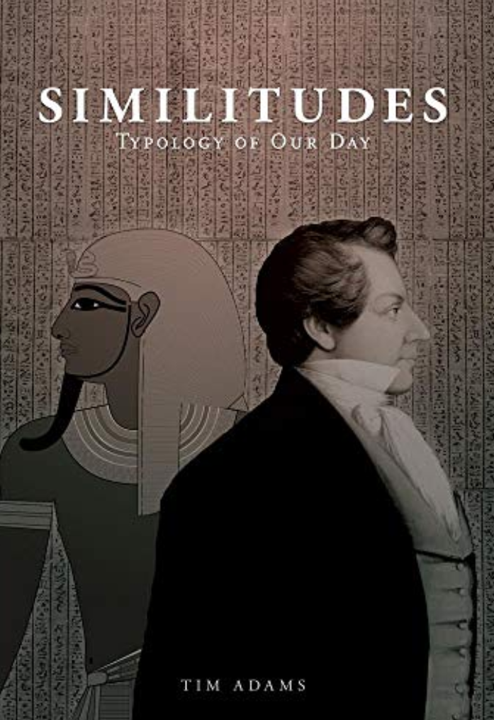
Tim Adams- Husband, Father, Author, Iconology Expert

Tim Adams is first and foremost a father of six children and married to the love of his life Katy Ann MacArthur.  Raised and lived around the US spending middle and High school years in Upstate New York.  I remember well camping as a boy scout on the backside of the Hill Cumorah.  Sneaking out at night as our leaders slept, digging with sticks looking for that stone box that held the plates.  Professors hadn’t taught me yet that New York’s Hill was the wrong one.  Nonetheless we moved there when I was 13; and I identified strongly with the boy prophet.  My Father became a professor of Art History working on organizing an iconographical index for the Cathedral of Chartres.  Having read a few of my Fathers papers and having him as a Seminary teacher trained me to “see” what the scriptures looked like in stone. Latter served a mission in the Netherlands Amsterdam mission, where I had fun with my companions seeing if they could identify the apostles and prophets in the large Catholic churches.

Tim attended Ricks College as it was then known; and found his girlfriend Katy MacAurthur (and yes; she is related to that famous General), and married her in the Washington DC Temple.

Tim attended a meeting in Portland Oregon where he lives; where a Christian man gave a presentation on the constellations, and how they testified of Christ.  Having an acute interest in Greek mythology, I thought how strange that he fears using the icons that are Greek to testify of Christ’s godliness.  Someone should write a book about it that understands iconology.  So “Pattern of the Heavens” became my first book written in 2009.  This year in March I completed a second book called “Similitude’s”.  One could call it the iconology of Old Testament stories.  This new book is a twist on a topic about typology, taking it to new places it has yet to go.

Tim graduated from Ricks College earning an associate degree in general education.  He has not gone on to further his studies in any direction.  No masters degree, no PHD, preferring instead to be a self made man; husband, Father, follower of Christ, and yes a dreamer.

Purchase Tim’s new book today: Similitudes: Typology of our Day

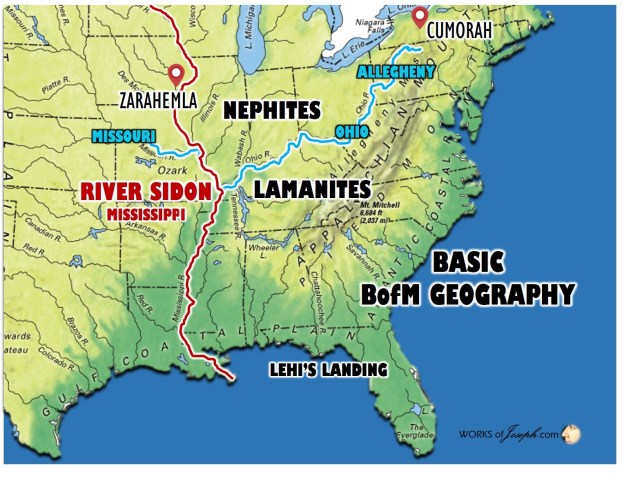
The Book of Mormon Reveals that the Inheritance of Joseph is the USA

The United States of America has been and is truly great. It is the Promised Land of the Book of Mormon. Elder Perry said, “The United States is the promised land foretold in the Book of Mormon—a place where divine guidance directed inspired men to create the conditions necessary for the Restoration of the gospel of Jesus Christ.” Elder L. Tom Perry Ensign Dec. 2012

The Book of Mormon reveals that the inheritance of Joseph, son of Israel, was not forgotten when, as promised in the Abrahamic covenant, land was distributed to the tribes of Israel. Joseph’s inheritance was to be a land choice above all others. (See Ether 13:2, 8.) It was choice not because of beauty or wealth of natural resources, but choice because it was chosen. It was to be the repository of sacred writing on plates of gold from which the Book of Mormon would one day come, choice because it would eventually host world headquarters of the restored church of Jesus Christ in the latter days.” A Treasured Testament.” Elder Russell M. Nelson Of the Quorum of the Twelve Apostles Ensign: July 1993

Today the world and this land of the United States is receiving relentless attacks from some very unpatriotic and evil people. We are in a World War 3 cyber battle and it is time to stand up and applaud the goodness of these United States. We know this land will not be possessed by a disobedient people. We have time to save our land, but it is becoming a challenge. Prophets and Apostles have spoken of the Choice Land and the responsibility those of us who are citizens must act with more dignity, respect, honor, faith and righteousness than those living in any other country. Not because we are better people, but because far more is expected of us. The penalty for our sin and disobedience will be far greater than those who live in other countries, as more is expected of us. We welcome all into the United States that want to come here legally and adopt our way of life which is freedom to choose right or wrong and be willing to accept the blessings or the curse for disobedience. Love our neighbor as ourselves, and above all Love the Lord our God with all our Heart, Might, Mind and Strength.

President Monson said, “The Lord gave a divine promise to the ancient inhabitants of this favored country (the United States): ‘Behold, this is a choice land, and whatsoever nation shall possess it shall be free from bondage, and from captivity, and from all other nations under heaven, if they will but serve the God of the land, who is Jesus Christ” (Ether 2:12).

“Our Heavenly Father inspired the leaders of…the United States of America, that they might together, under His direction, having been raised up by God for the purpose, establish the Constitution of this country and…Bill of Rights, that by the year of our Lord 1805 [there would be] a climate where our Heavenly Father could send into this period of mortality a choice spirit who would be known as Joseph Smith, Jr.” Teachings of Thomas S. Monson by Thomas S. Monson 2011 (Ordained an Apostle, 1963; President of the Church, 2008)

In my opinion, President Monson believes the United States is the Promised Land of the Book of Mormon. Why do Mesoamericanists believe the entire continent of the Americas is the Promised land? You mean Greenland, Guatemala, and the Northwest Territories are the Promised Lands? Do they all have a God given and written Constitution? “I established the Constitution of this land, by the hands of wise men whom I raised up unto this very purpose, and redeemed the land by the shedding of blood.” D&C 101:80

I love all of God’s children in the entire world and God loves us all the same, but seriously? If a person from Greenland comes to the United States legally as a citizen that person can also live in the Promised Land, correct? I’m sure Greenland has much beauty on its own, but it is not the Promised Land, is it? I am not belittling other lands. I’m just making a factual statement. Why is the United States and Land of Israel the two Promised Lands? Because Christ said so. See 3 Nephi 20:22,29 The Lord has said, the first shall be last and the last shall be first. It makes sense that our life will begin and end at the same location, and this life also includes the events of the Book of Mormon happening in that same area. This is not a coincidence. The Lord has planned out our existence and life, before, during and after. Missouri is an important place in the Lord’s plans. This is so obvious that those who believe in other geography theories are in a great and spacious building. You just need common sense and the scriptures to determine that as Elder L. Tom Perry said, “The United States is the promised land foretold in the Book of Mormon.”

How is it possible to read the Book of Mormon and read the promises about a Promised Land, and not know these prophets are speaking about the United States of America? There are many choice lands in the Americas, but not like the USA with its constitution, liberty and missionary work. We truly are blessed to be in this chosen land of America. With this blessing, we are under covenant to share the gospel to the rest of the world and if we don’t we shall be swept off this chosen Land. President Dyer shares in plain language as an ambassador of the Lord, this same sentiment below.


The Destiny of America by President Alvin R. Dyer

Of the First Presidency Conference Report, October 1968, pp. 106-110

“My brothers and sisters and friends of our vast television audience, I occupy this position this morning by assignment from our beloved leader, President David O. McKay. We are so grateful he is present with us this morning, and I bear record that he is a prophet of God.

The Destiny of America

My talk this morning concerns the destiny of America, which directly and indirectly affects all of mankind.

Since the founding of this country, political leaders have spoken of the greatness of America and of its place in the world as the cradle of freedom and democracy, with a destiny to disseminate these principles throughout the world.

We have witnessed America’s attempt at this by various methods, but she is learning by hard and costly experience that freedom cannot be taken or given to any people, nor can it be bought. America of today will need to learn the lesson, as did our Founding Fathers, that freedom must be sought after with courage and sacrifice, and that she cannot maintain it at home or convey it unto others unless this type of pursuit is involved.

As to the destiny of America, politically speaking, I am not prepared to say, but I do know that long before the ships of Columbus touched the shores of the New World, long before our independence and our Founding Fathers established a new nation, events had long since transpired to give unto this land, which we now call America, its committed purpose and destiny.

True destiny spiritual

I have a firm conviction that the true destiny of America is religious, not political; it is spiritual, not physical.

Much has been said by many of the purpose of its founding. The Prophet Joseph Smith himself declared its constitution to be heavenly inspired, and because of this we earnestly pray for its purposeful continuity. But noble and great as are the political phases of its establishment, its real significance lies in its spiritual purpose, for which it was truly founded. I have chosen two of these spiritual and therefore God-purposed reasons for reference:

First: America was founded to fulfill a covenant that God made with the patriarchal ancestors of the house of Israel. The Lord, speaking unto a remnant of this house who had inhabited this land, had thus to say:

“For it is wisdom in the Father that they should be established in this land, and be set up as a free people by the power of the Father, that these things might come forth from them unto a remnant of your seed, that the covenant of the Father may be fulfilled which he hath covenanted with his people, O house of Israel” (3 Ne. 21:4).

Preservation of moral agency

Second: America and its constitution were founded to preserve unto mankind the God-given right of moral agency. I quote from a revelation given to the Prophet Joseph Smith on this subject:

“According to the laws and constitution of the people, which I have suffered to be established, and should be maintained for the rights and protection of all flesh, according to just and holy principles;

“That every man may act in doctrine and principle pertaining to futurity, according to the moral agency which I have given unto him, that every man may be accountable for his own sins in the day of judgment.

“Therefore, it is not right that any man should be in bondage one to another,

“And for this purpose have I established the Constitution of this land, by the hands of wise men whom I raised up unto this very purpose, and redeemed the land by the shedding of blood” (D&C 101:77-80, italics added).

The people whom Columbus found were the ebbing remnants of those who came to this land by heavenly direction and in fulfillment of the covenants which God had enacted long before their migrations and occupancy of the land, which the Lord announced to them as a land of promise and inheritance.

Migration of Jaredites

According to the Book of Mormon, the Jaredites began their migration to this land at the time when the great tower of Babel was under construction. This occurred in about the year 2200 B.C. At this time the language of the people was confused. This tower has been identified in our modern time at a place called Hillah in modern Iraq, southwest of the city of Baghdad, on the east bank of the Euphrates River. Here is found a ruin known as Birs Nimrud, standing like a watchtower on a vast plain. Inscriptions on the pyramid-shaped ruins were found by Professor Rawlinson to bear the name of “The Temple of the Seven Planets.” This ruin is supposed to be what is left of the Tower of Babel.

In the course of the travels of the Jaredites, first northward into the valley of Nimrod and then, after crossing many lakes and rivers, eventually reaching the great sea which separated the continents, they established a community named Moriancumer after their great leader, the brother of Jared (see Ether 2:1-6,13).

We learn that the Lord gave instructions to the brother of Jared for the building of submersible barges that would enable his colony to cross the great waters to a land of promise, concerning which Mahonri-Moriancumer wrote:

“And now, we can behold the decrees of God concerning this land, that it is a land of promise; and whatsoever nation shall possess it shall serve God, or they shall be swept off when the fulness of his wrath shall come upon them. And the fulness of his wrath cometh upon them when they are ripened in iniquity.

“For behold, this is a land which is choice above all other lands; wherefore he that doth possess it shall serve God or shall be swept off; for it is the everlasting decree of God” (Ether 2:9-10).

Lehi led to promised land

About 1,600 years later, or 600 B.C., a prophet by the name of Lehi with his family left doomed Jerusalem, as the Lord had directed him. Lehi and his colony, as with the Jaredites many centuries before, were to be led to the promised land. Speaking unto Nephi, the son of Lehi, while they were yet in the wilderness prior to their embarkation, the Lord said:

“And inasmuch as ye shall keep my commandments, ye shall prosper, and shall be led to a land of promise; yea, even a land which I have prepared for you; yea, a land which is choice above all other lands” (1 Ne. 2:20).

Eventually, after much tribulation and a perilous journey over the great waters in a ship built as directed by the Lord, Lehi and his colony, somewhat enlarged since their departure from Jerusalem, reached the promised land, probably in the year of 589 B.C.

Lehi Leaves Jerusalem

Later, Nephi made this declaration:

“But,” said he, “notwithstanding our afflictions, we have obtained a land of promise, a land which is choice above all other lands; a land which the Lord God hath covenanted with me should be a land for the inheritance of my seed. Yea, the Lord hath covenanted this land unto me, and to my children forever, and also all those who should be led out of other countries by the hand of the Lord” (2 Ne. 1:5).

Land of man’s beginning

While the Reformation and the surge for freedom were gaining momentum in Europe and England, events were transpiring that led to the rediscovery of the land of America, for God touched the heart of a mariner by the name of Christopher Columbus, who eventually pioneered a passageway to the promised land in 1492. But neither Columbus, the Nephites, nor the Jaredites were its original discoverers, nor did they establish the purpose of America’s destiny. This had already been established in the infancy of earth’s habitation. In these migrations they were but directed to the land of man’s beginning upon the earth.

Christ’s visit to America

We have learned that following his earth-life ministry among the Jews, visiting the sheep of another fold here in the land of America and establishing his Church among the people, the resurrected Christ tells of the founding of America and the coming forth again of his gospel unto the remnant of the seed of those then occupying this land, and unto all of the children of God. This was to follow a period of spiritual darkness upon the earth. In this declaration the Lord tells of the sacred destiny of the great land of America, and I quote the words of the Savior:

“And verily I say unto you, I give unto you a sign, that ye may know the time when these things shall be about to take place—that I shall gather in, from their long dispersion, my people, O house of Israel, and shall establish again among them my Zion” (3 Ne. 21:1).

The land of inheritances

The lord in the following declaration designates the land of America as the land of inheritances unto those who are of the house of Israel, who shall be gathered from throughout the earth, for, said he:

“And then shall the remnants, which shall be scattered abroad upon the face of the earth, be gathered in from the east and from the west, and from the south and from the north; and they shall be brought to the knowledge of the Lord their God, who hath redeemed them.

“And the Father hath commanded me that I should give unto you this land, for your inheritance.

“And behold, this people will I establish in this land, unto the fulfilling of the covenant which I made with your father Jacob; and it shall be a New Jerusalem. And the powers of heaven shall be in the midst of this people; yea, even I will be in the midst of you” (3 Ne. 20:13-14,22).

To speak of America, both north and south, as “the choice land,” “a land consecrated” (D&C 57:1), we will need to go back to the beginning for an understanding.

The Garden of Eden

From the writings of the prophet Moses, dealing with the placement of man upon the earth, this statement is made:

“And I, the Lord God, planted a garden eastward in Eden, and there I put the man whom I had formed” (Moses 3:8).

Then, as it was not good for man to be alone, a helpmeet, or a woman, was placed beside him, that both man and woman together could occupy the garden thus planted.

As to what and where the Garden of Eden was, it is well to call to mind that in the process of the creation, during the third period, all waters were gathered in one place, and the dry land was in one place. The land was called earth and the waters sea (Gen. 1:10).

The dry land, or earth, is also given other name, that of Eden, and it was eastward in Eden or eastward on the dry land that the garden of our first earth-life parents was placed (Gen. 2:8).

In the course of time from the creation, in the days of Peleg (Gen. 10:16 (JST)), or about the year 2200 B.C., Just prior to the confusion of the languages, the single continent of land that had continued from creation was divided to produce the hemispheres as we now know them. But notwithstanding this, the geographic location of the Garden of Eden was made known to the Prophet Joseph Smith by revelation as here in the land of America, in Jackson County, Missouri, with Independence as the center place.

Beginning of mortal life

When Adam and Eve were cast out of the Garden, they traveled in a northerly direction less than 100 miles to settle in a place that we now have come to know by the revealed word of God as Adam-ondi-Ahman (see D&C 116:1). Here is where mortal family life began, as Adam and Eve begat sons and daughters, all of this here in the land of America.

Adam and Eve, shut out from the presence of God, settled in the place of their earthly abode and called upon God. They were instructed to offer the firstlings of their flocks upon altars as a sacrifice unto the Lord, to which commandment they were obedient even though they did not know the reason. An angel of the Lord then appeared and explained the similitude of the sacrifice of Christ the Lord, who would come to earth at an appointed time. Thereafter the gospel plan of salvation and exaltation, by reconciliation with God the Father, from whose presence they had been banished, was revealed for the first time to man upon the earth (Moses 5:4-8).

Keys of salvation given to Adam

The Holy Priesthood, after the order of the Son of God, which “administereth the gospel and holdeth the key of the mysteries of the kingdom, even the key of the knowledge of God” (D&C 84:19), was conferred upon Adam. Hence, unto Adam, the great progenitor of the human family, were given the “keys of salvation” (D&C 78:16). The Lord, or Ahman, thus made known unto Adam and Eve that though they had fallen and were subject to both physical and spiritual deaths, they could be redeemed and reconciled with God the Father.

In conferring the “keys of salvation” upon Adam, the revealing and unlocking of the conditions of salvation were made known to them and through them to mankind. In this we can understand the true meaning of the term “Adam-ondi-Ahman,” or simply: from “Ahman,” who is the Lord—”ondi,” meaning through Adam unto mankind.

In the revelation referred to, but to which more attention is now given, the Lord speaks clearly of the “keys of salvation” having been given to Adam (or Michael (D&C 27:11), his premortal name), identifying the purpose for which they were conferred.

“That you may come up unto the crown prepared for you, and be made rulers over many kingdoms, saith the Lord God, the Holy One of Zion, who hath established the foundations of Adam-ondi-Ahman;

“Who hath appointed Michael your prince, and established his feet, and set him upon high, and given unto him the keys of salvation under the counsel and direction of the Holy One, who is without beginning of days or end of life” (D&C 78:15-16).

“. . . for it is necessary in the ushering in of the dispensation of the fulness of times, which dispensation is now beginning to usher in, that a whole and complete and perfect union, and welding together of dispensations, and keys, and powers, and glories should take place, and be revealed from the days of Adam even to the present time” (D&C 128:18).

A choice land

Thus, from these brief accounts we see the reasons why America, or the continent of America, is the promised and choice land, choice above all other lands, for it was here that the habitation of man began, and here that the covenants of God were first established. And it is from the center of this land that God has started his great latter-day work that will carry to the finish.

It is of compelling interest to learn that in the sequence of the Lord’s time, the earth and the waters will return to their original place. On this subject we have this revelation from the Lord:

“And he shall utter his voice out of Zion, and he shall speak from Jerusalem, and his voice shall be heard among all people;

“And it shall be a voice as the voice of many waters, and as the voice of a great thunder, which shall break down the mountains, and the valleys shall not be found.

“He shall command the great deep, and it shall be driven back into the north countries, and the islands shall become one land;

“And the land of Jerusalem and the land of Zion shall be turned back into their own place, and the earth shall be like as it was in the days before it was divided.

“And the Lord, even the Savior, shall stand in the midst of his people, and shall reign over all flesh” (D&C 133:21-25).

Zion will not fail

America as Zion will not fail. Since America is the land choice above all other lands (1 Ne. 2:20), and it is in the “Center Place” that Zion will be established (D&C 57:3), it will not fail.

America as Zion will not fail, not simply because it is, the land of our illustrious independence and constitutional fathers, but because it is the land of Joseph, the son of Jacob, and has been so established by God’s covenant. It is the land for the gathering of Israel in the culminating period of the last dispensation, which God has established through the Prophet Joseph Smith.

To accomplish his purposes in the destiny of America as Zion, we have these words from the Lord concerning his people:

“But first let my army become very great, and let it be sanctified before me, that it may become fair as the sun, and clear as the moon, and that her banners may be terrible unto all nations” (D&C 105:31).

I bear testimony of the fulfillment and the destiny of the land of America as Zion, and I do it in the name of Jesus Christ. Amen.” (Color and highlights added)

The Lamb and the Lion of Judah Part 2 The Strong Man

0

In our last discussion about the return of the Lion of Judah we shared this scripture:

  • The heavens declare the glory of God; and the firmament sheweth his handywork.
  • Day unto day uttereth speech, and night unto night sheweth knowledge.
  • There is no speech nor language, where their voice is not heard.
  • Their line is gone out through all the earth, and their words to the end of the world. In them hath he set a tabernacle for the sun,
  • Which is as a bridegroom coming out of his chamber, and rejoiceth as a strong man to run a race. 
  •  His going forth is from the end of the heaven, and his circuit unto the ends of it: and there is nothing hid from the heat thereof. (Psalms19:1-5)

Verse four uses the line “As a bridegroom coming out of his chamber, and rejoiceth as a strong man to run a race. God in this case is compared to a bridegroom which throughout the scriptures is coupled with the “Bride” meaning the Church.  These descriptions in the scriptures, and in these sky pictures incorporate what we call “icons,” describing attributes of each character.  Taken together they are called the iconography of the heavens.  So the goal of this paper is to investigate the icons and match them to their natural counterparts in the scriptures.  In this way the reader will “see” that these icons in the heavens naturally testify of Christ.  When one considers the “strong man” and the Lion of the tribe of Judah one needs to ask “do these two descriptions show up in the Heavens?”  They do.

My favorite constellation is Orion.  Of all the constellations this one, looks nearly like the drawn depiction, easy to see in the night sky.  His left arm is raised, holding aloft a lion’s skin. From our previous essay we learn that the Lion skin identifies him as the Lion of the tribe of Judah. In his right hand he wields a club, this club is from an olive branch where the redeeming work of the savior occurred in an orchard of olive trees and the adversary’s work was frustrated.  Three stars mark his waist or the belt of Orion, and below it his sword in it’s sheath.   Lupus had originally been a serpent clutched in the talons of the lion that has been replaced by Canis Major (also a corrupted constellation). Remember the excerpt from Hinckley’s book: And long before him Spenser had, in the Faerie Queen:

And now in Ocean deepe Orion
flying fast from hissing snake,                                   
His flaming head did hasten for to steepe.   

This hissing snake has been replaced by a rabbit named Lupis. That snake or serpent’s head was under Orion’s left foot, in the act of being crushed, and Orion’s right leg is in the attitude as if wounded, bent back awkwardly.  All put together we have the Lion of the tribe of Judah in the act of crushing the head of a serpent while himself being wounded in the heel.

And I will put enmity between thee and the woman, and between thy seed and her seed; it shall bruise thy head, and thou shalt bruise his heel. (Genesis 3:15)

Seek him that maketh the seven stars and Orion,  (Amos 5:8)   

A straight line can be drawn across a planisphere (map of the heavens) lining up to stars in the heels of the feet of four constellations (Orion, Auriga, Hercules, and Ophiuchus) portraying the bruised heel!  There must be a significant reason the heavens were organized to portray this enmity between the woman and the serpent to be drawn from one end of heaven to the other.

In Greek mythology Orion is a giant huntsman, the son of Euryale and Poseidon, he is also said to be the son of Gaia (Mother Earth).  His father Poseidon gave him the gift of walking on water!  To the Jews he was known as “Chesil” the giant, a hero, or the strong one.

In the Egyptian Denderah, Orion is shown as a man wearing the crown of Lower Egypt with a staff and beater.  Under his feet he appears to be treading on a serpent and under that in Hieroglyphs, is the name Oar.  In Hebrew the root oor, or or, means “lighting”[1].  Orion means coming forth as light.  The Akkadian Ur-ana, means the “light of heaven.” The sword at his side has several nebulae reflecting the glory and brilliancy of his coming. In all cases Nebulae that can be seen with the naked eye seem to be strategically placed.  This one is in the sword.  Two others are also found lower in the blade of the sword, suggesting blood spilled.

The name Orion comes from the Latin “Ori” to rise, beginning, source, founder, morning light, where we get the word origin, and same as the 1st Greek letter[2] and beginning of the Greek dictionary Alpha!  In Hebrew “Or”[3] means to shine gloriously. This Constellation surely is the Alpha and Omega of the Heavens!  See Orion below by Johann Bayer, 1603  in the standing position, where his wounded heel is more natural looking.  Some of the stars in this constellation are as follows:

“Meissa” at the head meaning shining, or coming forth[4]  (Hebrew) A similar word “Messiah” means “The anointed one,” as one is anointed on the head.
“Betelgeuz” right shoulder “Geuz” and “Giauza” [5]were thought to be the like names to “Gibbor” to the Hebrews meaning Giant, but originally these words expressed one who was in the center of the heavens, as a central figure.  The other part of the word “Bet-el” [6]is the Hebrew for temple, or house of God.  Could this star name that we in the west pronounce Beetle-juice, in reality mean the house of God in the midst of Heaven? (Hebrew) “Bellatrix” means the female conqueror, But the Arabic title from Ulugh Beg is“Al Murzim al Najid meaning the Prince who roars[7] identified by the lion skin held aloft in his left arm (Arabic)
“Rigel” at left ankle, meaning foot[8] (Arabic) maybe also known as “Thabit” to kick, treading on?[9] (Hebrew)
“Al Nitak” one of three stars at belt and above the Diffused Nebula meaning “the wounded one”(Arabic) “makka”[10] (Hebrew)
“Al Nilam” the middle belt star meaning string or belt of pearls [11](Arabic)
“Mintaka” belt star, unknown meaning, possibly to cut or divide as with his sword [12]
“Saiph” or “Nair Al Saif” on the sword meaning sword [13](Arabic)
“Al Giebba” or “Al Gebor” in the midst[14] (Arabic)

Another constellation in the heavens also wearing a lion skin is Hercules; like Orion he is positioned exactly the same, his left foot is coming down upon the head of Draco the dragon, so that he treads down the serpent. His right foot turned back so that he is in the kneeling position as if his foot has been wounded. Draco’s tongue is extended pointing to the left foot, as if he were the cause of the wounding.

Thou shalt tread upon the lion and adder: the young lion and the dragon shalt thou trample under feet. (Psalms 91:13)                                             

In Greek mythology Hercules is part man and part God.  His Father was Zeus, and his ‘mortal’ mother called Alcmene. Likewise Heavenly Father is the Father to Jesus with a mortal Mother by the name of Mary.  In his right hand he wields a club (fashioned from an olive tree)[15] to crush his enemy, and in his left, he grasps a branch that has apple-like fruit.  He is dressed in the skin of a lion identifying Him as the Lion of the tribe of Judah.  This heavenly depiction shows Hercules holding a branch with apples and serpents intertwined.
And I will put enmity between thee and the woman, and between thy seed and her seed; it shall bruise thy head, and thou shalt bruise his heel.

Unto Adam also and to his wife did the LORD God make coats of skins, and clothed them.

And the LORD God said, Behold, the man is become as one of us, to know good and evil: and now, lest he put forth his hand, and take also of the tree of life, and eat, and live for ever:

Therefore the LORD God sent him forth from the garden of Eden, to till the ground from whence he was taken.

So he drove out the man; and he placed at the east of the garden of Eden Cherubim , and a flaming sword which turned every way, to keep the way of the tree of life.                  (Genesis 3: 15, 21-24)

The “It,” in verse 15 did not refer to Adam, but to the seed of the woman (Christ) who would come later to bruise the head of the serpent.

Among the latter feats of Hercules was to travel to the far western extremity of the world to a garden protected by the Hesperides[16] and retrieve a “branch of golden apples.”  The Hesperides were three Nymphs of the evening, the daughters of Atlas, who were sent to the garden to protect the way of a fabled tree that grew golden apples which was guarded by a fierce serpent.  Some stories have it that these golden fruits were Citroen (Oranges).   This golden fruit was only for the gods, for to partake of it insured the recipient of immortality. Hercules unable to get past the Hesperides went to their father Atlas, asking to trade tasks.  Hercules would carry the heavens on his shoulders if Atlas would get past his daughters and return with a branch.  Atlas went, and returned successfully branch in hand, but had no intention of re-taking the burden of the heavens.  Hercules then asked him to trade places just long enough to get a cushion for his shoulders, as he was unaccustomed to the great weight. Atlas laid down the branch and took his place while Hercules picked up the branch and escaped.  In other accounts[17] Hercules did not need to call on Atlas for help but killed the dragon (snake) of the Hesperides himself and took possession of the fruit.  The Hesperides in despair turned into trees- Elm, willow, and poplar.  The dragon was transported to the sky where it became the constellation Draco the dragon. The Greeks also believed the Hesperides were also placed in the heavens as the seven stars of the constellation Ursa Minor[18], which we see guarding the way with Draco the dragon wrapped around them.

The Hesperides replace the cherubim who guard the way into the garden, the snake matches the serpent of the tree of knowledge of good and evil in the Garden of Eden.  Christ took on the weight (sins) of the world and retrieved a branch with fruit from the tree that restores the partaker of eternal life.  In fact, Christ is that branch.

Behold, the days come, saith the LORD, that I will raise unto David a righteous Branch, and a King shall reign and prosper, and shall execute judgment and justice in the earth.

In his days Judah shall be saved, and Israel shall dwell safely: and this is his name whereby he shall be called, THE LORD OUR RIGHTEOUSNESS.                                      (Jeremiah 23:5-6)

Once again we have here the idea of a “branch” who is identified as “The Lord our Righteousness.”  However, this representation of the tree is none other than the tree of life, where the only one who could lead us back to eternal life is Christ.  Hercules had at least twelve labors to perform before he could dwell with the gods.  They portray in story many shadows and pictures of the mission of Jesus the prophet of Nazareth. It is this picture in mind that convinces me that Hercules is a picture of the 1st and 2ndAdam; Adam in the Garden with a wound at his heel (creating a fall), then Christ (the 2nd Adam) who receives a piercing through his heel, but then crushes the serpents head with his foot defeating his enemy, like Hercules pictured in the heavens.  The very nature of his club coming from an olive tree, where Satan’s purposes were frustrated by the redeeming work that happened in the Garden of Gethsemane, an olive orchard!  Interesting also that the Old Testament had twelve tribes represented by twelve Captains identified in the book of Numbers chapter two, and the New Testament had twelve representatives (Apostles), like unto the 12 labors of Hercules.

Hercules first labor[19] was to kill the Nemean Lion, whose skin could not be penetrated by any sword or spear.  Because of this Hercules had to kill the lion with his bare hands.  After having strangled the lion, he tried in vain to skin the beast with his knife, but it could not penetrate the skin. He then took one of the claws of the lion, which he found was the only thing that could penetrate through the thick skin, and he dressed the hide.  He was then able to use this covering for his own.  He is seen in the heavens wearing this garment to cover his nakedness and as a protection (it was impenetrable). Our first parents were dressed in coats of skins that were said to be associated with priestly or kingly vestiture’s[20].  We have the details of what King David wore as he brought the Ark of the Covenant to Jerusalem.

And David was clothed with a robe of fine linen, and all the Levites that bare the ark, and the singers, and Chenaniah the master of the song with the singers: David also had upon him an ephod of linen. (1 Chronicles 15:27)

In another story he threatened Oceanus with his arrows because of the tempest and boisterous sea.  Oceanus becomes frightened and immediately the waves became smooth, yet another reference to a deed of Christ[21].

In Arabic he is called “Al Giscale”[22] the strong one[23].  Another name “Jasi ala rakbatihi” the kneeling one[24] (Arabic)

  Some star names are:

     “Ras al Gethi” at the face meaning “the head of him who brusies” (Arabic)

     “Maasim” at club hand meaning wrist[25] (Arabic)

     “Caiam” or “Cujam” or “Guiam” club [26](Arabic)

I warn those who have read this far, that the next page or so a lot of information will be thrown at you, the likes I have never done before.  If I could show a full astronomy program for each piece, it would blow your mind.  I advise much pondering and savoring of this information,  It is mine alone, as a simple believer as I see a great witness in the Heavens of a divine creation.  A chapter of my book “Pattern of the Heavens” called “other events” only touches on this information.

Another portrait in the Heavens, in fact another Zodiac sign called Sagittarius fits perfectly with the tribe of Asher.  Asher comes from the Hebrew root meaning “Archer”.  This heavenly sign is also a corruption of the original in that this sign is part Man and part Horse or a Centaur.  On his back appears to be a loose cape, but most depictions show this is no mere cape, but a coat of skin.  The earliest depictions show him wearing a coat of skin, including Albumazer’s block print description where a lion’s skin is clearly shown.

Taking the horns off of the centaur, and moving the man upward so as to sit upon his horse, and once again wearing the coat of a lion skin, we have the Lion of Judah fighting for his people.

And of Asher he said, Let Asher be blessed with children; let him be acceptable to his brethren, and let him dip his foot in oil.

Thy shoes shall be iron and brass; and as thy days, so shall thy strength be.
There is none like unto the God of Jeshurun who rideth upon the heaven in thy help, and in his excellency on the sky.

The eternal God is thy refuge, and underneath are the everlasting arms: and he shall thrust out the enemy from before thee; and shall say, Destroy them. (Deuteronomy 33:24-27                                                                                                                     

Moses is referred to as the King of Jeshurun, so then the God of Moses is he who rideth upon the Heavens. Make note: The signs of the zodiac are the ensigns of the twelve tribes of Israel.  In the blessings of both Israel to his sons, and Moses to the tribes, the blessings articulate to each tribe an individual blessing.  However each zodiac sign also portray elements of God himself, as well of his organized church upon the earth.  The eternal God is our refuge protected by his everlasting arms.

And in thy majesty ride prosperously because of truth and meekness and righteousness; and thy right hand shall teach thee terrible things.

Thine arrows are sharp in the heart of the king’s enemies; whereby the people fall under thee. (Psalms 45:4-5[27])

Speaking of the sharp arrows of the King, you may find it interesting to note, that this constellation’s point of the arrow is located at the Lagoon nebula, an orangish red nebula that appoears as blood.  This arrow travels through the Heel of Ophiuchus, and on through the head of Scorpio.  Scorpio is the constellation for the tribe of Dan.

Dan shall be a serpent by the way, an adder in the path, that biteth the horse heels, so that his rider shall fall backward. (Genesis 49:17)

Dan is portrayed both as a serpent, and by an eagle rending a serpent.  The scorpion is a latter addition, placed by the Egyptians.  This God who rideth high in the heavens shoots an arrow that passes through the Heel of Ophiuchus the thirteenth sign of the zodiac, in that his heel drops down into the path of the sun.  Following past the foot the arrow buries itself into the head of the serpent.  This is I believe where the beginning of the clock started as we measured time as Adam fell in the Garden of Eden the sun (in the Fall time of year) was at the heel on the clock and the adversary was thrust out of the garden, mortally wounded (in that he did not receive mortality as he lost his first estate).  The signs of the zodiac are the twelve positions as our modern clocks are organized one through twelve.  You may find it interesting to know that just below the tip of the Archers Arrow we have the very center of our Galaxy!  This next photo is the latest picture we have of the great lights where (I believe) God dwells as the Book of Abraham describes:

And I saw the stars, that they were very great, and that one of them was nearest unto the throne of God; and there were many great ones which were near unto it;

And the Lord said unto me: These are the governing ones; and the name of the great one is Kolob, because it is near unto me, for I am the Lord thy God: I have set this one to govern all those which belong to the same order as that upon which thou standest.

And the Lord said unto me, by the Urim and Thummim, that Kolob was after the manner of the Lord, according to its times and seasons in the revolutions thereof; that one revolution was a day unto the Lord, after his manner of reckoning, it being one thousand years according to the time appointed unto that whereon thou standest. This is the reckoning of the Lord’s time, according to the reckoning of Kolob.  (Abraham 3:2-4)                                                    

Over 80% of all matter in the universe is made up of material scientists have never seen. It’s called dark matter and we only assume it exists because without it, the behavior of stars, planets and galaxies simply wouldn’t make sense. Here is what we know about it, or rather, what we think we know.  Dark matter is completely invisible. It emits no light or energy and thus cannot be detected by conventional sensors and detectors. The key to its elusive nature must lie in its composition, scientists think. (From Space.com)

Here is what scientist think they know; they think, but they do not know.  In other words they need to lean on theory.  Think of dark matter (and dark energy) as a form of space dust, on a somewhat level plain between us and the center of our galaxy. Without dark matter scientist believe that the light from the center is enough to consume all life as we know it, here, where we live on the outer edge of our galaxy.  Dark matter acts in a way as a sort of temporal veil between us and GOD.  Many, but not all scientists, mock that God even exist; let alone that Abraham had any idea about what he was talking about.  Science does not favor the scriptures, because they themselves do not have clear answers.  I think science and prophets are both right about some things, but I defer to the prophets.  Some of our newer telescopes help us see around all that space gunk, to see light that is emitted from the clouds of gas and light from the center.  Newer telescopes have the ability to discern between different gases.  As I understand it these colors of light are assigned to different groupings of gas, so that the color picture we have above may not be the actual colors. Yet these color combinations together make up the colors of refracted light.  And so we have this scripture in Revelation:

And he that sat was to look upon like a jasper and a sardine stone: and there was a rainbow round about the throne, in sight like unto an emerald. (Revelation 4:3)
As you will recall the Lord placed the rainbow in the sky as a sign that he would no more flood the earth and kill man.  So he covenanted with Noah:

I do set my bow in the cloud, and it shall be for a token of a covenant between me and the earth.

And it shall come to pass, when I bring a cloud over the earth, that the bow shall be seen in the cloud:

And I will remember my covenant, which is between me and you and every living creature of all flesh; and the waters shall no more become a flood to destroy all flesh.

And the bow shall be in the cloud; and I will look upon it, that I may remember the everlasting Covenant between God and every living creature of all flesh that is upon the earth.(Genesis 9: 13-16)

In our latter days, our Prophet that restored the latter-day gospel Joseph Smith said:

“I have asked of the Lord concerning His coming; and while asking the Lord, He gave a sign and said, ‘In the days of Noah I set a bow in the heavens as a sign and token that in any year that the bow should be seen the Lord would not come; but there should be seed time and harvest during that year: but whenever you see the bow withdrawn, it shall be a token that there shall be famine, pestilence, and great distress among the nations, and that the coming of the Messiah is not far distant.’”         

(History of the Church, 6:254; from a discourse given by Joseph Smith on Mar. 10, 1844, in Nauvoo, Illinois; reported by Wilford Woodruff; see also appendix, page 562, item 3.

Interesting that the rainbow is used as a token covenant for man, and that we have references to a bow in the heavens and that the color spectrum of theses gases may in like fashion mirror the place where God dwells. It is highly likely that Jehovah understands the true science and that man and his speculative theories (mine included) may fall short.  But what I do have that others may lack is a true testimony of Jesus the Christ and his divine mission, His workings both on the earth and in the Heavens above.” Tim Adams

Footnotes

[1] Websters New World Hebrew Dictionary, Hayim Baltsan, published by Wiley Publishing inc. 1992 Cleveland Ohio

[2] James Strong, The Strongest Strong’s Exhaustive Concordance of the Bible, Greek dictionary, Grand Rapids, Michigan USA, Zondervan, 2001 p1587 word 1

[3] Ibid. Hebrew-Aramaic dictionary P 1469 words 215-219

[4] Steven J. Gibson, Star name list, Astronomer at Arecibo Observatory, Puerto Rico

[5] Richard Hinckley Allen, Star names Their Lore and Meaning, Dover Publications Inc New York USA 1963 p 307, 309

[6] James Strong, The Strongest Strong’s Exhaustive Concordance of the Bible, Hebrew-Aramaic dictionary, Grand Rapids, Michigan USA, Zondervan, 2001 p 1480 word 1008

[7] Allenop.cit. p 313

[8] Hayim Baltsan, Webster’s New World Hebrew Dictionary, Cleveland, Ohio, Wiley Publishing, Inc., 1992 p 583

[9] Ibid. 632

[10] Strongop.cit. p 1525 word 4347

[11] Allenop.cit. p 314

[12] Frances Rolleston, Mazzaroth, Whitefish, Montana USA, Kessinger Publishing, 2009 part 2 p 10

[13] Awde/Smith, Arabic Practical Dictionary, New York, USA Hippocrene Books Inc, 2004 p 401

[14] Allenop.cit. p 306-307

[15] Pierre Grimal, The Dictionary of Classical Mythology, Malden, Massachusetts USA, Blackwell Publishers Inc. 2001 p 196 2nd paragraph

[16] Pierre Grimal, The Dictionary of Classical Mythology, Malden, Massachusetts USA, Blackwell Publishers Inc. 2001 p201-201, 213

[17] Pierre Grimal, The Dictionary of Classical Mythology, 108 Cowley Road, Oxford, UK Blackwell Publishers Ltd, (pages 201-202)

[18] Wikipedia, the free Encyclopedia, article “Hesperides” mythology

[19] Pierre Grimal, The Dictionary of Classical Mythology, Malden, Massachusetts USA, Blackwell Publishers Inc. 2001 p 196

[20] Genesis 3:21, Isaiah 22:20-25

[21] Mark 4: 35-41

[22] Frances Rolleston, Mazzaroth, Whitefish, Montana USA, Kessinger Publishing, 2009 part 2 p 19

[23] Ps. 19: 5 Which is as a bridegroom coming out of his chamber, and rejoiceth as a strong man to run a race.

[24] Ulugh Beg’s Catalogue of Stars, Carnegie Institution of Washington, Gibson Bros. Press, 1916 p 98

[25] Awde/Smith, Arabic Practical Dictionary, New York, USA Hippocrene Books Inc, 2004 p 428

[26] Richard Hinckley Allen, Star names Their Lore and Meaning, Dover Publications Inc New York USA 1963 p 246

[27] Ps 64:7 also Rev 6:2

Tim Adams- Husband, Father, Author, Iconology Expert

Tim Adams is first and foremost a father of six children and married to the love of his life Katy Ann MacArthur.  Raised and lived around the US spending middle and High school years in Upstate New York.  I remember well camping as a boy scout on the backside of the Hill Cumorah.  Sneaking out at night as our leaders slept, digging with sticks looking for that stone box that held the plates.  Professors hadn’t taught me yet that New York’s Hill was the wrong one.  Nonetheless we moved there when I was 13; and I identified strongly with the boy prophet.  My Father became a professor of Art History working on organizing an iconographical index for the Cathedral of Chartres.  Having read a few of my Fathers papers and having him as a Seminary teacher trained me to “see” what the scriptures looked like in stone. Latter served a mission in the Netherlands Amsterdam mission, where I had fun with my companions seeing if they could identify the apostles and prophets in the large Catholic churches.

Tim attended Ricks College as it was then known; and found his girlfriend Katy MacAurthur (and yes; she is related to that famous General), and married her in the Washington DC Temple.

Tim attended a meeting in Portland Oregon where he lives; where a Christian man gave a presentation on the constellations, and how they testified of Christ.  Having an acute interest in Greek mythology, I thought how strange that he fears using the icons that are Greek to testify of Christ’s godliness.  Someone should write a book about it that understands iconology.  So “Pattern of the Heavens” became my first book written in 2009.  This year in March I completed a second book called “Similitude’s”.  One could call it the iconology of Old Testament stories.  This new book is a twist on a topic about typology, taking it to new places it has yet to go.

Tim graduated from Ricks College earning an associate degree in general education.  He has not gone on to further his studies in any direction.  No masters degree, no PHD, preferring instead to be a self made man; husband, Father, follower of Christ, and yes a dreamer.

Purchase Tim’s new book today: Similitudes: Typology of our Day

With Guilt Comes a Sense of Obligation Among our Native Friends

Tickets Now!

Civilized Indians had been destroyed by barbarians who remained, and Indians-as-hostile-savages was a familiar motif in the Palmyra press during the period: Indians massacring anglos (Palmyra Register, 3 May 1820); white women falling captive to Indian savages (Wayne Sentinel, 17 Aug. 1824); children captured and raised by Indians (Palmyra Register, 3 July 1822); Indians fighting with each other (Palmyra Register, 19 July 1820). Even the Cherokees, (Iroquois) who had long been regarded as one of the most Christianized Indian nations, threatened to kill their own delegates to a peace conference upon their return from Washington because the tribe did not like the treaty the delegates had signed (Wayne Sentinel, 15 Aug. 1828).

Colonial attitudes toward Indians survived into the nineteenth century. There was the desire to get their lands, to kill or drive them [p.53] away. But there coexisted a guilty awareness that this was wrong and with this guilt a sense of obligation: convert and civilize them, or at least civilize them.” Joseph Smith’s Response to Skepticism Robert N. Hullinger

Editors Note: Read D&C 28, 30, and 32. Joseph Smith sent the first missionaries to the Lamanites (Native Americans of North America), who were the Cattaraugus (Iroquois) in Buffalo NY, the Wyandot, (Iroquois) in Ohio, and the Shawnee and Delaware (Algonquin) in Missouri. The Book of Mormon was to be shared with the Lamanites as it was written for them.

It is our duty to love the Hebrews and Lamanites and put in their hands the Book of Mormon. This is our duty. Let’s reflect on how we are doing in fulfilling this mission. Are we yet like Jacob who said, “But, wo, wo, unto you that are not pure in heart, that are filthy this day before God; for except ye repent the land is cursed for your sakes; and the Lamanites, which are not filthy like unto you, nevertheless they are cursed with a sore cursing, shall scourge you even unto destruction. And the time speedily cometh, that except ye repent they shall possess the land of your inheritance, and the Lord God will lead away the righteous out from among you.” Jacob 3:3-4 Below is some wonderful information about the progress and lack of progress among our Native American brothers and sisters in the early days of the Church. There is much truth to be found, but there is also error, and it it up to each of us through study and prayer to decide what the Lord says is true to our hearts. I believe in today’s difficult world with so much deception going on, we need that personal revelation that our Prophet speaks of here: “I urge you to stretch beyond your current spiritual ability to receive personal revelation, for the Lord has promised that “if thou shalt [seek], thou shalt receive revelation upon revelation, knowledge upon knowledge, that thou mayest know the mysteries and peaceable things—that which bringeth joy, that which bringeth life eternal.” Revelation for the Church, Revelation for Our Lives by President Russell M. Nelson


Elder Nigeajasha and Other Mormon Indians by Lori Elaine Taylor  

The Lamb and Lion of Judah Part 1

0

My good friend, author, and speaker, Tim Adams has shared a 3-part series of the Lamb and the Lion of Judah which is very well presented. I believe your love and understanding of the Savior will greatly increase from Tim’s wonderful essay’s. Part 2 will be released on Tues March 1st and Part 3 on Thurs March 3rd, 2022. Take a look at his fantastic book at the bottom called “Similitudes: Typology of our Day”


The Lamb and Lion of Judah Part 1

Why in the world would anybody write a paper about astronomy/Astrology on a FIRM Foundation, Book of Mormon Evidence website?

  1. Astronomy/astrology testifies of Christ in a big way from one end of heaven to the other.
  2. The Book of Mormon is another testament of Jesus Christ the Savior of the world.
  3. The testament of Christ as the Messiah and redeemer is our FIRM

To properly make the connections between the Book of Mormon, Christ’s anointed Kingship, and the study of the heavens, we will review many scriptures to prove this idea that astronomy announces and proclaims Christ central mission.  The essence of the Gospel is the good news of Christ as the redeemer of Mankind, therefore as it says in 3 Nephi:

Behold I have given unto you my gospel, and this is the gospel which I have given unto you—that I came into the world to do the will of my Father, because my Father sent me.

And my Father sent me that I might be lifted up upon the cross; and after that I had been lifted up upon the cross, that I might draw all men unto me, that as I have been lifted up by men even so should men be lifted up by the Father, to stand before me, to be judged of their works, whether they be good or whether they be evil—

And for this cause have I been lifted up; therefore, according to the power of the Father I will draw all men unto me, that they may be judged according to their works. (3Nephi 13-15)             

And then Alma teaches:

The scriptures are laid before thee, yea, and all things denote there is a God; yea, even the earth, and all things that are upon the face of it, yea, and its motion, yea, and also all the planets which move in their regular form do witness that there is a Supreme Creator.    (Alma 30:44)

The constellations with their original historical meanings reveal Christ and his mission portrayed across the heavens.  These portrayals denote there is a God, and Jehovah or Christ was the creator doing the work of The Father.

Did you know that Christ is displayed from one end of Heaven to the other?  Multiple constellations depict Christ and his mission, and his church for that matter.  Often credit for designing the constellations is given to the Greeks, but the Greek mythologies are a perversion of the original celestial stories that come from the Old Testament. Think of the constellations as depictions of an earlier book, a book without paper, and without text.  Instead, this book as another testimony of Christ, are instead icons or pictures organized by star groupings to tell the wonderful story of Christ, that can easily (for some) be seen night after night.

The heavens declare the glory of God; and the firmament sheweth his handywork.

Day unto day uttereth speech, and night unto night sheweth knowledge.

There is no speech nor language, where their voice is not heard.

Their line is gone out through all the earth, and their words to the end of the world. In them hath he set a tabernacle for the sun,

Which is as a bridegroom coming out of his chamber, and rejoiceth as a strong man to run a race. 

His going forth is from the end of the heaven, and his circuit unto the ends of it: and there is nothing hid from the heat thereof. (Psalms19:1-5)

The purpose for this paper is to demonstrate and rationalize the two natures of Jehovah in the Heavens.  For centuries the Jewish people looked forward to the Messiah.  They anticipated he would come as the Strong Man, or symbolically as a Lion.  Instead, Christ came in the form of a lamb, quietly, gently, inviting His people to see and become like Him; meek, forgiving, and filled with love.  He came as the Lamb of God.  Throughout the scriptures beginning with Adam and Mother Eve, we see the symbolic sacrifices of Lambs.  The blood of the sacrificial lamb is sprinkled on the Mercy seat (the Kippuret) at both Passover (to remember the Exodus) and at Yom Kippur, or day of atonement, when the sins of the Children of Israel were symbolically transferred to the lamb representing Christ.  As you recall, when Moses and the Children of Israel exited Egypt, they sacrificed the Paschal Lamb inviting the spirit of death to passover them.  As stated in Exodus:

Speak ye unto all the congregation of Israel, saying, In the tenth day of this month they shall take to them every man a lamb, according to the house of their fathers, a lamb for an house:

And if the household be too little for the lamb, let him and his neighbour next unto his house take it according to the number of the souls; every man according to his eating shall make your count for the lamb.

Your lamb shall be without blemish, a male of the first year: ye shall take it out from the sheep, or from the goats:                                

And ye shall keep it up until the fourteenth day of the same month: and the whole assembly of the congregation of Israel shall kill it in the evening.

And they shall take of the blood, and strike it on the two side posts and on the upper door post of the houses, wherein they shall eat it.

And they shall eat the flesh in that night, roast with fire, and unleavened bread; and with bitter herbs they shall eat it.

Eat not of it raw, nor sodden at all with water, but roast with fire; his head with his legs, and with the purtanance thereof.

And ye shall let nothing of it remain until the morning; and that which remaineth of it until the morning ye shall burn with fire.

And thus shall ye eat it; with your loins girded, your shoes on your feet, and your staff in your hand; and ye shall eat it in haste: it is the Lord’s passover.

For I will pass through the land of Egypt this night, and will smite all the firstborn in the land of Egypt, both man and beast; and against all the gods of Egypt I will execute judgement: I am the Lord.

And the blood shall be to you for a token upon the houses where ye are: and when I see the blood, I will pass over you, and the plague shall not be upon you to destroy you, when I smite the land of Egypt.

And this day shall be unto you for a memorial; and ye shall keep it a feast to the Lord throughout your generations; ye shall keep it a feast by an ordinance for ever. (Exodus 12:3-14)

What might not be first noticeable in this Sky print of Alexander Jamison’s 1822, is the Ram “Aries” has his extended leg “break” the two bands that tie Pisces to the dragon/monster Cetus.  As explained in my book “Pattern of the Heavens” the representation of the two fish symbolizes the ancient church, and the Latter-day church.  The bands represent “sin” that ties us to the awful monster “the devil”.  In some drawings of Aries, his front right hoof is tied back as the sacrificial lamb before the slaughter.  Remember it was Father Abraham who was stopped by the angel of the Lord as he tried to offer his only son Isaac as a sacrifice.  A Ram caught nearby in a thicket then mercifully replaced Isaac.  Isaac’s life is a beautiful type of the Savior.  God’s commandment to Abraham gives us an understanding of what great things may be asked of us, and at least to a small degree, it gives us compassion, understanding, and love for what our Father went through, as He allowed His Son to be sacrificed for us. These representations of the Lamb of God, the Son of our living Father are commonly referenced at Easter time as the great sacrifice of The Christ our elder brother.  As Isaiah said:

He was oppressed, and he was afflicted yet he opened not his mouth: he is brought as a lamb to the slaughter and as a sheep before her shearers is dumb, so he openeth not his mouth. (Isaiah 53:7)

This Messiah, the Jewish Church, didn’t see coming.  Though He bore testimony of His mission, shared His Gospel, and fulfilled the plan of salvation, the Church leaders of the time were ignorant to the Lamb.  It is important to now consider if the Jewish nation was wrong linking the Messiah to the Lion?  Will He ever come as a Lion as the Jews so desperately hoped? And if so, when? 

I shall see him, but not now: I shall behold him, but not nigh: there shall come a Star out of Jacob, and a Sceptre shall rise out of Israel, and shall smite the corners of Moab, and destroy all the children of Sheth. (Numbers 24:9,17)

What did Moses mean when he wrote that a star would come out of Jacob? And how does a Scepter rise out of Israel?  I assert in my book “Pattern of the Heavens,” the chapter on the star of Bethlehem, that the twelve signs of the zodiac are the twelve ensigns representing the twelve tribes of Israel.  If this is true, then we may conclude an event in one of those signs may have precipitated the coming of the Lord.  Of the twelve signs of the Zodiac Leo is the best representation for Judah, (the tribe that Christ came out of) one of Jacob’s twelve sons.

Another of Alexander Jamesion’s star chart shows Leo, or the lion of the Tribe of Judah with the set star of Regulas at its shoulder.  Regulas is the Arabic word where we get the word “Regal,” or Royal, and literally means “Prince.”  In 3 and 2BC the events that brought the Star of Bethlehem to view happened around that star.

Judah, thou art he whom thy brethren shall praise: thy hand shall be in the neck of thine enemies; thy father’s children shall bow down before thee.

Judah is a lion’s whelp: from the prey, my son, thou art gone up: he stooped down, he couched as a lion, and as an old lion; who shall rouse him up?

The sceptre shall not depart from Judah, nor a lawgiver from between his feet, until Shiloh come; and unto him shall the gathering of the people be.

Binding his foal unto the vine, and his ass’s colt unto the choice vine; he washed his garments in wine, and his clothes in the blood of grapes:

His eyes shall be red with wine, and his teeth white with milk. (Genesis 49:8-12)
Notice here the Lion of Judah, ignoring the sextant, with his hands/paws at the neck of the adversary that old serpent the devil.  The return of the Lion brings with him the fury of the Lord’s wrath and great destruction to the adversary and those who follow in his camp.  A war of two opposing sides.  The devil and his minions against the Lord and his disciples.

 Who is this that cometh from Edom with dyed garments from Bozrah? this that is glorious in his apparel, travelling in the greatness of his strength? I that speak in righteousness, mighty to save.

Wherefore art thou red in thine apparel, and thy garments like him that treadeth in the winefat?

I have trodden the winepress alone; and of the people there was none with me: for I will tread them in mine anger, and trample them in my fury; and their blood shall be sprinkled upon my garments, and I will stain all my raiment

For the day of vengeance is in mine heart, and the year of my redeemed is come. (Isaiah 63:1-4)

This scripture sets the stage for the return of the Messiah in our latter days.  A day of vengeance.  The symbol of the Lion of Judah returning to redeem His people, is quite different from when He came at the meridian of time as a meek and lowly Lamb.  This is the Messiah that the Children of Israel looked forward to for millennia. He will come to right the wrongs and reward both the wicked and obedient.

If one travels to the land of Israel today they will see the symbol of the Lion everywhere they go, Even the trash bins have the logo of the Lion returning to fight for his people.  We say we look forward to that day which is nearly upon us; yet are we truly prepared to go out and meet Him?  Will we sacrifice our will, so that we might be swallowed up in His delivering arms?

I had a friend that had a pet Liger, a mixed breed of Tiger and Lion.  As we were out back looking at his full-grown pet, the animal lunged at us through the chain-linked fence.  I was amazing how strong the animal was, it was frightening to see how far out the chain-link extended out to greet us.  Even the owner was frightened for us.

In the fall celebratory feast Yom Kippur before the destruction of the Temple in Jerusalem, the high priest performed an elaborate sacrificial ceremony in the Temple, successively confessing his own sins, the sins of priests, and the sins of all Israel. Clothed in white linen, he then entered the Holy of Holies—allowed only at Yom Kippur, and Passover— with the blood of the lamb in the capture dish, the high priest stood at the mercy seat and sprinkled the blood of the sacrifice on the mercy seat and lit incense.   These two High Jewish holy days of Passover in the Spring and Yom Kippur in the Fall are the only two times the blood of the lamb was sprinkled on the mercy seat.  These two feasts are two seasons marked in time near the Spring and Fall Equinox, also marking the time for April and October Conference where we feast on the words of Christ.

For I will be unto Ephraim as a lion, and as a young lion to the house of Judah: I, even I, will tear and go away; I will take away, and none shall rescue him.

They shall walk after the Lord: he shall roar like a lion: when he shall roar, then the children shall tremble from the west.   (Hosea 5:14 11:10)

And we have this verse in Isaiah:

For thus hath the Lord spoken unto me, Like as the lion and the young lion roaring on his prey, when a multitude of shepherds is called forth against him, he will not be afraid of their voice, nor abase himself for the noise of them: so shall the Lord of hosts come down to fight for mount Zion, and for the hill thereof. (Isaiah 31:4)                                                          

This floor mosaic from a Synagogue in Hammath Israel depicts all 12 constellations of the zodiac including this one of Leo/Lion of Judah.

Surely all these verses testify that when the Savior returns, he will come down in defense of His people and He will come down to fight for them at mount Zion!  And look where he is roaring, to, or at, the children in the West.

As the Old Testament and New Testament testified of the Lamb of God in both books, Likewise the Both Old and New Testaments testify of the Lion:

And one of the elders saith unto me, Weep not: behold, the Lion of the tribe of Juda, the Root of David, hath prevailed to open the book, and to loose the seven seals thereof.

They shall walk after the Lord: he shall roar like a lion: when he shall roar, then the children shall tremble from the west. (Revelation 5:5, 10)

The scriptures speak of the Messiah as a Lamb and a Lion, two natures and yet one Messiah. These two descriptions or natures are embodied in the one Messiah. Each character to accomplish specific tasks. As the Lamb the Messiah teaches us Love and invites us to become like Him through humility, repentance, and acts of goodness. As the Lion He will justify and sanctify those who accepted His invitation and will destroy those who conspire to fight against the righteous by building the earthly counterpart of hell, into which they will all soon perish.

All of these verses of scripture referring to the Lion are latter-day revelations given to various Prophets and Apostles.  With the scriptures representing the Lamb, they constitute the mighty Shepherd of Israel who is both meek and strong.  It is part of His nature.  The two greatest events in the History of the world, His first coming in the Meridian of time, and His second coming in these latter-day where he will shortly return.  When these two natures shall eternally coexist after peace is restored:

The wolf and the lamb shall feed together, and the lion shall eat straw like the bullock: and dust shall be the serpent’s meat. They shall not hurt nor destroy in all my holy mountain, saith the Lord. (Isaiah 65:25)

How blessed the day when the lamb and the lion Shall lie down together without any ire.
(Hymns, The Spirit of God)

Now as we finish let’s wrap up these two symbols and consider how they are placed in the Heavens.  Genesis tells us the lights were created for times, for signs, and for seasons.   The constellations are designed out of multiple stars.  They fill the immensity of space and the darkness comprehends them not.  They are for light, both (to give light, and to lighten our understanding).  Notice this last scripture, all of this text is made bold because every word has meaning and depth.

Which truth shineth. This is the light of Christ. As also he is in the sun, and the light of the sun, and the power thereof by which it was made.

As also he is in the moon, and is the light of the moon, and the power thereof by which it was made;

As also the light of the stars, and the power thereof by which they were made;

And the earth also, and the power thereof, even the earth upon which you stand.

And the light which shineth, which giveth you light, is through him who enlighteneth your eyes, which is the same light that quickeneth your understandings;

Which light proceedeth forth from the presence of God to fill the immensity of space

The light which is in all things, which giveth life to all things, which is the law by which all things are governed, even the power of God who sitteth upon his throne, who is in the bosom of eternity, who is in the midst of all things.

And again, verily I say unto you, he hath given a law unto all things, by which they move in their times and their seasons;

And their courses are fixed, even the courses of the heavens and the earth, which comprehend the earth and all the planets.

And they give light to each other in their times and in their seasons, in their minutes, in their hours, in their days, in their weeks, in their months, in their years—all these are one year with God, but not with man.

The earth rolls upon her wings, and the sun giveth his light by day, and the moon giveth her light by night, and the stars also give their light, as they roll upon their wings in their glory, in the midst of the power of God. (Doctrine and Covenants 88:7-13,42-45)

At the onset of this paper the goal was to recognize that astronomy/astrology (in the biblical sense) was a portrayal of the attributes of Christ, as both a Lamb and a Lion.  That Christ is the central figure of these and other constellations in the Heavens.  Also, to show that in the heavens all things witness of Him.  I will be writing of other constellations that testify of Christ and show how these sky pictures are organized to prove just that.


Tim Adams- Husband, Father, Author, Iconology Expert

Tim Adams is first and foremost a father of six children and married to the love of his life Katy Ann MacArthur.  Raised and lived around the US spending middle and High school years in Upstate New York.  I remember well camping as a boy scout on the backside of the Hill Cumorah.  Sneaking out at night as our leaders slept, digging with sticks looking for that stone box that held the plates.  Professors hadn’t taught me yet that New York’s Hill was the wrong one.  Nonetheless we moved there when I was 13; and I identified strongly with the boy prophet.  My Father became a professor of Art History working on organizing an iconographical index for the Cathedral of Chartres.  Having read a few of my Fathers papers and having him as a Seminary teacher trained me to “see” what the scriptures looked like in stone. Latter served a mission in the Netherlands Amsterdam mission, where I had fun with my companions seeing if they could identify the apostles and prophets in the large Catholic churches.

Tim attended Ricks College as it was then known; and found his girlfriend Katy MacAurthur (and yes; she is related to that famous General), and married her in the Washington DC Temple.

Tim attended a meeting in Portland Oregon where he lives; where a Christian man gave a presentation on the constellations, and how they testified of Christ.  Having an acute interest in Greek mythology, I thought how strange that he fears using the icons that are Greek to testify of Christ’s godliness.  Someone should write a book about it that understands iconology.  So “Pattern of the Heavens” became my first book written in 2009.  This year in March I completed a second book called “Similitude’s”.  One could call it the iconology of Old Testament stories.  This new book is a twist on a topic about typology, taking it to new places it has yet to go.

Tim graduated from Ricks College earning an associate degree in general education.  He has not gone on to further his studies in any direction.  No masters degree, no PHD, preferring instead to be a self made man; husband, Father, follower of Christ, and yes a dreamer.

Purchase Tim’s new book today: Similitudes: Typology of our Day

You can’t Practice the Law of Moses in Mesoamerica

0

Nearly all those familiar with the early statements by the Prophet Joseph Smith touching on potential Book of Mormon lands know that he clearly indicated them to be in North America. This is evident in the historically verified accounts wherein he declared revelation such as in the Wentworth Letter, the American Revivalist Account, the Zelph Accounts and Joseph’s handwritten letter to Emma while on Zion’s camp. In addition, the prophet revealed a Nephite altar at Adam-ondi-Ahman, mentioned the land of Manti was near Huntsville, Missouri, and revealed that this land was “the borders of the Lamanites” (see D&C 54:8). Furthermore he received revelation from the Lord for the location of Zarahemla (see D&C 125:3) and New Jerusalem (see D&C 84:1-6) which Christ Himself declared to be on Book of Mormon lands (3 Nephi 20:22), both of which are absolutely located in North America. These accounts and their indications are not speculation based, but historically documented fact.

John Sorenson the “Dean” so to say of Mesoamerican Geography says the following. “There remain Latter-day Saints who insist that the final destruction of the Nephites took place in New York, but any such idea is manifestly absurd. Hundreds of thousands of Nephites traipsing across the Mississippi Valley to New York, pursued (why?) by hundred of thousands of Lamanites, is a scenario worthy only of a witless sci-fi movie, not of history.” Mormon’s Codex, p. 688.

Tickets   Information

Mesoamerica as Hinterlands

From Moroni’s America Chapter 28 by Jonathan Neville

For decades, LDS scholars have labored to establish and defend a Mesoamerican setting for the Book of Mormon because they believed they were vindicating what Joseph Smith wrote (or approved) in three articles published in the Times and Seasons on 15 September and 1 October 1842. The discovery that it was someone other than Joseph Smith, Wilford Woodruff, or John Taylor who wrote the articles,[i] led to the further discovery that Benjamin Winchester wrote the articles linking the Book of Mormon to Central America, and that William Smith edited and published them.[ii] These discoveries raise serious questions about the original premise for both hemispheric and Mesoamerican theories of Book of Mormon geography. Although now discredited, these Times and Seasons articles have influenced generations of Latter-day Saints—members, scholars, and leaders[iii]—and have been frequently cited by those who advocate a Mesoamerican setting.

In response to the Winchester saga, some proponents of the Mesoamerican setting now claim the Times and Seasons articles are ancillary, or even irrelevant, to Book of Mormon geography. This chapter accepts that premise for the sake of argument and examines Mesoamerican geography on the merits, without the implied imprimatur of Joseph Smith’s authorship—or editorial approval—of the Times and Seasons articles. As John Sorenson wrote, “If we are to progress in this task, we must chop away and burn the conceptual underbrush that has afflicted the effort in the past. We must stop asking, as so many do, what have the Brethren said about this in the past?”[iv]


[i] Matthew Roper, Paul J. Fields, Atul Nepal, “Joseph Smith, the Times and Seasons, and Central American Ruins,” Journal of the Book of Mormon and Other Restoration Scripture 22/2 (2013): 84-97. In that article, the authors present the results of a stylometric analysis that show none of the three candidates tested could have written the articles. The authors nevertheless conclude that “Joseph Smith is the most likely author of the composite text” because they erroneously assume that no one else was “said to be working in the printing office.” In fact, there were several employees, but most importantly, William Smith was publishing the Wasp from the same office and much—often most—of the content of the Times and Seasons consisted of articles mailed to Nauvoo or excerpted from other publications.

[ii] Jonathan Neville, The Lost City of Zarahemla (Legends Library, Rochester NY 2015).

[iii] For example, Joseph Fielding Smith included one of them in Teachings of the Prophet Joseph Smith, and they have been widely cited and quoted in books and articles about Book of Mormon geography, including Mormon’s Codex, cited below, and numerous articles published by FARMS and the Neal A. Maxwell Institute for Religious Studies, both affiliated with BYU.

[iv] John L. Sorenson, The Geography of Book of Mormon Events: A Source Book (FARMS 1990, 1992) p. 210.

Filters and Terms of Reference

Sorenson lists terms of references, or “filters,” that he believes must be applied to any real-world candidate for The Book of Mormon setting. This section examines his three “major filters,”[i] applies them to the text and evidence, and then performs the same assessment using three additional filters. The six filters are:


1. Scope of territory (Sorenson)
2. Destruction in 3 Nephi (Sorenson)
3. Sophisticated society (Sorenson)
4. Law of Moses (Discussed Below)
5. Promised land
6. Infrastructure (Ores, Towers, Fortresses, Buildings, Roads)

[i] Numbers 1-3 are copied verbatim from Mormon’s Codex, pp. 20-21.

Filter 4—Law of Moses. Criteria related to the law of Moses as described in the text must be accounted for in any acceptable theory. “Lehi and his people diligently kept the law of Moses. Nephi affirmed… that they did ‘keep the law of Moses, and look forward with steadfastness unto Christ, until the law shall be fulfilled’ (2 Nephi 25:24)…. The Nephites were to continue to keep the law of Moses until it was fulfilled.”[i]

The Book of Mormon people did not casually observe the Law of Moses. They “were strict in observing the ordinances of God, according to the law of Moses.” Alma 30:3. It was obedience to the law of Moses that Korihor criticized:

Lehi Offers Sacrifice

“Korihor said unto him: Because I do not teach the foolish traditions of your fathers, and because I do not teach this people to bind themselves down under the foolish ordinances and performances which are laid down by ancient priests, to usurp power and authority over them, to keep them in ignorance, that they may not lift up their heads, but be brought down according to thy words.” (Alma 30:23)

When groups failed to observe the law of Moses, they “had fallen into great errors.” Alma 31:9.

The law of Moses and its implications for Book of Mormon geography deserve an entire book, but this filter can serve its purpose with just a few of the key points.

Architecture

One major difference between the Mesoamerican and American settings is visible in architecture. Mayan architecture is typified by large stone temples, made of cut stones and featuring steps by which one ascends to altars or the tops of the temples. By contrast, Hopewell architecture relies on uncut stone and ramps to ascend. Altars and ramps of earth are also common.

According to the law of Moses, observers of the law must use ramps and uncut stones. “An altar of earth thou shalt make unto me, and shalt sacrifice thereon thy burnt offerings, . . . And if thou wilt make me an altar of stone, thou shalt not build it of hewn stone, for if thou lift up thy tool upon it, thou hast polluted it. Neither shalt thou go up by steps unto mine altar, that thy nakedness be not discovered thereon” (Exodus 20:24-26). Ramps were also important for leading animals to be sacrificed.

Altar of Stacked Stone.

“The altars of the temple were made of stacked stone, not hewn stone. “The word in Exodus 20:25 which is translated as ‘tool’ is the Hebrew חרב which most literally means ‘sword’.  There explains that a sword is designed to shorten life, while an altar is designed to lengthen life by being used to achieve atonement. It makes sense, therefore, that one should not be used in the formation of the other.” Rashi, Medieval French Rabbi.

By Val Chadwick Bagley

Moroni’s America continued. “This distinction is apparent in Israel, where archaeologists can use the distinction between ramps and stairs to determine whether an ancient site was built according to the law of Moses. One archaeologist describing the discovery of Joshua’s Altar on Mt. Ebal, Israel, explains it this way:

Hebrew altars can be distinguished from pagan altars in 5 respects: 1. They are made of uncut natural stone. 2. Ramps, never stairs. 3. Hebrew altars are square. 4. Hebrew altars have their sides oriented to the 4 points of the compass (NSEW), as we see in the orientation of the tabernacle.[ii]

Altar at Copan
Nicknamed El Caracol (“the snail”) because of the stone spiral staircase inside

In Mesoamerican sites, there are no ramps; in the American setting, sites have no steps. In Mesoamerica, stones are carved; in the American setting, they are unhewn. Whoever created the Hopewell structures complied with this aspect of the Law of Moses, intentionally or not. Whoever created the Mesoamerican structures did not comply with the Law of Moses, even in the Nephite time period.”

Amberli Nelson Said,

3 Essential Truths about Nephite Observance of the Law of Moses

     “First Truth: Not only did the Nephites “strictly” keep the law of Moses (as indicated in 37 verses in the Book of Mormon (see Alma 30:3, Mosiah 13:29-30, Jarom 1:5), but they did so with delight as it was seen by them as both a collection of types of Christ and a means of coming unto Him. Occasionally even the Lamanites were known to “strictly” observe the law (Hel. 13:1).  Second: In “observing to keep the commandments of the Lord in all things, according to the Law of Moses” (2 Ne. 5:10), the Nephites would have necessarily observed all the feasts or “holy days” given to Moses by Jehovah. These are recorded in Exodus and Leviticus and are known as “holy convocations” or “rehearsals” and they typify the life and mission of Jesus Christ in profoundly beautiful ways. Third: It was absolutely essential for these Jewish Lehites to be brought to a land that would provide an abundance of all the plants and animals required to keep the Law of Moses, with its concomitant Holy Days or festivals. Based on the latest archaeological findings, it can now be irrefutably shown that the Heartland of North America is the only location in the Western Hemisphere where all ten of the essential items were found anciently including; lambs, oxen, goats, doves, barley, wheat, grapes, and altars made of stacked, unhewn stones. These aforementioned items have not been found in the archaeological record of the pre-Columbian peoples of Mesoamerica.” “An altar of earth thou shalt make unto me… in all places where I record my name I will come unto thee, and I will bless thee. And if thou wilt make me an altar of stone, thou shalt not build it of hewn stone: for if thou lift up thy tool upon it, thou hast polluted it. Neither shalt thou go up by steps unto mine altar…” Exodus 20:24 – 26 Amberli Nelson MBA Hebrew/Jewish Symbology Expert

Calendar

Another aspect of the Law of Moses was determining the time for various religious events. The ancient Hebrews used a lunar calendar. Psalm 81:3-6 notes that the moon determined the time for feasts: “Blow up the trumpet in the new moon, in the time appointed, on our solemn feast day. For this was a statute for Israel, and a law of the God of Jacob.”

Jewish Calendar

Sorenson notes that “A lunar-based calendar was apparently basic to Nephite/Mulekite calendrical calculations (Omni 1:21). That being the case, a systematic record of moon phenomena would have been an element in their astronomy/calendar knowledge system… The moon-based calendar of the Jews of Jerusalem surely was carried forward by the Lehites and Mulekites when they emigrated from the near East to the New World.”[iii] He notes that some scholars believe the Mayans used lunar months at one time, but their primary calendar was solar. In fact, the Mayan lunar series was not incorporated until the 3rd Century AD.[iv] The best-known calendar, used by the lowland Maya, used 13 numbered days in connection with 20 named days, producing a 260-day cycle. Another version of Mayan calendars was based on the Haab’, a roughly solar calendar consisting of eighteen 20-day months plus five days at the end of the year. This resembled the Egyptian solar calendar.

Mesoamerican Calendar

Like the Hebrews (and presumably the Nephites), the Hopewell culture also used a lunar calendar to schedule feasts.[v] The largest geometric earthworks complex in the world is near Newark, Ohio, and is around 2,000 years old. The site’s “lunar alignments precisely encode the orb’s very complex cycle, with moonrises and moonsets rotating north and south over an 18.61-year cycle.”[vi]

To summarize, Mesoamerican culture was based primarily on a solar calendar, while the ancient American (Hopewell) culture, like the culture of ancient Israel, was based primarily on a lunar calendar.

Plants and Animals

Proof of the existence of species at the time and place mentioned in the Book of Mormon requires first, determining what species were mentioned, and second, where the species were encountered. Consideration of the Law of Moses is important because it filters out species that would not, and could not, be used as part of strict observance of the law. Specific species of plants and animals are essential for observing the law of Moses. Strict obedience to the law of Moses does not allow substitutions; for example, for a peace offering, the law specifies “a bullock, a sheep, or a goat,” (Leviticus 22:27). When he arrived in the land of promise, Nephi indicated that he found the animals they needed to observe the law of Moses. He wrote “we did find upon the land of promise… that there were beasts in the forests of every kind, both the cow and the ox, and the ass and the horse, and the goat and the wild goat.” 1 Nephi 18:25.

One unnamed animal pertains directly to the law of Moses. The Book of Mormon has sixty-six references to “flocks.” Mosiah 2:3 explains the significance: “And they also took of the firstlings of their flocks, that they might offer sacrifice and burnt offerings according to the law of Moses.” The flocks were so important that when Limhi prepared his people to escape from the Lamanites, he “caused that his people should gather their flocks together…the people of king Limhi did depart by night into the wilderness with their flocks and their herds.” Mosiah 22:10-11. When Alma led his people out of bondage, he “and his people in the night-time gathered their flocks together.” Mosiah 24:18. Presumably the reason they took their flocks when they escaped, despite the evident complications and the pursuit by the Lamanites, was because they needed them for their offerings and sacrifices.

The Hebrew term translated as “flock” ordinarily applies to sheep, but when used as the plural “flocks” it can include other kinds of domesticated animals. “Book of Mormon terminology fails to clarify what species composed Nephite ‘flocks’ and ‘herds,’” according to John Sorenson.[vii] However, Alma defines the term flock as meaning sheep. “For what shepherd is there among you having many sheep doth not watch over them, that the wolves enter not and devour his flock?” (Alma 5:59) Other uses of the term, such as “flocks of sheep” in 3 Nephi 20:16, could be interpreted as purely metaphorical, but if the people did not have sheep, what sense would the metaphor make? Christ is referred to as the Lamb of God throughout the text, from 1 Nephi through Ether.

Sheep, of course, are one of the animals required under the law of Moses, along with goats, bulls, and oxen. Enos reiterated that the people of Nephi did raise “flocks of herds, and flocks of all manner of cattle of every kind, and goats, and wild goats, and also many horses.” Enos 1:21. Mosiah emphasized that the people grew wheat and barley, both needed for the law of Moses. Mosiah 9:9. None of these species are found in Mesoamerica, which is why Mesoamerican advocates suggest the small Mexican brocket deer might be a goat and the tapir an ass.[viii] By contrast, there is evidence of each of these species in the American setting.

Barley

Pre-Columbian wheat and barley have both been documented in North America (but not in Mesoamerica). Wade E. Miller and Matthew Roper have noted, “beginning in the 1980s, discoveries of pre-Columbian barley started to be made, substantiating the Book of Mormon claim.”[ix] The Fort Ancient State Memorial Museum in Oregonia, Ohio, has this ancient barley on display. Miller and Roper also note that the Vikings claimed to find wheat in North America when they arrived in the year 1000 A.D. Despite this evidence in North America, because they are defending the Mesoamerican setting, Miller and Roper write, “while the Book of Mormon makes reference to wheat (e.g., Mosiah 9:9), it might have been another grain translated as ‘wheat.’”[x] Sorenson explains: “Exactly what species Nephite ‘wheat’ referred to is unclear, but it apparently was not the wheat familiar to us, which was unknown in Mesoamerica; presumably the name was applied to one of the aforementioned grains.”[xi] But if the Nephites were using a different grain, how did they comply strictly with the Law of Moses?

Animals that match the terms used in the Book of Mormon apparently existed in North America before Columbus. Nephi claimed he found “the goat and the wild goat.” (1 Nephi 18:25). These species were permitted as food under the Law of Moses (Deuteronomy 14:4-5). It’s interesting that Deuteronomy also specifies “the hart, and the roebuck, and the fallow deer… and the pygarg, and the wild ox, and the chamois,” but Nephi listed none of these. Early French explorers noted the presence of “wild goats” along the Mississippi River, in Indiana and Illinois, and in Florida.[xii] Miller and Roper suggest the “goat” may have been a species of domesticated deer that resembled a goat. They note that men accompanying De Soto observed “herds of tame deer”[xiii] in Ocale, a town in northern Florida. Another Spanish historian recorded a similar observation in Apalachicola[xiv]—right in the area where Lehi landed, according to the American model.

As evidence that ancient people in Ohio had goats, the Mound City Group Visitors Center, a Hopewell Culture National Historic Park near Chillicothe, Ohio, features a copper goat horn that dates to Book of Mormon times.

Sheep and lambs are mentioned 77 times in the Book of Mormon. Many references are figurative, but as Alma 5:59 indicates, the people were familiar with sheep and did tend to them. William Richie, an archaeologist, reported that he found remains of domestic sheep in western New York dating to 100 A.D., about 30 miles east of the Hill Cumorah.[xv] At least one Hopewell sculpture of an animal that looks like a sheep has been found.

Enos referred to “all manner of cattle of every kind,” a description similar to that of French explorers who described seeing “wild bulls, wild cows, wild cattle, and vaches sauvages” that are now considered to be terms used “as the designation of both the moose and the elk.”[xvi] Buffalo, or bison, were often described as cattle. There are several accounts from the 1500s of buffalo-like creatures in Florida, but it is not known what species the explorers were describing.[xvii]

Evidence of the specific animals required by the Book of Mormon is far more abundant in the American setting than it is in the Mesoamerican setting. Sorenson notes that there is evidence of other Book of Mormon animals from the right time period that fit the American model, such as the horse, mammoth and mastodon remains at St. Petersburg, Florida, that date around 100 B.C.[xviii]

Horses or Tapir’s?

Regarding Mesoamerica, Sorenson concludes that “there are plausible creatures to match each scriptural term.”[xix] He suggests that the deer or tapir may qualify as horse, ox, ass and goat, while the paca or agouti may qualify as sheep, his theory being that Joseph Smith didn’t know a more accurate term to translate the original word on the plates. But “deer” and “pygarg” (the term for antelope) were both terms used in Deuteronomy that presumably could have been used in the translation of the Book of Mormon and would have been better fits to the species in Mesoamerica. It is inconceivable that a paca or agouti, both of which are rodents and therefore unclean under the law of Moses, would have been considered “sheep” by the Nephites and used for their sacrifices.

At any rate, calendars, architecture, plants, and animals all tend to show that this important aspect of Nephite culture was feasible in America, but not in Mesoamerica.

Conclusion: The American model passes filter #4 and Mesoamerica does not (unless one assumes the Book of Mormon was not translated accurately when it came to naming animal and plant species). Mormon’s America Chapter 28 by Jonathan Neville


[i] John W. Welch and Stephen D. Ricks, editors, King Benjamin’s Speech, (Foundation for Ancient Research and Mormon Studies, Provo, Utah 1998), pp. 150-151.
[ii] Adam Zertal, Ph.D , Joshua’s Altar on Mt. Ebal, Israel, http://www.bible.ca/archeology/bible-archeology-altar-of-joshua.htm (accessed 29 April 2015). See another description of the altar at Mt. Ebal here: http://www.ucg.org/the-good-news/the-bible-and-archaeology-archaeology-and-the-book-of-joshua-the-conquest 
[iii] Mormon’s Codex, p. 432-435.
[iv] See, e.g., http://mayan-calendar.com/ancient_supplementary.html
[v] E.g., see Brad Lepper, Hopewell Astronomy, Ohio History Connection Archaeology Blog http://apps.ohiohistory.org/ohioarchaeology/hopewell-astronomy/
[vi] Stephanie Woodard, “Ohio’s Magnificent Earthworks, an Ancient Astronomical Wonder,” Indian Country Today, June 16, 2012, accessed April 29, 2015 at http://indiancountrytodaymedianetwork.com/2012/06/16/ohios-magnificent-earthworks-ancient-astronomical-wonder-118726
[vii] Mormon’s Codex, p. 313.
[viii] Ibid.
[ix] Wade E.Miller and Matthew Roper, “Animals in the Book of Mormon: Challenges and Perspectives,” Interpreter: A Journal of Mormon Scripture, (herein Animals), http://www.mormoninterpreter.com/animals-in-the-book-of-mormon-challenges-and-perspectives/, note 69, citing Daniel B. Adams, Last ditch archaeology. Science 83/4 (1983), 28-37; N. B. Asch and D. L. Asch, “Archaeobotany.” In C. R. McGimsey and M. D. Conner (eds.) Deer Track: A late Woodland Village in the Mississippi Valley (Kampsville, Illinois, Center for American Archaeology, 1985): 79-82. Note that this discovery was made in the Mississippi Valley.
[x] Ibid.
[xi] Mormon’s Codex, p. 306.
[xii] Memoirs of the Museum of Comparative Zoology at Harvard College, Volume 4 (Harvard University, Museum of Comparative Zoology 1874) pp. 81, 88 and 133, available online on google books. (herein, Memoirs).
[xiii] Animals, footnote 97, citing Hernando De Soto, Narratives of the Career of Hernando De Soto (New York: Allerton Book, 1922), 162.
[xiv] Ibid.
[xv] William Richie, The Archaeology of New York (The Natural History Press, Garden City, NY 1965), p. 242.
[xvi] Memoirs, p. 87.
[xvii] Memoirs, pp. 99-100.
[xviii] John L. Sorenson, An Ancient American Setting for the Book of Mormon (Deseret Book Company, Salt Lake City, Utah, 1996), p. 298.
[xix] Ibid, p. 299.


Heartland or Mesoamerican Animals?

Below is some information from the Book “New Approaches to the Book of Mormon”. They share how difficult it is to fit the animals of the Book of Mormon in Mesoamerican. Most animals of the Book of Mormon fit a North American geography and they are very difficult to place these animals into a Mesoamerican setting. Read below:

New Approaches to the Book of Mormon Brent Lee Metcalfe, editor Chapter 8.
Does the Shoe Fit? A Critique of the Limited Tehuantepec Geography
Deanne G. Matheny

Animals

Like domesticated plants, domesticated animals form an important component of civilized life. The Book of Mormon mentions many different kinds of animals, for the most part those which would have been found in an Old World setting. Table 1 lists animals mentioned in the Book of Mormon and their possible Mesoamerican correlates as suggested by Sorenson (1985, 299). Animals such as the dog or honey bee, which present fewer problems for a Mesoamerican setting, are omitted.

Table 1.
Book of Mormon Animals and Their Suggested Correlates19

Cattle, oxen, cows, calf deer, bison, camelidae
sheep, lambs sheep, camelidae, paca, or agouti
goats brocket, deer
swine, sow peccary (wild pig)
horses horse, deer, tapir
asses tapir, camelidae
elephants mammoth, mastodon
curelom sloth, bison, tapir, mammoth, mastodon
cumom sloth, bison, tapir, mammoth, mastodon

Sorenson discusses the terminology used for animals in the Book of Mormon and notes that some labels are unclear. He mentions the frequent references to flocks and herds such as the following: “And they did raise many flocks and herds, yea, many fatlings” (Hel. 6:12). [p.303] He suggests that these flocks and herds could have included deer and pigs (peccary) and various fowls such as turkey, Muscovy duck, Tinamou duck,20 quail, pheasant, partridge, dove, currasow, cotinga, roseate spoonbill, macaw, chachalaca, and parrot (1985, 292-93). He also suggests that the term flocks could apply to hares, rabbits, pacas, agoutis, and even fattened dogs.

However, many of these animals may have been considered unclean for consumption by Nephites, who according to the Book of Mormon kept the Law of Moses (see, e.g., Jacob 4:5, Alma 30:3). We do not know if the Nephites kept the dietary laws but Nephi exhorted them to keep the performances and ordinances of the Law of Moses, inasmuch as it was expedient, until the law was fulfilled (2 Ne. 25:30). It is stated in 4 Ne. 1:12 that they “did not walk any more after the performances and ordinances of the law of Moses.” If they had been keeping the dietary laws, it is unclear whether they abandoned the laws at that point.

If the Nephites kept the dietary laws associated with the Law of Moses, their classification of animals could have been based on those laws. The dietary laws given in the Old Testament state that only animals which have split hooves and chew the cud may be eaten. Prominent among such animals are cattle, sheep, and deer. In the Old Testament, prohibited birds are listed and laws are given concerning fish and other categories of animals. For example, the hare is declared “unclean” because “he cheweth the cud, but divideth not the hoof” (Lev. 11:6). It is further noted: “Nevertheless these ye shall not eat of them that chew the cud, or of them that divide the cloven hoof; as the camel, and the hare, and the coney: for they chew the cud, but divide not the hoof; therefore they are unclean to you” (Deut. 14:7). A further clarification explains: “And whatsoever goeth upon his paws, among all manner of beasts that go on all four, those are unclean unto you: whoso toucheth their carcass shall be unclean until the even” (Lev. 11:27).

Such passages indicate that those who kept the Law of Moses and its dietary laws would not have kept flocks of either lagomorphs (hares and rabbits) or rodents (agoutis and pacas) because those animals would have been considered unclean. This also would suggest that the camelidae (llama and alpaca), even if they could be shown to have been present in Mesoamerica at the proper time and place, would not have been considered sheep-like. Their characteristics as measured by the dietary laws would likely have rendered them unclean for consumption.  Chapter 8. Does the Shoe Fit? A Critique of the Limited Tehuantepec Geography Deanne G. Matheny


Below are some of my blogs about evidence of various animals and plants of the Book of Mormon fitting nicely in a North American setting.

Horses
Mammoth/Mastodon
Sheep
Barley
Wine

Bees

First Mission to the Lamanites

0

Below is a video clip from “History of the Saints” with the words of a Church History Researcher who says Lamanite in D&C 28, 30, and 32, refers to a NATIVE AMERICAN INDIAN.

Alexander L. Baugh

“I think it’s important to realize that the title page of the Book of Mormon says, “written to the Lamanites.” That’s one of the very first things it says. I think Latter-day Saints today think well, the Book of Mormon is written for us. Well it was, written for the entire world, but of course Mormon, Moroni in their understanding of the coming forth of the Book of Mormon, they fully realized that this book, this record, would eventually come forth to their descendants to the descendants of Lehi, and his family. And, this is clear to Joseph Smith. There’s no question in my mind that Joseph Smith knows from the very beginning this record needs to be received and given to and accepted by Lamanite descendants. And in 1830, to Joseph Smith and the Church members, a Lamanite meant to them, a North American Indian. There’s just no question.Alexander L. Baugh BYU Church History Department; transcribed from the documentary “History of the Saints” Mission to the Lamanites Part 1.


Through the hard work of Jonathan Neville, he was able to help the Church History Museum correct a huge mistake. We are all working behind the scenes to make sure the North American setting for the Book of Mormon is well known in the Church. See his blog Here!


Parley P. Pratt Circa 1850–1856, photograph likely by Marsena Cannon or Lewis W. Chaffin (Church History Library, Salt Lake City).

PARLEY P. PRATT’S MISSION TO THE LAMANITES
“Two of our number [Peter Whitmer, Jr. and Ziba Peterson] now commenced work as tailors in the village of Independence [Missouri], while the others crossed the frontier line and commenced a mission among the Lamenites [sic], or Indians. Passing through the tribe of Shawnees we tarried one night with them, and the next day crossed the Kansas river and entered among the Delawares. We immediately inquired for the residence of the principal Chief, and were soon introduced to an aged and venerable looking man, who had long stood at the head of the Delawares, and been looked up to as the Great Grandfather, or Sachem of ten nations or tribes.

He was seated on a sofa of furs, skins and blankets, before a fire in the center of his lodge; which was a comfortable cabin, consisting of two large rooms. His wives were neatly dressed, partly in calicoes and partly in skins; and wore a vast amount of silver ornaments. As we entered his cabin he took us by the hand with a hearty welcome, and then motioned us to be seated on a pleasant seat of blankets, or robes. His wives, at his bidding, set before us a tin pan full of beans and corn boiled tip together, which proved to be good eating; although three of us made use alternately of the same wooden spoon.

There was an interpreter present and through him we commenced to make known our errand, and to tell him of the Book of Mormon. We asked him to call the council of his nation together and give us a hearing in full. He promised to consider on it till next day, in the meantime recommending us to a certain Mr. Pool for entertainment; this was their blacksmith, employed by government.

The man entertained us kindly and comfortably. Next morning we again called on Mr. Anderson, the old chief, and explained to him something of the Book. He was at first unwilling to call his council; made several excuses, and finally refused; as he had ever been opposed to the introduction of missionaries among his tribe.

We continued the conversation a little longer, till he at last began to understand the nature of the Book. He then changed his mind; became suddenly interested, and requested us to proceed no further with our conversation till he could call a council. He despatched a messenger, and in about an hour had some forty men collected around us in his lodge, who, after shaking us by the hand, were seated in silence; and in a grave and dignified manner awaited the announcement of what we had to offer. The chief then requested us to proceed; or rather, begin where we began before, and to complete our communication. Elder [Oliver] Cowdery then commenced as follows:

“Aged Chief and Venerable Council of the Delaware nation; we are glad of this opportunity to address you as our red brethren and friends. We have travelled a long distance from towards the rising sun to bring you glad news; we have travelled the wilderness, crossed the deep and wide rivers, and waded in the deep snows, and in the face of the storms of winter, to communicate to you great knowledge which has lately come to our ears and hearts; and which will do the red man good as well as the pale face.

“Once the red men were many; they occupied the country from sea to sea—from the rising to the setting sun; the whole land was theirs; the Great Spirit* gave it to them, and no pale faces dwelt among them. But now they are few in numbers; their possessions are small, and the pale faces are many. [*See Alma 18: 18-26, p. 235]

“Thousands of moons ago, when the red men’s forefathers dwelt in peace and possessed this whole land, the Great Spirit talked with them, and revealed His law and His will, and much knowledge to their wise men and prophets. This they wrote in a Book; together with their history, and the things which should befall their children in the latter days.

“This Book was written on plates of gold, and handed down from father to son for many ages and generations. It was then that the people prospered, and were strong and mighty; they cultivated the earth; built buildings and cities, and abounded in all good things, as the pale faces now do.

“But they became wicked; they killed one another and shed much blood; they killed their prophets and wise men, and sought to destroy the Book. The Great Spirit became angry, and would speak to them no more; they had no more good and wise dreams; no more visions; no more angels sent among them by the Great Spirit; and the Lord commanded Mormon and Moroni, their last wise men and prophets, to hide the Book in the earth, that it might be preserved in safety, and be found and made known in the latter day to the pale faces who should possess the land; that they might again make it known to the red man; in order to restore them to the knowledge of the will of the Great Spirit and to His favor. And if the red man would then receive this Book and learn the things written in it, and do according thereunto, they should cease to fight and kill one another; should become one people; cultivate the earth in peace, in common with the pale faces, who were willing to believe and obey the same Book, and be good men and live in peace.

First 3 missions to the Lamanites D&C 28, 30, and 32

“Then should the red men become great, and have plenty to eat and good clothes to wear, and should be in favor with the Great Spirit and be his children, while he would be their Great Father, and talk with them, and raise up prophets and wise and good men amongst them again, who should teach them many things.

“This Book, which contained these things, was hid in the earth by Moroni, in a hill called by him, Cumorah, which hill is now in the State of New York, near the village of Palmyra, in Ontario County.

“In that neighborhood there lived a young man named Joseph Smith, who prayed to the Great Spirit much, in order that he might know the truth; and the Great Spirit sent an angel to him, and told him where this Book was hid by Moroni; and commanded him to go and get it. He accordingly went to the place, and dug in the earth, and found the Book written on golden plates.

“But it was written in the language of the forefathers of the red man; therefore this young man, being a pale face, could not understand it; but the angel told him and showed him, and gave him knowledge of the language, and how to interpret the Book. So he interpreted it into the language of the pale faces, and wrote it on paper, and caused it to be printed, and published thousands of copies of among them; and then sent us to the red men to bring some copies of it to them, and to tell them this news. So we have now come from him, and here is a copy of the Book, which we now present to our red friend, the chief of the Delawares, and which we hope he will cause to be read and known among his tribe; it will do them good.”

We then presented him with a Book of Mormon. There was a pause in the council, and some conversation in their own tongue, after which the chief made the following reply:

Notice the amazing sign from the Lamanite. It should look familiar.

“We feel truly thankful to our white friends who have come so far, and been at such pains to tell us good news, and especially this new news concerning the Book of our forefathers; it makes us glad in here”—placing his hand on his heart.

“It is now winter, we are new settlers in this place; the snow is deep, our cattle and horses are dying, our wigwams are poor; we have much to do in the spring—to build houses, and fence and make farms; but we will build a council house, and meet together, and you shall read to us and teach us more concerning the Book of our fathers and the will of the Great Spirit.”

We again lodged at Mr. Pool’s, told him of the Book, had a very pleasant interview with him, and he became a believer and advocate for the Book, and served as an interpreter.

Red Cloud-Sitting Bull-Chief Joseph-American Horse

We continued for several days to instruct the old chief and many of his tribe. The interest became more and more intense on their part, from day to day, until at length nearly the whole tribe began to feel a spirit of inquiry and excitement on the subject. We found several among them who could read, and to them we gave copies of the Book, explaining to them that it was the Book of their forefathers.

Some began to rejoice exceedingly, and took great pains to tell the news to others, in their own language. The excitement now reached the frontier settlements in Missouri, and stirred up the jealousy and envy of the Indian agents and sectarian missionaries to that degree that we were soon ordered out of the Indian country as disturbers of the peace; and even threatened with the military in case of non-compliance.

We accordingly departed from the Indian country, and came over the line, and commenced laboring in Jackson County, Missouri, among the whites. We were well received, and listened to by many; and some were baptized and added to the Church.

Thus ended our first Indian Mission, in which we had preached the gospel in its fullness, and distributed the record of their forefathers among three tribes, viz: the Catteraugus Indians, near Buffalo, N. Y., the Wyandots of Ohio, and the Delawares west of Missouri.” (Autobiography of Parley P. Pratt, Deseret Book Company, Salt Lake City [1874], 41-44, posthumous.)

“The Book of Mormon is a record of the forefathers of our western tribes of Indians…containing the word of God, which was delivered unto them… By it, we learn that
our western tribes of Indians are descendants from that Joseph that was sold into Egypt, and that the land of America is a promised land unto them” – Letter to Noah C. Saxton, 4 January 1833, from Joseph Smith Jr.; written “by the commandment from God” in “Mormonism,” The American Revivalist, and Rochester Observer, Rochester, New York, [2 Feb. 1833].

Annotated Book of Mormon by David Hocking and Rod Meldrum page 546-7 Purchase Here

Anachronisms in Mesoamerica, not in the Heartland!

Click for Answers

Mormon-book.jpgAnachronisms in the Book of Mormon

From Wikipedia, the free encyclopedia

“Latter Day Saint scholars and apologists respond to the anachronisms in several ways.

A page from the original manuscript of the Book of Mormon, covering 1 Nephi 4:38- 5:14

There are a number of words and phrases in the Book of Mormon that are anachronistic—their existence in the text of the Book of Mormon is at odds with known linguistic patterns or archaeological findings.

Each of the anachronisms is a word, phrase, artifact, or other concept that mainstream historians, archaeologists, or linguists believe did not exist in the Americas during the time period in which the Book of Mormon claims to have been written.” Wikipedia

In the Heartland model, we have discovered many things that are not anachronistic at all. Mesoamericanists have been looking in the wrong place. Now that we are looking in North America for horses, barley, mammoths, and steel swords, we have found nearly all of the items discussed in the Book of Mormon. You will see many articles below and have many of your questions answered. We believe as Moroni said, we may know the “truth of all things.”

“The United States is the promised land foretold in the Book of Mormon—a place where divine guidance directed inspired men to create the conditions necessary for the Restoration of the gospel of Jesus Christ.” Elder L. Tom Perry Ensign Dec. 2012

This Land is indeed the United States of America!

The Annotated Book of Mormon by David Hocking and Rod Meldrum Page xxxi


Answers to Anachronism’s

  1. Why does the Smithsonian not tell us about large ancient cities found in North America?
  2. Do Cave Men or Pre-Adamites exist?
  3. Is Zinc, Ziff?
  4. Since Swine are mentioned in the Book of Mormon, do we find archaeological remains in North America?
  5. Is there proof of scalping in North America as mentioned in Alma 44?
  6. How did we get Bees in North America?
  7. Mesoamericanists say huge mountains, Heartlanders say hills and small mountains.
  8. The Book of Mormon talks about BEASTS. What is the most likely animals they speak of?
  9. Do we find horses in ancient North America?
  10. Are Cureloms and Cumoms found in North America?
  11. Have any Nephite Coins been found?
  12. Are Tapir’s a good substitute for Horses?

For additional answers visit our website at bookofmormonevidence.org/answers/ to over 400 questions about the Book of Mormon in America’s Heartland.


Annotated Edition of the Book of Mormon by David Hocking and Rod Meldrum Page 16-17

Is the Word SNOW found in the Book of Mormon? Absolutely, read here

Click to Purchase

“Evidences in Proof of the Book of Mormon”

0

WE HAVE LAYING BEFORE US,” wrote Ebenezer Robinson, editor of the Times and Seasons for January 1, 1842, “a neat little work of 256 pages, 32 mo. entitled ‘Evidences in proof of the Book of Mormon’ &c. By Charles Thompson, minister of the gospel; published at Batavia, N. Y. We are much pleased with the spirit manifested by the writer, and feel to commend him in his laudable undertaking.” Indeed, four and a half pages (more than a quarter of this issue) were devoted to extracts from Thompson’s proofs and comments. (Times and Seasons 3:5; pp. 640-44)

Such a work was needed badly. Thompson took on the project with apologies for his personal limitations, hoping to benefit “the young Elders and Priests who are just commencing in their ministry,” as well as new converts and an uninformed public (Preface, p. [3]). Among the “young” missionaries was Thompson himself, only twenty-seven years of age. He had joined the Church at age 21, was soon appointed a seventy, and in 1838 joined the Kirtland Camp to Far West, Missouri . . .

Charles Thompson’s 1838 signature on the Kirtland Camp constitution as reproduced in Milton V. Backman, The Heavens Resound; A History of the Latter-day Saints in Ohio 1830-1838 (Salt Lake City, 1983), p. 390.

PETER CRAWLEY explains that Thompson then undertook a four-year mission to his native state of New York, and baptized nearly a hundred converts in Batavia who encouraged him in the production of this book. Crawley demonstrates that portions draw upon the Gospel Reflector, an important LDS periodical-format treatise published by Benjamin Winchester in Philadelphia during the first half of 1841.

Native American antiquities, Bible prophecy – even an acrostic-based poem comprise various segments of this handy volume. Pages 235-40 contain Thompson’s own Mormon folk verse, an unnoticed extra! These homely lines will not conceal the exuberance of the early Saints. Two segments caught my attention as particularly interesting . . .

In eighteen hundred thirty-three, As many did most plainly see, Signs in the stars were then shone forth, And plainly seen in all the earth. [p. 236] 

http://www.rickgrunder.com/Books%20for%20Sale/Thompson/thompson.htm


EVIDENCES IN PROOF OF THE BOOK OF MORMON
By Charles Thompson, minister of the gospel; published at Batavia, N.Y.

From the Times and Seasons 3:5; pp. 640-44 we quote, “We have laying before us, a neat little work of 256 pages, 32 mo. entitled “Evidences in proof of the Book of Mormon” &c. By Charles Thompson, minister of the gospel; published at Batavia, N. Y. We are much pleased with the spirit manifested by the writer, and feel to commend him in his laudable undertaking.

We make the following extracts, commencing on the 97th page.

I will next introduce the description of some of these ancient fortifications and military works of defence [defense], as recorded in the American Antiquities, by Josiah Priest, and also introduce a history of the building of these fortifications and works of defence [defense], as recorded in the Book of Mormon; and I will here remark, that the Book of Mormon was published in A. D. 1830, and the American Antiquities, by Josiah Priest, was not published until A. D. 1833, three years after. Antiquities, page 158 and 159, “Near Newark in the county of Licking, Ohio, is situated one of the immense works or fortifications of the ancient nations of America. It embraces in the whole, a circumferance [circumference] of about six hundred rods, or nearly two miles; a wall of earth about four hundred rods, is raised on the sides of this fort next to the small creek which comes down along its sides from the west and east. It would seem that the people who made this settlement, undertook to encompass, with a wall, as much land as would support its inhabitants, and also sufficient to build their dwellings on, with several fortifications arranged in a proper manner for its defence [defense]. There are within its ranges four of these forts, of different dimensions; one contains forty acres, with a wall of about ten feet high; another containing twenty-two acres, also walled, but in this fort is an elevated observatory, of sufficient height to overlook the whole country; a third fort, containing about twenty-six acres, having a wall around it thrown out of a deep ditch on the inside of the wall. This wall is now from twenty-five to thirty feet in height. A fourth fortification encloses twenty acres with a wall of about ten feet high.”

Book of Mormon, page 378, 2nd Ed., “Now it came to pass that while Amalickiah had thus been obtaining power by fraud and deceit, Moroni on the other hand, had been preparing the minds of the people to be faithful unto the Lord their God, yea, he had been strengthening the armies of the Nephites, and erecting small forts or places of resort, throwing up banks of earth round about to enclose his armies, and also building walls of stone to encircle them round about their cities and the borders of their lands.”

Antiquities, page 160, “A second fort siuated [situated] southwesterly from the great works on the Licking, encloses about forty acres; its wall is entirely of stone.


Click to Enlarge

Antiquities, page 163, “At Circleville, Ohio, there is a circular fort surrounded by two walls with a deep ditch between them; also, a square foot about eighteen rods in circumference enclosed by a wall with a ditch.”

Book of Mormon, page 382, “Now behold, the Lamanites could not get into their forts of security by any other way save by the entrance, because of the highness of the bank which had been thrown up and the depth of the ditch which had been dug round about, save it was by the entrance.

Antiquities, page 165, “Near the round fort at Circleville is another fort ninety feet high, and was doubtless erected to overlook the whole works of that enormous military establishment. That it was a military establishment is the decided opinion of the President of the Western Antiquarian Society, Mr. Atwater. He says the round fort was picketed in, if we are to judge from the appearance of the ground on and about the walls. Half way up the outside of the inner wall, is a place distinctly to be seen, where a row of pickets once stood, and where it was placed when this work of defence [defense] was originally erected. These works have been examined by the first military men now living in the United States, and they have uniformly declared their opinion to be, that they were military works of defence [defense].”

Moroni fortifies the lands of the Nephites, by Clark Kelley Price (Alma 50 See explanation at end of blog)

Book of Mormon, page 383, 2nd Ed., (Alma 50) “And now it came to pass that Moroni did not stop making preparation for war, or to defend his people against the Lamanites, for he caused that his armies should commence in the commencement of the twentieth year of the reign of the Judges, that they should commence in digging up heaps of earth round about all the cities throughout all the land which was possessed by the Nephites; and upon the top of the ridges of earth, he caused that there should be timbers, yea, works of timbers built up to the height of a man, round about the cities. And he caused that upon those works of timbers there should be a frame of pickets built upon the timbers, round about, and they were strong and high; and he caused towers to be erected that overlooked those works of pickets. And he caused places of security to be built upon those towers, that the stones and arrows of the Lamanites could not hurt them; and they were prepared, that they could cast stones from the top thereof, according to their pleasure and their strength, and slay him who should attempt to approach near the walls of the city. Thus Moroni did prepare strong holds against the coming of their enemies, round about every city in all the land.

The foregoing is but a few of the corresponding accounts of fortifications and works of defence [defense] there are to be found in the Book of Mormon and American Antiquities, but these are sufficient to show to the public that the people whose history is contained in the Book of Mormon, are the authors of these works.-But again; as we trace the history of this people down through succeeding generations, we find that one Gadianton, a robber, rose up and organized a band to rob and plunder. These robbers prepared strong holds and secret places in the mountains, to which they could flee, and be secure when the armies of the Nephites pursued them. Some of these strong holds and secret places were discovered in 1832–two years after the Book of Mormon was published-by a Mr. Furguson, and communicated to the editor of the Christian Advocate and Journal. This account is recorded on page 169 of the American Antiquities. Mr. Furguson describes this discovery as follows:

Looking from Lookout Mountain down to Moccasin Bend on the Tennessee River

On a mountain called the Lookout Mountain, (Chattanooga, TN) belonging to the vast Allegany [Allegheny] chain, running between the Tennessee and Coos rivers, rising about one thousand feet above the level of the surrounding valley. The top of the mountain is mostly level, but presents to the eve [eye?] an almost barren waste. On this range, notwithstanding its hieght [height], a river has its source and after traversing it for about seventy miles, plunges over a precipice. The rock from which the water falls, is circular, and juts over considerably. Immediately below the fall, on each side of the river, are bluffs, which rise about two hundred feet. Around one of these bluffs the river makes a bend which gives it the form of a peninsula. On the top of this are the remains of what is esteemed fortifications, which consist of a stone wall built on the very brow of this tremendous ledge. The whole length of the wall, following the very course of the brink of this precipice, is thirty seven rods and eight feet, including about two acres of ground. The only descent from this place is between two rocks, for about thirty feet, when a bench of the ledge presents itself from two to five feet in width and ninety feet long. This bench is the only road or path up from the water’s edge to the summit. But just at the foot of the two rocks where they reach this path and within thirty feet of the top of the rock, are five rooms, which have been formed by dint of labor. The entrance to these rooms is very small, but when within, they are found to communicate with each other by doors or appertures [apertures].”

Mr. Furguson thinks them to have been constructed during some dreadful war, and those who constructed them, to have acted on the defensive; and believes that twenty men could have withstood the whole army of Xerxes, as it was impossible for more than one to pass at a time, and might by the slightest push, be hurled at least an hundred and fifty feet down the rocks.

I, Nephi, did build a Temple by Ken Corbett at Lookout Mountain, TN

Book of Mormon, page 479, 2nd Ed., “And it came to pass that the ninety and third year (of the reign of the Judges over the people of Nephi) did also pass away in peace, save it was for the Gadianton robbers, who dwelt upon the Mountains, who did infest the land; for so strong were their holds and their secret places, that the people could not overpower them; therefore they did commit many murders, and did so much slaughter among the people.”

Again; Book of Mormon, page 481, “And it came to pass in the commencement of the fourteenth year, (form [from] the time the sign was given of the birth of Christ,) the war between the robbers and the people of Nephi did continue, and did become exceeding sore; nevertheless the people of Nephi did gain some advantage of the robbers, insomuch [inasmuch] that they did drive them back out of their land into the mountains and into their secret places.” Again; Book of Mormon, page 485, 2nd Ed., “But it came to pass that in the latter end of the eighteenth year, those armies of robbers had prepared for battle and began to come down and to sally forth from the hills, and out of the mountains and the wilderness, and their strong holds and their secret places, and began to take possession of the lands.” And on the 487 and 488 pages, we are informed how these robbers were finally destroyed; it was by a stratagem. A part of the Nephite armies getting between the robbers and their secret places and strong holds, by which they were cut off in their retreat.

Click to Enlarge

This again, is evidence that the Book of Mormon is true, and that this band of robbers were the constructors of this strong hold and these secret rooms which Mr. Furguson has described; for mark! this discovery was not made untill [until] two years after the Book of Mormon was published, consequently the writer of the Book of Mormon could not have written this tale concerning the robbers, to account for the construction of those caverns, for it was not known that there was such a place in existence, until after the book was written and published. And thus we have abundance of proof from recent discoveries, American Antiquities and prophecy, that the history contained in the Book of Mormon is true.

Again; this history informs us that about four hundred years after Christ, this nation of Nephites were brought down and destroyed by the Lamanites; and this because they became proud and lifted up, practising [practicing] all manner of wickedness and abominations, and they refused to repent and turn again unto God; therefore because they were more wicked than the Lamanites, God stirred up the Lamanites to camp against them round about, and to raise forts against them with a mount, and thus they were brought down. But just before their final overthrow, a man by the name of Mormon took their record containing their history and sacred writings, from the time they left Jerusalem, (the city where David dwelt,) unto his days, and made an abridgement [abridgment] therefrom, and engraved it upon plates which he made out of ore. These plates, after Mormon’s death, fell into the hands of Moroni, his son, who survived the entire destruction of the Nephites, finished the record, and deposited it in a stone box in the earth, that it might not be destroyed; to come forth in due time for a sign to Israel, that the time of their redemption had come. And also, in connection with the Bible, to be set up as an ensign for the nations; and thus, this nation of Nephites possessing the light of God’s revelation, which constituted them Ariel, or Lion of God, and being “of the city where David dwelt,” (that is, having come out from Jerusalem,) was brought down and their words having been written and hid up in the earth and come forth again out of the earth, they “speak out of the ground and their voice whispers out of the dust.”

This account also agrees with the Indian traditions which I have quoted in a former part of this work. It says, that their forefathers were once in possession of a sacred Book, which was handed down from generation to generation, and at last hid in the earth; but these oracles are to be restored to them again and then they shall triumph over their enemies and regain their ancient country.

But again, when this Book was taken from the place of its deposite [deposit], the words thereof were delivered to the learned Dr. Mitchel of New York, with a request that he should read them, but he could not; thus fulfilling the 11th verse of the 29th chapter of Isaiah, which says, the words of a book which is sealed men deliver to one that is learned, saying, read this I pray thee; and he saith I cannot for it is sealed. And the book is delivered to him that is not learned, saying read this I pray thee; and he saith I am not learned. Wherefore the Lord said, forasmuch as this people, (the people of this generation,) draw near me with their mouths, and with their lips do honor me; but have removed their hearts far from me, and their fear towards me is taught by the psecepts [precepts] of men; therefore behold, I will proceed to do a marvelous work among this people, even a marvelous work and a wonder: for the wisdom of their wise men shall perish, aud [and] the understanding of their prudent men shall be hid. And this he has done-

There Indeed by Clark Kelley Price

First; by inspiring the unlearned Joseph Smith, and giving him wisdom and power from on high, with the means which were before prepared, to read and translate the Book of Mormon, the words of which the learned Dr. Mitchel could not read; thus the wisdom of the wise has perished and the understanding of the prudent is hid.

Secondly.-By raising up and inspiring illiterate and unlearned men, and sending them forth with the Book of Mormon in connection with the Bible, as an ensign for the nations, to preach the fulness [fullness] of the gospel, and to build up the kingdom of God on the earth, in direct opposition to all the jarring systems of modern sectarianism, and giving them knowledge and wisdom from on high, insomuch [inasmuch] that they have been enabled to confound, astonish and bring to shame, confusion, and disgrace, every wise and learned man who has dared to oppose them by fair arguments or candid investigation.

Thirdly.-It is a marvel and a wonder to this generation that this work has spread so rapidly under the following circumstances: First, the men who were engaged in preaching this doctrine were men of no influence, being the poor, illiterate, and despised ones of the earth. Second,-they had not the advantages of education which the most of the preachers of the different denominations have. Third,-the advantages of that mighty engine, the press, which all the Christian world are so highly blessed with, they were almost wholly destitute of, while at the same time its power was put in requisition against them in all parts of the land. It is true, they undertook, and did publish a monthly periodical at diferent [different] times and places, but its circulation was very limited, and their office, press and type have been three times entirly [entirely] destroyed by mobs and incendiaries. Fourth,-they had to sustain the shock of an overwhelming religious influence opposed to them by the combined powers of every sect in America-they had to contend with the prejudices of the ignorant and the pen of the learned, together with all the lying slanders and misrepresentations which the devil and all his emissaries on earth could invent; while at the same time the combined powers of earth and hell were hurling a storm of persecution unparalelld [unparalleled] in the history of the world. They were insulted by mobs, their houses torn down or burned, their goods destroyed and fields of grain laid waste, some of them were cast into dungeons and there kept for months loaded with chains. Yea more-some of them were shot; others had their brains dashed out; others were whipped to death; others were cut in pieces with swords knives, corn-cutters, &c., while the whole society, at one time amounting to about 12 000 souls, were banished from the State of Missouri and driven two hundred miles from their lands, houses, homes and property, in the winter season, and this by the order of

See 50 pages of the Annotated Book of Mormon. Click here.

the Executive of Missouri, one of the free and independent states of this boasted republic. And the blood of many of these people now stains the soil of Missouri because of their religious principles, in this their native land; the land of boasted liberty and equal rights, whose officers, both of the state and nation, have been deaf to the voice of innocence, imploring at their feet for justice and protection in the enjoyment of their rights as American citizens. And no doubt many of the instruments of these diabolical proceedings verily thought they were doing God service, being inspired by the press and pulpit, and encouraged by the officers of state; or what is still worse, by the personal example of both officers of state and professed preachers of the gospel, who were actually the leaders and abettors of all the above horrible deeds. But under all these conflicting circumstances, this work has spread and has penetrated every state in the Union from Maine to Missouri as well as the Canadies [Canada’s?]. It has reacheed [reached] the islands of the sea-it has spread nearly all over England, and is now preached in Ireland, Scotland and Wales-all this in the short space of ten years. Churches are organized and conferences are held in all these regions, and the number of disciples who have already embraced this work is from an hundred to an hundred and twenty thousand. What but the arm of the Omnipotent could have moved it forward thus! Under the conflicting circumstances referred to above, surely it is a marvelous work and a wonder, causing the wisdom of the wise to perish and the understanding of the prudent to be hid. But again, another feature about this work which constitutes it marvelous and wonderful among the people of this generation is, these preachers profess no authority from antiquity to administer the gospel ordinances, but say that an angel has come down from the midst of heaven, and conferred on them the priesthood and authority to preach and administer the everlasting gospel unto them that dwell on the earth, and to every nation, and kindred, and tongue, and people, sayiug [saying] with a loud voice, fear God and give glory to him for the hour of his judgement [judgment] is come: and worship him that made heaven and earth and the sea and the fountains of waters. (See Revelations 14th chap. 6th and 7th verses.) And they profess to be apostles, prophets, evangelists, pastors and teachers, all inspired by the Holy Ghost, just like the ancient officers of the church and kingdom of God-(See Ephesions [Ephesians] 4th chap. 11th 12th and 13th verses.) Also the believers in this Book of Mormon, being baptized for the remission of sins and receiving the laying on of hands by these apostles and prophets, they speak with new tongues and prophesy, cast out devils, and sometimes lay hands on the sick and they recover, and thus one has given him by the Holy Ghost the word of wisdom, and another the word of knowledge, and another faith, and another the gifts of healing, and another the working of miracles, and another prophecy, and another the diserning [discerning] of spirits, and another divers kinds of tongues, and another the interpretation of tongues-just as was anciently given to the church of Christ. (See 1st Cor. 12th chap.) And in consequence of these gifts the blind are made to see, the deaf to hear, the meek increase and their joy is in the Lord, and the poor rejoice in the Holy One of Israel. Also, they that erred in spirit come to understanding, and they that murmured learn doctrine. All these things are marvelous to this generation because their fear towards God is taught by the precepts of men, and they know nothing of inspiration or the power of God, therefore they have a form of godliness but deny the power thereof. From such says Paul turn away. (See 2nd Timothy iii: 1-9.)”

Times and Seasons 3:5; pp. 640-44


Alma 50:1-15
I have a proposition for Alma 50:8 in regard to the “Straight Course.” Jonathan Neville speaks about this in Moroni’s America below.

“A key point here is that the east wilderness was “north of the lands of their own possessions.” This is true whether he refers to the Nephites or the Lamanites; i.e., the east wilderness was south of the narrow strip of wilderness, but because the Ohio and Allegheny rivers flow from the north, the east wilderness is actually north of much of the land of Zarahemla (including the land Bountiful).
When Moroni drove the Lamanites down to the land of Nephi, south of Zarahemla, he extended Nephite territory all the way east to the seashore, in this case the Atlantic. At that point, the land of the Lamanites ran in a straight east/west line instead of following the narrow strip of wilderness northeast.
When Moroni “cut off all the strongholds of the Lamanites in the east wilderness,” it was a smart strategic move because it removed the vulnerability from the small neck of land between the rivers that formed the narrow strip of wilderness. He was then able to fortify the rest of the narrow strip, the “line between the Nephites and the Lamanites, between the land of Zarahemla and the land of Nephi, from the west sea running by the head of the river Sidon” (Alma 50:11).” Moroni’s America pg 179-180

In trying to identify the “Straight Course” in Alma 50:8. I have come up with this map (attached) including latitudes for various cities. Notice how a parallel line is formed from:

1- Philadelphia to Columbus through Moundsville
2- Baltimore to Cincinnati through Parkersburg, WV
3- Washington DC to St Louis through Huntington WV
4- Norfolk, VA to The Head of the River Sidon.

That means the City Moroni may have been either Philadelphia, Baltimore, Washington DC or Norfolk. These are all cities on the shores of the Atlantic and they have a parallel line to other popular mound builder cities either on the Ohio or Mississippi rivers which is quite ironic. Any of these lines could have been the “strait course” referred to in Alma 50. I have found great archaeology in Wash DC., that matches the Nephite timeline. (See additional map above)

Purchase tickets now!


Hopewell Walls & a Hebrew 400 Year Prophecy

Helaman 13-15

Newark Earthworks, Ohio

“This section of the text bears the heading “The prophecy of Samuel, the Lamanite, to the Nephites.” Helaman 13:1 explains the context:

“And now it came to pass in the eighty and sixth year, the Nephites did still remain in wickedness, yea, in great wickedness, while the Lamanites did observe strictly to keep the commandments of God, according to the law of Moses.”

Throughout the Book of Mormon, the law of Moses was an important part of the culture. Obedience of the law was a key indicator of the righteousness of the people, as this passage shows. Presumably the Lamanites began living the law of Moses as part of their conversion by Nephi and Lehi. (See Helaman 15:5, where Samuel emphasizes this point).

In about 6 B.C., “Samuel, a Lamanite, came into the land of Zarahemla and began to preach unto the people” (Helaman 13:2). He preached “many days” but was rejected. He was going to return home but the Lord told him to “return again” and preach. When the people would not let him into the city—Samuel identifies it as “this great city of Zarahemla”—he “got upon the wall thereof” (Helaman 13:4, 12). What kind of a wall could a man “get upon” the way the scripture describes Samuel’s action? Certainly not the wall depicted in the iconic painting by Arnold Friberg. (Picture Right)

Although the painting depicts an undoubtedly dramatic scene, it is nothing remotely comparable to what the text describes. Arnold Friberg specifically set his artwork in Central America, and many if not most LDS have been raised with this understanding of the setting for the Book of Mormon. Overcoming these long-held mental images is one of the challenges of changing the paradigm from Central America to North America.

What would be a more accurate image? [See Below] The text speaks of “throwing up banks of earth… and also building walls of stone to encircle them about, round about their cities and the borders of their lands” (Alma 48:8).

Scene depicting an Early Woodland/Adena (2800-2000 B.P. gathering at a ceremonial earthwork in the Hocking River Valley. The Adena people of this period constructed circular earthen enclosures which were used as sites for ceremonies and social events. A hunter can be seen holding spears and an atlatl as he oversees the ceremony taking place, with Adena men and women performing a ritual using wolf skins. In the distance can be seen the encampment which would be constructed for use during ceremonial periods until participants returned to their home settlements in the region. The large enclosure seen here is modeled on similar earthworks along the Hocking River in Athens County, Ohio.


Tickets Here

Moroni’s America continued, “They built breastworks of timbers; “they had encircled the city of Bountiful round about with a strong wall of timbers and earth to an exceeding height” (Alma 53:4). These are good descriptions of Hopewell sites. They built mostly with earth and timber, but sometimes they built walls of stone by piling stones. Perhaps the actual wall Samuel “got upon” was more like the one shown in the painting (above), although more likely topped with timber, (as shown below left).

The likelihood that Samuel stood on a typical Hopewell wall is attested later in the account. After Samuel had prophesied, many Nephites became angry.

Recreated Hopewell Wall by Wayne May

“But as many as there were who did not believe in the words of Samuel were angry with him; and they cast stones at him upon the wall, and also many shot arrows at him as he stood upon the wall; but the Spirit of the Lord was with him, insomuch that they could not hit him with their stones neither with their arrows” (Helaman 16:2). The inability of the Nephites to hit Samuel had to be quite miraculous, because “when they saw that they could not hit him, there were many more who did believe on his words, insomuch that they went away unto Nephi to be baptized” (Helaman 16:2).

Had Samuel been standing on a wall such as the one in the Friberg painting, it would have been a miracle for the people to hit him, not to miss him. Furthermore, when they saw that they could not hit him with their stones and their arrows, they cried unto their captains, saying: Take this fellow and bind him, for behold he hath a devil; and because of the power of the devil which is in him we cannot hit him with our stones and our arrows; therefore take him and bind him, and away with him. And as they went forth to lay their hands on him, behold, he did cast himself down from the wall, and did flee out of their lands, yea, even unto his own country, and began to preach and to prophesy among his own people (Helaman 16:6-7).

Samuel had to be close enough that the people could seize him and bind him. And the wall had to be low enough that he could “cast himself down” from it. This entire description suggests the kind of wall built by Hopewell Indians, and not a high wall made of carved blocks of stone.

When Samuel gets upon the wall, he introduces himself and declares an alarming prophecy:

Behold, I, Samuel, a Lamanite, do speak the words of the Lord which he doth put into my heart; and behold he hath put it into my heart to say unto this people that the sword of justice hangeth over this people; and four hundred years pass not away save the sword of justice falleth upon this people… And four hundred years shall not pass away before I will cause that they shall be smitten; yea, I will visit them with the sword and with famine and with pestilence. (Helaman 13:5, 9), emphasis added.”

“What is the significance of the four hundred years? (Note 190) Genesis chapter 15 provides a Hebrew background.

13 And he said unto Abram, Know of a surety that thy seed shall be a stranger in a land that is not theirs, and shall serve them; and they shall afflict them four hundred years;
14 And also that nation, whom they shall serve, will I judge: and afterward shall they come out with great substance.

The Nephites to whom Samuel was preaching would recognize the symbolic significance of his prophecy. There are several references in the Book of Mormon to the children of Israel being in bondage and being freed. Ancient Israel was afflicted for four hundred years before the nation that subjected them would be judged; now the sword of justice would fall on the Nephite nation in four hundred years. Samuel’s prophecy, particularly in the context of the law of Moses referenced just a few verses earlier, demonstrates the Book of Mormon is a Hebrew text and should be interpreted with that in mind.

Samuel tells the people of Zarahemla that, “if it were not for the righteous who are in this great city, behold, I would cause that fire should come down out of heaven and destroy it” (Helaman 13:13). Later we see that the city of Zarahemla was burned (3 Nephi 9:3).

He names the city of Gideon, and then says “wo be unto all the cities which are in the land round about, which are possessed by the Nephites” (Helaman 13:16). Because Zarahemla and Gideon are on opposite sides of the River Sidon, Samuel’s prophecy suggests the cities destroyed in 3 Nephi are along that river.

Samuel condemns the people for having their hearts set on their riches, so the judgment that takes place in 3 Nephi is appropriate. These cities are buried in the earth and the water, and covered with earth, and burned—completely destroying the material wealth that the people valued over living the gospel.

I will address the actual destruction in the chapter on 3 Nephi, but it’s important to note that Samuel’s prophecy is not necessarily limited to the immediate vicinity of Zarahemla. For example, Samuel prophesied that “there shall be many mountains laid low, like unto a valley, and there shall be many places which are now called valleys which shall become mountains, whose height is great” (Helaman 14:23). Yet when the destruction is described in 3 Nephi, only one mountain is mentioned, and it is formed when “the earth was carried up upon the city of Moronihah that in the place of the city there became a great mountain” (3 Nephi 8:10). This suggests fulfillment of Samuel’s prophecy in other parts of the world; even in the case of the mountain on Moronihah, a “great mountain” is not the same as a mountain “whose height is great.” Moroni’s America page 206-9 by Jonathan Neville.

Note 190:  “Proponents of a Mesoamerican theory claim the 400 year prophecy should be viewed in the context of a Mayan culture the text never mentions. For example, in Mormon’s Codex, Sorenson writes, “An intriguing possibility of a detailed Mesoamerican correspondence with the Book of Mormon arises in connection with the prophecy of Samuel. He had announced that “four hundred years pass not away save the sword of justice falleth upon this people” the Nephites (Helaman 13:5, 9). (Here he nearly echoes Alma in Alma 45:10…) Another cycle in the numeration of some [Mayan] groups was 400 years. The 400-year prophecies by Alma and Samuel would be on a potentially correct calendrical target, even though so far we lack documentation form secular sources that prophecies occurred for a like period.” In my view, this is an illusory correspondence that is much better explained by the passage in Genesis, as are the other references to 400 years (Alma 45:10, Mormon 8:6, and Moroni 10:1).” Moroni’s America page 208


About Hopewell Walls

Reconstructed Hopewell Timber Stockade at Hopewell Mound Group, Ohio, covered with a type of cement.

The website JosephKnew.com said, “This [Hopewell Culture] was a Native American culture that developed and spread throughout the Midwest. It is not associated with any specific tribe, but rather is a way of life that was common throughout the heartland of North America, Indiana, Minnesota, Nebraska, Mississippi, and the Ohio Valley. The main concentration was found in these areas, but evidence of them can be found in other areas as well.

They built their cities mainly near waterways such as rivers and lakes that could support their trade system. They created large enclosures of earthen walls 2 -3 meters high. These walls outlined shapes such as squares, circles and octagons. They created entire cities using geometry and astronomy. Their sacred enclosures often occupied spaces of over 100 acres and were laid out in distinctive patterns aligned with the sun, moon and stars.”


Samuel the Lamanite and additional Information including the Indian Removal Act

The Book of Mormon, which contained Lehi’s prophecies, was published in March, 1830. The infamous “Indian Removal Act” was passed by Congress on May 28, 1830.

In speaking to the Lamanites and others who are disobedient, the Book of Mormon said, “and he will take away from them the lands of their possessions, and he will cause them to be scattered and smitten.” 2 Nephi 1:10-11

At the beginning of the 1830s, nearly 125,000 Native Americans lived on millions of acres of land in Georgia, Tennessee, Alabama, North Carolina and Florida–land their ancestors had occupied and cultivated for generations. By the end of the decade, very few natives remained anywhere in the southeastern United States. Working on behalf of white settlers who wanted to grow cotton on the Indians’ land, the federal government forced them to leave their homelands and walk thousands of miles to a specially designated “Indian territory” across the Mississippi River. This difficult and sometimes deadly journey is known as the “Trail of Tears.”

“Samuel [The Lamanite] here gives important keys to identifying the Lamanites in the latter days. We should be looking for a people who were “driven to and fro upon the face of the earth.” They will have been “hunted, and smitten and scattered abroad, having no place for refuge.” This is an accurate description of the fate of the American Indians, as is well known in history. The Lord sent Oliver Cowdery, Parley P. Pratt and others to the Lamanites—Indian tribes—in New York, Ohio, Missouri and Kansas.

Although Indians had been “to and fro” ever since the Europeans arrived, the Indian Removal Act—enacted in 1830 after the Book of Mormon was translated—gave President Andrew Jackson authority to negotiate removal treaties with Indian tribes who lived east of the Mississippi. Before becoming President, Jackson had waged war against the Indians, including the Creek nation that lost 22 million acres of land in Georgia and Alabama. By 1837, most of the southeastern tribes had been removed from their homeland, “smitten and scattered abroad,” with no place for a refuge other than government-operated reservations that were, in many cases, difficult places to live and without resources. The legacy of this treatment continues today, with many Indian nations suffering from high levels of poverty, substance abuse, and poor health.”  By contrast, Mayan peoples in Central America generally occupy their ancestral homes.” Jonathan Neville, Moroni’s America

Map by Worksofjoseph.com

The southern Kingdom of Judah was taken into Babylonian captivity about 570 BC. Since that time they have been scattered all over the world similar to the Native Americans who were scattered during the middle of 19th century.

Today 2021, there are just over 15 million Jews in the world and about 2 million Native Americans. Have we forgotten that the Hebrew and the Native Americans are blood relatives. A scattering has happened to both as well as their numbers are few as they are truly scattered everywhere.

The Jew, of whom the Lamanites are a Remnant

“And again, I command thee that thou shalt not covet thine own property, but impart it freely to the printing of the Book of Mormon, which contains the truth and the word of God—Which is my word to the Gentile, that soon it may go to the Jew, of whom the Lamanites are a remnant, that they may believe the gospel, and look not for a Messiah to come who has already come.” D&C 29:26-27

“Which is my word to the Gentile, that soon it may go to the Jew, of whom the Lamanites are a remnant, that they may believe the gospel, and look not for a Messiah to come who has already come.” D&C 19:27

“And then shall the remnant of our seed know concerning us, how that we came out from Jerusalem, and that they are descendants of the Jews.” 2 Nephi 30:4


Other Rock and Earth Walls in North America


“Scattered throughout the woods and fields of New England lie the remains of an ancient civilization. These remnants are enigmatic stone structures that predate European settlement. Standing stone circles, hundreds of impressive and elaborate stone chambers, massive balanced stones, over one million stone cairns, stone animal effigies, solstice and equinox markers and many other unexplained structures litter the landscape. Historical texts, colonial reports, carbon dating, astro-archeological research and Native American oral traditions all support this contention. Written by Jim Vieira a stone mason, researcher, freelance writer and member of the Northeast Antiquities Research Association… The Adena, Hopewell and Mississippian mound building cultures built earthen mounds, pyramids and geometric enclosures that showed an extremely high degree of engineering and mathematical skill. Shell and midden mounds were built from Florida to Maine. Mystery stone walls and forts were built throughout the midwestern states…

America’s Stonehenge in Salem, New Hampshire is probably the most elaborate and controversial site in New England. It has been described by Dr. Edward J. Kealy, professor of History at Holy Cross University as “potentially the most important stone complex in the Northern Hemisphere”. Featured on the History Channel and other programs, this 30 acre complex is a mixture of stone chambers, stone solstice and equinox markers, cairns, chimneys, fireplaces and stone drains. The two largest stones here weigh 45 and 70 tons. The site has been carbon dated to at least 2000 B.C. by scientists at Geochron Labs of Cambridge, Mass after dating 13 different test pits. That dates it’s construction half a millenia before the final construction phase of Stonehenge, and like Stonehenge it possesses many precise astronomical alignments. Stone markers throughout the site provide over 200 alignments with the sun, moon and 45 different stars which have been verified by independent researchers. One alignment wall allows a person to observe the southern most standstill of the moon on its 18.61 year metonic cycle. A period of 18.61 is required to carry the moon to all of its possible positions in respect to the sun. This event is marked at Mystery Hill as the moon passes above the winter solstice stone and then aligns with the terminal of this wall…

Thomas Jefferson, Yale President Ezra Stiles, Cotton Mather, Roger Williams and countless others described the different structures they saw and theorized about who the builders might be. There is certainly a mystery here and the closer you look, the stranger it gets.”

Jim Vieira I am a stone mason, researcher, freelance writer and member of the Northeast Antiquities Research Association. I can be reached at [email protected]https://barbaradelong.com/special-projects/secrets-of-the-stones/search-for-the-mysterious-stone-builders-of-new-england-2/


America’s Birth Certificate

Understanding the Many Names of AMERICA!
Amerigo Vespucci
Richard Amerike
Christopher Columbus
John Cabot
Amalric
Himmelreich
Ommerike
Oh-ma-reeg-eh
Pilgrims Mayflower Compact
Language of the Vikings
Lands beyond Greenland
Amteric, or the Land of (Leif) Eric

Gordon B. Hinckley

“I should like to say a few words about America…No land is without its beauty, no people without their virtues, and I hope that you who come from elsewhere will pardon my saying a few words concerning my own native land, America…surely this is a good land, a choice land, a chosen land. To me it is a miracle, a creation of the Almighty.” Gordon B. Hinckley Let Not Your Heart Be Troubled”, BYU Speeches of the Year, October 29, 1974, pp. 267-68 )

N. Eldon Tanner

“Nephi saw in vision also the coming of the Pilgrims, who came to escape religious persecution. He foresaw the coming to America of peoples from many nations, their wars and contentions. As Nephi said, they did humble themselves before the Lord. Thus the American colonies attained their independence and set up the government of the United States, all under the divine intervention of God in preparing this land for its divine destiny. We believe that both freedom and the continuing reformation that flourished here occurred in preparation for the restoration from heaven of the full gospel of Jesus Christ. That restoration began in the United States of America in the 1820s, through the [assistance] of the Prophet Joseph Smith, who was chosen by the Lord and who, through [visits] from heavenly messengers, received … records that contained the authentic record of early American peoples and God’s dealings with them. He received the priesthood and authority to reestablish the church of Jesus Christ in these latter days. At the time of this restoration, God the Father and His Son Jesus Christ actually appeared to Joseph Smith, as they had appeared to leaders of previous dispensations. They announced to him that Christ’s church would be reestablished upon the earth. … This restoration was the greatest event in the history of mankind since the birth, death, and resurrection of our Savior, Jesus Christ.” A Choice Land President N. Eldon Tanner, First Counselor in the First Presidency

Wilford Woodruff

“This work will fill the Rocky Mountains with tens of thousands of Latter-day Saints, and there will be joined with them the Lamanites who dwell in those mountains who will receive the gospel of Christ from the elders of Israel, and they will be united with the Church and the kingdom of God, and bring forth much good” (Discourses of Wilford Woodruff, p. 30).

George Q. Cannon

Upon the land of North America, four hundred years after the birth of our Savior and Master, there stood at least one man who knew the Lord God Almighty as a distinct personality, a Being capable of communicating Himself to man. That man was Moroni, the son of Mormon, whose testimony abides now and must abide through all the ages to come.”—George Q. Cannon, Life of Joseph Smith, p. 21.

Alvin R. Dyer

While the Reformation and the surge for freedom were gaining momentum in Europe and England, events were transpiring that led to the rediscovery of the land of America, for God touched the heart of a mariner by the name of Christopher Columbus, who eventually pioneered a passageway to the promised land in 1492. But neither Columbus, the Nephites, nor the Jaredites were its original discoverers, nor did they establish the purpose of America’s destiny. This had already been established in the infancy of earth’s habitation. In these migrations they were but directed to the land of man’s beginning upon the earth…. In the course of time from the creation, in the days of Peleg (Gen. 10:16 (JST)), or about the year 2200 B.C., Just prior to the confusion of the languages, the single continent of land that had continued from creation was divided to produce the hemispheres as we now know them. But notwithstanding this, the geographic location of the Garden of Eden was made known to the Prophet Joseph Smith by revelation as here in the land of America, in Jackson County, Missouri, with Independence as the center place.” The Destiny of America by President Alvin R. Dyer October 1968

AMERICA
(Look Unto the Rock Whence Ye are Hewn!)
By Reverend Ken Kemble

“Hearken unto me, ye that follow after righteousness, ye that seek the LORD: look unto the rock whence ye are hewn, and to the hole of the pit whence ye are digged. Look unto Abraham your father, and unto Sarah that bare you: for I called him alone and blessed him, and increased him.’ – (ISAIAH 51:1-2)

IT is generally assumed and taught that America is named after the explorer Americus Vespucci (1451-1512). Others claim that America is named after Richard Ameryke, enthusiastic supporter and financier of the explorer John Cabot (1450-1498).

Thus, America (amalric, himmelreich) literally means Kingdom of Heaven.Reverend Ken Kemble

Amerigo Vespucci

Amerigo Vespucci

The name America, however, is actually much older, and has been attached to this great land since the time of the Vikings and before, hundreds of years before the time of Columbus, Cabot or Vespucci.

Amerigo Vespucci March 9, 1454 – February 22, 1512) was an Italian explorer, financier, navigator, and cartographer who was born in the Republic of Florence. Sailing for Portugal around 1501–1502, Vespucci demonstrated that Brazil and the West Indies were not Asia’s eastern outskirts (as initially conjectured from Columbus’ voyages) but a separate, unexplored land mass colloquially known as the New World. In 1507, the new continent was named America after the Latin version of Vespucci’s first name. Vespucci became a citizen of the Crown of Castile and died in Seville (1512). Wikipedia

Richard Amerike (or Ameryk)

Richard Amerike

“Richard ap Meryk, anglicised to Richard Amerike (or Ameryk) (c. 1440–1503) was an Anglo-Welsh merchant, royal customs officer and, at the end of his life, sheriff of Bristol. Several claims have been made for Amerike by popular writers of the late twentieth century. One was that he was the major funder of the voyage of exploration launched from Bristol by the Venetian John Cabot in 1497, and that Amerike was the owner of Cabot’s ship, the Matthew. The other claim revived a theory first proposed in 1908 by a Bristolian scholar and amateur historian, Alfred Hudd. Hudd’s theory, greatly elaborated by later writers, suggested that the continental name America was derived from Amerike’s surname in gratitude for his sponsorship of Cabot’s successful discovery expedition to the ‘New World’. However, neither claim is backed up by hard evidence, and the consensus view is that America is named after Amerigo Vespucci, the Italian explorer.” Wikipedia

John Cabot

Aalric or Amalaric

Amalric or Amalaric (also Americ, Almerich, Emeric, Emerick and other variations) is a personal name derived from the tribal name Amal (referring to the Gothic Amali) and ric (Gothic reiks) meaning “ruler, prince”.

Equivalents in different languages include:
French: Amaury (surname/given name), Amalric (surname), Amaurich (surname), Maury (surname)
German: Amalrich, Emmerich
Italian: Amerigo, Arrigo
Hungarian: Imre
Latin: Amalricus, Americus, Almericus, Emericus
Greek: Emerikos
Polish: Amalaryk, Amalryk, Emeryk
Dutch: Emmerik, Amerik, Hamelink
Portuguese: Amauri, Américo, América
Spanish: Américo
Serbo-Croatian: Mirko
Wikipedia

Himmelsreich

Alternative forms
Reich der Himmel (“kingdom of the heavens; literal translation from Koine Greek: βασιλεία τῶν οὐρανῶν (Matthew 20:1)”)

German to English: Himmelreich: kingdom of Heaven
Wiktionary

Reverend Ken Kemblen continues, “A marvelous appellation,’ wrote Miskovsky, ‘and calculated to make us thoughtful.’ Indeed, one might almost believe that this name, apparently given to our land by mere accident, was in reality prophetic, looking forward to a bright day to come.

America … Kingdom of Heaven! God’s country!

Ommerike’ (oh-meh- ric-eh)

It has been suggested that ‘America’ is derived from the old Norse word ‘Ommerike’ (oh-meh- ric-eh), that was evidently in common use among the North Atlantic sailing fraternity from around the beginning of the 11th century.

Voyages of Christopher Columbus

Omme means ‘out there,’ ‘final,’ or ‘ultimate’ Rike (spelled a number of ways in ancient Norse manuscripts such as rige, rega, rike, rikja, and reykja) means ‘great land’, ‘kingdom’, ’empire’. It is the equivalent of the Gaelic ‘righ’ and the German ‘reich’.

The old Norse ommerike, however, is simply a slightly corrupted form of the still more ancient Visigothic term amalric.(2)

In fact, Professor Louis Miskovsky of Oberlin College wrote in the 1920’s that America is ‘simply another form of the old Gothic Amalric’. Amal means ‘heaven’; and ric means ‘Kingdom’, just as in the old Norse rike. We find the same old word handed down to us today in the modern German term ‘Himmelreich’, used for, the Biblical ‘Kingdom of Heaven.’ (3)

Throughout our history men and women have fought all manner of trouble to come to this great land. It was a new mysterious ‘Promised Land’; a land flowing with milk and honey, prepared for us by the Hand of the Almighty. They came usually at risk of life, and sometimes lost it. But in their hearts was a righteous fervor. They wanted not only to be free, but to establish a place where they could live for God unfettered by the chains of religious persecution!

Pilgrims Mayflower Compact

The Pilgrims were Separatists (a dirty word nowadays, but highly scriptural – II Corinthians 6:17). They settled here in the early 1600’s and established a ‘Civil body Politick’, and it is made very clear in the Mayflower Compact that they did so under God, referring to God and the Christian Faith repeatedly throughout the Compact. The Compact even begins with the words ‘In the name of God, Amen.’ They lived their lives according to the Word of God, and to them this was truly America, the Kingdom of Heaven.

Pilgrims Landing

By the early 19th century, the United States of America was a marvel and a wonder to all the world. Our God had placed us above all the other nations of the earth, just as He had promised to do if we were obedient (Deuteronomy 28: 1). We were so blessed of God and so full of strength, liberty and bounty that one almost had to come to America and see it to believe it. And that they did; by the hundreds.

Alexis de Tocqueville

One of those who curiously came over for a visit to see this great new wonder called the United States of America was a French historian and researcher named Alexis de Tocqueville. He came to see what made America ‘tick’. In 1826, after he had been here for a tirne, he came to a conclusion. He said: ‘I sought for the greatness and genius of America in her commodious harbours and her ample rivers, and it was not there; in her fertile land and boundless prairies, and it was not there. Not until I went to the churches of America and heard her pulpits aflame with righteousness did I understand the secret of her genius and power. America is great because she is good, and if America ceases to be good America will cease to be great.’

Back in those days, there were indeed many mighty men of God in the pulpits across America. Men like Jonathan Mayhew, Samuel West and countless others stirred their congregations on to holy living. They preached righteousness. They preached obedience to God. They preached the Kingdom of Heaven. The pulpits of America were, as de Tocqueville states from firsthand experience, aflame!

Jonathan Mayhew.  Discourse Concerning Unlimited Submission Some would say later that this sermon was the first volley of the American Revolution, setting forth the intellectual and scriptural justification for rebellion against the Crown.

Sadly, I see a totally different America when I look around me and when I listen to the news on the radio. Lawlessness abounds in the land of the free and home of the brave. In fact, it becomes more and more evident if we take an honest look at life in America today that we are neither free nor brave. We are in bondage. A bondage of our own making. The bondage that results from turning away from God.

Matthew 24:12, in speaking of our present day, says: And because of the abundance of lawlessness (rebellion against God’s Law), the love of many shall become cold.’

We have indeed become cold, and have lost our first love. We have become a wicked and adulterous generation, calling evil good and good evil. We accept all manner of wickedness in the name of tolerance, and are called ‘un-christian’ if we don’t. Forgiveness of the wicked seems to be the principal concern, while the cries for the re-establishment of righteousness in the land are made out to be the ravings of an ogre.

We have brazenly turned our back on God and despised the inestimable treasure of His Holy Word. We have become a nation of infidels, reprobates and debauchees. We allow our unborn to be slaughtered without the blink of an eye, and talk about it as though it were merely some trivial political issue. We accept decadent sexual perverts as normal and castigate anyone who dares suggest that they are what they are; wicked

Our nation’s Capitol is filled, even at it’s highest levels, with sexual deviants, liars and felons; and nobody even seems to care.

More and more, the lovers of righteousness and those that love God’s Holy Word are called ‘hate mongers’ and the wicked are smothered with sympathy and called simply ‘human’ or even ‘good!’

Righteousness is more and more becoming a relic of the distant past. It is now an undesirable trait. It simply doesn’t fit in to the communistic New World Order that everyone seems to want.

Jesus and Barabbas

Just as the angry mob so long ago shouted ‘Give us Barabbas’ and ‘Crucify Jesus’, we have said ‘Away with Christ’, ‘Away with His Word’, ‘Away with Christian ideals’, and we have welcomed Barabbas with open arms! Just as in the days of Ezra and Nehemiah, we have married strange wives and have begotten a whole new order, both in our society and in our churches, that is contrary to the Divine order! Just as the mighty Samson, we have laid our head in the lap of Delilah, and have been lulled to sleep by the constant subtle stroking of the world upon our mind. We have lost our vision and our strength.

America, look around. You have ceased being good; and whether you realize it or not, you are no longer great; not like you once were. And you have only yourselves to blame. De Tocqueville’s prophetic words loom ominously overhead. Your demise is sure if you do not repent with a humble and contrite heart, and look unto the Rock whence ye are hewn for grace and mercy.

The God of Heaven is the God of your fathers as far back as the history of the faith goes. He is the Lord your God, and He is a jealous God. He will not tolerate this wanton rebellion and harlotry! Submit yourselves under the Mighty Hand of God! Forsake all of this foul wickedness! Turn back to your God (‘In God We Trust!) and obey His Commandments and Statutes. Serve Him with your whole heart. Draw nigh to God, and He will draw nigh to you! Humble yourselves in the sight of the Lord, and He will, once again, lift us up!

For He hath said: ‘If My people, which are called by My Name, shall humble themselves, and pray, and seek My Face, and turn from their wicked ways; then will I hear from heaven, and will forgive their sin, and will heal their land.’(II Chronicles 7:14)

Amen, Lord! Let It be! May America be truly America, Kingdom of Heaven, once again!” Reverend Ken Kemblen

Did The Vikings Name America? by Dick Wicken

A number of theories regarding the origin of the name “America” have been advanced, but none have been proved true.

First, and most generally accepted, is that the name “America” is derived from the first name of Amerigo Vespucci, an Italian mapmaker and self-promoter who explored the seacoasts of North America in the decade following Christopher Columbus’ “discovery” of the New World for her most Catholic majesty, Isabella of Spain.

However, there has been no substantiation that this derivation of the name “America” is correct: and there is other evidence indicating that Amerigo Vespucci was not above turning to personal advantage an odd coincidence of phonetics in the sound of his first name and a composite word of ancient Norse invention, evidently in very current use by the North Atlantic sailing fraternity from about the year 1000 until well past the times of Columbus, Cabot and Vespucci.

The claim that the name of the entire continent, North and South, was derived from a given name is odd in itself, for common practice at the time would indicate using a man’s family name to derive an identity for a locality.

Secondly, and less generally accepted, is a theory emanating from Bristol, England, submitting that the name “America” was derived from name of one Richard Ameryke, a tax collector for King Henry VII as well as the city’s leading lumber merchant. Ameryke was an enthusiastic supporter and financial backer of the Italian navigator, John Cabot. Under letters-patent from Henry VII, dated 5 March 1496, Cabot set sail from Bristol in 1497, accompanied by his three sons.

Richard Ameryke

On 24 June 1497 he sighted Cape Breton Island and Nova Scotia, thus “discovering” the mainland of North America – about 600 years after the Vikings had done so.

There is no more factual substantiation of the Bristol theory of the origin of the name “America” than the highly questionable claims of Amerigo Vespucci.

Thirdly, the theory has been advanced that America was named for a Spanish sailor bearing the ancient Visigothic name of “Amalrick”.

Since these unproved – and quite possibly, unprovable – claims and theories are being advanced and accepted, it seems only right to submit a fourth unproven, equally logical and far more possible theory of the origin of the name “America”.

Therefore, it is herewith submitted that the word “America” is simply a phonetic derivation of an ancient Norse compound word “omme-rike“. In its simplest translation from the largely four-letter language of the Viking discoverers of the New World, it means “the remotest land”. The various parts of the New World were referred to in the Icelandic Sagas as Helluland (Stoneland), Markland (Woodland) and Vineland (Wineland). “Omme-rike” would have been the logical name to apply to the great land mass as a whole.

Norsemen

In support of this submission the following facts are listed for consideration:

The long-used and familiar name occurring in classic writings, “Ultima Thule,” designating a mysterious distant land. The meaning of these two words is singularly interesting in itself. Ultima means “the end,” “remotest,” and Thule is derived from, not Latin, but from the old Norse word “Thyle,” which means to “speak”. It is safe to assume that when the Norse word meaning speech is used, the speech being referred to is Norse. The simplest translation of “Ultima Thule” is “the farthest out land where Norse is spoken”. The obvious conclusion is simply that “Ultima Thyle” means what it says.
The analysis of the word in question, “America,” as to its possible meaning in old Norse, the language of the Vikings, still current in a slightly changed form in Iceland and in isolated parts of Norway. In old Norse, the word “America” strongly suggests two separate words, “omme” and “rike”. “Omme” means “over,” “out,” “out there,” “the end,” “final,” “furthest out,” “most remote,” “very last,” or “ultimate”
Rike” appears in lively existence today both in contemporary Norse, and its use by the Vikings to designate large land masses is amply attested to today in the names of places in the areas of Viking operations. Sometimes the word is slightly modified, but its presence is as easily recognized as its meaning. In old Norse it is pronounced rica as in America, It is spelled in a number of ways, but always pronounced the same: rige, rega, rike, rikja, reykja. In German it appears as “reich”. It always means the same thing: country, land, kingdom empire. Examples of the use of this ancient Norse word can be found in the following:

Norege, pronounced nor-reeg-eh, meaning Norway.
Sverige, pronounced sver-reeg-eh, meaning Sweden.
Frankrike, pronounced frankr-reeg-eh, meaning France.
Osterike, pronounced oste-reeg-eh, meaning Austria.

The above should be sufficient to prove that it was common practice for Vikings to use this word to designate countries.

Combined, the old Norse words “omme” and rike” would be pronounced “Oh-ma-reeg-eh” – virtually identical to “America” – and would translate into an almost identical meaning with the oft repeated classic term “Ultima Thule (Thyle)” when one considers that Norse was a spoken, not a written, tongue, and that Latin was the only written language of the time; additional inferences are obvious.

On one of Verrazzano’s maps, the coast of New England is oddly named “Norumbega”. Naturally, one cannot expect a “segener” like Verrazzano to pronounce Norse words correctly, much less spell or understand them. Basic study on the possible Norse origin of the word “Norumbega,” bastardized by an ignorant Latin, suggests much support for the idea advanced: “Norum” is nothing else than the Norse word “naerom,” meaning “near under” (and contains the stem word “om” from “omme”) and “bega” is merely a misspelled-and-mispronounced Italian version of the Norse word “rege” or “rike”. I believe it is obvious that “Norumbega” is an Italianized version of the Norse word “Naerom-rega,” “Naeromrike,” or, possibly, “Naerom-vikja” which would translate into the meaning of “the near-under regions” or “the near-under-harbor”. But its real meaning is even clearer: It is only a slightly modified version of “omme-rike”.

Finn Magnussen has established that Columbus did visit Iceland at least once in 1477, fifteen years before undertaking his first voyage to the New World. He could have easily heard of Ommerike and could even have visited there in a Norse ship.
Previous to the great plague, Iceland and Greenland – and the lands beyond – are believed to have supported a population numbering into the hundreds of thousands. One of the major ports doing business in this area was Bristol, England. It was the home base for John Cabot and source of the Bristol Theory of the origin of the name “America”. The first White man to see America was Bjarne Herulfssen, wind-blown upon it while bringing a cargo of wood (reader please make note of the cargo) from Norway to Iceland, 600 miles across open seas. It is rather naive to assume that what happened to Bjarne Herulfssen did not happen to others, Bristol traders as well as Norsemen. It is, I believe, quite safe to assume that Bristol ships had sailed the Ommerike coast long before John Cabot – if only by accident – and referred to the place by its Norse name.
The key to the main reason that the Icelanders and Greenland Norse would never have abandoned contact with Ommerike can be found in the cargo of Bjarne Herulfssen’s ship. As there are no forests on either Iceland or Greenland and wood was needed to sustain life (both to keep warm in the rigorous winter and as building material for shelter for humans and livestock as well as for building and repairing ships), a source of supply of lumber had to be maintained. It had to come either from Europe or Ommerike. Europe meant a six hundred mile voyage across the open seas, with plenty of chance of disaster from the elements, desertion of the crews on arrival and payment of some kind to secure lumber; while a voyage to Ommerike meant a two hundred and fifty mile open sea voyage from Iceland to Greenland with landfall almost certain, another two hundred and fifty miles to certain landfall on the Ommerike coast, and from there on a cold but relatively safe coastal voyage to endless forests that were free for the taking – with little chance that the crew would desert or refuse to return to Iceland.
Any present Icelander, given a similar choice of voyages, would set his sails for Ommerike, not Europe.

Vatican records in Rome are reported to establish that a Bishop Eric Gnuptson (probably Knutssen), Bishop of Greenland and neighboring regions, arrived in Ommerike in the last year of Pope Pashal II, stayed for at least one year and then returned to Rome via Greenland and Iceland. His ministry is said to have included seventeen parishes. There is also a reported Norwegian record granting the King’s authority to one George Knutsen to recruit the sons of leading Norwegian families to go to the lands beyond Greenland to search out and induce to return to the fold those colonists that had drifted off to live with the natives.
The Vatican could well have had very real practical reasons to be reluctant to place too great an importance to the Norse adventures in the New World or to publicize them. The Church’s authority always diminished in direct proportion to the northward distance from Rome. The grip on the countries around the Norwegian sea was always precarious, and any real hold in Iceland or Greenland was virtually non-existent.
Undoubtedly it seemed – and proved to be – to the Vatican’s advantage that the discovery and all ensuing “rights” to the New World be credited to the enterprise and operation of nations ruled by devout Christians.

Columbus

The name of this wondrous land, Ommerike, was so well established, so totally known and accepted, such common knowledge that none of the Italian navigators, not Cabot, Vespucci or even Columbus himself, ever thought of calling the place by any other name but the already long established Ommerike – America.
The political expedients employed in this great delusion worked very well indeed, for both the nations of Spain and Portugal and for the Catholic Church. However, the days of such reasoning and shenanigans are long past and no reason remains, except indifference, to continue to deny that someplace in forgotten archives of the Vatican exist maps and written reports of Bishop Erie Knutssen and many others who visited the New World long before Columbus, voyaging over the Icelandic-Greenland route, and perhaps even as far as the islands of the Gulf of Mexico or even Mexico itself.

Bit by bit, in unexpected ways, the truth of the discovery of the New World surfaces, the last example of which is the authenticated Yale University Vinland map. There will be many more such scholastic breakthroughs and it is safe to predict that in some future rediscovered map or written report predating both the Italian Amerigo Vespucci and the Englishman Richard Ameryke, a name for the new lands will appear very close to “Ommerike”.

As stated before, these submissions are mere theories, with no more substantiation than the theories of other origins of the name “America”. Proof of them must be left to better and more thorough scholars than the writer. But the meaning of the word “omme-rike” in ancient Norse is sound, and should provide a new and different source to explore in searching out and authenticating a page of human history replete with all the ingredients of enchantment and subterfuge of a mystery novel.” Did The Vikings Name America? by Dick Wicken http://www.orange-street-church.org/text/viking.htm

Moundbuilders-Not from the Bering Strait!

“Traditional history lessons about the discovery of America also raise questions about the meaning of discovery itself. It is now universally recognized that neither Vespucci nor Columbus “discovered” America. They were of course preceded by the pre-historic Asian forebears of Native Americans, who migrated across some ice-bridge in the Bering Straits or over the stepping stones of the Aleutian Islands. A black African discovery of America, it has been argued, took place around 3,000 years ago, and influenced the development of Mayan, Aztec, and Inca civilizations. The records of Scandinavian expeditions to America are found in sagas — their historic cores encrusted with additions made by every storyteller who had ever repeated them. The Icelandic Saga of Eric the Red, the settler of Greenland, which tells how Eric’s son Leif came to Vinland, was first written down in the second half of the 13th century, 250 years after Leif found a western land full of “wheatfields and vines”; from this history emerged a fanciful theory in 1930 that the origin of “America” is Scandinavian: Amt meaning “district” plus Eric, to form Amteric, or the Land of (Leif) Eric.” THE NAMING OF AMERICA: FRAGMENTS WE’VE SHORED AGAINST OURSELVES BY JONATHAN COHEN

http://themutineer.org/america-amerigo-or-amerike/

Thomas S. Monson

“Our Heavenly Father inspired Christopher Columbus in his discovery of America. Our Heavenly Father inspired the leaders of the renaissance period. Our Heavenly Father inspired men and caused that they would dream dreams and see visions and discover marvelous instruments and inventions which would enable them to set forth upon the oceans and to be led to the place where our Father in Heaven would have them led. Our Heavenly Father inspired the man who invented movable type, that His holy word, as found in the Bible, could be printed and disseminated widely to the people. Our Heavenly Father inspired the leaders of . . . the United States of America, that they might together, under His direction, having been raised up by God for the purpose, establish the Constitution of this country and . . . Bill of Rights, that . . . by the year of our Lord 1805 [there would be] a climate where our Heavenly Father could send into this period of mortality a choice spirit who would be known as Joseph Smith, Jr. His life’s mission would alter the course of all future events. Thus, came Joseph into the world.” Teachings of Thomas S Monson 2011 (Twenty-First Annual Joseph Smith Memorial Sermon, December 11, 1963) Read my Blog titled

America is not the same as Americas

A STUDY OF THE HILL CUMORAH

0

ABSTRACT A STUDY OF THE HILL CUMORAH: A SIGNIFICANT LATTER-DAY SAINT LANDMARK IN WESTERN NEW YORK Cameron J. Packer Religious Education Master of Arts

“Early Church member W. W. Phelps wrote, “Cumorah.. .is well calculated to stand in this generation, as a monument of marvelous works and wonders” (Latter-day Saints’ Messenger and Advocate, November 1835, 2:221). With a stately monument of the Angel Moroni cresting its summit, and a yearly pageant commemorating salient events associated with the coming forth of the Book of Mormon, it is fulfilling the exact role that Phelps envisioned. However, the general population of the Church is relatively unfamiliar with the history of this significant Latter-day Saint landmark. The following thesis is an in depth study and documentation of certain historical aspects of the Hill Cumorah as a significant, sacred geographic location to members of The Church of Jesus Christ of Latter-day Saints.

Drumlins are common in central New York (between the south shore of Lake Ontario and Cayuga Lake

BACKGROUND INFORMATION “Man becomes aware of the sacred because it manifests itself, shows itself, as something wholly different from the profane.”1 To Latter-day Saints, the Hill Cumorah is an example of a place that has become different from its surrounding area. The following briefly outlines the pertinent information regarding the land that contains the hill held in reverence by The Church of Jesus Christ of Latter-day Saints. Physical Description Although the state of New York is currently one of the most eastern of the United States, in the early colonial days, western New York was still Indian territory and considered the western frontier of that day. One of the earliest descriptions of this frontier, which contained the Hill Cumorah, comes from Lewis Evans, a geographer and mapmaker of the early 18th Century. After observing the terrain that was occupied by the Iroquois Indians that included western New York, he wrote: To look from these Hills into the lower Lands, is but, as it were, into an Ocean of Woods, swelled and deprest [sic] here and there by little Inequalities, not to be distinguished, one Part from another, any more than the Waves of the real Ocean. The Uniformity of these Mountains, tho’ debarring us of an Advantage in this Respect, makes some Amends in another. They are very regular in their Courses, and confine the Creeks and Rivers that run between; and if we know where the Gaps are, that let through these Streams, we are not at a Loss to lay down their most considerable Inflections.2 From a higher vantage point, the land that contains the Hill Cumorah does, indeed, appear to be filled with “waves.” These waves, of course, are the hills of upstate New York. These hills, technically referred to as drumlins, are “regular in their courses” in that almost all of their long axes run in a north/south direction. The prevailing theory for this phenomenon is that drumlins are a result of glacial movement across the surface of the earth. When the glacier came in contact with a friction point, it deposited the sand, gravel, clay, and other debris along behind the friction point.3

Figure 1. Diagram of drumlin formation

In further describing drumlins, one geology text states the following: Individual drumlins come in all sizes. Mostly they are highly elongated, stretching parallel with the direction of ice movement for 3 km or more. They may be over 100 m or less than 10 m in height. Generally they have rather blunt rounded up-glacier ends and more elongated ‘tails’…. Quite often drumlins exist in dense ‘swarms’, showing that they probably grow in response to a particular set of subglacial environmental conditions.4 It is within these “swarms” of drumlins that we find the Hill Cumorah. The area between Rochester and Syracuse contains around 10,000 drumlins, with about 1,000 in the Palmyra vicinity alone, making it one of the largest drumlin fields in the world.5 A geo-hydrology report in the Church’s Real Estate Department gives further information regarding this specific drumlin field: Hill Cumorah and the surrounding terrain are remnant deposits of the great ice cap which covered the northern part of North America during the early. Quaternary time. Linear shaped hills of clayey and silty alluvium called till because of their ice origin, have been deposited over northern New York State in the form of drumlins. These drumlins are aligned near parallel to magnetic north and vary in height up to as much as 200 feet. Hill Cumorah is one of these being a little over 100 feet high (elevation 700 feet above mean sea level), and surrounded by moderately sloping small valleys with elevations ranging from 570-580 feet. The unconsolidated sediments of silt, clay, sand and gravel with interspersed boulders, comprising the valley bottom and slopes, and the drumlins are a mantle approximately 40-200 feet thick. The larger number includes the higher and thicker section of the drumlins. The ancient topography of the underlying bedrock is moderate within the Hill Cumorah part of Ontario County, but the southern and especially southwestern part of the county is comprised of many ancient ravines and ridges… Apparently, the drumlins represent the filling of crevasses within the ice mass which were aligned in the direction of ice movement. After the confining ice melted away, the drumlins slumped along their sides, with the northerly ends to be the last to have their supports removed, and thus, today the steeper slopes.6 The topographical map in the Appendix, page 155 of this work, shows the Hill Cumorah and some of the surrounding drumlins that are part of this particular drumlin field. As far as the appearance of the Hill Cumorah in the early Eighteenth Century, Oliver Cowdery provided some of the earliest accounts. In 1830, he visited the hill and wrote at least two descriptions. The first, in the July 1835 issue of the Latter-day Saints Messenger and Advocate states: “You are acquainted with the mail road from Palmyra, Wayne county, to Canandaigua, Ontario county, New York, and also as you pass from the former to the latter place, before arriving at the little village of Manchester, say from three to four, or about four miles from Palmyra, you pass a large hill on the east side of the road. Why I say large, is because it is as large perhaps, as any in the country. To a person acquainted with this road a description would be unnecessary, as it is the largest and rises the highest of any on that route. The north end rises quite sudden until it assumes a level with the more southerly extremity, and I think I may say an elevation higher than at the south a short distance, say half or three fourths of a mile. As you pass toward Canandaigua it lessens gradually until the surface assumes its common level, or is broken by other smaller hills or ridges, water-courses and ravines. I think I am justified in saying that this is the highest hill for some distance round, and I am certain that its appearance, as it rises so suddenly from the plain on the north, must attract the notice of the traveler as he passes by.” 7 A few months later, in October 1835, he again elaborated: “The hill of which I have been speaking, at the time mentioned, presented a varied appearance: the north end rose suddenly from the plain, forming a promontory without timber, but covered with grass. As you passed to the south you soon came to scattering timber, the surface having been cleared by art or by wind; and a short distance further left, you are surrounded with the common forest of the country. It is necessary to observe, that even the part cleared was only occupied for pasturage its steep ascent and narrow summit not admitting the plow of the husbandman, with any degree of ease or profit.” 8 The Christian Register, in 1831, corroborates Cowdery’s description: “This hill has since been called by some, the Golden Bible Hill. The road from Canandaigua to Palmyra runs along its western base, at the northern extremity the hill is quite abrupt and narrow. It runs to the south for half a mile then spreads out into a piece of broad table land, covered with beautiful orchards and wheat fields. On the east, the Canandaigua outlet runs past it on its way to the beautiful village of Vienna in Phelps. It is profusely covered to the top with Beech, Maple, Bass, and Whitewood—the northern extremity is quite bare of trees.” 9 These three accounts are all very similar, especially with their description of the rather barren, northern end of the hill. According to Dr. James L. Baer, emeritus professor of geology at Brigham Young University, this lack of natural forestation is due to the steep angles characteristic of the northern ends of drumlins. The northern exposure that this end of the drumlin receives is also not conducive to the growth of the sub-alpine variety of trees that grows indigenous to the Palmyra-Manchester region.10

Current Subscribers watch Here     New subscribers sign up here

Figure 2. ca. 1920 photograph from the north ascent of Cumorah, looking north. Palmyra Bean Packer Collection, Provo, Utah.

The hill lies about 3.0 miles southeast of the Joseph Smith, Sr., farm, and 4.0 miles south of the village of Palmyra (road distance). When traveling north from Canandaigua to Palmyra on New York State Highway 21 (also known as Canandaigua Road) the hill is on the east side.11 Pre-Colonial and Colonial Era After Moroni buried the gold plates in the side of the drumlin called Cumorah, it, and its hidden record, became lost to the knowledge of humankind. The first human contact with the hill after Moroni seems to be that of the Native Americans that assumed control of the area prior to the colonization of America. This region of western New York containing the Hill Cumorah was formerly known as “Genesee Country,” and when the first Dutch settlers arrived in this area in 1609, it was controlled by the Seneca tribe of Indians.12 The Seneca tribe was the strongest of several Indian nations that formed an alliance or league sometimes referred to as the Iroquois confederacy. The other tribes included in this alliance were the Mohawks, Oneidas, Onondagas, Cayugas, and later, the Tuscaroras. Together they dominated the New York area and formed a type of chain across the central part of New York with each tribe making up a link.14

Figure 3. Map of the Iroquois Nation, Harper’s Atlas of American History

These Indians, specifically the Seneca tribe that inhabited the land that now makes up Wayne and Ontario counties of New York, were intimately connected to the hills that made up their territory. In fact, the Seneca tribe’s original title was the “Great Hill People” due to the legend that they claim explains their origination. The legend states: The base of Genundewah Mountain, as it is usually called, they believed to have been encircled, when their nation was in its infancy, by a huge serpent, so vast in proportions as to coil himself entirely around the mountain. The head and tail of the monster united at the gateway of the path leading to and from the steep summit, and there were few who attempted to pass that escaped his voracious jaws. Thus environed, a long time elapsed, during which the people were not only besieged and reduced in numbers, but made to suffer from the poisonous breath of the reptile. Finally, their torment being beyond endurance, the Indians resolved to attempt a sally. Armed with such weapons as were at hand, they rushed down the hill towards the dreaded portal, where all were seized and swallowed with the exception of two children, who somehow contrived to overleap this fearful line of circumvallation, and so avoid the terrible fate of the tribe. These children, thus spared and orphanized, were reserved for a high destiny,—the destruction of the serpent. Mysteriously the information was imparted how this object could be accomplished. Direction was given to form a bow from a specified kind of willow, and an arrow from the same material. The barb of the arrow was to be dipped in poison and shot obliquely, to allow of penetration beneath the scales. Obeying divine injunction, the death of the serpent was effected. As the deadly arrow penetrated the skin, the huge monster was seized with violent convulsions. Uncoiled from around the mountain, and writhing in the most frightful contortions, the reptile threw up the heads of the people he had devoured, and rolled down the steep into the lake, sweeping down the timber in his course… From these two survivors sprang the new race of Senecas.15

Purchase Tickets Here

While this well known Genundewah hill is at the head of Canandaigua Lake, it is probably safe to assume that this same group of Indians were aware of the Hill Cumorah just a few miles north. John D. Giles, director of the Hill Cumorah Bureau of Information in the 1940’s, and one who did considerable research on the Hill Cumorah wrote about the connection between the Senecas and the Hill Cumorah: It is of more than ordinary interest, if not of real significance, that Hill Cumorah is in the heart of the lands of the League of the Iroquois, the Six Nations, with its federal system of government that made it not only the most influential of all Indian groups, but that the Hill is in the heart of the lands of the Senecas, most powerful and influential of the Six nations in the League of the Iroquois. To what purpose if any, early Senecas put the Hill, with its overview of surrounding country, is not known, but it seems reasonable to believe that, although it was not near any of the larger Indian villages it served as a lookout in times of trouble. One of the old Indian Trails which became the route of the first road of the white man in this area, from Canandaigua Lake, two miles south of the Hill to Lake Ontario twenty-two miles north passing the “nose” of the Hill Cumorah. The finding of Indian arrow and spearheads in great quantities on the slopes of the Hill and in the fields surrounding it indicates that long after the great battle in which the Nephites were annihilated Hill Cumorah has been an important battle ground.16 Willard Bean’s17 experience coincides with Giles’ conclusion as he found many arrowheads and artifacts as he visited and worked on the Hill Cumorah in the early 1900’s. Some of these are shown below.

Figure 4. Collection of arrowheads found at or near the Hill Cumorah, Palmyra Bean Packer Collection.

Phelps/Gorham Purchase According to the Treaty of 1763, the land upon which the Hill Cumorah stood was still part of Indian territory, although title to the land had long been in dispute by the English, French, and the Dutch who each granted it out to different colonists.18 After the War of Independence, both the Massachusetts and New York colonies laid claim to the Genesee Country (western New York including the Finger Lakes region). On 16 December 1786, representatives of both colonies met at Hartford, Connecticut to work out an agreement over the disputed land. Part of the settlement “gave to New York the sovereignty of all the disputed territory within her chartered limits, at the same time giving Massachusetts title in the soil, or the right to buy the soil from the Indians, who were then in actual possession.”19 This gave Massachusetts the right to sell the land after which it would revert back to the control of the colony of New York. Massachusetts then sold this pre-emption right to all six million acres to two men named Oliver Phelps and Nathaniel Gorham for $1,000,000.21

Figure 5. Map of Phelps and Gorham Purchase, Vanderhoof, Historical Sketches of Western New York, 233. Although Phelps and Gorham had purchased the pre-emption rights they still had to officially purchase the land from the current inhabitants, the Iroquois, namely Seneca, Indians.22 Oliver Phelps was put in charge of negotiating with the Indians and a meeting was scheduled with them at Kanadesaga, which is now the city of Geneva.23 On July 4, 1788, Phelps and his party met with a group of Indian chiefs headed by Red Jacket, representing the Senecas, Oneidas, and Tuscaroras whose lands were the principal object of the purchase.24 After several days of bargaining the Indian chiefs agreed to sell 2,600,000 of the 6,0000,000 acres to Phelps and Gorham for the price of $5,000 down and an annual payment of $500 forevermore.25 In 1789, Oliver Phelps opened the first official land office in Canandaigua and began dividing the land into townships and ranges.26 Ontario County, which includes Manchester township where the Hill Cumorah lies, was formed from Montgomery County in 1789. 27 (Manchester township was not organized until March 31,1821). From the time the land office was opened, settlers came in rapidly to this new area, attracted by the beautiful country and fertile soil.28 The early settlers to Ontario County were mostly from New England. According to one source, three fourths of all the men were former Revolutionary War soldiers. Some of these men had previous knowledge of the Genesee country as they had been with General Sullivan on his 1779 campaign through the area to quell hostile Indian activity. While there, they had taken note of the fertility and beauty of the Indian lands they traveled through, and were amongst some of the first settlers when the land opened up for settling.30 This 2,600,000 acres of land purchased by Oliver Phelps and Nathaniel Gorham and settled in large part by former Revolutionary War veterans included the hill out of which the Prophet Joseph Smith would remove the gold plates in 1827.

Notes
1 Eliade, The Sacred and the Profane, 11.
2 Lewis Evans, Geographical, Historical, Political, Philosophical and Mechanical Essays. The First, Containing an Analysis of a General Map of the Middle British Colonies in America; and of the Country of the Confederate Indians: A Description of the Face of the Country; the Boundaries of the Confederates; Several Rivers and Lakes Contained Therein. (Philadelphia: B. Franklin, and D. Hall, 1755), 5-6.
3 Richard H. Jackson, “Hill Cumorah,” in Historical Atlas of Mormonism, ed. Donald Q. Cannon, S. Kent Brown, Richard H. Jackson (New York: Simon & Schuster, 1994), 8. When the glacier retreats, it is smaller and lighter and, therefore, melts around the drumlins it had previously formed rather than scraping or flattening them down. Personal Interview with Dr. James L. Baer, emeritus professor of Geology, Brigham Young University, 13 August 2002.
4 Brian S. John, The Ice Age: Past and Present (London: William Collins Sons & Co Ltd., 1977), 73.
5 P. Jay Fleisher, “Geology of the Wine Country of New York,” in Glacial Geology and Geomorphology of North America, ed. Penelope M. Hanshaw, Glacial Geology and Geomorphology of North America (Washington D.C.: American Geophysical Union, 1989), 29.
6 Geo-Hydrology Report contained in the “Hill Cumorah” files, file number 505-4907, located in the Real Estate Department of The Church of Jesus Christ of Latter-day Saints, Salt Lake City. See also, Jackson, “Hill Cumorah,” As far as an exact measurement of the height of Cumorah, Larry C. Porter, with the aid of a Global Positioning System, has calculated the height of the peak to be about 117 feet above ground level, see LaMar C. Berrett, ed.. Sacred Places: A Comprehensive Guide to Early LDS Historical Sites, vol. 2, New York and Pennsylvania (Salt Lake City: Deseret Book Company, 2000), 155.
7 Oliver Cowdery, Latter-day Saints Messenger and Advocate, July 1835,1:158.
8 Cowdery, Latter-day Saints Messenger and Advocate, October 1835,2:195 196.
9 “Mormonism,” Christian Register, 24 September 1831.
10 James L. Baer, Personal Interview, 13 August 2002. Dr. Baer explained that the trees mentioned in the Christian Register are known as “sub-alpine” and struggle to grow on the steep, northern exposed ends of drumlins in that area, but thrive on the other, more lenient slopes.
11 Larry C. Porter, “A Study of the Origins of the Church of Jesus Christ of Latter-Day Saints in the States of New York and Pennsylvania, 1816-1831” (Ph.D. diss., Brigham Young University, 1971), 24-5.
12 E.W. Vanderhoof, Historical Sketches of Western New York (New York: AMS Press, 1907), .
13 George W. Cowles, Landmarks of Wayne County, New York (Syracuse: D. Mason & Company, 1895), 19, and W.H. Mcintosh, History of Ontario Co., New York (Philadelphia: Everts, Ensign & Everts, 1876), 9, and Orsamus Turner, History of the Pioneer Settlement of Phelps and Gorham’s Purchase and Morris’ Reserve (Rochester: William Ailing, 1851), 109. See also, Willard W. Bean, A.B.C. History of Palmyra and the Beginning of “Mormonism” (Palmyra: Palmyra Courier CO., Inc., 1938), 5.
14 Vanderhoof, Historical Sketches of Western New York, 1, see also. Harper’s Atlas of American History (New York: Harper & Brothers Publishers, 1920), 6,11,13.
15 Mcintosh, History of Ontario Co., New York, 9.
16 John D. Giles personal writings, in John Davis Giles Collection (LDS Church Archives, Salt Lake City), Box 6, reel 5, folder 12, original spelling and punctuation retained. The writer has access to a number of arrowheads found on and around the slopes of the Hill Cumorah that were found in the early 1900’s (see visual), courtesy of the Palmyra Bean Packer Collection, Provo, Utah. Alvin P. Bean corroborates the finding of these arrowheads as he is one that personally found many on and around the hill in the 1920′s-30’s. Personal Interview, Orem, Utah, 24 October 2002.
17 Willard Washington Bean was the caretaker of the Joseph Smith farm from 1915-1939. 18 Harper’s Atlas of American History, 16. See also, Vanderhoof, Historical Sketches of Western New York, 7, and Cowles, Landmarks of Wayne County, New York, 15, and Turner, History of the Pioneer Settlement of Phelps and Gorham’s Purchase and Morris’ Reserve, 105.
19 Cowles, Landmarks of Wayne County, New York, 15.
20 Bean, A.B.C. History of Palmyra and the Beginning of “Mormonism”, 6.
21 Cowles, Landmarks of Wayne County, New York, 18, also Child, ed.. Gazetteer and Business Directory of Ontario County, N.Y.for 1867-8, 29-30.
22 Cowles, Landmarks of Wayne County, New York, 20.
23 Mcintosh, History of Ontario Co., New York, 16.
24 Mcintosh, History of Ontario Co., New York, 13.
25 Cowles, Landmarks of Wayne County, New York, 20, according to Cowles, this equaled about a half cent an acre. See also Child, ed.. Gazetteer and Business Directory of Ontario County, NY. for 1867-8, 29-30, also Bean, A.B.C. History of Palmyra and the Beginning of “Mormonism”, 6.
26 Mcintosh, History of Ontario Co., New York, 17.
27 Horatio Gates Spafford, A Gazetteer of the State of New York (Albany: H.C. Southwick, 1813), 91, Child’s Gazetteer gives the exact date as 27 January 1879, see Child, ed.. Gazetteer and Business Directory of Ontario County, NY. For 1867-8, 21,29-30.
28 Child, ed.. Gazetteer and Business Directory of Ontario County, N.Y. for 1867,21,29-30. Cowles claims that many soldiers who accompanied General Sullivan on his campaign through western New York in 1779 to quiet Indian troubles, saw this territory as “the Canaan of the wilderness,” and helped to portray the Genesee country as a favorable place to homestead to those in the colonies, see Cowles, Landmarks of Wayne County, New York, 14-15.
29 Vanderhoof, Historical Sketches of Western New York, 10. 0 Cowles, Landmarks of Wayne County, New York. 14-15. Bean states that another group of settlers into the northern part of Ontario County was the group led by Jonathan Swift and John Jenkins from the Wyoming Valley of Pennsylvania, see Bean, A.B.C. History of Palmyra and the Beginning of “Mormonism “, 9-11.

Source: https://pdfs.semanticscholar.org/ad86/6fd47d990b643fd8a55175ba1272daade902.pdf

For additional information see my blog titled: “Letter 12-Cumorah, the Artificial Hill of North America”

https://www.bofm.blog/letter-12-cumorah-the-artificial-hill-of-north-america/
Great Article About Drumlins Here
One side of the drumlin is typically steeper and higher (called the ‘blunt end’) while the other tapers off in the direction of the ice movement. This indicates in which direction the glacier was moving at the time the drumlin was formed with the tapered end closest to the glacier. Source

Nephite/Jaredite Underwater Burial

If you are looking for plausible evidence of the Jaredites and Nephites in North America from 3000 BC to 500 AD, you will find all sorts of information by reputable archaeologists and scientists. The amazing thing for me is that the more you look, the more evidence of civilizations existing during the timeline of the Nephites and the Jaredites in North America. You will see some amazing videos below and other maps of evidence of the Hopewell and Adena in Florida.

Hopewell Tradition and Cultures
Adena Tradition and Cultures

The chart below shares a summary of reasons that Lehi’s group after traveling in the wilderness to the Saudi Arabia shore near Salalah, they then headed south-west around the continent of Africa and not east around India. They would of left Salalah after harvest in September and the trade winds would naturally take them south west around Africa. In a replica 600 BC ship called the Phoenicia, made a previous voyage in 2009 from Oman area around Africa, They tried hugging the coast of Africa, to return to Lebanon, but the ship was forced directly toward North America. In other words, Lehi’s possible route to Florida has already been proven by Captain Beale 2009 Phoenicia Expedition. Read Here.

GREAT NEWS. Our Heartland friends Mike and Betty LaFontaine, and John Lefgren now own the replica 600 BC ship called the Phoenicia, and they are restoring it for us to visit near Nauvoo, Illinois, where Mulek is also thought to have landed in Zarahemla which we believe is in Montrose, IA. D&C 125. Read all about it here:

DIGGING HISTORY Published February 28, 2018 By Travis Fedschun

Ancient Native American burial spot found off Florida coast

A Native American burial spot has been found underwater off the Florida coast. Researchers say it’s been there for 7,000 years.

A Native American burial site hidden for 7,000 years beneath the Gulf of Mexico off the coast of Florida has been unearthed in what archaeologists are calling an “unprecedented” discovery.

Florida Secretary of State, Ken Detzner, said in a news release on Wednesday the unmarked site near Venice, which measures roughly 0.75 acres, was first discovered by a diver in June 2016, who then reported possible human remains on the continental shelf to the Bureau of Archaeological Research.

One of the stakes excavated at Manasota Key Offshore revealed a notch in its length. It is not yet known what the notch was for.

One of the stakes excavated at Manasota Key Offshore revealed a notch in its length. It is not yet known what the notch was for. (Ivor Mollema, Florida Department of State)

“Our dedicated team of underwater archaeologists has done an incredible job of documenting and researching the Manasota Key Offshore archaeological site, and I am extremely proud of the work,” Detzner said in a statement. “Our hope is that this discovery leads to more knowledge and a greater understanding of Florida’s early peoples.”

The site has been preserved in what appears to have been a “peat-bottomed freshwater pond” from thousands of years ago, according to the news release.

FPAN partner, Nicole Grinnan, measures the test unit’s depth using a laser level and folding ruler.

FPAN partner, Nicole Grinnan, measures the test unit’s depth using a laser level and folding ruler. (Ivor Mollema, Florida Department of State)

Researchers believe during that time period, when sea levels were lower, the indigenous people of Florida buried their family members at the site. As sea levels eventually rose, the pond was covered by the Gulf of Mexico but the peat bottom of the pond remained intact.

“Peat slows the process of organic decay, which allowed the site to stay well preserved,” state officials said.

The find off the coast of Florida is significant because the only known examples of submerged offshore prehistoric burial sites located in Israel and Denmark, according to researchers.

“Seeing a 7,000-year-old site that is so well preserved in the Gulf of Mexico is awe-inspiring. We are truly humbled by this experience,” said Dr. Ryan Duggins, an underwater archaeology supervisor for the Florida Bureau of Archeological Research.

An archaeologist uses a grid to map a section of the test unit.

An archaeologist uses a grid to map a section of the test unit. (Ivor Mollema, Florida Department of State)

“It is important to remember that this is a burial site and must be treated with the utmost respect. We now know that this type of site exists on the continental shelf. This will forever change the way we approach offshore archaeology,” he added.

State officials said they are now working to figure out how to best manage the site and protect it for generations to come.

“As important as the site is archaeologically, it is crucial that the site and the people buried there are treated with the utmost sensitivity and respect,” said Dr. Timothy Parsons, the director of Florida’s Division of Historical Resources. “The people buried at the site are the ancestors of America’s living indigenous people. Sites like this have cultural and religious significance in the present day.”

While the site may be accessible in the Gulf of Mexico, state officials warned that it is a first-degree misdemeanor in Florida to remove artifacts from an archaeological site without authorization, and a third-degree felony to disturb or vandalize an unmarked human burial.

The site is also monitored by law enforcement and “any suspicious or unusual activity will be reported,” according to state officials.Travis Fedschun is a reporter for FoxNews.com. Follow him on Twitter @travfed

https://www.foxnews.com/science/unprecedented-native-american-burial-site-discovered-in-gulf-of-mexico-off-florida

If you are looking for plausible evidence of the Jaredites and Nephites in North America from 3000 BC to 500 AD, you will find all sorts of information by reputable archaeologists and scientists. More Information below

Ancient burial site off coast of Venice is virtually explored

More Archaeological findings in Florida and Georgia below.

Windover Archaeological Site. Burial in a pond which later was completely covered by water. The covering was to keep Spirits of the living from disturbing the dead person.

Below see two videos about the Windover Bog People from Titusville, Florida who are dated from 6,000 to 7,000 BC. This video shows you fabric and textiles found in the bog pond and brain tissue that is European and shows the Natives came from Europe like Heartlanders believe.

See Link to Wikipedia about the Windover Site:
https://en.wikipedia.org/wiki/Windover_Archeological_Site#:~:text=The%20DNA%20indicated%20Asian%20origin,with%20many%20of%20the%20burials.

The Windover Archaeologists have found skeletons that date similarly to Windover all over the United States. They estimate thousand’s of Natives who lived near each of these sites.

“He Denieth None” 2 Nephi 26:33

0

“He inviteth them all to come unto him and partake of his goodness; and he denieth none that come unto him, black and white, bond and free, male and female; and he remembereth the heathen; and all are alike unto God, both Jew and Gentile.” 2 Nephi 26:33

Prophet Joseph Smith’s counsel: “A man filled with the love of God, is not content with blessing his family alone, but ranges through the whole world, anxious to bless the whole human race.” History of the Church, 4:227.

President Brigham Young echoed this sentiment when he said: “We are not here isolated and alone, differently formed and composed of different material from the rest of the human race. We belong to and are part of this family, consequently we are under obligations one to another, and the Latter-day Saints … are under obligations to their brethren and sisters scattered in the nations who, through indigent circumstances, are unable to gather to themselves … the comforts of life.” Discourses of Brigham Young, comp. John A. Widtsoe (1941), 271.

Join us with over 75 inspirational speakers and 125 amazing presentations. April 7-9 Davis County Conference Center in Layton, UT.

Information Here Tickets here


In the United States of America and in the entire world today, we are facing a serious war filled with many challenges. Whether it is of a virus, or of black vs white, love vs hate, party vs party and good vs evil, it is challenging to say the least. These signs of the times tell us that wickedness has reached a terrible extreme. Why is there so much hate? Because we are in a war. God vs Satan the war is coming to the end. Who is on the Lord’s side who? Now is the time to tell!

It’s easy to find challenges and hard to find solutions, unless we turn to the Lord Jesus Christ. A peaceful truckers protest vs the desire of government to take away our rights is on stage. The utter reckless killing (It seems this way although the jury hasn’t said) of George Floyd, an African American, by a White American policeman in Minneapolis has set off a fire storm of riots, protests and insurrection. I definitely believe in civil protests, but not riots. Why do some people hate so much? What spirit are we following in this life? Hostility has been fomenting a lot lately.

I still have total confidence and faith that the Lord is in control. As we turn to Him we will be blessed. That doesn’t mean we won’t face adversity, but we will be triumphant in the end. We must pray for all as the scripture above says, for the Jew and Gentile, the Bond and Free and the Black and White. We are all children of God who loves us all.

There is a lot to be learned from a friend of ours, Tim Ballard. He just hates, HATE! I do as well. Let us learn from the past and love each other. I am trying just to understand hate and slavery and by no means do I have all the answers. Pray and serve the Lord and do as He would do will go far in finding answers.

Tim Ballard

“Lincoln may not have started out to abolish slavery but he became a convert to the idea as he eventually grasped the magnitude of this egregious human rights violation. He was humbled and repentant and ready to take a stand.

Lincoln declared to the nation:

“It behooves us, then, to humble ourselves before the offended Power, to confess our national sins, and to pray for clemency and forgiveness…let us then rest humbly in the hope authorized by the Divine teaching, that the united cry of the nation will be heard on high, and answered with blessings no less than the pardon of our national sins, and the restoration of our now divided and suffering country….” (Lincoln, as quoted in Richardson ed., “A Proclamation by the President of the United States of America (March 30, 1863),” 164-165)

AMERICA IS A COVENANT LAND—AND THAT STILL MATTERS!  Purchase Here:

The Civil War ended in 1865 with a shattered nation and the abolishment of slavery. Lincoln paid the ultimate price for his conviction, as have many before and after him. And although slavery may now be illegal, it has not been eliminated.

I invite you to join me in continuing the fight to free the enslaved. You may not be able to go in and free a child, but you can support those who do. As Edmund Burke so famously stated, “The only thing necessary for the triumph of evil is for good men to do nothing.”

As quoted from http://ourrescue.org/blog/the-sin-of-slavery/ by Tim Ballard.

Slavery

“A day’s work ended,” drawn by Matt Morgan, depicts African Americans bringing cotton in from a field in Alabama. The image was published in Frank Leslie’s illustrated newspaper in 1887. (Wikimedia Commons)

Slavery has been around for a long time. It is wrong no matter who practices it. When you demean another child of God as inferior to you, that is a terrible sin. I know we as Latter-day Saints know and believe that. All people were born with a conscious of right vs wrong. We all chose to follow Christ in the pre-existence. We as a nation are better than this racist evil. Racism is surely an evil that Satan has used for generations now.

Slavery’s Roots: War and Economic Domination

  • 6800 B.C. The world’s first city-state emerges in Mesopotamia. Land ownership and the early stages of technology bring war—in which enemies are captured and forced to work: slavery.
  • 2575 B.C. Temple art celebrates the capture of slaves in battle. Egyptians capture slaves by sending special expeditions up the Nile River.
  • 550 B.C. The city-state of Athens uses as many as 30,000 slaves in its silver mines.
  • 120 A.D. Roman military campaigns capture slaves by the thousands. Some estimate the population of Rome is more than half slave.
  • 500 Anglo-Saxons enslave the native Britons after invading England.
  • 1000 Slavery is a normal practice in England’s rural, agricultural economy, as destitute workers place themselves and their families in a form of debt bondage to landowners.
  • 1380 In the aftermath of the Black Plague, Europe’s slave trade thrives in response to a labor shortage. Slaves pour in from all over the continent, the Middle East, and North Africa.
  • 1444 Portuguese traders bring the first large cargo of slaves from West Africa to Europe by sea—establishing the Atlantic slave trade.
  • 1526 Spanish explorers bring the first African slaves to settlements in what would become the United States. These first African-Americans stage the first known slave revolt in the Americas.
  • 1550 Slaves are depicted as objects of conspicuous consumption in much Renaissance art.
  • 1641 Massachusetts becomes the first British colony to legalize slavery.

The Age of Abolition

  • 1781 Holy Roman Emperor Joseph II abolishes serfdom in the Austrian Habsburg dominions.
  • 1787 The Society for the Abolition of the Slave Trade is founded in Britain.
  • 1789 During the French Revolution, the National Assembly adopts the Declaration of the Rights of Man, one of the fundamental charters of human liberties. The first of 17 articles states: “Men are born and remain free and equal in rights.”
  • 1803 Denmark-Norway becomes the first country in Europe to ban the African slave trade, forbidding trading in slaves and ending the importation of slaves into Danish dominions.
  • 1807 The British Parliament makes it illegal for British ships to transport slaves and for British colonies to import them. U.S. President Thomas Jefferson signs into law the Act Prohibiting Importation of Slaves, forbidding the importation of African slaves into the United States.
  • 1811-1867 Operating off the Atlantic coast of Africa, the British Navy’s Anti-Slavery Squadron liberates 160,000 slaves.
  • 1813 Sweden, a nation that never authorized slave traffic, consents to ban the African slave trade.
  • 1814 The king of the Netherlands officially terminates Dutch participation in the African slave trade. At the Congress of Vienna, the assembled powers proclaim that the slave trade should be abolished as soon as possible but do not stipulate an actual effective date for abolition.
  • 1820 The government of Spain abolishes the slave trade south of the Equator—but it continues in Cuba until 1888.
  • 1833 The Factory Act in Britain establishes a working day in textile manufacture, provides for government inspection of working conditions, bans the employment of children under age 9, and limits the workday of children between 13 and 18 years of age to 12 hours.
  • 1834 The Abolition Act abolishes slavery throughout the British Empire, including British colonies in North America. The bill emancipates slaves in all British colonies and appropriates nearly $100 million in today’s money to compensate slave owners for their losses.
  • 1840 The new British and Foreign Anti-Slavery Society calls the first World Anti-Slavery Convention in London to mobilize reformers and assist post-emancipation efforts throughout the world. A group of U.S. abolitionists attends, but Elizabeth Cady Stanton and Lucretia Mott, as well as several male supporters, leave the meeting in protest when women are excluded from seating on the convention floor.
  • 1845 The British Navy assigns 36 ships to its Anti-Slavery Squadron, making it one of the largest fleets in the world.
  • 1848 The government of France abolishes slavery in all French colonies.
  • 1850 The government of Brazil ends the country’s participation in the slave trade and declares slave traffic to be a form of piracy.
  • 1861 Alexander II emancipates all Russian serfs, numbering about 50 million. His decree begins the Great Reform in Russia and earns him the title “Czar Liberator.”
  • 1863 President Abraham Lincoln issues The Emancipation Proclamation, freeing all U.S. slaves in states that had seceded from the Union, except for those in Confederate areas already controlled by the Union army.
  • 1863 The government of the Netherlands takes official action to abolish slavery in all Dutch colonies.
  • 1865 Congress gives final passage to, and a sufficient number of states ratify, the 13th Amendment to the U.S. Constitution to outlaw slavery. The amendment reads: “Neither slavery nor involuntary servitude, except as a punishment for crime whereof the party shall have been duly convicted, shall exist within the United States, or any place subject to their jurisdiction.”
  • 1888 The Lei Aurea, or Golden Law, ends slavery in South America when the legislature of Brazil frees the country’s 725,000 slaves.
  • 1865-1920 Following the American Civil War, hundreds of thousands of African Americans are re-enslaved in an abusive manipulation of the legal system called “peonage.” Across the Deep South, African-American men and women are falsely arrested and convicted of crimes, then “leased” to coal and iron mines, brick factories, plantations, and other dangerous workplaces. The formal peonage system slows down after World War I but doesn’t fully end until the 1940s. However, in recent years, activists have noted that the 13 Amendment to the U.S. Constitution does not outlaw prison slavery, and that requiring inmates to work in prison industries today constitutes a continuing form of modern slavery. Source:

Mapping Slavery in America
Distribution of the Slave Population

Thanks to my friend Bruce Lloyd for directing me to these awesome maps

Edwin Hergesheimer, “Map Showing the Distribution of the Slave Population of the Southern States” (1861). Library of Congress.

Edwin Hergesheimer’s map of Southern slavery was printed in September of 1861 and sold to raise money for sick and wounded Union soldiers. It identified the percentage of the population enslaved in each county, and the total number of slaves—four million, up from 700,000 in 1790—was a figure that could not have gone unnoticed by Americans living through such violent upheaval. By using this relatively new “choropleth” technique of shading, Hergesheimer showed Americans their country through the lens of slavery.

The “slave map” was of particular interest to President Abraham Lincoln, as illustrated in a painting by Francis Bichnell Carpenter, First Reading of the Emancipation Proclamation of President Lincoln. [Offsite link: See an image of the painting on the U.S. Senate website.] The artist spent six months living at the White House in order to complete this work, and in that time repeatedly observed Lincoln studying the map. To master the detail on the map for his painting, Carpenter surreptitiously borrowed it; and when the president visited the artist in his White House studio a few days later he remarked, “You have appropriated my map, have you? I have been looking all around for it.” According to Carpenter, Lincoln was once again instantly absorbed by the map and used it to trace the recent progress of Union troops through Virginia. It gave Lincoln happy news, for the areas conquered by the Union just that week were densely populated with slaves. Thus Hergesheimer’s map appears in the corner of Carpenter’s painting, a detail as meticulously chosen as the artist’s arrangement of Lincoln’s cabinet: those sympathetic to emancipation appear on the president’s right, while the more conservative members are placed at his left. The map also appealed to Carpenter for its elegant organization of information. By just a glance, one could see the proportion of blacks to whites in the Southern states, which made it impossible to deny that slavery was at the heart of the rebellion. https://press.uchicago.edu/books/akerman/maps_slavery.html%C2%A0

Historical Geography

“The two English colonies that first settled in America furnish a moral lesson that is full of interest and in some respects without a parallel in the history of the world.

This map (below) represents those colonies by two trees whos striking contrast will be apparent to the most superficial observer, but not more so than the historical facts make them appear.

The student of history can here see at a glance that it would require him years of hard study to glean from textbooks, and many will see the moral of the subject here for the first time.

It is said that history repeats itself. We do not claim that it does; but there is a similarity between the first colony of the old world and the first colonies of the new world. The  first colony of the old world was established in the Garden of Eden where good and evil existed and the evil cause the down-fall of man; so it was in the new world. Good and evil came here also, the good to Plymouth and the bad to Jamestown. As the tree which bore the forbidden fruit caused the curse to be brought upon man in Eden, so did the tree of Slavery in Jamestown.

There was a constant warfare in the old world between good and evil, so there has been in the new world. The evil of Jamestown has always been and is today at war with the good of Plymouth.

Much of the trouble in the new world was caused in this way. In 1620 EACH COLONY PLANTED A TREE. The tree of Liberty, then quite small, was planted by the Pilgrims upon the Bible, at Plymouth, where it received God’s blessing, which accounts for its wonderful growth and the excellent quality of its fruit.

The tree of slavery was brought from the old world and the people of Jamestown planted it upon mammon.

In time a dispute arose between the two colonies as to whose tree should grow so large that it would occupy all the land.

Slavery with its attendant evils would overshadow the land with darkness, while Liberty with its manifold blessings would send a flood of light over the whole country.

At one time it appeared that the tee of Slavery would gain the supremacy, but God cursed that tree and is soon began to lean southward. Its friends then tried to prop it up, but it still continued to lean and showed signs that it would fall. This made the Southern mind jealous and he decided to murder his Northern brother, as Cain of old had done his brother Abel. For this sin God set a black mark upon Cain and sent Father Abraham with his big emancipation axe to cut the tree of Slavery down.

Editor’s Note: This curse above is spoken of in the Bible in Genesis 4:14-16. “Behold, thou hast driven me out this day from the face of the earth; and from thy face shall I be hid; and I shall be a fugitive and a vagabond in the earth; and it shall come to pass, that every one that findeth me shall slay me. And the Lord said unto him, Therefore whosoever slayeth Cain, vengeance shall be taken on him sevenfold. And the Lord set a mark upon Cain, lest any finding him should kill him.” Genesis 4:14-15

It is a remarkable fact that so far as the influence of the two colonies has been felt in the affairs of our country that of the Jamestown colony has been bad, and that of the Plymouth colony good.

The grand and noble thoughts recorded, the wonderful inventions, our free schools, the many blessings we enjoy today and all that tends to elevate mankind are heirlooms handed down from the Puritans and their children. While nearly every evil which exists in the political economy of our beloved country can be traced back to the pernicious teachings of the Jamestown settlers and their children.

Jamestown is no more but the colony still lives in the form of the Democratic party. Plymouth is a flourishing city and her children now form the Republicans party of this great country. For a verification of these facts study the history of the United States.”
John F. Smith, “Historical Geography” (1888). Library of Congress (Quoted from the bottom of the map below)

The turn of the nineteenth century was a period of national reconciliation, but one that came at the cost of the rights and welfare of black Americans. Yet the Civil War continued to affect politics. The rising power of the Republican Party—born out of antislavery impulses in the 1850s—was in no small part aided by the willingness of Republicans to “wave the bloody shirt” and remind the nation of their party’s leadership during the war and unbroken Unionism. This view is embodied in the 1888 map “Historical Geography,” a vision of the nation very much at odds with the contemporary spirit of reconciliation. In this rendering the Civil War is only a symptom of a much deeper division traceable to the early days of colonial settlement and which turned on the decision to import slaves to Jamestown. From here, “history” brought forth two entirely different societies. To Plymouth came Liberty, “planted by Pilgrims upon the Bible … where it received God’s blessing” in the form of intellectual, technical, and educational advantages unblemished by the sin of slavery. By contrast, “nearly every evil which exists in the political economy of our beloved country can be traced back to the pernicious teachings of the Jamestown settlers and their children.” Text from the map above titled Historical Geography. Copyright: Excerpted from Maps: Finding Our Place in the World by edited by James R. Akerman and Robert W. Karrow, Jr., published by the University of Chicago Press. ©2007 by the University of Chicago. (See Map Below)
https://press.uchicago.edu/books/akerman/maps_slavery.html%C2%A0

Cartographic Evidence of Hell in Texas, 1888

[Source:  the Library of Congress.  The map is very expandable.]

“The map is divided North and South by two lightning-like trees, “God’s Blessing, Liberty” and “God’s Curse, Slavery.”  The limbs of the tree of Liberty read “Light, Joy, Hope, Faith, Charity, Patience, Benevolence, Philanthropy, Love of Country, Equal Rights, Obedience to Law, Peace, Honor, Truth, Virtue, Sobriety, Industry, Contentment, Free Speech, Knowledge, Free School.”

The limbs of the dark, crooked tree of slavery read: “Murder, War, Rebellion, Treason, Secession, Sedition, Superstition, Ignorance, Avarice, Lust” and of course “Hades”. these are hosted on the spikes of the Missouri Compromise, the Compromise of 1850, Fugitive Slave Laws, Kansas-Nebraska Act, Dred Scott.”

See Hades on the bottom left of map near the E in Texas.

“Hades” might not be that far off, at least for the heat/difficulty index, as this one seems to be located right about at the eastern boundary of the Llano Estacado, which in centuries past was a very highly difficult place to navigate.” Edited by James R. Akerman and Robert W. Karrow, Jr.

https://longstreet.typepad.com/thesciencebookstore/2012/12/cartographic-evidence-of-hell-in-texas-1888.html

Division Among the Nephites and Lamanites.

We know the story of Nephi and his brothers Laman and Lemuel. They were separated from each other because of sin and wickedness. The Book of Alma Chapter 3 says,

“And the skins of the Lamanites were dark, according to the mark which was set upon their fathers, which was a curse upon them because of their transgression and their rebellion against their brethren, who consisted of Nephi, Jacob, and Joseph, and Sam, who were just and holy men.

And their brethren sought to destroy them, therefore they were cursed; and the Lord God set a mark upon them, yea, upon Laman and Lemuel, and also the sons of Ishmael, and Ishmaelitish women.

And this was done that their seed might be distinguished from the seed of their brethren, that thereby the Lord God might preserve his people, that they might not mix and believe in incorrect traditions which would prove their destruction.

And it came to pass that whosoever did mingle his seed with that of the Lamanites did bring the same curse upon his seed.” Alma 3:6-9

The Church in an American Racial Culture

The Church of Jesus Christ of Latter-day Saints was restored amidst a highly contentious racial culture in which whites were afforded great privilege. In 1790, the U.S. Congress limited citizenship to “free white person[s].” Over the next half century, issues of race divided the country—while slave labor was legal in the more agrarian South, it was eventually banned in the more urbanized North. Even so, racial discrimination was widespread in the North as well as the South, and many states implemented laws banning interracial marriage. In 1857, the U.S. Supreme Court declared that blacks possessed “no rights which the white man was bound to respect.” A generation after the Civil War (1861–65) led to the end of slavery in the United States, the U.S. Supreme Court ruled that “separate but equal” facilities for blacks and whites were constitutional, a decision that legalized a host of public color barriers until the Court reversed itself in 1954. Not until 1967 did the Court strike down laws forbidding interracial marriage…” Gospel Essays Race and the Priesthood 20013

“Today, The Church of Jesus Christ of Latter-day Saints disavows the theories advanced in the past that black skin is a sign of divine disfavor or curse, or that it reflects unrighteous actions in a premortal life; that mixed-race marriages are a sin; or that blacks or people of any other race or ethnicity are inferior in any way to anyone else. Church leaders today unequivocally condemn all racism, past and present, in any form.” Gospel Essays Race and the Priesthood 20013

Book of Mormon Geography

According to the Heartland Theory about Book of Mormon Geography, the Lehites landed near Florida originally, (Map Below) and the Nephites eventually fled for their lives toward the north and settled near Tennessee. Eventually, Mosiah left that area and headed further north into Missouri, Iowa and Illinois along the Mississippi River. This is the area of Nauvoo where we believe the Mulekites arrived from the Gulf of Mexico, up the Mississippi River and stopped near Nauvoo in a place they called Zarahemla. From that time forward the Nephites lived north of the Ohio River and the Lamanites lived south of the Ohio River.

This designation of lands looks very similar to the John F. Smith, “Historical Geography” (1888) map above by the Library of Congress, that separates the Northern States from the Southern States. This could be an amazing coincidence comparable to the founding of Jamestown, VA, by treasure seekers vs the founding of Plymouth, MA where the Puritans arrived.

From Annotated Edition of the Book of Mormon by David Hocking and Rod Meldrum page 415
History of the Church, Volume 6, Chapter 15, p. 318

I fully understand I am generalizing. In no way do I mean the Nephites are always good and the Lamanites are always bad. Look at Samuel the Lamanite who was the most righteous on the American soil as he preached against the sins of the evil Nephites. At the end of the Book of Mormon all were wicked and only Lamanites remained. The end was at 385-421 AD which coincides with the end of the Hopewell Culture in historical North America.

Most understand all are created equal, and all are loved equally by God. Part of this life is to take what we have been blessed with, and turn our life over to God and He will pour out abundantly, additional blessings we could never dream of, whether we are Black, White, Asian, Polynesian, or Indian. We all have equal potential and opportunity to be with our Father in Heaven again. We shouldn’t blame our past history on our future possibilities. If we repent daily and look to God through Jesus Christ we will win in the end against all this racism, sin and darkness we are experiencing.

Notice the North South division similar to the maps above. In this comparison, the Pilgrims and Nephites lived in the North part of the United States.

Mormon Fun

Find the “Mormon Swamp” on the Gospel Temperance Railroad Map Below.

The “Gospel Temperance Railroad Map” (See Below) is an example of an allegorical map. It was published in 1908 by G. E. Bula and looks very much like the typical American railroad map of its day. It presents the traveler with three main lines diverging from Decisionville in the State of Accountability at the left-hand side of the map. The routes of the lower two lines, the Way That Seemeth Right Division and the Great Destruction Way Route, pass at first through towns representing relatively minor vices and self-deceptions of alcohol use, but lead inevitably to more serious “states” of Depravity, Intemperance, and Bondage. A River of Salvation offers hope for some, but those who stubbornly remain on the path of drink and debauchery end, without escape, in the City of Destruction. The upper line from Decisionville, the Great Celestial Route, is not without its trials, represented by such station stops as Bearingcross, Abandonment, and Long Suffering; but the final destination, The Celestial City, is clearly more desirable than its counterpart.

The Mormon Swamp is found on the “Way That Seemeth Right” in the State of Vanity, right next door to Infidel Park. This is a fun little map. I’m glad they don’t label us as “drunkards.” We Mormons know a tiny bit of racism compared to the African Americans! May we love one another.

G. E. Bula, “Gospel Temperance Railroad Map” (1908). Library of Congress.

I found my way to “The Celestial City”.

Directions: From the Mormon Swamp, go east to Confusionpoint, then turn north and visit Fort Confidence then travel NE to Fort Whosoeverville, then take the River of Life directly to the Celestial City! We Mormon’s made it. Hallelujah!

“Proof of its Divine Authenticity” Joseph Smith

0

In Joseph Smith’s Own Words, “Proof of its Divine Authenticity
End of Story, North America is the land of the Book of Mormon.
See Joseph Smith Papers Here:


“On the banks of the Mississippi, June 4th. 1834. My Dear Companion, I now embrace a few moments to dictate a few words that you may know how it is with us up to this date. We arrived this morning on the banks of the Mississippi, and were detained from crossing the river, as there was no boat that we could cross in, but expect a new one to be put into the river this evening, so that we are in hopes, to be able to cross tomorrow, and proceed on our journey. A tolerable degree of union has prevailed among the brethren or camp up to the present moment, and we are all in better circumstances of health apparently than when we started from Kirtland… The whole of our journey, in the midst of so large a company of social honest men and sincere men, wandering over the plains of the Nephites, recounting occasionaly the history of the Book of Mormon, roving over the mounds of that once beloved people of the Lord, picking up their skulls & their bones, as a proof of its divine authenticity…” Signed, Joseph Smith Jr. Joseph to Emma, 6.4.1834. Retained copy in handwriting of James Mulholland, Joseph Smith Letterbook 2, pp. 56–58, LDS Church Archives

In this personal love letter to Emma, Joseph says Zion’s Camp traveled on the same plains as those Nephites of the Book of Mormon. Joseph also explains these “once beloved people of the Lord” built these mounds. These are the same lands as the Hopewell Mound Builder Civilization that thrived in the heartland of the United States from 100 BC to 500 AD according to archaeologists and scientists.

Watch Video if Subscribed New Subscription here

What better description from Joseph Smith than “the plains of the Nephites” when speaking about the heartland of North America. Imagine rolling hills, vast prairies, rivers, lakes, streams, majestic meadows, areas of wilderness, pastures, flatlands and timberland, just as spoken of in places of scripture. “…And it came to pass that when they had come to the city of Nephihah, they did pitch their tents in the plains of Nephihah, which is near the city of Nephihah.” Alma 62:18 (see D&C 117:8, Ether 14:15). It seems very unlikely that you could confuse these plains with the jungles of South and Central America.

I Believe Joseph Smith

“Do you who trust and believe Joseph Smith, believe his words when he said to Emma that he was “wandering over the Plains of the Nephites?” Do you trust the fact that Joseph was camped on the Mississippi River near a small landing near the town of Atlas, Illinois? Do you indeed believe Joseph wrote said letter of June 4, 1834 as shown in the Joseph Smith papers? Was Joseph telling Emma the truth? Did he have any reason to be making something up here? Do you really think that Joseph was traveling on the very plains that the Nephites had once walked on, some 2,000 years ago? If he wasn’t why would Joseph say he was walking on those very plains of the Nephites? Was he really roving over the Nephite mounds and was it indeed a proof of the divine authenticity of the Book of Mormon?

Mark Wright a Mesoamerican friend once wrote while trying to downplay Joseph’s letter,  “in a letter to his wife Emma dated June 4, 1834, he gave a general account of what they encountered on their excursion:” Does Mark mean generally true or generally false, or he doesn’t know? What did they encounter on their excursion? Bones of real Nephites? Did they really see physical mounds? Did Joseph really say this, “proof of [the Book of Mormon’s] divine authenticity?” Yes, and Yes. So, Joseph spoke a FACT, not a FEELING. Joseph spoke the truth and I believe Joseph, and I know that Joseph knows that the plains of the Nephites in the Book of Mormon are in Ohio, Indiana, and Illinois.

Zion’s Camp brethren said they picked up the bones of ancient Nephites on the plains. From the mound they visited just a day or so earlier, they brought with them some bones of Zelph in their wagon. “Some of his bones were brought into the Camp and the thigh bone which was broken was put into my wagon and I carried it to Missouri.” Wilford Woodruff’s Journal, ed. Scott G. Kenney, 1:10. “We took the leg and thigh bones and carried them along with us to Clay County. All four appeared sound.” Heber C. Kimball, Times and Seasons, 6:788. “…We came to the bones of an extraordinary large person or human being, the thigh bones being 2 inches longer from one Socket to the other than of the Prophet who is upwards of 6 feete high which would have constuted some 8 or 9 feete high.” Moses Martin Diary, LDS Church Archives, spelling not corrected).


“As we look into the record, we find that after the first visit to the Hill Cumorah, Joseph told the story of the history of the early American inhabitants to his family. His mother wrote: “From this time forth, Joseph continued to receive instructions from the Lord, and we continued to get the children together every evening for the purpose of listening while he gave us a relation of the same. I presume our family presented an aspect as singular as any that ever lived upon the face of the earth—all seated in a circle, father, mother, sons and daughters, and giving the most profound attention to a boy, eighteen years of age.” This sounds like the first family home evening of this dispensation.

Art by Val Chadwick Bagley

Then she continued to say: “We were now confirmed in the opinion that God was about to bring to light something upon which we could stay our minds, or that would give us a more perfect knowledge of the plan of salvation and the redemption of the human family. This caused us greatly to rejoice, the sweetest union and happiness pervaded our house, and tranquility reigned in our midst. During our evening conversations, Joseph would occasionally give us some of the most amusing recitals that could be imagined. He would describe the ancient inhabitants of this continent, their dress, mode of traveling, and the animals upon which they rode; their cities, their buildings, with every particular; their mode of warfare; and also their religious worship. This he would do with as much ease, seemingly, as if he had spent his whole life among them.” Lucy Mack Smith, History of Joseph Smith by His Mother, pp. 82-83. This was before he received the plates. He must have received this by revelation, for he knew the whole story of the content of the record that is now the Book of Mormon. He had had five long visits with Moroni, and his mother says he received many revelations.” Eldred G. Smith, Conference Report, October 1967, pp. 82-84


“From the time Father Bosley located near Avon, he found and plowed up axes and irons, and had sufficient to make his mill irons, and had always abundance of iron on hand without purchasing. In the towns of Bloomfield, Victor, Manchester, and in the regions round about, there were hills upon the tops of which were entrenchments and fortifications, and in them were human bones, axes, tomahawks, points of arrows, beads and pipes, which were frequently found; and it was a common occurrence in the country to plow up axes, which I have done many times myself.

I have visited the fortifications on the tops of those hills frequently, and the one near Bloomfield I have crossed hundreds of times, which is on the bluff of Honeyoye River, at the outlet of Honeyoye Lake.

In that region there are many small deep lakes, and in some of them the bottom has never been found. Fish abound in them. The hill Cumorah is a high hill for that country, and had the appearance of a fortification or entrenchment around it. In the State of New York, probably there are hundreds of these fortifications which are now visible, and I have seen them in many other parts of the United States. Readers of the Book of Mormon will remember that in this very region, according to that sacred record, the final battles were fought between the Nephites and Lamanites. At the hill Cumorah, the Nephites made their last stand prior to their utter extermination, A. D., 385. Thus was Heber preaching the Gospel to the Gentiles, above the graves of the ancients of Israel, whose records with the fullness of that Gospel, and the relics of their prowess and civilization, were now whispering from the dust.” Life of Heber C. Kimball by Orson F. Whitney Mounds at Cumorah


Other verses of the Book of Mormon that have “plains of…”:
“The plains of Nephihah.” (Alma 62:18)
“The plains of Heshlon.” (Ether 13:28)
“The plains of Agosh.” (Ether 14:15)


Egyptian or Phoenician Relic Found in Michigan

America Unearthed (TV Series) The Blood Stone (2015)

Summary

Scott Wolter of the History Channel, investigates a 3000-pound boulder hidden inside the Chicago History Museum’s secret storage location. The Wabaunsee Stone used to be even bigger when it sat along the Chicago River outside Fort Dearborn. Known as the city’s oldest piece of art, the stone features the face of a man with closed eyes, parted lips and a chin beard. Some think it was an homage to a local Native American chief, but others believe the stone may have had a more sinister use hundred of years earlier. Scott’s search for the truth about the Wabaunsee stone results in a wild romp through important events in the history of Chicago–from ancient to modern times–in which the Wabaunsee Stone always seems to have played a role.

The ‘Sea Market Altar Stone’

South of St. Petersburg, Florida, someone discovered a stone carving like the Waubonsie Stone, the show claims. It’s called the Sea Market Altar Stone. Both stones have a large impression on the top, seemingly used for sacrifices.

Judging by their resemblance to each other and Tophet’s, Olsen believes the Phoenicians created both objects. By sacrificing someone or something on the altars, they may have been trying to bless their journey back across the ocean.

An Egyptian or Phoenician Relic Found in Michigan?

Next, Wolter travels northwest to Colfax, WI, to talk to Wayne May, publisher of “Ancient American.” May claims to hold an Egyptian-style Ushabti funerary figurine. These small statues were placed in burial mounds.

May claims he purchased the Ushabti from a woman after her husband passed. The man supposedly found the figurine in a mound along the Des Plaines River north of Chicago. Since the Phoenicians copied Egyptian art, Wolter is convinced it’s more evidence they were once in the area.

If the story is true, it certainly confirms there were artifacts from other parts of the world reaching the Chicago area long ago. Either through trade or direct human arrival, the influence in North America is there.

Egyptian or Phoenician Ushabti via YouTube

Scott Wolter, field producer, Paula Engelking (left side) and guest, Dr. Scott Mastores, with his daughter Katie, pose with the Wabaunsee Stone at a secret location outside of Chicago.

Tickets Now    Information Here

Other Explanations

Wayne May on History Channel

Both Wolter and May came to believe the evidence points to the Phoenicians carving the Waubonsie Stone.

As reprehensible as it may be, those Phoenicians may have sacrificed babies on the Waubonsie Stone,” said Wolter.

By making sacrifices, they hoped to have a safe crossing back to their homes in the Middle East.

However, there’s no definite proof. Perhaps the sacrifice would be attributed to some other culture known for sacrifices like the ancient Druids? Also, the Vikings arrived 500 years before Columbus? Could they have some connection? Some have noted the rounded triangular holes are similar to those of Viking mooring stones.

On the other hand, the face bears a striking similarity to the giant faces carved by the mysterious Olmec of Mesoamerica.

Of course, Ancient Astronaut theorists will have their own ideas. Maybe, the face represents the bearded Anunnaki?

Despite all of the possible explanations, the Wabaunsee Stone remains a total mystery. Perhaps, rather than sitting in a warehouse, it’s time for experts to look at it with renewed interest? (and seriousness) If that were done, it’s possible the stone could radically change conventional timelines. As we see with some other artifacts, that may be why it tends to remain in obscurity.

See the America Unearthed, Season 3, Episode 9, “The Blood Stone” below:

Watch our friend Wayne May visits with Scott Wolter in his home.

https://www.ancient-code.com/the-waubonsie-stone-in-chicago-an-ancient-altar-for-sacrificing-babies/


Detailed Blog about the Waubansee Stone Here

In case you didn’t see my post of the following two videos in the past few days, I wanted others to get an opportunity to watch these below.

Back Story of America Revealed

Here is the back story and how America Revealed got the inspiration to be made. Most of those of us involved in the North America setting of the Book of Mormon find much of the unknown archaeological finding or mysteries fun, inspirational, and part of the search for truth. It seems most of the “smart people” or intellects, think anything that doesn’t fit their agenda is fake and wrong. They cry conspiracy in most things that are outside of their belief system.The seem to have no room for the Spirit of things but believe the old adage, “prove all things by the evidence.

Elder Maxwell said, “The Lord has made the Lamanites—the Indians, a scourge; but if this people will turn to and do just as they have been told, their wrath will be turned away in a short time, but not until the Lord God sees that this people are determined to do right. It is the author’s opinion that all the scriptures, including the Book of Mormon, will remain in the realm of faith. Science will not be able to prove or disprove holy writ. However, enough plausible evidence will come forth to prevent scoffers from having a field day, but not enough to remove the requirement of faith. Believers must be patient during such unfolding.” Neal A. Maxwell, Plain and Precious Things, 1983 page 4

I am one who loves to look outside and find truth in any form. I have a “Questing Spirit” as Hugh B. Brown said, “I admire men and women who have developed the questing spirit, who are unafraid of new ideas as stepping stones to progress. We should, of course, respect the opinions of others, but we should also be unafraid to dissent – if we are informed. Thoughts and expressions compete in the marketplace of thought, and in that competition truth emerges triumphant. Only error fears freedom of expression.” – Apostle Hugh B. Brown, “A Final Testimony,” from An Abundant Life, 1999

We have wonderful friends who own the LDS Film Festival, Kels and Stephanie Goodman. He a wonderful filmmaker, her a witty and talented actress. They had a wonderful idea to do a “spoof” video making fun of Scott Wolter’s “America Unearthed” and called it, “America Revealed”, with Stephanie as our lead expert in the field. The results is this fantastic 2nd video you see below.

Since Wayne May knows Scott Wolter he had some fun with him. Ask Wayne about the details. Scott is an Atheist and we think that is a huge reason he will never tie his findings to the Book of Mormon. Wayne did send a copy of the America Revealed to Scott, who I understand thought it was a very funny and great video spoof.

Book of Mormon Evidence in North America

“On Sept. 10, what are believed to be bodies of a royal family of the ancient mound builders were unearthed in a group of mounds near Bainbridge, Ohio. With these remains were found strands of pearls, some of extraordinary size and perfection; also ornaments of silver and copper and some sculptured objects of exquisite workmanship.

This is a highly interesting find. It shows that these mound builders in the Mississippi valley were wealthy and civilized, and that they must have had commercial connections with distant places where pearl oysters were procured.

Scientists know nothing certain about the time when the mound builders lived, whence they came and what became of them.

However, when Zion’s Camp, in the year 1834, was temporarily located on the western bank of the Illinois river, the Prophet Joseph and others ascended a high mound, on the top of which three altars had once stood. On removing some soil, they uncovered a skeleton, between the ribs of which there was an arrowhead. To the Prophet it was later made known that this was the remains of a Lamanite warrior, by the name of Zelph, who served the great Onandagus, a prophet known from the Hill Cumorah to the Rocky Mountains. Zelph was slain during the last struggle between the Lamanites and Nephites. May not this furnish a key to the mystery of the mound builders in the Mississippi valley? Besides this, at various points, from Maine to California, we find evidences of a race, or perhaps more than one race, that, like the Jaredites, who from their point of departure, carried with them “the fish of the waters,” depended largely upon sea food for their sustenance. The evidence of this they have left in numerous shell mounds, which consist almost entirely of oyster shells, some of gigantic size.

Some tell us American archaeology does not corroborate the Book of Mormon. As I see it, American Archaeologists will never unravel the mysteries of this country without the Book of Mormon.” THE JUVENILE INSTRUCTOR, Vol. 60, No. 10 October 1925 Janne M. Sjodahl

America Unearthed and Revealed!

Cosmic Cataclysm Assisted Downfall of the Hopewell & Nephites

Cosmic Cataclysm may have caused downfall of the Hopewell Culture

Researchers from the University of Cincinnati have found evidence of a cosmic cataclysm 1,500 years that may be responsible for the downfall of the Hopewell Culture.

The Hopewell Culture was a widely dispersed set of pre-Columbian Native American populations connected by a common network of trade routes from 100 BC to AD 500 in the Middle Woodland period.

The researchers found evidence of a cosmic airburst at 11 Hopewell archaeological sites in three states stretching across the Ohio River Valley in the United States, which rained debris down into the Earth’s atmosphere creating a fiery explosion around 1,500 years ago based on radiocarbon and typological dating.

The airburst affected an area bigger than New Jersey, setting fires across 9,200 square miles between the years AD 252 and 383. This coincides with a period when 69 near-Earth comets were observed and documented by Chinese astronomers and witnessed by Native Americans as told through their oral histories.

The study, published in the Nature journal Scientific Reports found an unusually high concentration and diversity of meteorites at Hopewell sites compared to other time periods. The meteorite fragments were identified from the tell-tale concentrations of iridium and platinum they contained. They also found a charcoal layer that suggests the area was exposed to fire and extreme heat.

In his lab, lead author Kenneth Tankersley, a professor of anthropology in UC’s College of Arts and Sciences, held up a container of tiny micrometeorites collected at the sites. A variety of meteorites, including stony meteorites called pallasites, were found at Hopewell sites.

“These micrometeorites have a chemical fingerprint. Cosmic events like asteroids and comet airbursts leave behind high quantities of a rare element known as platinum,” Tankersley said. “The problem is platinum also occurs in volcanic eruptions. So we also look for another rare element found in non-terrestrial events such as meteorite impact craters — iridium. And we found a spike in both, iridium and platinum.”

The Hopewell people collected the meteorites and forged malleable metal from them into flat sheets used in jewellery and musical instruments called pan flutes.

Beyond the physical evidence are cultural clues left behind in the masterworks and oral histories of the Hopewell. A comet-shaped mound was constructed near the epicenter of the airburst at a Hopewell site called the Milford Earthworks.” Scientific Reports

Milford Earthworks

Does it Look Like a Comet?

William Lytle’s Drawing prior to 1803. William Lytle was the founder of Williamsburg Oh and the Father of Clermont County Ohio he surveyed most of the County for the Virginia Military in order to provision land for Virginian Revolutionary War Veterans. As he surveyed the land he found several Earthworks of which he drew the illustration seen here. William Lytle became wealthy moved to Cincinnati and founded Cincinnati Medical College, now the University of Cincinnati. Milford Earthworks was published in, Observations on the Climate in Different Parts of America by Hugh Williamson, Published 1811 in England.

PLATE XXXIV. No. 1.ANCIENT WORK, CLERMONT COUNTY, OHIO.

The work here presented is situated near the western border of Clermont county, Ohio, about one mile east from the town of Milford, which is built near the junction of the East fork with the Little Miami river. It occupies the third terrace, which is here broad and fertile, and consists of those constantly recurring figures, the square and the circle. The plan will give a correct idea of its outline. In its form and combination, it closely resembles some of the more remarkable structures of the Scioto valley, and was doubtless erected for a common purpose with them. It has, however, one novel and interesting feature. The parallels which lead off from the large irregular circle extend upon an isolated hill to the left, which is elevated perhaps fifty feet above the plain, where they end in a small circle, not more than three hundred feet in diameter. From this circle diverging lines extend to the south-west, terminating in a maze of walls unlike any others which have yet fallen under notice. A portion of the parallels and the diverging lines just mentioned are much reduced, and when the crops are on the ground, are hardly traceable.

From the hill an extensive prospect is afforded, bringing in view the sites of several large groups of works in the vicinity. It has been suggested that the structures upon the hill were devoted to rites analogous to those attending the primitive hill or grove worship of the East.

An inspection of this work shows clearly that the irregularity of the great circle is due to the nature of the ground, and that the terrace bank bordering the old bed of the East fork existed at the period of the construction of the work. The river now flows a considerable distance to the southward.” Source


Scientific Reports continues, “Various Algonquin and Iroquoian tribes, descendants of the Hopewell, spoke of a calamity that befell the Earth, said Tankersley, who is Native American.

“What’s fascinating is that many different tribes have similar stories of the event,” he said.

“The Miami tell of a horned serpent that flew across the sky and dropped rocks onto the land before plummeting into the river. When you see a comet going through the air, it would look like a large snake,” he said.

“The Shawnee refer to a ‘sky panther’ that had the power to tear down forest. The Ottawa talk of a day when the sun fell from the sky. And when a comet hits the thermosphere, it would have exploded like a nuclear bomb.”

And the Wyandot recount a dark cloud that rolled across the sky and was destroyed by a fiery dart, Tankersley said.

“That’s a lot like the description the Russians gave for Tunguska,” he said of a comet airburst documented over Siberia in 1908 that levelled 830 square miles of forest and shattered windows hundreds of miles away.

“Witnesses reported seeing a fireball, a bluish light nearly as bright as the sun, moving across the sky. A flash and sound similar to artillery fire was said to follow it. A powerful shockwave broke windows hundreds of miles away and knocked people off their feet,” according to a story in EarthSky.

UC biology professor and co-author David Lentz said people who survived the airburst and its fires would have gazed upon a devastated landscape.

It looks like this event was very injurious to agriculture. People didn’t have good ways to store corn for a long period of time. Losing a crop or two would have caused widespread suffering,” Lentz said.

And if the airburst levelled forests like the one in Russia, native people would have lost nut trees such as walnut and hickory that provided a good winter source of food.

“When your corn crop fails, you can usually rely on a tree crop. But if they’re all destroyed, it would have been incredibly disruptive,” Lentz said.

UC’s Advanced Materials Characterisation Centre conducted scanning electron microscopy and energy dispersive spectrometry of the sediment samples. Inductively coupled plasma mass spectrometry was employed at the University of Georgia’s Centre for Applied Isotope Studies. The U.S. Geological Survey provided stable carbon isotope analysis.

Despite what scientists know, there is still much they do not, Lentz said.

“It’s hard to know exactly what happened. We only have a few points of light in the darkness,” he said. “But we have this area of high heat that would have been catastrophic for people in that area and beyond.

Now researchers are studying pollen trapped in layers of sediment to see how the comet airburst might have changed the botanical landscape of the Ohio River Valley.

Co-author Steven Meyers, a UC geology alumnus, said their discovery might lead to more interest in how cosmic events affected prehistoric people around the world.

“Science is just a progress report,” Meyers said. “It’s not the end. We’re always somewhere in the middle. As time goes on, more things will be found.” Find out more

https://www.heritagedaily.com/2022/02/cosmic-cataclysm-may-have-caused-downfall-of-the-hopewell-culture/142668


Waters of Mormon- Catoosa, Crawfish, or Blue Hole?

Now Let’s Follow the Trail of the Nephites and learn about the Waters of Mormon

TRAIL OF THE NEPHITES- Lehi and Family Land near Apalachicola, FL

Book of Mormon Evidence.org believes The Book of Mormon events in the New World occurred in North America. The Church of Jesus Christ of Latter-day Saints is neutral on this subject. Our information is based on archaeology, anthropology, text of the Book of Mormon, distances, geology, and we believe the many rivers were the highways of the ancients including the Nephites. We believe Lehi landed in Florida near Tallahassee at a place called Apalachicola, FL right on the coast about 589 BC. See blog on Apalachicola here:

TRAIL OF THE NEPHITES- Apalachicola, FL to Chattanooga, TN

Later, after Lehi dies, Nephi escaped his brothers north possibly using the direct route on the Chattahoochee River to Unicoi Gap, GA which I call Nephi’s Valley as he traveled “many days” (7-9 days by river) and then “set up tents.” Nephi next could travel the Hiwassee River which flowed north and was only 1,700 feet from the mouth of the Chattahoochee River. From the Hiawassee River which connects to the Tennessee River is about 100 miles then, settling near Chattanooga, Tennessee which was the City of Nephi and the land around the City of Nephi called the Land Lehi-Nephi. As Nephi was on the Hiawassee Rive he would have seen the many precious ores all around the eastern mountains of Chattanooga, TN. Much later, Mosiah was told by the Lord to leave Tennessee (about 323 BC) and he traveled  the Tennessee River west then north to the Ohio River then traveling north on the Mississippi River, to the land of Zarahemla (modern Illinois, Iowa, Missouri). Eventually Mosiah made his way to the city of Zarahemla at Montrose Iowa (D&C 125:3), where the Mulekites already lived. This image has an empty alt attribute; its file name is waters5-1.jpg

Mulekites 586 BC and Mosiah 323 BC

This image has an empty alt attribute; its file name is water-mulekites-735x1024.jpgShortly after Lehi left Jerusalem for the new World, in about 586 BC the Mulekites (Descendants of King Zedekiah) came from Jerusalem by way of the Atlantic Ocean and ascended the lower and upper Mississippi Rivers until they stopped at the Des Moines river rapids near Nauvoo. They lived along the Mississippi river (the land of Zarahemla) until Mosiah arrived from the land of Nephi. Mosiah meets the people of Zarahemla and translated Coriantumr’s stone. (Read Omni 1:17, 21). See the rest of Timeline Here: “The Mulekites could have easily sailed up the river without encountering the Nephites or the Lamanites, who were several hundred miles east. Furthermore, the Mulekites would have sailed right past other civilizations that likely existed in the area, descendants of Jaredites or other groups who have come to the continent. This geography helps clarify why the Nephites never encountered Zarahemla until Mosiah was prompted to flee from the land of Nephi.” Moroni’s America page 101

Mosiah 11, 19-22 by Moroni’s America

“Mosiah 11:12 relates that King Noah, Zeniff’s son, built “a very high tower, (See Lookout Mountain in Chattanooga, TN in two pictures below) even so high that he could stand upon the top thereof and overlook the land of Shilom, and also the land of Shemlon, which was possessed by the Lamanites, and he could look over all the land round about.” If Noah wanted to look over all the land round about, there could hardly be a better place to do so than Lookout Mountain which rises out of the river valley above Chattanooga to a height of almost 2,400 feet. On clear days, mountains 100 miles away are visible from the summit. The tower was near the temple, but there is no description of where the temple was. It may have been enclosed in walls within the city, or it may have been built on a high place, which would explain why Noah built his tower near the temple.This image has an empty alt attribute; its file name is waters-lookout.jpg In Mosiah 19, Gideon chased King Noah to the tower, from which Noah saw “the army of the Lamanites were within the borders of the land” (verse 6). It is unlikely a tower could be high enough to provide such a panoramic view unless it was built on a high place, such as Lookout Mountain. If the Book of Mormon did not take place in or around Chattanooga, it had to have taken place somewhere with similar topographical features.

By Ken Corbett. Nephi’s Temple on Lookout Mountain in Chattanooga, TN. Moccasin Bend is in the background on the Tennessee River.

Mosiah 22 describes the escape of king Limhi and his people. They give wine to the Lamanite guards, and when the guards are drunk, they escape at night out the “back pass, through the back wall, on the back side of the city.” The text gives no hint of direction, but it does explain that “they went round about the land of Shilom in the wilderness, and bent their course towards the land of Zarahemla, being led by Ammon and his brethren.” This means Limhi’s people went to Zarahemla following the route Ammon took. (see map)

  1. Nephites are feeding Limhi’s flocks near the river.
  2. Their only chance to escape the Lamanites would be south towards Lehi-Nephi on the Tennessee River.
  3. Remember Ammon’s possible routes would give him an advantage when escaping as he knew the best direction to leave. Caney’s, Duck, or Elk River. Moroni’s America page 126-27

The Lamanites would not have expected this, so apparently there were no guards along that route. A Lamanite army pursued Limhi’s people for two days, but then lost their tracks, probably at a river. This suggests that Limhi’s people traveled overland for a while before reaching a river, which is consistent with the proposed route Ammon took when he followed a river to its source and then crossed land to reach the hills overlooking the land of Shilom [Which is just north of Chattanooga]. With the Lamanite army in pursuit, it seems unlikely that the people of Limhi could have built boats quickly enough to accommodate all the people, their animals, and their provisions. Perhaps they walked down the river far enough to hide their tracks and then continued overland. The text implies the journey took a long time: “after being many days in the wilderness they arrived in the land of Zarahemla” (Mosiah 22:13). [Near Nauvoo, Illinois]

Mosiah 18, 23-24 Moroni’s America

These chapters focus on Alma. When Alma “fled from the servants of king Noah” (Mosiah 18:1), [See map below] he didn’t go far. He “went about privately among the people” to teach the gospel. Those who believed him went to the “place which was called Mormon, having received its name from the king, being in the borders of the land having been infested, by times or at seasons by wild beasts” (Mosiah 18:4).This image has an empty alt attribute; its file name is water-0101.jpg The place of Mormon seems unusual, being close enough to the city of Lehi-Nephi for Alma to go about privately teaching, yet also in the borders infested by wild beasts. It was notable enough that the King named it, another indication of its proximity. One possible location for the “infested” land is the mountain ranges east of Chattanooga, [See map above of where the ore is located] which are natural borders and would harbor migrating or hibernating animals such as bears or wolves.

Verse 5 offers more description of the place Mormon: [Waters of Mormon]

5 Now, there was in Mormon a fountain of pure water, and Alma resorted thither, there being near the water a thicket of small trees, where he did hide himself in the daytime from the searches of the king. There are plentiful natural springs in this area of Tennessee, [And Northern Georgia] some of which are tourist attractions today. The “thicket of small trees” suggests this particular fountain had been cleared, possibly to be developed as a water source.This image has an empty alt attribute; its file name is waters3.jpg This image has an empty alt attribute; its file name is waters9-1.jpg

I will speak more about the location of the Waters of Mormon below. We believe two great candidates are Catoosa Springs and Crawfish Springs, Georgia, both within 15 miles of the City Nephi or Chattanooga, TN.

Moroni’s America continues, “Eventually, the king sent spies and found out where Alma was assembling with his followers. (I think the spies took names and told the king, who sent his army to round up Alma’s followers.) The Lord warned Alma that the king’s army was coming, so he alerted the people (about 450 of them) and they “departed into the wilderness” (Mosiah 18:34) with their tents and families, as well as their flocks and grain (Mosiah 23:1). Although the text does not give us directional information, it seems likely that Alma would move in the direction of Zarahemla—north and west—instead of deeper into Lamanite territory. They “fled eight days’ journey into the wilderness and they came to a land, yeah even a very beautiful and pleasant land, a land of pure water” (Mosiah 23 3-4). They called the land Helam and “they built a city, which they called the city of Helam” (Mosiah 23: 19-20). This image has an empty alt attribute; its file name is waters-1024x636.jpg There are many places in Tennessee that fit this description. One candidate that has been preserved and can be visited today is Pinson Mounds, located approximately 200 miles northeast of Chattanooga and 28 miles from the Tennessee River. The 400-acre site is elevated above wetlands and a river that form its southern border. Over 30 mounds were constructed here over a long period of time. The probable age of some features is between about 100 B.C. and A.D. 260,[i] a reasonable fit for Alma’s early development in about 145 B.C. As is typical of many sites, mounds were added and developed in later years. The site includes the “second-tallest mound in the United States (Saul’s Mound, at 72 feet) and a circular earthen enclosure similar to earthworks found in the Ohio Valley.”[ii] Could Alma and his people travel 200 miles in 8 days? That’s an average of 25 miles per day, or about 8-10 hours of walking (or canoeing) at 2.5 to 3 miles per hour. Because they were fleeing from the Lamanites, this seems a reasonable estimate, even for a large group with animals. Alma’s people settled in for two decades. About 20 to 24 years later, though, the army of Lamanites that was chasing Limhi’s people (and had found the priests of king Noah in the land of Amulon) came across Alma’s land of Helam. Alma surrendered to the army. An initially strange thing about this account is that this army chased the people of Limhi for two days before losing their tracks, at which point “they were lost in the wilderness” (Mosiah 22:16). How could they become lost after two days when they were following the tracks of a group of people? Even if they got lost, couldn’t they have simply turned around and made their way back to Lehi-Nephi? One possible answer is they feared being killed by the king of the Lamanites if they returned empty-handed. We learn in Mosiah 23 that they “had followed after the people of king Limhi” and “had been lost in the wilderness for many days” (Mosiah 23:30). This suggests they did not stop the pursuit of Limhi when they lost the tracks. Maybe they continued down the river. Every fork in a river must be explored, a laborious process. At some point, the Lamanites stumbled upon the priests of king Noah, led by Amulon. Amulon and his brethren joined the Lamanites, but for some reason, Amulon also didn’t know the way back to the land of Nephi.

This image has an empty alt attribute; its file name is waters-lemhi.jpg
Limhi’s people end up near Cumorah on the Allegheny River which connects to the Ohio River.

Continuing with the proposed geography, if the Lamanites had chased king Limhi’s people to the Duck River, they would have eventually reached the Tennessee River at a point about 30 miles downriver from a point due east of Pinson Mounds. They could have found Amulon in that area, a successful discovery that would have made it possible to return to their king. Hence, they “were traveling in the wilderness in search of the land of Nephi when they discovered the land of Helam” (Mosiah 23:35). This sequence suggests they didn’t recognize the Tennessee River—the way back to the land of Nephi. Maybe they followed tributaries into the land of Helam. Alma had no problem showing them “the way that led to the land of Nephi” (Mosiah 23:37), which suggests the “way” was obvious, even though the Lamanites had missed it. What obvious “way” could there be other than a river? Alma would simply have to lead the Lamanite army to the Tennessee River and explain they needed to go upriver.This image has an empty alt attribute; its file name is waters-2.jpg Of course, this is merely one of many scenarios possible in this area of the country. There are many other rivers and archaeological sites in Tennessee where the events described in the text could have taken place. Pinson Mounds is plausible, based on the text, and I like it because it can be visited today. Most ruins from this time period have been destroyed. Other plausible alternative settings for the land of Helam would likely be about the same distance northwest from the city of Nephi.” Moroni’s America by Jonathan Neville page126-130 [i] Robert C. Mainfort, Jr., Pinson Mounds: Middle Woodland Ceremonialsim in the Midsouth (University of Arkansas Press, Fayetteville, 2013),  p. 197. [ii] Robert C. Mainfort, Jr., and Mary L, Kwas, “Pinson Mounds State Archaeological Park,” The Tennessee Encyclopedia of History and Culture, online at http://bit.ly/Moroni72.

Why Chattanooga as the City of Nephi?

Let’s now  speak more about the location of the Waters of Mormon below. We believe two great candidates are Catoosa Springs and Crawfish Springs both within 15 miles of the City Nephi or Chattanooga, TN. We will look at some of the history of both locations. Rod Meldrum and I used to think Big Spring MO was the Waters of Mormon, but we have now determined since we are confidant that the City Nephi is in Chattanooga, TN and that means Big Spring would be over 430 miles away for Alma to baptize nearby.This image has an empty alt attribute; its file name is waters7.jpg1.City/land of Nephi is higher in elevation than land of Zarahemla and place of first landing. 2.Land of Zarahemla is north of Nephi, but downstream; Tennessee River is one of the few that flows north. 3.King Noah built a tower that let him see at least 3 lands, so it had to be high. (Lookout Mountain 2,400 FT) 4.Archaeology shows the area was inhabited during the relevant time periods.

Moccasin Bend National Archeological District

Moccasin Bend reserve has produced many archaeological finds.

American Indians used this land as a place for a home as long as 12,000 years ago. During the Paleo-Indian Period (10500–8000 BC), Moccasin Bend served as a home for Paleo-Indians. These people evidently had a highly mobile hunting and gathering way of life. The artifact markers for this period include a variety of fluted, semi- fluted, and un-fluted lanceolate projectile points. The Paleo-Indian period corresponds to the end of the Pleistocene Era.[10] During the Woodland Period (700 BC-1000 AD,) there were major changes evolving with the needs of the Indian people. The use of bow and arrows became the primary way of hunting and pottery became widely popular throughout the Indian tribes. From the Woodland Period, artifacts have been found on Moccasin Bend. During the Mississippian Period (AD 1000–1630), the American Indians resided on Moccasin Bend in large villages enclosed by corn fields and other agricultural necessities. The Mississippian Period was also the time of interaction with the Spanish to the area, starting with Hernando de Soto‘s march through the area in 1540. Moccasin Bend was very important area of land at this time. “The bend’s history of human habitation, spanning 12,000 to 14,000 years, is unique. Research suggests that Moccasin Bend may be the nation’s most significant repository of Native American history… Americans of the Paleolithic and Archaic periods, and later the Woodlands and Mississippian periods, naturally gravitated there over millennia, establishing a succession of villages and major towns. Sparse and respectful exploration of 18 important sites on the bend have yielded abundant evidence of habitation across these eras. Tools, Clovis points, pottery shards, remains of houses, and innumerable burial sites document a concentration of Native American habitation virtually unmatched in the Southeast. Among the bend’s most celebrated archaeological sites are the Vulcan site, where midden deposits, hearths, and pit house features have been radiocarbon-dated to 1335 b.c., and Hampton Place, near the heel of the bend, where remains show that a large, palisaded Indian town existed for a time dating from at least 1430 a.d.” Retracing the Trail of Tears—Land & People, by Harry Austin editorial page editor of the Chattanooga Times . “At times of relatively high water flow, the bottomland was dissected to create an island on what is now the westernmost part of  Moccasin Bend. This part-time island and other areas on the floodplain afforded the Archaic Indians attractive campsites so that during this period of first occupation the bend would have seen a series of camps constructed by bands of nomadic hunters and gatherers. In the later Archaic period, around 2000-1000 B.C., more permanent camps were present as shown by the remains of a dwelling at the Vulcan Site. Still later in time, during the archaeological Woodland Period, (1000 B.C. – A.D. 1000), the bend was occupied by Indians who had invented pottery making and primitive horticulture and had developed a complex social and political system in which extensive exotic material trade networks played a major role. During Woodland times, villages were established on the bend at the Vulcan, (40HA140), Mallards Dozen, (40HA147), and Hampton Place, (40HA146), sites. __ In the later part _of this period, a person would have seen various groups of Woodland Indians burying their dead by constructing mounds of earth over the deceased. At least seven of these mounds were constructed at sites 40HA133, 40HA141, 40HA142, 40HA143, 40HA144 and 40HA145. Later after periodic flood waters had deposited additional layers of sand and silt covering up the remains of previous camps and villages, the bend was occupied by agriculturally oriented Indians. During this period Mississippian (A.D. 1000 to first European contact), you would have seen clusters of houses built of vertical posts interwoven with cane and plastered with mud, roofed with native grasses surrounded by a palisade of vertical logs. Fields of corn, squash and beans would lie outside the palisade and there would also be a few individual houses scattered around the area. Sometime in the middle to late sixteenth century, many or all of the houses in the village areas now known as the Hampton Place site burned, preserving some of their contents and affording a glimpse of the way Indians lived at this critical time of first contact with European explorers. The river flood waters again covered the village remains and when the first settlers came, Moccasin Bend was attractive farm land. Its next period of historical significance came during the Civil War when U.S. Army troops constructed artillery positions on Stringers Ridge to protect supply routes leading into Chattanooga and to bombard Confederate positions it forms Moccasin Bend, a large open agriculturally productive area which has been intermittently occupied for the past 10,000 years. Geography has played a key role in the historical development of Moccasin Bend. At the time of earliest known human use, the archaeological Archaic Period (10,000 B.C. to 1000 B.C.), the river would sweep south along Stringers Ridge carrying sand and silt, then curve west around the foot of Lookout Mountain and continue northward. The impact with Lookout Mountain and influx of water and silt from Lookout Creek caused the river to slow down and release part of its sand and silt load on the west side of Stringer’s Ridge to protect supply routes leading into Chattanooga and to bombard Confederate positions.” Moccasin Bend Registration of Historic Places United States Department of the Interior National Park Service

This image has an empty alt attribute; its file name is waters-mocc.jpg

Big Spring, MO Edit

Note: Rod Meldrum used to think Big Spring, MO was the Waters of Mormon as he mentions in his book, “Exploring the Book of Mormon in Americas Heartland”. It is a beautiful spring and you definitely can feel a special spirit nearby. But, Rod has over the past few years now, determined since he is confidant that the City Nephi is near Chattanooga, TN then that means Big Spring, MO would be over 430 miles away from the City of Nephi. That is too far for Alma to baptize in the borders. Rod likes both possibilities of Crawfish Springs or Catoosa Springs, GA. What do you think? Remember none of us know the exact location of most of these Book of Mormon locations. However, a few things we believe strongly are very evident that the only hill Cumorah is in Ontario, NY, Zarahemla is across the river from Nauvoo, IL, and the Plains of the Nephites are in Ohio, Indiana, and Illinois. We believe Joseph Smith knew these locations and shared them in Section 125 of the Doctrine and Covenants here and Section 128 here, and in his Letter to Emma that we have a copy of at the Joseph Smith Papers here. Also, read Rod’s article “The Scriptural Basis for Book of Mormon Geography” here.

Catoosa Springs

50 MINERAL SPRINGS USED FOR A HOSPITAL OF HEALING DURING THE CIVIL WAR INHABITED  1500 BC + “Due to its unique geological formation, there has always been an Indian village in the gap of White Oak Mountain and Taylor’s Ridge in Ringgold, Catoosa County, Georgia. This was a woodland village, primarily early to middle woodland, occupied roughly from 600 B.C. to about 700 A.D. There is a little bit of late archaic artifacts that go back to roughly 2000 B.C.,” Randall Frank The Catoosa County Historical Society

Catoosa ARTIFACTS 600 BC

Ringgold Stone Church

“The artifacts are in very good shape,” she said. “They are older than we realized they were.” Catoosa County Historian and former State Rep. William H.H. Clark, who is currently writing “The History of Catoosa County Volume 2,” recently went to West Georgia College in Carrollton with archaeologist Lawrence Alexander of Wildwood, Ga., and Society member Alva Crow to examine 13 boxes of artifacts recovered by the state archaeologist around 1960. Clark was a driving force behind retrieving the exhibit pieces. “In 1959, they were constructing I-75 through the gap of the mountain,” Clark said. “They got started and realized they were on top of a (Native American) village located between the south end of Anderson Cemetery and the Ford (dealership). They could not stop the development of the highway so the Georgia Department of Transportation and state archaeologist came in and for two summers did a salvage excavation. They hired quite a number of high school students to help them search.” According to Lawrence and Clark, they worked to get the most photogenic specimens. “While there, we discovered the Chieftain Museum in Rome had gone through and picked out the best (artifacts) and were displaying them in Rome, but they were going to give up the collection,” Clark said. Alexander, who has a Masters degree in anthropology from the University of Alabama, was on hand to assist with the design of the exhibit when it was placed March 12. “This was a woodland village, primarily early to middle woodland, occupied roughly from 600 B.C. to about 700 A.D.,” he said. “There is a little bit of late archaic artifacts that go back to roughly 2000 B.C., but 99 percent of (the artifacts are) woodland.” These woodland dates would roughly date the artifacts to around the time of the Hebrew Kings David and Solomon from Biblical times.” Randall Frank The Catoosa County Historical Society This image has an empty alt attribute; its file name is waters-pool.jpg There was a significant mound near Ringgold Gap that was between the southern ends of Anderson Cemetery and where I-75 is now. It was described by Union officers in 1864 and seemed to be 50 to 60 feet across and 20 feet high. The mound was destroyed when I-75 was built in the early 1960s. Several Ringgold High School history classes assisted archeologists from West Georgia College in collecting artifacts from the mound that were reported to be extensive. One reports seeing a white marble alter at the site, suggesting there was a place of worship, or spiritual center at this mound site between the conjunction of the Little Chickamauga and the South Chickamauga Creeks. Artifacts retrieved from the site have been on a traveling exhibit and are now on display at the Stone Church Museum[ [From 600 BC]…. Other important sites in the county are Catoosa Springs, which were used as medicine springs by the Cherokees due to the minerals and healing properties of the water. The Catoosa County community of Graysville was once known as “Opelika,” and was a Cherokee village. The Cherokee ceremonial grounds were at the intersection of Temperance Hall Road and the Alabama road in Woodstation. Here the Cherokees held dances and would sing and dance for several days and nights at a time.“ Catoosa County Native American History” By Nancy Harris Crowe This image has an empty alt attribute; its file name is water44.jpgDue to its unique geological formation, there has always been an Indian village in the gap of White Oak Mountain and Taylor’s Ridge in Ringgold, Catoosa County, Georgia. The gap in the mountains provided sanctuary for many years to several Southeastern tribes that preceded the Cherokee. The Napoche, Uchee, and Coosa Indians were among the first inhabitants of the region and were called the Mound Builders. Their mounds can be seen at the Etowah Mound site near present day Cartersville, GA. The descendants of the Mound Builders were the Muskogean, or Creek Indians. They built villages along the creek banks, and inhabited this region until encroaching white settlements pushed the Cherokees down from Virginia and Tennessee.This image has an empty alt attribute; its file name is waters6.jpg

Crawfish Springs

20 MILLION GALLONS ON FRESH WATER PER DAY PURE WATER FOR CRAWFISH INHABITED 1,000 BC – 1,000 AD “Human occupation of the area that came to be the City of Chickamauga dates from the Woodland period (1000 BCE to 1000 CE) .” City of Chickamauga Historic Resources Survey, June 15, 2013   “In the “Fork-field,” as it was known, are a number of mounds built by earlier people of whom the Cherokees knew nothing.” Historic Chickamauga Georgia Sacred ground: History lives on at Crawfish Springs in Chickamauga By Jenni Frankenberg 

This image has an empty alt attribute; its file name is water-crawfi.jpg
Crawfish Springs

STRATEGIC CIVIL WAR LOCATION MCLEMORE COVE HISTORIC DISTRICT 1000 BC TO 1300 AD

Springs of Northern Georgia- Crawfish Springs- Waters of Mormon?

As you read below some of the spectacular history of Crawford and Catoosa Springs you will understand why we have selected these as possible locations for the Waters of Mormon. From the History of Walker County we read, “No section is favored with a greater variety of springs than this county. [Walker] The Medicinal Springs, owned by the Gordons, are situated at the base of Taylor’s Ridge. There are twenty springs within the space of a half mile; but the main springs are twelve in number, on a beautiful eminence of Taylor’s Ridge. The trees have been cut down. From this spot may be seen various mountains. Cherokee Springs are at the base of Taylor’s twenty-four miles from Chattanooga. Yate’s Spring is five miles from Gordon’s Spring. Crawfish Spring is twelve miles from Gordon’s Catoosa Springs are one and a half miles from the State Road. We give the following extracts concerning these springs from an account written by Mr. S. Rose, one of the editors of the Georgia messenger: Imagine to yourself an elevated cove, or basin, in the Blue Ridge, surrounded almost entirely by towering eminences. From the eastern slope a bold, clear brook comes tumbling into the valley, and passes rapidly westward, until it escapes between two abrupt mountain peaks, and dashes for half a mile over rocky barriers into a branch of the Chickamauga. On the borders of this brook, and in the center of this basin, which I shall designate “The Vale of Springs” there is a level spot about two acres in extent, within the limits of which I have counted no less that fifty-two distinct, bold, and well-defined springs. The waters are strongly mineral. “All these springs seem to issue either from the mountain side, upon a bed of hard, black slate, or boil up through the slate. They are perennial: the most severe and continued droughts make no perceptible difference in the quantity of water which they discharge. The country around is protected by its native forests. The atmosphere is pure, dry and bracing, and entirely free from disease, or from any cause which could product it. “Immediately in the rear of the springs there are two beautiful mountain peaks, from the summits of which visitors might enjoy an extensive prospect of the surrounding country. “There is a pond in Chattooga Valley called the Round Pond. It embraces four or five acres, forty-eight feet deep in the middle, of a sea green color. Tradition says two Indians were drowned in this pond. There is no visible outlet and the water never becomes stagnant. Long Pond is a beautiful sheet of water, famous for excellent fish. “Among the first settlers of this county were: X.G. McFarland, T. G. McFarland, Josh Spradlin, Mr. Allman, J.R. Brooks, General Newman, Mr. Acock, S. Marsh, S. Fariss, Jesse Land, J.T. Story, Robert Boyle, B. McCutchins, A. Hughes, S. Dunn, Lawson Black, Wm. Hardin, James Park, John Caldwell, John Wicker, Joseph P. McCullough. “Walker has many caves, among which the most remarkable is Wilson’s Cave. We extract from “Sears’ Wonders of the World” the description given by some persons of a visit which they make in 18— “The company being met, with lighted torches we entered the cave, through a small aperture, descending a flight of natural stairs, almost perpendicularly, some ten or twelve feet. Coming to the most magnificent room we ever beheld, and being desirous of viewing as minutely as we could, from the amplitude of this anomaly of nature, and illuminated the place as far as we were able b the means we had, when we discovered that an almost infinite number of stalactites had been formed bh the continual dripping of the water, resembling, in size and appearance, various animal bodies. “Being somewhat satisfied with our examination of the apartment, with our hearts glowing with wonder, love, and praise to the Architect of Nature, we moved slowly and rather pensively along this solitary and hitherto unexplored mansion, through devious wiles of incognita loca, in quest of new discoveries. “Having reached the extreme end of this spacious dome, we found that to proceed further, we had to ascend stupendous and almost inaccessible eminences, over craggy precipices and awning gulfs, to the height of some fifth or sixty feet, when, by the dim light of our tapers, we discovered through a small opening into another room, less extensive but far more beautiful and picturesque; for there appeared to the astonished beholder not only a representation of a part of the animal creation, but a true delineation of a great number on inanimate objects, such as cones, altars, pyramids, tables, candle-stands, with a facsimile of some of nature’s choicest productions; and it really appeared as if she, in her wild and playful moments, had intended to mock the curiosities of art.” “General Daniel Newman died in the county. He merits the remembrance and respect of the people of Georgia. In the Indian Wars he proved himself a good soldier. Besides holding many high offices in the State, he was a member of Congress from 1831 to 1833.” (History of Walker County, Georgia Chapter 30 page 204-206 White’s Historical Collections, published in 1854, devotes several pages to Walker County. For showing the changes since that time, and for its general interest, it is copied and reproduced herewith) “Human occupation of the area that came to be the City of Chickamauga dates from the Woodland period (1000 BCE to 1000 CE). This was a time of hunting, gathering, small-scale agriculture, modest villages, and burial mounds. The Mississippian period (900-1600 CE) succeeded the Woodland. These people cultivated maize on a large scale; lived in palisaded towns; and built prominent, platform-type mounds. The Etowah Mounds, north of Cartersville, GA, date from this period. The limestone springs have always been an attraction for human activity. Named for a Cherokee chief, Crawfish Springs emerges at the head of a ravine, just east of Cove Road. Approximately 20 million gallons of water are produced per day, and it currently serves as the back-up water supply for Walker County and the City of Chickamauga water systems.” City of Chickamauga Historic Resources Survey, June 15, 2013 Atlanta Preservation & Planning Services, LLC “The Cherokees cleared some of the lands in the fork made by the spring stream and the Chickamauga Creek, about four or five acres, which was as much as they usually cultivated. In the “Fork-field,” as it was known, are a number of mounds built by earlier people of whom the Cherokees knew nothing. This was James Gordon’s first home.” Historic Chickamauga Georgia Sacred ground: History lives on at Crawfish Springs in Chickamauga, Ga. By Jenni Frankenberg Veal

This image has an empty alt attribute; its file name is water-craw.jpg
Crawfish Springs

History of Chickamauga published in 1979 by Espy Publishing Co., “Cherokee arrowheads were produced en masse downstream from Crawfish Springs on a piece of land formerly known as Fork Field. A large number of arrowheads were found there in the years before the field was cultivated.” 1.The Lithic stage 8000 BC 2.The Archaic stage 8000 TO 2000 BC 3.The Formative stage 1000 BC TO 500 AD  ADENA, EARLY WOODLAND 4. Middle Woodland period (200 BC–500 AD) 5.The Classic stage 500 TO 1000 AD LATE WOODLAND MISSISSIPPIAN 6.The Post-Classic stage 1200 TO 1500 AD LATE MISSISSIPPIAM 7. HOPEWELL 200 BC TO 500 AD [Nephites] 8.ADENA 1000 BC to 200 BC [Jaredites]

Sixty Million Gallons of Pure Water Flow Daily from a never Failing Spring. Can be pumped to Any Part of the Town.   CRAWFISH SPRING http://chickamaugacampaign.org/pdfs/crawfishspring.htm

150 Page Map BOOK or 210 Page Book + 20×30 Fold Out Map

150 Maps $19.95


210 Maps + 20×30 foldable Road Map $34.95

I personally love Crawfish Springs as my Waters of Mormon and Jonathan Neville loves Catoosa Springs as his location. Please do some research and see what you feel. That is how we learn. What are the pros and cons of each one and is there a better choice you can find? If you can find a better choice, or tell me where think the Waters of Mormon is located, and share it with me. To help you decide you can either copy pages on this blog or I can email you a few of my Waters of Mormon maps as you see in the blog, for FREE!

This image has an empty alt attribute; its file name is water-crawfish-1024x576.jpg
Crawfish Springs

This image has an empty alt attribute; its file name is water12.jpg

History of Walker County

South of Kensington GA 12 miles south of Chickamauga. United States Department of the Interior National Park Service National Register of Historic Places Continuation Sheet Section 7 NPS Form 10-900-a 0MB Approved No. 1024-0018

The boundaries of Walker County were originally set in 1833, carved from neighboring Murray County and land once belonging to the Cherokee tribe. During its early years, the Georgia legislature changed Walker County’s boundaries four times. In 1837, Dade County was ceded from Walker’s extreme northwestern corner. In 1838, part of Walker and Floyd Counties became Chattooga County. In 1851, part of Walker and Murray Counties were combined to form Whitfield County. And, in 1857, Catoosa County was taken from portions of Walker and Murray Counties. The original center of Walker County government was shared by two communities, Benton and Chattooga. By 1835, these settlements had nearly grown together. So, in 1836 the town was renamed, LaFayette, in honor of the Marquis de LaFayette who assisted George Washington during the Revolutionary War. Walker County is home to 17 sites on the National Register of Historic Places, including the Courthouse, which was constructed in 1917. Several major battles have occurred in Walker County over the years, including the Battle of Chickamauga, the second bloodiest battle during the Civil War. From Chattooga Academy and the Marsh House to the Gordon-Lee Mansion and Coke Ovens, you’ll find a host of places where you can step back in time and see what life was like in the 1800’s. Visit our Attractions page for a sample of some of the historic sites available to visit on your next trip to Walker County. If you see something in Walker County that looks like it belongs in the Shire of Middle Earth, you’ve found the Coke Ovens. In the late 1800’s and early 1900’s, the ovens were used to turn coal into coke for foundries to use to make iron and steel. The ovens closed around the time of the Great Depression when a nearby seam of coal was exhausted.


Blue Hole Spring/Cherokee Trail of Tears Begins

Red Clay State Historic Park encompasses 263-acres of narrow valleys formerly used as cotton and pasture land. The park site was the last seat of Cherokee national government before the 1838 enforcement of the Indian Removal Act of 1830 by the U.S. military, which resulted in most of the Cherokee people in the area being forced to emigrate west. Eleven general councils were held between 1832 and 1837. Red Clay is where the Trail of Tears really began, for it was at the Red Clay Council Grounds that the Cherokee learned that they had lost their mountains, streams and valleys forever. The park is home to a natural landmark, Blue Hole Spring, which arises from beneath a limestone ledge to form a deep pool that flows into Mill Creek, a tributary of the Conasauga and Coosa River system. The spring was used by the Cherokee for their water supply during council meetings. Red Clay State Historic Park has a 100-person capacity picnic pavilion and 18 individual picnic tables. The picnic shelter may be reserved up to one year in advance and is equipped with a grill, a water fountain and restrooms. Individual picnic tables each have a grill and are available on a first-come, first-served basis. The park also features an amphitheater that can seat up to 500 people. The amphitheater can be reserved and often used for musical and theatrical performances. The James F. Corn Interpretive Facility contains exhibits on the 19th century Cherokee, the Trail of Tears, Cherokee art, a video theater, gift shop and small library. https://tnstateparks.com/parks/info/red-clay At the time the first troops arrived at the park there were nine deep drilled wells, besides several wells at farmhouses and a number of cold springs which had been considered pure. These springs and wells were cleaned out and the wells provided with pumps by the park commissioners before the water was used. These wells and those subsequently sunk were piped to the bottom with six-inch iron tubing, which projected two or three feet above the surface of the ground. The pipes above the ground were protected by stone laid in cement for the purpose of preventing surface drainage getting into the wells. The principal springs outside the park are Crawfish Springs, capacity, say, 15,000,000 gallons per day, distance 1½  miles; Blue Springs, distance, 3 miles; Ellis Springs, distance, 4 miles. All furnished good and abundant water. The water supplied the camp was obtained from the springs above mentioned, hauled in barrels furnished by the Quartermaster’s Department to the different regimental organizations from the nine wells in existence in the park before the arrival of the troops, and thirty-six more that were rapidly sunk in convenient localities, and from Chickamauga Creek. The wells furnished one barrel per minute by vigorous pumping. The use of Crawfish Springs was discontinued about July 1 on account of disagreement with the owner as to compensation, and the direct supply from that source was cut off. The park commissioners put in a water system at Chickamauga Creek, where it touches the park on its northern and eastern corner. An intake was constructed at that point, a power house erected and furnished with steam pumping machinery, with a capacity of 1,800,000 gallons per day, and a reservoir with a capacity of 17,000 gallons was erected some distance from the pump house upon an elevation sufficiently high so that the water could be distributed through the various portions of the park by gravity. The water-pipe line was about 10 miles in length and extended to the camps of numerous regiments. Chickamauga Creek has its source some 20 miles distant from the park, in the highlands, and is fed by numerous springs, the most important of which are Pond, Gowdy, Owen, Lee, and Crawfish.

The Cherokee Nation Lands in 1830 Georgia, before the Trail of Tears


Red Clay Park and Blue Hole Springs Celebration


Filters were used to a limited extent, but their use amounted to but little, as they soon clogged with the large amount of solid substances which were held in suspension in the water. At first all the wells in the camp furnished cool and pure water, but later some of them became contaminated and their use was discontinued. Whether any of those which were not discontinued were contaminated may be a mooted question, but the evidence before us does not warrant the statement that such was the fact. A very considerable quantity of the water used for drinking during July and August was drawn from the springs above mentioned, which were located outside of the park, the procuring of which was at times a serious inconvenience. There were but few bathing houses, soldiers generally bathing below the intake in Chickamauga Creek. The troops washed their clothing in water obtained from the pipe system, from the wells and springs, and in Chickamauga Creek. The water supply at Camp Thomas was at times insufficient for comfort, especially when the largest number of troops were there. At these times of shortness of water considerable inconvenience and discomfort were caused, but it did not amount to distress. It is very difficult to determine from the evidence to what extent impure water contributed to the production of sickness, but it is probable that it did to a considerable degree. The men would drink any clear water without much thought as to its source, and it appears that they used water which was known to be impure and which was forbidden. In some cases this practice was induced no doubt by disinclination to drink the roily water from Chickamauga Creek.

Eternal Flames in Tennessee

The “Eternal Flame of the Cherokee Nation” at Red Clay State Park in Bradley County, Tennessee, United States. The plaque reads: Eternal Flame of the Cherokee Nation This fire is a memorial to those people who suffered and died on the infamous “Trail of Tears.” It also commemorates the reuniting of the Eastern and Western Cherokee Nations here at Red Clay. Aug. 7, 1837 — Apr. 6, 1984

The Cherokee maintained a fire at their seat of government, and carried coals to the Oklahoma Territory. Coals from that fire were used to relight the eternal flame at Red Clay State Park near Blue Hole springs, the last seat of the independent Cherokee Nation. The Cherokee People Eternal Flame, located on the Qualla Boundary in Cherokee, North Carolina, is another example of a flame first lit on the Oklahoma Cherokee Reservation and carried as hot coals back to the homeland. Memphis, at the grave of Elvis Presley at his home Graceland ia another one.

MCLEMORE COVE HISTORIC DISTRICT

The McLemore Cove Historic District is significant as a geographically well-defined rural area reflecting the patterns of agricultural and rural development in Northwest Georgia for more than a century. The mountain also contains an area known as “The Pocket.” Located in the northwest section of the mountain, this area contains several rare plant species. This “pocket” is a small patch of mesic hardwood forest in which grow at least eleven significant species found nowhere else in Georgia. Examples of some of these uncommon plants include bent trillium, nodding spurge, lance-leaf trillium, wild hyacinth, celandine poppy, Ohio buckeye, log fern, Virginia bluebells, hairy mock-orange, and blue ash. The Pocket is considered one of the most remarkable botanical areas in northwest Georgia.

ARCHAEOLOGICAL RESOURCES – PREHISTORIC

A 1986 reconnaissance level survey of an area in Back Valley between Lookout Mountain and Harp and Roland Ridges found a diversity of site types and time periods. The report concluded: “that this area was extensively utilized throughout the Archaic and Woodland periods. Archaic use was probably based in habitation camps and they probably maintained those locations for relatively long periods of time. Woodland use probably involved revisiting certain locations for specialized activities. Both occupations would have had brief hunting camps… Since raw material is so plentiful… expedient tool manufacture and use may be common… All aspects of tool manufacturing were evident on sites surveyed. There are extensive chert deposits which were used by the aboriginal population!” (Cedar Grove Alternative) The Cedar Grove Alternative study recorded sixty-eight prehistoric sites in the Back Valley area. About two-thirds of the sites require additional work to determine National Register eligibility and three sites were described as “the kinds of sites…which could offer much more information with little additional work.”

COMPLETE NEPHITE TIME-LINE FLORIDA TO CUMORAH HERE