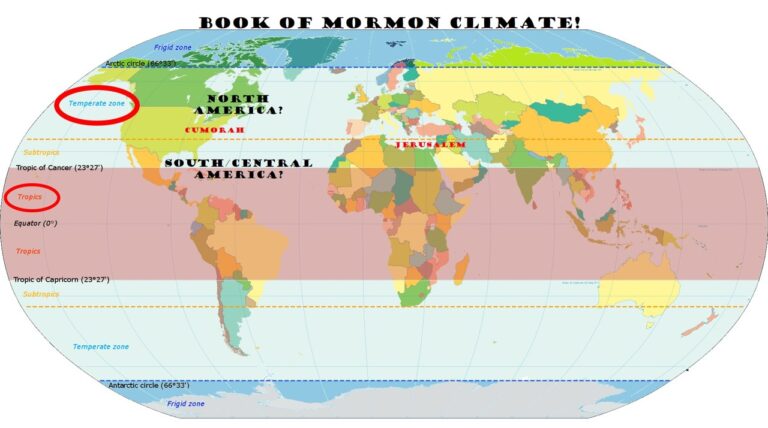
“…at some seasons of the year…” (Alma 46:40). As the Book of Mormon states there were some seasons of the year, that doesn’t fit the climate in Mesoamerica which has tropic and subtropic climates. The Heartland of the United States has Winter, Spring, Summer and Fall, which is the type of climate most indicative of what is said in the Book of Mormon. Alma 40:46“And there were some who died with fevers, which at some seasons of the year were very frequent in the land—but not so much so with fevers, because of the excellent qualities of the many plants and roots which God had prepared to remove the cause of diseases, to which men were subject by the nature of the climate.” So some seasons of the year had more fevers than others, and certain herbs were found during different climates in the land, which I feel is the Heartland of the United States and not in Mesoamerica.
At what seasons of the year would fevers be more likely? In South America there are basically two seasons. Hot and hotter. Or, warm and warmer. Rainy or not rainy? Dry or wet? In North America there are 4 seasons of the year and and at what time of the year are fevers and the flu more frequent?
Four Seasons in the Promised Land
Migrating Animals
“The Waters of Mormon, were in the borders of the and of Shilom, which was prone to “having been infested, by times or at seasons, by wild beasts” (Mosiah 18:4). A seasonal infestation of wild beasts could indicate migratory patterns caused by changing seasons that affect the abundance or scarcity of available food throughout the year in temperate climates. There are no migratory land animals in climates that do not have distinctive seasons, such as near the equator.” Page 171 Annotated Book of Mormon
Migratory animals live in locales that are difficult to survive in year-round. Instead of hibernating (the survival choice of many land animals) when food and water become scarce, these animals choose to migrate in search of more hospitable habitats and terrain. Most land animals practice seasonal migration — a type of migration that corresponds with the change in seasons, while others migrate in search of mates.
American Bison
American bison inhabit the grasslands and parklands of Canada and the central United States. They are nomadic as well as seasonal migratory animals. During the day, bison slowly graze on grasses, herbs and shrubs, moving approximately 2 miles each day; this slow-moving migratory pattern is called “nomadic migration.” During their seasonal migration, American bison move to more southerly habitats in the winter covering up to 150 miles during their journey. https://animals.mom.me/land-animals-migrate-3520.html
Elk Migration
Elk wintering in Jackson Hole, Wyoming, after migrating there during the fall As is true for many species of deer, especially those in mountainous regions, elk migrate into areas of higher altitude in the spring, following the retreating snows, and the opposite direction in the fall. Hunting pressure also impacts migration and movements.[46] During the winter, they favor wooded areas and sheltered valleys for protection from the wind and availability of tree bark to eat. Roosevelt elk are generally non-migratory due to less seasonal variability of food sources.[37]
The Greater Yellowstone Ecosystem elk herd numbers over 200,000 individuals and during the spring and fall, they take part in the longest elk migration in the continental U.S. Elk in the southern regions of Yellowstone National Park and in the surrounding National Forests migrate south towards the town of Jackson, Wyoming, where they winter for up to six months on the National Elk Refuge. Conservationists there ensure the herd is well fed during the harsh winters.[47] Many of the elk that reside in the northern sections of the Greater Yellowstone Ecosystem migrate to lower altitudes in Montana, mainly to the north and west. https://en.m.wikipedia.org/wiki/Elk
Mammals Migration
“Seasonal movements are not widespread among terrestrial species of mammals, because walking speed is relatively slow and energy consumption great. Marine and flying mammals have a much greater tendency to migrate, a tendency that is directly related to their locomotive powers.
Terrestrial Mammals
True migration among mammals occurs mostly among large artiodactyls (even-toed ungulates) living in habitats with wide fluctuations of climatic and biotic conditions.
In North American Arctic regions, herds of caribou (Rangifer tarandus) settle during the summer in the barrens—rather flat wasteland with little vegetation. In July the animals begin to move irregularly southward and spend the winter in the taiga, or northern forests, through which they wander freely with no general directional trend. Each herd seems to move in accordance with local conditions and without a well-defined pattern. The caribou again move northward as early as late February and return to the barrens. These migrations follow the same routes from year to year.
In former times, American bison (Bison bison) migrated regularly through the Great Plains. Herds of as many as 4,000,000 animals moved from north to south in fall and returned when spring rains brought fresh grass to the northern part of their range. Bison travelled over more or less circular routes and spent the winter in areas 320 to 640 kilometres (200 to 400 miles) from the summer range. Other North American mammals, such as elk (Cervus canadensis), mule deer (Odocoileus hemionus), and dall sheep (Ovis dalli), still migrate regularly in areas undisturbed by man.
Mesoamerican Migration
A few birds and the butterfly migrate in Mesoamerica. “And it came to pass that the people did follow the course of the beasts, and did devour the carcasses of them which fell by the way, until they had devoured them all.” Ether 9:34 I doubt in Ether that Mormon was referring to either a bird or a butterfly or even the turkey which is from Mesoamerica.
Domesticated Animals
What are domestic animals?
The term is very vague especially if you’re talking about Mesoamerica. If you mean animals of burden, they had none, but there are other animals
What they had for food, ritual sacrifice & companions (if they were pets, they were never used as food.) dogs & turkeys.
The dogs that they had are the Chihuahuas (debated to be techichi) & Mexican Hairless (Xoloitzcuintli). There was people who breed them to have select qualities. It’s a debate whether the ones as pets were breeded differently than the ones that were eaten other than the ones that would be eaten were fatten. https://tecpaocelotl.livejournal.com/16190.html
Jaredites Bring Their Animals
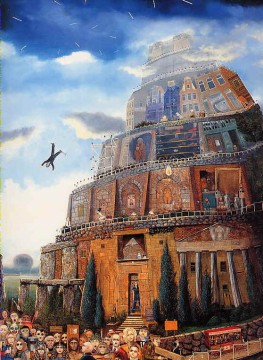
The Jaredites would not have brought their animals from the Middle East to Mesoamerica as they would not have survived the climate. This is another reason why it makes sense that the Jaredites landed in North America in a temperate climate and a place for domesticated animals.
“The Jaredites left their homeland driving great herds of cattle before them in the immemorial Asiatic manner, and even if they had never been nomads before, they certainly lived the life of the steppes during those many years before they set sail (Ether 3:3, p. 464), and when they embarked, they crammed all they could of their beasts into their small boats, “flocks and herds” and other beasts (Ether 6:4, p. 466), and upon reaching the New World continued to cultivate “all manner of cattle, of oxen, and cows, and of sheep…and of goats” just as their ancestors had in the old country (Ether 9:18, p. 471)” – Hugh Nibley, “The World of the Jaredites;” Part VIII, Improvement Era, [Apr. 1952], 236. The Nephites, who came from Jerusalem, then had religiously essential sheep, goats, cows and oxen brought in by the Jaredites to North America. This allowed the Nephites, who were from the House of Joseph, to practice the Law of Moses in the land of the future New Jerusalem. Page 493 Annotated Book of Mormon.
Domesticated Animals in Mesoamerica
“Dogs, turkeys, and the Musovy duck were the only domesticated animals in ancient Mesoamerica. All were used for food, but they made only a minor contribution to the Aztec diet. The Aztecs also fished and hunted wild game, but again these food sources were limited…Archaeologists do find the bones of fish, deer, rabbit, iguana, dog, turkey, and other animals in Aztec domestic trash deposits, but rarely in dense concentrations. Meat from large animals was a minor part of the Aztec diet. Early Spanish observers noted the widespread use of insects among the Aztecs, including ants, grasshoppers, manuey worms, and jumil bugs. Insects are high in protein, tasty, and could often be harvested in large numbers. The Aztecs also gathered great amounts of blue-green spirulina algae…from the surface of the lakes. This algae, known as tecuitlatl, is extremely high in protein, grows rapidly, and abundantly, and is easy to gather with fine nets…The Spanish soldiers and priests had a low opinion of the palatability of this algae, but it was much prized by the Aztecs.” —The Aztecs, Smith (p. 67) http://www.foodtimeline.org/foodmaya.html
Turkeys Were Domesticated Not For Meat, But For Ancient Mesoamerican Ceremonies
A staple for many a Thanksgiving and Christmas lunch, the turkey is now synonymous with the holiday season and roast dinners.
But this wasn’t always the case. Now archaeologists have uncovered the earliest origins of the all-American domestic turkey in Mexico, finding that these early birds were not prized for their tasty meat, but rather traded for their cultural significance in rituals and sacrifice.
“The archaeological evidence suggests that meat from deer and rabbit was a more popular meal choice for people in pre-Columbian societies; turkeys are likely to have also been kept for their increasingly important symbolic and cultural role,” explained Dr Aurélie Manin, who led the study published in Royal Society Open Science.
Mesoamerica did not have lambs, sheep, rams, bullocks, doves, wheat, barley or wine during the time of the Book of Mormon. These were all necessary animals and plants to practice the Law of Moses.
Not only this, but the proper seasons were required to practice the Law of Moses. In Mesoamerica there is very little change in seasons.
Beginning in the Spring (the Jewish month of the Abib* or “Aviv” [Nisan], which was a critical stage of barley maturation as discussed on p. 160 Annotated Book of Mormon), and continuing through the year, seasonal changes are necessary for observing all of the holy convocations of the Law of Moses (see Appendix, p. 532 Annotated Book of Mormon). See blog on Barley here:
“Observe the month of Abib, and keep the Passover unto the LORD thy God. For in the month of Abib [Early Spring] the LORD thy God brought thee forth out of Egypt by night. Thou shalt therefore sacrifice the Passover unto the LORD thy God, of the flock and the herd, in the place which the LORD shall choose to place His name there” – Deuteronomy 16:1-2.
“And thou shalt observe the Feast of Weeks, of the Firstfruits of Wheat Harvest, [late Spring] and the Feast of Ingathering [Tabernacles] at the year’s end [early Fall]” – Exodus 34:22.
“Three times thou shalt keep a feast unto Me in the year. Thou shalt keep the Feast of Unleavened Bread [Spring]: (thou shalt eat unleavened bread seven days, as I commanded thee, in the time appointed of the month Abib, for in it thou camest out from Egypt. And none shall appear before Me empty:) And the Feast of Harvest [Pentecost] [early Summer], the firstfruits of thy labours, which thou hast sown in the field. And the Feast of Ingathering, which is in the end of the year [Fall], when thou hast gathered in thy labours out of the field” – Exodus 23:14-17.
*Abib: The first month of the Jewish ecclesiastical year, corresponding nearly to the Gregorian April. After the Babylonian captivity this month was called Nisan (see the Jewish calendar on p. 308 of the Annotated Book of Mormon) (https://en.wiktionary.org/wiki/Abib)
THE LAW OF MOSES AND SEASONAL FEASTS Four Seasons in the Promised Land
3 Nephi 1:24-26 “And there were no contentions save it were a few that began to preach, endeavoring to prove by the scriptures, that it was no more expedient to observe the Law of Moses. Now in this thing they did err, having not understood the scriptures. But it came to pass that they soon became converted and were convinced of the error which they were in, for it was made known unto them that the Law was not yet fulfilled, and that it must be fulfilled in every whit; yea, the word came unto them that it must be fulfilled; yea, that one jot or tittle should not pass away till it should all be fulfilled; therefore in this same year were they brought to a knowledge of their error and did confess their faults. And thus the ninety and second year did pass away, bringing glad tidings unto the people because of the signs which did come to pass according to the words of the prophecy of all the holy prophets.”
It was no more expedient to observe the Law of Moses: The Nephites were observing the Law of Moses as contained in the Plates of Brass for over 600 years since they left Jerusalem. They were commanded to observe it until Jesus Christ’s Atonement fulfilled the Law. (The Hebrew word jot is the smallest letter of the square Hebrew alphabet. A tittle refers to a small stroke or point in writing or printing. It is now most commonly used as the name for the dot over the letter i. ) Page 380 Annotated Book of Mormon
Lambs
Remember the most important symbolic animal in the Israelite culture is the Lamb, as in “the Lamb of God.” I have heard the Lamb is known as the only animal that will not resist its own death. That surely describes the Savior of the World.
“…they had a lamb-skin about their loins…” (3 Nephi 4:7).
Hopewell-era stone carvings of white and black lambs resemble the photos on the right and below.
The Nephites observed the Law of Moses by sacrificing lambs during Passover. The Lamanites possibly mocked the Nephites and their religion by wearing a lambskin about their loins “dyed with blood” (3 Nephi 4:7). The Lamanites might have killed Nephite lambs, then wore and displayed the lamb-skin as an act of defiance and sacrilege to the Law of Moses during battles with the Nephites. (Research by Amberli Nelson) Page 385 Annotated Book of Mormon
(Above) “Kee-o-kúk, The Watchful Fox, Chief of the Tribe” by George Catlin,1835, oil on canvas; Smithsonian American Art Museum. (Note the red-dyed loin cloth. “…and they were naked, save it were a skin which was girded about their loins… ” (Alma 43:20). (Left) Joseph Smith met with Chief Kee-O-Kuk on Aug. 12, 1841; see p. 117 Annotated Book of Mormon)
Mesoamerica did not have sheep or goats or bullocks or rams to practice the Law of Moses. North America did as Hugh Nibley states below.
“If my insistent harping on central Asia annoys you, let me remind you again that the book of Ether gives us no choice. It never lets us forget that what the Jaredite kings did was a conscious imitation and unbroken continuation of the ways of “the ancients,” of “them of old” on the other side of the water. This, incidentally, is another indication that we are not to regard the Jaredite migration as taking place immediately after the flood, for the fall of the tower saw the destruction of an ancient and established order. The Jaredites left their homeland driving great herds of cattle before them in the immemorial Asiatic manner, and even if they had never been nomads before, they certainly lived the life of the steppes during those many years before they set sail (Ether 3:3), and when they embarked, they crammed all they could of their beasts into their small boats, “flocks and herds” and other beasts (Ether 6:4), and upon reaching the New World continued to cultivate “all manner of cattle, of oxen, and cows, and of sheep” just as their ancestors had in the old country (Ether 9:18). Now you know, how the Nephites could have had sheep in North America brought to this land by the Jaredites. The Nephites could continue practicing the Law of Moses in the land of The New Jerusalem.” (2 Nephi 25:24 Mosiah 2:3) Hugh Nibley from Lehi in the Desert; The Great Open Spaces
Why are Baby Farm Animals Typically Born in the Spring? IOWA AG LITERACY …Some of my friends even celebrate events like ‘Lambaggedon’. So many baby lambs can be born on a single weekend that family and friends have to come from miles away to help out. They make the event fun with a little contest. Guess the number of lambs to be born between Friday morning and Monday noon. Closest guess gets the privilege of naming one of the lambs.
But why are so many babies born in the spring?
In a lot of ways spring is the perfect time for babies to be born. Mother mammals usually need better, richer food to produce quality milk for their babies to nurse. For grazing animals like cattle, sheep, and horses, the fresh green grass and other plants on pasture in spring and early summer are rich in nutrients. These plants can have a higher percentage of protein and ‘total digestible nutrients’. This can lead to better milk production for the babies. Most calves are born between January and May because of this reason. Read more about early calving here.
Spring is also a good time for babies to be born because the days become longer and temperatures rise. With the warmer weather it is easier for the baby to survive. There is less chance of harsh weather. Just like humans, animals need to be protected from severe weather. Cows often like to wander away from the herd to give birth in solitude. This can put the mother and calf at risk. If the cow has any problems during the birthing process, a farmer might not be available to assist and help pull the calf. Away from the herd, especially in cold weather, the calf might be less likely to survive. Away from the herd, the baby might be in danger from predators like foxes, coyotes, or even large birds of prey like eagles. In many, contemporary farming operations calving and farrowing happens in a barn or ‘under roof’. This protects the mother and baby from many of those dangers.
Because spring is such a good time of year for babies, many animals evolved to accommodate these natural cycles. Many Iowans are familiar with the deer rut that happens in October, November, and December. Male deer are at peak testosterone, get more aggressive, and start fighting for mates. They wander out of their natural habitats which leads to increased motor vehicle accidents when they cross roads. This is in large part because the female deer come into estrus in the fall. As the days shorten, their hormones trigger the estrus cycles. A deer’s gestation will take 201 days. So if the female gets pregnant on October 1, you can expect a fawn around April 20th. Why are Baby Farm Animals Typically Born in the Spring?
Warfare only in the Tropics?
Apparently, the only place the Nephites could have fought is in tropics like Mexico where a narrow neck of land is located. From Book of Mormon Central we read this:
“When we carefully examine the accounts of wars in the middle portion of the Nephite record, we find that military action did not take place at random throughout the calendar year but at particular times. Whatever realistic scene we assume for the Nephite lands, we would expect to find a similar seasonal pattern in that area’s secular historical sources. I consider Mesoamerica (central and southern Mexico and northern Central America) to have been the scene of the Nephite conflicts, but whatever plausible location one chooses will lie in the tropics because, among other reasons, only in those areas are there feasible isthmuses located that could correspond to the “narrow neck of land” of the Nephites. Everywhere in those latitudes, war was normally carried on by the pre-Columbian inhabitants during a limited annual period. This paper investigates the evidence for seasonality of warfare in the Book of Mormon account and compares it with what is currently known about the timing of warfare in Mesoamerica.” https://archive.bookofmormoncentral.org/content/seasonality-warfare-book-mormon-and-mesoamerica
Cold Climate
(Below) “On a cold March 16, 1621, in Plymouth, Massachusetts, the English settlers were startled to see a Native American Indian approach them and with great enthusiasm speak the famous words, ‘Welcome, Englishmen.’ His name was Samoset (c. 1590–1653) and he towered over them. He stood before them ‘a tall straight man…’ What impressed them the most was that he was ‘stark naked,’ with just a fringe strap of leather around his waist When a cold gust of wind kicked up, one of the Pilgrims was moved to throw his coat over the Indian’s shoulders” – Nathaniel Philbrick, Mayflower, A Story of Courage, Community and War, Viking, Penguin Group (USA) Inc., NY, NY [2006], 93.
This encounter (below) shows that native Indian tribes could acclimate to the cold months even though non-natives, not accustomed to the cold, needed to be fully clothed for protection from the “cold gust of wind.”
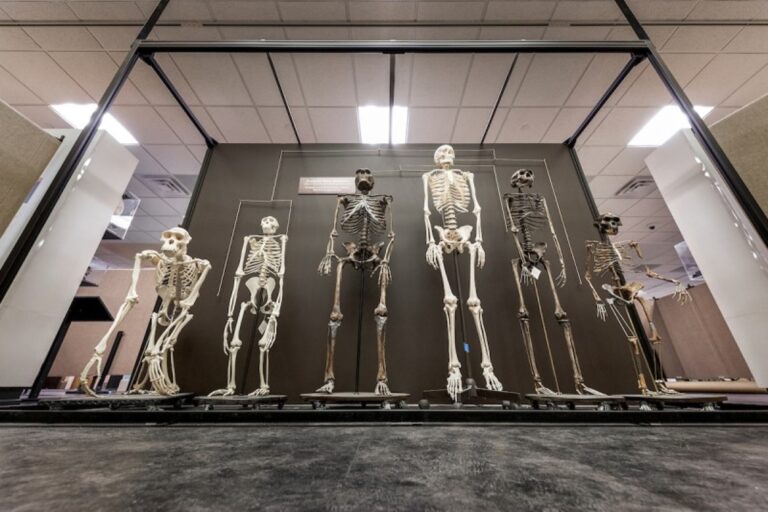
Many intellectuals and scientists love sharing the quote which says, “The Church has no official position on the theory of evolution.” The Church has also said they are neutral on the Geography of the Book of Mormon. These statements by the Church don’t say that we have to be neutral about these things. I believe the Church is telling us to search and pray for ourselves. The Church shouldn’t tell us everything as we are accountable for our own intelligence that we learn in this life.
Supposedly those writers at FAIR Mormon use Elder Holland’s statement below as he says, “I do not know the details of what happened on this planet before that” [Adam and Eve], to feel they can tell us all about evolution as they are smarter than the Prophets. This secular society needs to have the faith of the Brethren and end this tremendous amount of time spent in promoting evolution of ape to man and from nothing comes something.
WE DID NOT COME FROM AN APE OF THIS I AM MOST CERTAIN! MAN DID NOT EVOLVE FROM NOTHING! ADAM WAS PLACED ON THE EARTH IN ABOUT 4,000 BC!
The presiding church leaders are unified on doctrinal issues and Joseph Fielding Smith did not stand alone in his quest against evolutionary theories. After becoming Prophet and President of the Church, he said the following in General Conference, October 1970 (italics and underlining are added):
As I ponder the principles of the gospel, I am struck forcibly by the uniform manner in which I and all the Brethren have taught them over the years. The truths of the gospel are everlastinglythe same. Like God himself, they are the same yesterday, today and forever. What I have taught and written in the past I would teach and write again under the same circumstances.And what I say of myself should be true for all the Brethren and for all the elders of the Church. We are all called to preach the gospel, to be ministers of Christ, to raise the warning voice, and to “teach one another the doctrine of the kingdom.”
IS there a conflict between religion and science? Between
the revealed word of the Lord to his prophets and the truth revealed through
scientific investigation, there is no conflict. There can be no disagreement
wherein truth is arrayed against truth. Could such a thing be possible all
things would perish in confusion. There is a conflict existing between revealed
truth coming from the Lord to his chosen servants and the false doctrines
advocated by men of science. There is also a conflict between false religion
and truth revealed through scientific investigation. The time will come when
nothing will remain except truth…
As long as men of science ignore the light of truth and have no faith in the Divine Creator, they will search the hard way to find out the works of the Lord and will formulate false theories which may prove both harmful and pernicious in that they will guide their fellows who accept them away from the revealed plan leading to eternal life.
Unfortunately most scientists depend entirely upon their own
intelligence and wisdom without a thought of divine aid. It is said repeatedly
that scientists do not take God into their reckoning in the search of truth.
This is an unfortunate condition, for if they were men of prayer and faith,
seeking divine help they would come to the truth more readily and would avoid
the many pitfalls of false hypotheses.
The Church, nevertheless, is very grateful to the wonderful
men and women who have been benefactors of humanity in a thousand ways, perhaps
unconscious of the fact that divine aid has been given them, even if they did
not seek it. Such as Harvey, Jenner, Lister, Pasteur, the Curies, Morse, Tesla,
Whitney, Farnsworth and thousands of others. It is foolish for one to think,
however, that these discoveries and inventions have come to light during the
past few centuries because men are more intelligent today than they were in
former times. The poetry of the Psalms, the wisdom of Proverbs, the admonition
and teachings of the Old Testament prophets, have never been surpassed. The
painting and sculpture of the ancients equal or surpass anything produced
today. The Damascus steel has been the marvel of the world and thousands of
other things known and practiced by the ancients indicate an intelligence of
the highest quality. Dr. Robert A. Millikan, who has been deceived by some
modern theories, testifies that the ancients were as intelligent as men are
today and that there have been billions of people who have lived and died with
“as high intelligence” as people manifest today. 3
“If this is true,” it has been said, “why, then, is it that the ancients did not have modern means of travel, of communication, numerous inventions for their convenience, such as we have today?” The answer to this question is, because the time had not come for these inventions and discoveries to be revealed. Let us not forget that the Spirit of the Lord has played a great part in all of the developments that have come to benefit mankind in these latter centuries. Can there be an honest doubt that the ancient seers saw these things in vision? They wrote about them and have predicted their coming; but the Almighty withheld from them these benefits for his own purpose. It is inconsistent to think that the Son of God, who by command of his Father organized the earth on which we stand, who could turn water into wine, raise the dead, give eyesight to the blind, cleanse the lepers, command the elements and have them obey him, and then could not have revealed, had it pleased him, these modern inventions. Nahum without question saw our present means of transportation. 4 John on the Isle of Patmos without doubt saw our airplanes and described them as they are now being used in war. It is revealed in the Book of Mormon that the Brother of Jared saw our day; 5 and the Lord revealed to Enoch the history of this earth and its inhabitants down to the end of time. 6 Isaiah also must have seen these modern conditions when he speaks of the gathering of Israel and that those being gathered would “fly as a cloud, and as the doves to their windows.” 7 Joel declared that in the last days the Lord would pour out his spirit upon all flesh; and “your sons and your daughters shall prophesy, your old men shall dream dreams, your young men shall see visions: and also upon the servants and upon the handmaids in those days will I pour out my spirit.” 8 We are living in that day.
The reason for all of this great activity which was denied the ancient peoples is that we are living in the day of restitution; a day in which preparation shall be made to bring the earth back again to its primitive glory as it was when the Lord pronounced it good. It is the day spoken of by Peter as a time of “refreshing,” and restitution of all things spoken of by all the prophets. 9 The same that was prophesied of by Paul in his epistle to the Ephesians, that “in the dispensation of the fulness of times he might gather together in one all things in Christ, both which are in heaven, and which are on earth; even in him.” 10
Henry George Bohn, printer and historian, writing of the
Origin and Progress of Printing, wrote as follows:
“Nature does not advance by leaps,” says an old
proverb; neither does her offspring, Art. All the great boons vouchsafed to man
by a munificent providence are of gradual development; and though some may
appear to have come upon us suddenly, reflection and inquiry will always show
that they have had their previous stages.
Indeed, nothing in this great world which concerns the
well-being of man takes place by accident, but is brought forward by divine
will, precisely at the moment most suitable to our condition. So it was with
astronomy, the mariner’s compass, the steamengine, gas, the electric telegraph,
and many other of those blessings which have progressed with civilization. The
elements were there and known, but the time had not arrived for their
fructification. 11
Daniel in his vision of the last days saw a “time of
trouble” such as “never was since there was a nation even to that
same time.” He saw the time of the redemption of the righteous, and the
day of the resurrection, when the dead should come forth, “some to
everlasting life, and some to shame and everlasting contempt.” It was to
come in a day when “many should run to and fro, and knowledge shall be
increased.” 12 Who can deny that this day is here? Paul also saw our time
and described the conditions accurately as they now are. In writing to Timothy
he said:
This know also, that in the last days perilous times shall
come.
For men shall be lovers of their own selves, covetous,
boasters, proud, blasphemers, disobedient to parents, unthankful, unholy.
Without natural affection, trucebreakers, false accusers,
incontinent, fierce, despisers of those that are good,
Traitors, heady, highminded, lovers of pleasure more than
lovers of God;
Having a form of godliness, but denying the power thereof:
from such turn away. 13
In writing to the members of the Church at Thessaly, Paul also predicted that because men would turn away from the truth the Lord, “Shall send them strong delusion, that they should believe a lie: That they all might be damned who believe not the truth, but had pleasure in unrighteousness.” 14
What the prophets predicted has come to pass. Enoch, Moses, Isaiah, Daniel, Peter, Paul, the Jaredite and Nephite prophets, told the story of man’s turning away from God, boasting in his own wisdom and his denial of the truth as truly and clearly by prophecy thousands of years ago, as we see it fulfilled today. We live in an age of materialism; of unbelief in the power of God, and denial of the divine calling of Jesus Christ as the Redeemer of the world and the Only Begotten Son of God in the flesh. This reminds us of the words of Jacob, brother of Nephi:
O that cunning plan of the evil one! O the vainness, and the
frailties, and the foolishness of men! When they are learned they think they
are wise, and they hearken not unto the counsel of God, for they set it aside,
supposing they know of themselves, wherefore, their wisdom is foolishness and
it profiteth them not. And they shall perish.
But to be learned is good if they hearken unto the counsels
of God.
But wo unto the rich, who are rich as to the teachings of
the world. For because they are rich they despise the poor, and they persecute
the meek, and their hearts are upon their treasures; wherefore, their treasure
is their god. And behold, their treasure shall perish with them also.
And wo unto the deaf that will not hear; for they shall
perish.
Wo unto the blind that will not see; for they shall perish
also.
Wo unto the uncircumcised of heart, for a knowledge of their
iniquities shall smite them at the last day.
Wo unto the liar, for he shall be thrust down to hell.
Wo unto the murderer who deliberately killeth, for he shall
die.
Wo unto them who commit whoredoms, for they shall be thrust
down to hell.
Yea, wo unto those who worship idols, for the devil of all
devils delighteth in them.
And in fine, wo unto all those who die in their sins; for
they shall return to God, and behold his face, and remain in their sins. 15
There is great divergence between the path traversed by the scientific investigator, who labors without faith in God, and that traveled by those who accept the divine revelations and walk in the light of his revelations. The scientist, searching without divine aid, depending solely on his own research and wisdom, reaches certain conclusions in relation to the origin of things; how worlds come into being and how they are eventually to die, perhaps to disintegrate and be recreated again in one eternal round. These theories are uncertain; they change from time to time, but quite generally scientists all agree that all things must eventually come to an end and then, some of them believe, the recreation will take place again. They like to talk about the “dying sun” 16 and have written volumes about the Universe how it came into being by chance and is subject to the temporal laws which we mortals understand and by which we are governed, and therefore, according to their calculations based on things which they see naturally, they conclude that all things in the Universe are governed by the same mutable laws that bind us to this mundane sphere. The Lord said to Isaiah:
. . . Forasmuch as this people draw near me with their
mouth, and with their lips do honour me, but have removed their heart far from
me, and their fear toward me is taught by the precept of men:
Therefore, behold, I will proceed to do a marvellous work
among this people, even a marvellous work and a wonder: for the wisdom of their
wise men shall perish, and the understanding of their prudent men shall be hid.
17
By revelation direct from our Eternal Father, we learn a very different story in relation to the beginning of things and the end thereof. There is a Supreme Ruler in the Universe, the Creator of worlds and all things that are in them. He does not create worlds to be destroyed. They are created to bring to pass his divine purpose for he said his work and glory is, “To bring to pass the immortality and eternal life of man.” 18 Life is not an accident 19 and the human race is not destined to “die and cease to be.” 20 Neither is life “an unimportant by-product . . . off the main line.” 21
Gordon B. Hinckley
―When I was a college student there were many discussions on the question of organic evolution. I took classes in geology and biology and heard the whole story of Darwinism as it was then taught. I wondered about it. I thought much about it. But I did not let it sway me, for I read what the scriptures said about our origins and our relationship to God.‖ (Gordon B. Hinckley, Faith: The Essence of True Religion, p. 18.)
―None of us . . . knows enough. The learning process is an endless process. We must read, we must observe, we must assimilate, and we must ponder that to which we expose our minds. I believe in evolution, not organic evolution, as it is called, but in the evolution of the mind, the heart, and the soul of man. I believe in improvement. I believe in growth.‖ (Gordon B. Hinckley, Teachings of Gordon B. Hinckley, p. 298.)
There are always members and alleged scholars who belong to The Church of Jesus Christ of Latter-day Saints, who enjoy misrepresenting the Church to which they belong, by teaching false doctrine.
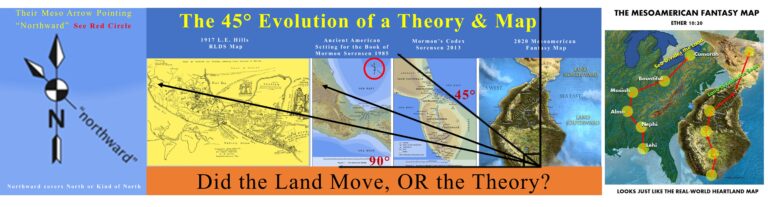
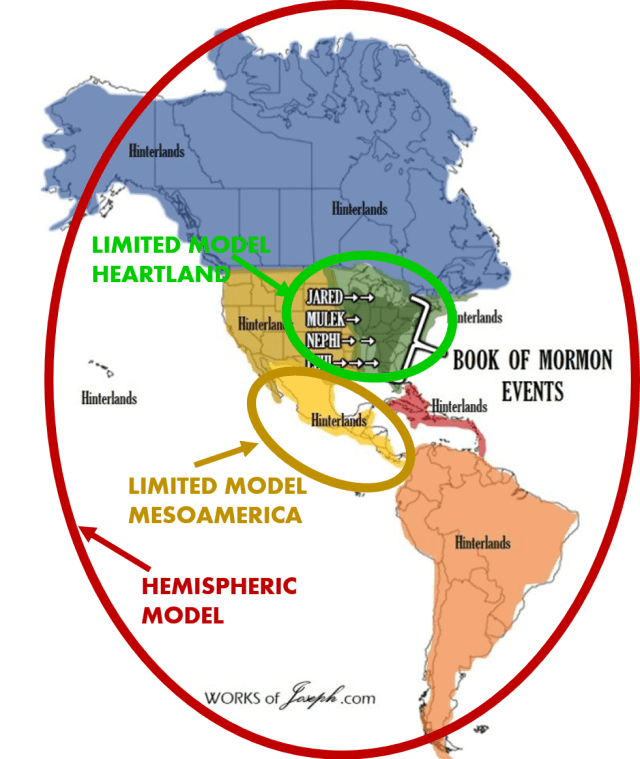
One false idea they enjoy promoting is that The Book of Mormon occurred entirely within the confines of Mesoamerica or Central America and Southern Mexico.
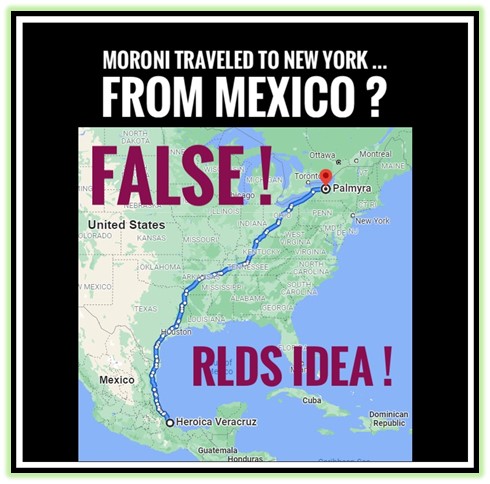
They even claim, laughably, that the Prophet Moroni walked with the plates, from Central America to upstate New York after the final Nephite battle, then stumbled upon a hill and buried in it the gold plates. Then 1,400 years later, the Prophet Joseph Smith by chance grew up in a home near that hill.
The idea that there are Two Cumorahs, originated with a member of The Reorganized Church of Jesus Christ of Latter-day Saints. His name was Henry A. Stebbins.
Stebbins wrote an article in The Saints’ Herald, dated March 15, 1911 where he introduced the idea of Two Cumorahs and the Prophet Moroni walking to present-day New York.
It is not a teaching of The Church of Jesus Christ of Latter-day Saints.
Here is an excerpt from Stebbins’ March 15, 1911 article from the RLDS Saints’ Herald publication:
Actually, this is a screenshot of Page 131 from “New Light on American Archaeology” published in 1924, written by another member of the RLDS Church, Louis E. Hills. He was quoting from the earlier March 15, 1911 Saints’ Herald article to justify his Two Cumorah Theory restricted to Mesoamerica.
Here is the link to that page in that book, with the name “Stebbins” in the search query:
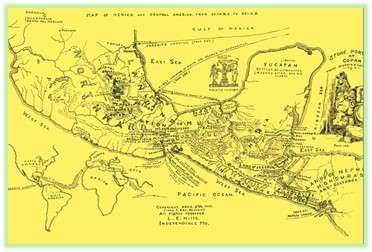
This is the 1917 map created and copyrighted by Louis E. Hills, showing his false idea that The Book of Mormon was restricted to Mesoamerica, forcing the Prophet Moroni to travel to New York to bury the plates. He justified Moroni walking to New York by quoting an older RLDS Scholar,
Henry A. Stebbins.
In 1835, (before 1911 and 1924), Oliver Cowdery under the direction of Joseph Smith, wrote in his Letter IV:
He [The Angel Moroni] said this history was written and deposited not far from that place, and that it was our brother’s privilege, if obedient to the commandments of the Lord, to obtain and translate the same by the means of the Urim and Thummim, which were deposited for that purpose with the record.
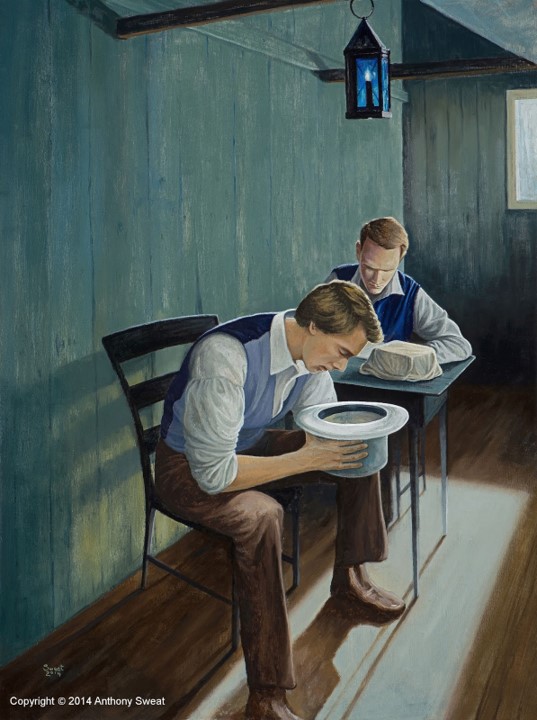
The history or The Book of Mormon was written and deposited not far from the home of Joseph Smith, in present-day New York, not in Mexico. (And no stone in a hat was used to translate it, as you just read.) Thus, the final Jaredite and Nephite Battles occurred at the Hill Cumorah in New York and The Book of Mormon occurred in North America.
The false Mesoamerica Two Cumorah theory, is an RLDS idea and was plagiarized by LDS Scholars to resell for money. This is because the copyrights belonging to Louis E. Hills on his books and maps, have expired. His books and maps are now in the Public Domain, meaning anyone can resell them.
Hills died in 1925, which was 90 years after Oliver Cowdery wrote his Letter IV.
The next time you hear someone claiming Moroni walked from Mexico to New York, just laugh. Because it’s a false idea which originated over 100 years ago, from members belonging to another Church which didn’t follow Brigham Young to the Salt Lake Valley.
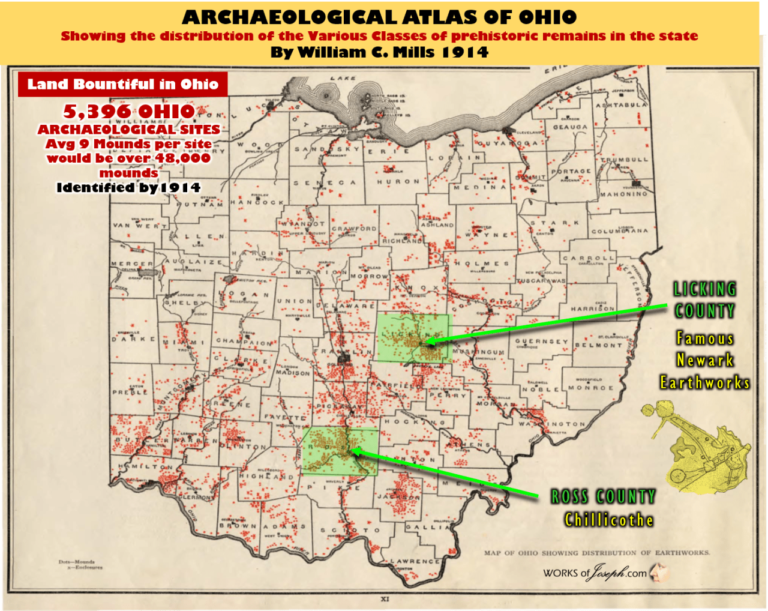
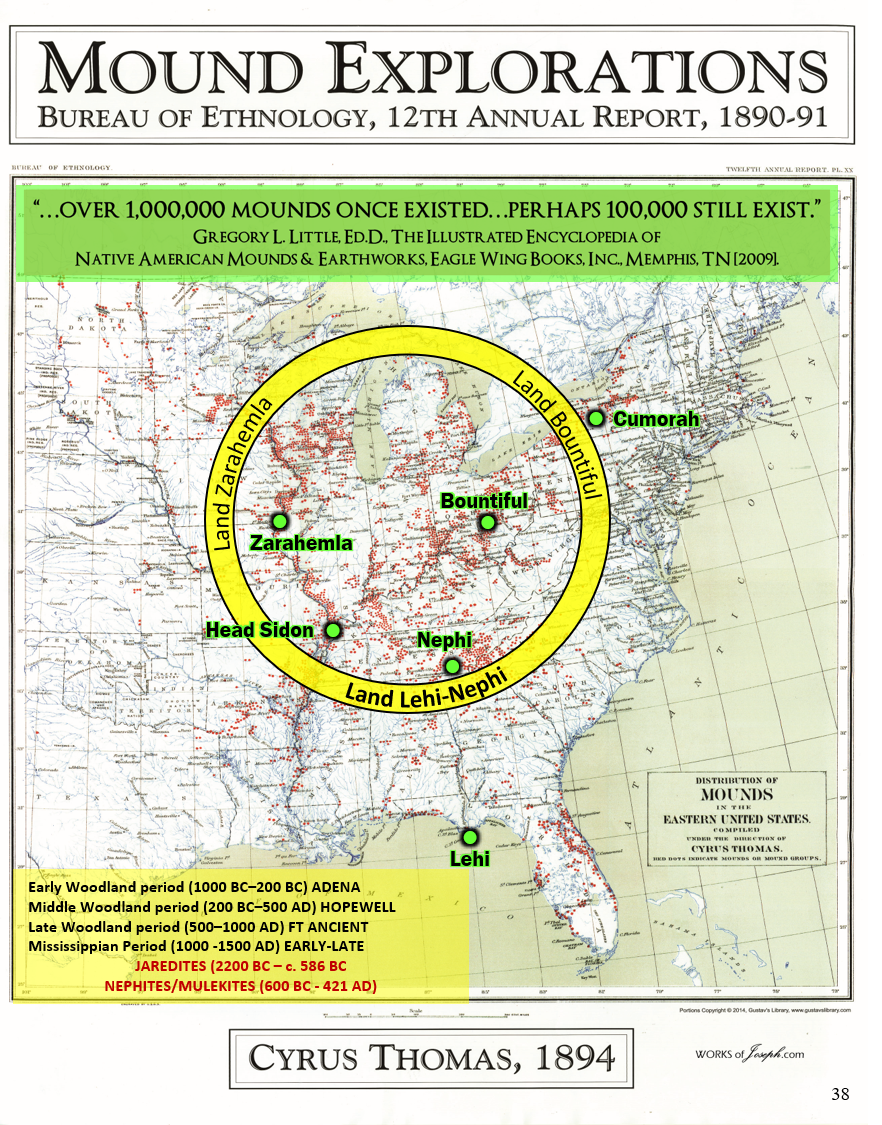
Why is it that so many artifacts found in North America over the years have been called a hoax by most of the so-called archaeologists and scientists? Why do the “smart ones” seem to lack so much knowledge? Why did the Smithsonian hide artifacts and claim that all Native Americans were Savages? Most scientists don’t like discussing things that go against their pet theories. The map below was patterned after a map of Cyrus Thomas from 1891. Look at the amazing dates that are said to be during the Adena and Hopewell timeline in the Book of Mormon. Why would no LDS archaeologist even consider this? The non-Mormon scholars and archaeologists have no reason to lie about their findings. This is why we have so little faith in some of our Church historians who won’t even look or consider. It is very sad indeed.
For example, I have an acquaintance who is a well known professor in Utah who is a wonderful man, a great member of the Church of Jesus Christ of Latter-day Saints, and has spent over 30 years of research to find evidences of the Book of Mormon in Mesoamerica. His donors have spent millions of dollars researching all over the land of Mexico and Central America looking for any little proof of a connection to the Book of Mormon. He refuses to even consider artifacts in North America.
Here is a quote from another LDS researcher friend of mine who said, “Mesoamerica fits because of things like populations, writing systems, warfare, city-state governments, kings, raised highways, and so much more. This is not saying that the Nephites were the Maya. Rather, it seems that the Nephites were a small group affected by Mesoamerican culture.” These serious archaeologists searching in Mesoamerica have found nothing of substance, but only suggestions of why the Book of Mormon happened in Mesoamerica. Now understand, as a heartlander I don’t think I have all the answers either. I am just saying why not take all of this possible evidence of Nephites in North America and research it? Why not spend $1 million of the $8 million these LDS archaeologists just received, and search things in North America. They could still use the $7 million in Mesoamerica.
This is why almost all so-called evidence of the Book of Mormon in North America is called a hoax because it doesn’t fit their paradigm so they don’t want to explore it further, in case it goes against their belief. We have the same bias who believe in the heartland theory, but like me, most of us have studied the Mesoamerican theory for many years and found very little.
Recently this first acquaintance I mentioned earlier, spent a few days in Ohio with 4 non-Mormon PhD’s, scientists and archaeologists who were looking for evidence of ancient civilizations of Hebrew culture in Ohio. Combined they had over 90 years of archaeological experience of Ancient Hebrew existing in Ohio. We did find 7 ancient Adena roundhouses dated from about 400 to 200 BC, using magnetometry from Germany.* However not one of our non-Mormon friends could convince this acquaintance of mine to even consider looking in Ohio for Hebrew artifacts. Understand this event? A wonderful LDS archaeologist who is so focused in Mesoamerica that he won’t even look at this Hebrew evidence in North America. He doesn’t even want to take the chance that it is a possibility. You would think with Lehi being from the tribe of Joseph, and Mulek from the tribe of Judah and possibly existing evidence in North America, why wouldn’t that be something he would want to at least take a look at? It’s called confirmation bias, and we all do it. *See my other blog here. https://www.bofm.blog/in-search-of-the-lost-menorah-in-ohio/
This is why I think it is important for my readers to view all the information that is out there. I believe we should be open minded to all theories. It shows strength when we are willing to look at the other side which just strengthens our own resolve as we learn and pray about truth. As Moroni said, “we may know the true of all things.”
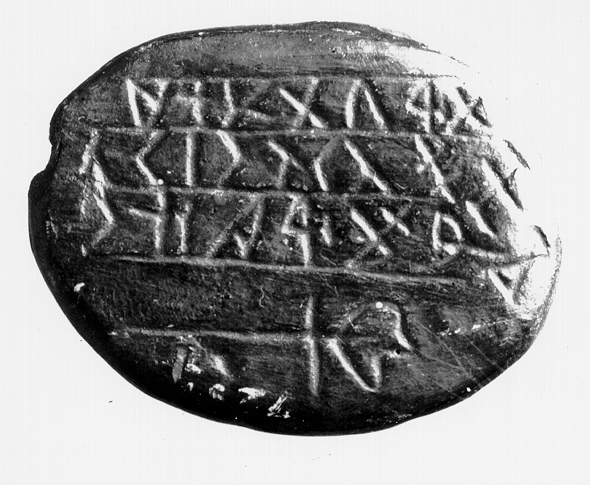
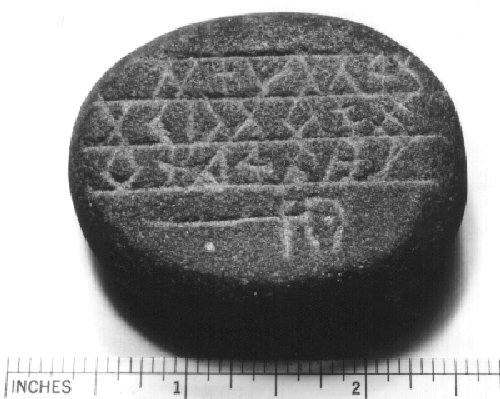
The Grave Creek Stone (Left)
Smithsonian photograph 90-9022 (MS 3146, E.H. Davis Collection, National Anthropological Archives)
Fig 2
The Grave Creek Stone was discovered in 1838 during the excavation of the Grave Creek Mound, in Moundsville, West Virginia, on the Ohio River, about 10 miles south of Wheeling. The stone, an actual photograph of which appears in Figure 1 above, was a small inscribed sandstone disk, about 1 7/8″ (4.8 cm) wide, and 1 1/2″ (3.6 cm) high. The reverse side was uninscribed.
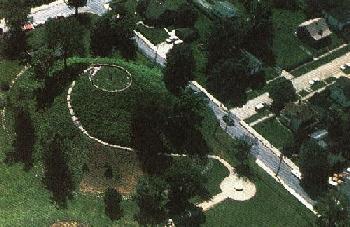
In 1838, the mound was reported to have been 69 feet high and 295 feet in diameter at the base, making it the largest of the Adena mounds. Today the mound is preserved in the Grave Creek Mound State Park. According to the Park website, the mound is currently believed to have been built between 250 BC and 150 BC. Figure 2 below shows the mound in its present condition. Note the relative size of the cars and house.
Grave Creek Mound Archaeological Complex
The Mound
“The heart of the site is probably the most famous and certainly the largest of the Adena Burial mounds. A massive undertaking, the total effort required the movement of more than 60,000 tons of earth. Artifacts and exhibits interpreting the lifestyle of the Adena people are displayed in the Delf Norona Museum, adjacent to the 2,000 year old mound. The most impressive and largest Adena mound, Grave Creek Mound is the largest conical type of any of the mound builder structures. Construction of the mound took place in successive stages from about 250-150 B.C., as indicated by the multiple burials at different levels within the structures. In 1838, road engineers measured its height at 69 feet and its diameter at the base at 295 feet. Originally a moat of about 40 feet in width and five feet in depth with one causeway encircled it.
The first recorded excavation of the mound took place in 1838, conducted by local amateurs. To gain entrance to the mound, two horizontal tunnels and one vertical shaft were created. This led to the most significant discovery of two burial vaults.
In addition to the Adena ornaments and remains found in the interior, the upper vault contained a small flat sandstone tablet. Later, authenticity of the tablet and the meaning of its inscription became quite controversial. Though the stone has never been authenticated and has been disputed by most professionals, a replica of the original is on display in the museum.
Grave Creek Archaeological Complex also maintains a 136-seat theater with a small stage.
The Museum
The Delf Norona Museum opened in December 1978. The thoroughly modern facility, with its natural brick facade and pyramid-shaped skylights is an architectural tribute to a prehistoric era. Exhibits and displays on the upper level portray and clarify what is known about the cultural life of this prehistoric people and the construction of the Grave Creek Mound. We also have the archaeology exhibits that pertain to the early inhabitants of the area including the First Homes of West Virginia; the Grave Creek Tablet; The Building of the Mound; The Builders of the Mound and Who They Were.
Open year-round to visitors. An interpretive lecture is available to groups with advance reservation and group leaders can contact the museum for a list of hands-on programs
The Adena People
About 1000 B.C. marks the beginning of a new period in North America. Called the Woodland Period, this period lasted until about 700 A.D. During this time, a new culture emerged and made significant settlements in what is now known as West Virginia. These people are known to us today by the general term the Mound Builders, so called for their practice of creating earthen burial mounds and other earthworks. The Mound Builders lived over a wide range from the Atlantic, the Midwest and the Ohio Valley to the Mississippi Valley. The term “mound builders” refers to several cultures that span a period of about 20 centuries.
The first group of people to develop this unique way of life were the Adena, from about 1000 B.C. to about 1 A.D. They had well-organized societies and lived in a wide area including much of present day Ohio, Indiana, West Virginia, Kentucky and parts of Pennsylvania and New York. A later group of Mound Builders, the Hopewell, lived from about 1 A.D. to 700 A.D. and represented a greater refinement over the earlier Adena culture. Other cultures extended Mound Builders to about 1300 A.D.
The labour of many people must have been required to build these mounds since they did not use the wheel and had no horses. The large amounts of earth had to be moved by the basket-load. Perhaps for this reason, the mounds were often used more than once. We find in many mounds there are multiple burials at different levels. Over time the mounds gradually increased in size.
Most of the people were cremated after death, placed in small log tombs and covered with earth. They often were buried in the flesh and more important people were laid to rest with a variety of artifacts such as flint tools, beads, pipes and mica and copper ornaments.
Grave Creek Mound is of the late Adena Period and was built in successive stages over a period of 100 years or more. We do not know why the Adena chose to build the particular mound on such a huge scale compared with other burial mounds in the area that generally range in size from 20 to 300 feet in diameter.
A typical Adena house was built in a circular form from 15 to 45 feet in diameter. The walls consisted of paired posts tilted outward, joined to other wood to form a conical-shaped roof. The roof was covered with bark and the walls may have been bark, wickerwork or some combination. They were extensive traders as evidenced by the types of ,material found in the mounds they constructed. Copper from the western Great Lakes region and shells from the Gulf of Mexico, all attest to the range of their economic activity. In addition, the culture also practiced agriculture, hunting and fishing.
About 500 B.C., the Adena culture began slowly to give way to a more sophisticated culture, the Hopewell. Although little remains of their villages, the Adena left great monuments to mark their passing, and one of the greatest of these in the Grave Creek Mound.” by The West Virginia Department of Arts, Culture and History See my blog about the Adena people here: https://www.bofm.blog/the-adena-culture-is-the-jaredite-culture/
The Grave Creek Stone was discovered in 1838 during the excavation of the Grave Creek Mound, in Moundsville, West Virginia, on the Ohio River, about 10 miles south of Wheeling. The stone, an actual photograph of which appears in Figure 1 above, was a small inscribed sandstone disk, about 1 7/8″ (4.8 cm) wide, and 1 1/2″ (3.6 cm) high. The reverse side was uninscribed.
In 1838, the mound was reported to have been 69 feet high and 295 feet in diameter at the base, making it the largest of the Adena mounds. Today the mound is preserved in the Grave Creek Mound State Park. According to the Park website, the mound is currently believed to have been built between 250 BC and 150 BC. Figure 2 below shows the mound in its present condition. Note the relative size of the cars and house
Fig. 2 The Grave Creek Mound today Lifted from Home in West Virginia website.
It is not known where the stone itself is today. In 1868 it was in the collection of E.H. Davis, of Squier and Davis fame, before most of Davis’s collection was sold to the Blackmore Museum, now part of the British Museum. Fig. 1 above, the only known photograph of the actual stone, is cropped from a photograph of items 60 – 65 of the Davis collection taken shortly before the sale. Nevertheless, the British Museum’s North American Ethnographic Collection confirms that the Grave Creek Stone is not at present in the Museum’s Squier and Davis collections (personal communication, 12/4/89). According to Barnhart (1986, p. 124n), the stone was probably in the collection of Wills de Hass at the time of his death in 1910, and may have passed from there “to parts unknown.” De Hass’s papers are preserved in a library in West Virginia, and may provide some information, or even contain the stone itself, but I have not checked this out.
The Cast and Wax Impression
In 1868, however, Davis made a plaster cast of the stone and deposited it in the Smithsonian Institution. In 1990, Donal Buchanan and I visited the Smithsonian’s National Museum of Natural History in order to view the cast and to check out rumors that the Smithsonian had the original. The NMNH in fact has four casts of the stone, but no original.
(C) Smithsonian Institution Fig. 3. Cast of the Grave Creek Stone. Smithsonian Institution Photograph No. 6768 (Catalogue No. 7252)
Two of the casts have catalog number NMNH 7252, one NMNH 138470, and one NMNH 325934. The darker of the two 7252s, which I call 7252 #1, is painted realistically and signed at the bottom of the front in pale white ink, “E.H. Davis W. Va.” It is shown in Figure 3 above. The white marks under the figure at the bottom are just the remnants of Davis’s signature, upside down. The second, lighter colored NMNH 7252 #2 and the two higher numbered casts appear to be derivative casts made from the above NMNH 7252 #1.
The National Anthropological Archives (MS 3146, E.H. Davis Collection) also has a wax impression of the stone that Davis made at the same time. It is unprotected and badly cracked, but confirms some details that do not show well on the cast. In particular, it clearly shows an X-shaped letter at the left end of the second line, and a lozenge- or diamond-shaped letter at the left end of the third line, that only partially “took” on the cast.
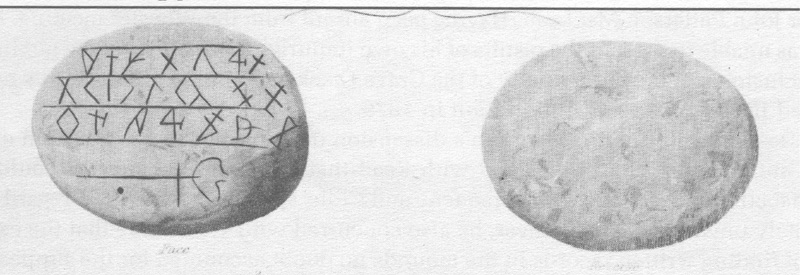
Our inspection confirmed the view of Charles Whittlesey, (1876) that the drawing by Capt. Seth Eastman, which appeared in Henry R. Schoolcraft’s 1850 Indian Tribes of the United States, was the only reliable drawing of the stone, of the six depicted by Whittlesey. Unfortunately, many of the early scholars who made serious attempts to interpret the inscription, including Rafn, Jomard, and Bing-Lvy, worked from seriously inferior copies of the stone. This may at least in part account for the total divergence of the early interpretations, as to both language and content.
Fig. 4 Photocopy of Seth Eastman drawing of Grave Creek Stone from Henry R. Schoolcraft Indian Tribes of the United States, 1850, by way of Barnhart (1986). (added 2/08)
It should be noted that although Whittlesey (1876, p. 2) presents what he calls a “Copy of Grave Creek Stone — No. 1. by Captain Eastman, United States Army,” what he shows is not actually Eastman’s copy of the stone, but rather a redrawing of Eastman’s copy. Furthermore, his redrawing differs in two important respects from Eastman’s — First, Eastman draws the leftmost letter in the first line with its two verticals meeting at the bottom to form a “V”, whereas Whittlesey has them more nearly parallel, and distinctly open at the bottom. And second, Eastman correctly draws the leftmost letter on the third line as a lozenge or diamond that closes at its top, whereas Whittlesey draws this letter to be distinctly open at the top. In a second, 1879 article, Whittlesey includes his redrawing of Eastman again, with the somewhat misleading explanation, “I insert again the only correct copy made by Captain Eastman, United States Army, from the original in 1850, for Schoolcraft’s Indian Tribes.” Williams (1991, p. 84) also reproduces Whittlesey’s 1876 illustration, giving an 1879 article by M.C. Read as his immediate source.
A New Drawing
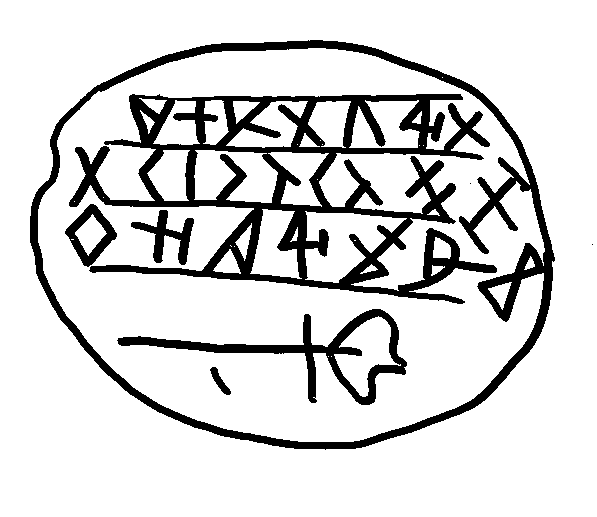
Below is my own attempt to draw the inscription, based on a tracing of the above photograph of the cast, supplemented by our inspection of the actual cast and wax impression.
Fig. 5. The Grave Creek Inscription
It is not obvious from the inscription itself whether the lines are to be read from left to right or right to left, or perhaps even back and forth or “boustrophedon.” It is not even obvious which end of the stone is the top. Many of the letters are invertible top for bottom, and two actually appear along with their own inverse. I have merely followed the universal convention of placing the figure at the bottom.
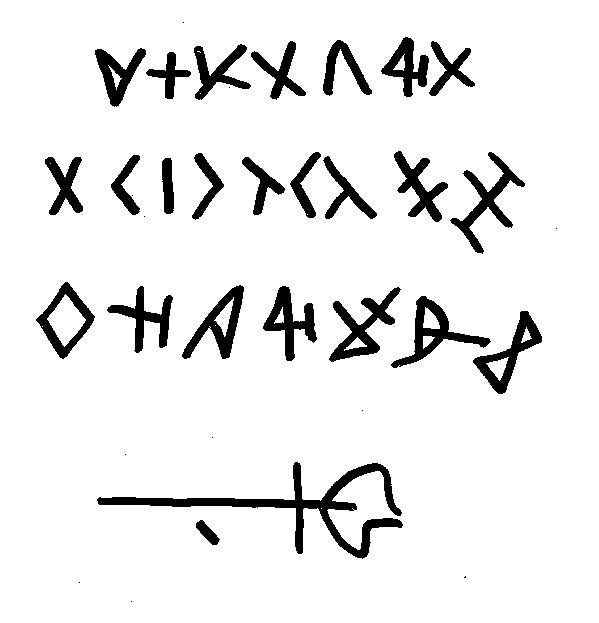
The horizontal guide lines are more shallow than the letters themselves, and are not part of the inscription. In Figure 5 below, I have eliminated them and separated the lines for clarity.
Fig. 6.The Letters of the Grave Creek Inscription
The principal difference between my drawing and Eastman’s is that in the D-like second letter from the right in the last line, Eastman has drawn the crossbar as a faint wavering line, which one might interpret as a stray scratch, while in fact it is straight and bold, and definitely part of the letter. I have drawn the vertical of the “D” to extend down below the crossbar to meet the loop, as Eastman did, since this appears to be what was intended. However, this continuation in fact is not very clear on either the cast or the wax impression. It is therefore not inconceivable that the vertical only extends down to the crossbar, as it appears in Whittlesey’s Copy #2, from the American Pioneer, May 1843, and Copy #3, used by Jomard.
The Early Controversy
Historian Terry Barnhart has recently published an excellent overview (1986) of the 19th century controversy over the authenticity of the Grave Creek Stone. Schoolcraft, Wills de Hass, and J.P. MacLean supported its authenticity, while E.G. Squier, Davis, and M.C. Read regarded it as a forgery. Barnhart’s most interesting observation is that in 1847, Squier had made much of the “singular omission” of any mention of the stone in Dr. James W. Clemens’ first-hand, day-by day account of the excavation, which appeared in S.G. Morton’s 1839 Crania Americana. In 1858, however, de Hass managed to produce the manuscript original of Clemens’ account, and demonstrated that Morton had merely taken it upon himself to expurgate the stone’s discovery from the published version. Dr. Clemens in fact recorded the inscribed stone on the day of its discovery.
In 1877, the Ohio State Archaeological Society appointed a committee to study the authenticity of the stone. Committee member M.C. Read published a strong denunciation, that included a widely cited experiment to determine if the inscription was alphabetic: He asked four persons who had no training in ancient inscriptions to fabricate twenty or more arbitrary “letters” composed of straight lines and combinations of straight lines. “The result, said Read, was that ‘In every case an inscription was produced presenting as many indications of being alphabetical’ as that on the Grave Creek stone. Accordingly, Read concluded that the Grave Creek inscription was ‘just such a medley of characters as anyone would produce who undertook to invent an inscription to puzzle the curious.'” (Barnhart 1986 p. 120)
Committee member Rev. J.B. MacLean, on the other hand, published his own article in which he “did not hesitate to pronounce its authenticity as incontestable…. Regardless of who found the stone or whether it was discovered inside or outside the mound, all professed witnesses agreed it had come from the mound. To MacLean, this was the unassailable preposition.” (Barnhart 1986 p. 122)
Barnhart’s discussion stops short of the two influential articles by Charles Whittlesey, already mentioned above. The first, entitled “Archaeological Frauds,” (1876) deals at length with the Grave Creek Stone. Whittlesey ominously cites Squier’s finding that “Dr. Clemens, in his first account of the opening of the mound, makes no mention of this stone” (p. 5), but himself makes no mention of de Hass’s correction of this misconception.
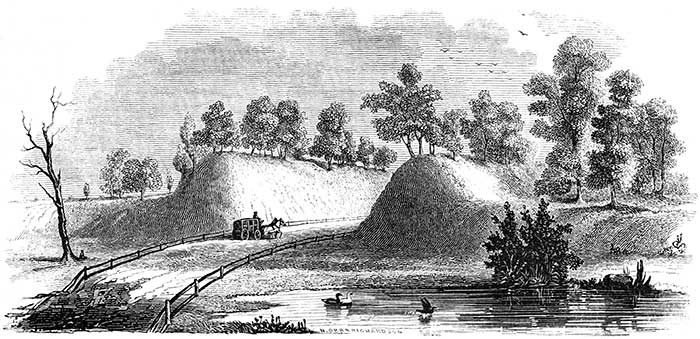
The Prehistoric Mound as it appeared in 1857
Whittlesey condemns the inscription itself on the very peculiar grounds that even “If the Grave Creek find was free from suspicion as to its integrity, it has undergone so many mutations from transcribers and translators that its value to ethnologists is gone.” (1876, p. 5) Whittlesey himself had already demonstrated that most of the copies that had been made of the stone were unreliable. However, even though these inaccurate copies created considerable unfortunate confusion among scholars, they in no way altered the inscription itself or in any way lessened any ultimate value it might have to ethnologists.
It was also true that the many attempts at translation differed completely as to substance and even purported language and alphabet. However, this does not demonstrate that none of the proposed translations could be of any merit, but merely that at most one could be of any merit. Even if they all proved erroneous (which Whittlesey did not even begin to attempt to demonstrate in either of his articles), it still would not follow that there could never be a valid translation. Nor would they in any way hamper any future valid translation. In any event, the disagreement among the translations may have been more the fault of the bad copies the translators had to work with than of the inscription or of the translators themselves.
Whittlesey concludes that “The best authorities in the United States have condemned it during many years. The preponderances of proof as well as of probabilities are decidedly against it.” (1876, p. 5) The very title of his article clearly classifies it as a fraud.
In his second, 1879 article, entitled “The Grave Creek Inscribed Stone,” Whittlesey intriguingly backs off his earlier position that the stone itself is a clearcut hoax. Instead, he now merely insists that the inscription is not alphabetic: “I agree with Prof. Read that the characters on the stone, by whomsoever they were cut, are not alphabetical or phonetic. If they have any meaning and are not a mere jumble of characters they must be symbolic or picture writing. It is therefore of small consequence whether the stone is antique or modern, whether it is genuine or a fraud.” (p. 66) He concludes, “If Professor Read and myself are right in our conclusions, that the figures are neither of the Runic, Phonician, Canaanite, Hebrew, Libyan, Celtic, or any other alphabet language, its importance has been greatly overrated.” (p. 68)
After Whittlesey’s two articles the Grave Creek Stone was generally dropped from serious consideration by archaeologists, except as a textbook example of an established hoax. It was so thoroughly discredited that they even lost track of its whereabouts.
Wills de Hass was appointed to head the Smithsonian Bureau of Ethnology’s Mound Survey project, but was quickly replaced in favor of Cyrus Thomas. It is not unlikely that this had something to do with his favorable position toward the Grave Creek Stone. Thomas, on the other hand, “took a very strong, almost sarcastic, stance toward the Grave Creek Stone and Schoolcraft’s support of it.” (Williams 1991, p. 86)
The Bil Stumps Reading
A 1930 article in Science News Letter reported in all seriousness that one Andrew Price had at last “cleared up one of the greatest hoaxes in the record of American science,” by translating the Grave Creek inscription into “good old West Virginian.” (Davis 1930) According to the article, “That hoax, perpetrated by some unknown practical jokesmith, has stood triumphantly undetected for ninety odd years.” The inscription, according to Price, reads, in plain English,
BIL STUMPS STONE OCT 14 1838
Price claims that this hoax was inspired by Charles Dickens’ The Pickwick Papers, published just the year before the Grave Creek mound was opened. In Dickens’ novel, Mr. Pickwick discovers a stone bearing the following cryptic inscription:
X B I L S T U M P S H I S. M. A R K
After Pickwick announces that he has unearthed “a curious inscription of unquestionable antiquity,” the message is ignominiously deciphered as reading
X BIL STUMPS HIS MARK
A diagram accompanying the Science News Letter article indicates that Price interprets the three lines on the Grave Creek Stone as follows:
B I L-S T-U M P S S T O N E O C T-1 4-1 8 3 8
Over these letters is a transcription of the inscription that is bad beyond Whittlesey’s wildest imagination. Letters are pushed together or pulled apart and lines added or ignored wherever convenient. Letters from different lines are even joined together, and in several cases letter portions are used more than once in this manner. Even this mutilated transcription must be tortured beyond endurance before it will confess to Price’s reading.
The Bil Stumps reading is an amusing spoof that has no true relation to the inscription. Even Williams (1991, p. 87) concurs in this assessment. The only hoax here was that the likes of Science News Letter fell for Price’s “solution.”
Figure 7. The Hough Stone Photo courtesy Robert B. Miller, Jr. [Added 8/31/00]
In 1951, Philip R. Hough purchased for $1 an inscribed stone from an assemblage of unprovenienced Indian artifacts offered for sale by a gun dealer near Steubenville, Ohio. Hough sent a rubbing of the stone to the Smithsonian. He was informed that it closely resembled the Grave Creek stone, and might either be the original or a clever copy. Hough duly reported his find and its circumstances in a note in the Tennessee Archaeologist (1952).
In 1988, Hough’s grandson Robert B. Miller, Jr., then of Richmond Va., sent a photograph of the Hough stone to the late Victor Moseley, then president of the Midwestern Epigraphic Society. Moseley passed the photo on to me, which is displayed in Figure 6 above.
A close comparison of the Hough stone to the cast shown in Figure 3 above reveals, unfortunately, that it is not the original Grave Creek Stone. Its guide lines are too straight, too evenly spaced, and too parallel. Furthermore, the vertical alignment of the letters does not match that on the cast. It is, however, definitely a deliberate modern copy of the Grave Creek stone, and not, like the Braxton Creek and Ohio County stones, a possible corroborating inscription in the same script. There is no evidence that whoever made it was attempting to pass it off as the genuine article, and Hough is to be commended for his straightforward reporting of the matter.
Barry Fell
Modern interest in the stone has been revived, at least among amateurs like myself, by the late Barry Fell in his 1976 book America B.C. (1976a, p. 21, ch. 11). Fell offers yet another entirely different translation of the inscription, stating that the script is Iberian and the language Punic:
The mound raised-on-high for Tasach This tile (His) queen caused-to-be-made.
He argues that although the Iberian script was already known in 1838, the phonetic values of the letters were not completely understood until the publication of Diringer’s The Alphabet in 1968, so that if the inscription yields an intelligible translation using these values, it must be genuine.
Fell provides the details of his translation in (1976b). In this article, he generally follows Eastman’s drawing of the stone. However, it should be noted that he adds a short foot to the third letter from the left in the second line, and then reads it, together with its two neighbors, as a single letter (a Semitic shin). I see no evidence of a foot or any connection at the base apart from the guideline, which should not be taken as part of the inscription, and believe this group should instead be read as three separate letters. I have no idea how this change would alter sense of his reading.
Fell’s translation is incorporated into an exhibit about the stone in the Delf Norona Museum at the Grave Creek Mound State Park. The replica of the stone on display there is not an actual cast of the original stone, but merely an artist’s reconstruction based on Eastman’s drawing.
Humbug?
The mound was built over a period of 200 years with burial vaults at different layers.
The Grave Creek Stone plays the lead role in Chapter 4 of Stephen Williams’ 1991 Fantastic Archaeology, entitled “The American Humbug: They’ll Believe Almost Anything!” Williams initially has the stone first noticed by Schoolcraft five years after the excavation among some artifacts taken from the mound by its owner, Abelard Tomlinson. In his next paragraph, however, Williams indicates that Tomlinson actually exhibited the stone about two years after the excavation (p. 82). Either way, he warns, following Samuel F. Haven, that the claim that the stone came from the mound was greatly “weakened by the time that purportedly elapsed between its discovery and the announcement of the find” (p. 84). He makes no mention of de Hass’s 1858 demonstration that Clemens in fact recorded it on the day it was found. Instead, he cautions the reader that “the problem of a time delay is a common thread running through a number of Fantastic Archaeology cases” (p. 85).
Williams places great weight on Read’s experiment to determine that the inscription is not alphabetical. “Read … says: ‘It [the inscription] is precisely of such character as would be the result of an ordinary attempt to manufacture an inscription’ and that any of the laborers could have made it. Read’s well-structured and careful testing should have laid the question of the Grave Creek inscription to rest.” (p. 86)
Williams’ overall assessment of the stone, echoed in the title of his chapter, is, “Bah, humbug, Mr. Tomlinson.” (p. 87)
Kelley
In a critical review of Williams’ book, philologist David H. Kelley deals at length with Williams’ treatment of the Grave Creek Stone. Kelly is the author of Deciphering the Mayan Script, a 1976 text that was instrumental in establishing the phonetic character of the Mayan glyphs. He considers as entirely appropriate Schoolcraft’s much-ridiculed, if inconclusive, attempt to identify the alphabet of the inscription.
Kelley writes, “I have a hard time criticizing the view that the inscription is non-alphabetic, for that seems to me an obvious fantasy. I think that anyone who could not recognize that obvious fact should, ipso facto, disbar himself from any serious discussion of the problem. Williams praises an ‘experiment’ by Read to determine what geometric forms would be produced by a teacher, a schoolgirl, a druggist, and a college professor asked ‘to write down twenty or more arbitrary symbols, not resembling any characters known to them and using only straight lines.’ This rubbish is utterly irrelevant to the question of alphabets. If one can match an inscription to a specific alphabet or even to a closely related group of alphabets, it is alphabetic; otherwise, it is not. Inventing imaginary systems (by people familiar with alphabets) seems to have been a useful propaganda device, but such systems do nothing to support Read’s conclusion that any of the labourers could have invented such an inscription. ‘Bah, humbug, Mr. Read.'” (1995, p. 12)
Display at Grave Creek Mound of objects found during an early dig at the mound.
Kelly goes on to discuss the similar Braxton Creek and Ohio County inscriptions mentioned by Fell, and concludes, “My major point, however, is not to argue that the inscriptions are, indeed, genuine, but rather that I do not find it fantastic to think that they may be. Williams’s account makes the Grave Creek inscription look like obvious humbug, but he did not know many important facts which supported Tomlinson’s account of the find, and he completely misinterpreted Schoolcraft’s comparisons…. Williams’s book …. should not be used as a bludgeon against looking at important but unusual data and trying to put such data in a genuinely appropriate archaeological context.” (pp 13-14)
Smith
Most recently, Rev. C. Edward Smith, Jr. (1998) has made a detailed study of Fell’s (1976b) translation of the Grave Creek inscription. Smith argues that Fell’s interpretation of the text as Punic does not work at all, even taking his letter values as given. Personally, I couldn’t tell Punic language from Arabic, but Smith cogently maintains that Fell doesn’t seem to see the difference either, using as he does Wehr’s Arabic dictionary to read Punic. Both are Semitic languages, but they belong to different branches of the family, and are evidently quite different in many pertinent respects.
Smith attempts no evaluation of Fell’s interpretation of the letters themselves as Iberian script, nor of the authenticity of the stone. He concludes, “we simply do not know — at this point in time and history — what the Grave Creek Stone says — only what it does not say.”
Conclusion
The Grave Creek Stone is long lost. It may turn up some day, but in the meanwhile, a surviving cast, a wax impression, Eastman’s drawing, and even a fuzzy photograph of the original give us an adequate indication of its appearance. The Hough Stone is a good copy, but regrettably is not the original.
Although it was amateurishly excavated, and years later there were numerous discrepancies about the details of its discovery, by all accounts it came out of the interior of the mound. Dr. Clemens documented the inscribed stone on the day of its discovery, even though Morton cut this account from the published version of Clemens’ report. There is no particular reason to think the stone is fraudulent.
Although David Kelley regards the inscription as obviously alphabetic, there is still no solid confirmation of Barry Fell’s identification of the script as Iberian. Fell’s translation of the language as Punic has been sharply criticized by Edward Smith. Perhaps future study will establish a consensus about the alphabet, the language, and/or the message.
(Left) Dr. Walter Hough (1859-1935), curator of ethnology, U.S. National Museum, Smithsonian Institution, shown holding a rare cast of the Grave Creek Mound inscription which has been in the museum for more than half a century. The original stone disappeared years ago.
References
Barnhart, Terry A. “Curious Antiquity? The Grave Creek Controversy Revisited.” West Virginia History 1986, pp. 103-124.
Davis, Emily C. “Printer’s Knowledge of Dickens Solves Scientific Hoax,” Science News Letter 17: 234-5, 1930.
Fell, Barry. America B.C. New York Times Books, 1976a.
Fell, Barry. “The Etymology of some Ancient American Inscriptions,” Epigraphic Society Occasional Publications Vol. 3, No. 76 part 2, Sept. 1976b.
Hough, Philip R. “My Part in the Story of the Grave Creek Tablet,” Tennessee Archaeologist Vol. 8 #2, Summer 1952, pp. 47-48.
Kelley, David H. “Epigraphy and Other Fantasies,” The Review of Archaeology, vol. 15, #2 (April 19, 1995), pp. 8-14.
Smith, C. Edward, Jr. “What the Grave Creek Stone Does not Say: An Epigraphic and Philological Analysis.” PO Box 96, Colerain, OH 43916. Revised Jan. 1998, June 2006.
Whittlesey, Charles. “Archaeological Frauds,” Western Reserve and Northern Ohio Historical Society Tract No. 33, Nov. 1876, pp. 1-7.
Whittlesey, Charles. “The Grave Creek Inscribed Stone,” Western Reserve and Northern Ohio Historical Society Tract No. 44, April 1879, pp. 65-68.
Drawings on this page may be freely downloaded and copied, with credit to this website. Figure 3 may not be used without the permission of the Smithsonian Department of Anthropology.
The Lord has said, the first shall be last and the last shall be first. It makes sense that our life will begin and end at the same location, and this life also includes the events of the Book of Mormon happening in that same area. This is not a coincidence. The Lord has planned out our existence and life, before, during and after. Missouri is an important place in the Lord’s plans. This is so obvious that those who believe in other geography theories are in a great and spacious building. You just need common sense and the scriptures to determine that as Elder L. Tom Perry said, “The United States is the promised land foretold in the Book of Mormon—a place where divine guidance directed inspired men to create the conditions necessary for the Restoration of the gospel of Jesus Christ.” Elder L. Tom Perry Ensign Dec. 2012
When I type in a google search for, Where is the Garden of Eden? This is the first result:
Mesopotamia
The Garden of Eden is considered to be mythological by most scholars. [Wow this is how some of the same scholars feel about the Book of Mormon]. Among those who consider it to have been real, there have been various suggestions for its location: at the head of the Persian Gulf, in southern Mesopotamia (now Iraq) where the Tigris and Euphrates rivers run into the sea; and in Armenia.
Most Bible commentaries state that the site of the Garden of Eden was in the Middle East, situated somewhere near where the Tigris and Euphrates Rivers are today. This is to easy as the bible mentions the name Euphrates so I assume most scholars think it must be where that river named Euphrates is located today. We know that is silly to assume as their is Place in Lebanon called Sidon and the same as a River Sidon in the Book of Mormon. Names alone don’t tell location. Did you know there was an ancient of Memphis in Egypt and today there is a city not so ancient named Memphis, TN?
“The word Nephi may come from the Egyptian city of N-ph, transliterated into Hebrew as Noph, which appears in the Old Testament in several places, and translated into English as Memphis. Actually, Hebrew in Nephi’s day (600 BC) was written without vowels, so it would be nph in Egyptian letters transliterated into nph in Hebrew letters when the Egyptian city we now call Memphis was referred to in the Old Testament.” Smith’s Bible Dictionary
This is based on the description given in Genesis 2:8–14:The Lord God planted a garden eastward in Eden. . . . Now a river went out of Eden to water the garden, and from there it parted and became four riverheads. The name of the first is Pishon . . . . The name of the second river is Gihon. . . . The name of the third river is Hiddekel [Tigris]. ;. . . The fourth river is the Euphrates.
Mississippi 3- River Divisions
The importance of the Mississippi river in the history of the Native Americans goes without saying. It could be called three different rivers as explained below and it could be the four rivers described in Genesis flowing out of Eden. (More below)
The Mississippi River can be divided into three sections: the Upper Mississippi, the river from its headwaters to the confluence with the Missouri River; the Middle Mississippi, which is downriver from the Missouri to the Ohio River; and the Lower Mississippi, which flows from the Ohio to the Gulf of Mexico. Source
Named by Algonkian-speaking Indians, Mississippi can be translated as “Father of Waters.” The river, the largest in North America, drains 31 states and 2 Canadian provinces, and runs 2,350 miles from its source to the Gulf of Mexico. The Mississippi River is truly one of the great forces that has shaped the United States into the country it is today. Although its role has changed over the past few centuries, the Mississippi has always been important to those who lived along its banks. Indigenous peoples fished its waters and depended on the waterway for transportation. Explorers and traders traveled the river in hopes of conquering more land and obtaining wealth for their countries. Settlers moved close to take advantage of the rich farmland the river provided. All of these pursuits resulted in a trade industry that brought about a social and economic transformation, when news and goods made their way downriver and livelihoods were provided. In fact, the Mississippi River’s economic and strategic value was so important that when Ulysses S. Grant won the siege of Vicksburg and control of the river during the Civil War, the Confederacy was dealt a serious blow. Today, although still used to transport goods, the river has taken on yet another identity: that of entertainer. Literature, pleasure boats, and floating casinos all showcase a new dimension of this magnificent river. https://www.arcadiapublishing.com/Products/9780738507453
Give these four rivers some thought:The Maps below seems logical.
We know by revelation that the New Jerusalem and Adam-Ondi-Ahman are in Missouri. Before the earth was divided it existed together with no Atlantic Ocean between. It would make sense that if Adam was placed in Missouri that the 4-rivers spoken of in Genesis could be in or near Missouri. See the Map below as it shows the Head of Sidon near St. Louis, MO which very well could be this area in Genesis 2:10 that says, ““And a river went out of Eden to water the garden; and from thence it was parted and became into four heads.” These four rivers could be any of the ones shown below, Upper Mississippi, Lower Mississippi, Ohio/Allegheny, or the Missouri. It makes a lot of sense. I would rather find commonality in the Land of Missouri where we know by revelation it’s existence of Adam, and we have no idea about Mesopotamia, except by the commonality of the name Euphrates in the Bible and in Iraq today.
THE MOST MISUNDERSTOOD QUOTE BY MESOAMERICAN THEORISTS-
“You know there has been great discussion in relation to Zion–where it is, and where the gathering of the dispensation is, and which I am now going to tell you. The prophets have spoken and written upon it; but I will make a proclamation that will cover a broader ground. The whole of America is Zion itself from north to south.” President Joseph Smith’s Remarks–The Whole of America Zion–April Conference, 1844 Section Six 1843-44, p.362
Mesoamerican activists actually cite this above quote as evidence that the Book of Mormon took place in Central America. WRONG!
The United States of America has been and is truly great. It is the Promised Land of the Book of Mormon. Today it is receiving relentless attacks from some very unpatriotic and evil people. We are in a World War 3 cyber battle and it is time to stand up and applaud the goodness of these United States. We know this land will not be possessed by a disobedient people. We have time to save our land, but it is becoming a challenge. Prophets and Apostles have spoken of the Choice Land and the responsibility those of us who are citizens must act with more dignity, respect, honor, faith and righteousness than those living in any other country. Not because we are better people, but because far more is expected of us. The penalty for our sin and disobedience will be far greater than those who live in other countries, as more is expected of us. We welcome all into the United States that want to come here legally and adopt our way of life which is freedom to choose right or wrong and be willing to accept the blessings or the curse for disobedience. Love our neighbor as ourselves, and above all Love the Lord our God with all our Heart, Might, Mind and Strength.
Find out about how to explain the Prophet Joseph Smith’s quote above. Complete Blog Here
”We must remember that the whole earth was paradisaical before the Fall. The Garden of Eden was a center place. After the Fall, there was no Garden of Eden or paradisaical status on earth. Yet relative to the locale of the site of the Garden of Eden, the Prophet Joseph Smith learned through revelation (D&C 57) that Jackson County was the location of a Zion to be and the New Jerusalem to come. The Prophet first visited Jackson County, Missouri, in the summer of 1831. The Prophet visited Jackson County again in April and May 1832. On one of the occasions, or perhaps both, the Prophet Joseph apparently instructed his close associates, and perhaps even a general Church gathering, that the ancient Garden of Eden was also located in Jackson County.” Bruce A. Van Orden, associate professor of Church history, Brigham Young University.
“When Lehi landed in the Promised land, it seems he found bounties of all kind, just as Adam and Eve had found in the garden of Eden. It makes sense that Lehi was upon the same land as Adam began his life, the area of the united States of America today.
Janne Mattson Sjödahl
Janne Mattson Sjödahl (29 November 1853 – 23 June 1939) was a Swedish convert to The Church of Jesus Christ of Latter-day Saints (LDS Church) and was the author of influential commentaries on LDS Church scriptures. Sjödahl was among the first commentators to advance a “limited geography model” for the theorized geography of the Book of Mormon.
In 1874, Sjödahl moved to England and enrolled in Spurgeon’s College in London, where he graduated with a degree in divinity in 1876. While in England, Sjödahl mastered English and also specialized in Greek and Hebrew. In addition to knowing Swedish and Norwegian from his childhood, Sjödahl would also master the German, Icelandic, and Arabic languages…
On 8 June 1886, Sjödahl was excommunicated from the Baptist Church, possibly on charges of adultery.[1] Around the same time, Sjödahl became associated with Ferdinand Friis Hintze, a Danish missionary from the LDS Church. Following his excommunication, Sjödahl travelled to Utah Territory to further investigate Mormonism. On the sea journey, his son Janne Jr. died.
After arriving in Utah Territory, Sjödahl settled in Sanpete County, where a large number of Scandinavian Latter-day Saints had settled. On 7 October 1886, Sjödahl was baptized into the LDS Church in Manti.
Life in Manti
Upon settling in Manti, Sjödahl became the editor of the Manti Sentinel newspaper.
When the LDS Church’s Manti Utah Temple was completed in May 1888, Sjödahl became the first individual to receive his Endowment in the new temple. On 30 May 1888, Sjödahl and Christina Christofferson were married in the Manti Temple by Apostle Francis M. Lyman; they were the first couple married in the new temple. His second wife died in 1910.
Church Translator and Missionary
In 1888, Sjödahl completed a church-approved translation of the LDS Church’s Doctrine and Covenants into Swedish. In 1927, Sjödahl translated the Pearl of Great Price into Swedish, and in 1935 he completed the third revised translation of the Book of Mormon into Swedish.
Upon the completion of the translation, Sjödahl was asked by church president Wilford Woodruff to go on a mission to Palestine. In January 1889. Sjödahl arrived in Jaffa. He learned to speak Arabic and preached in Palestine for one year, organizing a branch of the church in Jaffa.[3] In January 1890, Sjödahl was asked to go to Bern, Switzerland to complete his mission. He arrived back in Utah Territory in July 1890.
Newspaper Editor and Publications
Upon returning to Utah, Sjödahl became employed by the Deseret News newspaper in Salt Lake City. From 1906 to 1914, Sjödahl was the chief editor of the newspaper. In 1914, Sjödahl returned to England and became an editor of the LDS Church’s Millennial Star in Liverpool.
In 1917, Sjödahl and LDS Church Apsotle Hyrum M. Smith, who was the president of the church’s European Mission, together worked on A Commentary on the Doctrine and Covenants. While Sjödahl wrote most of the text, it was reviewed and approved by Smith. When Doctrine and Covenants Commentary was first published in 1919 in Liverpool, it was a church-approved publication and only Smith was listed as an author. However, subsequent publication of Doctrine and Covenants Commentary have acknowledged Sjödahl as its coauthor. Doctrine and Covenants Commentary is still cited frequently by Latter-day Saint authors and commentators.
Upon returning to Utah in 1919, Sjödahl became an editor for the church’s Improvement Era magazine, in which he published more than 50 of his own articles. In 1920, Sjödahl worked with George F. Richards and James E. Talmage in revising the footnotes in the Book of Mormon; Sjödahl’s work was incorporated into the LDS Church’s 1920 English edition of that publication. In 1923 and 1924, he assisted Talmage in revising his church-approved book Articles of Faith.
An Introduction to the Study of the Book of Mormon
In 1927, Sjödahl published An Introduction to the Study of the Book of Mormon, an apologetic work and one of the founding works in the area of Book of Mormon studies. In this work, Sjödahl advanced an early version of the “limited geography model” of the Book of Mormon, one of the first authors to do so.
Sjödahl was also the editor of the LDS Church’s German, Danish–Norwegian, Dutch, and Swedish newspapers in Salt Lake City from 1919 until they ceased publication in 1935.
When Sjödahl died in 1939, he had partially completed an extensive commentary on the Book of Mormon. In 1955, Sjödahl’s material was taken by his son-in-law, Philip C. Reynolds, and combined with some materials by church general authority George Reynolds and published under their names the seven-volume Commentary on the Book of Mormon. In 1965, Philip Reynolds published under the same names Commentary on the Pearl of Great Price.
Publications
George Reynolds and Janne M. Sjödahl (1955) (Philip C. Reynolds, ed.). Commentary on the Book of Mormon (7 vols.) (Salt Lake City, Utah: Deseret News Press)—— and —— (1965) (Philip C. Reynolds, ed.). Commentary on the Pearl of Great Price (Salt Lake City, Utah: Deseret News Press)Janne M. Sjödahl (1927). An Introduction to the Study of the Book of Mormon (Salt Lake City, Utah: Deseret News Press) —— (1913). The Reign of Antichrist, or, The Great Falling Away: A Study in Ecclesiastical History (Salt Lake City, Utah: Deseret News Press) Hyrum M. Smith and Janne M. Sjödahl (1955, 2d ed.). The Doctrine and Covenants Containing Revelations Given to Joseph Smith Jr., the Prophet, with an Introduction and Historical and Exegetical Notes (Salt Lake City, Utah: Deseret News Press) [originally published in 1919 as A Commentary on the Doctrine and Covenants] source: Wikipedia
See my Blog Here about the stories in the D&C Commentary by Sjodahl and Hyrum Smith that support events of the Book of Mormon in North America
In 1927, Janne M. Sjödahl a Swedish immigrant and convert to the LDS church, wrote a book on one of the founding works in the area of Book of Mormon studies. In his book he said; “The Onondagas: These have special interest… It appears from this, that this warrior, Zelph, was an Onondaga, as well as a “white” Lamanite, and that the Onondagas (of New York), consequently must be of Lamanite lineage. It also appears that at least some of the mounds in the Ohio Valley were erected by the descendants of Lehi”J.M. Sjodahl, An Introduction to the Study of the Book of Mormon.
THE LATTER DAY SAINTS MILLENNIAL STAR THURSDAY, JANUARY 4, 1917, Editorial by J.M. Sjodahl, CONFIRMING THE BOOK OF MORMON.
According to the belief of the Latter-day Saints, the American continents were inhabited before the Flood. Somewhere in America, they believe, Enoch built his marvelous city, which was taken from the earth before the deluge. Somewhere in that region, Noah built the ark, and preached the gospel of repentance, and from America he was carried across the mighty deep until the vessel in which he and his family had found safety rested on Mount Ararat.
The Book of Mormon tells us that some of those who were engaged in the construction of the Tower of Babel and who were scattered over the face of the earth were brought to America. There they grew to become a mighty nation. In course of time, however, they became exceedingly wicked and destroyed each other. These people are known as the Jaredites.
The sacred record mentioned also tells us that about six hundred years before our era, the Lord brought another colony of settlers to America. They came from Jerusalem. They also increased, prospered, and became wicked. Like the Jaredites, they destroyed each other, and but few remained after their sanguinary wars. From these the Red Indians have descended.
The Book of Mormon teaches, then, that there has been communication between Asia and America during the past ages, and that the American ancient civilization, of which many marvelous monuments still remain, are of Semitic origin, influenced, however, by Egyptian culture. This is implied by Nephi, when he says that he makes his record in the language of his father, “which consists of the learning of the Jews and the language of the Egyptians,” and, when the circumstances of the time in which Lehi lived before he emigrated from Jerusalem are considered, it is easily understood that the Egyptian influence must have been considerable upon the Hebrew mind and intellectual life generally. He lived at a time when Babylonia and Egypt were striving for supremacy in Palestine, and when the shortsighted leaders of the people favored the Egyptians in preference to the Chaldean’s, to such an extreme degree that many of them fled to Egypt, when the army of Nebuchadnezzar approached their beloved city. They even forced Jeremiah to accompany them to Egypt. Under the circumstances it is natural that Egyptian influence should have had a strong hold on the leading men among the Jews, as indicated in the Book of Mormon.
Lately, scientists have been inclined to doubt our belief in this respect. They have tried to account for the similarity observed in the civilizations of the Old World and the New, by supposing that similar needs and circumstances in different parts of the world may well lead isolated groups of men to work out systems of civilization of the same type. How much this theory owes to a desire to disprove the Book of Mormon, no one knows. Even scientists may have their prejudices. It is all the more noteworthy that a recent contributor to Science (New York, August 11th. 1910), G. Elliot Smith, contends that the pre-columbian civilization of the Americas came from Egypt. He places the date of its exodus from that country at 900 B.C. A “cultural migration,” he thinks, took place at that time, which left its influence also in India, China, and Polynesia. On this theory the trek eastward from the Red Sea. of Lehi and his company, would appear quite natural, though miraculously guided by divine power.” As quoted in the Literary Digest, September 9th, 1910, G. Elliot Smith writes”
“The proof of the reality of this great migration of culture, is provided, not merely by the identical geographical distribution of a very extensive series of curiously distinctive, and often utterly bizarre, customs and beliefs, the precise dates and circumstances of the origin of which are known in their parent countries, but by the fact that these strange ingredients are compounded in a definite and highly complex manner, to form an artificial cultural structure, which no theory of independent evolution can possibly explain, because chance played so large a part in building it up in its original home.
“For instance, it is quite conceivable (though, I believe, utterly opposed to the evidence at our disposal) that different people might, independently the one or the other, have invented the practices of mummification, building megalithic monuments, circumcision, tattooing, and terraced irrigation; evolved the stories of the petrification of human beings, the strange adventures of the dead in the underworld, and the divine origin of kings ; and adopted sun-worship.
But why should the people of America and Egypt who built megalithic monuments, build them in accordance with very definite plans compounded of Egyptian, Babylonian, Indian, and East Asiatic models ? And why should the same people who did so, also have their wives’ chins tattooed, their sons circumcised, their dead mummified ? Or why should it be the same people who worshiped the sun and adopted the curiously artificial winged-sun-and-serpent symbolism, who practiced terraced irrigation in precisely the same way, who made idols, and held similar beliefs regarding them, who had identical stories of the wanderings of the dead in the underworld?
“If any theory of evolution of customs and beliefs is adequate to explain the independent origin of each item in the extensive repertoire, either of the New Empire Egyptian or the pre-Columbian American civilization (which I deny), it is utterly inconceivable that the fortuitous combination of hundreds of utterly incongruous and fantastic elements could possibly have happened twice. It is idle to deny the completeness of the demonstration which the existence of such a civilization in America supplies of the fact that it was derived from the late New Empire Egyptian civilization, modified by Ethiopian, Mediterranean, West Asiatic, Indian, Indonesian, East Asiatic, and Polynesian influences. * * *
“All that I claim, then, is that the influence of Egypt was handed on from place to place ; that the links which all ethnologists recognize as genuine bonds of union can with equal certainty be joined up into a cultural chain uniting Egypt to America.
“In almost every one of the focal points along this great migration route the folklore of today has preserved legends of the culture heroes who introduced some one or other of the elements of this peculiarly distinctive civilization. * * *
“At every spot where they touched and tarried, whether on the coasts of Asia, the islands of the Pacific, or on the continent of America, the new culture took root and flourished in its own distinctive manner, as it was subjected to the influence of the aborigines or to that of later comers of other ideas and traditions ; and each place became a fresh focus from which the new knowledge continued to radiate for long ages after the primary inoculation.
“The first great cultural wave (or the series of waves of which it was composed) continued to flow for several centuries. It must have begun some time after 900 B.C., because the initial equipment of the great wanderers included practices which were not invented in Egypt until that time. The last of the series of ripples in the great wave set out from India just after the practice of cremation made its appearance there, for at the end of the series the custom of incinerating the dead made its appearance in Indonesia, Polynesia, Mexico, and elsewhere.” J.M. Sjodahl, CONFIRMING THE BOOK OF MORMON.
Faith Crisis Solutions: How I Resolved My Questions Regarding Joseph Smith’s Polygamy
By Kimberly W Smith
“To many Latter-day Saints, Joseph Smith’s Polygamy is one of the most “troublesome” aspects of early Church history. Discovering this history has shocked many Latter-day Saints, leading to confusion and inner conflict.
“Although plural marriage is no longer practiced in the Church, I believe it is critical for every faithful latter-day saint to obtain a witness and testimony that it was the Lord who commanded Joseph Smith to institute the practice of plural marriage. Joseph Smith’s “polygamy” is not a stain on his character and it is not something we need to apologize for or be embarrassed about.
The First Vision
There are many in this generation who cannot understand plural marriage because they themselves are “governed by their passions and not by principles.” Not only is the world without knowledge in relation to this principle, but many of those among the Latter-day Saints are far from possessing a correct understanding of it. A great deal of the misunderstanding and confusion over the practice of plural marriage can be avoided when viewed in the light of the examples on the subject contained in ancient biblical records, and by using the correct terminology, such as Celestial marriage, or Eternal plural marriage. ‘Polygamy,’ ‘spiritual wifery,’ and ‘secret wife system’ are all unwarranted, derogatory, and counterfeit labels concocted by Joseph’s avowed enemy, the infamous John C. Bennett. For every good thing, Satan produces a counterfeit that is exactly 180 degrees opposed, inverted, and distorted. The devil promotes lust, God promotes love. They are not comparable. Warren Jeff’s polygamy is not comparable to Celestial Plural Marriage as revealed by God to the Prophet Joseph Smith. It is a Satanic counterfeit.
If the idea of this principle or doctrine is something you have struggled with you are not alone. It is also important to recognize that despite the truth of the principle, Plural marriage has been a source of controversy since the beginning of its practice by early members of The Church of Jesus Christ of Latter-day Saints.
The Law of God governing marriage in every dispensation has been consistent: A man may legally have but one living wife at a time, unless the Lord directs otherwise through the constituted channels of His Holy Priesthood. Joseph Smith emphasized this law:
“I have constantly said no man shall have but one wife at a time unless the Lord directs otherwise.”
The Prophet taught the same law as found in the Book of Mormon:
“There shall not any man among you have save it be one wife;and concubines he shall have none,” and acting as the Lord’s mouthpiece, the prophet Jacob explained to the Nephites: “For if I will, saith the Lord of Hosts, raise up seed unto me, I will command my people; otherwise they shall hearken unto these things.”
Because monogamy is the basic law of marriage within the Kingdom of God, the Lord has set clear bounds and restrictions on the taking of plural wives. The Priesthood is necessary to guide men in the practice of plural marriage, and if not practiced with “holiness and purity,” it is a sin.
The Lord conferred upon the Prophet Joseph Smith “the keys and the power of the priesthood to restore all things and to make known all things.” Joseph Smith held the power to turn the key and inquire of the Lord, and by revelation and commandment through the medium of the Lord’s anointed, a man could receive more than one wife.
In ancient times, the keys and power over the plurality of wives were held by Abraham. Only through Abraham could Hagar obtain a blessing that her posterity would become a great nation. In relation to King David, the prophet Nathan held the keys. When David unlawfully took the wife of Uriah to be his own, Nathan came to reprove him for certain disobedience, and told him that through that act, he had lost his other wives; the Lord would give them to another. He also told him that, if he had been faithful, and if he had only asked for them, the Lord would have given him still more.
Abraham
When the principle of the plurality of wives was revealed to the Prophet Joseph Smith, the Lord stated:
“Verily I say unto you, that the wisdom of man in his fallen state knoweth not the purposes and the privileges of my Holy Priesthood, but ye shall know when ye receive a fullness.”
The Lord made clear that in our current fallen state, it is impossible for any of us to understand His purposes without having received a fullness of knowledge. To our own detriment, we allow modern culture to influence our perception, and we so often mistakenly associate marriage with Hollywood’s corrupted version of romance and sexual pleasure, warping our view of its divine and intended purpose. In order to overcome our prejudices surrounding the doctrine of plural marriage, we must make an appeal to heaven and to scripture for understanding.
One of the primary purposes for requiring plural marriage, according to the Book of Mormon, is to raise up seed unto the Lord. But not just any seed—the “Chosen Seed.”
Among the greatest revelations ever received from the Lord to the Prophet, Joseph Smith was the doctrine on the eternal order of birthright lineage—that priesthood was passed down to this generation through “a chosen seed.” The Lord revealed:
“The order of this priesthood was confirmed to be handed down from father to son, and rightly belongs to the literal descendants of the chosen seed, to whom the promises were made.”
The revelation in the 84th section of the Book of Doctrine of Covenants illustrates this principle:
“Abraham received the priesthood from Melchizedek, who received it through the lineage of his fathers, even till Noah; And from Noah till Enoch, through the lineage of their fathers.”
And the Lord covenanted with Enoch, and swore unto him, that through his seed the “Messiah” would come:
“And he sent forth an unalterable decree, that a remnant of his seed should always be found among all nations, while the earth should stand.”
Here the Lord made an unbreakable oath with Enoch that not only would Jesus Christ descend through his seed, but this “chosen seed” would always be found on the Earth. In 1832, while he was working on the inspired translation of the Bible, the Prophet Joseph Smith was given a revelation in which the Lord revealed:
“Therefore, thus saith the Lord unto you, with whomthe priesthood hath continued through the lineage of your fathers—
For ye are lawful heirs, according to the flesh, and have been hid from the world with Christ in God.”
Joseph Smith, inspired by God, came forth and declared that he and certain of the early brethren were the chosen seed, a royal lineage, and the legal heirs to the Priesthood.
We often fail to realize the deeper significance of this revelation. The Priesthood comes to us through the lineage of our fathers and mothers. The Lord was not talking about the Priesthood line of authority; He was talking about the inherited right to receive the Priesthood. We receive a right to the Priesthood from our royal blood ancestry.
Eliza R. Snow
In Nauvoo, when Eliza R. Snow—plural wife of the Prophet Joseph Smith—first understood that the practice of plurality of wives was to be introduced into the Church, she recorded in her journal: “The subject was very repugnant to my feelings.” But later, after growing in her understanding of the principle through the teaching of the Holy Spirit, she wrote: “As I increased in knowledge concerning the principle and the design of plural marriage, I grew in love with it, and today esteem it a precious, sacred principle.”
In a blessing given to Eliza R. Snow by the Prophet Joseph Smith, he pronounced her to be a daughter of Judah’s royal house. The Prophet also prophesied that Eliza R. Snow, by virtue of her royal lineage, would one day visit Jerusalem. In 1872, Brigham Young commissioned George A. Smith to rededicate the Holy Land. He was accompanied by Eliza R. Snow, and together with her brother, Lorenzo Snow, they stood on top of the Mount Olives and re-consecrated the Holy Land for the Gathering of the Jews and the House of Israel.
Consider for a moment the significance of this knowledge—that our pioneer ancestors were men and women of honor, integrity, and noble character, who understood the sacred lineage of which they were a part—that the plural wives of the Prophet Joseph were not victims, but were women who understood their religion, they counted the cost of discipleship, and bore the cross of sacrifice so that the blessings of the birthright lineage—and all the powers of the Priesthood—would be placed on the heads of their posterity forever.
In the Nauvoo Temple revelation, the Lord said unto Joseph Smith, as he said unto Abraham: “In thee and in thy seed shall the kindreds of the earth be blessed.”
Members of the Church of Jesus Christ of Latter-day Saints, descendants of these faithful forbearers, are the “chosen seed.” We are heirs of the Eternal Priesthood through the lineage of our pioneer fathers and mothers. The vast majority of multi-generational members can trace their lineage back through the lines of faithful men and women who accepted the Celestial plural marriage covenant. We would not be here without them. The plural wives of the Restoration understood—like the four wives of Jacob—that their offspring would inherit the rights, keys, and honors of the Priesthood.
Many struggle to resolve concerns dealing with Joseph Smith’s polygamy. LDS Answers, a Joseph Smith foundation website, provides accurate, faith-filled answers that tell the real story with the real facts and the real history.” Kimberly Smith(Editor added some bold and red for highlight)
Behind the controversy, lies the untold history and inspiring stories of real women with their personal experiences, successes, failures, trials, and legacies. Latter-day Saint women looking for exemplary heroines will be inspired to discover female role models of strength, intelligence, compassion, courage, determination, talent, leadership, and accomplishment.
If you know someone who is struggling with the historic practice of plural marriage, this book will provide the reader with an honest and faith-filled account of the history, from the perspective of the women—the forgotten mothers of the Restoration.
Kimberly Smith-Writer, Researcher at the Joseph Smith Foundation
Presentation: How I resolved my questions regarding Joseph Smith’s Polygamy-Faith Crisis Solutions! Sept 2021
Kimberly Smith is a writer and researcher of church history. She is the Research Director for the Joseph Smith Foundation and author of several articles on the web including the article: “Answering the Claim: Did Joseph Smith Fight Plural Marriage”. I will be speaking on How I resolved my questions regarding Joseph Smith’s Polygamy-Faith Crisis Solutions! https://josephsmithfoundation.org/
“It is very difficult for us to communicate to the churches all that God has revealed to us, in consequence of tradition; for we are differently situated from any other people that ever existed upon this earth; consequently those former revelations cannot be suited to our conditions; they were given to other people, who were before us; but in the last days, God was to call a remnant, in which was to be deliverance, as well as in Jerusalem and Zion. Now if God should give no more revelations, where will we find Zion and this remnant? The time is near when desolation is to cover the earth, and then God will have a place of deliverance in His remnant, and in Zion.” —Joseph Smith, Jr.
Zion is The New Jerusalem
“Because of his faithfulness and integrity, Joseph received greater blessings than the progenitors of Jacob, and was rewarded with the land of Zion. His brothers, with malicious intent, separated him and cast him out from among them. The Lord, in rewarding him, separated him from his brothers — the other tribes of Israel — and gave him an inheritance in a land that is choice above all other lands, which, we have learned from the Book of Mormon and modern revelation, is America… We are informed in the revelations given to Joseph Smith the Prophet, that the city of Zion and the New Jerusalem is one and the same. In a number of revelations the Lord speaks of the New Jerusalem which is to be built…” Zion and Jerusalem by Joseph Fielding Smith, Improvement Era Vol. 22 JULY 1919
“I would that all men could believe in the destiny of America as did the early pioneers: that it is the land of Zion; that the founders of this nation were men of inspired vision; that the Constitution as written by the inspiration of heaven must be preserved at all costs. “I make a further plea that the citizens of this favored land live righteously that they might enjoy the fruits of their righteousness in this land of promise.” Let Not Your Heart Be Troubled Gordon B. Hinckley of the Quorum of the Twelve Apostles Oct. 29, 1974
The location of Lamanites has nothing to do with where the events of the Book of Mormon began. Today the blood of the Lamanites is all over North and South America.
Hopi, Navajo, Aztec and Mayan all have Asian DNA. Only the North American Tribes near the Great Lakes have Jewish blood. See National Geographic link at the end of the post.
The Mayans and Aztecs are not Jewish as the BofM says the Lamanites are in the scriptures that follow. Experts and Historians have shown that the people all along the west coast of the United States from Alaska to California have Asian markers. The same is true of the Mesoamerican and Central and South American Natives.
Research into DNA studies continues to show new evidence that many Native Americans east of the Mississippi have the same Haplogroup X as many in western Eurasia. As the experts continue to try and explain away this evidence, the more I become excited about it. Those in the scientific arena continually want to push the narrative of their great theories about Evolution, Climate Change, Old Earth, Noah’s Flood Myth, etc. With the new information from our recent Book, The Annotated Edition of the Book of Mormon, I am excited to continue the path of learning. I am finding some amazing things about DNA and a connection between the Lamanites and the Jews. It just makes sense that they are related as we know the Mulekites were Jewish and they surely left evidence of the Native Americans in North America didn’t they? We have also found many evidences of the Hebrew language and Hebrew artifacts in North America. See my blog with additional articles here, here, and here.
The Jews and the Natives east of the Mississippi have similar DNA and were smitten and scattered, and driven during the “Trail of Tears.” No such scattering by the Gentiles towards the South American Natives has occurred.
“A great nation (the United States of America) shall be set up… by the power of God, so that the gospel may be restored, the Book of Mormon come forth, its message go to the American remnant of Jews, that the eternal covenants of the Lord with his people might be fulfilled.” “The remnant of Jacob, including the Lamanites in the Americas”, will assist in the gathering of Israel to the promised land New Jerusalem.” McConkie, Bruce R., Mortal Messiah, Book 4, 1981, pp. 348-349, 358
“Which is my word to the Gentile, that soon it may go to the Jew, of whom the Lamanites are a remnant, that they may believe the gospel, and look not for a Messiah to come who has already come.” D&C 19:27
“And then shall the remnant of our seed know concerning us, how that we came out from Jerusalem, and that they are descendants of the Jews.” 2 Nephi 30:4
We need to look no further than the scriptures to know the Lamanites ARE DESCENDANTS of the JEWS.
“And again, I command thee that thou shalt not covet thine own property, but impart it freely to the printing of the Book of Mormon, which contains the truth and the word of God—Which is my word to the Gentile, that soon it may go to the Jew, of whom the Lamanites are a remnant, that they may believe the gospel, and look not for a Messiah to come who has already come.” D&C 29:26-27
“Which is my word to the Gentile, that soon it may go to the Jew, of whom the Lamanites are a remnant, that they may believe the gospel, and look not for a Messiah to come who has already come.” D&C 19:27
“And then shall the remnant of our seed know concerning us, how that we came out from Jerusalem, and that they are descendants of the Jews.” 2 Nephi 30:4
D&C 57:1 “Hearken, O ye elders of my church, saith the Lord your God, who have assembled yourselves together, according to my commandments, in this land, which is the land of Missouri, which is the land which I have appointed and consecrated for the gathering of the saints.
2 Wherefore, this is the land of promise, and the place for the city of Zion.
3 And thus saith the Lord your God, if you will receive wisdom here is wisdom. Behold, the place which is now called Independence is the center place; and a spot for the temple is lying westward, upon a lot which is not far from the courthouse.
4 Wherefore, it is wisdom that the land should be purchased by the saints, and also every tract lying westward, even unto the line running directly between Jew and Gentile;” D&C 57:1-4
At that time the Lamanites (or Jews) lived on the west and the Gentiles (or Whites) lived on the east. In this way you may interpret D&C 57:1-4 as separating the Jews and Gentiles or the Lamanites and Whites
Lamanites a Branch of the House of Israel
“I would say to the Lamanites, if I could speak to them understandingly, that you are also a branch of the house of Israel, and chiefly of the house of Joseph, and your forefathers have fallen through the same examples of unbelief and sins, as have the Jews, and you, as their posterity, have wandered in sin and darkness for many generations; and you, like the Jews, have been driven and trampled under the foot of the Gentiles, and put to death through your wars with each other, and with the white man, until you are almost destroyed. But there is still a redemption and salvation for a remnant of you in the latter days. It is time for you to cease shedding each other’s blood or making war upon your fellow-man. Cease to destroy one another, learn to cultivate the earth, and raise your food therefrom; call upon the Great Spirit to protect you and deliver you from bondage and darkness, and the Great Spirit will hear you and deliver you, and a remnant of you will again become a delightsome people as your forefathers were when they kept the commandments of God.”
Wilford Woodruff History of His Life and Labors AS RECORDED IN HIS DAILY JOURNALS PREPARED FOR PUBLICATION BY MATTHIAS F. COWLEY Salt Lake City, Utah 1909
Native Americans are Middle Eastern & Hebrew.
“The laboratory immediately stumbled into a scientific hornet’s nest. That Cherokee princess in someone’s genealogy was most likely a Jewish or North African princess. Its scientists have labeled the Cherokees not as Native Americans, but as a Middle Eastern-North African population. Cherokees have high levels of test markers associated with the Berbers, native Egyptians, Turks, Lebanese, Hebrews and Mesopotamians. Genetically, they are more Jewish than the typical American Jew of European ancestry. So-called “full-blooded” Cherokees have high levels of European DNA and a trace of Asiatic (Native American) DNA. Their skin color and facial features are primarily Semitic in origin, not Native American.” Source:
Heber J Grant in London
“While listening to the remarks of Brother Ivins, referring to a book that was written by one of our enemies, in which the statement is made that there is not a particle of evidence to show that there is any trace of the Hebrew among the people who anciently inhabited this country, and that there is no evidence that would go to prove that the Book of Mormon is true. I was reminded of a little item of evidence that came under my observation while I was in the City of London. A gentleman there, to whom a very dear friend of mine, Col. Alex. G. Hawes, had given me a letter, kindly invited a number of newspaper men to his home to meet me. I am very sorry that the newspaper men declined the honor; but I had the privilege of meeting with this man and his family, and a few friends, and conversing with them. One of his friends had been a member of the British legation at Constantinople and had spent a considerable portion of his life there. He had traveled all over the holy land and was familiar with the people and their customs. Among other things, he said: “Mr. Grant, I was astonished beyond measure, when I visited Canada, to find there oriental patterns woven in beads, by the American Indians. They were the same patterns that were woven in rugs, in the oriental countries. I have traveled extensively, and I had never seen those oriental patterns in any part of the world except in the holy land, until I found them among the North American Indians. Those patterns have been handed down for hundreds of years, from generation to generation ; they are kept in families, and can be found nowhere else; and how under the heavens those Indians, who have no connection with the people of the holy land, should have the same patterns is a mystery to me.” “Well, mv friend,” I said, “if I were to inform you that the forefathers of these American Indians came from the city of Jerusalem, that would explain it, wouldn’t it?” He replied, “Well, of course, it would.” I asked him if he had ever read the Book of Mormon. He said, “No.” “Well, it will be my pleasure to send you a copy, and from it you will learn that the forefathers of the American Indians came from Jerusalem.” “Well,” he said, “that explains the mystery; I am much obliged for the book.” Now, the one thing for us to do, as Latter-day Saints, is to be loyal, to be true, to be patriotic, to be honest with God; then we need have no fear of what the world may say about us. We have the truth, and we know it, thank God; we know it, though the world may not know it. Let us follow the admonition of the Savior, and let our light so shine that other men seeing our good deeds shall glorify God.”
ELDER HEBER J. GRANT 79th Annual Conference of the Church of Jesus Christ of Latter- day Saints April 4th, 5th, and 6th, 1909, page 111-113
Who, then, are the Jews?
“Who, then, are the Jews, and what part shall they yet play in the gathering of Israel and the return of their King? There is a maze of fuzzy thinking and shoddy scholarship, both in the world and in the Church, that seeks to identify the Jews, both ancient and modern, and to expound upon what they have believed and do believe. It is not strange that the divines of the day-not knowing that the kingdom is to be restored to Israel at that glorious day; not having the Book of Mormon and latter-day revelation to guide them-it is not strange that they come up with false and twisted views about the mission and destiny of the Jews. It is a little sad that church members sometimes partake of these false views and of this secular spirit so as to misread the signs of the times.
The term Jew is a contraction of the name Judah, but the Jews are not the members of the tribe of Judah as such. After the reign of Solomon, the Lord’s people divided into the kingdom of Israel and the kingdom of Judah. Nearly ten tribes served Jeroboam in Israel and two and a half tribes served Rehoboam in Judah. The Levites were scattered among all the tribes. Judah, Simeon, and part of Benjamin comprised the kingdom of Judah. In actual fact, and considering blood lineage only, both kingdoms had in them people from all of the tribes. Lehi, who lived in Judah and was a Jew, was of the tribe of Manasseh. The Jews were nationals of the kingdom of Judah without reference to tribal ancestry. Thus the descendants of Lehi, both the Nephites and the Lamanites, were Jews because they came out from Jerusalem and from the kingdom of Judah. (2 Ne. 33:8.)
The Jews today are also those whose origins stem back to the kingdom of their fathers. Clearly the dominant tribe-dominant, however, only in the sense of political power and rulership-was Judah. As to the bloodlines, who knows whether there are more of Judah or of Simeon or of Benjamin or of some other tribe among the Jews as we know them? Paul, a Jew, was of the tribe of Benjamin. The name Judea, now used as a noun, is actually an adjective meaning Jewish and is the Greek and Roman designation for the land of Judah.
Since the Ten Tribes were taken into Assyria and lost from the knowledge of their fellows more than a century before the Jews went into Babylonian captivity, the prophets began to speak of Jews and Gentiles and to consider as a Gentile everyone who was not a Jew. This classifies Ephraim and the rest of scattered Israel as Gentiles. Everyone, in this sense, who is not a Jew is a Gentile, a concept that will enable us, in due course, to set forth what is meant by the fulness of the Gentiles.” (The Millennial Messiah: The Second Coming of the Son of Man, p.221-222) Bruce R. McConkie
Missouri Cherokee Tribes Proclaim Jewish Heritage
“The Northern Cherokee Nation of the Old Louisiana Territory has recently shocked the world by claiming their ancient Oral legends tell of a Cherokee migration made to America from the area known as Masada.
This startling evidence is being offered to the public by Beverly Baker Northup whom is the spokesperson for their organization. The evidence offered in support of this connection to Cherokees escaping the mountain *fortress of Masada (Details about Masada below) is based in part of what Northup claims is stories passed down from elders and the similarity between ancient words.
Beverly Baker Northup believes there is a connection between these two peoples based on evidence of Jews of the region around Masada during Roman times wearing braided hair and the similarities that the spokesperson attributes to Hebrew language. In explaining this connection Beverly Baker Northup is quoted as saying:
“The story has been kept alive among our Cherokee people that the Sicarii [More below*] who escaped from Masada, are some of our ancestors who managed to cross the water to this land, and later became known as Cherokees. (Please note the phonetic resemblance of Si’cari’i and, Cherokee or Tsa’ra-gi’.)”
*The Sicarii (Modern Hebrew: סיקריים siqariyim) were a splinter group of the Jewish Zealots who, in the decades preceding Jerusalem’s destruction in 70 CE, strongly opposed the Roman occupation of Judea and attempted to expel them and their sympathizers from the area.[1] The Sicarii carried sicae, or small daggers, concealed in their cloaks.[2] At public gatherings, they pulled out these daggers to attack Romans and Hebrew Roman sympathizers alike, blending into the crowd after the deed to escape detection.
The Sicarii are regarded as one of the earliest known organized assassination units of cloak and daggers, predating the Islamic Hashishin and Japanese ninja by centuries.[3][4] The derived Spanish term sicario is used in contemporary Latin America to describe a hitman working for a drug cartels.” Source
Northup claims that the famous scholar Josephus wrote that there were escapees from Masada in which the spokesperson for the Northern Cherokee states that this is evidence that gives credence to this connection between the Cherokee Indians and the Jews.
In addition to other startling claims, there is also the belief by the Northern Cherokee that a rock that was uncovered in Tennessee in 1889 that is named the Bat Creek Stone, proves a transatlantic connection to Jews.
Northup believes that the scratched writings on the rock indicate that the stone is evidence of a first century Atlantic Crossing to America by these escaped Jews that later became known as the Northern Cherokee Indians.
The Northern Cherokee attempted to gain full legislative recognition in the State of Missouri in 1985 that was eventually vetoed by Governor John Ashcroft. Governor Ashcroft made the following statement concerning his decision to veto the recognition of the Northern Cherokee:
“The Federal Government has traditionally exercised authority with respect to Indian Affairs. I am not persuaded that the state has such a substantial interest in this area that it should become involved in the recognition of Indian tribes.”
Sources among some federally recognized Indian Tribes have stated that Mr. Ashcroft’s comments were 100% correct and should be referred to from time to time.”
Native American Jews? A Fulfillment of Prophecy? By HaRav Ariel Bar Tzadok
Submitted by Quest-News-Service on Wed, 05/18/2011
In 1650, Rabbi Menashe Ben Israel, Chief Rabbi of Amsterdam recorded an incredible story in his book Mikveh Yisrael. He relates a conversation that he had with a Jewish Dutch explorer of the Americas.
The explorer related how he made contact with the Native Americans but after trying to communicate with them in every possible European language, he had no success. Being a Jew, as was his first mate, these two began to talk amongst themselves in Hebrew. To his utter amazement, upon hearing him speak Hebrew to his first mate, the Native American chief responded in kind and stated, “Shema Yisrael.”
This is only one of the very numerous instances that seem not only to suggest, but to actually prove that indeed, somehow, in some way, a number of Biblical Israelites managed to leave the Holy Land, over two thousand years ago and by the Hand of G-d found their way to the shores of what today we call the Americas. It was known in Talmudic times that the world was indeed round and some Sages suggest that there is hints to the existence of what today we call the Americas in some of the oldest Rabbinic literature.
Archeological evidence to establish this claim is rather significant and wide spread. There are numerous archeological artifacts that have been found throughout the Americas, specifically here in the United States that are clearly thousands of years old and written in either Biblical Hebrew or later block (modern) Hebrew script. These include full inscriptions of the Ten Commandments, etched in stone and written in Ktav Ivrit (original pre-Babylonian Biblical Hebrew script). There is even one claim made that an ancient pair of Tefillin have actually been found buried in an Indian burial ground.
In 1775, Englishman James Adair, after living with Native Americans for 40 years, recorded his experiences and published a book about them in London entitled, “The History of the American Indians.” Almost his entire work is dedicated to document and prove that the Native American tribes of the central and southern territories, soon to become the U.S.A. were definitively of Jewish origins and to his day maintained a sizable amount of their ancient Israelite heritage. He goes so far as to say that the tribes that he knew worshiped a single God Creator who they called in their language Ye’ho’wah. Adair’s book created quite a stir and was widely read.
Even President Thomas Jefferson in 1803 was aware of Adair’s book and made mention of it in one of his letters to John Adams. Jefferson quotes Adair’s belief that, “all the Indians of American to be descended from the Jews: the same laws, usages; rites and ceremonies, the same sacrifices, priests, prophets, fasts and festivals, almost the same religion, and that they all spoke Hebrew.”
The belief of the Native American/Israelite connection proliferated widely in the early 1800s. Even a new religion was founded upon the belief. We have all heard of the Mormons, famously of Utah. But many (non-Mormons) do not know that Mormon founder Joseph Smith was originally from the North East and proclaimed that his “Book of Mormon” (which serves as a Mormon Bible) claims to tell the history of a family of Jewish refugees who fled Jerusalem prior to the Babylonian exile. Smith claims that this history was revealed to him from special writings given to him by an angel. Yet, regardless of Mormon theology, the Native American/Israelite concept was alive and thriving at that time and many believed it, not needing Joseph Smith to establish a religion based on it.
I will leave it to my readers to explore the evidence for themselves. James Adair’s book, The History of the American Indians, written in 1775 is still available today. A copy of the original London publication can be found on Amazon.com. I also recommend to everyone a very interesting DVD also available from Amazon.com entitled Lost Civilizations of North America. This production also claims that DNA testing’s have shown a positive match between certain Native Americas and inhabitants of Holy Land from over 2000 years ago. One can also do a web search for the Los Lunas Ten Commandments Stone in New Mexico. One can further see that certain websites presenting themselves as teaching Cherokee Spiritual Traditions certainly look suspiciously similar to ancient Torah teachings.
In these days, when we believe Biblical prophecies are being fulfilled around us and how in the End of Days many of the “lost tribes” would rejoin the Jewish nation, I would love to pursue the possibility of locating those Native American elders who may still have safeguarded their ancient and sacred histories and who may be able to shed some light on this wondrous revelation.
I once spoke with an elder of a southwestern Native American tribe. He told me how during the Second World War he had served in the armed forces, which brought him for the first time in his life to New York City. While there having time to look around, he related to me how in one set of buildings he recognized what for him were ancient Native holy symbols. He concluded that there must be a lost segment of his “Indian” tribe in New York. He told me the symbol that convinced him of such is what we know as the Menorah and the set of buildings he mentioned were synagogues. The Lost Civilizations of North America does show an ancient Native symbol which, in my opinion could be nothing other than a menorah. So, apparently the Native chief knew something 70 or more years before the producers of the DVD did.
Rabbi Menashe Ben Israel understood the discovery of lost Israelites to be a clear and immanent sign that we are living close to the days of the coming of Mashiah. While I cannot say with certainty that all Native Americans are of Israelite stock, nonetheless the way they suffered under the dominion of European oppressors certainly makes them no different from Jews who lived in European lands for centuries. Both Jews and Native Americans suffered similar oppression under the boot of Europeans.
The similarities of our sufferings under the boot of the same oppressors certainly adds to the evidence that not only are these people historically Israel, but they remain spiritual Israel to this day, suffering as all Jews do. Maybe their Jewish identity may be lost to our eyes, but apparently it is not lost to the eyes of Heaven.
I am presently conducting an in-depth study into the ancient spiritual traditions of the Native peoples whose land I presently inhabit. I want to learn everything about them, good or bad, Israelite or otherwise. If there is any real connection between our peoples, if we truly are one, then I believe we should make every effort to discover this, validate it and proceed from there to reach out to our lost family and help reintroduce them to the Boreh Olam, Creator of the Universe (the Great Spirit?) and to reunite them with their lost ancient past and their even better most promising future.
I invite anyone reading this to say hi to this Rabbi as I have done and tell him all you know about the Book of Mormon. He also quotes from our fellow member of the Church of Jesus Christ of Latter-day Saints, Steven E. Smoot who is the author of “Lost Civilizations of North America” which the Rabbi is fascinated by. You can purchase Steven Smoot’s book here:
Antique photograph of North American Indians from Southwest of United States during 19th century: an Indian family is posing in front of the camera, a man and a woman that bears a baby in a wrap at her back (all of them in traditional, period costume). With them a horse with his carry. Behind them their conical tent (tipi) and far way other tents of their village
“The law of witnesses has always been a part of the Lord’s work on earth. This law states that “in the mouth of two or three witnesses shall every word be established” (2 Cor. 13:1; see also Deut. 17:6; Deut. 19:15; Matt. 18:15–16; John 8:12–29). This witness confirms that certain events took place and that God-given doctrine and principles are true.” Witnesses 1995 Loren C. Dunn
“The Lord has almost always used witnesses to help establish his word and his power on the earth. One of his purposes is to test us—that is, to see if we will believe in him and obey his laws while we live separated from his presence. (See Abr. 3:25.) Because of that purpose, he has, according to Elder Bruce R. McConkie, “ordained the law of witnesses, the law whereby he reveals himself to prophets and righteous men and sends them forth to teach his laws and bear testimony of their truth and divinity.” (The Promised Messiah: The First Coming of Christ, Salt Lake City: Deseret Book Co., 1978, p. 84.) We Prophesy of Christ”: The Law of Witnesses in 2 Nephi 1990 By Bruce A. Van Orden
Joseph Fielding Smith, “The Divine Law of Witnesses”
By President Joseph Fielding Smith Tuesday, Dec 8, 1953
“Now, coming to our own day. When Joseph Smith received his first vision, he was alone. That was of necessity The Lord had to reveal himself to one man alone When Moroni came to him in the beginning, the Prophet was alone; but when the way was opened for three men to behold an angel and bear witness of the Book of Mormon, the prophet returned home and said that a great load had been lifted from his shoulders. Now he was not carrying the load alone. Three other men were called to be witnesses with the Prophet Joseph Smith of the restoration of the Gospel.
Moreover, when the priesthood was restored, it was necessary that not only Joseph Smith should hold the keys and receive the ordination but there should be another witness, and Oliver Cowdrey was always present, so far as any history is concerned that we have, whenever the priesthood was restored; whenever the keys of the priesthood were restored Oliver Cowdrey received the authority with the Prophet Joseph Smith. When John the Baptist came, he came to Joseph Smith and Oliver Cowdrey. He conferred upon each of them the priesthood of Aaron, When Peter, James and John came, Oliver Cowdrey and Joseph Smith were together. They received the keys for the power of the priesthood from Peter, James and John. Not the prophet alone. When other revelations came, the opening of the heavens and the great bestowal of gifts and blessings? they were given to Oliver Cowdrey as well as to Joseph Smith, In the Kirtland Temple when Moses came he conferred not only upon the head of Joseph Smith but upon the head of Oliver Cowdrey the keys of the gathering of Israel. When Elias came he gave to Joseph Smith and to Oliver Cowdrey the keys of the priesthood of Abraham. When Elijah came it was to Joseph Smith and Oliver Cowdrey, the first and second elders of the Church, And every time keys were given to the Prophet they were also given to Oliver Cowdrey. (Doctrine & Covenants: 110)
Now there is a reason for this, For the Lord says, “In the mouth of two or three witnesses shall every word be established.” (Doctrine & Covenants 6:28) Joseph Smith could not stand alone in the beginning of this dispensation. There had to be another witness, and Oliver Cowdrey was called to be that other witness. In other words, Oliver Cowdrey was an assistant president of the Church. Had Oliver Cowdrey lived and been faithful, at the time of the death of the Prophet Joseph Smith he would have, been the President of the Church, But Oliver Cowdrey transgressed and lost his calling, and it became necessary to appoint another in his stead; so we read in Section 124 in the Doctrine and Covenants that Hyrum Smith, my grandfather, had bestowed upon him all the keys and the authority that had been given to Oliver Cowdrey, and Hyrum Smith stood in the stead of Oliver Cowdrey as the second elder of the Church and an assistant president of the Church. And President Young said truthfully, ” had Hyrum Smith lived’ he would have been President of the Church.” (Doctrine and Covenants 124:95) He was already a president of the Church. We had two presidents of the Church during all the ministry of the Prophet Joseph Smith, a senior and a junior, or an assistant president, and there would have been no necessity for his ordination because he already had been so ordained.
Now I don’t think this is a matter that is generally understood, and I am going to read to you what the Lord said to the Prophet Joseph Smith in regard to Oliver Cowdrey and the duties of the assistant president. In The History of the Church under the date of December 6, 1834, we read:
Oliver Cowdrey was ordained by Joseph Smith by the command of the Lord as an assistant president of the high priesthood, to hold the keys of presidency with Joseph Smith in his ministry. This was in harmony with the ordinations he received under the hands of John the Baptist, and Peter, James and John. I’m not quoting the exact words, but this is the substance of that statement of December 5th, 1834. But here is an exact statement from the Prophet explaining the office given to Oliver Cowdrey. “The office of assistant president is to assist in presiding over the whole church and to officiate in the absence of the President according to his rank and appointment Namely, President Cowdrey first, President Rigdon second, arid President Williams third as they were severally called, The office of this priesthood is also to act as spokesman, taking Aaron for an example. The virtue of the above priesthood is to hold the keys of the kingdom of heaven and the Church militant. “ (History of the Church, Book A, Chapter I)
Oliver Cowdrey in rank preceded Sidney Rigdon and Fredrick G. Williams. Now, I have said, and I think it is absolutely true, I have never been questioned on it, that had Oliver Cowdrey lived faithful and true to his calling as the second elder, or President of the Church, he would have gone to his martyrdom with the Prophet Joseph Smith at Carthage, Illinois, on the 27th day of June, 1844. For I think it required the sealing of the testimony of the two men; but Oliver Cowdrey lost his place, and Hyrum Smith was appointed to it, and it became necessary for Hyrum Smith to become a martyr just as well as it was for the Prophet Joseph Smith. For the two witnesses for this dispensation holding the keys–and they now hold the keys of this dispensation-both had to seal that testimony, make it binding upon the world through the shedding of their blood.” Joseph Fielding Smith
We want to thank Mark Hales who is the husband of our new Navajo Podcaster and friend from the last conference, Andrea Hales. He approached me at the conference and wanted to share this Law of Witnesses that he authored. I really enjoyed it and wanted to share it with each of you. This Law of Witnesses in the Scriptures and from the Lord, is a critical part of our laws and order of the Church in the last days. Think about how often this law applies in most of our law today.
In ancient Israel during biblical times, legal transactions and activities required the presence of witnesses in order to be valid (see Deuteronomy 19:15).[1] For example, “contracts were considered invalid unless there were witnesses present and their names inscribed at the end of the text.”[2]
Witnesses were also needed in every stage of a trial. Specifically, two witnesses were required against an accused to initiate criminal charges (see Deuteronomy 17:6-7).[3] During most trials, these same witnesses gave testimony,[4] were present when the decision was rendered[5], and expected executed any sentence.[6]
Besides legal trials, witnesses were necessary when purchasing property,[7] creating a bailee/bailor relationship,[8] disputing over the legal status of a potential slave,[9] dividing up inheritances,[10] making marriage agreements,[11] regarding accounting issues,[12] recording shipping records,[13] creating records in private archives,[14] during undocumented transactions[15] and other certain dealings.[16]
Because of the necessity of witnesses in all business and legal functions, being a witness required personal accountability because “being a witness was not simply a passive function but carried some responsibility.”[17]
The purpose of this article is to demonstrate that the Nephites and Lamanites of the Book of Mormon followed the law of witnesses in their various property transactions, legal proceedings, governmental and political functions, and several other legal and non-legal activities like those living in the geography of Near Eastern and Eastern Mediterranean.
Throughout The Book of Mormon, the Nephites and Lamanites[18] followed the law of witnesses involving property transactions, legal trials, politics activities, military actions, and religious events.
Under the laws of ancient Israel, to avoid being considered thief, both the purchasers and seller of real property needed to provide witnesses.[19] In order to ensure that witnesses were available for important business transactions, the participants went to specific locations where witnesses would be accessible. For example, Boaz, went into the presence of the people at the gate and took off his shoe as proof of purchasing Ruth and her property (see Ruth 4: 1-11). These witnesses were called “people of the gate.”[20]
To discuss property, I have separated the transactions into those that involve real property (i.e., land) and personal property.
The oldest legal documents discovered involve the sale of land in Mesopotamia.[21] In the Bible, the prophet Jeremiah took with him witnesses when he purchased Hanameel’s field in Anaththoth (see Jeremiah 32:6-16).[22]
With a small population during the first few years of the people of the Book of Mormon, few documented transactions of real property were necessary since Lehi’s family were nomadic. However, after Lehi and his family landed in the Promised Land, they quickly established permanent residence, the land of first inheritance (see 1 Nephi 18:23). Unfortunately, conflicts arose and the Nephites separated themselves and formed the land of Nephi (see 2 Nephi 5:6-8). As the population of these two cities grew the law of witnesses became more necessary and apparent.
The most frequent reference to witnesses regarding a real property transaction occurred when a particular group of people requested to possess a specific city. One example was that of Zeniff and those Nephites who lived with him (see Mosiah 9:1).[23] Zeniff had a great desire to inherit the land of his fathers, or the land of Nephi, so he and four of his men went into the Laman, king of the Lamanites, to “know if [they] might go in with [their] people and possess the land [of Lehi-Nephi] in peace” (Mosiah 9:5). Even though King Laman intended to bring Zeniff and his people into bondage, he still followed the law of witnesses and covenanted with Zeniff that his people would depart of that land in order that Zeniff and his people could possess it (see Mosiah 9:6-7).
In addition to the presence of witnesses, use of oaths in a property transaction since “[o]ccasionally, parties took oaths when making a contract.”[24] This can be seen with the people of Limhi. When the Lamanites invaded the land of Lehi-Nephi, the king of the Lamanites made an oath unto King Limhi[25] and his people wherewith the Lamanites would allow the Limhi and his people to remain in the land of Nephi if the Nephites in return would pay a tax of “one half of all that they possessed” (Mosiah 19:15-25). Limhi agreed to these terms, and in return made an oath unto the King of the Lamanites that his people would pay the requested tribute (see Mosiah 19:26). Several witnesses to this transaction were Gideon and his men. To prevent future problems, Gideon and his men were sent to find several of the priests of Noah who had fled with King Noah when the Lamanites attacked. These priests were seeking to attack the Lamanites when Gideon and his men told them of their ability to possess the land of Nephi in relative peace (see Mosiah 19:22). The fact Gideon and his men were present as witnesses may have prevented continued war.
This pattern of witnesses to real property negotiations is further seen when the Nephites allowed the Anti-Nephi-Lehies to possess the land of Jershon. When Alma and his brethren returned to Zarahemla they talked with Nephihah, the chief judge, about what they accomplished in the land of Nephi. Having a desire to help the people of Anti-Nephi-Lehi, Nephihah “sent a proclamation throughout all the land, desiring the voice of the people concerning admitting their brethren, who were the people of Anti-Nephi-Lehi, among the Nephites. And it came to pass that the voice of the people came, saying: Behold we will give up the land of Jershon . . . for an inheritance” (Alma 27:21-22). In addition to giving them land, the Nephites agreed to provide military protection (see Alma 27:23-24). In informing the Anti-Nephi-Lehies Ammon, Alma, Aaron, and the other brethren present with the chief judge, corroborated all that was made known unto them concerning the possession and protection of the Anti-Nephi-Lehies (see Alma 27:25).
Witnesses were also used when searching for particular locations. King Mosiah, for example, commanded “sixteen of their strong men [that they] might go up to the land of Lehi-Nephi, to inquire concerning their brethren” (Mosiah 7:2). Similarly, Limhi sent several brethren to find the land of Zarahemla (see Mosiah 21:23) and Ammon, the leader of these men, specifically took with him Amaleki, Helem, and Hem to meet with the king (see Mosiah 7:3-8). Obviously, sending several men might increase the chance of finding the proposed locations, but in addition, it provides witnesses to any potential transaction that may occur. For if only one or two men are sent to a city, they are often bond, captured, and imprisoned.[26] Such was not the case when a group of people came into the city.
Another real property transaction that occurred by the voice of the people is the naming of cities and lands. Specific examples include: the valley of Alma (see Mosiah 24:20), the city of Ammonihah (see Alma 8:7), the land of Amulon (see Mosiah 23:31), the city and valley of Gideon (see Alma 6:7; Alma 2:20), and the land of Nephi (see 2 Nephi 5:8).
Since personal property is moveable, witnesses to personal property transactions are imperative to prove ownership and to avoid being accused of being a thief.
The problem of not having a witness for a real property transaction occurred early in the Book of Mormon and caused major problems for hundreds of years between the Nephites and the Lamanites. Once Lehi and his family landed in the land of promise they established the land of their first inheritance (see 1 Nephi 18:23). But, after several years of disputations between the families of Nephi and Laman the Nephites left the main group and brought with them the plates of brass, the Liahona, and the sword of Laban (see 2 Nephi 5:5-14). Since Laman was the oldest son of Lehi, he felt that it was his birth right to retain possession of the brass plates and thus since claimed he was “wronged” by Nephi and thus taught his children, and their children to hate, murder, rob, and plunder the Nephites (Mosiah 10:17). Since there was no record of Nephite negotiating the keeping of these items, it could be argued that he was a thief and the Lamanites had a legitimate claim against Nephi and his descendants.
In reference to the plates of brass, prior to leaving the land of Jerusalem Lehi requested his sons to obtain these same brass plates directly from Laban. When Laman first attempted to obtain the plates on his own, Laban cast him out of his house and called him a robber (see 1 Nephi 3:13).[27] Later, when Laman and all of his brethren attempted to purchase the plates, they were chased away by the servants of Laban (see 1 Nephi 3:23-27). Finally, when Nephi had killed Laban, he requested Zoram “go with [him] into the treasury” (1 Nephi 4:20). Even though he was not Laban, Nephi obtained a witness in retrieving the plates. Obviously requesting Zoram to retrieve the plates was not to later verify ownership if needed, but possibly to follow a legal procedure; to do otherwise may have tipped off Zoram of Nephi’s disguise.
Another common occurrence involving the use of witnesses were legal trials. I will not specifically analyze the legal context of each trial, but just point out the use of witnesses through the legal process, including bringing forth an accusation or complaint, during the trial itself, and in carrying out the sentence.
To establish a valid legal procedure able to enforce a judgment, “the aggrieved party had to physically bring the perpetrator before the judges.”[28] One of the best examples of such a legal proceeding is the trial of Abinadi. When Abinadi entered the city of Nephi, he began to preach repentance among the people and prophesy that God will destroy them (see Mosiah 12:1-8). Abinadi’s words were not accepted well, and the citizens “were angry with him; and they took him and carried him before the king” and accused Abinadi of false prophesy (see Mosiah 12:9-13). As Abinadi confounded the priests of Noah, they continued to accuse him of additional crimes (see Mosiah 17:12). During his trial, one of the Noah’s priest, Alma, believed Abinadi’s words and was a witness in his defense. Because of Alma’s verbal actions in defense of Abinadi, the remaining council of priests accused Alma of his own crimes, chased him from out of the city, and attempted to kill him (see Mosiah 17:2-3). Other examples include Nehor, Alma, Amulek, and Paanchi.
During Alma’s first year in his judgment seat, Nehor began to preach that the people should support priests and teachers, and that God will redeem all men regardless of their level of repentance (see Alma 1:3-6). During Nehor’s preaching, he was confronted by Gideon, wherewith Nehor killed Gideon by the sword (see Alma 1:7-9). It was because of this murder, that Nehor “was taken by the people of the church, and was brought before Alma, to be judged according to the crimes which he had committed” (Alma 1:10).
After Alma and Amulek preached unto the people of Ammonihah, the people became angry and felt that Alma and Amulek had “lied unto them, and had reviled against their law and also against their lawyers and judges,” the people of Ammonihah, first “sought to put them away privily” (Alma 14:2-3). But, because of the law of witnesses, the people of Ammonihah instead “took [Alma and Amulek] and bound them with strong cords, and took them before the chief judge of the land” and testified that they “had reviled against the law, and their lawyers and judges of the land, and also of all the people that were in the land” (Alma 14:4-5).
The satisfaction of the law of witnesses is also evidenced within the accusation of Paanchi, one of the sons of Pahoran I vying to become the chief judge around the “fortieth year of the reign of judges over the people of Nephi” (Helaman 1:1). When Paanchi lost his bid for the judgment seat to his brother Pahoran, he “was exceedingly wroth; therefore he was about to flatter away those people to rise up in rebellion against their brethren” (Helaman 1:7). Because of his attempted rebellion, “he was taken” by the people of Nephi before the chief judge to be “tried according to the voice of the people” (Helaman 1:8).
The people of Zarahemla also followed the law of witnesses when they accused Nephi, the son of Helaman, of the murder of the chief judge Seezrom. While in the garden of Nephi near the city of Zarahemla, Nephi sent five messengers to verify, “the chief judge had fallen to the earth and did lie in his blood” (Helaman 9:1-3). When these five messengers arrived and saw the chief judge dead, they knew Nephi had spoken the truth and they fell to the earth (see Helaman 9:5). Meanwhile, prior to the messengers arriving at the judgment-seat, several of Seezorm’s servants saw Seezrom dead, and ran out among the people crying murder (see Helaman 9:6). As Seezorm’s servants returned with a multitude from the city, they saw the five messengers sent by Nephi passed out near the Seezorm’s body, and quickly accused them of murder (see Helaman 9:7-8). Now, since there was a different crowd that gathered in the garden when Nephi sent out the five messengers, these people could testify to the innocence of the messengers (see Helaman 9:11). Though these five men contended that Nephi was innocent, the circumstances led the people to believe that Nephi had conspired to murder Seezrom (see Helaman 9:12-17). So, the group present “caused the Nephi should be taken and bound and brought before the multitude” to be tried (Helaman 9:19).
To prevent false accusations, witnesses were also used. One example includes Aaron and the king of the Lamanites. After Aaron expounded the scriptures to the king, the king prayed to God to have his sins taken away (see Alma 22:2-18). After the king’s prayer, “he was struck as if he were dead” (Alma 22:18). In response, his servants rushed to tell his wife, who admittedly accused Aaron of murder and commanded these same servants to kill Aaron (see Alma 22:19-23). But, because the servants witnessed the event, they knew that Aaron was not a murder and refused the queen’s order. Similar circumstances occurred with Ammon and the king’s son, Lamoni (see Alma 18-19).
Because of the law of witnesses, unfortunately, witnesses were often used to corroborate lies and misdeeds. The prime example is Amalickiah, who used treachery, murder, and intrigue to become king of the Lamanites. When the existing king of the Lamanites came out to greet Amalickiah and some his men, one of Amalickiah’s servants murdered the king (see Alma 47:22-24). In fear of their own life, the servants of the king that witnessed his slaying fled[29] (see Alma 47:25). In response, the servant’s of Amalickiah, to cover their actions, blamed the murder on the king’s servants crying, “behold, the servants of the king have stabbed him to the heart, and he has fallen and they have fled; behold, come and see” (Alma 47:26). To gain the support of the people, Amalickiah “pretended to be wroth” and commanded his armies, and all that loved the king to come forth and purse after the servants of the king (see Alma 47:27-29). Though Amalickiah’s army did not capture the king’s servants, the Lamanites believed in the lies of Amalickiah and his men that the king’s servants were those that assassinated the king (see Alma 47:30). To testify the queen, Amalickiah took the same servant that actually killed the king, and all those that were with him, and “testified unto her that the king was slain by his own servants” (Alma 47:32-34). It was because of the verified testimony of Amalickiah and his witnesses, that the queen believed that the king’s former servants murdered her husband (see Alma 47:34-35). Through the corroborated abuse of the law of witnesses, Amalickiah used the queen’s trust to gain her favor, marry her, and become the king of the Lamanites.
Other situations of witness making accusations include times when prophets were captured by the people and taken before the king/chief judge, thrown into prison, or cast out of the city include Ammon (see Alma 17:20), Nephi and Lehi (see Helaman 5:21), and Samuel the Lamanite (see Helaman 13:1).
As with accusations, a trial before a legal authority required the presence of witnesses.[30] After being cast into prison, Abinadi stood trial before King Noah and the council of King Noah’s Priests to be questioned so “that they might cross him, that thereby they might have wherewith to accuse him” (Mosiah 12:17-19). After Abinadi confounded their words, he was again placed in prison for three days but was later brought back in front of the king and his counselors where King Noah officially accused Abinadi of crimes and asked how he would plead (see Mosiah 17:6-12). It is before these witnesses, that Abinadi refused to recant his words and accepted the fate of his peers.
The trial of Nehor was simple, and in front of his accusers, Nehor was condemned to die by Alma, the chief judge (see Alma 1:12-14). During Alma and Amulek’s trial, all was done before the chief judge of the land (see Alma 14:4). Now, this chief judge was the local magistrate and not the highest judicial authority Nephihah, to whom Alma had appointed to his judgment seat (see Alma 4:16-17). Before this judge, the people brought forth their accusations of Alma and Amulek, while Zeerom, defendants’ witness, testified in their behalf. After their initial trial and the execution of many believers of Christ, Alma and Amulek are cast into prison wherewith many lawyers, judges, priests, and teachers again questioned them (see Alma 14:17-26). But Alma and Amulek remained silent and did not respond to their questioning. But, as their persecution in prison continued, eventually the chief judge, and those with him, challenged Alma and Amulek to break their bands to testify of the truthfulness of their words. In doing so, the power of God was manifested, Alma and Amulek broke their bands, and the prison walls came down killing everyone but Alma and Amulek (see Alma 14:29). As they were leaving the fallen prison, a multitude gathered and witnessed Alma and Amulek leave without harm.
There is little mentioned about the trial of Paanchi, but the law of witnesses was still exhibited. After Paanchi’s defeat for the position of chief judge, he tried to rebel against his brothers. Because of his attempted rebellion “he was taken, and was tried according to the voice of the people, and condemned unto death” (Helaman 1:8). As with his accusation, Paanchi’s case also demonstrates the use of witnesses during the trial.
Not only did the people of Zarahemla use the law of witnesses to accuse Nephi, but Nephi himself used this same law exonerate himself of false accusations. Within the trial of Nephi, the five messengers that Nephi sent were acquitted because of the testimony of the judges and others that had gathered in the garden of Nephi when Nephi had sent them to the house of Seezoram. Even though these messengers testified to the innocence of Nephi, he was arrested and taken before the multitude where several judges, one by one, attempted to confound and cross him so “that they might accuse him to death” (Helaman 9:16-20). But, to defend himself, Nephi prophesied how Seantum would confess to the murder of Seezoram (see Helaman 9:25:36). While Nephi remained under the watchful eye of his accusers and the judges, to substantiate Nephi’s claims several witnesses went unto Seantum wherewith, Seantum confessed as Nephi had prophesied, thus again proving the innocence of Nephi (see Helaman 9:37-38). It was this last act that finally liberated Nephi.
As stated previously, often the witnesses under the Ancient Near East and the Mosaic Law executed the judgment or sentence.[31] This is also true in the Book of Mormon. Returning to the trial of Abinadi, it was the priests of Noah that executed the death sentence on Abinadi for reviving against the King (see Mosiah 17:12-20). Though this was not the original charge the people brought before the king, it was the accusations of these priests that resulted in Abinadi’s death.
In regard to Nehor, the same people that brought him to Alma (the chief judge at the time), after his death sentence, took him and “carried him upon the top of the hill Manti . . . [where] he suffered an ignominious death” (Alma 1:15).
In the trial of Alma and Amulek, though the chief judge rendered no legal judgment, the people punished Zeerom for his “false testimony” by spitting in his face, and casting him from among the people, along with all those that also believed in the words of Alma and Amulek (see Alma 14:7). To punish those followers of God that were cast out, the men were stoned while the women and children were thrown into a fire (see Alma 14:7-9). While Alma and Amulek were required to watch the punishments of their followers, the chief judge “smote them with his hand upon their cheeks” (Alma 14:14-17). Alma and Amulek were later sent back to prison where they were mocked, slapped, spit upon, bound with strong cords, and had no food, drink, or clothes (see Alma 14:18-25).
Besides legal transactions and trials, witnesses were used in other aspects of the government or political environment since “[o] ne of the most important functions of an government is the administration of a legal system.”[32] Examples of this in the Book of Mormon include deciding who should be a group’s ruler, selecting what type of government should be used, requesting a change of the law, or becoming a citizen of a existing or new civilization.
By the “voice of the people” kings, judges, and military leaders were elected. Though the appointment of new king was recognized as a divine decision, the people to show their support of a new king, often acclaimed “the popular blessing of ‘long live the king.’”[33]
Just as the Nephites were establishing themselves, they sought Nephi to be their first king (see 2 Nephi 5:18).[34] There is no record that subsequent kings were individually appointed by the voice of the people among the Lamanties, but Most of the other kings in the Book of Mormon were not elected by the people but inherited the throne and had their authority conferred upon them by the current king. Exceptions occurred when outsiders, as with Amalickiah, used murder and power to become king (see Alma 46-47). Current kings also received support of people joining their cities. For example, the Mulekites appointed Mosiah to be their king, when the Nephites joined them in the city of Zarahemla (see Mosiah 25:12).
Often, small groups became distraught over the current government regime, rebelled, and elected their own king. This occurred either by breaking off and creating your own following, as with Amlici (see Alma 2:9-10) and Amalickiah (see Alma 47:6), or by completely taking over the city and establishing your own king, as with the king-men (see Alma 61:4-8). The Gadination Robbers also elected their leaders; for Kishkumen (see Helaman 1:11-12), Gadination (see Helaman 2:4-5), and Jacob (see 3 Nephi 7:9-10) were placed in power by the voice of their people.
Later the Nephites elected, by the voice of the people, their local and chief judges. These wise men would be appointed by the people to judge “according to the commandments of God” and laws of the land (see Mosiah 29:11, 25). With the first election under the reign of judges, the people assembled together and cast “their voices concerning who should be their judges,” and appointed Alma the Younger, the current High Priest of the Church, the chief judge (Mosiah 29:39-42). For nine years, Alma served in these dual capacities until he resigned and “selected a wise man” named Nephihah to serve as chief judge, and “gave him power according to the voice of the people” to enact laws, judge, and govern the people (Alma 4:16-17).
For the next 25 years, Nephihah judged in “perfect uprightness before God” until his death in 67 B.C. (see Alma 50:37). After Nephihah’s death, his son, Pahoran, was appointed to fill the judgment seat “with an oath and sacred ordinance to judge righteously” (Alma 50:39). Though it is not stated whether Pahoran was elected by the voice of the people, it is obvious he covenanted to serve them righteously. This was similar to the actions of kings in Hebrew Law when a king was “accepted by the people through a covenant specifying his rights and duties.”[35] Soon into Pahoran’s reign, “there were a few part of the people who desired that a few particular points of the law be altered” and desired “to overthrow the free government and to establish a king over the land” (Alma 51:2-5). To resolve this contention, an election occurred and “voice of the people” voted to have Pahoran remain as the chief judge (Alma 51:7).
After Pahoran’s death in 52 B.C., three of his sons vied for the judgment seat, with the “voice of the people” appointing Pahoran II as the new chief judge (Helaman 1:2-5). But, soon after his appointment, Pahoran II was murdered, and the people had a new election and chose his brother Pacumeni (see Helaman 1:12-13). But such as the fate of many chief judges, Pacumeni was also murdered (see Helaman 1:21), and a contention again arose as to who should be the new chief judge (see Helaman 2:1). As a result of Pacumeni’s assassination, the people gathered their voices together and appointed Helaman II, the son of Helaman, as the new chief judge (see Helaman 2:2).
Years later, Cezoram was the Chief Judge, where remained until “he was murdered by an unknown hand as he sat upon the judgment seat” in the sixty and six year of the reign of judges (Helaman 6:15). After Cezoram’s murder, his son was “appointed by the people” to sit upon the judgment seat (Helaman 6:15). Also, after Seantum killed his brother Seezoarm, the Chief Judge, (Helaman 9:3-6; 23-38), Seantum sought the appointment of the judgment seat by the people (Helaman 8:27).
After the reign of judges ended, the people elected their tribal leaders (see 3 Nephi 7:3). Both Captain Moroni (see Alma 46:34)[36] and Captain Mormon (see Mormon 2:1) were appointed as military leaders by the voice of the people. The actions of the military leaders will be discussed later.
Unique to the Nephites, was the opportunity to choose their type of government. While the Lamanites continued to have a king, the Nephites established three different types of governmental systems involving kings, judges, and tribal leaders. Whenever there was a change in the governmental structure, or a challenge to switch to a different type of government, it was the voice of people that chose which style of government they wanted. Thus, with people selecting their method of government, the law of witnesses was fulfilled.
When the Nephites first formed, they desired their government to be ruled by a king (see 2 Nephi 5:18). This governmental system lasted for over 400 years until King Mosiah II suggested a government controlled by judges elected by the people (see Mosiah 29:11-47). The people accepted this proposed government style (see Alma 1:1), and elected Alma as the first chief judge (see Mosiah 29:42).
In regard to Chief Judges, these wise men would be appointed by the voice of people to judge “according to the commandments of God” and laws of the land (Mosiah 29:11, 25). Though all judges were to be selected by the voice of the people, there was a difference in how a new chief judge was appointed based on if the previous chief judge died or resigned.
Soon after the reign of judges began, Amlici desired a reestablishment of the reign of kings (see Alma 2:1-4). So, the people gathered together and voted to retain the reign of judges (see Alma 2:5-7). In revolt of the choice of the people, Amlici and his followers joined the Lamanites and stirred up a battle against the Nephites (see Alma 2:7-31). A similar election occurred between the freemen and the king-men (see Alma 51:1-8). Unlike Amlici, after the king-men’s defeat, the king-men were silent on their cause for they “durst not oppose but were obligated to maintain the cause of freedom” since the “voice of the people came in favor of the freemen” (Alma 51:7).[37]
The Nephites selected a third type of government after chief judge Lachoneus II was murder. Under this new tribal government did “every tribe did appoint [an individual] chief or leader” (3 Nephi 7:3).
During the reign of the judges, the voice of the people also initiated legislative actions to change existing laws. The Book of Mormon shares two examples of legislative actions instituted by the Nephites. The first involved the king-men. When the king-men were denied their political objectives, though the king-men remained silent, they still were unhappy and refused to take up arms in defense of the Lamanites (see Alma 51:1-13). In response, the people of Zarahemla, under the assistance of Captain Moroni, sent a petition unto Pahoran, the chief judge and governor, to change the law and allow Moroni the power to compel all dissenters to defend their country or be put to death (see Alma 51:13-15). This was the first time that the Nephites handled such “contentions and dissentions among the people” so the law had to be altered in response (Alma 51:16). The governor supported the request of the people, and the laws of the land were changed (see Alma 51:16).
A later example of the Nephites taking legislative action was due to judges secretly murdering prophets. In response, the Nephites sent a complaint to their governor informing him of the judge’s illegal acts, hoping that the governor would act (see 3 Nephi 6:21-25). Unfortunately, the chief judge was also murdered before any action could be taken (see 3 Nephi 7:1).
Citizenship often bestowed significant privileges.[38] A person’s privileges, protections, and duties were based on “belonging to a family, clan or tribe.”[39] Because of the importance of belonging to a specific group of people, whenever an individual or individuals desired to form their own society, or to join a different society, they expressed this desire in front of witnesses. Some examples include when: Zoram joined with Nephi and his brethren (see 1 Nephi 4:33-35); the Mulekites became Nephites while assembled together (see Mosiah 25:1-13); the Amilcites, as a group, joined the Lamanites (see Alma 2:24); many Lamanites and Zormaites joined the Anti-Nephi-Lehies (see Alma 25:13; Alma 35:6-7; Alma 62:16-17);[40] and converted Lamanites united with the Nephites (3 Nephi 2:14-15).
Similar to that of joining a new civilization, when people formed their own group, they would decide what name they were to be called by. Those with Nephi desired to be called Nephites (see 2 Nephi 5:9). Other groups similar formed, namely: “Jacobites, Josephites, Zoramites, Lamanites, Lemulites and Ismaelites” (Jacob 1:13).[41] These major societies existed unto the time of Christ, until there became no “Lamanites, nor any manner of ites, but; they were one, the children of Christ, and heirs to the kingdom of God” (4 Nephi 1:17). Eventually the Lamanites were reestablished (see 4 Nephi 1:20); in time, all of the other five original groups were again formed (see 4 Nephi 1:35-38). Several times people changed their name to “be distinguished from their brethren” (Alma 23:16). This change was serious and was supported by the voice of the people. Many converted Lamanites called themselves Anti-Nephi-Lehies (see Alma 23:17); later these people called themselves the people of Ammon (see Alma 27:26).
The actions of military leaders were heavily scrutinized, for laws prevented officers from abusing their power or forming illegal treaties.[42] Because of this, military leaders followed the law of witnesses. The most common occurrence was during negotiations between opposing parties. One example is the meeting between Lehonti and Amalickiah (see Alma 47:10-14). Because of the need of witnesses, Amalickiah was very specific in his request to have Lehonti “bring his guards with him” (Alma 47:12). Not only did Lehonti bring his guards for protection, but also to substantiate any potential agreement.
Another example is the settlement offer by Captain Moroni to Zerahemna. After overtaking Zerahemna and his men, Moroni requested Zerahemna to surrender and take an oath of peace in front of all the soldiers (see Alma 44: 1-9). Though Zerahemna refused to surrender and to take an oath unto the Nephites, there were witnesses on both sides available to testify of Zerahemna’s actions. Other groups made oaths or covenants in regards to fighting: The king of the Lamanites made an oath not to slay the people of Limhi (see Mosiah 19:25); the Anti-Nephi-Lehies made a covenant never to fight again (see Alma 24:7-18); the Nephites covenanted to protect the Anti-Nephi-Lehies (see Alma 27:23-24); the Lamanite chief captains swore to each other to attack the land of Noah (see Alma 49:13,17); and the sons of Helaman, who were children of the Anti-Nephi-Lehies, covenanted to go to war (see Alma 53:16). The importance of witnesses associated with oaths is complex and is not discussed in depth in this study.
The uses of witnesses were also used in forming military and governmental factions. The most common alliance was the Gadination Robbers. Kishkumen, Gadination, Jacob, and others seeking to establish power over the people formed at different times this band of secrecy by swearing oaths and covenants (see Helaman 1:9; Helaman 2:3-5; Helaman 6:21-32).[43]
Though there are distinctions between religion and law, they are also intertwined. “Hebrew tradition did not distinguish between the norms of religion, morality, and law.”[44] God himself gave the Law of Moses, and “was said to supervise the judges.”[45] Because of the importance of God, the law of witnesses was seen in many religious aspects or ceremonies.
Typically, it was the outward religious rituals that required witnesses. Among the Nephites, baptisms required witnesses (see Mosiah 18:8-16; Alma 15-6-12; Helaman 5:18). Other outward symbolic religious acts were oaths and covenants. One example of people making religious oaths or covenants was the people of Zarahemla. After King Benjamin spoke to the people about serving God and each other, keeping the commandments, among other things, the people of Zarahemla covenanted “to be obedient” to God’s commandments (Mosiah 5:5).
Beyond just religious symbols and ordinances, more than one individual generally witnessed angelic visitations. After Nephi and his brothers failed a second time to get the plates of brass from Laban, Laman and Lemuel began to beat Nephi with a rod. As this was occurring, an angel appeared unto them and commanded Laman and Lemuel to stop beating Nephi and told them that Laban would be delivered unto their hands (see 1 Nephi 3:29). A second angelic visit occurred while Alma the Younger and the Sons of Mosiah were rebelling against God and leading many of the people astray. In response, “an angel of the Lord appeared unto them” and commanded them to repent (see Mosiah 27:11-18; Alma 17:2).
As stated above, witnesses were needed in making legal accusations; the same principal applied with religious accusations. To be brought before the prophet to be judged for one’s sins, witnesses were required. When the non-believers created dissensions among the Nephites, witnesses brought them before Alma, the “authority over the church” (Mosiah 26:7-9). Since these were purely religious violations, King Mosiah refused to judge them criminally (Mosiah 26:11-12). But, as seen with Nehor, when you mixed religious and criminal actions, it was appropriate to be judged by the legal authorities (see Alma 1:1-15). Korihor, for his preaching, was captured by the people and taken before Alma, the high priest (see Alma 30:20-21). Other examples include Abinadi (see Mosiah 12:9), Alma and Amulek (see Alma 14:1-4), Ammon (see Alma 17:20), and Helaman’s sons Nephi and Lehi (see Helaman 5:21; Helaman 9:19).[46]
Out of the mouth of two to three witnesses shall every word be established (see Deuteronomy 19:15; Matthew 18:16). Not only is principle prophesying the coming worth of the Book of Mormon, but also sets forth the standard needed for legal transactions for the people of Ancient America. As established in the laws of the Ancient Near East, the Nephites also practiced the law of witnesses by including witness with all property transactions, legal trials, elections, legislative proceedings, military actions, and religious activities.
[1]Deuteronomy 19:15 reads. “One witness shall not rise up against a man for any iniquity, or for any sin, in any sin that he sinth: at the mouth of two witnesses or at the mouth of three witnesses, shall the matter be established.” For other Biblical references, read: 1 King 21:13; John 8:17; 2 Corinthians. 13:1; Hebrews. 10:28.
[4] David Daube, The Law of Witnesses in Transferred Operations, Journal of the Near Eastern Society of Columbia University (1973), 91.
[5] EML §4.2 “Lawsuits: Trial Procedure,” 57; §4.3 “Evidence,” 60; §4.4 “Witnesses and Perjury,” 61; and §4.5 “Enforcement of Judgments,” 62.
[6] Ze’ev W. Falk, Hebrew Law in the Biblical Times, “Procedure,” John W. Welch, ed. (Winona Lake, In. and Provo, Utah: Eisenbrauns and Brigham Young University Press, 2001), 58. [Hereafter Falk]
[7] Code of Hammurabi #9, 10, & 11. See also, EML 8.3[C] “Black Market Sales,” 116; §10.2 “Sale of Land, Prices, Deeds, & Recordation of Real Property,” 146.
[11] Eva von Dassow, Introducing the Witness in Neo-Babylonian Documents, Ancient near Eastern Biblical Judicial Studies in Honor of Baruch A. Levine. Robert Chazan & others, eds. (Eisenbrauns, Winonon Lake, In. 1999), 9.
[21] EML §10.2 “Sale of Land, Prices, Deeds & Recordation of Real Property,” 146.
[22] In this purchase, Jeremiah produced a witnessed document in which the terms of the transaction were written twice, one part that “was sealed according to the law and custom,” and the other part that “was open.” The purpose was to provide a second witness to the terms of the contract if discrepancies developed between the parties or possible damage to the open portion of the document. The additional testimony of the sealed portion may be the exact reason why the Book of Mormon has an open and sealed portion. For an extended discussion on this topic, see John W. Welch, Doubled Sealed, Witnessed Documents: from the Ancient World to the Book of Mormon, in Mormons, Scripture, and the Ancient World, ed. Davis Britton (Provo, Utah: Farms, 1998), 391-444; and John W. Welch, Doubled, Sealed, and Witnessed Documents, in FARMS Update Research in Progress, Update No. 147, Vol. 21, 2001.
[23] This was nearly 400 after the Nephites left Jerusalem.
[26] Abinadi (see Mosiah 12:9); Alma and Amulek (see Alma 14:4); Ammon (see Alma 17:20); and Nephi and Lehi (see Helaman 5:21) are good examples of individuals quickly being thrown in jail upon arriving into a city.
[27]Though there are obvious differences in ancient legal theology between a thief and a robber, the basic understanding is still applicable. Because Laman did not retain a witness when attempting to purchase property, he is accused of a crime against property. In this situation, Laman may also fit the description of a robber. Robbers were outsiders and outlaws; robbers acted in a group or band; robbers acted in open; and robbers kept their hideouts secret. This can apply to Laman and his brothers since their father was accused of false prophecy, their family had left Jerusalem to an unknown location, and Laman and his brother returned as a group to Jerusalem. See John W. Welch and John F. Hall, Charting the New Testament, Chart 3-12, FARMS (2002).
[33] See Falk, “Kingship,” 32. (Citing 1 Samuel 10:24; 2 Samuel 16:16; 1 Kings 1:25,34; and 2 Kings 11:12).
[34]To remember and honor Nephi, the people called all successive kings “second Nephi, third Nephi, and so according to the reign of the Kings” (Jacob 1:11). The Jaredites also elected their first king, Orihah (Ether 6:14).
[35] Ze’ev W. Falk, Hebrew Law in the Biblical Times, Brigham Young University Press, 2nd Edition (2001), 14.
[36]Captain Moronihah, Moroni’s son, was the military leader following Captain Moroni. He was not appointed by the voice of the people, but “Moroni yielded up the command of his armies” into Moronihah’s hands (Alma 62:43).
[37]As stated before, eventually these king-men established their political desire and revolted against Pahoran and established a king over the city of Zarahemla (see Alma 61: 1-8). In addition, the Nephites later sought help from Pahoran, the chief judge, in compelling the king-men to defend the country. This is discussed in the “Legislative Actions” section of this paper.
[38] EML §5.1 “Citizenship & Status in General,” 66.
[40]The Anti-Nephi-Lehies later became the people of Ammon.
[41] Other groups were also formed in the Book of Mormon. These include the Amalekites (see Alma 21:2), Amalickiahites (see Alma 46:28), Amulonites (see Alma 21:3), Jaredites (see Ether 1:33), the people of Zarahemla (see Omni 1:14), and the people of Ammon or the Anti-Nephi-Lehies (see Alma 23:17 and Alma 27:26).
[46] Nephi was accused with his brother Lehi in Helaman 5:21 and by himself in Helaman 9:19.
Here is a bio on Mark Hales
Mark Hales has over 17 years of legal experience in areas of family, criminal, and civil law. He handles all types of domestic matters including, but not limited to, custody, divorce, child support, alimony, annulment, termination of parental rights, paternity, modifications, and adoptions. In addition, he defends clients charged with issues of domestic violence and abuse, stalking, violations of a protective order and other criminal charges. Mark is a certified mediator for all legal matters and is also a certified guardian ad litem.
Mark and Andrea Hales
Mark has been a volunteer Small Claims Court Judge since 2009 and has presided over five thousands of cases involving torts, breach of contract, and personal injury.
Mark previously spent time in American Samoa as an Assistant Attorney General. While there, Mark handled criminal cases ranging from “too many coconuts in the back of a pick-up truck” up to, and including, cases of murder, rape, incest, arson, and governmental corruption. He also defended the government in civil matters, provided legal counsel to the Governor and other departments, and was the Deputy Director of Consumer Protection.
Mark was elected to his first term on the Bluffdale City Council in 2019. Previously, he was the Chair of the Bluffdale Historic Preservation Commission and a member of the Board of Adjustments for Bluffdale and West Valley City. He also was on the Board of Directors for Camp Kostopulos, which is Utah’s #1 charity for children and adults with disabilities. Mark has his HAM radio license, has been a high school football coach, and has acted in several movies and plays.
Mark’s legal work and effort can best be summed up by United States District Court Senior Judge Reggie Walton when he wrote, “[Counsel] Hales has gone above and beyond the call of duty.” Mahjor v. Kempthorne, 518 F.Supp.2d 221, 240 (2007).
Our sweet friend Betty “Red Ant” LaFontaine introduced me to Andrea Hales a beautiful and special Navajo Podcaster, who spoke at our recent September 2021 Firm Foundation Conference. Her video presentation will be available soon at bookofmormonevidence.org/streaming. Andrea also participated at our Conference’s Native American Celebration called “We Shall Remain” and the video will also be available to view on our streaming website soon. She is the host of a wonderful podcast called “Tribe of Testimonies.” Andrea’s website of podcasts can be found here: https://tribeoftestimonies.buzzsprout.com/
About Andrea Hales
In late fall 2020, I started working on a podcast to unite my fellow Native American and First Nations brothers and sisters with the Gospel of Jesus Christ. The purpose is not a social-movement platform, not a political platform, and not a place to air grievances. The purpose is solely to strengthen testimonies and share the Light of Jesus Christ. It is my hope to help align personal traditional beliefs, customs, and cultures with the Gospel of Jesus Christ one interview at a time.
Andrea Hales Navajo Podcaster
Through this project, I have found additional purposes. One is a gathering of those who sometimes have felt removed from their tribal identity because they joined or were raised as members of The Church of Jesus Christ of Latter-day Saints. Another is teaching those who are open to learn from the words of living Native Americans how their tribal identity does make them look at the Gospel through a different lens.
In this presentation, I will share with you the making of my podcast. You will hear some of my favorite stories and moments. And you will hear about my podcast as a weekly offering to the Lord.
The Book of Mormon, a scripture of The Church of Jesus Christ of Latter-day Saints, describes two peoples: Lamanites and Nephites. After a last great battle, the Nephites were destroyed from the face of the earth. The remnants of the Lamanites are among the ancestors of today’s North American Native Americans. Andrea Hales (Navajo), the host of Tribe of Testimonies, interviews faithful Native American Latter-day Saints of tribes across the U.S. to learn how the Gospel of Jesus Christ has influenced their lives. Everyone’s story is different—conversions, families, missions, educations, careers, talents, achievements, failures, trials. As we share our stories, maybe we can strengthen each other. May we all walk in beauty. // This podcast is not affiliated with The Church of Jesus Christ of Latter-day Saints. However, we support the Church. For further information on The Church of Jesus Christ of Latter-day Saints, please visit ComeUntoChrist.org. Andrea, “In God We Trust”
Bio: Yá’át’ééh! Andrea Hales was born to the best parents. Her father is a pioneer-heritage, small-town Utah man who was raised in The Church of Jesus Christ of Latter-Day Saints. Her mother is a reservation Navajo who was not raised fully traditionally nor as a Christian. Thank the Lord for the Indian Placement Program of the Church; without that–Andrea might not be here now. Andrea grew up in the same small town her father grew up in. She had a joyful youth and was loved fiercely by family and friends.
She attended seminary when in high school and was basically told the Book of Mormon was a history of the Aztecs, the Incas, and the Olmecs. But it never quite set right in her mind. How could modern prophets have told the Native Americans THEY were the remnant of the Lamanites? How could there be Hill Cumorah in New York state when the last battles happened in central America? Why was the Indian Placement Program only for Native American youth–not for all brown people from both North, Central, and South America? And other questions. It just never fit in her head correctly. When she attended BYU, those questions were never answered either; the same things were taught as in high school seminary.
Andrea continued to hold fast to her personal ideas about the Native Americans being the remnants. Then one day, she found this amazing YouTube video with a man named Rod Meldrum. His theory aligned exactly with Andrea’s! And then he had the evidence to back it up! Andrea found new and satisfactory joy in reading the Book of Mormon again! Just recently she and her family traveled to Cancun, Mexico, for a vacation. Of course they went to visit Chichen Itza. They even hired a tour guide who would show them how the Book of Mormon could be proved by evidence at the temple compound. Let’s just say, Andrea was not swayed–not even a tiny bit. The Book of Mormon happened here, in the United States.
Now she is working on a podcast called Tribe of Testimonies. Each week is a new conversation with a faithful Native American member of The Church of Jesus Christ of Latter-day Saints where they testify of the Savior and of their identity.
Andrea is married to Mark and mother to four children (Zach, Emma, Quinton, and Valene). She has three degrees from BYU. She volunteers in her community in large and small efforts. She just launched a class with neighborhood ladies to study the US History and Constitution. And she has a heart full of gratitude to her Father in Heaven and Savior, Jesus Christ, for an amazing life.
Interview of Chief Blue’s Great Grandson Travis Blue
Travis Blue, Ronnie Beck, and Pat Blue performed traditional Indian dancing at the Catawba’s and Christ event. Photo courtesy of Kaytlin Thomas.
Some family stories truly affect generations–and even people peripheral to the family. This is the legacy Travis Blue comes from, one where his ancestors have left such an impression on many lives to forgive, to live the commandments, to be giving, and to listen to the Holy Ghost. You will be delighted as Travis tells a family story about General Conference. And you will be humbled as you learn about the losses of two youth who left this world too soon. Thanks, Travis, for your testimony!
Click Picture for Podcast
Enjoy Travis’ testimony as a member of the Church of Jesus Christ of Latter-day Saints. You will hear a wonderful testimony as recorded by Andrea Hale a Navajo podcaster from Utah. Listen Here: https://tribeoftestimonies.buzzsprout.com/1517116/8835295
How can we Help the Lamanites?
How can you and I help the Lamanites? How can we help them blossom as the rose? When will their time actually be here where they assist us in building the New Jerusalem? I love them. I feel a kinship to them just as I have always felt about the Jewish people. Today I have never felt a stronger knowledge to know their plights are similar as they are the same people.
Bruce R. McConkie was asked the question, “What did Jacob mean when he said that the Jews would be restored ‘to the land of their inheritance’? (see 2 Nephi. 9:2). He answered, “The Lamanites are Jews, aren’t they? (MLM Journal, Dec. 6, 1984).
Please let that sink into your heart. The Jews and the Native Americans specifically the Iroquois and Algonquin of the United States, are one in the same (See DNA blog here). We remember the first shall be last and the last shall be first in receiving the gospel. The day of the Gentile is slowing down. Let us seek to love and help the Lamanites.
I have enjoyed a strong love of the Catawba Nation of Lamanites in the past 3 years or more. I would like to share with you an inspiring story about Chief Samuel Blue and his family. The Mormon Catawba’s of 1890 flourished and the Mormon Catawba’s of today are struggling as many of the wonderful Lamanites of North America are. At one point in 1840 there were only 110 of the Catawba Nation and today there are still only 2,600. Where have they gone and what is our responsibility as Gentiles to bring the Gospel to them? I pray this blog will inspire you to reach out and help these wonderful people. Their faith will amaze you.
Power to Forgive by Chief Samuel Blue
Chief Samuel Blue
“One day my eleven-year old son went hunting with six other Indians. They were hunting squirrels. A squirrel darted up a pine tree and my son climbed up the tree to scare him out on a limb. Finally, the squirrel ran out where he could be seen. My boy called to the hunters to hold their fire until he could get down out of the tree. One of these Indians in the hunting party had always been jealous of me and my position as chief. He and his son both shot deliberately at my boy. He was filled with buckshot from his knees to his head. One blast was aimed at his groin and the other hit him squarely in the face. The Indians carried my boy toward our home and found a cool spot along the trail under a pine tree. There they laid him down and ran for a doctor.
“A friend came to me in Rock Hill where I had gone to buy goods and said, “Sam, run home at once, your boy has been shot.’ I thought it was one of my married sons. I ran all the way home and found that it was my little boy near death. The doctor was there. He had put the boy to sleep with morphine, so he wouldn’t be in so much pain. He said my boy could not live. He was right; the boy died in a few minutes. “The man and his son who had done the shooting were out in my front yard visiting with members of the crowd that had gathered. They did not appear to be upset at their deed. My heart filled with revenge and hatred… Something seemed to whisper to me, ‘If you don’t take down your gun and kill that man who murdered your son, Sam Blue, you are a coward.’
Marion G. Romney by Ken Corbett Click to see Ken’s Art
“Now I had been a Mormon ever since I was a young lad, and I knew it would not be right to take revenge. I decided to pray to the Lord about it. I left the house and walked to my secret place out in the timber where I always have gone to pray alone when I have a special problem, and there I prayed to the Lord to take revenge out of my heart. I soon felt better, and I started back to my place of prayer and prayed again until I felt better. Then on my way back to the house, at the same spot along the path I heard the voice say again, ‘Sam Blue, you are a coward.’ I turned again and went back to pray. This time I told the Lord He must help me or I would be a killer. I asked Him to take revenge out of my heart and keep it out. I felt good when I got up from praying. I went back to the house the third time and when I reached the house I went out and shook hands with the Indian who killed my boy – there was no hatred or desire for revenge in my heart.” (Quoted in Marion G. Romney, The Power of God unto Salvation, Brigham Young University Speeches of the Year [Provo, Utah. 3 Feb. 1960], pp. 6-7) Transcribed by Rian Nelson July 24, 2018 from Knowing Christ by George W. Pace (Joseph Harvey Blue b.03-14-1903 d.01-08-1914 of a gunshot wound. Source www.findagrave.com/memorial/112939391/samuel-taylor-blue)
South Carolina Ward Celebrates History of the Gospel among the River People
Ronnie Beck performs the hoop dance. Photo courtesy of Kaytlin Thomas.
and Christ: A History of the Mormon Church among the River People came to fruition on April 28, 2018. Visitors participated in pottery making, tasted venison stew, and observed Indian dancing, music, and drumming by members of the tribe. The hallways of the Church building were lined with photos and historical accounts written by tribal, family, and ward members with the help of Elder Michael and Sister Karren Boone, from the North Carolina Charlotte Mission. Tribal quilts and artifacts were on display in various classrooms. Article August 8, 2018 Read Here
Catawba Indian Genealogy by Ian Watson The Geneseo Foundation and the Department of Anthropology, State University of New York at Geneseo 1995 Catawba Genealogy Here
The Church of Jesus Christ of Latter-day Saints in South Carolina
“The first LDS member in South Carolina is believed to be Emmanual Masters Murphy, who was baptized in Tennessee in 1836. When Elder Lysander M. Davis arrived in South Carolina in 1839 (nine years after the Church was organized in New York), he found the Murphys had people prepared for baptism. Seven of these were baptized.
Opposition arose and Davis was briefly jailed. Murphy had reportedly spoken with Church President Joseph Smith in the late 1830s, and was told to warn South Carolinians of the destruction soon to hit their state, “the wars that will shortly come to pass, beginning at the rebellion of South Carolina, which will eventually terminate in the death and misery of many souls … the Southern states will call on other nations, even the nation of Great Britain…” This warning saw reality in 1861, when the Confederates attacked Fort Sumter, and the Civil War commenced.
Catawba tribe
The South Carolina Conference was organized on March 31, 1882, with its first president as Elder Willard C. Burton of the Southern States Mission. (Southern States Mission History 1832-1880) The Kings Mountain Baptist Church had several families convert on March 12, 1882. Some of the earliest branches were established at King’s Mountains beginning March 3, 1882, and among the Catawba Indian community beginning July 31, 1885. Conference headquarters were established at the plantation of John Shaw Black, a man who remained unbaptized in order to provide refuge for the Church, and a veteran of the Palmetto Sharpshooters. Many converts, including Indians, moved onto his plantation to escape persecution. The Catawbas also shielded missionaries from persecutions. Two families were noted in Missionary journals as being home base, James and Elizabeth W Patterson’s home shielded them on the occasions of the mobs hunting them. Evan and Lucy Marsh Watts were the host family when Elder C E Robinson died, and they were again helping when the two Elders were injured, Elder W C Cragun and F A Franughton. Most of the Catawba’s joined the Church and remained faithful in South Carolina.
One of the more known LDS members of the Catawba tribe was Samuel Taylor Blue (Chief Blue). Blue was baptized in 1897. A few years later he served as branch president of the branch of the LDS Church on the Catawba Reservation. In the early 20th century he would often help missionaries escape mobs. In 1950 Blue traveled to Salt Lake City and gave a talk at General Conference on April 9. (Full Article at the end of this post)
Another Catawba, the first Lamanite Patriarch, William F Canty came from 5 families who moved west with the Migration in 1887. His father John Alonzo Canty was the first Branch President of the Gaffney area, and James Patterson, his grandfather was the first Branch President of the Catawba Branch. William (Buck) Canty spoke at the BYU Indian school graduation many times in the 1970s and toured with the Lamanite Generation in 1978.
Genealogy of the Western Catawba, Missionary Journals of Joseph P Willey and Pinkney Head, and My Father’s people, all written by Judy Canty Martin. News articles from the Church news in 1978 and other sources of family.
Church growth
Progress and persecution continued in the 1890s. Mobs often gathered to persecuted missionaries. In 1897, mobs burned one of South Carolina’s first Latter-day Saint meetinghouses in ab area called by locals Centerville near the small town of Ridgeway South Carolina. It was rebuilt and burned again in 1899.
Branches organized included Society Hill, Columbia, Charleston, and Fairfield. However, as converts migrated to the West, branches dwindled, and some were reorganized later with new converts. The South Carolina conference included six branches (four with meetinghouses) and 10 Sunday Schools.
On November 20–21, 2004, President Hinckley spoke to nearly 12,000 Church members in Columbia, S.C., with proceedings carried to 11 meetinghouses in 11 other stakes in South Carolina and Georgia.
BOOK OF MORMON PROMISES TO INDIANS COMING TRUE, SAYS CHIEF. —
“One of the most colorful figures among the Latter-day Saints is Chief Samuel “Thunderbird” Blue, 82- year-old former chief of the Catawba Indians of South Carolina.
His tribe is located on a reservation near Rockhill, South Carolina, and more than 90 per cent, of them are Latter-day Saints. They have a new chapel which was dedicated there two years ago by President McKay. Chief Blue, one of the oldest members of the Church among the Catawbas, spoke at those dedicatory services. He paid a visit to Salt Lake City in 1948, having the privilege of speaking from the pulpit of the Salt Lake Tabernacle.
He and his wife were the first of their tribe to go through a Mormon temple. This they did when they were in Salt Lake City. Missionaries first came to the Catawbas about 70 years ago.
Then there were only about 100 of these Indians. Now there are over 400.
Chief Blue said that the “Book of Mormon promise to the Indians is coming true and that the younger generation of Indians are now very light.” Cumorah’s Southern Messenger June, 1954 Ezra Taft Benson
ELDER CHIEF SAMUEL BLUE GENERAL CONFERENCE Sunday, April 9, 1950
“Brethren and sisters, we are told that the Lord moves in mysterious ways, and I bear testimony this is true. It is wonderful to me that I have this privilege to enter this building and attend this conference.
I have been a member of the Church, as you have been told, for sixty-odd years. I am one of the poor Indians down there on the reservation, and as we were told a while ago, “Seek ye first the kingdom of God, and his righteousness; and all these things shall be added unto you.” I surely bear testimony to this.
I was raised up as a poor boy, as I said before, and worked at 25 cents a day I fed my mother, brothers and sisters, and when I was fifteen years old, the missionaries came to my home and I have fed the Elders off my wages. I slept out in the woods to give my bed to the Elders. I have wondered to myself, how would I get through this world, but nevertheless, I seek to do the will of God. I fasted and prayed unto him for a blessing, and we have been told if we seek God, other things will be added unto us, and this is one of the “adds” that have been given to me. I am thankful for those blessings.
I have lived at home with two missionaries in my house. They were boarding in Rock Hill. Their room was costing them fifteen dollars a week. I said: “Elders, come to my home. I have a cabin with a room in it you can use, with two beds in it”; so they have taken the room, they eat at my table, sleep under my roof. They want to pay me wages for staying there. I say: “No. The Lord has provided for me and he is providing for you. I want no pay.”
So when I left home the other day, Elder Price, he had a hundred dollars in his pocketbook. He offered me part of it. I said: “No, I don’t want it.” “Well,” he said, “you made it for me.” I said: “How did I make it?” “
You did not charge me for my bedroom or for food, and by so doing I have been able to accumulate this much which my parents have sent to me.” I said: “If I have done you that much good by the will of God, keep it and use it in your mission.”
I know that this gospel is true. I have tasted the blessing and joy of God. I have seen the dead raised; I have seen the sick whom the doctors have given up, through the administration of the Elders they have been restored to life.
My brothers and sisters, beyond a shadow of a doubt I know that this gospel is true. My wife is with me and she is not very well, and I have not been feeling well either. She told me last night, we
had better go home. I said: “Why? I have come here for a good purpose, and if I die here I would just as leave die here as in the world till I have filled the obligation that I am sent here to do. Now may God bless you, Amen.” Elder Chief Blue
“You have just had the unusual experience of hearing from one of our Indian members from the Catawba Tribe, Elder Chief Blue. President George Albert Smith will now make a few comments upon that and such other comments as he will wish to make.”
PRESIDENT GEORGE ALBERT SMITH response below:
“When I was twenty-one years of age, I was sent on a mission to the southern states. I became secretary of the mission, and while there was called to Columbia, South Carolina, because some of our elders had become seriously ill. It was difficult to get word back and forth, so I got on a train and went down there. I found that they were improved and getting along all right.
Missionary Experience
When I bade them good-bye, I boarded the train and started home, and we passed a little Indian settlement at the side of the track. I saw evidence that there were quite a number of Indians here, so I reached over and touched the man who was sitting in the seat in front of me, and I said, “Do you know what Indians these are?”
He said, “They are the Catawbas.” That is the tribe that Chief Blue represents, who has just spoken to us. I asked, “Do you know where they come from?” He said, “Do you mean the Catawbas?” I replied, “Any Indians.”
He said, “Nobody knows where the Indians came from.”
“Oh,” I said, “yes they do.” I was talking then to a man about forty-five or fifty years old, and I was twenty-one. He questioned, “Well, where did they come from?”
I answered, “They came from Jerusalem six hundred years before the birth of Christ.” “Where did you get that information?” he asked. I told him, “From the history of the Indians.” “Why,” he said, “I didn’t know there was any history of the Indians.”
See Annotated book of Mormon Here
I said, “Yes, there is a history of the Indians. It tells all about them.” Then he looked at me as much as to say: My, you are trying to put one over on me. But he said, “Where is this history?”
“Would you like to see one?” I asked. And he said that he certainly would. I reached down under the seat in my little log- cabin grip and took out a Book of Mormon and handed it to him.
He exclaimed, “My goodness, what is this?” I replied, “That is the history of the ancestry of the American Indian.” He said, “I never heard of it before. May I see it?”
I said, “Yes” and after he had looked at it a few minutes, he turned around to me and asked, “Won’t you sell me this book? I don’t want to lose the privilege of reading it through.”
“Well,” I said, “I will be on the train for three hours. You can read it for that long, and it won’t cost you anything.” I had found that he was getting off farther on, but I had to get off in three hours.
In a little while he turned around again and said, “I don’t want to give up this book. I’ve never seen anything like this before.”
I could see that he apparently was a refined and well-educated man. I didn’t tell him I really wanted him to read the book, but I said, “Well, I can’t sell it to you. It is the only one I have.” (I didn’t tell him I could get as many more as I wanted.)
He said, “I think you ought to sell it to me.”
I replied, “No, I’ll tell you what I’ll do. You keep it for three weeks, and at the end of that time you send it to me at Chattanooga,” and I gave him my card with my address on, secretary of the mission.
So we bade one another good-bye, and in about two weeks he wrote me a letter saying, “I don’t want to give this book up. I am sure you can get another, and I will pay you any price you want for it.”
Then I had my opportunity. I wrote back, “If you really enjoy the book and have an idea it is truly worth while, accept it with my compliments.” I received a letter of thanks back from him.
I speak of that because that was the first time I had ever heard of the Catawba Indians, and there were only a few of them. I understand now from Chief Blue that ninety-seven percent of them are members of the Church of Jesus Christ of Latter-day Saints.
Meeting 15 Years Later
Coming back to this book again — Brother B. H. Roberts and I were sent some fifteen years later down into the southern states to visit the mission. When we arrived at the hotel at Columbia, we registered and went into our room, and soon after a knock came at the door and a colored man said, “There’s a man downstairs that wants to see George A. Smith.” That was the way I used to write my name, and I wrote it that way before I was married.
I said to Brother Roberts, “What will we do?” and he replied, “Send him up,” so the man went back, and pretty soon up came a man and knocked on the door, and we opened it.
He reached out his hand and said, “My, I am glad to see you.” I said, “I am glad if you’re glad to see me; I am happy to see you, but who are you?” and he gave me his name.
I asked, “What can I do for you?” He said, “Don’t you remember me?”
I told him, “Remember you? I don’t believe I ever saw you before.” He said, “Isn’t your name George A. Smith?” and I said, “Yes.”
“Well, he replied, “I am sure you’re the man. I met George A. Smith years ago as he was doing missionary work here.” I answered, “Oh, that is easily explained, there was another George A. Smith here doing missionary work, too.”
“Oh,” he said, “it wasn’t any other George A. Smith. It was you. Nobody that ever saw that face would forget it.” Well,” I said, “I guess I must be the man.”
Then he related this story. He said, “You were on a train, and we passed the Catawba Indian Reservation.” I interrupted, “I remember all about it now.” It all came back in an instant.
He said, “I want to tell you something. I read that book, and I was so impressed with it that I made up my mind I would like to take a trip down into Central America and South America, and I took that book with me in my bag when I went down there. As a result of reading it, I knew more about those people than they knew about themselves.
“I lost your address; I didn’t know how to find you, and all these years I wanted to see you, and today after you registered downstairs I happened to be looking at the hotel register and I saw your name. That is how I found you.
“I am a representative of the Associated Press for this part of the United States. I understand you are here in the interest of your people.” – – And I answered, “Yes, Mr. Roberts and I both are here for that purpose,”
And he said, “If there is anything I can do for you while you are here, if you want anything put in the press, give it to me and it won’t cost you a cent. But,” he continued, “I want to tell you one other thing, I have kept your missionaries out of jail; I have got them free from mobs; I have helped them every way I could; but I have never been able to get your address until now.”
Chief Blue and Catawba Indians
So you may be interested, brethren and sisters, in knowing that I am delighted in seeing Chief Blue here today, representing that tribe of fine Indians. I have seen some of them since. I have met one very fine young woman who is a schoolteacher, and others I have met of that race; in fact, I have some trinkets in my office that were sent to me by members of that tribe.
I am happy to have this good man here who represents one of the tribes that descended from Father Lehi as well as some of the others that are in our audience today. One good man that I am looking at here came to the temple during the week and was sealed to his wife. They are coming into the Church all around, and I am so grateful this morning to be here and hear this man who for sixty years has been a faithful leader among his people and now comes to this general conference and bears testimony to us.
It is a great work that we are identified with. Not the least of our responsibilities is to see that this message is carried to the descendants of Lehi, wherever they are, and give them an opportunity to accept the gospel of Jesus Christ.
Additional Knowledge
How glorious it is to know that we have that information, and we have the knowledge that there were others resurrected, as recorded in the New Testament. And then we have the information in the Book of Mormon of the coming of the Savior to this western hemisphere, and we have the appearance of John the Baptist, and Peter, James, and John, and the Father and the Son to Joseph Smith in these latter days. No other people have what we have. I don’t know of any people who ought to be so anxious and willing and grateful to be able to celebrate this day that is recognized in the world as the anniversary of the resurrection of the Redeemer of mankind, and that meant the opening of the grave for all humanity.
I pray the Lord to bless us that we may be worthy because of our lives to keep this testimony, that not only we, but all we can reach may receive that witness and carry it to our brothers and sisters of all races and creeds, and particularly to the descendants of Lehi, until we have done our duty by them. I am sure that when the time comes for the resurrection, that all who are in their tombs and worthy shall be raised from their graves, and this earth shall become the celestial kingdom, and Jesus Christ, our Lord, will be our King and our Lawgiver — that we will rejoice that we have availed ourselves of the truth and applied it in our lives. That is what the gospel teaches us. That is what the gospel offers to us if we will accept it, and I pray that we may be worthy of it in the name of Jesus Christ. Amen.
Chief Samuel Taylor Blue
“For many Catawba people, Chief Samuel Taylor Blue (c.1872-1959)—often referred to as Chief Sam Blue or simply as Chief Blue—looms large as a symbol of the relationship between the Catawba Nation and the Mormon Church. So large, in fact, that some people I have talked to remembered him as being chief at the time the first Mormon missionaries came—an impressive feat since he would have been about ten years old at the time. But he was old enough to remember when the first missionaries came and he reportedly told stories about helping missionaries sneak in and out of the nation when he was a child and young man. One church publication recalled that “during the days of persecution, he had carried the missionaries across the river on his back to protect them from the mobs.”71 Blue became chief of the Catawba Nation in the early 1930s and served during most of that decade and intermittently in that capacity several times over the course of his life.72 He also served as president of the Catawba Branch and as a respected elder and leader both in the church and the Catawba nation, which were not easily distinguishable to many. While he has not always been regarded in quite the same light by all nation members, he is probably the most prominent single figure in the history of the modern Catawba Nation and is highly esteemed by his descendants and many other nation members to this day. He was also quite well known outside of the Catawba Nation among the local community and in the church, and continues to be to a significant extent. This is particularly true in the LDS Church. In 1950 he and his wife Louisa traveled to Salt Lake City to attend General Conference and to be sealed in the temple. While there Blue was spontaneously called upon to speak in the conference before the general body of the church—an event that is not only remembered but still held in digital copy by some of his descendants. During my fieldwork I watched a recording of Chief Blue’s talk at the home of Travis Blue, a great grandson.
A good example of Chief Blue’s legacy among his descendants and in the LDS Church is the way his great-great grandson, Matt Burris , describes him. “When it comes to the tribe and the church,” Burris explained, “I always think of him…because he was a very good example, as a member of the church and a member of the tribe.” In Burris’s memory of the Catawba past, from the stories he’s been told, the years that his great-great grandfather served as chief were something like a golden era of Catawba history. “During his time he was chief, ninety-nine or even a hundred percent of the tribe were members of the church…. and at the time,” Burris shared his opinion, “there was kind of a big happiness in the tribe, there weren’t any problems or things like that.” Burris tied this period of perfect church attendance to a scripture in the book of Enos in the Book of Mormon about the Lamanite people: “there was a promise that if they obeyed the commandments they would blossom like a rose into a beautiful—beautiful people. And…at the time when my great-great grandpa was chief, the people were following the commandments and doing what they were supposed to, and they were a beautiful people.” Burris contrasted this with the present. “Now, very sadly, it’s the opposite. The majority of the tribe aren’t members, and if they are members they don’t come to church. There’s a very big problem with inactive members in the tribe right now.” Burris also seemed to imply that the tribe is also politically less united than he imagines it was then. He spoke of conflicts and divisions within the tribe and of his own extended family’s withdrawal from politics after his grandfather and other relatives resigned from their positions in tribal leadership. While several members of the Blue family have withdrawn from formal politics, they remain active in the LDS Church and find family solidarity there.
Burris in fact carried his great-great grandfather’s legacy with him on his LDS mission to Chile. He also found that, much to his surprise, parts of that legacy were already there, and he also, quite literally, carried part of it back home with him. There is a story about Chief Blue that has achieved some level of prominence and familiarity among church members by being included in a number of church publications.73 Burris carried a copy of the story with him on his mission and used it in his teachings, only to discover that his mission president was already familiar with it. Burris described feeling shocked that this man who had spent his entire life in Argentina had heard of Catawbas and of Chief Blue. The mission president had the story translated into Spanish, distributed it to the mission, and referred to it in his talks. Thus, Chief Blue and Catawba Mormonism became part of the Mormon missionary curriculum in Chile. Further, Burris described connecting with Indigenous peoples in Chile when they discovered that he was Native American; he said that many Chileans, particularly those of the Mapuche tribe, identified as Lamanites, an Indigenous Mormon identity that also linked them, since Burris identifies the Catawba people as Lamanites. Before leaving the mission he had a special leather case made for his scriptures with two images burned into it, based on prints he had brought with him. On one side is a depiction of the Book of Mormon character Enos, known for his long and soul-wrenching prayer for the descendants of the Lamanite people. On the other side is, of course, an image of his great-great grandfather, Chief Blue. Thus, holding together his scriptures, like two bookends, is a Nephite prophet praying for the welfare of the future Lamanites, and the latter-day Lamanite Catawba Chief Samuel Taylor Blue, quite literally now a part of the Book of Mormon, burned into the cover of his great-great grandson’s missionary scriptures.
Click to Purchase today!
Catawba “Pride Cycle”: Reading Catawba History through the Book of Mormon A cycle emerges from the Book of Mormon that has become popularly known as “the pride cycle.” Though that phrase does not appear in the Book of Mormon, it was popularized through a church video made in 1995 and shown as part of the standard curriculum in church seminary and Sunday School classes, and probably predates that. It has become part of the standard Mormon parlance. A diagram illustrating this cycle, published as an appendix to the church-produced Book of Mormon Student Manual, reveals five stages of that cycle: 1. blessings and prosperity are followed by 2. pride and wickedness which leads to 3. warning by prophecy which, when rejected, leads to 4. destruction and suffering, resulting in 5. humility and repentance, which leads back to number one. The manual describes this as “a recurring cycle that underlies the rise and fall of nations as well as individuals,” revealed by the Book of Mormon. Ultimately, as the Book of Mormon teaches, it was pride—like hubris, the tragic flaw of the classic Greek hero—that led to the overthrow of the Nephites, a fact reiterated by Joseph Smith’s later revelations and by more recent prophets who quote the warning: “beware of pride, lest ye become as the Nephites of old.”74 I have talked to more than one Catawba person who felt they could see a “pride cycle” at play in the history of the Catawba people. For example, Kathryn Ellis explained that her father felt that when you see the pride cycle that’s referred to in the Book of Mormon, of people getting closer to Heavenly Father when things are maybe not going so great, and then when things do start going well then they allow themselves to have other influences enter in because they feel like things are going well now—he really likened that to the tribe and how, through the ups and downs of the tribe, throughout its history, there were times when things weren’t going well and the people really pulled together and came closer to heavenly father and closer to the church, had more attending church and a better feeling at church; and then when things were going well, then other things entered in like jealousy and money and greed, and it affected how people lived their lives and it affected the spirituality of the people as a whole, and some even fell away from church because of things they saw other church members doing within the tribe. The tribal government itself. So he always felt like the history of the church correlated. Or he could see a lot of that pride cycle in the people here. Ellis was hesitant to say she saw that cycle clearly at play, explaining that it is harder to really pin down now because there are a lot of tribal members attending other churches, if they even attend church. She identifies this as a fairly new development, even within her own life. As she explained, “it used to be a lot more centralized where…all the tribal members that were church members were all going to Catawba Ward, for the most part.” However, as more Latter-day Saints have moved into the surrounding area, wards and meetinghouses have proliferated and the geographical boundaries have shrunk. As more and more people have moved out from the reservation and immediate vicinity, it now means they attend different wards on those communities. The Catawba Ward has also been split and is now attended by as many or more non-Catawbas as Catawbas. I have talked to a few Catawba people who used to attend and still recall those good old days when it was the entire Catawba community, and only them, that gathered on Sunday for meetings. Church meeting was a tribal gathering then. However, as the ward has split, non-tribal members have moved in, and many Catawba people have begun attending other wards, the de facto Catawba-Mormon congregation became fragmented, and as a result many stopped attending. When the church body no longer correlated with the tribal body, it seems to have lost its appeal for many Catawba people.
But if Ellis was hesitant to really impose the pride cycle onto Catawba history as a model with perfect explanatory force, she did identify the events surrounding the 1993 settlement as a moment when the pride cycle seemed to come into play, or had explanatory power for understanding that political climate. She explained that in the late 1970s “the tribe had kind of come together…especially the ones that felt they wanted to regain the federal recognition.” That was the period of struggle and unity. However, when they were successful, and “once we received the settlement in 1993, there was a lot of money that came with that.” And so, naturally, with prosperity there came divisions. “You have this group of people who kind of have control over this fifty million dollars, and how it’s spent, and then you have these people that are on the outside who think they know how the money should be spent or not spent, and it just…there became a lot of fighting between the two groups.” She explained that “there were people in both of those groups who were church members, so, it affected a lot of things, not just for the tribe but at church.” Some people stopped attending church. “So it really affected a lot of people, and from what I understand, it’s even caused some barriers for missionaries even until today, because…they’ll say, ‘Well, I’m not going there because so-and-so spent all the tribe’s money.’…after all these years, it’s still causing barriers to getting people to come back to church.” While she felt it’s still too early to tell if the settlement was a watershed moment for defining church affiliations in the tribe, she did state that “I do feel like it was a little bit of a turning point, from what I can see at this point in our history.”
Father Lehi by Lehi Thundervoice Eagle Sanchez. Purchase his art here.
I interviewed one other person who made reference to the pride cycle and other Book of Mormon references specifically in reference to tribal politics. “Every time around elections the pride gets way up here [reaches above his head]. Everybody’s better than everybody else. It’s sad…. It’s like you live among the Gadianton Robbers.” Even this he explained as a possible fulfillment of the Book of Mormon, which states “that there’s opposition in all things.” “Maybe that’s a part of the scriptures that some of these people held to.” Though he also feels like the Book of Mormon provide an antidote: “But, I think that it’s just, they need to partake of the blessings of the Book of Mormon. Because if they don’t, then they see what happens. They see they are led away, led astray, and they don’t live by the things that they need to do.”
With the pride cycle reading by Catawba people, it becomes clear that the Book of Mormon is not just a narrative read onto Indigenous peoples by white Mormons. Some Catawba people read their own history and community through the Book of Mormon and through Book of Mormon inspired narrative models such as the pride cycle. The Book of Mormon is read onto Catawba history and Catawba history is read through the Book of Mormon. Not only, then, is the Book of Mormon taken to be a “history of the American Indians,” but the history of the Catawba people is read to be an ongoing narrative extension of the Book of Mormon. Political factions become, in effect, the Nephites and the Lamanites. Periods of conflict are the natural result of straying from the God of the Book of Mormon. Catawbas are, in some readings at least, quite literally, a people of the book.
Information here about the Annotated Book of Mormon
Conclusion: Linking East and West So I will tell you a little of the oral history that has been passed down. And again I don’t know about the truth of it, but it is what it is. It’s as accurate as I remember it. So, Granddad Patterson, the story goes that Granddad Patterson had a mule. And he was in the fields plowing, and this must have been in the 1870s. So he was plowing his fields and, um, he stopped his mule to rest and he went to sit under a tree. And as he was sitting there he saw two men approaching him, off in the distance. And he waited and waited, and he looked at him. And finally they got to him and they said, ‘We want to show you that we have a history of your people.’ And it was the Book of Mormon. And he said, he threw open his arms and he said, ‘Where have you been? We knew you were coming. We’ve been waiting for you.’ And so, he received the missionaries, and received the lessons, and he wasn’t the first Catawba to be baptized. I think it was either one of his sons-in-laws. Probably Alonzo Canty was the first one. But Granddad Patterson was the first elder in the church. So, when the missionaries were there, there was a lot of persecution from other religious sects. And Granddad Patterson hid the missionaries in his cabin multiple times, and fed them, and one time there was a mob that was coming for the missionaries, and he got the missionaries out and took them into the woods and told them where to hide, and that kind of thing. But the first LDS services were held in his cabin, there on the land. So, I don’t know if it was, uh, you know, if it was any kind of a premonition for Granddad Patterson to join the church and then to migrate to Utah to be—or to Southern Colorado—to be closer to the headquarters of the church—or not. But I know they didn’t have anything in South Carolina [at that time], so they—probably with religious freedom, and acceptance for being Lamanites, and then being part of the church probably helped them direct their migration movement to Colorado.
Pottery of Ancient Chief Hagler. Catawba Website Here
I begin this concluding section with this passage from an interview with David Garce, a Western Catawba descendent, because it encapsulates several themes I have heard from both Western Catawba descendants and citizens of the Catawba Nation: passed-memories of the persecuted first Mormon missionaries to visit the Catawba, or, rather, of Catawba ancestors hiding these missionaries from their persecutors. In this version their coming is not a surprise but something anticipated by Catawba leaders. In this Western Catawba version it is Granddad Patterson. In the Catawba Nation it is often Chief Blue who is remembered in a similar position, as escort and protector of the missionaries. The above passage also seeks to explain why the Western Catawbas left, but it begins with the coming of the missionaries. If, as I suggest above, we can think of this as a pivotal moment in Catawba collective memory—as Lamanites, as Mormons, as a church-tribe entanglement that not every Catawba person totally agrees with today, but every one of them feels the effect of—then this is something shared by both citizens and descendants alike, east and west. Both have passed down stories about the early missionaries who came and changed the way they think about who they are—brought them a book to teach them (or remind them, some would say) of who they are. It is a book many of them continue to read, believe in, and use to articulate what it means to be Catawba and to be Indigenous. For some Western Catawba people, being a Catawba descendent and being a descendant of Book of Mormon peoples becomes entangled and inseparable. When I asked Thomas Croasman, a retired professor at Brigham Young University–Idaho and a Western Catawba descendant, what it means to be Catawba, he replied, “Oh, it just means that that’s our heritage, you know—the blood of father Lehi flowing in my veins, and I’m glad for that.” That answer is twofold. On the one hand, it is heritage. “Some people are glad that they’re Italian, or glad that they’re from England, or Ireland, or whatever, and that’s fine. They should be. And we’re just proud to be Catawba.” For Croasman, Catawba descent is a national heritage, much like that of migrants from other nations overseas (you might say he’s Catawba-American). It is also something he carries in his veins: “the blood of father Lehi.” David Garce, a Western Catawba descendant of James Patterson, also sees Book of Mormon identity as a more expansive category to which Catawba people, east and west, do or can belong. When I asked him how Mormonism fits into the story of the Western Catawbas, he replied, It sure fits in with Book of Mormon promises. And certainly the Catawbas were Lamanites, or descendants of Lamanites, and, as we know, the Book of Mormon was written for the Lamanites, and… it’s a story of our people… Catawbas back in the Nation have done wonderful things as members of the church. And they’re doing Christian things. And it’s great. And I think, there’s not a conflict, but there’s a parallel track between what we’re doing out here and they’re doing back there. I think the religious part of it has something to do with our heritage, in that we can, we can almost claim blessings from the Book of Mormon, and our faithfulness to the gospel principles that are taught in the Book of Mormon. …but they seem to be not, not so much parallel with being Catawba, but rather being Lamanite. I don’t know if that makes any sense or not. …So you can be a Catawba, for sure, and have all kinds of squabbles and disagreements and everything, but you can also be a Latter-day Saint who is a Lamanite and claim those blessings, and the pride of knowing that you are a descendant of Father Lehi, and all of the prophets that have come down from him. This idea of a parallel track—that is, the idea that Eastern and Western Catawbas have had a similar experience in their respective locations (South Carolina and southern Colorado)— is one I have heard from a number of Catawba people I have spoken to. And while the Western Catawba descendants, in diaspora, may face a very difficult task in trying to gain enrollment or recognition as a Western Band, Lamanite identity is something that, in the minds of many Catawbas, links all of them to a much larger Indigeneity. A spiritualized Indigeneity that is still, nonetheless, located in the blood: “the blood of Father Lehi.” If geography, nationalism, and politics divide them, Indigeneity and the “blood of Father Lehi” is still something that many of them, on both sides, believe they share. And while this is not a narrative that all Catawba people agree upon, for many it is a powerful and expansive shared Indigenous identity. For Thomas Croasman, to be Catawba is to have the blood of father Lehi in your veins. Similarly, Sarah Ayers, late Catawba elder and master potter remembered by many in the Catawba nation today, also felt the presence of father Lehi. Speaking of her pottery she said, “I know who I’m representing with my work. I was once blessed that Father Lehi would help me in all endeavors that stand for the tribe in honor of our heritage.”75 Clay from the Catawba River shaped by hands guided by Father Lehi. The people of the river are a people of the book. They shape and are shaped by both. Of course, again, not all Catawba people see it that way. As one Catawba man who has left Mormonism—or has been trying to leave it—told me, quite adamantly: I am not a Lamanite and I am not from the tribe of Manasseh. But the fact that he had to declare this in an effort to break that link suggests just how strong the association is connecting Catawba people to the Book of Mormon. ” The Blood of Father Lehi: Indigenous Americans and the Book of Mormon by Stanley J. Thayne A dissertation submitted to the faculty at the University of North Carolina at Chapel Hill in partial fulfillment of the requirements for the degree of Doctor of Philosophy in the Department of Religious Studies Chapel Hill 201671 Lucile C. Tate, LeGrand Richards: Beloved Apostle (Salt Lake City: Bookcraft, 1982), 169.
72 According to a table in Douglas Summer Brown, The Catawba Indians: The People of the River (Columbia: South Carolina University Press, 1966), 340-48, Blue served from 1931-38, 1941-43; and 1956-58. 73 The story relates an incident that occurred in the Catawba Nation when Chief Blue’s son was shot, ostensibly by accident, by two tribal members who were reportedly known to be his political opponents. Chief Blue felt an urge to revenge his son’s death but instead knelt in prayer and plead for the power to forgive them until he was able to. The story was included in Marion G. Romney, The Power of God unto Salvation, Brigham Young University Speeches of the Year, Provo, 3 Feb. 1960, pp. 6–7, and has been reproduced in a number of church publications and talks since then, often citing that source. Its inclusion, for example, in the church’s Family Home Evening Resource Book (1997), under the topic “Forgiving,” means that the story is likely recited as part of family home evening lessons in Mormon homes throughout the world. 74 Doctrine and Covenants 38:39. This verse is perhaps most associated with church president Ezra Taft Benson’s landmark address “Beware of Pride,” Ensign, May 1989. 75 From a newspaper article, probably Church News, included in Judy Canty Martin, My Father’s People: A Complete Genealogy of the Catawba Nation (self published, 1999), photocopy of article preceding p. 136.
The above is from “The Blood of Father Lehi: Indigenous Americans and the Book of Mormon” page 114 – 122 by Stanley J. Thayne. A dissertation submitted to the faculty at the University of North Carolina at Chapel Hill in partial fulfillment of the requirements for the degree of Doctor of Philosophy in the Department of Religious Studies Chapel Hill 2016
Chief Gilbert Blue son of Samuel Blue is recognized throughout South Carolina and America for saving the tribe during a time of poverty and dissent after decades of struggle. The tribe is South Carolina’s only federally-recognized Native American group.
Chief Samuel Taylor Blue’s birthdate has never been pinned down. His birth was August 15, year between 1870/79. Possibly around 1872/73 due to birth dates of his children.
Samuel’s mother was Margaret George Brown, one of the last native speakers of Catawba. His father was a white man, named Samuel Blue. It was stated that his father was born in Fort Mill, SC. Per 1850 Census a Samuel Blue was living in York, SC, aged 25, with a wife Sarah Blue and two young children, Araminta Blue and John Blue. This 1850 Census states that Samuel T Blue was born in Lancaster, SC. His father is said to have died about 1878 leaving his wife and children to provide for themselves. Per 1900 and 1910 Census Margaret Brown is listed as a widow.
1880 Census listed Samuel T Blue as Samuel T Brown, after his mother. Chief Samuel T Blue’s first marriage was to Minnie Hester George. This marriage took place in July 1887 when Samuel was only fourteen years old. Minnie Hester George was born September 19, 1871 and died December 28, 1896 or in the spring of 1897.
Samuel remarried Louisa Hester Jean Canty on May 8, 1897 and it’s said the marriage was three months after the death of his first wife, putting that death date roughly in February 1897. Louisa Hester Jean Canty was the daughter of George and Betsy Canty. She died on July 9, 1963.
Samuel Taylor Blue became chief of the Catawbas’ as early as 1928 and served in that capacity at various times until his death, which occurred on April 16, 1959. On May 7, 1897, Blue had been baptized into The Church of Jesus Christ of Latter-day Saints in South Carolina. He also served as branch president of the Latter-day Saints Church on the Catawba Reservation until his death in 1959, serving a total of 40 years. In 1952 Samuel was a speaker at the dedication of the Catawba Branch Building, a dedication performed by David O. McKay.
Samuel Taylor Blue allegedly had 23 children; three by his first wife and twenty by his second. Eleven of these children are said to have been stillborn, of whom five “died unnamed”. There are twelve known children of Chief Blue, three by his first wife and nine by his second. Only ten children survived to adulthood.
Children of Samuel Taylor Blue and Minnie Hester George: 1. Fred Nelson Blue b.10-25-1889 d.08-08-1980 he married Leola Watts. 2. Rodie Blue (daughter) died in infancy 3. Nora Lily (Lillie) Blue b 11-19-1893 d.05-1915 in childbirth, husband and father of child unknown.
Children of Samuel Taylor Blue and Louisa Hester Jean Canty: 1. Herbert Blue b.04-25-1898 d.04-1979, married Lavinia Harris 03-17-1915, daughter of D.A. Harris and Lizzie Patterson, she died 07-25-1916. He remarried Lula Addie Mae Blankenship. 2. Samuel Andrew Blue b.10-06-1900 d.09-18-1960, married Doris Belle Wheelock b.01-15-1905 d.05-14-1986, daughter of Archie and Rosa(Harris) Wheelock. 3. Joseph Harvey Blue b.03-14-1903 d.01-08-1914 of a gunshot wound. 4. Lula Samuel Henrietta Blue Beck b.05-03-1905 d. unknown, married Major John Beck. 5. Henry Leroy Blue b.08-14-1907 d. 07-11-2002, married Eva Mae Bodiford 01-21-1933, she was born in Alabama 10-19-1905 and died 04-21-1993. 6. Vera Louise Blue Sanders b. 08-21-1909 d. 03-16-1991, married Albert Henderson Sanders, son of William and Nora Sanders. 7. Guy Larson Blue b.12-03-1911 d. 02-07-1984, married Eva Bell George d.09-1982, they had several children including Chief Gilbert Blue. 8. Elsie Inez Blue George b.03-03-1914 d. unknown, married Landrum Leslie George on 09-03-1932, they had no children. 9. Arnold “Donny” Lee Blue b.11-23-1917 d. unknown, married Lillian Harris and had one son, Arnold Jr. who seemed to have died before the 1961 tribal roll.
Information obtained from Wikipedia, Thomas J Blummer, Catawba Indian Nation: Treasures in History (The History Press, 2007), page 101. Catawba Indian Genealogy – Ian Watson, pages 16-19
More information on Chief Blue and the Catawba Nation below.
A c. 1724 English copy of a deerskin Catawba map of the tribes between Charleston (right) and Virginia (right) following the displacements of a century of disease and enslavement and the 1715–7 Yamasee War. The Catawba themselves are labelled as “Nasaw”.
From the earliest period, the Catawba have also been known as Esaw, or Issa (Catawba iswä, “river”), from their residence on the principal stream of the region. They called both the present-day Catawba and Wateree rivers Iswa. The Iroquois frequently included them under the general term Totiri, or Toderichroone, also known as Tutelo. The Iroquois collectively used this term to apply to all the southern Siouan-speaking tribes.
Albert Gallatin (1836) classified the Catawba as a separate, distinct group among Siouan tribes. When the linguist Albert Samuel Gatschet visited them in 1881 and obtained a large vocabulary showing numerous correspondences with Siouan, linguists classified them with the Siouan-speaking peoples. Further investigations by Horatio Hale, Gatschet, James Mooney, and James Owen Dorsey proved that several tribes of the same region were also of Siouan stock.
In the late nineteenth century, the ethnographer Henry Rowe Schoolcraft recorded the purported Catawba traditions about their history, including that they had lived in Canada until driven out by the Iroquois (supposedly with French help). They migrated to Kentucky and to Botetourt County, Virginia. By 1660 they had migrated south to the Catawba River, contesting it with the Cherokee in the area. The Kentucky River was also known as the Catawba River at times. Catawba Tribe was later a subtribe under Cherokee Chiefs authority at times. Limhi under Lamanites similarity??
But, 20th-century anthropologist James Mooney later dismissed most elements of Schoolcraft’s record as “absurd, the invention and surmise of the would-be historian who records the tradition.” He pointed out that, aside from the French never having been known to help the Iroquois, the Catawba had been recorded by 1567 in the same area of the Catawba River as their later territory. Mooney accepted the tradition that the Catawba and Cherokee had made the Broad River their mutual boundary, following a protracted struggle.
The Catawba were long in a state of warfare with northern tribes, particularly the Iroquois Seneca, and the Algonquian-speaking Lenape, a people who had occupied coastal areas and had become vassals of the Iroquois after migrating out of traditional areas due to European encroachment. The Catawba chased their raiding parties back to the north in the 1720s and 1730s, going across the Potomac River. At one point, a party of Catawba is said to have followed a party of Lenape who attacked them, and to have overtaken them near Leesburg, Virginia. There they fought a pitched battle.
Similar encounters in this longstanding warfare were reported to have occurred at present-day Franklin, West Virginia(1725), Hanging Rocks and the mouth of the Potomac South Branch in West Virginia, and near the mouths of Antietam Creek (1736) and Conococheague Creek in Maryland. Mooney asserted that the name of Catawba Creek in Botetourt came from an encounter in these wars with the northern tribes, not from the Catawba having lived there.
The colonial governments of Virginia and New York held a council at Albany, New York in 1721, attended by delegates from the Six Nations (Haudenosaunee) and the Catawba. The colonists asked for peace between the Confederacy and the Catawba, however the Six Nations reserved the land west of the Blue Ridge mountains for themselves, including the Indian Road or Great Warriors’ Path (later called the Great Wagon Road) through the Pennsylvania, Virginia, North Carolina and Georgia backcountry. This heavily traveled path, used until 1744 by Seneca war parties, went through the Shenandoah Valley to the South.
In 1738, a smallpox epidemic broke out in South Carolina. It caused many deaths, not only among the Anglo-Americans, but especially among the Catawba and other tribes, such as the Sissipahaw. They had no natural immunity to the disease, which had been endemic in Europe for centuries. In 1759, a smallpox epidemic killed nearly half the tribe. Native Americans suffered high fatalities from such infectious Eurasian diseases.
In 1744 the Treaty of Lancaster, made at Lancaster, Pennsylvania, renewed the Covenant Chain between the Iroquois and the colonists. The governments had not been able to prevent settlers going into Iroquois territory, but the governor of Virginia offered the tribe payment for their land claim. The peace was probably final for the Iroquois, who had established the Ohio Valley as their preferred hunting ground by right of conquest. The more western tribes continued warfare against the Catawba, who were so reduced that they could raise little resistance. In 1762, a small party of Algonquian Shawnee killed the noted Catawba chief, King Hagler, near his own village. From this time, the Catawba ceased to be of importance except in conjunction with the colonists.
In 1763, South Carolina confirmed a reservation for the Catawba of 225 square miles (580 km2; 144,000 acres), on both sides of the Catawba River, within the present York and Lancaster counties. When British troops approached during the American Revolutionary War in 1780, the Catawba withdrew temporarily into Virginia. They returned after the Battle of Guilford Court House, and settled in two villages on the reservation. These were known as Newton, the principal village, and Turkey Head, on opposite sides of Catawba River. https://en.wikipedia.org/wiki/Catawba_people
Emma Canty Brown 1918
19th-century
“In 1826, the Catawba leased nearly half their reservation to whites for a few thousand dollars of annuity, on which the few survivors (as few as 110 by one estimate[8]) chiefly depended. In 1840 by the Treaty of Nation Ford with South Carolina, the Catawba sold all but one square mile (2.6 km2) of their 144,000 acres (225 sq mi; 580 km2) reserved by the King of England to the state. They resided on the remaining square mile after the treaty. The treaty was invalid ab initio because the state did not have the right to make it and did not get federal approval.[9] About the same time, a number of the Catawba, dissatisfied with their condition among the whites, removed to join the eastern Cherokee in western North Carolina. But, finding their position among their old enemies equally unpleasant, all but one or two soon returned to South Carolina. An old woman, the last survivor of this emigration, died among the Cherokee in 1889. A few Cherokee intermarried with the Catawba.
At a later period some Catawba removed to the Choctaw Nation in Indian Territory and settled near present-day Scullyville, Oklahoma. They merged with the Choctaw and did not retain separate tribal identity.
Starting in 1883–84, a large number of Catawba joined The Church of Jesus Christ of Latter-day Saints, and some migrated west with them to Colorado.
Religion and culture
The Catawba women were well known for their pottery in the Carolinas. The customs and beliefs of the early Catawba were documented by the anthropologist Frank Speck in the twentieth century.
In the Carolinas, the Catawba became well known for their pottery, which was made by the women.[10]
In approximately 1883, tribal members were contacted by Mormon missionaries. Numerous Catawba were converted to The Church of Jesus Christ of Latter-day Saints, and some migrated to Colorado and Utah and neighboring western states.[11]
The Catawba hold a yearly celebration called Yap Ye Iswa, which roughly translates to Day of the People, or Day of the River People. Held at the Catawba Cultural Center, proceeds are used to fund the activities of the center.
20th century to present
Chief DA Harris 1908
The Catawba were electing their chief prior to the start of the 20th century. In 1909 the Catawba sent a petition to the United States government seeking to be given United States citizenship.[12]
During the Franklin D. Roosevelt administration, the federal government worked to improve conditions for Native Americans. Under the Indian Reorganization Act of 1934, tribes were encouraged to renew their governments for more self-determination. The Catawba were not at that time a recognized Native American tribe. In 1929 the Chief of the Catawba, Samuel Taylor Blue, had begun the process to gain federal recognition. The Catawba were recognized as a Native American tribe in 1941 and they created a written constitution in 1944. Also in 1944 South Carolina granted the Catawba and other Native American residents of the state citizenship, but not to the extent of granting them the right to vote. Like African Americans, they were largely excluded from the franchise. That right would be denied the Catawba until the 1960s, when they gained it as a result of the Voting Rights Act of 1965, which provided for federal enforcement of people’s constitutional right to vote..
As a result of the federal government’s Indian termination policy in the 1950s of its special relationship with some Indian tribes that it determined were ready for assimilation, it terminated the government of the Catawba in 1959. This meant also that the members of the tribe ceased to have federal benefits, their assets were divided, and the people were subject to state law. The Catawba found that they preferred to be organized as a tribal community. Beginning in 1973, they applied to have their government federally recognized, with Gilbert Blue serving as their chief until 2007. They adopted a constitution in 1975 that was modeled on their 1944 version.
In addition, for decades the Catawba pursued various land claims against the government for the losses due to the illegal treaty made by South Carolina in 1840 and the failure of the federal government to protect their interests. In 1993 the federal government reversed the “termination”, recognized the Catawba Indian Nation and, together with the state of South Carolina, settled the land claims for $50 million to go toward economic development for the Nation.[13]
Chief Gilbert Blue
With the late 20th-century governmental recognition of the right of Native Americans to conduct gambling on sovereign land, the Catawba set up such enterprises to generate revenue. In 1996, the Catawba formed a joint venture partnership with D.T. Collier of SPM Resorts, Inc. of Myrtle Beach, South Carolina, to manage their bingo and casino operations. That partnership, New River Management and Development Company, LLC (of which the Catawba were the majority owner) operated the Catawba’s bingo parlor in Rock Hill, for several years.
When in 2004 the Catawba entered into an exclusive management contract with SPM Resorts, Inc., to manage all new bingo facilities, some tribal members were critical. The new contract was signed by the former governing body immediately prior to new elections. In addition, the contract was never brought before the General Council (the full tribal membership) as required by their existing constitution.[14] After the state established the South Carolina Education Lottery in 2002, the tribe lost gambling revenue and decided to shut down the Rock Hill bingo operation. They sold the facility in 2007.[15]
In 2006, the Catawba filed suit against the state of South Carolina for the right to operate video poker and similar “electronic play” devices on their reservation. They prevailed in the lower courts, but the state appealed the ruling to the South Carolina Supreme Court. The state Supreme Court overturned the lower court ruling. The tribe appealed that ruling to the United States Supreme Court, but in 2007 the court declined to hear the appeal.[16]
On July 21, 2007, the Catawba held their first elections in more than 30 years. Of the five members of the former government, only two were reelected.[17]
In the 2010 census, 3,370 people claimed Catawba ancestry. 2,025 of them were full-blooded.” Wikepedia/Catawba
A Study of the Influence of the Mormon Church on the Catawba Indians of South Carolina 1882-1975 Jerry D. Lee Brigham Young University – Provo
“No matter whether you think John Lefgren, Wayne May, Kevin Price, Mike and Betty LaFontaine, Mike Baker, Valerie Steimle, Mike Stahlman, Jeff Green and the others at Heartland Research are doing a significant work, or if they are looking for something that is not there, or think they are amazing and dedicated to finding truth, your are correct in your opinion. Your opinion is your own and no one can change it but you.
Based on information, study, research and a lot of prayer, you and I can know for sure as well. We are all blessed with the Light of Christ, and the ability to use reasoning and common sense. Only those who put their entire focus in something and really want to know, to those the Lord will answer their prayers of faith if He feels you need that witness or not. See my blog titled Light of Christ-Common Sense-Personal Revelation here.
I believe in what the Heartland Group is trying to do. They are faithful Saints who love the Lord and they are endeavoring to bring things from the ground that will (help validate, or reshape ones focus, or get a person to look deeper) into the truth of the Book of Mormon to receive a Spiritual confirmation. The Book of Mormon needs only validation of the Spirit which I have received and which John and Wayne have received.
Elder Jeffrey R. Holland said, “…Truly rock-ribbed faith and uncompromised conviction comes with its most complete power when it engages our head as well as our heart… Truth borne by the Holy Spirit comes with, in effect, two manifestations, two witnesses if you will—the force of fact as well as the force of feeling… I believe God intends us to find and use the evidence He has given—reasons, if you will—which affirm the truthfulness of His work… Evidence is still evidence even if it is not immediately observable… “My testimony to you tonight is that the gospel is infallibly true and that a variety of infallible proofs supporting that assertion will continue to come until Jesus descends as the ultimate infallible truth of all. Our testimonies aren’t dependent on evidence—we still need that spiritual confirmation in the heart of which we have spoken—but not to seek for and not to acknowledge intellectual, documentable support for our belief when it is available is to needlessly limit an otherwise incomparably strong theological position and deny us a unique, persuasive vocabulary in the latter-day arena of religious investigation and sectarian debate.” The Greatness of the Evidence By Elder Jeffrey R. Holland August 16, 2017
This quote by Elder Holland is very significant. The Heartland Research group along with each of us individually must seek for “the force of fact as well as the force of feeling“ as Elder Holland has said. They don’t need to have physical evidence that the most correct book is indeed true, they just seek additional answers that very well could be shown to assist others, if the good Lord desires us to know them. By faith are all things possible. It never hurts to attempt and it never hurts to try hard, in the end it is always up to what the Lord wants to reveal and does reveal that makes all the difference. The Light of Christ gives me hope and desire to look into truth, Common Sense tells me if I should pursue that truth and Personal Revelation may be given to me PERSONALLY, not necessarily for the benefit of others or for the benefit of the Church, but just to assist me in my journey on this earth.
“And if it so be that you should labor all your days in crying repentance unto this people, and bring, save it be one soul unto me, how great shall be your joy with him in the kingdom of my Father! And now, if your joy will be great with one soul that you have brought unto me into the kingdom of my Father, how great will be your joy if you should bring many souls unto me” D&C 18:15-16. I can also say if just one artifact or one pile of dirt or one huge temple is found and assists just ONE Person and it assists that person exercise faith into believing, and common sense into striving towards, how great will be John and Wayne’s reward in heaven if just one soul is helped by this physical evidence.” Rian Nelson
God Moves in a Mysterious Way
Heartland Research seeks to find the truth as it comes out of the ground. In November, we will continue to use scanning technologies to measure magnetic and electric forces from anomalies of ancient human habitation found in the ground.
Split-Spoon Sample
We will soon have to drill core samples to validate what we see from the scans on the digital maps. With this in mind, three weeks ago, we contacted a drilling supply company to see if they could help us in our search.
Last Thursday we met a representative of a large company that has offices around the country. The representative came to the meeting well prepared to discuss Zarahemla.
He had studied what we are doing as reported on the web. He said he is willing to go to Montrose in November to demonstrate how he thinks we should take spilt-spoon samples from the fields to find charcoal samples for radiocarbon-14 dating. We told him that we intended to use technologies from Russia to identify specific spots for sampling. The representative reminded us that eventually, we must get into the dirt, and that core drilling would be the best way to start.
At the end of the lunch, we thanked the representative for his time and interest. We asked why he had such a high level of interest in what we were trying to do. He said that his company has extensive experience working with temple foundations. We asked how is that? He said that they are responsible for supplying all the drilling equipment for the new foundation of the Salt Lake Temple.
We all agreed that temple foundations are essential. What better way to start the discovery of Zarahemla than with the foundation of an ancient temple that is more than 2,000 years old.
On Sunday morning, in General Conference, President Russell M. Nelson talked about how the Salt Lake Temple foundation will last through the Millennium. As he talked we thought of how the Zarahemla Temple foundation has been in the ground for at least 2,000 years and that it too would last through the Millennium.
It is mysterious how the very same drilling specialists who are involved with the re-enforcement of the Salt Lake Temple are now coming to Zarahemla to help us find the foundation of the temple that was used by King Benjamin and Samuel the Lamanite.
Folly means: Lack of good sense, understanding, or foresight. An act or instance of foolishness. A costly undertaking having an absurd or ruinous outcome. wordnik.com
(I don’t know of anything where this happened to Joseph. I don’t believe he ever had anything that was ruinous as an outcome. Including losing the 116 pages. He overcame all, died as a martyr, and was greater than anyone except the Lord Jesus Christ, that is my testimony. What an amazing man he was, and is today).
Rarely did the Prophet Joseph Smith do anything that may be even close to the word folly.
The Lord was pleased with Joseph Smith in spite of a few follies or instances of a lack of thought. The Lord said to Joseph, “I, the Lord your God, am not displeased with your coming this journey, notwithstanding your follies.” D&C 111:1 Joseph had heard about some possible treasure in Salem Massachusetts, and as broke as the Church was, he followed this somewhat silly path to seek out a quick way to bail the church out. Joseph had great intentions, but the Lord turned those intentions into something Joseph was not thinking about. Saving souls and Genealogy to name two.
How often do we seek after something foolish and the Lord bails us out by showing us a more valuable lesson than receiving money, but we receive something totally different and more eternal in nature?
JOSEPH , “SEALED HIS MISSION AND HIS WORKS”
Works of Joseph website was started by me in 2011 as a way to honor the Prophet Joseph Smith. Everything he has done, will do, and continues to do, has been and always will be focused on testifying of the Lord Jesus Christ.
As the scripture says in D&C 135: 3, “Joseph Smith, the Prophet and Seer of the Lord, has done more, save Jesus only, for the salvation of men in this world, than any other man that ever lived in it. In the short space of twenty years, he has brought forth the Book of Mormon, which he translated by the gift and power of God, (Blog on my idea of the Proper translation), and has been the means of publishing it on two continents; has sent the fullness of the everlasting gospel, which it contained, to the four quarters of the earth; has brought forth the revelations and commandments which compose this book of Doctrine and Covenants, and many other wise documents and instructions for the benefit of the children of men; gathered many thousands of the Latter-day Saints, founded a great city, and left a fame and name that cannot be slain. He lived great, and he died great in the eyes of God and his people; and like most of the Lord’s anointed in ancient times, has sealed his mission and his works with his own blood; and so has his brother Hyrum. In life they were not divided, and in death they were not separated!”
What ever Joseph Smith possessed, spoke of, acted out, preached, served, translated, worshiped, revealed, and testified of; witnesses as a testimony of the Lord Jesus Christ. He is the Prophet of this Last Dispensation and holds the keys in these last days. It will be well with us to learn about him and speak of him as he will lead us to the Savior.
To me, Joseph Smith loved the Lamanites and sought to share “their” book with them. I believe Joseph continues today bringing to pass the great “Blossoming as a Rose” as promised in the D&C here. “But before the great day of the Lord shall come, Jacob shall flourish in the wilderness, and the Lamanites shall blossom as the rose.” D&C 49:24
Along with Moroni holding the keys of the Stick of Ephraim (D&C 27:5), Joseph Smith and Hyrum I believe, will lead us during the millennium. May the Lord help each of us to become more familiar with these amazing prophets and strive to follow the Lord Jesus Christ in all we do.” Editor: worksofjoseph.com, Rian Nelson – [email protected]
Their Theories and Practice toAppear like Folly
“Our lives have already become jeopardized by revealing the wicked and bloodthirsty purposes of our enemies; and for the future we must cease to do so. All we have said about them is truth, but it is not always wise to relate all the truth.Even Jesus, the Son of God, had to refrain from doing so, and had to restrain His feelings many times for the safety of Himself and His followers, and had to conceal the righteous purposes of His heart in relation to many things pertaining to His Father’s kingdom. When still a boy He had all the intelligence necessary to enable Him to rule and govern the kingdom of the Jews, and could reason with the wisest and most profound doctors of law and divinity, and make their theories and practice to appear like folly compared with the wisdom He possessed; but He was a boy only, and lacked physical strength even to defend His own person; and was subject to cold, to hunger and to death. So it is with the Church of Jesus Christ of Latter-day Saints; we have the revelation of Jesus, and the knowledge within us is sufficient to organize a righteous government upon the earth, and to give universal peace to all mankind, if they would receive it, but we lack the physical strength, as did our Savior when a child, to defend our principles, and we have a necessity to be afflicted, persecuted and smitten, and to *bear it patiently until Jacob is of age, then he will take care of himself.” (Joseph Smith, Not Always Wise to Expose Evil. TPJS Section Six 1843-44, p.392 — June 27, 1844.)
*Meaning until the Kingdom of Israel or The Church of Jesus Christ of Latter-day Saints is of age; meaning strong enough to defend our principles. We have the gospel and all ordinances necessary to reign, but not the power and might to resist persecution.
Joseph is ONE Tribe of Israel, not 10 Tribes North America, not Mesoamerica is the “Land Choice”
Those who believe in a Mesoamerican setting for the book of Mormon just don’t get it. You read quotes like this below and I am convinced the Native Americans of the united States are the original people of Nephi. Yes there are other great Lamanites in South and Central America, but that is not where the Book of Mormon events began. Mesoamerica is outside of the original Lamanites location and called the hinterlands. See my blog here: and also here:
Hinterlands vs. Where BofM Began
“In America there is a “multitude of nations,” called by us “Indians.” These Indians evidently sprang from the same source as is indicated by their color, features, customs, dialects, traditions, &c.; that they are of Israelitish origin is also evident from their religious ceremonies, their language, their traditions, and the discovery of Hebrew inscriptions, &c.
If America is not the land given to a branch of Joseph, where, or in what part of the globe shall that tribe receive the fulfillment of Jacob’s prediction? Where, if not in America, has a land been peopled by a multitude of the nations of Joseph? Can a multitude of the nations of Joseph be found in Europe, Asia, or Africa, or in any of the adjoining islands? If not, then America seems to be the only place where that great prediction could receive its accomplishment. The Book of Mormon testifies that America is “the land of Joseph,” given to them by promise. Is not this an additional evidence that Mr. Smith was sent of God?
If Mr. Smith was an impostor, how came he to discover that the tribe of Joseph was to be favored so much above all the other tribes of Israel? Perhaps it may be replied, that it was easy to discover that from the scriptures; but, we ask, why did not Swedenborg, Wesley, Irving, or some of the other impostors of former times, make this scriptural discovery, and incorporate it in their pretended dispensations?
It would be, at first, thought far more natural to suppose the American Indians to be the ten lost tribes of Israel; indeed, this is the opinion of many of the learned at the present day. Why did not this modern prophet, if a deceiver, form his deceptive scheme more in accordance with the opinions of the learned? or why should he choose a remnant of the tribe of Joseph to people ancient America?
Out of the twelve tribes of Israel, why did he select only a branch of one tribe to people this vast continent? All can now perceive why the Book of Mormon should profess to be the history of a remnant of one tribe, instead of being the history of the ten tribes.
All can see, why America should be represented as a promised land to Joseph, instead of being given to Reuben, Simeon, or any of the other tribes. All can now see, though it was not seen at the first, that if the Book of Mormon was different from what it now is; that is, if it professed to contain a history of the ten lost tribes; or if it had given the great western continent to any other people, or to any other tribe than that of Joseph, that it would have proved itself false–it would not have been the book or record which the prophets predicted should come forth to usher in the great work of the last days. An impostor would be obliged to take into consideration all these minute circumstances, many of which are in direct opposition to the established traditions of the day; yet none of them could be neglected without proving fatal to his scheme. But Mr. Smith, with all the accuracy of a profound mathematician, has combined all the minute elements of both doctrine and prophecy in his grand and wonderful scheme–nothing is wanting. Whatever department of his system is examined it will be found invulnerable. What an invaluable amount of evidence to establish the divine mission of the Prophet Joseph Smith!” Divine Authority Or the Question: Was Joseph Smith Sent of God? Orson Pratt
“Because of his faithfulness and integrity, Joseph received greater blessings than the progenitors of Jacob, and was rewarded with the land of Zion. His brothers, with malicious intent, separated him and cast him out from among them. The Lord, in rewarding him, separated him from his brothers — the other tribes of Israel — and gave him an inheritance in a land that is choice above all other lands, which, we have learned from the Book of Mormon and modern revelation, is America… [Not Mesoamerica] We are informed in the revelations given to Joseph Smith the Prophet, that the city of Zion and the New Jerusalem is one and the same. [Located in North America not Mesoamerica] In a number of revelations the Lord speaks of the New Jerusalem which is to be built…” Zion and Jerusalem by Joseph Fielding Smith, Improvement Era Vol. 22 JULY 1919
“Go back to the promises of Jacob and Moses and Joseph, who was sold into Egypt and who was promised a new land in the utmost bounds of the everlasting hills. Nobody in this world, outside of this Church, can tell you where that new land is, and yet Moses, in describing that land, used the word precious five times in just four short verses in the bible (see Deuteronomy 33:13–16). He called it a precious land, and we read the history of how Lehi and his people came here and how they were told that it was a land choice above all other lands.[North America] This fact is repeated over and over again in the scriptures.
From a historical standpoint, it ought to be worth something to people to know about this land of America or when Columbus discovered it. The knowledge that we get through the Book of Mormon is a knowledge that we can’t get any other way in all this world. It not only tells us of the great destiny of this land of America, but it also gives the promises of the Lord through his prophets that it would be a land choice above all other lands and that it would be the land upon which God would build his New Jerusalem in the latter days. It was hidden away from the eyes of the world that it might not be overrun, and the Spirit of the Lord moved upon a man across the great waters to come here. We understand and know that man was Columbus. You see what a marvelous thing it is to have understanding.” LeGrande Richards, “You’re Fringe Benefits” 1975 Devotional
“A great nation (the United States of America) shall be set up… by the power of God, so that the gospel may be restored, the Book of Mormon come forth, its message go to the American remnant of Jews, that the eternal covenants of the Lord with his people might be fulfilled.” “The remnant of Jacob, including the Lamanites in the Americas”, will assist in the gathering of Israel to the promised land New Jerusalem.” McConkie, Bruce R., Mortal Messiah, Book 4, 1981, pp. 348-349, 358
Indicative of the continued concern for this chosen remnant was the dedicatory prayer of the Kirtland temple, received by revelation, wherein Joseph prayed: “And cause that the remnants of Jacob, who have been cursed and smitten because of their transgression, be converted from their wild and savage condition to the fullness of the everlasting gospel; That they may lay down their weapons of bloodshed, and cease their rebellions. And . . . come to a knowledge of the truth, believe in the Messiah, and be redeemed from oppression, and rejoice before thee. (D&C 109:65–67).” Byron R. Merrill, “Joseph Smith and the Lamanites,” in Joseph Smith: The Prophet, The Man, ed. Susan Easton Black and Charles D. Tate Jr. (Provo, UT: Religious Studies Center, Brigham Young University, 1993), 187–202
No Where Else but the United States
“This is the land that was given to Joseph—the son so well beloved by his father Jacob; and no king will ever reign upon it but the King, the Lord. Could that book [the Book of Mormon] have been brought forth and published to the world under any other government but the Government of the United States? No. He has governed and controlled the settling of this continent. He led our fathers from Europe to this land, and prepared the way to break the yoke that bound them, and inspired the guaranteed freedom in our Government, though that guarantee is too often disregarded. He could bring forth his work, and has prepared a people to receive and commence his kingdom. Could this be done anywhere else? No. He has known, from the beginning of creation, that this is the land whereon to build this Zion. He knows how to commence his work and how to finish it, and he will finish it where he commenced it. How our faith would stretch out and grasp the heavenly land where our father Adam dwelt in his paradisiacal state! That land is on this continent. Here is where Adam lived. Do you not think the Lord has had his eye upon it? Yes. Brigham Young, June 3, 1860, JD 8:67
Wow, the above Scriptures are direct in saying the Book of Mormon events began in North America.
Baseball vs Firm Foundation
All my life I have loved baseball and though I played at the University of Utah for a season, and a little semi-pro baseball, I was not born with the skills to reach the highest level. I settled for owning a minor league baseball team as my goal. I worked hard in sales to make all the money I could. I focused on more and more sales. It didn’t necessarily matter what product I sold, I just wanted to make money. Now don’t get me wrong I never sold anything evil or immoral, just things like Real Estate, Water Softeners, Insurance, Motivational tapes and books, gizmos and gadgets, and other ridiculous products, all in the name of becoming rich.
After about 20 years working hard in sales with a great income at times and then “no” income for months, (the old feast or famine idea), I read Jacob that said, “Think of your brethren like unto yourselves, and be familiar with all and free with your substance, (my wife hates this one, as I at times am a little too free with my substance, haha), that they may be rich like unto you. But before ye seek for riches, seek ye for the kingdom of God. And after ye have obtained a hope in Christ ye shall obtain riches, if ye seek them; and ye will seek them for the intent to do good—to clothe the naked, and to feed the hungry, and to liberate the captive, and administer relief to the sick and the afflicted.” Jacob 2:17-19. Here (Picture right) is my favorite quote by a wonderful man, Hugh Nibley.
This scripture changed my life. I slowly began focusing on what the Lord wants first. I began serving more, paying a very honest tithing, seeking to help strangers, and reading my scriptures even more. In my heart I knew my life of “folly” in seeking the wrong things, actually became a blessing to me. After several times suffering through being dirt poor and then rich again, and stressing my wife out regularly, my focus changed. I was now truly seeking first for Godly things and if I made money great and if not so be it. I only need enough for my needs anyway. I no longer had to have the nicest home or the biggest vehicle and I definitely didn’t want or need that baseball team anymore. My folly turned me inward towards God not outward against Him. I believe trials are important as they will either make you mad at God and life, or they will make you humble so you turn to the Lord. I am thankful I turned inward and today working with Firm Foundation and earning far less than I ever have, I am happier than I have ever been. I love serving the Lord everyday by writing a blog, speaking with a customer who is down in the dumps, helping someone who had a family member who is leaving the church, assist Rod with editing, publishing, and organizing wonderful events where people like you can feel the Lord’s Spirit. The thing I love the most is sharing my strong witness that the Book of Mormon is true, to everyone I meet.
Think and Grow Rich
Here is a book that helped me as well: Think and Grow Rich “One of the very best inspirational books ever written, Think and Grow Rich might be crucial monetary e book you may ever hope to learn. Inspiring generations of readers for the reason that time it was first printed in 1937, Think and Grow Rich—Hill’s greatest best-seller—has been utilized by thousands and thousands of enterprise leaders all over the world to create a concrete plan for achievement that, when adopted, by no means fails. However, it will likely be incorrect to restrict the e book to be nearly attaining monetary richness. a motivational private improvement and self-help e book, its core power lies in the truth that it not solely expounds upon materials wealth however that on the coronary heart of it, it’s a treatise on serving to people reach all traces of labor and to do or be nearly something they need on this world.”
Approaching Zion
Here is my favorite book of all time which I have read several times. (right) “Approaching Zion.” It’s over 600 pages and full of Nibley’s language. It is not for the faint of heart, but it is amazing. If you are a member of The Church of Jesus Christ of Latter-day Saints, and have not read this book, it’s because you have been intimidated by its size and scope. Other than the Scriptures, this is a must read. It will truly humble you and you will understand one great principle, “there is no such thing as a free lunch”.
“And about work? I once had a university fellowship for which I had to agree not to accept any gainful employment for the period of a year—all living necessities were supplied: I was actually forbidden to work for lunch. Was it free lunch? I never worked so hard in my life—but I never gave lunch a thought. I wasn’t supposed to. I was eating only so that I could do my work; I was not working only so that I could eat. And that is what the Lord asks us: to forget about lunch, and do his work, and the lunch will be taken care of.” Hugh Nibley Approaching Zion. I highly recommend it.
The Lord said, “before ye seekfor riches, seek ye for the kingdom of God.” I am so blessed. I now know how the Prophet felt with his folly off to Salem (his baseball team) and then his being happier than ever (finding the genealogy of his family) and other things. Wow is the Lord wonderful. I think you will really enjoy the article I found about section 111. It is an eye opener and information that may be able to change your follies into happiness.
Learning from our Folly the Greater Things
Section 111: The Salem Experience by Michael J. Preece
“In the summer of 1836, a Brother Jonathan Burgess, a member of the Church from Massachusetts, came to Joseph and told him of a widow lady of Salem, Massachusetts, who was now deceased. Before her death, Brother Burgess had learned that this lady, also a member of the Church, had a treasure chest in her basement filled with gold, silver, jewels, and other precious things. Brother Burgess had spoken with her about her treasures and asked her what she intended to do with them. She told him that she intended to give them to the Church. Thus it seemed that the treasure was available for the taking, if only they could find it. Brother Burgess was the only one who had visited the home and knew of its location. The news of this treasure came at an opportune time, since the Church was struggling with an increasingly serious plague of debts.
Many factors had contributed to this debt. The loss of all church assets in Jackson County, Missouri, was estimated at $175,000. Funds had been raised and spent in support of the displaced Missouri members. The costs of provisioning Zion’s Camp had seriously depleted the resources of the saints who had contributed. The Church was still under divine commandment to raise money to purchase additional lands in Missouri (D&C 105:29). Finally, Joseph had borrowed tens of thousands of dollars to pay the financial demands of building the Kirtland Temple. It should be noted that the debts of the Church during this period were not due to foolishness or mismanagement. Rising land values in the Kirtland area had made it possible to keep securing loans for the Church with church-owned property used as collateral. Thus, the Church was land rich and cash poor. The debt problem was largely one of cash flow rather than of net worth.
So Joseph decided to take a trip to Salem to see if he could locate this treasure. He took with him Hyrum Smith, Sidney Rigdon, and Oliver Cowdery. They traveled first to New York City, where they spent several days with the church’s creditors, and then they continued on to Salem, Massachusetts, arriving there on August 4. They were joined in Salem by Brigham Young and Lyman E. Johnson who were doing missionary work in the area. They rented a house in Salem and began looking for the widow’s house. Brother Burgess met with them briefly and told them all he remembered about the house and its location, and then he disappeared. It seems that it had been some years since Brother Burgess had actually met with this woman, and considerable building had occurred since then, so that locating the house was going to be difficult. The group was in Salem for weeks looking for the treasure. They divided their time between preaching, sight seeing, and looking for the widow’s house. They never found the house or the treasure.
While in Salem, in the house they had rented, Joseph received, in the presence of Brigham Young and Lyman E. Johnson, a revelation—section 111. A copy of section 111 in the handwriting of Willard Richards was included in the Manuscript History of the Church sometime before January 4, 1844. The revelation was first published in the Deseret News (December 25, 1852, 9) and was first included in the Doctrine and Covenants in 1876.
1 I, the Lord your God, am not displeased with your coming this journey, notwithstanding your follies.
verse 1 A classic verse of scripture! Do we sense that the Lord may have had tongue-in-cheek here? What is a “folly” anyway? Perhaps it is best described as an honest mistake or an unwise decision made with good intentions.
In this verse and in subsequent verses, the Lord gives us a great example of how to deal with a folly committed by someone over whom we have responsibility. The Lord could have rebuked his young prophet and not let him off the hook for making this nearly fruitless trip to Salem. This would certainly have been embarrassing for Joseph and damaging to his self esteem. Instead, the Lord points out positive features of Joseph’s trip to Salem and provides encouragement for the “treasure” seekers. How often are we guilty of anger or abuse, both verbal and physical, when we are affected or inconvenienced by a folly of someone over whom we have authority—a child, an employee, or even a friend?
2 I have much treasure in this city for you, for the benefit of Zion, and many people in this city, whom I will gather out in due time for the benefit of Zion, through your instrumentality.
verse 2“I have much treasure in this city for you” The Lord teaches that there is more treasure than just gold and silver here in Salem. This other treasure includes genealogical records (see verse 9).
“many people in this city, whom I will gather out in due time” In addition to the genealogical records, the Lord may be alluding to other potential treasures—contact with influential people, and potential converts.
Five years later, Erastus Snow and Benjamin Winchester were sent back to Salem. They were given a copy of the Salem revelation and told to fulfill it. They arrived in Salem in September 1841. They preached at public meetings, published a pamphlet, and challenged the notorious Mormon apostate, John C. Bennett, to public debate. Their efforts bore fruit. Within a year there were ninety members in Salem.
3 Therefore, it is expedient that you should form acquaintance with men in this city, as you shall be led, and as it shall be given you.
verse 3“form acquaintance with men in this city” Joseph’s account of his time in Salem reveals a great deal of public relations work as well as public lectures and sermons. Joseph Smith and his associates visited most of the important people and places in the city, and several newspapers covered their activities while they were in Salem. It appears from all accounts that their visit left the community with a generally positive impression.
4 And it shall come to pass in due time that I will give this city into your hands, that you shall have power over it, insomuch that they shall not discover your secret parts; and its wealth pertaining to gold and silver shall be yours.
verse 4“And it shall come to pass in due time” It seems likely that, even as of today, the whole story of Salem, Massachusetts, and Zion in the latter days has not yet been played out.
“they shall not discover your secret parts” In the Old Testament, this statement is a Hebrew idiom for being thoroughly and publicly humiliated. The Hebrew could be translated more literally “uncover your private parts,” and carries the connotation of being publicly stripped and humiliated (1 Samuel 5:9; Isaiah 3:17). In the context here, it is a promise that the brethren will not be publicly embarrassed or shamed.
“its wealth pertaining to gold and silver shall be yours” It would be hard to make a more explicit reference to financial treasure than this, and there will come a time when the wealth of Salem will be brought to adorn Zion’s fair head.
5 Concern not yourselves about your debts, for I will give you power to pay them.
verse 5 Two years before, the Lord had given Joseph Smith specific instructions and promises concerning his debts and those of the Church (D&C 104:79-86). The Lord had told Joseph that “in temporal labors thou shalt not have strength, for this is not thy calling” (D&C 24:9). Again, the Lord challenged the leaders of the Church to have faith in allowing him to deal with both Church debt and the redemption of Zion in his own due time. The promise concerning debt has been fulfilled. The promise concerning the physical Zion has not—as yet.
6 Concern not yourselves about Zion, for I will deal mercifully with her.
7 Tarry in this place, and in the regions round about;
verse 7“Tarry in this place” One might think that Joseph, having learned that his purpose for going to Salem was “folly,” would have wanted to return promptly to Kirtland. But the Lord wanted Joseph in Salem for reasons of his own, and he would show Joseph where to go and what to do.
8 And the place where it is my will that you should tarry, for the main, shall be signalized unto you by the peace and power of my Spirit, that shall flow unto you.
verse 8 The word signalized means made evident, prominent, or eminent.
9 This place you may obtain by hire. And inquire diligently concerning the more ancient inhabitants and founders of this city;
verse 9“This place you may obtain by hire” Joseph’s temporary lodgings on Union Street were acceptable to the Lord to serve as his base of operations in Salem.
“inquire diligently concerning the more ancient inhabitants and founders of this city” The Lord counsels Joseph to begin to do genealogical research. Salem was the county seat of Essex County, and many genealogical records were kept there. It was in that county that Robert Smith, the first of the Smith family in America, settled. Salem was the residence of many of the pioneer immigrants to America whose descendants joined the Church. The Smith family records were there in Salem.
10 For there are more treasures than one for you in this city.
11 Therefore, be ye as wise as serpents and yet without sin; and I will order all things for your good, as fast as ye are able to receive them. Amen.
verse 11“be ye as wise as serpents and yet without sin” The Lord commands them to summon all their resources to do the Lord’s work and to remain pure. The dangerous “serpent” was prototypical of astuteness and cunning in the ancient world. Therefore, the Lord’s servants, in order to remain safe in the world, need to be “as wise as serpents.”
Brief Historical Setting
The spiritual high of the completion and dedication of the Kirtland Temple was followed by one of the lowest periods of our church’s history. The year following the Temple dedication saw a spirit of apostasy sweep through the Church. This apostasy even involved several members of the Quorum of the Twelve.
1837 July
In July 1837 the Lord warned Thomas B. Marsh that, as President of the Twelve, he should bring his quorum back into line [D&C 112 -Thomas B. Marsh and the Quorum of Twelve].
Our great and knowledgeable friend, Leslie Rees has shared here a very inciteful article. I was speaking with her a few months ago and I mentioned that I thought literal blood sacrifices will probably have to be restored as I understood it. After sharing the following information, I have been educated and I am thankful for great friends and scholars like Leslie.
Rian- it is my belief that some of the Jews in Israel who claim the Aaronic Priesthood through Levi may indeed make blood sacrifices, believing they are fulfilling scripture.
But it seems clear to me that those Priesthood bearers, whom the Lord has claimed are now Sons of Moses and Aaron- and thus sons of Levi, will not offer a blood sacrifice-but broken hearts and contrite spirits–and their sacrifice will be the work done in the temples for the dead. I attached a short paper I wrote to a man who was convinced our Priesthood would offer blood sacrifice. It seems to me we are taught in several places-including the temple if we pay close attention- that this is so. Leslie Rees
SONS OF LEVI – AND THEIR SACRIFICES (emphasis added)
The basic part of the Law of Moses- the Ten Commandments- have never been “done away.” It is many of those practices, that were meant to help the people remember the basic, eternal laws, that were no longer to be practiced. Those practices were patterns for living; and the sacrifices pointed to the coming atoning sacrifice of the Savior. Blood sacrifice was to come to an end with the Savior’s sacrifice.
“Ye shall offer up unto me no more the shedding of blood; yea, your sacrifices and your burnt offerings shall be done away.… And ye shall offer for a sacrifice unto me a broken heart and a contrite spirit. And whoso cometh unto me with a broken heart and a contrite spirit, him will I baptize with fire and with the Holy Ghost” (3 Nephi 9:19-20).
This was consistent with the much earlier testimony of Amulek:
“Therefore, it is expedient that there should be agreat and last sacrifice,and then shall there be, or it is expedient there should be,a stop to the shedding of blood; then shall the law of Moses be fulfilled; yea, it shall be all fulfilled, every jot and tittle, and none shall have passed away.” (emphasis added)
“And behold, this is the whole meaning of the law, every whit pointing to that great and last sacrifice; and that great and last sacrifice will be the Son of God, yea, infinite and eternal” (Alma 34:13-14).
If we pay attention in the temple, we are also taught the Savior was the last blood sacrifice.
D&C 13 tells us the Sons of Levi will again, in the last days, offer sacrifice to the Lord. And theSons of Levi- who are they? Who is being spoken of in OUR day?
D&C 13 is one verse long, and recounts the ordination of the Prophet Joseph and Oliver Cowdery to the Aaronic Priesthood. Note footnote “g.” Footnote “g” links, among other citations, to the account of this occurrence found in JSH 1:69. You will note there is a long end note printed at the end of the JSH-1; this is unusual in our canon of scriptures. It gives Oliver’s description of the occasion related in D&C 13, and shows, in the next to last paragraph, that he recorded the words as“that the Sons of Levi may yet offer an offering unto the Lord in righteousness.” I believe this is a clearer meaning (though both accounts can be interpreted in the same way) of what was actually being conveyed.
So again- who are the Sons of Levi? Surely this includes those who are his descendants. However, the Lord seems to give a broader meaning to that title.
“For whoso is faithful unto the obtaining these two priesthoodsof which I have spoken, and the magnifying their calling, are sanctified by the Spirit unto the renewing of their bodies.
“They become the sons of Moses and of Aaron and the seed of Abraham, and the church and kingdom, and the elect of God.” (D&C 84:33-34)
So- ALL men who are faithful in the reception and exercising of these two Priesthoods become sons of Moses and Aaron- and thus also sons of Levi, ancestor of Moses and Aaron.
And what does the Lord say about these men?
“Therefore, as I said concerning the sons of Moses—for the sons of Moses and also the sons of Aaron shall offer an acceptable offering and sacrifice in the house of the Lord,which house shall be built unto the Lord in this generation, upon the consecrated spot as I have appointed— And the sons of Moses and of Aaron shall be filled with the glory of the Lord, upon Mount Zion in the Lord’s house, whose sons are ye; and also many whom I have called and sent forth to build up my church.” (D&C 84:31-32)
So then what is this offering these sons will offer, if blood offerings have been “done away”?
“Therefore, verily I say unto you, that your anointing’s, and your washings, and your baptisms for the dead, and your solemn assemblies, and your memorials for your sacrifices by the sons of Levi,and for your oracles in your most holy places wherein you receive conversations, and your statutes and judgments, for the beginning of the revelations and foundation of Zion, and for the glory, honor, and endowment of all her municipals, are ordained by the ordinance of my holy house, which my people are always commanded to build unto my holy name.(D&C 124:39)
What are these “memorials” to be offered as a sign of sacrifice by the sons of Levi in the House of the Lord?
“Behold, the great day of the Lord is at hand; and who can abide the day of his coming, and who can stand when he appeareth? For he is like a refiner’s fire, and like fuller’s soap; and he shall sit as a refiner and purifier of silver, and _he shall purify the sons of Levi, and purge them as gold and silver, that they may offer unto the Lord an offering in righteousness.Let us, therefore, as a church and a people, and as Latter-day Saints, offer unto the Lord an offering in righteousness; and let us present in his holy temple, when it is finished, a book containing the records of our dead, which shall be worthy of all acceptation.”(D&C 128:24) (emphasis added)
Did Joseph Smith teach there would be BLOOD sacrifice again? No. He said this: “These sacrifices, as well as every ordinance belonging to the Priesthood, will, when the Temple of the Lord shall be built, and the sons of Levi be purified, be fully restored and attended to in all their powers, ramifications, and blessings. This ever did and ever will exist when the powers of the Melchizedek Priesthood are sufficiently manifest; else how can the restitution of all things spoken of by the Holy Prophets be brought to pass? It is not to be understood that the law of Moses will be established again with all its rites and variety of ceremonies; this has never been spoken of by the prophets; but those things which existed prior to Moses’ day, namely, sacrifice, will be continued.” (TPJS Section Four 1839–42, p.173)
Joseph Smith said, “Orrin Porter Rockwell, who is now a fellow-wanderer with myself [is] an exile from his home, because of the murderous deeds, and infernal, fiendish dispositions … and unrelenting hand of the Missourians. He is an innocent and a noble boy. May God Almighty deliver him from the hands of his pursuers. … Let the blessings of salvation and honor be his portion.” (History of the Church, 5:125.)
PRP Mission Statement
1- “Reflected Honor Upon the Church” Just as Porter Rockwell represents strength against the Lord’s enemies, PRP represents continual push back against laws and rules that offend the true order of the Gospel of Jesus Christ. We reflect the truth and values of The Church of Jesus Christ of Latter-day Saints.
At his funeral service, Elder Joseph F. Smith of the Council of the Twelve said, “He had his little faults, but Porter’s life on earth, taken altogether, was one worthy of example, and reflected honor upon the Church. Through all his trials he had never once forgotten his obligations to his brethren and his God.” Heroes and Heroines: Orrin Porter Rockwell By Lawrence Cummins
2- “People of the Pew” PRP may have little faults, but their desire to become a “People of the Pew” who stand up for the Church as faithful members of The Church of Jesus Christ of Latter-day Saints, motivates them to do the will of God. We will be relentless in opposing evil.
“He was a faithful Mormon to the end of his life Despite his no-nonsense demeanor and shady past, Porter Rockwell was a faithful member of the Church until the day he died. He was one of the first members of the Church, baptized in the June of 1830 just a few months after the Church was organized. Later in his life, he was ordained as a member of the Seventy and held the position throughout his life. Amidst the slander and accusations stirred up by his sudden death on June 9, 1878, President Joseph F. Smith praised Porter Rockwell in his eulogy, saying, “They say he was a murderer; if he was he was the friend of Joseph Smith and Brigham Young, and he was faithful to them, and to his covenants, and he has gone to Heaven . . . clothed with immortality and eternal life, and crowned with all glory which belongs to a departed saint.” Porter Rockwell the “Destroying Angel” by Lawrence Cummings
3- “Conservative Defense of Truth” The PRP will defend the Lord Jesus Christ until the end, even amid slanders, lack of free-agency, with honest debate, and by upholding the values of the Savior. We won’t be shy in our Conservative Defense of TRUTH over Political Correctness, Liberalism, and Acting Woke!
4- PRP- Avenging Angel’s Against Evil!
The Porter Rockwell Project
Human History
The world has always had a good number of bullies walking around. Bullies often become tyrants and history tells us that preying upon the weak and vulnerable has sadly been the prevalent social order of humankind.
A Republic if WE can Keep it
The American Experiment, our democratically elected republic, is the exception, not the rule. We are a nation where sovereignty comes from the people, where individual liberty and self determination is protected and promoted. Up until the Constitutional Convention in 1787, human beings only took power and authority for themselves. Frankly, the concept of consent by the governed is nothing short of a political miracle… and I know where miracles come from.
Plymouth Rock – The Boston Tea Party
To really understand America, look to Plymouth Rock not the Boston Tea Party. It is the freedom to worship, the protection of our churches FROM Government intrusion – not the other way around – that has made America a land of freedom, opportunity and prosperity. A city on a hill that has no equal.
Orrin Porter Rockwell
Given the constant presence of bullies and tyrants, it is easy to spot the divine nature of 1) the close friendship between the Prophet Joseph Smith and Orrin Porter Rockwell and 2) the sixteen-year-old Porter being the youngest member of the first group to be baptized into the Church, after it was organized in 1830. Porter was there from the beginning.
It was Divine in nature because Prophets and likely all faith leaders are not adept, nor should they be, at taking on the Tyrants and bullies. Someone, however, must take them on. The lifelong service of Porter Rockwell especially reveals this truth. He was a friend and bodyguard to Joesph Smith as well as Brigham Young. He served as a protector of the Faith and to the Saints. The Lord blessed him and prepared him to serve in a way that the Shepherd of the flock could not. The Church was attacked on many fronts. The Shepherd, the Prophets of the Church, guided and watched over the flock. The sheep dog, Porter Rockwell, not only kept the wolves at bay, he hunted them.
The Extermination Order of Mormons
On October 27, 1838, Missouri Governor Boggs issued Executive Order 44, known as the “Extermination Order”, which evicted Mormons from his state by any means possible, including violence. The church members were not welcome. Tensions had been rising due to the economic and electoral growth of the church community, along with Joseph Smith’s opposition to slavery.
This surreal and extraordinary moment in American history was sanctioned with the full political and legal weight of a sitting Governor. It could have resulted in the complete annihilation of the early Saints and their Church which was only 8 years old at the time. Plymouth Rock was clearly far from the minds of the self interested and powerful in Missouri.
Church leaders met in Porter’s home as they discussed how to keep the Members safe from the violent mobs hunting them. They ultimately left Jackson County Missouri for Illinois. Porter stayed in Missouri until every Member of his Faith arrived in Illinois safely.
Avenging Angel or Karma?
Less than 4 years after issuing the extermination order the now retired former Governor Boggs was shot and wounded by an unknown gunman. Porter Rockwell, now well known as the Mormon Avenging Angel, was assumed to be responsible and was arrested for the crime. A jury NOT made up of his peers, meaning they were selected because they were anti-Mormon, found him not guilty for lack of any evidence but not before Porter spent 8 months in a dark, dank dungeon of a prison cell.
Upon his release he walked from the jail all the way to Nauvoo Illinois to the Prophet Joseph Smith’s home. He was ready to resume his duties of protecting the Prophet, the Members and the Church.
It was said that only Tyrants, Outlaws and Criminals hated Porter Rockwell
The stories of his unique and loyal service to his fellow beings are legendary. Many better known characters from America’s wild west frontier admired and tried to emulate Porter Rockwell. It is said that Buffalo Bill and Wild Bill Hickok grew their hair long to be like Ol’ Port.
He was the avenging angel, a lawman, a U.S. Mail Courier on The Pony Express (Indians believed he couldn’t be killed and left him alone) and owned a hotel and watering hole. He was loyal to his friends, Church leaders and his Faith. He protected all of them and served in a way that most wouldn’t or couldn’t. Fearlessly and aggressively.
Porter Rockwell Served Faithfully
Porter was no stranger to violence but he did not die in a gunfight or any fight for that matter. He passed away from a heart attack at the age of 65. The promise made to him by Joseph Smith was if Porter would stay close to the Lord and continue to fight for what’s right (and also not cut his hair) his enemies would never strike him down.
At his funeral, Joseph F. Smith then a member of the Quorum of the Twelve Apostles said, “He had his little faults, but Porter’s life on earth, taken altogether, was one worthy of example, and reflected honor upon the Church. Through all his trials he had never once forgotten his obligations to his brethren and his God.” He then closed with a chippy observation worthy of the man they were there to eulogize. “They say he was a murderer; if he was he was the friend of Joseph Smith and Brigham Young, and he was faithful to them, and to his covenants, and he has gone to Heaven and apostates can go to Hell…”
Who is our Porter Rockwell Today?
Only the Lord’s Kingdom will stand forever. Our city on a hill, our American Experiment, can fall in less than one generation if we let pride seep in, lose focus, stop protecting and promoting liberty and freedom and forget that bullies and tyrants continue to walk among us as they do throughout the world. Some are easier to spot than others but understand that they are legion.
We have Ecclesiastical leaders from all Faiths to shepherd us through dark times and a dark world. As we are spiritually fed we unite as a people and collectively engage in the service of our fellow being and engage in causes bigger than ourselves. It has been said, “America is great because America is good.” That said, something is wrong. The wolves are among the flock and more are coming.
I don’t know when the moment came when the Prophet Joseph Smith and the Saints in Jackson County Missouri felt the tide turn against them but I feel that tide turning today. Our American Experiment is being attacked from within and from around the world in ways I couldn’t even imagine just a short time ago.
Caesars Palace vs Calvary Chapel
Did anyone believe less than two years ago that it would be possible that governments of this nation would prohibit the right to assemble and worship? They would force the doors of chapels, synagogues, mosques, etc to be closed? At the same time that religious services were banned – even outdoor services including Sacrament administered in a drive-thru fashion to congregants in their automobiles – these same government powers made sure the casinos, liquor stores, abortion clinics and other establishments, with favor and sway among the tyrants and bullies, remained open. It seems like a very broad extermination order on all religious liberties and religions in effect today.
The counter culture used to scoff at religion. They would mock and demean our social mores, our commonly held values and principles. Values and principles such as; One nation under God. In God we trust. Love for God and Country. Reverence for our flag, Old Glory. Singing our National Anthem together. Pride and gratitude knowing that we are the Land of the Free, Home of the Brave. This was our baseline. Our common thread.
Today, WE are the counter culture. The mainstream culture now promotes or blindly accepts the destruction of our once common and dearly held beliefs. The conventional wisdom now is that WE are hate mongers, racists and bigots. Our children are being taught to not trust or believe in their parents and the worth of a person depends on the color of their skin. How does a nation of immigrants, the huddled masses of every race, color and creed yearning to breathe free, stick together when the children are taught all curriculum through the lens of the marxist philosophy, critical race theory?
The View from the Pew, not the Pulpit:
Porter’s Place Restaurant is located at 321 West Main Street Eureka UT 84628 and is dedicated to the memory of Porter Rockwell. Menu items are named for Porter and the restaurant serves Old Port which is a nostalgic soda beverage rumored to be named after Porter Rockwell.
I need my faith. I need my faith leaders. I’m better off and so are a lot of other people because I have religion in my life. I am not alone in this. This nation, founded specifically for those of faith and those that seek faith, must never lose the freedom to worship and the right to exercise religious liberties. I see the tyrants. I see them taking away our religious liberties in real time. America’s religious institutions need bodyguards. As I said, faith leaders make lousy fighters. It’s not what they do.
I am Porter Rockwell
I am ready to be a Porter Rockwell.
I am willing to be the tip of the spear.
I am willing to be attacked and accused of every moral failing.
I am willing to call attention to those that attack and demean people and institutions of faith.
I recognize the role reversal and as a member of the new counter culture I am ready to
have public debates with religious bigots whoever they are
expose the tyrants and bullies with the bright lights of good information and transparency
cede no ground. Go to where they live, be it social media, pop culture or the news media.
hunt the wolves in sheep’s clothes. Find their dens.
The Porter Rockwell Project comes from the perspective of the congregant who needs Church. This is NOT for religious leaders. They already have their hands full!
The world was a better place when Orrin Porter Rockwell took his talents of fearless aggression and a bias toward action and put it to work for the Lord. I’m glad Porter wanted to stick close to his Church. Imagine if he didn’t?
If you are a faith leader, thank you! We NEED YOU and we will have your back.
If you go to Church and believe they are worth keeping around, join us!
If the Lord blessed Porter Rockwell with special talents and blessings to be an early Avenging Angel then it’s clear that the Lord prepares and blesses others to be defenders of the faith.
We all have different talents and different roles. Wisdom, wealth and work. Too much of one and not enough of the others and the project would fail.
Identify how you believe you could best contribute to the Project and join us. It’s a tough group to get involved with. By design.
W.W.P.R.D.? Greg Hughes Founder
Introducing: Greg Hughes Founder of Porter Rockwell Project
Utah House of Representatives Majority Whip, Speaker of the House, KNRS Radio Host, Co-Host of Take Two on Utah’s CBS Affiliate KUTV
In 2002 he was elected to the Utah House of Representatives where he served as the Chairman of the House Education Committee, House Majority Whip, and was twice elected by colleagues be the Speaker of the House. He retired from the Legislature at the end his term in 2018.
During his time in the Legislature, he was champion of fiscally conservative policies, government reform, and protecting our veterans. Greg worked extensively on issues that created an environment for businesses to thrive and jobs to be created. As Speaker, he led the charge to increase education funding to historic levels while also cutting taxes.
Named the 2015 “Utahn of the Year” by the Salt Lake Tribune, Hughes is best known for his determination to get things done and his ability to bring opposing sides together solve controversial issues such as medical cannabis, moving the state prison, justice reform, developing the inland port, and protecting religious freedom while opposing discrimination.
Recently, Greg finished third place out of eight candidates competing for the Republican nomination for governor. Currently he manages a public policy and government relations consulting firm and has weekly media appearances on KNRS radio and as a co-host of Take Two on Utah’s CBS affiliate KUTV.
Listen to“The Mormon Traditionalist Podcaster, Jaren O’Driscoll
7 Unbelievable Facts About Porter Rockwell by Danielle B. Wagner
“A notorious gunslinger, wanted man, and devout Church member, Orrin Porter Rockwell led a life of paradox. His lethal accuracy with a shotgun and policy to “always shoot first . . . that way they know you’re armed” made his time as a lawman controversial at best. Charged with murder or attempted murder on three occasions, Porter was acquitted twice and died before the last charge could come to courts. Despite his rough-and-tumble attitude, Porter Rockwell remained unshakably faithful to the Church and its leaders until his death in June 1878, serving as a body guard to Joseph Smith and Brigham Young. The incongruities and myths surrounding Rockwell’s life have drawn the fascination of Mormons and non-Mormons alike. But here are a few curious tidbits you might not have known about Orrin Porter Rockwell.
1. He was known as the “Destroying Angel” Porter Rockwell killed more outlaws than Wyatt Earp, Doc Holladay, Tom Horn, and Bat Masterson combined, earning him the menacing title, the “Destroying Angel.” Rockwell’s hawk-like vision was so acute he could spot landmarks along the trail days before his fellow pioneers. His accuracy was so deadly he once shot a bank robber attempting to escape on horseback in the pitch-black of night. It didn’t take long for Rockwell’s legendary abilities to draw the attention, and sometimes even the competition, of outlaws all throughout the Wild West.
The other statute of Porter Rockwell is located in Bluffdale to mark the original property that Porter settled and owned. On July 29th, 1858 OP Rockwell paid five-hundred dollars to Evan M. Green for sixteen acres of land near to the Crystal Hot Lakes (adjacent to the present Utah State Prison). This land included a hotel with dining facilities, stable, brewery, and pony express station. The statute is located in the Porter Rockwell Business Park in Bluffdale which is now part of the property originally owned by Rockwell. GPS Coordinates are: 40.481749, -111.903174
2. He assisted in Joseph Smith’s attempted jail break from Liberty Jail Porter Rockwell and Joseph Smith grew up on neighboring farms in Palmyra, New York. Despite their eight years difference in age, both men had a noticeable limp that cemented their close friendship—Joseph’s resulted from a childhood surgery and Rockwell’s resulted from an improperly set bone that left one leg two inches shorter than the other. When Joseph became imprisoned at Liberty Jail, Rockwell served as his personal messenger and smuggler, sneaking two augers into the jail that the prophet used to chisel a hole through the four-foot wall. When Joseph Smith was finally released from Liberty Jail, he had progressed so far in his digging that only a few inches stood between the inmates and freedom. Rockwell remained close to Joseph until the end of the Prophet’s life, saying when he learned of Joseph’s death, “They killed the only friend I ever had.”
3. He never cut his hair or beard. After a nine-month stint in Missouri awaiting trial for the attempted assassination of Governor Lilburn Boggs (the same Governor Boggs who signed the Mormon extermination order), Porter Rockwell showed up at Joseph Smith’s house in Nauvoo on Christmas night, shaggy and skeletal. Joseph Smith ordered the gruff-looking ruffian out only to find it was his childhood friend, Porter Rockwell. After hearing Rockwell’s story, Joseph Smith made a Samson-like prophecy: as long as Rockwell did not cut his hair and remained Porter Rockwell the “Destroying Angel” faithful to the Gospel, his enemies could never touch him. Rockwell lived by the prophet’s promise, cutting his hair only once to make a wig for Joseph’s widowed sister-in-law recovering from typhoid fever. And until his dying day, the prophecy held true for Rockwell who escaped dozens of showdowns with notable marksmen without a scratch. On one such occasion, sharp-shooter Loren Dibble unloaded both his guns at Rockwell on Lehi Main Street in broad daylight without even ruffling Rockwell’s composure. (Rockwell always professed his innocence in the Governor Boggs’ assassination attempt, using as his evidence, “I’ve never shot at anybody. If I shoot, they get shot. He’s still alive, isn’t he?”)
In the parking lot of Lehi Legacy Center and Lehi City Hutchings Museum is one of only 2 statutes of Porter Rockwell. It depicts a mother and two children clinging to Porter while he looks to the side holding a revolver. GPS Coordinates are 40.389353, -111.849470.
4. He went to jail on the prophet’s orders. Though a trail blazer for the pioneer’s moving west, Rockwell returned to Nauvoo on an unusual mission for Brigham Young: to shift persecution from the poverty stricken Saints left behind to himself. Rockwell was to accomplish this feat by getting arrested for the murder of Frank Worrell, a man Rockwell shot in self-defense while serving as a deputy. Despite his previous harrowing imprisonment and acquittal, Rockwell obeyed the prophet’s wishes to their fullest. In a stunt crazy enough to capture everyone’s attention, Rockwell barricaded himself in an old boardinghouse after chasing an old enemy through Nauvoo’s streets while firing his pistols above the man’s head. The plan worked: the Saints remained peacefully in Nauvoo until the spring and Rockwell was acquitted.
5. He was involved in the mysterious Aiken brother murders. While Rockwell insisted he “never killed anyone who didn’t need killing,” several murky incidences clouded his reputation as a deputy and later as a sheriff in Utah. Among these cases was the mysterious murder of the Aiken brothers. Charged by Brigham Young with the duty to slow down Johnson’s army using any nonviolent means necessary, Rockwell spent a number of nights on the plains knocking out wheel pins and scattering horses. But as the encroaching army neared its target, tensions rose to a furious pitch. The Aiken brothers arrived in Utah on friendly terms with the army and with the intent to set up a gambling house and brothel for the soldiers. Afraid the Aiken brothers knew too much about Mormon preparations against the army, Brigham Young charged Rockwell to escort four of the brothers back to California. Two of the brothers reappeared in Nephi days later, blood smeared and tattered. Apparently, their two brothers had been killed somewhere in the desert between Nevada and Utah. The two remaining brothers were later killed as they attempted to return to Salt Lake. Some blamed the deaths on Indians, others condemned Porter Rockwell, but the truth is, the murder of the Aiken brothers remains a mystery to this day.
Porter Rockwell Ranch & Cabin. Porter Rockwell Ranch is a stretch of land originally settled by Porter Rockwell. It is currently West of Little Sahara Recreation Area in Juab County Utah. The cabin originally built on the ranch has since been moved to Main street in Eureka UT where it can be visited. The picture displayed is of the cabin now in Eureka. GPS Coordinates for the ranch: 39.7546698, -112.4466169. GPS Coordinates for the cabin: 39.9545188,-112.1198969
6. He shot Brigham Young’s nephew. After stealing a horse from outside the bishop’s house, Lot Huntington—nephew to Brigham Young— fled to Camp Floyd where he met up with two other petty outlaws. An expert tracker, Rockwell followed the trail all the way to a Pony Express station in Tooele, arriving in the middle of the night. At sunup, the situation quickly escalated into a standoff. The outcome: Lot Huntington tried taking on Porter Rockwell and ended up shot clean through the heart.
7. He was a faithful Mormon to the end of his life. Despite his no-nonsense demeanor and shady past, Porter Rockwell was a faithful member of the Church until the day he died. He was one of the first members of the Church, baptized in the June of 1830 just a few months after the Church was organized. Later in his life, he was ordained as a member of the Seventy and held the position throughout his life. Amidst the slander and accusations stirred up by his sudden death on June 9, 1878, President Joseph F. Smith praised Porter Rockwell in his eulogy, saying, “They say he was a murderer; if he was he was the friend of Joseph Smith and Brigham Young, and he was faithful to them, and to his covenants, and he has gone to Heaven . . . clothed with immortality and eternal life, and crowned with all glory which belongs to a departed saint.”
Regarding the “key” Joseph Smith said, “I can see anything; they are marvelous.”
I believe Joseph wore the breastplate under his shirt, as Lucy Mack Smith said, “he kept these things constantly about his person.” Lucy also said speaking of the breastplate, “and is made to fit the breast very exactly.” I believe Lucy, as I have been told that her journal is as accurate or more so than Wilford Woodruff’s.
Lucy also wrote in her journal of 1845 that Joseph said to her, “Mother,” said he. “Do not be uneasy. All is right. See here,” said he, “I have got the key.“ The Key was simply the two clear stones in a silver bow that was fastened to a breastplate.
Joseph Knight was also quoted by Lucy and said, “Then he [Joseph] went on to tell the length and width and thickness of the plates, and said he, “they appear to be gold.” But he seemed to think more of the glasses or the Urim and Thummim than he did of the plates, for, says he, “I can see anything; they are marvelous.” (“Joseph Knight’s Recollection of Early Mormon History,” BYU Studies, Vol. 17, No. 1; spelling modernized.)
Joseph Knight was present at the Smith family farm when Joseph Smith retrieved the plates in September 1827, and he supplied the Prophet Joseph with money, paper, and provisions during the translation of the Book of Mormon.
Translation Method, “not intended to tell the world“
The matter of how the Book of Mormon was translated has been of considerable interest and discussion virtually from the time the book became public. This is illustrated in an exchange that took place between the Prophet and his brother Hyrum in a conference of the Church held 25 October. On that occasion Hyrum said “that he thought best that the information of the coming forth of the book of Mormon be related by Joseph himself to the Elders present that all might know for themselves.” In response, Joseph Smith said that “it was not intended to tell the world all the particulars of the coming forth of the book of Mormon, & also said that it was not expedient for him to relate these things &c” (Cannon and Cook, Far West Record, 23).
Joseph did not share many particulars about the translation but it seems everyone else did. Even today there is a great effort by the historians and Intellectuals in the Church to push the Stone in the Hat Theory. I do not believe that theory. I believe what the Lord said, “and these stones, fastened to a breastplate, constituted what is called the Urim and Thummim… God had prepared them for the purpose of translating the book.” (JSH 1:34), was the only means of translation.
Exclusive 26-Page Article Titled, “Mother, I have got the Key” By Rod Meldrum and Rian Nelson FREE!
After downloading, you will be able to view it on your computer immediately. Feel free to copy and paste the pictures and information and share it with family and friends.
This 26-pages are similar pages from the 103-page book titled, “These Stones, Fastened to a Breastplate”, which is a complete story of Joseph and his mother’s descriptions of the method of translation, “by the Gift and Power of God.” Joseph was commanded to not show the plates, breastplate nor the spectacles to anyone unless commanded otherwise. As the only three items in the stone box, these exact articles were utilized by Joseph for the complete translation of the Book of Mormon. A Stone in a Hat was not used to translate, as you will not find that information anywhere in scripture. Free Download Here!
What led up to the discussion between whether the Urim and Thummim or the Seer Stone were used for translation?
SITH below refers to “Stone in the Hat Theory” – M2C refers to the “Two Hill Cumorah’s theory.“
“For over 150 years, LDS Church leaders taught that Joseph Smith translated the Nephite plates with the Urim and Thummim. From the early 1830s, critics said that Joseph produced the Book of Mormon by either (i) reading words off a seer stone he put in a hat or (ii) reading a manuscript written by Solomon Spalding and edited by Sidney Rigdon.
All three alternatives were set out in the 1834 book Mormonism Unvailed (Left). When that book was released in October 1834, Oliver Cowdery responded by declaring unambiguously that Joseph translated the record with the Urim and Thummim. You can see Oliver’s declaration in the Pearl of Great Price, at the end of Joseph Smith-History, or in the Joseph Smith papers here:” By Jonathan Neville
Why are they called Interpreters and where did they come from?
The Interpreters are holy and came from God. How do we know this? It is in the Scriptures. We know where the Interpreters come from and why. That’s why it’s so important knowing that the Prophet Joseph Smith used them to translate the plates. Remember one of the greatest stories about faith is when the Brother of Jared (Mahonri Moriancumer) saw the finger of the Lord and could not be kept outside of the veil. Jesus Christ showed himself unto Mahonri and told him to write the doings of His people and He touched 16 stones for light in the 8 barges. The Lord also touched two additional stones called interpreters, for Mahonri to seal up until after Christ would appear in the flesh.
Ether 3:21-24
“And it came to pass that the Lord said unto the brother of Jared: Behold, thou shalt not suffer these things which ye have seen and heard to go forth unto the world, until the time cometh that I shall glorify my name in the flesh; wherefore, ye shall treasure up the things which ye have seen and heard, and show it to no man.
And behold, when ye shall come unto me, ye shall write them and shall seal them up, that no one can interpret them; for ye shall write them in a language that they cannot be read.
And behold, these two stones will I give unto thee, and ye shall seal them up also with the things which ye shall write.
For behold, the language which ye shall write I have confounded; wherefore I will cause in my own due time that these stones shall magnify to the eyes of men these things which ye shall write.” Ether 3:21-24
Thesetwo stones were also given to Mosiah with the same promise of being kept secret. Then these two stones were given back to Moroni who finally sealed up the Interpreters with the plates for the last time before Joseph Smith received them.
With this spiritual background of the Interpreters it is essential to understand the significance of Joseph using these “two stones” to translate the plates. In Ether we read, “And behold, these two stones will I give unto thee, and ye shall seal them up also with the things which ye shall write. For behold, the language which ye shall write I have confounded; wherefore I will cause in my own due time that these stones shall magnify to the eyes of men these things which ye shall write.”Ether 3:23-24.
Ether: “These Two Stones”
Fastened to a Breastplate
It was “these two stones”, not A seer stone, not A stone, not A stone found in a well, but “these TWO stones” that were sealed up to come forth to Joseph the Prophet to translate the plates. Remember the translation was done “by the Gift and Power of God”, not by any other means. Not with one stone for convenience, or because Joseph left the Interpreters home, or he just can’t carry two stones, so I will only use one; these things did not matter because the Prophet was to do the translation “by the Gift and Power of God”, only! Joseph’s single stone he found in a well was not THAT spiritual method that the Lord planned from the beginning. Man’s way is not the Lord’s way. Joseph Smith the Prophet of the Lord translated the records of the Nephites and Jaredites with the spiritual means the Lord intended with the Interpreters (two stones and a breastplate) that were provided inside that most sacred stone box on Cumorah’s hill.
Scriptural Proof about the Method of Translation
Joseph said, “there were two stones in silver bows—and these stones, fastened to a breastplate, constituted what is called the Urim and Thummim—deposited with the plates; and the possession and use of these stones were what constituted “seers” in ancient or former times; and that God had prepared them for the purpose of translating the book.” (Joseph Smith—History 1:34–35). This scripture is very clear on the method and means of translation. The Urim and Thummim or more correctly called Interpreters, is a tool those in the Old Testament used but it was different than the one in the new world. See my complete blog here with more scriptural evidence.
“Joseph Smith received the same Urim and Thummim had by the Brother of Jared for it was the one expressly provided for the translation of the Jaredite and Nephite records. (D&C 10:1; 17:1; Ether 3:22-28.) It was separate and distinct from the one had by Abraham and the one had by the priests in Israel. The Prophet also had a seer stone which was separate and distinct from the Urim and Thummim, and which (speaking loosely) has been called by some a Urim and Thummim.” Mormon Doctrine page 576 under title Urim and Thummim and (Doctrines of Salvation, vol. 3, pp. 222-226.)
Many of the saints in Joseph’s day spoke of the instrument as a Urim and Thummim, but it was only called “Interpreters” in the entire Book of Mormon. Hence the Urim and Thummim or the Interpreters are that singular spiritual instrument called by two various names combined for translation, not the single stone, or a stone found somewhere in a well. To equate the two is not, “by the Gift and Power of God.
Proper Translation by Joseph
Entire Contents of the Stone Box
“Again, he told me, that when I got those plates of which he had spoken—for the time that they should be obtained was not yet fulfilled—I should not show them to any person; neither the breastplate with the Urim and Thummim; only to those to whom I should be commanded to show them; if I did I should be destroyed. While he was conversing with me about the plates, the vision was opened to my mind that I could see the place where the plates were deposited, and that so clearly and distinctly that I knew the place again when I visited it.” Joseph Smith History in the Pearl of Great Price or History of the Church 1:2–79.
“The box in which they lay was formed by laying stones together in some kind of cement. In the bottom of the box were laid two stones crossways of the box, and on these stones lay the plates and the other things with them.” JSH 1:52
In order to keep the commandment of the Lord it would be necessary for Joseph to use his intellect and be guided by the spirit, to protect these articles from being seen by those who transcribed or anyone else.I believe Joseph sat at one end of the table while Emma or Martin sat at the other end. In front of Joseph were the gold plates which were only covered by a cloth over about 10% of the front of the plates facing Emma. This way with the angle of Emma looking on, she could only see the cloth hiding the front end of the plates. I believe Joseph wore the breastplate as Lucy Mack Smith said, “he kept these things constantly about his person.” Lucy also said speaking of the breastplate, “and is made to fit the breast very exactly.” I believe Lucy, as I have been told that her journal is as accurate or more so than Wilford Woodruff’s.
Anne Marie Oborn Artist, Mike LaFontaine, Great Friend and Steve Ross Metal Worker
As farm boy I believe Joseph wore a wide brim farmers hat, and not a top hat, and with that hat as a prop, he hid the spectacles from the view of Emma. Joseph did not put a stone or the spectacles in the hat, he just used the hat to block the sight(Joseph had to hide the spectacles with something. See picture left), between the spectacles and Emma’s view.
From Emma’s view (Picture below) all she could see is the farmers hat and maybe a slight view of the covered front of the plates. Joseph with the spectacles secured to the breastplate, could use one hand to hold the hat in front and use the other hand to turn the pages of the plates. This makes sense as the History of Joseph Smith which is canonized scripture says, “Also, that there were two stones in silver bows—and these stones, fastened to a breastplate, constituted what is called the Urim and Thummim—deposited with the plates; and the possession and use of these stones were what constituted “seers” in ancient or former times; and that God had prepared them for the purpose of translating the book.“ JSH 1:35
“I have got the Key” by Joseph Smith Jr., as told by his mother Lucy
After first returning late at night from Hill Cumorah after the 4th year mentioned by Angel Moroni, on Sept 22, 1827 Joseph ran into the house and his mother Lucy said, “I trembled so much with fear lest all might be lost again by some small failure in keeping the commandments, that I was under the necessity of leaving the room to conceal my feelings. Joseph saw this and followed me. “Mother,” said he. “Do not be uneasy. All is right. See here,” said he, “I have got the key.“
“I knew not what he meant, but took the article in my hands and, examining it with no covering but a silk handkerchief, found that it consisted of two smooth three-cornered diamonds set in glass, and the glasses were set in silver bows connected with each other in much the same way that old-fashioned spectacles are made. He took them again and left me but did not tell me anything of the record….
The spectacles shown left, reflect the definition by Lucy above. The glasses probably looked like two magnifying glasses with a clear diamond shaped and clear crystal possibly embedded in something like a magnifying glass. I’m sure it would be difficult for Lucy to describe, but I am confident that however it looked, it was an amazing instrument which originally came from the Brother of Jared.(See Ether 3:23-24; 4:5)
Spencer W. Kimball said, “Exactly how this precious instrument, the Urim and Thummim, operates we can only surmise, but it seems to be infinitely superior to any mechanism ever dreamed of yet by researchers… the abode of God is a master Urim and Thummim, and the synchronization of transmitting and receiving apparatus of this kind can have no limitation.” (Spencer W. Kimball, Faith Precedes the Miracle, Pg.52 – Pg.53)
We offer this entire 26-page pdf as an overall summary of the truest method of translation as we have discovered as you may also. Not just by the words you read but by the Spirit you may feel after study and prayer.
As Elder J. Reuben Clark says below, “So long as that church was persecuted from without, it prospered, but when it began to be polluted from within, the church began to wither.” What can we do to strengthen our family and ourselves? Now is the time to draw upon our testimony of the Lord Jesus Christ and follow our dear Prophet, Russell M. Nelson.”
We must study and pray to receive personal revelation from the Lord as the Prophet tells us here.”
Personal Revelation
“You don’t have to wonder about what is true. You do not have to wonder whom you can safely trust. Through personal revelation, you can receive your own witness that the Book of Mormon is the word of God, that Joseph Smith is a prophet, and that this is the Lord’s Church. Regardless of what others may say or do, no one can ever take away a witness borne to your heart and mind about what is true.
I urge you to stretch beyond your current spiritual ability to receive personal revelation, for the Lord has promised that “if thou shalt [seek], thou shalt receive revelation upon revelation, knowledge upon knowledge, that thou mayest know the mysteries and peaceable things—that which bringeth joy, that which bringeth life eternal.” Revelation for the Church, Revelation for Our Lives by President Russell M. Nelson
The Lamanites have been saved for work to be done in these last days, and they will receive their promised blessings. They have endured much, but the Great Spirit has remembered them. Our wonderful Native American Celebration at our 28th Book of Mormon Evidence Conference was a beautiful experience. For those who attended and felt the spirit of the Lord will forever be blessed.
Canyon Rahtigan
This past celebration for Firm Foundation was the first of a long line of celebrations to come for our Lamanite brothers and sisters whom we love. The hoop dance by Canyon was done after years of not performing and it was so wonderful and really touched the audience. Thanks to our Native American brothers and sisters pictured for making our celebration so successful. For those of you who didn’t attend, you will be able to see the video in a few weeks on our streaming site here: https://www.bookofmormonevidence.org/streaming/
The Descendants of Lehi
“I think it’s important to realize that the title page of the Book of Mormon says, “written to the Lamanites.” That’s one of the very first things it says. I think Latter-day Saints today think well, the Book of Mormon is written for us. Well it was, written for the entire world, but of course Mormon, Moroni in their understanding of the coming forth of the Book of Mormon, they fully realized that this book, this record, would eventually come forth to their descendants to the descendants of Lehi, and his family. And, this is clear to Joseph Smith. There’s no question in my mind that Joseph Smith knows from the very beginning this record needs to be received and given to and accepted by Lamanite descendants. And in 1830, to Joseph Smith and the Church members, a Lamanite meant to them, a North American Indian. There’s just no question.”Alexander L. Baugh BYU Church History Department; transcribed from the documentary “History of the Saints” Mission to the Lamanites Part 1.
Saints and Indians in Frontier America
“At length, on the 2nd day of July, 1843, President Joseph Smith and several of the Twelve met those chiefs in the court-room, with about twenty of the elders. The following is a synopsis of the conversation which took place as given by the interpreter:
The Indian orator arose and asked the Prophet if the men who were present were all his friends. Answer—”Yes.”
He then said—”We as a people have long been distressed and oppressed. We have been driven from our lands many times. We have been wasted away by wars, until there are but few of us left. The white man has hated us and shed our blood, until it has appeared as though there would soon be no Indians left. We have talked with the Great Spirit, and the Great Spirit has talked with us. We have asked the Great Spirit to save us and let us live; and the Great Spirit has told us that he had raised up a great Prophet, chief, and friend, who would do us great good and tell us what to do; and the Great Spirit has told us that you are the man (pointing to the Prophet Joseph). We have now come a great way to see you, and hear your words, and to have you to tell us what to do. Our horses have become poor traveling, and we are hungry. We will now wait and hear your word.”
The Spirit of God rested upon the Lamanites, especially the orator. Joseph was much affected and shed tears. He arose and said unto them: “I have heard your words. They are true. The Great Spirit has told you the truth. I am your friend and brother, and I wish to do you good. Your fathers were once a great people. They worshiped the Great Spirit. The Great Spirit did them good. He was their friend; but they left the Great Spirit, and would not hear his words or keep them. The Great Spirit left them, and they began to kill one another, and they have been poor and afflicted until now.
The Great Spirit has given me a book, and told me that you will soon be blessed again. The Great Spirit will soon begin to talk with you and your children. This is the book which your fathers made. I wrote upon it (showing them the Book of Mormon). This tells what you will have to do. I now want you to begin to pray to the Great Spirit. want you to make peace with one another, and do not kill any more Indians: it is not good. Do not kill white men; it is not good; but ask the Great Spirit for what you want, and it will not be long before the Great Spirit will bless you, and you will cultivate the earth and build good houses like white men. We will give you something to eat and to take home with you.”
When the Prophet’s words were interpreted to the chiefs, they all said it was good. The chief asked, “How many moons would it be before the Great Spirit would bless them?” He [Joseph] told them, Not a great many.
At the close of the interview, Joseph had an ox killed for them, and they were furnished with some more horses, and they went home satisfied and contented.” BYU Studies Quarterly, Volume 5 Chapter 25 page 481
Below is a wonderful article that Valerie shared with me. It shows the beauty and spirit of so many of our Lamanites in the world today. We love and respect Betty and Mike LaFontaine and thank them for being the Hosts of this past Native Celebration. They did a wonderful thing for their people and for we Gentiles, who felt such a fantastic spirit. Thanks to Mike and Betty.
Beautiful Music of the Native American by Valerie Steimle
September 16, 2021|Valerie Steimle
Betty Red Ant LaFontaine
“One of the most enjoyable sounds in Native American music is of the flute. Flutes are known to be the 3rd oldest instrument and date back as far as 6,000 years ago. They were made of bone and their inspiring songs still exist today.
Native flutes are called bansuri, are usually about 23 inches long, and made of wood or bamboo. The music is made by blowing air through the top while placing fingers over the holes to create certain notes. What’s different about the Native flute unlike the regular band playing the flute is the wooden piece that is tied to the top above most of the holes covering the top hole called a block nest. This gives the flute a certain airy sound.
It is told that these flutes were a means of transmitting signals to other tribes at night but in modern times they are used for celebrations, spiritual purposes, community gatherings such as pow wows as well as simple entertainment.
As described in many online sources, (https://www.infoplease.com/encyclopedia/arts/performing/music-history/native-american-music) Native American musical expressions are often termed as “songscapes” which fall under three classes of songs: traditional songs which are handed down from generation to generation, ceremonial and medicine songs received in dreams, and modern songs which shows the influence of the European culture. So, it is the same with the sounds of the flute. There are traditional, ceremonial, and modern songs played by many flutists.
In our Heartland Research Group, we are lucky to have one who plays beautiful music on her flute. Betty “Red Ant” LaFontaine has played her flute for our group at the Nauvoo Mounds site, during our seminars for our Heartland Research Group meetings, and other times which help those within listening distance to feel at peace.
This is her story of the Native American flute:
“About 5 years ago (2016) I attended a Native American festival in Georgia and picked up a flute. I had always loved the flute because of the sweet spirit it brings but never thought I was capable to play it. This is because I had not thought myself very musical as I have tried learning to play the piano and that did not go well as a youth.
For years the flute was always a calming thing for me. My thoughts were that only men played the Native flute so I thought it wasn’t for me. But for some reason that day at the festival I followed the calming Spirit of the flute where a lady was playing and selling her flutes! I stood and just took it all in.
She saw how I was really into it, and said, ‘You know you should learn, I’ll teach ya!!’ She said to pull up a chair, and she handed me a flute. She went through each step from how to hold it, how to blow and use my fingers to cover the holes. As I sat, Mike my husband watched my whole self, I guess you might say, change! He said let’s buy it! Well, we did.
This flute sat nicely on a shelf for a while, until September of last year. You see I caught COVID 19 and was hospitalized for nearly 5 weeks, almost losing my battle with it. Alone and with visiting angels and Heavenly Father at my side, I made it! As part of building my lungs up, I had to do breathing exercises.
Breathing was pretty hard at that time and my lungs nearly gave out. Mike, my husband said, ‘I will send your flutes up and they will help with the breathing!’ I had picked up the flute a couple months before at home and started to play it as best as I could. Mike was inspired that day!
The therapy I got both Spiritually and health-wise was the magic I needed. I would play as best as I could until I could breathe better.
At night the nurses would request I play, due to a 90-year-old dementia woman who was across the room from me. It calmed her. I would hear her call out to her mommy! I would tear up and pick up my flute struggling through my breath, but after a while, notes started floating out of my flute which became beautiful music!
The lady who sold us the flute said “play from your heart” as she placed her hand on her heart. I am truly thankful for this experience for now I play from the heart and what comes out, comes from my heart!”
We always loved when Betty played where ever we were during our visits to the Heartland. My appreciation for the Native flute has increased 100 fold since listening to Betty play which provided relaxing tunes for us to enjoy. The Native American flute will go on for generations to come and we can all benefit from its beautiful music.” Valerie Steimle
A Branch of the House of Israel
“I would say to the Lamanites, if I could speak to them understandingly, that you are also a branch of the house of Israel, and chiefly of the house of Joseph, and your forefathers have fallen through the same examples of unbelief and sins, as have the Jews, and you, as their posterity, have wandered in sin and darkness for many generations; and you, like the Jews, have been driven and trampled under the foot of the Gentiles, and put to death through your wars with each other, and with the white man, until you are almost destroyed. But there is still a redemption and salvation for a remnant of you in the latter days. It is time for you to cease shedding each other’s blood or making war upon your fellow-man. Cease to destroy one another, learn to cultivate the earth, and raise your food therefrom; call upon the Great Spirit to protect you and deliver you from bondage and darkness, and the Great Spirit will hear you and deliver you, and a remnant of you will again become a delightsome people as your forefathers were when they kept the commandments of God.” Wilford Woodruff History of His Life and Labors AS RECORDED IN HIS DAILY JOURNALS PREPARED FOR PUBLICATION BY MATTHIAS F. COWLEY Salt Lake City, Utah 1909
Featuring the Exclusive FREE 26-Page Article Titled, “Mother, I have got the Key” by Rian Nelson
The purpose of the NEW Heartland Handbook, is to frustrate the work of Satan and give readers some ammunition to further the work of the Lord. We as a people need ammunition to fight against evil. NOW! Is the Church in a foretold apostacy? Are we in a world war three? Is our Constitution hanging by a thread? Is the current socialistic culture upon us? You know your own answer and I think it is clear. Please read CREEPING INTO OUR CHURCH… GREAT HOST OF SECTARIAN DOCTRINES.
We offer this book as a good possible answer to some of your big questions. Not just by the words we speak but by the Spirit you may feel after study and prayer.
In order to understand our enemy, maybe we need to get closer to the Lord, correct? Here is a blog that will open your eyes to this enemy in these Latter Days. It is called, THE SYSTEM OF THE BEAST
As Elder J. Reuben Clark says below, “So long as that church was persecuted from without, it prospered, but when it began to be polluted from within, the church began to wither.” What can we do to strengthen our family and ourselves? Now is the time to draw upon our testimony of the Lord Jesus Christ and follow our dear Prophet, Russell M. Nelson. We must study and pray to receive personal revelation from the Lord as the Prophet tells us here:
“You don’t have to wonder about what is true. You do not have to wonder whom you can safely trust. Through personal revelation, you can receive your own witness that the Book of Mormon is the word of God, that Joseph Smith is a prophet, and that this is the Lord’s Church. Regardless of what others may say or do, no one can ever take away a witness borne to your heart and mind about what is true.
I urge you to stretch beyond your current spiritual ability to receive personal revelation, for the Lord has promised that “if thou shalt [seek], thou shalt receive revelation upon revelation, knowledge upon knowledge, that thou mayest know the mysteries and peaceable things—that which bringeth joy, that which bringeth life eternal.” Revelation for the Church, Revelation for Our Lives by President Russell M. Nelson
Goodness in Good People
I am blessed to have my own personal witness of the Lord Jesus Christ, His true Church, even The Church of Jesus Christ of Latter-day Saints, and our wonderful Prophet Russell M. Nelson. I have been so blessed to increase my witness that the Book of Mormon is indeed the “Most Correct” book ever in the world, and by daily study and also with a group of amazing people at Firm Foundation and like minded people, my testimony has grown by leaps and bounds. There is goodness in these people of the Church. Read my blog here titled, GOODNESS IN GOOD PEOPLE and you will see what I mean. Of course this is only my current group of friends, and there are people all over the world that continue to bless my life on the internet, in person, and those I meet randomly. I especially learn from the Prophet and Apostles and the Scriptures, along with my dear eternal companion and family whom I love.
This Heartland Handbook is chock full of antidotes to evil and to false teachings that we have been taught all our lives. Even though the contents of this book are the opinions and thoughts of Rod Meldrum and myself, we encourage you to individually pray and study on your own as we are only two lovers of Christ like most of you are, and we encourage you to always first follow and listen to the Spirit of Christ, read and ponder the scriptures and follow the doctrine of the Church as taught by our living prophet and you can’t and won’t go wrong. When you have time please enjoy our handbook.
Will you continue to have trials, of course. Isn’t that the purpose of this wonderful life? I was told by a special aunt, “I don’t worry when I have trials, I only worry when I don’t.” That is sound advice for it is not the trial or the struggle or the disappointment of life that is hard, it is the course of action we decide to travel as these trials happen that is important. The sinners never repent and the righteous are always repenting and forgiving. Which side are we following?
This handbook was written and developed with one idea in mind. Draw nearer to Christ and follow Him. No matter what you read and ponder, always pray for your personal revelation as I have done, and as you ponder the material Rod and I have shared, you may know as Moroni said, “The truth of all things.” We are human and make many mistakes, so please take what we say and pray about it.
May the Lord bless you.
Heartland Handbook Description
This is for a PDF Download of 128-pages only. After ordering you will be able to view it on your computer immediately. Feel free to copy and paste the pictures and information and share it with family and friends.
We have printed a very limited number of books especially for the Sept 2021 Conference. They will sell out quickly. We will try and get more ordered as we ran out of time to do a large printing. Thanks!
1- “Joseph termed a key… nothing more nor less than a Urim and Thummim”
2- “I have likewise carried in my hands the sacred breastplate. It is composed of pure gold and is made to fit the breast very exactly.”
3- “I can see anything; they are marvelous.“
4- “He kept these things constantly about his person”
The Key Joseph Kept Constantly About His Person
Joseph kept the “Key” ‘Constantly about his person’. Little room for seer stones. Joseph used the “Key” to translate the Book of Mormon, not the seer stone. I believe Lucy Mack and not Martin, David or Emma in there very late and conspicuous testimony.
Lucy Mack Smith said, “I trembled so much with fear lest all might be lost again by some small failure in keeping the commandments, that I was under the necessity of leaving the room to conceal my feelings. Joseph saw this and followed me. “Mother,” said he. “Do not be uneasy. All is right. See here,” said he, “I have got the key.“
The “Key”
“I knew not what he meant, but took the article in my hands and, examining it with no covering but a silk handkerchief, found that it consisted of two smooth three-cornered diamonds set in glass, and the glasses were set in silver bows connected with each other in much the same way that old-fashioned spectacles are made. He took them again and left me but did not tell me anything of the record….
That of which I spoke, which Joseph termed a key, was indeed nothing more nor less than a Urim and Thummim by which the angel manifested those things to him that were shown him in vision; by which also he could at any time ascertain the approach of danger, either to himself or the record, and for this cause, he kept these things constantly about his person.” (History of Joseph Smith, Revised and Enhanced, p. 139, 145)
Lucy Mack Smith About the Breastplate
Spectacles Attached = Urim & Thummim
“After bringing home the plates, Joseph now commenced work with his father on the farm in order to be as near as possible the treasure that was committed to his care. Soon after this, he came in from work one afternoon, and after remaining a short time, he put on his great coat and left the house. I was engaged at the time in an upper room in preparing some oilcloths for painting. When he returned, he requested me to come downstairs. I told him that I could not leave my work just then, yet upon his urgent request, I finally concluded to go down and see what he wanted, upon which he handed me the breastplate spoken of in his history
It was wrapped in a thin muslin handkerchief, so thin that I could see the glistening metal and ascertain its proportions without any difficulty. It was concave on one side and convex on the other and extended from the neck downwards as far as the center of the stomach of a man of extraordinary size. It had four straps of the same material for the purpose of fastening it to the breast, two of which ran back to go over the shoulders, and the other two were designed to fasten to the hips. They were just the width of two of my fingers (for I measured them), and they had holes in the end of them to be convenient in fastening. The whole plate was worth at least five hundred dollars. After I had examined it, Joseph placed it in the chest with the Urim and Thummim.” (History of Joseph Smith, Revised and Enhanced)
“I have myself seen and handled the golden plates; they are about eight inches long, and six wide; some of them are sealed together and are not to be opened, and some of them are loose. They are all connected by a ring which passes through a hole at the end of each plate and are covered with letters beautifully engraved. I have seen and felt also the Urim and Thummim. They resemble two large bright diamonds set in a bow like a pair of spectacles. My son puts these over his eyes when he reads unknown languages, and they enable him to interpret them in English. I have likewise carried in my hands the sacred breastplate. It is composed of pure gold and is made to fit the breast very exactly.” Lucy Mack Smith (in Henry Caswall, The City of the Mormons; or, Three Days at Nauvoo, in 1842, 2nd ed. revised and enlarged, (London: J. G. F. & J. Rivington, 1843), 26)Other source
My Opinion about President Nelson’s Stone in the Hat video
“Quite miraculous really, we have through the gift and power of God, we have a lot of suggestions about how it was done. We know that they had a table like this, we know they had the golden plates covered usually and Joseph used these, the Urim and Thummim seer stones and the hat, it was easier for him to see the light when he, uh, takes that position (holds hat up to his face).” Pres Nelson Video Transcribed from Palmyra
Art by Ken Corbett
We agree with the Prophet when he said, “we have a lot of suggestions.” The Prophet also says, “the Urim and Thummim seer stones” almost as if sounding like one instrument. In many previous quotes over the years, Elder Nelson said, “The details of this miraculous method of translation are still not fully known. Yet we do have a few precious insights. David Whitmer wrote…”
After this quote, Elder Nelson quotes from David Whitmer and Emma Smith who are quoted as speaking about the stone in the hat. If Elder Nelson had a revelation or knew what David and Emma said was true, he wouldn’t have said, “The details of this miraculous method of translation are still not fully known. Yet we do have a few precious insights.”
I love and support the Prophet in all things doctrinally. When he speaks for the church, it is revelation, and I will follow. If it’s an opinion, I must study it out and pray about it for my own personal revelation. The Prophet will not tell us to go against our free will and we are free to act for ourselves with opinion and other common ideas in church leaders’ books and teachings.
“THE DETAILS OF THIS MIRACULOUS METHOD OF TRANSLATION ARE STILL NOT FULLY KNOWN” Above quote by Russell M. Nelson 1993, A Treasured Testament
“By the Gift and Power of God”
I believe Joseph Smith used the Urim and Thummim and by the power of the Lord translated the Book of Mormon. Even though I believe Joseph had a seer stone or two, I don’t believe he used them to translate the plates. In this article I show you many quotes from church leaders that say Joseph could have used various methods to translate including using a seer stone or the Urim and Thummim or both, and as it is said, if we pray with real intent, we can know the truth of all things. I just feel the Urim and Thummim was prepared by the Lord during the time of the Brother of Jared and sealed up for Joseph to find with the plates. That’s why I feel strongly that Joseph used the Urim and Thummim to translate.
Joseph was not a money digger as they like to say, and he was and is a Prophet of the Lord today. Much of the information about the translation process is written by people who didn’t have the best of intentions towards Joseph. (David Whitmer, Martin Harris etc). The story of being a money digger and only using a seer stone was started by Eber D. Howe in his book called Mormonism Unvailed in 1834, and I surely don’t take much stock in that anti-Mormon book.
I know some of our current Prophets and Apostles have said Joseph could have used the Urim and Thummim and/or a seer stone to translate. (See Elder Uchtdorf and Pres Nelson etc). I know that both methods are a possibility, but you must each form your own witness as there is no revelation on the subject. Based on prayer and personal revelation you can know for yourself just as I can. I love and support the Prophets and Apostles as they will continue to lead us with sound doctrine and revelation.
What is your Opinion about a Demonstration vs a hidden breastplate and spectacles?
My good friend and associate Jonathan Neville believes it is possible that Joseph Smith showed many of the Whitmer’s a demonstration of the rock and the hat. It is a very interesting possibility and in no way will I say if it is correct or not. In my opinion I have a question about Joseph showing a demonstration to appease their curiosity and I don’t think that was necessary. I don’t think Joseph was obligated to show anyone a sneak preview so to speak. As you read my idea about the breastplate under Joseph’s shirt and the spectacles hidden with the hat as a prop only, I think is a better possibility. As usual you all can decide for yourself, and you can also contribute what you feel happened. None of us know for sure. Thanks for your consideration. Read Jonathan’s book>
“True, there are plenty of accounts of the stone-in-a-hat process, but as I’ve pointed out, a careful reading of these accounts is consistent with a demonstration, not the actual translation of the plates…
To summarize, David was never a scribe; he could only have witnessed a demonstration, not the actual translation with the plates and Urim and Thummim. He didn’t even see the plates until after the translation was complete and he became one of the Three Witnesses. Martin Harris’ statements are consistent with the demonstration explanation. He, too, never saw the plates or the interpreters until he became one of the Three Witnesses. If he knew those objects weren’t even used for the translation, why would he have been so insistent on seeing them? Emma’s statement is not believable for several reasons that I’ll discuss in part 3.” Jonathan Neville http://www.moronisamerica.com/peep-stones-vs-urim-and-thummim-part-2/
Why I don’t believe Joseph did a Demonstration
•He wouldn’t allow the perception that his demonstration was the actual demonstration if it wasn’t •As he was told to not show the plates, or the Breastplate or the Spectacles, none of those in the demonstration saw any of that. Maybe they saw the rock and the hat, but that is it. •I don’t believe the Whitmer article from the Chicago Tribune that a blanket covered the front of the first story room so others could not see if they came to the door. Just how long did this demonstration last? •The Chicago quote says that each time they would open with a prayer. How many times did they do the demonstration and how much time did the Whitmer’s loose on their farm work? •Why would Joseph have unauthorized scribes to actually write down some of Isaiah that he had memorized, and have it become part of the book of Mormon? How can we trust those scribes? •Why would Joseph have to show the demonstration and have it include sacred writings that the others could hear? •The demonstration says nothing about the breastplate. Where was it and didn’t Joseph need it to translate every time.
With these quotes below, I am assuming William Smith saw the Urim and Thummim and maybe even the translation process. He gives an amazing description of the entire process. Of course, we don’t know about the authenticity, but I am intrigued by William being quoted as saying, “[Joseph] always used it in connection with the breastplate when receiving official communications, and usually so when translating as it permitted him to have both hands free to hold the plates.” Tyrell Givens, By the Hand of Mormon
William Smith’s description: “A silver bow ran over one stone, under the other, around [sic] over that one and under the first in the shape of a horizontal figure 8…[T]hey were much too large for Joseph and he could only see through one at a time using sometimes one and sometimes the other.” These stones, he continued, “were attached to the breastplate by a rod which was fastened at the outer shoulde[r] edge of the breastplate and to the edge of the silver bow.” (Tyrell Givens, By the Hand of Mormon, p.22)
Another account from William Smith: “Among other things we inquired minutely about the Urim and Thummim and the breastplate. We asked him what was meant by the expression “two rims of a bow,” which held the former. He said a double silver bow was twisted into the shape of the figure eight, and the two stones were placed literally between the two rims of a bow. At one end was attached a rod which was connected with the outer edge of the right shoulder of the breast-plate. By pressing the head, a little forward, the rod held the Urim and Thummim before the eyes much like a pair of spectacles. A pocket was prepared in the breastplate on the left side, immediately over the heart. When not in use the Urim and Thummim was placed in this pocket, the rod being of just the right length to allow it to be so deposited. This instrument could, however, be detached from the breastplate and his brother said Joseph often wore it detached when away from home, but always used it in connection with the breastplate when receiving official communications, and usually so when translating as it permitted him to have both hands free to hold the plates.” (J. W. Peterson in The Rod of Iron I:3 (February 1924), 6—7.)
“It always has been when a man was sent of God with the priesthood and he began to preach the fullness of the gospel, that he was thrust out by his friends, who are ready to butcher him if he teach things which they imagine to be wrong; and Jesus was crucified upon this principle. –History of the Church,” 5:423–25
I had the privledge today to receive a phone call from someone who attended our recent Firm Foundation Conference. I meet some amazing and wonderful people. This particular man I will call Joe, was very excited once again with the words he heard from Wayne, Rod, Tim, Hannah, etc, and he let me know his appreciation for organizing the event. He was very nice and I invited him to assist us even more in future events. I could tell this man has a heart of gold and loves the Lord. This is the part of working with Rod and Hannah and Wayne that I love. We meet such exuberant members who love the Book of Mormon and Joe is no different.
Joe mentioned a long time speaker in our group and heard some troubling things from him recently. (This was not a speaker who spoke at our Sept 23-25 recent event, but one who has spoken many times in the past). I won’t get into specifics, but I was concerned at what Joe told me. This person who he was referring to, is a great man and one who I love. It was troubling to hear about him saying what he did, and he also had a group of 3 or 4 others who tried to recruit Joe into their so-called Remnant or Snuffer type beliefs. Joe sent me the following article which I just posted below with my comments added. There are wolves in our midst. I will not judge this man that Joe mentioned, as I love him, and don’t know for sure if the hearsay is true, but I do know this happens far more often that many realize.
Why did I share this on my blog? I want all of us to Wake Up, and realize that each of us is tempted and can easily follow evil deception if we are not careful. Satan wants us very much and it is amazing to me how many of us fall. This is the 3rd person in the last week I have heard about or who I knew who has done similar things and left the Church for the Remnant or other Apostates who allow much free agency and I guess to sin and act like they can’t do in The Church of Jesus Christ of Latter-day Saints. These three people I am referring to have one foot in the Church and one foot out. they are Luke Warm and it is sad.
Editor’s Notes are seen throughout the article below.
An offshoot of the Mormon church is drawing away members. But what does the ‘Remnant’ believe — and will it last?
By Peggy Fletcher Stack | Aug. 27, 2017
Sandy • Don’t call Denver Snuffer Jr. a prophet and don’t view his Remnant movement as a church.
Of course, it was the Sandy lawyer’s account about a face-to-face meeting with Jesus that branded him a prophetic figure in the first place. And his 2013 excommunication from the LDS Church for “apostasy” — arguing that after the death of Joseph Smith in 1844, the faith he founded no longer had the exclusive truth or divine authority — seems to have made Snuffer more popular with segments of dissatisfied Mormons.
(Al Hartmann | The Salt Lake Tribune) Believers in Denver Snuffer’s Remnant movement meet in a Sandy home Sunday, Aug. 13, to sing songs and take the sacrament. Ken Jensen, who is hosting the group, passes the sacrament bread to the group.
Before long, hundreds of like-minded seekers traveled to hear him speak — in St. George, Phoenix and Boise — and poured out of their respective LDS pews to form “fellowships,” or small groups, usually gathering in houses and yearning for, well, something more.
They were mostly super-Mormons, zealots who gave their all to the faith. They taught in the LDS Church Educational System or worked at church-owned Brigham Young University. They served in temples. They dissected the scriptures looking for potent but hidden clues to Jesus’ Second Coming or keys to salvation. Some devotees delved into holistic healing, piled up excessive food storage or launched apocalyptic preparations. Others found mainstream Mormon services too boring, too shallow to feed their spiritual hungering. They ached for more celestial manifestations, more holy works, more Holy Writ.
Whatever his listeners’ personal issues, Snuffer’s message seemed to hit home: Mormonism’s hierarchical and bureaucratic structure had abandoned Smith’s heavenly visions and clarion calls to build Zion. Anyone, he said, could a have mystical encounter with deity — like early Latter-day Saints trumpeted — not just the guy at the top.
Editor’s Note: That may be correct, that God and Angels may visit man, as I believe in personal revelation, but the keys of the Church are administered by one man, President Russell M. Nelson. Those who fall away and think they know more than the Lord because some spirit entity, or an angel appearing as light, or Satan himself visits you pretending to be Christ, members must be leery of false prophets like this Snuffer guy.
President Nelson said, “Does God really want to speak to you? Yes! “As well might man stretch forth his puny arm to stop the Missouri river in its decreed course … as to hinder the Almighty from pouring down knowledge from heaven upon the heads of the Latter-day Saints.”
You don’t have to wonder about what is true. You do not have to wonder whom you can safely trust. Through personal revelation, you can receive your own witness that the Book of Mormon is the word of God, that Joseph Smith is a prophet, and that this is the Lord’s Church. Regardless of what others may say or do, no one can ever take away a witness borne to your heart and mind about what is true. I urge you to stretch beyond your current spiritual ability to receive personal revelation, for the Lord has promised that “if thou shalt [seek], thou shalt receive revelation upon revelation, knowledge upon knowledge, that thou mayest know the mysteries and peaceable things—that which bringeth joy, that which bringeth life eternal.” Revelation for the Church, Revelation for Our Lives by President Russell M. Nelson
The Remnant, as some began to call themselves, would be radically democratic, a “federation of fellowships” with no clear leader, no rigid rules, no prescribed offices, no formal organization — setting themselves apart from what they see as the ultra controlled and controlling LDS administration operating out of a grand old building and a skyscraper in downtown Salt Lake City.
Editor’s Note: Yes, they must feel free from spiritual bureaucracy and bondage to an earthly kingdom and they then falsely set up a personal kingdom that allows them to make up any rules they want. This idea that all roads lead to God is silly in my opinion. Follow the Lord through his Prophets, that is why we have them, so we don’t chase after false doctrine.
By some estimates, the schismatic movement now includes between 5,000 and 10,000 followers in 49 states and several countries — mostly former or current members of The Church of Jesus Christ of Latter-day Saints. Some have been disciplined by the church; others continue to participate in the Utah-based faith, while sneaking off to fellowships on the side.
Editor’s Note: This is what concerns me. I personally know three such members of our true Church who pretend to be members and yet they go to Snuffer meetings and pretend they are doing right. My friend Jaren O’Driscoll calls them “One-Footers”, one foot in the gospel and one foot outside the gospel. The Lord calls them “Luke Warm.” See Jaren’s Mormon Traditionalist podcasts here
On Labor Day weekend, Snuffer will be in Boise at what the group is calling a Doctrine of Christ Conference, where hundreds of voters are expected to canonize a new set of scriptures, including a reworking of Mormonism’s foundational text, the Book of Mormon, and its Doctrine and Covenants, a collection mostly of Smith’s revelatory writings.
“The last known major canonization was in 1672 by the Eastern Orthodox Church, so nothing like this has been seen in orthodox or Protestant Christianity in nearly 350 years,” Chris Hamill, a spokesman for the project, says in a news release. “Not even the Mormon church, or any of its offshoots, ever formally canonized (or accepted by common consent of the membership) all of their scriptures. … This is a very important historical development.”
“Things are happening fast,” says Remnant participant Ken Jensen of Sandy. “The work of God is afoot.”
Editor’s Note: Wow I am so excited to see the new Nicaean Creed come out of the Hodge Podge of New Scripture they canonize. (Not!) It is sad to think you can make up your own changes without priesthood authority. What arrogance and deceit they are falling for. My heart aches for them as, They know not what they do.”
How worried are Mormon higher-ups?
The LDS Church declined to comment on Snuffer or his movement, but an internal 2015 presentation to the faith’s apostles (as provided by the website MormonLeaks) lists the Sandy attorney — along with Ordain Women, excommunicated podcaster John Dehlin, nagging church history questions and some church policies — among the individuals and issues leading some members away from the religion.
And many Mormons, especially in places such as Utah County, Davis County, Mesa, Ariz., and Boise, where Latter-day Saints are in the majority, are seeing formerly active members tear up family unity by joining the Snufferites. Their absence in their congregations is obvious and far more dramatic than others who simply slip away.
Editor’s Note: Why do apostates and ex-Mormons leave the Church and then spend more time ripping on it than they spent attending and learning? Because once the Spirit of God leaves, Satan takes over. Unfortunately, I have seen many people now in our church who hate it, and yet go to church so they don’t cause waves at home. It is the time of the wheat and tares. Even in our government today, deception is the weapon of choice for Satan and his minions. Remember, there are only two spirits, one does good and one does evil. I am so blessed to be able to discern most of these false priesthoods.
These folks challenge core Mormon principles and precedents — established over nearly two centuries of LDS expansion — and any notion of inspired organization.
Though theirs is still an all-male priesthood, they reject the Mormon notion that ties it to church office or leadership. Baptism is not about joining a church. They have created a GoFundMe account to buy land for a future temple, though it is unclear exactly what rituals might take place there. Tithing monies remain in local fellowships, used for the poor in their midst, and are not sent to any central headquarters. There isn’t one. They don’t believe polygamy — as Mormons understand it — came from God.
In fact, Snuffer denounces plural marriage and insists Smith never fully practiced it — even in the face of generally accepted historical evidence stating otherwise — though some polygamists belong to fellowships.
Editor’s Note: Those who say that Joseph Smith never lived the Celestial Law of Plurality of Wives doesn’t believe in the scriptures. Why do they say this? Polygamy is such a difficult thing to explain, they just act like its no big deal and pretend like they are so against it that they want others to see them as normal, while we believers that Celestial Marriage is a Higher Law of God, just don’t get it. Joseph restored all things including the same law God directed Abraham and Isaac and David to follow. The people “of this world” just cant understand such a spiritual and higher law with the earthly notions that control them.
The 60-something Snuffer and these believers advocate “a new tide of open religious thought and worship that is highly individual,” Brent Edward writes in a news release about the Boise conference, “involving no paid clergy. … The faithful in this new school of thought believe that God is capable of revealing his word to anyone who earnestly seeks it, and when truth is discovered, it should be added to the canon of inspired writings.”
Editors Note: Personal revelation should stay personal. I say those who know things of the spirit, don’t usually share them. and yet people who don’t know things of the spirit tell every thing to others to build themselves up. Pride goeth before the fall.
Still, the movement’s language and direction are far from clear.
“Remnant of what?” asks Daymon Smith, a Utah Valley University anthropologist who has studied Snuffer’s writings and assertions. “Many different Mormons finish that sentence in often divergent ways, generally in opposition to a larger church; and yet still seem to be part of a single movement.”
Remnant believers are found in two places, Smith says, “on social media, where many ideas can be discussed and wrestled over, or left vague, and in face-to-face meetings, where the rituals and practices of the emerging movement provide a sense of unity, of preserving something.”
(Al Hartmann | The Salt Lake Tribune) Believers in Denver Snuffer’s Remnant movement meet in a Sandy home Sunday, Aug. 13, to sing hymns and take the sacrament.
Though Snuffer urges all to have their own pipelines to God, he is still the one they look to and quote. They refer to scores of his books, his lectures on Mormonism, his running commentary and blog, and his public speeches.
“Denver’s words are highly regarded, not because he is the leading authority or single prophet to be submitted to,” Smith says, “but because he voices their own sentiments, aspirations and long-running criticisms of the LDS Church.”
Some Remnant adherents believe Snuffer might be the “one mighty and strong” described in Mormon scripture as a powerful figure who will come in the last days to set God’s house in order.
Editor’s Note: Everyone who hates the church and leaves it seems to say they are the one mighty and strong. It is silly to think of a name like Denver Snuffer could actually be a church of the Lord’s, or a correct way of worship. I know they don’t claim a name of their church, but to follow a strange name like Denver Snuffer by itself is weird. And the pride it must take to think such a small few, tens of thousands of people will be saved, while 8 billion are damned is very strange indeed. In my opinion there are many righteous people in the world that are more righteous than 80% of our members. The Church is a guide to assist us and church was made for man to direct us. Without the priesthood and Prophets we would have nothing. The Lord wants love and obedience and whether in the True Church or not, the righteous of this world will become official members of Christ’s Church during the millennium I an confident.
Forty years in the faith
As a young Air Force cadet in New Hampshire, the nonbelieving Snuffer found Mormonism and was entranced by founder Smith’s words in D&C 76, offering a glimpse of three heavens in the eternities.
“Here in majestic simplicity was a vision of things which had never been revealed about the afterlife,” he writes in a description of his conversion, “and the definition of ‘many mansions’ which was both clear and soul stirring,”
On Sept. 10, 1973, Snuffer, a self-confessed sinner and skeptic, plunged into the waters of LDS baptism and soon began an intense study of Mormon beliefs. For the next few decades, he taught the weekly Gospel Doctrine class in six wards (or congregations) in four states, plus spoke at BYU Education Week and at the University of Utah’s LDS Institute of Religion.
Editor’s Note: In order to speak at Education Week you are required to have a higher education. That is a big reason Rod Meldrum, Wayne May, Hannah Stoddard, and others don’t get invited. That makes it easy to exclude them. Remember in the Church it is the Intellects, Professors, and other Scholars who direct things like Education Week, not the Prophet and Apostles. I truly believe that the 15 Brethren trust their professors and intellects very much and hope an pray for them to make correct decisions. When some thing is approved with a stamp of approval by the First Presidency, it doesn’t mean it is scripture, it is just good evaluated material that is suitable for Saints to read. The Ensign, Joseph Smith Papers, Saints, are all great to read, but they are not doctrine. Did you know we have found many concerning ideas in the book Saints? See Here, Here, and Here. I think the book “Saints” is great for many in the Church, but is does have some definite flaws that may be concerning.
Meanwhile, he earned a law degree from BYU, married, divorced, remarried and reared nine children from both marriages. Along the way, he was drawn to Mormonism’s more esoteric theories.
In 2006, the lawyer published “The Second Comforter: Conversing With the Lord Through the Veil,” which became an overnight sensation with Mormons who desired more mystical interactions. Within four years, he was attracting hundreds to his speeches up and down the Mormon corridor.
At least two volumes and many sermons after his foray into deep theological waters, the now-ponytailed preacher produced “Passing the Heavenly Gift,” a tome which spells out Snuffer’s reading of Mormon history based on scripture, including his hypothesis about the church losing its way after Smith perished. The future Remnant leader’s Mormon stake (or regional) president demanded that he pull back the book. The writer refused.
He learned he had been excommunicated by his ecclesiastical leaders in Sandy on Sept. 10, 2013 – 40 years to the day after his baptism.
“I was not a rebel,” he says in a recent interview. “I suspect there are people in my home ward and stake today who are unaware that I’ve ever written a book.”
Being exed didn’t change his commitment to Mormonism, Snuffer says. He continued to attend LDS services with his wife, Stephanie, while stepping up his speaking schedule — and telling everyone who would listen, as he wrote on his blog at the time: “I will not start a church. Period. Won’t. Not now. Not later. Never.”
Editor’s Note: I guess the thrill of leading his own group gave in. I won’t judge him, buttis seems so easy for the apostates to change their minds and follow their heart as they claim it is God they are following.
Now the couple are all in with the Remnant.
Two years or so after the LDS Church booted him out, Snuffer joined forces with some followers who wanted to expunge Mormon scriptures of anything that they couldn’t trace explicitly to Smith. Gone were D&C sections that talked about church organization, priesthood offices and polygamy, replaced by a package of Snuffer revelations and tucked into a new volume known as Teachings and Commandments.
“Conspiracies have corrupted the records beginning among the Jews, and again following the time of my apostles, and yet again following the time of Joseph and Hyrum [Smith],” Snuffer says God told him. “As you have labored with the records, you have witnessed the alterations and insertions, and your effort to recover them pleases me and is of great worth.”
I believe this Snuffer movement, John Dehlin, Mormon Stories, CES Letter, and any other apostate groups are just as bad as Communism. See my blog here;
Wine and worship
On a recent Sunday, a dozen members of a Remnant fellowship lounge on couches in Ken Jensen’s Sandy living room, with about the same number of children, some in arms, some sprawled across laps and some crawling on the floor. Print shirts, pants on women, and flip-flops give it a casual feel.
A large staircase snakes up to the second floor, with black letters affixed to the wall, saying, “This is the covenant that I will make with them — I will put my law in their inward parts and write it in their hearts and will be their God, and they shall be my people.”
The bearded dad, a father of 11 who was excommunicated from the LDS Church in 2015 for apostasy, suggests they sing hymns, beginning with children’s pieces. So Taylor Child moves to a piano and plays “Jesus Wants Me for a Sunbeam.” After that, it’s the Mormon classic “I Am a Child of God” and “Jesus Once Was a Little Child.”
While waiting for one woman to go to a nearby store for a baby bottle, the group discusses a Remnant baptism from the previous night. By now, scores of former Mormons have been rebaptized as a symbol of their newfound beliefs, but not to become a member of a church.
Child, who has been with the movement for three years, conducted the ritual for his 8-year-old son, Aidan, and invited his Mormon parents to attend. It took place at a Saratoga Springs hot spring, by full immersion.
“There was a really good spirit there,” he says before quipping: “It was good exposure for my parents so they could see we are not all Satan worshippers.”
Editor’s Note: See how good Satan is? Remember there are only two spirits, one good and one evil. If they aren’t following God they are following Satan. So based on bias I am following God and they aren’t. I know the Lord will judge one day. I will take my chances and build my faith on Christ and the doctrine of The Church of Jesus Christ of Latter-day Saints, not on re-constructed scriptures and fake baptisms. May the Lord forgive them as for me. I do love and forgive them, but ultimate judgement by The Savior will determine all of our fates.
At 79, LaPrele Jordan has been looking for a spiritual home in various faith groups. She left the LDS Church in 1990 to join James Harmston’s breakaway — and eventually polygamous — sect in Manti, but fled that, too.
“It’s been a long, long, long journey to find you guys,” says Jordan, who was among those baptized the day before. “I’ve finally found where I belong, and it’s so wonderful.”
(Al Hartmann | The Salt Lake Tribune) At a Remnant fellowship gathering in Sandy, the sacrament bread is broken into large pieces and fruit juice or wine is passed around.
More singing and then comes the sacrament.
Two piano benches are placed in the middle of the room. Bottles of wine (with grape juice for the children) and baskets of artisan bread are set upon them. They kneel and close their eyes. Some hold their hands with upturned, cupped palms or reach their arms heavenward.
Child offers traditional Mormon communion prayers, except saying “wine” rather than water — as modern Latter-day Saints do. He and others tear slabs of the bread. Each worshipper takes a hunk. The wine and grape juice are poured into plastic cups and served.
After all partake, they move on to discuss the new scriptures as well as a draft of the movement’s emerging “guidelines and standards.”
Jensen found Snuffer’s work in 2010, back when he was a practicing Latter-day Saint, and felt it was “over my head.”
Now the insurance salesman grasps Snuffer’s message and says he is amazed at “how incredibly patient and long-suffering Denver has been … and how willing to let others grow in understanding.”
As religious movements go, this one is in its infancy. Now comes the hard part: finding a balance between individuality and organization.
What’s the appeal?
It was the Book of Mormon that propelled Jeff Savage into the Remnant movement.
Savage was born and reared in the LDS Church in California, often serving in leadership positions. He spent two years proselytizing for his faith in southern Chile, met his wife, Emily, at BYU, and then married her in a Mormon temple.
When Savage went to the University of Illinois for graduate work, he discovered Snuffer’s “Second Comforter.”
“It was like finding a drink of water in the desert,” the gentle scholar says. “Denver interweaves scripture and prose together and does so masterfully.”
Editor’s Note: Yes isn’t it so wonderful to drink from the cup of Denver? Wow, it seems incredibly shallow, but when people become disillusioned from the true gospel, they do funny things. It is amazing to me how silly all of this sounds, but it is definitely a problem we all need to be aware of and stay focused on the teachings of President Nelson, the Scriptures and especially on the doctrine and Spirit of the Lord.
Savage returned to the Mormon scripture he had read maybe 25 times before. This go-around, he saw things he had never before noticed.
“It talks about the last days before Christ’s return,” Savage says. “It describes people who care about appearance and riches and churches ‘built up unto themselves.’ It says those churches have gone astray.”
Editor’s Note: This is all very true about riches. We as members of the church have gravitated toward things of this world and we love our money. “But before ye seek for riches, seek ye for the kingdom of God. And after ye have obtained a hope in Christ ye shall obtain riches, if ye seek them; and ye will seek them for the intent to do good—to clothe the naked, and to feed the hungry, and to liberate the captive, and administer relief to the sick and the afflicted.” Jacob 2: 18-19.
I am sure these Snufferites see the worldliness of other active members of our church and are distraught to see such lavishness and wealth among our members. This is a difficult challenge we are facing and I believe the very elect are being deceived along with the not so elect. I pray so often for the humility needed to stay faithful to the Lord and His kingdom today. My heart aches when we lose a soul to evil or to an apostate group.
Reading along with his wife, Savage says, the couple concluded such verses were “talking about us. Our church.”
They didn’t want to abandon the only faith they had ever known, so they kept their observations private and, after moving to South Carolina, took in both Mormon and Remnant services.
Editor’s Note: My eyes have been open during this past Firm Foundation Conference. I have witnessed several people in our little group of seemingly good members of the Church, who are dabbling in apostate groups. When I find them it is my obligation to nicely let them go and aks them to not attend our event again. Rod and I try very hard to select only people that have a good message. However, we have a great need to change things up even more. Our Conferences need to be more focused on the Book of Mormon and Christ, and less on the peripheral tenants that are not needed. We are working on making that happen.
Meanwhile, Savage was asked to oversee the effort to create some “guidelines and standards” for the burgeoning movement.
Fast-forward to a hot summer night in early August at Salt Lake Community College’s Sandy campus. There, Savage presents his draft to a group of about 40 representatives — about half are women — from fellowships across Utah, with others tuning in via Skype.
Though there is a patina of civility, collegiality and cohesion, serious divisions percolate beneath the surface and occasionally erupt, including after a kneeling prayer to discover God’s will.
It’s not surprising, though, given that, to these believers, words matter — a lot — and each is entitled to hear heaven’s promptings.
Debating revelation
During the nearly five-hour meeting, every word in Savage’s document is scrutinized, assessed, challenged and voted upon.
The first long debate is about whether to allow the words “or grape juice” to be included in the section describing how the fellowships should perform the sacrament.
[ Editor’s Note; Picking at the little nuances? Not worrying about the bigger things of the Lord?]
Snuffer says it should be “wine,” one attendee argues, so why allow grape juice? Another woman insists that those coming out of Mormonism or conservative traditions might be uncomfortable with wine. Why not allow grape juice? After more than 20 minutes, it is added.
For these representatives, the LDS health code known as the “Word of Wisdom,” which forbids alcohol, tobacco, coffee and tea, is just that — wisdom, counsel, advice. It is not a requirement as it has become in Mormonism.
The longest and most vociferous debate is over the inclusion of four words: “Thus saith the Lord.”
Savage, who sits patiently by like a modern-day Thomas Jefferson watching others rip apart his Declaration of Independence, defends his use of those words, noting they were dictated by God.
Smith used the same “thus saith the Lord” phrase in sections of Mormonism’s D&C, but he was believed to be the only “prophet, seer and revelator” who could speak for God to the whole church.
In this case, these words came exclusively to Savage. Could his personal revelation stand for the collective fellowships, they wonder, or only for him?
After some time, Savage acknowledges to the group that the first attribution to the Lord is a passage that came to Snuffer. Savage was reluctant to make that known because Snuffer has declared he was not involved in the guideline-writing process.
After more than an hour, the group votes on the phrase, and, though not all agree, no one opposes it. Other parts of the document are approved, disapproved or tabled
During the lengthy discussions, Snuffer’s name is invoked again and again as authoritative.
The notion of all fellowshippers getting their own revelations, including ones that may contradict others, is still an unsettling, new idea, Savage says. ”We are transitioning out of revering the LDS hierarchy but some still feel they can only trust Denver.”
Editor’s Note: This seems to be a real convenient Church. All have correct revelation. That is ridiculous. Yes we can all have individual manifestations of the spirit, by why would God give one revelation to one person that is contradictory of the other revelation? Satan must be in control is what I think. Please people wake up. The Lord is coming soon.
Though he maintains he is just one voice among many, Snuffer will lay out what the group’s approach to history and scripture should be going forward in his “Prayer for Covenant.”
The words of it, Snuffer writes on a recent blog, “came by revelation fromthe Lord to me alone.”
How should we handle the laws of the land in our individual countries? Are they to be obeyed no matter what? That is a difficult question and the spirit of the law is as just as important as the letter of the law.
Should we use a seat belt?
Wear a mask?
Drive over the speed limit?
Have to pay taxes to causes that are against our right to free speech?
What if we are demanded to take a vaccine?
Do we need car insurance? A Drivers’ License?
Pay taxes on money that supports abortion?
Which do we obey, city, state or federal law if they are all different?
The key question is, what does the Lord expect of us?
Citizens of God’s Kingdom
By Val Chadwick Bagley
“Citizens of many countries claim membership in the Church. Regardless of their flag or form of government, they find that allegiance to the Lord does not preclude their being loyal citizens of their nations. Fidelity to God enables one to develop a more profound patriotic allegiance and become a better citizen.
“In addition to their national citizenship, members of the Church are also citizens of God’s kingdom. (See Eph. 2:19.) Their commitment to it, however, may be variable. The great majority seek ‘first to build up the kingdom of God, and to establish his righteousness.’ (JST, Matt. 6:38.) Some allow their allegiance to God and His kingdom to slip below that of other interests in life. They have not yet determined which way they face. (See Joel 3:14.)”
“Choice” can mean excellent or superior, but it can also mean carefully selected for a righteous people to dwell and prosper. The Book of Mormon uses it in the last connotation: ‘And the Lord would not suffer that they should stop beyond the sea in the wilderness, but he would that they should come forth even unto the land of promise, which was choice above all other lands, which the Lord God had preserved for a righteous people.’ (Ether 2:7; emphasis added.)
“This does not mean that the land of North America is ‘superior’ to all other lands. However, it was ‘carefully selected’ for a special purpose. For the Jaredites it was a land chosen for a‘righteous people.’ For the Nephites, it was ‘carefully selected’ as a land of promise and a covenant land for a remnant of the House of Israel.
“The covenant land can be a blessing and also a cursing in that, if the people don’t keep the covenant, they are worse off than had they never entered the covenant in the first place.In this sense, America has been carefully selected not only as a promised land for the Jaredite sand the Nephites, but as the central place for the Lord’s marvelous work and a wonder in our day. America has been chosen to host: a) the restoration of the Gospel, b) the translation and publication of the Book of Mormon, c) the establishment of the Church of Jesus Christ of Latter-day Saints; and d) the restoration of Priesthood authority and keys for the gathering of Israel and the salvation of the dead. These blessings come with great responsibilities. America is not “superior” to any other land created by God.
“This is consistent with the basic principle that God is no respecter of persons, that He speaks to all His children wherever they live: ‘Know ye not that there are more nations than one? Know ye not that I, the Lord your God, have created all men, and that I remember those who are upon the isles of the sea; and that I rule in the heavens above and in the earth beneath;and I bring forth My word unto the children of men, yea, even upon all the nations of the earth?’ (2 Nephi 29:7; emphasis added.)“
In this sense, every land can be a promised land for the people who live there. We should appreciate all respective homelands for every nation or peoples in every continent. Understanding the history of Book of Mormon connections may help us recognize that all people can develop their own spiritual connections and traditions with their respective homeland” – Jonathan Neville.
“I should like to say a few words about America…No land is without its beauty, no people without their virtues, and I hope that you who come from elsewhere will pardon my saying a few words concerning my own native land, America… surely this is a good land, a choice land, a chosen land. To me it is a miracle, a creation of the Almighty” – Gordon B. Hinckley, “Let Not Your Heart Be Troubled,” BYU Speeches of the Year
“We believe in being subject to kings, presidents, rulers, and magistrates, in obeying, honoring, and sustaining the law” (Articles of Faith, 12)
Some Latter-day Saints take the 12th Article of Faith at face value without understanding the additional context provided in other scriptures and from statements of church leaders.
It’s not uncommon to hear this from a Latter-day Saint: “We are obeying _____ ordinance because it is the law and saints are required to sustain and uphold the law.”
It is important to consider a more complete context of LDS doctrine & teachings regarding obedience to law, lest we act in ignorance.
“And now, verily I say unto you concerning the laws of the land, it is my will that my people should observe to do all things whatsoever I command them. And that law of the land which is constitutional, supporting that principle of freedom in maintaining rights and privileges, belongs to all mankind, and is justifiable before me. Therefore, I, the Lord, justify you, and your brethren of my church, in befriending that law which is the constitutional law of the land; And as pertaining to law of man, whatsoever is more or less than this, cometh of evil.
“I, the Lord God, make you free, therefore ye are free indeed; and the law also maketh you free. Nevertheless, when the wicked rule the people mourn. Wherefore, honest men and wise men should be sought for diligently, and good men and wise men ye should observe to uphold; otherwise whatsoever is less than these cometh of evil. And I give unto you a commandment, that ye shall forsake all evil and cleave unto all good, that ye shall live by every word which proceedeth forth out of the mouth of God.” (D&C 98:4-11)
We are only required to obey that law which is constitutional and supports freedom. However, if we choose to disobey the dictates of evil men, we may also risk having to face the unjust punishment of man; nevertheless we would be justified before God in our actions.
“…it is my will that they should continue to importune for redress, and redemption, by the hands of those who are placed as rulers and are in authority over you — According to the laws and constitution of the people, which I have suffered to be established, and should be maintained for the rights and protection of all flesh, according to just and holy principles; That every man may act in doctrine and principle pertaining to futurity, according to the moral agency which I have given unto him, that every man may be accountable for his own sins in the day of judgment.
“Therefore, it is not right that any man should be in bondage one to another. And for this purpose have I established the Constitution of this land, by the hands of wise men whom I raised up unto this very purpose, and redeemed the land by the shedding of blood.” (D&C 101: 76-80)
Again we have more revelation from the Lord, to Joseph Smith, stating that though the wicked may rule it is our responsibility to stand up for our rights and for just and holy principles.
D&C 134
Consider these excerpts from Doctrine & Covenants section 134, which is a declaration of belief regarding governments and laws in general:
“We believe that governments were instituted of God for the benefit of man; and that he holds men accountable for their acts in relation to them…
“We believe that no government can exist in peace, except such laws are framed and held inviolate as will secure to each individual the free exercise of conscience, the right and control of property, and the protection of life.
“We believe that all men are bound to sustain and uphold the respective governments in which they reside, while protected in their inherent and inalienable rights by the laws of such governments; and that sedition and rebellion are unbecoming every citizen thus protected…”
Joseph Smith
Additionally, Joseph Smith made other statements regarding our duty to the law:
“The different states, and even Congress itself, have passed many laws diametrically contrary to the Constitution of the United States…
“Shall we be such fools as to be governed by its laws, which are unconstitutional? No! … The Constitution acknowledges that the people have all power not reserved to itself. … This is the doctrine of the Constitution, so help me God. The Constitution is not law to us, but it makes provision for us whereby we can make laws. Where it provides that no one shall be hindered from worshiping God according to his own conscience, is a law. No legislature can enact a law to prohibit it. The Constitution provides to regulate bodies of men and not individuals.” (Teachings of the Prophet Joseph Smith, 278)
It is quite clear that while we do believe in “obeying, honoring, and sustaining the law”, there is a requirement that those laws be just and do not infringe on the rights of the people. As Thomas Aquinas stated, “an unjust law is not really a law at all.”
The United States of America would not exist if the Founding Fathers believed, as many do today, in obeying the edicts of corrupt government officials.
Thomas Jefferson believed that “disobedience to tyrants is obedience to God” and he made it his personal seal. Virginia, home to a Bible believing society, with such men as George Washington and James Madison, had it as its official seal in 1776. Benjamin Franklin suggested it as the official motto of the United States.
In the Declaration of Independence we find this important directive:
“Whenever any Form of Government becomes destructive of these ends (defending the rights of the people), it is the Right of the People to alter or to abolish it, and to institute new Government.”
For a better understanding of why these concepts are important, consider the proper role of government:
Ezra Taft Benson
“…the proper function of government is limited only to those spheres of activity within which the individual citizen has the right to act. By deriving its just powers from the governed, government becomes primarily a mechanism for defense against bodily harm, theft and involuntary servitude. It cannot claim the power to redistribute the wealth or force reluctant citizens to perform acts of charity against their will. Government is created by man. No man possesses such power to delegate. The creature cannot exceed the creator.
“In general terms, therefore, the proper role of government includes such defensive activities, as maintaining national military and local police forces for protection against loss of life, loss of property, and loss of liberty at the hands of either foreign despots or domestic criminals.” (Ezra Taft Benson, The Proper Role of Government)
John Taylor
John Taylor explained our obligation to the laws of man, and of God, as he spoke of celestial and terrestrial laws:
“There are again celestial laws as before referred to, and terrestrial laws, and the question arises, what is the meaning of a celestial law; and what again is the meaning of a terrestrial law; a celestial law pertains to the law of heaven; and is a principle by which the intelligences in the celestial world are governed. The Gospel in its fulness places those who obey it, under its influences, while at the same time it does not relieve them from other obligations of a terrestrial nature.
“It is said in the Doctrine and Covenants, that he that keepeth the laws of God, hath no need to break the laws of the land. It is further explained in section 98, what is meant in relation to this. That all laws which are constitutional must be obeyed, as follows: ‘And now, verily I say unto you concerning the laws of the land, it is my will that my people should observe to do all things whatsoever I command them. And that the law of the land which is constitutional, supporting that principle of freedom in maintaining rights and privileges, belongs to all mankind, and is justifiable before me. Therefore, I, the Lord, justify you, and your brethren of the church, in befriending that law which is the constitutional law of the land; And as pertaining to law of man, whatsoever is more or less than this cometh of evil.’
“That is taking this nation as an example, all laws that are proper and correct, and all obligations entered into which are not violative of the constitution should be kept inviolate. But if they are violative of the constitution, then the compact between the rulers and the ruled is broken and the obligation ceases to be binding. Just as a person agreeing to purchase anything and to pay a certain amount for it, if he receives the article bargained for, and does not pay its price, he violates his contract; but if he does not receive the article he is not required to pay for it. Again we ask, what is this celestial law? The celestial law above referred to is absolute submission and obedience to the law of God. It is exemplified in the words of Jesus, who, when He came to introduce the Gospel said, ‘I came not to do my will but the will of the Father that sent me;’ and His mission was to do the will of the Father who sent him, or to fulfill a celestial law.”
(John Taylor, Remarks before the High Council of Salt Lake Stake of Zion, Feb 20, 1884. Journal of Discourse 26:350)
“In it is a declaration requiring obedience, loyalty to, and respect for duly constituted laws and the officials administering those laws. In justifying such loyal compliance, however, the Lord also promulgated certain safeguards and conditions which must be observed if freedom and liberty are to be preserved and enjoyed. These are emphasized primarily in the 98th and 134th sections of the Doctrine and Covenants. How I wish these fundamental concepts were emblazoned on the hearts of all our people!”
“We must be eternally vigilant as Latter-day Saints and inspire in the lives of our children a love for eternal principles and a desire to seek out honorable men—the best possible—to stand at the head of our political governments, local, state, and federal. Only in this way can we safeguard the liberties which have been vouchsafed to us as our inalienable rights. Unless we do so, we may very easily lose them because of our indifference, because of our failure to exercise our franchise, because we permit men who are unworthy to rise to positions of political power.”
(Ezra Taft Benson, The Twelfth Article of Faith. From God, Family, Country: Our Three Great Loyalties, 279. 1974.)
All this being said, we live in a wicked world full of tyrants, corrupt politicians, and oppressive laws. In all that we do we must consider the risks and use the Holy Spirit as our guide.
Not Always Wise to Relate All the Truth
“Our lives have already become jeopardized by revealing the wicked and bloodthirsty purposes of our enemies; and for the future we must cease to do so. All we have said about them is truth, but it is not always wise to relate all the truth. Even Jesus, the Son of God, had to refrain from doing so, and had to restrain His feelings many times for the safety of Himself and His followers, and had to conceal the righteous purposes of His heart in relation to many things pertaining to His Father’s kingdom. When still a boy He had all the intelligence necessary to enable Him to rule and govern the kingdom of the Jews, and could reason with the wisest and most profound doctors of law and divinity, and make their theories and practice to appear like folly compared with the wisdom He possessed; but He was a boy only, and lacked physical strength even to defend His own person; and was subject to cold, to hunger and to death. So it is with the Church of Jesus Christ of Latter-day Saints; we have the revelation of Jesus, and the knowledge within us is sufficient to organize a righteous government upon the earth, and to give universal peace to all mankind, if they would receive it, but we lack the physical strength, as did our Savior when a child, to defend our principles, and we have a necessity to be afflicted, persecuted and smitten, and to bear it patientlyuntil Jacob is of age, then he will take care of himself.”
(Joseph Smith, Not Always Wise to Expose Evil. TPJS Section Six 1843-44, p.392 — June 27, 1844.)
Protect our Freedom
While there are some threats to liberty that we must bear patiently, we do have a responsibility to do something. Ezra Taft Benson spoke about our immediate responsibility, regarding freedom, stating:
“We have been warned again and again and again. The Lord’s spokesman has consistently raised his voice of warning about the loss of our freedom. Now he that has ears, let him hear, and ye who praise the Lord, learn to also follow His spokesman.
“‘No greater immediate responsibility rests upon the members of the church, upon all citizens of this republic and of neighboring republics than to protect the freedom vouchsafe by the Constitution of the United States.’
“In this mighty struggle each of you has a part. Be on the right side. Stand up and be counted.”
(Ezra Taft Benson. Our Immediate Responsibility. BYU University. October 25, 1966.)https://www.youtube.com/embed/s2wNdGXK_dk?feature=oembed
The Promised Land of America Shows Signs the Nephites Lived There
“The Lord gave a divine promise to the ancient inhabitants of this favored country (the United States): ‘Behold, this is a choice land, and whatsoever nation shall possess it shall be free from bondage, and from captivity, and from all other nations under heaven, if they will but serve the God of the land, who is Jesus Christ” (Ether 2:12). Our Heavenly Father inspired the leaders of…the United States of America, that they might together, under His direction, having been raised up by God for the purpose, establish the Constitution of this country and…Bill of Rights, that by the year of our Lord 1805 [there would be] a climate where our Heavenly Father could send into this period of mortality a choice spirit who would be known as Joseph Smith, Jr.” Teachings of Thomas S. Monson by Thomas S. Monson 2011 (Ordained an Apostle, 1963; ordained President of the Church, 2008)
It sounds like to me that President Monson believes the United States is the Promised Land of the Book of Mormon. Why do Mesoamericanists believe the entire continent of the Americas is the Promised land? You mean Greenland, Guatemala, and the Northwest Territories are the Promised Lands? I love all of God’s children in the entire world and God loves us all the same, but seriously? If a person from Greenland comes to the United States legally as a citizen that person can also live in the Promised Land, correct? I’m sure Greenland has much beauty on its own, but it is not the Promised Land, is it? I am not belittling other lands. I’m just making a sensible statement. Why are the United States and Israel the only two Promised Lands? Because Christ said so. See 3 Nephi 20:22,29
Many of these same Mesoamericanists who don’t think the USA is the Promised Land of the Book of Mormon, also have very liberal takes on science and evolution and other important things. They seem to also reject the reality or believable idea that the migration of the Hopewell Culture mirrors that of the Nephites, where both civilizations ended up in extermination near Hill Cumorah in about 400 AD. Non-Mormon archaeologists believe the idea about the Hopewell Culture ending in NY about 400 AD, and the Heartlanders believe that same thing about the Nephites. It just makes sense!
Intellectual Theory
“There has been a lot of talk from some intellectuals about various hoaxes purported to be associated with certain mounds and artifacts and stones, including ancient Hebrew stones and script found in North America. It makes sense that when Lehi landed in North America he and his culture would have left behind evidence of his Jewish and Israelite heritage. Since nothing has been found in South and Central America, these intellectuals want to condemn anything that may have been found in North America. Of the 10-12 evidences found in North America related to Hebrew, the scholars refute ALL OF THEM as hoaxes!. That seems way to easy to just out of hand condemn any evidence. That’s what people do when they can’t explain things. Much of today’s science is not engaged in finding new truths, but in finding new pet theories. Since no new “Scientific Law” has been discovered and proven in over 100 years, the scientists are now propping up their new “theories” as if they are true.
Take for example the theory of evolution. Last time I heard it is still a theory and has never been proven to be a law. What about the theory of magma in the center of the earth? It has been shown in Dean Sessions book that it is more likely that water is at the center of the earth? I’m not a scientist but just an ordinary man who likes to have science and history just “make sense”. What about the intellectuals (some at BYU) that say Noah’s flood was not universal and was probably a myth? What about those who say Adam was not the first man created on this earth? I would rather ask the simple question of, “does it make common sense” rather than listen to many intellectuals who claim to know the unknown or have a good theory for it. I don’t know the unknown either, but I study and pray about all things and it has to make sense as well. For example, something cannot be created out of nothing. We know this by the scriptures (D&C 93:29) and yet the vast majority of these intellectuals don’t believe in some scripture either.
If you have an Annotated Book of Mormon by David Hocking and Rod Meldrum, turn to pages 538 and 539 to see the 50 similarities between the Hopewell and the people of the Book of Mormon. Below you will see additional proof of these similarities by non-LDS scholars and archaeologists. It is simply amazing!
Are the Nephites the Hopewell Mound Builders?
“When European colonists began to expand west beyond the Allegheny Mountains, they found tens of thousands of mounds scattered all across the land. Massive structures of every conceivable type were found, including pyramids, cone shaped mounds, hill-top forts, terraced platforms, and effigy mounds in the shape of various animals, each of which must have taken thousands of man-hours to construct, most built as monuments to their honored dead.
While most Hopewell mounds were built to house their honored dead, Olaf Prufer maintains that the most flamboyant traits of the Hopewell, including their practice of sun-worship, seems to have originated from outside sources, particularly those living along the Tennessee River System where we find an ancient people S. D. Peet simply refers to as the stone-grave people, for they buried their dead in boxlike cists. The stone-grave people were a broad-headed people unlike the narrow-headed skull types found among the populations settled around the Great Lakes, i.e., the Algonquians, Iroquois and Sioux-those of Nephite and Mulekite stock.
Parallel Paths. Hopewell/Nephites
Several noted historians and archaeologists note the similarities between the stone grave people and those living in Ireland, a people who appear to have arrived via the Atlantic where they initially settled in New England, and from there across the land to West Virginia, Kentucky, and Tennessee. From there they migrated along the Ohio River into Ohio and Illinois and along the Mississippi where major changes began to take shape including, 1-the rise of a strong religious class which constituted a selected minority of the population; 2-an elaboration and centralization of a mortuary cult by the ruling class, 3-the establishment of a more effective social organization that brought the general population under the control of the ruling class, and 4-a general population increase. (1-Don Dragoo, Hopewellian Studies, p. 25.)
Trade was likely the main reason the Nephites participated in the Hopewell phenomena and began moving west to join them. Those who remained in New York steered clear of their society however, for the ceremonial centers built up in Hopewell territory were centers of sun, moon, and serpent worship. The Nehors noted in the Book of Moron may well have been tied to the Hopewell, a people the Nephites had to use all their strategies to keep out of Nephite territory, for all too many of their people succumbed to their decadent ways and headed south to live among the Lamanites-those likely living in Ohio where the Order of Nehor was flourishing, an order very much like the Druidic Order of Ireland and England.” bookofmormonlands
“During the nineteenth century, considerable excitement and speculation raged about the antiquity and identity of the builders of the numerous prehistoric burial mounds, earthworks, and fortifications which were encountered by the settlers west of the Allegheny Mountains, it was to be expected that the Book of Mormon, with its claim to being a historical record of ancient American peoples, would be drawn into the controversy. In fact, it has been almost as common-place among non-Mormon writers to regard that record as a history of the “Mound Builders” as to consider it a narration of the travels of the “Lost Ten Tribes.”
That this belief has persisted to the present day, in spite of the efforts of Mormon writers to emphasize the parallels between the Middle American archaeological record and the Book of Mormon, may be seen in the recent (1968) statement by the author of an otherwise excellent account of the “Mound Builder” controversy:
The legend of the Mound Builders achieved its apotheosis when a major religious creed was founded upon it by Joseph Smith and made lasting by his successor Brigham Young.”’ JOSEPH SMITH AND THE PREHISTORIC MOUND-BUILDERS OF EASTERN NORTH AMERICA By John H. Wittorf
Hopewell Culture Mounds and Earthworks
Grave Creek Mound, Moundsville, West Virginia
“The Hopewell Culture was contemporaneous with the end of the Adena culture, but the Adena people tended to be considerably larger than the Hopewell. Remains of men seven feet tall were common among the Adena, while Hopewell were robust, their males averaged closer to six feet in height. There are four types of earthworks that were constructed by the ancient Hopewell civilization.
Defensive Enclosure Mounds
Burial Mounds
Effigy (Shaped) Mounds
Ceremonial and Temple Mounds
“Mounds were used chiefly as burial places but also as elevated foundations for special structures such as temples (Marietta, OH), hill top enclosures (Fort Ancient, OH), as totemic representations (Serpent Mound in Ohio), and ceremonial space and structures, (The great Circle/Octagon complex, Newark, OH). In size they vary from less than one acre in area to more than 100 acres. Over 200,000 earthworks dotted America’s Heartland.” The Book of Mormon in America’s Heartland page 102 by Rodney Meldrum
5 Important Similarities
Serpent Mound, Ohio
The Hopewell Culture describes the common aspects of the Native American culture that flourished along rivers in the northeastern and midwestern United States from 300 BC to 400 AD, in the Middle Woodland period. The Hopewell tradition was not a single culture or society, but a widely dispersed set of related populations. They were connected by a network of trade routes, known as the Hopewell Exchange System. Serpent Mound, Ohio
At its greatest extent, the Hopewell Exchange System ran from the Southeastern United States as far south as the Crystal River Indian Mounds into the southeastern Canadian shores of Lake Ontario up north. Within this area societies participated in a high degree of exchange with the highest amount of activity along waterways. The Hopewell Exchange System included copper from the Great Lakes, mica from the Carolinas, obsidian from the Rocky Mountains, and shells from the Gulf Coast. These people then converted the materials into products and exported them through local and regional exchange networks. Although the origins of the Hopewell are still under discussion, the Hopewell culture can also be considered a cultural climax, ending suddenly in about 400 AD.
Hopewell populations originated in western New York and moved south into Ohio where they built on top of the local Adena mortuary tradition. Hopewell was also said to have originated in western Illinois and spread by diffusion … to southern Ohio. Similarly, the Havana Hopewell tradition was thought to have spread up the Illinois River and into southwestern Michigan, spawning Goodall Hopewell.
The name “Hopewell” was applied by Warren K. Moorehead after his explorations of the Hopewell Mound Group in Ross County, Ohio in 1891 and 1892. The mound group itself was named for the family that owned the earthworks at the time.
The Hopewell location in the Mississippi Valley, plains of Illinois, and Indiana and locations in Ohio match up with the location of the Nephites in the Book of Mormon. The time period also shows a great correlation, especially as both the Hopewell and Nephite civilization abruptly ended in about 400 AD. Rod Meldrum Exploring the Book of Mormon in America’s Heartland.
Thousands of United States Ancient Earthworks
The most common question that is asked about mounds is, “How many exist?” In the 1800’s the Smithsonian sponsored many expeditions to identify mound sites across America. A map (shown below) was produced by Cyrus Thomas in 1894 in a Bureau of Ethnology book. They found approximately 100,000 mound sites, many with complexes containing 2 to 100 mounds. The figure of 100,000 mounds once existing— based on Cyrus Thomas map revealing 100,000 sites—is often cited by others, but that estimate is far, far too low. After visiting several thousand mounds and reviewing the literature, I am fairly certain that over 1,000,000 mounds once existed and that perhaps 100,000 still exist. Oddly, some new mound sites are discovered each year by archaeological surveys in remote areas. But in truth, a large majority of America’s mounds have been completely destroyed by farming, construction, looting, and deliberate total excavations” – Gregory L. Little, Ed.D., The Illustrated Encyclopedia of Native American Mounds & Earthworks, Eagle Wing Books, Inc., Memphis, TN [2009].
(Picture Above) A list of earthworks was compiled to aid in the construction of archaeological maps for the general report and was then published in 1891 as Bulletin 12 of the Bureau of American Ethnology, “Catalogue of Prehistoric Works East of the Rocky Mountains” by Cyrus Thomas. This list, along with information from additional fieldwork, formed the basis for the construction of this map.
There is a temple mound situated above the Ohio River near Cincinnati. “Fragments of burnt limestone may still be seen on the top. The mound is a rectangle two hundred and twenty-five feet long by one hundred and twenty feet broad, and seven feet high.” In contrast to the hewn stone buildings and altars of Mexico, the Ohio mound has the right dimensions to have accommodated a timber and burnt lime plaster (“cement”) building of the size and proportions of Solomon’s Temple.” J. P. Maclean, The Mound Builders – Archaeology of Butler County, Ohio, 1904, pp. 222-223.
“Few realize that some of the oldest, largest and most complex structures of ancient archaeology were built of earth, clay, and stone right here in America, in the Ohio and Mississippi valleys. From 6,000 years ago until quite recently, North America was home to some of the most highly advanced and well organized civilizations in the world – complete with cities, roads, and commerce.” Dr. Roger Kennedy, former director of the Smithsonian’s American History Museum.
View of the Hebrews
“Ethan Smith’s View of the Hebrews (Poultney, Vt., 1823; second enlarged edition, 1825) combines scriptural citations and reports from various observers among American Indians and Jews to support the claim that the Indians were the descendants of the Lost Ten Tribes of Israel. It is one of several books reflecting the popular fascination at the time of Joseph Smith with the question of Indian origins. While some have claimed it to be a source for the Book of Mormon, no direct connections between this book and the Book of Mormon have been demonstrated.
The full title of the 1825 edition is View of the Hebrews; or the Tribes of Israel in America. Exhibiting the Destruction of Jerusalem; the Certain Restoration of Judah and Israel; the Present State of Judah and Israel; and an Address of the Prophet Isaiah to the United States Relative to Their Restoration. The author, Ethan Smith (no relation to Joseph Smith), was pastor of the Congregational church in Poultney, Vermont.” Author: Roberts, Richard C.
Arguments to show that the American natives are the tribes of Israel
View of the Hebrews; By Ethan Smith
85 1. They all appear to have had one origin 88 2. Their language appears a corruption of Hebrew 93 3. They have their holy ark 94 4. They have practised circumcision 95 5. They have one, and only one, God 104 6. Their variety of traditions evince they are the descendants of Israel 107 7. A prediction relative to their famine of the world 119 8. Testimony of William Penn 120 9. The tribe of Levi 121 10. Several appropriate traits of character 123 11. Their being in tribes, with heads of tribes 123 12. Their places answering to the cities of refuge 125 13. Other evidences and considerations 128 A hint to objectors
Archaic Shell Rings Spotted in Southeastern United States
Monday, August 30, 2021(Dylan Davis, Penn State) UNIVERSITY PARK, PENNSYLVANIA—According to a statement released by Penn State, Dylan S. Davis and his colleagues identified possible shell rings and mounds using deep machine learning to analyze data collected from lidar surveys, synthetic aperture radar, and multispectral satellite imagery of a 4,000-square-mile area of the southeastern coast of the United States. These technologies detect structures underneath heavy forest or ground cover, provide information on soil attributes, and reveal features not visible to the human eye. Such shell rings were constructed between 3,000 and 5,000 years ago, and are thought to have been used as trade centers, Davis said, since copper from the Great Lakes region and imported ceramics and lithics have previously been recovered from the 50 known shell ring sites in the region. The study spotted hundreds of potential new shell ring sites, based upon their slope and elevation change when compared to the surrounding landscape. Some of these sites were found in counties where shell rings have never been identified. Davis said the team has not yet been able to investigate the possible shell rings in person. To read about rituals performed at Georgia’s Dyar Mound, go to “Enduring Rites of the Mound Builders,” one of ARCHAEOLOGY’s Top 10 Discoveries of 2020. https://www.archaeology.org/news/9965-210830-archaic-shell-rings?fbclid=IwAR1gWRRPRlYUdD8Pn6f5k4hJM3vvXyO6bfJqTVdEqtkqjNoOXO_CB50NSrE
Enduring Rites of the Mound Builders
Georgia, United States By ERIC A. POWELL January/February 2021
(University of Georgia) Aerial view, 1978, Dyar Mound, Georgia, United States(National Museum of the American Indian)
Mississippian shell ornament
The site of a three-story-high earthen structure known as Dyar Mound now lies beneath central Georgia’s Lake Oconee, a reservoir created by a dam built in the 1970s. Before the dam’s construction, archaeologists excavated the mound, which was originally built in the fourteenth century A.D. by the ancestors of today’s Muscogee Creek people. Based on artifacts recovered from the site, they determined that Dyar Mound had been abandoned shortly after a 1539–1543 expedition led by Spanish explorer Hernando de Soto traversed the southeastern United States. De Soto and his retinue brought diseases that caused a population collapse in the region. This collapse has long been thought to have precipitated the sudden end of the Mississippian tradition, a widespread belief system practiced by the ancestral Muscogee peoples, among others.
A team led by Washington University in St. Louis archaeologist Jacob Holland-Lulewicz has now redated charcoal unearthed at Dyar Mound and used statistical modeling to determine that the site was not in fact abandoned after the de Soto expedition, but that people carried out Mississippian rites atop the mound for nearly 150 years more. “The ancestors of the Muscogee were resilient, and their practices endured for generations,” says Holland-Lulewicz, who notes that advances in radiocarbon dating methods will likely continue to help revise scholarly narratives of early contact between Europeans and Indigenous peoples.
Our 28th International Book of Mormon Evidence just finished, and we are all very enthused with the great messages and the overall success of the event. I am just sending out a quick blog to thank all of you who attended and all that were vendors or speakers.
We will have the recordings of this event available in several weeks for you to watch on our streaming site at bookofmormonevidence.org/streaming. If you are already a subscriber all the new videos will be available as soon as we upload them in a few weeks. For those who have not registered for a membership, may do so immediately at the same website. Currently we have over 700 videos of hundreds of speakers you will love to listen to.
We had fantastic information and spiritual food shared by Tim Ballard, Greg Hughes, Eric Moutsos and many others, along with a brand new discussion by Rod Meldrum called, “And the Earth Shall Be Rolled Together as a Scroll”, Part 1 and Part 2.
Jonathan Neville spoke about a brand new book, (I think he has published 15 or more books in just 5 years) which was titled, “Heartland in Africa”, a unique and colorful Church History book which is perfect for youth and children as well as adults. Wayne May had three fantastic presentations and had a blow out sale of many of his tapes and books. We hade a wonderful Native American program hosted by Betty and Mike LaFontaine. The spirit was strong as our Natives brothers and sisters spoke, dance, sung, and bore witness of the Savior. it was inspiring. Hannah and the Stoddard “S-Team” were powerful again. As we dedicated this conference to a great man James Stoddard, many of us felt his presence at the conference and we believe he will be able to help us succeed from his place with God even more than he helped us while on this earth. He will be missed but Hannah is continuing the focus of protecting the name of Joseph Smith, and moving the masses toward loving our Savior Jesus Christ.
We were blessed with the musical talents of Tatia Nelson and Nathan Osmond. What a crucial part of the Conference as they both testified through song, about their love of the Lord. We were all touched deeply by the spirit. We also thank Tatia who’s company she works for, Nature’s Fusions, owned by CJ Peterson, donated over 6,000 bottles of hand sanitizer for anyone who wanted some, and they utilized Wayne May’s Foundation, so they could donate. Thanks to all who contributed.
We had Dr. Kevin Price and Dana Young introduce a new oil called Bee Balm or Oil of the Nephites, extracted by what we believe was an ancient Nephite plant to help with disease and sickness. Our constitution was defended again from Pamela Romney Openshaw and many others. We had many great nutritional products and health benefit speakers like Dr. Pat Jones, Angie Christensen, Craig Fairclough and Tim Peak. . You wouldn’t’ believe the incredible works of art and old history books that CJ Peterson had on display and for sale. We heard from new authors, Juanita Werritt, and Angela Wilson, and we also remember our Universal Model scientists Russ Barlow and Dean Sessions. My Father in law, Robert Mehl is a 50 year former geologist, and he joined Dean on stage to attack and show truth about science of the Lord, and how it refutes the current dogmas in the world departments of theory. You missed a lot if you didn’t attend, but you will have videos to enjoy soon.
Thanks to all for the time we shared together. I will spend more time in the weeks to come to share with you about other topics and new information that was shared. I did a presentation called, “Mother I have got the Key“, which I summarize below and offer you an upload about the talk. Rod and I have also created a new 128 page volume called “Heartland Handbook”, available to purchase here for only $15.
Book of Mormon Translation Common Sense- What is the KEY?
Through study, research and prayer in the past many months I have repeatedly felt the strength of common sense about the method of translation of the Book of Mormon. I do know and have a testimony that, the plates were translated by the “Gift and Power of God”, and by that Spirit of the Lord’s, I know the Book of Mormon is true.
I also believe very strongly that Joseph Smith never uses a so called seer stone to translate the Book of Mormon, as it makes NO sense to me whatsoever. There is not one place in the scriptures that says a stone was used to translate the plates, but in scripture you will hear about two stones, or the interpreters (plural), or the Urim and Thummim (plural by its own name), or “two stones in a silver bow. Lucy Mack Smith said, “ what Joseph termed a key… nothing more nor less than a Urim and Thummim” Lucy Mack Smith
Get a Free download here, of a list of Scripture and Hard Evidence that shows the scriptural significance of Joseph’s translation with the spectacles and breastplate, not with a silly stone in a hat.
“The Key” explained from Lucy Mack Smith’s Journal
Lucy Mack Smith said, “I trembled so much with fear lest all might be lost again by some small failure in keeping the commandments, that I was under the necessity of leaving the room to conceal my feelings. Joseph saw this and followed me. “Mother,” said he. “Do not be uneasy. All is right. See here,” said he, “I have got the key.”
I knew not what he meant, but took the article in my hands and, examining it with no covering but a silk handkerchief, found that it consisted of two smooth three-cornered diamonds set in glass, and the glasses were set in silver bows connected with each other in much the same way that old-fashioned spectacles are made. He took them again and left me, but did not tell me anything of the record….
That of which I spoke, which Joseph termed a key, was indeed nothing more nor less than a Urim and Thummim by which the angel manifested those things to him that were shown him in vision; by which also he could at any time ascertain the approach of danger, either to himself or the record, and for this cause he kept these things constantly about his person.” (History of Joseph Smith, Revised and Enhanced, p. 139, 145)
We had a few minor issues about the speaking times and names of some speakers, as we had many more cancellations by speakers than we ever had. We replaced the unavailable speakers easily with other fantastic speakers. Those who were ill or unable to come we hope to see them next April. We have currently reserved the Davis County Conference Center in Layton, UT for April 7-9, 2022 to have our 29th Conference. You can see details and updates regularly on our website at bookofmormonevidence.org/events.
The meaning of the words Urim is rendered as haw-oo-reem, or lights; Thummim is rendered veh-hat-toom-meen, or perfections; the septuagint render them as revelation and truth. – Popular Bible Encyclopedia
Lucy’s Description of the Interpreters/Urim and Thummim
Glasses based on Lucy’s Description
Lucy Mack Smith’s physical description of the interpreters/Urim and Thummim that Joseph Smith had in his possession.” “On the morning of September 22, after Joseph had returned from the hill, he placed the article [the Nephite interpreters] of which he spoke into my hands, and, upon examination, I found that it consisted of two smooth three-cornered diamonds set in glass, and the glasses were set in silver bows, which were connected with each other in much the same way as old fashioned spectacles. . . . He [Joseph Smith] handed me the breastplate spoken of in his history. It was wrapped in a thin muslin handkerchief, so thin that I could feel its proportions without any difficulty. It was concave on one side and convex on the other, and extended from the neck downwards, as far as the center of the stomach of a man of extraordinary size. It had four straps of the same material, for the purpose of fastening it to the breast.” (History of Joseph Smith by His Mother Lucy Mack Smith)
Back in the day, mostly prior to the 2000’s, if you would have even hinted that Joseph looked at a rock in a hat to translate the Book of Mormon, you’d get called into the bishop’s office with threats of disfellowship, maybe even excommunication, for perpetuating anti-Mormon lies. Then the information age came crashing in. Be prepared for parents that were born in the 70’s, 80’s, and 90’s to accuse you of teaching their kids anti-Mormon lies in primary as their cognitive dissonance goes bonkers.
The intellectuals in the great and spacious building are creating havoc in our society. The Firm Foundation Conference speakers are successfully debunking much of this anti Christ delusion.
Elder Russell M. Nelson has shared a talk several times over the years called, “A Treasured Testament”, spoken and published in 1992, 1993, 1997,and, 2016, In describing the translation of the Book of Mormon he says, “The details of this miraculous method of translation are still not fully known. Yet we do have a few precious insights. David Whitmer wrote…” Elder Nelson then continues his talk.
In this talk Elder Nelson quotes David Whitmer, Emma Smith, and Edmund Briggs which very well could be accurate quotes, but they are all second and third hand quotes. I however feel the words of Joseph Smith and the words of Oliver Cowdery who were first hand accoun,ts ring most true to my heart and I have followed the council of Elder Benson below.
Mother I have got the Key by Anne Marie Oborn
Ezra Taft Benson
“Suppose a leader of the Church were to tell you that you were supporting the wrong side of a particular issue. Some might immediately resist this leader and his counsel or ignore it, but I would suggest that you first apply the fourth great civic standard for the faithful Saints. That standard is to live for, to get, and then to follow the promptings of the Holy Spirit.” Civic Standards for the Faithful Saints, Ezra Taft Benson
Said Brigham Young: “I am more afraid that this people have so much confidence in their leaders that they will not inquire for themselves of God whether they are led by Him. … Let every man and woman know, by the whisperings of the Spirit of God to themselves, whether their leaders are walking in the path the Lord dictates, or not.” (JD, vol. 9, p. 150.)”
First-Hand Witnesses of Joseph Smith
“With the records was found a curious instrument, which the ancients called “Urim and Thummim,” which consisted of two transparent stones set in the rims of a bow fastened to a breastplate. Through the medium of the Urim and Thummim I translated the record by the gift and power of God.” Joseph Smith Wentworth Letter
“He said there was a book deposited, written upon gold plates, giving an account of the former inhabitants of this continent, and the source from whence they sprang. He also said that the fulness of the everlasting Gospel was contained in it, as delivered by the Savior to the ancient inhabitants;
There Indeed by Clark Kelley Price
Also, that there were two stones in silver bows—and these stones, fastened to a breastplate, constituted what is called the Urim and Thummim—deposited with the plates; and the possession and use of these stones were what constituted “seers” in ancient or former times; and that God had prepared them for the purpose of translating the book. …
Again, he told me, that when I got those plates of which he had spoken—for the time that they should be obtained was not yet fulfilled—I should not show them to any person; neither the breastplate with the Urim and Thummim; only to those to whom I should be commanded to show them; if I did I should be destroyed. While he was conversing with me about the plates, the vision was opened to my mind that I could see the place where the plates were deposited, and that so clearly and distinctly that I knew the place again when I visited it.” Joseph Smith—History in the Pearl of Great Price or History of the Church, 1:2–79.
Personal Revelation
I have said many times, that if the Prophet and Apostles tell me it is doctrine that the main Book of Mormon Events happened in Mesoamerica, or if they tell me that at one time Adam was an ape, or that only a seer stone was used to translate the Book of Mormon, or that Joseph Smith never looked at the plates but he just read the words off of a rock, or that Noah’s flood was not real, I would have a very hard time believing it, but with much prayer, and personal revelation, I would follow the Living Prophets, including Russell M. Nelson who speaks doctrine and revelation to us.
“Does God really want to speak to you? Yes! “As well might man stretch forth his puny arm to stop the Missouri river in its decreed course … as to hinder the Almighty from pouring down knowledge from heaven upon the heads of the Latter-day Saints.”
By Ken Corbett
You don’t have to wonder about what is true. You do not have to wonder whom you can safely trust. Through personal revelation, you can receive your own witness that the Book of Mormon is the word of God, that Joseph Smith is a prophet, and that this is the Lord’s Church. Regardless of what others may say or do, no one can ever take away a witness borne to your heart and mind about what is true.
I urge you to stretch beyond your current spiritual ability to receive personal revelation, for the Lord has promised that “if thou shalt [seek], thou shalt receive revelation upon revelation, knowledge upon knowledge, that thou mayest know the mysteries and peaceable things—that which bringeth joy, that which bringeth life eternal.” Revelation for the Church, Revelation for Our Lives by President Russell M. Nelson
First-Hand Witnesses of Oliver Cowdery
Then in the fall of 1848, he and his family made their way to Council Bluffs and found themselves again among many of the Saints who at that time were moving to the West. At a conference held in Kanesville on the 24th of October, 1848, he stood and said:
“Friends and Brethren:
“My name is Cowdery—Oliver Cowdery. In the history of the Church I stood … in her councils. Not because I was better than other men was I called … to fill the purposes of God. He called me to a high and holy calling. I wrote with my own pen the entire Book of Mormon (save a few pages) as it fell from the lips of the Prophet Joseph Smith, and he translated it by the power and gift of God, by means of the Urim and Thummim, or as it is called by that book, ‘Holy Interpreter.’
“I beheld with my eyes and handled with my hands, the gold plates from which it was translated. … That book is true, Sidney Rigdon did not write it; Mr. Spaulding did not write it; I wrote it myself as it fell from the lips of the Prophet. …
“I was present with Joseph when an Holy Angel from Heaven came down and conferred upon us … the Aaronic Priesthood, and said to us, at the same time, that it should remain on earth while the earth stands. I was also present with Joseph when the Higher or Melchizedek Priesthood was conferred by the Holy Angels from on high. …
“Brethren, for a number of years, I have been separated from you. I now desire to come back. I wish to come humble and be one in your midst. I seek no station. I only wish to be identified with you. I am out of the Church, but I wish to become a member. I wish to come in at the door: I know the door, I have not come here to seek precedence. I come humbly and throw myself upon the decision of the body, knowing as I do, that its decisions are right.” (Stanley R. Gunn, Oliver Cowdery, Salt Lake City: Bookcraft, 1962, pp. 203–4.)
In the October 1834 Messenger and Advocate [the Church newspaper in Kirtland, Ohio], Oliver Cowdery wrote: “These were days never to be forgotten to sit under the sound of a voice dictated by the inspiration of heaven, awakened the utmost gratitude of this bosom! Day after day I continued, uninterrupted, to write from his mouth, as he translated, with the Urim and Thummim, or, as the Nephites would have said, ‘Interpreters,’ the history or record called ‘The Book of Mormon’” (Messenger and Advocate, 1:14; Also known as Letter I Oliver Cowdery to William W. Phelps, 7 September 1834).
Joseph Fielding McConkie/Craig J. Ostler
Craig J. Ostler Professor of Church History and Doctrine BYU
“Explanations as to how the Book of Mormon was translated have become the source of considerable speculation and misinformation. There appears to be little interest on the part of some writers to distinguish between what might be called historical prattle and competent testimony. For instance, scripture, statements by the Prophet himself, and the collaborative testimony of Oliver Cowdery the only firsthand sources we have on the matter are not, among some, accorded the same attention or credence as things said by secondhand witnesses who in thought and spirit were clearly out of harmony with the Prophet and the Church. See my complete blog here:
Joseph Fielding McConkie Professor of Ancient Scripture (BYU)
The matter of how the Book of Mormon was translated has been of considerable interest and discussion virtually from the time the book became public. This is illustrated in an exchange that took place between the Prophet and his brother Hyrum in a conference of the Church held 25 October On that occasion Hyrum said “that he thought best that the information of the coming forth of the book of Mormon be related by Joseph himself to the Elders present that all might know for themselves.” In response, Joseph Smith said that “it was not intended to tell the world all the particulars of the coming forth of the book of Mormon, & also said that it was not expedient for him to relate these things &c” (Cannon and Cook, Far West Record, 23).
Yet, it was not intended that we be entirely ignorant of the process of translation; otherwise, the revelation recorded in Doctrine and Covenants 9 would not have been included in a compilation of revelations intended for the eyes of the entire world. There are principles involved here of which every faithful Latter- day Saint ought to be a competent witness. There are also counterfeit notions about how the Book of Mormon was translated that enhance neither our understanding of how revelation is received nor our appreciation for the labor and faith involved so that we might have the Book of Mormon.” “The Process of Translating the Book of Mormon” 2000 by Joseph Fielding McConkie (Professor of Ancient Scripture, BYU) and Craig J. Ostler (Assistant Professor of Church History and Doctrine, BYU)
“The Prophet Joseph Smith used the same Urim and Thummim that was “given to the brother of Jared upon the mount, when he talked with the Lord face to face” (D&C 17:1). President Joseph Fielding Smith wrote a brief history regarding the Urim and Thummim: “King Mosiah possessed ‘two stones which were fastened into the two rims of a bow,’ called by the Nephites Interpreters, with which he translated the Jaredite record [Mosiah 28:11–14], and these were handed down from generation to generation for the purposes of interpreting languages. How Mosiah came into possession of these two stones or Urim and Thummim the record does not tell us, more than to say that it was a ‘gift from God’ [Mosiah 21:28]. Mosiah had this gift or Urim and Thummim before the people of Limhi discovered the record of Ether. They may have been received when the ‘large stone’ was brought to Mosiah with engravings upon it, which he interpreted by the ‘gift and power of God’ [Omni 1:20–21]. They may have been given to him, or to some other prophet before his day, just as the Brother of Jared received them—from the Lord. “That the Urim and Thummim, or two stones, given to the Brother of Jared were those in the possession of Mosiah appears evident from Book of Mormon teachings. The Brother of Jared was commanded to seal up his writings of the vision he had when Christ appeared to him, so that they could not be read by his people. … The Urim and Thummim were also sealed up so that they could not be used for the purpose of interpreting those sacred writings of this vision, until such time as the Lord should grant to man to interpret them. When they were to be revealed, they were to be interpreted by the aid of the same Urim and Thummim [Ether 3:21–28]. …“Joseph Smith received with the breastplate and the plates of the Book of Mormon, the Urim and Thummim, which were hid up by Moroni to come forth in the last days as a means by which the ancient record might be translated, which Urim and Thummim were given to the Brother of Jared [D&C 17:1]” (Joseph Fielding Smith Doctrines of Salvation, 3:223–25).The Prophet inquired of the Lord, and D&C Section 17 was given in answer through the Urim and Thummim.
Letter of thanks to Anne and Garth Oborn:
I am absolutely impressed that in just a few days you can create what I feel in my heart, in that beautiful art work. Seriously I have prayed and prayed for just a small answer as I was prepared to do my presentation without artwork. It comes down to a feeling i had to call Kendra Burton for a last opportunity, but I had resigned myself to say it just isn’t possible with only two weeks left. I sent all the pictures to your brother Dave and he called me back and suggested you Ann Oborn, do this project. At first I thought well I don’t know this lady and I would have to know her art etc, but I took a leap of faith and called you.
A few days later, when you called me at 3:17, ( looked at my phone), and you said cane you come right over as you had models coming to your home in a dew minutes, I was shocked and quickly gathered up my replica gold plated, a stove pipe hat and a farmers hat, a seer stone, a pair of rag tag hanger wired white crystals made to look lie the crystals in a bow, my turkey feather, an old journal made by my friend Steve Blake, an old 1830 replica Book of Mormon created by Steve as well, and with these articles I hurried over to your home only about 4 miles from my home in Bountiful. I came to your house that Sunday and met you and Garth and soon Eliza Thompson and her husband came over. He had on a blue shirt and you and Garth asked him if he had a white shirt. (Honestly I felt, what does it matter, as Anne could paint any color shirt why does she have to see a white one?) Garth wanted you to set up the table and chairs and he wanted to get right at taking pictures. I explained to Garth I have to tell you the story first as it will add the spirit to the art I feel is appropriate. Garth patiently let me spend about 20 minutes explaining and then I said, “Ok I’m done take the pictures. You and Garth hurriedly took many many pictures. I still had a little doubt, but I put it in the Lord’s hands and asked Him to help Anne and myself. I left your home with you and I had a lot of hope in my heart. When I didn’t hear from you in 3 or 4 days to answer my questions or to let me see where you were in the process, I thought, well, maybe she just couldn’t do it that quickly and I was fine to go forward without the art.
When you texted me today and said you had something for me to see, I said to myself, wow, she couldn’t be done yet so she just wants me to come over and see the progress she was making. When I walked into your home tonight and from about 100 feet away, I saw the painting you had done and I immediately saw what Lucy and I called “The Key”. Meaning that from a distance I saw the spectacles but I also immediately thought I saw Martin Harris sitting across from Joseph. As I walked toward the art, I could see, no that isn’t Martin, that is Emma, and I was so happy. Then I looked at the gold plates partially covered with a very fine twined linen cloth covering a small part of one of the three rings of the plates so Emma couldn’t see them, and I thought. Wow, that image of the plates is perfect in proportion to the spectacles.
Lastly I looked at Joseph and he looked wonderful as he held his farmers hat over the front of the spectacles so Emma couldn’t see them, as the Lord had instructed that no one was to see the plates, The spectacles or the plates and all three of those issues were taken care of by how you set up the picture for the proper look and feel. I could see the spectacles were attached to a rod on Joseph’s right side and you could tell they were being held up for the breastplate that Joseph had tightly on his person and under his shirt. You can’t see the front of Joseph which is perfect, as none of us know what, “by the gift and power of God” means really, but the one thing I do know through the spirit is that the spectacles and the breastplate had to be connected as the scriptures say, in order for Joseph to receive the proper translation of that most sacred record.
Just as Elder Holland said, there was heart and head in this painting, you knew by both feelings, that the breastplate and the spectacles represented this head and heart feeling, that the translation was indeed from the Lord. I know through the powerful words of my now favorite woman in the church, Lucy Mack Smith, that these, (meaning the spectacles and the breast plate) “remained constanalty on his person.”
The hat was nothing more than a prop to block out Emma’s vision so Joseph could keep his promise to not show the breastplate (under his shirt) or the spectacles hidden behind and not in the hat, and the plates lay partially covered as Emma could not see them at all from her angle. Yes, the Prophet of the Lord kept his promise not to show anyone these articles the best way he new how, with the shirt, the hat, and the Linen, these became special articles of the translation and a special part of the” gift and power of God”. How marvelous are these spectacles as I can see “everything” as Joseph said to Josiah Stowell as written by Lucy and written by her transcribers Sister Coray.
I think the tile of the art for me is, “Mother, I have got the Key'” and as Lucy continued to say, “He [Joseph] seems to like the glasses more than the plates” and Joseph said, Mother, I can see anything! Rian Nelson
If this subject is important to you, then study and pray about it. This is my very reasonable conclusion of a possible method of translation and I would appreciate your feedback about it. Remember we each can receive personal revelation to build our faith in the Lord Jesus Christ.
My complete video presentation will be available in 3 weeks or so along with the other 70 speakers who just spoke. If you would like to subscribe to the streaming site visit here.
Thanks to Mike LaFontaine for telling me about his great friend Steve Ross of Florida who made several breastplates and spectacles for me. You will see more in my upcoming video.
The two paintings by Anne Marie Oborn were first unveiled at our 28th conference on Sept 23, 2021 exactly 198 years from the date that Joseph received the plates, spectacles and breastplate from Moroni in 1823.
See pictures below of the photo shoot and the wonderful illustrations that Anne created in a short focused and spiritual pattern, where I believe the Lord stepped in to help Anne create this wonderful vision I had bee seeing in my head. I believe the method of translation that I have described here makes sense, and the idea of using a seer stone in a hat, makes no sense to me. Especially where there is not one scripture to say anything about a stone in a hat, but there are over 9 scriptural accounts of Joseph using the connected breastplate and spectacles to assist Joseph in mentally and physically being able to formulate an inspired translation. If Joseph was just receiving words off of a rock, who was speaking? Was Joseph ever translating or was he dictating, simply repeating words from a mysterious source? Why do the intellectuals say Joseph never even looked at the plates while translating? Why did Nephi and Moroni take such pains in writing and protecting the plates if Joseph later in life would just read a silly stone in a hat? That makes NO SENSE! With the breastplate under Josephs shirt and spectacles in a pocket on the inside of the breastplate, and “upon his person constantly”, Joseph had the key of revelation at a moments notice. As canonized scripture says a lot about the method of translation, we can pray and study and find even more knowledge that will allow us additional divine and personal revelation. Oliver said, “These were days never to be forgotten—to sit under the sound of a voice dictated by the inspiration of heaven, awakened the utmost gratitude of this bosom! Day after day I continued, uninterrupted, to write from his mouth, as he translated with the Urim and Thummim, or, as the Nephites would have said, ‘Interpreters,’ the history or record called ‘The Book of Mormon.’ JSH 1:75*
Anne Oborn’s friends, Eliza Thompson and her Husband model for her.
The Lord’s Instrument
“We are awed by the perspicacity and discernment of the scientists, whose accumulated knowledge is great, but there is still greater knowledge; there are more perfect instruments; there is much more to learn. Most of us can but imagine how the great truths have been transmitted through the ages. Exactly how this precious instrument, the Urim and Thummim, operates we can only surmise, but it seems to be infinitely superior to any mechanism ever dreamed of yet by researchers. It would seem to be a receiving set, or instrument. For a set to receive pictures and programs, there must be a broadcasting set. The scripture above quoted indicates that the abode of God is a master Urim and Thummim, and the synchronization of transmitting and receiving apparatus of this kind can have no limitation.” (Spencer W. Kimball, Faith Precedes the Miracle, Pg.52 – Pg.53)
Two Paintings. Can you see the differences?
The Urim and Thummim, a Precision Instrument
The showing of a possible Diamond Lucy Describes
I don’t see quotes like the ones below from Pres Kimball, that speak about a rock in a hat. The Urim and Thummim is truly an instrument of God. Did you know however the words, “Urim and Thummim” are not in the Book of Mormon text at all? The words they use is “Interpreters.” The intellectuals say the peep stone was simply called a Urim and Thummim, not necessarily being the exact Urim and Thummim. Intellectuals, historians and professors always try and complicate the issues to hide truth. The simplicity of Joseph wearing the breastplate under his shirt and using a hat as an impediment from vision of the transcriber, and a small covering of a portion of the plates to stay out of site from a front view angle, simply makes sense.
“In a short period man has so improved his communication techniques as to hear voices around the world. A few years ago, even with earphones, we could decode only part of the static over the newborn radio. Our first television pictures were very local and very amateurish. Today, we see in our homes a fight in Madison Square Garden, a football game in the Cotton Bowl, the Tabernacle Choir in Chicago, an astronaut on his way to the moon. Is it hard to believe that with such accomplishments by puny man Omnipotent God has precision instruments with which to enlarge the knowledge of those who have the skill to use them? Is it difficult to believe that the Urim and Thummim could be such a precision instrument to transmit messages from God to his supreme creation — man? Can God have limitations? Can atmosphere or distance or space hold back his pictures? Would it be so difficult for Moses or Enoch or Abraham or Joseph to see a colorful, accurate, moving picture of all things past and present, and even future? The Creator said to Moses, “ . . . look, and I will show thee the workmanship of mine hands; but not all, for my works are without end.” (Moses 1:4.) (Spencer W. Kimball, Faith Precedes the Miracle, Pg.53)
“. . . the fact that there were superstitions among the people in the days of Joseph Smith is no evidence whatever that the Church came of such superstition.” Gordon B. Hinckley, “Lord, Increase Our Faith,”