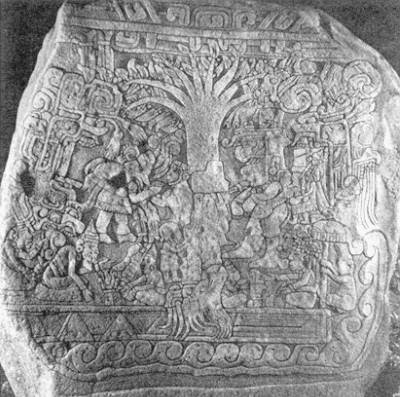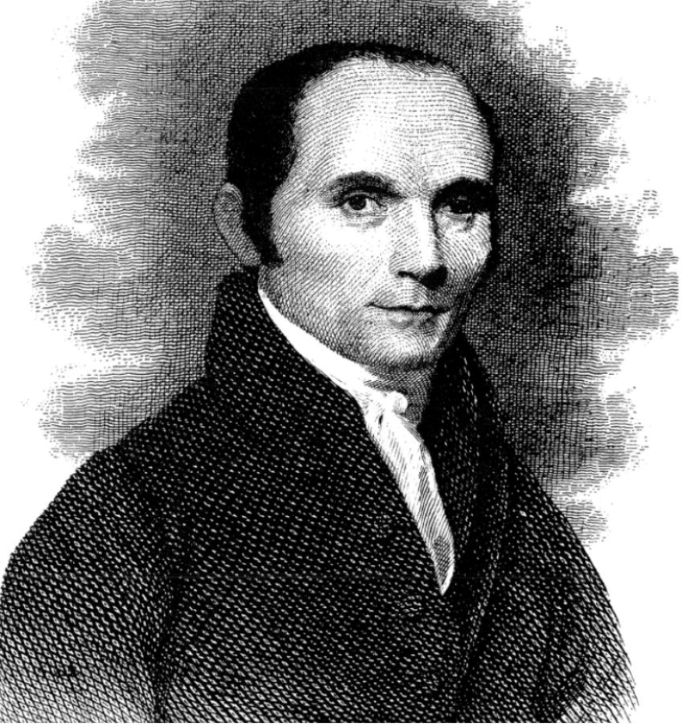
James Talmadge said, “Parallels of the Hopewell Culture as described by William C. Mills, Chief Archaeologist of Ohio, with the Book of Mormon. [May 20, 1917; Sunday] Attended Sunday School and afternoon service in Hawthorne Hall, and was a speaker at each assembly. Evening meetings here, as also in Brooklyn, have been discontinued for the summer. The attendance both at Sunday School and afternoon meeting was surprisingly large in view of the fact that many of the Utah college students have left for the vacation period. This evening at the hotel I had a long and profitable consultation with Professor Wm. C. Mills, State Archaeologist of Ohio. He is continuing his splendid work of exploration in the Ohio mounds, and I went over with him again the remarkable agreement between his deductions and the Book of Mormon story. He has reached the following (10) conclusions: The area now included within the political boundaries defining the State of Ohio was once inhabited by two distinct peoples, representing two cultures, a higher and a lower. These two classes were contemporaries; in other words, the higher and the lower culture represented distinct phases of development existing at one time and in contiguous sections, and furnish in no sense an instance of evolution by which the lower culture was developed into the higher. These two cultural types or distinct peoples were generally in a state of hostility one toward the other, the lower culture being more commonly the aggressor and the higher the defender. During limited periods, however, the two types, classes, or cultures, lived in a state of neutrality, amounting in fact to friendly intercourse. The numerous exhumations of human bones demonstrate that the people of the lower type, if not indeed both cultures, were very generally affected by syphilis, indicating a prevalent condition of lasciviousness. There (are) two peoples or cultures…the lower culture was most commonly the assailing party, while the people of the higher type defended as best they could but in general fled. As a further consequence of this belligerent status they buried their dead, with or without previous cremation, in such condition as to admit of expeditious covering up of the cemeteries by the heaping of earth over the sepulchers [sic], in which hurried work the least skilled laborers and even children could be employed. From a careful collating of data it is demonstrated that the general course of migration through the area now defined as the State of Ohio was inward from the west and outward toward the east. Professor Mills states that no definite data as to the age of these peoples have as yet been found, but that the mounds may date back a few hundred years or even fifteen hundred or more. Several years ago I placed a Book of Mormon in the hands of Professor Mills and, while he is reticent as to the parallelism of his discoveries and the Book of Mormon account, he is impressed by the agreement.” James E. Talmage 20 May 1917
Tony & Lorraine George
“Ancient Clues from Old Ohio History”
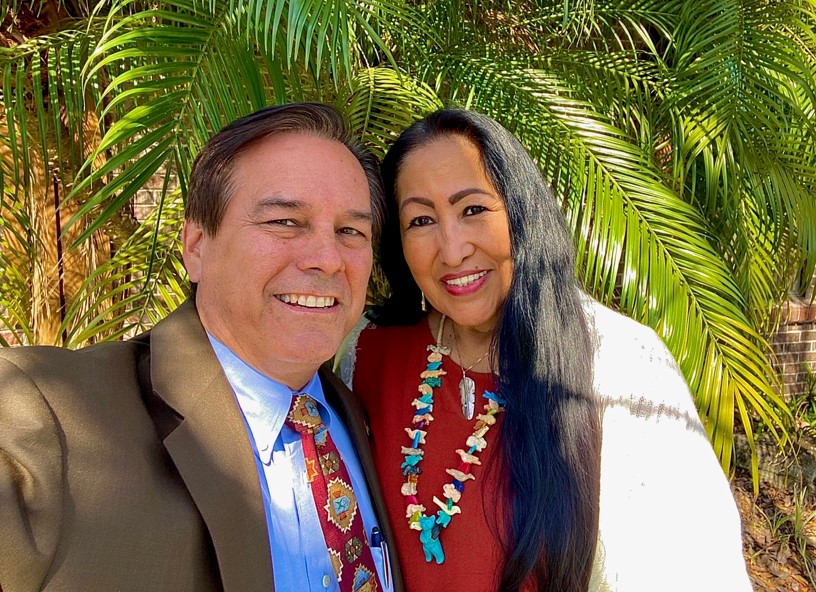
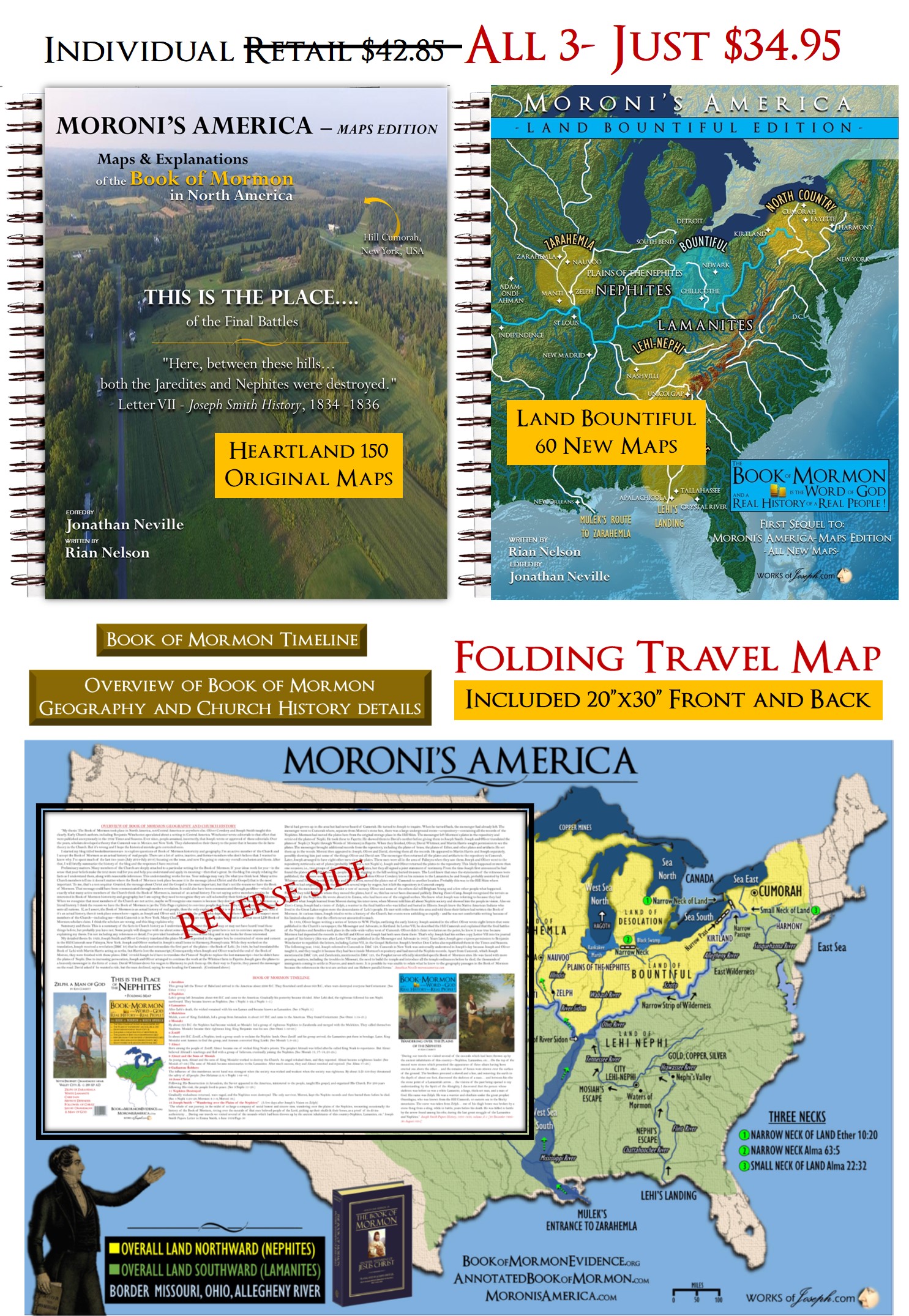
Tony and Lorraine have been researching the Mound Builder culture most of their lives. Tony was born and raised in southern Ohio, otherwise known as Hopewell Central, and follows in the footsteps of his father’s passion. Lorraine, his high school sweetheart, joined with him on an early date to Hopewell Culture National Historic Park, and the rest is history, literally. Having been surrounded by countless earthworks during their life and working closely with current archaeologists, they share enthusiasm and excitement and their love of history with countless visitors to Ohio. Purchase their Map Book called Moroni’s America Maps, “Land Bountiful Edition” 60 Pages HERE
“Lorraine is a princess of very distant royal ancestry who courted and married an Appalachian goober. Her family has roots in the early history of The Church of Jesus Christ of Latter-day Saints. Tony’s family arrived in the Ohio valley seven generations ago, among the earliest of pioneers in that region. He has been the beneficiary of stories and observations of the ancient peoples and their land and has continued the pursuit with earnestness. He has served as a Bishop and in various other capacities in Church and community organizations. Together they provide a simple but curious perspective of an ancient culture who kept their eyes aligned to the horizon, but their hearts to the heavens.”
Possible Places for The Savior’s Appearance –
Principal location of Ross County Ohio – even in historic times, the geology, geography, and biotic zones have been recognized as significant and even desirable for habitation. Modern Chillicothe serves as regional commerce center and a crossroads of transportation. The Scioto River and large tributaries in Paint Creek and Deer Creek converge in one relatively concentrated region. The Shawnee revered the place. Ohio pioneers made Chillicothe the first capital of the newly formed state.
Sugarloaf Mountain, Ohio – Eternal Geography
Sugarloaf Mountain – “The Hopewell road from Newark points straight as an arrow to Sugarloaf Mountain, the hill directly behind the Cedar Bank site. It is also the hill which many Chillicothe earthworks align to. Additionally, the Marietta Road, another ancient thruway, points straight to Sugarloaf from Marietta. Then consider the Kanawha Trail from Charleston WV and the Scioto Trail from Portsmouth OH…yep, the same. It seems everything in southern Ohio points to Sugarloaf. And there is more. The largest concentration of Hopewell earthworks are within minutes of Sugarloaf (over 500). You can see Columbus OH from the top of the hill. It commands the valley more in presence as opposed to height. Anthony George Lifelong Resident of Chillicothe, Ohio and Archaeological Researcher.
Trail#1– The “Great Trail” so-called, was the most important of the east and west trails in Ohio. It was the western extension of the great highway between the Indian country around Delaware and Chesapeake Bay traveling westward to the forks of the Ohio
Trail #2- Of striking importance was the Scioto trail running north and south through the state, between Sandusky Bay,“ and the mouth of the Scioto River. Ascending the Sandusky River crossing the portage and descending the Scioto to its juncture with the Ohio, the Scioto trail crossed the 1atter river and joined the famous “Warrior’s Path”, leading far into the southland.
Trail #3- This trail connected the Indian country about the forks of the Muskingum with the Shawnee settlements on the Scioto and thence west and north to the important Miami towns.
Trail #13- Extended from Maguck [Circleville] southeast to the Muskingum River thence southward, crossing the Ohio river in Washington County. This was a well-known war trail from the Shawnee settlements on the Scioto to the Indian settlements in southwestern Pennsylvania.
ARCHAEOLOGICAL ATLAS OF OHIO INDIAN TRAILS AND TOWNS
By William C. Mills 1914
5,396 OHIO ARCHAEOLOGICAL SITES Identified by 1914
The importance of the aboriginal trails of Ohio to the settlement and development of the state, hardly can be overestimated. In many instances they determined the location of the early white settlements as well as the first forts and military roads, many of them later becoming permanent highways. They ranged in width from a mere trail threading the wilderness to paths of a few feet wide in the more open country and generally followed the high ground between the water courses of hills and ridges adjacent to the streams. It was along these trails that the aboriginal Ohio peoples traveled from one part of the state to another, whether engaged in warfare, the chase, trade and barter, or migration. Later they served, together with navigable streams, as the only means of entrance for the white traders and settlers who pushed their way into the country west and north of the Ohio River. Thus, the trails in great measure determined the course of improved highways and in this way strongly influenced the location of communities and towns.
SPECIFIC EARLY WOODLAND MOUNDS AND SITES AROUND CLEVELAND
“Indian Point, located just 14 miles northeast of the Kirtland Temple. This ancient Indian enclosure features two earthen walls bordered by ditches and protected on two sides of a triangle by steep cliffs. The walls were built around 140 B.C.” Jonathan Neville by reading the signage at the site.
“The most spectacular Cleveland area earthworks are surprisingly little known to many area residents. The prehistoric embankments are still sufficiently high as to be easily viewed. The site isIndian Point (33La2) located at the juncture of the Grand River and Paine Creek just east of Painesville, Ohio. The site is now part of the Lake Metropark system. The archaeological community, who has been interested in the area long before it became a park, calls it the Lyman Site because it is on the former grounds of a military training camp operated by Charles Lyman. The site consists of three earthen enclosures atop a steep river bluff. (The western set of walls is severely eroded but the eastern two are easily viewed.) Indian Point did not have mounds; mound-like structures found there have more recently been determined not to be of prehistoric human origin. Until recently the Early Woodland date of Indian Point was not recognized; it was considered strictly a Late Prehistoric site (900 AD-1650 AD) because of the large amount of ceramics and bone tools of this period found there. Archaeologist James Murphy has long obtained radiocarbon dates prior to the First Millennium AD. He tested remains of cooking fires from deep within the inner earthworks. He also found an Early Woodland Stemmed point. The dates of specific portions of the site including the earthen walls still remain a matter of controversy. Murphy has proposed that the two sets of earthworks may have been constructed at different times.” 2011 LAURA PESKIN Prehistoric Indian Earthworks in the City of Cleveland and Environs
Cedar Bank Works – Ancient Temple? Chillicothe, OH
Proximity of likely temple site – the Cedar Bank site is a great candidate for a temple site. It is situated on the east bank of the Scioto and below Sugarloaf Mountain. Incidentally, Sugarloaf has a very, majestic shape. Even Squire and Davis suggest Cedar Bank as a place of “religious observances”. And then there is the name ‘Cedar Bank. It is understood that the site was named from the inordinate number of cedar trees growing on a bank among
Cedar Bank Site
one of the thickest hardwood forests in the world. Propagated from an ancient introduction of cedars? Additionally, the earthwork appears to have had a graded way to the water feature. It also resembles very, very closely the constructions found in Marietta, OH, Cincinnati, OH, Havana, IL and what we know as the Zarahemla site across from Nauvoo. Keep in mind that upon the Savior’s coming the people would be practicing the law of Moses. Although the Newark works are wonderful at offering symbolism of the Plan of Salvation through its geometric, earthen constructions, so do likewise other geometric construction’s in Ohio and opposite Portsmouth in Kentucky. These constructions were likely built or ‘added upon’ (from earlier constructions) after the Savior’s coming and teachings. Anthony George, Lifelong Chillicothe Resident & Archeological Researcher (For points 1-5 see page 2)
Hopeton Great Circle
“There was a wall at the Great Circle at the Hopeton site. For those of you interested in dry archeological research, here is more about an interesting and recent discovery at the Hopeton Great Circle (adjacent to the Cedar Bank site near Chillicothe OH and also adjacent to the Chillicothe Ward building). Typically, I try to remain abreast with the research happening each year in Ohio and nearby. I spoke with an archaeologist last summer [2017] at the site, and learned of his confirmation of anomalies indicated by a an extensive magnetometry survey. The other day in conversation, we discussed more details regarding the findings. It appears the Great Circle has evidences of a wooden fence, where the at least 6 ft height 1050 ft diameter earthen wall (enclosing 20 acres) was located. Indications are a pattern of very large posts spaced every 6 meters. This excavation last season revealed a post mold to be 96cm (about 38 inches) in diameter and 1.13 meters deep. One can estimate the height from that data. Indications are that smaller posts existed between the larger ones. The Hopeton site is significant in its location in relation to Cedar Bank, Sugarloaf, Mound City, and Dunlap Works and likely others. The current Chillicothe Ward building aligns with the Cedar Bank site (specifically the platform mound) and is within sight of Sugarloaf and in association with other major earthworks, including Hopeton. I am pretty sure Church engineering had not considered the earthworks when the building was designed.” Anthony George Lifelong Resident of Chillicothe, Ohio and Archaeological Researcher
Promised Land Bountiful
“And it came to pass that after we had sailed for the space of many days we did arrive at the promised land; and we went forth upon the land, and did pitch our tents; and we did call it the promised land. And it came to pass that we did begin to till the earth, and we began to plant seeds; yea, we did put all our seeds into the earth, which we had brought from the land of Jerusalem. And it came to pass that they did grow exceedingly; wherefore, we were blessed in abundance. And it came to pass that we did find upon the land of promise, as we journeyed in the wilderness, that there were beasts in the forests of every kind, both the cow and the ox, and the ass and the horse, and the goat and the wild goat, and all manner of wild animals, which were for the use of men. And we did find all manner of ore, both of gold, and of silver, and of copper.” 1 Nephi 18:23-25
The Small Neck of Land
Triple Divide – 3 River Sources
Susquehanna Flows to the Atlantic
Allegheny/Ohio Flows to the Gulf of Mexico
Genesee Flows to the Gulf of St Lawrence
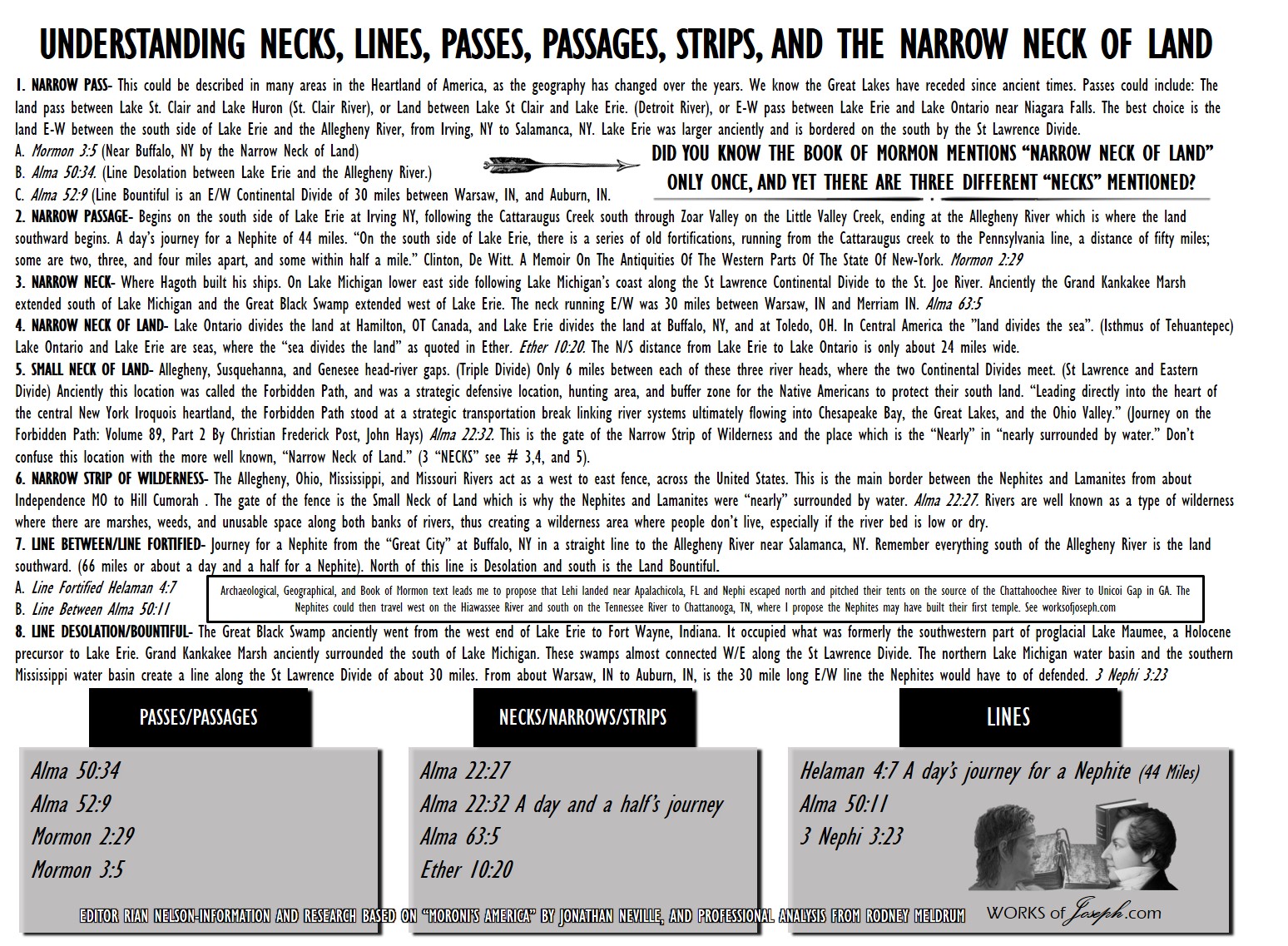
“… I propose that the narrow strip of wilderness is a major river—or system of rivers—that serves as an effective border. Here is my rationale. First, Moroni tells us it is a border. The “narrow strip” element suggests a feature that is visible and obvious to people on the ground; i.e., narrow enough that observers can see how wide it is, and long and thin enough that it is not mistakable. It is a definite border, not a vague region. Second, the definitions of the terms offer similar connotations. Narrow suggests a vale, valley, or river bed. Strip suggests something that is long and thin—like a river… In the past, however—in Book of Mormon times—the Ohio River often dried up in late summer. This left the riverbed as an expanse of silt and mud. In that state, it could not be called a river. But it could still be a border, and it could still be called a narrow strip of wilderness.” Jonathan Neville Moroni’s America page 23, 51-5
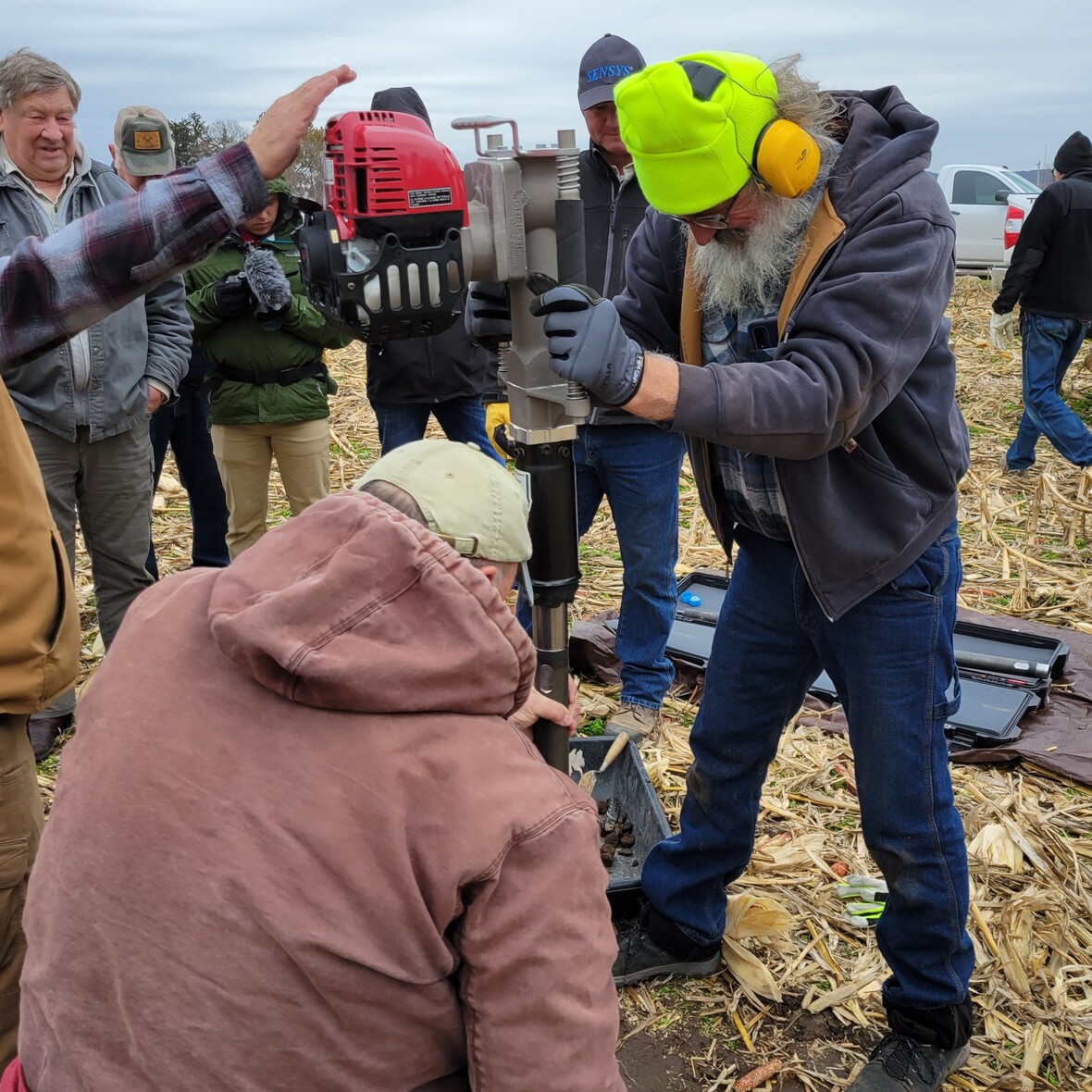
Research Group SENSYS Magnetometer Survey
“James Dutcher, in June 1987, received permission from Elizabeth Cooperrider, the owner, to excavate the stone mound… He measured the mound at 129 feet east to west and 110 feet north to south, with the highest point being 12 feet. Using a backhoe, he removed large portions of stone from the center of the mound, excavating a trench 30 feet by 10 feet on the northwest side of the stone mound. In the trench he found a fire hearth and a layer of charcoal on thirteen flat stones; four post molds were also located. The charcoal was sent to Beta Analytic in Florida in January 1988 for radiocarbon dating, and the results produced a date of 2220 ± 50 b.p., which translated to a date of ca. 270 b.c., suggesting a late Adena or early Hopewell period structure”. Glenford Stone “Fort” and Other Stone Constructions in Ohio and Beyond Norman Muller NEARA Journal, 2010
Many areas in Ohio have had magnetometer surveys. Above left, is an example of what those surveys look like. Experts search for post holes, fire pits, moved earth, and other things 3-5 feet below the surface .
The Newark Works, built between 100 B.C. – 500 A.D. is the largest surviving Hopewell earthwork complex in North America and originally encompassed more than four square miles. Taken as a whole, the earthwork symbols appear to represent a fundamental understanding of the essential elements of the Plan of Salvation:
1. Pre-Mortal Life: The Great Circle (light yellow) may symbolize our spirits eternal nature (circle), being born from a fluid-lined womb which opens toward the east, entering a—
2. Veil of forgetfulness: Two converging paths between the Great Circle and square are juxtaposed symbolizing
our forgetting of the pre-mortal life.
3. Telestial Kingdom: Mortal life (green square) represents earth and is likened to having four corners, “and gather
together the dispersed of Judah from the four corners of the earth” (2 Nephi 21:12).
4. Direct path: If all ordinances are performed on earth the individual can enter this path passing only one checkpoint.
5. Spirit Prison: Entrance from the earth, having only a dead-end holding area for the wicked.
6. Paradise: Another holding area following earth life where the gospel is preached and accepted or rejected.
7. Vicarious path: Those who accept the gospel in Paradise must have their temple ordinances performed by others
thereby passing multiple checkpoints.
8. Lake of Filthy Water: This man-made stagnant lake symbolizes the temptations each person must pass through.
9. Terrestrial Kingdom: (blue octagon), represented as the Seal of Melchizedek or eight-pointed star or octagon.
10. Celestial Kingdom: (gold circle) Entered only through the Terrestrial realm of Melchizedek through a straight and narrow path to be eternally encircled about by God. (Annotated Book of Mormon page 250- Original research by Amberli Nelson)
HOPEWELL EFFIGY OF A HUMAN HAND
“Effigy of a human hand cut from sheet mica, Ohio Hopewell culture, 100 BC-500 AD. Excavated from Hopewell Mound Group, Ross County, Ohio ca.1922-1925. The Hopewell obtained mica from western North Carolina. This object is 11” x 7” and is held in the Ohio History Connection Archaeology Collection. Hopewell culture spiritual leaders used small slabs of mica for a kind of mirror, possibly used in divination ceremonies, and artisans cut sheets into a variety of delicate shapes that may have been sewn onto garments to serve as personal ornaments. Around 400 A.D Hopewell culture began to decline for an unknown reason according to archaeologists.” Ohio History Connection Archaeology.
3 Nephi 11: 13-17
Zechariah 13:6
John 20:24-29
D&C 45:52
Pictured-Actual artifact at Ohio History Connection Museum, Columbus, OH
Dr. John C. Lefgren of Bethlehem, PA was the person who first made the association of the Fibonacci Series to this Hopewell artifact which shows the nail print in the hand of Christ. (See great video “The Fibonacci Sequence” here https://www.youtube.com/watch?v=P0tLbl5LrJ8)
“Cumorah which must become as famous among the Latter-day Saints, as Sinai was among the former day Saints…Cumorah, the artificial hill of North America, is well calculated to stand in this generation, as a monument of marvelous works and wonders.” WW Phelps Letter 12
What is the difference between an Artificial hill and an Official hill?
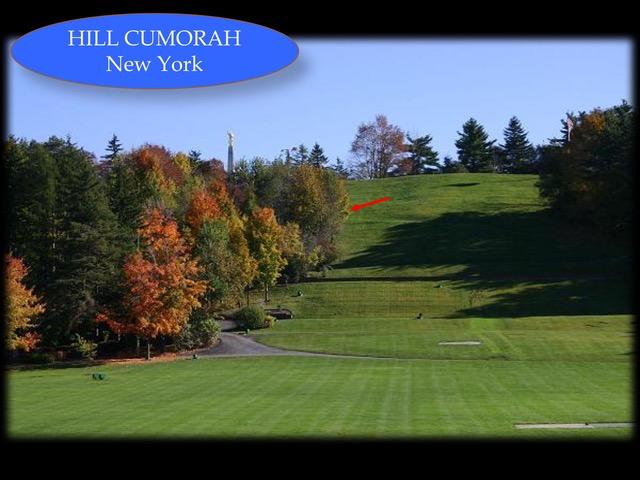
Hill Cumorah is not an “official” hill, but is defined as a drumlin.
“Drumlin, oval or elongated hill believed to have been formed by the streamlined movement of glacial ice sheets across rock debris, or till. The name is derived from the Gaelic word druim (“rounded hill,” or “mound”) and first appeared in 1833.” Britannica.com
Below, W.W. Phelps calls Cumorah an “artificial” hill. What would he mean by the name, artificial hill? One that is obviously different than a typical dirt hill, or rock hill as we usually think? In other words official or typical hills naturally formed would have natural caves within. The Hill Cumorah was not a typical hill such as we normally understand, i.e. mountain, or mount etc. Hill Cumorah was a drumlin which many people don’t know the difference between that and a typical hill. Webster’s current dictionary says, “Definition of drumlin: an elongate or oval hill of glacial drift… First Known Use of drumlin 1812, in the meaning defined above.” So a drumlin was formed from glacial drift unlike many hills we usually think of.
Because of W.W. Phelps quote below, I assume the Mesoamerican theorists who are looking for the Hill Cumorah somewhere in Mesoamerica, are looking only at hills or mountains that could have a natural cave, and not a man-made cave? I don’t know.
WW Phelps calls Cumorah, the artificial hill of North America, so let’s examine what that may mean.
ARTIFI’CIAL, adjective
1. Made or contrived by art, or by human skill and labor, in opposition to natural; as artificial heat or light; an artificial magnet. 2. Feigned, fictitious; not genuine or natural; as artificial tears. 3. Contrived with skill or art. 4. Cultivated; not indigenous; not being of spontaneous growth; as artificial grasses. 1828 Websters Dictionary
So, we should be looking for an “artificial hill” or a man-made hill, and not a typical cave that would naturally occur with typical mountains. That may mean there are no artificial hills in Mesoamerica? I’m not saying that, but it seems some are.
The Geologic History of Hill Cumorah Michael J. Dorais
Setting of Hill Cumorah
“Cumorah is perhaps the most famous drumlin in the world, other than Breed’s Hill, where the Battle of Bunker Hill took place during the American Revolutionary War. A drumlin, after the Gaelic word druim for hill, is an elongated hill formed by glacial processes. Cumorah is one of 10,000 similar hills of west-central New York that compose one of the largest drumlin fields in the world (see Picture below). The field defines an east-west trending belt about 35 miles wide bordering the south side of Lake Ontario and extends for about 140 miles from Syracuse to the Niagara River. In order to understand the processes that formed Hill Cumorah, a brief explanation of the causes of continental glaciation, the extent of Pleistocene glaciation, and the geomorphological evidence of glaciation in the Palmyra region of New York is in order.
This Greenland ice sheet resembles the ice sheet that once lay across the northeastern corridor of the United States and created an extensive drumlin field. Photo courtesy of Peter G. Knight.
Origin and Characteristics of Drumlins and Hill Cumorah
A type of drift deposited by continental glaciers, drumlins are not uniformly distributed under continental glaciers but form in distinct areas called drumlin swarms or fields (see picture above). Although their dimensions vary, drumlins are elongated, tapered hills that range from one-half to three-quarters of a mile in length, are about a quarter of a mile wide, and rise approximately 100 to 150 feet above the surrounding lowlands. In profile, they resemble inverted spoons with the shallow lee slope pointing in the direction of ice flow (see sketch below). The aspect ratios of drumlins are thought to reflect the speed of the glacier that produced them. That is, narrower and longer drumlins may indicate faster glacial movements than wider, shorter ones.
Because the formation of drumlins is a process that occurs under glaciers and is unobservable, the origin of drumlins has been a controversial topic. One theory is that because some drumlins contain stratified sands and gravels similar to those deposited by streams, the drumlins are water deposits. Subglacial flooding is thought to carry immense volumes of floodwater and sediment in cavities between the glacier and its underlying rock and sediment bed. Another theory is that because other drumlins are not stratified but consist of till, a poorly sorted sediment deposited by glaciers, drumlins are the result of a deformable layer of sediment between the glacier and bedrock. The sediment layer that forms drumlins is shaped by pressure exerted by the mass of the overlying glacier, with the sediment migrating to lower pressure regions under the ice sheet. Beginning about 19,000 years ago, when the Laurentide Ice Sheet began to melt at a faster rate than snow. (Editor’s note: In my opinion dating could be wrong by quite a bit) accumulated at its source, the margin of the glacier retreated, disappearing entirely from the Palmyra area around 12,000 years ago.
Aerial photo of drumlin field in northern Saskatchewan caused by an ice flow from the bottom left. Photo from Douglas I. Benn and David J. A. Evans, Glaciers and Glaciation (1998). Reprinted by permission.
As the ice retreated, glacial features that had formed below the ice sheet were exposed, including the large drumlin fields of west-central New York. Hill Cumorah is typical of the drumlins of this region, being 1.7 miles long and 0.4 miles wide and attaining a height of 140 feet above the lowland topography. The hill is also typical because its elongated profile is shaped like an inverted spoon with one end of the hill being steeper (the location of the Angel Moroni Monument and the pageant) and the other tapering off at a shallower angle (see sketch below). Perpendicular to its length, the hill has a cross-sectional profile common to drumlins, namely, a wide base of several hundred feet and a narrow summit, especially at the northern end where it narrows to less than 20 feet. Drumlins are composed of a variety of materials including mixtures of till, sand, and gravel. Most of these materials have high porosity and permeability, which, combined with the slope of the hill, would have allowed efficient water drainage that could have been important in the preservation of the plates, Urim and Thummim, Laban’s sword, and the Liahona over the centuries after their deposition in the stone box by Moroni. The tills and outwash deposits from the ice sheet at Palmyra are excellent sources of sand and gravel and are well suited for agriculture. It was these fertile soils that attracted the Smiths and other early agriculturally minded settlers. Indeed, had glaciation and till deposition not produced good farmlands in western New York, the Smiths might not have migrated there, and the restoration of the gospel might have commenced elsewhere. We readily recognize that the religious freedoms provided by the Constitution of the United States, coupled with the religious fervor that swept western New York in the early 1800s, were essential to pro-viding the political and cultural conditions necessary for the restoration of the gospel.
Profile and cross section of a drumlin with typical elongated and inverted-spoon shape.
But it was the development of the appropriate climate and agricultural conditions of western New York by glaciation and till deposition that brought the Smiths to Palmyra. Once the family was there, the unique political and cultural conditions provided the appropriate setting for the boy prophet to begin his divinely appointed mission. While it is faith promoting to see the Lord’s foresight in the preparation and preservation of the plates, it is also faith promoting to see an even greater foreknowledge of the Lord throughout the thousands of years of geologic history that led to the formation of Hill Cumorah and the surrounding lands. For he who has seen “the least of these hath seen God moving in his majesty and power” (Doctrine and Covenants 88:47).” Journal of Book of Mormon Studies. The Geologic History of Hill Cumorah Michael J. Dorais 142 VOLUME 13, NUMBER 1–2, 2004 JOURNAL OF BOOK OF MORMON STUDIES 143
The majority of Mesoamerican theorists believe that Moroni deposited the gold plates in a hill, but not the Hill Cumorah in New York. These same theorists also believe the final battles of the Nephites to be somewhere in Mesoamerica. I don’t agree with this perspective. .
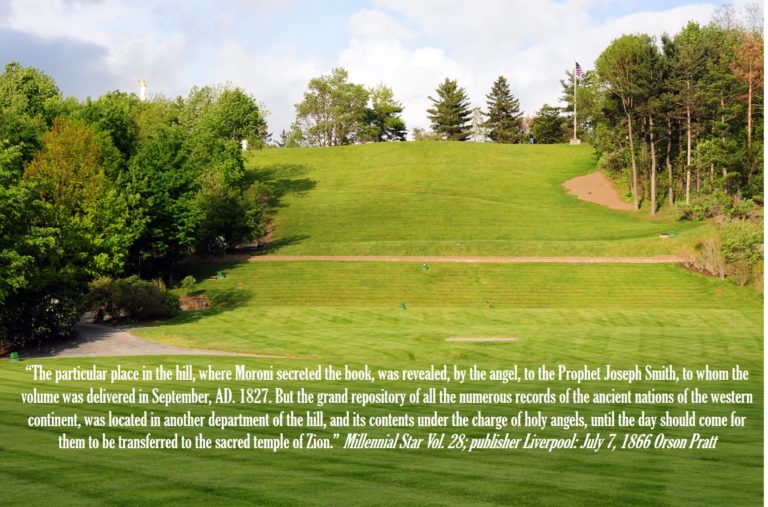
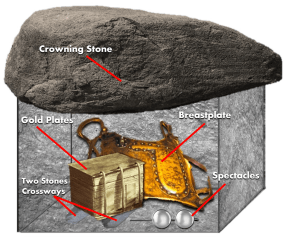
In Ether 15:11 Moroni says that the same hill that the Jaredites were destroyed was called Ramah, and was the same hill that Mormon hid the plates. It makes sense that all the plates were buried in the man made cave or depository in the Hill Cumorah, and not in Moroni’s man made stone box that held the set of plates Joseph translated.
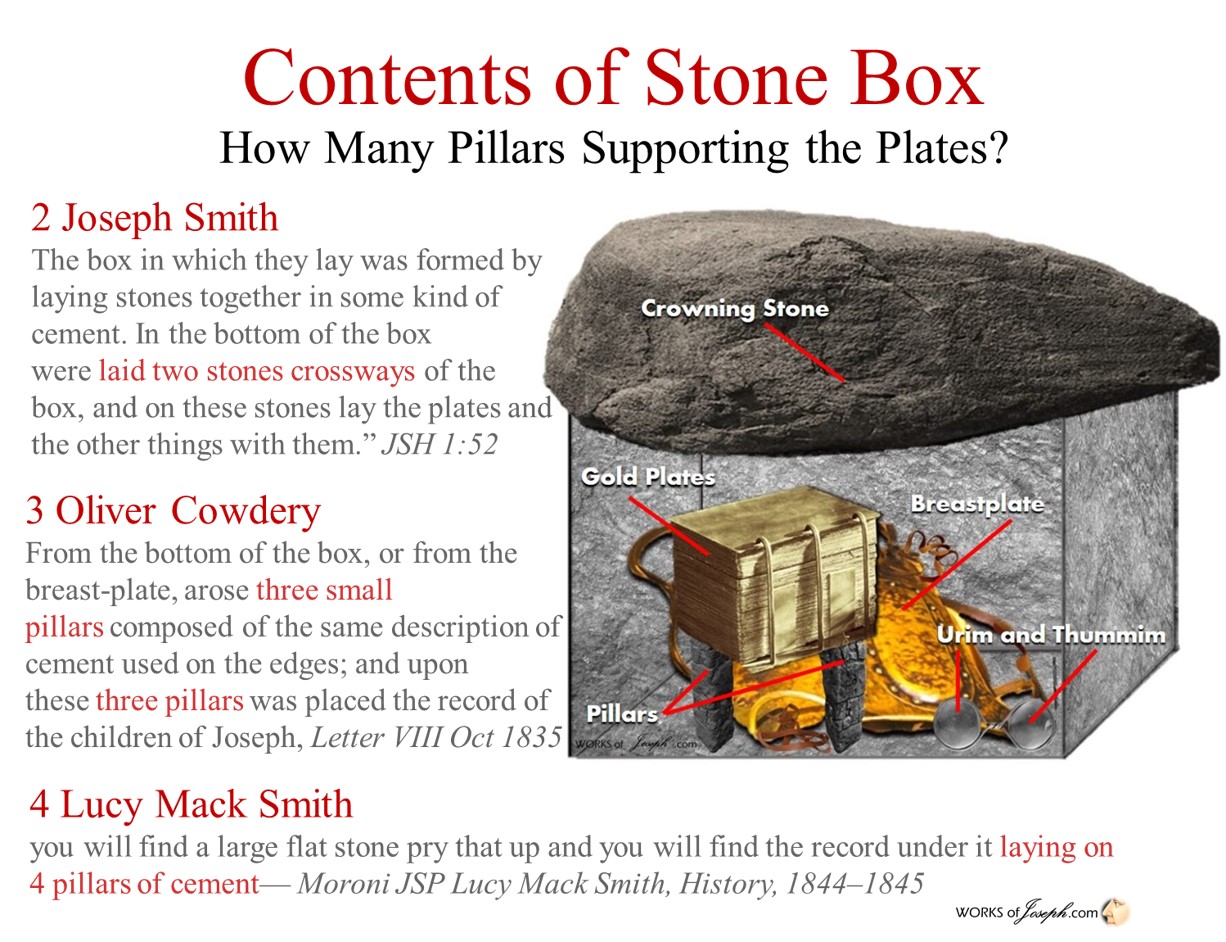
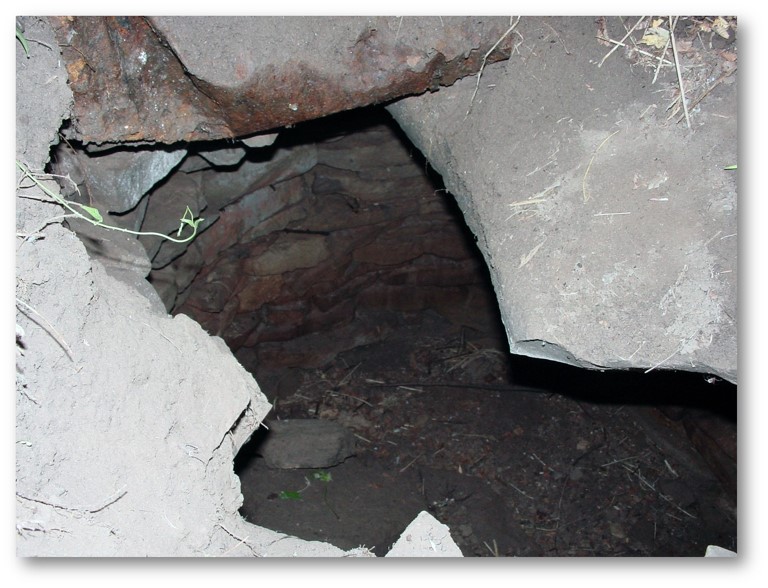
We believe there are two repositories in Cumorah for all the records. Both man made. First, the *Cave at Cumorah spoken of by Heber C. Kimball, Brigham Young and many others. Secondly, the stone box where Joseph Smith found the plates that were sealed with the Urim and Thummim and the Jaredite Breastplate.
*Quote about the Cave at Cumorah
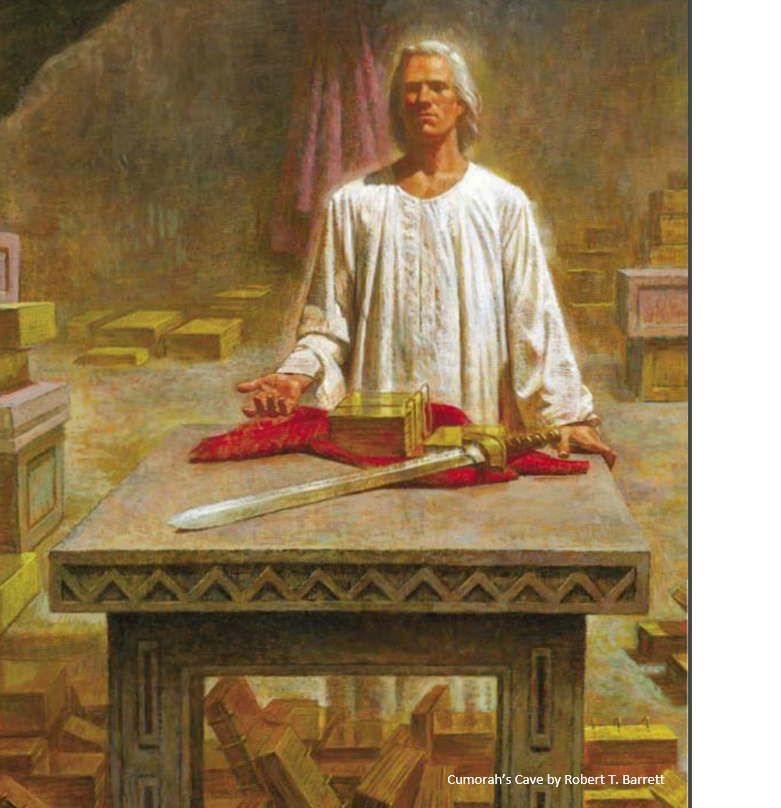
“Brother Mills mentioned in his song, that crossing the Plains with hand-carts was one of the greatest events that ever transpired in this Church. I will admit that it is an important event, successfully testing another method for gathering Israel, but its importance is small in comparison with the visitation of the angel of God to the Prophet Joseph, and with the reception of the sacred records from the hand of Moroni at the hill Cumorah. How does it compare with the vision that Joseph and others had, when they went into a cave in the hill Cumorah, and saw more records than ten men could carry? There were books piled up on tables, book upon book. Those records this people will yet have, if they accept the Book of Mormon and observe it’s precepts, and keep the commandments.” Heber C. Kimball Journal of Discourses, 4:105, September 28, 1856
Orson Pratt- One Hill Cumorah- Two Depositories
“The hill Cumorah, with the surrounding vicinity, is distinguished as the great battlefield on which, and near which, two powerful nations were concentrated with all their forces. Men, women and children fought till hundreds of thousands on both sides were hewn down, and left to molder upon the ground. . . . “These new plates were given to Moroni to finish the history. And all the ancient plates, Mormon deposited in Cumorah, about three hundred and eighty-four years after Christ. When Moroni, about thirty-six years after, made the deposit of the book entrusted to him, he was, without doubt, inspired to select a department of the hill separate from the great depository of the numerous volumes hid up by his father. The particular place in the hill where Moroni secreted the book, was revealed, by the angel, to the prophet Joseph Smith, to whom the volume was delivered in September, A.D. 1827. But the grand repository of all the numerous records of the ancient nations of the western continent, was located in another department of the hill, and it’s contents under the charge of holy angels, until the day should come for them to be transferred to the sacred temple of Zion.” 1866 Orson Pratt Millennial Star (28 (27): 417) “In relation to these records, Orson Pratt commented in 1873: “But will these things be brought to light? Yes. The records, now slumbering in the hill Cumorah, will be brought forth by the power of God, to fulfil the words of our text, that ‘the knowledge of God shall cover the earth, as the waters cover the deep.'” (Orson Pratt, May 18, 1873, in Journal of Discourses 16:57)
Mormon 6: Chapter 6 Notes
The Nephites gather to the land of Cumorah for the final battles—Mormon hides the sacred records in the hill Cumorah—The Lamanites are victorious, and the Nephite nation is destroyed—Hundreds of thousands are slain with the sword. About A.D. 385.
Ether Chapter 15 Notes
Millions of the Jaredites are slain in battle—Shiz and Coriantumr assemble all the people to mortal combat—The Spirit of the Lord ceases to strive with them—The Jaredite nation is utterly destroyed—Only Coriantumr remains.
Ether 15:11 “And it came to pass that the army of Coriantumr did pitch their tents by the hill Ramah; and it was that same hill where my father Mormon did hide up the records unto the Lord, which were sacred.”
Main Street, Canandaigua, New York, c. 1830 (at the time W. W. Phelps was publishing his Ontario Phoenix)
LETTER NO. 12 W.W. Phelps to Oliver Cowdery
I want to drop an idea or two about Cumorah. Yes, Cumorah which must become as famous among the latter-day saints, as Sinai was among the former day saints. — The law of the Lord, by the hand of Moses, was received upon Sinai, for the benefit of Israel, before they entered the goodly land of Canaan, and before they were scattered and driven among ail nations; and the fulness of the everlasting gospel, the history of the first settlers of America; even the book of Mormon, preparatory to gathering Israel from their long dispersion, came from Cumorah: Glorious spot! — sacred depository! out of thee came the glad tidings which will rejoice thousands! Israel must be restored to mercy; a holy people raised up unto God to possess the promised land, to bring the present unto the Lord of hosts, even to Mount Zion, as Isaiah foretold more than three thousand years ago.
Cumorah, the artificial hill of north America, is well calculated to stand in this generation, as a monument of marvelous works and wonders. Around that mount died millions of the Jaredites; yea, there ended one of the greatest nations of this earth. In that day, her inhabitants spread from sea to sea, and enjoyed national greatness and glory, nearly fifteen hundred years. — That people forsook the Lord and died in wickedness. There, too, fell the Nephites, after they had forgotten the Lord that bought them. There slept the records of age after age, for hundreds of years, even until the time of the Lord: —
“An angel came down from the regions of glory
“And told that a record was hid in Cumorah,
“Containing the fulness of Jesus’s gospel,
“And also the cov’nant to gather his people.”
“There began the church of Christ in 1830; yea, there the stone cut out of the mountain without hands, as foretold by Daniel, commenced rolling to fill the earth, and may it continue, in a moral sense, in dreadful splendor, till it fills the whole, and wickedness is ended. So much for the Hill Cumorah…”
As ever,
W.W. PHELPS.
To Oliver Cowdery.
LATTER DAY SAINTS’ MESSENGER AND ADVOCATE Vol. II No. 2 KIRTLAND, OHIO, Nov 1835 Page 221
This initial information is important before I blog about my subject of “Peccaries & Swine in the Heartland no Mesoamerica”, because I want you to have some context of Book of Mormon Central’s [BOMC] subjects on anachronisms.[which means, The representation of someone or something as existing or something as happening in other than chronological, proper, or historical order]. I want you to see how BOMC especially speaks about animals that the Book of Mormon speaks of, but none of these animals are found in Mesoamerica. However, you will find most of the Book of Mormon animals not found in Mesoamerica are found in North America, where I believe the proper geography is for the Book of Mormon.
“The legal organization behind Book of Mormon Central is the Book of Mormon Archaeological Forum, [link below] Inc., a 501 (c) 3 non-profit public charity chartered in the state of Utah in 2004. Book of Mormon Central is not an official part of the Church of Jesus Christ of Latter-day Saints, but rather an independent organization. BMC welcomes donations in support of this work. Book of Mormon Central is only possible through the diligent service of many volunteers. Book of Mormon Central began operating in May, 2015.” https://www.bookofmormoncentral.org/about
Big Question: I have always wondered why BOMC and BOMAF get to put 4 Emeritus General Authorities on their website who support their organization, and we also have many Emeritus General Authorities who support the Heartland, but we are not allowed to tell you their names or put them on our website. This has nothing to do with the Prophet and Apostles, as I don’t question anything they do. I’m sure some historian or scholar got permission from someone in the hierarchy. See which Emeritus GA’s are on their Advisory board here:
“There are several theories held among Latter-day Saints for the location of Book of Mormon lands. Some place the geography of the book in upstate New York or near the Great Lakes. Others look to Peru and South America, or to the Baja Peninsula, or Texas, and some even propose the Malaysian Peninsula. BMAF supports a Mesoamerican context for the major Book of Mormon sites. Other locations may meet some of the following criteria, but only Mesoamerica meets all these elements required by the book itself. This list of criteria is not a cafeteria list. Any Book of Mormon lands proposal must be able to demonstrate all.” BOMC
A Narrow Neck of land and 4 seas (east, west, north, and south)
A major river running south to north from a narrow strip of wilderness
A high civilization with cities, kings, artisans, military, and priests
An agricultural base large enough to support several millions of people
A highly literate (written language) society with scribes as important officers
Functional calendar and dating systems
A merchant class using weights and measures
Engineers to build houses, temples, towers, and highways using cement
Highly skilled craftsmen working with precious metals and stonework
A warrior society involved in large battles using trained soldiers and sophisticated fortifications
Legends of a white, bearded God
See here their list of requirements to be a Mesoamerican Geography.
After their long list above, notice their next quote that says,
“These Criteria must be in the Western Hemisphere but where Joseph Smith could not have known about them in 1829.” BOMC
What a power-packed statement. This statement says that whatever Moroni (My blog here shows over 20 visits to Joseph by Moroni and many other past prophets), or other translated beings or prophets taught Joseph Smith before 1829 he would not have recognized about Book of Mormon geography, animals, cities, teachings, way of life, interpreters, battles, artifacts, buried bodies, mounds, spiritual instructions, narrow passes, and more. What a list of disclaimers. This is why I have trouble taking seriously anything BOMC says about geography, and translation. I will still look for their opinions of things that I may have not studied as their scholars know many great things that I agree with.
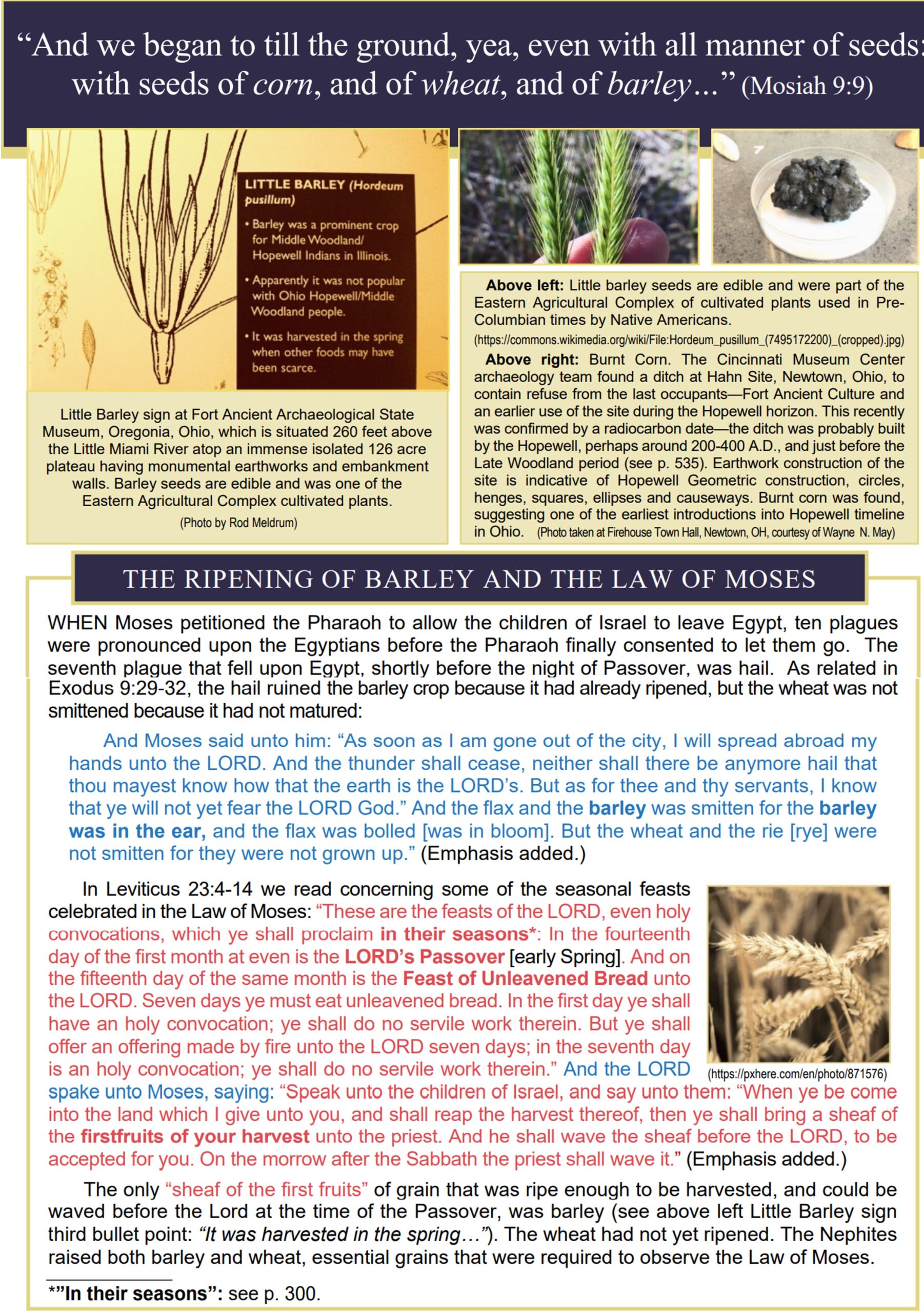
Our friends at Book of Mormon Central have many great articles and information, but when it comes to their Book of Mormon geography, some say that they are neutral like the Church of Jesus Christ of Latter-day Saints is and believes. I know that is the church’s position and I am perfectly fine with that. I believe BOMC or BOMAF’s neutrality stand, makes it easier for researchers and members to feel more comfortable to read their their blog for answers, more than it says they really are neutral when it comes to geography however. In my opinion they are not neutral. You can’t find anything about the Heartland’s geography they say is true, except about when they speak of Barley in North America and Abinadi being tortured using faggots was something that happened in North and Mesoamerica, both. [See Blog Here]
Below is an article by two BOMC scholars about their position about animals in the Book of Mormon that they can’t explain why they are not found in Mesoamerica. This is why I speak about specifically “swine” as the Meso-scholars can’t explain it to my satisfaction.
Type: Journal Article Animals in the Book of Mormon: Challenges and Perspectives Author(s): Wade E. Miller and Matthew Roper Source: BYU Studies Quarterly, Vol. 56, No. 4 (2017) Published by: BYU Studies Page(s): 133–175
Abstract: When the Book of Mormon first appeared, skeptics said that references to horses, asses, elephants, and other animals (such as swine and cows) were out of place. During the first century after its publication, Book of Mormon critics argued that such animals never existed anywhere in the Americas before the arrival of Columbus and western Europeans in the late fifteenth century. In time, however, scientific discoveries showed that species of horses, asses, elephants, and other animals had once been present in North America, although dating to an earlier period than that covered in the Book of Mormon.(1)
Encouraged by such discoveries, the present authors and some other specialists reasoned that future research and investigation would show that some of these species survived into historical times consistent with the account in the Book of Mormon. It can no longer be argued that there were no horses, asses, or elephants in the Americas. The issue has shifted to when such animals became extinct. As we approach the end of the second century since the publication of the Book of Mormon, the skeptical reader is more likely to claim that these animals disappeared before the advent of modern humans or long before the time covered by the Nephite record. Some Latter-day Saints are challenged by what they consider a lack of evidence supporting the historicity of the animals mentioned in the Book of Mormon. People of faith, however, are not alone in their challenges. Secular scholars have their own difficulties interpreting the past. An understanding of some of these challenges and the nature of the tools and evidence needed to address such questions can provide a helpful perspective to those who may be troubled by this issue.
In this article, we address factors that provide important perspectives on animals mentioned in the Book of Mormon.(2)For many Latter-day Saints, the subject may be of peripheral interest. For others, these matters may be a challenge. The truth of the scriptural text, whose primary purpose is to testify of God’s dealings with an ancient group of his covenant people, is first and foremost a matter of faith. However, this should not stop scholars from seeking all available truths that can be derived from this sacred text. B. H. Roberts wrote, “Secondary evidences in support of truth, like secondary causes in natural phenomena [science], may be of first rate importance and mighty factors in the achievement of God’s purposes.”(3)
Notes: 1. Fred James Pack, “Revelation Ante-dating Scientific Discovery: An Instance,” Improvement Era 10 (February 1907): 241–47; (June 1907): 595–97; B. H. Roberts, New Witnesses for God (Salt Lake City: Deseret News Press, 1909), 3:534–43; Franklin S. Harris, The Book of Mormon: Message and Evidences (Salt Lake City: Deseret News Press, 1953), 70–94. 2. The authors have benefited greatly from the pioneering research and publications of John L. Sorenson on this subject, which represent the essential starting place for those who approach this subject. See John L. Sorenson, An Ancient American Setting for the Book of Mormon (Salt Lake City: Deseret Book, 1985), 288–99; John L. Sorenson, Animals in the Book of Mormon: An Annotated Bibliography (Provo, Utah: FARMS, 1992); and John L. Sorenson, Mormon’s Codex: An Ancient American Book (Salt Lake City: Deseret Book; Provo, Utah: Neal A. Maxwell Institute for Religious Scholarship, 2013), 309–21. 3. Roberts, New Witnesses for God, 2:viii.
Nephites and Jaredites had Swine?
The answer is, Yes!And they had sheep and other animals spoken of in the Book of Mormon. All of the rhetoric and vagueness of the above BOMC statements, to try and get pigs and sheep and cows and doves and goats and rams and horses and elephants into a Mesoamerican setting, it can’t be done according to history. North America has all of those animals before during and after the timeline of the Jaredites and the Nephites. Read on.
Ether 9:18 And also all manner of cattle, of oxen, and cows, and of sheep, and of swine, and of goats, and also many other kinds of animals which were useful for the food of man.
3 Nephi 14:6 Give not that which is holy unto the dogs, neither cast ye your pearls before swine, lest they trample them under their feet, and turn again and rend you.
The 1828 Webster’s dictionary defines “swine ” as; SWINE, noun sing. and plural A hog, a quadruped of the genus Sus, which furnishes man with a large portion of his most nourishing food. The fat or lard of this animal enters into various dishes in cookery. The swine is a heavy, stupid animal, and delights to wallow in the mire.
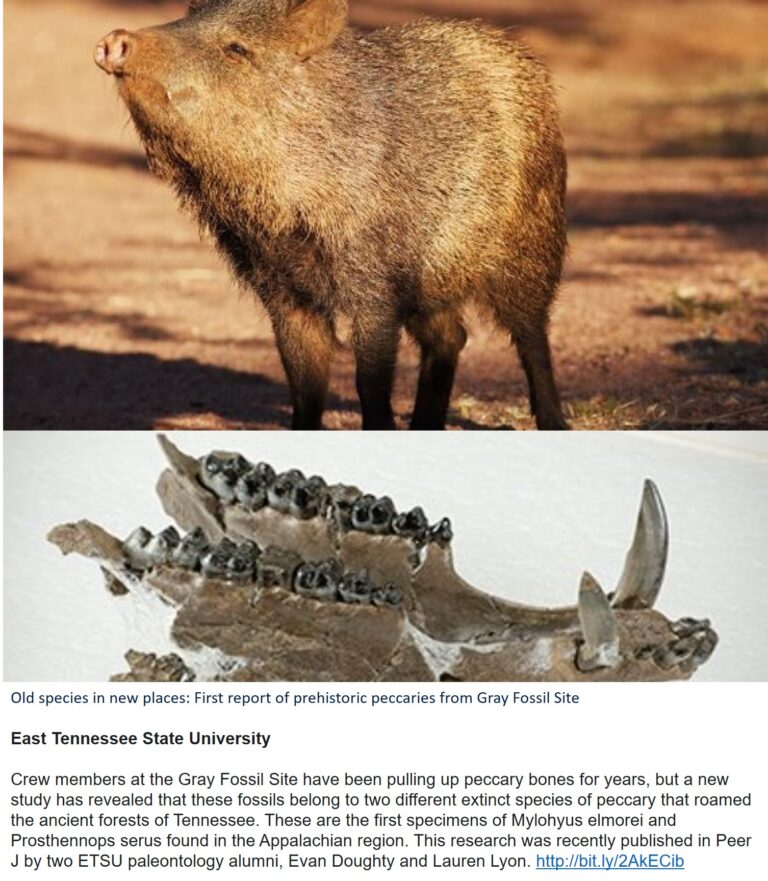
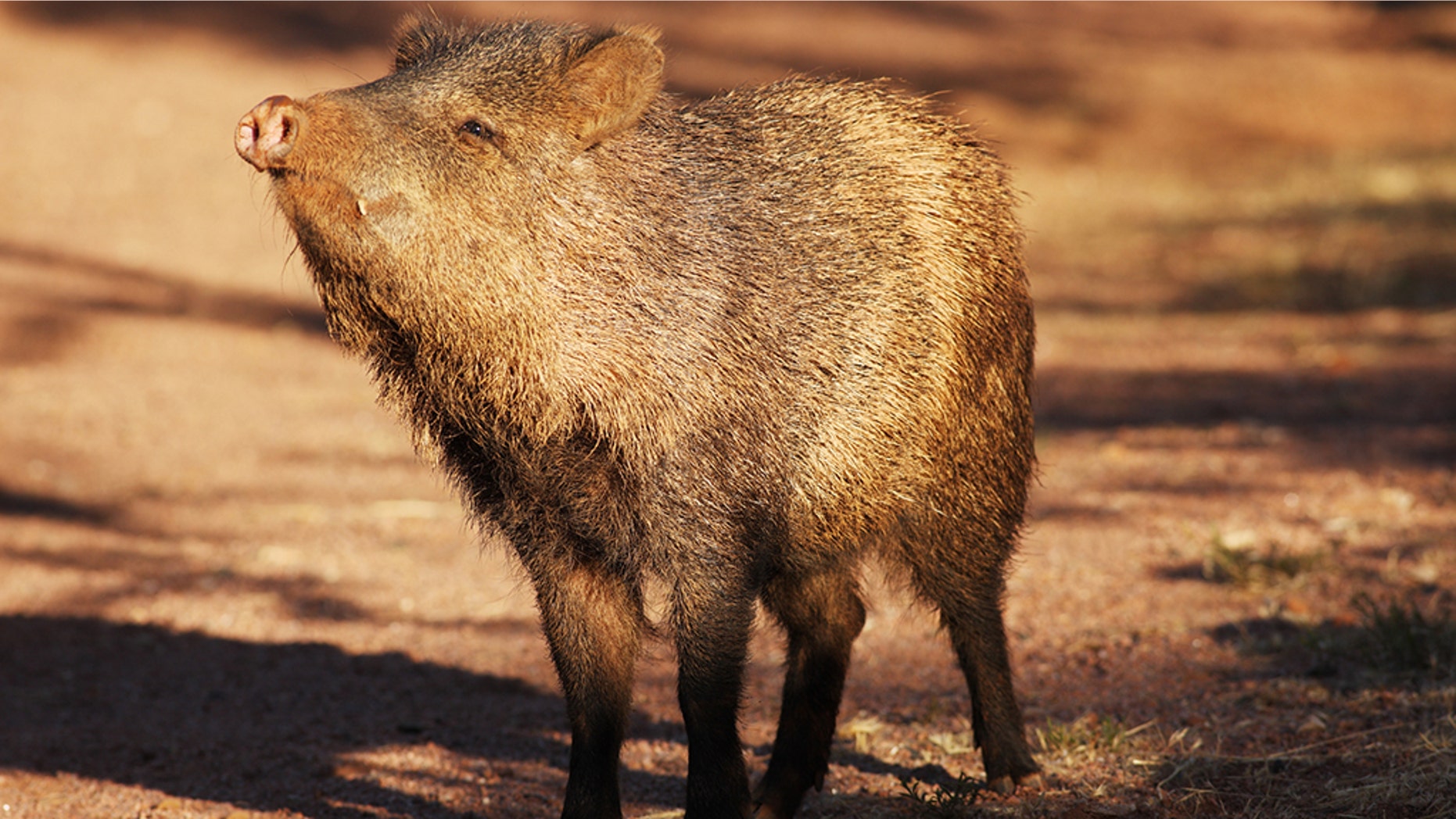
A collared peccary or Javelina or “Swine” are referred to twice in the Book of Mormon, and states that the swine were “useful for the food of man” among the Jaredites, and among the Nephites in a discussion to not mix pearls with swine.
Anachronisms
There are a number of words and phrases in the Book of Mormon that are anachronistic—their existence in the text of the Book of Mormon is at odds with known linguistic patterns or archaeological findings.
Each of the anachronisms is a word, phrase, artifact, or other concept that critics, historians, archaeologists, or linguists believe did not exist in America during the time period in which the Book of Mormon claims to have been written.
Mormon scholars and apologists respond to the anachronisms in various ways. Since I believe the events of the Book of Mormon happened in North America, I look for archaeology that support that setting.
Peccaries in Tennessee
*Editors note: It is my opinion that when many archaeologists identify dating of artifacts at millions of years, as a young earth creationist I believe no animals lived on this earth until they were created about 3-4,000 BC just before Adam was placed on the earth.
Two species of peccary were present in North America north of Mexico *16,000 years ago, and remains of both are found in the midwestern U.S. The two species are the flat-headed peccary (Platygonus compressus) and the long-nosed peccary (Mylohyus nasutus).
Both the flat-headed peccary and the long-nosed-peccary stood about three-quarters of a meter (about 30 inches) tall at the shoulder and probably weighed around 50 kg (110 pounds). Both were probably fairly omnivorous, although the long-nosed peccary consumed more browse (trees and shrubs) than did the flat-headed peccary.
Peccaries are members of the artiodactyl family Tayassuidae. They are New World relatives of the Old World true pigs (family Suidae). Peccaries can easily be distinguished by the fact that their upper canines (tusks) point downward. In true pigs (suids) the tusks curve upward. In addition, peccaries have less complex cheek teeth, reduced side toes, and large, dorsal musk glands.
The flat-headed peccary apparently lived in herds. Sometimes these herds used caves as shelters. Large numbers of peccary bones have been foundin several caves in Kentucky, Missouri, and Texas. In some cases, such as Welsh Cave, Kentucky (specimen shown above), Bat Cave, Missouri, Zoo Cave, Missouri, and Laubach Cave, Texas, these finds probably represent long-term usage of a cave by herds of peccaries. Unlike the flat-headed peccary, Mylohyus was probably a solitary animal and did not frequent caves. In spite of the fact that they did not frequent caves, occasionally long-nosed peccary remains are found in caves.
To the left is a fragment of a long-nosed peccary jaw was recovered from a cave in Jefferson County, Missouri. The teeth are shorter and have more rounded cusps than do the teeth of the flat-headed peccary (on the right). These differences in the teeth are due to the fact that long-nosed peccaries lived in woodlands and ate mainly shrubs while flat-headed peccaries lived in open areas and ate coarser vegetation.
Bat Cave, Missouri contained the remains of at least 98 individual flat-headed peccaries. The material from this site is in the collections of the Illinois State Museum.
Both Platygonus and Mylohyus became extinct in North America approximately *11,500 years ago. The reason for their extinction is being studied by paleontologists.
Peccary Finds in the Midwestern U.S.
This map shows some of the sites at which the flat-headed peccary (red triangles) and long-nosed peccary (green dots) have been found in the midwestern United States. The sites on this map are all relatively well-dated and well-studied. These sites contain peccary remains that are between *40,000 and 11,500 years old. [Wow, old pigs wouldn’t you say? Of course this is rubbish to me. How can anyone date them with that great of a distance of time. Why not just say the pig is millions of years old like they do for dinosaurs? I strongly believe dinosaurs lived during the time of Adam. See my blog here and here
Long Fossil History.
Peccaries have a long fossil history. They first evolved around *33 million years ago in either North America or Eurasia. They are present in North America from that time right through to the present. Between about *5 and 33 million years ago they were also found in the Old World. Peccaries dispersed into South America approximately *2.5 million years ago and have been successful in that area since. Three species of peccary are alive today. The Chacoan peccary (Catagonus wagneri), which is found in the Gran Chaco region of Bolivia, Paraguay and Argentina, is a close relative of the extinct Platygonus. The collared peccary (Tayassu tajacu) ranges from Arizona and Texas south to northern Argentina. The white-lipped peccary (Tayassu pecari) ranges from southern Mexico to northern Argentina. Source:
So pigs were in North America 33 million years ago and it only took 31 million years or so to disperse to South America” Wow I am believing this aren’t you? [haha] The fact remains there are peccaries in North America as seen in other archaeological artifacts above and below.
Peccary
Extinct Peccary NPS Photo/ Matternes Mural
Hagerman Horse Quarry
“The Hagerman Horse Quarry is a paleontological site containing the largest concentration of Hagerman horse (Equus simplicidens) fossils yet found. The quarry is within Hagerman Fossil Beds National Monument, located west of Hagerman, Idaho, USA, at the geographic division of the Snake River Plain. The Hagerman Horse Quarry is an integral part of the monument and is located on the northern flank of Fossil Gulch in the northern portion of the monument.
The Hagerman Horse Quarry resides near the top of the hillside of Smithsonian Hill. The hill was named from the early Smithsonian excavations of the Hagerman horse. The Hagerman horse is the first fossil representation of the genus Equus in North America.” Source
“In 1938, one of the scientists who excavated at the Hagerman Horse Quarry, Dr. C.L. Gazin, described a new species of peccary, Platygonus pearcei, from the Hagerman fossil beds. The name Platygonus means flat head and refers to the straight shape of the forehead. The species name pearcei is for the discoverer, George B. Pearce, a member of the 1934 Smithsonian field crew. Since its original discovery at Hagerman, Pearce’s peccary has been found near Grand View Idaho and at White Bluffs, Washington. People often confuse peccaries, which are found in the New World, with pigs which originated in the Old World, especially since some domestic pigs brought by european settlers have escaped over the years and now run wild in many parts of the United States. These feral pigs are popularly known as razor-back hogs.
Relatives of the Old World pigs include the wart hog of Africa. One of the ways to tell the two groups apart is the shape of the canine tooth or “tusk”. In the Old World pigs the tusk is long and curves around on itself, whereas in the New World peccaries the tusk is short and straight. Peccaries are plant eaters and use it for defense. By rubbing the tusks together they can make a chattering noise that warns potential predators to not get too close. Today there are three living species of peccary. They are found from the southwestern United States through Central America and into South America. The only peccary in the United States is the collared peccary (Dicotyles tajacu), also known by its spanish name, javelina. It is often found in dry arid habitats. A second species is the White-lipped peccary (Tyassu peccari) which is found in the rain forests of Central and South America. The last species, the Chacoan peccary (Catagonus wagneri) is the closest living relative to the extinct Platygonus pearcei found at Hagerman. It is found in the dry shrub habitat or Chaco of Paraguay, Bolivia and Southern Brazil. The Chacoan peccary has the unusual distinction of having been first been described based on fossils and was originally thought to be only an extinct species. In 1975 the animal was discovered to still be alive and well in the Chaco region of Paraguay. This third species of peccary was well known by the native Indians but it took awhile for scientists to discover its existence. Peccaries have a long history in North America.
They first appear in the Early Oligocene, about *32 million years ago and a variety of different species are present in faunas of different ages across the continent. Some of these extinct peccaries have been found at John Day Fossil Beds National Monument in Oregon and at Badlands National Monument in South Dakota. Although common in South America today, peccaries did not reach that continent until about 9 million years ago. Prior to that, there was no isthmus of Panama, and South America was an island continent. As the Panamanian isthmus formed, many North American animals entered South America. Along with peccaries, lames and tapirs also migrated south. Today people think these animals are South American, yet all come from North American ancestors. The exchange was a two-way street however, and some of the ancient South American species, like the ground sloth, migrated north and are found at Hagerman.” https://www.nps.gov/hafo/learn/nature/peccary.htm
Perhaps the best site for Pleistocene fossils in Arkansas is Peccary Cave located in Newton County. The site was first excavated in 1960s, and a follow-up expedition prospected for fossils again in the early 1990s. The fossil remains of at least 51 species of mammals have been found here. 4000 specimens of a minimum of 64 individual flat-headed peccaries (Platygonus compressus) were discovered in the cave, hence the name. The bones of other extinct species excavated from the cave include mammoth, mastodon, bison (Bison antiquus), stag-moose, helmeted musk-ox, tapir, beautiful armadillo, and dire wolf. There are also remains of extralimital species found here that no longer occur in the region–grizzly bear, pine marten, porcupine, heather vole, and numerous other rodents and insectivores of northern affinities. Plenty of species still found in the region are represented in the cave as well such as beaver, otter, muskrat, raccoon, coyote, gray fox, opossum, and either mule or white-tailed deer. Reptile and amphibian specimens have been excavated from the cave along with a few human-made artifacts of unknown cultural origin.
Newton County, location of Peccary Cave.
Illustration of the flat-headed peccary. Peccaries didn’t use Peccary Cave as a den. Instead, they either fell inside or their bones were washed into the cave when the nearby creek flooded. Birds of prey dropped or defecated smaller animals into the cave from overhanging trees.
The fossils represent several different climate phases. The lowest level contains fossils over *22,000 calendar years BP, a climate phase that includes a weak interstadial and the following early glacial maximum. Mixed Ice Age woodlands of spruce, pine, and hardwoods interspersed with prairies predominated. 7 different species of squirrels lived in the region then, showing how many diverse habitats occurred here. Red squirrels and least chipmunks, now absent from the region, preferred spruce forests; gray squirrels, fox squirrels, and southern flying squirrels occur in temperate hardwood forests; woodchucks like meadows; and 13-lined ground squirrels require tree-less plains. The author of the study discussed below thinks the following glacial maximum caused the entire Missouri Plateau to become inhospitable desert because there are few fossils from the site, dating to between *21,000 calendar years ago-15,000 calendar years BP. Undoubtedly, the region became more arid during this climate phase, and desert scrub grassland likely predominated, but I think there are alternative explanations for the lack of fossils during this time period here: a) the cave entrance may have become closed and/or b) the barren landscape allowed animals to see the trap entrance and avoid it whereas before it was hidden by thick vegetation and animals frequently fell inside. Without overhanging limbs there was no perch for birds of prey to drop of defecate the remains of their meals. Moreover, the nearby creek dried up, so there were no floods to wash fossils into the cave.
The upper level of sediment represents a warm dry interstadial post *15,000 calendar years BP when the region was dominated by grassland. Bison fossils appear during this phase, and toad fossils outnumber frog bones. Toads can survive better than frogs in more arid climates.
Kurt Wilson wrote his PHD thesis about the peccary and dire wolf bones found in Peccary Cave. His paper has interesting information, but it is incompletely researched, and his conclusions are logically flawed. He believes flat-headed peccaries were always an uncommon species. Part of his reason for this assertion is based on his incorrect observation that “the southeast is virtually devoid of records (of flat-headed peccaries), except for a dozen localities in Florida.” Wilson is unaware of 2 sites in north Georgia (Yarbrough Cave and Ladds) and 1 site in coastal South Carolina where fossil remains of flat-headed peccaries have been found. It is also illogical to assume a species was absent from a region based on its absence in the fossil record. Large areas of the southeast are devoid of fossils because the local geology is not conducive to fossil preservation, not because animals didn’t live there in the past.
Wilson concludes flat-headed peccaries became extinct due to climate change based on 4 lines of evidence that are easily debunked.
Collared Peccary
1. He dismisses overhunting by humans as a cause of flat-headed peccary extinction when he regurgitates the tired old claim of Meltzer and Grayson (an archaeologist and anthropologist…not paleoecologists) that there isn’t enough archaeological evidence of human interaction (kill sites) with this species. I consider this reasoning absurd in the extreme. 99.999…etc% of animals that ever lived on earth left no fossil evidence whatsoever. It has always seemed unreasonable to me to expect the remains of the final populations of a species that overlapped with man for less than 2000 years to be preserved in the fossil record. The chances of this happening are tiny. I’ve noticed Grayson’s recent book published in 2016 is frequently being cited in new papers about Pleistocene vertebrates. Grayson was blatantly dishonest in this book in the way he characterized a study that rules out climate change models of extinction. (See: https://markgelbart.wordpress.com/2017/01/23/donald-graysons-disingenous-case-against-overkill/ ) Grayson lied and he knows he lied.
2. Wilson assumes flat-headed peccaries became extinct in this region about 22,000 calendar years BP because their remains don’t occur in cave sediment after this date. (When Wilson writes of extinction in his paper he means regional disappearance or extirpation because he’s aware terminal dates for this species in other regions are 11,000 calendar years ago. Nevertheless, he clumsily never makes this distinction in his paper.) He asserts peccaries became extinct here because the climate became too arid for them. Again, he is basing his assertion on the dubious assumption that the absence of evidence is evidence of absence. I think flat-headed peccaries were probably even more abundant during the arid climate phase because they were anatomically well-adapted to dry dusty environments. Flat-headed peccaries had extensive structures in their nasal passages that helped filter dust. Wilson must be unaware there are at least 9 fossil sites where herds of flat-headed peccaries were buried during sandstorms. (See: https://markgelbart.wordpress.com/2013/03/10/when-sand-dunes-buried-herds-of-flat-headed-peccaries/ ) This suggests they were common in desert environments. Flat-headed peccaries may have avoided falling in Peccary Cave after 22,000 calendar years BP because the area around the entrance to the cave was barren and not hidden by vegetation. None happened to fall in the cave after this date, but that doesn’t mean they didn’t still occur in the region. Other fossil sites in the region yield the remains of horses, but not a single horse fossil has been found in Peccary Cave. Horses were likely another abundant species in the region that just happened to never fall in or enter Peccary Cave.
3. Wilson did a stable isotope analysis of 2 flat-headed peccary teeth and concluded they fed upon just a few leguminous plant species, so they became extinct when these limited number of plant species disappeared from the region. I don’t believe the entire dietary breadth of a species can be determined from such a small sample size. Moreover, 1 study suggests stable isotope analysis is not at all reliable. (See: https://markgelbart.wordpress.com/2016/06/24/trust-the-coprolites-not-the-stable-isotope-analysis/) Scientists compared the results of a stable isotope analysis of moa bones with actual fossil droppings. The stable isotope analysis was wrong. Flat-headed peccary teeth were built to eat grass and tough vegetation. A species that survived millions of years of climate change didn’t exclusively feed upon just a few species of leguminous plants.
4. Wilson asserts flat-headed peccaries were uncommon and thus vulnerable to extinction. However, a new genetic study of 12 flat-headed peccary individuals from Sheridan Cave, Ohio, dating to just before their extinction revealed populations of this species were diverse and expanding. This suggests flat-headed peccaries were common, adaptable, and had a wide geographical distribution until the species’ demise.
Peccary Cave has yielded a wealth of information for paleoecologists, and I’m shocked at how little research has been published about this site. I’ve been able to find about half a dozen research papers. There hasn’t been a scientific excavation of the site since 1993, though amateurs are currently pillaging it. Most of the specimens from this site have not yet been described in the scientific literature, and they are not listed on the paleobiology database. An early report of the site mentions the existence of peccary “droppings.” Yet, nobody has studied the coprolites (please email me if I’m wrong)–an outrageous oversight. We could actually find out what flat-headed peccaries ate, instead of guessing based on stable isotope analysis. I’m not sure the coprolites were even collected and stored in a museum. There should be hundreds of published papers about this site, not just a paltry 6. I’ve come across other understudied fossil sites and collections in my research, but this site might possible be the most underappreciated.
References:
Bell, Kenneth; and Lee Davis
“Sinkhole Excavations in Peccary Cave, Newton County, Arkansas”
Arkansas Academy of Science 47(30) 1993
Davis, Lee
“Biostratigraphy of Peccary Cave, Newton, County, Arkansas”
Arkansas Academy of Science 1969
Perry, Tahlia; et. al.
“Ancient DNA Analysis of the Extinct North American Flat-headed Peccary (Platygonus compressus)”
Molecular Phylogenetics and Evolution 2017
Wilson, Kurt
“Late Pleistocene Extinction of the Flat-headed Peccary on the Ozark Plateau: Paleozoological Insights from Peccary Cave”
Iowa State Graduate Thesis 2017
Tennessee scientists unearth fossils of prehistoric pig-like creatures in stunning discovery
In a thrilling discovery, scientists with East Tennessee State University (ETSU) have recently confirmed the prehistoric fossils found in an area known as the Gray Fossil Site belonged to two different species of ancient peccaries, pig-like creatures.
The fossils, including part of a well-preserved skull, confirm that two species of peccaries — Mylohyus elmorei and Prosthennops serus — roamed this area in prehistoric times. In fact, the findings mark the first time the remains of either species have been found in the Appalachian region, the university said in a news release.
While one of the two species, Prosthennops serus, had previously been found in other fossil sites in the U.S., it has never before been found in the Appalachian region. And the other, Mylohyus elmorei, has “only been found in one region of central Florida, more than 900 kilometers to the south,” the university said.
Scientists were able to identify these prehistoric species thanks to the “well-preserved remains of their skulls,” which included the “nearly complete lower jaws of both species.
Both the Prosthennops serus and the Mylohyus elmorei would likely have been the size of a German shepherd, which scientists noted is larger than modern-day peccaries.
“Details of the peccaries’ teeth suggest they spent their lives browsing on the leaves and fruits of succulent plants, so they would have been right at home in the Gray Fossil Site ecosystem, which we know from plant fossils was rich with tasty vegetation,” Chris Widga, the head curator at the ETSU Museum of Natural History at the Gray Fossil Site — which was once “a large pond surrounded by a lush forest” — said in a statement. https://www.foxnews.com/science/tennessee-scientists-unearth-fossils-of-prehistoric-pig-like-creatures-in-stunning-discovery
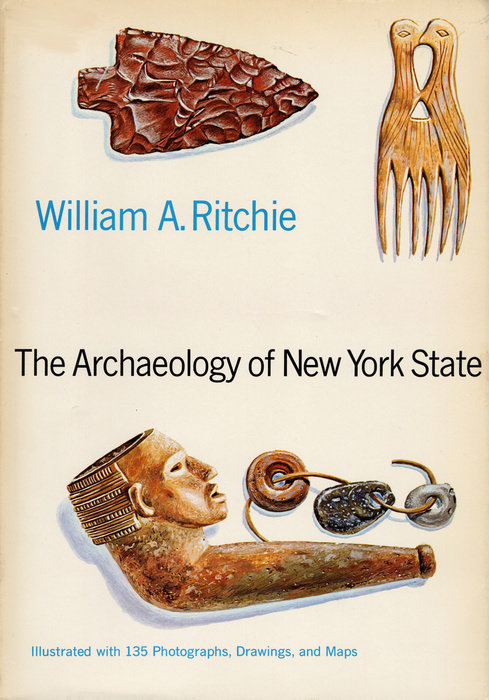
Archaeology of New York
In the book “Archaeology of New York State” by William Ritchie in 1965 there have been found many ancient Peccary’s dated around the Jaredite and Nephite time periods. See their map below:
As you see you also find many of the migratory and domesticated animals mentioned in the Book of Mormon. The food source of these animals alone show the ability for millions to have been feed during Book of Mormon time frames. In south Mesoamerica there are only migratory butterflies and turkies and it seems a challenge to feed on Apes, Llamas, and Lizards for survival.
Mesoamerica also lacks the necessary animals needed to live the Law of Moses such as Sheep, Goats, Rams, Bullocks, and Doves.
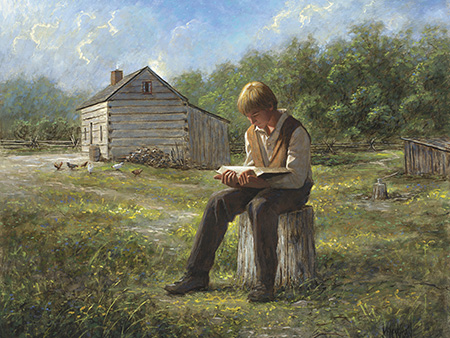
We have heard many times about the scripture in the Bible in James 1:5 that Joseph read, which gave him a great desire to pray to God out loud for the first time. The result was truly miraculous, and a gave the world an important doctrine, which is of course a key belief of the Church of Jesus Christ of Latter-day Saints.
Young Joseph said, “While I was laboring under the extreme difficulties caused by the contests of these parties of religionists, I was one day reading the Epistle of James, first chapter and fifth verse, which reads: ‘If any of you lack wisdom, let him ask of God, that giveth to all men liberally, and upbraideth not; and it shall be given him.'” JSH 1:11
We understand Joseph was directed by the Lord to read the Bible, but did Joseph at random read James 1:5, or did he have encouragement from someone else? Either way Joseph read that verse, and as Joseph said, “Never did any passage of scripture come with more power to the heart of man than this did at this time to mine. It seemed to enter with great force into every feeling of my heart. I reflected on it again and again, knowing that if any person needed wisdom from God, I did; for how to act I did not know, and unless I could get more wisdom than I then had, I would never know;” James 1:12
Below is some information that may lay a foundation for us to understand that Joseph may have received encouragement to read James 1:5. I don’t think Joseph simply read at random that verse, and I can also imagine the Lord leading him to the specific verse. However, let’s read below as there may be another possibility, that Joseph indeed was encouraged to read that verse from a Minister named George Lane. This may have been the same Minister who scolded Joseph.
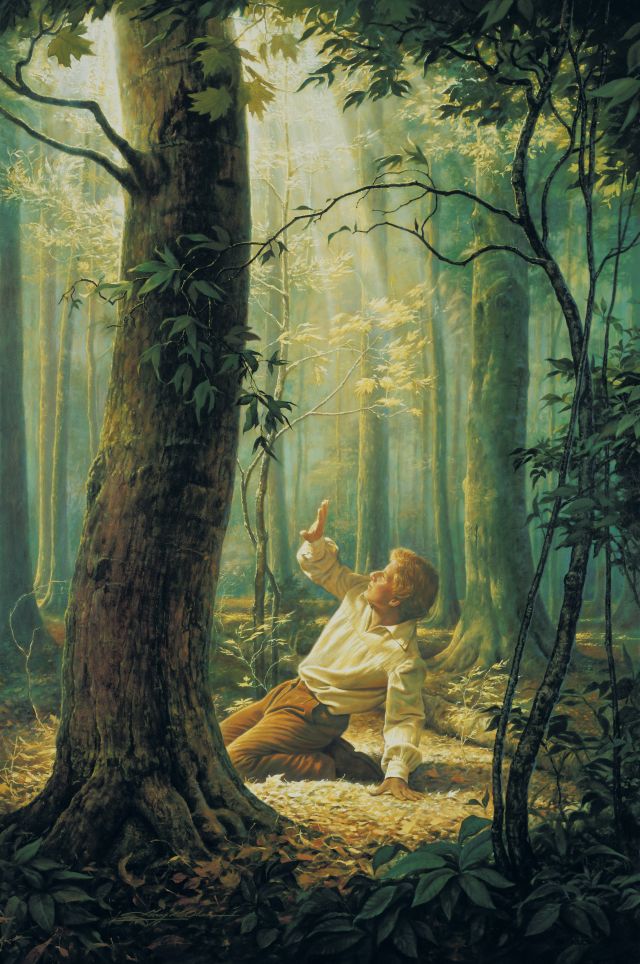
Joseph explained his scolding thus, “Some few days after I had this vision, I happened to be in company with one of the Methodist preachers, (George Lane?) who was very active in the before mentioned religious excitement; and, conversing with him on the subject of religion, I took occasion to give him an account of the vision which I had had. I was greatly surprised at his behavior; he treated my communication not only lightly, but with great contempt, saying it was all of the devil, that there were no such things as visions or revelations in these days; that all such things had ceased with the apostles, and that there would never be any more of them.” JSH 1:21
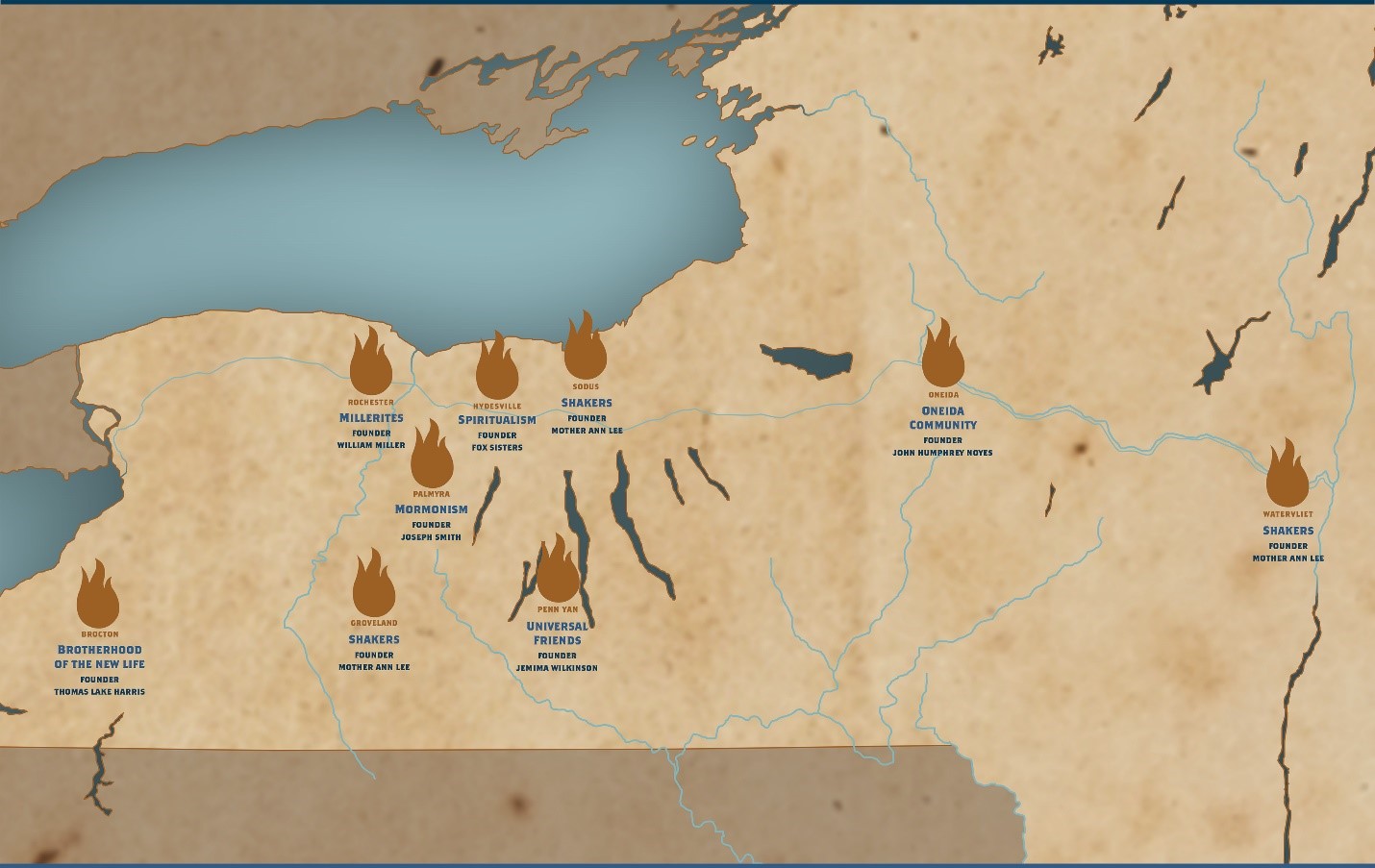
Who Was the Minister Joseph Smith Spoke to About His Vision?
“In the canonized account of the First Vision, Joseph Smith remembered confiding in a Methodist minister and received a stinging rebuke.
Some few days after I had this vision, I happened to be in company with one of the Methodist preachers, who was very active in the before mentioned religious excitement; and, conversing with him on the subject of religion, I took occasion to give him an account of the vision which I had had. I was greatly surprised at his behavior; he treated my communication not only lightly, but with great contempt, saying it was all of the devil, that there were no such things as visions or revelations in these days; that all such things had ceased with the apostles, and that there would never be any more of them. (Joseph Smith History 1:21)
The impact of this rejection may have shaped how and when Joseph did (and did not) tell his story for years to come. Yet this is the only time Joseph ever mentioned this encounter, and none of his firsthand accounts disclose the name of this preacher. It is therefore impossible to know for certain who this preacher was. There is, however, one Methodist preacher named by both Oliver Cowdery and William Smith as being influential in the religious excitement leading up to Joseph Smith’s vision, and even in potentially prompting Joseph Smith to pray and ask God in the first place—Rev. George Lane.(3)
(3) See Oliver Cowdery, “Letter III,” Messenger and Advocate 1, no. 3 (December 1834): 42; William Smith Interview with E. C. Briggs, 1893, in Early Mormon Documents, 5 vols. (Salt Lake City, UT: Signature Books, 1996–2003), 1:513.
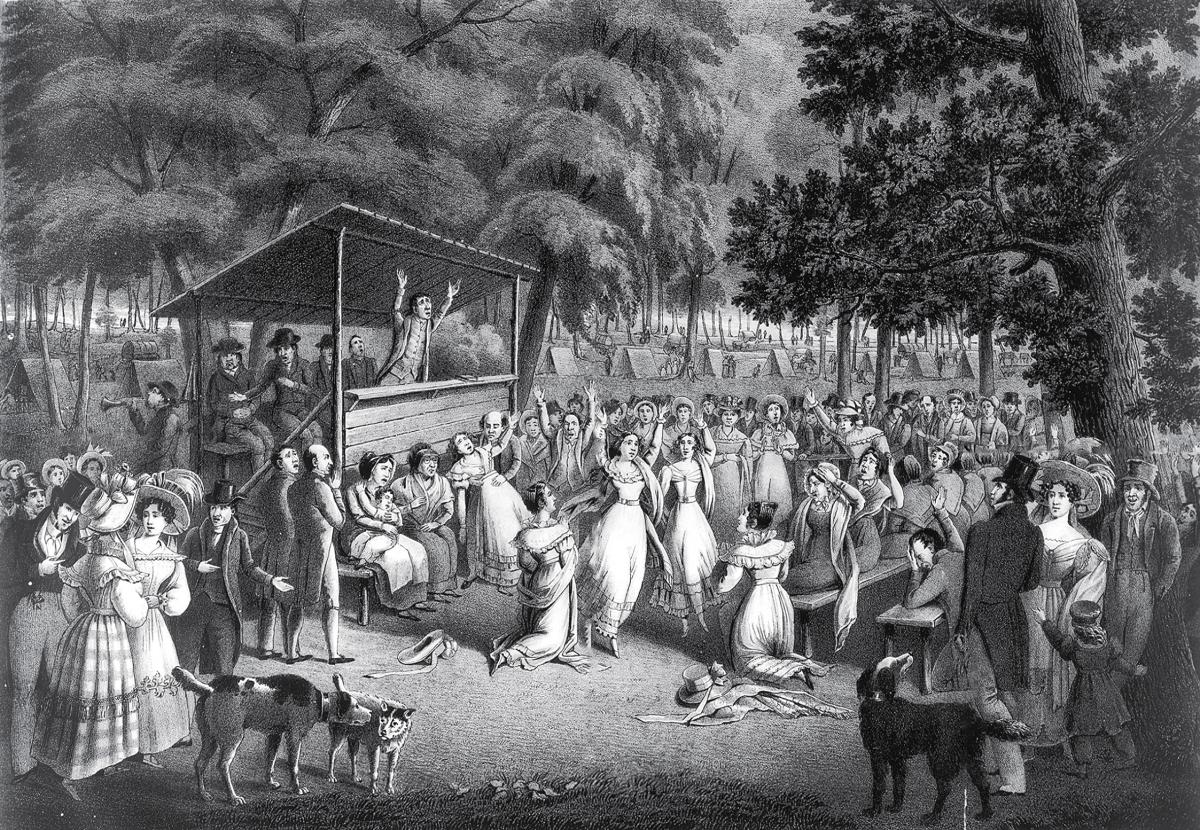
Rev. George Lane was an itinerant Methodist minister in the northern Pennsylvania and western New York area in the early 1820s. He was remembered for his powerful preaching. A contemporary who heard him preach at a camp meeting in 1819 said, “The exhortations of the presiding elder, George Lane, were overwhelming. Sinners quailed under them, and many cried aloud for mercy.”
According to Oliver Cowdery, in Joseph Smith’s “15th year [1820] … One Mr. Lane, a presiding Elder of the Methodist church, visited Palmyra, and vicinity. Elder Lane was a tallented man possessing a good share of literary endowments, and apparent humility. … Mr. Lane’s manner of communication was peculiarly calculated to awaken the intellect of the hearer, and arouse the sinner to look about him for safety—much good instruction was always drawn from his discourses on the scriptures, and in common with others, our brother’s [i.e., Joseph Smith’s] mind became awakened.”William Smith remembered Rev. Lane specifically exhorting anyone who was uncertain about which church to join to follow the counsel of James 1:5, and this prompting Joseph to act on Lane’s words.
There is some question as to the reliability of these recollections, however, since Rev. Lane was not placed over the Ontario Circuit (which included Palmyra) until 1824, and primarily worked in northern Pennsylvania between 1819 and 1823. The issue is further complicated by ambiguities in both Oliver’s and William’s narratives. After introducing Rev. Lane in an 1820 setting, Oliver relocates his narrative to the year 1823, and proceeds to tell of the visit of Moroni rather than the First Vision. Thus, it is ambiguous as to whether Oliver meant to indicate whether Rev. Lane was influential in 1820 or 1823. In William’s late reminiscences, he also frequently conflates details from Joseph Smith’s First Vision in 1820 with Moroni’s visit in 1823, and William’s accounts may actually be dependent on Oliver’s narrative.
Joseph Smith, unfortunately, never mentioned Rev. Lane by name, and thus never clarified what, if any, influence the preacher had on him in his youth. In light of the accounts from Oliver Cowdery and William Smith, however, it is noteworthy that, according to historian Larry C. Porter, “Lane was in the geographical proximity of Joseph Smith on a number of occasions between the years 1819 and 1825.” In particular, Lane attended the Genesee Conference held in Phelps in July 1819—less than 15 miles from the Smith farm and likely part of the “unusual excitement” Joseph remembered leading up to the First Vision. Thus, Joseph may, indeed, have heard Rev. Lane preach prior to his First Vision, as Oliver and William described.
Could Rev. Lane also be the unnamed preacher mentioned by Joseph, in whom he confided after his vision? Porter notes, “In July 1820, Lane would have had to pass through the greater Palmyra-Manchester vicinity on his way to Niagara, Upper Canada,” to the Genesee Conference, that year held at Lundy’s Lane. As was customary, Lane stopped and preached at camp-meetings along the way to and from the conference. This potentially could have afforded Joseph the opportunity to speak to Lane a few months after his vision, if Lane indeed was the minister Joseph remembered confiding in. Others, however, have argued that the minister Joseph was referring to was someone more regularly in the Palmyra area.
Even though the “nature and degree, or indeed the actuality, of their acquintanceship during this interval” remains uncertain, Porter concludes, “it is easy to see that Joseph Smith could have had contact with Lane at a number of points during this extended period.” BMC TEAM
Reverend George Lane—Good “Gifts,” Much “Grace,” and Marked “Usefulness”
“Many of the personalities who touched early Mormonism have drifted into comparative obscurity, their initial roles ill remembered or undefined. Such has been the lot of the Methodist Episcopal Church minister, the Reverend George Lane (1784–1859), a figure who, according to certain accounts, was one of those instrumental in moving Joseph Smith to make his epic inquiry of the Lord with the attendant vision of the Father and Son. The renewed research on Mormon origins has generated interest in Lane’s activities and his contact with Joseph Smith. This new interest has pointed out how very little we know of the Reverend George Lane, which has motivated this study of the man and his relationship to Mormonism.” Reverend George Lane—Good “Gifts,” Much “Grace,” and Marked “Usefulness” Larry C. Porter
Firm Foundation supports Mark E. Petersen’s quote here. “I do not believe that the classrooms or the pulpits of our Church are for laboratory purposes in which to experiment with new doctrines and speculative notions. They are exclusively for the use of those who are willing to convert men and women and boys and girls to the truth. . . . I do not believe we should give credence to the highly speculative theories about Book of Mormon geography. I do not believe that there were two Hill Cumorahs, one in Central America and the other one up in New York, for the convenience of the Prophet Joseph Smith, so that the poor boy would not have to walk clear to Central America to get the gold plates. I do not believe we can be good Latter-day Saints and question the integrity of Joseph Smith. I do not believe we can be good Latter-day Saints and question the testimony of the eleven witnesses of the Book of Mormon. I do not believe you have a testimony of the truth if you question the accuracy of the translation of the Book of Mormon.” Mark E. Petersen LDS Conference Reports, Sunday afternoon, April 5, 1953
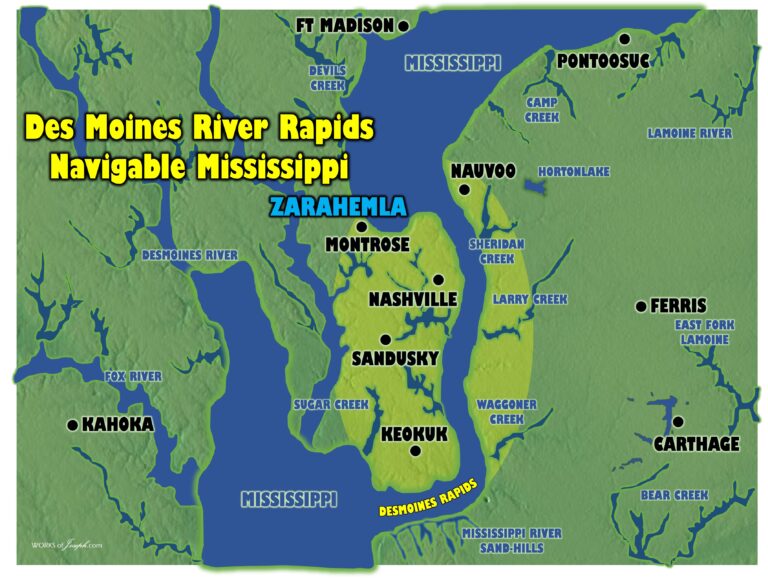
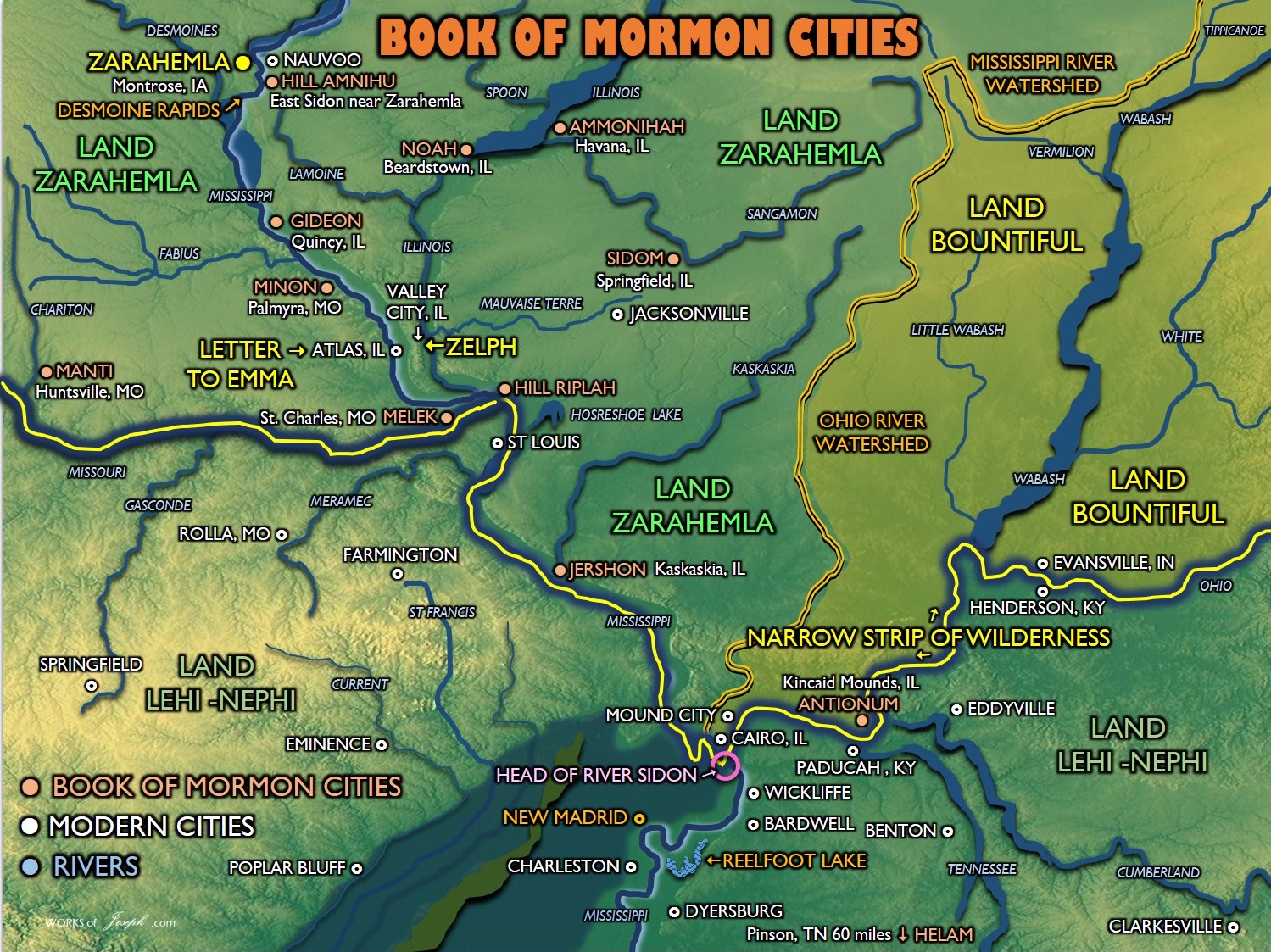
We support Heartland Research with the same belief as Firm Foundation, that there is a one and only Hill Cumorah in New York, and we also believe Joseph Smith’s revelation in D&C 125, showing the very city of Zarahemla in the Book of Mormon was indeed near Nauvoo in Montrose, Iowa.
In our friends Heartland Research blog below, you will find credible and plausible signs of ancient archaeology in Jerusalem and in Montrose Iowa. Of course all things are done in a desire to discover truths of the Bible and Book of Mormon. Both groups also love and support the many years of research done by Wayne May.
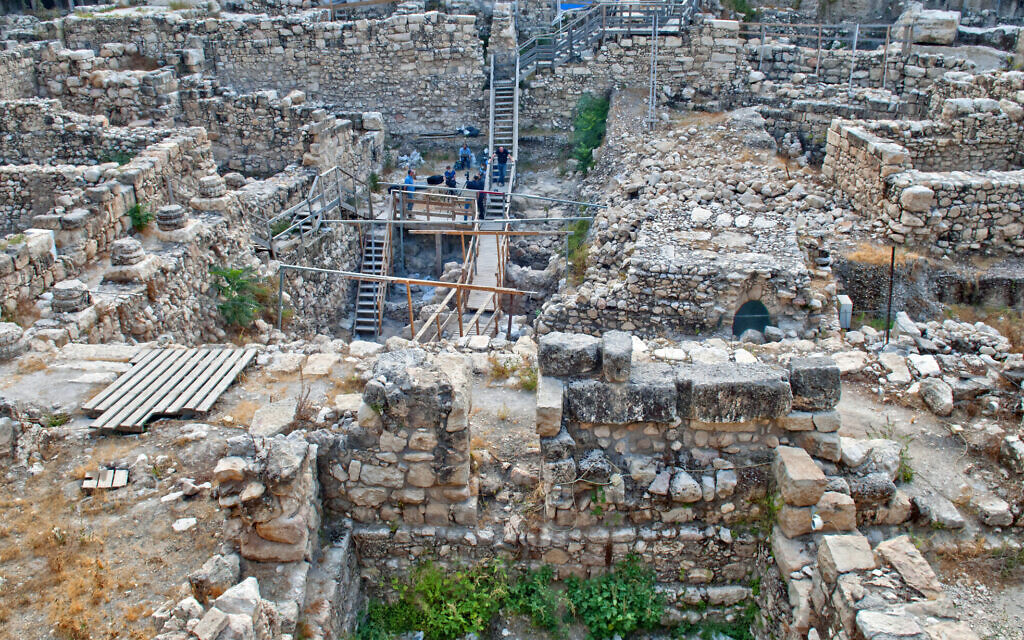
Since few in the world have ever looked specifically for evidence in the Heartland for ancient evidence of the Book of Mormon city of Zarahemla, Heartland Research continues to explore with passion and desire to help others understand physical evidence of the Book of Mormon. The Heartland Research team all have a spiritual witness that the Book of Mormon is true, and they move forward on words from an Apostle, Jeffrey R. Holland who said, ”
“…Truly rock-ribbed faith and uncompromised conviction comes with its most complete power when it engages our head as well as our heart… Truth borne by the Holy Spirit comes with, in effect, two manifestations, two witnesses if you will—the force of fact as well as the force of feeling… I believe God intends us to find and use the evidence He has given—reasons, if you will—which affirm the truthfulness of His work… Evidence is still evidence even if it is not immediately observable… “My testimony to you tonight is that the gospel is infallibly true and that a variety of infallible proofs supporting that assertion will continue to come until Jesus descends as the ultimate infallible truth of all. Our testimonies aren’t dependent on evidence—we still need that spiritual confirmation in the heart of which we have spoken—but not to seek for and not to acknowledge intellectual, documentable support for our belief when it is available is to needlessly limit an otherwise incomparably strong theological position and deny us a unique, persuasive vocabulary in the latter-day arena of religious investigation and sectarian debate. Thus armed with so much evidence of the kind we have celebrated here tonight, we ought to be more assertive than we sometimes are in defending our testimony of truth… Farrer [English cleric Austin Farrer] said: “Though argument does not create conviction, lack of it destroys belief. What seems to be proved may not be embraced; but what no one shows the ability to defend is quickly abandoned. Rational argument does not create belief, but it maintains a climate in which belief may flourish.”… May our Father in Heaven bless us and an ever-larger cadre of young scholars around the Church to do more and more to discover and delineate and declare the reasons for the hope that is in us, that like those converted Lamanites, we may with bold conviction hold up to a world that desperately needs it “the greatness of the evidences which [we have] received,” especially of the truthfulness of the Book of Mormon, the keystone of our religion. In the name of Jesus Christ, amen.” The Greatness of the Evidence By Elder Jeffrey R. Holland August 16, 2017
“Individual members are encouraged to independently strive to receive their own spiritual confirmation of the truthfulness of Church doctrine. Moreover, the Church exhorts all people to approach the gospel not only intellectually but with the intellect and the spirit, a process in which reason and faith work together.” LDS Newsroom http://www.mormonnewsroom.org/article/approaching-mormon-doctrine
Ash and Soot in Zarahemla.
The Old Testament states that Nebuchadnezzar II, the King of Babylon, burned the Temple of Jerusalem when he conquered Jerusalem in 586 BC. The time of the burning of the First Temple and the destruction of Jerusalem corresponds to the history of the Phoenicia Ship Replica that is now in Zarahemla.
In Jerusalem scientists are searching for destruction layers and burnt materials from 2,600 years ago, when the Babylonians took the Jews into captivity. During this time Prince Mulek escaped from Jerusalem to Zarahemla.
Due to religious and political sensitivities, archaeological excavations of the Temple Mount in Jerusalem are limited to surface surveys. There is, however, an active search for evidence from a dig near the First Temple. This dig has gone down forty feet and in recent years archaeologists have found ash that is 2,600 years old from the Babylonian burning of the First Temple. These reports are on the internet and can be found at the website of The Times of Israel.
Most of what we know about Zarahemla today comes from an ancient record that more than ten million people accept as the Word of God. Our analysis of Alma Chapter 2 confirms that Zarahemla is located in Montrose, Iowa, on the west bank of the Mississippi River. Click here and look at this video for our report.
In our search for Zarahemla, we have already spent considerable effort on four expeditions. SENSYS is one of the world’s most experienced and advanced companies for magnetometers and electromagnetic surveys. Three years ago, we scanned 200 acres using the best equipment from SENSYS to identify magnetic signatures of soils and rocks that were altered thousands of years ago by ancient fires. The magnetometer detected hundreds of firepits within a 200-acre area. We concluded from these initial results that Zarahemla’s population 2,000 years ago was greater than today’s population in the same area.
We are now interested in confirming Zarahemla’s location by using a new approach for the discovery of ash and soot from the city’s burning.
We read from 3 Nephi Chapter 9: 2 Wo, wo, wo unto this people; wo unto the inhabitants of the whole earth except they shall repent; for the devil laugheth, and his angels rejoice, because of the slain of the fair sons and daughters of my people; and it is because of their iniquity and abominations that they are fallen! 3 Behold, that great city Zarahemla have I burned with fire, and the inhabitants thereof.
According to scripture, at the time of Christ’s death ancient America’s largest city was destroyed by fire.
The burning of Zarahemla two thousand years ago caused tons of ash and soot some of which would have floated and collected in pools of water on layers of clay.
After the burning, ash and soot would have gathered in pools in low areas with clay being the holding layer in core samples.
At the time of Christ’s death, Zarahemla burned. During the Nephite evacuation of AD 320, the city likely burned. These burnings of the city produced soot and ash. Surface water from rain and melting snow concentrated the carbon-based materials into pools.
We want to begin a concerted effort to find the locations for these materials in the ground of Zarahemla. We believe that the discovery can be accomplished through an analysis of terrain features and the drilling of cores. We think that we will need to drill down five feet and more. We expect that the layers of ash and soot will be found on top of a layer of clay that would have held the collected ash and soot.
Again Elder Jeffrey R. Holland said,“but not to seek for and not to acknowledge intellectual, documentable support for our belief when it is available is to needlessly limit an otherwise incomparably strong theological position…”
“If you live into the next century you will see evidence for the Book of Mormon come forth in droves.” Truman G. Madsen, speaking of what the Prophet Joseph Smith said to a colleague, in the opening statement of the 2005 video, “Journey of Faith.”
The Heartland Research Group with John Lefgren, Mike and Betty LaFontaine and their entire team, are continually studying research from the Old World and the New World as a testimony that Jesus is the Christ.
In essence they are helping the world join the two Sticks of Ezekiel where it says in the introduction of Ezekiel in the LDS King James Version Bible, “Ezekiel is shown the valley of dry bones—Israel will inherit the land in the Resurrection—The stick of Judah (the Bible) and the stick of Joseph (the Book of Mormon) will become one in the Lord’s hand—The children of Israel will be gathered and cleansed—David (the Messiah) will reign over them—They will receive the everlasting gospel covenant.” This research is becoming a very significant archaeological and ground breaking reunion of the House of Israel. A “miracle book” from the earth [Stone Box at Cumorah] is a sure witness that the “Last Days” are at hand. The rejoining of the Lord’s people and histories from Promised Lands of Israel and America, is a witness to the world of Christ’s ultimate love for all of His people on every continent.
The connection of the Old World Phoenicians, likely bringing some of tribe of Judah like Mulek to America is of significance, as we join the two worlds. The ‘Phoenicia’ Voyages of 2009 and 2020 are an ideal test of the veracity of the Book of Mormon account. Former English Navy Captain Philip Beale, shows not only that the materials and technology of 600 BC allowed him to construct an ocean-going vessel representative of both Lehi’s group and the Mulekites voyages, as they may have crossed the Atlantic and landed near Florida in North America Blog Here You can now assist Heartland Research by donating or helping them re-construct that ship in Montrose, Iowa. Donate Here
Every land the Lord has created and every person, are alike unto God. However, God chose a specific place for His people to have the ability to carry out His promises to share the world with His Gospel. The Lord chose two lands, the Holy Land, and land of Adam and his posterity here in America.
As Pres. Hinckley said, “I should like to say a few words about America…No land is without its beauty, no people without their virtues, and I hope that you who come from elsewhere will pardon my saying a few words concerning my own native land, America…surely this is a good land, a choice land, a chosen land. To me it is a miracle, a creation of the Almighty.” Gordon B. Hinckley Let Not Your Heart Be Troubled”, BYU Speeches of the Year, October 29, 1974, pp. 267-68 )
Why did the Lord chose North America? “…in culmination of the grand scheme of schemes, this great nation, the Republic of the United States, might be established upon this land as an asylum for the oppressed; a resting place, it might be said, for the Ark of the covenant, where the temple of our God might be built; where the plan of salvation might be introduced and practiced in freedom, and not a dog would wag his tongue in opposition to the purposes of the Almighty. We believe that this was His object in creating the Republic of the United States; the only land where his work could be commenced or the feet of his people find rest. No other land had such liberal institutions, had adopted so broad a platform upon which all men might stand. We give glory to those patriots for the noble work they did; but we give the first glory to God, our Father and their Father, who inspired them. We take them by the hand as brothers. We believe they did nobly their work, even as we would fain do ours, faithfully and well, that we might not be recreant in the eyes of God, for failing to perform the mission to which He has appointed us.” Bishop Orson F. Whitney, delivered in the Tabernacle, Salt Lake City, Sunday Afternoon, April 19, 1885. Reported by John Irvine. Journal Discourses Volume 26 Page 201
Broken Covenants- Children of Ancient Biblical Israel
From the ground comes compelling evidence of broken covenants with the Lord in Palestine from the Northern Tribes of Israel in 722 BC and the Southern Tribes in 586 BC along with the once mighty nations of the Jaredites [Apx 500 BC] and the Nephites [Apx 400 AD] on North American soil. The Lord is gathering Israel in these last days, with the House of Israel being once again joined together as the Tribe of Joseph, and the Tribe of Judah.
Judges CHAPTER 2
The Lord was righteously angry at the original Children of Israel Scripture says, “And the anger of the Lord was hot against Israel; and he said, Because that this people hath transgressed my covenant.” Judges 2:20
“An angel rebukes Israel for not serving the Lord—As a pattern of future events, a new generation arises that forsakes the Lord and serves Baal and Ashtaroth—The Lord is angry with the children of Israel and ceases to preserve them—He raises up judges to guide and lead them—The Canaanites are left in the land to test Israel.” Heading, Judges Chapter2
Broken Covenants- Children of Book of Mormon Israel
Jaredites:
“And he had sworn in his wrath unto the brother of Jared, that whoso should possess this land of promise, from that time henceforth and forever, should serve him, the true and only God, or they should be swept offwhen the fulness of his wrath should come upon them.” Ether 2:8
Nephites: “Behold, it is expedient that much should be done among this people, because of the hardness of their hearts, and the deafness of their ears, and the blindness of their minds, and the stiffness of their necks; nevertheless, God is exceedingly merciful unto them, and has not as yet swept them off from the face of the land.” Jarom 1:3
“Therefore, repent ye, and humble yourselves before him, lest he shall come out in justice against you—lest a remnant of the seed of Jacob shall go forth among you as a lion, and tear you in pieces, and there is none to deliver.” Mormon 5:24
Every American is under Covenant with the Lord, which covenant was made by General George Washington on September 22, 1789 at his inauguration. Earlier Washington said, “Come then, my Brethren, unite with us in an indissoluble Union, let us run together to
the same Goal.—We have taken up Arms in Defence of our Liberty, our Property, our Wives, and our Children, we are determined to preserve them, or die.[Compare Moroni’s Title of Liberty statement.] Washington continues, “We look forward with Pleasure to that Day not far remote (we hope) when the Inhabitants of America shall have one Sentiment, and the full Enjoyment of the Blessings of a free Government.” The Papers of George Washington, Revolutionary War Series, vol. 1, 16 June 1775?–?15
Stay Centered in the Covenant Path
Art by Ken Corbett
Our dear Prophet has said, “Today, I spoke from my heart to the Saints in what is often referred to as the heartland of the United States. I shared with my brothers and sisters in Oklahoma and Kansas that their geographic location is a metaphor for how, and where, the Lord wants us to live—in the center of His covenant pathand in the center of our temple covenants. He also wants us to understand the central core of His doctrine and message, which is why He has given us the gift of the Book of Mormon.
“On August 2, 216 BC, near the ancient village of Cannae in Apulia, southeast Italy, there was a battle between the Roman Republic and Carthage during the Second Punic War. Hannibal led the Carthaginians and their allies in encircling and destroying a larger Roman army under Lucius Aemilius Paullus and Gaius Terentius Varro. The battle is regarded as one of the worst defeats in military history. For Hannibal’s army, it was an impressive tactical feat. Hannibal’s reputation as one of antiquity’s greatest tacticians was cemented by this victory.
Today, we would be using the Phoenician Alphabet instead of the Roman Alphabet if Hannibal had succeeded in his campaign against the Romans. The Battle of Cannae profoundly impacted Western history. There is a great deal of information about Hannibal in Roman records. The Romans burned the libraries when they destroyed Carthage, so few records from the Phoenician side have survived.
We know the location of the Battle of Cannae, so we expect the horrific battle on August 2, 216 BC, to be documented archaeologically.
There are records of 85 thousand dead bodies in an area of only a few square miles. This great battle should have left bones, swords, and breastplates in the dirt. There is no doubt in anyone’s mind that the great battle took place. The location of that battle is undeniable. Remember, Hannibal’s army had 37 elephants when it crossed the Alps. We might expect to find a broken piece of an elephant’s toenail in Cannae.
The Roman and Punic armies used metal weapons. An ancient battle of significant proportions was described in ancient records. The field of a few square miles was crammed with over 130,000 warriors, and the first day of the war left at least 60,000 dead, according to conservative estimates. On the Roman side, it was one of the deadliest days in history. What evidence can be found in the archeological record of this battle? As of today, there is no evidence. Cannae has a clean field with nothing to show for one of history’s great battles.
The Hill Cumorah
There are two leading contenders for the location of the final stand of one of America’s great armies. Some say that Cumorah is in Palmyra, New York; others say that Cumorah is some unknown hill in Middle America 2,000 miles south. According to many, the Hill Cumorah in New York has no archaeological evidence of the great battle where General Mormon died.
So here’s the question. Many records provide significant details about the Battle of Cannae. We know where it is. We know what time it was. In the grain fields of Cannae, there are no signs of this great battle today. In Cannae, the fields are archaeologically clean. What evidence is there?
The same is true of the great battle of Mormon’s last stand. In modern times, Cumorah and Cannae’s battlefields are comparable. Significant ancient battles seem unlikely to have occurred in Cumorah or Cannae based on the dirt evidence in New York and Italy. Does that mean these battles didn’t take place? In the modern world, both battles have profoundly influenced history.
In understanding how Cumorah and Cannae played such an essential role in our history, it would be great if there was clear evidence from the ground that great battles were fought in both areas. Today, we only have ancient records and little physical evidence from the ground that would confirm the locations of both battles.” Heartland Research Group
Below, the Heartland Research Group compares a battlefield in Italy, with a battlefield in New York. The analysis is amazingly parallel and convincing, that Hill Cumorah and the surrounding land may indeed have been the final battles of the Nephite’s and Jaredites, without the need to find many remaining artifacts. I however have a blog here, that will show you there were many breastplates, bones, weapons and artifacts found near Cumorah that substantially support that hill indeed, being a place of last battles. Email me at [email protected] for additional evidences.
Cumorah and Cannae Historic Battles Video by John Lefgren
Morally Obligated to Turn this Land Over
We have discussed the Land in Italy and the Land in New York, now let us ask ourselves, “have we protected and preserved these lands the Lord has given to His people?” Do we not only love the Land but do we also show that love, through obedience to God?
“I looked upon the sun, the glorious luminary of the earth, and also the moon, rolling in their majesty through the heavens, and also the stars shining in their courses and the earth also upon which I stood, and the beasts of the field and the fowls of heaven and the fish of the waters, and also man walking forth upon the face of the earth in majesty, and in the strength of beauty whose power and intelligence in governing the things which are so exceedingly great and marvelous. . . . And when I considered upon these things, my heart exclaimed, ‘Well hath the wise man said, it is a fool that saith in his heart there is no God.’ My heart exclaimed, ‘All these bear testimony and bespeak an omnipotent and omnipresent power, a being who maketh laws and decreeth and bindeth all things in their bounds.” Joseph Smith Letterbook 1, p. 2–3, Joseph Smith Papers, Church History Library, Salt Lake City, Utah; spelling and punctuation modernized.
“The earth is vulnerable. . . . Excessive consumption sullies God’s seas; wanton waste blackens His air. The creation groans under the weight of recklessness and indulgence that neglects both the poor earth and the earth’s poor.” In Honoring Creation, We Honor the Creator,” Apr. 26, 2018, MormonNewsroom.org
Some live lavishly in the moment without a thought for the future. Others believe that because “the earth will [one day] be renewed and receive its paradisiacal glory” that we have free license to be wasteful. Spencer W. Kimball, “God Will Not Be Mocked,” Ensign, Nov. 1974, 4–9
“Stewardship in the Church is a very important matter. The Lord has mentioned it in the revelations. We are stewards over these earthly blessings which the Lord has provided, those of us who have this soil and this water. We have no moral latitude, it seems to me. In fact, we are morally obligated to turn this land over to those who succeed us—not drained of its fertility but improved in quality, in productivity, and in usefulness for future generations.” The Teachings of Ezra Taft Benson, 645
The following story titled below as “The Hole in Cumorah“, is shared as some first hand and second hand information. I am confident I have described things fairly accurate. I have however contacted my video friend who is the one who took the pictures in this article and he thinks this story as I present is accurate to his recollection.
Remember there are two different locations of importance in the Hill Cumorah. Of course there was the place of the “Stone Box” where Joseph Smith received the set of plates from Moroni. In that stone box was contained the Original Gold Plates including the sealed portion, the large breastplate and the Urim and Thummim, The Sword of Laban and Liahona were not in this “Stone Box”. (See picture below)
There was also a “Cave of Records” separate from the stone box, which many brethren including Joseph Smith, Oliver Cowdery, Wilford Woodruff, Brigham Young and others spoke of. (See two quotes below).
“Oliver Cowdery went with the Prophet Joseph when he deposited these plates. Joseph did not translate all of the plates; there was a portion of them sealed, which you can learn from the Book of Doctrine and Covenants. When Joseph got the plates, the angel instructed him to carry them back to the hill Cumorah, which he did. Oliver says that when Joseph and Oliver went there, the hill opened, and they walked into a cave, in which there was a large and spacious room. He says he did not think, at the time, whether they had the light of the sun or artificial light; but that it was just as light as day. They laid the plates on a table; it was a large table that stood in the room.
Under this table there was a pile of plates as much as two feet high, and there were altogether in this room more plates than probably many wagon loads; they were piled up in the corners and along the walls. The first time they went there the sword of Laban hung upon the wall; but when they went again it had been taken down and laid upon the table across the gold plates; it was unsheathed, and on it was written these words: “This sword will never be sheathed again until the kingdoms of this world become the kingdom of our God and his Christ.” I tell you this as coming not only from Oliver Cowdery, but others who were familiar with it, and who understood it just as well as we understand coming to this meeting. . . . [Don] Carlos Smith was a young man of as much veracity as any young man we had, and he was a witness to these things. Samuel Smith saw some things, Hyrum saw a good many things, but Joseph was the leader.” Brigham Young, Journal of Discourses, 17 June 1877
“The hill Cumorah, with the surrounding vicinity, is distinguished as the great battlefield on which, and near which, two powerful nations were concentrated with all their forces. Men, women and children fought till hundreds of thousands on both sides were hewn down, and left to molder upon the ground. These new plates were given to Moroni to finish the history. And all the ancient plates, Mormon deposited in Cumorah, about three hundred and eighty-four years after Christ.
When Moroni, about thirty-six years after, made the deposit of the book entrusted to him, he was, without doubt, inspired to select a department of the hill separate from the great depository of the numerous volumes hid up by his father. The particular place in the hill where Moroni secreted the book, was revealed, by the angel, to the prophet Joseph Smith, to whom the volume was delivered in September, A.D. 1827. But the grand repository of all the numerous records of the ancient nations of the western continent, was located in another department of the hill, and it’s contents under the charge of holy angels, until the day should come for them to be transferred to the sacred temple of Zion.” 1866 Orson Pratt Millennial Star (28 (27): 417)
The Hole in Cumorah
About 10 years ago a friend of mine who worked in the Church Video department was on assignment at the Hill Cumorah for a project the Church was working on.
The west side of Hill Cumorah was being prepared for setting up the stage for the Hill Cumorah Pageant. A missionary couple had some guests on a tour showing them around this west facing hill Cumorah. After a time one of the families on tour noticed one of their children was missing from the group. A search for this young man began. After searching for a time the missionary couple and their guest family heard a yell for help several times. They came upon the missing young man who had fallen through an opening in the top west side of the Hill Cumorah. [See Approximate location of that hole at the red arrow above]
The hole seemed to be 12-15 feet deep. Someone ran to their car and brought back some jumper cables as a rope, to assist in bringing the young man up out of the hole below, which is my video friends actual picture he took of the hole after the young man was pulled out.
An Actual Picture at Hill Cumorah about 2009. Shows a possible man made cavern in the drumlin
My friend put his camera with its light down the hole and snapped a few pictures. He was very surprised to see the appearance of a cave that was about 15 feet square. The cave was empty (Explained below). On the sides of the walls were stacked stones and there were some stones attached seemingly as shelves coming out from the stacked stones, which would mean the cave would have been man made.
What most people know about the hill Cumorah is that it is classified as a drumlin. “A drumlin, from the Irish word droimnín (“littlest ridge”), first recorded in 1833, and in the classical sense is an elongated hill in the shape of an inverted spoon or half-buried egg formed by glacial ice acting on underlying unconsolidated till or ground moraine.” Source: Wikipedia.
Drumlins are created by a glacial drift with moving dirt and debris and won’t leave spaces for caves as other hills and mountains would. This is one of the reasons those of the Mesoamerican belief don’t think a cave would exist in a drumlin. But this pictures shows a possibility for a man made cave to be created in a drumlin.
After discovering this cave, the Church had a contractor notified about fixing the hole. They came out to the location and put a large thick piece of steel over the hole, (see photo above) and then covered it with dirt. I have some friends who have since been back with detectors and can easily locate the location of where the piece of steel was buried.
The cave was empty (Explained Here)
Mormon 1:3 “Therefore, when ye are about twenty and four years old I would that ye should remember the things that ye have observed concerning this people; and when ye are of that age go to the land Antum, unto a hill which shall be called Shim; and there have I deposited unto the Lord all the sacred engravings concerning this people.
4 And behold, ye shall take the plates of Nephi unto yourself, and the remainder shall ye leave in the place where they are; and ye shall engrave on the plates of Nephi all the things that ye have observed concerning this people.”
Mormon would return to the hill Shim in about 375 AD. So, all the records of the Nephites were in hill Shim at that time.
Two probable routes of Mormon’s travel to hill Shim. About A.D. 363–75.
As you read in Mormon 4:23, “And now I, Mormon, seeing that the Lamanites were about to overthrow the land, therefore I did go to the hill Shim, and did take up all the records which Ammaron had hid up unto the Lord.” This would mean the plates from Shim were hid up in a place probably close to Hill Cumorah.
In one of Jonathan Neville’s blogs Here he speaks about how the Cave of all the Plates including the Sword of Laban and Liahona were taken from the Cave at Cumorah and probably taken back to the Hill Shim to hide them from people today. David Whitmer also explains that possibility below.
Wagonloads of plates in Cumorah’s cave?
The following was originally printed in the March-April 2010 edition of Mormonism Researched.
“David Whitmer’s testimony is a rare exception because he was one of the men who is said to have actually entered such a cave. His testimony slightly conflicts with Young’s for he stated in an 1878 interview printed in the Deseret Evening News, that Smith’s gold plates were indeed hidden, but not in a cave in the Hill Cumorah. Instead, he said they were hidden, “not far away from that place.”
8. Edward Stevenson, Reminiscences of Joseph, the Prophet, 1877 In his book Reminiscences of Joseph, the Prophet, and the Coming Forth of the Book of Mormon, Edward Stevenson relates an interview with David Whitmer in 1877:
It was likewise stated to me by David Whitmer in the year 1877 that Oliver Cowdery told him that the Prophet Joseph and himself had seen this room and that it was filled with treasure, and on a table therein were the breastplate and the sword of Laban, as well as the portion of gold plates not yet translated, and that these plates were bound by three small gold rings, and would also be translated, as was the first portion in the days of Joseph. When they are translated much useful information will be brought to light. But till that day arrives, no Rochester adventurers shall ever see them or the treasures,
although science.”
9. David Whitmer, Deseret Evening News, 16 August 1878 In an interview with P. Wilhelm Poulson, David Whitmer gave another account of the cave:
[Poulson]: Where are the plates now?
[Whitmer]: In a cave, where the angel has hidden them up till the time arrives when the plates, which are sealed, shall be translated. God will yet raise up a mighty one, who shall do his work till it is finished and Jesus comes again.
[Poulson]: Where is that cave?
[Whitmer]: In the State of New York. [Poulson]: In the Hill of Comorah? [Whitmer]: No, but not far away from that place.
8 and 9 above from JOURNAL OF BOOK OF MORMON STUDIES 7-31-2004 Cumorah’s Cave by Cameron J. Packer Volume 13 Number 1 Article 6 Page 55
Art by Jon McNaughton
Hill Cumorah and Hill Shim
Oliver Cowdery spoke of the valley (in yellow), as the final battle location of the Nephites and Lamanites. The battle was not necessarily “on” Cumorah, but, round about the hill.
In these two quotes, I feel it very likely the hill Shim was very close to the Hill Cumorah as that would make it feasible to move the plates from one location to the other. Below is my proposed location for hill Shim.
This area locating Shim is speculation, based on a few personal friends that have discovered some interesting artifacts in that location in the past few years. A very large and flat topped rock in that area, that seems to be a possible location of a grave or an entrance. It is on private land as my friends couldn’t get much access. Again I speculate but is seems like a possibility according to the location and how Oliver described the 1-mile valley below:
“At about one mile west rises another ridge of less height, running parallel with the former, leaving a beautiful vale between. The soil is of the first quality for the country, and under a state of cultivation, which gives a prospect at once imposing, when one reflects on the fact, that here, between these hills, the entire power and national strength of both the Jaredites and Nephites were destroyed. By turning to the 529th and 530th pages of the Book of Mormon, you will read Mormon’s account of the last great struggle of his people, as they were encamped round this hill Cumorah. In this valley fell the remaining strength and pride of a once powerful people, the Nephites—once so highly favored of the Lord, but at that time in darkness, doomed to suffer extermination by the hand of their barbarous and uncivilized brethren. From the top of this hill, Mormon, with a few others, after the battle, gazed with horror upon the mangled remains of those who, the day before, were filled with anxiety, hope, or doubt.” Oliver Cowdery’s Letter VII Joseph Smith Papers “Letter VII,” LDS Messenger and Advocate, July 1835, 1:155–159 .
In the DVD, you will also have the following questions answered.
Where is the Hill Cumorah of the Book of Mormon?
Is there more than one Hill Cumorah?
What have prophets and apostles proclaimed?
What archaeological evidence should we expect?
Has any archaeological evidence been found?
Treaties and Covenants among various nations and tribes of the world have often been agreed upon. Many times however the aggressive people take advantage of the weaker more vulnerable neighbors and break treaties or quickly push the weaker aside, just because they can, and are exploited by the often white aggressor.
More often in times of history the aggressor is the most powerful army or tribe that pushed out the smaller and more humble owners of the land. As it says in the scriptures, “We have learned by sad experience that it is the nature and disposition of almost all men, as soon as they get a little authority, as they suppose, they will immediately begin to exercise unrighteous dominion.” D&C 121:39. I am confidant the Lord in saying “almost all men”, He means the overly vast majority, probably 90-95% . That seems reasonable.
However, there are many times where the Children of the Lord who make special Covenants with the Lord and are the minority, are held to a higher law. For example, with the children of Adam (4,000 BC), eventually all but 8 were destroyed. Yet before that the City of Enoch (3313 BC) who were also the children of God were translated and taken to heaven for their righteousness. The Lord would not allow Enoch to live among the many atrocities of many of Adams seed.
In about 2200 BC the Jaredites were led out of the Old World to America as a covenant to obey God, and they later broke that covenant and were swept from the land.
In about 1,500 BC in the Old World the Children of Israel were held in bondage by Egypt because of their transgressions against God. Moses became their deliverer. In about 722 BC the Northern 10 tribes were conquered by the Assyrians and in 586 BC the Southern Tribes came under the rule of the Babylonians, as the Children of Israel wer disobedient to the covenants they had made with God.
In 600 BC Lehi was led out of the Old World to America as they made new covenants with the Lord, and we know after 1,000 years in America, they eventually fell into apostacy and were removed from the land.
The Hebrew Children of Israel were also under bondage at the time of Christ and Christ tried to remind them to look to Him who had come and they would be blessed. And those Pilgrims and Puritans in 1620 AD coming from Europe to the United States made covenants with God and also were truly tested as they had made a covenant with God.
What lead to the terrible smiting and scattering of the Native Americans was their fathers breaking covenants with the Lord. The Lord allowed the US Govt to become their oppressors, but they could always repent and be saved. It is sad to say the American Colonists and Govt. who abused and drove the Children of God, will be ultimately held accountable for those atrocities, if they haven’t been already.
This seems to be the trial of those who are called as His Children, if they don’t keep those covenants. Those who make covenants with God are always held to a higher standard to be examples to others, but as D&C 121 says, “Almost All” of Gods covenant people do succumb to the weakness of flesh and break covenants, so the Lord HAS to allow the consequences of broken promises to occur to His people.
Briefly I want to speak of the Hill Cumorah in upstate New York. We see that two final battles for two distinct nations happened there. This was a culmination of not obeying the Covenants they had promised to God. Since this land of Cumorah is a key beginning point of this last dispensation of Time under Joseph Smith, this makes the Book of Mormon truly able to speak from the dust, to we as His people today. We are under covenant and we will either obey or be swept off. It is our choice. We who have covenanted with God must obey Him, or the Deep State or Cabal or whatever you want to call Satan, are here to oppress us. We will be victors if we will repent and come unto Him.
VISIT TO THE LAND AND HILL CUORAH
“We had proceeded a little over a mile on the road when the driver of the carriage pointed out a hill to us on our left, which he said was “Mormon Hill.” We supposed that by this he meant Cumorah. Though in its general appearance it resembled the descriptions we had had of Cumorah, yet we were somewhat disappointed in its size, as it was not so high a hill as many others which we saw in the neighborhood. In fact, as we rode along, we saw several hills which we thought more like what we imagined Cumorah to be than the one pointed out to us. We rode on for probably two miles farther, conversing but very little and each absorbed in his own reflections, when we saw, immediately in front of us. a hill that rose suddenly, almost precipitously, from the plain. Brother Brigham, Jun., remarked when we saw it: “There is a hill which agrees in appearance with my idea of Cumorah.”
In this opinion the Editor coincided. The driver, hearing our remarks, turned to us and said: “Yes, this is Gold Bible Hill.” We then learned that Cumorah was known through the country by the name of “Gold Bible Hill.” We asked him what he meant by calling the other, which he had pointed out to us, “‘Mormon Hill.” He replied that there was a cave in that hill which the “Mormons” had dug and some of them had lived in it, so the people said; and, therefore, it was known by that name…
This was the hill Ramah of the Jaredites, and it is probable, that, in this vicinity, Coriantumr and Shiz, with the people whom they led, fought their last battle. For this great battle they were four years preparing, gathering the people together from all parts of the land, and arming men and women, and even children. The battle lasted eight days, and the result was the complete extermination of the Jaredite nation, none being left but the prophet Ether — who warned the nation of the fate that awaited it unless the people repented, and who lived to record the fulfilment of his own warnings and predictions — and Coriantumr who succeeded in slaying his mortal enemy, Shiz.
It is probable that the prophet Ether, when he emerged from his hiding-place to view the destruction of his race, which he had been inspired to foretell, had ascended this hill and from its summit had gazed with profound grief upon the thousands of slain which lay scattered unburied upon the surface of the earth around. He and Coriantumr alone of all that mighty race which had flourished for upwards of fifteen hundred years, were loft. Who can imagine the feelings which he must have had on such an occasion?
From the summit of this hill, doubtless, Mormon and his great son Moroni had also witnessed the gathering of the hosts of the Nephites and the dusky and myriad legions of their deadly enemies, the Lamanites. Around this hill they had marshaled their forces — their twenty- three divsions of ten thousand men each, commanded by the most skillful of their generals; all to be swept away, except Mormon and Moroni and twenty-two others, in one day’s battle, by the fierce and relentless foe whom God permitted to execute his threatened judgment I Stealthily perhaps, for fear of exciting the attention of the Lamanites, Mormon and Moroni and their companions may have ascended this hill and gazed on the dreadful scene around them.
What a picture of desolation and woe must have met their sight! How deep must have been their anguish at thus witnessing the destruction of the fair ones of their nation! No wonder they cried out in anguish, and mourned with pathetic lamentations the rebellion against God which had brought this terrible destruction upon them. Mormon’s feelings must have been very peculiar.
At fifteen years of age chosen to be the commander-in-chief of the armies of his nation, he had fought battle after battle until now, at seventy-four years of age, he witnessed the complete blotting out of what had been the most favored people on the earth. His reflections must have been peculiarly painful, because he knew that had they listened to him he could have saved them.
It was here that he hid the abridgment which he made of the records, and which is now known by his name, and it was here, thirty-six years after this tremendous battle, that his son Moroni also hid his abridgment of the Book of Ether and the record which he had made from which we learn the fate of his father Mormon and his other companion?, that sixteen years after the battle of Cumorah Mormon and all the Nephites except Moroni had been killed by the Lamanites. It was to this spot that about fourteen hundred years after these events, Joseph Smith, the prophet, was led by Moroni in person and here the records, engraved on plates, were committed to him for translation.
Who could tread this ground and reflect upon these mighty events, and not be filled with indescribable emotion ? We were literally surrounded by the graves of two of the mightiest nations which had ever flourished on the earth. We stood in the centre of their burial place. They had rebelled against God, they had slain His prophets, disregarded His warnings and arrayed themselves against Him. His promise and covenant concerning this land are: “that whatsoever nation shall possess it, shall serve God, or they shall be swept off when the fullness of His wrath shall come upon them. And the fullness of His wrath, cometh upon them when they are ripened in iniquity; for behold, this is a land which is choice above all other lands ; wherefore he that doth possess it shall serve God, or shall be swept off; for it is the everlasting decree of God.” VISIT TO THE LAND AND HILL CUORAH GEORCE O. CANNON – – EDITOR. SATURDAY, JULY 5, 1873.https://archive.org/stream/juvenileinstruct814geor/juvenileinstruct814geor_djvu.txt
“The final struggles between Nephites and Lamanites were waged in the vicinity of the Hill Cumorah, in what is now the State of New York, resulting in the destruction of the Nephites as a nation, about 400 A.D. The last Nephite representative was Moroni, who, wandering for safety from place to place, daily expecting death from the victorious Lamanites, wrote the concluding parts of the Book of Mormon, and hid the record in Cumorah. It was the same Moroni who as a resurrected being, gave the records into the hands of Joseph Smith in the present dispensation.” James Talmage Articles of Faith, Ch 14, Pg. 260.
INDIAN TREATIES
The United States continue to buy the land of Joseph, and become nursing fathers unto his children. The Globe in speaking of the treaty of peace with the Indians, states, “That the land acquired by government from the Winnebagoes contains about 4,600,000 acres, and is represented to be of excellent soil, well watered, and abounding in inducements for agriculturists to purchase and cultivate.
Advices have been received of the formation of another treaty with the Sacs and Foxes. By this compact the United States acquire about 600,000,000 acres, of a quality not inferior to any between the same parallels of latitude.It is known to abound in lead, and the Indians say in other ores.
For the tract ceded, the United States agree to pay an annuity of twenty thousand dollars for thirty years, to support a black smith and gun-smith in addition to those now employed, to pay the debts of the tribes, to supply provisions, and, as a reward for the fidelity of Ke-o-kuk and the friendly band, to allow a reservation to be made for them of 400 miles square on the Ioway [Iowa] river, to include Ke-o-kuk’s principal village.
Black Hawk and his two sons, the Prophet, Napope and five others, principal warriors of the hostile bands, are to be retained as hostages, during the pleasure of the President. All the other prisoners have been delivered up to the friendly Sacs and Foxes.”
What a beauty it is to see the prophecies fulfilling so exactly. Nephi says:
Nevertheless, after that they have been nursed by the Gentiles, and the Lord hath lifted up his hand upon the Gentiles, and set them up for a standard, and their children shall be carried in their arms and their daughters shall be carried upon their shoulders: behold these things of which are spoken are temporal:
For thus is the covenants of the Lord with our fathers; and it meaneth us in the days to come, and also all our brethren which are of the house of Israel.
And it meaneth that the time cometh that after all the house of Israel have been scattered and confounded, that the Lord God will raise up a mighty nation among the Gentiles: yea, even upon the face of this land;[Heartland of America] and by them shall our seed be scattered. [American Colonists]
And after that our seed is scattered, the Lord God will proceed to do a marvelous work among the Gentiles [Book of Mormon], which shall be of great worth unto our seed:
Wherefore, it is likened unto the being nourished by the Gentiles, and being carried in their arms, and upon their shoulders.
And it shall also be of worth unto the Gentiles; and not only unto the Gentiles, but unto all the house of Israel, unto the making known of the covenants of the Father of heaven, unto Abraham, saying, In thy seed shall all the kindreds of the earth be blessed.
And I would my brethren that ye should know, that all the kindreds of the earth cannot be blessed, unless he shall make bare his arm in the eyes of the nations.
Wherefore, the Lord God will proceed to make bare his arm in the eyes of all the nations, in bringing about his covenants and his gospel unto they which are of the house of Israel.
How Native Americans Struggled to Survive on the Trail of Tears
BY: CHRISTOPHER KLEIN: JULY 10, 2023
Severe exposure, starvation and disease ravaged tribes during their forced migration to present-day Oklahoma.
In the early 1800s, the sovereign Cherokee nation covered a vast region that included northwest Georgia and adjacent land in Tennessee, North Carolina and Alabama. Under the terms of an 1819 treaty, the United States guaranteed that Cherokee land would be off-limits to white settlers forever.
Forever lasted less than 20 years.
Although the treaty mandated the removal of “all white people who have intruded, or may hereafter intrude, on the lands of the Cherokees,” the United States instead forcibly removed more than 15,000 Cherokees in 1838 and 1839. As many as 4,000 died of disease, starvation and exposure during their detention and forced migration through nine states that became known as the “Trail of Tears.”
[Editors note: The Cherokee of the Iroquois Language group in my opinion, are many of the last Nephites from Cumorah who remained after 421 AD. I believe many of the Nephites before the great destruction, may have fled by ship to Europe and many of them were on the land but not destroyed, just as many Lamanites remained. These Lamanites most likely the Algonquians of today, were part of the “Fort Ancient” culture in history and many of those Lamanites mixed with some Mayans in about 900 Ad who had come up to America after seeing their Mesoamerican region in drought or other reason. The mixture are called the “Mississippian Culture” which had a mixture of Lamanite, Nephite, and Mesoamerican.]
Indian Removal Act Forces Tribes From Native Lands
CHRISTOPHER KLEIN continues, “The Indian Removal Act signed by President Andrew Jackson in 1830 authorized the federal government to relocate tribes within state borders to unsettled land west of the Mississippi River. When white settlers encroached on Cherokee land to grow cotton and search for newly discovered gold, the United States ordered the Cherokee to join the Creek, Seminole, Choctaw and Chicksaw tribes in resettling to present-day Oklahoma.
The first Cherokees to relocate—approximately 2,000 men, women and children split into four groups—did so voluntarily in 1837 and early 1838. They traveled westward by boat following the winding paths of the Tennessee, Ohio, Mississippi and Arkansas Rivers. The journey for these voluntary exiles was as short as 25 days, and deaths numbered less than two dozen.
Conditions proved far worse for the Cherokee evicted from their homes at gunpoint by 7,000 federal troops dispatched by President Martin Van Buren. Beginning on May 26, 1838, soldiers under the command of General Winfield Scott rounded up the majority of the Cherokee along with 1,500 slaves and free blacks, forced them to leave behind most of their possessions and herded them into wooden stockades and internment camps.
Editors note: Many of the Cherokee hid in hills and caves around Tennessee and Alabama and remained even after the removal of their other tribe members. Many of these Cherokee still remain today and are called the Eastern Tribes of the Cherokee.”
“The Eastern Band of Cherokee Indians (EBCI), (Cherokee: ᏣᎳᎩᏱ ᏕᏣᏓᏂᎸᎩ, Tsalagiyi Detsadanilvgi) is a federally recognized Indian Tribe based in Western North Carolina in the United States. They are descended from the small group of 800–1,000 Cherokee who remained in the Eastern United States after the U.S. military, under the Indian Removal Act, moved the other 15,000 Cherokee to west of the Mississippi River in the late 1830s, to Indian Territory. Those Cherokee remaining in the East were to give up tribal Cherokee citizenship and to assimilate. They became U.S. citizens.” Wikipedia
“Men working in the fields were arrested and driven to the stockades,” recalled Private John Burnett, who served as an interpreter. “Women were dragged from their homes by soldiers whose language they could not understand. Children were often separated from their parents and driven into the stockades with the sky for a blanket and the earth for a pillow. And often the old and infirm were prodded with bayonets to hasten them to the stockades.”
Reverend Daniel Butrick, a missionary who had ministered in the Cherokee territory for 20 years, wrote “from their first arrest they were obliged to live very much like brute animals, and during their travels, were obliged at night to lie down on the naked ground, in the open air, exposed to wind and rain, and herd together, men women and children, like droves of hogs, and in this way, many are hastening to a premature grave.”
Due to the poor sanitation of the internment camps, deadly diseases such as whooping cough, measles and dysentery spread among the Cherokee.
Nephi Travels from Tallahassee to Unicoi Gap to Chattanooga
(Follow Map Below)
At the Head or beginning of the Chattahoochee River (1) at Unicoi Gap, only 1,700 feet away is the Head or beginning of the Hiawassee River. (2) After Nephi came from the Tallahassee, FL (3) area on the Chattahoochee he traveled “many days” as the scriptures say. That would be about 9 days by canoe from Tallahassee to Unicoi Gap GA (4) where I propose Nephi’s Valley (5) could have been. Just a few hundred feet away, Nephi could have taken the next few days by canoe on the Hiawassee River(6) to the Tennessee River (7) flowing with the river into Chattanooga (8) which we propose is the City Lehi-Nephi. (9) The First Temple could have been built on Lookout (10) in Chattanooga some 2,400 feet above the city. I propose the water of Mormon could be at Catoosa Springs(11) or at Crawfish Springs (12) Rian Nelson
I will now discuss Track Rock Gap an archaeological site in northern Georgia. My friends Betty and Mike LaFontaine sent me personal pictures from their wonderful adventure at Track Rock Gap. They inspired me once again to do this blog about the importance of that area. I believe this is prime area where Nephi traveled to, in order to get away from Laman and Lemuel. From this Track rock Gap area they probably traveled north on the Hiawassee River into the city Lehi-Nephi or what I believe to be Chattanooga, TN., where Nephi lived and prospered building the first Nephite Temple.
Track Rock Gap Origins The Georgia Historical Marker placed there in 1988 says:
This area is one of the best-known of the petroglyph, or marked stone, sites in Georgia. The six table-sized soapstone boulders contain hundreds of symbols carved or pecked into their surface. Archaeologists have speculated dates for the figures from the Archaic Period (8,000 to 1,000 B.C.) to the Cherokee Indians who lived here until the 19th Century. No one knows the exact meaning of the symbols or glyphs which represent animals, birds, tracks and geometric figures. The earliest written account (1834) was by Dr. Matthew Stephenson, who was director of the U.S. Branch Mint in Dahlonega. One of the favorite stories about Track Rock Gap was recorded by ethnographer James Mooney who gathered Cherokee stories. The Cherokee called this site Datsu’nalasgun’ylu (where there are tracks) and Degayelun’ha (the printed or branded place). Cherokee stories include an explanation that hunters paused in the gap and amused themselves by carving the glyphs: the marks were made in a great hunt when the animals were driven through the gap, and that the tracks were made when the animals were leaving the great canoe after a flood almost destroyed the world and while the earth and rocks were soft.[1]
This is a previous marker people may not have wanted us to see. Thanks to Mike and Betty Lafontaine for these pictures while they visited Track Rock Gap.
In 1867, conservationist John Muir traveled nearby and met a mountaineer who said, “It is called Track Gap … from the great number of tracks in the rocks – bird tracks, bar tracks, hoss tracks, men tracks, all in the solid rock as if it had been mud.”[2]
There is a gravel parking lot at Track Rock; the site is also accessible via the Arkaquah Trail. Track Rock Gap Archaeological Area is under consideration for listing on the National Register of Historic Places, reference number 76002336, but it is still pending.https://en.wikipedia.org/wiki/Track_Rock
What is the Track Rock Gap stone landscape?
Stone landscape sites, such as the one located near Track Rock Gap on the Chattahoochee National Forest in Union County, Georgia, occur throughout the region and are not unusual. Some mark important geographical locations while others have a ceremonial origin. In Georgia these were created by the Cherokee and Creek Indians and by their ancestors, while they were created by other Tribes in other states. American Indians consider these to be an important type of site that should be respected and protected. Archeologists do not understand everything about the function and use of these sites, but research is continuing. The Southern Region of the U.S. Forest Service is working with the United South and Eastern Tribes (USET) to study these sites so that we can better understand and protect stone landscape sites. https://www.fs.usda.gov/detailfull/conf/home/?cid=stelprdb5379176
Nephi’s Valley Unicoi Gap, GA
Some people believe Track Rock Gap was done by the Mayans. See Richard Thornton here: I believe the Mayans came up into the Missouri, Alabama and Georgia areas in about 900 AD and lived on top of where the Lamanites and Cherokee lived. The Mayans probably left some of their culture and probably did some engravings etc. However, The Mayans went back to Mesoamerica in about 1200 AD.
According to Wayne May and may of the Chiefs of Native Americans he met with, in Nauvoo a few years ago, they told Wayne these Mayans were called “the Snake People” by the Native Americans and the Mayans overpowered the simple hunter gatherer Lamanites and turned them into slaves. In fact these chiefs said the Mayans (Snake People) forced the Lamanites to build many of their mounds including the one called Cahokia near St Louis which is dated at 1000 AD.
It seems the Adena began their building of mounds 1500 BC to 300 AD, and then the Hopewell 600 BC to 400 AD, built on top of those in the Heartland of North America, and then the Mayans or Mississippian Culture, 900 to 1400 AD built on top of the Hopewell. Many Native Americans that were never part of the Mayans were called the Fort Ancient culture 1000 AD to 1500 which was very different than the Mississippian culture, and the main Native Americans we hear about most today are from the Historical Period 1670 to 1866 AD or so.
It is obvious from the above timeline that the Native Americans (Nephites and Lamanites) mixed with all cultures from possible Hebrews through the Mulekites, or Asians through the Brother of Jared and his friends, or the Vikings of 1000 AD, or the Mayan of 900 AD. The “Blood of Lehi” is mixed all over North, Central, and South America today. Many prophets today mention in Temple dedication prayers the “Children of Lehi” as you can read more about here.
Creek and Cherokee Tribes Also Debunk Mayan Myth
If you have any doubts as to the Native American origins of Track Rock Gap site and to Native American heritage that have been destroyed, this video shows the Muscogee Creek Nation and the Eastern Band of Cherokee Indians, in their own words, “debunking the Mayan myth,” and explaining clearly what the site and petroglyphs mean to their peoples, and why, horribly ironically, “it’s so important to protect it.”
But folks, this is a direct, and determined, attack on Native American heritage “not” on pre-Colombian Mexican heritage , as the internet might have you believe.
Track Rock Gap is one of the best-known of the petroglyph, or marked stone, sites in Georgia. The six table-sized soapstone boulders contain hundreds of symbols carved or pecked into their surface. Archaeologists have speculated dates for the figures from the Archaic Period (8,000 to 1,000 BC) to the Cherokee Indians who lived here until the 19th century. No one knows the exact meaning of the symbols or glyphs, which seem to represent animals, birds, tracks and geometric figures. The earliest written account was in 1834 by Dr. Matthew Stephenson, who was director of the U.S. Branch Mint in Dahlonega.
One of the favorite stories about Track Rock Gap was recorded by ethnographer James Mooney who gathered Cherokee stories. The Cherokee called this site Datsu`nalasgun`ylu (where there are tracks) and Degayelun`ha (the printed or branded place). Cherokee stories include an explanation that hunters paused in the gap and amused themselves by carving the glyphs: the marks were made in a great hunt when the animals were driven through the gap, and that the tracks were made when the animals were leaving the great canoe after a flood almost destroyed the world and while the earth and rocks were soft. Unlike other similar Native American sites, these petroglyphs are carved into huge soapstone boulders and not drawn or painted on the rocks.
Notice this new marker is different than the cracked one above. Are they trying to change history like usual. Thanks to Mike and Betty Lafontaine for these pictures while they visited Track rock Gap.
Track Rock Archaeological Site
Legends and folklore, mysteries and myths, science and speculation can’t completely explain the ancient encrypted carvings on large boulders located at the Track Rock Archaeological Area.
The Track Rock Gap Archaeological Area is in the North Georgia’s Chattahoochee National Forest just below Brasstown Bald along Union County’s eastern border. This archaeological site lies in a low gap between two mountain ranges and is easily accessed along Trackrock Road just off US/76 East. The roadway travels right next to the archaeological site and Trackrock Trail.
Trackrock Road, which passes over the gap next to the site, is part of an ancient Native American trade route that traveled from north to south through the mountains. This site and trade route is estimated to have been in use since 1,000 AD; some speculate that the site and trade route are several thousands years old.
There are six major boulders at the site covered in encrypted carvings along with several other smaller stones scattered about the site that appear to have some type of carvings. These primitive carvings depict ancient symbols of human and animal forms, plus what might be described as spirit beings. These carving were created at different times and not all at once. Each set of carvings appears to tell a story, or possibly a type of ritual.
Whatever the mysteries at Track Rock Archaeological Area are, is all up to speculation since the stones speak a language that archaeologists as well as the native Cherokee haven’t been able to decipher, as of yet. Symbols may coincide with native legends yet their meanings are too uncertain. The Blue Ridge Highlander believes each visitor to the site can decide for themselves as to their nature and purpose.
Newly added to the site is an interpretive area alongside the main boulders. What’s been removed from the site are the old protective grated cages that covered some of the larger boulders, often visually obstructing the carvings though providing adequate protection from earlier vandalism and theft.
Appalachian Trail Access Points in Union County
The Appalachian National Scenic Trail, (white blazed) also known as the AT, is over 2,100-miles long, mostly following the Blue Ridge and Appalachian Mountains’ backbone from Springer Mountain in North Georgia to Mount Katahdin in Maine. North Georgia’s Chattahoochee National Forest portion of the trail extends over 75-miles, traversing some of the most exceptional regions and mountain vistas in its entire 2,100-miles.
Along the southern regions of the Blue Ridge Mountain Range in Union County, the trail traverses three high mountain gaps. These gap locations are direct access points to the AT and are reached by paved roadways. Other access trails that intersect the Appalachian Trail are also listed below and are GPS’d at large recreation areas or notable points of interest. The entire Appalachian Trail should be regarded as moderate to strenuous in difficulty.
I have always wondered about Shem and Melchizedek as the same person or not? I haven’t decided myself the answer to this question, but it is an interesting discussion about significant leaders of the ancient church. It seems to me it is more likely they are the same person, but I would like some discussion about your opinion. Below is some information to help you decide.
Is it possible that Shem and Melchizedek are the same person? Alma E. Gygi
Melchizedek—Keeper of the Storehouse by Clark Kelley Price
“This question is frequently asked and is an interesting one. Let us examine first what we know about Shem. Although the Bible names Shem as the eldest son of Noah (Gen. 5:32), modern-day revelation places Japheth as the eldest (Moses 8:12). Both reports, however, are harmonious in naming Shem as the progenitor of Israel and in the fact that the priesthood descended through Shem to all the great patriarchs after Noah. (1 Chr. 1:24–27.) In this patriarchal order of priesthood, Shem stands next to Noah. He held the keys to the priesthood and was the great high priest of his day.1
Living contemporary with Shem was a man known as Melchizedek, who was also known as the great high priest.2The scriptures give us the details of Shem’s birth and ancestry but are silent as to his ministry and later life. Of Melchizedek, however, the opposite is true. Nothing is recorded about his birth or ancestry, even though the Book of Mormon states that he did have a father. (Alma 13:17–18.) Concerning his ministry and life we have several interesting and important facts. (Gen. 14:18–20; Heb. 7:1–4; Alma 13:17–18.)
All of this provokes some questions and calls for answers. Were there two high priests presiding at the same time? Why is the record silent concerning Shem’s ministry? Why is nothing known concerning Melchizedek’s ancestry?
Because of this state of knowledge on our part, many Saints and gospel scholars have wondered if these men were the same person. The truth is, we do not know the answer. But an examination of the scriptures is fascinating, because it seems to indicate that these men may have been one and the same. For example, here is the case for their oneness:
The inheritance given to Shem included the land of Salem. Melchizedek appears in scripture as the king of Salem, who reigns over this area.
Shem, according to later revelation, reigned in righteousness and the priesthood came through him. Melchizedek appears on the scene with a title that means “king of righteousness.”
Shem was the great high priest of his day. Abraham honored the high priest Melchizedek by seeking a blessing at his hands and paying him tithes.
Abraham stands next to Shem in the patriarchal order of the priesthood and would surely have received the priesthood from Shem; but D&C 84:5–17says Abraham received the priesthood from Melchizedek.
President Joseph F. Smith’s remarkable vision names Shem among the great patriarchs, but no mention is made of Melchizedek.
Times and Seasons (vol. 6, p. 746) speaks of “Shem, who was Melchizedek. …”
On the other hand, there is a case for their being two distinct personalities. Many persons believe D&C 84:14 is proof that there are perhaps several generations between Melchizedek and Noah. The scripture says, “Which Abraham received the priesthood from Melchizedek, who received it through the lineage of his fathers, even till Noah.”
If it does turn out that Shem and Melchizedek are the same person, this scripture should prove no stumbling block, because it could be interpreted to mean that priesthood authority commenced with Adam and came through the fathers, even till Noah, and then to Shem.” I Have a Question answered by Alma E. Gygi, Salt Lake City businessman.
Notes
Joseph F. Smith, Gospel Doctrine (Deseret Book Co., 1919) p. 474.
When Abraham returned from the war, Shem, or, as he is sometimes called, Melchizedek, the king of righteousness, priest of the Most High God. …” (Ginsberg, Legends of the Jews, p. 233.) “Jewish tradition pronounces Melchizedek to be a survivor of the Deluge, the patriarch Shem.” (Smith’s Bible Dictionary, p. 393.) “And Adonizedek king of Jerusalem, the same was Shem. …” (Book of Jasher 16:11.)
The Connection between Melchizedek and Shem by Tim Barker
Abraham gives tithes to Melchisedec
“…According to Jewish traditions, Melchizedek is Shem, the son of Noah, whom God consecrated to be a priest for ever, and who set up a kingdom on Salem.”(1) Included in his book on the Legends of Old Testament Characters, the Reverend Sabing Baring-Gould includes a quotation from the Targumim, stating, “Melchizedek, who was Shem, son of Noah, king of Jerusalem.” (2) Louis Ginzberg continues this tradition, in his Legends of the Bible (a condensed version of the 7-volume Legends of the Jews), stating that “when Abraham returned from the war, Shem, or, as he is sometimes called, Melchizedek, the king of righteousness, priest of God Most High, and king of Jerusalem, came forth to meet him with bread and wine.” (3) More recently, scholars Raphael Patai and Robert Graves note that, “others again say that Melchizedek (also known as Adoni-Zedek), was Abram’s ancestor Shem, and that he now taught Abram the duties of priesthood…” (4) Numerous other historical Jewish sources confirm this same teaching.
In 1842, Elder John Taylor, then editor of the Times and Seasons, published the following:
From this definite account of driving the “nations apart, when the ancient hills did bow,” all reflecting minds may judge that man was scattered over the whole face of the earth. And with the superior knowledge of men like Noah, Shem (who was Melchizedek) and Abraham, the father of the faithful, three contemporaries, holding the keys of the highest order of the priesthood… (5)
Other Latter-day Apostles have discussed this issue as well. Elder John A. Witdsoe stated:
There is an old Hebrew tradition that Melchizedek was none other than Shem, the son of Noah. As far as the age of Shem is concerned, that is possible. Shem lived five hundred two years after the flood, and Abraham was born two hundred ninety-two years after the flood. Abraham, therefore, must have known Shem. (6)
Additionally, Elder Alvin R. Dyer stated:
Abraham, who was born of the chosen lineage of patriarchs, received the priesthood from Shem, or Melchizedek, who received it from Noah unto whom it had come through the lineage of the fathers from Enoch, unto whom it had come from Adam the first man through his son, Abel. (7)
More recently and readily available, is the CES Institute Manual on the first half of the Old Testament. This manual outlines, amongst other things, 7 points for consideration relating to the identity of Shem and Melchizedek and commonalities between the two. The comments on this issue are based on an Ensign article, by Alma E. Gygi, entitled, “Is it possible that Shem and Melchizedek are the same person?” (8)
Shem’s inheritance included the land of Salem, and Melchizedek was the king of Salem.
Shem “reigned in righteousness” and Melchizedek’s name means “king of righteousness.”
Shem was the great high priest of his day. Abraham honored the high priest Melchizedek by paying him tithes and seeking blessings at his hand.
Abraham stands next to Shem in the patriarchal order of the priesthood and would likely have received the priesthood from him, but according to D&C 84:5-7, Abraham received the priesthood from Melchizedek.
Substitution of God’s Holy Name
A friend of the Heartland named David Larkins shared and email with Firm Foundation on Nov 18, 2023 that makes a lot of sense that I will share below.
“This morning I was reading the article titled “Shem is Melchizedek?”. There is another piece of circumstantial evidence which could support the idea of Shem and Melchizedek being the same person. It is something I noticed as I was studying one day. It has to do with their names.
The name Shem in Hebrew, means “name”. When speaking about God (YHWH) Jews often use the title Hashem, meaning “the name”. D&C 107 tells us that the Melchizedek priesthood was called “the Holy Priesthood, after the Order of the Son of God”, until Melchizedek’s day, when the name of this order was changed to Melchizedek.
So in order to protect the sacredness of the name of the Son of God/YHWH (sometimes referred to as Hashem) the name of the priesthood was changed to Melchizedek, the other name or perhaps title of Shem. Assuming they are the same person.
Son of God/YHWH = Hashem
Melchizedek = Shem?
I don’t know if I made this point very clearly, but you are smart and can probably understand what I am trying to say. It isn’t proof, but it is one of the interesting “coincidences” we find in scripture. You may have already thought of this or heard it. But, I found it interesting, and thought I would share.” David Larkins
A good addition to the response from David shared above, is the following.
“Hashem is a Hebrew term for God. Literally, it means “the name.” In the Bible the Hebrew word for God is made up of four letters, and according to tradition it was only pronounced on Yom Kippur by the High Priest. Saying God’s name was considered a very serious and powerful thing, so much so that one of the Ten Commandments prohibits us from saying God’s name in vain. As a result, people have come up with various substitutions.
When reading Torah, we generally substitute the word Adonai for the four letter un-pronounceable name of God. Outside of reading Torah and praying, God is often referred to as Hashem, a creative way of not saying God’s name…
There are many other names for God in Jewish tradition, including Adoshem, Yah, Yahweh, HaKadosh Baruch Hu, El Shaddai, Av Harahamim, and Harahaman.” My Jewish Learning
Even our traditional upbringing as members of the Church of Jesus Christ of Latter-day Saints has taught us all our life about taking God’s name in vain. There are many ways we have used for not blaspheming God or Christs name or even swearing at all. We use slang words such as:
Gosh
Golly
Jiminy Cricket
Gee or Gee whiz
Oh, my heavens,
Oh my heck, Oh my gosh, etc
Oh, whatever as Oh G– is substituted
Holy with whatever after it such as, Holy Crap, or Holy Moly.
Holy Caesars ghost
Here are also substitutes for other swear words:
Shoot, Dang, Darn, Heck, Dang it, Fudge, Suck etc.
Our LDS Heritage is a cultural which has taught us how evil it is to say the Lord’s name in vain by substitution, as I describe above.
Jewish tradition identifies Shem as Melchizedek.
President Joseph F. Smith’s vision of the Redemption of the Dead (D&C 138), names Shem among the great patriarchs, but there is no mention of Melchizedek.
Times and Seasons (official church periodical at this time), indicates that Shem was Melchizedek. (9)
On the contrary, some Latter-day Saints, including Apostle Bruce R. McConkie, believes that the two are definitely separate individuals: There is an unsupported tradition to the effect that Melchizedek was the same person as Shem the son of Noah. That this could hardly have been the case is seen from the revelation which says: “Abraham received the priesthood from Melchizedek, who received it through the lineage of his fathers, even till Noah.” (D. & C. 84:14.) In other words, there seem to have been at least two generations between Melchizedek and Shem.(10)
Also for consideration, E. Douglas Clark commented on the matter in his book, The Blessings of Abraham: Becoming a Zion People: Genesis 11:10-11 tells Shem’s life span in the same manner as it tells the life spans of the subsequent patriarchs, implying that Shem died (a passage left unchanged in the Joseph Smith Translation), while the JST Genesis 14 tells that Melchizedek was translated. Second, a latter-day revelation in Doctrine and Covenants 84:14 states that “Abraham received the [Melchizedek] Priesthood from Melchizedek, who received it through the lineage of his fathers, even till Noah, and from Noah till Enoch,” which seems to require at least two generations between Melchizedek and Noah. And third, in Joseph F. Smith’s vision of the redemption of the dead, he saw among the host of righteous post-mortal spirits Shem (D&C 138:41), who would not have been there had he been translated. The revelation does not mention seeing Elijah or Enoch or Moses, who, like Melchizedek, had been translated. (11)
It is clear that with the diversity of opinion on the matter, that no definitive revelation has yet been received. As such, the scriptures are sought for further understanding, and where helpful, supplemental sources provide unique insights.
The Catholic Encyclopedia seems to indicate that the connection was developed by the Rabbi’s to suit their own purposes:
The Rabbins [Rabbi’s] identified Melchisedech with Sem, son of Noe, rather for polemic than historic reasons, since they wished to set themselves against what is said of him as a type of Christ “without father, without mother, without genealogy” (He., vii, 3).
In the Epistle to the Hebrews the typical character of Melchisedech and its Messianic import are fully explained. Christ is “a priest forever according to the order of Melchisedech” (Heb,. vii, 6; Ps., cix, 4); “a high priest forever”, etc. (Heb., vi, 20), …i.e. order or manner (Gesenius), not after the manner of Aaron. The Apostle develops his teaching in Heb., vii: Melchisedech was a type by reason (a) of his twofold dignity as priest and king, (b) by reason of his name, “king of justice”, (c) by reason of the city over which he ruled, “King of Salem, that is, king of peace” (v.2), and also (d) because he “without father, without mother, without genealogy, having neither beginning of days nor end of life, but likened unto the Son of God, continueth a priest forever” (v.3). The silence of Scripture about the facts of Melchisedech’s birth and death was a part of the divine plan to make him prefigure more strikingly the mysteries of Christ’s generation, the eternity of His priesthood.” (12)
Interestingly, an early Jewish source, Flavius Josephus is completely silent regarding any connection between Shem and Melchizedek.
James L. Kugel indicates that “some scholars have suggested that this was first done in the context of later Jewish-Christian polemics: if Melchizedek was actually Shem, then he was the ancestor of Abraham, Isaac, and Jacob, and the idea of a priesthood extending back through him was less disturbing to Jews than the notion of a “priest of God Most High” who lacked any connection to the Jewish people or the later levitical priesthood.” He goes on to say that:
It seems likely, however, that Melchizedek’s identification with Shem actually came about before any Christian arguments existed (and certainly before the time when Christian arguments seemed to Jews to require refutation). After all, who was Melchizedek to early interpreters? Why was the genealogy of such an important person–the “priest of God Most High,” no less–not mentioned? Identifying him as Shem, whose genealogy was known, provided an answer, and an easily accepted one. (13)
It is interesting to note that Kugel alludes to the idea that Melchizedek, “could be understood as an honorific title given to Shem…” (14)
Whatever the connection is, it remains a mystery. As stated by Alma Gygi, “all of this provokes some questions and calls for answers. Were there two high priests presiding at the same time? Why is the record silent concerning Shem’s ministry? Why is nothing known concerning Melchizedek’s ancestry? Because of this state of knowledge on our part, many Saints and gospel scholars have wondered if these men were the same person. The truth is, we do not know the answer.” (15) When the answer comes, it should satisfy the arguments on either side of the matter.
_______________________________________
1 Rev. S. Baring-Gould, Legends of Old Testament Characters, From the Talmud and Other Sources (New York: MacMillan and Co., 1871), 2:1; see also Rev. S. Baring-Gould, Legends of the Patriarchs and Prophets, and Other Old Testament Characters From Various Sources (New York: James B. Millar & Co., 1884), 140-141
2 Baring-Gould, Legends of Old Testament Characters, 2:1
3 Louis Ginzberg, Legends of the Bible (Philadelphia: The Jewish Publication Society of America, 1956), 106
4 Robert Graves and Raphael Patai, Hebrew Myths: The Book of Genesis (New York: McGraw-Hill, 1966), 147
5 John Taylor, “Ancient Ruins,” Times and Seasons 5/23 (Dec 15, 1844):746
6 John A. Widtsoe, Evidences and Reconciliations, 3 Vols., ed. G. Homer Durham (Salt Lake City: Bookcraft, 1960), 232
7 Alvin R. Dyer, Who Am I? (Salt Lake City: Deseret Book, 1968), 400; also see Alvin R. Dyer, The Lord Speaketh (Salt Lake City: Deseret Book, 1964), 284-291
8 Alma E. Gygi, “Is it possible that Shem and Melchizedek are the same person?,” Ensign (November 1973), 15-16
9 Old Testament Student Manual: Genesis-2 Samuel (Religion 301), Church Educational System (Salt Lake City: The Church of Jesus Christ of Latter-day Saints, 2003), 67-68
10 Bruce R. McConkie Mormon Doctrine, 2nd Ed. (Salt Lake City: Bookcraft, 1966), 475
11 E. Douglas Clark, The Blessings of Abraham: Becoming A Zion People (American Fork, UT: Covenant Communications, 2005), 267 fn 36
12 John J. Tierney, “Melchisedech” The Catholic Encyclopedia, 15 Vols., eds. Charles G. Herbermann, et al (New York: The Encyclopedia Press, 1913), 10:157
13 James L. Kugel, Traditions of the Bible: A Guide to the Bible as it was at the Start of the Common Era (Cambridge, MA: Harvard University Press, 1999), 289-290
14 Ibid, 290
15 Old Testament Student Manual: Genesis-2 Samuel, 68
Dear Gramps,
Recently, one of the “Daily Wows” indicated that Shem was in fact the great high priest “Melchizedek.” However, while sharing this information with one of our ward scriptorians he said that Shem couldn’t be Melchizedek because Melchizedek was born after the flood and Shem was born before the flood. I’ve studied it out also and found that in the Pearl of Great Price, Joseph while talking of teaching in the spirit prisons refers to Shem as the Great Priest. Do you have some insight on this subject? Thanks.
Paula
Dear Paula,
There is much conjecture about who Melchizedek was. Shem is not the only person to whom Melchizedek’s identity has been attributed. B.H. Roberts had this to say-
Abram Blessed by Melchizedek
“Much of mystery is connected with the life and character of Melchizedek. ‘The Jews,’ says Kitto, in admitting Melchizedek’s official superiority to Abraham, ’sought to account for it by alleging that the royal priest was no other than Shem, the most pious of Noah’s sons, who according to the shorter chronology might have lived to the time of Abraham.’ (Biblical Literature, Vol. II, Art. Melchizedek). Others have seen in him Canaan the son of Ham; Ham himself, or even Enoch; while others have held that Melchizedek was no other than the son of God himself under human appearance, and still others take him to have been an angel, the latter being among the wild notions of Origen and his school. (Ibid, as above). All this of course is conjecture, although it is not unreasonable that he may have been Shem the son of Noah” (The Seventy’s Course in Theology, Second Year, p.88).
Here, B.H. Roberts admits the possibility that Melchizedek may have been Shem. That possibility is bolstered by the vision of President Joseph F. Smith, who refers to Shem as the great high priest in D&C 138:41. And in D&C 107:1-3, Melchizedek is referred to as a great high priest –
There are, in the church, two priesthoods, namely, the Melchizedek and Aaronic, including the Levitical Priesthood.
Why the first is called the Melchizedek Priesthood is because Melchizedek was such a great high priest. Before his day it was called the Holy Priesthood, after the Order of the Son of God.
It is true that Shem lived in the time of Abraham. Shem was born in 2448 B.C. and lived for 602 years. He was 100 years old at the time of the great flood. Abraham was born in 1986 B.C., and was 140 years old when Shem died. But that coincidence in living at the same time only makes their identity a possibility, not a reality.
It is also true that Melchizedek was not the only great high priest, and there is evidence reported by Elder Bruce R. McConkie that Melchizedek was not the son of Noah-
“There is an unsupported tradition to the effect that Melchizedek was the same person as Shem, the son of Noah. That this could hardly have been the case is seen from the revelation which says: ‘Abraham received the priesthood from Melchizedek, who received it through the lineage of his fathers, even till Noah.’ (D.&C. 84:14.) In other words, there seem to have been at least two generations between Melchizedek and Shem (Mormon Doctrine, p.475). Gramps
The LDS Bible dictionary says, under the heading Shem says, Name. Son of Noah (Gen. 5:29–32; 6:10; 7:13; 8:16; 9:26; Moses 8:12); his descendants (Gen. 10:21–31; 11:10–32; 1 Chr. 1:17; Luke 3:36). Shem was the traditional ancestor of the Shemitic or Semitic races, a group of kindred nations, which includes the Arabs, the Hebrews and Phoenicians, the Arameans or Syrians, the Babylonians and Assyrians. The languages spoken by these various nations were closely related and were known as the Semitic languages. In latter-day revelation Shem is referred to as “the great high priest” (D&C 138:41). See also Melchizedek.
The LDS Bible dictionary says, under the heading Melchizedek says, “King of Righteousness. A notable prophet and leader who lived about 2000 B.C. He is called the king of Salem (Jerusalem), king of peace, and “priest of the most High God.” Unfortunately, information concerning him in the Bible is relatively scarce, being limited to Gen. 14:18–20; Heb. 5:6; 7:1–3. Mention of the priesthood of Melchizedek is given in several other instances, primarily in Psalms and in Hebrews. However, latter-day revelation gives us much more about him and his priesthood (see JST Gen. 14:17 [Gen. 14:18 note d]; JST Gen. 14:25–40; JST Heb. 7:3 [Appendix]; Alma 13:14–19; D&C 84:14; 107:1–4). From these sources we realize something of the greatness of this prophet and the grandeur of his ministry. See also Jebus; Jerusalem; Melchizedek Priesthood.
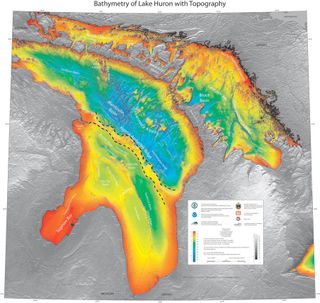
The Featured picture at the top of the page is called, “Shem, Ham and Japheth” by James Tissot 1904
The Heartland Research Group headed by John Lefgren PhD, and Mike and Betty Lafontaine, have been doing research near Nauvoo and Montrose, Iowa for several years now looking for evidence of the City of Zarahemla. Heartland Research has found evidence for ancient fires pits using magnetometry, and with Lidar imaging have found many mounds and other promising information pertaining to several possible locations, that could be termed as a temple site or mound area in Iowa.
We base our plausible evidence of the real City of Zarahemla of the Book of Mormon in many statements of saints and a revelation from Joseph Smith in D&C 125. There are many quotes and evidences below also detailing with plausibility that the Heartland of the United States was the setting for the Book of Mormon events.
Bill, your Relative who knew Joseph Smith-Faithful Question
Let me ask you a question. If you have a great great… grandfather (Let’s call him Bill), who lived during the time of Joseph Smith, and Bill personally knew and loved Joseph as a true prophet of God, wouldn’t that be exciting to explore the relationship of Bill and Joseph? Maybe some of you already have that relative. As you research and find out about the close relationship that Bill has with Joseph and the other Apostles, and Bill’s testimony of these men, wouldn’t you be so pleased to find out all you could know about their relationship? (I know some of your relatives maybe didn’t like Joseph but we are not talking about those relatives).
What if you found out Bill was present with Wilford Woodruff in Nauvoo when he told Bill, as Wilford pointed out a spot on the opposite side of the Mississippi River about a mile and a half above Montrose, IA, and said “there would be a city and a temple built there and the place would be called Zarahemla.“
Would you believe Bill? Of course you would, as you had studied and found out Bill was a good active member of The Church of Jesus Christ of Latter-day Saints and had prayed about it. What if it was Bill’s witness after Joseph had passed away, that he saw the countenance of Brigham Young as “it appeared that Joseph had returned and was speaking to the people?” Bill said, As Brigham Young commences speaking, hundreds in the audience believe “in every possible degree it is Joseph’s voice, and his person, in look, attitude, dress and appearance it is Joseph himself, personified.” You want to and probably would believe Bill after prayer correct? Let’s say you prayed earnestly about that fact, and you received a personal witness that you indeed know that Bill believed Wilford Woodruff and Bill was present at the talk by Brigham Young and Bill knew that Brigham was to be the next Prophet. Is that even possible? Of course it is.
I can hear the non-believers say, “I don’t believe Bill”, or “he was lying”, or “Joseph didn’t mean it was a Book of Mormon city”, or “I still believe Zarahemla was somewhere in Mesoamerica.” What is the difference between you believing Bill and others not believing him? Is it because you are related to Bill and you are biased. Or is it because you have prayed about it and studied it out and you thought it was very important to know, and you believed what Moroni told you and that you could “know the truth of all things?”
Why do many people in the Church today not want to believe Bill, or Edward Phillips, or D&C 125? Why is their heart so hard? Why is it that you believe so strongly in Bill and Joseph and others in the church don’t? It’s probably because you want to believe, and you pray in faith to believe and others may only think of their bias that Zarahemla was in Mexico or some other place. You see, to believe it takes faith, study, and prayer. This is what I believe, that the Zarahemla of the Book of Mormon was indeed across the river near Montrose, Iowa. It is a part of my testimony and I don’t have a relative named Bill, but through faith I really believe this.
Now you know The Church of Jesus Christ of Latter-day Saints has not spoken on whether the Zarahemla of D&C 125 means it was a city in the Book of Mormon, but some of the General Authorities and many members believe personally that eastern Iowa, Missouri and Illinois, are possible places of the ancient Land of Zarahemla. In other words knowing this is not church doctrine but it is true all the same. Is it that important you know the answer? Maybe. To me it is very important as I look for additional evidences of the Book of Mormon not just my witness of the spirit, but as Elder Holland said, “Truth borne by the Holy Spirit comes with, in effect, two manifestations, two witnesses if you will—the force of fact as well as the force of feeling.” In the same talk Elder Holland said, “but not to seek for and not to acknowledge intellectual, documentable support for our belief when it is available is to needlessly limit an otherwise incomparably strong theological position and deny us a unique, persuasive vocabulary in the latter-day arena of religious investigation and sectarian debate.” The Greatness of the Evidence By Elder Jeffrey R. Holland August 16, 2017
Half-Breed Land Iowa
“The Lee County Half-Breed Tract, designated as 120 on the map.
Map of the w:Half-Breed Tract in Iowa, a reservation designated for individuals of mixed American Indian and European descent. This reservation was designated in an 1824 treaty between the Sac and the Fox Indian tribes and the United States government.
Lee County, Iowa and the “Half Breed Tract” historic detail, from an Iowa 1905 census map. [Left] A Half-Breed Tract was located in Lee County, Iowa. An 1824 treaty between the Sauk people, the Fox tribe, and the United States set aside a reservation for mixed-blood people related to the tribes. Lying between the Mississippi, and Des Moines rivers and below an eastward extension of the Sullivan Line (The old Indian boundary surveyed out by John C. Sullivan in 1816—at approximately 40.60° N.), the Tract occupied an area of approximately 119,000 acres (480 km2). Under the original treaty, the half-breed people had the right to occupy the soil, but individuals could not buy or sell the land.[4]
In 1834 Congress repealed the rule. Immediately afterward, claim jumpers claimed much of the land. The government gave away mixed-blood peoples’ claims to the land, effectively ending the provisions of the Half-Breed Tract by 1841.[5][6]
Mormon leader Joseph Smith, Jr. purchased parts of the Half-Breed Tract, probably in 1837, from a land speculation company. Deeds to most of the land were faulty and could not be held. This left the church with only about 1,000 acres (4.0 km2), including a town called Commerce in Illinois. The Mormons moved to this Illinois site from Far West, Missouri, to escape the Missouri Executive Order 44 issued by Missouri Governor Lilburn Boggs.[7]” Wikipedia
Map Showing Accession of Territory from Indians” from the original instructions for the Census of Iowa for the Year 1905, Published: 1905-1906, Des Moines, Iowa, Bernard Murphy, State Printer; Under the authority of chapter 8, acts of the 30th general assembly, page iii
I believe the Book of Mormon Zarahemla is near Montrose, Iowa, just as I believe there is only one Hill Cumorah in upstate New York. Mike and Betty LaFontaine believe the land in Montrose is sacred land of their previous Native American ancestor. Thus, Heartland Research Group not only continues exploring the area for the City of Zarahemla, but also seek land in the area that in history was called Half-Breed land.
Letter below from Betty LaFontaine Nov 15, 2023 to HRG and friends.
“Since we (HRG) have been asked about purchasing the 9.4 acres which literally has been gifted to us for our use. I have pondered and asked in Prayer of what we may do. I have been researching the “Half Breed Tract lands” I came upon this explanation and or article!
I believe HRG may have yet another, “Big piece of history once again!” I will continue this research further.
This land we acquired was given to us for a reason, the Spirits of the Natives who walked the land 9.4 acres and much much more in the area where we believe Zarahemla to be is a Sacred land, where we have a 600 BC replica ship Phoenicia!
A ship like it may have brought the ancestors of these people “from the east” to this area of the Heartland.
Here yet another connection!
This particular piece like I said was gifted to us by a great man. Mike and I connected with this man that day we met and had lunch together. We love the work we are doing and love all of your hard work in this project.
Let us continue working together and always strive to be good stewards.
Thank you, We Love you guys ?Betty aka “Red Ant”& Mike
Read an amazing article below about the Half-Breed Land
Below is a revelation, not a statement, not an idea, not conjecture, a revelation. If the Lord planned the name Zarahemla as just another name and not one in the Book of Mormon, the Lord may have called it in D&C 125 the New Zarahemla, signifying a different location as in the city of the New Jerusalem.
D&C 125:3-4
“Revelation given through Joseph Smith the Prophet, at Nauvoo, Illinois, March 1841, concerning the Saints in the territory of Iowa.” (Heading of D&C 125)
“Let them build up a city unto my name upon the land opposite the city of Nauvoo, and let the name of Zarahemla be named upon it.
And let all those who come from the east, and the west, and the north, and the south, that have desires to dwell therein, take up their inheritance in the same, as well as in the city of Nashville, or in the city of Nauvoo, and in all the stakes which I have appointed, saith the Lord.” D&C 125:3-4
Half-Breed Land in Eastern Iowa
Zarahemla According to Neville
“When Joseph Smith purchased the land for Nauvoo, he actually purchased far more land across the river in Iowa, as this map (left) from the Joseph Smith papers shows. If this area–designated in the 1800s as the “half-breed tract”–was the location of the ancient city of Zarahemla, the location could explain why the people were wealthy and why they had problems with pride, etc. (Of course, every human society has problems of pride, envy, etc.
However, Alma focuses particularly on this when he’s in the city of Zarahemla.) People ask if there is archaeological evidence for a city in this area. There is archaeological evidence of settlements along the river, north and south of this site, that date to Book of Mormon times, but nothing that can be identified as the city of Zarahemla, per se.The city of Zarahemla and its inhabitants were burned (3 Nephi 8:8). Later, the city was built again (4 Nephi 1:8) but the city is not mentioned afterward. It could have been destroyed again, of course. The river could have flooded the city, deposited sand over it, or any number of other possibilities.”
Neville continues, “For now, I note that it’s a location that seems to fit the text nicely. Another consideration is that D&C 125 hints at this site as the location of ancient Zarahemla. Another interesting aspect of Alma 5 is the mention of sheep, shepherds, and wolves. There must have been sheep in the city of Zarahemla. We’ve already stipulated that, because the Nephites “strictly” observed the Law of Moses, but Alma emphasizes the point is repeated here.
v. 37: ye that have professed to have known the ways of righteousness nevertheless have gone astray, as sheep having no shepherd, v. 38: ye are not the sheep of the good shepherd. v. 39: And now if ye are not the sheep of the good shepherd, of what fold are ye? v. 59: For what shepherd is there among you having many sheep doth not watch over them, that the wolves enter not and devour his flock? v. 60: if you will hearken unto his voice he will bring you into his fold, and ye are his sheep; and he commandeth you that ye suffer no ravenous wolf to enter among you, that ye may not be destroyed.
These metaphors would be ineffective if the people living in Zarahemla did not have sheep. In verse 59, Alma abandons the metaphorical use and speaks directly to actual shepherds. Some species of sheep that are indigenous to North America have survived to the present day, including the Bighorn and Dall. Anciently, their populations were in the millions. Although confined mainly to the western US, Canada, and northern Mexico. Wolves are indigenous to North America and were ubiquitous throughout North America before the Europeans arrived. They were part of Native American Indian legends and mythology. Their devastating impact on domesticated animals led to federal government programs to eradicate wolves from grazing areas. See this article.
Because Alma discussed wolves in this sense, I think it’s possible that whatever domesticated sheep the Nephites had–whether related to the other indigenous North American species or species Lehi brought with him–were killed off after the destruction of the Nephite society. The situation could be similar to that of horses, where recent research has shown the traditional explanation for horses–that the Spanish brought them all–is not consistent with the actual records.” Source: 2016 Gospel Doctrine Resource by Jonathan Neville
The most exciting news in many years, is the 600 BC replica ‘Phoenicia’ is being re-assembled on the banks of the Mississippi River near Montrose, Iowa. Heartland Research purchased the original Philip Beale, ‘Phoenicia’ which sailed over 30,000 nautical miles from the Old world to America in 2009 and another voyage in 2020.
Since Philip Beale was unable to sell the ship whole, he wanted it preserved, so he had it cut up and loaded on two large containers in Florida and sent one back to England, and just a few months later, before Philip sent the 2nd container to England, Heartland Purchased purchased the entire contents of those two large containers from Philip. Quickly they set up the current warehouse in Montrose, Iowa and began re-build that 600 BC replica.
About a year later the 2nd container that was sent to England was sent to Heartland Research in Iowa. The first container has already been restored and the second container of the ship is just beginning to be rebuilt as of Nov 2023. Come join us as volunteers to help restore this wonderful ship. Donate Here
Across the river from Nauvoo, Illinois is where the ‘Phoenicia’ is being re-built today. The Heartland Research Group also owns significant land in Montrose Iowa as you can see below with the red arrow. More to Come
Mike and Betty LaFontaine awarding Captain Philip Beale with a hand made drum constructed by Mike and Painted by Betty, after the Captains last voyage on the ‘Phoenicia’ in 2020.
“For my people, the Dine’ oral tradition says that we came to this land from the East direction, at first light as the sun rises we give thanks for all we have in the east direction. Our homes face the east direction, we believe to have come here from the east by The Holy People.
When I first learned of the Phoenicia and its beginning and how it sailed here to North America she fascinated me, especially learning of replication of a 600 BC ship. The timeline of The Book of Mormon and the stories of my people coming to this sacred land America. I believe The Phoenicia is a special ship, I believe she has a Spirit of discovery and a mission. In 2019 she came to the shore of Ft Lauderdale, I boarded her and instantly felt her Spirit, I thought of how it was very possible a ship like her came to North America carrying my Ancestors of The Book of Mormon! She had a rough couple of years and even made it through a bad Tropical storm, and had some damage. Mike and I drove to Ft Lauderdale in December 2021 to see her. As I walked around and touched her worn wood I instantly felt a strong presence, she lives! She has a story to tell, others need to see her, touch her and hear her story.
Her figurehead a horse head on the bow of the ship was damaged but still made her beautiful presence known. She lives and must live on were my thoughts, when we visited her that day in the shipyard in Ft Lauderdale, Florida. She will need love and care to bring her back to where she will continue her story. Philip Beale sailed her to America to tell a story without really knowing our story and the time era of 600 BC and what that means to us. May we continue her story here in America” Red Ant
600 BC Phoenicia Expedition Ship with Horse-Head Prows
“The Heartland Research Group is a grassroots, boots-on-the-ground organization that believes that the historical narrative of the Book of Mormon took place in the Heartland of North America. The HRG is active in archaeological research and in the acquisition, restoration and display of ancient American artifacts. The HRG is currently preparing an ancient ship replica called the “Phoenicia” for display. The ships construction design is patterned after a shipwreck dating to 600 BC. The Phoenicia ship made modern voyages, first around Africa and then also from the Middle East to Florida in 2019 – proving that voyages around Africa or from Sidon to North America were feasible anciently.” Heartland Research Group
We invite you to support our efforts financially so we can complete these worthy goals! See their website here: phoenicia.rocks
“I was one of the forty-six preachers that Brother Woodruff speaks of in his “Leaves of My Journal.” The forty-six were baptized except one, that was Phillip Holdt. Brother Woodruff baptized me at Hill Farm where he baptized six hundred. He told me not long ago, that less had apostatized out of that lot than any other of the same number in the church.” Edward Phillips
“I was standing by the temple talking to Brother Woodruff and he pointed out a spot to me on the opposit[e] side of the river about a mile and a half above Montrose, and said there would be a city and a temple built there and the place would be called Zarahemla.” Edward Phillips. More from his autobiography below.
Sheep in ancient North America, Validate a Zarahemla site is possible in Iowa
No Sheep, Goats, Bullocks, Rams, Doves, Wheat, or Barley in Mesoamerica during the time of the Nephites. They couldn’t practice the Law of Moses unless they lived in North America.
Hugh Nibley said, “If my insistent harping on central Asia annoys you, let me remind you again that the book of Ether gives us no choice. It never lets us forget that what the Jaredite kings did was a conscious imitation and unbroken continuation of the ways of “the ancients,” of “them of old” on the other side of the water. This, incidentally, is another indication that we are not to regard the Jaredite migration as taking place immediately after the flood, for the fall of the tower saw the destruction of an ancient and established order. The Jaredites left their homeland driving great herds of cattle before them in the immemorial Asiatic manner, and even if they had never been nomads before, they certainly lived the life of the steppes during those many years before they set sail (Ether 3:3), and when they embarked, they crammed all they could of their beasts into their small boats, “flocks and herds” and other beasts (Ether 6:4), and upon reaching the New World continued to cultivate “all manner of cattle, of oxen, and cows, and of sheep” just as their ancestors had in the old country (Ether 9:18). Now you know, how the Nephites could have had sheep in North America brought to this land by the Jaredites. The Nephites could continue practicing the Law of Moses in the land of The New Jerusalem.” (2 Nephi 25:24 Mosiah 2:3) Hugh Nibley from Lehi in the Desert; The Great Open Spaces
3 Essential Truths about Nephite Observance of the Law of Moses By Amberli Nelson
“First Truth: Not only did the Nephites “strictly” keep the law of Moses (as indicated in 37 verses in the Book of Mormon (see Alma 30:3, Mosiah 13:29-30, Jarom 1:5), but they did so with delight as it was seen by them as both a collection of types of Christ and a means of coming unto Him. Occasionally even the Lamanites were known to “strictly” observe the law (Hel. 13:1). Second: In “observing to keep the commandments of the Lord in all things, according to the Law of Moses” (2 Ne. 5:10), the Nephites would have necessarily observed all the feasts or “holy days” given to Moses by Jehovah. These are recorded in Exodus and Leviticus and are known as “holy convocations” or “rehearsals” and they typify the life and mission of Jesus Christ in profoundly beautiful ways. Third: It was absolutely essential for these Jewish Lehites to be brought to a land that would provide an abundance of all the plants and animals required to keep the Law of Moses, with its concomitant Holy Days or festivals. Based on the latest archeological findings, it can now be irrefutably shown that the Heartland of North America is the only location in the Western Hemisphere where all ten of the essential items were found anciently including; lambs, oxen, goats, doves, barley, wheat, grapes, and altars made of stacked, unhewn stones. These aforementioned items have not been found in the archaeological record of the pre-Columbian peoples of Mesoamerica.” Amberli Nelson MBA Hebrew/Jewish Symbology Expert
Mesoamerican Theories of Zarahemla
Mesoamerica “Book of Mormon Lands” tour promoter Dr. John L. Lund, released a historically incorrect and misleading article in a newsletter and paid advertisement eblast (http://ldsliving.com/e/2012/db02_29_2012.html ) published Feb. 29, 2012. Lund’s piece, Joseph Smith Identified Zarahemla as Being in Guatemala, proclaims that an article appearing in the Times and Seasons on October 1, 1842 in Nauvoo, Illinois was emphatically “written by Joseph Smith.” Read more here:
“In March 1841, a revelation known as Section 125, gave a name and location of a city. While the Lord had previously named Adam – ondi – Ahman and the New Jerusalem as being in the state of Missouri, perhaps this revelation has named yet another city in ancient America. The Lord said to Joseph: “Let them build up a city unto my name upon the land opposite the city of Nauvoo, and let the name of Zarahemla be named upon it”. We first learned of the name Zarahemla in the Book of Mormon. However, very early in Church History documents, the name Zarahemla was disassociated with the revelation. Writers of the history of this period began to attribute the naming of Zarahemla to other persons who were contemporary with the Prophet Joseph or even to the Prophet himself rather than to the Lord and they made it appear that the word Zarahemla was used pre-1841 when the Lord actually gave the revelation to Joseph. We have learned from historic and current Church History publications the following clarifications about the naming of Zarahemla.”
1. Joseph Smith DID NOT use the word Zarahemla in 1839. (Joseph Smith Papers, Journals, vol. 1, p. 336)
Thus, we have learned, that any use of the name Zarahemla prior to March 1841 is not correct and was inserted in historical accounts after 1841. Surely, further investigation is warranted as to why the Lord used such a name in the revelation.
Again do you remember Bill? Read study and pray and you will know the truth.
Autobiography of Edward Phillips (1813-1896)
Edward Phillips (1813-1896)
This sketch was written by Sylvia Phillips, then a fourteen year old granddaughter of Edward Phillips, as he dictated it to her in the year 1889. Italicized portions are apparently Phillips’ corrections/additions. Typescript in hands of family.
Edward Phillips, son of William and Mary Phillips, born in Oxenhall Parrish [Parish], Glouscestershire [Gloucestershire], England, April 2, 1813. He was christened April 3, 1813.
When [I was] six months old my father moved to Leigh, Worcestershire, Upper Sandlin, and there rented a farm of one hundred acres for three years. From there moved to Black House, Creadley, Herefordshire, and rented a farm of seventy-five acres for four years then returning to Upper Sandlin and rented that farm again for three years. From there he moved to Creadley and rented another farm. While working there he was taken sick and died at Longley Groen [Green], Suckley, Worcestershire, November 29, 1825, at the age of sixty-two. He married Mary Ann Pressdee in Worcestershire, being about ten years her senior. She was the mother of eleven children. From that time I employed myself farming and learning blacksmithing. I joined the society called the “United Brethern” whose president and leader was Thomas Kington. Everything worked well with us until within a year of the time Brother Wilford Woodruff arrived in our neighborhood. It seemed to me that we had come to a precipice and could not go any farther until Brother Wilford Woodruff placed a bridge over that precipice and we went on with glad hearts rejoicing. I went to hear him preach at Ridgeway Crossing on or about March 15, 1840. A day or two following I went to Hill’s Farm to hear him speak. When I started my good old mother said, “Edward, I should think you will not come back without being baptized.” I obeyed this council. I was the only male member of my father’s family who received the gospel. My sister Susan followed suite.I was one of the forty-six preachers that Brother Woodruff speaks of in his “Leaves of My Journal.” The forty-six were baptized except one, that was Phillip Holdt.Brother Woodruff baptized me at Hill Farm where he baptized six hundred. He told me not long ago, that less had apostatized out of that lot than any other of the same number in the church.
I[n] a few days after I was baptized, I was ordained a priest and put in charge of two branches, Ashfield and Crocutt, with George Brooks as my addistant [assistant]. This was near Sherrage, Leigh, Worcestershire. In the fall of that year, I was ordained an elder at the conference, under the hands of Brother Woodruff, and was sent to preach the gospel with Elder John Gaily to the Forest of Deane and Glouscestershire [Gloucestershire]. There I had the privilege of visiting my father’s family. We traveled and preached nearly a year and many were brout [brought] into the church under our administration. My mother embraced the gospel about this time under the hands of Brother Woodruff at a place called Moorings Cross, Maythen Parrish [Parish], Herfordshire [Herefordshire], 1841.
I left my home to emigrate to America. I went to Gloucester and in company with one hundred saints went to Bristol and boarded the “Carolina” for America. We set sail for Quebec, August 8th, 1841. We had a tedious voyage of eight weeks and three days, but landed safely. Thomas Richardson was our President. We set sail for Quebec, from Quebec we went to Montreal by steamer, and from Montreal through the lock to Kinston and then we sailed along Lake Ontario to Lewiston. We had a fine view of the city of Toronto. From Lewiston we boarded the train (which was drawn by mules) from Niagara Falls.
The next day we boarded the train for Buffalo and arrived at that place after dark. We put up at the Farmer’s Exchange for a week because of sickness. We then boarded the Chespeake [Chesapeake] for where now stands the great city of Chicago. We hired a man there to take us to Nauvoo with a team which contract he filled. We arrives [arrived] at Nauvoo in the latter part of October, 1841, on Saturday. On Sunday, I was anxious to see the Prophet. I attended meeting there and saw him for the first time. I did not need an introduction for I knew him the moment I saw him. He preached the gospel of salvation to us that morning which caused my heart to rejoice. Next day, Monday, I went to work in quarrying rock for the temple, (that was my first days work in America) near the upper Stone House on the Mississippi River. I continued to work on the temple and the Nauvoo House, most of the winter. I boarded with an old friend by the name of Jenkins, a shoemaker. There I fell in love with my present wife, who had preceeded [preceded] me a few weeks to America. On the 2nd of August of the next year, being one year from the time I left home, we were married by Heber C. Kimball near Camp Creek in Hancock County. She bore me fifteen children, nine of whom are still living, three of whom were born in Illinois, and the two first, a boy and a girl, died there. We were driven from their graves at the point of a bayonet, which was very grievous to us. I had some land and made me a nice home near where they were buried. I was working in the field near the house when the news came that the Prophet and his brother were killed at Carthage Jail.This made me shed bitter tears for I felt they were two good friends and I knew Joseph was a true prophet of God. He had said that he would go and die for the people. I was under arms in Nauvoo when he gave himself up to die for the people. He discharged us and told us to go home and he would go and die for us. We would gladly have gone and stood between him and death, but he would not let us. I was ready and willing to go. We were quartered at the tithing yard and slept in the Nauvoo Exposition Building. We went one day for foliage for our horses, and met Gen. Joseph Smith with his staff in the street. He cheered us and said, “Well done, boys.” We had been out inspecting the ground where we expected to meet our enemies. Word came to our Captain one night that the pickett guard was driven in and we were ordered out in the dead of night to go and meet the mob. I was determined to go and assist, so I borrowed a horse from a boy who did not like to go himself. Nevertheless this proved to be a false alarm and I went back disappointed. The prophet said he would go and die for us. He did and was butchered in cold blood. I was not there when he was killed, but I went later and took my wife with me to show her the well, curb, and the window where he jumped out when he was shot.
I have a Patriarchal blessing hanging in a frame in my room, which was pronounced upon my head by the prophet and patriarch, Hyrum Smith, in the fall of 1844[1843?], which is worth more than gold to me – Gold is no name for it. The predictions are being literally fulfilled every day. I know if I prove faithful it will all come to pass. I knew then and also know now that Joseph was a true prophet of God, and that the mantle of Joseph fell on Brigham Young who was his legal successor.
Brigham Young appeared to be Joseph Smith
I was present at the meeting when this took place (Read about that meeting below with the *) and heard with my own ears and saw with my own eyes. We all thought Joseph had come back to us although we knew he was in his grave. I was standing by the temple talking to Brother Woodruff and he pointed out a spot to me on the opposit[e] side of the river about a mile and a half above Montrose, and said there would be a city and a temple built there and the place would be called Zarahemla. I was at Nauvoo when the temple was finished and dedicated. I went up into the tower and wrote my name there. As I understand, the wicked have burned that temple to the ground and it is all destroyed like the Jerusalem temple. But I expect to see that temple re-erected and the one built on the opposite side of the river to match. Source Here and Here
2018 Scanned Sites in Montrose, Iowa Area – More than 220 Acres.
*Is there evidence for the transfiguration of Brigham Young?
James F. Stoddard IV and Aaron R. Halsell
“The day is Thursday, August 8, 1844. Six weeks to the day have passed since the martyrdom of the Prophet Joseph Smith on June 27, 1844. The majority of the Twelve Apostles have recently returned from missions1 and some are still stunned and disheartened by the loss of their Prophet. Upon their arrival they find “Sidney Rigdon busy among the Saints, trying to establish his claim to the presidency of the Church.”2 According to a report issued by the Times and Seasons:
[A] special meeting of the Church of Jesus Christ of Latter Day Saints, convened at the stand in the city of Nauvoo, President Brigham Young, called the audience to order, and arranged the several quorums according to their standing, and the rules of the church. The meeting had been previously called, as stated, to choose a guardian, or trustee for said church.3
Sidney Rigdon
Opinions differ,4 either Sidney Rigdon, former First Counselor in the First Presidency,5 or the Quorum of the Twelve with Brigham Young at their head. The audience is divided as the polished and eloquent Sidney Rigdon commences his message. The old gentleman is charismatic and the arguments are compelling to some of the flock.6
Brigham Young, a man fiercely loyal to the Prophet Joseph Smith, current President of the Twelve and later to become known as the “Lion of the Lord”, takes the stand. Suddenly, the people arise “en-masse to their feet astonished.”7 One eyewitness later remembered, “it appeared that Joseph had returned and was speaking to the people.”8 As Brigham Young commences speaking, hundreds in the audience believe “in every possible degree it [is] Joseph’s voice, and his person, in look, attitude, dress and appearance [it is] Joseph himself, personified”.9 William Hyde later remembers:
[Brigham Young] then called upon the saints to know if they would receive the Twelve and let them stand in their place as the First Presidency of the Church in the absense of Joseph. The vote was unanimous in the affirmative. On this day it was plainly manifest that the mantle of Joseph had rested upon President Young.10James F. Stoddard IV and Aaron R. Halsell
Here are other evidences to pray about as you decide where the Book of Mormon Events happened. I believe the events happened right here in the USA.
Zelph of Zarahemla
Zelph a Man of God by Ken Corbett
“Before breaking camp the morning of June 3, the Prophet Joseph Smith, accompanied by several of the men, went to observe a large mound which was located approximately one mile below the Phillip’s Ferry crossing. It was of unusual size and lay within the proximity of a number of smaller mounds. Heber C. Kimball and Wilford Woodruff recorded in their journals that the mound was one hundred feet high and three hundred feet above the level of the river. The height of the mound enabled the men to look over the tops of the trees and view the surrounding area. At the crest of the mound, human bones were strewn around the base of what appeared to be a three-tiered altar. Heber C. Kimball wrote that the arrangement of the stones resembled the ancient order or altars..
Zelph in vision by Ken Corbett
The men were curious about the area, the mounds, and particularly about the scattered bones. As they began to descend the mound, Joseph Smith suddenly stopped, pointed to the ground, and said, “Brethren, dig in there.” When the earth had been removed to the depth of one or two feet, the men found the skeleton of a large man. Journal accounts state that, “the bones were all there and in a good state of preservation.” Buried in the backbone, between the ribs of the man was a stone arrowhead which Milton Holmes took. Examining the skeleton more closely, it was noted that one of the thigh bones had been previously broken and knitted together. The thigh bones and the arrowhead were taken back to camp and placed in Wilford Woodruff’s wagon. The skeleton was unusually large . It was estimated to be over eight feet tall.” James L. Bradley, Zion’s Camp 1834: Prelude to the Civil War (Salt Lake City: Publishers Press, 1990), p. 207.
Letter to Emma by Ken Corbett
“The whole of our journey, in the midst of so large a company of social honest and sincere men, wandering over the plains of the Nephites, recounting occasionally the history of the Book of Mormon, roving over the mounds of that once beloved people of the Lord, picking up their skulls & their bones, as a proof of its divine authenticity… During our travels we visited several of the mounds which had been thrown up by the ancient inhabitants of this country-Nephites, Lamanites, etc.” Joseph Smith Papers Letter to Emma Smith, 4 June 1834 Page 56
“On the top of the mound were stones which presented the appearance of three altars having been erected one above the other, according to the ancient order; and the remains of bones were strewn over the surface of the ground. The brethren procured a shovel and a hoe, and removing the earth to the depth of about one foot, discovered the skeleton of a man, almost entire, and between his ribs the stone point of a Lamanitish arrow, which evidently produced his death. Elder Burr Riggs retained the arrow. The contemplation of the scenery around us produced peculiar sensations in our bosoms; and subsequently the visions of the past being opened to my understanding by the Spirit of the Almighty, I discovered that the person whose skeleton was before us was a white Lamanite, a large, thick-set man, and a man of God. His name was Zelph. He was a warrior and chieftain under the great prophet Onandagus, who was known from the Hill Cumorah, or eastern sea to the Rocky mountains. The curse was taken from Zelph, or, at least, in part-one of his thigh bones was broken by a stone flung from a sling, while in battle, years before his death. He was killed in battle by the arrow found among his ribs, during the last great struggle of the Lamanites and Nephites.” Joseph Smith Papers History, 1838–1856, volume A-1 [23 December 1805–30 August 1834], Page 483
Book of Mormon City Manti
“The camp passed through Huntsville, in Randolph County, which has been appointed as one of the stakes of Zion, and is the ancient site of the City of Manti…” Millennial Star, vol. 16, p. 296 “September 25, 1838. We passed through Huntsville, Co, seat of Randolph Co, Pop. 450, and three miles further we bought 32 bu. of corn off one of the brethren who resides in this place. There are several of the brethren round about here and this is the ancient site of the City of Manti, which is spoken of in the Book of Mormon and this is appointed one of the Stakes of Zion, and it is in Randolph County, Missouri, three miles west of the county seat.” Journal of Samuel D. Tyler, filed in Church Historian’s Office. Joseph Fielding Smith, Doctrines of Salvation 3: 239 History of Joseph Smith page 296
“We came through Huntsville, the county seat of Randolph county . . . A mile and a half west of Huntsville we crossed the east branch of Chariton (River), and one and a half miles west of the river we found Ira Ames and some other brethren near the place where the city of Manti is to be built, and encamped for the night on Dark creek, six miles from Huntsville. Traveled this day seventeen miles. Distance from Kirtland, seven hundred and fifty-five miles.” Joseph Smith Documentary History of the Church, 3:10:144:1
Joseph Smith accompanied several Church members in exploring the area around Lyman Wight’s northern Missouri home. In his journal, A. Jenson wrote: “The [Kirtland] camp passed through Huntsville, in Randolph County, which has been appointed as one of the stakes of Zion, and is the ancient site of the City of Manti.” A. Jenson, Historical Record, Book 1, p. 601Millennial Star 16:296
Indians that now Inhabit this Country
“In this important and interesting book the history of ancient America is unfolded, from its first settlement by a colony that came from the Tower of Babel at the confusion of languages to the beginning of the fifth century of the Christian era. We are informed by these records that America in ancient times has been inhabited by two distinct races of people. The first were called Jaredites and came directly from the Tower of Babel. The second race came directly from the city of Jerusalem about six hundred years before Christ. They were principally Israelites of the descendants of Joseph. The Jaredites were destroyed about the time that the Israelites came from Jerusalem, who succeeded them in the inheritance of the country. The principal nation of the second race fell in battle towards the close of the fourth century. The remnant are the Indians that now inhabit this country…” Wentworth Letter reprinted in Ensign July 2002
Joseph said that “the Book of Mormon is a record of the forefathers of our western tribes of Indians . . . By it we learn that our western tribes of Indians are descendants from that Joseph that was sold into Egypt, and that the land of America is a promised land unto them.” Joseph Smith’s Letter to The American Revivalist Feb 2, 1833 (Quoted in Dean C. Jessee, The Personal Writings of Joseph Smith (Salt Lake City: Deseret Book Co., 1984), p. 273)
“He told me of a sacred record which was written on plates of gold, I saw in the vision the place where they were deposited, he said the Indians were the literal descendants of Abraham…” Joseph Smith Journal, November 9, 1835; The Joseph Smith Papers: Journals Volume 1:1832-1839 (Salt Lake City: Church Historian’s Press, 2008), 88-89.
“Wherefore, it is an abridgment of the record of the people of Nephi, and also of the Lamanites—Written to the Lamanites, who are a remnant of the house of Israel;” BofM Title Page
“You shall go unto the Lamanites and preach my gospel unto them;… and no man knoweth where the city Zion shall be built, but it shall be given hereafter. Behold, I say unto you that it shall be on the borders by the Lamanites. D&C 28:8-9
The Lamanites that were first taught the gospel, as Parley Pratt says were the Native American Indians of the United States. There were two tribes of the Iroquois, Wyandot, and Cattaraugus, and two from the Algonquian, the Delaware or Leni Lape, and the Shawnee.
“Once the red men were many; they occupied the country from sea to sea — from the rising to the setting sun; the whole land . . . Thousands of moons ago, when the red men’s forefathers dwelt in peace and possessed this whole land the Great Spirit talked with them, and revealed His law and His will and much knowledge to their wise men and prophets. This they wrote in a Book . . . written on plates of gold and handed down from father to son for many ages and generations. It was then that the people prospered and were strong and mighty; they cultivated the earth, built buildings and cities and abounded in all good things, as the pale faces now do . . . This Book, which contained these things was hid in the earth by Moroni, in a hill called by him Cumorah, which hill is now in the state of New York, near the village of Palmyra, in Ontario county . . . Thus ended our first Indian mission, in which we had preached the Gospel in its fullness and distributed the record of their forefathers among three viz.: the Cattaraugus Indians, near Buffalo, N.Y., the Wyandots, of Ohio and the Delawares, west of Missouri.”Autobiography of Parley P. Pratt, pp. 56-6; Documentary History of the Church Vol 1: Footnotes 183:2-18
“Thus ended our first Indian mission, in which we had preached the Gospel in its fullness and distributed the record of their forefathers among three tribes… west of Missouri.” Autobiography of Parley P. Pratt, p 56-61
“Now, to my story again. Besides the Delawares, Shawnees, Kickapoos, Wyandots, Pottowattomies, Senecas, Osages, Choctaws, Cherokees, Kaskaskias, Kansas, &c. &c. which our nation and the missionaries are domesticating as they are gathered, upon the southern limits of the land of Israel, the Pawnees, the Sioux, the Rickarees, the Mandans, the Nespersees, the Blackfeet, the Sacs, the Foxes, and many other tribes, rove and hunt from prairie to prairie, from river to river, from hill to hill, and from mountain to mountain, and live, and are blessed before the face of heaven daily as well as their contemporary whites; and, perhaps I may add, are as justifiable before God, as any people on the globe, called heathens. No church bell from its elevated steeple, rings “Go to meeting; it is Sunday,” while a dozen lesser ones, for stages and Steam boats, peal a ding dong “for parties of pleasure, as a holiday,” among these rude sons of the west.—And it is a difficult matter to make one soul of them believe the Great Spirit ever said, “Remember the Sabbath day to keep it holy,” while they know, that the majority of the white nation, use it for a holiday. No politicians boast of freedom and equal rights, while thousands are imprisoned for debt, or are in bondage: No; when the tribes are at peace, the Indian is free; his land is free; his game is free; his time is free, and all is free.” LETTER NO. II. From WW Phelps to Oliver Cowdery Liberty, Mo. Nov. 6, 1834
“I accordingly went down, and met Keokuk, Kis-Ku-Kosh, Appenoose, and about one hundred chiefs and braves of those tribes (Sac, Fox), with their families.” … and instructed them in many things which the Lord had revealed unto me concerning their fathers, and the promises that were made concerning them in the Book of Mormon.” Joseph Smith Papers; History, 1838–1856, volume C-1 Addenda page 10-11
Joseph Knew where the Book of Mormon took Place
“From this time forth, Joseph continued to receive instructions from the Lord, and we continued to get the children together every evening, for the purpose of listening while he gave us a relation of the same. I presume our family presented an aspect as singular as any that ever lived upon the face of the earth–all seated in a circle, father, mother, sons, and daughters, and giving the most profound attention to a boy, eighteen years of age, who had never read the Bible through in his life: he seemed much less inclined to the perusal of books than any of the rest of our children, but far more given to meditation and deep study… During our evening conversations, Joseph would occasionally give us some of the most amusing recitals that could be imagined. He would describe the ancient inhabitants of this continent, their dress, mode of traveling, and the animals upon which they rode, their cities, their buildings, with every particular; their mode of warfare; and also their religious worship. This he would do with as much ease, seemingly, as if he had spent his whole life with them.” Lucy Mack Smith, History, 1844–1845 Book 4 Joseph Smith Papers
The United States is the Land of the Book of Mormon
“The United States is the promised land foretold in the Book of Mormon—a place where divine guidance directed inspired men to create the conditions necessary for the Restoration of the gospel of Jesus Christ.” Elder L. Tom promised Ensign Dec. 2012
“The Lord gave a divine promise to the ancient inhabitants of this favored country (the United States): ‘Behold, this is a choice land, and whatsoever nation shall possess it shall be free from bondage, and from captivity, and from all other nations under heaven, if they will but serve the God of the land, who is Jesus Christ” (Ether 2:12).
“Our Heavenly Father inspired the leaders of…the United States of America, that they might together, under His direction, having been raised up by God for the purpose, establish the Constitution of this country and…Bill of Rights, that by the year of our Lord 1805 [there would be] a climate where our Heavenly Father could send into this period of mortality a choice spirit who would be known as Joseph Smith, Jr.” Teachings of Thomas S. Monson by Thomas S. Monson2011 (Ordained an Apostle, 1963; ordained President of the Church, 2008)
President Monson believes the United States is the Promised Land of the Book of Mormon. Why do Mesoamericanists believe the entire continent of the Americas is the Promised land? You mean Greenland, Guatemala, and the Northwest Territories are the Promised Lands? I love all of God’s children in the entire world and God loves us all the same, but seriously? If a person from Greenland comes to the United States legally as a citizen that person can also live in the Promised Land, correct? I’m sure Greenland has much beauty on its own, but it is not the Promised Land, is it? I am not belittling other lands. I’m just making a factual statement. Why is the United States and Israel the two Promised Lands? Because Christ said so. See 3 Nephi 20:22,29 Rian Nelson
Gadianton Robbers
“Upon one occasion President Brigham Young was in the Tabernacle at St. George and was speaking on the spirit world. He stated that it was not far from us and if the veil could be taken from our eyes there wouldn’t be either a man, woman or child who would dare go out of “this tabernacle as the spirits of the Gadianton robbers were so thick out there. This is where they lived in these mountains,” said he.” Crowther, Duane S., 1967, Life Everlasting, Bookcraft, SLC, UT, p. 165, as quoted from N. B. Lundwall, Temples of the Most High, p. 89.
“Of course, the significance of this statement makes sense only in light of the land of Zarahemla being in the United States. The Nephites wouldn’t have gone all the way from Mexico into the United States to hunt the Gadianton Robbers, nor would the Gadiantons have gone into the United States to hide from Nephites in Mexico. It is clear that since the Gadianton Robbers were hiding out in Utah in the St. George region, the Land of Zarahemla must have been in the United States as well. The “mountains” mentioned in the following scriptures, therefore, are the Rocky Mountains of the United States.” Josephsmithacademy.org
Joseph Smith’s Historically Verifiable Written Statements
“Nearly all those familiar with the early statements by the Prophet touching on potential Book of Mormon lands know that he clearly indicated them to be in North America. This is evident in the historically verified accounts wherein he declared revelation such as in the Wentworth Letter, the American Revivalist Account, the Zelph Accounts and Joseph’s handwritten letter to Emma while on Zion’s camp. In addition, the prophet revealed a Nephite altar at Adam-ondi-Ahman, mentioned the land of Manti was near Huntsville, Missouri, and revealed that this land was “the borders of the Lamanites” (see D&C 54:8). Furthermore he received revelation from the Lord for the location of Zarahemla (see D&C 125:3) and New Jerusalem (see D&C 84:1-6) which Christ Himself declared to be on Book of Mormon lands (3 Nephi 20:22), both of which are absolutely located in North America. These accounts and their indications are not speculation based, but historically documented.” By Rod Meldrum
There are so many connections with the Ancient Jewish people and the Tribe of Judah here in the United States of America. We know Hebrew roots are all over the United States in the writings of amazing historians. Many connect the Hebrews in the USA from 1000 BC to 400 AD and many say the Native Americans speak of a earlier time where white people were a great culture before them.
“There has been a lot of talk from intellectuals about various hoaxes purported to be associated with ancient Hebrew stones and script found in North America. It makes sense that when Lehi landed in North America he and his culture would have left behind evidence of his Jewish and Israelite heritage. Since nothing has been found in South and Central America, the intellectuals want to condemn anything that may have been found in North America. Of the 8-10 evidences found in North America related to Hebrew, the scholars refute ALL OF THEM as hoaxes!. That seems way to easy to just out of hand condemn any evidence. That’s what people do when they can’t explain things. Today’s science is not engaged in finding new truths, but in finding new pet theories.
Since no new “Scientific Law” has been discovered and proven in over 100 years, the scientists are now propping up their new “theories” as if they are true. Take for example the theory of evolution. Last time I heard it is still a theory and has never been proven to be a law. What about the theory of magma in the center of the earth? It has been shown in Dean Sessions book that it is more likely that water is at the center of the earth? I’m not a scientist but just an ordinary man who likes to have science and history just “make sense”. What about the intellectuals that say Noah’s flood was not universal or was a myth? What about those who say Adam was not the first man created on this earth? I would rather ask the simple question of, “does it make common sense” rather than listen to many intellectuals who claim to know the unknown.
I offer this information below as wonderful information to take to heart. Learn and listen, search and pray and things will make sense to you. By all means I don’t want you to believe me as I like you am only one who loves the Lord and tries daily to learn His truths that He is sharing with us. Stay close to the Church of Jesus Christ of Latter-day Saints and follow the Prophet and Apostles in all you do. I have a witness that the Book of Mormon is the word of God and I also know as Moroni promised that I. “may know the truth of all things.” Rian Nelson FIRM Foundation
The following is from Alexander’s Messenger, page 16. Published in 1883, in Philadelphia, Pennsylvania. “A government officer stationed at Lake Superior, at an early day, before any white settlers had invaded that part of the country, after becoming acquainted with a number of the Indian tribes, found one tribe in possession of a copper tube, tightly soldered; and when asked what it contained they said they were not able to tell, but they had received it from their ancestors a long time ago. The officer finally prevailed upon them to let him open the article, and when he did so he found it filled with parchment, with inscriptions that he could not read, but he sending the parchment to Washington City where it was examined by competent Hebrew scholars, it was declared to be part of the five books of Moses.”
Here we have another link in the chain, proving the Hebrew were here many years before the white many came to this continent, and that the present North American Indians are their descendants.” Ten Tribes of Israel or the True History of the North American Indians showing that they are descendants of the Ten Tribes of Israel. By Timothy R. Jenkins, Springfield, Ohio 1883https://chroniclingamerica.loc.gov/lccn/sn86072017/
An Ancient Jewish Phylactery found in Massachusetts
Phylacteries and Borders of their Garments (Matt. 23)
In reprimanding the Pharisees, the Savior said: “But all their works they do for to be seen of men: they make broad their phylacteries, and enlarge the borders of their garments” (Matthew 23:5). What are phylacteries? What are the borders of their garments?
Phylacteries
The Hebrew word for phylactery is tefillin. In the following command, note that the Lord states that Israel is to keep the law before their eyes and heart. As a sign they are to bind the law on their hand and between their eyes.
Hear, O Israel: The LORD our God is one LORD: And thou shalt love the LORD thy God with all thine heart, and with all thy soul, and with all thy might. And these words, which I command thee this day, shall be in thine heart: And thou shalt teach them diligently unto thy children, and shalt talk of them when thou sittest in thine house, and when thou walkest by the way, and when thou liest down, and when thou risest up. And thou shalt bind them for a sign upon thine hand, and they shall be as frontlets between thine eyes. And thou shalt write them upon the posts of thy house, and on thy gates. (Deuteronomy 6:4-9; emphasis added)
A tefillin is a literal representation of the Lord’s command to bind the law on the hand and between the eyes. In his excellent book, To Be a Jew, Rabbi Hayim Halevy Donin describes what tefillin are:
The tefillin (translated phylacteries) consist of two small black boxes, containing small scrolls of parchment upon which are written four Biblical passages [Exodus 13:1-10; 13:11-16; Deut. 6:4-9; and 11:13-21]. These four passages from the Torah [five books of Moses] all include the commandment to don tefillin as a sign, as a symbol of Jewish faith and devotion. Each of the black boxes comes with leather straps (Hebrew: retzuot) so designed as to enable one to be bound upon the hand and for the other to be worn above the forehead. (p. 145)
Borders of the Garments
The phrase “borders of their garments” as reference to what is called in Hebrew the tallit or prayer shawls. The Lord gave the following commandment to the children of Israel:
37 And the LORD spake unto Moses, saying, 38 Speak unto the children of Israel, and bid them that they make them fringes in the borders of their garments throughout their generations, and that they put upon the fringe of the borders a ribband of blue: 39 And it shall be unto you for a fringe, that ye may look upon it, and remember all the commandments of the LORD, and do them; and that ye seek not after your own heart and your own eyes, after which ye use to go a whoring: 40 That ye may remember, and do all my commandments, and be holy unto your God. (Numbers 15:37-40)
Rabbi Donnin says of this passage:
The commandment in [Numbers 15:37-40] calls for the attachment of fringes (tzitzit) to four-cornered garments as a reminder of all the commandments of the Lord … Garments not possessing four or more corners are not required to have the special fringes. ….
Although in ancient times four-cornered garments or robes were common, the development of clothing not having four corners would have rendered this mitzvah [Heb. for commandment] totally obsolete, with the full sanction of the law. To prevent the total disappearance of a mitzvah that possessed such great symbolic significance (since it serves as a reminder to observe all the commandments), the Sages encouraged the wearing of a specially-made four-cornered garments so as to provide the opportunity to observe and implement this commandment.
Says Maimonides: “Although one is not obligated to buy a garment and wrap himself in it just so as to provide it with fringes, it is not proper for a devout or pious person to exempt himself from observing this precept. He should strive to wear a garment that requires fringes so as to perform this precept. And during times of prayer, one should take special care to do so” (Hil. Tzitzit 3:11)
The tallit, a four-cornered robe with the required tzitzit, has thus become the garment traditionally worn by men during morning prayer services. In English, it is commonly called a “prayer shawl.” (pp. 155-6) Source: BYU Idaho
The Annotated Book of Mormon by David Hocking and Rod Meldrum page 253
When Joseph Merrick, local farmer and innkeeper, purchased a tract of land in west Pittsfield in 1800, he had no expectation that it would prove such fertile ground for growing mystery. Indeed, it was not until 15 years later that a seemingly innocuous piece of refuse found there would go on to arouse the interest of the town’s most prominent citizens, and to serve as a potentially crucial clue in controversy surrounding the origins of the Book of Mormon.
In June of 1815, a boy Merrick had employed to clear a piece of yard presented him with a leather strap found among the debris left by plowing. Merrick at first threw it in a box and paid little attention. Only looking at it later did he realize that there was something inside the strap. He cut it open to find several tightly scrolled pieces of parchment. Each was inscribed with Hebrew characters of some sort. Perplexed, Merrick shared the discovery with some of the most learned men at the First Congregational Church, where he served as a deacon. He didn’t have to try very hard to get their attention. He had only barely mentioned the find when he found himself called on by a number of curious visitors. Rumors of the object quickly reached Elkanah Watson, father of the American Agricultural Society and probably Pittsfield’s most illustrious citizen at the time. Watson wrote in a letter “immediately on hearing of the discovery, I repaired to the house of Mr. Merrick, where I found several clergymen whose curiosity was [also] greatly excited by the strange incident..”
Among those present when Watson arrived was 20-year-old Sylvester Larned, fresh from seminary but already “greatly distinguished for talents and moving eloquence.” Larned, though exceedingly well educated for the times, lacked any knowledge of Hebrew. This required the help of William Allen, son of “Fighting Parson” Thomas Allen, and the minister of First Congregational Church at the time. Allen identified the object as a Jewish phylactery, containing four pieces of parchment inscribed with verses from Deuteronomy and Exodus.
Now that they knew what it was, the question of where it came from became all the more exciting to them. No Jewish family or individual had ever lived at that location, so far as anyone knew. Before Merrick it had been the site of “Fort Hill” or Fort Ashley, a blockhouse built by colonial militia during the French and Indian War. Prior to that the area was called “Indian Hill,” in reference to it being the site of a former Mohican settlement, and it was this earlier occupation that most intrigued the Pittsfield scholars. In their mind, the phylactery fit quite perfectly into a debate that had begun more than a century and a half before. The theory that the American Indians were descendants of the lost tribes of Israel had first been advanced in 1650, with the publication of Thorowgood’s “Jewes in America” and had been a subject of perennial interest in Puritan New England ever since. Watson had already leaped to this conclusion, stating “the artifact must have found its way into this recent wilderness by the agency of some descendants of Israel. this discovery forms another link in the evidence by which our Indians are identified with the ancient Jews.” After his initial inspection, Allen was inclined to agree that the phylactery “furnished proof that our Indians were descendants of the ancient chosen people.” Adding weight to this conclusion was the late testimony of Dr. West of Stockbridge that “an old Indian” had told him that his ancestors had once “been in the possession of a book which they had, not long since, carried with them, but having lost the knowledge of reading it, they buried it with an Indian Chief.”*
Shortly thereafter, Allen sent the artifact to Abiel Holmes, a scholar in Cambridge. There is no record of Holmes’ opinion, only that he delivered the phylactery to the American Antiquarian Society, on Allen’s urging. Nothing much was said or done about the phylactery for several years after that. Most of the parties who had viewed it (and many who hadn’t) believed it to be evidence of the Hebrew origins of Native Americans, but by 1816 or so no one outside of select sectarian circles seemed much interested in proving that point. In the early 1820s, Ethan Smith, a congregational minister in Poultney, Vt., became interested in the Pittsfield phylactery. Though he never actually saw it personally, he described it in his 1823 book “View of the Hebrews: The Lost Tribes of Israel in America.” That same year, a young man in Palmyra, N.Y., announced that he was to receive a set of plates from an angel. The man was Joseph Smith and the plates were said to contain a history of ancient America.
Later, when these plates were being translated, Oliver Cowdery, one of original “Three Witnesses” of Mormonism’s Golden Plates, joined Smith and became the major scribe who assisted in Smith’s translation. Cowdery hailed from Poultney, where he had been a parishioner of Ethan Smith’s congregational flock and quite likely owned a copy of his book. For this reason, nearly two centuries of skeptics and opponents to Mormonism have theorized that Ethan Smith’s ideas, along with certain elements of his style (e.g., his heavy quotation of the Book of Isaiah) may have been one of two major sources of influence on the Book of Mormon (the other being a fictional manuscript by Solomon Spaulding that Smith friend and follower Sidney Rigdon may have provided. It is certain that Joseph Smith did become aware of View of the Hebrews at some point, for he cites it and the artifact found in Pittsfield as supporting evidence of the “Lost Tribes” in America. Furthermore, it is entirely conceivable that Smith could have already have heard of the phylactery prior to 1823.
By then, though, no on was sure where the darned thing was. Isaiah Thomas, the first president of the antiquarian society, told Ethan Smith that he didn’t know where it was, or even where to go about looking. Several historians have made attempt over the years to track its whereabouts after being delivered to the society, coming up with only fragmentary possible scenarios. It may or may not have been returned to Sylvester Larned, who in 1818 expressed disappointment that nothing had come of the find. Larned may or may not in turn have sent it to Elias Boudinot, another interested scholar. Larned died of Yellow Fever two years later in New Orleans, at the age of 25, and there is no sign of the phylactery in Boudinot’s papers, housed at the Historical Society of Pennsylvania. I tend to think that the Hebrew inscriptions are still in the hands of the Antiquarians – in fact, one AAS librarian in 1917 said that he seemed to remember seeing the scrolls but not didn’t know where. As such, it is one of hundreds of fascinating, potentially paradigm-shaking artifacts which resides in a Library Limbo, lost, uncataloged or misfiled in one of the country’s major archives or museums.
What relevance does the Pittsfield discovery have today, anyway? Scientific knowledge has advanced, well, let’s say slightly, since the early 1800s, at least to a point where belief in Native American groups as descendants of lost Israelite tribes can be effectively dismissed. On the other hand, scholarly opinion over the past decade has increasingly shifted toward the concept of the Americas being an occasional stopping point of many different world groups prior to Columbus. In 1924, some lead artifacts, mostly crosses and swords, with Hebrew and early Latin inscriptions were dug up in Tucson, Ariz. The inscriptions told of a group of Romanized Jews who left the Empire and whose ship (apparently) came to shore in the Gulf of Mexico, from which point they followed the Colorado River inland, establishing a briefly flourishing colony. Of course, questions were raised about the authenticity of the artifacts and, like the Pittsfield phylactery, the “Tucson Crosses” went missing for many years before finally showing up on display at the University of Arizona campus in 2003.
For those who prefer to get somewhat cleaner shave out of old Ockham’s razor, an alternate explanation was offered by William Allen, some time after the object left his care, though no one paid much attention. Allen noted that the strap was found in a place where wood chips and dirt had been collecting for years, and he was unable to find out whether it had come from the old earth beneath or from among the recent debris. He did learn that Merrick had employed British and German prisoners during the War of 1812, one of whom could have dropped it there. For my contribution, I’d append that it could have been lost there even earlier. The entire county was suddenly inundated with Hessian deserters following Burgoyne’s defeat at Saratoga in 1777 – some of whom never left – and any one of whom could have been the owner of the 18th-century equivalent of a scriptural fanny pack.
Of course, modern forensics could probably provide snappy answers to almost all of the questions surrounding the legendary scripts, if one could only put one’s finger on the troublesome strip. “Or,” as Charles Fort more eloquently put it, “there could be a real science, if there were really anything to be scientific about.” Full Article here. http://mysterious-hills.blogspot.com/2006/03/pittsfields-hebrew-scrolls-spark.html
Ancient Hebrew in North America
There is so much Hebrew influence as shown in the chart below, that has been found in North America. Most artifacts are called hoaxes by the intellectuals because is doesn’t fit with their theory. Most of these intellectuals still believe the New World was peopled on land via the Bering Strait. We haven’t found even one Hebrew item in the Mesoamerica area. An amazing number of ancient Hebrew items are all over the United States.
STC172909 A Rabbi tying the Phylacteries to the arm of a boy (oil on canvas) by Jewish School (19th century) oil on canvas Private Collection The Stapleton Collection Israeli, out of copyright
According to Wikipedia under Bering Strait it says, “The Strait has been the subject of the scientific hypothesis that humans migrated from Asia to North America across a land bridge known as Beringia when lower ocean levels – perhaps a result of glaciers locking up vast amounts of water – exposed a wide stretch of the sea floor, both at the present strait and in the shallow sea north and south of it. This view of how Paleo-Indians entered America has been the dominant one for several decades and continues to be the most accepted one. Numerous successful crossings without the use of a boat have also been recorded since at least the early 20th century.”
Most common sense people just don’t believe the Bering Strait theory any more. We believe North America was peopled by ocean voyages from the Old World by the Jaredites, Mulekites, and Nephites and others from Asia and Africa voyaged to South and Central America.
(* Note from above) In 1837, Elder Parley P. Pratt, one of the early defenders of the church, wrote a work entitled, “A Voice of Warning,” which has been published in many different editions in Europe and America. In the edition of 1885, published at Lamoni, Iowa, page 82, there is a quotation from Mr. Boudinot, which reads as follows:
Purchase Today
Mr. Boudinot in his able work, remarks concerning their language: “Their language in its roots, idiom, and particular construction, appears to have the whole genius of the Hebrew; and what is very remarkable, and well worthy of serious attention, has most of the peculiarities of the language, especially those in which it differs from most other languages. There is a tradition related by an aged Indian of the Stockbridge Tribe, that their fathers were once in possession of a ‘Sacred Book’ which was handed down from generation to generation, and at last hid in the earth, since which time they have been under the feet of their enemies. But those oracles were to be restored to them again, and then they would triumph over their enemies and regain their. ancient country, together with their rights and privileges.”
Rabbi Yoni Birnbaum shows us how to put on your Tefillin correctly.
Yes, but we must live and follow the Lords commandments and allow His Atonement into our lives. We must STRIVE daily and perfection is possible, but we must not have hard heads and seek after comfortable gods.
Hard Heads
“There has been a great difficulty in getting anything into the heads of this generation. It has been like splitting hemlock knots with a corn-dodger for a wedge and a pumpkin for a beetle. Even the Saints are slow to understand. I have tried for a number of years to get the minds of the Saints prepared to receive the things of God; but we frequently see some of them, after suffering all they have for the work of God, will fly to pieces like glass as soon as anything comes that is contrary to their traditions” Joseph Smith, Jr. (January 21, 1844, History of the Church, 6:184-85
Comfortable gods
“Sadly enough, my young friends, it is a characteristic of our age that if people want any gods at all, they want them to be gods who do not demand much, comfortable gods, smooth gods who not only don’t rock the boat but don’t even row it, gods who pat us on the head, make us giggle, then tell us to run along and pick marigolds.
Talk about man creating God in his own image! Sometimes—and this seems the greatest irony of all—these folks invoke the name of Jesus as one who was this kind of “comfortable” God. Really? He who said not only should we not break commandments, but we should not even think about breaking them. And if we do think about breaking them, we have already broken them in our heart. Does that sound like “comfortable” doctrine, easy on the ear and popular down at the village love-in?” The Cost—and Blessings—of Discipleship By Elder Jeffrey R. Holland 2014
Secondary Evidence
I think there is importance when the Prophet and Apostles of the Church of Jesus Christ of Latter-day Saints Brethren are being neutral on geography, evolution and other difficult issues. They want us to gain our own witness to secondary information. They have given us sound doctrine and that is what we should focus on. I know through the Spirit that the Book of Mormon is true. However, I love to seek for other truth like secondary evidence, as Moroni has said “I may know the truth of all things.” Are you willing to seek diligently for difficult answers, or continue to simply listen to prophets and other leaders, and wait to be told what to believe? What about personal revelation?
I believe the Land of Promise spoken of in the Book of Mormon is the United States of America as Elder Perry said, “The United States is the promised land foretold in the Book of Mormon—a place where divine guidance directed inspired men to create the conditions necessary for the Restoration of the gospel of Jesus Christ.” Elder L. Tom Perry Ensign Dec. 2012.
The Constitution was created by the Lord, Adam and Eve were placed on this same land and the New Jerusalem will be on this same land of the United States of America. No need for me to check out Mesoamerica anymore as I did for 40 years.
What do the scriptures tell us about this Constitution [D&C 101:79] and this land of Promise? “For behold, they rejected all the words of Ether; for he truly told them of all things, from the beginning of man; and that after the waters had receded from off the face of this land it became a choice land above all other lands, a chosen land of the Lord; wherefore the Lord would have that all men should serve him who dwell upon the face thereof; And that it was the place of the New Jerusalem, which should come down out of heaven, and the holy sanctuary of the Lord. Behold, Ether saw the days of Christ, and he spake concerning a New Jerusalem upon this land.” Ether 13:2-4 [What Land? The United States of America near Independence Missouri according to scripture]
Just like evolution. I don’t believe we came from an ape and I know that matter cannot come from nothing. I don’t have to look into science to figure this out, but by the witness of what the scriptures tell us.
I don’t expect President Nelson to come right out and tell me where the Book of Mormon events happened, or if we came from an ape, I know through sound reasoning the answer that makes most sense to me. Now if the Brethren say otherwise, I would always listen to them first, and then seek personal revelation about it, but in my opinion the Church is neutral on secondary evidence that exists, to help each of us individually come to a knowledge of the “truth of all things” by personal revelation, as promised in the Book of Mormon. I don’t need to be commanded in all things!
Be Ye Therefore Perfect
I am perfect in my belief that Joseph Smith received the gold plates from the Hill Cumorah in upstate New York, and the final battles took place near that same hill. This is a great part of my testimony with the spirit of personal revelation assisting my beliefs.
Of course we have heard, the Spirit is willing but the flesh is weak. When will be become righteous enough to become a ressurrected being living with the Savior again? As recorded in “Life Everlasting by Duane Crowther it says, “I was told that the Prophet Joseph Smith has his body, as also his brother Hyrum, and that as soon as I could do more with my body than I could do without it, my body would be resurrected.” (Peter E. Johnson, The Relief Society Magazine, op. cit., Vol. VII, pp. 451-452.) page 244 .
Just when will we learn to do more with our body than we could do without? That is a long and steady progression speaking for most of us today. As it says in the Bible, “Everlearning, and never able to come to the knowledge of the truth.” 2 Timothy 3:7
Yet, can we become perfect in this life? “Till we all come in the unity of the faith, and of the knowledge of the Son of God, unto a perfect man, unto the measure of the stature of the fulness of Christ” Ephesians 4:13, and in Matthew 5:48 it says, “Be ye therefore perfect, even as your Father which is in heaven is perfect.” Is it then possible to become perfect?
Be Ye therefore “Complete” as Elder Bednar says in this video below.
With diligence, patience, and divine aid, we can obey the Lord’s command to be perfect.
“And when Abram was ninety years old and nine, the Lord appeared to Abram and said unto him, I am the Almighty God; walk before me and be thou perfect.” [Genesis 17:1.]
Lorenzo Snow said, “We ought to feel in our hearts that God is our Father, and that while we make mistakes and are weak yet if we live as nearly perfect as we can all will be well with us.”
“We may think that we cannot live up to the perfect law, that the work of perfecting ourselves is too difficult. This may be true in part, but the fact still remains that it is a command of the Almighty to us and we cannot ignore it. When we experience trying moments, then is the time for us to avail ourselves of that great privilege of calling upon the Lord for strength and understanding, intelligence and grace by which we can overcome the weakness of the flesh against which we have to make a continual warfare…
When the Latter-day Saints received the gospel in the nations afar, and when the voice of the Almighty to them was, to leave the lands of their fathers, to leave their kindred as Abraham did, so far as they complied with this requirement, so far they were walking in obedience to this law, and they were as perfect as men could be under the circumstances and in the sphere in which they were acting, not that they were perfect in knowledge or power, etc.; but in their feelings, in their integrity, motives and determination. And while they were crossing the great deep, providing they did not murmur nor complain, but obeyed the counsels which were given them and in every way comported themselves in a becoming manner, they were as perfect as God required them to be…
The Lord designs to bring us up into the celestial kingdom. He has made known through direct revelation that we are His offspring, begotten in the eternal worlds, that we have come to this earth for the special purpose of preparing ourselves to receive a fulness of our Father’s glory when we shall return into His presence. Therefore, we must seek the ability to keep this law to sanctify our motives, desires, feelings and affections that they may be pure and holy and our will in all things be subservient to the will of God, and have no will of our own except to do the will of our Father. Such a man in his sphere is perfect, and commands the blessing of God in all that he does and wherever he goes.
But we are subject to folly, to the weakness of the flesh and we are more or less ignorant, thereby liable to err. Yes, but that is no reason why we should not feel desirous to comply with this command of God, especially seeing that he has placed within our reach the means of accomplishing this work. This I understand is the meaning of the word perfection, as expressed by our Savior and by the Lord to Abraham.
A person may be perfect in regard to some things and not others. A person who obeys the word of wisdom faithfully is perfect as far as that law is concerned. When we repented of our sins and were baptized for the remission of them, we were perfect as far as that matter was concerned…
One of the chief difficulties that many suffer from is, that we are too apt to forget the great object of life, the motive of our Heavenly Father in sending us here to put on mortality, as well as the holy calling with which we have been called; and hence, instead of rising above the little transitory things of time, we too often allow ourselves to come down to the level of the world without availing ourselves of the divine help which God has instituted, which alone can enable us to overcome them. We are no better than the rest of the world if we do not cultivate the feeling to be perfect, even as our Father in heaven is perfect.” Lorenzo Snow Study Manual, Becoming Perfect before the Lord: “A Little Better Day by Day” Lesson 6
Can You?
…be a perfect tithe payer?
…never cheat on your spouse?
…never lie?
…pray regularly?
…obey your temple covenants?
…brush your teeth daily?
…never speak ill of your spouse?
…read the book of Mormon daily?
…always partake of the sacrament worthily?
…repent daily?
You are on your way to perfection!
Hugh Nibley said, “Who is righteous? Anyone who is repenting. No matter how bad he has been, if he is repenting, he is a righteous man. There is hope for him. And no matter how good he has been all his life, if he is not repenting, he is a wicked man. The difference is which way you are facing. The man on the top of the stair’s facing down is much worse off than the man on the bottom step who is facing up. The direction we are facing, that is repentance; and this is what determines whether we are good or bad.” Hugh Nibley Approaching Zion, pg. 301-302
John Lefgren has done a fantastic work. His logic makes sense as you really study it out. If you don’t don’t quite understand the Book of Mormon as the Promised Land in North America, you just might not understand Alma, and how John has explained it. Further if you don’t understand that the River Sidon is the Mississippi, you wont understand this amazing battle scene in Alma 2 as the header to that chapter says, “Amlici seeks to be king and is rejected by the voice of the people—His followers make him king—The Amlicites make war on the Nephites and are defeated—The Lamanites and Amlicites join forces and are defeated—Alma slays Amlici. About 87 B.C.
Don’t judge Johns video explanation without first understanding if the similarity between the Hopewell Culture and Nephites Civilization beginning in Florida is true or not. Both cultures began in about 600 BC in Florida and ended in about 400 AD in New York. I believe the similarity is awesome.
Here is another battle scene from Alma 43 you will enjoy.
John Lefgren also shares with you a recent visit by the Heartland Reseach Group to Indian Artifact Museum in Iowa. The Hopewell Culture has an amazing resemblance to our Nephites of the Book of Mormon. If you visit Nauvoo, be sure to see the absolutely amazing Phoenicia replica 600 BC ship, being re-built across the Mississippi river at Montrose, Iowa. Their website is here: phoenicia.rocks.
View pictures below of the extensive collection of Indian artifacts including an impressive display of arrowheads! The artifacts are displayed in intricately designed inlaid wood showcases, with each piece being hand cut and sanded by owner, Tony Sanders. Location: Indian Artifact Museum 21929 Des Moines St. Bentonsport, IA 52565 Website here:
For about 60 years, Tony Sanders has combed Southeast Iowa, Northwest Missouri, and Northeast Illinois for arrowheads and other artifacts. Scouring the countryside along stream beds after heavy rains and in newly tilled farm fields, Tony may find up to 13 or 14 arrowheads at a time. He has in his collection more than 4,000 points and 100s of ancient tools.
“Polynesians are descendants of Lehi and blood relatives of the American Indians.” Peterson, Mark E., General Conference, April 1962.
Many Children of Israel Upon the Isles of the Sea
There are many distinct cultures among the Children of Israel in the Islands of the sea. The Polynesians are generally a mixture with Europeans. The Melanesians are generally a mixture with Africans, and the Micronesians most likely are a mix with the Asians. Another important mixture of people are the Australasians and the New Zealanders or Maori’s. The isles of the sea are blessed with Israelites as it continues to speak about in the scriptures.
Annotated Book of Mormon by David Hocking and Rod Meldrum Page 253
With the blood of Israel that will include the Tribe of Judah or Hebrews. Remember also, the Native American Lamanites are related to the Polynesians and to the Hebrews. “And then shall the remnant of our seed know concerning us, how that we came out from Jerusalem, and that they are descendants of the Jews.” 2 Nephi 30:4 (See also D&C 29:26-27; and D&C 19:27;)
Hagoth most likely was a mixture of the Nephites, Lamanites and the Hebrew as they once lived together in North Amrierica at the Heartland.
“Thus saith the Lord: In an acceptable time have I heard thee, O isles of the sea, and in a day of salvation have I helped thee; and I will preserve thee, and give thee my servant for a covenant of the people, to establish the earth, to cause to inherit the desolate heritages;” 1 Nephi 21:8
“But great are the promises of the Lord unto them who are upon the isles of the sea; wherefore as it says isles, there must needs be more than this, and they are inhabited also by our brethren.” 2 Nephi 10:21
“And it shall come to pass in that day that the Lord shall set his hand again the second time to recover the remnant of his people which shall be left, from Assyria, and from Egypt, and from Pathros, and from Cush, and from Elam, and from Shinar, and from Hamath, and from the islands of the sea.” 2 Nephi 2:21 and Isaiah 11″11
Moroni’s America- Alma 63
“In the 37th year, “there was a large company of men, even to the amount of five thousand and four hundred men, with their wives and their children, departed out of the land of Zarahemla into the land which was northward.” This would make a group of 10-20,000, depending on family size. The text does not explain whether these people sailed north or traveled overland. It doesn’t even specify from where in the land of Zarahemla they left. All we know is that the land was “northward” from Zarahemla.
Whether they sailed or hiked, it seems unlikely that such a large group would veer far from a river. At a minimum, they would need a constant supply of water. The text says nothing about herds or grain; presumably the people would prefer fresh sources of food from fishing.
Two rivers they could follow north are the Illinois and Mississippi Rivers and their tributaries. Because the text does not say they left from the city of Zarahemla (on the west bank of the Mississippi), it seems more likely they would follow the Illinois River out of the land. This would have led them in proximity to the southern part of Lake Michigan and the Michigan peninsula. Anciently, much of northwestern Indiana was covered by the Kankakee marsh, through which the meandering Kankakee River flowed. That area has been called the “Everglades of the North.” It has since been drained and converted to farmland, but anciently it was an area of abundant wildlife and resources such as fresh water pearls. This would be a logical place for people to seek out. Although I don’t address archaeology in this book, archaeologists have suggested “a date of activity could logically be established as ranging from 100 B.C. to A.D. 200” in this area.[i]
The text suggests this northward migration piqued the curiosity of a man named Hagoth.
Alma 63:5-6 “And it came to pass that Hagoth, he being an exceedingly curious man, therefore he went forth and built him an exceedingly large ship, on the borders of the land Bountiful, by the land Desolation, and launched it forth into the west sea, by the narrow neck which led into the land northward. And behold, there were many of the Nephites who did enter therein and did sail forth with much provisions, and also many women and children; and they took their course northward. And thus ended the thirty and seventh year.”
Hagoth by Brook Malia Mann
The story of Hagoth shows the Nephites were proficient in shipbuilding, as Mormon implies in Helaman 3:14. Mormon does not mention Hagoth because he built a ship; he mentioned Hagoth because he built an exceedingly large ship. Because the entire civilization was founded by seafarers, it would be more surprising if the Nephites did not use ships than if they did, and Hagoth demonstrates that they knew how to build ships.
One wonders why he built such a large ship and which Nephites became passengers. Given the sequence of events, it is possible that the “large company of men” sailed north on the Illinois River, reaching the source. They would continue overland to the “land which was northward” where they reached the west sea and sent word back to Hagoth. Then Hagoth came north and built an “exceedingly large ship” to accommodate “many of the Nephites” who had gone northward.
Why did all these people go northward? One reason could be natural expansion; i.e., the Nephite population was growing and the Lamanites occupied all the land south of Zarahemla. The east (Bountiful) was already populated. The west may have been less appealing. Another reason could be economic opportunity in the north, perhaps associated with the abundant copper on the Keweenaw Peninsula where hundreds of ancient mines have been found.[ii]
The text says Hagoth built his ship “on the borders of the land Bountiful by the land Desolation.” This implies he constructed it inland, presumably in a protected area that would be deep enough, like on a river or inlet. From the construction site, he “launched it forth into the west sea by the narrow neck which led into the land northward.
This passage is susceptible to more than one meaning. Of course, a “narrow neck” can be either water or land, and the text doesn’t explain which it is in this case (unlike Ether 10:20, which specifies a “narrow neck of land”).
I discussed the various “narrow” features in the geography in Chapter 6. The Oxford English Dictionary includes these definitions of neck:
a. A pass between hills or mountains; the narrow part of a mountain pass.
b. A narrow channel or inlet of water; the narrow part of a sound, etc.
c. A narrow piece of land with water on each side; an isthmus or narrow promontory
d. A narrow stretch of wood, pasture, ice, etc.
No mountains or woods are mentioned in Alma 63, so presumably we are dealing with 1) a narrow channel or inlet of water; 2) the narrow part of a sound; 3) an isthmus; 4) or a narrow promontory.
A common interpretation treats by as a synonym of near; i.e., Hagoth launched his ship into the west sea near the narrow neck, and the narrow neck leads into the land northward. This interpretation assumes the neck was a neck of land, but it’s not clear how a neck of land would lead into a larger land mass. A neck of land would lead to a larger land mass, but not into one. This interpretation also raises the question of why the narrow neck is associated with the launch, but not the construction, of the ship. That is, Hagoth built the ship by the land Desolation but launched it by the narrow neck that led into the land northward.
A second interpretation assumes that because Hagoth built the ship inland, the narrow neck could be the neck of a river that led into—meaning penetrated—the land northward.
A third possibility is that the narrow neck was a waterway—a narrow channel or inlet—by means of which he launched his ship into the sea. In this case, the relative pronoun which would refer back to the west sea; i.e., the west sea leads into the land northward.
Yet another interpretation would have the launching itself constitute what led into the land northward. A comma after neck would clarify this meaning; i.e., “launched it forth into the west sea by the narrow neck, which led into the land northward.”
This interpretation is somewhat corroborated by the sequence of events. Hagoth built the ship by the land Desolation, launched it into the west sea, then picked up his passengers and took their course northward. Clearly, the west sea led into the land northward; it’s only a question of whether, and how, the narrow neck did also.
The text distinguishes between the land northward and the land Desolation. Again, this reflects the relative nature of these terms. Often in the text, the land Desolation is northward. Here, the frame of reference is near the land Desolation where Hagoth built his ship. Consequently, the land northward in these passages is north of Desolation.
Verse 7 points out that the first ship returned “and set out again to the land northward.” That seems inconsistent with the idea that Hagoth’s departure point was close to the land northward, which would be the case if it was next to a narrow neck that led into that land. His passengers were boarding a ship in the west sea because that sea led into the land northward, not because the narrow neck did.
There are several places along Lake Michigan that would qualify as a “narrow neck” under the definitions given. The lake today is at around 577 feet above sea level. There are areas such as Benton Harbor where the land is only a few feet higher than the lake. In ancient times, when the lake was higher, the harbor would have been much bigger than it is today, surrounded by peninsulas—narrow necks.[iii] It would be a good place to build an exceedingly large ship, and then launch it into the west sea.
This all becomes clearer by referencing the map to the left.
Hagoth was not satisfied with only one ship.
7 And in the thirty and eighth year, this man built other ships. And the first ship did also return, and many more people did enter into it; and they also took much provisions, and set out again to the land northward.
8 And it came to pass that they were never heard of more. And we suppose that they were drowned in the depths of the sea. And it came to pass that one other ship also did sail forth; and whither she did go we know not.
The text does not say in what month of the thirty-seventh year Hagoth launched his first ship, or in what month it returned in the thirty-eighth year. The first ship could have been gone an entire year, only a few months, or nearly two years. I assume it returned after about a year, only because Hagoth built other ships before it returned.
At any rate, the first voyage was successful. Either the ship sailed for six months, discovered something worth exploring, and turned around for supplies for an even longer expedition, or it spent some period of time—a winter, perhaps—at its destination before returning. It may have dropped off passengers at various locations, such as the mining areas in northern Michigan, and then continued exploring. There was at least one permanent community in the land northward because Alma’s son Corianton went forth to deliver provisions to the people who had settled there (Alma 63:10).
Polynesia
One aspect of the Hagoth verses is the link that has been made between Hagoth and the Polynesian people. Although the text says the Nephites thought Hagoth’s people were drowned at sea, there are LDS traditions that Hagoth’s people went to Japan, Hawaii, and Polynesian Islands.[iv]
Without commenting on the merits of these traditions, is the North American setting consistent with them?
The answer is yes.
Although the common view regarding Hagoth is that he launched his boats directly into the Pacific Ocean (i.e., the west sea), his ships could have arrived in the Pacific from Lake Michigan also. The Black and White map above left, shows a northeast waterway that leads to the St. Lawrence Seaway. From there, a ship could navigate to the Pacific by going south around South America or north through the Northwest passage and down through the Bering Strait.
In a 1976 talk to the Samoans, President Kimball referred to the scattering of Israel in connection with the Polynesians. He said, “Some of them remained in America and went from Alaska to the southern point.”[v] That could be consistent with the Northwest Passage route.
Other traditions refer to the ancestors of the Maoris coming from “the joining of two waters.”[vi] Although Matthew Cowley and others interpreted that phrase to refer to the “narrow neck of land between two bodies of water,” meaning Central America, the two waters do not join there. Two waters join at the southern tip of South America: the Atlantic and the Pacific.
The North American setting doesn’t establish the Hagoth-Polynesia link, but it doesn’t contradict it, either. Moroni’s America by Jonathan Neville page 181-190
[ii] “The Native Americans used the copper from this area for the last 6800 years. The natives mined the copper from the bedrock as well as from glacial deposits. The entire peninsula from Keweenaw Point to the Ontonagon River area contain ancient mining pits. The deposits on Isle Royale were also mined by natives (a conservative estimate is that there were at least 1089 pits on the island).” Collector’s Corner, Mineralogical Society of America, http://bit.ly/Moroni144.
[iii] One “analysis of 115 geographic features English-speaking colonists called a ‘neck of land’” concluded that the Book of Mormon narrow neck of land would be a peninsula rather than an isthmus because 113 of the 115 features studied were peninsulas. “Necks of Land,” Book of Mormon Resources, http://bit.ly/Moroni145. Of course, if the narrow neck here was a water feature, it would not be a peninsula.
[iv] For a thorough overview of LDS teachings, see Robert E. Parsons, “Hagoth and the Polynesians,” in The Book of Mormon: Alma, the Testimony of the Word, ed. Monte S. Nyman and Charles D. Tate Jr., (Religious Studies Center, BYU 1992), 249-62, online at http://bit.ly/Moroni146. Genetic data suggests the Polynesians came from Southeast Asia and Taiwan. See K. R. Howe, “Ideas of Maori Origins,” The Encyclopedia of New Zealand, available online at http://bit.ly/Moroni147.
4,000 Latter-day Saints in Fiji welcomed President Nelson on his fifth stop of Pacific Ministry Tour on May 22, 2019. Here is the article about his Fiji visit.
I remember that beautiful land and the wonderful saints of Fiji very well, as I served a mission from 1975 to 1977. I was privileged to meet President Spencer W. Kimball the prophet who called me on my mission to Fiji. There in 1976 he visited Fiji with Elder Russell M Nelson as his personal Doctor along with Elder David B. Haight as a newly called Apostle. The picture on the left is Pres Kimball in Fiji in 1976 with District President Yee on his left and Sister Yee on his right. Over his left shoulder is Mission President Kenneth M. Palmer from New Zealand and over his right shoulder is Elder Rian W. Nelson. What an honor it was to be there that day. At that time in Fiji we only had about 600 members and today (2021) we have over 22,154. As part of the Fiji Suva Mission we also opened the missionary work in the Gilbert Islands (Kiribati today). My companion Richard Evans and I were the first to baptize the Gilbertese people, and today there are over 15,000 members there. It is now called Kiribati where in 2021 there are 20,946 members. In the entire Oceania (Pacific) area there are over 572,895 membersof the Church. The Church growth among Hagoth’s blessed people is growing all the time.
I have lived with Fijians, served them and had hundreds of visits with them at my home They are pure wonderful people. They have the Spirit of Lamanites about them. It is very interesting to me that their dwellings (called a Bure, pronounced bur-ey), very closely resemble the Hopewell civilization in the United States. The Fijians also have the chiefs home built higher on a platform rather than a regular villager as seen below.
Nephite and Lamanite Link to Polynesia by Joseph Smith Foundation
Summary
In 1836, the keys to direct the work of gathering the House of Israel were given to Joseph Smith by Moses in the Kirtland Temple (see D&C 110:11). Seven years later, the first missionaries were sent to the Polynesian islands, and later to Japan.
The story of Hagoth in the Book of Mormon, a Nephite who built several ships and sailed away with a large group of Nephites (Alma 63:4–9), has sparked an interest in the origins of the Polynesian people. Many statements have been made by Presidents of the Church and members of the Twelve Apostles in regard to their belief that the Polynesian people originated from Lehi’s American colony.
Inspired Teachings Polynesia
Mark E. Petersen
The Polynesian Saints are characterized by a tremendous faith. Why do they have this great faith? It is because these people are of the blood of Israel. They are heirs to the promises of the Book of Mormon. God is now awakening them to their great destiny. As Latter-day Saints we have always believed that the Polynesians are descendants of Lehi and blood relatives of the American Indians, despite the contrary theories of other men. 1
George Q. Cannon
The doctrine that the Hawaiian people and all other Polynesians are heirs to the blessings promised to the posterity of Abraham had its origin through George Q. Cannon. While he was at Lahaina, he received a knowledge directly from the Lord that the Hawaiians were of the house of Israel. From this time on Elder Cannon and his associates began to teach that the Hawaiian people were an offshoot branch of Israel through the posterity of Lehi, the Book of Mormon prophet. 2
Patriarchal Blessings
Paul Cheesman notes in Early America and the Polynesians that Bruce G. Pitt, a graduate student, “viewed a portion of microfilm #34 in the BYU library” which contained the patriarchal blessings given to these people in regard to the lineage declared in the blessings. The following information was found: “Of 321 total Polynesian lineages viewed, 155 were declared to be of Manasseh, 2 of Manasseh and Ephraim, 68 of Joseph, 62 of Israel, 4 of Jacob, 28 of Ephraim, 1 of Lehi and 1 of Japeth. . . .
Another [graduate] researcher, Max Hirschi, recorded that out of 35 patriarchal blessings given to Polynesians, thirteen were from the tribe of Ephraim, fourteen were told they were from Manasseh, and the other eight were of the tribe of Joseph”.
During Dr. Paul Cheesman’s visits to the islands, he questioned patriarchs in the various places and found “that nearly three-fourths [of the declared lineages] were from Manasseh and one-fourth were from Ephraim, with some being designated as descendants of the tribe of Joseph”. Since Lehi was a descendant of Manasseh (Alma 10:3) and Ishmael was a descendant of Ephraim (Journal of Discourses 23:184), the common lineage of these two descendants of Joseph who was sold into Egypt and the Polynesian Saints gives support to the theory that the Polynesians came from the American Nephites. 3
Japan
Heber J. Grant
According to Alma Taylor’s reminiscences of the event [Elder Heber J. Grant’s prayer dedicating the land of Japan for missionary work in 1901], Elder Grant “spoke of those who, because of iniquity, had been cut off from among the Nephites . . . and said we felt that through the lineage of those rebellious Nephites who joined with the Lamanites, that the blood of Lehi and Nephi [and of all Israel] had been transmitted unto the people of this land, many of whom have the features and manners of the American Indians, [and he] asked the Lord that if this were true that He would not forget the integrity of His servants Lehi and Nephi and would verify the promises made unto them concerning their descendants in the last days upon this [the Japanese] people for we felt that they were a worthy nation”. 4
Hawaii
Matthew Cowley
Brothers and sisters, you are God’s children—you are Israel. You have in your veins the blood of Nephi. 5
New Zealand
David O. McKay
We express gratitude that to these fertile islands thou didst guide descendants of Father Lehi and hast enabled them to prosper. 6
Spencer W. Kimball
And so it seems to me rather clear that your ancestors moved northward and crossed a part of the South Pacific. You did not bring your records with you, but you brought much food and provisions. And so we have a great congregation of people in the South seas who came from the Nephites, and who came from the land southward and went to the land northward, which could have been Hawaii. And then the further settlement could have been a move southward again to all of these islands and even to New Zealand. The Lord knows what he is doing when he sends his people from one place to another. That was the scattering of Israel. Some of them remained in America and went from Alaska to the southern point. And others of you came this direction.
[President Spencer W. Kimball continued by quoting former President Joseph F. Smith as saying:]
“I would like to say to you brethren and sisters from New Zealand, you are some of Hagoth’s people, and there is No Perhaps about it!” He didn’t want any arguments about it. That was definite. So you are of Israel. You have been scattered. Now you are being gathered. 7
It might be of interest to you to know that when Elder Spencer W. Kimball set me apart for my mission to New Zealand in 1946, he said: “We bless you with power and the ‘gift of tongues’ to learn the language of the Maoris. . . . We set you apart among the Children of Lehi to do good.” 8
Gordon B. Hinckley
Again, there was something prophetic about it. Here were two great strains of the house of Israel the children of Ephraim from the isles of Britain, and the children of Lehi from the isles of the Pacific. 9
Hugh B. Brown
We thank Thee, O God, for revealing to us the Book of Mormon, the story of the ancient inhabitants of America. We thank Thee that from among those inhabitants, the ancestors of these whose heads are bowed before Thee here, came from the western shores of America into the South Seas pursuant to Thy plan and now their descendants humbly raise their voices in grateful acknowledgement of Thy kindness, Thy mercy, and Thy love for them and those who went before them.
We humbly thank Thee that this building is erected in this land, so that those faithful Maoris who came here in early days, descendants of Father Lehi, may be remembered by their descendants and saved through the ordinances that will, in this House, be performed in their behalf. 10
Matthew Cowley
Elder Matthew Cowley tells of a great convention held in 1881 that represented all of the native tribes of New Zealand. They were gathered at a native village near Mastertown, near Wellington. Many who attended that conference were old enough to have seen the first Christian missionaries arrive in New Zealand, and all who attended belonged to a Christian church. They were Catholics, Methodists, or Presbyterians. One of the dominant topics considered was why the Maoris were no longer religiously unified as they had been before Christianity came to them. If Christianity was the higher light—the true religion—why were they divided into many churches? So they began asking themselves which of these Christian churches was the right one for the Maori race and which one they should all belong to so that there would be only one church among them. Not knowing the answer and not being able to decide in their debate, they turned to their wisest sage, Paora Potangaroa, and asked him which church they should all join. He said he would have to think on it and then went to his own residence which was nearby. After three days of fasting and prayer, asking Jehovah which was the right church for the Maori people, he returned to his people and said: “My friends, the church for the Maori people has not yet come among us. You will recognize it when it comes. Its missionaries will travel in pairs. They will come from the rising sun. They will visit with us in our homes. They will learn our language and teach us the gospel in our own tongue. When they pray they will raise their right hands.”
Paora Potangaroa then asked Ranginui Kingi to write down what he was going to say and his words were proclaimed to his people at the “eight-years house” on the 16th day of March 1881. Several things were said of interest to us: First, the year 1881 is the “day of fulness”; that is the year that the missionaries first taught the fulness of the gospel to the Maori people. It is also the year W. M. Bromley arrived to preside over the mission. He was told before leaving Utah “that the time had come to take the gospel to the Maori people.” Potangaroa said the next year, 1882, would be the year of the “sealing.” It was in 1882 when they were first taught about the sealing ordinances performed in the temple. He said the third year, 1883, would be the year of “the honoring,” when they would pay “tribute to whom tribute was due, custom to whom custom . . . honor to whom honor” (See Romans 13:7). Elder Cowley interpreted that as the year when Maoris joined the Church in great numbers and gave “tribute to whom tribute was due [and] custom to whom custom” was due as they began worshiping the Lord.
The prophecy went on to say that they were the lost sheep of the house of Israel. They would learn of the scepter of Judah, and of “Shiloh, the king of peace.” They would also learn of “the sacred church with a large wall surrounding it.” There would be an “increase of the[ir] race” and of their faith, love, and peace. That was at a time when the Maoris were beginning to be exterminated, much as the American Indian was in the United States. There was a great deal of apprehension among them, a fear they would disappear as a people.
This covenant was written down on a piece of paper, and at the top of the piece of paper they drew an “all-seeing eye.” This prophecy was then placed in a cement monument in the eight-years house where the convention was held. It remained there from 1881 until 1929, when a Maori sect known as the Ratana Church, in groping for substantiation that they were the true church of the Maoris as foretold by Potangaroa, broke open the cement monument to get at his prophecy, hoping to find something in it that would establish their claim to be the right church for the Maori. Unfortunately, the storage chamber which contained the prophecy had not been hermetically sealed and the paper had been so damaged by moisture that nothing was legible on it.
That was 1929. In 1944, Matthew Cowley was the New Zealand mission president. He was there during the war years, and the only American missionaries he had were himself, his wife, and their daughter. They held a convention for the Maoris in the same area where Paora Potangaroa gave his prophecy in 1881. Present at the 1944 convention was Eriata Nopera, another great Maori chief. When he rose to speak, he told his people that he had been a little boy there when Paora Potangaroa gave his prophecy and repeated what he remembered of the prophecy. At the end of that day’s convention, one of the women attending the convention had her husband go fetch parcel wrapped in brown paper from a trunk in their house. When he brought her the parcel, she called President Cowley and Eriata Nopera into an adjoining room and gave it to them. They opened the parcel and found a photograph of Potangaroa’s written prophecy wrapped up in it.
What had happened was that in 1881, when the prophecy was written down by Ranginui, a photographer in Wellington had heard that a Maori had made a prophecy. He traveled out to that village and asked for permission to photograph it. This was granted and he photographed the prophecy before it was sealed in the cement monument. This woman’s family got a copy of that photograph and had kept it since. She then gave it to Brother Nopera, who in turn gave it to President Matthew Cowley. That is the way we know what was in Paora Potangaroa’s prophecy. 11
Samoa
Spencer W. Kimball
I thought to read to you a sacred scripture which pertains especially to you the islanders of the Pacific. It is in the sixty-third chapter of Alma [He then read the account of Hagoth.]
And so it seems to me rather clear that your ancestors moved northward and crossed a part of the South Pacific. You did not bring your records with you, but you brought much food and provisions. And so we have a great congregation of people in the South seas who came from the Nephites, and who came from the land southward and went to the land northward, which could have been Hawaii. And then the further settlement could have been a move southward again to all of these islands and even to New Zealand. The Lord knows what he is doing when he sends his people from one place to another. That was the scattering of Israel. Some of them remained in America and went from Alaska to the southern point. And others of you came this direction. 12
Tonga
Robert E. Parsons
I asked Elder John Groberg, who has spent years among the Tongans, if they had any traditions concerning their coming to the islands. He said they had nothing as detailed as the Maori, but that Church members among both Tongans and Samoans were adamant in their tradition that they came from the east, not the west as some modern scholars affirm. 13
Notes:
Petersen, Mark E. “New Evidence for the Book of Mormon,” Improvement Era (June 1962) 65:456–59; also in Conference Report (Apr 1962) 111–15
George Q. Cannon, as quoted in Britsch, R. Lanier. Unto the Islands of the Sea: A History of the Latter-day Saints in the Pacific. Salt Lake City: Deseret Book, 1986, pp. 97–98
Cheesman, Paul R. and Millie Foster Cheesman. Early America and the Polynesians. Provo, Utah: Promised Lands Publication, Inc., 1975, p. 15; as quoted in Robert E. Parsons, “Hagoth and the Polynesians,” in The Book of Mormon: Alma, the Testimony of the Word, ed. Monte S. Nyman and Charles D. Tate Jr. (Provo, UT: Religious Studies Center, Brigham Young University, 1992), 249–62
Reminiscences by Alma Taylor of Elder Heber J. Grant’s 1901 prayer dedicating the land of Japan to receive the restored gospel, Palmer, Spencer J., and Roger R. Keller. Religions of the World: A Latter-day Saint View. Provo, Utah: Brigham Young University, 1989, p. 91
Elder Matthew Cowley, in an address to the Hawaiian people at Laie, as recorded in Cole, William A., and Edwin W. Jensen. Israel in the Pacific: A Genealogical Text For Polynesia. Salt Lake City: Genealogical Society of Utah, 1961, p. 384
Prayer offered by President David O. McKay the the dedicatory prayer of the New Zealand Temple, “Dedicatory Prayer Delivered By Pres. McKay at New Zealand Temple,” Church News, 10 May 1958, 2, 6
President Spencer W. Kimball in a talk to the Samoan people, as recorded in the “Official Report of the Samoa Area Conference Held in Pago Pago and Apia, Samoa,” February 15, 16, 17, 18, 1976
Robert E. Parsons, “Hagoth and the Polynesians,” in The Book of Mormon: Alma, the Testimony of the Word, ed. Monte S. Nyman and Charles D. Tate Jr. (Provo, UT: Religious Studies Center, Brigham Young University, 1992), 249–62
President Gordon B. Hinckley’s comment at the dedication of the New Zealand temple upon observing Europeans assembling with the Maoris of the Pacific, “Temple in the Pacific.” Improvement Era (July 1958) 61:506–509, 538
Elder Hugh B. Brown’s closing prayer at the ceremony to lay the cornerstone for the New Zealand Temple, as told in Cummings, David W. Mighty Missionary of the Pacific. Salt Lake City: Bookcraft, 1961, p. 63; and Cheesman, Paul R. and Millie Foster Cheesman. Early America and the Polynesians. Provo, Utah: Promised Lands Publication, Inc., 1975, p. 14
Cowley, Matthew. Matthew Cowley—Speaks. Salt Lake City: Deseret Book, 1954, pp. 200-205, as quoted in Robert E. Parsons, “Hagoth and the Polynesians,” in The Book of Mormon: Alma, the Testimony of the Word, ed. Monte S. Nyman and Charles D. Tate Jr. (Provo, UT: Religious Studies Center, Brigham Young University, 1992), pp. 249–262
President Spencer W. Kimball in a talk to the Samoan people, as recorded in the “Official Report of the Samoa Area Conference Held in Pago Pago and Apia, Samoa,” February 15, 16, 17, 18, 1976
Robert E. Parsons, “Hagoth and the Polynesians,” in The Book of Mormon: Alma, the Testimony of the Word, ed. Monte S. Nyman and Charles D. Tate Jr. (Provo, UT: Religious Studies Center, Brigham Young University, 1992), 249–62
1937 Stuart Meha and “The Personal Testimony of Stuart Meha,” Waipawa, H. B., New Zealand. Elwin W. Jensen A signed manuscript, recorded May 20, 1937, in the Missionary Journal, (abt. Joseph F. Smith) First Mission, Elder Elwin W. Jensen, Salt Lake City.
Although some scholars insist that the Polynesian ancestors came from the Orient and sailed east to settle Polynesia, the Church of Jesus Christ of Latter-day Saints has always taught that they sailed west from America. In 1818, Stuart Meha, a Maori Latter-day Saint from New Zealand, sent a telegram to the Church leaders thanking them for the privilege of allowing a group of Maori saints to travel to Salt Lake to go through the temple. In the telegram, Brother Meha added the words: “Who knows but that some of Hagoth’s people have returned–perhaps!”
Later, the First Presidency of the Church, and some of the General Authorities, gave a welcome, in Wandermere Park, in honor of this party of Maori Saints from New Zealand. In a speech delivered on that occasion, President [Joseph F.] Smith replied to the telegram: “I would like to say to you brethren and sisters from New Zealand, you are some of Hagoth’s people, and there is NO PERHAPS about it!” Continuing,
President Smith told how it had been given to him by the spirit, while laboring in Hawaii, that the Polynesians were descendants of Lehi. Brother Meha testifies that these statements touched his heart, and he had no more uncertainties as to whether the Polynesians were truly of the House of Israel. (From “The Personal Testimony of Stuart Meha,” Waipawa, H. B., New Zealand. A signed manuscript, recorded May 20, 1937, in the Missionary Journal, First Mission, Elder Elwin W. Jensen, Salt Lake City.
Source: Allen H. Richardson, David E. Richardson and Anthony E. Bentley. 1000 Evidences for the Church of Jesus Christ of Latter-day Saints: Part Two-A Voice from the Dust: 500 Evidences in Support of the Book of Mormon. Salt Lake City: Envision Press, 2001, p. 33.
*The expression that Hagoth was an “exceedingly curious man” meant that his skills and knowledge in ship building were extremely good and was beyond the ability of common men. To those who could not comprehend how he could have constructed the ship, they used the term “curious” to describe his skills, similar to Nephi’s skill referred to in 1 Nephi 18:1.341 Hagoth’s Travels Alma 63:6 (55 B.C.)
“The map below suggests a possible area where Hagoth built and launched his ship. In ancient America, the Grand Kankakee Marsh and the Great Black Swamp almost merged. The land between the two wetlands produced a narrow neck which provided an entrance into “the land northward.” As shown, “the borders of the land Bountiful” are next to “seas.” Annotated Book of Mormon by David Hocking and Rod Meldrum page 341
“I attended sessions of meetings for the institute teachers, held in the assembly room on the fourth floor of the Church Office Building. I cannot say that I was very greatly edified. Too much philosophy of a worldly nature does not seem to mix well with the fundamentals of the gospel. In my opinion many of our teachers employed in the church school system have absorbed too much of the paganism of the world, and have accepted too readily the views of uninspired educators without regard for the revealed word of the Lord.
What to do about it I do not know. It is a problem for the Presidency to consider. It is a very apparent fact that we have traveled far and wide in the past 20 years [since his father’s death]. What the future will bring I do not know. But if we drift as far afield from fundamental things in the next 20 years, what will be left of the foundation laid by the Prophet Joseph Smith? It is easy for one who observes to see how the apostasy came about in the Primitive Church of Jesus Christ. Are we not traveling the same road? The more I see of educated men—I mean those who are trained in the doctrines and philosophies now taught in the world, the less regard I have for them. Modern theories which are so popular today just do not harmonize with the gospel as revealed to the prophets, and it would be amusing if it were not a tragedy to see how some of our educated brethren attempt to harmonize the theories of men with the revealed word of the Lord. Thank the Lord, there is still some faith left and some members who still cherish the word of the Lord and accept the prophets. Surely the world is ripening rapidly for the destruction, and Satan has power and dominion over his own. If any are saved surely the Lord must soon come and have power over his Saints and reign in their midst, and execute ‘judgment upon Idumea, or the world.'”
(Joseph Fielding Smith, Jr., and John J. Stewart, The Life of Joseph Fielding Smith [Salt Lake City: Deseret Book Co., 1972], 210 – 211. Bold and color added)
Joseph Fielding Smith was correct 68 years ago, just as he is today.
“Satan has control now. No matter where you look, he is in control, even in our own land. He is guiding the governments as far as the Lord will permit him. That is why there is so much strife, turmoil, and confusion all over the earth. One master mind is governing the nations. It is not the president of the United States; it is not Hitler; it is not Mussolini; it is not the king or government of England or any other land; it is Satan himself.” ― Joseph Fielding Smith, Doctrines of Salvation Vol I 1954
The world today is mostly controlled by a Deep State, led by evil. They are the same dark force today called Satan. This is a war between Good and Evil. We know the Lord will win, so the question is, who are we following?
Knowing truth about anything related to the Gospel of Jesus Christ will assist us in our faith. Yes, even knowing what the proper instrument for translation was, and knowing where the Book of Mormon events occurred, can assist us in knowing more truth. The more truth you know, the less swayed you are when the evil winds of lies beseech you.
The Lord said, “The glory of God is intelligence, or, in other words, light and truth.” D&C 93:36 He also said, “Whatever principle of intelligence we attain unto in this life, it will rise with us in the resurrection.” D&C 130:18 And Moroni said, “And by the power of the Holy Ghost ye may know the truth of all things.” Moroni 10:5
That sums it up for me. In addition to the absolute spiritual witness I have, that the Book of Mormon is true, I have received as a special part of my testimony, the realization of the proper instruments used for translation and the place where the Lehites began their journey in America.
I Believe Joseph Fielding Smith, Not Intellectuals
I believe Joseph Fielding Smith is one of the brightest, most spiritual, knowledgeable and loving church leaders in the entire Church of Jesus Christ of Latter-day Saints. Why do many of the scholars and intellectuals in the church today, not believe the words of this great man, and give more accord to their own group think? I believe it is because he was so conservative, and principled and didn’t care what the world thought, but only what the Lord knew and thought.
What specifically do I mean? Read just two amazing quotes of Joseph Fielding Smith which should assist these intellectuals in believing truth from his very soul. Quote one, about the proper instruments used for translation of the gold plates, and Quote two, about the geography of the Book of Mormon!
1- “I don’t not believe the stone was used for this purpose [Translation].”
Why do so many members of the Church believe an occultic or strange method of translation [Stone in a hat], was more feasible than following the scriptures?
Below are all the scriptures that say the breastplate and spectacles were used for translation. You will not find even one scripture to speak about the stone in a hat. JSH 1:35,52,62,75*; Mosiah 28:13, 20; Ether 3:22-23; 4:5; Alma 37:21, 24-25
[JFS Full Quote Here] “While the statement has been made by some writers that the Prophet Joseph Smith used a seer stone part of the time in his translating of the record, and information points to the fact that he did have in his possession such a stone, yet there is no authentic statement in the history of the Church which states that the use of such a stone was made in that translation.The information is all hearsay, and personally, I do not believe that this stone was used for this purpose. The reason I give for this conclusion is found in the statement of the Lord to the Brother of Jared as recorded in Ether 3:22–24. These stones, the Urim and Thummim which were given to the Brother of Jared, were preserved for this very purpose of translating the record, both of the Jaredites and the Nephites. Then again the Prophet was impressed by Moroni with the fact that these stones were given for that very purpose. It hardly seems reasonable to suppose that the Prophet would substitute something evidently inferior under these circumstances. It may have been so, but it is so easy for a story of this kind to be circulated due to the fact that the Prophet did possess a seer stone, which he may have used for some other purposes” (Joseph Fielding Smith, “Doctrines of Salvation,” Vol. 3, 225-26).
The Book of Mormon was translated using the spectacles and breastplate that was found by Joseph in the stone box at Cumorah in NY.
2- “Because of this theory [Mesoamerica] some members of the Church have become confused and greatly disturbed in their faith in the Book of Mormon.”
How is your faith in the Book of Mormon? Joseph Fielding Smith was concerned about the faith of those who believed in Mesoamerica as the beginning place of the Book of Mormon.
Why don’t we believe Joseph Smith who said to Emma, “The whole of our journey, in the midst of so large a company of social honest and sincere men, wandering over the plains of the Nephites, recounting occasionally the history of the Book of Mormon, roving over the mounds of that once beloved people of the Lord, picking up their skulls & their bones, as a proof of its divine authenticity… During our travels we visited several of the mounds which had been thrown up by the ancient inhabitants of this country-Nephites, Lamanites, etc.” Joseph Smith Papers Letter to Emma Smith, 4 June 1834 Page 56
[JFS Full Quote Here] “…This modernistic theory of necessity, in order to be consistent, must place the waters of Ripliancum and the Hill Cumorah some place within the restricted territory of Central America, notwithstanding the teachings of the Church to the contrary for upwards of 100 years. Because of this theory some members of the Church have become confused and greatly disturbed in their faith in the Book of Mormon. It is for this reason that evidence is here presented to show that it is not only possible that these places could be located as the Church has held during the past century, but that in very deed such is the case… It is known that the Hill Cumorah where the Nephites were destroyed is the hill where the Jaredites were also destroyed. This hill was known to the Jaredites as Ramah. It was approximately near to the waters of Ripliancum, which the Book of Ether says, “by interpretation, is large, or to exceed all…
It must be conceded that this description fits perfectly the land of Cumorah in New York, as it has been known since the visitation of Moroni to the Prophet Joseph Smith, for the hill is in the proximity of the Great Lakes and also in the land of many rivers and fountains. Moreover, the Prophet Joseph Smith himself is on record, definitely declaring the present hill called Cumorah to be the exact hill spoken of in the Book of Mormon. Further, the fact that all of his associates from the beginning down have spoken of it as the identical hill where Mormon and Moroni hid the records, must carry some weight. It is difficult for a reasonable person to believe that such men as Oliver Cowdery. Brigham Young, Parley P. Pratt, Orson Pratt, David Whitmer, and many others, could speak frequently of the Spot where the Prophet Joseph Smith obtained the plates as the Hill Cumorah, and not be corrected by the Prophet, if that were not the fact. That they did speak of this hill in the days of the Prophet in this definite manner is an established record of history.” Doctrines of Salvation Joseph Fielding Smith Chapter 12
In the heart of the Navajo Nation, nestled amidst the crimson mesas and golden deserts, lived a woman named Desbah. She was known throughout her community for her deep connection with nature and her remarkable ability to play the Native American flute.
Desbah’s days were spent wandering the sacred lands, her feet moving in rhythm with the whispers of the wind. She had learned the art of flute- playing from her grandfather, who had passed down the knowledge of their ancestors. His words echoed in her mind as she played. The flute is a gift from the spirits. Let it carry your hearts song.
One sweltering summer afternoon, Desbah ventured farther into the desert than she had ever gone before. The relentless sun blazed overhead, and the land seemed to shimmer in the heat. Lost in the tranquility of the moment, she played her flute, the notes dancing with the gentle sway of the desert grass.
Desbah, Betty ‘Red Ants’ Mother
As the sun dipped below the horizon, the desert transformed. Desbah’s peaceful serenade attracted a curious, slithering presence. A rattlesnake, coiled and ready to strike, crept closer to the haunting melodies of her flute.
Desbah’s senses tingled with danger as she continued to play. In a heartbeat, the snake lunged toward her, its venomous fangs bared. Desbah instinctively raised her flute, using it as a barrier between her and the serpent. The snakes fangs sank into the wooden instrument, and its deadly venom flowed harmlessly into the flute.
Desperation filled the snakes eyes as it recoiled, realizing it had bitten an inanimate object. Desbah, trembling but unharmed, knew that the flute had saved her life. She gently set it down and watched as the snake slithered away into the night.
The flute, now marked with the snake’s venom, became even more sacred to Desbah. She returned to her community and shared her miraculous story. Her flutes haunting melodies took on a deeper resonance, carrying with them the power to protect and heal.
Years passed, and Desbah’s fame as a flute player spread far and wide. People from different tribes came to hear her play, to witness the magic that surrounded her. She became a guardian of the desert, using her flute to soothe troubled spirits and heal the sick.
Desbah’s flute had saved her life that fateful day, but it had also become a beacon of hope and resilience, a testament to the enduring connection between the Navajo people and the land that had sustained them for generations. And as long as her flute sang, Desbah’s spirit remained intertwined with the ancient rhythms of the desert, carrying the heart’s song of her people for all to hear.
Betty and her husband Mike along with John Lefgren have a sacred project of rebuilding a replica 600 BC Phoenician Ship here. https://www.phoenicia.rocks/
Conference Sponsors and Supporters: LDS-Traditional Value Groups Firm Foundation- Rodney and Tonya Meldrum Joseph Smith Foundation- Hannah, Leah Stoddard and Family and Kimberly Smith The Universal Model- Dean and Danette Sessions Truth Seekers- Russ and Heidi Barlow
The Spear Fund- Tim Ballard and Ken Krogue
LDS Archaeology/Ancient American Magazine- Wayne May Heartland Research Group- Mike and Betty LaFontaine and John Lefgren Moroni’s America- Jonathan and Beverly Neville David W. Allan- It’s About Time Digital Legend Press- Boyd Tuttle Lighthouse Books- David Hocking Lost Civilizations of North America- Steven Smoot Promises of the Constitution- Pamela and Bob Openshaw Prophetic Appointments- Farrell & Rhonda Pickering Plus Many More…..
A special thanks to our key-note speakers, Ken Krogue, Greg Matsen, Kate Dalley, Eric Moutsos, Don Bradley, Cindy Biggs, Charles Castleberry, and Michael Bedard
LDS-Traditional Value Groups
I sincerely believe the Lord today is“pouring down knowledge from heaven upon the heads of the Latter-day Saints… there are many called, but few are chosen.” D&C 121:33.
The title of this blog, Latter-day Saint Traditional Value Groups, (LDSTVG) includes the many groups who are at the forefront of bringing this new, lost, or forgotten knowledge of the Lord’s Truth, to the world. In other words, on “the heads of the Latter-day Saints”, truth and knowledge is being poured out to the LDSVG, as they to share with other Latter-day Saints and thus to the world to many important truths. These Traditional Value Groups, (LDSTVG) are on the cutting edge of reliable, traditional, and truth based research about the Gospel of Jesus Christ.
“33 How long can rolling waters remain impure? What power shall stay the heavens? As well might man stretch forth his puny arm to stop the Missouri river in its decreed course, or to turn it up stream, as to hinder the Almighty from pouring down knowledge from heaven upon the heads of the Latter-day Saints. 34 Behold, there are many called, but few are chosen. And why are they not chosen? 35 Because their hearts are set so much upon the things of this world” D&C 121:33-35
My Email to the Universal Model, and LDSTVG
I recently sent the following email to the many Universal Model collaborators.
“I am an 11 year UM-er and love Dean and Danette and Russ and Heidi Barlow who own truthseekers.com. I also sent this Heartland Research information to Hannah Stoddard proprietor of Joseph Smith Foundation. I work with Rod Meldrum at Firm Foundation as Rod was a 7-year leading scientific research specialist with Dean Sessions.
Robert Mehl 2019
My wife Stacy’s dad and my Father-in-law, Robert Mehl has been a Geologist for over 60 years, and he is 92 years old and has been to all our our past 7 Firm Foundation Conference’s. He drives himself from Colorado to Utah and is in great health.
I sent this current article from Heartland Reseach titled, “Stone Analysis” (9/19/2023) to Mr. Mehl, and I share with each of you his phone number, as he has read the Universal Model Volume I, 8 times and Universal Model II, 5 times and can’t get enough of it. He has been called on stage many times by Dean Sessions to share his abundant confirmation of the UM and clearly states that Kansas University has taught him many lies as many Universities have. He is a wonderful expert witness and I would encourage you to call him and keep him in your loop.
To my readers and friends, please use this information to contact me about using Bob Mehl in any correspondence you would like. He is best on the phone, not by text or email.” Thanks, Rian Nelson
FIRM Foundation
Phone: 801-931-9031
The following blog is from our friends at the Heartland Research Group, where Mike and Betty LaFontaine, and John Lefgren are the owners of this Group
Heartland Research are at the forefront of new research about the Heartland of the United States. As John Lefgren says, “The Truth will come out of the Ground” and as Mike and Betty are proving, “the truth is also on the ground of the Nephites”
Dr. Himanshu Jain and Dr. Masashi Watanabe, in a conference room at Lehigh Microcopy School in Bethlehem, Pennsylvania, on Monday, September 18th, met for one and a half hours with John Lefgren, Boyd Tuttle, and Blaise Colasante to discuss the focus of research for engraved stones that come from the Mississippi River Valley. The scientists are recognized as among the foremost experts in the field of microscopy. Over the last fifty years, Lehigh University has had 7,000 graduates from its research programs. No other school has had such an impact on the ability of modern science to see all kinds of materials under ultra-high magnification. Professors and students from Lehigh have seen more materials under high magnification than any other group of people. With power as high as twenty million times, they view objects at the atomic level.
We gave a slide presentation showing our efforts to restore the world’s oldest ship replica that sailed 33,000 miles around Africa and from Tunisia to Florida.
Connection of Ancient Ship to Engraved Stones.
The first question was how a 2,600-year-old ship replica connects to the stones from the middle of America. We told the scientists that we believed that Phoenician technology made it possible for ancient seamen to come to America 2,000 years before Columbus. We also explained that the Phoenicians came to America with their language and culture. After all, they invented a system of writing that is the origin of our alphabet. We said that the evidence of their presence in America is in these stones.
Dr. Watanabe was quick and direct in his thinking. He asked why we needed the electron microscope to determine the methods and tools for engraving the stones. Dr. Watanabe reminded us that the field of view decreases as we increase the power of magnification. He suggested that our research should start with optical magnification. He said that he has little experience looking at rocks and that we should bring a geologist who knows the crystal structure of the stones into the project. Viruses, molecules, and atoms are beyond the capabilities of compound microscopes and can be viewed only with an electron microscope. But with the power of 2000x, we can see what we seek. At that level of magnification, we will know the fracture mechanics of the engraved portions of the stones. At that level of investigation, we can determine the tools and methods of cutting the stones.
Framework for Moving Forward.
Having received directions from these leading scientists, we suggested a framework for analyzing the engraved stones. We will make a comparative analysis of three objects. The first object is the original stone. The second is a similar stone cut by a jeweler with modern tools. Blaise Colasante would engrave the third stone with tools available in ancient times.
Fortunately, Blaise has twenty-five years of experience working with a large group interested in ancient tools. Blaise explained how he and his colleagues could use a burin of handheld lithic flake with a chisel-like edge to engrave the characters and drawings found in the original stone. Blaise offered to carve the stone with this ancient method of cutting.
On a large screen, we looked at a close-up picture of characters found on Stone 32 from the John White Collection. Blaise identified the fracture mechanics of the stone from the attached photo. He also noted that the cutting of the “O” shows the manufacture of the cut has straight lines from the hand working of the burin. See the photo for details.
In the field of lithic reduction, a burin /ˈbjuːrɪn/ (from the French burin, meaning “cold chisel” or modern engraving burin) is a type of handheld lithic flake with a chisel-like edge which prehistoric humans used for engraving or for carving wood or bone.
In archaeology, burin use is often associated with “burin spalls”, which are a form of debitage created when toolmakers strike a small flake obliquely from the edge of the burin flake in order to form the graving edge.
On a large screen, we looked at a close-up picture of characters found on Stone 32 from the John White Collection. Blaise Colasate identified the fracture mechanics of the stone from the attached photo. He also noted that the cutting of the “O” shows the manufacture of the cut has straight lines from the hand working of the burin.
Date Line: Bethlehem, Pennsylvania, September 20, 2023
In honor of the 200th year since the appearance of Moroni to Joseph Smith, we thought it would be appropriate for us to try to replicate the ancient inscriptions cut in stones from the Mississippi River Valley.
Cutting these inscriptions would not have been possible without the twenty-five years of stone tool manufacturing that Blaise Colasante brought to the project.
Burins exhibit a feature called a burin spall—a sharp, angled point formed when a small flake is struck obliquely from the edge of a larger stone flake. These tools could have been used with or without a wooden handle.
Primarily an engraving tool, this was the tool that could have been used to produce the beautiful works of art carved on Mammoth tusk ivory, antler and some of the softer carveable stone types.
Limestone is a relatively soft stone, rated between a 3 and 4 on the Mohs scale of harness. Flint (hardness 7 on the Mohs scale) typically has a glassy lustre and can be flaked with limited effort.
First srcatches made with flint burin into limestone. We are only at the first grade level and we are still leaning.
First character cut in limestone with flint burin tool.
Ancient tools for making flint burin. Note that we used a hard round stone, copper tipped stick, and the base of a moose antler.
This is the longer version of my presentation called “Jaredites 2 Sets of Barges; Pacific Landing”, that was recorded at the 32nd Book of Mormon Evidence Conference. See bookofmormonevidence.org/streaming after Nov 15, 2023.
Note: This blog post is my own researched and well thought out opinions, and not those of Firm Foundation or Rod Meldrum. I do not ever represent The Church of Jesus Christ of Latter-day Saints. I would appreciate any feedback from anyone to share with me any edits or other information that you believe is correct or not correct, as I value others opinions.
“2 Sets of Barges” My Summary Thesis
Below is a step by step evaluation of this map, a little at a time.
I believe it is very possible the Jaredites traveled on foot from the Tower of Babel area to near Kuwait, built their first set of barges and crossed “many waters” beginning at the Persian Gulf. After sailing through this Gulf, they continued through the Gulf of Oman, Arabian Sea, Laccadive Sea, Bay of Bengal, Gulf of Thailand, South China Sea and perhaps the Philippine Sea. They plausibly arrived in either Japan, Taiwan, or near Shanghai, China. Here in Moriancumer they stayed for 4 years and they built their 2nd set of barges to sail to the Promised Land. They followed the ocean flow of the Kuroshio Current (NE) to the North Pacific Drift, (East) right into the State of Washington or southern Canada. From there the Jaredites (mostly Asian?) would have migrated north to Canada and Alaska, south to Mesoamerica and South America, and east to the western, central and eastern part of America.
The Adena Culture that historians found, lived near Ohio, as the Jaredites and Adena may be related. To eventually migrate to the eastern USA, Jaredites could easily have taken the Columbia River (WA) to the snake and then the Missouri to the Mississippi to the Ohio river which I call the Head of Sidon (confluence of the Mississippi and Ohio), to migrate through the Heartland of North America to Ohio, PA, NY and the Hill Cumorah.
Indian Ocean Currents
“Like the prevailing winds for the Indian Ocean, it is useful to look at the predominant currents for the northern and southern Indian Ocean separately. …It must be emphasized that in coastal waters currents can be contrary to the main oceanic flow or can be in the same direction but greater…The pattern of currents in the Bay of Bengal changes radically between the NE and SW monsoons.” schoonerman.com. “During winter, the flow of the upper ocean is directed westward from near the Indonesian Archipelago to the Arabian Sea. During the summer, the direction reverses, with eastward flow extending from Somalia into the Bay of Bengal.” Wikipedia Indian Monsoon Current
Some Scriptural References
The Jaredite Route according to many scriptures, follow these 11 statements. Quoting the Introduction of the Book of Mormon we read, “Their journey began somewhere near the Tower of Babel. The other came much earlier when the Lord confounded the tongues at the Tower of Babel. This group is known as the Jaredites. After thousands of years, all were destroyed except the Lamanites, and they are among the ancestors of the American Indians.” https://www.churchofjesuschrist.org/study/scriptures/bofm/introduction?lang=eng#p2
1.”And it came to pass that the Lord commanded them that they should go forth into the wilderness” Ether 2:5. Jaredites traveled on foot about 405 miles from the Tower of Babel to Kuwait near the Persian Gulf, and built their first set of bargesWhy did they travel South?
2.“Yea, into that quarter where there never had man been.” Ether 2:5
3.They crossed “many waters” beginning at the Persian Gulf. After sailing through this Gulf, they continued through the Gulf of Oman, Arabian Sea, Laccadive Sea, Bay of Bengal, Gulf of Thailand, South China Sea and perhaps the Philippine Sea.
4.“And the Lord would not suffer that they should stop beyond the sea in the wilderness” Ether 2:7
5.They plausibly arrived in either Japan, Taiwan, or near Shanghai, China. (Called Moriancumer) They stayed 4 years
6.The Lord said: Go to work and build, after the manner of barges which ye have hitherto built.” Ether 2:16. They built their 2nd set of barges to sail to the Promised Land.
7.”For ye cannot cross this great deep save I prepare you against the waves of the sea.“ Ether 2:25 (2nd set of barges smaller and tighter)
8.“And they were small, and they were light upon the water, even like unto the lightness of a fowl upon the water. And they were built after a manner that they were exceedingly tight, even that they would hold water like unto a dish; and the bottom thereof was tight like unto a dish; and the sides thereof were tight like unto a dish; and the ends thereof were peaked; and the top thereof was tight like unto a dish; and the length thereof was the length of a tree; and the door thereof, when it was shut, was tight like unto a dish.” Ether 2:16-17
9.”Were driven forth, three hundred and forty and four days upon the water.” Ether 6:11. They followed the ocean flow of the Kuroshio Current (NE) to the North Pacific Drift, (East) right into the State of Washington or south-western Canada.
10.From here they spread to Canada, to Mexico, to South America, and to the Heartland of the United States.
11.The Historical Adena Culture prospered near Ohio, as the Jaredites and Adena may be related. The Jaredites could easily taken the Columbia River to the Snake and then the Missouri and Ohio rivers, to migrate through the Heartland to New York and the Hill Ramah where their last battles occurred.
I will evaluate 5 different Jaredite Route Thesis’s below:
Above is my summary. Some of you will want to just read that summary and look at the map, which is fine with me. If you are patient and can endure research, you will want to read on, as this long and insightful blog was a lot of fun writing. You have been notified! STOP OR READ ON?
Gather Thy Flocks- Following the Jaredites
“Which Jared came forth with his brother and their families, with some others and their families, from the great tower, at the time the Lord confounded the language of the people, and swore in his wrath that they should be scattered upon all the face of the earth; and according to the word of the Lord the people were scattered.” Ether 1:33
41 Go to and gather together thy flocks, both male and female, of every kind; and also of the seed of the earth of every kind; and thyfamilies; and also Jared thy brother and his family; and also thy friends and their families, and the friends of Jared and their families.
42 And when thou hast done this thou shalt go at the head of them down into the valley which is northward. And there will I meet thee, and I will go before thee into a land which is choice above all the lands of the earth.
43 And there will I bless thee and thy seed, and raise up unto me of thy seed, and of the seed of thy brother, and they who shall go with thee, a great nation. And there shall be none greater than the nation which I will raise up unto me of thy seed, upon all the face of the earth. And thus I will do unto thee because this long time ye have cried unto me.” Ether 1:41-43
Traveling North First, before Traveling South to the Persian Gulf!
I understand comments as I agree the Jaredites first traveled north from Babel as it says in Ether 1:41-42, “Go to and gather together thy flocks, both male and female, of every kind; and also of the seed of the earth of every kind; and thy families; and also Jared thy brother and his family; and also thy friends and their families, and the friends of Jared and their families. And when thou hast done this thou shalt go at the head of them down into the valley which is northward. And there will I meet thee, and I will go before thee into a land which is choice above all the lands of the earth.”
The question becomes why north or why south after the initial northern direction? The Jaredites may have gone north into the valley to gather herds and flocks and bees and water and fowls etc because north of where they were, had the appropriate valley’s to gather these things. So the Lord said, “I will go before thee into a land which is choice above all the lands of the earth”, the Lord does not say they traveled north or south after that time.
However, the Lord says in Ether 2:5, “the Lord commanded them that they should go forth into the wilderness, yea, into that quarter where there never had man been.” Where is that quarter where man had never been? Likely, man had been north into Europe and Asia and southwest into Africa, but not locating in todays “Empty Quarters” of Saudi Arabia.
Remember the Jaredites left Babel over 150 years after the flood, so there was plenty of time for the earth to recuperate from commotion and upheavel. Remember also that there were two sets of barges so where do you think the first set was built and where was the second set was built if the Jaredites stayed north of Babel? Also could any location north of Babel have water sufficient to be on it for 344 days? Not on the Atlantic, only in the Pacific in my opinion.
Remember the 344 days fits perfectly from Japan or China to Seattle with the natural current of ocean. (I discuss below the details of debris drifting for about 1 year from Japan to Seattle). It is also important to remember the type of water the first set of barges traveled on “Many Waters” (gulfs, bays, inlets seas explained below) and the type of water they sailed on with the 2nd set of barges, (Great Deep and Great Seas explained below). Also remember the archaeology in the eastern USA has to be older than Hopewell time frames (also explained below). In Alaska, Washington, and Oregon there are thousands of 3000 b.c. artifacts. I agree the Jaredites first went north (Likely that is where the animals and game and bees were located) from Babel but very soon soon went south into the empty quarter of land where man had never been, which could not be Europe, Asia and Africa as many had settled there after Noah’s Ark came to a rest in Turkey.
Jaredites Route from Babel- 5 Various Thesis’s
Some researchers believe that the Jaredites come from the Near East traveled the Mediterranean Sea and took the Atlantic Ocean and arrived at the St Lawrence River near the Great Lakes in America. Some believe the Jaredites traveled east from the Tower of Babel crossing the Zargos Mountains to the Caspian Sea and then over 4,000 miles across Asia’s wilderness and stopped in China, and then traveled the Pacific Ocean to land in America. Some believe the Jaredites went far north into the wilderness to Sumer and Valley of Nimrod before making way to the Mediterranean Sea for travel on the Atlantic.
I will cover each thesis’s briefly, and then share with you my thesis, which is the 5th one. My Summary Thesis is at the top of the page to give you an overview.
1st Thesis Wayne May
This route in red below, could be correct as it was continuous sea travel without stopping using the first set of barges, which would fulfill Mormon’s words of, “The Lord would not suffer that they should stop beyond the sea in the wilderness” Ether 2:7.
However, the travel from Gibraltar to the St Lawrence Seaway in Canada would only be 40 to 60 days travel, not 344 days as the scripture says. Also, few travel routes from the Tower of Babel farther east on foot, to the Pacific Ocean would allow much water travel at all. On foot from the tower to the Persian Gulf would only be about 405 miles which the Jaredites could walk and then travel the “many waters” by sea continuously, as I show on the map titled, “Jaredites. Not Suffer that they Should Stop Beyond the Sea.”
I know Jonathan Neville likes the Pacific Landing, and Wayne May likes the Atlantic. After much research I am convinced the Pacific is the most feasible, but of course that is your choice to decide.
This is a great quote by Hugh Nibley, that may support an Atlantic landing.. “The first land settled by the Jaredites was Moron… Now the Nephite land in the borders, by the seashore on the edge of the wilderness was called by them Moroni… Moroni as meaning ‘belonging’ to Moron… the old -i ending being the most familiar and unchanging suffix from the oldest Egyptian and Babylonian to modern Arabic… Both the time—the very end of Jaredite history—and the place—the outer borderland—agree in bringing the two names Moron and Moroni together in a cultural overlap…” Lehi in the Desert Hugh Nibley
Philip Beale Captain of the “Phoenicia”
Beale said, “I think in general the so called Northern route [Gibraltar to St Lawrence Seaway] is a non-starter for an historical/maritime point of view because as you will see from the attached chart,(left) the currents and winds (which have been the same for thousands of years) go against the norther route. [Gibraltar to Florida]. Unless the Phoenicians invented the internal combustion engine or sailed to meet the Vikings first in Norway, it just does not make sense.
This map suggests my opinion of the travel of the Mulekites and Lehites.
However the southern route is just like a conveyer belt all the way to the Caribbean from the Med. For the rivers we would have to look at the distances involved but I think at best you would be looking at 10 miles per day through rowing.
Happy to do a bit more work on this but I thought I would send this to get started.” Philip Beale
Kinderhook Plates
Moroni lived in Cumorah so Moron makes it seem possible they came from the Atlantic. KINDERHOOK PLATES 1843 PIKE COUNTY, IL “Joseph Smith has translated a portion and says they contain the history of the person with whom they were found and he was a descendant of Ham through the loins of Pharaoh king of Egypt…” Journals of William Clayton. Parley P. Pratt identified the engravings as “Egyptian,” containing a genealogy of a descendant of the Jaredites back to Ham and Noah.”
The picture above is from 2013 video by Wayne May titled, Jaredites. In that presentation Wayne also said, “The Jaredites of the Book of Mormon are direct descendants from Ham’s Lineage” which may support the information with the Kinderhook Plates.
Olmecs
Olmec Heartland
Personally I believe the Jaredites are mostly Asian but I would not be surprised with descendants of Ham or possibly even Shem coming to America with the Jaredites. The Olmecs are a possible race that came from Ham to America and migrated south to Mesoamerica.
Olmec Head No. 3 from San Lorenzo-Tenochtitlán; 1200–900 BCE; basalt; height: 1.8 m, length: 1.28 m, width: 0.83 m; Xalapa Museum of Anthropology (Xalapa, Mexico)
“The Olmecs flourished during Mesoamerica’s formative period, dating roughly from as early as 1500 BCE to about 400 BCE. Pre-Olmec cultures had flourished since about 2500 BCE, but by 1600–1500 BCE, early Olmec culture had emerged, centered on the San Lorenzo Tenochtitlán site near the coast in southeast Veracruz. They were the first Mesoamerican civilization, and laid many of the foundations for the civilizations that followed.
Among other “firsts”, the Olmec appeared to practice ritual bloodletting and played the Mesoamerican ballgame, hallmarks of nearly all subsequent Mesoamerican societies. The aspect of the Olmecs most familiar now is their artwork, particularly the aptly named “colossal heads”. The Olmec civilization was first defined through artifacts which collectors purchased on the pre-Columbian art market in the late 19th century and early 20th centuries. Olmec artworks are considered among ancient America’s most striking.” Wikipedia
This is my map considering the many possibilities of an Atlantic crossing for the Jaredites, similar to Wayne May’s route.
2nd Thesis Hugh Nibley’s Jaredite Route
“Nibley’s route (article here) is the most popular belief among Book of Mormon scholars, and currently found in the Encyclopedia of Mormonism, stating Nibley’s belief that the Jaredites were “from the warring steppes of Asia issuing forth from the well-known dispersion center of the great migrations in western Asia and moved across the central plains, crossing the shallow seas (left over from the last ice age) in barges and… reaching the great sea.
This Nibley map shows many seas that are no longer part of the Asian geography. He claims a possible ice age effect, but on this map shows the Jaredites crossing water and then stopping on land several times. In Ether 2:7 The Lord said “And the Lord would not suffer that they should stop beyond the sea in the wilderness.” To me, this means with the 1st barges, there would be no stopping on land until they would build the next barges to cross the Pacific.
Nibley’s route (map above) covers crossing either the Caucasus or Zagros Mountains from the Babylon area in Mesopotamia to start out, then finishing by crossing the Atlai Mountains in Mongolia/China on the way to the Pacific Ocean.” Nephi’s Code
I feel it is good to learn about other geography theories of the Book of Mormon. The Nephi Code group, believe in a South American Andes Theory, which is why they have the map above of Nibley landing in the Andes or landing in Mesoamerica.
Hugh Nibley said, “In sharp contrast to other cultures in the book, the Jaredites carried on the warring ways of the steppes of Asia “upon this north country” (Ether 1, 3- 6). Issuing forth from the well-known dispersion center of the great migrations in western Asia, they accepted all volunteers in a mass migration (Ether 1:41-42). Moving across central Asia they crossed shallow seas in barges (Ether 2:5-6). Such great inland seas were left over from the last ice age (CWHN 5:183-85, 194-96). Reaching the “great sea” (possibly the Pacific), they built ships with covered decks and peaked ends, “after the manner of Noah’s ark” (Ether 6:7), closely resembling the prehistoric “magur boats” of Mesopotamia.
The eight ships were lit by shining stones, as was Noah’s ark according to the Palestinian Talmud, the stones mentioned in the Talmud and elsewhere being produced by a peculiar process described in ancient legends. Such arrangements were necessary because of “the furious wind…[that] did never cease to blow” (Ether 6:5, 8). In this connection, there are many ancient accounts of the “windflood”-tremendous winds sustained over a period of time-that followed the Flood and destroyed the Tower (CWHN 5:359-79; 6:329-34; 7:208-10).” Hugh Nibley
Shining Stones/Noah
“Shining stones are not unique to the book of Ether. One reference to a shining stone in Noah’s ark appears in the Jerusalem Talmud, stating that a stone in the ark shone brighter in the night than in the day so that Noah could distinguish the times of day (Pesachim I, 1; discussed in CWHN 6:337-38, 349). Shining stones were also said to be present in the Syrian temple of the goddess Aphek (see CWHN 5:373) and are mentioned several times in the pseudepigraphic Pseudo-Philo (e.g., 25:12).”Encyclopedia on Mormonism Author: Tanner, Morgan W.
The Shining Stone of Noah’s Ark By Shaul Yosef Leiter
“Noah’s ark is described in detail in the Torah as an enclosed four sided structure with only one opening to the outside, on the very top, as the verse says, “make a window for the ark.” (Gen. 6:16) The Hebrew word that the Torah uses for ‘window/tzohar’ refers to something that shines. Some of the commentaries suggest that it was a skylight; others describe it as a type of precious stone that emitted light. How was it possible that one small opening, either a single window or a precious stone was able to light up the entire ark, especially since each type of animal had its own compartment (Rashi on 6:14) and each floor was separate from the next?
Also, we know that the light of the sun and the moon did not penetrate during the Flood (see Rashi 8:22) so how could a window have helped anyway? There had to have been other light sources. Thus, we understand that Noah was not given every single small instruction about the ark’s construction or furnishings, only those that were not obvious, and that details like bringing oil lamps and wicks and any other needs were left to Noah’s judgment. Therefore, there must be a special intention in the commandment to make a “tzohar”, applicable not only for Noah’s ark but for future generations.
What is the difference between a window and a light producing stone? A window’s light comes from outside, while a tzohar stone shines from within. Bearing in mind that the whole purpose of a Jewish person’s life is to bring and reveal divine light in the world, we can see how the two different interpretations of tzohar demonstrate for us the different courses a person can take in fulfilling his purpose, to serve G‑d.” Source
3rd Thesis Mesoamerican
Guided by the Cloud
“In applying the premise that volcanic eruptions served as a navigational guide, it should not be assumed that the Jaredites were leapfrogging from one volcano to another, since it is clear that they were “being directed continually by the hand of the Lord” (Ether 2:6) and were traveling at times through areas where no volcanoes were located or active. Volcanic activity would have been principally useful in offering navigational guidance in areas that might not have had populations or trade routes and when maintaining a specific direction was necessary, such as in barren territory or open sea/ocean, as is indicated by the fact that they traveled in “that quarter where there never had man been.”
Figure 21. Approximate route of the first three legs of the Jaredite journey. (Google Earth, 2016, modified by the author)
For the second and third legs of the journey, an examination of all volcanoes or volcanic fields and their history of eruption to the east of Mesopotamia and easterly through and beyond the Mediterranean indicates only two volcanoes had eruptions during the departure timeframe of the Jaredites (2600–2700 BC); the Harrat Ash Shamah volcanic field (eruption in 2670 BC +/– 200 years), in current northwestern Saudi Arabia near the Jordanian border, and the Tenerife volcano in the Canary Islands (eruption approximately 2650 BC). There were no volcanic eruptions of any sort east of Mesopotamia, again confirming that the Jaredite journey moved west through the Mediterranean Sea.
The approximate route shown in figure 21 indicates that the Jaredites crossed a portion of the Syrian Desert, using the volcanic cloud as a guide and that the third leg of the trip took them to a spot in the ocean where another volcanic cloud would have been extremely useful as a directional navigational guide, especially if one is aiming to arrive at a small island.
Figure 21 should not be viewed as an exact route, since the Jaredites may have launched at Travel Path of the Jaredites a slightly different point in the eastern Mediterranean and probably stopped at various locations along the way for supplies. The arrival at the Canary Islands would have required a bit of open-water travel in the barges, since the islands are located 60 to 70 miles offshore, but in calm weather this would not have been much different from sailing the Mediterranean Sea.” Travel Path of the Jaredites Author: Jerry D. Grover, Jr. Book of Mormon Central (BOMC)
Editors Note: I have no idea why BOMC spends so much time speaking about volcanoes. It probably has to do with the desire for the events to seem like they happened in Mesoamerica. No where in the Book of Mormon speaks about volcanoes. Besides, why does a cloud have anything to do with a volcano the Lord must follow? I think the Lord could create any cloud He needs for the Jaredites to follow, don’t you?
Another Mesoamerican Thesis
The Geography of the Jaredites by Joe V. Andersen November 2011 Source
4th Thesis Jonathan Neville
“The Jaredites originated in what is now Iraq, roughly, although we don’t know the origin of their “friends.” For many years they traversed land (“that quarter where there never had man been”) (Ether 2:5) and “many waters” (maybe the Black Sea, Caspian Sea, etc.) before arriving at the ocean. Nibley and others (including me) think the description matches Asia, meaning they ended up in China. After all this journey, they stayed at the seashore for 4 years before launching their barges. That makes it likely they would have picked up Asian followers and maybe intermarriage, but it’s impossible to tell from the text…
I’ve seen one study in which a non-LDS anthropologist rejects the Bering Strait hypothesis because he says people crossed by water from Asia to British Columbia and migrated both north (to Alaska) and south and east from there. That fits well.
Had the Jaredites crossed Europe or Africa to get to the ocean, the journey would have been shorter and more difficult to reconcile with the text, including 344 days on the water. It took Columbus only 36 days to cross the Atlantic. The Adena were concentrated in Ohio, with some in W. Virginia, Kentucky, and a bit of Penn. Because it’s a cultural designation, anthropologists don’t identify a specific origin. DNA appears to be mostly Asian, the same as the Hopewell.
This is why I think the Jaredites came from Asia, branched off into different groups, and by the time the descendants of Jared migrated to the Ohio area, they developed the culture we know today as Adena. Lots of possibilities, of course…
If they crossed the Pacific, the Jaredites could have landed on the west coast and spread throughout the land until a portion of them reached the Great Lakes area. This is the scenario I find most persuasive, although I think the text and the data are equivocal on this point. Here is my rational.”
“First, the text says when they left the tower they went into ‘that quarter where there never had man been.’ At a minimum, that means they avoided populated areas. This would exclude much of the ancient world, particularly along sea coasts, but seems most possible if they traveled across Asia. This is the route Hugh Nibley favored, for example. Second, the Jaredite barges seemed to have no means of propulsion; ‘they were driven forth, three hundred and forty and four days upon the water’ (Ether 6:11).
That is a very long time to cross the Atlantic… Just as there is actual precedent for Lehi’s travel across the Atlantic, there is also precedent for ships drifting across the Pacific. Debris from the tsunami that struck Japan on March 11, 2011, took about a year to reach North American shores. One fishing vessel that broke free from the dock in Japan after the tsunami drifted for about a year before being sunk by the Coast Guard off the coast of Alaska.
Here is my map considering a Pacific landing for the Jaredites. This mostly supports Jonathan Neville’s opinion and validates how I feel the route was accomplished from the Pacific as well.
Third, the text says they grew in numbers and spread upon the face of the land… The text suggest the Jaredites spread out. Moroni specifically limited the scope of the record he abridged to the area where he lived… Ether himself was the descendant of at least 30 generations of descendants of Jared, and possibly many more… I think the text not only allows but implies that descendants of the Jaredites spread throughout the Americas. Evidence of their influence in Central America, such as among the Olmec’s, is consistent with this view. Fourth, related to the third point, is that the Jaredites presumably had Asian DNA, which is the predominant source of indigenous DNA throughout Latin America. I say presumably because they originated in Asia and crossed Asia before coming to the promised land. Fifth, migratory patterns show a general migration from the west coast throughout the Americas. Indian legends are consistent with this. One tribe in British Columbia claims their ancestors came from the west in ‘tight barges’ each of which contained a pearl that gave light. One Haida artist has created sculptures of the ‘first Men’ squeezing out from clam shells.” Moroni’s America page 258-259 Jonathan Neville
During my visit to Canada I was fascinated by the Haida people and their story of creation. The Haida are an indigenous people of the Pacific Northwest Coast of North America. Their main territory is the archipelago of Haida Gwaii (formerly the Queen Charlotte Islands) in northern British Columbia.
From the Bill Reid foundation website: “The sculpture of The Raven and the First Men depicts the story of human creation. According to Haida legend, the Raven found himself alone one day on Haida Gwaii. He saw an extraordinary clamshell and protruding from it were a number of small human beings. The Raven coaxed them to leave the shell to join him in his wonderful world. Some of the humans were hesitant at first, but they were overcome by curiosity and eventually emerged from the partly open giant clamshell to become the first Haida.
“In Haida culture, the Raven is the most powerful of mythical creatures. His appetites include lust, curiosity, and an irrepressible desire to interfere and change things, and to play tricks on the world and its creatures.”
In Greek mythology ravens are associated with Apollo, the god of prophecy. They are said to be a symbol of good luck, and were the god’s messengers in the mortal world.
In other mythology and mysticism the raven is symbolic of rebirth and renewal or for direction – showing a way through a difficult time in you life.
On a more ornithological note – the Raven is in the crow family Corvidae (corvids) which also includes crows, magpies, jays, choughs, rooks, and nutcrackers. Crows and ravens are considered to be the most intelligent of birds – even fashioning tools.
Haida are an indigenous group who have traditionally occupied Haida Gwaii, an archipelago just off the coast of British Columbia, Canada, for at least 12,500 years. (I don’t believe this dating, but it suggests from the earliest times these people showed up in Canada).
The Haida are known for their craftsmanship, trading skills, and seamanship. They are thought to have frequently carried out raids and to have practised slavery.The Haida have been compared to the Vikings by Diamond Jenness, an early anthropologist at the Canadian Museum of Civilization.” Wikipedia
5th Thesis. Rian Nelson
My Summary Repeated: I believe the Jaredites traveled on foot from the Tower of Babel area to near Kuwait, built their first set of barges and crossed “many waters” beginning at the Persian Gulf. After sailing through this Gulf, they continued through the Gulf of Oman, Arabian Sea, Laccadive Sea, Bay of Bengal, Gulf of Thailand, South China Sea and perhaps the Philippine Sea. I feel likely they arrived in either Japan, Taiwan, or near Shanghai, China. Here they built their 2nd set of barges to sail to the Promised Land. They followed the ocean flow of the Kuroshio Current (NE) to the North Pacific Drift, (East) right into the State of Washington or southern Alaska. They probably used the Columbia River to migrate all over North America to the Hill Cumorah.
Two Set of Barges
The Book of Mormon mentions that the Jaredites used two different sets of barges for various travel, whether over small or many waters or a over a great sea. Many of the above thesis’ don’t mention the two sets of barges, which may be new to some readers. I explain it in detail below.
I have researched for quite some time now, and I am now confidant to share my research and opinion with you. The past many years, understanding that the Jaredites made two different types of barges for a very different level of travel, has helped me tremendously as I have read, studied, and prayed about it. As you read Ether 2 with me below, you will see how obvious the two sets of barges is. It will probably be the first time you have heard or remember such a thing, but it is in our scriptures just waiting to be read and understood.
Dating the Jaredites/Adena Culture
This is a slide from Wayne May’s 2013 video titled, Jaredites
I have quoted Rod Meldrum below about the Adena Culture:
1. “The Adena culture existed from 2200 BC to 300 AD, in a time known as the Early Woodland period. The Adena culture refers to what were probably a number of related Native American societies sharing a burial complex and ceremonial system. The Adena lived in an area including parts of present-day Ohio, Indiana, West Virginia, Kentucky, New York, Pennsylvania and Maryland.
2. “Adena sites are concentrated in a relatively small area (see pink area in map to the left)- maybe 200 sites in the central Ohio Valley, with perhaps another 200 scattered throughout the other states, although they may once have numbered in the thousands. The importance of the Adena complex comes from its considerable influence on other contemporary and succeeding cultures. The Adena culture is seen as the precursor to the traditions of the Hopewell culture, which are sometimes thought as an elaboration, or zenith, of Adena traditions.
Miamisburg Mound, OhioBook is Out of Print
3. “The Adena were notable for their agricultural practices, pottery, artistic works and extensive trading network, which supplied them with a variety of raw materials, ranging from copper from the Great Lakes to shells from the Gulf Coast. The Adena culture was named for the large mound on Thomas Worthington’s early 19th-century estate called ‘Adena’, in Chillicothe, Ohio.
4. “The Miamisburg Mound (Rod Meldrum’s book cover left) is the best known, but least understood major prehistoric Indian feature in Ohio. It is the largest conical shaped burial mound or earthwork of its kind east of the Mississippi, and the most recognizable land mark in in the city of Miamisburg.”
5. “The origin of these very advanced peoples is not known. They arrived or developed in the Ohio river valley beginning 1500 BC They were the first to domesticate plant food such as squash, sunflower and pumpkins. They lived in permanent settlement near streams. Sometimes their villages were enclosed with earthen walls from four to five feet in height. Their principal weapon was the spear. The Adena Indians were the first in Ohio to build earthworks and burial mounds giving rise to their popular name, Mound Builders.
6. “This civilization, unlike the Hopewell Mound Builder civilization which followed them tended to create their mounds in conical form. Both buried their honored dead within large earthen mounds.
7. “Their culture strongly correlated with the Book of Mormon Jaredite people in time frame and location in relation to the Nephites and several criteria. Their skills were advanced and many of their remains were truly monumental.” The Book of Mormon in America’s Heartland page 100 by Rodney Meldrum
Adena Mounds
Some of these mounds would be during the Adamic or Clovis times frame and the Adena or Jaredite time.
We have information dating Louisiana mounds (Poverty Point 1700 – 1100 BC), (Watson Brake 3500 BC), and Georgia mounds (Bilbo 3560 AD) as places of the oldest North American known civilizations. We also know about the Olmec culture of Mesoamerica in about 1500 BC. Some of these ancient mounds and cities would be long before the flood of Noah and others would be just after. We know Adam was placed in North America at Missouri at about 4000 BC, so it makes sense the people of the earth would spread all over both Hemispheres, as during Adam’s time there were not separate Hemispheres. Noah’s flood was in about 2345 BC and the City of Enoch was taken to heaven in about 3313 BC. We believe the Jaredites came to America after the great flood, in about 2200 BC after the Tower of Babel fell.
Click picture for text explanation
Important Dates
2943 BC Noah Born 2345 BC Noah’s Flood (UM Date) 2275 BC Eber Born (Hebrews) 2241 BC Peleg Born 2200 BC Brother of Jared (To America) 2052 BC Abraham Born 1993 BC Noah Died Source:
Key Information- 344 Days
I have considered that the Jaredites after being sent from Babylon (Baghdad, Iraq) and after landing in North America, they spread all over into Canada, the USA and Mexico. However, the most important fact we know is, as the Book of Mormon says, the Jaredites “were driven forth, three hundred and forty and four days upon the water.” Ether 6:11. Understanding this fact from the Book of Mormon, I believe it is most likely the Jaredites traveled across the Pacific and not the smaller and shorter Atlantic Ocean.
Three hundred and forty four days is a very long time to be on the water, but I think it is the most import clue which helps us understand the Jaredites most plausible route from the Old world.
Newly Shared Truth- Phoenicia Voyages
I love the scripture in D&C 121:33 that says, “How long can rolling waters remain impure? What power shall stay the heavens? As well might man stretch forth his puny arm to stop the Missouri river in its decreed course, or to turn it up stream, as to hinder the Almighty from pouring down knowledge from heaven upon the heads of the Latter-day Saints.”
Because of amazing hard work and inspiration of Rod Meldrum, Wayne May, Mike and Betty LaFontaine, John Lefgren, Dean Sessions, Hannah Stoddard, Jonathan Neville, Russ Barlow, Steve Smoot, and hundreds of other Latter-day Saints, we are receiving new knowledge and understanding about this world, and the people of this world. I am thankful for each of these wonderful friends and other contributors searching for and seeking truth.
Before I continue with the probable voyage of the Jaredites, I want to review some previous voyages by Captain Philip Beale on his two amazing Phoenicia voyages. He has traveled over 30,000 nautical miles form the Old World to America and back, twice. This has nothing to do with the Jaredites sailing the Pacific to America, but it does in my opinion validate the voyage of the Lehites and the Mulekites across the Atlantic. In context to the Jaredite voyage, this information is fantastic.
Philip Beale Validates Travel Days from Japan to America
Philip Beale said to me in an email dated Jan 23, 2023 the following. “The ocean currents move at about half a mile per hour or 12 miles per day. So any voyage from say Japan to the Americas would take a few hundred days, depending on the distance (4000 miles – Japan to North America, would equal 333 days at sea).”Philip Beale British Navy and Captain of the Phoenicia Ship sailed in 2009 and 2020 on a replica 600 BC Ship.
Email From Rian Nelson September 2023 to Philip Beale British Navy and Phoenicia Captain
“Hi Philip:
I need a sailors answer please.
I have many people who think that ships sailed from the Mediterranean through Gibraltar and headed north or directly west to the St Lawrence seaway.
Even if sailing to Florida from Gibraltar, is it possible to follow the gulf stream north along the USA coast and then cross the Deep Western Boundary Current and the Labrador Current to reach the St Lawrence?
I believe one of the Sons of King Zedakiah in the Bible survived and was named Mulek in the Book of Mormon, and most likely sailed the route from Israel to Iowa USA up the Mississippi River and landed in Iowa.
Others think Mulek sailed from Israel to the St Lawrence through the Niagara Falls and somehow ended up in Iowa. This doesn’t seem like a direct route as from the Great Lakes to Iowa would mean crossing on foot from about Detroit to the Illinois River and then on the Mississippi River to Iowa.
What do you think? Thanks for sharing with me.” Rian Nelson FIRM Foundation
Email From Philip Beale Sept, 2023 “Hi Rian,
Hope all well. My answer to this is that as far as Sailors are concerned, Wind always trumps Tide.
If you look at the prevailing wind charts attached (left), the bold arrows show the strongest prevailing winds. The Northeast trades are stronger and more direct than any other winds. The gulf stream (current) might be going in the right direction for a while but (a) how would they know it was there (b) the currents would be slow and they would probably get blown offshore in a square-rigged Phoenician ship 9c) it would be very slow.
So realistically you cannot sail west from Gibraltar in a square-rigged vessel and the winds have not changed for thousands of years. There are seasonal changes as per the attached charts, but they don’t add anything to the case for the northern route in my opinion – as any favourable winds are weak and inconsistent.
The obvious way was via the Northeast trades… it’s what Columbus and all early sailors used. And note those voyages went from further south … from the Canary Islands.
Hope that helps. When they next ask…just show them the charts!”
Kind regards, Philip Beale
Travel on the sea from the Old World to America is spoken about in all the many accounts of the Book of Mormon. Historians had it very wrong as they claimed the Bering Strait was the way in which the New World was populated. Today’s world is just now beginning to understand the truth. Our non-Mormon friend Philip Beale from England’s Navy, has done Atlantic crossings on the Phoenicia Ship. Our good friends Mike and Betty LaFontaine, and John Lefgren now own that replica 600 BC ship, and it is being re-constructed in Montrose, Iowa across the Mississippi River from Nauvoo, Illinois.
Jules Verne 7- A Pattern for the Phoenicia
“Two thousand six hundred years ago, the truth of the PHOENICIA’s original design was in the low oxygen mud of the ancient French seaport of Marseilles on the coast of the Western Mediterranean Sea.
Jules-Verne 7 and 9 (foreground) shipwrecks. General view during excavation (Photo M. Derain, AMU).
In 1993 construction workers discovered the shipwreck, and she soon became known to the archaeological world as Jules Verne 7.
Twenty-two years ago, Royal Navy officer, Philip Beale, determined that he would use the design of the 600 BC shipwreck to show how the ancient Phoenicians built seaworthy vessels capable of crossing the Atlantic Ocean.
Phoenicia replica being re-built in Montrose, Iowa today
The shipwrights of Arwad, Syria, took on the challenge of handcrafting the ancient ship by using the same materials their forefathers had used to build the best ocean vessels of the ancient world.
Today, on the western banks of the Upper Mississippi River, in Montrose Iowa, the PHOENICIA is on display for the world to see how in the Sixth Century Before Christ, the Prince of Judah, Mulek, came to America seeking refuge from the agents of the King of Babylon. Visit us at Montrose Iowa, across the river from Nauvoo, Illinois and volunteer to help us re build the 600 BC replica Phoenicia.” John Lefgren Read more about the Phoenicia here
.
Gyptis: Sailing Replica of a 6th-century-BC Archaic Greek Sewn Boat
Patrice Pomey and Pierre Poveda Aix-Marseille Univ., CNRS, MCC, CCJ, Centre Camille Jullian, F-13000, Aix-en-Provence, France, [email protected], [email protected] A sailing replica based on the archaeological remains and structural analysis of the 6th-century archaic Greek sewn boat Jules Verne 7& 9 was built in Marseille as part of the city’s European Capital of Culture 2013 program. Full-scale reconstruction allowed investigation of specific aspects of the methods used to build a shell-first, sewn-plank, and lashed-frame vessel, as well as learning the gestures and know-how of the original shipbuilders. The first two seasons of sailing trials, including short journeys in the Bay of Marseille and longer, coast-hopping expeditions, reflecting the uses of the original vessel have taken place and are reported. here in a PDF
Phoenicia Voyages vs. Mesoamerican Route
The Mesoamerican Theory is that Lehi sailed east from Oman and navigated the large Pacific Ocean. Our Captain Philip Beale said the boat could make that voyage, but the passengers would all be dead. You see the Heartland Theory (blue line) could be accomplished in just 120 days or so.
Phoenicia Voyage 2009 Oman to Lebanon
In the Phoenicia Ship, Philip Beale’s 2009 voyage from Oman to near Florida took about 120 to 180 days, and his trip in 2019 from Tunisia to Florida only took 38 days. It only took Columbus about 36 days to land in the Bahamas. This is a very quick voyage time on the Atlantic, compared to traveling the large Pacific ocean. This is one of the reasons I believe the Jaredites probably used the Pacific Ocean in their voyage to the New World, as the scriptures say they traveled for 344 days.
Phoenicia Voyage 2019 Tunisia to Florida
To read more about both of these Phoenicia Voyages you can see my blog here and here.
Jaredite Voyage 5th Thesis Continued
Jaredite Voyages- 1st Set of Barges (“Many Waters”)
I believe the Jaredite information is so ancient (Apx 1800 to 2200 BC) which makes it difficult to be very accurate in determining the correct route of the Jaredites, but it is very interesting to speculate on the possibility of each voyage. With many hours of research, study and prayer I have come up with a very plausible route of the Jaredites to America.
Ether 2: 5 And it came to pass that the Lord commanded them that they should go forth into the wilderness, yea, into that quarter where there never had man been. And it came to pass that the Lord did go before them, and did talk with them as he stood in a cloud, and gave directions whither they should travel.
(See map below. I have divided the map in quarters using the location of the Tower of Babel (Baghdad, Iraq) as the center point, where we believe the Jaredites lived close by. The quarter that is most likely to be where the Lord said, “that quarter where there never had man been“, is most likely the south east quarter.
We know after the flood, Noah had three sons, Ham, Shem, and Japeth who began civilization near Mount Ararat in Turkey. After Noah landed at just north of Baghdad, Ham Shem and Japeth with family’s spread all over. They went northwest into Turkey, Greece, Poland and Europe. They spread northeast into Turkmenistan, Kazakhstan, Russia and Mongolia. They also spread far into Egypt, Libya, Sudan and Ethiopia. It seems likely to me that they least traveled to the area of Burma, Thailand, Malaysia and Singapore as ship travel probably made it not as feasible to travel there. The people getting on a ship to go anywhere far away for just travel, seems unrealistic with all the land and water close by. Sea travel of course was great for trade around the Mediterranean Sea and Persian Gulf, as the Phoenicians have proven.
It says in Ether 2:6, they traveled in the wilderness, built barges, and crossed many waters. In my opinion it is most likely they traveled on foot towards the best water source to complete their long few voyages ahead. I don’t think they traveled towards the Mediterranean, as that is an area that many people were already located and not as the Lord said, “that quarter where there never had man been” Also travel to the north or east would require traveling over high mountainous terrain. See Map Below
Being surrounded by mountains, it is most likely the Jaredites traveled by foot parallel to the Zargos Mountains along the Tigris or Euphrates Rivers and right into the Persian Gulf. Map shows Lehi’s voyage to the Promised Land to the Gulf of Mexico and the Jaredite voyage towards the Promised Land arriving probably in Washington State on the West coast.Babylon northward is surrounded by the Taurus Mountains, Armenian Highlands and the Pontic MountainsThis map shows you the Alborz Mountains and the elevation all around the Caspian Sea. This would definitely impede migration and travel from Baghdad or Tehran to the sea.
With the Jaredites in the area of Babylon, any movement to the Steppes or more mountainous areas would require a considerable distance through and over a series of very tall mountains, that have restricted traffic and migration for millennia now. See the solid mass of mountains to the northwest, north, and northeast of Mesopotamia and the home of the Jaredites. In brown text above see the many mountain ranges surrounding Babylon to the North and the East.
As you can see above the majority of migration was to the North, and West of Babylon. Some travel went northeast and southwest. I am proposing “that quarter where there never had man been” is most likely towards the south east and the Persian Gulf.
I don’t believe the dating on this specific map as I feel best with JohnPratt.com information. Again, this map shows the incredible amount of migration everywhere except, “that quarter where there never had man been”, as the Lord describes the Jaredite voyage.
Most likely the Jaredites built barges near today’s city of Kuwait just before taking their voyage. “And it came to pass that they did travel in the wilderness, (Baghdad to Persia Gulf 655 Miles) and did build barges, (We aren’t told how many) in which they did cross many waters, (Persian Gulf, Gulf of Oman, Arabian Sea, Laccadive Sea, Bay of Bengal, Andaman Sea, Malacca Strait, South China Sea, and Yellow Sea), directed continually by the hand of the Lord.” Ether 2:6. Italics added.
Ether 2:7 “And the Lord would not suffer that they should stop beyond the sea in the wilderness”Location of the Sons of Noah, Ham, Shem, and Japeth
7 And the Lord would not suffer that they should stop beyond the sea in the wilderness, but he would that they should come forth even unto the land of promise, which was choice above all other lands, which the Lord God had preserved for a righteous people.” Ether 2:5-7
Not stopping beyond the sea in the wilderness, in my opinion means, they would continue on the “many waters” continually, crossing many different named seas without stopping, until they arrived at the final destination of the Lord, (Taiwan, Shanghai or Japan?) to begin building new barges that were appropriate for crossing the larger Pacific Ocean to America. They were led by the Lord in a cloud.
Jaredite Voyage 2nd Set of Barges (“Cross this Great Water”)
At this point we believe the crossing of the many waters had to end on land, in order to build the next barges necessary to make the 344 day journey to the Promised Land. And, judging by my personal reading of these verses, the 2nd set of barges were apparently almond-shaped and perhaps 35-70 feet (10-20 meters) long. (Length of a tree?)
See all of the forested areas in green, near Shanghai for wood to build the barges.
Let me suggest the places they may have stopped to build the 2nd set of barges. Hong Kong, Taiwan, Shanghai or in Japan near Kogoshima, which is at the far southern tip of Japan in the East China Sea. Any of these places would be a convenient place with a lot of forest to build barges near the China Sea/Pacific Ocean in preparation to taking the long journey to the Promised Land. I’m sure the Lord guided then in the cloud, to a place that had the proper raw materials for building the final barges.
2 Jaredite Voyages with Two Varied Types of Barges
The Lord instructs the building of the 1st Barges, by saying In verse 6 of Ether, “Many Waters.” With the 2nd Barges, the Lord says, “Cross this Great Water“
Very different barges for very different purposes. The first barges may have been perhaps bigger but swifter, possibly even using a sail. Their route over smaller gulfs, inlets, and straits, they would not have those fierce winds and waves of the great ocean. They possibly only traveled by day without needing light. That is why two similar but unique type of barges would need to be made. We know with the lord leading them in a cloud, they could have made any barge or ship work.
“16 And the Lord said: Go to work and build, after the manner* of barges which ye have hitherto built. And it came to pass that the brother of Jared did go to work, and also his brethren, and built barges after the manner which they had built, according to the instructions of the Lord. And they were small, and they were light upon the water, even like unto the lightness of a fowl upon the water.
*After the Manner
After the manner reminds us of what the Lord said to Nephi when he was to build the first Nephite Temple, “after the manner” of the Temple of Solomon. Obviously building a temple or a ship had many similar building instructions, and Nephi or the Brother of Jared would just need slightly modified building plans, “after the manner.”
17 And they were built after a manner that they were exceedingly tight, even that they would hold water like unto a dish; and the bottom thereof was tight like unto a dish; and the sides thereof were tight like unto a dish; and the ends thereof were peaked; and the top thereof was tight like unto a dish; and the length thereof was the length of a tree; and the door thereof, when it was shut, was tight like unto a dish.”Ether2:16-17
The adjectives in verse 17 above make it obvious the 2nd set of barges were much different than the first ones. The 2nd set seems to be “Light and Tight.”
Cross this Great Water/ Light and Steering?
18 And it came to pass that the brother of Jared cried unto the Lord, saying: O Lord, I have performed the work which thou hast commanded me, and I have made the barges according as thou hast directed me.
19 And behold, O Lord, in them there is no light; whither shall we steer? And also we shall perish, for in them we cannot breathe, save it is the air which is in them; therefore we shall perish.
20 And the Lord said unto the brother of Jared: Behold, thou shalt make a hole in the top, and also in the bottom; and when thou shalt suffer for air thou shalt unstop the hole and receive air. And if it be so that the water come in upon thee, behold, ye shall stop the hole, that ye may not perish in the flood.
21 And it came to pass that the brother of Jared did so, according as the Lord had commanded.
22 And he cried again unto the Lord saying: O Lord, behold I have done even as thou hast commanded me; and I have prepared the vessels for my people, and behold there is no light in them. Behold, O Lord, wilt thou suffer that we shall cross this great water in darkness? Ether 2:16-22.
Needing light, steering and air holes for the 2nd set of barges was crucial. This is the big difference between the 1st set of barges and the 2nd set. Crossing the “great water” vs. the “many waters.” It is absolutely clear to me as I study this out in my mind.
A Most Righteous Man. Mahonri Moriancumer
Most of us know the incredible story about the Lord touching the 16 stones that would give light to the Jaredites in the 2nd set of barges. It is a very faith promoting story of the incredible faith of the Brother of Jared. However, I won’t emphasis the story in this blog.
I will just quote these verses. “And because of the knowledge of this man he could not be kept from beholding within the veil; and he saw the finger of Jesus, which, when he saw, he fell with fear; for he knew that it was the finger of the Lord; and he had faith no longer, for he knew, nothing doubting. Wherefore, having this perfect knowledge of God, he could not be kept from within the veil; therefore he saw Jesus; and he did minister unto him.” Ether 3:19-20
It is absolutely amazing to even think about beholding the Savior as a Spirit or with a Ressurrected body. What an incredibly faith promoting experience.
Connection of Joseph Smith and the Brother of Jared
In addition to the 16 stones the Lord touched, He touched two more to assist the Prophet Joseph Smith in translation of the gold plates in 1827. Wow! I just touched on it here, as it is most remarkable.
“And behold, these two stones will I give unto thee, and ye shall seal them up also with the things which ye shall write. For behold, the language which ye shall write I have confounded; wherefore I will cause in my own due time that these stones shall magnify to the eyes of men these things which ye shall write.” Ether 3:23-24 Blog Here
Understanding 344 Days on the Ocean to Cross this Great Water
Ether 2:24 says, “For behold, ye shall be as a whale in the midst of the sea; for the mountain waves shall dash upon you. Nevertheless, I will bring you up again out of the depths of the sea.” This indicates to me a far larger body of water and a very different body of water than the “many waters” spoken of above with the first set of barges.
(Here also the Brother of Jared uses the phrase, “cross this great water“, which to me shows a singular body of a very large body of water, unlike the many waters which seem smaller and less vast and easier perhaps to navigate.) Similar definitions of seas in the Book of Mormon is found in 1 Nephi that says, “And we beheld the sea, which we called Irreantum, which, being interpreted, is many waters.” 1 Nephi 17:5
The definitions below help us understand the two main descriptions in the book of Ether about water, ocean, or seas. I feel it is obvious that the term, cross this great water, means our oceans today, and many waters most likely applies to what we call today seas, gulfs, inlets, etc.
I believe I now understand the term “many waters.” The term describes a lot of differently named gulf’s, inlet’s, or sea’s that are all connected by other water or seas. This would be unlike the Great Lakes which is “many waters” but they are all connected with some type of land, peninsula, or geological feature. I am sure anciently the Great Lakes were one complete body of water but that may have been during the time of Adam and predates the flood.
Remember also, my friend and Phoenicia Captain who has sailed 30,000 nautical miles in a 600 BC replica ship, from the Old World to Florida, said to me in Jan of 2023, “the ocean currents move at about half a mile per hour or 12 miles per day. So any voyage from say Japan to the Americas would take a few hundred days, depending on the distance (4000 miles – Japan to North America, would equal 333 days at sea).” Philip Beale
[Wow, another incredibly accurate piece of information].
Sea as a River?
I love how Jonathan Neville explained the River Sidon as a possible Sea. “I looked up the word sea in Biblical Hebrew concordances. Strong’s Concordance transliterates the Hebrew as yam, with the number 3220. The NAS Exhaustive Concordance defines yam as sea and notes variations, including seacoast, west, west side, and westward. Brown-Driver-Briggs offer usages in context, including the Mediterranean Sea, Red Sea, Dead Sea, Sea of Galilee—and “a mighty river.”
The example given for “a mighty river” is the Nile River. The Hebrew term yam is used in Isaiah 19:5 and Nahum 3:8 (twice in one verse), both in connection with Thebes, or the modern Luxor.
Alternate translations show the term is translated as either sea or river.
By looking at the 1828 Webster’s Dictionary we can see the definition of word during the time of Joseph Smith. We all have many varied definitions of the various bodies of water mentioned in the Book of Mormon. I give you these definitions to help you evaluate the names of oceans, lakes, rivers, seas, and other bodies of water you will come across.
Sea
“A large body of water, nearly enclosed by land, as the Baltic or the Mediterranean; as the sea of Azof. Seas are properly branches of the ocean, and upon the same level. Large bodies of water inland, and situated above the level of the ocean, are lakes. The appellation of sea, given to the Caspian lake, is an exception, and not very correct. So the lake of Galilee is called a sea, from the Greek.” Source
Water
The ocean; a sea; a lake; a river; any great collection of water; as in the phrases, to go by water to travel by water. Source
Ocean
“The vast body of water which covers more than three fifths of the surface of the globe, called also the sea, or great sea. It is customary to speak of the ocean as if divided into three parts, the Atlantic ocean the Pacific ocean and the Indian ocean; but the ocean is one mass or body, partially separated by the continents of Europe, Asia and Africa on one side, and by America on the other.” Source
Irreantum
IRREANTUM is one of the few Book of Mormon names that is defined with a textual gloss in the Book of Mormon. This gloss signals that its meaning was not readily discernible to readers of the plates and was not in their language. A number of different etymologies have been proposed for IRREANTUM, one Semitic and four EGYPTIAN. Source
Semitic languages and would mean “somewhat literally, ‘abundant watering of completeness,’ or ‘fully abundant waters.’”1 The second proposed origin for the word Irreantum is Egyptian, and when parsed “the elements would mean ‘great watercourse of all.’”2
Ripliancum
“And it came to pass that he came to the waters of Ripliancum, which, by interpretation, is large, or to exceed all; wherefore, when they came to these waters they pitched their tents; and Shiz also pitched his tents near unto them; and therefore on the morrow they did come to battle.” Ether 15:8
Ripliancum- Jaredite GN 1. “Large, to exceed all,” waters of, north of RAMAH and OGATH (Ether 15:8, 10)
Until possible language affinities for JAREDITE names can be determined, all suggestions for etymologies of JAREDITE names must remain more speculative than substantive. With that caveat, the onomasticon does offer etymologies for some JAREDITE names, especially if it is possible that some JAREDITE names were translated into NEPHITE, or were otherwise related to one or more Semitic languages.
Likely with Sumerian rib “surpassing, outstanding, massive; strong.”[1]
The -LIAN- element (as for -REAN- in IRREANTUM) might be derived from the Semitic root rwy “abundant waters,” with the nominalizing affix -n. In such an instance, the -r- following a bilabial plosive would perforce change to an -l-. Cf. Tupliaš River (Akkadian) = Duweirig.” Source
Winds and Buried in the Deep
Ether 6:7 “And it came to pass that when they were buried in the deep there was no water that could hurt them, their vessels being tight like unto a dish, and also they were tight like unto the ark of Noah; therefore when they were encompassed about by many waters they did cry unto the Lord, and he did bring them forth again upon the top of the waters.
8 And it came to pass that the wind did never cease to blow towards the promised land while they were upon the waters; and thus they were driven forth before the wind.
Once on the Kuroshio Current east of Japan, and then the North Pacific Drift all the way into the United States, these sea currents would constantly drift or flow or push thingsconstantly or as the scripture says, “never cease.” Once reaching the Promised Land (United States), in my opinion near the Columbia River in eastern Washington State, is my best choice of landing as I will explain below. They then would have spread all over Canada, USA, and Mexico.
We know the Jaredites had their final battles at Hill Ramah or Cumorah as the Nephites called it. “And it came to pass that the army of Coriantumr did pitch their tents by the hill Ramah; and it was that same hill where my father Mormon did hide up the records unto the Lord, which were sacred.” Ether 15:11
To arrive from the Columbia River to Hill Ramah would have a very direct route, using the rivers across the United States. The route could easily be from the Columbia River, to the Missouri River, to the Mississippi River, for a short ride and to the Head of the River Sidon (Mississippi/Ohio Confluence) they could follow the Ohio River east which continues as the Allegheny River near Pittsburg, and then on the Genesee River which flows north, right to Cumorah Land.
Japan Earthquake and Tsunami (3/11/11)
Now, so we may better understand the importance of 344 Days on the Ocean to Cross this Great Water, let us see if we find in the world today, some event or travel that may help us confirm, that 344 days, non stop towards America on the Pacific is feasible. It is not only feasible, it happened.
“Japan earthquake and tsunami of 2011, also called Great Sendai Earthquake or Great Tōhoku Earthquake, severe natural disaster that occurred in northeastern Japan on March 11, 2011. The event began with a powerful earthquake off the northeastern coast of Honshu, Japan’s main island, which caused widespread damage on land and initiated a series of large tsunami waves that devastated many coastal areas of the country, most notably in the Tōhoku region (northeastern Honshu). The tsunami also instigated a major nuclear accident at a power station along the coast…
The magnitude-9.0 earthquake struck at 2:46 PM. (The early estimate of magnitude 8.9 was later revised upward.) The epicenter was located some 80 miles (130 km) east of the city of Sendai, (see red circles in map left) Miyagi prefecture, and the focus occurred at a depth of 18.6 miles (about 30 km) below the floor of the western Pacific Ocean…
As the search for victims continued, the official count of those confirmed dead or still missing rose to about 28,500. However, as more people thought to be missing were found to be alive, that figure began to drop; by the end of 2011 it had been reduced to some 19,300.” Source
Predicted Distribution of Debris (One year)
The Tsunami of March 2011 struck the northeast coast of Japan. The image below shows the predicted distribution of debris by April 3, 2012, which would end up in the State of Washington or a little further north in Alaska within 1 to 2 years depending on the size of debris, currents and temperatures.
As we have discussed, the Jaredite 2nd set of barges traveling from Hong Kong, Taiwan, China or Japan to the United States,(see map above) would have taken 344 days as the scriptures say.
“When the monstrous tsunami of March 2011 struck the northeast coast of Japan, the retreating waves pulled many pieces of civilization and many lives out to sea. The Japanese government estimated that 5 million tons of debris was swept up by the event, with about 70 percent sinking to the seafloor and 1.5 million tons left floating. More than a year later, the debris from that tragedy is still drifting on the Pacific Ocean…
The map above shows the output of the Surface Currents from Diagnostic (SCUD) model, an attempt to simulate where and how that debris would disperse. Orange and red shaded areas represent parcels of water with a high probably of containing floating debris. The deeper the red color, the higher the likely concentration. The debris field stretches roughly 5,000 kilometers by 2,000 kilometers across the North Pacific.
The model begins with more than 678,000 “tracers” being released from various points along the northeastern coast of Japan on March 11, 2011. The initial distribution is based on the density of population and development…
Debris was initially carried by the potent Kuroshio Current, which whips past eastern Japan much like the Gulf Stream in the North Atlantic. The Kuroshio carries surface waters northeast, before eventually turning east in the Kuroshio Extension and then the North Pacific Current. Some debris should reach the west coast of North America within a year or two, while much of it is likely to end up in the floating debris field in the middle of the North Pacific Gyre that is referred to as “the garbage patch…
“in Canada recently detected an abandoned 150-foot Japanese fishing vessel floating offshore of British Columbia. Other reports of debris in Washington and Hawaii came in months ago. But in most cases, the objects were larger and standing above the water line, where they could be pushed like sails at higher speeds. The model shown above tracks objects sitting at or just below the water line.”
NASA Earth Observatory image by Jesse Allen, using model data courtesy of Jan Hafner, International Pacific Research Center. Caption by Michael Carlowicz.
Summary of Multi-Model Simulations of Debris Drift from the 2011 Japan Tsunami
“The models agree that windage, a variable characterizing debris exposure to the wind, stratifies the debris and affects the pathways during the eastward drift from Japan: high-windage items reaching North America first, at the end of 2011, (260 to 300 days) with lower windage items arriving up to approximately 36 months later. Only SCUD model, however, successfully reproduced all main peaks of tsunami-boat arrivals reported from the US/Canada West Coast indicating that surface currents and surface drift remain a challenging task for ocean models.” International Pacific Research CenterMore Info
The IPRC Model for tracking the Japan tsunami debris across the Pacific has been adjusted to reflect the effects of wind on different types of debris. The original model was based on data from scientific drifting buoys with large drogues at 15 meters below the surface to measure the movements of currents. To this model, Senior Scientist Nikolai Maximenko and Scientific Computer Programmer Jan Hafner have now added five levels of windage to provide a more complete simulation of the debris field and a more accurate estimate of the present location of various types of debris. Objects with the highest windage in the model started to arrive on the West Coast already at the end of 2011. The new animations generated by the model are available to the public at the International Pacific Research Center Marine and Tsunami Debris
After the March 11, 2011 Japan Tsunami, this scan (Pictures above) of the International Pacific Research Center Marine and Tsunami Debris Center, shows you where the debris field was located 8 months later, 10 months after the disaster, and 12 months later. You can see a large drift of debris landed right in the northwest corner of the United States, very close to where the Columbia River would empty. This helps validate the 344 days it took the Jaredites to follow the currents of the same ocean at a similar distance as the debris of the tsunami. Click the link below for an animated video of the drit motion. http://iprc.soest.hawaii.edu/users/hafner/PUBLIC/TSUNAMI_DEBRIS/WINDAGE_03/ANIMATION_1/movie_windages.gif
Jaredites Led by the Lord
Nephi made a thorough documentation of the route taken by his group when leaving Jerusalem to Oman which they called Bountiful. I believe at Oman they traveled in September at harvest time, and went the direction of the currents in the fall and traveled west around the tip of Africa to Florida.
The Book of Ether offers us clues of travel to “that quarter where there never had man been“, probably south east on foot towards Kuwait, and then on the many waters.
They were led spiritually by the brother of Jared, one of the mightiest prophets of whom we have record. The brother of Jared recognized in this task something fundamentally different from their previous efforts at barge-building: These barges would be used to cross the “great deep” in an extended voyage. But the barges were not fit for long voyages for at least two reasons: First, there was no light source inside the barges, rendering the interiors inky black, with no ability to see in order to steer or take care of other necessities; and second, the barges were airtight, with no mechanism to allow the passengers to breathe when the air became stale. Since these were problems that were beyond the ken of the Jaredites to solve on their own initiative, the brother of Jared took them to the Lord, and the Lord gave him instructions to help them resolve the problems. (For a fascinating and instructive take on this scriptural account, read or listen to Elder Bruce R. McConkie’s BYU devotional speech “Agency or Inspiration – Which?“)
In short, the Jaredites’ earlier barge-building efforts appear to have been for a shorter-duration voyage, so no special construction was required. It was only when crossing the sea, a journey of nearly a year, that they needed such special construction and conditions.
David Read Face of a Nephite Kennewick Man Has Haplogroup X DNA
The Kennewick Man is a human skeleton that was found in Kennewick, Washington in 1996. The skeleton is claimed to be over 6-8,000 years old, and is believed to be from a male who was around 40-50 years old when he died. The Kennewick Man generated huge public interest, as claims were made over who the skeleton belonged to. Native American tribes claimed him as their ancestor, and the skeleton was eventually returned to them in 2017.
Our friend David Read has shared a lot of information about how Kennewick man most likely validates the Book of Mormon timeline. If he is correct, it will also validate the Jaredite landing near the west coast of the United States near the State of Washington.
“Nephites in North America: New DNA Evidence” Despite popular belief, the currently available DNA evidence supports the Book of Mormon. Critics who attempt to rely on DNA evidence to attack the truth of the Book of Mormon misinterpret or misconstrue what the DNA evidence actually shows. In this presentation, Mr. Read will present more DNA evidence that has recently come to light supporting Book of Mormon claims.
As one example, Mr. Read will discuss further scientific studies which again confirm that mitochondrial DNA haplogroup X (previously publicized by Rod Meldrum) is found among Native Americans and originated in the Middle East. Indeed, one recent study found a variety of haplogroup X in Egypt that is just one mutation away from the type found in Native Americans, which undermines the critics’ previous claims that Native American haplotype X2a has “too many mutations” from the haplogroup X haplotypes found in the Middle East to fit a Book of Mormon timeframe for a migration from the Middle East to the Americas.
Mr. Read will also present new DNA evidence regarding Y DNA haplogroup R, which is a second non-Asian DNA type found in large numbers among some Native American groups. Mr. Read will present evidence showing that this non-Asian DNA type also predates Columbus and has a distribution pattern in common with haplogroup X. This means that there is now a second and separate line of DNA evidence that corroborates the haplogroup X information and is again consistent with the Book of Mormon.
Finally, Mr. Read will explain the significance of recent findings about an ancient Native American skeleton known as Kennewick Man, whose DNA is haplogroup X, but whose carbon dating has been commonly reported as being over 8,000 years old. Because of the reported carbon dating, Kennewick Man is now often used by critics to argue that haplogroup X in the Americas predates Book of Mormon timeframes. However, this again misconstrues the evidence. Mr. Read will demonstrate that a more complete analysis of the carbon dating for Kennewick Man shows that his correct age is within Book of Mormon timeframes and once again supports the DNA evidence in favor of the Book of Mormon. David possesses many intellectual interests. Before finishing his juris doctorate in law and becoming a patent attorney and later a judge, he earned undergraduate degrees in chemistry and philosophy. Over the past 10 years, he has completed a considerable amount of research into the historical authenticity of the Book of Mormon with a particular emphasis on DNA evidence related to the Book of Mormon. Through this research, he has recently uncovered additional DNA evidence that corroborates and supports the historical authenticity of the Book of Mormon. Register to see his video here bookofmormonevidence.org/streaming
Warning
I now share with you a plethora of additional information about the Jaredites possible landing places in Eastern Asia, with artifacts that date to the Jaredite time frame. I only warn you as I have taken up most of your day already, with this previous information on the Jaredite route, and if you are a sucker for punishment you will endure more fascinating information.
I want to say, Wow! The amount of information available today is massive. We know the Book of Mormon is the absolute truth, and I love finding the secondary evidence to validate its spiritual truth. Information is everywhere if you just look and study and research and don’t forget to pray!
Connection/China/Mexico/North America
From a Wayne May talk Oct 2013 at the Firm Foundation
Jaredites Landed in China? Chinese Artifacts in Western North America
New Evidence Ancient Chinese Explorers Landed in America Excites Experts By Tara MacIsaac , Epoch Times
John A. Ruskamp Jr., Ed.D., reports that he has identified an outstanding, history-changing treasure hidden in plain sight. High above a walking path in Albuquerque’s Petroglyph National Monument, Ruskamp spotted petroglyphs that struck him as unusual. After consulting with experts on Native American rock writing and ancient Chinese scripts to corroborate his analysis, he has concluded that the readable message preserved by these petroglyphs was likely inscribed by a group of Chinese explorers thousands of years ago.
Arizona Cartouche Chinese Petroglyphs.
On the fringe of archaeology have long been claims that the Chinese reached North America long before Europeans. With some renowned experts taking interest in Ruskamp’s discovery, those claims may be working their way from the fringe to the core.
It doesn’t mean our history textbooks will change tomorrow. Anything short of discovering an undisturbed early Asiatic relic or village in the Americas may fail to convince those archaeologists who have dogmatically rejected evidence of an ancient Chinese presence in the New World, said Ruskamp.
But, the disparate and widespread symbols he has found show many indications of authenticity. They have the potential to inspire a more serious investigation into early trans-Pacific interaction. To date, Ruskamp has identified over 82 petroglyphs matching unique ancient Chinese scripts not only at multiple sites in Albuquerque, New Mexico, but also nearby in Arizona, as well as in Utah, Nevada, California, Oklahoma, and Ontario. Collectively, he believes that most of these artifacts were created by an early Chinese exploratory expedition, although some appear to be reproductions made by Native people for their own purposes.
Did China discover America 70 years before Columbus?
Recently we reported on a new book by Italian physicist and philologist Lucio Russo who presented the controversial claim that the ancient Greeks discovered America long before Christopher Columbus set foot on American soil in 1492. Now another historian is arguing that the Chinese also discovered the ‘New World’ 70 years before Columbus…
Chinese map dated 1418 supports that the Chinese were exploring the Americas in 1421
Amateur historian Gavin Menzies has made a career upending conventional wisdom and has already authored three highly controversial books: ‘1421: The Year China Discovered the World’, in which he claims that a Chinese fleet helmed by Admiral Zheng He sailed to the Americas in 1421, and its sequel, ‘1434:
But is there any evidence for Menzies’ so-called outlandish claims? In a new book titled ‘Who Discovered America: The Untold History of the Peopling of the Americas’, Menzies claims a Chinese map dated 1418 supports his contention that the Chinese were exploring the Americas in 1421. The map charted by Chinese Admiral Zheng He appears to show North American rivers and coasts as well as the continent of South America in some detail. He also writes that DNA markers prove American Indians and other natives are the descendants of several waves of Asian settlers.
Menzies claims that the map has been authenticated by an appraiser form Christie’s Auctions, as well as by a team of historians who concluded that it was written in the Ming Dynasty, a Chinese period that lasted from 1368 to 1644. The map is further corroborated, Mr Menzies says, by the Chinese names of numerous towns and regions in Peru.” OCTOBER, 9, 2013 APRIL HOLLOWAY
Jaredites Landed in Taiwan?
The Saoba Stone Pillars of Taiwan Present A Peinan Culture Conundrum
Taiwan is a modern and dynamic country, but it also has a rich culture and history, which is often forgotten by the wider world. The island has been home to a variety of communities and cultures since the Neolithic age. One of the most remarkable archaeological sites in Taiwan are the Saoba stone pillars in the Satokoay Historical Site which is a third-grade national historic monument and one of Taiwan’s most popular tourist attractions.
The Enigmatic Saoba Stone Pillars
The stone pillars are two large, badly-weathered standing stones that may have once had carvings on them. The pillars are of different heights – one is 18 feet (6 meters) and the other is 12 feet (4 meters) high. They are situated on a slope north of the Wuhe terrace and face a deep river valley. The Satokay Historical Site is located in an area of outstanding natural beauty and the pillars can be seen from a distance.
Circles of small rocks surround both pillars, and how the two large stones were transported and erected at this site is a mystery, but given their remarkable location, Saoba stone pillars may have been used for ceremonial or religious purposes.
The Peinan Culture
The stones are believed to be part of the ancient Peinan Culture, also known as the Beinan Culture. There has been an excavation of the Saoba site, but it yielded little of historical value. And at another Peinan site, similar stone pillars were found which has led many experts to accept that the stones are important relics of Peinan culture.
Jade earing found at a Peinan Cultural site (Beinan Site Academic)
A similar standing stone to the one at Saoba can also be seen at National Museum of Prehistory and Peinan Culture Park. This Neolithic culture flourished in Taiwan about 2,000 to 3,000 years ago. It was fairly advanced when compared to previous societies on the island. It is noted for its distinctive stone coffins that have been found all over the Pacific and South-East Asia, convincing many that Taiwan was the birthplace of some of the Asian-Pacific cultures and civilizations. There is evidence that migration from Taiwan was very important in the spread of civilization in the region. While experts generally accept the stone pillars are from the Peinan culture, their role and purpose are not known.
Niumatou Site: An Archaeological Preservation of Taiwan’s Lost Aborigines
Atayal indigenous woman
“As long as 5,500 years ago the Formosan, Taiwan’s indigenous peoples, lived in small settlements in relative isolation along the coastal terrace in the Taichung (formerly Niumatou) basin areas. The men fished and hunted deer or wild boars, while women farmed and raised the families. They predominantly occupied the edges of the low-lying river terraces on the slope of the mountain which were covered by lush forests. Their stilt houses were raised on platforms above the typhoon flood levels. Possibly due to population expansion as well as needing a safer place to live, they moved higher up into the hilly areas approximately 3,800 years ago.
The Taiwan aborigines are termed Austronesian, with linguistic and genetic ties to a list of ethnic groups including those of New Zealand and Hawaii, Timor-Leste, the Philippines, Indonesia, Malaysia and Brunei and others from the African region, to name a few.
Mother Found Still Cradling Baby After 4800 Years
“Oftentimes, few people are interested in the findings of archeological digs – broken pots, scattered bones, it usually takes a sign of cannibalism or extraordinarily old carbon dating to draw the mainstream media’s attention. Yet a Taiwanese discovery announced last year proved to be an exception to the rule. Photos of the exhumed bodies went viral and major news organizations from Fox News to the Huffington Post reported on the story. What was that discovery? A Stone Age skeleton of a mother cradling a baby in a shared grave.
The Origins of the Mummified Mother and Baby
The Stone Age remains of a mother cradling her baby
The scientific excavation began in 2014 and took about a year to complete. A team of archaeologists led by Chu Whei-Lee of Taiwan’s National Museum of Science was working on a Neolithic site 6.2 miles (10 kilometers) inland from Taiwan’s western coast. Today, that area is called Taichung City but the site itself has been dubbed An-ho. Experts believe shorelines have shifted over the years and that An-ho was once a coastal village. Indeed, over 200 shark teeth have been found in the site’s dwellings, however, whether these teeth were practical, decorative, or spiritual is not known. The inhabitants of An-ho were most likely Dabenkeng people.
“The Dabenkeng people were the first farmers in Taiwan, who may have come from the south and southeast coasts of China about 5,000 years ago,” says Chengwha Tsang of Taiwan’s Academia Sinica. “This culture is the earliest Neolithic culture so far found in Taiwan.” (Drake, 2016) Taiwanese Dabenkeng culture featured corded ware pottery and stone adzes. source
Jaredites Landed in Japan
Ancient DNA Rewrites Story of Japanese Ancestry
One of the ancient Japanese skulls from which DNA was extracted. Credit: Shigeki Nakagome / Trinity College Dublin
The archipelago nation of Japan has been occupied since the Upper Paleolithic period (36,000 BC), and dual genomic Japanese ancestry has been the dominant theory, up until now. A new study carried out by Trinity College Dublin, published in the journal Sciences Advances , has completely changed this narrative, pointing to a tripartite Japanese ancestry, i.e., genetic origins from three different, ancient populations.
“We are very excited about our findings on the tripartite structure of Japanese populations. This finding is significant in terms of rewriting the origins of modern Japanese by taking advantage of the power of ancient genomics,” said Professor Shigeki Nakagome, a geneticist at Trinity College Dublin, and co-lead author of the study.
Japanese Ancestry Based on aDNA and New Genome Samples
The aDNA (ancient DNA) extracted from human bones, derived from 12 newly sequenced ancient Japanese genomes from pre- and post-farming periods, confirm the genetic signatures of early indigenous Jomon hunter-gatherers and immigrant Yayoi farmers .
However, the aDNA analysis also revealed a third Japanese ancestry source. This third genetic component comes from the Kofun people, a Japanese cultural phase that rapidly advanced between the 3rd and 7th centuries AD, reports Phys.org.
The oldest of the study skeletons was that of a Jomon female, found in Ehime Prefecture , from 9,000 years ago, from which aDNA was extracted.
But the ancient DNA analysis of the latest study revealed something modern genetic data had completely missed. Three Japanese skeletons from 1,500 years ago, from a Kofun period site in Ishikawa Prefecture, showed three primary genetic sources, according to geneticist and study co-leader Professor Takashi Gakuhari of Kanazawa University, Japan.
Japanese Burial Mounds
An aerial view of the Mozu-Furuichi Kofun Group, a group of one hundred and twenty-three kofun or tumuli in Fujiidera and Habikino, Osaka Prefecture, Japan. Thirty-one of the burial mounds are keyhole-shaped, thirty round, forty-eight rectangular, and a further fourteen are of indeterminate shape. ( Claude Jin / Adobe Stock)
The Third Japanese Ancestry Source: The Kofun People
The Kofun period is associated with the first emergence of political centralization in Japan, which continued and eventually became dominant. The Jomon people occupied the Japanese archipelago between 16,000 and 3,000 years ago, while the Yayoi migrated from the Asian mainland (specifically the northeast) and lived in Japan between 900 BC and 300 AD, says the Daily Mail . It was the Yayoi, who introduced wet-rice farming to Japan.
Based on the study results, the Kofun DNA comprised 71% of the genetic Japanese ancestry, versus 13% and 16% respectively for the Jomon and Yayoi DNA.
Interestingly, the Kofun ancestry most closely resembled the genetics of the Han people, who make up most of the population of China. “Chinese characters started to be used in this period [Kofun], such as Chinese characters inscribed on metal implements, for example swords,” said Nakagome. He was referring to the import of technology and culture from China, by way of the Korean Peninsula.
“Jōmon people” (縄文人, Jōmon jin) is the generic name of several peoples who lived in the Japanese archipelago during the Jōmon period (c. 14,000 to 300 BCE). The Jōmon people may have consisted of multiple groups, which arrived and merged at different times in the Japanese archipelago, using multiple migration routes, rather than a single homogeneous people.” Wikipedia
Jaredite/Near East Mummies DNA?
The First Genome Data from Ancient Egyptian Mummies: Ancient Egyptians Were Most Closely Related to Ancient Populations from the Near East
Egyptian Sarcophagus containing mummifies remains
“An international team of scientists, led by researchers from the University of Tuebingen (Germany) and the Max Planck Institute for the Science of Human History in Jena, successfully recovered and analyzed ancient DNA from Egyptian mummies dating from approximately 1400 BCE to 400 CE, including the first genome-wide nuclear data from three individuals, establishing ancient Egyptian mummies as a reliable source for genetic material to study the ancient past. The study, published on Tuesday in Nature Communications , found that modern Egyptians share more ancestry with Sub-Saharan Africans than ancient Egyptians did, whereas ancient Egyptians were found to be most closely related to ancient people from the Near East…
The Research
For this study, an international team of researchers from the University of Tuebingen, the Max Planck Institute for the Science of Human History in Jena, Germany, the University of Cambridge, the Polish Academy of Sciences, and the Berlin Society of Anthropology, Ethnology and Prehistory, looked at
genetic differentiation and population continuity over a 1,300-year timespan, and compared these results to modern populations. The team sampled 151 mummified individuals from the archaeological site of Abusir el-Meleq, along the Nile River in Middle Egypt, from two anthropological collections hosted and curated at the University of Tuebingen and the Felix von Luschan Skull Collection at the Museum of Prehistory of the Staatliche Museen zu Berlin, Stiftung Preussicher Kulturbesitz”. Source
Ancient Egyptians were more European than African, groundbreaking DNA research on mummies reveals
Analysis on mummies dating from 1400BC to 400AD showed they were genetically similar to people from Turkey and Europe
Analysis on 151 mummies revealed that they share more DNA with Europeans than AfricansBy Ben Cusack 30 May 2017 Article Here
Chief Joseph Lamb Receipt 2042 BC
Not far from the landing of the Jaredites on the Columbia River, was found an amazing cuneiform tablet dating to 2042 BC, near the time frame of the Jaredites. I found it very interesting that on this square shaped stone was found wedge-shaped characters used in the ancient writing systems of Mesopotamia called cuneiform.
A sales receipt for a lamb dating back to 2042 B.C. in Assyria
It spoke about the purchase of sheep and goats for a sacrifice. In total there are three artifacts found in the USA with the ancient cuneiform script that have been studied by reputable archaeologists and deemed authentic. They are sales receipts for sheep and goats. Amazing. Below are the details.
The star is an Assyrian symbol
“In 1877 the respected leader of the Nez Perce tribe surrendered to the U. S. Government. At his surrender, Chief Thunder Rolling Down the Mountain (known by his Christian name Joseph), presented General Nelson Appleton Miles with a pendant, a 1 inch square clay tablet with writings unrecognizable to General Miles. The writing, which was translated by Dr. Robert D. Biggs, Assyriology Professor at the University of Chicago, turned out to be a sales receipt dating back to 2042 B.C. in Assyria.
It read: “Nalu received 1 lamb from Abbashaga on the 11th day of the month of the festival of An, in the year Enmahgalanna was installed as high priestess of Nanna.”
Chief Joseph said the tablet had been passed down in his family for many generations. How would his family come into possession of a nearly 4,000-year-old tablet? According to the Chief, they inherited it from their white ancestors.” Josephknew.com More detail in my blog here:
Overwhelming Evidence Shows that the Jaredites and Nephites Fought Final Battles at the Exact Same Hill in Ontario, New York! Once called Ramah and once called Cumorah!
Where Exactly is Hill Cumorah/Ramah?
“And it came to pass that the army of Coriantumr did pitch their tents by the hill Ramah; and it was that same hill where my father Mormon did hide up the records unto the Lord, which were sacred.” Ether 15:11
SPECULATION ABOUT BOOK OF MORMON GEOGRAPHY. Within recent years there has arisen among certain students of the Book of Mormon a theory to the effect that within the period covered by the Book of Mormon, the Nephites and Lamanites were confined almost entirely within the borders of the territory comprising Central America and the southern portion of Mexico — the isthmus of Tehauntepec probably being the “narrow neck” of land spoken of in the Book of Mormon rather than the isthmus of Panama.232. 16
This theory is founded upon the assumption that it was impossible for the colony of Lehi’s to multiply and fill the hemisphere within the limits of 1,000 years, or from the coming of Lehi from Jerusalem to the time of the destruction of the Nephites at the Hill Cumorah. Moreover, they claim that the story in the Book of Mormon of the migrations, building of cities, and the wars and contentions, preclude the possibility of the people spreading over great distances such as we find within the borders Of North and South America.
EARTH POPULATED RAPIDLY. If we are willing to accept the Bible record, which is confirmed by the Doctrine and Covenants, the entire civilization of the earth was destroyed in the flood except Noah and his family. Moreover, this destruction took place less than 5,000 years ago, and today the population of the earth, notwithstanding wars and destructions, is estimated at over 2,000,000,000 souls. (Updated population of the earth, Nov 2022, 8 billion plus here)
The population of Europe, based upon the best records available, is vastly increased over that at the time of the discovery of America; yet upon this hemisphere are to be found hundreds of millions of people, descendants of European and Asiatic ancestors who knew nothing of this land before the discovery by Columbus. The rapid increase of posterity is known to every genealogist who has traced the record of the early settlers in this western country.
LOCALE OF CUMORAH, RAMAH, AND RIPLIANCUM. This modernistic theory of necessity, in order to be consistent, must place the waters of Ripliancum and the Hill Cumorah some place within the restricted territory of Central America, notwithstanding the teachings of the Church to the contrary for upwards of 100 years. Because of this theory some members of the Church have become confused and greatly disturbed in their faith in the Book of Mormon. It is for this reason that evidence is here presented to show that it is not only possible that these places could be located as the Church has held during the past century.
It is known that the Hill Cumorah where the Nephites were destroyed is the hill where the Jaredites were also destroyed. This hill was known to the Jaredites as Ramah. It was approximately near to the waters of Ripliancum, which the Book of Ether says, “by interpretation, is large, or to exceed all. “And it came to pass that we did march forth to the land of Cumorah, and we did pitch our tents round about the hill Cumorah; and it was in a land of many waters, rivers, and fountains; and here we had hope to gain advantage over the Lamanites.”
EARLY BRETHREN LOCATE CUMORAH IN WESTERN NEW YORK. It must be conceded that this description fits perfectly the land of Cumorah in New York, as it has been known since the visitation of Moroni to the Prophet Joseph Smith, for the hill is in the proximity of the Great Lakes and also in the land of many rivers and fountains. Moreover, the Prophet Joseph Smith himself is on record, definitely declaring the present hill called Cumorah to be the exact hill spoken of in the Book of Mormon.
Further, the fact that all of his associates from the beginning down have spoken of it as the identical hill where Mormon and Moroni hid the records, must carry some weight. It is difficult for a reasonable person to believe that such men as Oliver Cowdery, Brigham Young, Parley P. Pratt, Orson Pratt, David Whitmer, and many others, could speak frequently of the Spot where the Prophet Joseph Smith obtained the plates as the Hill Cumorah, and not be corrected by the Prophet, if that were not the fact. That they did speak of this hill in the days of the Prophet in this definite manner is an established record of history.” LOCALE OF CUMORAH, RAMAH, AND RIPLIANCUM.Joseph Fielding Smith Doctrines of Salvation Vol 3 Chapter 12
Jaredite Artifacts Japan, China, Alaska, Washington, Canada, British Columbia
Please do your own research by typing in the numbered quote below in a google search. These things should come up for you to read. The dating of archaeology is very unconfirmed. For example if a site says it dated to 30,000 BC I feel that more likely means sometime near the beginning of Adam or his recent posterity. I believe most likely Adam was placed on the earth in about 4,000 BC. You see my dating of events based on John Pratt and others above as my possible time lines. Johnpratt.com
1.Oldest Bone Projectile Point in the Americas Found Stuck in a Mastodon. Manis Mastodon site Sequim, Washington, 13,900 Manis, WA
2.Iñupiat Sod House Excavated in Alaska. Iñupiat people are known to have lived in this area for 3,500 years. Walakpa, AK
3.Arrowhead dating back at least 6,000 years found near Williams Lake, B.C.
4.13,800-year-old Haida site found underwater Juan Perez Sound off British Columbia in Canada.
5.Keatley Creek Archaeological Site in British Colombia the Fraser Canyon area, Keatley River. Site was first inhabited as early as 7,000 BP
6.Bluefish Caves is an archaeological site in the Yukon, just below Old Crow. Radiocarbon dating suggested age 24,000 before present (BP).
7.14,000 Old Heiltsuk Village Could it be the Oldest in North America? Triquet Island on B.C.’s Central Coast. 2500-2900 BC
8.Type 1E kiln pegs from St George’s Quay dig in Lancaster Washington
9.Prehistoric Architecture of Oregon By Dr. Leland Gilsen, 14,953 prehistoric and 7,485 historic sites (22,438 total)
10.Smoking pipes discovered in archaeological contexts demonstrate that Indigenous peoples of the Pacific Northwest of North America have practiced smoking for over 4,500 years.
11.First Genome Data from Ancient Egyptian Mummies: Ancient Egyptians Were Most Closely Related to Ancient Populations from the Near East
12.Ancient Egyptians were more European than African, groundbreaking DNA research on mummies reveals 1400BC to 400AD
13.The Saoba Stone Pillars of Taiwan Present A Peinan Culture Conundrum. 3,000 years ago.
14.Niumatou Site: An Archaeological Preservation of Taiwan’s Lost Aborigines 4,000 years ago.
15.Ancient Peinan Culture, also known as the Beinan Culture. 2300 to 5300 years old Taiwan
16.Complex society in prehistoric Korea has long been understood as a socioeconomic corollary of its Bronze Age agriculture 1300–300 b.c.
17.Mother Found Still Cradling Baby After 4800 Years Taiwan
18.The Dabenkeng people were the first farmers in Taiwan, who may have come from the south and southeast coasts of China about 5,000 years ago,” says Chengwha Tsang of Taiwan’s Academia Sinica.
19.Ancient DNA Rewrites Story of Japanese Ancestry
20.The Third Japanese Ancestry Source: The Kofun People
Yayoi migrated from the Asian mainland and lived in Japan between 900 BC and 300 AD, says the Daily Mail.
4,500-Year-Old Smoking Pipes Discovered in Washington State
“Smoking pipes discovered in archaeological contexts demonstrate that Indigenous peoples of the Pacific Northwest of North America have practiced smoking for over 4,500 years.” Wikipedia
BP Dates Below refer to “Before Present”
BP refers to “Before Present” “BP is a system commonly used by geologists and archaeologists for the purposes of carbon dating. Because carbon dating become popular in the 1950s, BP essentially means “before 1950.” To estimate, I just think of it as “years ago.” So if you have 15,000 BP, it would be about 15,000 years ago. If you wanted to be more exact, it would be BP + (current year – 1950), or 15,067. In the grand scheme of things, 67 years is generally not a big deal, so I find it’s easier to say “years ago.” Kat Sanders Founder and Blogger at Pawsitive Research (2015–present)
The “Present Year” is fixed at our calendar year of 1950. The date 1950 was arbitrarily assigned. It is not a movable. it does not refer to the current year because that year changes every year. Example 4000 BC is actually 4000 + 1950 or 5950 BP. And 4417 BP is actually 2467 BC.
Archaeological sites throughout the Pacific Northwest
This map shows archaeological sites throughout the Pacific Northwest where pipes or pipe fragments have been identified. See Supplemental Text 2 for a key to sites and references.Selected pipes from the Mid-Columbia study representing the stylistic diversity of pipes in the region: (a) 45GR27.116, a conical granite pipe bowl; (b) 45GR30.2197, a fragment of a thin-walled tubular steatite pipe; and (c) 45DO172.2224, a robust oblong steatite pipe with regular incisions. Illustration by Trent Raymer. Research Gate
The Evolution of Smoking and Intoxicant Plant Use in AncientNorthwestern North AmericaWilliam J. Damitio , Shannon Tushingham, Korey J. Brownstein, R. G. Matson, and David R. Gang
“Smoking pipes discovered in archaeological contexts demonstrate that Indigenous peoples of the Pacific Northwest of North America have practiced smoking for over 4,500 years. Archaeometry and ancient residue metabolomics provide evidence for the association of particular plants with these artifacts. In this article, we synthesize recent research on ancient smoking and present current knowledge on the spatiotemporal distribution of smoking in the past. The presence of stone smoking pipes in the archaeological record is paired with our understanding of past plant use based on chemical residue analyses to create a picture of precontact smoking practices. Archaeological pipe data demonstrate that smoking was a widely distributed practice in the inland Northwest over the past several thousand years, but not on the coast. Distributional data—including positive and negative evidence from chemical residue studies—show that tobacco was an important smoke plant in the region as early as around 1,410 years ago and as far north as the mid-Columbia region. Ancient residue metabolomics contributes to a richer understanding of past use of specific plants through the identification of tobacco species and other indigenous plants, including Rhus glabra, Cornus sericia, and Salvia sp., as contributing to the chemical residues in ancient pipes.” The Evolution of Smoking and Intoxicant Plant Use
“Washington State has a rich archaeological heritage that spans over tens of thousands of years. Typical pre-historic archaeological sites in Washington include shell middens, open sites or campsites, pictographs and petroglyphs, caves or rockshelters, wet sites, lithic sites, quarries, culturally modified trees, and burial sites or cemeteries.” DAHP October 2020
Other information
The Brother of Jared is Connected to Every Prophet including Joseph Smith
The Prophet Joseph Smith used the same Urim and Thummim that was “given to the brother of Jared upon the mount, when he talked with the Lord face to face President Joseph Fielding Smith wrote a brief history regarding the Urim and Thummim: “King Mosiah possessed ‘two stones which were fastened into the two rims of a bow,’ called by the Nephites Interpreters, with which he translated the Jaredite record [Mosiah 28:11–14], and these were handed down from generation to generation for the purposes of interpreting languages. How Mosiah came into possession of these two stones or Urim and Thummim the record does not tell us, more than to say that it was a ‘gift from God’ [Mosiah 21:28]. Mosiah had this gift or Urim and Thummim before the people of Limhi discovered the record of Ether. They may have been received when the ‘large stone’ was brought to Mosiah with engravings upon it, which he interpreted by the ‘gift and power of God’ [Omni 1:20–21]. They may have been given to him, or to some other prophet before his day, just as the Brother of Jared received them—from the Lord. “That the Urim and Thummim, or two stones, given to the Brother of Jared were those in the possession of Mosiah appears evident from Book of Mormon teachings… Joseph Smith received with the breastplate and the plates of the Book of Mormon, the Urim and Thummim, which were hid up by Moroni to come forth in the last days as a means by which the ancient record might be translated, which Urim and Thummim were given to the Brother of Jared” [D&C 17:1] (Joseph Fielding Smith Doctrines of Salvation, 3:223–25).
“Is it difficult to believe that the Urim and Thummim could be such a precision instrument to transmit messages from God to his supreme creation — man?” NO Spencer W. Kimball, Faith Precedes the Miracle
The words Urim & Thummim are not found in the Book of Mormon! [Only Interpreters]. Nowhere in Scripture is found translation with a “rock in a hat”
“He should seal up the two stones” “These stones shall magnify to the eyes of men”
How Many Stones did the Lord touch? “Did molten out of a rock sixteen small stones; and they were white and clear, even as transparent glass” Ether 3:1
“23 And behold, these two stones will I give unto thee, and ye shall seal them up also with the things which ye shall write.
24 For behold, the language which ye shall write I have confounded; wherefore I will cause in my own due time that these stones shall magnify to the eyes of men these things which ye shall write.” Ether 3:23-24
“28 And it came to pass that the Lord commanded him that he should seal up the two stones which he had received, and show them not, until the Lord should show them unto the children of men.” Ether 3:28
New Art Sept 2023
“Joseph kept the Urim and Thummim constantly about his person” Lucy Mack Smith by Anne Marie Oborn
Ask yourself.
Have you heard many people or scholars speak about or describe the breastplate? Where was it found? How did Joseph hide the breastplate and the spectacles from those who transcribed for him? Where did the two stones and the breastplate come from? What is the significance of the breastplate? Was it necessary for Joseph to use to translate?
You may be surprised, but there is plenty of scriptural evidence that Joseph indeed used the spectacles fastened to the breastplate to translate the entire Book of Mormon. (Save a Few Pages)
Joseph kept the “Key” ‘Constantly about his person’. Joseph used the “Key” to translate the Book of Mormon, not the seer stone.
Learn what the “Key” represents from Joseph’s own mouth as his mother describes it.
I believe Lucy Mack Smith is credible and not the second-hand Martin Harris, David Whitmer, or even Emma Smith, who all spoke about the stone in the hat but never saw the spectacles, the breastplate nor the plates during translation. Lucy Mack Smith said, “I trembled so much with fear lest all might be lost again by some small failure in keeping the commandments, that I was under the necessity of leaving the room to conceal my feelings. Joseph saw this and followed me. “Mother,” said he. “Do not be uneasy. All is right. See here,” said he, “I have got the key.“
Book available here
“I knew not what he meant, but took the article in my hands and, examining it with no covering but a silk handkerchief, found that it consisted of two smooth three-cornered diamonds set in glass, and the glasses were set in silver bows connected with each other in much the same way that old fashioned spectacles are made. He took them again and left me but did not tell me anything of the record…. That of which I spoke, which Joseph termed a key, was indeed nothing more nor less than a Urim and Thummim by which the angel manifested those things to him that were shown him in vision; by which also he could at any time ascertain the approach of danger, either to himself or the record, and for this cause, he kept these things constantly about his person.” (History of Joseph Smith, Revised and Enhanced, p. 139, 145)
You will learn from Scripture and from Joseph, through his mother, just what “by the gift and power of God” may have meant.
Polynesians Saved by the Lord in the Islands because of, “the worthiness of your forefathers.” 1911
Hagoth 56 BC Alma 63:5
Joseph F. Smith and the Presidency said, “The Lord … directed their course away from this continent [America] to their [the Polynesian ancestors’] island homes, that they might not be left to be preyed upon and destroyed by the more wicked part of the House of Israel whose descendants still roam upon this continent in a fallen and degraded state. … This is the secret of the overruling hand of providence which has been over you all from that time until you received the gospel through the preaching of the elders, and until the present time. …
And we repeat, the reason that few of the islands of the sea have been more highly favored and blessed in the Lord than those of your brethren of this continent is because of the worthiness of your forefathers who were led away and separated from their brethren of this continent, and because of the blessing of the Lord which has attended you, their children, from that time to the present.” A letter from the First Presidency, (Joseph F. Smith, Anthon H. Lund, and John Henry Smith), written to the Maori Saints on the occasion of their annual Hui Tau (conference) in 1911″ Maori Traditions and the Mormon Church by R. Lanier Britsch
Our Beloved Prophet
“In coming days, it will not be possible to survive spiritually without the guiding, directing, comforting, and constant influence of the Holy Ghost.” Russell M. Nelson May 23, 2018
“I plead with you to take charge of your testimony of Jesus Christ. Work for it. Own it. Care for it. Nurture it so that it will grow. Then watch for miracles to happen in your life.” Russell M. Nelson Aug 1, 2022
Please study out the information above. It has been a few years of research and my main purpose in sharing, is for you as an individual to study the Book of Mormon as you never have. I want you to not only know the spiritual truth which is most important of the Book of Mormon, but any additional information related to this amazing book. For as Moroni said, “we may know the truth of all things”. for as our Prophet also said, “Learn for yourself—right now at your age—how to receive personal revelation. And nothing will make a bigger difference in your life than that!” Hope of Israel. “Anytime you do anything that helps anyone—on either side of the veil—take a step toward making covenants with God and receiving their essential baptismal and temple ordinances, you are helping to gather Israel. It is as simple as that” (Russell M. Nelson, “Hope of Israel”)
I have come to realize that the words uttered by Prophets and many others, “by the gift and power of God“, is such an overwhelming, and powerful definition of how the Book of Mormon came forth into the world. It’s meaning is extraordinary!
By the Gift and Power of God
“I translated the record by the gift and power of God” Joseph Smith Wentworth Letter
“As he [Joseph Smith] translated it by the gift and power of God, by the means of the Urim and Thummim.” Oliver Cowdery JSH 1:75
I call the Interpreters or Urim and Thummim, or “these stones fastened to a breastplate” JSH 1:35 the same incredible resource. I call them “The Lord’s Instruments.” These instruments have to be “THEM” [Plural], in my opinion.
Interpreters has a plural “s”, the Urim and Thummim constitute several items, and the these stones with an “s” means plural. A single seer stone is not the Lord’s Instrument of translation according to the scriptures. Now I will agree with you that “a stone” may be an instrument of the Lord, i.e., Brother of Jared, 18 individual stones, but a single stone by itself is not an instrument that was used to translate records. (See Scriptures, JSH 1:35,52,62,75*; Mosiah 28:13, 20; Ether 3:22-23; 4:5; Alma 37:21, 24-25)
In Alma 37:23 “a stone” in my opinion means, “a seer.” This is the only place in the scriptures speaking about a single stone in anything close to acting in a type of translation, and I think I have proven the editors added a comma where they shouldn’t have.See my blog here:
The Lord’s Instrument
“We are awed by the perspicacity and discernment of the scientists, whose accumulated knowledge is great, but there is still greater knowledge; there are more perfect instruments; there is much more to learn. Most of us can but imagine how the great truths have been transmitted through the ages. Exactly how this precious instrument, the Urim and Thummim, operates we can only surmise, but it seems to be infinitely superior to any mechanism ever dreamed of yet by researchers. It would seem to be a receiving set, or instrument. For a set to receive pictures and programs, there must be a broadcasting set. The scripture above quoted indicates that the abode of God is a master Urim and Thummim, and the synchronization of transmitting and receiving apparatus of this kind can have no limitation.” (Spencer W. Kimball, Faith Precedes the Miracle, Pg.52 – Pg.53)
“These Stones Fastened to a Breastplate” JSH 1:35
“In a short period man has so improved his communication techniques as to hear voices around the world. A few years ago, even with earphones, we could decode only part of the static over the newborn radio. Our first television pictures were very local and very amateurish. Today, we see in our homes a fight in Madison Square Garden, a football game in the Cotton Bowl, the Tabernacle Choir in Chicago, an astronaut on his way to the moon. Is it hard to believe that with such accomplishments by puny man Omnipotent God has precision instruments with which to enlarge the knowledge of those who have the skill to use them? Is it difficult to believe that the Urim and Thummim could be such a precision instrument to transmit messages from God to his supreme creation — man? Can God have limitations? Can atmosphere or distance or space hold back his pictures? Would it be so difficult for Moses or Enoch or Abraham or Joseph to see a colorful, accurate, moving picture of all things past and present, and even future? The Creator said to Moses, “ . . . look, and I will show thee the workmanship of mine hands; but not all, for my works are without end.” (Moses 1:4.) (Spencer W. Kimball, Faith Precedes the Miracle, Pg.53)
With an instrument or the power of the Lord as described above, I think these are a few great descriptions of what Joseph’s or Moses’ or Lehi, or the Brother of Jared’s countenance must have looked like.
1- “And the children of Israel saw the face of Moses, that the skin of Moses’ face shone: and Moses put the veil upon his face again, until he went in to speak with him. Exodus 34:35
Moses Face Shone
2- “They [Joseph Smith & Oliver Cowdery] looked so exceedingly white and strange…The power of God was so great in the room that they could hardly endure it; at times angels were in the room in their glory, which nearly consumed them.” Oliver B. Huntington, History of the Life of Oliver B. Huntington, p. 49-50
3- “And after the brother of Jared had beheld the finger of the Lord, because of the promise which the brother of Jared had obtained by faith, the Lord could not withhold anything from his sight; wherefore he showed him all things, for he could no longer be kept without the veil.” Ether 12:21
Brother of Jared
4- “And it came to pass that I did go forth and partake of the fruit thereof; and I beheld that it was most sweet, above all that I ever before tasted. Yea, and I beheld that the fruit thereof was white, to exceed all the whiteness that I had ever seen.” 1 Nephi 8:11
“Generally, when we think of witnesses of the Book of Mormon, we think of the Three Witnesses or the Eight Witnesses. However, there were many other indirect witnesses of the Book of Mormon. These incidental witnesses may have seen part of the plates, like Josiah Stowell did. Others may have handled the plates, like Emma Smith did. One witness was converted to the church simply by witnessing the effect that the translation process had on Joseph Smith and Oliver Cowdery. Her name was Sally Heller Conrad.(Note 3 Below)
In June of 1829, Mary Whitmer was hard at work taking care of her own family, but she also faced the added burden of taking care of Joseph and Oliver, who were translating the Book of Mormon in her home. Exhausted and overworked, Mary hired Sally to help her around the house. Eighteen-year-old Sally likely thought this would be a job like any other, but she soon noticed something unusual. She later told a friend that she saw Joseph and Oliver “come down from the translating room several times when they looked so exceedingly white and strange” that she asked Mary Whitmer what was going on.
Because of the sacred nature of the work and fear of persecution, the Whitmer’s did not tell Sally what was happening. But finally, after seeing this happen multiple times, Sally said she would leave if Mary did not tell her what was going on. Mary finally explained that Joseph and Oliver were translating a sacred record from golden plates, “and that the power of God was so great in the room that they could hardly endure it: at times angels were in the room in their glory, which nearly consumed them.”
Mary’s explanation satisfied Sally, who not only stayed to help the Whitmer’s, but eventually joined the church because of her experiences. She would eventually marry in the church, come west with the Saints, and die in Provo, Utah at the age of 92.
(Note 3) Her actual name was Sarah, but she went by Sally (sometimes spelled Sallie). See John W. Welch, “The Miraculous Timing of the Translation of the Book of Mormon,” in Opening the Heavens: Accounts of Divine Manifestations, 1820–1844, ed. John W. Welch, 2nd edition (Salt Lake City and Provo, UT: Deseret Book and BYU Press, 2017), 109, primary document no. 114 (available on p. 185). See also Glenn Rawson, “Sallie Heller Conrad” in Signs, Wonders, and Miracles: Extraordinary Stories from Early Latter-day Saints, ed. Glenn Rawson and Dennis Lyman (American Fork, UT: Covenant Communications, 2015), 199.” Book of Mormon Central Know Why #385
Here is the story about Sally Conrad in Oliver Huntington’s journal.
Exceedingly White
Sarah Heller Conrad By Oliver B. Huntington
“Sunday, June 13, 1897- I conversed with one old lady eighty-eight years old who lived with David Whitmer when Joseph Smith and Oliver Cowdery were translating the Book of Mormon in the upper room of the house, and she, only a girl, saw them come down from [the] translating room several times when they looked so exceedingly white and strange that she inquired of Mrs. Whitmer the cause of their unusual appearance, but Mrs. Whitmer was unwilling to tell the hired girl the true cause, as it was a sacred, holy event connected with a holy, sacred work which was opposed and persecuted by nearly everyone who heard of it.
The girl felt so strangely at seeing so strange and unusual appearance, she finally told Mrs. Whitmer that she would not stay with her until she knew the cause of the strange looks of these men.
Sister Whitmer then told her what the men were doing in the room above and that the power of God was so great in the room that they could hardly endure it; at times angels were in the room in their glory, which nearly consumed them. This satisfied the girl.” (Oliver B. Huntington, History of the Life of Oliver B. Huntington, p. 49-50)
Transfigured, Exceedingly White, Strange
After listening to the various examples of descriptions pertaining to the “gift and power of God”, or being in the presence of God, or seeing the countenance of a person who has been in the presence of God, do these descriptions make sense? What a glorious sight that must be. Now we know what it means in the Book of Moses, “But now mine own eyes have beheld God; but not my natural, but my spiritual eyes, for my natural eyes could not have beheld; for I should have withered and died in his presence; but his glory was upon me; and I beheld his face, for I was transfigured before him.” Moses 1:11
In my opinion this description of Sally Conrad, that “they [Joseph & Oliver], were “exceedingly white and strange”makes complete sense. I can imagine after Joseph and Oliver sat together in a room with the Interpreters as you see in the painting below, the glory and radiance of God would shine all over their persons. I feel if Joseph had simply translated by putting his head in a hat to see a stone, would not only be blinding but would block all that radiance from the room and the face of Oliver as well.
This may seem like a simple statement, but I think the brilliance of light from the Lord as Sally described it, is “another witness” to me that Joseph used “these stones fastened to a breastplate” (JSH 1:35), not a silly stone in a hat.
“Oliver Sat Beside Him”
“When Brother Samuel W. Richards was eighty-two, (1906) he dictated a statement reporting Oliver Cowdery’s recollections of Book of Mormon translation:
Art by Anne Marie Oborn. This painting is an excellent representation of the quote by Samuel Richards below.
“He represented Joseph as sitting at a table with the plates before him, translating them by means of the Urim and Thummim, while he (Oliver) sat beside him writing every word as Joseph spoke them to him.This was done by holding the ‘translators’ over the hieroglyphics, the translation appearing distinctly on the instrument, which had been touched by the finger of Godand dedicated and consecrated for the express purpose of translating languages. Every word was distinctly visible even to every letter; and if Oliver omitted a word or failed to spell a word correctly, the translation remained on the ‘interpreter’ until it was copied correctly.” Richard Lloyd Anderson https://www.churchofjesuschrist.org/study/ensign/1977/09/by-the-gift-and-power-of-god?lang=eng
Oliver was a Special Witness
It seems that Oliver Cowdery was the second special witness as described in the Bible that “in the mouth of two or three witnesses shall every word be established.” 2 Corinthians 13:1
Just think of how many important things during the Restoration were done by Joseph when Oliver was the second witness.
First and Second Baptism
Receiving both Priesthoods JSH 1:68-72
Translation of the Book of Mormon
Given Keys of the Dispensation
Joseph’s journal entry for April 3, 1836, says that they [Jooseph & Olicer] “saw the Lord standing upon the . . . pulpit before them.” He was followed in succession by Moses, Elias, and Elijah, each authorizing some aspect of the gospel, the gathering of Israel, or the preparation of the world for the impending millennium. “The keys of this dispensation are committed into your hands,” the messenger told Joseph and Oliver (D&C 110:16).
Oliver saw the Gold Plates, the Interpreters and the Breastplate.
Only Joseph and Oliver could say they saw all three of the Lord’s Instruments, probably in the same room often and without a blanket between them. However Lucy Mack Smith did see the spectacles and breastplate under a thin handkerchief and she also beheld the plates according to her journal.
“When Cowdery returned to Church membership in 1848 he spoke to an Iowa conference. His words there were recorded by Reuben Miller: “I wrote with my own pen the entire Book of Mormon (save a few pages) as it fell from the lips of the Prophet as he translated it by the gift and power of Godby means of the Urim and Thummim, or as it is called by that book, holy interpreters. I beheld with my eyes and handled with my hands the gold plates from which it was translated. I also beheld the Interpreters. That book is true. … I wrote it myself as it fell from the lips of the Prophet.”
The Miller journal can be tested by comparing it with official records of the Cowdery speeches, and it is clearly accurate. Thus the above words are likely to be Cowdery verbatim. This judgment is essential because in the report Oliver Cowdery says, “I … handled with my hands the gold plates.” Yet another Witness, David Whitmer, insisted that he had never handled the plates; he only watched as the angel in the vision displayed the plates and other sacred objects. Since Whitmer and Cowdery were together at this impressive vision, one must infer that Cowdery did not handle the plates at that time. Thus a distinction emerges between the key secretary and his witness brother-in-law:at some time during the translation process Oliver Cowdery evidently handled the plates.” By the Gift and Power of God By Richard Lloyd Anderson
The Lord’s Instrumentswere seen by the same two eyewitnesses that also received the priesthood, were baptized, and saw the Son of Man and other messengers. These two, Oliver and Joseph, witnessed all key and important moments of the restoration. Joseph did not use a rock in a hat to translate. Nowhere in the scriptures does it say this. But you can read all these scriptures below, that say the spectacles and the breastplate were used. I believe the scripture.( JSH 1:35,52,62,75*; Mosiah 28:13, 20; Ether 3:22-23; 4:5; Alma 37:21, 24-25)