Home Blog Page 29

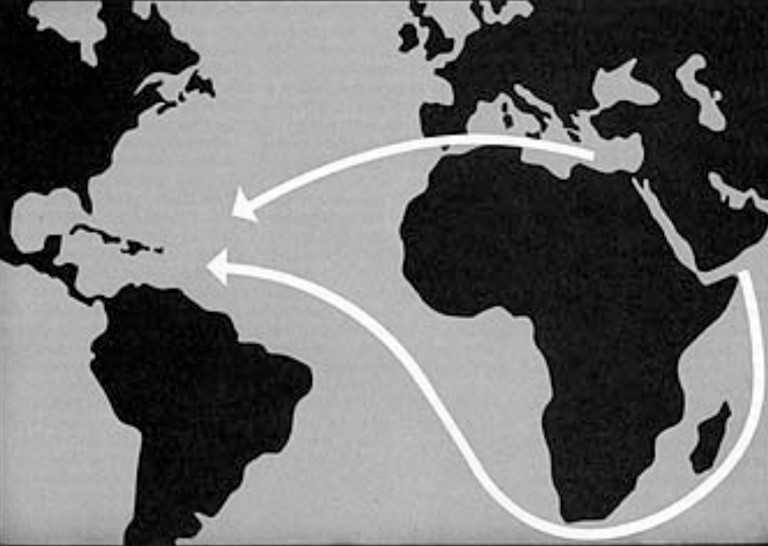
Lamanite Forefathers came from Jerusalem

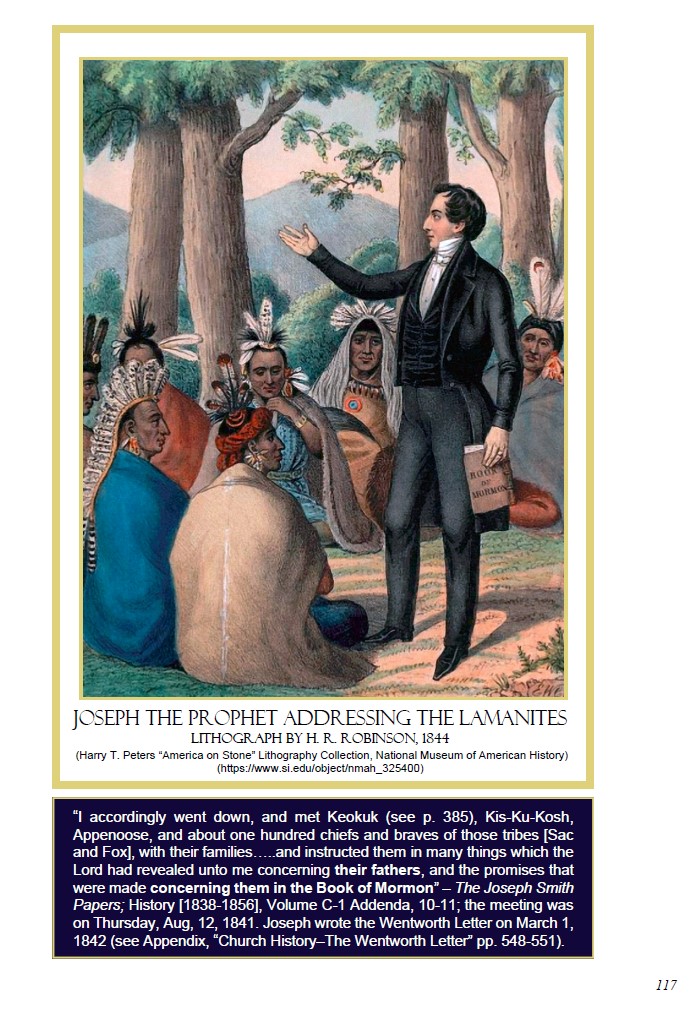
Lamanite, A North American Indian

“I think it’s important to realize that the title page of the Book of Mormon says, “written to the Lamanites. That’s one of the very first things it says. I think Latter-day Saints today think well, the Book of Mormon is written for us. Well it was, written for the entire world, but of course Mormon, Moroni in their understanding of the coming forth of the Book of Mormon, they fully realized that this book, this record, would eventually come forth to their descendants to the descendants of Lehi, and his family. And, this is clear to Joseph Smith. There’s no question in my mind that Joseph Smith knows from the very beginning this record needs to be received and given to and accepted by Lamanite descendants. And in 1830, to Joseph Smith and the Church members, a Lamanite meant to them, a North American Indian. There’s just no question.” Alexander L. Baugh BYU Church History Department; transcribed from the documentary “History of the Saints” Mission to the Lamanites Part 1.

“I would say to the Lamanites, if I could speak to them understandingly, that you are also a branch of the house of Israel, and chiefly of the house of Joseph, and your forefathers have fallen through the same examples of unbelief and sins, as have the Jews, and you, as their posterity, have wandered in sin and darkness for many generations; and you, like the Jews, have been driven and trampled under the foot of the Gentiles.” Wilford Woodruff History of His Life and Labors AS RECORDED IN HIS DAILY JOURNALS  PREPARED FOR PUBLICATION BY MATTHIAS F. COWLEY Salt Lake City, Utah 1909

“The Book of Mormon is a record of the forefathers of our western tribes of Indians; having been found through the ministration of an holy angel, and translated into our own language by the gift and power of God, after having been hid up in the earth for the last fourteen hundred years, containing the word of God which was delivered unto them. By it we learn that our western tribes of Indians are descendants from that Joseph who was sold into Egypt, and that the land of America is a promised land unto them, and unto it all the tribes of Israel will come, with as many of the Gentiles as shall comply with the requisitions of the new covenant.” TEACHINGS OF THE PROPHET JOSEPH SMITH Page 17:

“The Forefathers of these American Indians came from the
City of Jerusalem” Heber J Grant

“I rejoice in the work that is being accomplished both at home and abroad. I rejoice in the manifestations of the Spirit of God, that come to each and every one of our elders who faithfully perform the duties devolving upon them. I rejoice in the fact that God opens the way and prepares the hearts of the honest in every land and clime, wherever this Gospel of Jesus Christ has gone. It is also a source of joy and satisfaction to me that, in all my journeys at home and abroad, wherever I go, wherever I mingle with people, I am constantly receiving additional evidence and testimony regarding the divinity of this work in which we are engaged, As I journeyed away from home, and as I mingled with people, I would feel sorrowful if I had constantly been finding objections to the plan of life and salvation, that required exertion on my part to explain away. It would be a source of regret if I were constantly finding obstacles in the path, regarding the divinity of the work of God, which we have espoused. But, I have never found any such obstacles: I have never found anything that needed to be explained away: everything points to the divinity of the work.

“While listening to the remarks of Brother Ivins, referring to a book that was written by one of our enemies, in which the statement is made that there is not a particle of evidence to show that there is any trace of the Hebrew among the people who anciently inhabited this country, and that there is no evidence that would go to prove that the Book of Mormon is true. I was reminded of a little item of evidence that came under my observation while I was in the City of London. A gentleman there, to whom a very dear friend of mine, Col. Alex. G. Hawes, had given me a letter, kindly invited a number of newspaper men to his home to meet me. I am very sorry that the newspaper men declined the honor; but I had the privilege of meeting with this man and his family, and a few friends, and conversing with them. One of his friends had been a member of the British legation at Constantinople and had spent a considerable portion of his life there. He had traveled all over the holy land and was familiar with the people and their customs. Among other things, he said: “Mr. Grant, I was astonished beyond measure, when I visited Canada, to find there oriental patterns woven in beads, by the American Indians. They were the same patterns that were woven in rugs, in the oriental countries. I have traveled extensively, and I had never seen those oriental patterns in any part of the world except in the holy land, until I found them among the North American Indians. Those patterns have been handed down for hundreds of years, from generation to generation ; they are kept in families, and can be found nowhere else; and how under the heavens those Indians, who have no connection with the people of the holy land, should have the same patterns is a mystery to me.” “Well, mv friend,” I said, “if I were to inform you that the forefathers of these American Indians came from the city of Jerusalem, that would explain it, wouldn’t it?” He replied, “Well, of course, it would.” I asked him if he had ever read the Book of Mormon. He said, “No.” “Well, it will be my pleasure to send you a copy, and from it you will learn that the forefathers of the American Indians came from Jerusalem.” “Well,” he said, “that explains the mystery; I am much obliged for the book.” Now, the one thing for us to do, as Latter-day Saints, is to be loyal, to be true, to be patriotic, to be honest with God; then we need have no fear of what the world may say about us. We have the truth, and we know it, thank God; we know it, though the world may not know it. Let us follow the admonition of the Savior, and let our light so shine that other men seeing our good deeds shall glorify God.” ELDER HEBER J. GRANT 79th Annual Conference of the Church of Jesus Christ of Latter- day Saints April 4th, 5th, and 6th, 1909, page 111-113


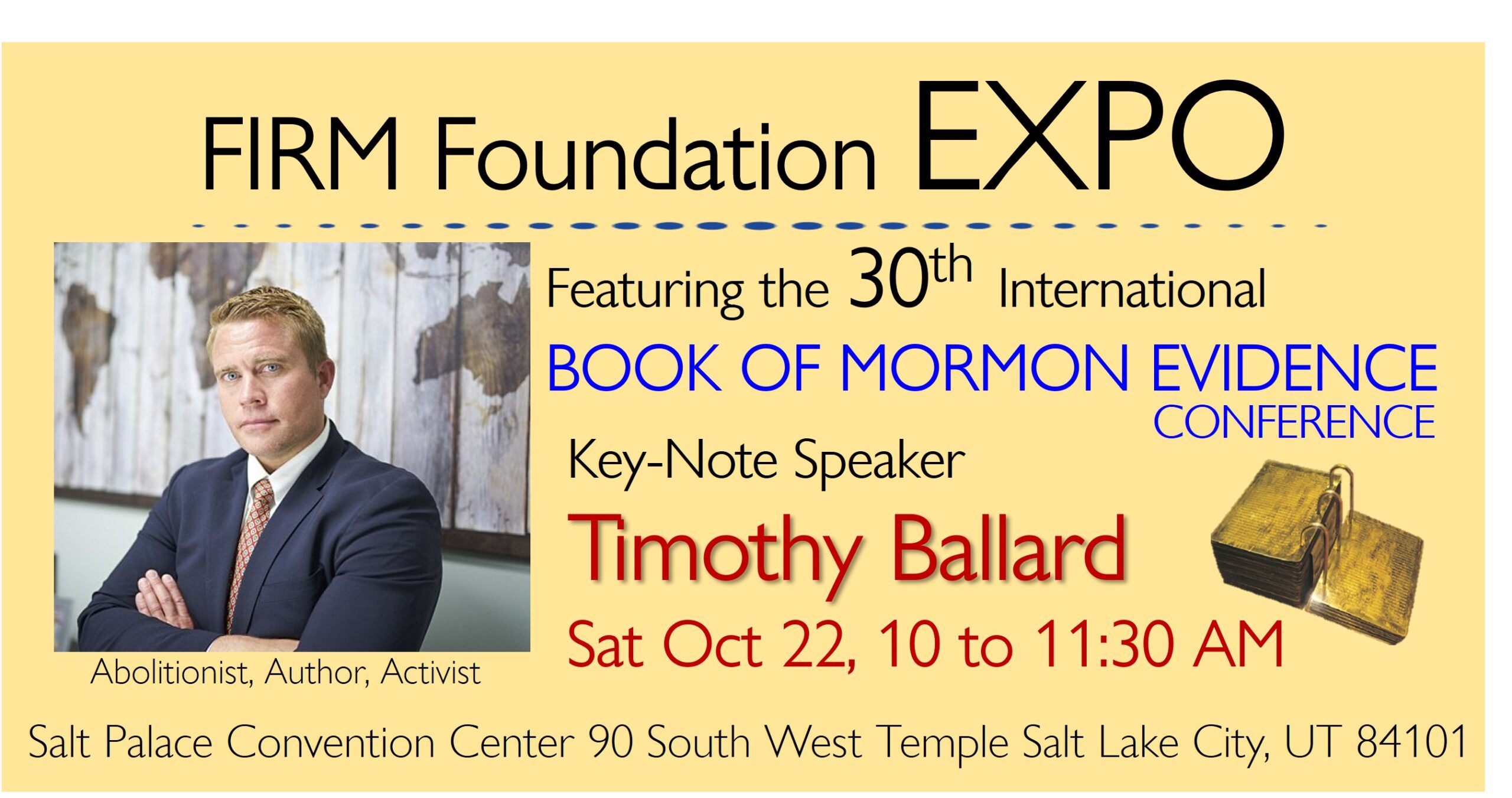
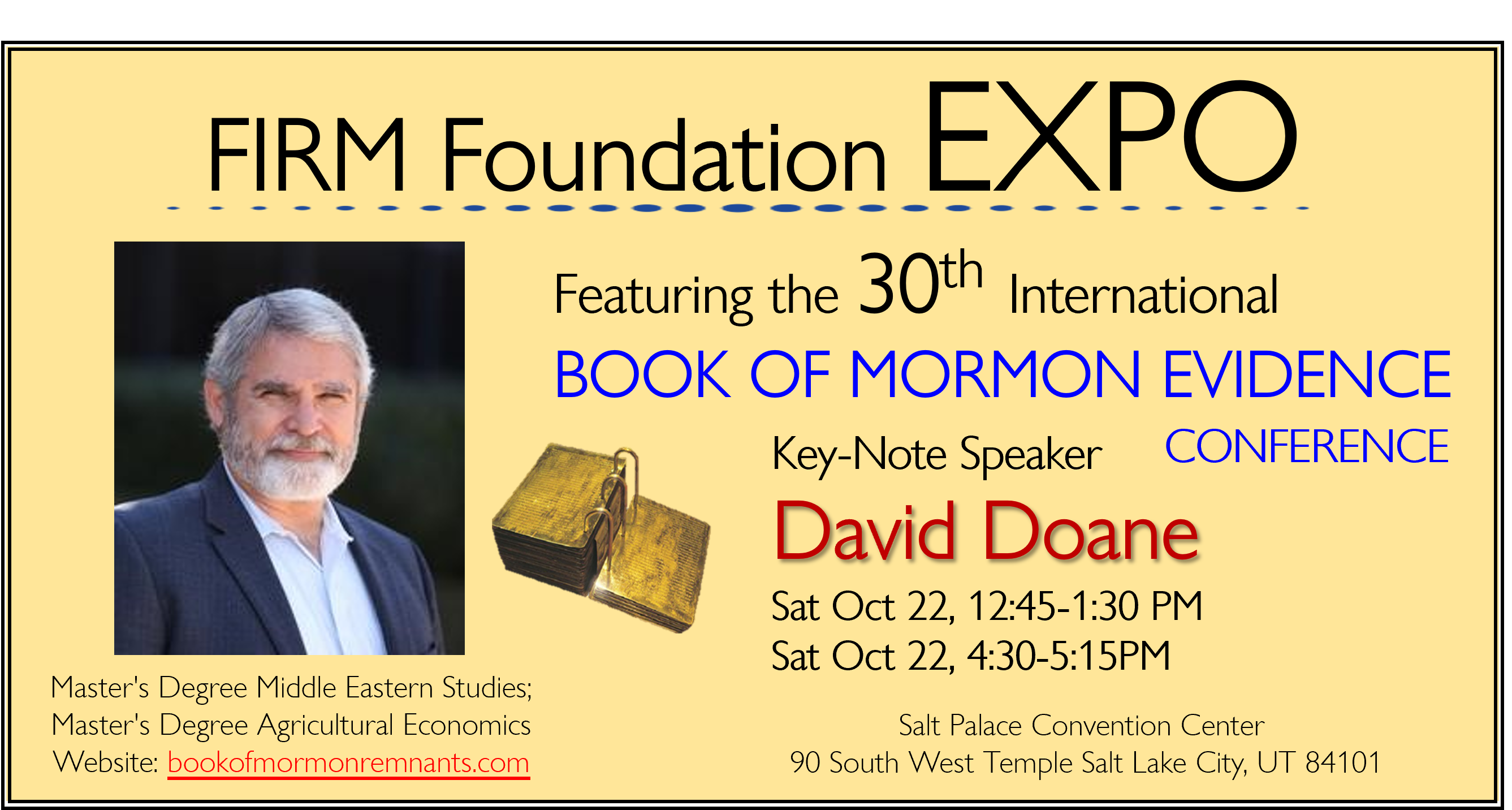
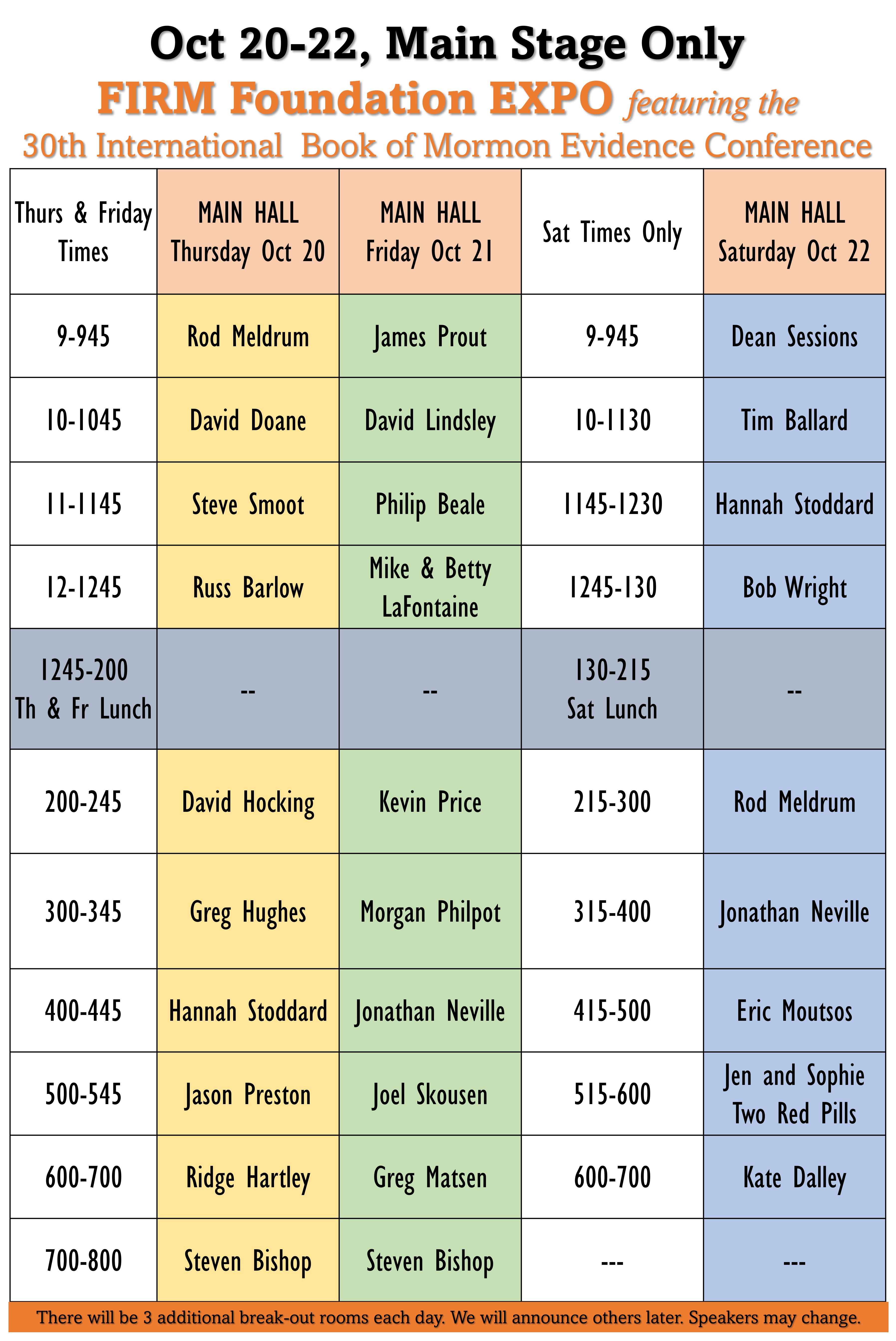
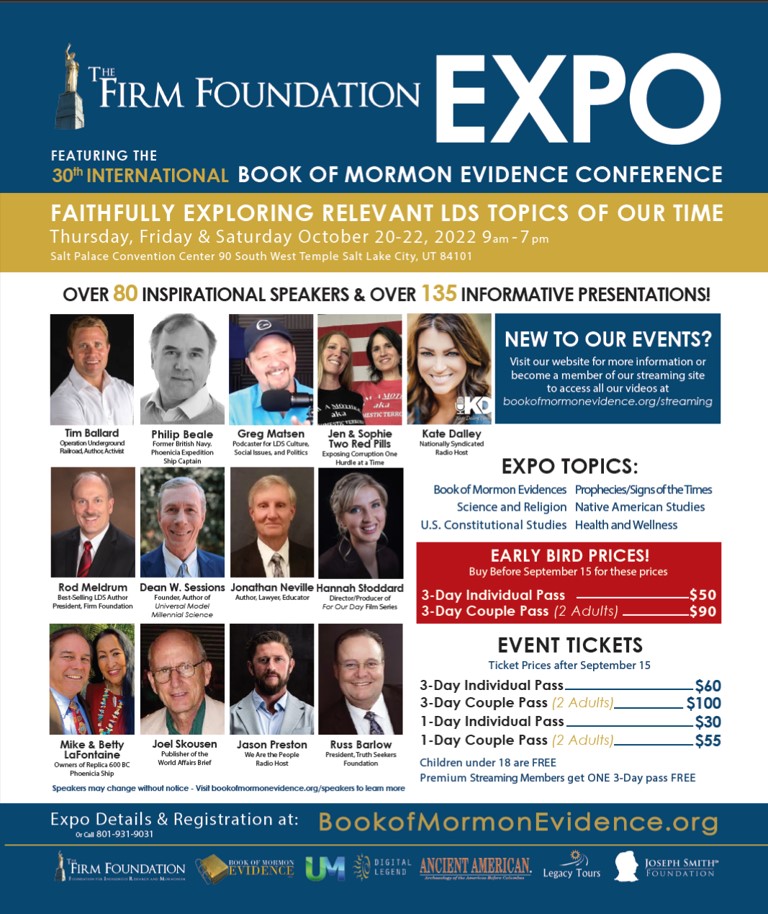
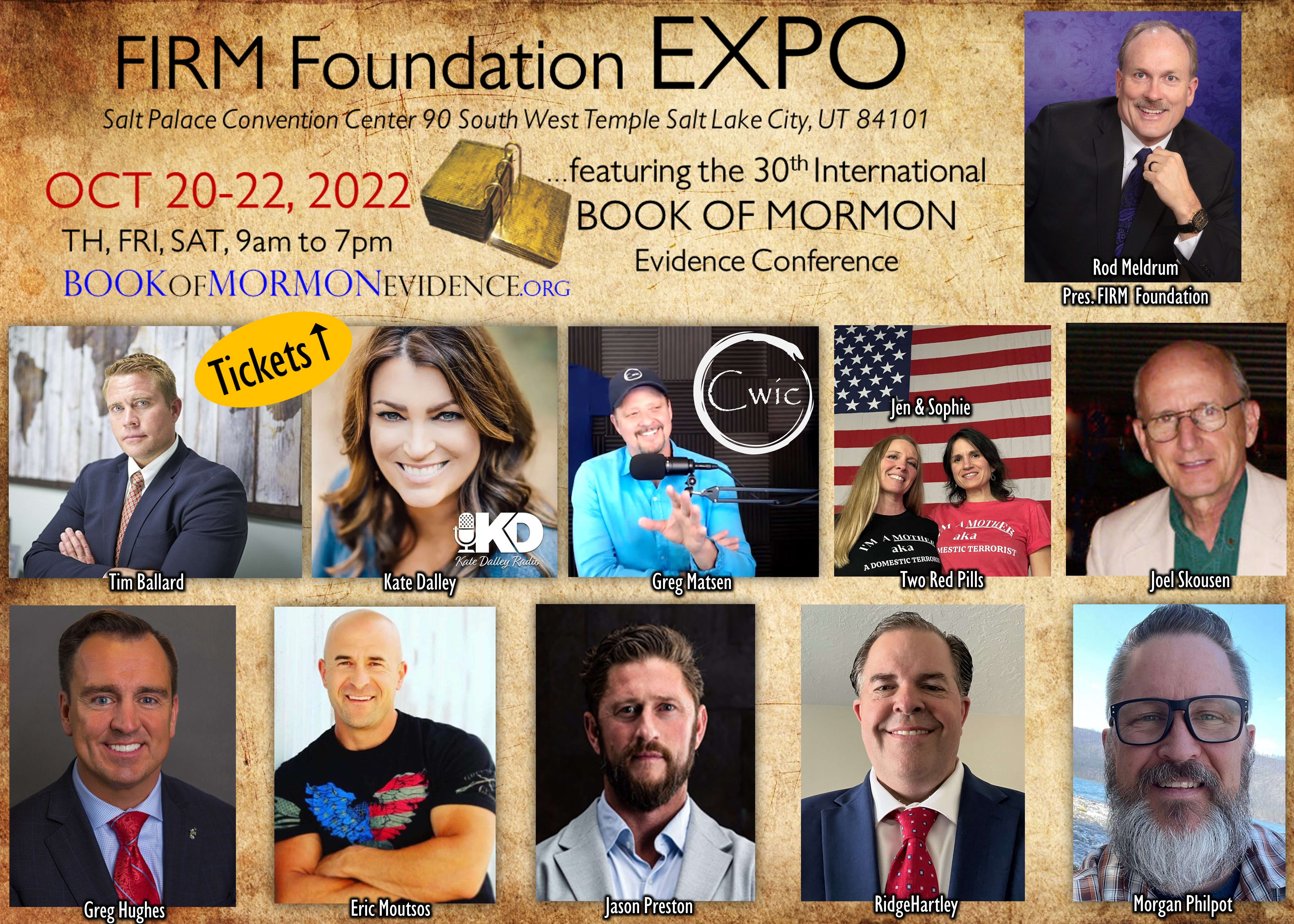
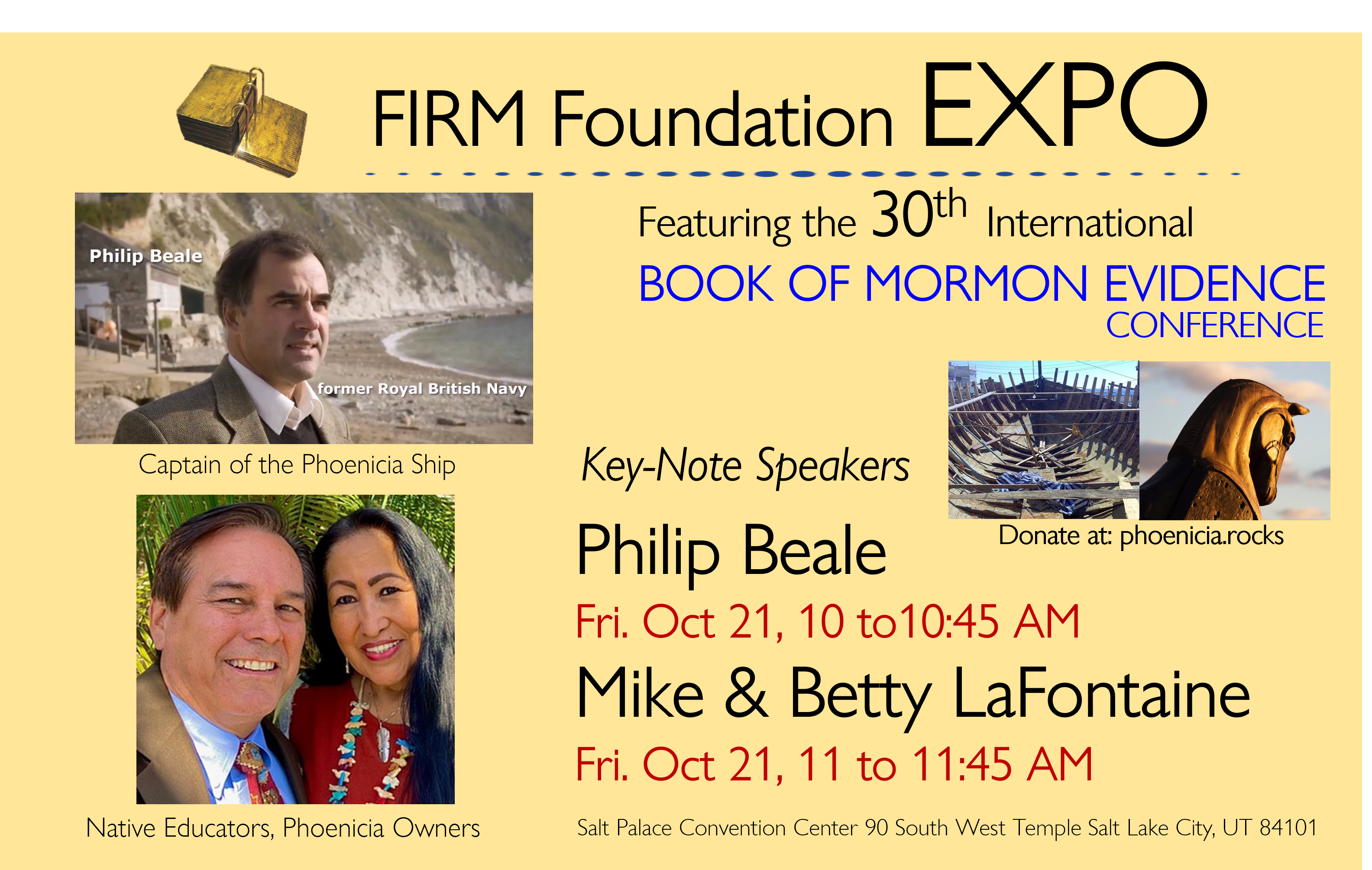
Click on any Picture Below to enlarge it. Expo Information here

1-Day Left for Early-Bird Tickets Here


THE AMERICAN INDIAN (UH-NISH-IK-NA-BA) by ELIJAH M. HAINES

From this book, THE AMERICAN INDIAN (UH-NISH-IK-NA-BA) by ELIJAH M. HAINES we will show the similarity in some of the Indian languages, to the Hebrew, and that the former must have been derived from the latter. I have edited just one chapter of over 833 pages which focuses on Chapter IV, Affinity with the Jews. This may be a lengthy blog, but it is amazing how much information you will receive about the similarities of our Book of Mormon Lamanites with the Tribe of Judah from Israel. You will also enjoy some of the old pictures which come from this amazing book.

You will also enjoy the online links to other wonderful books written long ago about the Native Americans of the United States. I know they are the honored brothers of Manasseh and it is our duty as Ephraim to bring us together again with the Book of Mormon. To Purchase the Annotated Book of Mormon Click Here!


THE AMERICAN INDIAN (UH-NISH-IK-NA-BA).
The Whole Subject Complete in One Volume Illustrated with Numerous Appropriate Engravings. By ELIJAH M. HAINES. CHICAGO: THE MAS-SIN-NA’-GAX COMPANY, 1888. Page 99-114

The subject of the American Indian has ever been one of peculiar interest to the ethnologist and student of history; but at no time since the discovery of America has it attracted so much attention as is being given to it at the present day. Volumes upon volumes have been written concerning it in its varied relations, but still it is not exhausted; and indeed the changing circumstances of the American race present at this day a phase of this subject, calling for its renewed presentation in more complete and comprehensive form.

Amidst the vast number of books published concerning this mysterious people since the discovery of America, there seems to be none now in print presenting their history in a succinct classified form, at the same time reaching out and taking in every phase of the Indian subject, to the satisfaction of the general reader.

This book has therefore been prepared with reference to this long felt want, and is such a work as the public mind and student of history now seem to demand. As the title indicates, it comprises ‘the whole Indian subject in complete and comprehensive form. In other words, it is a sort of cyclopaedia on the subject of the’ American Indian in all its phases and bearings as shown by the table of contents following; grouping together in condensed form, and within such limited space as the subject will admit of, the varied information comprised in that vast field of research in American history, not to be found in any single work of this kind heretofore published, containing many special features, which are highly interesting and valuable to the general reader.https://archive.org/stream/americanindianu01haingoog/americanindianu01haingoog_djvu.txt

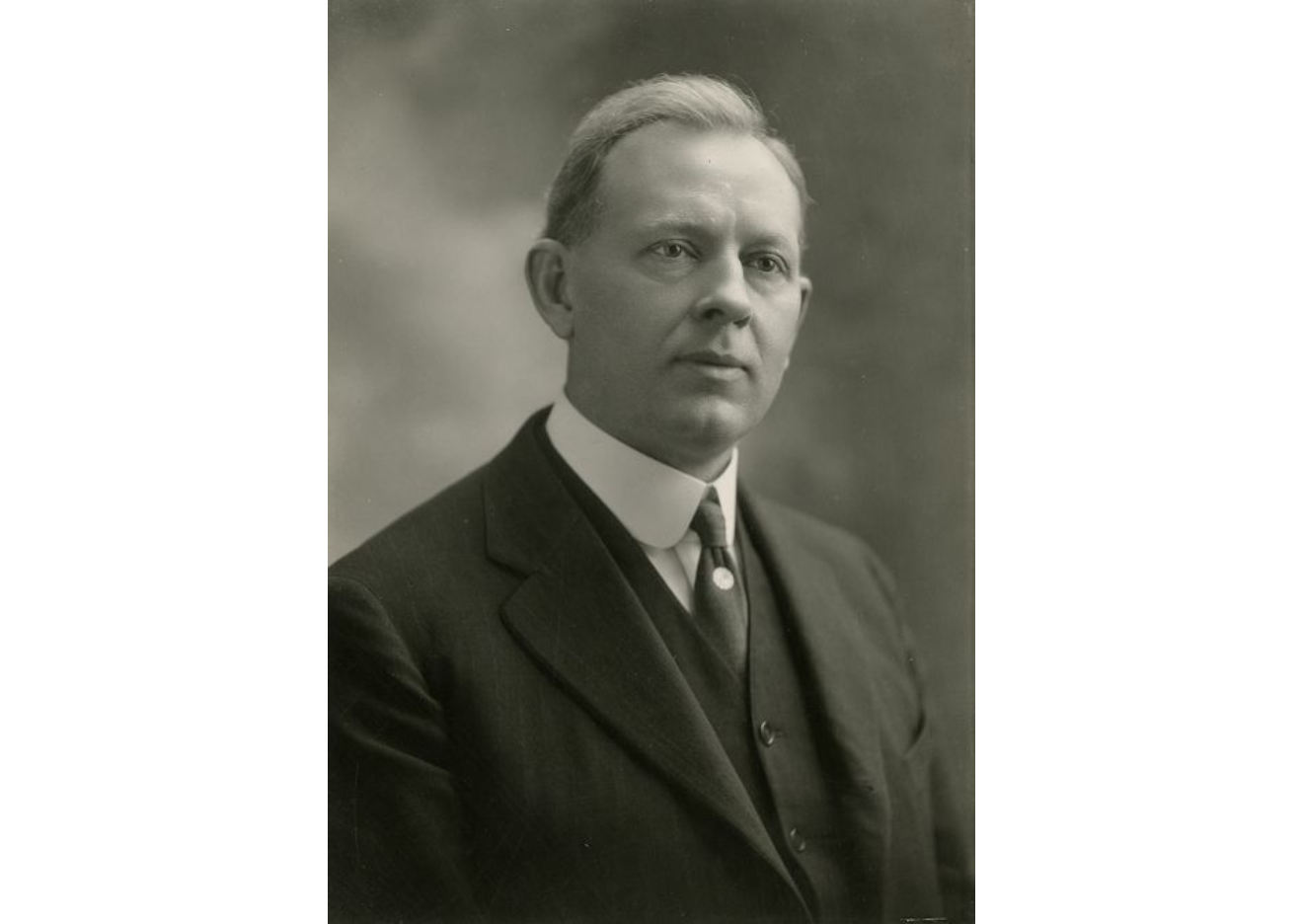
Elijah M. Haines

Photograph (Left) of Elijah M. Haines, Illinois politician from Lake County and former Speaker of the Illinois House.

CHAPTER IV. AFFINITY WITH THE JEWS.

Opinion of James Adair-The Indians Descended from the People of Israel-He Assigns Twenty-three Arguments for this Opinion— Similarity Between the Languages — Comparison of Words and Sentences— Opinion of Be v. Jedidiah Morse— Similarity of Religious Customs— Dr. Boudinot Favors this Theory— Rev. Ethan Smith— Evidence in Favor of this Theory— The Indians Acknowledge but One Great Spirit like the Jews— Father Charlevoix Presents Evidence in Support of this Theory— Indians Were Never Known to Worship Images— Evidence of William Penn — Features of the Face like the Hebrews — And so with Dress t Trinkets and Ornaments— Their Fasts and Feasts, like the Jews— They Reckon by Moons and Count Time like the Hebrews— Have their Prophets— Abstain from Unclean Things — Salute the Dawn of Morning by Devotional Ceremony — In their Lodge Tales and Traditions Twelve Brothers are Spoken of— Custom in Mourning for the Dead, like the Jews— Have a Custom of Burnt Offerings— Had a Custom like the Jews of Anointing the Head— The Indian Medicine Lodge Corresponded to the Jewish Synagogue — Had a Secret Order Resembling that of the Jews— Their Medicine Man Corresponded to the “Wise Men,” Matthew II, 1 — The Bow and Arrow was Common to the Jews— The Indian Tent was like that of the Jews — Lived in Tribes like the Jews.

Many writers have given special attention to an inquiry into the subject of the American aborigines, with reference to discovering an affinity of this people with the Jews, or people of Israel.

Among the class of writers aforesaid is Mr.James Adair, who resided forty years among the American tribes, and who wrote a book (here) on the subject, which was published about the year 1775, in which he, without hesitation, declares that the American aborigines are descendants from the Israelites, and so complete is his conviction on this head, that he declares he finds a perfect and undisputable similitude in each. He says: “From the most accurate observations I could make, in the long time I traded among the Indians of America, I was forced to believe them lineally descended from the tribes of Israel.”

AFFINITY WITH THE JEWS. Page 99

Among the early authorities cited, to show that the American Indians are descendants from the Israelites, Mr. Adair seems to be the principal one, and since his time, all writers who have favored his views, refer with unreserved confidence to the evidence furnished by him to this end.

One of the earnest writers in support of this theory in later times, is Rev. Ethan Smith, of Poultney, Vt , as shown in his book entitled “ View of the Hebrew, or the Tribes of Israel in America,” published in 1825, wherein he undertakes to prove, citing Mr. Adair and others, that the American Indians are descendants from the Lost Tribes of Israel.

Mr. Smith sums up the arguments of Mr. Adair that the natives of this continent are of the ten tribes of Israel, to the following effect: 1. Their division into tribes. 2. Their worship of Jehovah. 3. Their notions of a theocracy. 4. Their belief in the administration of angels. 5. Their language and dialects. 6. Their manner of counting time. 7. Their prophets and high priests. 8. Their festivals, fasts and religious rites. 9. Their daily sacrifice. 10. Their ablutions and anointings. 11. Their laws of uncleanliness. 12. Their abstinence from unclean things. 13. Their marriage, divorces and punishments of adultery. 14. Their several punishments. 15. Their cities of refuge. 16. Their purifications and preparatory ceremonies. 17. Their ornaments. 18. Their manner of curing the sick. 19. Their burial of the dead. 20. Their mourning for the dead. 21. Their raising seed to a deceased brother. 22. Their change of names adapted to their circumstances and times. 23. Their own traditions; the account of English writers ; and the testimonies given by Spaniards and other writers of the primitive inhabitants of Mexico and Peru.

Many of those who contend for Jewish origin of the American Indian insist that evidence of this fact is found in the languages of the Indians, which appear clearly to have been derived from the Hebrew. This is the opinion expressed by Mr. Adair, in which Dr. Edwards having a good knowledge of some of the Indian languages, concurs and gives his reasons for believing this people to have been originally Hebrew.

The languages of the Indians and of the Hebrews, he remarks, are both found without prepositions, and are formed with prefixes and suffixes, a thing not common to other languages; and he says that not only the words, but the construction of phrases in both are essentially the same. The Indian pronoun, as well as other nouns, he remarks, are manifestly from the Hebrews. The Indian laconic, bold, and commanding figures of speech, Mr. Adair notes as exactly agreeing with the genius of the Hebrew language.

THE AMERICAN INDIAN

Relative to the Hebraism of their figure, Mr. Adair gives the following instance from an address of a captain to his warriors, on going to battle: “I know that your guns are burning in your hands; your tomahawks are thirsting to drink the blood of your enemies ; your trusty arrows are impatient to be upon the wing ; and lest delay should burn your hearts any longer, I give you the cool refreshing words: Join the holy ark; and away to cut off the devoted enemy”

A table of words and phrases is furnished by Dr. Boudinot, Adair and others, to show the similarity, in some of the Indian languages, to the Hebrew, and that the former must have been derived from the latter. The following is an example afforded from the sources quoted:

Photocopy from THE AMERICAN INDIAN (UH-NISH-IK-NA-BA). By ELIJAH M. HAINES.

Rev. Jedidiah Morse, in big tour among the Western Indians, says of the Indians language: “It is highly metaphorical; and in this and other respects they resemble the Hebrew.” ” This resemblance in their language” he adds, “and the similarity of many of their religious customs to those of the Hebrews, certainly give plausibility to the ingenious theory of Dr. Boudinot, exhibited in his interesting work, the Star in the West”

Dr. Boudinot speaks of some Indians at a place called Cohocks, who called the high mountain at the west Ararat He says that the Penobscot Indians called a high mountain by the same name ; that he himself attended an Indian religious dance, concerning which he remarks:

“They dance one round; and then a second, singing hal-hal-hal, till they finished the round. They then gave us a third round, striking up the words le-le-le. On the next round it was the words, lu-lu-lu, dancing with all their might During the fifth round was yah-yah-yah. Then all joined in a lively and joyful chorus, and sung halleluyah ; dwelling on each syllable with a very long breath, in a most pleasing manner.” And he says, “there could be no deception in all this. Their pronunciation was very gutteral and sonorous, but distinct and clear.”

Rev. Ethan Smith, in his book before mentioned, remarking on this circumstance, says: “How could it be possible that the wild native Americans, in different parts of the continent, should be found singing this phrase of praise to the Great First Cause, or to Jah —exclusively Hebrew, without having brought it down by tradition from ancient Israel ? The positive testimonies of such men as Boudinot and Adair are not to be dispensed with nor doubted. They testify what they have seen and heard. And I can conceive of no rational way to account for this Indian song, but that they brought it down from ancient Israel, their ancestors.”

Dr. Boudinot further says of the Indians: ” Their languages in their roots, idioms and particular construction, appear to have the whole genius of the Hebrew; and what is very remarkable have most of the peculiarities of that language, especially those in which it differs from most other languages.”

It is also insisted by many, as further evidence showing the Jewish origin of the American Indian, that they have had their imitation of the ark of the covenant in ancient Israel. Rev. Ethan Smith says, that different travelers, and from different regions, unite in this, and refers to the fact that Mr. Adair is full in his account of it. He describes it as a small square box, made convenient to carry on the back; that the Indians never set it on the ground, but on rocks in low ground where stones were not to be had, and on stones where they are to be found. Mr. Adair, in reference to this matter, says:

It is worthy of notice that they never place the ark on the ground, nor set it on the bare earth when they are carrying it against an enemy. On hilly ground, where stones are plenty, they place it on them. But in level land, upon short logs, always resting themselves (i. e. the carriers of the ark) on the same materials. They have also as strong a faith of the power and holiness of their ark as ever the Israelites retained of theirs. The Indian ark is deemed so sacred and dangerous to touch, either by their own sanctified warriors, or the spoiling enemy, that neither of them dare meddle with it on any account. It is not to be handled by any except the chieftain and his waiter, under penalty of incurring great evil; nor would the most inveterate enemy dare to touch it. The leader virtually acts the part of a priest of war, pro tempore, in imitation of the Israelites fighting under the divine military banner.”

It is said that among all the aboriginal tribes and nations of both North and South America, whatever may have been said by the Spaniards to the contrary, they acknowledged one, and only one God, and this again is taken by the advocates of the Jewish origin of the American Indians as further proof that this people are descendants of the Jews. Dr. Boudinot says of the Indians, that they were never known, whatever mercenary Spaniards may have written to the contrary, to pay the least adoration to images or dead persons, to celestial luminaries, to evil spirits, or to any created beings whatever ; in which Mr. Adair concurs, adding that none of the numerous tribes and nations, from Hudson Bay to them Mississippi, have ever been known to attempt the formation of any image of God. On this subject Rev. Ethan Smith says:

“Du Pratz was very intimate with the chief of those Indians called ‘ The Guardians of the Temple,’ near the Mississippi (Book Here). (He inquired of them the nature of their worship. The chief informed him that they worshipped the great and most perfect Spirit, and said: * He is so great and powerful, that in comparison with him all others are as nothing. He made all things that we see, and all things that we cannot see.’ The chief went on to speak of God as having made little spirits, called free servants, who always stand before the Great Spirit, ready to do his will. That ‘ the air is filled with spirits, some good, some bad, and that the bad have a chief who is more wicked than the rest.’ Here, it seems, is their traditional notion of good and bad angels, and of Beelzebub, the chief of the latter. This chief, being asked how God made man, replied that ‘ God kneaded some clay, made it into a little man, and, finding it was well formed, he blew on his work, and the man had life and grew up.’ Being asked of the creation of the woman, he said that ‘ their ancient speech made no mention of any difference, only that the man was made first Moses 9 account of the formation of the woman, it seems, had been lost 1 “

Charlevoix, speaking of the Indian traits and religious customs, and in reference to their resembling the Jews, says: ” The greatest Part of their Feasts, their Songs and their Dances, appear to me to have had their Rise from Religion, and still to preserve some Traces of it; but one must have good eyes, or rather a very lively imagination, to perceive in them all that some travelers have pretended to discover. I have met with some who could not help thinking that our savages were descended from the Jews, and found in everything some affinity between these barbarians and the people of God. There is, indeed, a resemblance in some things, as not to use knives in certain meals, and not to break the bones of the beast they ate at those times, and the separation of the women during the time of their usual infirmities. Some persons, they say, have heard them, or thought they heard them, pronounce the word Hallelujah in their songs. But who can believe that when they pierce their ears and noses they do it in pursuance of the law of circumcision ? On the other hand, don’t we know that the custom of circumcision is more ancient than the law that was given to Abraham and his posterity. The feast they made at the return of the hunters, and of which they must leave nothing, has also been taken for a kind of burnt offering, or for a remain of the passover of the Israelites ; and rather, they say, because when any one cannot compass his portion, he may get the assistance of his neighbors, as was practiced by the people of God, when a family was not sufficient to eat the whole Paschal Lamb.”

Rev. Ethan Smith, in his book before mentioned, refers to a letter from Mr. Calvin Cushman, missionary among the Choctaws, to a friend in Plainfield, Mass., in 1824, in which he says:

” By information received from Father Hoyt respecting the former traditions, rites and ceremonies of the Indians of this region, I think there is much reason to believe they are descendants of Abraham. They have had cities of refuge, feasts of first fruits, sacrifices of the firstlings of the flock, which had to be perfect, without blemish or deformity, a bone of which must not be broken. They were never known to worship images, nor to offer sacrifices to any God made with hands. They all have some idea and belief of the Great Spirit Their feasts, holy days, etc., were regulated by sevens, as to time, i. e., seven sleeps, seven moons, seven years, etc They had a kind of box containing some kind of substance which was considered sacred, and kept an entire secret from the common people. Said box was borne by a number of men who were considered pure or holy (if I mistake not, such a box was kept by the Cherokees). And whenever they went to war with another tribe they carried this box; and such was its purity in their view that nothing would justify its being rested on the ground. A clean rock or scaffold of timber only was considered sufficiently pure for a resting place for this sacred coffer. And such was the veneration of all of the tribes for it, that whenever the party retaining it was defeated and obliged to leave it on the field of battle, the conquerors would by no means touch it. “ The celebrated William Penn, who saw the Indians of the eastern shore of the continent before they had been affected by the ill-treatment of the white people, in a letter to a friend in England concerning this people, says:

I found them with like countenances with the Hebrew race; and their children of so lively a resemblance to them that a man would think himself in Duke’s place, or Barry street, in London, when he  sees them.” Here, without the least previous idea of those natives being Israelites, that shrewd man was struck with their perfect resemblance of them, and with other things which will be noted. He speaks of their dress and trinkets as notable like those of ancient Israel ; their earrings, nose jewels, bracelets on their arms and legs (such as they were), on their fingers, necklaces made of polished shells found in their rivers and on their coasts, bands, shells and feathers ornamenting the heads of females, and various strings of beads adorning several parts of the body.

Mr. Penn further adds that the worship of this people consists in two parts, sacrifices and cantos (songs). The first is with their first fruits, and the first buck they kill goes to the fire; and that all who go to this feast must take a piece of money, which is made of the bone of a fish. (” None shall appear before me empty.”) He speaks of the agreement of their rites with those of the Jews, and adds:

They reckon by moons; they offer their first ripe fruits; they have a kind of feast of tabernacles; they are said to lay their altars with twelve stones; they mourn a year; they have their separation of women; with many other things that do not now occur.” Here is a most artless testimony given by that notable man, drawn from his own observations and accounts given by him, while the thought of this people’s being actually Hebrew was probably most distant from his mind. William Penn visits the Indians

Mr. Adair says that the southern Indians have a tradition that their ancestors once had a sanctified rod, which budded in one night’s time, which is held by some to be a tradition of Aaron’s rod. Some tribes of Indians, it is said, had, among their numerous feasts, one which they called the hunter’s feast,answering, it is claimed by some, to the Pentecost in ancient Israel, and which is described as follows:

“They choose twelve men, who provide twelve deer. Each of the twelve men cuts a sapling ; with these they form a tent, covered with blankets. They then choose twelve stones for an altar of sacrifice. Some tribes, he observes, choose but ten men, ten poles, and ten stones. Here seems an evident allusion to the twelve tribes, and also to some idea of the ten separate tribes of Israel. Upon the stones of their altar they suffered no tool to pass. No tool might pass upon a certain altar in Israel.”

In their feasts of first ripe fruits, or green corn, the custom of the Indians is to eat none of their corn or first fruit till a part is given to God. In the Indian feasts they had their sacred songs and dances, singing Hallelujah, Tohewa, in syllables which compose the words, and it is asked what other nation besides the Hebrews and Indians ever attempted the worship of Jehovah.

Mr. Adair, in further support of his theory, says: “As the nation had its particular symbol, so each tribe has the badge from which it is denominated The sachem of each tribe is a necessary party in con- veyances and treaties, to which he affixes the mark of his tribe. If we go from nation to nation among them we shall not find one who doth not lineally distinguish himself by his respective family. The genealogical names which they assume are derived either from the names of those animals whereof the cherubim are said in revelation to be compounded, or from such creatures as are most familiar to them. They call some of their tribes by the names of cherubimical figures that were carried on four principal standards of Israel.”

The Indians count time after the manner of the Hebrews. They divide the year into spring, summer, autumn and winter. They number their years from any of those four periods, for they have no name for a year, and they subdivide these and count the year by lunar months, like the Israelites who counted by moons. They begin a year at the first appearance of the first new moon of the vernal equinox, according to the ecclesiastical year of Moses. Till the so-called captivity the Israelites had only numeral names for the solar and lunar months except Abib and Ethamin ; the former signifying a green ear of corn, and the latter robust or valiant, and by the first of these the Indians (as an explicative) term their Passover, which the trading people call the green corn dance.

In conformity to, or after the manner of the Jews, the Indians of America have their prophets, high priests and others of a religious order. As the Jews had a sanctum sanctorum (holy of holies), so in general have all the Indian nations. There they deposit their consecrated vessels, none of the laity daring to approach that sacred place. Indian tradition says that their fathers were possessed of an extraordinary divine spirit, by which they foretold future things and controlled the common course of nature ; and this power they transmitted to their offspring, provided they obeyed the sacred laws annexed pertaining thereto.

Mr. Adair, it must be remembered, in referring to words in the Indian languages, has reference to those tribes which at that day were living in the southern colonies, classed by ethnologists as the Appalachians, and who were the Choctaws, Chickasaws, Cherokees, Seminoles and Muscogees. In speaking with reference to these Indians he says, Ishtoallo is the name of their priestly order, and their pontifical office descends by inheritance to the eldest. There are some traces of agreement, though chiefly lost, in their pontifical dress. Before the Indian Archimagus officiates in making the supposed holy fire for the yearly atonement for sin, the Sagan (waiter of the high priest) clothed him with a white ephod, which is a waistcoat without sleeves. In resemblance of the Urim and Thummim, the American Archimagus wears a breast plate made of a white conch shell with two holes bored in the middle of it, through which he puts the ends of an otter skin strap and fastens a buck-horn white button to the outside of each, as if in imitation of fche precious stones of the Urim.


[More about Ishtoallo here:  SIMILARITY OF CUSTOMS OF THE ISRAELITES AND NORTH AMERICAN INDIANS. To the Editors of the Jewish Expositor. The Jewish Expositor, and Friend of Israel]

7. In conformity to or after the manner of the Jews, the Indian Americans have their prophets, high priests, and others of a religious order. As the Jews had a sanctum sanctorum, [Holy of Holies) so have all the Indian nations. There they deposit their consecrated vessels; none of the laity daring to approach that sacred place. The Indian tradition says, that their forefathers were possessed of an extraordinary divine spirit, by which they foretold things future, and controlled the common course of nature: and this they transmitted to their offspring, provided they obeyed the sacred laws annexed to it. Ishtoallo is the name of all their priestly order; and their pontifical office descends by inheritance to the eldest. T here are some traces of agreement, though chiefly lost, in their pontifical dress. Before the Indian Archimagus officiates in making the supposed holy fire for the yearly atonement of sin, the Sagan clothes him with a white ephod, which is a waistcoat without sleeves. In resemblance of the Urim and Thummim, the American Archimagus wears a breast-plate made of a white conch-shell, with two holes bored in the middle of it, through which he puts the ends of an otter-skin strap, and fastens a buck horn white button to the outside of each, as if in imitation of the precious stones of the Urim.”— Upon this statement (says Mr. Faber,) I may observe, that Ishtoallo may perhaps be a corruption of Ish-di-Eloah, a man of God, (see 2nd Kings iv. 21, 22, 25. 27. 40. et alibi,; and that Sagan is the very name by which the Hebrews called the deputy of the high priest, who supplied his office, and who performed the functions of it in the absence of the high priest, or when any accident had disabled him from officiating in person. (See Calmet’s Diet. vox Sagan.)

“It is generally thought that Elohim is derived from eloah, the latter being an expanded form of the Northwest Semitic noun ’il.[5] The related nouns eloah (אלוה) and el (אֵל) are used as proper names or as generics, in which case they are interchangeable with elohim.)” Wikipedia Quote Here K. van der Toorn, Bob Becking, Pieter Willem van der Horst (eds), Dictionary of deities and demons in the Bible (revised 2nd edition, Brill, 1999)


In this statement, Rev. Ethan Smith thinks Mr. Adair exhibits evidence of which he himself seems unconscious, saying that the general name of all their priestly order is Ishtoallo, and the name of the high priest waiter is Sagan. It is thought by some that the former word is a corruption of Ish-da-elvah, a man of God ; see 2 Kings, iv, 21, 22, 25, 27, 40, and other places. That the latter word Sagan is the very name by which the Hebrews called the deputy of the high priest, who supplied his office, and performed the functions of it in the absence of the high priest.

The ceremonies of the Indians, in their religious worship, says Mr. Adair, were more after the Mosaic institutions than of Pagan imitation; which could not be if a majority of the old nations were of heathenish descent They were utter strangers to all the gestures practiced by the Pagans in their religious rites.

Mr. Adair further speaks of the sacred adjuration of the Indians by the great and awful name of God; the question being asked, and the answer given, Yah, with a profound reverence in a bowing posture of body immediately before the invocation of To-he-wah; this he considers to be Hebrew, adjuring their witnesses to give true evidence.

Jle says it seems exactly to coincide with the conduct of the Hebrew witnesses even now on like occasions.

Mr. Adair, in likening the Indians to the Jews on account of their abstinence from unclean things, says that eagles of every kind are esteemed an unclean food, likewise ravens, crows, bats, buzzards, swallows and every species of owl. This he considers as precisely Hebrew, as also their purifications of their priests, and purification for having touched a dead body or any other unclean thing. He further says that before going to war, the Indians have many preparatory ceremonies of purification and fasting, like what is recorded of the Israelites.

Bev. Mr. Chapman, missionary of the United States Foreign Missionary Society, at the Union Mission, in a letter of March 24th, 1823, gives an account of some of the manners and customs of the Osage Indians, which would seem to have some bearing on the question under consideration. He went with a large company of these Indians, whose object was to form a treaty of peace with the Cherokees, to Fort Smith. The evening before they arrived on a hill, the chiefs announced that in the morning they must make their customary peace medicine (a religious ceremony previous to a treaty) for the purpose of cleansing their hearts and securing their sincerity of thinking and acting. Ten of the principal warriors, including the priest of the Atmosphere, (a name of one of their clans) were selected and sent beneath a ledge, to dream or learn whether any error had been committed thus far, or (as they express it) to “watch the back track.” In proceeding to describe their ceremonies, prayers, sacred painting, anointings, etc, Mr. Chapman says: “About two feet in advance, and in a line with our path, were three bunches of grass, which had been cut and piled about three feet apart, as an emblem of him whom they worshipped.

“Here the priest stood with his attendants, and prayed at great length. Having finished his prayer, he again ordered the march on foot. The Indians from the right and left entered the path with great regularity, and, on wheeling forward, every individual was compelled to step upon each bunch of the grass. The company proceeded about forty rods, then halted and formed as before. The priest now ordered his senior attendant to form a circle of grass about four feet in diameter, -and to fix a handsome pile in the centre. By this he made another long prayer. Then stepping on the circle, and followed in this by his attendants, they passed on.”

Mr. Chapman further says: “It is a universal practice of these Indians to salute the dawn every morning with their devotion.” This custom, it may be remarked, seems to be universal among all the American tribes. In regard to the ceremonies which Mr. Chapman describes, he adds: “Perhaps the curious may imagine that some faint allusion to the lost ten tribes of Israel may be discovered in the select number of dreamers (they being ten), to the Trinity in Unity in the bunches (and the circle) of grass, to the Jewish anointings and purifications in their repeated paintings, to the sacred rite of the sanctuary in their secret consultations, and to the prophetic office in the office of their dreamers.”

A religious custom is related by Maj. Long, which some think goes to prove that the Omaha Indians are of Israel. He relates that from the age of between five or ten years their little sons are obliged to ascend a hill fasting once or twice a week, during the months of March and April, to pray aloud to Wahconda. When this season of the year arrives, the mother informs the little son that the u ice is breaking up in the river, the ducks and geese are migrating, and it is time for you to prepare to go in clay.” The little worshipper then rubs himself over with whitish clay, and at sunrise sets off for the top of a hill, instructed by the mother what to say to the Master of Life.

From his elevated position he cried aloud to Wahconda, humming a melancholy tune, and calling on him to have pity on him and make him a great hunter, warrior, etc.

This, it is urged by some, has more the appearance of descending from Hebrew tradition than from any other nation in the earthy teaching their children to fast in clay as “in dust and ashes,” and to cry to Jah for pity and protection.

In part second of Mr. Schoolcraft’s general work on the Indian tribes of the United States, p. 135, is an article written by Mr. Wm. W. Warren, on the oral traditions respecting the history of the Ojibway nation. Mr. Warren, as Mr. Schoolcraft remarks, was a descendant, on his mother’s side, of one of the most respectable Indian families- at the ancient capital of this nation.

In this communication, Mr. Warren is inclined to the opinion, from the information derived from the manners and customs of the Ojibways, that the red race of America are descendants of the lost tribes of Israel, and he asserts that this is the belief of some eminent men and writers, and mentions this belief to say that he has noted much in the course of his inquiries that would induce him to fall into the same belief, besides the general reasons that are adduced to prove the fact Referring to the Ojibways, he says:

“I have noticed that in all their principal and oldest traditions and lodge tales, twelve brothers are spoken of that are the sons of Getube, a name nearly similar to Jacob. The oldest of these brothers

is called Mudjekeewis, and the youngest Wa-jeeg-e-wa-kon-ay, the name for his coat of fishers 9 skins, with which he resisted the machinations of evil spirits. He was the beloved of his father and the Great Spirit; the wisest and most powerful of his twelve brothers.”

The tradition in which also originated Ke-na-big-wusk, or snake-root, which forms one of the four main branches of the Me-da-win, is similar in character to the brazen serpent of Moses that saved the lives of the afflicted Israelites. In the Indian tradition, the serpent is made to show to man a root which saved the lives of the people of a great town, which was being depopulated by pestilence. Not only in these instances is the similitude of the Ojibway oral traditions and the written history of the Hebrews evident and most striking, but in part first of Mr. Schoolcraft’s work aforesaid, page 259, is some information by Mr. Thomas Fitzpatrick, a government agent of the higher Platte and Arkansas. In this, reference is made to the fact of a resemblance in the manners, customs and habits of the Indians with that of the Jews or Israelites, in which he says: “In regard to the manners, customs, habits, etc., of the wild tribes of the western territory, a true and more correct type than any I have ever seen may be found in the ancient history of the Jews or Israelites after their liberation from Egyptian bondage. The medicine lodge of the Indian may be compared to the place of worship or tabernacle of the Jews, and the sacrifices, offerings, purifications and anointings may be all found amongst and practiced by those people.”

It is to be noted, however, that Mr. Fitzpatrick is not inclined to adopt these evidences as proof that the Indians are descended from the Jews, but considers them as mere coincidences, liable to occur among the natives of any portion of the globe.

In an interview which the writer had several years ago with Rev. John Johnston, a native educated Ottawa Indian, and a minister of the gospel of the Episcopal Church among the Ojibways at White Earth Agency, Minn., he expressed his belief quite firmly that the aborigines were descendants from the Jews, and cited instances of their manners, customs and habits in support of this opinion.

There is a marked similarity between the customs of the Indians and the Jews in their mourning for the dead. Like the Jews, the Indians had a time or season for mourning for the dead. A custom among the Jews of loud lamentation over the dead was also a peculiar custom of the American tribes. In Gen. xxxii, 34, it is said that *’ Jacob rent his clothes, and put sackcloth upon his loins, and mourned for his son many days.” This is suggestive of a like custom among the American Indians. Among the Indians the friends of the deceased visited the graves of their departed relatives and there resumed their custom of weeping and shrieking. This was also a prominent custom among the Jews, as noticed in John xi, 31 : ” She goeth out to the grave to weep there.” The custom of engaging women to mourn over the bodies of the dead, which prevailed among the American tribes, was also a custom among the Jews, as mentioned in Jer. ix, 17 : ** Thus saith the Lord of Hosts, consider ye, and call for the mourning women that they may come.”

Among the Indians it was a custom for the bridegroom to make presents to the father or parents of the bride as a consideration in the transaction. This custom also prevailed among the . Jews; Jacob gave a term of service as a consideration for Eachel. Gen. xxix, 20.

Among the Jews, parents negotiated marriage between sons and daughters. Hagar chose a wife for Ishmael. Gen. xxi, 21. Judah selected a wife for Er. Gen. xxxviii, 6. The like custom prevailed among the American Indians.

The marriage ceremony among the American tribes was much the same as with the Jews. In Gen. xxiv, 67, it is said ” Isaac brought her into his mother Sarah’s tent, and took Eebekah, and she became his wife.” Rev. James Freeman, in his book entitled ” Manners and Customs,” says there is no evidence of any special religious forms in these primitive marriages. The marriage ceremony consisted of the removal of the bride from the father’s house to that of the bridegroom, or that of his father. The marriage ceremony among the American tribes was of like simplicity, and very much the same.

The Indians, like the Jews, had a custom of burnt offerings, as that of the burning of tobacco, as an offering to the Great Spirit They had also a custom like that of the meat offering of the Jews. See Lev. vi, 14. They also, like the Jews, had a sacrifice of animals. Num. xix, 2. Instead of the red heifer without a spot, as with the Jews, it was a white dog without a spot or blemish.

Like the Jews, they had their feasts for various occasions. Amongst others was a feast of first fruits, such as the strawberry feast of the Iroquois. The harvest feast was universal with all tribes who raised the Indian corn or zea maize. This corresponded to the like custom among the Jews. Ex. xxiii, 16.

Dancing on various occasions was a custom practiced among the American Indians as with the Jews, although not precisely in the same form. Dancing was performed at first among the Jews on sacred occasions only. Among the Hebrews it was joined with sacred songs and was usually participated in by the women only. When the men danced it was in company separate from the women. When Jeptha returned from his conquest over the Ammonites, his daughter came out to meet him with timbrels and with dances. When the men of Benjamin surprised the daughters of Shiloh, the latter were dancing at a feast of the Lord. Judges, xxi, 19-21. A corresponding custom of dances among the Hebrews, as given in scripture, is found among all the American tribes, the occasion for many of which is precisely the same.

The Israelites used the mortar for beating their manna. Num. xi, 8. It was by this means that the Indians of America from time immemorial beat their corn and thus prepared it for use.

The custom prevailing among the Jews of anointing the head, and in using oils on other parts of the body, also prevailed among the American tribes.

Sign language, so common among the American tribes, is also marked as a mode of communication among the Jews. In Proverbs, vi, 13, it is said “He speaketh with his feet; he teacheth with his fingers.”

The Indians, at the close of their speeches in council, used a word of like signification as the word Amen, common among the Jews as stated in 1 Chronicles, xvi, 36. U A11 the people said Amen, and praised the Lord.” Amen literally means firm, from Aman, to prop, to support Its figurative meaning is faithful ; its use is designated as affirmatory response, and the custom is very ancient among the Jews. See Num. v, 22, Deui xxvii, 15-16. The Iroquois, in closing their speeches, used the word Hiro, of the like import of the Jewish word Amen. The Pottawattamies, a tribe of the Algonquin group, used the word Hoa.

The Indian medicine lodge or council-house corresponds much to the ancient Jewish synagogues, which were originally places of instruction rather than of worship, and wherein, it is said, the Jews read and expounded the law. We find Christ publicly speaking in the synagogues, and so also the Apostles in their missionary travels addressing the people in the synagogues.

The secret order of medicine men and prophets of the Indians had a corresponding institution among the Jews called “sons of the prophets,” forming a peculiar order, whose mission seems to have been to assist the prophets in their duties, and in time to succeed them. 2 Kings, ii, 3-12; vi, 1.

A personage corresponding to the Indian medicine man is found in the ”wise men” or Magi of the Jews, spoken of in Mathew, ji, 1. We find in the Old Testament several references to the Magi. In Jer. xxxix, 3, 13, Nergal-sharezer is said to have been the Rab-mag, that is, the chief of the Magi. In Daniel’s time the Magi were very prominent in Babylon. In Dan. ii, 2, “magicians,” “astrologers,” “sorcerers,” and “Chaldeans” are mentioned, while in the twenty-seventh verse of the chapter “soothsayers” are named.

Some tribes of Indians had a custom of making images or a kind of idols, not as an object of worship, but to imitate or personate some particular spirit or god, to whom they paid some kind of adoration. A like custom seems to have prevailed among the Jews, mentioned in 1 Samuel, vi, 5.

A custom prevailed among western Indian tribes, who lived in villages of dirt houses, of assembling on the tops of their dwellings on festive or public occasions; this was likewise a custom among the Jews. See Judges, xvi, 27, wherein it is said, “there were upon the roof about three thousand men and women, that beheld while Samson made sport”

The Indians felt that menial service was degrading. Service of this kind among them was performed by the women. The same idea prevailed among the Jews, who considered it a degradation to be hewers of wood and drawers of water. Josh, ix, 21.

The bow and arrow, the common and efficient weapon with the primitive American Indian, was also in common use among the ancient Jews. See 2 Kings, xiii, 15.

The ancient Israelites lived in tents in the style of the most of the American tribes.

In notions of dress there was a striking similarity between the American Indians and the Jews, especially in regard to the outer garment thrown over the shoulders or wrapped around the body. The Indian medicine man or prominent chief possessed a peculiar vanity in regard to their dress, which was frequently gaudy and fantastic, and so with the high priests among the Jews where display in dress was a peculiar feature in Jewish custom among those high in authority. It was a custom among the Jews to sleep in their garments, Deut. xxiv, 12-13, and so with the American Indians.

The name Dorcas, Acts, ix, 36, it is said, means antelope or gazelle. According to some writers the Jews had a custom of giving to their daughters poetic names, or names significant of beauty or beautiful objects. This was a marked custom with the American Indians.

According to Mr. Freeman, it was an ancient custom among the Jews to give names to families from animals. This found a corresponding custom among the Indians, in adopting their totems to mark their families, as the bear, the deer, the elk, and the like. The custom is continued among the Israelites down to the present time, as found in the name of Wolf, Bear, Lion and other names from animals.

It was a custom among the Jews to give names to persons that have some special signification, as Reuben, ” See a Son.” This custom likewise prevailed among other eastern nations. This was a universal custom among the American Indians, as Sheeshebanee (Ojibway), “little duck.”

The change of names of persons in after life on particular occasions was a custom of the Jews. 2 Chron. xxxvi, 4; Gen. xxxii, 28 ; xxxv, 10. It was also a custom among the American Indians.

By an ancient mode of declaring war, practiced amongst the Jews, a herald came to the confines of the enemy’s territory, and, after observing certain solemnities, cried with a loud voice, ” I wage war against you,” at the same time giving reasons therefor. He then shot an arrow or threw a spear into the enemy’s country, which was significant of warlike intentions. The custom among the Indians, in declaring war, was to send a bundle of arrows to some representative chief of the enemy.

The Indian practice of lying in ambush to surprise an enemy, it seems, was also a practice to some extent among the Jews. In Judges, v, 11, is the following: “They that are delivered from the noise of archers in the places of drawing water, there shall they rehearse the righteous acts of the Lord.” This, it is said, refers to the practice of lying in ambush near wells and springs for the purpose of seizing flocks and herds when brought thither for water.

When a war party of Indians returned to their villages after the victory, it was customary for the women and children, with the old men remaining behind, to assemble and express their great joy by singing, shouting and other demonstrations. This was likewise a custom among the Jews, as appears 1st Sam. xviii, 6: “It came to pass as they came, when David was returned from the slaughter of the Philistine, that the women came out of all the cities of Israel, singing and dancing, to meet King Saul with tabrets, with joy, and with instruments of music.” See also Ex. xv, 20. Judges, xi, 34.

The war club and other weapons of the Indians were like those of the Jews. Jer. li, 20. With the Jews, the same as with the Indians, these weapons were buried with the dead. Ezek. xxxii, 27.

The custom of wearing buffalo horns by distinguished warriors, attached to their head dress, seems to have existed also among the Jews. In 1st Kings, xxii, 11, it is said ” the false prophet Zedekiah made him horns of iron,” and in Ps. lxxv, 5: ” Lift not your horns on high; speak not with a stiff neck.”

Rev. Peter Jones, an educated Ojibway Indian, in the appendix to his book, entitled “History of the Ojibway Indians,” quotes approvingly the following from a recent publication which he considers good authority, and wherein is summed up in general terms the most striking analogies between the American tribes and the ancient Israelites:

“They (the Indians) are living in tribes, with heads of tribes; they all have a family likeness, though covering thousands of leagues of land, and have a tradition prevailing universally that they connect that country at the northwest corner. They are a very religious people, and yet have entirely escaped the idolatry of the Old World. They acknowledge one God, the Great Spirit, who created all things seen and unseen. The name by which this being is known to them is Ale, the old Hebrew name of God; he is also called Tehowah, sometimes Yah, and also Abba; for this great being they possess a high reverence, calling him the head of their community, and themselves his favorite people. They believe that he was more favorable to them in old times than he is now; that their fathers were in covenant with him, that he talked with them, and favored them. They are distinctly heard to sing, with their. religious dances, Hallelujah and praise to Yah; other remarkable sounds go out of their mouth as shilu yo, shilu he ale yo he-wah, yohewah, but they profess not to know the meaning of these words, only that they learned to use them on sacred occasions. They acknowledge the government of a Providence overruling all things, and express a willing submission to whatever takes place. They keep annual feasts, which resemble those of the Mosaic ritual ; a feast of first fruits, which they do not permit themselves to taste until they have made an offering of them to God; also an evening festival, in which no bone of the animal that is eaten may be broken ; and if one family be not large enough to consume the whole of it, a neighboring family is called in to assist; the whole of it is consumed, and the relics of it are burned before the rising of the next day’s sun. There is one part of the animal which they never eat, the hollow of the thigh. They eat bitter vegetables, and observe severe feasts, for the purpose of cleansing themselves from sin ; they also have a feast of harvest, when their fruits are gathering in ; a daily sacrifice and a feast of love. Their forefathers practiced the rites of circumcision, but not knowing why so strange a practice wag continued, and not approving of it, they gave it up. There is a sort of jubilee kept by some of them. They have cities of refuge, to which a guilty man, and even a murderer, may fly and be safe.”

Rev. Jabez B. Hyde, a minister of the gospel, of prominence in Western New York, and of considerable experience among the Seneca Indians, writing in 1825 concerning his information derived from the aforesaid people on the subject of their manners and customs, says that of the meaning of words they used in their dances and divine songs, they were wholly ignorant They used the words T-O-He- Wah and Hal-le-lu-yak as represented of other Indians. Speaking further in regard to their apparent affinity with the Jews, he says: “In all their rites which I have learned from them, there is certainly a most striking similitude to the Mosaic rituals; their feast of first fruits; feasts of ingathering; day of atonement; peace offerings; sacrifices. They build an altar of stones before a tent covered with blankets ; within the tent they burn tobacco for incense, with fire taken from the altar of burnt offering.” Mr. Hyde further remarks that these Indians had formerly places like cities of refuge existing among them, and that an old chief had shown him the boundaries of one of them.


Art by George Catlin 1796 – 1872


On this subject the testimony of Mr. George Catlin may be considered as important, he having spent eight years amongst the wildest and most remarkable tribes then existing in North America, commencing in the year 1832, as an artist and student of Indian history and manners and customs. He describes at length and in detail the manners and customs of these tribes, in concluding which, he says:

“Amongst the list of their customs, however, we meet a number which had their origin, it would seem, in the Jewish ceremonial code, and which are so very peculiar in their forms, that it would seem quite improbable, and almost impossible, that two different people should ever have hit upon them alike, without some knowledge of each other. These I consider go farther than anything else as evidence and carry in mind conclusive proof that these people are tinctured with Jewish blood.”

To read the entire volume click here:

To purchase the Annotated Book of Mormon Click Here:

Native Americans are Remnants of the Jews

 “And again, I command thee that thou shalt not covet thine own property, but impart it freely to the printing of the Book of Mormon, which contains the truth and the word of God—Which is my word to the Gentile, that soon it may go to the Jew, of whom the Lamanites are a remnant, that they may believe the gospel, and look not for a Messiah to come who has already come.” D&C 29:26-27

“A great nation (the United States of America) shall be set up… by the power of God, so that the gospel may be restored, the Book of Mormon come forth, its message go to the American remnant of Jews, that the eternal covenants of the Lord with his people might be fulfilled.” “The remnant of Jacob, including the Lamanites in the Americas”, will assist in the gathering of Israel to the promised land  New Jerusalem.” McConkie, Bruce R., Mortal Messiah, Book 4, 1981, pp. 348-349, 358

“I hope that when you read the Book of Mormon you will read carefully the last chapter of first Nephi, which refers to the day in which we are living. In this chapter Nephi talked about this land and the gentiles who in latter days would be brought here. Then he said:

And it meaneth that the time cometh that after all the house of Israel have been scattered and confounded [the scattering of the ten tribes and the Jews to all parts of the world], that the Lord God will raise up a mighty nation among the Gentiles, yea, even upon the face of this land [the United States]; and by them shall our seed be scattered. [Through the Indian wars the Indians were scattered by the early Americans.]” The Great Prologue by Mark E. Petersen.

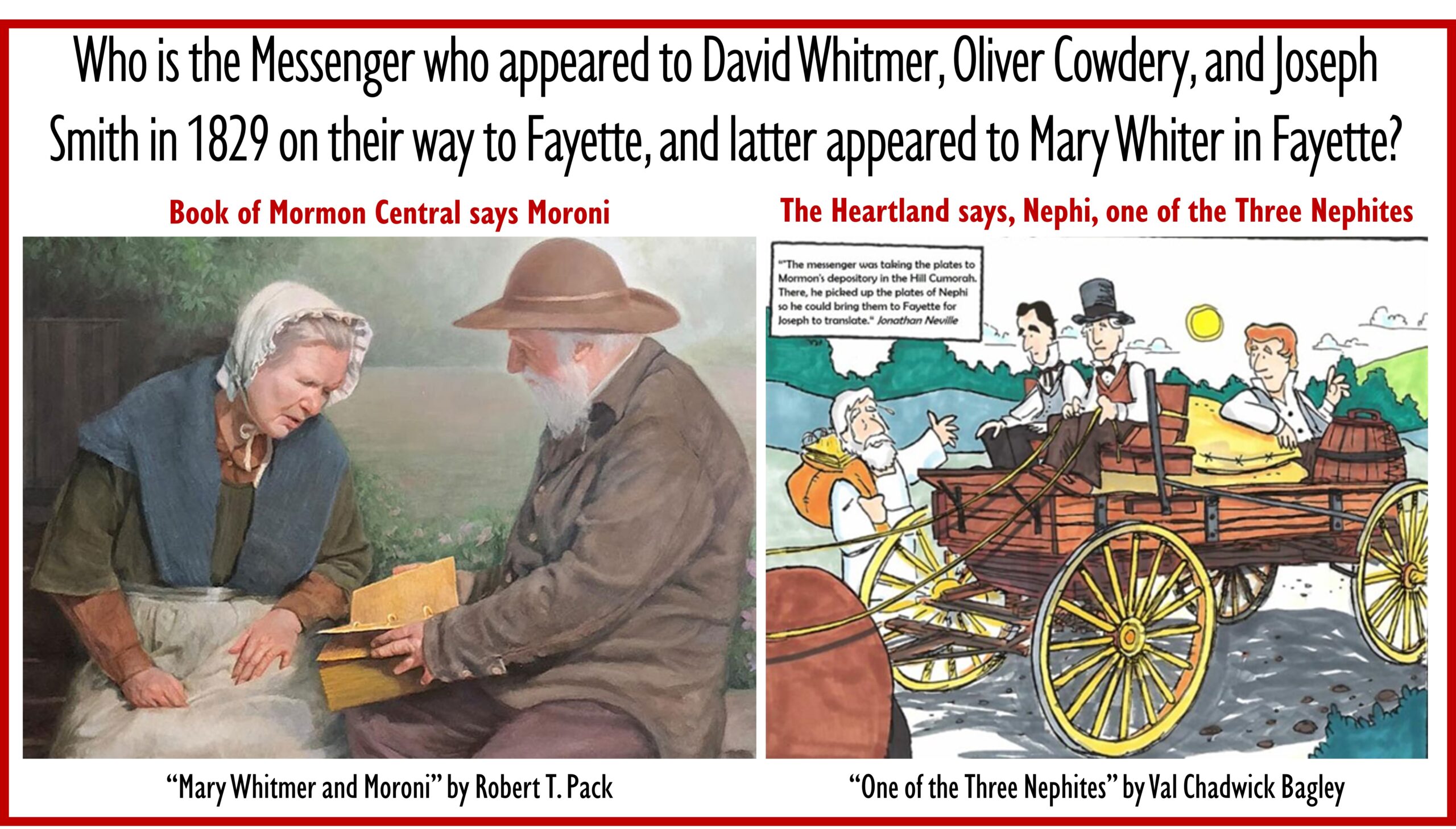
Brother Nephi, One of the Three Nephites Carry’s Gold Plates

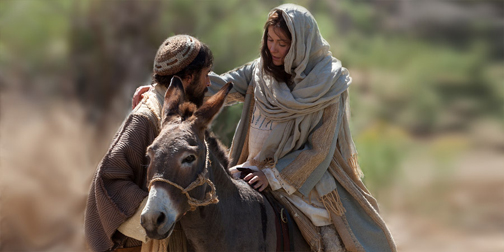
You can read all the quotes yourself below. It makes sense the answer to me is, the man who appears at the wagon carrying the knapsack on his back, was one of the Three Nephites, probably named Nephi. David and his mother Mary gave very similar descriptions at different times which is very conclusive to me. 

John C. Whitmer’s 1878 account

As recorded by Andrew Jenson (see his Latter-Day Saint Biographical Encyclopedia 1:283, Salt Lake City, Utah: 1901):

“I have heard my grandmother (Mary Musselman Whitmer) say on several occasions that she was shown the plates of the Book of Mormon by a holy angel, whom she always called Brother Nephi.

Edward Stevenson Accounts

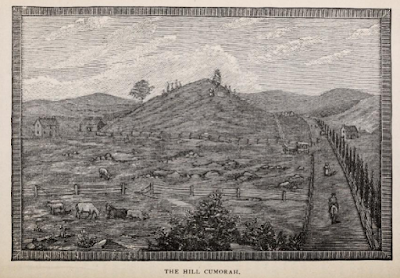
“And an aged man about 5 feet 10, heavy set, and on his back an old fashioned army knapsack strapped over his shoulders and something square in it, and he walked alongside of the wagon and wiped the sweat off his face, smiling very pleasantly. David asked him to ride and he replied, ‘I am going across to the Hill Cumorah.’ Edward Stevenson, Journal, Dec. 23, 1877 quoted in Richard L. Anderson, Investigating the Book of Mormon Witnesses (Salt Lake City, UT: Deseret Book, 1989), 30.

Tickets Now

“I wish to mention an Item of conversation with David Whitmer in regard to Seeing one of the Nephites, Zina Young, Desired me to ask about it. David Said, Oliver, & The Prophet, & I were riding in a wagon, & an aged man about 5 feet 10, heavy Set & on his back, an old fashioned Armey knapsack Strapped over his Shoulders & Something Square in it.” “Edward Stevenson Interview (1) 22-23 December 1877, Richmond, Missouri Diary of Edward Stevenson,” LDS Church Archives, Lyndon W. Cook, ed., David Whitmer Interviews, 1993, p. 13; also Dan Vogel, ed., Early Mormon Documents, 2003, vol. v, p. 30

Anita Murdock Account

The reason she was interested in the Three Nephites, is because the same one stopped by their family home in Watertown, Jefferson, NY and taught them the gospel of Jesus Christ… 

The family was having what we might call a family home evening one night, discussing scriptures and playing music, when they had a knock at their door, and when opened, they found a man dressed in old fashioned clothes, who said that he usually takes sequestered paths…

Joseph confirmed it was one of the three Nephites sent to prepare them to receive the gospel. Since Zina had spent an entire evening with one of the three Nephites, not a moment, but an entire night learning from him, you can imagine why she was so interested in this story. -Anita Murdock

David Whitmer Account

“It was the messenger who had the plates [of the Book of Mormon], who had taken them from Joseph just prior to our starting from Harmony” David Whitmer to Elders Orson Pratt and Joseph F. Smith in 1878 and in Andrew Jensen, Historical Record, p. 209), and in 1950 Revised Edition of the Doctrine and Covenants Commentary page 508

Jonathan Neville’s Account

“The simplest, historically justified explanation is that David told Zina and her family the story when he contacted them as a missionary. Zina remembered it and told Stevenson to ask David about it in 1877. Stevenson recorded it and wrote about it.” Jonathan Neville

Who is the messenger spoken of? One of the Three Nephites!

I have studied this part of Church History very thoroughly and I know Rod and Jonathan have as well. The story about the “messenger” who appeared at the Whitmer wagon with Joseph and Oliver riding, on their way to Fayette, and the story about the “Cave at Cumorah” that Joseph Smith entered many times. Both stories scream out truth which validates that Book of Mormon events happened in North America in my opinion.

Editors Account

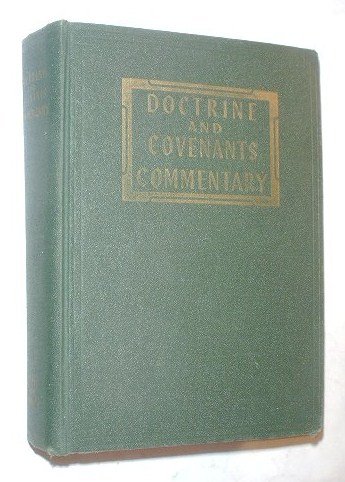
These two stories make the events of the Book of Mormon happening in Mesoamerica as not likely. Showing two repositories of records at Hill Cumorah is significant. One depository is the Stone Box where the original gold plates were found by Joseph Smith, and a second depository in a different location in Hill Cumorah where wagons full of records were found. In this large cave was also the Sword of Laban and the Liahona which were not found with the gold plates and the Urim and Thummim. Both of these accounts have been published in Church History since 1923 in the Doctrine and the Covenants Commentary shown below.

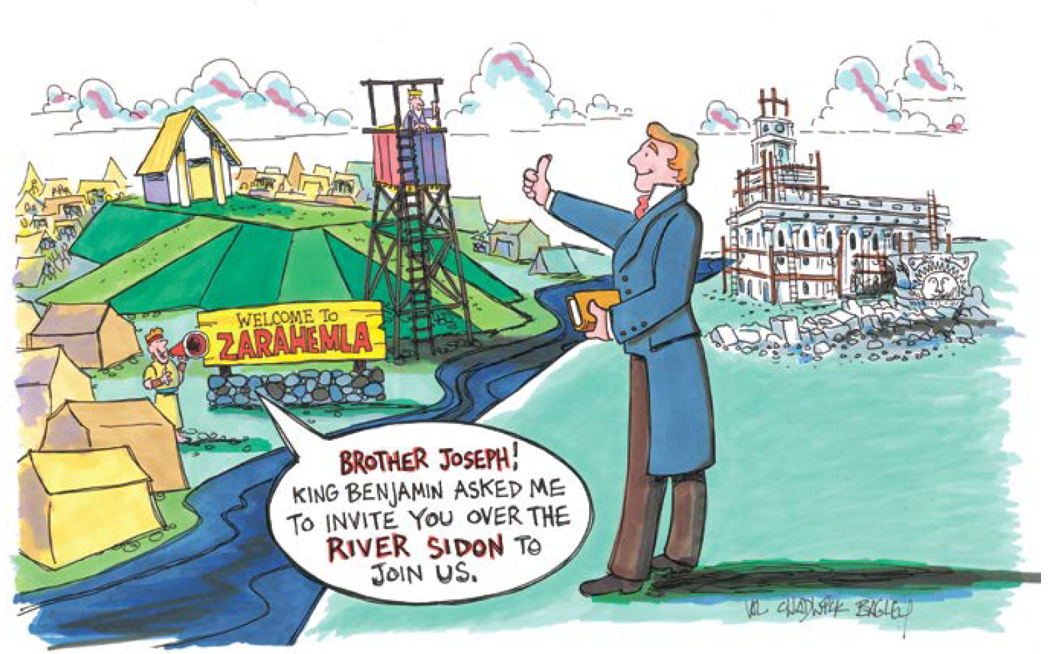
If the Cave at Cumorah really existed (which it did, see page 47 Doctrine and the Covenants Commentary), there would be no reason for Moroni to walk all the way from Mesoamerica to NY to deposit the plates. In fact think about it. If there was a cave at Cumorah with wagon loads of plates (all Nephite and Jaredite records) and the sword of Laban and the Liahona, how would Moroni bring all of this back to the hill Cumorah in New York? Would he have made 5 or 6 trips of over 3,000 miles each way? My friend Val Chadwick Bagley illustrates that idea below that I asked him to draw. Before he drew the picture he believed the Meso story, but was soon converted after realizing the absurdity of these many trips to Mesoamerica and back to NY.


Art by Val Chadwick Bagley

Historical Information from Church History

The First Presidency in 1923 of Heber J Grant, Charles W. Penrose and Anthony W. Ivins and again in 1950 The Publication Committee of  Joseph Fielding Smith, Harold B. Lee and Marion G. Romney, assigned by Pres George Albert Smith, approved some historical information from Church History (page 508 below) that has much to do with Book of Mormon Geography. The last edition of the commentary was also published in 1978 by Deseret Book and approved by Pres Spencer W. Kimball, N. Eldon Tanner and Marion G. Romney.

Within this Commentary speaking about section 84, contains comments pertinent to Book of Mormon geography by telling the historical account by David Whitmer saying, “the messenger who had the plates [of the Book of Mormon], who had taken them from Joseph just prior to our starting from Harmony.” Again I ask, who is the messenger spoken of? We report, you decide!

On page 508 of the The Doctrine and the Covenants Commentary (picture above) it says,

Approved commentary from 3 Presidencies


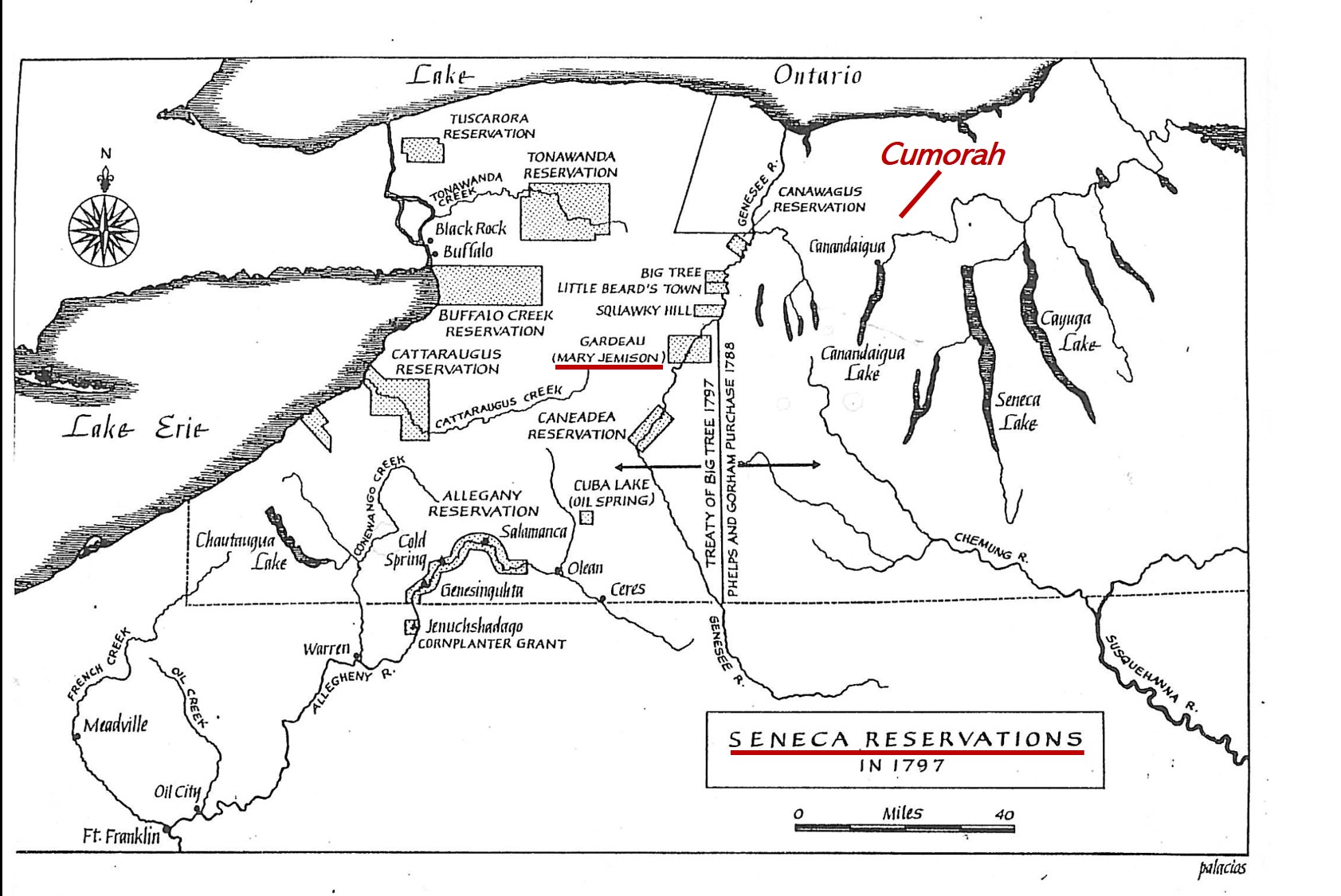
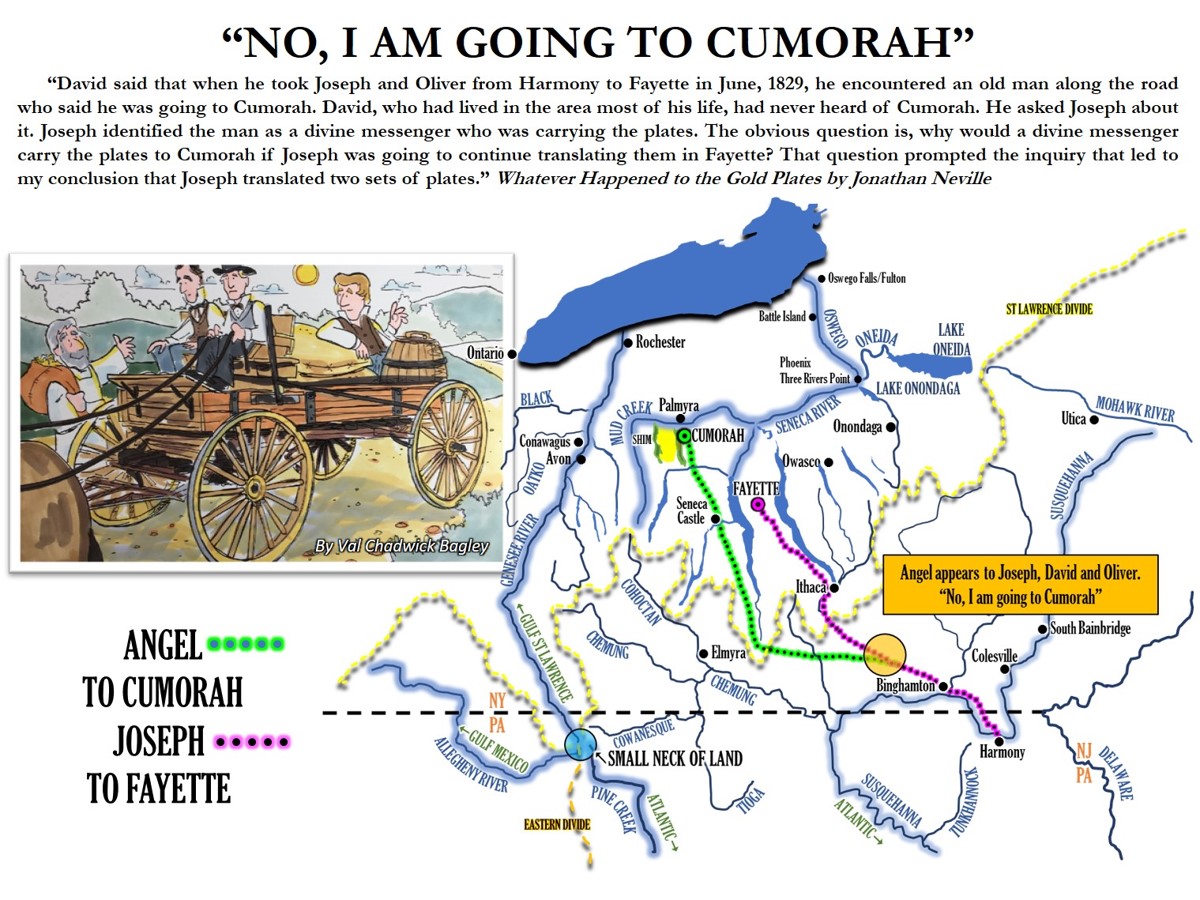
“The following anecdote, which was told by David Whitmer to Elders Orson Pratt and Joseph F. Smith in 1878, may be retold here: When I was returning to Fayette, with Joseph and Oliver, all of us riding in the wagon. Oliver and I on an old- fashioned wooden spring seat and Joseph behind us — while traveling along in a clear open space, a very pleasant, nice-looking old man suddenly appeared by the side of the wagon and saluted us with, ‘Good morning, it is very warm,’ at the same time wiping his face or forehead with his hand. We returned the salutation, and, by a sign from Joseph, I invited him to ride if he was going our way; but he said very pleasantly, ‘No, I am going to Cumorah.’ This name was something new to me; I did not know what Cumorah meant. We all gazed at him and at each other, and as I looked around inquiringly of Joseph, the old man instantly disappeared, so that I did not see him again. “Whitmer described his appearance and added, it was the messenger who had the plates [of the Book of Mormon], who had taken them from Joseph just prior to our starting from Harmony”(Andrew Jensen, Historical Record, p. 209) 1950 Revised Edition of the Doctrine and Covenants Commentary page 508 More Details at this blog

David Whitmer and the Messenger by Jonathan Neville

“Some people still dismiss David Whitmer’s account of the messenger taking the plates from Harmony to Cumorah before arriving in Fayette with the plates of Nephi.

I discussed this in 2016, but there are a lot of new readers who probably missed those posts so I’m posting updated versions of them here.

Note on Cumorah, David Whitmer and Zina Young

I realize the topic of Cumorah has been discussed a lot lately, but there are still people who claim the founding prophets and their successors were wrong when they taught that the Hill Cumorah of Mormon 6:6 is in western New York. I’ve covered this topic in detail here. This post covers a new bit of information that’s always been available but a lot of people don’t know much about it.

If you’re new to this topic, it has to do with two of the Three Witnesses. Those who advocate the Mesoamerican/two Cumorah geography (M2C) reject Oliver Cowdery’s description of Cumorah in Letter VII. They also reject David Whitmer’s explanation of the first time he heard the word Cumorah (which he said was in June 1829, before he’d ever read the text, and he heard it from a heavenly messenger).

The rationale for rejecting David Whitmer’s testimony is that he supposedly never talked about it until 50 years after the fact, in interviews he gave to Edward Stevenson in 1877 and to Joseph F. Smith and Orson Pratt in 1878.

Here’s how one scholar articulated the argument:

Edward Stevensen

“The earliest possible connection between the New York hill and the Book of Mormon Cumorah comes from an 1878 interview with David Whitmer by Orson Pratt and Joseph F. Smith,… This report [the Whitmer interview] would be much more conclusive had it not been recorded nearly fifty years later. The passage of time and the accepted designation of “Cumorah” as the name of the New York hill by the time of the recollection argue against the second-hand report from Whitmer as being a definitive statement.”

There are all kinds of logical errors in that statement, but I’ve addressed those before. Today, I want to point out something in the Stevenson statement, taken from his contemporaneous journal.

I obtained a copy of Stevenson’s journal recently and here’s what his entry says:

Page from Stevenson journal

“I wish to mention an Item of conversation with David Whitmer in regard to Seeing one of the Nephites, Zina Young, Desired me to ask about it. David Said, Oliver, & The Prophet, & I were riding in a wagon, & an aged man about 5 feet 10, heavy Set & on his back, an old fashioned Armey knapsack Straped over his Shoulders & Something Square in it, & he walked alongside of the Wagon & Wiped the Sweat off his face, Smileing very Pleasant David asked him to ride and he replied I am going across to the hill Cumorah. Soon after they Passed they felt Strangeley and Stoped, but could see nothing of him all around was clean and they asked the Lord about it. He Said that the Prophet Looked as White as a Sheet & Said that it was one of the Nephites & that he had the plates.”*

Art by Brooke Mahlia Mann

Edward Stevenson was a general authority (one of the seven presidents of the Seventy). He was a well-known missionary (one of the MTC buildings is named after him). There’s no reason to doubt the credibility of his interview with David Whitmer.

What I find fascinating is that Zina Young asked Stevenson to ask David Whitmer about seeing one of the Nephites. That was the focus of the interview, not the Cumorah question.

Zina Young

This means that Zina had heard this story earlier. 

Why Zina Young? 
And when could she have heard it? 
And from whom?

It could not have been from the interview with Joseph F. Smith, which occurred a year later.

Instead, the evidence indicates she heard it from David Whitmer directly!

Zina was born in 1821. Her family lived in Watertown, New York. In 1835, when she was 14 years old, two missionaries came to town: Hyrum Smith and David Whitmer. Hyrum baptized her on August 1, 1835. The family moved to Kirtland, and eventually to Far West, and then to Nauvoo along with most of the rest of the Saints. Zina married, had two children, and then also married Joseph Smith. After his death, she married Brigham Young. (That’s a topic for another day.)

David Whitmer left the Church in 1837-1838 and lived in Missouri for the rest of his life. Zina would have had no contact with him after about 1837, at the latest. If that’s the case, then she could only have heard the story from him between 1835 and 1837–just a few years after 1829, when David said the event happened.

Of course, modern Mesoamerican scholars will dispute this somehow, but the argument that David’s testimony is unreliable because it was 50 years late contradicts the Stevenson account.

Interestingly, Zina was also the one who inherited Joseph’s seer stone after Brigham Young died.

The simplest, historically justified explanation is that David told Zina and her family the story when he contacted them as a missionary. Zina remembered it and told Stevenson to ask David about it in 1877. Stevenson recorded it and wrote about it. 

Then Joseph F. Smith asked David about it, and he reiterated his account of the event.

It’s not a 50-year-old story related from a feeble and tainted memory. It’s a retelling of an account related by a missionary to his investigators just a few years after the event. Other than to defend the M2C ideology, there’s no reason to cast doubt on the testimony of the Three Witnesses.
________________

David Whitmer

The bottom line is this: 
To accept M2C, you have to disbelieve two of the three main witnesses to the Book of Mormon: Oliver Cowdery and David Whitmer. The M2C advocates seek to persuade you these two men were not reliable witnesses when it comes to the issue of Cumorah being in New York.

By contrast, to accept the North American setting (Moroni’s America or the Heartland), you fully embrace what these two men said.

References: http://contentdm.lib.byu.edu/cdm/ref/collection/BYUIBooks/id/3527

*You can find this account in these references, although apparently not transcribed exactly: “Edward Stevenson Interview (1) 22-23 December 1877, Richmond, Missouri Diary of Edward Stevenson,” LDS Church Archives, Lyndon W. Cook, ed., David Whitmer Interviews, 1993, p. 13; also Dan Vogel, ed., Early Mormon Documents, 2003, vol. v, p. 30._____

More on David Whitmer, Zina Young, and Cumorah

avid Whitmer, circa 1855
(photo links to JSP)

This post offers more detail on David Whitmer and Zina Young.

I’ve had some feedback on the previous post that there is no evidence Zina had heard about David Whitmer’s Cumorah experience from David himself. It’s true we don’t have written evidence of when she heard the story or from whom, but Stevenson’s journal shows Zina had heard it from somewhere before Stevenson visited Whitmer. That’s why she told Stevenson to ask Whitmer about it. I imagine the conversation being something such as this:

Zina: “You’re going to visit David Whitmer?”
Stevenson: “I plan to. I hope he’ll see me.”
Zina: “Ask him about the Nephite he met.”
Stevenson: “He met a Nephite?”
Zina (nodding): “And he was carrying the plates to the hill Cumorah because Joseph didn’t want the responsibility. David, Joseph and Oliver Cowdery were riding in a wagon from Harmony to the Whitmer farm. He’ll tell you all about it.”
Stevenson: “Sounds interesting.”
Zina: “You should publish it when you get back.”

The M2C advocates who reject David’s testimony rely on the “late” retelling to Stevenson and Joseph F. Smith. Their objection is based on the premise that David’s experience hearing the term “Cumorah” for the first time occurred in 1829, but he did not tell the story before 1877. Certainly, 50 years after the fact could be considered late; each person has to assess that “lateness” in light of the detail of Whitmer’s account, the surprising and unusual circumstances (most people probably remember their first encounter with divine messengers), and the presence of Joseph and Oliver when the event occurred.

The Stevenson account undermines the “lateness” objection, however. Whether Zina heard the story directly from Whitmer in 1835, or heard it from someone else, the point is that she did hear it before Stevenson asked Whitmer about it. From his journal, we have to infer that Stevenson had not heard the story before.

There is no record of anyone knowing this story before Stevenson’s interview with David, except for Zina. So all the evidence we have suggests that before the interview, the only two people who knew the story were Zina and David (and Oliver and Joseph, if David’s testimony is to be believed, but Joseph and Oliver were dead by then).

And the only evidence we have of David and Zina interacting was when David and Hyrum Smith were missionary companions in 1835 in Watertown, NY, where Hyrum baptized her. [This is no minor point. David Whitmer didn’t go on a lot of missionary journeys. When you read Zina’s account, notice how she emphasizes how hard David worked to persuade her to get baptized. It seems reasonable to infer he tried everything he could, including his viewing of the golden plates as one of the Three Witnesses. In this context, his claim he saw one of the Nephites carrying the plates to Cumorah would naturally be another thing to bring up.

Later, Joseph F. Smith and Orson Pratt visited David Whitmer and elicited the same story from him. This suggests they first heard it when Stevenson published it (or told them about it).

Zina published an article, probably taken from parts of her journal we don’t otherwise have now, in the April 1893 issue of The Young Woman’s Journal. Titled “How I Gained my Testimony of the Truth,” the article gives details on how she joined the Church in 1835. It is available online here. In the next section, I show the relevant aspects of Zina’s article.

In the following summer Hyrum Smith and David Whitmer came to our house and stayed several days. Father and mother had been baptized in the April of that same year, but neither myself nor my sister were baptized.

David Whitmer persuaded me to be baptized while they were at our home, but some way I did not accept his offer. I had told my sister-in-law, Fanny Huntingdon, that when she was baptized I would go with her.

The morning for the departure of these men from our house arrived, and I had not as yet become a member of the Church. That morning, a short time before they were to start, Hyrum Smith’s cousin rode up with a message that they could not leave that day, as my brother Dimick and his wife Fanny, my dear sister-in-law, were desirous of being baptized.

That morning at prayers I had presented to me a heavenly vision of a man going down into the water and baptizing someone. So when this message came I felt it was a testimony that the time had come for me to receive baptism. Brother Hyrum Smith was mouth in prayer, and in my secret soul I had a wish that he should baptize me. I had refused the coaxing of Brother Whitmer, as I told myself, because mother and father were going away from home, and I had all the home cares on me, and I feared I would be tempted to speak crossly or say something I ought not to after so sacred an ordinance as that; but this strong testimony that the proper time had arrived I did not dare treat lightly.

As soon as I consented to go with my brother and sister-in-law David Whitmer began talking about performing the office for us. Happily for me, however, Brother Hyrum was chosen by the others to be the proper one and I added my preference to their words. Accordingly, we all went down to the water and were baptized by Hyrum Smith, and confirmed under the hands of Hyrum Smith and David Whitmer. [This was on August 1, 1835.]

Article by Jonathan Neville here

Why does Book of Mormon Central say a “messenger” is Moroni?

Edward Stevenson’s journal said, “And an aged man about 5 feet 10, heavy set, and on his back an old fashioned army knapsack strapped over his shoulders and something square in it, and he walked alongside of the wagon and wiped the sweat off his face, smiling very pleasantly. David asked him to ride and he replied, ‘I am going across to the Hill Cumorah.’ Soon after they passed, they felt strange and stopped but could see nothing of him-all around was clear. And they asked the Lord about it. He said that the Prophet looked as white as a sheet and said that it was one of the Nephites, and that he had the plates.See Edward Stevenson, Journal, Dec. 23, 1877

See the title assigned to the painting by Book of Mormon Central as, “Mary Whitmer and Moroni” by Robert T. Pack (See picture below)

In the actual article below, Book of Mormon Central never mention the messenger as “Moroni”, just as “a messenger“. Why would they call this messenger Moroni? Take a look at the description of Edward Stevenson below. He says that David Whitmer identified the messenger as 5’10” and heavy set. Does that describe the Moroni we all know as described by Joseph Smith? NO!
https://knowhy.bookofmormoncentral.org/knowhy/what-does-mary-whitmer-teach-us-about-enduring-trials

Original source (Joseph F. Smith, 1918):

“In the middle of this prairie, all of a sudden, there appeared a man walking along the road, and David said he raised his hat and rubbed his brow, as if it were a little warm, and said good morning to them, and they said good morning. Oliver and David looked at each other and began to marvel and wonder: Where did he come from, what does it mean? David described him saying he had on something like an old-fashioned knapsack, but of course a little differently formed, right across his shoulders, and on his back he was carrying something of considerable weight.

“They looked round to Joseph inquiringly: What does it mean? And Joseph said, “Ask him to ride.” So David, who was teamster, asked him if he would get in and ride with them. He said, “No, I am just going over to Cumorah.” David said, “Cumorah? Cumorah? What does that mean?” He had never heard of Cumorah, and he said, I thought I knew this country all around here, but I never heard of Cumorah” and he inquired about it. While he was looking around and trying to ascertain what the mystery was the man was gone, and when he looked back he did not seem him any more. Then he demanded, “What does it mean?”

“Joseph informed him that the man was Moroni, and that the bundle on his back contained plates which Joseph had delivered to him before they departed from Harmony, Susquehanna County, and that he was taking them for safety, and would return them when he (Joseph) reached father Whitmer’s home. There was a long talk about this.”

To be sure, there is a discrepancy in the accounts about whether this messenger was Moroni or one of the Three Nephites, a topic I’ve discussed elsewhere, but there is complete consistency among all the accounts that the messenger was going to Cumorah.” Jonathan Neville

John C. Whitmer’s 1878 account
As recorded by Andrew Jenson (see his Latter-Day Saint Biographical Encyclopedia 1:283, Salt Lake City, Utah: 1901):


5’10” Heavy Set Old Man Brother Nephi,
one of the Three Nephites?

“I have heard my grandmother (Mary Musselman Whitmer) say on several occasions that she was shown the plates of the Book of Mormon by a holy angel, whom she always called Brother Nephi. (She undoubtedly refers to Moroni, the angel who had the plates in charge.)”

Why would John C. Whitmer change his grandmother’s name for the messenger from Brother Nephi, to Moroni?

Over 6 foot medium build Moroni?

We think the messenger appearing at Joseph and David’s wagon, (picture left) and the same messenger that appeared to Mary Whitmer at her farm and the same messenger who knocked at the door of Zina to teach her about Christ, could very well be one of the Three Nephites named Brother Nephi, AND IT WASN”T MORONI!

You Choose!


More Information from Zina Huntington by Ryan and Anita Murdock below:

I read your blog this morning and have a bit more to add. Zina Diantha Huntington Jacobs Smith Young is my husbands 3rd great grandmother and was the wife of two prophets, sealed twice to Joseph Smith (once by her brother Dimmock, best friend of the prophet, and then again by Brigham Young, after he returned from England.) She later married Brigham for time only.  The reason she was interested in the Three Nephites, is because the same one stopped by their family home in Watertown, Jefferson, NY and taught them the gospel of Jesus Christ. It is mentioned in the book 4 Zina’s about her mother Zina, herself, her daughter Zina and granddaughter Zina. The family was having what we might call a family home evening one night, discussing scriptures and playing music, when they had a knock at their door, and when opened, they found a man dressed in old fashioned clothes, who said that he usually takes sequestered paths. the mother of the family, Zina Baker Huntington, had said she wished she could hear the gospel from someone who KNEW CHRIST. The man told them all about Jesus Christ in a manner that they had never heard before, as if he did know Christ, and stayed the night with them. Later after they were gathered with the Saints, William Huntington related the story to Joseph, who asked them the describe the man, which he did. Joseph confirmed it was one of the three Nephites sent to prepare them to receive the gospel. Since Zina had spent an entire evening with one of the three Nephites, not a moment, but an entire night learning from him, you can imagine why she was so interested in this story. -Anita Murdock

Blog about Two Depositories in Hill Cumorah
Blog about Two Sets of Plates Translated by Joseph
Blog about Church History and Two Sets of Plates

Intellectuals Determined to Convince the Prophet Joseph, was a Just a Man

Many intellectuals seem determined to convince everyone that the prophet was simply a man. Elder Packer said, We knew that already.” He was and is now, simply an incredible Prophet of God.

“Joseph Smith, the Prophet and Seer of the Lord, has done more, save Jesus only, for the salvation of men in this world, than any other man that ever lived in it.” D&C 135:3

Joseph Knew the Book of Mormon Geography

I feel it is significant to show some of the deeply held biases of some of our intellectual members of the church. When it comes to geography of the Book of Mormon I believe Joseph Smith knew all along that events began in North America.

Joseph said in the Wentworth letter,I was also informed concerning the aboriginal inhabitants of this country [America] and shown who they were, and from whence they came; a brief sketch of their origin, progress, civilization, laws, governments, of their righteousness and iniquity, and the blessings of God being finally withdrawn from them as a people, was [also] made known unto me; I was also told where were deposited some plates on which were engraven an abridgment of the records of the ancient prophets that had existed on this continent…”

Joseph continued in the Wentworth letter to say, “With the records was found a curious instrument, which the ancients called “Urim and Thummim,” which consisted of two transparent stones set in the rims of a bow fastened to a breastplate. Through the medium of the Urim and Thummim I translated the record by the gift and power of God.

First Lamanite Mission in the United States of America D&C 28, 30, 32

In this important and interesting book the history of ancient America is unfolded, from its first settlement by a colony that came from the Tower of Babel at the confusion of languages to the beginning of the fifth century of the Christian era. We are informed by these records that America in ancient times has been inhabited by two distinct races of people. The first were called Jaredites and came directly from the Tower of Babel. The second race came directly from the city of Jerusalem about six hundred years before Christ. They were principally Israelites of the descendants of Joseph. The Jaredites were destroyed about the time that the Israelites came from Jerusalem, who succeeded them in the inheritance of the country. The principal nation of the second race fell in battle towards the close of the fourth century. The remnant are the Indians that now inhabit this country. This book also tells us that our Savior made His appearance upon this continent after His Resurrection;” Wentworth Letter (Red Text added which shows to me that Joseph was speaking from the area of New York in the USA and his references were about America, not Mesoamerica. It’s logical and makes sense).

List of all Speakers and the Schedule, Click Here

Early-Bird Prices end Sept 15. Purchase Today!


Decide Truth

We should all be open minded to listen to differences in our opinions about the geography of the Book of Mormon. I believe there is only one Hill Cumorah and others are welcomed to share why they feel there are two Cumorah’s. I believe events of the Book of Mormon happened in the USA and others who contribute to some of our Church publications such s “Saints”, believe events happened in Central America. The Church of Jesus Christ of Latter-day Saints is officially neutral about where the events took place. Since the Church is neutral, why do many intellectuals who correlate and edit Church History, promote a specific geography in Central America? It’s a subject worth learning more about. I believe Joseph Smith taught a North American setting for the Book of Mormon and never hinted at a Central American setting. You can decide what you believe.

Intellectuals Concerned about an Occultic Joseph?

Pres Benson said, “For those concerned how this occultic “Joseph Smith” could make its way into Church publications, President Ezra Taft Benson offered this advice, “Sometimes from behind the pulpit, in our classrooms, in our Council meetings and in our church publications we hear, read or witness things that do not square with the truth. . . . Now do not let this serve as an excuse for your own wrong-doing. The Lord is letting the wheat and the tares mature before he fully purges the Church. He is also testing you to see if you will be misled. The devil is trying to deceive the very elect.” Ezra Taft Benson, “Our Immediate Responsibility” (BYU Devotional, Provo, October 25, 1996), https://speeches.byu.edu/talks/ezra-taft-benson_immediateresponsibility.

I have noticed some peculiar beliefs behind some very intellectual men and women that are good active members. They believe in Christ and the Gospel. They believe in the Doctrine of the Church. They generally believe the First Presidency and the Quorum of the Twelve. They believe in past Prophets and Apostles mostly. (Most likely disagreeing slightly with Joseph Smith, Joseph Fielding Smith, Ezra Taft Benson, and David O. McKay. They believe members of the Quorum of the Seventy mostly but have a few different opinions on many issues. They believe their peers, and scholars in a group think setting. They believe the Prophet Joseph Smith, but often try and put him down, or make him more human.

I realize I am generalizing, but I am trying to make a point. In my opinion it seems many historians, professors and intellectuals try and bring Joseph Smith down just a notch more often than anyone else.

Elder Packer said, Some historians write and speak as though the only ones to read or listen are mature, experienced historians. They write and speak to a very narrow audience. Unfortunately, many of the things they tell one another are not uplifting, go far beyond the audience they may have intended, and destroy faith. What that historian did with the reputation of the President of the Church was not worth doing. He seemed determined to convince everyone that the prophet was a man. We knew that already. All of the prophets and all of the Apostles have been men. It would have been much more worthwhile for him to have convinced us that the man was a prophet, a fact quite as true as the fact that he was a man.” The Mantle Is Far, Far Greater Than the Intellect Elder Boyd K. Packer

Quotes about Intellectual Opinions

“Mormonism, as it is called, must stand or fall on the story of Joseph Smith. He was either a Prophet of God, divinely called, properly appointed and commissioned or he was one of the biggest frauds this world has ever seen. There is no middle ground. If Joseph was a deceiver, who willfully attempted to mislead people, then he should be exposed, his claims should be refuted, and his doctrines shown to be false” .Joseph Fielding Smith, Doctrines of Salvation, vol. 1 (Bookcraft, 1960), 188

I have come to believe that it is the tendency for many members of the Church who spend a great deal of time in academic research to begin to judge the Church, its doctrine, organization, and leadership, present and past, by the principles of their own profession. Ofttimes this is done unwittingly, and some of it, perhaps, is not harmful. The Mantle Is Far, Far Greater Than the Intellect Elder Boyd K. Packer

This problem has affected some of those who have taught and have written about the history of the Church. These professors say of themselves that religious faith has little influence on Mormon scholars. They say this because, obviously, they are not simply Latter-day Saints but are also intellectuals trained, for the most part, in secular institutions. They would that some historians who are Latter-day Saints write history as they were taught in graduate school, rather than as Mormons. The Mantle Is Far, Far Greater Than the Intellect Elder Boyd K. Packer

President Brigham Young admonished Karl G. Maeser not to teach even the times table without the Spirit of the Lord. How much more essential is that Spirit in the research, the writing, and the teaching of Church history. The Mantle Is Far, Far Greater Than the Intellect Elder Boyd K. Packer

I don’t believe these quotes above were said too long ago for us to believe them today. Why do we at times become complacent with older quotes of Prophets and look for new and out of the box thinking? I love the quotes above and know many intellectuals at BYU and in may Stakes, try too much to come up with new and seemingly progressive ideas. Say no the revisionists and stick with traditional values which are still important today. It’s been a few years since the amazing “Faith Crisis” books of the Stoddard’s have come to light, but they are more relevant today than ever. I challenge you to read them and have your children who may have a faith crisis read them. All will learn that it’s ok to be traditional.

FAITH CRISIS: Did the LDS Church Lie? (Part 1 ) We Were NOT Betrayed! By James and Hannah Stoddard

“A Reconstructed Narrative” 

Purchase Volume One

“Many remain unaware of the growing movement among disaffected members and disgruntled academic scholars within the Church to change our history. While the effort to progressively alter the traditional history is not a new phenomenon, the last few years have produced a sharp increase in the number of prominent Latter-day Saint historians and intellectual scholars who are calling for a ‘reconstructed narrative.’ 

The Bushman Challenge

One of those leading that charge [reconstructed narrative] is Richard L. Bushman, a prominent, progressive, New Mormon Historian whom some consider the “world’s foremost scholar on Joseph Smith and early Mormonism.” During a July 12, 2016 fireside, Bushman responded to a participant’s question regarding whether the traditional understanding of Church history is accurate: 

Question: In your view do you see room in Mormonism for several narratives of a religious experience or do you think that in order for the Church to remain strong they would have to hold to that dominant narrative? 

Click to read how this book has been debunked!

Richard Bushman: I think that for the Church to remain strong it has to reconstruct its narrative. The dominant narrative is not true; it can’t be sustained. The Church has to absorb all this new information or it will be on very shaky grounds and that’s what it is trying to do and it will be a strain for a lot of people, older people especially. But I think it has to change.    The following month, Bushman elaborated on his meaning in connection with a new reconstructed narrative by making the following statement:  “I consider Rough Stone Rolling a reconstructed narrative.  It was shocking to some people.  They could not bear to have the old story disrupted in any way.  What I was getting at in the quoted passage is that we must be willing to modify the account according to newly authenticated facts.  If we don’t we will weaken our position.  Unfortunately, not everyone can adjust to this new material. 

Many think they were deceived and the church was lying.  That is not a fair judgment in my opinion.  The whole church, from top to bottom, has had to adjust to the findings of our historians.  We are all having to reconstruct.” Richard Bushman Bushman is not alone in calling for a new Joseph Smith, and a new Church history with an accompanying newly-crafted Mormon culture. Throughout this and later chapters we will hear from historians who are encouraging a “new era,” and who hope to shift the general consciousness of the Church toward one of ‘intellectual enlightenment.’ One professor even went so far as to call for the “foundation” to be torn down and completely rebuilt. 

According to Bushman, from the most-recently baptized member, to multi-generational Latter-day Saints born and raised in the Church—all the way to the hierarchy—large numbers many are turning to the historians who are eagerly altering the foundational fundamental restoration story, based on their new ‘enlightened’ own interpretation. In the progressive mind their minds, Latter-day Saints have been fed a fictitious fallacious account of their  Mormon origins, but all now need to adapt their antiquate down understanding ideas to match the positions of these broad-minded progressive historians. For Bushman and his eager proselytes, the old story was inaccurate, and—at best—a feel-good myth; or—at worst it was a deliberate deceit, at its worst. Apparently, everyone was fooled except a few the New Mormon Historians, who have now solved the puzzle. 

Who is this new ‘Joseph Smith,’ and what constitutes a “reconstructed narrative”?  For those who are unaware, Bushman’s book, Rough Stone Rolling, presents a Joseph Smith who differs dramatically from the Joseph Smith advocated spoken of by past leaders, teachers and scholars in Presidents of the Church. 

In contrast According to Rough Stone Rolling:  

  • Joseph Smith was “involved in magic” (p 53). 
  • Joseph Smith’s involvement in “magic . . . was a preparatory gospel” (p 53) and “[r]emnants of the magical culture stayed with him to the end” (p 51). 
  • Joseph Smith gave “angry responses,” and “lashed back.” (pp 295-296). 
  • Joseph Smith had “easily bruised pride.“ He was “unable to bear criticism” and “rebuked anyone who challenged him” (p 296).
  • Joseph Smith suffered from “treasure-seeking greed” (p 51).
  • The Smith family has been “diagnosed as a dysfunctional family that produced a psychologically crippled son” (p 55).
  • The Smith family was drawn to “treasure-seeking folklore,” and saw astrology and magical “formulas and rituals” as connected to their spiritual well-being (pp 50-51).
  • “Magic and religion melded in Smith family culture” (p 51). 
  • Consecration “never worked properly. . . . The system’s two-year existence was about average for the various communal experiments being undertaken in the period” (p 183). 
  • Joseph Smith Sr. was an “oft-defeated, unmoored father” (pp 26-27) who “partially abdicated family leadership” (p 42).   
  • Joseph Smith Sr.’s “life [was] blighted by shame” (p 42). 
  • “Was Joseph Smith an adulterer? . . . Had Joseph been involved in an illicit affair?” (p 323) 
  • Joseph Smith’s “boasting” made his personal secretary “a little uncomfortable” (p 484). Joseph would “cut loose with extravagant comments about his mastery” (p 484). 
  • Joseph Smith had “outrageous confidence” for attempting the Joseph Smith Translation (JST) of the Bible (p 132). 
  • “Treasure seeking taught Joseph to look for the unseen in a stone” (p 131).  
  • Joseph “from time to time drank too much” (p 43). 
  • Joseph “probably exaggerated” the persecution after relating his First Vision. (p 43) 
  • Joseph Smith had “[n]o flashes of intelligence, ambition, or faith distinguish him” (p 143).  
  • Joseph Smith “was not the luminous figure he is sometimes made out to be. . . . His own person was effaced” (p 112). 

Bushman admitted that the proposed ‘reconstructed narrative’ of Latter-day Saint Church History, as well as the life and character of the Prophet Joseph Smith  clearly departed from the traditional or “dominant narrative” given to us by previous past Church historians, including Willard Richards, who was present at the Carthage martyrdom, George A. Smith, first cousin to the Prophet Joseph Smith, and Presidents Wilford Woodruff and Joseph Fielding Smith.   

Is The Dominant Narrative True?

Is the dominant narrative true? To answer this question, we must first define what it is that represents the dominant narrative. For nearly two centuries, the Church maintained a consistent message about its foundational events; that God directed Joseph Smith as His Prophet to restore His truth, and to organize the Church according to the pattern of His primitive Church. Furthermore, that account characterizes the Prophet Joseph Smith as a righteous man who built the Church based on literal revelations received directly from God; that actual angels appeared, and the members witnessed the manifestation of authentic miracles.

Additionally, God restored His priesthood through Joseph Smith, the restorer and Head of this dispensation, who stands next to the Son of God in righteousness and holiness as a pure and holy vessel.  Subsequent to the sealing of the Prophet Joseph Smith’s testimony with his blood—at the Martyrdom where he fell with his noble brother, Hyrum—Brigham Young, who called himself “Joseph’s apostle,” continued to promote the teachings of the Prophet Joseph Smith, and to orchestrate his vision. Succeeding leaders and faithful members earnestly strive to carry on the Prophet Joseph’s work, testifying of and echoing his teachings in their lives, and to the world.  Traditionalists believe the points of the foregoing represent the essence—the dominant narrative—of the Restoration event, and that true history and credible sources corroborate the particulars of this account. The evidence, and the historical witnesses, stand in full support of the Church’s and Joseph Smith’s accounts.

Progressives disagree adamantly, arguing that the dominant narrative of the Church is “not true,” and believing that an immense cover-up has occurred—that when acknowledged, will allow a full-scale reconstruction of the story. The Angel Moroni told Joseph Smith that his name would be “had for good and evil,” so it is perhaps fitting that the struggle continues, both on the world’s stage and in the homes of the members of the Church. Time will vindicate the truthfulness of the record; that there was no cover-up, and that the true greatness of Joseph Smith is not less—but rather far greater—than what we might have imagined.   Nevertheless, the Church is a temporal organization of imperfect human beings who strive, with varying degrees of success, to follow God’s will. Along the way, there have been some issues and historical complexities in which Presidents of the Church and other General Authorities acted in less-than-straight-forward ways. There have been times when the Lord required Presidents to act on His direction, and there may have been other times when Presidents acted according to the best light and knowledge they had, and were doing their best. 

Examples of where the Church leaders were perhaps less than one hundred percent straight-forward might include Joseph Smith’s carefully-worded denials of plural marriage in Nauvoo. This can be understood in considering that the Lord had commanded the practice of plural marriage in opposition to the laws of the land, necessitating that its practice be out of the public eye. Another example might be the continuance of post-1890 Manifesto polygamy. The Church publicly discontinued the practice of plural marriage with the issuance of the Manifesto (Official Declaration 1), but plural marriages were afterwards performed with the sanction of the President of the Church for some years. We do hold that the Presidents of the Church did not commit any dishonourable actions or decisions contrary to the will of God.

This becomes clear once one understands the true history. However, the history and further exploration into these subjects exceeds the purpose of this work; they must fall under the pen of a future volume.   In addition to these highly-poised issues, Presidents of the Church—especially during the administrations of David O. McKay and Spencer W. Kimball—and even more so during recent times, have paid careful attention to the message available to the media; and so far as is possible, have portrayed the Church in its best-possible light according to public opinion and perception. All businesses and organizations are acutely aware of this necessity today. Is every decision made by leaders altogether inspired? Such answers are far too difficult for us to know individually, but the responsibility stands rightfully between the Lord and the leaders of the Church. We believe, at least generally, that these decisions have been made in righteousness.  

However, historical nuances and the analogue of human imperfection are not the focus of this book; nor, we would suggest, are they the source of the ‘trust gap,’ the sense of lost moorings, felt by so many of today’s Latter-day Saints. At the end of the day, one question nagging thousands of Latter-day Saints can be summarized thus: “Is the dominant, traditional narrative true?” One might further ask, “Did the founding of the Church originate as presented by Joseph Smith and his companions who affirmed his narrative, or are there skeletons in the closet?” Progressives claim the Church covered up its history for nearly 200 years, but the student of truth must ask, is the current faith crisis the result of unmasked history . . . or of new interpretations

The authors believe that the dominant narrative is not only true, but in many respects has been understated. The Restoration of the Gospel of Jesus Christ, and the work of Joseph Smith and those loyal to his mission, is greater than we as a people might understand. It is the sincere belief of the authors that the nobility and greatness of Joseph Smith surpasses the glory that even his most ardent supporters concede.   

Unbeknownst to the general Church membership, the 20th century would witness an organized effort to rewrite Latter-day Saint history from within its own ranks. In a head-to-head, behind-the-scenes-battle, traditional leaders resisted intellectual progressives working in the Church History Department and at BYU, who claimed some forty years ago that it would take a generation to re-educate the Church membership. Where are we in this attempted re-education? What is the New Mormon History, and how does it personally affect you and your family?  

Purchase Part II Here

Join us as we explore newly-available diaries, review old books, and bring untold history into the light!  

Leonard Arrington told the Church History Division staff in 1976 that it would “take a generation to educate the Church to historical trends.’”

Leonard J. Arrington Diaries, September 23, 1976; Leonard J. Arrington and Gary James Bergera, Confessions of a Mormon Historian: The Diaries of Leonard J. Arrington, 1971-1997, vol. 2 (Salt Lake City: Signature Books, 2018), 243, footnote 46.  Biblical Criticism has led many scholars to determine that the Creation, the story of Adam and Eve, Noah’s worldwide Flood, the account of Jonah and the whale, Moses’ Exodus, and other miraculous events, are merely fictional stories with an allegorical purpose. Where did they come from? Some advocates of Biblical Criticism maintain that many were borrowed from Babylonian and Canaanite pagan myths.” Faith Crisis Part 1, James and Hannah Stoddard 

BYU linked, Dragshow, Exposing Children, Enough!

Shock: BYU linked, Dragshow, Exposing Children, Enough! Take Action

This article is disturbing. Defending Utah has been a great vendor and speaker at our Firm Foundation events and does a lot of great work. This evil at the doorsteps of BYU needs to be known. I feel I need to let people know what’s happening. I have a moral obligation. This event by the “RaYnbow Collective” as they call themselves, is beyond disturbing, it is evil smut and even though they are not doing this on BYU campus, its right next door.

I fully understand they have a right to express and have a freedom to the first amendment, but I also know by the report from Defending Utah there were little children present and that is illegal. The police just sit around it seems and allow this evil to be displayed around children. I can’t imagine what parent or pervert would want a child to see this behavior. We are truly living is Satan’s world.

Our wonderful Church is doing what it can to address the problems, but we must remeber that people have their free agency. We can’t stop people, nor should we from expressing free speech. We just need to figure out how to combat and attack evil when we see it. I am sad that the people who promote radical sex and abhorrent behavior, will need to explain at the bar of God.

Elder McConkie said, “I do not know all of the providences of the Lord, but I do know that he permits false doctrine to be taught in and out of the Church and that such teaching is part of the sifting process of mortality.” Bruce R. McConkie, McConkie’s 1981 letter to BYU

Here’s what a good friend told me after seeing this article:

“BYU needs to be exposed and the administration fired for even having a club on campus that contradicts the values of the church. They have crossed so many lines preaching evolution, and gender neutrality and all the crap that’s of the adversary. They accept students that desecrate the church’s values and spit upon the founders of the church and Brigham Young. They should NEVER be allowed to attend our supposed religious institution.

It’s not a religious institution anymore and the church needs to take back control or stop financially supporting it! And to call this family friendly is total evil! Yes, PLEASE share my concerns. I’m so sick of the people who attend BYU looking down their noses at those who choose not to go there as if they are holier than thou. And this is what they are learning there now. Its got to STOP!! My kids growing up in BYUs shadows learned early on they did NOT want to go there with all the self righteous people they were once friends with. It destroys people with the double standard and the hypocritical manner and doctrine they learn both in the classroom and on campus! Ok there’s my soap box!” Anonymous

“It is now time that we each implement extraordinary measures — perhaps measures we have never taken before — to strengthen our personal spiritual foundations. Unprecedented times call for unprecedented measures.” Oct 3, 2021 President Nelson

Defending Utah

September 6, 2022 by Defending Utah

“Did you see this teaser below on social media?  Then you’ve come to the right place.

On Sep 3rd, 2022 – We covered a drag show event targeting children in the name of BYU through various BYU affiliated groups. The public event happened at Kiwanis park in Provo, just barely off campus.

Too many wouldn’t believe it if someone didn’t document it.  So here’s the full story with tons of details. Sign and share the petition to BYU at the bottom of this article.

Defending Utah, exercising our first amendment right to freedom of the press, assigned three journalists to the crowd working together at this public event.  The group putting on the drag show, the “RaYnbow Collective” (The Y is to claim their representation of BYU homosexuals) claimed this would be a “family friendly” drag show.  That’s difficult to do, since the nature of cross-dressing itself is not family friendly (the reason why the LDS church hasn’t even allowed it for employees at Halloween parties). Sexual fetishes have never been considered family friendly anywhere and as one protestor from Utah County put it, “Drag is a sexual fetish”.

But still, our intent was to give the benefit of the doubt and neutrally observe as journalists and report facts.  If the show was truly benign, we would report it as such.  But instead, the evidence shows the “family friend” intention is a complete lie. Instead, the evidence points strongly to suggest it’s intended to expose children to sexual content at inappropriate age levels.

New Section: BYU Connections

UPDATE: We’ve added this section for clarity based on feedback. This article already explains the various connections to BYU, but this summary paragraph is to put it into one place, because some people need to see it in one place, not everyone reads the whole article.

1. The drag queens themselves were both BYU students and BYU alumni doing the child grooming on stage, according to students and alumni that Defending Utah interviewed.
2. The Official Sponsoring Group was the “RaYnbow Collective” (it’s their screenshot above).
3. The group was raising money at the event, which they labeled for six different purposes. Some of those purposes are activities known to happen as part of the BYU experience.
4. The group uses the BYU “Y” logo, transformed into a rainbow. BYU does
not stop these unofficial groups from using their branding and implying
some level of endorsement from the university.
5. They’re supposedly an “unofficial” BYU group, as if that’s an excuse to distance this behavior from the university, however this is not a real excuse:
a. The same group is reported to hold other events on campus, even if this one was slightly outside campus. Students see them as a part of the university and the university culture.
b. Faculty do attend the meetings for this group, so they have faculty organizational help in their activities.
6. BYU professors have openly declared their opposition to the proclamation on the family, and they teach this to students. Read that article here.
7. BYU has a dozen or more groups that fall into the gender dysphoria category, some are official and some are not (listed below, and on the petition), and the same circles of students, alumni and staff may rotate between the groups. BYU provides money and resources to some, but not others. So picking and choosing which groups do the controversial things is only a dishonest way to hide that the university is supportive of the agenda as a whole.
8. Color the Campus – A related group is one of the most famous for “coloring” the BYU campus, they do events on campus, as their name even suggests.  The only difference is there is no child grooming on campus (yet).
9. See the video linked below of a walk through of BYU’s sociology department, to see how widespread this is at parts of the school.
10. Some other examples we’ve exposed about BYU professors engaging in anti-family behavior:
– BYU: Princess Culture Helps Boys Overcome Toxic Masculinity
– BYU Professor Pushing Removal of Family Proclamation
– BYU Professor Attacks Teachings of the Church”
by Defending Utah Complete Article Here


100 protesters yelled slurs in Provo as LGBTQ students at BYU celebrated coming back to school

by Salt Lake Tribune

“Clubs for queer students who attend BYU are not allowed to meet on campus; the school operated by The Church of Jesus Christ of Latter-day Saints forbids it, as well as any same-sex romantic partnerships or displays of affection among LGBTQ students.

So the RaYnbow Collective, a nonprofit that supports the BYU queer community, holds an annual gathering at a park at the start of every school year. This year, they went bigger than ever before, planning what they billed as a family-friendly drag show — which included current and former BYU students as performers.”


Elder Holland asks BYU faculty to defend the university’s unique mission; offer love, hope to LGBTQ while upholding God’s commandments

“PROVO, Utah — After loving Brigham Young University for nearly three-fourths of a century, Elder Jeffrey R. Holland pleaded with BYU faculty and staff on Monday, Aug. 23, to do their part to ensure the university “stands unquestionably committed to its unique academic mission and to the Church that sponsors it.”

“From one who owes so much to this school and has loved her so deeply for so long, keep her not only standing but standing for what she uniquely and prophetically was meant to be,” he said…

Elder Holland also shared a few lines from another memo. “ ‘You should know,’ the writer says, ‘that some people in the extended community are feeling abandoned and betrayed by BYU. It seems that some professors (at least the vocal ones in the media) are supporting ideas that many of us feel are contradictory to gospel principles, making it appear to be about like any other university our sons and daughters could have attended. Several parents have said they no longer want to send their children here or donate to the school…

LGBTQ and BYU

“Elder Holland said Church leaders “are not deaf or blind to the feelings that swirl around marriage and the whole same-sex topic on campus.”

“I and many of my Brethren have spent more time and shed more tears on this subject than we could ever adequately convey to you this morning, or any morning. We have spent hours discussing what the doctrine of the Church can and cannot provide the individuals and families struggling over this difficult issue. So, it is with scar tissue of our own that we are trying to avoid — and hope all will try to avoid — language, symbols and situations that are more divisive than unifying at the very time we want to show love for all of God’s children.” Read Entire Article Here


Tickets Here       Speaker Complete Schedule Here

 Listen to Greg Matsen, one of Firm Foundation Conference Speakers

The Great and Abominable Church- The Devil is the Founder

Once again I thank our friend David W. Allan for posting this brief and vital information from Chauncy Riddle. Two brilliant and special men who know about truth. I pray we listen to them. And it came to pass that I beheld this great and abominable church; and I saw the devil that he was the founder of it.” 1 Nephi 13:6
Today this Great and Abominable Church is alive in Politics, Sports, Religion, Hollywood Music, Big Pharma, Big Corporations, Big Tech, and Deep State Governments all over the World. We are inundated with Satan in 90% of those things in this world that focus and promote money and power, including evil Churches. Let’s heed the Prophets council who said, “It is now time that we each implement extraordinary measures — perhaps measures we have never taken before — to strengthen our personal spiritual foundations. Unprecedented times call for unprecedented measures.” Oct 3, 2021 President Nelson


The Great and Abominable Church

Chauncey C. Riddle
Chauncey C Riddle

Guest Post:  Chauncy C. Riddle and I have been very good friends for a long time.  His understanding of the gospel of Jesus Christ and his political awareness is unmatched.   Chauncey C Riddle is a Professor Emeritus of Philosophy from Brigham Young University in Provo, Utah. He is a religious leader in the Church of Jesus Christ of Latter-day Saints. He has written many articles for the Ensign, Sunstone Magazine, and BYU Studies. He has also written countless articles and has published the milestone  book entitled, “Think Independently,” that everyone should read.

Some Things to Know About “The Great and Abominable Church”

  1. It is found among every nation, kindred, tongue, and people, and covers the whole earth.
  2. It is operated under the direct control of Satan.
  3. It has its own temples, ordinances, and priestly vestments.
  4. It has its own gospel, which is taught everywhere and is believed by most of the educated and by many members of the Church of Jesus Christ of Latter-day Saints.
  5. It tries to either capture or drive out every other church and is very close to doing so.
  6. It fosters abortion, artificial birth control, and euthanasia.
  7. It tries to destroy the Ten Commandments and Christian standards.
  8. It pretends to be like a democracy but it is actually totalitarian.
  9. It is the most influential force in the world.
  10. It is in your face every day of the world.

But almost no one talks about it. Most people do not realize it exists. But it is doing the task God has assigned it to do and makes the blessings of the New and Everlasting Covenant possible to be received and enjoyed for everyone who deliberately rejects it in favor of Faith in Jesus Christ.

C.C.Riddle The Great and Abominable Church


Join us at the 30th Book of Mormon Evidence Conference.
Over 75 inspirational speakers.

Expo Tickets  Speakers Schedule

Satan’s Tool- Evolution

“Although through the majority of the 1900s controversy existed in the Church and at BYU dealing with the subject of evolution, the Church has officially stated its neutral stance on evolution, and the BYU administration today has been supportive of the teaching of evolution.” Daily Universe by Rachel Keeler July 2019 Source

In 2016, the Church’s youth magazine published articles on the pursuit of scientific truth. These articles reiterated that “the Church has no official position on the theory of evolution” and characterized it as a “matter for scientific study.” Echoing countless statements of Church leaders, the articles once again affirmed God’s role in creation and our relationship to our Heavenly Father as His children.” Gospel Topic Essay’s

Click Picture for Tickets

Neutrality in my Opinion

I think there is importance in the Brethren being neutral on geography, evolution and other difficult issues. They want us to gain our own witness to secondary information. They have given us sound doctrine and that is what we should focus on. I know through the Spirit that the Book of Mormon is true. However, I love to seek for other truth and as Moroni has said “I may know the truth of all things.”

False Doctrine

“I do not know all of the providences of the Lord, but I do know that he permits false doctrine to be taught in and out of the Church and that such teaching is part of the sifting process of mortality.” Bruce R. McConkie, McConkie’s 1981 letter to BYU

To me this is a very important part of understanding our purpose in life. In order to reach our fullest potential, we must hear other sides of issues. It is a way the Lord prepares us for Godhood. I am just saddened if some of our sweet naïve 18 year old’s become indoctrinated before they have the confidence to push back and pray about whether they are being taught truth or lies.

Darwinian Deceptions – Defending Truth for Today’s Latter-day Saints

Ever since Charles Darwin published his theory on the Origin of Species in 1859, evolution’s influence has steadily grown. Many people no longer even question it’s validity; however, most Christians (including Latter-day Saints) who hold to a biblical view of the Creation and man’s origins have struggled with the Darwinian assertion that all life evolved from a common ancestor over millions of years, and that humans evolved from simpler life forms.

I Don’t Believe in the Darwinian Opinion of Evolution

I have personally followed our Prophets words below. I don believe man came from an ape and I don’t believe something can be created out of nothing. I have personal revelation on a few of these these things.

Art by Ken Corbett

“Does God really want to speak to you? Yes! “As well might man stretch forth his puny arm to stop the Missouri river in its decreed course … as to hinder the Almighty from pouring down knowledge from heaven upon the heads of the Latter-day Saints.”

You don’t have to wonder about what is true. You do not have to wonder whom you can safely trust. Through personal revelation, you can receive your own witness that the Book of Mormon is the word of God, that Joseph Smith is a prophet, and that this is the Lord’s Church. Regardless of what others may say or do, no one can ever take away a witness borne to your heart and mind about what is true.

I urge you to stretch beyond your current spiritual ability to receive personal revelation, for the Lord has promised that “if thou shalt [seek], thou shalt receive revelation upon revelation, knowledge upon knowledge, that thou mayest know the mysteries and peaceable things—that which bringeth joy, that which bringeth life eternal.” Revelation for the Church, Revelation for Our Lives by President Russell M. Nelson


Creation and Evolution; A Witness of Prophets

The following are quotes from Joseph Fielding Smith of the Church of Jesus Christ of Latter-day Saints involving the concepts of organic evolution. I love Joseph Fielding Smith and that is more than likely the reason many liberals and progressives don’t love him. I am a conservative Latter-day Saint and follow neither political party but I follow the Lord and the inspired Constitution.

It is hoped that this information will help give insight and perspective on the teaching of evolution being done at nearly every university, college, and public high school across our nation to our most precious treasure, our children. For more detailed information presented in a historical context that provides tremendous understanding of the origins and growth of the theory of evolution and what it’s being taught means to us today and the terrible results it has already produced in this nation and around the world, read Joseph Fielding Smith.

Joseph Fielding Smith
Prophet January 23, 1970 – July 2, 1972

Organic evolution is Satan’s chief weapon in this dispensation in his attempt to destroy the divine mission of Jesus Christ. It is a contemptible plot against faith in God and to destroy the effective belief in the divine atonement of our Redeemer through which men may be saved from their sins and find place in the Kingdom of God. There is not and cannot be any compromise between the Gospel of Jesus Christ and the theories of evolution. Were evolution true, there could be no remission of sin. (Joseph Fielding Smith, Man, His Origin and Destiny, 184-185)

  • Note: President Joseph Fielding Smith was opposed to organic evolution and vocalized such opposition more than any other prophet of this dispensation. In fact, President Smith wrote an entire book that teaches against the theory, and he was asked to do so by members of the Quorum of the Twelve Apostles. Obviously, the entire book is too long to include here. This book, entitled Man, His Origin and Destiny, was highly recommended by President Ezra Taft Benson.

    President Joseph Fielding Smith has been condemned and criticized for the publishing of his book and for his other writings and sermons in which he denounces the false theory of organic evolution. Some critics insinuate that President Smith went against the First Presidency in publishing his views and that he became silent when he became the president of the Church. This is demonstrably false given that he himself became the Lord‘s mouthpiece. The Lord does not call men who have a habit of disregarding counsel to preside over His Church. This also runs counter to the testimony of President David O.
    McKay, who was the President of the Church at this time. His [Joseph Fielding Smith‘s] loyalty to the leadership of the Church has been uncompromising. He has supported his brethren in every endeavor. No man has ever been more loyal to the President of the Church. (Improvement Era, July 1966, p.613)

  • Note that Man, His Origin and Destiny was published in 1954. President Heber J. Grant also added his feelings about Joseph Fielding Smith‘s qualifications to speak on doctrinal matters. In a letter to Elder Smith he noted.

I don’t want to flatter you, Joseph, but I want you to know that I consider you the best posted man on the scriptures of the General Authorities of the Church that we have. I want you to prolong your life, I want you to make a business of trying to take care of yourself. Your affectionate relative,
HEBER J. GRANT (Advice from a Prophet: Take Time Out, BYU Studies copyright 1976, Richard O. Cowan)

These insinuations made by President Smith‘s detractors are also proven to be false by the inspired testimony of President Smith himself in the October 1970 general conference of the Church. At that time, when he spoke as the Lord‘s mouthpiece and as president of the Church, he said:

―For more than sixty years I have preached the gospel in the stakes and missions of the Church—pleading with the Saints to keep the commandments, inviting our Father’s other children to accept the truth of salvation which has come to us by revelation in this present dispensation. All my days I have studied the scriptures and have sought the guidance of the Spirit of the Lord in coming to an understanding of their true meaning. The Lord has been good to me, and I rejoice in the knowledge he has given me and in the privilege that has been and is mine to teach his saving principles. As I ponder the principles of the gospel, I am struck forcibly by the uniform manner in which I…have taught them over the years. The truths of the gospel are everlastingly the same. Like God himself, they are the same yesterday, today, and forever. What I have taught and written in the past I would teach and write again under the same circumstances.(President Joseph Fielding Smith, Conference Report, October 1970, 5.)

The following are only a few of President Smith‘s many teachings that denounce the false theory of organic evolution.

GOD: FIRST OF THE HUMAN FAMILY.
Let me comment first upon the expression that God is the “first of the human family.” This same doctrine was taught by Joseph Smith. It is a fundamental doctrine of the Church of Jesus Christ of Latter-day Saints. According to the teachings of Joseph Smith, he beheld the Father and the Son in his glorious vision, and he taught that each had a body of flesh and bones. He also taught that, literally, God is our Father; that men are of the same race—the race called humans; and that God, the Progenitor, or Creator, is the Father of the human race. “In the image of his own body, male and female, created he them, and blessed them, and called their name Adam, in the day when they were created and became living souls in the land upon the footstool of God. It is a doctrine common to the Latter-day Saints, that God, the Great Elohim, is the First, or Creator, of the human family.‖ (Joseph Fielding Smith, Doctrines of Salvation, volume 1, p. 102.)

NO DEATH ON EARTH BEFORE FALL

The Lord pronounced the earth good when it was finished. Everything upon its face was called good. There was no death in the earth before the fall of Adam. I do not care what the scientists say in regard to dinosaurs and other creatures upon the earth millions of years ago, that lived and died and fought and struggled for existence. When the earth was created and was declared good, peace was upon its face among all its creatures. Strife and wickedness were not found here, neither was there any corruption.
(Joseph Fielding Smith, Doctrines of Salvation, Volume 1, p. 108.)

―If death was always here, then Adam did not bring it, and he could not be punished for it. If Adam did not fall, there was no Christ, because the atonement of Jesus Christ is based on the fall of Adam. And so we face these problems. If there is anybody here that believes that death has always been going on, and that sin was always here, he will have a difficult time to explain Adam and the fall, or the atonement. You see from these writings what a dreadful state these men get in when they do not believe in the fall and the introduction of sin into the world. (Joseph Fielding Smith, Doctrines of Salvation, 1:119-120.)

THEORY OF EVOLUTION DENIES CHRIST.
Then Adam, and by that I mean the first man, was not capable of sin. He could not transgress, and by doing so bring death into the world; for, according to this theory, death had always been in the world. If, therefore, there was no fall, there was no need of an atonement, hence the coming into the world of the Son of God as the Savior of the world is a contradiction, a thing impossible. Are you prepared to believe such a thing as that? Do you believe that the first man was a savage? That he lacked
in the power of intelligence? That he has been on the constant road of progression? These are the teachings of such theorists. (Joseph Fielding Smith, Doctrines of Salvation, 1:142.)

―CANNOT BELIEVE BOTH GOSPEL AND EVOLUTION
.
I say most emphatically, you cannot believe in this theory of the origin of man, and at the same time accept the plan of salvation as set forth by the Lord our God. You must choose the one and reject the other, for they are in direct conflict and there is a gulf separating them which is so great that it cannot be bridged, no matter how much one may try to do so. If you believe in the doctrine of the evolutionist, then you must accept the view that man has evolved through countless ages from the very lowest forms of life up through various stages of animal life, finally into the human form. The first man, according to this hypothesis known as the “cave man,” was a creature absolutely ignorant and devoid of any marked intelligence over the beasts of the field. (Joseph Fielding Smith, Doctrines of Salvation, 1:141.)

―These theories [of organic evolution] taught in our schools should be taught only as theories for they can be nothing more. Unfortunately as previously said, they are presented by many instructors [Including many at Church schools] as though they were well established facts, with a positive assurance that belongs only to established truth. Between belief in God and the fact that he has directed and does direct his servants by revelation, vision, and personal visitation, and the theories based on organic evolution, there is a gulf that can never be bridged.

These theories are man-made deductions but the testimony of the prophets are actual facts, attested by sufficient witnesses, according to the decree of the Almighty, and thus it becomes incumbent upon every soul unto whom these testimonies come to carefully weigh them in the spirit of humility and prayer by which the knowledge of the truth may be received, and then accepted. (Joseph Fielding Smith, Man, His Origin and Destiny, 5.)

IF EVOLUTION IS TRUE, THE CHURCH IS FALSE.
If life began on the earth, as advocated by Darwin, Huxley, Haeckel (who has been caught openhanded perpetrating a fraud), and others of this school, whether by chance or by some designing hand, then the doctrines of the Church are false. Then there was no Garden of Eden, no Adam and Eve, and no fall. If there was no fall; if death did not come into the world as the scriptures declared that it did—and to be consistent, if you are an evolutionist, this view you must assume—then there was no need for a redemption, and Jesus Christ is not the Son of God, and he did not die for the transgression of Adam, nor for the sins of the world. Then there has been no resurrection from the dead! Consistently, logically, there is no other view, no alternative that can be taken. Now, my brethren and sisters, are you prepared to take this view? (Joseph Fielding Smith, Doctrines of Salvation, 1:143.)
EVOLUTIONISTS REJECT FATHERHOOD OF GOD.
The modern world is fulfilling the scriptures which say that in the last days men would be “ever learning, and never able to come to the knowledge of the truth.” Today the world has discarded the great truth concerning the Fatherhood of God and has turned to fables. It has adopted and is promulgating in textbooks and schools the debasing doctrine that man is not the offspring of God, but a natural development through countless ages from the lowest forms of physical life to his present form and intelligence. Such a doctrine is an insult to our Father in whose Image we were created, and yet in this teaching vast multitudes seem to glory. Paul saw our day and by prophetic vision declared that such conditions would prevail in this dispensation and the Lord should ‘send them strong delusion, that they should believe a lie: That they all might be damned who believe not the truth, but had pleasure in unrighteousness‘. (Joseph Fielding Smith, Doctrines of Salvation, 1:143.)

―These modernists, who are instructing and leading astray the people of this and other lands, reject the doctrine of the atonement of Christ; they reject the resurrection of the Son of God and consequently the resurrection of all mankind. They have discarded entirely the miracles of the scriptures and make light of the saving ordinances of the gospel which the Lord declared to be so essential to our salvation; and in the stead thereof they have accepted the theories and notions advanced by modern scientists which are evidently false, and have taken to their hearts and hugged to their bosoms the falsehoods set forth in the theories of evolution and of higher criticism of the scriptures. And why have they done this thing? Because the simple truth, which is understood by the Spirit of God and not understood and comprehended by the spirit of man, does not appeal to their reason. (Joseph Fielding Smith, Doctrines of Salvation, 3:289-290.)

Darwin…lost his religion when he lost confidence in [William] Paley’s evidences. He says: “The old argument from design in Nature, as given by Paley, which formerly seemed to me so conclusive, fails now that the law of natural selection has been discovered. We can no longer argue that, for instance, the beautiful hinge of a bivalve shell must have been made by an intelligent being, like the hinge of a door by man.” “At the present day,” he continues, “the most usual argument for the existence of an intelligent God is drawn from the deep inward conviction and feeling which are experienced by most persons.” Formerly he was led by feelings such as those just referred to, to the firm conviction of the existence of God and of the immortality of the soul.

The grandeur of the Brazilian forest, he says, used to inspire him with religious awe. “But now the grandest scenes would not cause any such convictions and feelings to arise in my mind. It may be truly said that I am like a man who has become color-blind.” In another passage he mentions the fact that his love for poetry has gradually disappeared—a proof of the withering effect which continual scientific investigation may exert upon the soul! His state was, however, evidently preconditioned by the original intellectualistic bent of his religious convictions, formed by his early instruction. He has a feeling of having been cheated by false theories and proofs, and therefore looks with distrust upon the entire church. This is an every-day occurrence. Consequently it is a vital question for the church to assume a proper attitude towards science. The mutual distrust existing between science and the church is fatal to her. (Introduction to Philosophy, by Dr. Friedrich Paulsen, pp. 159-160.)

The quotations in relation to the loss of faith of Charles Darwin is taken from the book, Charles Darwin’s Life, by his son, Francis Darwin, page 63. One who follows the theories of Darwin, will eventually, like Darwin, lose all faith in God the Eternal Creator. A person cannot believe that bivalve shells come by chance and hinges of a door have to come by the act of an intelligent being, and be sound in his thinking. Verily, those who insistently follow the evolutionary theories, cannot at the same time accept and worship an intelligent anthropomorphic God!

Portrait of President Joseph Fielding Smith Jr., 192

“Question asked of Joseph Fielding Smith: “Since reading your book, Man: His Origin, and Destiny, I have been troubled by your difference in view of organic evolution and the age of man and the teachings of some of our most outstanding scientists who maintain that scientific evidence prove the earth and man to be much older than you claim. Your statements are contrary to what I have been taught and believe.”

President Smith’s Answer: If what I have written is in criticism of the present theories in relation to organic evolution and the age of man upon the earth, in which you believe, then I can readily see why you disagree with what I have taught. I will state frankly and positively that I am opposed to the present biological theories and the doctrine that man has been on the earth for millions of years. I am opposed to the present teachings in relation to the age of the earth which declare that the earth is millions of years old. Some modern scientists even claim that it is a billion years old. Naturally, since I believe in modern revelation, I cannot
accept these so-called scientific teachings, for I believe them to be in conflict with the simple and direct word of the Lord that has come to us by divine revelation. (Joseph Fielding Smith, Answers to Gospel Questions, 5: 112.)

―EVOLUTIONARY THEORY FALSE.
This idea that everything commenced from a small beginning, from the scum upon the surface of the sea, and has gradually developed until all
forms of life, the beasts of the field, the fowls of the air, the fishes of the sea, and the plants upon the face of the earth, have all sprung from that one source, is a falsehood absolutely. There is no truth in it, for God has given us his word by which we may know, and all who are led by the Spirit of God can understand through that Holy Spirit, the truth of these things.

Organic evolution is Satan’s chief weapon in this dispensation in his attempt to destroy the divine mission of Jesus Christ. It is a contemptible plot against faith in God and to destroy the effective belief in the divine atonement of our Redeemer through which men may be saved from their sins and find place in the Kingdom of God. There is not an cannot be any compromise between the Gospel of Jesus Christ and the theories of evolution. Were evolution true, there could be no remission of sin.

Again, as President of the Church of Jesus Christ of Latter-day Saints, President Joseph Fielding Smith said:
―What I have taught and written in the past I would teach and write again under the same circumstances. (President Joseph Fielding Smith, Conference Report, October 1970, 5.)


Evolution Believers

Book of Mormon Central who are adamant believers in the Mesoamerican Geography of the Book of Mormon also share many of the theories of Organic Evolution. See the Abstract below from B.H. Roberts:

Abstract: Less than ten years before his death in 1933, B. H. Roberts, one of the most influential Mormon writers of the twentieth century, began work on “the most important book that I have yet contributed to the [LDS] Church.” A prolific and respected Mormon apologist, Roberts wanted to consolidate his theological thought into a unified whole and to reconcile science with scripture. His final manuscript, “The Truth, the Way, the Life,” synthesized doctrine into three sections: the truth about the world and revelation, the way of salvation, and Jesus’ life in shaping Christian character. He submitted his completed work to the LDS First Presidency and Quorum of the Twelve, which, after a series of heated meetings, rejected it. Roberts’s views on evolution, the age of the earth, the pre-earth existence, and the eternal progression of God were deemed too controversial, so his “masterwork” went unpublished. With the support of the Roberts family, editor Stan Larson has corrected this sixty-year omission from the corpus of Mormon theology. According to Leonard J. Arrington, former LDS Church Historian, “B. H. Roberts considered ‘The Truth, The Way, The Life’ to be the most important work he had written. While people may differ with him on that judgement, this ambitious treatise . . . shows a great mind grappling with great issues.”

Editor’s note

As I search the Book of Mormon Central Website for “evolution” Here is what I come up with. I want you to see both sides and then judge on your own. I believe an ape cannot become a man and a cat cannot become a dog. To me evolution means changes within a species.


Joseph Smith Foundation– James and Hannah Stoddard

I support the Joseph Smith Foundation and feel their research on Evolution to be very accurate.

“Many LDS scientists and other LDS church members who are proponents of evolutionary theory have mistakenly believed that Joseph Fielding Smith is one of the few Church leaders who was out spoken against evolution.  Because of this there has been an effort by some of these proponents of evolution to disregard President Joseph Fielding Smith’s words and pass them off as having been stated when he was “speaking as a man” and not “as a prophet.” In particular, President Smith’s work, “Man: His Origin and Destiny,” has come under “fire”.  The presiding church leaders, however, are unified on doctrinal issues and Joseph Fielding Smith did not stand alone in his quest against evolutionary theories.  After becoming Prophet and President of the Church, he said the following in General Conference, October 1970 (italics and underlining are added):”

As I ponder the principles of the gospel, I am struck forcibly by the uniform manner in which I and all the Brethren have taught them over the years.  The truths of the gospel are everlastingly the same. Like God himself, they are the same yesterday, today and forever.  What I have taught and written in the past I would teach and write again under the same circumstances. And what I say of myself should be true for all the Brethren and for all the elders of the Church.  We are all called to preach the gospel, to be ministers of Christ, to raise the warning voice, and to “teach one another the doctrine of the kingdom.”

Tickets  Speakers

Statements by President Gordon B. Hinckley such as the following have not been uncommon in conference proceedings:

I am pleased to report, my brethren, that there is harmony, there is total unity, among the General Authorities and among Church officers and leaders throughout the world wherever the work is organized.  1

A notable and powerful defense of Joseph Fielding Smith was offered by President Ezra Taft Benson in a BYU Twelve‑Stake Fireside speech where he said:

More recently one of our Church educators published what he purports to be a history of the Church’s stand on the question of organic evolution.  His thesis challenges the integrity of a prophet of God.  He suggests that Joseph Fielding Smith published his work “Man: His Origin and Destiny,” against the counsel of the First Presidency and his own Brethren.  This writer’s interpretation is not only inaccurate, but it runs counter to the testimony of Elder Mark E. Peterson, who wrote this foreword to Elder Smith’s book, a book I would encourage all of you to read: “…Some of us [members of the Council of the Twelve] urged [Elder Joseph Fielding Smith] to write a book on the creation of the world and the origin of man… The present volume is the result. It is a most remarkable presentation of material from both sources [science and religion] under discussion.  It will fill a great need in the Church and will be particularly invaluable to students who have become confused by the misapplication of information derived from scientific experimentation.” 2 

When one understands that the author to which I alluded is an exponent for the theory of organic evolution, his motive in disparaging President Joseph Fielding Smith becomes apparent.  To hold to a private opinion on such matters is one thing, but when one undertakes to publish his views to discredit the work of a prophet, it is a very serious matter. It is also apparent to all who have the Spirit of God in them that Joseph Fielding Smith’s writings will stand the test of time. 3” Joseph Smith Foundation. Continued here: https://josephsmithfoundation.org/doctrinal-fortifications-against-darwinian-evolution/

Suggested Routes of the Mulekites

Mike LaFontaine sent me this article below that is from the Sept 1973 Ensign.

It shares two possible routes for the Mulekites in about 550 – 600 BC from Jerusalem to Zarahemla in the Book of Mormon time period. We at Firm Foundation feel confident that it is most likely the Mulekites traveled through the Mediterranean and south with the winds, right into the Gulf of Mexico and up the Mississippi River where they were forced to stop because of the Des Moines River Rapids near Keokuk, IA. A perfect place to begin the main Mulekite Civilization in the New World. Mosiah would find them later in about 329 BC.


Possible Routes Suggested for Mulek’s Voyage
by Dr. and Sister Ross T. Christensen

Two possible routes of the voyage of Mulek and his followers to the New World “promised land” of the Book of Mormon have been proposed by Dr. and Sister Ross T. Christensen of Brigham Young University. Dr. Christensen is a professor of archaeology and anthropology; his wife is a graduate student in archaeology.

The Book of Mormon does not specify whether the Mulekites made their voyage to the Americas in the sixth century B.C. westward across the Atlantic Ocean or eastward across the Pacific. But since that history clearly indicates that they landed on the east coast of the “land northward,” the Christensen’s suggest that the Mulekites may have followed the Atlantic route.

A study of Atlantic Ocean currents together with other substantive information supports the feasibility of two possible routes that these early voyagers might have taken, according to the Christensen’s. One is a Mediterranean and North Atlantic route; the other is around Africa, then across the South Atlantic.

The sixth century before Christ was a time of extraordinary activity in exploration, trade, and colonization in the Mediterranean world and beyond. And the destruction of Jerusalem and the flight of Mulek and his people and others who were oppressed only accelerated a disposition to emigrate. Israelite colonies are believed to have existed at Cyprus, Crete, Libya, Jerba, and Carthage at the time of Jerusalem’s fall, some of them having been established, according to tradition, during the reigns of David and Solomon. Also dating from the period of David and Solomon was a tradition of Israelite commerce with the Phoenicians.

One hypothesis suggests that at least part of the colony that settled in America with Mulek was Phoenician, because the river Sidon, mentioned in the Book of Mormon, bears the name of the principal city of ancient Phoenicia, Sidon. Aided by Phoenician mariners and Hebrew colonists across the Mediterranean, Mulek’s group could have reached the Atlantic Ocean by traveling the length of the Mediterranean Sea. Once out on the Atlantic, Mulek would have entered into a powerful ocean current that sweeps southwestward from Spain and Portugal along the west coast of Africa, then veers westward across the Atlantic, continuing in an arc through the West Indies.

While the Christensen’s believe Mulek traveled this more direct route across the Atlantic, they have also considered the route around Africa and across the South Atlantic as another possibility.

A powerful ocean stream originates in the Indian Ocean in the vicinity of Madagascar, sweeps southward around the Cape of Good Hope, veers westward across the South Atlantic to a point on the north of the eastern tip of Brazil, and continues northward off the coast of South America until it merges with the current flowing across the North Atlantic. Thus, if a vessel were to embark on the Red Sea and hold course close to the eastern shore of Africa until it reached the vicinity of Madagascar, it could follow the currents to the West Indies and the Gulf of Mexico.

Although twice as far as the Mediterranean route, this second possibility warrants consideration. It has been discovered that under orders of the Egyptian monarch Neccho II, Phoenician sailors in about 600 B.C. voyaged around the entire continent of Africa, and this was 2100 years before the same feat was accomplished by Vasco de Gama in 1498.

Another accomplishment about the time of the Mulekite voyage was an actual crossing of the Atlantic to America by Phoenician mariners who set sail in the Red Sea, taking the route around the Cape of Good Hope and across the South Atlantic to what is now Brazil. An ancient Phoenician inscription found at Paraiba, Brazil, sets the crossing between 534 and 531 B.C. https://www.churchofjesuschrist.org/study/ensign/1973/09/discovery/possible-routes-suggested-for-muleks-voyage?lang=eng

Lehi’s Route

This second route that the Christensen’s think is a possible Mulek route, I definitely feel it is more likely a route for Lehi in 600 BC. Firm Foundation has been promoting this route for Lehi for many years now.

I believe the Book of Mormon Events began in North America as many prophets and leaders have taught. There are Lamanites in North, South, and Central America through migration, intermarriage and other circumstances. However, through much study research, time, and prayer it makes most sense to me that Lehi landed in Florida and Nephi leaving his brethren, ended up in northern Georgia and Tennessee. Mosiah left Tennessee and went to Iowa and Illinois to join the Mulekites who were already in those areas.

I feel it is very likely that the Mulekites came up the Mississippi River. The main reason I feel that way, is it says in Omni, the Mulekites had been the same place where Mosiah found them the entire time. “There”, in Onmi, would be defined as near the Mississippi River somewhere between Keokuk, IA and Montrose, IA where we feel the Land of Zarahemla is located.

You can also see the similar paths the Lord may have brought Columbus, Lehi, and Mulek on the map below. All three would have a similar direction through the Bahamas. It makes sense to me.

15 Behold, it came to pass that Mosiah discovered that the people of Zarahemla came out from Jerusalem at the time that Zedekiah, king of Judah, was carried away captive into Babylon.

16 And they journeyed in the wilderness, and were brought by the hand of the Lord across the great waters, into the land where Mosiah discovered them; and they had dwelt there from that time forth.

17 And at the time that Mosiah discovered them, they had become exceedingly numerous. Nevertheless, they had had many wars and serious contentions, and had fallen by the sword from time to time; and their language had become corrupted; and they had brought no records with them; and they denied the being of their Creator; and Mosiah, nor the people of Mosiah, could understand them.” Omni 1:15-17

Because they had become numerous, I am confident there would have been people all up and down the Mississippi from New Orleans and above into Wisconsin and Minnesota. Groups who fight and flee would always find an area where they could live in peace.

“And they gave an account of one Coriantumr, and the slain of his people. And Coriantumr was discovered by the people of Zarahemla; and he dwelt with them for the space of nine moons.” Omni 1:21

After Coriantumr was injured near Ramah [Cumorah] in New York, he would probably find a close river with a boat to get away, and have time to heal. All around Coriantumur would be the Genesee River that runs north to Lake Ontario, the Susquehanna River that runs south east to the Atlantic Ocean, and the Allegheny/Ohio River that runs south west to the confluence of the Ohio with the Mississippi River. This is all the Land of Zarahemla as you see in the map below in shaded yellow. Any where along these rivers Mosiah and his people could have discovered Coriantumr, including up to Nauvoo where the City of Zarahemla was.

Since the land of Zarahemla as all along the northern part of the Ohio river and all around the Mississippi River Coriantumr’s boat could have been.

As my friend Wayne May suggests, the Mulekites may have taken the St Lawrence northern route and followed the Great Lakes toward Detroit and ending up in Iowa. I just feel that would be a difficult route with the harsh flowing direction of the St Lawrence, the barrier of Niagara Falls, and not having a direct route from Detroit to Iowa on the Mississippi. It seems to me they would have had to stop several places along the way.

The Phoenicia Ship voyage of 2020 by Captain Philip Beale went from Tunisia through the Mediterranean then south to Florida, landing in Puerto Rico and then onto Miami shown on the map below:
In Dec 2021 I sent the following email to  Captain Beale:

Hi Philip:
I need your professional opinion as a navigator and ship Captain.

What are the advantages and disadvantages of a 600 BC ship to sail to Nauvoo, Illinois, USA.

We have two suggested paths and I would like a short answer of which pathway to Illinois would be most likely and why.

1. From Tunisia across the Atlantic similar to the path you took in 2020. Instead of landing on the East Coast of Florida the ship would continue around Miami and travel up the Mississippi River and stop in Illinois USA and Nauvoo?

2. Or from Tunisia  going through Gibraltar and entering the St Lawrence Seaway following the Great Lakes through Lake Ontario Lake, Erie through Lake Michigan then taking the Mississippi River south to Nauvoo Illinois?

I am just looking for a basic decision based on the information you have now, with a most likely scenario.

Thanks for your suggestion.

Captain Beale Map

Captain Beale answered me with an email that said the following.

Hi Rian,

It is fairly straight forward I think.. the southern route is by far the easiest because of the prevailing winds and currents.

If you look at the Gulf stream that was first identified by Benjamin Franklin… from the Med. to the Caribbean is a simple conveyer belt.(See Map Below)

The winds and current are pretty much in synch most of the year and in the north north Atlantic the prevailing winds are West to East.. so very difficult for the Phoenicians to have gone the northern route.

Hope that helps. Philip Beale

Tickets to see the Speakers Here


Curious Instruments-Small Means/Marvelous Works

The other day I was reading from the Wentworth Letter, when I read a quote by Joseph Smith saying, “With the records was found a curious instrument'”

I immediately thought, “Yes, that unique pair of spectacles attached to a breastplate is very curious.” I didn’t think, wow, that rock and a hat was curious. That didn’t even cross my mind. I thought how strange to think the translation with a stone found in a well by Joseph many years earlier, being put in a so-called top-hat, was not curious, it was strange to me.

With my love of Joseph Smith and the Lord’s method of translation, that word of “curious” hit me in a way I hadn’t realized before. I sat back and pondered that word for a minute, and almost immediately recalled in my mind time and time again, where I had heard that word in the scriptures. As I began looking up quotes about the word “curious“, I found an outstanding reason to write a blog about that word. What is the Lord telling us in scripture, when He attaches the word “Curious” as an adjective to other words?

The word “Curious” also invoked words like, unusual, unique, not ordinary, special and then I decided to hear what the dictionary said about this word. Here is what Merriam said:

Merriam-Webster

Different from the ordinary in a way that causes curiosity or suspicion

Synonyms for curious

  • bizarre,
  • bizarro,
  • cranky,
  • crazy,
  • eccentric,
  • erratic,
  • far-out,
  • funky,
  • funny,
  • kinky,
  • kooky
  •  (also kookie),
  • odd,
  • off-kilter,
  • off-the-wall,
  • offbeat,
  • out-of-the-way,
  • outlandish,
  • outré,
  • peculiar,
  • quaint,
  • queer,
  • queerish,
  • quirky,
  • remarkable,
  • rum
  •  [chiefly British],
  • screwy,
  • spaced-out,
  • strange,
  • wacky
  •  (also whacky),
  • way-out,
  • weird,
  • weirdo,
  • wild

After I read these words,(some of them were strange), I continued reading, and read in Merriam the following words or sentences that hit me much deeper and even in a more spiritual sense.

Words such as:

made carefully.
abstruse.
precisely accurate.
done with painstaking accuracy or attention to detail:
a curious inquiry.
careful;
fastidious.
marked by intricacy or subtlety.


Curious used in Scripture

I found the word curious associated with some very important Prophets and items such as the following.

1-Interpreters/Urim & Thummim     Joseph Smith
2-Timbers/Ship                               Nephi
3-Liahona/Directors                        Lehi
4-Man/Ship                                     Hagoth
5-Tools/Weapons                            Ether

That simple word, curious, began taking on a unique meaning in my mind, as I realized whenever the Lord used that word, it seemed to be associated with the scripture I found in Alma 37, which says by small means He shows marvelous works.

Small Means/Marvelous Works

41 Nevertheless, because those miracles were worked by small means it did show unto them marvelous works. They were slothful, and forgot to exercise their faith and diligence and then those marvelous works ceased, and they did not progress in their journey;

45 And now I say, is there not a type in this thing? For just as surely as this director did bring our fathers, by following its course, to the promised land, shall the words of Christ, if we follow their course, carry us beyond this vale of sorrow into a far better land of promise. Alma 37:41, 45

Now I understood how simple the way of the Lord can be, especially with “an instrument” or a “small means” to assist me on my journey. This led me to a quote I remembered by Elder Oaks that helped me understand the Lord is constantly using small things to inspire us greatly, especially when we need personal revelation from Heaven.

Use of Tangible Objects

“It should be recognized that such tools as the Urim and Thummim, the Liahona, seer stones, and other articles have been used appropriately in biblical, Book of Mormon, and modern times by those who have the gift and authority to obtain revelation from God in connection with their use. At the same time, scriptural accounts and personal experience show that unauthorized though perhaps well-meaning persons have made inappropriate use of tangible objects while seeking or claiming to receive spiritual guidance. Those who define folk magic to include any use of tangible objects to aid in obtaining spiritual guidance confound the real with the counterfeit. They mislead themselves and their readers.”  Elder Dallin H. Oaks From a talk given at Brigham Young University, 6 August 1987.

I thought of the sentence above of “inappropriate use of tangible objects” and thought of many examples.

My train of thought continued as I remembered the very special way I remembered Pres Kimball had once described these so-called “Curious” items such as the Urim and Thummim. So, I added his quote to my blog below.

“We are awed by the perspicacity and discernment of the scientists, whose accumulated knowledge is great, but there is still greater knowledge; there are more perfect instruments; there is much more to learn. Most of us can but imagine how the great truths have been transmitted through the ages.  Exactly how this precious instrument, the Urim and Thummim, operates we can only surmise, but it seems to be infinitely superior to any mechanism ever dreamed of yet by researchers. It would seem to be a receiving set, or instrument. For a set to receive pictures and programs, there must be a broadcasting set. The scripture above quoted indicates that the abode of God is a master Urim and Thummim, and the synchronization of transmitting and receiving apparatus of this kind can have no limitation.”  

“In a short period man has so improved his communication techniques as to hear voices around the world. A few years ago, even with earphones, we could decode only part of the static over the newborn radio. Our first television pictures were very local and very amateurish. Today, we see in our homes a fight in Madison Square Garden, a football game in the Cotton Bowl, the Tabernacle Choir in Chicago, an astronaut on his way to the moon.   Is it hard to believe that with such accomplishments by puny man Omnipotent God has precision instruments with which to enlarge the knowledge of those who have the skill to use them? [May I add the word Curious here?]. Is it difficult to believe that the Urim and Thummim could be such a precision instrument to transmit messages from God to his supreme creation — man?   Can God have limitations? Can atmosphere or distance or space hold back his pictures? Would it be so difficult for Moses or Enoch or Abraham or Joseph to see a colorful, accurate, moving picture of all things past and present, and even future? The Creator said to Moses, “ . . . look, and I will show thee the workmanship of mine hands; but not all, for my works are without end.”  (Moses 1:4.)   (Spencer W. Kimball, Faith Precedes the Miracle, Pg.52-53)

“From all the evidence in the Book of Mormon, augmented by the testimony of the Prophet Joseph Smith, these final battles took place in the territory known as the United States and in the neighborhood of the Great Lakes and hills of Western New York. And here Moroni found the resting place for the sacred instruments which had been committed to his care.” Joseph Fielding Smith, Doctrines of Salvation Vol. 3 Ch. 12

This quote above by Elder Smith also gave me a huge sense of truth in my heart, that the special Curious Instruments Joseph saw in the stone box with the plates, was indeed a gift from heaven as the ONLY way Joseph would have translated the Book of Mormon. Why else would the Lord include those Interpreters with the plates, and then later just have Joseph use a silly rock in a hat? There is no scripture anywhere to say Joseph used anything but this curious instrument to translate the Book of Mormon.

Especially today, I feel the Lord is sending new information to this world to help rescue us. I think of a quote that validates this in the D&C. “What power shall stay the heavens? As well might man stretch forth his puny arm to stop the Missouri river in its decreed course, or to turn it up stream, as to hinder the Almighty from pouring down knowledge from heaven upon the heads of the Latter-day Saints.” D&C 121:33

We Latter-day Saints are having knowledge and new information poured down from heaven constantly. New science with Dean Sessions, amazing geography, DNA, and Promised Land information from Rod Meldrum, relevant North America artifacts from Wayne May, special understanding of higher laws from Hannah Stoddard, and I could go on and on. We are being blessed with new ammunition to counter the evils of Satan.

In my personal opinion, we need that help from the Lord today, as our government is more evil than it has ever been. I don’t trust the CIA, FBI, CDC, NATO, UN, Big Pharma, Hollywood, Fake Vaccines, and much more. The Lord is with us, that is why this new knowledge is being poured down to the earth. Victory from this evil Deep State is soon at hand.

Ever since the beginning of time with Adam and Noah all the way to the discovery of America, the Lord has given us dreams and visions and amazing instruments to help us in these last days. That made me think of an amazing quote by Pres Monson below.

Discover Marvelous Instruments

“Our Heavenly Father inspired Christopher Columbus in his discovery of America. Our Heavenly Father inspired the leaders of the renaissance period. Our Heavenly Father inspired men and caused that they would dream dreams and see visions and discover marvelous instruments and inventions which would enable them to set forth upon the oceans and to be led to the place where our Father in Heaven would have them led. Our Heavenly Father inspired the man who invented movable type, that His holy word, as found in the Bible, could be printed and disseminated widely to the people. Our Heavenly Father inspired the leaders of . . . the United States of America, that they might together, under His direction, having been raised up by God for the purpose, establish the Constitution of this country and . . . Bill of Rights, that . . . by the year of our Lord 1805 [there would be] a climate where our Heavenly Father could send into this period of mortality a choice spirit who would be known as Joseph Smith, Jr. His life’s mission would alter the course of all future events. Thus, came Joseph into the world.” Teachings of Thomas S Monson 2011 (Twenty-First Annual Joseph Smith Memorial Sermon, December 11, 1963)

SORRY: Now with all that background information, let me get to the point of this amazing word I seemingly just discovered, “Curious.” I apologize for how long winded I am, but this took no time at all to write as the feelings kept flowing so quickly. Bearing with me, I will share with you the places in the scriptures that talk so beautifully about, “Curious Instruments.”

A Curious Instrument

I was also informed concerning the aboriginal inhabitants of this country [America] and shown who they were, and from whence they came; a brief sketch of their origin, progress, civilization, laws, governments, of their righteousness and iniquity, and the blessings of God being finally withdrawn from them as a people, was [also] made known unto me; I was also told where were deposited some plates on which were engraven an abridgment of the records of the ancient prophets that had existed on this continent. The angel appeared to me three times the same night and unfolded the same things. After having received many visits from the angels of God, unfolding the majesty and glory of the events that should transpire in the last days, on the morning of the 22nd of September, A.D. 1827, the angel of the Lord delivered the records into my hands.

These records were engraven on plates which had the appearance of gold. Each plate was six inches wide and eight inches long, and not quite so thick as common tin. They were filled with engravings, in Egyptian characters, and bound together in a volume as the leaves of a book, with three rings running through the whole.

The volume was something near six inches in thickness, a part of which was sealed. The characters on the unsealed part were small, and beautifully engraved. The whole book exhibited many marks of antiquity in its construction and much skill in the art of engraving. With the records was found a curious instrument, which the ancients called “Urim and Thummim,” which consisted of two transparent stones set in the rims of a bow fastened to a breastplate. Through the medium of the Urim and Thummim I translated the record by the gift and power of God.

This is where I was reading the Wentworth Letter again, that touched me so deeply about the word “curious.” The part below in blue is what the Church Historians left out of the Church Manual I blogged about last year. You can read that blog here

Wentworth Omission

In this important and interesting book the history of ancient America is unfolded, from its first settlement by a colony that came from the Tower of Babel at the confusion of languages to the beginning of the fifth century of the Christian era. We are informed by these records that America in ancient times has been inhabited by two distinct races of people. The first were called Jaredites and came directly from the Tower of Babel. The second race came directly from the city of Jerusalem about six hundred years before Christ. They were principally Israelites of the descendants of Joseph. The Jaredites were destroyed about the time that the Israelites came from Jerusalem, who succeeded them in the inheritance of the country. The principal nation of the second race fell in battle towards the close of the fourth century. The remnant are the Indians that now inhabit this country. This book also tells us that our Savior made His appearance upon this continent after His Resurrection; that He planted the gospel here in all its fulness, and richness, and power, and blessing; that they had apostles, prophets, pastors, teachers, and evangelists—the same order, the same priesthood, the same ordinances, gifts, powers, and blessings, as were enjoyed on the eastern continent; that the people were cut off in consequence of their transgressions; that the last of their prophets who existed among them was commanded to write an abridgment of their prophecies, history, etc., and to hide it up in the earth; and that it should come forth and be united with the Bible for the accomplishment of the purposes of God in the last days. For a more particular account I would refer to the Book of Mormon, which can be purchased at Nauvoo, or from any of our traveling elders.” Joseph Smith Wentworth Letter

Now more about the word “curious” in the scriptures.

Testimony of Eight Witnesses

Be it known unto all nations, kindreds, tongues, and people, unto whom this work shall come: That Joseph Smith, Jun., the translator of this work, has shown unto us the plates of which hath been spoken, which have the appearance of gold; and as many of the leaves as the said Smith has translated we did handle with our hands; and we also saw the engravings thereon, all of which has the appearance of ancient work, and of curious workmanship. And this we bear record with words of soberness, that the said Smith has shown unto us, for we have seen and hefted, and know of a surety that the said Smith has got the plates of which we have spoken. And we give our names unto the world, to witness unto the world that which we have seen. And we lie not, God bearing witness of it.

Christian Whitmer
Jacob Whitmer
Peter Whitmer, Jun.
John Whitmer
Hiram Page
Joseph Smith, Sen.
Hyrum Smith
Samuel H. Smith

Timbers of Curious Workmanship

And it came to pass that they did worship the Lord, and did go forth with me; and we did work timbers of curious workmanship. And the Lord did show me from time to time after what manner I should work the timbers of the ship.

Art by Joseph Brickey

Now I, Nephi, did not work the timbers after the manner which was learned by men, neither did I build the ship after the manner of men; but I did build it after the manner which the Lord had shown unto me; wherefore, it was not after the manner of men.

And I, Nephi, did go into the mount oft, and I did pray oft unto the Lord; wherefore the Lord showed unto me great things.

And it came to pass that after I had finished the ship, according to the word of the Lord, my brethren beheld that it was good, and that the workmanship thereof was exceedingly fine; wherefore, they did humble themselves again before the Lord. 1 Nephi 18:1-4

An Exceedingly Curious Man

And it came to pass that Hagoth, he being an exceedingly curious man, therefore he went forth and built him an exceedingly large ship, on the borders of the land Bountiful, by the land Desolation, and launched it forth into the west sea, by the narrow neck which led into the land northward.

And behold, there were many of the Nephites who did enter therein and did sail forth with much provisions, and also many women and children; and they took their course northward. And thus ended the thirty and seventh year.  Alma 63:5-8

Hagoth near the Narrow Neck in North America

A Round Ball of Curious Workmanship

10 And it came to pass that as my father arose in the morning, and went forth to the tent door, to his great astonishment he beheld upon the ground a round ball of curious workmanship; and it was of fine brass. And within the ball were two spindles; and the one pointed the way whither we should go into the wilderness.

16 And we did follow the directions of the ball, which led us in the more fertile parts of the wilderness.

23 And it came to pass that I, Nephi, did make out of wood a bow, and out of a straight stick, an arrow; wherefore, I did arm myself with a bow and an arrow, with a sling and with stones. And I said unto my father: Whither shall I go to obtain food?

26 And it came to pass that the voice of the Lord said unto him: Look upon the ball, and behold the things which are written.

27 And it came to pass that when my father beheld the things which were written upon the ball, he did fear and tremble exceedingly, and also my brethren and the sons of Ishmael and our wives.

28 And it came to pass that I, Nephi, beheld the pointers which were in the ball, that they did work according to the faith and diligence and heed which we did give unto them.

29 And there was also written upon them a new writing, which was plain to be read, which did give us understanding concerning the ways of the Lord; and it was written and changed from time to time, according to the faith and diligence which we gave unto it. And thus we see that by small means the Lord can bring about great things.

30 And it came to pass that I, Nephi, did go forth up into the top of the mountain, according to the directions which were given upon the ball. 1 Nephi 16:10, 16, 23, 26-30


[This is where we go back to the beginning of my blog as I spoke about, “by small means.” This entire message flows so precisely to the importance of the Lords guidance while using our faith and at times an instrument the Lord provides for our help].

So Curious a Workmanship/Compass

Art by Clark Kelley Price

“38 And now, my son, I have somewhat to say concerning the thing which our fathers call a ball, or director—or our fathers called it Liahona, which is, being interpreted, a compass; and the Lord prepared it.

39 And behold, there cannot any man work after the manner of so curious a workmanship. And behold, it was prepared to show unto our fathers the course which they should travel in the wilderness.

40 And it did work for them according to their faith in God; therefore, if they had faith to believe that God could cause that those spindles should point the way they should go, behold, it was done; therefore they had this miracle, and also many other miracles wrought by the power of God, day by day.” Alma 37:38-40

Curious above also makes me think of, “not possible without God.” No man could do what the Lord can, and these curious instruments validate that.

All Manner of Work of Exceedingly Curious Workmanship.

25 And they did make all manner of tools to till the earth, both to plow and to sow, to reap and to hoe, and also to thrash..

26 And they did make all manner of tools with which they did work their beasts.

27 And they did make all manner of weapons of war. And they did work all manner of work of exceedingly curious workmanship.Ether 10:25-27

[Even the Jaredites spoke this word of “Curious.” It seems we may have found an incredibly unique word in the scriptures, that describes the Lord working with Man to cause His work to continue. I love this concept].

President Nelson- A Curious Instrument

“The details of this miraculous method of translation are still not fully known.” Elder Russell M. Nelson “Treasured Testament” 2016 Joseph Smith then said, “With the records was found a curious instrument, which the ancients called. “Urim and Thummim,” which consisted of two transparent stones set in the rims of a bow fastened to a breastplate.

[In the quote above and in the scriptures once again, it is validated that Joseph used “these stones fastened to a breastplate” as it says in JSH 1:35].

I am aware that the Church is neutral on the position of the exact method of translation, as a quote in a video from the Prophet seen below, indicates the process could vary.

In this video, speaking about the method of translation President Nelson said, “Quite miraculous really, we have through the gift and power of God, we have a lot of suggestions about how it was donePres Nelson Video Transcribed from Palmyra 2019]

The Prophet then shows a description of how possibly the hat and “Urim & Thummim Seer Stone” [Quote from the Prophet] were used. This is not doctrine, but a Prophets idea of a possible way of translation. Personally I feel the translation happened with the spectacles fastened to a breastplate as it says in all the scriptures here: JSH 1:35,52,62,75*; Mosiah 28:13, 20; Ether 3:22-23; 4:5; Alma 37:21, 24-25]

You of course may decide the method of translation you believe.


Native American Curious Instrument

Art by Clark Kelley Price

“We had a war long ago with a light skinned people around the Great Lakes. We conquered them but we had so much respect for their warrior chief that we buried him at the mouth of the Oswego River that is in New York State. We don’t discuss this very much because it is an embarrassment to us.” President Rawson then asked why this is an embarrassment, and the Chief replied, “Our history is written on metal plates and buried in a hill in New York, but we don’t know which hill… It is the belief of the Cherokee People that they came to the land of the New World from the direction of the East Ocean riding on a white cloud. There seems to be in the legend, the existence of some type of round instru­ment which directed the voyage. Although not totally clear, it seems that the instrument which directed the voyage was ball-shape and contained another like it within itself. It contained a liquid, making the float­ing devices within to congregate at times to give direction to the eyes of the beholder…In those days when the Cherokee were a God-loving people, living in peace among themselves, they lived as one people, dwelling in half-moon shaped council houses. They had gone from living in caves to living in log-cabins. They still kept the sacred records of metal, some of which had come across the ocean waters with them, and others which they had con­tinued keeping and making, scribing upon them as had been done before by the leaders of the People. They, too, had possession of the Ark of the Covenant, which they also had brought with them from their place of origin, existing across the eastern waters.” Talk given to missionaries in training at the MTC, Provo, Utah 1979, by President Murray J. Rawson.

As the quote above shows, there are also many Native American stories about instruments being used for these wonderful children of Joseph. Indeed the word “CURIOUS” has become an important word in my study of how the Lord works in these latter days.

Stone in a Hat- Eagerness of Old Age- A Demonstration?

You will be inspired by the witness of a man of God who loved the Book of Mormon. Francis W. Kirkham said, “The Prophet declared in October, 1831, that no one knew the manner of the translation, neither was “it expedient for him to relate these things.” Kirkham spoke about David Whitmer and Martin Harris’ description of translation as, “The statements of both of these men are to be explained by the eagerness of old age.” Read more about Francis Kirkham at the end of this blog.

I trust the word of Joseph Smith and Oliver Cowdery certainly more than any any other second-hand witness about the true method of translation. 

In this eagerness of old age quote that Brother Kirkham uses, I will include Emma Smith who in 1870 said, “Now the first that my <husband> translated, [the book] was translated by use of the Urim, and Thummim, and that was the part that Martin Harris lost, after that he used a small stone, not exactly, black, but was rather a dark color.” Emma Smith Bidamon to Emma Pilgrim (1870)

Emma when she is younger and when she was a scribe for Joseph, says that Joseph used the Urim and Thummim. So did she see Martin Harris as a scribe using the Urim and Thummim, or did she herself see the breastplate and spectacles? I say neither.

Martin Harris- Fear of the Divine Displeasure

I believe Martin Harris was very superstitious, nervous and scared of consequences. The way he acted would seem to me that he made Joseph put a curtain between them as Martin wanted no chance of himself accidently seeing the plates, breastplate or spectacles. Martin seemed he was afraid that he may meet his utter destruction as the Lord warned Joseph. “Harris declares, that when he acted as amanuensis, and wrote the translation, as Smith dictated, such was his fear of the Divine displeasure that a screen (sheet) was suspended between the prophet and himself. “Gold Bible, No. 6.” The Reflector (Palmyra, New York) 2, no. 16 (19 March 1831): 126–27.

Martin probably used a curtain because he was paranoid to not see anything as he thought he would be killed or destroyed, and Martin told over 8 news reported there was a curtain between them.

“With regard to the physical circumstances of the Prophet Joseph Smith and his scribe, Martin Harris was quoted as saying there was a blanket or curtain hung between himself and Joseph during the translation process. If Martin is accurately quoted, perhaps this occurred when the Prophet was copying characters directly from the plates in the sample to be taken to Professor Charles Anthon, since the dates mentioned are several months before Martin Harris’s brief scribal duties began. I say this because although David Whitmer mentions a blanket being used—it was only to partition off the living area in order to keep both the translator and scribe from the eyes of visitors (see David Whitmer Interviews: A Restoration Witness, ed. Lyndon W. Cook, [1991], 173).

I believe Martin Harris was very superstitious, nervous and scared of consequences. The way he acted would seem to me that he made Joseph put a curtain between them as Martin wanted no chance of himself accidently seeing the plates, breastplate or spectacles. Martin seemed he was afraid that he may meet his utter destruction as the Lord warned Joseph. “Harris declares, that when he acted as amanuensis, and wrote the translation, as Smith dictated, such was his fear of the Divine displeasure that a screen (sheet) was suspended between the prophet and himself. “Gold Bible, No. 6.” The Reflector (Palmyra, New York) 2, no. 16 (19 March 1831): 126–27.

See more information below how the curtain was not used any other time for aid in translation. Only to appease martin Harris

Emma’s Ideas of Translation

Joseph was also prohibited from showing the plates, spectacles and breastplate to anyone, so how did Emma see them, as her quote indicates to Emma Pilgrim, and then later Emma who didn’t do any translation later, how did she see Joseph using a stone in a hat?

Now, I give you that Emma most likely knew Joseph had a stone or two and he had a hat, but did Emma ever see Joseph actually use a stone in a hat to translate? I say no. 

I believe in Emma’s eagerness of age she went along with what David Whiter and Martin Harris said and what the Reorganized Church taught, that Joseph used a stone in a hat to translate. I don’t think anyone ever saw Joseph translate with a stone in a hat, but it could have appeared he may have as you see this picture below.

I believe the breastplate was under Joseph’s shirt because his mother Lucy Mack Smith said twice in her journal that, Joseph kept the items [breastplate and glasses] “constantly upon his person.”

Martin Harris Eagerness of Old Age

“By aid of the seer stone, sentences would appear … Martin said further that the seer stone differed in appearance entirely from the Urim and Thummim that was obtained with the plates, which were two clear stones set in two rims, very much resembled spectacles, only they were larger.” Martin Harris, as recorded by Edward Stevenson (1881)

“[Martin Harris] also stated that the Prophet translated a portion of the Book of Mormon, with the seer stone in his possession. The stone was placed in a hat that was used for that purpose, and with the aid of this seer stone the Prophet would read sentence by sentence as Martin wrote.” Martin Harris, as interviewed by Edward Stevenson (1886)

“The Prophet possessed a seer stone, by which he was enabled to translate as well as from the Urim and Thummim, and for convenience he then used the seer stone.” Martin Harris, as published by Andrew Jenson (1887)

David Whitmer Eagerness of Old Age

In the previous quote from the Chicago Tribune, David Whitmer claims Joseph, “repented of his rash conduct, was “Puffed Up” and “Entering into some Carnal Confab as I quote here: “. . . It seems that Smith, who was puffed up with his great importance as a confidential secretary to the Lord, displeased the Master by entering into some carnal confab in relation to the work. For this offense he was punished by having the celestial visitant, who first commissioned him to inaugurate the work, suddenly appear and carry off the plates and spectacles. . .

. . . Smith’s offense of tattling the secrets of the work among his neighbors was less readily condoned [than Harris losing the 116 pages], and for a long time the work was suspended, the angel being in possession of the plates and spectacles. Finally, when Smith had fully repented of his rash conduct, he was forgiven. The plates, however, were not returned, [Which is untrue] but instead Smith was given by the angel a Urim and Thummim of another pattern, it being shaped in oval or kidney form. This seer’s stone he was instructed to place in his hat, and on covering his face with the hat the character and translation would appear on the stone.

This worked just as satisfactorily as the old method, but at no time thereafter was the backsliding Joseph intrusted with the precious plates. However, the entire portion of the golden volume, which the angel said might be translated, was reduced by the nimble amanuenses to readable manuscript.” David Whitmer, as interviewed by the Chicago Tribune (1885).  “The Book of Mormon,” Chicago Tribune, December 17, 1885

How can we believe David Whitmer about the purpose of a blanket for the Whitmer’s to watch the stone in a hat demonstration, or how can we believe the many various methods that Whitmer speaks of for translation when he is so unhappy and mean towards Joseph Smith in the same interview? I believe Joseph, not David Whitmer.

William Smith’s Views

Joseph also kept the spectacles safely in a pocket on the backside of the breastplate which was next to his chest in the pocket, [like the picture left only the glasses could not be seen as they were in the pocket]. It also seems Joseph’s brother William Smith, may have seen the Interpreters as he says, “A silver bow ran over one stone, under the other, around [sic] over that one and under the first in the shape of a horizontal figure 8…[T]hey were much too large for Joseph and he could only see through one at a time using sometimes one and sometimes the other.” These stones, he continued, “were attached to the breastplate by a rod which was fastened at the outer shoulde[r] edge of the breastplate and to the edge of the silver bow.” (Tyrell Givens, By the Hand of Mormon, p.22)

Another account from William Smith: “Among other things we inquired minutely about the Urim and Thummim and the breastplate. We asked him what was meant by the expression “two rims of a bow,” which held the former. He said a double silver bow was twisted into the shape of the figure eight, and the two stones were placed literally between the two rims of a bow. At one end was attached a rod which was connected with the outer edge of the right shoulder of the breast-plate. By pressing the head a little forward, the rod held the Urim and Thummim before the eyes much like a pair of spectacles. A pocket was prepared in the breastplate on the left side, immediately over the heart. When not in use the Urim and Thummim was placed in this pocket, the rod being of just the right length to allow it to be so deposited. This instrument could, however, be detached from the breastplate and his brother said Joseph often wore it detached when away from home, but always used it in connection with the breastplate when receiving official communications, and usually so when translating as it permitted him to have both hands free to hold the plates.” (J. W. Peterson in The Rod of Iron I:3 (February 1924), 6—7.)

Joseph Smith Foundation

You have to read a great article by James Sr. and Hannah Stoddard of the Joseph Smith foundation here, all about the way Whitmer and Harris should not be trusted in reference to how the Book of Mormon was translated. For example Hannah says, 

“It’s interesting here that David describes the translation process in a way that is consistent with the traditional belief that Joseph used the Urim and Thummim, or “interpreters”, to read the plates.  He clearly states or implies this process in several interviews.1819(See footnote 7 and 20 ) Inconsistent with this he describes on other occasions that Joseph used a stone, often called the seer stone, but also given other names, which was placed in a hat 20212223 (see also footnotes 109, and 17 ). Late in his life he claimed that Joseph used the Urim and Thummim and “chocolate colored stone” interchangeably (see footnote 23).  On an earlier occasion, he said that Joseph “translated by means of a pair of large bound Spectacles ie the ‘Book of Mormon’, that the Characters would appear in the air & stay until correctly translated and then disappear…” (see footnote 19)” David Whitmer: Man of Contradictions – An Analysis of Statements by David Whitmer on Translation of the Book of Mormon by the Joseph Smith Foundation

A Demonstration? Use Made of a Blanket

In order to give privacy to the proceeding a blanket, which served as a portière, was stretched across the family living room to shelter the translators and the plates from the eyes of any who might call at the house while the work was in progress. This, Mr. Whitmer says, was the only use made of the blanket, and it was not for the purpose of concealing the plates or the translator from the eyes of the amanuensis. In fact, Smith was at no time hidden from his collaborators, and the translation was performed in the presence of not only the persons mentioned, but of the entire Whitmer household and several of Smith’s relatives besides.” David Whitmer, as interviewed by the Chicago Tribune (1885).  “The Book of Mormon,” Chicago Tribune, December 17, 1885

In regards to the above quote, my good friend and associate Jonathan Neville believes it is possible that Joseph Smith showed many of the Whitmer’s a demonstration of the stone in the hat. It is a very interesting idea, but I don’t think it is correct. In my opinion I have a question about Joseph showing a demonstration to appease others curiosity and I don’t think that was necessary. I don’t think Joseph was obligated to show anyone a sneak preview so to speak. As you read my idea about the breastplate under Joseph’s shirt and the spectacles hidden with the hat as a prop only, I think it is a better possibility. As usual, you all can decide for yourself, and you can also contribute what you feel happened. None of us know for sure.

Jonathan and I are in total agreement otherwise, as Jonathan said, “The story that doesn’t work is the currently popular narrative that Joseph Smith never translated anything, that he merely read words off a stone in a hat (and it doesn’t matter whether that was a “peep stone” he found in a well or the spectacles, if he didn’t even use the plates), and Joseph and Oliver misled people by claiming he translated the engravings on the plates by means of the Nephite interpreters.” Jonathan Neville

In speaking about the demonstration, Jonathan says, “He [Joseph Smith] realized he could just do a demonstration of the process by just reciting Isaiah from memory. So he went downstairs, put the stone in the hat, recited Isaiah, and the three scribes wrote it as fast as they could to keep up… On this one occasion, the demonstration, he was dictating so fast that he had three scribes and they were getting tired and had to take turns, which is not the normal manner of translation. That’s why I propose, anyway, that he was reciting from memory looking at the stone in the hat.” Jonathan Neville, A Man that can Translate

Why I don’t Believe the Demonstration Idea

  • Joseph wouldn’t allow the perception that his demonstration was the actual translation being shown if it wasn’t. It seems deceiving.
  • As Joseph was told to not show the plates, or the breastplate or the spectacles, none of those who participated in the demonstration saw any of that. Maybe they saw the rock and the hat, but why would Joseph want them to see a rock in a hat?
  • I don’t necessarily believe the David Whitmer quote from the Chicago Tribune above, that a blanket covered the front of the first story room so others could not see if they came to the door. Just how long did this demonstration last? Wouldn’t the blanket make neighbors even more curious as to what was going on?
  • The Chicago quote says that each time they would open with a prayer. How many times did they do the demonstration and how much time did the Whitmer’s loose on their farm work? Did the demonstration go on for a few days or a few weeks?
  • Why would Joseph recite Isaiah from memory as Jonathan says, and have Whitmer’s and others write it down during the demonstration, as Joseph supposedly read the stone in a hat with his memorized lines of Isaiah? 
  • Why would Joseph have unauthorized scribes to actually write down some of Isaiah that Joseph had memorized, or even let the scribes know that some of Isaiah’s words were contained in the Book of Mormon?
  • Why would Joseph have to show the demonstration and have it include sacred writings that the others could hear?
  • The demonstration says nothing about the breastplate. Where was it and didn’t Joseph need it to translate every time?
  • Jonathan doesn’t mention how the breastplate was used with the spectacles, but I feel the two items had to be used together as many scriptures speak to that method.

THE 2 QUOTES THAT SHOULD STAND ALONE

-1- “In the Wentworth Letter, the Prophet wrote: “With the records was found a curious instrument, which the ancients called “Urim and Thummim,” which consisted of two transparent stones set in the rim of a bow fastened to a breast plate. Through the medium of the Urim and Thummim I translated the record by the gift and power of God(History of the Church, 4:537).

-2- In the October 1834 Messenger and Advocate [the Church newspaper in Kirtland, Ohio], Oliver Cowdery wrote: “These were days never to be forgotten to sit under the sound of a voice dictated by the inspiration of heaven, awakened the utmost gratitude of this bosom! Day after day I continued, uninterrupted, to write from his mouth, as he translated, with the Urim and Thummim, or, as the Nephites would have said, ‘Interpreters,’ the history or record called ‘The Book of Mormon’” (Messenger and Advocate, 1:14; Also known as Letter I Oliver Cowdery to William W. Phelps, 7 September 1834).

Here is more Scriptural Evidence that Joseph used the Interpreters or Urim and Thummim or Spectacles. Not a Stone in a Hat! See JSH 1:35,52,62,75*; Mosiah 28:13, 20; Ether 3:22-23; 4:5; Alma 37:21, 24-25


Nowhere in scripture does it say,
Joseph used a stone in a hat to translate!

These quotes above should stand on their own as direct witnesses of Joseph Smith’s method of translation, as seen below.

“These Stones Fastened to a Breastplate…” JSH 1:35 by Ann Marie Oborn. Never a curtain as the Lord gave Joseph permission to show items to Oliver.

Oliver is the only one besides Joseph Smith to see and feel and perhaps even attempt to utilize, all articles of translation, the plates, the breastplate, and the spectacles. When Cowdery returned to Church membership in 1848 he spoke to an Iowa conference. His words there were recorded by Reuben Miller:

“I wrote with my own pen the entire Book of Mormon (save a few pages) as it fell from the lips of the Prophet as he translated it by the gift and power of God by means of the Urim and Thummim, or as it is called by that book, holy interpreters. I beheld with my eyes and handled with my hands the gold plates from which it was translated. I also beheld the Interpreters. That book is true. … I wrote it myself as it fell from the lips of the Prophet.”

Lucy Mack Smith About the Spectacles

Lucy Mack Smith also saw all three items, but the were covered in a linen cloth. She witnessed seeing them.

Lucy Mack Smith said, “I trembled so much with fear lest all might be lost again by some small failure in keeping the commandments, that I was under the necessity of leaving the room to conceal my feelings Lucy. Joseph saw this and followed me. “Mother,” said he. “Do not be uneasy. All is right. See here,” said he, “I have got the key.”

I knew not what he meant, but took the article in my hands and, examining it with no covering but a silk handkerchief, found that it consisted of two smooth three-cornered diamonds set in glass, and the glasses were set in silver bows connected with each other in much the same way that old-fashioned spectacles are made. He took them again and left me, but did not tell me anything of the record….

That of which I spoke, which Joseph termed a key, was indeed nothing more nor less than a Urim and Thummim by which the angel manifested those things to him that were shown him in vision; by which also he could at any time ascertain the approach of danger, either to himself or the record, and for this cause he kept these things constantly about his person.” (History of Joseph Smith, Revised and Enhanced, p. 139, 145)

Lucy Mack Smith About the Breastplate

After bringing home the plates, Joseph now commenced work with his father on the farm in order to be as near as possible the treasure that was committed to his care.

Soon after this, he came in from work one afternoon, and after remaining a short time, he put on his greatcoat and left the house. I was engaged at the time in an upper room in preparing some oilcloths for painting. When he returned, he requested me to come downstairs. I told him that I could not leave my work just then, yet upon his urgent request, I finally concluded to go down and see what he wanted, upon which he handed me the breastplate spoken of in his history. It was wrapped in a thin muslin handkerchief, so thin that I could see the glistening metal and ascertain its proportions without any difficulty.

It was concave on one side and convex on the other and extended from the neck downwards as far as the center of the stomach of a man of extraordinary size. It had four straps of the same material for the purpose of fastening it to the breast, two of which ran back to go over the shoulders, and the other two were designed to fasten to the hips. They were just the width of two of my fingers (for I measured them), and they had holes in the end of them to be convenient in fastening.

The whole plate was worth at least five hundred dollars. After I had examined it, Joseph placed it in the chest with the Urim and Thummim.”  (History of Joseph Smith, Revised and Enhanced)

Lucy Mack Smith About the Gold Plates

I have myself seen and handled the golden plates; they are about eight inches long, and six wide; some of them are sealed together and are not to be opened, and some of them are loose. They are all connected by a ring which passes through a hole at the end of each plate, and are covered with letters beautifully engraved. I have seen and felt also the Urim and Thummim. They resemble two large bright diamonds set in a bow like a pair of spectacles. My son puts these over his eyes when he reads unknown languages, and they enable him to interpret them in English. I have likewise carried in my hands the sacred breastplate. It is composed of pure gold and is made to fit the breast very exactly.” Lucy Mack Smith (in Henry Caswall, The City of the Mormons; or, Three Days at Nauvoo, in 1842, 2nd ed. revised and enlarged, (London: J. G. F. & J. Rivington, 1843), 26) 

Joseph was told by the Lord, “I should not show them to any person; neither the breastplate with the Urim and Thummim; only to those to whom I should be commanded to show them; if I did I should be destroyed. JSH 1:51 Joseph was however, authorized to show Oliver Cowdery and Lucy Mack Smith. THE ONLY THREE WITNESSED TO SEE ALL THREE!

“Exactly how this precious instrument, the Urim and Thummim, operates we can only surmise, but it seems to be infinitely superior to any mechanism ever dreamed of yet by researchers…Is it difficult to believe that the Urim and Thummim could be such a precision instrument to transmit messages from God to his supreme creation — man?”   Spencer W. Kimball Faith Precedes the Miracle, Pg.53

With the additional quotes of Lucy Mack Smith above and the quotes by Joseph and Oliver, these stand on their own as direct witnesses of Joseph Smith’s instruments and method of translation, as seen below.

The hat was only used to block the view of Emma from seeing the spectacles. The spectacles were NOT put INSIDE the hat to block out light.

No Curtain Used After the Lost Pages

“There was a curtain between Joseph and Martin Harris when Joseph copied some characters from the plates for Martin to take to Charles Anthon. Joseph had to look directly at the plates, and Martin was not authorized to view them, so a curtain was necessary. During the actual translation, however, the only time a curtain was used was in a doorway on those occasions when they wanted to keep visitors from disturbing the prophet and scribe as they worked.” By Amy Joi O’Donoghue@Amyjoi 16  Nov 9, 2009

Elizabeth Ann Whitmer Cowdery (eyewitness) “I cheerfully certify that I was familiar with the manner of Joseph Smith’s translating the book of Mormon. He translated the most of it at my Father’s house. And I often sat by and saw and heard them translate and write for hours together. Joseph never had a curtain drawn between him and his scribe while he was translating. He would place the director in his hat, and then place his [face in his] hat, so as to exclude the light, and then [read] to his scribe the words as they appeared before him.”[3] Elizabeth Ann Whitmer Cowdery, “Elizabeth Ann Whitmer Cowdery Affidavit, 15 February 1870,” in Dan Vogel (editor), Early Mormon Documents (Salt Lake City, Signature Books, 1996–2003), 5 vols, 5:260.

Editorial comment: Where this may tell us more than it says is the specific statement that “Joseph never had a curtain drawn between him and his scribe while he was translating.” The statement made by Elizabeth virtually requires that there be a story in current circulation that there was a curtain, and that this statement was made to counter that story. This indicates that among the Saints there may have been two versions circulating and that there was no clear understanding about which was the accurate picture. Therefore, Elizabeth wanted to clarify the account based on her experience.

“With regard to the physical circumstances of the Prophet Joseph Smith and his scribe, Martin Harris was quoted as saying there was a blanket or curtain hung between himself and Joseph during the translation process. If Martin is accurately quoted, perhaps this occurred when the Prophet was copying characters directly from the plates in the sample to be taken to Professor Charles Anthon, since the dates mentioned are several months before Martin Harris’s brief scribal duties began. I say this because although David Whitmer mentions a blanket being used—it was only to partition off the living area in order to keep both the translator and scribe from the eyes of visitors (see David Whitmer Interviews: A Restoration Witness, ed. Lyndon W. Cook, [1991], 173).

In fact, Elizabeth Anne Whitmer Cowdery, Oliver’s wife, said, “Joseph never had a curtain drawn between him and his scribe” (quoted in John W. Welch and Tim Rathbone, “The Translation of the Book of Mormon: Basic Historical Information,” F.A.R.M.S. report WRR–86, p. 25). Emma likewise said of her days as scribe, early on, that Joseph dictated “hour after hour with nothing between us” (“Last Testimony of Sister Emma,” 289).

Of course, the real revelatory process involved Joseph’s mind and faith, which could not be seen by others in any case… By the Gift and Power of God Neal A. Maxwell 1997 Ensign https://www.churchofjesuschrist.org/study/ensign/1997/01/by-the-gift-and-power-of-god?lang=eng

Purchase Now

I can see Anything; They are Marvelous

 “After breakfast [on the day he received the plates and the urim and thummim] Joseph [Smith] called me into the other room and he set his foot on the bed and leaned his head on his hand and says,… “t is ten times better then I expected.” Then he went on to tell the length and width and thickness of the plates, and said he, “they appear to be gold.” But he seemed to think more of the glasses or the urim and thummim than he did of the plates, for, says he, “I can see anything; they are marvelous.” (“Joseph Knight’s Recollection of Early Mormon History,” BYU Studies, Vol. 17, No. 1; spelling modernized


About Francis W. Kirkham

“Francis W. Kirkham occupies a special place among those who have taken pen in hand to write of the Book of Mormon. At a time when others lacked either the opportunity or the inclination to do so, he set out to gather many early documents related to the coming forth of the Book of Mormon—source materials that were still available but in jeopardy of loss or deterioration. He analyzed these sources and compiled them into a work that has had a lasting impact on our understanding of this book of scripture.” By Keith W. Perkins ChurchofJesusChrist.org

“Francis Washington Kirkham (January 6, 1877 – September 14, 1972)[1] was a prominent educator and the author of New Witness For Christ in America: Evidence of Divine Power in the “Coming Forth” of the Book of Mormon, one of the earliest book-length defenses of the authenticity of the Book of Mormon.

Kirkham studied business under James E. Talmage at age 15. He later attended Brigham Young Academy (BYA) and then served a three-year mission for the LDS Church in New Zealand. At the end of his mission, Kirkham wrote a grammar to help new missionaries learn the Māori language. After his mission, Kirkham completed his studies at BYA, graduating in 1904 as the valedictorian.[2]

Francis Kirkham & Martha Alzina Robison

In 1901 Kirkham married Martha Alzina Robison in the Salt Lake Temple. He then worked as a business man in Canada for about three years. After this, he went to the University of Michigan where he earned his bachelor’s degree. Kirkham then taught at Brigham Young University (BYU), which had formerly been BYA, for two years. He next entered law school at the University of Utah, where he was in the law school’s first graduating class. Kirkham pursued graduate studies at Stanford University and then earned his Ph.D. from the University of California, Berkeley.

Kirkham served as president of LDS Business College, head of vocational education for the state of Utah, and superintendent of Granite School District. While in the last position he wrote the book Educating All the Children of All the People. This gained him national attention and led to his appointment as head of the New York City-based National Child Welfare Association.

It was while working from New York that Kirkham did his studies on the Book of Mormon. This was a result of being able to access the newspapers from western New York and north-east Ohio in the time of Joseph Smith. In 1937, Kirkham published a compilation of these works as Source Material on the Book of Mormon. This material also was the main basis for his seminal work, A New Witness For Christ in America. The main argument of this book is built around using contemporary sources to dispute the main non-divine theories on the origin of the Book of Mormon.” From Wikipedia

A New Witness for the Book of Mormon by Francis W. Kirkham

“Near the time of the setting of the sun, Sabbath evening, April 5th, 1829, my natural eyes for the first time beheld this brother. He then resided in Harmony, Susquehanna County, Pennsylvania. On Monday, the 6th, I assisted him in arranging some business of a temporal nature and on Tuesday, the 7th, commenced to write the Book of Mormon. These days were never to be forgotten — to sit under the sound of a voice dictated by the inspiration of heaven, awakened the utmost gratitude of this bosom. Day after day I continued, uninterrupted, to write from his mouth as he translated with the Urim and Thummim, or, as the Nephites would have said, “interpreters,” the history or record called the “Book of Mormon.”

Further on in his narrative Mr. Cowdery, with the apparent Elders, 10 Priests, and 10 Teachers were in conference at the home of Brother Sirenes Burnett, at Orange, Cuyahoga County, Ohio (October 25, 1831 ). In the minutes of this conference the following appears (Far West Record, p. 16):

Brother Hyrum Smith said, “That he thought best that the information of the coming forth of the Book of Mormon be related by Joseph himself, to the Elders present, that all might know for themselves.”

Brother Joseph Smith, Jr., said “That it was not intended to tell the world all the particulars of the coming forth of the Book of Mormon,” and also said, “that it was not expedient for him to relate these things, etc.” A careful reading of the writings of the Prophet including his messages and sermons fails to reveal any further information regarding the manner of the translation of the Book of Mormon,

Explanations have been advanced by students to explain the diction, form, and construction of the language of the book. Reasons for the appearance of quotations from the King James’ Bible in the Book of Mormon have also been given.

Here it is emphasized that the only information left us by the Prophet Joseph Smith and Oliver Cowdery, his scribe, may be stated in a sentence. Joseph Smith translated the Book of Mormon by the gift and power of God with the aid of the Urim and Thummim from gold plates entrusted to him by Moroni, who being dead was raised again therefrom.

Final Word on the Translation from Francis W. Kirkham

“Both David Whitmer and Martin Harris knew positively that they had been shown the plates by Moroni and had so declared since the time of the experience, but the Prophet declared in October, 1831, that no one knew the manner of the translation, neither was “it expedient for him to relate these things.” ( See quotation above. ) When both these men were past eighty years of age, and about fifty years after the event, they undertook to describe the manner of translation, which Elder Brigham H. Roberts has clearly shown is not in harmony with the manner indicated in Section 8 of the Doctrine and Covenants. (See New Witness for God, Vol. II, pages 106- 133 by B. H. Roberts.) Moreover, they refer to the use of a seer stone by the Prophet. But no publication during his life contains such a statement.

A neighbor, Willard Chase, asserted Joseph stole a “singularly appearing stone” which he had found in 1 822 when Joseph and his brother Alvin were employed by him in digging a well. “Joseph put it into his hat and then his face into the top of his hat . . . alleging that he could see in it.” — Mormonism Unveiled, Eber D. Howe, 1834.

This is an attempt to explain the alleged power of Joseph Smith to translate the plates by a person who denounced him as a fraud and an ignorant deceiver.

In the opinion of the writer, the Prophet used no seer stone in translating the Book of Mormon, neither did he translate in the manner described by David Whitmer and Martin Harris. The statements of both of these men are to be explained by the eagerness of old age to call upon a fading and uncertain memory for the details of events which still remained real and objective to them.” By DR. FRANCIS W. KIRKHAM THE IMPROVEMENT ERA, OCTOBER, 1939

Giant Skeletons- Mound Builders in Aztalan

The Chiefs will be Filled with the Power of God

Kirtland Temple Dedication

“The Prophet Joseph Smith dedicated the Kirtland Temple in 1836. His prayer, which he stated later was a revelation from the Lord, covered many matters, and in it he made this statement:

And cause that the remnants of Jacob, who have been cursed and smitten because of their transgression, be converted from their wild and savage condition to the fulness of the everlasting gospel (D&C 109:65).

And they [Lamanites], by and by, will receive the gospel. It will be a day of God’s power among them and a nation will be born in a day (Isa. 66:8). The chiefs will be filled with the power of God and will receive the gospel, and they will go forth and build the New Jerusalem, and we shall help them. They are branches of the House of Israel and when the fulness of the Gentiles has come in and the work ceases among them, then it will go in power to the seed of Abraham.” (Wilford Woodruff Journal of Discourses 15:282).


Steven E. Smoot 

S. Edgar Smoot, Executive Producer of documentary, The Lost Civilizations of North America, comes revealing new research into Americas ancient civilizations and how history has been handed down to our day. Learn how early men of science, John Wesley Powell and Lewis Henry Morgan changed nearly every aspect of modern society; and why their philosophies matter today.  With hundreds of referenced works and thousands of quotes this masterpiece of thought will inspire.
List of Main Stage Speakers
    Purchase Tickets

Lost American Antiquities: A Hidden History

“These early men of science understood that by addressing the origin and evolution of man, that it could provide a foundational philosophical base to address a myriad of political, religious and social questions. One of those questions was the continued growth and expansion of Mormonism as they were establishing settlements across the West. Powell and Morgan were both finding in their positions in both government and business, that there were answers in the new evolutionary sciences of ethnology and anthropology, which would make cultures, evolution and origin of man their focus.

Purchase Today

The Mormon question was just one of the many issues that could be addressed by redirecting societal views as to the origin of man and the ancient Mound Builders. Besides addressing claims found in the Book of Mormon it would address other looming religious and societal questions, as it would pave the way for a more operative way to liberate society from traditional marriage and oppressive family structures, while creating a whole new morality.

These foundational views into the origin of man would also, be used in the passing of race and Indian legislation, while providing a way for the emancipation of many dogmas of religious belief ’s into the creation of the world as jointly held by Protestant, Catholic and Mormons alike.

In the introduction and cover pages of The Book of Mormon, it states that the book is the abridgment of an ancient record, of a people who are a remnant of the House of Israel. It further states that it was written by way of commandment, and by the spirit of revelation and prophecy, as viewed by its believers to be a record of God’s dealings with the ancient inhabitants of the Americas. It goes on to state that this ancient record was “brought forth from the earth as the voice of a people speaking from the dust, and translated into modern speech by the gift and power of God as attested by divine affirmation.” This ancient record translation was first published in 1830 and asserts that it is another testament of Christ and of his ministries.334

Today, historians of The Church of Jesus Christ of Latter-day Saints affirm that the Church has never taken any official position on the geographical setting of the Book of Mormon. Many of the Church’s faithful believe that the book’s geographical setting was Central and South America, while others believe that it’s setting took place in the heartland of North America.

That having been said, in the late 1800s some antagonists of The Book of Mormon and many faithful believed that the heartland of America and the Mound Builders were, in fact, the setting for the geography of the Book of Mormon, and that the artifacts coming out of the mounds were evidence of its truthfulness. The Book of Mormon tells of a prophet, Lehi, who with his family left Jerusalem to journey by ship, driven by the hand of God, to a land of promise; In an early chapter of The Book of Mormon called First Nephi 2:20 it states: “And inasmuch as ye shall keep my commandments, ye shall prosper, and shall be led to a land of promise; yea, even a land which I have prepared for you; yea a land which is choice above all other lands.”335

Upon arriving at the divinely appointed destination, Lehi referred to this land as a “land of promise,” a chosen and sacred land, a land of liberty. Later, declaring in Second Nephi, chapter one, verse 5-7:

We have obtained a land of promise, a land which is choice above all other lands; a land which the Lord God hath covenanted with me should be a land for the inheritance of my seed. Yea, the Lord hath covenanted this land unto me, and to my children forever, and also all those who should be led out of other countries by the hand of the Lord…Wherefore, this land is consecrated unto him whom he shall bring. And if it so be that they shall serve him according to the commandments, which he hath given, it shall be a land of liberty unto them; wherefore, they shall never be brought down into captivity.336

These promises continue later when Lehi’s son Jacob said:

“Behold, this land, said God, shall be a land of thine inheritance, and the Gentiles shall be blessed upon this land. And this land shall be a land of liberty unto the Gentiles, and there shall be no kings upon this land, who shall raise up unto the Gentiles. And I will fortify this land against all other nations.”

The language used in The Book of Mormon describing the location of the “Promised Land” is both specific as to distance and close as to proximity. The selection of the words, “this land” with “this” being singular as to the land around the speaker, seems to be pointing to a location in close proximity to a land which has been referred to as a land of promise, a choice land, a land of liberty, a land of prosperity and security.

Concurrent with, and subsequent to the publication of The Book of Mormon, Joseph Smith, the founding prophet of The Church of Jesus Christ of Latter-day Saints, was also making some bold statements about the origins of the early inhabitants of this country. In a letter written to John Wentworth (a Chicago newspaper editor) in 1841, Smith wrote; “I was also informed concerning the aboriginal inhabitants of this country, and shown who they were, and from whence they came; a brief sketch of their origin, progress, civilization, laws, governments, of their righteousness and iniquity, and the blessings of God being finally withdrawn from them as a people, was made known unto me…the remnant are the Indians that now inhabit this country.338 Joseph Smith viewed some of the Indian tribes as a remnant of the House of Israel as spoken of in The Book of Mormon and sent missionaries to teach them. Such proselytizing was a cause for great concern in the region, by government and religious leaders alike. Not only was there concern regarding the alliances that were being made, but also about espousing ideas to the Indians that were contrary to the policy of Manifest Destiny and other social, political and religious agendas of the day.

These missionaries were stating, unequivocally, that the Indians were a remnant of the House of Israel, which implied that they were more than mere savages. They were the descendants of an advanced culture, which implied that they should be viewed differently by American society and should be given rights under the law.

Oliver Cowdery Teaching the Native Americans

In the summer of 1841, a group of Native Americans from the Sac and Fox tribes had been displaced from their homelands and were living in present-day Iowa. They agreed to cross the Mississippi River to Nauvoo, a Mormon settlement; to visit the Prophet Joseph Smith as described in a recorded meeting in LDS church history. “Thursday, 12—A considerable number of the Sac and Fox Indians have been for several days encamped in the neighborhood of Montrose. The ferryman brought over a great number on the ferryboat and two flat boats for the purpose of visiting me. [Joseph Smith describes] The military band and a detachment of Invincibles [part of the Legion] were on the shore ready to receive and escort them to the grove, but they refused to come on shore until I went down. I accordingly went down, and met Keokuk, Kis-ku-kosh, Appenoose, and about one hundred chiefs and braves of those tribes, with their families. At the landing, I was introduced by Brother Hyrum [Smith] to them; and after salutations, I conducted them to the meeting ground in the grove, and instructed them in many things which the Lord had revealed unto me concerning their fathers, and the promises that were made concerning them in The Book of Mormon. I advised them to cease killing each other and warring with other tribes; also to keep peace with the whites; all of which was interpreted to them. 339

The year before publication of the Squier and Davis report of 1848, the first company of Mormon pioneers entered the valley of the Great Salt Lake as a consequence of being driven out of their homes in Nauvoo, Illinois. This was the beginning of a westward migration of tens of thousands of their faithful into the valley of the Great Salt Lake, where they would establish the headquarters of their expanding settlements.

Chief Moses Keokuk [Kis-ku-kosh] a Sac [Sauk] Indian

However, the concerns of government officials continued regarding the handling of the land claims of the American Indians, since they were being gathered and placed on reservations. At the same time, questions related to who would get title to the lands and homes, which the Mormons left behind were being raised. Both those lands being left behind, as well as those lands that the Mormon pioneers were looking to settle were in question. This and the alliances that were being made between the Mormons and Indians, as Mormons were continually sending missionaries to befriend the Indians, were the cause of much concern for government officials.

At a later date in addressing some of these ongoing concerns, officials found answers in some of the writings and views of Lewis Henry Morgan and John Wesley Powell, as they advanced their ideas regarding stages of human evolution. As we have seen, these theories viewed the American Indian as a savage, at the lowest stage in this evolutionary cycle of development, and saw fundamental religionists as barbaric. These perceptions would be used in establishing political and legal norms that would become the means and justification for the implementation of discriminatory acts and policies that were passed against minority races and religious organizations in the 1800s.

Eastern Tribes of Indians

A word that originated in France in the 1800s is the word “stereotyping.” In advancing public policy and in the preparation for war, the opposition is oftentimes vilified. This tactic that has been used throughout history to increase support for a war effort or for the advancement of race legislation, is a way to stereotype a culture or race so that they would be viewed as evil, crazy or sub-human. In history we have witnessed how the use of denigrating labels have been affixed to a race, culture or a religion, becomes a stigma, that is hard to erase even after many generations.

The Indian tribes of North America have been characterized and stereotyped as being a savage culture, originating from common origins. In our history books Indian tribes are continually characterized as native to America, even though there is ample evidence that shows that the various tribes are greatly different, as they were spread across North America, speaking different languages and living under very different customs.

The images of Indians, in the minds of many, is that of savages running around in loincloths, living in a tent, carrying a tomahawk looking for a scalp. They have seldom been depicted as well clothed with beards, as would be the case with men who would have to survive in cold climates. Nor are they typically depicted harvesting fall crops and living in well laid out and thought-out fortified communities, where they have built giant earthworks and temple mounds for their worship.

Moundville Archaeological Park outside Tuscaloosa, Alabama

Shawnee, Sauk and Algonquin Indians of America’s Heartland

_______________________

334 Book of Mormon, Title Page 335 Book of Mormon, 1 Nephi 2:20. 336 Ibid., 2 Nephi 1:5-11 337 Ibid., 2 Nephi 10:10-12. 338 Joseph Smith, The Personal Writings of Joseph Smith, [Wentworth Letter] compiled and edited by Alma P. Burton [Salt Lake City: Deseret Book., 1977], 275-276 339 See: B. H. Porter, An Everlasting Decree, 101-102: L.D.S. History of the Church 3:34-35, 4:401: see also Teaching of the Prophet Joseph Smith, 122

Steven E. Smoot Lost American Antiquities: A Hidden History Chapter 40

Listen to Andrea Live
Tickets Now!https://www.facebook.com/tribeoftestimonies


“The Work Among the Lamanites” Elder Spencer W. Kimball

Of the Council of the Twelve Apostles Conference Report, October 1950, pp. 63-69

“…And then the Prophet Joseph Smith said,

. . . and there (in the Rocky Mountains) they (the Latter-day Saints) will open the door for the establishing the gospel among the Lamanites who will receive the gospel and their endowments and the blessings of God.

And Brother John Taylor said:

. . . the work among the Lamanites must not be postponed if we desire to retain the approval of God.

Oliver Cowdery, even in that early day, had found the Navajos in the far Southwest, and he reported it to the brethren, feeling that it was a very important thing. Then Wilford Woodruff said this further, as he went down into the southwest, in New Mexico, and visited among the Indians there. He said:

“In my short communication of the second inst., I promised to give a fuller account of my visit to the Isletas which I will now endeavor to do.

The Isletas are one of the Pueblo groups down in New Mexico.

I view my visit among the Nephites one of the most interesting missions of my life, although short. I say Nephites, because if there are any Nephites on this continent, we have found them among the Zunis, the Lagunas, and the Isletas, for they are a different race of people, altogether, from the Lamanites. I class the Navajo, Moquis (Hopis) and Apaches with the Lamanites, although they are in advance of many Indian tribes of America. I class the Zunis, Lagunas, and Isletas among the Nephites.

And then he goes on to say, that as soon as they dismissed this particular meeting among the Isletas, and were going to leave, one of the Nephites arose.

. . . full of the spirit of the Lord and said, “Friends, why do you dismiss us and leave us this way? This is the first time we have heard of our forefathers and the gospel and the things we have looked for from the traditions of our fathers. If our wives and children are weary, let them go home. We want to hear more. We want you to talk all night. Do not leave us so.”

Brother Brigham Young said: “It is our duty to feed and teach these Indians.” Let me quote a few lines from him. He advised us to “educate them and teach them the gospel” so that many generations would not pass ere they should become a white and delightsome people (2 Ne. 30:6).

This is the land they and their fathers have walked over, called their own. And they have just as good right to call it theirs today as any children have to call any land their own. They have buried their fathers and mothers and children here. This is their home, and we have taken possession and occupy the land where they used to hunt. Now the game is gone, and they are left to starve… The Lord has given us the ability to cultivate the ground and reap bountiful harvests. We have an abundance of food for ourselves and for the stranger… We are living on their possessions and at their homes.

I should like to quote again from President John Taylor. He said:

The work among the Lamanites must not be postponed if we desire to retain the approval of God. Thus far we have been content simply to baptize them and let them run wild again, but this must continue no longer; the same devoted effort, the same care in instructing, the same organization and priesthood must be introduced and maintained in the House of Lehi as amongst those of Israel gathered from Gentile nations. As yet God has been doing all, and we comparatively nothing. He has led many of them to us, and they have been baptized, and now we must instruct them further and organize them into churches with proper presidencies, attach them to our stakes, organizations, etc., in one word, treat them exactly in these respects as we would and do treat our white brethren.” Spencer W. Kimball Of the Council of the Twelve Apostles Conference Report, October 1950, pp. 63-69

Remember the Blessing

The chiefs will be filled with the power of God and will receive the gospel, and they will go forth and build the New Jerusalem, and we shall help them. They are branches of the House of Israel and when the fulness of the Gentiles has come in and the work ceases among them, then it will go in power to the seed of Abraham.” (Wilford Woodruff Journal of Discourses 15:282).

Flooding the Earth with the Book of Mormon

There was a critical desire of Joseph Smith to fulfill his work of sharing the Book of Mormon with the remnants of Jacob, even the Native Americans. Joseph understood his calling to find, translate, print, and share this sacred book with the world. How are we helping the Lord today? Can we do more? I say of course we can!

Are We Flooding the Earth?

In 1988, President Ezra Taft Benson said, “The time is long overdue for a massive flooding of the earth with the Book of Mormon.”

In August 2005 President Gordon B. Hinckley (1910–2008) made this promise to members who read the Book of Mormon: “There will come into your lives and into your homes an added measure of the Spirit of the Lord, a strengthened resolution to walk in obedience to His commandments, and a stronger testimony of the living reality of the Son of God.” In October 2007 he said of the book: “Through all of these years critics have tried to explain it. They have spoken against it. They have ridiculed it. But it has outlived them all, and its influence today is greater than at any time in its history.

How are we as a church doing with sharing this sacred work? Overall very well I think. As of 2021 we have 16,805,400 Total Church Membership, 188 Published Languages, and 31,315 Congregations. Source

“As of 2021, the Book of Mormon has been translated into 115 languages,[1] and there are active projects to translate it into a number of other languages. Portions of the book, as opposed to complete translations, have also been conducted for another 20 languages.” Source

President Benson said, “In this age of electronic media and mass distribution of the printed word, God will hold us accountable if we do not now move the Book of Mormon in a monumental way.”

Audio recordings of the Book of Mormon in English, Japanese, Korean, Portuguese, and Spanish are available at audio.ChurchofJesusChrist.org, with other languages to come. The electronic text of the Book of Mormon is available in 21 languages at scriptures.ChurchofJesusChrist.org; more than 740,000 people use the online edition of the scriptures each month.

“We have the Book of Mormon,” President Benson said during October 1988 conference. “We have the members, we have the missionaries, and the world has the need. The time is now!”

President Thomas S. Monson, 16th president of the Church, has emphasized the book’s importance as well: “The Lord brought forth the Book of Mormon at a period of time [that] would enhance its distribution far and wide,” he said. “It is my personal testimony that the Book of Mormon changes human lives. It is indeed another testament of Jesus Christ.”

“According to Guinness World Records as of 1995, the Bible is the best-selling book of all time with an estimated 5 billion copies sold and distributed. Sales estimates for other printed religious texts include at least 800 million copies for the Qur’an and 190 million copies for the Book of Mormon.” Source

As of Oct 2020, “The church has now published 192 million copies of the Book of Mormon in 112 languages… Elder Gong also noted that the Book of Mormon is translated into most of the 23 world languages spoken by 50 million people or more. Collectively, those languages represent 4.1 billion of the world’s people.” Deseret News. Retrieved 2021-03-15. Source

List of Speakers  Tickets


We Live in a Time of Widespread War

“We live in a time of widespread war and violence. News sources report incidents of these awful events every day. The Lord’s prophet, President Thomas S. Monson, said, “We have come to the earth in troubled times.” He affirms what President Gordon B. Hinckley (1910–2008) said: “We live in a season when fierce men do terrible and despicable things. We live in a season of war.”

While sobering, this should not be surprising. The scriptures teach that in the last days Satan will “make war” (Revelation 12:17) with the faithful and that “peace shall be taken from the earth” (D&C 1:35).

God foresaw our day and called the Prophet Joseph Smith to bring forth the Book of Mormon to help us (see D&C 1:17, 2945:26). Of the 239 chapters in the Book of Mormon, 174 (73 percent) deal with war, terrorism, murder, political conspiracies, secret combinations, threats, family collusions, and other hostilities.

Why did the Book of Mormon record keepers preserve so many incidents of war? President Ezra Taft Benson (1899–1994) answered, “From the Book of Mormon we learn how disciples of Christ live in times of war.” Following are insights that can guide us as we live in troubled times.” How Disciples of Christ Live in Times of War and Violence By David Brent Marsh, Priesthood Department

Our Heartland friend, actor and film producer, Darin Scott said”, Of the Book of Mormon’s 239 chapters, 174 of them (73%) deal with war, terrorism, murder, political conspiracies, secret combinations, threats, family collusions, and other hostilities. These are universal themes 100% of the world understands. In contrast, the Book of Mormon also references Jesus nearly 4000 times as “Another Testament of Jesus Christ”. It’s one of the most Christ-soaked books on the planet.

Remember the New Covenant

How critical is for us in the church today to share the Book of Mormon with the world and especially the Lamanites? According to the header in D&C 84 it says, The Saints must testify of those things they have received; Then the scripture says, “And they shall remain under this condemnation until they repent and remember the new covenant, even the Book of Mormon and the former commandments which I have given them, not only to say, but to do according to that which I have written.” D&C 84:57

How Hundreds of Thousands can hear about the Book of Mormon

Today we can reach hundreds of thousands of people with the Book of Mormon message through media and film. One example is the unreligious, ridiculous Broadway Play titled “The Book of Mormon” which I have never seen and I will not. This harsh movie has been an unusually successful missionary tool, which was hard to imagine at first, but the Church made it a success as I share below. Then I will speak about our friend and fellow Latter-day Saint, Darin Scott’s new movie, “The Oath”, which has the potential to reach hundreds of thousands of people and inspire them to read the Book of Mormon. I support Darin’s huge effort to share this important movie. Neither of these films represent the church’s opinion but both movies can inspire.

How can we help the Lord accomplish that goal? After you read the important information about how Joseph Smith and the Saints loved the Book of Mormon and desired to share it with the Lamanites first, I will then speak about the two films I mentioned above.

Joseph Smith and the Lamanites

Here I share some information from “Joseph Smith and the Lamanites” by Byron R. Merrill. In my opinion the Lord not only wants the members to share the Book of Mormon with the Lamanites, but with the world.

“William W. Phelps wrote to Oliver Cowdery in 1835:The Indians are the people of the Lord; they are of the tribes of Israel; the blood of Joseph, with a small mixture of the royal blood of Judah, and the hour is nigh when they will come flocking into the kingdom of God, like doves to their windows.” (193).

At a meeting in Kirtland, during that same year, Joseph Smith proposed a mission for the Twelve throughout the eastern states. It was there resolved that Brigham Young should “go immediately from this place to an adjacent tribe of the remnants of Joseph, and open the door of salvation to that long dejected and afflicted people” (HC 2:224–25). Brigham Young was not then president of the Quorum of the Twelve, but the promise that this appointment would “open the door to the whole house of Joseph” (222) seems prophetic in view of his labors among the Lamanites when the Saints moved to the Rocky Mountains. There is no record, however, that his early mission resulted in any substantial work among that people (see Young 11).

Indicative of the continued concern for this chosen remnant was the dedicatory prayer of the Kirtland temple, received by revelation, wherein Joseph prayed:

And cause that the remnants of Jacob, who have been cursed and smitten because of their transgression, be converted from their wild and savage condition to the fullness of the everlasting gospel; That they may lay down their weapons of bloodshed, and cease their rebellions.

And . . . come to a knowledge of the truth, believe in the Messiah, and be redeemed from oppression, and rejoice before thee. (D&C 109:65–67).”

What of Joseph’s Efforts? There seems to be a perception that Joseph’s efforts among the Lamanites were not only relatively unsuccessful but even superficial. It has been argued that “the initiative for [such] missionary work lay more with the members of the Church than with Joseph Smith” (Parry 74), and that Joseph did not see the redemptive work among the Lamanites “as essential to the ‘building up of Zion’” (72). To the contrary, Joseph’s commitment to the Book of Mormon promises to the Lamanites and the need to find a long term home for his people appear to have been closely connected priorities. Oliver B. Huntington recorded that early in the settlement of Nauvoo, Joseph Smith, Sr., confided in him that it had been revealed to the Prophet that the Church would stay in Nauvoo just seven years and “when we left there, we would go right into the midst of the Indians, in the Rocky Mountains” (18). Similarly, efforts by Lyman Wight and Jonathan Dunham appear to have combined proselyting the Lamanites and exploring for a new home for the Saints in their midst (Esplin 90–97). An 1845 mission call by the Council of the Kingdom was to “fill Joseph’s measures originally adopted . . . to seek out a location and a home where the Saints can dwell in peace and health . . . and proceed from tribe to tribe, to unite the Lamanites. . . .” (Ehat 269).

Had Joseph done nothing more than translate the Book of Mormon, his contribution would have been greater than all other efforts to help the Native Americans; yet an examination of his life indicates his concern for and involvement with them went much further. But his time and energy were limited. He was faced with continual personal persecution, legal battles, and imprisonment. He conducted the defense, movements, and growth of the Church and the founding of cities. The Lord gave him many assignments including the new translation of the Bible, the translation of the Egyptian papyri, the organization of the Priesthood, the revelation of temple ordinances and their dissemination, etc. All of these required concentrated effort and substantial time. Spencer W. Kimball summarized:

The very first thing before the Church was organized, Joseph Smith caught the vision of this work. He sent Oliver Cowdery, Ziba Peterson, and Parley P. Pratt and Peter Whitmer to the Indians immediately. They didn’t do very much. The brethren had their hands full: there were persecutions and the expulsions and the exodus and the settlement of this country. So missionary work with the Indians was limited in the Church to whom the great responsibility came. (Kimball, “The Children” 6)

Brigham Young indicated that “there was a watch placed upon [Joseph] continually to see that he had no communication with the Indians” (Journal of Discourses 4:41; hereafter JD). Perhaps the Lord inspired Joseph to proceed cautiously in the face of false accusations which so negatively impacted the Saints. One wonders if the Lord also revealed to him that as important as this work was, only the seeds thereof were then being planted, that the fulfillment of the promises awaited a future day. Whereas this effort had originally been a primary objective of Joseph’s ministry, as the flood of revelation broadened his assignments, it became one of the principal objectives in the midst of many others. In the Proclamation of the Twelve Apostles issued 6 April 1845, many of the 115 paragraphs discuss the Lamanites, giving a more balanced perspective of their place in the overall picture than perhaps would have been the case had such a mission statement been issued in 1829 (see Clark 252–66).

In Nauvoo, Joseph was heavily occupied in the restoration of the blessings given to Abraham as part of the gathering of the house of Israel, the initial stages of which were just then beginning. Who, in Joseph’s mind, would have fit more prominently into the family of Abraham (for whom the blessings were being restored) than the Lamanites? It seems Joseph knew they were of Israel before he knew he was. Was it not the spirit of the Book of Mormon and the continual leadership of the Prophet in this regard that led individual members of the Church to have special personal encounters with the Lamanites? (see Johnson 76). Contrary to general assumption, there were a few Lamanites baptized in his day. Panina S. Cotton, a Cherokee, and Lewis Dana, an Oneida, received their temple blessings in Nauvoo (Black 11:760, 13:194).”

Ultimately, what did Joseph accomplish? By the gift and power of God, he translated the Book of Mormon which revealed who the Native Americans are, their heritage of prophets and priests, of repentance and righteousness, and of pride and destruction. It discloses promises to this remnant of Israel, so diligently sought by their ancestors and vouchsafed by the covenants of the Lord. It proclaims their glorious future in the face of their state of poverty. In a personal way, Joseph seemed to feel a kinship to this people whose culture was so very distant from his own. He knew he and they were both descendants of Joseph of old, the son of Israel. He knew that Joseph of old, their prophet ancestor, had foretold that a mighty seer would be raised up from his posterity to bring to pass much restoration to the remnant of his seed (2 Nephi 3:6–12). From his early tutoring by Moroni to his personal visits with numerous Native American chiefs, Joseph Smith sought to bring to this chosen people the glad tidings of the restoration.

But what did he see in the way of fulfillment for his efforts? In mortality he saw very little, but in vision he must have seen the Lamanites “blossom as a rose” (D&C 49:24). Byron R. Merrill, “Joseph Smith and the Lamanites,” in Joseph Smith: The Prophet, The Man, ed. Susan Easton Black and Charles D. Tate Jr. (Provo, UT: Religious Studies Center, Brigham Young University, 1993), 187–202

How the LDS Church’s response to ‘The Book of Mormon’ musical is actually working


When “The Book of Mormon” musical opened on Broadway in 2011, The Church of Jesus Christ of Latter-day Saints issued the following statement:

“The production may attempt to entertain audiences for an evening, but the Book of Mormon as a volume of scripture will change people’s lives forever by bringing them closer to Christ.”

When the musical came to Los Angeles in 2012, the LDS Church bought ad space in the show’s playbill and similar ads later appeared in productions of “The Book of Mormon” musical throughout the country. The ads said things like, “The book is always better” and “You’ve seen the play, now read the book.”

Tyler Todd saw the play and it drove him to read the book, the Tennessean reported on Tuesday.

“I just thought it was really funny and obviously I knew it was kind of making fun of the religion,” Todd said. “I was like, ‘Well, I’ve heard their side of things, I want to hear what people who actually believe think about it.’”

Then there’s the story of Richard Marcus, a former California mayor whose viewing of the musical served as a catalyst in his investigation of the church.

The LDS Church has been applauded by both public relations professionals and media outlets for its response to the production in the more than five years since its release. Just this month, INC.com highlighted the Mormon strategy as a model for how to respond when “someone is rude to you.”

Award-winning public relations professional Chris Thomas offered his take on the church’s response in 2012.

“The playbill ad is another example of the LDS Church’s savvy response to ‘The Book of Mormon’ musical,” Thomas said. “Instead of protesting the musical, which is something that many would do, especially religious organizations, they made a bold and deliberate decision to embrace the situation. They have taken something that could have been detrimental to the church’s missionary efforts and made it positive.”

In fact, the creators of the musical told NPR that they “had faith” that the church would respond favorably.

“Before the church responded, a lot of people would ask us, ‘Are you afraid of what the church would say?’ And Trey (Parker) and I were like, ‘They’re going to be cool.’ And they were like, ‘No, they’re not. There are going to be protests,’” co-creator Matt Stone said. “And we were like, ‘Nope, they’re going to be cool.’ We weren’t surprised by the church’s response. We had faith in them.” Email: [email protected]


The Oath & Reign of Judges: A New Freedom

Listen to this!! Moroni’s Theme “THE OATH” Movie – SNEAK LISTEN with The AMAZING Trevor Morris!

Also, in case you missed our update explaining the name change to The Oath and other important things:
Last 8 minute update below
, which includes a FIRST LOOK TEASER of our first full feature, The Oath, based on our Reign of Judges pilot short film. A lot to unpack since our last update but the video says it all. Get excited!

Also, this week we had another amazing investor come in with significant funds to help us across the production finish line. We are still raising capital for MARKETING. Our offering will remain open until The Oath is released, so you may direct any potential investors to fill out our brief INVESTMENT FORM and we can reach out to them personally. Thanks again for your continued support!

PS – Please, Forward this email to a friend

Yours in FAITH and FREEDOM,

Darin Scott
Actor/Writer/Director
http://www.imdb.me/realdarinscott

The Oath & Reign of Judges: A New Freedom
“The first North American (Book of Mormon) war epic set in the pre-Columbian New World.”
Copyright © *2022* *Reign of Judges Movie, LLC*, All rights reserved


Below Darin Scott has answered a few questions about his two movies, Reign of the Judges and The Oath.

Are the filmmakers behind this all members of the Church of Jesus Christ of Latter-day Saints?

No. This film is entirely independent of The Church of Jesus Christ of Latter-day Saints and we are independently funded by over 43 amazing investors. 90% of the cast and crew on our pilot short film were not members of The Church of Jesus Christ, and an even higher number than that is true of our first full feature. We’re proud of the fact that so many of all faiths (and of no faiths) have joined our production team and lent their inspiring talents to this meaningful endeavor. Nearly all the Hollywood professionals we’ve consulted have been very supportive of (and genuinely intrigued with) what we are doing.

Yes, the Writer/Director, Darin Scott, is an active member of the Church of Jesus Christ of Latter-day Saints who has made a lifelong study of the Book of Mormon and is an enthusiastic fan of Captain Moroni.

Mark Burnett did a masterful job of producing the Bible and Son of God. Mel Gibson did the same with The Passion of The Christ. Should we not see these movies because they’re both Catholic? Of course not. Likewise, we will employ the best talent in Hollywood, regardless of religious or irreligious affiliation, but we also feel it’s important to have a few team members who are active members of the Church of Jesus Christ and can provide the necessary knowledge of the source material. 

I’m a Christian, should I support this movie?

Absolutely, YES! If you are a freedom-loving patriot of liberty, you will support making this film. It’d be the “Christian” thing to do ;).

Of course, as Christians, we read many books about Christ that are not the Bible. C.S. Lewis’ “Mere Christianity”, Sarah Young’s “Jesus Calling”, or Max Lucado’s “Fearless”, for example, are excellent Christian choices. But these books may be (and often are) written by pastors from Church denominations other than our own. Does this mean we up and change our Church just because we read a book from a different denomination? Of course not.

Of the Book of Mormon’s 239 chapters, 174 of them (73%) deal with warterrorismmurderpolitical conspiraciessecret combinationsthreatsfamily collusions, and other hostilities. These are universal themes 100% of the world understands. In contrast, the Book of Mormon also references Jesus nearly 4000 times as “Another Testament of Jesus Christ”. It’s one of the most Christ-soaked books on the planet.

With these merits, Reign of Judges: Title of Liberty is a war epic based on a book capable of attracting one of the largest, most ideologically-diverse audiences in history. It’s no wonder the Book of Mormon will soon be the 9th most translated book in the world approaching nearly 150 languages. But here’s the thing, if you’re not member of the Church of Jesus Christ of Latter-day Saints, the book is just another book about Jesus that’s also chock full of universally-relatable themes. Whether in a different religion or in no religion at all, you should support this epic film. Reign of Judges: Title of Liberty is really just an action-packed entertaining story about the blood cost price of LIBERTY that is soaked in the Spirit of Freedom. A period action film that follows a people who fled Jerusalem to declare independence from the oppressive king Zedekiah.

If you want to know something really interesting, the man our story centers around, Captain Moroni, actually coined the phrase “Christian” in 73 BC. Think of it, the inhabitants of ancient America had such faith in Christ they took upon themselves His name, even before He became flesh on earth. “And thus (Moroni) was preparing to support their liberty, their lands, their wives, and their children, and their peace, and that they might live unto the Lord their God, and that they might maintain that which was called by their enemies the cause of Christians. And therefore, at this time, Moroni prayed that the cause of the Christians, and the freedom of the land might be favored (Alma 48:10).”

Please, especially if you’re Christian, buy and share our concept short film, make a donation, or make an investment in our film, which represents your love of liberty, peace, and freedom that Christ affords His children. You won’t regret it

    • What will the Nephites and Lamanites look like in Reign of Judges (as well as their armor)?

      This is a long one, sorry :). Need to be thorough here.

      First, I think it best to acknowledge nobody really knows what either people looked like (if we are taking the events as historical). Everything we have put into our film is derived from or inspired directly by the record itself (The Book of Mormon). This includes the necessary creative liberties that have been taken to fill story gaps and pertinent details. Sadly, much of what people believe with regard to how Nephites and Lamanites looked anciently and where Book of Mormon events took place is derived from outside of the record itself (from “Scholarly” sources), which inherently involve someone else’s interpretation. Moreover, embracing the temptation to view these events through modern political vernaculars would also be detrimental to their authenticity. It’s also important to note, the Church of Jesus Christ of Latter-day Saints does not have an official position on what the Nephites looked like, nor where Book of Mormon events took place. To get caught up in these matters would miss the mark and be exactly the kind of distraction the opposition would love to create. And certainly to withhold support based on such opinions would be an even greater advantage to the opposition.

      That said, here is what we do know. There was a lot of mixing between the Nephites and Lamanites, per the record, throughout their 1000 year cohabitation in the New World. At times, the Lamanites were “more righteous” than the Nephites and visa versa. At times, the Nephites where “white” and the Lamanites “dark” and visa versa. As far as the way they looked and skin color, the prophet Nephi, the first (in the Book of Mormon), saw in vision the “Gentiles” taking possession of what is now America. We do know the Gentiles, or the people who established America, essentially looked (and still do look) like Europeans. We can readily observe this even today.

      Nephi said in his vision:
      “And I beheld the Spirit of the Lord, that it was upon the Gentiles, and they did prosper and obtain the land (the land that Nephi also possessed with his people) for their inheritance; and I beheld that they were white, and exceedingly fair and beautiful, like unto my people before they were slain.” 1 Nephi 13:15

      Here Nephi describes the Gentiles in great detail and then giving us the astonishing link directly to his people by saying the Gentiles looked “like… my people before they were slain.”

      There are three critical points to consider in this vision.
      1. If Nephi was a prophet we must believe he had this vision and he meant what he said. His words should not have projections placed on them to mean anything other than what he wrote, even if it doesn’t fit modern political vernaculars.
      2. Nephi himself professed to be one who “(gloried) in plainness” and therefore his words must be taken plainly to mean exactly what they were intended to mean. White means white, fair means fair, and beautiful means beautiful. We also know that Lehi (Nephi’s father) and their families came from Jerusalem so that means they were white and fair Hebrews, essentially.
      3. Nephi says, very importantly, that the Gentiles looked like his people “BEFORE they were slain”. The Native Americans found in America when the Gentiles drove them off the land, as was prophesied would take place in the Book of Mormon itself, were not the way the Nephites looked. There were nearly 1400 years of war, conflict, decivilization, and degeneration that took place among the Lamanites after they had destroyed the Nephites off the face of the land; so even the Lamanites in Nephi’s time likely looked very different from those found here at the time of Columbus and the early explorers.

      The Lamanites were described many times as having a darker skin color, shaved heads, and fighting in loincloths. So that gives us one image. But there were other times when the Lamanites looked just like the Nephites, a few years after Christ’s post-resurrection visit to the Americas, for example.

      That said, again, there was much mixing so there were Lamanites who joined the Nephites and visa versa. Usually the white Nephites who dissented to the Lamanites did so for political purposes and used the Lamanites’ hatred of the Nephites to incite war. The ultimate end of such conflict was to supplant the Nephites’ free republic with a monarchy. This will all be portrayed in Reign of Judges: Title of Liberty.

      Finally, the Nephites would not have looked Roman necessarily. The Nephites appealed more to Egypt than anything else. They spoke often of (and held in highest regard) Joseph of Egypt. This is why the armor we designed hints of Egypt. We also know there was Greek influence from the descendants of Mulek, son of Zedekiah, who also came to the Northern part of the Americas before Lehi’s group arrived. We have names like “Archeantus”, a Greek name, found among the Captains of the Nephites, for example. What is a Greek name doing in the pre-Columbian New World? As far as armor is concerned, we also know the Nephites had possession of breastplates from the fallen civilization of the Jaredites. These breastplates were likely highly influential in the armor designs that Captain Moroni developed for his soldiers. What influences did the Jaredites have, hailing from the Tower of Babel? There is much to consider but the armor we have designed and the actors who will be featured will reflect what we know, as taken from the Book of Mormon itself.

      We want to strike a tone similar to Terrance Malick’s The New World for the Lamanites and Exodus: Gods and Kings or The Ten Commandments for the Nephites, with mixing on both sides.

      There will be many people of color in our film. There will also be many white people, as described by the record. In this sense, Reign of Judges will be an extremely diverse saga and the first film, Title of Liberty, will feature a Lamanite group who joins the Nephites, laying down their weapons of war in a covenant of peace. A very moving story as a backdrop to the heroic action of Captain Moroni’s defensive warfare.

      View the successful Short film, “Reign of Judges below.

View the new Prequel called “The Oath- A Redeeming Love. A Transcending Mission”

https://youtu.be/wKq8hMcMdI4

We showed the first full cut of the movie “The Oath” at the 29th Book of Mormon Evidence Conference at the Davis County Conference Center, in 2021. We love and appreciate Darin’s dedication and hard work to share this film with us.

1 Cumorah- 2 Repositories- 10 Evidences

In your study of the Book of Mormon and its geography, understanding of Hill Cumorah, its location, archaeology, battle area, and location of ancient records is critically important. I share below and you can decide on your own. NY or Mesoamerica?

10 Evidences of Cumorah in NY

1. One Hill located in up-state NY in Ontario County NY. “I do not believe we should give credence to the highly speculative theories about Book of Mormon geography. I do not believe that there were two Hill Cumorah’s, one in Central America and the other one up in New York” (Mark E. Petersen LDS Conference Reports, Sunday afternoon, April 5, 1953)
2. In the hill were two repositories
A. Stone box, where Moroni hid the plates, breastplate and spectacles. “Also, that there were two stones in silver bows—and these stones, fastened to a breastplate, constituted what is called the Urim and Thummim—deposited with the plates; and the possession and use of these stones were what constituted “seers” in ancient or former times; and that God had prepared them for the purpose of translating the book.” JSH 1:35
 B. Man-made cave where the Jaredites and Nephites hid records, swords, etc. “They went into a cave in the hill Cumorah, and saw more records than ten men could carry? There were books piled up on tables, book upon book. Those records this people will yet have…” (Heber C. Kimball Journal of Discourses, 4:105)
3. The hill is called a drumlin, which is an “elongated hill in the shape of an inverted spoon or half-buried egg formed by glacial ice acting on underlying unconsolidated till or ground moraine.” (Wikipedia)
4. Looking at the 1-mile wide valley to its west, “In this valley fell the remaining strength and pride of a once powerful people, the Nephites” (Oliver Cowdery Letter VII)
5. Thousands of arrowheads and artifacts were found around the hill. “Evidence of the great battles that have been fought there in days gone by are manifest in the numerous spear and arrow-heads that have been found by farmers while plowing in that neighborhood.”  (George Albert Smith, Conference Report, April 1906, Third Day—Morning Session p. 56)
6. Don’t loose your faith, “This modernistic theory of necessity, in order to be consistent, must place the waters of Ripliancum and the Hill Cumorah some place within the restricted territory of Central America, notwithstanding the teachings of the Church to the contrary for upwards of 100 years. Because of this theory some members of the Church have become confused and greatly disturbed in their faith in the Book of Mormon…  It must be conceded that this description fits perfectly the land of Cumorah in New York, as it has been known since the visitation of Moroni to the Prophet Joseph Smith, for the hill is in the proximity of the Great Lakes and also in the land of many rivers and fountains. Moreover, the Prophet Joseph Smith himself is on record, definitely declaring the present hill called Cumorah to be the exact hill spoken of in the Book of Mormon.” (Doctrines of Salvation Joseph Fielding Smith Chapter 12)
7. The name “Cumorah” was known in 1823. “The record is on a side hill on the Hill of Cumorah 3 miles from this place. Remove the grass and moss and you will find a large flat stone pry that up and you will find the record under it laying on 4 pillars of cement— then the angel left him.” (Journal of Lucy Mack Smith)
8. ‘This Land’ means America. You will not find one quote from Joseph Smith that says Cumorah is in Mesoamerica. “The principal nation of the second race fell in battle towards the close of the fourth century. The remnant are the Indians that now inhabit this country.” (Wentworth Letter)
9. Scriptural witness about Cumorah.
“And again what do we hear? Glad tidings from Cumorah. Moroni, an angel from heaven, declaring the fulfillment of the prophets–the Book to be revealed.” (D&C 128:20)
10. There are Two Repositories in the same hill. “The particular place in the hill, where Moroni secreted the book, was revealed, by the angel, to the Prophet Joseph Smith, to whom the volume was delivered in September, AD. 1827. But, the grand depository of all the numerous records of the ancient nations of the western continent, was located in another department of the hill.” Orson Pratt The Latter-day Saints Millennial Star, Volume 28 July 7, 1866 Page 417

Mormon’s Cave in NY by Jon McNaughton

Those who believe in the Mesoamerica Theory don’t believe there is a cave in Cumorah. They only believe there was “A” Hill in New York where Joseph buried the plates not necessarily named Cumorah. The reason this is so, is because if they said the Cave of Cumorah was in New York, then what would the purpose be of the Mesoamerican Theory? They also claim the Sword of Laban and the Liahona were buried in the stone box with the plates and Heartlanders believe those two items were in the Cave, not the stone box.

They say Joseph had a dream only about the Cave of records and it was located somewhere in Mexico. Heartlanders the ten items above and believe as Orson Pratt taught, that “the grand depository of all the numerous records of the ancient nations of the western continent, was located in another department of the hill.” (In New York)

Mesoamerican Opinions

Mesoamericanists believe the hill Cumorah is too small for millions of people to battle on. The battles around the Hill Cumorah, not “on it.” They call it a clean hill, meaning no swords, breastplates etc. were found around the hill. My blog here and here and here disputes this.

Mesoamericanists also say the name of the hill was never called Cumorah until mid-1830’s. Here is their quote: “There is “no historical evidence that Moroni called the hill ‘Cumorah’ in 1823” during his first encounter with the Prophet Joseph Smith. The name Cumorah came into “common circulation [amongst Latter-day Saints] no earlier than the mid-1830s.” Jed Woodworth and Matt Grow, “Saints and Book of Mormon Geography

You can see all the evidence from the Mesoamericanists at Book of Mormon Central here.

Again we want you to read their side of the issue as well. You can study and pray about it yourself. The Church of Jesus Christ of Latter-day Saints is neutral on the geography location of the book of Mormon which is fine with me. The Chruch can’t and won’t tell us opinions. The strength of my opinion come from much study and pray and with personal revelation.

TWO DEPARTMENTS IN THE HILL CUMORAH

Moroni’s Stone Box

Mormon’s Cave of Records

Below from the Church Newsroom is some great counsel about our witnesses about Church doctrine. I have felt a wonderful Spirit about the idea that there is only ONE CUMORAH and there are TWO SETS OF PLATES that Joseph translated. I also believe there are TWO SEPARATE DEPOSITORIES in the Hill Cumorah. Utilizing physical evidence, text of the Book of Mormon and feeling a deep spiritual witness, I know the Book of Mormon is true.

“Individual members are encouraged to independently strive to receive their own spiritual confirmation of the truthfulness of Church doctrine. Moreover, the Church exhorts all people to approach the gospel not only intellectually but with the intellect and the spirit, a process in which reason and faith work together.” Newsroom May 2007 THE OFFICIAL RESOURCE FOR NEWS MEDIA, OPINION LEADERS AND THE PUBLIC http://www.mormonnewsroom.org/article/approaching-mormon-doctrine

The Hill and the Plates

“I think I am justified in saying that this is the highest hill [Cumorah] for some distance round… At about one mile west rises another ridge of less height, running parallel with the former, leaving a beautiful vale between… one reflects on the fact, that here, between these hills, the entire power and national strength of both the Jaredites and Nephites were destroyed.” Oliver Cowdery Letter VII

“The manner in which the plates were deposited: First, a hole of sufficient depth, (how deep I know not) was dug. At the bottom of this was laid a stone of suitable size, the upper surface being smooth. At each edge was placed a large quantity of cement, and into this cement, at the four edges of this stone, were placed, erect, four others, their bottom edges resting in the cement at the outer edges of the first stone. The four last named, when placed erect, formed a box, the corners, or where the edges of the four came in contact, were also cemented so firmly that the moisture from without was prevented from entering. It is to be observed, also, that the inner surface of the four erect, or side stones was smoothe. This box was sufficiently large to admit a breast-plate, such as was used by the ancients to defend the chest, &c. from the arrows and weapons of their enemy.

From the bottom of the box, or from the breast-plate, arose three small pillars composed of the same description of cement used on the edges; and upon these three pillars was placed the record of the children of Joseph, and  of a people who left the tower far, far before the days of Joseph… I must not forget to say that this box, containing the record was covered with another stone, the bottom surface being flat and the upper, crowning. But those three pillars were not so lengthy as to cause the plates and the crowning stone to come in contact. I have now given you, according to my promise, the manner in which this record was deposited; though when it was first visited by our brother, in 1823, a part of the crowning stone was visible above the surface while the edges were concealed by the soil and grass, from which circumstances you will see, that however deep this box might have been placed by Moroni at first, the time had been sufficient to wear the earth so that it was easily discovered when once directed, and yet not enough to make a perceivable difference to the passer-by.” Oliver Cowdery, “Letter VIII,” October 1835

“From the bottom of the box, or from the breast-plate, arose three small pillars composed of the same description of cement used on the edges; and upon these three pillars was placed the record of the children of Joseph.” Oliver Cowdery


“The first time they went there the sword of Laban hung upon the wall; but when they went there again it had been taken down and laid upon the table across the gold plates; it was unsheathed, and on it was written these words: ”This sword will never be sheathed again until the kingdoms of this world become the kingdom of our God and his Christ.’” Heber C. Kimball, in Journal of Discourses, 4:105.

“After receiving the plates at the hill, the Prophet hid them nearby in a hollow birch log whose tough bark had resisted the forces of decay better than the wood itself. Cutting a hole in the bark and peeling it back, he placed the plates in the cavity of the log thus exposed, then replaced the bark and “laid across the log in several places some old stuff that happened to lie near, in order to conceal, as much as possible, the place in which they were deposited.” (see Joel Tiffany, “Mormonism—No. II,” Tiffany’s Monthly June 1859, 165; Joseph Smith and the Beginnings of Mormonism [1984], 217 n. 5).

“This stone was thick and rounding in the middle on the upper side, and thinner towards the edges, so that the middle part of it was visible above the ground, but the edge all around was covered with earth.” JSH 1:51

“There indeed did I behold the plates, the Urim and Thummim, and the breastplate, as stated by the messenger. The box in which they lay was formed by laying stones together in some kind of cement. In the bottom of the box were laid two stones crossways of the box, and on these stones lay the plates and the other things with them.’ JSH 1:52

Hill Cumorah Cave

“Oliver Cowdery went with the Prophet Joseph when he deposited these plates. Joseph did not translate all of the plates; there was a portion of them sealed, which you can learn from the Book of Doctrine and Covenants. When Joseph got the plates, the angel instructed him to carry them back to the hill Cumorah, which he did. Oliver says that when Joseph and Oliver went there, the hill opened, and they walked into a cave, in which there was a large and spacious room. He says he did not think, at the time, whether they had the light of the sun or artificial light; but that it was just as light as day. They laid the plates on a table; it was a large table that stood in the room. Under this table there was a pile of plates as much as two feet high, and there were altogether in this room more plates than probably many wagon loads; they were piled up in the corners and along the walls. The first time they went there the sword of Laban hung upon the wall; but when they went again it had been taken down and laid upon the table across the gold plates; it was unsheathed, and on it was written these words: “This sword will never be sheathed again until the kingdoms of this world become the kingdom of our God and his Christ.” I tell you this as coming not only from Oliver Cowdery, but others who were familiar with it, and who understood it just as well as we understand coming to this meeting. . . . [Don] Carlos Smith was a young man of as much veracity as any young man we had, and he was a witness to these things. Samuel Smith saw some things, Hyrum saw a good many things, but Joseph was the leader.” Brigham Young, Journal of Discourses, 17 June 1877

“President [Heber C.] Kimball talked familiarly to the brethren about Father Smith, [Oliver] Cowdery, and others walking into the hill Cumorah and seeing records upon records piled upon table[s,] they walked from cell to cell and saw the records that were piled up. . . .” Manuscript History of Brigham Young, 5 May 1867

“In his journal, Wilford Woodruff recounted what he had heard Brigham Young say about the cave: President Young said in relation to Joseph Smith returning the Plates of the Book of Mormon that He did not return them to the box from wh[ence?] He had Received [them]. But He went [into] a Cave in the Hill Comoro with Oliver Cowdry & deposited those plates upon a table or shelf. In that room were deposited a large amount of gold plates Containing sacred records & when they first visited that Room the sword of Laban was Hanging upon the wall & when they last visited it the sword was drawn from the scabbard and [laid?] upon a table and a Messenger who was the keeper of the room informed them that that sword would never be returned to its scabbard untill the Kingdom of God was Esstablished upon the Earth & untill it reigned triumphant over Evry Enemy. Joseph Smith said that Cave Contained tons of Choice Treasures & records.” Wilford Woodruff Journal, 11 December 1869 Spelling not corrected.

Purchase Jonathan Neville’s Books here and here


Click Map to Purchase Moroni’s America Map Books


Join Rod Meldrum on one of the most exciting tours ever. Church History and Book of Mormon Mounds. July 10-23, 2023 Info Here

Ancient Hebrew Evidence in North America

Yes, There is Hebrew Evidence of Nephites in North America 

There are so many connections with the Ancient Jewish people and the Tribe of Judah here in the United States of America. We know Hebrew roots are all over the United States in the writings of amazing historians. Many connect the Hebrews in the USA from 1000 BC to 400 AD and many say the Native Americans speak of a earlier time where white people were a great culture before them.

Click Picture

“There has been a lot of talk from intellectuals about various hoaxes purported to be associated with ancient Hebrew stones and script found in North America. It makes sense that when Lehi landed in North America he and his culture would have left behind evidence of his Jewish and Israelite heritage. Since nothing has been found in South and Central America, the intellectuals want to condemn anything that may have been found in North America. Of the 8-10 evidences found in North America related to Hebrew, the scholars refute ALL OF THEM as hoaxes!. That seems way to easy to just out of hand condemn any evidence. That’s what people do when they can’t explain things. Today’s science is not engaged in finding new truths, but in finding new pet theories.

Since no new “Scientific Law” has been discovered and proven in over 100 years (see chart below), the scientists are now propping up their new “theories” as if they are true. Take for example the theory of evolution. Last time I heard it is still a theory and has never been proven to be a law. What about the theory of magma in the center of the earth? It has been shown in Dean Sessions book, Universal Model, that it is more likely that water is at the center of the earth. I’m not a scientist but just an ordinary man who likes to have science and history just “make sense”. What about the intellectuals that say Noah’s flood was not universal or was a myth? What about those who say Adam was not the first man created on this earth? I would rather ask the simple question of, “does it make common sense”, and does what do the scriptures say, rather than listen to many intellectuals who claim to know the unknown.

I offer this information to study and take to heart. Learn and listen, search and pray and things will make sense to you. By all means I don’t want you to believe me, as I like you am only one who loves the Lord and tries daily to learn His truths that He is sharing with us. Stay close to the Church of Jesus Christ of Latter-day Saints and follow the Prophet and Apostles in all you do. I have a witness that the Book of Mormon is the word of God and I also know as Moroni promised that I. “may know the truth of all things.” Rian Nelson FIRM Foundation

Great Surprise”—
Native Americans Have West Eurasian Origins

Oldest human genome reveals less of an East Asian ancestry than thought.

Nearly one-third of Native American genes come from west Eurasian people linked to the Middle East and Europe, rather than entirely from East Asians as previously thought, according to a newly sequenced genome.

Based on the arm bone of a 24,000-year-old Siberian youth, the research could uncover new origins for America’s indigenous peoples, as well as stir up fresh debate on Native American identities, experts say.

The study authors believe the new study could also help resolve some long-standing puzzles on the peopling of the New World, which include genetic oddities and archaeological inconsistencies. 

“These results were a great surprise to us,” said study co-author and ancient-DNA specialist Eske Willerslev, of the University of Copenhagen, Denmark. PUBLISHED NOVEMBER 22, 2013


New Millennial Science, The Universal Model

“3.2 The Dark Age of Science What is the Dark Age of Science?
After all, hasn’t modern science progressed since the mid-1800s? In the History of Science Table (Fig 3.2.1), we arrange the top 100 scientists and their observations, technologies, theories, and natural laws for which they are credited in chronological order. By doing so, we see the development of an interesting pattern, a relationship that identifies a sharp decline in the discovery of natural law—a Dark Age of Science. This period of scientific regression is not mere conjecture, and this historical fact seems to have escaped notice in modern times.

The History of Science Table

Universal Model by Dean Sessions Volume 1 Page 43-45

We adapted the History of Science Table in Fig 3.2.1 from the book 100 Scientists Who Shaped World History Bib 22 (Fig 3.2.2) published by Bluewood Books as part of their 100 Series collection. The books each contain concise summaries of the men and women most influential in shaping world history. The 100 scientists chosen by the author, John Tiner, provides for us a solid summary of scientific discovery during the past 2,500 years.

Purchase Volume II Today!

By arranging these notable characters both chronologically and categorically, according to their contributions to science, we gain a new perspective of the direction modern science is moving. The table is not inclusive of all scientists or all advancements in science, nor is it a UM production; we list only those who appear in the afore-mentioned book. Some individuals appear more than once in the table as each contribution is assigned a category—observation, technology, theory, or natural law.

One of the first patterns to emerge is the consistency of entries in the New Observations and New Technologies columns. In these columns, especially the New Observations column, contributions show continuity throughout history.

This reveals an underlying fact that for these categories, Observation and Technology, discovery endures, and new knowledge abounds. Clearly, they passed the Test of Truth, which is time, as described in Chapter 1.5. Hundreds of years ago, Galileo observed for the first time that the Moon had craters. We can still observe them today because they are real—they are true. Thomas Edison invented the light bulb. It worked then, it works now, and we have no reason to expect that it will not work tomorrow.

In the third column listing New Theories, we see an increasing number of them from the mid-1800s forward. Where are the theories prior to this time? Before the mid-1800s, during the traditional science period, scientists tested and proved their theories and established natural law or they discarded them.

Compare the fourth column (above), New Laws, with the column listing New Theories to see a very clear relationship; as new theory proliferated, the addition of new laws subsided, even to a point of notable absence.” Universal Model by Dean Sessions Volume 1 Page 43-45

Information Here..Tickets Here.. 


Evidence of Hebrew 

Annotated Book of Mormon by David Hocking and Rod Meldrum Page 546

Historical Evidence of Hebrews in North America

Read about some of these historians and their findings.
James Adair
Ethan Smith
David Cusick
Arthur Parker
William A. Ritchie
Elias Boudinot

The following is from Alexander’s Messenger, page 16. Published in 1883, in Philadelphia, Pennsylvania.
“A government officer stationed at Lake Superior, at an early day, before any white settlers had invaded that part of the country, after becoming acquainted with a number of the Indian tribes, found one tribe in possession of a copper tube, tightly soldered; and when asked what it contained they said they were not able to tell, but they had received it from their ancestors a long time ago. The officer finally prevailed upon them to let him open the article, and when he did so he found it filled with parchment, with inscriptions that he could not read, but he sending the parchment to Washington City where it was examined by competent Hebrew scholars, it was declared to be part of the five books of Moses.

Here we have another link in the chain, proving the  Hebrew were here many years before the white many came to this continent, and that the present North American Indians are their descendants.Ten Tribes of Israel or the True History of the North American Indians showing that they are descendants of the Ten Tribes of Israel. By Timothy R. Jenkins, Springfield, Ohio 1883 https://chroniclingamerica.loc.gov/lccn/sn86072017/

An Ancient Jewish Phylactery found in Massachusetts

Phylacteries and Borders of their Garments (Matt. 23)

Pictures from Rabbi Hayim Halevy Donin shows what tefillin are:

In reprimanding the Pharisees, the Savior said: “But all their works they do for to be seen of men: they make broad their phylacteries, and enlarge the borders of their garments” (Matthew 23:5). What are phylacteries? What are the borders of their garments?

Phylacteries

The Hebrew word for phylactery is tefillin. In the following command, note that the Lord states that Israel is to keep the law before their eyes and heart. As a sign they are to bind the law on their hand and between their eyes.

Hear, O Israel: The LORD our God is one LORD:
And thou shalt love the LORD thy God with all thine heart, and with all thy soul, and with all thy might.
And these words, which I command thee this day, shall be in thine heart:
And thou shalt teach them diligently unto thy children, and shalt talk of them when thou sittest in thine house, and when thou walkest by the way, and when thou liest down, and when thou risest up.
And thou shalt bind them for a sign upon thine hand, and they shall be as frontlets between thine eyes.
And thou shalt write them upon the posts of thy house, and on thy gates. (Deuteronomy 6:4-9; emphasis added)

A tefillin is a literal representation of the Lord’s command to bind the law on the hand and between the eyes. In his excellent book, To Be a Jew, Rabbi Hayim Halevy Donin describes what tefillin are:

The tefillin (translated phylacteries) consist of two small black boxes, containing small scrolls of parchment upon which are written four Biblical passages [Exodus 13:1-10; 13:11-16; Deut. 6:4-9; and 11:13-21]. These four passages from the Torah [five books of Moses] all include the commandment to don tefillin as a sign, as a symbol of Jewish faith and devotion. Each of the black boxes comes with leather straps (Hebrew: retzuot) so designed as to enable one to be bound upon the hand and for the other to be worn above the forehead. (p. 145)

Borders of the Garments

Pictures from Rabbi Hayim Halevy Donin shows what borders of their garments are;

The phrase “borders of their garments” as reference to what is called in Hebrew the tallit or prayer shawls. The Lord gave the following commandment to the children of Israel:

37 And the LORD spake unto Moses, saying,
38 Speak unto the children of Israel, and bid them that they make them fringes in the borders of their garments throughout their generations, and that they put upon the fringe of the borders a ribband of blue:
39 And it shall be unto you for a fringe, that ye may look upon it, and remember all the commandments of the LORD, and do them; and that ye seek not after your own heart and your own eyes, after which ye use to go a whoring:
40 That ye may remember, and do all my commandments, and be holy unto your God. (Numbers 15:37-40)

Rabbi Donnin says of this passage:

The commandment in [Numbers 15:37-40] calls for the attachment of fringes (tzitzit) to four-cornered garments as a reminder of all the commandments of the Lord … Garments not possessing four or more corners are not required to have the special fringes. ….

Although in ancient times four-cornered garments or robes were common, the development of clothing not having four corners would have rendered this mitzvah [Heb. for commandment] totally obsolete, with the full sanction of the law. To prevent the total disappearance of a mitzvah that possessed such great symbolic significance (since it serves as a reminder to observe all the commandments), the Sages encouraged the wearing of a specially-made four-cornered garments so as to provide the opportunity to observe and implement this commandment.

Says Maimonides: “Although one is not obligated to buy a garment and wrap himself in it just so as to provide it with fringes, it is not proper for a devout or pious person to exempt himself from observing this precept. He should strive to wear a garment that requires fringes so as to perform this precept. And during times of prayer, one should take special care to do so” (Hil. Tzitzit 3:11)

The tallit, a four-cornered robe with the required tzitzit, has thus become the garment traditionally worn by men during morning prayer services. In English, it is commonly called a “prayer shawl.” (pp. 155-6)  Source: BYU Idaho 


The Annotated Book of Mormon by David Hocking and Rod Meldrum page 253


Pittsfield’s Hebrew scrolls spark Mormon controversy

When Joseph Merrick, local farmer and innkeeper, purchased a tract of land in west Pittsfield in 1800, he had no expectation that it would prove such fertile ground for growing mystery. Indeed, it was not until 15 years later that a seemingly innocuous piece of refuse found there would go on to arouse the interest of the town’s most prominent citizens, and to serve as a potentially crucial clue in controversy surrounding the origins of the Book of Mormon.

In June of 1815, a boy Merrick had employed to clear a piece of yard presented him with a leather strap found among the debris left by plowing. Merrick at first threw it in a box and paid little attention. Only looking at it later did he realize that there was something inside the strap. He cut it open to find several tightly scrolled pieces of parchment. Each was inscribed with Hebrew characters of some sort. Perplexed, Merrick shared the discovery with some of the most learned men at the First Congregational Church, where he served as a deacon. He didn’t have to try very hard to get their attention. He had only barely mentioned the find when he found himself called on by a number of curious visitors. Rumors of the object quickly reached Elkanah Watson, father of the American Agricultural Society and probably Pittsfield’s most illustrious citizen at the time. Watson wrote in a letter “immediately on hearing of the discovery, I repaired to the house of Mr. Merrick, where I found several clergymen whose curiosity was [also] greatly excited by the strange incident..”

Among those present when Watson arrived was 20-year-old Sylvester Larned, fresh from seminary but already “greatly distinguished for talents and moving eloquence.” Larned, though exceedingly well educated for the times, lacked any knowledge of Hebrew. This required the help of William Allen, son of “Fighting Parson” Thomas Allen, and the minister of First Congregational Church at the time. Allen identified the object as a Jewish phylactery, containing four pieces of parchment inscribed with verses from Deuteronomy and Exodus. 

Now that they knew what it was, the question of where it came from became all the more exciting to them. No Jewish family or individual had ever lived at that location, so far as anyone knew. Before Merrick it had been the site of “Fort Hill” or Fort Ashley, a blockhouse built by colonial militia during the French and Indian War. Prior to that the area was called “Indian Hill,” in reference to it being the site of a former Mohican settlement, and it was this earlier occupation that most intrigued the Pittsfield scholars. In their mind, the phylactery fit quite perfectly into a debate that had begun more than a century and a half before. The theory that the American Indians were descendants of the lost tribes of Israel had first been advanced in 1650, with the publication of Thorowgood’s “Jewes in America” and had been a subject of perennial interest in Puritan New England ever since. Watson had already leaped to this conclusion, stating “the artifact must have found its way into this recent wilderness by the agency of some descendants of Israel. this discovery forms another link in the evidence by which our Indians are identified with the ancient Jews.” After his initial inspection, Allen was inclined to agree that the phylactery “furnished proof that our Indians were descendants of the ancient chosen people.” Adding weight to this conclusion was the late testimony of Dr. West of Stockbridge that “an old Indian” had told him that his ancestors had once “been in the possession of a book which they had, not long since, carried with them, but having lost the knowledge of reading it, they buried it with an Indian Chief.”*

Shortly thereafter, Allen sent the artifact to Abiel Holmes, a scholar in Cambridge. There is no record of Holmes’ opinion, only that he delivered the phylactery to the American Antiquarian Society, on Allen’s urging. Nothing much was said or done about the phylactery for several years after that. Most of the parties who had viewed it (and many who hadn’t) believed it to be evidence of the Hebrew origins of Native Americans, but by 1816 or so no one outside of select sectarian circles seemed much interested in proving that point. In the early 1820s, Ethan Smith, a congregational minister in Poultney, Vt., became interested in the Pittsfield phylactery. Though he never actually saw it personally, he described it in his 1823 book “View of the Hebrews: The Lost Tribes of Israel in America.” That same year, a young man in Palmyra, N.Y., announced that he was to receive a set of plates from an angel. The man was Joseph Smith and the plates were said to contain a history of ancient America.

Later, when these plates were being translated, Oliver Cowdery, one of original “Three Witnesses” of Mormonism’s Golden Plates, joined Smith and became the major scribe who assisted in Smith’s translation. Cowdery hailed from Poultney, where he had been a parishioner of Ethan Smith’s congregational flock and quite likely owned a copy of his book. For this reason, nearly two centuries of skeptics and opponents to Mormonism have theorized that Ethan Smith’s ideas, along with certain elements of his style (e.g., his heavy quotation of the Book of Isaiah) may have been one of two major sources of influence on the Book of Mormon (the other being a fictional manuscript by Solomon Spaulding that Smith friend and follower Sidney Rigdon may have provided. It is certain that Joseph Smith did become aware of View of the Hebrews at some point, for he cites it and the artifact found in Pittsfield as supporting evidence of the “Lost Tribes” in America. Furthermore, it is entirely conceivable that Smith could have already have heard of the phylactery prior to 1823.

By then, though, no on was sure where the darned thing was. Isaiah Thomas, the first president of the antiquarian society, told Ethan Smith that he didn’t know where it was, or even where to go about looking. Several historians have made attempt over the years to track its whereabouts after being delivered to the society, coming up with only fragmentary possible scenarios. It may or may not have been returned to Sylvester Larned, who in 1818 expressed disappointment that nothing had come of the find. Larned may or may not in turn have sent it to Elias Boudinot, another interested scholar. Larned died of Yellow Fever two years later in New Orleans, at the age of 25, and there is no sign of the phylactery in Boudinot’s papers, housed at the Historical Society of Pennsylvania. I tend to think that the Hebrew inscriptions are still in the hands of the Antiquarians – in fact, one AAS librarian in 1917 said that he seemed to remember seeing the scrolls but not didn’t know where. As such, it is one of hundreds of fascinating, potentially paradigm-shaking artifacts which resides in a Library Limbo, lost, uncataloged or misfiled in one of the country’s major archives or museums.

What relevance does the Pittsfield discovery have today, anyway? Scientific knowledge has advanced, well, let’s say slightly, since the early 1800s, at least to a point where belief in Native American groups as descendants of lost Israelite tribes can be effectively dismissed. On the other hand, scholarly opinion over the past decade has increasingly shifted toward the concept of the Americas being an occasional stopping point of many different world groups prior to Columbus. In 1924, some lead artifacts, mostly crosses and swords, with Hebrew and early Latin inscriptions were dug up in Tucson, Ariz. The inscriptions told of a group of Romanized Jews who left the Empire and whose ship (apparently) came to shore in the Gulf of Mexico, from which point they followed the Colorado River inland, establishing a briefly flourishing colony. Of course, questions were raised about the authenticity of the artifacts and, like the Pittsfield phylactery, the “Tucson Crosses” went missing for many years before finally showing up on display at the University of Arizona campus in 2003.

For those who prefer to get somewhat cleaner shave out of old Ockham’s razor, an alternate explanation was offered by William Allen, some time after the object left his care, though no one paid much attention. Allen noted that the strap was found in a place where wood chips and dirt had been collecting for years, and he was unable to find out whether it had come from the old earth beneath or from among the recent debris. He did learn that Merrick had employed British and German prisoners during the War of 1812, one of whom could have dropped it there. For my contribution, I’d append that it could have been lost there even earlier. The entire county was suddenly inundated with Hessian deserters following Burgoyne’s defeat at Saratoga in 1777 – some of whom never left – and any one of whom could have been the owner of the 18th-century equivalent of a scriptural fanny pack.

Of course, modern forensics could probably provide snappy answers to almost all of the questions surrounding the legendary scripts, if one could only put one’s finger on the troublesome strip. “Or,” as Charles Fort more eloquently put it, “there could be a real science, if there were really anything to be scientific about.” Full Article here. http://mysterious-hills.blogspot.com/2006/03/pittsfields-hebrew-scrolls-spark.html


Bering Strait Pseudo-Theory

There is so much Hebrew influence as shown in the chart below, that has been found in North America. Most artifacts are called hoaxes by the intellectuals because is doesn’t fit with their theory. Most of these intellectuals still believe the New World was peopled on land via the Bering Strait. We haven’t found even one Hebrew item in the Mesoamerica area. An amazing number of ancient Hebrew items are all over the United States.

According to Wikipedia under Bering Strait it says, “The Strait has been the subject of the scientific hypothesis that humans migrated from Asia to North America across a land bridge known as Beringia when lower ocean levels – perhaps a result of glaciers locking up vast amounts of water – exposed a wide stretch of the sea floor, both at the present strait and in the shallow sea north and south of it. This view of how Paleo-Indians entered America has been the dominant one for several decades and continues to be the most accepted one. Numerous successful crossings without the use of a boat have also been recorded since at least the early 20th century.”

Most common sense people just don’t believe the Bering Strait theory any more. We believe North America was peopled by ocean voyages from the Old World by the Jaredites, Mulekites, and Nephites and others from Asia and Africa voyaged to South and Central America.


The Mystic Symbol

Broadside used in the early days of the Church to publicize the Book of Mormon reproduces the characters Joseph Smith copied from the plates. The broadside was printed in gold letters on black paper. (Church Archives) CHARACTERS TAKEN FROM THE PLATES THE BOOK OF MORMON!! …. “Our fathers once has a sacred book like the white man have, but it was hidden in the ground, since then Indian no more prevail against their enemies” — An aged Indian of the Stockbridge tribe.

(* Note from above) In 1837, Elder Parley P. Pratt, one of the early defenders of the church, wrote a work entitled, “A Voice of Warning,” which has been published in many different editions in Europe and America. In the edition of 1885, published at Lamoni, Iowa, page 82, there is a quotation from Mr. Boudinot, which reads as follows:

Purchase Today

Mr. Boudinot in his able work, remarks concerning their language: “Their language in its roots, idiom, and particular construction, appears to have the whole genius of the Hebrew; and what is very remarkable, and well worthy of serious attention, has most of the peculiarities of the language, especially those in which it differs from most other languages. There is a tradition related by an aged Indian of the Stockbridge Tribe, that their fathers were once in possession of a ‘Sacred Book’ which was handed down from generation to generation, and at last hid in the earth, since which time they have been under the feet of their enemies. But those oracles were to be restored to them again, and then they would triumph over their enemies and regain their. ancient country, together with their rights and privileges.”

Rabbi Yoni Birnbaum shows us how to put on your Tefillin correctly.

Hopewell 50 Correlations with Nephites

“The Hopewell Culture was contemporaneous with the end of the Adena culture, but the Adena people tended to be considerably larger than the Hopewell. Remains of men seven feet tall were common among the Adena, while Hopewell were robust, their males averaged closer to six feet in height. There are four types of earthworks that were constructed by the ancient Hopewell civilization.

  • Defensive Enclosure Mounds
  • Burial Mounds
  • Effigy (Shaped) Mounds
  • Ceremonial and Temple Mounds

“Mounds were used chiefly as burial places but also as elevated foundations for special structures such as temples (Marietta, OH), hill top enclosures (Fort Ancient, OH), as totemic representations (Serpent Mound in Ohio), and ceremonial space and structures, (The great Circle/Octagon complex, Newark, OH). In size they vary from less than one acre in area to more than 100 acres. Over 200,000 earthworks dotted America’s Heartland.” The Book of Mormon in America’s Heartland page 102 by Rodney Meldrum


Beautiful Aerial Drone Footage of Various Mounds at the end of this Blog!
Share this Blog with a 5 Friends and receive a pdf Heartland Map FREE


5 Important Similarities

  1. The Hopewell Culture describes the common aspects of the Native American culture that flourished along rivers in the northeastern and midwestern United States from 300 BC to 400 AD, in the Middle Woodland period. The Hopewell tradition was not a single culture or society, but a widely dispersed set of related populations. They were connected by a network of trade routes,  known as the Hopewell Exchange System.

    Serpent Mound, Ohio
  2. At its greatest extent, the Hopewell Exchange System ran from the Southeastern United States as far south as the Crystal River Indian Mounds into the southeastern Canadian shores of Lake Ontario up north. Within this area societies participated in a high degree of exchange with the highest amount of activity along waterways. The Hopewell Exchange System included copper from the Great Lakes, mica from the Carolinas, obsidian from the Rocky Mountains, and shells from the Gulf Coast. These people then converted the materials into products and exported them through local and regional exchange networks. Although the origins of the Hopewell are still under discussion, the Hopewell culture can also be considered a cultural climax, ending suddenly in about 400 AD.
  3. Hopewell populations originated in western New York and moved south into Ohio where they built on top of the local Adena mortuary tradition. Hopewell was also said to have originated in western Illinois and spread by diffusion … to southern Ohio. Similarly, the Havana Hopewell tradition was thought to have spread up the Illinois River and into southwestern Michigan, spawning Goodall Hopewell.
  4. The name “Hopewell” was applied by Warren K. Moorehead after his explorations of the Hopewell Mound Group in Ross County, Ohio in 1891 and 1892. The mound group itself was named for the family that owned the earthworks at the time.

    Purchase Here:
  5. The Hopewell location in the Mississippi Valley, plains of Illinois, and Indiana and locations in Ohio match up with the location of the Nephites in the Book of Mormon. The time period also shows a great correlation, especially as both the Hopewell and Nephite civilization abruptly ended in about 400 AD. Rod Meldrum Exploring the Book of Mormon in America’s Heartland.

A list of earthworks was compiled to aid in the construction of archaeological maps for the general report and was then published in 1891 as Bulletin 12 of the Bureau of American Ethnology, “Catalogue of Prehistoric Works East of the Rocky Mountains” by Cyrus Thomas. This list, along with  information from additional fieldwork,  formed the basis for the construction of this map.

Thousands of United States Ancient Earthworks

Click to enlarge

(Picture Right) A list of earthworks was compiled to aid in the construction of archaeological maps for the general report and was then published in 1891 as Bulletin 12 of the Bureau of American Ethnology, “Catalogue of Prehistoric Works East of the Rocky Mountains” by Cyrus Thomas. This list, along with  information from additional fieldwork,  formed the basis for the construction of this map.

There is a temple mound situated above the Ohio River near Cincinnati. “Fragments of burnt limestone may still be seen on the top. The mound is a rectangle two hundred and twenty-five feet long by one hundred and twenty feet broad, and seven feet high.” In contrast to the hewn stone buildings and altars of Mexico, the Ohio mound has the right dimensions to have accommodated a timber and burnt lime plaster (“cement”) building of the size and proportions of Solomon’s Temple.” J. P.  Maclean, The Mound Builders – Archaeology of Butler County, Ohio, 1904, pp. 222-223.
“Few realize that some of the oldest, largest and most complex structures of ancient archaeology were built of earth, clay, and stone right here in America, in the Ohio and Mississippi valleys. From 6,000 years ago until quite recently, North America was home to some of the most highly advanced and well organized civilizations in the world – complete with cities, roads, and commerce.” Dr. Roger Kennedy, former director of the Smithsonian’s American History Museum.


“The painting (Left) book [Page 129 in Annotated book of Mormon], by Kendra Burton titled, “Christ Visits the Nephites in America’s Heartland”, shows Christ descending in a shaft of light to visit multitudes of Nephites who are streaming up a ramped earthen platform mound reminiscent of other earthen monuments made by the civilization now known as the Hopewell Mound Builders. The background is a vast plain with interspersed massive grass-covered mounds, wooden homes with thatched roofs and hardwood forests, while the foreground shows a large wooden temple atop a monumental ramped earth structure.  The scene is one that is true to the Book of Mormon record, without stone pyramids or thick jungle vegetation since nowhere in the text is there any mention of stone buildings, palm trees, monkeys or a tropical climate.” Rodney Meldrum 


(Picture Right) Hopewell timber house at Angel Mounds State Historic Site, located on the Ohio River in Vanderburgh and Warrick counties in the southwestern corner of the U.S. state of Indiana.

The Heartland geography research has overwhelmingly demonstrated through Book of Mormon prophesies, Joseph Smith’s writings, DNA, archaeological, linguistic and cultural evidences that the most likely location for the setting of the Book of Mormon was in America’s Heartland. This painting is consistent with Joseph Smith’s known and historically documented statements and actions in such accounts as the those found in D&C 28, 30, and 32, the Wentworth Letter, the American Revivalist account, the Zelph accounts, Joseph’s hand-written letter to his wife while on Zion’s camp, and many additional sources.” Rod Meldrum, Author “Exploring the Book of Mormon in America’s Heartland”
Contrasting the works of the mound builders with Mesoamerica stone ruins, Hugh Nibley observes: “A closer approximation to the Book of Mormon picture of Nephite culture is seen in the earth and palisade structures of the Hopewell and Adena culture areas than in the later stately piles of stone in Mesoamerica… Though such piles as the great pyramid-temple of Chichen Itza are surpassed by few buildings in the world in beauty of proportion and grandeur of conception, there is something disturbing about most of these overpowering ruins… The great monuments do not represent what the Nephites stood for; rather they stand for what their descendants, mixed with the blood of their brethren, descended to…” Hugh Nibley, The Prophetic Book of Mormon, pp. 272-273


THE HOPEWELL CIVILIZATION: 50 CORRELATIONS WITH THE BOOK OF MORMON

1. Both were from Semitic (Caucasian/Jewish) lineages evidenced in the Hopewell by Haplogroup X DNA
2. Both were in the same archaeological time-frame (500 B.C. to 400 A.D.)
3. Both were highly advanced civilizations, indicated by size, scope, language, archaeological remains and artifacts
4. Both the Hopewell and Nephites were in the same areas indicated by Joseph Smith’s revelations,
writings, statements, and actions such as:
▪ The visitation by Moroni testified of in the Wentworth Letter (pp. 550-553)
▪ The vision Joseph Smith had in Illinois regarding Zelph while on Zion’s Camp (pp. 321, 524)
▪ The three revelations sending missionaries to the “Lamanites” (D&C 28, 30, 32; p. 116)
▪ The revelations revealing the location of the New Jerusalem in Missouri, USA (D&C 42, 45,
84; p. 485)
▪ The revelation claiming Missouri to be “the land of promise” (D&C 57:1-2; pp. xii, xiii and 414)
▪ Scriptural linking of Book of Mormon lands with the lands of the New Jerusalem
(3 Nephi 20:22; 21:22-23; Ether 13:2-6; pp. 485, 506, 524)
▪ The revelation about the city of Zarahemla in Iowa (D&C 125:3; p. 127, 528-529)
▪ Joseph’s Letter to Emma saying that he was “wandering over the plains of the Nephites”
while “roving over the mounds of that once beloved people” (p. 320, 524)
▪ Joseph Smith speaking of a Nephite altar at Adam-ondi-Ahman in Missouri (p. 486)
▪ Joseph’s claim of the ancient City of Manti near Huntsville, Missouri (p. 329 footnote; p. 524)
5. Both built defensive cities, “places of retreat” and fortifications (Alma 49:11-12)
6. Both built cities with ditch’s, earth banks, pickets of timbers and towers (Alma 50:2-4; Alma 53:4,
Mosiah 11:12-13; pp. 303, 307, 311)

Replica of Mound City Group, Ohio

7. Both built cities with engineered ‘places of entrance’ (Alma 49:4, 20-21; p. 307)
8. Both built protective walls of stone, but no cities were built using stone (Alma 48:8; pp. 287, 303)
9. Both were in the boundaries of the Promised Land that the 36 prophecies and promises in the Book of Mormon identify as the latter day nation known as the United States of America (pp. 510-511)
10. Both had a major or primary river system within their lands (River Sidon; Mississippi River; pp. 202-203)
11. Both lived in a region where earthquakes occur rarely as recorded only twice in the Book of
Mormon’s 1,000 year history (1 Nephi 12:4; Mormon 8:30; p. 396)
12. Both lived in an area where earthquakes would cause massive destruction that matches every
description in the Book of Mormon record (3 Nephi 8-11; p. 395)
13. Both had people who were “large in stature” as in 1 Nephi 2:16; 4:31; Alma 1:2; 46:3,
Helaman 1:15; Mormon 2:1; Ether 1:34; 14:10 and 15:26 (pp. 116, 309, 344, 362)
14. Both used metal breastplates and headplates (Alma 46:13; Alma 43:38,44; Helaman 1:14)
15. Both possessed a written Hebrew or Egyptian language, evidenced by engraved stones and metal plates
16. Both used lunar time reckoning as indicated by archaeology (p. 130) and Omni 1:21, which was
also the timing system used by the Jews (3 Nephi 2:8)
17. Both used wood and dirt as their primary building materials (Mosiah 11:8-10, Jarom 1:8; 2 Nephi 5:15)
18. Both used “cement” such as “Hopewell cement” found at Mound City and Fort Ancient, Ohio
(Helaman 3:7, 9; pp. 349, 383)
19. Both performed “digging up heaps of earth round about all the cities” (Alma 50:1)
20. Both utilized metals such as copper, iron and silver (1 Ne. 18:25; Mosiah 11:3, 8, 10; 8:10; Ether 10:23)
21. Both knew metallurgy and practiced smelting of metals as evidenced by smelting furnaces (p. 124)
22. Both had iron or steel swords (2 Nephi 5:15, Jarom 1:8, Ether 7:9; p. 162)
23. Both were in the same lands indicated by the Lord in D&C 54:8 near Missouri (p. 485)
24. The Hill Cumorah in New York, USA matches the descriptions in the Book of Mormon (p. 441)
25. Both were in New York, USA area where the gold plates were actually recovered (pp. 116, 547)
26. Both built ceremonial temples and they were devoid of burial crypts (pp. 63-64)
27. Both knew “seasons” because it was “the nature of the climate” (Mosiah 18:4; Alma 46:40)
28. Both lived in an area where “whirlwinds” and “tempests” or tornados and hurricanes occur (p. 353)
29. Both civilizations deforested their lands (Helaman 3:5-7, 9-10)
30. Both civilizations were agricultural and “tilled the ground” (Mosiah 23:5, 31; 10:4, 21; Alma 62:29)
31. Both civilizations utilized corn, barley and wheat (Mosiah 7:22; 9:9, 14)
32. Both had broad trading networks and commerce (Mosiah 24:7)
33. Both made colorized textiles for clothing (1 Nephi 13:7-8; Mosiah 10:5; Ether 10:24)
34. Both had “heavy clothing” and “loincloths” (Enos 1:20; Alma 43:19; 49:6; 3 Nephi 4:7)
35. Both had goats or herds as indicated by copper goat horns of the Hopewell (1 Nephi 18:25; Enos 1:21)
36. Both had mass burials resulting from wars of extermination (Mosiah 9:19, Alma 30:1-2; Ether 14:22)
37. Distances and rate of travel indications correlate with Book of Mormon journeys (Zion’s Camp, p. 526)
38. Both had high concentrations of war implements to defend themselves (Enos 1:20; Alma 24: 17-19)
39. Ancient horse bones and pictograph found in North America (1 Ne. 18:25; Enos 1:21; Alma 18: 9; p. 37)
40. Both built a city in a “particular manner” that was different than all their other cities (Alma 50:15; p. 558)
41. Both built roads between primary cities (i.e. Great Hopewell Road p. 389)
42. Both had and used pearls and other ornamental items in their dress (4 Nephi 1:24, pp. 429-430)
43. Both had access to migratory beasts, i.e. Buffalo, Elk (Alma 22:31; p. 246; Ether 9:34–Jaredites)
44. Both indicate a knowledge of elephants (Ether 9:19; pp. 473-474; (Adena) Jaredites)
45. Both were familiar with vultures as indicated by Hopewell effigies (Mosiah 12:2, Alma 2:38; p. 166)
46. Both had an understanding of the “Plan of Salvation” of the gospel (Jarom 1: 2; Alma 24:14; p. 250)
47. Both utilized Hebrew above-ground burial practices (Hebrew Sepulchre’s and Hopewell burial
mounds. See https://en.wikipedia.org/wiki/Mount_of_Olives_Jewish_Cemetery)
48. Both had clothing that included fringes, as directed by the Lord (Numbers 15:38; p. 146)
49. Both knew about the Ten Commandments of Moses (2 Nephi 5:10; Decalogue Stone, p. 545)
50. Both had dogs and wild beasts (wolves) that devoured the flesh (Mosiah 12:2; Alma 5: 59; Alma
16:10; Helaman 7:19; p. 166

50 Correlations with the Book of Mormon Page 539 Annotated Book of Mormon by David Hocking and Rod Meldrum. Purchase here


(Picture Right) The Mound City Group is a large Hopewell culture ceremonial center located along the Scioto River in Ross County, Ohio. This culture has been dated from~100 B.C. to 500 A.D.

To purchase video drone from the first image click here! $19.95

To Purchase the above video plus “The Hinterland Hypothesis below,
buy one, get one half price here:

A Cochapa- Lamanite or Nephite?

It really doesn’t matter whether in this story about a Cochapa Indian, whether he is a Nephite or a Lamanite. I just thought it was a catchy title. The story below explains what the significance is. We are all children of our Father in Heaven and He loves us all.

As I researched these Cochapa Indians, my heart reached out to them. They seem to be some of the least worldly and most humble people on the earth. With all the poverty and despair these wonderful people were born into, it is so great to see them rise above it with a firm testimony of the only things that are important. How would we compare to these good people? Are we sufficiently humble? Are we higher and mightier as a people considering all the amazing worldly possessions we have? No. These good Native Americans will be our leaders in the next life. We will learn at their hands on how to love the Lord and be humble. I honor and respect all Native Americans and love the Spirit they bring to me.

A Cocopah Indian Hut El Centro, CA

Life Beyond by Robert Millet And Joseph Fielding McConkie About a Cochapa Indian

I was made aware of this great article by a good friend named York Bennett.

“Teaching Those of Our Own Nation and Tongue The heavens have decreed that “every man shall hear the fulness of the gospel in his own tongue, and in his own language, through those who are ordained unto this power” (D&C 90:11). We have every reason to suppose that such decrees transcend the veil of death. Those in that world will also be taught by those of their same nation and tongue. A manifestation given to Oscar W. McConkie while he was serving as president of the California Mission sustains such a conclusion.

A Cochapa Indian by the name of Mark Johnson Vest was baptized in President McConkie’s mission, which at that time included parts of Arizona. Mark Vest was a giant of a man with a spirit to match. He stood six feet five inches tall and weighed over three hundred pounds. By birth he would have been the chief of his tribe had his people been following the traditions of their fathers. After he had been in the Church a short time he was called to be the branch president over a small Indian branch. Within six months he had increased increased the branch to seventy-five members. Brother Vest became ill and in the course of his illness lost over a hundred pounds. Both President McConkie and Elder Harold B. Lee administered to him but without lasting effect. Despite his illness, Mark Vest continued in his work with his people until his death a short time later.

He is a Nephite

When President McConkie received word that Mark had died he immediately boarded a train for Arizona to attend the funeral. All night long as he traveled, he prayed to know why the Lord had allowed this great missionary to be taken. As he prayed, a vision was opened to him of the spirit world. He saw Mark Johnson Vest standing in front of a large group of Lamanites, which he estimated to be twenty to thirty thousand. As he did so, one of the Indians in the middle of the group stood up and said: “Do not listen to this man! He is not a Lamanite. He is a Nephite!”

President McConkie saw Mark Vest rise to the full stature of his height and say: “I am not a Nephite! I am a Lamanite, and when I died I was cremated according to the custom of my people.” At this point the vision closed up. Upon his arrival in Mesa, and as he drove to the chapel where the funeral was to be held, President McConkie was advised of a conflict between Mark Vest’s tribe and the tribe from which his wife came. Mark’s family wanted him buried in a cemetery while his wife’s people wanted to cremate his body according to their traditions. The matter had become so heated that Mark’s wife’s tribe had threatened to dig up his body and take it if their demands were not met. When they arrived at the chapel President McConkie learned that he was to be the speaker. In his sermon, he was able to resolve the difficulty, explaining the importance of Mark complying even in death with the customs of those among whom he had now been called to labor.

Conclusion Peter’s simple statement that those in the spirit world are to “be judged according to men in the flesh” speaks volumes. If judgment is the same and, as we have learned from the Vision of the Redemption of the Dead, the gospel is the same; and if the source of the gospel is the same, that is, revelation; and if the authority by which it is preached is the same; and if all men are to be taught by the prophets and missionaries of their own dispensation; and if we know that the nature or disposition of men does not change—would we not reason that the degree of ease or difficulty associated with accepting the gospel will be the same also? Surely the justice of God demands it! We could not suppose that those who did not have the opportunity to hear the gospel in this life—who would have accepted it had that chance come to them—will find themselves in a situation that would make it infinitely more difficult in the spirit world. Nor could justice be found in a system demanding of some that they accept the gospel on earth in the most trying of circumstances—being called upon.” Life Beyond by Robert Millet And Joseph Fielding McConkie

Cremation

I learn a few important points from this vision of Elder McConkie’s. It matters not whether we have a burial service or a cremated body with a service. The important thing is receiving the proper show of love and respect for the loved ones who have lost their friend, brother, or father. I feel knowing this is an opportunity for each of us to now judge which is the best way to be buried.

I have a daughter in law who wanted her mother cremated and it was a beautiful service. I also have an uncle who wanted cremation and, as his power of attorney I met his wishes and he was cremated. Many of my extended family didn’t like this but I was giving my uncle respect by giving him as he chose.

Expo Tickets Here

Spirit World

“A vision given to President Joseph F. Smith in Salt Lake City, Utah, on October 3, 1918. In his opening address at the 89th Semiannual General Conference of the Church, on October 4, 1918, President Smith declared that he had received several divine communications during the previous months. One of these, concerning the Savior’s visit to the spirits of the dead while His body was in the tomb” Heading to D&C Section 138

We realize that this life includes the time we spend in the Spirit World as part of this same existence. After death we continue to live and are still a huge part of this earth. As a Spirit we are preparing names and assisting people with helping temple work go forward, teaching and learning the gospel, and dong the things we cant accomplish in this earthly existence.

Blossoming as a Rose

Our western tribes of Indians are descendants from that Joseph which was sold into Egypt, and that the land of America is a promised land unto them.” HC 1:301-315. I believe the “blossoming as a rose” has come in the past and continues today in the Spirit world. Read the scripture below very carefully.

“Joseph Smith contemplated the state of the Lamanites and wondered: “When will the wilderness blossom as the rose? When will Zion be built up in her glory, and where will Thy temple stand, unto which all nations shall come in the last days?” Subsequently he received this revelation.” Heading to D&C Section 57

“Thus provide for my saints, that my gospel may be preached unto those who sit in darkness and in the region and shadow of death.” D&C 57:10

But before the great day of the Lord shall come, Jacob shall flourish in the wilderness, and the Lamanites shall blossom as the rose” D&C 49:24

When will the blossoming of a rose take place? It’s clear in verse 24 above. Before the great day of the Lord, and speaking of today, that still is happening, correct?  And when Jacob will flourish, which is still happening today isn’t it?

Has the blossoming happened? Yes! Look at the story a Cochapa Indian, Mark Vest above. Rod Meldrum shares his story about how he found the names of 85 Native American’s temple records from 1877. I also believe the 85 Indian Chiefs baptized Aug 29, 1877 at the St. George Temple, one week after the Founding Fathers, opened the door to this blossoming as a rose. Read the Annotated Book of Mormon by David Hocking and Rod Meldrum page 554.

Joseph Smith sees the Blossoming as a Rose

“But what did he see in the way of fulfillment for his efforts? In mortality he saw very little, but in vision he must have seen the Lamanites “blossom as a rose” (D&C 49:24). Byron R. Merrill, “Joseph Smith and the Lamanites,” in Joseph Smith: The Prophet, The Man, ed. Susan Easton Black and Charles D. Tate Jr. (Provo, UT: Religious Studies Center, Brigham Young University, 1993), 187–202

Elder Alma O. Taylor said, “The following is an outline of the prayer, as I remember it… (O) “Spoke of the righteousness of Lehi and of the great faith of Nephi in doing whatsoever the Lord commanded him. Also spoke of those, who, because of iniquity, had been cut off from among the Nephites and cursed with a dark skin, like unto the Lamanites, the blood of Lehi and Nephi had been transmitted unto the people of this land, many of whom have the features and manners of the American Indians. Asked the Lord that if this were true, that he would not forget the integrity of his servants Lehi and Nephi, and would verify the promises made unto them concerning their descendants in the last days, upon this people, for we felt that they were a worthy nation.” Dedication of Japan Temple by Heber J. Grant Journal of Elder Alma O. Taylor, Relief Society Magazine JANUARY, 1921, pg. 199-203

Read of many more instances of miracles amongst the modern day Native American here.

Remeber the Hinterlands

Most Native Americans in the United States who live west of the Mississippi River, would be considered living in the “Hinterlands.” This simply means they lived outside of the heartland of the United States where the Nephites began living. Through wandering, marriage, interbreeding, there are many wonderful Lamanites that live all over the world. This is why in many of the Temple Dedications the Prophets say the blood of Lehi is in Mexico, Brazil Canada, and other places all over the Western Hemisphere.

There is DNA found in the Eastern Nations of the Algonquian, Iroquois and Muskogean Nations, that is similarly found in Israel and the West Eurasian Nations. See article here; https://www.nationalgeographic.com/science/article/131120-science-native-american-people-migration-siberia-genetics
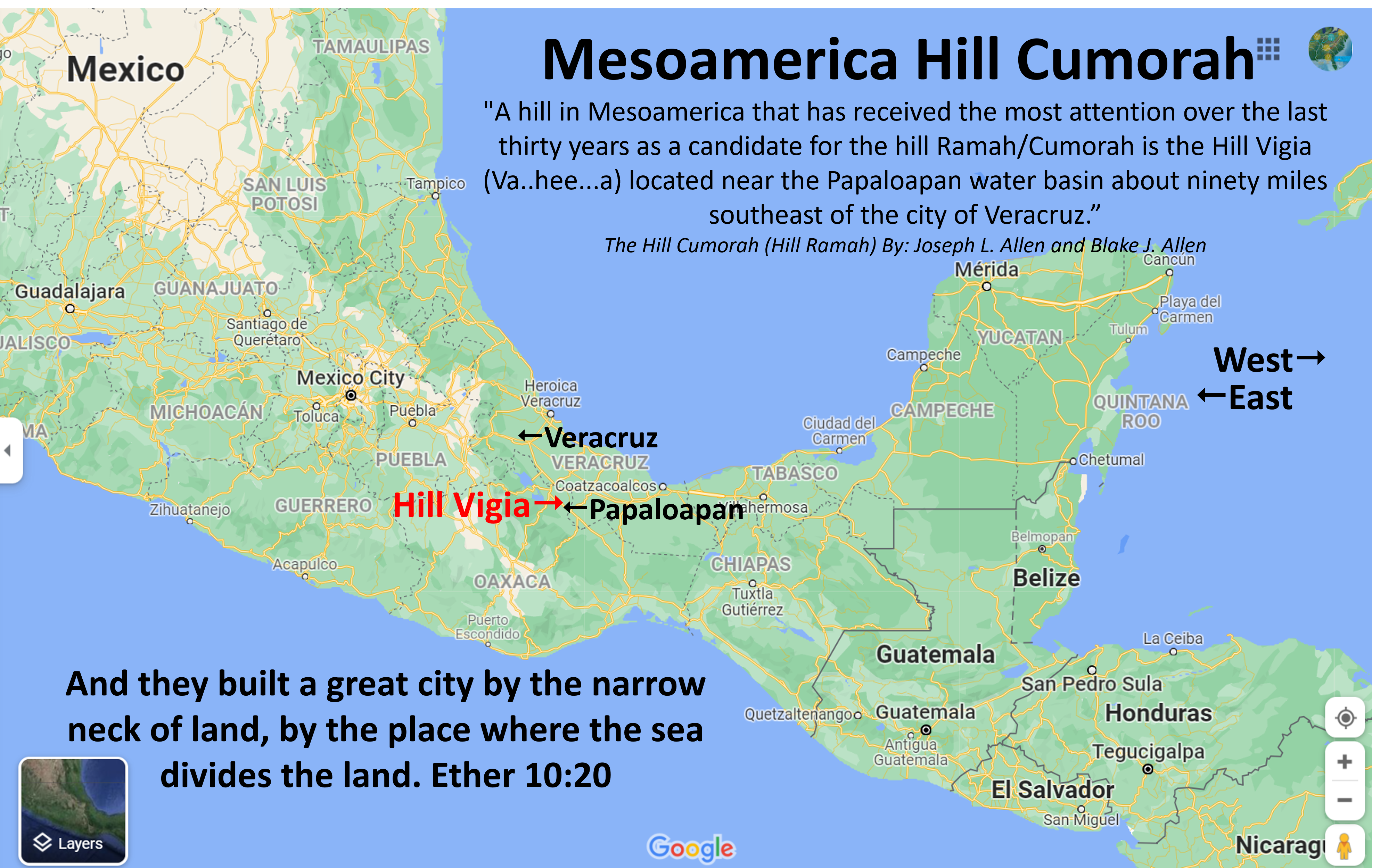
“Hinterlands is defined here as meaning the unknown area of North and South America that are not within the scope of the writings of the Book of Mormon. In other words, since we believe main events of the Book of Mormon happened in a limited area of North America around the Great Lakes  in the east,  and Ohio, Indiana, Iowa and Missouri to the west, and south in Tennessee, West Virginia, Georgia, and Florida, all other areas will be discussed as “The Hinterlands”. We propose that Mesoamerica is the Hinterlands along with many other areas of the continent. As Mormon has said, “…I shall take from the plates of Nephi; and I cannot write the hundredth part of the things of my people (Words of Mormon 1:5).  There are many people in South and Central America that are Lamanites and part of the Hinterlands.” Jonathan Neville

In other words, if the Book of Mormon events took place in Mesoamerica, then every other area would be the “Hinterlands” where other Lamanites may have migrated and lived. If however the events of the Book of Mormon took place in the Heartland of the United States (As we believe they did), then every other area outside of this limited Heartland area would contain migrating Lamanites, including the western United States, Canada, Mexico, and South and Central America. Heartland CoreWhere the main Nephite and Lamanite events occured! Mesoamerican Periphery Where Nephites and Lamanites migrated to outside of this core! (See map above right)

Who are the Yuman–Cochimí?

Yuman–Cochimí languages

With the powerful story about Mark Vest above, I wanted to find out a little more about his Cochapa ancestry.

The Yuman–Cochimí languages are a family of languages spoken in Baja California, northern Sonora, southern California, and western Arizona. Although only Cochimí is no longer spoken, going extinct in the late 18th century, all other Yuman languages are nearly extinct. https://en.wikipedia.org/wiki/Yuman%E2%80%93Cochim%C3%AD_languages

COCOPAH INDIAN TRIBE OF ARIZONA HISTORY
The Cocopah (Kwapa), also known as the River People, have long lived along the lower Colorado River and delta. For centuries, the Cocopah people, described as generous and non-materialistic, have maintained their traditional and cultural beliefs through the various political environments and ever-changing landscapes.

The Cocopah Indian Tribe is one of seven descendant Tribes from the greater Yuman language-speaking people who occupied lands along the Colorado River. Cocopah Tribal ancestors also lived along the Lower Colorado River region near the river delta and the Gulf of California. The Cocopah people had no written language, however, historical records were passed on orally or interpreted in documents written by outside visitors.

Diaries and journals kept by travelers along the Colorado River and migrants into the West documented the Cocopah people. Spanish explorer Hernando de Alarcon, a member of Coronado’s marine expedition, traveled the river in 1540 and described members of the Cocopah Indian Tribe as tall, well-built people who carried wooden maces and bows and arrows. The men wore loincloths and the women wore willow bark skirts. The explorer and his crew were offered gifts of shells, beads, well-tanned leathers and food.

When Don Juan de Onate and Father Escobar sailed up the river, there were estimated to be about 6,000-7,000 Cocopah people living along the delta and the lower Colorado River. Fellow travelers, such as Father Kino, Father Garces, fur trapper James O’Patte, military men and ethnographers, kept colorful records from 1540-1917.

Westward expansion in the 1840s and the discovery of gold in California in 1849 brought many migrants through the area near the mouth of the Colorado River and the Grand Canyon region. The strategic importance of the river crossing was recognized by the U.S. government, and the United States Army established Camp Independence in 1850 to protect the entry route through the tribe’s territories. The following year the camp was moved to the site of an old Spanish Mission later named Fort Yuma, which still stands today.

Throughout the mid 1800s and early 1900s, the Cocopah Indian Tribe effectively resisted assimilation to an established reservation and maintained its social, religious and cultural identities.

In the last half of the nineteenth century, the steamboat business became important to the Cocopah people. Cocopah men, known for their skillful river navigating, were valued pilots.

President Woodrow Wilson signed Executive Order No. 2711 in 1917 which established the Reservation. In 1985, the Cocopah Tribe gained an additional 4,200 acres, including the North Reservation, through the Cocopah Land Acquisition Bill signed by President Ronald Reagan.

The Cocopah Tribe of Arizona is comprised of three noncontiguous bodies of land known as the North, West and East Reservations. Today, the East, West and North Reservations comprise over 6,500 acres, much of which is leased as agricultural land to non-Indian farmers. The Cocopah Reservation is located 13 miles south of Yuma, AZ, and 15 miles north of San Luis, Mexico, in Yuma County along the Colorado River. The reservation’s unique geographical location borders the United States, Mexico, Arizona and California.
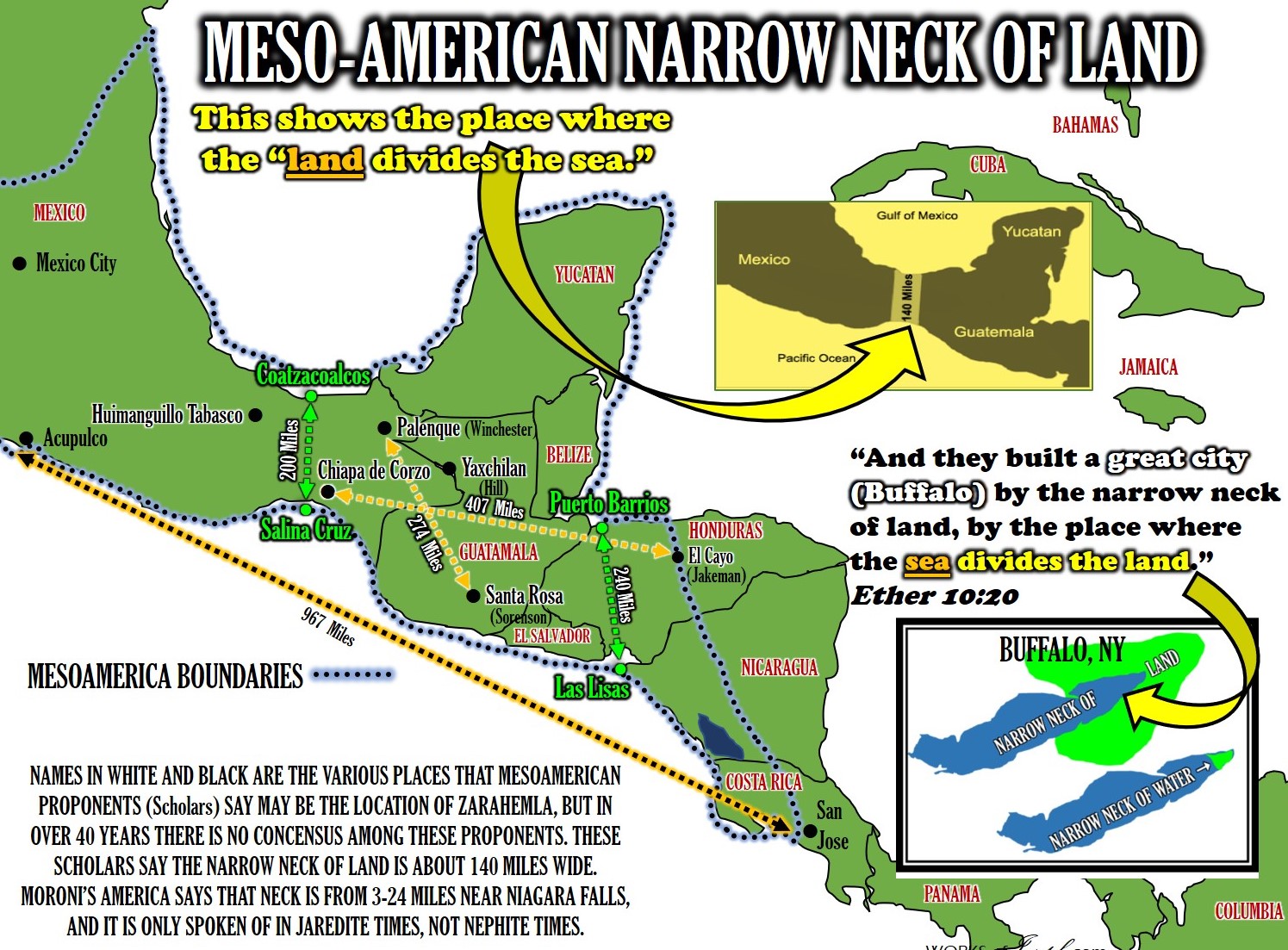
Historical records show that the Cocopah domain once included portions of Arizona, southern California and Sonora, Mexico. The Treaty of Guadalupe Hidalgo divided the U.S.-Mexican border and the Cocopah lands between the two countries in 1848. Since 1930, the Cocopah (U.S.) and the Cucapá (Mexico) peoples have been forced to end Tribal unity.

In 1964, the Cocopah Indian Tribe founded its first Constitution and formed a five-person Tribal Council. The Cocopah Tribal Seal, similar to the U.S. flag in America, represents the sovereign Cocopah Nation.

As recently as the 1960s, a number of tribal families lived in traditional arrow weed-thatched homes, and until 1968, there were few houses and gravel roads. In the late 1970s and 1980s, the Tribe began acquiring additional land, constructing homes, installing utilities, developing an infrastructure system and initiating economic development. The hexagonal Tribal Administration Building was completed in 1976. Currently, there are about 1,000 enrolled Cocopah Tribal members who live and work on or near the three reservations.

Yuman-Cochimi Languages

Are you Green & Growin’ or Ripe and Rotten?

Whether you love the Book of Mormon as a believer in the Mesoamerica Theory or the Heartland Model or some other theory, you will enjoy taking this brief personal quiz. I admit I am a Heartland follower and I feel it “Just makes sense”. I used to follow the Meso theory for 40 years, but it never made sense. All may feel the spiritual truth of the Book of Mormon as Moroni said, but I also feel you may know the truth about the Geography within the same promise. I believe truth is a simple process and it doesn’t require advanced learning or peer reviewed information. It just exists and “feels right”. I personally don’t know all the answers of my questions below, but how I answer them, just “feels right”. See how you feel!

Art by Val Chadwick Bagley

Are you a Revisionist Historian, or a Traditionalist?
When Science and Scriptures don’t agree, which side do you agree with more often?
Do you love learning new truth, or you are happy with what you already know?
Scientists have no found new laws in the past 100 years, but they find daily new theories.
Are you green and growin’ or ripe and rotten?

Join us at our Big Conference

Tickets Here

Have some fun. Answer Yes or No Only

Was Noah’s flood universal and is it a factual event?
Was there any man on this earth before Adam?
Did Man evolve from monkeys?
Are dinosaurs about the age of Adam?
The name Cumorah was spoken by Joseph Smith to his parents in 1827?
Are there two hill Cumorah’s, one in Mexico and one in Ontario, NY?
Did Joseph enter a hill of records at Cumorah, or was it only a vision of a possible place?
Is Letter I,  written by Oliver Cowdery scripture? See the “*” after JS 1:75 It says the source is “Messenger and Advocate, vol. 1 (October 1834), pp. 14–16.” But the actual source is Letter from Oliver Cowdery to W.W. Phelps” (Letter I), (September 7, 1834)
Did Joseph Smith write a letter to Emma in 1834 from Illinois that said Joseph was wandering over the plains of the Nephites?
Did Joseph Smith have a vision during Zion’s camp discovery of the bones of Zelph?
Is the City of Zarahemla near present day Montrose Iowa?
Is the USA the Promised Land of the Book of Mormon?
Was Adam placed on the earth near Independence, MO?
Does the history of the Hopewell Indians follow the same dates as the history of the Nephites?
Did the Nephites practice the Law of Moses?
Would the Nephites have sacrificed Lambs, goats, bullocks, and doves, or Llamas, Apes, and Lizards?
Have Hebrew writings and earthworks been found in North America?
Are Eastern Native Americans (Woodland) descendants of the Jews?
Did the Lord send the first missionaries to Lamanites in NY, OH, and MO?
Are there cooper breastplates and headplates found in museums in North America that date to Book of Mormon times?
Did Joseph Smith use the Urim and Thummim to translate the plates in Harmony?
Did Joseph ever look at the plates to assist him in translation?
Do the historical Adena Indians of North America match the dates of the Jaredites?
Are there 3,000 BC ancient copper smelters found in North America?
Were grapes and wine available in Mesoamerica during Book of Mormon times?
Did Book of Mormon Lamanites keep written records of their history?
Has a modern ship route been discovered to show the possibility of Lehi sailing and landing in Florida?


As you read the scriptures below, are they speaking of you, non-believers, myself, all people, or does it matter? I think it does matter and I challenge each of you to personally reflect within your heart, so we can learn new things by humbling ourselves and pondering these things. Is it your focus to be correct or to teach correct principles?

Timothy 3:7 “Ever learning, and never able to come to the knowledge of the truth.”

D&C 121:34 “Behold, there are many called, but few are chosen. And why are they not chosen? 35 Because their hearts are set so much upon the things of this world, and aspire to the honors of men, that they do not learn…”

I Nephi 11:35 “And the multitude of the earth was gathered together; and I beheld that they were in a large and spacious building, like unto the building which my father saw. And the angel of the Lord spake unto me again, saying: Behold the world and the wisdom thereof; yea, behold the house of Israel hath gathered together to fight against the twelve apostles of the Lamb. 36 And it came to pass that I saw and bear record, that the great and spacious building was the pride of the world; and it fell, and the fall thereof was exceedingly great. And the angel of the Lord spake unto me again, saying: Thus shall be the destruction of all nations, kindreds, tongues, and people, that shall fight against the twelve apostles of the Lamb.”

Joseph Smith Matthew:22 “For in those days there shall also arise false Christs, and false prophets, and shall show great signs and wonders, insomuch, that, if possible, they shall deceive the very elect, who are the elect according to the covenant. 23 Behold, I speak these things unto you for the elect’s sake; and you also shall hear of wars, and rumors of wars; see that ye be not troubled, for all I have told you must come to pass; but the end is not yet.”

2 Nephi 9:28 “O that cunning plan of the evil one! O the vainness, and the frailties, and the foolishness of men! When they are learned they think they are wise, and they hearken not unto the counsel of God, for they set it aside, supposing they know of themselves, wherefore, their wisdom is foolishness and it profiteth them not. And they shall perish. 29 But to be learned is good if they hearken unto the counsels of God…. 42 And whoso knocketh, to him will he open; and the wise, and the learned, and they that are rich, who are puffed up because of their learning, and their wisdom, and their riches—yea, they are they whom he despiseth; and save they shall cast these things away, and consider themselves fools before God, and come down in the depths of humility, he will not open unto them.”


Laughter helps Life

The cartoons in this post are all from my great friend Val Chadwick Bagley. For 37 of the past 40 years he has believed in the Mesoamerican Theory and drawn cartoons reflecting that. He now believes in the Heartland Model and is having some fun sharing the differences between the two theories. It is amazing how Val also “just makes sense”. Purchase Val’s products below. Meso fans, just let go of the barriers and have some fun with these.

96 page cartoon book here
Coloring books and 5 posters here

12 Newest Heartland cartoons here


D&C 121:33 “How long can rolling waters remain impure? What power shall stay the heavens? As well might man stretch forth his puny arm to stop the Missouri river in its decreed course, or to turn it up stream, as to hinder the Almighty from pouring down knowledge from heaven upon the heads of the Latter-day Saints.”


Meso believers and Heartlanders are a huge part of the army of Latter-day Saints the Lord will use to get His message out to the world. Are we helping the Lord’s people or hurting them? May we all try to come together in sharing the truth of the Book of Mormon as it testifies of the Savior. Let’s not contend, but instead have fun sharing our differences and let others decide on their own.


Cartoon about Elder Holland’s last conference talk by Val Chadwick Bagley

“If the ox is in the mire every Sunday, we strongly recommend you sell the ox or fill the mire.”
Jeffrey R. Holland April 2019 General Conference

Click to Enlarge

More free laughter here https://www.worksofjoseph.com/humor/

Did Abraham Receive the Birthright?

The title of this blog is, Did Abraham Receive the Birthright? The quick and simple possible answer is, “Abraham never did receive the birthright, though he was in line to receive it. Hence, it passed directly from Shem to Isaac.” Dr. Stephen E. Jones. 

Although Dr. Jones shares his opinion, I feel it is very possible it contains much truth. However, nothing is more true than studying the KJV Bible and Book of Mormon with the Spirit of God. My and opinions in this blog do not represent the belief of The FIRM Foundation nor The Church of Jesus Christ of Latter-day Saints. This information is given as a personal opinion and it is up to you to discern truth with your own personal revelation.

To me the idea about the birthright is a very interesting finding of Dr. Jones. I had never even thought about whether Abraham had the birthright, as I always assumed he did. Knowing that Shem outlived Abraham makes this a very possible scenario.

The title of this blog could also be, was Shem and Melchizedek the same person?

I had always wondered about whether Shem and Melchizedek was the same person? I wrote a blog in 2019 where I said, “I haven’t decided myself the answer to this question, but it is an interesting discussion about significant leaders of the ancient church. It seems to me it is more likely they are the same person, but I would like some discussion about your opinion.”  Since reading Dr. Jones’ book called, “The Struggle for the Birthright” by Stephen E. Jones, I have come up with a very favorable answer of I feel it makes sense that Shem and Melchizedek are the same person. You will also see the importance of the book of Jasher. Read below for your own answers.

LDS Dictionary

“Shem was the traditional ancestor of the Shemitic or Semitic races, a group of kindred nations, which includes the Arabs, the Hebrews and Phoenicians, the Arameans or Syrians, the Babylonians and Assyrians. The languages spoken by these various nations were closely related and were known as the Semitic languages. In latter-day revelation Shem is referred to as “the great high priest” LDS Bible Dictionary “Shem”
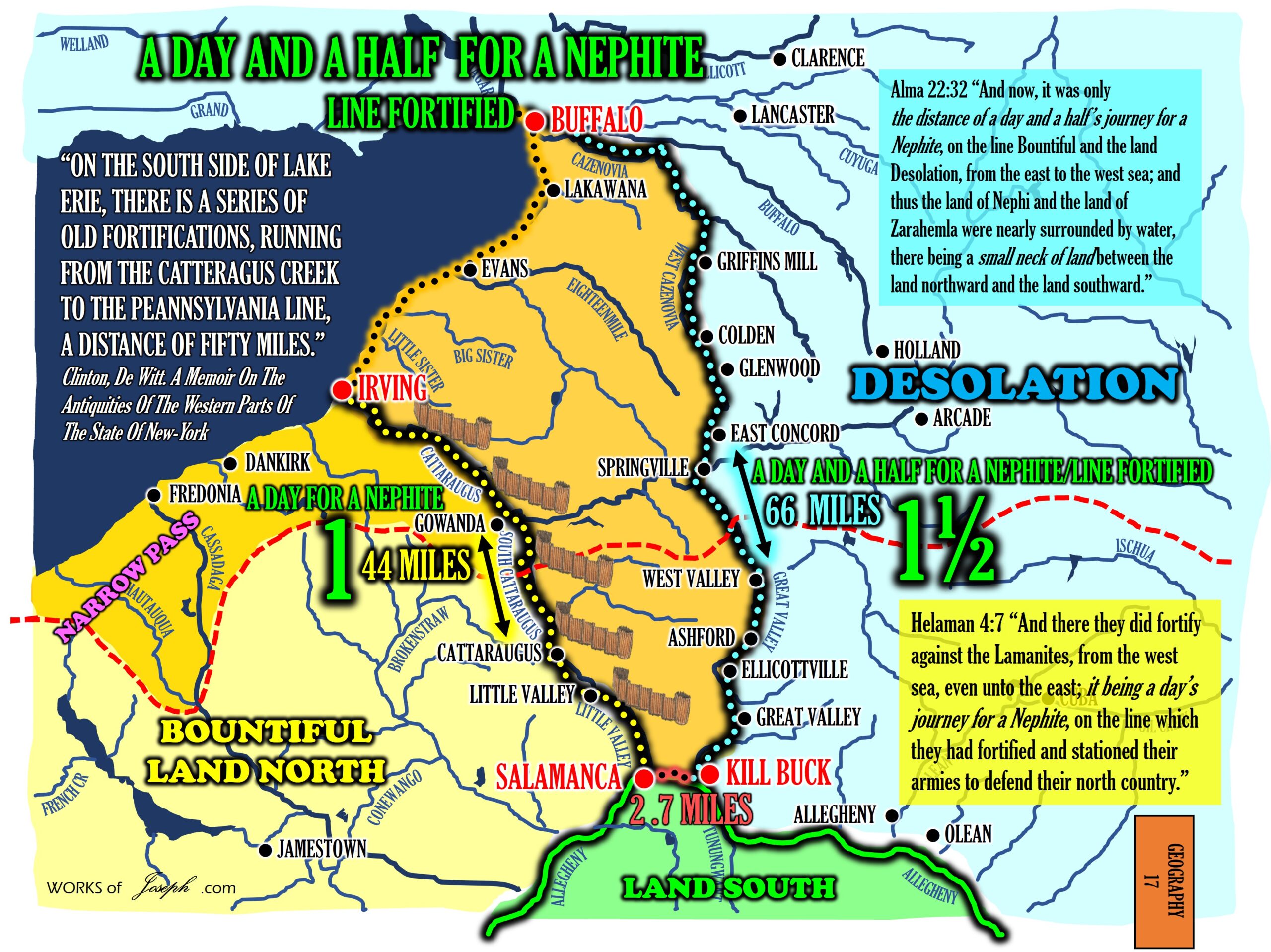
Distribution of Semitic languages.


Shem was Melchizedek by Stephen E. Jones

To show that Shem was the Melchizedek of Gen. 14:18, we will quote from Jasher 16:11, 12, which tells us the story of Abram’s meeting with Melchizedek after freeing Lot :And Adonizedek king of Jerusalem, the same was Shem, went out with his men to meet Abram and his people, with bread and wine, and they remained together in the valley of Melech. And Adonizedek blessed Abram, and Abram gave him a tenth from all that he had brought from the spoil of his enemies, for Adonizedek was a priest before God.”

Purchase today!

Many people have misunderstood Melchizedek, thinking him to be Jesus Christ incarnate. Their belief is based upon a misreading of Heb. 7:1-8. Verse 3 says Melchisedec was: without father, without mother, without genealogy, having neither beginning of days nor end of life; but made like the Son of God.” (NASB)

This must be taken in the context of verse 6. Heb. 7:6 says in the KJV, ” But he whose descent is not counted from them received tithes of Abraham.” The NASB reads, ” But the one whose genealogy is not traced from them collected a tenth from Abraham.” In other words, Melchisedec’s genealogy is not counted, traced, or RECORDED by the biblical writer, and in this way is he also a type of Christ. It does NOT say that Melchisedec literally had no parents. It only says that he merely appears out of nowhere in the biblical text, with no explanation of who he was or who were his parents. This divine silence in the biblical text was done purposefully in order to make him a type of Christ, that is, ” one like the Son of God.

Shem himself lived to the ripe old age of 600 years. He was a century old when the flood came, and lived 500 years after the flood. If one charts the genealogies of Gen. 11, as we did on page 17 of Secrets of Time, we find that Shem outlived Abraham. In fact, Shem died when Isaac was 50 years old.

Jewish traditions teach that Shem built Jerusalem, and he would therefore be its king. He was still alive during all of Abraham’s life. Therefore, it would only stand to reason that Abraham would pay tithes to him, for he was the true king of all the earth and was the birthright holder. In fact, because Shem outlived Abraham, Abraham never did receive the birthright, though he was in line to receive it. Hence, it passed directly from Shem to Isaac, and this is why the biblical narrative does not tell us about the birthright until Isaac’s sons fought over it.” The Struggle for the Birthright” Chapter 2; Shem was Melchizedek by Dr. Stephen E. Jones.


Below are other articles that validate this opinion of mine. I think it is significant to understand the importance of Melchizedek, as he was and is a representative of Christ. Just think about the name of the Priesthood today.

As The Church of Jesus Christ of Latter-day Saints said, “Before his day it was called the Holy Priesthood, after the Order of the Son of God. But out of respect or reverence to the name of the Supreme Being, to avoid the too frequent repetition of his name, they, the church, in ancient days, called that priesthood after Melchizedek, or the Melchizedek Priesthood.” Source

Is it possible that Shem and Melchizedek are the same person?
By Alma E. Gygi

Melchizedek—Keeper of the Storehouse by Clark Kelley Price

This question is frequently asked and is an interesting one. Let us examine first what we know about Shem. Although the Bible names Shem as the eldest son of Noah (Gen. 5:32), modern-day revelation places Japheth as the eldest (Moses 8:12). Both reports, however, are harmonious in naming Shem as the progenitor of Israel and in the fact that the priesthood descended through Shem to all the great patriarchs after Noah. (1 Chr. 1:24–27.) In this patriarchal order of priesthood, Shem stands next to Noah. He held the keys to the priesthood and was the great high priest of his day. 1

Living contemporary with Shem was a man known as Melchizedek, who was also known as the great high priest. 2 The scriptures give us the details of Shem’s birth and ancestry but are silent as to his ministry and later life. Of Melchizedek, however, the opposite is true. Nothing is recorded about his birth or ancestry, even though the Book of Mormon states that he did have a father. (Alma 13:17–18.) Concerning his ministry and life we have several interesting and important facts. (Gen. 14:18–20Heb. 7:1–4Alma 13:17–18.)

All of this provokes some questions and calls for answers. Were there two high priests presiding at the same time? Why is the record silent concerning Shem’s ministry? Why is nothing known concerning Melchizedek’s ancestry?

Because of this state of knowledge on our part, many Saints and gospel scholars have wondered if these men were the same person. The truth is, we do not know the answer. But an examination of the scriptures is fascinating, because it seems to indicate that these men may have been one and the same. For example, here is the case for their oneness:

  1. The inheritance given to Shem included the land of Salem. Melchizedek appears in scripture as the king of Salem, who reigns over this area.
  2. Shem, according to later revelation, reigned in righteousness and the priesthood came through him. Melchizedek appears on the scene with a title that means “king of righteousness.”
  3. Shem was the great high priest of his day. Abraham honored the high priest Melchizedek by seeking a blessing at his hands and paying him tithes.
  4. Abraham stands next to Shem in the patriarchal order of the priesthood and would surely have received the priesthood from Shem; but D&C 84:5–17says Abraham received the priesthood from Melchizedek.
  5. Jewish tradition identifies Shem as Melchizedek.3
  6. President Joseph F. Smith’s remarkable vision names Shem among the great patriarchs, but no mention is made of Melchizedek.
  7. Times and Seasons (vol. 6, p. 746) speaks of “Shem, who was Melchizedek. …”

On the other hand, there is a case for their being two distinct personalities. Many persons believe D&C 84:14 is proof that there are perhaps several generations between Melchizedek and Noah. The scripture says, “Which Abraham received the priesthood from Melchizedek, who received it through the lineage of his fathers, even till Noah.”

If it does turn out that Shem and Melchizedek are the same person, this scripture should prove no stumbling block, because it could be interpreted to mean that priesthood authority commenced with Adam and came through the fathers, even till Noah, and then to Shem.

I Have a Question answered by Alma E. Gygi, Salt Lake City businessman.

Notes

  1. Joseph F. Smith, Gospel Doctrine (Deseret Book Co., 1919) p. 474.
  1. D&C 107:2Heb. 7:4Alma 13:17Gen. 14:18–20.
  1. When Abraham returned from the war, Shem, or, as he is sometimes called, Melchizedek, the king of righteousness, priest of the Most High God. …” (Ginsberg, Legends of the Jews, p. 233.) “Jewish tradition pronounces Melchizedek to be a survivor of the Deluge, the patriarch Shem.” (Smith’s Bible Dictionary, p. 393.) “And Adonizedek king of Jerusalem, the same was Shem. …” (Book of Jasher 16:11.)

The Connection between Melchizedek and Shem by Tim Barker

Abram Blessed by Melchizedek by Unknown

“…According to Jewish traditions, Melchizedek is Shem, the son of Noah, whom God consecrated to be a priest for ever, and who set up a kingdom on Salem.”(1) Included in his book on the Legends of Old Testament Characters, the Reverend Sabing Baring-Gould includes a quotation from the Targumim, stating, “Melchizedek, who was Shem, son of Noah, king of Jerusalem.” (2) Louis Ginzberg continues this tradition, in his Legends of the Bible (a condensed version of the 7-volume Legends of the Jews), stating that “when Abraham returned from the war, Shem, or, as he is sometimes called, Melchizedek, the king of righteousness, priest of God Most High, and king of Jerusalem, came forth to meet him with bread and wine.” (3) More recently, scholars Raphael Patai and Robert Graves note that, “others again say that Melchizedek (also known as Adoni-Zedek), was Abram’s ancestor Shem, and that he now taught Abram the duties of priesthood…” (4) Numerous other historical Jewish sources confirm this same teaching.

In 1842, Elder John Taylor, then editor of the Times and Seasons, published the following:
From this definite account of driving the “nations apart, when the ancient hills did bow,” all reflecting minds may judge that man was scattered over the whole face of the earth. And with the superior knowledge of men like Noah, Shem (who was Melchizedek) and Abraham, the father of the faithful, three contemporaries, holding the keys of the highest order of the priesthood… (5)

Purchase

Other Latter-day Apostles have discussed this issue as well. Elder John A. Witdsoe stated: There is an old Hebrew tradition that Melchizedek was none other than Shem, the son of Noah. As far as the age of Shem is concerned, that is possible. Shem lived five hundred two years after the flood, and Abraham was born two hundred ninety-two years after the flood. Abraham, therefore, must have known Shem. (6)

Prepare for 2023 Gospel Doctrine with our Newly Released, Annotated Edition of the New Testament.

Tim Barker continues, “Additionally, Elder Alvin R. Dyer stated: Abraham, who was born of the chosen lineage of patriarchs, received the priesthood from Shem, or Melchizedek, who received it from Noah unto whom it had come through the lineage of the fathers from Enoch, unto whom it had come from Adam the first man through his son, Abel. (7)

More recently and readily available, is the CES Institute Manual on the first half of the Old Testament. This manual outlines, amongst other things, 7 points for consideration relating to the identity of Shem and Melchizedek and commonalities between the two. The comments on this issue are based on an Ensign article, by Alma E. Gygi, entitled, “Is it possible that Shem and Melchizedek are the same person?” (8)

Shem’s inheritance included the land of Salem, and Melchizedek was the king of Salem.
Shem “reigned in righteousness” and Melchizedek’s name means “king of righteousness.”
Shem was the great high priest of his day. Abraham honored the high priest Melchizedek by paying him tithes and seeking blessings at his hand.

Abraham stands next to Shem in the patriarchal order of the priesthood and would likely have received the priesthood from him, but according to D&C 84:5-7, Abraham received the priesthood from Melchizedek.

Jewish tradition identifies Shem as Melchizedek

President Joseph F. Smith’s vision of the Redemption of the Dead (D&C 138), names Shem among the great patriarchs, but there is no mention of Melchizedek.

Times and Seasons (official church periodical at this time), indicates that Shem was Melchizedek. (9)

On the contrary, some Latter-day Saints, including Apostle Bruce R. McConkie, believes that the two are definitely separate individuals: There is an unsupported tradition to the effect that Melchizedek was the same person as Shem the son of Noah. That this could hardly have been the case is seen from the revelation which says: “Abraham received the priesthood from Melchizedek, who received it through the lineage of his fathers, even till Noah.” (D. & C. 84:14.) In other words, there seem to have been at least two generations between Melchizedek and Shem.(10)

Also for consideration, E. Douglas Clark commented on the matter in his book, The Blessings of Abraham: Becoming a Zion People: Genesis 11:10-11 tells Shem’s life span in the same manner as it tells the life spans of the subsequent patriarchs, implying that Shem died (a passage left unchanged in the Joseph Smith Translation), while the JST Genesis 14 tells that Melchizedek was translated. Second, a latter-day revelation in Doctrine and Covenants 84:14 states that “Abraham received the [Melchizedek] Priesthood from Melchizedek, who received it through the lineage of his fathers, even till Noah, and from Noah till Enoch,” which seems to require at least two generations between Melchizedek and Noah. And third, in Joseph F. Smith’s vision of the redemption of the dead, he saw among the host of righteous post-mortal spirits Shem (D&C 138:41), who would not have been there had he been translated. The revelation does not mention seeing Elijah or Enoch or Moses, who, like Melchizedek, had been translated. (11)

It is clear that with the diversity of opinion on the matter, that no definitive revelation has yet been received. As such, the scriptures are sought for further understanding, and where helpful, supplemental sources provide unique insights.

The Catholic Encyclopedia seems to indicate that the connection was developed by the Rabbi’s to suit their own purposes:

The Rabbins [Rabbi’s] identified Melchisedech with Sem, son of Noe, rather for polemic than historic reasons, since they wished to set themselves against what is said of him as a type of Christ “without father, without mother, without genealogy” (He., vii, 3).

In the Epistle to the Hebrews the typical character of Melchisedech and its Messianic import are fully explained. Christ is “a priest forever according to the order of Melchisedech” (Heb,. vii, 6; Ps., cix, 4); “a high priest forever”, etc. (Heb., vi, 20), …i.e. order or manner (Gesenius), not after the manner of Aaron. The Apostle develops his teaching in Heb., vii: Melchisedech was a type by reason (a) of his twofold dignity as priest and king, (b) by reason of his name, “king of justice”, (c) by reason of the city over which he ruled, “King of Salem, that is, king of peace” (v.2), and also (d) because he “without father, without mother, without genealogy, having neither beginning of days nor end of life, but likened unto the Son of God, continueth a priest forever” (v.3). The silence of Scripture about the facts of Melchisedech’s birth and death was a part of the divine plan to make him prefigure more strikingly the mysteries of Christ’s generation, the eternity of His priesthood.” (12)

Interestingly, an early Jewish source, Flavius Josephus is completely silent regarding any connection between Shem and Melchizedek.

James L. Kugel indicates that “some scholars have suggested that this was first done in the context of later Jewish-Christian polemics: if Melchizedek was actually Shem, then he was the ancestor of Abraham, Isaac, and Jacob, and the idea of a priesthood extending back through him was less disturbing to Jews than the notion of a “priest of God Most High” who lacked any connection to the Jewish people or the later levitical priesthood.” He goes on to say that:

It seems likely, however, that Melchizedek’s identification with Shem actually came about before any Christian arguments existed (and certainly before the time when Christian arguments seemed to Jews to require refutation). After all, who was Melchizedek to early interpreters? Why was the genealogy of such an important person–the “priest of God Most High,” no less–not mentioned? Identifying him as Shem, whose genealogy was known, provided an answer, and an easily accepted one. (13)
It is interesting to note that Kugel alludes to the idea that Melchizedek, “could be understood as an honorific title given to Shem…” (14)

Whatever the connection is, it remains a mystery. As stated by Alma Gygi, “all of this provokes some questions and calls for answers. Were there two high priests presiding at the same time? Why is the record silent concerning Shem’s ministry? Why is nothing known concerning Melchizedek’s ancestry? Because of this state of knowledge on our part, many Saints and gospel scholars have wondered if these men were the same person. The truth is, we do not know the answer.” (15) When the answer comes, it should satisfy the arguments on either side of the matter.

_______________________________________
1 Rev. S. Baring-Gould, Legends of Old Testament Characters, From the Talmud and Other Sources (New York: MacMillan and Co., 1871), 2:1; see also Rev. S. Baring-Gould, Legends of the Patriarchs and Prophets, and Other Old Testament Characters From Various Sources (New York: James B. Millar & Co., 1884), 140-141
2 Baring-Gould, Legends of Old Testament Characters, 2:1
3 Louis Ginzberg, Legends of the Bible (Philadelphia: The Jewish Publication Society of America, 1956), 106
4 Robert Graves and Raphael Patai, Hebrew Myths: The Book of Genesis (New York: McGraw-Hill, 1966), 147
5 John Taylor, “Ancient Ruins,” Times and Seasons 5/23 (Dec 15, 1844):746
6 John A. Widtsoe, Evidences and Reconciliations, 3 Vols., ed. G. Homer Durham (Salt Lake City: Bookcraft, 1960), 232
7 Alvin R. Dyer, Who Am I? (Salt Lake City: Deseret Book, 1968), 400; also see Alvin R. Dyer, The Lord Speaketh (Salt Lake City: Deseret Book, 1964), 284-291
8 Alma E. Gygi, “Is it possible that Shem and Melchizedek are the same person?,” Ensign (November 1973), 15-16
9 Old Testament Student Manual: Genesis-2 Samuel (Religion 301), Church Educational System (Salt Lake City: The Church of Jesus Christ of Latter-day Saints, 2003), 67-68
10 Bruce R. McConkie Mormon Doctrine, 2nd Ed. (Salt Lake City: Bookcraft, 1966), 475
11 E. Douglas Clark, The Blessings of Abraham: Becoming A Zion People (American Fork, UT: Covenant Communications, 2005), 267 fn 36
12 John J. Tierney, “Melchisedech” The Catholic Encyclopedia, 15 Vols., eds. Charles G. Herbermann, et al (New York: The Encyclopedia Press, 1913), 10:157
13 James L. Kugel, Traditions of the Bible: A Guide to the Bible as it was at the Start of the Common Era (Cambridge, MA: Harvard University Press, 1999), 289-290
14 Ibid, 290
15 Old Testament Student Manual: Genesis-2 Samuel, 68


LDS Bible Dictionary

Melchizedek Blesses Abram by Walter R

The LDS Bible dictionary says, under the heading Shem says, Name. Son of Noah (Gen. 5:29–326:107:138:169:26Moses 8:12); his descendants (Gen. 10:21–3111:10–321 Chr. 1:17Luke 3:36). Shem was the traditional ancestor of the Shemitic or Semitic races, a group of kindred nations, which includes the Arabs, the Hebrews and Phoenicians, the Arameans or Syrians, the Babylonians and Assyrians. The languages spoken by these various nations were closely related and were known as the Semitic languages. In latter-day revelation Shem is referred to as “the great high priest” (D&C 138:41). See also Melchizedek.

The LDS Bible dictionary says, under the heading Melchizedek, “King of Righteousness. A notable prophet and leader who lived about 2000 B.C. He is called the king of Salem (Jerusalem), king of peace, and “priest of the most High God.” Unfortunately, information concerning him in the Bible is relatively scarce, being limited to Gen. 14:18–20Heb. 5:67:1–3. Mention of the priesthood of Melchizedek is given in several other instances, primarily in Psalms and in Hebrews. However, latter-day revelation gives us much more about him and his priesthood (see JST Gen. 14:17 [Gen. 14:18 note d]JST Gen. 14:25–40JST Heb. 7:3 [Appendix]Alma 13:14–19D&C 84:14107:1–4). From these sources we realize something of the greatness of this prophet and the grandeur of his ministry. See also JebusJerusalemMelchizedek Priesthood.

Abortion, Feminist Movement, Same/Sex Attraction- Perilous Times of Evil

0

“For false Christs and false prophets shall rise, and shall shew signs and wonders, to seduce, if it were possible, even the elect.” Mark 13:22

“That he no longer should live the rest of his time in the flesh to the lusts of men, but to the will of God.” 1 Peter 4:2

“That young man with gender disorientation needs to know that gender was not assigned at mortal birth, that we were sons and daughters of God in the premortal state.” Talk to the All-Church Coordinating Council By Elder Boyd K. Packer

“But whoso shall offend one of these little ones which believe in me, it were better for him that a millstone were hanged about his neck, and that he were drowned in the depth of the sea.” Matt.18:6

1 “This know also, that in the last days perilous times shall come.
For men shall be lovers of their own selves, covetous, boasters, proud, blasphemers, disobedient to parents, unthankful, unholy,
Without natural affectiontrucebreakersfalse accusersincontinent, fierce, despisers of those that are good,
Traitorsheadyhighminded, lovers of pleasures more than lovers of God;
Having a form of godliness, but denying the power thereof: from such turn away.
For of this sort are they which creep into houses, and lead captive silly women laden with sins, led away with divers lusts,
Ever learning, and never able to come to the knowledge of the truth.” 2 Timothy 3:1-7

The above scriptures touch upon many of the greatest challenges that face us today. There are many issues we need to avoid in these last days. The more difficult ones such as those addressed in this article, need more discussion in my opinion. I am thankful for Elder Packer and Current Prophets and Apostles who address these issues. The Church of Jesus Christ of Latter-day Saints has a complete website to help address the same/sex lifestyle here.

I love the Gospel with all my heart. I have a firm belief that the Lord’s Church is alive and well today. We as members however, need to listen to our Prophet and Leaders, and stop thinking we know better than they do. We should also look internally and overcome this seeming complacency that has affected the Church in my opinion. Being lukewarm is not advisable today. May we humble ourselves and with love adhere to these very sacred doctrines of Christ. President Nelson said, “It is now time that we each implement extraordinary measures — perhaps measures we have never taken before — to strengthen our personal spiritual foundations. Unprecedented times call for unprecedented measures.” Oct 3, 2021 President Russell M. Nelson

Abortion

Here is the official position of The Church of Jesus Christ of Latter-day Saints about abortion.

Also read the article here about, Roe v. Wade ends: Latter-day Saint leaders urge members ‘to protect life and to preserve religious liberty’ “The church’s position on this matter remains unchanged,” says update on church webpage. By Tad Walch Jun 24, 2022,


INTRODUCING: Greg Matsen
FIRM Foundation is honored to have as a Key-Note Speaker for the first time, Greg Matsen of cwicmedia.com.

Greg Matsen- Founder of Cwic Media, Host of its primary show, Cwic Show.

Greg’s Presentation: Fri. Oct 21, 2022 6-7 pm
Plus 3-Full Days of over 75 Additional Speakers
Salt Palace Convention Center, SLC, UT

Tickets here

Greg Matsen is the founder of Cwic Media and the host of its primary show, Cwic Show. Cwic Show has almost 4,000,000 views and downloads and is one of the top podcasts for Latter-day Saint culture, social issues, and politics. His website, cwicmedia.com, includes the Critical Social Justice Hub which contrasts LDS principles with Social Justice and woke ideology, what Greg calls the, “Religion of Academia.”
 
He has studied the scriptures and history almost daily since his mission, seeks and develops interfaith relationships, and diligently seeks to help others learn what he has learned through lenses he developed called Cwic Interpreters. He also does a weekly Come Follow Me podcast. Greg sold his Wealth Management Firm in Scottsdale, AZ in 2020 and now runs Cwic Media full time. He and his wife have four kids and one son-in-law.

Click the link below for one of Greg’s powerful presentations on the critically important topic of abortion.

Roe v Wade- Pro-Life LDS Church, Pro-Choice Members?

Why Is There A Growing Number of Pro-Choice Members Of The Church?

“We give a timeline of the strong and consistent position of the Church on abortion.
Can a Pro-Choice view be reconciled with these statements?
We analyze a Pro-Choice Member’s argument on why he is Pro-Choice.” Greg Matsen


Lull & Flattereth- Past Feeling

Hugh Nibley appropriately said, “Who is righteous? Anyone who is repenting. No matter how bad he has been, if he is repenting, he is a righteous man. There is hope for him. And no matter how good he has been all his life, if he is not repenting, he is a wicked man. The difference is which way you are facing. The man on the top of the stair’s facing down is much worse off than the man on the bottom step who is facing up. The direction we are facing, that is repentance; and this is what determines whether we are good or bad.” Hugh Nibley Approaching Zion, pg. 301-302

“And others will he pacify, and lull them away into carnal security, that they will say: All is well in Zion; yea, Zion prospereth, all is well—and thus the devil cheateth their souls, and leadeth them away carefully down to hell.

And behold, others he flattereth away, and telleth them there is no hell; and he saith unto them: I am no devil, for there is none—and thus he whispereth in their ears, until he grasps them with his awful chains, from whence there is no deliverance.” 2 Nephi 28:21-22

“Having the understanding darkened, being alienated from the life of God through the ignorance that is in them, because of the blindness of their heart:

Who being past feeling have given themselves over unto lasciviousness, to work all uncleanness with greediness.” Ephesians 4:18-19

Have we slipped into any of these evil traps? It begins with a negative comment about a bishop or member. It continues with refusing a calling or not attending church. Do we find ourselves rationalizing why we won’t forgive another?. Do we shun a Prophet when he comes down hard on Abortion or Same Sex Attraction? Are we LULLED to sleep? Can we become past feeling? Remeber there is only God and Satan. That’s it! One or the other. Your ultimate choice!


Same-Sex Attraction

I personally feel we all are children of God and He loves us equally. Elder M. Russell Ballard said: “Let us be clear: The Church of Jesus Christ of Latter-day Saints believes that ‘the experience of same-sex attraction is a complex reality for many people. The attraction itself is not a sin, but acting on it is. Even though individuals do not choose to have such attractions, they do choose how to respond to them. With love and understanding, the Church reaches out to all God’s children, including [those with same-sex attraction].’” Source:

I am an imperfect person just as every one else in this world. Because of the Atonement I can be forgiven or all sins if I sincerely repent. I believe we choose to be a feminist or to have same/sex relationships, I don’t believe we are born that way. Others may disagree, but these are my feelings. We should love all people and forgive others of things they do which we think are wrong. The Lord will judge righteously.

Interview with Elder Oaks about same sex attraction here:


Either you Represent the Teachers or you Represent the Brethren

Talk to the All-Church Coordinating Council By Elder Boyd K. Packer

May 18, 1993

The twelfth chapter of Alma is like a field of precious stones lying about on the surface. I have picked one very small one, very precious one, only fifteen words, to use as my text. “God gave unto them commandments, after [first] having made known unto them the plan of redemption.” (Alma 12:32)

Boyd K. Packer

Thirty-eight years ago I came from Brigham City to the office I now occupy in the Administration Building to see Elder Harold B. Lee, who, next to President Joseph Fielding Smith, was the senior member of the Quorum of the Twelve. I had just been appointed the supervisor of Seminaries and Institutes of Religion. I knew there were serious problems in the system and I wondered why they had not appointed someone with more experience.

Elder Lee had agreed to give me counsel and some direction. He didn’t say much, nothing really in detail, but what he told me has saved me time and time again. “You must decide now which way you face,” he said. “Either you represent the teachers and students and champion their causes or you represent the Brethren who appointed you. You need to decide now which way you face.” Then he added, “Some of your predecessors faced the wrong way.” It took some hard and painful lessons before I understood his counsel. In time, I did understand, and my resolve to face the right way became irreversible.

One of the early lessons was also my first lesson in correlation. The seminaries were sponsoring speech contests. They were very successful — much better than similar contests sponsored by the Mutual Improvement Association. It was an ideal gospel-centered activity for seminaries. They were succeeding beautifully under able teachers who could assist even the shy students. We were instructed to discontinue them!

There was something of an uprising among the teachers. They accused Superintendent Curtis of the Young Men and President Reeder of the Young Women of being responsible. Perhaps they were. The teachers wanted Brother Tuttle and me to plead their cause before the Brethren. The logic was all on our side. Nevertheless we remembered the counsel of Brother Lee, and really, just out of obedience, we declined.

Later I could see that the seminaries served then only a very small part of our youth; the MIA, all of them. A B-minus program reaching most of the youth would, in the aggregate, bring better results than an A-plus program which reached relatively few. It wasn’t until many years later, when some other problems arose, that I could see that those contests, even though they were gospel centered, pulled the teachers into an activity-oriented mind-set and away from the less exciting responsibility of teaching the Old and New Testaments to teenagers. Finally I could see that the very success of the program was an enemy.

Other lessons followed, some of them hard ones. I was asked to write an article for the Improvement Era. It was returned with the request that I change some words. I smarted! The replacement words didn’t convey exactly what I was trying to say. I balked a bit, and was told that Richard L. Evans, then of the Seventy and magazine editor, had asked that the changes be made. I remembered Brother Lee’s counsel. I had to submit. Now, though that article is piled under thirty-five years of paper, I’m glad, very glad, that if someone digs it out, I was “invited” to change it.

After one of my first general conference talks, I received a call from Joseph Anderson. In a very polite way he said that President McKay and his counselors suggested that I add one word to the text of my talk. Would I mind doing that? Actually the word was in my text, I just failed to read it at the pulpit. A most embarrassing lesson — the First Presidency! It was easier when Elder Evans corrected my work; even easier when one of my associates was kind enough to do it.

Only last Friday while putting together some things for a presentation, I read part of it to some brethren from BYU. I noticed they looked at one another at one place in my reading, and I stopped and asked if there was a problem. Finally one of them suggested that I not use a certain scripture that I had included even though it said exactly what I wanted to convey. How dare they suppose that a member of the Twelve didn’t know his scriptures! I simply said, “What do you suggest?” He said, “Better find another scripture,” and he pointed out that if I put that verse back in context, it was really talking about another subject. Others had used it as I proposed to use it, but it was not really correct. I was very glad to make a change.

Now you may not need a correlating hand in what you do, but I certainly do. This brother lingered after the meeting to thank me for being patient with him. Thank me! I was thankful to him. If I ever make that presentation, it will only be after some of our Correlation staff have checked it over for me.

Now I give you all full credit for knowing more about your work than anyone else — more, certainly than the staff of the Correlation Department. That is how it should be, for you are hired or called to be a specialist. I also know from experience how easy it is to get turned around, and, as Brother Lee warned, to face the wrong way.

However much you know about your work, I doubt that you know, or have the time to learn, as much as do the Correlation staff about how your work interacts with everything else that is going on. The Council of the Twelve Apostles is the Correlation Committee, with the President of the Twelve and the two senior members acting as the executive committee. Correlation is the one department where they are hired to be generalists. They represent the Brethren in pointing out to you areas where you, in one detail or another, might, in the interest of the overall program, need to make an adjustment or two.

The principle of correlation is a sound principle. Except for its having been established, we could not now possibly administer an ever-growing multi-national and multi-lingual church. The full purpose for its having been established, I know, is yet to be realized. If we neglect it, we will pay a very, very heavy price one day. The value of having struggled through those years, and there aren’t many around who struggled through those years, will one day be apparent. The greatest use of this is yet to come.

The responsibility to effect a reduction and simplification in programs was assigned by the First Presidency to Correlation Department. We have been only modestly successful at best. Perhaps just to have slowed the growth is enough reward for all the effort that has been put in. There are isolated success stories. The Music Department, catching the vision, reduced five manuals of 190 pages into one manual of 18 pages. They did it themselves, and they count themselves better for it.

Perhaps too many of us are strong advocates of our own specialized work or are such strong protectors of our own turf that we face the wrong way — maybe just sideways. Simplification and reduction must come. Simplification and reduction will come! If we cannot do it on our own — and we seem to be in that circumstance — the future will see us doing, in anxious haste, that which we might have done with deliberate care had we followed the vision which has been given to us.

Surely you have been anxiously watching the worldwide evaporation of values and standards from politics, government, society, entertainment, schools. Could you be serving in the Church without having turned to those pages in the revelations and to those statements of the prophets that speak of the last days? Could you, in working for the Church, not be conscious of or have ignored the warnings? Could you be blind to the drift that is taking place? Are you not conscious of the drift that is taking place in the Church? Could you believe other than it is critical that all of us work together and set aside personal interests and all face the same way?

It is so easy to be turned about without realizing that it has happened to us. There are three areas where members of the Church, influenced by social and political unrest, are being caught up and led away. I chose these three because they have made major invasions into the membership of the Church. In each, the temptation is for us to turn about and face the wrong way, and it is hard to resist, for doing it seems so reasonable and right.

The dangers I speak of come from the gay-lesbian movement, the feminist movement (both of which are relatively new), and the ever-present challenge from the so-called scholars or intellectuals.

Our local leaders must deal with all three of them with ever-increasing frequency. In each case, the members who are hurting have the conviction that the Church somehow is doing something wrong to members or that the Church is not doing enough for them. To illustrate, I will quote briefly from letters on each of those subjects. They are chosen from among many letters which have arrived in the last few weeks. These have arrived in just the last few days.

The Gay/Lesbian Challenge

The first is from a young man, possibly a gay rights activist:

“May 3rd marks my 18th year in the Church. As a gay Mormon, I have witnessed and experienced first-hand during those eighteen years what it’s like to be a homosexual in a Church which is sometimes less than accepting of its gay members. My experiences have run the range from incredible, Spirit-filled and loving encounters with members, Bishops and Stake Presidents to a laughable run-in with a departing Mission President. May I share with you some of the more permanent and meaningful memories?”

After a page or two of those, he said:

“So in a spirit of friendship I offer that which I have to give — the life experience of a gay Mormon. At your convenience I would be happy to meet with you to discuss the issues facing gay Latter-day Saints and the Church. The purpose for meeting is not to debate, or to presumptively call you to repentance, or to be called to repentance myself for being gay. The point is to meet together and share what we have for the good of The Kingdom and the furthering of the Will of the Lord on Earth.”

The Feminist Movement

The next quotation is from a woman who is hurting, and perhaps wonders if anyone but the feminists care about her problems:

“I’m upset that I was always advised to go back and try harder only to get abused more. I need some comfort, I need solace, need hope, need to know Heavenly Father sees all that I have endured. What hope do I have for a chance to live with Heavenly Father? If temple marriage is the key to the celestial [kingdom], where am I? Outside gnashing my teeth for eternity? Help me.”

The Scholars

The last is from a self-described intellectual:

“My concern is that the Brethren are contending with the church’s own scholars. … In the Catholic Church, the great scholars’ efforts were used by the Church to refine and strengthen the doctrine (St. Augustine, Thomas Aquinas, for example). In our Church, the scholars are put down, even banished [and he names three of them, and they would be names all of whom you would know]. Once again I extend an offer to you to be a peacemaker between the Brethren and the scholars, if you wish me to attempt it, since I know so many in both groups. More than that, I understand the mind-sets of both groups.”

These letters and hundreds more are from members who are hurting or leaders who are worried. I might say here that I can see in the last few weeks a change in the letters coming in. There isn’t time to talk about it now, but out in the Church there is another growing group of the discontented. That is the rank and file who are trying to do what they are supposed to do and feel neglected as we concentrate on solving the problems of the exceptions.

Those who are hurting think they are not understood. They are looking for a champion, an advocate, someone with office and influence from whom they can receive comfort. They ask us to speak about their troubles in general conference, to put something in the curriculum, or to provide a special program to support them in their problems or with their activism.

When members are hurting, it is so easy to convince ourselves that we are justified, even duty bound, to use the influence of our appointment or our calling to somehow represent them. We then become their advocates — sympathize with their complaints against the Church, and perhaps even soften the commandments to comfort them. Unwittingly we may turn about and face the wrong way. Then the channels of revelation are reversed. Let me say that again. Then the channels of revelation are reversed. In our efforts to comfort them, we lose our bearings and leave that segment of the line to which we are assigned unprotected. The question is not whether they need help and comfort. That goes without saying. The question is “How?” The Prophet Joseph Smith, when he organized the Relief Society said, “There is the need for decisions of character aside from sympathy.”

Working Mothers

To illustrate principles which apply to all of these problems, I have taken one common one — working mothers. President Ezra Taft Benson gave a talk to wives and mothers. There was a reaction within the Church. (Ten years ago, that would not have happened.) That was very interesting, because if you read his talk carefully, it was, for the most part, simply a compilation of quotations on the subject from the prophets who have preceded him.

Some mothers must work out of the home. There is no other way. And in this they are justified and for this they should not be criticized. We cannot, however, because of their discomfort over their plight, abandon a position that has been taught by the prophets from the beginning of this dispensation. The question then is, “How can we give solace to those who are justified without giving license to those who are not?

The comfort they need is better, for the most part, administered individually. To point out so-called success stories inferring that a career out of the home has no negative effect on a family is an invitation to many to stray from what has been taught by the prophets and thus cause members to reap disappointment by and by.

I think President Thomas S. Monson may not appreciate what I am going to say now. I know of no one who maintains such a large private ministry of counsel and comfort in the midst of heavy pressures of office than does Brother Monson. He says very little about it, but he visits the sick, hospitals, homes, comforting, counseling, both in person and in writing. However, I have never heard him over the pulpit, nor have I read anything in his writings — not one thing — that would give any license to any member to stray from the counsel of the prophets or to soften the commandments that the Lord has given. There is a way to give comfort that is needed.

If we are not very careful, we will think we are giving comfort to those few who are justified and actually we will be giving license to the many who are not. The process of correlation is designed to keep us from making mistakes in manuals, in publications, in films, in videos, in those specialized programs which are justified.

Those fifteen words from Alma state: “God gave unto them commandments, after having made known to them the plan of redemption.” There are many things that cannot be understood nor taught nor explained unless it is in terms of the plan of redemption. The three areas that I mentioned are among them. Unless they understand the basic plan — the premortal existence, the purposes of life, the fall, the atonement, the resurrection — unless they understand that, the unmarried, the abused, the handicapped, the abandoned, the addicted, the disappointed, those with gender disorientation, or the intellectuals will find no enduring comfort. They can’t think life is fair unless they know the plan of redemption.

That young man with gender disorientation needs to know that gender was not assigned at mortal birth, that we were sons and daughters of God in the premortal state.

The woman pleading for help needs to see the eternal nature of things and to know that her trials — however hard to bear — in the eternal scheme of things may be compared to a very, very bad experience in the second semester of the first grade. She will find no enduring peace in the feminist movement. There she will have no hope. If she knows the plan of redemption, she can be filled with hope.

The one who supposes that he “understands the mind-set of both groups” needs to understand that the doctrines of the gospel are revealed through the Spirit to prophets, not through the intellect to scholars.

Only when they have some knowledge of the plan of redemption will they understand the supposed inequities of life. Only then will they understand the commandments God has given us. If we do not teach the plan of redemption, whatever else we do by way of programs and activities and instructions will not be enough.

“God gave unto them commandments, after having made known unto them the plan of redemption.” We face invasions of the intensity and seriousness that we have not faced before. There is the need now to be united with everyone facing the same way. Then the sunlight of truth, coming over our shoulders, will mark the path ahead. If we perchance turn the wrong way, we will shade our eyes from that light and we will fail in our ministries.

God grant that a testimony of the redemption and knowledge of the doctrine will be so fundamentally in our minds and in our hearts that we will move forward with his approval. This Church will prevail. There is no power in existence that can thwart the work in which we are engaged. Of that I bear witness, and of him who is our redeemer I bear witness in the name of Jesus Christ, amen.” Talk to the All-Church Coordinating Council By Elder Boyd K. Packer May 18, 1993 Original copyrighted 1993 by LDS Church. Paragraphing changed. (Bold, color and italics have been added)

Intellectuals

“When I was a college student there were many discussions on the question of organic evolution. I took classes in geology and biology and heard the whole story of Darwinism as it was then taught. I wondered about it. I thought much about it. But I did not let it sway me, for I read what the scriptures said about our origins and our relationship to God.” (Gordon B. Hinckley, Faith: The Essence of True Religion, p. 18.)

“None of us . . . knows enough. The learning process is an endless process. We must read, we must observe, we must assimilate, and we must ponder that to which we expose our minds. I believe in evolution, not organic evolution, as it is called, but in the evolution of the mind, the heart, and the soul of man. I believe in improvement. I believe in growth.” (Gordon B. Hinckley, Teachings of Gordon B. Hinckley, p. 298.)

“One need not look far into science to discover it consists too generally of a maze of facts and theory so closely interwoven that even the most learned and honorable scientist (to say nothing of the intellectually dishonest one or the novice) may have difficulty in distinguishing readily between truth and theory.” — Joseph Fielding Smith Man, His Origin and Destiny

Feminists Movement

“What the modernists, even the liberationists, fail to remember is that women, in addition to being persons, also belong to a sex, and that with the differences in sex are associated important differences in function and behavior. Equality of rights does not imply identity of functions. As Paul the apostle declared: “… neither is the man without the woman, neither the woman without the man, in the Lord.” (1 Cor. 11:11.)” The Women’s Movement: Liberation or Deception? By Elder Thomas S. Monson Of the Council of the Twelve

Prophetic Witnesses “One Cumorah”

“I want to share with you some brief quotes from prophets and apostles that clearly speak about the Hill Cumorah in New York being the only Hill Cumorah. The Church Education System (CES) for years has taught about the two Cumorah theory which I believe is just not accurate. I know many in the Church, like me have been looking to make sense of why Mexico has occupied the minds of Saints in the Church for so many years. I feel I have found answers that “just make sense.” I know wonderful Lamanites are found in many places of North and South America, but I feel the main events spoken of in the Book of Mormon began in the Heartland of North America.

I have researched and studied and found secondary evidences about the Book of Mormon in North America. My testimony is based on solid spiritual confirmation of this Church and the truthfulness of the Book of Mormon. I am not trying to prove my point or to prove anyone wrong. It is fine with me for others to believe Book of Mormon geography happened in Central America, and there are those who really don’t care either way. I have been trying for over 40 years to find the other Cumorah somewhere in Central America and I had become complacent as I had never found any answers.

Many in the Church I believe, have also shrugged their shoulders and lazily said, “If the Lord wants us to know where the Book of Mormon events happened He will let us know.” Is that what we should say every time we have a question? Should we say if the Lord wants us to know whether cave men existed before Adam, He will let us know? Didn’t Moroni say “we may know the truth of all things?” Didn’t the Lord say, “Whatever principle of intelligence we attain unto in this life, it will rise with us in the resurrection?D&C 130:18

How can we become a God if we shrug our shoulders each time and say , “Oh the Lord will tell me if He wants to?” You see how silly that sounds? I know the Book of Mormon is true and I also know the final battles of the Nephites, and the gold plates were found on that same Hill Cumorah, not in Mesoamerica, Chile, or Russia. It just makes sense especially after all the quotes you will read below. Joseph Smith never said anything about Mesoamerica, not even in the Times and Seasons that many quote him as saying. They have no proof those were even his words.

Jonathan Neville said, “Two stylometry studies by LDS scholars have purported to prove Joseph was the author (or co-author) of the Times and Seasons articles. However, both studies limited their examination to only three possible authors: Joseph Smith, Wilford Woodruff, and John Taylor. Of the three, Joseph’s writing style was closest to the actual author’s, but not by much. The Mesoamerican articles were linguistic outliers. The results of the study showed it was unlikely that any of the three candidates they tested were the actual author. In fact, these studies essentially proved Joseph could not have been the author.” (That analysis is too detailed for this article, but it is included in the book, “The Lost City of Zarahemla,” which discusses the historical facts in depth.) Blog here


I know if you read these few quotes below, you will be able to feel the power of these brethren and as you study and pray about it, I feel you will learn some new truths about the Hill Cumorah. I haven’t found one quote of Joseph Smith speaking about a Hill Cumorah in Mexico, yet I have found hundreds of Apostles, Prophets, and Saints discuss just One Cumorah in New York, as you will see below.” Rian Nelson


>Information Here >Tickets Here >Vendor Tables Here


Mesoamerican Opinion of Hill Cumorah

Let me share with you briefly what the Historians who believe in a Mesoamerican setting say. They believe the final battles of the Nephites and Lamanites happened somewhere in Mexico, and Moroni carried the final Book of Mormon from Mexico to New York and buried it there where Joseph found it.

“There remain Latter-day Saints who insist that the final destruction of the Nephites took place in New York, but any such idea is manifestly absurd. Hundreds of thousands of Nephites traipsing across the Mississippi Valley to New York, pursued (why?) by hundreds of thousands of Lamanites, is a scenario worthy only of a witless sci-fi movie, not of history.” John L. Sorenson, Mormon’s Codex (Deseret Book, 2013), p. 688.

“But when we analyze Book of Mormon statements about geography and events, the “land of first inheritance” can only lie west (Pacific) coast of Central America (1 Nephi 18:23; Alma 22:28)… [T]he southernmost portion of Guatemala’s Pacific coast or adjacent El Salvador is most likely where Lehi’s party landed and first settled.” Sorenson, John L., An Ancient American Setting for the Book of Mormon. Salt Lake City, Utah; Deseret Book Company and Foundation for Ancient Research and Mormon Studies, 1985, pp. 138-139. http://www.bmaf.org/node/415

Witnesses of Hill Cumorah in North America

“The Hill Cumorah is situated in western New York. . . . It is distinguished as the great battlefield on which, and near which, two powerful nations were concentrated with all their forces, men, women and children, and fought till hundreds of thousands on both  sides were hewn down, and left to molder upon the ground. . . . The Hill Cumorah is remarkable also as being the hill on which and around which, a still more ancient nation perished, called Jaredites. . . . Millions fought millions, until the Hill Ramah, and  the land round about, was soaked with blood.” Orson Pratt Millennial Star 28 (16 June 1866)

“On the top of the mound were stones which presented the appearance of three altars having been erected one above the other, according to the ancient order; and the remains of bones were strewn over the surface of the ground. The brethren procured a shovel and a hoe, and removing the earth to the depth of about one foot, discovered the skeleton of a man, almost entire, and between his ribs the stone point of a Lamanitish arrow, which evidently produced his death. Elder Burr Riggs retained the arrow. The contemplation of the scenery around us produced peculiar sensations in our bosoms; and subsequently the visions of the past being opened to my understanding by the Spirit of the Almighty, I discovered that the person whose skeleton was before us was a white Lamanite, a large, thick-set man, and a man of God. His name was Zelph. He was a warrior and chieftain under the great prophet Onandagus, who was known from the Hill Cumorah, or eastern sea to the Rocky mountains. The curse was taken from Zelph, or, at least, in part-one of his thigh bones was broken by a stone flung from a sling, while in battle, years before his death. He was killed in battle by the arrow found among his ribs, during the last great struggle of the Lamanites and Nephites.” Joseph Smith Papers History, 1838–1856, volume A-1 [23 December 1805–30 August 1834], Page 483

“The final struggles between Nephites and Lamanites were waged in the vicinity of the Hill Cumorah, in what is now the State of New York, resulting in the destruction of the Nephites as a nation, about 400 A.D. The last Nephite representative was Moroni, who, wandering for safety from place to place, daily expecting death from the victorious Lamanites, wrote the concluding parts of the Book of Mormon, and hid the record in Cumorah. It was this same Moroni who, as a resurrected being, gave the records into the hands of Joseph Smith in the present dispensation.” James Talmage Articles of Faith

“For many decades the Nephites retreated before their aggressive foes, making their way north-eastward through what is now the United States. About 400 A.D. the last great battle was fought near the hill Cumorah; and the Nephite nation became extinct. The degenerate remnant of Lehi’s posterity, the Lamanites or American Indians, have continued until this day. Moroni, the last of the Nephite prophets, hid away the record of his people in the hill Cumorah, whence it has been brought forth by divine direction in the current dispensation. That record is now before the world translated through the gift and power of God, and published to the edification of all nations, as the BOOK OF MORMON.”  Jesus the Christ, p. 743

“Joseph then went to the locality specified by the angel, on the side of a hill called in the record Cumorah, and immediately identified the spot that had been shown him in vision. By the aid of a lever he removed a large stone, which proved to be the cover of a stone box wherein lay the plates and other articles described by Moroni. The angel appeared at the place, and forbade Joseph to remove the contents of the box at that time. The young man replaced the massive stone lid and left the spot. Four years later, the plates, the Urim and Thummim, and the breastplate were delivered into Joseph’s keeping by the angel Moroni. This Moroni, who now came as a resurrected being, was the last survivor of the Nephite nation; he had completed the record, and then shortly before his death had hidden away the same in the hill Cumorah, whence it was brought forth through his instrumentality and delivered to the modern prophet and seer, Joseph Smith, September 22, 1827. That record, or, strictly speaking a part thereof, is now accessible to all; it has been translated through divine instrumentality and is now published in many languages as the Book of Mormon.” Jesus the Christ, p. 767

Click to Enlarge

“In the face of this evidence coming from the Prophet Joseph Smith, Oliver Cowdery, and David Whitmer, we cannot say that the Nephites and Lamanites did not possess the territory of the United States and that the Hill Cumorah is in Central America. Neither can we say that the great struggle which resulted in the destruction of the Nephites took place in Central America. If Zelph, a righteous man, was fighting under a great prophet-general in the last battles between the Nephites and Lamanites; if that great prophet-general was known from the Rocky Mountains to “the Hill Cumorah or eastern sea,” then some of those battles, and evidently the final battles did take place within the borders of what is now the United States. There were no righteous prophets, save the Three Nephites, after the death of Moroni, and we learn that Zelph was slain during one of these battles during the great last struggle between the Nephites and Lamanites and was buried near the Illinois River. In the Book of Mormon story the Lamanites were constantly crowding the Nephites back towards the north and east. If the battles in which Zelph took part were fought in the country traversed by the Zion’s Camp, then we have every reason to believe from what is written in the Book of Mormon, that the Nephites were forced farther and farther to the north and east until they found themselves in the land of Ripliancum, which both Ether and Mormon declare to us was the land of Ramah or Cumorah, a land of “many waters,” which “by interpretation, is large, or to exceed all.” This being true, what would be more natural then that Moroni, like his father Mormon, would deposit the plates in the land where the battles came to an end and the Nephites were destroyed? This Moroni says he did, and from all the evidence in the Book of Mormon, augmented by the testimony of the Prophet Joseph Smith, these final battles took place in the territory known as the United States and in the neighborhood of the Great Lakes and hills of Western New York. And here Moroni found the resting place for the sacred instruments which had been committed to his care.” Joseph Fielding Smith, Doctrines of Salvation Vol. 3 Ch. 12

“At one time a fierce battle was fought near where Buffalo, N.Y., now stands, wherein two million were lying strewn upon the earth, slain in battle and no one to bury them, till the stench drove them southward to the Hill Ramah, which was called Cumorah by the Nephite race.” Reminiscences of Joseph the Prophet, by Edward Stevenson 1893

“Just before the Camp passed from Illinois across the Mississippi river into Missouri, Joseph with Brigham Young and others went up on one of the mounds in the neighborhood to obtain a view of the great river, called the Father of Waters. Here they found an altar built according to the ancient style, and from its foot they dug up the skeleton of a man. They were surprised to find an arrow-head between the ribs. It was revealed to the Prophet that this was the remains of Zelph, a white Lamanite and a mighty man of God, who had fought as a chieftain under the Prophet Omandagus [sp].  He was killed in battle during the last great struggle of the Lamanites and Nephites. Of course, we know it was not in the last battle of the struggle because that was fought around the hill Cumorah. What a glorious gift is the inspiration of God!” The Latter-day Prophet, History of Joseph Smith, Written for Young People page 100-101 by George Q. Cannon Illustrated and Published at Juvenile Instructor Office Salt Lake City, Utah 1900

“The passages which I have quoted from the Book of Mormon… definitely establish the following facts: That the Hill Cumorah, and the Hill Ramah are identical; that it was around this hill that the armies of both the Jaredites and Nephites, fought their great last battles; that it was in this hill that Mormon deposited all of the sacred records which had been entrusted to his care by Ammaron, except the abridgment which he had made from the plates of Nephi, which were delivered into the hands of his son, Moroni. We know positively that it was in this hill that Moroni deposited the abridgment made by his father, and his own abridgment of the record of the Jaredites, and that it was from this hill that Joseph Smith obtained possession of them.” President Anthony W. Ivins of the First Presidency, April 1929 General Conference:

“The Book of Mormon tells us that America is a land of promise, a land choice above all other lands. Nephi said that whosoever should possess it must serve the God of the land or they would be swept off. And we have read in the Book of Mormon of the nations that have been swept off because they ceased to worship the God who had led them and their forefathers here to this land. We have a great responsibility as citizens in this land, for the Lord said that he would fight its battles and be its king, if we will just serve him. So it’s appropriate at this time that we express our appreciation for this great land. I like the words Moses used when he gave a blessing to the twelve tribes of Israel. When he blessed Joseph he promised him a new land in the utmost bowels of the everlasting hills (see Deut. 33:15). Now that isn’t in Jerusalem because they don’t have everlasting hills over there, and the prophets have never predicted a regathering of all nations to the land of Israel. But they have predicted the gathering of Israel to this land of America, which is the land of Joseph. And we are the only people in the world who know what that land is that Moses promised to Joseph. It was so great in his eyes as he received the revelations of the Holy Spirit that in describing the land he used the word “precious” five times in just four verses…We have so much to be grateful for. We are not here by chance. We are here because of the sacrifices of our pioneer fathers who came to this choice land that the Lord, according to the Book of Mormon, had hidden away from the eyes of the world that it should not be overrun. He preserved it for us, for the day and time in which we now live here in these valleys of the mountains.” Thanksgiving LEGRAND RICHARDS of the Quorum of the Twelve Apostles Nov. 18, 1980 • Devotional

“…Here, between these hills, the entire power and national strength of both the Jaredites and Nephites were destroyed. By turning to the 529th and 530th pages of the Book of Mormon, you will read Mormon’s account of the last great struggle of his people, as they were encamped round this hill Cumorah.  In this valley fell the remaining strength and pride of a once powerful people, the Nephites—once so highly favored of the Lord, but at that time in darkness, doomed to suffer extermination by the hand of their barbarous and uncivilized brethren. From the top of this hill, Mormon, with a few others, after the battle, gazed with horror upon the mangled remains of those who, the day before, were filled with anxiety, hope, or doubt.” Oliver Cowdery’s Letter VII Joseph Smith Papers “Letter VII,” LDS Messenger and Advocate, July 1835, 1:155–159 . 

“On the top of the mound were stones which presented the appearance of three altars having been erected one above the other, according to the ancient order; and the remains of bones were strewn over the surface of the ground. The brethren procured a shovel and a hoe, and removing the earth to the depth of about one foot, discovered the skeleton of a man, almost entire, and between his ribs the stone point of a Lamanitish arrow, which evidently produced his death. Elder Burr Riggs retained the arrow. The contemplation of the scenery around us produced peculiar sensations in our bosoms; and subsequently the visions of the past being opened to my understanding by the Spirit of the Almighty, I discovered that the person whose skeleton was before us was a white Lamanite, a large, thick-set man, and a man of God. His name was Zelph. He was a warrior and chieftain under the great prophet Onandagus, who was known from the Hill Cumorah, or eastern sea to the Rocky mountains. The curse was taken from Zelph, or, at least, in part-one of his thigh bones was broken by a stone flung from a sling, while in battle, years before his death. He was killed in battle by the arrow found among his ribs, during the last great struggle of the Lamanites and Nephites.” Joseph Smith Papers History, 1838–1856, volume A-1 [23 December 1805–30 August 1834], Page 483

. “We visited the Hill Cumorah and were accorded the courtesy of going thereon by the wife of Mr. George Sampson, a brother of Admiral Wm. Sampson, who before his death owned the property. When we went up there and looked around, we felt that we were standing on holy ground. The brethren located, as near as they thought was possible, the place from which the plates of the Book of Mormon were taken by the Prophet. We were delighted to be there. Looking over the surrounding country we remembered that two great races of people had wound up their existence in the vicinity, had fought their last fight, and that hundreds of thousands had been slain within sight of that hill. Evidence of the great battles that have been fought there in days gone by are manifest in the numerous spear and arrow-heads that have been found by farmers while plowing in that neighborhood. We were fortunate enough to obtain a few of the arrowheads.” (George Albert Smith, Conference Report, April 1906, Third Day—Morning Session p. 56)

“Aug. 11, Wed: President McCune and I went early to the Grove. Later we were conveyed by auto to the Hill Cumorah by Brother Bean. We climbed the hill and traversed it back and fore and examined it with interest and care. It is the largest of the many glacial drumlins of the locality, and is the most prominent of all the elevations in the neighborhood. Aside from the fact that the plates of the Book of Mormon were taken from this hill, I was greatly interested in looking from its summit over the surrounding region and in contemplating the tremendous battle-scenes of the past, whereby first the Jaredites and later the Nephites were exterminated as nations. I believe the Book of Mormon account without reservation or modification. I believe, also, and express it as my personal conviction, that many ancient records, possibly those from which Mormon made his abridgment, are still concealed in that hill. I believe also that they will be brought forth in the Lord’s due time, and that until that time no man will succeed in finding them.” (James E. Talmage Journal Entries, 1920, pg 132-133; Special Collections, Harold B. Lee Library, BYU: MSS 229, Box 6, Folder 1, Journal 23.)

“The far west, as the section of country from the Mississippi to the Rocky Mountains may justly be styled, is not only distant from the Atlantic States, but different. Its principle river, running rapidly from the 48th to the 39th degree of north latitude, is always rily, always wearing away its banks and always making new channels: It is rightly named Missouri; for in plain English, it looks like the waters of misery, -or troubled water:-even as the sea which the prophet said, Casts up mire and dirt. With the exception of the skirts of timber upon the streams of water, this region of country is one continued field, or prairie, (as the French have it, meaning meadows,) and there is something ancient as well as grand about it, too; for while the eye takes in a large scope of clear field, or extensive plains, decorated with here and there a patch of timber, like the orchards which beautify the farms in the east, the mind goes back to the day, when the Jaredites were in their glory upon this choice land above all others, and comes on till they, and even the Nephites, were destroyed for their wickedness:

Here pause and look to the east, and read the words of the prophet: Wo to the crown of pride, to the drunkards of Ephraim, whose glorious beauty is a fading flower, which is on the head of the fat valleys of them that are overcome with wine! Behold, the Lord hath a mighty and strong one, which as a tempest of hail and a destroying storm, as a flood of mighty waters overflowing, shall cast down to the earth with the hand.-The crown of pride, the drunkards of Ephraim, shall be trodden under feet: and the glorious beauty, which is on the head of the fat valley, shall be a fading flower, and as the hasty fruit before the summer; which when he that looketh upon it seeth, while it is yet in his hand he eateth it up. In that day shall the Lord of hosts be for a crown of glory, and for a diadem of beauty, unto the residue of his people, and for a spirit of judgment to him that sitteth in judgment, and for strength to them that turn the battle to the gate…

Click to Enlarge

To return: this beautiful region of country is now mostly, excepting Arkansas and Missouri, the land of Joseph or the Indians, as they are called, and embraces three fine climates: First, like that of New-York; second, like Missouri, neither northern nor southern; and third, like the Carolinas. This place may be called the centre [center] of America; it being about an equal distance from Maine, to Nootka sound; and from the gulf of St. Lawrence to the gulf of California; yea, and about the middle of the continent from cape Horn, south, to the head land at Baffin’s Bay, north. The world will never value the land of Desolation, as it is called in the Book of Mormon, for anything more than hunting ground, for want of timber and mill-seats: The Lord to the contrary notwithstanding, declares it to be the land of Zion which is the land of Joseph, blessed by him, for the precious things of heaven…” Editor WW Phelps Evening and Morning Star Vol. 1 No. 5 October 1832 Page 71

“In this important and interesting book the history of ancient America is unfolded, from its first settlement . . . to the beginning of the fifth century of the Christian era. We are informed by these records that America in ancient times has been inhabited by two distinct races of people. . . . The principal nation of the second race fell in battle towards the close of the fourth century. The remnant are the Indians that now inhabit this country.” 1842 Joseph Smith, Jr The Times and Seasons 3 (1 March 1842), pp. 707-8 History of the Church of Jesus Christ of Latter-day Saints 4:537-8   

The Hill Cumorah is situated in western New York. . . . It is distinguished as the great battlefield on which, and near which, two powerful nations were concentrated with all their forces, men, women and children, and fought till hundreds of thousands on both sides were hewn down, and left to molder upon the ground. . . . The Hill Cumorah is remarkable also as being the hill on which and around which, a still more ancient nation perished, called Jaredites. . . . Millions fought millions, until the Hill Ramah, and the land round about, was soaked with blood.”  1866 Orson Pratt Millennial Star 28 (16 June 1866)

>Information Here >Tickets Here >Vendor Tables Here

In 1873, apostles Brigham Young Jr. and George Q. Cannon visited the New York Hill Cumorah and wrote up an account of the same which was published. “Undoubtedly great changes had occurred in the appearance of the surrounding country[side] since the days when Mormon and [his son] Moroni had trod the spot where we stood. Still we could readily understand, even now, how admirable a position this would be [from the hilltop] for a general to occupy in watching and directing the movements of armies and in scrutinizing the position of an enemy.

Around Cumorah is yet a land of many waters, rivers and fountains [just] as Mormon said it was in his day. Our emotions on treading on this sacred hill were of the most peculiar character. They were indescribable. This was the hill Ramah of the Jaredites. In this vicinity, Coriantumr and Shiz, with the people whom they led, fought their last battle. For this great battle they were four years preparing, gathering the people together from all parts of the land, and arming men and women, and even children. The battle lasted eight days, and the result was the complete extermination of the Jaredite nation, none being left but the Prophet Ether and Coriantumr, who succeeded in slaying his mortal enemy Shiz. [Ether] and Coriantumr alone, of all that mighty race which had flourished upwards of fifteen hundred, were left. Who can imagine the feelings which he must have had on such an occasion?

From the summit of this hill, Mormon and his great son Moroni had also witnessed the gathering of hosts of the Nephites, and the dusky and myriad legions of their deadly enemies, the Lamanites. Around this hill they had marshaled their forces–their twenty-three divisions of ten thousand men each, commanded by the most skillful of their generals, all to be swept away except Moroni.

Mormon in the Heartland by David Lindsley

It was here that [Mormon] hid the abridgement which he made of the records [of his people], and which is know known by his name [Book of Mormon]. And it was here, thirty-six years after this tremendous battle, that his son Moroni also hid his abridgment of the book of Ether, and the record which he had made from which we learn the fate of his father, Mormon, and his other companions.

It was to this spot that about fourteen hundred years after these events, Joseph Smith, the Prophet, was led by Moroni in person, and here the records, engraved on plates, were committed to him for translation. Who could tread this ground and reflect upon these mighty events, and not be filled with indescribable emotion?” Brigham Young, Jr. and George Q. Cannon The Latter-Day Saints’ Millennial Star,(35 (33): 513-16), Tuesday, August 19th, 1873

In 1900, George Reynolds finally published his Complete Concordance to the Book of Mormon, much of which (25,000 entries) had been completed while in prison in 1880. Until the age of computers, this monumental work would become the standard for students of the Book of Mormon. “CUMORAH- A hill and the district immediately surrounding it in Ontario County, State of New York. It was known as Ramah to the Jaredites. In its vicinity both the Jaredite and the Nephite races were destroyed in battle. Within its bosom the sacred records of the latter race were concealed.” George Reynolds Complete Concordance of the Book of Mormon, SLC: Deseret Book, 1900

McGavin and Bean explain their point of view concerning the identity of the Hill Cumorah as an ancient battlefield. The authors conclude that the scholars “need not search for [Cumorah] in Mexico or Yucatan” E. Cecil McGavin and Willard W. Bean “Cumorah-Land, An Ancient Battlefield,” The Improvement Era 44, September 1941, 526, 571-72.

Purchase Today- $7.95

The book, Book of Mormon Geography, SLC: Bookcraft, argues that the Hill Cumorah and the Hill Ramah as geographical locations in the Book of Mormon were located in upstate New York. It therefore challenges the theory that the Hill Cumorah was located somewhere in Latin America. In the preface we find the following: “In recent years there has been a tendency among certain students of the Book of Mormon to orientate Book of Mormon cultures far to the south. Many students of the subject are convinced that the three colonies that came to America had their existence in Central America and Mexico. They are thought to have lived within a radius of a few hundred miles of Zarahemla, never pushing northward many miles, certainly not thrusting out their branches as far north as the Great Lakes along our Canadian border. . . .

Most students who accept this theory do not consider the Hill Cumorah in western New York as the hill where the gold plates were originally deposited, nor the area immediately south of the Great Lakes as the site of the Jaredite and Nephite battlefields. This theory leads to the assumption that Moroni buried the gold pates in a hill in Middle America known as Cumorah. After Joseph Smith’s family moved to Palmyra, New York, it is thought that the Angel Moroni took the plates from the Hill Cumorah in Central America and deposited them in the largest hill near the Smith homestead in western New York. .

The following pages are a plea in defense of the old theory–the interpretation of Joseph Smith, Oliver Cowdery, Orson Pratt, and a countless number of the Authorities of the Church. It is our humble opinion that there is no occasion to fling aside the old interpretation and accept the new, thus restricting the Book of Mormon races to the restricted confines of Central America.

We are indebted to Elder Mark E. Petersen, of the Quorum of the Twelve, for reading the manuscript and encouraging us to hasten its publication. He wrote these lines after reading it:” “I greatly enjoyed my perusal of your manuscript, and was very much impressed with the array of information you have gathered together from archaeological and other sources to prove your points. I recall that many of our people who have made studies in the region of the Hill Cumorah in western New York are convinced that the Nephites and Lamanites fought their last battles there because of the discovery of so many evidences of an ancient battle in that region. I am glad for anything that strengthens the faith of our people, and I believe that this new book will do that, particularly with respect to their attitude toward the Book of Mormon. I hope many people will read it and enjoy it as I did.” 1948 E. Cecil McGavin and Willard W. Bean Book of Mormon Geography, SLC: Bookcraft

“Cumorah in the Book of Mormon refers to a hill and surrounding area where the final battle between the Nephites and Lamanites took place, resulting in the annihilation of the Nephite people. Sensing the impending destruction of his people, Mormon records that he concealed the plates of Nephi and all the other records entrusted to him in a hill called Cumorah to prevent them from falling into the hands of the Lamanites. He delivered his own abridgment of these records, called the plates of Mormon, and the small plates of Nephi, which he placed with them, to his son Moroni (W of M 1:5; Morm. 6:6), who continued writing on them before burying them in an unmentioned site more than thirty-six years later (Moro. 10:1-2).

Cumorah had also been the site of the destruction of the Jaredites roughly 900 years earlier. Moroni states in the book of Ether that the Jaredites gathered for battle near “the hill Ramah,” the same hill where his father, Mormon, hid up “the records unto the Lord, which were sacred” (Ether 15:11). It was near the first landing site of the people of Mulek (Alma 22:30), just north of the land Bountiful and a narrow neck of land (Alma 22:32).

The more common reference to Cumorah among Latter-day Saints is to the hill near present-day Palmyra and Manchester, New York, where the plates from which the Prophet Joseph Smith translated the Book of Mormon were found. During the night of September 21, 1823, Moroni appeared to Joseph Smith as an angel sent from God to show him where these plates were deposited (JS–H 1:29-47).

In 1928 the Church purchased the western New York hill and in 1935 erected a monument recognizing the visit of the angel Moroni. A visitors center was later built at the base of the hill. Each summer since 1937, the Church has staged the Cumorah Pageant at this site. Entitled America’s Witness for Christ, it depicts important events from Book of Mormon history. This annual pageant has reinforced the common assumption that Moroni buried the plates of Mormon in the same hill where his father had buried the other plates, thus equating this New York hill with the Book of Mormon Cumorah. Because the New York site does not readily fit the Book of Mormon description of Book of Mormon geography, some Latter-day Saints have looked for other possible explanations and locations, including Mesoamerica. Although some have identified possible sites that may seem to fit better (Palmer), there are no conclusive connections between the Book of Mormon text and any specific site that has been suggested.” 1992 David A. Palmer “Cumorah” in Daniel H. Ludlow ed. Encyclopedia of Mormonism, vol. 1. New York: Macmillan Publishing Company, 1992, pp. 346-347.

“From the time Father Bosley located near Avon, he found and plowed up axes and irons, and had sufficient to make his mill irons, and had always abundance of iron on hand without purchasing. In the towns of Bloomfield, Victor, Manchester, and in the regions round about, there were hills upon the tops of which were entrenchments and fortifications, and in them were human bones, axes, tomahawks, points of arrows, beads and pipes, which were frequently found; and it was a common occurrence in the country to plow up axes, which I have done many times myself.

I have visited the fortifications on the tops of those hills frequently, and the one near Bloomfield I have crossed hundreds of times, which is on the bluff of Honeyoye River, at the outlet of Honeyoye Lake. In that region there are many small deep lakes, and in some of them the bottom has never been found. Fish abound in them. The hill Cumorah is a high hill for that country, and had the appearance of a fortification or entrenchment around it. In the State of New York, probably there are hundreds of these fortifications which are now visible, and I have seen them in many other parts of the United States. Readers of the Book of Mormon will remember that in this very region, according to that sacred record, the final battles were fought between the Nephites and Lamanites. At the hill Cumorah, the Nephites made their last stand prior to their utter extermination, A. D., 385. Thus was Heber preaching the Gospel to the Gentiles, above the graves of the ancients of Israel, whose records with the fullness of that Gospel, and the relics of their prowess and civilization, were now whispering from the dust.” Life of Heber C. Kimball by Orson F. Whitney Mounds at Cumorah

The importance of this statement lies in the fact that it is made by the second elder of the Church, when it was organized; he was Joseph Smith’s amanuensis in the translation of Mormon’s record. It is written and published in the life time of the Prophet Joseph Smith, with his knowledge and approval; It is published in the Saints Messenger and Advocate, the organ of the Church at that time, 1834; and it is inconceivable that the Prophet Joseph would permit the publication of such an article identifying this hill where he found the record called the Book of Mormon with the hill called Ramah by the Jaredites, and Cumorah by the Nephites, and the scene of the successive battles which destroyed both of these nations in the region; and also identifying it with the hill in which Mormon deposited “all of the Nephite records” which had been given into his custody–if it did not state the truth.

A testimony also comes from David Whitmer, one of the three witnesses to the truth of the Book of Mormon. When Joseph Smith and Oliver Cowdery found it necessary to move from Harmony, Pennsylvania, to Fayette, New York, David Whitmer drove them from Harmony to the home of his father in Fayette. Before starting on this journey Moroni came to the Prophet and took possession of the plates in order to insure their safety in transit to the Whitmer home. On the way the three brethren, Joseph, Oliver and David overtook Moroni carrying the plates. (see note#1) Joseph suggested to David that he ask the “stranger” to ride. David stopped his team and invited him to ride, if by chance he would be going in their direction. “No,” said the one addressed, very pleasantly, “I am going to Cumorah.” “This name was somewhat new to me,” says David, “and I did not know what ‘Cumorah’ meant.” They all gazed at him and at each other. When David looked around again, after turning to Joseph for instruction or information, the man had disappeared. “It was the Messenger (Moroni) who had the plates, who had taken them from Joseph just prior to our starting form Harmony.” says David Whitmer in closing the story of the incident. (See Orson Pratt and Joseph F. Smith’s report of an interview with David Whitmer. Millennial Star, Vol,. 40, pp. 769-774. The report bears date of September 17, 1878.

Another circumstance which verifies all that is here said about this hill in western New york from which Joseph Smith obtained the Book of Mormon, being identical with Ramah-Cumorah of the Book of Mormon, is the fact of agreement between the description in the Book of Mormon of the Hill Ramah-Cumorah and the region round about, and the topography of western New York. It is a region of “many waters”–“Ripliancum” by interpretation “large, or to exceed all”; and here in western New York, immediately to the north of Cumorah, is Lake Ontario; to the west and northwest are Lake Erie, Lake Huron, Lake Michigan and Lake Superior–the greatest group of fresh water lakes in the world, while immediately to the south of Cumorah are the noted “finger lakes” of New York, beginning on the east side of the region is the lake bearing the modern name of Otisco; and moving westward the following named lakes: Skaneateles Lake, Owasco Lake, Cayuga Lake, Seneca Lake–with its elongation, Keuka Lake; Canadaigua Lake and a number of others westward in the same line. All these, and beside them numerous streams and rivers throughout the whole region.

The identification both in the recorded facts of the Book of Mormon about the Hill Ramah-Cumorah and the physical characteristics of this region of western New York–extending westward to include the whole great five lake basin–“Rippliancum[sic]”–“to exceed all”–is sufficient to eliminate all doubt about the hill recently purchased by the Church, being the very site of the destruction of both the Jaredite and the Nephite people, also the place where Mormon deposited the great collection of sacred records which had been entrusted to him and where later his son Moroni kept concealed the gold plates of the Book of Mormon.

And now, behold, how fortunate it is that the Church has possessed herself of so many of the sacred places connected with the coming forth of the new dispensation of the gospel in these last days. . . . The Smith farm near Palmyra, New York . . . Scant three miles away is the Hill Cumorah, surrounded by several hundred acres of farm lands including the whole of the hill Ramah-Cumorah, the sacred depository of Jaredite and Nephite records, including the Book of Mormon gold plates given to Joseph Smith to translate for the enlightenment of the world and also the site of the destruction of the two great peoples of ancient America–the Jaredites and Nephites.

Eastward less than a score of miles is the old “Peter Whitmer Farm,” in Fayette township near the present prosperous town of Waterloo, where the Church of Jesus Christ of Latter-day Saints was organized on the sixth of April, 1830, with its six charter members, an event soon to be a century old. The Carthage prison . . . How complete is the circle of sacred places, now in possession of the Church, connected with the life and mission of the prophet of the new dispensation! The Saints should be thankful for possession of these sacred places.” Note#1 See the notation on 1829 and 1878. B. H. Roberts The Deseret News, 3 March 1928

Let’s see, two great battles of extermination took place near the Hill Cumorah. The first occurred sometime before 600 BC in which some two million warriors were, along with their wives and children. The second occurred in 385 AD, in which 150,000 warriors were killed. And you did your search I would imagine somewhere near the year 2000 AD. The area that you searched has been gone over by others for the last 200 years or more, and do think 1) that those arrow heads would still be on the surface after that period of time, and 2) that by searching around the area you could pick up a bunch of arrow heads that all the others who have poured over the area for the last 200 years have missed?

You should have been there when the place was first settled when the American frontier was expanding. At that time there were arrow heads all over the place.

Here’s a statement by President George Albert Smith who reported in 1906 of visiting the Hill Cumorah and of hearing the reports of farmers finding arrow heads while plowing in the region. He reports that he obtained a few himself. “We visited the Hill Cumorah and were accorded the courtesy of going thereon by the wife of Mr. George Sampson, a brother of Admiral Wm. Sampson, who before his death owned the property. When we went up there and looked around, we felt that we were standing on holy ground. The brethren located, as near as they thought was possible, the place from which the plates of the Book of Mormon were taken by the Prophet. We were delighted to be there. Looking over the surrounding country we remembered that two great races of people had wound up their existence in the vicinity, had fought their last fight, and that hundreds of thousands had been slain within sight of that hill. Evidence of the great battles that have been fought there in days gone by are manifest in the numerous spear and arrow-heads that have been found by farmers while plowing in that neighborhood. We were fortunate enough to obtain a few of the arrowheads” (Conference Report, April 1906, p.56).

Further, Elder Claude Taylor and others visited the area in 1901, and Susan Young Gates recorded the following:

“Outside the farmhouse Elder Taylor and myself noted several bushel baskets filled with arrow heads and I asked Mrs. Samson (local resident) what they were. She said they had just begun to plow up the hill Cumorah and around the hill, to plant some crops, and they turned up these arrow heads by the basket full” (J. M. Sjodahl, An Introduction to the Study of the Book of Mormon , p.7)

Had Joseph done nothing more than translate the Book of Mormon, his contribution would have been greater than all other efforts to help the Native Americans; yet an examination of his life indicates his concern for and involvement with them went much further. But his time and energy were limited. He was faced with continual personal persecution, legal battles, and imprisonment. He conducted the defense, movements, and growth of the Church and the founding of cities. The Lord gave him many assignments including the new translation of the Bible, the translation of the Egyptian papyri, the organization of the Priesthood, the revelation of temple ordinances and their dissemination, etc. All of these required concentrated effort and substantial time. Spencer W. Kimball summarized:

The very first thing before the Church was organized, Joseph Smith caught the vision of this work. He sent Oliver Cowdery, Ziba Peterson, and Parley P. Pratt and Peter Whitmer to the Indians immediately. They didn’t do very much. The brethren had their hands full: there were persecutions and the expulsions and the exodus and the settlement of this country. So missionary work with the Indians was limited in the Church to whom the great responsibility came. (Kimball, “The Children” 6)

Brigham Young indicated that “there was a watch placed upon [Joseph] continually to see that he had no communication with the Indians” (Journal of Discourses 4:41; hereafter JD). Perhaps the Lord inspired Joseph to proceed cautiously in the face of false accusations which so negatively impacted the Saints. One wonders if the Lord also revealed to him that as important as this work was, only the seeds thereof were then being planted, that the fulfillment of the promises awaited a future day. Whereas this effort had originally been a primary objective of Joseph’s ministry, as the flood of revelation broadened his assignments, it became one of the principal objectives in the midst of many others. In the Proclamation of the Twelve Apostles issued 6 April 1845, many of the 115 paragraphs discuss the Lamanites, giving a more balanced perspective of their place in the overall picture than perhaps would have been the case had such a mission statement been issued in 1829 (see Clark 252–66).

Works of Joseph Website

In Nauvoo, Joseph was heavily occupied in the restoration of the blessings given to Abraham as part of the gathering of the house of Israel, the initial stages of which were just then beginning. Who, in Joseph’s mind, would have fit more prominently into the family of Abraham (for whom the blessings were being restored) than the Lamanites? It seems Joseph knew they were of Israel before he knew he was. Was it not the spirit of the Book of Mormon and the continual leadership of the Prophet in this regard that led individual members of the Church to have special personal encounters with the Lamanites? (see Johnson 76). Contrary to general assumption, there were a few Lamanites baptized in his day. Panina S. Cotton, a Cherokee, and Lewis Dana, an Oneida, received their temple blessings in Nauvoo (Black 11:760, 13:194).”

Ultimately, what did Joseph accomplish? By the gift and power of God, he translated the Book of Mormon which revealed who the Native Americans are, their heritage of prophets and priests, of repentance and righteousness, and of pride and destruction. It discloses promises to this remnant of Israel, so diligently sought by their ancestors and vouchsafed by the covenants of the Lord. It proclaims their glorious future in the face of their state of poverty. In a personal way, Joseph seemed to feel a kinship to this people whose culture was so very distant from his own. He knew he and they were both descendants of Joseph of old, the son of Israel. He knew that Joseph of old, their prophet ancestor, had foretold that a mighty seer would be raised up from his posterity to bring to pass much restoration to the remnant of his seed (2 Nephi 3:6–12). From his early tutoring by Moroni to his personal visits with numerous Native American chiefs, Joseph Smith sought to bring to this chosen people the glad tidings of the restoration.

But what did he see in the way of fulfillment for his efforts? In mortality he saw very little, but in vision he must have seen the Lamanites “blossom as a rose” (D&C 49:24). Byron R. Merrill, “Joseph Smith and the Lamanites,” in Joseph Smith: The Prophet, The Man, ed. Susan Easton Black and Charles D. Tate Jr. (Provo, UT: Religious Studies Center, Brigham Young University, 1993), 187–202