Home Blog Page 58

Nephite Scalps

0

Our Heartland facebook friend Emily Bailey Dayley‎ has come up with an unusual and amazing possible anachronism for the Book of Mormon in North America. She posted the following:

Archeology & Book of Mormon Evidence Yesterday  “Weird question for ya. After reading about how Zerahemna got scalped in Alma during the war chapters, I wondered if this is account was when scalping originated? A quick search online showed scalping was mostly a practiced by the American Native Americans, and wasn’t recorded having been done earlier than 1000 AD in Europe/Africa. It was mostly an American old world thing. Sorry for the gross question but I thought it was an interesting thought. Another “parallel” of sorts, maybe?”

Actually is was a great question that I had never even thought of, so I got busy and began finding out some interesting things. So far I can date scalping in North America to 1-359 AD in Utah. Wow, those are Book of Mormon times alright. Good find Emily.

Alma 44:12 “And now when Moroni had said these words, Zerahemnah retained his sword, and he was angry with Moroni, and he rushed forward that he might slay Moroni; but as he raised his sword, behold, one of Moroni’s soldiers smote it even to the earth, and it broke by the hilt; and he also smote Zerahemnah that he took off his scalp and it fell to the earth. And Zerahemnah withdrew from before them into the midst of his soldiers.”

Zerahemnah
Lamanite commander [c. 74 B.C.]

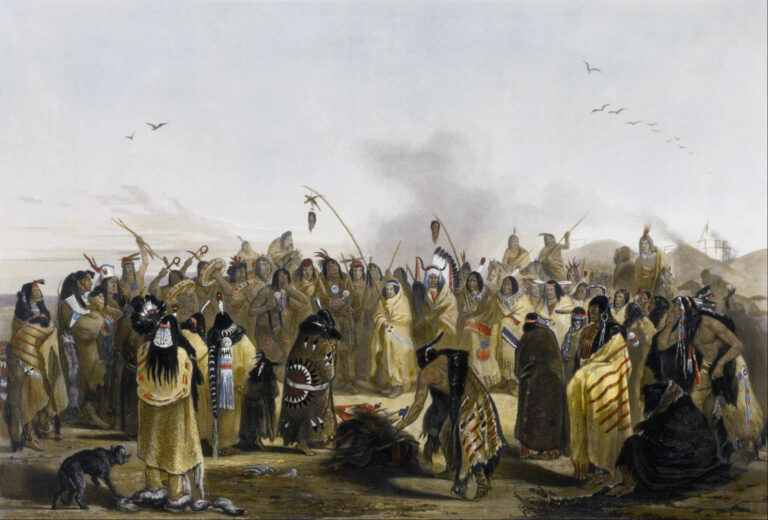
‘How Outina’s men treated the slain of the enemy’: scene showing the amputation of limbs to be taken as trophies (engraving 15, published by Theodore de Bry, after an original drawing by Jacques Le Moyne de Morgues, in Brevis narratio eorum quae in Florida Americae provincia Gallis acciderunt [1591]).

Scalping in Nephite Time Frame

From the earliest years of conflict between Native Americans and Europeans, the object which most resonates to the present as emblematic of that conflict’s violence is the scalp. Scalping was an ancient practice in North America that predates European contact by centuries. It figures prominently in early European accounts. Beyond its simple description as a grisly souvenir or trophy of war, the scalp, and the practice of scalping, carried meanings, both symbolic and concrete. Taking a scalp represented the ultimate dominance of a warrior over an enemy. The scalp became a stand-in for the slain enemy in a celebratory ritual of further humiliation, many with gendered aspects. Europeans also included scalping in their imperialistic war-making practices. Their scalping, which began as an imitation or response to Indian scalping, in time created a new materialistic motivation for taking scalps.

Evidence for the antiquity of scalping on the North American continent takes three different forms: archaeological, historical, and linguistic. Each is compelling and the three, taken as a whole are comprehensive and convincing. The skeletal remains that form the basis for the archaeological argument for scalping as an ancient American practice are persuasive because they are perhaps the most concrete and least susceptible to semantics or interpretation, in the way that historical or linguistic arguments may be.[1] The cut marks found upon skulls that are consistent with scalping by a stone blade are among the key diagnostic attributes used by archaeologists to say with a degree of certainty that a set of skeletal remains represents a victim of interpersonal violence and “malevolent intent.” Other such attributes include bodies with multiple projectile point impacts, multiple crushing injuries, or a mass of bodies dumped together.[2] Another, related, category of skulls that corroborates the markings as being representative of ancient scalping are the skulls that show these marks but also signs of healing.[3] These individuals survived scalping, a not uncommon occurrence in historic times. An early American medical journal even published an article explaining how to care for the scalping survivor.[4] Absent the possibility of industrial mishap, it is hard to find another explanation for a person to be separated from their scalp.

In 1940, archaeologist Georg Neumann excavated and described the first set of remains widely accepted as showing evidence for scalping.[5] In his findings, Neumann reported finding the skull of a young man in an Illinois site that dated to the Middle Mississippian Period of the 11th to 16th century A.D. The skull showed that death was caused by four blows from a stone celt or club, furthermore, there was a series of cuts around the crown of the skull consistent with scalping with a stone blade.[6] Another, more dramatic site of prehistoric violence and scalping is the Crow Creek site in South Dakota, where, in the 14th century, enemy warriors destroyed an agricultural village. Here, archaeologists discovered 486 skeletons in two mass graves. Almost all of the bodies showed some form of post-mortem mutilation.[7] Nearly 90 percent of the skulls, male and female, showed the tell-tale cut-marks associated with scalping. [8] In addition to skulls that have had the scalp removed, in a few cases the scalps themselves have survived. A scalp, which included ears and eyebrows, attached to a basketry disk found in a Utah cave yielded a carbon-14 date of between 1 and 359 A.D.[9] [This is a time frame consistent with Alma 44 above] The earliest North American archaeological evidence for an Indian scalping a European is the skeletal remains of an English settler killed in Virginia in a 1622 attack.[10] His shattered skull speaks to a violent end and his cranium shows signs of being scalped with a metal knife, perhaps even an English one.

Scalping appears in the earliest historical accounts of European explorations of North America. On his second voyage to the continent, the French explorer Jacques Cartier wrote that the Indians of a village called Stadacona showed him the “the skin of five men’s heads”, which were spread out on a board “like parchments.”[11] In 1540, Indians killed and scalped Simon Rodrigues, a member of the de Soto Expedition to what is now the southeastern United States.[12] De Soto, in attempting to describe what happened, recounted that the natives took el pellejo de corona, the skin of the crown.[13] Jacques Le Moyne a Frenchman who visited Florida in 1564 described in graphic detail how members of the Timucua tribe scalped dead enemies, “they cut the skin of the head down to the skull with pieces of reed sharper than any steel blade, from the brow in a circle to the back of the head; and they pull it off whole, gathering the hair, which is still attached to it and more than a cubit long, into a knot at the crown; and what there is over the brow and back of the head they cut off in a circle to a length of two fingers.[14] Not only was Le Moyne a vivid writer, he also drew what he saw, and later a Belgian engraver, Theodor de Bry produced lurid reproductions of his sketches.

In the above De Bry engraving, after Le Moyne’s drawing, of Timucuas mutilating dead enemies, the men at right are drying scalps over a fire.  The figures in the background are returning to the village with scalps and other body parts on the ends of their lances. Le Moyne described how the trophies became a central part of a victory ceremony in which the whole village took part.[15]


[1] Phillip L. Walker, “A Bioarcheological Perspective on the History of Violence,” Annual Review of Anthropology 30, no. 1 (2001): doi: 10.1146/annurev.anthro.30.1.573., 574.

[2] Walker, 576

[3] James Axtell and William C. Sturtevant, “The Unkindest Cut, or Who Invented Scalping,” The William and Mary Quarterly 37, no. 3 (1980):  doi:10.2307/1923812. 468.

[4] James Robertson, “Remarks on the Management of the Scalped-Head,” The Philadelphia Medical and Physical Journal 2 (April 1806). 27-33

[5] Wolf D. Bueschgen and D. Troy Case, “Evidence of Prehistoric Scalping at Vosberg, Central Arizona,” International Journal of Osteoarcheology 6, no. 3 (1996): doi:10.1002/1099-12126:33.0, 231

[6] Georg K. Neumann, “Evidence for the Antiquity of Scalping from Central Illinois,” American Antiquity 5, no. 04 (1940): doi:10.2307/275199. 287.

[7] Patrick S. Willey, Prehistoric Warfare on the Great Plains: Skeletal Analysis of the Crow Creek Massacre Victims (New York: Garland, 1990), 105;

[8] P. Willey and Thomas E. Emerson, “The Osteology and Archaeology of The Crow Creek Massacre,” Plains Anthropologist 38, no. 145 (1993), doi:10.1080/2052546.1993.11931655., 257.

[9] Julie Howard and Joel Janetski, “Human Scalps from Eastern Utah,” Utah Archaeology 1992 5, no. 1 (1992) https://www.upaconline.org/journal/PDF/Utah%20Archaeology%201992. 128-130.

[10] Axtell and Sturtevant, 460.

[11] Stephen Leacock, The Mariner of St. Malo a Chronicle of the Voyages of Jacques Cartier, vol. 2 (Toronto: Glasgow, Brook & Company, 1915), https://www.gutenberg.org/files/4077/4077-h/4077-h.htm. VII

[12] Thomas S. Abler, “Scalping, Torture, Cannibalism and Rape: An Ethnohistorical Analysis of Conflicting Cultural Values in War,” Anthropologica 34, no. 1 (1992): doi:10.2307/25605630, 7.

[13] Axtell and Sturtevant, 457.

[14] Jacques Le Moyne De Morgues, Theodor De Bry, and Frederic B. Perkins, Narrative of Le Moyne an Artist Who Accompanied the French Expedition to Florida under Laudonnière, 1564 (Boston: J.R. Osgood and, 1875) https://babel.hathitrust.org/cgi/pt?id=mdp.39015027064032;view=1up;seq=51. 7.

[15] Le Moyne, 7.

The Skin of the Crown: The Origins and Meanings of Scalping in Early America Phillip Lingle New Mexico State University January 2019

Late Archaic Scalping 3000 to 1000 BC

“Three individuals from Late Archaic period sites in the Kentucky Lake Reservoir exhibit cutmarks on their crania which are best interpreted as scalping. The likely scalping victims are the earliest examples of this warfarerelated trophy-taking practice in the eastern United States. The importance of this identification lies not just in establishing a great antiquity for an ethnohistorically well known practice, but in the informative potential trophy taking has in particular theories of cultural evolution. Certain paradigms stress the dynamic role of warfare in the genesis of social stratification. A primary motive for scalp taking is prestige enhancement. The temporal and spatial distribution of scalping and other trophy-taking practices among Late Archaic hunter-gatherers may provide useful clues to patterns of status differentiation.” Scalping in the Archaic Period: Evidence from the Western Tennessee Valley Maria O. Smith [The Late Archaic Period lasted from about 5,000 to 3,000 years ago]
Trophy Taking in the Central and Lower Mississippi Valley
NANCY A. ROSS-STALLINGS

“The purposes of this chapter are to first review the criteria for evaluating
whether or not a human remain should be considered as a legitimate trophy when found in an archaeological context. Second, some previously unpublished cases of decapitation and cannibalism from the central and lower Mississippi Valley, plus a site with one feature exhibiting multiple scalping and decapitation cases from southeastern Tennessee, will be presented. The final section is a review of sites in the continental United States where trophy taking and/or cannibalism has been verified, using the criteria established in the early part of the chapter. This review will demonstrate that trophy taking had two discrete origins in the United States, first from a temporal and second from a spatial standpoint, and that the practice spread across cultural areas on a timeline.”

Origins of Human Trophy Taking in California

“Scalps were taken in the greater part of California, brought home in triumph, and celebrated over, usually by a dance around a pole” (Kroeber 1976:843); thus concluded the great California ethnographer Alfred Kroeber on the human trophy taking in his lengthy treatise, Handbook of the Indians of California. At the time of his study of the cultural elements of California’s indigenous peoples, California was or had recently been occupied by over 50 tribal groups (Figure 4.1) Ethnographic and Linguistic Evidence for the Origins of Human Trophy Taking in California PATRICIA M. LAMBERT

Evidence for the Antiquity of Scalping from Central Illinois

Georg K. Neumann Published 1940 History JUST before the archaeological party of the University of Chicago moved camp to the extreme southeastern part of Fulton County, Illinois, during the summer of 1933, the writer visited the aboriginal site (designated FV896 by the archaeological survey) on the Norman Crable farm located on the high Illinois River bluff about two miles north of Bluff City. Here for several years Mr. Glenn McGirr, a local collector, had opened a large number of graves to secure artifacts, and on that afternoon had opened six of them.

The burials were extended on the back with the arms to the sides and accompanied by typical Middle Mississippi [800 to 1600 AD] pottery and other artifacts that were assigned to the Spoon River focus of the Monk’s Mound aspect after excavations had been carried on by the field party.368 Mr. McGirr was kind enough to let the writer have four of the skeletons for the University collections, and upon cleaning them it was found that one of them, that of an adult male (No. F896-101), exhibited evidences of a violent end, and had cuts on the vault of the skull that seemed to indicate that the individual had been scalped. Death had clearly been caused by four celt blows which had fractured the parietals and crushed in the right side of the skull. If one can judge by the distribution of the cuts, the victim probably had lain face down during the operation for most of the cuts, which look as if they had been made with a flint knife, are on the frontal bone and extend in a rough circle around the crown.

After the front end of the scalp had been cut loose in all probability it had been pulled backward and then cut free without making more than two cuts on the occipital bone. The presence of a small amount of calcium carbonate leached from the calcareous loess and deposited in some of the cuts attest to their antiquity. Here, then, there is direct evidence of a case of scalping of an individual who belonged to a group with a Middle Mississippi culture that was shown in Illinois to be pre-historic and by relative chronology to post-date Hopewellian manifestations. All evidences of culture, as well as of physical anthropology, point to the Muskhogean-speaking tribes of the Southeast, who, it may be noted, also practiced scalping when De Soto first visited them in 1540.

Old World Scalping

In England in 1036, Earl Godwin, father of Harold Godwinson, was reportedly responsible for scalping his enemies. According to the ancient Abingdon manuscript, ‘some of them were blinded, some maimed, some scalped. No more horrible deed was done in this country since the Danes came and made peace here’.[3]

Georg Frederici noted that “Herodotus provided the only clear and satisfactory portrayal of a scalping people in the old world” in his description of the Scythians, a nomadic people then located to the north and west of the Black Sea.[4] Herodotus related that Scythian warriors would behead the enemies they defeated in battle and present the heads to their king to claim their share of the plunder. Then, the warrior would skin the head “by making a circular cut round the ears and shaking out the skull; he then scrapes the flesh off the skin with the rib of an ox, and when it is clean works it with his fingers until it is supple, and fit to be used as a sort of handkerchief. He hangs these handkerchiefs on the bridle of his horse, and is very proud of them. The best man is the man who has the greatest number.”[5] https://en.wikipedia.org/wiki/Scalping

“Although American native peoples were all too often accused of being the sole practitioners of scalping, in reality they did nothing others had not done before. Herodotus found the practice among the Pontic Scythians, and, according to the Maccabees, the ancient Persians tore away the scalp of one of their prisoners. Orosius reports that Romans scalped during the battle on the Raudine plain. It is highly probable that Germanic tribes behaved similarly, for we know that they ascribed magical powers to a shock of human hair, regarding it as the symbol of the free man. In Germanic law, if a court demanded the guilty party’s head to be shaved it was considered an especially grievous sentence — in very serious cases the court could decree that the hair be ripped out with the skin.” Source 

Setting the Record Straight About Native Peoples: Scalping

Q: Who invented scalping? My history book says it was the Indians but the tribe who lives near me says the colonists used to scalp them.
A: They’re both right. Scalping–cutting off the scalp of a dead enemy as proof of his demise– was common practice throughout North America before colonists got here. It is described in Indian oral histories, and preserved scalps were found at archaeological sites. Colonists learned to scalp enemies from the Indians. (The European custom was to cut off people’s heads for proof/trophies, originally, but scalps are easier to transport and preserve, so the colonists quickly switched to the Indian method.) Once they picked up the technique, the English did a tremendous amount of scalping, both of natives and of rival Frenchmen.

Below is a bounty notice from 1755 offering varying rewards for the scalps of Indian men, women, and children. (These scalps, incidentally, were commonly referred to as “redskins,” one reason why that is considered such a rude racial slur by many Native Americans today.) American and Canadian frontiersmen kept up the tradition of scalping until the turn of the 20th century, though in some places, like California, they reverted back to severed heads. There was actually still a law on the books in Canada as of the year 2000 promising bounties in exchange for Indian scalps, though the embarrassed Canadian government was hurrying to repeal it (here’s an article on that).

Bounty Notice 1755

In other words, the scalping technique came from the American Indians, the idea of taking a piece of a dead enemy’s body as a war prize was well known to Indians and Europeans alike, and the idea of paying bounties for dead body parts came from the Europeans. http://www.native-languages.org/iaq12.htm

Scalping Proclamation

A 1755 proclamation (above) by one Spencer Phips, then lieutenant governor of the Commonwealth of Massachusetts. The document declared the Penobscots “Enemies, Rebels, and Traitors to his Majesty King George the Second.” It “required” his Majesty’s Subjects “to embrace all opportunities of pursuing, captivating, killing and Destroying all and every of the aforesaid Indians.” It further stated that a bounty had been voted by the General Court of the Province, promising 25 pounds for a female Penobscot of any age or a male Penobscot under age 12, and 50 pounds for a Penobscot male over age 12. Scalps of Penobscots under 12 would earn a little less, 20 pounds”. https://bangordailynews.com/2011/11/13/living/official-issued-proclamation-against-penobscot-indians-in-1755/

Who Invented Scalping?

In recent years many voices—both Native-American and white—have questioned whether Indians did in fact invent scalping. What is the evidence? James Axtell April 1977 Volume 28 Issue 3

Americans have always assumed that scalping and Indians were synonymous. Cutting the crown of hair from a fallen adversary has traditionally been viewed as an ancient Indian custom, performed to obtain tangible proof of the warrior’s valor. But in recent years many voices—Indian and white—have seriously questioned whether the Indians did in fact invent scalping. The latest suggestion is that the white colonists, in establishing bounties for enemy hair, introduced scalping to Indian allies innocent of the practice.

This theory presupposes two facts: one, that the white colonists who settled America in the seventeenth century knew how to scalp before they left Europe; and two, that the Indians did not know how to scalp before the white men arrived. But are these facts? And if they are not, who did invent scalping in America?

Total silence from both participants and historians casts doubt on the first proposition. For no one has ever insinuated, much less proved, that the European armies who fought so ruthlessly the Crusades, the Hundred Years’ War, and the Wars of Religion ever scalped their victims. Even when they were combating a European form of “savagery” in Ireland, Queen Elizabeth’s forces were never scalped or ever took scalps. The grim, gray visages of severed heads lining the path to a commander’s tent were more terrible than impersonal shocks of hair and skin.

Nor does the second proposition fare much better. For there is abundant evidence from various sources that the Indians practiced scalping long before the white man arrived and that they continued to do so without the incentive of colonial cash.

The first and most familiar source of evidence is the written descriptions of the earliest European observers, who presumably saw the Indian cultures of the eastern seaboard in something like an aboriginal condition. When Jacques Cartier sailed down the St. Lawrence to what is now Quebec City in 1535, he met the Stadaconans, who showed him “the scalps of five Indians, stretched on hoops like parchment.” His host, Donnacona, told him they were from “Toudamans from the south, who waged war continually against his people.”

Twenty-nine years later, another Frenchman, artist Jacques Ie Moyne, witnessed the Timucuans’ practice of scalping on the St. Johns River in Florida:


They carried slips of reeds, sharper than any steel blade … they cut the skin of the head down to the bone from front to back and all the way around and pulled it off while the hair, more than a foot and a half long, was still attached to it. When they had done this, they dug a hole in the ground and made a fire, kindling it with a piece of smoldering ember. … Over the fire they dried the scalps until they looked like parchment. … They hung the bones and the scalps at the ends of their spears, carrying them home in triumph.

When they arrived at their village, they held a victory ceremony in which the legs, arms, and scalps of the vanquished were attached to poles with “great solemnities.”

The French were not alone in witnessing the Indian custom of scalping. When the English brazenly set themselves down amid the powerful Powhatan Confederacy in Virginia, the Indians used an old tactic to try to quash their audacity. In 1608 Powhatan launched a surprise attack on a village of “neare neighbours and subjects,” killing twenty-four men. When the victors retired from the scene of battle, they brought away “the long haire of the one side of their heades [the other being shaved] with the skinne cased off with shels or reeds.” The prisoners and scalps were then presented to the chief, who hung “the lockes of haire with their skinnes” on a line between two trees. “And thus,” wrote Captain John Smith, “he made ostentation … , shewing them to the English men that then came unto him, at his appointment.”

The first Dutchmen to penetrate the Iroquois country of upstate New York also found evidence of native scalping. When the surgeon of Fort Orange (Albany) journeyed into Mohawk and Oneida territory in the winter of 1634-35,ne saw atop a gate of the old Oneida castle on Oriskany Creek “three wooden images carved like men, and with them … three scalps fluttering in the wind.” On a smaller gate at the east end of the castle a scalp was also hanging, no doubt to impress white visitors as well as hostile neighbors…

The older English word scalp did not acquire its distinctly American meaning until 1675 when King Philip’s War brought the object renewed prominence in New England. Until then, the best expressions were compounds such as “hair-scalp” and “head-skin,” phrases such as “the skin and hair of the scalp of the head,” or the simple but ambiguous word “head.” Likewise, the only meaning of the verb to scalp meant “to carve, engrave, scrape, or scratch.” Consequently, English writers were forced to use “skin,” “flay,” or “excoriate” until 1676 when the American meaning became popular. French, Dutch, German, and Swedish speakers were also forced to resort to circumlocutions until they borrowed the English words in the eighteenth century.

On the other hand, the languages of the eastern Indians contained many words to describe the scalp, the act of scalping, and the victim of scalping. A Catholic priest among the Hurons in 1623 learned that an onontsira was a war trophy consisting of “the skin of the head with its hair.” The five languages of the Iroquois were especially rich in words to describe the act that has earned them, however unjustly, an enduring reputation for inhuman ferocity. To the Mohawks and Oneidas, the scalp was onnonra ; the act of taking it, kannonrackwan . Their western brothers at Onondaga spoke of hononksera , a variation of the Huron word. And although they were recorded after initial contact with the Europeans, the vocabularies of the other Iroquois nations and of the Delaware, Algonquin, Malecite, Micmac, and Montagnais all contained words for scalp, scalping, and the scalped that are closely related to the native words for hair, head, skull, and skin. That these words were obviously not borrowed from European languages lends further support to the notion that they were native to America and deeply rooted in Indian life

Drawings reveal yet another piece of evidence damaging to the new theory of scalping, namely scalp locks. A small braid of hair on the crown, often decorated with paint or jewelry, the scalp lock was worn widely in both eastern and western America. Contrary to the notion of scalping as a recent and mercenary introduction, the scalp lock originally possessed ancient religious meaning in most tribes, symbolizing the warrior’s life-force. For anyone to touch it even lightly was regarded as a grave insult. If the white man had taught the Indians to scalp one another for money, it is highly unlikely that the Indians were also hoodwinked into making it easier for their enemies by growing hairy handles. Something far deeper in native culture and history must account for the practice.

The final and most conclusive evidence of scalping in pre-Columbian America comes from archaeology. Since Indian skulls of the requisite age can be found to show distinct and unambiguous marks made by the scalping knife, the Indians must have known of scalping before the arrival of the white man. A wealth of evidence, particularly from prehistoric sites along the Mississippi and Missouri rivers and in the Southeast, indicates just such a conclusion…

But the second kind of evidence is more conclusive. In a number of prehistoric sites, circular lesions have been found on the skulls of victims who survived scalping long enough to allow the bone tissue to regenerate partially, leaving a telltale scar. Contrary to popular belief, scalping itself was not a fatal operation, and American history is full of survivors. Scalping is the only possible explanation for these lesions, which appear exactly where eyewitness descriptions and drawings indicate the scalp was traditionally cut.

In the light of such evidence, it is clear that Indians, not white men, introduced scalping to the New World. At the same time, it cannot be denied that the colonists encouraged the spread of scalping to many tribes unfamiliar with the practice by posting scalp bounties. Nor can it be forgotten that Americans of every stripe—from frontiersmen to ministers—were tainted by participating in the bloody market for human hair. Yet in the end, the American stereotype of scalping must stand as historical fact, whether we are comfortable with it or not.

https://www.americanheritage.com/who-invented-scalping#2

Hannah Duston Indian Captive

This image has an empty alt attribute; its file name is dustin-chart.png

I have a grandmother named Cecilia Ellen Dustin (1895-1962) who married my grandfather, Alvin Christian Tueller (1898-1972) both from Bear Lake Idaho. I have been told the story about my 7th Great Grandmother Puritan Hannah Emerson Dustin for many years now. She has always been a hero to me as a woman of courage who was the first woman ever to have a statue created in her honor in the United States (1874). I have also always had a great love for the Native Americans (Abenaki in this instance) of this great country and honor those Lamanites whenever I get a chance. The story about Hannah and the Native Americans is a difficult story as one side kills the other, I however know that the Lord will sort all things out and hold a fair judgement of all concerned. I will let you read the story and come to your own conclusion.

Today, what she did to deserve a statue might be called, by some, a monument to an atrocity. What did Hannah do? Hannah scalped the ten Indians who had attacked her farm, dragged her from her bed, and burned her house down before taking her captive and killing her six-day-old infant.

Hannah Duston Monument, by Calvin H. Weeks, 1879

About Hannah Webster (Emerson) Dustin, Indian Captive

Hannah Webster (Emerson) Dustin (1657 – 1736) – Hannah Dustin was a 40-year-old colonial Massachusetts Puritan mother of eight during King William’s War who was taken captive with her newborn daughter during an Indian raid on Haverhill. On 15 March 1697, Hannah witnessed the brutal killing of her baby and several of her neighbors. While held captive on an island in the Merrimack River in present-day Boscawen, New Hampshire, she and two other captives scalped ten members of the Indian family who were holding them hostage. More of my blog here:

Hannah Duston Takes Scalps

Utah Archaeology Volume 5, Number 1, 1992  

Published on Sep 4, 2018  

UTAH ARCHAEOLOGY is an annual publication of USAS, UPAC and the Utah Division of State History. The purpose of this publication is to disseminate information relevant to archaeological research both historic and prehistoric in the state of Utah. Subscriptions are available through membership in the USAS, UPAC or the Publication Department of the Utah Division of State History. Authors interested in publishing contact the editors for manuscript guide. 

INTRODUCTION Over the past several years the Bureau of Land Management (BLM) in Moab and the Museum of Peoples and Cultures at Brigham Young University (BYU) have obtained collections of prehistoric materials that include human scalps. These items have come from both the Uinta Basin and the Moab area of eastern Utah. Similarities in the scalps and associated material cultural suggest regional affinities, perhaps witli the Southwest. The function of these important but highly sensitive artifacts is unknown at the moment, although intriguing insights are available in the ethnographic literature on the Pueblos.

SCALPS WITH BASKETRY FROM THE UINTA BASIN In 1988 the Museum of Peoples and Cultures at BYU received a large collection of Ute ethnographic items from the heirs of Mildred Miles DiUman, a longlime resident of Vernal, Utah. Among the items were several prehistoric artifacts that, according to the notes with the collection, were from Nuie Mile Canyon in eastern Utah. Included in the Nine Mile Canyon material were two human scalps stretched over basketry disks or rosettes (Figures 1 and 2). Each of the disks is 14.5 cm in diameter.

Following Adovasio (1977) and Morris and Burgh (1954), the basketry was constructed with an open- or space-coiled, intricatestitch, interlocked on a one-rod foundation technique (basketry material is unknown). The rim finish is a form of false braid. One of the disks is completely painted red, while the other has a red band painted across it just below the center (Figure 1). Spots of red paint are also present on the leather thongs that tie the rosettes together. One of the scalps is secured to its disk with a fine, two-ply, s-twist type cordage of unidentified plant fibers. Each scalp has two perforations (perhaps three on one) at the lower end or neck portion. The perforations are elongated as if something were tied or hung from them at one point. The scalps are well worn and little hair remains. Each appears to be from a separate individual and approaches being a full scalp.

The hair is black and coarse and evidence of parasites is visible. Maximum hair length is about 15 cm. A hair whorl presumably from the back of the head is clearly visible on one of the scalps. The scalps have suffered some insect damage, but the disks are well preserved; however, both are extremely brittle and fragile. The two separate scalps along with the disks are bound together with leadier thongs suggesting they were paired for some reason. No details are known of the circumstances of the discovery of these scalps in Nine Mile Canyon.

SCALPS AND BASKETRY FROM THE MOAB AREA Five scalps are known from the North and the South Forks of Mill Creek Canyon, southeast of Moab. These artifacts are now in Moab in collections at the BLM office and the Dan O’Laurie Museum. Two of the scalps (Figure 3) were found during the spring of 1986 by a Salt Lake City couple who visited the North Fork of Mill Creek Canyon near Moab. While hiking, they explored several large alcove sites cmd in one found a woven mat protruding from the sand. Upon investigating, they found the scalps wrapped in the mat buried approximately 20 cm below the surface. Unaware of the antiquity laws, they collected die scalps and returned to Salt Lake. Their discovery was made approximately one week before the Calvin Black case was reported in the newspapers. The couple was concerned about having violated any federal law and subsequently turned the items over to the United States Attorney for the District of Utah. The attorney contacted a special agent who gave them to the Grand Resource Area, Bureau of Land Management archaeologist in Moab.

RADIOCARBON DATE FROM THE LEMA SCALP [Fig. 4 and 5]

An Accelerator Mass Spectrometric (AMS) radiocarbon date was obtained from the Lema scalp. The sample was taken from a small section of skin from the back of the neck. The sample yielded a raw date of 1845 ± 80 years (Beta Analytic sample number 31535). The tree ring calibration of this date following Stuiver and Reamer (1987) is A.D. 1-359 (two sigma range)

https://issuu.com/utah10/docs/utah_archaeology_1992

“He Will Justify in Committing a Little Sin; yea, Lie a Little”

0

“For all have sinned, and come short of the glory of God;” Romans 3:23. I know I have. Knowing this we have joy in the gift of God as we can repent of those sins, daily. The scriptures below speak about our day. Today! I believe however the wicked are getting more pervasive and more wicked, but the righteous are also growing stronger and preparing for the last great battle against evil. The tares are being separated.

1 This know also, that in the last days perilous times shall come.
2 For men shall be lovers of their own selves, covetous, boasters, proud, blasphemers, disobedient to parents, unthankful, unholy,
3 Without natural affection, trucebreakers, false accusers, incontinent, fierce, despisers of those that are good,
4 Traitors, heady, highminded, lovers of pleasures more than lovers of God;
5 Having a form of godliness, but denying the power thereof: from such turn away.
6 For of this sort are they which creep into houses, and lead captive silly women laden with sins, led away with divers lusts,
7 Ever learning, and never able to come to the knowledge of the truth. 2 Timothy 3:1-7

7 Yea, and there shall be many which shall say: Eat, drink, and be merry, for tomorrow we die; and it shall be well with us.
8 And there shall also be many which shall say: Eat, drink, and be merry; nevertheless, fear God—he will justify in committing a little sin; yea, lie a little, take the advantage of one because of his words, dig a pit for thy neighbor; there is no harm in this; and do all these things, for tomorrow we die; and if it so be that we are guilty, God will beat us with a few stripes, and at last we shall be saved in the kingdom of God.
9 Yea, and there shall be many which shall teach after this manner, false and vain and foolish doctrines, and shall be puffed up in their hearts, and shall seek deep to hide their counsels from the Lord; and their works shall be in the dark. 2 Nephi 28:7-9

13 If a man also lie with mankind, as he lieth with a woman, both of them have committed an abomination: they shall surely be put to death; their blood shall be upon them.
14 And if a man take a wife and her mother, it is wickedness: they shall be burnt with fire, both he and they; that there be no wickedness among you.
15 And if a man lie with a beast, he shall surely be put to death: and ye shall slay the beast. Leviticus 20:13-15

Thou shalt not lie with mankind, as with womankind: it is abomination. Lev 18:22

The woman shall not wear that which pertaineth unto a man, neither shall a man put on a woman’s garment: for all that do so are abomination unto the Lord thy God. Deut 22:5

With these warnings from God I continually think of the scripture that says, “And it came to pass that I beheld the church of the Lamb of God, and its numbers were few, because of the wickedness and abominations of the whore who sat upon many waters; nevertheless, I beheld that the church of the Lamb, who were the saints of God, were also upon all the face of the earth; and their dominions upon the face of the earth were small, because of the wickedness of the great whore whom I saw.” 1 Nephi 14:2. With the numbers so few, it is a blessing the Lord has helped me understand the Covenant Path that President Nelson has spoken of on which I strive daily to remain upon.

I now share with you two very real and yet very similar evils happening in the world today. One evil comes from some in the St. Francis Xavier Catholic Church and others come from riot and Marxist groups to name only two. These examples will show you the challenge of today’s world. Is it really ok to lie a little bit?

NYC Priest Leads Vows Against “White Privilege” During Mass in Viral Video

Church of Saint Francis Xavier NYC, Facebook / ChurchPOP

by Church POP Editor – Sep 1, 2020

What are your thoughts about this?

Pastor Fr. Kenneth Boller, SJ, of St. Francis Xavier Catholic Church in New York City led his congregation in vows addressing “white privilege” and “racial justice” on Sun., Aug. 30. He led the vows during Mass, just before the final blessing.

In the video, Fr. Boller invites the congregation to recite “a prayer for racial justice,” by responding “Yes.”

Here’s the text of Fr. Boller’s prayer:

“Do you support racial justice, equity, and compassion? Yes.

“Do you affirm that white privilege and the culture of white supremacy must be dismantled where it is present? Yes.

“Do you support racial equity, racial justice, and liberation for every person? Yes.

“Do you affirm the inherent worth and dignity of every person? Yes.

“Therefore, from this day forward, will you strive to understand more deeply the injustice and suffering white privilege and white supremacy cause? Yes.

“Will you commit to help transform our Church culture to one that is actively engaged in seeking racial justice and equity for everyone? Yes.

“Will you make a greater effort to treat all people with the same respect you expect to receive? Yes.

“Will you commit to developing the courage to live your beliefs and values of racial justice and equality? Yes.

“Will you strive to eliminate racial prejudice from your thoughts and actions, so that you can better promote the racial justice efforts of our Church? Yes.

“Will you renew and honor this pledge daily, knowing that our Church and our community, our nation, and our world will be better places because of our efforts. Yes.” https://churchpop.com/2020/09/01/nyc-priest-leads-vows-against-white-privilege-during-mass-in-viral-video/

I do not believe in the concept of White Privilege. I believe God loves us equally and He has placed each of us in His care on this earth. We all have equal opportunity, not equal outcomes. Our freedom to choose can be effected by where we live and how we are treated, but ultimately God loves us all and will judge each of us fairly. I believe we are all privileged to live on this earth. As taught in the Scriptures we all of us born on this earth chose in a pre-life to follow Christ into this world to learn and grow by our experiences. Each challenge in life we can either grow closer to the Lord ofr grow further from him.

Do you Know what the Black Lives Matter Group Believes?

I think it is important for you to know who is on the Lord’s side. I believe all people are children of God and are equal in His sight. I believe all of God’s children’s lives matter and we should love each other regardless of race, creed or color. Read what the Black Lives Matter organization believes from their own website so you can determine their values with your own.

From their website, Black Lives Matter says, BlackLivesMatter was founded in 2013 in response to the acquittal of Trayvon Martin’s murderer. Black Lives Matter Foundation, Inc is a global organization in the US, UK, and Canada, whose mission is to eradicate white supremacy and build local power to intervene in violence inflicted on Black communities by the state and vigilantes. By combating and countering acts of violence, creating space for Black imagination and innovation, and centering Black joy, we are winning immediate improvements in our lives. Source

“These are the results of our collective efforts.

The Black Lives Matter Global Network is as powerful as it is because of our membership, our partners, our supporters, our staff, and you. Our continued commitment to liberation for all Black people means we are continuing the work of our ancestors and fighting for our collective freedom because it is our duty.

Every day, we recommit to healing ourselves and each other, and to co-creating alongside comrades, allies, and family a culture where each person feels seen, heard, and supported.

We acknowledge, respect, and celebrate differences and commonalities.

We work vigorously for freedom and justice for Black people and, by extension, all people.

We intentionally build and nurture a beloved community that is bonded together through a beautiful struggle that is restorative, not depleting.

We are unapologetically Black in our positioning. In affirming that Black Lives Matter, we need not qualify our position. To love and desire freedom and justice for ourselves is a prerequisite for wanting the same for others.

We see ourselves as part of the global Black family, and we are aware of the different ways we are impacted or privileged as Black people who exist in different parts of the world.

We are guided by the fact that all Black lives matter, regardless of actual or perceived sexual identity, gender identity, gender expression, economic status, ability, disability, religious beliefs or disbeliefs, immigration status, or location.

We make space for transgender brothers and sisters to participate and lead.

We are self-reflexive and do the work required to dismantle cisgender privilege and uplift Black trans folk, especially Black trans women who continue to be disproportionately impacted by trans-antagonistic violence.” Black Lives Matter.

[“Cisgender (sometimes cissexual, often abbreviated to simply cis) is a term for people whose gender identity matches their sex assigned at birth. For example, someone who identifies as a woman and was assigned female at birth is a cisgender woman. The term cisgender is the opposite of the word transgender. Related terms include cissexism and cisnormativity… While some believe that the term cisgender is merely politically correct,medical academics use the term and have recognized its importance in transgender studies since the 1990s.” Source Wikipedia]

Black Lives Matter continues saying, “We build a space that affirms Black women and is free from sexism, misogyny, and environments in which men are centered.

We practice empathy. We engage comrades with the intent to learn about and connect with their contexts.

We make our spaces family-friendly and enable parents to fully participate with their children. We dismantle the patriarchal practice that requires mothers to work “double shifts” so that they can mother in private even as they participate in public justice work.

We disrupt the Western-prescribed nuclear family structure requirement by supporting each other as extended families and “villages” that collectively care for one another, especially our children, to the degree that mothers, parents, and children are comfortable.

We foster a queer‐affirming network. When we gather, we do so with the intention of freeing ourselves from the tight grip of heteronormative thinking, or rather, the belief that all in the world are heterosexual (unless s/he or they disclose otherwise).

We cultivate an intergenerational and communal network free from ageism. We believe that all people, regardless of age, show up with the capacity to lead and learn.

We embody and practice justice, liberation, and peace in our engagements with one another.

https://blacklivesmatter.com/what-we-believe/

I believe under the Constitution all people are allowed to peaceably protest and share honest grievances with our government. Once protesting becomes a riot with destruction of property and people and lawlessness, this is not protesting but is a form of anarchy.

I would like to be wrong but I don’t think groups like Black Lives Matter want to negotiate or come together to make life better. We can all differ in opinion but not through illegal behavior. What happened to the day where the Republicans, and Democrats could work things out? May the Lord bless our country as we are worthy of His blessings.

The Flood and Noah’s Wife

0

To me, it seems science has missed the mark for many years now. Einsteins theory is still just a theory and not true, man has not evolved through an ape, the creation time of this earth did not take billions of years, and the dinosaurs are the age of Adam not millions of years old. 

There have been many of these scientists and intellectuals who have completely disagreed with the new book, Universal Model. In my opinion that means Dean Sessions author of Universal Model, is on the correct path, because for years I have believed the opposite of what most of today’s scientists believe.  I am learning that the more the professors of the large and spacious buildings say something is true, I think the opposite is usually the right answer. Read a portion of Universal Model at the very end of this blog about New Scientific Evidence for a Universal Flood.

There was an article in LDS Living by Stephen O. Smoot here, that I have a hard time believing. I believe the flood was a true account and was a world wide global event and no part of the story was a myth. I share below a small portion of Mr. Smoot’s article.

Was the flood a global or local flood?

“Modern believers are confronted with geological and other scientific evidence (in addition to the ancient literary context of Genesis) that casts serious doubt on the feasibility of a worldwide catastrophic flood sometime (presumably) around 3,000 BC that wiped out all animal and human life save that which was spared on Noah’s ark. In response to these challenges, some have wondered if perhaps the flood described in Genesis drew from memory of a localized event, perhaps a particularly bad flooding of the Tigris and Euphrates rivers. Given the somewhat ambiguous meaning of the Hebrew word eretz (“earth,” “land”), rather than the “earth” (meaning the spherical globe) being entirely flooded, instead perhaps Genesis meant to convey that the “earth” (meaning the land or local region where Noah dwelt) was inundated (Moses 1:29). Or perhaps a local flood was mythologized into a global one to symbolically signify the renewal or recreation of the earth from out of a primordial universal ocean (Genesis 1:2).

Latter-day Saints have likewise wrestled with this question and have come to varying conclusions (some more traditionalist, others more moderate). Apostle John A. Widtsoe acknowledged in 1943 that from a revelatory point of view we simply do not know enough to conclusively settle this matter. “The fact remains that the exact nature of the flood is not known. We set up assumptions, based upon our best knowledge, but can go no further.” He continued:

We should remember that when inspired writers deal with historical incidents they relate that which they have seen or that which may have been told them, unless indeed the past is opened to them by revelation. The details in the story of the flood are undoubtedly drawn from the experiences of the writer. Under a downpour of rain, likened to the opening of the heavens, a destructive torrent twenty-six feet deep or deeper would easily be formed. The writer of Genesis made a faithful report of the facts known to him concerning the flood. In other localities the depth of the water might have been more or less. In fact, the details of the flood are not known to us.” 5 Answers to Difficult Questions About Noah and the Flood by Stephen O. Smoot


I think it is always great when we can find information about the wonderful women in the scriptures. Although I am speaking a lot about the truthfulness of an actual flood, I found some information about the possible women of the family of Noah that I want to share as well.

I’ve discovered that the problem is not that women are left out of the scriptures, but that women are not studying their scriptures. We are not learning the stories of our ancient heroines, we are not sharing their stories with our daughters and sons, we are not letting the archetypes and lessons of their stories permeate our lives, we are not claiming the rich spiritual heritage that we have been given. We need to claim our heroines! #claimourheroines

I have spent years compiling information and resources about women in the scriptures on this website. I hope it will open you eyes and help you discover women you never knew about. Mostly though, I hope that you will be inspired to open your scriptures and start discovering these women for yourself. They will become your friends and, if you let them, they will strengthen you, teach you and guide you on the path of discipleship, they will lead you to Jesus Christ.”Heather Women in the Scriptures

Bible Info

“This is what the Bible says about Noah’s wife beginning in Genesis 7:7. “So Noah, with his sons, his wife, and his sons’ wives, went into the ark because of the waters of the flood.”

The Bible does not give her name, however, according to Jewish tradition her name is Naamah – the sister of Tubal-cain, a descendant of Cain, the son of Adam and Eve (see Genesis 4:22). Why Tubal-cain’s sister (a daughter of Lamech by his wife Zillah) should be specifically mentioned is unknown. Jewish tradition made her Noah’s wife. Her name, meaning “the beautiful” or “the pleasant one,” reflects the worldly mind of the Cainites, who looked for beauty rather than for character as the chief attraction in women.” https://www.bibleinfo.com/en/questions/what-was-noahs-wifes-name

Noah’s Wife Background:

Only nine generations after Adam’s death the world had become “corrupt before God” and it was filled with violence (Genesis 6:11). It was so wicked that the Lord “repented… that he had made man on the earth” and vowed to “…destroy… from the face of the earth; both man, and beast and the creeping thing, and the fowls of the air.” (Genesis 6:6-7) Amidst all this wickedness Noah remained faithful and found “grace in the eyes of the Lord.” (Genesis 6: 8) God makes a covenant with him that he will save him, his wife, his sons, and his son’s wives from the destruction. He provides Noah with instructions on how to build and ark that will carry him, his family and all the creations of the earth to safety (Genesis 6: 13-22).

Facts About Her:

She was married to the prophet Noah, who was a “… just man and perfect in his generation.” (Genesis 6:9);

She was the mother of three sons: Japeth, Shem and Ham. They were also righteous men who walked with God (Moses 8:13);

She went into the ark with her husband, sons, three daughter-in-laws, and all the animals and fowls of the earth (Genesis 7: 7, 13);

Her granddaughters married men of the world, became wicked, and were destroyed in the flood along with everyone else (Moses 8:14-15);

She and her family stayed in the ark for almost a whole year (Genesis 7:11, 8:4, 13-14) ;

God made a covenant with her husband and her sons that He would never destroy the earth by flood again (Genesis 9:12-17);
She was a “second Eve” in that all the children of the earth born after the flood came through her;

It is through her son Shem’s posterity that the Jews came, and eventually the Savior Jesus Christ.

Speculations About Her:

In the apocryphal Book of Jasher (5:15) it says that her name was “Naamah”, the daughter of Enoch.

Jewish tradition also says her name was Naamah but that she was the Naamah mentioned in Genesis 4:22, the daughter of Lamech and Zilah and sister of Tubal-Cain.

The Greeks called her “Doris” the wife of Nereus (Noah), the “wet one”.
She probably would have had to help take care of all the animals that were on the ark. God commanded Noah to take 7 male/female pairs of all the clean animals and fowls (14 total of each animal) and 2 (one male, one female) of the unclean animals (Genesis 7:2-3). That would have been a whole lot of animals to be cooped up with for almost a whole year!
God also commanded them to take all the food they would need for the animals and themselves onto the ark (Genesis 6: 21). I read one story that claimed Noah’s wife was the one to gather all the plants and preserved the ancient wisdom of the earth.”
http://www.womeninthescriptures.com/2008/11/noahs-wife.html

Book of Jubilees 

https://en.wikipedia.org/wiki/Wives_aboard_Noah%27s_Ark
In the Book of Jubilees (160–150 BC) the names of the wives of Noah, Shem, Ham and Japheth are as follows:

Wife of Noah – Emzara, daughter of Rake’el, son of Methuselah
Wife of Shem – Sedeqetelebab
Wife of Ham – Na’eltama’uk
Wife of Japheth – ‘Adataneses
It adds that the three sons each built a city named after their wives.

Meet the Ladies in Noah’s Family

https://arkencounter.com/blog/2018/07/12/meet-ladies-noahs-family/

by Ark Encounter on July 12, 2018

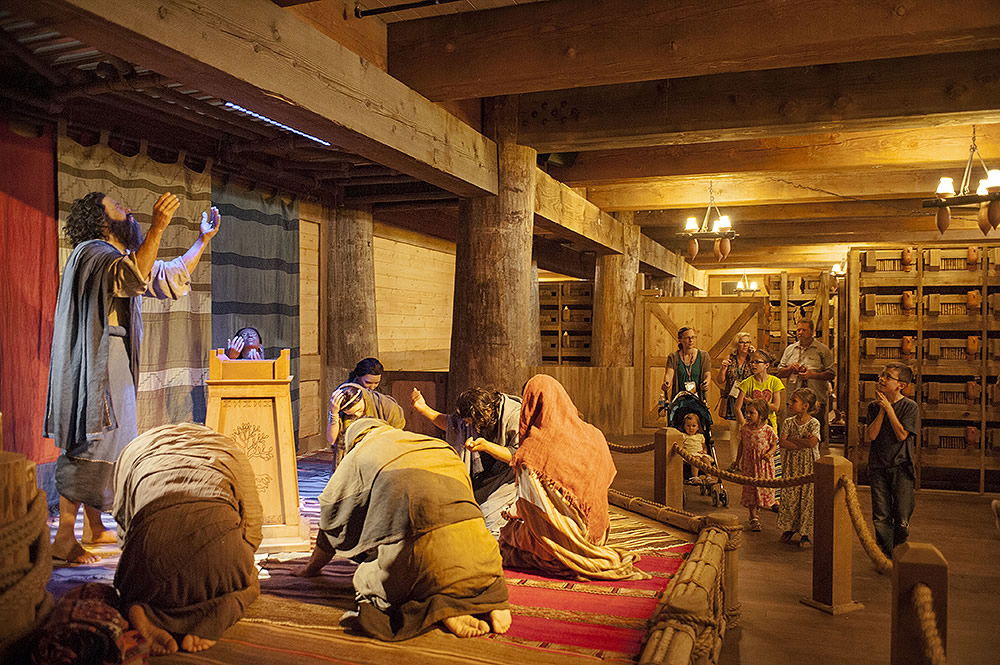
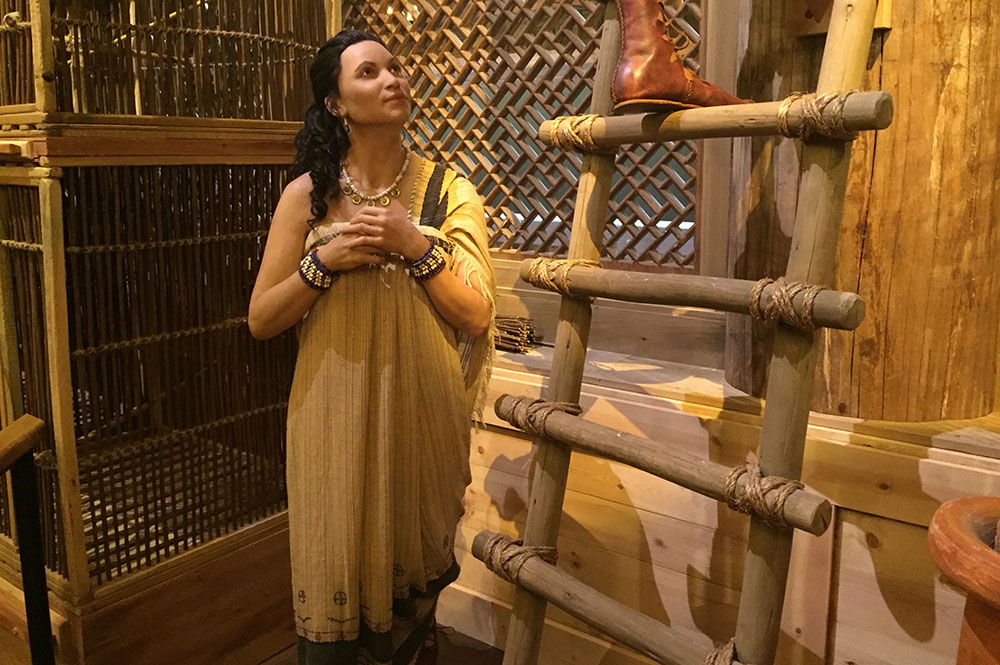
Throughout the life-size Noah’s ark at the Ark Encounter, you will see several instances where our designers needed to use artistic license when creating the exhibits, including the Living Quarters.

As you explore this area on deck three, you’ll meet Noah and his family. A few weeks ago, we looked at the stories our content team created for Noah and his three sons. Now let’s take a look at the backstories created for their wives.

Emzara—Noah’s Wife

Throughout history, many have wondered about the name of Noah’s wife. She is called Emzara in the ancient Jewish writing known as the Book of Jubilees (not found in the Bible). This name probably means “ancestor of Sarah,” and it connects her to Abraham’s wife, Sarah.

Emzara endured centuries of childlessness before the Lord blessed her with three sons. Faithful to God and her husband, she has made family time a priority and enjoys relaxing with Noah when time permits. An animal lover from her youth, Emzara knows more about the animals than anyone else, and her expertise is on display in caring for them.

Rayneh—Japheth’s Wife

Being artistic, Rayneh works closely with Emzara, sketching the ark’s animals while studying and recording their habits. In her limited free time, she enjoys making crafts and adding some flair to her family’s surroundings, such as painting intricate designs on pottery.

Rescued by Noah from a life-threatening situation when she was a little girl, Rayneh grew up around his family. She helped Japheth with his farming responsibilities, and the two eventually became husband and wife. She put her seamstress skills to good use during the ark’s construction, creating many of the clothes and tapestries seen on board.

Ar’yel—Shem’s Wife

Ar’yel was raised in a remote forest village among people who worshipped false gods. She came to believe in the true God after hearing Noah speak to her people. Longing to know more about the Creator, she soon joined Noah’s family in building the ark.

Quick to take part in conversations with the rest of the family, Ar’yel loves the profound discussions about God that she has with Shem. She also enjoys reading accounts of what the rest of the world was like before it became filled with wickedness, and she prays that it will be like that again after the flood.

Kezia—Ham’s Wife

Kezia grew up around Noah’s family as the ark was being constructed, and she trusted in the Creator from her youth. When her parents left to pursue other interests, Kezia decided to remain with Noah’s family.

Similar to her husband, Kezia is a hard worker. She is the medical expert of the group, having learned the craft from her mother. She uses her skills to treat sick or wounded family members or animals. In fact, Ham and Kezia grew very close as she cared for the severe wounds he received from an animal attack, and they married shortly after he recovered.

Speaking of that animal attack, if you look closely at Ham in the ark, you can see a scar on the right side of his face. This is most noticeable on deck two where guests can get a pretty good glimpse of his face. Also, in the study on deck two, there is a note written by Ham on the scroll showing the cat-like creature called Thylacosmilus. Since this is the kind of creature that injured him, Ham warned the other family members to watch out for its sharp claws.

Variations of the names include: Salit, Nahlat, Arisisah. Shem, Ham and Japheth respectively. Other variations include: Zalbeth/Zalith/Salit- Shem, Nahalath-Ham and Aresisia-Japheth. Or Ṣalib, Nahlab, Arbasisah. None of these should be taken as fact. https://www.quora.com/What-were-the-names-of-the-wives-on-Noahs-ark

The Flood and the Tower of Babel

“Because of the Prophet Joseph Smith, Latter-day Saints have additional knowledge that confirms the reality of these world-changing historical events.

The Flood

Many of us have fond memories learning about Noah and his ark during our days at home and in Primary. Perhaps our parents and teachers held up a picture of Noah preaching to laughing and mocking people as he stood in front of the partially built ark, or perhaps they showed us a picture portraying the ark filled with animals standing on the deck as the great vessel rested in the water. Later, our Sunday School or seminary teachers added to our knowledge of this great man, his righteousness, his missionary work, and the revelations surrounding the building of the ark. As Latter-day Saints, we treasure this sacred, true account of one of God’s great prophets who lived so long ago.

Not everyone throughout the modern world, however, accepts the story of Noah and the Flood. Many totally disbelieve the story, seeing it as a simple myth or fiction. Typical of some modern scholars, one author recently discounted the events of the Flood by using such terms as “implausible,” “unacceptable,” and “impossible”; he stated that believers who would hope to provide geologic or other evidence regarding the historicity of the Flood “can be given no assurance that their effort, however sustained, will be successful.” Another author titled his book The Noah’s Ark Nonsense, revealing his disbelief that the Flood actually took place.

Still other people accept parts of the Flood story, acknowledging that there may have been a local, charismatic preacher, such as Noah, and a localized flood that covered only a specific area of the world, such as the region of the Tigris and Euphrates Rivers or perhaps even the whole of Mesopotamia. Yet these people do not believe in a worldwide or global flood. Both of these groups—those who totally deny the historicity of Noah and the Flood and those who accept parts of the story—are persuaded in their disbelief by the way they interpret modern science. They rely upon geological considerations and theories that postulate it would be impossible for a flood to cover earth’s highest mountains, that the geologic evidence (primarily in the fields of stratigraphy and sedimentation) does not indicate a worldwide flood occurred any time during the earth’s existence.

There is a third group of people—those who accept the literal message of the Bible regarding Noah, the ark, and the Deluge. Latter-day Saints belong to this group. In spite of the world’s arguments against the historicity of the Flood, and despite the supposed lack of geologic evidence, we Latter-day Saints believe that Noah was an actual man, a prophet of God, who preached repentance and raised a voice of warning, built an ark, gathered his family and a host of animals onto the ark, and floated safely away as waters covered the entire earth. We are assured that these events actually occurred by the multiple testimonies of God’s prophets.

Scriptural Evidence for a Worldwide Flood

Many prophets from two different continents and different eras have identified Noah as a historical, not a mythical, character. These include Enoch (see Moses 7:42–43), Abraham (see Abr. 1:19), Amulek (see Alma 10:22), Moroni (see Ether 6:7), Matthew (see JS—M 1:41–42), Peter (see 2 Pet. 2:5), Joseph Smith (see D&C 84:14–15D&C 133:54), and Joseph F. Smith (see D&C 138:9, 41). The Lord Jesus Christ himself spoke to the Nephites of the “waters of Noah” (3 Ne. 22:9). Recent latter-day prophets and apostles have similarly spoken of Noah. For example, Elder Howard W. Hunter, then of the Quorum of the Twelve Apostles, asked, “Because modernists now declare the story of the flood is unreasonable and impossible, should we disbelieve the account of Noah and the flood as related in the Old Testament?”

The most voluminous scriptural witness to Noah and the Flood is recorded in the writings of Moses, who dedicated a total of 57 verses in the King James Version to the account (Gen. 6:9–8:19). It is instructive to note that some of Noah’s actual words are preserved in the book of Moses, which introduces them with “And it came to pass that Noah continued his preaching unto the people, saying”—followed by his words: “Hearken, and give heed unto my words; Believe and repent of your sins and be baptized in the name of Jesus Christ, the Son of God, even as our fathers, and ye shall receive the Holy Ghost, that ye may have all things made manifest; and if ye do not this, the floods will come in upon you” (Moses 8:23–24). This text is significant in that it confirms that Noah, like his predecessors, understood the gospel covenant, including the baptismal ordinance and Jesus Christ’s role as Savior.

Moses may have received his information about Noah through direct revelation, or perhaps he used ancient records that were written by one of the eyewitnesses to the Flood, such as Noah himself or one of his sons. Such records, presuming they once existed, are now lost to the world. In the book of Genesis, Moses clearly states that a flood occurred, and the terminology definitely refers to a worldwide flood, as opposed to a localized flood. The Joseph Smith Translation backs up the Genesis account, modifying the wording only slightly.

Said the Lord, “I, even I, do bring a flood of waters upon the earth, to destroy all flesh, wherein is the breath of life, from under heaven; and every thing that is in the earth shall die” (Gen. 6:17; emphasis added in this and other scriptures in this article). The phrases “all flesh … from under heaven” and “every thing that is in the earth” indicate a worldwide destruction of all creatures that lived on land. Note that the Inspired Version, translated by the Prophet Joseph Smith, changes “in the earth” to “on the earth” (JST, Gen. 8:22).

Genesis 7:19–20 [Gen. 7:19–20] states, “All the high hills, that were under the whole heaven, were covered … ; and the mountains were covered.” These verses explicitly state that all of earth’s high mountains (“hills” should read “mountains” here; Hebrew harim) were covered by the waters. Lest one believe that the statement “under the whole heaven” is figurative and can be read or interpreted in different ways, a scriptural search through the entire Old Testament reveals that the phrase is used elsewhere only in a universal sense, as it is here; the phrase does not refer to a geographically restricted area (see Deut. 2:25Deut. 4:19Job 28:24Job 37:3Dan. 9:12). For instance, Job 28:24 also uses the phrase when referring to God’s omniscience, which is certainly not restricted to a specific geographical region on the earth.

Genesis 7:21 [Gen. 7:21] states, “All flesh died that moved upon the earth, … every creeping thing … every man.” The phrase “all flesh” refers to all land animals, creeping things, and fowls and all of humanity, with the exception of those in the ark (see Gen. 7:23). The entry every in the Oxford American Dictionary reads: “each single one, without exception.” Moses is clearly trying to let us understand that the Flood was universal.

Verse 22 [Gen. 7:22] states, “All in whose nostrils was the breath of life, of allthat was in the dry land, died.” Again the term “all” expresses a sum total. The term “dry land” should be read literally here, having reference to the land masses of our planet.

Verse 23 [Gen. 7:23] states, “Every living substance was destroyed which was upon the face of the ground, both man, and cattle, and the creeping things, and the fowl.” Moses’ list of those destroyed by the Flood is inclusive; only Noah “remained alive, and they that were with him in the ark.”

Genesis 8:5 [Gen. 8:5] states, “In the tenth month … were the tops of the mountains seen.” After the flood, the “waters decreased” until Noah and his group were able to once again see mountaintops.

Verse 9 states, “The waters were on the face of the whole earth.” The phrase “on the face of the whole earth” refers to a worldwide flood (see Gen. 1:29Gen. 11:4, 8, 9).

Taken altogether, these statements should convince every believer in the Bible that the great Deluge was a worldwide event, not a localized flood that filled only the Mesopotamian or some other region.

Uniformitarianism

Some cite geological data to argue against the Flood. The issue for them, perhaps, revolves around the concept of uniformitarianism, which has been described simply in this way: “The present is the key to the past.” Uniformitarianism, first postulated by James Hutton in 1795, proposes three primary concepts: (a) there were no processes (such as geologic processes) operating in the past which are not operating now; (b) there are no processes operating now which were not operating in the past; and (c) process rates have not changed. Because modern scientists observe geologic change to be relatively slow now, many have naturally concluded that geologic processes have always been slow. Yet uniformitarianism, a premise on which much of geologic science is based, is an idea, not a fact. With our limited knowledge, it presently is a powerful paradigm for examining the earth, and given our ignorance of how the Lord has done things, it does help explain many things. The science that uses the idea has found for us such things as gas, oil, and certain types of minerals.

Yet although uniformitarianism is a powerful perspective, it is still a premise, not a fact. Uniformitarianism cannot explain all of the oddities and anomalies about the earth. Further, it neglects a God who can speak and have the dust of the earth obey, who can move mountains at will, and who can divide the Red Sea. As Latter-day Saints, we have scriptural evidence that God has intervened in the affairs of the earth and modified the landscape on numerous occasions. Among other things, he changed the earth’s environment after the Fall, he gave Enoch power to move mountains and rivers before the Deluge, he caused the Flood, and he was the cause of the catastrophic events in America at the Savior’s death.

For Latter-day Saints, the Flood is a matter of faith and belief. We believe in many events that today we cannot scientifically explain. For example, in a world where change and death are the norm, the scriptures promise immortality and eternal life. Indeed the scriptures teach that this earth will be burned (see 2 Pet. 3:10), receive a resurrection (D&C 88:26), and become a celestial kingdom (D&C 88:17–18). Such future events will make the incident of the Flood look like child’s play in comparison.

Further, with all of the advancements of science in recent decades, we still cannot explain how angels are able to defy gravity and descend or ascend through a building’s ceiling (see JS—H 1:43); how rapid interplanetary travel is possible for heavenly beings (see D&C 130:6–7); how a righteous man can raise the dead using God’s power (see 1 Kgs. 17:17–23); how heavenly messengers can appear to mortals (see D&C 110:2, 11–13); or how Jesus Christ’s divine sacrifice is able to atone for our sins.

Though we cannot yet explain the physics or dynamics behind those events, we look forward to the time when the Lord will come and explain them. In the Millennium—a time of great physical change in the earth—he will “reveal all things—

“Things which have passed, and hidden things which no man knew, things of the earth, by which it was made, and the purpose and the end thereof—

“Things most precious, things that are above, and things that are beneath, things that are in the earth, and upon the earth, and in heaven” (D&C 101:32–34).

The Tower of Babel

The account of the tower of Babel, presented in Genesis 11:1–9 [Gen. 11:1–9], is another account about which many persons in the world today disbelieve. It is an account of some of Noah’s descendants who set aside true temple worship and built a “pagan temple,” or “counterfeit temple,” in the form of a great tower. Two statements hint at an attempt to build a temple: “Let us build … a tower, whose top may reach unto heaven” (4) recalls one of the purposes of temples: to serve as places where God and man can meet. “Let us make us a name” (Gen. 11:4) recalls another purpose of temples: to serve as holy places where individuals take upon themselves the name of Jesus Christ. But the rebellious people under the leadership of King Nimrod lacked real priesthood keys and the authority to build temples; they lacked the divine power to make sacred covenants in the Lord’s name. Other parallels have been made between the tower of Babel and the Lord’s temple, both in antiquity and in our times, helping Latter-day Saints, more than any other people on earth, to understand what those in Babel were vainly attempting to duplicate.

The tower of Babel had a momentous impact on the events of world history, occurring not too long after the Flood and immediately before the confusion of tongues. The confusion of tongues came as a curse from the Lord because of the wicked people’s attempt to build the counterfeit temple, or tower, as Moses explained (Gen. 11:5–7). Before the tower, “the whole earth was of one language, and of one speech” (Gen. 11:1), but the building of the tower brought the Lord’s decision to confuse the tongues so the people could “not understand one another’s speech” (Gen. 11:7), preventing further defilement of the Lord’s sacred ordinances. The curse, in addition, resulted in the scattering of the people “upon the face of the whole earth,” a phrase given three different times for emphasis (see Gen. 11:4, 8, 9).

The Akkadian or Babylonian word babel means “gate of God.” The word translates from Hebrew into English as “confusion” or “confound”—hence Moses’ text, “Therefore is the name of it called Babel; because the Lord did there confound the language of all the earth” (Gen. 11:9).

For some in the modern world, the historicity of the tower of Babel story, as with the Flood, is often discounted. One modern school of thought considers the account to be nothing more than an “artful parable” and an “old tale.”But Latter-day Saints accept the story as it is presented in Genesis. Further, we have the second witness of the Book of Mormon. The title page of the Book of Mormon explains that the book of Ether “is a record of the people of Jared, who were scattered at the time the Lord confounded the language of the people, when they were building a tower to get to heaven.” The book of Ether itself then tells of when “Jared came forth with his brother and their families, with some others and their families, from the great tower, at the time the Lord confounded the language of the people, and swore in his wrath that they should be scattered upon all the face of the earth” (Ether 1:33).

Principles and Lessons for Our Time

The stories of the tower of Babel and the Flood present a number of doctrinal principles and applications for Latter-day Saints today. With reference to the tower of Babel, we find the following interesting observations and parallels for our day:

  1. Every time we hear foreign tongues (including English), we can be reminded that at one time “the whole earth was of one language, and of one speech” (Gen. 11:1). The hundreds of languages on the earth today stand as a witness that there existed long ago a tower of Babel in the land of Shinar.

    Yet in spite of the confusion of tongues so long ago, the gospel of Jesus Christ is reversing the effects of Babel. In the context of a temple dedication, Elder Spencer W. Kimball taught: “someone said yesterday, there never should have been a Babel. There having been a Babel, it is in reverse now. The confusion of Babel is being overcome. The Finns and the Dutch and the British, the Germans and the French and the Hollanders, the Scandinavians, Italians, Austrians all meeting under one roof! All of them heard the voice of the prophet of the Lord. Everyone of them heard his message in his own tongue. Everyone of them heard the ordinances of the gospel, the ordinances of the temple, in his own tongue. The confusion of Babel is in reverse.”

  2. Because of her great iniquity, ancient Babel, or Babylon, has become a long-standing scriptural symbol for “wickedness” (see D&C 133:14). Specifically, Babylon represents any people who “have strayed from mine [the Lord’s] ordinances, and have broken mine everlasting covenant;

    “They seek not the Lord to establish his righteousness, but every man walketh in his own way, and after the image of his own god, whose image is in the likeness of the world, and whose substance is that of an idol, which waxeth old and shall perish in Babylon, even Babylon the great, which shall fall” (D&C 1:15–16).

    In antiquity, Babylon attempted to imitate Zion, attempting to replace the temple with its great tower, and Babylon’s false gods were substitutes for the Lord God. Unfortunately, Babylon has not changed in time.

  3. The word “scatter[ed]” is found three times in the story of the tower (Gen. 11:4, 8–9). Nations are scattered as the result of wickedness. The opposite of scattering is gathering, and this dispensation is the era for gathering. The rebellious people who followed Nimrod were scatteredfrom Babel, and in our dispensation the Lord’s people are to gather from Babel, or Babylon: “Gather … upon the land of Zion. … Go ye out from Babylon. … Go ye out of Babylon; gather ye out from among the nations, from the four winds, from one end of heaven to the other. … Go ye outfrom among the nations, even from Babylon, from the midst of wickedness, which is spiritual Babylon” (D&C 133:4–7, 14).

In addition to carefully studying scriptural teachings related to the tower of Babel, a study of the Flood and the last days provides valuable instruction for us:

  1. Those who hearkened unto the prophet Noah’s voice and repented were baptized and received the Holy Ghost and obtained a spiritual and a “temporal salvation” (Moses 7:42). Likewise, those who follow the prophets in this dispensation, from the Prophet Joseph Smith to President Gordon B. Hinckley, and who accept the Lord Jesus Christ and repent of their sins, will be saved.

  2. Noah’s contemporaries “sought his life” (Moses 8:26); “every man was lifted up in the imagination of the thoughts of his heart, being only evil continually” (Moses 8:22); they failed to hearken unto the words of their prophet (Moses 8:24); and they were guilty of riotous living, described as “eating and drinking, and marrying and giving in marriage” (Moses 8:21). The evil deeds and same type of lifestyle that belonged to people in Noah’s time are being repeated in our own day and will be present at the time of the Second Coming, as the Savior himself prophesied (see Matt. 24:37–39).

  3. The disobedient of Noah’s day reveled “until the day that [Noah] entered into the ark, and knew not until the flood came, and took them all away” (Matt. 24:38–39). Similarly, the wicked at the last days will not know of the destruction at Christ’s coming until it comes and destroys them all as did the Flood. The Savior taught: “But as it was in the days of Noah, so it shall be also at the coming of the Son of Man” (JS—M 1:41).

  4. Latter-day prophets teach that the Flood or the total immersion of the earth in water represents the earth’s required baptism. Elder John A. Widtsoe of the Quorum of the Twelve Apostles explained: “Latter-day Saints look upon the earth as a living organism, one which is gloriously filling ‘the measure of its creation.’ They look upon the flood as a baptism of the earth, symbolizing a cleansing of the impurities of the past, and the beginning of a new life. This has been repeatedly taught by the leaders of the Church. The deluge was an immersion of the earth in water.” He writes that the removal of earth’s wicked inhabitants in the Flood represents that which occurs in our own baptism for the remission of sins.

  5. The destruction of the disobedient at Noah’s time anticipates the devastation of the wicked at the time of Christ’s coming in glory, when the earth will receive its baptism by fire. The Prophet Joseph Smith taught, “In the days of Noah, God destroyed the world by a flood, and He has promised to destroy it by fire in the last days.” The prophet Enoch saw in vision Noah’s ark, seeing “that the Lord smiled upon it, and held it in his own hand; but upon the residue of the wicked the floods came and swallowed them up” (Moses 7:43). Likewise, the Lord has said that he will smile upon or uphold the obedient in the last days, while at the same time smiting the wicked with his judgments.

Thus, although there are many in our day who consider the accounts of the Flood and tower of Babel to be fiction, Latter-day Saints affirm their reality. We rejoice in the many truths and lessons to be learned from these two accounts, as well as from all the stories of the Old Testament.” The Flood and the Tower of Babel By Donald W. Parry

I think you will love this article from our friends at the Universal Model. Visit universalmodel.com


The Name of God; From Sinai to the American Southwest

0

Elder Jeffrey R. Holland said, “To the Lord’s covenant people, names—particularly proper names—have always been very important. Adam and Eve themselves bore names that suggested their roles here in mortality (see Moses 1:34; 4:26) and, when important covenants were made, men like Abram and Jacob took on new names that signaled a new life as well as a new identity. (See Gen. 17:5; 32:28). Because of this reverence for titles and the meanings they conveyed, the name Jehovah, sometimes transliterated as Yahweh, was virtually unspoken among that people. This was the unutterable name of Deity, that power by which oaths were sealed, battles won, miracles witnessed. Traditionally, he was identified only through a tetragrammaton, four Hebrew letters variously represented in our alphabet as IHVH, JHVH, JHWH, YHVH, YHWH.” Whom Say Ye That I Am? Jeffrey R. Holland Ensign Sept. 1974.

The writing above represents the name “Jehovah”, or the tetragrammaton. This is the language written in Paleo-Hebrew and used from 1000 BC – 400 AD. All throughout the Old Testament, the word ‘LORD’ (all small caps), replaced the sacred name “Yahweh” as described above. “I Am” in Hebrew is “Yahweh” and “Adonai” is the Hebrew word for LORD.

What is the Tetragrammaton?

“Tetragrammaton” is a Greek word that literally means “four letters”, so “the Tetragrammaton” meaning “the four letters”.

The Tetragrammaton is “YHWH”, Yahweh, or Jehovah. Keep in mind that since “W” is interchangeable with “V” and that “Y” is interchangeable with “J”, this also includes any variations like Jahveh, Yehovah, Yehuwah and so forth.

The name of the Most High was FIRST given in Exodus 3:14.

  • Exodus 3:13-15
    (13) And Moses said unto God, Behold, when I come unto the children of Israel, and shall say unto them, The God of your fathers hath sent me unto you; and they shall say to me, What is his name? what shall I say unto them? (14) And God said unto Moses, I AM THAT I AM: and he said, Thus shalt thou say unto the children of Israel, I AM hath sent me unto you. (15) And God said moreover unto Moses, Thus shalt thou say unto the children of Israel, The LORD God of your fathers, the God of Abraham, the God of Isaac, and the God of Jacob, hath sent me unto you: this is my name for ever, and this is my memorial unto all generations.

I AM THAT I AM =

Exodus 3:14, God's name

AHAYAH ASHAR AHAYAH

YHWH tetragrammaton (יהוה‎) Yod He Waw He | Thoughts of God

This is important to note because the Tetragrammaton can be found throughout Genesis and even in Exodus chapter 3 but BEFORE verse 14. So how did “YHWH” end up all throughout the Bible if AHAYAH is His name? Read more at link below. The Meaning of Yahweh, Jehovah, and the Tetragrammaton Made Free from Truth


The following is a Review by Professor Robert J. Mathews, former professor of Ancient Scripture and Dean of Religious Education, BYU

“A recent publication, The Name of God from the Sinai to the American Southwest, is a detailed comparison of language forms and religious concepts found in the ancient inscriptions of the people on two continents separated by great distance with an ocean in between.  The title states the scope of the study; Inscriptions bearing the same name for God in ancient Hebrew or Semitic-type script in the widely distant lands of the Middle East and the American Southwest-two

different hemispheres.  The similarity in language and deistic belief suggests that the ancient American culture has a close tie and origin to the older Hebrew culture.

The research of Harris and Hone is undergirded by hundreds of examples gathered on both sides of the ocean, and their conclusions that the ancient Americans had linguistic and religious ties with the Middle East, seems well founded.”

Foreward by Dr. Jon R. Polansky, Research Scientist, Associate Professor, University of California, San Francisco; Editor ESOP [Epigraphic Society Occasional Publications

“The proposal by Dr. Harris and Dann Hone of script-like elements in petroglyphs that appear related to Proto-Sinaitic both in form and content, if verified by the scholarly attention it deserves, represents a major new discovery with important implications for both ‘Old World’ and ‘New World’ cultures. The ideas presented are based on detailed comparisons and on an honest attempt to evaluate probable meanings, and should not be dismissed out-of-hand by archaeologist and linguists, because they disagree with `established’ opinion concerning an isolated development of pre-Columbian American cultures.

Dr. Harris has been studying southwestern petroglyphs for many years in relation to indigenous cultures, and his scholarship in this area received general acceptance. In the early years (of this project) he began to validate the concept of an Egyptian hieroglyphic content in certain petroglyph panels. Since the proposed hieroglyphics appeared to fit into the accompanying depiction’s on the panels of petroglyphs being examined, this find left the door open to a consideration of potential script-like elements.

The publication of, The Name of God From the Sinai to the American Southwest, presents essential aspects of the evidence and rationale developed by Harris and Hone concerning what they think should best be termed Proto-Canaanite from both American and Near Eastern sites.

This publication. was postponed until after several years of effort were expended to obtain critical appraisals of the basic data. This included evaluations of associated symbolism and quantitative assessments of the frequencies of letter forms at SW American sites and sites in the Negev of Israel.

While it is clear that a final understanding of these parallels will benefit from additional scholarly interchanges and a consideration of alternatives, as the authors readily admit, it is appropriate to have the benefit of their opinions (in this and other planned publications) prior to the lively exchanges this work should engender. Dr. Harris has put forward an initial corpus of material, from which the reader can make judgments about both the methods of inquiry and the author’s waking hypotheses. These of course can be tested, expanded, and corrected where necessary.

I have observed that both Jim Harris and Dann Hone. respond positively to a critical and scholarly scientific process. I hope that the potential contributions of this work are evaluated on such a basis, without suffering unduly from biases imposed by archaeological pre-conceptions or religious doctrines. If the validity of specific proposals are assessed in an unbiased way (for example, using what can be deduced from trans-cultural aspects of symbolism and rigorous linguistic approaches), then the value of this interesting work to the individual development of cultures as well as to understand the spread of information in the ancient world, can best be considered.”

The Tetragrammaton is explained as “Jehovah, Jewish national name of God.” And as you can see here, this is translated mostly as “LORD”, but also “JEHOVAH” and “GOD”.

The Name of God; From Sinai to the American Southwest by Dr. James R. Harris (Book)

$19.95

Professor James R. Harris, a foremost expert on ancient Near Eastern languages, shares the culmination of over three decades of work uncovering an ancient alphabetic script used by peoples of the Negev (Israel) and the ancients of America.  He traced the name of God, or “Yah” (abbreviated from “Yahweh”) from Proto-Sinaitic (Proto-Canaanite) depictions to New World petroglyphs in America demonstrating Hebrew influence. 259 pgs hardcover.

Was it really the Founders’ Intention that Man should be left Free, Free without Accountability?

0
“If we are to be truly free, liberty demands that we are accountable, law abiding and willing to accept the natural consequences of our actions. To be truly free, individuals must accept and deal with life consequences and not constantly look to governments for some sort of absolution.” Edgar S. Smoot

Freedom vs. Liberty

According to Annotated Book of Mormon page 216, “Noah Webster Dictionary Definitions of Freedom vs. Liberty from the 1828 American Dictionary of the English Language. FREE, noun 1. Being at liberty; not being under necessity or restraint, physical or moral. 2. Unconstrained; unrestrained; not under compulsion or control. A man is free to pursue his own choice; he enjoys free will. FREE’DOM, noun 1. A state of exemption from the power or control of another. LIB’ERTY, noun [Latin libertas, from liber, free.] 1. Freedom from restraint, in a general sense, and applicable to the body, or to the will or mind. The body is at liberty when not confined; the will or mind is at liberty when not checked or controlled. A man enjoys liberty when no physical force operates to restrain his actions or volitions. 2. Natural liberty consists in the power of acting as one thinks fit, without any restraint or control, except from the Laws of Nature. (But generally men mean by nature, the Author of created things, or the operation of His power.)
3. Religious liberty is the free right of adopting and enjoying opinions on religious subjects, and of worshiping the Supreme Being according to the dictates of conscience, without external control.”

Book of Mormon Definition of Freedom vs. Liberty

“Wherefore, men are free according to the flesh; and all things are given them which are expedient unto man. And they are free to choose [first choice] liberty and eternal life, through the great Mediator of all men, or to choose [second choice] captivity and death, according to the captivity and power of the devil; for he seeketh that all men might be miserable like unto himself.” (2 Nephi:2:27; emphasis added.) “And thus he was preparing to support their liberty, their lands, their wives, and their children, and their peace, and that they might live unto the Lord their God, and that they might maintain that which was called by their enemies the ‘cause of Christians.’” (Alma 48:10; emphasis added.) “For behold, they do study at this time that they may destroy the liberty of thy people, (for thus saith the Lord) which is contrary to the statutes, and judgments, and commandments which He has given unto His people.” (Alma 8:17; emphasis added.) Freedom provides the ability to choose between good and evil—God’s Natural Law or Satan’s counterfeit plan. True liberty is the conscientious choice to follow God’s law. “We hold these truths to be self-evident, that all men are created equal, that they are endowed by their Creator with certain unalienable rights, that among these are life, liberty and the pursuit of happiness” – United States Declaration of Independence, final draft, July 4, 1776. From Annotated Book of Mormon page 216 David Hocking and Rod Meldrum

History, Liberty and the Provident Hand

Lost American Antiquities-A Hidden History by Edgar S. Smoot Chapter 54 There are those who would seek to close the history books of man’s experiences—history that shows weakness, shortcomings, prejudices and man’s inhumanity to man, that may be cause for embarrassment. If these things are forgotten, man is destined to repeat the grossest failures of the past that he implacably seeks to forget. It is a guaranteed formula for failure in the prospect to create a better world. How can we avoid the atrocities of the past if a society or nations closes their eyes to what man is capable of? The full understanding of history must not only include its glory but its depredations if society is to realize the changes needed towards a more beautiful world. That which ignites the kindling is the perpetual flame of a true history, changes that may only take place if real history is allowed to be shared, and understood as America’s liberties are preserved. The offspring of what Morgan and Powell taught and advanced in the 1800s, as covered in this section “A Larger History,” shows how the “Science of Man” has been used to advance public policy both home and abroad. Whether these men ever intended it or not, their ideas have been effectively used to unravel the underpinnings of Natural and Constitutional law. There are laws which were at one time held to be immutable laws, seen as a gift from God; a gift that does not come free, but at a price that is worth whatever the cost. Unless we as a society are willing to elevate the discussion, and our efforts in the protection of our liberties, they will surely be lost to future generations. As a boy growing up my interests were focused primarily on any sport which ended with the word ball; primarily Football, Basketball and Baseball. At age ten, I was invited to be part of a youth choir. To me, that wasn’t my idea of fun. Nevertheless, my dear mother, who wanted me to become more well rounded, gave me an ultimatum, which was, if I don’t go to choir practice then she wouldn’t take me to my ball practice. So after being dragged to a few choir practices, I soon learned to enjoy choir as I still find myself humming some of those familiar tunes and reflecting on the lyrics of those youthful choir songs. One well-known song was written by Paul and Ralph Colwell. The lyrics say; “freedom isn’t free, you have to pay the price, you have to sacrifice, for your liberty.” Too often man seeks to limit man’s liberties for the betterment of society. Limitations placed on agency greatly influences man’s ability to progress. “The exalting power of agency is founded in the law of opposition. Agency of liberty can exist only in the opportunity for doing good, but this is so only when [there] is also an opportunity for doing wrong.” Progression is a function of agency as one is given the ability to choose without coercion.
Purchase Today!
Both in antiquity and in the future, there are those who might seek to sever culture’s foundational roots for the sake of conditional equality. History has shown what will happen to a society when religious liberties are taken by those entrusted to protect them. One sure thing that history teaches, is that “there has never been a society or a nation established without God; but history is cluttered with the wreckage of nations that became indifferent to God, and then died. In the 1953 College Edition of Webster’s New World Dictionary, freedom is defined as: “the state or quality of being free; exemption or liberation from the control of some arbitrary power,” stating, that “liberty, [is] often interchangeable with freedom.” This definition points out that liberty is something more, as it is more closely associated with particular rights granted, such as franchise rights, religious rights, privileges, or immunities.
Throughout the ages there have been those in society who are continually looking for a place where there is absolute freedom, no accountability or rule of law, a place where rules, commandments and laws are non-existent. Those who are still looking for this kind of freedom will soon realize that it cannot be found, even in the most freedom-loving countries of the world. For only in America do you find enshrined in its founding documents such strong language for the preservation of one’s liberties. The Constitution of the United States and the Declaration of Independence contains language, which is given as part of a moral code of conduct with immutable laws which grant liberties with conditions which requires a level of obedience, service and sacrifice. In putting together America’s founding documents, as described in the Federalist Papers, the founders were striving to strike a balance between anarchy and monarchy, in creating a representative democracy, creating a place where all men would be treated equally under the law, and where all rights and liberties would be protected by the rule of law. In spite of this, America has drifted from those early moorings, which were enshrined in the Declaration of Independence, the Bill of Rights and memorialized in the Constitution; a standard upon which all laws and policies are to be weighed. Today, we often see the words freedom and liberty being used interchangeably, thus few differentiate between them. Was it really the founders’ intention that man should be left free, free without accountability? Or did they intend, as a God-fearing people, to become subject to the will of God, and by so doing, would be assured the promise and blessings of life, liberty and happiness? Liberty comes with conditions that are based on man’s willingness to respect and to render obedience to laws. As the Preamble to the Constitution points out, we must work to “secure the blessings of liberty.”
The Founders used the Bible as the foundation for the Constitution: “But whoso looketh into the perfect law of liberty, and continueth therein, he being not a forgetful hearer, but a doer of the work, this man shall be blessed in his deed.” Then in James 2:12 it goes on to admonish all to “speak the law of liberty.” A benevolent Creator, as described in the Bible, gave these laws for the betterment of man with a promise, that if followed, they would be led towards a greater good. John Quincy Adams, the son of John Adams, the sixth President of the United States, pointed out that the Declaration of Independence was given in “the spirit of the Constitution” and that the Declaration of Independence implies that a provident hand has guided and blessed this nation. The term, “law of nature” means that the rights granted under the Constitution are based on Godly principles. John Adams put it best when he stated: “Our Constitution was made for a moral and religious people. It is wholly inadequate to the government of any other.” Without the moral foundation developed in a religious society, a free country with liberties like America cannot prosper. A free society is based on having a moral people who will show respect for “the rule of law.” History and statistical findings show that the makeup of the family and religious beliefs are core to the preservation of a country’s freedom. This belief is that there is a God of nature, and that He has brought about the great order that is found in nature, as evidenced in historical findings. These findings show that traditional marriage and family, strengthened by religious worship and scriptural study, are more likely to produce children who will have respect for law and, as such, will be a blessing and not a burden on society. Accordingly, if we are to be truly free, liberty demands that we are accountable, law abiding and willing to accept the natural consequences of our actions. To be truly free, individuals must accept and deal with life consequences and not constantly look to governments for some sort of absolution. When individuals accept accountability, they learn important life lessons. When society absolves individuals of the consequences of their actions, which is frequently done, it starts society down a very slippery slope, a slope into a hole that is difficult to climb out of.
President John Adam’s admonition about the Constitution and a “moral and religious people,” is worthy of serious consideration, if America is to remain a free nation. The founding documents of America were based on religious imperatives. As a nation, we need to honor and return to them and recognize that the road paved by Morgan and Powell was based on theories and hypotheses, not facts. And, as such, it is not a proven path that leads to a more abundant life, which liberty and justice offers.
Although disputed by some, there is significant evidence that the Iroquois Confederacy served as a model or at least provided some inspiration in the drafting of the U.S. Constitution and Bill of Rights. Benjamin Franklin and Thomas Paine were well acquainted with the League. John Rutledge, chairman of the committee that participated in writing the first draft of the Constitution, began the process by quoting some passages from the Haudenosaunee Great Law. The Iroquois form of government was based on democracy, righteous living and personal freedoms, and included checks and balances, initiatives, referendums, and recall language. In 1987 Senator Daniel Inouye sponsored a resolution that would commemorate the Iroquois’ contributions. In 1988, the United States Congress passed a resolution recognizing the Iroquois Confederacy forefathers guiding influence.” Lost American Antiquities-A Hidden History by Edgar S. Smoot Chapter 54

Who are the Gentiles that will be brought out of captivity to THIS LAND?

0

Set up as a Free People

Christ teaches during his visit to the Nephites in the Land Bountiful that His words will come to the remnant of Lehi through Gentiles that will be brought out of captivity to “this land.” He also taught that this same Promised Land will be established for these Gentiles, and that they will “be set up as a free people” in “this land.”

“And behold, this is the thing which I will give unto you for a sign—for verily I say unto you that when these things which I declare unto you, and which I shall declare unto you hereafter of myself, and by the power of the Holy Ghost which shall be given unto you of the Father, shall be made known unto the Gentiles that they may know concerning this people who are a remnant of the house of Jacob, and concerning this my people who shall be scattered by them; Verily, verily, I say unto you, when these things shall be made known unto them of the Father, and shall come forth of the Father, from them unto you; For it is wisdom in the Father that they should be established in this land, and be set up as a free people by the power of the Father, that these things might come forth from them unto a remnant of your seed, that the covenant of the Father may be fulfilled which he hath covenanted with his people, O house of Israel;

Therefore, when these works and the works which shall be wrought among you hereafter shall come forth from the Gentiles, unto your seed which shall dwindle in unbelief because of iniquity; For thus it behooveth the Father that it should come forth from the Gentiles, that he may show forth his power unto the Gentiles, for this cause that the Gentiles, if they will not harden their hearts, that they may repent and come unto me and be baptized in my name and know of the true points of my doctrine, that they may be numbered among my people, O house of Israel;” 3 Nephi 21:2-6

These Gentiles will be “set up as a free people” in a nation founded on religious freedom that the Gospel might be restored and the Church established as seen in D&C 10:45-53. The phrase “set up” in Hebrew means to “raise up, confirm or organize.” As it relates to a “free people,” such an entity must be the formation of a new organization or government that secures freedom for its people. It cannot mean a pre-existing organization, but a new one. Almost every nation and kingdom of the world had a “state”-based religion. The Gentiles come out of religious captivity to establish a place and nation based on religious freedom. This constitutional right to worship according to the dictates of will was “set up” by inspired men in this new nation. The Lord continues teaching the saints in Bountiful that the Holy Ghost will come upon these Gentiles making them “mighty above all” and that they will inhabit the land where the “remnant” remains.

“And after that ye were blessed then fulfilleth the Father the covenant which he made with Abraham, saying: In thy seed shall all the kindreds of the earth be blessed— unto the pouring out of the Holy Ghost through me upon the Gentiles, which blessing upon the Gentiles shall make them mighty above all, unto the scattering of my people, O house of Israel”. 3 Nephi 20:27

Gentiles Come out of Captivity

Further clarifying the revelation concerning the land of promise, the Prophet Nephi describes in detail the Gentiles that go Prophecies & Promises: The Book of Mormon and the United States 62 “forth out of captivity” by the “power of God.” While seeking to understand his father’s vision of the Tree of Life, Nephi sees that the Holy Ghost “wrought” upon the Gentiles as foretold by Christ generations later.

“And it came to pass that I beheld the Spirit of God, that it wrought upon other Gentiles; and they went forth out of captivity, upon the many waters. And it came to pass that I beheld many multitudes of the Gentiles upon the land of promise; and I beheld the wrath of God, that it was upon the seed of my brethren; and they were scattered before the Gentiles and were smitten. And I beheld the Spirit of the Lord, that it was upon the Gentiles, and they did prosper and obtain the land for their inheritance; and I beheld that they were white, and exceedingly fair and beautiful, like unto my people before they were slain. And it came to pass that I, Nephi, beheld that the Gentiles who had gone forth out of captivity did humble themselves before the Lord; and the power of the Lord was with them. And I beheld that their mother Gentiles were gathered together upon the waters, and upon the land also, to battle against them. And I beheld that the power of God was with them, and also that the wrath of God was upon all those that were gathered together against them to battle. And I, Nephi, beheld that the Gentiles that had gone out of captivity were delivered by the power of God out of the hands of all other nations. And it came to pass that I, Nephi, beheld that they did prosper in the land; and I beheld a book, and it was carried forth among them.” 1 Nephi 13:13-20

Readers of the Book of Mormon quickly recognize these verses as a brief history of the pilgrims and puritans, the founding fathers and the Revolutionary War. All these events led to the establishment of a new Gentile nation—the United States. The Revolutionary War is the only war that can fulfill this prophecy as the Gentiles battle against their “mother Gentiles” on the “waters” and on the Promised Land.
Verses 13, 16, and 19 previously cited record that the Gentiles will “come out of captivity” to this Promised Land for freedoms they did not have. Both the freedom to worship as their conscience dictates, as well as out of literal jail cells in Europe. The Doctrine and Covenants and modern prophets reveal important correlations between these Gentiles who were to be led out of captivity and those who played a part in the establishment of the United States and the restoration of the gospel.

President Ezra Taft Benson discussed some of these prophecies and promises recorded in the Book of Mormon and the relationship of the Promised Land to the United States of America. This discussion by President Benson is worth quoting below:

“For centuries the Lord kept America hidden in the hollow of His hand until the time was right to unveil her for her destiny in the last days. “It is wisdom that this land should be kept as yet from the knowledge of other nations,” said Lehi, “for behold, many nations would overrun the land, that there would be no place for an inheritance” (2 Nephi 1:8). In the Lord’s due time His Spirit “wrought upon” Columbus, the pilgrims, the Puritans, and others to come to America. They testified of God’s intervention in their behalf (see 1 Nephi 13:12–13). The Book of Mormon records that they humbled “themselves before the Lord; and the power of the Lord was with them” (1 Nephi 13:16).

Our Father in Heaven planned the coming forth of the Founding Fathers and their form of government as the necessary great prologue leading to the restoration of the gospel. Recall what our Savior Jesus Christ said nearly two thousand years ago when He visited this promised land: “For it is wisdom in the Father that they should be established in this land, and be set up as a free people by the power of the Father, that these things might come forth” (3 Nephi 21:4). America, the land of liberty, was to be the Lord’s latter-day base of operations for His restored church. Nephi recorded that the Founders “were delivered by the power of God out of the hands of all other nations” (1 Nephi 13:19).

The years immediately preceding the Constitutional Convention were filled with disappointments and threats Prophecies & Promises: The Book of Mormon and the United States 64 to the newly won peace. Washington was offered a kingship, which he adamantly refused. Nephi had prophesied hundreds of years before that “this land shall be a land of liberty unto the Gentiles, and there shall be no kings upon the land” (2 Nephi 10:11; italics added).

The Book of Mormon warns us relative to our living in this free land: “Wherefore, this land is consecrated unto him whom he shall bring. And if it so be that they shall serve him according to the commandments which he hath given, it shall be a land of liberty unto them; wherefore, they shall never be brought down into captivity; if so, it shall be because of iniquity; for if iniquity shall abound cursed shall be the land for their sakes, but unto the righteous it shall be blessed forever” (2 Nephi 1:7).

“And now,” warned Moroni, “we can behold the decrees of God concerning this land, that it is a land of promise; and whatsoever nation shall possess it shall serve God, or they shall be swept off when the fulness of his wrath shall come upon them. And the fulness of his wrath cometh upon them when they are ripened in iniquity” (Ether 2:9). Two great American Christian civilizations—the Jaredites and the Nephites—were swept off this land because they did not “serve the God of the land, who is Jesus Christ” (Ether 2:12). We, the blessed beneficiaries of the Constitution, face difficult days in America, “a land which is choice above all other lands” (Ether 2:10). (Note 1)

These prophetic statements made by President Benson in General Conference clearly teach that the Promised Land of the Book of Mormon can only be the United States of America. President Benson’s words agree with Moroni, the angelic messenger from the presence of God, as he revealed and declared to young Joseph that the record on the plates of gold contained a history of the ancient inhabitants that lived on “this continent.”

The “Gentiles” of this land spoken of in these prophecies are also addressed by President Marion G. Romney of the First Presidency in a portion of his talk:

“The tragic fate of the Jaredite and the Nephite civilizations is proof positive that the Lord meant it when he said that this “is a land of promise; and whatsoever nation shall possess it shall serve God, or they shall be Chapter 7 – The Gentiles 65 swept off when the fulness of his wrath shall come upon them. And the fulness of his wrath cometh upon them when they are ripened in iniquity” (Ether 2:9).

This information, wrote Moroni, addressing himself to us who today occupy this land, “cometh unto you, O ye Gentiles” (now, Gentiles is the term used by the Book of Mormon prophets to refer to the present inhabitants of America and to the peoples of the old world from which they came), “[this] cometh unto you, O ye Gentiles, that ye may know the decrees of God—that ye may repent, and not continue in your iniquities until the fulness come, that ye may not bring down the fulness of the wrath of God upon you as the inhabitants of the land have hitherto done.”

God gave us victory in the Revolutionary War. We are indebted to him for our nation’s independence. He has prospered us in every righteous endeavor. He established the Constitution of the United States “by the hands of wise men whom [He] raised up unto this very purpose” (D&C 101:80).

He himself with his Beloved Son appeared to the Prophet Joseph Smith to open a new dispensation of the gospel of Jesus Christ here in this land. He has established his Church here and has sent and is sending representatives thereof into every nook and corner of the land—and as far as possible to all the earth—to declare and teach the laws of Jesus Christ, the God of this land.

He has revealed anew and repeated over and over again the ancient decree: “This is a land which is choice above all other lands; wherefore he that doth possess it shall serve God or shall be swept off; for it is the everlasting decree of God” concerning this land (Ether 2:10).” (Note 2)

(Note 1)
Ezra Taft Benson, “Our Divine Constitution,” Ensign, Nov 1987, 4. See also Marion G. Romney, “America’s Destiny,” Ensign, Nov 1975, 35.President Romney, like President Benson, makes it clear that the United States of America is the land of promise prophesied about in the Book of Mormon. He adds testimony to the Prophecies and Promises listed that
they refer to the land of the United States of America. President Romney states: “Millennia ago he declared: ‘There shall none come into this land [he was speaking of America] save they shall be brought by the hand of the Lord’.”

(Note 2)
Marion G. Romney, “America’s Destiny,” Ensign, Nov 1975, 35. See also
an explanation of the Promised Land in N. Eldon Tanner, “If They Will But
Serve the God of the Land,” New Era, Jul 1977, 36.

Prophecies and Promises by Bruce H. Porter and Rod Meldrum Chapter Seven The Gentiles Bold and italics added.

Hear Glenn Beck, Tim Ballard and The Osmond’s at our Conference!

0

The Osmond’s Video Just Added to our Conference

Purchase Tickets HERE!

See the Bonuses below that offset your complete subscription cost!

Virtual Conference

Because of the continued covid 19 restrictions we will again have our event virtually… with some important improvements! Because of the challenges of live streaming, we are going to pre-record every presentation and release them on opening morning! (Sept 25, 2020 at 9 AM). You will have 70-80 videos to choose from right away. You can watch from anywhere in the world on your smartphone, computer, or similar device with internet access.

Our previous Virtual Expo in April 2020, touted over 90 presentations by 75 experts in many fields. This event will be just as big with brand new presentations from many of your favorite presenters as well as many new speakers we’ve never had before.

No Vendors

We are sorry to say that our wonderful vendors will again not be able to participate at this event. This is unfortunate because they have such important educational and useful materials and it’s harder to choose things that may interest you without being able to see it. Please be aware that most all the products can be purchased online from our various vendors or at the Book of Mormon Evidence Bookstore HERE. 

We are anticipating an April 2021 event like usual with live participation, but we cannot confirm the dates yet.

Additional Resources
Purchase Tickets Here
Speaker Presentation Uploads
Speaker Biographies
Podcasts
Future Events

See the Bonuses below that offset your complete subscription cost!

1- “Destruction at Christ’s Death” 2-Hour Streaming Video by Rod Meldrum from his Volume II Series. (One 2- Hour video only.

$20 Value FREE
Was the destruction at the time of Christ’s death caused by a volcanic eruption as has been speculated by some Book of Mormon geography scholars, or is there another explanation? Amazing new research has uncovered incredible parallels between the eye-witness accounts of the Book of Mormon prophets and the eye-witness observations of those who suffered through a sequence of earthquakes in the heartland of America in 1811 and 1812. Together we will compare the scriptural account with the History Channels Earthquake in the Heartland documentary and authoritative accounts by those who were there! It is nothing short of amazing.
  • What textual evidence exists that the destruction was volcanic in nature?
  • How was the destruction described by the ancient prophets?
  • What caused the three days of darkness?
  • When did the Nephites gather at the temple in Bountiful?
  • Why couldn’t some Nephites light fires, while other Nephite cities were entirely burned?
  • Did an event similar to that witnessed in 1811-1812 occur near the time of Christ?

No Disc nor actual CD. This is a streaming version you can watch from the Categories menu of your Book of Mormon Evidence Streaming Site. No Disc will be sent to you.

2- New 40 Page E-Book by Rod Meldrum

$15 Value FREE

*E-Book: One 45 page E-book exerted from a chapter in the book, Prophecies and Promises Titled “What Did Joseph Know?” Includes new charts, graphs, art and information that was not included in his original chapter of Prophecies and Promises. No book will be mailed to you. You will be able to read the entire book from your computer, i-pad, or Smart Phone, right after your payment.

No refunds after Sept 10, 2020

Some Members Think the BofM is Religious Fiction?

0

Rod Meldrum Asks,

“Why do Intellectuals conflate when Joseph Smith does or does not have a revelation? The Mission to the Lamanites as declared and described by the Lord in the Doctrine and Covenants clearly reflects that Joseph sent the missionaries to the areas revealed and directed by the Lord. The scriptures imply that not only were they to preach to the Native Americans on this North American continent, but that they are a remnant of the seed of Lehi and “Lamanites” as described in the Book of Mormon and Doctrine and Covenants.” Rod Meldrum Prophecies and Promises page 94

“The writers of the articles at fairlds.org and Book of Mormon Central, have concluded that perhaps these revelations were not directly from the Lord but just Joseph’s choice of words and therefore cannot be taken at face value without secondary interpretation. FAIR writes: “Many readers assume that revelations in the Doctrine and Covenants in which Joseph Smith speaks in “God’s voice” are direct “quotations” from God. Joseph didn’t claim to be hearing a voice, and he didn’t claim to be quoting God or “taking dictation.” Rather, impressions would come to him, which he would put into words. Joseph clearly did not consider them “direct quotations” from God, since he was quite happy to revise them, edit them later, etc.…This means that “Lamanites” to describe the American Indians was Joseph’s word choice.” It would appear that there is a need by FAIR to maintain a legitimacy for the Limited Geography Theory (LGT) by also writing “The few personal statements he made on Book of Mormon geography indicate that he believed it took place on a hemispheric scale, so it would be natural for him to believe that all Native Americans were pure descendants of Laman, and hence were literal “Lamanites.” See also http://en.fairmormon.org/ Lamanites_in_the_Doctrine_and_Covenants” Note 54 by Rod Meldrum Prophecies and Promises

Why are more and more people of the world claiming that Noah’s flood was fictional or just a good story? More people are saying that Adam wasn’t the first man on this earth. Why are more and more members of the Church of Jesus Christ of Latter-day Saints claiming that the Book of Mormon contains a lot of great parables that aren’t real stories, but just parables that can teach us good things? Is the Bible the Word of God? We answer yes as far as it is translated correctly. We do know however that the stories in the Bible are actual accounts of real people in real places, just as the Book of Mormon is.

Why would we believe anything else? Because Satan’s plan is in full force. Remember this is Satan’s world right now. It won’t be Christ’s until the second coming. The craftiness of man is constantly being mixed with scripture and folklore. The “Great and Spacious building” is truly coming from the halls of academia. Many intellectuals continue pointing their fingers at humble followers of God from the heights of those house’s of cards. “Who’s on the Lord’s side who?” There are “save two churches”, one that speaks the truth of the Savior and all others who teach of man and his so-called wisdom.

Click to enlarge a Heartland version of the Book of Mormon

As you read this recent blog of Jonathan’s, don’t be discouraged, be bold! Don’t allow fear to affect your faith! The truth shall be known and we must continue steadfastly in living and teaching the truth of the Book of Mormon to the world. The Book of Mormon is real and true and it speaks of one amazing hill Cumorah in upstate New York. The “Plains of the Nephites” as Joseph said to Emma are in Ohio, Illinois, and Indiana, in the United States of America. I don’t speak for the Church of Jesus Christ of Latter-day Saints, but I do speak of common sense and truth as I understand it. I love this Church and the Brethren are true messengers of Christ. The Church remains neutral on geography, but they didn’t say I had to be. I know the land spoken of in the Book of Mormon, is the United States of America, and I am so blessed to live in this country. May we continue to share this true message of the Book of Mormon with the world.


Only 49% of LDS believe Book of Mormon is a literal, historical account? by Jonathan Neville

“Jana Reiss published a fascinating detail recently about the beliefs of Church members about whether the Book of Mormon is a literal, historical account:

More religiously orthodox. Utah Mormons were more devout on almost every testimony question. These differences were less pronounced on questions of basic Christian belief (God, Jesus, etc.) and more visible on specifically Mormon questions about the Book of Mormon, Joseph Smith, and the role of apostles and prophets today. For example, there’s a twenty-point difference between the Utah Mormons who strongly agree that the Book of Mormon is a “literal, historical account” (69%) and the non-Utah Mormons who do (49%). In many cases on these testimony questions, non-Utah folks would choose the second option of “somewhat” agree rather than “strongly” agree. So it doesn’t mean they don’t believe in Mormon teachings, but they may hold them less tightly than Utah Mormons tend to.
This indicates that 1/3 of devout Utah Mormons don’t strongly believe the Book of Mormon is a literal, historical account, and less than 1/2 of non-Utah Mormons believe that.

I suspect that the difference between the Utah and non-Utah Mormons is partly attributable to Utah Mormons having fewer interactions with people who challenge their faith in the Book of Mormon; i.e., they let bias confirmation guide them.

Those who make inquiries on the Internet quickly realize that outside of a handful of M2C intellectuals and their followers, no Mesoamerican scholars see any links between actual Mayan culture and the Book of Mormon. As I’ve shown many times, the so-called “correspondences” touted by the M2C intellectuals are illusory and unpersuasive to those who are outside the M2C bubble..
_____

The difference could also be attributed to demographics; i.e., non-Utah Mormons are generally younger, and younger LDS are less likely to believe the Book of Mormon is a literal history because of what LDS youth are being taught in CES and at BYU.

As LDS youth go through CES and BYU and learn the Book of Mormon by referring to the fantasy map, even fewer will believe it is a literal, historical account.

BYU fantasy map that teaches the prophets are wrong about the New York Cumorah This map is the work of fine scholars at BYU who claim it is the best representation of the geography-related passages in the text. Of course, they really mean it’s the best representation of their M2C-driven interpretation; other interpretations of the text fully support the teachings of the prophets.

BYU fantasy map that teaches the prophets are wrong about the New York Cumorah

You can read about the map here:

Church members must realize that these fine scholars also teach that the prophets are wrong about the New York Cumorah. That’s why, in their map, they place Cumorah at the upper part of this fantasy map, as far from the real-world New York as possible.

This BYU map has been taught for several years now. Every new student has to learn this map in their introductory Book of Mormon classes. CES uses a similar map.

My question is, how could any trusting youth in the Church believe the Book of Mormon is a literal, historical account when his/her CES/BYU teachers claim a fantasy map is the best fit for the geography?

Especially when these CES/BYU teachers are telling the youth that the prophets are wrong?
_____

The M2C intellectuals, who claim to have been hired by the prophets to guide the Church, do, in fact, seem to be guiding the Church through their influence on the youth.

The inevitable result of this course will be rejection of the historicity of the Book of Mormon. What impact will that have? I’ll discuss that in an upcoming post.
_____

Meanwhile, let’s consider what course we’re on.

The de-literalizing of the Book of Mormon became apparent to me when I took a closer look at the lesson manuals, the CES/BYU curriculum, the Saints book, the visitors centers, etc. These all repudiate the teachings of the prophets about the New York Cumorah. I attribute all of those to the M2C Church employees.

True, members of the Quorum of the Twelve do approve all of this, at some level. But they can only review what the employees show them, and the employees only show them M2C approved material.

So far, not one Apostle or President of the Church has repudiated or even questioned the teachings of prior prophets about the New York Cumorah.
_____

Lately, lds.org has linked to the groups who are promoting the fictional fantasy maps of the Book of Mormon. At BYU Education Week, they offer courses in Lessons from the Book of Mormon and Lessons from the Chronicles of Narnia back-to-back.

And it has been 40 years since anyone speaking in General Conference declared the Book of Mormon is a real history.

When I go back and re-read the conference talks and other messages, they mostly emphasize the content of the book, not it’s historical reality. The parables in the Bible are discussed in the same way; i.e., stories that teach true principles.

Buy the Annotated Book of Mormon today!

Of course we all stipulate that the message of the Book of Mormon is more important than its history, but it is the literal, divine authenticity of the Book of Mormon–its historicity–that makes it a miraculous manifestation of God’s involvement with the world. As an inspired parable, it may have power like the Biblical parables, but the power of the book is, in my view, greatly diminished.

The Church History Department is instructing their staff and volunteers to tell people that Joseph never actually used the plates; instead, he kept them covered with a cloth while he read the words on a stone in a hat. Now Skousen and Carmack are saying Joseph didn’t even translate the plates, an idea that is getting zero pushback from Church leaders and a warm welcome from the intellectuals, in part because it corroborates their view that Joseph Smith was merely an ignorant farm-boy speculator who misled the Church about the New York Cumorah.

People tell me that when they ask Church leaders about Book of Mormon geography, the standard response is “We don’t talk about that.” That’s also the response missionaries are instructed to give whenever the question arises.

I realize the historicity doesn’t matter to those who already want to believe; bias confirmation always conquers lack of evidence. I’m more interested in the people who want at least some touchstone with reality.

Purchase Here!

During his lifetime, Joseph Smith emphasized the literal, historical reality of the Book of Mormon. He helped Oliver Cowdery write Letter VII, which teaches it was a fact that the final battles of the Nephites and Jaredites took place in the valley west of the hill Cumorah in western New York and that the repository of Nephite records (Mormon 6:6) was in the same hill. Joseph endorsed Letter VII and made sure it was widely distributed so all Church members could read it.

Today, few Church members have ever heard of Letter VII.

Instead, they’re learning that the Book of Mormon took place in a fictional fantasyland.

Does anyone care?”


Jonathan Neville (italics and pictures added)-Book of Mormon Wars

America & Wallbuilders

0

This image has an empty alt attribute; its file name is 26th.png
Click to Purchase Ticket

CONTINENT OF GENESIS AND NORTH AMERICA, A LAND OF PROMISE

The Lord has always promised his covenant people who are faithful, four principle blessings. Posterity, prosperity, security and freedom, and a land of promise. The first recorded instance of a “land of promise” in scripture is a land called Cainan, named after a great-grandson of Father Adam (Moses 6:17). We understand through the scriptures that this land was near current day Adam-ondi-Ahman, Missouri (D&C 116:1).

Elder Jeffrey R. Holland said, “Temporarily, we call it America. But it began with the single, primeval continent of Genesis, and the miracle of millennial healing will bring that unity again… The most sacred of places, then, will always be those locations which God has designated for holy and eternal purposes, locations where he is the “doer of the deed.” These places are revered forever by his faithful children wherever they may be.

America is such a place, but of course it wasn’t always called America nor has it always been identified by a distinctive continental shape. Originally it was simply a portion of that large, single land mass which God in his creative process called “Earth” and which, when completed, was pronounced “good.” (Gen. 1:10.) Whatever its name and geographical configuration, however, it was from the beginning a land of divinity as well as a land of destiny.

The choicest part of this earthly creation was a garden “eastward in Eden” where God placed our first parents, Adam and Eve. This resplendent place filled with paradisiacal glory was located on that part of the land mass where the city Zion, or the New Jerusalem of the earth’s last days, would eventually be built… After Adam and Eve were driven out of the Garden, they dwelt at a place called Adam-ondi-Ahman, located in what is now Daviess County, Missouri. In that region this first family lived out their days, tilling the soil, tending the flocks, offering sacrifices, and learning the gospel of Jesus Christ from on high. There Adam prophesied concerning all the families of the earth and, three years before his death, called together the righteous remnant of his posterity and bestowed upon them his last blessing. The Lord appeared unto this faithful group and Adam’s family rose up “and blessed Adam, and called him Michael, the prince, the archangel… Never before had one spot of earth been favored with such a meeting, nor provided the stage for such sacred scenes from the drama of man’s ultimate destiny.
But even as such sacred manifestations and proclamations were recorded, the land was being polluted with unrighteousness. The willful Cain had already made his covenant with Satan and taken the life of his younger brother, Abel…

Annotated Book of Mormon by David Hocking and Rod Meldrum. Click for details

Two generations later the Lord was so pained by that generation “without affection” (Moses 7:33) that he opened the windows of heaven and cleansed the entire earth with water. Thus, the “everlasting decree” (Ether 2:10) was first taught that he who will not obey the Lord in righteousness will be swept from his sacred land. The lesson would be tragically retaught in dispensations yet to come.

Holy Scripture records that “after the waters had receded from off the face of this land it became a choice land above all other lands, a chosen land of the Lord; wherefore the Lord would have that all men should serve him who dwell upon the face thereof.” (Ether 13:2.) Such a special place needed now to be kept apart from other regions, free from the indiscriminate traveler as well as the soldier of fortune. To guarantee such sanctity the very surface of the earth was rent. In response to God’s decree, the great continents separated and the ocean rushed in to surround them. The promised place was set apart. Without habitation it waited for the fulfillment of God’s special purposes.


With care and selectivity, the Lord began almost at once to repeople the Promised Land. The Jaredites came first, with stories of the great flood fresh in their memories and the Lord’s solemn declaration ringing in their ears… (Ether 2:8.) Despite such counsel, however, the Jaredite civilization steadily degenerated into a violent society which forced a man to keep “the hilt of his sword in his right hand” (Ether 14:2)…

North America, A Land of Promise by Brook Malia Mann


But even as the last light flickered on Jaredite civilization, a bold new sun rose to illuminate a thousand years of Nephite-Lamanite experience on the same soil. Despite periods of war and rebellion, these people nevertheless had great moments of power and purity, including the personal ministry of the resurrected Christ, who walked and talked and prayed with these New World inhabitants for three indescribable days. There in the meridian of time the land enjoyed three generations of peace and perfection, which it would not know again until the Master’s millennial reign.

But the lessons of history, if not learned well, are certain to be taught again, and a lone father with his son lived to see the self-destruction of these people of promise. The Nephite-Lamanite morality descended from “sorceries, and witchcrafts, and magics” (Morm. 1:19) into rape, murder, and cannibalism…

A thousand years after God had given such choice land to their fathers and a thousand years before he would attempt to do it again, Mormon wrote to his son Moroni: “O the depravity of my people! They are without order and without mercy…

In spite of such grief and despair the Lord of the vineyard determined to “spare it a little longer” (Jacob 5:50) long enough for one final attempt, long enough for one more dispensation, long enough for one final experiment focused on the Promised Land.

So, after a thousand years of preparation, the Spirit of God rested upon a young Italian [Columbus] sailing under the flag of Spain, and, as Nephi had seen in vision, “he went forth upon the many waters, even unto the seed of my brethren, who were in the Promised Land.” (1 Ne. 13:12.) This “Christian of almost maniacal devoutness”… was not to be denied…

As Elder Paul H. Dunn recently declared to a Church-wide audience: “(Joseph) grew up toward adolescence just like the new land. He fitted it. He was young, clean, unspoiled—a lad without a past, kneeling in a grove. This pristine land—this innocent young man—and thus the Lord reached out and kept his promise. He established his conditions over centuries; you see, God has time. His plan made it possible for the holy priesthood and the Church to be restored upon the earth—the restoration of the gospel of Jesus Christ—but only in America…The purpose of America was to provide a setting wherein that was possible. All else takes its power from that one great, central purpose.” (Ensign, Nov. 1975, p. 54.)

Elder Holland continues, “Thus in one final moment worthy men and righteous principles came together for the restoration of heavenly things. With his center stake in America, God began stretching the cords of his tabernacle to all the world… “And the land of Jerusalem and the land of Zion shall be turned back into their own place, and the earth shall be like as it was in the days before it was divided.” (D&C 133:23–24.)

Click for DVD of American Promised Land Covenant, by Rod Meldrum

These two cities, Zion (the New Jerusalem) and the ancient city of Jerusalem, will be those capitals out of which both the word and law of the Lord shall go forth and to which all nations shall flow. (See Isa. 2:2–3.)

It is good that the historical celebration of the United States bicentennial allows us to focus on a land in which God has done so much of his work. It has not always looked the same geographically nor has it always been governed the same politically. But that all seems appropriate since the meaning of America, in its most theological sense, is something more than borders and boundaries, something above nativism and nationalism. It is an ideal, a thing of the spirit… As with temple sites, missionary service, and area general conferences, gospel experience transcends the borders—and, if necessary, the flames of nationalism…” Selected portions of a talk titled, “A Promised Land”, by Jeffrey R. Holland June 1976 Ensign

FOR OUR DAY: DIVINELY SANCTIONED GOVERNMENTS (DVD) by James and Hannah Stoddard

In Salt Lake City, July 4, 1854 Orson Hyde said, “The progressive spirit of the times, on the one hand, and the chains of cruelty and oppression, on the other, inspired the apostles of American freedom to raise the standard of liberty, and unfurl its banner to the world as a warning to oppressors, and as the star of hope to the oppressed. The very name of America causes a thrill of patriotic devotion to her best interests to quiver in the heart of every citizen of Utah, with a zeal and a pride for the welfare of our country that does honor to the memory of those departed heroes whose ashes are mingled in our soil, and made rich and dear to us by their own blood…

In those early and perilous times, our men were few, and our resources limited. Poverty was among the most potent enemies we had to encounter; yet our arms were successful; and it may not be amiss to ask here, by whose power victory so often perched on our banner? It was by the agency of that same angel of God that appeared unto Joseph Smith, and revealed to him the history of the early inhabitants of this country, whose mounds, bones, and remains of towns, cities, and fortifications speak from the dust in the ears of the living with the voice of undeniable truth. This same angel presides over the destinies of America, and feels a lively interest in all our doings. He was in the camp of Washington; and, by an invisible hand, led on our fathers to conquest and victory; and all this to open and prepare the way for the Church and kingdom of God to be established on the western hemisphere, for the redemption of Israel and the salvation of the world.

This same angel was with Columbus, and gave him deep impressions, by dreams and by visions, respecting this New World. Trammeled by poverty and by an unpopular cause, yet his persevering and unyielding heart would not allow an obstacle in his way too great for him to overcome; and the angel of God helped him—was with him on the stormy deep, calmed the troubled elements, and guided his frail vessel to the desired haven. Under the guardianship of this same angel, or Prince of America, have the United States grown, increased, and flourished, like the sturdy oak by the rivers of water.

To what point have the American arms been directed since the Declaration of our National Independence, and proven unsuccessful? Not one! The peculiar respect that high Heaven has for this country, on account of the promises made to the fathers, and on account of its being the land where the mustard seed of truth was planted and destined to grow in the last days, accounts for all this good fortune to our beloved America…

So sure and certain as the great water courses wend their way to the ocean, and there find their level—so sure as the passing thundercloud hovers around yonder Twin Peaks of the Wasatch Mountains, and upon their grey and barren rocks pours the fury of its storm, just so sure and certain will the guardian angel of these United States fly to a remote distance from their borders, and the anger of the Almighty wax hot against them in causing them to drink from the cup of bitterness and division, and the very dregs, stirred up by the hands of foreign powers, in a manner more cruel and fierce than the enemies of the Saints in the day of their greatest distress and anguish; and all this because they laid not to heart the martyrdom of the Saints and Prophets, avenged not their blood by punishing the murderers, neither succored nor aided the Saints after they were despoiled of their goods and homes.

Would to God that we could forget this part of our experience in the land of our fathers! But we cannot forget it. It is incorporated in our being. We shall carry it to our graves, and in the resurrection it will rise with us. Had the United States been as faithful a guardian to the Latter-day Saints as the angel of God has been to them, she would never know dissolution, nor be humbled in dishonor by the decrees of any foreign powers…

When Justice is satisfied, and the blood of martyrs atoned for, the guardian angel of America will return to his station, resume his charge, and restore the Constitution of our country to the respect and veneration of the people; for it was given by the inspiration of our God.

One positive decree of Jehovah, respecting this land, is, that no king shall ever be raised up here, and that whosoever seeketh to raise up a king upon this land shall perish. The spirit of this decree is that no king shall bear rule in this country. And the islands contiguous to this land belong unto it by promise, for they are a part and parcel of the land of Joseph, and they geographically belong to it—belong to it by the covenants of the fathers: they also philosophically incline to this nearer and greater land.” Moroni Guardian Angel of America Orson Hyde Journal of Discourses 6:65.

Indeed this land of America and its leaders have been blessed with the protection of the Lord. “As details of the battle emerged, it turns out that either George Washington was extremely lucky, was bulletproof, or was being supernaturally protected. One Indian warrior testified that he had shot at him 17 times. He exclaimed that “Washington was never born to be killed by a bullet!” Another Indian, Red Hawk, had shot and missed him 11 times. He had not missed a shot before, and became convinced that Washington was being supernaturally protected by the Great Spirit. In 1770, fifteen years after the battle, an old Indian told Washington that he had sought out to meet him. He had been fighting in the battle that day, and he had told all the Indians with him to shoot at him, and make sure that he died. When they all missed, he told them to stop. On that evening, he predicted that Washington would never die in battle, and would be “the founder of a mighty empire.” David.Barton, The Bulletproof George Washington.

This United States of America is indeed, “A Land of Promise.” Moroni presides over the destinies of the United States, holds the keys of the Stick of Ephraim (D&C 27: 5), and is the guardian angel of this wonderful land. The Lord has said, “…repent and remember the new covenant, even the Book of Mormon…” (D&C 84:57). As we study The Book of Mormon, we learn to love even more this blessed America we call “A Promised Land.”

“ONE” Cumorah

0

“One” Cumorah
Why Geography Matters by Rian Nelson

I believe the Hill Cumorah in New York is the only sacred Hill Cumorah spoken of in the Book of Mormon. Many in the Church Education System and BYU Professors for years have taught about the two Cumorah theory, which I believe is just not accurate. I quite a few in the Church like me, have been looking to make sense of why Mexico has anything to do with the Book of Mormon. Many of these members and professors say that Joseph did receive the plates from Hill Cumorah in New York, but the final battles of the Nephites happened somewhere in Mexico. They say that New York Cumorah wasn’t large enough to contain hundreds of thousands of bodies and they say it is a clean hill, meaning no arrowheads have been found. Both assertions are false.

The Hill Cumorah DVD by Rod Meldrum 2018. Here

I have researched and studied and found additional insights about the Book of Mormon. I am not trying to prove my point or to prove anyone wrong. It is fine with me for others to believe Book of Mormon geography happened in Central America, and there are those who really don’t care. I have been trying for over 40 years to find the other Cumorah somewhere in Central America and I had become complacent as I had never found any answers. In about 2011, I learned what an Indian Mound was, and since then I have been a solid believer that The Book of Mormon events happened in the Heartland of North America.

Click to Enlarge

There are hundreds of thousands of ancient mounds, fortifications, cities, and artifacts all over the United States that I have researched. I know there are Lamanites in Central America and in other countries, but they are not necessarily the ones spoken of in the Book of Mormon. Time frame. The Book of Mormon only contains a fraction of the history of the Promised Land Lehites. But, I believe that small fraction of history speaks about Lehi, and Nephi, and Alma, and Mormon as they lived and fought in these United States.
Why does the geography matter? Think of that question if we are speaking about Israel. Does it matter where the Savior was born, or where the Biblical events happened? Yes. At Mount Moriah where Abraham was to sacrifice Isaac, the Lord made a special covenant with Abraham. This land around Mt Moriah was a Covenant land and God’s people were given that land as long as they are righteous.

Click to Enlarge

However, if they disobey the commandments, God’s people will be swept off that sacred land. The Jews, Muslims, and Christians fight over control over this one piece of land why? Because it is a beautiful piece of real estate? No, because it is a covenant land. All three religions say Mt Moriah is sacred to them and they are willing to die over it.
In the same token what is the Promised Land spoken of in the Book of Mormon? According to the Book of Mormon this Promised land must meet certain requirements to be the Promised Land. 1. No Kings upon the land 2. Land choice above all other lands 3. Land of Liberty 4. Land where sacred record is kept 5. Land kept from the knowledge of other nations. 6. Land of the New Jerusalem 7. Gentiles to scatter and afflict the Remnant. These are only 7 of 36 prophesies and promises in the Book of Mormon and so only the USA can be the Promised land, not Canada, or Mexico, or South America.

AMAZING 4-Hour DVD for only $5-Great gift for friends. Click HERE

Just as Israel is a Promised Land forever, so the USA is a Promised Land forever and it does matter where this Promised Land is located. It is in the Heartland of North America. The Nephites practiced the Law of Moses. To do this they needed the following plants and animals to keep the Law. Sheep, Rams, Goats, Bullocks, Doves, Wheat, Barley, and Wine. None of these animals or items are found anywhere in Meso-America during the Nephites times, only in the USA. So, the land and where things happen is critical to us and especially to the Lord.
If we in the church cannot even decide among ourselves where the Book of Mormon happened, how confusing is that to our youth and adults? The Anti-Mormons love the idea that we don’t even know where our sacred scriptures happened. There are over 100 theories of where the Book of Mormon happened, including, Baja, Chile, Malaysia, Honduras, Peru, etc.
I know the Brethren of the Church take a neutral position on the geography. There are many CES members and other BYU professors that teach the two Cumorah theory and won’t consider other options. That is not a neutral stand. Many educated people ridicule this Heartland Model and won’t even take time to read about it. That is sad. For you and I to take a neutral stand is not required. The Lord told us to read and study, and in the promise to Moroni, He said we may know the truth of ALL things, and that would include knowing the location of the Book of Mormon events. I feel I know this location to be the United States of America. I will support and follow the Brethren where ever they say it is located, but what if they never tell us and we find out it was our duty as Latter-day Saints to find this out on our own? I would just love for all to consider a North American setting for the Book of Mormon. I believed as many others did about two Cumorahs for 40 years. But, with new information in the Joseph Smith Papers and Letter VII written by Oliver Cowdery and Joseph Smith in 1835, I am so excited about the new knowledge the Lord is sending us today to strengthen our testimonies. Another new truth we learn is that Joseph Smith translated two separate sets of plates. Most people have never heard about that. Jonathan Neville is an amazing Church History researcher and he has a new book titled, “Whatever Happened to the Golden Plates”. I believe it is true and it is explained in the new josephpapers.org website. It will make sense to you as you read and pray about it. Is it critical to our salvation? No. But is it cool? Yes. There is so much we can learn and I love it.
I know if you read these few quotes below, you will be able to feel the power of these brethren and as you study and pray about it, I feel you will learn some new truths about the Hill Cumorah. I haven’t found one quote of Joseph Smith speaking about a Hill Cumorah in Mexico, yet I have found hundreds of quotes from Apostles, and Prophets discussing just “One Cmuorah”.

A quote I like from the Church says. “Individual members are encouraged to independently strive to receive their own spiritual confirmation of the truthfulness of Church doctrine. Moreover, the Church exhorts all people to approach the gospel not only intellectually but with the intellect and the spirit, a process in which reason and faith work together.” (Accessed July 6, 2018)

I also like what Jeffrey R. Holland said. 

“Faith and testimony, gospel devotion and Church loyalty, conviction so strong it leads to covenants and consecration are ultimately matters of the Spirit. They come as a gift from God, delivered and confirmed to our soul by the Holy Ghost in His divine role as revelator, witness, teacher of truth. But it should be noted that truly rock-ribbed faith and uncompromised conviction comes with its most complete power when it engages our head as well as our heart.

“Behold, the Lord requireth the heart and a willing mind,”[1] Jehovah declared to the early Saints, and to Oliver Cowdery specifically He said, “I will tell you in your mind and in your heart, by the Holy Ghost. . . . Behold, this is the spirit of revelation.”[2]

I have always loved that definition of revelation. For one thing, it makes clear that all revelation that can be called revelation comes through the influence of the Holy Ghost—that is to say that the receipt of any truth is ultimately a spiritual experience, an enlightenment facilitated and confirmed by the Holy Ghost. Secondly, that definition makes it clear that truth borne by the Holy Spirit comes with, in effect, two manifestations, two witnesses if you will—the force of fact as well as the force of feeling.” The Greatness of the Evidence By Elder Jeffrey R. Holland Chiasmus 50th Anniversary, JSB, Brigham Young University August 16, 2017


Read Jonathan’s Book today!

“In 1835 Oliver Cowdery wrote a series of letters to W. W. Phelps, the editor of the Messenger and Advocate. These were titled,  Letter I, Letter II. Letter III, Letter IV, Letter V, Letter VI, Letter VII, and Letter VIII.  ( Link directs you to the Joseph Smith Papers Online )The Messenger and Advocate was published with the direction and approval of Joseph Smith. In 1841 these same letters were published in Nauvoo in the Times and Seasons (V. 2, p. 379). These letters were again published in  The Improvement Era (1899, Vol. 2, pp. 729-734).

“…Here, between these hills, the entire power and national strength of both the Jaredites and Nephites were destroyed. By turning to the 529th and 530th pages of the Book of Mormon, you will read Mormon’s account of the last great struggle of his people, as they were encamped round this hill Cumorah.  In this valley fell the remaining strength and pride of a once powerful people, the Nephites—once so highly favored of the Lord, but at that time in darkness, doomed to suffer extermination by the hand of their barbarous and uncivilized brethren. From the top of this hill, Mormon, with a few others, after the battle, gazed with horror upon the mangled remains of those who, the day before, were filled with anxiety, hope, or doubt.” Oliver Cowdery’s Letter VII Joseph Smith Papers “Letter VII,” LDS Messenger and Advocate, July 1835, 1:155–159


Roots of Church History – Prophets vs Scholars –the Hill Cumorah and Letter VII by Jonathan Neville

“Most members of the Church still believe the Hill Cumorah is in New York, a few miles from Palmyra.

Church leaders have consistently taught this for over 160 years. No member of the First Presidency or Quorum of the Twelve has ever taught Cumorah was anywhere other than New York. New discoveries in Church history validate this teaching.

However, some intellectuals in the Church—including faculty at BYU and CES—promote the theory that the Book of Mormon took place in Central America (Mesoamerica). This theory teaches that there are “two Cumorahs.” They admit that Joseph Smith got the plates from the hill in New York (one Cumorah), but they rationalize that New York is too far from Central America (Mesoamerica) to be the scene of the final battles of the Jaredites and the Nephites. They also claim Mormon’s depository (Mormon 6:6) is somewhere in Mexico.

These intellectuals are teaching their students that the prophets and apostles are wrong about the New York Cumorah.

Because these intellectuals have trained thousands of LDS students at BYU and CES, their ideas have permeated the Church. The “two-Cumorahs” theory is on display every time you see a depiction of the Book of Mormon in Mesoamerica. This theory has caused confusion among members and investigators. But the teachings of the prophets are clear and consistent.” Complete article by Jonathan here.


I now share with you below, many quotes from Church Leaders about the Hill Cumorah.

1. “I do not believe that the classrooms or the pulpits of our Church are for laboratory purposes in which to experiment with new doctrines and speculative notions. They are exclusively for the use of those who are willing to convert men and women and boys and girls to the truth. . . . I do not believe we should give credence to the highly speculative theories about Book of Mormon geography. I do not believe that there were two Hill Cumorahs, one in Central America and the other one up in New York, for the convenience of the Prophet Joseph Smith, so that the poor boy would not have to walk clear to Central America to get the gold plates. I do not believe we can be good Latter-day Saints and question the integrity of Joseph Smith. I do not believe we can be good Latter-day Saints and question the testimony of the eleven witnesses of the Book of Mormon. I do not believe you have a testimony of the truth if you question the accuracy of the translation of the Book of Mormon.” Mark E. Petersen LDS Conference Reports, Sunday afternoon, April 5, 1953

2. “…This modernistic theory of necessity, in order to be consistent, must place the waters of Ripliancum and the Hill Cumorah some place within the restricted territory of Central America, notwithstanding the teachings of the Church to the contrary for upwards of 100 years. Because of this theory some members of the Church have become confused and greatly disturbed in their faith in the Book of Mormon. It is for this reason that evidence is here presented to show that it is not only possible that these places could be located as the Church has held during the past century, but that in very deed such is the case… It is known that the Hill Cumorah where the Nephites were destroyed is the hill where the Jaredites were also destroyed. This hill was known to the Jaredites as Ramah. It was approximately near to the waters of Ripliancum, which the Book of Ether says, “by interpretation, is large, or to exceed all… It must be conceded that this description fits perfectly the land of Cumorah in New York, as it has been known since the visitation of Moroni to the Prophet Joseph Smith, for the hill is in the proximity of the Great Lakes and also in the land of many rivers and fountains. Moreover, the Prophet Joseph Smith himself is on record, definitely declaring the present hill called Cumorah to be the exact hill spoken of in the Book of Mormon. Further, the fact that all of his associates from the beginning down have spoken of it as the identical hill where Mormon and Moroni hid the records, must carry some weight. It is difficult for a reasonable person to believe that such men as Oliver Cowdery. Brigham Young, Parley P. Pratt, Orson Pratt, David Whitmer, and many others, could speak frequently of the Spot where the Prophet Joseph Smith obtained the plates as the Hill Cumorah, and not be corrected by the Prophet, if that were not the fact. That they did speak of this hill in the days of the Prophet in this definite manner is an established record of history.” Doctrines of Salvation Joseph Fielding Smith Chapter 12

3. “The United States is the promised land foretold in the Book of Mormon—a place where divine guidance directed inspired men to create the conditions necessary for the Restoration of the gospel of Jesus Christ.” Elder L. Tom Perry Ensign Dec. 2012

4. “Both the Nephite and Jaredite civilizations fought their final great wars of extinction at and near the Hill Cumorah (or Ramah as the Jaredites termed it), which hill is located between Palmyra and Manchester in the western part of the state of New York. It was here that Moroni hid up the gold plates from which the Book of Mormon was translated. (Morm. 6; Ether 15.) Joseph Smith, Oliver Cowdery, and many of the early brethren, who were familiar with all the circumstances attending the coming forth of the Book of Mormon in this dispensation, have left us pointed testimony as to the identity and location of Cumorah or Ramah.” (Doctrines of Salvation, vol. 3, pp. 232-241.) (Bruce R. McConkie, Mormon Doctrine “CUMORAH,” 1966, p. 175)

5. “We visited the Hill Cumorah and were accorded the courtesy of going thereon by the wife of Mr. George Sampson, a brother of Admiral Wm. Sampson, who before his death owned the property. When we went up there and looked around, we felt that we were standing on holy ground. The brethren located, as near as they thought was possible, the place from which the plates of the Book of Mormon were taken by the Prophet. We were delighted to be there. Looking over the surrounding country we remembered that two great races of people had wound up their existence in the vicinity, had fought their last fight, and that hundreds of thousands had been slain within sight of that hill. Evidence of the great battles that have been fought there in days gone by are manifest in the numerous spear and arrow-heads that have been found by farmers while plowing in that neighborhood. We were fortunate enough to obtain a few of the arrowheads.” (George Albert Smith, Conference Report, April 1906, Third Day—Morning Session p. 56)

6. “Aug. 11, Wed: President McCune and I went early to the Grove. Later we were conveyed by auto to the Hill Cumorah by Brother Bean. We climbed the hill and traversed it back and fore and examined it with interest and care. It is the largest of the many glacial drumlins of the locality, and is the most prominent of all the elevations in the neighborhood. Aside from the fact that the plates of the Book of Mormon were taken from this hill, I was greatly interested in looking from its summit over the surrounding region and in contemplating the tremendous battle-scenes of the past, whereby first the Jaredites and later the Nephites were exterminated as nations. I believe the Book of Mormon account without reservation or modification. I believe, also, and express it as my personal conviction, that many ancient records, possibly those from which Mormon made his abridgment, are still concealed in that hill. I believe also that they will be brought forth in the Lord’s due time, and that until that time no man will succeed in finding them.” (James E. Talmage Journal Entries, 1920, pg 132-133; Special Collections, Harold B. Lee Library, BYU: MSS 229, Box 6, Folder 1, Journal 23.)


Click to purchase 150 maps of the Book of Mormon in North America

7. “Millennia ago he declared: “There shall none come into this land [he was speaking of America] save they shall be brought by the hand of the Lord… In the western part of the state of New York near Palmyra is a prominent hill known as the “hill Cumorah.” (Morm. 6:6.) On July twenty-fifth of this year, as I stood on the crest of that hill admiring with awe the breathtaking panorama which stretched out before me on every hand, my mind reverted to the events which occurred in that vicinity some twenty-five centuries ago—events which brought to an end the great Jaredite nation… Thus perished at the foot of Cumorah the remnant of the once mighty Jaredite nation, of whom the Lord had said, “There shall be none greater … upon all the face of the earth.” (Ether 1:43.)… This second civilization to which I refer, the Nephites, flourished in America between 600 B.C. and A.D. 400. Their civilization came to an end for the same reason, at the same place, and in the same manner as did the Jaredites… The tragic fate of the Jaredite and the Nephite civilizations is proof positive that the Lord meant it when he said that this “is a land of promise; and whatsoever nation shall possess it shall serve God, or they shall be swept off when the fulness of his wrath shall come upon them. And the fulness of his wrath cometh upon them when they are ripened in iniquity.” (Ether 2:9.) This information, wrote Moroni, addressing himself to us who today occupy this land, “cometh unto you, O ye Gentiles” (now, Gentiles is the term used by the Book of Mormon prophets to refer to the present inhabitants of America and to the peoples of the old world from which they came)… Now my beloved brethren and sisters everywhere, both members of the Church and nonmembers, I bear you my personal witness that I know that the things I have presented to you today are true—both those pertaining to past events and those pertaining to events yet to come. The issue we face is clear and well defined. The choice is ours. The question is: Shall we of this dispensation repent and obey the laws of the God of the land, who is Jesus Christ, or shall we continue to defy them until we ripen in iniquity That we will repent and obey and thereby qualify to receive the blessings promised to the righteous in this land, I humbly pray in the name of Jesus Christ, our Redeemer. Amen.” America’s Destiny Marion G. Romney Oct 1975

8. “Oliver Cowdery wrote that the Ephraimites and the Lamanites were the “original settlers of this continent,” and that “an ancient prophet caused the plates from which the Book of Mormon was translated to be buried nearly two thousand years ago, in which is now called Ontario County, New York. In this same issue, W. W. Phelps wrote that it was “by that book [the Book of Mormon] I learned that the poor Indians of America were of the remnants of Israel.” Many other times editor Phelps identified the land of America as being the place where at least some Book of Mormon history took place, including the last battles of both the Jaredites and the Nephites (see Messenger and Advocate, vol. 2, October 1835, and the letter of W. W. Phelps to Oliver Cowdery in that same issue.) Oliver Cowdery Latter Day Saints’ Messenger and Advocate, July 1835, pp. 158-159

9. “We shall now introduce much circumstantial evidence, from American antiquities, and from the traditions of the natives, etc. First, says Mr. Boudinot: “It is said among their principal or beloved men, that they have it handed down from their ancestors, that the book which the white people have, was once theirs: that while they had it they prospered exceedingly, etc. They also say, that their fathers were possessed of an extraordinary Divine Spirit, by which they foretold future events, and controlled the common course of nature; and this they transmitted to their offspring, on condition of their obeying the sacred laws; that they did, by these means, bring down showers of blessings upon their beloved people; but that this power, for a long time past, had entirely ceased.” Colonel James Smith, in his journal, while a prisoner among the natives, says: “They have a tradition, that in the beginning of this continent, the angels or heavenly inhabitants, as they call them, frequently visited the people, and talked with their forefathers, and gave directions how to pray. Mr. Boudinot, in his able work, remarks concerning their language: “Their language, in its roots, idiom, and particular construction, appears to have the whole genius of the Hebrew; and what is very remarkable, and well worthy of serious attention, has most of the peculiarities of that language.” There is a tradition related by an aged Indian, of the Stockbridge tribe, that their fathers were once in possession of a “Sacred Book,” which was handed down from generation to generation; and at last hid in the earth, since which time they had been under the feet of their enemies. But these oracles were to be restored to them again; and then they would triumph over their enemies, and regain their rights and privileges.” Quoted from A Voice of Warning An introduction to the faith and doctrine of The Church of Jesus Christ of Latter-day Saints. Chapter IV by Parley P. Pratt

10. [Heber C. Kimball] “prophesied that when the final last struggle came to this nation it would be at the Hill Cumorah where both of the former Nations [Jaredite and Nephite] were destroyed” (abt. Heber C. Kimball) Wilford Woodruff’s Journal 6:305, December 17, 1866

Click to enlarge and study

11. “In 1873, apostles Brigham Young Jr. and George Q. Cannon visited the New York Hill Cumorah and wrote up an account of the same which was published. “Undoubtedly great changes had occurred in the appearance of the surrounding country[side] since the days when Mormon and [his son] Moroni had trod the spot where we stood. Still we could readily understand, even now, how admirable a position this would be [from the hilltop] for a general to occupy in watching and directing the movements of armies and in scrutinizing the position of an enemy. Around Cumorah is yet a land of many waters, rivers and fountains [just] as Mormon said it was in his day. Our emotions on treading on this sacred hill were of the most peculiar character. They were indescribable. This was the hill Ramah of the Jaredites. In this vicinity, Coriantumr and Shiz, with the people whom they led, fought their last battle. For this great battle they were four years preparing, gathering the people together from all parts of the land, and arming men and women, and even children. The battle lasted eight days, and the result was the complete extermination of the Jaredite nation, none being left but the Prophet Ether and Coriantumr, who succeeded in slaying his mortal enemy Shiz. [Ether] and Coriantumr alone, of all that mighty race which had flourished upwards of fifteen hundred, were left. Who can imagine the feelings which he must have had on such an occasion? From the summit of this hill, Mormon and his great son Moroni had also witnessed the gathering of hosts of the Nephites, and the dusky and myriad legions of their deadly enemies, the Lamanites. Around this hill they had marshaled their forces–their twenty-three divisions of ten thousand men each, commanded by the most skillful of their generals, all to be swept away except Moroni. It was here that [Mormon] hid the abridgement which he made of the records [of his people], and which is know known by his name [Book of Mormon]. And it was here, thirty-six years after this tremendous battle, that his son Moroni also hid his abridgment of the book of Ether, and the record which he had made from which we learn the fate of his father, Mormon, and his other companions It was to this spot that about fourteen hundred years after these events, Joseph Smith, the Prophet, was led by Moroni in person, and here the records, engraved on plates, were committed to him for translation. Who could tread this ground and reflect upon these mighty events, and not be filled with indescribable emotion?” Brigham Young, Jr. and George Q. Cannon The Latter-Day Saints’ Millennial Star,(35 (33): 513-16), Tuesday, August 19th, 1873

12. Just two months and twelve days before his death in 1877, Brigham Young was establishing a new stake in Farmington, Utah. In his discourse, he said the following: “Orrin P. Rockwell is an eyewitness to some powers of removing the treasures of the earth. He was with certain parties that lived nearby where the plates were found that contain the records of the Book of Mormon. There were a great many treasures hid up by the Nephites. Porter was with them one night when there were treasures, and they could find them easy enough, but they could not obtain them. When [Porter] tells a thing he understands, he will tell it just as he knows it; he is a man that does not lie. He said that on this night when they were engaged hunting for this old treasure, they dug around the end of a chest for some twenty inches. The chest was about three feet square. One man who was determined to have the contents of that chest took his pick and struck into the lid of it, and split through into the chest. The blow took off a piece of the lid, which a certain lady [Lucy Mack Smith, Joseph’s mother] kept in her possession until she died. That chest of money went into the bank. Porter describes it so he says this is just as true as the heavens are.” Brigham Young Journal of Discourses (Liverpool, 1878), vol. 19:36-39.

13. “Consider how very fortunate we are to be living in this land of America. Many great events have transpired in this land of destiny. This was the place where Adam dwelt; this was the place where the Garden of Eden was; it was here that Adam met with a body of high priests at Adam-Ondi-Ahman shortly before his death and gave them his final blessing, and the place to which he will return to meet with the leaders of his people (D&C 107:53-57). This was the place of three former civilizations: that of Adam, that of the Jaredites, and that of the Nephites.” The Teachings of Ezra Taft Benson pp. 587-588

14. McGavin and Bean explain their point of view concerning the identity of the Hill Cumorah as an ancient battlefield. The authors conclude that the scholars “need not search for [Cumorah] in Mexico or Yucatan” E. Cecil McGavin and Willard W. Bean “Cumorah-Land, An Ancient Battlefield,” in The Improvement Era 44, September 1941, 526, 571-72.

15. J. Golden Kimball is quoted as saying the following: “Heber C. Kimball said it was revealed to him that the last great destruction of the wicked would be on the lakes near the Hill Cumorah.” J. Golden Kimball (abt. Heber C. Kimball) N. B. Lundwall, Temples of the Most High, SLC: Bookcraft, 1941, p. 52.

16. “Once the red men were many; they occupied the country from sea to sea — from the rising to the setting sun; the whole land . . .  Thousands of moons ago, when the red men’s forefathers dwelt in peace and possessed this whole land the Great Spirit talked with them, and revealed His law and His will and much knowledge to their wise men and prophets.  This they wrote in a Book . . . written on plates of gold and handed down from father to son for many ages and generations. It was then that the people prospered and were strong and mighty; they cultivated the earth, built buildings and cities and abounded in all good things, as the pale faces now do . . . This Book, which contained these things was hid in the earth by Moroni, in a hill called by him Cumorah, which hill is now in the state of New York, near the village of Palmyra, in Ontario county . . .  Thus ended our first Indian mission, in which we had preached the Gospel in its fullness and distributed the record of their forefathers among three viz.: the Cattaraugus Indians, near Buffalo, N.Y., the Wyandots, of Ohio and the Delawares, west of Missouri.” Autobiography of Parley P. Pratt, pp. 56-6; Documentary History of the Church Vol 1: Footnotes 183:2-18

17. “Two great American Christian civilizations—the Jaredites and the Nephites—were swept off this land because they did not “serve the God of the land, who is Jesus Christ” (Ether 2:12). What will become of our civilization?… I have faith that the Constitution will be saved as prophesied by Joseph Smith. It will be saved by the righteous citizens of this nation who love and cherish freedom. It will be saved by enlightened members of this Church—among others—men and women who understand and abide the principles of the Constitution.

I reverence the Constitution of the United States as a sacred document. To me its words are akin to the revelations of God, for God has placed His stamp of approval upon it.

I testify that the God of heaven sent some of His choicest spirits to lay the foundation of this government, and He has now sent other choice spirits to help preserve it.

We, the blessed beneficiaries of the Constitution, face difficult days in America, “a land which is choice above all other lands” (Ether 2:10)… Exra Taft Benson “Our Divine Constitution Ensign Oct 1987

18. “It is as impossible for me to continue the subject of yesterday as to raise the dead. My lungs are worn out. There is a time to all things, and I must wait. I will give it up, and leave the time to those who can make you hear, and I will continue the subject of my discourse some other time. I want to make a proclamation to the Elders. I wanted you to stay, in order that I might make this proclamation. You know very well that the Lord has led this Church by revelation. I have another revelation in relation to economy in the Church–a great, grand, and glorious revelation. I shall not be able to dwell as largely upon it now as at some other time; but I will give you the first principles. You know there has been great discussion in relation to Zion–where it is, and where the gathering of the dispensation is, and which I am now going to tell you. The prophets have spoken and written upon it; but I will make a proclamation that will cover a broader ground. The whole of America is Zion itself from north to south, and is described by the Prophets, who declare that it is the Zion where the mountain of the Lord should be, and that it should be in the center of the land. When Elders shall take up and examine the old prophecies in the Bible, they will see it.” President Joseph Smith’s Remarks–The Whole of America Zion–April Conference, 1844 Section Six 1843-44, p.362

19. “What most impressed me last summer on my first and only expedition to Central America was the complete lack of definite information about anything. Never was so little known about so much… It is just a fact of life that no one knows much at all about these oft-photographed and much-talked-about ruins… Counterparts to the great ritual complexes of Central America once dotted the entire eastern United States, the most notable being the Hopewell culture centering in Ohio and spreading out for hundreds of miles along the entire length of the Mississippi River. These are now believed to be definitely related to corresponding centers in Mesoamerica… One thing that leads us to suspect that most of the great powerhouses whose traces still remain were never anything more than pompous imitations or replicas is their sheer magnificence. The archaeologist finds virtually nothing of the remains of the primitive Christian church until the fourth century, because the true church was not interested in buildings and deliberately avoided the acquisition of lands and edifices that might bind it and its interests to this world. The Book of Mormon is a history of a related primitive church, and one may well ask what kind of remains the Nephites would leave us from their more virtuous days. A closer approximation to the Book of Mormon picture of Nephite culture is seen in the earth and palisade structures of the Hopewell and Adena culture areas than in the later stately piles of stone in Mesoamerica… Though such piles as the great pyramid-temple of Chichén Itzá yield to few buildings in the world in beauty of proportion and grandeur of conception, there is something disturbing about most of these overpowering ruins. Writers describing them through the years have ever confessed to feelings of sadness and oppression as they contemplate the moldy magnificence—the futility of it all: “They have all gone away from the house on the hill,” and today we don’t even know who they were
The great monuments do not represent what the Nephites stood for; rather, they stand for what their descendants, “mixed with the blood of their brethren,” descended to. But seen in the newer and wider perspective of comparative religious studies, they suggest to us not only the vanity of mankind and the futility of man’s unaided efforts, but also something nobler; the constant search of men to recapture a time when the powers of heaven were truly at the disposal of a righteous people.” Ancient Temples: What Do They Signify? By Hugh Nibley September 1972

20. “The passages which I have quoted from the Book of Mormon and the more extended discussion of this subject by Elder B. H. Roberts which was published in The Deseret News of March 3 definitely established the following facts: That the hill Cumorah, and the hill Ramah are identical. That it was around this hill that the armies of both the Jaredites and Nephites fought their great last battles. That it was in this hill that Mormon deposited all of the sacred records which had been entrusted to his care by Ammaron, except the abridgment which he had made from the plates of Nephi, which were delivered into the hands of his son, Moroni. We know positively that it was in this hill that Moroni deposited the abridgment made by his father, and his own abridgment of the record of the Jaredites, and that it was from this hill that Joseph Smith obtained possession of them.” Anthony Ivins Improvement Era June 1928

Click to preview pages of the Annotated Book of Mormon

21. “On the title page I read that it is “written to the Lamanites, who are a remnant of the house of Israel; and also to Jew and Gentile.” In the introduction to the Book of Mormon: Another Testament of Jesus Christ, it says that the Lamanites “are among the ancestors of the American Indians.” As I read the Book of Mormon, it seemed to me that it was about my American Indian ancestors. It tells the story of a people, a part of which were later described as “Lamanites,” who migrated from Jerusalem to a “land of promise” (1 Nephi 2:20) about 600 B.C.” “Come unto Me, O Ye House of Israel” By Elder Larry Echo Hawk of the Seventy Ensign Oct 2012

22. “But while this direct testimony from the Prophet himself is lacking, it is not lacking from those who are competent to speak on the subject–and who did speak of it and who published their statements, and one of these in the life time of the prophet, Oliver Cowdery, close associate with Joseph Smith in bringing forth the Book of Mormon, and his chief amanuensis in the translation of it, declares this hill from which the Book of Mormon was taken to be the Hill Cumorah, the place where Mormon deposited “all the records in his possession, except his abridgment from the plates of Nephi which he gave to his son; and also emphatically declares it to be the scene of the destruction of both the Jaredite and Nephite people. This statement Oliver published in the Church organ at the time, called the “Saints Messenger and Advocate,” Kirtland, Ohio, 1834. There are nine letters published under the title of “Early Scenes and Incidents in the Church.” These letters were reproduced in the Improvement Era, Vol. II, 1898-9”. Written for the Deseret News by B. H. Roberts.

23. “From the time Father Bosley located near Avon, he found and plowed up axes and irons, and had sufficient to make his mill irons, and had always abundance of iron on hand without purchasing. In the towns of Bloomfield, Victor, Manchester, and in the regions round about, there were hills upon the tops of which were entrenchments and fortifications, and in them were human bones, axes, tomahawks, points of arrows, beads and pipes, which were frequently found; and it was a common occurrence in the country to plow up axes, which I have done many times myself. I have visited the fortifications on the tops of those hills frequently, and the one near Bloomfield I have crossed hundreds of times, which is on the bluff of Honeyoye River, at the outlet of Honeyoye Lake. In that region there are many small deep lakes, and in some of them the bottom has never been found. Fish abound in them. The hill Cumorah is a high hill for that country, and had the appearance of a fortification or entrenchment around it. In the State of New York, probably there are hundreds of these fortifications which are now visible, and I have seen them in many other parts of the United States. Readers of the Book of Mormon will remember that in this very region, according to that sacred record, the final battles were fought between the Nephites and Lamanites. At the hill Cumorah, the Nephites made their last stand prior to their utter extermination, A. D., 385. Thus was Heber preaching the Gospel to the Gentiles, above the graves of the ancients of Israel, whose records with the fullness of that Gospel, and the relics of their prowess and civilization, were now whispering from the dust.” Life of Heber C. Kimball by Orson F. Whitney Mounds at Cumorah

Purchase Annotated Book of Mormon Here

Canasatego Forgotten Founding Father

Canasatego. An Onondaga chief who played an important role in the proceedings of the council at Philadelphia in 1742. A dispute arose between the Delaware Indians and the government of Pennsylvania concerning a tract of land in the forks of Delaware. It was on this occasion, evidently in accordance with a preconcerted arrangement between the governor of Pennsylvania and the Iroquois chief, that the latter, addressing the Delawares, made the memorable statement: “How came you to take upon you to sell land at all? We conquered you; we made women of you; you know you are women, and can no more sell land than women. We charge you to remove instantly; we don t give you liberty to think of it.” The choice of Wyoming and Shamokin was granted, and the Delawares yielded. Little more is recorded regarding this chief. His son, Hans Jacob, resided on the Ohio in 1758. Source

Native American Contributions to the Constitution

The Great Peace Maker, Deganawodah, appeared as a ‘Heavenly Messenger’ in the eastern forests to the Iroquois Confederacy, a league of nations held together by the sacred teachings of this Holy Man. Benjamin Franklin first learned about these five nations in accounts from the proceedings of the Treaty of Lancaster (PA) in 1744. When the delegates from Maryland, Pennsylvania, and Virginia fell apart in quarrels among themselves, a great Indian Chief by the name of Canasatego ran out of patience. He scolded the colonial delegates for their lack of wisdom and ignorance of good procedures. Ben Franklin then caught an intimation of what made these peoples government work — a religion-based constitution, which he held up in a series of pamphlets as the world’s only available model for a confederation of thirteen contentious colonies. –Source: God of War, Gods of Peace, Russell Bourne, p91-92, 2002 Brief Video

Canasatego a Prominent Diplomat

Canassatego (c. 1684–1750) was a leader of the Onondaga nation who became a prominent diplomat and spokesman of the Iroquois Confederacy in the 1740s. He was involved in several controversial land sales to colonial British officials. He is now best known for a speech he gave at the 1744 Treaty of Lancaster, where he recommended that the British colonies emulate the Iroquois by forming a confederacy. He was reportedly assassinated, perhaps by sympathizers or agents of New France.
Early career
Canassatego appears in British historical documents only during the last eight years of his life, and so little is known of his early life. His earliest documented appearance is at a treaty conference in Philadelphia in 1742, where he was a spokesman for the Onondaga people, one of the six nations of the Iroquois (Haudenosaunee) League. According to most modern scholars, Canassatego did not appear to be one of the fourteen Onondaga hereditary sachems who sat on the Iroquois Grand Council.But Johansen disagrees, saying that Canassatego held the League title of Tadadaho.

This map shows Pennsylvania’s land purchases from Native Americans. Canassatego had a role in the 1736 and 1749 sales, although the Iroquois League nations had a questionable claim to those lands.


In the 1730s, a faction of Iroquois leaders opened a diplomatic relationship with the British Province of Pennsylvania, facilitated by Conrad Weiser, Pennsylvania’s interpreter and agent. Pennsylvania agreed to recognize the Iroquois as the owner of all Indian lands in Pennsylvania; the Iroquois, in turn, agreed to sell lands only to Pennsylvania representatives. Canassatego probably attended a 1736 treaty where some Iroquois chiefs sold land along the Susquehanna River to Pennsylvania, although the territory had traditionally been occupied by the Lenape people.[6

Canassatego served as the speaker for the Onondaga at another conference in 1742, where the Iroquois chiefs collected the final payment for the 1736 land sale. At this meeting, Canassatego managed to convince Governor Thomas Penn to pay more than the original purchase price. Penn, for his part, urged Canassatego to remove the Delaware Indians from what was known as the Walking Purchase of 1737, which was quite controversial. Canassatego complied, berating the Delawares as “women” who had no right to sell land, and ordering them to leave. “You are women; take the Advice of a Wise Man and remove immediately”, he told the Delaware. The Iroquois denigration of the Delaware as “women” has been the subject of much scholarly writing.

Lancaster treaty

In 1744, Canassatego served as a speaker at meetings to negotiate the Treaty of Lancaster. Witham Marshe, a Marylander in attendance, recorded the only written description of Canassatego:

The first of these sachems (or chiefs) was a tall, wellmade man; had a very full chest, and brawny limbs. He had a manly countenance, mixed with a good-natured smile. He was about 60 years of age; very active, strong, and had a surprising liveliness in his speech, which I observed in the discourse betwixt him, Mr. Weiser, and some of the sachems.

At the treaty conference were representatives of five of the Iroquois nations (except the Mohawk, the easternmost tribe), and the provinces of Pennsylvania, Maryland, and Virginia. With King George’s War underway, the British colonies needed to cultivate a good relationship with their Iroquois neighbors, who might otherwise become French allies. After a speech by Canassatego, officials from Maryland and Virginia agreed to pay the Iroquois for land in their colonies, although they believed that the Iroquois had no legitimate claim to those lands. Virginia got the better part of the deal, however: although Canassatego and other Iroquois leaders believed that they had sold only the Shenandoah Valley to Virginia, the official deed gave Virginia much more land than that.

Near the end of the conference, Canassatego gave the colonists some advice:

We have one thing further to say, and that is We heartily recommend Union and a Good Agreement between you our Brethren. Never disagree, but preserve a strict Friendship for one another, and thereby you as well as we will become the Stronger.

Our wise Forefathers established Union and Amity between the Five Nations; this has made us formidable, this has given us great weight and Authority with our Neighboring Nations.

We are a powerful confederacy, and, by your observing the same Methods our wise Forefathers have taken, you will acquire fresh Strength and Power; therefore, whatever befalls you, never fall out with one another.

Canassatego was concerned that the British colonies lacked a coordinated policy to deal with the military threat coming from New France. He made similar recommendations about colonial unity at another conference in 1745. His words became a central part of the Iroquois Influence Thesis, the controversial proposal that the Iroquois League was a model for the United States Constitution.

Final years

Canassatego’s final appearance at a treaty conference was in August 1749, one year after the end of King George’s War. In Philadelphia, he complained that colonists were settling on Native land along the Susquehanna River. He agreed to sell this land to Pennsylvania, but once again, the written document ceded much more land than what had been agreed upon in negotiations.

Canassatego was reportedly assassinated with poison in September 1750. Contemporary accounts that were recorded said that he was killed for taking bribes in exchange for selling tribal communal lands. Another said that he had been poisoned by agents of New France. Historian William Starna argued that Canassatego was probably assassinated by pro-French Iroquois who wanted to repudiate Canassatego’s diplomatic ties with Pennsylvania.

Legacy

A fictional version of Canasatego was featured in the 1755 novel Lydia: or Filial Piety, by English writer John Shebbeare. Following a literary convention by which Native American characters were used to satirize Europeans, Canassatego was portrayed as wise and honest, in stark contrast to the scheming Englishmen he encounters.

The US Navy named the USS Canassatego (YN-38/YNT-6/YTM-732), a harbor tug, for Canasatego. Wikepedia

Senator Mike Lee:

Utah Senator Mike Lee published a book titled “Written out of History, The Forgotten Founders Who Fought Big Government”. It contains an enitre chapter about the importance of Canesetego as one who assisted the US government in creating a similar style of government as the Iroquois Confederacy already had.

Iroquois Confederacy Culture

Simply put, the Iroquois were the most important native group in North American history. Culturally, however, there was little to distinguish them from their Iroquian-speaking neighbors. All had matrilineal social structures – the women owned all property and determined kinship. The individual Iroquois tribes were divided into three clans, turtle, bear, and wolf – each headed by the clan mother. The Seneca were like the Huron tribes and had eight (the five additional being the crane, snipe, hawk, beaver, and deer). After marriage, a man moved into his wife’s longhouse, and their children became members of her clan. Iroquois villages were generally fortified and large. The distinctive, communal longhouses of the different clans could be over 200′ in length and were built about a framework covered with elm bark, the Iroquois’ material of choice for all manner of things. Villages were permanent in the sense they were moved only for defensive purposes or when the soil became exhausted (about every twenty years).

Iroquois ConfederacyLeaders from five Iroquois nations (Cayuga, Mohawk, Oneida, Onondaga, and Seneca) assembled around Dekanawidah c. 1570, French engraving, early 18th century.From Second Annual Report of the Bureau of Ethnology to the Secretary of the Smithsonian Institution, 1880-1881, edited by J.W. Powell, 1883

Agriculture provided most of the Iroquois diet. Corn, beans, and squash were known as “deohako” or “life supporters.” Their importance to the Iroquois was clearly demonstrated by the six annual agricultural festivals held with prayers of gratitude for their harvests. The women owned and tended the fields under the supervision of the clan mother. Men usually left the village in the fall for the annual hunt and returned about midwinter. Spring was fishing season. Other than clearing fields and building villages, the primary occupation of the men was warfare. Warriors wore their hair in a distinctive scalplock (Mohawk of course), although other styles became common later. While the men carefully removed all facial and body hair, women wore theirs long. Tattoos were common for both sexes. Torture and ritual cannibalism were some of the ugly traits of the Iroquois, but these were shared with several other tribes east of the Mississippi. The False Face society was an Iroquois healing group which utilized grotesque wooden masks to frighten the evil spirts believed to cause illness.

It was the Iroquois political system, however, that made them unique, and because of it, they dominated the first 200-years of colonial history in both Canada and the United States. Strangely enough, there were never that many of them, and the enemies they defeated in war were often twice their size. Although much has been made of their Dutch firearms, the Iroquois prevailed because of their unity, sense of purpose, and superior political organization. Since the Iroquois League was formed prior to any contact, it owed nothing to European influence. Proper credit is seldom given, but the reverse was actually true. Rather than learning political sophistication from Europeans, Europeans learned from the Iroquois, and the League, with its elaborate system of checks, balances,, and supreme law, almost certainly influenced the American Articles of Confederation and Constitution.
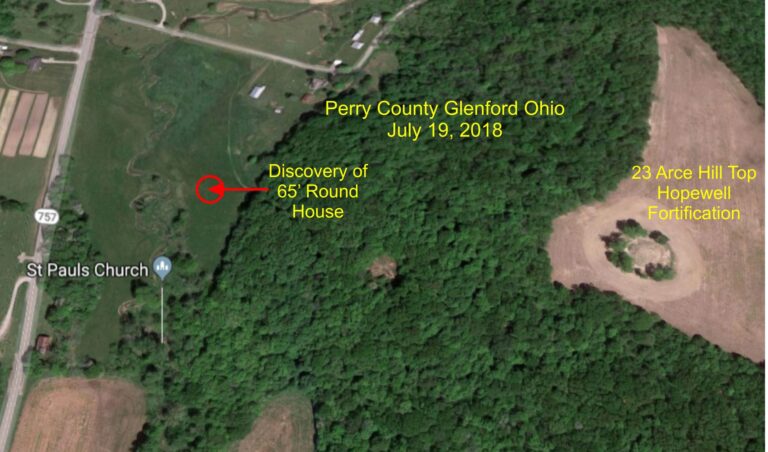
The Iroquois were farmers whose leaders were chosen by their women – rather unusual for warlike conquerors. Founded to maintain peace and resolve disputes between its members, the League’s primary law was the Kainerekowa, the Great Law of Peace which simply stated Iroquois should not kill each other. The League’s organization was prescribed by a written constitution based on 114 wampums and reinforced by a funeral rite known as the “Condolence” – shared mourning at the passing of sachems from the member tribes. The council was composed of 50 male sachems known variously as lords, or peace chiefs. Each tribe’s representation was set: Onondaga 14; Cayuga 10; Oneida 9; Mohawk 9; and Seneca 8. Nominated by the tribal clan mothers (who had almost complete power in their selection), Iroquois sachemships were usually held for life, although they could be removed for misconduct or incompetence. The emblem of their office was the deer antler head dress, and guided by an all-male council, the sachems ruled in times of peace. War chiefs were chosen on the basis of birth, experience, and ability, but exercised power only during war.

The central authority of the Iroquois League was limited leaving each tribe free to pursue its own interests. By 1660, however, the Iroquois found it necessary to present a united front to Europeans, and the original freedom of its members had to be curtailed somewhat. In practice, the Mohawk and Oneida formed one faction in the council and the Seneca and Cayuga the other. The League’s principal sachem (Tadodaho) was always an Onondaga, and as “keepers of the council fire” with 14 sachems (well out of proportion to their population), they represented compromise. This role was crucial since all decisions of the council had to be unanimous, one of the League’s weaknesses. There was also a “pecking order” among members reflected by the eloquent ritual language of League debate. Mohawk, Onondaga, and Seneca were addressed as “elder brothers” or “uncles,” while Oneida, Cayuga, and Tuscarora were “younger brothers” or “nephews.”

In this form, the Iroquois used a combination of military prowess and skilled diplomacy to conquer an empire. Until their internal unity finally failed them during the American Revolution, the Iroquois dealt with European powers as an equal. The League was a remarkable achievement, but it also had flaws, the most apparent was its inability to find a satisfactory means to share political power with its new members. As mentioned, the Iroquois incorporated thousands of non-league Iroquian peoples during the 1650s. Political power was retained by the original Iroquois to such an extent that the adoptees remained second-class citizens. The resulting dissatisfaction eventually led to the Mingo separating and moving to Ohio to free themselves from League control. Others found refuge with the French at Caughnawaga and other Jesuit missions along the St. Lawrence.

The League’s massive adoptions also explains why it was so relentless in its pursuit of the remnants of defeated enemies. So long as one small band remained free, the Iroquois were in danger of an insurrection from within. Perhaps because they considered themselves “Ongwi Honwi” (superior people), the Iroquois never offered wholesale adoption to the non-Iroquian speaking peoples who came under their control. Instead they offered membership in the “Covenant Chain,” a terminology first suggested by the Dutch at a treaty signed with the Mohawk in 1618. By 1677 the Iroquois had extended this form of limited membership to the Mahican and Delaware and later would offer it to other Algonquin and Siouan tribes. Essentially, the Covenant Chain was a trade and military alliance which gave the Iroquois the authority to represent its members with Europeans, but there was no vote or direct representation in the League council, Worse yet, the Iroquois were often arrogant and placed their own interests first. A system of “half-kings” created to represent the Ohio tribes in the 1740s never really corrected this problem.

Canasatego Temple Work

Editor’s Note 4

“The deep understanding of the proper role and procedures in good government exemplified by Canassatego in his discourses with many of the Founding Fathers may have contributed to his being included in a little-known account in the history of the Church. I have recounted many times this story of how a Native American chief by the name of Canassatego had instructed some of the Founding Fathers during a particularly difficult negotiation, thereby being an instrument in establishing the inspired Constitution of the United States.

Many Latter-day Saints are aware that in August 1877 at St. George, Utah, Wilford Woodruff, the temple president, and his recorder received visions that vicarious temple ordinances for the Founding Fathers and other eminent men and women were to be performed. On August 21, 1877, temple ordinance work was undertaken for them. However, few church members are aware that baptisms by proxy were also performed for 85 Native American Chieftains. That was done August 29, 1877, only a few days following the ordinance work that had been done for the Founders. One of the historically significant chieftains of that illustrious group was Canassatego. The death of President Brigham Young on that same day resulted in the temple presidency leaving for Salt Lake City with only the chieftains’ baptismal work accomplished. Their remaining temple work seems to have been accidentally forgotten until I showed images of the temple registry during a presentation at St. George. In that audience was Delores Kahkonen, a Cayuga of the Six Nations/Iroquois.  She literally jumped from her chair exclaiming, “Those are my people!” During the next two years she would be instrumental in researching each of those chieftains and facilitating the completion of their temple ordinance work including sealings to their spouses.”(January 26, 2019 email to Rian Nelson from Rodney Meldrum.) 

Page 196, St. George Temple Records August 29, 1877, LDS Church Archives, Copied by Rod Meldrum

Canassatego also said, “Our wise forefathers established Union and Amity between the Five Nations. This has made us formidable; this has given us great Weight and Authority with our neighboring Nations. We are a powerful Confederacy; and by your observing the same methods, our wise forefathers have taken, you will acquire such Strength and power. Therefore, whatever befalls you, never fall out with one another.” Canassatego, Lancaster Treaty Council, 1744.

Legends of the Iroquois Nation Allen C. Christensen

Hiawatha

There are intriguing legends and historical traditions attached to the powerful Iroquois Nation or Confederacy.  One such tradition known to some is that before the five tribes became united, there were frequent intertribal conflicts among them which were fierce and deadly.  In the midst of these fratricidal struggles well before the coming of Columbus, two men came to the five nations and declared to them a message of peace.  These two men, Deganawidah or Deganawideh (The Peacemaker) and Hayenwatha (Hiawatha) instructed them that no longer were they to engage in such conduct, but that they were to live in peace one with another. 

Purchase Here

Hiawatha had known great personal sorrow and was well acquainted with grief.  According to Iroquois memory his seven daughters had been murdered.  Depravity had come to characterize that society.  There were evil forces who thought that killing his daughters would be an acceptable means of drafting him into their service.  The people had become corrupted to the point they were beyond feeling.  They had lost empathy and the power of grief, because they had so debased the value of a single life. v  Hiawatha wandered the woods seeking consolation.  He devised a ceremony designed to console one who had suffered tremendous loss.  Later, the Peacemaker–one born of a virgin mother who could not be killed, and who taught peace–came to him with a new ceremony.  Known today as the Ritual of Condolence, it symbolically anoints and consoles.  One is helped to recognize grief and the sanctity of life, wherein society acknowledges that when suffering grief, it is hard to hear the laughter of children, hard to swallow and hard to see the sun in the sky.  Using the white fawn-skin of pity, the Ritual of Condolence wipes the ears to hear the laughter of children, the eyes to see the sun, opens the throat to swallow. vi  Outside of the Iroquois “Longhouse ceremonies,” the actual name of the Peacemaker is not used for it is considered sacred. vii

Great Law of Peace

They were given the laws by which they were to conduct their affairs.  Whatever the genesis of that Great Law of Peace, sometimes referred to as the Iroquois Constitution, the Mohawk, Oneida, Onondaga, Cayuga and Seneca tribes bound themselves together in a league of confederacy.  Decisions reached in Council meetings had to be unanimous.  The Iroquois believed that it was so important that all be of one heart, one mind, one law, that the Confederacy did not take action without unanimous agreement.  Formal provision was made for women to appoint delegates to the Council of the Iroquois Nation.  No nation of the Confederacy was under the rule of a single leader, although one chief might hold an honored station as the keeper of the sacred artifacts. viii,ix 

Their chieftains were installed by having a headdress of antlers placed upon them.  Impeachment for unacceptable behavior resulted in dehorning or removal of the antlers.  Those acquainted with the Old West’s cattle roundups for purposes of branding and dehorning probably have assumed that “dehorning” was a word unique to the American cowboy or Mexican vaquero.  According to the best information available today, sometime between 800 and 1390 A.D. the Iroquois peoples and their patterns of government were firmly established in what is now New York and Ontario, Canada.  These five nations fared well.  War came only after all efforts at diplomacy failed. 

As an aside, consider what America’s governmental system and the resolution of contentious contemporary problems might be like today were the people’s representatives or delegates removed for acting in self-interest.  What would happen were grandmothers to determine that leaders should be removed where such officials were deemed as not acting in the best interests of the next seven generations?  M. Franklin Keel has written: “From a practical point of view, who better than mothers, grandmothers, and aunts would know the very nature and personality of the many young children.  Knowing them from birth, they were in a unique position to see which children were kind, which ones were bullies, which ones had leadership qualities, which ones were intelligent, which ones were generous, which ones were wise.   Among the Iroquois, there was a governance requirement for considering the long-term consequences of council decisions.  Honestly assessed, the clan mothers knew who would provide the type of leadership that the Great Law required.” x  Clearly the power of incumbency would be held in check.  Truth is like gold.  Neither gold nor truth is confined to a single place or to a single people.  Sometimes great effort is required to extract gold from its ore-bearing rock.  And lest we forget, so it is with truth. 

The councils of the Iroquois were dignified, a stark contrast to the rancor and harsh rhetoric which sometimes were manifest in colonial politics.  Native orators were perhaps among the tribes most eloquent spokesmen.  However, it did not follow that the spokesman was the most influential in the actual decision making.  The colonist wanted to strike deals quickly whereas members of the Confederacy proceeded deliberately.  When they were unable or had not reached consensus, Iroquoian representatives offered polite evasions.  Seemingly, in that regard they were more sophisticated than their colonial counterparts.  Their speech was richly symbolic.  Metaphors such as ‘burying the hatchet” meant to make peace, especially so, when a tree was planted to cover the hole.  “To clear a path” meant the restoration of trade.  “Eating from the same bowl” was to share one’s land resources. xi  There were cultural chasms to be bridged.  It was difficult for the somewhat rough-hewn colonial translators to infuse the fire of native oratory into English expression.  If the most effective communication is not to be misunderstood, then the lack of such linguistic sensitivities on the part of the colonists were a harbinger of difficulties to come.

When expansionist European nations came to America, things changed.  The Iroquoian peoples became involved in the fur trade.  Beaver were not abundantly supplied in their land.  Men began to devote themselves to the quest for beaver beyond their traditional territory.  Beaver skins became the medium of exchange for iron tools and utensils, for cloth and guns.  European powers schemed successfully to promote intertribal tension.  Playing one people against the other is not new in international subterfuge and intrigue.  In the early 1600s, French Jesuits established themselves among the Hurons, where they were well received and became effective missionaries, perhaps due in part to the fact the French were Huron trading partners.  Jesuit records indicate hundreds of Huron converted to Catholicism, most often as the proselyte lay dying from small pox or measles.  Following the destruction of the Huron Confederacy, the Jesuits turned their missionary efforts toward the Iroquois.  While not so well received, they did find some success among the Mohawk tribe.  Adoption of French practices tended to result in rejection of old ways and beliefs. xii

During the numerous wars of America’s colonial period, some tribes had been allied with the French, others with the British.  Those friendship choices frequently were influenced by the European nation that had been their trading partner.  To their disappointment and apparent surprise, the Thirteen Colonies discovered after that poetic moment when “once embattled farmers stood and fired the shot heard round the world,” xiii many of those tribes, who had been British trading partners, continued to ally themselves with Great Britain.  We have learned by sad experience that with quarrels, while blood is said to be thicker than water, it tends not to be thicker than money.  Then and now, people did what they thought to be in their best interest. 

Continental Congress Ask Iroquois Chiefs for help

On June 11. 1776, while delegates to the Continental Congress were debating the matter of independence visiting Iroquois chiefs were invited into the meeting hall.  Addressed as brothers (as used it that context it meant equals), the Iroquois were invited to act with the American Colonists as one people  and have but one heart.  While the sought for military alliance did not happen, the Founding Fathers ultimately gave serious consideration to the Iroquois Constitution as a model of Government, which knowing Iroquoian descendants state had been given by the “Luminous White Being.” xv  Clearly, that model of governance influenced America’s Articles of Confederation.  Benjamin Franklin became one of the proponents of that model.  He is reported to have said that if six nations of unsophisticated people (the Tuscarora had become the sixth member of the Confederacy by that time) “should be capable of forming a Scheme for such Union, and be able to execute it in such a Manner as that it has subsisted for Ages, and appears indissoluble; and yet a like Union should be impracticable for ten or a Dozen English Colonies, to whom it is more necessary, and must be more advantageous; and who cannot be supposed to want an equal Understanding of their Interests.” xvi  Franklin proposed naming the national legislature, “The Great Council.”  He also proposed making America’s wild turkey the National Bird.  Even great men don’t get their way on everything. (See Editor’s Note 2)

Iroquois Nation of the Oneida

From Joseph’s Remnant we read, “The Oneida, an Iroquois nation, played a significant role in the Revolutionary War.  They fought at Oriskany and Saratoga.  Oneida chief, Shenandoah, had prevented a massacre of settlers at German Flats.  It was he who encouraged his people to ally themselves with the Americans.  In the Battle of Oriskany, 800 American militia under the command of Nicolas Herkimer attempted to relieve the British siege of Fort Stanwix.  En-route, they were ambushed by British forces and thrown into confusion.  A sortie from the fort and a party of Oneida came to the rescue.  In that August 6, 1777 battle, 60 or more Oneida warriors fought with the colonists.  The Pennsylvania Journal & Weekly Advertiser of September 3, 1777 described the exploits of Oneida Han Yerry and his family.  It reported that Han was a friendly Indian, with his wife and son, who distinguished themselves remarkably on that occasion.  The Indian killed nine of the enemy, when, having received a ball through his wrist that disabled him from using his gun, fought with his tomahawk.  His son killed two and his wife, on horseback, fought by his side with pistols during the whole action.  Mrs. Yerry’s name was Tyonajanegen.  It was she who loaded his guns and notified the colonists that the American militia had been badly bloodied by the British ambush.  It had cost at least 200 Oneida and Patriot lives.

The Oneida were the first sovereign nation to recognize the United States of America.  They fought alongside the Americans at Saratoga.  That American victory was a turning point in the war and was key in convincing the French that aiding the American effort was both desirable and feasible.    The Oneida were with Lafayette in 1778, and probably saved the young 20-year-old general and his 2,000 troops from being captured or killed at the Skirmish of Barren Hill in May.  Lest one forget, for their population base the Oneida suffered staggering losses in the war.

Oneida Nation Friendship Statue

General George Washington and Oneida Nation Friendship statue at National Museum of the American Indian Washington DC. Edward Hlavka depicts Oneida Chief Oskanondohna and Oneida woman (Polly Cooper), and General George Washington. The statue is a commemoration of the bonds between the Oneida Nation and the United States.

Polly Cooper, an Oneida woman, walked some 400 miles from her New York home to Valley Forge.  She and others brought 600 barrels of corn to feed Washington’s desperately hungry troops. It was white rather than yellow corn.  White corn requires extended preparation before it can be eaten.  If uncooked, raw-white corn swells in the stomachs and causes death.  Polly Cooper and the others taught the camp cooks the lengthy preparation process.  Following the war, the Army tried to pay her, but she refused stating simply that it was her duty to help her friends in their time of need.  She accepted as a token of appreciation, however, a shawl and bonnet offered by Martha Washington.  Her descendants have treasured that shawl to this day.    

In 1777, the United States Congress recognized the Oneida contribution, stating: We have experienced your love, strong as the oak, and your fidelity, unchangeable as truth.  You have kept fast hold of the ancient covenant-chain, and preserved it free from rust and decay, and bright as silver.  Like brave men, for glory you despised danger; you stood forth, in the cause of your friends, and ventured your lives in our battles.  While the sun and moon continue to give light to the world, we shall love and respect you.  As our trusty friends, we shall protect you; and shall at all times consider your welfare as our own. Sadly, America’s record toward those beautiful words has been one of malicious neglect and frequent betrayal.  

Yes, remarkable bravery had been displayed.  But life was not all about war and bloodshed.  Traditions of faith and the need for spirituality existed among the Iroquois Confederacy.  Handsome Lake was a 60-year-old Seneca when he fell gravely ill in 1795.  For four years he suffered, experiencing periods of delirium and unconsciousness.  In 1799, he seemed to die.  When others had come to mourn his death, he suddenly awoke and announced that he had received a miraculous manifestation.  He had been visited by four messengers from the “Great Creator.”  He had been given a message for the Seneca, a lengthy set of instructions which enumerated their wrong doings.  Commandments or instructions for behavioral change were given.  The Seneca were instructed to live virtuous and peaceful lives.  They were to repair family and community relationships, treat children with patience and love, show kindness to the elderly, and avoid gossip and quarrels. This spiritual announcement followed two centuries of warfare.  It is called by some the prophecy of Handsome Lake.

Handsome Lake also began to teach that the Seneca should adopt the white man’s agricultural methods.  That men rather than women should become the farmers. xxiii  He also exhorted his people to discontinue their abortive and contraceptive practices.  He attempted to make fathers responsible for the welfare and success of their individual families.  He turned the family focus away from matrilineal ties.  He plead for the role of the nuclear family rather than placing the rearing responsibility on the traditional extended-family residences.  Essentially, he argued that father and mother, not the village, were to raise the children.  The debate of whom is responsible for the successful rearing of children continues in contemporary America.  During the initial Latter-day Saint mission to Native Americans, it was to Seneca people that Oliver Cowdery, Parley P. Pratt, Peter Whitmer and Ziba Peterson visited first in the fall of 1830.” Joseph’s Remnant by Allen C. Christensen

Mormon’s Burial Place

As an aside, in a 1979 address to missionaries in training at the Missionary Training Center in Provo, Utah, President Murray J. Rawson shared an experience from his time as mission president in Florida. He reported that he had been teaching a group of the Seminole tribe concerning the Book of Mormon, when he was interrupted by their chief, who said: “We had a war a long time ago with a light-skinned people around the Great Lakes. We conquered them, but we had so much respect for their warrior chief that we buried him at the mouth of the Oswego River that is in New York State. We don’t discuss this very much, because it is an embarrassment to us.” President Rawson then asked: “Why is this an embarrassment?” The Chief replied, “Our history is written on metal plates and buried in a hill in New York, but we do not know which hill!” 

The mouth of the Oswego River empties into Lake Ontario. It is northeast of present-day Palmyra and the Finger Lake region of New York. In what some may call the storehouse of legends, it is fascinating that this account makes reference to an event that would have taken place in the lands of the Iroquois Confederacy, and yet, centuries later or a long time ago, was of sufficient significance that it was remembered and treasured among the Seminole of Florida. Murray J. Lawson

Thomas Mayhew Jr. Patriarch to the Inidans

“Governor Thomas Mayhew, the Elder (March 31, 1593 – March 25, 1682) established the first English settlement of Martha’s Vineyard, Nantucket and adjacent islands in 1642. He is one of the editors of the Bay Psalm Book, the first book published in British North America. His assistant Peter Foulger was the grandfather of Benjamin Franklin. Lloyd C.M. Hare wrote a book about Mayhew titled, Thomas Mayhew, Patriarch to the Indians

Mayhew and his fellow settlers found a large and economically stable native population of about 3,000 living in permanent villages, led by four sachems (chiefs). Relations between the first settlers and their Wampanoag neighbors were peaceful and courteous. Under the leadership of his son, a minister, they instituted a policy of respect and fair dealing with the Wampanoag natives that was unequaled anywhere. One of the first of Mayhew’s orders was that no land was to be taken from the native islanders, the Wampanoags, without their consent or without fair payment. From this time forward, the colonial settlers and Indians lived without the bloodshed that marked the history of European colonies elsewhere in the New World.

From the beginning, Mayhew had worked to preserve the original political institutions of the Indians. Religion and government were distinct matters, he told the Indian chiefs. When one of your subjects becomes a Christian, he is still under your jurisdiction. Indian land was guarded against further encroachment by white settlers. So successful were these policies that during the bloody battles of King Philip’s War, (blog here) in 1675-1676, the Vineyard Indians never stirred, although they outnumbered the English on the island by twenty to one.

By 1660 there were about 85 white people living peaceably among the natives, earning their living by farming and fishing. The Mayhew family, which from that time forth became an integral part of island history, wanted to share its religion with the natives, but the Wampanoags were not too interested, having their own spiritual faith. However, once it was clear that, though Mayhew was the governor, the sachems remained in charge of their people, some became curious about the white man’s God. When a native named Hiacoomes expressed an interest, Mayhew invited him into his home and instructed him in English and Christianity. Hiacoomes, in return, taught Mayhew the native language. As soon as Mayhew could converse with the natives, he would some days “walk 20 miles through uncut forests to preach the Gospel…in wigwam or open field”. Thomas Mayhew is a direct descendent and 8th great-grandfather of the editor.

This is a stained-glass window at the baptismal section in the National Cathedral in Washington D.C. depicting Rev. Thomas Mayhew Jr. baptizing Hiacoomes.

”The common wisdom among historians is that the people who wrote the Constitution had no concept of the Indian way of life,” said John Mohawk, a Seneca from the Cattaraugus Indian Reservation near Buffalo, and the organizer, with Professor Lyons, of the project. ”But what made the colonists American as opposed to English was their experiences with the Indians.”

As proof, they cite records kept by the colonists. An Onondaga named Canassatego suggested that the colonists form a nation similar to the Iroquois Confederacy during a meeting of the Provincial Council of Pennsylvania in Lancaster on June 25, 1744.

According to the director of the Historical Society of Pennsylvania, Peter J. Parker, the council minutes show that Canassatego urged the colonists to ”receive these your brethren with open arms; unite yourselves to them in the covenant chain and be you with them as one body and one soul.” Iroquois Constitution: a Forerunner to Colonists’ Democratic Principles, New York Times June 28, 198.

“The Iroquois Confederacy had been a functioning democracy for centuries by Benjamin Franklin’s day. Sometime between 1000 and 1450, the Cayuga, Mohawk, Oneida, Onondaga, and Seneca Nations came together to become the Iroquois Confederacy, and in the early 18th century they were joined by the Tuscaroras. Referred to as the Six Nations by the English, and the Iroquois by the French, the Confederacy called themselves the Haudenosaunee, or People Building a Long House.” By Cynthia Feathers and Susan Feathers www.upenn.edu/gazette/0107/gaz09.html

“Contrary, then, to widespread assumptions during Joseph Smith’s lifetime that the Onondaga migrated to the New York region, it becomes clear that they originated here as a small, narrowly localized amalgamation of a few villages near Onondaga Lake, during the century before Columbus’ discovery of America” Beauchamp’s Aboriginal Place Names of New York;

Joseph Smith during his life more than likely knew about many of these Indian chiefs below who were from the same vicinity as him. Joseph may have also spent time with many of them.

IROQUOIS INDIAN CHIEFBORNPLACE
DEGANAWIDA-Huron/ Onondaga/Mohawk12th CenturyNear Lake Huron
HIAWATHA- Onondaga/Mohawk12th CenturyOnandaga, NY
TADODAHO- Onondaga12th CenturyOnondaga, NY
JIGONHSASEE- Haudenosaunee12th CenturyCohoes Falls, NY
CANASSATEGO- Onondaga1684-1750Onondaga, NY
SAYENQUERAGHTA- Seneca1707-1786Geneva, NY
GUYASUTA- Seneca1725-1794Conawagus, NY
SKENANDOA- Susquehannock/Oneida1706-1816Conestoga, PA
CORNPLANTER- Seneca1732-1836Canawaugus, NY
HANDSOME LAKE- Seneca1735-1815Conawagus, NY
GOVERNOR BLACKSNAKE – Seneca1737-1860Romulus, NY
RED JACKET- Seneca1750-1830Canoga, NY
JOHN BRANT- Mohawk1794-1832Brant, Ontario
JESSE CORNPLANTER- Seneca1889-1957Cattaraugus, NY
See blog called Onandaga, Joseph Smith’s Indians here.

 “On the one hand, there are parallels between Handsome Lake’s teachings and Book of Mormon, economic and social interactions between Iroquois and white settlers at the time were still extensive during the early decades of the 19th century, and Lucy Mack Smith wrote that Joseph talked about Indians “as if he had spent his whole life among them.” Lucy Mack Smith, Biographical Sketches of Joseph Smith, the Prophet, and His Progenitors for Many Generations (Liverpool: S.W. Richards, 1853. “Joseph Smith was interested in the people who lived around him. Young Joseph was a member of the juvenile debating club in Palmyra during 1822 when Red Jacket, arguably the most widely-known Seneca of this period, delivered a speech in town. Joseph also liked to hang out on Ganargua Creek (Mud Creek) in the area where Iroquois travelers camped. He had interest and access.” Joseph Smith and the Code of Handsome Lake Lori Taylor, Ph.D.

The Onondaga Nation at the great white pine tree in Syracuse NY on the shores of Onondaga Lake is where the message of peace was planted, and the hatchets were buried according to many researchers. Similarly, the Lamanites ,  “…buried the weapons of war, for peace.” Alma 24:19 (“a peacemaker crossed Onondaga Lake in a stone canoe, how he convinced warring nations to bury their weapons beneath a tree of peace.”) Sean Kirst Syracuse.com

“The Onondagas: These have special interest… this warrior, Zelph, was an Onondaga, as well as a “white” Lamanite, and that the Onondagas (of New York), consequently must be of Lamanite lineage.” J.M. Sjodahl, An Introduction to the Study of the Book of Mormon

 “How America Was Discovered is a story told by Handsome Lake (Seneca Prophet), and documented by Arthur C. Parker, about a young minister who meets the one he perceives to be the Lord, who then asks him to go to a new land and bring with him cards, money, a fiddle, whiskey, and blood corruption. In return the young minister will become rich. The young minister sought out Christopher Columbus, and with the help of his crew, traveled to the Americas. They turned back to report what they had seen, which caused an immigration of people from Europe to the Americas. Along with the people came the five things that aided in destroying the natives. The end reveals that the “Lord” in the gold castle was actually the devil, and that even he knew what he had caused was wrong.” Rudes, B. Tuscarora English Dictionary Toronto.

Honoring the Great American Story

Over the past few days I have watched the news and heard from many friends, the Republican Convention theme this year is amazing. We as members of the Church in this great United States of America couldn’t have come up with a better theme ourselves.

“Honoring the Great American Story” August 24-27, 2020

Monday “The Land of Promise
Tuesday “Land of Opportunity
Wednesday “Land of Heroes
Thursday “Land of Greatness”

I will share my reasons below of why I am so excited about our government today. I still believe 80% of Democrats and Republicans are terrible, but we do have hope. God is still in control of this great PROMISED LAND!


Republican convention theme revealed: ‘Honoring the Great American Story’

The Trump campaign on Thursday previewing the themes with GOP lawmakers

By Brooke Singman | Fox News

Will in-person political conventions permanently disappear?

EXCLUSIVE: The theme of the upcoming 2020 GOP convention will be “Honoring the Great American Story” and will highlight America’s “greatness, opportunity and President Donald Trump’s bold leadership,” Fox News has learned.

The Trump campaign on Thursday afternoon had back to back phone calls with Republican members of Congress, previewing the themes for the 2020 Republican National Convention, a source familiar with the calls told Fox News.

The source told Fox News that the GOP’s convention theme is in “stark contrast to the doom and gloom message we expect to hear from career politicians at the DNC convention.”

BIDEN, HARRIS TO DELIVER DEMOCRATIC CONVENTION SPEECHES FROM DELAWARE

Fox News has learned that the first day of the convention, Monday Aug. 24, will focus on “the Land of Promise,” Tuesday will focus on the “Land of Opportunity,” Wednesday will focus on the “Land of Heroes,” and Thursday on the “Land of Greatness.”

Fox News has learned that Sen. Tim Scott, R-S.C., will speak at the convention.Video

Other speakers include Tanya Weinreis, owner of Mountain Mudd Espresso in Montana, a local espresso drive-thru business with 12 kiosks and about 50 employees.

Weinreis received the PPP loan through her local lender and talked about how significant it is for her business during this time.

“The loss of sales was scary—I was nervous this would ruin the business. The large corporations like Starbucks could withstand it, but I didn’t know if we could,” Weinreis said. “[The PPP loan] will allow us to continue paying our employees, as well as covering other operational costs like rent and utilities. Now we can give back to the community in a meaningful way.”

Also, Sergeant of the St. Louis Metro Police Department, Ann Dorn, and wife of slain retired St. Louis police captain David Dorn, who was killed while protecting a pawn shop during a night of violent looting across St. Louis, will speak at the convention.

The discussions come as the convention details remain in flux, and as the campaign and the Republican National Committee continue to adjust their plans amid the coronavirus pandemic.

Last month, the Trump campaign and the RNC dramatically downscaled the convention by canceling planned celebratory events in Jacksonville, Fla., amid a surge in cases in the state, and refocused their attention to convention business back in the original convention site of Charlotte, N.C.

Meanwhile, the RNC last month said “a few hundred delegates” will be in Charlotte, N.C., on Monday, Aug. 24 for convention business, which will include the formal nomination of the president.

As Fox News reported in June, the delegates convening in Charlotte will not be voting on a 2020 party platform or even re-adopting the 2016 platform. Since there will be no convening of a platform committee, the 2016 platform will remain in effect. https://static.foxnews.com/static/orion/html/video/iframe/vod.html?v=20200810203603#uid=fnc-embed-1

My Opinion

As I found out that President Trump will be Featured each day of the GOP Convention, I wanted to briefly write down why I love President Trump’s leadership. He has amazed me. When he first joined the race in 2015, I thought he was just another man full of promises he will never keep. I saw him with a huge ego and a desire only for self. I hated his overt agressive behavior and ignorant remarks.

All of that has changed, (he still has a huge ego) because Pres Trump gets the results that my family and I want and need. He loves and serves others and loves God. Without much thought I came up with so many reasons why I support Trump. As I wrote, many other items kept coming to mind and I could have easily written 50 more. That is amazing. Not since Pres Reagan have I respected a President as I do now. I think Trump will go down as one of the best Presidents we ever had.

My List

Made Colleges debate both sides of issues or won’t fund them.
Protects my right to bear arms
Favors the right to life and opposes the partial birth abortion bill
Sisters of the Poor won their lawsuit not forcing them to use contraception
Israel now has its capital in Jerusalem
Israel and UAE have normalized relations
The wall is being built and immigration is granted orderly.
Over 80% of small business and workers received a tax cut
Reduced corporate taxes
We may choose our own health care
Respects the right to protest but not to riot and destroy
Is against sanctuary cities and letting illegals be released
Crime reform bill. First time arrested citizens have opportunity to succeed
Veterens may get health care from anywhere
Right to try bill. People may choose to try a drug not approved by Govt.
Took no money from donors for his campaign.
Killed leading terrorists and wants to get us out of war
America comes first in ALL things.
Left the international organizations that don’t pay their fair share
Left the Paris Climate Accord
Loves families and emphasises a fathers presence
Against Gay marriage but believes in equal rights
Wants small government, more local city and state representaion.
Is holding China and Russia and Iran and North Korea accountable
Respects our right to worship as we please.
Lowest unemplyment for African Americans and other minorities
Economy best ever. See stocks
Wants to open business safely and is sensible with the virus
Wants voter ID enforced and is against general mail in of ballots
Believes God has endowed us with rights to life, libery and property.
Doesn’t need governments money or power.
Keeps his promises on what he said before elected.
Has created self reliance on need for oil and approves fracking
Supports law enforcement.
I believe all lives are important in the eyes of God. He loves us all.

Now think about this. Name two or three things Pres Clinton, Bush, or Obama did for us? What has Biden of Hillary done with their 40 years in government? It’s a challenge to name even one accomplishment for each person. The choice is obvious of who I will vote for in November. It’s not even a close call.

President Benson gave a most wonderful talk below, that everyone of us should share with all those we know. His love for the Promised Land of the United States is such a testimony to me. This talk has strengthened my love for our country and helped me understand our role to spread the Gospel to the world. We have made a Covenant with the Lord to share the Gospel and if we don’t we will be held accountable. Those on other lands of the world have also been blessed as the Lord loves them as much as He love us. President Benson in my opinion, makes it very clear that this land of the United States is the Promised Land spoken of in the Book of Mormon.

President Benson said, “The Constitution of the United States has served as a model for many nations and is the oldest constitution in use today. “I established the Constitution of this land,” said the Lord, “by the hands of wise men whom I raised up unto this very purpose” (D&C 101:80). For centuries the Lord kept America hidden in the hollow of His hand until the time was right to unveil her for her destiny in the last days. “It is wisdom that this land should be kept as yet from the knowledge of other nations,” said Lehi, “for behold, many nations would overrun the land, that there would be no place for an inheritance” (2 Ne. 1:8)… Our Father in Heaven planned the coming forth of the Founding Fathers and their form of government as the necessary great prologue leading to the restoration of the gospel. Recall what our Savior Jesus Christ said nearly two thousand years ago when He visited this promised land: “For it is wisdom in the Father that they should be established in this land, and be set up as a free people by the power of the Father, that these things might come forth” (3 Ne. 21:4). America, the land of liberty, was to be the Lord’s latter-day base of operations for His restored church…

Only in this foreordained land, under its God-inspired Constitution and the resulting environment of freedom, was it possible to have established the restored church…

“Two great American Christian civilizations—the Jaredites and the Nephites—were swept off this land because they did not “serve the God of the land, who is Jesus Christ” (Ether 2:12). What will become of our civilization?… I have faith that the Constitution will be saved as prophesied by Joseph Smith. It will be saved by the righteous citizens of this nation who love and cherish freedom. It will be saved by enlightened members of this Church—among others—men and women who understand and abide the principles of the Constitution.

I reverence the Constitution of the United States as a sacred document. To me its words are akin to the revelations of God, for God has placed His stamp of approval upon it.

I testify that the God of heaven sent some of His choicest spirits to lay the foundation of this government, and He has now sent other choice spirits to help preserve it.

We, the blessed beneficiaries of the Constitution, face difficult days in America, “a land which is choice above all other lands. (Ether 2:10)” Ezra Taft Benson “Our Divine Constitution Ensign Oct 1987


Ancient Medicine from Zarahemla

Nephites

AN ANCIENT AND POWERFUL MEDICINAL PLANT FOUND ON THE ZARAHEMLA TEMPLE SITE

During the last month, people have become aware of the health benefits from a plant that Dr. Kevin Price discovered six weeks ago growing on the Zarahemla Temple Site. Based on existing literature, the health benefits from the oils of this plant will be significant. At the end of the Heartland Research Group Expedition during the first week of August 2020, volunteers harvested 13 pounds of fresh plant material directly from the center of the sand mound that is the foundation of the Zarahemla temple. The plant material was flown to Utah where its precious essential oils were extracted within 24 hours after harvest by Dana Young, Founder and President of Be Young Total Health. The appearance, smell, and taste of the essential oils confirm that the plant has the properties of world-class essential oils that are used for many medicinal purposes. These expectations, however, can only be confirmed through rigorous tests in a certified essential oils testing laboratory.

The extracted essential oil from the first harvest has been hand-delivered to a third-party testing laboratory that specializes in gas chromatography and mass spectrometry analyses to certify its chemical composition and purity. The laboratory report will be completed in the next few weeks. While the chemical make-up of this plant has been reported in another country, we are excited to see how the uniqueness of this area and the preservation by the ancient people have molded the DNA of this plant to produce this exquisite healing essential oil. The report will confirm the essential oil chemistry of the plant found on the Zarahemla Temple site and a summary of the findings will be posted on this Facebook Page and on www.zarahemla.site.

We have mounting evidence that this plant was cultivated more than 2,000 years ago by people who are found in the Book of Mormon. The plant is tied to a verse in the 46th chapter of the Book of Alma. Alma was living in Zarahemla at the time when he wrote:

“… there were some who died with fevers, which at some seasons of the year were very frequent in the land—but not so much so with fevers, because of the excellent qualities of the many plants and roots which God had prepared to remove the cause of diseases, to which men were subject by the nature of the climate.”

Malaria was a seasonal disease that causes severe fever during certain seasons of the year throughout the Heartland of the US. This dreadful disease was not eradicated from the US until 1951.

Seeds from the plant will soon be ready for harvest. In a few weeks, we intend to harvest these seeds under the supervision of a trained botanist. The seeds naturally fall from the plant directly to the ground which means their dispersal method is more in place than plants that use longer distance dispersal mechanisms such as wind and clinging to the fur coats of animals and dropped in more distant locations. Based on the dominance and geographic distribution of this plant, its dispersion seems to have been dependent on the deliberate action and migratory direction of ancient people. None of the plants are noticeable in the fields and roadside areas for miles around the Zarahemla Temple site. Visual areal correspondence analysis shows strong mapping-pattern agreement between the plant distribution and Hopewell cultural settlement sites in the State of Iowa, and authors of newly found documents report that the plant is found abundantly in the sandy areas around the Great Lakes region, another area where Hopewell people were also heavily concentrated. These findings suggest the Hopewell people, were maintaining this plant for its medicinal qualities. We found it thriving in the Zarahemla Temple area, but most strongly associated with the sandy area where the temple was located and along an ancient berm created by the Hopewell people near their temple. The plant appears to be a living artifact from the Book of Mormon.

Centuries ago, the Europeans came and gave Native People smallpox while at the same time these intruders ignored the health benefits that the Natives could have given them for the cure of malaria — sickness from the old world and health in the new world. This was an unfortunate situation. For 300 years of European domination, the healing properties of this ancient plant have been hiding in the weeds. It is now time for these benefits to be made available to the world. Published studies have shown that important essential oils also found in this plant are effective against every strain of bacteria for which it was tested, and the EPA recently approved the use of sterilizing compounds that are found in this plant for cleaning surfaces for bacteria and viruses.

It is also interesting to note a clear correlation of the plant’s dispersal with locations of those people who are identified in the Book of Mormon. From Florida to Iowa and from Iowa to the Great Lakes the plant is found within the habitation areas of the Hopewell people, whom we believe to have been the Nephites described in the Book of Mormon. These people carried the seeds of the plant in pouches and planted them as they moved from one location to another. We are extremely excited about bringing the plant from the Temple of Zarahemla Site back to the attention and benefit of our time. Heaven knows that we have suffered too much from strange diseases. It is now time for the ancient world of the Nephites to come forth to help us as we try to improve our health and wellness.

Please help in our continued search for Zarahemla. If you would like to contribute to these efforts you can do so by going to www.zarahemla.site.


The Greatness of Joseph

The Fountain from which he Spoke

Joseph Smith during Zion’s Camp., he Brigham declared of this experience: I have travelled with Joseph a thousand miles. . . . I have watched him and observed every thing he said or did. . . . For the town of Kirtland I would not give the knowledge I got from Joseph on this Journey; and then you may take the State of Ohio and the United States. . . . It has done me good . . . and this was the starting point of my knowing how to lead Israel. President Brigham Young called himself “an Apostle of Joseph Smith, and also of Jesus Christ” [footnote] and attributed his wisdom and success to his diligent obedience to the counsel and instruction of the Prophet Joseph Smith:  

I wish to say that, when I see [men] in Israel who are careless and unconcerned, who trifle away their time . . . where there are opportunities to learn, my experience for the best part of forty years teaches me that they never progress . . . . In my experience I never did let an opportunity pass of getting with the Prophet Joseph and of hearing him speak in public or in private, so that I might draw understanding from the fountain from which he spoke, that I might have it and bring it forth when it was needed.

More Precious… than all the Wealth of the World

My own experience tells me that the great success with which the Lord has crowned my labors is owing to the fact of applying my heart to wisdom. . . . In the days of the Prophet Joseph, such moments were more precious to me than all the wealth of the world. No matter how great my poverty—if I had to borrow meal to feed my wife and children, I never let an opportunity pass of learning what the Prophet had to impart. This is the secret of the success of your humble servant.[footnote] (Journal of Discourses, 12:270)   FAITH CRISIS: Did the LDS Church Lie? (Part 1) We Were NOT Betrayed! By James and Hannah Stoddard

Wilford Woodruff: “It has been my faith and belief from the time that I was made acquainted with the Gospel that no greater prophet than Joseph Smith ever lived on the face of the earth save Jesus Christ. He was raised up to stand at the head of this great dispensation—the greatest of all dispensations God has ever given to man. He remarked on several occasions when conversing with his brethren: ‘brethren you do not know me, you do not know who I am.’ As I remarked at our priesthood meeting on Friday evening, I have heard him in my early days while conversing with the brethren, say, (at the same time smiting himself upon the breast) ‘I would to God that I could unbosom my feelings in the house of my friends.’ Joseph Smith was ordained before he came here, the same as Jeremiah was. Said the Lord unto him, ‘Before you were begotten I knew you’ etc.” Wilford Woodruff, “Organization of the First Presidency—Responsibility of the Saints, Etc.,” in Journal of Discourses, vol. 21 (Liverpool, 1881), 317. Discourse given on October 10, 1880.

Greatest Prophet that ever Breathed

“I look upon Joseph Smith as the greatest prophet that ever breathed the breath of life, excepting Jesus Christ. Father Adam, as I have said, stands at the head; but Joseph Smith was reserved to lay the foundation of this great kingdom and dispensation of salvation to the whole human family in these last days, to build up Zion, to establish God’s Kingdom, and to prepare it for the coming of the Son of Man.” Wilford Woodruff, The Deseret Weekly, vol. 38, (Deseret News Company, 1889), 389.

Brigham Young about Joseph Smith

“Who can say aught against Joseph Smith? I do not think that a man lives on the earth that knew him any better than I did, and I am bold to say that, Jesus Christ excepted, no better man ever lived or does live upon this earth. I feel like shouting Hallelujah all the time, when I think that I ever knew Joseph Smith, the Prophet.” Millennial Star, XXI (July 11, 1863)

Wilford Woodruff about Joseph Smith

“The Prophet called the Quorum of the Twelve together several months before his death, and informed them that the Lord had commanded him to hasten their endowments; that he did not expect to remain himself to see the Temple completed; that he wished to confer the keys of the Kingdom of God upon other men, that they might build up the Church and Kingdom according to the pattern given. The Prophet stood before the Twelve from day to day, clothed with the spirit and power of God, and instructed them in the oracles of God, in the pattern of heavenly things, in the keys of the Kingdom, in the power of the priesthood, and in the knowledge of the last dispensation of the fulness of times.

In his last charge to the Quorum of the Twelve, he rose up in all the majesty, strength, and dignity of his calling, as a prophet, seer, and revelator, out of the loins of ancient Joseph, and exhorted and commanded the brethren of the Twelve to rise up, and go forth in the name of Israel’s God, and bear off the keys of the Kingdom of God in righteousness and in honor in all the world. They were instructed to walk in all holiness, godliness, faith, virtue, temperance, patience, and charity; to do honor to the cause of God in this last dispensation and fulness of times; and when their work was finished, to follow his example by boldly sealing their testimony with their blood, for the word of God, and the testimony of Jesus Christ, if necessity required it, that they might be prepared for the reward, which is beyond the veil.

Those who were present on those occasions cannot forget the teachings that fell from the lips of that noble, but now martyred Prophet of God. Though his body sleeps in the tomb, his testimony lives, not only in the hearts of men, but is on record and will remain in force, while his persecutors will reap a just reward for all their works. And I hereby bear my testimony unto all men into whose hands these lines may fall, that I have been acquainted with Joseph, and Hyrum Smith, the Prophet and the Patriarch of the Church of Jesus Christ of Latter-day Saints; have attended their private and public counsels from time to time, during the last ten years of my life; and notwithstanding their enemies have caused the earth to be deluged, as it were, with lies, slanders, and fabrications, with the intent to injure their character and destroy their influence among men; that I have never heard either of those men teach, counsel, or advocate, or practice any principle that was contrary to the word of God, virtue, or temperance, or unbecoming men standing in their high and holy calling. On the contrary, I have been astonished at the patience, forbearance, long-suffering, philanthropy, and charity manifested in the lives of those men. I have been filled with joy by the beauty, order, knowledge, principles, intelligence, and glory manifest in the teachings, counsels, and revelations of Jesus Christ given through those servants of God, for the benefit of the children of men in this last dispensation.” WILFORD WOODRUFF FOURTH PRESIDENT OF THE CHURCH OF JESUS CHRIST OF LATTER-DAY SAINTS History of His Life and Labors AS RECORDED IN HIS DAILY JOURNALS “To him that overcometh will I grant to sit with me in my throne, even as I also overcame, and am set down with my Father in his throne.”—Rev. 3:21. PREPARED FOR PUBLICATION BY MATTHIAS F. COWLEY Salt Lake City, Utah 1909

What Did Joseph Know?

0

Prophecies & Promises

The Book of Mormon and The United States of America
Bruce H. Porter and Rod L. Meldrum-Chapter Nine with added charts, pictures and information.

This is a 40 page booklet from chapter 9 of the book Prophesies and Promises that has amazing information about what Joseph Smith knew about the Geography of the Book of Mormon. All along he knew where the Nephites lived, worked, and worshiped. We believe Joseph always knew this information and we have never found one quote from Joseph Smith that indicated he thought Mesoamerica was the correct geography of the Book of Mormon.

What Did Joseph Know?
What the Prophet Joseph Smith knew of the geography of the Book of Mormon can be learned from his statements that are recorded in journals and accounts prepared and published by him and later by the Church as well as a study of his actions in these regards. These published accounts give substantial clues to his knowledge on this matter. There are two key concepts that need to be understood pertaining to the statements of Joseph Smith, particularly regarding the extensive amount of geographical discussion that has taken place over the years by Mesoamerican theorists. Their concepts are one, Joseph simply didn’t know, was unaware, or was speculating about the geography of the Book of Mormon early in his prophetic calling; and two, he never claimed inspiration on the matter of geography.

This book is dedicated to the historically documented fact that the Prophet Joseph Smith did, in fact, know about the geographical setting for the Book of Mormon and that he did, in fact, claim inspiration for the statements he made about its geography. Joseph Smith’s published accounts and his claim of revelation on the matter of geography mentioned in the following chapters of this book will stand on their own, as authoritative statements from a prophet of God. This chapter is not meant to be an exhaustive study of the Prophet’s statements that might outline arguments for or against any one geographical theory. Nor is it intended to debate the implied meaning or authorship of the accounts reviewed. Such an in depth review of these arguments is reserved for a separate text that will follow in due time.

The “authority” of scripture—prophet, person or law—in an individual’s life is completely dependent on the person’s acceptance or rejection of that authority. The Standard Works have no authority or power in anyone’s life unless that person allows scripture that authority. Nor do the words of a prophet—modern or ancient— have any specific authority in someone’s life unless they decide to accept the prophet and his words as authoritative. If individuals consider their education, knowledge, or beliefs more authoritative and correct than scripture or revealed prophetic statements, they are placing their trust in the arm of flesh. The decision must be made by the individual to accept or reject the statements of Joseph Smith as inspired. Often training and tradition will condition and influence an individual in his acceptance of an “authority” in his life. That is an individual decision and choice.

“This Continent”
The prior discussion about the demonstrative “this” must be kept in mind as a word that is used to indicate the defined noun within proximity of the speaker. First, look at the words of Moroni as described by Joseph Smith and found in the canonized scriptures. The Prophet Joseph writes that Moroni appeared and taught him about a book “written upon gold plates.” Joseph was told by this angelic messenger sent from God, that this record gave an account of the “former inhabitants of this continent” (Joseph Smith-History 1:34).

Annotated Edition of the Book of Mormon by David Hocking and Rod Meldrum Page xxvi

The interpretation of the phrase “former inhabitants of this continent” must, for clarity of understanding, have one of two meanings or conclusions. Either this refers to “this continent” or it does not. If it does not refer to the United States, a person would have to ignore the demonstrative “this” and then redefine “this continent” into a generality of hemisphere or continent(s). To assume the latter would mean that either Joseph or Moroni made a mistake in the description and the use of the demonstrative in pointing to the “which” continent. The inspired text should be able to be understood as correctly in 1830 as well as 2030 by reading the words chosen by the Lord.

Even though in the early 1800s the American continent was defined by Noah Webster’s dictionary to be all of North and South America, later refinements divide North America from South America as two distinct and separate continents. If a North American geographic setting is applied, then Joseph’s statement remains true both then and now, but if a South American setting is used, then Joseph’s statement was true only during his time, and is no longer true because Joseph was never on the South American continent. The Lord knew what the best definition of “this land” and “this continent” would be and inspired Joseph Smith accordingly. The statements are as correct then as they are now.

Lucy Mack Smith
The earliest account of the life of Joseph Smith and the events that surrounded the Smith family during the prophet’s youth is recorded by his mother. Lucy Mack Smith, the mother of Joseph Smith, described the family gatherings as young Joseph rehearsed those thing that he had learned from the Lord and the messengers sent to teach him of this great work. Remember that this is in the time frame between the “First Vision” and the retrieval of the plates by Joseph from the Hill Cumorah.

Annotated Edition of the Book of Mormon by David Hocking and Rod Meldrum Page 431

“From this time forth, Joseph continued to receive instructions from the Lord, and we continued to get the children together every evening for the purpose of listening while he gave us a relation of the same. I presume our family presented an aspect as singular as any that ever lived upon the face of the earth—all seated in a circle, father, mother, sons and daughters, and giving the most profound attention to a boy, eighteen years of age, who had never read the Bible through in his life: he seemed much less inclined to the perusal of books than any of the rest of our children, but far more given to meditation and deep study.

During our evening conversations, Joseph would occasionally give us some of the most amusing recitals that could be imagined. He would describe the ancient inhabitants of this continent, their dress, mode of traveling, and the animals upon which they rode; their cities, their buildings, with every particular; their mode of warfare; and also their religious worship. This he would do with as much ease, seemingly, as if he had spent his whole life among them.52 Lucy Mack Smith

This description of the first family home evenings in this dispensation gives insight into his revelations and learning as Joseph Smith’s mother states that he “continued to receive instructions from the Lord.” She describes that his insights and inspiration were as though “he had spent his whole life among” those who were the “ancient inhabitants of this continent.” Again the records are clear as to the inspiration Joseph received, that he knew the land were these things happened. Joseph’s knowledge and understanding of this culture was broad and comprehensive, according to his mother.

There is not another person, anthropologist or archaeologist, then or now, who would know more about the details of the day to day life of the Nephite and Lamanite cultures, than Joseph Smith. Joseph is the only prophet who has, in confidence declared, where places and events took place that were recorded in the Book of Mormon.

Annotated Edition of the Book of Mormon by David Hocking and Rod Meldrum Page 116

Mission to the Lamanites
As described in the Title Page of the Book of Mormon written by Moroni, this record is to be taken to the “remnant” of the seed of Lehi, to convince them that Jesus is the Christ. Almost as soon as the church was organized, the Lord instructs Oliver Cowdery, through Joseph, that this gospel is to be taken to the Lamanites. The Lord through the Prophet Joseph instructs Oliver Cowdery to “go unto the Lamanites” and that he will receive revelations about this important mission to the Lamanites but that he is not to write them down as part of the latter-day commandments. It would appear from the references below that the Lord knows where the Lamanites are located and also that they are a “remnant” of Lehi that remain upon the land.

“And now, behold, I say unto you that you shall go unto the Lamanites and preach my gospel unto them; and inasmuch as they receive thy teachings thou shalt cause my church to be established among them; and thou shalt have revelations, but write them not by way of commandment.” D&C 28:8

The Lord later instructs these brethren that the city of Zion shall be built on the border by the Lamanites. And that they are to take their journey among the Lamanites.
“And now, behold, I say unto you that it is not revealed, and no man knoweth where the city Zion shall be built, but it shall be given hereafter. Behold, I say unto you that it shall be on the borders by the Lamanites.

“And thou shalt assist to settle all these things, according to the covenants of the church, before thou shalt take thy journey among the Lamanites.” D&C 28:9, 14

In the same month the Lord instructs Peter Whitmer and Oliver Cowdery to be the first missionaries to take the gospel and words of the record to the Lamanites as declared by Christ in Third Nephi. The exact location of this mission is given by instruction an revelation from the Lord a short time later.

“Behold, I say unto you, Peter, that you shall take your journey with your brother Oliver; for the time has come that it is expedient in me that you shall open your mouth to declare my gospel; therefore, fear not, but give heed unto the words and advice of your brother, which he shall give you.”

“And be you afflicted in all his afflictions, ever lifting up your heart unto me in prayer and faith, for his and your deliverance; for I have given unto him power to build up my church among the Lamanites;” D&C 30:5-6

Annotated Edition of the Book of Mormon by David Hocking and Rod Meldrum Page 526

In October of 1830 two more missionaries are called to assist in the teaching of the Lamanites. This first missionary force will now have the addition of Parley P. Pratt, Ziba Peterson, and the Lord as they go among the Lamanite remnant to teach.

“And now concerning my servant Parley P. Pratt, behold, I say unto him that as I live I will that he shall declare my gospel and learn of me, and be meek and lowly of heart.

“And that which I have appointed unto him is that he shall go with my servants, Oliver Cowdery and Peter Whitmer, Jun., into the wilderness among the Lamanites.”

“And Ziba Peterson also shall go with them; and I myself will go with them and be in their midst; and I am their advocate with the Father, and nothing shall prevail against them.”

“And they shall give heed to that which is written, and pretend to no other revelation; and they shall pray always that I may unfold the same to their
understanding.” D&C 32:1-4

The four missionaries—Parley P. Pratt, Oliver Cowdery, Peter Whitmer, Jr., and Ziba Peterson—left immediately upon the Lord’s instruction and commenced the very first mission of the church west of New York. The History of the Church describes the events of this Lamanite mission in these words:

“Immediately on receiving this revelation, preparations were made for the journey of the brethren therein designated, to the borders of the Lamanites, and a copy of the revelation was given them. They bade adieu to their brethren and friends, and commenced their journey, preaching by the way, and leaving a sealing testimony behind them, lifting up their voice like a trump in the different villages through which they passed. They continued their journey until they came to Kirtland, Ohio, where they tarried some time, there being quite a number in that place and vicinity who believed their testimony, and came forward and obeyed the Gospel. Among the number was Mr. Sidney Rigdon, and a large portion of the church over which he presided.” 53

The Mission to the Lamanites as declared and described by the Lord in the Doctrine and Covenants clearly reflects that Joseph sent the missionaries to the areas revealed and directed by the Lord. The scriptures imply that not only were they to preach to the Native Americans on this North American continent, but that they are a remnant of the seed of Lehi and “Lamanites” as described in the Book of Mormon and Doctrine and Covenants. 54

Parley P. Pratt also speaks of this first mission to the Lamanites in these words as he describes and names the Native American tribes to whom he was sent to preach the gospel.

“Thus ended our first Indian Mission, in which we had preached the gospel in its fulness, and distributed the record of their forefathers among three tribes, viz: the Catteraugus Indians, near Buffalo, N.Y., the Wyandots of Ohio, and the Delawares west of Missouri. We trust that at some future day, when the servants of God go forth in power to the remnant of Joseph, some precious seed will be found growing in their hearts, which was sown by us in that early day.” 55

Elder Pratt walked about “fifteen hundred miles” and preached the “gospel to tens of thousands of Gentiles and two nations of Indians.”56 It must be realized and accepted that the Lord knew, and therefore Joseph knew, where the Lamanites were located and that a remnant was left in fulfillment of the Prophecies and Promises that are revealed in the Book of Mormon. These first missionaries to the Lamanites were sent to where the Lord commanded and meant them to go. There is no indication in Church History of dissatisfaction by the Lord in their mission, nor is there any reason to think that they did not preach to the “Lamanites” as directed by the Lord, who indicated that He would go with them and be in their midst.

Following the loss of the 116 pages of manuscript, when the Lord requested something from Joseph, the Prophet began immediately to try to accomplish it. This mission to the Lamanites is an example of Joseph’s dedication to the requirements established by the Lord. It was 117 years later that the gospel was taken to Guatemala. The promises of the Savior at Bountiful to those who gathered there emphatically stated that when the Gentiles received “these things” [the Book of Mormon] they would then be taken to the Lamanite remnant. This objective was a major concern of Joseph Smith until his death according to church historian Ronald W. Walker in his article Seeking the Remnant; the Native American in the Joseph Smith Period. He writes:

“RECENT SCHOLARS HAVE largely set aside the Native American as an important force in early Restoration history, 1830-44. After telling the familiar story of Oliver Cowdery’s 1830-31 Lamanite mission, most writers either grow quiet on the topic or say that Joseph Smith and other Mormon leaders became preoccupied with more pressing things. But the evidence supports another view. First-generation leaders, while not always having the freedom to interact with the Indian as they wished, consistently sought the Native American “remnant” of Jacob. This argument, more than revising a familiar historical tenet, provides a window through which to view early Mormonism. It shows the millennial spirit of the movement’s first years, helps to explain the intensity of early anti-Mormonism, and reveals one of the reasons why the Mormon hegira took the path it did. Finally, it suggests that the Book of Mormon, which lay at the heart of the original disciples’ view of the Indian, was more than a theoretical handbook. It actually affected how Mormons thought and what they did.

There is no mistaking the importance of the Indian during the earliest part of Joseph Smith’s ministry. His first and greatest revelation was the Book of Mormon, which was not just a record of the “Lamanite” or Native American people, but a highly unusual manifesto of their destiny.” 57

The Wentworth Letter
In 1841, at the request of John Wentworth, Joseph Smith wrote a letter describing the rise of the Church of Jesus Christ of Latter-day Saints and a proclamation of the basic beliefs that distinguish the Church from other religions. It is from this inspired letter that the 13 Articles of Faith are gleaned that so many Latter day Saints have memorized as children. The Wentworth Letter was written in Joseph’s own words and signed by him personally. The following statement clearly relates “this country” [that is where Joseph is at] to “this continent” and the inhabitants and Prophets that lived there. It is important to note that the statements of Joseph contained in this letter boldly testify of his inspiration and the revelations on matters pertaining not only to the record and the history of the people, but also the land where it took place.

“On the evening [of] the 21st of September, a.d. 1823, while I was praying unto God and endeavoring to exercise faith in the precious promises of scripture, on a sudden a light like that of day, only of a far purer and more glorious appearance and brightness, burst into the room. Indeed the first sight was as though the house was filled with consuming fire. The appearance produced a shock that affected the whole body. In a moment a personage stood before me, surrounded with a glory yet greater than that with which I was already surrounded. This messenger proclaimed himself to be an angel of God, sent to bring the joyful tidings that the covenant which God made with ancient Israel was at hand to be fulfilled; that the preparatory work for the second coming of the Messiah was speedily to commence; that the time was at hand for the gospel in all its fulness to be preached in power unto all nations, that a people might be prepared for the millennial reign. I was informed that I was chosen to be an instrument in the hands of God to bring about some of His purposes in this glorious dispensation.

I was also informed concerning the aboriginal inhabitants of this country [America] and shown who they were, and from whence they came; a brief sketch of their origin, progress, civilization, laws, governments, of their righteousness and iniquity, and the blessings of God being finally withdrawn from them as a people, was [also] made known unto me; I was also told where were deposited some plates on which were engraven an abridgment of the records of the ancient prophets that had existed on this continent. The angel appeared to me three times the same night and unfolded the same things. After having received many visits from the angels of God, unfolding the majesty and glory of the events that should transpire in the last days, on the morning of the 22nd of September, a.d. 1827, the angel of the Lord delivered the records into my hands.

In this important and interesting book the history of ancient America is unfolded, from its first settlement by a colony that came from the Tower of Babel at the confusion of languages to the beginning of the fifth century of the Christian era. We are informed by these records that America in ancient times has been inhabited by two distinct races of people. The first were called Jaredites and came directly from the Tower of Babel. The second race came directly from the city of Jerusalem about six hundred years before Christ. They were principally Israelites of the descendants of Joseph. The Jaredites were destroyed about the time that the Israelites came from Jerusalem, who succeeded them in the inheritance of the country. The principal nation of the second race fell in battle towards the close of the fourth century. The remnant are the Indians that now inhabit this country. This book also tells us that our Savior made His appearance upon this continent after His Resurrection; that He planted the gospel here in all its fulness, and richness, and power, and blessing; that they had apostles, prophets, pastors, teachers, and evangelists—the same order, the same priesthood, the same ordinances, gifts, powers, and blessings, as were enjoyed on the eastern continent; that the people were cut off in consequence of their transgressions; that the last of their prophets who existed among them was commanded to write an abridgment of their prophecies, history, etc., and to hide it up in the earth; and that it should come forth and be united with the Bible for the accomplishment of the purposes of God in the last days. For a more particular account I would refer to the Book of Mormon, which can be purchased at Nauvoo, or from any of our traveling elders.” 58

It is common knowledge that when Joseph prepared something for publication, he was overtly concerned about being so correct in his choice of words that there could be no misunderstanding in the intended meaning by the reader. This is a prophetic responsibility to make sure there would be no mistake in comprehension which might lead to false information or doctrine. The Prophet reveals in the above quote that the remnants of the people in the Book of Mormon are the “Indians that now inhabit this country,” [not all natives in the western hemisphere]. The Prophet Joseph then continues with the statement that “This book also tells us that our Savior made His appearance upon this continent after His resurrection; that He planted the Gospel here.”59

Joseph used again the demonstrative that is singular and points to “which” country and “which” continent and correctly pronounces “this continent” which is where he stands when making the statement. He states that the Savior appeared on “this continent” as recorded in the Book of Mormon. This should clearly indicate that the continent of South America is not included. Central or Mesoamerica is considered to be a part of the North American continent, but not a part of Joseph’s “this country” which unmistakably refers to the area and “country” in which he lived.

Annotated Edition of the Book of Mormon by David Hocking and Rod Meldrum Page 551

Joseph Smith knew and was shown, as he testifies, who exactly the Book of Mormon people were, where they came from, their origins, how they and their civilization progressed. He also knew them so intimately as to understand their very laws and governmental system, as he recorded in the Wentworth Letter and as recorded by his mother. In the summer of 1828, following the loss of the 116 pages of the Book of Mormon manuscript, the Lord speaks to the Prophet Joseph about the Nephite record, the land and nations that will be upon “this land.” These statements directed to Joseph Smith from the Lord do not imply a land other than where Joseph is receiving the revelation. To try to stretch the meaning of “this land” in this revelation to include Central or South America is beyond comprehension. This revelation is directly from the Lord to Joseph Smith and about the Gospel and the land where Joseph received the revelation. The verses below become important in understanding the location of “this people” and “this land” that will be free unto all, because this passage is not from the Book of Mormon and cannot be construed to have a hemispherical setting.

“And, behold, all the remainder of this work does contain all those parts of my gospel which my holy prophets, yea, and also my disciples, desired in their prayers should come forth unto this people. And I said unto them, that it should be granted unto them according to their faith in their prayers; Yea, and this was their faith—that my gospel, which I gave unto them that they might preach in their days, might come unto their brethren the Lamanites, and also all that had become Lamanites because of their dissensions.

Now, this is not all—their faith in their prayers was that this gospel should be made known also, if it were possible that other nations should possess this land;

And thus they did leave a blessing upon this land in their prayers, that whosoever should believe in this gospel in this land might have eternal life; Yea, that it might be free unto all of whatsoever nation, kindred, tongue, or people they may be.” D&C 10:46-51

Annotated Edition of the Book of Mormon by David Hocking and Rod Meldrum Page 415

Without doubt it is intended by the Lord that “this land” meant “this land” as it would be a land “free unto all of whatsoever nation…or people they may be.” This is a discussion between the Prophet Joseph and the Lord, not a passing reference in the Book of Mormon of “a land” or “the land” meant to be general and inclusive of the entire western hemisphere. “This land” in this context and in this discussion with Joseph Smith would mean the very land upon which Joseph Smith stands and declares that the land of the Nephites and the land where Joseph receives this revelation are one and the same.

Current thought and consensus of scholarly opinion on Book of Mormon geography nearly demands a belief in a Mesoamerican setting for the Book of Mormon. If the realities were so distant and general the Lord would not have been so specific to Joseph about “this land.”

A common explanation offered by Mesoamerican theorists is that all of the statements by Joseph Smith include the entire western hemisphere. However, this premise cannot be construed from the documented statements and personal letters of the Prophet Joseph. The Prophet is clear and concise in his statements about Book of Mormon geography, yet the allure and enticement of Mesoamerican ruins and a desire for physical proof seems to determine the interpretation and interpolation of the words of the Prophet Joseph Smith. It is regrettable that so many cannot simply take Joseph Smith at his word.

The American Revivalist Account
Joseph Smith sent the following letter to N. C. Saxton, the editor of a Rochester, New York newspaper written, as Joseph Smith later indicated, “by the commandment of God.” Kirtland 4th Jan. 1833—

“Mr. Editor Sir,
Considering the Liberal principles upon which your interesting and valuable paper is published and myself being a subscriber and feeling a deep interest in the cause of Zion and in the happiness of my brethren of mankind I cheerfully take up my pen to contribute my mite at this every [very] interesting and important period.

The Book of Mormon is a record of the forefathers of our western Tribes of Indians, having been found through the ministration of an holy Angel translated into our own Language by the gift and power of God, after having been hid up in the earth for the last fourteen hundred years containing the word of God, which was delivered unto them, By it we learn that our western tribes of Indians are descendants from that Joseph that was sold into Egypt, and that the land of America is a promised land unto them, and unto it all the tribes of Israel will come. with as many of the gentiles as shall comply with the requesitions of the new co[v]enant. But the tribe of Judah will return to old Jerusalem. The City of Zion, spoken of by David in the 102 Psalm will be built upon the Land of America and the ransomed of the Lord shall return and come to it with songs and everlasting joy upon their heads, and then they will be delivered from the overflowing scourge that shall pass through the Land But Judah shall obtain deliverance at Jerusalem see Joel 2:32. Isaiah 26, 20 & 21, Jer. 31:12, Psalm 50:5, Ezekiel 34, 11, 12 & 13.”

(Signed)
Joseph Smith Jr. 60

Noting that the letter he had sent on January 4 to the Rochester newspaper editor had appeared in abbreviated form, Joseph again addressed Mr. Saxton on February 12 urging the importance of publishing the document in its entirety. The Prophet realized his responsibilities to make sure that his published statements are to be doctrinally sound so that the information would convey a correct understanding that could not be misconstrued. Because of this responsibility the Prophet Joseph writes again to Mr. Saxton.

“Dear sir
I was somewhat disappointed on receiving my paper with only a part of my letter inserted in it. The letter which I wrote you for publication I wrote by the commandment of God, and I am quite anxious to have it all laid before the public for it is of importance to them, But I have no clame [claim] upon you, neither do I wish to urge you beyond that which is reasonable to do it. I have only to appeal to your extended generosity to all religious societies that claim that Christ has come in the flesh and also tell you what will be the consequence of a neglect to publish it.”

—Joseph Smith Jr. 61

The reply of Joseph to Mr. Saxton leaves no room to doubt that the explanation that was first sent to the newspaper was inspired. The declaration of the Prophet Joseph to Mr. Saxton was that it was written by “commandment of God” and therefore, revelatory in nature. It cannot be claimed that Joseph had no knowledge about geography or that he never claimed any inspiration on the matter as has been done by many who support a setting contrary to the words of Joseph Smith.

The Prophet Joseph describes a visit by Robert Matthews, a preacher who was traveling through the area and stopped for a visit. This visit prompted Joseph to write a “brief history” of the restoration of the Church wherein he records the following.

“…all at once the room was illuminated above the brightness of the sun an angel appeared before me, his hands and feet were naked pure and white, and he stood between the floors of the room, clothed purity inexpressible, he said unto me I am a messenger sent from God, be faithful and keep his commandments in all things, he told me of a sacred record which was written on plates of gold, I saw in the vision the place where they were deposited, he said the Indians, were the literal descendants of Abraham he explained many of the prophecies to me…” 62

Joseph Smith was given, by revelation from a messenger of God (Moroni), the knowledge that the American Indians are the actual descendants of the house of Israel through Abraham. There are a number of documented occurrences of the prophet Joseph claiming to have had revelation on this matter, and each time he clearly indicated that the Native Americans in North America are the literal descendants, or “remnant”, of the Book of Mormon history.

Annotated Edition of the Book of Mormon by David Hocking and Rod Meldrum Page 547

Zion’s March and Zelph
The statements of the Prophet Joseph Smith about Zelph are important events in church history and should not be overlooked or forgotten. While on Zion’s March the Prophet rehearsed some of the final events of the Book of Mormon that had taken place at or near the banks of the Illinois River, where he and the brethren were standing. The Prophet not only indicated his inspiration and revelation but also taught important facts that pertain to the geographical setting of the Book of Mormon.

This event will be reviewed here as it is directly related to the discussion above about the Prophet’s inspiration and his discussion about “this country,” “this continent,” and “this land.” These sources have been and will continue to be a point of difficulty and dispute for those espousing a Mesoamerican setting for the Book of Mormon. Several articles have been written that question or attempt to discredit the inspired words of Joseph Smith and to cast doubt on the validity of these statements and the inspiration claimed by the Prophet. The Zelph account and the events pertaining to it give legitimacy to the inspiration and knowledge of Joseph Smith, the Wentworth Letter, the Doctrine and Covenants, and the Book of Mormon.

On June 2, 1834 Joseph Smith Jr., along with several members of Zion’s Camp, crossed the Illinois River and camped on the west bank. The next morning, June 3, 1834, Joseph, with several other brethren, visited a prominent mound on top of the bluffs overlooking the river which had been located the previous day by a reconnaissance party. This location today is approximately a mile south of Valley City, Illinois, and is now known as Naples Russell Mound number 8.

While standing atop the mound a marvelous event took place that surely must have impacted all those present. Joseph’s experience is historically recorded as follows:

“…on top of the mound were…stones which presented the appearance of three altars having been erected one above the other, according to the ancient order; and the remains of bones were strewn over the surface of the ground.” 63

Joseph then requested a shovel be brought in order that the mound might be dug into.

“The brethren procured a shovel and a hoe, and removing the earth to the depth of about one foot, discovered the skeleton of a man, almost entire, and between his ribs the stone point of a Lamanitish arrow, which evidently produced his death. Elder Burr Riggs retained the arrow…the visions of the past being opened to my understanding by the Spirit of the Almighty, I discovered that the person whose skeleton was before us was a white Lamanite, a large, thick-set man, and a man of God. His name was Zelph. He was a warrior and chieftain under the great prophet Onandagus, who was known from the hill Cumorah or eastern sea to the Rocky Mountains. He was killed in battle by the arrow found among his ribs, during the last great struggle with the Lamanites and Nephites.” 64

Wilford Woodruff, Heber C. Kimball, Reuben McBride, Moses Martin, Levi Hancock, George A. Smith and other men all bore record in their personal journals of this event and each gave similar accounts. The journal of Joseph Smith records the event in the same way and same words as do the journals of those who were there. It is known that Joseph’s journal was not always written by him personally; however, it would be reviewed and approved by the Prophet. One congruent fact in all these journal accounts is the inspiration attributed to Joseph as a revelation. The Prophet states that the “visions of the past being opened to my understanding by the Spirit of the Almighty.”

Joseph received a revelation from God and a vision of the past indicating precisely where particular events of the Book of Mormon took place. This man (the prophet Onandagus or Zelph) was known from “the Hill Cumorah or eastern sea to the Rocky Mountains.” This information may also help to establish a location for the “eastern sea” mentioned in the text of the Book of Mormon. Also Joseph declares that this was the area of “the last great struggle with the Lamanites and Nephites” (not the last battle) which would exclude Mesoamerica as Limited Geography Theory (LGT) would demand.

NOTE: The LGT is the supposition that the geography of the Book of Mormon must have been limited in size to several hundred miles in scope as a result of the study of the travel times and distances found within the text, such as the number of days travel between principle cities and lands. These indicate quite clearly that the distances were not on a hemispheric scale, but on a more restricted regional scale on the order of from three hundred to a thousand miles.

The Lord, through Joseph, could not have been any clearer that this very mound was within the boundaries of the Book of Mormon lands. Even though these statements cannot be reconciled with the accepted Mesoamerican LGT geography, they should not be cast away as frivolous statements. There are multiple witnesses that testify of Joseph’s inspiration on this occasion. The rejection of Joseph’s statements about Zelph is required by Mesoamerican proponents to maintain a belief in their geographical inclinations. This rejection indicates that the conclusions reached are flawed, especially since they must discard the statements of Joseph Smith for the acceptance of their proposed theories. Donald Q. Cannon, a recognized church historian and scholar, has expressed similar feelings about the statements of the Prophet Joseph Smith. Cannon addresses how some LDS scholars have attempted to discredit or dismiss Joseph Smith’s statements about the Zelph accounts.

Zelph in Vision by Ken Corbett (Notice Altar & Zelph Uncovered)
Zelph a Man of God by Ken Corbett (Notice this is the same location as the last picture of the uncovered skeleton of Zelph 1,400 years before).

“The journal accounts of Joseph Smith’s activities and his letter indicate that he believed that Book of Mormon history, or at least a part of it, transpired in North America. What does one do with such a prophetic statement? Some have dismissed it as a joke or playful exercise of Joseph’s imagination. Others have chosen to emphasize discrepancies and possible contradictions in the source accounts, thereby discrediting what Joseph Smith said. It seems to me that either approach carries heavy risks. When one chooses to state that Joseph Smith can’t be taken seriously on this issue, the door is opened to question his statements on other issues. Where does it stop? Does the First Vision, with the discrepancies in the primary source accounts, also come under the doubt and skepticism applied here to Zelph? Why can’t we simply take Joseph Smith at his word?” 65

Letter to Emma
While on Zion’s Camp march just two days after the vision regarding Zelph on the mound above the Illinois River, Joseph Smith recorded the experience in a four-page letter to his wife Emma. This letter, written by the Prophet in his own handwriting (he usually used scribes), closed with his personal signature. This letter dated 4th of June, 1834 reveals his feelings and understandings about Book of Mormon geography that may have come from the vision and inspiration two days before at the Zelph mound.

Wandering Over the Plains of the Nephites by Ken Corbett (Notice the huge thigh bone of Zelph in Wilford Woodruff’s wagon and the letter Joseph wrote to Emma. This event on the Mississippi/Sidon River, happened just two days after the Zelph skeleton was uncovered).

“The whole of our journey, in the midst of so large a company of social honest and sincere men, wandering over the plains of the Nephites, recounting occasionally the history of the Book of Mormon, roving over the mounds of that once beloved people of the Lord, picking up their skulls & their bones, as a proof of its divine authenticity, and gazing upon a country the fertility, the splendour and the goodness so indescribable, all serves to pass away time unnoticed.” 66

This personal letter and the Zelph account, which he and others bore record was received by him through revelation and inspiration, testify to the knowledge that Joseph Smith had about Book of Mormon geography. In this written account by the Prophet he claims that they had been on plains previously occupied by the Nephites of the Book of Mormon. Joseph also clearly states that the Nephites, that “once beloved people of the Lord,” also built mounds. Although the Prophet surely had no question about the validity of the Book of Mormon, he was still interested in finding physical evidences of what he already knew by revelation to be true.

The statements above give no indication that the Prophet was confused or unaware where the history of the Book of Mormon took place, or that he had “no inspiration on the matter.” Proper research should not ignore or dismiss these statements made by the Prophet Joseph. To claim that these documented accounts are flawed, uninspired and are insufficient evidence of Joseph’s knowledge about Book of Mormon geography is at best dismissive. At worst, to say Joseph did not know, demonstrates a profound
disregard of the Prophet’s revelatory knowledge in favor of a personally held hypothetical theory. Joseph Smith is clear, concise, and inspired, leaving no doubt about his thoughts as to the setting of this sacred history. This being the case, these statements cannot be set aside as they become a primary witness along with the scriptures. These two witnesses should be used in every theory or methodology for the determination of a geographical setting for the Book of Mormon.

Manti, Missouri
According to journal accounts, the Prophet Joseph also declared that the Book of Mormon city of Manti was not far from this area. In 1836, the Prophet Joseph Smith, Brigham Young, and others, found it best, on account of apostasy and bitterness, to leave Kirtland and go to Far West, Missouri where the Saints were endeavoring to establish themselves. On September 25, they passed through Huntsville, Randolph County, Missouri and it was reported that the prophet told the brethren that this place, where a stake of Zion had been established, was “the ancient site of the city of Manti.” 67

The camp passed through Huntsville, in Randolph County, which has been appointed as one of the stakes of Zion, and is the ancient site of the City of Manti, and pitched tents at Dark Creek, Salt Licks, seventeen miles. It was reported to the camp that one hundred and ten men had volunteered from Randolph and gone to Far West to settle difficulties.”

The following account of the same event is taken from the daily journal of the Kirtland Camp and was written by Samuel D. Tyler:

“September 25, 1838. We passed through Huntsville, Co seat of Randolph Co, Pop. 450, and three miles further we bought 32 bu, of corn off one of the brethren who resides in this place. There are several of the brethren round about here and this is the ancient site of the City of Manti, which is spoken of in the Book of Mormon and this is appointed one of the Stakes of Zion, and it is in Randolph County, Missouri, three miles west of the county seat.” 68

The Prophet Joseph, according to these diary accounts, revealed where the Book of Mormon city of Manti was located. This is not the only ancient city mentioned in this dispensation that has a link to the Promised Land in the Book of Mormon. The Lord in the Doctrine and Covenants told the Prophet Joseph Smith that a city was to be built opposite the city of Nauvoo on the west bank of the river. However, speaking of “new” cities and “old” cities, the scriptures record in Ether:

New Jerusalem/Zarahemla
“Behold, Ether saw the days of Christ, and he spake concerning a New Jerusalem upon this land.

And he spake also concerning the house of Israel, and the Jerusalem from whence Lehi should come—after it should be destroyed it should be built up again, a holy city unto the Lord; wherefore, it could not be a new Jerusalem for it had been in a time of old; but it should be built up again, and become a holy city of the Lord; and it should be built unto the house of Israel.

And that a New Jerusalem should be built up upon this land, unto the remnant of the seed of Joseph, for which things there has been a type”. Ether 13:4-6

These verses imply that if a city existed previously and was acknowledged or named by the Lord and that should another city be built by the same name, it should be called “New” as in the case of Jerusalem. Thus a city that is to be built named Jerusalem in a different place than the original city must be called “New Jerusalem” according to the Lord because there was another city by that name in another time and place. Likewise, it could be understood that if there were to be a new city built using the ancient name of Zarahemla, and it is to be built in a different place than the original city, it should naturally be called “New Zarahemla.” In the Doctrine and Covenants the Lord declares that “Zarahemla” should be built across the river from Nauvoo. “Let them build up a city unto my name upon the land opposite the city of Nauvoo, and let the name of Zarahemla be named upon it” (D&C 125:3). This Zarahemla should be a “New Zarahemla” if it was to be built in a different location from the old location. The Lord’s instructions for the naming of cities with the same name would at least imply that the ancient city of Zarahemla might have been in the area of Montrose, Iowa, west of present day Nauvoo. That this was in fact the area where Joseph was told to build up a city named Zarahemla can be seen in the map on page 394 of the Joseph Smith Papers, Journals Vol. 1 which shows the many tracts of land purchased by the saints on the western side of the Mississippi River across from Nauvoo, even though they were in relatively desperate financial condition.

There exists no direct or positive statement that would leave without doubt that the ancient city Zarahemla was west of Nauvoo; however, it is clear that it could be, and the Lord gave no indication that it was not the location of the ancient Zarahemla. The Lord named this new city Zarahemla for a reason. There is no indication that He named it for any other purpose than to establish an understanding of where the ancient city may have stood.

There are other considerations that may provide additional support for the possibility of this location being the ancient city of Zarahemla. The city of Zarahemla was one of the most important and largest cities in Book of Mormon history. The Nephites and Mulekites, who were “exceedingly numerous” (Omni 1:17), joined together in Zarahemla, and the city was destroyed by fire (3 Nephi 8:8, 8:24, 9:3) at least once and rebuilt (4 Nephi 1:8). Zarahemla was a “great city” that was in the “heart of their lands” (Helaman 1:18) and was the “strongest hold in all the land” (Helaman 1:22). It was also their “capital city” (Helaman 1:27) and had at least one “highway” (Helaman 7:10) that ran into it.

The final wars between the Nephites and Lamanites “began to be among them in the borders of Zarahemla by the waters of Sidon” (Mormon 1:10) and in many of the wars it seemed to be a very strategic location to hold or possess. Location and physical surroundings would make this an ancient city of strategic importance both militarily as well as economically. It would have most likely been in an area that had a military advantage in some way and that also enjoyed an important geographic location for trade and commerce.

The Des Moines River Rapids
The Des Moines rapids on the Mississippi River spanned the river from the west bank to the east bank and existed prior to the building of dams and locks which have today raised the water levels some 19-20 feet. These dams and locks were constructed to raise the river level so that riverboats plying the Mississippi could pass these shallow rapids between Nauvoo and the city of Keokuk to the south. The river above and below these rapids was historically about 2500 feet across, with the rapids widening to almost 4500 feet as a result of a hard limestone shelf that crosses the area. (These rapids are clearly shown on the map on page 394 of The Joseph Smith Papers, Journals Vol. 1 that divides Commerce [Nauvoo] on the eastern bank from Zarahemla on the western side of the river.) The ancient city of Zarahemla was on the western side of the Sidon River (Alma 6:7) just as the revelation from the Lord to Joseph Smith put this latter-day Zarahemla on the western side of the river.

Historical records state that the mean depth of the Des Moines Rapids was a mere 2.4 feet (about mid-thigh level for most people), with most of the crossing being more shallow, especially during dry spells or fall seasons. This rapid was the first location upstream from the Gulf of Mexico where the Mississippi River could be crossed on foot. The rapids were so shallow that riverboats in the early 1800s could not pass them and their cargo had to be portaged by wagon or flat bottomed barge past the rapids and reloaded onto other riverboats.

Certainly the depth of the river, prior to control measures that are in place today, was subject to great fluctuations. However, the fact remains that this rapid would make this particular location one of the most important and strategic in all of ancient North America because this is where the river could be crossed without the necessity of boats at certain seasons of the year. This also means that whoever could maintain control of the land area bounding these rapids could effectively thwart any large army from attacking one side of the river or another, thereby providing control of nearly all of the lands of the eastern United States from the western lands
and vice versa.

It also would provide a naturally strategic location for trade coming from all areas of North America to cross this great natural barrier dividing and separating the heartland of America without the aid of boats. Certainly this was one of the most important and strategic locations both in ancient times and in modern times for this very reason. It would make sense that if this were the ancient site of Zarahemla, it would be one of the largest and most important cities in the Book of Mormon.

Landing of the Mulekites
(From Moroni’s America by Jonathan Neville pg. 99-101)
“A key point here is that they [Mulekites] were led by the Lord “into the land where Mosiah discovered them and they had dwelt there from that time forth.” [Omni 1:17]. How would they have reached Iowa directly? And why would they have remained there for hundreds of years?

Figure 17 depicts their course across the Atlantic Ocean. Figure 18 shows their route up the Mississippi to Iowa, across from Nauvoo.

There is a good reason why the Mulekites would have stopped in Iowa, across from Nauvoo. It is the first place up the Mississippi river from the Gulf Coast that, historically, was impassable for large ships, due to the Des Moines rapids located just south of there. Even in the 1840s, riverboats had to stop at the rapids, unload cargo, and then be dragged over the rapids before progressing north. (Now, a series of dams and locks makes the river navigable for barges and other large ships.) Lewis and Clark noted the rapids on their 1814 map. In 1837, Robert E. Lee made a map showing the rapids by Fort Des Moines, where Montrose, Iowa, is today.

Figure 18 shows another key point. The Mulekites could have easily sailed up the river without encountering the Nephites or the Lamanites, who were several hundred miles east. Furthermore, the Mulekites would have sailed right past other civilizations that likely existed in the area, descendants of Jaredites or other groups who had come to the continent.

The Zarahemla location in Iowa, across from Nauvoo, is ideal from several perspectives. First, being on the river provides plentiful water and facilitates commerce. Second, it is upriver from the Des Moines rapids, which provide a defensive barrier against river-borne invaders from the south. Third, the area has productive agricultural land. Ultimately, of course, it’s where the Lord led them.

This geography helps clarify why the Nephites never encountered Zarahemla until Mosiah was prompted to flee from the land of Nephi. In our day, we might think people would explore freely, but anciently, the wilderness was dangerous. There were wild beasts, unpredictable weather, the potential of getting lost, sicknesses, and no way to communicate over long distances. You were on your own in the wilderness. By contrast, there was safety in numbers and community. Farms provided food. Why risk leaving a safe, productive and favorable location?

It required great faith for Lehi and his family to leave Jerusalem, let alone cross the ocean (which is why Nephi faced such resistance from his brothers). In the new world, it required great faith for Nephi to flee from his brothers into the wilderness. Mosiah exercised great faith to leave the land of Nephi.

The prominence of Zarahemla—it is by far the most-often mentioned place in the Book of Mormon, the capital of the Nephites—shows it was wise for the people of Zarahemla to stay put.” (From Moroni’s America by Jonathan Neville pg. 99-101)

Figure 17 Mulekites Across the Atlantic
Figure 18 Mulekite route Up Mississippi

Prophesies and Promises continues,
The Sac and Fox Indians at Nauvoo
Late in the summer of 1841 a group of Native Americans of the Sac and Fox tribes (who had been displaced from their homelands in Michigan and were now west of the Mississippi in present-day Iowa and Missouri) came to visit the Prophet Joseph Smith. The meeting was recorded in the History of the Church. Joseph writes of this meeting on August 12, 1841:

“Thursday, 12.—A considerable number of the Sac and Fox Indians have been for several days encamped in the neighborhood of Montrose. The ferryman brought over a great number on the ferryboat and two flat boats for the purpose of visiting me. The military band and a detachment of Invincibles [part of the Legion] were on shore ready to receive and escort them to the grove, but they refused to come on shore until I went down. I
accordingly went down, and met Keokuk, Kis-ku-kosh, Appenoose, and about one hundred chiefs and braves of those tribes, with their families. At the landing, I was introduced by Brother Hyrum to them; and after salutations, I conducted them to the meeting grounds in the grove, and instructed them in many things which the Lord had revealed unto me concerning their fathers, and the promises that were made concerning them in the Book of Mormon. I advised them to cease killing each other and
warring with other tribes; also to keep peace with the whites; all of which was interpreted to them.” 69

Wall Inside the Mesa, Arizona Temple

This account of the visit of the Sac and Fox tribes to Joseph teaches two important concepts: first, that the Lord had revealed things to the Prophet concerning “their fathers,” and second, that the Book of Mormon promises were made concerning them. Respectively, these concepts let us know of the inspiration and revelation that Joseph Smith received and that he knew that these Lamanite remnants were recipient heirs of the promises of the Book of Mormon.

Some claim that Joseph Smith’s understanding of the setting for the Book of Mormon changed or evolved as he supposedly learned more about Central American ruins near the time of his death. Contrary to this view, however, just days before his martyrdom, the Prophet repeated again his understanding in relation to who the remnant Lamanites were. His views and understanding had in fact not evolved, but had remained steadfast and constant. In May of 1844 the Prophet records another visit by the Sac and Fox in his personal journal wherein he again restates what the Lord told him.

“23 May 1844 Thursday
1 P.M. held council with the Indians Sac & Fox &c in my back kitchen. They told me (Joseph) “You are a big chief. We are sons of big men, and Priests as ever inhabited this land. You preach a great deal so say Great Spirit. You be as great & good as our fathers that will do. Our worship is different, but we are good as any other men.

I [Joseph Smith] Replied. Great Spirit wants you to be united & live in peace. [I] found a book, (presenting the Book of Mormon) which told me about your fathers & Great Spirit told me. you must send to all the tribes you can, & tell them to live in peace, & when any of our people come to see you treat them as we treat you.” 70

Joseph explained to the Sac and Fox that the Book of Mormon taught about “their fathers.” Joseph then taught them that the Lord (Great Spirit) “told me” that the book must be given to all the tribes. In making such a statement Joseph again reinforces his previous claim to have been given this knowledge through revelation. Just a few days before his death, the Prophet Joseph reaffirms his testimony and previous statements that the Native North Americans were a Lamanite remnant prophesied of in the
Book of Mormon.

The Book of Mormon in North America by Rian Nelson

It is evident that the Prophet Joseph Smith had revelations and inspiration about the “ancient inhabitants of this continent” as Moroni declared in the Pearl of Great Price. Joseph Smith also states “He [the angel] said that the Indians were the literal descendants of Abraham.” 71

The words that Joseph and others used to describe his inspiration specifically about a Book of Mormon setting in North America are listed below. Each of these phrases, from historical documents containing the statements made by Joseph Smith about the geographical setting of the Book of Mormon, declare that he received this knowledge by inspiration and revelation.

• “things which the Lord had revealed unto me”
• “the visions of the past being opened to my understanding by the Spirit of the Almighty”
• “this publication I wrote by the commandment of God”
• “We are informed by these records”
• “It was [also] made known unto me”
• “I was also told”
• “the angel said”
• “I was also informed concerning the aboriginal inhabitants of this country [America] and shown”
• “I was informed”
• “Joseph continued to receive instruction from the Lord”

It is disappointing that many of the statements made by Joseph Smith about his inspiration and revelations on this matter are frequently ignored for the sake of a pet theory, especially when his statements appear to conflict with a particular consensus or scholarly tradition. History has shown repeatedly that those who dismiss the prophet Joseph Smith in any degree do so at their own peril. Should his statements on this matter be taken any less seriously than other statements for which he claimed divine inspiration? Did he in fact make these statements? The unflinching answer: Yes he did. Can each of these statements be backed up with historical documentation to establish beyond reasonable question their authenticity? Again, the answer is a resounding yes.

Once they are established as documented fact, one need not question the Prophet’s statements further, but rather more appropriately ask oneself: Do I believe him or do I try to find reasons not to believe him? Do I question and/or dismiss his words as some have done writing, “he never claimed inspiration on the matter” [of Book of Mormon geography], for example.

What message is sent to those unfriendly to the Church and Mormonism when recognized scholars within the Church openly disagree with (or reject) the words and claimed inspiration of the founding prophet of this dispensation? Joseph Smith’s prophetic statements blend in perfect harmony with every one of 36 prophecies and promises found in the Book of Mormon about a new Gentile nation that would be established in the latter days that would become a mighty nation, above all other nations, where the gospel would be restored and where the New Jerusalem will be
built.

Only one nation on earth can fulfill all of these scriptural injunctions and also stand in full agreement with Joseph Smith’s inspired statements and actions regarding the latter-day nation that was and is the Promised Land of the Book of Mormon. Joseph Smith knew. Despite the much confusion and perplexity that has dogged this subject over the ensuing years, Joseph himself was clear and concise in his declaration of inspiration and in his knowledge of the geographical setting for the Book of Mormon.

The Prophet Joseph himself made multiple claims of being informed through direct revelation from heavenly messengers and the Lord of things pertaining to the locations where the Book of Mormon actually occurred. Either we can believe his prophetic words or reject him in favor of pursuing locations based on hypothetical maps. Those who choose to reject the prophet’s revelatory words cannot then also claim to be “defending
Mormonism” in the pursuit of their own agendas, which occasionally run contrary to his words. Such actions demonstrate a casual disregard for Joseph’s prophetic calling and an espousal of the ‘theories of men’ over his inspired and historically documented statements.” End of Chapter 9 – What Did Joseph Know?


The Book of Mormon in North America by Rian Nelson

Notes from Chapter 9

52 Lucy Mack Smith, History of Joseph Smith by His Mother [Salt Lake City:
Stevens & Wallis, Inc., 1945], 82.
53 History of the Church 1:120.
54 The writers of the articles at fairlds.org have concluded that perhaps
these revelations were not directly from the Lord but just Joseph’s choice of
words and therefore cannot be taken at face value without secondary
interpretation. FAIR writes: “Many readers assume that revelations in the
Doctrine and Covenants in which Joseph Smith speaks in “God’s voice” are
direct “quotations” from God. Joseph didn’t claim to be hearing a voice, and
he didn’t claim to be quoting God or “taking dictation.” Rather, impressions
would come to him, which he would put into words. Joseph clearly did not
consider them “direct quotations” from God, since he was quite happy to
revise them, edit them later, etc…This means that “Lamanites” to describe
the American Indians was Joseph’s word choice.” It would appear that there is a need by FAIR to maintain a legitimacy for the Limited Geography Theory (LGT) by also writing “The few personal statements he made on
Book of Mormon geography indicate that he believed it took place on a
hemispheric scale, so it would be natural for him to believe that all Native
Americans were pure descendants of Laman, and hence were literal
“Lamanites.” See also http://en.fairmormon.org/ Lamanites_in_the_Doctrine_and_Covenants accessed 3/4/2009.
55 Autobiography of Parley P. Pratt, 56-61. See also Andrew Jensen, The
Historical Record, (1888), Vol. 7, 389.
56 Andrew Jensen, The Historical Record, (1888), Vol. 7, 387.
57 Ronald W. Walker, “Seeking the ‘Remnant’: The Native American During
the Joseph Smith Period,” Journal of Mormon History, Vol. 19 No. 1, (Spring
1993), 1-33.
58 Joseph Smith, Discourses of the Prophet Joseph Smith, compiled by Alma P. Burton, [Salt Lake City: Deseret Book Co., 1977], 275–276.
59 Ibid.
60 Joseph Smith, The Personal Writings of Joseph Smith, compiled and edited by Dean C. Jessee, [Salt Lake City: Deseret Book Co., 1984], 273-274. See also History of the Church 1:301 and D&C 87:1.
61 Ibid., 275-276. See also History of the Church 1:326.
62 Joseph Smith, The Joseph Smith Papers, Journals, Volume 1 (1832-1839),
compiled and edited by Dean C. Jessee, Richard L. Bushman, and Ronald K.
Esplin, [Salt Lake City: Church Historian’s Press, 2008], 88.
63 History of the Church 2:79-80.
64 Ibid. See also in Joseph Fielding Smith, Doctrines of Salvation, 3:239-240.
Heber C. Kimball is quoted in his journal as saying: “While on our way we
felt anxious to know who the person was who had been killed by that
arrow. It was made known to Joseph that he had been an officer who fell in
battle, in the last destruction among the Lamanites, and his name was
Zelph. This caused us to rejoice much, to think that God was so mindful of
us as to show these things to his servant. Brother Joseph had inquired of the
Lord, and it was made known in a vision.” Joseph Fielding Smith goes on to
state in the same reference that: “In the face of this evidence coming from
the Prophet Joseph Smith, Oliver Cowdery, and David Whitmer, we cannot
say that the Nephites and Lamanites did not possess the territory of the
United States and that the Hill Cumorah is in Central America. Neither can
we say that the great struggle which resulted in the destruction of the
Nephites took place in Central America. If Zelph, a righteous man, was
fighting under a great prophet-general in the last battles between the
Nephites and Lamanites; if that great prophet-general was known from the
Rocky Mountains to ‘the Hill Cumorah or eastern sea,’ then some of those
battles, and evidently the final battles, did take place within the borders of
what is now the United States.”
65 Donald Q. Cannon, “Zelph Revisited,” Church History Regional Studies,
BYU Department of Church History and Doctrine, Regional Studies, Illinois, 97-109.
66 Joseph Smith, The Personal Writings of Joseph Smith, compiled and edited by Dean C. Jessee (Salt Lake City: Deseret Book, 1984), 324. The original letter from the prophet to his wife is held today by the Community of Christ (formerly RLDS) church.
67 Andrew Jenson, The Historical Record, Vol. 7, 601.
68 Joseph Fielding Smith, Doctrines of Salvation, 3:239.
69 History of the Church 4:401.
70 Joseph Smith Diary, kept by Willard Richards, 23 May 1844, LDS Church
History Library.
71 The Diaries and Journals of Joseph Smith, edited by Scott H. Faulring, (198

Annotated Edition of the Book of Mormon by David Hocking and Rod Meldrum Page 510
Annotated Edition of the Book of Mormon by David Hocking and Rod Meldrum Page 511
Moroni’s America by Rian Nelson

Are we in a War of Mobocracy?

0

Definition of Mobocracy

1: rule by the mob
2: the mob as a ruling class

Mobocracy happens without the rule of law. Look what happened to our beloved Prophet and Hyrum. Mobocracy. We know the pain it can create. Imagine the rule of a mob as in Seattle or Portland or any other city and how it can spread. We need to wake up and protect this great country. The Mob is louder than the civil people and we may pay a price.

At the dedication of the Kirtland Temple Joseph Smith said, “Have mercy, O Lord, upon the wicked mob, who have driven thy people, that they may cease to spoil, that they may repent of their sins if repentance is to be found;” D&C 109:50

A Cold Missouri Night

The key words are “if repentance.” We must be willing to forgive and yet that doesn’t mean give up. I hope and pray we have “much might” left in us to overcome the adversary in these terrible injustices.

Orson Pratt’s prophecy Posted: 27 Jun 2020 09:29 AM PDT Journal of Discourses, vol. 18, pp. 335-348

Daniel’s Vision—Nebuchadnezzar’s Dream—Its Interpretation—The Coming of the Ancient of Days—Joseph Smith’s Prophecy—Things Yet to Be Fulfilled—The Valley of God Where Adam Dwelt—The Establishment of the Kingdom of God—The Coming Millennium and Triumph of the Saints
Discourse by Elder Orson Pratt, delivered in the Eighteenth Ward Meetinghouse, Salt Lake City, Sunday Afternoon, Feb. 25, 1877. Reported by Geo. F. Gibbs._____

For instance, this great republic must pass away in the manner indicated unless the people repent. There is only one condition by which they can be preserved as a nation, and the Lord himself has decreed it. We can read it in the various revelations which God has given, respecting this land. The Book of Mormon, for instance, speaks in many places, of the overthrow of the government that should exist on this land if they should reject the divine message contained therein. Inasmuch as they repent not, the Lord has said that he would visit them in his anger, and that he would throw down all their strongholds. And he further says, that he will cut off their horses out of their midst. This will doubtless be done through some great calamity or disease. He also says that he will cut off the cities of our land, that all manner of lying, deceits, hypocrisy, murders, priestcrafts, whoredoms and secret abominations shall be done away, having reference particularly to this nation. He says, too, “I will execute vengeance and fury upon them, even as upon the heathen, such as they have not heard.” We are told, too, that the nature of these judgments is to be swift and terrible, coming upon them like a fierce wind, when they expect it not; when they are crying peace and safety, behold sudden destruction is at their doors….It has been revealed that the time will come in the history of our nation, that one State will rise against another, one city against another, even every man’s hand shall be against his neighbor, until the whole Republic will be in general commotion and warfare. How and when this will take place, the Lord, in his wisdom, has not told us; but it is sufficient for us to say, that he has told us of the facts that such and such will be the case.For aught we know, the fulfillment of this prophecy may grow out of politics. If the people are very nearly equally divided in politics, this feeling may run so high, in years to come, as to be the direct cause of war. And if this should be the case, it would very naturally spread to every neighborhood in the Union. 

One class of political opponents would rise up against the other class in the same city and country, and thus would arise a war of mobocracy. If a war of this description should take place, who could carry on his business in safety? Who would feel safe to put his crops in the ground, or to carry on any enterprise? There would be fleeing from one State to another, and general confusion would exist throughout the whole Republic. Such eventually is to be the condition of this whole nation, if the people do not repent of their wickedness; and such a state of affairs means no more or less than the complete overthrow of the nation, and not only of this nation, but the nations of Europe, which form the feet and toes of that great image. They are the powers to be first broken; it is not the nation representing the head of gold, the remnant of the Babylonish Empire that still exists in Asia, that will be attacked first, neither is it the Persians and Medes, whose descendants still live; but the Lord will first break up those kingdoms which represent the feet and toes of the image, of which I have been speaking. After that, he will proceed to break in pieces the kingdoms that represent the brass, the silver, and the gold. Some are to be spared for a little season. The kingdom of God is to roll forth…
https://jod.mrm.org/18/335Source: Book of Mormon Consensus Jonathan Neville.

https://jod.mrm.org/18/335

DNA discovery identifies living descendants of Biblical Canaanites

0

By James Rogers| Fox News

A large jar burial containing the remains of one of the individuals sequenced in the study (Dr. Claude Doumet-Serhal - The Sidon excavation).

A large jar burial containing the remains of one of the individuals sequenced in the study (Dr. Claude Doumet-Serhal – The Sidon excavation).

DNA research is shining new light on the Biblical Canaanite civilization, which existed thousands of years ago in the Middle East.

The ancient civilization, which created the first alphabet and is mentioned frequently in the Bible, has long fascinated historians. LiveScience reports that, because the Canaanites kept their records on papyrus, rather than clay, relatively little is known about them.

Now, however, scientists have found a genetic ‘trail’ back to the Canaanites’ ancient world.

EXPERTS HUNT FOR BIBLICAL TABERNACLE THAT HOUSED THE ARK OF THE COVENANT

By sequencing the genomes of five Canaanites that lived 4,000 years ago with genomes from 99 people living in modern day Lebanon, researchers identified a strong genetic link to the mysterious civilization.

The results surprised the scientists, whose work was supported by U.K. biomedical research charity The Wellcome Trust.

Tickets

“In light of the enormously complex history of this region in the last few millennia, it was quite surprising that over 90 percent of the genetic ancestry of present-day Lebanese was derived from the Canaanites,” said Chris Tyler-Smith, senior group leader at The Wellcome Trust Sanger Institute, in a statement.

EXPERTS UNCOVER EVIDENCE OF ANCIENT JERUSALEM’S DESTRUCTION BY THE BABYLONIANS

In addition to the ancient Canaanite DNA, the analysis of genomes from the modern day Lebanese people also showed a small proportion of Eurasian ancestry that may have come from conquests by Assyrians, Persians or Macedonians, according to the experts.

The researchers also discovered that the ancient Canaanites were a mixture of local people, who settled in farming villages during the Neolithic period, and eastern migrants who arrived about 5,000 years ago. “Using ancient DNA we show for the first time who were (genetically) the ancient Canaanites, how they were related to other ancient populations and what was their fate,” explained Marc Haber, a genetic data expert at The Wellcome Trust Sanger Institute, in an email to Fox News. “Our work shows the power of genetics in filling gaps in human history when the historical records are absent or scarce.”

ARCHAEOLOGISTS UNEARTH 2,700-YEAR OLD RESERVOIR IN ISRAEL

Haber added that the results complement Biblical accounts of the Canaanites. While the Israelites are commanded to “utterly destroy” the Canaanites in Deuteronomy 20:16-18, Judges 1 describes the survival of a number of Canaanite communities.

Canaanites once lived in what we now recognize as Israel, the Palestinian territories, Lebanon, Syria and Jordan. The remains of the five ancient Canaanites studied as part of the DNA research were recovered in the modern-day Lebanese city of Sidon.

The research was published in the American Journal of Human Genetics on July 27.

Follow James Rogers on Twitter @jamesjrogers

North America Inhabited before the Flood/Janne M. Sjödahl

0

Janne Mattson Sjödahl (29 November 1853 – 23 June 1939) was a Swedish convert to The Church of Jesus Christ of Latter-day Saints (LDS Church) and was the author of influential commentaries on LDS Church scriptures. Sjödahl was among the first commentators to advance a “limited geography model” for the theorized geography of the Book of Mormon.

In 1874, Sjödahl moved to England and enrolled in Spurgeon’s College in London, where he graduated with a degree in divinity in 1876. While in England, Sjödahl mastered English and also specialized in Greek and Hebrew. In addition to knowing Swedish and Norwegian from his childhood, Sjödahl would also master the German, Icelandic, and Arabic languages…

On 8 June 1886, Sjödahl was excommunicated from the Baptist Church, possibly on charges of adultery.[1] Around the same time, Sjödahl became associated with Ferdinand Friis Hintze, a Danish missionary from the LDS Church. Following his excommunication, Sjödahl travelled to Utah Territory to further investigate Mormonism. On the sea journey, his son Janne Jr. died.

After arriving in Utah Territory, Sjödahl settled in Sanpete County, where a large number of Scandinavian Latter-day Saints had settled. On 7 October 1886, Sjödahl was baptized into the LDS Church in Manti.

Life in Manti
Upon settling in Manti, Sjödahl became the editor of the Manti Sentinel newspaper.

When the LDS Church’s Manti Utah Temple was completed in May 1888, Sjödahl became the first individual to receive his Endowment in the new temple.[2] On 30 May 1888, Sjödahl and Christina Christofferson were married in the Manti Temple by Apostle Francis M. Lyman; they were the first couple married in the new temple.[2] His second wife died in 1910.

Church translator and missionary
In 1888, Sjödahl completed a church-approved translation of the LDS Church’s Doctrine and Covenants into Swedish. In 1927, Sjödahl translated the Pearl of Great Price into Swedish, and in 1935 he completed the third revised translation of the Book of Mormon into Swedish.

Upon the completion of the translation, Sjödahl was asked by church president Wilford Woodruff to go on a mission to Palestine. In January 1889. Sjödahl arrived in Jaffa. He learned to speak Arabic and preached in Palestine for one year, organizing a branch of the church in Jaffa.[3] In January 1890, Sjödahl was asked to go to Bern, Switzerland to complete his mission. He arrived back in Utah Territory in July 1890.

Newspaper editor and publications
Upon returning to Utah, Sjödahl became employed by the Deseret News newspaper in Salt Lake City. From 1906 to 1914, Sjödahl was the chief editor of the newspaper. In 1914, Sjödahl returned to England and became an editor of the LDS Church’s Millennial Star in Liverpool.

In 1917, Sjödahl and LDS Church Apsotle Hyrum M. Smith, who was the president of the church’s European Mission, together worked on A Commentary on the Doctrine and Covenants. While Sjödahl wrote most of the text, it was reviewed and approved by Smith. When Doctrine and Covenants Commentary was first published in 1919 in Liverpool, it was a church-approved publication and only Smith was listed as an author. However, subsequent publication of Doctrine and Covenants Commentary have acknowledged Sjödahl as its coauthor. Doctrine and Covenants Commentary is still cited frequently by Latter-day Saint authors and commentators.

Upon returning to Utah in 1919, Sjödahl became an editor for the church’s Improvement Era magazine, in which he published more than 50 of his own articles. In 1920, Sjödahl worked with George F. Richards and James E. Talmage in revising the footnotes in the Book of Mormon; Sjödahl’s work was incorporated into the LDS Church’s 1920 English edition of that publication. In 1923 and 1924, he assisted Talmage in revising his church-approved book Articles of Faith.

In 1927, Sjödahl published An Introduction to the Study of the Book of Mormon, an apologetic work and one of the founding works in the area of Book of Mormon studies. In this work, Sjödahl advanced an early version of the “limited geography model” of the Book of Mormon, one of the first authors to do so.

Sjödahl was also the editor of the LDS Church’s German, Danish–Norwegian, Dutch, and Swedish newspapers in Salt Lake City from 1919 until they ceased publication in 1935.

When Sjödahl died in 1939, he had partially completed an extensive commentary on the Book of Mormon. In 1955, Sjödahl’s material was taken by his son-in-law, Philip C. Reynolds, and combined with some materials by church general authority George Reynolds and published under their names the seven-volume Commentary on the Book of Mormon. In 1965, Philip Reynolds published under the same names Commentary on the Pearl of Great Price.

Publications
George Reynolds and Janne M. Sjödahl (1955) (Philip C. Reynolds, ed.). Commentary on the Book of Mormon (7 vols.) (Salt Lake City, Utah: Deseret News Press)
—— and —— (1965) (Philip C. Reynolds, ed.). Commentary on the Pearl of Great Price (Salt Lake City, Utah: Deseret News Press)
Janne M. Sjödahl (1927). An Introduction to the Study of the Book of Mormon (Salt Lake City, Utah: Deseret News Press)
—— (1913). The Reign of Antichrist, or, The Great Falling Away: A Study in Ecclesiastical History (Salt Lake City, Utah: Deseret News Press)
Hyrum M. Smith and Janne M. Sjödahl (1955, 2d ed.). The Doctrine and Covenants Containing Revelations Given to Joseph Smith Jr., the Prophet, with an Introduction and Historical and Exegetical Notes (Salt Lake City, Utah: Deseret News Press) [originally published in 1919 as A Commentary on the Doctrine and Covenants] source: Wikipedia

See my Blog Here about the stories in the D&C Commentary by Sjodahl and Hyrum Smith that support  events of the Book of Mormon  in North America 

In 1927, Janne M. Sjödahl a Swedish immigrant and convert to the LDS church, wrote a book on one of the founding works in the area of Book of Mormon studies. In his book he said; “The Onondagas: These have special interest… It appears from this, that this warrior, Zelph, was an Onondaga, as well as a “white” Lamanite, and that the Onondagas (of New York), consequently must be of Lamanite lineage. It also appears that at least some of the mounds in the Ohio Valley were erected by the descendants of Lehi” J.M. Sjodahl, An Introduction to the Study of the Book of Mormon.

THE LATTER DAY SAINTS MILLENNIAL STAR  THURSDAY, JANUARY 4, 1917, Editorial by J.M. Sjodahl, CONFIRMING THE BOOK OF MORMON.

According to the belief of the Latter-day Saints, the American continents were inhabited before the Flood. Somewhere in America, they believe, Enoch built his marvelous city, which was taken from the earth before the deluge. Somewhere in that region, Noah built the ark, and preached the gospel of repentance, and from America he was carried across the mighty deep until the vessel in which he and his family had found safety rested on
Mount Ararat.

The Book of Mormon tells us that some of those who were engaged in the construction of the Tower of Babel and who were scattered over the face of the earth were brought to America. There they grew to become a mighty nation. In course of time, however, they became exceedingly wicked and destroyed each other. These people are known as the Jaredites.

The sacred record mentioned also tells us that about six hundred years before our era, the Lord brought another colony of settlers to America. They came from Jerusalem. They also increased, prospered, and became wicked. Like the Jaredites, they destroyed each other, and but few remained after their sanguinary wars. From these the Red Indians have descended.

The Book of Mormon teaches, then, that there has been communication between Asia and America during the past ages, and that the American ancient civilization, of which many marvelous monuments still remain, are of Semitic origin, influenced, however, by Egyptian culture. This is implied by Nephi, when he says that he makes his record in the language of his father, “which consists of the learning of the Jews and the language of the Egyptians,” and, when the circumstances of the time in which Lehi lived before he emigrated from Jerusalem are considered, it is easily understood that the Egyptian influence must have been considerable upon the Hebrew mind and intellectual life generally. He lived at a time when Babylonia and Egypt were striving for supremacy in Palestine, and when the shortsighted leaders of the people favored the Egyptians in preference to the Chaldean’s, to such an extreme degree that many of them fled to Egypt, when the army of Nebuchadnezzar approached their beloved city. They even forced Jeremiah to accompany them to Egypt. Under the circumstances it is natural that Egyptian influence should have had a strong hold on the leading men among the Jews, as indicated in the Book of Mormon.

Lately, scientists have been inclined to doubt our belief in this respect. They have tried to account for the similarity observed in the civilizations of the Old World and the New, by supposing that similar needs and circumstances in different parts of the world may well lead isolated groups of men to work out systems of civilization of the same type. How much this theory owes to a desire to disprove the Book of Mormon, no one knows. Even scientists may have their prejudices. It is all the more noteworthy that a recent contributor to Science (New York, August 11th. 1910), G. Elliot Smith, contends that the pre-columbian civilization of the Americas came from Egypt. He places the date of its exodus from that country at 900 B.C. A “cultural migration,” he thinks, took place at that time, which left its influence also in India, China, and Polynesia. On this theory the trek eastward from the Red Sea. of Lehi and his company, would appear quite natural, though miraculously guided by divine power.

As quoted in the Literary Digest, September 9th, 1910, G. Elliot Smith writes 

“The proof of the reality of this great migration of culture, is provided, not merely by the identical geographical distribution of a very extensive series of curiously distinctive, and often utterly bizarre, customs and beliefs, the precise dates and circumstances of the origin of which are known in their parent countries, but by the fact that these strange ingredients are compounded in a definite and highly complex manner, to form an artificial cultural structure, which no theory of independent evolution can possibly explain, because chance played so large a part in building it up in its original home.”

“For instance, it is quite conceivable (though, I believe, utterly opposed to the evidence at our disposal) that different people might, independently the one or the other, have invented the practices of mummification, building megalithic monuments, circumcision, tattooing, and terraced irrigation; evolved the stories of the petrification of human beings, the strange adventures of the dead in the underworld, and the divine origin of kings ; and adopted sun-worship.

But why should the people of America and Egypt who built megalithic monuments, build them in accordance with very definite plans compounded of Egyptian, Babylonian, Indian, and East Asiatic models? And why should the same people who did so, also have their wives’ chins tattooed, their sons circumcised, their dead mummified? Or why should it be the same people who worshiped the sun and adopted the curiously artificial winged-sun-and-serpent symbolism, who practiced terraced irrigation in precisely the same way, who made idols, and held similar beliefs regarding them, who had identical stories of the wanderings of the dead in the underworld?

“If any theory of evolution of customs and beliefs is adequate to explain the independent origin of each item in the extensive repertoire, either of the New Empire Egyptian or the pre-Columbian American civilization (which I deny), it is utterly inconceivable that the fortuitous combination of hundreds of utterly incongruous and fantastic elements could possibly have happened twice. It is idle to deny the completeness of the demonstration which the existence of such a civilization in America supplies of the fact that it was derived from the late New Empire Egyptian civilization, modified by Ethiopian, Mediterranean, West Asiatic, Indian, Indonesian, East Asiatic, and Polynesian influences. * * *

“All that I claim, then, is that the influence of Egypt was handed on from place to place ; that the links which all ethnologists recognize as genuine bonds of union can with equal certainty be joined up into a cultural chain uniting Egypt to America.

“In almost every one of the focal points along this great migration route the folklore of today has preserved legends of the culture heroes who introduced some one or other of the elements of this peculiarly distinctive civilization. * * *

At every spot where they touched and tarried, whether on the coasts of Asia, the islands of the Pacific, or on the continent of America, the new culture took root and flourished in its own distinctive manner, as it was subjected to the influence of the aborigines or to that of later comers of other ideas and traditions ; and each place became a fresh focus from which the new knowledge continued to radiate for long ages after the primary inoculation.

“The first great cultural wave (or the series of waves of which it was composed) continued to flow for several centuries. It must have begun some time after 900 B.C., because the initial equipment of the great wanderers included practices which were not invented in Egypt until that time. The last of the series of ripples in the great wave set out from India just after the practice of cremation made its appearance there, for at the end of the series the custom of incinerating the dead made its appearance in Indonesia, Polynesia, Mexico, and elsewhere.” J. M. S.

Tickets

Direction & Language of the Book of Mormon

0

In the Book of Mormon and other scripture, it is important to know and understand directions as the people of that day and place understood certain directions.

For example in the USA we think of North, South, East and West in our own unique way. For my example lets assume I am in Utah and speaking with a friend. When we are talking or communicating I may say to my friend, “I would love to go “back east” one day.” Or, I am discussing my family in California and I say, “I need to go “out west” to see my family. If I want to travel to Arizona on a vacation I might say, “I would love to go “down south” to see the desert. If I wanted to go to Canada I would say, “Let’s go “up North” to Vancouver.

Out West
Back East
Up North
Down South

We must understand the culture and environment in which we are. In the Book of Mormon, whenever it says something about travel to from the land of first inheritance to Zarahemla, it says, “down to Zaraemla” or down into, etc. On a map as we see it today that would seem incorrect as Tennessee is down to and Zarahemla is up to, right? Well, in the Book of Mormon they are referring to elevation, not direction. Going from Tennessee down to Missouri is related to elevation, not direction.

Tickets Here

“The Book of Mormon was engraved onto metal plates in a modified/reformed Egyptian language because it took less space than Hebrew writing. So, the Nephite historians new the customs of both Hebrew and Egyptian cultures. Note in the reference below that, in Hebrew, the direction of west may be referred to as ‘back’, as in “the back pass”. Also note that, in Egyptian, the direction of south is ‘upwards’ (up to the land of Nephi) and the direction of north is ‘lower’, so travel north would involve going down (down to the land of Zarahemla). Up and down may also refer to elevation changes in parts of the Book of Mormon, but generally, “going up” means going south and “going down” means going north. So yes, the river Sidon can flow south through one or more heads, because ‘head’ can mean ‘conflux’ (Webster’s 1828 Dictionary) which equals a confluence.”

This image has an empty alt attribute; its file name is jer.jpg
Annotated Book of Mormon page 4 by David Hocking and Rod Meldrum

“The name of the Khar, which occurs also in the Assyrian cuneiform inscriptions as the designation of a people and country, is undoubtedly connected with the Semitic root achur or achor, which signifies ‘back or hinder side, behind, backwards,’ and hence also the West quarter of a region, in opposition to qadam, the ‘front side, the East quater.’ As is well known, the Semitic nations used to turn the face to the East, the quarter of the rising sun, and accordingly they called the East the ‘front side’ the West the ‘hinder side,’ the South therefore the ‘right’ (yamin), and the North the ‘left’ (shemol, shamel). In opposition to all this the ancient Egyptians regarded the Western side as the right (unim), the Eastern as the left (semah, whence the word Asmach cited by Herodotus as meaning ‘those who stand on the king’s left hand’). Consequently they turned the face to the South, or, as they used to say, ‘upwards’ (hir) or ‘forwards’ (khhont), so that the North lay at their back, and hence its appellation of the ‘lower’ (khir) or ‘hinder’ (pehu) region.”

Reference:
“A History of Egypt Under the Pharaohs, Derived Entirely from the Monuments, Volume 1”, by Heinrich Karl Brugsch, Henry Danby Seymour – Egypt – 1881, (p254+255, Footnote 6)

Book of Mormon Language

Author: Stubbs, Brian Darrel

The language of the Book of Mormon exhibits features typical of a translation from an ancient Near Eastern text as well as the stamp of nineteenth-century English and the style of the King James Version (KJV) of the Bible. That the language of the Book of Mormon should resemble that of the KJV seems only natural, since in the time of the Prophet Joseph Smith, the KJV was the most widely read book in America and formed the standard of religious language for most English-speaking people (see CWHN 8:212-18). Furthermore, the Book of Mormon shares certain affinities with the KJV: both include works of ancient prophets of Israel as well as accounts of part of the ministry of Jesus Christ, both are translations into English, and both are to become “one” in God’s hand as collections of his word to his children (Ezek. 37:16-171 Ne. 13:41D&C 42:12).

LANGUAGES USED BY THE NEPHITES. Statements in the Book of Mormon have spawned differing views about the language in which the book was originally written. In approximately 600 B.C., Nephi1-the first Book of Mormon author and one who had spent his youth in Jerusalem-wrote, “I make a record [the small plates of Nephi] in the language of my father, which consists of the learning of the Jews and the language of the Egyptians” (1 Ne. 1:2). One thousand years later, Moroni 2, the last Nephite prophet, noted concerning the plates of Mormon that “we have written this record…in the characters which are called among us the reformed Egyptian, being handed down and altered by us, according to our manner of speech. And if our plates [metal leaves] had been sufficiently large we should have written in Hebrew; but the Hebrew hath been altered by us also…. But the Lord knoweth…that none other people knoweth our language” (Morm. 9:32-34). In light of these two passages, it is evident that Nephite record keepers knew Hebrew and something of Egyptian. It is unknown whether Nephi, Mormon, or Moroni wrote Hebrew in modified Egyptian characters or inscribed their plates in both the Egyptian language and Egyptian characters or whether Nephi wrote in one language and Mormon and Moroni, who lived some nine hundred years later, in another. The mention of “characters” called “reformed Egyptian” tends to support the hypothesis of Hebrew in Egyptian script. Although Nephi’s observation (1 Ne. 1:2) is troublesome for that view, the statement is ambiguous and inconclusive for both views.

Nephite authors seem to have patterned their writing after the plates of brass, a record containing biblical texts composed before 600 B.C. that was in the possession of descendants of Joseph of Egypt (1 Ne. 5:11-16). At least portions of this record were written in Egyptian, since knowledge of “the language of the Egyptians” enabled Lehi, father of Nephi, to “read these engravings” (Mosiah 1:2-4). But whether it was the Egyptian language or Hebrew written in Egyptian script is again not clear. Egyptian was widely used in Lehi’s day, but because poetic writing are skewed in translation, because prophetic writings were generally esteemed as sacred, and because Hebrew was the language of the Israelites in the seventh century B.C., it would have been unusual for the writings of Isaiah and Jeremiah-substantially preserved on the brass plates (1 Ne. 5:13;19:23)-to have been translated from Hebrew into a foreign tongue at this early date. Thus, Hebrew portions written in Hebrew script, Egyptian portions in Egyptian script, and Hebrew portions in Egyptian script are all possibilities. If the brass plates came into being while the Israelites were still in Egypt, then earlier portions (e.g., words of Jeremiah) in Hebrew.

Concerning Book of Mormon composition, Mormon 9:33indicates that limited space on the Gold Plates dictated using Egyptian characters rather than Hebrew. In Lehi’s day, both Hebrew and Egyptian were written with consonants only. Unlike Hebrew, Egyptian had bi-consonantal and even triconsonantal signs. Employing such characters-particularly in modified form-would save space.

Written characters were handed down and altered according to Nephite speech (Morm. 9:32). This observation suggests that at least later generations of Nephites used Egyptian characters to write their contemporary spoken language, an altered form of Hebrew. It is extremely unlikely that a people isolated from simultaneous contact with the two languages could have maintained a conversational distinction between, and fluency in the two languages over a thousand-year period. Thus, if Egyptian characters were altered as the living language changed, then the Nephites were probably using such characters to write their spoken language, which was largely Hebrew.

Though some of Lehi’s group that left Jerusalem may have spoken Egyptian, a reading knowledge of the script on the brass plates would have allowed them to “read these engravings” (Mosiah 1:4). But the possibility that Lehi’s colony could maintain spoken Egyptian as a second language through a thousand years without merging it with Hebrew or losing it is beyond probability. Therefore, the fact that the Nephites had “altered” the Egyptian characters according to their “manner of speech” underscores the probability that they were writing Hebrew with Egyptian characters. In addition, Moroni’s language (c. A.D. 400) was probably different enough from that of Lehi (c. 600 B.C.) that reading Lehi’s language may have required as much study in Moroni’s day as Old English requires of modern English-speaking people.

LANGUAGE AMONG NATIVE AMERICANS. Because Moroni’s time represents a near midpoint between Lehi and the present, a consideration of the near end of the continuum could be helpful. The vague picture presented by statements in the text might be brought into focus by examining American Indian languages. The time depth from Latin to modern Romance languages is only slightly less than that from Lehi to the present. Similarities among Romance languages are plentiful and obvious. Though some professionals have alluded to similarities, no study has yet convinced scholars of Near Eastern links with any pre-Columbian American language.

One study, however, holds promise for demonstrating links to the Uto-Aztecan language family (Stubbs, 1988). Though other language groups offer suggestive leads, Uto-Aztecan yields more than seven hundred similarities to Hebrew, in phonological, morphological, and semantic patterns consistent with modern linguistic methods. While a handful of Egyptian words are identifiable, they are minimal compared to their Hebrew correspondents.

HEBRAISMS IN THE BOOK OF MORMON. Many typical Hebrew language patterns have been identified in the Book of Mormon, though several are also characteristic of other Near Eastern languages. For example, the cognate accusative, literarily redundant in English, is used in Hebrew for emphasis: “They feared a fear” (Ps. 14:5,Hebrew text). Similar structures appear in the Book of Mormon: “to fear exceedingly, with fear” (Alma 18:5), another possible translation of the same cognate accusative (cf. 1 Ne. 3:2;8:2Enos 1:13).

Hebrew employs prepositional phrases as adverbs more often than individual adverbs, a feature typical of Book of Mormon language: “in haste” (3 Ne. 21:29) instead of “hastily” and “with gladness” (2 Ne. 28:28) instead of “gladly.”

Tvedtnes has noted a possible example of Hebrew agreement: “This people is a free people” (Alma 30:24; emphasis added). In English, “people” is usually considered grammatically plural, but in Hebrew it is often singular. While this phrase in Alma may have been verbless, it may also have contained the third-person singular pronoun /hu/ placed between the two noun phrases or at the end as a anaphoric demonstrative functioning as a copula verb. Uto-Aztecan indian languages also have the word /hu/, which is a third-person singular pronoun in some languages but a “be” verb in others.

Possession in English is shown in two constructs-“the man’s house” and “the house of the man”-but only the latter construct is employed in Hebrew. The lack of apostrophe possession in the Book of Mormon is consistene with a translation from the Gebrew construct. Further, the “of” construct is common for adjectival relationships in Hebrew. Correspondingly, the Book of Mormon consistently employs phrases such as “plates of brass” (1 Ne. 3:12) instead of “brass plates” and “walls of stone” (Alma 48:8) rather than “stone walls.”

Sentence structures and clause-combining mechanisms in Hebrew differ from those in English. Long strings of subordinate clauses and verbal expressions, such as those in Helaman 1:16-17 andMosiah 2:20-21 and 7:21-22, are acceptable in Hebrew, though unorthodox and discouraged in English: “Ye all are witnesses…that Zeniff, who was made king,…he being over-zealous,…therefore being deceived by…king Laman, who having entered into a treaty,…and having yielded up [various cities],…and the land round about-and all this he did, for the sole purpose of abringing this people…into bondage” (Mosiah 7:21-22).

Frequent phrases such as “from before” and “by the hand of” represent rather literal translations from Hebrew. for example, “he fled from before them” (Mosiah 17:4), instead of the more typically English “he fled from them,” portrays the common Hebrew compound preposition/millifne/.

While many words and names found in the Book of Mormon have exact equivalents in the Hebrew Bible, certain others exhibit Semitic characteristics, though their spelling does not always match known Hebrew forms. For example, “Rabbanah” as “great king” (Alma 18:13) may have affinities with the Hebrew root /rbb/, meaning “to be great or many.” “Rameumptom” (Alma 31:21), meaning “holy stand,” contains consonantal patterns suggesting the stems /rmm/ramah/, “to be high,” and /tmm/tam/tom/, “to be complete, perfect, holy.” The /p/ between the /m/ and /t/ is a linguistically natural outgrowth of a bilabial /m/ in coluster with a stop /t/, such as the /p/ in /assumption/ from /assume + tion/, and the /b/ in Spanish /hombre/ from Latin /homere/.

Claims that Joseph Smith composed the Book of Mormon by merely imitating King James English, using biblical names and inventing others, typically exhibit insensitivities about its linguistic character. Names such as “Alma” have been thought peculiar inventions. However, the discovery of the name “Alma” in a Jewish text (second century A.D.), the seven hundred observed similarities between Hebrew and Uto-Aztecan, literary patterns such as chiasmus, and numerous other features noted in studies since 1830 combine to make the fabrication of the book an overwhelming challenge for anyone in Joseph Smith’s day. [See also Book of Mormon AuthorshipBook of Mormon LiteratureBook of Mormon NamesBook of Mormon Near Eastern BackgroundBook of Mormon Translation By Joseph Smith.]

Bibliography

Hoskisson, Paul Y. “Ancient Near Eastern Background of the Book of Mormon.” F.A.R.M.S. Reprint. Provo, Utah, 1982.

Nibley, Hugh. Lehi in the Desert and the World of the Jaredites. CWHN 5.

Nibley, Hugh. An Approach to the Book of Mormon. CWHN 6.

Sperry, Sidney B. “The Book of Mormon as Translation English.” IE 38 (Mar. 1935): 141,187-88.

Sperry, Sidney B. “Hebrew Idioms in the Book of Mormon.” IE 57 (Oct. 1954): 703, 728-29.

Sperry, Sidney B. Book of Mormon Compendium. Salt Lake City, 1968. Stubbs, Brian D. “A Creolized Base in Uto-Aztecan.” F.A.R.M.S. Paper. Provo, Utah, 1988.

Tvedtnes, John A. “Hebraisms in the Book of Mormon: A Preliminary Survey.” BYU Studies 11 (Autumn 1970): 50-60.

BRIAN D. STUBBS

Purpose of the Mounds

By Jeff Downs

Our good friend and fellow Heartlander Jeff Downs, has shared a most important point about the mounds. Some of us may be aware of Jeff’s information, but he shares it in a very well written manner. There is a HUGE spiritual side to the Mounds and Jeff has nailed it.

You have hit on a very important part of the purpose of the mounds. You described it very well and I would love to make it part of a blog if you would like me to quote you. Jonathan made a great observation below.

“Dr. Roger Kennedy, the former director of the Smithsonian’s American History Museum, addressed a misconception about earth mounds, noting that earth mounds are actually buildings. Build and building are also very old words, often used in this text [his book] as they were when the English language was being invented, to denote earthen structures. About 1150, when the word build was first employed in English, it referred to the construction of an earthen grave. Three hundred and fifty years later, an early use of the term to build up was the description of the process by which King Priam of Troy constructed a “big town of bare earth.” So when we refer to the earthworks of the Ohio and Mississippi Valleys as buildings no one should be surprised.” Jonathan Neville Mounds and Mormons

Choctaw believe that Nanih Waiya is the “Mother Mound” (Inholitopa iski) where the first Choctaw was created.

—–Original Message—–
From: Jeff Downs <[email protected]>
To: [email protected]; Rian Nelson <[email protected]>; Jonathan Neville <[email protected]>
Sent: Sat, Jun 6, 2020 1:19 pm
Subject: I just wanted to share my “ah ha” moment

Dear Rod, Rian, and Jonathan,
I’ve written to each of you individually in the past, but I wanted to share with you this thought after having watched Rod’s latest podcast with Rian.  I enjoyed hearing Rian describe the thrill it was to stumble on Rod and Jonathan and all their research.  It reminded me of an ah-ha moment I had last month.  I wanted to share it with all three of you.
All the best, Jeff

I stumbled across a fascinating lecture by Bruce Porter. In it he discusses how the Egyptian religion ties in incredibly with what we have in our current temple today. What it did for me was provide the missing link I’ve been looking for and I thought I would pass it along.

In the beginning of his lecture Bruce explains a concept that now answers, for me at least, WHY the Nephite culture (given the gospel knowledge they had) would construct mounds. That has always been a sticking point for me. I love EVERYTHING the Heartland model has presented, but the mounds and how they relate to the GOSPEL just didn’t seem to have a “bridge” for me.  I’m not talking about mounds for defense. I am talking about why they would take the time to construct these massive mounds for burial. It just seemed, in my mind at least, to put a bit of distance between the Hopewell people and a Nephite people ( a people who had the gospel and were adamant in their practice of the Law of Moses).  I am well aware of statements that have been made in the past that hint that much of that information (concerning the mounds) might have been contained in the book of Lehi which was part of the manuscript portion that was lost by Martin Harris. But Bruce has helped explain WHY it is that these mounds would have been constructed by Nephites (the Hopewell).  If you’ve heard all this before, I apologize.  I was just excited to make this connection and thought I would share it.

Bruce’s connection in a nutshell:  We read in scripture, during the creation, about the dry land that rises from the water. This dry land, when it appears, puts borders and boundaries to chaos. Before the land appears, everything is in chaos–underwater. When the land appears, order is now established in that environment. The land that appears is known as the primordial mound. This primordial mound concept is found all throughout the world in many different cultures. In other words, this concept has been preserved and passed down through the ages and it’s the reason why you see religious buildings built upon higher elevations. This primordial mound anciently represents the high point or the connection between heaven and earth. It, therefore, becomes a sacred spot where alters can be built and covenants can be made. Mountains, mounds, pyramids, temples all symbolize this primordial mound concept. Think about all of the times in scripture when we read about prophets being taken up onto a high mountain or the prophecies of people coming up into the mountains to the mountain of the Lord in the last days. 

The mound, therefore, is associated with the creation and the connection between the world of the Gods, the world of the living, and the world of the dead. People were buried in mounds because you wanted to be buried in the closest point between heaven and earth. The bigger the primordial mound, the closer to heaven you will be (of course really enormous mounds and pyramids could simply be the result of some taking this concept too far and to the extreme—that’s human nature). Anciently in Egypt, they were buried underneath the mound which of course would symbolize the world of the dead. False traditions, and a falling away from the genuine meaning, explains why some would later be placed into the mound or pyramid structure itself.

Seip Mound

FINALLY, these burial mounds have a purpose for being.  They DO in fact have a connection to the gospel: they were a symbolic connection between heaven and earth and their roots go back millennia. And the ceremonial/temple mounds they built make sense because, when you think about it, we still build mounds in our church today! As Bruce points out, the temple building in and of itself is a type of raised mound (a primordial mound symbol) in/on which an altar has been placed for the purpose of making covenants with the Lord.

Burial mounds and temple/ceremonial mounds DO have a connection with the gospel and that connection is hinted at and scattered all throughout scripture; the evidence has been there the whole time just as the physical mounds lie right beneath the noses of those living in the heartland of America.  How ironic is that?  Don’t knock the Mound Builders.  As members of the Church of Jesus Christ of Latter-Day Saints, we are building “mounds” too!

Here is a link to his lecture (I’m sure Rod and Rian were present for it).’

Awesome Jeff. Thanks so much for your contribution and we appreciate your support.