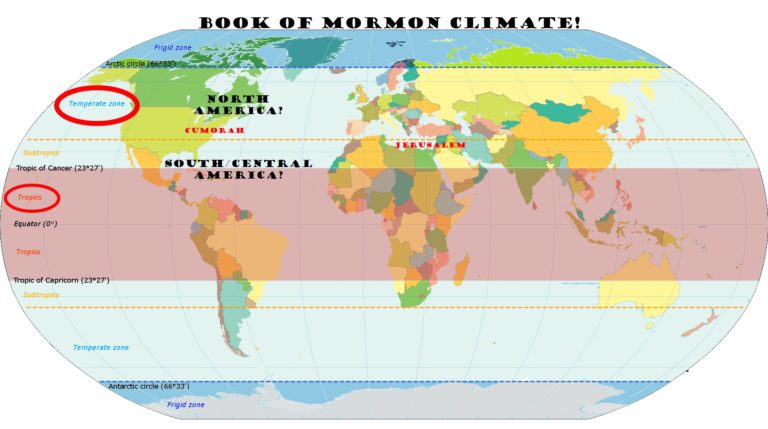
M2C means, “Mesoamerica Two Cumorah Theory”, as defined by Jonathan Neville. In other words those who believe there are two Hill Cumorah’s, one in New York where Joseph deposited the plates, and a second Hill Cumorah somewhere in Mexico where the final battles of the Nephites and Lamanites took place. YES, they really believe this! Why? 1. They need to justify that their theory has to have happened in Mesoamerica. 2. They insist the area around NY Cumorah is too small to be a place for such disaster. 3. They claim no bones, arrowheads, iron, copper and other artifacts have ever been found near the NY Cumorah. My Proof Here 4. They believe the Cave at Hill Cumorah that Joseph entered and saw wagon loads of plates was just a dream and didn’t really happen. Blog, Other Blog 5. They believe Moroni traveled over 3,500 miles to NY to bury the plates.
John L. Sorenson begins his Preface to Mormon’s Codex: An Ancient American Book, with these observations:
“This book presents a wide array of evidence that the Book of Mormon is an ancient historical record that could only have been produced by a writer who lived in Mesoamerica (southern Mexico and northern Central America) many centuries before Spanish explorers reached that area…. Numerous theories have, of course, been proposed to correlate Book of Mormon geography with the modern map of the Americas. None of these theories have been considered definitive by authorities of the Church of Jesus Christ of Latter-day Saints. In chapters 2 and 7, I explain why I consider only one of those theories–involving a particular area in Mesoamerica–to escape the fatal flaws exhibited by all the others.”
I suspect most readers glide right over this sleight-of-hand rhetoric. The truth, though, is that Church authorities have always made a clear distinction between fact and theory regarding Book of Mormon geography.
Fact: The Hill Cumorah is in New York. This was established as a fact in Letter VII, written by President Oliver Cowdery who was an eye-witness to the depository of Nephite records in that hill (Mormon 6:6). Joseph Smith helped write these letters, had them copied into his personal history, and endorsed their republication for the rest of his life. The fact that Cumorah is in New York has been repeated many times by Church leaders, including by members of the First Presidency speaking in General Conference. No member of the First Presidency or Quorum of the Twelve has ever repudiated this teaching of his predecessors.
Theory: Church leaders have always said don’t know for sure the locations of other Book of Mormon events, so every proposed geography other than the New York Cumorah is necessarily a theory.
All of this means that, starting right from the outset, Mormon’s Codex is propaganda, not scholarship…
Brother Sorensen also says, “There remain Latter-day Saints who insist that the final destruction of the Nephites took place in New York, but any such idea is manifestly absurd. Hundreds of thousands of Nephites traipsing across the Mississippi Valley to New York, pursued (why?) by hundred of thousands of Lamanites, is a scenario worthy only of a witless sci-fi movie, not of history.” Mormon’s Codex, p. 688…
The treatment of Cumorah in Mormon’s Codex is an illusion of scholarship, as you’ll see if you read it carefully. Here are some examples:
“In the final stage of their retreat, all the identifiable Nephites assembled near the hill Cumorah, probably Cerro El Vigia in south-central Veracruz….
When all the remaining Nephites were ‘gathered in,’ the numerically superior Lamanite horde waged battle. In a single day they exterminated all 23 units of the defenders (each nominally of 10,000 men)….
Finally, the hill where the end came for the Jaredites, who called it Ramah, and the location of the last battle of the Nephites at the same hill (they called it Cumorah), have a highly likely correspondence to Cerro El Vigia (see fig. 7.2), an outlier on the northwest of the Tuxtla Mountains. In overall location and in a dozen other features, the textual information in the Book of Mormon agrees with the geographical situation. 72″
In classic M2C citation cartel fashion, Footnote 72 (page 142) cites David A. Palmer, In Search of Cumorah (Bountiful, UT: Horizon Publishers, 1992). Brother Palmer, of course, encouraged Brother Sorenson to write his books…
Brother Palmer is the one who wrote the self-serving entry on Cumorah in the Encyclopedia of Mormonism that cites only his own book for authority, again in classic M2C citation cartel fashion. You can read my discussions of his book if you search for “David Palmer” on this blog. Brother Palmer cites the anonymous articles in the Times and Seasons for authority, while ignoring the teachings of the prophets entirely, except for a brief dismissal of Letter VII, which he doesn’t even quote. _____
As you go through the “criteria” for Cumorah set forth in Mormon’s Codex and In Search of Cumorah, you’ll see that the criteria are derived not from the text but from the assumed Mesoamerican setting. There must be volcanoes, for example, which Mormon and Moroni forgot to mention but which Brothers Sorenson and Palmer thoughtfully provide.
As I noted at the outset, once you recognize that Mormon’s Codex is a long-winded justification for repudiating the prophets, you see the logical fallacies and circular reasoning throughout.
To be clear, I do not reject the Mesoamerican setting and I won’t until it has not been rejected by the prophets. However, I think it is implausible, given the New York Cumorah. I think the evidence from ancient North America aligns far better with the text of the Book of Mormon than the evidence from Mesoamerica, Baja, Panama, etc.
For me, the distinction between fact and theory, between the New York Cumorah and everything else, is so well established by the prophets that it is inexcusable to censor, let alone repudiate, the teachings of the prophets…
It’s a side benefit that the fact of the New York Cumorah is so well supported by available archaeology, anthropology, geography, and geology. Mormon’s Codex is a classic case of the tail wagging the dog.” Jonathan Neville Illusion of scholarship – Mormon’s Codex part 3
“Sorenson’s analysis of Alma 22 seems to be influenced by the Times and Seasons article published on 1 October 1842, which declares that the Nephite city of Zarahemla “stood upon” “Central America or Guatimala [sic].” Sorenson cites this passage from the Times and Seasons, although he recognizes the “fact that the geography question had not been settled authoritatively.”[1] In Mormon’s Codex, Sorenson relegates the Times and Seasons articles to a footnote in support of his unequivocal conclusion: “Joseph Smith became convinced in the last years of his life that the lands of the Nephites were in Mesoamerica.”[1]
Sorenson’s assumptions about Central America lead him to a preconceived concept of Book of Mormon geography; i.e., a narrow neck of land between two larger land masses. Perhaps he felt somewhat bound by the Times and Seasons articles and his inference that Joseph Smith agreed with them. As such, Sorenson’s work could be viewed as an effort to vindicate the Prophet’s words.” Moroni’s America by Jonathan Neville pages 26-28
From a strict cultural and linguistic perspective, it would include all countries and territories where Romance languages — Spanish, Portuguese, French, and their creoles — are spoken.
The most common view is that Latin America includes territories in the Americas where Spanish or Portuguese prevail: Mexico and most of Central America, South America, and (per land area and population) the Caribbean. The acronym “LACRO” refers to this view. The English-speaking American countries are not considered to be part of Latin America. Territories where other Romance languages such as French (e.g., Quebec in Canada) or Kreyol (e.g. Haiti, Martinique and Guadeloupe) predominate are frequently not considered to be part of Latin America from this perspective, despite the French origins of the concept. The former Dutch colonies Suriname, Netherlands Antilles and Aruba are not considerend parts of Latin America, even though in the latter two, the predominantly Iberian-influenced language Papiamentu is spoken by the majority of the population.
Green- Latin America
Sometimes, particularly in the United States, the term “Latin America” is used to refer to all of America south of the U.S., including countries such as Belize, Trinidad and Tobago, Guyana, Jamaica, Barbados and Suriname where non-Romance languages prevail. Conversely, it is often used in Brazil to designate the Spanish-speaking countries within this area, which are often known as Hispanic America.
Geopolitically, Latin America is divided into 20 independent countries and several dependent territories. Spanish is predominant and an official language in most Latin American countries, with the exception of Brazil where Portuguese prevails. Source
Moroni’s America Chapter 29 – Latin America and The Book of Mormon
Click to Purchase
In The Lost City of Zarahemla, I discussed the impact of the North American setting on people who live outside the United States. I suggested three ways in which native peoples in Central and South America can be Book of Mormon people.
First, they could be among the “other sheep” Christ visited. The numerous legends of a “white God” and other elements of a Biblical nature could be attributable to such visits, even though there are no records extant.
Second, the “Hinterlands” theory suggests that descendants of Lamanites migrated southward.
Third, the Jaredite civilization, which came from Asia, expanded throughout the continent. As I wrote there, “In some respect, the Book of Ether is largely forgotten as a history of the inhabitants of the American continent, probably because of a widely held perception in the Church that the Jaredites were completely killed off, leaving only a sole survivor to meet the Mulekites. I propose that this notion is incorrect and that the Jaredites are at least one of the sources of the Asian DNA found in indigenous Latin Americans.” Moroni’s America Chapter 29 – Latin America and The Book of Mormon
“Concluding as I have that the Mesoamerican theory originated out of misplaced missionary zeal (or a focus on the hinterlands), I was curious about what a “correct” geography would look, like. The work of Sorenson and others has been invaluable in this pursuit-but it led me to a much different conclusion. Sorenson’s work excludes Mesoamerica as a viable setting for the Book of Mormon. “The Lost City of Zarahemla” by Jonathan Neville page 357
John Sorensen also denies the Heartland model by saying, “There remain Latter-day Saints who insist that the final destruction of the Nephites took place in New York, but any such idea is manifestly absurd. Hundreds of thousands of Nephites traipsing across the Mississippi Valley to New York, pursued (why?) by hundreds of thousands of Lamanites, is a scenario worthy only of a witless sci-fi movie, not of history.” John L. Sorenson, Mormon’s Codex (Deseret Book, 2013), p. 688.
“Hinterlands is defined here as meaning the unknown area of North and South America that are not within the scope of the writings of the Book of Mormon. In other words, since we believe main events of the Book of Mormon happened in a limited area of North America around the Great Lakes in the east, and Ohio, Indiana, Iowa and Missouri to the west, and south in Tennessee, West Virginia, Georgia, and Florida, all other areas will be discussed as “The Hinterlands”. We propose that Mesoamerica is the Hinterlands along with many other areas of the continent. As Mormon has said, “…I shall take from the plates of Nephi; and I cannot write the hundredth part of the things of my people (Words of Mormon 1:5). There are many people in South and Central America that are Lamanites and part of the Hinterlands.” Jonathan Neville
“From a theological perspective, there is another way to address the question of Lamanites and Latin America.
In 3 Nephi 16, the Lord gave an extended sermon about the “lost sheep of Israel,” the Gentiles, and the house of Israel. There are several key points.
1. The Lord said he had “other sheep which are not of this land.” If, as I propose, “this land” refers to North America, then Christ could have been referring to people in Mesoamerica and South America, as well as anywhere else in the world. The heading to the chapter refers to the “lost sheep of Israel,” but the text itself does not use that phrase. In fact, according to Mosiah 26:21, “he that will hear my voice shall be my sheep and him shall ye receive into the church and him will I also receive.” This suggests that the “sheep” in 3 Nephi 16 were not necessarily of the house of Israel, but anyone who hears the Lord’s voice. The Lord’s sheep could be Mesoamericans, Asians, Africans—anyone.
Moroni’s America-Maps Edition 150 Pages, AND Moroni’s America-Land Bountiful Edition 60 Maps. 210 Total Maps, PLUS receive the All-New 20″ x 30″ Folding Travel Map. Buy ALL THREE and Save 18%.
2. The Lord’s sayings were to be kept and manifested unto the Gentiles, “that through the fullness of the Gentiles” the remnant of their seed—meaning the Lord’s people at Jerusalem, or the Jews—may be brought to a knowledge of their Redeemer, and thereby be gathered.
3. The truth was to come unto the Gentiles, who were to scatter the Lord’s people who are of the house of Israel. The Europeans did scatter the tribes from Eastern North America (through the Removal Act of 1830 and the many treaties that placed them on reservations), but the indigenous people in Latin America still live where they always have.
4. At a future date, the Gentiles would rebel. “At that day when the Gentiles shall sin against my gospel, and shall reject the fullness of my gospel,” the Lord will bring the fullness of the gospel from among them. And then he will remember his covenant with the house of Israel. So it seems consistent with the scriptures for the gospel to be taken to the Gentiles—including the people in Latin America—before it is taken to the descendants of the people to whom the Lord was speaking; i.e., the Lamanites. At this point—still future—the Lord says:
12 And I will show unto thee, O house of Israel, that the Gentiles shall not have power over you; but I will remember my covenant unto you, O house of Israel, and ye shall come unto the knowledge of the fullness of my gospel.
13 But if the Gentiles will repent and return unto me, saith the Father, behold they shall be numbered among my people, O house of Israel.
14 And I will not suffer my people, who are of the house of Israel, to go through among them, and tread them down, saith the Father.
15 But if they will not turn unto me, and hearken unto my voice, I will suffer them, yea, I will suffer my people, O house of Israel, that they shall go through among them, and shall tread them down, and they shall be as salt that hath lost its savor, which is thenceforth good for nothing but to be cast out, and to be trodden under foot of my people, O house of Israel.
16 Verily, verily, I say unto you, thus hath the Father commanded me—that I should give unto this people this land for their inheritance.
At the end of this sermon, the Lord told the people, “I perceive that ye are weak, that ye cannot understand all my words which I am commanded of the Father to speak unto you at this time. Therefore, go ye unto your homes and ponder upon the things which I have said, and ask of the Father in my name that ye may understand.” (3 Nephi 17: 1-2) That advice applies to us today as well. (My novel, The Rule of Equity, proposes one possible way the promises in chapters 16 and 20 of 3 Nephi could be fulfilled.)
The Lord did resume this sermon, starting with 3 Nephi 20:10. In verse 22, he explains, “this people will I establish in this land . . . and it shall be a New Jerusalem.”
The New Jerusalem, of course, will be in Jackson County, Missouri” Moroni’s America Chapter 29 – Latin America and The Book of Mormon
“During Zion’s Camp while in Illinois, and Missouri, the prophet Joseph Smith said, “ …Wandering over the plains of the Nephites, recounting occasionally the history of the Book of Mormon, roving over the mounds of that once beloved people of the Lord, picking up their skulls & their bones, as a proof of its divine authenticity…” This cannot mean that while Joseph was picking up the bones of Nephites in Illinois that he was referring to divine authenticity of a Mesoamerica record.” Jonathan Neville
I think it is a great time in life to stop trying to avoid trials. “Trials Happen” Trials are necessary for spiritual growth. If you have never had trials and challenges how can you ever appreciate the great things in your life. There must be an opposite in all things.
Of course I do know quite a few people who don’t seemingly have many trials. They have money, a happy marriage, a great job and seem happy in life. If having these great things and yet having no trials, I don’t think anyone could have as good of a life to come, without some trials to overcome. The more we have a challenge and overcome it, the more we learn on our path to Godhood.
Believe me, I don’t ask God for trials but they just keep coming which I am grateful for. I have a wonderful Aunt Beth who always said to me “I never worry when I have a trial, I worry when I don’t have one, as they strengthen my testimony.”
Try this experiment. Next time you have a trial, stop for a moment and say. Thank you Lord for this trial. What is it I can learn from it? You can either get closer to the Lord or further from Him. It’s your choice.
This past conference was wonderful. I loved Elder Holland’s and President Nelson’s talks below. Here is a small portion of them.
Waiting on the Lord
By Elder Jeffrey R. Holland Of the Quorum of the Twelve Apostles Oct 2020
Faith means trusting God in good times and bad, even if that includes some suffering until we see His arm revealed in our behalf.
My beloved brothers and sisters, we are all eager—no one more than I—to hear concluding remarks from our beloved prophet, President Russell M. Nelson. This has been a marvelous conference, but it is the second time that COVID-19 has altered our traditional proceedings. We are so tired of this contagion, we feel like tearing our hair out. And apparently, some of my Brethren have already taken that course of action. Please know that we do pray constantly for those who have been affected in any way, especially for any who have lost loved ones. Everyone agrees that this has gone on much, much too long.
How long do we wait for relief from hardships that come upon us? What about enduring personal trials while we wait and wait, and help seems so slow in coming? Why the delay when burdens seem more than we can bear?…
COVID and cancer, doubt and dismay, financial trouble and family trials. When will these burdens be lifted? The answer is “by and by.”17 And whether that be a short period or a long one is not always ours to say, but by the grace of God, the blessings will come to those who hold fast to the gospel of Jesus Christ. That issue was settled in a very private garden and on a very public hill in Jerusalem long ago…” Jeffrey R. Holland
A New Normal
By President Russell M. Nelson President of The Church of Jesus Christ of Latter-day Saints Oct 2020
I invite you to turn your heart, mind, and soul increasingly to our Heavenly Father and His Son, Jesus Christ…
We live in a glorious age, foreseen by prophets for centuries. This is the dispensation when no spiritual blessing will be withheld from the righteous.1 Despite the world’s commotion,2 the Lord would have us look forward to the future “with joyful anticipation.”3 Let us not spin our wheels in the memories of yesterday. The gathering of Israel moves forward. The Lord Jesus Christ directs the affairs of His Church, and it will achieve its divine objectives.
The challenge for you and me is to make certain that each of us will achieve his or her divine potential. Today we often hear about “a new normal.” If you really want to embrace a new normal, I invite you to turn your heart, mind, and soul increasingly to our Heavenly Father and His Son, Jesus Christ. Let that be your new normal.
Embrace your new normal by repenting daily. Seek to be increasingly pure in thought, word, and deed. Minister to others. Keep an eternal perspective. Magnify your callings. And whatever your challenges, my dear brothers and sisters, live each day so that you are more prepared to meet your Maker.4(Pres Russell M Nelson color and italics added)
Elder Holland compares pornography to COVID-19 in address to Utah Coalition Against Pornography
Elder Jeffrey R. Holland of the Quorum of the Twelve Apostles gives a remote keynote address for the Utah Coalition Against Pornography annual conference on Saturday, Sept. 12, 2020. Credit: Screenshot
In offering the keynote address at that same conference on Sept. 12 — this time delivered remotely due to precautions for COVID-19 — Elder Holland said, “Well, I guess we’d better be careful what metaphors we use because we have been given such a plague.”
The UCAP’s annual conference, called the Rally for Hope and Healing, was held at the Burns Arena on the Dixie State University campus in Southern Utah. In his remarks, which were livestreamed to participants in St. George and elsewhere, Elder Holland outlined the “striking similarities between pornography and COVID-19” and offered hope and encouragement to the “foot soldiers in the war against pandemics, whether of the body or the mind.”Elder Jeffrey R. Holland of the Quorum of the Twelve speaks at the 14th annual Utah Coalition Against Pornography held in Salt Lake City, Utah on March 12, 2016. Credit: Courtesy UCAP
“As we conquer COVID-19 — and we will — may we be equally committed right now to conquering this other pandemic and free the world from the plague of pornography,” he declared.
In the first of his comparisons between COVID-19 and porn, Elder Holland explained that the coronavirus spreads through small, imperceptible droplets in the air. Those who are infected with the small particles — 1,000 times smaller than a grain of sand — may not initially recognize the danger and therefore “may or may not have taken appropriate precautions against this seemingly ubiquitous aggressor.”
“This sounds eerily like the infection of pornography,” Elder Holland said. “Exposure begins through small, simple, visual droplets about which even the victim may not fully appreciate the danger.” Sadly, “the little pornographic germs” are pervasive — television, movies, checkout counters, cell phones and iPads — so that exposure goes on and on.
While washing hands, using sanitizer, wearing a mask and observing social distancing can help protect against COVID-19, “pornography does not know how to be clean or to be masked or to keep any distance at all,” the Church leader said.
And while there is hope for the development of some form of inoculation to COVID-19, “I am not aware of a wonder drug coming to counter pornography, so we must conquer it another way,” he said.
Elder Holland then explained “more than you ever wanted to know about these two plagues.” Once in the body, COVID-19 forms spikes on its surface that contain three elements that help the virus access the ACE2 receptors of cells. After attaching, the virus deposits its genetic material inside the cell and quickly replicates itself until the cell bursts.
Like COVID-19’s “sticky” spikes, pornography has three elements that make it a particularly contagious disease. Quoting Dr. Al Cooper, Elder Holland explained that those three elements are accessibility, affordability and anonymity. Due to its widespread accessibility, porn’s onslaught is constant. “And because porn is available for free on a variety of internet-enabled devices, it is available to any viewer whenever and wherever he or she wants it — usually the darkest and most private hour and location possible, allowing it to be viewed anonymously in most cases.”
What of the impact of “these two plagues?” Elder Holland asked. COVID-19’s impact varies, though it is generally worse for those over 60. Some will never know they had it while others end up on a respirator, having their blood artificially oxygenated, or dying from the disease. “These victims can no longer rely on their own natural capabilities. Instead, they must live artificially to survive from day to day.”
Elder Jeffrey R. Holland of the Quorum of the Twelve Apostles gives a remote keynote address for the Utah Coalition Against Pornography annual conference on Saturday, Sept. 12, 2020. Credit: Screenshot
In contrast, no one escapes pornography unscathed as some might with COVID-19, and it reverses its audience — attacking the young more viciously than the elderly. “Like COVID-19’s worst victims, pornography takes what is normal and natural and makes it artificial for everyone who uses it. Because it rewires the neural pathways in your brain, to leave it will require constant monitoring of your thoughts and feelings, not unlike the greatest monitoring of the lungs or blood of COVID-19 patients,” he said.
Both COVID-19 and pornography create a form of social distancing, he continued, where family and friends feel powerless. But where COVID-19’s isolation is compelled by public officials, porn’s isolation is voluntary, stemming from a fear of being found out. “Unfortunately, users think that when they use it in isolation that they can restrain the contagion like someone in quarantine does for COVID-19,” he said. “Yet this isolation only perpetuates the disease instead of isolating it.”
Pornography distorts the very nature of love, he said, which is as important to a fully functioning human as the cells that make up the body. Calling COVID-19 “a destructive, intracellular parasite,” Elder Holland explained that the virus hijacks a cell’s reproduction machinery and relentlessly replicates itself until the host cell bursts from the buildup of the viruses.
“Similarly,” he said, “when pornography hijacks our love and emotions unnaturally, we struggle to replicate them naturally.” He then quoted Dr. Gail Dines who said, “In porn[ography], sex is not about making love. The feelings and emotions we normally associate with such an act — connection, empathy, tenderness, caring, affection — are missing. In their place are those emotions we normally associate with hate — fear, disgust, anger, loathing and contempt.”
For those who give illicitly only part of that which cannot be followed with the gift of their whole heart, Elder Holland warned, “is its own form of emotional Russian roulette. If they persist in sharing part without the whole, in pursuing satisfaction devoid of loyalty and love, giving parts and pieces and inflamed fragments only, they run the terrible risk of such spiritual, psychic damage that they may undermine both their physical intimacy and their wholehearted devotion to those who love them most — in reality, not virtually.”
Recognizing that many in the audience have “deeply personal hopes,” Elder Holland said, “Because God does work in this world, we can hope — we should hope — even when facing the most insurmountable odds. … We all need to believe that what we desire in righteousness can someday, someway, somehow yet be ours.”
With COVID-19, there is hope for a vaccine. “As we have learned with flu and other vaccines, they are not always perfect. Similarly, efforts to protect yourself, your spouse, child, family member, or other associate from pornography may be successful by degrees.”
Elder Holland recognized that those who struggle will need help. “For the kind of painful loneliness that some suffer here today, the best help always comes from heaven.”
Look forward with faith and courage, he said. “Do not replicate the longing look of Lot’s wife back to Sodom and Gomorrah. That leads to salty, bitter experiences. It does not matter whether you are looking back for grief, pain, desire, or some other reason. Learn from the past, but don’t wallow in it,” he said.
In a remote address livestreamed to the annual UCAP conference on Sept, 12, 2020, Elder Jeffrey R. Holland shares a lesson from President Russell M. Nelson’s career as a heart surgeon. Credit: Screenshot
Many years ago, a young heart surgeon — Dr. Russell M. Nelson — operated on two siblings, but, despite his best efforts, he lost them both. Although he was ready to quit, his wife Dantzel explained that if he quit, someone would have to learn what he already learned, which would take a long time and result in the loss of additional lives in the process.
“Part of life is coming up against obstacles such as pornography and pandemics and conquering them, destructive as they are,” Elder Holland said. “Some problems are of our own making, and others simply happen to us. We face what we must face, and we persevere. It means squaring our shoulders and stiffening our back and staying with a virtuous effort.”
Use pains, temptations and traumas, Elder Holland told listeners. “Harness them as a moving force to be better, to become better. Allow God-given gifts to come out in you. When you are a creator, you focus more on the positive and less on the things that are destroying or hurting you. Let your pain lead you to your Heavenly Father who loves you.”
Elder Holland said he is not oblivious to the fact that this is a “wrenching, terribly harrowing problem.” Many have been trying to help themselves or others battle this demon for years.
“In some sense, we are all distant spectators to one another,” he said. “Not one of us has suffered what the other has suffered. However, I believe there is One who has. Each person will have to counsel and pray and work through that with Him. We cannot live without hope. Every one of you needs to have hope. Christ Jesus gives us that hope because in some incredible way, He has in effect been where you have been and felt what you have felt.”
The Lord will always bless those who want to improve, who accept the need for commandments and try to keep them, who cherish Christlike virtues and strive to the best of their ability to acquire them. “If you stumble in that pursuit, so does everyone; the Savior is there to help you keep going,” Elder Holland said. “If you fall, summon His strength. Get back up. Call out like one did, ‘O Jesus, … have mercy on me’ (Alma 36:18).”
Christ will help individuals repent, repair, fix whatever needs to be fixed and keep going. “Soon enough you will have the success you seek,” he said.
When others try and ban certain words or wont listen to another’s opinion they are turning this Miracle we call America upside down. Whenever there is disagreement we should have more dialogue, not less. Banning words or phrases or books is a terrible way the progressives use today to take away our God-given rights.
Plead for America
“I plead with you this evening to pray for this country, for our leaders, for our people, and for the families that live in this great nation founded by God… this country was established and preserved by our founding fathers and mothers who repeatedly acknowledged the hand of God through prayer… We must stand boldly for righteousness and truth, and must defend the cause of honor, decency, and personal freedom espoused by Washington, Madison, Adams, Lincoln, and other leaders who acknowledged and loved God… We must stand boldly for righteousness and truth, and must defend the cause of honor, decency, and personal freedom espoused by Washington, Madison, Adams, Lincoln, and other leaders who acknowledged and loved God… Please look for the Lord’s hand in your lives and in the lives of your family, as I do in the lives of my ancestors and family,” he said. “Expect it. Do not dismiss it. Do not relegate the experiences in your lives to coincidences. From the signing of the Declaration of Independence in July 1776 through the signing of the U.S. Constitution in September 1787, the “wise men” whom the Lord “raised up unto this very purpose… As an apostle of the Lord Jesus Christ, I have a solemn duty to face the Lord and deliver His message,” said President Ballard. “His words often include words of encouragement and expressions of love. They also include words of warning. America and the nations of the earth, as in times past, “are at another crossroad… Let it begin today that we take leadership and reach out in our own prayers and encourage our neighbors, our friends, our families … to pray for this country that we all love much.” President Ballard pleads with Latter-day Saints to ‘pray for this country’ as United States is at ‘another crossroad by Sarah Jane Weaver church News. Link here: https://www.thechurchnews.com/leaders-and-ministry/2019-10-21/pray-for-the-united-states-its-leaders-and-its-family-president-ballard-pleads-164797
“…in culmination of the grand scheme of schemes, this great nation, the Republic of the United States, might be established upon this land as an asylum for the oppressed; a resting place, it might be said, for the Ark of the covenant, where the temple of our God might be built; where the plan of salvation might be introduced and practiced in freedom, and not a dog would wag his tongue in opposition to the purposes of the Almighty. We believe that this was His object in creating the Republic of the United States; the only land where his work could be commenced or the feet of his people find rest. No other land had such liberal institutions, had adopted so broad a platform upon which all men might stand. We give glory to those patriots for the noble work they did; but we give the first glory to God, our Father and their Father, who inspired them. We take them by the hand as brothers. We believe they did nobly their work, even as we would fain do ours, faithfully and well, that we might not be recreant in the eyes of God, for failing to perform the mission to which He has appointed us.” Bishop Orson F. Whitney, delivered in the Tabernacle, Salt Lake City, Sunday Afternoon, April 19, 1885. Reported by John Irvine. Journal Discourses Volume 26 Page 201
Mark E. Petersen said: “You from other lands don’t need to become jealous of America. Who is jealous of Palestine, where Jesus was born? We are not jealous of the country; we merely recognize the hand of God in sending him there. We must also recognize the hand of God in sending the gospel to this land. We learn to love America because it is God’s land!
Celebrating First Amendment Rights
Religious Freedom Day is celebrated in America each year on January 16 — the date of the 1786 passage of Thomas Jefferson’s Virginia Statute of Religious Freedom. That measure ended the state-established church in Virginia and for the first time placed all denominations on the same legal footing. That act fully protected the right of religious conscience — one of the first rights protected in America. As John Quincy Adams affirmed, “The transcendent and overruling principle of the first settlers of New England was conscience.”
When America became an independent nation, the first state constitutions similarly protected the rights of religious conscience, such as that of North Carolina:
That all men have a natural and unalienable right to worship Almighty God, according to the dictates of their own conscience.Source
73% Say Freedom of Speech Worth Dying For
Rasmussen Reports Wednesday, August 23, 2017. 73% Say Freedom of Speech Worth Dying For
Americans agree freedom of speech is under assault but strongly insist that they are prepared to defend that freedom even at the cost of their lives if necessary.
A new Rasmussen Reports national telephone and online survey finds that an overwhelming 85% of American Adults think giving people the right to free speech is more important than making sure no one is offended by what others say. Just eight percent (8%) think it’s more important to make sure no one gets offended. (To see survey question wording, click here.)
This shows little change from past surveying. Eighty-three percent (83%) think it is more important for the United States to guarantee freedom of speech than it is to make sure nothing is done to offend other nations and cultures. Seventy-three percent (73%) agree with the famous line by the 18th century French author Voltaire: “I disapprove of what you say but will defend to the death your right to say it.” Only 10% disagree with that statement, but 17% are undecided.
Among Americans who agree with Voltaire, 93% rate freedom of speech as more important than making sure no one is offended. That compares to just 69% of those who disagree with the French author’s maxim.
The national survey of 1,000 American Adults was conducted on August 17 & 20, 2017 by Rasmussen Reports. The margin of sampling error is +/- 3 percentage points with a 95% level of confidence. Field work for all Rasmussen Reports surveys is conducted by Pulse Opinion Research, LLC.
Just 28% of Americans believe they have true freedom of speech today, and most think the country is too politically correct.
There is rare partisan agreement on freedom of speech. Most Americans regardless of political affiliation agree that they would defend someone’s right to say something even if they don’t agree with it, although Democrats are slightly less sure than Republicans and those not affiliated with either major party. The majority across the political spectrum also agree that free speech is more important than making sure no one’s offended.
Generally speaking, most adults across the demographic board agree. Blacks (65%) are just slightly less likely than whites (75%) and other minorities (73%) to say they’d defend to the death someone’s right to free speech if they don’t agree with them.
Men are more supportive of the statement that women are.
Voters rate freedom of speech as even more important than other basic constitutional rights such as religious freedom, freedom of the press and the right to bear arms
After conservative pundit Ann Coulter was forced to cancel a planned speech at University of California, Berkeley, in the late spring following protests and threats of violence by some students. 44% of Americans said there is less freedom of speech on U.S. college campuses today than there has been in the past. Nearly half (47%) also believe most college administrators and professors are more interested in getting students to agree with certain politically correct points of view rather than in a free exchange of ideas.
In May, just 19% of voters felt that the United States should erase symbols of its past history that are out of line with current sentiments.
Despite calls by some politicians and the media for erasing those connected to slavery from U.S. history, voters strongly believe it’s better to learn from the past than erase it.
Just 20% of Americans say it is better for owners of social media like Facebook and Twitter to regulate what is posted to make sure some people are not offended.
Banned Words by FG
Posted here June 29, 2015
It’s in the First Amendment to the United States Constitution, for goodness sakes: “Congress shall make no law . . . abridging the freedom of speech . . .” Is there anyone who doesn’t understand what that means? It means as a free American citizen I can say whatever I want (as long as my words don’t lead to the physical harm of others — like shouting “fire” in a movie theater, for example). My thoughts and words are not controlled by the government. I am free to say whatever I wish.
Yet, there are colleges and universities across the country compiling lists of words students must not use, phrases that are forbidden, and all sorts of rules about what can and can not be spoken. These, mind you, are the institutions intended to be forums of debate; they’re where issues are expected to be argued back and forth. These are the institutions that now wish to squelch any comment they disagree with.
The First Amendment wasn’t provided to protect uncontroversial speech. There’s no need to protect that; it’s uncontroversial. The First Amendment was expressly provided to protect uncomfortable, disagreeable, and contentious speech.
The ‘Inclusive Language Campaign’ at the University of Michigan (Source.)
Dozens of posters plastered across the University of Michigan caution students not to say things that might hurt others’ feelings, part of a new “Inclusive Language Campaign” at the state’s flagship public university that cost $16,000 to implement.
Words declared unacceptable through the campaign include “crazy,” “insane,” “retarded,” “gay,” “tyranny,” “gypped,” “illegal alien,” “fag,” “ghetto” and “raghead.” Phrases such as “I want to die” and “that test raped me” are also verboten.
University spokesman Rick Fitzgerald said the campaign aims to “address campus climate by helping individuals understand that their words can impact someone, and to encourage individuals to commit to creating a positive campus community.”
Macalester College Seeks to Ban ‘Offensive Phrases’ Like ‘You Guys,’ ‘Derp’ . (Source.)
Students at Macalester College in St. Paul, Minnesota are going to have to start watching their tongues, for a new campaign introduced on campus seeks to ban words like “girl,” “derp,” “lame,” “crazy,” “gay,” “invalid,” “spaz,” “retarded,” and “you guys” in an effort to halt “oppressive” language.
The campaign encourages students to become more aware of the words they use, because if they don’t, they “may inadvertently use the power of our voice to oppress and degrade others.”
Elon University Bans the Word “Freshman” (Source.)
Elon University in North Carolina has banned the word “freshman” from its website and student orientation, claiming it’s sexist and suggests that the young women might make good rape victims. It’s replacing the word with the term “first-year.”
Ironically, numerous students have stated they were actually more comfortable with the word “freshman.”
The University of North Carolina at Chapel Hill has also eliminated the word “freshman” from its official university documents as part of a concerted effort to use “gender inclusive language.” (Source.)
PC Police at UC Berkeley Want to Ban One of the Most American Phrases of All Time (Source.)
The administrators at UC Berkeley want to ban certain phrases on campus. Among them: “America is a melting pot,” “Why are you so quiet?” and “I believe the most qualified person should get the job.”
These innocent phrases are said to be racist and sexist.
At Hinds Community College in Mississippi, “public profanity, cursing and vulgarity” are all punishable with a $25 fine for a first offense, and a $50 fine for a second offense.
Further, the offense of “flagrant disrespect” (which may be demonstrated by swearing), can earn a student demerits that could lead to suspension.
Forbidden at the University of California (Source.)
A University of California faculty seminar discussed “diversity in the classroom” at nine of the 10 UC campuses during the 2014-2015 school year. A worksheet at these ceminars was entitled “Tool: Recognizing Microagressions and the Messages They Send.” The opening sentence: “Microaggressions are the everyday verbal, nonverbal, and environmental slights, snubs, or insults, whether intentional or unintentional, that communicate hostile, derogatory, or negative messages to target persons based solely upon their marginalized group membership.” The ultimate cure for such “hurtful” behavior? Banning free speech.
Examples of “microagression” statements were listed: “You are a credit to your race.” And “Wow! How do you become so good in math?” And “Everyone can succeed in this society, if they work hard enough.” And “Where are you from” or “where were you born?” And (said to an Asian person): “You must be good in math, can you help me with this problem?” And (to a woman of color): “I would have never guessed you were a scientist.” (Source.)
“Mr.,” “Mrs.,” and “Ms” are being shown the door at the Graduate Center of the City University of New York.
At CUNY, school staffers have been advised to refrain from using gendered salutations in correspondence with students — and instead use a student’s full name, according to an internal university memo.
Campus Speech Codes: Absurd, Tenacious, and Everywhere (Source.)
The University of Connecticut banned the “use of derogatory names, inappropriately directed laughter, inconsiderate jokes, anonymous notes or phone calls, and conspicuous exclusions from conversations and/or classroom discussions.”
Free Speech Dying a Slow Death on Campus (Source.)
It was reported in The Washington Post that, during a university panel on free speech (of all things), “Smith [College] President Kathleen McCartney had joked, ‘We’re just wild and crazy, aren’t we?’ In the transcript, the word ‘crazy’ was replaced by the notation: ‘[ableist slur].”
Term of Endearment Is on List of Words to Ban (Source.)
The word “bae” is on a list of a dozen words to be banned at Lake Superior State University. Others include “cra-cra” (short for crazy-crazy), “takeaway,” “swag,” “curate,” (which means chosen), “skill set,” “enhanced interrogation,” and “foodie.” Other words: “polar vortex,” (a large pocket of very cold air), “friend-raising,” “hack,” (meaning to gain unauthorized access by manipulating a computer code), and “-Nation” when used as a suffix for fans of a sports team, celebrity, or politician.
Lake Superior State has been publishing a list of bad words since Jan. 1, 1976.
In their 1993 book, The Shadow University, Alan Charles Kors and Harvey Silverglate turned some of the early speech codes into national laughingstocks. Among the banned comments and action they listed: “intentionally producing psychological discomfort” (University of North Dakota), “insensitivity to the experience of women” (University of Minnesota), and “inconsiderate jokes” (University of Connecticut). Serious nonverbal offenses included “inappropriate laughter” (Sarah Lawrence College), “eye contact or the lack of it” (Michigan State University), and “subtle discrimination,” such as “licking lips or teeth; holding food provocatively” (University of Maryland).
Later gems, added well after the courts struck down (as overly broad) some campus conduct codes, included bans on “inappropriate non-verbals” (Macalaster College), “communication with sexual overtones” (Lincoln University), and “discussing sexual activities” (State University of New York at Brockport). Other campus codes bar any comment or gesture that annoys, offends, or otherwise makes someone feel bad. Tufts ruled that attributing harassment complaints to the “hypersensitivity of others who feel hurt” is itself harassment.
Free Speech and Safe Spaces on College Campuses (Source.)
Free speech has become an increasingly limited and precarious right, especially on college campuses. Some 58 percent of public campuses still enforce shockingly illiberal speech codes. Furthermore, 1 in 6 of America’s largest and most prestigious colleges have free speech zones which limit where free speech can occur. Some of these zones compromise areas as miniscule as 1.37 percent of the total campus, and many require weeks-long approval processes for any expressive activity.
Speech Codes Have Expanding Dramatically (Source.)
There were approximately 75 hate speech codes in place at U.S. colleges and universities in 1990; by 1991, the number had grown to over 300.
Critics assert that the costs of hate speech codes far outweigh their benefits. Threatened by “politically correct” speech codes, students will be afraid to speak in classes. As a social institution, a university should be open to all opinions, popular and unpopular. As Oliver Wendell Holmes commented, “The very aim and end of our institutions is just this: that we may think what we like and say what we think.” Speech codes thus inflict a major harm on our social institutions.
Speech Codes: The Biggest Scandal on College Campuses Today (Source.)
At the end of 2012, it was reported that 62 percent of all the higher-education institutions surveyed maintain policies that restrict a substantial amount of speech protected under the First Amendment. Included in the 62 percent are Harvard, Columbia, the University of Texas at Austin, and the University of North Carolina at Greensboro.
Speech codes come in many forms. The University of North Dakota bans student speech that “feels offensive” or “demeaning.” The University of Missouri at St. Louis boasts a policy restricting speech that will “discredit the student body.” Texas’ Sam Houston State University broadly prohibits “abusive, indecent, profane or vulgar language.” (Just how is a student to know if something he or she says falls in one or more of these categories?)
But there’s some good news. Although the percent of schools with speech codes (62%) is high, in 2007 it was 75 percent. So progress has been made. But, given that universities have been sued at least 22 times since 1989 — with virtually every challenge leading to the university either settling and withdrawing its code or losing in court — why do any speech codes still exist?
Obama Administration Pressures Universities to Adopt Unconstitutional Speech Codes Report dated June 19, 2015. (Source.)
Under the Obama administration, the Education Department has pressured universities and the public schools to restrict speech, including off-campus speech, even when it is protected by the First Amendment. The Education Department claims this is required by federal anti-discrimination laws such as Title IX and Title VI, even when the speech is not severe and pervasive.
In May 2013, Obama’s Office for Civil Rights (OCR) ordered the University of Montana to ignore the requirements in the Supreme Court’s Davis decision (that speech be severe, pervasive, and objectively offensive) in its internal Title IX investigations of harassment and retaliation, effectively commanding colleges to adopt speech codes broader than those struck down by the federal courts in cases like Saxe v. State College Area School District (2001) and DeJohn v. Temple University (2008).
Since 2013, the Office for Civil Rights has sent conflicting signals about what definition of hate speech should be adopted by colleges, but it is not surprising that colleges that want to avoid a Title IX inquisition have adopted strict speech codes to avoid potential harassment by the OCR, as in fact, many colleges have. The result: Draconian restrictions on speech at many of the colleges and universities around the country.
A list of 100 politically correct words and phrases:
Our good friend Dr. John Lefgren is a dedicated Heartlander and wonderful member of the Church. He and Wayne May have been the ones in the lead of the www.Zarahemla.Site research going on in Montrose, Iowa.
In 1980 Dr. Lefgren wrote a book titled, “April 6th” which is described here: On Tuesday, April 6, 1830, The Church of Jesus Christ of Latter-day Saints was organized according to the commandment of the Lord. Why was that date chosen? What was special about the sixth of April? “For the last century and a half,” says author John Lefgren, “Latter-day Saints have continued to believe that the timing of the restoration of the Church of Christ has an association with the birth of Christ.” April Sixth shows justification for this belief as it links three historic events: the birth of Christ, the death and resurrection of Christ, and the nineteenth-century restoration of the Church of Christ. Purchase here:
See an article about Dr. Lefgren in Meridian Magazine from 2015 here. Dr. Lefgren has also been a speaker at our Firm Foundation Expo. He has contributed a lot of vital information about the signs of Samuel the Lamanite and about the date of the Savior’s visit to the Nephites in Ohio. Read Dr. Lefgren’s analysis in the Annotated Book of Mormon page 399 at the end of 3 Nephi 10.
By bringing together Dr Lefgren’s study and the amazing deciphering that Amberli Nelson brought forward about the Newark Earthworks, has been a tremendous bit of information.
THE NEWARK EARTHWORKS & THE BOOK OF MORMON Dr. John C. Lefgren
The sign before the Birth of Christ- As Witnessed at the Newark Earthworks in Ohio by Dr. John C. Lefgren 2 Every historic account has a time line and every time line fixes the interrelation of events. Once a historical account is fixed in time it has a context which is the subject of rigorous numerical analysis. The analysis of this study is to concentrate on the counting of days which are connected to the birth of Christ and to the visit of Christ at the Temple in the Land of Bountiful. The harmony for the events of more than 2,000 years ago rely on 8 primary sources: (1) the movements of the earth around its axis; (2) the movements of the earth around the sun; (3) the movements of the moon around the earth; (4) the physical presence and alignment of the world’s largest geometric earthen complex; (5) the 5-year prophecy of Samuel, the Lamanite, concerning the sign of the birth of Christ; (6) the eyewitness testimony of the fulfillment of that prophecy as seen by Nephi, the Son of Nephi; (7) the details which Mormon wrote concerning the day when the resurrected Christ appeared to the Nephites at the Temple in the Land of Bountiful, and (8) the archaeological search for the remains of seismic activity from the first century in or around the area of the Newark Earthworks in Central Ohio.
EXECUTIVE SUMMARY The Newark Earthworks are the largest set of geometric earthen enclosures in the world. Because of their sheer size the descendants of Europeans over two centuries have not been able to destroy these ancient artifacts. Certainly, over the years farms, railroads, militia encampments, golf courses and houses have had their impact. Nevertheless, main features of the monuments remain as a witness to a people who lived there more than 2,000 years ago.
Astronomers and archaeologists are in agreement that the design and the orientation of the 200-acre Octagon / Great Circle in Newark, Ohio precisely differentiate the effects that a slight tilt of the moon’s axis has on its movements around the earth. The effects of this tilt cause the positions of the rising moon to vary over a cycle of 18.6 years. Two thousand years ago the maximum northern position of the moon at its rising was an important event for the people who built and maintained these monumental structures. With the use of modern computers and with Newton’s laws of motion it is possible to define within a tolerance of a few minutes the movements of the moon in the sky over Newark, Ohio.
Enlarge
The Book of Mormon is an ancient record of a people who lived in America. These people kept the Law of Moses with its required feasts. The biblical feasts are directly tied to a calendar which counts the days of full lunar months. As needed the calendar adds an extra month to the year to keep the reckoning of time within the cycles of the four seasons. For 4,000 years the Jews have observed the biblical feasts of Passover, Pentecost, and Tabernacles when they are commanded to present themselves before the Lord at the Temple.
The Book of Mormon declares that after His ascension Jesus Christ appeared in America. This study confirms that in the evening of 3 October 33 AD there was for the ancient people at the Newark Earthworks an important lunar event – the maximum northern moonrise alignment along the central line between the Great Circle and the Octagon. At that same time the last day of the Feast of Tabernacles began and on the following morning the Children of Israel according to the Law of Moses presented themselves before the Lord at the Temple. On that day there was a great multitude at the Temple in the Land of Bountiful. The Book of Mormon testifies that the Lord Jesus Christ descended and appeared to the believers at the Temple in the Land of Bountiful.
TWO IMPORTANT DATES IN BOOK OF MORMON HISTORY
1- Birth date of the Savior in Bethlehem based on the Newark Earthworks. In early spring 1 BC Nephi, the Son of Nephi recorded the very events of Christ’s birth as he witnessed them in Ohio. In his account the conflict between the unbelievers and the believers over the exact day for the fulfillment of Samuel’s prophecy was a matter of life and death. Nothing could have been more serious. The conflict underscored how important the people considered the keeping of time. This conflict in the first century validated the fact why the people in Ohio were willing to expend so much time and material for the construction and maintenance of the Newark Earthworks. The measurement of time was an important part of their religion and of their social structure.
The accounts of the Book of Mormon allow us to reconstruct from the astronomical cycles of the moon and of the sun those events which occurred when the sign of the birth of Christ was given in the sky above the Earthworks. At 6:29 p.m., Tuesday, April 4th, 1 BC (Gregorian Calendar) the full moon was rising on the horizon in the east and the sun was setting on the horizon in the west. There was a perfect balance in nature. Just before that moment, Christ had told Nephi that “on the morrow come I into the world”. After that moment, after the setting of the sun, Samuel’s prophecy was fulfilled. Lights appeared in the sky saving the believers from certain death and “the people began to be astonished because there was no darkness when the night came”. On the morrow (Ohio time zone) Christ was born in Bethlehem during the night (Judea time zone) of April 5th/6th, 1 BC (Gregorian Calendar).
2- Date of the appearance of the Savior to the Nephites in Ohio, based on the Newark Earthworks. The world’s largest earthwork works are located in Newark, Ohio. The central axis of these monuments are fixed at 58.1 degrees east of true north which is the azimuth for the maximum northern moonrise. This event occurs only once every 18.6 years and is the result of a slight tilt of the moon’s axis with respect to the earth. The tilt moderates the effect of the moon’s gravitational pull on the earth creating a necessary prerequisite for life. The moonrise for Saturday, October 3rd, AD 33 was in alignment the central line of the Newark Earthworks. At this time the Calendar of Moses required the Children of Israel to gather at the temple. On the rising of the sun of the next morning the Nephites were gathered at the temple in Bountiful to observe the 7th day of the Feasts of Tabernacles. On this day Christ came to the Nephites in His resurrected glory.
The first month, Nisan, of the Hebrew Calendar is fixed so that the first full moon of the year will be after the spring equinox. Six months later during harvest time the Law of Moses in Exodus 23:16 states that “the feast of harvest, the first fruits of thy labours, which thou hast sown in the field: and the feast of ingathering, which is in the end of the year.” So, when Mormon wrote that in the ending of the 34th year Christ came to America, he was using the language of Moses to describe that it is was at the time of the feast of ingathering or tabernacles. (See 3 Nephi 10:18-19)
By Dr John C. Lefgren Ph.D. Economic History
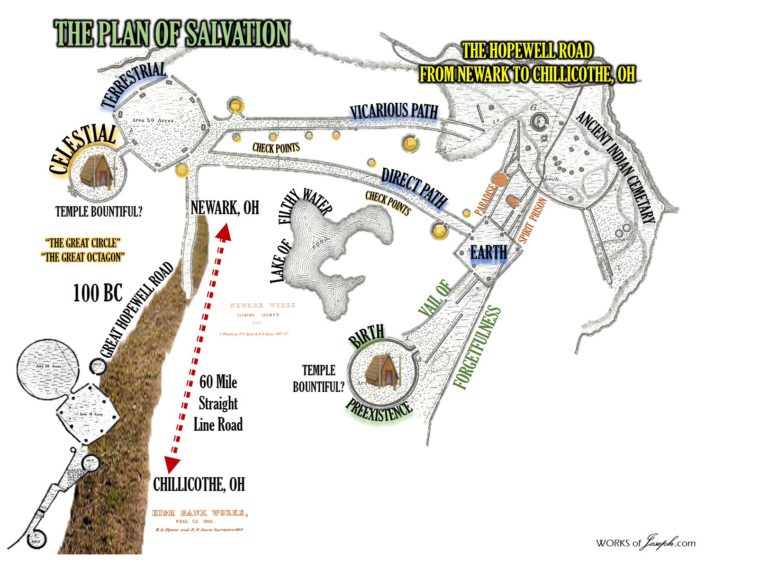
The Plan of Salvation and the Newark Earthworks
The Newark Works, built between 100 B.C. – 100 A.D. is the largest surviving Hopewell earthwork complex in North America and originally encompassed more than four square miles. https://en.wikipedia.org/wiki/Newark_Earthworks T
Christ Appears to the Nephites in North America by Kendra Burton
“This painting above shows Christ descending in a shaft of light to visit multitudes of Nephites who are streaming up a ramped earthen platform mound reminiscent of other earthen monuments made by the civilization now known as the Hopewell Mound Builders. The background is a vast plain with interspersed massive grass-covered mounds, wooden homes with thatched roofs and hardwood forests, while the foreground shows a large wooden temple atop a monumental ramped earth structure. The scene is one that is true to the Book of Mormon record, without stone pyramids or thick jungle vegetation since nowhere in the text is there any mention of stone buildings, palm trees, monkeys or a tropical climate.
The Heartland geography research has overwhelmingly demonstrated through Book of Mormon prophesies, Joseph Smith’s writings, DNA, archaeological, linguistic and cultural evidences that the most likely location for the setting of the Book of Mormon was in America’s Heartland. This painting is consistent with Joseph Smith’s known and historically documented statements and actions in such accounts as the those found in D&C 28, 30, and 32, the Wentworth Letter, the American Revivalist account, the Zelph accounts, Joseph’s hand-written letter to his wife while on Zion’s camp, and many additional sources.” Rod Meldrum, Author “Exploring the Book of Mormon in America’s Heartland”
The Ancient Plan of Salvation
Annotated Book of Mormon page 250 As explained by Amberli Nelson
The Newark Earthworks, built between 100 A.D. to 100 A.D.,* originally encompassed more than four square miles. Taken as a whole, the earthworks appear to symbolize elements of the Plan of Salvation and Redemption:
Pre-Mortal Life as spirits being born with a…
Veil of Forgetfulness to begin mortal…
Earth life: “the four corners of the earth”
Direct path after death to a higher kingdom
Spirit Prison (holding area for the wicked)
Paradise (Gospel preached to the dead)
Vicarious Path with multiple check points
Lake of Filthy Water (worldly temptations)
Terrestrial Kingdom (cf. 1 Cor. 15:40) The Seal of Melchizedek consists of two interlocked (or overlapping) squares, making what appears to be an eight-pointed star within the octagon.
Celestial Kingdom (narrow path entered only through the realm of the Melchizedek Priesthood)
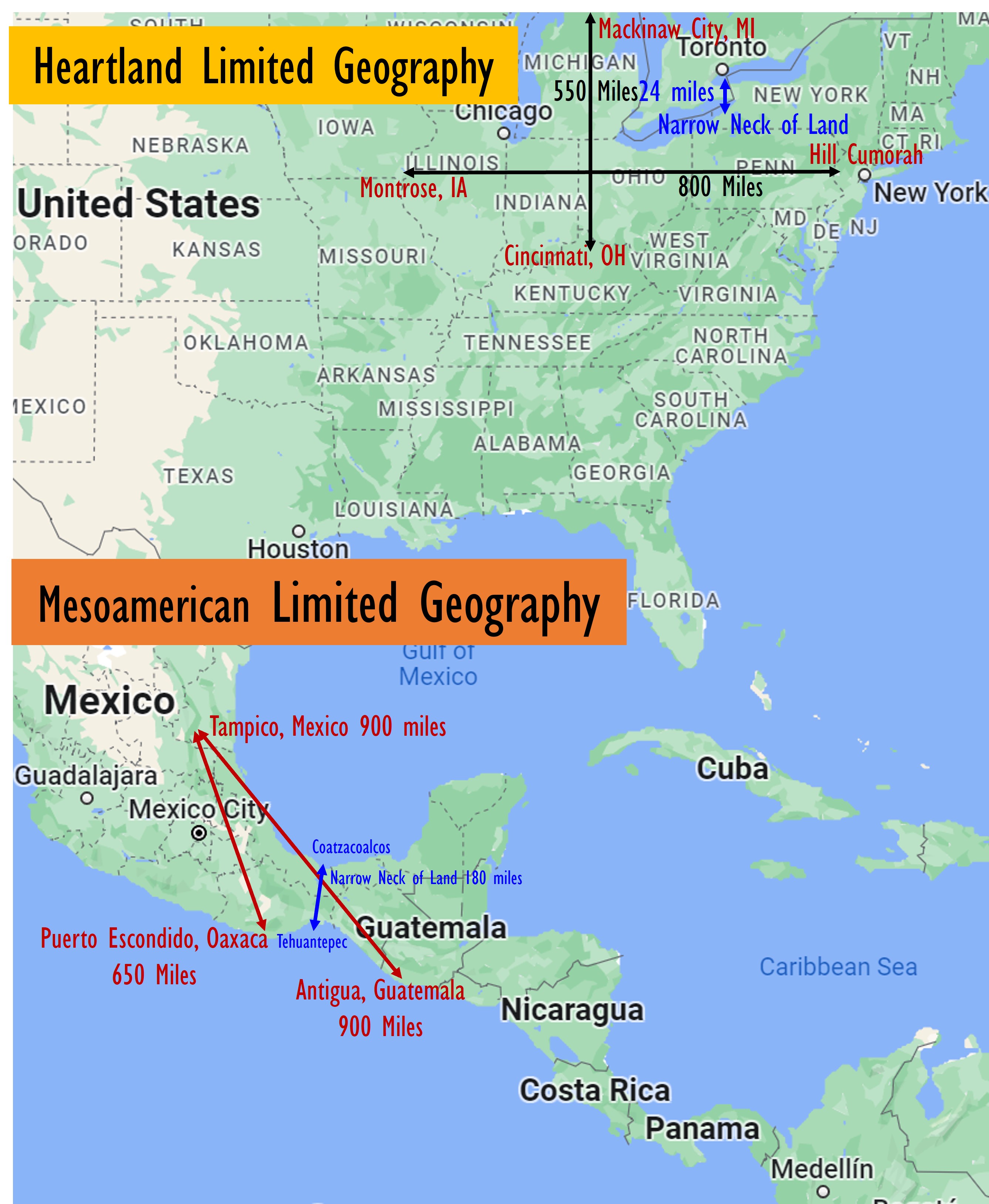
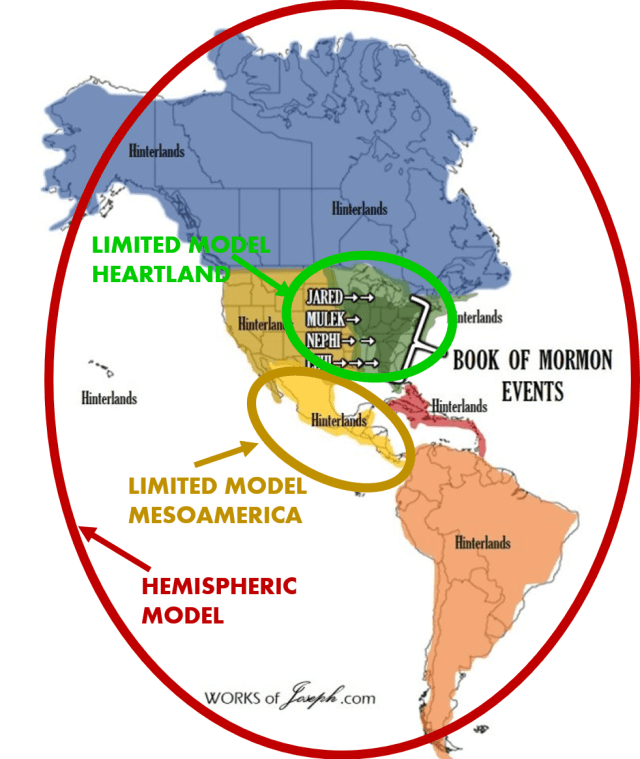
See the header map to understand better what the Limited Geography of the Book of Mormon is all about. The understanding of who the Lamanites are, and where they lived, has been a topic of interest for many years in The Church of Jesus Christ of Latter-day Saints. I was taught in the 1970’s what is called the “Hemispheric Model” about the Book of Mormon. (Map Left)
Meaning, that generally speaking all of the Lamanites lived in South America and all the Nephites lived in North America and the “Narrow Neck of Land” was Central America. That has now become obsolete to most people in the Church, whether they believe in a Mesoamerican, a Heartland, a Baja theory, or any other theory about Book of Mormon Events.
The consensus opinion of both Heartlanders and Mesoamericanists is, the Book of Mormon had to be contained into a smaller geographical area of about 7-900 miles east to west and 4-600 miles north to south. That means either the Nephites lived in the Heartland of North America from about Zarahemla (Montrose, IA) to the Hill Cumorah near Palmyra NY (800 to 850 miles across the Land Zarahemla and Bountiful) and from about Mackinaw City, Michigan in the north to the Cincinnati, OH on the Ohio River (500-550 miles through the Land of Zarahemla and Bountiful)
The reason is, that the distances required to make that old Hemispheric Model a reality has created an almost consensus opinion that it just doesn’t make sense anymore. A “Limited Geography Model” or today what is called (Hinterland Model) is now the consensus.Either the Lehites sailed southwest from Oman and around Africa and they landed in North America near Florida to begin civilization, or they sailed southeast towards the tip of India and through the islands of Malaysia and the Philippines continuing east on the huge Pacific ocean and then landing on the west coast near Chile or Central America. My mariner friend, British Naval Captain Philip Beal from England, estimated this voyage time in a sailing vessel across the Pacific to be 14 to 18 months. Compete Blog here
Did the Inca, Aztec or Mayan civilizations leave any record that they knew about the Book of Mormon peoples? Does any ancient culture of the Americas show any awareness of the Book of Mormon people or events?
By Warren Osborn, Founder at Osborn Companies (1998-present) Answered February 2, 2019 · Upvoted by Jesse Christopherson, former Mormon Missionary at The Church of Jesus Christ of Latter-day Saints (1996-1998) Source
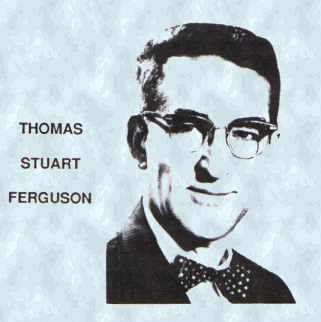
“As early as 1953, the New World Archaeological Foundation (NWAF) received funding from the Church of Jesus Christ of Latter-day Saints after Thomas Ferguson approached church leaders about finding Book of Mormon archeological evidence. Ferguson had a passion for looking for archaeological evidences for the Book of Mormon and he reminded the church leadership that discovering Book of Mormon artifacts would assist in the church’s missionary program.
After years of studying maps, Mormon scripture, and Spanish chronicles, Ferguson had concluded that the Book of Mormon took place around the Isthmus of Tehuantepec, the narrowest part of Mexico. He had come to the jungles of Campeche, northeast of the isthmus, to find proof.
Ferguson wrote, “It is the only Church on the face of the earth which can be subjected to this kind of investigation and checking.” And in another, to the LDS leadership, he declared, “The Book of Mormon is either fake or fact. If fake, the [ancient] cities described in it are non-existent. If fact—as we know it to be—the cities will be there.”
Below is a map of the land the Ferguson believed to be where the Book of Mormon people’s lived.
After many years of searching for artifacts and other evidence, he came up empty-handed. In 1975, he submitted a paper to a symposium about Book of Mormon geography outlining the failure of archaeologists to find Old World plants, animals, metals, and scripts in Mesoamerica. “The real implication of the paper,” he wrote in a letter the following year, “is that you can’t set Book of Mormon geography down anywhere—because it is fictional.”
In many other excavations and research, the church has come up empty-handed with evidence to back the Book of Mormon. {In Mesoamerica}
Many animals listed in the Book of Mormon did not exist in the Americas during Book of Mormon history.
The Book of Mormon tells the details of a war where 2 million were killed. Swords, chariots, cimeters were spoken of as being used. Yet none of these have been found.
The Book of Mormon speaks of an advanced currency of coins and other metallurgy. None have been found.
No language matching the Book of Mormon narrative matches.
Genetic evidence confirms that the people of the Americas originated in Asia, not the Middle East.
The culture in the Americas during Book of Mormon times does not match the Book of Mormon.
No evidence has been found to date to support the Book of Mormon as real history.
Confirmation of the truth of the book must be found through prayer and by way of the “burning in the bosom.” Source Here:Scroll down to find the article by Warren Osborne.
The New World Archaeological Foundation is an archaeological research and teaching entity administered by the Department of Anthropology at Brigham Young University. The research focus is the study of the origins and subsequent trajectory of civilization (complex societies) in the New World with special emphasis on Mesoamerica. Related to that study is the dissemination of findings through the NWAF Papers and other professional outlets. The NWAF also exists to enrich BYU student experience through mentoring/internship opportunities.
Heartland Model of the Book of Mormon vs. Fantasy Map Theory
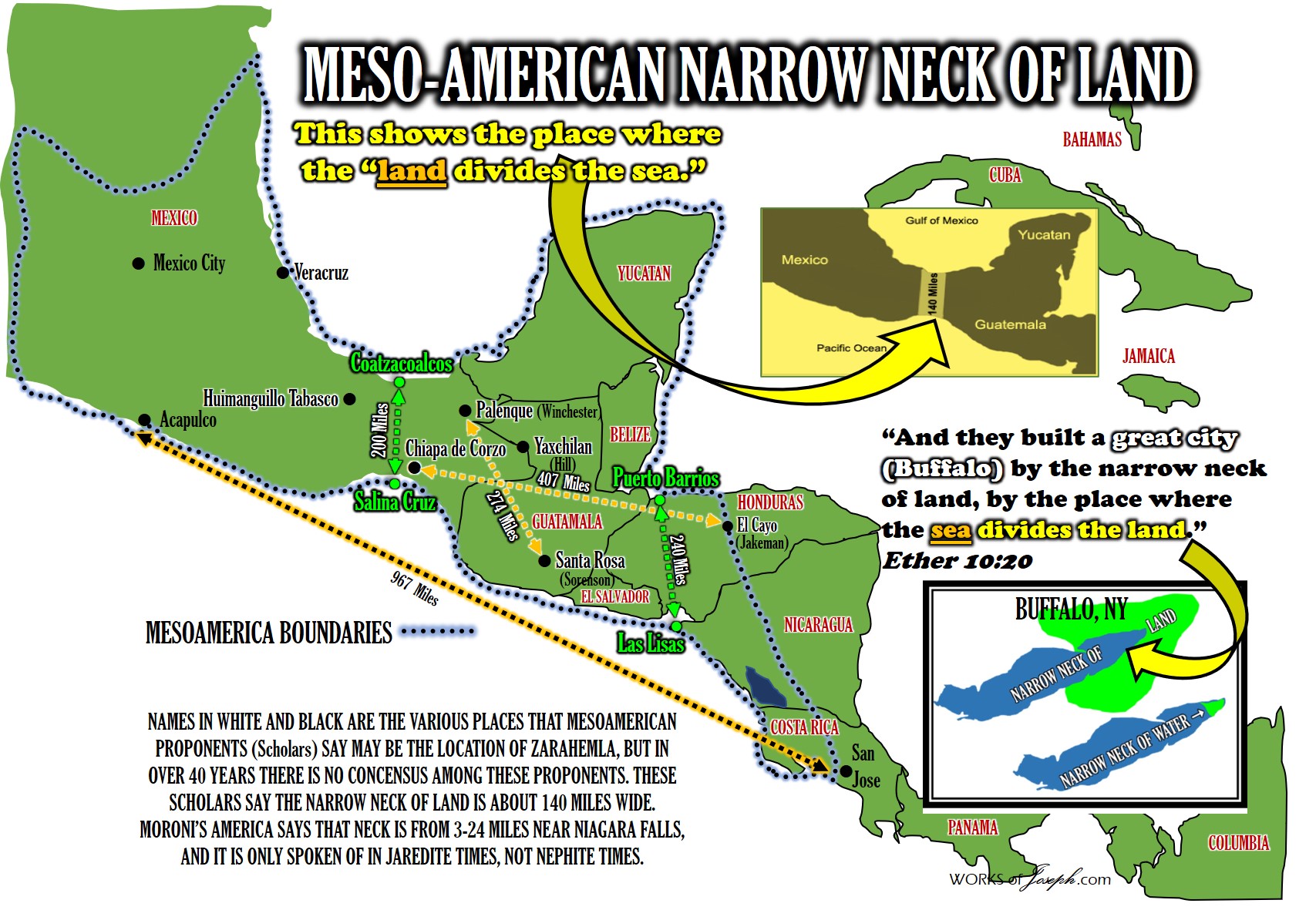
The fantasy map from Book of Mormon Central shows the same positioning of the various cities from Lehi’s landing, south, to the Hill Cumorah, north. But only the Heartland map agrees with Ether 10:20 which says, “And they built a great city by the narrow neck of land, by the place where the sea divides the land.” (Not, where the land divides the sea as is shown in the fantasy map).
Lake Ontario and Lake Erie are the seas that divide the land, at the Narrow Neck of Land or the Niagara Peninsula. Native American language says the word “Niagara” means “neck.”
How a Mormon Lawyer Transformed Archaeology in Mexico—and ended up losing his Faith!
By Lizzie Wade Jan. 18, 2018
Thomas Stuart Ferguson lay in his hammock, certain that he had found the promised land. It had been raining for 5 hours in his camp in tropical Mexico on this late January evening in 1948, and his three campmates had long since drifted off to sleep. But Ferguson was vibrating with excitement. Eager to tell someone what he had seen, he dashed through the downpour to retrieve paper from his supply bag. Ensconced in his hammock’s cocoon of mosquito netting, he clicked on his flashlight and began to write a letter home.
“We have discovered a very great city here in the heart of ‘Bountiful’ land,” Ferguson wrote. According to the Book of Mormon, Bountiful was one of the first areas settled by the Nephites, ancient people who supposedly sailed from Israel to the Americas around 600 B.C.E. Centuries later, according to the scripture, Jesus appeared to the Nephites in the same region after his resurrection. Mormons like Ferguson were certain that these events had happened in the ancient Americas, but debates raged over exactly how their sacred lands mapped onto real-world geography. The Book of Mormon gave only scattered clues, speaking of a narrow isthmus, a river called Sidon, and lands to the north and south occupied by the Nephites and their enemies, the Lamanites.
After years of studying maps, Mormon scripture, and Spanish chronicles, Ferguson had concluded that the Book of Mormon took place around the Isthmus of Tehuantepec, the narrowest part of Mexico. He had come to the jungles of Campeche, northeast of the isthmus, to find proof.
As the group’s local guide hacked a path through the undergrowth with his machete, that proof seemed to materialize before Ferguson’s eyes. “We have explored four days and have found eight pyramids and many lesser structures and there are more at every turn,” he wrote of the ruins he and his companions found on the western shore of Laguna de Términos. “Hundreds and possibly several thousand people must have lived here anciently. This site has never been explored before.”
Thomas Stuart Ferguson L. TOM PERRY SPECIAL COLLECTIONS, HAROLD B. LEE LIBRARY, BRIGHAM YOUNG UNIVERSITY, PROVO, UTAH
Ferguson, a lawyer by training, did go on to open an important new window on Mesoamerica’s past. His quest eventually spurred expeditions that transformed Mesoamerican archaeology by unearthing traces of the region’s earliest complex societies and exploring an unstudied area that turned out to be a crucial cultural crossroads. Even today, the institute he founded hums with research. But proof of Mormon beliefs eluded him. His mission led him further and further from his faith, eventually sapping him of religious conviction entirely. Ferguson placed his faith in the hands of science, not realizing they were the lion’s jaws.
But that night, lying in his hammock listening to the rain and the occasional roar of a jaguar in the distance, Ferguson felt surer than ever that Mesoamerican civilizations had been founded by migrants from the Near East, just as his religion had taught him. Now, he thought, how would he convince the rest of the world.
The Church of Jesus Christ of Latter-day Saints (LDS) doesn’t take an official position on where the events in the Book of Mormon occurred. But the faithful have been trying to figure it out practically since 1830, when church founder Joseph Smith published what he said was a divinely inspired account of the ancient Americas. Smith said an angel had led him to buried ancient golden plates, which he dug up and translated into the Book of Mormon. Smith’s account of buried wonders was one of many in the United States at the time. As white settlers moved west, they encountered mounds filled with skeletons and artifacts, including beautiful pottery and ornaments. Newspapers, including those in Smith’s hometown of Palmyra, New York, buzzed with speculation about who the “mound builders” were and how they came by their refined culture. Many settlers, blinded by racism, concluded that the mound builders—now known to be indigenous farming societies—were a lost people who had been exterminated by the violent ancestors of Native Americans. The Book of Mormon, with its saga of righteous, white Nephites and wicked, dark-skinned Lamanites, echoed these ideas.
The Book of Mormon also spoke of sprawling ancient cities, none of which had been identified in the United States. So in the 1840s, Mormons, including Smith himself, took notice of a U.S. explorer’s best-selling accounts of visits to the ruins of Mayan cities in Mexico and Guatemala. In 1842, as editor of a Mormon newspaper, Smith published excerpts from a book about the ruins of the Mayan city of Palenque in Mexico, with the commentary: “Even the most credulous cannot doubt … these wonderful ruins of Palenque are among the mighty works of the Nephites—and the mystery is solved.”
But non-Mormons continued to doubt, and church authorities gradually retreated from explicit statements about Book of Mormon locations. By the 1930s, when Ferguson learned about Mesoamerican civilizations as an undergraduate at the University of California (UC), Berkeley, the matter had been largely ceded to amateurs who pored over maps and the Book of Mormon looking for correspondences.
Ferguson wasn’t impressed by their efforts. “The interested and inquiring mind of the modern investigator is not satisfied with explanations which are vague, unsound, and illogical,” he wrote in an article in a church magazine in 1941. By then he was a law student at UC Berkeley and intrigued by the idea of scientifically testing Smith’s revelation. In a later letter, he wrote, “It is the only Church on the face of the earth which can be subjected to this kind of investigation and checking.” And in another, to the LDS leadership, he declared, “The Book of Mormon is either fake or fact. If fake, the [ancient] cities described in it are non-existent. If fact—as we know it to be—the cities will be there….
In 1954, LDS authorities granted NWAF $250,000 for 5 years of work. Intensive excavations at Chiapa de Corzo uncovered stone pyramids and tombs, and a wealth of pottery that impressed University of Pennsylvania anthropologist John Alden Mason, then working with NWAF. “Since pre-Classic pottery is not very common anywhere, and that of this region is entirely new, it is of course a very great scientific contribution,” Mason wrote to Ferguson. Eventually, archaeologists reported that the site was settled around 1200 B.C.E., likely by people connected to the Olmec, an early civilization that dominated the gulf coast of Mexico from 1200 B.C.E. to 400 B.C.E., centuries before the Classic Maya arose.
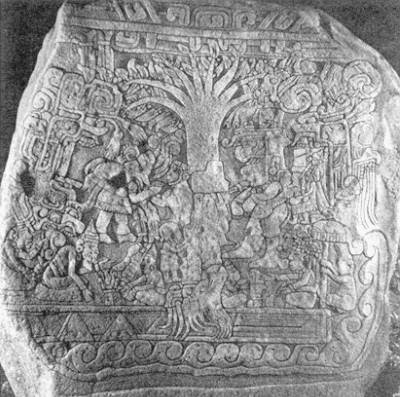
Stela 5 from Izapa in Mexico—an early site first extensively excavated by New World Archaeological Foundation archaeologists—shows a mythical tree; some Mormons believe it reflects a prophetic dream from the Book of Mormon. JEAN-PIERRE COURAU/BRIDGEMAN
Then, in the early 1960s, NWAF archaeologists became the first to extensively excavate at Izapa, near the Chiapas coast and the Guatemalan border. They were drawn to the site in part because of a monument that apparently depicts a myth involving a tree; Ferguson’s friend and founder of BYU’s archaeology department, M. Wells Jakeman, argued that the carving shows visions received in a dream by the Mormon prophet Lehi.NWAF archaeologists, some of whom were Mormon, later soundly rebuffed that interpretation. But Izapa turned out to be a key site in the Soconusco, the Pacific coast region from which every Mesoamerican political power, from the Olmec in 1200 B.C.E. to the Aztec empire in the early 1500s C.E., sourced key luxury goods such as cacao and quetzal feathers. NWAF spearheaded excavations throughout this region. Pottery finds and dates from Izapa and elsewhere formed the basis of the ceramic chronologies for the Formative period that are still used by every archaeologist working in central and coastal Chiapas today.
“They were working in a part of Mesoamerica that was really unknown,” says Michael Coe, an influential Mesoamerican archaeologist and professor emeritus at Yale University who, at the time, was surveying Formative sites just over the border in Guatemala. “NWAF put it on the map.”
But even as NWAF grew in scientific stature, and was finally assured continued existence when BYU took it over in 1961, Ferguson was quietly becoming frustrated. The smoking gun he had been certain he would find—Egyptian or Hebrew script—proved elusive. He once had promised that archaeological evidence for the Book of Mormon would be found within 10 years of NWAF starting excavations. But in 1966 he wrote, “My number one goal of establishing that Christ appeared in Mexico following the crucifixion will never be achieved until significant ancient manuscript discoveries are made. I hope it happens during our lifetimes.”
When an ancient manuscript discovery did come, however, it was from a different quarter of the world—and it shook Ferguson’s faith to its core.
In the summer of 1835, Joseph Smith had received a curious visitor in Kirtland, Ohio, then the headquarters of his burgeoning LDS church: a traveling showman, with four Egyptian mummies and some hieroglyphic texts in tow. The church bought the mummies and texts, and Smith said he translated the hieroglyphics, resulting in the Book of Abraham, which lays out Smith’s cosmic vision of the afterlife. (Although Egyptian hieroglyphics had been deciphered in France in 1822 with the help of the Rosetta Stone, the news had barely reached U.S. shores.) As Smith and his followers moved around the Midwest, often fleeing angry mobs, they carried the mummies and papyri with them. After Smith’s death at the hands of one of those mobs in Nauvoo, Illinois, they were sold by his family…
After decades of stressing the importance of the scientific method and using it to shore up his own faith, Ferguson now found himself at its mercy. “I must conclude that Joseph Smith had not the remotest skill in things Egyptian-hieroglyphics,” he wrote to a fellow doubting Mormon in 1971. What’s more, he wrote to another, “Right now I am inclined to think that all of those who claim to be ‘prophets’, including Moses, were without a means of communication with deity.”
This doubt ultimately spread to Ferguson’s archaeological quest. In 1975, he submitted a paper to a symposium about Book of Mormon geography outlining the failure of archaeologists to find Old World plants, animals, metals, and scripts in Mesoamerica. “The real implication of the paper,” he wrote in a letter the following year, “is that you can’t set Book of Mormon geography down anywhere—because it is fictional.”
Although open about his doubts in his private letters, Ferguson didn’t discuss his loss of faith with his family. He continued attending church, singing in the choir, and even giving blessings. “[Mormons] are so immersed in that culture … [that] to lose your faith, it’s like you’re being expelled from Eden,” Coe says. “I felt sorry for him.” Complete article and video here
Rod Meldrum’s good friend is the son of Thomas Ferguson. This friend of Rod’s is a very strong believer in the Heartland Model and wished his father would have been around when all of these discoveries of Wayne May’s and Rod Meldrum’s information had come to light.
I am continually amazed at the lack of desire for some prominent archaeologists in the Church to begin explorations in the Heartland of North America. Wayne May continues to search for the City of Zarahemla as do other members of the Church. If the Lord desires, more evidence will be found.
A Treasure Trove of North American Evidence of the Book of Mormon
The story of Joseph (of Egypt’s) brothers placing him in a pit then selling him as a slave to the passing Midianites is recorded in the Hebrew Scriptural account in the book of Genesis:
And Reuben returned unto the pit; and, behold, Joseph was not in the pit; and he rent his clothes. And he returned unto his brethren, and said, “The child is not; and I, whither shall I go?” And they took Joseph’s coat, and killed a kid of the goats, and dipped the coat in the blood; And they sent the coat of many colours, and they brought it to their father; and said, “This have we found: know now whether it be thy son’s coat or no.” And he knew it, and said, “It is my son’s coat; an evil beast hath devoured him; Joseph is without doubt rent in pieces.” (Genesis 37:29-33)
The same story is told with an additional detail in the Book of Jasher: Joseph’s coat is first torn, then dipped in the blood of a goat:
And Issachar said unto them: ‘Here is an advice for you, if it seem good in your eyes to do this thing—Take the coat which belongeth to Joseph and tear it, and kill a kid of the goats and dip it in its blood, and send it to our father;’” “And they hastened and took Joseph’s coat and tore it, and they killed a kid of the goats, and dipped the coat in the blood of the kid, and then trampled it in the dust, and they sent the coat to their father Jacob…” (Jasher 43:10; 13;
The significance of the torn coat is the symbolism of being rent, or separated by force into parts, and is associated with mourning, grief, and loss.The tearing of Joseph’s coat was symbolic of the House of Israel being torn apart by the actions of Joseph’s brothers to sell him into slavery. However, a portion of the torn coat was preserved and given to Jacob.
The Book of Mormon, published in 1830, includes a story in the book of Alma regarding Captain Moroni invoking the symbol of Joseph’s torn garment. He uses that symbol to motivate his people “to keep the commandments of God, or our garments shall be rent by our brethren, and we be cast into prison, or be sold, or be slain” (Alma 46:23). The opposite of being a slave is having liberty. Moroni was aware of Joseph’s coat being torn [rent] from source records other than the Holy Bible and invokes this symbol of being “sold” as a slave to making a covenant for liberty.
Purchase Here
Here we have an example of the Book of Jasher providing additional facts that are corroborated by modern scripture and the corollary—that the Book of Mormon contains an identical detail not available in published records. The Sefer haYasher manuscript (the Book of Jasher), found in the ruins of Jerusalem during its destruction in 70 A.D. then translated into English in 1840, contains this important detail in the Book of Mormon:
Moroni said unto them: “Behold, we are a remnant of the seed of Jacob; yea, we are a remnant of the seed of Joseph, whose coat was rent by his brethren into many pieces; yea, and now behold, let us remember to keep the commandments of God, or our garments shall be rent by our brethren, and we be cast into prison, or be sold, or be slain. Yea, let us preserve our liberty as a remnant of Joseph; yea, let us remember the words of Jacob, before his death, for behold, he saw that a part of the remnant of the coat of Joseph was preserved and had not decayed. And he said—‘Even as this remnant of garment of my son hath been preserved, so shall a remnant of the seed of my son be preserved by the hand of God, and be taken unto himself, while the remainder of the seed of Joseph shall perish, even as the remnant of his garment.’” (Alma 46:23-24) By David Hocking Executive Editor of the Annotated Edition of the Book of Mormon.
Alma 46: 11 And now it came to pass that when Moroni, who was the chief commander of the armies of the Nephites, had heard of these dissensions, he was angry with Amalickiah. 12 And it came to pass that he rent his coat, and he took a piece thereof, and wrote upon it: In memory of our God, our religion, and freedom and our peace, our wives and our children. And he fastened it upon the end of a pole. 13 And he fastened on his headplate, and his breastplate, and his shields, and girded on his armor about his loins, and he took the pole which had on the end thereof his rent coat, and he called it, ‘The Title of Liberty’. And he bowed himself to the earth, and he prayed mightily unto his God for the blessings of liberty to rest upon his brethren, so long as there should a band of Christians remain to possess the land. 14 For thus were all the true believers of Christ, who belonged to the Church of God, called by those who did not belong to the Church. 15 And those who did belong to the Church were faithful, yea, all those who were true believers in Christ took upon them, gladly, the name of Christ or Christians, as they were called, because of their belief in Christ who should come. 16 And therefore, at this time Moroni prayed that the cause of the Christians and the freedom of the land might be favored.
George Washington’s Title of Liberty Did You Know?
Annotated Book of Mormon by David Hocking and Rod Meldrum Page 297
“While the trueborn Sons of America, animated by the genuine Principles of Liberty and Love of their Country, with increasing Union, Firmness and Discipline repel every Attack, and despise every Danger… Come then, my Brethren, unite with us in an indissoluble Union, let us run together to the same Goal.—We have taken up Arms in Defence of our Liberty, our Property, our Wives, and our Children, we are determined to preserve them, or die. We look forward with Pleasure to that Day not far remote (we hope) when the Inhabitants of America shall have one Sentiment, and the full Enjoyment of the Blessings of a free Government… Incited by these Motives, and encouraged by the Advice of many Friends of Liberty among you, the Grand American Congress have sent an Army into your Province, under the Command of General Schuyler; not to plunder, but to protect you; to animate, and bring forth into Action those Sentiments of Freedom you have disclosed, and which the Tools of Despotism would extinguish through the whole Creation…” Quoted in Annotated Book of Mormon by Meldrum and Hocking. Source: The Papers of George Washington, Revolutionary War Series, vol. 1, 16 June 1775?–?15 September 1775, ed. Philander D. Chase. Charlottesville: University Press of Virginia [1985], 461–463.
As I think of the Prophet Joseph Smith translating the plates I am imagining the many things on his mind as he translates. What does “by the spirit and power of God” mean? I don’t think Joseph is reading some English words from a rock in a hat. I think he is “translating” meaning as the dictionary says, “the rendering of something into another language or into one’s own from another language.” Dictionary.com
I think this is an interesting definition of translation. “Translation has been used by humans for centuries, beginning after the appearance of written literature. Modern-day translators use sophisticated tools and technologies to accomplish their work, and rely heavily on software applications to simplify and streamline their tasks.” GALA
I would replace the words sophisticated tools, technologies, and software application to mean by the “gift and power of god”. In other words something very difficult to do or almost impossible to do without God’s help.
I don’t think some angel or the Lord were providing the English words to make it easy for Joseph. I believe the Lord tells us to use all our resources and try our best and after we have done all we can and feel we can’t go further, then and only then will the Lord step in. I don’t believe the Lord uses magic, ever!
My main point for this blog is to show that the surroundings where Joseph Smith lived and translated possibly influenced Joseph to help him translate. As Jonathan Neville explains it, Joseph used the information in his own “personal metal bank account” to explain what he saw on the plates. The surroundings of Joseph obviously assisted him to see things around him that helped explain translation. Especially when Joseph described what Lehi or Nephi saw during the dream of the tree of life. In other words what did Joseph see around him that made Lehi’s dream more familiar as he translated. How could Joseph put into words the amazing tree of life vision without being able to visualize the lakes, trees, streams, and wilderness that surrounded Joseph.
OVERVIEW:
“The Book of Mormon’s opening book of 1 Nephi presents a dream/vision in which prophets describe a detailed scene involving a narrow path with an iron rod, leading to the tree of life laden with the most desirable fruit. A river that is both good and bad flows alongside, on the other side of which is seen a large, high building filled with the proud people of the world. The scene is fraught with physical and spiritual peril. All of these elements are met efficiently and conspicuously in a scenario that Joseph Smith experienced in and around Rochester, New York, at the specific time when he dictated this text. In the Book of Mormon vision of the iron rod and the tree of life, Nephi’s father Lehi “. . . beheld, on the other side of the river of water, a great and spacious building; and it stood as it were in the air, high above the earth. And it was filled with people, both old and young, both male and female; and their manner of dress was exceedingly fine; and they were in the attitude of mocking and pointing their fingers towards those who had come at and were partaking of the fruit.” l Nephi 8:26-27.” Rick Grunder Page 1367
In the Book of Mormon dream of the iron rod beside the narrow path leading to the tree of life, Nephi’s father Lehi was led through “a dark and dreary wilderness.” The dismal passage continued “for the space of many hours” until Lehi “began to pray unto the Lord that he would have mercy on me . . .” (1 Nephi 8:4, 8). Joseph Smith dictated that vision text while he lived at the Whitmer farm in Fayette, Seneca County, New York; see MP 350 (Reynolds Arcade) for discussion. The Whitmers, like all farmers in that vicinity, were acutely aware of the vast Cayuga or Montezuma Marshes nearby . . .
“By 1790,” explained local historian John W. Wells, “thousands of settlers” could be seen migrating westward to vast tracts of land opened for farming and development in central and western New York. Of three principal migration routes, the most important was the “Great Genesee Road . . . extended to Buffalo by 1800, and for 30 years until the completion of the Erie Canal . . . the main artery of traffic across the state.” (Wells, 2). On this “cleared track about 30 feet wide,” Lucy Mack Smith and her boys drove their team and wagon to Palmyra in the eighteen-teens. Along the way, they experienced something no traveler could forget: the longest bridge in America, more than a mile in length, set on pilings across the shallow northern end of the “one major obstacle on this natural route to the Genesee country. This was Cayuga Lake. To the north of the lake extended the dread Montezuma marshes and other treacherous and pestilent swamps nearly to the shores of Lake Ontario.” (Wells, 2; see map further below)
Area near the center of the map above, now May’s Point, just south of the location where the Erie Canal flows beneath New York State Highway 89 in the town of Tyre, Seneca County. Photograph by Rick Grunder, attended by several thousand flies on June 14, 2005.
“Moscheto Point,” observed Horatio Gates Spafford wryly in 1824, “at the mouth of the Owasco Outlet, on the N. boundary of Mentz, is well named.” The town of Mentz then included the village of Montezuma which is seen in the map above. Spafford’s description continued with an unusual observation which deserves at least passing notice in the context of Lehi’s dream . . . —There is a very large hollow Buttonwood Tree, in this town, in which ‘Elder Smith, preached’ to 35 persons, at a time, and says the tree could have held 15 more: he says its circumference, 3 feet from the ground, is 33 feet; and a Correspondent informs me it measures ‘more than 17 feet diameter.'” [Spafford, 314, emphasis in the original] Spafford knew of only one tree in the entire state which was slightly larger.
The giant buttonwood (sycamore) he described near the marshes did not likely bear white fruit like that of Lehi’s tree, but it dramatized two elements of relevance here: first, the prominence of trees in the minds of early settlers of New York State at the time, and second, the association of such a noticeable tree with spiritual protection – the faithful believers worshipping in the shelter of the massive trunk. If this connection seems tangential, it is at least as notable as one Book of Mormon defender’s efforts to connect the dream of Lehi with ancient Egyptian precedents which praised this very kind of tree in the Book of the Dead (“Hail, sycamore tree of the goddess Nut. Grant thou to me of the water and the air which are in thee.” Quoted in Griggs, 273).
“In the Book of Mormon vision of the iron rod and the tree of life, Nephi’s father Lehi “. . . beheld, on the other side of the river of water, a great and spacious building; and it stood as it were in the air, high above the earth. And it was filled with people, both old and young, both male and female; and their mannerof dress was exceedingly fine; and they were in the attitude of mocking andpointing their fingers towards those who had come at and were partaking of thefruit.” l Nephi 8:26-27.
What images might Joseph Smith have seen in his mind while dictating these words? How might he have related to the iron rod dream? Elements of this story include:
– darkness and feelings of desperation (1 Nephi 8:4, 7-8, 23; 12:17) – a dark and dreary wasteland (1 Nephi 8:7) – a large and spacious field (1 Nephi 8:9) – a tree with desirable fruit of unsurpassed sweetness and whiteness (1 Nephi 8:10-11) – a river of water (1 Nephi 8:13); a “fountain of filthy water . . . yea, even the river . . .” (1 Nephi 12:16); “a great and a terrible gulf” which divides the people in the building from the righteous who are seeking the tree of life (1 Nephi 12:18); equated with the river of water, representing filthiness, “an awful gulf, which separated the wicked from the tree of life, and also from the saints of God.” (1 Nephi 15:27-28); even a representation of hell itself (1 Nephi 15:29). – a rod of iron extending along the bank of the river (1 Nephi 8:19); defined as “the word of God” (1 Nephi 15:24) – “a strait and narrow path which came along by the rod of iron” (1 Nephi 8:20) – “numberless concourses of people, many of whom were pressing forward, that they might obtain the path . . .” (1 Nephi 8:21) – mists of darkness (1 Nephi 8:23) – “a great and spacious building” “on the other side of the river,” which “stood as it were in the air, high above the earth . . . filled with people, both old and young, both male and female; and their manner of dress was exceedingly fine; and they were in the attitude of mocking and pointing their fingers . . .” (1 Nephi 8:26-27); defined as “the pride of the world” (1 Nephi 11:36) and “vain imaginations and the pride of the children of men” (1 Nephi 12:18) – ridiculed persons who “fell away into forbidden paths and were lost.” (1 Nephi 8:28) – “other multitudes feeling their way towards that great and spacious building.” (1 Nephi 8:31) – a great multitude that entered “that strange building” and “did point the finger of scorn at me and those that were partaking of the fruit . . .” (1 Nephi 8:33) – many people who “were drowned in the depths of the fountain . . .” (1 Nephi 8:32) – many people “wandering in strange roads.” (1 Nephi 8:32) – “broad roads” into which people were led, to their moral destruction (1 Nephi 12:17)”
IN THE LATE 1820s, the cheapest and least bone-jarring way to travel across New York State was by the Erie Canal. It was the wonder of the age, built at tremendous cost. Among the most challenging obstacles to its construction in the region around Palmyra had been the Cayuga or Montezuma Marshes north of Fayette, and the formidable Genesee River which runs through the heart of Rochester. The marshes cost health and lives, while the aqueduct by which boats could cross the Genesee required large, costly stone slabs anchored deep into the river bed…
People sometimes drowned in the canal, falling not only from the boats, but from the narrow towpath or the numerous bridges that crossed this inland waterway: The canal . . . was respectfully regarded as a place of danger, or even death. . . . Although the water was shallow at most points, there were reports of even the boatmen themselves drowning as they fell into the canal or the canal basins. Boats caught fire, they sank, and men and horses drowned with them. Children playing near the canal were often accidentally drowned. . . . Sometimes, too, bodies were discovered in the canal, their identities unknown, their deaths unexplained. [Shaw, 223. The ironic term “casual drowning” was applied to such incidents in some coroners’ reports of the time (telephone interview with Lysbeth Hoffman, Carlton Town Historian, Orleans County, New York, March 1, 2006)] Thomas Woodcock described how a young lady’s head was crushed when she failed to duck as the boat passed beneath a typically low bridge (Woodcock, 9). Joseph Smith’s mother was acutely aware of these dangers, and she chastised careless mothers for being neglectful on the boats in the spring of 1831, As for instance at a time when passing under a bridge if children were on deck they would be thrown over board or bruised in such a manner as was terrible to think of . . . Sisters said I God has given you children to be a blessing to you and it is your duty to take care of them to keep them out of every possible danger and in such a place as this especially to have them always by your side . . . [1844-45 manuscript, in Lucy Mack Smith 2001, 516]
THE PATH AND THE ROD
As a boat approached civilization, passengers’ pulses quickened. It is naturally exciting for a villager to arrive in the heart of a bustling, growing city. The entry into downtown Rochester was just such an event. Like Lehi in his dream, the canal rider found himself moving slowly alongside the river of water, parallel to the Genesee River, the canal feeder channel, and mill canals . . .
Looking ahead eagerly, passengers saw factories and flour mills on all sides, promising an accelerated pace of life. A traveler arriving from Palmyra would see that the canal was about to swing left and cross the Genesee on a magnificent aqueduct massively constructed to withstand floods and flotsam. The towpath, meanwhile, had become so narrow that horses had to be hitched one in front of the other (Shaw, 202).
As canal became bridge, there appeared something of crucial significance to our Mormon parallel scene . . .
The 1825 engraving above shows how the iron rod could indeed mean the difference between life and death . . .
This image may not convey the full drama, however, or sense of scale. The arches, for example, were fifty feet wide (Bernstein, 271). “. . . [W]e are lost in wonder,” wrote a friend of John Quincy Adams to another correspondent in 1826, “to see boats and horses, with men on them, passing at such a vast height above the surface of a bold river.
View ca. 1913 during unusually high water, looking east (showing the second, wider aqueduct finished in 1842 a few feet upriver, south of the original site). From the Albert R. Stone Negative Collection, Rochester Museum & Science Center, Rochester, New York; used with permission. Note the similar railing and the precarious narrowness even of the expanded towpath, to the inner side of which was water in the summer, and a potential fall of several feet to a stone base in the winter.
“What meaneth the rod of iron which our father saw . . . ? And I said unto them that it was the word of God; and whoso . . . would hold fast unto it, they would never perish . . .” 1 Nephi 15:23-24, To appreciate the fearsome power of this scene, the image above can be viewed clearly at greater than 100% on most computer monitors.
And I beheld a rod of iron, and it extended along the bank of the river, and led to the tree by which I stood. And I also beheld a strait and narrow path, which came along by the rod of iron, even to the tree by which I stood; and it also led by the head of the fountain, unto a large and spacious field, as if it had been a world. And I saw numberless concourses of people, many of whom were pressing forward, that they might obtain the path . . . [1 Nephi 8:19-21]
That is precisely how the scene must have appeared to our passengers at this point, as suggested by an 1888-94 photograph reproduced above, showing the similarly-designed but larger second aqueduct of 1842 (“. . . more massive in every respect.” McKelvey 1979, 55. Photograph from the Collection of the Rochester Public Library Local History Division; used with permission.)
The context is irresistible. In the dream, what begin as a nature scene and field suddenly become a worldly scene and field; just as with the setting illustrated above. It is at this very point, when Lehi perceives the path and the rod, that he also notices the concourses of people and the great and spacious building. The sensations described there are what the country traveler experienced in this approach to downtown Rochester, New York. “The streets,” wrote a British visitor to Rochester, even in 1820, “which are spacious, present a succession of well-furnished shops; and the bustle which continually pervades them gives the whole place an air of activity and commerce.” (John Howison, Sketches of Upper Canada . . . [Edinburgh, 1822, second ed.], quoted in Upstate Travels, 137)
THE FOUNTAIN OF FILTHY WATER
We have seen the narrow path, the rod, the river and some of its dangers. Delicious fruit is in abundance, both on trees and in the market over the river. Discarded fruit by the wagonloads even floats down the river itself. We have our first glimpse of the pride of the world in Rochester, New York, and have seen the many alluring roads and byways available there. Now to continue the narrative. Far more ominous than the upper rapids of the Genesee were the main falls, a few blocks north, downriver beyond the aqueduct:
THE DREAM OF THE IRON ROD DOES NOT OCCUR IN A “DESERT.”
That word is never used. Nephi’s terms are “wilderness” and “waste,” which Joseph Smith knew so well. As late as 1842, Joseph would refer to “the wilderness of Fayette, Seneca county [New York]” immediately adjacent to the Whitmer cabin, and to”the wilderness between Harmony, Susquehanna county, and Colesville, Broome county, on the Susquehanna river . . . [Pennsylvania and New York, respectively]” (D&C 128:20). These are green, green places indeed. At the front ofJoseph Smith’s own Bible was a picture of “Hagar in the Wilderness,” portraying young Ishmael strangely dying of thirst in a verdant setting with a broad stream flowing luxuriantly nearby…
Published in New York State in the 1820s, this was a picture of a “wilderness” as Joseph Smith would have understood it. Through eight years of wandering through Arabia, accordingly, up to the point where Lehi’s family arrives at a lush location which they call “Bountiful” (1 Nephi 17:4-5), there is no mention of dust, heat, wind, sand (except that of the sea), sun (except the glory of a heavenly being in a vision), horses, or camels – and certainly no tribes (other than “the twelve tribes of Israel”), caravans, robbers (unless Nephi’s brother, so accused by Laban) or thieves. ILLUSTRATION ABOVE: Frontispiece placed in many copies (including the one later owned by Joseph Smith) of H. & E. Phinney’s Stereotype Edition of The Holy Bible, Containing the Old and New Testaments . . . (Cooperstown, New York, 1828; MP 52)…
Joseph Smith never saw a desert. The sinners in his story drown “in the depths of the fountain” (1 Nephi 8:32). Compare the drying streams of Arabia to New York’s endless mists and flow! In arid Utah, one points to the Provo “River.” Here in Joseph Smith country, we would call such a thing a “creek.” The Genesee, so impressive in the illustrations above, is a nice river to New Yorkers, but an expected part of geography – almost ordinary when compared to the St. Lawrence River, to Niagara Falls, or the Hudson.
Joseph’s familiar “land of Cumorah” was “a land of many waters, rivers, and fountains” (Mormon 6:4). The topography of a genuine, much more extreme Arabian desert never crossed the consciousness of most Americans of that era. In the Book of Mormon description of wandering through the wilderness of Arabia, there is but one allusion to “thirst,” and that is in conjunction with affliction, hunger and fatigue (1 Nephi 16:35). When the eighteenth-century Moravian missionary David Zeisburger journeyed through the moist, fertile district which would one day include the Whitmer farm, he called it a “wilderness” – even “the Dry Desert” – when he failed to find ready drinking water for just a few hours (Willers, 7)…
As we prepare for conference I offer you a few wonderful quotes that have inspired me in the past and as I read them again I gain an even stronger understanding of their words. May we hear and understand this weekend with our spiritual eyes and ears. I love General Conference weekends.
“Whenever I hear anyone, including myself say, I know the Book of Mormon is True, I want to exclaim that’s nice but it isn’t enough. We need to feel deep the inmost pats of our hearts that the Book of Mormon is unequivocally the word of God. We must feel it so deeply that we wouldn’t want to live even one day without it. I might paraphrase President Brigham Young in saying, I wish I had the voice of seven thunders to wake up the people to the truth and power of the Book of Mormon.” Elder Russell M. Nelson Sept 30, 2017 General Conference.
Art By Ken Corbett
“The Book of Mormon reveals the inheritance of Joseph, son of Israel, who was not forgotten when land was distributed to the tribes of Israel. This was promised in the Abrahamic covenant… Josephs inheritance was to be a land choice above all others. Choice because it was chosen to be the repository of sacred writings on golden plates from which the Book of Mormon would one day come. Choice because it would eventually host the world headquarters of the Restored Church of Jesus Christ in the latter days. And it was choice because it was a land of liberty for those who worship the Lord and keep His commandments.” Russell M Nelson President, Quorum of 12 June, 2016 Provo Missionary Training Center
I would like to call your attention to one thing in the Book of Mormon. The Lord has promised us greater knowledge, greater understanding than we find in the Book of Mormon, when we are prepared to receive it. When the brother of Jared went upon the mount to have the Lord touch stones to give them light to light their way across the great ocean, the Lord revealed to him the history of this world from the beginning of it to the end. We do not have it. . . .
Now the Lord has placed us on probation as members of the Church. He has given us the Book of Mormon, which is the lesser part, to build up our faith through our obedience to the counsels which it contains, and when we ourselves, members of the Church, are willing to keep the commandments as they have been given to us and show our faith as the Nephites did for a short period of time, then the Lord is ready to bring forth the other record and give it to us, but we are not ready now to receive it. Why? Because we have not lived up to the requirements in this probationary state in the reading of the record which had been given to us and in following its counsels. — Joseph Fielding Smith, “The Book of Mormon, a Divine Book,” Improvement Era, Dec. 1961, pp. 925-27; also Conference Report, Oct. 1961, pp. 19-20
A photograph copy of the original Printers Manuscript for the first printing of the Book of Mormon sits next to a leather bound copy of the first Book of Mormon. The Book of Mormon was printed and bound at the Crandall Historic Printing Museum in Provo. Showing how the Book of Mormon was printed and bound is one of the demonstrations at the Museum. PHOTO BY STUART JOHNSON.
Members of the Church everywhere should know the Book of Mormon better than any other book. Not only should we know what history and faith-promoting stories it contains, but we should understand its teachings. .
I have noted within the Church the difference in discernment, in insight, conviction, and spirit between those who know and love the Book of Mormon and those who do not. That book is a great sifter.” — President Ezra Taft Benson, New Era, May 1975, p. 19
We have heard that the Prophet Joseph said something about the time when the Constitution would be in danger. We do not know just what turn that will take. He also said something about the Elders of Israel rising to the challenge and helping to save the Constitution of this land. It is entirely possible that that may come about in a rather natural way. Our young people — as they mature and develop and take their positions in industry, in the professions, and in agriculture clear across this land — might represent the balance of power in a time of crisis, when they will stand up and defend those eternal principles upon which this Constitution has been established.
The Founding Fathers did not invent this priceless boon of individual freedom and respect for the dignity of man. That great gift to mankind sprang from the Creator and not from government. But the Founding Fathers with superb genius, I believe, welded together certain safeguards which we must always protect to the very limit if we would preserve and strengthen the blessings of freedom.
. . . They were guided by allegiance to basic principles. These principles must be kept in mind always by those who are here today and reaping the benefits and the blessings which they so wisely provided. We must be careful that we do not trade freedom for security. Whenever that is attempted, usually we lose both. There is always a tendency when nations become mature for the people to become more interested in preserving their luxuries and their comforts than in safeguarding the ideals and principles which made these comforts and luxuries possible.
( Source: “Ezra Taft Benson Responsibilities of Citizenship” 8; also in TETB 599-600 )
“In harmony with our belief that the U.S. Constitution is an inspired document and that America has a special mission,” President Monson said, “the Deseret News will defend and promote the principles of the Constitution and the great freedoms for which the nation stands; indeed, it will promote the free agency of all mankind. We view ourselves as being not just in the newspaper business but in the communication business. As technology or public preferences change, our methods of communication may change, but at all times ours shall be a voice for the principles of our owner, for the canons of responsible journalism and for all other righteous and compatible interests and causes.”
( Source: “Thomas S. Monson New Home for Pioneer Newspaper”, LDS Church News, 31 May 1997 )
As a watchman on the tower, I feel to warn you that one of the chief means of misleading our youth and destroying the family unit is our educational institutions. President Joseph F. Smith referred to false educational ideas as one of the three threatening dangers among our Church members. There is more than one reason why the Church is advising our youth to attend colleges close to their homes where institutes of religion are available. It gives the parents the opportunity to stay close to their children; and if they have become alert and informed as President McKay admonished us last year, these parents can help expose some of the deceptions of men like Sigmund Freud, Charles Darwin, John Dewey, Karl Marx, John Keynes, and others.
Today there are much worse things that can happen to a child than not getting a full college education. In fact, some of the worst things have happened to our children while attending colleges led by administrators who wink at subversion and amorality.
Said Karl G. Maeser, “I would rather have my child exposed to smallpox, typhus fever, cholera, or other malignant and deadly diseases than to the degrading influence of a corrupt teacher. It is infinitely better to take chances with an ignorant, but pure-minded teacher than with the greatest philosopher who is impure.”
Two of the most important Prophets for us today are the Angel Moroni and Joseph Smith. I believe they have a critical mission for each of us even today. I believe they both are and will be, a big part of building the New Jerusalem and over seeing the Millennium. D&C 27:5 says, “and with Moroni, whom I have sent unto you to reveal the Book of Mormon, containing the fulness of my everlasting gospel, to whom I have committed the keys of the record of the stick of Ephraim”, which means anything to do with the Book of Mormon in this Promised Land and the World must be directed with Moroni in the lead. That includes an important stewardship to lead and teach Joseph Smith.
By Val Chadwick Bagley
Joseph Smith is the Prophet of this Last Dispensation of the Fulness of Times, and the Lord Himself said to Joseph, “Behold, there shall be a record kept among you; and in it thou shalt be called a seer, a translator, a prophet, an apostle of Jesus Christ, an elder of the church through the will of God the Father, and the grace of your Lord Jesus Christ, D&C 21:1
The importance of Moroni and Joseph Smith communicating with each other is of vital importance. How could a young unlearned farm boy become a great Prophet of the Lord? Being taught by angels and having a personal tutor in the form of Moroni is the answer. We will discuss the many visits made to Joseph Smith including over 22 visits we know of with the Angel Moroni.
Joseph knew the whole story about the Nephites
“We were now confirmed in the opinion that God was about to bring to light something upon which we could stay our minds, or that would give us a more perfect knowledge of the plan of salvation and the redemption of the human family. This caused us greatly to rejoice, the sweetest union and happiness pervaded our house, and tranquility reigned in our midst. During our evening conversations, Joseph would occasionally give us some of the most amusing recitals that could be imagined. He would describe the ancient inhabitants of this continent, their dress, mode of traveling, and the animals upon which they rode; their cities, their buildings, with every particular; their mode of warfare; and also their religious worship. This he would do with as much ease, seemingly, as if he had spent his whole life among them.” Lucy Mack Smith, History of Joseph Smith by His Mother, pp. 82-83. This was before he received the plates. He must have received this by revelation, for he knew the whole story of the content of the record that is now the Book of Mormon. He had had five long visits with Moroni, and his mother says he received many revelations.” Eldred G. Smith, Conference Report, October 1967, pp. 82-84
Moroni—Joseph Smith’s Tutor
“Joseph Smith’s six years of advanced training were anything but ordinary, for his tutors were celestial beings who taught eternal truths that would never change or become obsolete. Whereas much of man’s formal education is tentative, wrong, or outdated within a few years of graduation, Joseph said of his own education: “Could you gaze into heaven five minutes, you would know more than you would by reading all that ever was written on the subject.” (History of the Church, 6:50.) This was the quality of the heavenly instruction Joseph Smith enjoyed.
How Many Visits?
It is impossible to determine the number of “interviews” Joseph had with Moroni, but twenty-two visits are often identified. (See accompanying chart, “Moroni’s Known Appearances to Joseph Smith, 1823–1829.”)” “Moroni—Joseph Smith’s Tutor” By H. Donl Peterson
Moroni’s Known Appearances to Joseph Smith, 1823–1829
Date
Circumstances
References
Number of Appearances
21–22 Sept. 1823
Joseph’s bedroom—Message repeated three times. (Palmyra Township, N.Y.)
Moroni meets Joseph by the Hill Cumorah and says that the time has come for the record to be brought forth. He tells Joseph to be up and doing the things he has been commanded. (Hill Cumorah, N.Y.)
Urim and Thummim are taken by Moroni because of the Martin Harris incident. (Harmony, Pa.)
HC 1:21–22
1
July 1828
Urim and Thummim are returned.
HC 1:21–22
1
July 1828
Plates and Urim and Thummim are taken. (Harmony, Pa.)
HC 1:23
1
July–Aug. 1828 or 22 Sept. 1828
Plates and Urim and Thummim are returned. (Harmony, Pa.)
HC 1:23; Biographical Sketches, p. 126
1
June 1829
Angel obtains the plates at Harmony, Pa., to transport them to Fayette Township, N.Y., because Joseph is apprehensive about their safety en route. (Harmony, Pa.)
Biographical Sketches,p. 137
1
June 1829
On the road between Harmony, Pa., and the Hill Cumorah, Joseph, Oliver, and David Whitmer see Moroni carrying the plates; Moroni appears and disappears instantly.
The Historical Record,pp. 207–9
1
1
June 1829
Joseph has the plates once again in his possession in Fayette Township. Moroni meets Joseph in the garden and gives the plates to him. (Fayette Township, N.Y.)
Biographical Sketches,p. 137
1
June 1829
Joseph finishes the translation; Moroni takes the record. (Fayette Township, N.Y.)
Oliver, David Whitmer, and Joseph Smith (witnesses) see Moroni, who shows them the plates. (Fayette Township, N.Y.)
HC 1:54–55
1
June 1829
Martin Harris and Joseph Smith (witnesses) see Moroni and the plates. (Fayette Township, N.Y.)
HC 1:55
1
June 1829
Moroni gives the plates to Joseph, and Joseph shows them to the Eight Witnesses. Moroni then calls for the plates and keeps them. (Man. NY)
Biographical Sketches,pp. 140–41
1
Total Recorded Visits of Moroni to Joseph Smith
22
Above Chart from “Moroni—Joseph Smith’s Tutor” By H. Donl Peterson
“Following is a list of some of the personages who appeared to Joseph Smith to restore priesthood keys, to deliver divine instructions, or to perform other functions. The sources History of the Church and Journal of Discourses are abbreviated as HC and JD. The Prophet Joseph communicated with other messengers who previously had lived righteously on earth, but the precise nature of these visits is not known. These personages include Seth, Isaac, Jacob, and the Jewish and Nephite Apostles [Abraham, Isaac, Jacob, Noah, Adam, Seth, Enoch, and Jesus and the Father, and the apostles that lived on this continent as well as those who lived on the Asiastic continent. see Journal of Discourses, 21:94]. In addition, Joseph Smith saw other angels in vision, some of whom are identified in recorded revelation (see, for example, D&C 107:53; compare History of the Church, 3:388).
Latter-day Saints are blessed through the Prophet Joseph Smith’s great faith and mission that opened the windows of heaven. He was the preappointed agent through which communion with the heavens and the earthly ministry of angels were resumed in a grand manner. The mountain of truth built from the Prophet’s translations and revelations speaks for itself, towering above the stark foothills of earthly philosophy. This is amazing in light of young Joseph’s mortal inadequacy. Through faith, his weaknesses became strengths, and he nobly fulfilled his great foreordained mission—because heavenly messengers were his guides.
And we are among the beneficiaries: We have the wisdom of heaven—the riches of eternity—as found in sacred gospel ordinances and in holy scripture, both ancient and modern. In this way, we too are taught by former prophets, including Joseph Smith. In addition, besides possessing the legacy of former prophets, we have the special blessing of having the words and guidance of a living prophet as well!”
Moroni’s Message to Joseph Smith By Kent P. Jackson
A look at the verses the angel Moroni quoted to the Prophet Joseph Smith on 21–22 September 1823.
With Moroni’s appearance to seventeen-year-old Joseph Smith on 21 September 1823, the Lord began to educate the Prophet in preparation for the restoration of the gospel. The Nephite prophet Moroni, as the last prophet of the Lehite dispensation and the final author, compiler, and caretaker of the Nephite record, was appropriately chosen to serve as young Joseph Smith’s tutor. From Moroni, Joseph Smith learned more about his own future calling, and through the process of bringing forth the Book of Mormon, he began to receive and share the gospel light that this sacred volume contains. Moroni’s statue on our temples today announces to the world the message that he delivered to Joseph Smith: The gospel has been restored in its fulness, and its blessings are now available to humankind.
During Joseph Smith’s lifetime, he wrote or dictated four separate accounts of the appearance of Moroni: one dictated to Frederick G. Williams in 1832; a journal entry in 1835; another, the “official” account, dictated in 1838; and the Wentworth Letter, published by the Prophet in 1842. In addition to the accounts that came directly from Joseph Smith, other early accounts were written by Orson Pratt and Oliver Cowdery. Elder Pratt’s account was published in a pamphlet in 1840, while he was serving a mission in Scotland.Oliver Cowdery’s rendition is contained in three articles published in February, April, and July 1835 in the Kirtland Messenger and Advocate.
Moroni’s Message
During his initial visit with Joseph Smith, Moroni informed Joseph that his sins had been forgiven and that he had been chosen to bring forth the sacred record of the ancient Americans. But that was not all. In his 1832 account of the visitation, the Prophet reported simply that he learned “many things concerning the inhabitants of the earth.” In his 1835 account, he said that Moroni “explained many … prophesies.” And in the 1842 Wentworth Letter, Joseph Smith wrote that Moroni taught him “that the covenant which God made with ancient Israel was at hand to be fulfilled, that the preparatory work for the second coming of the Messiah was speedily to commence; that the time was at hand for the gospel, in all its fulness to be preached in power, unto all nations that a people might be prepared for the millennial reign.” Moreover, he wrote, “I was informed that I was chosen to be an instrument in the hands of God to bring about some of his purposes in this glorious dispensation.”
Moroni and the Bible
In the 1838 account, which is found in the Pearl of Great Price, Joseph Smith shared the greatest detail regarding Moroni’s teaching. The Prophet recorded that Moroni “commenced quoting the prophecies of the Old Testament.” Joseph Smith then listed several passages from the Bible that Moroni quoted. He listed those passages in this order (seeJS—H 1:35–41):
After reviewing Moroni’s recitation of these scriptures, Joseph Smith noted the following: “He quoted many other passages of scripture, and offered many explanations which cannot be mentioned here.” (JS—H 1:41.) The Prophet never specified what those “other passages of scripture” were, but Oliver Cowdery provided more information.
As stated earlier, in 1835 Oliver Cowdery wrote three articles in the Messenger and Advocate regarding the appearance of Moroni to Joseph Smith. All of the articles were written in the form of epistles addressed to W. W. Phelps, and they are characterized by Elder Cowdery’s rich literary style. The letters contain lengthy discourses on the restoration of the gospel and the message conveyed to the Prophet by Moroni. In writing them, Elder Cowdery apparently used the opportunity to present to the Church some expositions on several gospel subjects, based on the things Moroni communicated to Joseph Smith. In two of the articles, appearing in February and April, he included scriptures that presumably were quoted or paraphrased by Moroni. The following compilation lists them in the order in which they appear in the narrative.
Obviously, Oliver Cowdery was not with the Prophet on the occasion of Moroni’s coming, so the account is secondary. Yet it is not too much to assume that Joseph Smith had rehearsed the event to his colleague on numerous occasions. Elder Cowdery had been the Prophet’s scribe and was designated “Second Elder” of the Church at the time it was organized. When Oliver Cowdery wrote about the Restoration, he was Assistant President of the Church, in addition to being editor of the Messenger and Advocate. His close association with the Prophet, especially in the early part of the Prophet’s ministry, may have enabled him to know more about these events than anyone except Joseph Smith himself.
Click to purchase 210 full-color maps
In the February and July articles, Elder Cowdery marked his reconstructions of Moroni’s words with quotation marks to make it clear to the reader which were Moroni’s words and which were his own comments. However, the April article, which is of greatest interest to this study because it contains more than two dozen Bible passages quoted in context of Moroni’s visit, presents special problems. In this article it is not clear which words are Oliver Cowdery’s and which are the words of Moroni. Unlike the other articles, there are no quotation marks to assist the reader.
Perhaps Elder Cowdery did not feel a need to use quotation marks in the recitations of the story; editorial convention was fairly unstructured in those days. Or perhaps he did not use quotation marks in order to alert the reader to the fact that the entire message was reconstructed from his own understanding and was not necessarily a historical transcript of the event. At the beginning of his discussion, Elder Cowdery wrote: “I have thought best to give a farther detail of the heavenly message, and if I do not give it in the precise words, shall strictly confine myself to the facts in substance.” At the end of the account he wrote: “I have now given you a rehearsal of what was communicated to our brother. … I may have missed in arrangement in some instances, but the principle is preserved.”
How well he succeeded only God, Moroni, and Joseph Smith know. As historian Milton Backman has pointed out, “It is not clear whether Oliver is quoting Moroni or merely explaining, with scriptural references, themes emphasized by Moroni.” And so, as we study Elder Cowdery’s accounts, it is wise to view the angel’s words and the biblical passages cited with a degree of caution. His is a secondhand treatment of an event in which only Moroni and Joseph Smith were participants.” Moroni’s Message to Joseph Smith By Kent P. Jackson
I asked Jonathan Neville to share with me how accurate this preceding information from Kent Jackson’s article is since he has studied Cowdery’s letters so much. Jonathan said the following.
“Excellent article. He explained it very well, with maybe 3 exceptions.
First, Oliver said he wrote those essays using “original documents now in our possession” or words to that effect. We don’t know what those were, but they could have been notes written by Joseph or Oliver’s own notebook in which he wrote down everything Joseph told him in Harmony during the translation of the plates there. We don’t have either of those documents, but David Whitmer mentioned Oliver’s notebook.
Second, Oliver’s quotation marks throughout the essays are direct quotations, as opposed to what he wrote in the April letter. Oliver made that clear in the parts Jackson quoted. This means we should take those direct quotations for what they are, including when Moroni said the record was “written and deposited” not far from Joseph’s home.
Third, Joseph endorsed these letters by having them written in his history and republished. Those actions indicate a greater endorsement than Joseph merely assisting in writing them in the first place. Jackson didn’t mention this, possibly because he didn’t know about it.” Jonathan Neville to Rian Nelson June 22, 2019
Kent Jackson’s article continues below:
A View of the Latter Days
Although Joseph Smith’s prayer as he went to bed that autumn night was for “a manifestation” to know of his “state and standing” before the Lord (JS—H 1:29), what he received, in addition to that, was a powerful lesson about the mission of God’s people in the dispensation of the fulness of times. Moroni’s message to the young Prophet outlined not only the calling of Joseph Smith, but also the destiny of the Church and kingdom of God from the time of the Restoration until the Millennium. Significantly, the Lord’s messenger taught these truths by quoting passages out of the Bible. Since the resurrected Christ also taught by quoting and expounding scripture during his appearance to the children of Lehi in the Americas (see 3 Ne. 22–25), we can view this method of teaching as a significant model to be followed in gospel instruction.
From the scriptures cited by the Prophet in Joseph Smith—History, we can see that Moroni did not select random passages to outline the future of the Lord’s kingdom. They were chosen specifically to introduce the Prophet to his work. In them the following aspects of the mission of the Church in the last days are discussed:
It is interesting that, with only the following exceptions, all of the biblical passages presented in Oliver Cowdery’s accounts fit into these categories. Adding to these groupings, Elder Cowdery included some scriptures that tell of the apostasy and scattering of Israel—as a background to the discussion of the return—and he quoted material from Isaiah that deals with the coming forth of the Book of Mormon. In my view, his consistency with the message as related by Joseph Smith adds to the credibility of his reconstructions.
Moroni, the Link between Ancient and Latter-day Prophets
It is significant that Moroni trained Joseph Smith by teaching him from the scriptures. It may be that the Prophet’s great love for the Bible was a by-product of this experience, because for the rest of his life he taught others by using the scriptures. It is also worthy of note that with the exception of Paul’s phrase that the weak would confound the wise (1 Cor. 1:27–29)—which Moroni cited to introduce the topic of Joseph Smith’s work—all of the other scriptures quoted by Moroni come from the Old Testament. In using the words of ancient Israel’s prophets to instruct the messenger to modern Israel, Moroni symbolically tied the gospel dispensations together—the actual realization of which is a major goal of the Restoration. Moroni, an Israelite prophet, was the first emissary to provide the link between ancient dispensations and the dispensation of the fulness of times.
The visitation of Moroni to Joseph Smith holds an important place in our church history. With Moroni’s appearance, the process of restoring lost truths and educating the Prophet gained great impetus. Under the care and instruction of that great prophet of ancient America, the Prophet Joseph Smith received training and guidance that ultimately will lead to the restoration of all things. To all this Moroni’s first visits were a prelude—an instructional session from which Joseph Smith and all of us have learned the course that we are to pursue as we continue in the Lord’s service.
Scriptures Quoted by Moroni
The following is a list of the scriptures quoted by Moroni, as reported by Joseph Smith and Oliver Cowdery. The numbers in brackets refer to the subject-matter categories listed below.
The restoration of the priesthood and of the sealing keys
The gathering of the elect
Destruction and purification prior to and during the Second Coming
Deliverance for the faithful
The Second Coming
The premillennial and millennial state of the faithful” Moroni’s Message to Joseph Smith By Kent P. Jackson
Moroni Guardian Angel of the United States of America
“By whose power victory so often perched on our banner? It was by the agency of that same angel of God that appeared unto Joseph Smith, and revealed to him the history of the early inhabitants of this country, whose mounds, bones, and remains of towns, cities, and fortifications speak from the dust in the ears of the living with the voice of undeniable truth. This same angel presides over the destinies of America, and feels a lively interest in all our doings. He was in the camp of Washington; and, by an invisible hand, led on our fathers to conquest and victory; and all this to open and prepare the way for the Church and kingdom of God to be established on the western hemisphere, for the redemption of Israel and the salvation of the world. This same angel was with Columbus, and gave him deep impressions, by dreams and by visions, respecting this New World…Under the guardianship of this same angel, or Prince of America, have the United States grown, increased, and flourished, like the sturdy oak by the rivers of water… When Justice is satisfied, and the blood of martyrs atoned for, the guardian angel of America will return to his station, resume his charge, and restore the Constitution of our country…One positive decree of Jehovah, respecting this land, is, that no king shall ever be raised up here, and that whosoever seeketh to raise up a king upon this land shall perish…” Moroni Guardian Angel of America Orson Hyde Journal of Discourses 6:65.
“Indeed this land of America and its leaders have been blessed with the protection of the Lord. ‘As details of the battle emerged, it turns out that either George Washington was extremely lucky, was bulletproof, or was being supernaturally protected. One Indian warrior testified that he had shot at him 17 times. He exclaimed that ‘Washington was never born to be killed by a bullet!’ Another Indian, Red Hawk, had shot and missed him 11 times. He had not missed a shot before, and became convinced that Washington was being supernaturally protected by the Great Spirit. In 1770, fifteen years after the battle, an old Indian told Washington that he had sought out to meet him. He had been fighting in the battle that day, and he had told all the Indians with him to shoot at him, and make sure that he died. When they all missed, he told them to stop. On that evening, he predicted that Washington would never die in battle, and would be ‘the founder of a mighty empire.’ David.Barton, The Bulletproof George Washington.
“Many locations in this land of America have been blessed by its guardian angel. Moroni had the great privilege, as he walked across this American Continent, of finding a place and designating the place where the St. George temple was to be built. He also designated where the Manti Temple was to be. And it’s been written that he designated Kirtland and Nauvoo and probably others. Moroni appeared to the Prophet Joseph Smith 22 different times during the life of the Prophet Joseph that we know of.” The Angel Moroni by Elder Glen L. Rud
This United States of America is indeed, “A Land of Promise.” Moroni presides over the destinies of the United States, holds the keys of the Stick of Ephraim (D&C 27: 5), and is the guardian angel of this wonderful land. The Prophet Joseph Smith is the Prophet of the Last dispensation. together they are honored men of the Lord.
The Lord has said, “…repent and remember the new covenant, even the Book of Mormon…” (D&C 84:57). As we study The Book of Mormon, we learn to love even more this blessed America we call “A Land of Promise.”
The 26th International Book of Mormon Evidence Virtual Conference was a big success. We had great feedback and I think we were able to iron out many of the kinks from last April.
Please tell your family and friends about our conference as others can still sign up and watch every video. Remember we now have over 600 videos and we will be adding more each month. For a bio on the speakers click here. For friends and family they should only sign up for the $45 three-month subscription. If they sign up for only the $30 ticket, they won’t have access to any of the conference because that is the price if current subscribers were already signed up. Purchase Here
Wow!! This presentation is amazing! When I watched it, it brought tears to my eyes, remembering when my Dad taught us about the scriptures when I was a young girl in Honduras. My dad read the Book of Mormon and Doctrine & Covenants often, and what I remember is that he always taught his children that the “Promised Land” in the Book of Mormon was located in the United States of America. That was one of the reasons he wanted us to live in the United States, so we could prepare for the gathering of the lost tribes of Israel. We knew that Joseph Smith received the golden plates from Moroni in Palmyra, New York. That is a truth that I grew up with. I also read this myself in the Doctrine & Covenants and Pearl of Great Price. Even though I am of “Lenca Maya” descent, I don’t consider myself a Lamanite, because the Lord had already revealed in the Doctrine & Covenants that the Lamanites were relocated to the borders of Missouri from the Eastern States of the United States, and NOT from the Yucatan of Mexico, Guatemala, Honduras or Peru. I highly recommend that anyone with any doubts whatsoever of where the Book of Mormon actually took place should: pray, watch this inspiring presentation, and then read all the references located in the scriptures and church history for yourself!
Jeff Barnes – Book of Mormon/New Jerusalem Boundary Coordinates 2020/09/27 at 8:03 pm
For scholars to think Joseph had no influence whatsoever from sources all around him (and for members to deny that) is simply irrational. We are ALL influenced by what we take in as we grow and develop. I also believe those influences can be placed in our path in an effort to prepare us for the role we can play in the building up of the kingdom (a tender mercy from a loving Heavenly Father to aid us in our journey/contribution). For those who deny Joseph the ability to grow into what he ultimately became is to deny God the miracle/ability to work with any of us. And for members who feel it is heresy to claim Joseph could USE what he acquired over his young lifetime to complete the task he was given–there is no such thing as immaculate education!
Jonathan Neville – Infinite Goodness 2020/09/28 at 6:48 pm
Psalms 19:1-2 The Heavens declare the glory of God and the sky above proclaims His handywork. Day after day pours out speech and night after night reveals knowledge. Psalms 147:4 He telleth the number of the stars; he calleth them all by their names. Jeff Barnes is one of the discoverers of his handywork. Such exciting messages. Great research, great content and presentation. We hope many others will view this work and be touched by its content.
Jeff Barnes – Book of Mormon/New Jerusalem Boundary Coordinates 2020/09/28 at 11:40 am
I wish all citizens of United States of America were required to learn the real history of this great nation’s founding.These truths need to be taught in our public school system once again. I’m grateful to David Barton for his lifetime work of preserving and teaching these principles of truth.
*David Barton – God in the Constitution 2020/09/28 at 10:49 am
Timely! Thank you so much, Bruce. I have read many of your books and appreciate your knowledge and humility when it comes to the gospel. You encourage us to search our scriptures while stretching us intellectually: a master teacher.
Bruce Porter – Alternate Voices approved comments 2020/09/28 at 8:43 am
Thank you for providing the history of how higher education has corrupted Biblical truths. BYU has embraced the Federal Dept. of Education so that it can have credentials and be placed among the Ivy League schools. Doing so they have compromised truths related to the origins of life, embraced evolution and have banned healthy debates on the teachings of authorized servants of God. This presentation should be shown to the BYU Board of Directors.
Bob Wright – Higher Criticism is Coming After the Book of Mormon 2020/09/28 at 6:00 am
I only wish I could retreive information from my brain the way he can. Holy smoke. Amazing! *David Barton – God in the Constitution 2020/09/28 at 5:51 am
Amazing presentation! It’s wonderful how everything in the universe declares the Glory of God. And to know that our Heavenly Father and His Beloved Son know us by name? It’s like Elder Maxwell once said, “The Gospel of Jesus Christ is beautifully simple and simply beautiful.”
*Farrell Pickering – Star of Bethlehem: A Hebrew Wedding in the Sky 2020/09/27 at 11:29 pm
Kari [email protected] I am so glad to hear a testimony of truth from you, Tristan! I fear for many of our rising generation that gets caught in the lies of the philosophies of man that is being taught at BYU and other Utah schools. I LOVE the Book of Mormon! I hope to hear more from you! You are a leader that is standing up for truth and for right! Thank you!!!
Tristan Mourier – Many Are Called, But Few Are Chosen 2020/09/27 at 10:30 pm
This was so refreshing and soooo uplifting. Loved the testimony building stories and the laughter. I can’t wait to share so many of these videos with family and friends.
*Panel: Alan, Suzanne, Nathan, and David Osmond with Rod Meldrum – Heartland Happenings 2020/09/27 at 10:05 pm
Ginger [email protected] 73.65.168.38 Thank you for all the information. I could see the writing on the wall during the Obama administration. I was born and raised in Hawaii as a Democrat and believed there lies of being conservative when they were anything but. I started watching your show when I realized Obama wasnt who he said he was. I found that you gave me hope with all your informative history that I never learned in school and insight information based on evidence you were able to fine by investigating. I also realize that I wasnt alone in my thinking. What I learned today continues to give me hope that we must take a stand for our beliefs. I have already been questioned about my choices by extended families, friends and coworkers. I would simply state my convictions and leave it at that. Now I’m being questioned about my integrity at times for my stance on Trump, BLM, Antifa etc and I won’t back down. I simply state what Trump has accomplished What Antifa and the BLM is and leave it at that. We do live in trying times. Thank you for putting the truths out there. I can’t imagine what you and your family has to go through each day. God bless you and all those who work for you
*Glenn Beck – Book of Mormon: A Clock and A Map 2020/09/27 at 8:36 pm
In reply to Ginger. I will try and get this message to Glenn. He would love to hear your response. Hang in there Ginger. Truth is hard to find and once you find it, the whole world seems so out of touch. I know Trump has an ego and he speaks his mind, but he is a doer for the people, he doesn’t’ need the Wall Street donors, he is his own man. I don’t want Trump as my Bishop, but he is a fantastic President. He will go down as one of the Presidents who is great. Ignore the Progressives and Liberals as those are the party’s of give me, give me and are always playing victimhood. I was a missionary in Fiji and those who join the Church are amazing. They have the blood of Israel flowing through their veins. The DNA of the Native Americans near the Great Lakes of our USA, are directly linked to the Jews in Israel. That is who the Book of Mormon was written for. Thanks for your comments.
*Glenn Beck – Book of Mormon: A Clock and A Map 2020/09/28 at 12:01 pm
In reply to Laura. You bring tears of joy to us as we feel of your sweet spirit. Isn’t it wonderful when that Spirit touches you? I will share this message with Jeff Barnes as I know he would appreciate it very much. Do you mind if I use your testimonial in our blog and on our website. Please let me know at [email protected]. Thanks so much for your feedback.
Jeff Barnes – Book of Mormon/New Jerusalem Boundary Coordinates 2020/09/27 at 8:09 pm
Wow!! Great presentation. I didn’t realize mapping co-ordinances could lead to such great and detailed information and be so interesting. I found another way to learn truth and depth of our Heavenly Father, his creation, and symbolic gospel. S.B.
Jeff Barnes – Book of Mormon/New Jerusalem Boundary Coordinates 2020/09/27 at 7:14 pm
I don’t think you fully appreciate what you have done for so many with your hard work. Lives are being touched and drawn back into the pages of the Book of Mormon thanks to your efforts. My father has read the Annotated Book of Mormon 17 times! He loves it and is passionate to share it with others. I have given copies to each of my sons. Friends have seen my copy and ordered copies for themselves and their families. At no other time in history has there been a need to dive back into our scriptures, and you product was there at just the right time to fill that need. I’m so very grateful you chose to listen to that prompting you had! Many thanks!
David Hocking – Overview of the Annotated Editions 2020/09/28 at 3:44 pm
In reply to [email protected]. We are happy to get feedback and we appreciate your support. Perhaps you and the author of Universal Model Dean Sessions would enjoy speaking with each other. His email is [email protected]. Tell him Rian Nelson asked you to contact him. Thanks.
Carter Brown – UM: New Fossil Evidence for the Age of the Earth, Dinosaurs, & Man 2020/09/27 at 6:59 pm
Thanks for all your diligence in doing the Lord’s work on this earth. I enjoyed your presentation. My great, great grandmother, Lucy Bigelow Young, helped Elder Wilford W. by doing the temple work for the wives of the prominent men. I wish things could have worked out that she could have helped your ancestors too. It is interesting to note that Wilford wore all white buckskin in the temple. Bless you and your husband.
Delores Kahkonen – An Illuminating Historical Church Account 2020/09/27 at 5:44 pm
**Rod Meldrum – Crazy Covid-19 Year in Review 2020/09/27 at 4:12 pm
Thank you for having the courage to speak out on COVID and vaccines. And thanks for FIRM for allowing it.
YHWH will expose secret works of darkness through His servants. Alma (LDS 37:23-26) (RLDS 17:55-58) 23 And the Lord said: I will prepare unto my servant Gazelem, a stone, which shall shine forth in darkness unto light, that I may discover unto my people who serve me, that I may discover unto them the works of their brethren, yea, their secret works, their works of darkness, and their wickedness and abominations. 24 And now, my son, these interpreters were prepared that the word of God might be fulfilled, which he spake, saying: 25 I will bring forth out of darkness unto light all their secret works and their abominations; and except they repent I will destroy them from off the face of the earth; and I will bring to light all their secrets and abominations, unto every nation that shall hereafter possess the land. 26 And now, my son, we see that they did not repent; therefore they have been destroyed, and thus far the word of God has been fulfilled; yea, their secret abominations have been brought out of darkness and made known unto us.
Dean Sessions – The Coronavirus Truth
Nancy
[email protected] 73.98.144.64 This Annotated Book of Mormon truly brings the Savior’s words alive with the depth and breadth of Church History and ties to Ancient Native American histories. What a treasure! ツ
David Hocking and Boyd Tuttle – 2018 Annotated Edition of the Book of Mormon Preview to a Breakthrough 2019/09/30 at 12:43 am
Absolutely loved it! As a member of The Church of Jesus Christ of Latter-day Saints here in the Birmingham metro area in Alabama, USA, I don’t get the opportunity to attend the conferences. But, this way I can still see many of the speakers and catch up on the latest news of what’s been going on.
Rod Meldrum – Introduction to Firm Foundation Expo – Heartland Update: 2019/11/26 at 12:18 am
James. I’m with you. There is a retired scholar from BYU I won’t name him because I’m sure you would know who he is. I was so disappointed when he had very harsh words to say on this new movement of amateur LDS. I realized very quickly how we can so easily be mislead by academics. I have a hard time understanding where they are coming from. But one this is for sure, common sense is out the window.
James & Hannah Stoddard- Unlocking Isaiah: The Latter-Day Servant & Sons 2020/04/07 at 10:00 am
I can’t even tell you how mad I was when I figured out the other one was just a trailer!! Lol. I jumped up and down and did a happy dance when I saw this. The Stoddards are amazing and they blow my mind every time. I could listen to them talk for hours and not get bored at all!
James & Hannah Stoddard – Nephites in Europe: Quest for the Remnant 2020/02/19 at 3:47 pm
Betty…thank you for sharing your story of your people your family and your beautiful testimony. I’m so thankful that I got to watch this video of you. I felt the spirit in your words. Like always when we talk.I enjoy listening so much too. Prayers and love to all of you and your family.
Betty Red Ant LaFontaine- A Lamanites Testimony–
Mike [email protected] Jonathan, I don’t know how you find time in the day to get as much accomplished as you do. Your attention to the small details of Church history are incredibly enlightening. Your sense of curiosity is truly a gift. I hope someday someone is able to compile all these little nuggets of information into a video series. Something on the scale comparable to “The Work and The Glory”. Stringing together all those little details would paint a picture that would help clear up a lot of confusion for many people. I hope you never loose your sense of wonder about unanswered questions!
Jonathan Neville – Does Church History Matter? 2020/04/18 at 8:57 pm
As general conference approached it seemed odd that in light of President Nelson’s prophetic words leading into 200 years post the first vision that the church was reset. We had no meetings, no missionaries, no ministering we were suddenly stale mate. Our Prophet led us through famously, but from my “shelter in place” it has not been clear to see past much more than the Lords miraculous and matchless power in a very localized anthropotropic position. I encourage you to edit out your sermon and post it as a public observation to share with all who would listen that there is physical confirmation from October conferences talks that the Lords work is not only hastening but begun. Thank all of you for what you have done and the aide the conference is in helping us all to “trim and fill our lamps” and ready ourselves for whatever lies ahead. Marvelous Bother Meldrum, Thank you, From a Bakery in Austin, Texas
Rod Meldrum – Welcome to the Virtual Expo – Heartland Year in Review 2020/04/14 at 9:59 am
Everyone should own this book! Everyone should USE this book. This is a stumbling block that need not exist. How truly sad it is that we are losing members over this. Just because something is sold in Deseret Book does not mean it is doctrine! Search your scriptures. THERE you will find doctrine.
James and Hannah Stoddard – Reliable Primary Sources & the Seer ‘Stone in a Hat’ 2020/09/27 at 7:44 am
Thank you for sharing your testimony, and for stepping up and showing your humanity and concerns. Many of us share your same thoughts, and it’s refreshing to see your courage in addressing this topic with the rest of us.
You are not alone in this. You have a much larger family than you might think. We’re all in this together, and ready to lock arms with you at a moment’s notice… in standing for what is right and true. “Who’s on the Lord’s side who? NOW is the time to show!”
Keep sharing your messages with us on this forum, as we all benefit from the sharing of knowledge one to another. I encourage you to watch and learn from all of this year’s conference videos, and share with us your many thoughts on the subjects presented.
May God continue to bless and protect you and your family.
*Glenn Beck – Book of Mormon: A Clock and A Map 2020/09/27 at 1:43 am
Another outstanding message Brother Bruce! I have always appreciated your ability to present information with dignity, humility and openness, with the skill to encourage the spirit and uplift the soul .
You are a very effective messenger and a special teacher. May we all feast upon the words of the Savior, as you have often instructed us to do.
Bruce Porter – Alternate Voices 2020/09/27 at 12:28 am
I am blown away at his ability to state himself so clearly and us the Book of Mormon to tell us where we are in the state of our lives currently! Amazing young man! I wouldn’t mind listening to him again one day!
Tristan Mourier – Many Are Called, But Few Are Chosen 2020/09/26 at 10:58 pm
Wow! What an inspiring family! I loved this presentation. And I learned that we are cousins-Ebenezer Clawson Richardson is my 4th great grandfather. Thank you Osmonds, for sharing your testimonies. *Panel: Alan, Suzanne, Nathan, and David Osmond with Rod Meldrum – Heartland Happenings 2020/09/26 at 8:49 pm
On Point! Especially happy with Dean showing how science applies to the Corona virus debates going on now, and the clips with the doctors explaining how true science has been ignored in favor of profits for much of the world wide COVID-19 discussion. Dean Sessions – The Coronavirus Truth 2020/09/26 at 6:50 pm
I can’t wait for the Temples to reopen so that the work for our Lamanite brothers and sisters can continue! I love hearing all of the stories and insights that Delores shares. We are anxiously awaiting the completion of her book. Delores Kahkonen – An Illuminating Historical Church Account 2020/09/26 at 4:58 pm
I love this video! It is sooo needed right now. I want to share this with friends and family. Thank you for all your research. I want to follow up by reading David Barton’s books and whatever other materials he has published. Thank you for being a true truth seeker.
*David Barton – Truth is Under Attack – Learn to Defend Truth 2020/09/26 at 3:54 pm
Wow! I love maps, and even I didn’t know something like mapping could being me to tears. And why not? Galileo Galilei said, “Mathematics is the language in which God has written the universe.” Where there is truth, we can find God’s signature. Even mapping can be a witness of Jesus Christ.
Jeff Barnes – Book of Mormon/New Jerusalem Boundary Coordinates 2020/09/26 at 2:33 pm
I watched this presentation first, even before the introductory video. An ardent supporter of Glenn Beck, it was fun to see and hear him talk about the Book of Mormon, as well as see his scriptures. I would like to thumb through his copy in person. He has a way of giving a new lens through which to consider ordinary things in extraordinary ways, or, rather, how he distills and simplifies the complex for easier digestion. He really has a supernal gift for that.
*Glenn Beck – Book of Mormon: A Clock and A Map 2020/09/26 at 1:12 p
Wonderful truths. I’ve watched a former mission president and a cousin both professors at BYU fall into these trappings of the adversary. Thank you for explaining it so clearly.
Bob Wright – Higher Criticism is Coming After the Book of Mormon 2020/09/26 at 12:35 pm
I really enjoyed and appreciated this presentation. It is an upgrade of the video from earlier this year, having much of the same material, but has many visual slides and videos which really bring the message to the heart and mind. Well Done! I am a huge fan and wholeheartedly agree with Ben McClintock’s admonitions.
Ben McClintock – Prophets and the Constitution 2020/09/26 at 7:57 am
Bless you Tim, for all the good that you do. If my wish could come true it would be to donate a boatload of money to your organization; all I have is my mouth to tell a story as you requested. I ask the good Lord to bless & keep you & yours & all the people that work for you safe & very busy! Rescuing these souls! I took a course on how to recognize if someone may be held captive & need help. I will always try to be aware! Joyce
I learned & enjoyed his presentation. Have never heard of him before but intend to become familiar with his work & read his books. So happy to have had this opportunity to listen to his presentation! Joyce ps. cant wait to go to his website!
David Allan – New Bible & Book of Mormon Evidence Harmonizing Science & Religion 2020/09/25 at 9:10 pm
My wife Melanie and I have been using the A BofM all through 2020 as we study Come Follow materials. We have found all the special features very useful especially the color coding of text indicating who the writer/speakers are. The imbedded insight material is a great service. Having it just when needed, in the moment, is inspired. We have the B of J but have not appreciated its content until this expo presentation. Now we will very likely dive into its content and insights. We commend you for this work and trust that it is very rewarding for you. Thank you, Carl and Melanie Harris
David Hocking – Overview of the Annotated Editions 2020/09/25 at 8:17 pm
I loved that you remind us to pray and ask our Heavenly Father who we are to become and where we are supposed to be. I’ve always loved listening to Glenn. Thank you for your time and words spoken for us at this conference.
*Glenn Beck – Book of Mormon: A Clock and A Map 2020/09/25 at 11:46 am
We have attended these conferences for many years now, and I am excited to “attend” another one, especially to hear from Wayne May and his experiences in Zarahemla area this past summer!
Wayne May September 2020 Virtual Conference 2020/09/24 at 6:34 pm
As a traveler to many archeological sites in Mexico, I’ve always been a strong proponent of the Mesoamerica model of the Lands of the Book of Mormon. It’s time for me to explore Meldrum’s Heartland model to see if it makes more sense. I’ll tell you right now, it’s going to be a hard sell on your part to convince me that the Heartland model makes more sense than the John Sorenson Mesoamerican model.
September 2020 Virtual Conference 2020/09/22 at 8:51 pm
Excited to hear Glenn Beck and Tim Ballard and all the other great speakers. I am really enjoying my subscription to BoM Streaming! I am learning so much!!!
Glenn Beck September 2020 Virtual Conference 2020/09/09 at 2:14 pm
As a truth-seeker, I am so grateful to Dean, another truth-seeker, for all the effort, study, and research he has put into bringing these truths to a truth-starved world. I am using The UM volume 1 to teach and learn from with my family. It’s by far the best science model I’ve ever studied. It resonates with me. I’m so excited to finally have a resource like this. As a researcher myself, I’m always on the lookout for inspired work. The UM is on my list of inspired work to study. Thank you, Dean Sessions, for seeking and sharing truth.
Dean Sessions – Human Model April 2020 2020/08/21 at 12:31 pm
Our great friend Glenn Beck just spoke at the 26th International Book of Mormon Evidence Conference on Sept 24, 2020. His presentation was titled, “The Book of Mormon; Clock and Map”
Glenn shows us how to use the Book of Mormon as a clock to see what time it is in our history and a map to have it guide us to truth and courage. Glenn said, “Courage is a muscle, the more you use it the stronger it gets.”
In the picture below in the second column, Glenn speaks about CSE, Comprehensive Sex Education. You will be appalled as he mentions that 21 of our states are already teaching CSE to our Elementary children. What they are teaching is mind blowing and you’d better speak with your school to be sure it is not being taught. Read below about the 15 harmful elements of CSE.
SEXUAL EXPLOITATION AND FAMILIES
SEXUAL EXPLOITATION IS A COMPLEX PROBLEM WITH SOCIAL, LEGAL, POLITICAL, ECONOMIC AND ETHICAL DIMENSIONS.
It takes many singular and interrelated forms including pornography, prostitution, paedophilia, trafficking in human beings, and affects people of different ages, sexes and communities. Sexual exploitation has profound and damaging consequences for individuals exploited and those around them including families and communities. Targeting and grooming of children often brings psychological implications for parents and other family members; it can become almost impossible for them to carry on with their life and be able to respond effectively to the crises at hand.
They feel their lives have been turned upside down from a situation they have never anticipated. It can undermine parents’ capacity to respond proactively to the needs of their children. Lack of knowledge of the operation of abusers, patterns of grooming, impact of exploitation on their children can contribute to crises, pushing parents into despair. Source;
FAMILIES IN SUCH SITUATIONS NEED ADVICE AND SUPPORT.
PACE has been pioneering in support work to parents affected by child sexual exploitation. Founded by an affected parent, PACE continues to be driven by the experiences and needs of affected parents and works alongside them so that they can become active agents in responding to the sexual exploitation and abuse of their children.
Information provided by PACE (UK) (Parents Against Child Sexual Exploitation). More information on supporting parents can be found on the PACE website.
More information about the direct effects of Child Sexual Exploitation (CSE) on Parents and Carers and Supporting Parents and Carers can be found in our resources library.
The following are 15 harmful elements typically found in CSE curricula. Since each of these 15 harmful elements has the potential of causing long-term negative effects on the health and well-being of children, having even one of these elements should be reason enough to disqualify a program from being taught to children. A program containing several of these elements should be banned from use in any school or community setting.
1. SEXUALIZES CHILDREN Normalizes child sex or desensitizes children to sexual things. May give examples of children having sex or imply many of their peers are sexually active. May glamorize sex, use graphic materials, teach explicit sexual vocabulary, or encourage discussion of sexual experiences, attractions, fantasies or desires.
2. TEACHES CHILDREN TO CONSENT TO SEX May teach children how to negotiate sexual encounters or how to ask for or get “consent” from other children to engage in sexual acts with them. Note: “Consent” is often taught under the banner of sexual abuse prevention. While this may be appropriate for adults, children of minor age should never be encouraged to “consent” to sex.
3. NORMALIZES ANAL & ORAL SEX Normalizes these high-risk sexual behaviors and may omit vital medical facts, such as the extremely high STI infection rates (i.e., HIV and HPV) and the oral and anal cancer rates of these high-risk sex acts.
4. PROMOTES HOMOSEXUAL / BISEXUAL BEHAVIOR Normalizes or promotes acceptance or exploration of diverse sexual orientations, sometimes in violation of state education laws. May omit vital health information and/or may provide medically inaccurate information about homosexuality or homosexual sex.
5. PROMOTES SEXUAL PLEASURE Teaches children they are entitled to or have a “right” to sexual pleasure or encourages children to seek out sexual pleasure. Fails to present data on the multiple negative potential outcomes for sexually active children.
6. PROMOTES SOLO AND/OR MUTUAL MASTURBATION While masturbation can be part of normal child development, encourages masturbation at young ages, which may make children more vulnerable to pornography use, sexual addictions or sexual exploitation. May instruct children on how to masturbate. May also encourage children to engage in mutual masturbation.
7. PROMOTES CONDOM USE IN INAPPROPRIATE WAYS May inappropriately eroticize condom use (e.g., emphasizing sexual pleasure or “fun” with condoms) or use sexually explicit methods (i.e., penis and vagina models, seductive role plays, etc.) to promote condom use to children. May provide medically inaccurate information on condom effectiveness and omit or deemphasize failure rates. May imply that condoms will provide complete protection against pregnancy or STIs.
8. PROMOTES EARLY SEXUAL AUTONOMY Teaches children they can choose to have sex when they feel they are readyor when they find a trusted partner. Fails to provide data about the well-documented negative consequences of early sexual debut. Fails to encourage sexually active children to return to abstinence.
9. FAILS TO ESTABLISH ABSTINENCE AS THE EXPECTED STANDARD Fails to establish abstinence (or a return to abstinence) as the expected standard for all school-age children. May mention abstinence only in passing. May teach children that all sexual activity—other than “unprotected” vaginal and oral sex—is acceptable, and even healthy. May present abstinence and “protected” sex as equally good options for children.
10. PROMOTES TRANSGENDER IDEOLOGY Promotes affirmation of and/or exploration of diverse gender identities. May teach children they can change their gender or identify as multiple genders, or may present other unscientific and medically inaccurate theories. Fails to teach that most gender-confused children resolve their confusion by adulthood and that extreme gender confusion is a mental health disorder (gender dysphoria) that can be helped with mental health intervention.
11. PROMOTES CONTRACEPTION / ABORTION TO CHILDREN Presents abortion as a safe or positive option while omitting data on the many potential negative physical and mental health consequences. May teach children they have a right to abortion and refer them to abortion providers.May encourage the use of contraceptives, while failing to present failure rates or side effects.
12. PROMOTES PEER-TO-PEER SEX ED OR SEXUAL RIGHTS ADVOCACY May train children to teach other children about sex or sexual pleasure, through peer-to-peer initiatives. May recruit children as spokespeople to advocate for controversial sexual rights (including a right to CSE itself) or to promote abortion.
13. UNDERMINES TRADITIONAL VALUES AND BELIEFS May encourage children to question their parents’ beliefs or their cultural or religious values regarding early sex, sexual orientation or gender identity.
14. UNDERMINES PARENTS OR PARENTAL RIGHTS May instruct children they have rights to confidentiality and privacy from their parents. May teach children about accessing sexual commodities or services, including abortion, without parental consent. May instruct children not to tell their parents what they are being taught about sex in school.
15. REFERS CHILDREN TO HARMFUL RESOURCES Refers children to harmful websites, materials or outside entities. May also specifically refer children to Planned Parenthood or their affiliates or partners for their lucrative services or commodities (i.e., sexual counseling, condoms, contraceptives, gender hormones, STI testing and treatment, abortions, etc.) Please Note: A conflict of interest exists whenever an entity that profits from sexualizing children is involved in creating or implementing sex education programs. (For more information on how Planned Parenthood sexualizes children for profit see www.WaronChildren.org and www.InvestigateIPPF.org)
White Fragility: Why It’s So Hard for White People to Talk About Racism is a 2018 book written by Robin DiAngelo about race relations in the United States. An academic with experience in diversity training, DiAngelo coined the term “white fragility” in 2011 to describe any defensive instincts or reactions that a white person experiences when questioned about race or made to consider their own race. In White Fragility, DiAngelo views racism in the United States as systemic and often perpetuated unconsciously by individuals. She recommends against viewing racism as committed intentionally by “bad people”.
Published on June 26, 2018, the book entered the New York Times Bestseller List that month, remaining on the list for well over a year and experiencing a resurgence in demand during the George Floyd protests beginning in May 2020. As of the July 26, 2020 edition, the book is in its 97th week on the list in the Paperback Nonfiction category, where it is ranked number one. Critically, the book received generally positive reviews following its publication. It received more mixed reviews in the aftermath of the George Floyd protests two years later. Some reviewers lauded the book for being thoughtful and instructive, but characterized it as diagnostic rather than solution-oriented. Other reviewers criticized the book for making false claims about race and racism in America, for putting whites in a situation where anything they say is used against them, for infantilizing black people, and for doing nothing to promote racial justice.Wikipedia
No Guilt for being a Child of God
Personally as a “White Person”, I feel no guilt for being white. I feel blessed to be a child of God. My spirit came from a Heavenly Father and my parents who both happened to be white created my body. I know Heavenly Father loves all of His children and all of us have an equal opportunity to succeed or fail in this life. We will never have equal outcome as we all have our own individual freedom of choice.
I don’t need to overcome any silly white fragility, I just need to love my neighbor as myself. Christ is my Savior and it is He I must obey not someone who wrote a book of nonsense.
More and more society it trying to replace God with man. They don’t want to live by God’s law as it is seemingly judgmental. These people don’t want any judgement they want no restrictions on what ever they want, even if it is illegal or immoral. Please be aware of this harmful idea called White Fragility.
The Dehumanizing Condescension of White Fragility
The popular book aims to combat racism but talks down to Black people.
I must admit that I had not gotten around to actually reading Robin DiAngelo’s White Fragility until recently. But it was time to jump in. DiAngelo is an education professor and—most prominently today—a diversity consultant who argues that whites in America must face the racist bias implanted in them by a racist society. Their resistance to acknowledging this, she maintains, constitutes a “white fragility” that they must overcome in order for meaningful progress on both interpersonal and societal racism to happen.
White Fragility was published in 2018 but jumped to the top of the New York Times best-seller list amid the protests following the death of George Floyd and the ensuing national reckoning about racism. DiAngelo has convinced university administrators, corporate human-resources offices, and no small part of the reading public that white Americans must embark on a self-critical project of looking inward to examine and work against racist biases that many have barely known they had.
I am not convinced. Rather, I have learned that one of America’s favorite advice books of the moment is actually a racist tract. Despite the sincere intentions of its author, the book diminishes Black people in the name of dignifying us. This is unintentional, of course, like the racism DiAngelo sees in all whites. Still, the book is pernicious because of the authority that its author has been granted over the way innocent readers think.
MORE BY THIS WRITER
Reading white fragility is rather like attending a diversity seminar. DiAngelo patiently lays out a rationale for white readers to engage in a self-examination that, she notes, will be awkward and painful. Her chapters are shortish, as if each were a 45-minute session. DiAngelo seeks to instruct.
She operates from the now-familiar concern with white privilege, aware of the unintentional racism ever lurking inside of her that was inculcated from birth by the white supremacy on which America was founded. To atone for this original sin, she is devoted to endlessly exploring, acknowledging, and seeking to undo whites’ “complicity with and investment in” racism. To DiAngelo, any failure to do this “work,” as adherents of this paradigm often put it, renders one racist.
As such, a major bugbear for DiAngelo is the white American, often of modest education, who makes statements like I don’t see color or asks questions like How dare you call me “racist”? Her assumption that all people have a racist bias is reasonable—science has demonstrated it. The problem is what DiAngelo thinks must follow as the result of it.
DiAngelo has spent a very long time conducting diversity seminars in which whites, exposed to her catechism, regularly tell her—many while crying, yelling, or storming toward the exit—that she’s insulting them and being reductionist. Yet none of this seems to have led her to look inward. Rather, she sees herself as the bearer of an exalted wisdom that these objectors fail to perceive, blinded by their inner racism. DiAngelo is less a coach than a proselytizer.
When writers who are this sure of their convictions turn out to make a compelling case, it is genuinely exciting. This is sadly not one of those times, even though white guilt and politesse have apparently distracted many readers from the book’s numerous obvious flaws.
For one, DiAngelo’s book is replete with claims that are either plain wrong or bizarrely disconnected from reality. Exactly who comes away from the saga of Jackie Robinson thinking he was the first Black baseball player good enough to compete with whites? “Imagine if instead the story,” DiAngelo writes, “went something like this: ‘Jackie Robinson, the first black man whites allowed to play major-league baseball.’” But no one need imagine this scenario, as others have pointed out, because it is something every baseball fan already knows. Later in the book, DiAngelo insinuates that, when white women cry upon being called racists, Black people are reminded of white women crying as they lied about being raped by Black men eons ago. But how would she know? Where is the evidence for this presumptuous claim?
An especially weird passage is where DiAngelo breezily decries the American higher-education system, in which, she says, no one ever talks about racism. “I can get through graduate school without ever discussing racism,” she writes. “I can graduate from law school without ever discussing racism. I can get through a teacher-education program without ever discussing racism.” I am mystified that DiAngelo thinks this laughably antique depiction reflects any period after roughly 1985. For example, an education-school curriculum neglecting racism in our times would be about as common as a home unwired for electricity.
DiAngelo’s depiction of white psychology shape-shifts according to what her dogma requires. On the one hand, she argues in Chapter 1 that white people do not see themselves in racial terms; therefore, they must be taught by experts like her of their whiteness. But for individuals who harbor so little sense of themselves as a group, the white people whom DiAngelo describes are oddly tribalist when it suits her narrative. “White solidarity,” she writes in Chapter 4, “requires both silence about anything that exposes the advantages of the white population and tacit agreement to remain racially united in the protection of white supremacy.” But if these people don’t even know whiteness is a category, just what are they now suddenly defending?
Diangelo also writes as if certain shibboleths of the Black left—for instance, that all disparities between white and Black people are due to racism of some kind—represent the incontestable truth. This ideological bias is hardly unique to DiAngelo, and a reader could look past it, along with the other lapses in argumentation I have noted, if she offered some kind of higher wisdom. The problem is that White Fragility is the prayer book for what can only be described as a cult.
We must consider what is required to pass muster as a non-fragile white person. Refer to a “bad neighborhood,” and you’re using code for Black; call it a “Black neighborhood,” and you’re a racist; by DiAngelo’s logic, you are not to describe such neighborhoods at all, even in your own head. You must not ask Black people about their experiences and feelings, because it isn’t their responsibility to educate you. Instead, you must consult books and websites. Never mind that upon doing this you will be accused of holding actual Black people at a remove, reading the wrong sources, or drawing the wrong lessons from them. You must never cry in Black people’s presence as you explore racism, not even in sympathy, because then all the attention goes to you instead of Black people. If you object to any of the “feedback” that DiAngelo offers you about your racism, you are engaging in a type of bullying “whose function is to obscure racism, protect white dominance, and regain white equilibrium.”
That is a pretty strong charge to make against people who, according to DiAngelo, don’t even conceive of their own whiteness. But if you are white, make no mistake: You will never succeed in the “work” she demands of you. It is lifelong, and you will die a racist just as you will die a sinner.
Remember also that you are not to express yourself except to say Amen. Namely, thou shalt not utter:
I know people of color. I marched in the sixties. You are judging me. You don’t know me. You are generalizing. I disagree.
Coming up at the 26th Book of Mormon Evidence Conference I will share a two hour video about “The force of fact as well as the force of feeling” That comes from Elder Holland as he has told us, “Truly rock-ribbed faith and uncompromised conviction comes with its most complete power when it engages our head as well as our heart.”
As President Nelson said, “You don’t have to wonder about what is true. You do not have to wonder whom you can safely trust. Through personal revelation, you can receive your own witness that the Book of Mormon is the word of God, that Joseph Smith is a prophet, and that this is the Lord’s Church. Regardless of what others may say or do, no one can ever take away a witness borne to your heart and mind about what is true. I urge you to stretch beyond your current spiritual ability to receive personal revelation, for the Lord has promised that “if thou shalt [seek], thou shalt receive revelation upon revelation, knowledge upon knowledge, that thou mayest know the mysteries and peaceable things—that which bringeth joy, that which bringeth life eternal.” Revelation for the Church, Revelation for Our Lives by President Russell M. Nelson
I will share with you how you can know through faith and through secondary evidences that the Book of Mormon is true. Join me and over 60 other thought leaders including Glenn Beck, The Osmonds, Rod Meldrum, and David Barton. Sign up here:
Horses or Tapirs. What do you think?
Many people who believe in the Mesoamerican theory try very hard to explain why horses are mentioned in the Book of Mormon, when they can’t show horses anciently in Mesoamerica. I believe Hearlanders have an easy answer. We find ancient horses all over in North America.
Below is one way scholars explain horses in Mesoamerica!
“Several theories that attempt to address the issue of pre-Columbian horses are examined in this article, some of which are mutually exclusive. Therefore, not all can be correct. Evidence presented in this article includes (1) archeological evidence for large animals used for draft and transportation; (2) wheeled artifacts showing a person or animal riding on an obviously artificial wheeled platform; (3) the possibility that Book of Mormon peoples referred to native animals such as the Baird’s tapir with names such as horse that they were familiar with; (4) early accounts suggesting that Native Americans had horses too early for them to come from strays that escaped the Spanish conquistadors, especially since the Spanish kept very careful records of their horses; (5) the prevalence of the pinto or piebald horse among Native Americans and its relative absence among Spanish expeditions; (6) images in Mesoamerican art that might depict horses; (7) evidence that horses survived far longer after the last ice age than previously thought; and (8) the question of the Bashkir Curly…
The topic of horses in the Book of Mormon’s depiction of the ancient New World is undoubtedly a controversial one. Although hard evidence is available to consider, so far no incontrovertible proof of Book of Mormon horses exists—that is to say, physical remains conclusively dated to around 500 BC (and earlier) from supposed Book of Mormon lands in Mesoamerica are yet to be found. Because of this, more than any other criticism of the Book of Mormon, its inclusion of horses has generated greater accusation of its supposedly fraudulent nature. The horse is still used in this day and age to cast doubt on the book’s divine origins. Critics have long pointed to the mention of horses as an anachronism and evidence of its modern invention. Since 1830, their mention has seemed a bit problematic, but everyone should remember that the prevailing belief during Joseph Smith’s time (and to some degree, still in ours) was that there were no horses in America before the arrival of the Spanish. Therefore, why mention them at all, especially since they are not an integral part of the storyline?” “Hard” Evidence of Ancient American Horses Author Daniel Johnson BYU Studies Journal 54:3
Below is Jonathan Neville’s way of explaining horses in Mesoamerica!
“One of the basic premises of M2C (Mesoamerican 2 Hill Cumorah Theory), is that Joseph Smith didn’t know that much about the Book of Mormon. He was an ignorant farm boy who knew nothing about Mesoamerica, so he didn’t use the Mesoamerican terminology; i.e., he said “horses” when he should had said “tapirs,” he said “tower” when he should have said “pyramid,” etc.” Jonathan Neville
In this blog we are having some fun with our fellow friends at Book of Mormon Central. They laugh at us and we at times laugh at them, but we all love the Book of Mormon.
I brought the thigh bone to Missouri. I desired to bury it in the Temple Block in Jackson County; but not having this privilege, History of the Life and Labors of Wilford Woodruff.
“Elder [Wilford] Woodruff carried the thigh bone to Clay county” Joseph Smith Papers History, 1838–1856, volume A-1 [23 December 1805–30 August 1834] page 483
So where is Zelph’s thigh bone today? Our great friend Wayne May has studied this for years now. He has a very good idea where to find it. Wayne has much more information than I am sharing with you here and in a few months he may begin an organized search for this relic.
Why is Zelph important and what does it do for questions about the Book of Mormon geography? Many intellectuals just dismiss the story as a unique talk about some man named Zelph who isn’t even mentioned in the Book of Mormon. He also had a prophet leader named Onondagus who was known from the Rocky Mountains to the Hill Cumorah. We know this because Joseph Smith had “the heavens opened to him” as the information is here in the Joseph Smith Papers here.
In today’s archaeological record a Hopewell culture mound site is located in Pike County, Illinois three miles east of the city of Griggsville. The mound today is known as Naples-Russell Mound #8, or Zelph Mound. Dated 62 AD to 128 AD. Thomas E. Emerson, PhD. Principal Investigator, Survey Director, and State of Illinois Archaeologist. GPS 39.693399, -90.648772
This being an archaeological fact and adding Joseph Smith’s witness would naturally give the honest person a testament that this story is most likely true. Joseph said this man was a righteous Lamanite who fought with the Nephites in a great last struggle with the Nephites. It’s truth for me.
Just a day or two after speaking of Zelph, Joseph Smith wrote a letter to his wife Emma which also validates the Book of Mormon events happened near the Mississippi River. Joseph Smith Papers here.
Wandering over the Plains of the Nephites by Ken Corbett
“During our travels we visited many mounds thrown up by the ancient inhabitants, the Nephites and Lamanites. This morning, June 3rd, we went on to a high mound near the river. From the summit we could overlook the tops of the trees as far as we could see. The scenery was truly beautiful. On the summit of the mound were stones which presented the appearance of three altars, they having been erected, one above the other, according to the ancient order of things. Human bones were seen upon the ground. Brother Joseph requested us to dig into the mound ; we did so ; and in about one foot we came to the skeleton of a man, almost entire, with an arrow sticking in his backbone. Elder Milton Holmes picked it out, and brought it into the Camp, with one of the leg bones, which had been broken. I brought the thigh bone to Missouri. I desired to bury it in the Temple Block in Jackson County; but not having this privilege,
I buried it in Clay County, Missouri, near the house owned by Col. Arthur and occupied by Lyman Wight.” The arrowhead referred to is now in the possession of President Joseph F. Smith, Salt Lake City, Utah.History of the Life and Labors of Wilford Woodruff. AS RECORDED IN HIS DAILY JOURNALS PREPARED FOR PUBLICATION BY MATTHIAS COWLEY THE DESERET NEWS Salt Lake City, Utah 1909 page 41
“Brother Joseph,” continues Wilford, “feeling anxious to learn something of this man, asked the Lord, and received an open vision. The man’s name was Zelph. He was a white Lamanite, the curse having been removed because of his righteousness. He was a great warrior, and fought for the Nephites under the direction of the Prophet Onandagus. The latter had charge of the Nephite armies from the Eastern sea to the Rocky Mountains. Although the Book of Mormon does not mention Onandagus, he was a great warrior, leader, general, and prophet. Zelph had his thigh bone broken by a stone thrown from a sling, but was killed by the arrow found sticking in his backbone. There was a great slaughter at that time. The bodies were heaped upon the earth, and buried in the mound, which is nearly three hundred feet in height.” History of the Life and Labors of Wilford Woodruff. AS RECORDED IN HIS DAILY JOURNALS PREPARED FOR PUBLICATION MATTHIAS COWLEY THE DESERET NEWS Salt Lake City, Utah 1909 page 41
Zelph’s Thigh Bone in Wilford Woodruff’s Wagon by Ken Corbett
According to Wilford Woodruff, “I brought the thigh bone to Missouri. I desired to bury it in the Temple Block in Jackson County; but not having this privilege, I buried it in Clay County, Missouri, near the house owned by Col. Arthur and occupied by Lyman Wight. The arrowhead referred to is now in the possession of President Joseph F. Smith, Salt Lake City, Utah.” Wilford Woodruff Journal Page 41. According to Wayne May, “Zelph’s thighbone is on private property near the 3 witnesses marker here” >Click GPS Here
Seeking employment, Lyman Wight and Wilford Woodruff made brick and constructed a fine two-story home for Michael Arthur, a wealthy Clay County planter, during the summer of 1834. They lived in a log cabin in Arthur’s yard, shown here, while they worked; in that yard the Prophet disbanded Zion’s Camp, organized the first stake in Missouri on 3 July 1834, and set apart its presidency and high council. GPS HereEight Witnesses Marker
Eight Witnesses Statue to Adam-Ondi-Ahman is 68 miles
On these rocky bluffs separating the village of Adam-ondi-Ahman and the valley lies the site for Lyman Wight’s home. The valley’s broad floor is visible through the early spring foliage. Lyman Wight, an early convert in Kirtland, had baptized nearly a hundred people in Cincinnati, and many came with him to Jackson County. Captured with Joseph Smith at Far West and imprisoned with him in Liberty Jail, Lyman was called as an apostle in Nauvoo but later left the Church.
Jacob Whitmer, died April 21, 1856, at fifty-six years, two months, and twenty-six days. One of the Eight Witnesses, he, like David Whitmer, left the Church and stayed in Missouri after the Saints moved on. The Church owns this pioneer cemetery in Richmond, Missouri.
Eight witnesses Statue to Jacob Whitmer’s grave is 29 miles
The Way It Looks Today:
A Camera Tour of Church History Sites in Missouri; Click Link Below.
A son of Levi Wight and Sarah Corbon, was born in the township of Fairfield, Herkimer County, New York, May 9th, 1796. He served the Republic in the war of 1812–15 with Great Britain.
He united with Isaac Morley and others in forming a society in Kirtland, Ohio, conducted on the common stock principle, being one phase in the rise and progress of the Campbellite Church.
He was baptized into the Church of Jesus Christ of Latter-day Saints by Oliver Cowdery in 1830, and was soon afterwards ordained to the office of an Elder. He was ordained to the office of a High Priest by Joseph Smith, at the June conference in Kirtland, 1831. While at that conference he testified he had a vision and saw the Savior. He went to Missouri in 1831, by revelation, and soon after went to Cincinnati on a mission to preach the Gospel. On arriving in that city he called at a hotel and engaged his board for several weeks. The landlord asked him if he was a merchant. He said, ‘‘No.” He asked him what his business was. He replied he was a preacher of the Gospel. He asked him what order he belonged to. He answered, he was after the order of Melchisedek. He created so much curiosity that they wished to hear him preach. He told them that was his business, and if they would open the court house he would do so willingly. They obtained the house, and he delivered a series of lectures and built up a branch of the Church, and baptized upwards of one hundred. The family of Higbees were among the first baptized ; they were fishermen, and Wight would fish with them through the day and preach at night. One evening he went from the fish net to the court house, and stood on the top of a stove barefooted with his trowsers rolled up to his knees, and his shirt sleeves up to his elbows, and preached two hours. Some of the people remarked, “He preaches the truth, though he does not look much like a preacher.” Many that he baptized went to Jackson County, Missouri, and were with him through the persecutions of 1833. During that persecution he was a dread to his enemies and a terror to evil doers, and his life was often sought after. He commanded the brethren in Jackson County in their defense against the mob. In one instance he was chased by seven men about six miles; they were fully armed and came upon him so suddenly that he had to mount his horse with a blind bridle, without any saddle or arms, except a pocket knife. His horse being fleet, he escaped by out-running them and leaping a deep wide ditch, where none of his pursuers dared to follow. On the 23rd of July, 1833, he signed an agreement with others that the Saints would leave Jackson County before the first day of January, 1834; but before that time they were all driven out. After the Saints were driven out of Jackson County into Clay County, volunteers were called for to go and visit the Prophet in Kirtland. Several of the Elders were asked by Bishop Partridge if they could go ; but they made excuses. Lyman Wight then stepped forward, and said he could go as well as not. The Bishop asked him what situation his family was in. He replied, his wife lay by the side of a log in the woods, with a child three days old, and he had three days’ provision on hand; so he thought he could go very well. P. P. Pratt next volunteered, and they went together to Kirtland in February, 1834. On their arrival at Kirtland, the Prophet obtained the word of the Lord, and they were commanded to gather up the strength of the Lord’s house to go up to Zion, and it was the will of the Lord that there should be five hundred men, but not to go up short of one hundred. In fulfilment of this commandment, Lyman Wight went through Pennsylvania, and on the 15th day of March, he attended a conference at Avon, New York; he also went through Michigan, northern Indiana and Illinois, and assisted Hyrum Smith in gathering up a company of eighteen, who joined Zion’s Camp at Salt River, Missouri, June the 8th, where the camp was re-organized, and Lyman Wight was appointed the second officer. He walked the whole journey from Michigan to Clay County without stockings on his feet. By the appointment of Joseph Smith he gave a written discharge to each member of the camp when they were dismissed. On July 3rd he was ordained one of the High Council of Missouri. He was one of the signers of an appeal to the world, making a proclamation of peace in Missouri, July, 1834, and spent the summer of 1834 in Clay County, Missouri. He took a job of making 100,000 bricks, and building a large brick-house for Col. Michael Arthur in Clay County; Wilford Woodruff, Milton Holmes, Heman T. Hyde and Stephen and Benjamin Winchester labored for him through the season. Being counseled to go to Kirtland and get his endowment, Elder Wight started in the fall of 1835, and preached his way through to Kirtland, baptizing such as would receive his testimony. While on the journey he called at the city of Richmond, Indiana, and gave out an appointment to preach in the court house. He walked through the city, and, being a stranger, was unknown ; but wherever he went the people were blackguarding the Mormons, and many declared they would tar and feather the preacher when he came to meeting that night. At the time of appointment Elder Wight was at his post. There being no light provided, he went and bought candles and lighted the room. The house was soon filled with men who brought tar and feathers for the Mormon Elder. He preached about two hours, reproving them most severely for their meanness, wickedness and mobocratic spirit. At the close of the meeting he said, “If there is a gentleman in this congregation, I wish he would invite me to stay with him over night,” whereupon a gentleman stepped forward and tendered him an invitation, which he willingly accepted. His host said, “Mr. Wight, it is astonishing how you have become so well acquainted with the people here, for you have described them very correctly.” He was kindly entertained and furnished with money in the morning to aid him on his journey. He spent the winter of 1835–36 in Kirtland, and received his endowment. He returned to Missouri in 1836. David W. Patten having preferred a charge against Elder Wight for teaching false doctrine; he was tried before the High Council at Far West, April 24, 1837. It was decided that he did teach false doctrine. He made the required acknowledgments. He opposed the selling of land in Jackson County, Mo., and considered W. W. Phelps and John Whitmer in transgression for selling theirs. On June 28, 1838, he was chosen and ordained second Counselor to John Smith, President of the Stake at Adam-ondi-Ahman, by Joseph Smith. Sheriff Morgan, of Daviess Co., had agitated the people of the surrounding counties, by asserting that he had writs against Joseph Smith and Lyman Wight, which he could not serve without endangering his life. He invited the people to assemble together in Daviess County, with their arms, so that he could summon them as a posse comitatus to make the arrest. The real design was to murder Joseph Smith and Lyman Wight, as they had not offered any resistance, neither had the Sheriff.
When the Church removed to the Rocky Mountains, Lyman Wight and Geo. Miller, who both rebelled against the authority of President Young, went to Texas with a small company of Saints, and settled a little south of the present site of Austin. Wight and Miller subsequently dissolved partnership, and Miller returned 130 miles north with a part of the company. At a meeting held in the G. S. L. City fort, Dec. 3, 1848, fellowship was withdrawn from both Wight and Miller. Wight remained in Texas until his death, which occurred on March 31, 1858, in Mountain Valley. He died very suddenly of epileptic fits, having been sick only five hours. The company of Saints who went with him and Miller to Texas had been scattered to the four winds. Some of them, however, were subsequently received into the Church by rebaptism. The Historical Record, Volumes 5-6 page 109-110
Michael Arthur Farm, Clay County, Missouri
Site of the Michael Arthur farm, Clay County. Misouri. Photo by Kenneth Mays.
Though not well known, the site of the Michael Arthur farm in Clay County, Missouri is one of significance to students of Latter-day Saint history. Michael Arthur was not a member of the Church, but was friendly to the Latter-day Saints during a period of great opposition and animosity toward the Mormons. At that time, such an individual was referred to as a Jack Mormon.
Site of the Michael Arthur farm, Clay County. Missouri. Photo by Kenneth Mays.
According to Max H. Parkin, it was on the Michael Arthur farm that the following events occurred: Mr. Arthur assisted a number of the displaced Saints; he hired members of the Church, including Lyman Wight and Wilford Woodruff, to build a two-story home for him; the Prophet Joseph Smith spent time and preached there; on July 3, 1834,the members of Zion’s Camp were formally discharged there; and the second stake of the Church was organized there. A cemetery adjacent to the farm property has been purchased and a monument to the Eight Witnesses of the Book of Mormon has been erected.
Site of the Michael Arthur farm, Clay County. Misouri. Photo by Kenneth Mays.
The site of the Michael Arthur farm is located in Clay County, Missouri about four miles from the Liberty Jail. From the town square,, take Mill Street west to Thornton and turn left (southwest). After crossing highway 291, Thornton will become Withers Road. Follow Withers southbound until there is a forced right turn (west) on S. Liberty Parkway. Soon after, there will be the first cross street named Campbell Dr. Turn left, (south) on Campbell. While on Campbell, there will be a small parking lot on the right side of the road. That is for the Monument to the Eight Witnesses which is located on what was once the cemetery on the Michael Arthur farm. If you continue on Campbell, you will see a house on the right just before the road turns to the right. This area was once the Michael Arthur farm. The gps coordinates are: 39°12’25.7″N 94°26’58.7″W
Ownership Status
The property that was once the Michael Arthur farm is privately owned and the privacy of the owners should be respected. The one exception is the Monument to the Eight Witnesses. That property has been purchased by Latter-day Saints and is open to visitors.
Photos
Site of the Michael Arthur farm, Clay County. MO. Photo by Kenneth Mays.
Site of the Michael Arthur farm. Photo by Kenneth Mays.
Site of the Michael Arthur farm, Clay County. MO. Photo by Kenneth Mays.
Michael Arthur grave, Liberty Missouri. Photo by Kenneth Mays.
Sources
Kenneth R. Mays, “On the Road with Zion’s Camp: A Photographic Essay of the 1834 Missouri Expedition,” in Mormon Historical Studies, Spring/Fall 2007, vol. 8, nos.1-2, 72-75.
Max H Parkin, in LaMar C. Berrett, ed., Sacred Places, vol. 4, 171-173, 176, 215-216.
Religious Leader. Joined the Mormon Church in western New York. Baptized as a Latter Day Saint at Far West Missouri in 1838, and was arrested by the Carthage, Illinois mob shortly before Joseph Smith was killed (he was released to deliver a letter to Emma Smith). Served in Mormon Battalion Company A-Pueblo Detachment from 1846 to 1847, enlisting at age 15. He helped build the first public building in Salt Lake City, and received a Utah Pioneer Gold Medal from the state of Utah in 1897. He was a staunch defender of the Book of Mormon his entire life. The Zion’s Camp monument to Joseph Smith is located about 30 feet from Josiah Curtis’ grave.
Located about 3 miles south of Liberty , Missouri, the Eight Witness Monument recognizes the handful of individuals who saw ‘the gold plates’ first hand and recorded their testimony in the preface of The Book of Mormon.
The surrounding land also bears significance as it once belonged to Michael Arthur who was a great friend and sympathizer to many members of the Church of Jesus Christ of Latter-day Saints. As these Latter-day Saints were expelled from Jackson, Missouri Arthur opened much of his 169 acres of land for work and refuge.
The granite monument sits near the graves of Christian and Peter Whitmer, two of the Eight Witnesses, who died during the period of time that they worked on Arthur’s land. Several of the other witnesses are buried in the general nearby region including places such as Richmond, Kingston, and Excelsior Springs.
The Monument sits in a quite area surrounded by woodland. This is not a oft visited historical site however since its dedication in 2011 has been nicly taken are of by the Church of Jesus Christ.
The granite that composes this monument was quarried from the same deposit that was used to construct the Three Witnesses Monument as well as the Joseph Smith Memorial over a century ago.
In addition to remembering the testimony of the ‘Eight Witnesses’ this monument also commemorates the dischargin of Zion’s Camp and the calling of early Church leaders in Missouri
Letter to Emma June 2, 1834 On the Mississippi after traveling over the plains of the Nephites. Art by Ken Corbett.
[Regarding “Tower Hill” north of Far West, Missouri] We pursued our source up the river, mostly through timber, for about eighteen miles, when we arrived at Colonel Lyman Wight’s home. He lives at the foot of Tower Hill (a name I gave the place in consequence of the remains of an old Nephite altar or tower that stood there), where we camped for the Sabbath.
George W. Robinson, a scribe of Joseph Smith who was with him at the time, writes: “We next kept [traveling] up the river mostly in the timber for ten miles, until we came to Colonel Lyman Wright’s who lives at the foot of Tower Hill. A name appropriated by President Smith in consequence of the remains of an old Nephitish Altar and Tower where we camped for the Sabbath. (Scott H. Faulring ed., An American Prophet’s Record: The Diaries and Journals of Joseph Smith, SLC: Signature Books, 1989, p. 184.) 1838 Joseph Smith, Jr. History of the Church of Jesus Christ of Latter-day Saints, 3:34-35 Quoted in Step by Step through the Book of Mormonby Alan C. Miner
If you love Native Americans, Earthquakes, American History, and the Book of Mormon, you will love this blog. It is a story that is amazing especially as we know for a fact that an earthquake the size and breadth of the one that happened during 3 Nephi happened right here in the United States of America.
We are nearing our 26th Book of Mormon Evidence Conference coming up next week and part of your ticket package includes a free DVD streaming from Rod Meldrum titled, What caused the destruction at the time of Christ? And a new 45 page E-Book from Rod’s book Prophesies and Promises.
Bonus: You receive a link you can stream the 2-hour video titled, “What caused the destruction at the time of Christ?”
Was the destruction at the time of Christ’s death caused by a volcanic eruption as has been speculated by some Book of Mormon geography scholars, or is there another explanation? Amazing new research has uncovered incredible parallels between the eye-witness accounts of the Book of Mormon prophets and the eye-witness observations of those who suffered through a sequence of earthquakes in the heartland of America in 1811 and 1812. Together we will compare the scriptural account with the History Channels Earthquake in the Heartland documentary and authoritative accounts by those who were there! It is nothing short of amazing.
What textual evidence exists that the destruction was volcanic in nature? How was the destruction described by the ancient prophets? What caused the three days of darkness? When did the Nephites gather at the temple in Bountiful/ Why couldn’t some Nephites light fires, while other Nephite cities were entirely burned? Did an event similar to that witnessed in 1811-1812 occur near the time of Christ?
Tecumseh March 1768 – October 5, 1813) was a Native American Shawnee warrior and chief, who became the primary leader of a large, multi-tribal confederacy in the early 19th century. Born in the Ohio Country (present-day Ohio), and growing up during the American Revolutionary War and the Northwest Indian War, Tecumseh was exposed to warfare and envisioned the establishment of an independent Native American nation east of the Mississippi River under British protection. He worked to recruit additional members to his tribal confederacy from the southern United States.
Tecumseh was among the most celebrated Native American leaders in history and was known as a strong and eloquent orator who promoted tribal unity. He was also ambitious, willing to take risks, and make significant sacrifices to repel the Americans from Native American lands in the Old Northwest Territory. Wikipedia: Tecumseh
A Comparison of The Book of Mormon and a book called The Late War Between the United States and Great Britain.
Joseph [Smith] most likely grew up reading a school book called The Late War by Gilbert J. Hunt and it heavily influenced his writing of The Book of Mormon.
Summary In October 2013, the authors conducted a data analysis comparing The Book of Mormon to over 100,000 books from the pre-1830’s era. Out of the top matches, we discovered a book called The Late War Between the United States and Great Britain, a scriptural style account of the War of 1812 published in New York in 1816. Between 1817 and 1819 it was marketed “for the use of schools throughout the United States” under the title The Historical Reader.
Interesting Parallels
… near Moravian Town… And it came to pass…the army … were under … a chief warrior, whom they called Tecumseh[…] smote their chief warrior [Tecumseh], and slew him …he fell tothe earth.
… people of Morianton … And it came to pass … the army … was led by a man whose name was Teancum […] they did pursue Teancum, and slew him … he was dead, and had gone the way of all the earth.
Alma 50:33,35, Alma 62:36-37
People interested in how Joseph Smith translated the Book of Mormon into English focus on the language in the text. Some people say the text is merely a clumsy copy of the Bible or other “pseudo-biblical” books. Others say the text is too sophisticated for Joseph Smith because it contains Early Modern English syntax from the 1500s. he could not have possibly known. In this video we discuss the nature of language and offer evidence that both (i) corroborates Joseph’s own explanation and (ii) rebuts the critics. See the movie below by Jonathan Neville
Teancum / Tecumseh
“Before this computer-aided research, many researchers such as Vernal Holley in 1992 had speculated that there was a connection between Tecumseh and Teancum since both sounded similar, and both were connected to Moravian Town/Morianton.
FairMormon responded to the Teancum/Tecumseh parallel (which I disagree with) this way: “Teancum supposedly derived from Tecumseh… A place not named until 1912 Tecumseh, the supposed origin of Teancum, requires considerable creativity to even make the words the same… But could Joseph have known about Tecumseh, Ontario? As a prophet of God, yes, but as a plagiarizer, unlikely. Tecumseh, Ontario did not get this name until 1912… Desperate to save this idea, other critics have suggested the town of Tecumseh, Michigan instead of the Tecumseh, Ontario, replacing a ridiculous candidate with one that is merely silly (and even further from Joseph Smith than its later Canadian cousin).” FairMormon
We were surprised, while reading The Late War, to discover Tecumseh and his army go to Moravian Town. In addition, their leader was slain in a similar way to Teancum. We do not believe Joseph plagiarized from The Late War, but that it may have influenced some of his wording or ideas.”
Source: A Comparison of The Book of Mormon and The Late War Between the United States and Great Britain first published Jan 11, 2014 last edited Mar 9, 2014 http://wordtree.org/thelatewar/
“In understanding the similarities between the name Tecumseh and Teancum we thought you would love to hear this article relating Tecumseh and the New Madrid Earthquake. The similarities are amazing as we read about history in the Heartland of North America.” Rian Nelson
Wednesday, March 9, 1768 As he had done on occasion ever since childhood, the Shawnee chief Pucksinwah contemplated the multitude of stars sparkling with such life and beauty in the deep cloudless and moonless sky. Now that the fire had died to a dim orange bed of coals and the women squatted around it had lapsed into uncommon silence, these jewels of the night seemed to draw even closer and become more tangible, as if waiting to be plucked.
Only rarely was the stillness broken by a soft cry from within the hastily erected shelter beyond the fire where Methotasa — A-Turtle-Laying-Her-Eggs-in-the-Sand — waited delivery of her child. It would have been better had they been able to continue the journey to Chillicothe. The village was only three arrow flights to the northwest of them, but the time to bear fruit had come and further travel, however short, would have been dangerous to both Methotasa and the infant.
Turtle-shell Tecumseh Monument at the site of the Battle of the Thames
Though extremely anxious to reach this principal town of the Chalahgawtha sept, Pucksinwah nevertheless stayed behind with his 12-year-old son, Chiksika, and 10-year-old daughter, Tecumapese, along with half a dozen women of his clan who would help in the delivery. The remainder of his Kispokotha sept of the Shawnees he sent on to the village with word of his whereabouts and his promise to appear on the morrow at the large msi-kah-mi-qui, or council house.
Nearly 600 strong, these followers of his represented about two-thirds of the population of Kispoko Town on the west bank of the Scioto River. Similar groups from the other four Shawnee septs were also converging for this highly important council at Chillicothe. For over five years tribal representatives had been meeting here at intervals in an effort to decide what the Shawnees, as a nation, must do about the white man who, despite those treaties forbidding it, was crossing the mountains to the east and spilling into the valleys of the Monongahela and Youghiogheny and Allegheny.
Although the Shawnee septs were individual entities and governed themselves, each was an important branch of the Shawnee tribe as a whole, and each had a distinct office or duty to perform for the benefit of the tribe. The Peckuwe sept, for instance, had charge of the maintenance of order or duty, and looked after the celebration of matters pertaining to Shawnee religion. It was to this sept that Methotasa had belonged before Pucksinwah had taken her as wife.
The Maykujay clan controlled matters pertaining to health, medicine and food. The Kispokotha sept, on the other hand, was in charge of all circumstances of warfare, including the preparation and training of warriors.
But the two most powerful septs were the Thawegila and Chalahgawtha, which had charge of all things political and all matters affecting the entire tribe. These two septs were equal in power, and from one of them the principal chief of the Shawnees had to come. The chiefs of the other septs were subordinate to the principal chief in all matters of importance to the tribe but, in circumstances pertaining to their own jurisdiction, they were independent chiefs. The Thawegila, Kispokotha and Peckuwe septs were closely related morally and politically, while the Maykujay and Chalahgawtha septs always stood together, as they had in times past during occasional instances of tribal dissension.
So it was now in this problem of the encroachment of the whites. It was such a serious problem that strong lines of dissension had formed which threatened to cause a permanent breach in the nation; at least so it was feared by the principal chief, Hokolesqua — Cornstalk — a Chalahgawtha Shawnee. His sept and the Maykujays took the stand that “we had better make peace with the white people, as they are outnumbering us and increasing fast. It seems Moneto — God — is with them. Let us make peace with them and be always in peace with them.
“No!” said the Thawegila, Kispokotha and Peckuwe chiefs. “Let us not make peace with the white people. Let us fight them until one or the other of us is destroyed to the last man.”
Pucksinwah shook his head sadly. To the very marrow of his bones he knew there could never be a true peace between whites and Indians. As surely as summer follows spring, the whites would not stop at the river valley of western Pennsylvania. Inevitably they would spread down the Spay-lay-wi-theepi — Ohio River — to settle in the great and sacred hunting grounds of Can-tuc-kee. The Shawnees from the north and Cherokee from the south might share the bounty of that land below the great river, but no tribe — nor white man! — must be permitted to take up permanent residence there.
Had not over a century of friction between Indians and whites proven that nothing could be gained by talk of peace? When treaties had been signed and boundaries established in the past, had not these whites treated the Indians with unfeigned loathing, and had they not broken the boundaries almost immediately after they were established?
This was why the current council at the Little Miami River village of Chillicothe was so important to Pucksinwah. Largest of the Shawnee towns, it was centrally located to all the septs and more than 5000 Shawnee men would be on hand. And this time it would be his turn to speak without interruption in the msi-kah-mi-qui. He would pray to Moneto to bring powerful words to his lips that he might convince the Chalahgawtha and Maykujay septs that there could never exist an suitable peace between Indians and whites.
He raised his eyes skyward, but the prayer died aborning as a huge meteor suddenly plunged into the atmosphere and burst into brilliant greenish-white flame. It streaked across the heavens from the north in an awe-inspiring spectacle which lasted fully twenty seconds.
Tecumseh by Hamilton MacCarthy, Royal Ontario Museum, Toronto
Pucksinwah had heard of such occurrences, but not before had he seen anything so breathtaking as this, and the tales of the old people came back to him now: this shooting star was The Panther, a great spirit passing over to the south where it seeks a deep hole for sleep. Every night it passes somewhere on the earth to go to that home in the south. It was a good sign indeed, and Pucksinwah arose and stepped briskly to the fire where the women were clustered, chattering excitedly, for they too had seen it.
From within the temporary shelter came the sharp wail of a baby. Pucksinwah waited quietly, the murmur of voices from inside almost lost in the gurgle of water from the great bubbling spring beside the shelter. Soon the infant’s crying faded away, and a quarter hour later one of the women came out, beckoned to the chief, and happily told him he had a son.
Pucksinwah stooped to enter the shelter and the three women inside, giggling delightedly, left to join the others at the fire. Methotasa lay on a bedding of cedar boughs covered with a huge buffalo hide, the even softer hide of a deer covering her to the waist. Her breasts were swelled, but not yet heavily engorged with the milk which would come in two or three days. In the crook of her arm slept the newborn child, its skin glistening faintly with a protective coating of bear oil applied by the squaws.
Methotasa smiled up at Pucksinwah as he knelt to look at the baby. She told him that the other women had seen a great star, The Panther, passing across and searching for its home in the south. Pucksinwah nodded gravely, and told her it was the boy’s unsoma.
Shawnee custom declares that a boy baby is not named for ten days after his birth, nor a girl for twelve, during which time an unsoma — notable event — would occur which should indicate what Moneto wished the child to be called. But this time the sign had been given at the very moment of birth, and this was of great importance. Both Pucksinwah and Methotasa knew there could be no other name for this boy that The-Panther-Passing-Across.
Thus was born and named the Shawnee Indian known as Tecumseh.
Tecumseh’s younger brother, Tenskwatawa, by George Catlin
Sunday, April 13, 1788 “Little brother,” Chiksika had said yesterday,placing his had on Tecumseh’s shoulder,, “what I say now will come to be. Just as our father knew that he should die in that battle with the Shemanese where the Kanawha and Spay-lay-wi-theepi meet, so I know that I will die tomorrow during the midst of our little battle. When the sun is at its highest, then will a bullet from the whites strike me here,” he placed a finger to his forehead midway between his eyes, “and my life will be ended. But do not let them falter. Lead them on with an attack at once, and they will emerge victorious.”
And now, as they rode toward the frail fortification behind which the whites lay, a devastating sorrow drained Tecumseh of strength and will as he followed Chiksika wordlessly toward the destiny his older brother had predicted.
Tecumseh wished he could disbelieve his 31-year-old brother’s prediction, but he could not. How many times in the past had Chiksika predicted exactly what would happen and when? Too many times to count. Even on the trip south they had laughed together when Chiksika had told Tecumseh that though he was a better hunter than himself or any other of the dozen Kispokotha warriors with them, in three days he would fall from his horse and break his hip as he attempted to down a buffalo. But it had happened just as he said. Two months ago, they had charged a small herd and Tecumseh had thundered up beside the largest bull, prepared to strike, when the animal’s shoulder had bumped his horse, throwing it off stride. The horse had slipped and fallen, throwing Tecumseh from its back, and he had lain there filled with admiration for Chiksika’s prophetic ability, even as the waves of pain from the broken hip throbbed through him.
And then, last night Chiksika had told Tecumseh of his presentiment, and abruptly the world had become cold and hard and alien. So sorrowful at Chiksika’s prediction was he that Tecumseh scarcely heard his older brother’s further prediction.
“Tecumseh,” he said, “you must carry on for our people and become for them a leader. You will do this, I know. I have looked ahead and seen you not only as a leader of the Shawnees, but as the greatest and most powerful chief any tribe has ever known. I have seen you journey to far lands and I have watched you bring together under your hand a confederation of Indian nations such as has never before been known.”
But Tecumseh fond little comfort in the words. His own mind was filled with words that would never be spoken and his heart with a pain that would never be eased. He vowed to stay by his brother’s side during the engagement.
The fight began late in the forenoon, and it was a hot one, the whites defending their little stronghold with unexpected tenacity. Only gradually were the settlers picked off and the Indians able to slowly advance. The Cherokee chief three times led a charge, and three times had been forced to retire, but each time less emphatically than the last. Now, out of effective rifle range, he stood high and called his tribesmen and Shawnee friends to rally behind him for a final charge that would bring them victory.
Chiksika unexpectedly placed his had over Tecumseh’s and squeezed it. He pointed to a hickory sapling, its branches bare but for swelling buds. It stood arrow straight in the ground and the sun made the shadows of the branches a spiderwork pattern on the ground about the trunk, but there was little trunk shadow, for the sun was at its zenith.
“Happy am I,” Chiksika said softly, “to fall in battle and not die in a wegiwa like an old squaw.”
He and his younger brother then joined the Cherokee chief and suddenly, even before the sound of the distant shot came, there was a heavy thunking sound and Tecumseh whirled to see Chiksika just beginning to topple sideways, a hole nearly the diameter of his thumb between his brother’s eyes in the middle of his forehead. Tecumseh leaped forward and caught him and gently lowered him to the ground. As he did so, the Cherokee chief exhorted his men to charge the whites, but they were shocked at the bullet having traveled so incredibly far and so accurately to kill their northern ally and considered it a bad sign. Even though Tecumseh begged them to charge again, telling them that Chiksika had said they would win and that he would lead them beside their chief, they refused to fight more.
As the entire party withdrew, Tecumseh’s shoulders slumped far more with the weight of sorrow than with the weight of his brother’s body in his arms.
Part Two: Confederacy & Prophecy
A version of Lossing’s engraving (in wood) of Shawnee chief Tecumseh sketch by French trader Pierre Le Dru at Vincennes, taken from life about 1808
Wednesday, August 11, 1802 Each time Tecumseh addressed one of these councils, he felt a great exaltation as he saw how his words caught and held his listeners; how easily, with the proper turn of a phrase, he could stir in them emotions of anger and hate, love and pleasure, regret and sorrow. Each time he began to speak, he was never really sure exactly what he would say, but then the words came to him, rolling fluently from his tongue and never failing to stir deeply all who listened.
He was much pleased with the way things had gone thus far. All during spring, summer and fall of last year he had gone from village to village, journeying as far eastward as western Vermont and Massachusetts. This past spring, as soon as he had concluded the laughable treaty with the cut-ta-ho-tha, he had ranged across upper and western New York State and northwestern Pennsylvania. All of the remaining Iroquois Confederacy had been deeply inspired by the plan, and they looked upon the speaker with something very akin to reverence. They had pledged their faith and their secrecy and, most important, their help when the great sign should be given.
This great sign that Tecumseh spoke of wherever he went always remained the same, and his telling of it never failed to awe his audiences. When the period of waiting was over, he told them, when tribal unification had been completed, when all was in readiness, then would this sign be given: in the midst of the night the earth beneath would tremble and roar for a long period. Jugs would break, though there be no one near to touch them. Great trees would fall, though the air be windless. Streams would change their courses to run backwards, and lakes would be swallowed up into the earth and other lakes suddenly appear. The bones of every man would tremble with the trembling of the ground, and they would not mistake it. No! There was not anything to compare with it in their lives, nor in the lives of their fathers or the fathers before them since time began; when this sign came, they were to drop their mattocks and flash scrapers, leave their fields and their hunting camps and their villages, and join together and move to assemble across the lake river from the fort of Detroit. And on that day they would no longer be Mohawks or Senecas, Oneidas or Onondagas, or any other tribe. They would be Indians! One people united forever where the good of one would henceforth become the good of all!
So it would be!
Sunday, December 1809 The watchword of the year was suspicion. Everyone, it seemed, was suspicious of something.
Johnson shooting Tecumseh, Emmons 1833
Despite all the suspicions in the air, the year closed without open hostilities erupting anywhere. The United States, under its new President, James Madison, continued to be suspicious of the British. William Henry Harrison continued to be suspicious of Tecumseh and the Prophet. Many of the Indian chiefs continued to be suspicious of the amalgamation of the tribes. Tecumseh continued to be suspicious of the growing insubordination of his brother, Tenskwatawa, the Prophet. The settlers continued to be suspicious of all Indians. And Tenskwatawa continued to be suspicious of everything and everybody.
The Prophet’s work in helping to unite the tribes behind Tecumseh’s movement was, on the whole, a big disappointment to Tecumseh. These tribes — the Delawares, Miamis, Wyandots, and, in particular, the Shawnees — must be convinced to join. Without their active support, the entire grand plan might collapse. Yet, instead of uniting them, Tenskwatawa had succeeded only in alarming them and driving them away with talk of immediate attack on Vincennes and the river settlements, and by his suggestions that the Great Spirit would destroy any who did not join in to help. It was a maddening development and, before he set out again to visit each of these chiefs, Tecumseh held long conferences with his younger brother and gave him strict orders to follow.
Tenskwatawa was to begin immediately to regain some of the prestige he had lost during the year. He would retire alone to the woods and there make a large number of sacred slabs which he was to tell the assembled Indians he had made under the direction of the Great Spirit. The directions for their construction was specific.
Each slab was to be of the same length, thickness and taper, and each was to have carved , on one side only, the same symbols. The slabs were to be made of red cedar and each was to be accompanied by a bundle of thin red sticks. Each of the red sticks was to represent one moon, and, when the bundle and slab was given to a particular chief, he would be directed to throw away one of the red sticks at each full moon until only the slab itself remained, at which time he must prepare for the great sign to be given.
The symbols on the slab were to have a double meaning — one to tell any curious whites who might see them, the other to be the true meaning. For the whites, these were to be described as heaven sticks — symbols which would guide them to the happy Afterlife. The symbols, reading from bottom to top, were family, which was the most important single factor in everyday Indian life, the earth upon which they lived, followed by the principal features of the earth: water, lightning, trees, the four corners of the earth, corn, fowl and animals of the earth and air, all plant life, the sun, the blue sky and all of these things having to be experienced and understood before the people could reach the uppermost symbol, Heaven.
The actual meaning of the symbolism, however, was considerable different and much more menacing. It was for all the Indians on both sides of the Mississippi River — to come in a straight direction toward Detroit at lightning speed with their weapons; coming from the four corners of the earth, leaving behind the tending of the corn or hunting of game or storing of grains to become united when the great sign was given so that all the tribes might, in one movement, by peaceable means if possible, but by warfare if necessary, take over the place of the whites which had been usurped from them.
Death of Tecumseh, Frieze of the United States Capitol rotunda
Wednesday, August 28, 1811 To each of the southern tribes he visited, Tecumseh presented a sacred slab, along with a bundle of the red sticks. But where once these stick bundles had been large, now they were unusually small. The one he had given the Cherokees a few weeks ago when they had agreed to assemble under his leadership had only four sticks. And when, three days ago, he had concluded his talks with the Seminoles, their bundle had contained only three sticks.
Everywhere he went he was listened to eagerly. His fame had spread far; few indeed were those who could not relate exploits of the great Shawnee chief, Tecumseh, or who failed to be impressed deeply by the scope of his amalgamation. Thus, they readily pledged themselves to join him when the great sign came. Along with the Cherokees and Seminoles and Lower Creeks, there were the smaller and more scattered tribes — the Santee and Calusas and Catawbas and the slightly larger Choctaws and Biloxis, the Chickasaws and the Alabamas.
Occasionally one or another of the tribes would require a show of proof from Tecumseh — some small sign to show that he was, indeed, under the auspices of the Great Spirit. In most cases, minor prophecies sufficed, such as in the case of the Seminoles. When they had hesitated to join him, he told them that in two days there would come to Florida’s coast an ocean vessel which would be filled with arms and supplies for the Seminoles. They assembled at the point he indicated, and at dawn on the given day, they discovered a British ship at anchor in the bay and its smaller boats coming ashore laden with gifts of guns and powder and tomahawks, cloth and jewelry and foodstuffs. There was no further hesitancy among the Seminoles to join Tecumseh.
Now the great Shawnee leader was beginning his swing northwestward through the Alabama country to seek the important alliance formation with the powerful Upper Creek nation. From there he would move west, heading into the Mississippi land and Louisiana, then again northward on the west side of the mother of rivers to Missouri again. And along the way, he would stop to win over the Natchez and Yazoo, the Tawakonias and Caddos and others.
The New Madrid earthquake was interpreted by the Muscogee as a sign to support the Shawnee’s resistance.
But first the Upper Creeks. Big Warrior, principal chief of the Upper Creeks, listened with a disapproving frown as Tecumseh told his people of his great plan, its near culmination and the part he wished them to play in it. There could be no doubt of his jealousy of this Shawnee who could come from hundreds of miles away and sway his people so swiftly with his reputation and his elocution. Great numbers of the Upper Creeks had come to this village Tuckabatchee located on the Tallapoosa River to hear the chief; but no matter how earnestly and convincingly Tecumseh spoke, Big Warrior refused to pledge his people. Sensing his jealousy, Tecumseh became scornful. He looked first at the large crowd, and then he swung his gaze to Big Warrior.
“Your blood is white!” he said. “You have taken my talk and the sticks and the wampum and the hatchet, but you do not mean to fight. I know the reason. You do not believe the Great Spirit has sent me. You shall know. I leave Tuckabatchee directly and shall go to Detroit. When I arrive there, I will stamp on the ground with my foot, and shake down every house in Tuckabatchee!”
Impressed in spite of himself, Big Warrior thereupon agreed to come and join the amalgamation — if and when the houses of Tuckabatchee all fell down. Tecumseh nodded. The Upper Creeks would come. What now could stop this mighty force he had joined together?
Part Three: The Prophecy Fulfilled
The Great Comet of 1811, as drawn by William Henry Smyth
Sunday, November 10, 1811 All of the tribes, Tecumseh told these followers, had received bundles of red stick. All had but one of those sticks left. In six days a preliminary sign would be given to the tribes. It would be a sign under which he had been born and named. A great star would flash across the heavens and this would indicate that Tecumseh was still guided by the hand of the Great Spirit. The sign would be clearly visible to all the tribes, and when it came they were to take the last red stick and cut it into thirty equal pieces. Each day thereafter, one of these pieces was to be burned in the light of dawn. But the thirtieth piece was to be burned in the midst of the night, and when the last of these had been burned, then would come the great sign of which he had personally told them all. And when this sign came, all who believed in Tecumseh and in the future of the Indian nation would take up their weapons and strike out at once for the British fort that was called Malden, located on the north side of the head of the lakes that was called Erie.
Saturday, November 16, 1811
Pettrich, The Dying Tecumseh
Under a crisp cloudless sky, the Indians crouched. No fires had been lighted, lest this drive away or interfere with the sign. There was no moon this night, and the stars twinkled with almost tangible brightness in their deep black background. With blankets held over their heads to hold back the bite of the cold air, the Indians waited. In southern Canada, from the great falls of the Niagara to the great Lake-of-the-Woods, they watched. In western New York and Pennsylvania, they watched. In Ohio and the Indiana Territory and in the land that pushed north between the two great lakes and in the land to the west of the lakes, they watched. Along the Mississippi and Missouri, and even farther west, they watched. In the Tennessee and Alabama and Mississippi country, they watched. And the principal chief of each tribe held in his hand the final red stick of his bundle.
Just before the midpoint of the night it came — a great searing flash from out of the southwest; incredibly bright with a weird greenish-white light, incredibly swift, incredibly awe-inspiring. And the heads of a thousand, ten thousand, a hundred thousand Indians swiveled to watch its fiery progress across the heavens until it disappeared in the northeast. And they were deeply moved by it.
President Harry S. Truman joining Midshipmen in tossing pennies to Tecumseh, “the god of 2.5”, during his visit to the U.S. Naval Academy
Many of the chiefs broke their sticks over their knees and threw them away and rid their fear in anger. But there were some who retired to their wegiwas or teepees or hogans, lay the red stick upon the ground before the fire, and carefully measured, marked it off with a bit of charcoal, and cut it into thirty equal lengths.
And then they waited.
Monday, December 16, 1811 At 2:30 A.M. the earth shook.
In the south of Canada, in the villages of the Iroquois, Ottawa, Chippewa and Huron, it came as a deep and terrifying rumble. Creek banks caved in and huge trees toppled in a continuous crash of snapping branches.
In all of the Great Lakes, but especially Lake Michigan and Lake Erie, the waters danced and great waves broke erratically on the shores, though there was no wind.
In the western plains, there was a fierce grinding sound and a shuddering, which jarred the bones and set teeth on edge. Earthen vessels split apart and great herds of bison staggered to their feet and stampeded in abject panic.
To the south and west, tremendous boulders broke loose on hills and cut swaths through the trees and brush to the bottoms. Rapidly running streams stopped and eddied, and some of them abruptly went dry and the fish that had lived in them flopped away their lives on the muddy or rocky beds.
To the south, whole forests fell in incredible tangles. New streams sprang up where none had been before. In the Upper Creek village of Tuckabatchee, every dwelling shuddered and shook, and then collapsed upon itself and its inhabitants.
Johnson shooting Tecumseh, Langworthy 1843
To the south and east, palm trees lashed about like whips, and lakes emptied of their waters, while ponds appeared in huge declivities which suddenly dented the surface of the earth.
All over the land, birds were roused from their roosting places with scream of fright and flapping wings. Cattle bellowed and kicked, lost their footing, and were thrown to the ground where they rolled about, unable to regain their balance.
In Kentucky, Tennessee and the Indiana Territory, settlers were thrown from their beds, heard the timbers of their cabins wrench apart, and watched the bricks crumble into heaps of debris masked in choking clouds of dust. Bridges snapped and tumbled into rivers and creeks. Glass shattered, fences and barns collapsed and fires broke out. Along steep ravines, the cliffside slipped and filled their chasms, and the country was blanketing with a deafening roar.
In the center of all this, in that area where the Ohio River meets the Mississippi, where Tennessee, Kentucky, Arkansas, Missouri, and Illinois come together, fantastic splits appeared in the ground and huge tracts of land were swallowed up. A few miles from the Mississippi, near the Kentucky-Tennessee border, a monstrous section of ground sank as if some gigantic foot had stepped on the soft earth and mashed it down. Water gushed forth in fantastic volume and the depression became filled and turned into a large lake, to become known as Reelfoot Lake. The whole midsection of the Mississippi writhed and heaved and tremendous bluffs toppled into the muddy waters. Entire sections of land were inundated, and others that had been riverbed were left high in the air. The Mississippi itself turned and flowed backwards for a time. It swirled and eddied, hissed and gurgled, and at length, when it settled down, the face of the land had changed. New Madrid was destroyed and the tens of thousands of acres of land, including virtually all that was owned by Simon Kenton, vanished forever; that which remained was ugly and austere.
Such was the great sign of Tecumseh.
This was the earthquake which occurred where no tremor had ever been recorded before; where there was no scientific explanation for such a thing happening; where no one cold possibly have anticipated or predicted that an earthquake could happen. No one except Tecumseh.
And though they were only a small percentage of those who had pledged themselves to do so, nevertheless quite a number of warriors of various tribes gathered up their weapons and set out at once to join the amazing Shawnee chief near Detroit.
Purported portrait of Tecumseh acquired by William Clark ca. 1820
Wednesday, April 1, 1812 The earthquake of December 16 was only a starter. It lasted, intermittently, for two terror-filled days; and at the end of that time, the atmosphere was so choked with dust and smoke that for a week afterwards the sun shone sickly reddish-bronze through an ugly haze.
The second earthquake struck on January 23, and the third hit four days later. And finally, on February 13, came the last and worst of them — a hideous grinding and snapping which last for only an hour, but caused about as much damage as the other three combined.
This was powerful medicine — more powerful than the Indians had ever seen. Those who had deserted Tecumseh now began to reconsider. Although most were in no hurry to rejoin the Shawnee chief, the inclination was there; if, as Tecumseh had predicted, there would be war with the whites, why not make the most of it right where they were?
And so began the hostilities.”
David Yarrow at Turtle EyeLand c/o Broeckx, P.O. Box 6034, Albany, NY 12206 [email protected] 518-426-0563 http://www.championtrees.org/yarrow/
“True, the white man brought great change. But the varied fruits of his civilization, though highly colored and inviting, are sickening and deadening. And if it be the part of civilization to maim, rob, and thwart, then what is progress? I am going to venture that the man who sat on the ground in his tipi meditating on life and its meaning, accepting the kinship of all creatures, and acknowledging unity with the universe of things, was infusing into his being the true essence of civilization.” Chief Luther Standing Bear, 1933, From the Land of the Spotted Eagle, p.515
SALT LAKE CITY – When Brigham Young entered the Great Salt Lake Basin, legend has it he had but four words to say:
“This is the place.”
But if history had unfolded slightly differently, “the place” might have been Corpus Christi. In 1844, Mormon leaders were in serious discussions with Sam Houston about moving their flock to Texas, not Utah. Houston, anxious to put some sort of barrier between its boundaries and Mexico, came close to selling the southern tip of his young Republic to the church, which wanted to turn it into an independent theocracy the Mormons called the Kingdom of God.
When an untimely murder stopped those plans, the church’s flirtation with Texas was quickly forgotten.
“From its earliest days of colonization, Texas sparked the imagination and ambition of some of North America’s greatest leaders. Joseph Smith, the founder of the Church of Jesus Christ of Latter-Day Saints, was one such man. His interest in Texas coincided with the strategic goal of Sam Houston, the president of the young Texas Republic, to create a buffer zone between the areas of Anglo settlement and Mexico. History has until now hidden how close the ambitions of these two men came to carving out a Mormon Kingdom of God in the Republic of Texas.
In 1844 Smith and his followers were received with political jealousy, religious suspicions, and distaste by their neighbors in Nauvoo, Illinois. Smith looked outside the United States for both refuge and empire. Times were difficult for Texas president Sam Houston, as well. Texas faced the wrath of the Comanches on the western frontier and of Santa Anna on the disputed southern border. To make matters worse, the U.S. Congress was balking on the annexation issue. Houston was desperate, in debt, and looking for assistance from England, France, or perhaps even the Mormons. Smith appointed an ambassador to the Texas Republic, and secret negotiations began in earnest.
According to Mormon records, Houston agreed to sell Smith a disputed strip of land between the Nueces River and the Rio Grande. Before the Mormon leader could take further action, however, he was murdered by a mob in Illinois. In the leadership succession crisis that ensued, the negotiations were abandoned.
Yet, the secret negotiations cannot be seen as a total failure. Houston remained a friend to the Mormons throughout his political career and was later instrumental in ending the Utah War of 1857–58. In addition, a group of Mormon settlers emigrated to the Texas Republic on the eve of statehood and became an important part of the Texas cultural mosaic.” Texas A&M Press
The Growth of the Latter-day Saints Church in Houston and Katy, Texas
The founder of The Church of Jesus Christ of Latter-day Saints, Joseph Smith
“The story of the church of Latter-day Saints in Texas began with the founders of the religion as well as the state of Texas. Just before his death in 1844, church organizer Joseph Smith sent a representative to Sam Houston to negotiate for a tract of land where the Latter-day Saints could establish a settlement. The proposal for all church members to settle in Houston was called the “Texas Plan.” Although Sam Houston was on board, it never came to fruition because the Prophet Joseph was martyred by an angry mob in Carthage, Illinois, before completing the deal. The church struggled to maintain its identity under the absence of its recently lost prophet. The church might have gone through with the deal, had the early leaders acted more quickly, but it chose instead to complete the temple in Nauvoo, Illinois, where the church was based at the time. This temple was critical to because it was the members’ only way of providing salvation for their ancestors. During this time of crisis, church leaders concentrated their efforts on keeping the church together, thus preventing the immediate move. The next time Latter-day Saints came in contact with the city of Houston was much later around 1918.
The Houston Texas Temple in Spring, Texas. Photo courtesy of Uriah 923, wikicommons.
From the organization of The Church of Jesus Christ of Latter-day Saints in 1830, members were encouraged to immigrate to the location of the church’s main body, which began in Palmyra, New York, but later included Kirtland, Ohio; Nauvoo, Illinois; Winter Quarters, Nebraska; Independence, Missouri; and finally Salt Lake City, Utah. During this time of transition, Joseph Smith and his counselors encouraged recently converted members to go to Utah. As more and more people converted, however, it became less practical to send them to Utah and made more sense for them to stay where they were and create their own colonies. The saints who came to Houston were not typically members who moved from the main body of the church in Utah but rather the natives of Mississippi and Alabama who had converted to the faith and relocated to Houston for employment. Although missionary efforts started in Mississippi and Alabama, soon missionaries were called to preach in Texas. https://houstonhistorymagazine.org/wp-content/uploads/2016/07/Church-of-Jesus-Christ-of-Latter-day-Saints.pdf
A History of the Rise of The Church of Jesus Christ of Latter-day Saints in TEXAS
Sources Sources include, “Church History Library”; “A History of the Mormon Church in Texas, 1843-1906”, by Bonnie Means Durning; “Spencer W. Kimball”, by Edward L. Kimball and Andrew E. Kimball, Bookcraft 1979; “Father of a Prophet – Andrew Kimball” by Edward L. Kimball, BYU Studies; “Polygamy on the Pedernale
Sam Houston
EARLY TEXAS CHURCH HISTORY Joseph Smith sent an emissary, Lucien Woodworth, to Sam Houston in Austin during March 1844 to investigate the possibility of purchasing territory in the Texas Republic to create a nation in southwest Texas as a buffer between Texas and Mexico and a place for the Church to exist unmolested. Brother Woodworth was likely the first Mormon in the Texas area. Final negotiations were to be handled by Woodworth, George Miller, and Almon Babbitt but Joseph was martyred about one month after Woodworth’s return which ended negotiations. Texas became a state during 1845. The first Mormon group to enter Texas to live would have been the approximately 150 people led by Apostle Lyman Wight during 1845 as they journeyed to Texas from the Pinery area of Wisconsin. This group rejected the leadership of Brigham Young and the Apostles at Nauvoo in favor of what they thought, was the will of Joseph Smith to go to Texas.
The Wight group had left the Black River area of Wisconsin in the spring on flatboats, traveled for a time on the Black and Mississippi Rivers beginning 28 March 1845 to near Davenport, and then went overland from southern Iowa to Texas. They crossed into Texas during early November and wintered in Grayson County south of present day Lake Texoma before Travel for this group included some death and much suffering. However, they were committed to obey Apostle Wight’s every instruction. Polygamy was practiced by them.
Brigham Young sent Samuel Bent from Nauvoo to meet the group in Iowa in an attempt to divert them to Nauvoo to join the Saints without success. Wight and Bishop George Miller were instructed prepare to lead a group of Church members to Texas from the Wisconsin Pine area by Joseph Smith prior to Joseph’s death in June 1844. This move would be done after the negotiations with Texas, was complete. Also, Wight was instructed by the Quorum of Twelve Apostles in August 1844 to lead members to Wisconsin and establish a settleme and possibly prepare his group to move to Texas. Brigham Young made it clear however that only the Wisconsin group was instructed to do so. Bishop Miller was not a part of this second group and chose to remain in Nauvoo.
Later that year these instructions were rescinded but there is confusion as to whether Wight received word of the change from the Quorum of Twelve or ignored them as he lead approximately 150 people from Wisconsin to Texas. On at least two different occasions a person representing the Church went to Texas and informed him he should end the Texas mission and move to Utah.
William Clayton accused Lyman Wight of encouraging the burning of the lumber at Nauvoo to be used in building the Temple. Wight felt the Temple completion was unnecessary after Joseph’s death. This required Church leaders to establish protective guards around the Temple and the lumber. Lyman Wight was older than Brigham, was an Apostle, a member of the Council of Fifty, had received his Second Anointing, and considered himself duly authorized to follow through with Joseph’s instructions even after Joseph’s death.
The Council of Fifty was a group of leaders organized by Joseph Smith on 11 March 1844, including some non-members, to find a solution to where the saints might settle and be out of the jurisdiction of the United States government. Under consideration were Texas, California, Wisconsin, Oregon and the Rocky Mountains. Brigham taught that a man such as Lyman Wight had authority to build up a kingdom unto himself, but the leadership of the Church rested with the Quorum of Twelve Apostles as Joseph had instructed prior to his death.
Safety for the Church and its leaders in avoiding Texas became a key concern for the Twelve. Of course revelation from the Lord to Brigham and the Twelve was an overriding factor. Lyman Wight’s almost continuous estrangement from Nauvoo and Church leadership likely played a part in his decision to go to Texas. Problems that developed with the Wight group in Texas such as Comanche Indian raids, Civil War disagreements, extreme weather, conflicts with locals and some potential conflicts with the U.S. Military are all issues that proved Brigham to be right in moving the Saints to Utah.
Two additional Apostles: John E. Page and William Smith also refused to follow Brigham and the majority of the Twelve. Ironically, these three Apostles, including Wight, were the only Apostles serving in the Council of Fifty. Lyman Wight in Texas and William Smith in Kentucky developed a close alliance for a short time that helped promote the patrilineal form of succession of Church leadership that the Reorganized Church of Jesus Christ of Latter-day Saints came to believe. William Smith felt he should have been the true successor to his brother Joseph and didn’t appear threatened by young Joseph III who was still only 17 years old at the time. Wight seemed happy to promote anything that denigrated Brigham Young’s leadership. A great hypocrisy of this alliance was exposed when they exclaimed to the world that Brigham Young was teaching a principle of polygamy unlike them.
In fact, both men had practiced and promoted polygamy. The inevitable schism in this alliance occurred shortly after it began but the theory of patrilineal succession continued until the late 20th century when no male heir arose to take his father’s place as President of the RLDS Church.
About that time the RLDS Church was renamed the Community of Christ. The importance of the Book of Mormon was downgraded and the Church began emphasizing world peace as an important motto. The verbal promotion of world peace versus the actions generated by priesthood authority and the influence of the Holy Ghost seems to be the resultant effect of losing both the Priesthood and the Holy Ghost.
Lyman Wight’s grandson, Heman C. Smith, and great-grandson, Heman Hale Smith, became Historians for the RLDS Church. Both defended Joseph Smith III’s assertion that his father, Joseph Smith Jr., had not begun teaching the principle of polygamy but that Brigham Young had initiated it. During their tenures as historians some very important documents such as marriage records and journals that would have contradicted their stance seemed to be conveniently lost.
Declining Priesthood instructions to go west with the Saints in 1847 Bishop George Miller traveled from Winter Quarters Nebraska into Indian Territory with Church members Joseph Kilting (Lucy Matilda Johnson), Richard Hewitt, their families and others including women and children. They intended to eventually go to Texas to see Brother Miller’s son and perhaps stay. Most had familial ties to the Wight group. John F. Miller, George Miller’s son, was with Wight in Texas and was married to Lyman Wight’s daughter, Rosina.
They first traveled to an area just north of Kansas City Missouri called Plattesville looking for work but discovered that Church member Alpheus Cutler had already taken the work. Then learning that workers were needed in the Cherokee Nation they decided to go to that location. They arrived in Tahlequah, which was the capital of the Cherokee Nation, on 9 July 1847.
After obtaining work Bishop Miller began teaching the restored gospel in his home at first and then in the Tahlequah courthouse. Antagonism quickly followed with other religion’s missionaries and Bishop Miller was forced to leave on 16 December 1847 and continue to Texas. Some stayed in the area to finish the work that was started. It is said that 3 brick houses built by Mormons are still in Tahlequah. After a very difficult trip with problems of diseased animals they were met on 30 January 1848 by Lyman Wight and his wife, Harriet.
After agreements were reached on their living by the rules of the community they joined the Wight group at Zodiac which was the second settlement established by this group in Texas and was a short distance east of Fredericksburg, Texas. Miller later denied having agreed to the arrangement. Bishop Miller was a prominent leader of the Church in Nauvoo under Joseph Smith but would not follow Brigham Young’s leadership after Joseph’s death.
Miller originally chose not to join Lyman Wight, probably because of disagreements he had with Wight that once brought them to a fistfight in Nauvoo. Bishop Miller and Apostle Wight were strong men accustomed to taking the lead and getting things done. Bishop Miller did not stay in Texas, partly because he could not abide the communal rules in the Wight society and partly because he was not accepted by the group, including members of his own family. Miller left the Wight group during the summer of 1848 and attempted to farm near Austin but was invited back into the group during February 1849. He left for good a few months later and joined the James J. Strang group in Michigan during September 1850. Bishop George Miller died during 1856 in Illinois while on his way to California. James J. Strang was assassinated by some of his followers during 1856.
Miller was very effective in establishing roads and bridges as the pioneers traveled from Nauvoo to Winter Quarters Nebraska. However, once his group settled at Winter Quarters they kept themselves somewhat isolated from Brigham Young and most of the other pioneers. Bishop Miller’s estranged wife, Sarah, died during 1848 in Texas. Joseph Smith’s death in June 1844 had created a need for a new Church leader. Brigham Young led the main body of Church members and the majority of the Apostles to what became Utah. The diaspora from Nauvoo created pretended leaders such as Sidney Rigdon in Pennsylvania, Lyman Wight in Texas, James J. Strang in Michigan, William Smith in Kentucky, Alpheus Cutler in Iowa, and Joseph Smith III in Iowa who later moved to Independence Missouri. There was a great need for the influence of the Holy Ghost at this time.
“I wish from my soul that the legislature of this State could see the policy of a gradual Abolition of Slavery.” From George Washington to Lawrence Lewis, 4 August 1797
“Not only do I pray for it, on the score of human dignity, but I can clearly foresee that nothing but the rooting out of slavery can perpetuate the existence of our union, by consolidating it in a common bond of principle.” Attributed to GEORGE WASHINGTON.—John Bernard, Retrospections of America, 1797–1811, p. 91 (1887). This is from Bernard’s account of a conversation he had with Washington in 1798.
“[Let] the poor the needy and oppressed of the Earth, and those who want Land, resort to the fertile land of our western country, the second land of Promise, and there dwell in peace, fulfilling the first and great commandment.” From George Washington to David Humphreys, 25 July 1785
“I never mean, unless some particular circumstances should compel it, to possess another slave by purchase, it being among my first wishes to see some plan adopted, by which slavery in the country may be abolished by law.” From George Washington to John Francis Mercer, 9 September 1786
Lincoln and the Emancipated-Slave Statue
Washington DC
Allen C. Guelzo and James Hankins describe the poignant origins of the Emancipation Memorial in Washington, paid for by the donations of newly freed slaves (“A Monument to Our Shared Purpose,” Life & Arts, June 30). The story of the memorial’s design is equally poignant.
The scene depicted actually happened. Admiral David Dixon Porter accompanied President Lincoln to Richmond to accept the surrender of the Confederacy, and recounted the story in his 1885 memoir.
During Black Lives Matter and Antifa riots, this statue was attempted to be torn down, but it was saved. What are these Marxist groups thinking? They aren’t. They just hate and we as Latter-day Saints need to push back and support our country. Let’s not forget our past. The Lord needs us in the battle.
(CNN) A statue in a Boston park depicting a formerly enslaved man kneeling before President Abraham Lincoln will be removed, according to city officials. After two public hearings, the Boston Art Commission voted to remove the Emancipation Group, a statue installed in 1879 in Boston’s Park Square, according to a statement announcing the removal.The statue is a replica of one in Washington, DC, and has been controversial since its installation for the depiction of the freed slave. The statue features Archer Alexander, a Black man who “assisted the Union Army, escaped slavery, and was recaptured under the Fugitive Slave Act,” the statement says.
Did You Know? “The three-fifths clause was not a measurement of human worth; it was an attempt to reduce the number of pro-slavery proponents in Congress.” Wallbuilders.com see *Quote Bottom.
David Barton of Wallbuilders will be speaking at the 26th Book of Mormon Evidence Conference Sept 25 on any device. Details here.
Were all of America’s Founding Fathers racists, pro-slavery, and hypocrites?
By WallBuilders, Inc 1999
“One of the most frequent tactics employed to discredit America’s Founding Fathers is to say that the Founding Fathers were all pro-slavery racists and hypocrites. Therefore, why should we care what their views were on any subject? African-American professor Walter Williams wisely explained the use of this tactic in these words:”
Walter E. Williams
Walter Edward Williams (born March 31, 1936) is an American economist, commentator, and academic. He is the John M. Olin Distinguished Professor of Economics at George Mason University, as well as a syndicated columnist and author known for his classical liberal and libertarian views.[2] His writings frequently appear on Townhall.com, WND, and Jewish World Review. Wikipedia
“Politicians, news media, college professors and leftists of other stripes are selling us lies and propaganda. To lay the groundwork for their increasingly successful attack on our Constitution, they must demean and criticize its authors. As Senator Joe Biden demonstrated during the Clarence Thomas hearings, the framers’ ideas about natural law must be trivialized or they must be seen as racists.”
WallBuilders continues saying, “These people paint a false picture of the Founding Fathers and the issue of slavery. The historical fact is that slavery was not the product of, nor was it an evil introduced by the Founders; slavery was introduced in America nearly two centuries before the Founders. In fact, Supreme Court Chief Justice John Jay noted that there had been few serious efforts to dismantle the institution of slavery prior to the Founding Fathers.
The Revolution was a turning point in the national attitude against slavery—and it was the Founders who contributed greatly to that change. In fact, one of the reasons given by Thomas Jefferson for the separation from Great Britain was a desire to rid America of the evil of slavery imposed on them by the British.
Benjamin Franklin explained that this separation from Britain was necessary since every attempt among the Colonies to end slavery had been thwarted or reversed by the British Crown. In fact, in the years following America’s separation from Great Britain, many of the Founding Fathers who had owned slaves released them (e.g., John Dickinson, Ceasar Rodney, William Livingston, George Washington, George Wythe, John Randolph, and others).
It is true, however, that not all of the Founders from the South opposed slavery. According to the testimony of Thomas Jefferson, John Rutledge, and James Madison, those from North Carolina, South Carolina, and Georgia favored slavery.
Nevertheless, despite the support in those states for slavery, the clear majority of the Founders was opposed to this evil—and their support went beyond words.
For example, in 1774, Benjamin Franklin and Benjamin Rush founded America’s first antislavery society; John Jay was president of a similar society in New York. When Constitution signer William Livingston heard of the New York society, he, as Governor of New Jersey, wrote them, offering:
“I would most ardently wish to become a member of it [the society in New York] and… I can safely promise them that neither my tongue, nor my pen, nor purse shall be wanting to promote the abolition of what to me appears so inconsistent with humanity and Christianity… May the great and the equal Father of the human race, who has expressly declared His abhorrence of oppression, and that He is no respecter of persons, succeed a design so laudably calculated to undo the heavy burdens, to let the oppressed go free, and to break every yoke.”
Other prominent Founding Fathers who were members of societies for ending slavery included Richard Bassett, James Madison, James Monroe, Bushrod Washington, Charles Carroll, William Few, John Marshall, Richard Stockton, Zephaniah Swift, and many more.
In fact, based in part on the efforts of these Founders, Pennsylvania and Massachusetts abolished slavery in 1780; Connecticut and Rhode Island did so in 1784; New Hampshire in 1792; Vermont in 1793; New York in 1799; and New Jersey in 1804. Furthermore, the reason that the states of Ohio, Indiana, Illinois, Michigan, Wisconsin, and Iowa all prohibited slavery was a federal act authored by Rufus King (signer of the Constitution) and signed into law by President George Washington which prohibited slavery in those territories.
It is not surprising that Washington would sign such a law, for it was he who had declared:
“I can only say that there is not a man living who wishes more sincerely than I do to see a plan adopted for the abolition of it [slavery].” —George Washington
Notice a few additional examples of the Founder’s strong antislavery sentiments:
“[M]y opinion against it [slavery] has always been known… [N]ever in my life did I own a slave.” —John Adams, Signer of the Declaration of Independence and U.S. President. The Works of John Adams, Second President of the United States (Boston: Little, Brown, and Company, 1854), vol IX pp. 92-93. In a letter to George Churchman and Jacob Lindley on January 24, 1801.
“[W]hy keep alive the question of slavery? It is admitted by all to be a great evil.” —Charles Carroll, Signer of the Declaration of Independence. Kate Mason Rowland, Life and Correspondence of Charles Carroll of Carrollton (New York and London: G.P. Putnam’s Sons, 1898), Vol. II, pg. 231.
“As Congress is now to legislate for our extensive territory lately acquired, I pray to Heaven that they …[c]urse not the inhabitants of those regions, and of the United States in general, with a permission to introduce bondage [slavery].” —John Dickinson, Signer of the Constitution and Governor of Pennsylvania. Charles J. Stille, The Life and Times of John Dickinson (Philadelphia: J.B. Lippincott Company, 1898) p. 324.
“That men should pray and fight for their own freedom and yet keep others in slavery is certainly acting a very inconsistent as well as unjust and perhaps impious part.” —John Jay, President of Continental Congress, Chief-Justice of the U.S. Supreme Court, and Governor of New York. Correspondence and Public Papers of John Jay, Henry P. Johnston, editor (New York and London: G.P. Putnam’s Sons, 1891), Vol. III, pp. 168-169. In a letter to Dr. Richard Price on Sep. 27, 1785.
“Christianity, by introducing into Europe the truest principles of humanity, universal benevolence, and brotherly love, had happily abolished civil slavery. Let us who profess the same religion practice its precepts… by agreeing to this duty.” —Richard Henry Lee, President of Continental Congress and Signer of the Declaration of Independence. Memoir of the Life of Richard Henry Lee and His Correspondence With the Most Distinguised Men in America and Europe (Philadelphia: H.C. Carey and I. Lea, 1825), Vol. I, pp. 17-19. The first speech of Richard Henry Lee in the House of Burgesses.
“[I]t ought to be considered that national crimes can only be and frequently are punished in this world by national punishments; and that the continuance of the slave trade, and thus giving it a national sanction and encouragement, ought to be considered as justly exposing us to the displeasure and vengeance of Him who is equally Lord of all and who views with equal eye the poor African slave and his American master.” —Luther Martin, Constitutional Convention Delegate. James Madison, The Records of the Federal Convention, Max Farrand, editor (New Haven: Yale University Press, 1911), Vol. III, pg. 211.
“Domestic slavery is repugnant to the principles of Christianity… It is rebellion against the authority of a common Father. It is a practical denial of the extent and efficacy of the death of a common Savior. It is an usurpation of the prerogative of the great Sovereign of the universe who has solemnly claimed an exclusive property in the souls of men.” —Benjamin Rush, Signer of the Declaration of Independence. Minutes of the Proceedings of a Convention of Delegates From the Abolition Societies Established in Different Parts of the United States, Assembled at Philadelphia, on the First Day of January, One Thousand Seven Hundred and Ninety-Four… (Philadelphia: Zachariah Poulson, 1794), p. 24. “To the Citizens of the United States.”
“Slavery, or an absolute and unlimited power in the master over life and fortune of the slave, is unauthorized by the common law… The reasons which we sometimes see assigned for the origin and the continuance of slavery appear, when examined to the bottom, to be built upon a false foundation. In the enjoyment of their persons and of their property, the common law protects all.” —James Wilson, Signer of the Constitution and U.S. Supreme Court Justice. James Wilson, The Works of James Wilson, Robert Green McCloskey, editor (Cambridge, MA: Harvard University Press, 1967), Vol. II, pg. 605.
“It is certainly unlawful to make inroads upon others… and take away their liberty by no better right than superior force.” —John Witherspoon, Signer of the Declaration of Independence. The Works of John Witherspoon (Edinburgh: J. Ogle, 1815), p. 81, “Lectures on Moral Philosophy.”
Numerous similar quotes could be cited.
Yet despite the progress made by many of the Founders to end the institution of slavery and to recognize in practice that “all men are created equal,” it is currently charged that in the Constitution, the Founders considered a black to be only three-fifths of a person. This charge is yet another misportrayal of the truth.
Three-Fifths Clause
The records of the Constitutional Convention make clear that the three-fifths clause was actually an antislavery provision. As Professor Walter Williams explains:
“It was slavery’s opponents who succeeded in restricting the political power of the South by allowing them to count only three-fifths of their slave population in determining the number of congressional representatives. The three-fifths of a vote provision applied only to slaves, not to free blacks in either the North or South.” (emphasis added)
*The three-fifths clause was not a measurement of human worth; it was an attempt to reduce the number of pro-slavery proponents in Congress. By including only three-fifths of the total numbers of slaves into the congressional calculations, Southern states were actually being denied additional pro-slavery representatives in Congress.
While there were a few Founding Fathers who were pro-slavery, the truth is that it was the Founders who were responsible for planting and nurturing the first seeds for the recognition of black equality and for the eventual end of slavery. This is a fact made clear by Richard Allen.
RichardAllen
Allen had been a slave in Pennsylvania, but was freed after he converted his master to Christianity. A close friend of Benjamin Rush and several other Founding Fathers, he went on to become the founder of the A.M.E. Church in America. In an early address entitled “To the People of Color,” Allen reminded them:
“Many of the white people [who] have been instruments in the hands of God for our good, even such as have held us in captivity, are now pleading our cause with earnestness and zeal.” -Richard Allen
If this view of the Founding Fathers and many of their names were new to you, there is a solution to help acquaint you with many of them. Wallbuilders has reprinted an 1848 book entitled Lives of the Signers of the Declaration of Independence. This work, long used as a school text, gives a brief and informative biographical sketch of each of the fifty-six men who signed the Declaration of Independence.
What are the consequences of racial prejudice and false beliefs about the origin of races? Answer
Get biblical answers to racial hot-topics. Where did the races come from? How did skin color come about? Why is it important to have a biblical foundation for such issues?
SENSYS Scanning in Zarahemla for November – December 2020
It has taken two years to raise the money. We now have a new donation that allows us to lease the SENSYS MX V3 to begin the magnetic scanning for Zarahemla. This week we made an agreement with the German company, SENSYS, to fly in late November their equipment from Germany to Iowa. Yesterday we contacted ten landowners who farm more than 1,000 acres in Lee County. We are working out the details to gain access to their fields after this year’s harvest. The plan is clear. We are looking for the magnetic evidence of ancient habitations that are 2,000 years old when the people of Zarahemla made fires for heating, cooking, and lighting their roundhouses. It would be wonderful if we are able to find evidence of ancient fires for the working of metal.
Our 2018 scanning in Ohio demonstrated the effectiveness of the German technologies for the Heartland Research Group. Within a few days, we were able to identify the locations of six roundhouses that were 2,000 years old. In March 2019 in Saarow, Germany, and we had the opportunity to become acquainted with Wolfgang Süß, Managing Director, SENSYS Sales & Strategy. During that visit, there was a chance to become better acquainted with German engineers and scientists who are at Nobel Prize-winning levels when it comes to the measurement of magnetic forces.The expertise of German science permits the passive measurement of differential magnetic forces in the ground. Their scanning produces non-evasive, detailed surveys of ancient sites. The German system gives massive amounts of data in a short time. The equipment makes 13 million data readings per acre with a GPS accuracy of +/- 0.25″. The equipment can survey as many as 50 acres a day. No other technology produces so much information from the ground in such a short time and at such a low cost. From the SENSYS website, you will see underwater applications of this technology.
You can purchase the results of our Heartland Research group in Ohio from July 2018 here. We found at Fort Glenford Ohio some Adena roundhouses that date to 270 BC. Richard Moats and Wayne May have documented this information in this two book series.
Yost Works 18-Page Report The Reconstruction & Archeoastronomy of a Hopewell Geometric Earthwork in Ohio -A Window into Hopewell Religion Fort Glenford 17-Page Report Fort Glenford Hill Top Enclosure -An Adena Mortuary Complex 6-page Addendum Sept 2018 With updated and current information about these amazing discoveries. Author:Rev. Richard D. Moats Over 40 Pages of Archaeology in words and color photographs.
What is a grievance predator, race hustler, race advocate, race baiter, neo-nazi, or white supremacist? They are all the same thing. They are not advocates of sharing the Gospel of Jesus Christ. They prey upon us and call others racists, xenophobes, misogynist, etc. Have you noticed the world is becoming a lot of individual groups who espouse their individual rhetoric. This is the opposite of the what the Lord taught of “becoming one” and as our flag says, E pluribus unum, meaning “out of many, one”. Conquer and divide. should become, share Christ and be one.
“In the final analysis the weakness of Black Power is its failure to see that the black man needs the white man and the white man needs the black man”. Martin Luther King, Jr.
Race Hustler
“A term coined to describe those individuals of a particular race who project themselves into the media spotlight as spokespersons whenever there is an alleged racial incident which involves their race. The use of the word “Hustler”, included as a part of the term, also implies that these individuals exploit a racial situation to serve their own interests. Recently, this term has often been used to describe the Reverends Jesse Jackson and Al Sharpton as “Race Hustlers”. Urban Dictionary
British Wouldn’t Give up Slavery
“The Revolution was a turning point in the national attitude against slavery—and it was the Founders who contributed greatly to that change. In fact, one of the reasons given by Thomas Jefferson for the separation from Great Britain was a desire to rid America of the evil of slavery imposed on them by the British.
Robert L. Woodson, Sr. founded the Woodson Center in 1981 to help residents of low-income neighborhoods address the problems of their communities. A former civil rights activist, he has headed the National Urban League Department of Criminal Justice, and has been a resident fellow at the American Enterprise Foundation for Public Policy Research. Referred to by many as “godfather” of the neighborhood empowerment movement, for more than four decades, Woodson has had a special concern for the problems of youth. In response to an epidemic of youth violence that has afflicted urban, rural and suburban neighborhoods alike, Woodson has focused much of the Woodson Center’s activities on an initiative to establish Violence-Free Zones in troubled schools and neighborhoods throughout the nation. He is an early MacArthur “genius” awardee and the recipient of the 2008 Bradley Prize, the Presidential Citizens Award, and a 2008 Social Entrepreneurship Award from the Manhattan Institute.
A Feeding Frenzy for Race Grievance Predators
BY ROBERT L. WOODSON SR., OPINION CONTRIBUTOR — 02/08/19
Logan Cyrus/AFP/Getty Images
Virginia Gov. Ralph Northam’s yearbook photo is just the most recent incident in which an isolated piece of evidence proves that “institutional racism” runs rampant throughout our nation. A parade of politicians, Democrats and Republicans, and “spokespersons” for the black community have delighted news outlets by taking the stage to decry the photo and call for his resignation.
In its response, Northam’s alma mater, Eastern Virginia Medical School, issued a statement pledging to “continue a long tradition of action to build a strong culture of diversity and inclusion.” Sadly, those words indicate the impending arrival of “sensitivity” trainers from the race-grievance industry who have raked in millions of dollars from school systems, universities and corporations.
By Liz Lemon Swindle
These self-styled exorcists come to root out the inner racism in anyone forced to sit through these training programs. At such sessions you will hear about the need for “equity,” about “cultural appropriation” and being “racially relevant.” And if you speak out against the need for such training, you put your professional life at risk, as professors Bret Weinstein at Evergreen State and Paul Griffiths at Duke University found out.
The race racketeers have discovered fertile ground in the educational arena because many educational institutions have bought into the idea that any disparity, whether in performance or representation, is assumed to be the result of racism. The poisonous message to individuals of color is that their destiny is determined by forces beyond their control, forces allied against them; they are victims of the American system. Again, any incident of racial disparity is assumed to be the result of racists’ judgmental attitudes, and beyond the agency of students who suffer the consequences of their dismal academic performance or anti-social and violent behavior.
This begs the question, why do young blacks dominate both college and professional sports? The simplest explanation is they work hard and are self-motivated, and therefore excel. If they applied that same level of energy and commitment in the classroom, they would achieve similar results.
During Black History Month in Indianapolis, Indiana University-Purdue University continues its “White Racial Literacy Project” to address racial inequalities — including “whiteness” on campus. Discussions in this project are offered to students in sessions that are segregated by race. Do they even recognize the sad irony?
At the K-12 level, Evanston/Skokie public schools outside of Chicago implemented an “equity audit” in spring of 2017, supposedly to address low academic performance of the sizable black and Latino population of students they are tasked with educating. The study squarely blames disparities on “white supremacy.” When academic performance fails to improve as promised, their response is to point back to institutional racism, not their own failings.
Of course, the first order of business was to implement sensitivity training for all 500 Evanston public school teachers and staff members, and to hold required staff meetings segregated by race. It is unlikely that these social justice warriors who champion race training and reform efforts send their children to public schools where they would suffer from always blaming others (whites) for their failures.
Martin Luther King Jr.“I refuse to accept the view that mankind is so tragically bound to the starless midnight of racism and war that the bright daybreak of peace and brotherhood can never become a reality…. I believe that unarmed truth and unconditional love will have the final word.”
Vigilantes of political correctness utilize twists in language that were beyond the imagination of even George Orwell. Censoring the opinions of divergent groups has given rise to “safe spaces” on campuses where students can avoid exposure to alternative perspectives.
Booker T. Washington
I have never understood exactly what the end game of the racial grievance industry is, but I suspect it has to do with what Booker T. Washington once identified as a class of “people who make a business of keeping the troubles, the wrongs and the hardships of the Negro race before the public. Having learned that they are able to make a living out of their troubles, they have grown into the settled habit of advertising their wrongs — partly because they want sympathy and partly because it pays. Some of these people do not want the Negro to lose his grievances, because they do not want to lose their jobs.”
Martin Luther King Jr.“Darkness cannot drive out darkness; only light can do that. Hate cannot drive out hate; only love can do that.”
We are at a point where we cannot even enjoy Mary Poppins because she has been decried as racist for blackening her face with ashes to join the chimney sweeps in dance. The purveyors of racial grievance have effectively infiltrated our national discourse with their erroneous vocabulary of race and power and privilege.
By Liz Lemon Swindle
The fundamental proposition of the race industry is that disparities always denote injustice toward blacks. The question that never gets asked: Why are blacks overrepresented on the athletic fields and underrepresented at high school graduation? We must stop assuming the principal problem facing many in the black community is structural and external. There must be a move to confront the enemy within.
Martin Luther King Jr.“Nonviolence is a powerful and just weapon. Indeed, it is a weapon unique in history, which cuts without wounding and ennobles the man who wields it.”
Martin Luther King Jr.“I believe that unarmed truth and unconditional love will have the final word in reality. This is why right, temporarily defeated, is stronger than evil triumphant.”
Deciding whether Ralph Northam or other Virginia officials caught up in recent scandals leave office or remain is not a suitable response to this challenge. Misguided goodwill can be more dangerous than actions that stem from malice. I believe the governor should defy the racial bullies and be judged by his actions and record of public service over the past 35 years.
Robert L. Woodson, Sr. is the president and founder of the Woodson Center.