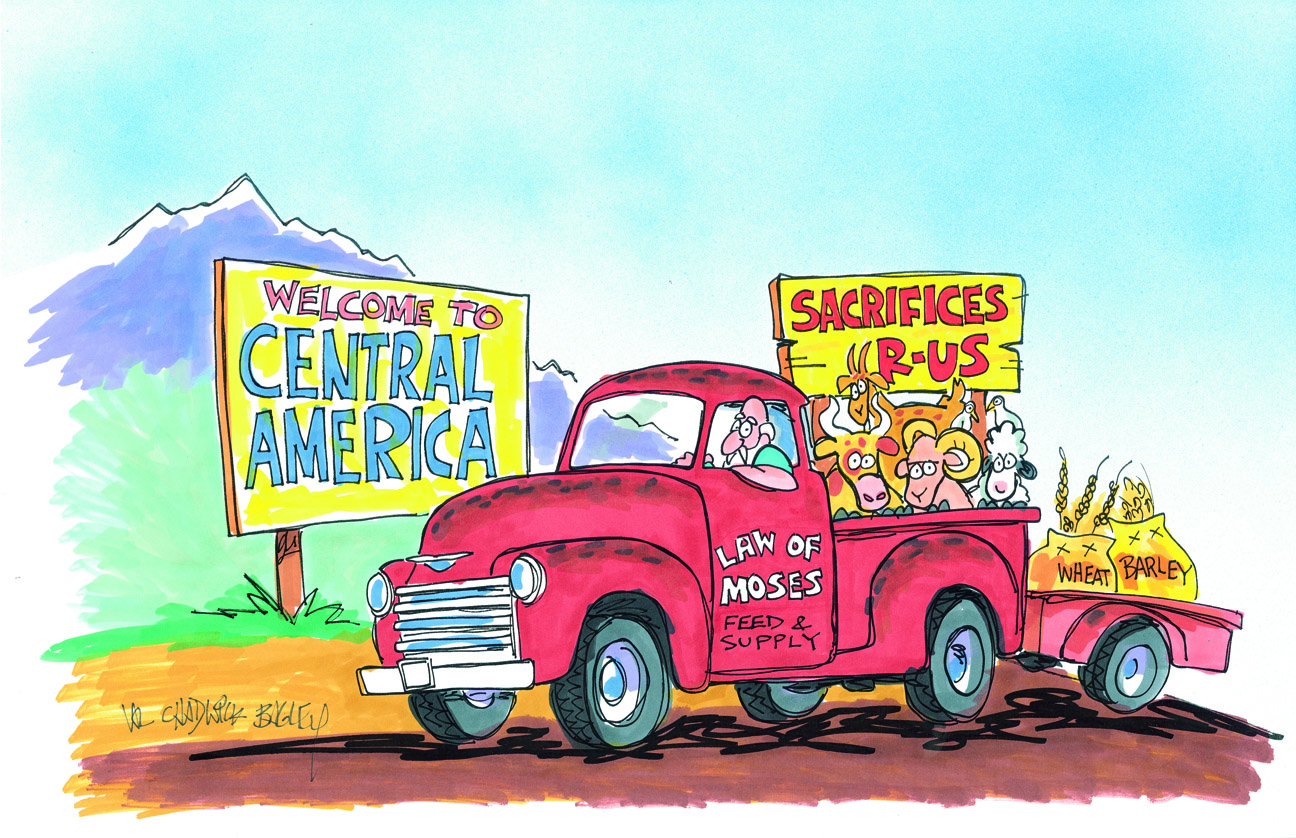
Although there are many views on Book of Mormon historicity and geography, we understand the Church is officially neutral on the question. However, in practice it’s possible that The Church of Jesus Christ of Latter-day Saints is inadvertently or unknowingly endorsing outside groups that do not follow the Church’s position and instead openly promote what is commonly called the “Mesoamerican/two-Cumorah’s” theory (M2C). We believe they may have lead Church administration personnel to believe that they are neutral in their approach to Book of Mormon geography, but they promote the Mesoamerica Book of Mormon theory that they have espoused in previous organizations to the exclusion – and indeed censorship – of all others.
This practice is causing concern and confusion for hundreds of thousands of Church members throughout the world who believe the teachings of the prophets and the scriptures about the Hill Cumorah in New York and about America being a covenant land of promise. Church leaders who have endorsed the M2C organizations are apparently unaware of what is really happening “on the ground.” They do not realize that those organizations openly reject and undermine the multiple teachings of the prophets and scriptures about the Hill Cumorah in New York as well as the teachings regarding the Lord’s involvement in the formation of the United States and its inspired Constitution. This can cause concern for the majority of Church members who still believe these inspired teachings.
On a personal level, we respect and admire our fellow Saints who believe in and promote M2C. This is not a question of faithfulness or fidelity to the Church. We provide this brief overview to possibly assist Church leaders in re-evaluating their unknowing support and or endorsement of these M2C organizations, and to suggest that Church administrators adopt the leadership’s neutral approach by endorsing only organizations that follow our leaders counsel of neutrality. Such organizations should be able to demonstrate their neutrality before receiving any endorsement from the Church. Their websites and information should provide support and encouragement to the majority of Church members who still believe in these inspired teachings of the prophets and scriptures.
“The FIRM Foundation (Foundation for Indigenous Research and Mormonism) is an organization dedicated to showing forth evidence for the Book of Mormon in order to provide LDS Church members with well-researched information enabling them to powerfully and respectfully defend its historicity and thus its truthfulness – with the ultimate goal of bringing people unto Christ.
The FIRM Foundation believes The Book of Mormon events in the New World occurred in North America in the Heartland of the United States. This is the reason many call us “Heartlanders.” The Church of Jesus Christ of Latter-day Saints is neutral on this subject. Our information is based on our own personal beliefs in regard to: archaeology, anthropology, text of the Book of Mormon, distances, geology, and we believe the many rivers were the highways of the ancients including the Nephites.
No information or opinions of the FIRM Foundation represent The Church of Jesus Christ of Latter-day Saints. The owner and employees are members of the LDS Church and in good standing. FIRM Foundation is not neutral in our opinion about the geography of the Book of Mormon.” Rod Meldrum
“I know the Brethren of the Church take a neutral position on the geography of the Book of Mormon. I love and support the Brethren. For you and me to take a neutral stand is not required. The Lord told us to read and study, and in the promise to Moroni, He said we may know the truth of ALL things, and I feel that could include knowing the location of the Book of Mormon events if that is desirable. I believe knowledge of the Spirit and of the head, are both important in learning truth. As Elder Holland in 2018 said, “truth borne by the Holy Spirit comes with, in effect, two manifestations, two witnesses if you will—the force of fact as well as the force of feeling.”
I think there is importance in the Brethren being neutral on Geography, Evolution and other difficult issues. They want us to gain our own witness to secondary information. They have given us sound doctrine and that is what we should focus on. I know through the Spirit that the Book of Mormon is true. However, I love to seek for other truth and as Moroni has said “I may know the truth of all things.
I believe our friend Jonathan Neville has shared some great information below in regard the beliefs of Book of Mormon Central and others like them including The Interpreter, FairMormon, Meridian Magazine and others. I want you to have some information that I think is good to explain the various beliefs. Again we love these other groups and pray that we may all love each other and the Lord.” Rian Nelson
Here’s the Dilemma “I fully share the objectives of Book of Mormon Central (BMC) in terms of sharing the Book of Mormon. I love all the people associated with BMC and its affiliates. They’re all wonderful people. I support about 90% of what they do and wish I could support the rest. However, I think their focus on M2C undermines their objectives for all the reasons I’ve explained.
At the very least, they should represent all faithful views and interpretations of the Book of Mormon, but they refuse. They have earned the nickname Book of Mormon Central America because that’s the only theory of geography they permit on their web site. They continue to censor alternative faithful views.
Like its predecessor FARMS, BMC is the antithesis of diversity and neutrality, but for obvious reasons they want everyone to think they follow the Church’s policy of neutrality on Book of Mormon geography issues, as well as the policy against contention.
Let’s see what the reality is.
As always, I’m eager to correct any errors in this material, so if there are any, please let me know by email. _____
First, let’s review the history of M2C.
1917 map of M2C by L.E. Hills
M2C originated over 100 years ago with the work of RLDS scholars, including Stebbins and Hills. You can see the 1917 map by Hills to the left. Some details in the map are different from some modern M2C maps, but the Hills map clearly shows Cumorah/Ramah in Central America.
Cumorah was part of the contest between the RLDS and LDS, as I discussed in more detail here.
In the late 1800s, the President of the RLDS Church was Joseph Smith III, the son of Joseph Smith Jr. RLDS missionaries were coming to Utah and converting LDS members to their church. By one count, 3,000 LDS in Utah converted to the RLDS church.
In response, Brigham Young called Joseph F. Smith, the 27-year-old son of Hyrum Smith, to the First Presidency, where he served the remainder of his life.
Joseph Smith III and Joseph F. Smith were first cousins. Their rivalry was partly doctrinal but also familial.
RLDS scholars developed M2C about the time that LDS President Joseph F. Smith focused on the New York Cumorah. As editor of the Improvement Era in 1899, President Smith republished Letter VII, reaffirming President Cowdery’s declaration that it was a fact that the hill Cumorah in New York was the scene of the final battles of the Nephites and Jaredites, as well as the location of Mormon’s depository of Nephite records.
After he became President of the Church, Joseph F. Smith wanted to purchase the Hill Cumorah in New York. RLDS scholars were saying, in effect, “go ahead, but the real Cumorah is in Mexico.”
Over the objections of LDS Church leaders such as Joseph Fielding Smith, LDS scholars adopted the RLDS theory. Today’s M2C is the result. _____
The clearest statement of the philosophical basis for M2C was provided by Dr. John Sorenson, author of Mormon’s Codex and other M2C books and articles found in BMC’s archive. Original in blue, my comments in red.
What may startle some about this situation is that most of what Joseph Smith said or implied about geography indicates that he did not understand or was ambiguous about the fact, as it turns out, that Mesoamerica was the particular setting for Nephite history.
Notice: Brother Sorenson announces that the Mesoamerican setting is a fact.
That is how M2C intellectuals define “neutrality,” and that’s what “neutrality” means to their followers, employees, and donors. They are “neutral” only about where in Mesoamerica the Book of Mormon took place, but they insist it could have taken place only somewhere in Mesoamerica.
Continuing: Until he encountered the Stephens’s book, Joseph gave no hint that he was aware that such a limited area with a distinctive civilized culture even existed in the Americas. Even with Stephens’s material in mind, he made no more than a passing attempt to relate the Book of Mormon’s story to the newly-found ruins. And in the long run, the little blip on the Latter-day Saints’ mental screen caused by the explorer’s book faded as the mistaken folk view reasserted its dominance.
Notice what he’s saying here. All the prophets and apostles who declared and affirmed that Cumorah was in New York were misleading members of the Church with a “mistaken folk view.”
That’s the essence of M2C. You can ask anyone associated with Book of Mormon Central what they think about the teachings of the prophets about Cumorah. After trying to evade the question, they will eventually admit they agree with Brother Sorenson. They might try to persuade you that they are “neutral” because they disagree with Brother Sorenson about which river is Sidon, or exactly where in Mesoamerica a particular city or feature is located, but they agree with everything he wrote in the quotation above. That’s the essence of M2C.
We have Hebrew (Old Testament). We have Egyptian (Book of Abraham) We have Greek (New Testament). And we have Mayan (Book of Mormon).
That’s as non-neutral as it gets. The logo is a carryover from the old FARMS, which was also 100% M2C, as discussed below.
This logo, heavily promoted with millions of dollars, announces to the world that there is no room for an interpretation of the Book of Mormon outside Mesoamerica. _____
Now, the people involved.
We love all these brothers and sisters. They are all wonderful, faithful, smart, etc. But they all have one thing in common: complete fidelity to M2C. Some of them are active in social media, pushing M2C aggressively. Maybe we’ll look at some examples of their work, but anyone following this topic knows what I’m referring to.
It is difficult to find more dogmatic groupthink than what exists among the BMC staff.
I tried really hard, though, and came across this group.
Actually, there was more “neutrality” about President Trump among the Democrats at Jim Clyburn’s recent fish fry than there is “neutrality” about Book of Mormon geography at BMC.
_____
The BMC editorial position, demonstrated in their archive as well as their regular Kno-Why series, focuses purely on M2C.
They oppose the New York Cumorah at every opportunity because they equate M2C with the authenticity of the Book of Mormon. It’s M2C or bust. This explains why they think the stakes are so high, and why M2C promoters have such an emotional attachment to M2C.
Purchase Here
This also explains why so many people (including BYU professors) lose their faith in the historicity of the Book of Mormon when they realize M2C is based on circular reasoning and illusory evidence (as well as the repudiation of the teachings of the prophets). Long ago, Joseph Fielding Smith warned that M2C would cause members of the Church to become confused and disturbed in their faith in the Book of Mormon. BMC rejects his warning, along with the teachings of all the prophets and apostles who have taught that the Hill Cumorah is in New York.
BMC coordinates its M2C messages with several affiliates who also promote the same M2C message, including Fairmormon and the Interpreter.
The M2C editorial position is at the core of their approach to the Book of Mormon. BMC and the Interpreter had their origins in FARMS, an organization that was known for its dogmatism and aggressive apologetics. The BMC archive contains some of the FARMS material.
Let’s look at how M2C is incorporated in BMC’s official policies.
The legal organization behind Book of Mormon Central is the Book of Mormon Archaeological Forum, Inc., a 501 (c) 3 non-profit public charity chartered in the state of Utah in 2004. When people donate to BMC, they are really donating to BMAF. BMC donors are supporting the dissemination of M2C, as we discussed here.
And that’s perfectly fine, so long as they know what they’re doing.
For decades, BMAF’s mission statement read:
If you can’t read it, it says:
The Book of Mormon Archaeological Forum (BMAF) is a 501(c)(3) not for profit organization dedicated as an open forum for presentation, dissemination, and discussion of research and evidences regarding Book of Mormon archaeology, anthropology, geography and culture within a Mesoamerican context.Our goals are (1) to increase understanding of the Book of Mormon as an ancient Mesoamerican codex, (2) to correlate and publish works of LDS and CofC scholars, (3) to help promote unity and cooperation among scholars and students of the Book of Mormon, and (4) to provide a forum where responsible scholars can present current ideas and discoveries.
After I publicized this mission statement, they changed the statement to what it currently reads:
MISSION STATEMENT
The Book of Mormon Archaeological Forum (BMAF) is a 501(c)(3) not for profit organization dedicated as an open forum for presentation, dissemination, and discussion of research and evidences regarding Book of Mormon archaeology, anthropology, geography and culture within Mesoamerican and other ancient contexts.
Even when they made this change, they could not bring themselves to endorse neutrality. The “other ancient contexts” they refer to here are in the Old World. They are not referring to anywhere in the Americas other than Mesoamerica. This is evident in all their work. Anyone can see it for themselves.
BMC continues “to increase understanding of the Book of Mormon as an ancient Mesoamerican codex.” You can see it in the archive, their Kno-Whys, their social media work, their firesides, their coordinated efforts with other members of the M2C citation cartel, etc.
I’ve mentioned a few examples previously in this blog, which you can see by searching for “KnowWhy,” “Kno-Why” or “no-wise” in the search box. For example:
Book of Mormon Central Policy on Book of Mormon Geography – June 2016
Book of Mormon Central at this time is officially geography neutral. We seek deep understanding of the Book of Mormon text. We hope diligent students work together to achieve working consensus on the geographic correlation issue. Until that happens, our selection of exegetical material is guided by these principles:
In our hierarchy of evidence, the text itself is primary because it is closest to the divine.
If profound and compelling location-specific insights shed light on the text, we highlight these regardless of their geographic provenience.
We favor authors with credentials in their areas of interest.
We favor formally published works from reputable presses.
We welcome good work from any geographic persuasion that is responsive to these principles.
This is all window-dressing for Church leaders and donors. I’ve discussed the implementation here:
I’ll conclude this post with another official statement and its implementation by a BMC employee who demonstrates the deep emotional attachment BMC has with M2C.
Book of Mormon Central Social Media Policy
Joseph Smith emphatically taught, “Friendship is one of the grand fundamental principles of Mormonism. [It is designed] to revolutionize and civilize the world, and cause wars and contentions to cease and men to become friends and brothers” (Teachings of the Prophet Joseph Smith, p. 316). At Book of Mormon Central we strive to represent the very best of professional and personal characteristics in our private and public lives. The message of the Book of Mormon is so compelling and transformative that we have no need to engage in any form of negative public discourse, including in our professional and private social media accounts. Our tremendous work is our defense. We let it speak for itself. Diligently pursuing our mission is the most powerful and convincing way we can answer any contrary individuals or organizations.
To see how that policy is implemented, look at the following social media post by a BMC employee, one that Dan Peterson at the Interpreter endorses. (We aren’t putting any of Dan’s posts here because, technically, he’s not listed under BMC’s directory.)
You have abundantly proven that you are not somebody who can have a rational argument in good faith with an “M2C intellectual.” You have, repeatedly, demonized and belittled and cast aspersion on anybody who doesn’t accept your dogmatic interpretation of early Mormon historical sources relevant to Book of Mormon geography. This isn’t just a matter of having differences of opinion. As your blog posts have more than demonstrated, you have a personal vendetta against the “citation cartel” (which is, in reality, peer reviewed academic scholarship, as opposed to your own brand of trashy Internet pseudo-scholarship) and anybody who is out of step with your narrow and uncompromising Heartland apologetics.
I suspect I know why you are so personally angry and upset at “M2C intellectuals.” It must be very frustrating that your pseudo-scholarship which you’ve invested so much time and energy into is not making mainstream inroads in Mormon studies. It must be frustrating to be a laughingstock at the Church History Department and amongst BYU faculty. It must be frustrating that the best you can do is publish semi-coherent ramblings on obscure personal blogs or with no-name presses. But just know that it isn’t anything personal: it’s because both your Mormon history and your Book of Mormon geography are nonsense and you’re a deeply unpleasant person to interact with..
I don’t know why you have chosen to become such a fanatic over this one issue, but I will say that it is genuinely sad that your testimony is so fragile that even the slightest contradiction of your pet theory causes your cognitive dissonance to flair up like lights on a Christmas tree.
I am content with what I wrote in my post and in the KnoWhy, and I’ll allow readers to decide for themselves which explanation they find more persuasive. I will not, however, waste further time or attention on your shenanigans. Like I said, since you refuse to engage people who disagree with you in good faith, and since you’re a close-minded fanatic, it would be utterly pointless for me to engage you any further.
I will just say this one thing: for all of your self-righteous preening about how you accept the apostles and the prophets, and how “M2C intellectuals” are subversive apostates, it is breathtakingly hypocritical for you to lambast the Church History Department and BYU faculty and Seminaries & Institutes faculty for not kowtowing to your theories, since all of them are ultimately hired by the First Presidency and Quorum of the Twelve. It is astoundingly hypocritical for you to criticize the “Correlation Department” of the Church, which approves “M2C” artwork and videos and articles in Church publications, when, again, the First Presidency and the Twelve are a part of Correlation. It is monstrously hypocritical of you to accuse Saints of being “revisionist history” attempting to deceive people about Book of Mormon geography when Saints has been authorized, reviewed, and approved by the First Presidency and the Twelve.
So please, Jonathan, spare us all the self-righteous BS about how “M2C intellectuals” are trying to get people to disbelieve the prophets and apostles.
Because guess what: as long as you keep doing what you’re doing, you are, in fact, doing the exact same thing. As long as you keep screaming about “M2C intellectuals” ruining the Church, you’re actually telling people to disbelieve the modern prophets and apostles who keep hiring them to work for the Church and guide the Church’s membership in intellectual and historical matters.
Our ability to communicate all over the world has been a great gift from the Lord. Remember all things were created spiritually before they were created temporally. The Lord has always had the systems of communications that are far better and eternal compared to our simple technology of the internet and smart phones. The power of prayer and the Priesthood are far better systems we need to rely on more often. Just think if we could as easily call down the angels of heaven or hear the voice of the Lord, just as easily as we are able to send an email or speak with a friend on the phone? What eternal power we can possess. It’s there for us to utilize.
I’m saddened that the worlds tech companies have been taking away our freedom of speech. We can’t trust google, facebook, twitter, youtube, amazon, or other giant tech companies. I’ve been deeply concerned for a long time about how our news is censored at CBS, NBC, ABC, and even at FOX. We are not getting the full truth anymore. We must learn to get our truth from the Scriptures and the Prophets. We as fathers and mothers can utilize the Keys we hold with our families and share truth with them.
Here are a few suggestions if you are tired of fake news and censoring tech companies:
Duckduckgo not google Mewe not facebook Signal not twitter Vimeo not youtube Newsmax not Fox News
If you have other suggestions I would love you to let me know about them.
Organic Evolution – Social Evolution – Political Evolution – The Internet
“We all have stewardships for which we must account to the Lord. Unfortunately, some men who do not honor their stewardships may have an adverse effect on many people. Often the greater the man’s responsibility, the more good or evil he can accomplish. The Lord usually gives a man a long enough rope and sufficient time to determine whether that man wants to pull himself into the presence of God or drop off somewhere below. There are some regrettable things being said and done by some people in the church today. As President Clark so well warned,the ravening wolves are amongst us. From our own membership and they more than any others are clothed in sheep’s clothing because they wear the habiliments of the priesthood. We should be careful of them.”
Mr. and Mrs. David W. Allan
“We are all grateful for the Internet and the amazing communication connection it provides. I believe that the best thing I can do is to share the message of gladness that the gospel of Jesus Christ provides, and I am grateful that the Internet is helping me do that in a major way. However, like any tool, it can be used for good or evil.
More than a century before the Internet was invented into the amazing tool that it is, Darwin brought forth the theory of “organic evolution”, and the world applauded his genius. Based on Darwin’s work, John Wesley Powell, et. al. introduced “social evolution”, which brought about the doctrine of “manifest destiny,” and which caused the native American Indians to be treated as savages and their way of life destroyed.
Then, as history marched on, based on Powell’s and Lewis Henry Morgan’s ideas, Marx and Engels gave the world “political evolution” the forerunner of communism and socialism.
Now, with the Internet, the prevalence of these three evolutionary theories continues to grow across the world. We are seeing the world’s masses acceptance of the same. Have we been globally deceived? If so, the implications are enormous.
Our education systems and textbooks are full of these three theories, and we have seen an ever-increasing number of atheists who believe these theories, as they are increasingly propagated across the Internet.
As we see the prideful elite trying to destroy our liberty, the battle seems to be their desire to make the state sovereign (political evolution) versus God’s plan for individual sovereignty and leading to eternal life. The writers of our inspired Declaration of Independence and the US Constitution had this individual sovereignty in their hearts and minds. Also, because the book that influenced them more than any other for their inspiration for these documents was the Bible…” David W. Allan
Sharing the Gospel Using the Internet By Elder M. Russell Ballard
A Changing World
“In the span of nearly 80 years, I’ve seen many changes. When I began my mission in England in 1948, the most common way for people to get news was through newspapers and radio.
“How different the world is today. For many of you, if you read newspapers, the chances are you read them on the Internet. Ours is the world of cyberspace, cell phones that capture video, video and music downloads, social networks, text messaging and blogs, handhelds and podcasts.
This is the world of the future, with inventions undreamed of that will come in your lifetime as they have in mine. How will you use these marvelous inventions? More to the point, how will you use them to further the work of the Lord?
You have a great opportunity to be a powerful force for good in the Church and in the world. There is truth in the old adage that “the pen is mightier than the sword.”1 In many cases it is with words that you will accomplish the great things that you set out to do. And it’s principally about ways to share those words that I want to talk to you.
From its beginnings, The Church of Jesus Christ of Latter-day Saints has used the power of the printed word to spread the message of the restored gospel throughout the world. The Lord, over the centuries, has had a hand in inspiring people to invent tools that facilitate the spreading of the gospel. The Church has adopted and embraced those tools, including print, broadcast media, and the Internet.
There are perhaps few inventions that have had a greater impact on the world than the printing press, invented by the inspired Johannes Gutenberg around 1436. The printing press enabled knowledge, including that contained in the Holy Bible, to be shared more widely than ever before.
The Internet: A Modern Printing Press
Today we have a modern equivalent of the printing press in the Internet.The Internet allows everyone to be a publisher, to have his or her voice heard, and it is revolutionizing society. Before the Internet there were great barriers to printing. It took money, power, influence, and a great amount of time to publish. But today, because of the emergence of what some call “new media,” made possible by the Internet, many of those barriers have been removed. New media consists of tools on the Internet that make it possible fornearly anyone to publish or broadcast to either a large or a niche audience. I have mentioned some of these tools already. The emergence of new media is facilitating a worldwide conversation on almost every subject, including religion, and nearly everyone can participate. This modern equivalent of the printing press is not reserved only for the elite.
Now some of these tools—like any tool in an unpracticed or undisciplined hand—can be dangerous. The Internet can be used to proclaim the gospel of Jesus Christ and can just as easily be used to market the filth and sleaze of pornography. Computer applications like iTunes can be used to download uplifting and stirring music or the worst kind of antisocial lyrics full of profanity. Social networks on the Web can be used to expand healthy friendships as easily as they can be used by predators trying to trap the unwary. That is no different from how people choose to use television or movies or even a library. Satan is always quick to exploit the negative power of new inventions, to spoil and degrade, and to neutralize any effect for good. Make sure that the choices you make in the use of new media are choices that expand your mind, increase your opportunities, and feed your soul.
As you know, the new media has already profoundly impacted the old world of newspapers and other traditional media. Once upon a time, as a Church leader I might give a newspaper interview, then wait a day or two for it to appear somewhere deep inside the newspaper. Then that newspaper was thrown away, and whatever impact it might have had dissipated rather quickly.
Now, as I am leaving one appointment to go to the next, the report of my visit or interview begins almost immediately to appear on the newspaper’s Web site or on blogs, where it can be copied and distributed all over the Web. You can see how important the right words are today. Words recorded on the Internet do not disappear. Any Google or Yahoo! search is going to find one’s words, probably for a very long time.
A case in point: In 2007, NBC television came to Salt Lake for an interview with me as part of a piece they were producing on the Church. Reporter Ron Allen and I spent an hour together in the chapel in the Joseph Smith Memorial Building. We discussed the Church at length. A few days later the story appeared, and in the four-minute segment that aired, there was one short quote of about six seconds from the one-hour interview. That was just enough time for me to testify of our faith in Jesus Christ as the center of all we believe. I repeat, just six seconds were used from a 60-minute interview. Those six seconds are quite typical, actually, for members of the traditional TV media, who think and air in sound bites. The big difference from the old days to today is that the reporter also ran 15 minutes of our interview on the NBC Nightly News Web site. And those 15 minutes are still there. What we say is no longer on and off the screen in a flash, but it remains as part of a permanent archive and can appear on other sites that reuse the content. People using Internet search engines to hunt for topics about the Church will come across that interview and many others.
These tools allow organizations and individuals to completely bypass the news media and publish or broadcast their messages in their entirety to the intended audiences. For instance, last year the Church Public Affairs Department conducted an interview with Elder Dallin H. Oaks of the Quorum of the Twelve Apostles and Elder Lance B. Wickman of the Seventy regarding the Church’s position on same-gender attraction. In the old days, to communicate our message to the public on an issue like this we would have had to rely on the news media. But this probing interview was conducted by Church Public Affairs staff and posted in its entirety on the Church’s Web site, unfiltered by the news media.
Joining the Conversation
There are conversations going on about the Church constantly. Those conversations will continue whether or not we choose to participate in them. But we cannot stand on the sidelines while others, including our critics, attempt to define what the Church teaches. While some conversations have audiences in the thousands or even millions, most are much, much smaller. But all conversations have an impact on those who participate in them. Perceptions of the Church are established one conversation at a time.
The challenge is that there are too many people participating in conversations about the Church for our Church personnel to converse with and respond to individually. We cannot answer every question, satisfy every inquiry, and respond to every inaccuracy that exists. We need to remember that there is a difference between interest and mere curiosity. Sometimes people just want to know what the Church is. And some who seek answers want them to come directly from a member of the Church. They appreciate one-on-one conversation.
All of you know that members of The Church of Jesus Christ of Latter-day Saints are reminded and encouraged continually to share the gospel with others. The Church is always looking for the most effective ways to declare its message. Preaching the gospel of the Restoration has always been special to me. I loved being a missionary in England. I loved being a mission president in Canada. And I love my present calling, which allows me opportunities to share the message of the Restoration of the gospel to the world and to testify that God the Father and His Son, Jesus Christ, appeared to the Prophet Joseph Smith in 1820. Through Joseph, the gospel that Jesus established in New Testament times was brought back. It had been lost with the deaths of the Apostles of old. I can share with the world the knowledge that priesthood authority, the doctrine, and the ordinances of the New Testament Church are once again on the earth. This is the most important work that we can participate in.
Now, may I ask that you join the conversation by participating on the Internet to share the gospel and to explain in simple and clear terms the message of the Restoration. Most of you already know that if you have access to the Internet you can start a blog in minutes and begin sharing what you know to be true. You can download videos from Church and other appropriate sites, including newsroom.lds.org, and send them to your friends. You can write to media sites on the Internet that report on the Church and voice your views as to the accuracy of the reports. This, of course, requires that you understand the basic principles of the gospel. It is essential that you are able to offer a clear and correct witness of gospel truths. It is also important that you and the people to whom you testify understand that you do not speak for the Church as a whole. You speak as one member—but you testify of the truths you have come to know.
Far too many people have a poor understanding of the Church because most of the information they hear about us is from news media reports that are often driven by controversies. Too much attention to controversy has a negative impact on peoples’ perceptions of what The Church of Jesus Christ of Latter-day Saints really is.
Recently a columnist writing in a major U.S. newspaper was irresponsibly inaccurate in his description of the Church and our beliefs and practices. Dozens, perhaps even hundreds, of Church members and others who understand our beliefs commented on the newspaper’s Web site, correcting the misconceptions he was spreading and calling for accuracy.
Examples of What You Can Do
Let me give you a few other examples of how Church members are using the new media.
A Church member living in the Midwest of the United States makes a concerted effort to share the gospel every day, in person. He then writes a blog about his daily endeavors to share the teachings of the Book of Mormon and to give pass-along cards to all he meets. His effort to share the gospel so diligently is admirable, and his further effort to write about it no doubt inspires many others to do the same.
Others have recorded and posted their testimonies of the Restoration, the teachings of the Book of Mormon, and other gospel subjects on popular video-sharing sites. You too can tell your story to nonmembers in this way. Use stories and words that they will understand. Talk honestly and sincerely about the impact the gospel has had in your life, about how it has helped you overcome weaknesses or challenges and helped define your values. The audiences for these and other new media tools may often be small, but the cumulative effect of thousands of such stories can be great. The combined effort is certainly worth the outcome if but a few are influenced by your words of faith and love of God and His Son, Jesus Christ.
The Restoration of the gospel of Jesus Christ has no doubt had a powerful impact on your life. It has, in part, shaped who you are and what your future will be. Do not be afraid to share with others your experiences as a follower of the Lord Jesus Christ. We all have interesting stories that have influenced our identity. Sharing those stories is a nonthreatening way to talk to others. Telling those stories can help demystify the Church. You could help overcome misperceptions through your own sphere of influence, which ought to include the Internet.
Things to Avoid
Every disciple of Christ will be most effective and do the most good by adopting a demeanor worthy of a follower of the Savior. Discussions focused on questioning, debating, and doubting gospel principles do little to build the kingdom of God. The Apostle Paul has admonished us to not be “ashamed of the gospel of Christ: for it is the power of God unto salvation” (Romans 1:16). Let us all stand firmly and speak with faith in sharing our message with the world. Many of you are returned missionaries and can carry on a meaningful conversation in the language you learned on your mission. Your outreach can be international.
As you participate in this conversation and utilize the tools of new media, remember who you are—Latter-day Saints. Remember, as the proverb states, that “a soft answer turneth away wrath: but grievous words stir up anger” (Proverbs 15:1). And remember that contention is of the devil (see 3 Nephi 11:29). There is no need to argue or contend with others regarding our beliefs. There is no need to become defensive or belligerent. Our position is solid; the Church is true. We simply need to have a conversation, as friends in the same room would have, always guided by the prompting of the Spirit and constantly remembering the Atonement of the Lord Jesus Christ, which reminds us of how precious are the children of our Father in Heaven.
May the Lord bless each of you that you will have a powerful influence on those you come in contact with. As I said in the beginning, the power of words is incredible. Let your voice be heard in this great cause of the gospel of Jesus Christ.
Helps for Home Evening
As a family, watch the video clip of Elder M. Russell Ballard’s call for Latter-day Saints to share the message of the Restoration with others using the Internet. See www.youtube.com/LDSPublicAffairs. Discuss ways you can share your testimony of the gospel with others using the Internet.
Fill a large bowl or bathtub with water. Drop a bar of soap into the water, noticing the ripple effect of tiny waves generated from the soap falling into the water. Compare the waves to using the Internet to promote good, clean conversations about the Church. As a family, send an e-mail to a friend, telling something you love about the gospel.” Elder M. Russell Ballard
“Sherem’s anti-Christ story in Chapter 7 of Jacob is reflective of exactly what is going on in the world today. As Satan knows, it is his last hour to promote his atheistic agenda using these three false theories and any other deceitful way he can devise with the Internet as the propagation tool. Without God, the world is trying to solve the world’s problems using science and technology, and most scientists believe the Bible to be a myth…
In contrast to Sherem and the atheists, who believe that we cannot know the future, which belief brings emptiness and fear into many hearts, we gratefully know much of the past, present, and future, because of God’s word – upon which this nation was founded. Our faith in God gives us great hope and purpose to our lives. As we are now seeing conspiring forces trying to destroy our liberty and encroach worldly values on all Christians. As the prophecies tell us, we know that the pit they dig to destroy us will be the pit in which they will eventually fall. And on the last day, they will confess with Sherem, that they were deceived by Satan, and will bow the knee in deep gratitude for the infinite atonement…
Both the Prophet Nephi and Joseph in Egypt prophesied that the Book of Mormon would come forth, and in that day when the Bible would be disbelieved, and the Book of Mormon and “other books” would come forth validating the Bible. (1 Ne. 13:39-41; 2 Ne. 3:11) There is now information known so that those who desire can come to know God, which is eternal life (John 17:3) and the greatest gift from God (D&C 14:7). David W. Allan
“Would you like to be a big part of the greatest challenge, the greatest cause, and the greatest work on the earth today?”
The Answer
On June 3, 2018, President Russell M. Nelson and his wife, Wendy W. Nelson, invited the youth to “enlist in the youth battalion of the Lord” and take part in “the greatest challenge, the greatest cause, and the greatest work on earth.”
By Ken Corbett
And what is the greatest challenge? The gathering of Israel.
“My dear extraordinary youth, you were sent to earth at this precise time, the most crucial time in the history of the world, to help gather Israel,” the prophet said. “There is nothing happening on this earth right now that is more important than that. There is nothing of greater consequence. Absolutely nothing. This gathering should mean everything to you. This is the mission for which you were sent to earth.” President and Sister Nelson’s Devotional for Youth. A Call to Enlist and Gather IsraelBy Charlotte Larcabal Church Magazines
Sometimes when we hear about gathering Israel, we become confused on who that is? We hear the words, Judah, Jew, Israel, Gentile, Joseph, Lamanite, Shem, Tribe, etc. Who is who? How can I gather someone whom I don’t understand who it even is? Let me share with you answers to questions like, Who, then, are the Jews, What does the name Jew mean? Who is a Gentile? What does it mean that I am from the tribe of Ephraim or Manasseh? Who are the Lamanites? Are the Lamanites Jewish? Who are the Indians and where do they fit in? Who is Ham, Shem and Japeth? Who are the lost 10 tribes of Israel?
The Prophet wants us to gather Israel, so let’s discuss a little information about who is who. At the very end, our Prophet, Russell M. Nelson has a simple answer for us.
Come Follow Me 2021 Free Podcasts Click Picture Above
Who, then, are the Jews
“Who, then, are the Jews, and what part shall they yet play in the gathering of Israel and the return of their King? There is a maze of fuzzy thinking and shoddy scholarship, both in the world and in the Church, that seeks to identify the Jews, both ancient and modern, and to expound upon what they have believed and do believe. It is not strange that the divines of the day-not knowing that the kingdom is to be restored to Israel at that glorious day; not having the Book of Mormon and latter-day revelation to guide them-it is not strange that they come up with false and twisted views about the mission and destiny of the Jews. It is a little sad that church members sometimes partake of these false views and of this secular spirit so as to misread the signs of the times.
What is a Jew?
The term Jew is a contraction of the name Judah, but the Jews are not the members of the tribe of Judah as such. After the reign of Solomon, the Lord’s people divided into the kingdom of Israel and the kingdom of Judah. Nearly ten tribes served Jeroboam in Israel and two and a half tribes served Rehoboam in Judah. The Levites were scattered among all the tribes. Judah, Simeon, and part of Benjamin comprised the kingdom of Judah. In actual fact, and considering blood lineage only, both kingdoms had in them people from all of the tribes. Lehi, who lived in Judah and was a Jew, was of the tribe of Manasseh. The Jews were nationals of the kingdom of Judah without reference to tribal ancestry. Thus the descendants of Lehi, both the Nephites and the Lamanites, were Jews because they came out from Jerusalem and from the kingdom of Judah. (2 Ne. 33:8.)
Who are the 10 Tribes?
The Jews today are also those whose origins stem back to the kingdom of their fathers. Clearly the dominant tribe-dominant, however, only in the sense of political power and rulership-was Judah. As to the bloodlines, who knows whether there are more of Judah or of Simeon or of Benjamin or of some other tribe among the Jews as we know them? Paul, a Jew, was of the tribe of Benjamin. The name Judea, now used as a noun, is actually an adjective meaning Jewish and is the Greek and Roman designation for the land of Judah.
Who is a Gentile?
Since the Ten Tribes were taken into Assyria and lost from the knowledge of their fellows more than a century before the Jews went into Babylonian captivity, the prophets began to speak of Jews and Gentiles and to consider as a Gentile everyone who was not a Jew. This classifies Ephraim and the rest of scattered Israel as Gentiles. Everyone, in this sense, who is not a Jew is a Gentile, a concept that will enable us, in due course, to set forth what is meant by the fulness of the Gentiles.” Titles Added (The Millennial Messiah: The Second Coming of the Son of Man, p.221-222)
The Midst of the Lamanites; Means?
Joseph Smith Sr.
“My father was living in a good hewed log house in 1840 when one morning as the family all sat at breakfast old Father Joseph Smith, the first Patriarch of the Church and father of the Prophet Joseph, came in and sat down by the fire place, after declining to take breakfast with us, and there he sat some little time in silence looking steadily in the fire. At length he observed that we had been driven from Missouri to this place; with some passing comments, he then asked this question: “And how long, Brother Huntington, do you think we will stay here?” As he asked this question I noticed a strange, good-natured expression creep over his whole being-an air of mysterious joy.
Father answered, after just a moment’s hesitation, “Well, Father Smith, I can’t begin to imagine.”
“No,” said the old Patriarch, his whole being seeming to be alive with animation. “The Lord has told Joseph that when we leave here we will goin to the Rocky Mountains; right into the midst of the Lamanites.”
Oliver B. Huntington and Family
“We will just stay here seven years,” he answered. “The Lord has told Joseph so-just seven years,” he repeated. “Now this is not to be made public; I would not like to have this word go any further,” said the Patriarch, who leaned and relied upon his son Joseph in all spiritual matters as much as boys generally do upon their parents for temporalities. There were then two or three minutes of perfect silence. The old gentleman with more apparent secret joy and caution in his countenance said, “And where do you think we will go to when we leave here, Brother Huntington?” Father did not pretend to guess; unless we went back to Jackson County.
Editors Note: Into the midst to me would mean, “to the very heart”, or “the middle of” or “into the Heatland of the United States”. As as I look at this today the area of the Heartland of America is where the Book of Mormon began, (the heart) and all around it are the remnants or outskirts, or the hinterlands as we call it. So there are Lamanites all around the heart of the land through marriage and inter mingling. Father Lehi would have distant relatives in South and Central America, but the heartland is where it all began.
Huntington continues, “This information filled our hearts with unspeakable joy, for we knew that the Book of Mormon and this gospel had been brought to light more for the remnants of Jacob upon this continent than for the Gentiles.
Father Smith again enjoined upon us profound secrecy in this matter and I don’t think it was ever uttered by one of Father Huntington’s family. The history of Nauvoo shows that we located in Nauvoo in 1839 and left it in 1846.
1875 Leslies illustrated June 5 – Mormons baptise Indians at St. George Utah
The Church did move to the Rocky Mountains into the midst of the Indians or Lamanites -or more properly speaking the Jews-and here expect to live until we move to the spirit land or the Lord moves us somewhere else.” Oliver B. Huntington, “Prophecy,” Young Woman’s Journal 2, no. 7 (April 1891): 314-15
Who are the Remnants of the House of Israel?
“I am asked to occupy the few minutes yet remaining: If the Spirit gives me liberty I will pursue the train of thought that has passed through my mind while Brother Richards has been speaking upon the spirit that has gone abroad upon the remnants of the house of Israel who occupy this land, the American Indians whom we understand to be the descendants of the Nephites, the Lamanites, the Lemuelites and the Ishmaelites who formerly possessed this land, whose fathers we have an account of in the Book of Mormon.” The Indians—The Influence of the Elders Among Them in the Interest of Peace, Etc. Discourse by Elder Erastus Snow, delivered at Logan, Sunday Afternoon, February 5th, 1882
Who is Shem?
Name. Son of Noah (Gen. 5:29–32; 6:10; 7:13; 8:16; 9:26; Moses 8:12); his descendants (Gen. 10:21–31; 11:10–32; 1 Chr. 1:17; Luke 3:36). Shem was the traditional ancestor of the Shemitic or Semitic races, a group of kindred nations, which includes the Arabs, the Hebrews and Phoenicians, the Arameans or Syrians, the Babylonians and Assyrians. The languages spoken by these various nations were closely related and were known as the Semitic languages. In latter-day revelation Shem is referred to as “the great high priest” (D&C 138:41). See also Melchizedek.Bible Dictionary
Noah had three sons Ham and Japeth, who were not the priesthood lineage and Shem who was the chosen lineage.
Lehi-Manasseh/Joseph Daughters of Ismael-Ephraim/Joseph Mulekites-Judah You can see how the Nephites, Lamanites, Joseph, Manasseh, Ephraim and Judah (All from Shem) intermingles with each other.
Do you believe the Lamanites of the Book of Mormon are in fact of Jewish descent? I do! Why is this such an important idea? There are only 3 races of people on the earth today. We all come from Adam through the sons of Noah. Noah’s three sons are Ham, Shem and Japeth. (ONLY 3 RACES)
Japeth The eldest son of Noah, an Old Testament prophet (Moses 8:12). God shall enlarge Japheth, Gen. 9:27. Ham The government of Ham was patriarchal and was blessed as to things of the earth and wisdom but not as to the priesthood, Abr. 1:21–27. Ham’s wife, Egyptus, was a descendant of Cain; the sons of their daughter Egyptus settled in Egypt, Abr. 1:23, 25 (Ps. 105:23; 106:21–22). Shem In the Old Testament, a righteous son of Noah and, according to tradition, the forefather of the Shemite, or Semite, peoples, including the Arabs, Hebrews, Babylonians, Syrians, Phoenicians, and Assyrians (Gen. 5:29–32;6:10; 7:13; 9:26; 10:21–32; Moses 8:12). In latter-day revelation Shem is referred to as “the great high priest” (D&C 138:41).
We need to look no further than the scriptures to know the Lamanites ARE DESCENDANTS of the JEWS.
“And again, I command thee that thou shalt not covet thine own property, but impart it freely to the printing of the Book of Mormon, which contains the truth and the word of God—Which is my word to the Gentile, that soon it may go to the Jew, of whom the Lamanites are a remnant, that they may believe the gospel, and look not for a Messiah to come who has already come.” D&C 29:26-27
“Which is my word to the Gentile, that soon it may go to the Jew, of whom the Lamanites are a remnant, that they may believe the gospel, and look not for a Messiah to come who has already come.” D&C 19:27 “And then shall the remnant of our seed know concerning us, how that we came out from Jerusalem, and that they are descendants of the Jews.” 2 Nephi 30:4
D&C 57:1 “Hearken, O ye elders of my church, saith the Lord your God, who have assembled yourselves together, according to my commandments, in this land, which is the land of Missouri, which is the land which I have appointed and consecrated for the gathering of the saints.
2 Wherefore, this is the land of promise, and the place for the city of Zion.
3 And thus saith the Lord your God, if you will receive wisdom here is wisdom. Behold, the place which is now called Independence is the center place; and a spot for the temple is lying westward, upon a lot which is not far from the courthouse.
4 Wherefore, it is wisdom that the land should be purchased by the saints, and also every tract lying westward, even unto the line running directly between Jew and Gentile;” D&C 57:1-4
At that time the Lamanites (or Jews) lived on the west and the Gentiles (or Whites) lived on the east. In this way you may interpret D&C 57:1-4 as separating the Jews and Gentiles or the Lamanites and Whites
Who is the House of Joseph?
Dispersion of the Jews
“I would say to the Lamanites, if I could speak to them understandingly, that you are also a branch of the house of Israel, and chiefly of the house of Joseph, and your forefathers have fallen through the same examples of unbelief and sins, as have the Jews, and you, as their posterity, have wandered in sin and darkness for many generations; and you, like the Jews, have been driven and trampled under the foot of the Gentiles,[See chart below] and put to death through your wars with each other, and with the white man, until you are almost destroyed. But there is still a redemption and salvation for a remnant of you in the latter days. It is time for you to cease shedding each other’s blood or making war upon your fellow-man. Cease to destroy one another, learn to cultivate the earth, and raise your food therefrom; call upon the Great Spirit to protect you and deliver you from bondage and darkness, and the Great Spirit will hear you and deliver you, and a remnant of you will again become a delightsome people as your forefathers were when they kept the commandments of God.” Wilford Woodruff History of His Life and Labors AS RECORDED IN HIS DAILY JOURNALS PREPARED FOR PUBLICATION BY MATTHIAS F. COWLEY Salt Lake City, Utah 1909Blog here
Who are the Indians?
“The Book of Mormon is a record of the forefathers of our western tribes of Indians; having been found through the ministration of an holy angel, and translated into our own language by the gift and power of God, after having been hid up in the earth for the last fourteen hundred years, containing the word of God which was delivered unto them. By it we learn that our western tribes of Indians are descendants from that Joseph who was sold into Egypt, and that the land of America is a promised land unto them, and unto it all the tribes of Israel will come, with as many of the Gentiles as shall comply with the requisitions of the new covenant. TEACHINGS OF THE PROPHET JOSEPH SMITH Page 17:
Where is Zion?
The word Zion is used repeatedly in all the standard works of the Church and is defined in latter-day revelation as “the pure in heart” (D&C 97:21). Other usages of Zion have to do with a geographical location. For example, Enoch built a city that was called Zion (Moses 7:18–19); Solomon built his temple on Mount Zion (1 Kgs. 8:1; see also 2 Sam. 5:6–7); and Jackson County, Missouri, is called Zion in many of the revelations in the D&C, such as 58:49–50; 62:4; 63:48; 72:13; 84:76; 104:47. The city of New Jerusalem, to be built in Jackson County, Missouri, is to be called Zion (D&C 45:66–67). The revelations also speak of “the cause of Zion” (D&C 6:6; 11:6). In a wider sense all of North and South America are Zion (HC 6:318–19). For further references see 1 Chr. 11:5; Ps. 2:6; 99:2; 102:16; Isa. 1:27; 2:3; 4:3–5; 33:20; 52:1–8; 59:20; Jer. 3:14; 31:6; Joel 2; Amos 6:1; Obad. 1:17, 21; Heb. 12:22–24; Rev. 14:1–5; and many others. (In the New Testament, Zion is spelled Sion.) Bible Dictionary
Joseph Smith said Zion is in Independence Missouri
“You know there has been great discussion in relation to Zion–where it is, and where the gathering of the dispensation is, and which I am now going to tell you. The prophets have spoken and written upon it; but I will make a proclamation that will cover a broader ground. The whole of America is Zion itself from north to south, and is described by the Prophets, who declare that it is the Zion where the mountain of the Lord should be, and that it should be in the center of the land. When Elders shall take up and examine the old prophecies in the Bible, they will see it. (Teachings of the Prophet Joseph Smith, Section Six 1843–44, p.362)
With a better knowledge of the Jews, Gentiles, Shem, Israel, Lamanites or Indians, we can better understand our Prophet’s words about the importance of gathering Israel. Who is Israel and how can I help gather them, to Zion, to Missouri, or how can I just help period?
The Answer Specifically?
President Russell M. Nelson declared, “Anytime you do anything that helps anyone—on either side of the veil—take a step toward making covenants with God and receiving their essential baptismal and temple ordinances, you are helping to gather Israel. It is as simple as that” (Russell M. Nelson, “Hope of Israel,” worldwide devotional for youth, June 3, 2018, churchofjesuschrist.org/broadcasts).
“I am the greatest advocate of the Constitution of the United States there is on the earth. In my feelings I am always ready to die for the protection of the weak and oppressed in their just rights.” (Joseph Smith, History of the Church 6:56, also in Teachings of the Prophet Joseph Smith, p. 326)
The Voice of the People
“We believe that all governments necessarily require civil officers and magistrates to enforce the laws of the same; and that such as will administer the law in equity and justice should be sought for and upheld by the voice of the people if a republic, or the will of the sovereign.
We believe that religion is instituted of God; and that men are amenable to him, and to him only, for the exercise of it, unless their religious opinions prompt them to infringe upon the rights and liberties of others; but we do not believe that human law has a right to interfere in prescribing rules of worship to bind the consciences of men, nor dictate forms for public or private devotion; that the civil magistrate should restrain crime, but never control conscience; should punish guilt, but never suppress the freedom of the soul.
We believe that all men are bound to sustain and uphold the respective governments in which they reside, while protected in their inherent and inalienable rights by the laws of such governments; and that sedition and rebellion are unbecoming every citizen thus protected, and should be punished accordingly; and that all governments have a right to enact such laws as in their own judgments are best calculated to secure the public interest; at the same time, however, holding sacred the freedom of conscience.” D&C 134:3-5
I Love Our Country
I love our Country and the blessed Constitution that the Lord Himself wrote. D&C 101:77-80. Ever since I saw Trump begin to keep his promises from his primary campaign, I have always supported him and the good things he does for our country. I admire his tenacity in trying to right the wrongs done against him and our country. He has tried to put America first so we can be a strong nation and remain the leader of the world as was promised by the Lord. We as Americans are not better than other people, but the Children of Joseph were promised this land as long as we live righteously. Sadly the fate of the Jaredites and Nephites on this land are a precursor to our fate if we don’t repent.
Reform the Nation
Joseph Smith appropriately spoke in 1844 saying, “Now, O people! people! turn unto the Lord and live, and reform this nation. Frustrate the designs of wicked men. Reduce Congress at least two-thirds. Two Senators from a State and two members to a million of population will do more business than the army that now occupy the halls of the national Legislature. Pay them two dollars and their board per diem (except Sundays). That is more than the farmer gets, and he lives honestly. Curtail the officers of Government in pay, number, and power; for the Philistine lords have shorn our nation of its goodly locks in the lap of Delilah.” The Prophet Joseph Smith’s Views on the Powers & Policy of The Government of The United States P. 16
The Nature and Disposition of Almost all Men
I also think Trump is a power seeker, a narcissist, and loves to be in the spotlight. I don’t love many of his known discretions but, I love what he is trying to do for our country. Does he make mistakes? Absolutely! Even though I know he plays to the popularity of telling us what we want to hear, I think most of us can agree he sure has done much for us. I did not vote for him to be my Bishop but as someone who could break through the gridlock and move our country forward which he has done. I feel having a two-party system helps us in check and balances. I sure hope and pray the Democrat party will not overreach, but I know that is doubtful.
Where are the Statesmen?
“Ye spirits of the blessed of all ages, hark! Ye shades of departed statesmen, listen! Abraham, Moses, Homer, Socrates, Solon, Solomon, and all that ever thought of right and wrong, look down from your exaltations, if you have any, for it is said in the midst of counsellors there is safety; and when you have learned that fifteen thousand innocent citizens, after having purchased their lands of the United States, and paid for them, were expelled from a “sovereign State” by order of the Governor at the point of the bayonet, their arms taken from them by the same authority, and their right of migration into said State denied under pain of imprisonment, whipping, robbing, mobbing, and even death, and no justice or recompense allowed ; and from the legislature, with the Governor at the head, down to the justice of the peace, with a bottle of whisky in one hand and a bowie knife in the other, hear them all declare that there is no justice for a “Mormon” in that State, and judge ye a righteous judgment, and tell me when the virtue of the States was stolen, where the honor of the General Government lies hid, and what clothes a senator with wisdom?” The Prophet Joseph Smith’s Views on the Powers & Policy of The Government of The United States page 27
I am afraid we are in a time in government where we have very few statesmen like Washington, Jefferson or Lincoln. Today we mostly have politicians who care about money and being reelected. This is what destroys our Constitution, men and women who are dishonest and as the scriptures say, “that it is the nature and disposition of almost all men, as soon as they get a little authority, as they suppose, they will immediately begin to exercise unrighteous dominion.” D&C 121:39. This applies to each of us today as well.
“We have had Democratic Presidents, Whig Presidents, a pseudo- Democratic- Whig President, and now it is time to have a President of the United States; and let the people of the whole Union, like the inflexible Romans, when- ever they find a promise made by a candidate that is not practiced as an officer, hurl the miserable sycophant from his exaltation, as God did Nebuchadnezzar, to crop the grass of the field with a beast’s heart among the cattle.” The Prophet Joseph Smith’s Views on the Powers & Policy of The Government of The United States page 20
No Justice/Evidence
No Judge has even looked at any evidence from the 2020 election. They turn down the cases on standing and won’t even look. They lack courage. Why not look at the evidence and judge whether there was fraud or not. I have looked at over 30 hours of fraud. I have watched at least 100 people from GA, MI, PA, and AZ with sworn affidavits of terrible fraud. If you look you will find it. Here are just two short videos of fraud.
3 minute video below:Trump Campaign lawyers presents video ‘evidence’ of ballot fraud from Atlanta to Senate Judiciary subcommittee.
6 Min. VIDEO below: Georgia Senate subcommittee holds hearing on election issues (Dec. 30)
It isn’t my desire to convince anyone of fraud. People will see what they want, and I will see what I want. I desire to expose fraud whenever I see it. More than likely if you agree with the Trump impeachment or if you agree Trump was guilty of collusion in the Russia hearings and if you don’t believe that Hunter Biden has ties to China, you won’t believe anything I say about 2020 election fraud. You are free to feel what ever you would like. If we disagree that is fine, but let’s agree on loving the Lord and upholding the wonderful document we call the Constitution. Free speech is critical to our freedom.
Protesting
Our country was built on the ability to peaceably protest. Jan 6th we saw thousands do just that in Washington DC. A few others did not protest peacefully. I am sure some on both sides did wrong, but we can’t fully judge until we learn the truth.
“Law enforcement told the New York Post at least two known Antifa members have already been identified as some of the individuals causing chaos as they stormed the Capitol. According to the Post, “the Antifa members disguised themselves with pro-Trump clothing to join in the DC rioting, said the sources, who spotted the infiltrators while monitoring video coverage from the Capitol.”
The source believes the Antifa members, who were identifiable due to their participation in New York City riots, joined the rioting so that Trump would get blamed for uproar. The Washington Times reported that the firm XRVision used facial recognition software to identify two other DC protesters as Philadelphia-based Antifa members.
One of the Antifa members has a tattoo signifying he is a Stalinist sympathizer. “Many Antifa members promote anarchy through violence and want the end of America in favor of a Stalinist-state. ‘No more USA at all’ is a protest chant.” Source
I don’t condone any violence or destruction regardless of who did it. I love our country and I support our Constitution, but it has been denigrated and is slowly being destroyed.
The Lord is in charge no matter what, and I have faith all will be alright. If we love and forgive and strive for unity in our homes, it will definitely make a difference in our country.
No one is to blame for the tragedy at the Capitol on Jan 6, except those who did the damage. Those who broke windows and breached the White house are criminals and should be punished. However, we have no clue how much influence either side had on these criminals.
The evil “Deep State” that lies at the very core of our government will not go away and is as vexing to we as Christians and Latter-day Saints in these days, and is equal to the Gadianton Robbers of the Book of Mormon who continually raided and killed both Lamanites and Nephites. The Lord is trying us and saying to we as a Country, “Repent, Repent!” The Lord is not speaking to the evil ones, but to we of Israel who are not being obedient to Him.
We Must Repent
Do we love our homes and cars and smart phones more than God? Do we strive to be part of this world so the popular person will praise us? It is not popular in our current world of progressives to love Donald Trump’s agenda as he loves America, just as it is not popular to be a good Christian or a good Muslim or Jew. What do the evil who point their finger at us from that great and spacious building say about us? Do they believe in equal rights and in free speech, or the right to bear arms, or that abortion is killing? No they trample under foot the saying’s of God. May we not be as them and may we Repent. We don’t ask others to repent but we, the Children of Israel are willing to do it. The only difference between a righteous and an evil person is; the righteous are always repenting. How are we doing?
“The parable of the woman and the unjust judge.”
“Let them importune at the feet of the judge; And if he heed them not, let them importune at the feet of the governor; And if the governor heed them not, let them importune at the feet of the president; And if the president heed them not, then will the Lord arise and come forth out of his hiding place, and in his fury vex the nation; And in his hot displeasure, and in his fierce anger, in his time, will cut off those wicked, unfaithful, and unjust stewards, and appoint them their portion among hypocrites, and unbelievers.” D&C 101:86-90
My Strange Work
“What I have said unto you must needs be, that all men may be left without excuse; That wise men and rulers may hear and know that which they have never considered; That I may proceed to bring to pass my act, my strange act, and perform my work, my strange work, that men may discern between the righteous and the wicked, saith your God.” D&C 101:93-95
Living in the last days: What Elder Russell M. Nelson taught 10 years ago that applies to us perfectly today!
Elder Gerald N. Young said, “While serving as a General Authority Seventy, I had one of those unexpected teaching moments that life presents to us. This was when the financial crash was in full swing and our country was experiencing the most drastic drop in the economy since the Great Depression. Every day there were new announcements. The stock market crash. The collapse of the housing market. Major banks, mortgage companies, retirement funds, and investment houses were failing. There was talk of massive government bailouts. Unemployment was skyrocketing. A dark cloud had settled over the country and was spreading to other nations.”
Editors Note: This drop in the economy spoken of above is very similar emotionally to what we are experiencing today with the problems of the 2020 Presidential Election. Elder Nelson’s response to Elder Lund applies to us today. God is at the helm!
Elder Lund continues, “In the fall of 2007, my assignment as a General Authority Seventy was in Salt Lake City, working in the Church Office Building. One day I went down to a small cafeteria in the basement of the Church Administration Building that is reserved for General Authorities. After getting my food, I saw that four of my colleagues in the Seventy were seated at a table for six, just starting to eat. They invited me to join them. We spoke briefly about our various assignments, but soon the talk turned to the current financial crisis. It didn’t take long for our conversation to become quite bleak in tone. One of the brethren had a grandchild who had recently graduated with an MBA but was having no luck in finding employment. Another reported that a grandchild was unsure about wanting to get married and bring children into the world.
LDS Church President Russell M. Nelson, center, is announced as the 17th president of LDS Church Tuesday, Jan. 16, 2018.
About that time, as this cloud of gloom settled over our lunch table, Russell M. Nelson, then Elder Nelson of the Twelve, came into the lunchroom with a tray of food. Seeing that we had a vacant spot at our table, he joined us. He ate quietly for a time as our conversation went right on in that same sense of discouragement. Finally, one of the brethren said, “They’re talking about the possibility of the whole government of the United States failing. Then what shall we do?”
Elder Nelson, who hadn’t said much since sitting down, laid down his fork and looked at us directly. His expression was very sober as he spoke quietly, saying something like this: “Brethren, the Lord chose the United States of America as the place for the Restoration of the gospel in our dispensation. He did that so we would have a base of religious freedom that would sustain the work of the Restoration. Also, the financial affluence and the political stability of the United States makes it possible for our Church to take the gospel to the world. That is a task that is not yet finished. Brethren, the Lord is at the helm. He will not let this work fail.”
That was more than ten years ago, but I still vividly remember two things. First, how sheepish we felt for letting ourselves become so negative. And the second was the lesson taught: God is in control. Why then do we fear? It was a profound teaching moment, and I have reminded myself of that day often when I have found myself growing discouraged and pessimistic. God is at the helm! by Elder Gerald N. Lund, adapted from “The Second Coming of the Lord” | Oct. 07, 2020
“In the United States the people are the Government, and their united voice is the only sovereign that should rule, the only power that should be obeyed, and the only gentlemen that should be honored at home and abroad, on the land and on the sea. Wherefore, were I the President of the United States, by the voice of a virtuous people, I would honor the old paths of the venerated fathers of freedom; I would walk in the tracks of the illustrious patriots who carried the ark of the Government upon their shoulders with an eye single to the glory of the people; and when that people petitioned to abolish slavery in the slave States, I would use all honorable means to have their prayers granted, and give liberty to the captive by paying the Southern gentlemen a reasonable equivalent for his property, that the whole nation might be free indeed.” The Prophet Joseph Smith’s Views on the Powers & Policy of The Government of The United States page 21
I will strive for humility and continue to rely on faith as we go through these struggles. It will be interesting to see what things the Democrat Party have in store for our country. I will pray for our government including Pres Biden. I will also pray for a statesman or two to come forward to help save our country. That could still be Trump, but we will see. May the Lord bless us and may we all strive for freedom in this blessed nation. Now it is critical to heed the words of The Brethren as they share the Lord’s council with us.
The main point of this entire blog is to bring attention to the awful way the 117th Congress of the United States is acting and how the Book of Mormon speaks specifically to their terrible acts. Congress is purposely confusing us and usurping their power. They have themselves in mind, and not us. We almost out voted them, 222 to 211, and hopefully in two years we can vote to bring back some sense to our government.
Representative of the 117th US Congress Burgess Owens on Video. Burgess speaks passionately about the power of what he calls “patient persistence,” coming to success by the countless successes already achieved even when the scoreboard suggests otherwise. Members watch here or Subscribe to watch here
And I, the Lord God, spake unto Moses, saying: That Satan, whom thou hast commanded in the name of mine Only Begotten, is the same which was from the beginning, and he came before me, saying—Behold, here am I, send me, I will be thy son, and I will redeem all mankind, that one soul shall not be lost, and surely I will do it; wherefore give me thine honor. Moses 4:1
Satan and his minions want to force us to do evil and even evil that looks good. He wants all glory unto himself. One of the most difficult things for us to remember is that this world is really Satan’s world. The Lord’s world is to come. We are trying to be in this world without becoming part of this world. That is a huge challenge. Our love of money and power are destroying our nation. Our nation is $29 Trillion in debt. Horrendous.
National Debt
Don’t Misuse Money
I love the saying in Jacob that says, “Think of your brethren like unto yourselves, and be familiar with all and free with your substance, that they may be rich like unto you. But before ye seek for riches, seek ye for the kingdom of God. And after ye have obtained a hope in Christ ye shall obtain riches, if ye seek them; and ye will seek them for the intent to ado good—to clothe the naked, and to feed the hungry, and to liberate the captive, and administer relief to the sick and the afflicted.” Jacob 2:17-19
Generation of Vipers
“Wo unto all those that discomfort my people, and drive, and murder, and testify against them, saith the Lord of Hosts; a generation of vipers shall not escape the damnation of hell. Behold, mine eyes see and know all their works, and I have in reserve a swift judgment in the season thereof, for them all; For there is a time appointed for every man, according as his works shall be”. D&C 121:23-2
I see our world more and more becoming a nation of vipers. I see our current government working evil, but we know their works will be known soon enough. We need to have faith and be patient.
“We have learned by sad experience that it is the nature and disposition of almost all men, as soon as they get a little authority, as they suppose, they will immediately begin to exercise unrighteous dominion. Hence many are called, but few are chosen”. D&C 121:39-40
Are we following the previous scripture in our own homes? Do we love our spouse and neighbor? I am afraid almost all politicians when they get a little power they exercise unrighteousness. Look how far we have tumbled since the beginning of 1776, or since 1844, or since 2001. We have been blessed with a constitution that has lasted almost 250 years. Can we maintain it?
Lull them away into carnal security,
It seems the majority of our government is officially saying, “All is well in Zion”. There is no fraud, we are the honorable of the earth. We dind’t steal this election, you just are wrong, is what they say.
“And others will he pacify, and lull them away into carnal security, that they will say: All is well in Zion; yea, Zion prospereth, all is well—and thus the devil cheateth their souls, and leadeth them away carefully down to hell.”
Little do they realize that Satan is leading our government and many of us carefully down to hell. Have we been lulled to sleep. May we wake up and heed the words of Pres. Benson below.
What can we do to save America?
“The Constitution of the United States has served as a model for many nations and is the oldest constitution in use today. “I established the Constitution of this land,” said the Lord, “by the hands of wise men whom I raised up unto this very purpose” (D&C 101:80). For centuries the Lord kept America hidden in the hollow of His hand until the time was right to unveil her for her destiny in the last days. “It is wisdom that this land should be kept as yet from the knowledge of other nations,” said Lehi, “for behold, many nations would overrun the land, that there would be no place for an inheritance” (2 Ne. 1:8)… Our Father in Heaven planned the coming forth of the Founding Fathers and their form of government as the necessary great prologue leading to the restoration of the gospel. Recall what our Savior Jesus Christ said nearly two thousand years ago when He visited this promised land: “For it is wisdom in the Father that they should be established in this land, and be set up as a free people by the power of the Father, that these things might come forth” (3 Ne. 21:4). America, the land of liberty, was to be the Lord’s latter-day base of operations for His restored church…
During his first inaugural address in 1789, President George Washington, a man who was raised up by God, said: “No people can be bound to acknowledge and adore the invisible hand, which conducts the affairs of men, more than the people of the United States. Every step by which they have advanced to the character of an independent nation seems to have been distinguished by some token of providential agency” (First Inaugural Address, 30 Apr. 1789)…
Unfortunately, we as a nation have apostatized in various degrees from different Constitutional principles as proclaimed by the inspired founders. We are fast approaching that moment prophesied by Joseph Smith when he said: “Even this nation will be on the very verge of crumbling to pieces and tumbling to the ground, and when the Constitution is upon the brink of ruin, this people will be the staff upon which the nation shall lean, and they shall bear the Constitution away from the very verge of destruction” (19 July 1840, as recorded by Martha Jane Knowlton Coray; ms. in Church Historian’s Office, Salt Lake City)…
Only in this foreordained land, under its God-inspired Constitution and the resulting environment of freedom, was it possible to have established the restored church…
Two great American Christian civilizations—the Jaredites and the Nephites—were swept off this land because they did not “serve the God of the land, who is Jesus Christ” (Ether 2:12). What will become of our civilization?… I have faith that the Constitution will be saved as prophesied by Joseph Smith. It will be saved by the righteous citizens of this nation who love and cherish freedom. It will be saved by enlightened members of this Church—among others—men and women who understand and abide the principles of the Constitution.
I reverence the Constitution of the United States as a sacred document. To me its words are akin to the revelations of God, for God has placed His stamp of approval upon it.
I established the Constitution of this land by the hands of wise men whom I raised up unto this very purpose. -Doctrine and Covenants 101:80 by Jon McNaughton
I testify that the God of heaven sent some of His choicest spirits to lay the foundation of this government, and He has now sent other choice spirits to help preserve it.
I will take a look at our 117th newly sworn in US Congress. I hear flattering words, hypocrites, congress acting as if they are His holy children, and I see many of our government is full of the arts of the devil. You will understand as you see Representative Cleaver invoke some unknown god in his prayer. You will hear words that have been removed from our vocabulary including the name of Father and Mother. It seems our congress wants us even more confused about who is a woman and who is a man all in the name of polical correctness.
Evil Good, and Good Evil
“Wo unto them that call evil good, and good evil, that put darkness for light, and light for darkness, that put bitter for sweet, and sweet for bitter!” 2 Nephi 15:20
Confusing Clothing
The woman shall not wear that which pertaineth unto a man, neither shall a man put on a woman’s garment: for all that do so are abomination unto the Lord thy God. Deut 22:5
Sexual Abnormalities
“Thou shalt not lie with mankind, as with womankind: it is abomination. Neither shalt thou lie with any beast to defile thyself therewith: neither shall any woman stand before a beast to lie down thereto: it is confusion. Lev 18:22-23
“Wherefore God also agave them up to uncleanness through the lusts of their own hearts, to dishonor their own bodies between themselves:
Who changed the truth of God into a lie, and worshipped and served the creature more than the Creator, who is blessed for ever. Amen.
For this cause God agave them up unto vile affections: for even their women did change the natural use into that which is against nature:
And likewise also the men, leaving the natural use of the woman, burned in their lust one toward another; men with men working that which is unseemly, and receiving in themselves that recompense of their error which was meet.
And even as they did not like to retain God in their knowledge, God gave them over to a reprobate mind, to do those things which are not convenient;
Being filled with all unrighteousness, fornication, wickedness, covetousness, maliciousness; full of envy, murder, debate, deceit, malignity; whisperers,
Backbiters, haters of God, despiteful, proud, boasters, inventors of evil things, disobedient to parents,
Without understanding, covenant breakers, without natural affection, implacable, unmerciful” Romans 1:24-31
Flattery Defined
pleasing or gratifying.
excessively or insincerely complimentary
helping to enhance attractiveness
to praise or compliment insincerely, effusively, or excessively:
to represent favorably; gratify by falsification
Sherem and the 222 House Representatives
And now it came to pass after some years had passed away, there came a man among the people of Nephi, whose name was Sherem.
And it came to pass that he began to preach among the people, and to declare unto them that there should be no Christ. And he preached many things which were flattering unto the people; and this he did that he might overthrow the doctrine of Christ.” Jacob 7:1-2
“Yea, ye will lift him up, and ye will give unto him of your substance; ye will give unto him of your gold, and of your silver, and ye will clothe him with costly apparel; and because he speaketh flattering words unto you, and he saith that all is well, then ye will not find fault with him.
O ye wicked and ye perverse generation; ye hardened and ye stiffnecked people, how long will ye suppose that the Lord will suffer you? Yea, how long will ye suffer yourselves to be led by foolish and blind guides? Yea, how long will ye choose darkness rather than light?” Helaman 13:28-29
“Therefore he did flatter them, and also Kishkumen, that if they would place him in the judgment-seat he would grant unto those who belonged to his band that they should be placed in power and authority among the people; therefore Kishkumen sought to destroy Helaman.” Helaman 2:5
Hypocrites in Synagogues (See Video Below)
“Therefore, when ye shall do your alms do not sound a trumpet before you, as will hypocrites do in the synagogues and in the streets, that they may have glory of men. Verily I say unto you, they have their reward. Helaman 13:2
Yea, he sent a decree among them, that they should not lay their hands on them to bind them, or to cast them into prison; neither should they spit upon them, nor smite them, nor cast them out of their synagogues, nor scourge them; neither should they cast stones at them, but that they should have free access to their houses, and also their temples, and their sanctuaries. Alma 23:2
We are Thy Holy Children
“Holy God, we believe that thou hast separated us from our brethren; and we do not believe in the tradition of our brethren, which was handed down to them by the childishness of their fathers; but we believe that thou hast elected us to be thy holy children; and also thou hast made it known unto us that there shall be no Christ.” Alma 31:16
The new 117th US House of Representatives was just sworn in and Nancy Pelosi was voted in again as the House Leader. I think she is the nemesis of the Saints in the Latter-days. It will be alright however as the Lord has said, “And now, because ye are compelled to be humble blessed are ye; for a man sometimes, if he is compelled to be humble, seeketh repentance; and now surely, whosoever repenteth shall find mercy; and he that findeth mercy and endureth to the end the same shall be saved.” Alma 32:13
Zeezrom Expert in the Devices of the Devil
“And this Zeezrom began to question Amulek, saying: Will ye answer me a few questions which I shall ask you? Now Zeezrom was a man who was expert in the devices of the devil, that he might destroy that which was good; therefore,: Alma 11:2
Proposed House Rules Seek to Erase Gendered Terms Such as ‘Father, Mother, Son, Daughter’
Leaders in the House of Representatives announced on Friday a rules package for the 117th Congress that includes a proposal to use “gender-inclusive language” and eliminate gendered terms such as “‘father, mother, son, daughter,” and more.
Speaker Nancy Pelosi (D-Calif.) and Rules Committee Chairman James McGovern (D-Mass.) announced on Friday that the rules package includes changes that would “honor all gender identities by changing pronouns and familial relationships in the House rules to be gender neutral.”
A separate announcement from McGovern (pdf) said that the Democratic rules package will make “Changes [to] pronouns and familial relationships in the House rules to be gender neutral or removes references to gender, as appropriate, to ensure we are inclusive of all Members, Delegates, Resident Commissioners and their families—including those who are nonbinary.”
James McGovern (D-Mass.) speaks during a meeting at the Capitol in Washington, on Dec. 21, 2017. (Alex Wong/Getty Images)
Terms to be struck from clause 8(c)(3) of rule XXIII, the House’s Code of Official Conduct, as outlined in the proposed rules (pdf), include “father, mother, son, daughter, brother, sister, uncle, aunt, first cousin, nephew, niece, husband, wife, father-in-law, mother-in-law, son-in-law, daughter-in-law, brother-in-law, sister-in-law, stepfather, stepmother, stepson, stepdaughter, stepbrother, stepsister, half brother, half sister, grandson, [and] granddaughter.”
Such terms would be replaced with “parent, child, sibling, parent’s sibling, first cousin, sibling’s child, spouse, parent-in-law, child-in-law, sibling-in-law, stepparent, stepchild, stepsibling, half-sibling, [and] grandchild.”
According to the proposed rules, “seamen” would be replaced with “seafarers,” and “Chairman” would be replaced with “Chair” in Rule X of the House.
Pelosi and McGovern said that the overall package “includes sweeping ethics reforms, increases accountability for the American people, and makes this House of Representatives the most inclusive in history.”
The rules package includes removing floor privileges from former Congress members who have been convicted of crimes related to their House service or election.
It would also make it “a violation of the Code of Official Conduct for a Member, officer, or employee of the House to disclose the identity of a whistleblower.”
It also establishes a new Select Committee on Economic Disparity and Fairness in Growth, to “investigate, study, make findings, and develop recommendations on policies, strategies, and innovations” to “[empower] American economic growth while ensuring that no one is left out or behind in the 21st Century Economy.”
The rules package will be introduced and voted on once the new Congress convenes.
In 2016, the Obama administration published an HHS rule interpreting “sex” to mean sexual identity or gender, which it defined as “one’s internal sense of gender, which may be male, female, neither, or a combination of male and female.”
Finding the rule was probably contrary to applicable civil rights law, the Religious Freedom Restoration Act, and the Administrative Procedure Act, a federal court preliminarily enjoined it at the end of 2016. The court finalized its judgment in October 2019, striking down the offending provisions of the rule. A second federal court concurred…
The new rule is “correct … because a government agency should not be a party to lying to patients,” Shupe told The Epoch Times.
“For example, I’m biologically male. … So everyone in the medical field should have been honest with me about that instead of playing along with the ruse that I was a female.”
“Will doctors turn patients away? Some will and some have always been doing so. It should be their right, especially in the religious freedom arena. No doctor should have to perform a surgery on a healthy person against their will to enable a sexual fetish or to pretend that it’s going to alleviate a mental health problem. A doctor creating a fake vagina for me is no different than asking a doctor to implant horns in my head so I can identify as a dragon.”
I would highly recommend “Epoch Times” as your daily newspaper source. Very timely, conservative and God fearing.
Screen Prints from Fox News Jan 4, 2021. The 117th Congress is taking man and women out of our vocabulary just like the world is doing with the name of God!.
Cleaver concludes congressional prayer with ‘amen and awoman’
Rep. Emanuel Cleaver (D-Mo.) finished the first daily congressional prayer of the new session with the words “amen and awoman” on Sunday.
He said, “And dare I ask, oh Lord, peace even in this chamber now and evermore,” Cleaver said while serving as guest House chaplain. “We ask it in the name of the monotheistic god, Brahma, and god known by many names by many different faiths. Amen and awoman.”
Cleaver’s ending to the blessing received sharp criticism from some online, primarily among conservatives. TheHill.com
Amen is a latin word that means “truly”
What does Awoman mean? No such word. It’s made up.
Democrat Rep Cleaver ended the opening prayer for the 117th Congress by saying, “Amen and Awomen”
Representative Cleaver Preaches from the Rameumpton Hear it for yourself in the Video Below:
Location of Rameumpton in North America near Paducah, KY?
Who is “the monotheistic god, Brahma, and god known by many names?”
Brahma is the first god in the Hindu triumvirate, or trimurti. The triumvirate consists of three gods who are responsible for the creation, upkeep and destruction of the world. The other two gods are Vishnu and Shiva. … Brahma is the least worshipped god in Hinduism today
Brahma (Sanskrit: ब्रह्मा, IAST: Brahmā) is the creator god in Hinduism.[1] He is also known asVāgīśa (Lord of Speech), and the creator of the four Vedas, one from each of his mouths. Brahma is consort of Saraswati and he is the father (creator) of Four Kumaras, Narada, Daksha, Marichi and many more.[2][3] Brahma is synonymous with the Vedic god Prajapati,[4] he is also known as Vedanatha (god of Vedas), Jnaneshwara (god of Knowledge), Chaturmukha (having Four Faces) Svayambhu (self born), etc, as well as linked to Kama and Hiranyagarbha (the cosmic egg). Wikepedia
Monotheism
Monotheism is the belief in one god. A narrower definition of monotheism is the belief in the existence of only one god that created the world, is omnipotent, omnipresent and omniscient, and intervenes in the world.
Monotheism, belief in the existence of one god, or in the oneness of God. As such, it is distinguished from polytheism, the belief in the existence of many gods, from atheism, the belief that there is no god, and from agnosticism, the belief that the existence or nonexistence of a god or of gods is unknown or unknowable. Monotheism characterizes the traditions of Judaism, Christianity, and Islam, and elements of the belief are discernible in numerous other religions.
Monotheism and polytheism are often thought of in rather simple terms—e.g., as merely a numerical contrast between the one and the many. Britannica.com
“Woke” Culture
In Berkeley, CA, even construction sites are woke. Last month, the Berkeley City Council approved an ordinance to change the language in the city’s municipal code to be gender neutral. That’s not a manhole over there, it’s now a maintenance hole. And that policeman? They are a police officer. Speaking of “they;” the pronouns “they” and “them” will be used in place of gendered language, including when referencing a single individual. You think that vase was man-made? Wrong again—it was human-made. Unless of course it was machine-made. The changes, which were spearheaded by City Councilmember and UC Berkeley alum Rigel Robinson, passed with no objection—to no one’s surprise.
The elimination of sex and gender is a sign of confusion and Satan is the king of confusion. Don’t give into the “Woke” or “Cancel” culture.
Transfigured the Holy Word of God
“O ye wicked and perverse and stiffnecked people, why have ye built up churches unto yourselves to get gain? Why have ye transfigured the holy word of God, that ye might bring damnation upon your souls? Behold, look ye unto the revelations of God; for behold, the time cometh at that day when all these things must be fulfilled. Behold, the Lord hath shown unto me great and marvelous things concerning that which must shortly come, at that day when these things shall come forth among you.” Mormon 8:33-34
The Church of Jesus Christ of Latter-day Saints, is the true gospel of Christ which is my testimony. I am thankful for this testimony and strive each day to serve the Lord in a righteous manner. I feel it is imperative that I and all others understand that Satan has a strong desire to infiltrate and do evil to our Church and to Christians world wide, and his goal is to infiltrate, not attack us from the outside.
No General Apostasy
“We now live in a time when the gospel of Jesus Christ has been restored. But unlike the Church in times past, The Church of Jesus Christ of Latter-day Saints will not be overcome by general apostasy. The scriptures teach that the Church will never again be destroyed (see Doctrine and Covenants 138:44; see also Daniel 2:44).
Although there will not be another general apostasy from the truth, we must each guard against personal apostasy by keeping covenants, obeying the commandments, following Church leaders, partaking of the sacrament, and constantly strengthening our testimonies through daily scripture study, prayer, and service. Gospel Topics Apostacy
Apostasy from Within
“It can be daunting to observe the proliferation of societal trends and worldly ideologies that conflict with the doctrines and beliefs that we embrace. Let us not lose faith. Rather, let us remember the words of the Prophet Joseph Smith penned in a letter to newspaper editor John Wentworth:
“The Standard of Truth has been erected; no unhallowed hand can stop the work from progressing; persecutions may rage, mobs may combine, armies may assemble, calumny may defame, but the truth of God will go forth boldly, nobly, and independent, till it has penetrated every continent, visited every clime, swept every country, and sounded in every ear, till the purposes of God shall be accomplished, and the Great Jehovah shall say the work is done” (Teachings of Presidents of the Church: Joseph Smith [2007], 444).
As in the days of the Nephites, the Church of Jesus Christ will never be overthrown by outside forces.Thus assured, we can confidently be about the business of strengthening the Church from within by means of personal righteousness and faithfulness, even as we reach out to share the gospel with others.” Viewpoint Church News 3/18/18
A Manifesto from Progressives?
I ask the question. In the Church of Jesus Christ of Latter-day Saints, do we need a new manifesto? Especially a “Radical Orthodox Manifesto“? Who is writing it and why do we need one? What does it say and how important is it to us? Why are we hearing more and more Liberal and Progressive thought with many church members and in the world today? What happened to Conservative principles and Traditional ideals and good old fashioned values?
“Traditionalists believe that progressives are destined to inherit ignorance because they reject revelation. Progressives believe that traditionalists are mired in ignorance because they do not fully accept and embrace the philosophies and teachings of the learned. Regardless of which position one takes, nearly all agree—an unbridgeable gulf separates the two.” FAITH CRISIS: Did the LDS Church Lie? (Part 1) We Were NOT Betrayed! By James and Hannah Stoddard
Understanding Apologetics
Apologetics cannot prove that the Church is true, but it can show you answers that may help you in knowing the Church is true, especially through personal revelation. Our group called FIRM [Foundation for Indigenous Research and Mormonism], along with FAIR, Book of Mormon Central, The Interpreter, Meridian Magazine, More Good Foundation etc., are similar organizations made up of great spiritual people who love the Lord and the Book of Mormon. All claim to have answers to many challenging or even difficult gospel questions that may encourage or assist people to better understand the truthfulness of The Church of Jesus Christ of Latter-day Saints.No Apologetic organization speaks in behalf of, or for the Church however. Doctrine in the Church only comes from the Prophet and Apostles who all organizations support.
The purpose of LDS Apologetics is to provide solid or well-reasoned information that makes sense in answering supposed church related difficult questions, so that a conclusive decision of the truth of the Gospel and Church can be determined by study and prayer through the Spirit.
President Russell M. Nelson in a talk titled, Hope of Israel said, “Learn for yourself—right now at your age—how to receive personal revelation. And nothing will make a bigger difference in your life than that!” “
There’s a new ‘Manifesto’ Circulating among Latter-day Saints, and it’s ‘Radical’
I quote below from the SL Tribune on who some of the signers of the manifesto are. In my opinion many of these people are very Liberal and Progressive. I believe in their freedom of choice, but not their stance with much of their politics, but I am confidant they love the Book of Mormon as much as I do. I just want you to become informed on the opinion of some of the Intellects and/or Professors in our church and at BYU
Progressive Ideals?
“Terryl and Fiona Givens, are listed among the manifesto signers and share their son [Nathaniel’s] vision. The two are known for their popular books on Mormon beliefs and for creative thinking about Latter-day Saint theology. “The American church is bipolar,” says Fiona Givens, “with histrionics on both sides and nobody in the middle. ”Terryl Givens, a senior research fellow at BYU’s Maxwell Institute and author of more than a dozen books, recently wrote an essay on abortion for Public Square Magazine. It chided “pro-choice” Latter-day Saints and generated lots of heated debate among the church’s intelligentsia. Others signers include Daniel Peterson, who was ousted from the Maxwell Institute (formerly the Foundation for Ancient Research in Mormon Studies) in 2012 after 23 years as editor of the Mormon Studies Review; Ralph Hancock, who has argued that professors at church-owned BYU have become too secular in their approach; Jacob Hess, a leading contributor to Public Square Magazine who has written on LGBTQ issues; Jennifer Roach, a therapist who has defended the church’s one-on-one bishop interviews; and Hanna Seariac, a BYU student who led a petition drive urging the Provo school to “emphasize Christ-centered education. ”Valerie Hudson, another signee, was delighted to embrace the document. “That is exactly the space we’ve tried to carve out with SquareTwo [an online journal] all these years,” exults Hudson, who teaches at The Bush School of Government and Public Service at Texas A&M University. “The statement sums up our mission, which is to build constructively and soundly off square one, the restored gospel of Jesus Christ.” SL Tribune. Other signatories are: Spencer Kraus, Neal Rappleye, Jeff Round, Gregory L. Smith, Stephen O. Smoot [Not Steven E. Smoot of our Heartland group], and Ben Spackman
The “manifesto” titled, Radical Orthodoxy a Manifesto says, “This polarization is driving members of the Church to spiritually dangerous extremes, tempting some Latter-day Saints to reduce fidelity to knee-jerk traditionalism and others to abandon fidelity for worldly philosophies.” I think good old traditionalism should be adhered to far more (90-10) than worldly philosophies. I am afraid that a 50/50 split with both has a better chance of making you a worldly philosophizer than keeping you as a wonderful traditionalist.
It reminds me of what Elder Packer said, “To you who may have lost your way, come back! We know how that can happen; we have walked that path of research and study. Come help us!—you with your scholarship and your training, you with your bright, intelligent minds, you with your experience and with your academic degrees.”The Mantle Is Far, Far Greater Than the Intellect Elder Boyd K. Packer
“This problem has affected some of those who have taught and have written about the history of the Church. These professors say of themselves that religious faith has little influence on Mormon scholars. They say this because, obviously, they are not simply Latter-day Saints but are also intellectuals trained, for the most part, in secular institutions. They would that some historians who are Latter-day Saints write history as they were taught in graduate school, rather than as Mormons.” The Mantle Is Far, Far Greater Than the Intellect Elder Boyd K. Packer
Editor’s Testimony
I testify Joseph Smith was and is a Prophet of the living God. Do we need others to say he was simply a good man who made mistakes, maybe dealt in the occult, was not perfect and some of his ideas are old fashioned and don’t necessarily apply to life today? As I wrote about a few months ago on Bias Confirmation and Richard Bushman, how do you feel when Brother Bushman says the Book of Mormon is “right” vs. someone who tells you they know the Book of Mormon is “true” and the most correct book on earth?. I go with the later. How do you feel when some scholar tries to bring Joseph Smith down a notch, so the scholar can uplift himself? I follow what Wilford Woodruff says below.
“I look upon Joseph Smith as the greatest prophet that ever breathed the breath of life, excepting Jesus Christ. Father Adam, as I have said, stands at the head; but Joseph Smith was reserved to lay the foundation of this great kingdom and dispensation of salvation to the whole human family in these last days, to build up Zion, to establish God’s Kingdom, and to prepare it for the coming of the Son of Man.” Wilford Woodruff, The Deseret Weekly, vol. 38, (Deseret News Company, 1889), 389.
Have you heard friends and family members say the Book of Mormon is a good book that teaches some good parables. I cringe when I hear that! I think, “Is that all you think this wonderful book is“? I witness the Book of Mormon is absolutely the word of God, and as Mormon said “And now, if there are faults they are the mistakes of men; wherefore, condemn not the things of God, that ye may be found spotless at the judgment-seat of Christ.” Title Page
I believe many Intellectuals and Scholars are seeking to ‘stay in the middle’ on controversial issues. They don’t want to be like a small minded Conservative nor like an aggressive Liberal. They try to cut out a new path or new pet theory so they have something different to share with their inner group. They ask questions in a liberal or scholarly way that confuses those of us of that are not “learned” men and women. They seemingly side with intellect or theory on controversial issues, but most of them also try to stay true to core church teachings, which I know is crucial. I believe their straddling the fence allows people to believe less in spiritual matters and more in theory or unknown details.
This “Radical Orthodoxy a Manifesto” was written by many that are far more intelligent than I am, who have all the learning of higher education. That’s not wrong or bad it just is! As I read through the many signers of this manifesto, I see a large percentage of those I know or who have read about, who believe very differently about the Book of Mormon Geography, Evolution, Creationism, Politics and Nationalism. I am not judging them as I am sure they are all people of faith and they love the Gospel as I do. I just think in their eyes, I am probably as Leonard Arrington says, a “Holy Ghoster”, which means a far right conservative, or a religious zealot or something like that. They also claim David O. McKay, Joseph Fielding Smith, and other spiritual men are “Holy Ghoster’s”. (See the Stoddard’s Books on Faith Crisis 1 and Faith Crisis 2)
Below I have broken down their new, Radical Orthodoxy a Manifesto into the three key words and define them below. This will help give you a better understanding of how I feel about their Manifesto.
Radical
a: very different from the usual or traditional: EXTREME b: favoring extreme changes in existing views, habits, conditions, or institutions c: associated with political views, practices, and policies of extreme change d: advocating extreme measures to retain or restore a political state of affairs the radical right
Orthodoxy
a: the traditional beliefs of a religious group or political party: b: authorized or generally accepted theory, doctrine, or practice.
Manifesto
a: a public declaration of policy and aims, especially one issued before an election by a political party or candidate. b: a written statement of a person or group’s beliefs, aims, and policies, especially their political beliefs: (All definitions come from Merriam Webster and Dictionaries online.)
Peggy Stack says, “These “radical orthodox” believers want to be defined “by what we are for, not what we are against,” [Nathaniel] Givens says. “We see ourselves as kind of ‘third way centrists’ — faithful to The Church of Jesus Christ of Latter-day Saints, while interested in theological exploration.”
In my opinion this interest in theological exploration has a great chance to lead us away from faith and into the teachings of the world. Before young people get involved in deep theological discussions they should have a firm witness of the Savior and the Gospel.
Givens also says, “Many young believers feel the only options they have are to be rigidly dogmatic to the point of being fundamentalist or to reject the Church’s teachings in favor of progressive political doctrines and intellectualism. This statement encourages intellectual engagement with the Church of Jesus Christ in ways that are faithful and flexible instead of either rigidly dogmatic or heretical and doubting.” Public Square Magazine
If you showed on a line a Traditionalist on the Right vs a Progressivists on the Left, I would say life on the “Center Right” would be just perfect. You can’t stay in the middle. The further Center and Left you go, the more you go against solid values and closer to intellectual theory. That is my opinion and I know all don’t agree. I am just saying I find no need for the Manifesto here given. The church already teaches values and doctrines to live by. I think reading our scriptures and more deep study and prayer bring us the best answers.
There’s a new ‘manifesto’ circulating among Latter-day Saints, and it’s ‘radical’ By Salt Lake Tribune
Scholars are seeking ‘middle ground’ on orthodoxy that allows questions but remains true to core church teachings.
(Rick Bowmer | AP file photo) Angel Moroni statue sits atop the Salt Lake Temple in 2014. By Peggy Fletcher Stack | Dec. 5, 2020
For many, the word “manifesto” calls to mind “The Communist Manifesto,” a political pamphlet penned by Karl Marx and Frederick Engels in 1848.Closer to home, Latter-day Saints have their own history with a momentous manifesto, the 1890 edict that marked the beginning of the end of polygamy in the faith. Now, three Latter-day Saint bloggers have declared a new manifesto, and it has nothing to do with Marxism or multiple wives. Indeed, “Radical Orthodoxy: A Manifesto” is about theology and is staking a claim to the middle ground in Mormon intellectualism — neither extreme right nor left.
Radical orthodoxy “is radical because it promotes bold exploration beyond what is familiar, and therefore rejects the obstinateness of fundamentalism,” the declaration says. “It is willing to revisit many facets of our received paradigm in order to apply the revealed doctrines and principles of the gospel to the unique challenges of today. That includes — under the tutelage of modern prophets — a revolutionary reconsideration of traditions, paradigms, and applications of the gospel inherited from prior generations.” There was no single catalyst for this effort, just the observation that the online discussion of Mormonism is “slanted heavily toward progressivism,” says Nathaniel Givens, one of the three writers, while the “growing right-wing response to that has seemed too reactionary and too negative.” Givens, a data scientist and entrepreneur in Virginia, worked for more than a year on the manifesto’s wording with co-authors Jeffrey Thayne, who teaches at Brigham Young University-Idaho, and J. Max Wilson, who runs the LDS-oriented blog, Sixteen Small Stones.
These “radical orthodox” believers want to be defined “by what we are for, not what we are against,” Givens says. “We see ourselves as kind of ‘third way centrists’ — faithful to The Church of Jesus Christ of Latter-day Saints, while interested in theological exploration.”
They reached out to others who shared their perspective and assembled a veritable who’s who among conservative Latter-day Saint intellectuals.
Theirs is not a movement per se, Givens says, but the organizers hope their manifesto might serve “as a rallying point to spur conversations, new friendships and maybe new projects.”
The key is not to “pick a fight with anybody, but to find new things to talk about, and to emphasize positivity,” he says. “We are not interested in labeling apostates,” but rather standing “for truth.”
When they feel compelled to speak up for church principles, practices and prophets, Givens says, they hope their style will be “kind,” not “contentious.”
‘Three tentpoles’
(Photo courtesy of The Church of Jesus Christ of Latter-day Saints) The Christus and the biblical apostles in the Rome Italy Temple Visitors’ Center. Supplemental materials are linked on the Radical Orthodoxy website, including an article by Thayne, spelling out what he sees as the “tentpoles” of belief in the Utah-based faith — namely, its three theological proclamations titled “The Family,” “The Living Christ” and “The Restoration.”
“Our argument is that once you dismiss, critique, or undermine the core teachings found in [these documents], you’ve left the tent of radical orthodoxy (as we understand it),” Thayne writes. “For example, if someone argues that the Book of Mormon is a modern midrash, argues that no unique divine authority was given to Joseph Smith, questions the historical Jesus as the sole anchor of our salvation, celebrates gender transitions as compatible with the gospel, or promotes the expectation that same-sex couples will someday be sealed in the temple, they are no longer operating within the paradigm laid out by radical orthodoxy.”
Being silent in the face of such statements, Thayne says, “can be as damaging as the critiques themselves. Radical orthodoxy, we argue, requires a willingness to speak out in defense of the divine truths in these documents, when the occasion calls for it.” Because the family proclamation addresses gender roles and the eternal importance of marriage between a man and a woman — and fails to mention never-married, divorced, childless or LGBTQ members — it often has been embroiled in controversy and overlapped with political debate. To J. Daniel Crawford, a blogger on the By Common Consent website, the manifesto amounts to little more than “question whatever you want, so long as you agree with the Brethren in the end.”
Thayne has an answer for that — a “steel man” approach to pronouncements from top church leaders.
“A straw man treatment finds and attacks the weakest interpretations of an argument. A steel man strives to find the strongest interpretations of an argument,” he writes. “It requires that we be generous with the prophets, not immediately dismissing them because we don’t agree or don’t understand. It means striving to step into a worldview (even if only provisionally) where we both understand and can embrace their warnings.”
That does not mean that those who embrace radical orthodoxy agree with everything church President Russell M. Nelson or his colleagues and predecessors have said, Thayne explains. “We have a duty to ‘steel man’ their teachings before rushing to conclusion — to strive to see the world through their eyes before dismissing what they have to say.” Kathleen Flake, who teaches Mormon studies at the University of Virginia, has no issue with what the manifesto says. She just questions why it even exists.
“No one needs more ‘-ites,’ or divisiveness,” she says. “You don’t need the Book of Mormon to tell you that anymore. The wisdom of it is manifest everywhere today.”
Besides, Flake says, it is always “a little spiritually dangerous to set oneself up as a public defender of the faith, any faith, and even for the best of reasons.”
Gathering the like-minded
(Chris Detrick | Tribune file photo Authors Fiona Givens and Terryl Givens in 2012.Givens’ parents, Terryl and Fiona Givens, are listed among the manifesto signers and share their son’s vision. The two are known for their popular books on Mormon beliefs and for creative thinking about Latter-day Saint theology. “The American church is bipolar,” says Fiona Givens, “with histrionics on both sides and nobody in the middle. ”Terryl Givens, a senior research fellow at BYU’s Maxwell Institute and author of more than a dozen books, recently wrote an essay on abortion for Public Square Magazine. It chided “pro-choice” Latter-day Saints and generated lots of heated debate among the church’s intelligentsia. Others signers include Daniel Peterson, who was ousted from the Maxwell Institute (formerly the Foundation for Ancient Research in Mormon Studies) in 2012 after 23 years as editor of the Mormon Studies Review; Ralph Hancock, who has argued that professors at church-owned BYU have become too secular in their approach; Jacob Hess, a leading contributor to Public Square Magazine who has written on LGBTQ issues; Jennifer Roach, a therapist who has defended the church’s one-on-one bishop interviews; and Hanna Seariac, a BYU student who led a petition drive urging the Provo school to “emphasize Christ-centered education.” Valerie Hudson, another signee, was delighted to embrace the document.“ That is exactly the space we’ve tried to carve out with SquareTwo [an online journal] all these years,” exults Hudson, who teaches at The Bush School of Government and Public Service at Texas A&M University. “The statement sums up our mission, which is to build constructively and soundly off square one, the restored gospel of Jesus Christ.”
Hudson agrees that “those in the church who have intellectual or political or influence aspirations in our faith community too often feel that either 1) they must oppose certain core doctrines of the church, or 2) they must never, ever question anything about the church, including current teachings,” Hudson says. “Both of these standpoints are injurious.”
There is a path “between the Charybdis of nonorthodoxy and the Scylla of super-rigid, or Mosaic, orthodoxy,” she says, “and that others are successfully treading that path even now is helpful and hopeful for many members to know. ”Hudson eschews labels, noting only that she fully supports the the church’s positions on gender issues, including the Equal Rights Amendment, abortion and same-sex marriage, she says, “but I am coming from an explicitly, even ardently, feminist perspective when I do.”
A ‘pretty banal’ document
(Jeremy Harmon | Tribune file photo) Patrick Mason speaks while recording the 100th episode of the “Mormon Land” podcast on Oct. 4, 2019.In his 1981 satirical dictionary, “Saintspeak,” novelist Orson Scott Card used the term “radically orthodox Mormon” to describe a member who, among other values and behaviors, “believes without question only those doctrines that are clearly set forth in the standard works or that have been accepted as revelation by the uplifted hands of the Saints in General Conference.”
Givens and his manifesto co-authors found this usage after they had already adopted it. They say that Card’s take, though it was meant to be humorous, isn’t far off from what they are doing.
The term “radical orthodoxy” has been identified for more than a decade by a school of Protestant theology coined by John Milbank, an Anglican theologian in England.“ It doesn’t very neatly line up with the way [the Latter-day Saint authors] are using the words,” says Adam Miller, author of “Letters to a Young Mormon” and a philosophy professor at Collin College in McKinney, Texas.
In their manifesto, the drafters praise “fidelity to the leadership of the church,” he says, “rather than a set of philosophically worked-out ideas and creeds.”
There is nothing to disagree with in this manifesto, unless “you want to read specific ideas into it,” Miller says. “Overall, it’s pretty banal.” Patrick Mason, head of Mormon studies at Utah State University in Logan, agrees that “radical orthodoxy” is hardly unique to Latter-day Saint theology. It has been used by Catholic and Protestant writers.
Many religions feel “besieged on all sides,” Mason says. “And they all are open to new arguments and conversations, trying to balance tradition while retaining a sense of relevance for the 21st century.”
Like Miller, Mason says “radical orthodoxy looks different in these other traditions.”
Still, the USU scholar applauds the attempt to thread “a middle path between what they see as the errors of unbridled progressivism and recalcitrant fundamentalism.” It is a “goodwill effort to put a stake in the ground,” he says, and, could be especially beneficial “if they provide a hedge against the far right, including some websites and groups like #DezNat.” That’s short for Deseret Nation, a “very conservative subgroup of church members,” according to an article in The Daily Beast, who sometimes harass those they see as apostates.
The backers of the Radical Orthodoxy manifesto — who seem to have the ear of some church leaders — “care deeply about the Latter-day Saint community and fear any fracture,” Mason says. “They want to hold the center.”
The historian understands why others might be wary, given that some of the document’s devotees are well-known conservatives, he says. They worry that the manifesto might be “a Trojan horse for doubling down on traditionalist views on gender and sexuality.”
In the end, Mason is unsure what will come of the manifesto and the radical orthodoxy rhetoric.
“It might be a nothing-burger,” he says, “or the beginning of something big.”
“There’s a new ‘manifesto’ circulating among Latter-day Saints, and it’s ‘radical’ By Salt Lake Tribune
Progressive Thought
“Some historians write and speak as though the only ones to read or listen are mature, experienced historians. They write and speak to a very narrow audience. Unfortunately, many of the things they tell one another are not uplifting, go far beyond the audience they may have intended, and destroy faith. What that historian did with the reputation of the President of the Church was not worth doing. He seemed determined to convince everyone that the prophet was a man. We knew that already. All of the prophets and all of the Apostles have been men. It would have been much more worthwhile for him to have convinced us that the man was a prophet, a fact quite as true as the fact that he was a man.” The Mantle Is Far, Far Greater Than the Intellect Elder Boyd K. Packer
I say to any member or intellect who tries to belittle the Church or Joseph Smith or who tries to intellectualize and promote Progressive thought, to remember the words of George Albert Smith. “There have been some who have belittled [Joseph Smith], but I would like to say that those who have done so will be forgotten and their remains will go back to mother earth, . . . and, the odor of their infamy will never die, while the glory and honor and majesty and courage and fidelity manifested by the Prophet Joseph Smith will attach to his name forever.” George Albert Smith, Conference Report, April 1946, p. 182
“As disciples of Jesus Christ we are called to hold fast to the revealed truths of the Restored Gospel in a polarized and contentious world. This polarization is driving members of the Church to spiritually dangerous extremes, tempting some Latter-day Saints to reduce fidelity to knee-jerk traditionalism and others to abandon fidelity for worldly philosophies.
On the one hand, those who replace divine instruction with secular measures of progress risk relinquishing eternal truths for misguided worldly ideas. This can lead them to declare that the Church is behind the times on moral and social issues. On the other hand, those who focus solely on conserving what we have already received are prone to conflate human tradition with eternal truth. This can lead them to condemn any form of question-asking, faithful exploration, or subsequent revelation.
Like Odysseus sailing between Scylla and Charybdis, the path of discipleship takes us through a narrow course between two spiritual monsters: unbridled progressivism and obstinate fundamentalism. Navigating these perilous waters requires radical orthodoxy. Radical orthodoxy is an approach to the Restored Gospel that seeks to harmonize fidelity with exploration and cultural improvement.
Radical orthodoxy is orthodox because it promotes fierce fidelity to revealed truth, the institutional Church, and the Lord’s authorized representatives, and therefore rejects the excesses of progressivism. This includes meticulously heeding and unabashedly embracing the counsel and teachings of prophets and apostles regarding chastity and morality, the divinity of Christ, and the foundational claims of the Restoration—even when doing so runs contrary to popular, worldly views. Those who embrace radical orthodoxy strive to be valiant in their witness of restored truth.
Radical orthodoxy is radical because it promotes bold exploration beyond what is familiar, and therefore rejects the obstinateness of fundamentalism. It is willing to revisit many facets of our received paradigm in order to apply the revealed doctrines and principles of the Gospel to the unique challenges of today. That includes—under the tutelage of modern prophets—a revolutionary reconsideration of traditions, paradigms, and applications of the Gospel inherited from prior generations.
Radical orthodoxy cultivates humility and a recognition that far less is certain about many doctrinal matters than we often presume. Those who embrace radical orthodoxy are not afraid to ask questions, and they eschew dogmatism with regards to lesser controversies—even while they boldly defend faith, diligence, and conviction on matters of covenant living, revelation, doctrine, and authority. As we revisit the lines between tradition and revelation, we are careful not to dishonor the prophets of the past, undermine the projects and programs of the church, or ignore the moral witness and counsel of living prophets and apostles.
Radical Orthodoxy embraces the following virtues:
Truth. We love and defend the Truth. We reject philosophies that suggest that there is no truth. We recognize, however, that without divine assistance, truth is very difficult to discern.
Humility. We recognize our own limitations and we are willing to question our cultural and religious presumptions in light of both sound scholarship and ongoing revelation from God.
Integrity. We do not believe in compartmentalizing the Gospel from our professional pursuits, politics, scholarship, social interactions, or hobbies.
Fidelity. We are loyal to Jesus Christ and His Restored Church and submit to His divine authority by sustaining and following the local and general leaders of the Church.
Seeking. We consider curiosity a virtue and desire to plumb the depths of the Gospel as well as of God’s Creation. Like Abraham, we seek to become “greater follower[s] of righteousness, and to possess a greater knowledge” than we currently possess (Abraham 1:2).
Revelation. We affirm that the Church is guided by continuing revelation. We strive to allow the Holy Spirit to guide us in all aspects of our lives, including our professional or scholarly endeavours. We recognize, however, that only those with the proper authority and stewardship can declare revelation for the Church and the world.
Faith. We know that Christ has already won the essential victories. We trust the Lord and His power to save us from sin and death. We also trust His ability to guide His Church and communicate His will to His appointed spokesmen, even when they are fallible.
Hope. We are deliberately optimistic about the Church and its role in the world. We reject negative, cynical attitudes towards the Church, its leaders, and its teachings. We avoid nitpicking and murmuring.
Charity. We love all of God’s children and we cultivate a soft-hearted temperament that rejects the spirit of contention towards those with different views, even while we vigorously defend the truth.
Radical orthodoxy is not a faction, nor a label intended to set forth boundaries for any particular group or organization. It is rather a rallying point, and invitation to embrace conviction and fidelity. It is also an invitation to reject fundamentalism and embrace the possibility of change, innovation, and progress in how we understand the Gospel. It is an occasion to reinforce our loyalties to the Resurrected Christ and the Church that bears His name, and to strive to be “lower lights” burning as an example to others who are also navigating the treacherous waters of modern intellectual discourse”. View Signatories
The Lord’s Way of Running the Church
Elder Henry B Eyring of the Church of Jesus Christ of Latter-day Saints discusses the remarkable candor and disagreement that accompany the eventual arriving at unanimity in Church councils.
Before I speak about this new article from the SL Tribune about Richard Bushman, I want to share with you some import differences I see between the belief system of Brother Bushman and other Traditionalists. See my blog here for more detail about An Apologist. As I discuss things below I am not claiming to speak for any other member of M2C or Heartlander, and I am definitely not speaking on behalf of the Church of Jesus Christ of Latter-day Saints. I love the Lord and His Church and I am a lifelong member in good standing.
I define myself as a Traditional & Conservative Apologist as well as many of my Heartland geography friends would.
Traditional is an advocate of maintaining tradition, especially so as to resist change. A person who believes the old ways are best. Truth cannot be changed. God’s in charge not man as a generalization. Judgmental of unusual behavior. Conservative is a person who is averse to change and holds traditional values. A person favoring free enterprise, private ownership, and socially traditional ideas and an adherence to God and His principles. Apologist is a person who defends or supports something (such as a religion, cause, or organization) that is being criticized or attacked by other people.” A person who offers an argument in defense of something controversial. Both M2C and Heartlanders are Apologists.
Most believers on the Mesoamerican two Cumorah Theory (M2C) belief of geography, I would say are Liberal, & Progressive Apologists.
Liberal a supporter of a political and social philosophy that promotes individual rights, civil liberties, democracy, and free enterprise. One who is open-minded or not strict in the observance of orthodox, traditional, or established forms or ways. Man’s more in charge not God, as a generalization. Less judgmental of norms. Progressive a supporter of policies that are socially progressive and promote social welfare. Favoring or implementing social reform or new, liberal ideas. Developing gradually or in stages; proceeding step by step until traditional values become more liberal or progressive.
Difficult Questions and Answers
Most Heartlanders are Conservative or believe in the Traditional history of the Church. Most in the M2C camp are more Liberal or Intellectual and believe in the Revisionist history of the Church. Most Traditional Mormons would answer questions about sensitive issues similar to me as follows:
Purchase here:Universal Model Volume II, The Living System
DNA- We believe there may be Hebrew DNA in many Native American Indians near the Great Lakes of the Algonquian and Iroquois tribes. Only Asian DNA has been found amongst the people of South, and Central America and amongst other Western Native Americans of the United States and Alaska. We believe most of those living in the South Pacific Islands are of Israelite blood, but we haven’t found DNA yet. M2C believe the Asian DNA found in Central America is because the Asian population over took any Hebrew DNA that may have existed as during the time of Lehi. Evolution: We do not believe a cat could evolve into a dog and we don’t believe an ape can evolve into Man. We do believe in Evolution defined as change or adaptation within a species. Most intellectuals believe we evolved from an ape and change can happen outside of a species. Translation of the Gold Plates: We believe they were translated by the power of God with Joseph using the breastplate and two clear stones in a silver bow (Like spectacles) that were found in the same hill as the plates. Most M2C followers believe the stone in the hat method of translation (SITH). They believe Joseph Smith never looked at the gold plates to translate. Seer Stones: We believe Joseph had several seer stones that were used for faithful things by Joseph, but Joseph did not use a seer stone in his hat to translate the the Book of Mormon. If he did use this method, he would be just reading words from a seer stone that someone gave him to be written down so he wouldn’t have “translated” the places but just would have dictated the words to Oliver. Joseph also used the Urim and Thummim to translate parts of the Doctrine and Covenants. Politics- We are mostly very conservative, love the US Constitution and our Founding Fathers. We believe in the right to bear arms and freedom of speech. Most of us don’t agree with many of the politics of fellow Mormon Mitt Romney and we love the great freedoms that Trump has given us. We also love Benjamin Netanyahu and how he has served our brothers and sisters in Israel. We don’t approve of the socialized version of government. We don’t agree with Socialism, Marxism, Communism, or Progressivism. We believe rights can only come from God not from Government. Polygamy: We believe Joseph Smith and Brigham Young were following the commandments to practice polygamy just as Abraham and others were instructed. Satan just uses this highly controversial idea to get us to doubt things. Only about 3% of the entire church ever practiced polygamy. We believe when the Lord commands us, we should listen. Spiritual marriage is a higher law of God and has nothing to do with a physical relationship. Science: We believe the dinosaurs lived during the Old Testament with Adam and were killed during the great world wide flood. We also believe that rocks were created during the flood which was an event that happened at about 2345 BC. Most Intellectuals believe the dinosaurs are millions of years old. We believe Noah’s worldwide flood was real. Many M2C think it may have been a myth. We have shown in a laboratory that wood can be fossilized in 2 days not in millions of years. (See Universal Model by Dean Sessions). Creationism: We believe Adam was the first man and Eve the first woman placed on this earth around 4,000 BC and the earth is only about 12,000 years old, but the material of the earth is billions of years old as matter cannot be created but has existed forever. Most intellectuals believe the earth is 4.5 billion years old as the consensus on google says. They also believe in cave men and men on earth before Adam. Testimony Most of the M2C theory are just as valiant as Heartlanders are in the Church and they are both trying to help others as good members of this Church. We just have different beliefs in some matters. Both sides should strive to love one another.
The Church of Jesus Christ of Latter-day Saints is neutral when it comes to Book of Mormon Geography and many of the other subjects from my above list.
M2C Apologists: They say they are neutral and open to hearing about other geographical theories of the Book of Mormon. I don’t believe they are neutral. The may vaguely listen to others, but they are staunch in the Mesoamerican belief. I believe they say they are neutral to stay in a supportive role with the Church.
John L. Sorenson a leader of the Mesoamerican Theory said, “There remain Latter-day Saints who insist that the final destruction of the Nephites took place in New York, but any such idea is manifestly absurd. Hundreds of thousands of Nephites traipsing across the Mississippi Valley to New York, pursued (why?) by hundreds of thousands of Lamanites, is a scenario worthy only of a witless sci-fi movie, not of history.” John L. Sorenson, Mormon’s Codex (Deseret Book, 2013), p. 688.
Heartland Apologists: We love and support The Church of Jesus Christ of Latter-day Saints and we are mostly life long members in good standing. We are not neutral in our opinions about Book of Mormon Geography. We believe Book of Mormon events happened in the heartland of North America. The Book of Mormon is only a small percent of history and through marriage and migration we acknowledge there are other Lamanites that live outside of this Heartland, not spoken of in the Book of Mormon, including in the western United States, Canada and Central and South America.
“Bias confirmation is not inherently good or bad. It’s a core part of our psychology. It helps us navigate an uncertain and unpredictable world. We confirm our biases daily in innumerable ways. If your bias makes you happy and productive, great. But there’s always a risk that the bias we’re confirming is based on a mistake.
The big mistake here is the assumption that Rough Stone Rolling is actual history. It’s not. It presents merely an abridgment of one version of history. Like every other book, it relates some facts and omits others. It suggests some conclusions and omits others. It’s not good or bad. It’s a tool. It’s one of many windows into actual history.
I always say people can believe whatever they want. It doesn’t matter to me what you believe. I just encourage people to pursue the truth and make informed decisions.” Jonathan Neville Here
Stoddard’s About Bushman
FAITH CRISIS: Did the LDS Church Lie? (Part 1 )We Were NOT Betrayed! By James and Hannah Stoddard“A Reconstructed Narrative”
Many remain unaware of the growing movement among disaffected members and disgruntled academic scholars within the Church to change our history. While the effort to progressively alter the traditional history is not a new phenomenon, the last few years have produced a sharp increase in the number of prominent Latter-day Saint historians and intellectual scholars who are calling for a ‘reconstructed narrative.’
Purchase here: Faith Crisis Volume 1 NEW! May 2020 Stoddard’s at their Best!
One of those leading that charge is Richard L. Bushman, a prominent, progressive, New Mormon Historian whom some consider the “world’s foremost scholar on Joseph Smith and early Mormonism.” During a July 12, 2016 fireside, Bushman responded to a participant’s question regarding whether the traditional understanding of Church history is accurate:
Question:In your view do you see room in Mormonism for several narratives of a religious experience or do you think that in order for the Church to remain strong they would have to hold to that dominant narrative?
Richard Bushman:I think that for the Church to remain strong it has to reconstruct its narrative. The dominant narrative is not true; it can’t be sustained. The Church has to absorb all this new information or it will be on very shaky grounds and that’s what it is trying to do and it will be a strain for a lot of people, older people especially. But I think it has to change.
The following month, Bushman elaborated on his meaning in connection with a new reconstructed narrative by making the with the following statement:
I consider Rough Stone Rolling a reconstructed narrative. It was shocking to some people. They could not bear to have the old story disrupted in any way. What I was getting at in the quoted passage is that we must be willing to modify the account according to newly authenticated facts. If we don’t we will weaken our position. Unfortunately, not everyone can adjust to this new material. Many think they were deceived and the church was lying. That is not a fair judgment in my opinion. The whole church, from top to bottom, has had to adjust to the findings of our historians. We are all having to reconstruct.
Bushman is not alone in calling for a new Joseph Smith, and a new Church history with an accompanying newly-crafted Mormon culture. Throughout this and later volumes chapters we will hear from historians who are encouraging a “new era,” and who hope to shift the general consciousness of the Church toward one of ‘intellectual enlightenment.’ One professor scholar even went so far as to call for the “foundation” to be torn down and completely rebuilt.
Purchase Here: FAITH CRISIS, VOLUME 2: BEHIND CLOSED DOORS—LEONARD ARRINGTON & THE PROGRESSIVE REWRITING OF MORMON HISTORY
According to Bushman, from the most-recently baptized member, to multi-generational Latter-day Saints born and raised in the Church—all the way to the hierarchy—large numbers many are turning to the historians who are eagerly altering the foundational fundamental restoration story, based on their new ‘enlightened’ own interpretation. In the progressive mind their minds, Latter-day Saints have been fed a fictitious fallacious account of their Mormon origins, but all now need to adapt their antiquate down understanding ideas to match the positions of these broad-minded progressive historians. For Bushman and his eager proselytes, the old story was inaccurate, and—at best—a feel-good myth; or—at worst it was a deliberate deceit, at its worst. Apparently, everyone was fooled except a few the New Mormon Historians, who have now solved the puzzle.
Who is this new ‘Joseph Smith,’ and what constitutes a “reconstructed narrative”? For those who are unaware, Bushman’s book, Rough Stone Rolling, presents a Joseph Smith who differs dramatically from the Joseph Smith advocated spoken of by past leaders, teachers and scholars in Presidents of the Church. In contrast according to Rough Stone Rolling:
Joseph Smith was “involved in magic” (p 53).
Joseph Smith’s involvement in “magic . . . was a preparatory gospel” (p 53) and “[r]emnants of the magical culture stayed with him to the end” (p 51).
Joseph Smith gave “angry responses,” and “lashed back.” (pp 295-296).
Joseph Smith had “easily bruised pride.“ He was “unable to bear criticism” and “rebuked anyone who challenged him” (p 296).
Joseph Smith suffered from “treasure-seeking greed” (p 51).
The Smith family has been “diagnosed as a dysfunctional family that produced a psychologically crippled son” (p 55).
The Smith family was drawn to “treasure-seeking folklore,” and saw astrology and magical “formulas and rituals” as connected to their spiritual well-being (pp 50-51).
“Magic and religion melded in Smith family culture” (p 51).
Consecration “never worked properly. . . . The system’s two-year existence was about average for the various communal experiments being undertaken in the period” (p 183).
Joseph Smith Sr. was an “oft-defeated, unmoored father” (pp 26-27) who “partially abdicated family leadership” (p 42).
Joseph Smith Sr.’s “life [was] blighted by shame” (p 42).
“Was Joseph Smith an adulterer? . . . Had Joseph been involved in an illicit affair?” (p 323)
Joseph Smith’s “boasting” made his personal secretary “a little uncomfortable” (p 484). Joseph would “cut loose with extravagant comments about his mastery” (p 484).
Joseph Smith had “outrageous confidence” for attempting the Joseph Smith Translation (JST) of the Bible (p 132).
“Treasure seeking taught Joseph to look for the unseen in a stone” (p 131).
Joseph “from time to time drank too much” (p 43).
Joseph “probably exaggerated” the persecution after relating his First Vision. (p 43)
Joseph Smith had “[n]o flashes of intelligence, ambition, or faith distinguish him” (p 143).
Joseph Smith “was not the luminous figure he is sometimes made out to be. . . . His own person was effaced” (p 112).
Bushman admitted that the proposed ‘reconstructed narrative’ of Latter-day Saint Church History, as well as the life and character of the Prophet Joseph Smith clearly departed from the traditional or “dominant narrative” given to us by previous past Church historians, including Willard Richards, who was present at the Carthage martyrdom, George A. Smith, first cousin to the Prophet Joseph Smith, and Presidents Wilford Woodruff and Joseph Fielding Smith.
Is The Dominant Narrative True?
Is the dominant narrative true? To answer this question, we must first define what it is that represents the dominant narrative. For nearly two centuries, the Church maintained a consistent message about its foundational events; that God directed Joseph Smith as His Prophet to restore His truth, and to organize the Church according to the pattern of His primitive Church. Furthermore, that account characterizes the Prophet Joseph Smith as a righteous man who built the Church based on literal revelations received directly from God; that actual angels appeared, and the members witnessed the manifestation of authentic miracles. Additionally, God restored His priesthood through Joseph Smith, the restorer and Head of this dispensation, who stands next to the Son of God in righteousness and holiness as a pure and holy vessel.
Subsequent to the sealing of the Prophet Joseph Smith’s testimony with his blood—at the Martyrdom where he fell with his noble brother, Hyrum—Brigham Young, who called himself “Joseph’s apostle,” continued to promote the teachings of the Prophet Joseph Smith, and to orchestrate his vision. Succeeding leaders and faithful members earnestly strive to carry on the Prophet Joseph’s work, testifying of and echoing his teachings in their lives, and to the world.
Traditionalists believe the points of the foregoing represent the essence—the dominant narrative—of the Restoration event, and that true history and credible sources corroborate the particulars of this account. The evidence, and the historical witnesses, stand in full support of the Church’s and Joseph Smith’s accounts. Progressives disagree adamantly, arguing that the dominant narrative of the Church is “not true,” and believing that an immense cover-up has occurred—that when acknowledged, will allow a full-scale reconstruction of the story. The Angel Moroni told Joseph Smith that his name would be “had for good and evil,” so it is perhaps fitting that the struggle continues, both on the world’s stage and in the homes of the members of the Church. Time will vindicate the truthfulness of the record; that there was no cover-up, and that the true greatness of Joseph Smith is not less—but rather far greater—than what we might have imagined.
Nevertheless, the Church is a temporal organization of imperfect human beings who strive, with varying degrees of success, to follow God’s will. Along the way, there have been some issues and historical complexities in which Presidents of the Church and other General Authorities acted in less-than-straight-forward ways. There have been times when the Lord required Presidents to act on His direction, and there may have been other times when Presidents acted according to the best light and knowledge they had, and were doing their best.
Examples of where the Church leaders were perhaps less than one hundred percent straight-forward might include Joseph Smith’s carefully-worded denials of plural marriage in Nauvoo. This can be understood in considering that the Lord had commanded the practice of plural marriage in opposition to the laws of the land, necessitating that its practice be out of the public eye. Another example might be the continuance of post-1890 Manifesto polygamy. The Church publicly discontinued the practice of plural marriage with the issuance of the Manifesto (Official Declaration 1), but plural marriages were afterwards performed with the sanction of the President of the Church for some years. We do hold that the Presidents of the Church did not commit any dishonourable actions or decisions contrary to the will of God. This becomes clear once one understands the true history. However, the history and further exploration into these subjects exceeds the purpose of this work; they must fall under the pen of a future volume.
In addition to these highly-poised issues, Presidents of the Church—especially during the administrations of David O. McKay and Spencer W. Kimball—and even more so during recent times, have paid careful attention to the message available to the media; and so far as is possible, have portrayed the Church in its best-possible light according to public opinion and perception. All businesses and organizations are acutely aware of this necessity today. Is every decision made by leaders altogether inspired? Such answers are far too difficult for us to know individually, but the responsibility stands rightfully between the Lord and the leaders of the Church. We believe, at least generally, that these decisions have been made in righteousness.
However, historical nuances and the analogue of human imperfection are not the focus of this book; nor, we would suggest, are they the source of the ‘trust gap,’ the sense of lost moorings, felt by so many of today’s Latter-day Saints. At the end of the day, one question nagging thousands of Latter-day Saints can be summarized thus: “Is the dominant, traditional narrative true?” One might further ask, “Did the founding of the Church originate as presented by Joseph Smith and his companions who affirmed his narrative, or are there skeletons in the closet?” Progressives claim the Church covered up its history for nearly 200 years, but the student of truth must ask, is the current faith crisis the result of unmasked history . . . or of newinterpretations?
The authors believe that the dominant narrative is not only true, but in many respects has been understated. The Restoration of the Gospel of Jesus Christ, and the work of Joseph Smith and those loyal to his mission, is greater than we as a people might understand. It is the sincere belief of the authors that the nobility and greatness of Joseph Smith surpasses the glory that even his most ardent supporters concede.
Unbeknownst to the general Church membership, the 20th century would witness an organized effort to rewrite Latter-day Saint history from within its own ranks. In a head-to-head, behind-the-scenes-battle, traditional leaders resisted intellectual progressives working in the Church History Department and at BYU, who claimed some forty years ago that it would take a generation to re-educate the Church membership. Where are we in this attempted re-education? What is the New Mormon History, and how does it personally affect you and your family?
Join us as we explore newly-available diaries, review old books, and bring untold history into the light!
Leonard Arrington told the Church History Division staff in 1976 that it would “take a generation to educate the Church to historical trends.’” Leonard J. Arrington Diaries, September 23, 1976; Leonard J. Arrington and Gary James Bergera, Confessions of a Mormon Historian: The Diaries of Leonard J. Arrington, 1971-1997, vol. 2 (Salt Lake City: Signature Books, 2018), 243, footnote 46.
Biblical Criticism has led many scholars to determine that the Creation, the story of Adam and Eve, Noah’s worldwide Flood, the account of Jonah and the whale, Moses’ Exodus, and other miraculous events, are merely fictional stories with an allegorical purpose. Where did they come from? Some advocates of Biblical Criticism maintain that many were borrowed from Babylonian and Canaanite pagan myths.” James and Hanna Stoddard
Neville about Bushman
“The article in the SLTribune was an interview with Richard Bushman, the author of Rough Stone Rolling. (see below)
People often ask me about Brother Bushman. I’ve met him, spoken with him briefly a few times, and I think he’s awesome. He’s brilliant, friendly, personable, thoughtful. He’s an excellent historian, of course. I respect his work. But… he’s a historian.
If you’re not already familiar with the term “talent stack,” you should learn about it. Everyone develops different combinations of talents. We have natural interests and aptitudes. We get an education. We gain experience and expertise. We pursue our interests and develop our skills. The sum of all that is our talent stack.
Purchase Here: A Man that Can Translate by Jonathan Neville New!
Our talent stacks are part of our filters on the world. Our brains only process what our filters allow to pass through. Some of that is perceptual–what we see, touch, smell, hear, etc.–and part of that is mental or psychological–what confirms our biases, mostly.
For example, our M2C scholars say they “cannot unsee” Mesoamerica when they read the Book of Mormon. Their talent stack–Mesoamerican anthropology, archaeology, etc., combined with an M2C interpretation of the Book of Mormon–literally filters out information and explanations that contradict their M2C beliefs. That’s why they create this incestuous citation cartel and engage in peer approval instead of peer review. It’s all about bias confirmation, but to them, their beliefs are reality and everyone else is wrong. They think they’re doing a favor to Latter-day Saints by “protecting” them from impossible ideas such as the idea that the prophets were correct about the New York Cumorah.
It’s the same with the dominant LDS historians. They have convinced themselves that Joseph Smith didn’t use the plates, that he didn’t really translate anything, and that he merely read words off a seer stone in the hat (SITH).
Why?
Because they’re historians. Their talent stack involves finding, uncovering, and preserving historical evidence (mainly documents). They consider the context and weigh the credibility of the evidence and reach conclusions. They think they are striving to be “objective” and get at the truth.
But historians are people, subject like everyone else to bias confirmation. Once they reach a conclusion, they profess skepticism or “caution” about documents that contradict their conclusions. They’ll redefine terms to suit their conclusions. They’ll omit inconvenient evidence, etc. For a prime example, notice how the Saints book, volume 1, censored Cumorah from the historical record.
Another good example is the “Early Modern English” theory promoted by Royal Skousen and Stanford Carmack. They’re linguists. Plus, they’re members of the citation cartels. Here is an excerpt from Brother Skousen’s book on the King James quotations in the Book of Mormon: ““The Book of Mormon is a creative and cultural translation of what was on the plates, not a literal one. Based on the linguistic evidence, the translation must have involved serious intervention from the English-language translator, who was not Joseph Smith.” I’ve discussed before the inherent weakness of intellectuals; they are blind to their own blindness. That’s why, when you read the work of LDS historians and other intellectuals, you can trust, but you better verify. (I wouldn’t even say trust, but that’s how the saying goes. I’d say you can “consider, but verify.” Jonathan Neville Here
Salt Lake Tribune about Bushman
What you may not know about Mormon historian Richard Bushman — for one, he was agnostic when he went on his mission
Writer of acclaimed Joseph Smith biography also explains why he sees the Book of Mormon as ‘right’ — as opposed to ‘true.’
(Photo courtesy of Richard Bushman) Latter-day Saint scholar Richard Bushman. By Peggy Fletcher Stack | Dec. 31, 2020, 10:11 a.m.| Updated: 2:06 p.m.
Nearing his 90th birthday, Richard Lyman Bushman is the godfather, or, should we say, the patriarch of Mormon history. As an emeritus history professor at Columbia University, with a chair of Mormon studies named in his honor at the University of Virginia, and the author of “Rough Stone Rolling,” the much-heralded biography of church founder Joseph Smith, Bushman is revered as a gentle, thoughtful scholar, who explores the past and present of The Church of Jesus Christ of Latter-day Saints with an evenhanded but deft touch. He is married to the inimitable Claudia Lauper Bushman, also an American historian, scholar, and writer who helped found Exponent II, a feminist magazine for Latter-day Saint women. The couple have six children.
Bushman also has been a bishop and stake (regional) president, lay positions of leadership in the Utah-based faith, using his skills to lead and minister congregations of believers.
This far-ranging December interview was edited for clarity and length.
Was your childhood home a bookish environment? Did your parents value intellectual pursuits?
Well, no, it really wasn’t. It was a good, faithful Latter-day Saint home [in Portland, Ore.]. My father was in advertising and was an artist. My mother was a faithful, truly believing Latter-day Saint. They always had an appreciation for the idea of culture, that it was a good thing to do music and go to museums and that sort of thing. But they rarely did it … and I was never aware of my mother or my father reading books. They probably did, but it just didn’t register on me.
So when did you develop this interest in Mormon history or history itself?
The question is: When did I feel that I needed to think about the world to understand it? That started in high school, when I would ponder and write in my journal and try to figure things out. It was just thinking about the meaning of life and how you could be a good person and what was important, why people developed different kinds of social ranks…When I went to college [at Harvard], I started in physics, and then migrated to math. It wasn’t until the middle of my sophomore year that I moved towards history. And it really wasn’t particularly Mormon history, though I did write my undergraduate honors thesis on the expulsion from Jackson County, Missouri, titled “Saints Fled.” When I got to graduate school and was doing history, I was not particularly focused on Mormon history at all. My dissertation was not on a Mormon topic, and it really wasn’t until Leonard Arrington got me involved in the 1970s that I began doing much Mormon history.
Did you ever have any religious rights? When did you get your testimony of the church?
That sounds like if you have a testimony, you can’t have doubts and issues, but that’s a poor way of looking at it. Here’s what happened. I’m at Harvard. I have a lot of good friends in the church. We meet every Sunday. We’re all talk-talk-talk guys. We’re dealing with everything under the sun. My problem is not Joseph Smith or history. My problem is God. Is there enough evidence to believe in God? I was drawn towards agnosticism, where you cannot say one way or another if there’s a God. That all began to happen in the middle of my sophomore year. And that was a little embarrassing because I had been interviewed for a [church] mission in December that year. I went back to school and lost my faith in God and at the same time got a call to the New England Mission, right back where I had been as a student. I told the stake president when he set me apart, you know, “I’m not sure that I believe in God.” And he said, “That’s all right.” When I arrived in Cambridge (Mass.), the mission president, a professor of agriculture from Utah State [University] and so wise, asked, “Do you have a testimony?” I said, “No, I’m not sure I believe in God.” But he didn’t send me home. He said, “Would you read this book and tell me what you think of it?” He handed me a Book of Mormon and sent me on the train to Halifax, which took 20 hours to get there from Boston. I spent the next three months asking every question I could about the Book of Mormon witnesses — Were they deceived? Were they hypnotized? Were they in on the game? After that three months, the mission president came up and asked us to bear our testimonies and, when he came to me, I just said, “I know the Book of Mormon is right.” I was prepared to commit myself, which I did, and never wavered from that. But I have had continual questions ever since. They’ve never gone away.
What did you mean by, the Book of Mormon was “right”?
I don’t know what I meant by that. It was just the word that came to me rather than “true.” When I read the book, I believed those things were happening. I could picture them happening. They seemed very real to me. So I’ve just always said it was right. I have a little difficulty with the word “true.” I am willing to say it’s true for me and it is something I’m willing to grasp. But it’s not something I can persuade everyone, including Harvard professors, to believe in.
(Photo courtesy of Richard Bushman) Claudia and Richard Bushman dance at their San Francisco wedding reception in April 1955.
How do you define truth?
We have a very confined notion of truth that’s really defined for us by science, which requires evidence or proof to be accepted. In ancient times, truth was connected to goodness — truth was what led you to a good life. And, for me, that’s always been more important. I’ve always valued the truth that led me to the right kind of life, the one which makes me a good father and husband and prompts me to help people be good. With that kind of truth, I’m very much willing to say, I know the gospel is true.
Have you changed your mind over the years about any of the church’s founding events?
In terms of the particulars — the overall story about the First Vision, gold plates, translation and a set of revelations to form a church — my view remains pretty much the way it was. But I do think about some things differently. The Book of Mormon is a problem right now. It’s so baffling to so many that Joseph was not even looking at the gold plates [to translate them]. And there’s so much in the Book of Mormon that comes out of the 19th century that there’s a question of whether or not the text is an exact transcription of Nephi’s and Mormon’s words, or if it has been reshaped by inspiration to be more suitable for us, a kind of an expansion or elucidation of the Nephite record for our times. I have no idea how that might have worked or whether that’s true. But there are just too many scholars now, faithful church scholars, who find 19th-century material in that text. That remains a little bit of a mystery, just how it came to be.
But you stand by your view that there were physical gold plates, right?
Yes, I am developing the idea that there are objects that prompt revelation. Objects like the gold plates, the seer stone or Egyptian manuscripts were instrumental, important and significant [in the translation or revelation process], but used differently from the way we would use an object to translate the writings of Augustine, for example.
You are completing a book about the plates, which Smith claimed to have but then returned to an angel. What is your fascination with them?
All they are is an imaginary object. We can’t see them or touch them, but they’re in our heads. Gold plates figure in the imagination of modern Mormons and especially educated Mormons. They’re one of our great fantasies, one of the most fabulous and unbelievable parts of our history. I am really curious about how today’s Latter-day Saints feel about them. If Joseph Smith had kept them, they would have just become another artifact, and he would be like the Bedouin shepherds who found the Dead Sea Scrolls, minor characters in a great archaeological discovery.
How do you — as a person who once studied physics and math — explain the kind of mystical experiences claimed by Smith and his followers, the witnesses, and those who attended the dedication of the Kirtland Temple?
The kind of faith that early Mormons used to have or the kind of experiences that various peoples around the Earth have, where visions and powerful things come to them, are sort of shut down by our insistence on what we call “rational.” I want to leave room for the mystical — not that I necessarily accept everything every mystic says — but I want to be very tolerant of that mode of apprehending world. When people report those experiences, I believe they have to be taken seriously as part of the human experience. It’s like saying, “I’m not going to listen to music or to let myself be moved by romantic feelings.” You’re cutting off part of yourself and your life if you say that’s just beyond human capacity.
Do you think that openness helps you capture the past better?
I have come to believe you should always treat the people that you write about with the same respect you would show them if you knew them in person. That is, you must honor the way they think of themselves. Your first responsibility is to re-create their life as they lived and experienced it, not to judge it. I once told a graduate student that I always felt I had to respect people because they may be dead now, but I might meet them in the hereafter. And I was embarrassed because at my farewell party when I retired from Columbia, she told that story to the whole faculty.
(Rick Egan | Tribune file photo) Historian Richard Bushman gives a talk at Benchmark Books in Salt Lake City in 2018.
My heart goes out to Brigham Young right now. He’s becoming the fall guy [for the church’s former racist priesthood-temple ban.] We really need someone to go through his biography and treat the latter half of his life empathetically. But on race, he really was off base. There seemed to be not just a sad acknowledgment of the limitations of African Americans in the church, but sort of a vindictive quality to him. And he spoke with some force. We just have to say he was wrong. But it’s not our job to condemn him or to say, therefore, we’re canceling him, that he’s worthless. We have to keep it all in perspective.
How have you seen the church evolve over the decades on race, feminism or LGBTQ issues?
I subsume this category into what I call cosmopolitanism, which is one of the most powerful influences in the church right now. By cosmopolitanism, I mean that we’re suddenly able to see ourselves as others see us and we can picture ourselves as one religion among a number of religions and a number of viewpoints. We can see how Mormonism looks from a global view. And as soon as we do that, then the way we treat women becomes problematic in terms of the way the educated world in general is looking upon women and race and LGBTQ issues and so on. We have to find ways of couching our message so that it makes sense to the world at large. At the same time, we need to hold onto our roots in a parochial way. I mean that in a positive sense. We all, even the most cosmopolitan people, need a home base in Mormonism. We’ll keep trying to find words that will allow us to express what we believe in a way that’s acceptable. We want to sound like we’re reasonable souls. I see the merits of that. But that relieves us of the responsibility of defending the things that are uniquely ours — like angels and gold plates — that should be protected.
Do you see the church changing as it moves into new countries?
Of course it’s going to change. The question is: What is doctrine and what is practice? What are the essentials we have to hold onto at all costs? We speak as if essential doctrines are clearly defined and that they will never change, but we can never say what they truly are. We say we believe God and faith are the basis of a good life, but it is always going to be remolded and reshaped. We just have to live with that. In the end, it can be very therapeutic and strengthening if you have to think through what you really believe, what you could stand up for, what you would speak about at the United Nations or to a group of the Harvard faculty. Then you’ve got something you could really hold onto. If your faith is only good in Salt Lake City, but it doesn’t work in London, then you don’t really have a viable faith.
How do you understand the reverence for Latter-day Saint prophets?
If it leads to the idea that prophets never make a mistake, even basic ones, that’s going to get us in trouble. Brigham did make a mistake on race, and saying he didn’t just gets us in more trouble. It’s better to say they do make mistakes like anyone else. But it’s of great importance for us to believe that God is leading us. And that begins with believing God is leading the church, that God is with the church. That makes possible the Mormon miracles — the fact that we work together so well, that we go along with our bishop, even when we don’t like the way he does things. It leads to our unity, our community, our strength. The idea of revelation permeates everything we do. We can’t let go of that.
(Rick Egan | Tribune file photos) Richard and Claudia Bushman in 2018.
Art is a form of expression, it’s presenting who we are. In my lifetime, I’ve seen Mormon history move from an organized group of a handful of scholars trying to approach the subject but really not being trusted entirely. The “true” Mormon history, the one that was believed academically, was done by non-Mormons. Now, Mormons not only write the history that’s accepted as the “true” history, but those outside the church who write about it have to satisfy Mormon scholars just as we have had to satisfy them. It’s coming to be a realm of real respectability. I see art as a way of telling our story noncombatively. It’s not aggressive. It seemed to me a lovely way to communicate that might be more suitable for the modern times than our kind of heavy-duty preaching and didactic art, which has been our mainstay for so long.
Where do you see the church going forward?
Well, I have these two big words: cosmopolitanism, which I’ve discussed already, and power. We’ve become a very powerful organization, not just because of our wealth — which is a critical part of power — but because of the very loyal members who are in positions of power, especially in the United States, but more and more in other countries, too. In government, business, scholarships, we have men and women who are right in the center of things. We’ve become influential as a people because there are so many Mormons doing good for their communities. That’s a core strength that is unmatched in the world.
Our challenge right now is to know what to do with this power. We have a duty to save the world, but how do we go about that? We’ve done it through missionary work in the past and we will continue to do that, but do we have some larger calling? The ultimate good end of cosmopolitanism is to recognize that the work of God is going to be handled by the 99.9% of the population that’s not Mormon. It can’t just be this tiny speck of a church.
Still, we need a mission that will inspire our young people and everyone who will say, “Yes, my church is taking major action to make the world a better place. And I want to be part of it.”
The Book of Mormon, published in 1830, includes a story in the Book of Alma regarding Captain Moroni invoking the symbol of Joseph’s torn garment. He uses that symbol to motivate his people “to keep the commandments of God, or our garments shall be rent by our brethren, and we be cast into prison, or be sold, or be slain” (Alma 46:23). The opposite of being a slave is having liberty.Moroni was aware of Joseph’s coat being torn [rent] from source records other than the Holy Bible and invokes this symbol of being “sold” as a slave to making a covenant for liberty.
Here we have an example of the Book of Jasher providing additional facts that are corroborated by modern scripture and the corollary—that the Book of Mormon contains an identical detail not available in published records. The Sefer haYasher manuscript (the Book of Jasher), found in the ruins of Jerusalem during its destruction in 70 A.D. then translated into English in 1840, contains this important detail in the Book of Mormon:
“Moroni said unto them: “Behold, we are a remnant of the seed of Jacob; yea, we are a remnant of the seed of Joseph, whose coat was rent by his brethren into many pieces; yea, and now behold, let us remember to keep the commandments of God, or our garments shall be rent by our brethren, and we be cast into prison, or be sold, or be slain. Yea, let us preserve our liberty as a remnant of Joseph; yea, let us remember the words of Jacob, before his death, for behold, he saw that a part of the remnant of the coat of Joseph was preserved and had not decayed. And he said—‘Even as this remnant of garment of my son hath been preserved, so shall a remnant of the seed of my son be preserved by the hand of God, and be taken unto himself, while the remainder of the seed of Joseph shall perish, even as the remnant of his garment.’” (Alma 46:23-24) By David Hocking Executive Editor of the Annotated Edition of the Book of Mormon.
We are All His!
“My brothers and sisters of the rising generation of the restored Church of Jesus Christ, I love you. I want to help you. Since I cannot meet with you individually as I would love to do, I must try to help you through teaching correct principles and trying to help you follow them.
Love is fundamental. When President Kevin J Worthen spoke to this student body seven weeks ago, he expressed an important hope, which I share:
I hope that in the coming year each of you can feel in greater measure God’s love for you individually. At those times when you wonder if anyone cares—or if anyone should care—I invite you to ask God what He thinks of you—what He really thinks of you.[1]The Universe, September 15-21, 2020, 1
I remind you that the love of God for His children and the love of His Son, the Savior who atoned for our sins, are incomprehensible. Joseph Smith helped us understand and apply this love in our own lives. He taught:
While one portion of the human race [is] judging and condemning the other without mercy, the Great Parent of the universe looks upon the whole of the human family with a fatherly care and parental regard; He views them as His offspring, and without any of those contracted feelings that influence the children of men. Teachings of Presidents of the Church: Joseph Smith (Salt Lake City: The Church of Jesus Christ of Latter-day Saints, 2007), 404.
That teaching, together with the Lord’s commandment to “love your enemies….and pray for them which despitefully use you,”[3] have application in all political campaigns. I will say no more of elections, except to reaffirm the political neutrality described in our recent letter. I urge you to treat others with civility and respect, and to vote! 3- Matthew 5:44; see Dallin H. Oaks, “Love Your Enemies,” Sub title added. Ensign, November 2020 Racism and Other Challenges Pres Oaks
Joseph Smith Loved All
“While [Joseph was] acting as mayor of the city, a colored man named Anthony was arrested for selling liquor on Sunday, contrary to law. He pleaded that the reason he had done so was that he might raise the money to purchase the freedom of a dear child held as a slave in a Southern State. . . . Joseph said, ‘I am sorry, Anthony, but the law must be observed, and we will have to impose a fine.’ The next day Brother Joseph presented Anthony with a fine horse, directing him to sell it, and use the money obtained for the purchase of the child. (Mary Frost Adams, “Joseph Smith, the Prophet,” Young Woman’s Journal, December 1906, as quoted in Hyrum L. Andrus, Joseph Smith, the Man and the Seer (Salt Lake City: Deseret Book, 1960), 33.)
On April 7, 1844, Joseph Smith arose at his final General Conference and delivered what many believe to be his greatest sermon. His topic, the relationship of man and God, transformed the understanding of members of the restored church. That same day, John Brown, a missionary in Mississippi, noted in his diary that “we ordained two elders the same day, brother James M. Flake & Washing[ton] N. Cook. I also baptized two black men, Allen & Green, belonging to Brother Flake.” John Brown, Reminiscences and Journals, April 3-7, 1844, p. 27, microfilm of holograph, MS 1636, LDS Church History Library.
“The first Sabbath after our arrival in Jackson county, Brother W. W. Phelps preached to a western audience over the boundary of the United States, wherein were present specimens of all the families of the earth; Shem, Ham and Japheth; several of the Lamanites or Indians–representative of Shem; quite a respectable number of negroes–descendants of Ham; and the balance was made up of citizens of the surrounding country, and fully represented themselves as pioneers of the West. At this meeting two were baptized, who had previously believed in the fulness of the Gospel.” HC 1:191 The First Sabbath in Zion.
Native American Racism
“…When…first commanded to testify of these things they [The Three Witness] demurred and told the Lord the people would not believe them for the book concerning which they were to bear record told of a people who were educated and refined, dwelling in large cities; whereas all that was then known of the early inhabitants of this country was the filthy, lazy, degraded and ignorant savages that were roaming over the land. The Lord told us, in reply that he would make it known to the people that the early inhabitants of this land had been just such a people as they were described in the book, and he would lead them to discover the ruins of great cities, and they should have abundant evidence of the truth of that which is written in the book…” – David Whitmer, Interview with James H. Hart (Richmond, Mo., 21 August 1883), as printed in Deseret Evening News, Salt Lake City, Utah as published in Annotated Book of Mormon by David Hocking and Rod Meldrum page 560.
The beautiful 5 minute song below titled “We Shall Remain” is beautiful and was shared by Betty Red Ant LaFontaine who of course loves this song as well. Native Americans do remain and we are thankful for them
Native Americans are a Blessed People
“The Book of Mormon is a record of the aborigines of this continent [America] . . . it gives an account of the first settlement of this land by the seed of Israel.” 1841 “Dialogues on Mormonism,” Times and Seasons, Vol. 2, July 15, 1841
Elias Boudinot (born Gallegina Uwati, also known as Buck Watie (1802 – 22 June 1839) was a writer, newspaper editor, and leader of the Cherokee Nation.
“We shall now introduce much circumstantial evidence, from American antiquities, and from the traditions of the natives, etc.
First, says Mr. Boudinot: “It is said among their principal or beloved men, that they have it handed down from their ancestors, that the book which the white people have, was once theirs: that while they had it they prospered exceedingly, etc. They also say, that their fathers were possessed of an extraordinary Divine Spirit, by which they foretold future events, and controlled the common course of nature; and this they transmitted to their offspring, on condition of their obeying the sacred laws; that they did, by these means, bring down showers of blessings upon their beloved people; but that this power, for a long time past, had entirely ceased.” Colonel James Smith, in his journal, while a prisoner among the natives, says: “They have a tradition, that in the beginning of this continent, the angels or heavenly inhabitants, as they call them, frequently visited the people, and talked with their forefathers, and gave directions how to pray.”
Mr. Boudinot, in his able work, remarks concerning their language: “Their language, in its roots, idiom, and particular construction, appears to have the whole genius of the Hebrew; and what is very remarkable, and well worthy of serious attention, has most of the peculiarities of that language.” There is a tradition related by an aged Indian, of the Stockbridge tribe, that their fathers were once in possession of a “Sacred Book,” which was handed down from generation to generation; and at last hid in the earth, since which time they had been under the feet of their enemies. But these oracles were to be restored to them again; and then they would triumph over their enemies, and regain their rights and privileges.” Quoted from A Voice of Warning An introduction to the faith and doctrine of The Church of Jesus Christ of Latter-day Saints. Chapter IV by Parley P. Pratt
“There is a book review in the Times and Seasons of Charles Blancher Thompson’s book, Evidence in Proof of the Book of Mormon, printed in Batavia, New York, in 1841. Concerning mention of antiquities of the eastern United States in the book, the reviewer states: “the people whose history is contained in the Book of Mormon, are the authors of these works.” 1842 Times and Seasons 1 Jan. 1842, pp. 640-644
“In this important and interesting book the history of ancient America is unfolded, from its first settlement . . . to the beginning of the fifth century of the Christian era. We are informed by these records that America in ancient times has been inhabited by two distinct races of people. . . . The principal nation of the second race fell in battle towards the close of the fourth century. The remnant are the Indians that now inhabit this country.” 1842 Joseph Smith, Jr The Times and Seasons 3 (1 March 1842), pp. 707-8 History of the Church of Jesus Christ of Latter-day Saints 4:537-8
Recently I read with interest feature articles that appeared in five widely circulated American publications. All presented information regarding the subject of women’s liberation.
Several of the articles called attention to the fact that 1970 marked the fiftieth anniversary of the right of women to vote in the United States. And from this base came a description of the goals and demands that are now being made by some women: free abortion, free child care, and equal employment.
One piece suggested that women should literally demand these things. This article then went on to describe much of Friedrich Engles’ philosophy. Engles, you will recall, was a colleague of Karl Marx and spoke out with irony and force against much of family life. He referred to marriage as a dreary mutation of slavery, urged its abolition, and suggested a public responsibility for the upbringing of children.
In another magazine there was a report dealing with “The Motherhood Myth.” This article debunked the idea that there is anything particularly fulfilling and satisfying about being a mother. It quoted one psychiatrist who suggested that people should move from planned parenthood to planned unparenthood and that it would be more loving to children not to have them. The author of the article, a senior editor of the magazine, concluded: “If God were still speaking to us in a voice we could hear, even He would probably say, ‘Be fruitful. Don’t multiply.’”
Such idiotic and blatantly false philosophy must not be entertained or believed. For God has spoken. Indeed, he has spoken in a voice clearly understood by those who have ears to hear and hearts that know and feel…
What the modernists, even the liberationists, fail to remember is that women, in addition to being persons, also belong to a sex, and that with the differences in sex are associated important differences in function and behavior. Equality of rights does not imply identity of functions. As Paul the apostle declared: “… neither is the man without the woman, neither the woman without the man, in the Lord.” (1 Cor. 11:11.)” The Women’s Movement: Liberation or Deception? By Elder Thomas S. Monson Of the Council of the Twelve
Racism and Other Challenges
“I remind you that the love of God for His children and the love of His Son, the Savior who atoned for our sins, are incomprehensible. Joseph Smith helped us understand and apply this love in our own lives. He taught:
“While one portion of the human race [is] judging and condemning the other without mercy, the Great Parent of the universe looks upon the whole of the human family with a fatherly care and parental regard; He views them as His offspring, and without any of those contracted feelings that influence the children of men.”[2]
That teaching, together with the Lord’s commandment to “love your enemies….and pray for them which despitefully use you,”[3] have application in all political campaigns. I will say no more of elections, except to reaffirm the political neutrality described in our recent letter. I urge you to treat others with civility and respect, and to vote…” Oct 27, 2020 Racism and Other Challenges By President Dallin H. Oaks of the First PresidencyFull Article Here:
Watch a fantastic video about overcoming racism from our last FIRM Foundation Conference below:
“It is a part of our “Mormon” theology that the Constitution of the United States was divinely inspired; that our Republic came into existence through wise men raised up for that very purpose. We believe it is the duty of the members of the Church to see that this Republic is not subverted either by any sudden or constant erosion of those principles which gave this Nation its birth.
In these days when there is a special trend among certain groups, including members of faculties of universities, to challenge the principles upon which our country has been founded and the philosophy of our Founding Fathers, I hope that Brigham Young University will stand as a bulwark in support of the principles of government as vouchsafed to us by our Constitutional Fathers.” Source: Letter to Ernest L. Wilkinson 2
Black Lives Matter by Pres Oaks
“The recent nationwide protests were fueled by powerful feelings that this country suffers from and must abolish racism. Let us consider what racism is, some of its history and evil effects, and its separate manifestations in civil law and policy. But first I refer briefly to the incident that precipitated the current discussion on racism.
The shocking police-produced death of George Floyd in Minnesota last May was surely the trigger for these nationwide protests, whose momentum was carried forward under the message of “Black Lives Matter.” Of course, Black lives matter! That is an eternal truth all reasonable people should support. Unfortunately, that persuasive banner was sometimes used or understood to stand for other things that do not command universal support. Examples include abolishing the police or seriously reducing their effectiveness or changing our constitutional government. All these are appropriate subjects for advocacy, but not under what we hope to be the universally acceptable message: Black lives matter.
Now I speak of the subject that commands our attention—racism. Dictionaries typically define racism as involving the idea that one’s own race is superior to others and has the right to rule over them.[8] This idea has led to many racist laws and administrative policies.
Some religious people have sought to justify practices of racism by references to the Bible, as I will discuss later. Nevertheless, the proper understanding of scriptures—ancient and modern—and recent prophetic statements help us to see that racism—as defined—is not consistent with the revealed word of God.[9] We know that God created all mortals and we are all children of God. Moreover, God created us with the differences that identify races. Therefore, any personal attitudes or official practices of racism involve one group whom God created exercising authority or advantage over another group God created, both groups having God-given qualities they cannot change. So understood, neither group should think or behave as if God created them as first-class children and others as second-class children. Yet that is how racism affects thinking and practices toward others. Latter-day Saints must remember that all such attitudes and official practices were outlawed for us by the Lord’s 1833 revelation to the prophet Joseph Smith “that it is not right that any man should be in bondage one to another” (D&C 101:79).
With this background, I was thrilled to hear President Nelson include a powerful doctrinal condemnation of racism and prejudice in his talk at general conference. He said, “I grieve that our Black brothers and sisters the world over are enduring the pains of racism and prejudice.” That was his focus, but he expanded its impact by teaching this principle: “God does not love one race more than another.” Thus, we condemn racism by any group toward any other group worldwide. President Nelson emphasized that point by saying, “Favor or disfavor with God is dependent upon your devotion to God and His commandments, and not the color of your skin.”[10]
Those authoritative statements from our prophet are very timely, but they simply clarify statements he has been making frequently in the past.
Thus, at a press conference following his historic invited address to the annual convention of the National Association for the Advancement of Colored People (NAACP) in 2019, President Nelson explained “that a fundamental doctrine and heartfelt conviction of our religion is that all people are God’s children. We truly believe that we are brothers and sisters—all part of the same divine family.”[11]
More recently, following the initial protests of the killing of George Floyd in Minnesota, he declared:
We join with many throughout this nation and around the world who are deeply saddened at recent events of racism and a blatant disregard for human life. We abhor the reality that some would deny others respect and the most basic freedoms because of the color of his or her skin. …”
Be One
The Creator of us all calls on each of us to abandon attitudes of prejudice against any group of God’s children. Any of us who has prejudice toward another race needs to repent![12]
These statements by our prophet are eloquently summed up by what he said in our “Be One” celebration on June 1, 2018. Our gospel understanding of the “true brotherhood of man and the true sisterhood of women … inspires us with passionate desire to build bridges of cooperation instead of walls of segregation.”[13] That is what we need for our future—for our nation, for our world, and for our individual divine destinies.
So, what do we do now? In general conference President Russell M. Nelson “call[ed] upon our members everywhere to lead out in abandoning attitudes and actions of prejudice toward any group of God’s children.” Earlier this year, President Nelson joined with three top leaders of the NAACP (Derrick Johnson, Leon Russell, and the Rev. Amos C. Brown) in a powerful joint statement which declared that “solutions will come as we … work to build bonds of genuine friendship, and as we see each other as the brothers and sisters we are—for we are all children of a loving God.”[14]
Racism Today and Anciently
As we go forward on that path, furthering our prophet’s plea to “abandon attitudes and actions of prejudice,” we are helped by understanding what racism is and something of its history.
There are many examples of racism in recent American history. The examples most familiarly reported by the media today are those that victimize Black Americans. These include the police brutality and other systemic discrimination in employment and housing publicized recently. Racism is still recognizable in official and personal treatment of Latinos and Native Americans. Less familiar in our day is American’s history of racism against Asians, which began with Chinese immigrants who worked on the Transcontinental Railroad. It was not until a century ago that Native Americans were considered U.S. citizens and Asians were allowed to apply for U.S. citizenship.[15]
Less than a century ago, the world experienced terrible tragedies not usually called racism but surely were extreme examples of this. The Holocaust, where German Nazis sought to exterminate Jews, is the most obvious. Another example of racism was the Hutu tribal majority in Rwanda murdering about 800,000 of the Tutsi tribal minority. Other examples of ethnic cleansing or genocide based on ethnicity or tribal differences could be cited.
Current efforts to identify and eliminate personal and official racism are best accomplished if we understand its relationship to scriptural references in the Old Testament and even the New Testament. As believers relying on scriptural history, we can be troubled and misled by Bible-recorded scriptural directions or traditions that may be viewed as racist or discriminatory by modern definition. For example, within the tribes of Israel, only members of the tribe of Levi were accepted for service in the temple.[16] The Israelites were forbidden to marry the Canaanites and some others of surrounding lands.[17] The direction for Jews not to associate with Samaritans was because of their partial descent from non-Israelite peoples.[18]
Most importantly, the gospel was not to be taught to Gentiles (non-Israelites). Jesus Himself affirmed that restriction in strong language (“not meet to take the children’s bread and to cast it to dogs”[19]), but then made an exception for a faith-filled mother.[20] During His mortal ministry Jesus reversed the prohibition against associating with the Samaritans,[21] and by revelation after His mortal life He revoked the prohibition against taking the gospel to the Gentiles.[22] But these and other restrictions remain in scriptural history.
Using current definitions, some might call such divine actions and prophet-taught principles racist, but God, who is the loving Father of all nations, tribes, and ethnicities,[23] cannot be branded as racist for His dealings with His children. Often the reasons for His plan are not known or understandable to mortals. “For my thoughts are not your thoughts,” He said through the Prophet Isaiah, “neither are your ways my ways” (Isaiah 55:8).
Some have rejected some element of God’s plan as unreasonable according to cultural norms they could understand or accept.[24] Others, who have accepted God’s plan, have mistakenly relied on cultural norms to provide reasons God has not revealed.[25] Thus, both non-believers and believers can reject or attempt to amend divine plans by relying on cultural norms instead of the directions of God. The safest course is not to reject or supplement the divine plan by human reasoning. Those who cannot accept the prophetic decisions and practices of the past should consider Winston Churchill’s wise counsel quoted earlier: “[I]f we open a quarrel between the past and the present, we shall find that we have lost the future.”
Now, with prophetic clarification, let us all heed our prophet’s call to repent, to change, and to improve. Only the Gospel of Jesus Christ can unite and bring peace to people of all races and nationalities. We who believe in that gospel—whatever our origins—must unite in love of each other and of our Savior Jesus Christ.
I love you, my brothers and sisters, and I want to help you. I invite each of you to accept the invitation repeated in our October conference to become more Christlike. That is not merely to speak of Christ or think of Him or try to copy His actions. We become Christlike when we have achieved what the Apostle Paul called “the mind of Christ” (1 Cor. 2:16). Then we will look at others and love them and act toward them as Christ would do and as He desires us to do. With God’s help we can do this, I know and testify in the name of Jesus Christ, amen”. Oct 27, 2020 Racism and Other Challenges By President Dallin H. Oaks of the First Presidency(The main part of this article has been edited but kept in the same order by editors only addition of sub titles. The other words are exact quotes. from Pres Oaks.)Full Article Here:
“As we have progressed the mist has been removed, and in relation to these matters, the Elders of Israel begin to understand that they have something to do with the world politically as well as religiously, that it is as much their duty to study correct political principles as well as religious, and to seek to know and comprehend the social and political interests of man, and to learn and be able to teach that which would be best calculated to promote the interests of the world.” ( Source: Journal of Discourses 9:340 )
Purge Iniquity
In a revelation given to the Prophet Joseph Smith on September 11, 1831, the Lord charged every member of the Church of Jesus Christ of Latter-day Saints with the duty to judge and purge iniquity from the Church:
Behold, I, the Lord, have made my church in these last days like unto a judge sitting on a hill, or in a high place, to judge the nations.
For it shall come to pass that the inhabitants of Zion shall judge all things pertaining to Zion.
And liars and hypocrites shall be proved by them, and they who are not apostles and prophets shall be known.” D&C 64:37-39
Nowhere in the Book of Mormon does it say “Urim and Thummim”. It simply says “Interpreters.” Oliver Cowdery in the Pearl of Great Price said, “Day after day I continued, uninterrupted, to write from his [Joseph Smith] mouth, as he translated with the Urim and Thummim, or, as the Nephites would have said, ‘Interpreters,’ the history or record called ‘The Book of Mormon.’”
I love the simplicity of understanding that the Lord had the Brother of Jared place the large breastplate and the two stones in a silver bow and the plates in the stone box at Cumorah in New York. No where was there any individual “seer stone” or oval shaped peep stone in the stone box. In that box were the two stones attached to a silver bow that the Brother of Jared buried and which were touched by the Lord’s finger before their burial. See Ether 3: 28also D&C 17:1
I believe that Joseph Smith had an individual seer stone or several, but they were not used to translate, but as a righteous instrument to help Joseph in other ways. Many people in Joseph’s day had a peep stone or a stone of some sort to look for treasure. Similarly today, we have crystal balls and Ouija boards. I don’t believe Joseph ever used a stone for any purpose other than to help him do the will of the Lord. We will all receive a “White Stone” in the next life. “He that hath an ear, let him hear what the Spirit saith unto the churches; To him that overcometh will I give to eat of the hidden manna, and will give him a white stone, and in the stone a new name written, which no man knoweth saving he that receiveth it.”Revelation 2:17
I believe Joseph Smith and Oliver Cowdery about how the plates were translated. They are the only two who saw the plates and the Urim and Thummim. (Lucy Mack held and described the breastplate under a linen cloth). Joseph and Oliver’s first hand accounts are to be believed. There are second and third hand accounts from Emma Smith, David Whitmer, Martin Harris, Willian McLellan and others who say Joseph used the stone in the hat (SITH) method, which I just don’t believe.
I believe Joseph Smith and Oliver Cowdery
“With the records was found a curious instrument, which the ancients called “Urim and Thummim,” which consisted of two transparent stones set in the rims of a bow fastened to a breastplate. Through the medium of the Urim and Thummim I translated the record by the gift and power of God.” Joseph Smith Wentworth Letter
“He said there was a book deposited, written upon gold plates, giving an account of the former inhabitants of this continent, and the source from whence they sprang. He also said that the fulness of the everlasting Gospel was contained in it, as delivered by the Savior to the ancient inhabitants;
Also, that there were two stones in silver bows—and these stones, fastened to a breastplate, constituted what is called the Urim and Thummim—deposited with the plates; and the possession and use of these stones were what constituted “seers” in ancient or former times; and that God had prepared them for the purpose of translating the book. …
Again, he told me, that when I got those plates of which he had spoken—for the time that they should be obtained was not yet fulfilled—I should not show them to any person; neither the breastplate with the Urim and Thummim; only to those to whom I should be commanded to show them; if I did I should be destroyed. While he was conversing with me about the plates, the vision was opened to my mind that I could see the place where the plates were deposited, and that so clearly and distinctly that I knew the place again when I visited it. Joseph Smith—History in the Pearl of Great Price or History of the Church, 1:2–79.
Oliver Cowdrey
Oliver Cowdery describes these events thus: “These were days never to be forgotten—to sit under the sound of a voice dictated by the inspiration of heaven, awakened the utmost gratitude of this bosom! Day after day I continued, uninterrupted, to write from his mouth, as he translated with the Urim and Thummim, or, as the Nephites would have said, ‘Interpreters,’ the history or record called ‘The Book of Mormon.’ Oliver Cowdery JSH 1:75 (See* after verse 75)
“Friends and brethren my name is Cowdery, Oliver Cowdery. In the early history of this church I stood identified with [you]. . . . I . . . handled with my hands the gold plates from which [the Book of Mormon] was translated. I also beheld the interpreters. That book is true. Sidney Rigdon did not write it. Mr. Spaulding did not write it. I wrote it myself as it fell from the lips of the prophet.” Miller, journal, 21 Oct. 1848
Joseph Fielding Smith
“While the statement has been made by some writers that the Prophet Joseph Smith used a seer stone part of the time in his translating of the record, and information points to the fact that he did have in his possession such a stone, yet there is no authentic statement in the history of the Church which states that the use of such a stone was made in that translation. The information is all hearsay, and personally, I do not believe that this stone was used for this purpose. The reason I give for this conclusion is found in the statement of the Lord to the Brother of Jared as recorded in Ether 3:22–24. These stones, the Urim and Thummim which were given to the Brother of Jared, were preserved for this very purpose of translating the record, both of the Jaredites and the Nephites. Then again the Prophet was impressed by Moroni with the fact that these stones were given for that very purpose. It hardly seems reasonable to suppose that the Prophet would substitute something evidently inferior under these circumstances. It may have been so, but it is so easy for a story of this kind to be circulated due to the fact that the Prophet did possess a seer stone, which he may have used for some other purposes” (Joseph Fielding Smith, “Doctrines of Salvation,” Vol. 3, 225-26).
James and Hannah Stoddard
Last year the Stoddard’s published an amazing book about the proper use of the Urim and Thummim with translating the Plates. Their incredible research and resource material is very well done. I highly recommend you read it.
Seer Stone V. Urim and Thummim: Book of Mormon Translation on Trial!
Click Picture to Purchase
“Seer Stone v. Urim and Thummim places the Book of Mormon translation on trial, presenting the latest research in one of the most comprehensive treatments of the translation process to date providing encouragement for Latter-day Saints who fear they have been “betrayed” by the translation history taught by the Church for over 190 years.
Did Joseph Smith study and master the Nephite language? Did the Prophet tutor some of the early Brethren in ancient Nephite characters?
Did Joseph Smith translate the Book of Mormon using a dark seer stone in a hat?
Why are progressive historians creating a new history using sources from a man who vowed to wash his hands in the blood of Joseph Smith, while boasting that he had deceived the Prophet and his God?
Has The Church of Jesus Christ of Latter-day Saints covered up its history for nearly 200 years?” James and Hannah Stoddard
Jonathan Neville
“A Man that Can Translate: Joseph Smith and the Nephite Interpreters” by Jonathan Neville
Click Picture to Purchase
Readers here know I’ve blogged a bit about the translation of the Book of Mormon. This is a critical issue that people continue to debate, although many LDS scholars claim the debate is over.
Two alternative explanations were set forth in the 1834 book Mormonism Unvailed: Joseph produced the Book of Mormon with either
(i) the Urim and Thummim (U&T), or Nephite translators, that Moroni put in his stone box on the Hill Cumorah, as described in the text itself;
OR
(ii) the “peep” stone, or seer stone, that Joseph put into a hat before covering his face with the hat to read the words that appeared. I refer to this as SITH for “stone-in-the-hat” theory.
Some say it doesn’t matter how Joseph produced the Book of Mormon, whether because they think it’s true or they think it’s false. That’s fine with me; people can believe whatever they want, and most people seek only to confirm their biases either way.
Those aren’t the people I write this blog for.
Many people think it matters a great deal how Joseph produced the Book of Mormon. Because Joseph and Oliver spoke about it multiple times, I assume they thought it mattered. For most people, how Joseph produced the Book of Mormon is an important component of “convincing” the world that “Jesus is the Christ” as the Title Page declares.
If Joseph actually translated engravings that were recorded on ancient plates, that demonstrates the divine authenticity of the record. If Joseph merely “read” words that “appeared” on a stone in a hat, or recited words he saw in a vision while staring at such a stone, it is more difficult to see that as a demonstration of the divine authenticity of the record. It’s no wonder that from the outset, critics promoted SITH. As an impediment to acceptance of the Book of Mormon, what is more effective than SITH?
For over 180 years, LDS prophets taught U&T, while critics taught SITH.
However, in recent years, many LDS scholars (including the M2C citation cartel) have agreed with nonbelievers that SITH is correct. They now teach it as a fact. Book of Mormon Central spends millions of dollars to promote this and related ideas.
These scholars believe they are “inoculating” the youth in the Church and new converts by teaching SITH.
Inoculation is a great idea–unless it’s really infection.
Years ago I had a friend who suffered from the effects of a childhood polio vaccine. The manufacturer had released over 100,000 doses in which the virus had not been properly inactivated; people who received those doses received active virus. They were infected, not inoculated.
I think teaching SITH infects people with a false narrative. It’s great for people to learn about the witness statements regarding SITH, but they should also learn what Joseph and Oliver taught. Even better, they should learn how the historical facts support an explanation that reconciles what appears on the surface to be conflicting evidence.
However, our LDS scholars are only “reconciling” the evidence by claiming that Joseph and Oliver, as well as their successors as Church leaders, misled the Church. These scholars say the term “Urim and Thummim” really meant the seer stone, contrary to the historical evidence. They are teaching that Joseph never even used the plates, never used the Nephite interpreters, didn’t really translate anything, etc.
The situation is so dire that even the Gospel Topics Essay on Translation teaches SITH without once quoting what Joseph and Oliver said about the U&T.
Consequently, the narrative promoted by opponents of Joseph Smith to destroy the Restoration has become the prevailing narrative. By now, we all see how that is playing out in terms of the widespread faith crises.
Seeing a need for a detailed, historically documented explanation that supports what Joseph and Oliver taught, while also reconciling the statements from other witnesses, I wrote a A Man that Can Translate. I’ll summarize it below.
I don’t expect our LDS scholars, or critics who reject the Book of Mormon, to agree with my interpretation. Both groups have huge investments of time, reputation, and money in their respective positions. They focus on confirming their biases, not on considering alternative perspectives. Book of Mormon Central, the most prominent and best-funded member of the citation cartel, identifies itself by a logo that forecloses consideration of alternative perspectives.
I wrote this book mainly for myself, to better understand the historical evidence. When I practiced law, I found that in many cases, the “truth” emerged from a reconciliation of multiple perspectives.
In every case, I would sit and watch the opposition present its case and, while seeing how the facts in evidence might support that version of the truth, I also knew there was an entirely different explanation of those same facts that I was about to present. Sometimes, both as a prosecutor and as a criminal defense lawyer, I knew facts I could not even present for various reasons.
I see the same process taking place when I do historical research. People take a position and then find evidence to support that position. They also seek evidence to discredit someone else’s position. People end up believing whatever they wanted to believe in the first place.
An exception is when someone’s beliefs are based on incomplete facts. In that situation, people are not making informed decisions.
This is why I mention Book of Mormon Central so often. Their approach is the antithesis of helping people make informed decisions because they censor alternative perspectives and insist people adhere to their editorial positions, buttressed by other members of their citation cartel to convey an impression of diversity and scholarship.
As a result of my research, I think both LDS scholars and critics are not making informed decisions.
They’ll undoubtedly disagree; scholars and critics always want to self-identify as “open-minded” and truth seekers who consider all the evidence. But they’re people, subject to bias confirmation, cognitive dissonance, and logical fallacies. As am I, which is why I welcome input if there is any evidence I’ve overlooked.
We published the book for those who are interested and willing to take a new look at the evidence.
Hopefully, some people will find it useful.
There is historical evidence in the form of witness statements to support both theories. They can be summarized this way:
(i) Joseph Smith and Oliver Cowdery always said Joseph translated the plates with the Urim and Thummim by the gift and power of God. A few others corroborated that claim. The first published declaration came in response to Mormonism Unvailed, when Oliver Cowdery declared,
“Day after day I continued, uninterrupted, to write from his mouth, as he translated with the Urim and Thummim, or, as the Nephites would have said, ‘Interpreters,’ the history or record called ‘The Book of Mormon.’” (Joseph Smith—History, Note, 1)
Joseph’s contemporaries and successors in Church leadership always reaffirmed what Joseph and Oliver taught; i.e., that Joseph translated the plates with the Urim and Thummim, or Nephite translators, that came with the plates.
(ii) Other people claimed that Joseph used SITH. Some claimed they were present during the event, others related what they’d heard or understood. Wikipedia collected some of these statements, here:
In A Man that Can Translate, I assess the statements and propose the following reconciliation.
Joseph and Oliver were absolutely correct and honest when they said Joseph translated the engravings on the plates by means of the Urim and Thummim and by the gift and power of God. Joseph did not translate any of it with the seer stone.
The translation process was difficult and time-consuming. At the Whitmer farm, Joseph translated from sunrise to sunset, 14-hour days. (In the book I explain why I think Emma and other pre-Oliver scribes recorded most or all of Mosiah, which expands the time for translation in Harmony consistent with the laborious effort in Fayette.)
However, Joseph did conduct one or more demonstrations using the seer stone. Joseph faced a dilemma: Under commandment to not show the U&T or the plates to anyone unless specifically authorized (for good reason), Joseph also had family members and supporters wanting to know how he was translating. The curiosity was interfering with the actual translation. People were familiar with the idea of seer stones in hats, so he did the demonstration. Witnesses and hearsay took it from there, even though Joseph and Oliver always specified Joseph translated with the U&T.
Mormonism Unvailed, which set forth the competing explanations, also set forth the Solomon Spalding theory, which claimed the Book of Mormon was copied from a novel by Spalding, adapted by Sidney Rigdon, who added Christian sermons and rhetoric. The Spalding theory became the predominant explanation for the Book of Mormon outside of the Church in the 1800s, widely reported in newspapers, by ministers, etc.
A key element of the Spalding theory was Joseph reading from the Spalding manuscript from behind a curtain. If you read the major statements about SITH in context, you see that they were prefaced by a rejection of the Spalding theory, including assertions that Joseph had no manuscript or other document to read from. In other words, after Joseph and Oliver died, SITH became a refutation of the Spalding theory.
An interesting detail from the demonstration account is that Joseph had multiple scribes present so they could take over when one got tired. That indicates a rapid dictation–much different from the laborious effort in Harmony and upstairs in Fayette. This detail also tells us that the demonstration had to involve Second Nephi (partly because Emma was one of the scribes at the demonstration and she did not write any of First Nephi). For the reasons explained in the book, I think Joseph used the demonstration to dictate some of the Isaiah chapters in Second Nephi from memory. That’s why these chapters have otherwise inexplicable minor differences from the King James version, etc.
This is merely an overview; you can get the details in the book, supported by hundreds of footnotes.
Jonathan Neville | December 18, 2020 at 7:14 pm | Categories: Uncategorized | URL: https://wp.me/p741A5-Xu
Three Small Pillars
The Articles in the Stone Box. Oliver Cowdery said, “…from the breast-plate, arose three small pillars composed of the same description of cement used on the edges; and upon these three pillars was placed the record of the children of Joseph”
“The manner in which the plates were deposited: First, a hole of sufficient depth, (how deep I know not) was dug. At the bottom of this was laid a stone of suitable size, the upper surface being smooth. At each edge was placed a large quantity of cement, and into this cement, at the four edges of this stone, were placed, erect, four others, their bottom edges resting in the cement at the outer edges of the first stone. The four last named, when placed erect, formed a box, the corners, or where the edges of the four came in contact, were also cemented so firmly that the moisture from without was prevented from entering. It is to be observed, also, that the inner surface of the four erect, or side stones was smoothe. This box was sufficiently large to admit a breast-plate, such as was used by the ancients to defend the chest, &c. from the arrows and weapons of their enemy. From the bottom of the box, or from the breast-plate, arose three small pillars composed of the same description of cement used on the edges;and upon these three pillars was placed the record of the children of Joseph, and of a people who left the tower far, far before the days of Joseph… I must not forget to say that this box, containing the record was covered with another stone, the bottom surface being flat and the upper, crowning. But those three pillars were not so lengthy as to cause the plates and the crowning stone to come in contact. I have now given you, according to my promise, the manner in which this record was deposited; though when it was first visited by our brother, in 1823, a part of the crowning stone was visible above the surface while the edges were concealed by the soil and grass, from which circumstances you will see, that however deep this box might have been placed by Moroni at first, the time had been sufficient to wear the earth so that it was easily discovered when once directed, and yet not enough to make a perceivable difference to the passer-by.” Oliver Cowdery, “Letter VIII,” October 1835
I have a blog called “Plates Lay on 2, 3,or 4 Pillars?”, coming soon, where it is stated the plates rested on “4 pillars” and even on “two stones crossways.”
No Liahona or Sword with the Plates
No Liahona nor Sword of Laban in the Stone Box. They were in the Cave at Cumorah a different place in the hill.
The reason the Mesoamericans say the Liahona and the Sword of Laban were in the stone box is so they can dispute the fact that there was a Cave at Hill Cumorah in NY as Orson Pratt said.
“The hill Cumorah, with the surrounding vicinity, is distinguished as the great battlefield on which, and near which, two powerful nations were concentrated with all their forces. Men, women and children fought till hundreds of thousands on both sides were hewn down, and left to molder upon the ground. . . .
These new plates were given to Moroni to finish the history. And all the ancient plates, Mormon deposited in Cumorah, about three hundred and eighty-four years after Christ. When Moroni, about thirty-six years after, made the deposit of the book entrusted to him, he was, without doubt, inspired to select a department of the hill separate from the great depository of the numerous volumes hid up by his father. The particular place in the hill where Moroni secreted the book, was revealed, by the angel, to the prophet Joseph Smith, to whom the volume was delivered in September, A.D. 1827. But the grand repository of all the numerous records of the ancient nations of the western continent, was located in another department of the hill, and it’s contents under the charge of holy angels, until the day should come for them to be transferred to the sacred temple of Zion.” 1866 Orson Pratt Millennial Star (28 (27): 417)
Mesoamericanists say the last battle of the Nephites and Lamanites happened in Mexico somewhere and we say it happened at the same Hill in New York.
If you are looking for plausible evidence of the Jaredites and Nephites in North America from 3000 BC to 500 AD, you will find all sorts of information by reputable archaeologists and scientists.
The chart below shares a summary of reasons that Lehi’s group after traveling in the wilderness to the Saudi Arabia shore near Salalah they then headed south-west around the continent of Africa and not east around India.
DIGGING HISTORY Published February 28, 2018 By Travis Fedschun
A Native American burial spot has been found underwater off the Florida coast. Researchers say it’s been there for 7,000 years.
A Native American burial site hidden for 7,000 years beneath the Gulf of Mexico off the coast of Florida has been unearthed in what archaeologists are calling an “unprecedented” discovery.
Florida Secretary of State, Ken Detzner, said in a news release on Wednesday the unmarked site near Venice, which measures roughly 0.75 acres, was first discovered by a diver in June 2016, who then reported possible human remains on the continental shelf to the Bureau of Archaeological Research.
Ancient sites all over Florida. The Jaredites and Nephites Geography
One of the stakes excavated at Manasota Key Offshore revealed a notch in its length. It is not yet known what the notch was for. (Ivor Mollema, Florida Department of State)
“Our dedicated team of underwater archaeologists has done an incredible job of documenting and researching the Manasota Key Offshore archaeological site, and I am extremely proud of the work,” Detzner said in a statement. “Our hope is that this discovery leads to more knowledge and a greater understanding of Florida’s early peoples.”
The site has been preserved in what appears to have been a “peat-bottomed freshwater pond” from thousands of years ago, according to the news release.
FPAN partner, Nicole Grinnan, measures the test unit’s depth using a laser level and folding ruler. (Ivor Mollema, Florida Department of State)
Researchers believe during that time period, when sea levels were lower, the indigenous people of Florida buried their family members at the site. As sea levels eventually rose, the pond was covered by the Gulf of Mexico but the peat bottom of the pond remained intact.
“Peat slows the process of organic decay, which allowed the site to stay well preserved,” state officials said.
The find off the coast of Florida is significant because the only known examples of submerged offshore prehistoric burial sites located in Israel and Denmark, according to researchers.
“Seeing a 7,000-year-old site that is so well preserved in the Gulf of Mexico is awe-inspiring. We are truly humbled by this experience,” said Dr. Ryan Duggins, an underwater archaeology supervisor for the Florida Bureau of Archeological Research.
An archaeologist uses a grid to map a section of the test unit. (Ivor Mollema, Florida Department of State)
“It is important to remember that this is a burial site and must be treated with the utmost respect. We now know that this type of site exists on the continental shelf. This will forever change the way we approach offshore archaeology,” he added.
State officials said they are now working to figure out how to best manage the site and protect it for generations to come.
“As important as the site is archaeologically, it is crucial that the site and the people buried there are treated with the utmost sensitivity and respect,” said Dr. Timothy Parsons, the director of Florida’s Division of Historical Resources. “The people buried at the site are the ancestors of America’s living indigenous people. Sites like this have cultural and religious significance in the present day.”
While the site may be accessible in the Gulf of Mexico, state officials warned that it is a first-degree misdemeanor in Florida to remove artifacts from an archaeological site without authorization, and a third-degree felony to disturb or vandalize an unmarked human burial.
The site is also monitored by law enforcement and “any suspicious or unusual activity will be reported,” according to state officials.Travis Fedschun is a reporter for FoxNews.com. Follow him on Twitter @travfed
If you are looking for plausible evidence of the Jaredites and Nephites in North America from 3000 BC to 500 AD, you will find all sorts of information by reputable archaeologists and scientists. More Information below
More Archaeological findings in Florida and Georgia below.
Windover Archaeological Site. Burial in a pond which later was completely covered by water. The covering was to keep Spirits of the living from disturbing the dead person.
Below see two videos about the Windover Bog People from Titusville, Florida who are dated from 6,000 to 7,000 BC. This video shows you fabric and textiles found in the bog pond and brain tissue that is European and shows the Natives came from Europe like Heartlanders believe.
The Windover Archaeologists have found skeletons that date similarly to Windover all over the United States. They estimate thousand’s of Natives who lived near each of these sites.
An Illinois coal mine holds a snapshot of life on earth *300 million years ago, when a massive earthquake “froze” a swamp in time
*Editors Note: I believe the fossilization happened at the time of the Great Flood about 2,345 BC. This is according to the author of Universal Model, Dean Sessions and his Sr. Scientific Researcher Rod Meldrum.
Map showing the location of the Galatia Channel
World’s largest Fossilized Forest Is Near Galatia.
The largest fossil forest ever discovered lies beneath southern Illinois and the town of Galatia. Scientist say it is nearly 50 times as extensive as what was once considered the largest. Paleontologist, Howard Falcon Lang from the University of London, who explored the site said, “It is the closest thing to time travel.” Lang also commented, “Effectively what you have is a lost world.” Paleontologist William A. DiMichele of the Smithsonian Institute called it, “A botanical Pompeii, buried in an instant.” The petrified forest was discovered in the roof of multiple underground coal mines along what is known as the Galatia Channel, an ancient river that flowed across southern Illinois.
The World’s Largest Fossil Wilderness
An Illinois coal mine holds a snapshot of life on earth 300 million years ago, when a massive earthquake “froze” a swamp in time
The remains of a forest of lycopsids and other oddities is 230 feet underground (John Nelson, left, and Scott Elrick inspect a mine shaft ceiling rich in fossils.) (Layne Kennedy)
By Guy Gugliotta
SMITHSONIAN MAGAZINE
Finding a fossil in a coal mine is no big deal. Coal deposits, after all, are petrified peat swamps, and peat is made from decaying plants, which leave their imprints in mud and clay as it hardens into shale stone.
But it was a different thing entirely when John Nelson and Scott Elrick, geologists with the Illinois State Geological Survey, examined the Riola and Vermilion Grove coal mines in eastern Illinois. Etched into ceilings of the mine shafts is the largest intact fossil forest ever seen—at least four square miles of tropical wilderness preserved 307 million years ago. That’s when an earthquake suddenly lowered the swamp 15 to 30 feet and mud and sand rushed in, covering everything with sediment and killing trees and other plants. “It must have happened in a matter of weeks,” says Elrick. “What we see here is the death of a peat swamp, a moment in geologic time frozen by an accident of nature.”
To see this little-known wonder, I joined Nelson and Elrick at the Vermilion Grove site, a working mine operated by St. Louis-based Peabody Energy and closed to the public. I donned a hard hat, a light, gloves and steel-toed boots. I received an oxygen bottle and a safety lecture. In case of emergency—poison gas, fire or an explosion—follow the red lights to find the way out of the mine, safety manager Mike Middlemas counseled. We could encounter “thick black smoke, and you won’t be able to see anything in front of you.” He said to use the lifeline running along the ceiling, a slender rope threaded through wooden cones, like floats in a swimming pool.
The fossil-rich coal seam is 230 feet below ground, and we rode there in an open-sided, Humvee-like diesel jitney known as a “man-trip.” The driver took us through four miles of bewildering twists and turns in tunnels illuminated only by escape beacons and the vehicle’s headlights. The journey took 30 minutes and ended in Area 5. The tunnels here are 6.5 feet high and about the width of a two-way suburban street.
The tunnels were silent and, lit by low-wattage bulbs, gloomy. Humid summer air, drawn in from above, was chilly and clingy underground, where temperatures hover around 60 degrees Fahrenheit year-round. Miners are finished extracting coal here, and the sides of the tunnel have been sprayed with quicklime to suppress explosive coal dust. The shale roof—made of the sediment that destroyed the forest so long ago—is cracking and flaking off now that the coal below it has been removed. Wire mesh covers the ceiling to prevent big pieces from falling into the roadways or hitting miners.
Nelson picked his way along the tunnel, stepping around piles of broken stone and lumps of coal tumbled like black dice across the dusty floor. He stopped and looked upward. There, shining in the glow from his helmet light, is the forest—a riot of intertwined tree trunks, leaves, fern fronds and twigs silhouetted black-on-gray on the clammy shale surface of the tunnel roof. “I had seen fossils before, but nothing like this,” he says.
Nelson, who is now retired, first visited the Riola-Vermilion Grove site during a routine inspection shortly after the mine opened in 1998. He spotted fossils but didn’t pay much attention to them. He saw more fossils when he inspected different tunnels the next year, and still more the year after that. Elrick joined him in 2005, and by then the fossils added up to “too many,” Elrick says. “Something odd was going on.”
Nelson called in two paleobotanists, William DiMichele, of the Smithsonian’s National Museum of Natural History, and Howard Falcon-Lang, of Britain’s University of Bristol, to view the site. Falcon-Lang describes it as “a spectacular discovery” because the whole forest—not just individual trees or plants—is intact on the ceiling. Most ancient peat forests die gradually, leaving only spotty evidence of what grew there. Because this one was buried all at once, almost everything that was there is still there. “We can look at the trees and the surrounding vegetation and try to understand the whole forest,” says DiMichele.The lords of this jungle were the lycopsids: scaly plants with trunks up to 6 feet in circumference that grew up to 120 feet in height and bore spore-producing cones. They looked like giant asparagus spears. In the pale light of the tunnel, 30-foot fossil traces of lycopsid gleam slickly in the shale roof like alligator skins.
Next to the lycopsids are calamites—30-foot-tall cousins of the modern-day horsetail—and ancient, mangrove-size conifers known as cordaites. Seed ferns (which are unrelated to modern ferns) grew 25 feet tall. Tree ferns grew 30 feet, with crowns of large, feathery fronds.
Few animal fossils have been found in the mine—chemicals in the ancient swamp’s water may have dissolved shells and bones—but other sites from more than 300 million years ago, a period known as the Carboniferous, have yielded fossils of millipedes, spiders, cockroaches and amphibians. Monster dragonflies with 2.5-foot wingspans ruled the skies. (It would be another 70 million years before the first dinosaurs.)
And then the earthquake struck, and this swampy rain forest was gone.
One of the reasons the site is so valuable to scientists is that it opens a window on the natural world just prior to a period of great, and puzzling, change. For several hundred thousand years after this rain forest was entombed, tree ferns, lycopsids and other plants competed for dominance—”a kind of vegetational chaos,” says DiMichele. For some unknown reason, the tree ferns prevailed, he says, and eventually took over the world’s tropical wetland forests.Two-thirds of the species found in Riola-Vermilion Grove would vanish. The mighty lycopsids virtually disappeared.
Researchers offer several possible reasons for the great makeover in plant communities around 306 million years ago: precipitous changes in global temperatures; drying in the tropics; or, perhaps, tectonic upheaval that eroded even older coal deposits, exposing carbon that then turned into carbon dioxide. Whatever the reason, earth’s atmosphere suddenly acquired a lot more carbon dioxide. Determining the relationship between this ancient atmospheric change and the changes in vegetation could offer clues about how today’s ecosystem will react to carbon dioxide increases caused by the burning of fossil fuels.
The Riola-Vermilion Grove team, DiMichele says, is using the fossil forest as a reference point. The researchers are analyzing the chemical makeup of earlier and later coal deposits for measures of ancient carbon dioxide, temperature, rainfall and other variables. So far, the rise in carbon dioxide seems to be fairly smooth over time, but the change in vegetation is jerkier.
Comparing fossils from before 306 million years ago and after, “you have a total regime change without much warning,” says DiMichele. “We need to look much more closely at the past,” he adds. “And this is our first opportunity to see it all.”
Guy Gugliotta has written about cheetahs and human migrations for Smithsonian.
Bob Wright of the Flood Museum and Rod Meldrum
I heard the information that Bob Wright shared about these fossil’s and knew you would enjoy it. Bob speaks about the “The World’s Largest Fossil Wilderness” in this video #46 at about 22 minutes in.
Since the time we were little children, we have heard the story of Noah and the Ark. We loved hearing of the great flood, and in particular about all the animals coming to Noah in pairs. Perhaps our fascination is that part of little children that loves animals, and water. We also love rainbows. This story has all the makings of a Grimm Fairy Tale. The seemingly innocuous story, with its beautiful images, and pretty pictures, yet somehow belying the dread and sorrow hiding just beneath the surface. While this may be perfectly fine for a children’s fable, it does great injustice to a story as compelling and insightful as the story of Noah, and the great deluge, and the promise.
The most significant difference, is hopefully the most obvious: this story is true. As we will see in chapters to come, the epic tale of Noah and his splendid ark did in fact happen. More importantly, the message it conveys to us is every bit as important today as it was to a persecuted prophet thousands of years ago.
In Genesis, the Lord says; “This is the token of the covenant which I make between me and you, and every living creature that is with you, for perpetual generations: I do set my bow in the cloud, and it shall be for a token of a covenant between me and the earth.”[1]
Isn’t it interesting that the Lord is specific in his granting this covenant to “perpetual generations”? This sign was not just given for Noah, or those with him, or even those who knew him, but for everyone, even in the furthest reaches of time. It is a sign for us. It is a story for us.
But, how much of your time is consumed with worrying about a flood? I happen to live along the Mississippi River, and there are times when I do worry about a flood. It might inconvenience me, it might cause my basement to flood, it might even prevent me from getting where I want to go if roads are washed out. But, I do not worry that it will cover my house, or that it will cause me or my loved ones to be in danger, and I certainly do not worry that it will cover the earth. So, this promise seems a little foreign to me. Does it to you?
There are other floods I do worry about. Psalms 18:4 says “The sorrows of death compassed me, and the floods of ungodly men made me afraid.” Psalms 69:2 reads: “I sink in deep mire, where there is no standing’ I am come into deep waters, where the floods overflow me.” I can relate to these floods, they are very real to me. They trouble me, and those I love.
The Savior himself made reference to these spiritual floods in Luke 6:48 when he spoke about the man building his house upon the rock: “He is like a man which built an house, and digged deep, and laid the foundation on a rock: and when the flood arose, the stream beat vehemently upon that house, and could not shake it: for it was founded upon a rock.”
The promise of the bow then, is also a reminder to us that the Lord has promised us, that by keeping his commandments, by being obedient, by building our house upon the rock, he will remember his promise and never allow us to perish.
The story of the bow is important because it is our story. The bow is a promise made to us and our families. We must understand it to take advantage of this amazing covenant.
And once we understand it, we must stand for it. In a world intent on drowning out a still, small voice with a cacophony of misinformation and misrepresentation, we are warned to remember, to stand, and to defend.
While others may be encouraged by evil forces to adopt the bow as a symbol of their own choices, we can be the guardians. As you will see, it is not simply a beautiful, colorful symbol, it is a token. A token of something important and valuable.
President Russell M. Nelson closed the October 2019 general conference with an invitation for Latter-day Saints to prepare for the subsequent April 2020 general conference, 200 years since Joseph Smith’s First Vision.
“The year 2020 will be designated as a bicentennial year. General conference next April will be different from any previous conference,” President Nelson announced at the end of the Sunday afternoon session.
“In the next six months, I hope that every member and every family will prepare for a unique conference that will commemorate the very foundations of the restored gospel.”
In previewing plans for the coming year, President Nelson recounted those “very foundations.”…
President Nelson invited Church members to read Joseph Smith’s account of the First Vision as recorded in the Pearl of Great Price, noting that next year’s Come, Follow Me course of study is the Book of Mormon…
He suggested incorporating the new Book of Mormon Videos into individual and family study.
“Select your own questions,” President Nelson continued. “Design your own plan. Immerse yourself in the glorious light of the Restoration. As you do, general conference next April will be not only memorable; it will be unforgettable.”
I am sure the Prophet anticipated some great happenings in 2020, including new celebrations and the Prophet also expected some real challenges. Every time something righteous happens, Satan turns that into a crisis as well. Whose side are we on? Now is the time to know.
You realize this year we celebrated the 400th anniversary of the Pilgrims and Puritans who established a new religious freedom at Plymouth Rock?
You know 2020 is the 200th year of when the Father and the Son came back to earth to visit the Prophet Joseph Smith? The Restoration began. Source:
How Did We Do in 2020?
How was a bicentennial year an unusual year for you? Was it a more unique Conference than ever before? Did you immerse yourself in the Restoration message? Was your family study better than ever?
Did what you learned this year, help you during the following challenges? Pandemic with thousand of deaths. Protests and Riots Impeachment of a president Lies about Russia Lack of understanding the Deep ties China has to our government Lack of respect for the Police and desire to defund them Sanctuary cities and autonomous zones Police shootings Division between the Right and the Left? Radical policies, Black Lives Matter, 1619 Doctrine, White Fragility Cancel Culture, Loss of First Amendment rights? Covid-19 shutdowns with many losing jobs Unrighteous government raises its ugly head. Unconstitutional laws Lack of respect for our country. Kneeling at anthem, burning flag. Bitter hate and evil speaking amongst two highly divided sides. Fraud election. Stuffed ballots, dead voting, computer malfeasants Socialism, Marxism, Communism vs. Capitalism and Freedom
Who is Your Hero?
Everyone in this world wants a hero or may want to be one. We all want to follow a popular and charismatic leader and we spend our life trying to find one. We look for different leaders for different aspects of our lives. Are we looking for the right type of leader and hero”
My best friend and sweetheart is Stacy my eternal companion. The man and woman I look up to the most is my Father and Mother The baseball player I love the most is Willie Mays My favorite singer is Amy Grant The most free and my favorite nation is the United States of America My favorite Prophet’s are Joseph Smith and Spencer W. Kimball My ultimate hero and Savior is Jesus Christ.
Spirit of Christ is Given to Every Man
“Wherefore, take heed, my beloved brethren, that ye do not judge that which is evil to be of God, or that which is good and of God to be of the devil.
For behold, the Spirit of Christ is given to every man, that he may know good from evil; wherefore, I show unto you the way to judge; for every thing which inviteth to do good, and to persuade to believe in Christ, is sent forth by the power and gift of Christ; wherefore ye may know with a perfect knowledge it is of God.
But whatsoever thing persuadeth men to do evil, and believe not in Christ, and deny him, and serve not God, then ye may know with a perfect knowledge it is of the devil; for after this manner doth the devil work, for he persuadeth no man to do good, no, not one; neither do his angels; neither do they who subject themselves unto him.” Moroni 7:14, 16-17
The Wrong Hero
“Now, one of the things that I have learned about Hillary Clinton is that one of her heroes, her mentors was Saul Alinsky. And, her senior thesis was about Saul Alinsky. This was someone that she greatly admired and that affected all of her philosophies subsequently. Now, interestingly enough, let me tell you something about Saul Alinsky. He wrote a book called, “Rules for Radicals.” On the dedication page it acknowledges Lucifer, the original radical who gained his own kingdom. Now, think about that, this is a nation where our founding document, the Declaration of Independence talked about certain inalienable rights that come from our creator. This is a nation where our Pledge of Allegiance says we are one nation under God.” Dr. Ben Carson Conservative Forbes Magazine
Wayne Allen Root says, “Saul Alinsky is one of Obama’s heroes and mentors. His book “Rules for Radicals,” is Obama’s bible, even though Alinsky’s masterpiece is dedicated to Lucifer, the Devil. Funny, I’ve never heard the media mention that little fact.
“Alinsky’s philosophy is to destroy and discredit any conservative who dares to question you by demonizing him. The strategy is to call him vile names and tell lies, because the end justifies the means. Humiliate and intimidate them so badly, they will hide under the covers, never to be seen again…” Alinsky Now Blog
Saul Alinsky Is the Cause of Our Political Divisions
Feb. 26, 2018 11:29 am ET
Regarding Mike Gecan’s “Better Call Saul: The U.S. Needs Radicalism, Not Extremism” (op-ed, Feb. 17): To understand President Obama and Hillary Clinton, one must understand Saul Alinsky. At the top of a short presidential resume in 2008, then- Sen. Barack Obama touted himself a “community organizer,” a construct of Saul Alinsky. In 1969 Hillary Clinton wrote a fawning senior thesis on Alinsky. In Alinsky’s 1971 book “Rules for Radicals,” in the chapter titled “Tactics,” he divides the electorate into demographic groups (today’s identity politics) and says the organizer must “rub raw the resentments of the people.” This cynical tactic may win elections but serves as a poison pill for our national cohesion. After eight years of Obama-Clinton we are left to wonder why our culture is so divided and filled with resentment.
Enter Mr. Gecan to offer Alinsky as the cultural solution to the problem he helped create.
I still greatly pray for Trump’s 2nd term. If not watch the new Biden administration for the same type of strategies as Hillary and Obama. Who’s side are they on? This side of freedom and Capitalism, or the side of government guarantees and Socialism? See for yourself. It’s either the Lord’s way or No-Way!
We sure are divided in this country. What will it take to come together? Just two things! Love the Lord and Love Thy Neighbor. Can we do it?
Isn’t there a happy Medium? Freedom vs. Safety? Government vs Freedom? Self awareness vs Self importance? Control vs Shaming? You choose!
A Complacent Country
“We live in an enormous country, the third largest country in the world. We sit between two oceans, and clock in with the third largest population over 300 million people. Not everything affects us the same way. Those who live in Texas process life differently than those who live in Hawaii. The economy, the neighborhood, the laws, they differ from place to place but there are things that happen to all of us that should make us angry. But many Americans just sit there and take it. Why, this isn’t who we are it’s not who our forefathers were?
It’s not the American spirit. China recklessly released the virus into America. They lied about it and covered it up and even blamed us for it. And many people believe we should consider this an act of war. Has China paid the price? Have our people demanded our leaders do something about this? No, we’re just sitting here on our iPhone made in China ordering take out, because we’re told we can’t go out to dinner because of a virus also made in China.
Congress held a hearing or two and then nothing happened. The media even praised China for how it handled the pandemic. That’s like praising an arsonist who set your house on fire. Our politicians told us to stay inside don’t go to work and we complied in the beginning. That’s fine.
But what broke us out of the lockdowns anymore and reopened their stores so they could put food on the table for their families? Politicians had him arrested, a salon owner in Texas handcuffed. But, the speaker of the house forces a salon to open in San Francisco while she just strolls inside without a mask.
Gym owners, pub owners arrested, not a peep. A few lockdown protests pop up here and there but the media makes them out to be domestic terrorists. And we just nod our heads. All the lies pile up from the press. But we still keep watching.
If the weatherman told you it was going to be sunny and every day it rained, would you still watch? No, but we still watch the fake news, collusion hoaxes, post office hoaxes, impeachment hoaxes, gang rape hoaxes, hundreds of eyewitnesses come forward and testify they saw election fraud, and poll watchers were kicked out of the count rooms. The Republican establishment just fades into the background. A few brave fighters are left out on the front lines totally outgunned by their political enemies. People in your party you thought were in your foxhole went AWOL after everything Donald Trump had accomplished for the country and for the Republican Party. The Republican establishment went silent when we needed them most.
Trump was there for you when you needed him. Cavanaugh, Coney Barret, Isis, Mideast peace, and North Korea. Tax relief, energy independence, border security, and a vaccine, but we just threw in the towel before the bell had wrung. Now we’re facing a second wave and Democrat lockdowns are punishing Americans. Congress thought cutting us 600 bucks before they go on vacation was a win when companies were giving a thousand dollar bonuses to workers after the Trump tax cuts. Nancy called that crumbs, so what’s six hundred dollars Nancy? But it’s even more devious than that. Politicians took your tax dollars while we’re suffering during a pandemic and sent tens of billions of dollars to a third world slush fund. 10 million dollars to Pakistan for gender studies, 700 million to Sudan for G__ knows what? 506 million to Central America to fight corruption. Probably just goes straight into the police chief’s bank account. 300 million to Caribbean countries to study how many fish are in the sea. 500 million to build a border wall between Jordan and Syria. Didn’t the Democrats tell us walls don’t work? 86 million to Cambodia. How about we send that to the Carolinas instead? Okay 1.3 billion to Egypt who’s just going to use it to buy weapons from Russia. The politicians are stealing our money and sending it to other countries. This doesn’t make us safer it’s just credit card therapy for insecure guilty congressmen. It’s our money. It should go to America first after the year we’ve had.
Rand Paul tracked the waste this year and found stuff that’s going to drive you crazy. 54 billion in waste. Here’s some highlights.
1.3 million to study if Americans will eat bugs? No, I just saved you 1.3. 2 million to study if going in a hot tub reduces stress. The answer is yes. 1 million to get people to get over their fear of going to the dentist. 150,000 on Kenyan art classes. 37 million to get Filipino students to stop playing hooky. Three million to send Russians to American community colleges. That’s smart. 1.5 million to walk lizards on a treadmill. First it was shrimp now it’s lizards. And 715 million dollars for equipment that was lost training Syrian rebels. Six million to build a place to park your bike in DC. 4.5 million to spray alcoholic rats with bobcat urine.
Now it’s kind of funny but it’s gallows humor. Americans are struggling, dying, and congress is picking our pocket. There’s hundreds of examples like this. Nobody cares. This is so d___ disrespectful. It’s debasing the dollar too. A million here a billion there, while our countrymen scrape by because politicians won’t let them work. They close our restaurants and then sneak out for a five course meal when they think no one’s watching.
Our country careens from crisis to crisis. Debt ceiling fiscal cliff, great recession, pandemic, government shutdowns, and they just play chicken with each other, and horse trade with our money, and at the very last second in the dark at night, jammed through a trillion in pork that gets laundered through bureaucrats and donors and corrupt foreign nationals, before hardworking taxpayers see a real dime. And nobody reads the bill it’s 5 000 pages rushed through written by lobbyists and special interests. But it’s a crisis so we have to pass it as fast as possible. It’s a criminally corrupt practice. It happens every year. The politicians pass it, pat themselves on the back, and then they go home and ask for your vote again. And guess what? You vote for him again. We must deserve it.
You get the government you deserve. We elect these people and rarely demand change and when they sabotage a president who actually changes things we don’t rebel. We don’t march, we don’t resist. We watch it on TV. Our form of protest is just changing the channel. DC just mocks us and kicks us when we’re down. We used to storm the castle over abuses of power like this. Now we just raid the fridge. So, in 2021 let’s relight that great American Spirit. Let’s stand up to this den of thieves, because they’ll just keep robbing us blind, until we actually do something about it!” Fox News Watters Word Dec 26, 2020Deleted words added.
View Full Video Below: A Complacent Country
Ezra Taft Benson How to Overcome Complacency
I thank God for freedom—the right of choice. I am grateful for this great nation in which we meet. Every true Latter-day Saint throughout the world loves the USA. The Constitution of this land is part of every Latter-day Saint’s religious faith.
To us, this is not just another nation, not just a member of the family of nations. This is a great and glorious nation with a divine mission and a prophetic history and future. It has been brought into being under the inspiration of heaven.
It is our firm belief, as Latter-day Saints, that the Constitution of this land was established by men whom the God of heaven raised up unto that very purpose. It is our conviction also that the God of heaven guided the founding fathers in establishing it for his particular purpose.
The founders of this republic were deeply spiritual men. They believed men are capable of self-government and that it is the job of government to protect freedom and foster private initiative.
Our earliest American fathers came here with a common objective—freedom of worship and liberty of conscience. Familiar with the sacred scriptures, they believed that liberty is a gift of heaven. To them, man as a child of God, emphasized the sacredness of the individual and the interest of a kind Providence in the affairs of men and nations. These leaders recognized the need for divine guidance and the importance of vital religion and morality in the affairs of men and nations.
To the peoples who should inhabit this blessed land of the Americas, the Western Hemisphere, an ancient prophet uttered this significant promise and solemn warning: “Behold, this is a choice land, and whatsoever nation shall possess it shall be free from bondage, and from captivity, and from all other nations under heaven if they will but serve the God of the land, who is Jesus Christ . . .
“For behold, this is a land which is choice above all other lands, wherefore he that doth possess it shall serve God or shall be swept off; for it is the everlasting decree of God” (see (Ether 2:12,10).
Ancient American prophets six hundred years before Christ foresaw the coming of Columbus and those who followed. These prophets saw the establishment of the colonies (1 Ne. 13:12-13), the war for independence (1 Ne. 13:17-19), and predicted the outcome. These prophecies are contained in a volume of scripture called the Book of Mormon. This sacred record, a companion volume to the Holy Bible, which it confirms, is an added witness to the divine mission of Jesus Christ as the Son of God and Redeemer of the world.
How I wish every American and every living soul would read the Book of Mormon. I testify to you that it is true. It tells about the prophetic history and mission of America. It gives the comforting assurance that God has kept this great nation, as it were, in the hollow of his hand in preparation for its great mission.
Yes, the Lord planned it all. Why? So America could serve as a beacon of liberty and in preparation for the opening of a new gospel dispensation—the last and greatest of all dispensations in preparation for the second coming of the Lord Jesus Christ. To achieve his purposes the Lord had to have a base of operations. Later he revealed to a modern prophet that the Constitution of this land was established by “wise men” whom the Lord “raised up unto this very purpose” (see (D&C 101:80). The Lord also directed that the constitutional laws of the land, supporting the principle of freedom, should be upheld and that honest and wise men should be sought for and upheld in public office.
The establishment of this great Christian nation, with a spiritual foundation, was all in preparation for the restoration of the gospel, following the long night of apostasy. Then in 1820 the time had arrived. God the Father and his Son Jesus Christ made their glorious appearance. I give you a few words from the Prophet Joseph Smith, who was the instrument in God’s hands in restoring the gospel and establishing the true Church of Christ again upon the earth. In response to humble prayer Joseph relates: “. . . I saw a pillar of light exactly over my head, above the brightness of the sun, which descended gradually until it fell upon me.
Art by Ken Corbett
“. . . When the light rested upon me I saw two Personages, whose brightness and glory defy all description, standing above me in the air. One of them spake unto me, calling me by name and said, pointing to the other—This is My Beloved Son. Hear Him!” (JS—H 1:16-17).
To me this is the greatest event that has occurred in this world since the resurrection of the Master—and it happened in America.
Later, other heavenly messengers came to restore the authority of the Holy Priesthood and important keys essential to the opening of the final gospel dispensation. The Church was organized in 1830. Immediately, in response to divine command, missionary-messengers began to carry the important message of salvation throughout the world. It is a world message intended for all of God’s children. And so, once this nation was well established, then the Church was restored and from here the message of the restored gospel has gone forth. All according to divine plan.
This then becomes the Lord’s base of operations in these latter days. And this base will not be shifted out of its place—the land of America. This nation will, in a measure at least, fulfil its mission even though it may face serious and troublesome days. The degree to which it achieves its full mission depends upon the righteousness of its people. God has, through his power, established a free people in this land as a means of helping to carry forward his purposes.
“It was his latter-day purpose to bring forth his gospel in America, not in any other place. It was in America where the Book of Mormon plates were deposited. That was no accident. It was his design. It was in this same America where they were brought to light by angelic ministry. It was” . . . [here] “where he organized his modern Church, where he, himself made a modern personal appearance” (Editorial, Church News).
Yes, it was here under a free government and a strong nation that protection was provided for his restored Church. Now God will not permit his base of operations—America—to be destroyed. He has promised protection to this land if we will but serve the God of the land. He has also promised protection to the righteous even, if necessary, to send fire from heaven to destroy their enemies (1 Ne. 22:17; Ether 2:12).
No, God’s base of operations will not be destroyed. But it may be weakened and made less effective. One of the first rules of war strategy—and we are at war with the adversary and his agents—is to protect the base of operations. This we must do if we are to build up the kingdom throughout the world and safeguard our God-given freedom.
How will we protect this base of operations?
We must protect this base of operations from every threat—from sin, from unrighteousness, immorality, from desecration of the Sabbath day, from lawlessness, from parental and juvenile delinquency.
We must protect it from dirty movies, filthy advertising, from salacious and suggestive TV programs, magazines, and books.
We must protect this base from idleness, subsidies, doles, and soft governmental paternalism which weakens initiative, discourages industry, destroys character, and demoralizes people.
We must protect this base from complacency—from the dangerous feeling that all is well—from being lulled away into a false security. We must protect this American base from the brainwashing, increasingly administered to our youth in many educational institutions across the land, by some misinformed instructors and some wolves in sheep’s clothing. Their false indoctrination, often perpetrated behind the front of so-called academic freedom, is leaving behind many faithless students, socialist-oriented, who are easy subjects for state tyranny.
“At what point, then, is the approach of danger to be expected?” asked Abraham Lincoln, and answered, “. . . If it ever reaches us, it must spring up among us. It cannot come from abroad. If destruction be our lot, we must ourselves be its author and finisher. As a nation of freemen, we must live through all time or die by suicide.” (Springfield, Ill., Jan. 27, 1837.)
The only threat to the liberty and independence of the American people from abroad is the threat of world communism spreading from its base in the Soviet Union. But the best authorities are confident that the Soviets will not provoke a major war. Their economy would not support it.
Lenin said, “The soundest strategy in war is to postpone operations until the moral disintegration of the enemy renders the mortal blow possible and easy.” Commenting on Lenin’s statement the Indianapolis Star adds: “Where then does the real danger lie? It lies with us—the American people . . .
“Other great civilizations have died by suicide. The first free people, the Greeks, died thus.
“And why did Greece fall: ‘A slackness and softness finally came over them to their ruin. In the end more than they wanted freedom they wanted security, a comfortable life, and they lost all—security, comfort and freedom.’
“It is the same with Americans today. The danger that threatens us is an internal danger. It lies in our hearts and minds and not in the hands of Khrushchev.
“It is our own ignorance—ignorance of our own history and our heritage of liberty that threatens us. It is our ignorance of the true nature of our enemy, socialistic communism, that threatens us . . . Our own lack of faith in freedom and ourselves, our own lack of confidence in the greatness of America and all that she stands for, morally and materially, is what puts us in mortal danger.
“Too many of us are afraid—afraid of atomic war, afraid of the disapproval of our allies or the neutrals, afraid of the threats and boasts of the bloated tyrants in the Kremlin, afraid to offend others by taking action to defend ourselves.”
Yes, we are afraid to live righteously according to eternal principles—economic, moral, and spiritual. This is our danger. We must never forget that nations may—and usually do—sow the seeds of their own destruction while enjoying unprecedented prosperity. As Jenkin Lloyd Jones said, “It is time we hit the sawdust trail. It is time we revived the idea that there is such a thing as sin—just plain old willful sin. It is time we brought self-discipline back into style . . .
“I am fed up with the educationists and pseudo-scientists who have underrated our potential as a people . . . I am tired of seeing America debased and low-rated in the eyes of foreigners. I am genuinely disturbed that to idealistic youth in many countries the fraud of Communism appears synonymous with morality, while we, the chief repository of real freedom, are regarded as being in the last stages of decay.
“In this hour of fear, confusion and self-doubt . . . let there be a fresh breeze, a breeze of new honesty, new idealism, new integrity.”
To protect this base we must protect the soul of America—we must return to a love and respect for the basic spiritual concepts upon which this nation has been established. We must study the Constitution and the writings of the founding fathers.
Yes, we must protect the Lord’s base of operations by moving away from unsound economic policies which encourage creeping socialism and its companion, insidious, atheistic communism. If we are to protect this important base, we must as a nation live within our means, balance our budgets, and pay our debts. We must establish sound monetary policies and take needed steps to compete in world markets.
If we are to protect this American base, we must realize that all things, including information disseminated by our schools, churches, and government, should be judged according to the words of the prophets, especially the living prophet. This procedure coupled with the understanding which will come through the Spirit of the Lord, if we are living in compliance with the scriptures, is the only sure foundation and basis of judgment. Any other course of action leaves us muddled, despondent, wandering in shades of gray, easy targets for Satan.
We must not fail in these pressing and important matters. We must not fall short of the great mission the Lord has proffered and outlined for America and for his divinely restored Church.
Yes, this is a choice land—a nation with a prophetic history.
God bless America and her leaders and all the free world. And may God protect his latter-day base of operation that his glorious message of salvation may go forth to all the world, I humbly pray in the name of Jesus Christ. Amen.” The Lord’s Base of Operations by Elder Ezra Taft Benson Of the Council of the Twelve Apostles Conference Report, April 1962, pp. 103-106
Direct quote from “Curiously Unique: Joseph Smith as Author of the Book of Mormon” by Brian C. Hales, Interpreter: A Journal of Latter-day Saint Faith and Scholarship 31 (2019):
Begin Quote
The complexity of the Book of Mormon can be assessed through general observations, as well as technical measurements. The text mentions the activities of more than 175 individuals and groups who existed in at least 125 different topographical locations.
Found within the narrative are 337 proper names, of which 188 are unique to the Book of Mormon. The chapters reference more than 425 specific geographical movements.
Also included are 430 identifiable chiasms, with more than thirty being six-level or greater. Throughout the Book of Mormon Joseph Smith used more than 100 different names for deity.
End Quote
Given the complexity of the 425 specific geographical movements that are in the Book of Mormon, it seems that an approach to discover the book’s major city may yield a better result than trying to understand the interconnections of hundreds of geographical points.
The events of the Book of Mormon took place over about one thousand years and in an area of more than a billion acres. By far, Zarahemla is the most frequently mentioned place name in the Book of Mormon. By focusing on 7,000 acres in Lee County, Iowa, as the likely location for the Lost City of Zarahemla, the research will be confined to less than one-thousandth of a percent of the total area found within the geography of the ancient people in the Book of Mormon. Just as the city of Rome occupied a small space in the entire area of the Roman Empire, so, Zarahemla was in a little place in the total geographical area of the Book of Mormon. Also, like Rome, Zarahemla was a vital place tying together as much as one million square miles of territory. For hundreds of years, Zarahemla was the center of government, military, and trade. These facts confirm the idea that if anyone can find the location of Zarahemla, it would become an essential geographical site for the historicity of the Book of Mormon.
John Lefgren PhD will show you in a short 6 minute video below about the importance of finding ancient fires. Heartland Research Group has already sent the first 25 core samples to a professional laboratory to carbon date the fire pits found all over the Nauvoo, Illinois and Montrose, Iowa area, which will prove habitation during the Nephite times.
SENSYS Technology successfully locates roundhouses in Ohio that are 2,000 years old. Field Report from Mike and Rhonda Stalhman. On December 8th, 2020, at 7:45 a.m., Wayne May, Michael, and Rhonda Stahlman, met at a Lee County administered survey benchmark; just north of Montrose Iowa near the intersection of Highway 61 and 280th St. Using this established point as a control reference, the G.P.S. Locating equipment was tested for operation.
The equipment consisted of a Pro Mark 700 G NS 5 receiver, the antenna used to connect to the Iowa real-time network. This is a network of 82 base units joined together to provide coverage for the entire state of Iowa. Set up and administered by the Iowa Department of Transportation with the cooperation of the Iowa State University, this GPS system is available to anyone that subscribes to the service. It’s used mainly by farmers and construction companies; the subscription is for two years and is provided at no cost. It works through civilian cell phone networks and is effective wherever there is cell phone coverage and provides accuracy measured in millimeters.
Fortunately, there is good coverage in Montrose Iowa. Being able to use the Iowa RTK saved us the expense of having to buy a base. These can cost up to $50,000.The rest of the equipment included a Carlson’s Surveyor II, the data collector and its associated software, and a carbon fiber leveling pole to support everything. These components are collectively known as a rover. After adjusting the input and getting the unit to recognize the proper coordinate system, we headed to what is being referred to as field five. There we were met by Scott Wilson and David Faria around 10:30 AM.
After outlining our plans we went to work. We first located the pre-picked target with the Rover, which had been pre-loaded with the GPS co-ordinates of the intended targets. Each target in a grouping was flagged and staked with its ID number. Following immediately behind the Rover, one of the crew members went to work with post hole diggers, excavating to approximately 16” to get through the plow zone. Any material in this zone is considered unfit for testing due to disturbance from agriculture. Coming along behind the post hole digger came a hand-operated 3 1/2 diameter, stainless steel auger. The auger could remove around 6 – 8 inches of material with each “bite”. Each “bite” of the material was emptied into a plastic tub. Using margin trowels to remove the material from the auger cup. The material was closely inspected for any signs of fire, ash, or charcoal. Any charcoal or unusual material was placed, using the margin trowel into a quart-sized zip-locked bag which was marked with the target location index designation as well as the depth that it was recovered from. Each sample and depth was also recorded in the field notebook. Each sample is identified by the index number for the target and the depth it was recovered. The field notes mention what the sample appears to be. For example, our first piece of charcoal, from target A1 at the depth of 48” is A1-48, and so forth.
We recovered our first piece of charcoal 48” down on the first target we augured. We then switched to a 2” diameter split sleeve sampler with a plastic liner sleeve. We took a 6” core sample from a depth of 49- 55”. Using this method we moved through all five targets in the first grouping of field five, everyone taking turns on the auger. We were visited at this point by the landowner.
Merry Christmas from Rod Meldrum, Rian Nelson and all of us from the FIRM Foundation. May the Lord bless you and your family.
YEA, come unto Christ, and be perfected in Him, and deny yourselves of all ungodliness; and if ye shall deny yourselves of all ungodliness, and love God with all your might, mind and strength, then is His grace sufficient for you, that by His grace ye may be perfect in Christ; and if by the grace of God ye are perfect in Christ, ye can in nowise deny the power of God. (Moroni 10:32)
“AND He shall go forth, suffering pains and afflictions and temptations of every kind; and this that the word might be fulfilled which saith, ‘He will take upon Him the pains and the sicknesses of His people.’*
And He will take upon Him death, that He may loose the bands of death which bind His people; and He will take upon Him their infirmities, that His bowels may be filled with mercy, according to the flesh, that He may know according to the flesh how to succor His people according to their infirmities.” (Alma 7:11–12; *see Isaiah 53:4; cf. Matthew 8:17)
The Prophet Joseph Smith was born on Mon 23 Dec 1805. That is close to the winter solstice, which usually occurs on 21 December, which has led to the suggestion that his birth symbolized the time when darkness would begin to recede and that the light would return to the earth. But that date is about two days off, according to our calendar. When we looked at the Savior’s birth and death dates, we saw that his birth was timed down to the quarter-day period before the midnight which commenced Thu 6 Apr 1 BC. Similarly, his resurrection must have been after midnight and before dawn on the morning of Sun 3 Apr AD 33. If the Savior’s birth and death were timed so precisely, we might expect that of Joseph Smith to have been also. At this point it might be well to remember that the Lord tends to use the calendars which he has revealed, rather than the one originating with Julius Caesar, which we currently employ. On the Hebrew Calendar, the four seasonal markers are the first days of the months Nisan (spring), Tammuz (summer), Tishri (autumn) and Tebeth (winter).
What was the day 23 Dec 1805 on the Hebrew Calendar? While the true Hebrew Calendar is not yet perfectly understood, all indications are that the evening of 23 Dec 1805 began the Hebrew day 1 Tebeth, the precise day of the winter solstice on that calendar. The identification of Joseph Smith as one of the four angels associated with the four seasons suggests that his birth date was carefully planned to coincide with one of the four seasonal markers on a calendar which God has endorsed. On the Hebrew calendar, the first day of every month is considered a holy day, so Joseph Smith was not only born on a holy day, but apparently was the standard bearer for the day of the winter solstice throughout all time.Source
“I love puzzles, science, math, calendars, and enjoy connecting ideas from a wide variety of disciplines. I have bachelor’s degrees in physics and math from the U. of Utah, and a Ph.D. in astronomy from the U. of Arizona. I taught astronomy at a state college and keep notes for that class on this web site. I also do computer programming, have three software patents, and host a few websites.” John Pratt
This editor has read John Pratt’s material for many years. He is a very brilliant man, but reader beware. Some of his ideas are so hard to understand. I love the prophet Joseph and I use these Pratt quotes about Joseph Smith’s birthday, as an example of how special a man Joseph Smith is. Using the signs in the heavens, it is interesting to me how the Lord can speak to us truth through various signs and wonders in heaven. Be prayerful.
The date on the Star Calendar for the birth of the Prophet Joseph is 10 Sgr. That corresponds to a star in the bow of the Archer (Sagittarius). With so many constellations available representing him, the birth date seemed surprising at first.
The blessings given to his twelve sons by Jacob have many references to constellations in them. Reuben is called unstable as water (Waterbearer), Dan is a serpent which bites heels (Scorpion) and Judah is a Lion. In the later blessing by Moses, Joseph is referred to as a wild ox (the Bull, mistranslated “unicorn” in KJV), with his two sons Ephraim and Manasseh being the two horns (Deut. 33:17).
What was Jacob’s blessing to Joseph? Here is part of it:
But his bow abode in strength, and the arms of his hands were made strong by the hands of the mighty God of Jacob (Gen. 49:24)
We know a lot of detail about the life of Joseph of Egypt. Having his bow be strong does not sound like a highlight of his life. It might refer to his descendants being mighty warriors. But it is well known that many of these blessings have obscure and/or multiple meanings. Consider the possibility that another intended meaning of this blessing could be a reference to the Prophet Joseph Smith being the “bow”. If so, then the word “his” in “arms of his hands” could refer to the strength of Joseph Smith. He was known for his great strength, which allowed him to become a champion wrestler.
In any case, it seems possible that Joseph Smith could indeed be symbolized by the Bow of the Archer. If so, then Joseph was born on a day representing him. That star is called the “Bow” in my work now. The day proposed in my work for the date of the death of Isaac was also on the day of the Bow, so Joseph is in good company. Source
One of Joseph Smith’s greatest accomplishments was of course the bringing forth of the Book of Mormon. We celebrate the Prophet’s role with the entire restoration when we celebrate his birthday. Next to Christ Himself there has not been a greater man on this earth.
Where the Book of Mormon Went to Press
Visitors to the Grandin Building can see how the book was first printed.
In 1830, a small publisher in Palmyra, New York, printed the first 5,000 copies of the Book of Mormon. Since then, millions of copies have been printed in 78 languages. These pages showcase the building—now a visitors’ center—where the book was printed.
Model of the gold plates, based on eyewitness descriptions of their appearance. By the inspiration of God, Joseph Smith translated the Book of Mormon from an ancient American record made of thin gold plates.
Three sheets from the printer’s manuscript of the Book of Mormon. The original manuscript that Oliver Cowdery made under Joseph Smith’s dictation was written so quickly that it contained no punctuation, little capitalization, and many spelling errors. At Joseph Smith’s request, Oliver Cowdery made another handwritten copy for the printer to use. This extra copy helped protect the translation from possible loss.
An original copy of the first edition of the Book of Mormon. In the 1830s, a normal edition consisted of 500 to 1,000 books. Major printers sometimes printed editions of up to 2,000 copies. A 5,000-copy edition was rare.
Replica of the hand-operated press that printed the Book of Mormon. Because of the size of the print run, Grandin bought a new typeface, Duodecimo, for the book.
The first floor of the Grandin building houses displays and old-style presses, which still work. Originally, the first floor contained the Palmyra Bookstore, owned by E. B. Grandin. The Book of Mormon first went on sale there.
Portrait of John H. Gilbert, typositor for the Book of Mormon. Gilbert was twenty-six when he set the type for the translation; he paragraphed, capitalized, punctuated, and corrected spelling as well.
The second floor of the Grandin building, where E. B. Grandin and a partner, Luther Howard, operated a bindery. Here each sixteen-page sheet of the Book of Mormon was folded, stitched, and cut into a booklet, called a signature. There were thirty-seven signatures in the book. These were assembled and bound in sheepskin covers.
An 1843 portrait of Egbert B. Grandin. He was twenty-two when he published the Book of Mormon for three thousand dollars.
The press printed sheets with eight pages on each side. At top speed, an operator could run about four sheets on one side per minute. After one side of a sheet was printed, the sheet was hung on a line to dry before the other side was printed. Since the ink became slightly sticky, an inked sheet sometimes pulled type out of the press plate. An assistant periodically checked for missing letters. Because of letter dropouts and corrections, it is possible that no two copies of the book are exactly the same.
To print 5,000 copies of the first edition of the 590-page Book of Mormon, the printer printed a minimum of 185,000 sheets, not counting mistakes and extras. The typesetting, printing, and binding took from August 1829 to 26 March 1830. Even if the press ran continuously, the print run would have taken 129 days to complete. This estimate is based on twelve-hour work days, since the pressmen assigned to the job worked from sunup to sundown. Source
Book of Mormon Printing Miracle
“The Lord is in the details of our lives. The printing of the Book of Mormon was truly a miracle. The details of the life of Gordon L. Weight, who died in 2004 at the age of 72, is another case in point. He wrote the booklet, “Miracle on Palmyra’s Main Street,” the year before he died.
Gordon is probably the only person on the planet that could have written with authenticity this booklet with subtitle, “An ‘Old-Time’ Printer’s Perspective on Printing the Original Copies of the Book of Mormon.”
The Book of Mormon has been criticized and praised for nearly 200 years. Now it is well recognized by many non-LDS scholars and religious leaders (view BYU-TV “A New Day for the Book of Mormon” available on line).
We have the book physically before us. What Gordon Wright has done is to show in its first printing we have a documented miracle. It would have been impossible for it to be printed as it was without “Divine assistance” – thus showing this second witness of Christ – companion to the Bible – was brought forth with God’s help because of its great importance in preparation for the coming of our Lord.
For example, Joseph specified both the kind of type and the kind of paper for the Book of Mormon, but the printer had neither or access to same, but they were provided miraculously. The massive amount of ink for the printing of the 5,000 copies was also miraculously provided. Brother Weight, who had the expertise to say so, estimates a minimum of 22 ½ months to print and bind these 5,000 copies of the Book of Mormon, and Grandin Press had other printing responsibilities in addition – a newspaper and other customer jobs.
Yet the 5,000 printed copies were ready in time for the Lord to organize His Church on the 6th of April 1830. They were printed and bound in a little over 6 months – a clear documented miracle. It is like what George Washington said when we should not have won the Revolutionary War, but we did. He summarized it in two words, “Divine intervention.” This is like water into wine at Cana of Galilee. (John 2)
I was pondering these miracles in the early morning hours of the Vernal Equinox (20 March 2017, 4:28 AM MST), and had the impression that the dimensions of this first printing were in the Divine ratio or Golden Mean = 1.618… Having a replica of these, I got up and measured it. It was exact. Another fingerprint of the Lord. I have found no other book in our library with these exact dimensions and we have well over two thousand books.
Copies of Gordon’s booklet on the Book of Mormon miracle can be obtained from Dorotha Wright: 4649 S. 345 E. Murray, UT 84107, (801) 262-9290 or [email protected].”
“And so it was, that, while they were there, the days were accomplished that she should be delivered. And she brought forth her firstborn son, and wrapped him in swaddling clothes, and laid him in a manger; because there was no room for them in the inn.” (Luke 2:6-7.)
No room in the inn. If, as we believe, it was April and not December, then it was very likely Passover season in Jerusalem. This could explain the reason Joseph took Mary on the rigorous, sixty-mile journey to Judea when she was in the final month of her pregnancy. The Roman “taxing” mentioned by Luke was more accurately a census or enrollment. Each family head had to register and give an accounting of their property so that taxes could be levied. But while there was considerable flexibility in timing allowed to meet this requirement, if it was Passover season, that would allow them to meet two responsibilities. The Mosaic Law required that every adult male bring his sacrifices before the Lord (i.e., to the temple) each year at Passover. (See Ex. 23:14-19.) So by choosing this time of year, Joseph could fulfill both requirements.
Today we can hardly conceive of the magnitude of this most important of all Jewish festivals. From all over the empire, Jews returned to their homeland at Passover. Though determining exactly how large Jerusalem was during this period is difficult, a fairly accurate guess would place the population between one and two hundred thousand. Josephus tells us that during Passover “innumerable multitudes came thither [to Jerusalem] out of the country.” In another place, he was even more specific. Because the Paschal lamb had to be totally consumed by the family in the ritual meal, tradition stated that no fewer than ten and no more than twenty could gather for each lamb sacrificed. (See Ex. 12:10.) Josephus tells us that during one Passover of his time (about A.D. 70, 256,500 lambs were sacrificed. Even using the more conservative figure of ten, that still means the population of Jerusalem at Passover had swollen by more than 1000 percent to the staggering number of nearly three million people.
The throngs must have been incredible, the facilities throughout the city taxed beyond belief. And with Bethlehem only six miles south of Jerusalem, no wonder there was no room at the inn. Luke probably could have said with equal accuracy, “There was no room anywhere.”
Often in the art and literature surrounding the Christmas story, the unknown, unnamed innkeeper of the scriptural account is viewed as selfish and uncaring, an insensitive oaf unmoved by the plight of a woman heavy with child. This may make for interesting art and literature, but it is not justified by the scriptural record. In the first place, the “inns” of the Middle East were not quaint and homey little buildings with thatched roofs and latticed windows from which warm lamplight beckoned the weary traveler. The inns of the Holy Land were typically large, fortress-like buildings, built around a spacious open square. Called khans or caravanserai, they provided stopping places for the caravans of the ancient world.
Just as modern hotels and motels must provide parking for automobiles, so did a caravanserai have to provide a place where the donkeys, camels, and other animals could be safely cared for. Inside the khan, which was usually of two-story construction, all the “rooms” faced the courtyard. They were typically arched, open antechambers facing out onto the square. Here the traveler could build a small fire or sleep within clear view of his animals and goods. “In these hostelries, bazaars and markets were held, animals killed and meat sold, also wine and cider; so that they were a much more public place of resort than might at first be imagined.”
Even if there had been room at the inn, a caravanserai was hardly the ideal place for a woman in labor. Perhaps the innkeeper, moved with compassion at Mary’s plight and knowing of her need and desire for privacy, offered them his stable. Perhaps Joseph found the place on his own. The scriptures do not say. But one thing is very probable, and this contradicts another popular misconception. The birth likely did not take place in a wooden shed with pitched roof as is so commonly depicted in nativity scenes around the world. LDS Living
Model “tower of the flock” in Israel.
Micah 4:8 – The “Tower of the flock” is where the King will come.
Micah 4:8 says that the Messiah’s birth at Migdal Eder, the tower of the flock, is evidence that Jesus will one day come back to Jerusalem and set up his kingdom. The tower of the flock, Migdal Eder, is at the edge of the Shepherd’s fields where Priestly Shepherd’s watched over their lambs that were to be sacrificed at the Temple about three miles away in Jerusalem. Therefore, the sacrificial lamb, Jesus Christ, had to be born at Migdal Eder.
In Bethlehem today stands the Church of the Nativity. Beneath the church is a large grotto or cave. In southern Judea, including the area around Bethlehem, limestone caves are common. Such caves provided natural shelter for the flocks and herds of ancient Israel. They were warm, safe from inclement weather, and could easily be blocked to keep the animals safe for the night. The tradition that this grotto was the stable of Luke’s account is very old and accepted by many scholars. President Harold B. Lee, then of the Council of the Twelve, visited this grotto in 1958 and confirmed that in his mind it was “a hallowed spot, . . . a sacred place.”
So there in the sheltered warmth of the cave, beneath the limestone hills of Bethlehem, He who was to become the Good Shepherd—not of the sheep that grazed the hills of Israel, but of the human flock—was born and cradled in a manger.
That seems almost beyond our comprehension. Here was Jesus—a member of the Godhead, the Firstborn of the Father, the Creator, Jehovah of the Old Testament—now leaving His divine and holy station; divesting Himself of all that glory and majesty and entering the body of a tiny infant; helpless, completely dependent on His mother and earthly father. That He should not come to the finest of earthly palaces and be swaddled in purple and showered with jewels but should come to a lowly stable is astonishing. Little wonder that the angel should say to Nephi, “Behold the condescension of God!” (1 Ne. 11:26.)
Announcement to the Shepherds
“And there were in the same country shepherds abiding in the field, keeping watch over their flock by night. And, lo, the angel of the Lord came upon them, and the glory of the Lord shone round about them: and they were sore afraid. And the angel said unto them, Fear not: for, behold, I bring you good tidings of great joy, which shall be to all people. For unto you is born this day in the city of David a Saviour, which is Christ the Lord. And this shall be a sign unto you; Ye shall find the babe wrapped in swaddling clothes, lying in a manger.” (Luke 2:8-12.)
One of these verses is frequently misquoted: “Keeping watch over their flocks by night.” But the verse does not say flocks, plural, but flock, singular. One scholar explained the significance: “There was near Bethlehem, on the road to Jerusalem, a tower known as Migdal Eder, or the watchtower of the flock. Here was the station where shepherds watched the flocks destined for sacrifice in the temple. . . . It was a settled conviction among the Jews that the Messiah was to be born in Bethlehem, and equally that he was to be revealed from Migdal Eder. The beautiful significance of the revelation of the infant Christ to shepherds watching the flocks destined for sacrifice needs no comment.” The flock mentioned in the scripture, then, apparently was the one used for temple sacrifices, and the shepherds thus had responsibility for the most important flock in the region.
Sometimes in translation the power of the original language is considerably lessened. While the words, in English, of the angel to the shepherds are beautiful and significant, we miss much of the electrifying impact the original words must have had on those men of Judea. Let us just examine two or three of the phrases as we assume they were given in Aramaic to the shepherds that night.
“In the city of David.” We have already seen that the Jews expected Bethlehem to be the birthplace of the Messiah. This in part stemmed directly from the prophet Micah, who centuries before had specified the place. (See Micah 5:2.)
“Is born a Savior.” The word that meant “Savior” was Yeshua. In the Greek New Testament that name was transliterated into Hee-ay- sous, or, in English, “Jesus.” When the angel announced to Joseph that Mary would bear a son, note what he said: “Thou shalt call his name Jesus [Yeshua]: for he shall save the people from their sins.” (Matt. 1:21, italics added.)
“Which is Christ.” Our English word Christ is derived directly from the Greek, Christos. It means “the anointed one.” Christos was a direct translation of the Hebrew word, Messhiach, which meant exactly the same thing—the anointed one. Messhiach is of course transliterated into English as “Messiah.”
“The Lord.” The simple title, “Lord,” is perhaps the most significant of all, yet we totally miss its importance in the translation. In the Old Testament the name of God was written with four Hebrew consonants: YHVH. Because they did not write vowels, there has been some debate as to its proper pronunciation. Modern scholars often write it as YAHVEH, but the King James translators wrote it as JEHOVAH.
The Jews of ancient times, however, viewed the name as being so sacred that it should not be pronounced out loud. Whenever they found it written, they would substitute the Hebrew word Adonai, meaning the Lord. The translators who produced the King James Version of the Old Testament honored that tradition of the Jews, and where they found the name YHVH, they wrote in (with very few exceptions) “the Lord.” However, adonai can also be used as a title of respect for men, such as in the phrase, “My lord, the king.” To distinguish between the two uses, the translators wrote Lord in small capital letters if it represented the name of deity, and regular upper and lower case letters if used normally. (See, for example, 2 Sam. 15:21, where both uses are found in the same verse.) The declaration of the angel to the shepherds obviously used Lord or Adonai in reference to deity; literally it could be translated Jehovah.
Now we begin to sense the impact of the angel’s words upon these shepherds. In essence, here is his pronouncement: “Unto you is born this day in the city prophesied to be the birthplace of the Messiah, Yeshua [or Jesus], the Savior, who is the Anointed One (the Messiah), and who is also Jehovah, the God of your fathers.”
“And they came with haste, and found Mary, and Joseph, and the babe lying in a manger. And when they had seen it, they made known abroad the saying which was told them concerning this child. And all they that heard it wondered at those things which were told them by the shepherds. But Mary kept all these things, and pondered them in her heart.” (Luke 2:16-19.) “The Birth of Jesus Christ Was on This Wise” by LDS Living
Where was the Birth Place of the Lord Jesus? by Cooper P Abrams III
The Nativity scene we see so often is of Jesus being born in a stable that sheltered animals has always bothered me. I grew up in a small town in rural eastern North Carolina and I have seen a lot of stables. Even the best kept ones are dirty smelly places because they house animals. I have never been able to understand how such an unclean place where donkeys and other animals resided was where Mary gave birth to the Lord Jesus Christ. Several years ago, a pastor friend of mine sent me an article that gave biblical evidence that Jesus was not born in an animal stable behind an inn where donkeys and other animals were kept, but in a more appropriate place. The following is the result of my research.
The Basilica of the Nativity in Bethlehem. Is this the birth place of Jesus Christ?
Tradition, not the Bible, says that Jesus’ birth place was in cave over which the Basilica of the Nativity was built in Bethlehem. Roman Emperor Constantine, built a Basilica1 over this cave in the 4th Century at the request of his mother, Helena. It was destroyed and the present basilica was built by Emperor Justinian in 530 AD. Origen of Alexandria (185 – 254 AD) wrote that it was generally accepted that Jesus was born in a cave at Bethlehem which could be visited in his day.
Clearly the city of Jesus’ birth was Bethlehem as Micah 5:2 prophesied and as the Gospels of Matthew, Luke and John confirm. (Matt. 2:1; Luke 2:4, 15; John 7:42) Luke proclaims the birth place as Bethlehem, “For unto you is born this day in the city of David a Saviour, which is Christ the Lord.” 1 Samuel 17:15, confirms Bethlehem as the City of David, “But David went and returned from Saul to feed his father’s sheep at Bethlehem.” But where in Bethlehem was Jesus born? The fact is that the New Testament does not mention the exact place in Bethlehem of where Jesus was born. Nowhere does the Bible record that Jesus was born in stable attended by donkeys, chickens, and cows as many nativity scenes present. In the past it was speculated that because there was no room for Joseph and Mary in the Inn, and that he was born in the stable behind the inn where the animals were kept. This conjecture is false and is a good example that shows us we should not apply speculation to God’s word. All the New Testament specifically says is that Jesus was laid in a manger in Bethlehem.
The popular conception that the word “manger” refers to a trough where animals were fed may be accurate. However, it could mean simply a stall. The Greek word which is translated in our English Bibles “manger” is Yatnh phat-ne (pronounced fat’-nay). The definition of the word is of a “stall” where animals are kept and in Luke 13:15 is translated as such. In the Septuagint (Greek translation of the Old Testament) the word means a stall or a crib (See Proverbs 14:4). The question is what kind of “stall” or manger is the New Testament referring to and what kind of animal was fed or housed there.
Stone Manger “But that manger in Bethlehem was not the wooden feed box we have come to imagine. It was not used for hay. And it was not made of poles or planks, lashed together with cords, as so often portrayed in Christmas art. The temporary cradle in which the newborn Jesus was laid was actually a manger cut from stone. How could we know all this, you may rightly ask? For over thirty years now I have worked in Israel as a researcher and field archaeologist, specializing in the material and cultural backgrounds of the biblical narratives. During all those years I have also taught New Testament courses at seminaries and for university religious studies programs. I’ve taught thousands of university students in Jerusalem and in the Galilee, and taken them over a hundred times for field study in every location from Nazareth to Bethlehem. Because I personally regard the New Testament gospel accounts as authentic and reliable, in my teaching I combine the biblical texts with critically valuable information provided by historical geography and contemporary archaeological research. The result is a realistic and more authentic understanding of scripture that goes beyond mere textual studies. It is a fusion which may properly be referred to as “contextual studies.”’ Stone Manger: The Untold Story of the First Christmas By Jeffrey R. Chadwick
Although the New Testament does not tell us where in Bethlehem Jesus was born, the Old Testament does. Micah 4:8 states, “And thou, O tower of the flock, the strong hold of the daughter of Zion, unto thee shall it come, even the first dominion; the kingdom shall come to the daughter of Jerusalem.” Thus the Old Testament clearly states that the Messiah would be born at the “tower of the flock” (Hebrew: Migdal Edar).
The phrase “tower of the flock” is the Hebrew phrase “Migdal Edar” [mig-dawl ay-der] and means a “watch tower of the flock”. In ancient times this was a military tower erected to view into the valley on the edge of Bethlehem to protect the city. Several of these military towers are recorded in the Old Testament (See Judges 8:71, 9:46, 9:51; 2 Kings 9:17, 18:8; Nehemiah 3:1) The tower at Bethlehem is first mentioned in Genesis 35:21, “And Israel journeyed, and spread his tent beyond the tower of Edar” (“tower of Edar” – Migdal Edar). After Jacob left Bethel he came to Edar (the tower) and there Rachel began hard labor and as she delivered Benjamin she died and was buried there in Ephratah which is Bethlehem” (Gen. 35:19). After burying Rachel, Jacob moved his flocks beyond the tower of Edar. This would pinpoint the location as being near to what is present day Bethlehem. Clearly, this establishes that Migdal Edar, “the tower of the flock” was in Bethlehem in Bible times.
Tower of the Flock Migdal EdarRachel’s Tomb Before it was annexed by Israel (before 1995)Rachel’s Tomb today (since 1995)
The oldest tradition, based upon Genesis 35:16-20; 48:7, points to a place one mile north of present day Bethlehem and 4 miles from Jerusalem. We do not know what were the bounds of ancient Bethlehem when Christ was born there, but we know the area called Bethlehem was larger than it is today. The references to present day Migdal Edar are in reference to present day Bethlehem and not the Bethlehem of biblical times which was certainly greater. Genesis 35:19 and 48:7 both state that Rachel was buried at “Ephrath, which is Bethlehem.” “And Rachel died, and was buried in the way to Ephrath, which is Bethlehem.” (Genesis 35:19)“And as for me, when I came from Padan, Rachel died by me in the land of Canaan in the way, when yet there was but a little way to come unto Ephrath: and I buried her there in the way of Ephrath; the same is Bethlehem.” (Genesis 48:7) It must be noted that Ephrath or Ephrathah was the ancient name for the area that later was called Bethlehem. According to Genesis 35:19, after Jacob buried Rachel he “moved his flocks beyond the tower of Edar” or “Migdal Edar.” The location of Rachel’s tomb today is outside, on the outskirts of present day Bethlehem, but clearly it was not when Jacob, buried his wife there. Clearly the area which is called Bethlehem in biblical times covered a greater area than does present day Bethlehem and the Tower of the Flock was in that city.
This watch tower from ancient times was used by the shepherds for protection from their enemies and wild beasts. It was also the place ewes were safely brought to give birth to the lambs. In this sheltered building/cave the priests would bring in the ewes which were about to lamb for protection. These special lambs came from a unique flock that was designated for sacrifice at the temple in Jerusalem.
Rabbi Short states, “According to Edersheim in The Life And Times Of Jesus The Messiah, in Book 2, Chapter 6, states, “This Migdal Edar was not the watchtower for the ordinary flocks that pastured on the barren sheep ground beyond Bethlehem, but it lay close to the town, on the road to Jerusalem. A passage from the Mishnah (Shekelim 7:4) 3 leads to the conclusion that the flocks which pastured there were destined for Temple sacrifices.“
In addition, Migdal Edar is also mentioned by the Jewish Targums and is translated “The Anointed One of the flock of Israel”. 5 Thus, Targum Yonatan, cited by Rabbi Munk, paraphrases Genesis 35:23 and Micah 4:8, “He spread his tent beyond Migdal Edar, the place where King Messiah will reveal Himself at the end of days.” What are we to make of all of this information from the writings of the rabbis? First, we know that Migdal Edar was the watchtower that guarded the Temple flocks that were being raised to serve as sacrificial animals in the Temple. These were not just any flock and herd. The shepherds who kept them were men who were specifically trained for this royal task. They were educated in what an animal, that was to be sacrificed, had to be and it was their job to make sure that none of the animals were hurt, damaged, or blemished.”6 These lambs were apparently wrapped in “swaddling cloths” to protect them from injury and also were used to wrap the Lord Jesus.
Thus, with the establishment of Temple worship in Jerusalem, the fields outside of Bethlehem became the place where a special group of shepherds raised the lambs that were sacrificed in the Temple. Being themselves under special Rabbinical care, they would strictly maintain a ceremonially clean stable for a birthing place. The Tower of the Flock was used for birthing ewes, and the surrounding fields were where these shepherds grazed their flocks. These shepherds customarily kept their flocks outdoors twenty-four hours a day every day of the year, but brought the ewes in to deliver their lambs where they could be carefully cared for. It was to this place that Joseph took Mary. It was in this special place at “Migdal Edar” that Christ was born! How do we know? Micah 4:8 tells us so!
Prophetically, “Migdal Edar” is the exact place in Bethlehem for Christ to be born. Micah was God’s prophet who was warning Israel of the coming captivity. He used the authenticating prophecy of the Assyrian captivity of the Northern Kingdom (soon to occur when he foretold it) to serve as a reminder to Israel of God’s promised Kingdom. God wanted them to know that even though they would be taken from their land because of their disobedience that He would restore them in time. Micah 4:7 establishes the context of the passage and clearly is a Messianic prophecy of the coming of the Millennial Kingdom when Jesus Christ will reign over Jerusalem forever. “. . .LORD shall reign over them in mount Zion from henceforth, even for ever.” In other words God was assuring Israel that He would fulfill His promises to them of the Kingdom. In Micah 4:8 the word is rendered “tower of the flock” (marg., “Edar”), and is used as a designation of Bethlehem, which figuratively represents the royal line of David as sprung from Bethlehem.
In this setting, Micah (Micah 4:8) uses the prophecy of the Babylonian captivity of the Southern Kingdom as a pledge to guarantee (authenticating prophecy) of the birth of Christ at “Migdal Edar” at Bethlehem which is exactly where it took place! Micah prophesied that as surely as Assyrians would soon carry away Israel in the North, so the Messiah would come and establish His kingdom, the “first dominion, the kingdom shall come to Jerusalem.” The verse states that as surely as Babylon would carry away the tribe of Judah, in the South, into captivity, so the Messiah would arrive at the Tower of the Flock. This prophecy was one other evidence that later proved that Jesus was the Messiah, but one that Israel ignored in rejecting Him as their Messiah.Who were the shepherds who first received the news of the birth of the Messiah?
Luke 2:8-18 records that there were shepherds in the fields keeping watch over their sheep by night. Who then were these shepherds? Without question these were shepherds who resided near Bethlehem They were none other but the shepherds from “Migdal Edar” who were well aware that the Targum hinted and many of the rabbis taught that Messiah might well be announced from “Migdal Edar” at Bethlehem. The angels only told the shepherds that they would find the Babe wrapped in “swaddling cloths and lying in a manger.” There was no need for the angels to give these shepherds directions to the birth place because they already knew. These were the men who raised sacrificial lambs that were sacrificed in the Temple. When the angelic announcement came, they knew exactly where to go, as Luke 2 indicates, for the sign of a manger could only mean their manger at the tower of the flock! You cannot explain the meaning or direction of the sign they were given or their response unless you have the right manger and the right shepherds!9
Typically, “Migdal Edar”, (the tower of the flock) at Bethlehem is the perfect place for Christ to be born. He was born in the very birthplace where tens of thousands of lambs, which had been sacrificed to prefigure Him. God promised it, pictured it, and performed it at “Migdal Edar”. It all fits together, for that’s the place the place where sacrificial lambs were born! Jesus was not born behind an inn, in a smelly stable where the donkeys of travelers and other animals were kept. He was born in Bethlehem, at the birthing place of the sacrificial lambs that were offered in the Temple in Jerusalem which Micah 4:8 calls the “tower of the flock.”
John the Baptist in John 1:29 proclaimed of Jesus, “Behold the Lamb of God, which taketh away the sin of the world.” Jesus is presented in the Bible as being “in type” as a sacrificial lamb. It was not by chance but by choice that Christ identified His death with the time of the observance of the Passover. Peter spoke of our redemption as wrought by the “precious blood of Christ, as of a lamb without blemish and without spot”( 1 Pet. 1:19); and Paul told us that “Christ our Passover is sacrificed for us” ( 1 Cor. 5:7). Even the first fulfilled type by which Christ is to be revealed in Heaven is as the Lamb (Rev. 5:6-13)10 .
Is the cave under the Basilica of the Nativity the birth place of Jesus?
Edersheim says that Migdal Edar was close to the town, on the road to Jerusalem. A modern topographical map shows the traditional place of the Shepherd’s Field as being about 300 meters from the Basilica of the Nativity on the edge of Bethlehem. The site has a long history as the place of the birth of Christ going back to Origen of Alexander in the 2nd Century who said that Jesus was born in a cave located in Bethlehem. It is entirely possible that this cave or grotto was used to keep sheep and that this is where the tower of the flock was located, but it has not been proved. Other’s have purported the location of the “tower of the flock” in another location in the vicinity which has not been thoroughly excavated. The tower of the flock being a tower built of stones does not exist today and archaeology has not found its ruins. However, based on biblical record, Micah 4:8, and other evidences we must conclude that it was not the stable of an inn where donkeys and other animals were kept was not a tower.
God’s word tells us that Jesus Christ was born in Bethlehem, of Judah in the city of David at a place called the “tower of the flock,” It is not important that we can go today to the exact spot where He was born. And even if we could, would that help us spiritually? I have been to Israel and seen Jerusalem, and many of biblical places, but what I saw has little semblance to what it looked like in Jesus’ day.
For a time I tried to imagine what it looked like during Bible times, but it proved to be a futile effort. As a student of the Bible I also realized that God is not through with this area and this very place the Lord Jesus will return and set up His earthly Kingdom, which He promised to the Jews. It is going to greatly changed again in the future. What really got my spirits lifted and my mind souring was the realization that as a child of God, born again by the Holy Spirit, saved by God’s free gift of grace, through the shed blood of Jesus Christ, I too one day will return to Israel and will abide in His Millennial Kingdom and serve the Lord throughout all eternity. His coming, His life, death, burial and resurrection has assured me of that truth. The significance of His birth is that in God’s time Jesus came exactly as God promised and that as sure as His past promises have been kept, so will His promises for the future. By the way, that was the promise in Micah 4:8. I rejoice and thank God for His sure promises.
Galatians 4:4-5 “But when the fulness of the time was come, God sent forth his Son, made of a woman, made under the law, To redeem them that were under the law, that we might receive the adoption of sons.”
“Over twenty years of research into the Jewish practices and customs inherent in living the Law of Moses has given a new and incredibly rich understanding of the significance and symbolism of the birth of our Lord and Savior Jesus Christ. Symbology expert Amberli Nelson has put her years of intensive study and natural writing talent in concert to create what I believe to be a Christmas classic… a masterpiece that will reverberate the world over.” – Rod L. Meldrum
NO WONDER SHE WEPT….
By Amberli Nelson Updated Dec 2020
It would be said of His glorious advent that it is “The greatest story ever told”… and they are right. It is. But there are a few details that need to be amended and perhaps a few more added. And that is where I come in. The wise ones say, “God is in the details”. And when it comes to the events of that glorious night, that little truism could not be more apropos.
First of all, it was not an inn to which my dear cousin Mary and her strong, protective Joseph arrived, seeking accommodations. I know this because it was to my house they came, and though our home is spacious with several guest rooms, it was not considered an inn. And it was I who watched the caravan of a dozen or so trudge up the long graded path to our front courtyard, led by a sturdy, powerfully built man of about 18 gripping the reins of a lumbering donkey who trailed behind bearing a young woman on its’ back.
Something about the man’s swift sure strides hinted at urgency but when I stood to greet him with my usual “Shalom”, his voice was subdued and his demeanor gentle though his brow was clearly creased with strain. He requested to speak with my father straightway, and luckily I knew right where to find him.
That fateful day just so happened to be the 14 of Nissan… Passover. And that meant our home was a flurry of activity as we were setting about some very specific and important duties that Passover mandated. First, it meant that we had spent the previous 2 days scouring our home for any trace of leaven, removing all furniture and rugs, even dishes and then scrubbing the place from floor to ceiling. A mitzvah kept by all Jews this time of year, as we prepare for the Feast of Unleavened Bread. Second it meant our home would be teeming with out of town relatives who had come to observe and share in the spring feasts, filling up every spare room in the house and making all the expected and excited noise of large family gatherings. And third, it meant that Father, in accordance with the Law of Moses to which we strictly adhered, would go out to our small flock that we kept and with his experienced eye for detail examine our one-year-old male lambs, selecting the two or three perfect ones, without spot or blemish. (It is decreed in the law that no part of the lamb is to go wasted, but all of it consumed, therefore it is appointed that for every 10 partakers of the Passover meal, one lamb was to be slaughtered and roasted. That year, our numbers counted almost 30…hence the need for 3 lambs).
Then precisely at 3 o’clock father took them one at a time in his arms, laid them flat and in one swift and sure slice of his blade, slit their throats. I’ve heard that lambs are the only animals that do not resist their own death and I can tell you that is true.
They simply lay there full of love and trust, meekly accepting whatever becomes their lot, never asserting their own will, always deferring to the will of their Master.
After all the blood is drained, the intestines are removed and wrapped around its head, giving the unmistakable appearance of a ‘crowned sacrifice’ of sorts. And then finally the legs are lashed together on an upright stick, usually a pomegranate branch, the arms being spread apart and fastened to each end of a horizontal stick, which when lashed together acquires an uncanny likeness to a cross.
Very careful precautions are taken to make sure that in the preparations, not a single bone of the lamb is broken. That was very important. It was then roasted in this upright position for approximately 3 hours, during which time the unleavened matzah bread was prepared by Mother. Since the roasted lamb is to be eaten at sundown (around 6 pm) and the law states that it is to be eaten with unleavened bread, Mother spent all afternoon of the 14th day getting this bread done just right.
According to the law, it can have no leaven in it– which is more difficult than it sounds. To accomplish this mother took great pains to prevent the rising of the bread and it was a multistep process that began with “striping” the dough. That was done by cutting furrows into it, leaving the appearance of stripes, which slowed the leavening process. But that was not enough to prevent the leavening. So, next came the piercing. Mother would pierce the dough dozens of times with a sharp tool, leaving distinct and permanent holes in the baked bread. But even that was not enough. Therefore, the final step required her to have it baking in the searing heat of the oven’s fire within minutes of striping and piercing, and only then is the act of rising finally thwarted.
When I was sent to fetch Mother that day, I knew I’d find her in the kitchen putting the finishing touches on the unleavened bread we would be breaking that night. Just as she always was on Passover. For, not only was it required to be eaten with our roasted lamb, but it was what we ate for the next seven days in the week long Feast of Unleavened Bread which immediately follows Passover and would require copious amounts of this special bread.
And on that night of nights it would also serve as much needed nourishment to a famished new mother.
Sure enough it was out by the woodshed, overseeing the final stages of lamb roasting, that I found Father and briefed him on the advent of yet another caravan of relatives coming to spend the Passover week with us. Upon hearing that his immediate presence was requested by a young man accompanied by a young woman who seemed to be great with child, he darted out of the field forthwith, propelled by a sense of urgency and headed straight for our guests waiting in the courtyard.
As soon as Father rounded the corner and saw the man I described, he exclaimed “Joseph!” in his deep booming tenor and swallowed him up in a hearty embrace! Ahhh, that is why the stranger looked so familiar to me….he was the beloved Joseph of our dear (and favorite) cousin Mary. It had been several months since she had introduced us to her betrothed and something about him now seemed so much older than he had been just six months earlier. As I looked up at his imposing figure, I noted that he had the bearing of a man, mature and masculine, the stature of one who knew his way, his calling, his mission. And now standing at our door, talking in hushed but eager tones, he looked majestic….someone I would want to be someday.
After conversing briefly with Joseph, Father formally welcomed the rest of the group (which was an assortment of Joseph’s relatives who had caravanned with the young couple to ensure their safe arrival. And also, of course, to keep the mitzvah that required every Jewish male over the age of 18 to journey to Jerusalem 3 times a year, Passover being the first, then Shavuot some 50 days later and then finally in the fall for the Feast of Tabernacles). After the usual greetings were exchanged, I was summoned from the nearby shadows and tasked with the mission to usher our guests inside, and show them to their rooms so they may begin preparations for the traditional Passover meal that we would all be sharing in the coming hour. Also I was instructed to summon Mother from the kitchen and deliver her to the courtyard immediately. Which I did. When Mother saw Joseph she squealed with delight, walked towards him as if to throw her arms about him as father had done, but instead swept right past him to the donkey that Mary was still perched atop. Mother talked with her in low soothing tones, but even I noticed that, like Joseph, Mary had concern creased across her delicate brow, which at the moment looked to be glowing with beads of perspiration.
Quickly, we were joined by Father and Joseph who, with a tenderness that defies words, gently lifted her down from the back of the beast. And then, all at once, I saw Mary grimace and stagger ever so slightly, gripping the broad shoulder of her mighty Joseph with one hand, and then gently caressing her swollen belly with the other, began to sway back and forth.
I was enraptured by what was transpiring, and though not yet fully aware of all this night would portend (as I was merely a lad of only 10 years) I felt a chill start at the crown of my head and cascade down my spine, echoing through every cell in my body alerting me that the divine presence of GOD was very nearby. The knowing in my heart began to swell and sing to my soul that all of heaven and earth were about to change forever because of that night, because of a beautiful girl standing there in our courtyard.
With that, my gaze was drawn to examine Mary’s comely, young face where I saw a light emanating from her countenance that in all the intervening years since, I have nary witnessed again. Her visage was almost translucent, glowing… in spite of the immense, intense energy that had temporarily engulfed her entire being. It was then that I noticed an almost imperceptible quivering of her chin and then, I saw it, something which was forever branded upon my heart ….I saw her lips slightly moving in what I would come to discern was an heartfelt plea to our G_d. A pleading that He would walk beside her through this, her travail….the sublime irony of which would abound in epic proportions, and reverberate through space and time for eternity, but would not be understood fully by me for exactly 33 years later— to that very day—give or take one or two.
After a minute, which felt like an hour, Mary regained her upright posture, released her hold on Joseph and nodded at Mother, as if to answer a question that could not be countenanced until the moment had passed. Mother, being the gifted midwife that she was, knew exactly what was going on and what was needed. She was known throughout all of Bethlehem and beyond for her vast knowledge of herbal remedies as well as her steady, strong hands and soothing presence in the art (and science) of beckoning anxious spirits through the gauzy veil of the great beyond to take up their new mortal residence in tiny bundles of soft pink flesh.
No, there was no one more adept at enabling and ensuring this transcendent transition called ‘birth’ than my mother and it was because of that that she so quickly and naturally stepped into her midwife persona and with authority not usually afforded women in our culture, began orchestrating the type of environment this situation demanded.
And so it was that mother enlisted my help when she called me over and quickly but forcefully whispered, “Asher, take her to your special spot, you know the one.” And then she added, as an afterthought, no doubt in response to the quizzical look I shot her, “Don’t worry, Father & I knew they were coming and he has already laid new straw…now go in haste, show them to the stable and make sure she is settled as comfortably as possible in that clearing towards the back,….I need to gather my bag of remedies and change my clothes and will be there shortly. Until then, stay nearby in case she needs anything . And Asher, this is very well one of the most important nights of your life and mine… and in truth, all of Israel’s. So, go now, do all that I asked.”
Hmmm, to any other, her words might have sounded cryptic…what did she mean by “most important night”? But having perfected the art of eavesdropping I had heard many conversations between mother and father about the Messianic baby Mary was carrying, and knew exactly what she meant. Mary’s mother was mother’s only sister and over the last several months they too had several conversations to which I was privy, unbeknownst to all. Each time I heard them discreetly whispering words such as, “Promised One” or “King of Kings”, my heart leapt inside my chest! Could it really be? Father had read the prophecies of Isaiah to me more than once and I had memorized some of them. As the realization of what was unfolding continued to hit me in waves, I could scarcely believe that I would forever be a witness to where & when & how it all began….
With her instructions still ringing in my eager ears, Mother turned on her heel and vanished in a flurry. I glanced at Joseph, and then at his beloved and uttered “Follow me.” In spite of the popular narrative that would be written centuries hence, mother and father had no intention whatsoever of putting this royal couple up in a houseful of noisy guests, which afforded no privacy.
And furthermore, relegating this event to a dingy old stable as though it was some kind of de facto solution couldn’t have been more wrong. The fact is, all of this had been arranged ahead of time. You see, several hours before Joseph had darkened our doorway, a pair of riders on swift camels had arrived in haste. I later learned they were members of Joseph and Mary’s caravan, sent ahead by Joseph to alert my parents of Mary’s precarious condition and their impending arrival, which in turn, allowed my parents time to get a perfect and special place prepared for a perfect and special birth that was becoming increasingly imminent.
And birth was something I was used to hearing about. You see, for as long as I could remember I had been opening our door to worried and anxious husbands and fathers, pleading for the services of my mother, summoning her at all hours of the night to attend their laboring women. But never in my young life had I been sent to take one of the travailing mothers to the cool, dark limestone cave that we used to stable our animals.
We called it our stable but it was actually a large limestone cave. A grotto really. Now, looking back, I shouldn’t have been so surprised at the unusual request of my mother….for I had been so fond of that place that I dubbed it “my special spot” and was frequently found there, basking in the peaceful silence. Yes, I have spent many an hour there alone, both before and since, pondering, among other things, the words of the prophet Isaiah and his prophecies concerning our promised Messiah.
Almost palpable is the feeling of reverence that pervades the whole space and the silence is otherworldly. That is, of course, when the animals have finally bedded down for the night. Oddly though, when it finally did get perfectly quiet, I could almost hear the sound of frothy burbling water akin to that which I had seen spouting from fresh mountain springs. Father tells of a legend recounted by local elders that “our cave” sits atop a pristine spring of living water cascading forth from the womb of mother earth, eager and alive. But so far no one has been able to find the outlet, only speculate on its alleged and dubious existence. Others claim it doesn’t exist at all, ‘twas rather a phantom sound haunting and taunting us. But on clear, quiet nights, one could truly hear the faint whisper of it’s presence, … a living witness of it’s higher purpose…foreshadowing some future connection between the limestone rock of this magnificent cave and pure, living water that would one day burst forth.
Additionally, it was another piece of history, or lore as some would claim, which inextricably bound me to the cave and had been passed down through the oral histories of my family generating even more allure to that magical place. I was born into the lineage of David (as was my cousin Mary) the most beloved King of all of Israel and I grew up on the stories of his youth, his unbounded bravery and courageous military coups. He was my boyhood hero, and to think he grew up right here in our little Bethlehem was the pride of my existence. Indeed, I can claim that hearing of our relation to Beloved King David was one of my first and fondest memories, and it happened while standing in that very cave which I have described. Unforgettable was that day a few years earlier when, as Father was teaching me the ways of stabling and feeding the animals, he proceeded to relate the story of how it was that the prophet Samuel had come to Bethlehem looking to anoint the next King of Israel. Jesse had trotted out all seven of his older sons, but Samuel, not being satisfied, asked if there was not one more. When David the young shepherd boy was called to the scene, Samuel recognized him as the divinely appointed successor to King Saul who had lost the goodwill and faith of God. “Thus, legend has it,” Father whispered, “that David was brought to this very spot (pointing to the ground on which we stood inside our cave) and at age 13 was anointed King of Israel by none other than the prophet Samuel himself.”
History tells us that he would go on to rule and reign over a united Kingdom of Israel for 33 glorious years, becoming one of the most prescient and preeminent types of the great King Messiah himself! Oh, how I loved my King David and to think that all those centuries later I could share that sacred space with him every time I entered into my “special spot” thrilled me to no end, still does.….but on that holy night, as I escorted Mary into the cool dark recesses of our stable cave, situated in our quaint little Bethlehem, which means “house of bread”… the thought struck me like a thunderbolt that, once again, I was about to share that sacred space with the next and future King of Israel. The one they would call “The BREAD of LIFE”.
With that, my young heart nearly exploded with anticipation, and joy. Surprising though, was the fact that in spite of the deafening roar of my thundering heart, I could still hear the faint sound of running, breathing, living water. But for some reason, on that night it seemed louder than it ever had before… loud as the sound of the rushing of great waters that were on the verge of pushing through the encumbering layers of bedrock and shooting heavenward in a great fountain… a pillar of white living water to be seen for miles in all directions.
With each step farther into the quiet seclusion of the cave, Mary must have felt relief. No woman in labor would have found the noisy, crowded condition in our home suitable for the perilous journey that lay ahead, fraught as it was with trepidation. Mother always said that a woman in travail always preferred silence and seclusion to the chaos of company, and that is precisely what that sacred space afforded the young couple. After watching Joseph gently lower her onto the mounded, fresh straw, I turned to go stand watch at the entrance…. a self appointed sentry, ready to heed any beckon call, knowing mother would arrive shortly.
True to her word, it was only minutes before mother whisked by in a rush, her bag of herbs and oils in tow along with a stack of fresh clean, linen cloths and wraps. She slowed long enough to inform me that father would be starting the Passover dinner in a few minutes and he expected me to take my usual place at the table. But I was too overcome with what was happening to move. I just sat there lost in my thoughts, contemplating the prophecies that had foretold of this night for centuries upon centuries.
So eager was I to witness their fulfillment, that I decided to persist in my self appointed duty as gatekeeper of the cave, thru the night if necessary, which meant foregoing the Passover meal that was commencing at that very moment. Father must’ve known I needed to be where I was, because no one came to collect me, for which I would be forever grateful.
And so it was that right around eventide I parked myself on a clump of moist grass, leaned back against the exterior stone wall of the cave and gazed up into the heavens. Oh what a night it was for stargazing….all the heavenly bodies seemed brighter and felt closer than I had ever perceived them before. Telling me that yes, even THEY knew.
Soon enough, and just as I expected, out of the cave emerged Joseph. Once mother arrived, becoming Mary’s attending angel, Joseph was expelled. Not because mother did not desire his presence, and certainly His Mary yearned for it, but our laws forbade a man to be near a woman with any issue of blood. No physical contact was permitted in this condition, even incidental contact…..and giving birth, with the attendant and customary blood meant a woman would be considered Nadir, or ritually impure for 40 days after giving birth to a boy, and 80 for a girl. Therefore, by Judaic law, all soon to be fathers were relegated to the periphery of this sacred stage notwithstanding their sincere desire that it be otherwise, to be by her side as she entered into the vale of sorrows where the most robust life could be snatched away– so tragic and untimely. No, for a woman in travail whose hour has come, except for the presence of a lone midwife and the mercy of the great God Himself, her perilous path was trodden alone…so utterly and totally alone.
Unlike me, who was transfixed and rendered immovable by the very essence of heaven that seemed to be swirling all about me, as if heaven’s angels were rejoicing, dancing around the sublime space which we found ourselves in, Joseph was anything but still. He paced and paced and then paced some more, pausing only briefly when he heard a cry of distress coming from within. With each one, he was pulled to the entrance, visibly torn and tempted to defy all laws and conventions and run to His girl, cloaking her in his love and protection. Watching him thus kept me awake, wanting to put him at ease with my quiet company. But in spite of my best laid plans to stay awake, I succumbed to the slumber that overtook me sometime after midnight.
Lost in a dream that I could never recall, I was jolted awake upon hearing three words, “He has arrived”…whispered in my ear by mother sometime after 2 am. Rubbing my sleepy eyes, I asked, “Is He okay? And what of Mary?….how does she fare?”
With palpable relief and joy in her voice, Mother replied, “All is well. But now I need you to go to the house, fill a basket with my special bread, add some figs, and dates and then grab a jar of grape wine and bring it all back to me. The new mother is famished and needs nourishment. Go quickly!”
Despite the late hour I sprung into action, having gathered all that was requested and packed carefully in the basket, I returned in no time at all and waited outside the cave. Moments later I was greeted by mother, excitedly beckoning me to enter in and behold the newborn babe. “Come see Him Asher, He is perfect.”
In trembling awe I slowly made my way through the darkened cave, careful not to disturb the sleeping cattle and sheep that were stabled there for the night. But even more careful was I not to break the spell of wondrous glory and light that emanated from the scene I came to behold. So still was the night, to speak would have been a jarring intrusion.
Therefore, without a sound, I fell to my knees and then gently pushed my basket of goods toward a glowing Mary whose arms were encircled about the most glorious being I had ever laid eyes on. His head, crowned in curly wisps of dark brown hair, eyes that belied an intelligence beyond mortal words, and tiny red lips slightly parted, with a hint of a curl at the corners, I was utterly absorbed by his beauty and could not coax my eyes away from his perfect form. Though I had never asked to hold a baby in my life, I felt an urge to hold that child as I had never felt before. Much to my astonishment, Mary must’ve perceived my unspoken, urgent desire for she lifted him slightly towards me as if to say, “Would you like to hold him?”
Caught off guard, I glanced at Mother…asking with my eyes if it was ok. She nodded approval. And then I glanced at Joseph who hovered protectively a few paces off, visibly overwhelmed with joy as tears flowed down his cheeks freely, unabashedly. Smiling at me, he too, nodded.
Still on my knees, I inched forward covering the distance between Mary and me. As she deposited her precious bundle of new life into my eager, pudgy little arms, I shall never forget the thrill that coursed through every fiber of my being, a swelling crescendo of knowing engulfed my soul with the assurance that He was exactly who I thought He was. Messiah. King of Kings. And Lord of Lords.
As I gently brought his tiny form to my body I couldn’t help but think about the newborn lambs I held each year, so white and fleecy, whose fate was determined by their perfection.
Those lambs who were entirely pure and white, without a single spot or blemish with nary a broken bone were born to die a short time later, fulfilling the Passover Law of sacrifice, becoming a Paschal Lamb… one who gives his innocent life in order to provide salvation for others.
Maybe Mary perceived my thoughts, again, because when her intense searching gaze fell on me as I was peering down at the babe, marveling at his lamb-like innocence, she started to weep. At the time, I thought they were tears of joy…
Knowing Mary was famished, Mother reached down into the basket of food I had brought and handed her a piece of the unleavened bread …. with it’s unique and distinguished Passover markings. Curiously, as she accepted the bread from Mother, and in spite of her overwhelming hunger, Mary did not immediately lift the bread to eat it. Instead, she just stared at it, in earnest, as if seeing it for the first time. (though, being a Jewess she would have seen it throughout her young life) Nevertheless, she was mesmerized, turning it over and over in her trembling hands.
Running a finger over the rough, pierced texture, the stripes, the bruising. Tears coursing.
Finally, she ate it, washing it down with Mother’s freshly pressed grape juice. Soon after, the tears stopped. My young mind reasoned that it was because her belly was finally full. But, the truth is, that was just the beginning of this story. A story whose ending wouldn’t be written for 33 years almost to the day, give or take. But even that “ending” was really just the beginning of an even bigger story.
“Mary, it’s time to prepare Him…” Mother whispered, none of us wanting to break the spell with anything above a whisper, “for those humble seekers” she continued, “who’ve been watching, waiting , and will be coming to pay homage…”
With that Mother scooped him from my arms and laid him on his mother’s lap. Then she dipped a white linen cloth in warm water spiked with soothing oils and handed it to Mary who tenderly began washing his perfectly still and helpless little body. It must have been soothing for him to have the dried blood and fluid, remnants of his birth, carefully washed away with fresh warm water being dripped over his skin and scrubbed so gently by his mother’s loving hands. Finally, the washing complete, and with a vial of olive oil handed her by Mother, she anointed her baby son. Massaging the precious green oil into His pink, vibrant skin.
Next came the wrapping. In keeping with the traditions of our day, after being anointed with oil babies were rubbed with salt and placed diagonally on a square piece of cloth. Two corners were turned across the baby side’s and feet; then with its legs together and its arms at its side it was wound tightly around with linen cloth. During the day the “swaddling bands” were loosened and the child was again rubbed with olive oil and dusted with myrtle leaves.
Just as Mary completed this task of swaddling Him in soft white linen, his once alert eyes, that had been darting about, absorbing all around him, grew heavy with sleep and finally, almost reluctantly closed. A sweet slumber enveloped His tired little body.
After rocking his sleeping form for a few minutes longer, she handed him to Mother who tenderly placed him in the manger that sat just an arm lengths away from Mary. The traditions that were henceforth handed down would describe this manger as a wooden cradle of sorts, but that was not the case. This manger was a feeding trough that had been hewn from stone, and slightly hollowed out.
It struck me as kind of funny to see this little one placed in the very spot where I had been putting feed for our animals all those years….knowing that surely it had never been used for that purpose before or since. He was worthy of so much more, but alas and as always “God WAS in the details”.
It must have struck Mary too, but unlike me, she didn’t smile. Instead, when her eyes beheld that scene, a shadow fell across her countenance. Again, the tears fell.
And so it was there, in that manger where they first laid eyes on Him. I’m talking about the shepherds that showed up not long after….
at least two dozen of them or more. Oddly they never uttered a word. Not a single one. They all just quietly entered the cave with a singular look of awe etched into their worn and weathered faces and proceeded to fall to their knees the instant their eyes beheld Him. After a while, they would get back up on their feet, and wiping their tear stained faces would file out as quietly as they filed in. I am not sure how long this went on, for I fell asleep shortly before dawn…lulled to sleep by the sound of heavenly choirs singing nearby….or so it seemed.
It would be exactly 33 years later, during Passover, that I would relive and revisit this transcendent experience, as I did every year on the 14th of Nissan. Only this year, the story was added to in a way that forever impacted it in sublime, and wrenching ways, reframing it all in my mind. Thus effectively drenching the events of that beautiful night of His birth in paradox and irony. For surely if I have learned anything in my 43 years, it is that ‘The Gods rule in paradox and irony…’
Never was that more poignantly clear than when Mary, standing on a darkened and Godless Golgotha, wearied and fatigued with sorrow, watched as the blood stained torn body of her Son was taken down from the cruel cross…given over to her by the hardened Roman soldiers.
Once again it fell upon her as His mother to tend to His perfect body, which though HIS back had been striped, HIS flesh pierced and HIS body bruised, not one bone had been broken…
…becoming the ultimate Paschal Lamb.
The timing of it all was breathtaking…He was born at Passover, He died at Passover….He IS THE Passover. The only UNBROKEN being to ever walk the earth, and thus qualify HIM to absorb and then ATONE for all our BROKEN-NESS. All of Mine individually and ALL of OURS collectively.
And so I would always wonder. When, for the second time in HIS life, she washed, anointed and prepared HIS body,
…did her mind go back to that night in the cave? That cool Spring Night when she stared down through tear filled eyes at that piece of unleavened bread offered as nourishment, running her fingers over the rough holes and stripes that had been cut into it?
And then, as she washed his still, unbroken body with warm water, cleaning away the blood and fluid, remnants of His death….anointing him with spices and oils just as she had all those years ago, did she remember?
And finally as she wound his body with fresh white linen and laid him in a sepulcher hewn from stone situated in a nondescript cave of limestone, did the events of that night come back to her in a cacophony of irony?
No one can say for sure what she knew and when. But I believe she knew enough back in that limestone cave 33 years earlier. And that is why, looking back on that night of nights, all I can say, is …
“No wonder she wept…and wept.”
(click the image above to view special video)
~The End
& the beginning!
THE MOST INSPIRATIONAL CHRISTMAS VIDEO COLLECTION EVER!
The following quote by Elder Holland was one of the inspirations for this story:
“The true meaning, the unique and lasting and joyous meaning of the birth of this baby, would be in the life he would lead and especially in his death, in his triumphant atoning sacrifice, in his prison bursting resurrection. It is the life at the other end of the manger scene that gives this moment of nativity in Bethlehem its ultimate meaning. Special as this child was and divine as was his conception, without that day of salvation wherein he would gain an everlasting victory over death and hell on behalf of every man, woman, and child who would ever be born -‐ until that day should come, this baby’s life and mission would not be complete. Worse yet, without that triumphant atonement and resurrection he might have been remembered only as one born in humble circumstances, scorned in his own native village, and tortured to death by a ruthless Roman regime that knew everything about torture and death. In summation, the birth was ultimately for the death.”
Additionally, the following scriptures and references were used:
In 1 Samuel 16 we learn that David was from Bethlehem and anointed there by the Prophet Nathan.
In Isaiah 53:5,7 we get a poignant description of the wounds our Messiah would bear for us:
5 “But he was wounded for our transgressions, he was bruised for our iniquities: the chastisement of our peace was upon him; and with his stripes we are healed……
7: He was oppressed, and he was afflicted, yet he opened not his mouth: he is brought as a lamb to the slaughter,”
As for the idea that it was not an inn to which Mary and Joseph went, please see article written by Elder Nelson in the ENSIGN Dec. 2011. The more correct translation of “Inn” is “guest chamber”.
The description of how the leavening of bread was prevented and the wrapping of babies is historically accurate, along with the Passover traditions described.
– Amberli Nelson
MERRY CHRISTMAS AND HAPPY NEW YEAR FROM THE FIRM FOUNDATION!
If you enjoyed “No Wonder She Wept” as much as we did, you may be interested in the research Amberli has been sharing during the last year and a half, using her depth of knowledge to bear on incredible new support for the Heartland Book of Mormon geography. She recently released her much anticipated presentation on DVD. It is now available at the Bookstore.
This is what FIRM Foundation President, Rod Meldrum, had to say about her research…
“The findings of Amberli Nelson will forever alter the landscape of Book of Mormon geography theories as she imparts of her years of intensive research into an area of study never previously brought to bear on the subject of locating these lands.
Why has this critically important understanding – which was reiterated by the ancient prophets more than 30 times in the text and has been right before our eyes – been missed, ignored or overlooked by Book of Mormon scholars for so long? Prepare yourself to be blown away!”
– Rod Meldrum
Do you love learning new and previously undiscovered truths about the Book of Mormon? You are invited to enjoy this highly insightful video presentation on DVD (available in thebookstore) which will take you on a fascinating journey where you will learn three striking truths about the Nephites of the Book of Mormon, truths that indisputably confirm that their enigmatic history played out in the Heartland of North America! What are these truths?
Amberli Nelson received a B.S. in sociology from Brigham Young University. A busy wife and mother of seven, Amberli has a deep and abiding love of truth, knowledge and greater understanding and therefore she thoroughly enjoys reading about and researching subjects she is most passionate about which include: sacred symbology, The Book of Mormon, early LDS church history, and Jewish religious customs, beliefs and traditions. She has become an expert on ancient Jewish practices, especially those involving the Laws of Moses. She delights in sharing this knowledge with others and does so with energy and enthusiasm.
Amberli has discovered compelling new evidence that the ancient Hopewell Mound Builders may have been living the laws of Moses based on archaeological findings of the essential materials required for obedience to those laws. Her incredibly powerful new presentation was a tremendous hit at our Spring 2012 National Conference and she has some incredible new information to share. Her presentation is titled – Connections Between Jewish Family, Cultural and Religious Practices and Those of the Ancient Hopewell Civilization.
Amberli is also very involved in preparedness endeavors as well and loves to cycle and quilt in her free time.
Last Minute Shopping. SAVE ON SHIPPING Pick them up in Bountiful or Provo all this week UNTIL CHRISTMAS 1 Case here Call Rian 801-931-90311 Book here $54.95 Save 21%
The Lamanites, “…did keep the Law of Moses.” (Alma 25:15)
“Ye shall not round the corners of your heads, neither shalt thou mar the corners of thy beard” – Leviticus 19:27.
“And it shall be for a sign unto thee upon thine hand, and for a memorial between thine eyes” – Exodus 13:9.
“And it shall be for a token upon thine hand, and for frontlets between thine eyes” – Exodus 13:16.
Sidelocks in exact outline of Payot Braid on his forehead is in the exact position of the head Teffillin. Payot is the Hebrew word for sidelocks or side curls worn by Orthodox Jews. A head Tefillin is a form of a phylactery box worn by Orthodox Jews on their forehead containing verses from the Law of Moses in order to have God always on their minds. The photos below depict a few selected American Indian tribes displaying similar sidelocks and side curls along with forehead braids placed in a similar position to a head Tefillin. From Annotated Book of Mormonpg 253
More about Jewish Tefillin and Phylactery and Fringes here and here
Page 253 Annotated Book of Mormon by David Hocking and Rod Meldrum
Thanks to a great reader of our blogs, Neil Klotz who recommended this article to us. It is a great and interesting read. Thank you Neil for sharing this with us.
“Of Hems and Him”
Dr. Dale Manor | December 18, 2020 |
Summary: Hems and tassels show up in the archaeological record and their surprising significance is seen in biblical teaching.
“You shall make yourself tassels on the four corners of the garment with which you cover yourself. – Deuteronomy 22:12 (ESV)
Hems and Fringes in the Ancient World
Jesus upbraids the Pharisees in Matthew 23 for making their phylacteries1 broad and “their fringes long” (Matt. 23:5, ESV).2 To most Gentiles the statement is usually explained as a dress characteristic of the Jews to display their piety. But there is much more involved than just wide hems or tassels (fringes).
In ancient Mesopotamia, the hem of the garment made an important social statement. Documents from the city of Mari on the Euphrates (ca. 18th century BC) reveal that the hem of the garment represented the person who owned it and to cut off the hem implied an injury or denial of the person’s value.
One cuneiform letter speaks of a trustworthy person in which the author states: “since this man was trustworthy, I did not take any of his hair or the fringe of his garment.”3 Another letter, however, refers to a man who had proved dishonest, and Kibri-Dagan (the author of the letter) says: “I now hereby dispatch to my lord the fringe of his garment and a lock from his head. From that day [this] servant has been ill.”4
In the Old Babylonian period (ca. 2000-1600 BC), the bride-price (dowry) paid by the father of the bride was sewn into the hem of his daughter’s garment as part of the marriage agreement.5 In some cases, if a divorce occurred, the husband would cut off the hem of his wife’s robe.6
A Late Assyrian example of fingernail marks – the series of vertical parallel indentations on the left side of the upper middle register – used as a person’s affirmation to seal an ancient document. The display also discusses using the hem of the garment as a seal substitute. (credit: Dale Manor courtesy of Bible Land Museum, Jerusalem).
Further evidence of a connection of the “hem” with a person’s identity appears in declarations that diviners would deliver to the king, asserting their truthfulness and the validity of their visions. Several letters by diviners, visionaries, and cult players attest to their trustworthiness before Zimri-Lim (ruled ca. 1779-1761 BC) by including their “hair and fringe.”7 Additional connections are implied by some traditions of impressing the hem of one’s garment into soft clay to substitute for signatures8 in illiterate societies. (Learn about the discovery of the blue dye used for tassels in the era of King Solomon.)
Milgrom points out that the fringe was considered an extension of the hem9 (hence sometimes the variation of translation). The fringe could manifest itself as tassels. There is evidence that tassels were sometimes wardrobe decorations by some non-Israelite peoples. Whether these decorations were matters of fashion or conviction is unclear.
Tutankhamun (ca. 1350 BC) portrays his dominance over a Syrian captive on his ceremonial footstool and depicts him with tassels on the edge of his kilt.10 Later, Ramses III (ca. 1175 BC) commemorates his victories over the Sea Peoples and Semitic groups and one representation on his mortuary temple at Medinet Habu shows a line of captured Sea Peoples, several of whom wear tassels extending from the edge of their garment (see photo at top of article – look closely at the bottom edges of some of their garments).11
Tassels in Biblical Israel
Obviously, since other peoples had tassels (Heb: tsitsit)12 attached to their garments (perhaps as fashion statements), the presence of such for the Israelites was not unique. The LORD, however, commanded Israel to wear tassels (Deut. 22:12) and he prescribed that they include a blue cord13 as part of the garment (Num. 15:37-41). The LORD explicitly indicated that the purpose of this addition was to remind the Israelites of who they were and of the commandments that they were to obey,14 hence it became a point of cultural identity as well. (See the article on biblical plants and animals that investigates the animal related to tassels in Israel.)
David and Saul in the Cave by James Tissot 1836-1902. (public domain)
The importance of the hem impinges on the narrative when David cuts off the hem of Saul’s garment after Saul ventures into the cave to relieve himself (1 Sam. 24:4-5). David and some of his men were hiding in the cave when Saul enters and they urge David to kill Saul. Instead, David surreptitiously cuts off a “corner of Saul’s robe” (v. 4).
A flood of remorse quickly overwhelms David for this disrespectful behavior against the “LORD’s anointed” (v. 6). The episode permits David to demonstrate that he meant Saul no harm by showing him the hem fragment thus proving how vulnerable Saul had been. While David’s remorse may in part have been that he had damaged Saul’s robe, greater however was that the behavior had insulted the king and Saul’s position as the LORD’s anointed. His actions were much like ours when we might think at the time that our outburst may be justified only upon later reflection to realize that our actions or words were foolish and improper.
A Biblical Warning Related to Tassels
Considering the significance of the hem and the contempt and humiliation implied in the violation of the hem, conversely, how much more significant might a person think of him/herself to display an elaborate hem or long tassels? Milgrom specifically notes: “The more important the individual, the more elaborate the embroidery of his hem. Its significance lies not in its artistry but in its symbolism as an extension of its owner’s person and authority.”15 It is to this tendency that Jesus alludes in his tirade against the Pharisees (Matt. 23:5).
They do all their deeds to be seen by others. For they make their phylacteries broad and their fringes long, and they love the place of honor at feasts and the best seats in the synagogues and greetings in the marketplaces and being called rabbi by others. – Matthew 23:5-7 (ESV)
It is likely that Jesus is actually referring to the tassels as an extension of the hem. The Greek text speaks more specifically of the hem, which likely is a synecdoche for the tassels. Jesus was not condemning the use of the tassels; he apparently observed the injunction himself. The episode of the woman’s desire to touch “the fringe of his garment” (Matt. 9:20; cf. Luke 8:44; ESV)16 almost certainly alludes to Jesus’ wearing tsitsit to conform to the Law.17 Jesus’ condemnation was using the custom as a means of self-promotion and self-aggrandizement—a behavior which most of us at times are inclined to exhibit. This should cause us all to Keep Thinking!
1 “Phylactery” is a transliteration of the Greek word phylaktērion, which Danker (1068) describes as “leather prayer band and case containing scripture passages, sometimes used as an amulet” and then defines as “prayer-band, prayer-case.” Silva (4: 626) notes that the basic meaning from which the word derives conveys the idea of “‘outpost,’ then ‘safeguard’ and ‘amulet.’” The item under consideration is what most Jews refer to as tefillin which derives from the Hebrew word “tefillah” meaning “prayer.” The reference is to the small leather boxes that contain the shema‘, (cf. Deut 6:4-9) and were worn during times of devotion and prayer. 2 The KJV reads “enlarge the borders of their garments” while the NIV (1984, 2011) offers “They make… the tassels on their garments long” (the 1978 NIV renders: “tassels of their prayer shawls…”). 3 Moran, William L. “Akkadian Letters.” Pp. 623-32 in Pritchard (p. 623). 4 Ibid., 623-24. 5 Finkelstein, J. J. “Mesopotamian Legal Documents,” Pp. 542-47 in Pritchard (p. 544). 6 Milgrom (1983: 61). 7 Moran in Pritchard, pp. 632-34 (letters m, n, p, w). 8 Milgrom (1990: 410). The Bible Lands Museum in Jerusalem for several years has displayed an ancient document sealed with a person’s fingernails as his/her affirmation (photo upper left of Late Assyrian example, by DW.M, courtesy of Bible Land Museum, Jerusalem). The fingernail marks are the series of vertical parallel indentations on the left side of the upper middle register. The display also discusses using the hem of the garment, but it does not have an actual example on display. 9 Milgrom (1983: 62). 10 All the images I have seen of this footstool are copyrighted, but you may refer to Desroches-Noblecourt (50-51, 296) as well as a host of other sources. 11 Some of the reliefs at Medinet Habu portray Semitic peoples wearing tassels, but I have no photographs of those—only of the Sea Peoples. 12 In Ezekiel tsitsit refers to the lock of hair by which the LORD lifted him up in visions to Jerusalem (Ezek. 8:3). Milgrom notes that the tsitsit “resemble a lock of hair” (1990: 127) which may explain the references in the Mesopotamian literature that combine the lock of hair with the garments’ fringes (see references in Pritchard above). 13 The significance of “blue” is important. Blue was a characteristic colors associated with the priests (cf. Exo. 28:31). Perhaps this prescription for the blue cord was to remind God’s people that in a sense all of them were at least in a small way priests (cf. Exo. 19:6) and were expected to behave accordingly. In addition, the requirement of a blue cord intrinsically presented an economic impact since the production of blue, purple, violet, and red was very labor intensive, and thus expensive. I plan to address this color issue in a later discussion (—dw.m). 14 A peculiar story appears in the Babylonian Talmud (Menachot 44a) in which a fellow who was meticulous in his observance of the tsitsit went to a prostitute. As he approached her, the “four ritual fringes came and slapped him on his face.” This prompted him to remember his moral responsibilities and he refused to follow through with his plans. In addition, the prostitute was intrigued by his repentance and eventually converted as well! (cf. sefaria…) 15 Milgrom (1990: 410). 16 The Greek word in Matthew is kraspedon which Danker defines as “edge, border, hem” (564). Danker, however, notes that tsitsit is also a probable meaning. Certainly corroborating this interpretation is the fact that kraspedon is the word that appears in the Septuagint of both Deuteronomy and Numbers to prescribe the tassels. 17 See Albright and Mann (111); Lewis (139); and Hagner (249).
Bibliography:
Albright, W. F. and C. S. Mann. Matthew. Anchor Bible 26. Garden City, NY: Doubleday, 1971. Danker, Frederick William (rev. and ed.). A Greek-English Lexicon of the New Testament and other Early Christian Literature, 3d ed. Chicago: University of Chicago, 2000. Desroches-Noblecourt, Christiane. Tutankhamen: Life and Death of a Pharaoh. London: George Rainbird, 1963. Hagner, Donald A. Matthew 1-13. Word Biblical Commentary 33a. Grand Rapids: Zondervan, 2000. Lewis, Jack P. The Gospel According to Matthew, Pt. 1. Living Word Commentary. Austin, TX: Sweet, 1976. Milgrom, Jacob. “Of Hems and Tassels.” Biblical Archaeology Review 9.3 (1983): 61-65. __________. Numbers. JPS Torah Commentary. Philadelphia: Jewish Publication Society, 1990. Pritchard, James B. (ed.). Ancient Near Eastern Texts, 3d ed. with supplement. Princeton: Princeton University, 1969. Silva, Moisés (ed.). New International Dictionary of New Testament Theology and Exegesis, vol. 4. 2d ed. Grand Rapids: Zondervan, 2014.
Rank, authority and holiness were expressed in antiquity by fringes on garments In the book of Numbers, the Lord speaks to the Israelites through his servant Moses and commands them to wear tassels (or tsitsit) on the corners of their garments. The tassels must include a blue thread. The Biblical passage reads as follows-
“The Lord spoke to Moses, saying- Speak to the Israelite people and instruct them to make for themselves tassels (tsitsit) on the corners of their garments throughout the generations; let them attach a cord of blue to the tassel at each corner. That shall be your tassel; look at it [the blue cord] and recall all the commandments of the Lord and observe them, so that you do not follow your heart and your eyes in your lustful urge. Thus you shall be reminded to observe all my commandments and to be holy to your God. I am the Lord your God, who brought you out of the land of Egypt to be your God- I the Lord your God.”
Numbers 15-37–41.
The tassels were in fact extensions of the hem, as we learn from innumerable illustrations in ancient Near Eastern art.
The significance of the hem and of its being cut off is reflected in a famous Biblical episode. When the young and future king, David, fled from the jealous wrath of King Saul, Saul pursued David into the Judean wilderness near the Dead Sea. Weary from his pursuit, Saul went into one of the caves near the spring at Ein Gedi to relieve himself, unaware that David and his men were hiding in that very cave. David’s men urged him to kill the unsuspecting Saul. Instead, David cut the hem of Saul’s cloak to prove that he could easily have killed Saul if he had wanted to, but that he would not harm the Lord’s anointed. The passage has a deeper significance, however—in some ways the opposite significance. The hem that David cut off was an extension of Saul’s person and authority. David did in fact harm the Lord’s anointed; that is why David immediately felt remorse for what he had done- “Afterward David reproached himself for having cut off the hem of Saul’s cloak” (1 Samuel 24-6). According to the New English Bible translation, David’s “conscience smote him” (1 Samuel 24-7). Although protesting that he had not lifted a finger or a hand against the Lord’s anointed (1 Samuel 24-10), David had in fact committed a symbolic act—cutting off Saul’s hem—of enormous significance. This significance was not lost on King Saul; he understood full well- “Now I know that you will become king” (1 Samuel 24-20).
The Biblical instruction to attach the tassels to the “corners” (kanepe) of garments seems puzzling. One explanation is that the hem embroidery terminated at quarter points thereby forming four “corners.” Another possibility is that the skirt was scalloped and the tassels were suspended where the scallops met. This was probably what was intended in the quotation from Numbers at the beginning of this article. It directs that the tassels be attached to the kanap, a term which does not mean “corner” but rather “extremity” or “wing”; a scalloped hem forms a winged extremity to the garment.
Thus, the significance of the tassel (as well as the elaborate hem) is this- It was worn by those who counted; it was the “I.D.” of nobility The requirement of a blue cord (petil tekelet) in the tassels lends further support to the notion that the tassels signified nobility because the blue dye used to color the threads was extraordinarily expensive. Recent scholarship has greatly expanded our knowledge of this dye, and we are apparently on the verge of solving the basic mystery of its production. The blue dye was obtained from the hypobranchial gland of the murex snail.5
NATIVE AMERICANS & JEWISH RITES
Then the Lord said to Moses, 38 “Give the following instructions to the people of Israel: Throughout the generations to come you must make tassels for the hems of your clothing and attach them with a blue cord.39 When you see the tassels, you will remember and obey all the commands of the Lord instead of following your own desires and defiling yourselves, as you are prone to do.
-Numbers 15:37–39
This is why many of the Native tribes (throughout the Americas even) had clothing with this representation. Tassels are a known style of many Native tribes. In Leviticus, Moses wrote this about the Festival of Booths (a small shelter or tent):
41 You shall keep it as a festival to the Lord seven days in the year; you shall keep it in the seventh month as a statute forever throughout your generations. 42 You shall live in booths for seven days; all that are citizens in Israel shall live in booths, 43 so that your generations may know that I made the people of Israel live in booths when I brought them out of the land of Egypt: I am the Lord your God.
-Leviticus 23:41–43
This may be the most defining symbol associated to Native Americans and their use of tents or tepees; Source
Side-Note: NATIVE PHYSIQUE & APPEARANCE
Native Americans are also known to be fierce warriors and the association to lions can be understood from the picture here, especially when wearing war paint. James Adair spent 40 years living among them and also expressed nearly the same association in both facial features and athleticism:
Describing Native American, faces were like the faces of lionsSource
The men are expert in the use of fire-arms, — in shooting the bow, — and throwing the feathered dart, and tomohawk, into the flying enemy. They resemble the lynx, with their sharp penetrating black eyes, and are exceedingly swift of foot; especially in a long chase..
-James Adair (History of the Indians, 1775)
From the Gadites there went over to David at the stronghold in the wilderness mighty and experienced warriors, expert with shield and spear, whose faces were like the faces of lions, and who were swift as gazelles on the mountains..
I have discovered a number of things that you would never guess have a relationship to each other. One trip of Abraham Lincoln on a train leads me to Pigeons and doves and why they were so important to the Ancient Hopewell as a sacrifice to God, which leads me to the pigeons following the pathways of Hopewell Earthworks, to the importance of sacrifice for the Prophet Lehi which then takes us to near Jerusalem to a cave called “Biet Lehi” that resembles the pigeon caves in Ohio. Throw in there a bomb-grade uranium enrichment plant, and the underground railroad. Don’t forget about the Hopewell “Great Circle”, Adena Man and the many birdstones of Ohio either. Let’s tie it all together and see how doves and pigeons were such an important part of the Nephites and the Law of Moses.
Sargents Station Historic District
Sargents Station is the locality between Piketon and Wakefield, along the Scioto Trail, in Pike County, Ohio. It was named after the three Sargent brothers who migrated from Maryland in the 1790s, intending to establish stations for liberated slaves in Ohio. The network of “stations” thus established, named after stations of the Cross, led to later use of the term Underground Railroad.
Periods of Significance covered by the District now being organized span the periods from the earliest human habitation in Ohio to the Atomic Age. Evidence of paleolithic settlement has been found, along with a heavy concentration of birdstones from the Archaic and Woodlands periods. The most elaborate ancient earthworks of Pike County were located in Sargents, and the early white pioneers built their home on and overlooking the Indian works.American’s first and only bomb-grade uranium enrichment plant was built in Sargents, which itself has been deemed a historic site.
The Historic District will be organized around the theme of architectural succession and coexistence, as the integrated sites exhibit the interplay of Native, European and African American histories. The prehistoric and historic sites of Sargents Station include:
The Barnes Works: One of earliest and most important of the geometric earthworks built by theBarnes Earthworks was located in Sargents Ohio at the confluence of the Scioto River and Forked Tongue Creek that bisected the works.Scioto Civilization, datable to the fourth century BC. The Barnes Works uniquely included four separate structures that were aligned precisely to North, South, East and West. The Great Circle at Sargents enclosed 20 acres, while the Great Square enclosed 17 acres.
The Barnes Home: Originally built in 1803 by John Barnes, Jr., who served the area for many terms as state representative and judge, and founded the Whig Party of Henry Clay in Pike County. Aligned with the same part faction, Abraham Lincoln stayed at the house in 1848, while serving in Congress, to see the earthworks visible in panorama from the bedroom where he slept. The house was rebuilt around 1870, faithful to the original home, probably to preserve it as a shrine to Lincoln. The last passenger pigeon ever seen in the wild was mounted and displayed in shrine to Lincoln. The last passenger pigeon ever seen in the wild was mounted and displayed in the house between 1900 and 1915.The last passenger pigeon ever seen in the wild was shot near the Barnes house on March 22, 1900.The Alembic: A uniquely shaped ancient earthwork, about the size of a football field, relocated in 2006 alongside Rt. 23. The structure served as a central marker along the Great Scioto Trail.
Re: Alembic Earthwork: PIK-US 23-3.50 (PID 21802)
The Sargents Home: Built around 1799 by Snowden Sargent at a site overlooking the Alembic. It served as the first meeting place of the local Methodist Episcopal congregation, and is the only verified Underground Railroad station in Pike County. The house was expanded around 1870 in conjunction with the Barnes Home, at a time when two Barnes brothers were married to two Sargent sisters. Around 1900, Harriet Sargent founded an orphanage in the house, and in 1952 it became a rooming house for A-Plant construction workers. Other sites include the Sargents Railway Station; the Hughes Home and Mound; the Rittenour Home, the Sargents Methodist Episcopal Church; Bailey Chapel (in Wakefield); the Vulgamore, Barnes, Van Meter, and Wakefield Mounds; the Barnes Graveyard; and the Gaseous Diffusion Plant.
Ephraim George Squire and Edwin H. Davis visited the Barnes house in 1846. They wrote the book, Ancient Monuments of the Mississippi Valley, which was issued in 1848 and distributed to Congress, highlighting the spectacular earthwork complex at Sargents Station. Congressman Abraham Lincoln visits in December, to see the earthworks, giving him direct contact with Ohio Underground Railroad operators. Lincoln then submits his first piece of anti-slavery legislation
The last passenger pigeon ever seen in the wild was shot nearby and exhibited in the home from 1900 to 1915.
Trapper Albert Cooper with blind decoys used to capture wild Passenger Pigeon, 1870
The nearby town of Dove, Ohio, was the first location to be named for the Passenger Pigeon in English and was perhaps the largest regular roosting site in North America. (Note: Dove was located on Red Hollow Road where the DT&I railroad crossed.)
“John James Audubon knew birds. As part of what he called his “frenzy” for avians, the French-American naturalist attempted to survey and document in drawings all the native bird species of North America. And it is Audubon who in 1833 identified the passenger pigeon, Ectopistes migratorius, as the most numerous bird on the continent, highlighting the point by describing a mile-wide flock of migrating pigeons that passed over his head and blocked the sun for three straight days.
In fact, the passenger pigeon in the early 1800s may have been the most numerous bird in the world, with an estimated population of at least three billion birds—or at least a third as much as the total population of all kinds of birds in North America today. Yet, by 1900, none survived in the wild.” Scientific American
THE PIGEONS OF PIKETON
Geoffrey Sea recounts another historical event at this house: the famous “Sargents Pigeon”, and what it was like to see the huge, sky-darkening clouds of these birds in pre-modern times, as they gathered and migrated along these huge Teays-age river valleys.
The very last passenger pigeon seen in the wild was seen by a young boy half a mile south of this house. He didn’t know it was a passenger pigeon, they’d become very rare by the 1890s. He went and got a shotgun and shot the bird. It turns out that was the last passenger pigeon ever sighted. He brought the bird to this house and Blanche Barnes, the woman of the household at the time, was also a taxidermist.
The bird was stuffed, and was then displayed in the Barnes Home for many years, and eventually donated to the Ohio Historical Society in Columbus. Passenger pigeons were very important to the ecology of Ancient North America, and were numerous beyond imagination.
Flocks were counted up to two billion birds in a single flock flying together. There’s no other bird that congregates in those kind of numbers. It’s almost unimaginable – the pre-eminent natural phenomenon of this region. They would blot out the sun; it was like experiencing an eclipse. It would have been one of those great markers of the seasons when the birds returned and left.
Frank Leslie’s Illustrated News (vol. XXV, no. 625, p. 8), 1867, “Shooting wild pigeons in Iowa”
Sea has a theory that there were connections among these sky-darkening throngs of pigeons, traditional Native American beliefs, and the building of the geometric earthworks:
I believe that the big geometric earthworks were essentially built as a guide path for the pigeons. I have found a reference by Francis Parkman quoting one of the Jesuit missionaries in the early seventeenth century, saying that the Hurons and affiliated tribes including the Ojibway, and also the Shawnee, believe that when we die we resurrect as passenger pigeons. They anticipated that they would have to travel to a place in the sky, and in order to get there would need guide paths. So they built these giant earthworks as symbols to guide them on that path.
Dove vs Pigeon: What’s the Difference?
Can you tell the difference between a dove and a pigeon? The typical image of a dove is that of a white adorable bird with an olive branch in its mouth, a symbol of world peace. But what if I told you that doves can also refer to those ubiquitious rock pigeons that are found throughout Singapore?
Pigeons and doves belong to the same family of birds (Columbidae), which consists of more than 300 species of birds. They share similar features like thick and round bodies, short necks and thin peaks, but doves are generally of a smaller stature while pigeons are often larger and stubbier. Source
THE TREMPER MOUND
The Tremper Mound and Works in Piketon, OH are a Hopewell (100 BCE to 500 CE) earthen enclosure and large, irregularly shaped mound. The site is located in Scioto County, Ohio, about five miles northwest of Portsmouth, Ohio, on the second terrace floodplain overlooking the Scioto River. It was listed on the National Register of Historic Places in 1972.
The Tremper Works include a large earthen enclosure in the shape of a flattened oval. Measuring 480 feet (150 m) by 407 feet (124 m), the oval was entered through an opening in the southwestern part of the enclosure. At the center of the oval is a large, irregularly shaped mound. Believed by some to be an effigy mound built in the shape of an animal, although there has never been any conclusive proof of this.
The site was surveyed in the 1840s by Charles Whittlesey for E. G. Squier and E. H. Davis, and an engraving was included in their book Ancient Monuments of the Mississippi Valley.[3] The site was excavated by William C. Mills of the Ohio Historical Society in 1915. He discovered numerous postmolds at the base of the mound, revealing the outline of a wooden structure 200 feet (61 m) long by 100 feet (30 m) wide. The pattern showed that there had been a large building with several smaller chambers at its eastern end. http://mobile.ancientohiotrail.org/ls-6.html
Effigy Pipes
Adena Man Pipe from Piketon Mound, Ohio
Another significant discovery made at Tremper were more than 500 objects that had been deliberately broken and left in one of the eastern chambers. The objects included 136 smoking pipes made of catlinite or pipestone. Ninety were effigy pipes sculpted in the shapes of animals, notably bears, wolves, dogs, beavers, cougars, otters, turtles, cranes, owls, herons, and hawks.[2]
It had been thought that the material used to make the pipes had been quarried from Ohio pipestone outcrops across the Scioto River from Tremper, but new tests have shown that the majority of the pipes were made from Sterling pipestone from northwestern Illinois. Many of the Tremper pipes are on display at the Ohio Historical Center in Columbus, Ohio.[2]
Tremper is best known for its buried collection of 60 effigy smoking pipes, their bowls elegantly carved into the figures of Woodland animals, birds, and humans. Many of these pipes exactly match the collection found at Mound City, 40 miles upstream along the Scioto.
In the form of the pipes we can recognize the faces and paws, the bills and wings of creatures common in Ohio Valley woods and meadows.
Bird Figure from Tremper Mounds
Their stone bodies were beautifully formed and meticulously incised. But they were all ritually broken before being buried, to release or to cut their spiritual power.
Distribution and Habitat
Specimen in flying pose, Academy of Natural Sciences of Drexel University The passenger pigeon was found across most of North America east of the Rocky Mountains, from the Great Plains to the Atlantic coast in the east, to the south of Canada in the north, and the north of Mississippi in the southern United States, coinciding with its primary habitat, the eastern deciduous forests. Within this range, it constantly migrated in search of food and shelter. It is unclear if the birds favored particular trees and terrain, but they were possibly not restricted to one type, as long as their numbers could be supported. It originally bred from the southern parts of eastern and central Canada south to eastern Kansas, Oklahoma, Mississippi, and Georgia in the United States, but the primary breeding range was in southern Ontario and the Great Lakes states south through states north of the Appalachian Mountains. Though the western forests were ecologically similar to those in the east, these were occupied by band-tailed pigeons, which may have kept out the passenger pigeons through competitive exclusion.
The passenger pigeon was an important source of food for the people of North America.The indigenous peoples ate pigeons, and tribes near nesting colonies would sometimes move to live closer to them and eat the juveniles, killing them at night with long poles. Many Native Americans were careful not to disturb the adult pigeons, and instead ate only the juveniles as they were afraid that the adults might desert their nesting grounds; in some tribes, disturbing the adult pigeons was considered a crime. Away from the nests, large nets were used to capture adult pigeons, sometimes up to 800 at a time.
Large nets used to capture adult pigeons
Low-flying pigeons could be killed by throwing sticks or stones. At one site in Oklahoma, the pigeons leaving their roost every morning flew low enough that the Cherokee could throw clubs into their midst, which caused the lead pigeons to try to turn aside and in the process created a blockade that resulted in a large mass of flying, easily hit pigeons. Among the game birds, passenger pigeons were second only to the wild turkey (Meleagris gallopavo) in terms of importance for the Native Americans living in the southeastern United States. The bird’s fat was stored, often in large quantities, and used as butter. https://en.wikipedia.org/wiki/Passenger_pigeon
Pigeons Low-Cost Offering for Sacrifice
HaChayim: “The Torah tells us that as far as G‑d is concerned, the bird offering is equally esteemed in His eyes. We find support from Isaiah when the prophet describes G‑d as being close ‘to the contrite and lowly in spirit” which our Sages interpret as “I [G‑d] descend from Heaven to be close to the contrite,” or as “I elevate the contrite to my domain”. It is due to such considerations that the name of G‑d is written next to the bird offering and not next to those offerings of animals. All who offer a burnt-offering of a bird is presumed to be in low spirits since he cannot afford something of greater value to G‑d. So too with a meal offering that a poor person who cannot afford to offer more is offering his whole life-soul to G‑d by means of such a low cost offering.” Source
Sod (esoteric, mystical meaning): “Rabbi Yosi said, What difference does it make whether a burnt sacrifice is of the herd, the flock or the birds? If they are the same, why are they separated from each other, seeing that they all become the same thing? He who can afford it, offers of the herd. If he cannot, of the flock; and if he cannot afford even this, of the birds. Thus, it is written, “And if he be poor, and his means do not suffice” (Lev. 14:21), for G‑d does not overload on a man that which he cannot bear.”
The Columbarium
A columbarium is a structure for the respectful and usually public storage of funerary urns, holding cremated remains of the deceased. The term can also mean the nesting boxes of pigeons.
The great demand for pigeons resulted in a lucrative occupation for those who bred and sold the pigeons.
Columbaria in Beit Govrin
The habit of sacrificing was a common practice in the ancient world. At that time human sacrifice was experienced in central America, some tribes in Africa and some ancient tribes in Europe like the Germans and Kelts. In ancient Greece human sacrifice was a practice in order to appease the gods. Also in Egypt and Mesopotamia this was a practice in times of crisis. For example, Meisha, King of Moav, sacrificed his son (Kings 2,3,27).
Jephthah the Gileadite, to fulfill his pledge to God, sacrificed his daughter (Judges 11,31). The story goes that Jephthah pledged that, if he succeeded in his battle against his enemies, he would sacrifice the first to come out of his home to receive him….this turned out to be his only child – his daughter.
The Bible condemned human sacrifice and called for a substitute, as clearly indicated in the story of Abraham and Isaac. According to the Biblical laws of sacrifices (in particular Leviticus (Vaikra) 1-16), it is imperative that sacrifice should only be of small cattle, goats and sheep or of a pure fowl\bird.
Pigeons fit this last category. Plus which, they had an advantage over the other options because they were easy to breed. Therefore they fulfilled at least two basic needs:they served as a source of food and as an object acceptable for sacrifice. As a result a flourishing industry developed for cultivating pigeons.
Stone fragment with Hebrew Word “Korban” (Sacrifice) and etching of pigeons, discovered in Jerusalem in 1960s
In the beginning they were bred in small dove cotes, and with time they were cultivated in larger structures called columbarium.
Dovecotes Carved in Stone
Hundreds of ancient columbaria have been found in Israel, a few dozens of them in and around the city of Jerusalem. [See my blog below about Biet Lehi, or the house of Lehi in Jerusalem] Most of them were built in man-made caves. The others were built above the ground in the form of towers. These were found in the City of David, Jericho, Masada, Herodium and in other cities in Israel, dating back to the Hellenistic and early Roman periods.
Most of those that were built above the ground did not survive. Some that were created under the ground remained in good shape. A number of them, found close to Beit Govrin, south-west of Jerusalem, are shown in the pictures in this page.
Columbarium found close to Beit Govrin, south-west of Jerusalem
The relative softness of the limestone that exists in the foot hills of Jerusalem helped to create the underground structures. These were created in round shapes, square shapes and/or complexes that included several rooms and halls with connections among them.
In the walls of these rooms, hundreds of niches were dug, each big enough to allow a mother pigeon to lay 2 eggs and to grow her baby squabs.
These complexes contained sometimes thousand of pigeons. Their droppings were used to fertilize the agricultural land around – thereby introducing an additional benefit to the industry.
Inside the largest Columbaria of Beit Govrin
Columbarium can also be found in many places around the world: England, Scotland, Wales, France, central Europe, Italy etc. It is possible that the Romans introduced the practice into the conquered areas. In medieval times, raising pigeons was often considered the right of nobility and, as a result, you can find dovecotes that are still standing beside their castles.
In France a dovecote (colombier) was usually built out of rocks or from brick or cob. You can find dovecotes in France that could accommodate over 2,000 pigeons. The pigeons were encouraged to breed in clay basins or sometimes braided wicker baskets.
Exhibition PigeonBaby Pigeons in a Clay Basin
The breeding of pigeons quickly became a pastime that resulted in unusual varieties of fancy pigeons that were (and still are) cultivated for showcasing, sports etc. At the same time, a loss of control in this breeding process resulted in the widespread propagation of cultivated pigeons -turned wild – around cities and towns ….so much so that the descendants are now enough of a nuisance to warrant the emergence of an industry dedicated to get rid of them.
Photo from Biblical Archaeology Review, May/June 2009 – “This Place is for the Birds”, Author: Boaz Zissu. The Biblical Archaeology Society.
Photo by Erich Lessing, from Biblical Archaeology Review, May/June 2009 – “This Place is for the Birds”, Author: Boaz Zissu. The Biblical Archaeology Society. https://wysinfo.com/doves-and-pigeons-in-history http://www.birdsource.org/Features/Doves/index.html
In 1961 Israeli soldiers unearthed a cave that had inscriptions and drawings including the oldest known Hebrew writing of the word “Jerusalem” dated to approximately 600 B.C. by Dr. Frank Cross Moore, Jr. of Harvard University.
“I am Jehovah thy Lord. I will accept the cities of Judah and I will redeem Jerusalem”
“Absolve us oh merciful God. Absolve us oh Jehovah”
The drawings depicted men who appeared to be fleeing and two ships.
While investigating the cave, Dr. Joseph Ginat of The University of Haifa met a Bedouin who told him about the remains of an ancient oak tree about 1/4 of a mile away where, according to Bedouin legends and tradition, a prophet named Lehi blessed and judged the people of both Ishmael and Judah. The Bedouin told Dr. Ginat that Lehi had lived many years before Muhammad and that Arab people had built a wall of large rocks around the remains of the tree to protect it as a sacred spot, long known by arab inhabitants as “Beit Lehi”, meaning “Home of Lehi.”
Dr. Ginat shared this information with W. Cleon Skousen whom he had met while studying anthropology at University of Utah and teaching at Brigham Young University from 1970 through 1975. Blog here
I believe the connection between ancient sacrifice and the Law of Moses, Pigeons and Doves, Jerusalem, the Nephites, and Ohio are fascinating!
“…It appears indubitable from the two records, the Bible and the Book of Mormon, that the intent and true meaning of the Law of Moses, of its sacrifices, etc., were far better understood and comprehended by the Nephites than by the Jews. But in this connection, it must not be forgotten that a great many most plain and precious things, as the Book of Mormon states, have been taken from the Bible, through the ignorance of uninspired translators or the design and cunning of wicked men.” – John Taylor, The Gospel Kingdom: Selections from the Writings and Discourses of John Taylor, Third President of the Church of Jesus Christ of Latter-day Saints, Salt Lake City: Deseret Book Co. [2002],
In order for Lehi’s family to keep the commandments and covenants of God, they were required to live the Law of Moses. Throughout the history of the Nephites, those keeping the records will indicate that they did observe the law (see Jarom 1:5, p. 122; Mosiah 13:29-30, p. 170; and Alma 30:3, p. 261), and was seen by them as both symbolic of Christ and a means of coming unto Him (see Jacob 4:5). The Nephite record is a witness that observing the law would bring them to Christ. Even “…the Lamanites did observe strictly to keep the commandments of God according to the Law of Moses.” – Helaman. 13:1; and Annotated Book of Mormon p. 369.
The Law was engraven upon the Plates of Brass.
1 Nephi 4:14-16 “And now, when I, Nephi, had heard these words, I remembered the words of the Lord which He spake unto me in the wilderness, saying that: “Inasmuch as thy seed shall keep My commandments, they shall prosper in the land of promise.” Yea, and I also thought that they could not keep the commandments of the Lord according to the Law of Moses, save they should have the Law. And I also knew that the Law was engraven upon the Plates of Brass.
Nephi recounted when commanded to obtain the Plates of Brass: “Yea,and I also thought that they could not keep the commandments of the Lord according to the Law of Moses, save they should have the Law. And I also knew that the Law was engraven upon the Plates of Brass” – 1 Nephi 4:15-16. The Law of Moses was instituted to bring the children of Israel to Christ, “And for this intent we keep the Law of Moses, it pointing our souls to Him” – Jacob 4:5. The Law provided for seasonal holy ceremonial assemblies whereby specific items were symbolically used to focus the people’s actions and thoughts on the role the Holy One of Israel (Jesus Christ) had on their salvation (see Annotated Book of Mormon pp. 15, 142, 144, 169 and 300).
“Lamanites are the Indians that now inhabit this country”
The Prophet and Historian Mormon, when reviewing the history on the Large Plates of Nephi, noted that “…the Lamanites did observe strictly to keep the commandments of God according to the Law of Moses.” (Helaman. 13:1; p. 369). Joseph Smith wrote in his Church History to Mr. John Wentworth, “The principal nation of the second race fell in battle towards the close of the fourth century. The remnant [the conquering Lamanites] are the Indians that now inhabit this country.” (See p. 551.) Mordecai M. Noah (1785-1851), a prominent Jewish lay leader published his, “Discourse of the Evidences of the American Indians Being the Descendants of the Lost Tribes of Israel,” New York, James Van Norden, 1837. He based his discourse on their religious beliefs and seasonal ceremonies, “In their divisions of the year in four seasons, answering to the Jewish festivals of the feast of flowers [Feast of Weeks; see p. 300], the day of atonement, the feast of the tabernacle, and other religious holydays,” and, “By their laws of sacrifices, ablutions, marriages; ceremonies in war and peace, the prohibitions of eating certain things, fully carrying out the Mosaic institutions.” (p. 8.) He writes, “The most sacred fast day uniformly kept by the Jews is the day of Atonement, usually falling in the month of September or in early October…Precisely such a fast, with similar motives, and nearly at the same period of the year, is kept by the Indian natives generally…[James] Adair (see p. 544) stat[ed] the strict manner in which the Indians observe the revolutions of the moon, and describing the feast of the harvest, and the first offerings of the fruits, gives a long account of the preparations of putting their temple in proper order for the great day of atonement, which he fixes at the time when the corn is fully eared and ripe, generally in the latter end of September.” (p. 14.)
Law of Moses in Moroni’s America
“Lehi and his people diligently kept the law of Moses. Nephi affirmed… that they did ‘keep the law of Moses, and look forward with steadfastness unto Christ, until the law shall be fulfilled’ (2 Nephi 25:24)…. The Nephites were to continue to keep the law of Moses until it was fulfilled.”
The Book of Mormon people did not casually observe the Law of Moses. They “were strict in observing the ordinances of God, according to the law of Moses.” Alma 30:3. It was obedience to the law of Moses that Korihor criticized:
“Korihor said unto him: Because I do not teach the foolish traditions of your fathers, and because I do not teach this people to bind themselves down under the foolish ordinances and performances which are laid down by ancient priests, to usurp power and authority over them, to keep them in ignorance, that they may not lift up their heads, but be brought down according to thy words.” (Alma 30:23)
When groups failed to observe the law of Moses, they “had fallen into great errors.” Alma 31:9.
The law of Moses and its implications for Book of Mormon geography deserve an entire book, but this filter can serve its purpose with just a few of the key points.
Architecture
One major difference between the Mesoamerican and American settings is visible in architecture. Mayan architecture is typified by large stone temples, made of cut stones and featuring steps by which one ascends to altars or the tops of the temples. By contrast, Hopewell architecture relies on uncut stone and ramps to ascend. Altars and ramps of earth are also common.
According to the law of Moses, observers of the law must use ramps and uncut stones. “An altar of earth thou shalt make unto me, and shalt sacrifice thereon thy burnt offerings, . . . And if thou wilt make me an altar of stone, thou shalt not build it of hewn stone, for if thou lift up thy tool upon it, thou hast polluted it. Neither shalt thou go up by steps unto mine altar, that thy nakedness be not discovered thereon” (Exodus 20:24-26). Ramps were also important for leading animals to be sacrificed.
This distinction is apparent in Israel, where archaeologists can use the distinction between ramps and stairs to determine whether an ancient site was built according to the law of Moses. One archaeologist describing the discovery of Joshua’s Altar on Mt. Ebal, Israel, explains it this way:
Hebrew altars can be distinguished from pagan altars in 5 respects: 1. They are made of uncut natural stone. 2. Ramps, never stairs. 3. Hebrew altars are square. 4. Hebrew altars have their sides oriented to the 4 points of the compass (NSEW), as we see in the orientation of the tabernacle.
By Val Chadwick Bagely
In Mesoamerican sites, there are no ramps; in the American setting, sites have no steps. In Mesoamerica, stones are carved; in the American setting, they are unhewn. Whoever created the Hopewell structures complied with this aspect of the Law of Moses, intentionally or not. Whoever created the Mesoamerican structures did not comply with the Law of Moses, even in the Nephite time period.
Calendar
Another aspect of the Law of Moses was determining the time for various religious events. The ancient Hebrews used a lunar calendar. Psalm 81:3-6 notes that the moon determined the time for feasts: “Blow up the trumpet in the new moon, in the time appointed, on our solemn feast day. For this was a statute for Israel, and a law of the God of Jacob.”
Sorenson [John Sorensen, leader in the Mesoamerican Theory] notes that “A lunar-based calendar was apparently basic to Nephite/Mulekite calendrical calculations (Omni 1:21). That being the case, a systematic record of moon phenomena would have been an element in their astronomy/calendar knowledge system… The moon-based calendar of the Jews of Jerusalem surely was carried forward by the Lehites and Mulekites when they emigrated from the near East to the New World.” He notes that some scholars believe the Mayans used lunar months at one time, but their primary calendar was solar. In fact, the Mayan lunar series was not incorporated until the 3rd Century AD. The best-known calendar, used by the lowland Maya, used 13 numbered days in connection with 20 named days, producing a 260-day cycle. Another version of Mayan calendars was based on the Haab’, a roughly solar calendar consisting of eighteen 20-day months plus five days at the end of the year. This resembled the Egyptian solar calendar.
Mayan Calendar
Sacred Round-Mayan Calendar
Like the Hebrews (and presumably the Nephites), the Hopewell culture also used a lunar calendar to schedule feasts. The largest geometric earthworks complex in the world is near Newark, Ohio, and is around 2,000 years old. The site’s “lunar alignments precisely encode the orb’s very complex cycle, with moonrises and moonsets rotating north and south over an 18.61-year cycle.”
Newark Earthworks of the Hopewell. 100 AD to 100 BCFor interpretation about the plan of salvation see Annotated Book of Mormon Page 250
To summarize, Mesoamerican culture was based primarily on a solar calendar, while the ancient American (Hopewell) culture, like the culture of ancient Israel, was based primarily on a lunar calendar.
Plants and Animals
Proof of the existence of species at the time and place mentioned in the Book of Mormon requires first, determining what species were mentioned, and second, where the species were encountered. Consideration of the Law of Moses is important because it filters out species that would not, and could not, be used as part of strict observance of the law. Specific species of plants and animals are essential for observing the law of Moses. Strict obedience to the law of Moses does not allow substitutions; for example, for a peace offering, the law specifies “a bullock, a sheep, or a goat,” (Leviticus 22:27). When he arrived in the land of promise, Nephi indicated that he found the animals they needed to observe the law of Moses. He wrote “we did find upon the land of promise… that there were beasts in the forests of every kind, both the cow and the ox, and the ass and the horse, and the goat and the wild goat.” 1 Nephi 18:25.
One unnamed animal pertains directly to the law of Moses. The Book of Mormon has sixty-six references to “flocks.” Mosiah 2:3 explains the significance: “And they also took of the firstlings of their flocks, that they might offer sacrifice and burnt offerings according to the law of Moses.” The flocks were so important that when Limhi prepared his people to escape from the Lamanites, he “caused that his people should gather their flocks together…the people of king Limhi did depart by night into the wilderness with their flocks and their herds.” Mosiah 22:10-11. When Alma led his people out of bondage, he “and his people in the night-time gathered their flocks together.” Mosiah 24:18. Presumably the reason they took their flocks when they escaped, despite the evident complications and the pursuit by the Lamanites, was because they needed them for their offerings and sacrifices.
By Val Chadwick Bagley
The Hebrew term translated as “flock” ordinarily applies to sheep, but when used as the plural “flocks” it can include other kinds of domesticated animals. “Book of Mormon terminology fails to clarify what species composed Nephite ‘flocks’ and ‘herds,’” according to John Sorenson.
Editors note: Since the turkey, and dogs are the only known domesticated animals in Mesoamerica, they have forced the word “flocks” to mean a flock of turkey “For those intrigued with some of the issues of plants and animals in the Book of Mormon, a recent news item from the University of Florida offers some interesting information. The possibility that turkeys may have been part of references to “flocks” in the Book of Mormon is strengthened by recent discoveries of Mayan remains showing that domesticated turkeys were present much earlier than previously realized… “Very interesting. Was Ammon risking his life to vigorously defend King Lamoni’s turkey flocks? Food for thought. And thanksgiving. The relationship to religious rites (animal sacrifice) and religious sites is especially interesting. The turkey, though, is mentioned as Mesomerica’s only indigenous domesticated animal.” Jeff Lindsey blog at Mormanity and is a Mesoamerican Theorist
Moroni’s America continues, “However, Alma defines the term flock as meaning sheep. “For what shepherd is there among you having many sheep doth not watch over them, that the wolves enter not and devour his flock?” (Alma 5:59) Other uses of the term, such as “flocks of sheep” in 3 Nephi 20:16, could be interpreted as purely metaphorical, but if the people did not have sheep, what sense would the metaphor make? Christ is referred to as the Lamb of God throughout the text, from 1 Nephi through Ether.
Sheep, of course, are one of the animals required under the law of Moses, along with goats, bulls, and oxen. Enos reiterated that the people of Nephi did raise “flocks of herds, and flocks of all manner of cattle of every kind, and goats, and wild goats, and also many horses.” Enos 1:21. Mosiah emphasized that the people grew wheat and barley, both needed for the law of Moses. Mosiah 9:9. None of these species are found in Mesoamerica, which is why Mesoamerican advocates suggest the small Mexican brocket deer might be a goat and the tapir an ass. By contrast, there is evidence of each of these species in the American setting.
Pre-Columbian wheat and barley have both been documented in North America (but not in Mesoamerica). Wade E. Miller and Matthew Roper have noted, “beginning in the 1980s, discoveries of pre-Columbian barley started to be made, substantiating the Book of Mormon claim.” The Fort Ancient State Memorial Museum in Oregonia, Ohio, has this ancient barley on display. Miller and Roper also note that the Vikings claimed to find wheat in North America when they arrived in the year 1000 A.D. Despite this evidence in North America, because they are defending the Mesoamerican setting, Miller and Roper write, “while the Book of Mormon makes reference to wheat (e.g., Mosiah 9:9), it might have been another grain translated as ‘wheat.” Sorenson explains: “Exactly what species Nephite ‘wheat’ referred to is unclear, but it apparently was not the wheat familiar to us, which was unknown in Mesoamerica; presumably the name was applied to one of the aforementioned grains.” But if the Nephites were using a different grain, how did they comply strictly with the Law of Moses?
Animals that match the terms used in the Book of Mormon apparently existed in North America before Columbus. Nephi claimed he found “the goat and the wild goat.” (1 Nephi 18:25). These species were permitted as food under the Law of Moses (Deuteronomy 14:4-5). It’s interesting that Deuteronomy also specifies “the hart, and the roebuck, and the fallow deer… and the pygarg, and the wild ox, and the chamois,” but Nephi listed none of these. Early French explorers noted the presence of “wild goats” along the Mississippi River, in Indiana and Illinois, and in Florida. Miller and Roper suggest the “goat” may have been a species of domesticated deer that resembled a goat. They note that men accompanying De Soto observed “herds of tame deer” in Ocale, a town in northern Florida. Another Spanish historian recorded a similar observation in Apalachicola—right in the area where Lehi landed, according to the American model.
As evidence that ancient people in Ohio had goats, the Mound City Group Visitors Center, a Hopewell Culture National Historic Park near Chillicothe, Ohio, features a copper goat horn that dates to Book of Mormon times.
Sheep and lambs are mentioned 77 times in the Book of Mormon. Many references are figurative, but as Alma 5:59 indicates, the people were familiar with sheep and did tend to them. William Richie, an archaeologist, reported that he found remains of domestic sheep in western New York dating to 100 A.D., about 30 miles east of the Hill Cumorah. At least one Hopewell sculpture of an animal that looks like a sheep has been found.
Enos referred to “all manner of cattle of every kind,” a description similar to that of French explorers who described seeing “wild bulls, wild cows, wild cattle, and vaches sauvages” that are now considered to be terms used “as the designation of both the moose and the elk.” Buffalo, or bison, were often described as cattle. There are several accounts from the 1500s of buffalo-like creatures in Florida, but it is not known what species the explorers were describing.
Evidence of the specific animals required by the Book of Mormon is far more abundant in the American setting than it is in the Mesoamerican setting. Sorenson notes that there is evidence of other Book of Mormon animals from the right time period that fit the American model, such as the horse, mammoth and mastodon remains at St. Petersburg, Florida, that date around 100 B.C.
Regarding Mesoamerica, Sorenson concludes that “there are plausible creatures to match each scriptural term.” He suggests that the deer or tapir may qualify as horse, ox, ass and goat, while the paca or agouti may qualify as sheep, his theory being that Joseph Smith didn’t know a more accurate term to translate the original word on the plates. But “deer” and “pygarg” (the term for antelope) were both terms used in Deuteronomy that presumably could have been used in the translation of the Book of Mormon and would have been better fits to the species in Mesoamerica. It is inconceivable that a paca or agouti, both of which are rodents and therefore unclean under the law of Moses, would have been considered “sheep” by the Nephites and used for their sacrifices.
At any rate, calendars, architecture, plants, and animals all tend to show that this important aspect of Nephite culture was feasible in America, but not in Mesoamerica.” Jonathan Neville Moroni’s America Page 330-335


 We have Hebrew (Old Testament).


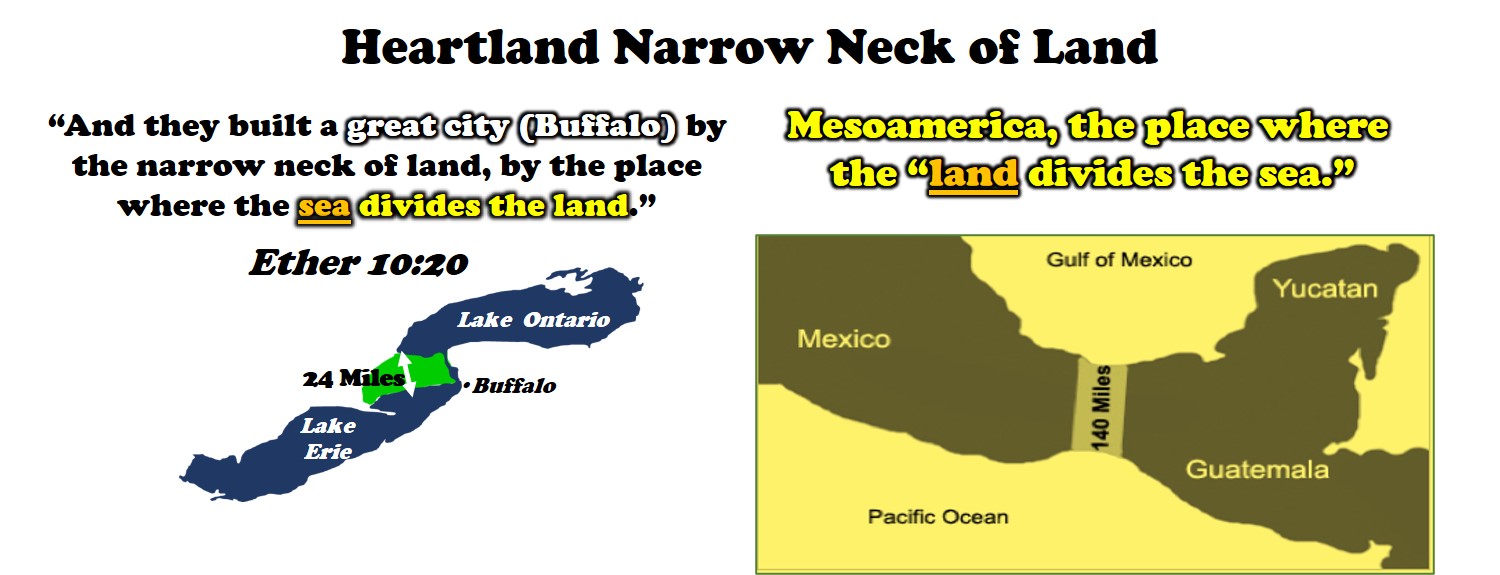










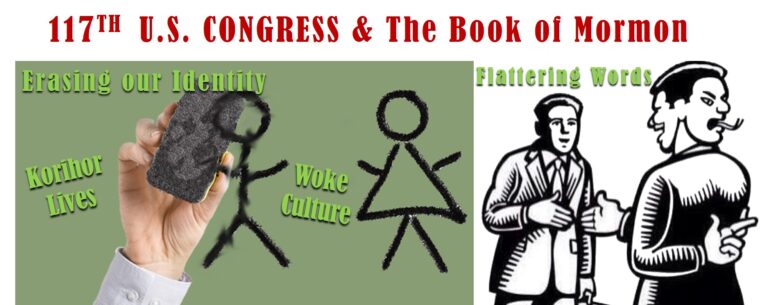








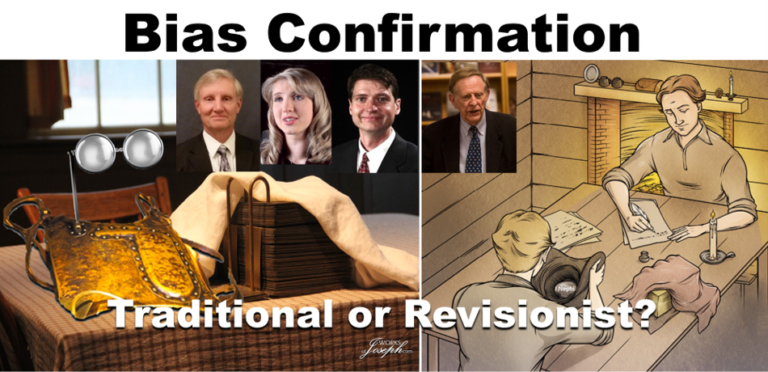













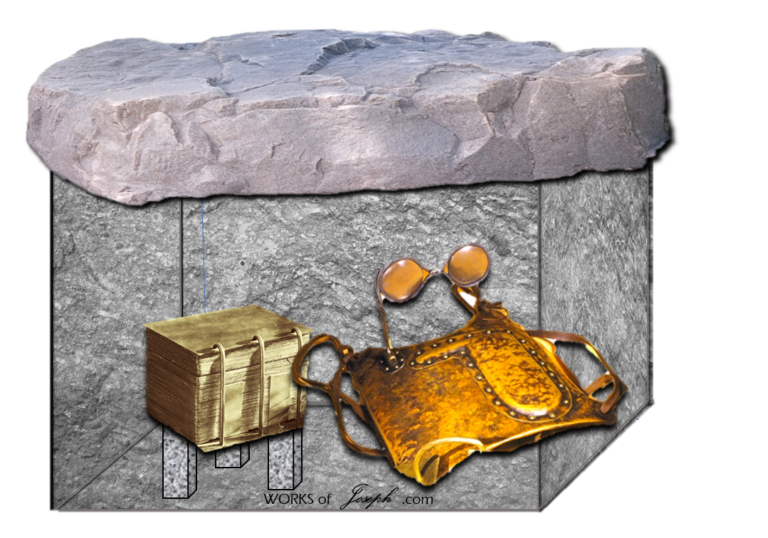


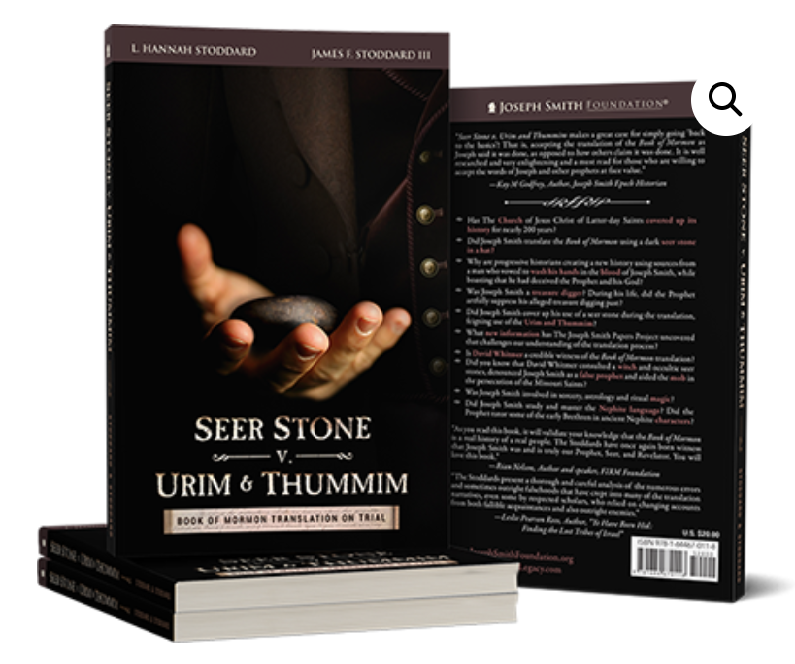

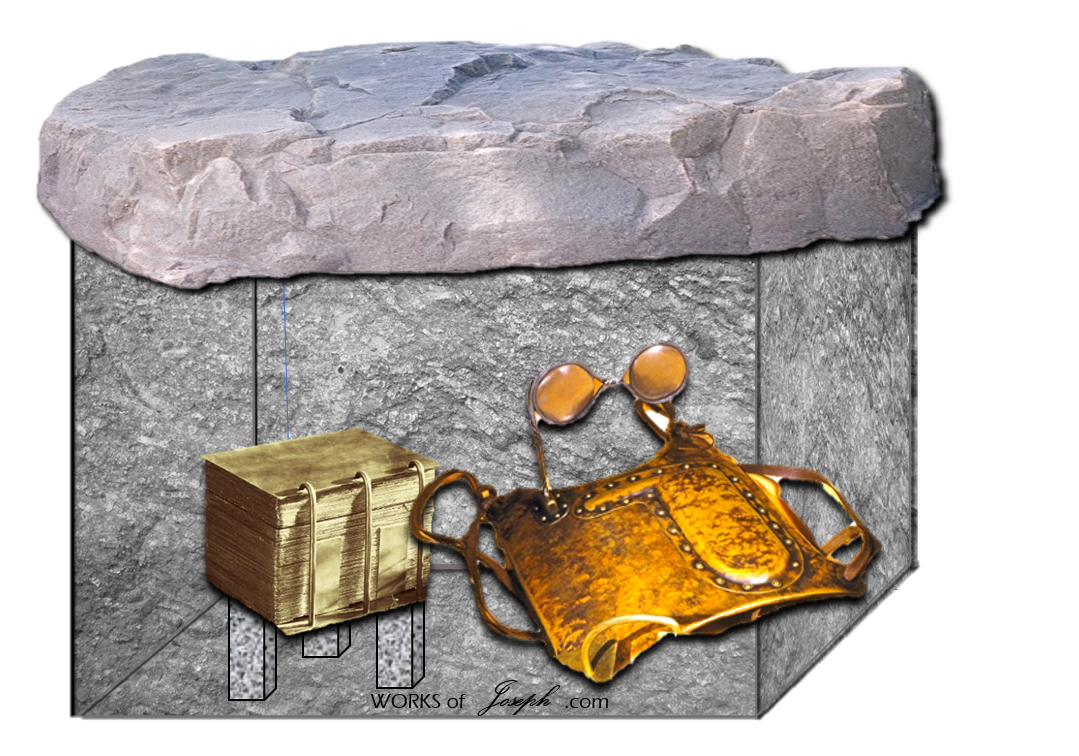

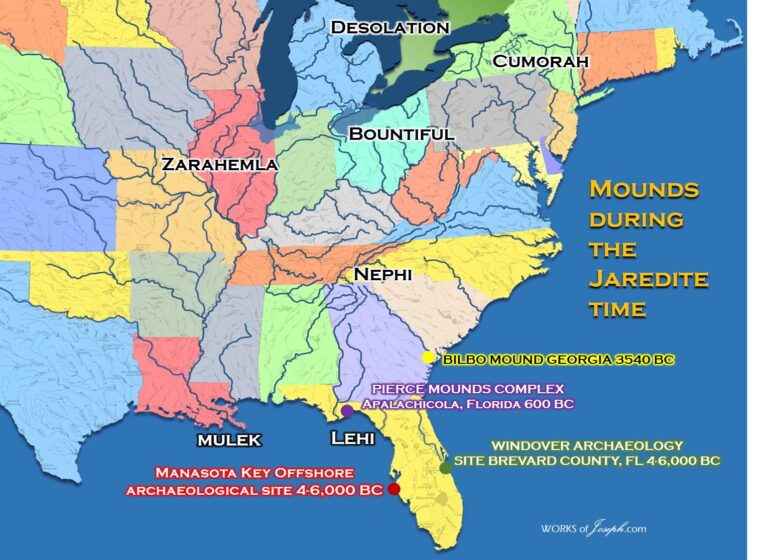










/https://public-media.si-cdn.com/filer/John-Nelson-Scott-Elrick-mine-shaft-forest-fossils-631.jpg)


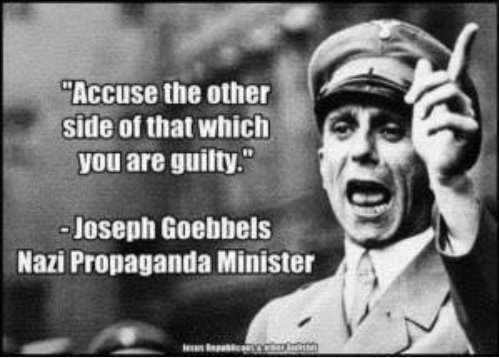



-0001.png/:/rs=w:400,cg:true,m)
 Field Report from Mike and Rhonda Stalhman.


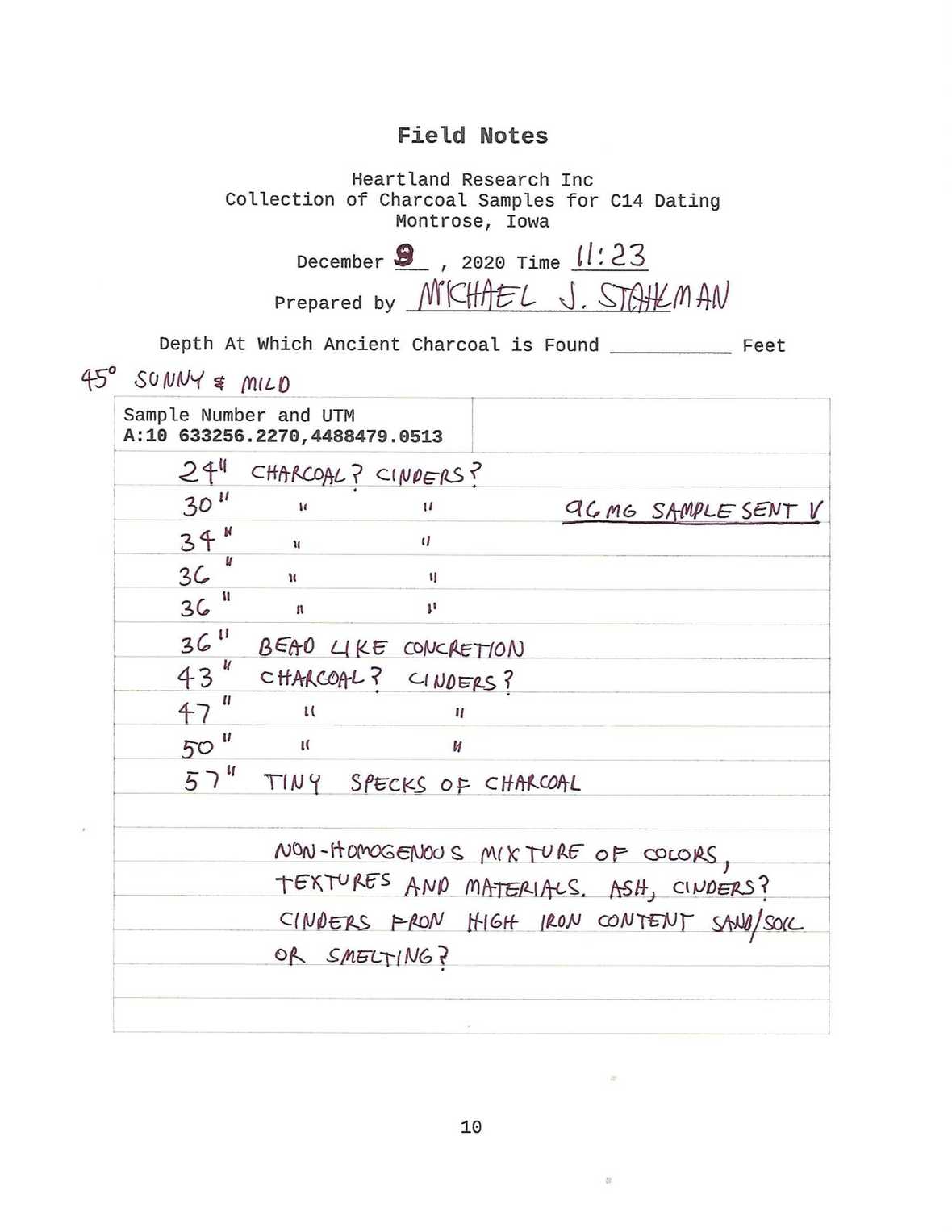
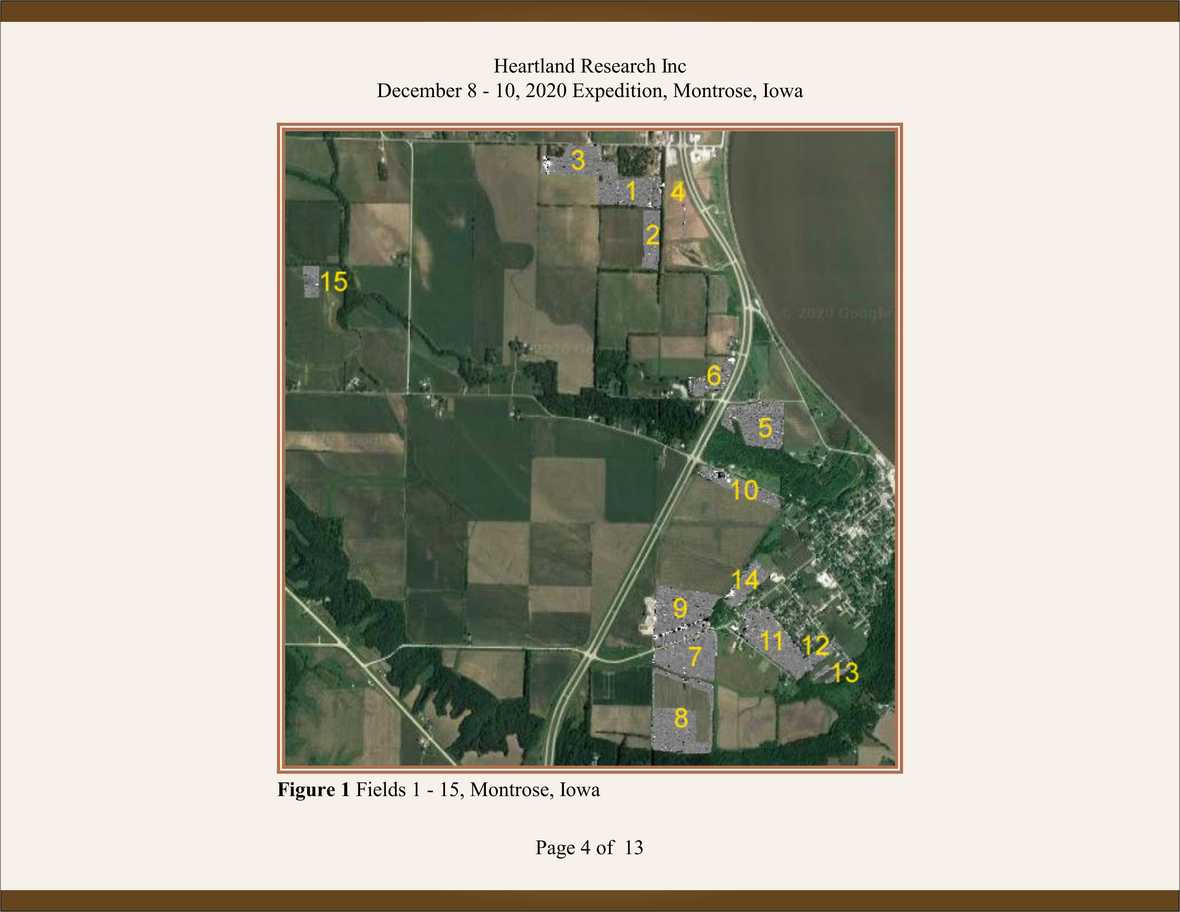



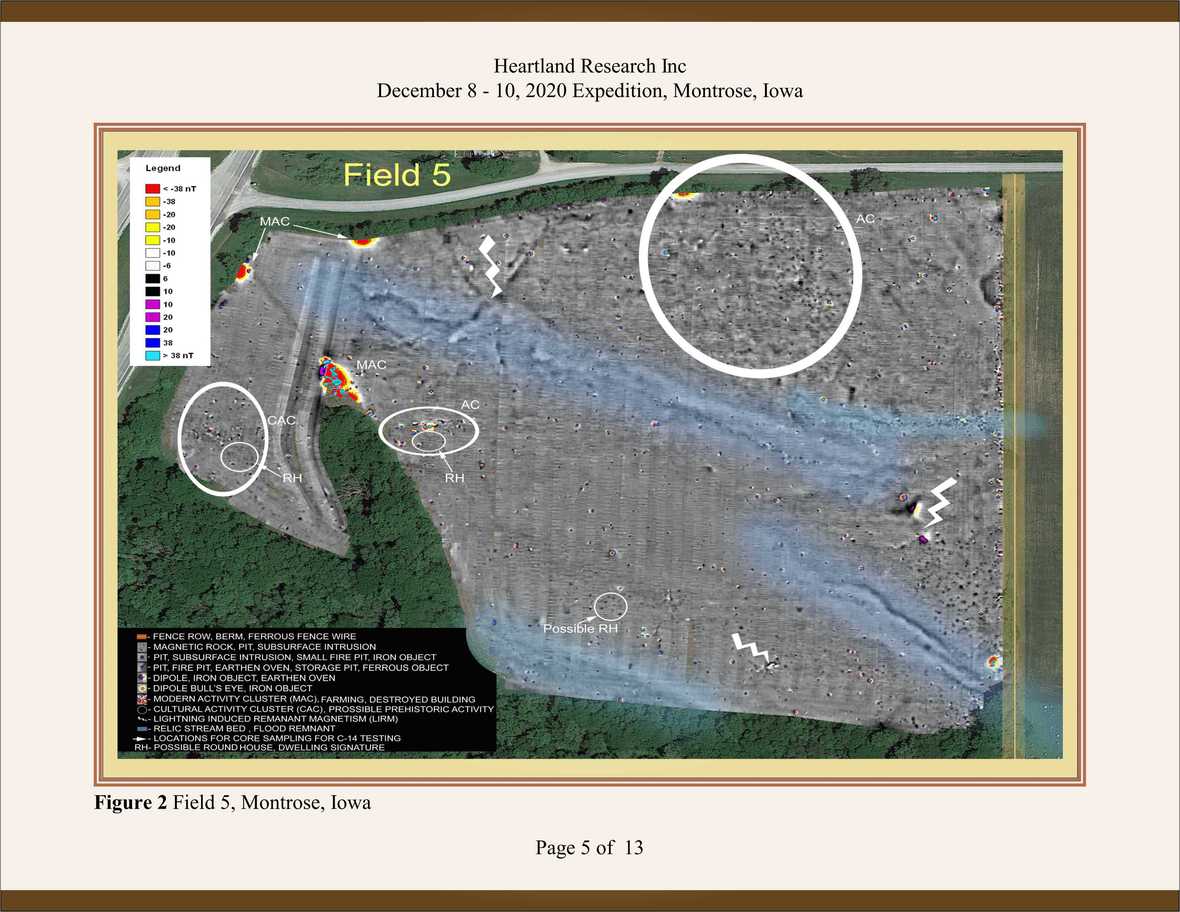


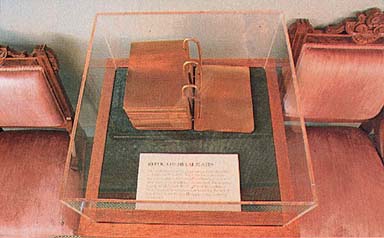
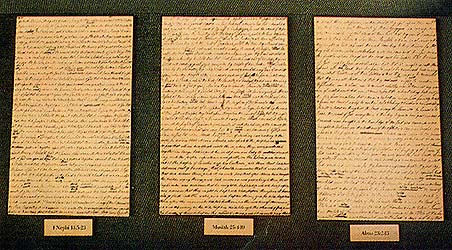

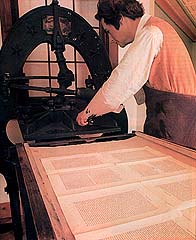
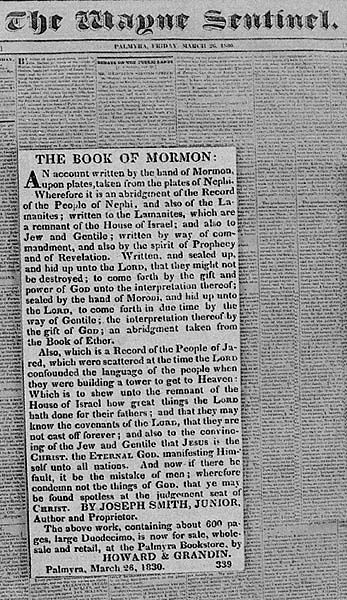





 After all the blood is drained, the intestines are removed and wrapped around its head, giving the unmistakable appearance of a ‘crowned sacrifice’ of sorts. And then finally the legs are lashed together on an upright stick, usually a pomegranate branch, the arms being spread apart and fastened to each end of a horizontal stick, which when lashed together acquires an uncanny likeness to a cross.






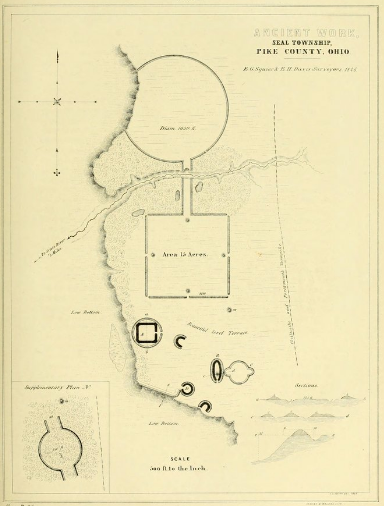


 The very last passenger pigeon seen in the wild was seen by a young boy half a mile south of this house. He didn’t know it was a passenger pigeon, they’d become very rare by the 1890s. He went and got a shotgun and shot the bird. It turns out that was the last passenger pigeon ever sighted. He brought the bird to this house and Blanche Barnes, the woman of the household at the time, was also a taxidermist.
 Can you tell the difference between a dove and a pigeon? The typical image of a dove is that of a white adorable bird with an olive branch in its mouth, a symbol of world peace. But what if I told you that doves can also refer to those ubiquitious rock pigeons that are found throughout Singapore?