Home Blog Page 39

Father Lehi’s Children- South, Central & North America

0
I believe the understanding of who the Lamanites are, and where they lived, has been a topic of interest for many years in The Church of Jesus Christ of Latter-day Saints. Many of us have been taught the “Hemispheric Model” about the Book of Mormon. Meaning, that generally speaking all of the Lamanites lived in South America and all the Nephites lived in North America and the “Narrow Neck of Land” was Central America. That has now become obsolete to most people in the Church, whether they believe in a Mesoamerican, a Heartland, a Baja theory, or any other theory about Book of Mormon Events. The reason is that the distances required to make this a reality has created an almost consensus opinion that it just doesn’t make sense.

We have two fantastic quotes speaking about the Book of Mormon in North America and a place God chose not a place that is better than any other place.

Thomas S. Monson
“The Lord gave a divine promise to the ancient inhabitants of this favored country (the United States): ‘Behold, this is a choice land, and whatsoever nation shall possess it shall be free from bondage, and from captivity, and from all other nations under heaven, if they will but serve the God of the land, who is Jesus Christ” (Ether 2:12). “Our Heavenly Father inspired the leaders of…the United States of America, that they might together, under His direction, having been raised up by God for the purpose, establish the Constitution of this country and…Bill of Rights, that by the year of our Lord 1805 [there would be] a climate where our Heavenly Father could send into  this period of mortality a choice spirit who would be known as Joseph Smith, Jr.” Monson, Thomas S., Teachings of Thomas S. Monson, 2011, pp. 14-15, 157-158

Russell M. Nelson
“The Book of Mormon reveals that Joseph, the son of Jacob who was once sold into Egypt, foresaw the Prophet Joseph Smith and his day (see 2 Ne. 3:6–21) and noted that there would be many similarities in their lives. Centuries later, the Prophet Joseph stated, “I feel like Joseph in Egypt.” (The Personal Writings of Joseph Smith, ed. Dean C. Jessee, Salt Lake City: Deseret Book Co., 1984, p. 409; spelling modernized.) The Book of Mormon reveals that the inheritance of Joseph, son of Israel, was not forgotten when, as promised in the Abrahamic covenant, land was distributed to the tribes of Israel. Joseph’s inheritance was to be a land choice above all others. (See Ether 13:2, 8.) It was choice not because of beauty or wealth of natural resources, but choice because it was chosen. It was to be the repository of sacred writing on plates of gold from which the Book of Mormon would one day come, choice because it would eventually host world headquarters of the restored Church of Jesus Christ in the Latter Days.” A TREASURED TESTAMENT By Elder Russell M. Nelson Of the Quorum of the Twelve Apostles JULY 1993 Adapted from an address given 25 June 1992 at a seminar for new mission presidents, Missionary Training Center, Provo, Utah.

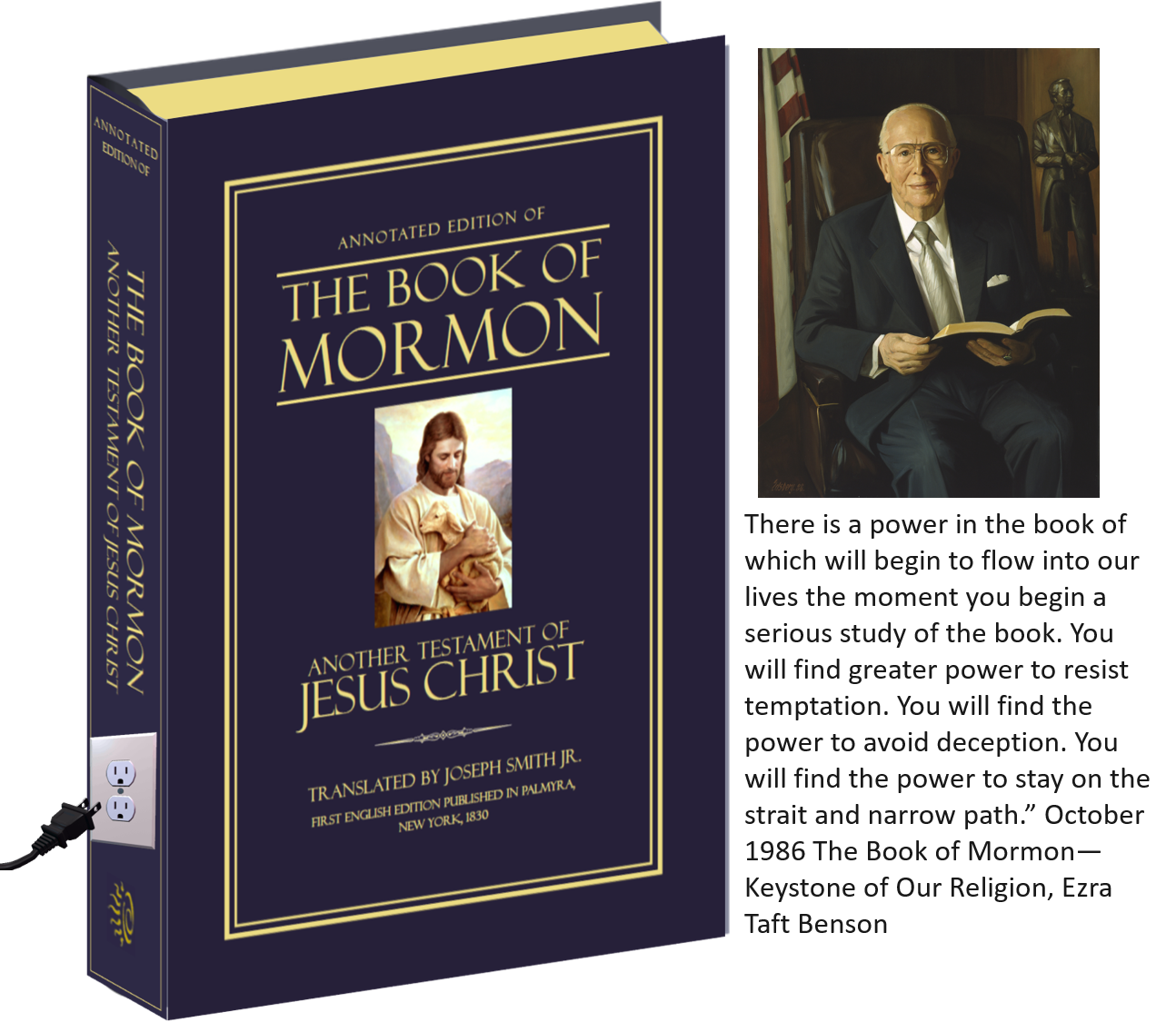
Annotated Book of Mormon

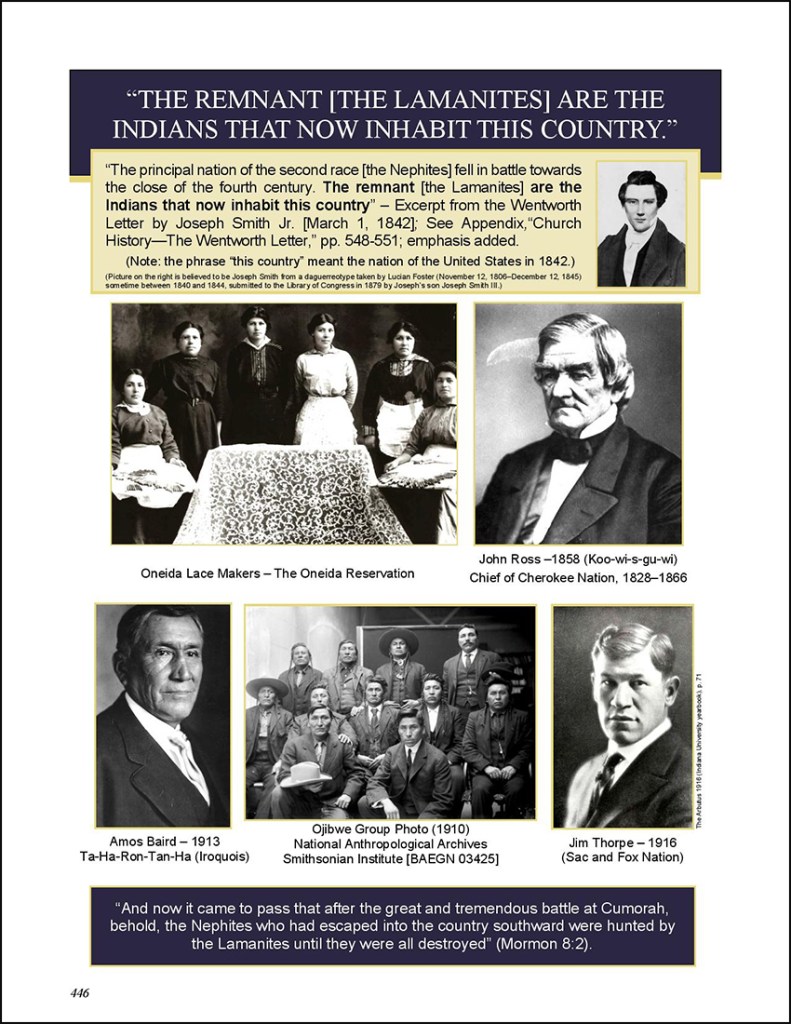
Annotated Book of Mormon by David Hocking and Rod Meldrum Page 446 Order Today!

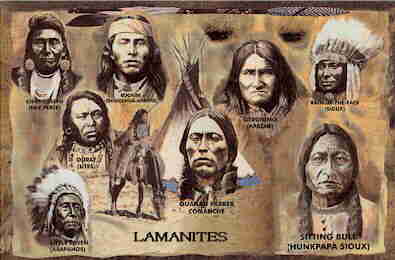
I believe the best evidence of who the Book of Mormon Lamanites are, comes from the Lord in D&C 32:2-3: “And that which I have appointed unto him is that he [Parley P. Pratt] shall go with my servants, Oliver Cowdery and Peter Whitmer, Jun., into the wilderness among the Lamanites. And Ziba Peterson also shall go with them; and I myself will go with them and be in their midst; and I am their advocate with the Father, and nothing shall prevail against them.” These first missionaries to the Lamanites first visited the Cattaraugus Indians in Buffalo NY, then the Wyandot Indians in Sandusky, OH, and finally the Shawnee and Delaware Indians in MO. It seems that we know from the Lord that these Native American Tribes are Lamanites. See Church Article Here! We will discuss this in more detail below.


Many dedicatory prayers by Prophets at Temples in South and Central America have mentioned that the people have, “the blood of Father Lehi”, or Prophets refer to “Lehi’s blood” or “Lehi’s descendants,” or even the “Lamanites,” how should we understand these terms? Who are the Lamanites? To help answer this question let’s first discuss an issue called “the Hinterlands.”


Mormon could not “write the hundredth part” of the events of his people. For this reason we have the record of the Nephites from Mormon’s abridgement, but we don’t have the written record of those who lived in the periphery or “Hinterland.” See Words of Mormon 1:5, Ether 15:33, Isaiah 18:1
This shows that it would be very difficult to include writings of civilizations clear up in Canada and some clear down into South America. We believe the limited writings of the Nephites were contained in this main area of where the Nephites lived, which is the heartland of North America. It just makes sense.

Defining Hinterlands

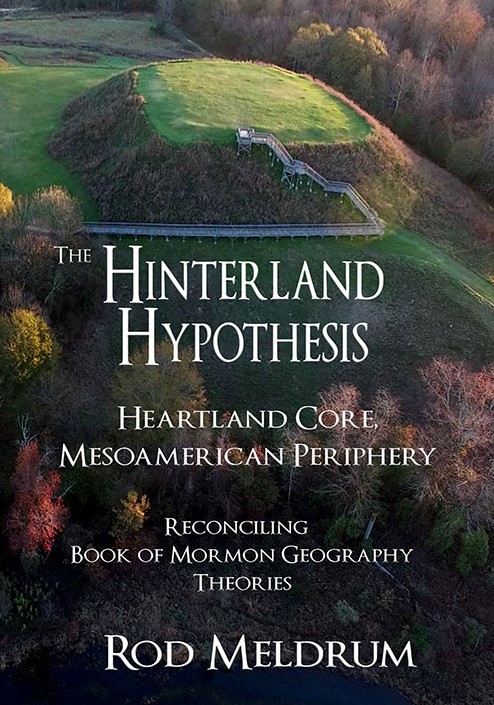
The Hinterland Hypothesis (DVD) $19.95

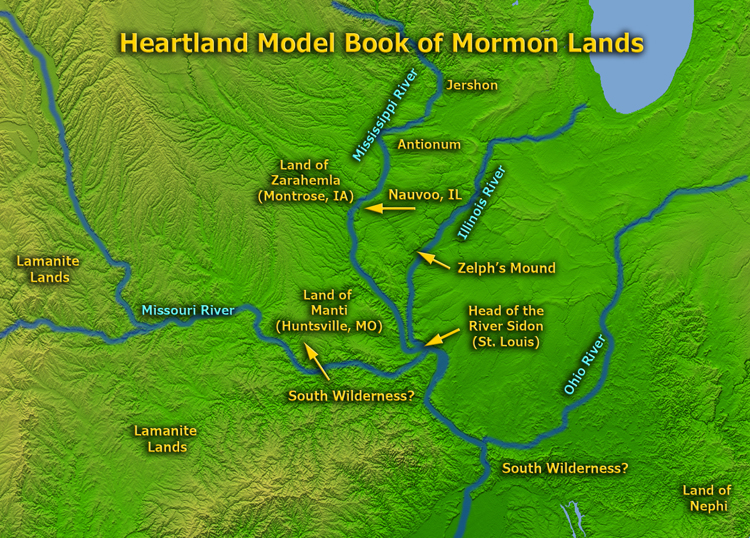
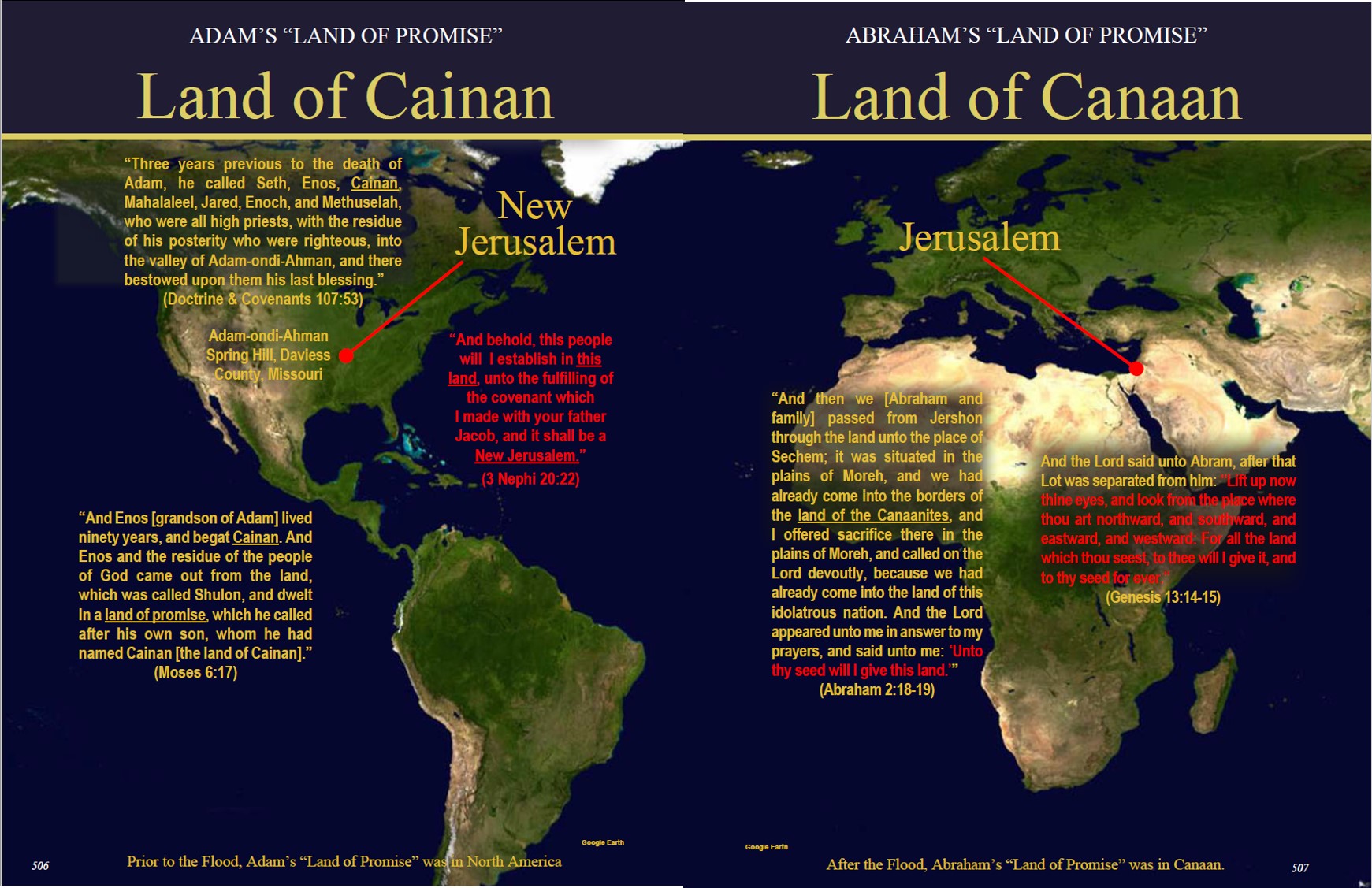
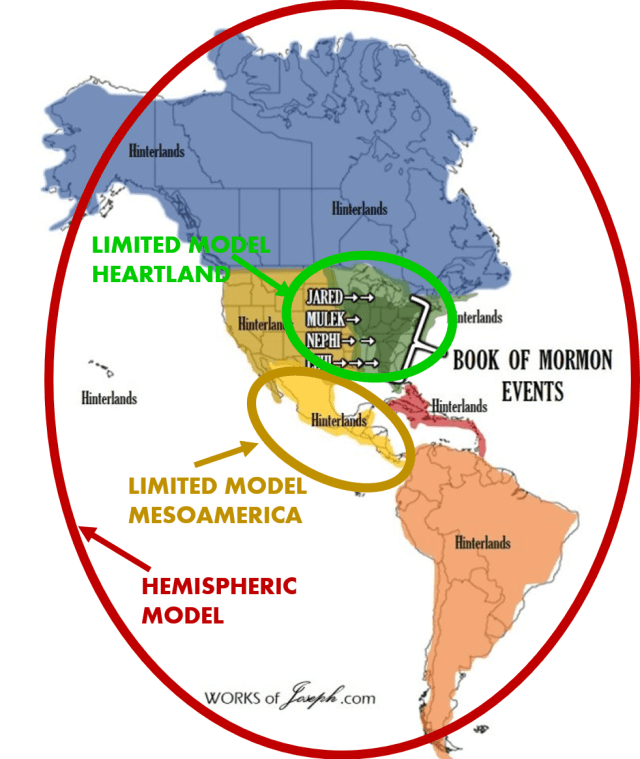
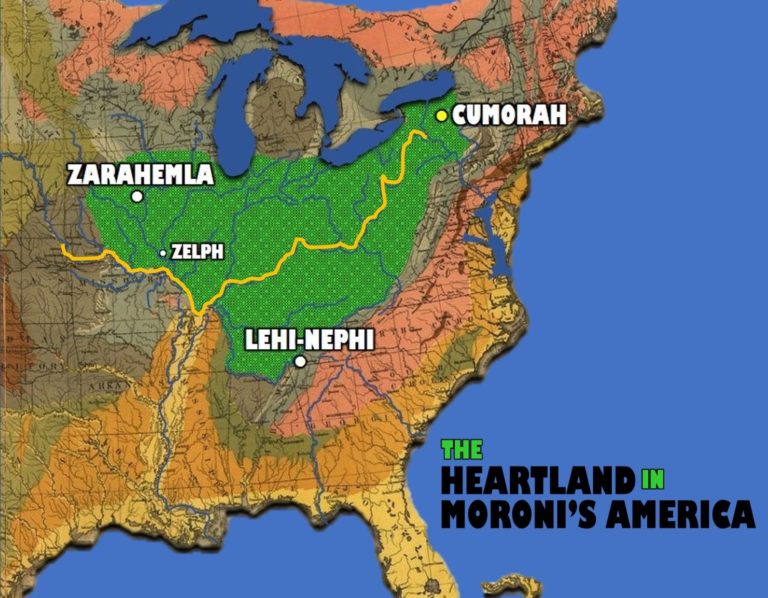
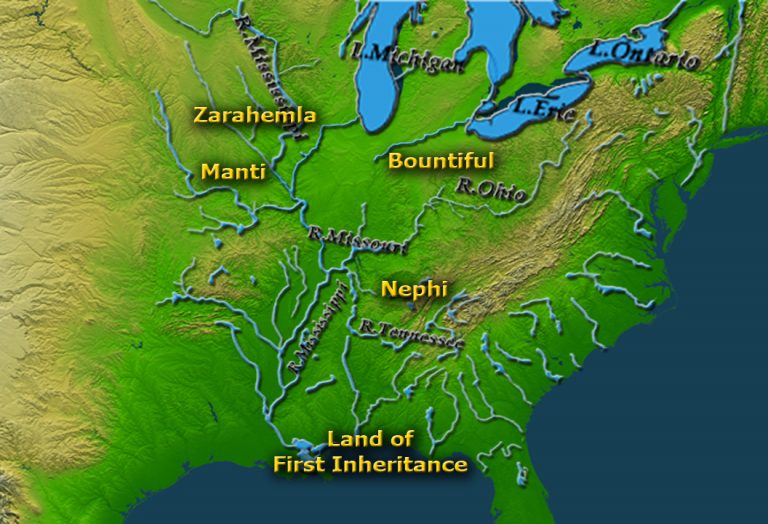
“Hinterlands is defined here as meaning the unknown area of North and South America that are not within the scope of the writings of the Book of Mormon. In other words, since we believe main events of the Book of Mormon happened in a limited area of North America around the Great Lakes  in the east,  and Ohio, Indiana, Iowa and Missouri to the west, and south in Tennessee, West Virginia, Georgia, and Florida, all other areas will be discussed as “The Hinterlands”. We propose that Mesoamerica is the Hinterlands along with many other areas of the continent. As Mormon has said, “…I shall take from the plates of Nephi; and I cannot write the hundredth part of the things of my people (Words of Mormon 1:5).  There are many people in South and Central America that are Lamanites and part of the Hinterlands.” Jonathan NevilleIn other words, if the Book of Mormon events took place in Mesoamerica, then every other area would be the “Hinterlands” where other Lamanites may have migrated and lived. If however the events of the Book of Mormon took place in the Heartland of the United States (As we believe they did), then every other area outside of this limited Heartland area would contain migrating Lamanites, including the western United States, Canada, Mexico, and South and Central America. Heartland Core – Where the main Nephite and Lamanite events occured! Mesoamerican Periphery – Where Nephites and Lamanites migrated to outside of this core! (See map to the right)

Narrow Neck of Land

“There is ONLY ONE “Narrow Neck of Land” in the entire Book of Mormon.

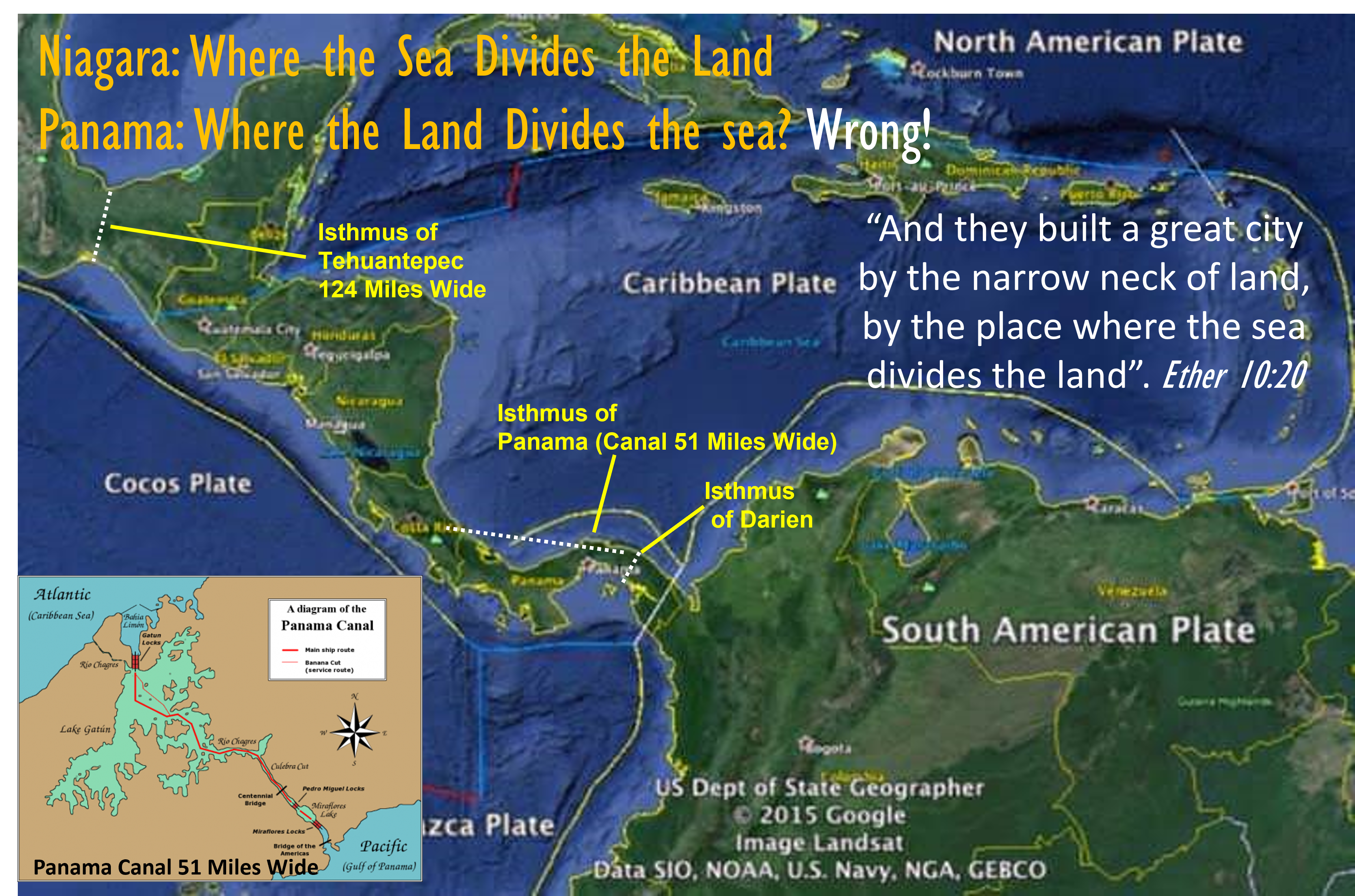
“And they built a great city by the narrow neck of land, by the place where the sea divides the land”. Ether 10:20

One of the most common questions asked about the North American setting is, “what about the narrow neck of land?” People have been taught to think the Book of Mormon describes two large land masses connected by the “narrow neck of land.” The hourglass shape has been depicted in many LDS publications. When we look on a globe, we immediately think of Panama as a narrow neck of land connecting North and South America. However, scholars have pointed out that a hemispheric interpretation of Book of Mormon geography contradicts the text; the distances are simply too great.

The Famous Narrow Neck of Land

Instead, scholars have proposed a more limited territory. Two articles in the 1984 Ensign  introduced the limited model of Book of Mormon geography in Mesoamerica to a wide LDS audience. The author of those articles, John Sorenson, has also written that “A key feature of any geographical correlation must include a narrow neck of land connecting two sizable land masses… Only one geographical correlation avoids fatal flaws: The narrow neck of land was the Isthmus of Tehuantepec…

A Single Passage.

“Narrow Neck of Land is only mentioned once in the Book of Mormon. the others similare are mentioned as “Narrow neck” Alma 63:5 and “Small Neck of Land” Alma 22:32. A passage describing the location of a Jaredite city. Nowhere in the Book of Ether does Moroni mention Nephite or Lamanite locations, except that the Jaredite hill Ramah is the same hill where Mormon hid the records (Ether 15:11). In the first verse of the first chapter, Moroni explained the territory addressed in the Book of Ether: “And now I, Moroni, proceed to give an account of those ancient inhabitants who were destroyed by the hand of the Lord upon the face of this north country.”

Despite its solitary appearance in Ether, many commentators have considered the “narrow neck of land” to be a defining feature of both Nephite and Jaredite lands. They think the verse in Ether refers to the same feature as a verse in Alma 22:32, which says “thus the land of Nephi and the land of Zarahemla were nearly surrounded by water, there being a small neck of land between the land northward and the land southward.” That interpretation is a mistake. Besides the difference in terminology (narrow does not mean small), the context and frame of reference of the two passages are entirely different, and they were written by different authors hundreds of years apart. Jonathan Neville


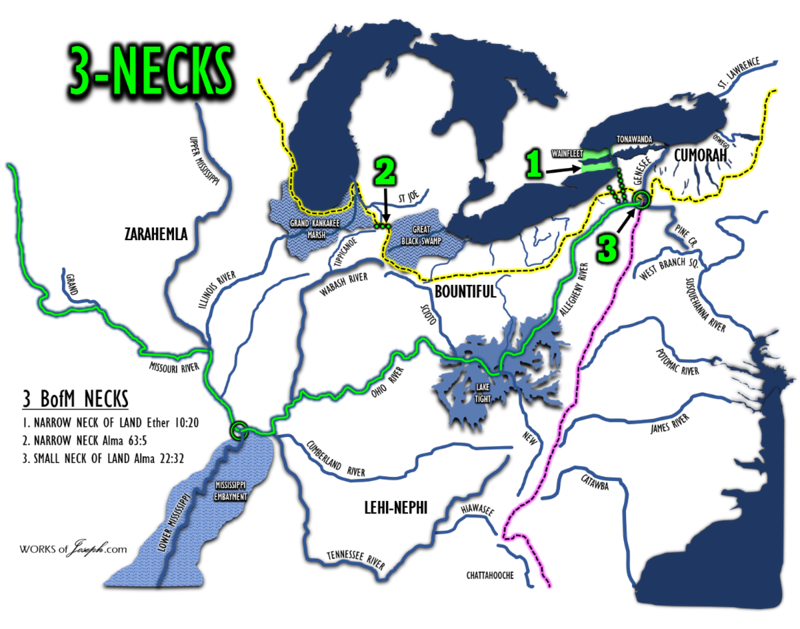
There are 3 unique mentions in the Book of Mormon about NECKS!

  1. NARROW NECK OF LAND Ether 10:20
  2. NARROW NECK Alma 63:5
  3. SMALL NECK OF LAND Alma 22:32

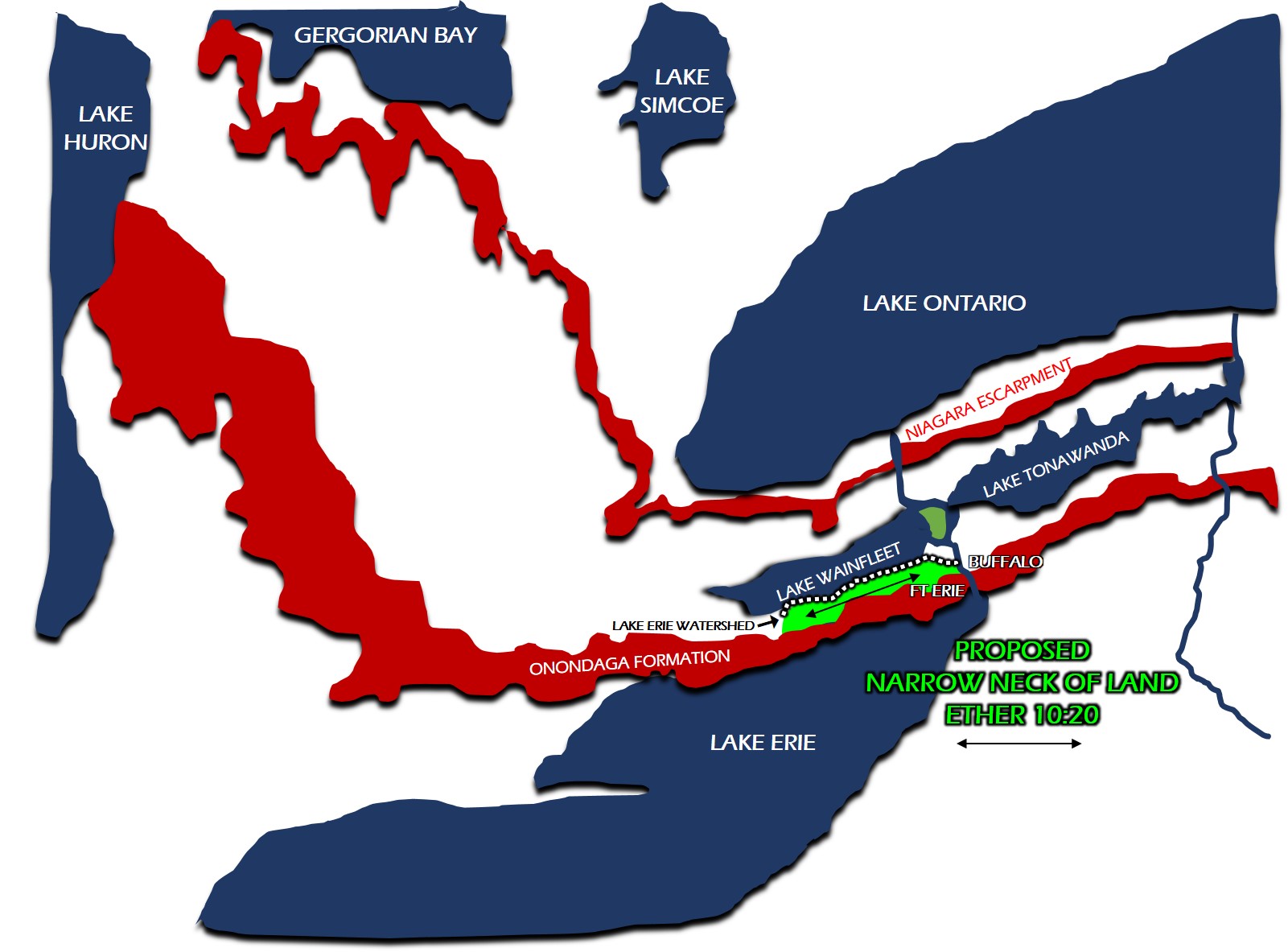
These three unique mentions of NECK are all in different locations in North America. THE NARROW NECK OF LAND is defined below:

Lake Ontario (a sea) divides the land at Hamilton, OT Canada, and Lake Erie (s sea)  divides the land at Buffalo, NY.

In Central America, the ”land divides the sea”. (Isthmus of Tehuantepec) which is opposite of what the scripture says about the “sea divides” the land.

Lake Ontario and Lake Erie are seas, where the “sea divides the land” as quoted in Ether. Ether 10:20. The N/S distance from Lake Erie to Lake Ontario is only about 24 miles wide and in Central America it is 140 miles, which doesn’t sound very narrow to me. In the Book of Mormon the Narrow Neck of Land is only described in the Book of Ether, so the Jaredites used it, not the Nephites. There is archaeological verification at the Niagara Peninsula that dates from 800 BC to 3000 BC which is the time of the Jaredites.

Confusion about Cumorah, “Lamanites,” and the Prophets by Jonathan Neville

“For several months, people have asked how the statements of prophets and apostles regarding Lamanites in Latin America and the Pacific fit with the North American setting. I’ve addressed the question several times, but not as thoroughly as I suppose I should, so here are my thoughts on the topic. A basic criticism of the North American setting (Moroni’s America or the Heartland model) is that in temple dedicatory prayers and other comments, modern prophets and apostles have said Lamanites live throughout the Americas, from at least Cardston, Alberta, to São Paulo, Brazil. Some people think I’ve ignored these statements. I haven’t ignored them; I just don’t think they tell us anything about Book of Mormon geography.

It’s difficult to understand the rationale of this criticism in the first place. It appears to rely on the premise that Lehi’s descendants were isolated and never interacted with other indigenous people in the Western Hemisphere.

For example, when President Hinckley’s 1983 temple dedicatory prayer said the Saints in Mexico “have in their veins the blood of Father Lehi,” the premise would mean that Mexico must be where the Book of Mormon took place. But such a premise contradicts the statements themselves, which, as I noted, identify Lamanites throughout the hemisphere. (Someone could argue that the narrative took place throughout the hemisphere such that Lehi’s descendants were restricted to one hemisphere, but I don’t think anyone makes that argument any longer, at least not from Alberta to southern Brazil).

Whether the Book of Mormon narrative took place in New York, Tennessee, Illinois, Baja, Mexico, Guatemala, Panama or Chile, people from all those areas interacted with one another over the thousands of years they shared the continent.

In other words, generalized statements of the prophets and apostles about the Lamanites tell us nothing about Book of Mormon geography except that it took place in the Western Hemisphere (but one could dispute even that). They certainly don’t contradict the North American setting or establish a justification for a non-New York Hill Cumorah.

I think the entire New World narrative of the Book of Mormon took place in North America, meaning from Florida to Canada and from the Atlantic to the Midwest (as far west as Missouri and Iowa). By the authors’ own admission, the narrative is merely a brief sketch; it covers less than 1% of the history of the Nephites and even less of the history of the Lamanites. Since before Lehi arrived, people throughout the Americas traded and intermarried. Lehi’s little colony grew to a large civilization in part by absorbing indigenous people (as well as the people of Zarahemla). After the Nephites were annihilated around 385 A.D., the Lamanites continued to live on the land, but their history is lost to us. We must resort to anthropology and archaeology, which indicate ongoing interaction throughout the Americas before and after 385 A.D.

With this background, how could “the blood of Father Lehi” not be found throughout the Americas?

There is no problem harmonizing the New York Cumorah with the statements of prophets and apostles regarding Lamanites or descendants of Lehi throughout the Americas (and in the Pacific). (See my addtional blog here: https://www.bofm.blog/the-hinterlands-lamanites-in-the-americas/

That said, there is an ongoing controversy about DNA. Critics ask how “Lamanite blood” can be found in people whose DNA shows they are overwhelmingly Asian in origin. It’s a valid question about definitions.

When prophets refer to “Lehi’s blood” or “Lehi’s descendants,” or even the “Lamanites,” are they referring to people whose DNA contains markers showing Israelite origin? If so, then the indigenous people of Latin America don’t qualify (unless we want to say Asians are Israelites, which broadens the term beyond usefulness). But if the prophets are referring to links in heredity, however tenuous, then the indigenous people of Latin America cannot be disqualified. Such links cannot be disproven because you can be descended from a person even if you don’t possess DNA markers that link you to that person. (The problems with the DNA criticism are discussed in the notes below.*)

To be sure, we would expect to find the highest concentration of relevant DNA markers in the areas where Lehi’s descendants lived in the highest concentrations; i.e., in the northeastern U.S. (and the Midwestern areas where they were forced to move). After all, the Lord designated the tribes in New York, Ohio, and Missouri as Lamanites when he sent Oliver Cowdery and others on a mission to these tribes (D&C 28, 30, 32). Joseph Smith told these tribes the Book of Mormon was their history.

That expectation seems to be borne out when we consider the X haplogroup.** The X haplogroup is the only non-Asian haplogroup found among indigenous Native Americans.

As the map depicts, the highest concentrations of X haplogroup in the world are in the Middle East and in the Northeastern U.S. and Canada. This isn’t “proof” of Lehi’s DNA for the reasons I mention in the notes, but it does correspond to our expectations of a genetic link between indigenous people in these two areas–expectations raised by Joseph Smith and the Lord Himself in the Doctrine and Covenants. Based on those expectations, the X haplogroup works as a proxy for Lehi’s ancestry.

In 1981, the Church added an introduction to the Book of Mormon that reads “After thousands of years, all were destroyed except the Lamanites, and they are the principal ancestors of the American Indians.” That introduction was changed in 2007 to read “After thousands of years, all were destroyed except the Lamanites, and they are among the ancestors of the American Indians.” This is how the introduction reads today.

As used in these sentences, who are the “American Indians?”

I’ve seen all kinds of semantic gyrations about this term, but a typical dictionary will provide an explanation similar to this one: “Usage Note: In principle, American Indian can apply to all native peoples throughout the Americas except the Eskimo, Aleut, and Inuit, but in practice it is generally restricted to the peoples of the United States and Canada. For native peoples in the rest of the hemisphere, usage generally favors Indian by itself or, less frequently, the contractions Amerindian or Amerind.”

If we look at the map, it is apparent that although the X haplogroup is concentrated in the Northeast, it spreads through much, but not all, of the American Indians in the United States and Canada. Therefore the 2007 change to the Introduction makes sense; i.e., the Lamanites may not be the principal ancestors of the American Indians, but they are among those ancestors–especially for those American Indians living in the Northeast.

But the X haplogroup does not appear among the indigenous people in Latin America.

From the New York Cumorah perspective, the prophets’ identification of Lamanites throughout the hemisphere works not because of DNA, but because of the assumption that over the centuries, trade and intermarriage would have distributed the “blood of Lehi” widely, albeit in concentrations too dilute to detect with DNA. [Here is a great article from National Geographic.]

From the non-New York Cumorah perspective, however, it’s a different problem. Advocates of these theories must assume that the areas where we would expect to find the most evidence of Middle-Eastern DNA (Mesoamerica, Chile, Peru, Baja, etc.) actually have so little it is undetectable. Meanwhile, indigenous people living in the Northeastern U.S.–the area they claim cannot be the setting for the Book of Mormon–have the highest concentration of X haplotype in the world outside of the Middle-East.

IOW, if we support what the prophets have said about the Lamanites, then the North American setting is the best explanation for the various statements about Lamanites throughout the hemisphere.

There is another little-known aspect of this Lamanite question. In the Wentworth letter, Joseph Smith wrote “The principal nation of the second race [the Nephites] fell in battle towards the close of the fourth century. The remnant are the Indians that now inhabit this country.”

Plenty of ink has been spilled parsing this statement. Although Joseph was writing from Nauvoo, Illinois, to Mr. Wentworth of Chicago, Illinois, Mesoamerican advocates have claimed that the term “this country” actually refers to the entire hemisphere. I leave it to the reader to decide whether that’s a plausible interpretation of what Joseph intended or what Mr. Wentworth would understand.

More significant is what Joseph deleted when he wrote those sentences.

The Wentworth letter was largely based on a missionary pamphlet written by Orson Pratt. Joseph (and/or his assistants) edited the pamphlet by changing details in some areas and by deleting large sections in others.

The first sentence of the two I quoted is identical to the one in Orson Pratt’s pamphlet. But Joseph’s second sentence–“The remnant are the Indians that now inhabit this country”–replaces 2,700 words of Orson Pratt’s speculation about Lehi’s descendants inhabiting all of North and South America. I view this significant editing as a specific repudiation of Pratt’s hemispheric model, but it is only apparent when we look at how Joseph edited Pratt’s pamphlet.

There is a “Mormon Chess” element of this discussion as people position their pieces (quotations) to defend their queens (theories). In many cases, there is a perception of conflict among the authorities (e.g., a New York Cumorah is inconsistent with a Guatemalan City of Nephi). These conflicts lead people to seek a hierarchy of authority; e.g., a Rook is worth more than a Knight which is worth more than a pawn, so the scriptures are worth more than a conference talk which is worth more than a dedicatory prayer.

You can see how such an approach quickly descends into chaos and confusion.

In my view, it is more valuable to harmonize the various statements of the prophets whenever possible and to clarify issues by isolating them for analysis. The Cumorah question is independent of the Lamanite and scope of geography questions, so I’ll look at it next.

Cumorah

Lately I’ve focused on the question of Cumorah because, in my view, it is the keystone of Book of Mormon geography. (In this post, I’m not indulging the dodge of the two-Cumorahs theory. When I say Cumorah, I mean the Cumorah of Mormon 6:6; i.e., the hill where Mormon hid the repository and where the final battles of the Nephites and Jaredites occurred.)

I don’t think there is any conflict among statements by Church authorities about Cumorah. Cumorah is the one unambiguous pin in the map we’ve been given, and I think it’s way past time that all Latter-day Saints agree that Cumorah is in New York, for all the reasons I’ve given in my blogs, books, and presentations.

Others disagree. They claim Cumorah is in southern Mexico, Baja, Panama, Chile, and places in Africa and Asia.

This is why I frame the Cumorah issue as a choice between two positions:

Either Cumorah is in New York, or it is elsewhere.  

The corollary: if it’s not in New York, I don’t think it really matters where it is, because in that case we are talking about a non-literal text; i.e., a parable at best.

I say this because the New York Cumorah has been a constant since before the text was translated through General Conference talks by prophets and apostles at least through the 1970s. Letter VII is explicit and unambiguous, and it has been republished multiple times.

So how, people ask, can anyone think Cumorah is not in New York?

The only reason–the only reason–is because they think the New York Cumorah conflicts with their preferred theories about Book of Mormon geography.

Here is the basic argument. Let’s say you believe the Book of Mormon events took place in Baja, or Chile, or Central America (including Mesoamerica). You find all kinds of correspondences that you think corroborate your interpretation of the text. You develop an abstract map and superimpose it on the actual geography, or the hypothetical ancient geography of your choice. You decide where Cumorah must be, based on your theory and interpretation of the text.

But you conclude that New York doesn’t fit. What then?

You write (or think) something along the lines of the famous quotation by John Sorenson: “There remain Latter-day Saints who insist that the final destruction of the Nephites took place in New York, but any such idea is manifestly absurd.”

[For those new to this topic, Brother Sorenson was a long-time BYU professor whose book, Mormon’s Codex, was widely praised by LDS scholars and educators as his “magnum opus.” The quotation is a direct repudiation of the prophets and apostles who have spoken on this issue, and yet everyone who promotes a non-New York Cumorah embraces the Sorenson position.]

To support the non-New York Cumorah theories, LDS scholars and educators have sought to obscure the issue by conflating it with the question of the “Lamanites.” 

The Lamanites

As noted at the outset, several prophets and apostles have made statements about the Lamanites, including sometimes in temple dedicatory prayers. There are good lists at FairMormon. The 19th Century is here. The 20th Century is here. The 21st Century is here. (Notice, that list includes no statements about Cumorah.)

These statements have been cited to criticize the North American setting, including the New York Cumorah. I’ve already explained why I don’t think that argument works, and why these statements actually are more consistent with a New York Cumorah than any non-New York Cumorah. But it’s useful to take a closer look at the temple dedicatory prayers that are so frequently cited.

Generally, the views expressed in these statements reflect a hemispheric concept of Lamanite people; i.e., the “descendants of Lehi” are identified as residing in the land around Cardston, Alberta, (Heber J. Grant’s dedication of the Cardston temple in 1923) all the way south to Sao Paulo, Brazil (President Kimball’s dedication of the Sao Paulo temple in 1978).

The prototype for temple dedicatory prayers is D&C 109, the dedication of the Kirtland temple. Verses 65-66 refer to the “remnants of Jacob” this way: “65 And cause that the remnants of Jacob, who have been cursed and smitten because of their transgression, be converted from their wild and savage condition to the fulness of the everlasting gospel; 66 That they may lay down their weapons of bloodshed, and cease their rebellions.” In context, this terminology refers to the American Indians in the United States, a discussion we can have if anyone doesn’t see that.

In my database of temple dedicatory prayers, I note that the term Lamanites has not been used since 1978. The most specific identification of Lamanites was in the 1975 Mesa Arizona re-dedicatory prayer: “Thou didst acknowledge the role of the Lamanite, especially in this temple, and numerous of the sons and daughters of Lehi have found in these sacred precincts peace, knowledge and solace to their souls.

The term Lehi has been used more recently and more frequently, but an interesting trend has developed that coincides with the changes to the Introduction to the Book of Mormon.

First, look at the 1983 Mexico City temple dedication: “Bless Thy saints in this great land and those from other lands who will use this temple. Most have in their veins the blood of Father Lehi. Thou hast kept Thine ancient promise. Many thousands “that walked in darkness have seen a great light.””

The 1986 Lima Peru temple prayer includes this passage: “We are particularly mindful this day of the sons and daughters of Lehi. They have known so much of suffering and sorrow in their many generations. They have walked in darkness and in servitude. Now Thou hast touched them by the light of the everlasting gospel. The shackles of darkness are falling from their eyes as they embrace the truths of Thy great work. Surely father Lehi has wept with sorrow over his posterity. Surely he weeps today with gladness, for in this holy house there will be exercised the fullness of the priesthood to the blessing, not only of those of this and future generations, but also to the blessing of those of previous generations.”

The 2000 Tuxtla Gutierrez Mexico Temple: “We invoke Thy blessings upon this nation of Mexico where so many of the sons and daughters of Father Lehi dwell.

The 2002 Snowflake Arizona temple: “We are grateful that this Thy house will be available to the sons and daughters of Lehi who live nearby. Let the scales of darkness fall from their eyes and bring a fulfillment of the ancient promises made concerning them. May this house become a hallowed sanctuary for many of these, our brothers and sisters.”

After 2002, I can’t find any examples of a dedicatory prayer specifically stating where Lehi’s descendants live. This includes temples throughout Latin America, including the rededications of the Mexico City temple in 2008 and 2015.

Now, notice the timing of the Introduction:

It was added to the text in 1981, when it said the Lamanites “are the principal ancestors of the American Indians.”

It was changed in 2007 to read the Lamanites “are among the ancestors of the American Indians.”

I’m not saying the change in the Introduction drove the changes in the temple dedicatory prayers. It may be an example of coincidence and not causation. But it could also be a shift in understanding that appears in both the Introduction and the temple dedicatory prayers.

That said, I note that dedications of temples in Mexico, Peru, Argentina, Honduras, Brazil, and Guatemala include this sentence: “We thank Thee for the sacred record of Lehi, Nephi and Jacob, Alma and Mosiah, Benjamin and Mormon, and of Moroni.”

The 2011 dedication of the Quetzaltenango Guatemala temple included these sentences: “Thou kind and gracious Father, our hearts are filled with gratitude for Thy remembrance of the sons and daughters of Lehi. Thou hast heard their cries and seen their tears. Thou hast accepted their righteous sacrifices.” The 2013 dedicatory prayer of the Tegucigalpa Honduras Temple included these: “Our hearts are filled with gratitude for Thy blessing of the sons and daughters of Lehi. Thou hast heard their cries and seen their tears. Thou hast accepted their righteous sacrifices.”

These sentences could be interpreted to imply Lamanites live in Guatemala and Honduras, but they could also be of more general application, like the expression of gratitude for the Book of Mormon that immediately follows in both prayers.

Click to Purchase

Hinterlands

In 2013, there was a brilliant article and presentation titled “Heartland as Hinterland: The Mesoamerican Core and North American Periphery of Book of Mormon Geography.” It was an attempt to explain Joseph Smith’s statements about the Nephites in North America by attributing them to Nephites who had escaped to the north. In my view, the article introduced a valuable concept, but got the geography and evidence backward; i.e., the core of Book of Mormon geography is in North America, while Mesoamerica is the periphery. I have a chapter about this in the Second Edition of The Lost City of Zarahemla (picture right) so I won’t repeat the discussion here, but if you read the article, I’d like to point out a few key points.

First, the premise relies on the anonymous 1842 articles in the Times and Seasons. I’ve offered considerable evidence that Joseph Smith had nothing to do with these articles, but instead they reflected the views of Benjamin Winchester, William Smith, John E. Page, and others. In fact, the article quotes John E. Page for authority.

Second, notice that the article includes a section on Cumorah that never even mentions Letter VII. It’s as if Letter VII didn’t exist, which is what you’ll see in all the publications by Mesoamerican proponents. Nor does it refer to the repository in the New York hill that Joseph and Oliver visited, even though it quotes Mormon 6:6.

Third, the article contains a claim that the term “plains of the Nephites,” which Joseph used to describe the Midwestern states he crossed during Zion’s Camp, “are never mentioned in the Book of Mormon.” Yet the article acknowledges “there are multiple plains attested to in the text.” The argument is summarized here: “Plains in the text of the Book of Mormon are always attached to a specific city. Those in Joseph’s letter to Emma are not.” Think about that one.

I mention this article here because it is the best one I know of that seeks to justify the Mesoamerican setting in the light of Joseph’s own statements about North America. Because it omits key facts such as Letter VII, it succeeds for Mesoamerican proponents who seek to confirm their biases. But it is also important because it addresses a key point in relation to the statements of the prophets about Lamanites throughout the hemisphere.

The last section of the article has this heading: “Evidence for Mesoamerican/North American Interaction.” It includes this observation:

“In 2003 a study was done that compared the DNA of the Ohio Hopewell with fifty indigenous populations from both North and Central America, and they found Central American and even South American markers. This, of course, demonstrates that the interaction between the two regions involved more than just the trading of goods and ideas. For the genetic markers to be so prevalent it is likely that there was a significant amount of procreation, more than is likely than from the occasional Mesoamerican merchant passing through town.”

There is increasing acceptance of the idea that Mayans migrated northward when much of their core civilization collapsed around 800-900 A.D. A month ago I was in Paducah, Kentucky, where a placard pointed out that the Mississippian culture, “around 700 years ago, exhibit a series of parallel, if not diffused cultural traits originating from Mesoamerica.” Later, these groups returned to their homeland in Central America, taking with them the heredity that the prophets have mentioned.

Conclusion

I think the statements by the prophets and apostles about the Hill Cumorah being in New York, starting with 1835 Letter VII and continuing through General Conference in the 1970s, are conclusive and should be accepted by all LDS. The objections to that position–that the New York hill doesn’t match the text and/or is too far from some other preferred setting–are unpersuasive because they are not supported by facts and they use circular reasoning to confirm the predetermined conclusions about the other preferred settings.

I also think the statements by the prophets and apostles about the identity and location of the Lamanites fall into two camps. Joseph Smith was specific when he identified the Lamanites as the American Indians living in the United States. He never identified any other group as Lamanites. However, some of his contemporaries, and several later prophets and apostles, have identified groups throughout the Western Hemisphere and even in the Pacific islands as Lamanites (or descendants of Lehi).

I don’t think these two camps conflict. Joseph (and the Lord, in the D&C) were specific because they were identifying people who had the highest concentration of Lehi’s blood. Others were more generalized because they were identifying people who have, or may have, more attenuated heredity linked to Lehi, even though it doesn’t show up in their DNA.

The generalized Lamanite statements have no bearing on the New York Cumorah issue one way or the other, because a New York Cumorah can coexist with a wide dispersal of Lehi’s posterity.

However, I think Joseph Smith’s specific statements about the Lamanites fully corroborate his statements on the North American setting generally and the New York Cumorah specifically.

NOTES:
* The first response to criticism based on DNA is that we don’t know what DNA Lehi’s group brought with them. To write the famous Wentworth letter, Joseph Smith edited an earlier pamphlet by Orson Pratt. Orson had written, “The second race came directly from the city of Jerusalem, about six-hundred years before Christ, being Israelites, principally the descendants of Joseph.” Joseph Smith changed that to read “The second race came directly from the city of Jerusalem, about six hundred years before Christ. They were principally Israelites, of the descendants of Joseph.” This is a significant change. Joseph Smith is telling us that Lehi’s group were not all Israelites. And we don’t even know what DNA markers the Israelite portion had.

The second response is that DNA only preserves limited markers; it’s not a complete genealogy.

** There is controversy about the X2 haplotype that is beyond the scope of this post, but if anyone’s interested, we can discuss it in another post. The controversy involves the split between different groups with distinctive X2 haplotype attributes. The prevailing view, based on mutation rates derived from evolutionary theory and the millions of years it has taken to evolve, holds that the X2 in the Americas split off 10,000 years or more before the present time. This would mean Lehi’s group was too recent so the ancient American people must have descended from another unknown group that had the X2 haplotype. The alternative view, based on mutation rates derived from observation, concludes that the X2 haplotype split off from the Middle-Eastern group around 600 B.C.

Source: Book of Mormon Wars

For a FREE download of Rod’s 170 page book titled, “Book of Mormon Remnant through DNA”, visit our website HERE!
Heber C Kimball Testifies to BofM Geography

0

It is very difficult for me to hear quote after quote from Heber C. Kimball and dozens of other prophets and apostles, (See many quotes here) witnessing that the hill Cumorah in NY was indeed the place of the final battles of the Nephites and Lamanites. Why has it become such a stumbling block for some to believe there is some other Hill Cumorah in Mesoamerica somewhere? I have to say for over 40 years I was looking in Mesoamerica as well. Wow, the earth has shaken about truth as I believe the following quote from Joseph Fielding Smith is so powerful.

He said, “This modernistic theory of necessity, in order to be consistent, must place the waters of Ripliancum and the Hill Cumorah some place within the restricted territory of Central America, notwithstanding the teachings of the Church to the contrary for upwards of 100 years. Because of this theory some members of the Church have become confused and greatly disturbed in their faith in the Book of Mormon. It is for this reason that evidence is here presented to show that it is not only possible that these places could be located as the Church has held during the past century, but that in very deed such is the case. It is known that the Hill Cumorah where the Nephites were destroyed is the hill where the Jaredites were also destroyed.” Joseph Fielding Smith Doctrines of Salvation Volume 3 Chapter 12 A Voice from Cumorah. Entire Article Here!

Can you see that great confusion among the Latter-day Saints? I certainly do. I refuse to judge others, but I feel so blessed to have eyes wide open as I study the geography of the Book of Mormon. I believe the USA is the Promised Land of the Book of Mormon.

Heber C. Kimball-Journal of Discourses

“To my certain knowledge there is not a settlement in these mountains but were instructed by brother Brigham to build good forts and live in them; and on these conditions alone were volunteers permitted to go out and make new settlements.

Have any of them built forts? Tell of one settlement, if you please, excepting they commenced one in Iron County which remains unfinished yet. The Indians are now upon us, and our brethren are scattered off, three, four, and five families in a place, away off in this and in that direction, exposed to the Lamanites. They have been called into the city that they might be safe, and they are now teasing us, and wanting to go back again, and live in those exposed locations without a fort. The Lord has made the Lamanites—the Indians, a scourge; but if this people will turn to and do just as they have been told, their wrath will be turned away in a short time, but not until the Lord God sees that this people are determined to do right…

As to getting rich, why bless your souls, is not the earth the Lord’s and the fulness thereof? Are not the gold and precious metals in the mountains, in the dells, and in the cliffs of the earth, all the Lord’s? He created all; and the human family, with all the treasures of earth, are in His hand. They all belong to the Lord our God, and we are His people if we do His will. Are we not heirs to all these riches? Certainly we are; every son and daughter of Adam, who loves the great Father of our spirits and His Son Jesus Christ, and obeys the Gospel, and listens to him whom God has delegated as an Apostle and Prophet to counsel His people, I tell you that all this treasure is theirs, and the devils cannot help themselves. I am just as sure of it as I am that the sun will rise and set tomorrow…

I have lived in the State of New York, town of Bloomfield, Monroe County, right in the heart of the country where the ancient Lamanites, and other veterans, destroyed each other, root and branch; where the Book of Mormon was discovered in the hill of Cumorah. From among those rich hills the people are flocking to these mountains. Why? Because this is the richest place in the world.

Hill Cumorah

The country adjacent to the Sweet Waters has actually become a rich gold mine. Talk about gold! The Lord can change any of the elements into gold as easy as He could change the water into wine.

I suppose I had better bring my disjointed remarks to a close. I feel first-rate; I feel like a soldier of Christ, like a man of God. I feel sometimes that I could take one of those mountains, and handle it as I could a football. Bless your souls! If you will only do as the Lord tells you through His delegated agent, who gives you the voice of God and the wisdom of God, I am not troubled at all. The question is asked many times, Has brother Brigham got the Urim and Thummim?” Yes, he has got everything; everything that is necessary for him to receive the will and mind of God to this people. Do I know it? Yes, I know all about it; and what more do you want? That is true, gentlemen; I am one of his witnesses in the last days, and to bear testimony of the truth of “Mormonism.” A Discourse by President Heber C. Kimball, Delivered at the Special Conference in the Tabernacle, Great Salt Lake City, August 13, 1853. Reported by G. D. Watt.

Millions of Nephite Mounds in North America

Mound City Group in Ohio

Before reading the quote below about “how many mounds”, understand definitions. “A Mound” does not necessarily mean one clump of dirt. Sometimes there are 5-50 mounds in one group that is designated as a mound, a group, a system, a culture etc. There are 23 mounds at the Mound City Group in Ohio.

“Mound City Group is the only fully restored Hopewell earthwork complex. As such, it is a national treasure. Here, visitors who walk quietly through the enclosure and among the mounds can still experience a sense of what it may have been like to gather at a Hopewell ceremonial site two thousand years ago.

This earthwork consist of a 13-acre rectangular earth enclosure with at least 23 mounds. The height of the earth walls of the enclosure is about 3 to 4 feet, with an entrance or gateway on both the east and west sides. All the mounds are dome shaped except for one that is elliptical. The largest mound of the group was described by early explorers as 17.5 feet high and 90 feet in diameter. There are two additional mounds just outside the enclosure. All the walls and mounds have been reconstructed and are clearly visible.” Source: The most common question that is asked about mounds is, “How many exist?” In the 1800’s the Smithsonian sponsored many expeditions to identify mound sites across America. A map (shown below) was produced by Cyrus Thomas in 1894 in a Bureau of Ethnology book. They found approximately 100,000 mound sites, many with complexes containing 2 to 100 mounds. The figure of 100,000 mounds once existing— based on Cyrus Thomas map revealing 100,000 sites—is often cited by others, but that estimate is far, far too low. After visiting several thousand mounds and reviewing the literature, I am fairly certain that over 1,000,000 mounds once existed and that perhaps 100,000 still exist. Oddly, some new mound sites are discovered each year by archaeological surveys in remote areas. But in truth, a large majority of America’s mounds have been completely destroyed by farming, construction, looting, and deliberate total excavations” – Gregory L. Little, Ed.D., The Illustrated Encyclopedia of Native American Mounds & Earthworks, Eagle Wing Books, Inc., Memphis, TN [2009].

Other Heber C. Kimball Quotes

[Heber C. Kimball] “prophesied that when the final last struggle came to this nation it would be at the Hill Cumorah where both of the former Nations [Jaredite and Nephite] were destroyed” (abt. Heber C. Kimball) Wilford Woodruff’s Journal 6:305, December 17, 1866

Joseph and others… went into a cave in the hill Cumorah, and saw more records than ten men could carry... There were books piled up on tables, book upon book. Those records this people will yet have, if they accept of the Book of Mormon and observe its precepts, and keep the commandments.” Heber C. Kimball

“President [Heber C.] Kimball talked familiarly to the brethren about Father Smith, [Oliver] Cowdery, and others walking into the hill Cumorah and seeing records upon records piled upon table[s,] they walked from cell to cell and saw the records that were piled up. . . .” Manuscript History of Brigham Young, 5 May 1867

Joseph Fielding Smith was attending the first general conference of the Eastern States Mission, convened at the Joseph Smith Farm near Palmyra on September 21, 1923–the one hundredth anniversary of the appearance of Moroni to Joseph Smith–when he said the following:

“As I stood upon the summit of the Hill Cumorah, in the midst of a vast multitude, only a few of whom belonged to the Church, I tried to picture the scenes of former days. Here were assembled vast armies filled with bitterness and bent on destruction. I thought of the great promises the Lord had made through his prophets concerning those who should possess this choice land, and how those promises were not fulfilled because the people violated his commandments. Here a people perished because of their extreme wickedness. There is something in the destiny of things that would cause a repetition of this terrible scene on the same spot many centuries later. I reflected and wondered if this unhappy time would ever come when another still mightier people would incur the wrath of God because of wickedness and likewise perish. If so, would this same spot witness their destruction?” (See 1866 notation–Heber C. Kimball prophecy) Joseph Fielding. Smith Doctrines of Salvation, Vol. 3, p. 242.

“Before breaking camp the morning of June 3, the Prophet Joseph Smith, accompanied by several of the men, went to observe a large mound which was located approximately one mile below the Phillip’s Ferry crossing. It was of unusual size and lay within the proximity of a number of smaller mounds. Heber C. Kimball and Wilford Woodruff recorded in their journals that the mound was one hundred feet high and three hundred feet above the level of the river. The height of the mound enabled the men to look over the tops of the trees and view the surrounding area. At the crest of the mound, human bones were strewn around the base of what appeared to be a three-tiered altar. Heber C. Kimball wrote that the arrangement of the stones resembled the ancient order or altars..

The men were curious about the area, the mounds, and particularly about the scattered bones.  As they began to descend  the mound, Joseph Smith suddenly stopped, pointed to the ground, and said, “Brethren, dig in there.”  When the earth had been removed to the depth of one or two feet, the men found the skeleton of a large man.  Journal accounts state that, “the bones were all there and in a good state of preservation.”  Buried in the backbone, between the ribs of the man was a stone arrowhead which Milton Holmes took.  Examining the skeleton more closely, it was noted that one of the thigh bones had been previously broken and knitted together.  The thigh bones and the arrowhead were taken back to camp and placed in Wilford Woodruff’s wagon.  The skeleton was unusually large .  It was estimated to be over eight feet tall.” James L. Bradley, Zion’s Camp 1834: Prelude to the Civil War (Salt Lake City: Publishers Press, 1990), p. 207.

“We two were alone: President Young took me to the spot [near Manti UT] where the Temple was to stand; we went to the southeast corner, and President Young said: ‘Here is the spot where the Prophet Moroni stood and dedicated this piece of land for a Temple site, and that is the reason why the location is made here, and we can’t move it from this spot; and if you and I are the only good persons that come here at high noon today, we will dedicate this ground.’ A Source Book, Provo, UT: FARMS; Whitney, Orson F., 1974, Life of Heber C. Kimball, Salt Lake City, Utah: Bookcraft, p. 477; Cheesman, Paul R., 1978, The World of the Book of Mormon, Horizon Publishers, Bountiful, Utah, p. 25; Heinerman, Joseph, 1986, Temple Manifestations, Salt Lake City, Utah: Joseph Lyon and Associates, Inc. dba Magazine Printing and Publishing, p. 101

“From the time Father Bosley located near Avon, he found and plowed up axes and irons, and had sufficient to make his mill irons, and had always abundance of iron on hand without purchasing. In the towns of Bloomfield, Victor, Manchester, and in the regions round about, there were hills upon the tops of which were entrenchments and fortifications, and in them were human bones, axes, tomahawks, points of arrows, beads and pipes, which were frequently found; and it was a common occurrence in the country to plow up axes, which I have done many times myself.

I have visited the fortifications on the tops of those hills frequently, and the one near Bloomfield I have crossed hundreds of times, which is on the bluff of Honeyoye River, at the outlet of Honeyoye Lake. In that region there are many small deep lakes, and in some of them the bottom has never been found. Fish abound in them. The hill Cumorah is a high hill for that country, and had the appearance of a fortification or entrenchment around it. In the State of New York, probably there are hundreds of these fortifications which are now visible, and I have seen them in many other parts of the United States. Readers of the Book of Mormon will remember that in this very region, according to that sacred record, the final battles were fought between the Nephites and Lamanites. At the hill Cumorah, the Nephites made their last stand prior to their utter extermination, A. D., 385. Thus was Heber preaching the Gospel to the Gentiles, above the graves of the ancients of Israel, whose records with the fullness of that Gospel, and the relics of their prowess and civilization, were now whispering from the dust.” Life of Heber C. Kimball by Orson F. Whitney Mounds at Cumorah

“Joseph Smith stands at the head of this last, greatest of all dispensations (see JD 8:224). From his position today in the spirit world, he undoubtedly presides over the day of the Lamanite which now has arrived (see Kimball “The Day of the Lamanites”). In that sphere, with the cultural biases, the language difficulties, and the centuries of tradition put aside, one wonders if Joseph is not now preaching those very words and seeing the budding and blossoming of that rose which will, in due course, both there and here, reach the perfection of its bloom. Byron R. Merrill, “Joseph Smith and the Lamanites,” in Joseph Smith: The Prophet, The Man, ed. Susan Easton Black and Charles D. Tate Jr. (Provo, UT: Religious Studies Center, Brigham Young University, 1993), 187–202

Kensington Runestone/North America Archaeology

0

Kensington-Runestone

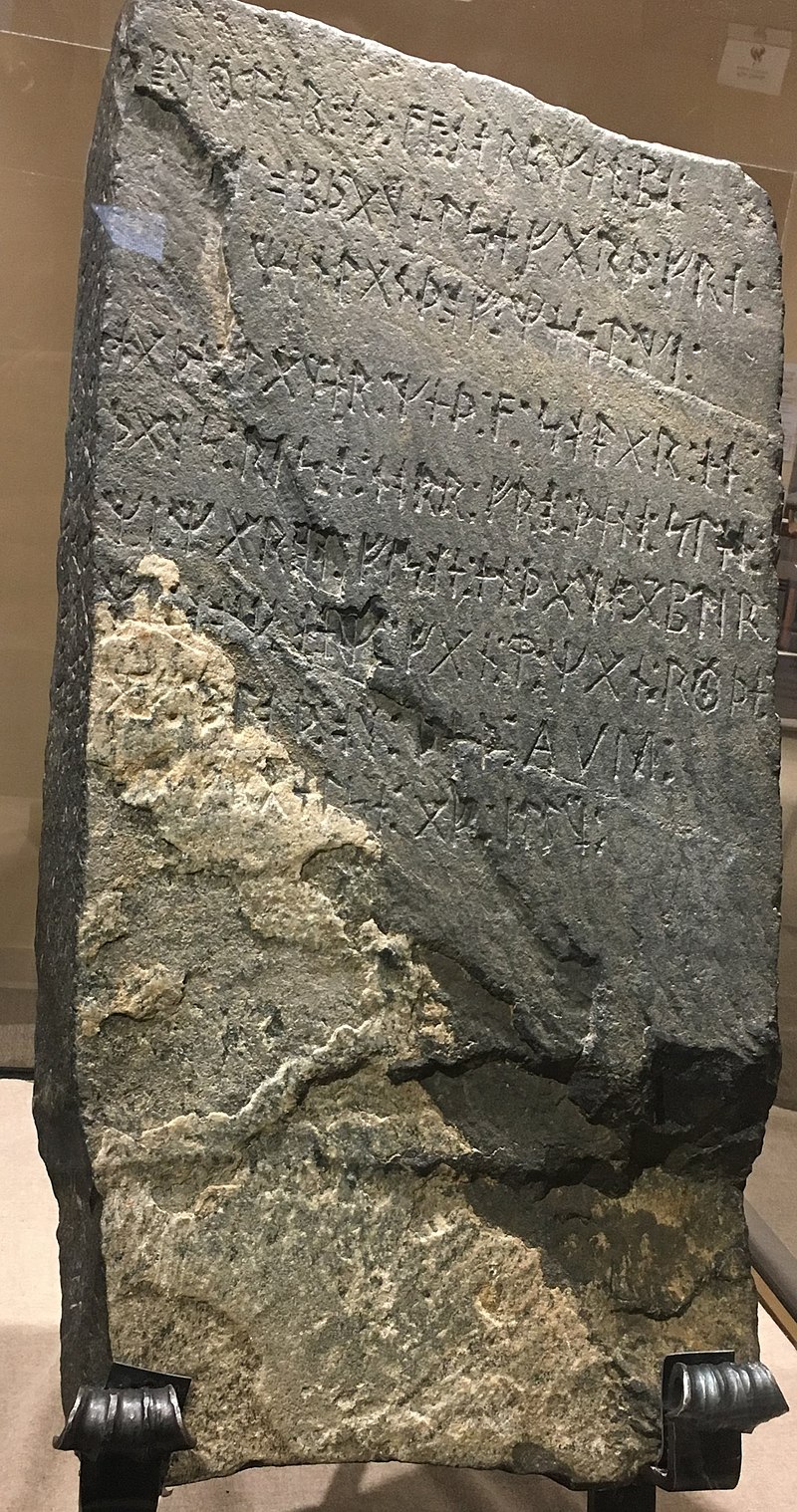
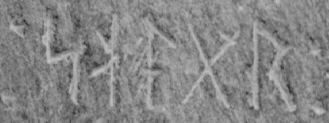
The purpose of this discussion is a follows. The Runestone found in Minnesota shows another possible sign of people living in North America previous to Columbus. Were they previous Jaredites, or Nephites? Or descendants of the Vikings or the Mississippian Culture? It shows a Nordic language these people spoke who wrote on the rock. The text translates to: “Eight Geats and twenty-two Norwegians on an exploration journey from Vinland to the west. We had camp by two skerries one day’s journey north from this stone. As with any information on artifacts we need to learn and study and then use our knowledge both head and spirit to determine truth on our own. North American is so full of amazing and interesting artifacts.

The Kensington Runestone is a 202-pound (92 kg) slab of greywacke covered in runes on its face and side. A Swedish immigrant, Olof Öhman, reported that he discovered it in 1898 in the largely rural township of Solem, Douglas County, Minnesota, and named it after the nearest settlement, Kensington.

The inscription purports to be a record left behind by Scandinavian explorers in the 14th century (internally dated to the year 1362). There has been a drawn-out debate on the stone’s authenticity, but the scholarly consensus has classified it as a 19th-century hoax since the time it was first examined in 1910, with some critics directly charging the purported discoverer Öhman with fabricating the inscription. Nevertheless there remains a community convinced of the stone’s authenticity…

Winchell estimated that the inscription was roughly 500 years old, by comparing its weathering with the weathering on the backside, which he assumed was glacial and 8000 years old. He also stated that the chisel marks were fresh.[16] More recently geologist Harold Edwards has also noted that “”The inscription is about as sharp as the day it was carved… The letters are smooth showing virtually no weathering.” Winchell also mentions in the same report that Prof. W. O. Hotchkiss, state geologist of Wisconsin, estimated that the runes were “at least 50 to 100 years.” Meanwhile, Flom found a strong apparent divergence between the runes used in the Kensington inscription and those in use during the 14th century. Similarly, the language of the inscription was modern compared to the Nordic languages of the 14th century.

The Kensington Runestone is on display at the Runestone Museum in Alexandria, Minnesota. Wikipedia

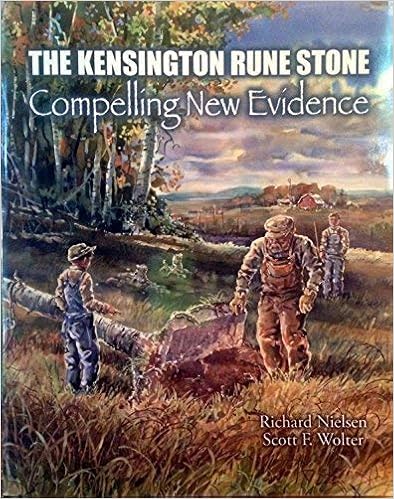
The Kensington Rune Stone: Compelling New Evidence

by Alice Beck Kehoe

Richard Nielsen and Scott Wolter are hard scientists. They understand the methodology of science, and Inference, from data, to the Best Explanation — IBE, philosophers of science call it. Both scientists are experienced serving as expert witnesses in court cases. Nielsen, with his doctorate in materials science, realized that the question of the Kensington Runestone’s authenticity likely could be answered with petrographic data. He engaged Wolter to examine the Runestone using current high-tech microscopy. The result was clear: the rune incisions are too weathered to have been carved as recently as the nineteenth century. QED, inference from the petrographic data leads to the carved date of A.D. 1362 as the best explanation for its origin.

Hoax or Truth?

“There has been a lot of talk from some intellectuals about various hoaxes purported to be associated with ancient Hebrew stones or pre-Columbian relics and script found in North America. It makes sense that when Lehi landed in North America he and his culture would have left behind evidence of his Hebrew and Israelite heritage. Since nothing has been found in South and Central America, these intellectuals want to condemn anything that may have been found in North America. Of the many evidences found in North America related to Hebrew, the scholars refute ALL OF THEM as hoaxes!. That seems way to easy to just out of hand condemn any evidence. That’s what people do when they can’t explain things. Much of today’s science is not engaged in finding new truths, but in finding new pet theories. Since no new “Scientific Law” has been discovered and proven in over 100 years, the scientists are now propping up their new “theories” as if they are true. Take for example the theory of evolution. Last time I heard it is still a theory and has never been proven to be a law. What about the theory of magma in the center of the earth? It has been shown in Dean Sessions book that it is more likely that water is at the center of the earth? I’m not a scientist but just an ordinary man who likes to have science and history just “make sense”. What about the intellectuals (some at BYU) that say Noah’s flood was not universal and was probably a myth? What about those who say Adam was not the first man created on this earth? I would rather ask the simple question of, “does it make common sense” rather than listen to many intellectuals who claim to know the unknown or have a good theory for it. For example see what a leading BYU Professor says in Newsweek  Magazine in 2018 titled,  “Is Evolution Real? Christians Should Embrace Darwin’s Theories, Mormon College Professor Says

I don’t know the unknown either, but I study and pray about all things and it has to make sense as well. For example, something cannot be created out of nothing. We know this by the scriptures (D&C 93:29) and yet the vast majority of these intellectuals don’t believe in scripture either.

I offer this information below as wonderful information to take to heart. Learn and listen, search and pray and things will make sense to you. By all means I don’t want you to believe me as I like you am only one who loves the Lord and tries daily to learn His truths that He is sharing with us. Stay close to The Church of Jesus Christ of Latter-day Saints and follow the Prophet and Apostles in all you do. I have a witness that the Book of Mormon is the word of God and I also know as Moroni promised that I. “may know the truth of all things.” Rian Nelson 

Evidence of Authenticity?

Since the coming forth of the Book of Mormon there has never been more profound evidence of its authenticity than today.  Arguably among the two greatest linguistic discoveries relating to the authenticity of the Book of Mormon are two ancient stones bearing Hebrew inscriptions that can now finally take their rightful place in the history of the world! Many, if not hundreds of stones inscribed with ancient characters and symbols have been summarily dismissed as fakes and forgeries because it was against the official policy of the scientific community under the Smithsonian Institution, and because linguistic evidence cannot be supported by one or two random artifacts.  Recent scientific verifications of several sites and artifacts – numbering eight as of this writing – now establish that people with a knowledge of ancient Hebrew written language and culture were in America during Book of Mormon time frames!  Read on for the entire history making story…the case for Book of Mormon written language in America’s Heartland! 

Dr. Huston McCullough of Ohio State University has an article all about the authenticity of these many Hebrew artifacts found in North America, and some information on other artifacts including the Runestone. Article Here.

Heartland Research Group of Pennsylvania headed by John Lefgren and Wayne May has been looking in Ohio and Iowa for lost earthworks, Hebrew artifacts, ancient roads, buildings and firepits using the most modern form of magnetometry today from Germany.
Last December Heartland Research Group and other scientists, archaeologists and supporters gathered in Ohio to do magnetometry research attempting to locate ancient evidence of human activity in Ohio over 2,000 years ago. The company SENSYS, from Germany was hired to utilize their state of the art equipment. Heading this research was John Lefgren PhD and longtime scientist. He said the following:

John Lefgren

“On Friday evening, December 14th, at the Frisch’s Big Boy Family Restaurant near the AmeriStay Motel in Batavia, Ohio I was eating a buffet and sitting with Richard Moats, Kirk Magleby, Hu McCullough, and Jeffery Wilson. It was a pleasant evening. There were other people at the table. In our table conversation, I turned to the aforementioned people and I said that I wanted each one of them to answer a plain and simple question. Were there ancient Hebrews in Ohio? Richard Moats said absolutely yes. Hu McCullough said yes. Jeffery Wilson said yes. Kirk Magleby said no.

How about that?”

John Lefgren PhD, President Heartland Research Group


Who said yes and who said no to the question, “Hebrews in Prehistoric America?”

“Absolutely”, says Richard Moats Ordained Evangelist in the Church of Jesus Christ International. and Avocational Archaeologist, Archaeoastronomer who has lived in Ohio all his life.

“Yes”, says J. Huston McCulloch Professor of Economics and Finance The Ohio State University and Ohio Avocational Archaeologist for 40 years.

“Yes”, says Jeffery Wilson the director/manager of the Serpent Mound in Ohio. Friends of Serpent Mound, or FOSM for short, is made up of individuals, organizations, and businesses that care about and see the value in preserving the Great Serpent Mound Park. He knows Ohio Archaeology very well.

“No”, said Mesoamerican advocate and Executive Director of Book of Mormon Central Kirk Magleby.

Below is a little more information about our friend Dr. McCulloch and his research on the Runestone.

J. Huston McCulloch Professor Emeritus, Economics The Ohio State University

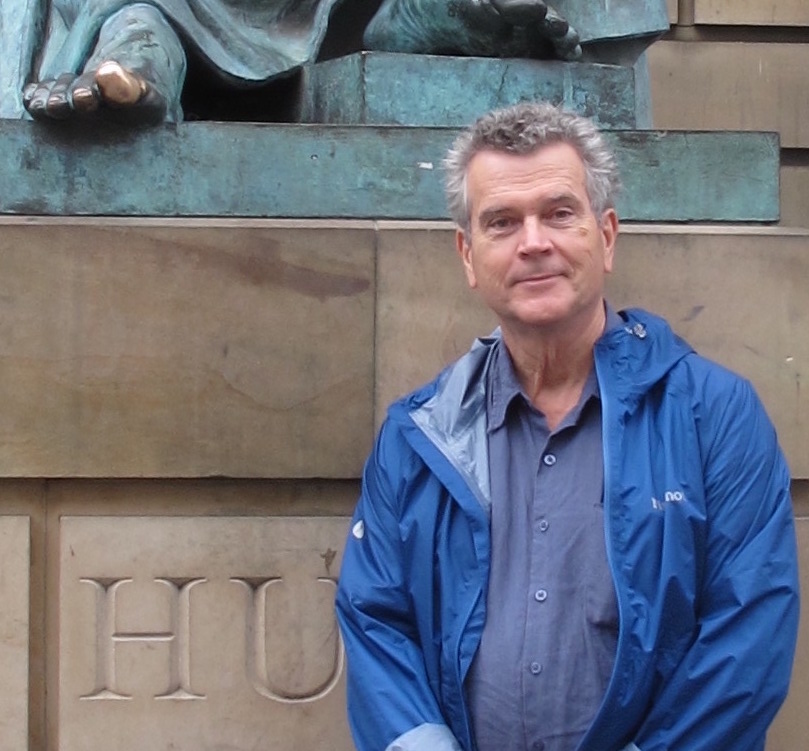
Edinburgh2010
J. Huston McCulloch Professor Emeritus, Economics The Ohio State University

PRIMARY TEACHING AND RESEARCH FIELDS
Money and Banking, Macroeconomics, Econometrics, Finance
DOCTORAL STUDIES
Ph.D., University of Chicago Department of Economics, June 1973
Dissertation Title: “An Estimate of the Term Premium”
Committee: Lester Telser (Chair), Reuben A. Kessel, Merton H. Miller
Field Examinations: Industrial Organization, Labor
Academic Honors: Earhart Fellowship, NSF Traineeship
PRE-DOCTORAL STUDIES
California Institute of Technology
B.S. in Economics with Honors, June 1967
POSITIONS
Professor Emeritus, The Ohio State University, Jan. 2013 – present.
Professor, The Ohio State University, Economics Department, July 1983 – Dec. 2012, with joint appointment in Faculty of Finance.
Associate Professor, The Ohio State University, Economics Department, September 1979 – June 1983.
Assistant Professor, Economics Department, Boston College, September 1973 – August 1979.
Contractor, Office of Tax Analysis, U.S. Treasury Department, June 1973 – September 1973.
First Lieutenant, U.S. Army Signal Corps, January 1970 – September 1971.
Economist, Center for Naval Analyses, Arlington, VA, June 1969 – December 1969.
Computer Programmer, C-E-I-R, Inc., June – September 1966.

The Kensington Runestone by J. Huston Mcullouch

https://www.asc.ohio-state.edu/mcculloch.2/arch/kens/kens.htm
Maintained and written by J. Huston McCulloch
Send comments to: [email protected]

sk(l)ar

The same symbol (represented here by “(l)”) appears in the KRS word sk(l)ar, shown above. The runic scholars who originally examined the KRS were unfamiliar with this uncommon symbol. The context called for some kind of landmark. Early on, someone suggested that it represented a Germanic j-sound (English consonantal y) so that the word could be read skjar, “skerries” or “rocky islets,” and this became the generally accepted interpretation of the KRS letter.

In 1951, Erik Moltke, the official Runologist of the Danish National Museum, cited this “invented” letter as the conclusive proof of the KRS’s inauthenticity: “The patient reader interested in the Kensington Stone will have already noticed that it is now in rather a precarious position. But it has not received the coup de grace. Here it comes. In his eagerness to have as complete an alphabet as possible the engraver has invented a j-rune. He ought not to have gone as far as that. The fact is that the letter ‘j’ is a development within the Latin alphabet (like v). Both these letters were invented by the French philosopher Petrus Ramus in the 16th century.” (Antiquity, 1951, p. 91)

In 1987, however, Richard Nielsen, writing in vol. 16 of Epigraphic Society Occasional Papers, pointed out no less than 8 uses of this admittedly rare symbol in the Codex Runicus, counting the two specimens in the above song. It was therefore, unbeknownst to Moltke, an authentic 14th century nordic rune, and not a newly invented J-rune at all.

Nielsen’s discovery is enough to put the KRS back in the running — how could the minimally educated Minnesota farmer who is generally believed to have forged it have known more about 14th century runes than someone with Moltke’s credentials? Moltke’s “coup de grace” thus backfired, and this KRS symbol, far from being “imaginary,” in fact provides a strong indication of authenticity.

The stone on display in the Alexandria Chamber of Commerce and Runestone Museum

Apparently this symbol represents a soft (one might even say silky) L-sound, and not a Germanic J-sound (English Y-sound), as had been assumed by Moltke and most prior writers. According to Einar Haugen (The Scandinavian Languages, Harvard 1976, section 10.3.1), it was also used in medieval inscriptions on the Baltic island of Gotland, to mark an L with “a special dental quality.” Nielsen suggests that this word should be read skylar, or “shelters,” rather than “skerries.”

  • Report on petrographic examination of the KRS by Scott Wolter and Sherry Veglahn of American Engineering Testing, Inc., a geotechnical consulting firm with offices in Minnesota, Wisconsin, and South Dakota. They found that
    • While the back is naturally glaciated, other surfaces were clearly “dressed” to provide the present shape.
    • Some of the man-made surfaces clearly show weathering, but not as much as the glacial surfaces.
    • Several of the inscribed grooves contain significant iron-oxide deposits, a byproduct of the decomposition of pyrite within the stone. However, roughly 90% of the runeforms were recently carved or recarved, removing any such deposits that may have originally been present.
    • The back side of the stone has two undulating discolorations, “believed to be chemical bleaching of minerals in the stone from prolonged contact with tree roots.” (The KRS was allegedly found entangled in the roots of a tree, although some skeptics have discounted this claim.)
    • A freshly fractured surface of a core sample obtained from the KRS shows well-defined, sharp mica crystals in a Scanning Electron Microscope (SEM) image displayed in the report. Another image shows that the mica crystals on a carved surface have completely weathered way, indicating that the runeforms “spent a long time in the ground.” The report calls for further comparison testing of gravestones, etc., to determine the rate of mica decomposition.
  • “Response to Dr. James Knirk’s Essay on the Kensington Runestone” by Richard Nielsen, Scandinavian Studies, vol. 72 no. 1, Spring 2001, online electronic supplement.
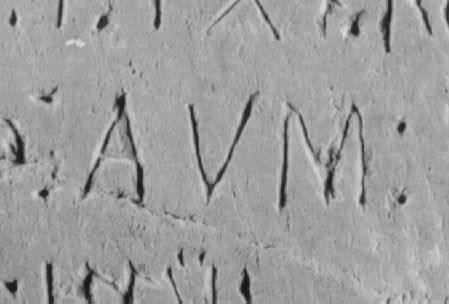
  • Bergen runes. Many of these inscriptions, discovered in 1955-79 and so not available to early discussion of the stone, are roughly contemporary with the 1362 date on the KRS. The searchable Bergen Database shows that 11 of the 670 items contain the phrase Ave Maria, generally assumed to be the meaning of the KRS Latin letter phrase AVM. Only two of the 670 contain the word virgo, and neither of these is in the phrase Ave Virgo Maria that has also been advocated. For further considerations in favor of Ave Maria, see the forthcoming article in Epigraphic Society Occasional Papers byKeith Massey and Kevin Massey-GillespiePlease note that an earlier version of this page erroneously attributed the reading Ave Virgo Maria to the Massey brothers — corrected 4/25/01.
  • Computus Runicus: The Runic Calendar from Gotland from 1328, with commentary written in 1626 by Ole Worm. More cool runes roughly contemporary with KRS.
  • Samnordisk Runtextdatabas. Data base of over 6000 Scandinavian runic inscriptions, sponsored by Uppsala U. It’s all in Swedish, so you’re on your own.
  • Session of the Joint Midwest Archaeological and Plains Anthropological Conference on “The Kensington Runestone Reexamined,” St. Paul, MN, 11/10/00. Summary by Michael Zalar, from his website. News article from the Minneapolis Star Tribune, on the NEARA website.
  • Dalarna runes from the 18th century, including some of the peculiar KRS runes. In particular, an X-like A-rune (!), not only the well known O-form Dalecarlian O-rune, but an umlauted O-form O-rune for o-umlaut (!), an umlauted two-stroke symbol for y (!), an umlauted A-rune (in an inverted V-form rather than the X-form) for A-umlaut, and a K-form K-rune. Unfortunately, the specimen of 16th century Dalarna runes on the same site does not include these features, except for an incipient X-form for the A-rune, and an incipient O-form for the O-rune. The site unfortunately gives no references to original sources.
  • Norwegian and Swedish runes, with additional photos.
  • Statement by Olaf Ohman’s great grandson, dated 8/24/2000, on scifi.com message board.
  • Runestone Museum, “right off exit 103 on I-94,” with 28 foot tall statue of “Big Ole.”
  • AVM Stone a hoax. In May of 2001, a boulder resting about 1/4 mile from the findsite of the Kensington runestone was noticed to bear the Latin letters AVM, presumably for Ave Maria as on the KRS, the year 1363 (1 year after the KRS) in KRS-like pentadic numerals, and three additional symbols, apparently ASU in Danish-type runes unlike the KRS runes. The new find was announced in August of 2001 on the AVM Stone webpage of the Runestone Museum. Three months later, Prof. Kari Ellen Gade, chairwoman of Germanic Studies at Indiana University, and Prof. Jana K. Schulman, associate professor of English at Southeastern Louisiana University, admitted that they had carved the stone as graduate students back in 1985, along with three other members of a University of Minnesota seminar on runic inscriptions taught by Prof. Anatoly Liberman. According to an interview with USA Today, their motive was to cast doubt on the validity of the original KRS. In a letter to the Runestone Museum, Gade and Schulman explained that the third line was intended to read “ALU” (a pagan invocation comparable to Ave Maria), in the Older Futhark, but that the chisel slipped on the “L”. I would have expected something like UMN in KRS-style letters instead. The Echo Press of Alexandria Minn. reported that Janey Westin, the finder of the stone who had spent weeks and hundreds of dollars investigating and transporting the 2200-pound stone to safe storage, was not amused by the prank.
  • The Vinland Map.
  • Strand of Ancient Yarn Suggests Early European Presence in Canada, New York Times, May 8, 2001. Archaeologist Patricia Sutherland announces that a 10-foot strand of yarn in a collection of Dorset artifacts from Northern Baffin Island “is directly comparable to textiles from the Farm Beneath the Sand [in Greenland],” and that the yarn implies contact with the Norse. The brief article concludes, “Now, as she studies Canadian collections of native artifacts, she says, ‘I am finding new Norse materials every couple of weeks. It suggests there was a significant European presence in Eastern Canada in the centuries around 1000 A.D.'” Sutherland is a curator at the Canadian Museum of Civilization in Hull, Quebec. (Link to full article now requires free registration with the New York Times Online, and cookies enabled.)
  • Wikipedia article on KRS, with remarkable 1885 rune chart by Edward Larsson from the collection of the Institute for Dialectology, Onomastics and Folklore Research in Umea [Sweden]. The chart contains the exact form of the controversial Kensington A-umlaut rune, i.e. an “X” with a hook and two dots. The Dalarna rune site cited above contains the X-form, but not the hook or the dots. It also contains an O-form O-umlaut rune, with two dots as on KRS. The only difference is that whereas the KRS rune contains a miniature e-rune inside the “O”, the Larsson form has a vertical stroke that extends outside the “O” both above and below. The Larsson chart also contains the unusual (if less controversial) KRS Y-rune, as “u”, complete with its two dots, though without its crossbar. Furthermore, Larsson lists the pentadic numerals from 1 to 9 plus 0, and dates his chart 1885 using these numerals in Arabic placement, just as on the KRS. Richard Nielsen has abundantly documented the use of these pentadic numerals plus knowledge of Arabic placement in Scandinavia in the 14th century, but this is the first example that I am aware of (outside of KRS) of actually using pentadic numerals in Arabic placement. The symbol Larsson identifies as 0 is used twice on the KRS as 10, without Arabic placment.Larsson’s chart demonstrates that most, if not all, of the controversial letters and numbers on the KRS are authentic runic conventions. The only issue is how far back before 1885, if at all, these conventions go. Larsson indicates that the runerow containing the contested KRS letters is more recent than a shorter FUTHORK he also gives, but he doesn’t say how recent it is, or where he got it.The Wikipedia article indicates that knowledge of these runes was widespread among late 19th century guilds, with the tacit implication that the KRS forger must have shared this knowledge, but does not indicate how this knowledge eluded the many runic scholars who have criticized the KRS for using these symbols. Even without the unusual symbols, the article concludes that the inscription is a hoax on linguistic grounds, in particular because “It also contains the word ‘ded,’ which is actually the English word “dead,” and not Scandinavian at all.” As Hjalmar Holland pointed out long ago, this word was in fact used in a 14th century letter by the famous Queen Margarete, who ruled Sweden, Norway and Denmark, and therefore is at least as Scandinavian as she was.
  • In a new book coming out in November of 2005, The Kensington Runestone: Compelling New Evidence, Richard Nielsen and Scott F. Wolter present new evidence in favor of the authenticity of the KRS runes, including a discussion of the Larsson letters and Wolter’s petrographic analysis. The Foreword by Alice B. Kehoe, author of Land of Prehistory: A Critical History of American Archaeology (Routledge, 1998), concludes, “The notion that the Kensington Runestone is a late nineteenth-century hoax is not supported by contemporary data.”

My Spiritual Covid Journey

“I have a new friend who reached out to me and told me his story about Covid and I asked him if I could share it. He agreed and sent the following article titled “My Spiritual Covid Journey.” He has been a member of The Church of Jesus Christ of Latter-day Saints and in good standing all his life, and I was very impressed with his personal story. He has been a Bishop, Stake President and served the Lord all his life. I won’t name him, but simply share this story to give a different perspective than some in the Church may have. I am trying to help all members in their decisions. Whether you took the experimental shot or not, whether you wear a mask or not, we all have our freedom to chose. Satan is trying to separate us and we must resist that urge and not force our own beliefs on others.If I asked any of the 15 Brethren in our wonderful Church if they thought Fauci was an honorable guy, what would they probably answer? I don’t know. If I asked them if each of their personal physicians were honorable and know the truth about the experimental therapy, what would they say? I can guess but I don’t know. If I asked any of the Brethren if they knew of anyone dying from the experimental jab what would they say? I don’t know. What if I asked them if they knew the experimental jab has aborted fetal tissue and Nano particles in it, would they say yes or no? Who knows? What if I ask them if they trust the government of Australia in their huge forced lock downs? What would they say? I don’t  know? Very few people know what they would say and that is not the point. What if I ask them about the article I read about nurses dying that took the jab? They wouldn’t have a clue and they shouldn’t, as they don’t have time to study that kind of thing, but I do. I have also seen dozens of soccer players drop dead on the pitch and many videos of people that took the shot and died after or had tremendous complications. That is scary.

Ask me those questions I hypothetically asked the Brethren, and I would have a definite answer based on what? My study, research and prayer. I would trust my personal revelation more than any answer the Brethren would give me, because I have really studied those things in depth and prayed about them and they possibly haven’t. Our Brethren love everyone, and they should. But I don’t believe they would trust everyone if they knew who they really are and what their answers really would be, even if they personally had the time to study any of this.

I will always follow the Prophet’s council, doctrine and revelations and church talks etc. But If I want personal answers why should I depend on them or even on my Bishop? The Lord needs leaders not followers. I will make up my own mind on things that I receive personal revelation on, and things that the Brethren really may not have time to study. I will do my best research and then add prayer. I will always take their counsel and listen to their concerns. They don’t know everything, and they shouldn’t, why should we hold them to a standard that is impossible for a human? We shouldn’t.

I will not take this experimental shot and those who do, it is their choice. As long as I have my own choice as well, I am happy.” Editor

My Spiritual Covid Journey 

Many years ago, while serving my mission, I was introduced to a very prominent and successful medical doctor who was converted to the Gospel of Jesus Christ after reading D&C Section 89. Although he had already read the Book of Mormon and other inspired Church writings, at the request of the missionaries, he hadn’t yet opened his heart or mind to accepting Joseph Smith as a latter-day prophet. Upon reading, for the first time, the Lord’s Law of Health, the Spirit bore witness to his heart and mind that Joseph must have been a prophet to have received such inspired counsel. In the words of this knowledgeable doctor; “There is no way in the world, that anyone, at that time, and especially the uneducated Joseph could possibly have known the significance and details of this inspired Word of Wisdom. Joseph therefore, must have received this from God.” It was at that point that he went back and re-read the Book of Mormon, with that seed of faith and hope planted in his heart and received a personal witness that it was truly the word of God and that Joseph was indeed, the Lord’s prophet.

Since that time, I have had a keen interest in striving to better understand the Word of Wisdom. I am certainly not perfect in my adherence to these inspired teachings, but I have always had them in mind when making lifestyle decisions.

Now, fast forward 45+ years later, when we are being faced with a worldwide health crisis, (whether real or perceived, I’ll leave that up to you.) Very early on, I began petitioning the Lord as to what He would have me and my family do to remain safe through whatever it was that lie ahead. Certainly, I could not have imagined what would transpire over the following two years.

As it was becoming evident that we were about to experience unprecedented challenges, these powerful words, which I had often pondered upon, came clearly to my mind; “In coming days, it will not be possible to survive spiritually without the guiding, directing, comforting, and constant influence of the Holy Ghost.” (Pres. Nelson, April 2018 General Conference). I had previously received a powerful witness that this was a prophetic declaration and warning, which would impact our lives “in coming days”. Little did I realize how swiftly those days would come!

I then began to diligently search and ponder the scriptures, seeking for guidance. As I did so, I was led on a wonderful and spiritually exhilarating journey, that is difficult, if not impossible, to put adequately into words, but I shall attempt to shed light, at very least, on the path that I traveled.

My thoughts soon turned to the Children of Israel and how they were delivered from the flying fiery serpents, by exercising faith in Christ and merely gazing upon the staff that Moses had been commanded to create. There is a wealth of symbology and beauty, along with powerful lessons in this account, which I shall not attempt to unfold here. This first step, however, planted my feet firmly upon the foundation of Faith in Christ, knowing that He can deliver us from any plague or destruction we may be faced with.

My mind began to be flooded with other verses of scripture that continued to lead me along this journey. One of the more prominent guideposts was found in Nephi’s declaration as he cried unto the Lord saying; “O Lord, I have trusted in thee, and I will trust in thee forever. I will not put my trust in the arm of flesh; for I know that cursed is he that putteth his trust in the arm of flesh.” And, as if these words were not clear enough, Nephi REPEATS this warning with; “Yea cursed is he that putteth his trust in man and maketh flesh his arm.” (2 Ne 4:34)

Upon reading this, the Spirit confirmed, once again, that I should turn to God and trust in Him throughout the entirety of this ordeal, as well as all other challenges that I would be faced with in the future.

Without covering every step of my journey, I ended up returning to D&C 89 and seeking guidance from the Lord’s Law of Health. Although I had read this many times in the past, and as I have mentioned, considered this to be counsel from the Lord, these are the verses that literally jumped out at me and grabbed hold of my heart in a profound way. (Emphasis added in an attempt to convey my personal experience.)

“4 Behold THUS SAITH THE LORD unto YOU! (ME!) IN CONSEQUENCE OF EVILS AND DESIGNS WHICH DO AND WILL EXIST IN THE HEARTS OF CONSPIRING MEN IN THE LAST DAYS, I HAVE WARNED YOU AND FOREWARN YOU by giving unto YOU (ME) this word of wisdom BY REVELATION.”!

As I read these words, I realized that this revelation was given for US in THE LAST DAYS, and I felt that, in this instance, it was being personalized to me as a direct answer to my prayers.

What is it then, that the Lord was warning and forewarning us against? These were the thoughts which came to my mind, in this moment; that we, in the last days, would be attacked by evil and conspiring men (seeking money and power) and that they would attack us in regards to our health!

The Lord, in His mercy, then proceeded to give us Heavenly guidance regarding things we should avoid AS WELL AS things we should seek out and incorporate into our health and nutrition to assist us in remaining free from the consequences of these evil and conspiring men.

By this point, I cannot express, in words, what I was feeling in my heart. But then, as if the Lord were adding a Heavenly exclamation point to my experience, these words flew off the page and penetrated every fiber of my being.

“18 And ALL SAINTS who remember to keep and do these sayings, walking in obedience to the commandments, SHALL receive health in their navel and marrow to their bones; 19 And SHALL find wisdom and great treasures of knowledge, even hidden treasures; 20 And SHALL run and not be weary, and SHALL walk and not faint. 21 AND I THE LORD, GIVE UNTO THEM A PROMISE, THAT THE DESTROYING ANGEL SHALL PASS BY THEM, as the children of Israel, AND SHALL NOT SLAY THEM. AMEN”!

There was my answer! Coming back to the counsel of Nephi to trust in God and in His power, and to not put my trust in the arm of flesh. Put my faith in Christ and HIS promises and HE will see us through this storm.

Now, many things have transpired since that wonderful day nearly two years ago. Long before any talk of masks and other mandates. But I cannot deny the “guiding, directing, comforting, and [undeniable] influence of the Holy Ghost” throughout this experience.

I will end with these thoughts, in hopes that others will seek their own guidance from the Spirit. I am not suggesting that the answers I received, which were specific to me and to my family, are the direction that the Lord would have anyone else follow. That is a personal decision and an experience that each should seek. I also wish to state unequivocally, that I sustain Pres. Russell M Nelson as THE Prophet, Seer and Revelator of the Lord and that whatsoever he shall speak “…when moved upon by the Holy Ghost shall be scripture, shall be the will of the Lord, shall be the mind of the Lord, shall be the word of the Lord, shall be the voice of the Lord, and the power of God unto salvation.” (D&C 68:4)

No other assumptions should be derived from the sharing of my experience. I implore others to seek divine inspiration regarding these and the many other challenges that we will face in these last days.

I conclude with this; through the grace and mercy of Our All-Knowing, All-Powerful, and All-Merciful Father in Heaven, each and every concern that has arisen over the course of this experience and challenge, has been resolved in my mind and in my heart and I am at peace with following the counsel I have received.

May God’s choicest blessings distill upon each of us as we diligently seek His counsel and may we, in all things, be true examples of the believers!” I won’t disclose this friends name.

THE ENEMY FROM WITHIN 

0
The documentary, (“Who Killed Joseph Smith”), premiered last night (Jan 13, 2022). It was made by the Doctrine of Christ group with Justin Griffin and Steve Sorensen, and speaks about framing Brigham Young, John Taylor, and Willard Richards for the murder of Joseph Smith.
We have to get the word out and defend Brigham Young’s name and character. For those aware of the movement which is gaining momentum among disaffected members of the Church to frame Brigham Young for the murder of the Prophet Joseph Smith, here is a short article Kimberly Smith wrote to put all honest seekers of truth in possession of the facts.

THE ENEMY FROM WITHIN 

Written by Kimberly W Smith 

“The devil has only one purpose: to destroy testimony in order to destroy the ordinances, the doctrines of salvation, and exaltation to which Brigham Young, John Taylor, Willard Richards and others testified of to the anger of Joseph Smith’s enemies-enemies from within who were in league with the underworld. 

In the spring of 1844, Joseph Smith was alerted by two young men, Denison L. Harris and Robert Scott, [Article about these men Here] of a secret movement to take both his life and the lives of several other leading men in the Church, including Hyrum Smith. These observant and courageous young men had been personally invited to the secret meetings by the conspirators. Risking their own lives, the boys attended three of the furtive meetings as spies, and brought to Joseph a report of what they had witnessed—including a recounting of the requirement that everyone present at the meeting take a blood oath to be willing to take the life of Joseph Smith. 

In addition to the testimonies of these young men, two other men—M.G. Eaton and A.B. Williams [BYU Studies about these men]—went before justice of the peace Daniel H. Wells to swear out an affidavit concerning their knowledge of those who had secretly combined to murder the Prophet and his brother. Included in this affidavit were the names of the leaders in the plot—Chauncy L. Higbee, R.D. Foster, Joseph H. Jackson, and William and Wilson Law—corresponding with the witnesses of the two young men.

These men had become desperately wicked. The mask of treachery having fallen at last from their faces, their fierce opposition was forced out into the open, and they joined with the avowed enemies of the Saints outside of Nauvoo to kill the Prophet Joseph Smith. 

For additional details read more about this conspiracy here:

https://passingdownthefaith.org/2021/07/conspiracy-of-nauvoo-in-1844/.html

TODAY THERE IS A NEW CONSPIRACY

A conspiracy over the death of the Prophet Joseph Smith and who killed him. 

In our generation, enemies  from within the church-also in league with the under world- blame Joseph Smith’s closest and most faithful associates for his murder. Why? 

To do that which was done in 1844: to destroy testimony in order to destroy the ordinances, the doctrines of salvation, and exaltation to which Brigham Young, John Taylor, Willard Richards and others testified of to the anger of modern apostates who reject Temple ordinances and the wearing of the Temple Garment. 

It must be observed that the very conspirators behind the plot to kill the Prophet Joseph Smith and his brother Hyrum were men once enlightened by the Spirit of God; they had great knowledge of things revealed to them pertaining to righteousness—and then, having fallen away into sin and disbelief, they rejected the revelations of Joseph Smith, and their minds became darkened—eventually leading them to betray the Prophet and to seek to take away his life. 

The type of apostates that existed in the early days of the Church are similar to the type we face today.

I Advise Against this Movie

There are members of the Church in this generation who are animated by the same evil spirit that possessed the apostates in Nauvoo. Perhaps they are not conscious that they are more or less the instruments of a secret and invisible power which operates upon them. They are being influenced by this invisible power of darkness to twist and distort the truth, misrepresent the facts, and are maliciously seeking to persuade others to believe the following:

??that the Prophet Joseph Smith neither taught, nor entered into, plural marriage

??that the Church was rejected for failure to build the Nauvoo Temple before Joseph died 

??that the Twelve Apostles usurped the leadership of the Church

??that Brigham Young conspired to kill Joseph Smith for power and ‘polygamy’

??that the Church of Jesus Christ of Latter-day Saints does not hold the keys of the Melchizedek Priesthood 

??that the Temple Endowment is a Satanic invention of Brigham Young 

They piously pretend to be “exposing” the “facts” while they mislead others with half-truths and manipulation of fact, hoping to attract members to their own interpretation of history and the revelations of Joseph Smith. As a result of insufficient knowledge of scripture and of real history, there is a surprisingly sufficient number of people whose inadequate understanding of doctrine leaves them susceptible to embracing the most sensationalized fiction and vicious falsehoods over proven facts and pure truth. 

In Nauvoo, persecution became an obsession for the dissenters. When William Law and other apostates conspired against the Prophet Joseph Smith to take his life, they were successful in their efforts to rile up a murderous mob of wicked men who were mere tools of a higher power of darkness. The conspirators succeeded because they employed the cunning use of slander, and the influential power of the press. 

The same diabolical tactics are being employed today to vilify the name and character of Brigham Young. The modern-day printing press has become more sophisticated; with the clever use of video, slick graphics, skillful editing, and carefully extrapolated quotes taken out of context, it almost appears that anyone can make anyone believe whatever they desire. 

In this final dispensation, the forces of evil have united and intensified under the powerful influences of Satan. Describing the apocalyptic events of the last days, John the Revelator foresaw when “the dragon was wroth with the woman, and went to make war with the remnant of her seed, which keep the commandments of God, and have the testimony of Jesus Christ.”

Seeing that the dragon could not destroy the testimony of our faithful pioneer ancestors, he has employed all his cunning to make war on their “seed,” to incite hatred in us towards our forefathers and mothers. 

APPENDIX

To the enemies of the Church, the martyrdom of Joseph Smith was believed to be the end of ‘Mormonism.’ But the course set before Brigham Young was clear; the Gospel in its purity and fullness had been revealed through the Prophet, and the foundation of the Kingdom had been laid. Brigham Young would subsequently maintain and build upon that foundation. The first object was to assure the fulfillment of promises made by the Prophet Joseph Smith to the Saints that they would receive the sacred temple endowment, as directed by the Lord: 

“And again, verily I say unto you, I command you again to build a house to my name, even in this place [Nauvoo], that you may prove yourselves unto me that ye are faithful in all things whatsoever I command you, that I may bless you, and crown you with honor, immortality, and eternal life.”

The dedicated Saints worked diligently toward the completion of the temple, even under threats of violence which demanded that they leave Illinois. 

Despite the devices of the mob, the temple was completed with “the aid of sword in one hand and trowel and hammer in the other and with the blessings of heaven.” The Saints endured hunger, thirst, weariness, threats, and violence, so that they could receive their endowments and the promised temple blessings. Then, to save the lives of the Saints from cruel murder and complete extermination, Brigham Young moved them westward. He later remarked:

“Of our journey hither, we need say nothing, only God led us. Of the sufferings of those who were compelled to, and did leave Nauvoo in the winter of 1846, we need say nothing. Those who experienced it know it, and those who did not, to tell them of it would be like exhibiting a beautiful painting to a blind man.”

Contrary to the vain imagination of some in this generation, God did not reject the Church in Nauvoo—but rather, He saved it by a miracle. Up to the time the Nauvoo Temple was partly finished, the enemies of the Church—to a great extent—triumphed over the Saints. They were driven from place to place, and compelled through violence to flee from one state to another. But God did for them as he did for His ancient covenant people when he caused the waters of the Red Sea to separate, that they might pass through and escape the destruction threatened by their enemies.

History vindicates Brigham Young by virtue of the fulfillment of a number of prophecies. On August 6, 1842, the Prophet Joseph Smith prophesied by divine inspiration that the Latter-day Saints would be “driven to the Rocky Mountains,” and that some Saints would “live to go and assist in making settlements and build cities and see the saints become a mighty people in the midst of the Rocky Mountains.”

The 1842 prophecy was literally fulfilled under the leadership of Brigham Young. Apart from President Young’s divine appointment, the principal cause for his success in the Church can be attributed to his unwavering loyalty to Joseph and his uncompromising commitment to every principle and doctrine ever taught by Joseph, including the principle of Celestial plural marriage.

ADDITIONAL WITNESSES 

“Now I promised to say a little about Church History. 1st Did Joseph appoint any to succeed him after his death while he was alive. He did. He imparted the Keys of the Kingdom to fifty and gave them their full authority – equal with himself and Brigham Young was their President. After he had done this he commissioned the Twelve in the following language. On you I have placed the burden of rolling of the Kingdom to the nations of the earth and building up the kingdom and a great deal more of the same import.” (Elias Adams letter to George Adams, 18 February 1847, LDS Archives) Kimberly Smith


Editors Note:

“I just listened to a recording of a man named Rob or (Zombre DoC) at the website doctrineofchrist.com called “Uncovering the Hidden Foundation of the LDS Restoration” Posted on Mar 15, 2021.

He shared what he calls the true Doctrine of Christ being Baptism by water, Baptism by Fire, Seeing Christ while in the flesh but by the Spirit you see him, and Enduring to the end. You don’t really receive the Holy Ghost that is always present. The first baptism is for the Telestial Kingdom, The Second Baptism by fire is the Terrestrial Kingdom but until you see Christ literally that is what is called the New and Everlasting Covenant. Temple Marriage and Polygamy are not the New and Everlasting Covenant. He also says Joseph Smith never condoned Polygamy and the reason Brigham and other Apostles killed Joseph, was because Joseph was about ready to ex-communicate them for polygamy. He also said temples are not needed and he mentions the Temple Recommend questions and says the first two and a few of the others are ok, but the ones sustaining the Prophet or following Tithing or the Word of Wisdom are not Doctrine of Christ.

This is a very general remembrance of the entire audio, but you can listen to it if you would like at the link above.

Ryan Fisher

Also, this is the same religious following (Doctrine of Christ) that I believe our friend Ryan Fisher who filmed “Nephite Explorer” is now following. Video Here. Summarized Ryan says, because of polygamy spoken of in Jacob 2, this was the big reason the Nephites were swept off the land. Ryan mentions the polygamy by Abraham, David and Solomon were not done on the Promised Land (North America), as if that makes a difference. If the Lord commands Plural Marriage we should obey. Less that 5% of the Saints ever practiced polygamy.

Ryan, quotes D&C 124 the Lord saying, “But I command you, all ye my saints, to build a house unto me; and I grant unto you a sufficient time to build a house unto me; and during this time your baptisms shall be acceptable unto me. But behold, at the end of this appointment your baptisms for your dead shall not be acceptable unto me; and if you do not these things at the end of the appointment ye shall be rejected as a church, with your dead, saith the Lord your God.” D&C 124:31-31
To Ryan these quotes above mean the Nauvoo Temple and the Nauvoo House were neither finished by the end of the appointment time the Lord gave, so the Church, including Brigham Young are rejected by the Lord. Actually the Nauvoo Temple was dedicated May, 1, 1846. I agree that in Church History we acknowledge that the St George Temple was the first one fully finished, which this group makes a big deal about to prove the Nauvoo temple was never completed in time, and so the Brigham Young and Saints are rejected by God. The Nauvoo House was not finished until later after the Saints moved West. He thinks polygamy was never correct and should have never happened. It’s very similar to other LDS Restoration Branches and this new movie.

I agree that the former Saints were not perfect and endured much affliction because of their failing to meet some standards of the Church. Isn’t that how we are today? We have all fallen short, but through repentance we are forgiven. A small part of the Saints being driven out of their homes may include some slothfulness, but Satan constantly stirred up evil people to destroy the Saints, just like the Native Americans and others over the course of the world.

Ryan and Doctrines of Christ don’t mention the meeting the Saints had on Aug, 8, 1844 where during  a speech by Brigham Young there were over 100 people later testify that Brigham was translated to look and sound like the former Prophet Joseph Smith as these people witnessed to them, why Brigham Young was to became the successor of Joseph. For some of these reasons the Doctrine of Christ Church just doesn’t follow Brigham Young.

I love Ryan Fisher and pray that he may come back onto the path of truth. I testify Joseph Smith, Brigham Young, and all LDS Prophets including our current Prophet Russell M. Nelson are true Prophets of the Lord Jesus Christ.” Rian Nelson


Prophetic Witnesses- Heartland Geography

After studying and researching and praying about the location of the Book of Mormon events, it is readily clear to me that there is only one Hill Cumorah in New York and only one place the Nephites began their lives, and that is in the Heartland of North America. From there and mostly after the final battles, the Lamanites spread across the USA and into Canada and Mexico. But, it all began somewhere in Florida and extended into Tennessee, Missouri, Illinois, Indiana, Ohio, and ended at Hill Cumorah in NY.

NORTH AMERICAN SUMMARY AND TRAIL OF THE NEPHITES

For a complete timeline of the Nephites, including maps to follow along, please see our website here: https://bookofmormonevidence.org/nephite-timeline/

I want to share with you some brief quotes from prophets and apostles that clearly speak about the Hill Cumorah in New York being the only Hill Cumorah. The Church Education System (CES) for years has taught about the two Cumorah theory which I believe is just not accurate. I know many in the Church, like me have been looking to make sense of why Mexico has occupied the minds of Saints in the Church for so many years. I feel I have found answers that “just make sense.” I know wonderful Lamanites are found in many places of North and South America, but I feel the main events spoken of in the Book of Mormon happened in the Heartland of North America.

I have researched and studied and found secondary evidences about the Book of Mormon in North America. My testimony is based on solid spiritual confirmation of this Church and the truthfulness of the Book of Mormon. I am not trying to prove my point or to prove anyone wrong. It is fine with me for others to believe Book of Mormon geography happened in Central America, and there are those who really don’t care either way. I have been trying for over 40 years to find the other Cumorah somewhere in Central America and I had become complacent as I had never found any answers.

I know if you read these few quotes below, you will be able to feel the power of these brethren and as you study and pray about it, I feel you will learn some new truths about the Hill Cumorah. I haven’t found one quote of Joseph Smith speaking about a Hill Cumorah in Mexico, yet I have found hundreds of Apostles, Prophets, and Saints discuss just One Cumorah in New York, as you will see below. Editor Rian Nelson


The Hill Cumorah is Situated in Western New York

“The Hill Cumorah is situated in western New York. . . . It is distinguished as the great battlefield on which, and near which, two powerful nations were concentrated with all their forces, men, women and children, and fought till hundreds of thousands on both  sides were hewn down, and left to molder upon the ground. . . . The Hill Cumorah is remarkable also as being the hill on which and around which, a still more ancient nation perished, called Jaredites. . . . Millions fought millions, until the Hill Ramah, and  the land round about, was soaked with blood.” Orson Pratt Millennial Star 28 (16 June 1866)

Art by Ken Corbett

Lamanitish Arrow

“On the top of the mound were stones which presented the appearance of three altars having been erected one above the other, according to the ancient order; and the remains of bones were strewn over the surface of the ground. The brethren procured a shovel and a hoe, and removing the earth to the depth of about one foot, discovered the skeleton of a man, almost entire, and between his ribs the stone point of a Lamanitish arrow, which evidently produced his death. Elder Burr Riggs retained the arrow. The contemplation of the scenery around us produced peculiar sensations in our bosoms; and subsequently the visions of the past being opened to my understanding by the Spirit of the Almighty, I discovered that the person whose skeleton was before us was a white Lamanite, a large, thick-set man, and a man of God. His name was Zelph. He was a warrior and chieftain under the great prophet Onandagus, who was known from the Hill Cumorah, or eastern sea to the Rocky mountains. The curse was taken from Zelph, or, at least, in part-one of his thigh bones was broken by a stone flung from a sling, while in battle, years before his death. He was killed in battle by the arrow found among his ribs, during the last great struggle of the Lamanites and Nephites.” Joseph Smith Papers History, 1838–1856, volume A-1 [23 December 1805–30 August 1834], Page 483

Description- The Hill Cumorah DVD by Rod Meldrum

Purchase Now!

“Where is the Hill Cumorah of the Book of Mormon?
Is there more than one Hill Cumorah?
What have prophets and apostles proclaimed?
What archaeological evidence should we expect?
Has any archaeological evidence been found?

The Hill Cumorah of the Book of Mormon (Mormon 6:6) stands as a final, silent witness of the consequences of forgetting God’s sacred covenant with His chosen and blessed peoples on the Promised Land of America.

The mighty Jaredite Nation, brought to this land by the hand of God from the Tower of Babel, fell prey to Satan’s deceptions and broke their covenant with God.  They turned upon each other in an epic battle to extinction.

The once righteous Nephites, so highly favored of the Lord to be brought from Jerusalem to this covenant and Promised Land of America prior to the destruction of Jerusalem by the Babylonians, likewise abandoned their covenant path as a nation resulting in their utter annihilation at the hands of the Lamanites.

Both of these great civilizations, their histories recovered from ancient plates of inscribed gold buried in the side of a great hill, met their end near a singularly sacred location called by the Jaredites, “Ramah” and by the Nephites, “Cumorah.” The last of the Nephite prophets, Mormon and Moroni, after witnessing the final destruction of their people from the top of this very hill, described the scene of bloodshed and carnage as they delivered a warning message to any people who would later occupy this covenant land.

Today, many are asking where this “Cumorah” was located, why it matters, and whether there is any evidence of such epic battles near the hill that the prophets of the Church have consistently identified as that place – the one-and-only Hill Cumorah, near Palmyra, New York, USA.” Rod Meldrum DVD Description

Nephite Final Struggles

“The final struggles between Nephites and Lamanites were waged in the vicinity of the Hill Cumorah, in what is now the State of New York, resulting in the destruction of the Nephites as a nation, about 400 A.D. The last Nephite representative was Moroni, who, wandering for safety from place to place, daily expecting death from the victorious Lamanites, wrote the concluding parts of the Book of Mormon, and hid the record in Cumorah. It was this same Moroni who, as a resurrected being, gave the records into the hands of Joseph Smith in the present dispensation.” James Talmage Articles of Faith

“For many decades the Nephites retreated before their aggressive foes, making their way north-eastward through what is now the United States. About 400 A.D. the last great battle was fought near the hill Cumorah; and the Nephite nation became extinct. The degenerate remnant of Lehi’s posterity, the Lamanites or American Indians, have continued until this day. Moroni, the last of the Nephite prophets, hid away the record of his people in the hill Cumorah, whence it has been brought forth by divine direction in the current dispensation. That record is now before the world translated through the gift and power of God, and published to the edification of all nations, as the BOOK OF MORMON.”  Jesus the Christ, p. 743

The Stone Box

“Joseph then went to the locality specified by the angel, on the side of a hill called in the record Cumorah, and immediately identified the spot that had been shown him in vision. By the aid of a lever he removed a large stone, which proved to be the cover of a stone box wherein lay the plates and other articles described by Moroni. The angel appeared at the place, and forbade Joseph to remove the contents of the box at that time. The young man replaced the massive stone lid and left the spot. Four years later, the plates, the Urim and Thummim, and the breastplate were delivered into Joseph’s keeping by the angel Moroni. This Moroni, who now came as a resurrected being, was the last survivor of the Nephite nation; he had completed the record, and then shortly before his death had hidden away the same in the hill Cumorah, whence it was brought forth through his instrumentality and delivered to the modern prophet and seer, Joseph Smith, September 22, 1827. That record, or, strictly speaking a part thereof, is now accessible to all; it has been translated through divine instrumentality and is now published in many languages as the Book of Mormon.” Jesus the Christ, p. 767

Click to Enlarge

Moroni, like his Father Mormon

“In the face of this evidence coming from the Prophet Joseph Smith, Oliver Cowdery, and David Whitmer, we cannot say that the Nephites and Lamanites did not possess the territory of the United States and that the Hill Cumorah is in Central America. Neither can we say that the great struggle which resulted in the destruction of the Nephites took place in Central America. If Zelph, a righteous man, was fighting under a great prophet-general in the last battles between the Nephites and Lamanites; if that great prophet-general was known from the Rocky Mountains to “the Hill Cumorah or eastern sea,” then some of those battles, and evidently the final battles did take place within the borders of what is now the United States. There were no righteous prophets, save the Three Nephites, after the death of Moroni, and we learn that Zelph was slain during one of these battles during the great last struggle between the Nephites and Lamanites and was buried near the Illinois River. In the Book of Mormon story the Lamanites were constantly crowding the Nephites back towards the north and east. If the battles in which Zelph took part were fought in the country traversed by the Zion’s Camp, then we have every reason to believe from what is written in the Book of Mormon, that the Nephites were forced farther and farther to the north and east until they found themselves in the land of Ripliancum, which both Ether and Mormon declare to us was the land of Ramah or Cumorah, a land of “many waters,” which “by interpretation, is large, or to exceed all.” This being true, what would be more natural then that Moroni, like his father Mormon, would deposit the plates in the land where the battles came to an end and the Nephites were destroyed? This Moroni says he did, and from all the evidence in the Book of Mormon, augmented by the testimony of the Prophet Joseph Smith, these final battles took place in the territory known as the United States and in the neighborhood of the Great Lakes and hills of Western New York. And here Moroni found the resting place for the sacred instruments which had been committed to his care.” Joseph Fielding Smith, Doctrines of Salvation Vol. 3 Ch. 12

“At one time a fierce battle was fought near where Buffalo, N.Y., now stands, wherein two million were lying strewn upon the earth, slain in battle and no one to bury them, till the stench drove them southward to the Hill Ramah, which was called Cumorah by the Nephite race.” Reminiscences of Joseph the Prophet, by Edward Stevenson 1893

Zelph of Zarahemla

“Just before the Camp passed from Illinois across the Mississippi river into Missouri, Joseph with Brigham Young and others went up on one of the mounds in the neighborhood to obtain a view of the great river, called the Father of Waters. Here they found an altar built according to the ancient style, and from its foot they dug up the skeleton of a man. They were surprised to find an arrow-head between the ribs. It was revealed to the Prophet that this was the remains of Zelph, a white Lamanite and a mighty man of God, who had fought as a chieftain under the Prophet Omandagus [sp].  He was killed in battle during the last great struggle of the Lamanites and Nephites. Of course, we know it was not in the last battle of the struggle because that was fought around the hill Cumorah. What a glorious gift is the inspiration of God!” The Latter-day Prophet, History of Joseph Smith, Written for Young People page 100-101 by George Q. Cannon Illustrated and Published at Juvenile Instructor Office Salt Lake City, Utah 1900

Hill Cumorah, and the Hill Ramah are Identical

“The passages which I have quoted from the Book of Mormon… definitely establish the following facts: That the Hill Cumorah, and the Hill Ramah are identical; that it was around this hill that the armies of both the Jaredites and Nephites, fought their great last battles; that it was in this hill that Mormon deposited all of the sacred records which had been entrusted to his care by Ammaron, except the abridgment which he had made from the plates of Nephi, which were delivered into the hands of his son, Moroni. We know positively that it was in this hill that Moroni deposited the abridgment made by his father, and his own abridgment of the record of the Jaredites, and that it was from this hill that Joseph Smith obtained possession of them.” President Anthony W. Ivins of the First Presidency, April 1929 General Conference:

America is a Land of Promise

“The Book of Mormon tells us that America is a land of promise, a land choice above all other lands. Nephi said that whosoever should possess it must serve the God of the land or they would be swept off. And we have read in the Book of Mormon of the nations that have been swept off because they ceased to worship the God who had led them and their forefathers here to this land. We have a great responsibility as citizens in this land, for the Lord said that he would fight its battles and be its king, if we will just serve him. So it’s appropriate at this time that we express our appreciation for this great land. I like the words Moses used when he gave a blessing to the twelve tribes of Israel. When he blessed Joseph he promised him a new land in the utmost bowels of the everlasting hills (see Deut. 33:15). Now that isn’t in Jerusalem because they don’t have everlasting hills over there, and the prophets have never predicted a regathering of all nations to the land of Israel. But they have predicted the gathering of Israel to this land of America, which is the land of Joseph. And we are the only people in the world who know what that land is that Moses promised to Joseph. It was so great in his eyes as he received the revelations of the Holy Spirit that in describing the land he used the word “precious” five times in just four verses…We have so much to be grateful for. We are not here by chance. We are here because of the sacrifices of our pioneer fathers who came to this choice land that the Lord, according to the Book of Mormon, had hidden away from the eyes of the world that it should not be overrun. He preserved it for us, for the day and time in which we now live here in these valleys of the mountains.” Thanksgiving LEGRAND RICHARDS of the Quorum of the Twelve Apostles Nov. 18, 1980 • Devotional

Oliver Cowdery’s Fact

Purchase Now! 120 Pages of Maps

“…Here, between these hills, the entire power and national strength of both the Jaredites and Nephites were destroyed. By turning to the 529th and 530th pages of the Book of Mormon, you will read Mormon’s account of the last great struggle of his people, as they were encamped round this hill Cumorah.  In this valley fell the remaining strength and pride of a once powerful people, the Nephites—once so highly favored of the Lord, but at that time in darkness, doomed to suffer extermination by the hand of their barbarous and uncivilized brethren. From the top of this hill, Mormon, with a few others, after the battle, gazed with horror upon the mangled remains of those who, the day before, were filled with anxiety, hope, or doubt.” Oliver Cowdery’s Letter VII Joseph Smith Papers “Letter VII,” LDS Messenger and Advocate, July 1835, 1:155–159 . 

“On the top of the mound were stones which presented the appearance of three altars having been erected one above the other, according to the ancient order; and the remains of bones were strewn over the surface of the ground. The brethren procured a shovel and a hoe, and removing the earth to the depth of about one foot, discovered the skeleton of a man, almost entire, and between his ribs the stone point of a Lamanitish arrow, which evidently produced his death. Elder Burr Riggs retained the arrow. The contemplation of the scenery around us produced peculiar sensations in our bosoms; and subsequently the visions of the past being opened to my understanding by the Spirit of the Almighty, I discovered that the person whose skeleton was before us was a white Lamanite, a large, thick-set man, and a man of God. His name was Zelph. He was a warrior and chieftain under the great prophet Onandagus, who was known from the Hill Cumorah, or eastern sea to the Rocky mountains. The curse was taken from Zelph, or, at least, in part-one of his thigh bones was broken by a stone flung from a sling, while in battle, years before his death. He was killed in battle by the arrow found among his ribs, during the last great struggle of the Lamanites and Nephites.” Joseph Smith Papers History, 1838–1856, volume A-1 [23 December 1805–30 August 1834], Page 483

Numerous Spears and Arrow-Heads

. “We visited the Hill Cumorah and were accorded the courtesy of going thereon by the wife of Mr. George Sampson, a brother of Admiral Wm. Sampson, who before his death owned the property. When we went up there and looked around, we felt that we were standing on holy ground. The brethren located, as near as they thought was possible, the place from which the plates of the Book of Mormon were taken by the Prophet. We were delighted to be there. Looking over the surrounding country we remembered that two great races of people had wound up their existence in the vicinity, had fought their last fight, and that hundreds of thousands had been slain within sight of that hill. Evidence of the great battles that have been fought there in days gone by are manifest in the numerous spear and arrow-heads that have been found by farmers while plowing in that neighborhood. We were fortunate enough to obtain a few of the arrowheads.” (George Albert Smith, Conference Report, April 1906, Third Day—Morning Session p. 56)

Contemplating the Tremendous Battle-Scenes

“Aug. 11, Wed: President McCune and I went early to the Grove. Later we were conveyed by auto to the Hill Cumorah by Brother Bean. We climbed the hill and traversed it back and fore and examined it with interest and care. It is the largest of the many glacial drumlins of the locality, and is the most prominent of all the elevations in the neighborhood. Aside from the fact that the plates of the Book of Mormon were taken from this hill, I was greatly interested in looking from its summit over the surrounding region and in contemplating the tremendous battle-scenes of the past, whereby first the Jaredites and later the Nephites were exterminated as nations. I believe the Book of Mormon account without reservation or modification. I believe, also, and express it as my personal conviction, that many ancient records, possibly those from which Mormon made his abridgment, are still concealed in that hill. I believe also that they will be brought forth in the Lord’s due time, and that until that time no man will succeed in finding them.” (James E. Talmage Journal Entries, 1920, pg 132-133; Special Collections, Harold B. Lee Library, BYU: MSS 229, Box 6, Folder 1, Journal 23.)

Cast up Mire and Dirt

“The far west, as the section of country from the Mississippi to the Rocky Mountains may justly be styled, is not only distant from the Atlantic States, but different. Its principle river, running rapidly from the 48th to the 39th degree of north latitude, is always rily, always wearing away its banks and always making new channels: It is rightly named Missouri; for in plain English, it looks like the waters of misery, -or troubled water:-even as the sea which the prophet said, Casts up mire and dirt. With the exception of the skirts of timber upon the streams of water, this region of country is one continued field, or prairie, (as the French have it, meaning meadows,) and there is something ancient as well as grand about it, too; for while the eye takes in a large scope of clear field, or extensive plains, decorated with here and there a patch of timber, like the orchards which beautify the farms in the east, the mind goes back to the day, when the Jaredites were in their glory upon this choice land above all others, and comes on till they, and even the Nephites, were destroyed for their wickedness: Here pause and look to the east, and read the words of the prophet: Wo to the crown of pride, to the drunkards of Ephraim, whose glorious beauty is a fading flower, which is on the head of the fat valleys of them that are overcome with wine! Behold, the Lord hath a mighty and strong one, which as a tempest of hail and a destroying storm, as a flood of mighty waters overflowing, shall cast down to the earth with the hand.-The crown of pride, the drunkards of Ephraim, shall be trodden under feet: and the glorious beauty, which is on the head of the fat valley, shall be a fading flower, and as the hasty fruit before the summer; which when he that looketh upon it seeth, while it is yet in his hand he eateth it up. In that day shall the Lord of hosts be for a crown of glory, and for a diadem of beauty, unto the residue of his people, and for a spirit of judgment to him that sitteth in judgment, and for strength to them that turn the battle to the gate…

Click to Enlarge

Center of America

To return: this beautiful region of country is now mostly, excepting Arkansas and Missouri, the land of Joseph or the Indians, as they are called, and embraces three fine climates: First, like that of New-York; second, like Missouri, neither northern nor southern; and third, like the Carolinas. This place may be called the centre [center] of America; it being about an equal distance from Maine, to Nootka sound; and from the gulf of St. Lawrence to the gulf of California; yea, and about the middle of the continent from cape Horn, south, to the head land at Baffin’s Bay, north. The world will never value the land of Desolation, as it is called in the Book of Mormon, for anything more than hunting ground, for want of timber and mill-seats: The Lord to the contrary notwithstanding, declares it to be the land of Zion which is the land of Joseph, blessed by him, for the precious things of heaven…” Editor WW Phelps Evening and Morning Star Vol. 1 No. 5 October 1832 Page 71

Two Distinct Races

“In this important and interesting book the history of ancient America is unfolded, from its first settlement . . . to the beginning of the fifth century of the Christian era. We are informed by these records that America in ancient times has been inhabited by two distinct races of people. . . . The principal nation of the second race fell in battle towards the close of the fourth century. The remnant are the Indians that now inhabit this country.” 1842 Joseph Smith, Jr The Times and Seasons 3 (1 March 1842), pp. 707-8 History of the Church of Jesus Christ of Latter-day Saints 4:537-8   

The Hill Cumorah is situated in western New York. . . . It is distinguished as the great battlefield on which, and near which, two powerful nations were concentrated with all their forces, men, women and children, and fought till hundreds of thousands on both sides were hewn down, and left to molder upon the ground. . . . The Hill Cumorah is remarkable also as being the hill on which and around which, a still more ancient nation perished, called Jaredites. . . . Millions fought millions, until the Hill Ramah, and the land round about, was soaked with blood.”  1866 Orson Pratt Millennial Star 28 (16 June 1866)

Around Cumorah is Yet a Land of Many Waters

In 1873, apostles Brigham Young Jr. and George Q. Cannon visited the New York Hill Cumorah and wrote up an account of the same which was published. “Undoubtedly great changes had occurred in the appearance of the surrounding country[side] since the days when Mormon and [his son] Moroni had trod the spot where we stood. Still we could readily understand, even now, how admirable a position this would be [from the hilltop] for a general to occupy in watching and directing the movements of armies and in scrutinizing the position of an enemy.

Around Cumorah is yet a land of many waters, rivers and fountains [just] as Mormon said it was in his day. Our emotions on treading on this sacred hill were of the most peculiar character. They were indescribable. This was the hill Ramah of the Jaredites. In this vicinity, Coriantumr and Shiz, with the people whom they led, fought their last battle. For this great battle they were four years preparing, gathering the people together from all parts of the land, and arming men and women, and even children. The battle lasted eight days, and the result was the complete extermination of the Jaredite nation, none being left but the Prophet Ether and Coriantumr, who succeeded in slaying his mortal enemy Shiz. [Ether] and Coriantumr alone, of all that mighty race which had flourished upwards of fifteen hundred, were left. Who can imagine the feelings which he must have had on such an occasion?

From the summit of this hill, Mormon and his great son Moroni had also witnessed the gathering of hosts of the Nephites, and the dusky and myriad legions of their deadly enemies, the Lamanites. Around this hill they had marshaled their forces–their twenty-three divisions of ten thousand men each, commanded by the most skillful of their generals, all to be swept away except Moroni.

Mormon in the Heartland by David Lindsley

It was here that [Mormon] hid the abridgement which he made of the records [of his people], and which is know known by his name [Book of Mormon]. And it was here, thirty-six years after this tremendous battle, that his son Moroni also hid his abridgment of the book of Ether, and the record which he had made from which we learn the fate of his father, Mormon, and his other companions.

It was to this spot that about fourteen hundred years after these events, Joseph Smith, the Prophet, was led by Moroni in person, and here the records, engraved on plates, were committed to him for translation. Who could tread this ground and reflect upon these mighty events, and not be filled with indescribable emotion?” Brigham Young, Jr. and George Q. Cannon The Latter-Day Saints’ Millennial Star,(35 (33): 513-16), Tuesday, August 19th, 1873

“CUMORAH- A Hill and the District Immediately Surrounding it in Ontario County, State of New York

In 1900, George Reynolds finally published his Complete Concordance to the Book of Mormon, much of which (25,000 entries) had been completed while in prison in 1880. Until the age of computers, this monumental work would become the standard for students of the Book of Mormon. “CUMORAH- A hill and the district immediately surrounding it in Ontario County, State of New York. It was known as Ramah to the Jaredites. In its vicinity both the Jaredite and the Nephite races were destroyed in battle. Within its bosom the sacred records of the latter race were concealed.” George Reynolds Complete Concordance of the Book of Mormon, SLC: Deseret Book, 1900

McGavin and Bean explain their point of view concerning the identity of the Hill Cumorah as an ancient battlefield. The authors conclude that the scholars “need not search for [Cumorah] in Mexico or Yucatan” E. Cecil McGavin and Willard W. Bean “Cumorah-Land, An Ancient Battlefield,” The Improvement Era 44, September 1941, 526, 571-72.

Located in Upstate New York.

Purchase Today- $7.95

The book, Book of Mormon Geography, SLC: Bookcraft, argues that the Hill Cumorah and the Hill Ramah as geographical locations in the Book of Mormon were located in upstate New York. It therefore challenges the theory that the Hill Cumorah was located somewhere in Latin America. In the preface we find the following: “In recent years there has been a tendency among certain students of the Book of Mormon to orientate Book of Mormon cultures far to the south. Many students of the subject are convinced that the three colonies that came to America had their existence in Central America and Mexico. They are thought to have lived within a radius of a few hundred miles of Zarahemla, never pushing northward many miles, certainly not thrusting out their branches as far north as dthe Great Lakes along our Canadian border. . . .

Defense of the Old Theory

Most students who accept this theory do not consider the Hill Cumorah in western New York as the hill where the gold plates were originally deposited, nor the area immediately south of the Great Lakes as the site of the Jaredite and Nephite battlefields. This theory leads to the assumption that Moroni buried the gold pates in a hill in Middle America known as Cumorah. After Joseph Smith’s family moved to Palmyra, New York, it is thought that the Angel Moroni took the plates from the Hill Cumorah in Central America and deposited them in the largest hill near the Smith homestead in western New York. .

The following pages are a plea in defense of the old theory–the interpretation of Joseph Smith, Oliver Cowdery, Orson Pratt, and a countless number of the Authorities of the Church. It is our humble opinion that there is no occasion to fling aside the old interpretation and accept the new, thus restricting the Book of Mormon races to the restricted confines of Central America.

We are indebted to Elder Mark E. Petersen, of the Quorum of the Twelve, for reading the manuscript and encouraging us to hasten its publication. He wrote these lines after reading it:” “I greatly enjoyed my perusal of your manuscript, and was very much impressed with the array of information you have gathered together from archaeological and other sources to prove your points. I recall that many of our people who have made studies in the region of the Hill Cumorah in western New York are convinced that the Nephites and Lamanites fought their last battles there because of the discovery of so many evidences of an ancient battle in that region. I am glad for anything that strengthens the faith of our people, and I believe that this new book will do that, particularly with respect to their attitude toward the Book of Mormon. I hope many people will read it and enjoy it as I did.” 1948 E. Cecil McGavin and Willard W. Bean Book of Mormon Geography, SLC: Bookcraft

“Cumorah in the Book of Mormon refers to a hill and surrounding area where the final battle between the Nephites and Lamanites took place, resulting in the annihilation of the Nephite people. Sensing the impending destruction of his people, Mormon records that he concealed the plates of Nephi and all the other records entrusted to him in a hill called Cumorah to prevent them from falling into the hands of the Lamanites. He delivered his own abridgment of these records, called the plates of Mormon, and the small plates of Nephi, which he placed with them, to his son Moroni (W of M 1:5; Morm. 6:6), who continued writing on them before burying them in an unmentioned site more than thirty-six years later (Moro. 10:1-2).

Cumorah had also been the site of the destruction of the Jaredites roughly 900 years earlier. Moroni states in the book of Ether that the Jaredites gathered for battle near “the hill Ramah,” the same hill where his father, Mormon, hid up “the records unto the Lord, which were sacred” (Ether 15:11). It was near the first landing site of the people of Mulek (Alma 22:30), just north of the land Bountiful and a narrow neck of land (Alma 22:32).

The more common reference to Cumorah among Latter-day Saints is to the hill near present-day Palmyra and Manchester, New York, where the plates from which the Prophet Joseph Smith translated the Book of Mormon were found. During the night of September 21, 1823, Moroni appeared to Joseph Smith as an angel sent from God to show him where these plates were deposited (JS–H 1:29-47).

In 1928 the Church purchased the western New York hill and in 1935 erected a monument recognizing the visit of the angel Moroni. A visitors center was later built at the base of the hill. Each summer since 1937, the Church has staged the Cumorah Pageant at this site. Entitled America’s Witness for Christ, it depicts important events from Book of Mormon history. This annual pageant has reinforced the common assumption that Moroni buried the plates of Mormon in the same hill where his father had buried the other plates, thus equating this New York hill with the Book of Mormon Cumorah. Because the New York site does not readily fit the Book of Mormon description of Book of Mormon geography, some Latter-day Saints have looked for other possible explanations and locations, including Mesoamerica. Although some have identified possible sites that may seem to fit better (Palmer), there are no conclusive connections between the Book of Mormon text and any specific site that has been suggested.” 1992 David A. Palmer “Cumorah” in Daniel H. Ludlow ed. Encyclopedia of Mormonism, vol. 1. New York: Macmillan Publishing Company, 1992, pp. 346-347.

“From the time Father Bosley located near Avon, he found and plowed up axes and irons, and had sufficient to make his mill irons, and had always abundance of iron on hand without purchasing. In the towns of Bloomfield, Victor, Manchester, and in the regions round about, there were hills upon the tops of which were entrenchments and fortifications, and in them were human bones, axes, tomahawks, points of arrows, beads and pipes, which were frequently found; and it was a common occurrence in the country to plow up axes, which I have done many times myself.

I have visited the fortifications on the tops of those hills frequently, and the one near Bloomfield I have crossed hundreds of times, which is on the bluff of Honeyoye River, at the outlet of Honeyoye Lake. In that region there are many small deep lakes, and in some of them the bottom has never been found. Fish abound in them. The hill Cumorah is a high hill for that country, and had the appearance of a fortification or entrenchment around it. In the State of New York, probably there are hundreds of these fortifications which are now visible, and I have seen them in many other parts of the United States. Readers of the Book of Mormon will remember that in this very region, according to that sacred record, the final battles were fought between the Nephites and Lamanites. At the hill Cumorah, the Nephites made their last stand prior to their utter extermination, A. D., 385. Thus was Heber preaching the Gospel to the Gentiles, above the graves of the ancients of Israel, whose records with the fullness of that Gospel, and the relics of their prowess and civilization, were now whispering from the dust.” Life of Heber C. Kimball by Orson F. Whitney Mounds at Cumorah

The importance of this statement lies in the fact that it is made by the second elder of the Church, when it was organized; he was Joseph Smith’s amanuensis in the translation of Mormon’s record. It is written and published in the life time of the Prophet Joseph Smith, with his knowledge and approval; It is published in the Saints Messenger and Advocate, the organ of the Church at that time, 1834; and it is inconceivable that the Prophet Joseph would permit the publication of such an article identifying this hill where he found the record called the Book of Mormon with the hill called Ramah by the Jaredites, and Cumorah by the Nephites, and the scene of the successive battles which destroyed both of these nations in the region; and also identifying it with the hill in which Mormon deposited “all of the Nephite records” which had been given into his custody–if it did not state the truth.

A testimony also comes from David Whitmer, one of the three witnesses to the truth of the Book of Mormon. When Joseph Smith and Oliver Cowdery found it necessary to move from Harmony, Pennsylvania, to Fayette, New York, David Whitmer drove them from Harmony to the home of his father in Fayette. Before starting on this journey Moroni came to the Prophet and took possession of the plates in order to insure their safety in transit to the Whitmer home. On the way the three brethren, Joseph, Oliver and David overtook Moroni carrying the plates. (see note#1) Joseph suggested to David that he ask the “stranger” to ride. David stopped his team and invited him to ride, if by chance he would be going in their direction. “No,” said the one addressed, very pleasantly, “I am going to Cumorah.” “This name was somewhat new to me,” says David, “and I did not know what ‘Cumorah’ meant.” They all gazed at him and at each other. When David looked around again, after turning to Joseph for instruction or information, the man had disappeared. “It was the Messenger (Moroni) who had the plates, who had taken them from Joseph just prior to our starting form Harmony.” says David Whitmer in closing the story of the incident. (See Orson Pratt and Joseph F. Smith’s report of an interview with David Whitmer. Millennial Star, Vol,. 40, pp. 769-774. The report bears date of September 17, 1878.

Another circumstance which verifies all that is here said about this hill in western New york from which Joseph Smith obtained the Book of Mormon, being identical with Ramah-Cumorah of the Book of Mormon, is the fact of agreement between the description in the Book of Mormon of the Hill Ramah-Cumorah and the region round about, and the topography of western New York. It is a region of “many waters”–“Ripliancum” by interpretation “large, or to exceed all”; and here in western New York, immediately to the north of Cumorah, is Lake Ontario; to the west and northwest are Lake Erie, Lake Huron, Lake Michigan and Lake Superior–the greatest group of fresh water lakes in the world, while immediately to the south of Cumorah are the noted “finger lakes” of New York, beginning on the east side of the region is the lake bearing the modern name of Otisco; and moving westward the following named lakes: Skaneateles Lake, Owasco Lake, Cayuga Lake, Seneca Lake–with its elongation, Keuka Lake; Canadaigua Lake and a number of others westward in the same line. All these, and beside them numerous streams and rivers throughout the whole region.

The identification both in the recorded facts of the Book of Mormon about the Hill Ramah-Cumorah and the physical characteristics of this region of western New York–extending westward to include the whole great five lake basin–“Rippliancum[sic]”–“to exceed all”–is sufficient to eliminate all doubt about the hill recently purchased by the Church, being the very site of the destruction of both the Jaredite and the Nephite people, also the place where Mormon deposited the great collection of sacred records which had been entrusted to him and where later his son Moroni kept concealed the gold plates of the Book of Mormon.

And now, behold, how fortunate it is that the Church has possessed herself of so many of the sacred places connected with the coming forth of the new dispensation of the gospel in these last days. . . . The Smith farm near Palmyra, New York . . . Scant three miles away is the Hill Cumorah, surrounded by several hundred acres of farm lands including the whole of the hill Ramah-Cumorah, the sacred depository of Jaredite and Nephite records, including the Book of Mormon gold plates given to Joseph Smith to translate for the enlightenment of the world and also the site of the destruction of the two great peoples of ancient America–the Jaredites and Nephites.

Eastward less than a score of miles is the old “Peter Whitmer Farm,” in Fayette township near the present prosperous town of Waterloo, where the Church of Jesus Christ of Latter-day Saints was organized on the sixth of April, 1830, with its six charter members, an event soon to be a century old. The Carthage prison . . . How complete is the circle of sacred places, now in possession of the Church, connected with the life and mission of the prophet of the new dispensation! The Saints should be thankful for possession of these sacred places.” Note#1 See the notation on 1829 and 1878. B. H. Roberts The Deseret News, 3 March 1928

Let’s see, two great battles of extermination took place near the Hill Cumorah. The first occurred sometime before 600 BC in which some two million warriors were, along with their wives and children. The second occurred in 385 AD, in which 150,000 warriors were killed. And you did your search I would imagine somewhere near the year 2000 AD. The area that you searched has been gone over by others for the last 200 years or more, and do think 1) that those arrow heads would still be on the surface after that period of time, and 2) that by searching around the area you could pick up a bunch of arrow heads that all the others who have poured over the area for the last 200 years have missed?

You should have been there when the place was first settled when the American frontier was expanding. At that time there were arrow heads all over the place.

Here’s a statement by President George Albert Smith who reported in 1906 of visiting the Hill Cumorah and of hearing the reports of farmers finding arrow heads while plowing in the region. He reports that he obtained a few himself. “We visited the Hill Cumorah and were accorded the courtesy of going thereon by the wife of Mr. George Sampson, a brother of Admiral Wm. Sampson, who before his death owned the property. When we went up there and looked around, we felt that we were standing on holy ground. The brethren located, as near as they thought was possible, the place from which the plates of the Book of Mormon were taken by the Prophet. We were delighted to be there. Looking over the surrounding country we remembered that two great races of people had wound up their existence in the vicinity, had fought their last fight, and that hundreds of thousands had been slain within sight of that hill. Evidence of the great battles that have been fought there in days gone by are manifest in the numerous spear and arrow-heads that have been found by farmers while plowing in that neighborhood. We were fortunate enough to obtain a few of the arrowheads” (Conference Report, April 1906, p.56).

Further, Elder Claude Taylor and others visited the area in 1901, and Susan Young Gates recorded the following:

“Outside the farmhouse Elder Taylor and myself noted several bushel baskets filled with arrow heads and I asked Mrs. Samson (local resident) what they were. She said they had just begun to plow up the hill Cumorah and around the hill, to plant some crops, and they turned up these arrow heads by the basket full” (J. M. Sjodahl, An Introduction to the Study of the Book of Mormon , p.7)

Had Joseph done nothing more than translate the Book of Mormon, his contribution would have been greater than all other efforts to help the Native Americans; yet an examination of his life indicates his concern for and involvement with them went much further. But his time and energy were limited. He was faced with continual personal persecution, legal battles, and imprisonment. He conducted the defense, movements, and growth of the Church and the founding of cities. The Lord gave him many assignments including the new translation of the Bible, the translation of the Egyptian papyri, the organization of the Priesthood, the revelation of temple ordinances and their dissemination, etc. All of these required concentrated effort and substantial time. Spencer W. Kimball summarized:

The very first thing before the Church was organized, Joseph Smith caught the vision of this work. He sent Oliver Cowdery, Ziba Peterson, and Parley P. Pratt and Peter Whitmer to the Indians immediately. They didn’t do very much. The brethren had their hands full: there were persecutions and the expulsions and the exodus and the settlement of this country. So missionary work with the Indians was limited in the Church to whom the great responsibility came. (Kimball, “The Children” 6)

Brigham Young indicated that “there was a watch placed upon [Joseph] continually to see that he had no communication with the Indians” (Journal of Discourses 4:41; hereafter JD). Perhaps the Lord inspired Joseph to proceed cautiously in the face of false accusations which so negatively impacted the Saints. One wonders if the Lord also revealed to him that as important as this work was, only the seeds thereof were then being planted, that the fulfillment of the promises awaited a future day. Whereas this effort had originally been a primary objective of Joseph’s ministry, as the flood of revelation broadened his assignments, it became one of the principal objectives in the midst of many others. In the Proclamation of the Twelve Apostles issued 6 April 1845, many of the 115 paragraphs discuss the Lamanites, giving a more balanced perspective of their place in the overall picture than perhaps would have been the case had such a mission statement been issued in 1829 (see Clark 252–66).

Works of Joseph Website

In Nauvoo, Joseph was heavily occupied in the restoration of the blessings given to Abraham as part of the gathering of the house of Israel, the initial stages of which were just then beginning. Who, in Joseph’s mind, would have fit more prominently into the family of Abraham (for whom the blessings were being restored) than the Lamanites? It seems Joseph knew they were of Israel before he knew he was. Was it not the spirit of the Book of Mormon and the continual leadership of the Prophet in this regard that led individual members of the Church to have special personal encounters with the Lamanites? (see Johnson 76). Contrary to general assumption, there were a few Lamanites baptized in his day. Panina S. Cotton, a Cherokee, and Lewis Dana, an Oneida, received their temple blessings in Nauvoo (Black 11:760, 13:194).”

Ultimately, what did Joseph accomplish? By the gift and power of God, he translated the Book of Mormon which revealed who the Native Americans are, their heritage of prophets and priests, of repentance and righteousness, and of pride and destruction. It discloses promises to this remnant of Israel, so diligently sought by their ancestors and vouchsafed by the covenants of the Lord. It proclaims their glorious future in the face of their state of poverty. In a personal way, Joseph seemed to feel a kinship to this people whose culture was so very distant from his own. He knew he and they were both descendants of Joseph of old, the son of Israel. He knew that Joseph of old, their prophet ancestor, had foretold that a mighty seer would be raised up from his posterity to bring to pass much restoration to the remnant of his seed (2 Nephi 3:6–12). From his early tutoring by Moroni to his personal visits with numerous Native American chiefs, Joseph Smith sought to bring to this chosen people the glad tidings of the restoration.

But what did he see in the way of fulfillment for his efforts? In mortality he saw very little, but in vision he must have seen the Lamanites “blossom as a rose” (D&C 49:24). Byron R. Merrill, “Joseph Smith and the Lamanites,” in Joseph Smith: The Prophet, The Man, ed. Susan Easton Black and Charles D. Tate Jr. (Provo, UT: Religious Studies Center, Brigham Young University, 1993), 187–202

America- Traditional or Progressive?

“Many an academic giant is at once a spiritual pygmy and, if so, he is usually a moral weakling as well. Such a man may easily become a self-appointed member of a wrecking crew determined to destroy the works of God.

“Beware of the testimony of one who is intemperate, or irreverent, or immoral, who tears down and has nothing to put in its place.” (In Conference Report, Apr. 1974, p. 138; or Ensign, May 1974, p. 95.)

Basic Definitions

Progressives tend to think of the world as a sort of blank slate that is meaningless in itself. On that view man becomes the creator of values, society becomes a system set up to bring about whatever goals people want it to serve, and it seems most sensible to design the system to help people attain whatever purposes they have, without playing favorites or interfering more than necessary with what they want to do…

Traditionalists view society and morality as natural rather than constructed. Since man is naturally social, society and morality are necessary to the world he inhabits and needed to make him what he truly is. That world is considered good in itself as well as productive of good, and to act socially and morally is to realize one’s own nature by participating in it. So the loyalty and authority that create a social world and make us part of it are natural to man and necessary for a good life.” Source

Is BYU getting too liberal? Here’s why some, amazingly, say it is.

By Peggy Fletcher Stack March 2021, SL Tribune

“There is “a wave of faculty” hired who “really do view the restored gospel as their secondary allegiance.” And that, he says, is a problem for a school trying to educate while building faith.

Think how many recent BYU students, he says, grew up watching the popular TV show “Modern Family,” which highlights a gay couple as a “healthy, happy, normal family.” (The series also was a favorite of the most famous Latter-day Saint politician, Utah Sen. Mitt Romney.)…

They come to BYU, where there are “quite a few faculty and students who do not believe in the principles in the proclamation on the family,” Ellsworth says. “Instead of having those views challenged and having the proclamation being articulated and explained and defended, they are having views contrary to the proclamation affirmed on campus…

Graduating senior Sam Crofts has definitely seen the school shift toward being “too liberal.”

In his major, political science, Crofts says, “I don’t know that I have had a single conservative professor, and that wasn’t my expectation coming to BYU.”

The Pleasant Grove resident wished there could be “a little more diversity of thought among the faculty. It is valuable for any educational experience to avoid the echo chamber.” Source

President Harold B. Lee,

Cautioned that some people may not follow the line of authority in the Church:

“We call upon you holders of the priesthood to stamp out any such [false doctrines] and to set to flight all such things as are creeping in, people rising up here and there who have had some ‘marvelous’ kind of a manifestation, as they claim, and who try to lead the people in a course that has not been dictated from the heads of the Church.

Joseph Smith wrote: “The great difficulty lies in the ignorance of the nature of spirits, of the laws by which they are governed, and the signs by which they may be known; if it requires the Spirit of God to know the things of God; and the spirit of the devil can only be unmasked through that medium, then it follows as a natural consequence that unless some person or persons have a communication, or revelation from God, unfolding to them the operation of the spirit, they must eternally remain ignorant of these principles. … Whatever we may think of revelation, … without it we can neither know nor understand anything of God, or the devil.” (History of the Church, 4:573–74.)

Joseph F. Smith, Anthon H. Lund, and Charles W. Penrose wrote in 1913 about those who make false claims or declare erroneous doctrines:

“When visions, dreams, tongues, prophecy, impressions or any extraordinary gift or inspiration conveys something out of harmony with the accepted revelations of the Church or contrary to the decisions of its constituted authorities, Latter-day Saints may know that it is not of God, no matter how plausible it may appear. Also they should understand that directions for the guidance of the Church will come, by revelation, through the head. All faithful members are entitled to the inspiration of the Holy Spirit for themselves, their families, and for those over whom they are appointed and ordained to preside. But anything at discord with that which comes from God through the head of the Church is not to be received as authoritative or reliable. In secular as well as spiritual affairs, Saints may receive Divine guidance and revelation affecting themselves, but this does not convey authority to direct others, and is not to be accepted when contrary to Church covenants, doctrine or discipline, or to known facts, proven truths, or good common sense. No person has the right to induce his fellow members of the Church to engage in speculations or take stock in ventures of any kind on the specious claim of Divine revelation or vision or dream, especially when it is in opposition to the voice of recognized authority, local or general. The Lord’s Church ‘is a house of order.’ It is not governed by individual gifts or manifestations, but by the order and power of the Holy Priesthood as sustained by the voice and vote of the Church in its appointed conferences.

“The history of the Church records many pretended revelations claimed by imposters or zealots who believed in the manifestations they sought to lead other persons to accept, and in every instance, disappointment, sorrow and disaster have resulted therefrom. Financial loss and sometimes utter ruin have followed. …

“Be not led by any spirit or influence that discredits established authority, contradicts true scientific principles and discoveries, or leads away from the direct revelations of God for the government of the Church. The Holy Ghost does not contradict its own revealings. Truth is always harmonious with itself. Piety is often the cloak of error. The counsels of the Lord through the channel he has appointed will be followed with safety. Therefore, O! ye Latter-day Saints, profit by these words of warning.” (In Clark, Messages of the First Presidency, 4:285–86.) Source of most quotes here

Rules for Radicals by Saul Alinsky

“In 1971, Saul Alinsky wrote an entertaining classic on grassroots organizing titled Rules for Radicals. Those who prefer cooperative tactics describe the book as out-of-date. Nevertheless, it provides some of the best advice on confrontational tactics. Alinsky begins this way: What follows is for those who want to change the world from what it is to what they believe it should be. The Prince was written by Machiavelli for the Haves on how to hold power. Rules for Radicals is written for the Have-Nots on how to take it away. His “rules” derive from many successful campaigns where he helped poor people fighting power and privilege…

According to Alinsky, the organizer, especially a paid organizer from outside, must first overcome suspicion and establish credibility. Next the organizer must begin the task of agitating: rubbing resentments, fanning hostilities, and searching out controversy. This is necessary to get people to participate. An organizer has to attack apathy and disturb the prevailing patterns of complacent community life where people have simply come to accept a bad situation. Alinsky would say, “The first step in community organization is community disorganization.” Source

Does this sound like a Traditionalist or a Progressive? This book by Saul Alinsky has been the guide book for years for political, influential, and progressive people on how to turn over a village, city, or county one step at a time into a radical and progressive place. It isn’t hard for you to google this book, to find out which prominent politicians acknowledge it is a wonderful influence in their lives.

In fact do you know who this evil book was written for and dedicated to by the author? Lucifer

“Lest we forget at least an over-the-shoulder acknowledgment to the very first radical: from all our legends, mythology, and history (and who is to know where mythology leaves off and history begins — or which is which), the first radical known to man who rebelled against the establishment and did it so effectively that he at least won his own kingdom — Lucifer.”
— SAUL ALINSKY

As you read this manifesto above, does it sound like many countries of the world today including our own United States of America? In my opinion, yes. Unless we stick to the Traditions (Traditionalist) and values of the Lord Jesus Christ through His gospel, His scriptures, and His Prophets, we cannot achieve peace in this world and our goal to live with the Savior again will not be achieved.

‘Mormon Land’

By Peggy Fletcher Stack and David Noyce
Nov. 10, 2021 SL Tribune

Anti Mormon Movie by Phil Davis


“The Church of Jesus Christ of Latter-day Saints considers itself the “restoration” of a complete Christianity that was lost centuries ago after the death of the biblical apostles.

Several years ago, Denver Snuffer, a former Latter-day Saint, launched his Remnant movement, preaching that the Utah-based faith fell away from the truth after founder Joseph Smith was killed in 1844 and Brigham Young led his followers West.

Now, yet another faction, called The Doctrine of Christ, has emerged. Phil Davis, a Latter-day Saint in Provo, asserts that Young murdered Smith and that Mormonism’s first prophet recently returned to re-restore the church with Davis at its helm.” Source

Please tell your friends and family to not support a trash film like this. 

Korihor is Alive

“And this Anti-Christ, whose name was Korihor, (and the law could have no hold upon him) began to preach unto the people that there should be no Christ. And after this manner did he preach, saying:

13 O ye that are bound down under a foolish and a vain hope, why do ye yoke yourselves with such foolish things? Why do ye look for a Christ? For no man can know of anything which is to come.

14 Behold, these things which ye call prophecies, which ye say are handed down by holy prophets, behold, they are foolish traditions of your fathers.

15 How do ye know of their surety? Behold, ye cannot know of things which ye do not see; therefore ye cannot know that there shall be a Christ.

16 Ye look forward and say that ye see a remission of your sins. But behold, it is the effect of a frenzied mind; and this derangement of your minds comes because of the traditions of your fathers, which lead you away into a belief of things which are not so.” Alma 30:12-16

Fight Mormon Stories

“Korihor is alive and well at Mormon Stories Podcast. It seems that modern-day apostasy has found a new home at a well funded website dubbed “Mormon Stories Podcast.” As Hugh Nibley once said, if you want to write an anti-Mormon book, just get an old one, dust it off and take a bit of a different slant and republish it under a new name. Now hiding in plain site, the website pretends to be faith-affirming, but then all of the old charges that the Book of Abraham was a ruse or that Joseph Smith dabbled in the occult surface without even an effort to show both sides of an argument. Several of our guests on LATTER DAY RADIO answered all those phony charges as did our host, Martin Tanner, but the website ignores all that. Yes, Korihor is alive and well and now has a website. The ironic thing is that it is a fulfillment of prophecy that “calumny will defame…” But, we know how it ends. In the meantime, “Mormon Stories” continues its deception after the order of Korihor. And, it is well funded. Unfortunately, money talks.” Greg Jerrod

Mormon Stories is WRONG. They are selling you you a bill of goods. This gospel is true and you need to follow President Russell M. Nelson who speaks for the Lord Jesus Christ!

A ridiculous billboard selling anti-Mormon ideas

How do you answer the voice of critics? Are you a conservative or liberal? Are you a traditionalist or a progressive? Do you love the history of The Church of Jesus Christ of Latter-day Saints, or do you constantly seek to change it’s history? Is your testimony of the Lord growing or remaining neutral? Are you green and growing or ripe and rotten? Do you need to get a check up from the neck up to get rid of stinkin’ thinkin’? Remember, if you do what you’ve always done, you will get what you’ve always got! I know if you read and pray to the Lord for help, He will answer you. don’t get caught up in all this negative revisionist history. Stick to the Lord’s word in scripture and prayer!

Read my blog here to see how I answer the critics and skeptics.

Revelation: Traditionalists vs. Progressives

From the Book “FAITH CRISIS, VOLUME 1: WE WERE NOT BETRAYED!” by James and Hannah Stoddard

“The essential difference separating traditionalists and progressives—and dividing traditional history from New Mormon History—is revelation from God. For traditionalists, the revelations in the scriptures, and those received by Joseph Smith, represent pure revelation from God. The Book of Mormon is one such revelation, as are the Doctrine and Covenants, the Book of Moses, and the Book of Abraham. Furthermore, many of the Prophet Joseph Smith’s teachings constitute revelation from God. 

Faith Crisis, Volume 1: We Were Not Betrayed!

The progressive places God’s revelations on a spectrum, assigning ‘weight’ or credibility based on particular academic fields of study, and built upon a framework of their particular discipline. 

Traditionalists reject the notion that revelation and history should be interpreted through a particular discipline of worldly learning; they recognize that man’s ideas are in a fluid state—a whirlwind—of change, and subject to the influence of an enemy whose goal is man’s destruction. “Theories which once invoked great authority are abandoned and given the most derisive of treatment by a later generation only to be revived by a subsequent generation.”(20) Thus we can see the wisdom offered two thousand years ago, that when we accept the worldly approach, we are “ever learning, and never able to come to the knowledge of the truth.”(21)

After interpreting revelation based on the scholar’s academic training, the progressive categorizes the revelations under various interpretations: myth, allegory, folklore, and sometimes inspiration—or perhaps attributing them to the historical environment of the receiving prophet. However, the progressive worldview does not accept the revelations as literal revelation from God in a concrete sense. Leonard Arrington related his belief that faiths that take the scriptures as divine revelation are inconsistent and illogical:

A big mistake is always made when one attempts to interpret the Scriptures literally . . . The Scriptures are contradictory, and inconsistent and any theology based upon them cannot help but be inconsistent and illogical. . . . It comes back to the fact that people must use their reason as well as their faith.”(22)

The Prophet Joseph Smith, a true traditionalist—perhaps one could even say, the father of traditionalism—entertained angels and witnessed firsthand, God the Father and His Son. The Prophet described engaging in literal combat with the adversary and his dominion; he spoke of receiving the pure word and will of God—directly from God. For the Prophet Joseph, this was not mere inspiration—and it certainly was not mythological, allegorical, nor the subject of folklore; it constituted an actual, literal, personal experience. The Prophet warned:

. . . whatever we may think of revelation, that without it we can neither know, nor understand any thing of God, or the devil; and however unwilling the world may be to acknowledge this principle, it is evident from the multifarious creeds and notions concerning this matter, that they understand nothing of this principle, and it is equally as plain that without a divine communication they must remain in ignorance.

Traditionalists believe that progressives are destined to inherit ‘unenlightenment’ because they reject revelation. Progressives believe that traditionalists are mired in ignorance because they do not fully accept and embrace the philosophies and teachings of the ‘learned.’ Regardless of which position one takes, nearly all agree—an unbridgeable gulf separates the two.” FAITH CRISIS, VOLUME 1: WE WERE NOT BETRAYED! By James and Hannah Stoddard Page 9-10

Notes:
20- David E. Bohn, “No Higher Ground: Objective History is an Illusive Chimera,” Sunstone Magazine 8 (May-June 1983): 30.
21- 2 Timothy 3:7.
22- Gregory A. Prince, “Faith and Doubt as Partners in Mormon History,” Leonard J. Arrington Mormon History Lecture Series, no. 19, 3.:


Is Our Dominant Narrative True? 

From the Book “FAITH CRISIS, VOLUME 1: WE WERE NOT BETRAYED!” by James and Hannah Stoddard

“On April 21, 2017, a Salt Lake Tribune headline announced, “’Trust gap’ hounds the Mormon church, research shows.” The article showcased a 2016 study completed by Dr. Jana Riess, a Latter-day Saint author and editor, who demonstrated that the unprecedented faith crisis among Latter-day Saint members was stemming not so much from history, politics, or unpopular doctrines—but from a trust gap: 

Riess has been conducting a large-scale survey, called The Next Mormons, and has been “struck by the fact that among former Mormons, particular historical problems or doctrines don’t emerge as the primary reasons for leaving the church,” she writes. “. . . Book of Mormon historicity ranks ninth, and the other specific historical issues barely register at all.”

Instead, the “third most common reason overall (and tied for first among millennials),” Riess reports, was “I did not trust the church leadership to tell the truth surrounding controversial or historical issues.” (1)

Many have suspected seer stones, polygamy, the Book of Abraham, Mountain Meadows Massacre, and other sensitive issues as the driving force behind the growing exodus away from the Church; but surprisingly, this may not be the case. Peggy Fletcher Stack reported:

Some Latter-day Saints may leave the fold after finding out aspects of their history that don’t match the Sunday school version — like the fact founder Joseph Smith peered at a “seer stone” in a hat to help him produce the Book of Mormon — but such discoveries are not what drive away most former believers.

It’s the realization that they didn’t hear those stories first from their church.(2)

As one former Latter-day Saint lamented, 

I was sold a “one true church” gospel, and it’s just not true so I can’t bring myself to support something so full of lies. . . . I was very faithful to the church for 43 years. My dad was a mission president in South America when I was 9. I have a son on a mission in Russia. I did not lose my faith lightly or because I wanted to sin. I felt completely betrayed, like I had been told lies my whole life. It hurt a lot. (Becky Berger, Richmond) (3)

Over the years, the authors have spoken with many hundreds of members who were either experiencing a crisis of faith of their own—or had a friend, relative, or family member who had abandoned the Church. The pain, the tears, the fear, and the doubt we have witnessed prompted us to address some of these issues, and to write this series, Faith Crisis.

Notes:
1- Peggy Fletcher Stack, “’Trust Gap’ Hounds the Mormon Church, Research Shows,” The Salt Lake Tribune, 2017, https://archive.sltrib.com/article.php?id=5196148&itype=CMSID.
2- Peggy Fletcher Stack, “’Trust Gap’ Hounds the Mormon Church, Research Shows,” The Salt Lake Tribune, 2017, https://archive.sltrib.com/article.php?id=5196148&itype=CMSID.
3- Peggy Fletcher Stack, “’Trust Gap’ Hounds the Mormon Church, Research Shows,” The Salt Lake Tribune, 2017, https://archive.sltrib.com/article.php?id=5196148&itype=CMSID.

FAITH CRISIS, VOLUME 2:
BEHIND CLOSED DOORS—LEONARD ARRINGTON & THE PROGRESSIVE REWRITING OF MORMON HISTORY

Description By Joseph Smith Foundation
During the 20th century, an organized objective to rewrite Latter-day Saint history from within, unbeknownst to the general Church membership, went head to head behind the scenes with traditional leaders of the Church. Meet the main players of this conflict: Leonard Arrington—progressive “Father of New Mormon History,” Ezra Taft Benson—traditionalist defender, and many other advocates of traditionalist and progressive Latter-day Saint history.

As traditionalists and progressives sparred during the 1970s-1980s, a covert cold war commenced in Salt Lake City, Utah, with the progressives spying on the traditionalists, and the traditionalists spying on the progressives. Secret informants, leaked documents, falsified reports, and even employed pseudonyms—all were part of this struggle to dominate Latter-day Saint history. But how did, and does, this secret conflict affect you? Progressives, working in the Church History Department and at Brigham Young University, claimed 40 years ago that it would take a generation to re-educate the Church. Where are we now in that re-education?

The USA, only Land where His Work could be Commenced

“…in culmination of the grand scheme of schemes, this great nation, the Republic of the United States, might be established upon this land as an asylum for the oppressed; a resting place, it might be said, for the Ark of the covenant, where the temple of our God might be built; where the plan of salvation might be introduced and practiced in freedom, and not a dog would wag his tongue in opposition to the purposes of the Almighty. We believe that this was His object in creating the Republic of the United States; the only land where his work could be commenced or the feet of his people find rest. No other land had such liberal institutions, had adopted so broad a platform upon which all men might stand. We give glory to those patriots for the noble work they did; but we give the first glory to God, our Father and their Father, who inspired them. We take them by the hand as brothers. We believe they did nobly their work, even as we would fain do ours, faithfully and well, that we might not be recreant in the eyes of God, for failing to perform the mission to which He has appointed us.” Bishop Orson F. Whitney, delivered in the Tabernacle, Salt Lake City, Sunday Afternoon, April 19, 1885. Reported by John Irvine. Journal Discourses Volume 26 Page 201

Captain Moroni vs World War III

Satan has done so much evil in this world he is outwardly mocking the Children of God today. He shows us his evil all over. Look at movies, music, internet, and news. Look today at evil statues and symbols erected today in front of us to mock us. (Stories Below) 

Victories are needed for the world of God’s children more today than a victory has ever been needed. What is the battle we are in? Do you feel we are in a War called WWIII? I do!

Like the Book of Mormon needed a strong powerful army led by Moroni, our world needs today, strong leaders who fight to defend this World and Nation. Where are those leaders? Are they amongst us? I believe they are and as this WWIII rages on, you will see them. Christ has not left us with no valiant leaders both militarily and spiritually. Always first rely on Christ and this war will be won as we repent and turn to God.

My blog today has absolutely no politics or controversy. It contains my simple opinion of which only I, am responsible for. I am speaking of statues and symbols that physically stand presently in our world today. You may want to differ on your opinion of what these statues and symbols represent, but that does not make this conspiratorial. I believe we need to each stretch our learning into knowledge so we can defend our future with the Lord. Don’t stand idly by.

Personal Revelation

“Does God really want to speak to you? Yes! “As well might man stretch forth his puny arm to stop the Missouri river in its decreed course … as to hinder the Almighty from pouring down knowledge from heaven upon the heads of the Latter-day Saints.

You don’t have to wonder about what is true. You do not have to wonder whom you can safely trust. Through personal revelation, you can receive your own witness that the Book of Mormon is the word of God, that Joseph Smith is a prophet, and that this is the Lord’s Church. Regardless of what others may say or do, no one can ever take away a witness borne to your heart and mind about what is true.

I urge you to stretch beyond your current spiritual ability to receive personal revelation, for the Lord has promised that “if thou shalt [seek], thou shalt receive revelation upon revelation, knowledge upon knowledge, that thou mayest know the mysteries and peaceable things—that which bringeth joy, that which bringeth life eternal.” Revelation for the Church, Revelation for Our Lives by President Russell M. Nelson (bold and italics added)

This fight is world wide and it is about good vs evil:

God vs Satan
Our Children vs Baal
Our Free Countries vs Hitler
Christ vs Satanism

We must simply choose one side in this battle. When we choose good, “These are they that are redeemed of the Lord; yea, these are they that are taken out, that are delivered from that endless night of darkness; and thus they stand or fall; for behold, they are their own judges, whether to do good or do evil.” Alma 41:7

This is not a battle of:
Christian vs Muslim
Democrat vs Republican
USA vs China
Black vs White

Prophesy Fulfilled Today?

Look at how Satan is acting today. These articles of information below are not found on the main stream media, who is bought and paid for. You’d better learn to find other reliable sources as I have tried to do. Here is an article by CBN News which I have only occasionally read, “UN Sculpture Looks a Lot Like the End Times Beast Referred to in Daniel 7 and Revelation 13, 12-10-2021 by Steve Warren

“The United Nations has placed a giant statue in New York that seems to resemble an end-times “beast” from the New Testament’s book of Revelation. 

The U.N. recently tweeted a photo of the statue. 

“A guardian for international peace and security sits on the Visitor’s Plaza outside UN Headquarters. The guardian is a fusion of jaguar and eagle and donated by the Government of Oaxaca, Mexico.”

Countless critics on social media are saying the statue appears to be the likeness of the “beast” the Prophet Daniel wrote about in the Old Testament and the Apostle John wrote about in the Book of Revelation.

Daniel chapter 7:2-4 describes the beast with the body of a lion and wings of an eagle: 

Daniel spake and said, “I saw in my vision by night, and, behold, the four winds of the heaven strove upon the great sea. And four great beasts came up from the sea, diverse one from another.

The first was like a lion, and had eagle’s wings.”

The Apostle John described a beast with similar features in the New Testament passage in Revelation 13:2.

“And the beast which I saw was like unto a leopard, and his feet were as the feet of a bear, and his mouth as the mouth of a lion: and the dragon gave him his power, and his seat, and great authority.”

Another Bible verse that’s evoked by this U.N. statue to “peace and security” comes straight out of an End Times warning from 1 Thessalonians 5:2-3:

“For you yourselves know full well that the day of the Lord will come just like a thief in the night. While they are saying, ‘Peace and safety!’ then destruction will come upon them suddenly like labor pains upon a woman with child, and they will not escape.” Source

The photo above should be sign enough that Satan is World Wide and hates us all. The UN is suppose to represent God’s values if the society is good. This is simply GOOD vs. EVIL. Christ vs Satan. Isn’t that what it has been since that day in heaven that Lucifer said, “I will ascend into heaven, I will exalt my throne above the stars of God: I will sit also upon the mount of the congregation, in the sides of the north: I will ascend above the heights of the clouds; I will be like the most High.” Isaiah 14:13-14

Read another strong article from CBN News titled, “Arch from the Temple of Baal in DC: Coincidence or Pagan Invitation?”

A reconstruction of the ancient Arch of Palmyra, Syria was set up in Washington, DC last week to celebrate global cultural heritage, according to the Institute for Digital Archaeology.  The arch has been also been displayed at various locations around the world including New York City, London, and Dubai.

However, some are calling the structure the “Arch of Baal,” saying it is a spiritual significance. It was assembled and unveiled across from the US Capitol the day before Christine Blasey Ford and Brett Kavanaugh testified before a Senate committee.” Source

“They have cast fire into thy sanctuary, they have defiled by casting down the dwelling place of thy name to the ground. We see not our signs: there is no more any prophet: neither is there among us any that knoweth how long.” Psalms 74:4,7

“Because they have forsaken me, and have estranged this place, and have burned incense in it unto other gods, whom neither they nor their fathers have known, nor the kings of Judah, and have filled this place with the blood of innocents; They have built also the high places of Baal, to burn their sons with fire for burnt offerings unto Baal, which I commanded not, nor spake it, neither came it into my mind.” Jer. 19:4-5

Mysteries and the Works of Darkness

“And now, I will speak unto you concerning those twenty-four plates, that ye keep them, that the mysteries and the works of darkness, and their secret works, or the secret works of those people who have been destroyed, may be made manifest unto this people; yea, all their murders, and robbings, and their plunderings, and all their wickedness and abominations, may be made manifest unto this people; yea, and that ye preserve these interpreters. For behold, the Lord saw that his people began to work in darkness, yea, work secret murders and abominations; therefore the Lord said, if they did not repent they should be destroyed from off the face of the earth.” Alma 37:21-22

And the strong and powerful answer the Lord gave to Adam and his posterity was, “And I will put enmity between thee and the woman, and between thy seed and her seed; it shall bruise thy head, and thou shalt bruise his heel.” Gen 3:15. In other words, GOD WINS! Where is our devotion, love and patience today? As Moses asked his people, “Who is on the Lord’s side? let him come unto me.” Exodus 32:26

Captain Moroni

“Yea, verily, verily I say unto you, if all men had been, and were, and ever would be, like unto Moroni, behold, the very powers of hell would have been shaken forever; yea, the devil would never have power over the hearts of the children of men.

Behold, he was a man like unto Ammon, the son of Mosiah, yea, and even the other sons of Mosiah, yea, and also Alma and his sons, for they were all men of God.

Now behold, Helaman and his brethren were no less serviceable unto the people than was Moroni; for they did preach the word of God, and they did baptize unto repentance all men whosoever would hearken unto their words.

And thus they went forth, and the people did humble themselves because of their words, insomuch that they were highly favored of the Lord, and thus they were free from wars and contentions among themselves, yea, even for the space of four years.” Alma 48:17-20

Moroni’s Battle for the East Wilderness vs Our WWIII Today!

My good friend and artist Clark Kelley Price, painted a beautiful rendition of Moroni fortifying the Nephite Lands as described in Alma 50. Clark read this chapter over and over trying to make this fortification as realistic as possible as it would have been in the Untied States of America. https://clarkkelleyprice.com/

I place this painting below of Moroni’s fortification somewhere near Pittsburgh, PA or Moundsville, WV as those locations would make a good fort along the Ohio/Allegheny Rivers protecting the Nephites with the rivers at their back and the East Wilderness in front as they began pushing the Lamanites east and south. (Alma 50:9) You will understand better as you read this blog.

Alma Chapter 50 I believe is one of the best sources for geography of the Book of Mormon in North America. I love creating maps as I read the text. Everything comes alive for me and I hope it does for you as well.

See on map above as this fortification could represent Pittsburgh, PA or Moundsville, WV Read verse 1-6 below to understand Clark’s painting better.

ALMA CHAPTER 50

Moroni fortifies the lands of the Nephites—They build many new cities—Wars and destructions befell the Nephites in the days of their wickedness and abominations—Morianton and his dissenters are defeated by Teancum—Nephihah dies, and his son Pahoran fills the judgment seat. About 72–67 B.C.

And now it came to pass that Moroni did not stop making preparations for war, or to defend his people against the Lamanites; for he caused that his armies should commence in the commencement of the twentieth year of the reign of the judges, that they should commence in digging up heaps of earth round about all the cities, throughout all the land which was possessed by the Nephites.

And upon the top of these ridges of earth he caused that there should be timbers, yea, works of timbers built up to the height of a man, round about the cities.

And he caused that upon those works of timbers there should be a frame of pickets built upon the timbers round about; and they were strong and high.

And he caused towers to be erected that overlooked those works of pickets, and he caused places of security to be built upon those towers, that the stones and the arrows of the Lamanites could not hurt them.

And they were prepared that they could cast stones from the top thereof, according to their pleasure and their strength, and slay him who should attempt to approach near the walls of the city.

Thus Moroni did prepare strongholds against the coming of their enemies, round about every city in all the land.

If Moroni prepared strongholds in every city in all the land, can you imagine how many that would be? Not 10 or even 100, I would guess hundreds of strongholds. Here is a good quote concerning this number. “ON THE SOUTH SIDE OF LAKE ERIE, THERE IS A SERIES OF OLD FORTIFICATIONS, RUNNING FROM THE CATTARAUGUS CREEK TO THE PENNSYLVANIA LINE, A DISTANCE OF FIFTY MILES; some are two, three, and four miles apart, and some within half a mile. Some contain five acres… Still further south, there is said to be another chain of forts running parallel with the former, and about the same distance from them as those are from the lake… Whether the nations, which possessed our western country before the Iroquois, had erected those fortifications to protect them against their invaders, or whether they were made by anterior inhabitants, are mysteries which cannot be penetrated by human sagacity; nor can I pretend to decide whether the Eries or their predecessors raised the works of defense in their territory; but I am persuaded that enough has been said to demonstrate the existence of a vast population, settled in towns, defended by forts, cultivating agriculture, and more advanced in civilization than the nations which have inhabited the same countries since the European discovery.”  Clinton, De Witt. A Memoir On The Antiquities Of The Western Parts Of The State Of New-York (Note: Remember not even the Native Americans know who built these fortifications, meaning a much earlier people than the Native Americans (perhaps the Hopewell or Nephite people) built these strongholds.

The bright green line in the map below represents a day for a Nephite and the Narrow Passage spoken of in Mormon 2:29. This is the “SERIES OF OLD FORTIFICATIONS, RUNNING FROM THE CATTARAUGUS CREEK TO THE PENNSYLVANIA LINE, A DISTANCE OF FIFTY MILES“, spoken of in the above quote. This 44 miles from the Land Northward at Irving, NY to the Land Southward to Salamanca, NY needed to be protected. (See Moroni’s America page 241 quoted below).

“What is Mormon’s frame of reference here? (Mormon 2:29) He is writing from his own homeland, where he grew up. It is the same perspective he had when, as a boy, his father took him “into the land southward, even to the land of Zarahemla” (Mormon 1:6). The Lamanites received all the land southward.

This is the only mention in the text of a “narrow passage.” It is not a neck or even a pass; it may not be a natural feature at all. A passage is a “road; way; avenue; a place where men or things may pass or be conveyed.”[i]

As part of a treaty, it appears to be an agreed-upon route or way—a corridor—through which access between the two lands would be permitted.

The narrow passage specified in this treaty reminds me of the narrow passages, also established by treaty, between West Germany and Berlin during the cold war. One could travel within these passages, but veering outside could mean arrest and imprisonment.

In terms of real world geography, there are numerous valleys, long narrow rises and hills, and other features in western New York that could have served as the narrow passage defined by this treaty. Presumably this narrow passage would give access to the river system that led into the land southward—the very river system Mormon’s father took him on when he was eleven years old.” Moroni’s America page 241-242.

[i] “Passage,” Webster’s 1828 Dictionary, http://bit.ly/Moroni113.


Read my blog here about the various necks of land in the Book of Mormon.

The quote from De Witt Clinton above, I use often which I believe is describing the Narrow Passage in the Book of Mormon in Mormon 2:29 which says, “And the Lamanites did give unto us the land northward, yea, even to the narrow passage which led into the land southward. And we did give unto the Lamanites all the land southward.”

We now continue with Alma Chapter 50 verses 7-11 below:

FOLLOW COLORS ON MAP ABOVE AS YOU READ VERSE 7-11 BELOW.

FOLLOW COLORS ON MAP ABOVE AS YOU READ

12 Thus Moroni, with his armies, which did increase daily because of the assurance of protection which his works did bring forth unto them, did seek to cut off the strength and the power of the Lamanites from off the lands of their possessions, that they should have no power upon the lands of their possession.

13 And it came to pass that the Nephites began the foundation of a city, and they called the name of the city Moroni; and it was by the east sea; and it was on the south by the line of the possessions of the Lamanites.

14 And they also began a foundation for a city between the city of Moroni and the city of Aaron, joining the borders of Aaron and Moroni; and they called the name of the city, or the land, Nephihah.

15 And they also began in that same year to build many cities on the north, one in a particular manner which they called Lehi, which was in the north by the borders of the seashore.

16 And thus ended the twentieth year.

In the map above there are some very interesting things. In Alma 50 the main border between the Lamanites and the Nephites is the light blue rivers above, the Ohio and the Allegheny. In verse 8 is says, “And the land of Nephi did run in a straight course from the east sea to the west.” Clearly the East Sea is represented by the Atlantic Ocean. The words “to the west” could represent and border or barrier along the Ohio River.

Notice above that the straight course would imply a common latitude and there are many cities on the East Sea that match up with cities on the Ohio River. In my opinion the most likely straight course would be from the Head of the river Sidon (confluence of the Ohio and Mississippi rivers) with the city of Norfolk, VA which is a strait course both being about 37 degrees latitude.

As you read in verse 13 above it says, “And it came to pass that the Nephites began the foundation of a city, and they called the name of the city Moroni; and it was by the east sea; and it was on the south by the line of the possessions of the Lamanites. Where is the line of possessions of the Lamanites? At that 37 degree latitude or the 38 degrees of Washington DC and Huntington WV or Moroni could be from Philadelphia to Moundsville at nearly 40 degrees latitude.

I have reasoned that wouldn’t it be fairly cool if the ancient city of Moroni was either Philadelphia, Baltimore, Washington DC or Norfolk? I have done some wonderful research around the Washington DC area to see what signs of the Hopewell people we could find. Amazingly there are many mounds and sites that date to the time of the verses in Alma 50 which would be around 73 BC. See map below.

Also in verse 14 above it says, “And they also began a foundation for a city between the city of Moroni and the city of Aaron, joining the borders of Aaron and Moroni; and they called the name of the city, or the land, Nephihah.” If the city Moroni that “was by the east sea; and it was on the south by the line of the possessions of the Lamanites” (verse 13), if we find that line of the Lamanite possessions which is the same as the straight course line, we could find the ancient city of Moroni and the Land of Nephihah which would be north of Moroni.

I have overloaded you with maps in this blog. Unless you are willing to follow the rivers, artifacts, geology, terrain, text, and all evidence, it will be difficult for you to find secondary evidence for the Book of Mormon. Each map created here has a specific purpose and I challenge you to read for yourself the text of the Book of Mormon and I believe some of this geography will begin to make sense to you. Read by the Spirit and the Lord will guide you in finding truth of whatever you seek.

Purchase 210 Maps Here

Our Christian Founding Fathers-Washington Baptized!

Many of our Founding Fathers were Christians!

How often have we heard the media or a progressive person say the Founding Fathers weren’t Christian. They didn’t even believe in God. They had slaves so they are evil and don’t deserve recognition and are all racist? It goes on and on demeaning our founders. I guess we understand this, as our Savior went through the worst of anyone ever born. He did it for us, that we may not have to suffer.

Today in this mixed up world we are feeling a greater sense of ridicule, opposition, hate and immorality, every day. This is some of the worst of times in the World. Yet, why do we suffer and still hold our head high? Because we believe we will be saved in God’s Kingdom as long as we are repenting and endure to the end.

George Washington Said:

“Almighty God,… I beseech thee, my sins, remove them from thy presence, as far as the east is from the west, and accept of me for the merits of thy son Jesus Christ, that when I come into thy temple, and compass thine altar, my prayer may come before thee as incense; and as thou wouldst hear me calling upon thee in my prayers, so give me grace to hear thee calling upon me in thy Word…for his sake, who lay down in the Grave and rose again for us, Jesus Christ our Lord, Amen.”  (Ibid, William J. Johnson, George Washington’s Prayer Journal-written in 1752 at age of 20) read entire prayer at missionariesofprayer.org)

I received some amazing pictures printed by the Sons of the American Revolution, from my friend Robert Goodwin and I was simply amazed. Here I see one of my heroes, George Washington being baptized? That’s right a painting of Washington being baptized into the Baptist Church in 1783, just six years before he would take his oath of office. You also remember Washington took that oath and prayed at the St Paul Cathedral in NY the same site of the World Trade Center bombings. The St. Paul Church was not harmed as that was a sacred place that the Lord protected. To read more about his see my blog here, and here!

We off course understand George Washington was baptized for the dead as a member of the Church of Jesus Christ of Latter-day Saints in the St George Temple by Wilford Woodruff on Aug 21, 1877 along with many other worthy men and women in history. George Washington, John Wesley, Lord Horatio Nelson, Benjamin Franklin and Christopher Columbus were also ordained as High Priests in the Church of Jesus Christ of Latter-day Saints. See blog here:

Painting hanging in Gano Chapel, William Jewell College in Liberty, Missouri, Showing Baptism By Immersion of George Washington By John Gano

My good friend, Robert Goodwin sent me an email saying, “I thought you might be interested in this discovery I found digitizing books for the church.  There were some skeptics who didn’t think this took place.  I have an additional 6 page official congressional acknowledgement of the event entitled “George Washington’s Baptism, An Official Act of Congress 7-16-1894 Accepts Evidence.  When I began to share this with fellow ODPC missionaries in the lunchroom, an Elder from the ROC unit spoke up and continued the story as a second witness- he was a resident of Liberty, Missouri where the college and special chapel is located where the portrait hangs.  He knew even more about the whole story  Nice to have a second witness of the story I was trying to tell.” Robert Goodwin

Immersion vs. Sprinkling

“IS IT PROBABLE THAT WASHINGTON, SPRINKLED IN INFANCY, BRED IN THE CHURCH OF ENGLAND AND CONTINUED TO THE END IN THE EPISCOPAL CHURCH, COULD AT ANY TIME HAVE SEEN IT TO BE HIS DUTY TO BE BAPTIZED, I.E. IMMERSED?

It will be recognized at once (that the improbability would be far greater than it is, if he had been reared in almost any of the other *Pedobaptist churches, e.g., the Presbyterian. But immersion continued to be the common practice of the Church of England till within less than one hundred years of the birth of Washington…

[*Note: Paedobaptism (pedobaptism) is the practice of baptizing infants. The Greek word pais means “child.”. There are differences of beliefs among churches that practice paedobaptism on what happens to the child when it is baptized. The Roman Catholic Church teaches that baptism removes original sin and strongly urges parents to baptize infants. Source ].

“Washington speaks in one of his letters of the fact that his stepson had begun the study of the Greek New Testament with a tutor at Mt. Vernon. Is it possible that, at meal time, or of an evening in that farmer’s mansion, the actual meaning of the word “baptize” may have been discussed. At any rate, Washington doubtless knew enough of his English Bible to know that it spoke of “one baptism” only, and did not contain the “or pour” of his prayer book. It may not have needed the instruction of a Dean or even of a Baptist minister, to convince his well-balanced, conscientious and fearless mind that he must himself obey the command, ”Repent and be baptized,” and that it would not answer to change it into a command, “Repent and have been baptized (in infancy) or poured.” We have reasonably gathered that the Episcopalian atmosphere which Washington breathed may have been, if not favorable, at least not hostile to a correct view as to that was the primitive act of baptism…

IS IT PROBABLE THAT A BAPTIST MINISTER WOULD HAVE BAPTIZED WASHINGTON WITHOUT THE VOTE OF A CHURCH AND WITHOUT HIS BECOMING A MEMBER OF A BAPTIST CHURCH?

Such certainly would not be the ordinary method of procedure. Exceptions however have always been sanctioned in emergencies. During the war of 1861- 65, hundreds of soldiers were baptized by Baptist chaplains, many of them during active campaigns, far from settled quarters and formalities, some of them in plain sight and range of the pickets on the opposite side. But apart from exceptional emergencies, there have been some Baptist ministers who have habitually baptized every one who applied and gave evidence of being a genuine Christian, whatever his former or subsequent church relations might be.

We have no direct evidence as to the views of John Gano on this subject. But it is, at least, interesting to note the views and practice of his son Rev. Stephen Gano, M. D., who was for thirty-six years pastor of the First Baptist church in Providence, R. I. In a pamphlet register of members of that ancient church, published in 1832, four years after his death, is a biographical sketch of Pastor Gano. It contains this paragraph,

“As to his denominational views and attachments, Dr. Gano was a Baptist of the o1d school, of the true, regular and orthodox cast, he was also a thorough-going adherent to all the peculiarities of his favorite sect, with the exception of the treatment of persons baptized by immersion in other communities. He had no scruples at administering the ordinance of baptism to all in whom he could recognize the characteristics of genuine discipleship to our blessed Lord, whether they were about to become church members with his own denomination or to unite in other communities. He was also fully settled in the belief that Baptist churches ought, in consistency with their principle, to admit to their communion table all real Christians who have been baptized by immersion on a profession of their faith, to whatever denomination they might belong. Many were the cases of his performing the baptismal rite to members of Pedobaptist churches.” Circumstantial Evidence of Washington’s Baptism by John Gano

Baptist vs Episcopalians

“IS IT PROBABLE THAT WASHINGTON’S KNOWLEDGE OF BAPTISTS AND RELATIONS WITH BAPTISTS WERE SUCH AS TO FAVORABLY DISPOSE HIM TOWARD THE PRACTICAL ADOPTION OF ONE OF THEIR VIEWS?

Baptists were at that time generally despised and spoken against.

One thing, however, was greatly in their favor. They were true to the American cause. In view of some of the circumstances in the case this was a remarkable fact, which must have impressed intelligent observers. They them- selves felt called upon to explain, Isaac Backus said, “Since the Baptists have often been oppressed in this land, and would have suffered more than they did had it not been for restraints from Great Britain, how came they to join in the war against her? Many have wondered at it, and some have censured them severely therefore. But they had the following reasons for their conduct.

1. Where Episcopalians have had all the power of government, they have never allowed others so much liberty as we have enjoyed. In England all are taxed to their worship, while none are admitted into civil offices both communicants in their church. In Virginia they cruelly imprisoned Baptist ministers, only for preaching the gospel to perishing souls without license from their courts, until this war compelled them to desist there from. Of this we had incontestable evidence. Therefore we had no rational hopes of real advantage in joining with them.”

Mr. Backus proceeds with four other reasons of different kinds, laying hold of the deepest principles of both religious and civil liberty, “the immutable rules of truth and equity.” Long lists of Tories are in print containing many hundreds of names, one of them 926 names but so far as is known, there are no names of Baptists among them. There is no need of discussion on this subject, for Washington himself said in his address to the Baptist Churches of Virginia,

“l recollect with satisfaction that the religious society of which you are members have been, throughout America, uniformly and almost unanimously the firm friends of civil liberty and the persevering promoters of our glorious revolution.” George Washington’s Baptism By Lemuel Call Barnes – Richard St. James, Editor Research performed by Richard St. James at William Jewell College Library Liberty, Missouri March 21, 2008

John Gano 1736-1804

History of the Restoration Movement

John Gano was a famous Baptist Preacher who’s claim to fame begins with the baptism of George Washington. Gano was Washington’s personal chaplain during the Revolutionary War. His grandson, John Allen Gano was one of the greatest gospel preachers of the Restoration Movement in Kentucky. It was said that John Allen baptized more people in Kentucky than any other man. Some years after the death of his grandfather, John Allen wrote attempting to prove that his grandfather had actually baptized George Washington for the remission of his sins. This was disputed by many. One other claim to fame in John Gano is that he was a direct ancestor to the billionaire, Howard Hughes. John Gano is buried in the Daughters Of The Revolutionary War Section of the Frankfort Cemetery, Frankfort, Kentucky. The cemetery itself is one of the most beautiful settings in America. It is located on the cliffs overlooking the Kentucky River and the downtown area of Frankfort, Kentucky. The cemetery’s greatest claim to fame is that it is the location of the grave of Daniel Boone. When you enter the cemetery follow the directions leading to the grave of D. Boone. Continue past his grave until you see the Daughters Of The Revolutionary War Section on the right. (Section 22-A on the map at the entrance of the Park. See Map Here!) Stop the car, and you will notice how the section descends in tiers. Go down to the second tier and you will find the grave of John and Sarah Gano. Note also, that next to Gano’s grave is the founding father of the Forks Of The Elkhorn Baptist Church, William Hickman (1747-1831).

Biographical Sketch On John Gano

John Gano was the most learned and distinguished of the pioneer Baptist preachers of Kentucky. And, although he was far advanced in life before he came to the West, and had but a few years to labor among the Baptists of Kentucky, his matured wisdom, long and varied experience, and eminent piety and consecration, made him of incalculable benefit to the cause of the blessed Redeemer, in the new country. He had spent his youth and the prime of his life in building up the cause of Christ along the Atlantic slope, from Rhode Island to South Carolina, and few men were ever better fitted for the work of a pioneer preacher. He was well educated and well skilled in the gospel. He was easy and agreeable in conversation, his wit and humor were rarely at fault, he could readily accommodate himself to any grade of society, and any contingency, his courage was dauntless, and, above all, he loved the cause of Christ, his brethren in the Lord and the souls of men, with an unquenchable ardor. He brought all these excellent gifts and graces into requisition among the pioneers of Kentucky, according to the measure of physical strength, which still remained to him. He visited and encouraged the young churches and preachers, hastened to adjust difficulties among the brethren, went far to attend the new associations, guided their counsels and corrected the crudities of their doctrines, and pushed out into the very remotest settlements in the midst of fierce Indian wars, to lift up and establish the feeble infant churches. It is not wonderful that he was greatly loved and much lamented by the Baptists of Kentucky.

John Gano was born at Hopewell, New Jersey, July 22, 1727. His father was of French extraction. His great-grandfather, Francis Gano, fled from France in the night, to avoid martyrdom. On his arrival in America he settled at New Rochelle, a few miles above New York City, where he lived to the age of 103 years. His son, Stephen Gano, raised six sons (Daniel, Francis, James, John, Lewis and Isaac) and three daughters. Daniel married Sarah Britton, by whom he raised five sons, (Daniel, Stephen, John, Nathan and David), and three daughters. Of these parents, both of whom were eminently pious, the father being a Presbyterian and the mother a Baptist, John was the fifth child and third son.

In early life John Gano professed conversion, and was strongly inclined to unite with the Presbyterian church; but, doubting the scriptural authority for infant baptism, he entered into an elaborate investigation of the subject. He read many books on the subject, and had many conversations with Presbyterian ministers. He only became more and more convinced of the truth of Baptist principles. Finally he had an extended conversation with the renowned Gilbert Tennant. At the close of this interview, Mr. Tennant, seeing he was not convinced, said to him: “Dear young man, if the devil cannot destroy your soul he will endeavor to destroy your comfort and usefulness, and, therefore, do not be always doubting in this matter. If you cannot think as I do, think for yourself.” Some time after this, having obtained the consent of his father, who had had him “christened” in infancy, he united with the Baptist church, at Hopewell, and was probably baptized by Isaac Eaton, who established the first school for educating young men for the Baptist ministry in America, and whose descendants have been so conspicuous as preachers and educators in this country.

Soon after he was baptized Mr. Gano became much exercised in mind on the subject of preaching Christ to dying sinners. His mind became so much absorbed on this subject that he was almost incapacitated for his ordinary business. “One morning after he began plowing in his field the passage, `Warn the people, or their blood will I require at your hands,’ came with such weight upon his mind that he drove on till 11 o’clock utterly insensible of his employment. When he came to himself he found he was wet with the rain, his horses were excessively fatigued, and the labor he had performed was astonishingly great.”

After becoming convinced that the Lord had called him to the work of the ministry, he applied himself with great diligence to study, preparatory to entering upon this duty. Before he had been licensed to preach he accompanied Benjamin Miller and David Thomas, who were among the most eminent ministers of their day, on a missionary tour into Virginia, whither they had been sent by the Philadelphia Association. The principal object of this mission was to visit and set in order a little church on Opecon Creek, which had been constituted by the notorious impostor, Henry Loveall. (Note: This Loveall was from New England. His real name was Desolate Baker. He was excluded from Opecan church for licentiousness.) On reaching the place, and visiting this little church, the ministers found it in a deplorable condition. Only three of its members could give a satisfactory account of their conversion. These were constituted a new church, and the rest of the members of the old church were exhorted to seek the salvation of their souls. Mr. Gano, in his Autobiography, gives the following account of the part he took in this work:

“After the meeting ended a number of old members went aside and sent for me. They expressed their deplorable state, and asked me if I would meet with them that evening and try to instruct them. They were afraid the ministers blamed them. They had been misled, but it was not their fault, and they hoped I would pity them. I told them I would with all my heart, and endeavored to remove their suspicion of the ministers. They met and I spoke to them from these words: “They, being ignorant of God’s righteousness, and going about to establish their own righteousness, have not submitted themselves to the righteousness of God. ” I hope I was assisted to speak to them in an impressive manner; and they to hear, at least some of them, so as to live. They afterwards professed conversion and became zealous members and remained so, I believe, until their deaths.”

This occurred in 1751. This was the first time Mr. Gano attempted to preach, and this, it will be remembered, was before he was licensed by his church. The attentive reader will also remember that William Hickman commenced his ministry in a similar manner, at Harrodsburg, Kentucky, just twenty-five years later.

Before Mr. Gano returned home the news reached Hopewell that he had been preaching in Virginia. Some of the brethren deemed it disorderly, and were aggrieved about it. As in the case of Peter’s preaching at Ceasarea, when John (Gano) was come up to Hopewell the brethren that were offended said unto him, “Thou didst go in unto the Virginians, and didst preach unto them, without authority from the church.” John demanded evidence to sustain the accusation. They informed him that they had only heard it from travelers, but desired him to give them a relation of the matter. He replied that it was the first time he had known the accused called on to give evidence against himself, but that he was willing to give them an account of his conduct. Then John rehearsed the matter from the beginning. They then asked him what he thought of his conduct. He replied that he thought this question more extraordinary than the former. He had given evidence against himself, and was now called on to adjudge himself guilty. This is a specimen of that self-possession, readiness of mind, and ingenuity which characterized him through life. At length he informed the church that he did not mean to act disorderly or contrary to their wishes. That the case was an extraordinary one, that was not likely to occur again. But if it should, he would probably act in the same way. The church now appointed a time to hear him preach. He gave satisfaction, and was soon licensed to exercise his gift. About this time he moved his residence to Morristown. Up to this period he had, with brief interruptions, devoted himself to close, systematic study. But the calls on him to preach became so frequent that he entered regularly into his holy calling. There being a call on the Philadelphia Association for a missionary to go to Virginia, he was ordained for that work in May, 1754, and soon afterwards set out on his mission. On this journey he went as far as Charleston, S. C. The following extracts, giving some account of this missionary tour, condensed from Mr. Gano’s journal, will give some insight into the character of that good and great man:

On the frontier of Virginia this zealous missionary, while conversing with some people where he lodged, in an affectionate manner, respecting their religious concerns, overheard one of the company say to another, “This man talks like one of the Joneses!” On inquiring who the Joneses were he was informed that they were distracted people, who did nothing but pray and talk about Jesus Christ, and that they lived between twenty and thirty miles distant on his route. “I determined,” said he, “to make it my next day’s ride, and see my own likeness.” When he arrived at the house he found there a plain, obscure family, which had formerly lived in a very careless manner, but a number of them had lately been changed by grace, and were much engaged in devotional exercises. As he entered the house he saw the father of the family lying before the fire, groaning with rheumatic pains. He inquired how he did. “O,” said he, ”I am in great distress.” “I am glad of it,” replied the stranger. The old gentleman, astonished at this singular reply, raised himself up and inquired what he meant. “Whom the Lord loveth he chasteneth, and scourgeth every son he receiveth,” answered Mr. Gano. From this they proceeded to religious conversation, and he soon found that this pious family, whom the world accounted mad, had been taught the words of truth and soberness. They asked him many questions, and were much pleased to find one who was acquainted with the things they had experienced.

From this place he proceeded on toward North Carolina, having a young man with him, who chose to bear him company. “We arrived at a house just at dusk, the master of which gave us liberty to tarry. After we had conveyed our things into the house, the following dialogue occurred:

“Landlord — “Are you a trader?”
“Mr. Gano — “Yes.”
“L. — “Do you find trading to answer your purpose?”
“G. — “Not so well as I could wish.”
“L. — “Probably the goods do not suit.”
“G. — “No one has complained of the goods.”
“L. — “You hold them too high.”
“G. — “Any one may have them below his own price.”
“L. — “I will trade with you on these terms.”
“G. — “I will cheerfully comply with them. Will not gold tried in the fire, yea, that which is better than the fine gold, wine and milk, durable riches and righteousness, without money and without price, suit you?”
“L. — “Oh, I believe you are a minister.”
“G. — “I am, and I have a right to proclaim free grace wherever I go.”

“This,” says Mr. Gano, “laid the foundation for the evening’s conversation, and I must acknowledge his kindness, though he was not very desirous of trading, after he discovered who I was.”

Our itinerant continued southward till he arrived at Charleston, and there, and in its vicinity, he preached to good acceptance. His account of his first sermon for Mr. Oliver Hart, at that time pastor of the Baptist Church in Charleston, is as follows: “When I arose to speak, the sight of so brilliant an audience, among whom were twelve ministers, and one of whom was Mr. [George] Whitefield [Who passed away in 1770], for a moment brought the fear of man upon me; but blessed be the Lord, I was soon relieved from this embarrassment; the thought passed my mind, I had none to fear and obey but the Lord.” 

Note: George Whitefield, “an Anglican cleric and evangelist was one of the founders of Methodism and the evangelical movement. He was introduced in 1732 to the Wesley brothers, John and Charles, with whom he would work closely in his later ministry. Whitefield was ordained after receiving his Bachelor of Arts degree. He immediately began preaching, but he did not settle as the minister of any parish. Rather he became an itinerant preacher and evangelist. In 1740, Whitefield traveled to North America, where he preached a series of revivals that became part of the “Great Awakening”. His methods were controversial and he engaged in numerous debates and disputes with other clergymen… Benjamin Franklin attended a revival meeting in Philadelphia, Pennsylvania and was greatly impressed with Whitefield’s ability to deliver a message to such a large group. Franklin had previously dismissed as exaggeration reports of Whitefield preaching to crowds of the order of tens of thousands in England. When listening to Whitefield preaching from the Philadelphia court house, Franklin walked away towards his shop in Market Street until he could no longer hear Whitefield distinctly—Whitefield could be heard over 500 feet. He then estimated his distance from Whitefield and calculated the area of a semicircle centred on Whitefield. Allowing two square feet per person he computed that Whitefield could be heard by over 30,000 people in the open air. Source:

On his [Gano] return from Charleston to the northward he visited an island where he was informed there never had been but two sermons preached. The people soon collected, and he preached to them from these words: “Behold, the third time l am ready to come to you, and I will not be burdensome to you.”

When he arrived at Tar River, in North Carolina, he found that a report had gone forth that some of the principal men in the county had agreed that if he came within their reach they would apprehend him as a spy; for, by his name he was judged to be a Frenchman, and this was in the time of the French war. Some of these people lived on the road he was to travel the next day. His friends urged him to take a different route, but he replied that God had so far conducted him on his way in safety, and he should trust Him for the future. When he got near the place where the men who had threatened him lived, he was advised to go through it as secretly as possible; but that by no means accorded with his views. He replied he should stop and refresh himself in the place. He stopped at one of the most public houses, and asked the landlord if he thought the people would come out to hear a sermon on a week day. He informed him he thought they would; but observed, that on the next Monday there was to be a general muster for that county. He therefore concluded to defer the meeting till that time, and requested the landlord to inform the colonel of the regiment, who, he had learned, was one of those who had threatened him, of his name, and desire of him the favor of preaching a short sermon before military duty. The landlord promised to comply with his request.” On Monday I had twenty miles to ride to the muster, and by ten o’clock there was a numerous crowd of men and women. They had erected a stage in the woods for me, and I preached from Paul’s Christian armor. They all paid the most profound attention, except one man, who behaved amiss. I spoke, and told him I was ashamed to see a soldier so awkward in duty, and wondered his officer could bear with him. The colonel, as I afterwards understood, brought him to order. After service I desired a person to inform the commander that I wanted to speak with him. He immediately came, and I told him that, although I professed loyalty to King George, and did not wish to infringe upon the laudable design of the day, yet I thought the King of kings ought to be served first, and I presumed what I had said did not tend to make them worse soldiers, but better Christians. He complacently thanked me, and said if I could wait, he would make the exercise as short as possible, and give an opportunity for another sermon, for which he should be much obliged to me. I told him I had an appointment some miles off to preach the next day. Thus ended my chastisement and the fears of my friends.

“From hence I returned by way of Ketocton, on Blue Ridge, where the inhabitants are scattered. On my road I observed a thunder-storm arising, and rode speedily for the first house. When I arrived the man came running into the house, and, seeing me, appeared much alarmed, there being at that time great demands for men and horses for Braddock’s army. He said to me, `Sir, are you a press-master?’ I told him I was. `But,’ said he, `you do not take married men?’ I told him surely I did; and that the Master I wished him to serve was good, His character unimpeachable, the wages great, and that it would be for the benefit of his wife and children if he enlisted. He made many excuses, but I endeavored to answer them, and begged him to turn out a volunteer in the service of Christ. This calmed his fears, and I left him, and proceeded on my way to Ketocton, where I spent some time, and baptized Mr. Hale.”

Soon after Mr. Gano’s arrival at home, after this tour, he was married to Sarah, daughter of John Stites, of Elizabethtown, New Jersey, and sister of the wife of the celebrated James Manning, the founder and first president of Rhode Island College-now Brown University.

Mr. Gano remained at home but a short time before he set out on another preaching tour through the Southern Colonies. This trip occupied him eight months. He was rejoiced to learn that his labors during the former tour had produced good fruits, and many people had turned to the Lord. Many striking incidents occurred on this tour, a few of which may be related:

Calling at a house on his route, he asked the man to have his horse fed. The man ordered his son to go at once and feed the horse. Meanwhile, ascertaining that his guest was a minister, he began to speak to him about baptizing his child.” I have been waiting some time,” said he, “for a priest to come along, that I might have my child baptized, and now I wish to have it attended to.” Mr. Gano signified his willingness to serve his host in any way that he could. The boy stood staring at “the priest,” and neglected feeding Mr. Gano’s horse. The father, observing this, said to the boy, “You son of a b—h; why don’t you feed that horse, as I told you?” The boy started on his errand, and the father resumed his conversation about baptizing his child. “What are you going to call it?” said Mr. Gano. “That boy, I perceive, is named son of a b—h.” After this singular reproof nothing more was said about baptizing the child.

Preaching at a place in Virginia one day, where the people were very wicked, two young men, believing that he was directing his censures against them, came forward at the close of the sermon and dared him to fight. “That is not the way I defend my sentiments,” said he, “but, if you choose it, I will fight you, either both at once, or one after the other. But as I have to preach again very soon, I prefer putting it off till after meeting. To this they agreed. At the close of the meeting they came forward to engage in the fight. “If I must fight,” said Mr. Gano, ”I perfer a more retired place, and not before all these people.” With this he walked off, bidding the young men follow him. When they were away from the crowd he said: “Young men, you ought to be ashamed of your conduct. What reason have you to suppose I had particular reference to you? I am an entire stranger here, and know not the character of any. You have proved, by your conduct, that you are guilty of the vices I have censured. If you are so much disturbed at my reproofs, how will you stand before the bar of God?” “I beg your pardon,” said each of the young men. “If you are beat, gentlemen, we will go back,” said Mr. Gano. Thus ended the fight.

On another occasion, hearing that there had been a revival at a certain place on his route, he made an effort to reach it that night. It was after dark when he reached the place. Knocking at the door of a house, with which he was unacquainted, and a woman answering the call, he said to her: “I have understood, madam, that my Father has some children in this place, and I wish to learn where they are, that I may find lodgings for the night.” “I hope I am one of your Father’s children,” said the woman; “come in, dear sir, and lodge here.”

In this manner, with his apparently exhaustless resources, did this eminent man of God find his way to all homes and hearts, and then, with equal wisdom and readiness, apply the blessed truth of the Gospel. After spending a few years in the manner above related, he was waited on at Morristown, N. J. by some messengers who came a distance of about eight hundred miles, to solicit him to take charge of an infant church in North Carolina. After a brief consideration, he accepted the call, and moved his family thence. At the “Jersey settlement” in North Carolina, he remained about two years. The church grew to be large, and his labors were abundantly useful throughout an extensive region of country. But a war breaking out with the Cherokee Indians, he moved back to New Jersey.

June 19, 1762, the first Baptist church in the city of New York was constituted by Benjamin Miller and John Gano, and the latter, who had recently moved from North Carolina to New Jersey, immediately became its pastor. He also accepted the pastoral care of the church in Philadelphia, and for a number of years was pastor of all the Baptists in the largest two cities on the American Continent.

Editor’s Note: “The First Baptist Church can trace its roots to 1745 when 13 believers gathered to worship in the home of Jeremiah Dodge. In 1753, they moved to a rigging loft on William Street, and six years later the society bought a lot on Gold Street and built the first church building, holding their first service there on March 14, 1760. In 1762 the church was formally constituted as “The First Baptist Church in the City of New York” and John Gano was called to be its first pastor. The church grew from 27 to over 200 members in only three years. Rev. Gano’s ministry was interrupted by the Revolutionary War, during which he served as Chaplain to General George Washington; it is said that Gano baptized Washington at the general’s request while at camp in Newburgh. Returning from the war, Rev. Gano regathered his scattered flock and restored the building. Later, he helped found Brown University.” Source:

At the breaking out of the war between England and the American Colonies, Mr. Gano warmly espoused the cause of the latter. In 1776, he entered the army as chaplain, and continued in the service till the close of the war. In this position he maintained the same purity of character, and the same zeal and energy in the cause of Christ, that he exhibited on the missionary field and in the pastoral office. Some specimens of the many incidents related concerning him, while in the army, may be interesting.

On one occasion, the General informed him, on Saturday, that the army would move on the following Monday, but requested him not to speak of it till after religious services next day. On Sunday morning he preached from the words: Being ready to depart on the morrow. Immediately after the sermon, orders were given to prepare for the march. On another occasion, as he was going to pray with the regiment, an officer, who did not observe him, was swearing profanely. Saluting the officer cheerfully and politely, he said to him : “You pray early this morning.” “I beg your pardon, sir,” said the officer. “Oh I cannot pardon you,” replied the chaplain; “carry your case to your God.”

One day, standing near where some soldiers were disputing as to whose turn it was to cut wood, he heard one of them say he would be d—nd if he would cut it. Soon, however, the profane soldier was convinced that the task was his, and took up the ax to perform it. Immediately Mr. Gano stepped up to him and said: “Give me the ax.” “Oh no,” said the soldier, “the chaplain shall not cut wood.” “Yes, I must,” said Mr Gano, “But why,” said the soldier. “Because,” said Mr. Gano, “I just heard you say you would be d—nd if you cut it; and I would rather take the labor off your hands than that you should be miserable for ever.”

At the close of the war, Mr. Gano resumed his labors as pastor of the church in New York city. He continued in this position till about the year 1786. At this time William Wood, pastor of Limestone church in Mason county, Ky., visited New York, and made such flattering representations of the western country, both for ministerial usefulness, and temporal advantage, as induced Mr. Gano to call a church meeting, and consult the church about his going to Kentucky. Mistaking his motive, and supposing that he only desired them to increase his salary, they treated the matter with apparent indifference, leaving him to the free exercise of his own judgment. He at once determined to go. Learning this, the church offered to raise his salary, and made an earnest effort to retain him. But it was now too late. He had formed his resolution, and could not be changed. He soon sold his small possessions, paid off some debts that had been embarrassing him, and started to Kentucky. He came to Redstone in wagons, and there took a boat. There was still much danger to be apprehended from the savages along the Ohio river; and, on the way their boat was partially wrecked. However, Mr. Gano and his family landed in safety at Limestone, June 17, 1787. He proceeded to Washington, where he preached his first sermon in Kentucky from the words” So they all got safe to land.” Some time after this, his son Stephen, then pastor of the Baptist church in Providence, Rhode Island, paid him a visit, on which occasion he preached from the words: I am glad of the coming of Stephanas. After remaining a short time at Washington, Mr. Gano moved to the neighborhood of Lexington, and became pastor of Town Fork church. Here he became the co-laborer of Craig, Taylor, Hickman, Dudley, and others of that noble band that were in Kentucky before him. Among these brethren who recognized him as a father in the gospel, he labored with faithfulness and efficiency, about ten years, when, in 1798, he had his shoulder broken by a fall from his horse. Before he recovered from this, he had a paralytic stroke, which deprived him of the power of speech. From this he so far recovered as to be able to preach. During the “Great Revival,” it is said, he preached in an “astonishing manner.” While Elkhorn Association was much agitated by the appearance of Arianism in some of the churches about the year 1803, Mr. Gano was carried to Lexington, and assisted into the pulpit, where he preached a masterly discourse on the Deity of Christ, which was thought to have a salutary effect in checking the spread of that baleful heresy. The next year, August 9, 1804, this venerable servant of Christ departed this life at his home near Frankfort, Kentucky, in the 78th year of his age.

Editors Note: We all know what happened on Dec 23, 1805. the birth of the Prophet of this Last dispensation, even Joseph Smith. In honor of great men like George Washington, John Wesley, George Whitfield, and now john Gano, I share with you my thankfulness for great men as this who came before the Prophet Joseph Smith to prepare people for the arrival of the true Church of Christ today.

This great and good man had some marked eccentricities; but they were such as heightened his efficiency, without detracting from his piety, and illustrate the important truth that God adapts all the means he uses in the accomplishment of his purposes, to the ends they are designed to subserve. The following observations from the pen of his personal friend, Richard Furman, long the distinguished pastor of the Baptist church at Charleston, South Carolina, will appropriately close this sketch of Mr. Gano:

“The late Rev. John Gano will be long remembered with affection and respect in the United States of America. He was a person below the middle stature, and, when young, of a slender form; but of a firm vigorous constitution. His mind was formed for social intercourse and friendship. His passions were strong, and his sensibilities could be easily excited, but so chastened and regulated were they, by the meekness of wisdom, that he preserved great composure of spirit and command of his words and actions.

“As a minister of Christ, he shone like a star of the first magnitude in the American churches, and moved in a widely extended field of action. For this office, God had endowed him with a large portion of grace and excellent gifts. `He believed and therefore spoke.’ His doctrines were those contained in the Baptist (Philadelphia) Confession of Faith, and are commonly called Calvinistic.

Editors Note: Calvinism: “The movement was first called Calvinism, referring to John Calvin, in the early 1550s by Lutherans who opposed it. Many within the tradition find it either a nondescript or inappropriate term and prefer the term Reformed… The Reformed tradition is largely represented by the Continental Reformed, Presbyterian, Evangelical Anglican, Congregationalist, and Reformed Baptist denominational families…Reformed Baptist churches are Baptists (a Christian denominational family that teaches credobaptism rather than infant baptism) who adhere to Reformed theology as explicated in the 1689 Baptist Confession of Faith.” Source: “Believer’s baptism (occasionally called credobaptism, from the Latin word credo meaning “I believe”) is the practice of baptising those who are able to make a conscious profession of faith, as contrasted to the practice of baptising infants.” Source 

“Like John the harbinger of our Redeemer, he was a burning and a shining light, and many rejoiced in his light. Resembling the sun, he rose in the church with morning brightness, advanced regularly to his station of meridian splendor and then gently declined with mild effulgence, till he disappeared without a cloud to intercept his rays or obscure his glory.”

—History Of Kentucky Baptists, J.H. Spencer, Vol. 1c.1886, Chapter 10, Pages 116-127


Even when I was a small boy I kept hearing older people say that they had heard that George Washington had been immersed in the Potomac River. Still later, some one said that he had been baptized by a preacher by the name of Gano.

An article on this subject appeared in the news-magazine, Time, Issue of September 6, 1932. Soon the Christian Standard, in its issue of October 15, 1932, presented to its readers some information assembled by Ira M. Boswell, minister of the Christian church at Georgetown, Kentucky.

Inasmuch as many readers of the Firm Foundation have not had access to these publications, it might be interesting to give them the opportunity to learn just what others have said along this line.

The man who is supposed to have baptized Washington was John Gano, a Baptist minister. It was he who helped to organize the First Baptist church of New York City, and he was the pastor of that church for some time. This church was founded in June, 1762. Mr. Gano also did some preaching in Philadelphia. If we may rely on the evidence, he was a man of great power and influence. It is said that the old records of his New York church are still preserved.

At the outbreak of the Revolutionary War, John Gano became a chaplain in the continental army, and continued to serve in that capacity until the close of hostilities. George Washington seems to have had a high regard for this chaplain, and is reported to have paid Gano a compliment for his ”bravery while encouraging the troops in a very severe conflict.” When peace had been declared, Washington selected Gano to conduct a thanksgiving service at the General’s headquarters, neat Newburgh, New Jersey, on April 19, 1783. Upon leaving the army, John Gano returned to his ministerial field of labor in the city of New York.

Now the tradition of the actual baptism of General Washington is this:

John Gano had been conducting a Sunday morning service in his capacity as chaplain. At the close of the service, he was engaged in a private conversation with a number of the soldiers who were Baptists in their religious belief. George Washington approached the group, and was drawn into the discussion. It seems that John Gano and the others of the group were talking about the “mode” or action of baptism. Washington said, “I am convinced that immersion is the baptism taught in the scriptures, and I demand baptism at your hands.” He further said that he wanted no parade made over it. In the presence of forty-two witnesses, he was led into the waters of the Potomac River, and there baptized.

(According to the article in the Baptist Argus, March 24, 1904, Washington first expressed his belief that immersion was the apostolic mode. Thereupon Chaplain Gano asked, “General Washington, if you believe that you have been improperly baptized, why don’t you secure proper baptism?” Washington replied by asking, “Do you think I am a fit subject for baptism?” The chaplain then proceeded to “examine” General Washington; and, at the conclusion of the examination, announced his readiness to attend to the ordinance. Washington was baptized in an adjacent river, and he and the chaplain returned dripping to their respective tents.) Upon what records and upon whose testimony is this story based?

1. General R. M. Gano, whom many of our older Texas brethren still remember as an early leader In the church in Dallas, has given his testimony. General R. M. Gano was 2. gospel preacher who baptized thousands. He was the great grandson of the Chaplain John Gano above mentioned. ln order to answer the many inquiries he received on this subject, he prepared a letter on the subject, in or about the year 1899. He said in this letter: “The parties from whom I received my information have all crossed over the river. My father, John A. Gano, named for his grandfather, who did the baptizing, I often heard speak of it. He was a minister in the church of Christ.”

2. Brother R. M. Gano also cited the testimony of his uncle, Dr. Stephen F. Gano, of Georgetown, Kentucky. Dr. Gano was the grandson of Chaplain Gano. He died at Georgetown, Kentucky, at the age of ninety-four, in the year 1901. This Dr. Gano claimed to have received the facts from his uncle, Colonel Daniel Gano. Daniel Gano was the son of Chaplain John Gano, and is supposed to have been a witness of the immersion. He was an officer in the continental army.

3. General R. M. Gano of Dallas also has the testimony of his father’s oldest sisters, Mrs. Mary Buckner and Mrs. Margaret Ewing. The elder of these sisters had conversed with her grandfather, who immersed General Washington.

4. When a boy of twelve years, R. M. Gano had also heard the story from his great-uncle, Daniel, to whom we have referred above. (This Daniel Gano was born about 1750 and died at the age of ninety-two. He had served in the same army where his father, John, was chaplain.)

5. R. M. Gano also had the testimony of an old Baptist minister from Virginia who visited his father’s home in Kentucky, while he was still a boy. This Baptist minister told R. M. Gano the circumstances of Washington’s baptism.

6. Once while in Corsicana, Texas, R. M. Gano heard Richard Bealle, an attorney, speak of the matter. This Mr. Bealle had a brother who was a Baptist minister residing in Virginia. This brother had often related the same story to Mr. Bealle.

7. Mrs. Mary Gano Cobb, a granddaughter of Chaplain Gano, wrote a letter dated Russiaville, Indiana, some time in 1898, in which she said, “My grandfather, Rev. John Gano, baptized General Washington. They were close friends. My father has often spoken of the circumstances.” At the time of this writing, Mrs. Cobb was nearing her ninety-seventh birthday.

1932 being Washington’s bi-centenary year, an unusual amount of attention was paid to digging into old material relating to the life of our first president. Many details, formerly unknown or almost forgotten, were brought to light. The above-mentioned details concerning Washington’s baptism were among the historical incidents rediscovered and brought to light. Wide-spread interest in this story was aroused by Charles Edward Thomas, editor of The Delta, Publication of Sigma Nu fraternity, some time in August, 1932.

The article in Time, issue of September 5, 1932, was based on the article which bad previously appeared in The Delta. In part, the Time article said: “When he was almost two months old, Washington was sprinkled in the ‘orthodox Episcopal manner.’ At thirty-three years of age, be took oath to conform to the doctrine or the church of England ‘as by law established.’ Throughout his life he was seen regularly in church though he did not often kneel or partake of the communion. Washington’s reputation, like that or such Deist as Thomas Jefferson, Thomas Paine, and Benjamin Franklin, is one of coolness and moderation In religion. But through his time swept a hot blast of evangelism, chiefly In the Methodist and Baptist faiths. General Washington one day went to Rev. John Gano, chaplain in the Continental Army, and exclaimed: ‘I have been Investigating the Scripture, and I believe immersion to be the baptism taught in the word of God, and I demand It at your hands. I do not wish any parade made or the army called out, but simply a quiet demonstration of the ordinance.’ In the presence or forty-two witnesses, George Washington was immersed in the Potomac; but he did not give ‘personal testimony’ which would have made him a member of the Baptist Church.” It Is also interesting to note that a minister named E. T. Sanford, in 1908, commissioned a painting of Washington .and Chaplain Gano, both standing waist deep in the Potomac. This painting was taken to the Baptist Church of Asbury Park, New Jersey, where it hung until 1926. It was then presented by John Gano’s great granddaughter, to William Jewell College, located at Liberty. Missouri, where it hangs In a John Gano Memorial Chapel.

To be perfectly fair, it might be well to add that E.C. Riley, or Midway, Kentucky, in a letter to Ira M. Boswell, said that he had read in the Louisville Public Library a volume entitled, “Biographical Memoirs of the Late Rev. John Gano, of Frankfort, Kentucky, formerly of New York. Written principally by himself. Printed by Southwick & Hardcastle, 1806.” This is a little book of 151 pages. In this there is no reference made to the alleged baptism of George Washington. However, it might have been omitted because the baptism {if it occurred) was not in accord with Baptist usage. Washington was not voted on by a Baptist church nor did he ever consider himself a Baptist. Perhaps Chaplain Gano, who was a Baptist minister, felt It best not to discuss the matter in his book of memoirs. Certainly, the Episcopal church would hardly have cared to publish the matter.

After weighing the matter carefully, It seems not at all unreasonable to suppose that Washington really may have been immersed. If he did so, he did not become a Baptist even though he was immersed by a Baptist preacher. (Alexander minister, but not according to Baptist custom and usage.) To say the least, it is very doubtful that General Washington had any very clear conception of gospel obedience. But it may be that he lived up to what light he did have.

To say the least, the tradition is an interesting one. However, whether Washington was really baptized or not, it still remains the duty of penitent believers to “arise, and be baptized,” being buried with Christ in the Waters of baptism-simply because Christ commanded baptism and his apostles thus instructed men and women who sought tor divine guidance.-James H. Childress, Firm Foundation, Vol. 50, No. 15, April 11, 1933, p.1,3

Directions to the Grave Of John Gano

John and Sarah Gano are buried in the Frankfort Cemetery in Frankfort, Kentucky. They are buried in the Revolutionary War section of the cemetery. Frankfort Cemetery is one of the oldest and most impressive cemeteries in all North America. It lies upon the cliffs above the Kentucky River, in the Kentucky’s capital city, Frankfort. Buried in the cemetery are former governors, state and U.S. representatives, and even Vice-President Richard M. Johnson, the brother of the restoration preacher, John T. Johnson. The most noted person buried in the cemetery is Daniel Boone. See map of including locations of others more directly connected to the Restoration Movement here.

In central Kentucky, take the Blue-Grass Parkway, I-64 to Exit 53A and go north on Hwy. 127/Lawrenceburg Rd. Turn right on the East-West Connector. After crossing the river, turn left on Martin Luther King, Jr. Blvd. Go to E. Main St. and turn left. Then enter the cemetery to your left. You can get a map at the office, or See Map below for location of grave in the cemetery.

GPS Location of Grave 38.192361,-84.865258 View Larger Map

Old Markers

New Marker Placed

Sacred in the Memory of John Gano Who departed this life August 10, A.D. 1804 In the 78th year of his age

Sarah Gano Who departed this life April 22, 1792 in the 57th year of her age

Of Huguenot descent, John Gano was born July 22, 1727 in Hopewell, New Jersey to Daniel and Sarah Britton Gano.

Afer his conversion, he was baptized and united with the Baptist church
at Hopewell. His call to preach the gospel came while he was plowing a field. Among the texts that took hold of his mind was: “Woe is unto me, if I preach not the gospel,” 1 Corinthians 9:16. He was ordained May 28, 1754 at Hopewell, and for fifty years plowed the eternal fields of the souls of men. As a minister of Christ, he shone like a star of the first magnitude in the American churches, and moved in a widely extended field of action.

The churches he pastored include:
Morristown Baptist Church – New Jersey 1755-1757
Jersey Baptist Church – North Carolina 1757-1760
First Baptist Church – New York City 1762-1788
Town Fork Baptist Church – Kentucky 1788-1798

During the Revolution, his services to his country were conspicuous. He entered the army as a chaplain to General Clinton’s New York Brigade. In the fierce conflict on Chatterton’s Hill, when he saw more than half the army flying from the sound of cannon, others abandoned their pieces without firing a shot, and a brave band of six hundred maintaining a conflict with the whole British army, being filled with chivalrous and patriotic sympathy for the valiant men who refused to run, he could not resist the strong desire to share their perils and he eagerly pushed to the front.” Of his conduct, Gano said, “My station in time of action I knew to be with the surgeons, but in this battle I somehow got in front of the regime, yet I durst not quit my place for fear of dampening the spirits of the soldiers or of bringing on myself the imputation of cowardice.

Also during the Revolution, his friend, General George Washington demanded the ordinance of immersion at the hands, to which he consented on April 19, 1783 when Washington proclaimed peace, he called upon his friend, John Gano, who offered a prayer of thanksgiving to the Almighty Ruler of the world. He lived to a good old; saw his posterity multiplying around him. His country independent and thus he closed his eyes in peace; his heart expanded with the sublime hope of immortality and heavenly bliss.

“May the peace of our Lord Jesus Christ be with you all, Amen.” https://www.therestorationmovement.com/_states/kentucky/gano,john.htm

George Washington Loved Christ

Here are a few quotes from George Washington that will validate that Washington was indeed a follower of Christ and one who knew he needed forgiveness and help. The quotes were sent to me again by Robert Goodwin and Robert told me they are from a handwritten journal that Washington wrote when he was 20 years old, very profound for a 20-year-old.

“ O Most Glorious God, in Jesus Christ, my merciful and loving Father; I acknowledge and confess my guilt in the weak and imperfect performance of the duties of this day. I have called on Thee for pardon and forgiveness of my sins, but so coldly and carelessly that my prayers are become my sin, and they stand in need of pardon.”

“ I have sinned against heaven and before Thee in thought, word, and deed. I have contemned Thy majesty and holy laws. I have likewise sinned by omitting what I ought to have done and committing what I ought not. I have rebelled against the light, despising Thy mercies and judgment, and broken my vows and promise. I have neglected the better things. My iniquities are multiplied and my sins are very great. I confess them, O Lord, with shame and sorrow, detestation and loathing and desire to be vile in my own eyes as I have rendered myself vile in Thine. I humbly beseech Thee to be merciful to me in the free pardon of my sins for the sake of Thy dear Son and only Savior Jesus Christ who came to call not the righteous, but sinners to repentance. Thou gavest Thy Son to die for me.”
[George Washington; from a 24 page authentic handwritten manuscript book dated April 21-23, 1752 by George Washington, at age 20, William J. Johnson George Washington, the Christian (New York: The Abingdon Press, New York) 

“Almighty God,… I beseech thee, my sins, remove them from thy presence, as far as the east is from the west, and accept of me for the merits of thy son Jesus Christ, that when I come into thy temple, and compass thine altar, my prayer may come before thee as incense; and as thou wouldst hear me calling upon thee in my prayers, so give me grace to hear thee calling upon me in thy Word…for his sake, who lay down in the Grave and rose again for us, Jesus Christ our Lord, Amen.”  (Ibid, William J. Johnson, George Washington’s Prayer Journal-written in 1752 at age of 20) read entire prayer at missionariesofprayer.org)


Pictures provided by Robert Goodwin

The Land of Joseph is Sovereign

The Land of Joseph is Sovereign

Sovereign meaning, one that exercises supreme, permanent authority, especially in a nation or other governmental unit, or true independence or autonomy.

This message by President Kimball below, is a very inclusive message for all the Children of Joseph who have been scattered all over the world after their disobedience, and now they will be gathered again. We understand by prophets below this land of America is the Land of Joseph where it all began. Life began with the placement of Adam in Missouri and will end at the building up of the New Jerusalem in the same land of America called Missouri. From this location Israel has been scattered to all parts of the world and they will be gathered back to this New Jerusalem. Today we are blessed with true independence as a Sovereign Nation.

Land of Joseph Quotes

“The Book of Mormon reveals that Joseph, the son of Jacob who was once sold into Egypt, foresaw the Prophet Joseph Smith and his day and noted that there would be many similarities in their lives. Centuries later, the Prophet Joseph stated, “I feel like Joseph in Egypt.” The Book of Mormon reveals that the inheritance of Joseph, son of Israel, was not forgotten when land was distributed to the tribes of Israel, as promised in the Abrahamic covenant. Joseph’s inheritance was to be a land choice above all others. It was choice not because of beauty or wealth of natural resources, but choice because it was chosen to be the repository of sacred writings on golden plates from which the Book of Mormon would one day come. It was choice because it would eventually host the world headquarters of the restored Church of Jesus Christ in the latter days. And it was choice because it is a land of liberty for those who worship the Lord and keep His commandments.” President Russell M. Nelson President of the Quorum of the Twelve Apostles June 23, 2016. Seminar for New Mission Presidents


“Certain lands were given to Israel for an inheritance in time and in eternity. America is the land of Joseph; it was the home of Nephite Israel, who were of Joseph, for a thousand years, and it is the headquarters of the Church in this final dispensation in which the church and kingdom of God are in the lands of Ephraim.” (McConkie, Bruce R., A New Witness for the Articles of Faith [1985], 511.)


“This beautiful region of country is…the land of Joseph or the Indians, as they are called…The world will never value the land of Desolation, as it is called in the Book of Mormon, for any thing more than hunting ground, for want of timber and mill-seats: The Lord to the contrary notwithstanding, declares it to be the land of Zion which is the land of Joseph, blessed by him, for the precious things of heaven, for the dew… Thou [Jerusalem] shalt no more be termed Forsaken; neither shall thy land [Zion] any more be termed Desolate.” The Evening and Morning Star Vol. 1 No. 5 October 1832 Page 71 Editor WW Phelps


“…Once this nation was well established, then the Church was restored and from here the message of the restored gospel has gone forth. All according to divine plan. This then becomes the Lord’s base of operations in these latter days. And this base will not be shifted out of its place—the land of America. This nation will, in a measure at least, fulfil its mission even though it may face serious and troublesome days. The degree to which it achieves its full mission depends upon the righteousness of its people. God has, through his power, established a free people in this land as a means of helping to carry forward his purposes. It was his latter-day purpose to bring forth his gospel in America, not in any other place. It was in America where the Book of Mormon plates were deposited. That was no accident. It was his design. It was in this same America where they were brought to light by angelic ministry. It was” . . . [here] “where he organized his modern Church, where he, himself made a modern personal appearance(Editorial, Church News).” The Lord’s Base of Operations” Elder Ezra Taft Benson Of the Council of the Twelve Apostles Conference Report, April 1962, pp. 103-106


Our Paths Have Met Again

After generations of separation, the children of Joseph are again uniting in the brotherhood of the gospel

Long ago, an elderly Navajo brother told me something that I have reflected upon many times in the years that have intervened. He said: “This gospel is something we have been trying all our lives to remember; now all at once it comes back. Our fathers used to be with your fathers in the long ago, but then we came to a division in the road with a great stone in the middle. We went one way and you went the other. We went around that big rock for a long time; but now we are back together, and we will always walk together from now on.”

There is great understanding in this view of the history of the Lord’s dealings with his people.

Many times I have tried in my mind to span the long centuries that link us to our common fathers, this Lamanite brother and I; and my soul is stirred when I remember that in our veins flows the blood of the Lord’s elect—the great patriarchs of the Old Testament, such as Adam, and Enoch, and Noah. I am humbled to know that our common father was Abraham, of whom it is said there were no greater ones and through whose seed the Lord has chosen to carry out his holy purposes on the earth. Isaac, one of the great prophets of all time, and Jacob, the father of all the house of Israel, are our ancestors. Joseph who was sold into Egypt, a man of constant virtue who was in his day a savior to his father’s house, is also the father of most members of the Church today, including the descendants of Lehi, Ishmael, and Zoram.

I have thought of the parting of our ways, when our fathers began to take their separate paths around that great rock that has kept us apart these many centuries, when, through disobedience and rebellion, the words of Moses began to be fulfilled: “The Lord shall cause thee to be smitten before thine enemies … and [thou] shalt be removed into all the kingdoms of the earth. …

“And the Lord shall scatter thee among all people, from the one end of the earth even unto the other; and there thou shalt serve other gods, which neither thou nor thy fathers have known, even wood and stone.” (Deut. 28:25, 64.)

How completely and thoroughly have these prophetic words come to pass! For although the scriptures are filled with examples of the Lord’s patience with ancient Israel—how he endured their pettiness, listened to their eternal complaining, recoiled from their filthiness, groaned at their idolatries and their adulteries, and wept at their faithlessness—yet his people finally did reject him through unrighteousness and rebellion. Then, true to the words of his holy prophets, the Lord suffered them to be scattered—first one branch, then another, and another—to the four corners of the earth: “For, lo, I will command, and I will sift the house of Israel among all nations, like as corn is sifted in a sieve.” (Amos 9:9.)

First, the northern kingdom of Israel was conquered and its people carried away captive to Assyria nearly 2,700 years ago. From thence these people, our fathers, known to us as the “ten lost tribes of Israel,” and principally Ephraim, were scattered among the heathen nations of the earth, to fall into the darkness of an apostasy that lasted for millennia.

Little more than a hundred years after this first captivity, the southern kingdom of Judah was attacked by Nebuchadnezzar’s armies; Jerusalem was sacked and its inhabitants, the Jews, taken into exile. After a time, some of them were permitted to return, but the remainder were scattered throughout western Asia. Following the ministry of the Lord Jesus Christ and his apostles, however, Jerusalem was once again destroyed, and unrighteous and rebellious Judah was once again driven from the land of their inheritance to wander to and fro in darkness upon the earth to await the gathering of Israel in this day.

In 600 B.C., just prior to the exile of Judah, the Lord led yet another precious branch of the house of Israel out of Jerusalem. Father Lehi fled Jerusalem before the destruction and was directed by the Lord to establish his seed upon the American continents. These were a people with an impressive roster of great and inspired leaders. These were the people of the Book of Mormon, the Lord’s “other sheep” (John 10:16), whom he personally visited in the meridian of time, who at one time achieved for the space of 200 years a society of perfect peace and unity. Nevertheless, these too fell into disobedience and rebellion and wickedness and were cut off from the presence of the Lord, to be scourged, scattered, and “led about by Satan, even as chaff is driven before the wind, or as a vessel is tossed about upon the waves, without sail or anchor, or without anything wherewith to steer her.” (Morm. 5:18.) The remnant of this people are our brethren the Lamanites.

Many long centuries have come and gone since the momentous day of the parting of our ways. Countless peoples have lived and died; many kingdoms have risen and fallen. Within the limits of the vast horizon of world history we have seen the hand of the Lord; we have seen a great river divided into smaller streams, to wander over the face of the land, moving ever farther from the place of their origin; we have seen the wanderings of the many branches of Israel, natural branches once part of a strong and healthy tree, then broken from the living tree and scattered.

Yet the Lord has not forgotten Israel, for though Israel was to be sifted among all nations, the Lord nevertheless said, “Yet shall not the least grain fall upon the earth” and be lost. (Amos 9:9.) In our own time we have seen the political developments that have prepared the way for the gathering of Judah to old Jerusalem, to the land of their inheritance. Our comparatively recent history has also unfolded the preparation of the land of the Americas for the restoration of the gospel through the Prophet Joseph Smith, and we have witnessed much of the gathering of the remnants of Joseph in the land of the New Jerusalem and the grafting of the natural branches of Israel into the new tree of the restored gospel. We ourselves are witnessing the fulfillment of the words of the great prophet Isaiah:

“And it shall come to pass in the last days, that the mountain of the Lord’s house shall be established in the top of the mountains, and shall be exalted above the hills; and all nations shall flow unto it.

“And many people shall go and say, Come ye, and let us go up to the mountain of the Lord, to the house of the God of Jacob; and he will teach us of his ways, and we will walk in his paths; for out of Zion shall go forth the law, and the word of the Lord from Jerusalem.” (Isa. 2:2–3.)

And though we have seen the beginning only, yet shall the work of bringing Israel again to Zion expand to the uttermost parts of the earth. In this regard, I am reminded of the words of the prophet Habakkuk: “For I will work in your days, which ye will not believe, though it be told you.” (Hab. 1:5.)

“Therefore, behold, the days come, saith the Lord, that they shall no more say, The Lord liveth, which brought up the children of Israel out of the land of Egypt;

“But, The Lord liveth, which brought up and which led the seed of the house of Israel out of the north country, and from all countries whither I had driven them; and they shall dwell in their own land.” (Jer. 23:7–8.)

Of immense importance to this work of gathering the scattered branches of the house of Israel is the work of carrying the blessings of the restored gospel of Jesus Christ to the Lamanites, for the Lord’s work in these latter days can in no wise be complete until these children of great promise are brought back into the fold. The Lord said through his prophet Lehi, “Behold, I say unto you, Yea; they shall be remembered again among the house of Israel; they shall be grafted in, being a natural branch of the olive-tree, into the true olive-tree.” (1 Ne. 15:16.) We are witnesses to these events; we ourselves, both Lamanite and gentile, have seen the removal of the great stone of our separation.

This process of redeeming the Lamanite people has been far from easy, especially for the Lamanites themselves. For a thousand years after the closing of the Book of Mormon record, these people wandered in spiritual darkness and were scattered upon the American continents and the isles of the sea. They lost their written language, their high culture, and, worst of all, their knowledge of the living God and his work. Faith was replaced by fear, rich language by crippled dialects, and an understanding of God and his ways by idolatry, even human sacrifice. Since the coming of the white man to the Americas, they have been driven mercilessly, killed, and degraded. When Columbus came, these descendants of the Book of Mormon peoples and those with whom they had mixed numbered in the millions and covered the islands of the Pacific and the Americas from Point Barrow to Tierra del Fuego. But the conquerors found a prey, and in the land southward they robbed and despoiled and slaughtered in the name of gold and silver. In the land northward the 400-year “Battle of America” drove the tribal nations, much reduced in numbers, into the far corners of desolate lands. The peoples of the isles of the sea were corrupted by European and American seaman adventurers and were reduced nearly to extinction by disease. Someone said, “If my pen might have the gift of tears I would write a book and call it ‘The Indian,’ and I would make the whole world weep,” Only the most brazen soul could fail to weep when contemplating the fall of this people, and yet it was the decree of the Lord that the Lamanites should be preserved in the land, that this remnant of Joseph should again come into their promised inheritance.

When I was a young man living among the Lamanites more than seventy years ago, the destruction of the Lamanites was a stark reality. It seemed impossible to me that this broken people could ever rise from the destruction and become a mighty people once more, as the Lord had promised. I remember reading the words of President Wilford Woodruff, spoken in a day when the Lamanites were literally the “vanishing Americans”:

“The Lamanites will blossom as the rose on the mountains. I am willing to say here that, though I believe this, when I see the power of the nation destroying them from the face of the earth, the fulfillment of that prophecy is perhaps harder for me to believe than any revelation of God that I ever read. It looks as though there would not be enough left to receive the Gospel.” (Journal of Discourses 15:282.)

Yes, when I was a lad of ten I could read with perfect empathy the moving words of old Chief Tamenund in Cooper’s novel: “The anger of the Manitou is not done. Why should Tamenund stay? The pale-faces are masters of the earth, and the time of the redmen has not yet come again. My day has been too long. In the morning I saw the sons of Unamis happy and strong; and yet, before the night has come, have I lived to see the last … of the Mohicans.”

Yet the Lord’s promises with regard to the Lamanites began to be fulfilled with the coming forth of the Book of Mormon in this dispensation (see Ether 4:17), and I have lived to see them begin to flourish once more and to put on their beautiful garments.

My interest in the Indian people was nourished by a patriarchal blessing that came to me when I was a little lad of eleven years. My father took us children to get our patriarchal blessings. The man who gave mine to me was Samuel Claridge, a white-headed little Englishman, very short. I quote just a few lines of it:

Joseph Smith, Founder of the Mormon Church, Preaching to Indians

“You will preach the gospel to many people, but more especially to the Lamanites, for the Lord will bless you with the gift of language and power to portray before that people the gospel in great plainness. You will see them organized and be prepared to stand as the bulwarks round this people.”

Certainly not a patriarch nor anyone else could ever have guessed that, because I was just a little ordinary country boy when I received that blessing. There was no evidence that I would ever go into the world and preach the gospel, and certainly not that I would go to nearly all the tribes in the world. So it was quite remarkable that these promises should come as they have. The Lamanite people are increasing in numbers and influence. When the Navajos returned from Fort Sumner after a shameful and devastating captivity, there were only 9,000 of them left; now there are more than 100,000. There are nearly 130 million Lamanites worldwide. Their superstitions are giving way. They are becoming active politically and responsible in their communities wherever they dwell. Their employment and standard of living are increasing.

The Church has been established among them to a degree, and it will continue to be established on an ever-increasing scale. There are now more than 350,000 Lamanite members of the Church. They attend their meetings faithfully. They have the priesthood among them. There are branch presidents, quorum leaders, bishops, stake presidents, high councilors, mission presidents, and leaders in all phases of the work among them. They are attending the temple and receiving the ordinances necessary for exaltation. They are intelligent and faithful; they are a great people and a blessed people.

Truly our paths have met once more—we a mixed remnant of Israel, principally Ephraim, even referred to as gentiles, now come forth out of captivity (see, e.g., 1 Ne. 13:19, 39), a people with a long history of apostasy and darkness and persecution, now only through the grace of Almighty God restored to the blessings of the gospel, that we in turn might be a blessing to the nations of the earth; and the Lamanites, also a people of disobedience now returned to the fold, whose sufferings have been sore, and punishment severe, and humiliation complete, whose affliction these many centuries must certainly be fruit meet for repentance. And what should be the nature of our reunion? We are relatives. We are brothers and sisters under the skin. We should receive each other with great joy, as the prodigal son was received, who, “when he was yet a great way off, his father saw him, and had compassion, and ran, and fell on his neck, and kissed him.” (Luke 15:20.)

I rejoice that it has been my privilege to carry the gospel to the Lamanites from the Pacific Ocean to the Atlantic, from the reaches of Canada to southern Chile, and in the islands from Hawaii to New Zealand. I have eaten with and visited with these my brethren and sisters and have been a guest in their homes.

I have met some who are a little bit ashamed that they are Lamanites. How can it be? Some would rather define themselves as Nephites, or Zoramites, or Josephites, or something else. Surely there must be a misunderstanding. Would they separate themselves from the great blessings the Lord has promised to his covenant people? Would they cast off their birthright? For the Lord himself has chosen to call these people Lamanites—all the mixed descendants of Father Lehi, and Ishmael, and Zoram, and Mulek, and others of the Book of Mormon record; all of the literal seed of the Lamanites, “and also all that had become Lamanites because of their dissensions.” (D&C 10:48.)

You who are Lamanites remember this: Your Lamanite ancestors were no more rebellious than any of the other branches of the house of Israel.All the seed of Israel fell into apostasy and suffered the long night of spiritual darkness, and only through the mercy of God have any of the branches been saved from utter destruction—the gentile-Ephraimite mixture first, and then the Lamanite remainder of Joseph, that the saying might be fulfilled, “the last shall be first, and the first last.”(Matt. 20:16.) You who are Lamanites remember: In your past are men such as the Nephi and his brother Lehi who, cast into prison while in the service of the Lord as missionaries, were so righteous and full of faith that though they were encircled by fire they could not be burned; whose faces shone like that of Moses when he descended from the mount; whose persecutors asked, “Who is it with whom these men do converse?” And the reply came: “They do converse with the angels of God.” (Hel. 5:38–39.) You are a chosen people; you have a brilliant future. You might possess all of the wealth of this earth, but you would be nothing compared to what you can be in this Church. You might rule over many nations, but you would have nothing compared to what you can have, through the holy priesthood, as a king or a queen unto the Most High God.

You non-Lamanites who, looking at these your brethren and sisters, can only see that which is “dark and loathsome,” take heed to yourselves! Look into your own past—any of our pasts—and you will find centuries of loathsomeness and unrighteousness. And then look to the scriptures and discover the Lord’s opinion of his chosen people, among whom the Lamanites are numbered.You who “pass by on the other side” when you meet one of these who have, as one may say, gone down from Jerusalem to Jericho and fallen among thieves and been stripped and beaten; in the words of the Prophet Joseph Smith, “you know no more concerning the destinies of this Church and Kingdom than a babe upon its mother’s lap. You don’t comprehend it.” (Wilford Woodruff, General Conference Report, April 8, 1898, p. 57.) if you had been with me recently to witness a chorus of small Lamanite children singing “I Am a Child of God,” you would have begun to see a vision of what the Lord has in mind for these, his people.

The Lord said, “I will soften the hearts of the Gentiles, that they shall be like unto a father to them [the Lamanite remnant of Joseph].” (2 Ne. 10:18.) A loving father does not despise his children. These are a chosen people and this Church has an important part in restoring them to their rightful inheritance. The chasm between what they are and what they will be is opportunity. The gospel furnishes that opportunity: it is ours to give. “And blessed are they who shall seek to bring forth my Zion at that day, for they shall have the gift and the power of the Holy Ghost; and if they endure unto the end they shall be lifted up at the last day, and … how beautiful upon the mountains shall they be.” (1 Ne. 13:37.)

There is one point I would like to make clear as I repeat what the Lord said: “I will give this land to you on one condition.” The title to the land of America is a conditional title, and only those who live the laws of God and serve him faithfully can inherit it. He wanted the Jaredites to come over. They found America. They lived for a long while here and ripened in iniquity before they encountered the people of Mulek. The land then was given to Lehi and to his sons and their families, but when a fulness of iniquity arose among these children of the land, they were swept off. Therefore, I want us to keep in our minds the fact that this land is ours only so long as we live the commandments of God. Whether it is Greeks or Italians or Norwegians or whoever is going to enjoy this land, they are going to serve God or they shall be swept off.

That is what makes me so frightened today when I read the magazines and the newspapers and see that the gentiles who are living upon this land today are failing, to some extent at least, to live the commandments. There is much evil, much wrong, much wrongdoing in this land of ours. Many people break the laws of God, and the day will come when he just cannot tolerate it. He says he won’t. When they become ripe in their iniquity, the day will come when they will be swept off. That day frightens us a little bit, doesn’t it, when people get so near the edge with their immoralities and their ugliness.

So, my appeal today is for the Lamanites, all the Lamanites, the Mexicans, the Polynesians, the Indians, to live the commandments of God and prove themselves worthy of this choice land. And a further word of caution: Keep your strength up to high purpose. Keep your eye single to the glory of God. Maintain your faith and live the principles of the gospel. Remember that the gospel of Jesus Christ is not compatible with radicalism or communism or any other of the “isms.” There could be those who would profess to be your saviors. They could enslave you with their force or their strange philosophies. If some of their leaders have motives that are selfish and questionable, have nothing to do with them. Perhaps some would even excite you to unwise actions. Beware of them. Keep your feet on the ground and your heads high. Listen to your duly elected tribal leaders and stay with those who want independence, equality, and full freedom for the Indian people by peaceful means alone. Only these kinds of successes will be enduring.

The Lord has a comprehensive plan, and I have a firm conviction that the blueprint he worked out many millennia ago will be carried out through the programs of the Church. Even now the Church is bringing to bear its resources to educate the Lamanites, to improve their living conditions and their health, to bring them to a knowledge of the gospel of their Redeemer. I have asked for increased effort in the missionary work among the Lamanites, and I have been most gratified by the response. The missions in the Lamanite areas are the most active and most productive of all, with many more converts per missionary than in any of the other missions. It is as in days of old: “And thus we see that the Lord began to pour out his Spirit upon the Lamanites, because of their easiness and willingness to believe in his words.” (Hel. 6:36.) We have many Lamanite missionaries in the field now, and there will be many, many more, I am sure.

And can we not exercise our faith to expand this work even further? Enos prayed a prayer of mighty faith and secured a promise from the Lord that the Lamanite would be preserved. How glorious it would be if a million Latter-day Saint families were on their knees daily asking in faith that the work among these their brethren would be hastened, that the doors might be opened.

The Lamanites must rise again in dignity and strength to fully join their brethren and sisters of the household of God in carrying forth his work in preparation for that day when the Lord Jesus Christ will return to lead his people, when the millennium will be ushered in, when the earth will be renewed and receive its paradisiacal glory and its lands be united and become one land. For the prophets have said, “The remnant of the house of Joseph shall be built upon this land; and it shall be a land of their inheritance; and they shall build up a holy city unto the Lord, like unto the Jerusalem of old; and they shall no more be confounded, until the end come when the earth shall pass away.” (Ether 13:8.)

In this I have great faith. President Spencer W. Kimball

https://www.churchofjesuschrist.org/study/ensign/1975/12/our-paths-have-met-again?lang=eng

We are Sovereign!

Today is Jan 6th, 2022. If we were using the Julian calendar, today would be Dec. 24, 2021, Christmas Eve or the Eve of our dear Savior’s birth. There may be common sense to reflect on the Savior and how He is blessing us today, more than reflecting on all the old calendar dates, but is there a message in the difference between the two calendars? We know the original Birth of Christ was April 6 as we see in D&C 20:1, but Satan is doing what he can to deceive us in all aspects of worship.

The Land of Joseph I have spoken about today, is special. It is the Promised Land spoken of in the Book of Mormon and it is the United States of America and The Constitution for the United States of America lives again. We are Sovereign!

“The Julian calendar, proposed by Julius Caesar in AUC 708 (46 BC), was a reform of the Roman calendar.[1] It took effect on 1 January AUC 709 (45 BC), by edict. It was designed with the aid of Greek mathematicians and astronomers such as Sosigenes of Alexandria.

The calendar became the predominant calendar in the Roman Empire and subsequently most of the Western world for more than 1,600 years until 1582, when Pope Gregory XIII promulgated a minor modification to reduce the average length of the year from 365.25 days to 365.2425 days and thus corrected the Julian calendar’s drift against the solar year. Worldwide adoption of this revised calendar, which became known as the Gregorian calendar, took place over the subsequent centuries, first in Catholic countries and subsequently in Protestant countries of the Western Christian world.

The Julian calendar is still used in parts of the Eastern Orthodox Church and in parts of Oriental Orthodoxy as well as by the Berbers.” Source

Gregorian vs Julian

I also believe the months are all mixed up due to Satanic naming and the highly deceptive use of two purposely corrupted Roman Edomite calendars, involving the older Julian and the newer Gregorian versions. Through the Edomites or the lineage of Esau, the younger brother of Isaac, come many of the ancient and evil dynasties of today.

In Daniel 7 and 1ST Maccabees which warns us of these very deceptive changes concerning times, seasons, laws, and ordinances in regard to Satan trying to throw us off the end-TIME prophetic time line.

Many Similarities in their Lives

This is why Satan attacks the Land of Joseph so greatly, because it is God’s chosen land as the following quotes explain.

“The Book of Mormon reveals that Joseph, the son of Jacob who was once sold into Egypt, foresaw the Prophet Joseph Smith and his day (see 2 Ne. 3:6-21) and noted that there would be many similarities in their lives. Centuries later, the Prophet Joseph stated, “I feel like Joseph in Egypt.” (The Personal Writings of Joseph Smith, ed. Dean C. Jessee, Salt Lake City: Deseret Book Co., 1984, p. 409; spelling modernized.)

“The Book of Mormon reveals that the inheritance of Joseph, son of Israel, was not forgotten when, as promised in the Abrahamic covenant, land was distributed to the tribes of Israel. Joseph’s inheritance was to be a land choice above all others. (See Ether 13:2, 8.) It was choice not because of beauty or wealth of natural resources, but choice because it was chosen. It was to be the repository of sacred writing on plates of gold from which the Book of Mormon would one day come, choice because it would eventually host world headquarters of the restored church of Jesus Christ in the latter days.” A Treasured Testament Elder Russell M. Nelson Of the Quorum of the Twelve Apostles Ensign: July 1993 

“No one at BYU has a PhD in Ancient Book of Mormon Studies” WHY?

0
This title seems impossible, but it is true. No one at BYU has a PhD in Ancient Book of Mormon Studies! No One! “This problem has affected some of those who have taught and have written about the history of the Church. These professors say of themselves that religious faith has little influence on Mormon scholars. They say this because, obviously, they are not simply Latter-day Saints but are also intellectuals trained, for the most part, in secular institutions. They would that some historians who are Latter-day Saints write history as they were taught in graduate school, rather than as Mormons.” The Mantle Is Far, Far Greater Than the Intellect Elder Boyd K. Packer “President Brigham Young admonished Karl G. Maeser not to teach even the times table without the Spirit of the Lord. How much more essential is that Spirit in the research, the writing, and the teaching of Church history.” The Mantle Is Far, Far Greater Than the Intellect Elder Boyd K. Packer  “Historians seem to take great pride in publishing something new, particularly if it illustrates a weakness or mistake of a prominent historical figure. For some reason, historians and novelists seem to savor such things. If it related to a living person, it would come under the heading of gossip. History can be as misleading as gossip and much more difficult—often impossible—to verify. The writer or the teacher who has an exaggerated loyalty to the theory that everything must be told is laying a foundation for his own judgment. He should not complain if one day he himself receives as he has given. Perhaps that is what is contemplated in having one’s sins preached from the housetops. The Mantle Is Far, Far Greater Than the Intellect Elder Boyd K. Packer” “Some historians write and speak as though the only ones to read or listen are mature, experienced historians. They write and speak to a very narrow audience. Unfortunately, many of the things they tell one another are not uplifting, go far beyond the audience they may have intended, and destroy faith. What that historian did with the reputation of the President of the Church was not worth doing. He seemed determined to convince everyone that the prophet was a man. We knew that already. All of the prophets and all of the Apostles have been men. It would have been much more worthwhile for him to have convinced us that the man was a prophet, a fact quite as true as the fact that he was a man.” The Mantle Is Far, Far Greater Than the Intellect Elder Boyd K. Packer This article below by William Hamblin is a good article to review. This change at BYU discussed below was the precursor to the creation of the fantasy map BYU is now teaching all new students in the Book of Mormon classes. (See Below) Editor’s Note: Why do Intellectuals, Scholars, Professors and Historians like to fiddle with and come up with net theories that make them feel good? The need the praise of those who peer review their books, and the more these intellectuals get others to support their pet theory, the more popular they become, just like the Great and Spacious Building. Judge Wisely.
BYU Fantasy Map of Book of Mormon Territory
This period of time (2015) could have been part of a shift toward reaffirming the the one Cumorah truth, but instead, it appears BYU was shifting away from the Book of Mormon as an actual history altogether.
Non Fantasy Map. Plausible Geography
I can now see how the historians desire, or maybe even mandate to be academic and secular has eroded the regular Church members testimony in many ways. With that need to share all sides without pushing true doctrine is simply a big problem. I never realized this until speaking with people over the previous few years. I am very sad that good worthy members of this church in high scholarly positions have seemingly led many astray. It’s heartbreaking to me. I would sure like you readers of this blog to team up with me or others to see how we can assist with this problem.

The tools of BYU historians in academia require that they be religion neutral, if not antagonistic to faith and religion, in order to be published. It has been unfortunate that members of the Church have supposed that these historians and their publications, podcasts, etc. were attempts to publish truth. It seems to me even more unfortunate that these publications to non-believing academics have, at times, become standard fare to teach the history of the Restoration as if now we have access to the real truth, which was carefully hidden from us previously.

The sad part for me is the judgments of earlier prophets and apostles as being wrong or “on the wrong side of history,” as the new historians might term it. I have noted that the fruits of the new interpretations and accepting of previously discounted sources have not been fruits of faith and strengthening testimony. Rather, the fruits have often been a loss of faith and testimony. That is a challenge for me to witness as it has had such a sad influence on individuals and families.

BYU Studies Submission Rules

“BYU Studies publishes academic articles, personal essays, poetry, art, and historical documents that are informed by the restored gospel of Jesus Christ. Submissions are invited from all authors who seek truth “by study and also by faith” (D&C 88:118), discern the harmony between revelation and research, value both academic and spiritual inquiry, and recognize that knowledge without charity is nothing (1 Cor. 13:2). Source: Contributions from all disciplines are invited. To be considered for publication, a submission should be informed by the restored gospel of Jesus Christ. It should declare a clear and consequential thesis and make a coherent and complete case for it. It should situate significant new knowledge in the context of what is already known. The writing should be praiseworthy and accessible to educated but non specialist readers.” I was told by a BYU Professor that writing something NEW was critical. He told me many historians revisit issues of controversy and try and bring up new ideas just so they can get accetped or published. Sometimes little thought goes into what is true, but like scientisst today they make up a theory and then convince others to go along with them. Finding truth today os so “old school”.

How BYU Destroyed Ancient Book of Mormon Studies

SEPTEMBER 8, 2015 BY WILLIAM HAMBLIN I maintain that numerous policies adopted by a wide range of BYU administrators over the past thirty years have had the effect—intended or unintended—of destroying ancient Book of Mormon studies as a fledgling discipline.  Here’s how. College and Department Politics.  Although many people might find it incredible, every single BYU administrator on every level of the administration has explicitly discouraged me from doing ancient Book of Mormon studies in my annual performance (“stewardship”) reviews.  They have all explicitly told me to focus my research and publications on non-Book of Mormon topics, such as the crusades.  In part this was good advice on their part; they were telling me if you want to be successful at BYU, don’t publish on the Book of Mormon or publish with FARMS or later Interpreter.  More broadly, you must publish outside the “BYU Bubble”—that is, BYU or LDS sponsored publications.  Only people hired to teach Mormon history should publish on Mormonism.  Only publications in non-LDS-related venues are viewed as legitimate scholarship.  Since non-LDS publications generally do not accept ancient Book of Mormon studies as a legitimate discipline, this essentially means that no publication on ancient Book of Mormon studies can be acceptable as authentic scholarship at BYU. This policy is also reflected in two other phenomena moving beyond mere verbal discouragement.  Over the past twenty-five years I submitted several research proposals to my college on Book of Mormon related topics; none was ever accepted.  This is in clear contrast to many of my non-Book of Mormon research proposals, many of which were accepted.  Merit pay raises, based largely on academic performance did not include ancient Book of Mormon publications as authentic scholarship.  The policy was crystal clear.  When I published non-Book of Mormon related books or articles, I received merit pay raises.  When I published Book of Mormon-related books or articles, I received no merit pay raise.  My promotion to full-professor a few years ago was rejected by my college dean precisely because my Book of Mormon publications were not viewed by him as legitimate scholarship.  I was informed explicitly by the dean that I needed more non-LDS-related publications to be promoted—despite the fact that I had two books and numerous non-LDS articles in my vita.  (The dean’s decision was overturned by the university.) So, my experience throughout my 25 years at BYU was that ancient Book of Mormon studies were not considered an authentic discipline.  Publications in that field were not legitimate scholarly work.  Such research was not supported by the college.   Publications in ancient Book of Mormon studies did not contribute to either merit pay raises, nor promotion.  Such policies not only obviously discourage young scholars from publishing in ancient Book of Mormon studies, and even  overtly punish those who do so against BYU policy and the universal advice of administrators. Religious Education.  One would expect that the College of Religious education would be the natural home for intensive ancient Book of Mormon studies.  It is not.  First, as I’ll note below, the curriculum on the Book of Mormon at BYU is both superficial and extremely limited.  Second, many people teaching the Book of Mormon have no professional interest or training in ancient Book of Mormon studies—or ancient scriptural studies of any sort.  Finally, Religious Education focuses on teaching what I call the “Three Ds”—doctrine, devotion, and daily application.  Those three approaches to the Book of Mormon are certainly important and legitimate.  But they do not provide the students much opportunity for intensive text-based academic study of the Book of Mormon.  The whole academic culture of Religious Education is directed towards teaching the basic principles of the Gospel, which is fine, and indeed most important.  The problem is that they also actively prevent any classes being taught at an advanced level, and essentially discourage the serious academic study of the Book of Mormon as an ancient text.  As far as I can tell, this restriction represents an intentional policy by the BYU Religious Education administration.  They don’t want the Book of Mormon studied contextually as an ancient historical document.  They want it studied only as a theological and ethical document.  

BYU Curriculum and the Book of Mormon.  Currently, there are only two courses that BYU students can take on the Book of Mormon: REL A 121: The Book of Mormon (first half), and REL A 122 : The Book of Mormon (second half).  Both are introductory courses, and are only two hours long, making a total of only four hours.  Even if a student wants to do more in depth study of the Book of Mormon, it is impossible to do so anywhere at BYU or in the church.  BYU classes on the Book of Mormon are perpetually stuck at the introductory level.  Furthermore, the new Book of Mormon class offered by BYU—Rel A 275 “Teachings and Doctrine of the Book of Mormon”—is now a single two hour class approaching the Book of Mormon thematically.  In other words, it’s a glorified Sunday School class.  It’s getting more superficial. 

What BYU actually needs is a robust curriculum in the Book of Mormon.  Most simply, BYU could offer in depth courses on each of the major books of the Book of Mormon, combining some of the smaller books into one.  Note that Religious Education offers a class on Isaiah, but no class on the book of Alma or Helaman or Nephi?  Why?  Beyond in depth classes on major books of the Book of Mormon, BYU should offer classes on Book of Mormon geography, history, archaeology, linguistics, literature, theology, culture, language (ancient Near East and Maya), textual criticism, religion, law, warfare, apocalyptic, reception history, the Bible in the Book of Mormon, etc.  BYU could, if the administration wanted, have a program in Book of Mormon studies, and offer two dozen different advanced courses on the Book of Mormon, certainly enough for a major.  But it doesn’t.  This cannot be an oversight or random chance.  This is obviously a conscious policy that implements curriculum decision which minimizes the opportunities of students to study the Book of Mormon as a serious academic discipline at BYU.  Which, for all practical purposes, means students can’t do ancient Book of Mormon studies at all, anywhere.

Graduate Studies and the Book of Mormon.  The only way that young LDS scholars can study the Book of Mormon in graduate school is to study it as a nineteenth century text in a secular religious studies program, or US history program.  There is, of course, nothing inherently wrong with this.  But what this means is that one cannot do graduate work anywhere in the world in ancient Book of Mormon Studies.  Unremarkably, young scholars are not doing ancient Book of Mormon studies.  Furthermore, no one teaching has at BYU has a PhD in ancient Book of Mormon Studies.  BYU has completely failed in its mission to prepare young LDS scholars for ancient Book of Mormon studies.

BYU and the Destruction of FARMS.  I’ve written extensively on the debacle of BYU’s destruction of FARMS.  FARMS originated outside of BYU precisely because of the policies of BYU that I’ve outlined above, which prevented ancient Book of Mormon scholarship from thriving at BYU.  Then, not satisfied with undermining ancient Book of Mormon studies on their own campus, BYU administrators decided they should undermine it outside of campus as well.  Their goal in forcing FARMS to join was not because they wanted to support ancient Book of Mormon studies.  Quite the contrary.  BYU wanted to gain control of land that FARMS owned, and be able to manipulate potential donations to FARMS.  BYU administrators made a number of promises to the FARMS board at the time of the hostile takeover—almost none of them have been fulfilled.  Furthermore, in the past three years, BYU administrators have completely transformed the direction of the Maxwell Institute from ancient scriptural studies to modern Mormon Studies in its broadest sense.  As I’ve detailed in blogs over the past few years, BYU has taken what was once the most productive center of research and publications on ancient Book of Mormon studies—which came into existence precisely because of the failure of BYU in this regard—and transformed it into Sunstone South. Conclusion.  I don’t know what the goals or motives of the BYU administrators have been over the past thirty years in relationship to the Book of Mormon.   I suspect they haven’t actually considered the implications of their policy decisions at all.  Their focus is on other important aspects of running a university.  However, the law of unintended (and perhaps even some intended) consequences has resulted in a series of administrative policy decisions over the past thirty years all of which have combined to result in undermining serious ancient Book of Mormon studies at BYU.  Indeed, if their actual goal was to intentionally minimize the discipline of ancient Book of Mormons studies, they could have achieved that goal no better than by making precisely the decisions they have made. SOURCE: https://www.patheos.com/blogs/enigmaticmirror/2015/09/08/how-byu-destroyed-ancient-book-of-mormon-studies/#comment-2255719944

Online Comments about this article below

Daron Fraley • Just my opinion, but BYU has a serious pride problem. For example . . . BYU is a CHURCH school that wants to be the “Harvard of the West”, that refuses to accept many of the credits that come from BYU-Idaho, another church sponsored school, because their instruction is not good enough? Ridiculous. Great-and-Spacious-Building kind of ridiculousness.
Hugh Nibley
I was among the fortunate few to take the first of four Honors Book of Mormon semesters with Hugh Nibley in the basement TV studio, fall of 1988. Incredible class. A masterful teacher… he is the smartest person I have ever met. I am sure he is rolling over in his grave to see what these policies have done to Book of Mormon scholarship. This post is another great reason why I despise universities. They all seem to be about back-scratching, agenda-pushing, exclusionary-policy-driving self-indulging-nonsense. NOT scholarship anchored in truth. It’s sad. Really sad. Wonderboywonderings . 1000X yes! Bill, you hit this one WAY outta the park. Thank you so much for shedding light on this situation. For 20 years since i was a BYU student I’ve been lamenting the generally superficial and perennially-adolescent approach to the Book of Mormon CHURCH-WIDE. What most of the commentators on here are missing–and what even you didn’t broach–is that the effects of this reverberate beyond the confines of BYU itself. Because of these anti-BOM attitudes at BYU, most students are NOT EVEN EXPOSED to a more critical/rigorous/in-depth approach to studying the BOM. Consequently, the most influential members (the so-called “cream” who go to BYU) carry this stunted paradigm with them throughout the world. As a result, the entire church is affected and its overall appreciation for, understanding of, and faith in, the BOM will only go so deep and NO DEEPER. EVER. The decisions made at BYU also affect the Seminary and Institute programs, only multiplying the problem (Not to mention lesson manuals in Sunday school). Flood the earth with the Book of Mormon, they say, just don’t flood it too seriously–or at the Church’s flagship university and school of higher learning. Knowing now that it is internal politics, personal views of certain administrators, and no-doubt bureaucratic tyranny that is throttling progress in Book of Mormon study and scholarship, I openly question the use of my consecrated tithing funds and call for an open and transparent inquiry into these policies. I want to know if the Brethren explicitly endorse this dumbing down of religious education and inquiry. As a historical consumer of FARMS output, I’ve been extremely disappointed by its demise. As a member of the church, I’m outraged at the real damage the BYU religious education department has done to faith in, study of, and championing of, the Book of Mormon.Many people have asked about the sealed portion of the plates and when they’ll be revealed, or why doesn’t the church get more revelation, etc. Invariably, most parrot the whole “we don’t have enough faith” explanation. Taking that at face value, perhaps a contributing factor to a lack of faith is that conscious decisions have been made by people in positions of leadership and influence to not take the Book of Mormon as seriously as what it purports to be would demand. After all, “I don’t think we should really take the Book of Mormon seriously, or study it for what it purports to be,” said Joseph Smith never. StevenWS If BYU does not take the BoM seriously enough to have a detailed studies program, it seems reasonable to ask if they believe it to be true as purported. If they cannot answer in the affirmative, then as someone else asked, why is the church supporting the school with tithing funds? Certainly there is as much validity in studying the BoM as an ancient text as there is in gender studies, woman studies, male patriarchy discussions and other like available courses of study. These, too, are perceived by many (albeit not in acadamia) as frivolous, but are present at many institutions of higher learning. Catholics may study Catholicism at Catholic universities; Evangelicals study their Bible teachings at their universities. Why is BYU not studying the Book of Mormon in depth at an LDS university? Sounds like a reasonable question to me. Education is the power to think clearly, the power to act well in the world’s work, and the power to appreciate life.— Brigham Young

Brother Maeser, I want you to remember that you ought not to teach even the alphabet or the multiplication tables without the Spirit of God.—Brigham Young

I love the Church of Jesus Christ of Latter-day Saints and I love their focus on intelligent education. I however don’t like that we allow far too many Liberal teachings enter our door without saying things are just theories or possibilities. Our students have a hard time deciding between a truth of Man and a truth of God. Many Professors are like the world and teach very liberal concepts without sharing the other conservative side. Both sides need equal representation.

Gadianton’s Sally Forth

0

A New Anachronism in the Book of Mormon!
“Sally Forth”

Define Anachronism

A chronological inconsistency in some arrangement, especially a juxtaposition of people, events, objects, language terms and customs from different time periods. The most common type of anachronism is an object misplaced in time, but it may be a verbal expression, [i.e. Sally Forth] a technology, a philosophical idea, a musical style, a material, a plant or animal, a custom, or anything else associated with a particular period that is placed outside its proper temporal domain. Source

I love the expression to “Sally Forth.” It seems like a military saying to move quickly from place to place. It seems the Gaddianton Robbers would always “Sally Forth.” I believe it may be difficult to do this on top of a large volcano or mountain top. I’m just saying. It would even be hard to do it on top of the Rocky Mountains or the Ozarks. Think about it. The Nephites after Nephi spent time in the Appalachians, never saw a hill higher than probably Hill Cumorah. How many high mountains or ranges are there between Iowa and New York?

“And the Lamanites, thus seeing our forces increase daily, and provisions arrive for our support, they began to be fearful, and began to sally forth.” Alma 56:29

“Began to come down and to sally forth from the hills, and out of the mountains, and the wilderness, and their strongholds, and their secret places, and began to take possession of the lands” 3 Nep 4:1


Free Dictionary defines, sally forth

Verb 1. sally forth – set out in a sudden, energetic or violent manner sally out. take off, start out, set forth, set off, set out, start, depart, part – leave; “The family took off for Florida”

sally (ˈsӕli) – plural ˈsallies – noun
a sudden act of rushing out (eg from a fort) to make an attack. sally forth (of soldiers) to rush out to make an attack. They sallied forth against the enemy.

Wikipedia says, Sally Forth may refer to:
‘sally forth’, a deployment of a military unit from a stronghold through a sally port


As I envision a battle between the Gadianton’s and the Nephites or Lamanites, in my mind’s eye I think of a battle in a valley or on a plain which has slight hills and rocks and ridges. This place I envision would be an easy place to retreat from the valley and hide behind a hill or grove near a river, or alternate ridge where the Gadianton’s probably lived. 

Most likely the Nephites being agricultural people would live in the valley’s and fertile places in the land near rivers. The Lamanites alternatively are hunter gatherers and would hide outside of the valley’s and across rivers and behind trees by small hills and in the clefts of rocks. I also envision that as the Gadianton’s hide in these locations, they could easily “Sally Forth” from small mountains or hills or across rivers and streams.

If the Gadianton’s lived in very high mountains or jungles like found in Mesoamerica they might be better described as climbing forth, or traveling or struggling forth. The words Sally Forth indicate a quick spurt from behind a tree or small hill not a journey from behind a mountain or from a steep location where they could easily be captured in retreat. The Gadianton’s had to be able to quickly get away over a hill, not struggling away up a high mountain. Of course I am a man of common sense and somewhere to a professor I may sound silly, but it does make a lot of sense, doesn’t it?

I don’t see a Gadianton saying to his buddy, “Let’s sally forth up this huge mountain”, or have an author like Mormon saying they, “Began to come down and to sally forth from the [mountains], and out of the mountains, and the [jungle], and their strongholds, and their secret places, and began to take possession of the lands” 3 Nep 4:1. I guess you can think whatever you would like, for me the Heartland territory like the picture below shows a more likely battle field.

What is a Hill

In simple terms, a hill is a naturally raised area of land or a “landform that extends above the surrounding terrain”. There are several reasons that trigger the occurrence of a hill (or a mountain). Some of these reasons include

  • Faulting (constant movement of rocks beneath the earth surface)
  • Melting and shifting of glaciers
  • Land erosion
  • Deposits of varied minerals

The United Kingdom and the United States used to define hills as summits less than 1,000 feet. However, both countries abandoned the distinction in the mid-twentieth century.

Key Difference - Hill vs Mountain

Figure 01: Pen Hill

However, some general features of a hill are;

  • Having a rounded summit or a not well-defined summit
  • Having a low altitude and elevation, usually less than 984-1968 feet (300-600 meters)
  • Less steep
  • Easy to climb

Some well-known hills in the world are; Seven hills of Rome, Silbury Hill, Big Hill, Bunker Hill, Vatican Hill, Chocolate Hills, Signal Hill, etc.

What is a Mountain?

Up until 1920’s the British Ordnance Survey defined a mountain as higher than 1000 feet (304 meters). Similarly, the United States used the same definition for the mountain as having a local relief higher than 1000 feet. However, this definition was dropped in the late 1970’s.

Therefore, a mountain is also a landform that is raised above the surrounding landscape. It is usually in the form of a peak with a well-defined summit. Moreover, only a few mountains are isolated summits while most occur as huge mountain ranges. Therefore, some general features of a mountain are:

  • High altitude and elevation, usually higher than 1968 feet (600 meters).
  • Having a well-defined summit
  • Having a steep slope
  • Challenging and thus harder to climb

Due to this high elevation of mountains, colder climate can be experienced on the top of the mountains. This results in the creation of varied ecosystems; varied fauna and flora can survive in those colder climates.Difference Between Hill and Mountain

How High Is a Hill?

Up until about 50 years ago, hills that were at least 1,000 feet high were considered to be mountains. But geologists, scientists who study landforms and rocks, couldn’t agree about the height, so in the United States, the 1,000 foot rule is no longer used.

In the United Kingdom, a new rule states that a hill over 2,000 feet high is a mountain. Because technology has improved since most of the hills were measured, geologists are re-measuring those that were close to 2,000 feet. As a result, some hills have become mountains and some mountains are now called hills! Source


Below is an interesting article but I don’t believe in the dating methods used etc. It’s just interesting to refer to the title as it makes you think.

The Appalachian Mountains May Have Once Been as Tall as the Himalayas

by KEN JENNINGS July 17, 2017

When Does A Hill Become A Mountain?

The most common question. Always gets asked too when I guide people on the Yorkshire 3 Peaks. Are we climbing mountains or hills here? I will talk about ‘peaks’ later. See, complicated.

Try to be subjective yourself. I know most people would say, mountains are steeper, higher, rockier maybe and most likely part of ranges. Then hills are grassier, lower lying, less steep, most likely more free standing.

Geographers of old tried to define it. They set the bar at 1,000 feet (304.8 meters). That is very low. You remember the film ‘The Englishman Who Went Up A Hill But Came Down A Mountain’ starring Hugh Grant? The old story was created because of this arbitrary height being made. The villagers who thought they lived by a mountain suddenly lived by a hill and put more rocks on top to make it a mountain. This defined height was largely abandoned at least by the 1970s.

If you want to look at it technically the current written down definitions are (in the UK):

  • By geologists and Oxford English Dictionary – A mountain is at least 2,000 feet (or 610 metres) above sea level.
  • By the UK Government (just to be awkward or more likely metric) – A mountain is above 600 metres (1,969 ft). They have to define a height to be able to create rules for freedom of access.

So YES! With the smallest of the Yorkshire 3 Peaks being Pen-Y-Ghent at 694 metres. The Yorkshire 3 peaks are all mountains. Plus many of the Pennine Hills are in fact mountains, technically.

So – Yes a great cause for confusion is there are many mountains are called hills. For example in the Highlands of Scotland you have the Torridon Hills, with height ranges of 700 to 902m. Definitely mountains.

We know there are many answers to a simple question of what is the difference between the Hills and or Mountains spoken of in the Book of Mormon. I utilize much information from Jonathan Neville who wort a fantastic book, Moroni’s America. Purchase Here:

Mountains in the Book of Mormon

“In the Old World, Nephi refers to mountains from his own experience as well as in quotations from Isaiah. In the promised land, however, no mountains are mentioned until the Book of Helaman (apart from Jacob’s vague reference [184] and the Isaiah quotations in Abinadi’s confrontation [185].

During all the travels between the land of Nephi and the land of Zarahemla, during the missionary journeys of the sons of Mosiah and the sons of Helaman (Lehi and Nephi), during all the wars described in Alma and Helaman—no one mentions mountains.

There are hills, however. The destruction in 3 Nephi created “hills and valleys” (3 Nephi 9:8). Ammon and his brethren taught people “upon their hills” (Alma 26:29).

Several hills are named.
– the hill “north of the land Shilom” (Mosiah 7:5, 16, 11:13)
– the hill Manti (Alma 1:15)
– the hill Amnihu (Alma 2:15-17),
– the hill Onidah (Alma 32:4),
– the hill Riplah (Alma 43:31-35)
– the hill Ephraim (Ether 7:9)
– the hill Comnor (Ether 14:28)
– the hill Ramah (Ether 15:11)
– the hill Shim (Mormon 1:3; 4:23)
– the hill Cumorah (Mormon 6:2, 6, 11)

The text also implies changes in elevation by describing places as being up or down in relation to one another. Riverbeds necessarily change in elevation for the water to flow.

But no mountains.

Until we get to Helaman.

The absence of mountains suggests that when we’re searching for the setting of the Book of Mormon, we would look not for terrain dominated by tall, steep mountains, but instead for a place characterized by hills and rivers and valleys, with ample flat areas suitable for growing crops.

“ …There were a certain number of the dissenters from the people of Nephi… being stirred up to anger… therefore they commenced a war with their brethren. And they did commit murder and plunder; and then they would retreat back into the mountains, and into the wilderness and secret places, hiding themselves that they could not be discovered…  in the space of not many years, they became an exceedingly great band of robbers; and they did search out all the secret plans of Gadianton; and thus they became robbers of Gadianton. Now behold, these robbers did make great havoc, yea, even great destruction among the people of Nephi, and also among the people of the Lamanites.” Helaman 11 :24-27

But what about the mountains mentioned in Helaman (as well as in 3 Nephi)?

In all cases, the mountains are mentioned in connection with the Gadianton robbers.

– The robbers “commit murder and plunder; and then they would retreat back into the mountains… hiding themselves” (Helaman 11:25).
– The people were “obliged to return…out of the mountains” because “of those robbers who infested the mountains” (Helaman 11:31).
– The robbers “dwelt upon the mountains” (3 Nephi 1:27).
– The robbers were driven by the Nephites “into the mountains” (3 Nephi 2:17).
– The people wanted to “go up upon the mountains… that we may fall upon the robbers and destroy them” (3 Nephi 3:20).
– The robbers “began to come down and to sally forth from the hills and out of the mountains” (3 Nephi 4:1).

What kind of mountains do these verses describe?

These mountains are habitable; the robbers dwell “upon” them in hiding places. Yet they are in close in proximity to the Nephite communities. The robbers can “sally forth” out of them, a term that means a sudden rushing out, as from a hiding place.

Nephite and Lamanite communities were located along rivers, with nearby fields of crops. Therefore these mountains would have to be in proximity to rivers, yet also in an area that supports extensive agriculture.

The 1828 Webster’s Dictionary gives this definition of mountain:

MOUNTAIN, noun [Latin adjective, montanus.] A large mass of earth and rock, rising above the common level of the earth or adjacent land, but of no definite altitude. We apply mountain to the largest eminences on the globe; but sometimes the word is used for a large hill. In general, mountain denotes an elevation higher and larger than a hill; as the Altaic mountains in Asia, the Alps in Switzerland, the Andes in South America, the Allegheny mountains in Virginia, the Catskill in New York, the White mountains in New Hampshire, and the Green mountains in Vermont. The word is applied to a single elevation, or to an extended range. [186] (emphasis added)

The description in the text implies something more like “large hills” than “the largest eminences on the globe.”

A verse in the Doctrine and Covenants supports this interpretation. “Is there not room enough on the mountains of Adam-ondi-Ahman, and on the plains of Olaha Shinehah…” (D&C 117:8). [187]

Adam-ondi-Ahman is located in Daviess County, northern Missouri. The “mountains” there are about 270 feet in elevation, only about 50 feet higher than the river bed.  If the elevations there are “mountains,” then the areas along the Mississippi and Ohio Rivers would certainly qualify as “mountains.” The land adjacent to these rivers includes elevations even higher than those in Adam-ondi-Ahman.

Adam-Ondi-Ahman

At Keokuk, Iowa, the water level now is around 480 feet, with nearby elevations at around 650 feet. Twenty miles south of St. Louis, the river bed is around 400 feet, with elevations on both sides that reach 750-800 feet. Modern communications towers are found at the peaks, such as Buck Knob near Festus, MO that is less than 2,000 feet from the current path of the river.

These mountains contain caves and steep ridges that would make good hiding places. In fact, river pirates took advantage of such hiding places along the Mississippi and Ohio Rivers as late as 1830. The efforts to find and eradicate these river pirates is comparable to the efforts of the Nephites and Lamanites to send armies into the mountains to destroy the Gadianton robbers.

And it came to pass that it was expedient that there should be a stop put to this work of destruction; therefore they sent an army of strong men into the wilderness and upon the mountains to search out this band of robbers, and to destroy them  (Helaman 11:28).

The descriptions of mountains in the Book of Mormon are consistent with the terrain throughout the proposed setting in Georgia, Tennessee, Illinois, Missouri, Iowa, Indiana, Ohio, and New York.Moroni’s America page 203 to 205

Notes

[184] Jacob 4:6 “Wherefore, we search the prophets, and we have many revelations and the spirit of prophecy; and having all these witnesses we obtain a hope, and our faith becometh unshaken, insomuch that we truly can command in the name of Jesus and the very trees obey us, or the mountains, or the waves of the sea.” No further explanation is given. It’s not even clear whether Jacob actually commanded the trees, mountains or waves of the sea or just cited these as examples of what they could do if they wanted, given the power of their faith. In a similar way, Nephi, son of Helaman, was given power that “if ye shall say unto this mountain, Be thou cast down and become smooth, it shall be done” (Helaman 10:9), but there is no account of him actually exercising this power. Helaman 12 cites moving mountains as within the power of the Lord, again with no specific example. Samuel the Lamanite prophesied about mountains (Helaman 14:23) but there is no account of the fulfillment of that prophecy except for the city of Moronihah which was buried with earth that became a mountain (3 Nephi (8:10).

[185] Mosiah 12:21, “How beautiful upon the mountains are the feet of him that bringeth good tidings; that publisheth peace; that bringeth good tidings of good; that publisheth salvation; that saith unto Zion, Thy God reigneth,” and Mosiah 15:18, “And behold, I say unto you, this is not all. For O how beautiful upon the mountains are the feet of him that bringeth good tidings, that is the founder of peace, yea, even the Lord, who has redeemed his people; yea, him who has granted salvation unto his people.”

[186] 1828 Websters Dictionary

[187] Elder Bruce R. McConkie commented on this passage: “There is a great valley there in which the righteous will assemble; and where there are valleys, the surrounding elevations are called mountains.” Bruce R. McConkie, The Millennial Messiah: The Second Coming of the Son of Man (Deseret Book Co., 1982), p. 578-588. Some LDS scholars dispute this interpretation. The website fairmormon.org makes this comment: “However, this verse raises more questions than it answers—there are no mountains of note in Missouri. So, was the geography more expansive than Joseph or the early saints presumed?” FAIR Mormon In my view, whoever wrote this comment at fairmormon is creating his/her own requirement for the text. The verse, as written, is perfectly fine; there are mountains at Adam-ondi-Ahman, according to the ordinary use of the English language.

Many Mountains Laid Low?

“Samuel condemns the people for having their hearts set on their riches, so the judgment that takes place in 3 Nephi is appropriate. These cities are buried in the earth and the water, and covered with earth, and burned—completely destroying the material wealth that the people valued over living the gospel.

I will address the actual destruction in the chapter on 3 Nephi [below], but it’s important to note that Samuel’s prophecy is not necessarily limited to the immediate vicinity of Zarahemla. For example, Samuel prophesied that “there shall be many mountains laid low, like unto a valley, and there shall be many places which are now called valleys which shall become mountains, whose height is great” (Helaman 14:23). Yet when the destruction is described in 3 Nephi, only one mountain is mentioned, and it is formed when “the earth was carried up upon the city of Moronihah that in the place of the city there became a great mountain” (3 Nephi 8:10). This suggests fulfillment of Samuel’s prophecy in other parts of the world; even in the case of the mountain on Moronihah, a “great mountain” is not the same as a mountain “whose height is great.Moroni’s America page 209

Art by Wayne May ancientamerican.com, I can see Samuel the Lamanite on this wall!

3 Nephi 4-7

“The proposed geography explains how the Gadianton robbers responded to the Nephite tactic.

And it came to pass that in the latter end of the eighteenth year those armies of robbers had prepared for battle, and began to come down and to sally forth from the hills, and out of the mountains, and the wilderness, and their strongholds, and their secret places, and began to take possession of the lands, both which were in the land south and which were in the land north, and began to take possession of all the lands which had been deserted by the Nephites, and the cities which had been left desolate (3 Nephi 4:1), emphasis added.

What Mountains Make Sense?

How could the Gadianton’s during a battle “sally forth” and “come out of mountains” into the wilderness, if it referred to a huge mountain? It makes sense that the Gadianton’s came forth quickly and surprisingly back and forth from hills and small caves and from bleak wilderness to rolling hills to avoid the Nephites. If they were to take possession of cities by sallying forth, what city is build on a mountain top? cities are usually in valley’s or on small hills with valley’s surrounding them. No one would think that mountains in the Book of Mormon were similar to a large volcano (not even mentioned) or in the Rocky Mountains or even in the Allegheny mountains. You would be exhausted in battle just going up and down large mountains.

The land south and the land north are relative terms, centered on the land where the Nephites had gathered. Because they deserted their cities, the Gadianton robbers could take possession of them, but because the Nephites had taken all their crops and animals and left nothing behind, the Gadiantons had no food. They couldn’t plant crops or they would be vulnerable to Nephite attacks.” Moroni’s America page 215

Hills and Mountains

“There is no indication in the text that Alma crossed a mountain, let alone mountainous terrain. Mosiah 24:25 speaks of Alma’s group departing a valley and traveling through “wilderness,” not “mountainous terrain.” A valley is a “hollow or low area of land between hills or mountains.” A valley can also be a “low extended plain, usually alluvial, penetrated or washed by a river.” [282]

In fact, the Book of Mormon text contains only 13 references to mountains in the new world, none in connection with Alma’s route. Several references involve the Gadianton robbers who “dwelt upon the mountains” and in the wilderness (Helaman and 3 Nephi), but there is no description of the mountains themselves. (As an aside, dwelling “upon” and sending an army “upon the mountains” suggests a more flat and livable “mountain” than the steep mountains one finds in Mesoamerica. One would dwell “upon” something more like a large hill than “upon” a volcano. [283] Samuel the Lamanite made a specific prediction: “And behold, there shall be great tempests, and there shall be many mountains laid low, like unto a valley, and there shall be many places which are now called valleys which shall become mountains, whose height is great” (Helaman 14:23). It’s anyone’s guess how high terrain would have to be to qualify as “great,” especially compared with the land’s former valley elevation. However, 3 Nephi only mentions a single “great mountain” with no reference to height (8:10).

The term “mountain” is relative; it refers to a “natural elevation of the earth’s surface having considerable mass, generally steep sides, and a height greater than that of a hill.” [284] There is another scriptural reference to mountains that may offer additional insight. On July 8, 1838, Joseph Smith received a revelation at Far West, Missouri, canonized as Section 117. Verse 8 reads, “Is there not room enough on the mountains of Adam-ondi-Ahman, and on the plains of Olaha Shinehah, or the land where Adam dwelt, that you should covet that which is but the drop, and neglect the more weighty matters?” Adam-ondi-Ahman is located in Davies County, Missouri, about 70 miles north of Kansas City. Section 117 refers to “mountains” in this area, suggesting a possible example of how the Book of Mormon uses the term. The Book of Mormon distinguishes between hills and mountains without clearly delineating between the two, raising the inference that the difference is a continuum, a matter of degree or perspective. (E.g., 3 Nephi 4:1). The highest elevation at Adam-ondi-Ahman currently is 124 feet above the river—a site named Spring Hill in Section 116, which suggests ambiguity about the terms “hill” and “mountain” as used in these scriptures.” Moroni’s America page 322


Notes

[281] “Valley,” Webster’s 1828 dictionary, http://webstersdictionary1828.com/Dictionary/valley

[282] Webster’s 1828 dictionary defines the term this way: “A large mass of earth and rock, rising above the common level of the earth or adjacent land, but of no definite altitude. We apply mountain to the largest eminences on the globe; but sometimes the word is used for a large hill…The word is applied to a single elevation, or to an extended range.”

[283] See“Mountain”
http://webstersdictionary1828.com/Dictionary/mountain
[284] American Heritage dictionary, https://www.ahdictionary.com/word/search.html?q=mountain

Filter #2 3 Nephi 8:11-13
The configuration of the lands cannot have been modified by catastrophic geological events in the historic past. Ancient geographical features were for practical purposes the same as we see today; for example, references to the narrow neck and narrow pass were the same in Moroni’s day as in the day of General Moroni, several centuries earlier.” No credible evidence exists from real-world research that justifies believing that major physical events have drastically changed the present boundaries of the seas or other major physiographic features in the Western Hemisphere within the period of human habitation. In fact, evidence from archaeology contradicts the idea of any major change in the shape or extent of the lands, since archaeological studies in all Western Hemisphere land areas show uninterrupted human occupation over thousands of years. 11 And there was a great and terrible destruction in the land southward. 12 But behold, there was a more great and terrible destruction in the land northward; for behold, the whole face of the land was changed, because of the tempest and the whirlwinds and the thunderings and the lightnings and the exceedingly great quaking of the whole earth; 13 And the highways were broken up, and the level roads were spoiled, and many smooth places became rough. 16 And there were some who were carried away in the whirlwind; and whither they went no man knoweth, save they know that they were carried away.  17 And thus the face of the whole earth became deformed, because of the tempests, and the thunderings, and the lightnings, and the quaking of the earth.  18 And behold, the rocks were rent in twain; they were broken up upon the face of the whole earth, insomuch that they were found in broken fragments, and in seams and in cracks, upon all the face of the land.  

The side-by-side comparison shows that there are two key elements integral to the purpose of this filter which are not expressly stated in the filter itself.

First, while there was there was “a great and terrible destruction in the land southward,” “there was a more great and terrible destruction in the land northward” (emphasis added). No Mesoamerican proponents have explained why there would be a difference between the two areas. Sorenson [288] and others [289]assert the destruction was caused by earthquakes and volcanic activity throughout the area, with no geological basis for distinguishing between north and south. Setting aside the text’s lack of any mention of volcanoes in 1,000 years of history in Mesoamerica—itself a stunning omission given the dominance of volcanoes in that area—there is no geological or historical basis for a difference in destruction between the north and the south in the Mesoamerican model. The terrain and geological formations are continuous. At best, one could argue the text is describing an epicenter—or volcanic eruption—in the north, but if that’s the case, how could there be “great and terrible destruction” in the south? The impact of earthquakes and volcanoes drops quickly with distance, but shaking from earthquakes is stronger in areas that have softer surface layers, such as accumulated sediment. When an earthquake strikes, “as the thickness of sediment increases, so too does the amount of shaking.” [290] Mountain areas experience less shaking than sediment areas; shaking is amplified where sediments are thicker. When the text differentiates between the impact in the northern and southern lands, it implies a difference in the type of terrain and geology between north and south.

Click to Enlarge

In contrast to Mesoamerica, the American setting offers a sharp distinction between the land southward and the land northward. The land southward is dominated by the Appalachian Mountains in present-day Tennessee, Alabama and Georgia. The risk of earthquake there is far less than along the Mississippi and Ohio River valleys, areas that extend into the land northward and are characterized by thick sediment. Actual historical accounts of the New Madrid earthquakes in 1811-1812—the biggest earthquakes in American history—describe conditions much like those described in 3 Nephi. The damage was far worse along the Mississippi River than in the mountains of Tennessee, just as expected from the respective geology. This is also consistent with the distinction made in 3 Nephi 8. In the earthquake of 1895, damage was documented along the Ohio and Upper Mississippi Rivers (part of the River Sidon), while shaking was felt but no damage experienced in eastern Tennessee and Alabama and Georgia. Moroni’s America page 325


Notes

[288] Mormon’s Codex, pp. 638-653.

[289] E.g., Alvin K. Benson, “Geological Upheaval and Darkness in 3 Nephi 8-10,” The Book of Mormon: 3 Nephi 9-30, This is My Gospel, Monte S. Nyman and Charles D. Tate, Jr., eds, (Religious Studies Center, Brigham Young University, Bookcraft, Inc., Salt Lake City, Utah 1993): 59-72.

[290] “Earthquake Shaking-Accounting for ‘Site Effects,’” Southern California Earthquake Center, http://www.scec.org/phase3/overview.html


Think of it this way. Large mountains are beautiful to look at and wonderful to visit and enjoy in nature. These same large beautiful mountains are a huge impediment when trying to live, work, survive and battle. The Land of Adam-Ondi-Ahman IS THE PROMISED LAND, not the top of Kings peak in Utah or in the Andes Mountains. I can imagine a Garden paradise in the beautiful valleys, trees, ponds, streams and wildlife, not in the huge hard to get to mountains with rugged terrain. That wouldn’t be peaceful like a garden. I report, you decide.

My Idea of a Mountain
Meso idea of a mountain. Where do we “Sally Forth” from?
Another beautiful Mountain

Challenging Mesoamerica, Saints, and 2-Cumorahs

Why “Saints” doesn’t use the word “Cumorah” in their book. (In their own words)

Saints and Book of Mormon Geography
Jed Woodworth and Matt Grow
12 October 2018 Source

Woodworth and Grow in black and red text below. My words in blue below.

“Since the publication of Saints, Volume 1: The Standard of Truth, 1815–1846, some concern has been expressed online and to us personally that the text of the book has expressed a preference against a “heartland” model of Book of Mormon geography. We have been disappointed to read online commentary from individuals favoring a “heartland” model of Book of Mormon geography that asserts Saints works in subtle (and even conspiratorial) ways to suppress their views. This is not true.

Much of the concern has resulted because the word “Cumorah” does not appear in Saints. This omission has led some to believe that we left out that word in order to speak against a “heartland” model. We assure you that this is simply not the case. We have worked on Saints for many years, Matt as a general editor of Saints and Jed as a review editor of Volume 1. In those capacities, we have read all the draft chapters and editorial comments accompanying these drafts. No one under our observation—writers, editors, external reviewers, General Authority reviewers—has expressed any concern about the word “Cumorah” or articulated any need to expunge it from the record. To our knowledge, there have been no discussions about the need to put down one theory of Book of Mormon geography in order to promote another. Maybe, “there have been no discussions about the need to put down one theory of Book of Mormon geography in order to promote another” but is sounds like it HAS happened here.

The purpose of Saints is to present a compelling narrative of the faith and sacrifice of early Latter-day Saints, not to weigh in (subtly or otherwise) on the various theories of Book of Mormon geography. [Weighing in for a compelling narrative would include well known places such as “The Sacred Grove” and” The Hill Cumorah” and “The First Vision.”] We have sought to uphold the Church’s position of neutrality on these theories: “Though there are several plausible hypotheses regarding the geographic locations of Book of Mormon events, the Church takes no official position except that the events occurred in the Americas.”1  [We agree the Church takes no official position. That should mean you consider a Heartland Model and a Baja Model, and A Zarahemla Centric model correct? There are many claims of geography in the United States of America and within the”Americas”, correct? Why won’t you allow any one on your websites and in your books discussing these other positions, as you only stick with your pet theory Mesoamerican? In other words stop acting like you are neutral like the Church because you aren’t. You don’t allow for any dialogue except Mesoamerican in your books and magazines and websites. Just come clean like we have. We are not neutral as we believe the Book of Mormon events happened in the Heartland of the USA. Why don’t you come out and say as all your writings show, that you are not neutral as you believe Book of Mormon events happened in Mesoamerica? A little honesty would help.

The preface to Saints explains that the book is a narrative history. Narrative histories are governed by rules, and one of the rules implemented by our writing team is that characters are to live in the “narrative present” and not be burdened by the understanding of later time periods. Our rule states: “The whole story as we understand it will be told, but readers will be following that story scene-by-scene, or even volume-by-volume, as the narrative progresses. If readers desire a broader view of the story or want additional information, extensive footnotes are included, and other in-depth material is available online, including links to essays, videos, and other sources.”

Definition: Use the present narrative tense. The simple present makes statements intended to be true regardless of time and without any stance. The present perfect relates a past situation/action to the present situation/result. As the narrative tense, the present accommodates the past tense and all modal verb usage seamlessly. Source

Thus, as Saints tells it, Joseph Smith walks into the “woods,” not the Sacred Grove, in 1820. There he has a “vision” of God and Christ, not the First Vision.2 In the same way, Joseph walks to a “hill” not far from his father’s home, not to the Hill Cumorah.3 The reason for omitting “Cumorah” is not that the writers wanted to expunge it in order to promote a geographical theory. The reason is that there is no historical evidence that Moroni called the hill “Cumorah” in 1823. [Editors note: I will show you below two times the word “Cumorah WAS used in Church History” that these editors leave out. In my opinion the Saints editors are simply choosing to write in a method that purposefully focuses away from the true geography of the Book of Mormon.

Of course, early Latter-day Saints, including Joseph Smith, later called the hill Cumorah, but the best research on the subject puts the term into common circulation no earlier than the mid-1830s.4 The main historical source concerning events at the hill between 1823 and 1827 comes from the history Joseph Smith began in 1838. There Joseph uses the term “hill,” never “Hill Cumorah.”5 Saints follows Joseph’s lead.

As our rule states, additional material connected with Saints contains “a broader view of the story.” In the Church History Topics, where the rules of narrative history do not apply, the term “Cumorah” can be found (see topics entitled “Angel Moroni” and “Sacred Grove and Smith Family Farm” at saints.lds.org or on the Gospel Library App).”

[1] “Book of Mormon and DNA Studies,” note 6, Gospel Topics, topics.lds.org.

[2] See Saints, volume 1, chapter 2.

[3] See Saints, volume 1, chapters 3 and 4.

[4] See Cameron J. Packer, “A Study of the Hill Cumorah: A Significant Latter-day Saint Landmark in Western New York,” (master’s thesis, Brigham Young University, 2002), chapter 3.

[5] This history initially refers to it only as “the place,” but Joseph’s scribe James Mulholland appended a slip of paper to the volume describing “a hill of considerable size, and the most elevated of any in the neighborhood.” The back of the slip of paper explains that he made the addition in consultation with Joseph. See Joseph Smith History, 1838–56, volume A-1, 7 and attached slip, in Karen Lynn Davidson and others, eds., Histories, Volume 1: Joseph Smith Histories, 1832–1844, volume 1 of the Histories series of The Joseph Smith Papers, edited by Dean C. Jessee and others (Salt Lake City: Church Historian’s Press, 2012), 232–33 (draft 2).

First 2 Times the Hill was Called Cumorah

1- Early 1827– Joseph Smith (quoted by his mother Lucy Mack Smith)

[In January 1827, Joseph] returned with his wife, in good health and fine spirits. Not long after this his father had occasion to send him to Manchester on business. <​And,​> as he started quite early in the morning, we expected him home, at the outside, by 6. o clock in the evening. But when 6. came he did not arrive.— we always had a peculiar anxiety about him whenever he was absent from us; for, it seemed as if something was always taking place to jeopardize his life. But to return, he did not get home till the night was far spent. On coming in, threw himself into a chair, apparently much exhausted. My husband did not observe his appearance, and immediately exclaimed, “Joseph, why have you staid so late? has anything happened you? we have been much distressed about you these three hours. As Joseph made no reply, he continued his interrogations until I finally said: now, father, (as that was the manner in which I commonly addressed him) let him rest a moment— don’t trouble him now— you see he is home safe, and he is very tired; so pray wait a little.

The fact is, I had learned to be a little cautious about matters with regard to Joseph; for I was accustomed to see him look as he did on that occasion, and could not easily mistake the cause thereof. Presently he smiled, and said in a very calm tone, “I have taken the severest chastisement, that I have ever had in my life”. My husband, supposing it was from some of the neighbors, was quite angry; and observed, “I would like to know what business any body has to find fault with you.”

“Stop, father, Stop.” said Joseph, “it was the angel of the Lord— as I passed by the hill of Cumorah, where the plates are, the angel of the Lord met me and said, that I had not been engaged enough in the work of the Lord; that the time had come for the record to <​be​> brought forth; and, that I must be up and doing, and set myself about the things which God had commanded me to do: but, Father,’ continued he, ‘give yourself no uneasiness concerning the reprimand that I have received; for I now know the course that I am to pursue; so all will be well.”

It was also made known to him at this interview, that he should make another effort to obtain the plates on the 22d. of the following September; But this he did not mention to us at that time.

https://www.josephsmithpapers.org/paper-summary/lucy-mack-smith-history-1845/111

2. 1823 to 1824

“By now, everyone knows we have an account of Joseph referring to Cumorah before he even got the plates, which indicates he had to have learned the name from Moroni (or Nephi, who also visited him). Parley P. Pratt explained that Moroni anciently called the hill in New York by the name of Cumorah.

The question arises: when did Moroni tell Joseph the name of the hill?

Apparently this occurred during the night of Moroni’s first visit

Lucy Mack Smith recorded a little-known account of what Moroni told Joseph Smith, including the identification of Cumorah. The detail in it suggests credibility and reliability. [editing marks removed]

[Moroni, after telling Joseph about the record, said] but you cannot get it until you learn to keep the commandments of God For it is not to get gain. But it is to bring forth that light and intelligence which has been long lost in the Earth

Now Joseph beware or when you go to get the plates your mind will be filled with darkness and all manner of evil will rush into your mind. To prevent you from keeping the commandments of God that you may not succeed in doing his work and you must tell your father of this for he will believe every word you say.

The record is on a side hill on the Hill of Cumorah 3 miles from this place. Remove the grass and moss and you will find a large flat stone pry that up and you will find the record under it laying on 4 pillars of cement— then the angel left him.

https://www.josephsmithpapers.org/paper-summary/lucy-mack-smith-history-1844-1845/41

Here we see Moroni referring to the hill by name and specifying its location. He told Joseph he’d have to remove the grass and moss, which is a significant detail because it helps explain why the stone had not been removed in the centuries since Moroni first put it over the stone box.

This account is from the version of her history that Lucy Mack Smith dictated to Martha Coray. The 1845 version, created by the Corays from Lucy’s original version plus additional material (see the historical introduction), omits these paragraphs without explanation. In this section on Moroni’s visit, they incorporated the History of Joseph Smith that was published in the Times and Seasons in lieu of Lucy’s description of the visit.

https://www.josephsmithpapers.org/paper-summary/lucy-mack-smith-history-1845/89

Some people think Lucy conflated the First Vision with the visit of Moroni, but when we read her original version (the 1844-1845 draft), it is not inconsistent with Joseph’s accounts.

Joseph’s 1832 history relates that he “called again” the night when Moroni appeared and that, once again, the Lord had forgiven him his sins.

it came to pass when I was seventeen years of age I called again upon the Lord and he shewed unto me a heavenly vision for behold an angel of the Lord came and stood before me and it was by night and he called me by name and he said the Lord had forgiven me my sins and he revealed unto me that in the Town of Manchester Ontario County N.Y. there was plates of gold upon which there was engravings which was engraven by Maroni & his fathers the servants of the living God in ancient days and deposited by th[e] commandments of God and kept by the power thereof and that I should go and get them and he revealed unto me many things concerning the inhabitents of of the earth which since have been revealed in commandments & revelations

https://www.josephsmithpapers.org/paper-summary/history-circa-summer-1832/4

Some scholars think Lucy was confused by the allegedly false tradition about Cumorah that arose among the early Latter-day Saints. Such an interpretation is not driven by historical evidence; instead, it is driven by their ideological opposition to the idea that the hill in New York was the Cumorah of Mormon 6:6.” Jonathan Neville 

The Hill Cumorah (Hill Ramah) By: Joseph L. Allen and Blake J. Allen
(Two Huge Mesoamericanist who are nice people)
Allen’s notes in black text mine in blue.

Many members of the Church are not aware that the hill Ramah of the Jaredites is the same hill as the hill Cumorah of the Nephites (see Ether 15:11). Scientific and scriptural analyses have been presented beginning in the 1940s proposing the hypothesis that the Hill Cumorah in New York is not the hill Cumorah of the Book of Mormon.

The hypothesis is stated as follows: If the Olmecs, who had their headquarters along the Gulf of Mexico, are the same people as the Jaredites in the Book of Mormon, then the hill Cumorah referred to in the Book of Mormon is in Veracruz, Mexico, and not in upstate New York. That hypothesis is based on Book of Mormon givens that the hill Ramah was located in Jaredite territory and that the Jaredite hill Ramah is the same hill as the Nephite hill Cumorah. [We of course believe the Jaredites are the Adena people who arrived in the USA about 2250 BC and the Nephites are the Hopewell culture that lived in the heartland of the USA from 600 BC Florida to 500 AD Great Lakes.]

Nevertheless, the issue is still a sensitive one. Traditional history of the Church affirms that the hill in New York is, indeed, the hill Cumorah referred to in the Book of Mormon. In the year 1868, Orson Pratt, an Apostle of the Church, presented an overview of Book of Mormon geography that is recorded in the Journal of Discourses (vol. 14:324–31) wherein he states that “the great and last battle, in which several hundred thousand Nephites perished was on the hill Cumorah, the same hill from which the plates were taken by Joseph Smith.”  [We also have over 200 quotes from Prophets and Apostles that quote and say that the Hill Cumorah in New York is the same hill where the final battles occurred between the Nephites and Lamanites near that same hill in New York.] See long list here. 

Very few members of the Church ever lived in Palmyra where the Prophet Joseph Smith received the gold plates because, within just a few years, the Church moved its headquarters from New York to Ohio and subsequently to Missouri, Illinois, and Utah. Nevertheless, tradition dictated that the “hill of considerable size” (Joseph Smith—History 1:51), where the Prophet retrieved the plates and which was located near the Smith home in Ontario County, New York, was the actual hill where the final Nephite-Lamanite battle was fought (see Mormon 6:6).

A careful reading of Mormon 6:6 has caused adherents of a Mexico hill Cumorah to reinforce their position by illustrating that Mormon “hid up in the hill Cumorah all the records” that the Lord entrusted to him except “these few plates” that he gave to his son, Moroni (Mormon 6:6). The “few plates,” they say, are the plates (our Book of Mormon) that Moroni carried from Mexico to New York. In his own words, he writes, “I will write and hide up the records in the earth; and whither I go it mattereth not” (Mormon 8:4). [So where would Moroni leave the wagon loads of records and the breatsplate and the Liahona, and the many swords as it would be hard enough for Moroni to carry 50 pounds of plates, his breastplate, sword and armor 3,387 miles, correct? Wouldn’t it be easier to say the cave that Brigham Young said Joseph walked into, that had all those items in another department of the hill in New York be a better answer?]

Two Depositories in the Same Hill Cumorah in New York

“The hill Cumorah, with the surrounding vicinity, is distinguished as the great battlefield on which, and near which, two powerful nations were concentrated with all their forces. Men, women and children fought till hundreds of thousands on both sides were hewn down, and left to molder upon the ground. . . .

These new plates were given to Moroni to finish the history. And all the ancient plates, Mormon deposited in Cumorah, about three hundred and eighty-four years after Christ. When Moroni, about thirty-six years after, made the deposit of the book entrusted to him, he was, without doubt, inspired to select a department of the hill separate from the great depository of the numerous volumes hid up by his father. The particular place in the hill where Moroni secreted the book, was revealed, by the angel, to the prophet Joseph Smith, to whom the volume was delivered in September, A.D. 1827. But the grand repository of all the numerous records of the ancient nations of the western continent, was located in another department of the hill, and it’s contents under the charge of holy angels, until the day should come for them to be transferred to the sacred temple of Zion.” 1866 Orson Pratt Millennial Star (28 (27): 417)

Fifteen years later, at about AD 400, Moroni wrote that he had made an end of abridging the book of Ether and had not yet left the lands of the Lamanites. He wrote that he would wander “whithersoever” for the safety of his life (Moroni 1:3). It is during that time of wandering from AD 400 to his last entry in AD 421 that adherents of the Mexico hill Cumorah say he would have wandered from Veracruz, Mexico, to upstate New York. [Silly journey. Wouldn’t Moroni be safer staying fairly close to the territory of New York where he grew up and knows? Wouldn’t the more Moroni travels on foot allow his enemy to see him easier? Why not hunker down in one of many caves, or crevasses, maybe near water where he could fish and leave the plates hidden at short intervals of time so he could hunt and fist. This narrative about an over 3,700 mile trek is silly and has outdated its shelve life, don’t you think?]

This concept, which became known as the “two-Cumorah theory,” proposed the existence of two separate hill Cumorahs—one in Mesoamerica where the last battles were fought and another in upstate New York where Joseph Smith was directed to the plates left there by Moroni. However, that thinking is not a totally accurate assessment because the Book of Mormon speaks of only one hill Cumorah—and it is the same hill that the Jaredites called Ramah (see Ether 15:11). As far as we know, no valid information has come forth between 1823 when Moroni first appeared to Joseph Smith to the present time to suggest that Joseph Smith ever stated that the hill in New York is the hill Cumorah/Ramah where the last battles of the Nephites/Lamanites and Jaredites took place.

Further, as far as we know, when Moroni appeared to Joseph Smith yearly over a four-year period, Moroni never referred to the New York hill as the hill Ramah or hill Cumorah. [Wrong: read two times above #1 and #2] In writing about the hill at a later time, Joseph simply says, “Convenient to the village of Manchester, Ontario county, New York, stands a hill of considerable size, and the most elevated of any in the neighborhood” (Joseph Smith—History 1:51). This statement does not mean that at some point Joseph or other members of the Church did not feel that the hill where the plates were retrieved is not the hill Cumorah referred to in Mormon 6:6. A case in point is a letter written by Joseph Smith to the Church dated September 6, 1842, which is now section 128 of the Doctrine and Covenants. Joseph uses what might be considered poetic, figurative language in this letter when he writes, “And again, what do we hear? Glad tidings from Cumorah! Moroni, an angel from heaven, declaring the fulfillment of the prophets—the book to be revealed” (D&C 128:20). If current members of the Church view this statement as a revelation on Book of Mormon geography, then they would probably not want to entertain the idea that the hills Ramah and Cumorah are in Mexico. On the other hand, if Joseph’s words are considered a generalized statement about events that occurred during the restoration process and leading up to the section 128 central theme of baptism for the dead, then Joseph’s words should not be viewed in connection with Book of Mormon geographical issues. [BOMC wants you to believe the Revelation in D&C 128 really doesn’t really say or mean  tidings from Cumorah”] 

Compelling Non-Evidence of A Hill Cumorah in Mesoamerica:

BMOC continues, “A hill in Mesoamerica that has received the most attention over the last thirty years as a candidate for the hill Ramah/Cumorah is the Hill Vigia (Va..hee…a) located near the Papaloapan water basin about ninety miles southeast of the city of Veracruz.

David Palmer wrote a book in 1981 called In Search of Cumorah: New Evidences for the Book of Mormon from Ancient Mexico in which he writes: “The impact of placing Mormon’s Cumorah in the State of New York is to grossly distort the geography of the Book of Mormon. Doing this makes it impossible to reconcile the internal geography of the Book of Mormon with actual maps. Without a valid geography of the Book of Mormon there cannot be any serious studies of the correlation between the geography and the Book of Mormon.”1

The Hill Vigia is a rather free standing hill, and with the exception of some volcanic mountains in the area, Vigia is the most prominent. The community of Santiago Tuxtla rests peacefully at the base of the Hill Vigia, and the ancient archaeological Olmec site of Tres Zapotes flanks the opposite side of the hill. Families live on the hillside of Vigia, and cows and other animals graze in its pastures. Springs of water spout up at different places on the hill. The Hill Vigia is considerably larger than the hill in Palmyra, New York. The local people from the town of Santiago Tuxtla require about two hours to walk to the top of the Hill Vigia. From the top of the hill, on a clear day, visitors can observe the plains to the south and the rolling hills that extend to the Gulf of Mexico to the north. [Wow this must be SOME HILL with all that specific information and directions. (NOT) You couldn’t miss it in the middle of Mesoamerica anywhere. Hill Vigia HAS to be the one. They blame us for non-archaeological research, this is insanely inaccurate.]

Proposing the Hill Vigia to be the same hill as the hill Cumorah of the Book of Mormon, Palmer writes: “After examination of satellite pictures, visits to the hill and the ancient mounds which surround it, and analysis of the topography and archaeology of the immediate area, I have become fairly convinced it is the correct spot.”

Wow, he is fairly convinced, that is good for an educated man isn’t it?

Palmer then proceeds to outline the qualifications necessary for the hill Cumorah preceded by the following statement: “At the present time it does not appear that there is any alternative site which has archaeological support to the degree that the Cerro Vigia does.”3  

Wow Even more proof!

Reasons for Labeling the Hill Vigia to Be the Hill Cumorah

A careful reading of the Book of Mormon will pinpoint several requirements for the hill Cumorah, all of which are met by the Hill Vigia and the surrounding area.4 The hill Cumorah must be

1. Near an eastern seacoast. (The Atlantic?) The eastern side of the Gulf of Mexico constitutes an eastern seacoast and is in close proximity to the Hill Vigia.

2. Near both the hill Shim and the narrow neck of land. (Narrow neck of Land is Niagara Peninsula and hill hSim is 1 mile west of NY Hill Cumorah) The Hill Vigia is about sixty miles from the top of the pass that runs through the Isthmus of Tehuantepec.

3. Situated so it overlooks a coastal plain, possibly near other mountains and valleys. (Plains all around Hill Cumorah NY near other drumlins and hills) The Hill Vigia meets those requirements.

4. Located a distance of a one-day journey from a large body of water called the waters of Ripliancum. (One Day journey to Lake Ontario, or Lake Erie, or from Lake Erie to Lake Ontario across the 24 mile Niagara Peninsula.)The Papaloapan water basin that empties into the Gulf of Mexico is about eighteen miles from the base of the Hill Vigia.

5. Located in a land of many waters and rivers. (I choose the Great Lakes and Finger Lakes but I am biased) The Hill Vigia is located in a land of beautiful lakes and picturesque rivers and water falls

6. Located in a land where “fountains” are found. The Hill Vigia is located in a land of pure water where streams of underground water spring forth.  Springs are often called fountains. ( Oh no did he say PURE Water? I’m not sure if I can prove that one. Did they make water purity detectors in those days?)

7. Located in an area where an abundance of water is available to provide sustenance for men, women, and children and a military advantage. The Tuxtla Mountains area, where the Hill Vigia is located, meets that requirement. 

Side Note from Wikipedia about the Tuxtlas Mountains

The Sierra de Los Tuxtlas (Tuxtlas Mountains) are a volcanic belt and mountain range along the southeastern Veracruz Gulf coast in Eastern Mexico. The Los Tuxtlas Biosphere Reserve (Biósfera Los Tuxtlas) includes the coastal and higher elevations of the Sierra de Los Tuxtlas.

The volcanic mountains were used as a basalt source by the Olmec culture during the Early Formative period (1500 BCE to about 400 BCE). Quarried basalt was transported by raft through a network of rivers, to sites in the Olmec heartland for use in creating monuments, including colossal heads.[2]

Peaks in this range include Volcano Santa Marta and Volcano San Martín Tuxtla, both rising above 1,700 meters. San Martín Tuxtla is the only recently active volcano in the belt, erupting in 1664 and again in May 1793. It is a broad alkaline shield volcano with a one kilometer wide summit. Hundreds of smaller cinder cones are prevalent throughout the Sierra… Source: (I haven’t ever heard the word volcano in the Book of Mormon have you? I have heard the word whirlwinds quite a bit. Isn’t that what they call a tornado. I understand in the Heartland we live in tornado alley. Not many of those in Mesoamerica.

Back to our List of Requirement for the Tuxtlas Hills to be Cumorah in Mexico

8. Located in an area wherein Nephites escaping to the south countries could escape without being captured by the Lamanites. A secluded route between the coast and the Tuxtla Mountains meets this requirement. (Yea I doubt the Nephites could escape from the NY Cumorah in that exact place and manner, so give this one to BOMC.)

9. Large enough for Mormon to view hundreds of thousands of bodies. The Hill Vigia is about twenty-four hundred feet high and fulfills that requirement. (Couldn’t you see hundreds of thousands of bodies in a soccer stadium? How high would the hill need to be to see 500,000 bodies? This could be a tie.)

10. A significant landmark because two nations perished on the spot and because sacred records were hidden there. (Oh yea there are no other sacred records hidden anywhere) 

11. Freestanding so people could camp around it. It must also be situated in such a manner that it could serve as a protection for the women and children. The Hill Vigia meets those requirements. (Yes Wordnik says here: “standing or setapart; not attached to anything”. Oh oh, that is how Cumorah in NY is described as well. We win on this one.)

12. Located in a temperate climate because of the absence of any reference to snow or cold in the Book of Mormon. The Tuxtla Mountains area is the “Hawaii of Mexico.”9 (No Snow in the Book of Mormon? Pretend it is not in 1 Nephi 11:8. See my silly “No Snow” blog here. Also the Great Lakes are called “4 Seasons of the USA which includes Hawaii”. It has 4 seasons and not just one so we can account for Alma 46:40 and we can explain migrating beasts like in Ether 9:34 migration is not needed in a temperant climate like found in Mesoamerica. Oh and by the way “rain is mentioned only once and I think Hail may be mentioned as well. Moroni was not a weather man.)

13. Located in an area that is subject to volcanoes and earthquakes, a requirement for the land northward. Mesoamerica is a land of volcanic activity and earthquake eruptions. The San Martin Volcano last erupted in 1793. (Again I say, I haven’t ever heard the word volcano in the Book of Mormon have you? I have heard the word whirlwinds quite a bit. Isn’t that what they call a tornado. I understand in the Heartland we live in tornado alley. Not many of those in Mesoamerica.

Although the above list is compelling, the primary reasons that the hill Cumorah is in the area of the Tuxtla Mountains are the facts that it is the same hill as the hill Ramah of the Jaredites and that it is close to the hill Shim, a hill identified by both the Jaredites and the Nephites. This reasoning simply means that if the Jaredites and the Olmecs are the same people, as defined in Exploring the Lands of the Book of Mormon, then the hill Cumorah is in the area of Veracruz because that is where the hill Ramah is located. The words Ramah and Vigia have the same meaning—that of a lookout hill, or a hill overlooking a designated area. I am not compelled as your description above could fit over a thousand locations including the place where the real Hill Cumorah is, in Ontario County New York. (Wow the Native Indians of North America call the Niagara Peninsula, as the word Niagara means neck or narrow neck. I think I will take this name over lookout hill if you don’t mind.)

Notes:

1. David A. Palmer, In Search of Cumorah: New Evidences for the Book of Mormon from Ancient Mexico (Bountiful, UT: Horizon Publishers, 1981), 18.

2. Palmer, In Search of Cumorah, 91.

3. Palmer, In Search of Cumorah, 91.

4. See Palmer, In Search of Cumorah, 96–101. In addition to Palmer’s analysis, we have made several editorial comments on the requirements outlined in the text. 

Copyright © 2011 by Joseph L. Allen and Blake J. Allen, Authors, Exploring the Lands of the Book of Mormon.  All rights reserved. http://www.bmaf.org/node/414

If you would like more fun you can read a BOFMC KnoWhy. I won’t do the blue as I am very tired. Mayne you can do you own on this one below. It would be fun for you.

BOMC says, There is “no historical evidence that Moroni called the hill ‘Cumorah’ in 1823” (You Read and Decide)

BMC Team's picturePost contributed by BMC Team November 29, 2018

KnoWhy #489

There is “no historical evidence that Moroni called the hill ‘Cumorah’ in 1823” during his first encounter with the Prophet Joseph Smith. The name Cumorah came into “common circulation [amongst Latter-day Saints] no earlier than the mid-1830s.”2 The first documented person to identify the drumlin hill3 in Manchester, New York where Joseph Smith received the plates with the hill Cumorah appears to have been William W. Phelps in 1833.4 Phelps’s identification was later followed by Oliver Cowdery in 1835.5 Probably due to the popularity and influence of these two early leaders’ writings, the identification of the hill in New York as the same hill Cumorah mentioned by Mormon in Book of Mormon became commonplace amongst early Latter-day Saints.6

As far as can be determined, the Prophet Joseph Smith himself only associated the hill in New York with the Cumorah in the Book of Mormon towards the end of his life. In an 1842 epistle the Prophet spoke of hearing “Glad tidings from Cumorah! Moroni, an angel from heaven, declaring the fulfilment of the prophets—the book to be revealed” (Doctrine and Covenants 128:20).7 Before then, Joseph left the name of the New York hill where Moroni gave him the plates unnamed in his accounts of the coming forth of the Book of Mormon.8 Whether the Prophet arrived at this conclusion about the location of Cumorah by revelation, by conforming to usage that had become common among the early members of the Church about Book of Mormon geography, or in some other way is historically unknown.9

In the decades after Joseph Smith’s death, other prominent early Latter-day Saints, including Lucy Mack Smith,10 Parley P. Pratt,11 and David Whitmer,12 recounted earlier incidents in which the New York hill was identified as Cumorah by the angel Moroni and by Joseph Smith. Since these statements are somewhat late recollections, coming after the identity of Cumorah as a hill near Palmyra, New York, had become widespread, they should be used cautiously.13

The Hill Cumorah with Angel Moroni monument, via history.lds.org.
The Hill Cumorah with Angel Moroni monument, via history.lds.org.

Similarly, second and thirdhand sources from after Joseph Smith’s lifetime speak of a hidden cave within the New York drumlin which supposedly contains an abundance of surviving Nephite records (presumably Mormon’s repository described in Mormon 6:6).14 As described by these sources, Joseph and Oliver are said to have entered the cave and beheld this repository after finishing the translation of the Book of Mormon. However, these sources are based on hearsay, and are somewhat ambiguous as to whether Joseph and Oliver’s purported experience was literal or they were taken there in a vision.15 As with other late or second-hand reminiscences describing any hill as Cumorah, these accounts should likewise be viewed cautiously.

The identification of the Hill Cumorah in New York as being the same hill where the Nephites perished has remained commonplace amongst members and leaders of The Church of Jesus Christ of Latter-day Saints.16 However, most Church leaders have simply and accurately said that the geography of the Book of Mormon is not revealed.17 Additionally, several Latter-day Saint scholars have questioned whether the hill in New York could feasibly be the hill Cumorah described in the Book of Mormon.

“Moroni Burying the Plates” by Tom Lovell

Due to inconsistencies between the location of the hill described in the Book of Mormon and the real-world topography of western New York, as well as the lack of any archaeological evidence for the violent, mass destruction of hundreds of thousands of people in one concentrated location in that area through sustained warfare (cf. Mormon 6:10­–15), some have suggested that the location of the final battle took place somewhere other than the New York hill, such as in modern day Mexico just northwest of the isthmus of Tehuantepec.18 Because Moroni had to flee for his life, getting away from the area of the final battle and wandering wherever he could “for the safety of [his] own soul” (Moroni 1:1–3), and because he did not bury the plates until A. D. 421 (Moroni 10:1), which was 36 years after the final battle at the Nephite hill (Mormon 6:5), one could expect that thousands of miles might lie between that battle site and the final repository of the plates.

“Those who assume that the final Book of Mormon events took place in what is now the northeastern United States believe that the hill in upstate New York is the only hill called Cumorah,” wrote one historian summarizing the issue. “Others conclude there must be two hills called Cumorah: one in Central America, where they believe the final battles of the Book of Mormon took place; and the other in New York, where Moroni ultimately buried the gold plates he later delivered to Joseph Smith.”19 The Church itself has no official position on this matter, leaving individual Latter-day Saints to decide for themselves which theory they prefer to follow.20

How the Theory Began that the BOM occurred in Central America

0

“As one who believes that the Book of Mormon events happened in North America, for over 40 years I believed (or was taught by Sunday school, seminary, and church literature), all about Mesoamerica, and nothing about the Heartland. “I believe it is important to understand another prevalent geography theory of the Book of Mormon, the Mesoamerican Theory.  Only after much prayer and research did I find the Heartland Model, and was blessed to meet Rod Meldrum. The Heartland Model is the most accurate theory of all. In fact, knowing that Hill Cumorah in NY is the only hill where the Nephites and Jaredites had their last battles, I listened and read and prayed about this one aspect, and it has become an important part of my testimony.This image has an empty alt attribute; its file name is map-chosen-1024x728.png

Other Apologists like Book of Mormon Central, Meridian Magazine, FAIR Mormon, and The Interpreter, are not neutral as they claim but they are one-sided in their view of where the Book of Mormon took place. But on their various websites they claim neutrality so they are in line with the Church of Jesus Christ of Latter-day Saints who keep a neutral position which is fine with us. We, Book of Mormon Evidence.org are not neutral. We believe the Book of Mormon events happened in the heartland of North America and the Lamanites spread to all parts of the hemisphere after the final battles in New York. See my blog here about the Hinterlands of the Book of Mormon which is South and Central America.” Rian Nelson

“THE SMOKING GUN OF BOOK OF MORMON GEOGRAPHY…”
Rod Meldrum

“Where did the idea that the Book of Mormon occurred in central America originate? What historical evidence from Joseph Smith exists to support the many Mesoamerica theories speculating about its geography? Where did the Book of Mormon history really take place and what did the Prophet, Joseph Smith, know about it, if anything? BYU law school graduate, former JAG attorney and author Jonathan Neville has conducted one of the most important, monumental and history clarifying research on these subjects. His research has culminated in one of the most important books on the Book of Mormon that has been written, a book that will finally lay to rest speculation about where to complete our search for the evidence of the reality of the Book of Mormon, a book that reveals new research that is destined to become… THE SMOKING GUN OF BOOK OF MORMON GEOGRAPHY…”
Rod Meldrum

The Scheme

Saturday, June 11, 1842, was unusually cold in Boston, Massachusetts. It snowed in the city that day, the latest snow in Boston history. Also on that day, the Dollar Weekly Bostonian published the first in a series of articles written under a false name–a pseudonym–that were part of a scheme to change LDS thinking about the Book of Mormon. The scheme would misdirect Book of Mormon research for 173 years.

By 1842 standards, it was a simple plan, but there were complications. The now virtually unknown perpetrator–who will become known as the “Smoking Gun” of Book of Mormon geography –was well known at the time. He had to work anonymously. He had to work from a great distance. And he needed an accomplice, someone very close to the Prophet Joseph Smith whom no one would suspect until it was too late.

To pull off this scheme, it had to be an inside job.

It was brilliantly executed. The seeds sown by the conspirators in 1842 took root and prospered. Even today, the fruit is visible inside thousands of LDS chapels around the world, in the pages of Church manuals and magazines, and in illustrations published inside the Book of Mormon itself. Millions of people–members, investigators, and critics–have formed opinions and mental images of the Book of Mormon based on the work of the Smoking Gun.

Try an Experiment

Try this experiment. With your mind’s eye, picture Samuel the Lamanite on the city walls, preaching to the Nephites.

Did you see a man standing on top of a massive stone wall, his red cape blowing in the wind? The sun setting behind him? A muscular archer aiming directly for his heart?

If that is what you pictured, you are experiencing the influence of this man… the Smoking Gun of Book of Mormon geography.

Arnold Friberg, who painted that image of Samuel the Lamanite and eleven other paintings in the famous series on Book of Mormon events, specifically set his paintings in Central America. His painting titled “Lehi and His People Arrive in the Promised Land” includes white birds flying around the ship. Friberg explained, “The birds are not seagulls, but rather swallow-tailed roseate terns, which are found in the tropical waters around Central America. Such details helped define the geographic location for this painting.” 1

Why did Friberg choose a Central American setting? Why do so many people–perhaps most members of the Church today–think Book of Mormon events took place in Mesoamerica?

It was the work of a small group of men, led by the Smoking Gun.

Saints Speculate, The “narrow neck of land” had to be Panama

Early church members speculated that the Book of Mormon events took place across the Americas. The “narrow neck of land” had to be Panama, they guessed, while the Nephites lived in North America and the Lamanites in South America. Such a hemispheric model might have made sense in a day when people did not have accurate maps–let alone satellites–to reveal the distances and geography involved. But Joseph Smith made statements that, had they been more widely known, likely would have focused the Saints’ attention on a smaller geographic area.

Joseph Smith’s View

The Book of Mormon text mentions only one site–Cumorah–that relates to a modern location. Cumorah is where the last great battles were fought, and is also the place where Joseph Smith obtained the plates. Some people believe there is one Cumorah; others believe there are two, one in New York and another–the scene of the last battles–in Mesoamerica.  This raises the question, how did Joseph Smith’s Cumorah end up in Mesoamerica?

After crossing Ohio, Indiana, and Illinois as part of Zion’s Camp in 1834, Joseph wrote a letter to his wife Emma. He described “wandering over the plains of the Nephites, recounting occasionally the history of the Book of Mormon, roving over the mounds of that once beloved people of the Lord, picking up their skulls & their bones, as proof of its divine authenticity.

Where are the plains of the Nephites? The Book of Mormon describes several plains where events took place, including plains near the city of Mulek (Alma 52:20), the plains of Agosh (Ether 14:15), the plains of Heshlon (Ether 13:28), and the plains of Nephihah (Alma 62:18).  Joseph could have been referring to any or all of these.

As recorded in the Doctrine and Covenants, the Lord sent missionaries to the Indians living in New York, Ohio, and Missouri, specifically identifying them as Lamanites and telling them that He (the Lord) “would go with them and be in their midst.” (D&C 32:2)  During this mission, Joseph Smith told tribes from Michigan that the Book of Mormon was the history of their ancestors. He wrote that the Book of Mormon is a record of “the forefathers of our western tribes of Indians.” 2

Joseph identified an old Nephite altar in what is known as Adam-ondi-Ahman. He had a vision on Zelph’s Mound of a fallen Lamanite who was killed during the last great struggle with the Lamanites and Nephites, and who served under the great prophet Onandagus, who was known from the Hill Cumorah or east sea to the Rocky Mountains. Cumorah and “east sea” are both locations named in the Book of Mormon text. The Book of Mormon explains that the last battles occurred between Zarahemla and Cumorah. Zelph’s Mound is located about 70 miles southeast of Nauvoo–between Zarahemla and Cumorah.

Mormon claims that when he was eleven years old, he “was carried by my father into the land southward, even to the land of Zarahemla. The whole face of the land had become covered with buildings, and the people were as numerous almost, as it were the sand of the sea.” Mormon 1:6-7. One non-Mormon observer in the 1800s claimed that anciently, there were 5,000 cities at once full of people in eastern North America. Another reported over 3,000 tumuli, or mounds, along the Ohio River alone. Today there are 170,000 known “Indian” archaeological sites in Illinois alone. Artifact collectors in Iowa, directly across the Mississippi from Nauvoo, have found tens of thousands of arrowheads in the vicinity. More wash up whenever the rivers flood.

To help you understand how many mounds really did exist in North America, listen to what Dr. Gregory L. Little has said. “The most common question that is asked about mounds is, “How many exist?” In the 1800’s the Smithsonian sponsored many expeditions to identify mound sites across America. A map (shown below) was produced by Cyrus Thomas in 1894 in a Bureau of Ethnology book. They found approximately 100,000 mound sites, many with complexes containing 2 to 100 mounds. The figure of 100,000 mounds once existing— based on Cyrus Thomas map revealing 100,000 sites—is often cited by others, but that estimate is far, far too low. After visiting several thousand mounds and reviewing the literature, I am fairly certain that over 1,000,000 mounds once existed and that perhaps 100,000 still exist. Oddly, some new mound sites are discovered each year by archaeological surveys in remote areas. But in truth, a large majority of America’s mounds have been completely destroyed by farming, construction, looting, and deliberate total excavations” – Gregory L. Little, Ed.D., The Illustrated Encyclopedia of Native American Mounds & Earthworks, Eagle Wing Books, Inc., Memphis, TN [2009].

We have taken the above map and laid on top of it the current Heartland Geography as we believe it to be. You will see an incredibly nice fit within all the red dots which constitute thousands of mound complexes.

D&C 125:3 named the area in Iowa across from Nauvoo as “Zarahemla and that location fits the proposed ancient Zarahemla when an abstract internal map based on the Book of Mormon text is overlaid on North America.

Despite all these links to North America, Arnold Friberg, who “established for Latter-day Saints what Book of Mormon people, landscapes, and events might have looked like,” 3  picked Central America–as have most artists who depict Book of Mormon events.

Why Central America?

As listed above, prior to 1842, there was a consistent record of Joseph Smith locating Book of Mormon peoples in North America. What caused the shift to Central America?

The Times and Seasons–the equivalent of today’s Ensignreprinted the Bostonian articles mentioned in the opening paragraph. These articles prepared readers for three additional articles published in the September 15th and October 1st issues of the Times and Seasons that specifically linked Book of Mormon cities to Mesoamerica.

The first Mesoamerica article claims “these wonderful ruins of Palenque [Mexico] are among the mighty works of the Nephites,” and “the Nephites… lived about the narrow neck of land, which now embraces Central America.” A second article reads new material into the Book of Mormon text: “When we read in the Book of Mormon that… Lehi… crossed over to this land and landed a little south of the Isthmus of Darien…” The third outright states that “The city of Zarahemla… stood upon this land [referring to Central America or Guatemala]… It is certainly a good thing for the excellency and veracity, of the divine authenticity of the Book of Mormon, that the ruins of Zarahemla have been found where the Nephites left them.”

Joseph Smith was listed as the publisher and editor of the Times and Seasons when these articles were published. For that reason, even though the articles themselves are unsigned, many historians and scholars assumed that Joseph wrote, or edited–or at least approved of–these articles. No one knew for sure, but this assumption has become the prevailing view and is the underlying basis for the Mesoamerican theory.

Now, thanks to new Church history research, we know Joseph did NOT write these articles. The Smoking Gun of Book of Mormon geography is now revealed.

Smoking Gun(s)

The earliest case in the career of Sherlock Holmes (1880) was titled “The Adventure of the Gloria Scott.” In the story, a fake chaplain shot the captain of the ship–proven because “the chaplain stood with a smoking pistol in his hand“–the first “smoking gun.” Now the term “smoking gun” refers to a fact that provides conclusive evidence of a crime.

Writing the three “Mesoamerica” articles for the Times and Seasons was not a crime in the technical sense of the word. But the mystery about their authorship has endured for 173 years because the stakes involved are so high. What reader of the Book of Mormon has not wondered where the events took place? Millions of people–members, investigators, and critics, as well as the curious and studious–have read the Book of Mormon. Having an idea of the actual setting is important in order to understand the Book of Mormon people and their society–as well as to establish the historicity of the book. If Joseph Smith wrote the Mesoamerican articles, then those who sustain him as a Prophet generally feel compelled to accept the Mesoamerican setting. In fact, it was the presumption that Joseph wrote, or at least approved of, these articles that led Church members to formulate the limited geography of Mesoamerica as the setting for the Book of Mormon in the first place. LDS scholars have worked diligently to vindicate what they thought were Joseph’s teachings about Mesoamerica.

But if Joseph did not write these articles, then shouldn’t the other things he wrote about the North American setting take precedence?

This brings us back to the central question: is there solid evidence of authorship? Is there in fact, a smoking gun?

Modern proponents of the Mesoamerican theory have used stylometry–the statistical study of linguistic style, word usage, etc.–to demonstrate that Joseph Smith was the author. Stylometry can find a “smoking gun,” but only if the actual author is among the candidates tested.

Two stylometry studies by LDS scholars have purported to prove Joseph was the author (or co-author) of the Times and Seasons articles. However, both studies limited their examination to only three possible authors: Joseph Smith, Wilford Woodruff, and John Taylor. Of the three, Joseph’s writing style was closest to the actual author’s, but not by much. The Mesoamerican articles were linguistic outliers. The results of the study showed it was unlikely that any of the three candidates they tested were the actual author. In fact, these studies essentially proved Joseph could not have been the author. (That analysis is too detailed for this article, but it is included in the book, “The Lost City of Zarahemla,” which discusses the historical facts in depth.)

So what went wrong? How and why did these scholars reach what seemed to be an incorrect result?

Purchase today!

The scholars who wrote these stylometry studies are also proponents of the Mesoamerican theory. Perhaps there was an element of confirmation bias; i.e., because they believe the Book of Mormon took place in Mesoamerica, they believed Joseph was the author of these articles and when the results seemed to verify this, the analysis ended. But in fact, it was the articles in the Times and Seasons that led to the Mesoamerican theory in the first place! The stylometry studies did not solve the real mystery of who wrote the articles.

There are two key facts that have been overlooked regarding the authorship of the Mesoamerican articles. First, much of the material in the Times and Seasons consisted of reprints from other sources that were mailed to the newspaper. Some articles were even written under pseudonyms. Second, someone other than Joseph Smith was actually editing and publishing the Times and Seasons in August and September of 1842.

What no one noticed before now was a number of similarities between the Mesoamerican articles and the known writings of one Benjamin Winchester. Words, phrases, and concepts were common to both sets of documents–and unique to Winchester.

Winchester, in fact, was the Smoking Gun of Mesoamerican theory.

This realization led to further inquiry. Who exactly was Benjamin Winchester? Why did he write these articles? How did he get them published in the Times and Seasons? What did Joseph Smith think of them?

Benjamin Winchester

Although he is mostly forgotten now, Benjamin Winchester was well known in the early days of the Church. He had been the youngest adult (age 16) on Zion’s Camp in 1834. He had been ordained an Elder and a Seventy by the age of 20. He had been present when the original members of the Quorum of the Twelve were chosen and ordained. Along with them, he had received a blessing and a promise that he “shall push many people to Zion.” In fulfillment of that blessing, he became a zealous missionary–successful enough that the Times and Seasons published an account of his missionary work in its very first issue in 1839.

Winchester settled down in Philadelphia, where he became the Branch President Presiding Elder (equivalent to today’s Bishop). Frustrated with the anti-Mormon opposition and the inadequate success of the missionary work, he started his own newspaper, called The Gospel Reflector, to promulgate his ideas about Church doctrine and the Book of Mormon, he developed a “new course of argument” that he believed would persuade the world to read the Book of Mormon and join the Church. A thrilling book by John L. Stephens, titled Incidents of Travel in Central America, Chiapas and Yucatan, was riveting readers with descriptions of an expedition that uncovered mysterious, long-lost civilizations. Accompanied by detailed illustrations of exotic ruins, the book became a national best seller. Winchester had previously sought to popularize the Book of Mormon by linking it to other books about archaeology, but the Stephens book was more sensational.

John E. Page, an Apostle who visited Philadelphia and conducted missionary meetings with Winchester along with another Apostle, William Smith (the Prophet’s younger brother), liked Winchester’s ideas. He wrote a letter to Joseph Smith, explaining this “new course of argument” with great enthusiasm. He gave the letter to William to hand-deliver to his brother Joseph. Winchester traveled through New York on his way to Massachusetts. Shortly thereafter, a member of the Church in New York, Dr. John Bernhisel, bought a copy of the Stephens book and sent it to Joseph Smith in Nauvoo. Winchester abandoned his mission and hastily relocated to Nauvoo, where he secured a job at the Times and Seasons following the death of Don Carlos Smith, another of Joseph’s brothers.   He managed to reprint many of his Gospel Reflector articles in the Times and Seasons but the Quorum of the Twelve suspended him before he could reprint his Mesoamerica promoting articles, which were first published in the Gospel Reflector back in March 1841.

Later in May of 1842, Brigham Young formally silenced Winchester, printing a notice in the Times and Seasons so Mormons everywhere would see it. But Winchester remained convinced that his new course of argument would dramatically improve missionary work. His overriding motivation was missionary zeal. He was well intentioned, but he disregarded the counsel of his leaders, a problem Joseph Smith himself explained several times to Winchester personally. Joseph once told John Taylor, “You can never make anything out of Benjamin Winchester if you take him out of the channel he wants to be in… he can write for thousands to read while he can preach to but few.” And Winchester did not want to be out of the channel of proving the Book of Mormon with archaeological evidence from Mesoamerica.

But how could Winchester accomplish his goal when he was living in Philadelphia, especially after the Quorum of the Twelve had suspended him from the Times and Seasons and publicly silenced him? Was someone in Nauvoo working with him? Did he have an accomplice?

The first paragraph of this article mentioned a pseudonymous article published in a Boston newspaper. There were actually four such articles written, two by an author using the fake name “Q” and two by another named “A Lover of Truth.” The articles purported to be written by non-Mormons who were inordinately impressed with the Mormon preachers in Boston–including the link between the Book of Mormon and archaeological discoveries. The Times and Seasons reprinted these articles in July, August and September 1842.

There was no explanation in Church history regarding the authorship of these articles, but there was something suspicious about them. Winchester had been present at the Boston meetings, but he was not mentioned in the articles. A closer look at the linguistic style of the articles revealed another smoking gun: clearly, Winchester was “Q.” Why would he write under a pseudonym?

The answer was easy. He had to.

Winchester was posing as a non-Mormon. Plus, he needed to avoid attention from Joseph Smith and Brigham Young, who had previously reprimanded him so many times.

But who was “A Lover of Truth?” The writing style excluded Winchester. A series of investigatory breakthroughs uncovered yet another smoking gun. A Lover of Truth was a friend of Winchester’s.

Still, it seemed improbable that Joseph Smith, John Taylor, or Wilford Woodruff would have published articles from pseudonymous authors. Such an author could have been an enemy of the church, writing falsehoods to fool the saints and then discredit the Times and Seasons. Someone had to know the true identity of “Q” and “A Lover of Truth,” but who?

There was only one person in Nauvoo who knew their identity: William Smith, the brother of Joseph. William was the editor and publisher of The Wasp, another Nauvoo newspaper, but what did he have to do with the Times and Seasons? No account of Church history mentions William Smith in connection with the Times and Seasons. In fact, as the stylometry articles mentioned above showed, William was never even considered as having had anything to do with the Times and Seasons.

What everyone seemed to have forgotten is that William was publishing and editing The Wasp from the same printing shop using the same printing press as the Times as Seasons. In fact, there is abundant evidence that William was the acting editor of the Times and Seasons during August and September 1842. This is an astonishing discovery–yet another smoking gun–but it makes sense in the context of the other facts of this case. It was William who had hand-carried the letter from John E. Page to Joseph Smith that described the “new course of argument” Winchester developed. William had reprinted Winchester’s pseudonymous articles from the Bostonian. Therefore, it was William who published Winchester’s unsigned articles about Mesoamerica in the Times and Seasons.

But why would William participate in a scheme to link the Book of Mormon to Mesoamerica, especially if it contradicted Joseph’s own teachings? For one thing, William had a long history of confrontations with his brother Joseph. Shortly after Joseph’s assassination, William apostatized and became President of the Quorum of the Twelve Apostles under James Strang. In that position, he continued to promote the Mesoamerican theory of Book of Mormon geography.

So William Smith was Winchester’s Nauvoo insider and accomplice.

Joseph not only didn’t write the Mesoamerican articles, he didn’t edit, publish or even approve them.  For several reasons (which are discussed in detail in the book), he couldn’t simply retract the articles. But he took action to mitigate their impact and prevent their recurrence. Within days of the unauthorized release of the three Mesoamerican articles in the fall of 1842, Joseph fired William from The Wasp, had Winchester removed as Branch President in Philadelphia, and resigned as Editor of the Times and Seasons himself.

The Legacy

The conspiracy fomented by Benjamin Winchester and William Smith is not merely an interesting and previously unknown aspect of Church history. George J. Adams, a close associate of Joseph’s, wrote that shortly before their martyrdom, “Joseph and Hyrum said that Winchester was rotten at heart, would apostatize, and injure the church as much as he could.” But as noted at the outset, Winchester has been largely forgotten. Few people other than serious students of Church history have ever heard of him. Has Joseph’s prophecy been fulfilled? Has Winchester injured the church?

The answer comes back to Winchester’s three Mesoamerican articles in the Times and Seasons. Certainly they have had a major influence on the Church through Mesoamerican Book of Mormon theories ever since.

For 173 years, faithful Mormons have been searching in Mesoamerica for evidences of the Book of Mormon. Scientific expeditions have been conducted. Books have been published, films produced, tours undertaken, and artwork and photos created and displayed, not only in chapels and temples but in the pages of the Book of Mormon itself. And yet, after all this time, energy and expense, not a single piece of evidence of the Book of Mormon civilizations has been discovered in Mesoamerica. At best, scholars find parallels and similarities.  They’ve made an honest and sincere–but terribly costly–mistake.

All because of one Benjamin Winchester.

The Problem with Mesoamerica

The underlying premise of the Mesoamerican geography is that there are problems with the text as translated by Joseph Smith.

As an example, Mesoamerica has an east/west orientation. To the north is the Gulf of Mexico. To the south is the Pacific. However, the Book of Mormon speaks of the land northward and the land southward, not the land east and west. For Mesoamerica to qualify as the setting for the Book of Mormon, proponents must redefine the term “north” as used in the Book of Mormon (“Nephite north”), claiming it cannot be the same as the direction we call “north” today.

This has led one faithful LDS scholar to make the following statement:

The Book of Mormon is the translation of a document from a culture with which Joseph Smith was not familiar. We have evidence that Joseph dictated ‘north.’ What we do not have evidence of is what the text on the plates said.” 4

This scholar doesn’t think Joseph’s translation is evidence of what was on the plates. It is difficult to conceive of an argument that undermines the Book of Mormon more than this. If Joseph couldn’t correctly or accurately translate a concept as basic as a cardinal direction, what basis is there for believing he could translate anything correctly or accurately? Joseph reviewed the Book of Mormon several times to make sure the translation was correct. If, as this quotation demonstrates, Mesoamerican proponents must cast doubt on the validity of Joseph’s translation to place the Book of Mormon in Mesoamerica, the Mesoamerican theory sows confusion and misdirection.

Another prominent and faithful LDS scholar has defended his Mesoamerican geography in a series of books on the topic. Here are some of his conclusions.

“There remain Latter-day Saints who insist that the final destruction of the Nephites took place in New York, but any such idea is manifestly absurd. Hundreds of thousands of Nephites traipsing across the Mississippi Valley to New York, pursued (why?) by hundreds of thousands of Lamanites, is a scenario worthy only of a witless sci-fi movie, not of history.” 5

Joseph Smith became convinced in the last years of his life that the lands of the Nephites were in Mesoamerica.” 6

The prospect that any other part of America than Mesoamerica was the scene of Book of Mormon events is so slight that only this obvious candidate area will be considered here.” 7

This “sci-fi” take on Joseph’s comments during Zion’s camp may be understandable if one believes that Joseph wrote the Times and Seasons articles, but now that we know he did not, what justification can there be for ridiculing a North American setting? The second quotation expresses a common belief among Mesoamerican advocates that Joseph’s views changed over the years, but what evidence is there of that, apart from Winchester’s articles? Once we recognize that Winchester, the Smoking Gun of Book of Mormon geography research, wrote these articles and that William Smith published them, everything that Joseph wrote or taught is consistent with a North American setting for the Book of Mormon.

3 Book Combo 33% OFF Special – Mesomania, Moroni’s America AND Letter VII by Jonathan Neville (Books) Just $26.95

The third quotation from this scholar shows that he didn’t even consider a site outside of Mesoamerica, presumably because of the Winchester articles. Hopefully he, and those who have collaborated with him, will now recognize that the foundations for the Mesoamerican theories have collapsed, leaving behind nothing but swirling dust and the smoke curling out of the smoking gun that is Benjamin Winchester’s.

Why Zarahemla?

It has long been somewhat curious that the final Mesoamerican Times and Seasons article focused on Zarahemla. Why Zarahemla? Why didn’t Winchester write about the city of Bountiful, or the city of Nephi or some other Book of Mormon location?

The site across the Mississippi River from Nauvoo had been named Zarahemla by the Lord in D&C 125:3. Some authors have stated, incorrectly, that the site was referred to as Zarahemla prior to this revelation, but the historical record shows this is not the case. The saints’ use of the term Zarahemla for the land across the river from Nauvoo followed the revelation.

The Times and Seasons published only one description of the development activity in Zarahemla, Iowa. The author stood by the temple and looked across the river, writing “The Temple also commands a fine view of Zarahemla, and the beautiful prairie that stretches along, at its wonted distance from the river for several miles. Several buildings are in progress in Zarahemla.

As you may already have guessed, the author of that article was Benjamin Winchester.

Winchester first formulated his Mesoamerican theory in March 1841–the same month that, 850 miles away in Nauvoo, Joseph Smith had received the revelation now known as D&C 125. Was the Lord preparing Joseph for what Winchester would eventually propose? Was it Winchester’s missionary zeal that led him to link the Book of Mormon to a best-selling book about Mesoamerica? Did this theory of Winchester’s ultimately injure the Church as Joseph predicted?

Everyone can assess the evidence and decide, but in the end, best-selling books and public fascination do not have enduring value. Only the truth does.

Notes:

  1. Vern G. Swanson, “The Book of Mormon Art of Arnold Friberg, ‘Painter of Scripture’” Journal of Book of Mormon Studies 10/1 (Neal A. Maxwell Institute for Religious Scholarship, Brigham Young University, Provo, Utah 2001): 26-35, 33. 
  2. Joseph Smith, “Mormonism,” The American Revivalist and Rochester Observer 7/6 (February 2, 1833). Only the last two paragraphs of Joseph’s letter to the newspaper were printed. The entire letter appeared eleven years later in the November 15, 18. issue of the Times and Seasons. 
  3. Vern G. Swanson, “The Book of Mormon Art of Arnold Friberg, ‘Painter of Scripture, Journal of Book of Mormon Studies 10/1 (Neal A. Maxwell Institute for Religious Scholarship, Brigham Young University, Provo, Utah 2001): 26-35, 33. 
  4. Brant A. Gardner, ‘An Exploration in Critical Methodology: Critiquing a Critique,” FARMS Review 16/2 (Neal A Maxwell Institute for Religious Scholarship, Brigham Young University, Provo, Utah, 2004): 173-223, p. 218 
  5. John L. Sorenson, Mormon’s Codex (The Neal A Maxwell Institute for Religious Scholarship and Deseret Book, Salt Lake City, Utah, 2013), p. 688. 
  6. Ibid, p. 694. 
  7. John L. Sorenson, The Geography of Book of Mormon Events: A Source Book (The Foundation for Ancient Research and Mormon Studies, Provo, Utah 1992): 407. 

Silk, Flax & Fine Twined Linen

There are a number of words and phrases in the Book of Mormon that are anachronistic—their existence in the text of the Book of Mormon is at odds with known linguistic patterns or archaeological findings.

Each of the anachronisms is a word, phrase, artifact, or other concept that critics, historians, archaeologists, or linguists believe did not exist in the Americas during the time period in which the Book of Mormon claims to have been written.

Mormon scholars and apologists respond to the anachronisms many different ways. Of course the location of the events of the Book of Mormon would be a key known or unknown to determine such anachronisms. I believe the Book of Mormon Events happened in the Heartland of North America with Lehi’s Old World voyage bringing him to the Florida area first. Nephi, to escape his wicked brothers settled north in Tennessee and later Mosiah met the Mulekites in Iowa and Illinois who were originally in Montrose Iowa before Mosiah arrived. See complete Nephite Timeline here:

Flax/Linen

Linen is an item mentioned in the Book of Mormon in which those who believe in the Mesoamerican theory about geography are perplexed. Flax is used to make linen and there is no flax found in Mesoamerica. In the Book of Mormon, linen is usually mentioned as “fine twined linen” referring to its costliness to make and its excess shine of beauty compared to wool. “It denotes linen as the finely spun threads of which consisted of two or more smaller threads twined together.” Bible Study Tools 

Nephites have abundance of silk and fine-twined linenAlma 1:29 (Hel. 6:13).

Details of the flax plant, from which linen fibers are derived

The earliest evidence of humans using wild flax as a textile comes from the present-day Republic of Georgia, where spun, dyed, and knotted wild flax fibers were found in Dzudzuana Cave and dated to the Upper Paleolithic… Flax was cultivated extensively in ancient Egypt, where the temple walls had paintings of flowering flax, and mummies were entombed in linen.[11] Egyptian priests wore only linen, as flax was considered a symbol of purity.[12] Phoenicians traded Egyptian linen throughout the Mediterranean and the Romans used it for their sails” Wikipedia

Common Flax

“Flax, also known as common flax or linseed, is a food and fiber crop that is grown in cooler regions of the world. Flax fibers are taken from the stem of the plant and are two to three times as strong as those of cotton.” agmrc.org “Flax (Linum usitatissimum) production goes back to ancient history. Flax remnants were found in Stone Age dwellings in Switzerland, and ancient Egyptians made fine linens from flax fiber. Flax production moved west across the northern United States and Canada during the 1800s. As settlers moved west, flax was one of the crops produced. North Dakota farmers have grown flax since sod first was broken.”  A brief history of Flax from 8000 BCE to present day “Twined linen was used to make the curtains, veil, and door hangings of the Tabernacle (Exod 26:1, 31, 36), the hangings for the gate of the court and for the court itself (27:9, 16, 18), and also the ephod, the girdle of the ephod, and the breastplate of the high priest.” Bible Gateway

“Linen is a textile made from the fibers of the flax plant. Linen is laborious to manufacture, but the fiber is very strong, absorbent and dries faster than cotton. Garments made of linen are valued for their exceptional coolness and freshness in hot and humid weather.” Wikipedia

Linen in Ohio

Cross section of Seip-Pricer Mound showing the remains of the log crypt

“All the mounds within the Seip Earthworks were used to inter the remains of individuals, most of whom had been cremated. However at the base of one of the two great mounds in the large circle’s center, there was a log crypt… The individuals in the crypt apparently wore or were draped with a linen burial shroud. At the time of the excavation this linen was said to resemble the weave, texture, and color of pioneer-style, homespun linen. I used to imagine woodland Indians dressing exclusively in leather and animal skins. However early settlers have described the Native Americans of their era as wearing colorful fabrics. The Hopewell Indians lived over a thousand years before these settlers, but apparently even their fabric employed colorful dyes. Scientists are now using techniques developed in forensic laboratories to learn more about the colors and dyes used on these ancient textiles.

This copper breastplate was photographed at the museum found at the Mound City site of the Hopewell Culture National Historical Park

It is very surprising that any cloth was preserved underground over a dozen centuries, however both the burial shrouds and an additional sample of linen that was part of a votive offering were preserved because they laid directly beneath copper breast plates.” As I mentioned earlier, the textiles, pearls and other precious items were discovered in a log crypt at the base of the mound. However the logs rotted causing the crypt to collapse and the top of the mound to sink in. The Hopewell Indians built a secondary mound over the original mound apparently to restore the mound’s shape. Besides the remains of the people within the log crypt, the remains of many other people were interred in and around the Seip Earthworks. According to an article in the Midcontinental Journal of Archaeology, an analysis of the remains of 87 individuals from one mound revealed that both males and females of all ages were laid to rest at this site, and this cemetery was populated over a relatively brief period of time.” Trek Ohio

Cloth of Every Kind:

“The comparatively well-made fabrics of the Hopewell mounds of the Etowah Group of Georgia indicate that some convenient adaptation of the loom was in use in these areas” – Henry Clyde Shetron, The Mound-Builders, D. Appleton-Century Company, NY [1930], 83. Figures on the left show various weaving of cloth by the Hopewell Group found in Georgia. Descriptions for each weave type are: a-c, g-i (twined weaving); f (in-and-out weaving); d and e (netting). Left: Woven cloth found in the Seip Mound, Chillicothe, Ohio, 1928. Cloths of various weaves were preserved by contact with copper. Below: Squier and Davis 1847 survey map of Seip Mound. (As written in Annotated Book of Mormon by David Hocking and Rod Meldrum page 161)

Seip Mound, Ohio

“The Seip Group” The Mound-Builders By Henry Shetrone

Copper Celts, Seip Mound, Ross County, Ohio Figure 140

“Two important votive offerings occurred in the central Seip Mound. In one of these reposed a huge ceremonial copper axe weighing 28 pounds (Figure 140). Over this were placed twelve large copper breastplates, overlapping one another, and between them were many thicknesses of woven fabric (Figure 36). This fabric, preserved by the chemical action of the copper, is very similar in weave, texture, and color to the homespun linen of pioneer days. It is perhaps the only woven fabric preserved in its original color and practically unstained so far taken from a mound. The other votive offering was the five massive effigy pipes of the Lower Mississippi culture… One accident occurred during the Seip mound excavation. A portion of the mound had been removed leaving a 30 ft. high vertical wall. Part of the top caved off burying Dr. Shetrone under a pile of rubble. He was unconscious and received numerous broken bones but made a full recovery. After excavation, Seip mound was restored and preserved. The Ohio Historical Society owns the central section of the earthworks and the National Park Service owns the surrounding property which includes some remains of the enclosure.” Science View’s LDS Bible Dictionary/Linen See also ClothClothing
Silks and fine-twined linen in abominable church, 1 Ne. 13:7–8.
Zeniff causes women to work all manner of fine linenMosiah 10:5.
Nephites have abundance of silk and fine-twined linenAlma 1:29 (Hel. 6:13).
Church begins to wax proud because of silks and fine-twined linenAlma 4:6.
Jaredites have silks and fine-twined linenEther 10:24.

“And I did cause that the women should spin, and toil, and work, and work all manner of fine linen, yea, and cloth of every kind, that we might clothe our nakedness; and thus we did prosper in the land; thus we did have continual peace in the land for the space of twenty and two years.”   Mosiah 10:5

“And it came to pass in the eighth year of the reign of the judges, that the people of the church began to wax proud because of their exceeding riches, and their fine silks and their fine-twined linen, and because of their many flocks and herds, and their gold and their silver, and all manner of precious things which they had obtained by their industry. And in all these things were they lifted up in the pride of their eyes, for they began to wear very costly apparel. Alma 4:6 And Moses said unto him: “As soon as I am gone out of the city, I will spread abroad my hands unto the LORD. And the thunder shall cease, neither shall there be anymore hail that thou mayest know how that the earth is the LORD’s. But as for thee and thy servants, I know that ye will not yet fear the LORD God.” And the flax and the barley was smitten for the barley was in the ear, and the flax was bolled [was in bloom]. But the wheat and the rie [rye] were not smitten for they were not grown up.” (Emphasis added.)

Mesoamerican Opinions about Flax

Silk and Linen in the Book of Mormon “Some people have wondered why the Book of Mormon mentions silk and linen (see Alma 1:29), since silkworms and linen as we know them were apparently not known in ancient America. The answer may be that even though the worm that eats mulberry leaves and produces silk in its cocoon seems to have been restricted to the Far East, several ancient American peoples had cloth as fine as and similar to silk. At the time of the Spanish conquest, natives in Mexico would gather cocoons from a type of wild silkworm and spin the thread into expensive cloth. People in the Yucatan would also spin the silky floss from the pod of the ceiba tree (or silk-cotton tree) into a soft, delicate cloth called kapok. The silky fiber of the wild pineapple plant was also prized in tropical America, yielding a fine, durable cloth. The Aztecs made a silk like fabric using hair from the bellies of rabbits. Some cotton specimens excavated at Teotihuacan, dating to A.D. 400, have been described as even, very fine, and gossamer-thin. As for linen, the flax plant from which the cloth is made was apparently not known in ancient America. However, several fabrics that look and feel like European linen were woven from native plants. The yucca plant and the leaves of the ixtle (agave plant) both yield fibers that make fine, linen-like cloth. A cloth made by stripping bark from the fig tree, soaking it, and pounding it also has some of the characteristics of linen.”

Source  John L. Sorenson, An Ancient American Setting for the Book of Mormon (Salt Lake City: Deseret Book Co., and Provo, Utah: Foundation for Ancient Research and Mormon Studies, 1985), pp. 232, 365; Diane E. Wirth, A Challenge to the Critics: Scholarly Evidences of the Book of Mormon (Salt Lake City: Horizon Publishers, 1986), pp. 23, 27–28; “F.A.R.M.S. Update,” Nov. 1988. “Although the type of silk with which we are familiar has not been found, other types of silk were known in the ancient New World. The Spanish reported several kinds of silk. One kind of silk was spun from the hair of rabbit’s bellies, another may have come from a wild silkworm, and yet a third came from the pod of the ceiba tree. Spanish chronicles report that types of silk were spun and woven in Mesoamerica before their arrival. Since the arrival of the Spanish, however, these fabrics have disappeared—deteriorated with time. As with wheat and silk, it is possible that Book of Mormon linen refers to linen-like items rather than the linen with which we are familiar. Bernal Diaz, for instance, who served with Cortez, described Native American garments made of henequen, which is like linen. Likewise, sixteenth-century Bishop Landa recorded that the Mayan priests used linen garb in their ritual ceremonies.[458] The native garments were enough like “linen” to warrant the use of the same label. Henequen is made from the fiber of the maguey plant and closely resembles the flax fiber used to make European linen.”

https://mormonchallenges.org/2013/10/26/book-of-mormon-6-silk-and-linen/ Michael R. Ash, Shaken Faith Syndrome: Strengthening One’s Testimony in the Face of Criticism and Doubt, Foundation for Apologetic Information & Research, Incorporated

Native Americans used Flax Plants

Wampum Belt

Wampum belts are woven, beaded belts produced by various American Indian nations in the northeastern and central United States, before European contact in the late 15th century and after. The word wampum means white shell in the Algonquian language family spoken by the Narragansett people of Rhode Island and the Wampanoag people of Massachusetts. Wampum belts are made of white and purple beads, the white beads from the whelk shell, and the purple from the quahog shell. Due to the fragility of the shells, artisans required immense skill and finesse to produce and polish a bead without breaking it, followed by drilling a hole through its center, usually taking one day to produce a single bead. The oldest wampum beads were disks, but were later crafted into the cylindrical shape we are most familiar with today. Women artisans spun thread made from milkweed, dogbane, toad flax, velvet leaf, and nettle plants for weaving the belts. Using weaving techniques similar to prehistoric finger weaving (without a loom), women wove the beads and thread to form a beaded belt. The term “belt” simply refers to its shape, as these were never worn. Source

Forensic photography brings color back to ancient textiles

An image of a Hopewell textile retrieved from Ohio Seip burial mounds in southern Ohio. Photographed in simulated daylight (top), some patterns can be seen by the unaided eye. Credit: Reprinted from The Journal of Archaeological Science , Vol. 34. Archaeologists are now turning to forensic crime lab techniques to hunt for dyes, paint, and other decoration in prehistoric textiles. Although ancient fabrics can offer clues about prehistoric cultures, often their colors are faded, patterns dissolved, and fibers crumbling. Forensic photography can be used as an inexpensive and non-destructive tool to analyze these artifacts more efficiently, according to new Ohio State University research. Forensic photography helps researchers collect information from fragile artifacts before using expensive chemical tests, which cause damage during material sampling. The forensic method also helps researchers narrow areas to sample for colorants, ultimately reducing artifact damage and testing costs. “Normally when you dig artifacts out of the ground, especially stone or ceramic ones, you wash them and they look sexy. But you can’t do that with textiles,” said Christel Baldia, Ohio State University doctoral graduate in textiles and clothing. Baldia conducted the study with Kathryn Jakes, professor of textile sciences in the College of Education and Human Ecology at Ohio State, and published their findings in the April, 2007 issue of Journal of Archaeological Science. Putting forensic photography to the test, Baldia and Jakes examined textiles from burial mounds built by the Hopewell, a prehistoric Native American people that flourished about 1600 years ago. In their study, the two investigators focused on pieces of fabric recovered from Ohio ‘s Seip burial mounds in southern Ohio. Experts believe some of the pieces belonged to a canopy of fabric that arched over the remains buried inside the mounds. “Textiles often come out looking like brown rags, yet Native American dress is described as colorful by early travelers or pioneers.” Baldia said. “So we asked ourselves: ‘What can we do to better examine ancient textiles for colors we no longer see?'” Forensic scientists use different light sources, such as ultraviolet and infrared, to visualize stains or fingerprints on clothing, but Jakes said no one has used those methods in looking at ancient textiles. “In a way, it’s like shopping for clothes,” she said. “You need to see the clothing in different lighting—a fabric looks like it matches in the store’s lighting, but when you bring it into sunlight the colors change.” Under non-visible light, many pigments and dyes absorb light energy but release it in different wavelengths, or colors, of light. This behavior is called fluorescence, and it can reveal faded or deteriorated artwork in textiles. Fluorescence normally helps forensic investigators find blood stains, fingerprints, body oils, and other evidence where there appears to be none (such stains can be visible even after washing thoroughly). To find fluorescent patterns in textiles, Baldia and Jakes simulated daylight, ultraviolet light (between 254 nm and 365 nm), and infrared light (between 800 nm and 900 nm), then photographed the artifacts with special film and light-filtering camera equipment. The photographs ultimately helped them see undetected patterns and markings in some of the artifacts they examined. “The materials we examined from Hopewell burial mounds show gradations of color under different light sources,” Jakes said. “When artifacts have non-random changes in color like that, it indicates to us that there has to be dye or pigment. That’s significant for ancient textiles because it reveals technologies prehistoric Native peoples were capable of.” When archaeologists are curious about an ancient fabric’s colors, they often sample the material at random and cause damage to it. Photographing artifacts with Baldia and Jakes’ method before sampling, however, helps archaeologists build a focused game plan for sampling that minimizes harm to the material. “The code of ethics from the American Institute of Conservation is ‘do no harm’,” Jakes said. “For the artifact to stick around for as long possible, you have to be as minimally destructive in your sampling as possible.” Baldia said sampling ancient fabric always requires removing a fiber or piece of yarn. “People essentially do this randomly, but forensic photography helps minimize damage by enabling us to sample strategically,” Baldia said. If archaeologists see a pattern in forensic photographs, she said, then the area most likely contains dye or paint—and focusing on such areas ultimately provides more information about ancient civilizations while cutting research costs. Baldia explained that she and Jakes got the idea to photographically analyze textiles from museum painting conservators. “Art museums use it to see if a painting has been painted over, if it’s a forgery, and so on,” Baldia said. “We thought: ‘why aren’t we doing this with ancient textiles?’ Just like other art, fabrics are dyed and painted, and this is an inexpensive way to gather important information.” The researchers hope their technique will become standard practice for analyzing textiles and even other organic artifacts, like wood or leather. “I think this will help spur a lot of new findings,” Jakes said. “It’s a great way to start looking at the stuff in the attics of museums across the country in a new way.” Source: Ohio State University

Copper Celts with Fabric Attached

The Naples Mound 8 (also Naples-Russell Mound 8 or Illinois Archaeological Survey #PK 335) is a Havana Hopewell culture mound site located in Pike County, Illinois three miles east of the city of Griggsville. The mound was given the name Naples Mound #8 in 1882. The mound was listed on the National Register of Historic Places in 1975.

Naples-Russel Mound 8 (or Illinois Archaeological Survey #PK 335), also known originally as Zelph’s Mound, pictured above, is a Havana Hopewell culture mound site located in Pike County, Illinois. The artifacts found during an excavation conducted by the University of Illinois at Urbana-Champaign in 1990 confirmed the mound was a Hopewell burial mound, dating from 100 B.C. to 500 A.D. — a time-frame within the fully developed Nephite civilization and when it collapsed. (Archaeology of the Americas Before Columbus, Ancient American Magazine, Volume 12, No. 74, 36.)

Copper Celts were removed from Naples-Russel Mound 8 during an archaeological dig. There are remains of fabric on the surface that was preserved from contact with the copper. (Below)

There is much more information about linen and fabrics found at ancient Hopewell sites. The importance of copper as a preservative has helped find these fabrics.

Zelph’s Mound Information

Excavations at the Blue Island and Naples-Russell Mounds and Related Hopewellian Sites in the Lower Illinois Valley

Native Americans are and were Indeed Children of God

“…When…first commanded to testify of these things they [The Three Witness] demurred and told the Lord the people would not believe them for the book concerning which they were to bear record told of a people who were educated and refined, dwelling in large cities; whereas all that was then known of the early inhabitants of this country was the filthy, lazy, degraded and ignorant savages that were roaming over the land. The Lord told us, in reply that He would make it known to the people that the early inhabitants of this land had been just such a people as they were described in the book, and he would lead them to discover the ruins of great cities, and they should have abundant evidence of the truth of that which is written in the book… – David Whitmer, Interview with James H. Hart (Richmond, Mo., 21 August 1883), as printed in Deseret Evening News, Salt Lake City, Utah as published in Annotated Book of Mormon by David Hocking and Rod Meldrum page 560.

This abundant evidence of the truth is here. It is in the art and archaeology, the geography, records, science, and philosophy, and every known learning of the people of today. The Native Americans are and were indeed Children of God who had truth among them and will be theirs again. We know this and preach this.

“Wherefore, this land is consecrated unto him whom he shall bring. And if it so be that they shall serve him according to the commandments which he hath given, it shall be a land of liberty unto them; wherefore, they shall never be brought down into captivity; if so, it shall be because of iniquity; for if iniquity shall abound cursed shall be the land for their sakes, but unto the righteous it shall be blessed forever.” 2 Nephi 1:7

The duty we Americans have for living in this wonderful land is to simply obey the Commandments. As we do this we are then able to bless the lives of others, especially our brothers and sisters the Lamanites and the Judeans. I am impressed with the deep love the Prophet Enos had for his brethren the Lamanites.

Enos 1:10 “And while I was thus struggling in the spirit, behold, the voice of the Lord came into my mind again, saying: I will visit thy brethren according to their diligence in keeping my commandments. I have given unto them this land, and it is a holy land; and I curse it not save it be for the cause of iniquity; wherefore, I will visit thy brethren according as I have said; and their transgressions will I bring down with sorrow upon their own heads.

11 And after I, Enos, had heard these words, my faith began to be unshaken in the Lord; and I prayed unto him with many long struggling’s for my brethren, the Lamanites.”

Our Prophet today, President Nelson has warned us, “Whenever I hear anyone, including myself say, I know the Book of Mormon is True, I want to exclaim that’s nice but it isn’t enough. We need to feel deep the inmost parts of our hearts that the Book of Mormon is unequivocally the word of God. We must feel it so deeply that we wouldn’t want to live even one day without it. I might paraphrase President Brigham Young in saying, I wish I had the voice of seven thunders to wake up the people to the truth and power of the Book of Mormon.” Elder Russell M. Nelson Sept 30, 2017 General Conference.

As the Lord began to bring His people back to the Promised Land, we know other Israelites were already here although they didn’t have the priesthood amongst them.

A big test was now upon the New Settlers. How would we treat the people who already occupied this land? Even as we had been promised this land would we reach out to the Native Americans and help bless their lives, or would our greed take over and would we destroy this great people? We know what happened. What are we doing today to give back to these wonderful Natives so they may have the blessings of the Book of Mormon that we have?Sign up here to subscribe to over 700 videos
See Bio on each Native American that participated in our Celebration Here. 

Current Subscribers, Watch the Native American Celebration, “We Shall Remain Here”

1492: Extensive civilizations and religions were established across the continent by Native Inhabitants.
1790: Numbers of settlers where on the increase (pop. 4 million), demand for land forced the Indians westward.
1830: The Indian Removal Act saw the Indians east of the Mississippi River moved to the west.
1860: Discovery of gold in the west and establishment of reservations, diminished the Native land base.
1890: A further 90 million acres of Indian land was lost due to allotment policies.

Green=Native Americans in 1784
It is simply sad to see what has happened to our Native brothers and sisters.

Trail of Tears

Trail of Tears
  1. The Book of Mormon, which contained Lehi’s prophecies, was first offered for sale in Grandin’s Bookstore March 26, 1830. The infamous “Indian Removal Act” was passed by Congress on May 28, 1830.
  2. In speaking to the Lamanites and others who are disobedient, the Book of Mormon said, “and he will take away from them the lands of their possessions, and he will cause them to be scattered and smitten.” 2 Nephi 1:10-11
  3. At the beginning of the 1830s, nearly 125,000 Native Americans lived on millions of acres of land in Georgia, Tennessee, Alabama, North Carolina and Florida–land their ancestors had occupied and cultivated for generations. By the end of the decade, very few natives remained anywhere in the southeastern United States. Working on behalf of white settlers who wanted to grow cotton on the Indians’ land, the federal government forced them to leave their homelands and walk thousands of miles to a specially designated “Indian territory” across the Mississippi River. This difficult and sometimes deadly journey is known as the “Trail of Tears.”
  4. Indian removal took place in the Northern states as well. In Illinois and Wisconsin, for example, the bloody Black Hawk War in 1832 opened to white settlement millions of acres of land that had belonged to the Sauk, Fox and other native nations.
  5. If we as Americans don’t wake up and strive more diligently to obey the Lord we will have the same horrible fate of our good brethren the Lamanites.
  6. The promise of a blessed land is only to those who are righteous.

A Jewish Duty: Creating A More Representative Judiciary

By RABBI SHMULY YANKLOWITZ January 2, 2014,

Of all the wisdom and political theory from the great Thomas Paine that has endured perhaps some of his wisest words were those he imparted on the eve of the American revolution: “Those who expect to reap the blessings of freedom must… undergo the fatigue of supporting it.” (The American Crisis, Number IV: Philadelphia, September 12 [1777]). Paine’s words are both thoughtful and inspiring and serve as a reminder that we must constantly defend and enhance our justice system in America to support freedom.

President Obama has nominated Diane J. Humetewa to serve on the U.S. District Court for the district of Arizona as a federal judge. Humetewa, Professor of Practice at the Sandra Day O’Connor College of Law at Arizona State University and a member of the Hopi tribe, helped establish one of the nation’s first programs for victim services, and was later appointed by President George W. Bush to be the first Native American woman to serve as the U. S. Attorney for the District of Arizona.

Diane Humetewa

Update: “Confirmed in 2014 as the first Native American woman and enrolled tribal member to serve as a federal judge, Humetewa is one of three Native Americans in history to serve in this position.” Source

Continued from RABBI SHMULY YANKLOWITZ, “She previously served as counsel for the Senate Committee on Indian Affairs and to the Deputy Attorney General for the U.S. Justice Department, and was a member of the U.S. Sentencing Guideline Commission, Appellate Court Judge for her tribe, and chairperson for the Arizona U.S. Magistrate Judge Merit Selection Committee. If she is confirmed, she will be the first Native American woman to serve as a federal judge, and the only active judge. Senator John McCain is among those who are supporting her candidacy, making it likely that she will receive at least some bipartisan support.

Native American tribes have been grossly mistreated by the United States for centuries, with hundreds of broken treaties, stolen land, brutal violence and even murder characterizing our relationship with America’s native peoples. One of the grossest examples of this miscarriage of justice occurred to the Cherokee nation, which had been located in the state of Georgia and some other areas of the southeast.Wary of the intentions of Georgia to seize its land, the Cherokee undertook numerous efforts to maintain their land by attempting to assimilate into American culture, including abandoning their traditional lifestyle, adopting the Christian religion, establishing a written language, a constitution, school system, and negotiating treaties with the United States in 1785, 1790, 1791, 1792, 1794, 1804, 1805, 1807, 1816, and 1819. Unfortunately for the Cherokee, President Andrew Jackson, who hated Native Americans, was elected President in 1828. President Jackson had Congress pass the Indian Removal Act of 1830, which authorized the removal of all Native Americans in the east to land west of the Mississippi river. In addition to the President and Congress’ efforts, Georgia also passed laws that facilitated the confiscation of Cherokee land.

In the spirit of assimilation, the Cherokee Nation utilized the American justice system and sued the State of Georgia. The case eventually reached the Supreme Court, where the Chief Justice, the Federalist John Marshall, was a strong political opponent of President Jackson (as he had also opposed President Thomas Jefferson 30 years earlier), possibly indicating a fairer solution to the forced removal. Contrarily, however, Chief Justice Marshall refused to intervene on behalf of the Cherokee, and evidenced the paternalistic, racist philosophy of his era in his infamous decision Cherokee Nation v. the State of Georgia (1831). In the opinion, Marshall wrote that the Cherokee did not qualify as a foreign nation deserving treaty rights, in spite of the numerous treaties that had been ratified by the Senate, and that they constituted “domestic dependent nations.” In Marshall’s words:

They occupy a territory to which we assert a title independent of their will, which must take effect in point of possession when their right of possession ceases; meanwhile, they are in a state of pupilage. Their relations to the United States resemble that of a ward to his guardian. They look to our Government for protection, rely upon its kindness and its power, appeal to it for relief to their wants, and address the President as their Great Father.

The Cherokee were the fifth Native American tribe pushed west in 1838, in a forced march that became known as the “Trail of Tears.” According to historians, the march resulted in the deaths of over 5,000 Cherokees. Originally, the U.S. government promised land and aid to Native American tribes. However, the United States officially began to view Native land as “unassigned territory,” and subsequently in 1885, 1889, and 1893, land in Oklahoma was opened to thousands of “settlers” who quickly journeyed west and claimed the land for their own. This mass repurposing further eroded Native American lands, and in 1907 Oklahoma was formally recognized as a state. While Native American tribes, to this day, have some land (reservations), these lands are almost invariably located on marginal land that has little value and little agricultural productivity.

While this all seems like distant history, the difficulty of obtaining any justice for Native Americans remains a problem; likewise, resistance to considering members of Native American tribes as equal citizens is still strong. Today, the House of Representatives is resisting efforts to reauthorize the Violence Against Women Act because, among other things, it would allow Native American tribal police the right to apprehend non-natives who attack women on tribal land. As a result of gap between State and tribal law, female victims of violence are left to suffer at the hands of violent offenders without legal recourse. For example, Diane Millich, a Southern Ute Native American living on tribal land, was the victim of domestic violence by her husband, a white man. The Southern Ute Tribal Police were not allowed to arrest her husband because he was not a Native, and the local County Sheriff’s office could not go on the tribal land to arrest him. When Millich’s husband traveled onto Federal Bureau of Land Management land and wounded another person with a firearm, he was finally arrested, but then only after the authorities literally measured the area of the crime with a tape measure to ensure the crime was committed on non-tribal land. Native American women are 2.5 times more likely to be raped than other American women, and about 60 percent will experience the horrors of domestic violence. The loopholes in State, Federal, and Tribal law are what allow Native women to be victimized; it is imperative that action be taken by Congress to pass the Violence Against Women Act.

As Jews, we know that justice for oppressed individuals and populations is at the core of the Jewish tradition and built into human conscience. This was our core commitment, even prior to the Sinai revelation, as Rabbi Abraham Joshua Heschel explained:

The moral imperative was not disclosed for the first time through Abraham or Sinai. The criminality of murder was known to men before…What was new was the idea that justice is an obligation to G-d, His way not only His demand; that injustice is not something G-d scorns when done by others but that which is the very opposite of G-d; that the rights of humans are not legally protected interests of society but the sacred interest of G-d. G-d is not only the guardian of moral order, ‘the Judge of all the earth,’ but One who cannot act unjustly (Genesis 18:25,” (G-d in search of Man, 136).

We must approach communities that we do not understand with humility. Political philosopher Jean-Jacques Rousseau wrote that we fail to truly understand and comprehend what others have to offer, be it Africans, Peoples of the East Indies, or Native Americans, when we exploit, beat into submission, and judge others through our perceived understandings of right/wrong and enlightened/savage. We are, in Rousseau’s language, “pretend[ing] to judge mankind:”

Although the inhabitants of Europe have for the past three or four hundred years overrun the other parts of the world and
are constantly publishing new collections of travels and reports, I am convinced that the only men we know are
Europeans…we do not know the Peoples of the East Indies, who are exclusively visited by Europeans more interested in
filling their purses than their heads. All of Africa and its numerous inhabitants, as remarkable in character as they are
in color, still remain to be studied; the whole earth is covered with Nations of which know only the names, and yet we
pretend to judge mankind!

Tragically for Native Americans, our legal system reflected the ignorance and violence of our singular perspective of justice. The consequences of that reverberate not only in our history books but are currently being experienced on tribal lands and in the halls of our political and legal institutions.

One important way of ensuring that the American legal system is more fair and representative of all of our nation’s citizens is by having more diverse judicial nominees and appointees. Native Americans are a minority group that has infamously and tragically been ignored and left without adequate representation. President Obama has stated that when considering judicial nominees he looks for individuals who understand “that justice isn’t about some abstract legal theory” and who “identif(y) with people’s hopes and struggles as an essential ingredient for arriving at just decisions and outcomes.” Justice is not all intellect. It requires empathy, personal narrative, and being deeply connected to the people. Confirming Professor Diane J. Humetewa as a District Judge, and reauthorizing the Violence Against Woman Act, will be at least a positive step toward equal justice.

Rabbi Dr. Shmuly Yanklowitz is the Executive Director of the Valley Beit Midrash, the Founder & President of Uri L’Tzedek, the Founder and CEO of The Shamayim V’Aretz Institute and the author of “Jewish Ethics & Social Justice: A Guide for the 21st Century.” Newsweek named Rav Shmuly one of the top 50 rabbis in America.” https://jewishweek.timesofisrael.com/a-jewish-duty-creating-a-more-representative-judiciary/

Read my blog about some of the Lamanites in America who are Heores to all and especially to their own people. https://www.bofm.blog/josephs-remnant-lamanites-in-todays-america/

It’s about Freedom not Safety

0

“Those that give up freedom for safety deserve neither.”
~Benjamin Franklin~

It is more than obvious that this famous Benjamin Franklin quote has lost its meaning in the 21st century. Franklin said: Those who would give up essential Liberty, to purchase a little temporary Safety, deserve neither Liberty nor Safety.” There is no doubt that the original design of a Constitutional Republic of the United States of America no longer exists. It has evolved into a democracy and an oligarchy which is now threatening to become a dictatorship from the way things are going.The following quote is attributed to a Scottish man by the name of Alexander Fraser Tyler who said: “A democracy cannot exist as a permanent form of government. It can only exist until the voters discover that they can vote themselves largesse from the public treasury. From that moment on, the majority always votes for the candidates promising the most benefits from the public treasury with the result that a democracy always collapses over loose fiscal policy, always followed by a dictatorship.”

This quote from Benjamin Franklin is the way to prevent a dictatorship. A certain method of government to keep the people in charge. Our Constitution is only for a righteous and moral people.

Benjamin Franklin was approached by a group of citizens asking what sort of government the delegates had created. His answer was: “A republic, if you can keep it.” The brevity of that response should not cause us to under-value its essential meaning: democratic republics are not merely founded upon the consent of the people, they are also absolutely dependent upon the active and informed involvement of the people for their continued good health.

This is not about freedom or personal choice,” Biden said during a speech from the White House. “It’s about protecting yourself and those around you.” ∼Joseph R. Biden∼

Editor’s note: [A civil and republic form of government is always about freedom and never about protecting yourself. It’s backwards from what Franklin shared. Our country is heading downhill unless we turn the current liberal ship around].

“President Joe Biden ordered widespread vaccination mandates on Thursday, demanding that private businesses mandate vaccinations for their employees.

Cultural Legacy continues, “This is not about freedom or personal choice,” Biden said during a speech from the White House. “It’s about protecting yourself and those around you…

Biden used a sharper tone against unvaccinated Americans, lecturing them for refusing the vaccine.

“We’ve been patient, but our patience is wearing thin,” he said.

Although Biden did not try to mandate vaccines for all public educators, he called on governors to require all school staff to get vaccinated.

He warned state governors who threatened to oppose his more draconian mandates that he would use his executive powers to enforce them.

“If these governors won’t help us beat the pandemic, I’ll use my powers as president to get them out of the way,” he said.” Cultural Legacy

A choice to take a vaccine is far different than being forced to take one. Your choice is your freedom.

“When you hear lukewarm Christians murmuring soft prophesies, such as all is well in Zion. Zion prospers! Remember, arrogance is a close relative to ignorance!” Neal A. Maxwell

America’s First Christmas that Changed the Course of History

George Washington Crossing the Delaware
Emanuel Leutze (American, Schwäbisch Gmünd 1816–1868 Washington, D.C.)

December 1776 was one of the darkest times for America:  hyperinflation gripped the economy, Washington’s army lost one battle after another, the mood of the country changed from optimism to defeat.  But on Christmas Day, Americans amid a raging Nor’easter crossed an impassable ice-filled river, surprised and killed an expertly trained enemy, and changed the course of history.

Thomas Paine epically captured the days leading up to Christmas 1776 in “The American Crisis.”

These are the times that try men’s souls,” Paine wrote. “The summer soldier and the sunshine patriot will, in this crisis, shrink from the service of their country; but he that stands by it now, deserves the love and thanks of man and woman. Tyranny, like hell, is not easily conquered; yet we have this consolation with us, that the harder the conflict, the more glorious the triumph.”

Washington’s army had lost one battle after another. The economy had tanked. And the paper money the United States printed seemed worthless. Americans were abandoning the cause in droves.

During the fall of 1776, the British issued an amnesty proclamation that offered pardon and protection to rebels who signed an oath of loyalty to the king within sixty days. Thousands of Americans, including several members of Congress, clambered to sign the oath. One disgusted American Patriot recalled, “To the disgrace of the country and human nature, great numbers flocked to confess their political sins to the representative of Majesty, and to obtain pardon. It was observed, that these consisted of the very rich and the very poor, while the middling class held their constancy.” Making matters worse, the enlistments for the Continental Army expired in December and January 1, 1777.

Most Americans could read, and the pamphlet immediately raised the morale of both the military and civilians. The looming prospect of disaster seemed to spur Americans into action, and some even believed that such a crisis was necessary to give people the proper motivation to fight. “Our republic cannot exist long in prosperity,” Doctor Benjamin Rush later wrote in a letter to John Adams. “We require adversity and appear to possess most of the republican spirit when most depressed.” The crisis had a direct positive effect that steeled resolve.   That December 245 years ago marked a period where Americans from all stripes came together to alter the course of history in a great counteroffensive on Christmas night.

On the eve of the battle, General George Washington sat in his tent on the banks of the Delaware River and methodically wrote the same three words over and over on several small pieces of paper. He had decided on a daring plan: crossing the ice-choked Delaware River and mounting a surprise attack on the Hessian garrison there. Knowing that the assault could not hope to succeed if word of the plan reached the enemy, he detailed a Virginia The to serve as sentries around the Patriot camp. The general himself selected the password for the night, and that was what he was writing on scraps of paper for distribution to the unit commanders. 

While the surgeon general of the Continental Army was visiting Washington, one of the slips happened to fall to the floor. “I was struck with the inscription on it,” the physician wrote. “It was ‘Victory or Death.’ 

Contrary to the myth perpetuated by many children’s books, the Hessians in Trenton were neither drunk nor idle. Their experienced commander, Colonel Johann Rall, the hero of White Plains Chatterton’s Hill and the breakthrough at Fort Washington, kept his men in constant readiness and on patrol. A series of raids by the local militia in the prior days had put them on edge, and the men slept dressed and armed. 

Rall realized the precarious nature of the Trenton outpost and frequently demanded reinforcements—to no avail. In exasperation, he complained, “Scheiszer bey Scheisz! [shit on shit] Let them come. . . . We will go at them with the bayonet.” British spies had warned of an impending attack on Trenton, but no one knew the exact day and time. The intelligence, combined with the raids, put Rall and his men in a perpetual state of alert and began to fray their nerves. 

Washington settled on a complicated plan to envelop Rall’s garrison. The main force, which included the elite troops from Maryland, would cross at McConkey’s Ferry. The unflappable John Glover and his Marblehead Mariners led the assault river crossing on the Delaware. Asked if the plan was doable, he confidently reassured Washington “not to be troubled about that as his boys could manage it.” I tell their untold story along with the story of America’s founding in my bestselling book, The Indispensables: Marblehead’s Diverse Soldier-Mariners Who Shaped the Country, Formed the Navy, and Rowed Washington Across the Delaware. The book is a Band-of-Brothers style treatment of this unique group of Americans who changed the course of history.

In December 1776, Washington turned to the only group of men he knew had the strength and skill to deliver the army to Trenton. The Marblehead men miraculously transported Washington and the bulk of his army across the Delaware in the heart of the raging storm. He ordered two additional groups of American troops to cross the river below Trenton to cut off the enemy’s retreat. These groups not guided by the Marbleheaders found the icy river impassable. But the courage and nautical talent of  The Indispensables  enabled the battle that changed the course of the Revolutionary War. 

When the main body reached the crossing point as the sun was setting on Christmas night, the water had begun to freeze near the shore, and even sections in the center of the river were covered in ice. Yet the men followed Washington. One participant recalled, “Our General halted his Army and raising on his stirrups made us such an animating speech that we forgot the cold, the hunger and the toil under which we were ready to sink and each man seemed only to be anxious for the onset. The Snow & Slush ice covered the firm ice in the River, yet when our brave commander gave the word and turned his horse’s head across the stream, no one complained or held back, but all plunged in emulous who should next touch the Jersey shore after our beloved.” 

The army was in pitiful condition as one American officer remembered, “It would be a terrible night for the soldiers who have no shoes.  Some have tied old rags around their feet; others are barefoot, but I have not heard a man complain.” 

By 11:00 p.m., a massive storm pelted the men with snow, sleet, and biting wind as they crossed the Delaware in Durham boats. For the troops, many of whom could not swim, falling over the side would likely have meant death in the icy currents. 

Despite the risk of frostbite and hypothermia, the indefatigable Continental Army pressed on. Washington was out front leading the operation, “I have never seen Washington so determined as he is now.  He stands on the bank of the river, wrapped in his cloak, superintending the landing of troops.  He is calm and collected, but very determined…the storm cuts like a knife.”

Miraculously, the Americans didn’t lose a single soldier in the initial crossing. However, the storm had put them far behind their original timetable. Washington had planned to have everyone over the river by midnight, but his army wasn’t reassembled on the far side of the Delaware until nearly four in the morning. Not knowing that the two other groups had not made it across, Washington ordered his exhausted, shivering men to proceed at once on the nine-mile march to Trenton. 

Through snow and sleet driven nearly horizontal by the punishing winds, the men and horses trudged through drifts and slid across the icy roads. As always, the Americans were poorly equipped, and few had clothing equal to the conditions. “Many of our poor soldiers are quite barefoot and ill clad,” wrote one of the officers on the scene. “Their route was easily traced, as there was a little snow on the ground, which was tinged here and there with blood from the feet of the men who wore broken shoes.” Another man recalled, “Our Army was destitute of shoes and clothing — . . . It was snowing at this time and the night was unusually stormy. Several of our men froze to death.” 

Not wanting to lose any more of his troops, Washington shouted encouragement to the men: “Soldiers, keep by your officers. For God’s sake, keep by your officers!” Throughout the night, the commander in chief remained determined; adversity brought forth his best qualities. “Press on! Press on, boys!” he shouted as he rode up and down the line. 

The Americans arrived on the outskirts of Trenton just before eight o’clock in the morning. Thanks to the reduced visibility from the storm, they approached within two hundred yards before the sentries sounded the cry, “Der feind! Heratus! Heratus!” (The enemy! Turn out! Turn out!). 

Shots were fired, and the Americans charged, some yelling “These are the times that try men’s souls!” the famous words penned by Thomas Paine, as their battle cry. The Hessians, disorganized, fell back from the onslaught that seemed to come from all around them. Small groups clashed throughout the city in the house-to-house fighting. Soon smoke from the cannons and muskets filled the streets and, combined with the continuing storm, added to the confusion and lack of visibility. 

Very quickly after entering Trenton, Washington’s army captured several Hessian artillery pieces. In the thick of the fighting, Rall ordered his men to retake the guns because their loss was considered a dishonor to the regiment. 

With kettle drums beating, Rall shouted, “All who are my grenadiers forward!” 

By this time, the Americans had infiltrated the entire city, and marksmen took up secure positions in houses and behind fences where they could pick off the enemy fighters. American artillery, commanded by Bostonian Colonel Henry Knox, pummeled the oncoming Hessians. Knox later wrote, “Here succeeded a scene of war, of which I had often conceived but never saw before.” Another participant captured the macabre melee: “My blood chill’d to see such horror and distress, blood mingling together, the dying groans, and ‘Garments’ rolled in ‘blood’ the sight was too much to bear.” 

After retaking his artillery, Rall tried but failed to rally his men. Acting on faulty intelligence, he assumed that his only escape route, a bridge across the Assunpink Creek (a tributary of the Delaware River that flows through Trenton), had been captured by the Marbleheaders. He ordered the Hessians to retreat through an orchard to the southeast. 

At that moment, two bullets struck the commander in the side. Mortally wounded, he “reeled in the saddle.” His men attempted to evade the Patriot forces, but the Americans pursued. On horseback, Washington led the attack, urging the Marylanders and his other troops forward, shouting, “March on, by brave fellows, after me!” 

Hit from three sides, the Hessians, now leaderless, lowered their guns and their flags around 9:00 a.m. 

Word of the surrender soon spread to the Continental forces throughout Trenton. A huge shout shook the town as the triumphant Americans threw their hats into the air and cheered the victory. In short order, they found forty hogsheads of rum and cracked them open. By the time Washington found out about the alcohol and ordered the casks destroyed, “the soldiers drank too freely to admit of Discipline or Defense.” 

Washington had intended to continue his push forward and to attack Princeton and New Brunswick after Trenton, but these plans for a further offensive had be scotched due to the state of the army. The victorious, drunken men rowed back across the icy Delaware. 

The blizzard continued to rage, and this crossing was even more treacherous than the first, costing the lives of three men. It was noon the next day before all the Americans got back to their camp, some having been awake and fighting against the elements and the enemy for fifty hours. 

The Americans had killed 22 Hessians, severely wounded 84, and took 896 prisoners, while suffering few losses of their own. Equally important, they captured “as many muskets, bayonets, cartouche boxes and swords,” as well as the artillery, swelling their supplies. 

The Americans had won a great victory, but they had little time for rest. Washington needed to capitalize on the victory at Trenton by eliminating the other British troops garrisoned in New Jersey. 

But for that he would need troops. The enlistment period for the bulk of Washington’s men expired on New Year’s Day, and they had every right to return home, having fulfilled the terms of their enlistment. 

What was left of the Continental Army went into formation and stood at attention as Washington mustered his oratorical prowess and appealed to the men to continue fighting. “My brave fellows, you have done all I asked you to do and more than could be reasonably expected,” he began. “But your country is at stake, your wives, your houses, and all that you hold dear. . . . If you will consent to stay one month longer, you will render that service to the cause of liberty and to your country which you probably can never do under any other circumstances.” 

Moved by the general’s words and his “most affectionate manner,” men slowly stepped forward from the ranks, more soldiers followed, as the majority of the army decided to continue fighting. Many of those who stepped forward would help turn the tide in the coming battles to win us the liberty we enjoy today. While the sacrifice was great, many of those volunteers died in battle or from smallpox, America’s resolve is at its strongest in its darkest hours. 

Patrick K. O’Donnell is a bestselling, critically acclaimed military historian and an expert on elite units. He is the author of twelve books including The IndispensablesWashington’s Immortals, and The Unknowns. O’Donnell served as a combat historian in a Marine rifle platoon during the Battle of Fallujah and speaks often on espionage, special operations, and counterinsurgency. He has provided historical consulting for DreamWorks’ award-winning miniseries Band of Brothers and for documentaries produced by the BBC, the History Channel, and Discovery. PatrickODonnell.com @combathistorian 

https://www.breitbart.com/politics/2021/12/24/exclusive-odonnell-americas-first-christmas-that-changed-the-course-of-history/

Neal A. Maxwell

“Dangerous social movements are in motion. Science claims dominance and plagiarizes God’s design. The world is looking for mass appeal instead of content. Everything to this point has been easy, but get ready for a high adventure, men and nations finest hours come with the difficult times ahead. The most dangerous environment for us is when we live with so little light, that with surrounding darkness seems normal. “ he continues, “Don’t seek out the storms of life. Be aware of the current news and subtle world movements but filter them through the hope of the Gospel. Don’t absorb the strife of our days, recognizing a day of sifting in the church and in the world is necessary.” Neal A. Maxwell


Joseph Smith Knew much more than you Know.

0

Joseph Smith Knew the Nephites

“Such questions have been asked as “How much did the prophet Joseph Smith actually know about Book of Mormon geography?” and “How much of what he knew did he feel at liberty to reveal to his followers?” Joseph Smith was first shown the plates of the Book of Mormon on September 22, 1823, but it was not until the fourth anniversary of that date, i.e., in 1827, that they actually came into his possession. What was he doing during those four years, and why that long wait before he could get on with his important assignment of translating them into English? A recent study documents no fewer than 22 visitations of the angel Moroni to Joseph, as well as appearances of Nephi, Alma, Mormon, and other Book of Mormon notables [Robert J. Woodford, “Book of Mormon Personalities Known by Joseph Smith” The Ensign, Vol. 8, No. 8, August 1978, pp. 12-15; also “The Story of the Doctrine and Covenants,” i.b.i.d., Vol. 14, No. 12, December 1984, pp. 32-39].

Most of these visits were made, no doubt, during this four-year period, and many of them were reported by Lucy Mack Smith, mother of the Prophet, who in her old age dictated a biography of her controversial son. (Smith, 1979) Chapter 18 (pp. 79-85) of Mother Smith’s biography is of particular interest. It starts with the date September 22, 1823, when young Joseph told his father of the visits of Moroni through the previous night. Then, that evening and the next, his whole family gathered about to listen to him. From this time forth, Joseph continued to receive instructions from the Lord, and we continued to get the children together every evening for the purpose of listening while he gave us a relation of the same. I presume our family presented an aspect as singular as any that ever lived upon the face of the earth–all seated in a circle, father, mother, sons and daughters, and giving the most profound attention to a boy, eighteen years of age, who had never read the Bible through in his life: he seemed much less inclined to the perusal of books than any of the rest of our children, but far more given to meditation and deep study. ‘During our evening conversations, Joseph would occasionally give us some of the most amusing recitals that could be imagined. He would describe the ancient inhabitants of this continent, their dress, mode of traveling, and the animals upon which they rode; their cities, their buildings, with every particular; their mode of warfare; and also their religious worship. This he would do with as much ease, seemingly, as if he had spent his whole life among them.’ (Smith, pp. 82-83) . . . In any case, the Prophet seems to have known a good deal about ancient Nephite civilization. Why, then did he not tell his followers more about such matters as Book of Mormon geography? Because they were not yet ready for it, and because that was not what the Church was to become involved in at that stage of development. It would seem, however, that he at least left a few clues behind, perhaps to stimulate us of the present generation to further inquiry. (Incidentally, I am not one to accept everything Joseph Smith ever said or wrote as automatically binding; he was a human being like the rest of us. But I do believe he had special insights, and whatever he may have had to say–even on a subject like Book of Mormon geography–is worthy of careful consideration.)” Ross T. Christensen at the Thirty-third Annual Symposium on the Archaeology of the Scriptures, held at BYU on September 28 and 29, 1984.

See art in the new Annotated Book of Mormon. Review book here.

I believe the Prophet Joseph Smith actually knew a great deal about Book of Mormon geography. I believe if you study, read and pray about the Prophet Joseph’s writings, you will find his strong belief in the North American setting for the Book of Mormon. Read Letter VII, Wentworth Letter, Josephs letter to Emma, D&C 28, 30,125, 128 and many other sources that reflect this belief. I believe it is important to know more about where Lehi landed, and Nephi served, and where the final battles of the Nephites happened. It adds to my testimony just as knowing the Lord was born in Bethlehem. Cumorah in New York is the key. This is where the angel appeared to Joseph, where the plates were hidden and the very hill where the Jaredites and Nephites were destroyed.

Below is some great counsel from the LDS Newsroom about our witnesses about Church doctrine. I have felt a wonderful feeling for example, that there is only ONE CUMORAH. This feeling  gives me a deeper understanding of the important role that Hill Cumorah played in the coming forth of the Book of Mormon.

“Individual members are encouraged to independently strive to receive their own spiritual confirmation of the truthfulness of Church doctrine. Moreover, the Church exhorts all people to approach the gospel not only intellectually but with the intellect and the spirit, a process in which reason and faith work together.” LDS Newsroom

Don’t Provoke Serpents

“The fact was communicated to me, and I took occasion to reprove him, and exhort the brethren never to trifle with the promises of God. I told them it was presumption for anyone to provoke a serpent to bite him, but if a man of God was accidentally bitten by a poisonous serpent, he might have faith, or his brethren might have faith for him, so that the Lord would hear his prayer and he might be healed; but when a man designedly provokes a serpent to bite him, the principle is the same as when a man drinks deadly poison knowing it to be such. In that case no man has any claim on the promises of God to be healed. (June 16, 1834.) DHC 2:95–96.” Joseph Smith Jr. TPJS 72

Solid Verification of Translation

“There were two stones in silver bows—and these stones, fastened to a breastplate, constituted what is called the Urim and Thummim—deposited with the plates; and the possession and use of these stones were what constituted “seers” in ancient or former times; and that God had prepared them for the purpose of translating the book.” JSH 1:35 (No Stone in a Hat in any scripture)


Visit Website

JOSEPH , “SEALED HIS MISSION AND HIS WORKS

My Works of Joseph website was started in 2011 as a way to honor the Prophet Joseph Smith. Everything he has done, will do, and continues to do, has been and always will be focused on testifying of the Lord Jesus Christ.

As the scripture says in D&C 135: 3, “Joseph Smith, the Prophet and Seer of the Lord, has done more, save Jesus only, for the salvation of men in this world, than any other man that ever lived in it. In the short space of twenty years, he has brought forth the Book of Mormon, which he translated by the gift and power of God, and has been the means of publishing it on two continents; has sent the fullness of the everlasting gospel, which it contained, to the four quarters of the earth; has brought forth the revelations and commandments which compose this book of Doctrine and Covenants, and many other wise documents and instructions for the benefit of the children of men; gathered many thousands of the Latter-day Saints, founded a great city, and left a fame and name that cannot be slain. He lived great, and he died great in the eyes of God and his people; and like most of the Lord’s anointed in ancient times, has sealed his mission and his works with his own blood; and so has his brother Hyrum. In life they were not divided, and in death they were not separated!”

Whatever Joseph Smith possessed, spoke of, acted out, preached, served, translated, worshiped, revealed, and testified of; witnesses as a testimony of the Lord Jesus Christ. He is the Prophet of this Last Dispensation and holds the keys in these last days. It will be well with us to learn about him and speak of him as he will lead us to the Savior.

Along with Moroni holding the keys of the Stick of Ephraim (D&C 27:5), Joseph Smith and Hyrum I believe, will lead us during the millennium. May the Lord help each of us to become more familiar with these amazing prophets and strive to follow the Lord Jesus Christ in all we do.


Art by Andrew Knaupp. Click for videos.

Mother Lucy Smith’s Statement

The day after Joseph and Hyrum were martyred, their bodies were taken back to Nauvoo on horse-drawn wagons. Their mother, Lucy Smith, described the events which followed:

After the corpses were washed and dressed in their burial clothes, we were allowed to see them. I had for a long time braced every nerve, roused every energy of my soul, and called upon God to strengthen me; but when I entered the room, and saw my murdered sons extended both at once before my eyes, and heard the sobs and groans of my family, and the cries of “Father! Husband! Brothers!” from the lips of their wives, children, brothers, and sisters, it was too much. I sank back, crying to the Lord, in the agony of my soul, “My God, my God, why hast thou forsaken this family!”

A voice replied, “I have taken them to myself, that they might have rest!”

Emma was carried back to her room almost in a state of insensibility.

Her oldest son approached the corpse, and dropped upon his knees, and laying his cheek against his father’s, and kissing him, exclaimed, “Oh, my father, my father!”

As for myself, I was swallowed up in the depths of my afflictions; and, though my soul was filled with horror past imagination, yet I was dumb, until I arose again to contemplate the spectacle before me. Oh! at that moment how my mind flew through every scene of sorrow and distress which we had passed together, in which they had shown the innocence and sympathy which filled their guileless hearts!

As I looked upon their peaceful, smiling countenances, I seemed almost to hear them say, “Mother, weep not for us, we have overcome the world by love; we carried to them the gospel, that their souls might be saved; they slew us for our testimony, and thus placed us beyond their power; their ascendancy is for a moment, ours is an eternal triumph.” (Lucy Smith, Joseph Smith the Prophet and His Progenitors, 354-355) Source https://restorationbookstore.org


“Who can say aught against Joseph Smith? I do not think that a man lives on the earth that knew him any better than I did, and I am bold to say that, Jesus Christ excepted, no better man ever lived or does live upon this earth. I feel like shouting Hallelujah all the time, when I think that I ever knew Joseph Smith, the Prophet.” Millennial Star, XXI (July 11, 1863)


To see all of Andrew Knaupp’s art of Joseph Smith and Videos visit here: https://www.youtube.com/watch?v=1Q8Zb1IMOik&list=PL1S539HeZXytwxvyn8Ae6co-W5T7CdPAE


Joseph Smith about Jesus Christ

When we understand the character of God, and know how to come to Him, he begins to unfold the heavens to us, and to tell us all about it. When we are ready to come to him, he is ready to come to us. History of the Church, 6:308.

Seek to know God in your closets, call upon him in the fields. Follow the directions of the Book of Mormon, and pray over, and for your families, your cattle, your flocks, your herds, your corn, and all things that you possess; ask the blessing of God upon all your labors, and everything that you engage in. History of the Church, 5:31.

The fundamental principles of our religion are the testimony of the Apostles and Prophets, concerning Jesus Christ, that He died, was buried, and rose again the third day, and ascended into heaven; and all other things which pertain to our religion are only appendages to it. History of the Church, 3:30.

It is left for us to see, participate in and help to roll forward the Latter-day glory, “the dispensation of the fullness of times, when God will gather together all things that are in heaven, and all things that are upon the earth, even in one,” . . . The blessings of the Most High will rest upon our tabernacles, and our name will be handed down to future ages; our children will rise up and call us blessed; and generations yet unborn will dwell with peculiar delight upon the scenes that we have passed through, the privations that we have endured; the untiring zeal that we have manifested; the all but insurmountable difficulties that we have overcome in laying the foundation of a work that brought about the glory and blessing which they will realize; a work that God and angels have contemplated with delight for generations past; that fired the souls of the ancient patriarchs and prophets; a work that is destined to bring about the destruction of the powers of darkness, the renovation of the earth, the glory of God, and the salvation of the human family. History of the Church, 4:609–10.

When I contemplate the rapidity with which the great and glorious day of the coming of the Son of Man advances, when He shall come to receive His Saints unto Himself, where they shall dwell in His presence, and be crowned with glory and immortality; when I consider that soon the heavens are to be shaken, and the earth tremble and reel to and fro; and that the heavens are to be unfolded as a scroll when it is rolled up; and that every mountain and island are to flee away, I cry out in my heart, What manner of persons ought we to be in all holy conversation and godliness! History of the Church, 1:442.

Joseph Smith is and was a Prophet of God.

A Unique Birth Place for Our Lord Jesus Christ

A Search for Lodgings

“And so it was, that, while they were there, the days were accomplished that she should be delivered. And she brought forth her firstborn son, and wrapped him in swaddling clothes, and laid him in a manger; because there was no room for them in the inn.” (Luke 2:6-7.)

No room in the inn. If, as we believe, it was April and not December, then it was very likely Passover season in Jerusalem. This could explain the reason Joseph took Mary on the rigorous, sixty-mile journey to Judea when she was in the final month of her pregnancy. The Roman “taxing” mentioned by Luke was more accurately a census or enrollment. Each family head had to register and give an accounting of their property so that taxes could be levied. But while there was considerable flexibility in timing allowed to meet this requirement, if it was Passover season, that would allow them to meet two responsibilities. The Mosaic Law required that every adult male bring his sacrifices before the Lord (i.e., to the temple) each year at Passover. (See Ex. 23:14-19.) So by choosing this time of year, Joseph could fulfill both requirements.

Today we can hardly conceive of the magnitude of this most important of all Jewish festivals. From all over the empire, Jews returned to their homeland at Passover. Though determining exactly how large Jerusalem was during this period is difficult, a fairly accurate guess would place the population between one and two hundred thousand. Josephus tells us that during Passover “innumerable multitudes came thither [to Jerusalem] out of the country.” In another place, he was even more specific. Because the Paschal lamb had to be totally consumed by the family in the ritual meal, tradition stated that no fewer than ten and no more than twenty could gather for each lamb sacrificed. (See Ex. 12:10.) Josephus tells us that during one Passover of his time (about A.D. 70, 256,500 lambs were sacrificed. Even using the more conservative figure of ten, that still means the population of Jerusalem at Passover had swollen by more than 1000 percent to the staggering number of nearly three million people.

The throngs must have been incredible, the facilities throughout the city taxed beyond belief. And with Bethlehem only six miles south of Jerusalem, no wonder there was no room at the inn. Luke probably could have said with equal accuracy, “There was no room anywhere.”

Often in the art and literature surrounding the Christmas story, the unknown, unnamed innkeeper of the scriptural account is viewed as selfish and uncaring, an insensitive oaf unmoved by the plight of a woman heavy with child. This may make for interesting art and literature, but it is not justified by the scriptural record. In the first place, the “inns” of the Middle East were not quaint and homey little buildings with thatched roofs and latticed windows from which warm lamplight beckoned the weary traveler. The inns of the Holy Land were typically large, fortress-like buildings, built around a spacious open square. Called khans or caravanserai, they provided stopping places for the caravans of the ancient world.

Just as modern hotels and motels must provide parking for automobiles, so did a caravanserai have to provide a place where the donkeys, camels, and other animals could be safely cared for. Inside the khan, which was usually of two-story construction, all the “rooms” faced the courtyard. They were typically arched, open antechambers facing out onto the square. Here the traveler could build a small fire or sleep within clear view of his animals and goods. “In these hostelries, bazaars and markets were held, animals killed and meat sold, also wine and cider; so that they were a much more public place of resort than might at first be imagined.”

Even if there had been room at the inn, a caravanserai was hardly the ideal place for a woman in labor. Perhaps the innkeeper, moved with compassion at Mary’s plight and knowing of her need and desire for privacy, offered them his stable. Perhaps Joseph found the place on his own. The scriptures do not say. But one thing is very probable, and this contradicts another popular misconception. The birth likely did not take place in a wooden shed with pitched roof as is so commonly depicted in nativity scenes around the world. LDS Living

Model
“tower of the flock” in Israel.

Micah 4:8 – The “Tower of the flock” is where the King will come.

Micah 4:8 says that the Messiah’s birth at Migdal Eder, the tower of the flock, is evidence that Jesus will one day come back to Jerusalem and set up his kingdom. The tower of the flock, Migdal Eder, is at the edge of the Shepherd’s fields where Priestly Shepherd’s watched over their lambs that were to be sacrificed at the Temple about three  miles away in Jerusalem. Therefore, the sacrificial lamb, Jesus Christ, had to be born at Migdal Eder.

In Bethlehem today stands the Church of the Nativity. Beneath the church is a large grotto or cave. In southern Judea, including the area around Bethlehem, limestone caves are common. Such caves provided natural shelter for the flocks and herds of ancient Israel. They were warm, safe from inclement weather, and could easily be blocked to keep the animals safe for the night. The tradition that this grotto was the stable of Luke’s account is very old and accepted by many scholars. President Harold B. Lee, then of the Council of the Twelve, visited this grotto in 1958 and confirmed that in his mind it was “a hallowed spot, . . . a sacred place.”

So there in the sheltered warmth of the cave, beneath the limestone hills of Bethlehem, He who was to become the Good Shepherd—not of the sheep that grazed the hills of Israel, but of the human flock—was born and cradled in a manger.

That seems almost beyond our comprehension. Here was Jesus—a member of the Godhead, the Firstborn of the Father, the Creator, Jehovah of the Old Testament—now leaving His divine and holy station; divesting Himself of all that glory and majesty and entering the body of a tiny infant; helpless, completely dependent on His mother and earthly father. That He should not come to the finest of earthly palaces and be swaddled in purple and showered with jewels but should come to a lowly stable is astonishing. Little wonder that the angel should say to Nephi, “Behold the condescension of God!” (1 Ne. 11:26.)

Announcement to the Shepherds

“And there were in the same country shepherds abiding in the field, keeping watch over their flock by night. And, lo, the angel of the Lord came upon them, and the glory of the Lord shone round about them: and they were sore afraid. And the angel said unto them, Fear not: for, behold, I bring you good tidings of great joy, which shall be to all people. For unto you is born this day in the city of David a Saviour, which is Christ the Lord. And this shall be a sign unto you; Ye shall find the babe wrapped in swaddling clothes, lying in a manger.” (Luke 2:8-12.)

One of these verses is frequently misquoted: “Keeping watch over their flocks by night.” But the verse does not say flocks, plural, but flock, singular. One scholar explained the significance: “There was near Bethlehem, on the road to Jerusalem, a tower known as Migdal Eder, or the watchtower of the flock. Here was the station where shepherds watched the flocks destined for sacrifice in the temple. . . . It was a settled conviction among the Jews that the Messiah was to be born in Bethlehem, and equally that he was to be revealed from Migdal Eder. The beautiful significance of the revelation of the infant Christ to shepherds watching the flocks destined for sacrifice needs no comment.” The flock mentioned in the scripture, then, apparently was the one used for temple sacrifices, and the shepherds thus had responsibility for the most important flock in the region.

Sometimes in translation the power of the original language is considerably lessened. While the words, in English, of the angel to the shepherds are beautiful and significant, we miss much of the electrifying impact the original words must have had on those men of Judea. Let us just examine two or three of the phrases as we assume they were given in Aramaic to the shepherds that night.

“In the city of David.” We have already seen that the Jews expected Bethlehem to be the birthplace of the Messiah. This in part stemmed directly from the prophet Micah, who centuries before had specified the place. (See Micah 5:2.)

“Is born a Savior.” The word that meant “Savior” was Yeshua. In the Greek New Testament that name was transliterated into Hee-ay- sous, or, in English, “Jesus.” When the angel announced to Joseph that Mary would bear a son, note what he said: “Thou shalt call his name Jesus [Yeshua]: for he shall save the people from their sins.” (Matt. 1:21, italics added.)

“Which is Christ.” Our English word Christ is derived directly from the Greek, Christos. It means “the anointed one.” Christos was a direct translation of the Hebrew word, Messhiach, which meant exactly the same thing—the anointed one. Messhiach is of course transliterated into English as “Messiah.”

“The Lord.” The simple title, “Lord,” is perhaps the most significant of all, yet we totally miss its importance in the translation. In the Old Testament the name of God was written with four Hebrew consonants: YHVH. Because they did not write vowels, there has been some debate as to its proper pronunciation. Modern scholars often write it as YAHVEH, but the King James translators wrote it as JEHOVAH.

The Jews of ancient times, however, viewed the name as being so sacred that it should not be pronounced out loud. Whenever they found it written, they would substitute the Hebrew word Adonai, meaning the Lord. The translators who produced the King James Version of the Old Testament honored that tradition of the Jews, and where they found the name YHVH, they wrote in (with very few exceptions) “the Lord.” However, adonai can also be used as a title of respect for men, such as in the phrase, “My lord, the king.” To distinguish between the two uses, the translators wrote Lord in small capital letters if it represented the name of deity, and regular upper and lower case letters if used normally. (See, for example, 2 Sam. 15:21, where both uses are found in the same verse.) The declaration of the angel to the shepherds obviously used Lord or Adonai in reference to deity; literally it could be translated Jehovah.

Now we begin to sense the impact of the angel’s words upon these shepherds. In essence, here is his pronouncement: “Unto you is born this day in the city prophesied to be the birthplace of the Messiah, Yeshua [or Jesus], the Savior, who is the Anointed One (the Messiah), and who is also Jehovah, the God of your fathers.”

“And they came with haste, and found Mary, and Joseph, and the babe lying in a manger. And when they had seen it, they made known abroad the saying which was told them concerning this child. And all they that heard it wondered at those things which were told them by the shepherds. But Mary kept all these things, and pondered them in her heart.” (Luke 2:16-19.) “The Birth of Jesus Christ Was on This Wise” by LDS Living

Where was the Birth Place of the Lord Jesus? by Cooper P Abrams 

     The Nativity scene we see so often is of Jesus being born in a stable that sheltered animals has always bothered me. I grew up in a small town in rural eastern North Carolina and I have seen a lot of stables. Even the best kept ones are dirty smelly places because they house animals. I have never been able to understand how such an unclean place where donkeys and other animals resided was where Mary gave birth to the Lord Jesus Christ. Several years ago, a pastor friend of mine sent me an article that gave biblical evidence that Jesus was not born in an animal stable behind an inn where donkeys and other animals were kept, but in a more appropriate place. The following is the result of my research.
The Basilica of the Nativity in Bethlehem. Is this the birth place of Jesus Christ?

Tradition, not the Bible, says that Jesus’ birth place was in cave over which the Basilica of the Nativity was built in Bethlehem. Roman Emperor Constantine, built a Basilica1 over this cave in the 4th Century at the request of his mother, Helena. It was destroyed and the present basilica was built by Emperor Justinian in 530 AD. Origen of Alexandria (185 – 254 AD) wrote that it was generally accepted that Jesus was born in a cave at Bethlehem which could be visited in his day. 

Clearly the city of Jesus’ birth was Bethlehem as Micah 5:2 prophesied and as the Gospels of Matthew, Luke and John confirm. (Matt. 2:1; Luke 2:4, 15; John 7:42) Luke proclaims the birth place as Bethlehem, “For unto you is born this day in the city of David a Saviour, which is Christ the Lord.” 1 Samuel 17:15, confirms Bethlehem as the City of David, “But David went and returned from Saul to feed his father’s sheep at Bethlehem.” But where in Bethlehem was Jesus born? The fact is that the New Testament does not mention the exact place in Bethlehem of where Jesus was born. Nowhere does the Bible record that Jesus was born in stable attended by donkeys, chickens, and cows as many nativity scenes present. In the past it was speculated that because there was no room for Joseph and Mary in the Inn, and that he was born in the stable behind the inn where the animals were kept. This conjecture is false and is a good example that shows us we should not apply speculation to God’s word. All the New Testament specifically says is that Jesus was laid in a manger in Bethlehem.

           The popular conception that the word “manger” refers to a trough where animals were fed may be accurate. However, it could mean simply a stall. The Greek word which is translated in our English Bibles “manger” is Yatnh phat-ne (pronounced fat’-nay). The definition of the word is of a “stall” where animals are kept and in Luke 13:15 is translated as such. In the Septuagint (Greek translation of the Old Testament) the word means a stall or a crib (See Proverbs 14:4). The question is what kind of “stall” or manger is the New Testament referring to and what kind of animal was fed or housed there.

Stone Manger
“But that manger in Bethlehem was not the wooden feed box we have come to imagine. It was not used for hay. And it was not made of poles or planks, lashed together with cords, as so often portrayed in Christmas art. The temporary cradle in which the newborn Jesus was laid was actually a manger cut from stone. How could we know all this, you may rightly ask? For over thirty years now I have worked in Israel as a researcher and field archaeologist, specializing in the material and cultural backgrounds of the biblical narratives. During all those years I have also taught New Testament courses at seminaries and for university religious studies programs. I’ve taught thousands of university students in Jerusalem and in the Galilee, and taken them over a hundred times for field study in every location from Nazareth to Bethlehem. Because I personally regard the New Testament gospel accounts as authentic and reliable, in my teaching I combine the biblical texts with critically valuable information provided by historical geography and contemporary archaeological research. The result is a realistic and more authentic understanding of scripture that goes beyond mere textual studies. It is a fusion which may properly be referred to as “contextual studies.”’
Stone Manger: The Untold Story of the First Christmas By Jeffrey R. Chadwick

           Although the New Testament does not tell us where in Bethlehem Jesus was born, the Old Testament does. Micah 4:8 states, “And thou, O tower of the flock, the strong hold of the daughter of Zion, unto thee shall it come, even the first dominion; the kingdom shall come to the daughter of Jerusalem.” Thus the Old Testament clearly states that the Messiah would be born at the “tower of the flock” (Hebrew: Migdal Edar).

           The phrase “tower of the flock” is the Hebrew phrase “Migdal Edar” [mig-dawl ay-der] and means a “watch tower of the flock”. In ancient times this was a military tower erected to view into the valley on the edge of Bethlehem to protect the city. Several of these military towers are recorded in the Old Testament (See Judges 8:71, 9:46, 9:51; 2 Kings 9:17, 18:8; Nehemiah 3:1) The tower at Bethlehem is first mentioned in Genesis 35:21, “And Israel journeyed, and spread his tent beyond the tower of Edar” (“tower of Edar” – Migdal Edar). After Jacob left Bethel he came to Edar (the tower) and there Rachel began hard labor and as she delivered Benjamin she died and was buried there in Ephratah which is Bethlehem” (Gen. 35:19). After burying Rachel, Jacob moved his flocks beyond the tower of Edar. This would pinpoint the location as being near to what is present day Bethlehem. Clearly, this establishes that Migdal Edar, “the tower of the flock” was in Bethlehem in Bible times.

Tower of the Flock Migdal Edar
Rachel’s Tomb Before it was annexed by Israel (before 1995)
Rachel’s Tomb today (since 1995)

The oldest tradition, based upon Genesis 35:16-20; 48:7, points to a place one mile north of present day Bethlehem and 4 miles from Jerusalem. We do not know what were the bounds of ancient Bethlehem when Christ was born there, but we know the area called Bethlehem was larger than it is today. The references to present day Migdal Edar are in reference to present day Bethlehem and not the Bethlehem of biblical times which was certainly greater. Genesis 35:19 and 48:7 both state that Rachel was buried at “Ephrath, which is Bethlehem.” “And Rachel died, and was buried in the way to Ephrath, which is Bethlehem.” (Genesis 35:19)“And as for me, when I came from Padan, Rachel died by me in the land of Canaan in the way, when yet there was but a little way to come unto Ephrath: and I buried her there in the way of Ephrath; the same is Bethlehem.” (Genesis 48:7)           It must be noted that Ephrath or Ephrathah was the ancient name for the area that later was called Bethlehem. According to Genesis 35:19, after Jacob buried Rachel he “moved his flocks beyond the tower of Edar” or “Migdal Edar.” The location of Rachel’s tomb today is outside, on the outskirts of present day Bethlehem, but clearly it was not when Jacob, buried his wife there. Clearly the area which is called Bethlehem in biblical times covered a greater area than does present day Bethlehem and the Tower of the Flock was in that city.

This watch tower from ancient times was used by the shepherds for protection from their enemies and wild beasts. It was also the place ewes were safely brought to give birth to the lambs. In this sheltered building/cave the priests would bring in the ewes which were about to lamb for protection. These special lambs came from a unique flock that was designated for sacrifice at the temple in Jerusalem.

           Rabbi Short states, “According to Edersheim in The Life And Times Of Jesus The Messiah, in Book 2, Chapter 6, states, “This Migdal Edar was not the watchtower for the ordinary flocks that pastured on the barren sheep ground beyond Bethlehem, but it lay close to the town, on the road to Jerusalem. A passage from the Mishnah (Shekelim 7:4) 3 leads to the conclusion that the flocks which pastured there were destined for Temple sacrifices.

           In addition, Migdal Edar is also mentioned by the Jewish Targums and is translated “The Anointed One of the flock of Israel”5 Thus, Targum Yonatan, cited by Rabbi Munk, paraphrases Genesis 35:23 and Micah 4:8, “He spread his tent beyond Migdal Edar, the place where King Messiah will reveal Himself at the end of days.” What are we to make of all of this information from the writings of the rabbis? First, we know that Migdal Edar was the watchtower that guarded the Temple flocks that were being raised to serve as sacrificial animals in the Temple. These were not just any flock and herd. The shepherds who kept them were men who were specifically trained for this royal task. They were educated in what an animal, that was to be sacrificed, had to be and it was their job to make sure that none of the animals were hurt, damaged, or blemished.”6 These lambs were apparently wrapped in “swaddling cloths” to protect them from injury and also were used to wrap the Lord Jesus.

           Thus, with the establishment of Temple worship in Jerusalem, the fields outside of Bethlehem became the place where a special group of shepherds raised the lambs that were sacrificed in the Temple. Being themselves under special Rabbinical care, they would strictly maintain a ceremonially clean stable for a birthing place. The Tower of the Flock was used for birthing ewes, and the surrounding fields were where these shepherds grazed their flocks. These shepherds customarily kept their flocks outdoors twenty-four hours a day every day of the year, but brought the ewes in to deliver their lambs where they could be carefully cared for. It was to this place that Joseph took Mary. It was in this special place at “Migdal Edar” that Christ was born! How do we know? Micah 4:8 tells us so!

           Prophetically, “Migdal Edar” is the exact place in Bethlehem for Christ to be born. Micah was God’s prophet who was warning Israel of the coming captivity. He used the authenticating prophecy of the Assyrian captivity of the Northern Kingdom (soon to occur when he foretold it) to serve as a reminder to Israel of God’s promised Kingdom. God wanted them to know that even though they would be taken from their land because of their disobedience that He would restore them in time. Micah 4:7 establishes the context of the passage and clearly is a Messianic prophecy of the coming of the Millennial Kingdom when Jesus Christ will reign over Jerusalem forever. “. . .LORD shall reign over them in mount Zion from henceforth, even for ever.” In other words God was assuring Israel that He would fulfill His promises to them of the Kingdom. In Micah 4:8 the word is rendered “tower of the flock” (marg., “Edar”), and is used as a designation of Bethlehem, which figuratively represents the royal line of David as sprung from Bethlehem.

           In this setting, Micah (Micah 4:8) uses the prophecy of the Babylonian captivity of the Southern Kingdom as a pledge to guarantee (authenticating prophecy) of the birth of Christ at “Migdal Edar” at Bethlehem which is exactly where it took place! Micah prophesied that as surely as Assyrians would soon carry away Israel in the North, so the Messiah would come and establish His kingdom, the “first dominion, the kingdom shall come to Jerusalem.” The verse states that as surely as Babylon would carry away the tribe of Judah, in the South, into captivity, so the Messiah would arrive at the Tower of the Flock. This prophecy was one other evidence that later proved that Jesus was the Messiah, but one that Israel ignored in rejecting Him as their Messiah.Who were the shepherds who first received the news of the birth of the Messiah?

           Luke 2:8-18 records that there were shepherds in the fields keeping watch over their sheep by night. Who then were these shepherds? Without question these were shepherds who resided near Bethlehem They were none other but the shepherds from “Migdal Edar” who were well aware that the Targum hinted and many of the rabbis taught that Messiah might well be announced from “Migdal Edar” at Bethlehem. The angels only told the shepherds that they would find the Babe wrapped in “swaddling cloths and lying in a manger.” There was no need for the angels to give these shepherds directions to the birth place because they already knew. These were the men who raised sacrificial lambs that were sacrificed in the Temple. When the angelic announcement came, they knew exactly where to go, as Luke 2 indicates, for the sign of a manger could only mean their manger at the tower of the flock! You cannot explain the meaning or direction of the sign they were given or their response unless you have the right manger and the right shepherds!9

           Typically, “Migdal Edar”, (the tower of the flock) at Bethlehem is the perfect place for Christ to be born. He was born in the very birthplace where tens of thousands of lambs, which had been sacrificed to prefigure Him. God promised it, pictured it, and performed it at “Migdal Edar”. It all fits together, for that’s the place the place where sacrificial lambs were born! Jesus was not born behind an inn, in a smelly stable where the donkeys of travelers and other animals were kept. He was born in Bethlehem, at the birthing place of the sacrificial lambs that were offered in the Temple in Jerusalem which Micah 4:8 calls the “tower of the flock.”

           John the Baptist in John 1:29 proclaimed of Jesus, “Behold the Lamb of God, which taketh away the sin of the world.” Jesus is presented in the Bible as being “in type” as a sacrificial lamb. It was not by chance but by choice that Christ identified His death with the time of the observance of the Passover. Peter spoke of our redemption as wrought by the “precious blood of Christ, as of a lamb without blemish and without spot”( 1 Pet. 1:19); and Paul told us that “Christ our Passover is sacrificed for us” ( 1 Cor. 5:7). Even the first fulfilled type by which Christ is to be revealed in Heaven is as the Lamb (Rev. 5:6-13)10 .

Is the cave under the Basilica of the Nativity the birth place of Jesus?

           Edersheim says that Migdal Edar was close to the town, on the road to Jerusalem. A modern topographical map shows the traditional place of the Shepherd’s Field as being about 300 meters from the Basilica of the Nativity on the edge of Bethlehem. The site has a long history as the place of the birth of Christ going back to Origen of Alexander in the 2nd Century who said that Jesus was born in a cave located in Bethlehem. It is entirely possible that this cave or grotto was used to keep sheep and that this is where the tower of the flock was located, but it has not been proved. Other’s have purported the location of the “tower of the flock” in another location in the vicinity which has not been thoroughly excavated. The tower of the flock being a tower built of stones does not exist today and archaeology has not found its ruins. However, based on biblical record, Micah 4:8, and other evidences we must conclude that it was not the stable of an inn where donkeys and other animals were kept was not a tower.

           God’s word tells us that Jesus Christ was born in Bethlehem, of Judah in the city of David at a place called the “tower of the flock,” It is not important that we can go today to the exact spot where He was born. And even if we could, would that help us spiritually? I have been to Israel and seen Jerusalem, and many of biblical places, but what I saw has little semblance to what it looked like in Jesus’ day.

           For a time I tried to imagine what it looked like during Bible times, but it proved to be a futile effort. As a student of the Bible I also realized that God is not through with this area and this very place the Lord Jesus will return and set up His earthly Kingdom, which He promised to the Jews. It is going to greatly changed again in the future. What really got my spirits lifted and my mind souring was the realization that as a child of God, born again by the Holy Spirit, saved by God’s free gift of grace, through the shed blood of Jesus Christ, I too one day will return to Israel and will abide in His Millennial Kingdom and serve the Lord throughout all eternity. His coming, His life, death, burial and resurrection has assured me of that truth. The significance of His birth is that in God’s time Jesus came exactly as God promised and that as sure as His past promises have been kept, so will His promises for the future. By the way, that was the promise in Micah 4:8. I rejoice and thank God for His sure promises.

           Galatians 4:4-5 “But when the fulness of the time was come, God sent forth his Son, made of a woman, made under the law, To redeem them that were under the law, that we might receive the adoption of sons.”


https://bible-truth.org/BirthPlaceofJesus.html

Who Were the Shepherds in the Christmas Story?


The Christmas season is such a wondrous time for reflection, giving thanks, and counting the many blessings we have enjoyed throughout the year.  May we remember, especially during this Christmas season, the significance of the Son of God coming to earth to redeem mankind from our mistakes and sin.

Tower of the Flock

SHEPHERD SYMBOLISM FROM THE FIRST CHRISTMAS

by Rod L. Meldrum

As we approach this sacred season of celebrating the birth of our Lord and Savior, Jesus Christ, may we reflect on the miracle and blessing He was and is. As I’ve pondered on His holy birth, and the circumstances around it, I am reminded again of how the Lord goes about his mighty works.

The Holy Son of the most glorified and powerful eternal being, our Father in Heaven, was not provided with a wondrous palace, security, wealth and privilege befitting his status as God’s first born son, but rather He showed his everlasting power through the simple, the meek, the lowly and the weak things of this world. His sacred Son wasn’t born amid the tumult and praise of the political, secular or religious superiors of his day, but in obscurity, vulnerability and to parents who were powerless because of their circumstances to provide much more than the most basic necessities of life at his birth.

I am reminded of how the Jews were anticipating a mighty king who was prophesied to deliver them. They presumed that God’s Son would enter this world provided with what men supposed would be needed to carry out this deliverance. Why would they not expect their deliverer to be born to parents who could provide a world-class education, money sufficient to procure status, authority and prestige so that other men would know of his leadership and knowledge and thus follow him?

Instead His Holy Child was born in a stable and lovingly laid in a manger of hay by honest, hard-working parents of common status among the Jewish throngs. Indeed, His pre-mortal status was hidden and utterly concealed from the world. How ashamed many Jews must have felt when they realized they had been looking for the wrong identifying features of this humble Son of God sent to deliver them.

In like manner some have supposed that the Nephite civilization of the Book of Mormon should be identified by grand features and majestic ruins, signs of an overpowering and influential people that the world can look to because of their triumphant accomplishments. Yet the Book of Mormon speaks of a humble people who obeyed the Laws of Moses, dressed in inconspicuous clothing, and built homes and temples and cities of wood. It was the unrighteous that built large and spacious palaces to demonstrate their own greatness. In contrast to impressive structures, the righteous Nephites seemed to follow the Lord’s ways in putting people as a higher priority that power; of salvation over worldly possessions.

May we, as followers of Christ, strive to emulate and understand the true power of God’s example of His Son by humbly submitting ourselves and meekly seeking His will, realizing our weaknesses and asking for his grace to attend us. This is, I believe, a most wonderful way to celebrate His birth.

WHO WERE THE SHEPHERDS IN THE CHRISTMAS STORY?

The Christmas story as taken from Luke 2:8-20:

And there were in the same country shepherds abiding in the field, keeping watch over their flock by night. And, lo, the angel of the Lord came upon them, and the glory of the Lord shone round about them: and they were sore afraid. And the angel said unto them, Fear not: for, behold, I bring you good tidings of great joy, which shall be to all people. For unto you is born this day in the city of David a Saviour, which is Christ the Lord. And this shall be a sign unto you; Ye shall find the babe wrapped in swaddling clothes, lying in a manger.

And suddenly there was with the angel a multitude of the heavenly host praising God, and saying, Glory to God in the highest, and on earth peace, good will toward men. And it came to pass, as the angels were gone away from them into heaven, the shepherds said one to another, Let us now go even unto Bethlehem, and see this thing which is come to pass, which the Lord hath made known unto us.

And they came with haste, and found Mary, and Joseph, and the babe lying in a manger. And when they had seen it, they made known abroad the saying which was told them concerning this child. And all they that heard it wondered at those things which were told them by the shepherds. But Mary kept all these things, and pondered them in her heart. And the shepherds returned, glorifying and praising God for all the things that they had heard and seen, as it was told unto them.”

Most of us are very familiar with this passage, as reading it is a Christmas Eve tradition for many families. But who were the shepherds?  Why were these men privileged to have angels appear to them? Was there any significance to these shepherds other than being humble keepers of sheep?  Did the angels announce the birth of the Savior throughout the land, but this was the only account that was recorded in scripture?  Or was there a greater purpose to the angelic revelation specific to these shepherds?

The Christmas story takes on added meaning when we consider that the shepherds who were abiding by their flocks in the fields were perhaps watching over temple sheep, sheep that were being bred and protected to be sacrificed at the temple in Jerusalem.  The noted information relies heavily on the research of Cooper P. Abrams III in his article Where was the Birth Place of the Lord Jesus?

These shepherds may have been men who were accustomed to preparing lambs which symbolically represented the Messiah in their cleanliness, perfection, and their sacrifice on the altar of the temple.  This gives added depth of meaning, if true, to these scriptures which tell of the angels who came to these shepherds to proclaim the birth of the Lamb of God, the Savior of mankind, who would offer the last and ultimate sacrifice.

Found-Migdal-eder-300x223
A tower similar to what Migdal Eder might have looked like

But there are more interesting details.  The place where the angels appeared to the shepherds is traditionally known as the Tower of the Flock, or Migdal Edar, which is very near Bethlehem.  One commentator notes: “This watch tower from ancient times was used by the shepherds for protection from their enemies and wild beasts. It was the place ewes were brought to give birth to the lambs. In this sheltered building/cave the priests would bring in the ewes which were about to lamb for protection. These special lambs came from a unique flock which were designated for sacrifice at the temple in Jerusalem.

According to Edersheim in The Life And Times Of Jesus The Messiah, in Book 2, Chapter 6, it states, “This Migdal Edar was not the watchtower for the ordinary flocks that pastured on the barren sheep ground beyond Bethlehem, but it lay close to the town, on the road to Jerusalem. A passage from the Mishnah (Shekelim 7:4) leads to the conclusion that the flocks which pastured there were destined for Temple sacrifices.

What are we to make of all of this information from the writings of the rabbis? First, we know that Migdal Edar was the watchtower that guarded the Temple flocks that were being raised to serve as sacrificial animals in the Temple. These were not just any flock. The shepherds who kept them were men who were specifically trained for this royal task. They were educated in what an animal, that was to be sacrificed, had to be and it was their job to make sure that none of the animals were hurt, damaged, or blemished. These lambs were apparently wrapped in swaddling cloths to protect them from injury which, or course, was also used to wrap the Christ Child.

Thus, with the establishment of Temple worship in Jerusalem, the fields outside of Bethlehem became the place where a special group of shepherds raised the lambs that were sacrificed in the Temple. Being themselves under special Rabbinical care, they would strictly maintain a ceremonially clean stable for a birthing place. The Tower of the Flock was used for birthing ewes, and the surrounding fields were where these shepherds grazed their flocks. These shepherds customarily kept their flocks outdoors twenty-four hours a day every day of the year, but brought the ewes in to deliver their lambs where they could be gently cared for. It was to this place that Joseph took Mary. It was in this special stable at “Migdal Edar” that Christ may have been born!

TOWER OF THE FLOCK There’s an obscure prophecy about the birth of Jesus that’s not just about the town of Bethlehem, it nails down Messiah’s birth to the square foot. You might not have heard this before, but it’s in the book of Micah. “And you, O tower of the flock, the stronghold of the daughter of Zion, to you shall it come, even the former dominion shall come, the kingdom of the daughter of Jerusalem.” – Micah 4:8 It’s a prophecy that the Messiah would be born not only in Bethlehem, but in the “Tower of the Flock.” So, what is that? More information here:

Luke 2:8-18 records that there were shepherds in the fields keeping watch over their sheep by night. Who then were these shepherds? Without question these were shepherds who resided near Bethlehem. They were none other than the shepherds from “Migdal Edar” who were well aware that the Targum (translations of the Hebrew Bible or portions of it into the Aramaic language. Thus the Targums were designed to meet the needs of unlearned Jews to whom the Hebrew of the Old Testament was unintelligible), hinted and many of the rabbis taught that the Messiah might well be announced from “Migdal Edar” at Bethlehem. The angels only told the shepherds that they would find the Babe wrapped in swaddling cloths and lying in a manger. There was no need for the angels to give these shepherds directions to the birth place because they already knew. These were the men who raised sacrificial lambs that were sacrificed in the Temple. When the angelic announcement came, they knew exactly where to go, as Luke 2 indicates, for the sign of a manger could only mean their manger at the tower of the flock! You cannot explain the meaning or direction of the sign they were given or their response unless you have the right manger and the right shepherds!

Prophetically, Migdal Edar is the exact place in Bethlehem for Christ to be born. Micah was God’s prophet who was warning Israel of the coming captivity. He used the authenticating prophecy of the Assyrian captivity of the Northern Kingdom (soon to occur when he foretold it) to serve as a reminder to Israel of God’s promised Kingdom. God wanted them to know that even though they would be taken from their land because of their disobedience that He would restore them in time. Micah 4:7 establishes the context of the passage and clearly is a Messianic prophecy of the coming of the Millennial Kingdom when Jesus Christ will reign over Jerusalem forever.  The…LORD shall reign over them in mount Zion from henceforth, even for ever. In other words God was assuring Israel that He would fulfill His promises to them of the Kingdom. In Micah 4:8 the word is rendered “tower of the flock” (marg., “Edar”), and is used as a designation of Bethlehem, which figuratively represents the royal line of David as sprung from Bethlehem.

In this setting, Micah (Micah 4:8) uses the prophecy of the Babylonian captivity of the Southern Kingdom as a pledge to guarantee (authenticating prophecy) of the birth of Christ at Migdal Edar at Bethlehem which is exactly where it took place! Micah prophesied that as surely as Assyrians would soon carry away Israel in the North, so the Messiah would come and establish His kingdom, the “first dominion, the kingdom shall come to Jerusalem.” The verse states that as surely as Babylon would carry away the Judah, in the South, into captivity, so the Messiah would arrive at the Tower of the Flock. This prophecy was but one other evidence that later proved that Jesus was the Messiah, but one that Israel ignored in rejecting Him as their Messiah.

Typically, “Migdal Edar”, (the tower of the flock) at Bethlehem is the perfect place for Christ to be born. He was born in the very birthplace where tens of thousands of lambs, which had been sacrificed to prefigure Him. God promised it, pictured it and performed it at “Migdal Edar”. It all fits together, for that’s the place where sacrificial lambs were born! Jesus may not have been born, as has often been assumed, behind an inn, in a smelly stable where the donkeys of travelers and other animals were kept. He was most likely born in Bethlehem, at the birthing place of the sacrificial lambs that were offered in the Temple in Jerusalem which Micah 4:8 calls the tower of the flock.

John the Baptist in John 1:29 proclaimed of Jesus, “Behold the Lamb of God, which taketh away the sin of the world.” Jesus is presented in the Bible as being likened to a sacrificial lamb. It was not by chance but by choice that Christ identified His death with the time of the observance of the Passover. Peter spoke of our redemption as wrought by the “precious blood of Christ, as of a lamb without blemish and without spot” ( 1 Pet. 1:19); and Paul told us that “Christ our Passover is sacrificed for us” ( 1 Cor. 5:7). Even the first fulfilled type by which Christ is to be revealed in Heaven is as the Lamb (Rev. 5:6-13) Over 33 references in the Book of Mormon speak of Christ as the “Lamb of God” and as such the significance of this sacred prophesied birthplace on the outskirts of Bethlehem takes on new meaning.

Enjoy the Christmas holiday!

Rod L. Meldrum President
The FIRM Foundation


“Jesus was not born behind an inn, in a smelly stable where the donkeys of travelers and other animals were kept. He was born in Bethlehem, at the birthing place of the sacrificial lambs that were offered in the Temple in Jerusalem which Micah 4:8 calls the “tower of the flock.” Where was the Birth Place of the Lord Jesus? by Cooper P Abrams III

The Tower of the Flock or Migdal Eder, Bethlehem — an early twentieth-century photograph

Shepherds_winter_cave
Natural limestone cave (above and below ground) where shepherds take shelter with their flocks at night.