“God intends us to find and use the evidence He has given—reasons, if you will—which affirm the truthfulness of His work….” The Greatness of the Evidence By Elder Jeffrey R. Holland August 16, 2017
Art by Ken Corbett. Visit kencorbettart.com
“The Book of Mormon reveals the inheritance of Joseph, son of Israel, who was not forgotten when land was distributed to the tribes of Israel. This was promised in the Abrahamic covenant… Josephs inheritance was to be a land choice above all others. Choice because it was chosen to be the repository of sacred writings on golden plates from which the Book of Mormon would one day come. Choice because it would eventually host the world headquarters of the Restored Church of Jesus Christ in the latter days. And it was choice because it was a land of liberty for those who worship the Lord and keep His commandments.”Russell M Nelson President, Quorum of 12 June, 2016 Provo Missionary Training Center
“It was not by chance that the Puritans left their native land and sailed away to the shores of New England, and others later followed. They were the advance guard of the army of the Lord, predestined to establish the God-given system of government under which we live and to make America, which is the land of Joseph, the gathering place of Ephraim, an asylum for the oppressed of all nations, and prepare the way for the restoration of the gospel of Christ and the establishment of his church upon the earth” – Heber J. Grant, Conference Report, April 1930.
Letter I to Letter VIII 1835 Written by Oliver Cowdery and Joseph Smith CLICK HERE
Below we share with you many examples of Scriptures, Prophets, Apostles, Leaders, and Saints who have firm beliefs in the Geography of the Book of Mormon in North America. In Joseph Smith’s own words (letter to Emma June 4, 1834) he expresses his feelings that many of the Book of Mormon events were located in North America and more specifically the Heartland of the United States.
“The United States is the promised land foretold in the Book of Mormon—a place where divine guidance directed inspired men to create the conditions necessary for the Restoration of the gospel of Jesus Christ.” Elder L. Tom Perry Ensign January 2012
Elder Jeffrey R. Holland said, “…Truly rock-ribbed faith and uncompromised conviction comes with its most complete power when it engages our head as well as our heart… Truth borne by the Holy Spirit comes with, in effect, two manifestations, two witnesses if you will—the force of fact as well as the force of feeling… I believe God intends us to find and use the evidence He has given—reasons, if you will—which affirm the truthfulness of His work… Evidence is still evidence even if it is not immediately observable… “My testimony to you tonight is that the gospel is infallibly true and that a variety of infallible proofs supporting that assertion will continue to come until Jesus descends as the ultimate infallible truth of all. Our testimonies aren’t dependent on evidence—we still need that spiritual confirmation in the heart of which we have spoken—but not to seek for and not to acknowledge intellectual, documentable support for our belief when it is available is to needlessly limit an otherwise incomparably strong theological position and deny us a unique, persuasive vocabulary in the latter-day arena of religious investigation and sectarian debate. Thus armed with so much evidence of the kind we have celebrated here tonight, we ought to be more assertive than we sometimes are in defending our testimony of truth… Farrer [English cleric Austin Farrer] said: “Though argument does not create conviction, lack of it destroys belief. What seems to be proved may not be embraced; but what no one shows the ability to defend is quickly abandoned. Rational argument does not create belief, but it maintains a climate in which belief may flourish.”… May our Father in Heaven bless us and an ever-larger cadre of young scholars around the Church to do more and more to discover and delineate and declare the reasons for the hope that is in us, that like those converted Lamanites, we may with bold conviction hold up to a world that desperately needs it “the greatness of the evidences which [we have] received,” especially of the truthfulness of the Book of Mormon, the keystone of our religion. In the name of Jesus Christ, amen.” The Greatness of the Evidence By Elder Jeffrey R. Holland August 16, 2017 (Color added) Full article HEREVideo HERE
More information about Book of Mormon Geography here.
Elder Dallin H. Oaks – while a member of the Quorum of Twelve Apostles – wrote, “The historicity—historical authenticity—of the Book of Mormon is an issue so fundamental that it rests first upon faith in the Lord Jesus Christ, which is the first principle in this, as in all other matters. However, on the subject of the historicity of the Book of Mormon, there are many subsidiary issues that could each be the subject of a book. Those lesser issues are worthy of attention. Elder Neal A. Maxwell quoted Austin Farrer’s explanation: ‘Though argument does not create conviction, the lack of it destroys belief. What seems to be proved may not be embraced; but what no one shows the ability to defend is quickly abandoned. Rational argument does not create belief, but it maintains a climate in which belief may flourish.”
Elder B. H. Roberts wrote in 1909: “[The Holy Ghost] must ever be the chief source of evidence for the truth of the Book of Mormon. All other evidence is secondary to this, the primary and infallible. No arrangement of evidence, however skilfully ordered; no argument, however adroitly made, can ever take [the] place [of the Holy Ghost].
Secondary evidences in support of truth, like secondary causes in natural phenomena, may be of first rate importance, and mighty factors in the achievement of God’s purposes” (New Witnesses for God,Salt Lake City, Deseret News, 1909, pp. vi–vii).
Buy 1 DVD get 6 FREE! Share with your Friends.
“Does the geography of the Book of Mormon matter?By Rod Meldrum The book is true no matter where it happened. Right? This is a response I have heard many others say and one I have said myself many times. But reading in 3 Nephi this morning made me change my mind. I think the Book of Mormon geography does matter. When Christ appeared to the Nephites as the resurrected Savior, He blessed them, He taught them He prayed with them and for them. He also quoted to them the words of Isaiah. He reminded them that they had been given THIS LAND for their inheritance and were warned that they would not be allowed to remain on THIS LAND if they did not remain faithful. This emphasis shows the significance of the LAND to the Book of Mormon people, and the people who would be brought by the hand of God to THIS LAND and now occupy THIS LAND.
Christ himself said, “great are the words of Isaiah” and He commanded the Nephites and all who read the Book of Mormon to search his words. If the words of Isaiah are great and we are commanded to read them and study them and ultimately understand them, then I believe we most certainly should understand where THIS LAND is and we should understand who the Lord is taking to when he talks about the inhabitants of THIS LAND. Because he is in fact talking directly to those who are on THIS LAND and if you don’t know where that is you can’t fully understand the message.
Does the geography of the Book of Mormon matter? With over 1400 references to “this land” in the Book of Mormon I’m not sure how the Book of Mormon prophets could have made it clearer. THIS LAND matters. Geography matters. Those of us on THIS LAND the “promised land,” the Land of Liberty, the Land of the New Jerusalem need to know who we are. America is THIS LAND. America is a covenant land. I live on THIS LAND. Even the chapter heading of 3 Nephi also confirms this truth.
Israel will be gathered when the Book of Mormon comes forth–The Gentiles will be established as a free people in America–They will be saved if they believe and obey; otherwise, they will be cut off and destroyed–Israel will build the New Jerusalem, and the lost tribes will return.
I am learning more each day about what the prophecies say about me, my fellow Gentiles and my House of Israel sisters and brothers on THIS LAND. I desire to understand my covenant that I have made with the Lord and the Book of Mormon is the “voice crying from the dust” helping me understand it. The geography of the Book of Mormon matters to me.” Rod Meldrum FIRM Foundation President
Moroni’s America-Great explanation of Book of Mormon Lands. Click to purchase- Just $9.95
I believe the following secondary evidences of the truth and veracity of Book of Mormon geography. My belief of these quotes shows solid support of a North American setting of the Book of Mormon with only “One Cumorah” clearly in Manchester, NY. This opinion is my own and not endorsed by The Church of Jesus Christ of Latter-day Saints. I am a lifelong devoted member of the The Church of Jesus Christ of Latter-day Saints and I love the Prophet Joseph Smith and the Lord Jesus Christ, and fully support President Russell M Nelson as the only holder of all Keys of the true Gospel of Jesus Christ, even The Church of Jesus Christ of Latter-day Saints. We believe the Book of Mormon is the word of God. It is a comfort to know that additional knowledge of many of the events of the Book of Mormon Geography happened right here in the Untied States. This makes us love the Book of Mormon even more. Rian Nelson
Secondary Evidences of The Book of Mormon in North America
1.“Let them build up a city unto my name upon the land opposite the city of Nauvoo, and let the name of Zarahemla be named upon it.” D&C 125:3
2.“…Here, between these hills, the entire power and national strength of both the Jaredites and Nephites were destroyed. By turning to the 529th and 530th pages of the Book of Mormon, you will read Mormon’s account of the last great struggle of his people, as they were encamped round this hill Cumorah. In this valley fell the remaining strength and pride of a once powerful people, the Nephites—once so highly favored of the Lord, but at that time in darkness, doomed to suffer extermination by the hand of their barbarous and uncivilized brethren. From the top of this hill, Mormon, with a few others, after the battle, gazed with horror upon the mangled remains of those who, the day before, were filled with anxiety, hope, or doubt.” Oliver Cowdery’s Letter VII
3. “And again, what do we hear? Glad tidings from Cumorah! Moroni, an angel from heaven, declaring the fulfilment of the prophets—the book to be revealed. A voice of the Lord in the wilderness of Fayette, Seneca county, declaring the three witnesses to bear record of the book! The voice of Michael on the banks of the Susquehanna, detecting the devil when he appeared as an angel of light! The voice of Peter, James, and John in the wilderness between Harmony, Susquehanna county, and Colesville, Broome county, on the Susquehanna river, declaring themselves as possessing the keys of the kingdom, and of the dispensation of the fulness of times!” D&C 128:20
4. “The whole of our journey, in the midst of so large a company of social honest and sincere men, wandering over the plains of the Nephites, recounting occasionally the history of the Book of Mormon, roving over the mounds of that once beloved people of the Lord, picking up their skulls & their bones, as a proof of its divine authenticity… During our travels we visited several of the mounds which had been thrown up by the ancient inhabitants of this country-Nephites, Lamanites, etc.” JS Papers Letter from Joseph to Emma. June 4, 1834
5. “The camp passed through Huntsville, in Randolph County, which has been appointed as one of the stakes of Zion, and is the ancient site of the City of Manti…” Millennial Star, vol. 16, p. 296 “September 25, 1838. We passed through Huntsville, Co, seat of Randolph Co, Pop. 450, and three miles further we bought 32 bu. of corn off one of the brethren who resides in this place. There are several of the brethren round about here and this is the ancient site of the City of Manti, which is spoken of in the Book of Mormon and this is appointed one of the Stakes of Zion, and it is in Randolph County, Missouri, three miles west of the county seat.” Journal of Samuel D. Tyler, filed in Church Historian’s Office. Joseph Fielding Smith, Doctrines of Salvation 3: 239
“We came through Huntsville, the county seat of Randolph county . . . A mile and a half west of Huntsville we crossed the east branch of Chariton (River), and one and a half miles west of the river we found Ira Ames and some other brethren near the place where the city of Manti is to be built, and encamped for the night on Dark creek, six miles from Huntsville. Traveled this day seventeen miles. Distance from Kirtland, seven hundred and fifty-five miles.” 1838 Joseph Smith Documentary History of the Church, 3:10:144:1
Joseph Smith accompanied several Church members in exploring the area around Lyman Wight’s northern Missouri home. In his journal, A. Jenson wrote: “The [Kirtland] camp passed through Huntsville, in Randolph County, which has been appointed as one of the stakes of Zion, and is the ancient site of the City of Manti. . . .” 1838 A. Jenson, Historical Record, Book 1, p. 601Millennial Star 16:296
6. “I was also informed concerning the aboriginal inhabitants of this country, and shown who they were, and from whence they came…I was also told where there was deposited some plates on which were engraven an abridgment of the records of the ancient prophets that had existed on this continent…. The principal nation of the second race fell in battle towards the close of the fourth century. The remnant are the Indians that now inhabit this country.” History of the Church 1: 301
7.Joseph said that “the Book of Mormon is a record of the forefathers of our western tribes of Indians . . . By it we learn that our western tribes of Indians are descendants from that Joseph that was sold into Egypt, and that the land of America is a promised land unto them.” Joseph Smith’s Letter to The American Revivalist Feb 2, 1833 (Quoted in Dean C. Jessee, The Personal Writings of Joseph Smith (Salt Lake City: Deseret Book Co., 1984), p. 273)
8. “He told me of a sacred record which was written on plates of gold, I saw in the vision the place where they were deposited, he said the Indians were the literal descendants of Abraham…” Joseph Smith Journal, November 9, 1835; The Joseph Smith Papers: Journals Volume 1:1832-1839(Salt Lake City: Church Historian’s Press, 2008), 88-89.
9. “From this time forth, Joseph continued to receive instructions from the Lord, and we continued to get the children together every evening, for the purpose of listening while he gave us a relation of the same. I presume our family presented an aspect as singular as any that ever lived upon the face of the earth–all seated in a circle, father, mother, sons, and daughters, and giving the most profound attention to a boy, eighteen years of age, who had never read the Bible through in his life: he seemed much less inclined to the perusal of books than any of the rest of our children, but far more given to meditation and deep study… During our evening conversations, Joseph would occasionally give us some of the most amusing recitals that could be imagined. He would describe the ancient inhabitants of this continent, their dress, mode of traveling, and the animals upon which they rode, their cities, their buildings, with every particular; their mode of warfare; and also their religious worship. This he would do with as much ease, seemingly, as if he had spent his whole life with them.” History of Joseph Smith by his mother, 1954, pp. 82-83
10. “Wherefore, it is an abridgment of the record of the people of Nephi, and also of the Lamanites—Written to the Lamanites, who are a remnant of the house of Israel;” BofM Title Page
11.” You shall go unto the Lamanites and preach my gospel unto them;… and no man knoweth where the city Zion shall be built, but it shall be given hereafter. Behold, I say unto you that it shall be on the borders by the Lamanites. D&C 28:8-9
12. “Thus ended our first Indian mission, in which we had preached the Gospel in its fullness and distributed the record of their forefathers among three tribes… west of Missouri.” Autobiography of Parley P. Pratt, p 56-61
13. “I accordingly went down, and met Keokuk, Kis-Ku-Kosh, Appenoose, and about one hundred chiefs and braves of those tribes (Sac, Fox), with their families.” … and instructed them in many things which the Lord had revealed unto me concerning their fathers, and the promises that were made concerning them in the Book of Mormon.” Joseph Smith Papers; History, 1838–1856, volume C-1 Addenda page 10-11
14. “I do not believe that the classrooms or the pulpits of our Church are for laboratory purposes in which to experiment with new doctrines and speculative notions. They are exclusively for the use of those who are willing to convert men and women and boys and girls to the truth. . . . I do not believe we should give credence to the highly speculative theories about Book of Mormon geography. I do not believe that there were two Hill Cumorahs, one in Central America and the other one up in New York, for the convenience of the Prophet Joseph Smith, so that the poor boy would not have to walk clear to Central America to get the gold plates. I do not believe we can be good Latter-day Saints and question the integrity of Joseph Smith. I do not believe we can be good Latter-day Saints and question the testimony of the eleven witnesses of the Book of Mormon. I do not believe you have a testimony of the truth if you question the accuracy of the translation of the Book of Mormon.” Mark E. Petersen LDS Conference Reports, Sunday afternoon, April 5, 1953
Purchase 150 Maps of The Book of Mormon in North America
15.“On the top of the mound were stones which presented the appearance of three altars having been erected one above the other, according to the ancient order; and the remains of bones were strewn over the surface of the ground. The brethren procured a shovel and a hoe, and removing the earth to the depth of about one foot, discovered the skeleton of a man, almost entire, and between his ribs the stone point of a Lamanitish arrow, which evidently produced his death. Elder Burr Riggs retained the arrow. The contemplation of the scenery around us produced peculiar sensations in our bosoms; and subsequently the visions of the past being opened to my understanding by the Spirit of the Almighty, I discovered that the person whose skeleton was before us was a white Lamanite, a large, thick-set man, and a man of God. His name was Zelph. He was a warrior and chieftain under the great prophet Onandagus, who was known from the Hill Cumorah, or eastern sea to the Rocky mountains. The curse was taken from Zelph, or, at least, in part-one of his thigh bones was broken by a stone flung from a sling, while in battle, years before his death. He was killed in battle by the arrow found among his ribs, during the last great struggle of the Lamanites and Nephites.” History of the Church, ed. B. H. Roberts, 7 vols. 2:79-80
16. “…This modernistic theory of necessity, in order to be consistent, must place the waters of Ripliancum and the Hill Cumorah some place within the restricted territory of Central America, notwithstanding the teachings of the Church to the contrary for upwards of 100 years. Because of this theory some members of the Church have become confused and greatly disturbed in their faith in the Book of Mormon. It is for this reason that evidence is here presented to show that it is not only possible that these places could be located as the Church has held during the past century, but that in very deed such is the case… It is known that the Hill Cumorah where the Nephites were destroyed is the hill where the Jaredites were also destroyed. This hill was known to the Jaredites as Ramah. It was approximately near to the waters of Ripliancum, which the Book of Ether says, “by interpretation, is large, or to exceed all… It must be conceded that this description fits perfectly the land of Cumorah in New York, as it has been known since the visitation of Moroni to the Prophet Joseph Smith, for the hill is in the proximity of the Great Lakes and also in the land of many rivers and fountains. Moreover, the Prophet Joseph Smith himself is on record, definitely declaring the present hill called Cumorah to be the exact hill spoken of in the Book of Mormon. Further, the fact that all of his associates from the beginning down have spoken of it as the identical hill where Mormon and Moroni hid the records, must carry some weight. It is difficult for a reasonable person to believe that such men as Oliver Cowdery. Brigham Young, Parley P. Pratt, Orson Pratt, David Whitmer, and many others, could speak frequently of the Spot where the Prophet Joseph Smith obtained the plates as the Hill Cumorah, and not be corrected by the Prophet, if that were not the fact. That they did speak of this hill in the days of the Prophet in this definite manner is an established record of history.” Doctrines of Salvation Joseph Fielding Smith Chapter 12
17. Other scriptures that reference the Book of Mormon in America or North America.
A. Mormon 6:6; B. D&C 128:20; C. D&C 10:48-52; D. Triple combination Index: (look under America, American) -prophets blessed land in prayers: D&C 10:49–50 -America to be free: D&C 10:51 -Zion to be built upon American continent: A of F 1:10 E. Ether 13; Ether speaks of a New Jerusalem to be built in America by the seed of Joseph.
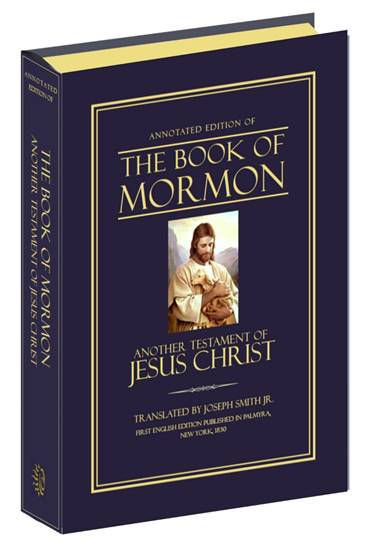
Review the new Annotated Book of Mormon here: To Purchase the Annotated Book of Mormon visit here:
Combine the original text of the “most correct book on earth”, with the secondary evidences of archaeology, artifacts, geology and geography in the Heartland of the United States. Shipping is not included in the price.
Edited by David R. Hocking & Rodney L. Meldrum. Nearly 600 pages of Prophetic Testimony, Evidences, Pictures, & Maps. Hardbound, Gold Embossed, 8½” X 11” and in Full Color!
I want you to think back to all that you love about President Monson. What a great man he was and is. His amazing stories and ability to remember them all have inspired me all my life. From 1963 to 2018 he served as an apostle or a Prophet. That is 55 years and I am only 64 years old. What an absolutely stellar life. I miss him. In his book “Teachings of Thomas S. Monson” you will read a lifetime of teachings from him as it is the ideal companion volume to the prophet’s bestselling biography, To the Rescue.
It Includes:
Quick, easy access to key teachings on scores of gospel topics representing nearly half a century of teaching
President Monson’s teachings topically in alphabetical order
A scripture index so readers can find what President Monson taught about specific scriptural passages.
He shares in the book two things I simply love. First is his stance on the United States of America. He speaks as though he knows that the United States is the Promised Land of the Book of Mormon, just like Elder L. Tom Perry said, “The United States is the promised land foretold in the Book of Mormon—a place where divine guidance directed inspired men to create the conditions necessary for the Restoration of the gospel of Jesus Christ.” Elder L. Tom Perry Ensign Dec. 2012
And I also love Pres Monson’s love of the Prophet Joseph Smith that you will read about below. There is no greater man other than our Savior, than Joseph Smith.
America (The United States)
The Lord gave a divine promise to the ancient inhabitants of this favored country (the United States): “Behold, this is a choice land, and whatsoever nation shall possess it shall be free from bondage, and from captivity, and from all other nations under heaven, if they will but serve the God of the land, who is Jesus Christ” (Ether 2:12).
Are we today serving the God of the land, even the Lord Jesus Christ? Do our lives conform with His teachings? Are we entitled to His divine blessings?
Too many Americans have been screaming ever louder for more and more of the things we cannot take with us and paying less and less attention to the real sources of the very happiness we seek. We have been measuring our fellow man more by balance sheets and less by moral standards. We have developed frightening physical power and fallen into pathetic spiritual weakness. We have become so concerned over the growth of our earning capacity that we have neglected the growth of our character.
As we view the disillusionment that engulfs countless thousands today, we are learning the hard way what an ancient prophet wrote out for us over three thousand years ago: “He that loveth silver shall not be satisfied with silver; nor he that loveth abundance with increase” (Ecclesiastes 5:10).
The revered American president Abraham Lincoln accurately described our plight: “We have been the recipients of the choicest bounties of heaven; we have been preserved these many years in peace and prosperity. We have grown in numbers, wealth, and power as no other nation has ever grown; but we have forgotten God. We have forgotten the gracious hand which preserved us in peace and multiplied and enriched and strengthened us. We have vainly imagined, in the deceitfulness of our hearts, that all these blessings were produced by some superior wisdom and virtue of our own. Intoxicated with unbroken succession, we have become too self-sufficient to feel the necessity of preserving and redeeming grace, to proud to pray to God that made us” (“Proclamation Appointing a National Fast Day,” Washington, D.C., March 30, 1864).
Can we extricate ourselves from this frightful condition? Is there a way out? If so, what is the way?
We can solve this perplexing dilemma by adopting the counsel given by Jesus to the inquiring lawyer who asked, “Master, which is the great commandment in the law?
“Jesus said unto him, Thou shalt love the Lord thy God with all thy heart, and with all thy soul, and with all thy mind. This is the first and great commandment. And the second is like unto it, Thou shalt love thy neighbour as thyself” (Matthew 22:36–39). (“America Needs You,” Church of the Air, October 4, 1964)
For many years the code 911 has been the telephone number dialed to report any emergency. Children have memorized the number, and it has been well known by one and all that when 911 was dialed, help would soon be on its way.
Then came September 11th, 2001, and nine-eleven took on another meaning and has a universal and everlasting place in the annals of history and in the hearts of millions. As with December 7, 1941, it too has become a day of infamy.
Early on the morning of September 11, 2001, men and women left their homes for work, mothers prepared their children for school, commuters filled the freeways. Then everything changed. The unthinkable occurred. An insidious attack planned and executed by evil minds, wreaked havoc in America. Indiscriminately, men, women, and children were slaughtered, including those who responded to the call to rescue. No dastardly deed has been so rapidly and graphically reported.
Amidst the fear, the sorrow, the pain and the suffering, a mighty miracle occurred. Experienced was a fusion of faith—even a pattern of prayer—as Americans turned not to dial 911, but rather dropped to their knees and looked heavenward to God for help. (“Nine-One-One,” September 11 Memorial Observance, September 11, 2002)
I never entered the classrooms of learning there where students are taught concerning the Declaration of Independence, the Bill of Rights, the Constitution and other monumental foundation principles but what I had the feeling that I was walking on sacred ground. (“God Bless America,” Freedoms Foundation Utah Chapter Constitution Day, September 17, 2002)
One of the most famous enlistment posters of World War II was one depicting Uncle Sam pointing his long finger and directing his piercing eyes at the viewer. The words read, “America Needs You.” America truly does need you and me to lead out in a mighty crusade of righteousness. We can help when we love God and with our families serve Him; and when we love our neighbor as ourselves. (“Duty—Honor—Country,” National Boy Scouts of America Duty to God Breakfast, May 29, 2003) From Teachings of Thomas S. Monson
As I read this plea from the Lord through Pres. Monson, I again in our day of July 2020 know there is calamity in the streets. Portland, Oregon was just officially called a riot after 70 days of supposed protesting. The virus is increasing in the land, we can’t worship in our churches, but we sure can attend tattoo parlors and abortion clinics. We have one potential US President hiding and saying little and we have another current President doing all he can to serve our country and we pray for his success. We are in the Last Days. What are we doing? I am repenting and trying to serve others. Isn’t that what we must do? Keep the faith and don’t fear is my motto.
One thing Pres Monson said that has inspired me is, “May we, each of us, strive to continue the Prophet Joseph’s vision for this work and to magnify his legacy through our works“, that is one reason I called my website, “Works of Joseph, Testify of Christ.” I love the Lore the Prophet Joseph, this blessed Promised Land, and my friend Thomas S. Monson.
Joseph Smith
“To get to the true meaning of the birth of the Prophet [Joseph Smith], we need to go back beyond the year of our Lord 1805. We need to go back a long way into history and read what another great prophet said—that prophet, Joseph, who was sold into Egypt and who literally saved his brothers. . . . Said Joseph: “A seer shall the Lord my God raise up, who shall be a choice seer unto the fruit of my loins” (2 Nephi 3:6).
“And his name shall be called after me; and it shall be after the name of his father. And he shall be like unto me; for the thing, which the Lord shall bring forth by his hand, by the power of the Lord shall bring my people unto salvation” (2 Nephi 3:15).
Joseph Smith, Jr., was called after the name of Joseph who was sold into Egypt. He was also called Joseph after his own father, Joseph Smith, Sr., literally fulfilling that prophecy which had been spoken many hundreds of years before his birth. (Twenty-First Annual Joseph Smith Memorial Sermon, December 11, 1963)
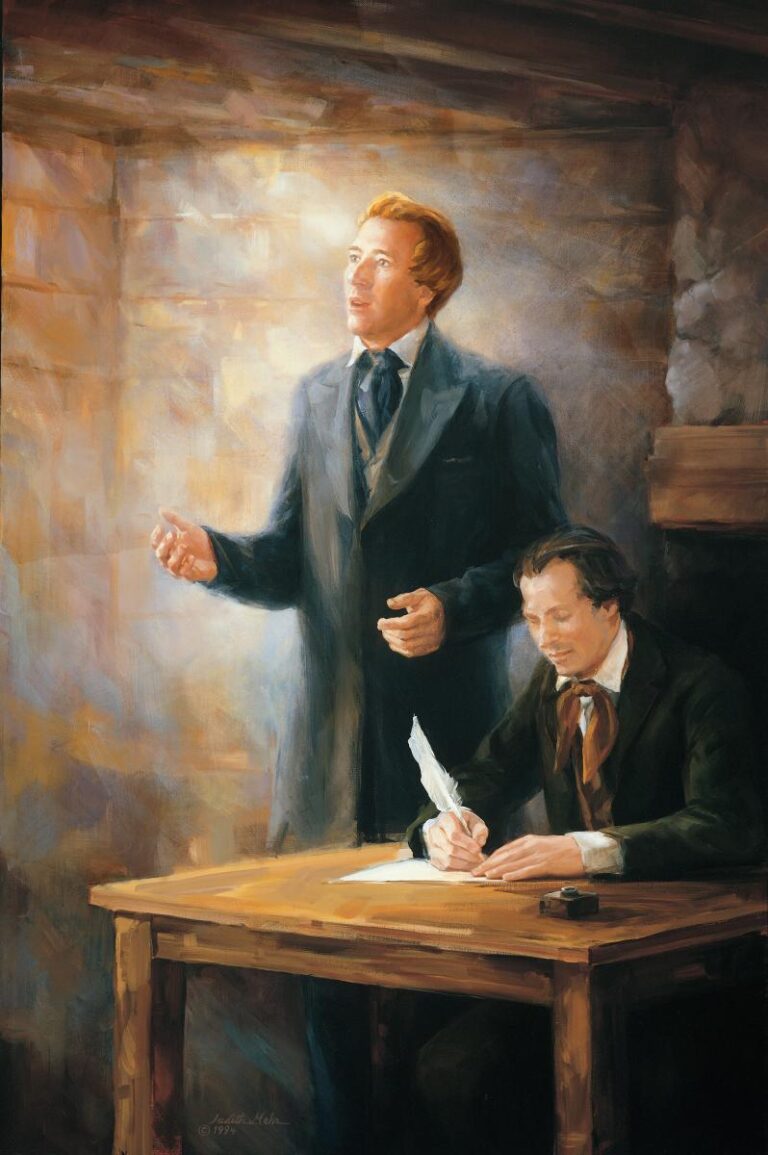
Following the visits of the angel Moroni to young Joseph and his acquisition of the plates, Joseph commenced the difficult assignment of translation. One can but imagine the dedication, the devotion, and the labor required to translate in fewer than 90 days this record of over 500 pages covering a period of 2,600 years. I love the words Oliver Cowdery used to describe the time he spent assisting Joseph with the translation of the Book of Mormon: “These were days never to be forgotten—to sit under the sound of a voice dictated by the inspiration of heaven, awakened the utmost gratitude of this bosom!” (Joseph Smith—History 1:71, footnote). (“The Prophet Joseph Smith: Teacher by Example,” Ensign, November 2005, 68)
I think one of the sweetest lessons taught by the Prophet Joseph, and yet one of the saddest, occurred close to the time of his death. He had seen in vision the Saints leaving Nauvoo and going to the Rocky Mountains. He was anxious that his people be led away from their tormentors and into this promised land which the Lord had shown him. He no doubt longed to be with them. However, he had been issued an arrest warrant on trumped up charges. Despite many appeals to Governor Ford, the charges were not dismissed. Joseph left his home, his wife, his family, and his people and gave himself up to the civil authorities, knowing he would probably never return. . . .
In Carthage Jail he was incarcerated with his brother Hyrum and others. On June 27, 1844, Joseph, Hyrum, John Taylor, and Willard Richards were together there when an angry mob stormed the jail, ran up the stairway, and began firing through the door of the room they occupied. Hyrum was killed, and John Taylor was wounded. Joseph Smith’s last great act here upon the earth was one of selflessness. He crossed the room, most likely “thinking that it would save the lives of his brethren in the room if he could get out, . . . and sprang into the window where two balls pierced him from the door, and one entered his right breast from without” (History of the Church [1932–1952], 6:618). He gave his life; Willard Richards and John Taylor were spared. “Greater love hath no man than this, that a man lay down his life for his friends” (John 15:13). The Prophet Joseph Smith taught us love—by example. (“The Prophet Joseph Smith: Teacher by Example,” Ensign, November 2005, 68–69)
I love the words of President Brigham Young, who said, “I feel like shouting Hallelujah, all the time, when I think that I ever knew Joseph Smith, the Prophet whom the Lord raised up and ordained, and to whom He gave keys and power to build up the kingdom of God on earth” (Teachings of Presidents of the Church: Brigham Young [1997], 343).
To this fitting tribute to our beloved Joseph, I add my own testimony that I know he was God’s prophet, chosen to restore the gospel of Jesus Christ in these latter days. (“The Prophet Joseph Smith: Teacher by Example,” Ensign, November 2005, 69–70)
Through Joseph Smith, the gospel—which had been lost during centuries of apostasy—was restored, the priesthood and its keys were received, the doctrines of salvation were revealed, the gospel and temple ordinances—along with the sealing power—were returned and, in 1830, the Church of Jesus Christ was re-established on the earth.
Though reviled and persecuted, the Prophet Joseph never wavered in his testimony of Jesus Christ. His peers watched him lead with dignity and grace, endure hardships, and time and again rise to new challenges until his divine mission was completed. Today that heritage he established still shines for all the world to see. The teachings he translated and his legacy of love for his fellow man continue in the millions of hearts touched by the message he declared so long ago.
Few in this dispensation have paid so dearly for an irrevocable testimony of Jesus Christ as did the Prophet Joseph Smith. On June 18, 1844, he gave what was to be his last sermon. He very likely knew that he would not again address his people. His concluding remarks were these: “God has tried you. You are a good people; . . . I love you with all my heart. Greater love hath no man than that he should lay down his life for his friends. You have stood by me in the hour of trouble, and I am willing to sacrifice my life for your preservation. May the Lord God of Israel bless you forever and ever.” His words sank deep into the hearts of the people. It was the last time, in the flesh, that they were to listen to . . . his voice, or to feel . . . his inspiration (from Historical Record, edited and published by Andrew Jenson [1889], 555).
Ultimately, the Prophet Joseph was slain by evil men who assumed the church would collapse after his death. George Q. Cannon, who served as a member of the Quorum of the Twelve Apostles and as a counselor to several Church presidents, wrote: “The enemies of truth were sure that they had now destroyed the work. And yet it lives, greater and stronger after the lapse of years. It is indestructible, for it is the work of God. And knowing that it is the eternal work of God, we know that Joseph Smith who established it was a prophet holy and pure” (Life of Joseph Smith the Prophet [1999], 527). . . .
We do not worship the Prophet Joseph; however he left behind a legacy that enables [his] followers today on every continent to proclaim him as a prophet of God. May we, each of us, strive to continue the Prophet Joseph’s vision for this work and to magnify his legacy through our works and testimonies to others, that they may know him as we do and that they may experience the peace and joy of the gospel he restored.
When the Savior returns to the earth in glory, the Prophet Joseph will come forth with the righteous as a resurrected being and will continue to minister under the Savior’s direction. As our beloved hymn affirms, “Millions shall know ‘Brother Joseph’ again.” Of this truth I testify. (“The Prophet Joseph Smith,” 200th Birthday Commemoration, December 23, 2005)
No description of models for us to follow would be complete without including Joseph Smith, the first prophet of this dispensation. When but fourteen years of age, this courageous young man entered a grove of trees, which later would be called sacred, and received an answer to his sincere prayer.
There followed for Joseph unrelenting persecution as he related to others the account of the glorious vision he received in that grove. Yet, although he was ridiculed and scorned, he stood firm. Said he, “I had seen a vision; I knew it, and I knew that God knew it, and I could not deny it, neither dared I do it” (Joseph Smith—History 1:25).
Step by step, facing opposition at nearly every turn and yet always guided by the hand of the Lord, Joseph organized The Church of Jesus Christ of Latter-day Saints. He proved courageous in all that he did.
Toward the end of his life, as he was led away with his brother Hyrum to Carthage Jail, he bravely faced what he undoubtedly knew lay ahead for him, and he sealed his testimony with his blood.
As we face life’s tests, may we ever emulate that undaunted courage epitomized by the Prophet Joseph Smith. (“Models to Follow,” Ensign, November 2002, 62)
“I was born in the year of our Lord 1805 on the 23rd day of December in the town of Sharon, Windsor County, state of Vermont.” Thus spoke the first prophet of this great dispensation, the dispensation of the fulness of times. His testimony has been translated into Portuguese, Spanish, Chinese, Russian, German, French, Polish, and almost every language of the civilized world. When it has been read by honest men and honest women, it has changed thinking and they have changed lives. This is the value of the simple testimony of the boy prophet, Joseph Smith. (“The Prophet Joseph Smith—Teacher by Example,” General Authority Family Home Evening, June 28, 1993)
Volumes have been written concerning the life and accomplishments of Joseph Smith, but for our purposes . . . perhaps a highlight or two will suffice: He was visited by the angel Moroni. He translated, from the precious plates to which he was directed, the Book of Mormon, with its new witness of Christ to all the world. He was the instrument in the hands of the Lord through whom came mighty revelations pertaining to the establishment of The Church of Jesus Christ of Latter-day Saints. In the course of his ministry he was visited by John the Baptist, Moses, Elijah, Peter, James, and John, that the Restoration of all things might be accomplished. He endured persecution; he suffered grievously, as did his followers. He trusted in God. He was true to his prophetic calling. He commenced a marvelous missionary effort to the entire world, which today brings light and truth to the souls of mankind. At length, Joseph Smith died the martyr’s death, as did his brother Hyrum. Joseph Smith was a pioneer indeed.” (“They Showed the Way,” Ensign, May 1997, 51–52) 2011 Teachings of Thomas S. Monson
“Mordecai Manuel Noah (July 14, 1785, Philadelphia, Pennsylvania – May 22, 1851, New York) was an American sheriff, playwright, diplomat, journalist, and utopian. He was born in a family of Portuguese Sephardic ancestry. He was the most important Jewish lay leader in New York in the early 19th century, and the first Jew born in the United States to reach national prominence…
In 1811, he was appointed by President James Madison as consul at Riga, then part of Imperial Russia, but declined, and, in 1813, was nominated Consul to the Kingdom of Tunis, where he rescued American citizens kept as slaves by Moroccan slave owners…
In 1825, with virtually no support from anyone — not even his fellow Jews — in a precursor to modern Zionism, he tried to found a Jewish “refuge” at Grand Island in the Niagara River, to be called “Ararat,” after Mount Ararat, the Biblical resting place of Noah’s Ark. He purchased land on Grand Island for $4.38 per acre to build a refuge for Jews of all nations. He had brought with him a cornerstone which read “Ararat, a City of Refuge for the Jews, founded by Mordecai M. Noah in the Month of Tishri, 5586 (September, 1825) and in the Fiftieth Year of American Independence.”
Noah also shared the belief, among various others, that some Native American “Indians” were from the Lost Tribes of Israel, on which he wrote the Discourse on the Evidences of the American Indians being the Descendants of the Lost Tribes of Israel. In his Discourse on the Restoration of the Jews, Noah proclaimed his faith that the Jews would return and rebuild their ancient homeland and called on America to take the lead in this endeavor.
The cornerstone was laid on the communion table, and the new proclamation establishing the refuge was read.
On September 2, 1825, soon after Noah’s arrival in Buffalo from New York, thousands of Christians and a smattering of Jews assembled for a historic event. Noah led a large procession headed by Masons, a New York militia company, and municipal leaders to St. Paul’s Episcopal Church. Here, there was a brief ceremony — including a singing of the psalms in Hebrew — the cornerstone was laid on the communion table, and the new proclamation establishing the refuge was read. “Proclamation – day ended with music, cannonade and libation. 24 guns, recessional, masons retired to the Eagle Tavern, all with no one ever having set foot on Grand Isle.”This was the beginning and the end of Noah’s venture: he lost heart and returned to New York two days later without once having set foot on the island. The cornerstone was taken out of the audience chamber of the church and laid against the back of the building. It is now on permanent display at the Buffalo Historical Society in Buffalo, New York. Afterwards, despite the failure of his project, he developed the idea of settling the Jews in Palestine and, as such, he can be considered a forerunner of modern Zionism.” Wikepedia Mordecai Noah
“It has been the general impression, as before mentioned, that great resemblance existed between some of the religious rites of the Jews, and the peculiar ceremonies of the Indians ; and the belief in one great spirit has tended to strengthen the impression.” Evidences of the American Indians Being the Descendants of the Lost Tribes of Israel. By Mordecai M. Noah
OBSERVING THE LAW OF MOSES IN THE BOOK OF MORMON
Nephi recounted when commanded to obtain the Plates of Brass: “Yea, and I also thought that they could not keep the commandments of the Lord according to the Law of Moses, save they should have the Law. And I also knew that the Law was engraven upon the Plates of Brass” – 1 Nephi 4:15-16. The Law of Moses was instituted to bring the children of Israel to Christ, “And for this intent we keep the Law of Moses, it pointing our souls to Him” – Jacob 4:5. The Law provided for seasonal holy ceremonial assemblies whereby specific items were symbolically used to focus the people’s actions and thoughts on the role the Holy One of Israel (Jesus Christ) had on their salvation (see pp. 15, 142, 144, 169 and 300). The Prophet and Historian Mormon, when reviewing the history on the Large Plates of Nephi, noted that “…the Lamanites did observe strictly to keep the commandments of God according to the Law of Moses.” (Helaman. 13:1; p. 369). Joseph Smith wrote in his Church History to Mr. John Wentworth, “The principal nation of the second race fell in battle towards the close of the fourth century. The remnant [the conquering Lamanites] are the Indians that now inhabit this country.” (See p. 551.) Mordecai M. Noah (1785-1851), a prominent Jewish lay leader published his, “Discourse of the Evidences of the American Indians Being the Descendants of the Lost Tribes of Israel,” New York, James Van Norden, 1837-39
Mordecai M. Noah
He based his discourse on their religious beliefs and seasonal ceremonies, “In their divisions of the year in four seasons, answering to the Jewish festivals of the feast of flowers [Feast of Weeks; see p. 300], the day of atonement, the feast of the tabernacle, and other religious holydays,” and, “by their laws of sacrifices, ablutions, marriages; ceremonies in war and peace, the prohibitions of eating certain things, fully carrying out the Mosaic institutions.” (p. 8.) He writes, “The most sacred fast day uniformly kept by the Jews is the day of Atonement, usually falling in the month of September or in early October…Precisely such a fast, with similar motives, and nearly at the same period of the year, is kept by the Indian natives generally…[James] Adair (see p. 544) stat[ed] the strict manner in which the [American heartland] Indians observe the revolutions of the moon, and describing the feast of the harvest, and the first offerings of the fruits, gives a long account of the preparations of putting their temple in proper order for the great day of atonement, which he fixes at the time when the corn is fully eared and ripe, generally in the latter end of September.” (p. 14.)
Editor’s Note: Ancient Mesoamerican worship revolved around the Sun and not the Moon like it is with the Jews and the Native Americans. “Maya astronomers had the ability to predict and mark the passage of the seasons by observing the movements of the Sun along the horizon, or the Sun’s movements with respect to the pyramids and other temples. The Sun and its cycles are the foundation for Maya calendar keeping.’ Source
Pres. John Taylor
“…It appears indubitable from the two records, the Bible and the Book of Mormon, that the intent and true meaning of the Law of Moses, of its sacrifices, etc., were far better understood and comprehended by the Nephites than by the Jews. But in this connection, it must not be forgotten that a great many most plain and precious things, as the Book of Mormon states, have been taken from the Bible, through the ignorance of uninspired translators or the design and cunning of wicked men.” – John Taylor, The Gospel Kingdom: Selections from the Writings and Discourses of John Taylor, Third President of the Church of Jesus Christ of Latter-day Saints, Salt Lake City: Deseret Book Co. [2002], 107.
“The Nephites definitely kept and observed the law of sacrifice, yet no procedural explanations of how such sacrifices were performed are presented in the Book of Mormon. However, there are three instances of animal sacrifice offerings recorded that shed some light on this: The first instance was an offering sacrifice performed by Lehi in the Arabian wilderness using an altar of stones in order to give thanks to God for his family’s deliverance: “And it came to pass that he built an altar of stones, and made an offering unto the Lord, and gave thanks unto the Lord our God.” (1 Nephi 2:7)
The second is an animal burnt offering when Lehi and Sariah rejoiced on the return of their sons from Jerusalem: “And it came to pass that they did rejoice exceedingly, and did offer sacrifice and burnt offerings unto the Lord, and they gave thanks unto the God of Israel.” (1 Nephi 5:9)
The third was also a burnt offering of sheep or goats (flocks) performed in the new land of promise when king Benjamin gathered the people at the temple in Zarahemla and “took of the firstlings of their flocks, that they might offer sacrifice and burnt offerings according to the Law of Moses.” (Mosiah 2:3) Amulek taught that sacrifices were symbolically a reminder of the future great and last sacrifice of Jesus Christ: “And behold, this is the whole meaning of the law, every whit pointing to that great and last sacrifice; and that great and last sacrifice will be the Son of God, yea, infinite and eternal.” (Alma 34:14) ” Annotated Book of Mormon David Hocking and Rod Meldrum Page 533
DISCOURSE THE EVIDENCES THE AMERICAN INDIANS BEING THE DESCENDANTS LOST TRIBES OF ISRAEL. MERCANTILE LIBRARY ASSOCIATION, CLINTON HALL. BY M. M. NOAH. PRINTED BY JAMES VAN NOUDEN,
DISCOURSE.
Those who study the Scriptures, either as a matter of duty or pleasure — who seek in there divine revelations, or search for the records of history, cannot be ignorant of the fact that the Jewish nation, at an early period, was divided into twelve tribes, and occupied their ancient heritage under geographical divisions, during the most splendid periods under the kingdoms of Judah and of Israel,
Their early history — the rise, progress and downfall of the nation — the proud distinction of being the chosen people — their laws, government and wars — their sovereigns, judges and temples — their sufferings, dispersions, and the various prophecies concerning this ancient and extraordinary people, cannot be unknown to you all. For their history is the foundation of religion, their vicissitudes the result of prophecy, their restoration the fulfillment of that great promise made to the Patriarch Abraham, almost I may say in the infancy of nature.
It is also known to you that the Jewish nation was finally overpowered, and nine and a half of the tribes were carried captives to Samaria ; two and a half, to wit : Judah, Benjamin and half Manasseh, remained in Judah or in the Trans Jordan”* cities.
The question before us for consideration is, what has become of the missing or dispersed tribes — to what quarter of the world did they direct their footsteps, and what are the evidences of their existence at this day?
An earthquake may shake and overturn the foundations of a city’ — the avalanche may overwhelm the hamlet — and the crater of a volcano may pour its lava over fertile plains and populous villages, but a whole nation cannot vanish from the sight of the world, without leaving some traces of its existence, some marks of habits and customs.
It is a singular fact that history is exceedingly confused, or rather I may say dark, respecting the ultimate dispersion of the tribes among the cities of the Medes. The last notice we have of them is from the second Book of Esdras, which runs thus.
” Whereas thou sawest another peaceable multitude : these are the ten tribes which were carried away prisoners out of their own land in the time of Hosea, whom Salmanazar King of Assyria led away captive, and he carried them over the waters, so they came unto another land.”…
On the discovery of America by Columbus, and the discoveries subsequent to his time, various tribes of Indians or savages were found to inhabit this our continent, whose origin was unknown.
It is, perhaps, difficult for the human mind to decide on the character and condition of an extreme savage state. We can readily believe that children abandoned in infancy in a savage country, and surviving this abandonment, to grow up in a state of nature, living on herbs and fruits, and sustaining existence as other wild animals, would be stupid, without language, with- out intellect, and with no greater instinct than that which gov- erns the brute creation. We can conceive nothing reduced to a more savage condition ; with cannibal propensities, an ungovernable ferocity, or a timid apprehension, there can be but a link that separates them from other classes of animal creation. So, with herds of men in a savage state, like herds of buffalo or wild horses on our prairies, they are kept together by sounds common amongst themselves, and are utterly unacquainted with the landmarks of civilization.
This, however, was not the condition of the American Indians when first discovered. They were a singular race of men, with enlarged views of life, religion, courage, constancy, humanity, policy, eloquence, love of their families ; with a proud and gallant bearing, fierce in war, and, like the ancients, relentless in victory. Their hospitality might be quoted as examples among- the most liberal of the present day. These were not wild men — these were a different class from those found on the Sandwich and Fiji Islands. The red men of America, bearing as they do the strongest marks of Asiatic origin, have for more than 2000 years (and divided as they are in upwards of 300 different nations) been remarkable for their intellectual superiority, their bravery in war, their good faith in peace, and all the simplicity and virtues of their patriarchal fathers, until civilization, as it is called, had rendered them familiar with all the vices which distinguish the present era, without being able to enforce any of the virtues which are the boast of our present enlightened times.
It is, however, in the religious belief and ceremonies of the Indians that I propose showing some of the evidences of their being, as it is believed, the descendants of the dispersed tribes.” This opinion is founded —
1st. In their belief in one God.
2d. In the computation of time by their ceremonies of the new moon. , . ., ,
3d. In their divisions of the year in four seasons, answering to the Jewish festivals of the feast of flowers, the day of atonement, the feast of the tabernacle, and other religious holydays.
4th. In the erection of a temple after the manner of our temple, and having an ark of the covenant, and also the erection of altars.
5th. By the division of the nation into tribes with a chief or grand sachem at their head.
6th. By their laws of sacrifices, ablutions, marriages; cere- monies in war and peace, the prohibitions of eating certain things, fully carrying out the Mosaic institutions; — by their traditions, history, character, appearance, affinity of their language to the Hebrew, and finally, by that everlasting covenant of heirship exhibited in a perpetual transmission of its seal in their flesh.
If I shall be able to satisfy your doubts and curiosity on these points, you will certainly rejoice with me in discovering that the dispersed of the chosen people are not the lost ones — that the promises held out to them have been thus far realized, and that all the prophecies relative to their future destination will in due time be strictly fulfilled.
It has been the general impression, as before mentioned, that great resemblance existed between some of the religious rites of the Jews, and the peculiar ceremonies of the Indians ; and the belief in one great spirit has tended to strengthen the impression ; yet this mere resemblance only extended so far as to admit of the belief, that they possibly may have descended from the dispersed tribes, or may have been of Tartar or Malay origin.
It was, however, a vague and unsatisfactory suspicion, which, having no tangible evidence, has been rejected, or thrown aside as a mere supposition. All the missionaries and travelers among the Indian tribes since the discovery of America — Adair, Heck- welder, Charlevoix, McKenzie, Bartram, Beltrami, Smith, Pena, Mrs. Simon, who has written a very interesting work on this subject, &c., have expressed opinions in favor of their being of Jewish origin — the difficulty, however, under which they all labored was simply this ; they were familiar with the religious rites, ceremonies, traditions and belief of the Indians, but they were not sufficiently conversant with the Jewish rites and cere- monies, to show the analogy. It is precisely this link in the chain of evidence that I propose to supply.
It has been said that the Indians believing in one great Spirit and Fountain of Life, like the Jews, does not prove their descent from the missing tribes, because in a savage state their very ignorance and superstition lead them to confide in the works of some divine superior being. But savages are apt to be idolaters, and personate the deity by some carved figure or image to whom they pay their adoration, and not like the Indians, having a clear and definite idea of one great Ruler of the universe, one great Spirit, whose attributes are as well known to them as to us. But if the continued unerring worship of one God like the Jews prove nothing, where did they acquire the same Hebrew name and appellation of that deity? If tradition had not handed down to them the ineffable name as also preserved by the Jews, how did they acquire it in a wilderness where the word of the Lord was never known?
Adair, in whom I repose great confidence, and who resided forty years among them, in his work published in 1775, says, ” The ancient heathens worshipped a plurality of gods, but these Indians pay their devoir to Lo-ak (Light) Ish-ta-hoola-aba, distinctly Hebrew, which means the great supreme beneficent holy Spirit of Fire who resides above.
They are, says Adair, utter strangers to all the gestures practiced by the pagans in their religious rites — they kiss no idols, nor would they kiss their hands in tokens of reverence or willing obedience.
These tribes, says Adair, so far from being Atheists, use the great and dreadful name of God which describes his divine essence, and by which he manifested himself to Moses ! and are firmly persuaded that they now live under the immediate government of the Almighty Ruler. Their appellative for God is Islo-hoolo, the Hebrew of Esh-Eshys, from Ishto, Great but they have another appellative, which with them as with us, is the mysterious essential name of God, which they never mention in common speech, and only when performing their most sacred religious rites, and then they most solemnly divide it in syllables, with intermediate words, so as not to pronounce the ineffable name at once.
Thus, in their sacred dances at their feast of the first-fruits, they sing Aleluyah and Mesheha, from the Hebrew of Masheach, Messiah, the anointed one. ” Yo mesheha,” ” He mesheha,” ” Wah meshehah,” thus making the Alleluyah, the Meshiah, the Yehovah.”
Can we, for a moment, believe that these sacred well known Hebrew words found their way by accident to the wilderness 1 Or can it be doubted that like the fire of the burning bush which never is extinguished, those words of religious adoration are the sacred relics of tradition, handed down to them from generation to generation 1 In the same manner, says Adair, they sing on certain other religious celebrations, ailyo ailyo, which is the Hebrew el for God by his attribute of omnipotence. They likewise sing heioah, hewah, He chyra, the ” immortal soul.” Those words sung at their religious rejoicings are never uttered at any other time, which must have occasioned the loss of their divine hymns. They on some occasions sing Shilu yo — Shilti he — Shilu wah. The three terminations make up in their order the four lettered divine name in Hebrew. Shilu is evidently Shaleach, Shiloth, the messenger ; ” the peace maker.”
The number of Hebrew words used in their religious services is incredible ; tlius, in chiding any one for levity during a solemn worship they say, Che hakeet Kana, ” you resemble those re- proved in Canaan,” and to convey the idea of criminality, they say Hackscl Canaha, ” the sinners of Canaan.” They call lightning eloah, and the rumbling of thunder yowah, from the Hebrew runch, ” spirit.”
Like the Israelites they divide the year into four seasons, with the same festivals ; (bey calculate by moons and celebrate as the Jews do the berachah halebana, the blessing for the new moon.
The Indians have their prophets and high-priests, the same as the Jews had ; not hastily selected, but chosen with caution from the most wise and discreet, and they ordain their high priests by anointing, and have a most holy place in their sanctuaries, like the Holy of Holies in the Temple. The Archimagus or High Priest, wears, in resemblance to the ancient breast- plate, a white conch-shell ornamented so as to resemble the precious stones on the Urim, and instead of the golden plate worn by the Levite on his forehead, bearing the inscription Kodish Ladonaye, the Indian binds his brows with a wreath of swan’s feathers, and wears a tuft of white feathers which he calls Yatira.
The Indians have their ark which they invariably carry with them to battle well-guarded. In speaking of the Indian places of refuge, Adair says, ” I observed that if a captive taken by the reputed power of the holy things of their ark, should be able to make his escape into one of these towns, or even into the winter house of the Archimagus, he is delivered from the fiery torture, otherwise inevitable. This, when taken in connection with the many other faint images of Mosaic customs, seems to point at the mercy-seat of the sanctuary. It is also worthy of notice, that they never place the ark on the ground. On hilly ground where large stones are plenty, they rest it thereon, but on level prairies, upon short logs, where they also seat themselves. And when we consider, continues Adair, in what a surprising manner the Indians copy after the ceremonial law of the Hebrews, and their strict purity in the war camps ; that opae, “the leader” obliges all during the first campaign which they have made with the beloved ark, to stand every day they are not engaged in warfare, from sunrise to sunset, and after a fatiguing day’s march and scanty allowance, to drink warm water embittered with rattle snake root very plentifully, in order to purification ; that they have also as strong a faith in the power of their ark as ever the Israelites had in theirs, ascribing the success of one party to their stricter adherence to the law, than the other, we have strong reason to conclude them of Hebrew origin. The Indians have an old tradition, that when they left their own native land, they brought with them a sanctified rod by order of an oracle, which they fixed every evening in the ground, and were to remove from place to place on the continent towards the sun rising till it budded in one night’s time. I have seen other Indians, says the same writer, who related the same thing. Instead of the miraculous direction to which they limit it, in their western banishment, it appears more likely that they refer to the ancient circumstance of the rod of Aaron, which in order to check the murmur of those who conspired against him, was in his favor made to bud blossoms and yield almonds at one and the same time. It is a well attested fact, and is here corroborated by Adair, that in taking female captives, the Indians have often protected them, but never despoiled them of honor.
This statement of Adair, in relation to the ark, is corroborated by several travelers. Major Long, a more recent traveler, in his expedition to the Rocky Mountains, says, in relation to the ark, ” It is placed upon a stand, and is never suffered to touch the earth. No person dare open all the coverings. Tradition informs them that curiosity induced three different persons to examine the mysterious shell, who were immediately punished for their profanation by instant blindness.” This is the Jewish punishment pronounced for looking on the holy of holies — even now for looking on the descendants of the High Priest who alone have the privilege of blessing the people.
The most sacred fast day uniformly kept by the Jews is the day of Atonement, usually falling in the month of September or early in October, This is deemed in every part of the world a most solemn fast, and great preparations are made for its celebration. It is in the nature of expiation of sin, of full confession, penitence and prayer; and is preceded by ablution and preparation of morning- prayer for some time.
It is a very sacred fast, which lasts from sunset on one day until the new moon is seen on the succeeding evening. It is not in the nature of a gloomy desponding penance, but rather a day of solemn rejoicing, of hope and confidence, and is respected by those most indifferent to all other festivals throughout the year.
Precisely such a fast, with similar motives, and nearly at the same period of the year, is kept by the Indian natives generally.
Adair, after stating the strict manner in which the Indians observe the revolutions of the moon, and describing the feast of the harvest, and the first offerings of the fruits, gives a long ac- count of the preparations in putting their temple in proper order for the great day of atonement, which he fixes at the time when the corn is full eared and ripe, generally in the latter end of September. He then proceeds:
” Now one of the waiters proclaims with a loud voice, for all the warriors and beloved men whom the purity of their law admits, to come and enter the beloved square, and observe the fast. He also exhorts the women and children, with those who have not been initiated in war, to keep apart, according to the law.
” Four sentinels are now placed one at each corner of the holy square, to keep out every living creature as impure, except the religious order, and the warriors who are not known to have violated the law of the first fruit-offering, and that of marriage, since the last year’s expiation. They observe the fast till the rising of the second sun ; and be they ever so hungry in the sacred interval, the healthy warriors deem the duty so awful, and disobedience so inexpressibly vicious, that no temptation would induce them to violate it. They at the same time drink plentifully of a decoction of the button snake root, in order to vomit and cleanse their sinful bodies.
” In the general fast, the children and men of weak constitutions, are allowed to eat, as soon as they are certain that the sun has begun to decline from his meridian altitude.
” Now every thing is hushed. Nothing but silence all around. The great beloved man, and his beloved waiter, rising up with a reverend carriage, steady countenance and composed beha- viour, go into the beloved place, or holiest, to bring them out the beloved fire. The former takes a piece of dry poplar, willow, or white oak, and having cut a hole, but not so deep as to reach through it ; he then sharpens another piece, and placing that in the hole, and both between his knees, he drills it briskly for several minutes, till it begins to smoke — or by rubbing two pieces together for a quarter of an hour, he collects by friction the hidden fire, which they all consider as proceeding from the holy spirit of fire.
” The great beloved man, or high priest, addresses the warriors and women ; giving all the particular, positive injunctions and negative precepts they yet retain of the ancient law. He uses very sharp language to the women. He then addresses the whole multitude. He enumerates the crimes they have committed, great and small, and bids them look at the holy fire which has forgiven them. He presses on his audience, by the great motives of temporal good and the fear of temporal evil, the necessity of a careful observance of the ancient law, assuring them that the holy fire will enable their prophets, the rain makers, to procure them plentiful harvests, and give their war leaders victory over their enemies. He then orders some of the fire to be laid down outside of the holy ground, for all the houses of the various associated towns, which sometimes lay several miles apart.”
Mr. Bartram, who visited the southern Indians in 1778, gives an account of the same feast, but in another nation. He says, ” that the feast of first fruits is the principal festival. This seems to end the old and begin the new ecclesiastical year. It commences when their new crops are arrived to maturity. This is their most solemn celebration.”
With respect to the sacrifices, we have had none since the destruction of the temple, but it was customary among the Jews, in the olden time, to sacrifice daily a part of a lamb. This ceremony is strictly observed* by the Indians. The hunter when leaving his wigwam for the chase, puts up a prayer, that the great Spirit will aid his endeavors to procure food for his wife and children, and, when he returns with the red deer, whatever may be the cravings of hunger, he allows none to taste until he has cut part of the flesh, which he throws in the fire as a sacrifice, accompanied with prayer. All travelers speak of this practice among the Indians, so clearly Hebrew in its origin.
The bathing’s, anointings, ablutions, in the coldest weather, are never neglected by the Indians, and, like the Jews of old, they anoint themselves with bear’s oil.
Editor’s note: None of the anointing, ceremony, altar, one God, prayers and eating of clean flesh remind me of any tribe in South or Central America. The Native Americans of the Untied States are the Hebrew. The Great Spirit is Jesus Christ.
The Mosaic prohibition of eating unclean animals, and their enumeration, are known to you all. It would be supposed that, amidst the uncertainty of an Indian life, all kinds of food would be equally acceptable. Not so : for in strict conformity with the Mosaic law, they abstain from eating the blood of any ani- mal, they abominate swine flesh, they do not eat fish without scales, the eel, the turtle or sea cow ; and they deem many animals and birds to be impure. These facts are noticed by all writers, and particularly by Edwards in his History of the West Indies. The latter able historian, in noticing the close analogy between the religious rites of the Jews and Indians, says, ” that the striking conformity of the prejudices and customs of the Caribbee Indians, to the practices of the Jews, has not escaped the notice of such historians as Gamella, Du Tertre,and others;” and Edwards also states, that the Indians on the Oroonoke, punished their women caught in adultery, by stoning them to death before the assembly of the people.
Among the Mosaical laws is the obligation of one brother to marry his brother’s widow, if he die without issue. Major Long says, ” if the deceased has left a brother, he takes the widow to his lodge after a proper interval and considers her as his wife.” This is also confirmed by Charlevoix.
It would occupy a greater space of time than I can afford, to trace a similitude between all the Indian rites and religious ceremonies, and those of the Jewish nation. In their births, in their separation after the births of their children, in their daily prayers and sacrifices, in their festivals, in their burials, in the employment of mourners, and in their general belief, I see a close analogy and intimate connection, with all the ceremonies and laws which are observed by the Jewish people ; making n due allowance for what has been lost, and misunderstood, in the course of upwards of 2000 years.
A general belief exists among most travelers, that the Indians are the descendants of the missing tribes.
Manasseh Ben Israel wrote his celebrated treatise, to prove this fact, on the discovery of America. William Penn, who always acted righteously towards the Indians, and had never suspected that they had descended from the missing tribes, says, in a letter to his friends in England, ” I found them with like countenances to the Hebrew race. I consider these people under a dark night, yet they believe in God and immortality, without the aid of metaphysics. They reckon by moons, they offer their first ripe fruits, they have a kind of feast of tabernacles, they are said to lay their altars with twelve stones, they mourn a year, and observe the Mosaic law with regard to separation.” i
Emanuel de Moraez, in his history of Brazil, declares that America has been peopled by the Carthaginians and Israelites, and as to the Israelites, he says, nothing is wanting but circumcision, to constitute a perfect resemblance between them and the Brazilians.
The Rev. Mr. Beatty, a very worthy missionary, says, ” I have often before hinted, that I have taken great pains to search into the usages and customs of the Indians, in order to see what ground there was for supposing them to be part of the ten tribes, and I must own, to my no small surprise, that a number of their customs appear so much to resemble those of the Jews, that it is a great question with me, whether we can expect to find among the ten tribes wherever they are at this day, all things considered, more of the footsteps of their ancestors than among the different Indian tribes.”
Discourse of the Evidences of the American Indians Being the Descendants of the Lost Tribes of Israel. By Mordecai M. Noah page 2-15
Jewish Hamsa Symbol found in prehistory Native American Artifacts
The Jewish hamsa is a symbol a hand with the all seeing eye in the palm is used by Jews and Arabians still to this day. This symbol is found in North America specifically the Mississippian native culture. The Mississippian culture is dated after the Hopewell and the Book of Mormon but I believe that they were strongly influenced by the descendants of the Hopewell. The Jewish symbol is shown below as well as the Mississippian hamsa symbol.
A bas relief on the Arch of Titus in Rome depicts the celebratory procession of Titus’s victorious troops after defeating the First Jewish Revolt (66–70 C.E.). They carry the spoils of the Temple on their shoulders: the Menorah, the Showbread table and the trumpets.
Amazing results of a study of ancient DNA from the Hopewell site! Lisa A. Mills conducted a study of ancient DNA recovered from human remains from mounds at the Hopewell site, Ross County, Ohio. The results of her work are presented in her doctoral dissertation: Mitochondrial DNA analysis of the Ohio Hopewell of the Hopewell Mound Group. PhD Dissertation by Lisa A. Mills, Department of Anthropology, Ohio State University, 2003.
The Hopewell Mound Group is located in Ross County along the North Fork of Paint Creek, about four miles northwest of Chillicothe. It is part of the Hopewell Culture National Historical Park here: The Hopewell culture here: The Hopewell Culture extended across much of eastern North America, but its heartland was here in central and southern Ohio. Hopewell culture sites range in age from 100 BC to around AD 500.
Mills successfully extracted mitochondrial DNA (mtDNA) from the teeth of 34 individuals originally excavated by H. C. Shetrone who was, at the time, Curator of Archaeology for the Ohio Archaeological and Historical Society (now called the Ohio Historical Society). These human remains were excavated from mounds of the Hopewell Mound Group between 1922 and 1925 and subsequently have been curated by the Ohio Historical Society. Mills sampled a total of 49 individuals so her success rate at recovering DNA was 69%. This rate of success indicates excellent preservation of DNA. Although based on a relatively small sample of individuals, the results are promising and provocative.
First, Mills noted that the people she studied from the Hopewell site represented a very diverse group. The sample included 4 out of the 5 documented Native American lineages (haplotypes) [see http://www.centerfirstamericans.com/mt.php?a=203 and http://en.wikipedia.org/wiki/Haplogroup_X_(mtDNA) for more information about Native American DNA]. This apparent diversity might suggest that individuals from different groups were buried together in these mounds.
Second, comparisons between the mtDNA from individuals from the Hopewell site and a database of mtDNA from groups from all over the world, demonstrated that these ancient Native Americans shared close ties with Asia especially, China, Korea, Japan, and Mongolia. This offers strong support for the already well-supported conclusion that Native Americans originated in Asia and migrated to the Americas in the past 15,000 years.
Third, comparisons between the mtDNA from these individuals from the Hopewell site and a database of mtDNA samples from 50 ancient and modern Native American groups provided evidence of some biological relationships. There were clear links between these people and individuals from two Adena culture [http://www.ohiohistorycentral.org/entry.php?rec=1287] sites as well as individuals from the even earlier Glacial Kame culture [http://www.ohiohistorycentral.org/entry.php?rec=2049]. This confirms the inference that the people of the Hopewell culture were the descendants of people of the Adena culture (circa 800 BC to AD 1) who were, in turn, descended from the local Archaic cultures (circa 3000-500 BC).
Interestingly, however, the Hopewell site individuals did not show a close relationship to the Fort Ancient culture samples [http://www.ohiohistorycentral.org/entry.php?rec=1285]. Perhaps, as some scholars have suggested, some Fort Ancient-era groups (circa AD 1000-1650) moved into Ohio from elsewhere. The most closely related ancient groups outside of Ohio included individuals buried at the 700-year-old Norris Farm mound in central Illinois. Also, Mills found that one particular female buried at Mound 25 at the Hopewell site had a rare mutation that she shared with several elite individuals buried at the 1000-year-old Cahokia site [http://www.cahokiamounds.com/cahokia.html].
Modern groups with whom the individuals at the Hopewell site shared some degree of relatedness include the Chippewa/Ojibwa [http://www.ohiohistorycentral.org/entry.php?rec=2090] and Kickapoo of the Great Lakes region. Some genetic links also are indicated between one or more of the individuals from the Hopewell site and tribes as diverse and widespread as the Apache, Iowa, Micmac, Pawnee, Pima, Seri, Southwest Sioux, and Yakima. Mills looked, in particular, for evidence of ancestral ties between the individuals at the Hopewell site and Cherokee Indians, since some oral traditions have suggested a relationship between them. She found that Cherokee mtDNA samples do not cluster close to the Ohio Hopewell.
Finally, Mills found that multiple burials at the Hopewell site included individuals with different mtDNA profiles, indicating they did not share a recent female ancestor (since mtDNA is passed from mother to child). This further indicates that the people at this Hopewell culture site did not base their burial practices on principles of matrilineal descent. Due to the small sample size, the conclusions are tentative.
Mills work, however, confirms that DNA is recoverable from 2,000-year-old bones and that it can be used to make inferences about biological relationships between and among ancient populations and their descendants. It also demonstrates the importance of museum collections, including ancient human remains.” Posted June 22, 2006 Ohio History Connection
What is the Controversy Surrounding DNA and the Book of Mormon? 2013
Rod Meldrum has said, “If The Book of Mormon is true (and I believe it is) then it is a literal historical record of real people in addition to its primary purpose of testifying of Jesus Christ. Lehi and his family, who came from the Holy Land area, where descendants of Joseph that was sold into Egypt. (1 Nephi 5:14). The three primary races of the earth, Asian (Oriental), African (Negroid) and European (Caucasian) are quite easily distinguished from each other through specific DNA markers or ‘signatures’ that delineate their ancestry.
The Book of Mormon tells us that the descendants of Lehi, (including his wife Sariah, Ishmael and his wife, and Zoram) lived and multiplied to a great extent somewhere in the America’s. Since it is highly probable that Sariah, Ishmael, and Zoram were also of the same genetic stock (not Asian or African), their genetic signatures today would most certainly be classified by present day geneticists as ‘European’ rather than Asian or African. We do not know the exact makeup of Lehi’s DNA, but that does not preclude us from being able to make a direct connection to his ‘European/Caucasian’ heritage.
Preliminary DNA studies, performed on thousands of individual Native Americans from the Aleuts in Alaska, through North, Central, and South America, were completed. They were tested, studied and classified into one of 4 primary genetic groups called haplogroups. These four founding groups, designated Haplogroups A, B, C and D are all Asian-based groups found in modern populations of Siberia and Asia today, which supports the dominant theory of the peopling of the New World (the America’s) by an overland migration across the Bering Strait during an ice age epoch. Initial studies indicated that there were no European type genetic DNA markers, which would lead to the conclusion that no migration or population expansion of an ‘Israelite’ group occurred anywhere in the America’s as is indicated by the Book of Mormon. This led to some LDS scientists viewing this as the ‘final straw’ for their belief and some were subsequently excommunicated from the church after writing books contrary to the teachings and doctrine of the gospel, but based on these initial scientific findings.” Rod Meldrum Rediscovering the Book of Mormon Remnant through DNA.Free 180 page download here!
LDS Lawyer says, “Nephites in North America: New DNA Evidence” 2020
Despite popular belief, the currently available DNA evidence supports the Book of Mormon. Critics who attempt to rely on DNA evidence to attack the truth of the Book of Mormon misinterpret or misconstrue what the DNA evidence actually shows.
David Read- Patent Attorney; JD; Judge
Mr. Read recorded his April 2020 presentation for the FIRM Foundation Expo, “Nephites in North America: New DNA Evidence”, (you can sign up and see it here). Mr. Read presents more DNA evidence that has recently come to light supporting Book of Mormon claims. As one example, Mr. Read will discuss further scientific studies which again confirm that mitochondrial DNA haplogroup X (previously publicized by Rod Meldrum) is found among Native Americans and originated in the Middle East. Indeed, one recent study found a variety of haplogroup X in Egypt that is just one mutation away from the type found in Native Americans, which undermines the critics’ previous claims that Native American haplotype X2a has “too many mutations” from the haplogroup X haplotypes found in the Middle East to fit a Book of Mormon time frame for a migration from the Middle East to the Americas.
Mr. Read will also present new DNA evidence regarding Y DNA haplogroup R, which is a second non-Asian DNA type found in large numbers among some Native American groups. Mr. Read will present evidence showing that this non-Asian DNA type also predates Columbus and has a distribution pattern in common with haplogroup X. This means that there is now a second and separate line of DNA evidence that corroborates the haplogroup X information and is again consistent with the Book of Mormon. Finally, Mr. Read will explain the significance of recent findings about an ancient Native American skeleton known as Kennewick Man, whose DNA is haplogroup X, but whose carbon dating has been commonly reported as being over 8,000 years old. Because of the reported carbon dating, Kennewick Man is now often used by critics to argue that haplogroup X in the Americas predates Book of Mormon timeframes. However, this again misconstrues the evidence. Mr. Read will demonstrate that a more complete analysis of the carbon dating for Kennewick Man shows that his correct age is within Book of Mormon time frames and once again supports the DNA evidence in favor of the Book of Mormon.
David possesses many intellectual interests. Before finishing his Juris Doctorate in law and becoming a patent attorney and later a judge, he earned undergraduate degrees in chemistry and philosophy. Over the past 10 years, he has completed a considerable amount of research into the historical authenticity of the Book of Mormon with a particular emphasis on DNA evidence related to the Book of Mormon. Through this research, he has recently uncovered additional DNA evidence that corroborates and supports the historical authenticity of the Book of Mormon.
David is an accomplished researcher. Over his career as a patent attorney, he has collaborated with inventors in numerous scientific fields. These include pharmaceuticals, medical devices, firearms, computer software, hybrid vehicles, battery technologies, pollution control technologies, textile manufacturing equipment, diesel and gasoline engines, chemical testing equipment, agricultural chemicals, turbocharging systems, fuels, coal gasification, and power plant technologies. In each of these areas, he researched and came up to speed on the state-of-the-art knowledge in the field to thoroughly understand the new invention and the scientific consensus, interacted with experts in that field, and assessed and argued whether an invention was new or would be obvious to other experts in that scientific field. His work required him to reliably evaluate the state of established scientific knowledge in various scientific fields. He has taken that experience and applied it here to the DNA evidence related to Native Americans.
David lives in Michigan. He and his wife Barbara have five children: Amy, Charlotte, Sarah, Seth, and Matthew. David currently serves as the Sunday School President in his ward.
Some descendant subclades have been found since pre-history in Europe, Central Asia and South Asia. Others have long been present, at lower levels, in parts of West Asia and Africa. Some authorities have also suggested, more controversially, that R-M207 has long been present among Native Americans in North America – a theory that has not yet been widely accepted.
Victim’s Mother Tells Dylann Roof ‘I Forgive You’ as He’s Sentenced to Death!
What is the difference between Forgiveness and Hate? Why do some turn to God and others turn to blaming God? Why is it harder to love than to hate? (Or is it?)
“O that I were an angel, and could have the wish of mine heart, that I might go forth and speak with the trump of God, with a voice to shake the earth, and cry repentance unto every people!
The above is a favorite scripture of mine. My entire desire is to share the Gospel, to help others see that He loves us all. The Lord judges fairly and we as a people from a great country need to learn LOVE!.
“That was the true Light, which lighteth every man that cometh into the world.” John 1:9 All that wer born on this earth made a promise in Heaven to follow Christ. Each of us received His Light. We need to learn and follow taht Light..
“Yea, I would declare unto every soul, as with the voice of thunder, repentance and the plan of redemption, that they should repent and come unto our God, that there might not be more sorrow upon all the face of the earth”. Alma 29:1-2 We must repent often and sometimes daily. What am i doing today to repent? Am I adding to the world or am I taking away with judgement? My heart goes out to all oppressed and vilified people of this world especially those of Black descent. It’s hare to imagine the hate and racism that has happened to them. I do however believe that the Lord can help us all, white and black to forgive and love one another.
“For I say unto you that whatsoever is good cometh from God, and whatsoever is evil cometh from the devil. Whey can’t we as Children of a Loving Father understand this simple sentence? We know in our heart what is good and what is not.
“Therefore, if a man bringeth forth good works he hearkeneth unto the voice of the good shepherd, and he doth follow him; but whosoever bringeth forth evil works, the same becometh a child of the devil, for he hearkeneth unto his voice, and doth follow him.” Alma 5:40-41
“And now, my brethren, seeing that ye know the alight by which ye may judge, which light is the light of Christ, see that ye do not judge wrongfully; for with that same judgment which ye judge ye shall also be judged.
Wherefore, I beseech of you, brethren, that ye should search diligently in the alight of Christ that ye may know good from evil; and if ye will lay hold upon every good thing, and condemn it not, ye certainly will be a child of Christ.” Moroni 7:18-19
“And the Spirit giveth light to every man that cometh into the world; and the Spirit enlighteneth every man through the world, that hearkeneth to the voice of the Spirit.” D&C 84:46
Below you will read three basic stories. 1- The forgiving Amish people who had their family members killed and they forgave is an inspirational story. 2- There are some amazing members of a Charleston Church who are some of the greatest lovers of God you will ever want to meet. 3- The story of the George Floyd killing has set off two separate positions. You judge which one is of God and which one is not? This is why I ask, “What is the difference between Forgiveness and Hate?”
Amish Girls Shot in an Amish School
Following the tragic Amish school shooting of 10 young schoolgirls in a one-room Amish school in October 2006, reporters from throughout the world invaded Lancaster County, PA to cover the story. (You can read the full story of the Amish school shooting here.) However, in the hours and days following the shooting a different, an unexpected story developed.
Amish Forgiveness in Response to School Shooting
In the midst of their grief over this shocking loss, the Amish community didn’t cast blame, they didn’t point fingers, they didn’t hold a press conference with attorneys at their sides. Instead, they reached out with grace and compassion toward the killer’s family.
The afternoon of the shooting an Amish grandfather of one of the girls who was killed expressed forgiveness toward the killer, Charles Roberts. That same day Amish neighbors visited the Roberts family to comfort them in their sorrow and pain.
Later that week the Roberts family was invited to the funeral of one of the Amish girls who had been killed. And Amish mourners outnumbered the non-Amish at Charles Roberts’ funeral.
It’s ironic that the killer was tormented for nine years by the pre-mature death of his young daughter. He never forgave God for her death. Yet, after he cold-bloodedly shot 10 innocent Amish school girls, the Amish almost immediately forgave him and showed compassion toward his family.
In a world at war and in a society that often points fingers and blames others, this reaction was unheard of. Many reporters and interested followers of the story asked, “How could they forgive such a terrible, unprovoked act of violence against innocent lives?”
Roof was sentenced to death for killing nine churchgoers at a Bible study.
By EMILY SHAPIROJanuary 11, 2017
Wife of Charleston Shooting Victim Says She’s Glad Sentencing Is OverRoof was sentenced to death today for killing nine churchgoers in 2015.
— — Felicia Sanders, the mother of one of the nine victims killed by Dylann Roof in a Charleston church, told Roof this morning at an emotional sentencing hearing, “I forgive you.”
“That’s the easiest thing I had to do. But you don’t want to help somebody who don’t want to help themselves,” she told her son’s killer, according to ABC affiliate WCIV. “May God have mercy on your soul.”
Sanders survived Roof’s shooting rampage on June 17, 2015, that killed nine black parishioners who had gathered at the Charleston, South Carolina, church for Bible study. She was there when her son, Tywanza Sanders, was shot to death.
A jury on Tuesday afternoon sentenced Roof to death. His formal sentencing was held today, during which Felicia Sanders and other family and friends of the victims addressed Roof directly in court. Roof did not look at them as they spoke. After the statements from family and friends, Roof declined to speak. Roof was then formally sentenced to death.
Dylann Roof is depicted during his sentencing hearing in federal court in Charleston, S.C., Jan. 11, 2017.Dylann Roof is depicted during his sentencing hearing in federal court in Charleston, S.C., Jan. 11, 2017.Robert Maniscalco
“You took my love away from me. And since June 17 I’ve gotten to know you,” Felicia Sanders said to Roof at his sentencing hearing, according to WCIV. “I know you because you are in my head all day.”
“I can’t hear balloons pop. I can’t see the fireworks,” she continued. She explained that she can’t shut her eyes to pray because she needs to keep them open to see those around her.
Tywanza Sanders’ father, Tyrone Sanders, said to Roof, “I need you to look at me.”
“You look at each individual in this room. Each and every one of us are a little different, but we are still human,” he said, according to WCIV. “Why you want to single out black people in a church I don’t know. But whoever your creator is needs to come be with you.”
Parents of Tywanza Sanders, Tyrone Sanders and Felicia Sanders comfort each other at the graveside of their son at Emanuel AME Cemetery in Charleston, South Carolina, in this June 27, 2015 file photo.Parents of Tywanza Sanders, Tyrone Sanders and Felicia Sanders comfort each other at the graveside of their son at Emanuel AME Cemetery in Charleston, South Carolina, in this June 27, 2015 file photo.Grace Beahm/The Post And Courier via AP Photo
According to WCIV, Tywanza Sanders’ sister, Shirrene Goss, told Roof, “One day it’s going to come to you and you’re going to realize you did not have to do this. And it’s going to bring you to your knees. And you’re going to have to ask — no — you’re going to have to beg, for forgiveness.”
“My brother didn’t deserve what he got,” she said. “None of the victims did. But you deserve every bit of the sentence you received.”
Roof, 22, was sentenced to death by the jury after three hours of deliberations on Tuesday. Roof was convicted of hate crimes resulting in death, among other charges, in his federal death penalty case. This is the first time a death penalty verdict was rendered in a federal hate crimes case, the Justice Department said.
Before the jury began deliberating, Roof told the jury Tuesday in a closing statement, “I still feel like I had to do it.”
Bethane Middleton-Brown, sister of the slain Rev. Depayne Middleton-Doctor, said to Roof today, according to WCIV, “I wanted to hate you, but my faith tells me no. I wanted to remain angry and bitter, but my view of life won’t let me.”
“You took someone precious from me, but my faith tells me she was a borrowed angel God called home,” she said, according to WCIV. To Roof, she said, “You can’t look at me, but when you’re alone you will hear my voice and see my face.”
Mourners pass by a make-shift memorial on the sidewalk in front of the Emanuel AME Church following a shooting by Dylann Roof in Charleston, S.C., June 18, 2015.Mourners pass by a make-shift memorial on the sidewalk in front of the Emanuel AME Church following a shooting by Dylann Roof in Charleston, S.C., June 18, 2015.Stephen B. Morton/AP Photo
Middleton-Doctor’s daughter, Gracyn, called Roof “Satan.”
“You will rot in hell where you belong,” she said, as Roof sat motionless, according to WCIV. “I hope your guilt eats you alive. While you’re pleading for life and begging for your life, I hope God forgives you, the one sin I’m not sure even he can forgive. … This spawn of Satan will not steal our joy.”
Middleton-Doctor’s niece addressed Roof as “the devil sitting here today.”
“How dare you sit here every day looking dumb-faced, acting like you did nothing wrong, and had the nerve to insinuate you were misled. How dare you even smile or smirk. … I’ve wanted to wipe that smile off your face myself,” she said, according to WCIV. “You are the biggest coward I have ever seen in my life because you can’t be a man and look at us. … It really shows the kind person you are, excuse me, the kind of animal you are. I have many choice words I would love to say to you, but God is working on me so I will not.”
She said Roof’s mission “failed” because the tragedy brought people closer together.
Rose Simmons, daughter of the slain Rev. Daniel Simmons Sr., told Roof, “I loved my father. I was just like him. And I’m going to miss him and I will miss getting to know him all over again in my adult life. But I don’t grieve so much for my father because I know he and his eight precious eternal comrades, they are at this very moment experiencing the greatest peace, and that’s a peace not found here on this earth.”
She said she’s not surprised Roof hasn’t shown accountability, sorrow or remorse. “I know at this time it’s not there.”
This file photo taken on June 19, 2015 shows a Charleston County Sheriff booking photo of suspect Dylann Roof.This file photo taken on June 19, 2015 shows a Charleston County Sheriff booking photo of suspect Dylann Roof.Charleston County Sheriff/AFP Photo/Getty Images
Rev. Simmons’ son, Dan Simmons Jr., said to Roof, “I forgive you.”
“I know that you don’t understand that, but God requires me to forgive you. I forgive you. He also requires me to plead and pray for you, and I do that,” Simmons Jr. said, according to WCIV. “Understand that as you have been judged, know that you have an opportunity to ask for forgiveness. Know that you can change your life. Stay focused. I guarantee if you choose to serve him you will have a better life.”
Rev. Sharon Risher, daughter of slain churchgoer Ethel Lance, said she’s against Roof’s death sentence. “I still don’t want you to die,” Risher said, adding she wants him to sit in a jail cell.
Risher told Roof, WCIV reported, “You have opened doors, and given me a platform. … Hopefully you will get to read the newspapers because you will get to see me crusading for each of those nine people. … May God have mercy on you.”
J. Denise Cromwell, left, hugs her daughter, Asia Cromwell, center, and a friend Sandy Teckledburg outside the Emanuel AME Church after a memorial in Charleston, S.C., June 19, 2015.J. Denise Cromwell, left, hugs her daughter, Asia Cromwell, center, and a friend Sandy Teckledburg outside the Emanuel AME Church after a memorial in Charleston, S.C., June 19, 2015.Stephen B. Morto/AP Photo
Lance’s son, Gary Washington, spoke today through sign language interpreters. He recounted the tragic moment he was told his mother was dead, and he said that since the shooting, he’s been left with no one to take care of him the way his mother could, WCIV reported. Washington said to Roof, “I know you’ll be burning in hell.”
Gail Jackson, niece of slain churchgoer Susie Jackson, said to Roof that to see him sit in court every day and never apologize hurts her.
She said she hopes his soul burns in hell. She added she hopes God has mercy on Roof’s mother’s soul.
Melvin Graham, brother of slain churchgoer Cynthia Hurd, said to Roof, the hate “you possess is beyond human comprehension.”
Melvin Graham, brother of slain churchgoer Cynthia Hurd, is depicted speaking to Dylann Roof in court in Charleston, S.C., Jan. 11, 2017.Melvin Graham, brother of slain churchgoer Cynthia Hurd, is depicted speaking to Dylann Roof in court in Charleston, S.C., Jan. 11, 2017.Robert Maniscalco
Graham said Roof wanted to start a race war, but instead started a love war; Graham said how Hurd was honored with a library, scholarships, a fellowship and more.
“When my sister was executed, it tore me apart,” Graham said. He said he and his sister used to go on walks, so after her funeral, he carried her the last steps of the way at the cemetery.
Jennifer Pinckney, whose husband, South Carolina State Sen. Clementa Pinckney, was killed in the shooting, told WCIV today that she’s glad that the process is over.
She had testified during the trial, saying her husband was a loving, devoted and involved father to their two young daughters, ages 12 and 7. She and her younger daughter were in an office at the church on the night of the shooting. They hid under a desk as gunshots rang out and put their hands over each other’s mouth.
Today Jennifer Pinckney said her daughters “miss daddy.”
“He was our rock,” she said, adding, “my girls have been strong. I’ve been very proud of them.”
Blondelle Gadsden, sister of slain churchgoer Myra Thompson, said she still wonders how a 21-year-old could carry out this attack, according to WCIV. Gadsden said she may not get those answers, but said she has gained a greater sense of God and an appreciation of her family — especially her parents -– after the attack.
Brenda Hargrove, aunt of slain churchgoer Sharonda Coleman-Singleton, spoke of her niece’s sweet spirit and their family’s close bond. Hargrove said her church in New Jersey gave Coleman-Singleton a memorial service.
U.S. Attorney Beth Drake of the District of South Carolina said Tuesday, “Motivated by racist hatred, Dylann Roof murdered and attempted to murder innocent African-American parishioners as they worshiped in the historic Mother Emanuel church.”
Men from Omega Psi Phi Fraternity Inc. lead a crowd of people in prayer outside the Emanuel AME Church in Charleston, S.C., June 19, 2015.Men from Omega Psi Phi Fraternity Inc. lead a crowd of people in prayer outside the Emanuel AME Church in Charleston, S.C., June 19, 2015.Stephen B. Morton/AP Photo
“But, contrary to Roof’s desire to sow the seeds of hate, his acts did not tear this community apart. Instead of agitating racial tensions as he had hoped, Roof’s deadly attack inside Mother Emanuel became an attack on all of us, and the community stood in solidarity. Now, following a trial, the jury has rendered a sentence that underscores the severity of his crimes,” Drake said.
Roof’s family said in a statement, “We will always love Dylann. We will struggle as long as we live to understand why he committed this horrible attack, which caused so much pain to so many good people. We wish to express the grief we feel for the victims of his crimes, and our sympathy to the many families he has hurt. We continue to pray for the Emanuel AME families and the Charleston community.”
Roof’s defense said in a statement that the “sentencing decision means that this case will not be over for a very long time. We are sorry that, despite our best efforts, the legal proceedings have shed so little light on the reasons for this tragedy.”
Roof also faces a state trial in which he may again face the death penalty.
The killing by a white policeman of George Floyd was a terrible event in American History. I think this event was as bad as any other evil crime and was especially bad as many people feel it was another racist crime against people of color. I believe God loves us all and all of Christ’s Children deserve to live a productive life. When people’s lives are cut short, the Lord will judge a righteous judgement and we must turn that ultimate role unto Him
“What good came out of people rioting and looting? Is it the black-owned businesses that were destroyed, all in the name of Black Lives Matter? Or destroying the homes, stores and communities of black disabled women?
Targets, Walmarts and other big box store chains weren’t the only ones who were impacted. And saying that looting a Target store somehow moves the conversation about police reform and racism forward is ignorant. It doesn’t do anything other than create a cycle of poverty.” Townhall
Chop Seattle
When civil and elected governments allow rioting and looting and disobeying all rules, you will get tyranny like you did in downtown Seattle. Following the rule of law is paramount to keeping order.
“The CHOP/ CHAZ in Seattle has finally been shutdown after almost a month of unrest in the city’s central Capitol Hill neighborhood. Its demise was not the end of a peaceful protest but a necessary curtailing by police and city leaders of a movement that turned violent and claimed the lives of two teenagers.
SEATTLE, WA – JUNE 14: A sign welcomes visitors on East Pine Street during ongoing Black Lives Matter events at the so-called “Capitol Hill Organized Protest” on June 14, 2020 in Seattle, Washington. Black Lives Matter protesters have continued demonstrating in what was first referred to as the Capitol Hill Autonomous Zone, which encompasses several blocks around the Seattle Police Departments vacated East Precinct, but what protesters are now calling the “Capitol Hill Organized Protest.” (Photo by David Ryder/Getty Images)
That shutdown should have been much sooner, as signs of violence and mal-intent abounded from early days. But the city’s mayor, Democrat Jenny Durkan sided with the protesters who insisted they were there only to peacefully demand racial justice following the death of George Floyd.
“This could be a summer of love,” Durkan famously said.” Source
“While protesters camp out in our city parks, harass police officers attempting to keep the peace, and enjoy the taffy-soft submission of leftist mayors and governors across the country, U.S. cities are experiencing a dramatic uptick in violent deaths. But as hundreds of Americans perish within our own borders each week, the protests focus only on the deaths that help advance the cause of defeating the entirety of law enforcement within the United States.
And they’re not losing. Hundreds of members of the NYPD have chosen to retire as Mayor Bill de Blasio and Governor Andrew Cuomo cowed to the mobs and refused to back up the police department, further promising to gut the budget.” Source
If you do what you have always done, you will get what you’ve always received. Things that don’t change stay the same and things that stay the same become obsolete. We as Americans must get a check up from the neck up to get rid of (As Zig Zigler said), Stinkin’ Thinkin’.
Again I ask the question, “Why do some turn to God and others turn to blaming God?” You choose.
Rod and I would like to share with you an interview Candace Owens had with Tim Ballard. These two people are two of our conservative heroes along with Glenn Beck, who love God and love this Country. Glenn Beck started the Nazarene Fund and has now turned it over to Tim’s Operation Underground Railroad. Tim talks briefly about that on the video. You will enjoy this exchange. We encourage you to support their effort as we also appreciate your continued support of FIRM Foundation.
Candace Amber Owens Farmer (born April 29, 1989) is an American conservative commentator and political activist. Initially critical of Trump and the Republican Party, Owens has become known for her increasingly pro-Trump activism, in addition to her criticism of Black Lives Matter and the Democratic Party. She worked for the conservative advocacy group Turning Point USA between 2017 and 2019 as their communications director.
Timothy “Tim” Ballard is the founder and CEO of Operation Underground Railroad (O.U.R.), CEO of The Nazarene Fund and the author of several books. He organizes activities on the national and international level to stop child trafficking. Thousands of trafficking victims have been rescued by Tim Ballard and Operation Underground Railroad. They have also assisted in the arrest of over 750 traffickers.
To liberate the captive, to free the enslaved, and to rescue, rebuild and restore the lives of Christians and other persecuted religious and ethnic minorities wherever and whenever they are in need.
OUR STORY
During the ISIS reign of terror in the Middle East, the Nazarene symbol, or nūn (the letter that makes the “n” sound in Arabic), was painted on the homes of Christians to mark them for conversion, extortion and murder. While ISIS used the nūn to symbolize death, The Nazarene Fund took this symbol as our own. We rehabilitated it to mean life, hope, safety and freedom and not just to the Christians of this troubled region, but to all of the world’s persecuted people.
Since 2015, The Nazarene Fund has been a beacon of hope to those suffering in the darkness of slavery, persecution and despair. We are are a highly motivated and resourceful team of dedicated professionals and supporters with a bias for action who have committed to help those who have lost all hope. We go where others cannot or will not. Wherever there is persecution, we will bring kindness, comfort and support. Wherever there is slavery, we will bring liberation. Wherever hope has died, we will bring it back to life.
OUR MANDATE
During our first two years, The Nazarene Fund was given the mandate to assist persecuted Christians and religious minorities in the Middle East – specifically those affected by the ISIS war. Although ISIS has been defeated in Iraq, the terror that permeated the region is far from gone. ISIS still controls large swaths of territory in Syria (about 6000 sq. km.). Some of its foreign fighters have returned home or traveled to other countries to spread its violent jihad, while others remain in an attempt to hold on to the diminished caliphate. Local fighters and sympathizers, still loyal to the ISIS cause, blended back into the population and continue to work on the terrorist organization’s behalf. The ISIS threat is still very real to the persecuted minorities of the region as well as to the thousands of captives and slaves under its control.
Adding another vile chapter to its dark history, ISIS and some of its former members are now involved in the international organ harvesting and trafficking markets. In the vacuum left by ISIS, new political players – some just as ruthless as its predecessor – have taken up the mantle of power. In addition, nation-states such as Iran are heavily involved in the area and are making the lives of Christians, Yazidis and other minorities there very difficult and dangerous.
The Nazarene Fund is committed to the continued support of the persecuted minorities of the Middle East by searching for and liberating captives, providing aid to those who remain in the area trying to maintain their lives and culture, and by evacuating and resettling those who cannot remain due to the threat of violence they face. We have also expanded our operations to Africa and Asia for the Christians there who are facing displacement, torture and death.
As our mission continues to evolve both internationally and at home, please continue to support all of The Nazarene Fund’s efforts by donating.
JOIN THE NAZARENE FUND TO LIBERATE THE CAPTIVE AND FREE THE ENSLAVED.
In Feb. 2018 Lidar images in Mesoamerica have caused many Mesoamericanist’s to say how this new archeological information corroborates the Book of Mormon in Mesoamerica. I believe it shows just the opposite.
Lidar in Mesoamerica
Mesoamericanist’s say, “These new LiDAR images have revealed 60,000 previously unknown structures, leading experts to new population estimates as high as 15–20 million for the lowland Maya during the Classic period. This means Maya civilization was much more dense, complex and advanced than previously thought. This is consistent with the situation described by Mormon: “The whole face of the land had become covered with buildings, and the people were as numerous almost, as it were the sand of the sea” (Mormon 1:7). Early Book of Mormon authors made similar descriptions” (Mosiah 27:6; Jarom 1:8).” 4 Ways the New Maya Discoveries May Relate to the Book of Mormon This post is based on an article by Kirk Magleby of Book of Mormon Central who believe in the Mesoamerican Theory of the Book of Mormon. View the original article at the Book of Mormon Resources blog
“Now that we are learning from LiDAR that the Mayan civilization was even larger, more densely populated, and more sophisticated than we previously realized, the Book of Mormon seems even less plausible in that setting. IOW, the grander the Mayan civilization, the less likely it is that Lehi landed anywhere near that civilization.” Jonathan Neville
The Mesoamericanist’s say that Lehi landed on the west coast of Mesoamerica and they found a large indigenous population already living there which describes what the Book of Mormon says. They also say that this population was large enough that the DNA of Lehi basically was absorbed and had become extinct. We will explain these ideas in this blog. First let’s discuss the ancient cities of North America that did exist. These cities in North America are being searched for and discovered regularly.
“If you live into the next century you will see evidence for the Book of Mormon come forth in droves.” Truman G. Madsen, speaking of what the Prophet Joseph Smith said to a colleague, in the opening statement of the 2005 video, “Journey of Faith.”
“HIDDEN CITIES” IN NORTH AMERICA
Cahokia near St. Louis MO
“…When…first commanded to testify of these things they [The Three Witness] demurred and told the Lord the people would not believe them for the book concerning which they were to bear record told of a people who were educated and refined, dwelling in large cities; whereas all that was then known of the early inhabitants of this country was the filthy, lazy, degraded and ignorant savages that were roaming over the land. The Lord told us, in reply that he would make it known to the people that the early inhabitants of this land had been just such a people as they were described in the book, and he would lead them to discover the ruins of great cities, and they should have abundant evidence of the truth of that which is written in the book…” – David Whitmer, Interview with James H. Hart (Richmond, Mo., 21 August 1883), as printed in Deseret Evening News, Salt Lake City, Utah as published in Annotated Book of Mormon by David Hocking and Rod Meldrum page 560.
Roger G. Kennedy, Director Emeritus, Smithsonian National Museum of American History, author, “Hidden Cities, The Discovery and Loss of Ancient North American Civilization,” The Free Press, New York, [1995], stated, “Very, very few of us were conscious of these immense cities of a place like Monk’s Mound and Cahokia, opposite St. Louis, which is bigger in its footprint than the Great Pyramid at Giza [city in Egypt]. We didn’t know that.” Dr. Kennedy coined the phrase, “Hidden Cities,” because he states, “I use the term because these were very big places. There were more people, that we now know, in Cahokia, across from St. Louis, than there were in London or Rome. There were major population centers in what is now Nashville and Cincinnati and Pittsburgh and St. Louis. Few realize that some of the most complex structures of ancient archaeology were built in North America, home of some of the most highly advanced and well organized civilizations in the world.”
Click Picture to Purchase
In his book, Hidden Cities, he writes: “Eighteenth century pioneers passing over the Appalachians into the Ohio Valley wrote often of [the] feeling of being freed of encumbrances, of fresh beginnings. Judging from what they said, and from what has been said of them subsequently, most of them shared the misconception that they were entering an ample emptiness intended to be theirs alone. “In fact… [t]he western vastness was not empty. Several hundred thousand people were already there, and determined to resist invasion….Even along the headwaters of the Ohio, on the banks of mountain brooks, there were signs of ancient habitation…As the streams grew larger, so did the buildings. “In the Ohio and Mississippi
valleys, tens of thousands of structures were built between six and sixty-six centuries ago. Some, as large
as twenty-five miles in extant, required over three million person hours of labor” – Roger G. Kennedy, Hidden Cities, page 560 Annotated Book of Mormon
Few realize that some of the oldest, largest, and most complex structures of ancient archaeology were built of earth, clay, and stone right here in America, in the Ohio and Mississippi valleys. From 6,000 years ago until quite recently, North America was home to some of the most highly advanced and well organized civilizations in the world – complete with cities, roads, and commerce. From the lost city of Balbantsha, near New Orleans, to the Great Hopewell Road, a causeway for religious pilgrims along the Ohio River in the thirteenth century, these cultures built hundreds of thousands of structures, of which a small but tantalizing portion still remain. Like the Druids of Salisbury Plain, they patterned extraordinarily precise geometry according to the rising and setting of the moon. Like the ancient Egyptians, they organized millions of hours of human labor to construct pyramids, platforms, and plazas. In Hidden Cities, Roger G. Kennedy sets out on a bold quest of recovery – a recovery of the rich heritage of the North American peoples, and a reimagination of the true relations of their modern-day successors and neighbors. From the Spanish and French explorers to the present, very few Euro-Americans have paid attention to the evidence and meaning of this heritage. Building on recent work of many archaeologists and historians, Roger Kennedy presents a fascinating picture of these American antiquities as well as their reception among leading citizens of the young United States. On missions of exploration, politics, and even piracy, men such as George Rogers Clark, George Washington, Albert Gallatin, and Thomas Jefferson frequently chanced upon the architecture of the past. As Kennedy shows us the magnificence of the mound-building cultures through the sometimes-prejudiced eyes of the Founding generation, he reveals not only the astounding history of our continent, but also the reasons why we have refused to credit Native American predecessors with the greatness. Roger G. Kennedy, Director Emeritus, Smithsonian National Museum of American History, author, “Hidden Cities, The Discovery and Loss of Ancient North American Civilization,” The Free Press, New York, [1995]
Etzanoa Ancient Mississippian Era City of 20,000 indians
“Wichita State archaeologist and anthropologist Donald Blakeslee points out man-made depressions on a boulder in what would have been the lost city of Etzanoa, a home to ancestors of the Wichita tribe. Researchers like Blakeslee believe that the area was a sprawling city of 20,000 people… ” TRAVIS HEYINGTHE WICHITA EAGLE
Wichita State archaeologist and anthropologist Donald Blakeslee
“Etzanoa has remained a mystery for 400 years. Archaeologists could not find it. Historians thought reports of a permanent settlement with 20,000 Native Americans in it were exaggerated. But here in Arkansas City, at the confluence of the Walnut and Arkansas Rivers, Blakeslee, an anthropologist and archaeologist at Wichita State University, has found evidence of a massive town stretching across thousands of acres of bluffs and rich bottomland along two rivers. What clinched it was the discovery, by a high school kid, of a half-inch iron cannon ball. He even found a still-functional water shrine, depicting communication with the spirit world, carved into a limestone boulder in Tami and Greg Norwood’s backyard.
It’s a good story, all true, Blakeslee said: A lost city, a forgotten mythology — and the story of the once-great Wichita Nation, decimated by European diseases, then pushed aside by American settlers and the United States Army. With the discovery, Arkansas City leaders are hoping to turn their town into a tourist destination.
“We always knew we once had a whole bunch of Indians living around here, because we had found way too many artifacts to think otherwise,” said Jay Warren, an Arkansas City council member. “But we had no idea until Dr. Blakeslee came along about how big it was.” Etzanoa might have been comparable in size to Cahokia, Blakeslee said. That alone should bring world attention…
“The Spaniards were amazed by the size of Etzanoa,” Blakeslee said. “They counted 2,000 houses that could hold 10 people each. They said it would take two or three days to walk through it all.” But for four centuries, the story of a big Native American town in Kansas made no sense to historians…. Onate sent armed patrols into the empty town.
What his soldiers saw unnerved them. They told Onate they’d counted 2,000 big beehive-shaped homes — clusters of these homes surrounded by cornfields. Nervous about the size of the place, they turned around. Indians told them later that the settlement extended for miles past where the Spaniards stopped, meaning the true population might have been higher than the 20,000 Spanish estimate.” Source: Its location a mystery for centuries, huge Indian city may have been found in Kansas By Roy Wenzl Kansas city Star Full Article Here: Etzanoa
“…the bodies of many thousands are moldering in heaps upon the face of the earth…” (Alma 28:11). See Annotated Book of Mormon page 260
How many Mounds were there?
“The most common question that is asked about mounds is, “How many exist?” In the 1800’s the Smithsonian sponsored many expeditions to identify mound sites across America. A map (shown left) was produced by Cyrus Thomas in 1894 in a Bureau of Ethnology book. They found approximately 100,000 mound sites, many with complexes containing 2 to 100 mounds. The figure of 100,000 mounds once existing— based on Cyrus Thomas map revealing 100,000 sites—is often cited by others, but that estimate is far, far too low. After visiting several thousand mounds and reviewing the literature, I am fairly certain that over 1,000,000 mounds once existed and that perhaps 100,000 still exist. Oddly, some new mound sites are discovered each year by archaeological surveys in remote areas. But in truth, a large majority of America’s mounds have been completely destroyed by farming, construction, looting, and deliberate total excavations” – Gregory L. Little, Ed.D., The Illustrated Encyclopedia of Native American Mounds & Earthworks, Eagle Wing Books, Inc., Memphis, TN [2009].
“We have an outstanding new example of how confirmation bias works in the arena of Book of Mormon geography and historicity.
Last week, researchers announced a major discovery about Mayan civilization based on LiDAR scanning of jungles in Central America. This discovery will probably confirm your bias no matter what you believe; i.e., it will support your position whether:
1. You accept the New York Cumorah as taught in President Cowdery’s Letter VII and reaffirmed by the prophets and apostles, which I refer to as Moroni’s America (MA);
OR
2. You accept the Mesoamerican/two-Cumorahs (M2C) theory taught by BYU/CES intellectuals, which repudiates Letter VII and the prophets and apostles.
Another way to say this:
M2C seeks to repudiate Letter VII and the prophets and apostles. MA seeks to support Letter VII and the prophets and apostles.
You decide which bias you share and then interpret the scriptures accordingly.
I’ll have lots more to say about bias confirmation in upcoming posts because it fascinates me that two groups can derive such dramatically different expectations from the same text.
Because this news about the Mayans is so fresh, let’s start by looking at the discovery. Then we’ll look at how the scriptures are interpreted to confirm the respective biases.
_____
Here’s one report, along with an image from the article:
A comparison of LiDAR data showing the ancient Maya site of El Zotz covered in trees (left), and with the trees digitally removed. Credit: Ithaca College
The image on the left shows what the area looks like with tree coverage. On the right, the trees are removed, showing a complex of buildings and roads that are not visible naturally.
The new data revealed a much more extensive, sophisticated, and densely-populated civilization than was previously known or estimated.
One of the researchers, Thomas Garrison, will appear in a documentary on the National Geographic channel tomorrow (Feb 6). The article notes this: “Especially telling to Garrison are newly revealed agricultural features that would be necessary to support the lowland Maya population during their centuries of civilization—population estimates have now expanded from a few million to 10-20 million—and defensive structures that suggest warfare was far more prevalent than previously known.”
As an MA supporter, my bias is this: I accept the New York Cumorah as taught by Letter VII and the prophets and apostles. I interpret the text and relevant scientific and historical evidence in a manner that corroborates and confirms my bias.
M2C supporters (those affiliated with BYU Studies, BookofMormonCentral, FairMormon, the Interpreter, Meridian Magazine, BMAF, etc.) have a bias expressed candidly by BMAF: “to increase understanding of the Book of Mormon as an ancient Mesoamerican codex.” They interpret the text and relevant scientific and historical evidence in a manner that corroborates and confirms their bias.
Big Mound City, Florida
After I started writing this post, Meridian Magazine posted an article about this finding titled “How an Incredible New Archaeological Discovery Corroborates the Book of Mormon.” Now I don’t have to infer what M2C intellectuals would think about this discovery: I can use their actual words. You can see why I’ve referred to this source as Meridian Mesoamerican Magazine. They will never, ever tell their readers about President Cowdery’s Letter VII because their owners don’t want their readers to know what the prophets and apostles have taught. I consider this deceitful, of course, and you can decide for yourself whether you agree, but I don’t blame them for seeking to confirm their biases because everyone does it–even when, in this case, they are trying to persuade members of the Church to disbelieve the prophets and apostles.
You can see the bias confirmation in the very title of this article!
_____
There is nothing inherently right or wrong about bias. Everyone has biases. It’s a question of whether we honestly recognize our own and those of others, and then recognize that we interpret the world (and the scriptures) to confirm our biases.
Once we recognize the biases of the various players, the rest is easy.
Here’s an example. My first job out of law school was as a law clerk to the Chief Justice of the Supreme Court of New Mexico. After oral argument on a case, the Justices would vote on the outcome they wanted. Whichever outcome the majority voted for became the Court’s position, and the Justices assigned us, as the law clerks, to write the opinions accordingly.
Any of us law clerks could have written the opinion to reach whichever conclusion the Justices wanted. In close cases, it’s not a question of what the law is, but rather what the Justices want it to be. Then we write the opinion to make it look like the desired outcome was obvious all along. You always want the Court’s opinion frame the issue as a pursuit of the “correct law,” but everyone knows these opinions are anything but that. They are always a reflection of the personal philosophies of the judges. That’s why it makes such a big difference whether a conservative or a liberal is appointed to a court.
The reason lawyers charge clients so much money is not because they know what the law is, but because they know how to use the law to get what the clients want.
BYU map designed to teach students that the
apostles and prophets are wrong about the New York Cumorah
It’s really no different in scholarly work. The idea that one side or the other is pursuing “the truth” is a ruse. Everyone is seeking purely to confirm his/her biases. When you look at the fantasy map currently being taught at BYU, for example, it has nothing to do with seeking the truth, and everything to do with teaching the students that the prophets and apostles are wrong about the New York Cumorah. Otherwise, the BYU map would show Cumorah in New York.
The same thing is going on in the Church History department, btw, which I’ll be demonstrating in upcoming posts. The scholars there are colluding with the M2C proponents to portray Joseph Smith as a confused speculator who was wrong about the New York Cumorah.
This is why the semantic arguments about interpreting the Book of Mormon are pointless. LDS literature on this topic is full of subjective interpretations about such topics as what constitutes a “narrow neck,” and whether that is different from a “narrow neck of land.” You will agree or disagree with a particular interpretation depending on whether you agree or disagree with the bias of the person proposing that interpretation.
Actually, this is why the M2C proponents oppose Letter VII so vehemently. You can’t mistake President Cowdery’s meaning when he states it is a fact that the final battles of the Jaredites and Nephites took place in the mile-wide valley west of Cumorah. There’s no wiggle room there.
To reiterate this again:
MA proponents seek interpretations of the text and relevant science, history, etc. that corroborate Letter VII and the prophets and apostles because they want to demonstrate their teachings are correct. M2C proponents seek interpretations of the text and relevant science, history, etc. that refute Letter VII and the prophets and apostles because they want to demonstrate their teachings are false.
Everything you read about this topic reflects these respective biases. Meridian Magazine has an agenda of teaching members of the Church that the prophets and apostles are wrong about Cumorah, so they published this article to reinforce that agenda.
My agenda is to teach members of the Church that the prophets and apostles are correct about Cumorah, so I publish this blog to reinforce that agenda.
This is all very basic, but it is usually overlooked.
Now, let’s look at how the new data about the Mayans confirms these respective biases.
Key Information
MA position. If you believe in the New York Cumorah, you will likely view this LiDAR discovery as additional evidence that the Nephites could not possibly have lived among the Mayans.
I think the text shows Lehi’s colony landing in the promised land, planting their own seeds, finding animals and ore in the wilderness, all while completely unimpeded by any existing civilization. (1 Ne. 18:23-5). ; i.e., that there were no “other nations” in the promised land where they landed, “for behold, many nations would overrun the land, that there would be no place for an inheritance” (2 Nephi 1:8). I do think there were some indigenous people who went with Nephi when he fled (2 Nephi 5:6), but I infer they were unorganized hunter/gatherers that did not qualify as any sort of “nation” and were impressed by the Jewish immigrants’ technology, language, etc.
In my view, it is difficult enough to believe that Lehi’s family, a relative handful of immigrants from a distant culture speaking a different language, could have arrived and started planting crops on unclaimed land in Mesoamerica, encountering no resistance, but it is even more difficult to believe Lehi’s descendants could have managed to rule as kings and chief judges over even a part of a Mayan civilization, and that in the midst of this Mayan civilization, King Mosiah could have escaped with the Nephites into the wilderness and found a much larger group of illiterate people (the people of Zarahemla) who possessed exactly one engraven stone.
Now that we are learning from LiDAR that the Mayan civilization was even larger, more densely populated, and more sophisticated than we previously realized, the Book of Mormon seems even less plausible in that setting. IOW, the grander the Mayan civilization, the less likely it is that Lehi landed anywhere near that civilization.
This view is based on the text and has nothing directly to do with the New York Cumorah, but it does confirm my bias in favor of the New York Cumorah. _____
M2C position. If you believe the M2C position that Cumorah is not in New York and that the entire Book of Mormon took place in Mesoamerica, you will likely view this LiDAR discovery as additional evidence that the Nephites must have lived among the Mayans.
Mound City, Ohio
The basic M2C concept is described in the Meridian Magazine article. It is the idea that the Nephites were absorbed into Mayan culture. That’s why there is no Israelite DNA in Central America, no traces of Nephite languages or the law of Moses or Christian beliefs and practices, etc. M2C proponents believe there were bottlenecks (both DNA-related and cultural) that screened out Nephite cultural influence.
Let’s look at some of the verses cited in the Meridian Magazine article to demonstrate how the respective interpretation confirm the respective biases.
M2C proponents generally believe the Nephites lived among a much larger culture (i.e., Mayan culture in Mesoamerica). The Meridian article cites Mormon 1:7 as evidence of a huge Nephite population, possibly in the millions, with intensive agriculture, etc.
6 And it came to pass that I, being eleven years old, was carried by my father into the land southward, even to the land of Zarahemla. 7 The whole face of the land had become covered with buildings, and the people were as numerous almost, as it were the sand of the sea.
If you look at the published LiDAR images, and you want to confirm your M2C bias of a large, dense civilization, you will eagerly conclude that (i) Mayan buildings literally “covered” the land, and (ii) Mormon somehow knew this without the benefit of satellite images.
But if you’re not seeking to confirm your M2C bias, you look at the selected LiDAR images and notice they do not show the land to be “covered with buildings.” There are more structures than archaeologists realized, for sure, but most of the terrain remains uninhabited, just like in the much more heavily populated modern world.
The National Geographic article points out that “The results suggest that Central America supported an advanced civilization that was, at its peak some 1,200 years ago, more comparable to sophisticated cultures such as ancient Greece or China than to the scattered and sparsely populated city states that ground-based research had long suggested.”
No ancient civilizations in Greece, China, Mesoamerica, or anywhere else, covered the land with buildings. The LiDAR articles themselves don’t make any such claim. Instead, they note that “Complex irrigation and terracing systems supported intensive agriculture capable of feeding masses of workers who dramatically reshaped the landscape.”
LiDAR shows us that the “face of the land” was mainly covered with agricultural activities and wilderness, with some areas containing a concentration of buildings, just as the land today is throughout the world, even in densely populated countries such as Taiwan, South Korea, Lebanon, and Israel.
Only a bias-confirming M2C proponent would delude himself/herself into thinking that these LiDAR images show “the whole face of the land covered with buildings.”
Am I saying Mormon was wrong?
Not at all.
Let’s look at the scripture. He says he was 11 years old when his father took him on this trip. Why would he say the face of the land was “covered with buildings,” when such a description, if taken literally, is impossible as we just saw.
1. First, we have to consider this from the perspective of an 11-year-old boy.
2. Second, we have to consider what someone on the ground would see, without the benefit of satellite images.
3. Third, we have to consider what the term “building” means.
I’ve addressed all of this before in my book, Moroni’s America, but I’ll quickly summarize it here.
1. The perception of an 11-year-old differs from the perception of an adult. Think of Mormon as a Cub Scout. He wasn’t even old enough to be a Deacon. How would a Cub Scout perceive the world? To children, everything looks bigger. Who hasn’t revisited a childhood home and been surprised at how small it was compared with what you remembered?
Tikal viewed from the air
2. Without the benefit of satellite or aerial imagery, how would ancient people know what “the face of the land” was like? If you’ve climbed to the top of the Mayan ruins in Yucatan as I have, you know you can look over the relatively flat terrain and see the peaks of other ruins, many of them still covered with jungle. Let’s assume that in Mormon’s day the jungle was cut back so you could see the structures clearly.
What would Mormon see from the top of one of these temples?
He would see mostly agricultural land, just as the LiDAR images show.
The Meridian Magazine article, paradoxically, recognizes the inconsistency of its own argument. Look at these two applications of Mormon 1:7:
“Maya lowland population at apogee could have reached 15 million Mormon 1:7” (we can all see that Mormon 1:7 gives no population numbers).
“land use was intensive – nearing 100% utilization is some areas Mormon 1:7” (we can all read that Mormon 1:7 describes buildings covering the whole face of the earth, not “intensive land use”).
Besides reading into the text the M2C bias, these two claims are inconsistent. Which is it? “The whole face of the earth is covered with buildings” (Mormon’s description)” or “intensive land use in some areas” for agriculture (Meridian Magazine’s M2C description)? Do you see how bias confirmation can lead to absurd interpretations of the text?
_____
So what could Mormon have meant in these verses?
He could only have reported what he saw (or was told). I think this means that on his way to Zarahemla, he traveled in heavily populated areas.
I think everyone can agree that he did not have an aerial view.
So let’s think. How would an 11-year-old boy taking what was essentially a long field trip travel through a heavily populated area that was “covered with buildings” with so many people that it seemed to him like “the people were as numerous almost, as it were the sand of the sea?”
One thing is for sure; Mormon either did not describe his experience accurately, or he could not have been traveling through the areas captured in these LiDAR images, because most of the land he would have traveled through was agricultural or wilderness.
National Geographic is going to show the most spectacular LiDAR images of stone structures, including temples and roads. They will show indicia of irrigation, including canals, dykes and reservoirs (none of which are mentioned in the text, btw). But by far, most of the land even in this “densely populated” ancient Mayan world captured by LiDAR is not covered by buildings.
Again, I’m not saying Mormon reported his observations inaccurately. I’m saying just the opposite.
Distribution of mounds and earthworks in the eastern United States.
Red dots indicate relative occurrence and comparative distribution
rather than individual major remains.
I think Mormon was traveling along the Allegheny and Ohio rivers on his way to the land of Zarahemla (Illinois and Iowa). In ancient North America, people lived along these rivers.
This map shows how the ancient moundbuilders in North America located mostly along rivers. This makes sense; rivers provided water, fish, and other wildlife. They were transportation corridors. They also served as boundaries between competing groups.
If, as I have proposed, Mormon was traveling along these rivers, he would have seen little more than buildings and people. (One non-LDS experts reports there were over a million mounds in ancient North America.)
Had Mormon instead been walking through Mesoamerica, he would have seen mostly agricultural and wilderness areas, occasionally interspersed with the Mayan structures.
From my perspective, confirming my bias in favor of Letter VII and the New York Cumorah, young Mormon was describing a long-distance journey through a heavily populated area where the “face of the land” (as opposed to the rivers he was on) appeared to be “covered with buildings” along with lots and lots of people.
From my perspective, a person traveling through the lands depicted in the Mayan LiDAR photos would never have described the land as “covered with buildings” because most of it was agricultural and wilderness.
3. What does the term “building” mean in the first place?
First, we have to recognize that not a verse in the Book of Mormon says any “buildings” were made of stone. We are told they were made of wood and, for one brief period in one location, of wood and cement (Helaman 3). But the only stone buildings in the text are in the imagination of the reader.
If you want to confirm an M2C bias, then you can read “stone” into the text wherever you want. People who share your bias will undoubtedly agree with you.
But because I don’t share the M2C bias, I don’t see any stone buildings.
However, I do see “their shipping and building of ships,” which Mormon didn’t take the time to describe in detail but was just as much a part of Nephite society as “their building of temples, and of synagogues and their sanctuaries” (Helaman 3:14). I take this to mean they lived along rivers.
So what could Mormon have meant by “buildings” in verse 7?
In my presentation at the 2017 Mormon History Association in St. Louis (you can read it here), I pointed out that Dr. Roger Kennedy, the former director of the Smithsonian’s American History Museum, addressed a misperception about earth mounds, noting that earth mounds are actually buildings. “Build and building are also very old words, often used in this text [his book] as they were when the English language was being invented, to denote earthen structures. About 1150, when the word build was first employed in English, it referred to the construction of an earthen grave. 350 years later, an early use of the term to build up was the description of the process by which King Priam of Troy constructed a “big down to bare earth.” So when we refer to the earthworks of the Ohio and Mississippi Valleys as buildings no one should be surprised.”
Even today when you drive along the Ohio River you see lots of ancient mounds that have been preserved. I’ve taken photos of many of these. By far, most have been destroyed and replaced by modern roads and structures. But as the map above shows, in ancient times if you traveled along these rivers, there were mound cities and defensive positions along the banks.
MORMON, “CARRIED BY MY FATHER… TO THE LAND OF ZARAHEMLA.” by Ken Corbett
Most of the modern depictions of the moundbuilder sites illustrate Mississippian or later culture because these were built over earlier settlements that dated to Book of Mormon times, but they give a rough idea of what Mormon would have seen during his field trip.
This painting shows young Mormon on his way to Zarahemla. [They are traveling south west on the Ohio River at Moundsville, WV, and you can see Grave Creek Mound].
A Cub Scout seeing this would definitely conclude that the “whole face of the land” was “covered with buildings.”
Nevertheless, if your bias is that Letter VII and the prophets and apostles are wrong, then you cannot accept my interpretation of the text because it would contradict your bias. It would generate cognitive dissonance you seek to avoid.
Instead, you must persuade yourself that traveling through agricultural and wilderness land, by foot, occasionally passing through areas of dense human habitation, would lead you to write that the “whole face of the land had become covered with buildings, and the people were as numerous almost, as it were the sand of the sea.”
_____
You can also pretend that you don’t have a bias; i.e., you don’t have an opinion on whether or not Letter VII and the prophets and apostles are correct. You just want to look at the “facts” and decide.
If so, I’m interested in an explanation of how these Mayan LiDAR images show anything like the “whole face of the land covered with buildings.”
_____
There’s one more aspect of this passage we should examine.
The M2C proponents claim the Book of Mormon describes a Nephite civilization numbering in the millions (or at least in the midst of millions of Mayans). The LiDAR discoveries have increased population estimates to as high as 15 million, which confirms the M2C bias.
The MA bias sees it differently. I read the text as describing a Nephite civilization of tens of thousands, not millions, of people. (I’m not discussing the Jaredites here.) Because of my bias, when I read LiDAR discoveries that there were many millions more Mayan than previously believed, that takes the Mayan civilization even further away from the descriptions in the text.
I keep reading in Mormon 1. During the same year as Mormon’s field trip, he says there began to be a war (verse 8). 8 And it came to pass in this year there began to be a war between the Nephites, who consisted of the Nephites and the Jacobites and the Josephites and the Zoramites; and this war was between the Nephites, and the Lamanites and the Lemuelites and the Ishmaelites. 9 Now the Lamanites and the Lemuelites and the Ishmaelites were called Lamanites, and the two parties were Nephites and Lamanites. 10 And it came to pass that the war began to be among them in the borders of Zarahemla, by the waters of Sidon.
Sounds like a lot of people involved, doesn’t it? Seven separate groups, allied into two camps: the Nephites and the Lamanites.
In fact, Mormon says “the Nephites had gathered together a great number of men” for this war. They had a number of battles during which the Nephite “did slay many of” the Lamanites.
Now, how many men did Mormon consider to be a “great number?”
30,000.
Well, “even to exceed the number of thirty thousand.”
Look at how that is phrased. Mormon seeks to impress the reader with the size of this Nephite army by calling it “a great number of men, even to exceed the number of thirty thousand.”
As if the reader can hardly imagine a number as great as 30,000.
In the context of a civilization of 15 million people, how would this be at all impressive?
Do you see why, in my interpretation of the text, a Nephite civilization in the midst of 15 million people makes no sense?
Later, Mormon tells us that after he gathered in his people “together in one body” he was able to recruit an army of 42,000. (Mormon 2:7-9). That’s even more impressive than the 30,000, but still insignificant in the midst of 15 million people.
For these and similar reasons, the larger the Mayan civilization turns out to be, the less likely it has anything to do with the Book of Mormon.
_____
So far, I’ve only addressed Mormon 1:7 to show how confirmation bias drives one’s interpretation of the text. I could do the same with the rest of the Meridian Magazine article.
I freely admit my bias: I seek to corroborate and support President Cowdery’s Letter VII and the prophets and apostles who have consistently affirmed it.
M2C proponents also freely admit their bias: they seek “to increase understanding of the Book of Mormon as an ancient Mesoamerican codex,” which requires them to refute and reject President Cowdery’s Letter VII and the prophets and apostles who have consistently affirmed it.
In my view, the intellectuals who push M2C don’t really care what the text actually says, so long as they can construe it–or make stuff up–up to confirm their biases.
They are so obsessed with proving the prophets and apostles wrong that they resort to strained interpretations of the text and seeing terms and concepts that don’t appear in the text anywhere. That’s how they come up with the 3 Js (Jaguars, Jungles and Jade) and the three Ms (Mayans, Mountains and Massive stone temples) that are characteristic of Mesoamerica but not the Book of Mormon. (Not to mention volcanoes…).
_____
Every time you read Meridian Magazine (or BYU Studies, or anything produced by any other members of the citation cartel), you need to recognize that the authors are confirming their biases.
If you share their biases, then you will probably accept what they write, no problem.
If you don’t share their biases, you will see right through their rhetoric.
Faith not Fear should lead us. According to prophets and Apostles below, America will not fail, but if we don’t obey the Commandments, we will lose this great country of America. Happy 244th Birthday America!
“America Will Not Fail: Men may fail in this country, earthquakes may come, seas may heave beyond their bounds, there may be great drought, disaster, and hardship, but this nation, founded on principles laid down by men whom God raised up, will never fail. This is the cradle of humanity, where life on this earth began in the Garden of Eden. This is the place of the New Jerusalem. This is the place that the Lord said is favored above all other nations in all the world. This is the place where the Savior will come to His temple. This is the favored land in all the world. Yes, I repeat, men may fail, but this nation won’t fail. I have faith in America; you and I must have faith in America, if we understand the teachings of the gospel of Jesus Christ. We are living in a day when we must pay heed to these challenges. “I plead with you not to preach pessimism. Preach that this is the greatest country in all the world. This is the favored land. This is the land of our forefathers. It is the nation that will stand despite whatever trials or crises it may yet have to pass through. President Harold B. Lee, 1974 Ye are the Light of the World, pp. 350-351
“I should like to say a few words about America…No land is without its beauty, no people without their virtues, and I hope that you who come from elsewhere will pardon my saying a few words concerning my own native land, America…surely this is a good land, a choice land, a chosen land. To me it is a miracle, a creation of the Almighty.” Gordon B. Hinckley Let Not Your Heart Be Troubled”, BYU Speeches of the Year, October 29, 1974, pp. 267-68 )
“We have a great message to tell the world. We have to live it, and then we have to tell it, too. If you’re interest in history and in geography, just think what you can get out of the Book of Mormon! The Book of Mormon is the most tangible evidence that we have the truth, for no man could have written it at the time that it was written—except the story of the Prophet Joseph be a true story. Just imagine what that book has to tell us about America. Go back to the promises of Jacob and Moses and Joseph, who was sold into Egypt and who was promised a new land in the utmost bounds of the everlasting hills. Nobody in this world, outside of this Church, can tell you where that new land is, and yet Moses, in describing that land, used the word precious five times in just four short verses in the bible (see Deuteronomy 33:13–16). He called it a precious land, and we read the history of how Lehi and his people came here and how they were told that it was a land choice above all other lands. This fact is repeated over and over again in the scriptures.
From a historical standpoint, it ought to be worth something to people to know about this land of America or when Columbus discovered it. The knowledge that we get through the Book of Mormon is a knowledge that we can’t get any other way in all this world. It not only tells us of the great destiny of this land of America, but it also gives the promises of the Lord through his prophets that it would be a land choice above all other lands and that it would be the land upon which God would build his New Jerusalem in the latter days. It was hidden away from the eyes of the world that it might not be overrun, and the Spirit of the Lord moved upon a man across the great waters to come here. We understand and know that man was Columbus. You see what a marvelous thing it is to have understanding.” LeGrande Richards, “You’re Fringe Benefits” 1975 Devotional
America’s Past Uncovered
“On Sept. 10, 1925 what are believed to be bodies of a royal family of the ancient mound builders were unearthed in a group of mounds near Bainbridge, Ohio. With these remains were found strands of pearls, some of extraordinary size and perfection; also ornaments of silver and copper and some sculptured objects of exquisite workmanship.
This is a highly interesting find. It shows that these mound builders in the Mississippi valley were wealthy and civilized, and that they must have had commercial connections with distant places where pearl oysters were procured.
Scientists know nothing certain about the time when the mound builders lived, whence they came and what became of them.
However, when Zion’s Camp, in the year 1834, was temporarily located on the western bank of the Illinois river, the Prophet Joseph and others ascended a high mound, on the top of which three altars had once stood. On removing some soil, they uncovered a skeleton, between the ribs of which there was an arrowhead. To the Prophet it was later made known that this was the remains of a Lamanite warrior, by the name of Zelph, who served the great Onandagus, a prophet known from the Hill Cumorah to the Rocky Mountains. Zelph was slain during the last struggle between the Lamanites and Nephites. May not this furnish a key to the mystery of the mound builders in the Mississippi valley? Besides this, at various points, from Maine to California, we find evidences of a race, or perhaps more than one race, that, like the Jaredites, who from their point of departure, carried with them “the fish of the waters,” depended largely upon sea food for their sustenance. The evidence of this they have left in numerous shell mounds, which consist almost entirely of oyster shells, some of gigantic size.
Some tell us American archaeology does not corroborate the Book of Mormon. As I see it, American Archaeologists will never unravel the mysteries of this country without the Book of Mormon.”THE JUVENILE INSTRUCTOR, Vol. 60, No. 10 October 1925 Janne M. Sjodahl
“I testify that America is a choice land. (See 2 Nephi 1:5.) God raised up the founding fathers of the United States of America and established the inspired Constitution. (See D&C 101:77–80.) This was the required prologue for the restoration of the gospel. (See 3 Nephi 21:4.) America will be a blessed land unto the righteous forever, and is the base from which God will continue to direct the worldwide latter-day operations of His kingdom.” (See 2 Nephi 1:7.) “Ezra Taft Benson,” in Latter-day Prophets and the United States Constitution, ed. by Donald Q. Cannon (Provo, Utah: Religious Studies Center, Brigham Young University, 1991), 163–210.
“It was his latter-day purpose to bring forth his gospel in America, not in any other place. It was in America where the Book of Mormon plates were deposited. That was no accident. It was his design. It was in this same America where they were brought to light by angelic ministry. It was” . . . [here] “where he organized his modern Church, where he, himself made a modern personal appearance” (Editorial, Church News).” The Lord’s Base of Operations” Elder Ezra Taft BensonOf the Council of the Twelve Apostles Conference Report, April 1962, pp. 103-106
“[The Constitution] is the keystone of our nation. It is the guarantee of our liberty. That original document, with the Bill of Rights, constitutes the charter of our freedom. Through all of the years that have followed we have had some ambitious men who have sought to subvert the great principles of the Constitution, but somehow we have endured one crisis after another. We have been involved in terrible wars during this, the bloodiest of all centuries in the history of man. All of this is part of the miracle that is America, the struggle, the travail, the bitterness, the jealousies, the cynicism, and the criticism. But beyond and above it all is the wonder of a nation that for more than two centuries has remained free and independent and strong, the envy of the world, the hope of the world, the protection of free men everywhere, the manifestation of the power of the Almighty. Source: Gordon B. Hinckley “ Keep Faith with America”, commencement address at Weber State University, Ogden, Utah on 6 May 1999
“Certain lands were given to Israel for an inheritance in time and in eternity. America is the land of Joseph; it was the home of Nephite Israel, who were of Joseph, for a thousand years, and it is the headquarters of the Church in this final dispensation in which the church and kingdom of God are in the lands of Ephraim.” 1985 – Elder Bruce R. McConkie
“The Lord gave a divine promise to the ancient inhabitants of this favored country (the United States): ‘Behold, this is a choice land, and whatsoever nation shall possess it shall be free from bondage, and from captivity, and from all other nations under heaven, if they will but serve the God of the land, who is Jesus Christ” (Ether 2:12).
“Our Heavenly Father inspired the leaders of…the United States of America, that they might together, under His direction, having been raised up by God for the purpose, establish the Constitution of this country and…Bill of Rights, that by the year of our Lord 1805 [there would be] a climate where our Heavenly Father could send into this period of mortality a choice spirit who would be known as Joseph Smith, Jr.” 2011 President Thomas S. Monson (ordained an Apostle, 1963; ordained President of the Church, 2008)
“I would that all men could believe in the destiny of America as did the early pioneers: that it is the land of Zion; that the founders of this nation were men of inspired vision; that the Constitution as written by the inspiration of heaven must be preserved at all costs. “I make a further plea that the citizens of this favored land live righteously that they might enjoy the fruits of their righteousness in this land of promise.” Let Not Your Heart Be Troubled Gordon B. Hinckley of the Quorum of the Twelve Apostles Oct. 29, 1974 • Devotional
Rod Meldrum’s friend David Osmond called him to join David at Glenn Beck’s Ranch. David was singing at an event to be produced by Glenn Beck. David’s mom and dad is Alan and Suzanne Osmond, Rod’s great friends who support the Heartland Model big time. Of course most of you know David Osmond, as the Osmond who took over Donnie’s role as Joseph and the Technicolor Dream-coat in Chicago. He has recorded albums all over the country and David will be singing some special music at a big July 2nd Glenn Beck special called “Restoring Hope”.
David, Glenn and Dance TeamWatch a rehearsal video here.
Tim Ballard
Our great friend, Tim Ballard will also be in attendance on Glenn’s July 2nd show with some of his patriotic stories about America. Don’t forget to check out Tim’s new book called, The Pilgrim Hypothesis” available here:
You can all watch it on July 2nd at 8 pm on Glenn’s Blaze TV here:
Rod spent some great time with Glenn and David and the crew of entertainers and performers as he watched some wonderful singing and dancing. Rod had the opportunity to meet Glenn’s wonderful wife and his son and daughters. Glenn had asked Rod to bring all his gear with him including Universal Model Rocks, Moroni armor, swords and artifacts, Hebrew Rocks, and all of his books and DVD’s. Glenn had been reading the Annotated Book of Mormon and was very impressed with it. Of course Glenn has to stay neutral as an active Latter-day Saint, as he can’t turn off his huge Christian audience by promoting the Church. It’s sad, but that is the way it has to be.
Rod began sharing some of the items he brought that Glenn could share on the air. Things about the Mound builders and Hopewell and Adena. Rod gave Glenn a Title of Liberty Flag and told Glenn he could promote the Title of Liberty and Glenn said, “I wish I could”. Rod turned to page 297 in the Annotated Book of Mormon and read to Glenn George Washington’s similar Title of Liberty” that says,
“The unnatural Contest between the English Colonies and Great-Britain, has now risen to such a Heighth, that Arms alone must decide it. The Colonies, confiding in the Justice of their Cause, and the Purity of their Intentions, have reluctantly appealed to that Being, in whose Hands are all human Events….
Come then, my Brethren, unite with us in an indissoluble Union, let us run together to the same Goal.—We have taken up Arms in Defence of our Liberty, our Property, our Wives, and our Children, we are determined to preserve them, or die. We look forward with Pleasure to that Day not far remote (we hope) when the Inhabitants of America shall have one Sentiment, and the full Enjoyment of the Blessings of a free Government” George Washington’s Address to the Inhabitants of Canada (14 September 1775)
That was some information Glenn said would be amazing to share about George Washington. Glenn had never seen that quote before.
Glenn’s family was so impressed with the Enhydro rocks (rocks with water inside), and Rod’s story about the age of dinosaurs. Glenn was fascinated with Rod’s replica’s of the Holy Stones and Bat Creek Stone and he asked all kinds of questions about those.
Glenn was excited to share this information on future episodes on radio or TV. Stay tuned for other updates as Rod continues to share his message about the wonderful Book of Mormon with all.
On a fun side-note, before Rod visited with Glenn, David and Glenn were in the middle of a rehearsal and David mentioned Rod Meldrum’s name to Glenn about America’s Covenant and how inspirational Rod’s materials were. Glenn said to David, “Meldrum? isn’t he dead?” David laughed and said no I can get him on the phone right now. David called Rod and that’s how Rod got connected with Glenn again. We are so happy that Rod isn’t dead yet aren’t we?
Get ready for a very special Fourth of July celebration. America needs hope now more than ever, and we plan of doing our part. Join us virtually, July 2nd 🇺🇸 pic.twitter.com/Tl9eDwDWVF
This blog is in two parts. The first part explains the importance of the Hebrew word JEHOVAH (Seen Left) The second part discusses the importance of this Hebrew word Yahweh (God) in the St Paul Chapel in New York City, which was the location of the 9-11 attacks against our country.
“The evidences for Jesus Christ as the Pale Prophet” are to be found in many legends and traditions among the native races, throughout the Western Hemisphere.
Why were the apparent teachings of Christ already familiar to North American Aboriginals before their first contact with modern Europeans in the 16th Century? For Native Americans, their God of the four Winds may have been another name for Jesus Christ. He was also known as The Healer, East Star Man, The Dawn Star, The Pale One, Chee-zoos, Waicomah, Wakana Tanka, Yowa, Yod Hey Vah, Yahud, Ye-Sos, etc. Henceforth, the bearded white visitor could have been none other that Jesus Christ of the Christian books namely the Stick of Judah and the Stick of Joseph (Ezekiel 37:16).” Wayne May and Joshua M. Bennett in Ancient American Magazine issue #36 page no. 36
“We are frequently told that Jesus Christ is the God of the Old Testament (see Bible Dictionary, “Jehovah,” 710–11). But when we open our Bibles, we find little evidence that this is so. What is missing in the translations is clear in the original Hebrew text, where Jehovah, the Savior’s Old Testament name, appears over 5,000 times!
Why then is Jehovah missing from our Bible translations? The answer can be found in the way His name has been treated by Jews since the days of Malachi and Zechariah. Jehovah is the name of God, and devout Jews, out of reverence for Him, never say His name. Instead they substitute Adonai, a Hebrew title meaning “Lord.” So whenever they speak of Him or read aloud His name from scripture, they substitute Adonai (Lord).
LORD (in small capital letters)
King James translators of the Hebrew Bible followed Jewish practice. Instead of printing Jehovah, the name of God, they substituted the English title LORD, printed in small capitals, every time the name Jehovah appeared in the Hebrew text.
Lord (in lowercase letters)
Lord is also printed in lowercase letters (as Lord and lord) in the King James Version of the Bible. Lord is a title that refers to rulers of various kinds—heavenly and earthly—such as God, king, husband, governor, prince, prophet, father, captain, and angel. The heavenly ruler is designated by Lord, the earthly ruler by lord. Neither of these titles, printed in lowercase letters, is a substitution for the name Jehovah.Simply put, LORD equals Jehovah, while Lord or lord refers to an earthly or heavenly ruler.
Knowing the distinction between LORD and Lord helps us understand the story of Hannah and Eli in 1 Samuel 1:1–28. In verse 11, Hannah makes a vow with the LORD for a child. Then when Eli, the high priest, accuses her of being drunk (v. 14), Hannah says, “No, my lord.” Her use of lord shows her reverence for the high priest. Her calling upon the LORD shows her pleading with Jehovah. When we understand the distinctions between LORD, Lord, and lord, we can see what publishers have done. We can find Jesus Christ in the Old Testament by substituting Jehovah for LORD whenever it appears. Then something wonderful happens. Jehovah, who is Jesus Christ, appears from beginning to end of this great book as the God of the Old Testament.
The Savior’s ministry on earth did not begin with His birth. He is “the eternal I AM,” the Lord God Omnipotent who appeared to the patriarchs and prophets of old, who delivered Israel from Egypt, who gave the law on Sinai, and who guided and inspired the righteous prophets, priests, seers, judges, and kings of the Old Testament.”
Keith H. Meservy is an emeritus professor of ancient scripture at Brigham Young University and a member of the Pleasant View Third Ward, Provo Utah Sharon East Stake.
This FIVE book series below by Wayne May contains valuable information about Book of Mormon archaeology, Native American oral history, and Church History relating to this subject material. He explains in detail about the word “Yod Hey Vah” or Jehovah and the Mystic Symbol. (Picture Left)
Elder Jeffrey R. Holland said, “To the Lord’s covenant people, names—particularly proper names—have always been very important. Adam and Eve themselves bore names that suggested their roles here in mortality (see Moses 1:34; 4:26) and, when important covenants were made, men like Abram and Jacob took on new names that signaled a new life as well as a new identity. (See Gen. 17:5; 32:28). Because of this reverence for titles and the meanings they conveyed, the name Jehovah, sometimes transliterated as Yahweh, was virtually unspoken among that people. This was the unutterable name of Deity, that power by which oaths were sealed, battles won, miracles witnessed. Traditionally, he was identified only through a tetragrammaton, four Hebrew letters variously represented in our alphabet as IHVH, JHVH, JHWH, YHVH, YHWH…
Repentance and faith, service and compassion—now is always the right time for these. The past is to be learned from, not lived in, and the future is to be planned for, not paralyzed by. God has declared himself in the present tense. I am the Great I AM.
The prescribed method for coming to knowledge (and subsequent freedom) is to “give diligent heed to the words of eternal life” (D&C 84:43), yet many of us spend precious little time with those words.” Whom Say Ye That I Am? Jeffrey R. Holland Ensign Sept. 1974.
Written in Paleo-Hebrew and used from 1000 BC – 400 AD, represents the name “Jehovah”, or the tetragrammaton. All throughout the Old Testament, the word ‘LORD’ (all small caps), replaced the sacred name “Yahweh” as described above. “I Am” in Hebrew is “Yahweh” and “Adonai” is the Hebrew word for LORD.
“The Tetragrammaton, referred to in rabbinic literature as HaShem (The Name) or Shem Hameforash (The Special Name), is the word used to refer to the four-letter word, yud-hey-vav-hey (יהוה), that is the name for God used in the Hebrew Bible.
The name, which some people pronounce as Yahweh and others (mostly Christians) as Jehovah, appears 5,410 times in the Bible (1,419 of those in the Torah).
It is unclear what the original pronunciation of the word was, due to the longstanding Jewish prohibition on speaking God’s name aloud. Instead, a variety of pseudonyms are used, such as Adonai (Lord), Elohim (God) and HaShem (The Name).
My good friend Bob Goodwin brought to my attention the Hebrew word for Jehovah (Yod Hey Vau Hey) on the altar in the St Paul Chapel. I want to thank him for sharing this information with me.
Saint Paul’s Chapel: A place of miracles in lower Manhattan
NEW YORK, June 21, 2016 — It was an event so improbable many considered it a miracle. No one more so than the first American president who that day swore an oath to defend the new U.S. Constitution against all enemies foreign and domestic.
And so, the first U.S. government under the Constitution marched a few blocks north of New York City’s Federal Hall on Wall Street to St. Paul’s Chapel on Broadway.
“No people can be bound to acknowledge and adore the invisible hand, which conducts the affairs of men more than the People of the United States,” said George Washington in his 1789 inaugural address to Congress. “Every step, by which they have advanced to the character of an independent nation, seems to have been distinguished by some token of providential agency.”
An 18th century rendering of the Great Seal of the United State at New York’s St. Paul’s Chapel.
And no one was more aware of providential intervention than Washington.
“I have been protected beyond all human probability or expectation,” he wrote in a letter to his brother, “for I had four bullets through my coat, and two horses shot under me, yet escaped unhurt, although death was leveling my companions on every side of me.”
Having concluded his inaugural address, Washington’s first act as president was to fulfill the terms of a Congressional resolution stating that he and they “proceed to St. Paul’s Chapel to hear divine service.”
Like the soldier/statesman that sat under its roof, St. Paul’s was a beneficiary of providential protection. Built in 1766, the structure came under threat ten years later, the same year Thomas Jefferson penned the Declaration of Independence. But the “chapel of ease” somehow escaped the ravages of fire that consumed one-third of the city.
225 years later, this modest place of worship survived the collapse of the World Trade Center towers one short block away, its stained glass windows withstanding the rush of 150-mile-an-hour winds generated by the falling structures.
The churchyard at St. Paul’s Chapel.
George Eacker also rests here, famous (or infamous) for killing Philip Hamilton in a duel in 1801. Three years later, Philip’s father, Founding Father and current hit Broadway musical sensation Alexander Hamilton, suffered the same fate at the hands of Vice President Aaron Burr.
Approaching the Georgian Classic-Revival building from Church Street, one confronts its ancient churchyard. Among the cemetery’s nearly 1,000 internees rests John Bailey – the man who forged General Washington’s jade-handle battle sword now on display at the National Museum of American History in the nation’s capital.
Bell of Hope
Just in passing, a Revolutionary War citizen’s militia, Hearts of Oak, trained on these very church grounds – led by Alexander Hamilton.
Before entering the sanctuary, its steeple towering above, you see the Bell of Hope; a gift from the Lord Mayor of London and the Archbishop of Canterbury, presented in 2002. The bell – “forged in adversity” – commemorates the tragic events of 9/11 and was cast at the Whitechapel Foundry, which long ago fashioned Philadelphia’s Liberty Bell.
On entering the rectangular structure, your eyes immediately focus ahead to three windows illuminating the neo-baroque altar designed by architect and civil engineer Pierre L’Enfant, who designed the federal district of Washington, D.C.
The Glory Altarpiece designed by Pierre L’Enfant.
The Glory Altarpiece, as it is known, has two stone tablets at its base that are inscribed with the Ten Commandments. Carved white clouds surround these dark slabs as a representation of Mount Sinai rises above them, crowned by a translucent golden sun inscribed with the Hebrew word Yahweh (God). To its immediate left stands the tall pulpit.
As you face the altar, turn left to see a replica of the box where George Washington sat and worshiped, his chair and hymnal stand inside. Directly opposite sits the Governors box.
Looking up, you see the original 14 cut-glass chandeliers, modernized to receive lightbulbs in 1925.
Along the walls at St. Paul’s are various displays, like the “Healing Hearts and Minds,” which contains a policeman’s uniform covered by police and firefighter’s patches from around the world.
Right of the altar, is another. The “Pilgrimage Alter,” which contains small tokens and notes left by the families of loved ones who perished on 9/11.
The Pilgrimage Alter at St. Paul’s Chapel.
A plaque reads:
“After 9/11, this alter was filled spontaneously with mementos by those remembering their lost loved ones. To this day, all pilgrims to St. Paul’s Chapel bring something precious with them: a hope, a question, a memory, a wound. This is a sacred place to name and offer what is in your heart.”
And this simple, unbroken sacrament of providential acknowledgment connects us to the venerable George Washington.
Part-museum and public gathering place but still an active part of Trinity Church Parish, St. Paul’s Chapel is opened Monday through Saturday, 10 a.m. to 6 p.m. And on Sunday from 7 a.m. to 6 p.m.
George Washington’s pew at St. Paul’s Chapel. Interior of St. Paul’s Chapel.
In his 2-hour DVD presentation Rod Meldrum discusses the 4 Sacred Covenants that George Washington invoked at St. Paul’s Chapel during his inauguration – the same sacred ground the New York Twin Towers collapsed on during 911. Take a trip through current news headlines and see why America’s promised blessings are now being revoked, leaving her in grave peril and judgment from God. With this warning will the people living in our nation, foretold by ancient prophets in the Book of Mormon still serve Jesus Christ, the God of this sacred covenant land?
A walk through the historic streets of Lower Manhattan uncovers many symbols illustrating the early history of the city and the celebration of freedom after the Revolutionary War. Some are in plain sight and others a little harder to find. Some are right in front of us but we usually don’t know what they mean. Let’s see what we can find in St. Paul’s Chapel artwork.
St. Paul’s Chapel
Every tour I lead visits St. Paul’s Chapel. Standing intact since 1766 it’s been a constant presence since before the Revolutionary War. The chapel is filled with symbols of hope, justice, freedom and the promise of a better life after the American Revolution.
Montgomery Monument
On the outside of the church, facing Broadway, is the Montgomery Monument. It was commissioned in 1776 by the Continental Congress, at the request of Benjamin Franklin, to honor Major General Richard Montgomery. Montgomery was killed in the Battle of Quebec on December 31, 1775.
Montgomery Monument, St. Paul’s Chapel, 1877
The monument was made in Paris by Jean Jacques Caffiéri in 1777. It was installed in the church in 1787. On the left is a group of palms, symbolizing martyrdom, with a phrygian cap, a symbol of freedom, and a club with a ribbon inscribed with “libertas”. On the right are traditional military emblems: a knight’s helmet and arrows. In the center is a column with an urn.
Beneath the monument is an inscription dedicated to Montgomery.
“Glory” Altar
Walking into the church you immediately notice the altar, designed by Pierre L’Enfant and installed in 1787. L’Enfant was from Paris. He was an artist, engineer and officer in the American Army during the Revolutionary War.
Altar, St. Paul’s Chapel, 1877 (The Glory Altar Piece)
The design is called “Glory” and represents Moses receiving the Ten Commandments from God atop Mount Sinai. The rays of light, known as a “glory”, symbolize God’s power. In the center of the glory is a triangle and within the triangle are the Hebrew letters YHVY, the unspoken name of God.
It’s likely that L’Enfant was inspired by European Christian iconography of the time. The picture below is from the book, Iconologia by Cesare Ripa, printed in 1620. (A wonderful book filled with religious depictions.) You can see the same symbol in the sky above St. Augustine, representing God.
L’Enfant would have been familiar with this book from his schooling in Paris and would have seen altars in France that incorporated the same symbols.
Plate #3, Iconologia, Cesare Ripa
What Does It Mean?
YHVH represents the Hebrew name of God and is also known as the tetragrammaton. (Greek for 4 letters). It’s placed inside of a pythagoras tetractys, a triangle that also represents God. Those are placed within the glory, also a symbol of God.
Interestingly, we see the same symbol on this Freemason banner from early NYC. Freemasonry incorporated many of these old religious symbols.
Robert R. Livingston Masonic Library, NYC
New York State Arms
On the Southern facing wall is a painting, commissioned by the church in 1784, of the Arms of the State of New York.
New York State Arms, 1784
At the very top of the painting are rays of light, a glory, breaking through the dark clouds. Beneath them, the American eagle, strong and capable. Beneath the eagle is a frame and within it the sun is rising over the Atlantic Ocean. This symbolizes the importance of maritime trade to the state. Today’s version of the NY State flag shows two ships sailing on the Hudson River in tribute the importance of that river in our financial success.
On the left side of the painting is a woman representing freedom. In her right hand is a spear with the point down, in the passive position, and a phrygian cap sits atop the end of the spear. The cap is an ancient symbol of freedom from slavery or oppression. Beneath her feet is a dagger and at the end of the dagger is the King’s crown, on its side. The cap of freedom is above her head and the crown of oppression is beneath her feet. The battle is over and liberty has won!
On the right side is a woman representing justice. Her sword us unsheathed and pointed upwards, in the aggressive position, ready for battle. The scales she carries are balanced and she is blindfolded. Justice in the new land will apply equally to all and we are prepared to fight for it.
At the bottom of the painting is the word “Excelsior”, our New York State motto: “Ever Upward”.
New York State Seal
The Great Seal
Directly across from the New York State arms, on the Northern facing wall, is a painting of the Great Seal of the United States of America. It was also commissioned in 1784.
Right away the giant glory jumps out at us! Within it are thirteen stars, representing the thirteen colonies: the colonies have been brought into existence by God’s will. In front of the glory is an eagle with a banner in its beak bearing the motto “E Pluribus Unum” our national motto: Out of Many, One. On the eagle’s right side the eagle carries an olive branch, the symbol of peace. On it’s left side are thirteen arrows, symbols of war. This tells us the new nation looks toward the path of peace but reserves the right to war, if necessary. On the eagle’s chest is a crest, representing the new American republic. Thirteen stripes are the thirteen states and blue above them is the congress. Meaning: the congress exists according to the will of the states, which are united into one republic.
Great Seal of the United States of America, 1784
Over the years the Great Seal has changed and below is the current version, designed by Tiffany & Co., NYC, in 1885.
Post War NYC
In St. Paul’s Chapel we see all of these symbols of hope, justice and freedom. The ideals of the generation that fought the American Revolution and came together to write and ratify the Constitution are commemorated in these beautiful works of art. There are many more in the neighborhood and I will be discussing them in future posts.
If you’d like to read more about the imagery found at St. Paul’s, see “By the Light of Providence: The Glory Altarpiece at St. Paul’s Chapel, New York City” by Michael Paul Driskel.
Until then, thank-you for reading! Karen Q
Pierre-Charles L’Enfant and the Iconography of Independence by Sally Webster
The result of L’Enfant’s work was the carving of the great Shekinah, or Glory which focuses all eyes on the altar. The design is inspired by Old Testament symbolism, Mount Sinai and the Tables of the Law, Jehovah (in Hebrew), in a Triangle surrounded by rays, representing the Deity, and a background of clouds and lightning, suggesting the power and majesty of God. There are several such “Glories” in French churches….It fulfills the purpose indicated in Didron’s “Christian Iconography,” emphasizing the supreme holiness of the altar, the Throne of God’s Presence in the Great Sacrifice…. It is a symbol of the Church of the Ancient Law, leading to the Altar of the Incarnate Christ, the Church of the New Dispensation, the Law of Love.7575. Margaret Elliman Henry, “L’Enfant and St. Paul’s Chapel,” Trinity Parish Herald, October/November 1947. Reprinted in Caemmerer, The Life of Pierre Charles L’Enfant, 464.http://www.19thc-artworldwide.org/spring08/109–pierre-charles-lenfant-and-the-iconography-of-independence
Fig. 10. Pierre-Charles L’Enfant, alter, 1787. Interior St. Paul’s Chapel, New York City
Works of Joseph website was started in 2011 as a way to honor the Prophet Joseph Smith. Everything he has done, will do, and continues to do, has been and always will be focused on testifying of the Lord Jesus Christ.
As the scripture says in D&C 135:3. “Joseph Smith, the Prophet and Seer of the Lord, has done more, save Jesus only, for the salvation of men in this world, than any other man that ever lived in it. In the short space of twenty years, he has brought forth the Book of Mormon, which he translated by the gift and power of God, and has been the means of publishing it on two continents; has sent the fullness of the everlasting gospel, which it contained, to the four quarters of the earth; has brought forth the revelations and commandments which compose this book of Doctrine and Covenants, and many other wise documents and instructions for the benefit of the children of men; gathered many thousands of the Latter-day Saints, founded a great city, and left a fame and name that cannot be slain. He lived great, and he died great in the eyes of God and his people; and like most of the Lord’s anointed in ancient times, has sealed his mission and his works with his own blood; and so has his brother Hyrum. In life they were not divided, and in death they were not separated!”
What ever Joseph Smith possessed, spoke of, acted out, preached, served, translated, worshiped, revealed, and testified of; witnesses as a testimony of the Lord Jesus Christ. He is the Prophet of this Last Dispensation and holds the keys in these last days. It will be well with us to learn about him and speak of him as he will lead us to the Savior.
Along with Moroni holding the keys of the Stick of Ephraim (D&C 27:5), Joseph Smith and Hyrum I believe, will lead us during the millennium. May the Lord help each of us to become more familiar with these amazing prophets and strive to follow the Lord Jesus Christ in all we do.
I share some details from the Joseph Smith Papers that speak about the Martyrdom of our wonderful Prophet and Leader. We look tenderly at the date of June 27th which is today. I know Joseph is and was a Prophet of the Living God, and I know Joseph continues with us today. He is the leader of this last dispensation and continues to serve us all.
Brigham Young about Joseph Smith “Who can say aught against Joseph Smith? I do not think that a man lives on the earth that knew him any better than I did, and I am bold to say that, Jesus Christ excepted, no better man ever lived or does live upon this earth. I feel like shouting Hallelujah all the time, when I think that I ever knew Joseph Smith, the Prophet.” Millennial Star, XXI (July 11, 1863)
Wilford Woodruff about Joseph Smith “The Prophet called the Quorum of the Twelve together several months before his death, and informed them that the Lord had commanded him to hasten their endowments; that he did not expect to remain himself to see the Temple completed; that he wished to confer the keys of the Kingdom of God upon other men, that they might build up the Church and Kingdom according to the pattern given. The Prophet stood before the Twelve from day to day, clothed with the spirit and power of God, and instructed them in the oracles of God, in the pattern of heavenly things, in the keys of the Kingdom, in the power of the priesthood, and in the knowledge of the last dispensation of the fulness of times. In his last charge to the Quorum of the Twelve, he rose up in all the majesty, strength, and dignity of his calling, as a prophet, seer, and revelator, out of the loins of ancient Joseph, and exhorted and commanded the brethren of the Twelve to rise up, and go forth in the name of Israel’s God, and bear off the keys of the Kingdom of God in righteousness and in honor in all the world. They were instructed to walk in all holiness, godliness, faith, virtue, temperance, patience, and charity; to do honor to the cause of God in this last dispensation and fulness of times; and when their work was finished, to follow his example by boldly sealing their testimony with their blood, for the word of God, and the testimony of Jesus Christ, if necessity required it, that they might be prepared for the reward, which is beyond the veil. Those who were present on those occasions cannot forget the teachings that fell from the lips of that noble, but now martyred Prophet of God. Though his body sleeps in the tomb, his testimony lives, not only in the hearts of men, but is on record and will remain in force, while his persecutors will reap a just reward for all their works. And I hereby bear my testimony unto all men into whose hands these lines may fall, that I have been acquainted with Joseph, and Hyrum Smith, the Prophet and the Patriarch of the Church of Jesus Christ of Latter-day Saints; have attended their private and public counsels from time to time, during the last ten years of my life; and notwithstanding their enemies have caused the earth to be deluged, as it were, with lies, slanders, and fabrications, with the intent to injure their character and destroy their influence among men; that I have never heard either of those men teach, counsel, or advocate, or practice any principle that was contrary to the word of God, virtue, or temperance, or unbecoming men standing in their high and holy calling. On the contrary, I have been astonished at the patience, forbearance, long-suffering, philanthropy, and charity manifested in the lives of those men. I have been filled with joy by the beauty, order, knowledge, principles, intelligence, and glory manifest in the teachings, counsels, and revelations of Jesus Christ given through those servants of God, for the benefit of the children of men in this last dispensation.” WILFORD WOODRUFF FOURTH PRESIDENT OF THE CHURCH OF JESUS CHRIST OF LATTER-DAY SAINTS History of His Life and Labors AS RECORDED IN HIS DAILY JOURNALS “To him that overcometh will I grant to sit with me in my throne, even as I also overcame, and am set down with my Father in his throne.”—Rev. 3:21. PREPARED FOR PUBLICATION BY MATTHIAS F. COWLEY Salt Lake City, Utah 1909
“I told Stephen Markham that if I and Hyrum were ever taken again, we should be massacred, or I was not a prophet of God; “I want Hyrum to live to avenge my blood, but he is determined not to leave me.” [HC 6:546]
Joseph Smith Speaks to Evil doers that his blood is all they want.
“Several of the officers of the troops in Carthage, and other gentlemen, curious to see the prophet, and to gratify a propensity to see the Elephant, visited Joseph in his room. Gen. Smith asked them if there was anything in his appearance that indicated he was the desperate character his enemies represented him to be; and he asked them to give him their honest opinion on the subject. The reply was “No, sir, your appearance would indicate the very contrary, General Smith, but we cannot see what is in your heart, neither can we tell what are your intentions;” to which Joseph replied,
“Very true, gentlemen, you cannot see what is in my heart, and you are therefore unable to judge me or my intentions; but I can see what is in your hearts, and will tell you what I see: I can see you thirst for blood, and nothing but my blood will satisfy you. It is not for crime of any description that I and my brethren are thus continually persecuted and harassed by our enemies, but there are other motives, and some of them I have expressed so far as relates to myself, and inasmuch as you and the people thirst for blood, I prophesy in the name of the Lord that you shall witness scenes of blood and sorrow to your entire satisfaction. Your souls shall be perfectly satiated with blood, and many of you who are now present shall have an opportunity to face the cannon’s mouth from sources you think not of; and those people that desire this great evil upon me and my brethren, shall be filled with regret and sorrow because of the scenes of desolation and distress that await them. They shall seek for peace, and shall not be able to find it. Gentlemen, you will find what I have told you to be true.”
8.20 a. m. Joseph wrote to Emma as follows:— [HC 6:604]
“Dear Emma,
The Governor continues <his> courtesies and permits us to see our friends. We hear this morning that the Governor will not go down with his troops to day, to Nauvoo, as was anticipated last evening, but if he does come down with his troops you will be protected; and I want you to tell Bro. [Jonathan] Dunham to instruct the people to stay at home and attend to their own business, and let there be no groups, or gathering together unless by permission of the Governor, they are called together to receive communications from the Governor, which would please our people, but let the Governor direct. Bro Dunham of course will obey the orders of the Government Officers, and render them the assistance they require. There is no danger of any exterminating order. Should there be a meeting among the troops (which we do not anticipate; excitement is abating) a part will remain loyal and stand for the defense of the State and our rights. There is one principle which is Eternal, it is the duty of all men to protect their lives, and the lives of the household, whenever necessity requires, and no power has a right to forbid it,— should the last extreme arrive, but I anticipate no such extreme, but I anticipate no such extreme, but caution is the parent of safety.
Joseph Smith
“P. S. Dear Emma,
I am very much resigned to my lot, knowing I am justified and have done the best that could be done, give my love to the children and all my friends, Mr [James] Brewer, and all who inquire after me; and as for treason, I know that I have not committed any, and they cannot prove an appearance of anything of the kind, so you need not have any fears that any harm can happen to us on that score. May God bless you all. Amen
Joseph Smith.
JSP History, 1838–1856, volume F-1 [1 May 1844–8 August 1844]
4 P. M. The guard was again changed; only eight men being stationed at the jail, whilst the main body of [HC 6:615] the Carthage Greys were in camp about a quarter of a mile distant, on the public square.
428
4¼. Joseph commenced conversing with the guard about Joseph H. Jackson, William [Law] and Wilson Law, and others of his persecutors
Hyrum and Dr. Richards conversed together until 5¼.
5.20. Jailer [George] Stigall returned to the jail, and said that Stephen Markham had been surrounded by a mob, who had driven him out of Carthage, and he had gone to Nauvoo. Stigall suggested that they would be safer in the cell. Joseph said, “after supper we will go in” Mr Stigall went out, and Joseph said to “Dr Richards, “If we go into the cell will you go in with us?” The doctor answered, “brother Joseph, you did not ask me to cross the river with you— you did not ask me to come to Carthage you did not ask me to come to Jail with you— and do you think I would forsake [p. 181] < June 27> you now? But I will tell you what I will do; if you are condemned to be hung for treason, I will be hung in your stead, and you shall go free” Joseph said, “you cannot.” The doctor replied, “I will.”
< June 27> you now? But I will tell you what I will do; if you are condemned to be hung for treason, I will be hung in your stead, and you shall go free” Joseph said, “you cannot.” The doctor replied, “I will.”
Before the jailer came in, his boy brought in some water, and said the guard wanted some wine. Joseph gave Dr Richards two half dollars to give the guard; but the guard said one was enough, and would take no more. The guard immediately sent for a bottle of wine, pipes, and two small papers of tobacco; and one of the guard brought them into the jail soon after the jailer went out. Dr Richards uncorked the bottle and presented a glass to Joseph, who tasted, as also brother Taylor and the Doctor, and the bottle was then given to the guard who turned to go out. When at the top of the stairs some one below called him two or three times, and he went down. [HC 6:616] Immediately there was a little rustling at the outer door of the jail, and a cry of surrender, and also a discharge of three or four fire arms followed instantly. The doctor glanced an eye by the curtain of the window, and saw about a hundred armed men around the door.
429
It is said that the guard elevated their firelocks, and boisterously threatening the mob discharged their firearms over their heads. The mob encircled the building, and some of them rushed by the guard up the flight of stairs, burst open the door, and began the work of death, while others fired in through the open windows.
In the meantime Joseph, Hyrum, and Taylor had their coats off; Joseph sprung to his coat for his six shooter, Hyrum for his single barrel, Taylor for [Stephen] Markham’s large hickory cane, and Dr Richards for Taylor’s cane; all sprang against the door; the balls whistled up the stairway, and in an instant one came through the door. Joseph Smith, John Taylor, and Dr Richards sprang to the left of the door, and tried to knock aside the guns of the ruffians. Hyrum was retreating back in front of the door and snapped his pistol, when a ball struck him in the left side of his nose, and he fell on his back on the floor, saying, “I am a dead man”. As he fell on the floor, another ball from the outside entered his left side and passed through his body with such force that it completely broke to pieces his watch which he wore in his vest pocket, and at the same instant another ball from the door grazed his breast and entered his head by the throat; <subsequently> a fourth ball entered his left leg. A shower of balls were pouring through all parts of the room, many of which lodged in the ceiling just above the head of Hyrum. [HC 6:617]
Joseph reached round the door casing, and discharged his six shooter into the passage, several barrels missing fire. Continual discharges of musketry came into the room.
Elder Taylor continued parrying their guns until they had got them about half their length into the room, when he found that resistance was vain, and he attempted to jump out of the window, where a ball fired from within struck him on his left thigh, hitting the bone, and passing through to within half an inch of the other side. He fell on the window sill, when a ball fired from the outside struck his watch in his vest pocket, and threw him back into the room. [p. 182] <June 27> After he fell into the room he was hit by two more balls, one of them injuring his left wrist considerably, and the other entering at the side of the bone, just below the left knee. He rolled under the bed, which was at the right of the window in the South east corner of the room. While he lay under the bed he was fired at several times from the stairway; one ball struck him on the left hip which tore the flesh in a shocking manner, and large quantities of blood were scattered upon the wall and floor.
<June 27> After he fell into the room he was hit by two more balls, one of them injuring his left wrist considerably, and the other entering at the side of the bone, just below the left knee. He rolled under the bed, which was at the right of the window in the South east corner of the room. While he lay under the bed he was fired at several times from the stairway; one ball struck him on the left hip which tore the flesh in a shocking manner, and large quantities of blood were scattered upon the wall and floor.
When Hyrum fell, Joseph exclaimed, “Oh dear! brother Hyrum,” and opening the door a few inches he discharged his six shooter in the stairway (as stated before) two or three barrels of which missed fire. Joseph, seeing there was no safety in the room, and probably thinking that it would save the lives of his brethren in the room if he could escape, turned calmly from the door, dropped his pistol on the floor, and sprang into the window, when two balls pierced him from the door, and one entered his right breast from without, and he fell outward into the hands of his murderers exclaiming “O Lord my God”!! [HC 6:618] He fell partly on his right shoulder and back, his neck and head reaching the ground a little before his feet, and he rolled instantly on his face. From this position he was taken by a man who was barefoot and bareheaded, and having on no coat, his pants rolled up above his knees, and his shirt sleeves above his elbows. He set Joseph against the south side of the well curb, which was situated a few feet from the jail, when Col. Levi Williams ordered four men to shoot him; they stood about eight feet from the curb, and fired simultaneously. A slight cringe of the body was all the indication of pain visible when the balls struck him, and he fell on his face
The ruffian who set him against the well curb now gathered a bowie knife for the purpose of severing his head from his body. He raised the knife, and was in the attitude of striking, when a light, so sudden and powerful, burst from the heavens upon the bloody scene (passing its vivid chain between Joseph and his murderers) that they were struck with terror. This light, in its appearance and potency, baffles all powers of description. The arm of the ruffian that held the knife fell powerless; the muskets of the four who fired fell to the ground, and they all stood like marble statues, not having the power to move a single limb of their bodies.
The retreat of the mob was as hurried and disorderly as it possibly could have been. Col Williams hallooed to some who had just commenced their retreat to come back and help to carry off the four men who fired, and who were still paralysed; they came and carried them away by main strength to the baggage wagons, when they fled towards Warsaw.
Dr Richards’ escape was miraculous, he being a very large man, and in the midst of a shower of balls, yet he stood unscatheed, with the exception of a ball which took away the tip end of the lower part of his left ear; which fulfilled literally a prophecy which Joseph made over a year previously, that the time would come that the balls would fly around him like hail, and he should see his friends fall on the right and on the left, but that there should not be a hole in his garment.
We here insert the location of the Twelve Apostles on this memorable day: 456 Prest B[righam] Young and Elder W[ilford] Woodruff spent a portion of the day together in the city of Boston, and were sitting together in the railway depot [p. 229] <June 27> at the time of the massacre of the Prophets: they felt very sorrowful, and depressed in spirits, without knowing the cause. 457 Elders H[eber] C. Kimball and Lyman Wight travelled from Philadelphia to New York by Railway and Steamboat. <Elder Kimball felt very mournful as though he had lost some friend, and knew not the cause.> Elder O[rson] Hyde was in the hall occupied by the Saints in Boston, examining maps, and designating, or pointing out each man’s district, or field of labor, in company with Elders B. Young, W. Woodruff and others, a part of the day. He felt very heavy and sorrowful in spirit, and knew not the cause, but felt no heart to look on the maps. He retired to the further end of the hall alone, and walked the floor: tears ran down his face and wet the floor as he walked. He never felt so before, and knew no reason why he should feel so then. 458 Elder P[arley] P. Pratt was on the canal boat between Utica and Buffalo N. Y., on his return to Nauvoo, and was much depressed in spirit; his Bro William Pratt came on board of the same boat, and Parley asked him if he had any books or pamphlets containing the Gospel of Christ, or the word of life, if so, to put them under lock and key for the people were not worthy [HC 7:132] of them, for said Parley “I feel <that> the spirit of murder is in the hearts of the people through the land” Elder Orson Pratt [2 lines blank] Elders Willard Richards and John Taylor were the only two of the Quorum of the Twelve who were not on missions, and the only two men who were with the martyrs when they fell and sealed their testimony with their blood. 459 Elder Geo. A. Smith was at the house of <rode with Elder Crandall Dunn from Napoleon to Elder> Noah Willis Bartholemew’s <near> Jacksonburgh, Jackson Co., Michigan, and felt unusually cast down and depressed in spirits. <About 5 o’clock he repaired to an oak grove and called upon the Lord, endeavoring to break the spell of horror which had dominion over his mind. He remained there a long time without finding any relief, and then went back to Bro. Bartholemew’s and went to bed with Elder Crandall Dunn: he could not sleep, but spent the night in a series of miserable thoughts and reflections. Once it seemed to him that some fiend whispered in his ear “Joseph and Hyrum Smith are dead, aint you glad of it.”> Elder Amasa Lyman was in the city of Cincinnati, and felt that depression of spirit mentioned by his brethren.
A Tribute “As suggested earlier, the life of Joseph Smith in some degree followed the pattern set by his Master, Jesus Christ. That pattern holds true even when extended to its tragic conclusion. Like his Master, Joseph Smith also shed his blood in order that the final testament, the reestablishment of the new covenant, might be in full effect. (See Heb. 9:16.) Just prior to his death, the Prophet Joseph was reported to have remarked:
“I am tired, I have been mobbed, I have suffered so much. Some of the brethren think they can carry this work out better than I can, far better. I have asked the Lord to take me out of this world. I have stood all I can. I have to seal my testimony to this generation with my blood. I have to do it, for this work will never progress until I am gone, for the testimony is of no force until the testator is dead. People little know who I am when they talk about me, and they never will know until they see me weighed in the balance in the kingdom of God. Then they will know who I am, see me as I am” (Mary Elizabeth Rollins Lightner, in They Knew the Prophet, compiled by Hyrum and Helen Mae Andrus, Salt Lake City: Bookcraft, 1974, pages 26–27).
President Brigham Young offered this testimonial: “Who can justly say aught against Joseph Smith? … I am bold to say that, Jesus Christ excepted, no better man ever lived or does live upon this earth” (Discourses of Brigham Young, page 459). Elder Wilford Woodruff observed: “There is not so great a man as Joseph standing in this generation. … His mind, like Enoch’s, expands as eternity, and only God can comprehend his soul” (In Journal History, 9 April 1837).
One of the significant challenges we face as Latter-day Saints at the close of the twentieth century is to be true and faithful to the legacy Joseph Smith left us. The Psalmist declared that in the last days the wicked would strike at the foundations of the faith of believers (see JST, Ps. 11:1–3) and would seek to undermine those fundamental verities which underlie our commitment to the church and kingdom of God. This has entailed and will yet entail attempts—both vicious and subtle—to malign the name and labors of Joseph Smith, the founding prophet of this dispensation. But be it remembered that the God of heaven has called and approved Joseph Smith; those who attempt to mar the name and image of the Prophet of the Restoration will eventually answer to God for their actions.
President George Albert Smith observed: “Many have belittled Joseph Smith, but those who have will be forgotten in the remains of mother earth, and the odor of their infamy will ever be with them, but honor, majesty, and fidelity to God, exemplified by Joseph Smith and attached to his name, will never die” (cited by Harold B. Lee in Conference Report, October 1973, page 166).
Joseph Smith was and is a prophet of the living God. I know that the Lord appeared to him, called him, and empowered him to reveal the Father and Son and the doctrines of salvation to a world that had been wandering for centuries in darkness. May the Lord endow each of us with the commitment and spiritual strength to live as we believe, in order that we can evidence our appreciation for God our Father, for Jesus Christ his Son, d for their preeminent prophetic witness in these last days, Joseph Smith the Prophet.” Joseph Smith Among the Prophets by Robert L. Millet
Triumph over all His foes- Art and Movie by Andrew Knaupp
What have latter-day prophets taught concerning the prophecy of Joseph Smith that the United States Constitution would hang by a thread and be saved, if saved at all, through the efforts of the Elders of Israel? See Below many quotes from Leaders of the Church. From Josephsmithfoundation.org
Joseph Smith
Joseph the Prophet
“Then shall the Lord say go tell all my servants who are the strength of mine house my young men and middle aged &c come to the Land of my vineyard and fight the battle of the Lord Then the Kings & Queens shall come then the rulers of the Earth shall come then shall all saints come yea the Foreign saints shall come to fight for the Land of my vineyard for in this thing shall be their safety and they will have no power to choose but will come as a man fleeth from a sudden destruction
But before this the time shall be when these who are now my friends shall become my enemies and shall seek to take my life and shall be m there are those now before me who will more furiously pursue me and the more diligently seek to my life and be more blood thirsty upon my track than ever were the Missouri Mobbers You say among yourselves as did them of old time it is I & is it I But I know these things by the visions of the Almighty.” 19 July 1840, as recorded by Martha Jane Knowlton Coray; ms. in Church Historian’s Office, Salt Lake City; Joseph Smith Papers, LDS Church Historical Archives, Box 1, March 10, 1844 Also: D. Michael Stewart, “I Have a Question,” Ensign, June 1976, 64-65
“Hence we say, that the Constitution of the United States is a glorious standard; it is founded in the wisdom of God. It is a heavenly banner: it is to all those who are privileged with the sweets of its liberty, like the coaching shades and refreshing waters of a great rock in a thirsty and weary land. It is like a great tree under whose branches men from every clime can be shielded from the burning rays of [oppression’s] son.” Joseph Smith, History of the Church, Vol 3, p. 304
Hanging by a Thread
(As recorded by Mosiah Hancock) The United States will spend her strength and means warring in foreign lands until other nations will say, “Let us divide up the lands of the United States”, then the people of the U.S. will unite and swear by the blood of their forefathers that the land shall not be divided. Then the country will go to war, and they will fight until one half of the U.S army will give up, and the rest will continue to struggle. They will keep on until they are very ragged and discouraged, and almost ready to give up — when the boys from the mountains will rush forth in time to save the American army from defeat and ruin. And they will say, “Brethren, we are glad you have come; give us men, henceforth, who can talk with God”. Then you will have friends, but you will save the country when its liberty hangs by a hair, as it were. Joseph Smith, as recorded by Mosiah Hancock in his autobiography
What do we know about the purported statement of Joseph Smith that the Constitution would hang by a thread and that the elders would save it?
D. Michael Stewart, Brigham Young University, Department of History
The documents show that Joseph Smith did prophesy a number of times that the United States and the Constitution would be imperiled and that the elders would have a hand in saving them. The first known record of the prophecy dates to July 19, 1840, in Nauvoo, when the prophet spoke about the redemption of Zion. Using Doctrine & Covenants 101 as a text, he said, “Even this nation will be on the verge of crumbling to pieces and tumbling to the ground and when the Constitution is on the brink of ruin this people will be the staff upon which the nation shall lean and they shall bear the Constitution away from the very verge of destruction.” (Joseph Smith Papers, LDS Church Historical Archives, Box 1, March 10, 1844.)
There are also other documents in Church History files that show that five different early Saints recorded some remarks by the Prophet Joseph Smith on this same prophecy, perhaps voiced by the Prophet a number of times in a number of ways after 1840. Parley P. Pratt wrote in 1841 that the prophet said, “The government is fallen and needs redeeming. It is guilty of Blood and cannot stand as it now is but will come so near desolation as to hang as it were by a single hair!!!!! Then the servants goes [sic] to the nations of the earth, and gathers the strength of the Lord’s house! A mighty army!!!!!! And this is the redemption of Zion when the saints shall have redeemed that government and reinstated it in all its purity and glory!!!!!!!!!!!!!!!!” (George A. Smith Papers, Church Archives, Box 7, Folder 5, January 21, 1841.)
James Burgess related that the Prophet, while addressing the Nauvoo Legion several miles east of Nauvoo in May 1843, said that “the time would come when the constitution and government would hang by a brittle thread and would be ready to fall into other hands but this people the latter-day saints will step forth and save it.” (James Burgess Journal, 1818–1904, Church Archives, vol. 1—found among loose sermons.)
Hyrum and Joseph by Ken Corbett
Orson Hyde recalled that the Prophet predicted that “the time would come that the Constitution and the country would be in danger of an overthrow and said he, if the constitution be saved at all, it will be by the Elders of this Church. I believe this is about the language as nearly as I can recollect it.” (JD, 6:150.)
In a Pioneer Day celebration in Ogden in 1871, Eliza R. Snow said, “I heard the prophet say, ‘The time will come when the government of these United States will be so nearly overthrown through its corruption, that the Constitution will hang as it were by a single hair, and the Latter-day Saints—the Elders of Israel—will step forward to its rescue and save it.” (Journal History, MSF 143 #28, July 24, 1871.)
Jedediah M. Grant, during the dark days of threatened invasion of Utah by a federal army, referred to the Prophet’s utterance as he addressed a Mormon Battalion gathering in Salt Lake City, February 6, 1855.
“What did the Prophet Joseph say? When the Constitution shall be tottering we shall be the people to save it from the hand of the foe.” (Deseret News Weekly, January 19, 1870.)
On various occasions, Joseph Smith referred to the Constitution, the country, and destiny of the nation; and there is clear evidence that he anticipated future peril. Furthermore, he pronounced the prophecy at various times and places. Perhaps he himself interchanged the simile “on the brink of ruin,” “hang by a brittle thread,” “hang by a single hair,” etc., to describe the anticipated crisis. It is also clear that the redeemers or rescuers of the Constitution were to be either the Saints generally or priesthood officers specifically.
Since no particular time was given for fulfilling this prophecy, members of the Church have often wondered about its timing. The prophecy clearly indicates a single, identifiable episode yet to come. However, it is helpful for us to constantly be on guard against threats to the central elements of the Constitution. It is not wise to sit by and think that the protection of the Constitution is the problem of someone else at some other time.
In support of this view of “constant vigilance,” it is most instructive to note that Church leaders have seen the Constitution imperiled a number of times. Brigham Young, reflecting on the prophecy of 1868, expressed: “It would not be many years before these words come to pass.” (JD, 12:204.) President John Taylor in 1884 declared: “It may be nearer … than some of us think.” (JD, 25:350.) President J. Reuben Clark, Jr., warned in 1942: “Whether it [the Constitution] shall live or die is now in the balance.” (Conference Report, October 1942, p. 58.)
Students of history and the Constitution know that the Constitution has been imperiled a number of times in its history and has been saved a number of times both by vigorous political action and by vocal public opinion.
Thus, rather than simply wait for the one time when the Constitution shall hang by a thread, Latter-day Saints must continually be vigilant. Our commission to save the Constitution is, like salvation, a continuing task, and Church leaders have pointed out the tools available: analysis of constitutional principles, personal study of the history of our nation, reading the Constitution to children at home and in schools, teaching them self-sacrifice—the principle that makes freedom possible—teaching them their obligations as mature citizens, recognizing and resisting ideologies that threaten constitutional principles, and developing loyalty to principle rather than to men or parties.
Politicians and statesmen must grapple with tough questions, painstakingly familiarize themselves with vital issues, and be decisive; but finally, an antidote to abusive government, to corruption, and to constitutional peril lies in private character. Humble people in prayerful homes will contribute immeasurably to a lasting constitutional government. And it should be apparent that consistent efforts in these areas will prepare us both to continually protect the Constitution and to prepare us for possibly a yet future rendezvous with our Constitution’s destiny.
https://www.churchofjesuschrist.org/study/ensign/1976/06/i-have-a-question/did-joseph-smith-say-that-the-constitution-would-hang-by-a-thread-and-that-the-elders-would-save-it?lang=eng
My good friend and artist Clark Kelley Price, painted a beautiful rendition of Moroni fortifying the Nephite Lands as described in Alma 50. Clark read this chapter over and over trying to make this fortification as realistic as possible as it would have been in the Untied States of America. https://clarkkelleyprice.com/
I place this fortification somewhere near Pittsburgh, PA or Moundsville, WV as those locations would make a good fort along the Ohio/Allegheny Rivers protection the Nephites with the rivers at their back and the East Wilderness in front as they began pushing the Lamanites east and south. (Alma 50:9) You will understand better as you read this blog.
Alma Chapter 50 I believe is one of the best sources for geography of the Book of Mormon in North America. I love creating maps as I read the text. Everything comes alive for me and I hope it does for you as well.
See on map below as this fortification could represent Pittsburgh, PA or Moundsville, WV Read verse 1-6 below to understand Clark’s painting better.
ALMA CHAPTER 50
Moroni fortifies the lands of the Nephites—They build many new cities—Wars and destructions befell the Nephites in the days of their wickedness and abominations—Morianton and his dissenters are defeated by Teancum—Nephihah dies, and his son Pahoran fills the judgment seat. About 72–67 B.C.
1 And now it came to pass that Moroni did not stop making preparations for war, or to defend his people against the Lamanites; for he caused that his armies should commence in the commencement of the twentieth year of the reign of the judges, that they should commence in digging up heaps of earth round about all the cities, throughout all the land which was possessed by the Nephites.
2 And upon the top of these ridges of earth he caused that there should be timbers, yea, works of timbers built up to the height of a man, round about the cities.
3 And he caused that upon those works of timbers there should be a frame of pickets built upon the timbers round about; and they were strong and high.
4 And he caused towers to be erected that overlooked those works of pickets, and he caused places of security to be built upon those towers, that the stones and the arrows of the Lamanites could not hurt them.
5 And they were prepared that they could cast stones from the top thereof, according to their pleasure and their strength, and slay him who should attempt to approach near the walls of the city.
6 Thus Moroni did prepare strongholds against the coming of their enemies, round about every city in all the land.
If Moroni prepared strongholds in every city in all the land, can you imagine how many that would be? Not 10 or even 100, I would guess hundreds of strongholds. Here is a good quote concerning this number. “ON THE SOUTH SIDE OF LAKE ERIE, THERE IS A SERIES OF OLD FORTIFICATIONS, RUNNING FROM THE CATTARAUGUS CREEK TO THE PENNSYLVANIA LINE, A DISTANCE OF FIFTY MILES; some are two, three, and four miles apart, and some within half a mile. Some contain five acres… Still further south, there is said to be another chain of forts running parallel with the former, and about the same distance from them as those are from the lake… Whether the nations, which possessed our western country before the Iroquois, had erected those fortifications to protect them against their invaders, or whether they were made by anterior inhabitants, are mysteries which cannot be penetrated by human sagacity; nor can I pretend to decide whether the Eries or their predecessors raised the works of defense in their territory; but I am persuaded that enough has been said to demonstrate the existence of a vast population, settled in towns, defended by forts, cultivating agriculture, and more advanced in civilization than the nations which have inhabited the same countries since the European discovery.” Clinton, De Witt. A Memoir On The Antiquities Of The Western Parts Of The State Of New-York (Note: Remember not even the Native Americans know who built these fortifications, meaning a much earlier people than the Native Americans (perhaps the Hopewell or Nephite people) built these strongholds.
The bright green line in the map below represents a day for a Nephite and the Narrow Passage spoken of in Mormon 2:29. This is the “SERIES OF OLD FORTIFICATIONS, RUNNING FROM THE CATTARAUGUS CREEK TO THE PENNSYLVANIA LINE, A DISTANCE OF FIFTY MILES“, spoken of in the above quote. This 44 miles from the Land Northward at Irving, NY to the Land Southward to Salamanca, NY needed to be protected. (See Moroni’s America page 241 quoted below).
“What is Mormon’s frame of reference here? (Mormon 2:29) He is writing from his own homeland, where he grew up. It is the same perspective he had when, as a boy, his father took him “into the land southward, even to the land of Zarahemla” (Mormon 1:6). The Lamanites received all the land southward.
This is the only mention in the text of a “narrow passage.” It is not a neck or even a pass; it may not be a natural feature at all. A passage is a “road; way; avenue; a place where men or things may pass or be conveyed.”[i]
As part of a treaty, it appears to be an agreed-upon route or way—a corridor—through which access between the two lands would be permitted.
The narrow passage specified in this treaty reminds me of the narrow passages, also established by treaty, between West Germany and Berlin during the cold war. One could travel within these passages, but veering outside could mean arrest and imprisonment.
In terms of real world geography, there are numerous valleys, long narrow rises and hills, and other features in western New York that could have served as the narrow passage defined by this treaty. Presumably this narrow passage would give access to the river system that led into the land southward—the very river system Mormon’s father took him on when he was eleven years old.” Moroni’s America page 241-242.
Read my blog here about the various necks of land in the Book of Mormon.
The quote from De WittClinton above, I use often which I believe is describing the Narrow Passage in the Book of Mormon in Mormon 2:29 which says, “And the Lamanites did give unto us the land northward, yea, even to the narrow passage which led into the land southward. And we did give unto the Lamanites all the land southward.”
We now continue with Alma Chapter 50 verses 7-11 below:
FOLLOW COLORS ON MAP ABOVE AS YOU READ VERSE 7-11 BELOW.
FOLLOW COLORS ON MAP ABOVE AS YOU READ
12 Thus Moroni, with his armies, which did increase daily because of the assurance of protection which his works did bring forth unto them, did seek to cut off the strength and the power of the Lamanites from off the lands of their possessions, that they should have no power upon the lands of their possession.
13 And it came to pass that the Nephites began the foundation of a city, and they called the name of the city Moroni; and it was by the east sea; and it was on the south by the line of the possessions of the Lamanites.
14 And they also began a foundation for a city between the city of Moroni and the city of Aaron, joining the borders of Aaron and Moroni; and they called the name of the city, or the land, Nephihah.
15 And they also began in that same year to build many cities on the north, one in a particular manner which they called Lehi, which was in the north by the borders of the seashore.
16 And thus ended the twentieth year.
In the map above there are some very interesting things. In Alma 50 the main border between the Lamanites and the Nephites is the light blue rivers above, the Ohio and the Allegheny. In verse 8 is says, “And the land of Nephi did run in a straight course from the east sea to the west.” Clearly the East Sea is represented by the Atlantic Ocean. The words “to the west” could represent and border or barrier along the Ohio River.
Notice above that the straight course would imply a common latitude and there are many cities on the East Sea that match up with cities on the Ohio River. In my opinion the most likely straight course would be from the Head of the river Sidon (confluence of the Ohio and Mississippi rivers) with the city of Norfolk, VA which is a strait course both being about 37 degrees latitude.
As you read in verse 13 above it says, “And it came to pass that the Nephites began the foundation of a city, and they called the name of the city Moroni; and it was by the east sea; and it was on the south by the line of the possessions of the Lamanites. Where is the line of possessions of the Lamanites? At that 37 degree latitude or the 38 degrees of Washington DC and Huntington WV or Moroni could be from Philadelphia to Moundsville at nearly 40 degrees latitude.
I have reasoned that wouldn’t it be fairly cool if the ancient city of Moroni was either Philadelphia, Baltimore, Washington DC or Norfolk? I have done some wonderful research around the Washington DC area to see what signs of the Hopewell people we could find. Amazingly there are many mounds and sites that date to the time of the verses in Alma 50 which would be around 73 BC. See map below.
Also in verse 14 above it says, “And they also began a foundation for a city between the city of Moroni and the city of Aaron, joining the borders of Aaron and Moroni; and they called the name of the city, or the land, Nephihah.” If the city Moroni that “was by the east sea; and it was on the south by the line of the possessions of the Lamanites” (verse 13), if we find that line of the Lamanite possessions which is the same as the straight course line, we could find the ancient city of Moroni and the Land of Nephihah which would be north of Moroni.
I have overloaded you with maps in this blog. Unless you are willing to follow the rivers, artifacts, geology, terrain, text, and all evidence, it will be difficult for you to find secondary evidence for the Book of Mormon. Each map created here has a specific purpose and I challenge you to read for yourself the text of the Book of Mormon and I believe some of this geography will begin to make sense to you. Please don’t get caught up in the maps however. Read by the Spirit and the Lord will guide you in finding truth of whatever you seek.
We have heard a lot about Oliver Cowdery’s Letter VII that Jonathan Neville has written a book about. It verifies as a FACT, [according to Oliver] that the Hill Cumorah is the place that Joseph received the gold plates and the same hill is where the final battles of the Nephites happened, unlike the Mesoamericanists believe.
[Note: President Cowdery wrote essays as letters to W.W. Phelps, who was living in Missouri at the time. Below Oliver is referring to what is now State Route 21, the road that runs directly in front of the Hill Cumorah Visitors Center today]
Oliver says, “…Here, between these hills, the entire power and national strength of both the Jaredites and Nephites were destroyed. By turning to the 529th and 530th pages of the Book of Mormon, you will read Mormon’s account of the last great struggle of his people, as they were encamped round this hill Cumorah. In this valley fell the remaining strength and pride of a once powerful people, the Nephites—once so highly favored of the Lord, but at that time in darkness, doomed to suffer extermination by the hand of their barbarous and uncivilized brethren. From the top of this hill, Mormon, with a few others, after the battle, gazed with horror upon the mangled remains of those who, the day before, were filled with anxiety, hope, or doubt.” Oliver Cowdery’s Letter VII Joseph Smith Papers “Letter VII,” LDS Messenger and Advocate, July 1835, 1:155–159 .
Oliver wrote 8 letters at Joseph Smith’s request to WW Phelps to tell the world on paper what the beliefs of the Church were. The anti-Mormon book Mormonism Unvailed came out in 1834 and Joseph wanted a correct explanation of church doctrine and what had really happened. WW Phelps wrote many letters back to Oliver. By writing letters they would not have to go through the expense of printing the words, as it was much less money to send letters back and forth through the postal service.
The rest of this blog will tell you what WW Phelps wrote to Oliver in WW Phelps’s Letter #II
W.W. Phelps, in Letter XII of writing to Oliver Cowdery, said about the Hill Cumorah,“I want to drop an idea or two about Cumorah. Yes, Cumorah which must become as famous among the Latter-day Saints as Sinai was among the former saints… the history of the first settlers of America; even the book of Mormon, preparatory gathering from Cumorah: Glorious spot… Cumorah, the artificial hill of North America is well calculated to stand in this generation as a monument of marvelous works and wonder. Around that mount died millions of the Jaredites; yea, there ended one of the greatest nations of this earth. In that day, her inhabitants spread from sea to sea, and enjoyed national greatness and glory, nearly fifteen hundred years . . . An angel came down from the regions of glory and told that a record was hid in Cumorah.” Latter Day Saint’s Messenger and Advocate, July 1836, p. 341. See my blog about the artificial hill of North America here.
This blog is dedicated to my
White Lamanite brother Mike “Painted Pony” LaFontaine (Chippewa) and my
White Lamanite Sister Betty “Red Ant” LaFontaine (Navajo)
PS: They weren’t supposed to marry outside of their tribe according to their parents, but that was between them and the Lord. I’ll bet many of you Gentiles married outside of your tribe as well, right? Great things happen as long as you follow the Lord.
LETTER NO. II. From WW Phelps Liberty, Mo. Nov. 6, 1834.
DEAR BROTHER:
I am one, but the world has many, and the many so various and extensive that every mind and body may have its portion, and satisfaction, even of truth: wherefore I continue the sketches of the western wilds. And let me begin with that section of land which lies between the Missouri river, and the north western counties of this State. This fine tract of territory embraces land enough for two or three counties, and contrary to the observation which I wrote you last August about it, there will be a further effort for annexation to this State, as soon as matters can move.
The appearance of this tract, as far as I know, is much the same, of the other contiguous country, as described in my last: Extensive prairies, fringed with timber upon the streams. The streams have generally a small assortment of fish, such as large cat, carp, buffalo—shad, hickory—shad, gars, and a few other small pan fish. About three or four miles west of the boundary line, there is a beautiful creek of living water, pebble bottom, running northwardly and empties into the Little Plat.. It is called “Tod’s Creek,” and is sufficient for light mills. Passing some dry branches, in dry times, the Little Platt comes next, and a fine looking river it is, too, about eight or ten rods wide, with a grand fall for mills, of say six or seven feet, at the ford and ferry. Like other western waters, however, it sometimes rises very high, (fifty or sixty feet,) on short notice; and to use it for mill privileges and purposes, would require a stamina and capital equal to what brought the grand canal, by an aqueduct across the Genesee at Rochester, New York.
On the great garrison road, near five miles westerly of the Platt, is a precious rivulet, called “Clear Creek,” along which the Indians camp, in hunting seasons, by scores.—This route to the garrison, from the Platt west, is timber land, and has fine appearance: in fact, from what I can learn, some of this section looks as rich and fertile as Jackson. At the distance of sixty or eighty rods from Clear Creek, as you come down upon the Missouri bottom, is a Jordan—like, deep sluggish stream, bridged, named “Bee Creek,” from the great quantities of bees that have been found in its woods. The Missouri bottom from this creek to the garrison, about three miles, is covered with an unparalleled phalanx of rushes, four or five feet high, presenting one of the stiffest pastures I ever beheld. The cattle live and fatten upon these rushes, year in and year out, without any other fodder. One Mr. Martin, who has a permit from the garrison, has the benefit of all this spontaneous feed, together with a farm and ferry at the Platt, a farm and ferry at the Missouri, opposite the garrison, and a boarding house in the garrison, or cantonment, more properly, an account of which will be given hereafter. This permission with the facilities, without money or price, gives him a chance to amass a fortune with little trouble, little competition, and in a little time.
But to my subject. The last Congress, if I am not mistaken, extended the limits, jurisdiction and laws, of the territory of Michigan, to all “the district of country north of the State of Missouri, and west of the Mississippi,” so that the “far west,” or western world of territory, laid down on some of the maps, as the Missouri Territory, is now bounded, south by the Arkansas Territory; and Mexican States; west by the Rocky Mountains: north by the British line, as it shall be established according to the treaty of Ghent, cornering on the north—east, at the Lake of the Woods: and east by Michigan Territory, and the State of Missouri: comprising more land than did the old “Thirteen United States,” and may emphatically be called the heart of North America. It is about nine hundred miles long and eight hundred miles broad, containing, at estimates, four hundred and sixty millions, and eight hundred thousand acres, spread over thirteen degrees of north latitude, and embracing all the beauty and variety of season and climate, that may be found from the south line of Virginia, to the gulf of St. Lawrence! It is a great place, and every thing about it is GREAT. The Missouri, than which a large or more dreadful river, (with its muddy face always scowling,) is not on earth, rushes rapidly from near the 49th to about the 39th degree of north latitude, hurrying along with it, its numerous relatives, and tributaries, from the vast prairies, that lay spread out like an empire, and passes into the State of Missouri, as the President of rivers.
Notwithstanding, this great country may be ranked as a part of the realm of the United States, yet, the title to the land, is held by the Indians that hunt upon it; or, at least, the most of it, is theirs; and as the general government, has already commenced gathering and settling the various tribes upon the south eastern limits of this grand region, I shall be justified on that point, and because we have the word of the Lord, that these Indians are a remnant of the seed of Joseph, I certainly shall write truth, on another point, when I call it THE LAND OF ISRAEL. Time will tell whether the United States will be so humane as to gather all the wandering tribes of the forest, and extinguish their title to such lands as they do not want. If the government should succeed in its philanthropic operation to ameliorate the condition of the Indians, and honorably purchase much of their land: if the Lord should permit timber to grow upon the prairies, like corn stalks upon the cultivated fields, so that towns and cities might speckle the west as they now do the east, still, when “Jacob takes root,” according to the prediction of Isaiah, “and blossoms and buds and fills the face of the world with fruit,” this country will then be The Land of Israel. page 34
I should do injustice to the subject, were I to omit a notice of the Indians that inhabit the territory, of which I am writing. When I was at the garrison, I saw a noble looking, portly Indian, dressed and harnessed in fine style for hunting, and for the life of me, I could not help composing the following lines for
Drum made and painted by Red Ant (Navajo) & Painted Pony (Chippewa)
THE RED MAN.
O stop and tell me, Red Man, “And long they’ve liv’d by hunting,
Who are ye? why you roam? “Instead of work and arts,
And how you get your living? “And so our race has dwindled
Have you no God;—no home? “To idle Indian hearts.
With stature straight and portly, “Yet hope within us lingers,
And decked in native pride, “As if the Spirit spoke:—
With feathers, paints, and broaches, “He’ll come for your redemption,
He willingly replied:—— “And break your Gentile yoke:
“I once was pleasant Ephraim, “And all your captive brothers,
“When Jacob for me pray’d; “From every clime shall come,
“But oh! how blessings vanish, “And quit their savage customs,
“When man from God has stray’d; “To live with God at home.
“Before your nation knew us, “Then joy will fill our bosoms,
“Some thousand moons ago, “And blessings crown our days,
“Our fathers fell in darkness, “To live in pure religion,
“And wander’d to and fro. “And sing our Maker’s praise.”
Mike Lafontaine (Painted Pony) & Betty “Red Ant” Lafontaine, from Jacksonville, FL
Now, to my story again. Besides the Delawares, Shawnees, Kickapoos, Wyandots, Pottowattomies, Senecas, Osages, Choctaws, Cherokees, Kaskaskias, Kansas, &c. &c. which our nation and the missionaries are domesticating as they are gathered, upon the southern limits of the land of Israel, the Pawnees, the Sioux, the Rickarees, the Mandans, the Nespersees, the Blackfeet, the Sacs, the Foxes, and many other tribes, rove and hunt from prairie to prairie, from river to river, from hill to hill, and from mountain to mountain, and live, and are blessed before the face of heaven daily as well as their contemporary whites; and, perhaps I may add, are as justifiable before God, as any people on the globe, called heathens. No church bell from its elevated steeple, rings “Go to meeting; it is Sunday,” while a dozen lesser ones, for stages and Steam boats, peal a ding dong “for parties of pleasure, as a holiday,” among these rude sons of the west.—And it is a difficult matter to make one soul of them believe the Great Spirit ever said, “Remember the Sabbath day to keep it holy,” while they know, that the majority of the white nation, use it for a holiday. No politicians boast of freedom and equal rights, while thousands are imprisoned for debt, or are in bondage: No; when the tribes are at peace, the Indian is free; his land is free; his game is free; his time is free, and all is free.
But the glory of the whole matter is yet to be told; and that is, that the hour is near, when the Lord will gather his elect, even Israel; that the righteous may come flocking to the standard of God like doves to the windows. This is the glory of the children of the promise. This is the expectation of the faithful. This is they joy of the saints, that they may be gathered and live and reign a thousand years on earth with Christ. And who would not be full of hope, faith, and charity, at such a grand prospect. Or in other words, Is there an heir of the celestial kingdom, that would take this world as a mite towards the glory and blessings, after much tribulation, that he can receive in the one to come? No!
The generations generally, except the saints, as they have passed by, from the beginning, have had their measure, of glory, fame and power, because they have eagerly sought for it—but where are the mightiest of them? Numbered with the dead! The Nephites who once had the Lord personally among them, where are they? Numbered with the dead! And the present generation, with the knowledge of six thousand years in advance, after a little, where will all its chiefest be? Numbered with the dead! O grave! grave! how many mysteries thou hidest!—but the hour of revelation is nigh, and who is prepared to hear it? And the time to renew the earth is not far off, and who will then possess it? And the time is soon at hand, when the Lord can be seen, and who shall see him? Yea, who can enjoy all these sublime privileges? The pure in heart.
No wonder the Saints endured martyrdom! No wonder the Son of God suffered upon the cross, it was for the sake of eternal life in a world of perfection, where the order and the power, and the realm, are unchangeable, and the enjoyment unutterable, (in this world.) Away with crowns and kingdoms; away with grandeur and gold; away with fame and fassions [fashions]—all are vanity: seek first the kingdom of heaven and its righteousness, and when the Lord comes, the riches of eternity will be given to the saints; and the curse will be taken off of the earth, and the land will yield its increase, and the whole world will become the garden of God and his people. The land of the north, the land of the east, the land of the south, and the land of the “West,” will be the land of Israel, the home of the blessed, and the seat of the beloved city: and though oceans shall roll back, and mountains sink down; though worlds may be created, and disappear, and ages come and go, yet, amidst my littleness, and nothingness, compared with the vastness of God’s works, I hope to enjoy an inheritance in that city.
As ever, W. W. PHELPS.
To OLIVER COWDERY, Esq.
Purchase Here!
Read the Annotated Book of Mormon. It includes dozens of stories about the Native American Indians and their rightful inheritance of the Land of Joseph which is the United States of America. As the scripture below says the Lamanites are a remnant of the Jew.
D&C 19:26-27: “And again, I command thee that thou shalt not covet thine own property, but impart it freely to the printing of the Book of Mormon, which contains the truth and works of God.
Which is my word to the Gentile, that soon it may go to the Jew, of whom the Lamanites are a remnant that they may believe the gospel, and look not for a Messiah to come who has already come.”
The Last Words of Moroni Mark E. Petersen Oct 1978
“When finished with the record, Moroni was to hide it up in that same Hill Cumorah which was their battlefield.” Mark E. Petersen
“Last week we passed one of the most significant anniversaries recognized by our Church. It marked the visitations of the Angel Moroni to the Prophet Joseph Smith, preliminary to the restoration of the gospel of Jesus Christ in our day. (JS—H 1:28–65.)
Moroni by Ken Corbett
Moroni came back from the dead, a resurrected man!
He had lived in America some fifteen hundred years ago and was the sole survivor of his people in a series of tragic battles which took many lives.
He had witnessed the destruction of his whole nation, including his own family. In bitter vengeance their enemies had vowed their complete annihilation, and now this threat was accomplished.
Young General Mormon Commander of the Nephite Host by Arnold Friberg
Moroni’s father was commander of the armies of this ancient people, known as Nephites. His name was Mormon. The war of which we speak took place here in America some four hundred years after Christ. (See Morm. 6.)
As the fighting neared its end, Mormon gathered the remnant of his forces about a hill which they called Cumorah, located in what is now the western part of the state of New York.
Their enemies, known as Lamanites, came against them on this hill. Of that dreadful event Mormon wrote:
“My people, with their wives and their children, did now behold the armies of the Lamanites marching towards them; and with that awful fear of death which fills the breasts of all the wicked, did they await to receive them.
“… Every soul was filled with terror because of the greatness of their numbers.
“And it came to pass that they did fall upon my people with the sword, and with the bow, and with the arrow, and with the ax, and with all manner of weapons of war.
“And it came to pass that my men were hewn down, yea, even my ten thousand who were with me, and I fell wounded in the midst.” (Morm. 6:7–10.)
Then he spoke of other leaders serving with him in the Nephite army, all of whom had fallen with the forces under their command. He accounted for about a quarter of a million Nephite soldiers killed in that final encounter at Cumorah.
He mourned over this great loss and wrote:
“My soul was rent with anguish, because of the slain of my people, and I cried:
“O ye fair ones, how could ye have departed from the ways of the Lord! O ye fair ones, how could ye have rejected that Jesus, who stood with open arms to receive you!
“Behold, if ye had not done this, ye would not have fallen. But behold, ye are fallen, and I mourn your loss.
“O ye fair sons and daughters, ye fathers and mothers, ye husbands and wives, ye fair ones, how is it that ye could have fallen!
“But behold, ye are gone, and my sorrows cannot bring your return.
“O that ye had repented before this great destruction had come upon you.” (Morm. 6:16–20, 22.)
Why were the Nephites destroyed?
They had been told that it was a privilege for anyone to live on the American continent, for it is a promised land, and those who reside here must abide by the rules that God decreed pertaining to it.
Only those who are willing to serve Jesus Christ, who is the God of this land, may remain here. Others will be swept off. (See Ether 2:10–12.)
The Nephites knew this, but with malice aforethought, they reveled in sin and rejected the teachings of Christ.
Having failed to meet the conditions by which they could remain on this promised land, they were swept off, and with great violence.
At the time Mormon recorded the details of this dreadful tragedy, he said that only twenty-four remained alive of all the men, women, and children of the Nephites. These surviving few were themselves killed the next day—with one exception, Moroni, whom the Lord spared to close up the written record.
When finished with the record, Moroni was to hide it up in that same Hill Cumorah which was their battlefield. It would come forth in modern times as the Book of Mormon, named after Moroni’s father, the historian who compiled it.
Realizing the importance of completing it, this lone survivor wrote: “I, Moroni, do finish the record of my father, Mormon” (Morm. 8:1).
Then he wrote a description of the last battle and added: “I … remain alone to write the sad tale of the destruction of my people. …
“Therefore I will write and hide up the records in the earth. …
“My father hath been slain in battle, and all my kinsfolk, and I have not friends nor whither to go; and how long the Lord will suffer that I may live I know not.” (Morm. 8:3–5.)
As he wrote his fateful words, he said again that his people were annihilated because they loved wickedness, rejected the counsel of God, and gave themselves over to seeking wealth and corruption. This made up the deadly concoction which brought about their extinction.
Had not the Lord said to them, as he says to us now, that America is a choice land and that those who live here must obey God or be swept off? And had he not kept his word to those rebellious Nephites, now totally wiped out? So it is that today’s archaeologists find the ruins which are silent witnesses to the greatness that once was theirs.
In closing his record, and knowing that it would come to us, Moroni pleaded with us, the modern inhabitants of this land, to escape the kind of tragic end which had obliterated his people. He said:
“Behold, I speak unto you as if ye were present, and yet ye are not. But behold, Jesus Christ hath shown you unto me, and I know your doing.
“And I know that ye do walk in the pride of your hearts; …
“Ye do love money, and your substance, and your fine apparel.” (Morm. 8:35–36.)
In prophecy also he spoke of the tragic moral pollutions which would engulf many modern Americans. He asked why we are so foolish as to revel in sin, why we would reject the Christ, and thereby invite disaster.
“Why are ye ashamed to take upon you the name of Christ?” he asked, speaking to modern America, knowing full well that many might profess to believe in him and yet refuse to do his works (Morm. 8:38). It is by engaging in his works that we truly take his name upon us. It is not through lip service. Moroni knew that faith without works is dead. And so likewise should we.
He made it clear that advance warning is given to us who live today through the very book which he and his father had written and which he was now about to bury in Cumorah. It would be published in our day to give us that warning.
Annotated Book of Mormon page 444. Purchase today!
Describing our day, he said the book would come forth when millions deny the power of God, when the world would be in turmoil, with earthquakes, violent storms, wars, and rumors of wars in many places. (See Morm. 8:26–34.)
He said it would be in a time of great pollution (see Morm. 8:31). Isn’t it interesting that he would speak of great pollution on the earth? Does it remind you of the claims of our modern ecologists?
He said also that it would be in a time of extensive crime, of murders, robberies, lies, deceptions, and immorality. Think of those words in terms of today’s cover-ups, bribes, thievings, embezzlements, and other fraudulent practices among individuals, in business, and also in government. Hasn’t dishonesty almost become a way of life with many people?
Think, too, of the epidemic of social diseases sweeping the nations in the wake of their vast immorality. What frightful pollutions these things are!
Before his death, Mormon wrote that his record would, of course, be a warning to those he called Gentiles, but that it would be a blessing to the Lamanites. Also he said that it would come with a special message to the Jews. For them it was published that they “may be persuaded that Jesus is the Christ, the Son of the living God; that the Father may bring about, through his most Beloved, his great and eternal purpose, in restoring the Jews, or all the house of Israel, to the land of their inheritance, which the Lord their God hath given them, unto the fulfilling of his covenant” (Morm. 5:14). Consider the current significance of that scripture!
Mormon then wrote directly to us as modern Americans who now occupy this promised land and said: “How can ye stand before the power of God, except ye shall repent and turn from your evil ways?
“Know ye not that ye are in the hands of God? Know ye not that he hath all power, and at his great command the earth shall be rolled together as a scroll?
“Therefore, repent ye, and humble yourselves before him, lest he shall come out in justice against you.” (Morm. 5:22–24.)
Can we ignore such a warning, directed specifically at this generation?
Moroni joined his father with this: “Who can stand against the works of the Lord? Who can deny his sayings? Who will rise up against the almighty power of the Lord? Who will despise the works of the Lord? Who will despise the children of Christ?
“Behold, all ye who are despisers of the works of the Lord, for ye shall … perish.” (Morm. 9:26.)
It should be remembered that these men wrote to us out of the desperation of the event they were passing through as the Nephites were being wiped off the face of the earth. They knew that we live here now under the same conditions that were given to them.
As Moroni wrote his last testimony, he realized how important his book would be to our generation. He asked that we read it and believe it. So he pleaded:
“I would exhort you that ye would ask God, the Eternal Father, in the name of Christ, if these things are not true; and if ye shall ask with a sincere heart, with real intent, having faith in Christ, he will manifest the truth of it unto you, by the power of the Holy Ghost” (Moro. 10:4).
These were among his very last words. His pen had already inscribed this frightening but divine warning about America:
Annotated Book of Mormon
“This is a land which is choice above all other lands; wherefore he that doth possess it shall serve God or shall be swept off” (Ether 2:10).
He gave us the lesson of the annihilation of the Nephites as a case in point. He wrote similarly of the tragedy of the Jaredites. It was another case in point. Do we realize that this same kind of destruction can come upon us, and for the same reason?
So this is the message of Moroni. He came back from the dead to deliver it—in these modern times.
His people were Americans, too. His words constituted a people-to-people message, ancient Americans speaking to modern Americans. Theirs was the voice of bitter experience seeking to persuade us to avoid the dreadful conditions which engulfed them.
Moroni announced that he will face us on Judgment Day in defense of his words (see Moro. 10:27). This he will do, together with his book, for out of the books we shall be judged, and the Book of Mormon is one of those books.
We now have it in our hands. It is published to the world. It carries God’s message to all. It gives full and fair warning to this generation, and the warning is true!
Read it! Believe it! Pray over it! Obey its counsels! It can lead us unerringly to Christ!
The last words of Moroni! Dare we forget them? God grant that we never will, I pray in Jesus’ name. Amen.”
Mark E. Petersen Oct 1978
The Book of Mormon Current as the Daily News! 10-Pack of DVD’s
Share with friends special: Let your family know what challenges we face in the last days. Help all to prepare for the coming of the Lord, by fasting praying and sharing the Gospel with others. These make great gifts!
Retail $20 Each 10 DVD’s for just $50
Brand-New DVD by Rod Meldrum 2 hours. Using the two quotations below as a guide, author Rod Meldrum explores some of the Book of Mormon prophecies that pertain to our day and compare them directly with news headlines from the mainstream media of the USA. WE STILL HAVE TIME! Purchase 10 copies of the same DVD to share with your friends and you will receive a huge discount. Let’s share the message!
Elder Gordon B. Hinckley, 1st Counselor to President Ezra Taft Benson, proclaimed that the Book of Mormon “is as current as the morning newspaper”, “in its descriptions of the problems of today’s society.” The Power of the Book of Mormon, Ensign June 1988
The American Prophet Moroni testified that “Jesus Christ hath shown you unto me, and I know your doing.” Mormon 8:35
Using these two quotations as a guide, author Rod Meldrum explores some of the Book of Mormon prophecies that pertain to our day and compare them directly with news headlines from the mainstream media of the USA.
To understand the signs of our day, we must read the Book of Mormon!
The Book of Mormon Prophets warned a very specific nation about the consequences of being wicked, upon God’s Promised Land. In Rod Meldrum”s latest DVD, he clearly demonstrates how the Book of Mormon is as “Current as the Daily News.”
In his 2-hour presentation Rod discusses the 4 Sacred Covenants that George Washington invoked at St. Paul’s Cathedral during his inauguration – the same sacred ground the New York Twin Towers collapsed on during 911. Take a trip through current news headlines and see why America’s promised blessings are now being revoked, leaving her in grave peril and judgment from God. With this warning will the people living in our nation, foretold by ancient prophets in the Book of Mormon still serve Jesus Christ, the God of this sacred covenant land?
Today we are seeing riot’s, protests, and vandalism in the streets of many of our big cities in the United States of America. Even here near my home in Salt Lake City we see much unrest.
Part of our constitution of coure is “the right to protest” when we feel our government has gone too far. There is however a huge difference between a “protest” and a “riot.”
The main difference between Riot and Protest is that the Riot is a form of civil disorder and Protest is a expression of objection.
We recently saw on the streets of Minneapolis a white policeman apparently murder a black man as we all watched in horror that terrible video tape of the policeman kneeling on the neck of George Floyd for over 7 minutes and latter knowing he died. That is terrible no matter what race or religion you are.
You hear in the streets all about “black lives matter” and racism. I believe all lives matter and race has less to do with our problems than disobedience to God and lack of love in our society. The Lord knows the problem and as we read below we will understand the problem and be able to do more about it in our own lives.
I believe the basic problem is a lack of the most important society on earth, The Family! Having a father and mother with children has been proven to be the most perfect recipe for happiness. As David O. McKay said, “No success in life can compensate for failure in the home.” When the family is broken up, society becomes vulnerable. Especially without a father in the home. I say that because the vast majority of broken homes have the father absent. No man in the home for children to look to for advice, protection, and discipline. Children are being short changed. The mother is overwhelmed. Her constant nurturing and loving takes a back seat when she also has to support and protect her children. For the first time in many years the U.S. replacement rate of children born is down to 1.6 children per couple. We know it takes 2.1 children per couple to sustain a proper growth rate for success in any society.
U.S. Births Continue to Fall, Fertility Rate Hits Record Low
A new CDC report shows longstanding trends in U.S. births continued in 2019.By Gaby Galvin, Staff WriterMay 20, 2020
The U.S. saw nearly 3.75 million births in 2019.(GETTY IMAGES)THE NUMBER OF BABIES born in the U.S. hit the lowest level in more than three decades in 2019, continuing a five-year downward trend, according to a new federal report.
The report on provisional data from the Centers for Disease Control and Prevention indicates notable birth and population measures reached record lows in 2019. American women, for example, are now projected to have about 1.71 children over their lifetimes – down 1% from 2018 and below the rate of 2.1 needed to exactly replace a generation.
“The (total fertility) rate has generally been below replacement since 1971 and consistently below replacement since 2007,” the report says.
In all, the U.S. saw nearly 3.75 million births last year, down 1% from 2018 and the lowest level since 1985, according to the CDC. Births fell among women of most races, though they rose 3% for women who were Native Hawaiian or other Pacific Islander. Births remained largely level for Hispanic women. https://www.usnews.com/news/healthiest-communities/articles/2020-05-20/us-births-continue-to-fall-fertility-rate-hits-record-low
What can we do? Keep the Commandments!
“And God blessed them, and God said unto them, Be fruitful, and multiply, and replenish the earth, and subdue it: and have dominion over the fish of the sea, and over the fowl of the air, and over every living thing that moveth upon the earth.” Genesis 1:28
“…inasmuch as parents have children in Zion, or in any of her stakes which are organized, that teach them not to understand the doctrine of repentance, faith in Christ the Son of the living God, and of baptism and the gift of the Holy Ghost by the laying on of the hands, when eight years old, the sin be upon the heads of the parents.” D&C 68:25
Proclamation on the Family
“…Husband and wife have a solemn responsibility to love and care for each other and for their children. “Children are an heritage of the Lord” (Psalm 127:3). Parents have a sacred duty to rear their children in love and righteousness, to provide for their physical and spiritual needs, and to teach them to love and serve one another, observe the commandments of God, and be law-abiding citizens wherever they live. Husbands and wives—mothers and fathers—will be held accountable before God for the discharge of these obligations.
The family is ordained of God. Marriage between man and woman is essential to His eternal plan. Children are entitled to birth within the bonds of matrimony, and to be reared by a father and a mother who honor marital vows with complete fidelity. Happiness in family life is most likely to be achieved when founded upon the teachings of the Lord Jesus Christ. Successful marriages and families are established and maintained on principles of faith, prayer, repentance, forgiveness, respect, love, compassion, work, and wholesome recreational activities. By divine design, fathers are to preside over their families in love and righteousness and are responsible to provide the necessities of life and protection for their families. Mothers are primarily responsible for the nurture of their children. In these sacred responsibilities, fathers and mothers are obligated to help one another as equal partners. Disability, death, or other circumstances may necessitate individual adaptation. Extended families should lend support when needed.
We warn that individuals who violate covenants of chastity, who abuse spouse or offspring, or who fail to fulfill family responsibilities will one day stand accountable before God. Further, we warn that the disintegration of the family will bring upon individuals, communities, and nations the calamities foretold by ancient and modern prophets.
We call upon responsible citizens and officers of government everywhere to promote those measures designed to maintain and strengthen the family as the fundamental unit of society.” (Read the first part of the Proclamation at the end of this blog)This proclamation was read by President Gordon B. Hinckley as part of his message at the General Relief Society Meeting held September 23, 1995, in Salt Lake City, Utah.
The Man is Without the Woman
“Nevertheless neither is the man without the woman, neither the woman without the man, in the Lord.” 1 Corinthians 11:11
Elder Thomas S. Monson said, “To quote the Master: “Ye are the salt of the earth. … Ye are the light of the world. … Let your light so shine before men, that they may see your good works, and glorify your Father which is in heaven.” (Matt. 5:13–14, 16.)
In stark and glaring contrast to this spirit are the tenor of our times, the demands of our day, and the goals of our generation. Look about you. Listen to the many voices, each competing for a listening ear. What do you see? What do you hear? The topic: women’s liberation.
Recently I read with interest feature articles that appeared in five widely circulated American publications. All presented information regarding the subject of women’s liberation.
Several of the articles called attention to the fact that 1970 marked the fiftieth anniversary of the right of women to vote in the United States. And from this base came a description of the goals and demands that are now being made by some women: free abortion, free child care, and equal employment.
One piece suggested that women should literally demand these things. This article then went on to describe much of Friedrich Engles’ philosophy. Engles, you will recall, was a colleague of Karl Marx and spoke out with irony and force against much of family life. He referred to marriage as a dreary mutation of slavery, urged its abolition, and suggested a public responsibility for the upbringing of children.
In another magazine there was a report dealing with “The Motherhood Myth.” This article debunked the idea that there is anything particularly fulfilling and satisfying about being a mother. It quoted one psychiatrist who suggested that people should move from planned parenthood to planned unparenthood and that it would be more loving to children not to have them. The author of the article, a senior editor of the magazine, concluded: “If God were still speaking to us in a voice we could hear, even He would probably say, ‘Be fruitful. Don’t multiply.’”
Such idiotic and blatantly false philosophy must not be entertained or believed. For God has spoken. Indeed, he has spoken in a voice clearly understood by those who have ears to hear and hearts that know and feel…
What the modernists, even the liberationists, fail to remember is that women, in addition to being persons, also belong to a sex, and that with the differences in sex are associated important differences in function and behavior. Equality of rights does not imply identity of functions. As Paul the apostle declared: “… neither is the man without the woman, neither the woman without the man, in the Lord.” (1 Cor. 11:11.)” The Women’s Movement: Liberation or Deception? By Elder Thomas S. Monson Of the Council of the Twelve
https://byustudies.byu.edu/content/mormon-feminism-essential-writings
“We do not want our LDS women to be silent partners or limited partners in that eternal assignment! Please be a contributing and full partner” (“Privileges and Responsibilities of Sisters,” Ensign, Nov. 1978, 106). https://www.churchofjesuschrist.org/study/manual/eternal-marriage-student-manual/equality-of-men-and-women?lang=eng
Elder Russell M. Nelson
“Opportunities for development of spiritual and intellectual potential are equal. Masculinity has no monopoly on the mind, and femininity has no exclusive dominion over the heart. The highest titles of human achievement—teacher, educated professional, loyal employee, faithful friend, student of the scriptures, child of God, disciple of Christ, trusted companion, loving parent—are earned under a uniform requirement of worthiness” (in Conference Report, Oct. 1989, 25; or Ensign, Nov. 1989, 21).
Out-of-Wedlock Births is a Problem
Children growing up in single-parent families typically do not have the same economic or human resources available as those growing up in two-parent families. Compared with children in married-couple families, children raised in single-parent households are more likely to drop out of school, to have or cause a teen pregnancy and to experience a divorce in adulthood.
This indicator is included in the KIDS COUNT Child Well-Being Index. Read the KIDS COUNT Data Book to learn more: http://datacenter.kidscount.org/publications.
Unintended pregnancy rates are highest among low-income women (i.e., women with incomes less than 200% of the federal poverty level), women aged 18–24, cohabiting women and women of color.2 Rates tend to be lowest among higher-income women (at or above 200% of poverty), white women, college graduates and married women. https://www.guttmacher.org/fact-sheet/unintended-pregnancy-united-states
THE FAMILY
A PROCLAMATION TO THE WORLD
The First Presidency and Council of the Twelve Apostles of The Church of Jesus Christ of Latter-day Saints
We, the First Presidency and the Council of the Twelve Apostles of The Church of Jesus Christ of Latter-day Saints, solemnly proclaim that marriage between a man and a woman is ordained of God and that the family is central to the Creator’s plan for the eternal destiny of His children.
All human beings—male and female—are created in the image of God. Each is a beloved spirit son or daughter of heavenly parents, and, as such, each has a divine nature and destiny. Gender is an essential characteristic of individual premortal, mortal, and eternal identity and purpose.
In the premortal realm, spirit sons and daughters knew and worshipped God as their Eternal Father and accepted His plan by which His children could obtain a physical body and gain earthly experience to progress toward perfection and ultimately realize their divine destiny as heirs of eternal life. The divine plan of happiness enables family relationships to be perpetuated beyond the grave. Sacred ordinances and covenants available in holy temples make it possible for individuals to return to the presence of God and for families to be united eternally.
The first commandment that God gave to Adam and Eve pertained to their potential for parenthood as husband and wife. We declare that God’s commandment for His children to multiply and replenish the earth remains in force. We further declare that God has commanded that the sacred powers of procreation are to be employed only between man and woman, lawfully wedded as husband and wife.
We declare the means by which mortal life is created to be divinely appointed. We affirm the sanctity of life and of its importance in God’s eternal plan…”
“Testimonial expressing my love and gratitude for the Annotated Edition of the Book of Mormon”
“I have attempted to write a testimonial expressing my love and gratitude for the Annotated Edition of the Book of Mormon numerous times, but mere words did not seem to do it justice. I am going to make another attempt to put my deepest and most sincere feelings concerning the Annotated Edition of the Book of Mormon into this testimonial using inadequate words, and petition the help of the Spirit as I do so!
My husband and I have been members of the Church of Jesus Christ of Latter-day Saints for 39 years this month—we joined in June of 1981. I gained a testimony of the truthfulness of the Book of Mormon and have since loved and pondered the spiritual, uplifting passages found in its pages. But, to be perfectly honest, at the same time it seemed somewhat like a Harry Potter novel simply because the strange names and places did not have a real-world location that made sense in my mind!
After 35 years as devoted and very active members of this Church, the beautiful Annotated Edition of the Book of Mormon came into our lives and literally rocked our spiritual world! Through its pages, we have now come to understand that Manasseh wrote the Book of Mormon on the very same land, “the land choice above all other lands,” where Ephraim established the cradle for the Restoration, translated the Book of Mormon, and restored the Gospel of Jesus Christ. That land is America, and specifically America’s Heartland!
Rod Meldrum shared a phenomenal geographical chiasmus with us when we met him in 2017. He said the Nephites were pushed by the Lamanites from the Missouri area, went across Illinois, Ohio, and into New York where they were annihilated and hid the plates in the earth in the Hill Cumorah. Approximately 1400 years later, Joseph Smith recovered the plates from the earth in the Hill Cumorah in New York, and then he and the saints went across Ohio, Illinois, and ended up in the Missouri area before heading West after Joseph’s martyrdom! Who but the Lord could plan and orchestrate a Hebrew geographical chiasmus of that proportion and magnitude? This will always remain embedded in my mind and heart! And I must not forget the Zion’s Camp March in 1834 which covered almost the identical territory, where Joseph had several revelations and visions of the Lamanite and Nephite altars, mounds, and remains. I do not think that was a mere coincidence!
I came to love and understand the words in Ether 13 in a most profound manner! Ether prophesied that the Nephite and Jaredite promised land, “the land choice above all other lands”, was also Joseph’s promised land—the New Jerusalem—where remnants of his seed, Ephraim and Manasseh, would dwell. Through His prophet Joseph Smith, the Lord later identified the New Jerusalem as Independence, Jackson County, Missouri!
In short, I came to understand that America is WHERE and that this is HOW the “tens of thousands of Ephraim and the thousands of Manasseh are now pushing the people together to the ends of the earth” in the Last Days, just as Moses prophesied in Deuteronomy 33: 13-17. In addition to being 1) Joseph’s promised land, 2) the land choice above all other lands, 3) the land where remnants of Ephraim and Manasseh would dwell, and 4) the location of the New Jerusalem, just look at what else we know about Missouri through modern-day prophets! It is 5) “the center of the land”, 6) the Garden of Eden, 7) the place where Adam dwelt, 8) the place where Enoch lived and to which his city will return, 9) the location of Adam-ondi-Ahman, and 10) one of only TWO designated promised lands on this earth which He gave to, and personally prepared for, His chosen House of Israel: The OLD JERUSALEM in the Holy Land and this very sacred land of the NEW JERUSALEM in America. Christ will Return to the earth! And when He does, He will Rule and Reign from Jerusalem and the New Jerusalem. Clearly, the land of Missouri in America is the land “chosen of the Lord” to which Ether referred in Ether 13:2!
Annotated Edition or the Book of Mormon by David Hocking and Rod Meldrum pages 506-507
For the Lord to send Lehi and his family to any other land on the face of the earth for their promised land makes reason stare! Of their promised land, Lehi said in 2 Nephi 1: 5 and 6, “…we have obtained a land of promise, a land which is choice above all other lands; a land which the Lord God hath covenanted with me should be a land for the inheritance of my seed. Yea, the Lord hath covenanted this land unto me, and to my children forever…” Together, the prophet Ether and the prophet Joseph Smith have identified Lehi’s covenanted promised land for us today! It is none other than the New Jerusalem in America’s Heartland. The New Jerusalem was prepared by the Lord as the place where Manasseh and Ephraim would dwell and where they would become Joseph’s “horns”, with which he would push the people together to the ends of the earth! In other words and at the risk of becoming overly redundant, why would the Lord have Ether prophesy that the New Jerusalem in the land choice above all other lands was prepared for Manasseh and Ephraim, tell Joseph Smith the New Jerusalem is in Missouri,send Ephraim to the New Jerusalem to establish America, translate the Book of Mormon, and restore the Gospel, but send Manasseh to Mesoamerica to write the Book of Mormon? That is completely and totally illogical!
If all of this is as intriguing, enthralling, exhilarating, and humbling to you as it is to me, you will not want to miss having THE most beautiful Book of Mormon of all times—the Annotated Edition— in your home. You can find all of this information expounded upon and much, much more explained by ancient and modern-day prophets in this red-letter edition of the Book of Mormon. The colored text and the easy-to-read narrative combine together to make the Book of Mormon more understandable and comprehensible than ever before. In addition, there are hundreds of inserts which magically place the Hill Cumorah in New York (as ALL the modern-day prophets have stated) and the Book of Mormon geography in Joseph’s promised land—the New Jerusalem. Joseph Smith stated over and over that, “…The remnant (the Lamanites) are the Indians which now inhabit this country (America).” The scholars who have been the keepers and interpreters of our Church History for many decades claim it was merely Joseph’s opinion. Consequently, and most unfortunately for us, they feel completely justified in censoring, repudiating, and hiding Joseph’s words from our view so that Joseph’s words will then fit their interpretation instead of making certain their interpretation fits Joseph’s words. Shame on them! Please thank the Lord often in your prayers for the publication of the Joseph Smith Papers in 2001 and for our Heartland friends who pour through them to find what Joseph actually said! As one such friend, Jonathan “Martin Luther” Neville, recently stated, “Make certain you are following the words of prophets and not the words of scholars!”
Annotated Edition of the book of Mormon by David Hocking and Rod Meldrum page 431
Scores and scores of my favorite inserts include the phenomenal number of ways the Annotated Edition prove Joseph correct—the Native American Indians in America today are indeed the descendants of the Lamanites! How profound is that? We have an actual, real, and authentic link to Book of Mormon peoples living in the world today! But not just anywhere in the world! They are living in America! How significant and breath-taking it is to me that the Lord allowed this phenomenon as part of the proof that the Book of Mormon is true! The Book of Mormon is about real members of the House of Israel who came to a real promised land called the New Jerusalem located in America the Beautiful. They were real descendants of Manasseh because Lehi was from Manasseh! Manasseh came to Joseph’s promised land to write the “stick of Joseph” which would be in the hands of Ephraim, to be joined with the “stick of Judah”, and then to be one in the hand—just as the Book of Mormon and Bible are literally one in our hand today. The Book of Mormon is now known to be an authentic, sophisticated Hebrew document, complete with the Hebrew Chiasmus and the Hebrew Midrash, and which also contains the essential Hebrew Old Testament “second witness” which completes the proof for of the divinity and authenticity of Jesus the Christ as the Only Begotten of the Father, the Holy Messiah, and Savior of the world! The Heartland of America is a real-world location for Book of Mormon geography which makes perfect sense, which has abundant proof which has come out of the earth in this country, and to which the Spirit abundantly testifies is true! This Annotated Edition of the Book of Mormon will delight, inspire, and prove, without question, that Joseph was the prophet of the Restoration whom the Lord chose above all others and that America has been, and will always be, the land which the Lord chose above all others to accomplish the majority of His grand and glorious Purposes through and for all of His Children! Once you have read the Annotated Edition of the Book of Mormon, like Lehi of old, you will desire that your loved ones should partake of it!
I have a deep and abiding love for this Gospel and for the Annotated Edition of the Book of Mormon which has taken the Gospel of Jesus Christ to a higher realm for me! This light and knowledge has deepened the love that I have for my Heavenly Father and His Son, Jesus Christ, and has drawn me ever closer to Them. I marvel at the way They have orchestrated Their Grand Design on this earth from the Pre-existence to the day in which we live and, thereby, we know that They will continue through the Millennium and through the Eternities. Amazingly, they have managed to do so with imperfect mortals who have Agency and with those same mortals being buffeted by Satan! “For behold, this is my work and my glory—to bring to pass the immortality and eternal life of man.” All of this testifies that They love us, They want us to become like Them, and They want us to live with Them and with our families for Eternity.
Editors and Contributors of the Annotated Book of Mormon
Thank you, David Hocking and Rod Meldrum, for being worthy, humble instruments in the Hands of the Lord and for putting your God-given talents together to produce this precious Book! And a special thank you to all of the diligent Heartlanders, geneticist, archeologist, geologist, linguist, and countless others, members and non-members alike, all of whom the Lord has raised up in this day to recover the things from the earth in this country—America—which prove the Book of Mormon true. The Lord promised the Three Witnesses and Joseph that He would “make it known to the people that the early inhabitants of this land had been just such a people as they were described in the book, and he would lead them to discover the ruins of great cities, and they should have abundant evidence of the truth of that which is written the book.” (David Whitmer interview, 21 August 1883) It is happening in our day!! Light and knowledge are flooding the earth as never before just as the Lord promised! A healthy portion of this light and knowledge can be found within the pages of the Annotated Edition of the Book of Mormon! We are most fortunate to be a part of the Lord’s marvelous work and a wonder in the Last Days! May we, as Gathering Israel, ask daily, “How may I help Thee, Lord?” And when He sends an answer—do it!
Because it is entirely relevant, I would like to share one more item which is somewhat miraculous! It is miraculous to me because I know it came as pure revelation to me a few weeks ago. I have a deep desire to share what the Spirit shared with me! I taught high school mathematics in North Carolina public schools. For thirty years, I taught Geometry students how to construct two-column deductive proofs by employing the use of two critical tools known as the Law of Detachment and the Law of Syllogism from Logic 101. Teaching students how to construct proofs was my favorite topic, and somewhat of a specialty, in my teaching career! I loved the order and beauty involved in the process, and I loved sharing it with students who appreciated it, as well! In all of the years of teaching proofs, I never once imagined that the Lord would one day enable me to use these same two Laws of Logic to organize a vast array of words from His prophets into a concise and infallible proof for the location of the Nephite or Book of Mormon geography. If you get bogged down in the five steps of the synopsis, simply skip down to the proof (in color) at the bottom. You should be able to follow the proof itself.” By Barbara B. Garner (Some italics and bold have been added)
“The prophet which prophesieth of peace, when the word of the prophet shall come to pass, then shall the prophet be known, that the Lord hath truly sent him” Jeremiah 28:9
When a prophecy is fulfilled, that is a true test which has been applied through the ages to identify those who truly speak in the name of God. Joseph Smith is such a Prophet.
Prophecies of Joseph Smith
While most of the revelations Joseph Smith received gave instructions, counsel, and doctrinal teachings or recovered sacred stories from the ancient past, a few contained historically specific prophecies about impending events. Those that did usually focused on global events leading up to the Second Coming of Jesus Christ or on specific endeavors in which the Saints were commanded to participate.
One of Joseph Smith’s most well-known millennial prophecies related to the American Civil War. On December 25, 1832, Joseph Smith received a revelation prophesying that a war between the northern and southern U.S. states would begin in South Carolina and that wars and uprisings throughout the earth would finally result in the “end of all Nations” at the time of the Second Coming of Jesus Christ. At the time the revelation was received, South Carolina and the federal government of the United States were involved in a dispute, but it was peacefully resolved the next March. Years later, Joseph reiterated his prophecy that war would break out in South Carolina over slavery debates, as it did nearly 20 years after Joseph Smith’s death. Source: The Church of Jesus Christ of Latter-day Saints.
Joseph Smith has had over 400 prophesies as shown in a book by Duane Crowther called “The Prophesies of Joseph Smith.” We understand the first prophecy to be in 1823 and the last one to be June 26, 1844 at Liberty Jail as you see both of them below. What mortal man could be correct that many times over such significant issues? Only a Prophet named Joseph Smith the Prophet and Seer in this Last Dispensation.
Joseph’s first Prophecy from a You Tube Video HereJoseph’s Last Prophecy.
You will find many more prophecies at the end of the Civil War Prophesy information below.
First Shots of the Civil War Fired at Fort Sumter
“In late 1860 and early 1861, South Carolina and other southern states withdrew from the Union. They formed a new nation called the Confederate States of America.
But Abraham Lincoln, the president of the United States, said the southern states did not have right to secede. And he said he would not accept the South’s demand to remove U.S. soldiers from South Carolina. The soldiers defended a base in Charleston Harbor called Fort Sumter.
So, Confederate leaders ordered an attack. Just before sunrise on April 12, 1861, a shell exploded above Fort Sumter. It was the first shot fired in the American Civil War.
Confederate and Union troops fired at each other over one night and two days.
Major Robert Anderson led the small force of U.S. soldiers at Fort Sumter. Anderson could not use his most powerful cannons to answer the Confederate attack. The cannons were in the open at the top of the fort, where the gunners were not protected. Too many of his men would be lost if his force tried to fire these guns.
So Anderson had his men fire smaller cannons from better-protected positions. These, however, did not do much damage to the Confederate guns. A big cloud of smoke rose high in the air over Fort Sumter.
U.S. Navy sailors could see the smoke a few miles outside Charleston Harbor. They were protecting a ship bringing food for the men at Sumter.
But neither the sailors nor the food could reach the fort to help Major Anderson. Confederate boats blocked the entrance to the harbor. And powerful Confederate guns could destroy any ship that tried to enter.
Confederate shells continued to smash into Sumter throughout the night and into the morning of a second day. The fires burned higher. Smoke filled the rooms where U.S. soldiers attempted to fire their cannons.
About noon, three men arrived at the fort in a small boat. One of them was Louis Wigfall, a former United States senator from Texas, now a Confederate officer. He asked to see Major Anderson.
“I come from General Beauregard,” Wigfall said. Beauregard commanded the Confederate troops in Charleston.
“It is time to put a stop to this. The flames are raging all around you. And you have defended your flag bravely. Will you leave, sir?”
Anderson was ready to stop fighting. His men had done all that could be expected of them. They had fought well against a much stronger enemy. Anderson said he would surrender if he and his men could leave with honor.
Wigfall agreed. He told Anderson to lower his country’s flag and the firing would stop.
Down came the United States flag. And up went the white flag of surrender. The battle of Fort Sumter was history.
More than 4,000 shells had been fired during the 33 hours of fighting. But no one on either side had been killed – yet.
This is The Making of a Nation from VOA Learning English.
Frank Beardsley and Kelly Jean Kelly wrote this report.
“Have We Not Had a Prophet Among Us?”: Joseph Smith’s Civil War Prophecy
A month following the artillery rounds fired at Fort Sumter, South Carolina, signaling the start to the Civil War, the Philadelphia Sunday Mercury remarked, “We have in our possession a pamphlet, published at Liverpool, in 1851, containing a selection from the ‘revelations, translations and narrations’ of Joseph Smith, the founder of Mormonism.” Citing what is now Doctrine and Covenants 87, the paper continued, “The following prophecy is here said to have been made by Smith, on the 25th of December, 1832. In view of our present troubles, this prediction seems to be in progress of fulfilment, whether Joe Smith was a humbug or not.” Though early in the war’s advancement, the paper nevertheless speculated about the prophecy, concluding, “The war began in South Carolina. Insurrections of slaves are already dreaded. Famine will certainly afflict some Southern communities. The interference of Great Britain, on account of the want of cotton, is not improbable, if the war is protracted. In the meantime, a general war in Europe appears to be imminent. Have we not had a prophet among us?”[1]Using Doctrine and Covenants 87 as proof of Joseph Smith’s prophetic nature, however, is only part of the section’s history. The prophecy’s use has changed over time, reflecting prophetic reinterpretation, geopolitical developments, and shifts in Church relations with the world. The receipt, recording, and publishing of section 87 reveals much about the Church, including how it uses Joseph Smith’s prophesies, how that use changes over time, and how it interacts with society. At the same time, society’s reporting of section 87 reflects reaction to the message of Mormonism and its central tenet, modern revelation.
Receiving, Recording, and Publishing the Revelation
Most analysis of Doctrine and Covenants 87 focuses on the historical context that led to its receipt.[2] Like so many other revelations of the Prophet, the section, received on December 25, 1832, is rooted in the history of his day. Unfortunately, Joseph Smith’s only surviving journal from the period reveals nothing of the event. Its daily entries, which began on November 28, 1832, inexplicably end after little more than a week, only to resume again ten months later on October 4, 1833.[3] However, working on the History of the Church a decade later in Nauvoo, Willard Richards penned, on behalf of the Prophet, an introduction to the section:
Appearances of troubles among the nations became more visible this season than they had previously been since the Church began her journey out of the wilderness. The ravages of the cholera were frightful in almost all the large cities on the globe. The plague broke out in India, while the United States, amid all her pomp and greatness, was threatened with immediate dissolution. The people of South Carolina, in convention assembled (in November), passed ordinances, declaring their state a free and independent nation; and appointed Thursday, the 31st day of January, 1833, as a day of humiliation and prayer, to implore Almighty God to vouchsafe His blessings, and restore liberty and happiness within their borders. President Jackson issued his proclamation against this rebellion, called out a force sufficient to quell it, and implored the blessings of God to assist the nation to extricate itself from the horrors of the approaching and solemn crisis.
Prefacing the text of the revelation itself, Richards concluded on behalf of the Prophet, “On Christmas day [1832], I received the following revelation and prophecy on war.”[4]
While world events, including cholera and plague, clearly contribute to the context, the revelation is most connected to the Nullification Crisis of 1832–1833. Latter-day Saint historian Donald Cannon summarized the conflict as follows:
This crisis grew out of the tensions existing between various geographic sections of the pre-Civil War United States. Specifically, the South felt itself threatened by the North. The state of South Carolina was the center of the unrest generated by this controversy. Southerners, and particularly South Carolinians, felt oppressed and disadvantaged by the high protective tariff of 1828, the so-called “‘Tariff of Abominations.”‘ This tariff imposed heavy duties on foreign manufactured goods, which favored the industrial North, while at the same time it worked against the interest of the agrarian South. In addition to the economic problems, the South was becoming increasingly wary of the nascent antislavery movement in the North. In order to protect itself from these threats, South Carolina passed an Ordinance of Nullification.[5]
That ordinance, founded on a philosophy of states’ rights, argued that because the states had created the federal government, an individual state could declare a federal law unconstitutional, something the state of South Carolina did on November 24, 1832, to the Tariff Act of 1828, together with its companion, the Tariff Act of 1832. Prohibiting the collecting of duties in the state after February 1, 1833, the stage was set for conflict. Clearly influenced by this issue, Joseph Smith received the revelation.
Though compromise was achieved and conflict averted in February 1833, the word of the Lord reached beyond the Nullification Crisis that precipitated it. An early reference to the revelation came little more than two weeks after its receipt when the Prophet referred to it in a January 4, 1833, letter to N. E. Seaton, editor of a Rochester, New York, newspaper. “I am prepared to say by the authority of Jesus Christ,” the Prophet declared, “that not many years shall pass away before the United States shall present such a scene of bloodshed as has not a parallel in the history of our nation; pestilence, hail, famine, and earthquake will sweep the wicked of this generation from off the face of the land.”[6]
Beyond referring to the warnings contained in the revelation, the recording of the text itself is unique. The revelation appears multiple times in what is known today as “Revelation Book 1” (also known as the “Book of Commandments and Revelations”), a collection containing revelations received between 1828 and 1834, and once in “Revelation Book 2” (formerly known as the “Book of Revelations” or the “Kirtland Revelation Book”), a volume containing revelatory text generally received by the Prophet between 1832 and 1834.[7] However, recording text in a scriptory book and disseminating it are two different matters. Importantly, the revelation, as recorded in Revelation Book 2, lacks the crosshatched symbol found at the beginning of the section that preceded it (D&C 86), together with the phrase “to go into th[e] covenants,” an indication that D&C 86 was approved for publication in the 1835 edition of the Doctrine and Covenants while section 87 was not. In fact, though recorded in multiple places, the revelation remained unpublished for nearly two decades and noncanonized for nearly forty-eight years.
While it was unpublished, the full text of section 87 was not unknown. In addition to his 1833 letter, the Prophet also publicly confirmed the revelation more than ten years later in a meeting in Ramus, Illinois, on April 2, 1843 (see D&C 130:12–13). Furthermore, he allowed the entire revelation to be copied by multiple individuals. A year into the Civil War, Wilford Woodruff affirmed, “I copied a revelation more than twenty-five years ago, in which it is stated that war should be in the south and in the north, and that nation after nation would become embroiled in the tumult and excitement, until war should be poured out upon the whole earth, and that this war would commence at the rebellion of South Carolina, and that times should be such that every man who did not flee to Zion would have to take up the sword against his neighbor or against his brother.”[8] A decade later, Woodruff added, “I wrote this revelation twenty-five years before the rebellion took place; others also wrote it.”[9]In addition to Woodruff’s personal copy, historian Robert Woodford identified eight other manuscript copies of the prophecy on war, including reproductions in the handwriting of William W. Phelps, Thomas Bullock, Willard Richards, and Edward Partridge.[10] The most prominent individual regularly using a prepublication copy of this revelation was Orson Pratt, who later recalled, “When I was a boy, I traveled extensively in the United States and the Canadas, preaching this restored Gospel. I had a manuscript copy of this revelation, which I carried in my pocket, and I was in the habit of reading it to the people among whom I traveled and preached.” Continuing, Pratt detailed the response he received to this message, “As a general thing the people regarded it as the height of nonsense, saying the Union was too strong to be broken; and I, they said, was led away, the victim of an impostor. I knew the prophecy was true, for the Lord had spoken to me and had given me revelation. I knew also concerning the divinity of this work. Year after year passed away, while every little while some of the acquaintances I had formerly made would say, ‘Well, what is going to become of that prediction? It’s never going to be fulfilled.’ Said I, ‘Wait, the Lord has his set time.’” Concluding his experience, Pratt summarized, “By and by it came along, and the first battle was fought at Charleston, South Carolina. This is another testimony that Joseph Smith was a Prophet of the Most High God; he not only foretold the coming of a great civil war at a time when statesman even never dreamed of such a thing, but he named the very place where it should commence.”[11]
He suffered the revelations to be printed just when He saw proper!
In spite of its prominence, the revelation itself was never formally published in Joseph Smith’s lifetime. As noted, the Prophet and the rest of the scripture committee did not mark it for publication in the 1835 edition of the Doctrine and Covenants, nor was it included in the 1844 Nauvoo edition. In 1860, Brigham Young explained, “That revelation was reserved at the time the compilation for that book was made by Oliver Cowdery and others, in Kirtland. It was not wisdom to publish it to the world, and it remained in the private escritoire.”[12] Nine years later, Orson Pratt further explained the omission of this section from early editions of the Doctrine and Covenants, “Why did not the revelations in the Book of Doctrine and Covenants come to us in print years before they did? Why were they shut up in Joseph’s cupboard years and years without being suffered to be printed and sent broadcast throughout the land? Because the Lord had His own time again to accomplish His purposes, and He suffered the revelations to be printed just when He saw proper. He did not suffer the revelation on the great American war to be published until some time after it was given.”[13]
Joseph’s revelation was not only originally excluded from published scripture, it was also excluded from other public records. For example, though the manuscript version of the history of Joseph Smith, authored in Nauvoo in the 1840s, includes both the entire text of the revelation and the background the led up to it, the published accounts of the same history that appeared in Nauvoo’s Times and Seasons and later in Britain in the Latter-day Saints’ Millennial Star both printed the background of the section but omitted the revelation itself.[14]
The Pearl of Great Price, containing the first published account of the prophecy on war, rolled off the Church’s Liverpool presses on July 11, 1851.
While missionaries relied on manuscript copies of the text for decades, Church leaders finally moved to formally publish the revelation prior to its fulfillment, a development later stressed by Wilford Woodruff, “It was published to the world before there was any prospect of the fearful events it predicted coming to pass.”[15] Ironically, the first publication of the revelation occurred outside the continent where the Civil War began. In 1850, Church membership worldwide numbered more than fifty-seven thousand, nearly thirty-one thousand of whom lived in Great Britain.[16] Orson Pratt, the individual who seemingly used the prophecy on war most emphatically, presided over the British Mission from August 1848 to February 1851. The day Pratt left for America, his successor, fellow Apostle Franklin D. Richards, wrote his plan “of issueing a collection of revelations, prophecies &c., in a tract form of a character not designed to pioneer our doctrines to the world, so much as for the use of the Elders and Saints to arm and better qualify them for their service in our great war.” Included in the proposed publication later named the Pearl of Great Price was “the destiny of the American Union . . . Joseph’s prophecy of the Union,” a copy of which Richards indicated he received from Orson Pratt while in Liverpool.[17]The Pearl of Great Price, containing the first published account of the prophecy on war, rolled off the Church’s Liverpool presses on July 11, 1851. Noting that “a smaller portion of this work has never before appeared in print,” the book’s preface stressed that the contents, including what it called “A Revelation and Prophecy by the Prophet, Seer, and Revelator, Joseph Smith. Given December 25th, 1832” were designed primarily for members. “Although not adapted, not designed, as a pioneer of the faith among unbelievers,” editors acknowledged, “still it will commend itself to all careful students of the scriptures, as detailing many important facts which are therein only alluded to.”[18]As British converts and returning missionaries immigrated to America, the Pearl of Great Price, together with its published account of the prophecy on war, became more familiar to the American Church membership. Ultimately, Orson Pratt again affected the history of the revelation when, as editor of the 1876 edition of the Doctrine and Covenants, he added it to that text for the first time. Two years later, he edited the first American edition of the Pearl of Great Price, keeping the revelation on war in both texts.[19]In the Church’s general conference on October 10, 1880, revised editions of both the Doctrine and Covenants and the Pearl of Great Price, each containing this revelation, were formally canonized. President George Q. Cannon, who as a youth anticipated the section’s fulfillment, declared at the time, “I hold in my hand the Book of Doctrine and Covenants and also the book The Pearl of Great Price, which books contain revelations of God. In Kirtland, the Doctrine and Covenants in its original form, as first printed, was submitted to the officers of the Church and the members of the Church to vote upon. As there have been additions made to it by the publishing of revelations which were not contained in the original edition, it has been deemed wise to submit these books with their contents to the Conference, to see whether the Conference will vote to accept the books and their contents as from God, and binding upon us as a people and as a Church.”[20]With that action, Joseph Smith’s prophecy on war became scripture.
Confirmation and Condemnation—The Prophecy during the Civil War
While the prophecy on war was working its way to publication and ultimately canonization from 1851 through 1880, the section experienced its most emphatic use as the conflict it prophesied erupted in South Carolina in 1861. The use of Joseph Smith’s prophecy prior to as well as during the Civil War reflects the Church’s feelings about the conflict, its relationship towards the government of the United States, its millennial fervor, and most importantly, its feelings for the prophetic ministry of Joseph Smith.
References to this revelation increased as war clouds loomed on the national horizon in 1860. Referring to the role South Carolina played in leading the insurrection, Orson Hyde noted in October 1860:
On the 25th day of December, 1832, the Lord spoke to Joseph Smith, and said—“Verily, thus saith the Lord, concerning the wars that will shortly come to pass, beginning at the rebellion of South Carolina, which will eventually terminate in the death and misery of many souls. The days will come that war will be poured out upon all nations, beginning at that place.” The Democratic party found it necessary to call a convention of delegates to nominate a successor to President Buchanan. No place but Charleston, South Carolina, could be agreed upon as the place for that body to assemble in. A most unlikely place, indeed!—entirely out of the political centre—a small town of about twenty or twenty-five thousand white inhabitants, accomodations very limited for such a body of men, and at a half-dozen prices. But to South Carolina they must go; for the prophecy, twenty-seven years before, said that the serious troubles of the land should begin at that place. The Democratic party of administration fell upon that stone of present revelation, and, according to our Saviour’s words, they must be broken. They had to go to Charleston to break. They did go there, and there they did break into several pieces—split asunder.[21]
For others, like Orson Pratt, the role South Carolina would play in secession seemed to be key. A decade after the war began, Pratt recalled, “When they were talking about a war commencing down here in Kansas, I told them that was not the place; I also told them that the revelation had designated South Carolina, ‘and,’ said I, ‘you have no need to think that the Kansas war is going to be the war that is to be so terribly destructive in its character and nature. No, it must commence at the place the Lord has designated by revelation.’” Pratt told their response, “What did they have to say to me? They thought it was a Mormon humbug, and laughed me to scorn, and they looked upon that revelation as they do upon all others that God has given in these latter days—as without divine authority. But behold and lo! in process of time it came to pass, again establishing the divinity of this work, and giving another proof that God is in this work.”[22]
Still others continued to use the prophecy in missionary opportunities, seeking to warn eastern inhabitants while proving that Joseph Smith was a prophet. George Q. Cannon recalled his experience just months before the outbreak of the war,
In 1860, Brothers Orson Pratt, Erastus Snow, myself, and others, were going on missions, and we arrived at Omaha in the month of November of that year. A deputation of the leading citizens of that city came to our camp and tendered to us the use of the Court House, as they wished to hear our principles. The invitation was accepted, and Elder Pratt preached to them. During the service, there was read the revelation to which I have referred—the revelation concerning the division between the South and the North. The reason probably, for reading it was that when we reached Omaha, the news came that trouble was alreading [sic] brewing, and several States were threatening to secede from the Union. Its reading made considerable impression upon the people. A good many had never heard of it before, and quite a number were struck with the remarkable character of the prophecy. It might have been expected, naturally speaking and looking at it as men naturally do, that the reading of such a revelation, at such a time, when the crisis was approaching, would have had the effect to direct men’s attention to it, and they would be led to investigate its truth and the doctrines of the Church and the foundation we had for our belief. But if there were any converted in that audience I am not aware of it. Good seed was sown, but we did not remain to see what effect it produced. The revelation being so remarkable, and the events then transpiring being so corroborative of its truth, one might naturally think, as there were present on that occasion the leading and thinking portion of that community, that a great number would have been impressed with the probability of its truth, and would have investigated and joined the Church.[23]
Missionary use of the revelation may have been the motivation for Orson Pratt’s arranging to have it published in the New York Times. During the war’s infancy, the newspaper reproduced the prophecy in its entirety on June 2, 1861, with a brief introductory commentary, “Elder Orson Pratt desires us to publish the following extract.”[24]
Though the Church certainly emphasized the prophecy the most, not all Civil War era references came from Latter-day Saint sources. As the war approached, an increase in its use from Latter-day Saint pulpits led observers to report the prediction. In 1858, San Francisco’s Daily Evening Bulletin published an account from its “Special Correspondent” in Utah, detailing talk of a “prophecy, the fulfillment of which [is] near at hand, . . . in which Joseph declared that the time should come when this nation should divide—when the South should rise up against the North, and the North against the South.” Calling the address “disjointed and incoherent,” the reporter downplayed the prediction as “full of holes as is a broken net.”[25] In a similarly negative tone, a correspondent reported in the New York Times Orson Pratt’s 1860 use of the prophecy. “At this fearful picture” painted by Pratt, the reporter cynically noted, “I saw upon every countenance a deep settled smile of malignity and savage delight, as the traitorous fiends glutted their imaginations upon the blood of my countrymen.”[26] As war approached, The New York Herald recorded another of Pratt’s talks involving the prophecy, causing the reporter to go “hunting for it for two days” and calling his interpretation of South Carolina’s pending actions “a very facetous turn and interpretation.”[27] Apparently those with faith in Joseph Smith’s ministry saw one thing in the prophecy, while those who doubted his calling found something very different.
For the Saints, the escalation of conflict between North and South was vindication of Joseph Smith’s words. “The revelation upon this subject had been written; it had been published. It was well known to the great bulk of the Latter-day Saints years previous to this,” George Q. Cannon later recalled. “I, when quite a child heard it, and looked for its fulfillment until it came to pass. And this was the case with the body of the people who were familiar with the predictions which had been uttered by the Prophet Joseph Smith.”[28] Later, he further speculated, “I suppose there is not a boy who has been brought up in this community who did not know of the revelation years before it was published, and, still longer, before it was fulfilled.”[29]
Latter-day Saint newspapers may have contributed most to Cannon’s conjecture that all were familiar with the prophecy. Orson Pratt’s short-lived Washington, DC, periodical, The Seer, produced the first newspaper account of the text in April 1854. Under the heading, “War,” Pratt cited the Pearl of Great Price account of the revelation, adding personal and scriptural commentary regarding its fulfillment.[30] In addition, Great Britain’s Latter-day Saints’ Millennial Star influenced interpretation of Joseph Smith’s prophecy as the United States raced to war. The paper made repeated reference to the revelation as war clouds gathered. In January 1860, the British periodical published the text, noting, “We have not quoted this revelation with the view to attempt to do justice to its many points and wonderful predictions; for, though but short in its wording, it is so full of matter, that a series of articles would not be too much to bring out its points and predictions, glancing at events since it was given in 1832, and looking into the dark future directly before us. The time is coming, and seems near at hand, when not only this revelation, but many others of Joseph’s revelations and prophecies must be brought before the world, and their truth forced upon nations by the course of events and the fulfilment of those prophecies.”[31]Indeed, the tenor of Civil War references to Joseph Smith’s prophecy highlights the conflict as a condemnation upon the nation for having rejected the Lord. An ocean away from the fray, the most pointed attacks came from the British Church press. “That nation was once under ‘the special protection of Divine Providence,’ and God sent to them a ‘special’ message and a ‘special’ day of opportunities by one of the greatest of Prophets,” the Millennial Star opined in 1860. “But they rejected him, and the special message, and their special day of opportunities; and the cry of Saints, with their wrongs and their repeated drivings, and the cries of the blood of Saints and the blood of Prophets and Apostles, and finally, the injustice of the intended exterminating Utah Expedition, and the pleadings of the last exodus of the Church have gone up into the ears of the Lord of Sabaoth. . . . Because of their many ‘demerits’ and special sins, they have lost ‘the special protection of Divine Providence.’ The dark day of the United States has indeed come.”[32] As Southern states formally seceded throughout the winter of 1860–61, the paper reprinted the entire prophecy once more, laying the blame again at the feet of a nation who had rejected God’s word. Noting that “slavery on the one side and fanatical hostility on the other were some of the means” which led to war, the paper concluded, “But it was not the operation of these evils alone that brought so speedily the fulfillment of this prophecy. . . . It was crime the most gross and terrible in its consequences of any that man can commit. It was the shedding of the blood of innocence—it was the murdering of Prophets and Apostles and Saints. Whenever a man or nation was guilty of this crime in ancient times, the retributive justice of the Almighty speedily followed them, and their downfall was sure.” Emphasizing its distance from the conflict, the paper concluded, “Who can behold what is now taking place in that land and not feel that the Lord’s hand is in the events that have transpired? What power but His could so signally have brought to pass his word spoken by his Prophets?”[33]Still smarting from the 1858 invasion by federal troops, Church leaders in Salt Lake likewise connected the Prophet’s revelation to national condemnation. “The ‘harmonious democracy’ that undertook to destroy this people,” Brigham Young blasted on the eve of war in October 1860, “broke in pieces in the State where the Lord, twenty-eight years ago, on the 25th of next December, revealed to the Prophet Joseph that the nation would begin to break. But I do not wish to make a political speech, nor to have anything to do with the politics and parties in our Government. They love sin, and roll it as a sweet morsel under their tongues. Had they the power, they would dethrone Jehovah; had they the power, they would to-day crucify every Saint there is upon the earth; they would not leave upon the earth one alive in whose veins runs the blood of the Priesthood. . . . They are broken in pieces. Do I wish to predict this? No, for it was predicted long ago.”[34] Interpreting the nation’s woes as condemnation for persecuting the Saints was so pervasive that even non-Mormon sources repeated the accusation. Mormons believe “the United States Government is being chastened for its sin of persecuting the Latter Day Saints,” a Colorado newspaper reported in 1862. “The nation, totally regardless of law and order, ran wild, and the natural result of such a state of things, was the Southern rebellion,” it continued. “The only means of cure,” the newspaper claimed, “is for the nation to go right back to where it commenced—to repair the wrongs from the beginning—that is, to reinstate the Mormons in their possessions in Missouri.”[35]
As the conflict continued, however, leaders eventually downplayed this rhetoric, emphasizing the revelation as a sign of Joseph Smith’s prophetic mission while trying to maintain loyalty to the Union. In 1864, Brigham Young stressed the Prophet’s prophecy as well as the consequences of sin:
The war now raging in our nation is in the providence of God, and was told us years and years ago by the Prophet Joseph; and what we are now coming to was foreseen by him, and no power can hinder. Can the inhabitants of our once beautiful, delightful and happy country avert the horrors and evils that are now upon them? Only by turning from their wickedness, and calling upon the Lord. If they will turn unto the Lord and seek after Him, they will avert this terrible calamity, otherwise it cannot be averted. There is no power on the earth, nor under it, but the power of God, that can avert the evils that are now upon and are coming upon the nation.
However, Young also expressed concern for the suffering:
It is distressing to see the condition our nation is in, but I cannot help it. Who can? The people en masse, by turning to God, and ceasing to do wickedly, ceasing to persecute the honest and the truth-lover. If they had done that thirty years ago, it would have been better for them to-day. When we appealed to the government of our nation for justice, the answer was:—“Your cause is just, but we have no power.” Did not Joseph Smith tell them in Washington and Philadelphia, that the time would come when their State rights would be trampled upon?
Joseph said, many and many a time, to us,—“Never be anxious for the Lord to pour out his judgments upon the nation; many of you will see the distress and evils poured out upon this nation till you will weep like children.” Many of us have felt to do so already, and it seems to be coming upon us more and more; it seems as though the fangs of destruction were piercing the very vitals of the nation.[36]As the war neared its end in 1865, Church leaders emphasized that talk of the prophecy did not demonstrate disloyalty to the union. “We frequently hear, ‘You are not loyal,’” John Taylor observed. “Who is it that talks of loyalty?” he countered. “Those who are stabbing the country to its very vitals. Are they the men that are loyal? . . . We will stand by that constitution and uphold the flag of our country when everybody else forsakes it. We cannot shut our eyes to things transpiring around us. . . . But did not Joseph Smith prophecy that there would be a rebellion in the United States? He did, and so have I scores and hundreds of times; and what of that? Could I help that?,” Taylor concluded. “Could Joseph Smith help knowing that a rebellion would take place in the United States? Could he help knowing it would commence in South Carolina? You could not blame him for that.”[37]
Joseph Smith’s revelation on war was also presented as proof of the Prophet’s divine calling. “These things ought to be a warning to us. We comfort our souls sometimes on the fulfillment of the prophesies of God,” John Taylor noted in October 1863. “We say ‘Mormonism’ must be true because Joseph Smith prophesied thus and so concerning a division of this nation, and that the calamities which are now causing it so mourn should commence in South Carolina. That is true, he did prophecy that, and did foretell the events that have since transpired, and did tell where the commencement of those difficulties should originate. Well if this is true, are not other things true.”[38] Brigham Young similarly observed, “There is no man can see, unless he sees by the gift and power of revelation, that every move that has been made by the Government has been made to fulfil the sayings of Joseph Smith the Prophet, and all earth and hell cannot help it. The wedge to divide the Union was entered in South Carolina, and all the power of the Government could not prevent it.”[39] Of course, not everyone reached the same conclusion. Colorado’s Tri-Weekly Miner Register countered, “[Mormons] regard it as proof positive that Joseph Smith was a true prophet of the Lord, because that his prophecy is now being fulfilled to the letter. The old Abolition party might, perhaps, have the same reason for believing their leaders to be divinely inspired, for who does not remember . . . to have listened to prophecies in substance exactly the same as this one, from the lips of the earnest apostles of emancipation.”[40]
In spite of a skeptical nation’s response, Church leaders continued to turn to this section as evidence even after the war ended. A generation later, George Q. Cannon declared, “God has sent a mighty Prophet who predicted, among other things, the civil war that took place in 1861. It is on record in this book (the Book of Doctrine and Covenants). Joseph Smith warned this nation of it—twenty-eight years before it occurred. He told them the cause of it, and the consequences that would follow. This great Prophet has been in their midst, and they have slain him, and have destroyed as far as possible those who believe in his doctrine. God will hold this generation to a strict accountability for these acts.”[41]A Changing Emphasis—Post Civil War Use of the Prophecy
With the conclusion of the Civil War in April 1865, Joseph Smith’s prophecy entered a new phase. While Church leadership continued to reference the revelation, using its fulfillment as proof of the Prophet’s divine calling, they also began noting that the section went much further. Nearly twenty years after the war’s final shots, B. H. Roberts characterized the changing use of the prophecy. “Thus you see this prophecy, so far as we have read it, has been minutely fulfilled—fulfilled in every particular,” Roberts declared. Turning to future fulfillment, he continued, “And the rest of it will be, so fast as the wheels of time shall bring the events due; and the fulfillment of these prophecies prove beyond controversy, that Joseph Smith was a Prophet of God, and ‘spake as he was moved upon by the Holy Ghost.’”[42] The same year, Joseph F. Smith noted that only “a portion of that revelation has been literally fulfilled.”[43] Increasingly, attention turned to future conflicts in the last days. “This great war,” said Orson Pratt following the conclusion of the Civil War, “is only a small degree of chastisement, just the beginning; nothing compared to that which God has spoken concerning this nation, if they will not repent.”[44]
Following the conclusion of the Civil War, Church leaders increasingly looked beyond the first part of the section to the latter half, which prophesies conflicts that will culminate in “a full end of all nations” (D&C 87:6). Reflecting the apocalyptic fervor of the day, Orson Pratt answered the question, “Do you really believe that such judgments are coming upon our nation?” declaring, “I do not merely believe, but I know it, just as well as I knew, twenty-eight years before it commenced, that there would be war between the North and the South. . . . We know that these judgments are coming with the same certainty that we knew concerning the war of the rebellion.”[45] John Taylor made a similar interpretation, “Were we surprised when the last terrible war took place here in the United States?” Taylor queried. “No; good Latter-day Saints were not, for they had been told about it. Joseph Smith had told them where it would start, that it should be a terrible time of bloodshed and that it should start in South Carolina. But I tell you today the end is not yet. You will see worse things than that, for God will lay his hand upon this nation, and they will feel it more terribly than ever they have done before; there will be more bloodshed, more ruin, more devastation than ever they have seen before. Write it down! You will see it come to pass.”[46] Indeed, in the decades following the war, Church leaders seemed to echo Orson Pratt’s interpretation: “That war that destroyed the lives of some fifteen or sixteen hundred thousand people was nothing, compared to that which will eventually devastate that country. The time is not very far distant in the future, when the Lord God will lay his hand heavily upon that nation. ‘How do you know this? inquires one.’ I know from the revelations which God has given upon this subject,” Pratt countered. “I read these revelations, when they were first given. I waited over twenty-eight years and saw their fulfillment to the very letter. Should I not, then, expect that the balance of them should be fulfilled? That same God who gave the revelations to his servant Joseph Smith in regard to these matters, will fulfill every jot and every tittle that has been spoken, concerning that nation.”[47]
In addition to looking for future fulfillment, Church leaders also connected the revelation to other Joseph Smith prophecies, warning that they too would be fulfilled. “Just as sure as the Lord lives,” Brigham Young declared in 1868, “we are going to see times when our neighbors around us will be in want. But some may say, here have ten years, twenty years, thirty years gone, and the sayings of Joseph and the Apostles have not all come to pass. If they have not all been fulfilled, they all will be fulfilled. When we saw the flaming sword unsheathed in the terrible war between the north and the south, we could see in it the fulfillment in part of the prophecies of Joseph. But when peace comes for a short time we forget all about it, like a person who comes into the Church because of seeing a miracle.”[48] Wilford Woodruff reached a similar conclusion, citing the prophecy in 1881 while declaring, “Joseph Smith was a true Prophet of God. . . . That revelation was published to the world broadcast, and I merely refer to it because it is a thing that is clear to the minds of all men. All the revelations in the Book of Doctrine and Covenants, the Bible, and the Book of Mormon, will have their fulfilment in the earth.”[49]
While Church leaders discussed the future, others skeptically challenged the prophecy’s past. Aware of its acceptance among the Mormon faithful, the Salt Lake Tribune attacked the prophecy in 1874, claiming that Joseph merely used the succession crisis of 1833 as “a splendid show to build up a cheap reputation as a Prophet.” When war failed to immediately follow, the “unfortunate turn in affairs sent the inspired document to its tomb in the archives of the Church, there to await resurrection should circumstances ever favor,” something the paper claimed the “half crazed fanatic” Orson Pratt did beginning in 1854.[50] Brigham Young’s estranged wife Ann Eliza Young used the revelation to rile up an audience in San Francisco, claiming the “memorable prophecy of Joseph Smith that civil war would work the destruction of the United States” was “promulgated” by the Church so that “when the rebellion finally broke out the Mormons exulted greatly, and held a jubilee to congratulate over the expected destruction of the Government and total slaughter of the male population, when the Church would at once assume supreme control of the country.”[51]
Others, like Chicago’s Daily Inter Ocean newspaper, refused to directly confront the revelation. When asked, “Is it true that Joseph Smith predicted about the war of rebellion, and where it would commence?” the paper dodged an answer by tersely responding, “some of our readers may be able to contribute to this . . . query.”[52] In the South, the News and Observer in Raleigh, North Carolina, warned inhabitants of “two ‘unrighteous pastors’ spreading their doctrines in Wake County.” These Mormon Elders were circulating a pamphlet containing what “purports to be a prophecy made by Smith in 1832,” but which, after republishing the revelation in its entirety, the paper concluded, “No proof whatever of the authenticity of this prophecy is given. It is certainly an imposition on the credulity of intelligent people.”[53] Most viciously, Maine’s Bangor Daily Whig & Courier called for the extermination of the Church over its Civil War stance. “The Mormon leaders have discovered and published the ‘singular fact,’ that they have among them a prophetic account, written thirty-three years ago, of the great war between the North and South,” the paper sarcastically announced. “This is a fair specimen of the teachings of the Mormon Church,” it continued. “The audacious blasphemy of the leaders, and the wicked social practices of the people, should condemn them, were miracles wrought now a days, to the fate of Sodom and Gomorrah. The next best thing that can befall them is the vengeance of Congress, which, by the way, is no trifle. Measures should be taken for the thorough eradication of this monstrous and growing evil.”[54]
Though the nation followed through, in some measure, with “vengeance” against the Church, the two parties eventually reconciled themselves. The way the section has been used, therefore, reflects the changing relationship between the Church and society. Over time, the insinuation that the American Civil War was a chastisement for the nation rejecting the Latter-day Saint message has been downplayed. In 1981, Ezra Taft Benson characterized the softened tone. “The desire of the Prophet Joseph Smith was to save the Union from that bloody conflict,” Benson declared.[55]
The change in church and state relationships coincided with a decline in millennialism within the Church at the end of the nineteenth and beginning of the twentieth centuries.[56] The de-emphasis on the imminence of the millennium seems to have lessened the influence of this prophecy. In fact, whereas it was featured prominently throughout much of the nineteenth century, the prophecy was not cited in general conference in the first decade of the twentieth century and used only once in the second. Eventually, apocalyptic references to the “chastening hand of an Almighty God” making “a full end of all nations” (D&C 87:6) dropped off significantly, replaced by messages of salvation present in the revelation.
Furthermore, as subsequent conflicts have occurred, section 87 has been reinterpreted to reflect geopolitical tensions. “It received its widest coverage at the time of the Civil War,” Robert Woodford noted, “but it was revived again when the First World War began and seems to receive some mention with just about every war since then.”[57] Former Presiding Bishop Joseph L. Wirthlin exemplified the expanded interpretation section 87 has received. “In many cases,” Wirthlin declared, “I am quite sure we all think this has to do particularly with the slaves in the Southern States, but I believe, brethren and sisters, that it was intended that this referred to slaves all over the world, and I think of those, particularly in the land of Russia and other countries wherein they have been taken over by that great nation and where the people are actually the slaves of those individuals who guide and direct the affairs of Russia and China, and where the rights and the privilege to worship God and to come to a knowledge that Jesus Christ is his Son is denied them.” Connecting to post–Civil War conflicts, Wirthlin continued:
In the matter of famine and plague and earthquakes, we can go back to World War I, where 40,000,000 individuals lost their lives either through the war or through famine or plague. And in the world war just passed wherein our own nation was involved, we lost 408,789 of our men. In Korea, we lost 33,629.
The Prophet Joseph gave us this marvelous revelation in 1832. The Civil War came in 1861; the war between Denmark and Prussia in 1864; Italy and Austria in 1865 and 1866; Austria and Prussia in 1866; Russia and Turkey in 1877; China and Japan in 1894 and 1895; Spanish-American in 1898; Japan and Russia in 1904 and 1905; World War I in 1914–1918; then the next war was a comparatively small one, Ethiopia and Italy, when the people in that land of Ethiopia were taken over and controlled by Italy. I am grateful to the Lord that they now have their freedom. Then, the World War just passed and, of course, the Korean War.[58]
A generation later, Elder Neal A. Maxwell reached a similar interpretation, “War has been the almost continuing experience of modern man. There have been 141 wars, large and small, just since the end of World War II in 1945. As the American Civil War was about to begin, the Lord declared there would be a succession of wars poured out upon all nations, resulting in the ‘death and misery of many souls’ (D&C 87:1). Moreover, that continuum of conflict will culminate in ‘a full end of all nations’ (D&C 87:6).”[59]The section’s references to additional wars led to one of the most interesting conflicts over the use of Joseph Smith’s prophecy. During debate regarding the League of Nations following the end of World War I, Utah senator and Apostle Reed Smoot apparently used the prophecy to lobby against the treaty’s passage. Fellow Apostle James E. Talmage recorded in his journal, “There is much agitation throughout the land over the question of the adoption of the Covenant of the League of Nations, and the ratification of the Treaty of Peace. Through an unwise and unwarranted misapplication of Scripture, many sensational newspapers are claiming that the ‘Mormon’ Church is opposed to the adoption of the Covenant of the League of Nations. Senator Reed Smoot tried to apply certain passages from the Book of Mormon and the Doctrine & Covenants to show that war is yet to come, and therefore that the League of Nations cannot be regarded as a preventative of war. We regret this misrepresentation, upon which the sensational press has seized.” In a newspaper account that had apparently reached four million readers, Smoot claimed, “You evidently think that when this covenant is ratified we will have no more wars. Do not be deceived, for such will not be the case. If so, the revelations of Prophet Joseph Smith as recorded in the Doctrine and Covenants are not true. I ask you to read the many passages of the Book of Mormon referring to this nation, as well as the many revelations given to the Prophet Joseph Smith, as to the destiny of the same.” A supporter of the League, Talmage retorted, “In this connection it is proper to say that the First Presidency and all members of the Quorum of the Twelve now at home hold unanimously that there is nothing to be found in the standard works of the Church that can in any reasonable way be construed as in opposition to the proposed League of Nations.”[60] Though the United States ultimately failed to join the League, the view that section 87 ought not to be used to lobby against it carried the day when, in the subsequent general conference, Talmage observed that “a point emphasized by all [speakers] was that none of the Scriptures accepted by the Church are in any way opposed to the adoption of the proposed League of Nations, but that on the contrary it is the duty of the Church to raise an ensign of peace and to proclaim peace among the nations.”[61]
The controversy over Smoot’s application of the prophecy to international politics highlights a final shift in the section’s use. Indeed, as the Church has become more international, the message of section 87 has broadened. Importantly, focus has turned to the gospel as the means of salvation from calamity. Even as the Civil War began, the Millennial Star declared, “What the length of the period may be before all these things be fulfilled, we cannot say; but this we can say, and verily know, that the rebellion of South Carolina is the beginning of wars which will surely ‘terminate in the death and misery of many souls’ and in the ‘consumption decreed,’ which is to make ‘a full end of all nations.’ These events convey this warning—one more powerful to the people of God and to all the world than any mortal voice is capable of giving—‘Stand ye in holy places, and be not moved, until the day of the Lord come; for behold it cometh quickly, saith the Lord. Amen.’”[62] Apostle Marion G. Romney summarized this emphasis, noting that “the Lord’s purpose in revealing these unhappy impending calamities was not to condemn but to save mankind is evidenced by the fact that with the warning he identified the cause and revealed the means by which the calamities may be turned aside.”[63]
Indeed, the greatest focus in recent decades has been on the phrase in the prophecy encouraging Church members to “stand ye in holy places, and be not moved” (D&C 87:8). Harold B. Lee, Marvin J. Ashton, Neal A. Maxwell, Dallin H. Oaks, Gordon B. Hinckley, Thomas S. Monson, and scores of other General Authorities have all cited D&C 87:8 in the past four decades.[64] Each emphasized that, in spite of difficulties ahead, safety can be found in righteousness. In many ways, Spencer W. Kimball’s 1979 plea typifies current use of Joseph Smith’s prophecy on war. “Our constant prayer and our major efforts,” Kimball announced, “are to see that the members are sanctified through their righteousness. We urge our people to ‘stand in holy places’ (D&C 87:8).”[65]Conclusion
The use of Joseph Smith’s “revelation and prophecy on war” has changed alongside the Church that continues to revere it. Unbounded by time, it reaches beyond the Nullification Crisis that precipitated it, the division between Southern and Northern States it most famously predicted, and even periods when war has been “poured out upon all nations” (D&C 87:3). The history of its receipt, recording, and publication demonstrates how the Church and its leaders have used it as a proof of Joseph’s prophetic mantle, a condemnation for a disobedient nation, a warning of future calamity, and even a reason to question international peace efforts.At the same time, the world has reacted with varying levels of wonder, skepticism, cynicism, or ridicule to the notion that a New York farm boy could know the future. However, though the revelation points to a time when the “chastening hand of an Almighty God” will make “a full end of all nations” (D&C 87:6), it also provides a singular solution for escaping the Lord’s wrath (see D&C 87:8). Standing in holy places, Saints have continually benefited from a prophecy on war, delivered to a Prophet of God on Christmas Day, 1832, by the Prince of Peace.Notes—
[1] “A Mormon Prophecy,” Philadelphia Sunday Mercury, May 5, 1861, cited in Robert J. Woodford, “Historical Development of the Doctrine and Covenants” (Ph.D. dissertation, Brigham Young University, 1974), 2:1110, emphasis added.
[2] Nearly every Doctrine and Covenants commentary discusses the Nullification Crisis of 1832. For examples, see Hyrum M. Smith and Janne M. Sjodahl, Doctrine and Covenants Commentary (Salt Lake City: Deseret Book, 1967), 533–34; Lyndon W. Cook, The Revelations of the Prophet Joseph Smith (Salt Lake City: Deseret Book, 1985), 180; Stephen E. Robinson and H. Dean Garrett, A Commentary on the Doctrine and Covenants (Salt Lake City: Deseret Book, 2004), 3:84–85; Steven C. Harper, Making Sense of the Doctrine and Covenants: A Guided Tour through Modern Revelations (Salt Lake City: Deseret Book, 2008), 310.
[3] Dean C. Jessee, Mark Ashurst-McGee, and Richard L. Jensen, eds., Journals, Volume 1: 1832–1839, vol. 1 of the Journals series of The Joseph Smith Papers, ed. Dean C. Jessee, Ronald K. Esplin, and Richard Lyman Bushman (Salt Lake City: Church Historian’s Press, 2008), 11.
[4]History of the Church of Jesus Christ of Latter-day Saints, ed. B. H. Roberts, 2nd ed. rev. (Salt Lake City: Deseret Book, 1980), 1:301. This citation uses Roberts’s published edition of History of the Church. Interestingly, the manuscript version in Willard Richards’s hand is nearly identical, except in one significant instance. The original states, “The people of North Carolina, in convention assembled ,” over the top of which someone clearly corrected, “The people of South Carolina, in convention assembled . . .” This error appeared in its original printing in the Times and Seasons on November 1, 1844 and the subsequent British reprinting in The Latter-day Saints’ Millennial Star on July 3, 1852.
[5] Donald Q. Cannon, “A Prophecy of War (D&C 87),” in Studies in Scripture, Vol. 1: The Doctrine and Covenants, ed. Robert L. Millet and Kent P. Jackson (Sandy, UT: Randall Book, 1984), 335; for an extended analysis, see William W. Freehling, Prelude to Civil War: The Nullification Controversy in South Carolina, 1816–1836 (New York: Harper & Row, 1965).
[6]History of the Church, 1:315. In addition to section 87, this statement by the Prophet may have been influenced by earlier revelations referring to destruction upon the American continent, including D&C 38:28–29, 42:64, and 45:63–64. Seaton apparently only published a portion of Joseph’s message in his newspaper, which drew the ire of the Prophet (see History of the Church, 1:326).
[7] Determining which copy is the earliest is problematic because the records were kept simultaneously. Revelation Book 1, kept by John Whitmer and used in Missouri during the publication of the Book of Commandments, generally appears to be the more complete record because it contains some revelations missing from Revelation Book 2. However, this particular revelation would have been delivered to Whitmer, as he was in Missouri while the Prophet was in Ohio in December 1832. Revelation Book 2, on the other hand, was kept in Kirtland by Joseph Smith and his scribes during the time this revelation was received. Interestingly, for some reason Oliver Cowdery made a second copy of the revelation, including it as the last item in Revelation Book 1, dated July 3, 1835. Also, though dated December 25, 1832, in Revelation Book 2, the text itself was likely copied into that collection by the Prophet’s scribe, Frederick G. Williams, sometime later because Williams referred to himself as “counceller” to Joseph Smith in the line immediately preceding this section. He was not appointed to that position until January 22, 1833. Robin Scott Jensen, Robert J. Woodford, and Steven C. Harper, eds., Revelations and Translations, Volume 1: Manuscript Revelation Books, vol. 1 of the Revelations and Translations series of The Joseph Smith Papers, ed. Dean C. Jessee, Ronald K. Esplin, and Richard Lyman Bushman (Salt Lake City: Church Historian’s Press, 2009), “Revelation Book 2,” 5-6, 290-1, 380-3, 409, and 476-9.
[8] Wilford Woodruff, in Journal of Discourses (London: Latter-day Saints’ Book Depot, 1854–86), 10:13. Woodruff’s writing down of the revelation was an idea he frequently repeated (see Journal of Discourses 10:219, 14:2, 22:175, and 24:242).
[9] Woodruff, Journal of Discourses, 14:2.
[10] Woodford, “Historical Development of the Doctrine and Covenants,” 2:1112–14. Of the eight copies, two are identified in Phelps’s hand (with a third also possibly his), two in the hand of Thomas Bullock, one each by Willard Richards and Edward Partridge, and a final one that is unidentified.
[11] Orson Pratt, Journal of Discourses, 18:224–25. Like Woodruff, Pratt frequently referred to his use of this section (see Journal of Discourses 13:135, 18:340–41.
[12] Brigham Young, Journal of Discourses, 8:58. An escritoire is a writing desk.
[13] Orson Pratt, Journal of Discourses, 13:193–94.
[14] See “History of Joseph Smith,” Times and Seasons, November 1, 1844, 688; “History of Joseph Smith,” Latter-day Saints’ Millennial Star, July 3, 1852, 296.
[15] Woodruff, Journal of Discourses, 14:2.
[16] H. Donl Peterson, The Pearl of Great Price: A History and Commentary (Salt Lake City: Deseret Book, 1987), 9.
[17] Franklin D. Richards to Levi Richards, February 1, 1851, cited in Peterson, Pearl of Great Price, 11, emphasis in original. See also Journal History of The Church of Jesus Christ of Latter-day Saint, April 10, 1896, 6, Church History Library, http://ldsarch.lib.byu.edu/CD%20Volume%202/Disc19/v322-323/seg8.htm.
[18] Preface to the Pearl of Great Price (Liverpool, 1851), cited in Peterson, Pearl of Great Price, 13–15.
[19] To eliminate duplication, the revelation on war was finally removed from the 1902 Pearl of Great Price edition (see Peterson, Pearl of Great Price, 23).
[20] Journal History, October 10, 1880, 4, http://ldsarch.lib.byu.edu/CD%20Volume%202/Disc8/v135-137/seg25.htm.
[21] Orson Hyde, Journal of Discourses, 8:236.
[22] Orson Pratt, Journal of Discourses, 13:135.
[23] George Q. Cannon, Journal of Discourses, 21:265–66. Like Woodruff and Pratt, Cannon made frequent reference both to this revelation and to his experience with it (see Journal of Discourses 12:41, 22:135, and 23:104–5).
[24] “A Mormon Prophecy,” New York Times, June 2, 1861, 3.
[25] “Continuation of Letter from Great Salt Lake,” Daily Evening Bulletin, July 23, 1858.
[26] “Affairs in Utah,” New York Times, June 7, 1860, 1.
[27] “Interesting News from Utah,” The New York Herald, November 18, 1860, 2.
[28] George Q. Cannon, Journal of Discourses, 22:135.
[29] George Q. Cannon, Journal of Discourses, 23:104.
[30] “War,” The Seer, April 1854, 241–47.
[31] “The Dark Day of the United States,” Millennial Star, January 28, 1860, 51.
[32] “The Dark Day of the United States,” Millennial Star, January 28, 1860, 52–53.
[33] “Division of the United States—Causes Which Have Hastened It,” Millennial Star, February 16, 1861, 100–101.
[34] Brigham Young, Journal of Discourses, 8:195.
[35] “Mormonism and the War,” Tri-Weekly Miner Register, October 15, 1862.
[36] Brigham Young, Journal of Discourses, 10:294–95.
[37] John Taylor, Journal of Discourses, 11:92–93.
[38] John Taylor, Journal of Discourses, 10:278.
[39] Brigham Young, Journal of Discourses, 9:367.
[40] “Mormonism and the War,” Tri-Weekly Miner Register, October 15, 1862.
[41] George Q. Cannon, Journal of Discourses, 24:140. See also George Q. Cannon, Journal of Discourses, 25:176.
[42] B. H. Roberts, Journal of Discourses, 25:143. Interestingly, not only did B. H. Roberts characterize the changing use of D&C 87, he had a hand in changing slightly the wording of the text itself. Early print versions of D&C 87 concluded verse 3 with the phrase, “and thus war shall be poured out upon all nations” (emphasis added). During the height of World War I, Roberts remarked in the October 1916 General Conference, “It reads in the current print of the Doctrine and Covenants ‘and “thus” war shall be poured out upon all nations.’ But when revising the History of the Church some years ago, we found that in the manuscript, it read ‘then,’ that is, when Great Britain shall call upon other nations to defend herself against other nations, ‘then war shall be poured out upon all nations,’” thereby applying the verse to the present conflict. B. H. Roberts, in Conference Report, October 1916, 141. The Church changed the wording from “thus” to “then” beginning with the 1921 edition of the Doctrine and Covenants. See B. H. Roberts, A Comprehensive History of the Church of Jesus Christ of Latter-day Saints (Salt Lake City: Deseret News, 1948–57), 1:300–301. “Then” is, indeed, in the manuscript version of the History of the Church, as penned by Willard Richards in Nauvoo. However, earlier manuscript copies preserve both options. “Then” is used in John Whitmer’s version of the revelation, found in Revelation Book 1, but “thus” is used in Oliver Cowdery’s later copy in the same book and in Frederick G. Williams’s version recorded in Revelation Book 2. See note 7 and Jensen, Woodford, and Harper, eds., Revelations and Translations, Volume 1: Manuscript Revelation Books, 5–6, 290–91, 380–81, and 478–79.
[43] Joseph F. Smith, Journal of Discourses, 25:97.
[44] Orson Pratt, Journal of Discourses, 12:344.
[45] Orson Pratt, Journal of Discourses, 17:319.
[46] John Taylor, Journal of Discourses, 20:318.
[47] Orson Pratt, Journal of Discourses, 20:151.
[48] Brigham Young, Journal of Discourses, 12:242.
[49] Wilford Woodruff, Journal of Discourses, 22:175; see also Wilford Woodruff, Journal of Discourses, 24:242 and George Q. Cannon, Journal of Discourses, 22:178.
[50] “The Prophet Joe Smith,” Salt Lake Tribune, April 8, 1874, 2.
[51] “The Mormon Faith,” Daily Evening Bulletin, October 12, 1874.
[52] “Author of the Book of Mormon,” The Daily Inter Ocean, June 11, 1881.
[53] “Mormon Priests,” News and Observer, March 27, 1895, 5.
[54] “Mormon Prophecies,” Bangor Daily Whig & Courier, March 2, 1867.
[55] Ezra Taft Benson, in Conference Report, October 1981, 83.
[56] See Thomas G. Alexander, Mormonism in Transition: A History of the Latter-day Saints, 1890–1930 (Urbana: University of Illinois Press, 1986), 288–290. See also Grant Underwood, The Millenarian World of Early Mormonism (Urbana: University of Illinois Press, 1993).
[57] Woodford, “Historical Development of the Doctrine and Covenants,” 2:1109.
[58] Joseph L. Wirthlin, in Conference Report, October 1958, 32–33.
[59] Neal A. Maxwell, in Conference Report, October 1982, 96.
[60] James E. Talmage, September 17, 1919, James E. Talmage Diary, in James Edward Talmage Collection, L. Tom Perry Special Collections, Harold B. Lee Library, Brigham Young University, Provo, UT.
[61] James E. Talmage, October 3, 1919, James E. Talmage Diary, in James Edward Talmage Collection; L. Tom Perry Special Collections.
[62] “Division of the United States—Causes Which Have Hastened It,” Millennial Star, February 16, 1861, 102.
[63] Marion G. Romney, in Conference Report, April 1965, 104.
[64] See Harold B. Lee, in Conference Report, October 1971, 62; Marvin J. Ashton, in Conference Report, April 1974, 52; Thomas S. Monson, “Pathways to Perfection,” Ensign, May 2002, 99; Neal A. Maxwell, in Conference Report, October 2002, 17; Dallin H. Oaks, in Conference Report, April 2004, 8; Gordon B. Hinckley, in Conference Report, October 2005, 65–66.
[65] Spencer W. Kimball, in Conference Report, April 1979, 115.
https://rsc.byu.edu/civil-war-saints/have-we-not-had-prophet-among-us-joseph-smiths-civil-war-prophecy
More Prophesies of Joseph Smith
These pictures below come from a video at the link below and from a great book by Crowther shown here:
https://www.youtube.com/watch?v=_M_3Dm2UwuQClick on any picture in the gallery to view.
Ultimately, what did Joseph accomplish? By the gift and power of God, he translated the Book of Mormon which revealed who the Native Americans are, their heritage of prophets and priests, of repentance and righteousness, and of pride and destruction. It discloses promises to this remnant of Israel, so diligently sought by their ancestors and vouchsafed by the covenants of the Lord. It proclaims their glorious future in the face of their state of poverty. In a personal way, Joseph seemed to feel a kinship to this people whose culture was so very distant from his own. He knew he and they were both descendants of Joseph of old, the son of Israel. He knew that Joseph of old, their prophet ancestor, had foretold that a mighty seer would be raised up from his posterity to bring to pass much restoration to the remnant of his seed (2 Nephi 3:6–12). From his early tutoring by Moroni to his personal visits with numerous Native American chiefs, Joseph Smith sought to bring to this chosen people the glad tidings of the restoration.
But what did he [Joseph Smith] see in the way of fulfillment for his efforts? In mortality he saw very little, but in vision he must have seen the Lamanites “blossom as a rose” (D&C 49:24). Byron R. Merrill, “Joseph Smith and the Lamanites,” in Joseph Smith: The Prophet, The Man, ed. Susan Easton Black and Charles D. Tate Jr. (Provo, UT: Religious Studies Center, Brigham Young University, 1993), 187–202
“It appears that even Brigham Young, the second president of the Mormon church, was influenced by the superstitions of his day. In a sermon delivered June 17, 1877, he stated:
These treasures that are in the earth are carefully watched, they can be removed from place to place according to the good pleasure of Him who made them and owns them…. Orin P. Rockwell is an eye-witness to some powers of removing the treasures of the earth. He was with certain parties that lived nearby where the plates were found that contain the records of the Book of Mormon. There were a great many treasures hid up by the Nephites. Porter was with them one night where there were treasures, and they could find them easy enough, but they could not obtain them…. He said that on this night, … they dug around the end of a chest…. One man who was determined to have the contents of that chest, took his pick and struck into the lid of it, and split through into the chest. The blow took off a piece of the lid, which a certain lady kept in her possession until she died. That chest of money went into the bank. Porter describes it so [making a rumbling sound]; he says this is just as true as the heavens are … to those who understand these things, it is not marvelous…. I will take the liberty to tell you of another circumstance … Oliver Cowdery went with the Prophet Joseph when he deposited these plates…. the angel instructed him to carry them back to the hill Cumorah, which he did. Oliver says … the hill opened, and they walked into a cave, in which there was a large and spacious room. … They laid the plates on a table; it was a large table that stood in the room. Under this table there was a pile of plates as much as two feet high, and there were altogether in this room more plates than probably many wagon loads; … there is a seal upon the treasures of earth; men are allowed to go so far and no farther. I have known places where there were treasures in abundance; but could men get them? No (Journal of Discourses, vol. 19, pp. 36-39).
“The Greatest Book in the World” by President Ezra Taft Benson
“I think we have a real challenge today to have our families read the Book of Mormon. We find the answer to practically every problem in the world in the Book of Mormon; there is no question about it.
In the little more than two years since he became president of the Church, President Benson has spoken of the Book of Mormon in every general conference, and has admonished members in addresses at 14 regional conferences to read and heed its words.
President Ezra Taft Benson
In his opening address to the April 1986 general conference– his first general conference as prophet– he said, “Because we have treated lightly the Book of Mormon, the Lord has stated in the 84th section of the Doctrine and Covenants that the whole Church is under condemnation. (See D & C 84:56-57.)
“Now we not only need to say more about the Book of Mormon, but we need to do more with it,”
“The Book of Mormon has not been, nor is it yet, the center of our personal study, family teaching, preaching, and missionary work. Of this we must repent.“
In his October 1986 general conference address, President Benson said, “The Book of Mormon must be re-enthroned in the minds of our people. We must honor it by reading it, by studying it, by taking its precepts into our lives and transforming them into lives required of the true followers of Christ.”
“The major mission of the Book of Mormon, as recorded on its title page, is ‘to the convincing of the Jew and the Gentile that Jesus is the Christ, the eternal God, manifesting Himself unto all nations.’
“The honest seeker after truth can gain the testimony that Jesus is the Christ as he prayerfully ponders the inspired words of the Book of Mormon.” Church News Jan 2, 1988 President Ezra Taft Benson
Below are a few testimonials about the Annotated Book of Mormon by David Hocking and Rod Meldrum. If you would like to say something about that wonderful book, please send your response to riannelson@aol.com Thanks for your support.
Annotated Edition of the Book of Mormon Testimonials
Dear Rod,
Today is Thanksgiving Day. I want you to know how grateful I am for you and the work that you and your friends are doing to bring the Book of Mormon to life in new and interesting ways. I started reading The Annotated Version last month and I’m almost finished. I have enjoyed the experience beyond description. I’ve gained a new appreciation for the Law of Moses, the Jews and their traditions, the American Indians and of course the geography and evidences of this promised land where it all happened.
Because of your recent work, I’ve also gained a new appreciation for the prophet Mormon. I’ve read the Book of Mormon many times, and I know the stories well, but this time it was different, and as I read Moroni’s account of his father’s death I could not control my emotions – and you know I’m not an emotional person!
I felt such sadness for this man who had been sharing the amazing story of the Nephites and inserting his helpful comments along the way. This man who wrote with apparent admiration of all the prophets who preceded him, even naming his own son after one of his hero’s, Captain Moroni. This man who explained again and again and again that “thus we see” how the Lord blesses those who remember him and destroys those who do not. This man WHO KNEW EVERYTHING, died a disappointing death in a failed effort to save his own people by bringing them to Christ – and it made me cry.
When I joined you on that Book of Mormon tour of the heartland back in 2012, I told you that you that you had changed my life. I’ve felt that way ever since and even more so now, after reading the Annotated Book of Mormon. On this Thanksgiving Day, I just wanted to reaffirm my appreciation for you. I don’t personally know most of your associates in this great work (though I have read many of their books), but please tell them thank you for me. I know that you, and they, are changing lives and bringing people to Christ every day. God bless you all.
Rod was blessed to have a world-class dinner with William and Barbara Garner when he visited Raleigh, NC last year. Barbara is a super-charged “missionary” for the Heartland Model and the Annotated Edition of the Book of Mormon. She sent me this encounter she had with Church friends whose parents are not members:
I wanted to tell you that I went to our friend’s house yesterday, Karen and Woody Woodall! She bought one of your spiral narratives BABOM (before the Annotated Book of Mormon:)) Her 90 year old father and almost that old mother are visiting from Ohio where Karen grew up! Her parents are Protestants, not Mormon, but Woody and Karen have been trying to convert them since they joined 40 years ago!
Anyway, Karen had wanted me to come over and show them the ABOM and talk to them about the Mound Builders and the Heartland Model. They have been here for a few weeks but we have been unable to get together because her Dad has had an UTI and has just gotten better. Karen told me at Church Sunday about how disappointed her Mom was that I had not been able to come. So yesterday I texted Karen and asked her if I could come over and talk to her Mom for just an hour. Her Mom was so excited! I went over about 2:00 and only stayed a little over an hour! But her Dad did join us!
It was magical! I took my trip-fold display chart so I could explain Joseph, Ephraim, and Manasseh coming over to Joseph’s promised land, the New Jerusalem! And then I opened your Book!! They were SOOOO intrigued! Her mother said at least three times how interesting all of this is!! Just like my brother-in-law, Craig! We went through as much as I could cover in an hour! But both of them were able to follow what I was saying without getting lost!! And both asked questions and just responded so beautifully! I pulled up a chair and sat right in front of them, turning the pages of the Book which was in my lap! Once in a while, they would get even closer so they could see something that peeked their interest even better! It was magical!
To make a long story longer, Karen texted me after I left. Her Mom told her, “I can see myself being a Mormon.” Karen said in 40 years she had NEVER said anything remotely close to that!! She told me that both her Mom and Dad want the ABOM, so Karen will be calling you to get a copy soon. And, they are going to go home and drive to southern Ohio to see some of the mound museums…when Karen and Woody take them home!!! They left this am!! The Annotated Book of Mormon is magical!! Simply magical!!
William and Barbara Garner
Hi Rod and Tonya: I showed the new Book of Mormon to the manager of our Deseret Bookstore. He was very excited to see the Heartland evidence incorporated. He will be carrying the book and placed an order from the warehouse while I was there today. Thanks again for all your dedication to bring for the real location of the Book of Mormon activities. By going on the tour last September, it makes the new Book of Mormon come alive. God bless you!
Adrian A.
I love, love, love it! I hope you make an app for it, I will buy it too. I recommed it to everyone! Annotated Edition of the Book of Mormon (Leather Bound) An IMAX-LIKE Book About Jesus Christ and the Americas Customer rating 5.0/5.0
By D. Hansen
I have a large library of religious books, but The Annotated Edition of The Book of Mormon is the most Techni-colored, high-fidelity, high-definition, highly-researched, testimony-building, multi-dimensional roller-coaster ride through the religious history of ancient America (and the World for that matter). There are many, but it’s MAIN PURPOSE is to convince every reader that JESUS IS THE CHRIST, manifesting Himself to all nations. And for me it does that in a magnificent way.
S. Elkins
I’ve always felt the promised land is this blessed & free land of America. Thank you for all the hard work you’ve done
Jared B
The leather cover and the gold edges are very nice and of good quality. I wish I could say the same for the annotated text and pictures. I like the format having quotes from God in red ink, quotation marks of direct quotes and listing some of the chiasms where they occur. I also like the side quotes of apostles and prophets on relevant topics. What I really don’t like is the blatant deceitful tactics used by the authors to try to force their opinion of the BofM taking place in the “heartland” of the US. I’m not opposed to the possibility of it taking place there but Mesoamerica has much stronger evidences. Hocking et al have gone too far in trying to force their case. The first page I opened was page 287 where it’s suggested that Giant City State Park in Illinois is where Captain Moroni fortified the cities with ditches and walls. The problem is that this was built at least 700 years after Moroni and the ditches are on the inside of the walls, not the outside. This fortification was not used for defense. Another example is on page 459 where Hocking tries to convince the readers that the Jaredites lived in Indiana by drawing attention to large skeletons. The picture shown is of an extra large skeleton of an Irishman named Charles Byrne who died in 1783. Why would they put this undocumented picture in the Book of Mormon other than to try to make you think it’s of a Jaredite? These 2 examples is just the tip of the iceberg of errors and deceitful practices. You should question every “annotation” that is given. I’m disappointed in the authors and the FIRM Foundation for their bad practices and I’m disappointed in Deseret Book for not doing their due diligence before selling such a sloppy and misleading book.
Raelynn Feb 26, 2020
I love the Annotated Book of Mormon and have given away over 9 copies to close friends and loved ones. I am proud to leave a review for this book. I love how the text is laid out in an easy to read format (paragraph form) that is color-coded. I am grateful that it is a red-letter edition so that I can show visually to friends not familiar with the Book of Mormon can see that it is a Christ-centered book I appreciate that it shows when Old Testament passages are quoted. Most of all I am grateful that I can use this book to answer questions that my children have about the text. I use this book to help fortify my son and daughter so that they are prepared to answer questions that their friends might have about the Book of Mormon. If you live in the area and have questions about the Annotated I would be glad to let you borrow mine to take a look at before you buy it. Wonderfully done
Mark In Palmyra Jan 9, 2020
What a great blessing this book has been. Some things I had already known, some additional insights and knowledge that i can pass on for my children and grandchildren. Absolutely Love this gift from my wife.
It is a religious, spiritual, historical, archaeological, antiquities study all blended into one pictorially informative, easy-to-read and understand book. I have never seen or read an LDS scripture text this interestingly presented, thoroughly researched, and comprehensive. As a church leader once said: you can learn more from This Book about living an abundant and happy life, about the true nature of God and Man, the purpose of the universe and the future of this earth and all nations. And this book lights up one’s knowledge and understanding like the Texas sun in the middle of July.
All LDS families, seminary teachers and students, Sunday school teachers and fellow Christians, Priests, Pastors, evangelicals, and Rabbi’s can be spiritually uplifted and strengthened in their testimony of our Savior by reading this Annotated Edition.
TMS
Dec 28, 2019
I enjoyed taking a walk through the book of Mormon in a way I had never done before. This book included maps, pictures of places, artifacts, quotes from modern day prophets and wonderful insights, etc. It created a spiritual experience in which I felt the Book of Mormon come to life. Better than I could’ve hoped for!
SpencerM
Dec 23, 2019
I’ve struggled in the past putting all the pieces together when reading the Book of Mormon. Timelines, who’s speaking in particular verses (first person, an angel, the Lord, etc). Never again with this book! The text is color coded depending on who’s speaking! Also, while it is still organized in the normal chapters and verses, it is also structured in more of a story format that really helps with the overall narrative. There are also tons of useful images, maps, and other info. The BEST Book of Mormon study guide / companion, I could ever recommend!! Fascinating Information
LNM
Dec 20, 2019
This book is beautifully bound and full of fascinating information that complements your Book of Mormon study. The articles, diagrams, pictures, and maps are woven right in between the pages of the Book of Mormon which enhances your reading by gaining a clearer understanding of things taught. I love using this book to study the Book of Mormon. I highly recommend it. Wonderful book with great information
Great book for families!
Dec 14, 2019
This is a wonderful book, especially for families. Not only do you get the scriptures in a different light but the pictures and and maps are so helpful to connect everything! Would highly recommend!
“He inviteth them all to come unto him and partake of his goodness; and he denieth none that come unto him, black and white, bond and free, male and female; and he remembereth the heathen; and all are alike unto God, both Jew and Gentile.”2 Nephi 26:33
This past week in the United States of America during the current Covid 19 Pandemic, we as Americans also face a serious war of black vs white, love vs hate, party vs party and good vs evil. These signs of the times tell us that wickedness has reached a terrible extreme. Why is there so much hate? Because we are in a war. God vs Satan the war is coming to the end. Who is on the Lord’s side who? Now is the time to tell!
The utter reckless killing (It seems this way although the jury hasn’t said) of George Floyd, an African American, by a White American policeman in Minneapolis has set off a fire storm of riots, protests and insurrection. I definitely believe in civil protests, but not riots. Why do some people hate so much? What spirit are we following in this life? Hostility has been fomenting a lot lately.
I still have total confidence and faith that the Lord is in control. As we turn to Him we will be blessed. That doesn’t mean we won’t face adversity, but we will be triumphant in the end. We must pray for all as the scripture above says, for the Jew and Gentile, the Bond and Free and the Black and White. We are all children of God who loves us all.
There is a lot to be learned from a friend of ours, Tim Ballard. He just hates, HATE! I do as well. Let us learn from the past and love each other. I am trying just to understand hate and slavery and by no means do I have all the answers. Pray and serve the Lord and do as He would do will go far in finding answers.
Thanks to my friend Bruce Lloyd for directing me to these awesome maps
Tim Ballard
“Lincoln may not have started out to abolish slavery but he became a convert to the idea as he eventually grasped the magnitude of this egregious human rights violation. He was humbled and repentant and ready to take a stand.
Lincoln declared to the nation:
“It behooves us, then, to humble ourselves before the offended Power, to confess our national sins, and to pray for clemency and forgiveness…let us then rest humbly in the hope authorized by the Divine teaching, that the united cry of the nation will be heard on high, and answered with blessings no less than the pardon of our national sins, and the restoration of our now divided and suffering country….” (Lincoln, as quoted in Richardson ed., “A Proclamation by the President of the United States of America (March 30, 1863),” 164-165)
AMERICA IS A COVENANT LAND—AND THAT STILL MATTERS! Purchase Here:
The Civil War ended in 1865 with a shattered nation and the abolishment of slavery. Lincoln paid the ultimate price for his conviction, as have many before and after him. And although slavery may now be illegal, it has not been eliminated.
I invite you to join me in continuing the fight to free the enslaved. You may not be able to go in and free a child, but you can support those who do. As Edmund Burke so famously stated, “The only thing necessary for the triumph of evil is for good men to do nothing.”
“A day’s work ended,” drawn by Matt Morgan, depicts African Americans bringing cotton in from a field in Alabama. The image was published in Frank Leslie’s illustrated newspaper in 1887. (Wikimedia Commons)
Slavery has been around for a long time. It is wrong no matter who practices it. When you demean another child of God as inferior to you, that is a terrible sin. I know we as Latter-day Saints know and believe that. All people were born with a conscious of right vs wrong. We all chose to follow Christ in the pre-existence. We as a nation are better than this racist evil. Racism is surely an evil that Satan has used for generations now.
6800 B.C. The world’s first city-state emerges in Mesopotamia. Land ownership and the early stages of technology bring war—in which enemies are captured and forced to work: slavery.
2575 B.C. Temple art celebrates the capture of slaves in battle. Egyptians capture slaves by sending special expeditions up the Nile River.
550 B.C. The city-state of Athens uses as many as 30,000 slaves in its silver mines.
120 A.D. Roman military campaigns capture slaves by the thousands. Some estimate the population of Rome is more than half slave.
500 Anglo-Saxons enslave the native Britons after invading England.
1000 Slavery is a normal practice in England’s rural, agricultural economy, as destitute workers place themselves and their families in a form of debt bondage to landowners.
1380 In the aftermath of the Black Plague, Europe’s slave trade thrives in response to a labor shortage. Slaves pour in from all over the continent, the Middle East, and North Africa.
1444 Portuguese traders bring the first large cargo of slaves from West Africa to Europe by sea—establishing the Atlantic slave trade.
1526 Spanish explorers bring the first African slaves to settlements in what would become the United States. These first African-Americans stage the first known slave revolt in the Americas.
1550 Slaves are depicted as objects of conspicuous consumption in much Renaissance art.
1641 Massachusetts becomes the first British colony to legalize slavery.
The Age of Abolition
1781 Holy Roman Emperor Joseph II abolishes serfdom in the Austrian Habsburg dominions.
1787 The Society for the Abolition of the Slave Trade is founded in Britain.
1789 During the French Revolution, the National Assembly adopts the Declaration of the Rights of Man, one of the fundamental charters of human liberties. The first of 17 articles states: “Men are born and remain free and equal in rights.”
1803 Denmark-Norway becomes the first country in Europe to ban the African slave trade, forbidding trading in slaves and ending the importation of slaves into Danish dominions.
1807 The British Parliament makes it illegal for British ships to transport slaves and for British colonies to import them. U.S. President Thomas Jefferson signs into law the Act Prohibiting Importation of Slaves, forbidding the importation of African slaves into the United States.
1811-1867 Operating off the Atlantic coast of Africa, the British Navy’s Anti-Slavery Squadron liberates 160,000 slaves.
1813 Sweden, a nation that never authorized slave traffic, consents to ban the African slave trade.
1814 The king of the Netherlands officially terminates Dutch participation in the African slave trade. At the Congress of Vienna, the assembled powers proclaim that the slave trade should be abolished as soon as possible but do not stipulate an actual effective date for abolition.
1820 The government of Spain abolishes the slave trade south of the Equator—but it continues in Cuba until 1888.
1833 The Factory Act in Britain establishes a working day in textile manufacture, provides for government inspection of working conditions, bans the employment of children under age 9, and limits the workday of children between 13 and 18 years of age to 12 hours.
1834 The Abolition Act abolishes slavery throughout the British Empire, including British colonies in North America. The bill emancipates slaves in all British colonies and appropriates nearly $100 million in today’s money to compensate slave owners for their losses.
1840 The new British and Foreign Anti-Slavery Society calls the first World Anti-Slavery Convention in London to mobilize reformers and assist post-emancipation efforts throughout the world. A group of U.S. abolitionists attends, but Elizabeth Cady Stanton and Lucretia Mott, as well as several male supporters, leave the meeting in protest when women are excluded from seating on the convention floor.
1845 The British Navy assigns 36 ships to its Anti-Slavery Squadron, making it one of the largest fleets in the world.
1848 The government of France abolishes slavery in all French colonies.
1850 The government of Brazil ends the country’s participation in the slave trade and declares slave traffic to be a form of piracy.
1861 Alexander II emancipates all Russian serfs, numbering about 50 million. His decree begins the Great Reform in Russia and earns him the title “Czar Liberator.”
1863 President Abraham Lincoln issues The Emancipation Proclamation, freeing all U.S. slaves in states that had seceded from the Union, except for those in Confederate areas already controlled by the Union army.
1863 The government of the Netherlands takes official action to abolish slavery in all Dutch colonies.
1865 Congress gives final passage to, and a sufficient number of states ratify, the 13th Amendment to the U.S. Constitution to outlaw slavery. The amendment reads: “Neither slavery nor involuntary servitude, except as a punishment for crime whereof the party shall have been duly convicted, shall exist within the United States, or any place subject to their jurisdiction.”
1888 The Lei Aurea, or Golden Law, ends slavery in South America when the legislature of Brazil frees the country’s 725,000 slaves.
1865-1920 Following the American Civil War, hundreds of thousands of African Americans are re-enslaved in an abusive manipulation of the legal system called “peonage.” Across the Deep South, African-American men and women are falsely arrested and convicted of crimes, then “leased” to coal and iron mines, brick factories, plantations, and other dangerous workplaces. The formal peonage system slows down after World War I but doesn’t fully end until the 1940s. However, in recent years, activists have noted that the 13 Amendment to the U.S. Constitution does not outlaw prison slavery, and that requiring inmates to work in prison industries today constitutes a continuing form of modern slavery. Source:
Mapping Slavery in America Distribution of the Slave Population
Edwin Hergesheimer, “Map Showing the Distribution of the Slave Population of the Southern States” (1861). Library of Congress.
Edwin Hergesheimer’s map of Southern slavery was printed in September of 1861 and sold to raise money for sick and wounded Union soldiers. It identified the percentage of the population enslaved in each county, and the total number of slaves—four million, up from 700,000 in 1790—was a figure that could not have gone unnoticed by Americans living through such violent upheaval. By using this relatively new “choropleth” technique of shading, Hergesheimer showed Americans their country through the lens of slavery.
The “slave map” was of particular interest to President Abraham Lincoln, as illustrated in a painting by Francis Bichnell Carpenter, First Reading of the Emancipation Proclamation of President Lincoln. [Offsite link: See an image of the painting on the U.S. Senate website.] The artist spent six months living at the White House in order to complete this work, and in that time repeatedly observed Lincoln studying the map. To master the detail on the map for his painting, Carpenter surreptitiously borrowed it; and when the president visited the artist in his White House studio a few days later he remarked, “You have appropriated my map, have you? I have been looking all around for it.” According to Carpenter, Lincoln was once again instantly absorbed by the map and used it to trace the recent progress of Union troops through Virginia. It gave Lincoln happy news, for the areas conquered by the Union just that week were densely populated with slaves. Thus Hergesheimer’s map appears in the corner of Carpenter’s painting, a detail as meticulously chosen as the artist’s arrangement of Lincoln’s cabinet: those sympathetic to emancipation appear on the president’s right, while the more conservative members are placed at his left. The map also appealed to Carpenter for its elegant organization of information. By just a glance, one could see the proportion of blacks to whites in the Southern states, which made it impossible to deny that slavery was at the heart of the rebellion. https://press.uchicago.edu/books/akerman/maps_slavery.html%C2%A0
Historical Geography
“The two English colonies that first settled in America furnish a moral lesson that is full of interest and in some respects without a parallel in the history of the world.
This map (below) represents those colonies by two trees whos striking contrast will be apparent to the most superficial observer, but not more so than the historical facts make them appear.
The student of history can here see at a glance that it would require him years of hard study to glean from textbooks, and many will see the moral of the subject here for the first time.
It is said that history repeats itself. We do not claim that it does; but there is a similarity between the first colony of the old world and the first colonies of the new world. The first colony of the old world was established in the Garden of Eden where good and evil existed and the evil cause the down-fall of man; so it was in the new world. Good and evil came here also, the good to Plymouth and the bad to Jamestown. As the tree which bore the forbidden fruit caused the curse to be brought upon man in Eden, so did the tree of Slavery in Jamestown.
There was a constant warfare in the old world between good and evil, so there has been in the new world. The evil of Jamestown has always been and is today at war with the good of Plymouth.
Much of the trouble in the new world was caused in this way. In 1620 EACH COLONY PLANTED A TREE. The tree of Liberty, then quite small, was planted by the Pilgrims upon the Bible, at Plymouth, where it received God’s blessing, which accounts for its wonderful growth and the excellent quality of its fruit.
The tree of slavery was brought from the old world and the people of Jamestown planted it upon mammon.
In time a dispute arose between the two colonies as to whose tree should grow so large that it would occupy all the land.
Slavery with its attendant evils would overshadow the land with darkness, while Liberty with its manifold blessings would send a flood of light over the whole country.
At one time it appeared that the tee of Slavery would gain the supremacy, but God cursed that tree and is soon began to lean southward. Its friends then tried to prop it up, but it still continued to lean and showed signs that it would fall. This made the Southern mind jealous and he decided to murder his Northern brother, as Cain of old had done his brother Abel. For this sin God set a black mark upon Cain and sent Father Abraham with his big emancipation axe to cut the tree of Slavery down.
Editor’s Note: This curse above is spoken of in the Bible in Genesis 4:14-16. “Behold, thou hast driven me out this day from the face of the earth; and from thy face shall I be hid; and I shall be a fugitive and a vagabond in the earth; and it shall come to pass, that every one that findeth me shall slay me. And the Lord said unto him, Therefore whosoever slayeth Cain, vengeance shall be taken on him sevenfold. And the Lord set a mark upon Cain, lest any finding him should kill him.” Genesis 4:14-15
It is a remarkable fact that so far as the influence of the two colonies has been felt in the affairs of our country that of the Jamestown colony has been bad, and that of the Plymouth colony good.
The grand and noble thoughts recorded, the wonderful inventions, our free schools, the many blessings we enjoy today and all that tends to elevate mankind are heirlooms handed down from the Puritans and their children. While nearly every evil which exists in the political economy of our beloved country can be traced back to the pernicious teachings of the Jamestown settlers and their children.
Jamestown is no more but the colony still lives in the form of the Democratic party. Plymouth is a flourishing city and her children now form the Republicans party of this great country. For a verification of these facts study the history of the United States.” John F. Smith, “Historical Geography” (1888). Library of Congress (Quoted from the bottom of the map below)
“The map is divided North and South by two lightning-like trees, “God’s Blessing, Liberty” and “God’s Curse, Slavery.” The limbs of the tree of Liberty read “Light, Joy, Hope, Faith, Charity, Patience, Benevolence, Philanthropy, Love of Country, Equal Rights, Obedience to Law, Peace, Honor, Truth, Virtue, Sobriety, Industry, Contentment, Free Speech, Knowledge, Free School.”
The limbs of the dark, crooked tree of slavery read: “Murder, War, Rebellion, Treason, Secession, Sedition, Superstition, Ignorance, Avarice, Lust” and of course “Hades”. these are hosted on the spikes of the Missouri Compromise, the Compromise of 1850, Fugitive Slave Laws, Kansas-Nebraska Act, Dred Scott.”
See Hades on the bottom left of map near the E in Texas.
“Hades” might not be that far off, at least for the heat/difficulty index, as this one seems to be located right about at the eastern boundary of the Llano Estacado, which in centuries past was a very highly difficult place to navigate.” Edited by James R. Akerman and Robert W. Karrow, Jr.
We know the story of Nephi and his brothers Laman and Lemuel. They were separated from each other because of sin and wickedness. The Book of Alma Chapter 3 says,
“And the skins of the Lamanites were dark, according to the mark which was set upon their fathers, which was a curse upon them because of their transgression and their rebellion against their brethren, who consisted of Nephi, Jacob, and Joseph, and Sam, who were just and holy men.
And their brethren sought to destroy them, therefore they were cursed; and the Lord God set a mark upon them, yea, upon Laman and Lemuel, and also the sons of Ishmael, and Ishmaelitish women.
And this was done that their seed might be distinguished from the seed of their brethren, that thereby the Lord God might preserve his people, that they might not mix and believe in incorrect traditions which would prove their destruction.
And it came to pass that whosoever did mingle his seed with that of the Lamanites did bring the same curse upon his seed.”Alma 3:6-9
The Church in an American Racial Culture
The Church of Jesus Christ of Latter-day Saints was restored amidst a highly contentious racial culture in which whites were afforded great privilege. In 1790, the U.S. Congress limited citizenship to “free white person[s].” Over the next half century, issues of race divided the country—while slave labor was legal in the more agrarian South, it was eventually banned in the more urbanized North. Even so, racial discrimination was widespread in the North as well as the South, and many states implemented laws banning interracial marriage. In 1857, the U.S. Supreme Court declared that blacks possessed “no rights which the white man was bound to respect.” A generation after the Civil War (1861–65) led to the end of slavery in the United States, the U.S. Supreme Court ruled that “separate but equal” facilities for blacks and whites were constitutional, a decision that legalized a host of public color barriers until the Court reversed itself in 1954. Not until 1967 did the Court strike down laws forbidding interracial marriage…” Gospel Essays Race and the Priesthood 20013
“Today, [T]he Church [ of Jesus Christ of Latter-day Saints] disavows the theories advanced in the past that black skin is a sign of divine disfavor or curse, or that it reflects unrighteous actions in a premortal life; that mixed-race marriages are a sin; or that blacks or people of any other race or ethnicity are inferior in any way to anyone else. Church leaders today unequivocally condemn all racism, past and present, in any form.” Gospel Essays Race and the Priesthood 20013
Book of Mormon Geography
According to the Heartland Theory about Book of Mormon Geography, the Lehites landed near Florida originally, (Map Below) and the Nephites eventually fled for their lives toward the north and settled near Tennessee. Eventually, Mosiah left that area and headed further north into Missouri, Iowa and Illinois along the Mississippi River. This is the area of Nauvoo where we believe the Mulekites arrived from the Gulf of Mexico, up the Mississippi River and stopped near Nauvoo in a place they called Zarahemla. From that time forward the Nephites lived north of the Ohio River and the Lamanites lived south of the Ohio River.
This designation of lands looks very similar to the John F. Smith, “Historical Geography” (1888) map above by the Library of Congress, that separates the Northern States from the Southern States. This could be an amazing coincidence comparable to the founding of Jamestown, VA, by treasure seekers vs the founding of Plymouth, MA where the Puritans arrived.
From Annotated Edition of the Book of Mormon by David Hocking and Rod Meldrum page 415History of the Church, Volume 6, Chapter 15, p. 318
I fully understand I am generalizing. In no way do I mean the Nephites are always good and the Lamanites are always bad. Look at Samuel the Lamanite who was the most righteous on the American soil as he preached against the sins of the evil Nephites. At the end of the Book of Mormon all were wicked and only Lamanites remained. The end was at 385-421 AD which coincides with the end of the Hopewell Culture in historical North America.
Most understand all are created equal, and all are loved equally by God. Part of this life is to take what we have been blessed with, and turn our life over to God and He will pour out abundantly, additional blessings we could never dream of, whether we are Black, White, Asian, Polynesian, or Indian. We all have equal potential and opportunity to be with our Father in Heaven again. We shouldn’t blame our past history on our future possibilities. If we repent daily and look to God through Jesus Christ we will win in the end against all this racism, sin and darkness we are experiencing.
Notice the North South division similar to the maps above. In this comparison, the Pilgrims and Nephites lived in the North part of the United States.
Mormon Fun
Find the “Mormon Swamp” on the Gospel Temperance Railroad Map Below.
The “Gospel Temperance Railroad Map” (See Below) is an example of an allegorical map. It was published in 1908 by G. E. Bula and looks very much like the typical American railroad map of its day. It presents the traveler with three main lines diverging from Decisionville in the State of Accountability at the left-hand side of the map. The routes of the lower two lines, the Way That Seemeth Right Division and the Great Destruction Way Route, pass at first through towns representing relatively minor vices and self-deceptions of alcohol use, but lead inevitably to more serious “states” of Depravity, Intemperance, and Bondage. A River of Salvation offers hope for some, but those who stubbornly remain on the path of drink and debauchery end, without escape, in the City of Destruction. The upper line from Decisionville, the Great Celestial Route, is not without its trials, represented by such station stops as Bearingcross, Abandonment, and Long Suffering; but the final destination, The Celestial City, is clearly more desirable than its counterpart.
The Mormon Swamp is found on the “Way That Seemeth Right” in the State of Vanity, right next door to Infidel Park. This is a fun little map. I’m glad they don’t label us as “drunkards.” We Mormons know a tiny bit of racism compared to the African Americans! May we love one another.
Directions: From the Mormon Swamp, go east to Confusionpoint, then turn north and visit Fort Confidence then travel NE to Fort Whosoeverville, then take the River of Life directly to the Celestial City! We Mormon’s made it. Hallelujah!
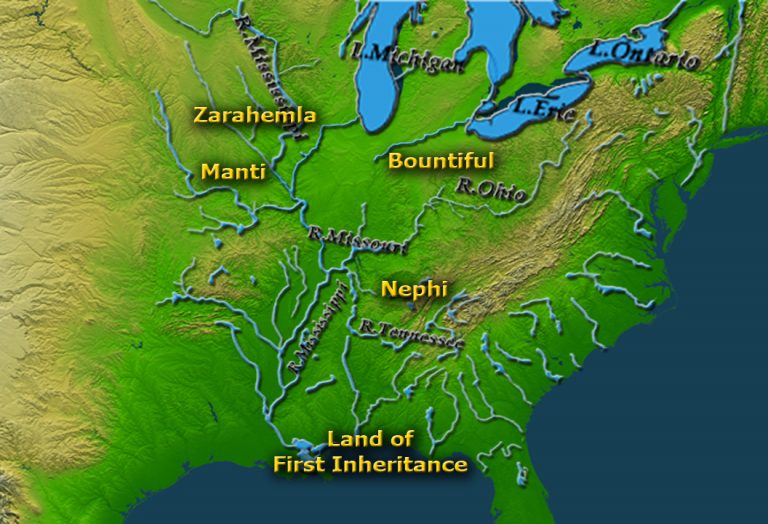

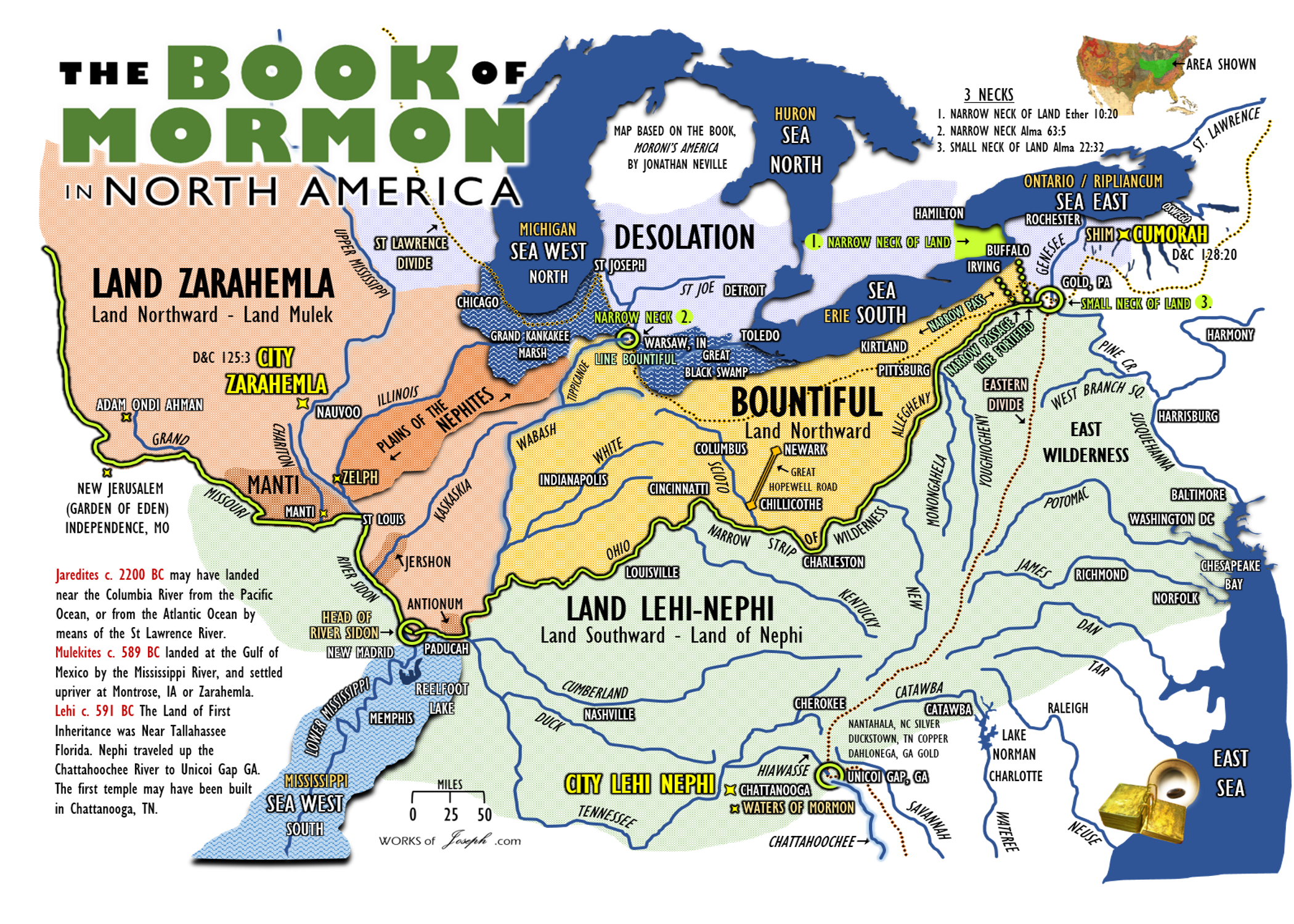
 Elder Jeffrey R. Holland said, “…Truly rock-ribbed faith and uncompromised conviction comes with its most complete power when it engages our head as well as our heart… Truth borne by the Holy Spirit comes with, in effect, two manifestations, two witnesses if you will—the force of fact as well as the force of feeling… I believe God intends us to find and use the evidence He has given—reasons, if you will—which affirm the truthfulness of His work… Evidence is still evidence even if it is not immediately observable… “My testimony to you tonight is that the gospel is infallibly true and that a variety of infallible proofs supporting that assertion will continue to come until Jesus descends as the ultimate infallible truth of all. Our testimonies aren’t dependent on evidence—we still need that spiritual confirmation in the heart of which we have spoken—but not to seek for and not to acknowledge intellectual, documentable support for our belief when it is available is to needlessly limit an otherwise incomparably strong theological position and deny us a unique, persuasive vocabulary in the latter-day arena of religious investigation and sectarian debate. Thus armed with so much evidence of the kind we have celebrated here tonight, we ought to be more assertive than we sometimes are in defending our testimony of truth… Farrer [English cleric Austin Farrer] said: “Though argument does not create conviction, lack of it destroys belief. What seems to be proved may not be embraced; but what no one shows the ability to defend is quickly abandoned. Rational argument does not create belief, but it maintains a climate in which belief may flourish.”… May our Father in Heaven bless us and an ever-larger cadre of young scholars around the Church to do more and more to discover and delineate and declare the reasons for the hope that is in us, that like those converted Lamanites, we may with bold conviction hold up to a world that desperately needs it “the greatness of the evidences which [we have] received,” especially of the truthfulness of the Book of Mormon, the keystone of our religion. In the name of Jesus Christ, amen.” The Greatness of the Evidence By Elder Jeffrey R. Holland August 16, 2017 (Color added) Full article HERE Video HERE


 4. “The whole of our journey, in the midst of so large a company of social honest and sincere men, wandering over the plains of the Nephites, recounting occasionally the history of the Book of Mormon, roving over the mounds of that once beloved people of the Lord, picking up their skulls & their bones, as a proof of its divine authenticity… During our travels we visited several of the mounds which had been thrown up by the ancient inhabitants of this country-Nephites, Lamanites, etc.” JS Papers Letter from Joseph to Emma. June 4, 1834
 6. “I was also informed concerning the aboriginal inhabitants of this country, and shown who they were, and from whence they came…I was also told where there was deposited some plates on which were engraven an abridgment of the records of the ancient prophets that had existed on this continent…. The principal nation of the second race fell in battle towards the close of the fourth century. The remnant are the Indians that now inhabit this country.” History of the Church 1: 301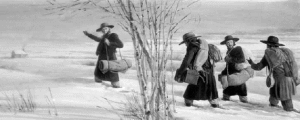

 Review the new Annotated Book of Mormon here:


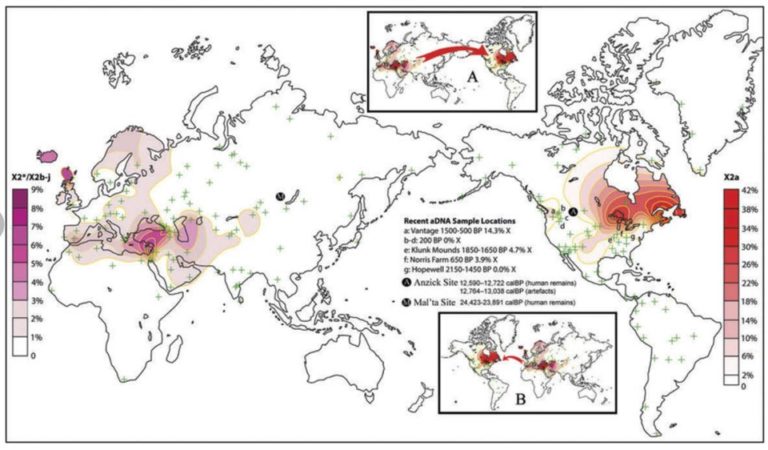






 Dylann Roof is depicted during his sentencing hearing in federal court in Charleston, S.C., Jan. 11, 2017.Dylann Roof is depicted during his sentencing hearing in federal court in Charleston, S.C., Jan. 11, 2017.Robert Maniscalco

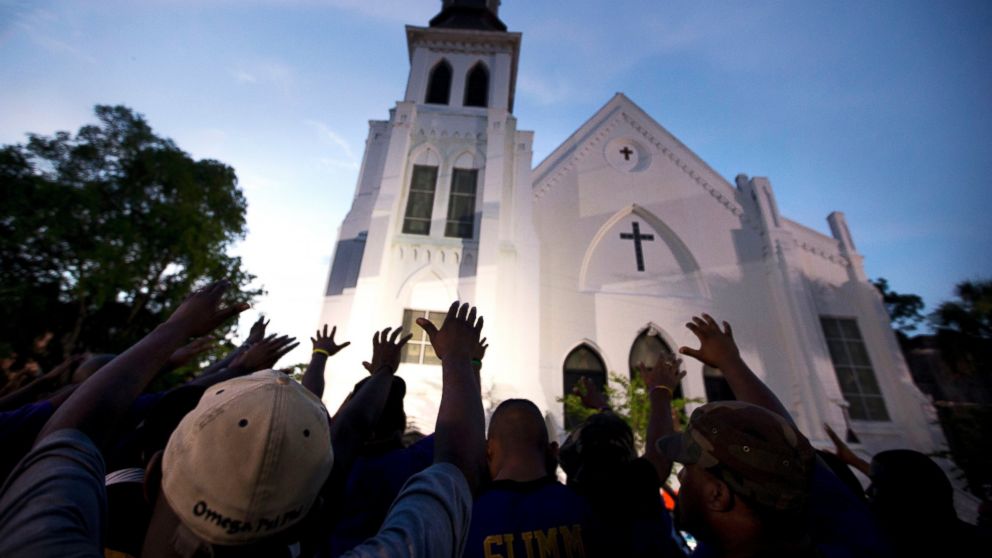



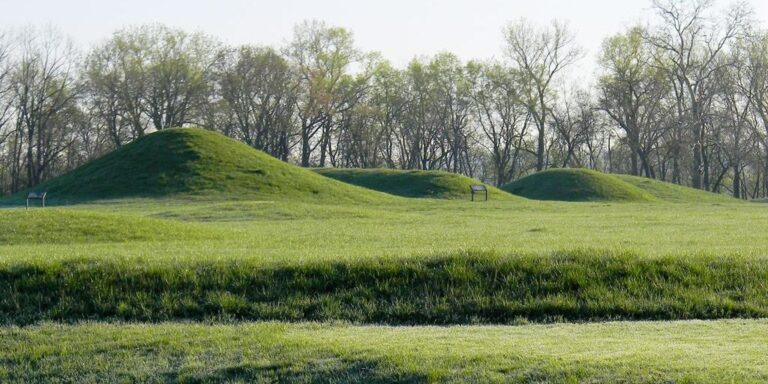


 “The Spaniards were amazed by the size of Etzanoa,” Blakeslee said. “They counted 2,000 houses that could hold 10 people each. They said it would take two or three days to walk through it all.” But for four centuries, the story of a big Native American town in Kansas made no sense to historians…. Onate sent armed patrols into the empty town.
 Another way to say this:


 Meridian Magazine has an agenda of teaching members of the Church that the prophets and apostles are wrong about Cumorah, so they published this article to reinforce that agenda.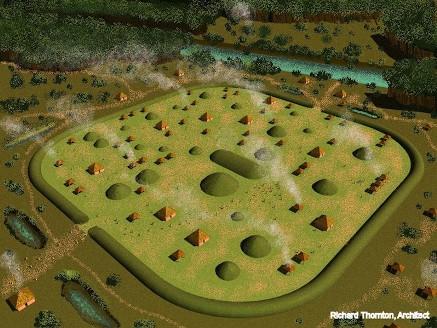


 As if the reader can hardly imagine a number as great as 30,000.





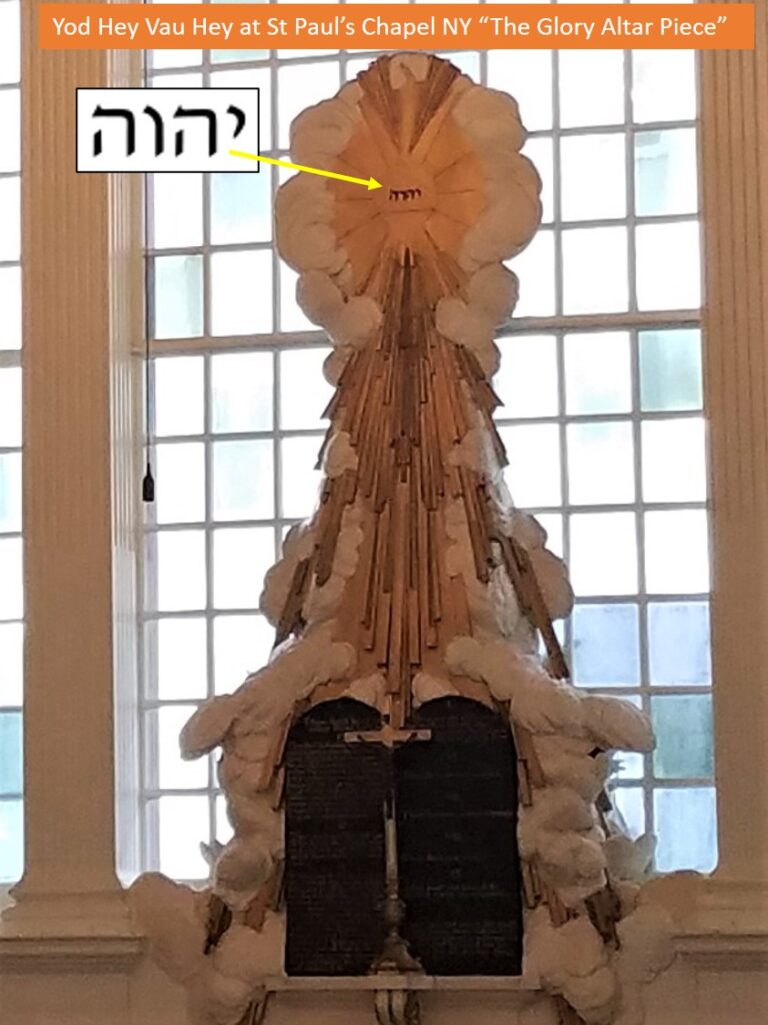


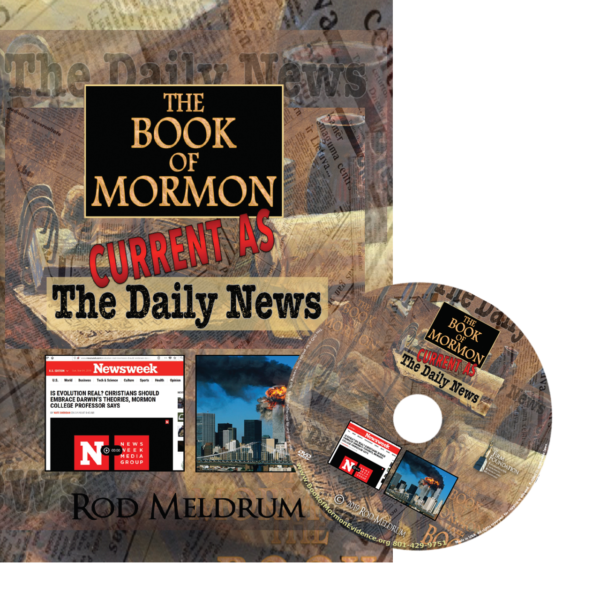


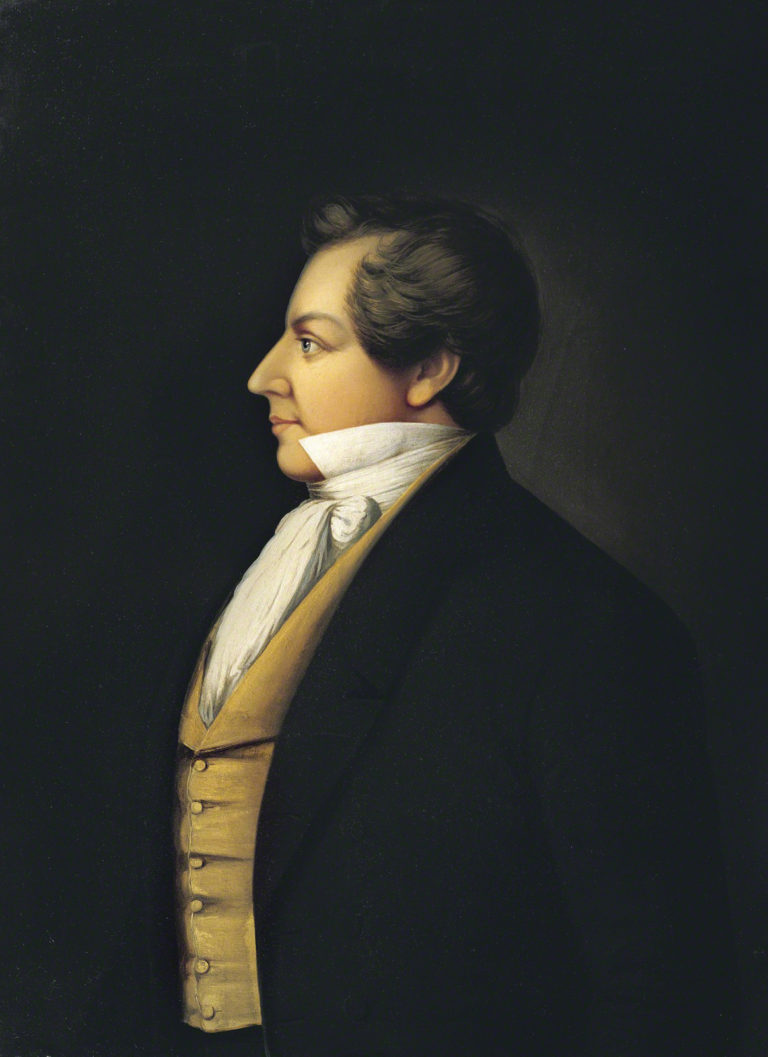

 “Who can say aught against Joseph Smith? I do not think that a man lives on the earth that knew him any better than I did, and I am bold to say that, Jesus Christ excepted, no better man ever lived or does live upon this earth. I feel like shouting Hallelujah all the time, when I think that I ever knew Joseph Smith, the Prophet.” Millennial Star, XXI (July 11, 1863)
 “The Prophet called the Quorum of the Twelve together several months before his death, and informed them that the Lord had commanded him to hasten their endowments; that he did not expect to remain himself to see the Temple completed; that he wished to confer the keys of the Kingdom of God upon other men, that they might build up the Church and Kingdom according to the pattern given. The Prophet stood before the Twelve from day to day, clothed with the spirit and power of God, and instructed them in the oracles of God, in the pattern of heavenly things, in the keys of the Kingdom, in the power of the priesthood, and in the knowledge of the last dispensation of the fulness of times.
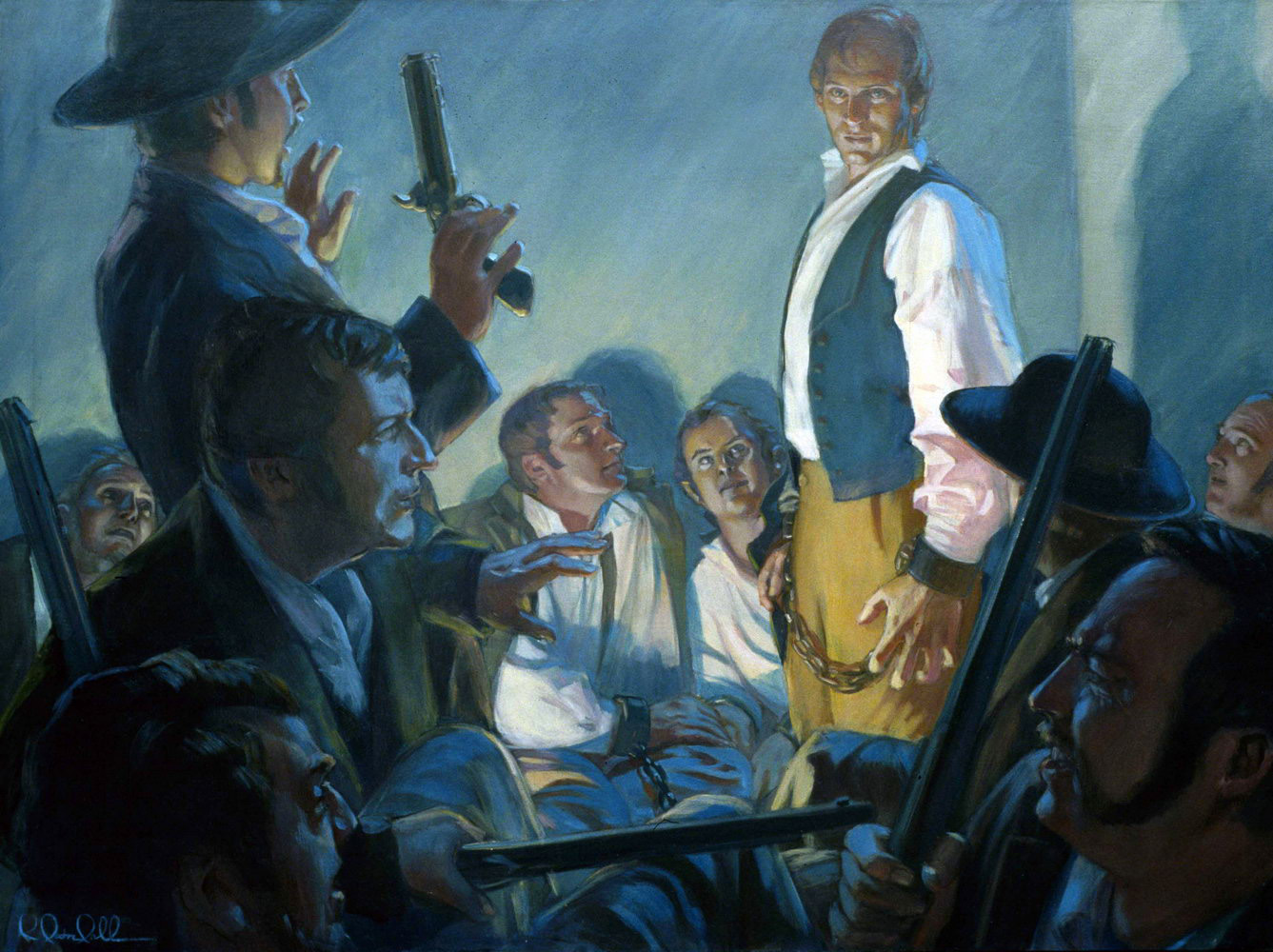 “Several of the officers of the troops in Carthage, and other gentlemen, curious to see the prophet, and to gratify a propensity to see the Elephant, visited Joseph in his room. Gen. Smith asked them if there was anything in his appearance that indicated he was the desperate character his enemies represented him to be; and he asked them to give him their honest opinion on the subject. The reply was “No, sir, your appearance would indicate the very contrary, General Smith, but we cannot see what is in your heart, neither can we tell what are your intentions;” to which Joseph replied,
 JSP History, 1838–1856, volume F-1 [1 May 1844–8 August 1844]
 In the meantime Joseph, Hyrum, and Taylor had their coats off; Joseph sprung to his coat for his six shooter, Hyrum for his single barrel, Taylor for [Stephen] Markham’s large hickory cane, and Dr Richards for Taylor’s cane; all sprang against the door; the balls whistled up the stairway, and in an instant one came through the door. Joseph Smith, John Taylor, and Dr Richards sprang to the left of the door, and tried to knock aside the guns of the ruffians. Hyrum was retreating back in front of the door and snapped his pistol, when a ball struck him in the left side of his nose, and he fell on his back on the floor, saying, “I am a dead man”. As he fell on the floor, another ball from the outside entered his left side and passed through his body with such force that it completely broke to pieces his watch which he wore in his vest pocket, and at the same instant another ball from the door grazed his breast and entered his head by the throat; <subsequently> a fourth ball entered his left leg. A shower of balls were pouring through all parts of the room, many of which lodged in the ceiling just above the head of Hyrum. [HC 6:617]
 Joseph reached round the door casing, and discharged his six shooter into the passage, several barrels missing fire. Continual discharges of musketry came into the room.
 When Hyrum fell, Joseph exclaimed, “Oh dear! brother Hyrum,” and opening the door a few inches he discharged his six shooter in the stairway (as stated before) two or three barrels of which missed fire. Joseph, seeing there was no safety in the room, and probably thinking that it would save the lives of his brethren in the room if he could escape, turned calmly from the door, dropped his pistol on the floor, and sprang into the window, when two balls pierced him from the door, and one entered his right breast from without, and he fell outward into the hands of his murderers exclaiming “O Lord my God”!! [HC 6:618] He fell partly on his right shoulder and back, his neck and head reaching the ground a little before his feet, and he rolled instantly on his face. From this position he was taken by a man who was barefoot and bareheaded, and having on no coat, his pants rolled up above his knees, and his shirt sleeves above his elbows. He set Joseph against the south side of the well curb, which was situated a few feet from the jail, when Col. Levi Williams ordered four men to shoot him; they stood about eight feet from the curb, and fired simultaneously. A slight cringe of the body was all the indication of pain visible when the balls struck him, and he fell on his face
 The ruffian who set him against the well curb now gathered a bowie knife for the purpose of severing his head from his body. He raised the knife, and was in the attitude of striking, when a light, so sudden and powerful, burst from the heavens upon the bloody scene (passing its vivid chain between Joseph and his murderers) that they were struck with terror. This light, in its appearance and potency, baffles all powers of description. The arm of the ruffian that held the knife fell powerless; the muskets of the four who fired fell to the ground, and they all stood like marble statues, not having the power to move a single limb of their bodies.
 456 Prest B[righam] Young and Elder W[ilford] Woodruff spent a portion of the day together in the city of Boston, and were sitting together in the railway depot [p. 229] <June 27> at the time of the massacre of the Prophets: they felt very sorrowful, and depressed in spirits, without knowing the cause.
 “As suggested earlier, the life of Joseph Smith in some degree followed the pattern set by his Master, Jesus Christ. That pattern holds true even when extended to its tragic conclusion. Like his Master, Joseph Smith also shed his blood in order that the final testament, the reestablishment of the new covenant, might be in full effect. (See Heb. 9:16.) Just prior to his death, the Prophet Joseph was reported to have remarked:
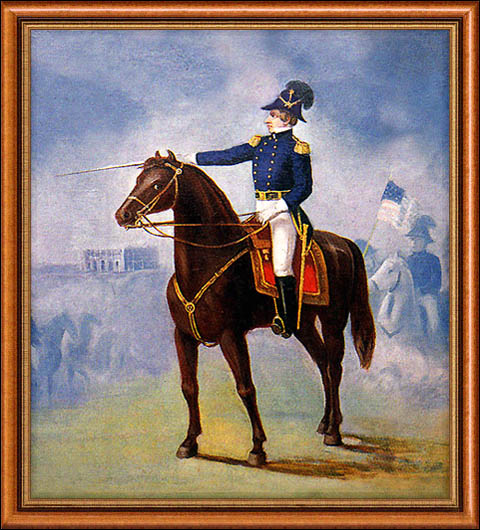


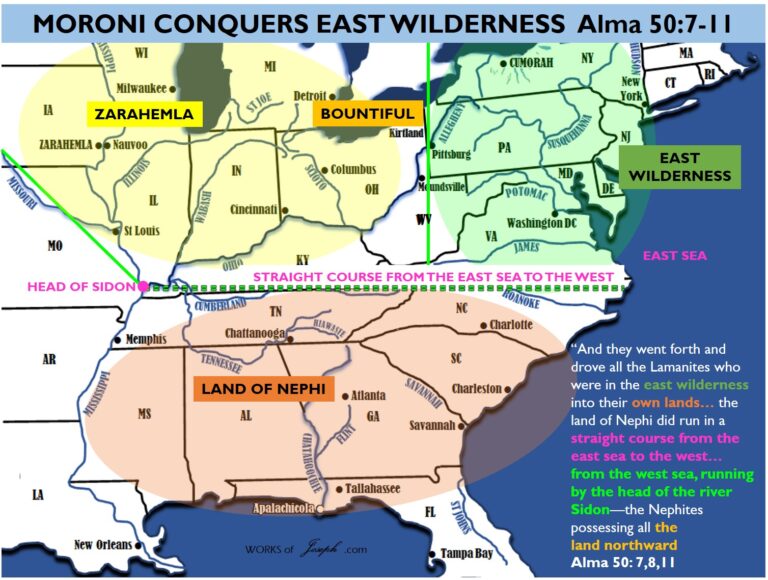




 On the great garrison road, near five miles westerly of the Platt, is a precious rivulet, called “Clear Creek,” along which the Indians camp, in hunting seasons, by scores
 But to my subject. The last Congress, if I am not mistaken, extended the limits, jurisdiction and laws, of the territory of Michigan, to all “the district of country north of the State of Missouri, and west of the Mississippi,” so that the “far west,” or western world of territory, laid down on some of the maps, as the Missouri Territory, is now bounded, south by the Arkansas Territory; and Mexican States; west by the Rocky Mountains: north by the British line, as it shall be established according to the treaty of Ghent, cornering on the north—east, at the Lake of the Woods: and east by Michigan Territory, and the State of Missouri: comprising more land than did the old “Thirteen United States,”
  Notwithstanding, this great country may be ranked as a part of the realm of the United States, yet, the title to the land, is held by the Indians that hunt upon it;


 But the glory of the whole matter is yet to be told; and that is, that the hour is near, when the Lord will gather his elect, even Israel; that the righteous may come flocking to the standard of God like doves to the windows.
  The generations generally, except the saints, as they have passed by, from the beginning, have had their measure, of glory, fame and power, because they have eagerly sought for it—but where are the mightiest of them? Numbered with the dead!
  No wonder the Saints endured martyrdom! No wonder the Son of God suffered upon the cross, it was for the sake of eternal life in a world of perfection, where the order and the power, and the realm, are unchangeable, and the enjoyment unutterable, (in this world.) Away with crowns and kingdoms; away with grandeur and gold; away with fame and fassions [fashions]—
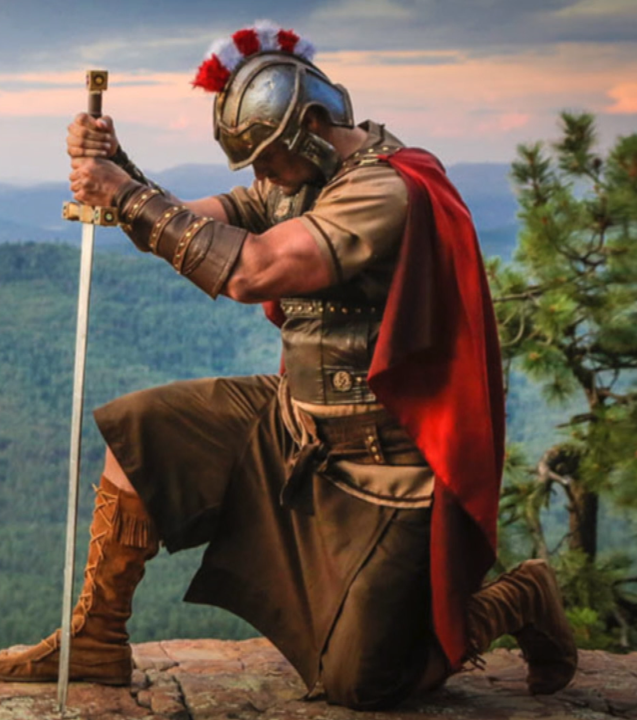


 Then he spoke of other leaders serving with him in the Nephite army, all of whom had fallen with the forces under their command.
  At the time Mormon recorded the details of this dreadful tragedy, he said that only twenty-four remained alive of all the men, women, and children of the Nephites. These surviving few were themselves killed the next day—with one exception, Moroni, whom the Lord spared to close up the written record.
 In closing his record, and knowing that it would come to us, Moroni pleaded with us, the modern inhabitants of this land, to escape the kind of tragic end which had obliterated his people. He said: